 DottaandPaperclip
dd777f4b73
DottaandPaperclip
dd777f4b73
## Thinking Path

> - Paperclip manages AI agents, their work, and their permissions.
> - Paperclip Runner supplies the same admitted tool authority to each
provider.
> - The Dot provider in #15402 needs reliable onboarding and useful
agent capabilities.
> - An idle Dot could not start work, assign a human, read skills, or
produce a workspace artifact.
> - Pairing also relied on a second configuration save before ordinary
admission could work.
> - This pull request adds governed idle admission and shared Runner
tools, and completes pairing atomically.
> - Operators can test Dot with fresh data while keeping normal company,
approval, budget, and run ownership checks.

## Linked Issues or Issue Description

**Subsystem affected**

Paperclip Runner, dedicated Dot MCP access, OAuth onboarding,
experimental settings, and empty worktree startup. This PR builds on
merged provider PR #15402. It reuses the merged MCP gateway from #14846
and assistant connection work from #14933 and #15380.

**Problem or motivation**

An idle Dot could see assignments but could not act on a conversation
request until someone created a task first. Its Runner catalog could not
assign tasks to humans or read pinned skills and workspace files.
First-time OAuth discovery and pairing also needed browser fixes, and a
completed pairing did not persist its binding reference on the agent.

**Proposed solution**

Keep Dot within the existing Runner. Admit a visible agent-authored
intake task for idle requests. Add people, human assignment, cross-task,
skill, and optional sandbox workspace tools through shared authority.
Relay assigned app calls through the configured MCP gateway. Add lease
renewal and follow-up references. Save pairing and its configuration
revision atomically. Show prerequisites and provide a complete copy
prompt.

**Roadmap alignment**

This extends the experimental provider in #15402. It uses the existing
governed gateway, task model, skills, artifact path, and native Runner.
It adds no separate execution subsystem.

## What Changed

- Add a standalone OpenAI Dot agent choice with an independent
experimental opt-in. It works with the general Runner option off.
Require Assistant connections (MCP), authenticated sign-in, and public
HTTPS for pairing.
- Use Dot’s own option for company package import. Allow an unpaired Dot
configuration to save after external billing acknowledgement; task
admission still requires pairing. Prepare the shared dev binary for
Dot-only opt-in.
- Label saved Dot agents as OpenAI Dot. Use prerequisite-check copy in
setup and runtime configuration.
- Route Dot creation directly to pairing after explicit external billing
acknowledgement. Hide local CLI, model, and harness setup for Dot.
Preserve the shared Runner implementation and canonical API type. Other
Runner providers still require their general opt-in.
- Add an empty worktree option with fresh signing keys and no production
data copy.
- Fix public-client OAuth negotiation, discovery compatibility, and
optional separate browser authorization origin.
- Add one-use pairing consent preview, clear copied setup instructions,
and atomic binding persistence and cleanup.
- Add idle request admission with stable request IDs and normal
scheduling, permissions, budgets, and task ownership.
- Add identity and people discovery, human task assignment and
reassignment, and authorized cross-task comments and documents.
- Read assigned skill files from pinned manifests. Relay assigned app
calls through the merged gateway without exposing credentials.
- Add an off-by-default workspace bridge. Constrain paths and writes.
Run commands in a deny-by-default OS sandbox with no network or injected
credentials. Reserve mutations before effects and never blindly repeat
uncertain work.
- Add rolling lease renewal, task pagination, bounded operation limits,
and deduplicated follow-up references without comment bodies in
webhooks.
- Add an off-by-default attachment reading setting. Restrict reads to
files on the current assigned task. Verify size and hash, cache bounded
verified copies per run, paginate text or binary bytes, and recheck live
authority before returning.
- Keep file grants operator-owned. Reject agent self-grants across
configuration routes. Preserve attachment consent in create/import
forms. Close generic API file bypasses while retaining current-run
response snapshots and permitted uploads.
- Keep provider limits explicit. Do not inherit a Dot binding,
attachment permission, or workspace permission when hiring another
agent.
- Include the required Markdown format in cross-task document writes and
validate the API title limit. Verify real creation and revision
persistence.
- Restrict command execution to Linux bubblewrap with descendant
containment. macOS retains workspace file tools and artifact publishing,
while refusing command calls. Explain the platform limit in setup.
- Exclude Paperclip instance state from workspace files, uploads,
artifact publication, and sandbox commands. Protect nested directories
and case variants. Fail closed when the directory protection scan
exceeds 4,096 directories.
- Add static UI compression for slow public tunnels. Document setup, the
complete tool inventory, and qualification limits.

## Verification

- Merge preparation on `00ca2c75b` integrates merged base #15402 and
master `fc6304dfe`. The ancestry commit preserves the reviewed follow-up
source tree. The subsequent security fix excludes instance state from
file tools, uploads, artifact publication, and sandbox commands. It
preserves private task authorization and task monitors. It regenerates
the combined tool catalog, seeded catalog digest, and protocol manifest.
Workspace typecheck, full build, and UI token gates pass. All sixteen
real Dot broker cases and 93 company import cases pass after the review
fixes and creator-attribution test correction. The exported
human-assignment catalog and Unicode page boundaries are also fixed. All
ten catalog tests and nine workspace/skill bridge tests pass. All 35
workspace bridge and authority tests passed after the instance-state
fix, including real macOS commands in that intermediate version. The
subsequent document and descendant-containment fixes pass 44 focused
tests across bridge, authority, and setup UI, with six Linux command
cases skipped on macOS. Real cross-task documents pass the route
validator and persist two revisions. macOS refuses command execution and
does not advertise the tool. Full workspace typecheck and build, changed
server/UI typechecks, and token gates pass again on the final commit.
Greptile rates final head 00ca2c75b 5/5 and its completed check
concludes success; all review threads are resolved. All 58 current-head
checks are complete: 54 passed and 4 intentionally skipped. This
includes full tests, typecheck, build, Runner, browser E2E, release
verification, and Canary Dry Run. The older full local root attempt
finished with 16,602 passes, 93 skips, and ten failures across two
suites: it began before source edits and retained earlier imported
implementations while loading later tests. Both suites pass a clean
final-head rerun (25 passed, six Linux-only command cases skipped on
macOS). This mixed-source full attempt is not a final-head full-suite
pass; use the fresh CI evidence below.
- Full workspace typecheck and build pass for the standalone Dot change
on head `392d54f80`. UI token gates are clean. The full workspace
typecheck passed before the final importer UI edit; the changed UI
typecheck, build, and token gates pass again on the final commit. The
server build passes for its unchanged final source.
- Standalone selection, creation, settings, harness visibility,
inventory, and runtime admission checks pass. OAuth onboarding and the
real Rust/PostgreSQL broker suite pass 27 cases with the general Runner
option disabled. Dot and MCP revocation still block pairing; other
Runner providers remain disabled. Create, hire, conversion, and
inherited-hire route regressions pass 68 cases. The runtime selection
suite passes 20 cases. The setup UI suite passes 50 cases. Company
import and dev binary checks pass 97 cases. Import UI checks pass 29
cases, including Dot-only selection, preservation of imported Dot
agents, generic Runner fallback, canonical configuration serialization,
and required billing acknowledgement. A read of the synthetic instance
reports the native binary required with Dot enabled, the general rollout
disabled, and no persisted native work.
- The latest attachment, operator-consent, generic API file-guard, and
bridge checks pass 80 tests. Cache and native lifecycle checks pass 550
tests; create/import builders pass 45 tests; attachment setup UI checks
pass 16 tests. The real Rust/PostgreSQL Dot broker suite passes 15
cases.
- Earlier authority, human assignment, pinned skill, confinement,
cancellation, inheritance, onboarding, replay, OpenAPI, and gateway
regressions pass their focused rechecks. Workspace writes reject
concurrent stale hashes.
- In the live empty test-drive, turn the general Runner option off and
leave Dot and MCP on. Add agent shows a separate OpenAI Dot choice.
Create rejects missing billing acknowledgement, saves the canonical Dot
configuration, and opens pairing. The existing paired Dot remains ready
and passes its prerequisite checks. No new plugin pairing was needed for
this UI change. The final browser import preview keeps a Dot source
agent as OpenAI Dot, falls back a generic Runner agent while its switch
is off, and offers Dot independently.
- Real Dot completed OAuth, signed MCP Events readiness, and an
event-only assigned document task in an empty synthetic instance.
Pairing saved its binding without a second configuration save.
- Real Dot verified human assignment, cross-task comments and documents,
pinned skill reading, sandbox commands, lease renewal, follow-up input,
and a downloaded artifact whose bytes and hash matched its receipt. An
idle conversation request created an intake, created a task for its
human owner, continued after a definite missing-file read error, and
finalized Done with exit code 0.
- After operator approval, real Dot read a synthetic assigned-task
attachment and wrote its file-only random proof into an agent-authored
document. Its first test required accepting review because the existing
document tool removed the final newline.
- On head `2626c8f9b`, real Dot read a 13,849-byte synthetic attachment
in two pages, used `expectedSha256` on page two, saved exactly its final
random marker, verified readback, and finalized Done with exit code 0. A
direct inbox check was required for this attachment qualification; it
does not claim event-only delivery.
- Previous head `392d54f80` passes all 55 checks (53 passed, two
intentionally skipped), including the full test, typecheck, build,
native Runner, browser, and release verification gates. Greptile rates
this head 5/5; all review threads are resolved.
- Head `2626c8f9b` passed all 56 checks: 54 passed and two intentionally
skipped. This includes full typecheck, build, native Runner, server
tests, serialized suites, browser E2E, and Canary Dry Run. The unchanged
Cursor managed-runtime test exceeded its five-second deadline on the
first attempt; its focused local suite passed all eight cases, and the
single CI rerun plus dependent verify gate passed.
- A prior full local serial test attempt reported 19 failures (16,141
passed, 88 skipped) and stopped before later wrapper groups. It began
before the final source edits. Every failed suite has a passing fresh
recheck; the macOS snapshot stress case passes alone in 227 seconds. The
previous head `000fb9261` passed all 56 CI checks. PRs leave
`pnpm-lock.yaml` unchanged; CI and the refresh bot own dependency
resolution.

## Risks

- Dot remains off by default. Its own opt-in does not enable other
Runner providers. It still requires the MCP option; disabling Dot blocks
new work while keeping existing recovery and saved bindings.
- Dot requires a stable public HTTPS origin. Its base provider in #15402
is merged. Temporary tunnels are useful for testing but are not
permanent deployments.
- Idle intake creates a visible agent-authored task. It does not
fabricate a human message or bypass ordinary admission.
- Workspace commands require Linux bubblewrap with a private PID
namespace; deployment qualification is still needed. macOS file tools
and artifact publishing remain available, but commands are disabled
because sandbox-exec does not contain detached descendants. There is no
unrestricted fallback. Command protection fails closed above 4,096
workspace directories. The historical macOS command walkthrough does not
qualify the current Linux implementation.
- Provider model choice, token usage, cost, native thread control, and
global external stopping remain unavailable. Known Paperclip budget
gates still apply.
- The workspace bridge and attachment reader are separate opt-in
settings. Reading assigned task files sends their contents to OpenAI.
Revocation prevents future reads but cannot withdraw bytes already sent.
Files are read on request; automatic inbound attachment staging remains
disabled.
- An existing event registration can retain earlier instructions that
prohibit extra tasks. Dot asked for permission before a second intake
after the final event-only bootstrap; that extra no-nudge continuation
is not live-qualified under that earlier registration. The later
attachment qualification submitted normally through the composer. The
revised onboarding prompt describes the new idle entry point, and its
protocol polling path is tested.
- OpenAI event delivery can be delayed; a webhook acknowledgement is not
proof that Dot has begun work.
- A running Dot can retain an old plugin catalog after tool refresh.
Refresh and actual tool exposure must be checked before using new
top-level actions.
- Hosted and remote controller modes are not qualified.

## Model Used

OpenAI Codex, based on GPT-6. The exact deployment ID and context window
size are not exposed in this session. Capabilities used: reasoning,
repository editing, code execution, test inspection, and browser
control.

## Checklist

- [x] I have included a thinking path that traces from project context
to this change
- [x] I have specified the model used (with version and capability
details)
- [x] I have checked ROADMAP.md and confirmed this PR does not duplicate
planned core work
- [x] I have searched GitHub for duplicate or related PRs and linked
them above
- [x] I have either linked existing issues or described the issue in-PR
following the relevant issue template
- [x] I have not referenced internal/instance-local Paperclip issues or
links
- [x] My branch name describes the change and contains no internal
Paperclip ticket id or instance-derived details
- [x] I have run tests locally and they pass (focused suites and all
fresh failure rechecks pass; the earlier full attempt is disclosed
above)
- [x] I have added or updated tests where applicable
- [x] I have updated relevant documentation to reflect my changes
- [x] I have considered and documented any risks above
- [x] All Paperclip CI gates are green
- [x] Greptile is 5/5 with no open P2s, recommendations, or follow-ups
- [x] I will address all Greptile and reviewer comments before
requesting merge

---------

Co-authored-by: Paperclip <noreply@paperclip.ing>

Quickstart · Docs · GitHub · Discord · Twitter · Website


Sign up for the Paperclip Cloud waitlist →
Paperclip is the app people use to manage AI agents for work.
Open-source orchestration for teams of AI agents.
If OpenClaw is an employee, Paperclip is the company.
Paperclip is a Node.js server and React UI that orchestrates a team of AI agents to run a business. Bring your own agents, assign goals, and track work and costs from one dashboard. Choose models and harnesses per agent while keeping your team's tasks, skills, permissions, and history in one place.
It looks like a task manager. Under the hood: org charts, budgets, governance, goal alignment, and agent coordination.
Manage business goals, not pull requests.
| Step | Example | |
|---|---|---|
| 01 | Define the goal | "Build the #1 AI note-taking app to $1M MRR." |
| 02 | Hire the team | CEO, CTO, engineers, designers, marketers — any bot, any provider. |
| 03 | Approve and run | Review strategy. Set budgets. Hit go. Monitor from the dashboard. |
| Works with |
 OpenClaw |
 Claude Code |
 Codex |
 Cursor + Cloud |
 Gemini CLI |
 OpenCode |
 Pi |
 Hermes + Gateway |
 Grok Build |
 Kimi Code |
If it can receive a heartbeat, it's hired.
Custom processes, HTTP endpoints, and external adapter packages extend the roster. See the adapter overview for setup and capabilities.
Paperclip is right for you if
- ✅ You want to build autonomous AI organizations
- ✅ You coordinate many different agents (OpenClaw, Codex, Claude, Cursor) toward a common goal
- ✅ You have 20 simultaneous Claude Code terminals open and lose track of what everyone is doing
- ✅ You want agents running autonomously 24/7, but still want to audit work and chime in when needed
- ✅ You want to monitor costs and enforce budgets
- ✅ You want a process for managing agents that feels like using a task manager
- ✅ You want to manage your autonomous businesses from your phone
The four pillars
Four things have to work for an organization of AI agents to actually produce: the tasks, the org, the training, and the infrastructure. Paperclip is built around exactly those four pillars.
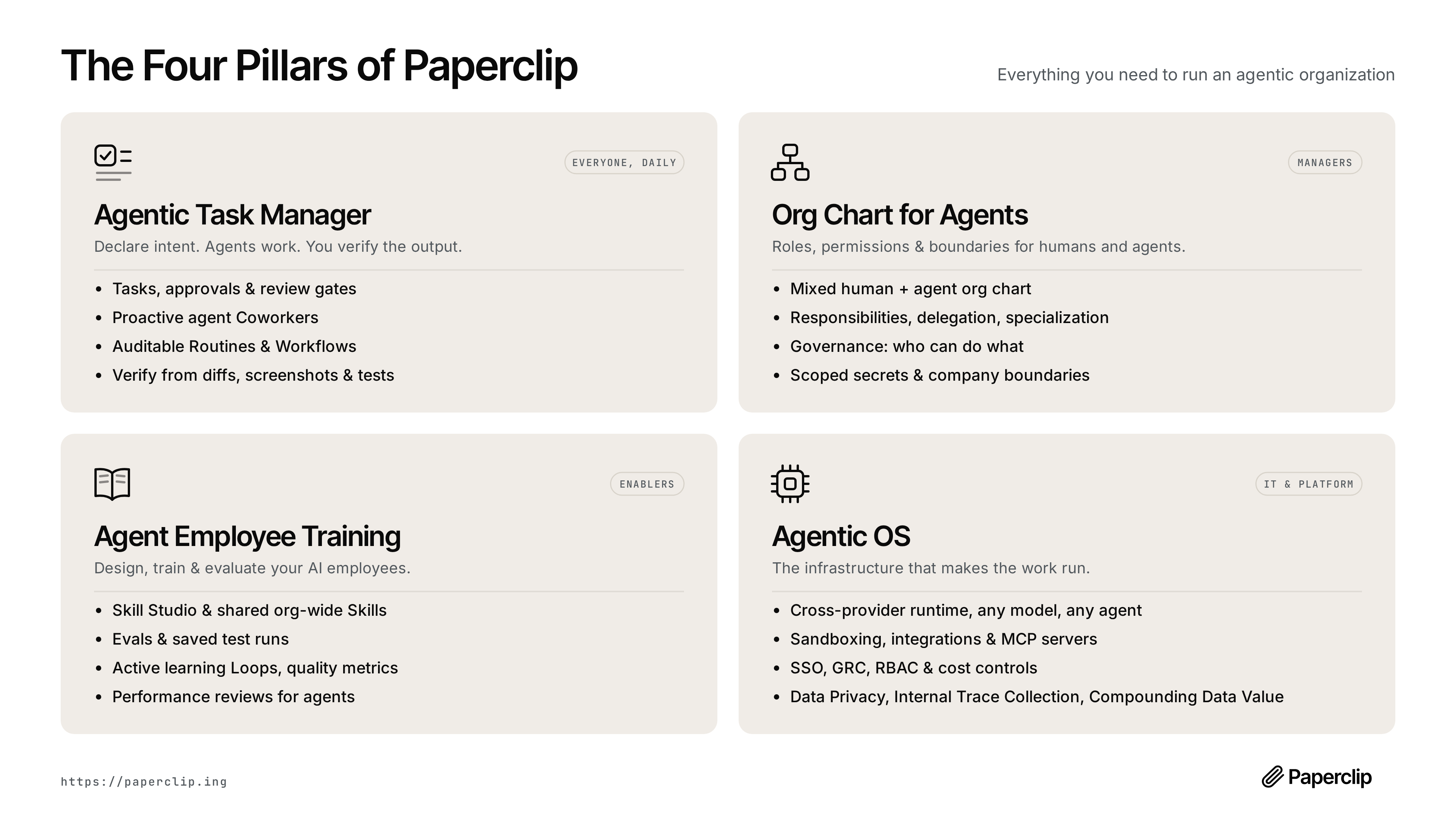
| Pillar | Built for | What it covers |
|---|---|---|
| Agentic Task Manager — Declare intent. Agents work. You verify the output. | Everyone, daily | Tasks, approvals & review gates · proactive agent coworkers · auditable routines & workflows · verify from diffs, screenshots & tests |
| Org Chart for Agents — Roles, permissions & boundaries for humans and agents. | Managers | Mixed human + agent org chart · responsibilities, delegation, specialization · governance: who can do what · scoped secrets & company boundaries · connection permissions & responsible-user identities |
| Agent Employee Training — Design, train & evaluate your AI employees. | Enablers | Skill Studio & shared org-wide skills · evals & saved test runs · active learning loops & quality metrics · performance reviews for agents · saved test inputs · skill version history & restore · reusable team templates |
| Agentic OS — The infrastructure that makes the work run. | IT & platform | Cross-provider runtime: any model, any agent · sandboxing, integrations & MCP servers · SSO, GRC, RBAC & cost controls · data privacy, internal trace collection, compounding data value · personal & shared app connections · run history & opt-in tracing |
Features
🔌 Bring Your Own AgentAny agent, any runtime, one org chart. If it can receive a heartbeat, it's hired. |
🎯 Goal AlignmentLink tasks and projects to your organization goals. Agents receive the goal context behind their work. |
💓 HeartbeatsAgents wake for assigned work, follow-up messages, or configured schedules. Delegation flows up and down the org chart. |
💰 Cost ControlCompany, agent, and project budgets. Track reported spend, get threshold alerts, and pause work at configured limits. |
🏢 Multi-OrganizationOne deployment, many organizations. Separate tasks, agents, permissions, and activity histories for each. |
🎫 Task ThreadsKeep conversations, plans, blockers, files, and run history attached to the work. Assign tasks to agents or people. |
🛡️ GovernanceConfigure review and approval stages, approve hires, and pause, reassign, or stop work when needed. |
📊 Org ChartHierarchies, roles, reporting lines. Your agents have a boss, a title, and a job description. |
📱 Mobile ReadyMonitor and manage your autonomous businesses from anywhere. |
🔗 Apps & ConnectionsConnect services such as GitHub, Notion, and Railway, or your own MCP server. Set gateway actions to Allowed, Ask first, or Off. |
👥 Shared Agents, Personal AccountsChoose who can use a connection and which agents can access it. Managed GitHub operations can use the account of the person directing the work. |
🧠 Skills & Skill StudioInstall or write shared skills, test them with saved inputs, inspect results, and restore earlier versions. |
📅 Scheduled RoutinesRun recurring work on a schedule or trigger it through an API or webhook. Each run has a task, an owner, and a history. |
📎 Artifacts & FeedbackFind the files and documents agents produce. Preview supported formats and leave comments on specific passages in documents. |
📦 Ready-Made TeamsPreview and install teams with roles, skills, projects, and routines. Choose their runtimes and make the setup your own. |
Experimental Agent Chat and chat/email connectors add conversations with agents in Paperclip and through configured services such as Slack, Discord, Telegram, and AgentMail. Enable the relevant instance settings to try them.
Problems Paperclip solves
| Without Paperclip | With Paperclip |
|---|---|
| ❌ You have 20 Claude Code tabs open and can't track which one does what. On reboot you lose everything. | ✅ Tasks are ticket-based, conversations are threaded, sessions persist across reboots. |
| ❌ You manually gather context from several places to remind your bot what you're actually doing. | ✅ Context flows from the task up through the project and company goals — your agent always knows what to do and why. |
| ❌ Folders of agent configs are disorganized and you're re-inventing task management, communication, and coordination between agents. | ✅ Paperclip gives you org charts, ticketing, delegation, and governance out of the box — so you run a company, not a pile of scripts. |
| ❌ Runaway loops waste hundreds of dollars of tokens and max your quota before you even know what happened. | ✅ Spend tracking, budget alerts, and automatic pauses help you control the cost of ongoing work. |
| ❌ You have recurring jobs (customer support, social, reports) and have to remember to manually kick them off. | ✅ Routines create assigned tasks on a schedule, with outputs and run history you can inspect. |
| ❌ You have an idea, you have to find your repo, fire up Claude Code, keep a tab open, and babysit it. | ✅ Add a task in Paperclip. Your coding agent works on it until it's done. Management reviews their work. |
Why Paperclip is special
Paperclip handles the hard orchestration details correctly.
| Atomic task checkout. | A single assignee and execution locks prevent competing runs from claiming the same task. |
| Persistent work context. | Tasks, comments, and documents stay in Paperclip. Supporting adapters resume saved sessions across runs. |
| Runtime skill injection. | Agents can learn Paperclip workflows and project context at runtime, without retraining. |
| Governance with rollback. | Approval gates are enforced, config changes are revisioned, and bad changes can be rolled back safely. |
| Accountable connections. | Human access, agent eligibility, and gateway action permissions are separate controls. Approve a call once or save a revocable rule. |
| Goal-aware execution. | Linked tasks and projects carry goal ancestry so agents see the "why," not just a title. |
| Portable company templates. | Export/import orgs, agents, and skills with secret scrubbing and collision handling. |
| Organization boundaries. | Company-scoped access checks keep each organization's work, agents, and activity separate within one deployment. |
What's Under the Hood
Paperclip is a full control plane, not a wrapper. Before you build any of this yourself, know that it already exists:
┌──────────────────────────────────────────────────────────────┐
│                       PAPERCLIP SERVER                       │
│                                                              │
│  ┌───────────┐  ┌───────────┐  ┌───────────┐  ┌───────────┐  │
│  │Identity & │  │  Work &   │  │ Heartbeat │  │Governance │  │
│  │  Access   │  │   Tasks   │  │ Execution │  │& Approvals│  │
│  └───────────┘  └───────────┘  └───────────┘  └───────────┘  │
│                                                              │
│  ┌───────────┐  ┌───────────┐  ┌───────────┐  ┌───────────┐  │
│  │ Org Chart │  │Workspaces │  │  Plugins  │  │  Budget   │  │
│  │ & Agents  │  │ & Runtime │  │           │  │ & Costs   │  │
│  └───────────┘  └───────────┘  └───────────┘  └───────────┘  │
│                                                              │
│  ┌───────────┐  ┌───────────┐  ┌───────────┐  ┌───────────┐  │
│  │ Routines  │  │ Secrets & │  │ Activity  │  │  Company  │  │
│  │& Schedules│  │  Storage  │  │ & Events  │  │Portability│  │
│  └───────────┘  └───────────┘  └───────────┘  └───────────┘  │
└──────────────────────────────────────────────────────────────┘
         ▲              ▲              ▲              ▲
   ┌─────┴─────┐  ┌─────┴─────┐  ┌─────┴─────┐  ┌─────┴─────┐
   │  Claude   │  │   Codex   │  │   CLI     │  │ HTTP/web  │
   │   Code    │  │           │  │  agents   │  │   bots    │
   └───────────┘  └───────────┘  └───────────┘  └───────────┘
The Systems
|
Identity & Access — Two deployment modes (trusted local or authenticated), human roles and permissions, agent API keys, short-lived run JWTs, company memberships, and invite flows. Responsible-user attribution follows work through delegation and supported managed connections. |
Org Chart & Agents — Agents have roles, titles, reporting lines, permissions, and budgets. Adapter examples match the diagram: Claude Code, Codex, CLI agents such as Cursor/Gemini/bash, HTTP/webhook bots such as OpenClaw, and external adapter plugins. If it can receive a heartbeat, it's hired. |
|
Work & Task System — Issues carry company/project/goal/parent links, atomic checkout with execution locks, first-class blocker dependencies, comments, documents, attachments, work products, labels, and inbox state. Search across work, review document revisions, and leave anchored feedback. |
Heartbeat Execution — DB-backed wakeup queue with coalescing, budget checks, workspace resolution, secret injection, skill loading, and adapter invocation. Runs produce logs, usage records, and adapter-specific session state. Bounded recovery handles supported failures and surfaces cases that need human action. |
|
Workspaces & Runtime — Project repositories and workspaces, optional isolated execution workspaces (git worktrees, operator branches), and runtime services (dev servers, preview URLs). Sandbox providers extend execution beyond the local host; availability depends on the configured environment and adapter. |
Governance & Approvals — Board approval workflows, execution policies with review/approval stages, decision tracking, budget hard-stops, and agent pause/resume/terminate. Configured task reviews govern completion; connection action approvals govern calls through the tool gateway. |
|
Budget & Cost Control — Token and cost tracking by company, agent, project, goal, issue, provider, and model. Scoped budget policies with warning thresholds and hard stops. Enforcement uses recorded spend; usage reporting and in-flight work can delay a stop. |
Routines & Schedules — Recurring tasks with cron, webhook, and API triggers. Concurrency and catch-up policies. Each routine execution creates a tracked issue and wakes the assigned agent — no manual kick-offs needed. |
|
Plugins — Instance-wide plugin system with out-of-process workers, capability-gated host services, job scheduling, tool exposure, and UI contributions. Extend Paperclip without forking it. |
Secrets & Storage — Company secrets and per-person secret values, encrypted credential storage, local or S3-compatible file storage, attachments, and work products. Secret references supply credentials to authorized runs without copying values into ordinary agent configuration. |
|
Activity & Events — Mutating actions, heartbeat state changes, cost events, approvals, comments, and work products are recorded as durable activity so operators can audit what happened and why. |
Company Portability — Preview, export, and import organization packages with agents, skills, and optional projects, routines, tasks, and attachments. Referenced secret values are omitted; review packages before sharing because plain environment values and local paths can remain. Packages share an operating setup; full-instance recovery uses backups. |
What Paperclip is not
| Not just a chatbot. | Conversations stay attached to tasks, plans, decisions, and outputs. Experimental Agent Chat can hand work off to assigned tasks. |
| Not an agent framework. | We don't tell you how to build agents. We tell you how to run a company made of them. |
| Not just a workflow builder. | Routines and experimental pipelines operate within an organization, with roles, goals, budgets, and governance. |
| Not a prompt manager. | Agents bring their own prompts, models, and runtimes. Paperclip manages the organization they work in. |
| Not limited to one agent. | Start with one agent and grow into a team with shared skills, delegation, and review. |
| Not only for code review. | Coding and PR review fit alongside research, operations, content, and other work. |
Quickstart
Open source. Self-hosted. No Paperclip account required. Follow the guided quickstart to set up your first agent.
Just ask your agent to install Paperclip
Share the installation guide with your agent.
Or install it yourself
With Node.js 24.11 or newer installed:
npx paperclipai@latest onboard --yes
The CLI runs from npm's cache; your instance configuration and data persist locally.
See the installation guide for managed installs, pinned versions, canary and git-ref installs, updates, rollback, service management, and uninstalling.
For an isolated manual test instance that is already initialized with a CEO
agent, use test-drive. It stays in the foreground, never installs a service
or creates a first task, and opens the browser only after setup succeeds:
ANTHROPIC_API_KEY=... npx paperclipai test-drive
OPENAI_API_KEY=... npx paperclipai test-drive --harness codex
OPENROUTER_API_KEY=... npx paperclipai test-drive \
  --harness opencode \
  --model openrouter/anthropic/claude-sonnet-4.5
Each run without --data-dir gets a unique, retained temporary directory; its
absolute path is printed at startup. Pass --data-dir to reuse one, or
--no-browser to leave the initialized instance unopened. When invoked from a
linked Git worktree, test-drive also enables task execution in that worktree.
See the test-drive guide for credential and
reuse behavior.
Troubleshooting: private npm registry
.npmrcIf this fails with an
E404forpaperclipai(or similar) and you use a private npm registry (for example GitHub Packages) via a global~/.npmrc,npxmay be resolvingpaperclipaiagainst that private registry instead of the public npm registry.Diagnostic:
npm config get registryWorkaround (cross-platform; force the public npm registry for this command):
npx --registry https://registry.npmjs.org paperclipai@latest onboard --yes
That quickstart path now defaults to trusted local loopback mode for the fastest first run. To start in authenticated/private mode instead, choose a bind preset explicitly:
npx paperclipai@latest onboard --yes --bind lan
# or:
npx paperclipai@latest onboard --yes --bind tailnet
If you already have Paperclip configured, rerunning onboard keeps the existing config in place. Use npx paperclipai configure to edit settings.
Or manually:
git clone https://github.com/paperclipai/paperclip.git
cd paperclip
pnpm install
pnpm dev
This starts the UI and API at http://localhost:3100. An embedded PostgreSQL database is created automatically — no setup required.
Requirements: Node.js 24.11+, pnpm 9.15+
Local Claude and Codex subscription sign-in also needs Python 3 and the corresponding provider CLI on the Paperclip host. The Docker image includes them.
Source development also builds the native Paperclip Runner when enabled (the self-hosted default). Install a Rust toolchain, or set PAPERCLIP_RUNNER_BINARY to a compatible prebuilt runner.
FAQ
Q: Is this project maintained or just slop?
A: Paperclip is maintained by the Paperclip team. We've merged over 2,700 pull requests.
Q: What does a typical setup look like?
A: Locally, a single Node.js process manages an embedded Postgres and local file storage. For production, point it at your own Postgres and deploy however you like. Configure projects, agents, and goals — the agents take care of the rest.
For remote access, use authenticated mode with a private-network bind such as Tailscale, or deploy the persistent server with Docker. See deployment modes and the Docker guide.
Q: Can I run multiple companies?
A: Yes. A single deployment can host multiple organizations with company-scoped data and access checks.
Q: How is Paperclip different from agents like OpenClaw or Claude Code?
A: Paperclip uses those agents. It orchestrates them into a company — with org charts, budgets, goals, governance, and accountability.
Q: Why should I use Paperclip instead of just pointing my OpenClaw to Asana or Trello?
A: Agent orchestration has subtleties in how you coordinate who has work checked out, how to maintain sessions, monitoring costs, establishing governance - Paperclip does this for you.
(Bring-your-own-ticket-system is on the Roadmap)
Q: Do agents run continuously?
A: Agents wake for assigned work and follow-up messages. Optional timer heartbeats let them check for work periodically; routines create recurring tasks on their own schedules. You can also connect externally running agents such as OpenClaw. A mention alone does not assign work or wake another agent.
Development
pnpm dev              # Full dev (API + UI, watch mode)
pnpm dev:once         # Full dev without file watching
pnpm dev:server       # Server only
pnpm dev:mobile       # Serve prebuilt UI on :3101 for phones/tablets (proxies /api → :3100)
pnpm dev:both         # Run `pnpm dev` and `pnpm dev:mobile` together
pnpm build            # Build all
pnpm typecheck        # Type checking
pnpm test             # Cheap default test run (Vitest only)
pnpm test:watch       # Vitest watch mode
pnpm test:e2e         # Playwright browser suite
pnpm db:generate      # Generate DB migration
pnpm db:migrate       # Apply migrations
pnpm test does not run Playwright. Browser suites stay separate and are typically run only when working on those flows or in CI.
See doc/DEVELOPING.md for the full development guide.
Roadmap
- ✅ Plugin system (e.g. add a knowledge base, custom tracing, queues, etc)
- ✅ Get OpenClaw / claw-style agent employees
- ✅ companies.sh - import and export entire organizations
- ✅ Easy AGENTS.md configurations
- ✅ Skills Manager, Skill Studio & Skills Store
- ✅ Scheduled Routines
- ✅ Better Budgeting
- ✅ Agent Reviews and Approvals
- ✅ Multiple Human Users
- ✅ Cloud / Sandbox agents (e2b, Cloudflare, Daytona, Modal, Novita, self-hosted Kubernetes)
- ✅ Artifacts & Work Products
- ✅ Deep Planning (planning mode, revisioned plans, plan approvals)
- ✅ Enforced Outcomes (watchdogs, recovery actions, review gates)
- ✅ MCP Tool Gateway & Apps (governed tool access)
- ✅ Secrets Manager with per-agent access
- ✅ Activity log & action attribution
- ✅ Self-healing runs & automatic recovery
- ✅ Agent evals & feedback
- ✅ Connected Apps
- ✅ Personal & Shared AI Accounts
- ✅ Shared Agents Use Personal GitHub Identities
- ✅ Skill Version History & Restore
- ✅ Document Comments & Revision History
- ✅ Company-Wide Search
- ✅ Multi-Model & Multi-Harness Teams
- 🟡 Memory / Knowledge
- ⚪ MAXIMIZER MODE
- ⚪ Work Queues
- ⚪ Self-Organization
- ⚪ Automatic Organizational Learning
- 🟡 Agent Chat
- 🟡 Cloud deployments
- ⚪ Desktop App
- ⚪ Bring-your-own-ticket-system (Asana / Linear / Jira as on-ramps)
This is the short roadmap preview. See the full roadmap in ROADMAP.md.
Community & Plugins
Find Plugins and more at awesome-paperclip
Observability
Paperclip ships with opt-in OpenTelemetry auto-instrumentation for the server (traces only). It activates when OTEL_EXPORTER_OTLP_ENDPOINT is set and supports grpc, http/protobuf, and http/json via the standard OTEL_EXPORTER_OTLP_PROTOCOL env var. @opentelemetry/api is a normal server dependency; the SDK, auto-instrumentation, and exporter packages are optional peer dependencies — install them only if you want tracing. See doc/observability.md for install commands and the full env-var reference.
Paperclip also ships with opt-in Sentry error monitoring for the server and the browser. Set SENTRY_DSN_FRONTEND to activate it for the browser and SENTRY_DSN_BACKEND to activate it for the server — each variable is optional, and the legacy SENTRY_DSN variable still works as a fallback for either component. The supported server SDK version is @sentry/node@10.71.0; it is an optional peer dependency for the server, so install it only if you want error monitoring. The browser SDK, @sentry/browser, is pinned to the same exact version. See doc/observability.md for the install command, the privacy settings, and the full default capture set.
Telemetry
Paperclip collects anonymous usage telemetry to help us understand how the product is used and improve it. No personal information, issue content, prompts, file paths, or secrets are ever collected. Private repository references are hashed with a per-install salt before being sent.
Contributors changing emitted telemetry events should follow the Telemetry Data Contract. For proposed first-party events that are not in the generated contract yet, follow Telemetry Workflow.
Telemetry is enabled by default and can be disabled with any of the following:
| Method | How |
|---|---|
| Environment variable | PAPERCLIP_TELEMETRY_DISABLED=1 |
| Standard convention | DO_NOT_TRACK=1 |
| CI environments | Automatically disabled when CI=true |
| Config file | Set telemetry.enabled: false in your Paperclip config |
Contributing
We welcome contributions. See the contributing guide for details.
Community
- Discord — Join the community
- Twitter / X — Follow updates and announcements
- GitHub Issues — bugs and feature requests
- GitHub Discussions — ideas and RFC
License
MIT © 2026 Paperclip Labs, Inc
Star History
Open source under MIT. Built for people who want to get work done, not babysit agents.