 dependabot[bot]
69e8585146
Bumps [better-auth](https://github.com/better-auth/better-auth/tree/HEAD/packages/better-auth) from 1.6.28 to 1.7.0. <details> <summary>Release notes</summary> <p><em>Sourced from <a href="https://github.com/better-auth/better-auth/releases">better-auth's releases</a>.</em></p> <blockquote> <h2>v1.7.0</h2> <p><strong>Blog post:</strong> <a href="https://better-auth.com/blog/1-7">Better Auth 1.7</a></p> <h2><code>better-auth</code></h2> <h3>❗ Breaking Changes</h3> <ul> <li>Moved database joins out of <code>experimental</code> into the stable <code>advanced.database.joins</code> option (<a href="https://redirect.github.com/better-auth/better-auth/pull/10359">#10359</a>) <blockquote> <p><strong>Migration:</strong> Replace <code>experimental: { joins: true }</code> with <code>advanced: { database: { joins: true } }</code>. Drizzle and Prisma users should regenerate their schema (<code>npx auth@latest generate</code>) so it includes the required relations.</p> </blockquote> </li> <li>Scoped account identity by trusted issuer, keying accounts on <code>(issuer, accountId)</code> (<a href="https://redirect.github.com/better-auth/better-auth/pull/10403">#10403</a>) <blockquote> <p><strong>Migration:</strong> Accounts now require <code>Account.issuer</code>. Read provider identity from <code>accountInfo.account.accountId</code>, drop <code>mapping.id</code> from SSO configs, and give the <code>microsoftEntraId</code> helper a concrete tenant GUID. Apply the account-identity backfill in the 1.7 upgrade guide before deploying.</p> </blockquote> </li> <li>Required captcha endpoint entries to match full auth paths, with wildcard support (<a href="https://redirect.github.com/better-auth/better-auth/pull/10004">#10004</a>) <blockquote> <p><strong>Migration:</strong> Replace partial paths such as <code>/sign-in</code> with explicit wildcards like <code>/sign-in/*</code> or <code>/sign-in/**</code>.</p> </blockquote> </li> <li>Moved the MCP plugin into its own <code>@better-auth/mcp</code> package built on the OAuth provider (<a href="https://redirect.github.com/better-auth/better-auth/pull/9992">#9992</a>) <blockquote> <p><strong>Migration:</strong> Install <code>@better-auth/mcp</code> and <code>@better-auth/cimd</code>, add the now-required <code>jwt()</code> plugin, and move options nested under <code>oidcConfig</code> to flat <code>mcp({ ... })</code> options. Rename <code>withMcpAuth</code> to <code>requireMcpAuth</code> and <code>mcpHandler</code> to <code>createMcpProtectedRequestHandler</code>. Regenerate the schema (<code>npx auth migrate</code>): <code>oauthApplication</code> becomes <code>oauthClient</code>, plus new <code>oauthRefreshToken</code> and <code>oauthClientAssertion</code> tables.</p> </blockquote> </li> <li>Added OIDC back-channel logout so ending a session cuts off every connected app's API access (<a href="https://redirect.github.com/better-auth/better-auth/pull/9304">#9304</a>) <blockquote> <p><strong>Migration:</strong> Introspecting an access token whose session has ended now returns <code>{ active: false }</code>, and <code>/oauth2/userinfo</code> rejects it. Clients opt into notifications by registering <code>backchannel_logout_uri</code>. Run the schema migration for the new <code>oauthClient</code> and <code>oauthAccessToken</code> columns.</p> </blockquote> </li> <li>Modeled OAuth protected resources explicitly, with per-resource TTLs, scopes, claims, and signing pins (<a href="https://redirect.github.com/better-auth/better-auth/pull/9648">#9648</a>) <blockquote> <p><strong>Migration:</strong> <code>validAudiences</code> is removed: move each resource identifier into <code>resources</code> and link restricted clients through <code>oauthClientResource</code>. <code>@better-auth/mcp</code> now requires an explicit <code>resource</code>. Run <code>npx @better-auth/cli generate</code> and apply the migration before deploying.</p> </blockquote> </li> <li>Decoupled SCIM provisioning from the organization plugin (<a href="https://redirect.github.com/better-auth/better-auth/pull/10390">#10390</a>) <blockquote> <p><strong>Migration:</strong> SCIM configuration, client APIs, database schema, and the Group model are all replaced, and provisioning state cannot migrate in place. Follow the SCIM cutover in the 1.7 upgrade guide, including a full directory reprovision, before resuming traffic.</p> </blockquote> </li> <li>Added OTP-only two-factor enablement with a discriminated <code>enableTwoFactor</code> response (<a href="https://redirect.github.com/better-auth/better-auth/pull/9057">#9057</a>) <blockquote> <p><strong>Migration:</strong> <code>enableTwoFactor</code> now returns a <code>method</code> field (<code>"otp"</code> or <code>"totp"</code>); narrow on it before reading <code>totpURI</code> and <code>backupCodes</code>. Pass <code>method: "otp"</code> for OTP enrollment, which requires <code>otpOptions.sendOTP</code>.</p> </blockquote> </li> <li>Resolved the auth origin from <code>Host</code> by default when using a dynamic <code>baseURL</code> (<a href="https://redirect.github.com/better-auth/better-auth/pull/9134">#9134</a>) <blockquote> <p><strong>Migration:</strong> If your proxy exposes the public hostname only through <code>x-forwarded-host</code>, set <code>advanced.trustedProxyHeaders: true</code>. Deployments where the proxy rewrites <code>Host</code> (nginx default, Vercel, Cloudflare, Netlify) are unaffected.</p> </blockquote> </li> <li>Added unique lookup indexes for the device authorization <code>deviceCode</code> and <code>userCode</code> columns (<a href="https://redirect.github.com/better-auth/better-auth/pull/10059">#10059</a>) <blockquote> <p><strong>Migration:</strong> Resolve duplicate code values before applying the migration. MySQL and SQL Server installations must also convert both columns to bounded strings and clean up values longer than 191 characters.</p> </blockquote> </li> <li>Enforced S256 PKCE in the Electron sign-in flow and hardened custom-scheme origin checks (<a href="https://redirect.github.com/better-auth/better-auth/pull/9645">#9645</a>) <blockquote> <p><strong>Migration:</strong> Upgrade the <code>@better-auth/electron</code> client and server together and add your app's scheme to <code>trustedOrigins</code>. The <code>code_challenge_method</code> parameter and <code>disableOriginOverride</code> option are removed, and host-bearing custom-scheme entries now match that host exactly.</p> </blockquote> </li> <li>Identified Microsoft Entra accounts by the stable <code>oid</code> claim (<a href="https://redirect.github.com/better-auth/better-auth/pull/10204">#10204</a>) <blockquote> <p><strong>Migration:</strong> Migrate existing Microsoft account rows created from <code>sub</code> before upgrading. Tokens without a valid <code>oid</code> are rejected.</p> </blockquote> </li> <li>Required a Google client ID before Google One Tap verifies ID tokens (<a href="https://redirect.github.com/better-auth/better-auth/pull/10036">#10036</a>) <blockquote> <p><strong>Migration:</strong> Configure <code>oneTap({ clientId })</code> or <code>socialProviders.google.clientId</code>.</p> </blockquote> </li> <li>Removed the deprecated <code>oidcProvider</code> plugin (<a href="https://redirect.github.com/better-auth/better-auth/pull/10031">#10031</a>) <blockquote> <p><strong>Migration:</strong> Move OIDC authorization-server integrations to <code>@better-auth/oauth-provider</code>.</p> </blockquote> </li> <li>Rewrote the generic OAuth plugin as a first-class social provider with OAuth 2.1 defaults (<a href="https://redirect.github.com/better-auth/better-auth/pull/9069">#9069</a>) <blockquote> <p><strong>Migration:</strong> Replace <code>signIn.oauth2({ providerId })</code> with <code>signIn.social({ provider })</code>, <code>oauth2.link()</code> with <code>linkSocial()</code>, and drop <code>genericOAuthClient()</code>. Callbacks move to <code>/api/auth/callback/:id</code>, <code>pkce</code> now defaults to <code>true</code>, and <code>issuer</code> and <code>requireIssuerValidation</code> are removed in favor of OIDC discovery.</p> </blockquote> </li> <li>Separated OAuth device grant ownership into <code>oauthDeviceAuthorization()</code> (<a href="https://redirect.github.com/better-auth/better-auth/pull/10746">#10746</a>) <blockquote> <p><strong>Migration:</strong> The OAuth integration replaces the optional <code>resource</code> column with <code>oauthClientId</code> and <code>resources</code>, so regenerate and apply the schema. Let pending device codes expire before upgrading from an earlier 1.7 prerelease.</p> </blockquote> </li> <li>Verified provider <code>id_tokens</code> with a single shared verifier (<a href="https://redirect.github.com/better-auth/better-auth/pull/9828">#9828</a>) <blockquote> <p><strong>Migration:</strong> Custom <code>UpstreamProvider</code> implementations replace the removed <code>verifyIdToken</code> method with an <code>idToken</code> config carrying a JWKS source, issuer, and audience. PayPal client <code>id_token</code> sign-in now returns <code>ID_TOKEN_NOT_SUPPORTED</code>; its redirect flow is unchanged.</p> </blockquote> </li> </ul> <h3>Features</h3> <ul> <li>Added <code>clientAssertion</code> support to the Microsoft Entra ID social provider (<a href="https://redirect.github.com/better-auth/better-auth/pull/9898">#9898</a>)</li> <li>Made the <code>Auth</code> instance directly fetchable (<a href="https://redirect.github.com/better-auth/better-auth/pull/9431">#9431</a>)</li> <li>Added per-provider <code>requireEmailVerification</code> for social sign-in (<a href="https://redirect.github.com/better-auth/better-auth/pull/9929">#9929</a>)</li> <li>Added a <code>user.validateUserInfo</code> gate for rejecting an identity before a user is created or linked (<a href="https://redirect.github.com/better-auth/better-auth/pull/9864">#9864</a>)</li> <li>Added <code>hydrateSession</code> so <code>useSession</code> returns server-fetched data on the first render (<a href="https://redirect.github.com/better-auth/better-auth/pull/8733">#8733</a>)</li> <li>Added compound table indexes to plugin database schemas (<a href="https://redirect.github.com/better-auth/better-auth/pull/10402">#10402</a>)</li> </ul> <!-- raw HTML omitted --> </blockquote> <p>... (truncated)</p> </details> <details> <summary>Changelog</summary> <p><em>Sourced from <a href="https://github.com/better-auth/better-auth/blob/main/packages/better-auth/CHANGELOG.md">better-auth's changelog</a>.</em></p> <blockquote> <h2>1.7.0</h2> <h3>Minor Changes</h3> <ul> <li> <p><a href="https://redirect.github.com/better-auth/better-auth/pull/8733">#8733</a> <a href="https://github.com/better-auth/better-auth/commit/4e8e4c7fc5fb2723144cbf41c4a1bfa28de8d671"><code>4e8e4c7</code></a> Thanks <a href="https://github.com/bytaesu"><code>@bytaesu</code></a>! - Add <code>hydrateSession</code> to seed the client with a server-fetched session so <code>useSession</code> returns data on the first render.</p> </li> <li> <p><a href="https://redirect.github.com/better-auth/better-auth/pull/9930">#9930</a> <a href="https://github.com/better-auth/better-auth/commit/0cbaf81bed9dec4c56880ee78a532262386e1ec5"><code>0cbaf81</code></a> Thanks <a href="https://github.com/gustavovalverde"><code>@gustavovalverde</code></a>! - Anonymous account linking now works after social and generic OAuth sign-in in Expo and other in-app browsers, where the OAuth callback returns without the session cookie. <code>onLinkAccount</code> fires and the anonymous user is migrated; before, it was silently skipped.</p> <p>Plugins can now carry server-trusted data across an OAuth redirect with the new <code>addOAuthServerContext</code> API, read back on the callback via <code>getOAuthState().serverContext</code>. Unlike <code>additionalData</code>, it cannot be set from the request body, so it is the right place for values the server must trust.</p> <p>For <code>@better-auth/oauth-provider</code>, the post-login authorization query now travels through that server-only channel, so it can no longer be injected through <code>additionalData</code>.</p> </li> <li> <p><a href="https://redirect.github.com/better-auth/better-auth/pull/10004">#10004</a> <a href="https://github.com/better-auth/better-auth/commit/b36c38f9842d3416689340552989449a32007819"><code>b36c38f</code></a> Thanks <a href="https://github.com/bytaesu"><code>@bytaesu</code></a>! - The captcha plugin now requires endpoint entries to match full auth paths unless they use wildcard patterns. This prevents requests like <code>/sign-in//email</code> from bypassing captcha while preserving trailing-slash matches like <code>/sign-in/email/</code>. To protect multiple routes, replace partial paths like <code>/sign-in</code> with explicit wildcards such as <code>/sign-in/*</code> or <code>/sign-in/**</code>.</p> </li> <li> <p><a href="https://redirect.github.com/better-auth/better-auth/pull/10746">#10746</a> <a href="https://github.com/better-auth/better-auth/commit/6782647d7c2d248246f9ef3980e656725c29ce64"><code>6782647</code></a> Thanks <a href="https://github.com/gustavovalverde"><code>@gustavovalverde</code></a>! - OAuth device grants now use <code>oauthDeviceAuthorization()</code> alongside <code>oauthProvider()</code> or <code>mcp()</code>. This single integration replaces both the standalone <code>deviceCodeGrant()</code> plugin and the shared-grant configuration. Standalone Device Authorization no longer accepts or stores RFC 8707 resources, and <code>onDeviceAuthRequest</code> receives only <code>clientId</code> and <code>scope</code>. The OAuth integration rejects resource indicators that are not absolute, fragment-free URIs.</p> <p>The OAuth integration replaces the optional <code>resource</code> column with <code>oauthClientId</code> and <code>resources</code>. Regenerate and apply the schema when using it. Before upgrading from an earlier 1.7 prerelease, let pending OAuth device codes expire or delete them because they cannot be exchanged through the new integration.</p> </li> <li> <p><a href="https://redirect.github.com/better-auth/better-auth/pull/10402">#10402</a> <a href="https://github.com/better-auth/better-auth/commit/763a2671c5372d88c291881977c8a1c2e29034b1"><code>763a267</code></a> Thanks <a href="https://github.com/gustavovalverde"><code>@gustavovalverde</code></a>! - Plugin database schemas can now define named or generated table-level indexes across multiple fields. SQL migrations and generated Drizzle or Prisma schemas resolve configured table and column names consistently, while the MongoDB adapter creates the same indexes before the first index-enforcing write.</p> </li> <li> <p><a href="https://redirect.github.com/better-auth/better-auth/pull/9766">#9766</a> <a href="https://github.com/better-auth/better-auth/commit/bf39cbf13f3b934f728cde72b1e7ebdc4c85f641"><code>bf39cbf</code></a> Thanks <a href="https://github.com/GautamBytes"><code>@GautamBytes</code></a>! - Add a server-only <code>auth.api.consumePhoneNumberOTP</code> API for custom phone OTP flows that need to verify and consume a code without creating or updating users or sessions.</p> </li> <li> <p><a href="https://redirect.github.com/better-auth/better-auth/pull/10330">#10330</a> <a href="https://github.com/better-auth/better-auth/commit/081d3c379c720926295067d878c421b5e8684c78"><code>081d3c3</code></a> Thanks <a href="https://github.com/ping-maxwell"><code>@ping-maxwell</code></a>! - Allow the username plugin's separate <code>displayUsername</code> field to be omitted by setting <code>displayUsername: false</code> on both the server and client plugins.</p> </li> <li> <p><a href="https://redirect.github.com/better-auth/better-auth/pull/10059">#10059</a> <a href="https://github.com/better-auth/better-auth/commit/49b5cf650e1264ecc4c917ca193ea05c3b58a3b9"><code>49b5cf6</code></a> Thanks <a href="https://github.com/GautamBytes"><code>@GautamBytes</code></a>! - Device Authorization now creates unique database indexes for <code>deviceCode</code> and <code>userCode</code>, so each generated code must be unique in its column. Existing installations on every adapter must resolve duplicate values before applying the migration. MySQL and SQL Server installations must also convert both columns to bounded strings and clean up values longer than 191 characters before running it.</p> <p>Generated codes are limited to 191 characters. Issuance makes up to 3 attempts to overcome unique-key collisions, then returns <code>server_error</code> if it cannot create a unique <code>deviceCode</code> and <code>userCode</code>. Default-generated user codes accept case changes and readability separators during verification, approval, and denial; custom codes outside the default alphabet are matched exactly. The <code>/device</code> limiter allows 5 requests over a window equal to the configured code lifetime, while <code>/device/token</code> polling keeps its separate interval behavior.</p> </li> <li> <p><a href="https://redirect.github.com/better-auth/better-auth/pull/9645">#9645</a> <a href="https://github.com/better-auth/better-auth/commit/e0140297a59ddb59cccbcb4ba46c513de8cb86a7"><code>e014029</code></a> Thanks <a href="https://github.com/ping-maxwell"><code>@ping-maxwell</code></a>! - Harden the Electron OAuth flow and tighten custom-scheme trusted-origin matching.</p> <p>The Electron sign-in flow now mandates PKCE S256. Plain PKCE is rejected: the <code>code_challenge_method</code> parameter is gone and every authorization code is verified by hashing the verifier with SHA-256. The server no longer trusts an <code>electron-origin</code> header to set the request Origin. The Electron client now sends a real <code>Origin</code> (for example <code>myapp:/</code>), so upgrade the <code>@better-auth/electron</code> client and server together and make sure your app's scheme is in <code>trustedOrigins</code>. The unused <code>disableOriginOverride</code> option is removed.</p> <p>Custom-scheme entries in <code>trustedOrigins</code> now match by scheme and authority instead of string prefix. A host-less entry such as <code>myapp://</code> or <code>exp://</code> still trusts every host of that scheme, but a host-bearing entry such as <code>myapp://callback</code> matches that host exactly, so it is no longer satisfied by <code>myapp://callback.attacker.tld</code>.</p> </li> <li> <p><a href="https://redirect.github.com/better-auth/better-auth/pull/9948">#9948</a> <a href="https://github.com/better-auth/better-auth/commit/3d04fababbf3efd4c46a4012f46ed9397715c2e3"><code>3d04fab</code></a> Thanks <a href="https://github.com/yordis"><code>@yordis</code></a>! - feat(generic-oauth): add <code>refreshTokenParams</code> config to forward extra params on token refresh</p> <p>Multi-tenant OIDC providers (Zitadel multi-org, Auth0 with <code>audience</code>) need to send extra body params on the refresh call to rescope tokens without a full authorization redirect. The generic-oauth plugin now accepts a <code>refreshTokenParams</code> option (object or sync/async function) that is merged into the refresh request body, with <code>grant_type</code> and <code>refresh_token</code> protected from override. The function form receives request metadata for the request that triggered the refresh, so request-scoped data (headers, cookies) is available without out-of-band state like AsyncLocalStorage.</p> <p><code>UpstreamProvider.refreshAccessToken</code> now accepts an optional second <code>ctx</code> argument; the change is backwards compatible because existing implementations that take only <code>refreshToken</code> remain valid. See <a href="https://redirect.github.com/better-auth/better-auth/issues/7554">#7554</a>.</p> </li> <li> <p><a href="https://redirect.github.com/better-auth/better-auth/pull/9069">#9069</a> <a href="https://github.com/better-auth/better-auth/commit/c7d22539ec4f7322d9625ae2953d397c3863d097"><code>c7d2253</code></a> Thanks <a href="https://github.com/gustavovalverde"><code>@gustavovalverde</code></a>! - Rewrite the generic OAuth plugin as a first-class social provider with OAuth 2.1 security defaults. Providers now use <code>signIn.social</code> + <code>callback/:id</code> instead of dedicated plugin endpoints, with PKCE required by default (OAuth 2.1), RFC 9207 issuer validation, OIDC auto-discovery with <code>openid</code> scope injection, and typed provider IDs.</p> <p><strong>Breaking changes:</strong></p> <ul> <li><code>signIn.oauth2({ providerId })</code> replaced by <code>signIn.social({ provider })</code></li> <li><code>oauth2.link()</code> replaced by <code>linkSocial()</code></li> <li>Callback URL changed from <code>/api/auth/oauth2/callback/:id</code> to <code>/api/auth/callback/:id</code></li> <li><code>genericOAuthClient()</code> removed; generic OAuth providers now use the standard social client APIs</li> <li><code>pkce</code> defaults to <code>true</code> (was <code>false</code>); set <code>pkce: false</code> for providers that reject PKCE</li> <li><code>authorizationUrlParams</code> and <code>tokenUrlParams</code> only accept <code>Record<string, string></code></li> </ul> </li> </ul> <!-- raw HTML omitted --> </blockquote> <p>... (truncated)</p> </details> <details> <summary>Commits</summary> <ul> <li><a href="https://github.com/better-auth/better-auth/commit/ccd57c2dcb145a40a30c75ab3f6c89b94af08701"><code>ccd57c2</code></a> docs(changelog): align v1.7 release notes with final behavior (<a href="https://github.com/better-auth/better-auth/tree/HEAD/packages/better-auth/issues/10846">#10846</a>)</li> <li><a href="https://github.com/better-auth/better-auth/commit/f577ec5c766c4ccd0a677ad18ca5f4f17b245289"><code>f577ec5</code></a> chore: exit pre-release mode for v1.7.0</li> <li><a href="https://github.com/better-auth/better-auth/commit/69258d16709b977e519aa00a323ae54aea2b6164"><code>69258d1</code></a> chore: sync main to next</li> <li><a href="https://github.com/better-auth/better-auth/commit/e84ec5e76d30e10fd692e8084177360484d538c1"><code>e84ec5e</code></a> chore: release v1.6.30 (<a href="https://github.com/better-auth/better-auth/tree/HEAD/packages/better-auth/issues/10840">#10840</a>)</li> <li><a href="https://github.com/better-auth/better-auth/commit/bc93b27542cbdf74f6455e6f66a0b4292c247a12"><code>bc93b27</code></a> chore: release v1.7.0-rc.6 (<a href="https://github.com/better-auth/better-auth/tree/HEAD/packages/better-auth/issues/10772">#10772</a>)</li> <li><a href="https://github.com/better-auth/better-auth/commit/58c49eb97f04ff18aa823318a3856a013353fdc2"><code>58c49eb</code></a> chore: release v1.6.29 (<a href="https://github.com/better-auth/better-auth/tree/HEAD/packages/better-auth/issues/10809">#10809</a>)</li> <li><a href="https://github.com/better-auth/better-auth/commit/e6e1b4e8146a84d2a2c5fe2c497c81d03dfc2ad3"><code>e6e1b4e</code></a> perf(db): replace sequential get-then-delete loop with parallel deletes in de...</li> <li><a href="https://github.com/better-auth/better-auth/commit/80799e69314d4d13c875457d932545d54fbc7ada"><code>80799e6</code></a> chore: sync main to next</li> <li><a href="https://github.com/better-auth/better-auth/commit/3e485bf730c62b4ef3df2e55198179c3d15b5a9f"><code>3e485bf</code></a> docs(username): fix displayUsername release notes (<a href="https://github.com/better-auth/better-auth/tree/HEAD/packages/better-auth/issues/10776">#10776</a>)</li> <li><a href="https://github.com/better-auth/better-auth/commit/65fc17c755c3e2c8c77d5b401d612737764c219d"><code>65fc17c</code></a> fix(deps): align <code>drizzle-orm</code> peer range with drizzle-adapter (<a href="https://github.com/better-auth/better-auth/tree/HEAD/packages/better-auth/issues/10501">#10501</a>)</li> <li>Additional commits viewable in <a href="https://github.com/better-auth/better-auth/commits/v1.7.0/packages/better-auth">compare view</a></li> </ul> </details> <br /> Signed-off-by: dependabot[bot] <support@github.com> Co-authored-by: dependabot[bot] <49699333+dependabot[bot]@users.noreply.github.com>

Quickstart · Docs · GitHub · Discord · Twitter · Website


Paperclip is the app people use to manage AI agents for work.
Open-source orchestration for teams of AI agents.
If OpenClaw is an employee, Paperclip is the company.
Paperclip is a Node.js server and React UI that orchestrates a team of AI agents to run a business. Bring your own agents, assign goals, and track work and costs from one dashboard.
It looks like a task manager. Under the hood: org charts, budgets, governance, goal alignment, and agent coordination.
Manage business goals, not pull requests.
| Step | Example | |
|---|---|---|
| 01 | Define the goal | "Build the #1 AI note-taking app to $1M MRR." |
| 02 | Hire the team | CEO, CTO, engineers, designers, marketers — any bot, any provider. |
| 03 | Approve and run | Review strategy. Set budgets. Hit go. Monitor from the dashboard. |
| Works with |
 OpenClaw |
 Claude Code |
 Codex |
 Cursor |
 Bash |
 HTTP |
If it can receive a heartbeat, it's hired.
Paperclip is right for you if
- ✅ You want to build autonomous AI companies
- ✅ You coordinate many different agents (OpenClaw, Codex, Claude, Cursor) toward a common goal
- ✅ You have 20 simultaneous Claude Code terminals open and lose track of what everyone is doing
- ✅ You want agents running autonomously 24/7, but still want to audit work and chime in when needed
- ✅ You want to monitor costs and enforce budgets
- ✅ You want a process for managing agents that feels like using a task manager
- ✅ You want to manage your autonomous businesses from your phone
The four pillars
Four things have to work for an organization of AI agents to actually produce: the tasks, the org, the training, and the infrastructure. Paperclip is built around exactly those four pillars.
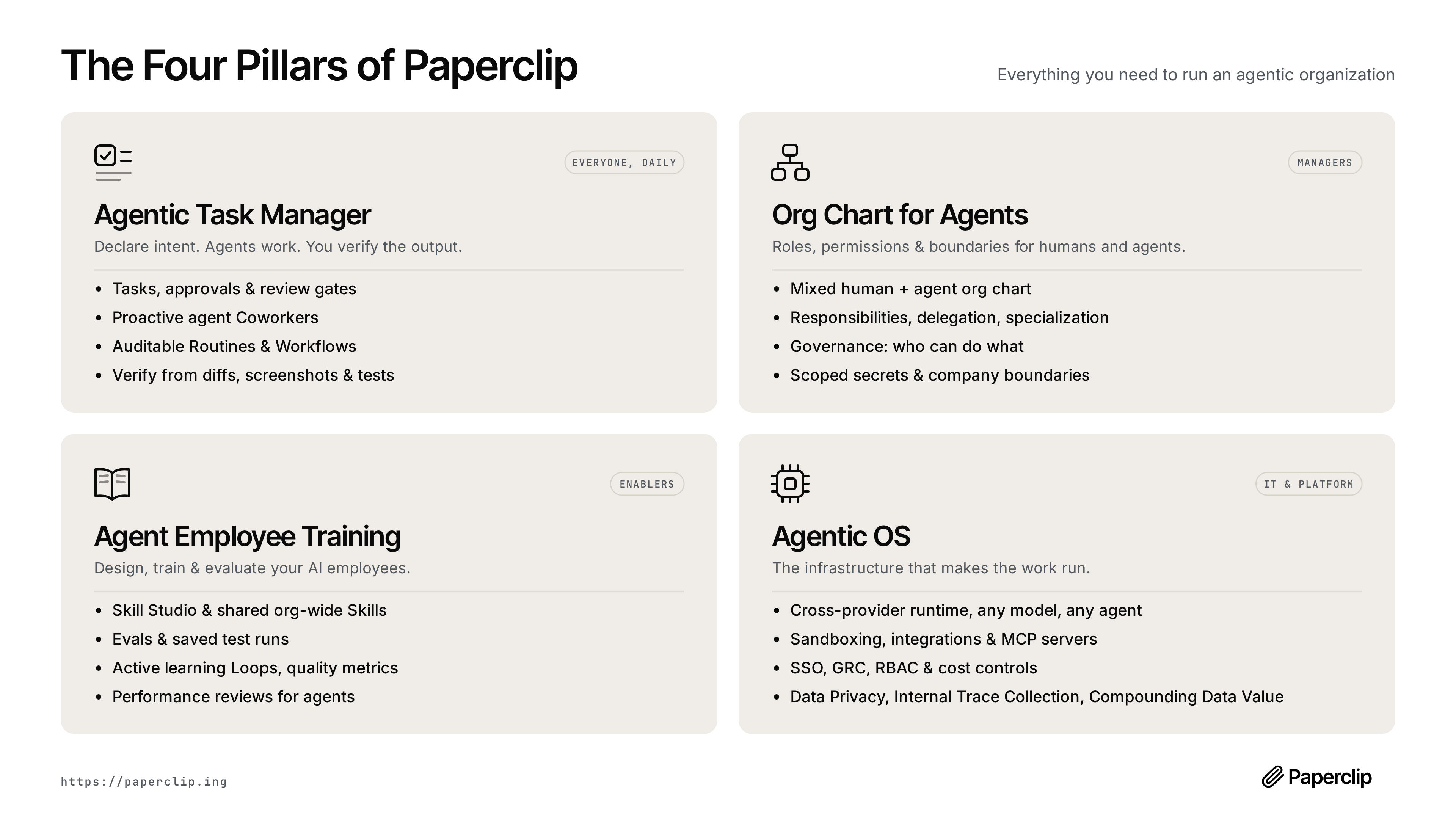
| Pillar | Built for | What it covers |
|---|---|---|
| Agentic Task Manager — Declare intent. Agents work. You verify the output. | Everyone, daily | Tasks, approvals & review gates · proactive agent coworkers · auditable routines & workflows · verify from diffs, screenshots & tests |
| Org Chart for Agents — Roles, permissions & boundaries for humans and agents. | Managers | Mixed human + agent org chart · responsibilities, delegation, specialization · governance: who can do what · scoped secrets & company boundaries |
| Agent Employee Training — Design, train & evaluate your AI employees. | Enablers | Skill Studio & shared org-wide skills · evals & saved test runs · active learning loops & quality metrics · performance reviews for agents |
| Agentic OS — The infrastructure that makes the work run. | IT & platform | Cross-provider runtime: any model, any agent · sandboxing, integrations & MCP servers · SSO, GRC, RBAC & cost controls · data privacy, internal trace collection, compounding data value |
Features
🔌 Bring Your Own AgentAny agent, any runtime, one org chart. If it can receive a heartbeat, it's hired. |
🎯 Goal AlignmentEvery task traces back to the company mission. Agents know what to do and why. |
💓 HeartbeatsAgents wake on a schedule, check work, and act. Delegation flows up and down the org chart. |
💰 Cost ControlMonthly budgets per agent. When they hit the limit, they stop. No runaway costs. |
🏢 Multi-CompanyOne deployment, many companies. Complete data isolation. One control plane for your portfolio. |
🎫 Ticket SystemEvery conversation traced. Every decision explained. Full tool-call tracing and immutable audit log. |
🛡️ GovernanceApprove hires, override strategy, pause or terminate any agent — at any time. |
📊 Org ChartHierarchies, roles, reporting lines. Your agents have a boss, a title, and a job description. |
📱 Mobile ReadyMonitor and manage your autonomous businesses from anywhere. |
Problems Paperclip solves
| Without Paperclip | With Paperclip |
|---|---|
| ❌ You have 20 Claude Code tabs open and can't track which one does what. On reboot you lose everything. | ✅ Tasks are ticket-based, conversations are threaded, sessions persist across reboots. |
| ❌ You manually gather context from several places to remind your bot what you're actually doing. | ✅ Context flows from the task up through the project and company goals — your agent always knows what to do and why. |
| ❌ Folders of agent configs are disorganized and you're re-inventing task management, communication, and coordination between agents. | ✅ Paperclip gives you org charts, ticketing, delegation, and governance out of the box — so you run a company, not a pile of scripts. |
| ❌ Runaway loops waste hundreds of dollars of tokens and max your quota before you even know what happened. | ✅ Cost tracking surfaces token budgets and throttles agents when they're out. Management prioritizes with budgets. |
| ❌ You have recurring jobs (customer support, social, reports) and have to remember to manually kick them off. | ✅ Heartbeats handle regular work on a schedule. Management supervises. |
| ❌ You have an idea, you have to find your repo, fire up Claude Code, keep a tab open, and babysit it. | ✅ Add a task in Paperclip. Your coding agent works on it until it's done. Management reviews their work. |
Why Paperclip is special
Paperclip handles the hard orchestration details correctly.
| Atomic execution. | Task checkout and budget enforcement are atomic, so no double-work and no runaway spend. |
| Persistent agent state. | Agents resume the same task context across heartbeats instead of restarting from scratch. |
| Runtime skill injection. | Agents can learn Paperclip workflows and project context at runtime, without retraining. |
| Governance with rollback. | Approval gates are enforced, config changes are revisioned, and bad changes can be rolled back safely. |
| Goal-aware execution. | Tasks carry full goal ancestry so agents consistently see the "why," not just a title. |
| Portable company templates. | Export/import orgs, agents, and skills with secret scrubbing and collision handling. |
| True multi-company isolation. | Every entity is company-scoped, so one deployment can run many companies with separate data and audit trails. |
What's Under the Hood
Paperclip is a full control plane, not a wrapper. Before you build any of this yourself, know that it already exists:
┌──────────────────────────────────────────────────────────────┐
│                       PAPERCLIP SERVER                       │
│                                                              │
│  ┌───────────┐  ┌───────────┐  ┌───────────┐  ┌───────────┐  │
│  │Identity & │  │  Work &   │  │ Heartbeat │  │Governance │  │
│  │  Access   │  │   Tasks   │  │ Execution │  │& Approvals│  │
│  └───────────┘  └───────────┘  └───────────┘  └───────────┘  │
│                                                              │
│  ┌───────────┐  ┌───────────┐  ┌───────────┐  ┌───────────┐  │
│  │ Org Chart │  │Workspaces │  │  Plugins  │  │  Budget   │  │
│  │ & Agents  │  │ & Runtime │  │           │  │ & Costs   │  │
│  └───────────┘  └───────────┘  └───────────┘  └───────────┘  │
│                                                              │
│  ┌───────────┐  ┌───────────┐  ┌───────────┐  ┌───────────┐  │
│  │ Routines  │  │ Secrets & │  │ Activity  │  │  Company  │  │
│  │& Schedules│  │  Storage  │  │ & Events  │  │Portability│  │
│  └───────────┘  └───────────┘  └───────────┘  └───────────┘  │
└──────────────────────────────────────────────────────────────┘
         ▲              ▲              ▲              ▲
   ┌─────┴─────┐  ┌─────┴─────┐  ┌─────┴─────┐  ┌─────┴─────┐
   │  Claude   │  │   Codex   │  │   CLI     │  │ HTTP/web  │
   │   Code    │  │           │  │  agents   │  │   bots    │
   └───────────┘  └───────────┘  └───────────┘  └───────────┘
The Systems
|
Identity & Access — Two deployment modes (trusted local or authenticated), board users, agent API keys, short-lived run JWTs, company memberships, invite flows, and OpenClaw onboarding. Every mutating request is traced to an actor. |
Org Chart & Agents — Agents have roles, titles, reporting lines, permissions, and budgets. Adapter examples match the diagram: Claude Code, Codex, CLI agents such as Cursor/Gemini/bash, HTTP/webhook bots such as OpenClaw, and external adapter plugins. If it can receive a heartbeat, it's hired. |
|
Work & Task System — Issues carry company/project/goal/parent links, atomic checkout with execution locks, first-class blocker dependencies, comments, documents, attachments, work products, labels, and inbox state. No double-work, no lost context. |
Heartbeat Execution — DB-backed wakeup queue with coalescing, budget checks, workspace resolution, secret injection, skill loading, and adapter invocation. Runs produce structured logs, cost events, session state, and audit trails. Recovery handles orphaned runs automatically. |
|
Workspaces & Runtime — Project workspaces, isolated execution workspaces (git worktrees, operator branches), and runtime services (dev servers, preview URLs). Agents work in the right directory with the right context every time. |
Governance & Approvals — Board approval workflows, execution policies with review/approval stages, decision tracking, budget hard-stops, agent pause/resume/terminate, and full audit logging. Nothing ships without your sign-off. |
|
Budget & Cost Control — Token and cost tracking by company, agent, project, goal, issue, provider, and model. Scoped budget policies with warning thresholds and hard stops. Overspend pauses agents and cancels queued work automatically. |
Routines & Schedules — Recurring tasks with cron, webhook, and API triggers. Concurrency and catch-up policies. Each routine execution creates a tracked issue and wakes the assigned agent — no manual kick-offs needed. |
|
Plugins — Instance-wide plugin system with out-of-process workers, capability-gated host services, job scheduling, tool exposure, and UI contributions. Extend Paperclip without forking it. |
Secrets & Storage — Instance and company secrets, encrypted local storage, provider-backed object storage, attachments, and work products. Sensitive values stay out of prompts unless a scoped run explicitly needs them. |
|
Activity & Events — Mutating actions, heartbeat state changes, cost events, approvals, comments, and work products are recorded as durable activity so operators can audit what happened and why. |
Company Portability — Export and import entire organizations — agents, skills, projects, routines, and issues — with secret scrubbing and collision handling. One deployment, many companies, complete data isolation. |
What Paperclip is not
| Not a chatbot. | Agents have jobs, not chat windows. |
| Not an agent framework. | We don't tell you how to build agents. We tell you how to run a company made of them. |
| Not a workflow builder. | No drag-and-drop pipelines. Paperclip models companies — with org charts, goals, budgets, and governance. |
| Not a prompt manager. | Agents bring their own prompts, models, and runtimes. Paperclip manages the organization they work in. |
| Not a single-agent tool. | This is for teams. If you have one agent, you probably don't need Paperclip. If you have twenty — you definitely do. |
| Not a code review tool. | Paperclip orchestrates work, not pull requests. Bring your own review process. |
Quickstart
Open source. Self-hosted. No Paperclip account required.
curl -fsSLO https://paperclip.ing/install.sh
curl -fsSLO https://paperclip.ing/install.sh.sha256
if command -v sha256sum >/dev/null 2>&1; then
  sha256sum -c install.sh.sha256
else
  shasum -a 256 -c install.sh.sha256
fi
bash install.sh
The installer ensures Node.js 24.11 or newer is available, installs a managed
Paperclip CLI under ~/.paperclip/cli, and starts interactive onboarding. It
can also install Paperclip as a background service on supported Linux and
macOS systems. The checksum detects transfer or publishing mistakes, but it is
served from the same origin as the script; use a release-tag or commit-pinned
GitHub copy when you need an independently hosted source.
For a non-interactive managed install:
curl -fsSL https://paperclip.ing/install.sh | bash -s -- --no-prompt --no-onboard
paperclipai onboard --yes
The piped form requires supported Node.js, npm, and npx to already be present.
If Node.js bootstrap is required, download and review install.sh before
running it so no privileged dependency-install command is accepted through a
pipe.
To try Paperclip without installing anything permanently:
npx --registry https://registry.npmjs.org paperclipai onboard --yes
Troubleshooting: private npm registry
.npmrcIf this fails with an
E404forpaperclipai(or similar) and you use a private npm registry (for example GitHub Packages) via a global~/.npmrc,npxmay be resolvingpaperclipaiagainst that private registry instead of the public npm registry.Diagnostic:
npm config get registryWorkaround (cross-platform; force the public npm registry for this command):
npx --registry https://registry.npmjs.org paperclipai onboard --yes
That quickstart path now defaults to trusted local loopback mode for the fastest first run. To start in authenticated/private mode instead, choose a bind preset explicitly:
paperclipai onboard --yes --bind lan
# or:
paperclipai onboard --yes --bind tailnet
If you already have Paperclip configured, rerunning onboard keeps the existing config in place. Use paperclipai configure to edit settings.
See doc/INSTALLING.md for pinned versions, canary and
git-ref installs, updates, rollback, service management, and uninstalling.
Or manually:
git clone https://github.com/paperclipai/paperclip.git
cd paperclip
pnpm install
pnpm dev
This starts the API server at http://localhost:3100. An embedded PostgreSQL database is created automatically — no setup required.
Requirements: Node.js 24.11+, pnpm 9.15+
FAQ
What does a typical setup look like? Locally, a single Node.js process manages an embedded Postgres and local file storage. For production, point it at your own Postgres and deploy however you like. Configure projects, agents, and goals — the agents take care of the rest.
If you're a solo entrepreneur you can use Tailscale to access Paperclip on the go. Then later you can deploy to e.g. Vercel when you need it.
Can I run multiple companies? Yes. A single deployment can run an unlimited number of companies with complete data isolation.
How is Paperclip different from agents like OpenClaw or Claude Code? Paperclip uses those agents. It orchestrates them into a company — with org charts, budgets, goals, governance, and accountability.
Why should I use Paperclip instead of just pointing my OpenClaw to Asana or Trello? Agent orchestration has subtleties in how you coordinate who has work checked out, how to maintain sessions, monitoring costs, establishing governance - Paperclip does this for you.
(Bring-your-own-ticket-system is on the Roadmap)
Do agents run continuously? By default, agents run on scheduled heartbeats and event-based triggers (task assignment, @-mentions). You can also hook in continuous agents like OpenClaw. You bring your agent and Paperclip coordinates.
Development
pnpm dev              # Full dev (API + UI, watch mode)
pnpm dev:once         # Full dev without file watching
pnpm dev:server       # Server only
pnpm dev:mobile       # Serve prebuilt UI on :3101 for phones/tablets (proxies /api → :3100)
pnpm dev:both         # Run `pnpm dev` and `pnpm dev:mobile` together
pnpm build            # Build all
pnpm typecheck        # Type checking
pnpm test             # Cheap default test run (Vitest only)
pnpm test:watch       # Vitest watch mode
pnpm test:e2e         # Playwright browser suite
pnpm db:generate      # Generate DB migration
pnpm db:migrate       # Apply migrations
pnpm test does not run Playwright. Browser suites stay separate and are typically run only when working on those flows or in CI.
See doc/DEVELOPING.md for the full development guide.
Roadmap
- ✅ Plugin system (e.g. add a knowledge base, custom tracing, queues, etc)
- ✅ Get OpenClaw / claw-style agent employees
- ✅ companies.sh - import and export entire organizations
- ✅ Easy AGENTS.md configurations
- ✅ Skills Manager, Skill Studio & Skills Store
- ✅ Scheduled Routines
- ✅ Better Budgeting
- ✅ Agent Reviews and Approvals
- ✅ Multiple Human Users
- ✅ Cloud / Sandbox agents (e2b, Cloudflare, Daytona, Modal, Novita, self-hosted Kubernetes)
- ✅ Artifacts & Work Products
- ✅ Deep Planning (planning mode, revisioned plans, plan approvals)
- ✅ Enforced Outcomes (watchdogs, recovery actions, review gates)
- ✅ MCP Tool Gateway & Apps (governed tool access)
- ✅ Secrets Manager with per-agent access
- ✅ Activity log & action attribution
- ✅ Self-healing runs & automatic recovery
- ✅ Agent evals & feedback
- ⚪ Memory / Knowledge
- ⚪ MAXIMIZER MODE
- ⚪ Work Queues
- ⚪ Self-Organization
- ⚪ Automatic Organizational Learning
- ⚪ CEO Chat
- 🟡 Cloud deployments (multi-tenant isolation & company Import/Export shipped)
- ⚪ Desktop App
- ⚪ Bring-your-own-ticket-system (Asana / Linear / Jira as on-ramps)
- ⚪ Connected Apps (one-click integrations, e.g. Vercel)
This is the short roadmap preview. See the full roadmap in ROADMAP.md.
Community & Plugins
Find Plugins and more at awesome-paperclip
Observability
Paperclip ships with opt-in OpenTelemetry auto-instrumentation for the server (traces only). It activates when OTEL_EXPORTER_OTLP_ENDPOINT is set and supports grpc, http/protobuf, and http/json via the standard OTEL_EXPORTER_OTLP_PROTOCOL env var. The @opentelemetry/* packages are optional peer dependencies — install them only if you want tracing. See doc/observability.md for install commands and the full env-var reference.
Telemetry
Paperclip collects anonymous usage telemetry to help us understand how the product is used and improve it. No personal information, issue content, prompts, file paths, or secrets are ever collected. Private repository references are hashed with a per-install salt before being sent.
Contributors changing emitted telemetry events should follow the Telemetry Data Contract. For proposed first-party events that are not in the generated contract yet, follow Telemetry Workflow.
Telemetry is enabled by default and can be disabled with any of the following:
| Method | How |
|---|---|
| Environment variable | PAPERCLIP_TELEMETRY_DISABLED=1 |
| Standard convention | DO_NOT_TRACK=1 |
| CI environments | Automatically disabled when CI=true |
| Config file | Set telemetry.enabled: false in your Paperclip config |
Contributing
We welcome contributions. See the contributing guide for details.
Community
- Discord — Join the community
- Twitter / X — Follow updates and announcements
- GitHub Issues — bugs and feature requests
- GitHub Discussions — ideas and RFC
License
MIT © 2026 Paperclip Labs, Inc
Star History
Open source under MIT. Built for people who want to get work done, not babysit agents.