 DottaandClaude Opus 5.5
3ad8f00192
## Thinking Path > - Paperclip is the open source app people use to manage AI agents for work > - Google Antigravity agents can run Google's native `/swarm` (a coordinator, helpers and a verifier) only on the Antigravity CLI > - #22731 adds a verified CLI route to the Runner, but nothing selects it yet > - A swarm must start only when the signed-in user asks for it, only when an admin turned the experimental feature on, and never silently run as an ordinary request when it cannot run > - This pull request adds the trusted `/swarm` request in the task composer, the server checks and run selection behind an experimental flag, removes Paperclip delegation tools from a swarm turn, and adds the attended catalog cells, docs and ledger > - The benefit is that a user can start a native swarm from a task, and gets one plain message when it is not available ## Linked Issues or Issue Description Refs #22731, #22727, #22728, #22701 **Subsystem affected** Task composer (UI), issue comments API, run selection (server), Paperclip Runner tool bridge, runner-e2e catalog, docs. **Problem or motivation** A user who writes `/swarm <request>` to a Google Antigravity agent should get a real native swarm in the task folder. Today `/swarm` is neutralised text, and the task runs as an ordinary request. **Proposed solution** Read a leading `/swarm` with the shared rule from #22727 in the composer, send it as a structured request, check it on the server, and select the CLI route from #22731 for that run only. ## What Changed - **Trusted start (UI).** `parseSwarmCommand` in `composer-commands.ts` uses `parseLeadingUserCommand` (the one rule from #22727). A leading `/swarm` in the task composer sends the request text with `nativeCommand: "swarm"`; a bare `/swarm` asks for a request; `/swarm` with an assignee change is refused; `/swarm` anywhere else stays text. A resent draft keeps the structured request. - **Contract.** `addIssueCommentSchema` gains `nativeCommand: "swarm"`. `instance.experimental.enableAntigravitySwarm` (feature catalog, settings page, server defaults), off by default. No Cloud policy in Core. - **Server (`services/antigravity-swarm.ts`, comments route, runtime selection).** - The comments route accepts `nativeCommand` only from a signed-in board user. When a swarm cannot run it answers 422 with one plain message and posts nothing: flag off, not a Google Antigravity assignee, a chat, Plan mode. - An accepted request is recorded in the activity log (`issue.antigravity_swarm_requested`, server-written) and the assignee's wake carries the comment id. Comment text is never read as a command. - Run selection makes the run a swarm only when that activity record exists. It refuses a remote or cloud environment and Plan mode with a plain run failure, so a swarm is never run as an ordinary request. It logs `issue.antigravity_swarm_started` in plain language: helper actions are auto-approved, Paperclip does not sandbox the helpers and cannot see their shell commands, and usage is one total. - The native execution input sets the Antigravity provider mode `swarm` for that run only, and carries the verified request in its own field, `provider.swarmRequest` (the Runner contract accepts it only with that mode and requires it there, 1 to 16,000 characters). The Runner copies it into the model envelope as `swarmRequest`; the swarm route sends exactly `/swarm <swarmRequest>` and never reads `task.prompt`, which holds rendered wake comments, task context and text the Runner adds (handoff, attachments, queued messages). - The swarm turn contract (mode `swarm`, envelope `paperclip.native-model-envelope.v3`, `swarmRequest` of 1 to 16,000 characters) is declared as `antigravitySwarmTurn` in `protocol/provider-schemas/acpx-sidecar.schema.json` and generated into TypeScript, so the pack `contractDigest` covers it (it changes; older image packs are rebuilt rather than reused). Provider profile `commandDigest`s and versions are unchanged, so no saved session is reset. - What the swarm sees of the task: only the request. The title, the description (which other people or agents may have written) and other comments are not part of the prompt; the coordinator can read them through Paperclip's task tools as data if it needs context. - An empty `/swarm` or one over 16,000 characters is refused in the composer, by the comments route (422, nothing posted) and at run selection (plain run failure), so it never runs as ordinary work. - A swarm run never takes queued messages, and Interrupt treats it as already started: it stops the swarm and delivers the queued message as the next ordinary request, before or after the provider accepted the turn. - Retry after Stop, and past the three automatic attempts, counts only when the signed-in user asked for it (their own Retry request on the task after the last attempt). Wake reasons and copied run context are not proof: a recovery that copies the request marker, an automatic retry on the user's behalf, or an agent wake that names `task_retry` stay bounded. - **Runner.** For a swarm turn the Paperclip bridge drops delegation tools (`paperclip_create_task`, `paperclip_create_issue`, hire/assign tools); the instructions also tell the coordinator not to delegate. - **runner-e2e.** `antigravity-swarm` suite, 5 local cells (`two-helpers-and-verifier`, `stop-mid-swarm`, `process-loss-retry`, `follow-up-after-swarm`, `flag-off-refusal`), explicit-only, never in `--all` or CI matrix jobs. There is no automated executor yet: the launcher refuses the cells and points at the live recipe. Catalog counts updated (1392 cells). - **Docs.** `tests/runner-e2e/SUITES.md`, `doc/evals.md`, and the `/swarm` section, ledger row and live recipe in `doc/plans/2026-11-22-antigravity-qualification.md`. ## Verification - `pnpm --filter @paperclipai/server exec vitest run src/services/antigravity-swarm.test.ts`: 2 passed (red first: module missing; Plan mode red then green). - `pnpm --filter @paperclipai/server exec vitest run src/__tests__/issue-comment-reopen-routes.test.ts -t swarm`: 3 passed; 2 red against the route without this change. - `pnpm --filter @paperclipai/ui exec vitest run src/components/task-chat/TaskChatComposer.test.tsx`: 164 passed, including 4 new `/swarm` tests (red first). - Runner: `vitest run src/drivers/acpx/antigravity-swarm-*.test.ts`: 69 passed (route tool filter red first). - runner-e2e: `antigravity-swarm.test.ts` (red first) plus the catalog, selector and Antigravity tests: 28 files passed. - Typecheck: server, UI (except generated Storybook files absent from a worktree) and runner: no errors. - Live, real CLI 1.5.15 with the owner's sign-in, through the driver: the receipt verified (pinned identity, task folder, `auto` read back, `gemini-3.8-flash` + `low`). Google then refused the prompt with its 429 quota text; the driver reported it as a typed "out of quota" failure, retired the CLI and nothing was written. - **Not run live yet:** the full Paperclip proof (swarm to Done, Stop, kill and Retry, follow-up, flag off). This PR is merged only after it passes. Recipe: `doc/plans/2026-11-22-antigravity-qualification.md#swarm-live-proof`. ## Risks ### Security notes: the trust boundary Helpers are auto-approved and Paperclip does not sandbox the CLI on a local computer, so the boundary is who asked and what text is sent. Every input that can influence it: **(a) Whether a run is a swarm** - `nativeCommand: "swarm"` on the comment request: accepted only from a signed-in board user; the request record (`issue.antigravity_swarm_requested`, actor = that user, `commentId`) commits in the same transaction as the comment. Paperclip-written. - `antigravitySwarmCommentId` on the wake/run context: set only by the comments route and by run selection. It is a pointer, never trusted alone: selection re-verifies comment id + task + company + human author (no agent author) + a matching record by the same user. - The pending request for marker-less wakes: the task's latest human comment, verified the same way. - Retry inheritance: the run's `retryOfRunId` chain (server-written), bounded to 8 hops on the same task. - Manual vs automatic: a request's first run, or a user's own Retry request (`task_retry` / `retry_failed_run`, requested by a user, not `initiatedBy` automation) after the last attempt. Not the wake reason string. - Instance flag `enableAntigravitySwarm` (admin), the assignee's adapter config (Google Antigravity), execution target (local only), work mode (Standard only: Plan, Ask and any other mode are refused, at comment time and at run time), chat vs task: all Paperclip-owned settings. - Prior attempts on the same request (run status rows): Paperclip-written. **(b) What text and tools the swarm gets** - The prompt: `/swarm ` + `provider.swarmRequest`, which is the recorded comment body minus a leading `/swarm`, trimmed, byte for byte (tested through the production input builder and envelope with a merged wake that contains an agent comment). The verified request. - The system prompt append: only Paperclip-authored text: Paperclip's fixed execution prompt, the run's hand-in values (the server-written completion revision and criterion IDs that `paperclip_finish`/`paperclip_block` require; never a criterion's requirement text), and the fixed swarm rules. **The swarm runs without the agent's own instructions**: the instruction bundle and connection instructions are left out, because an agent with an editable instructions folder can rewrite its instructions in an earlier ordinary run, the helpers act under auto mode, and Paperclip keeps no user-approved copy of those instructions to trust instead. - Tools: only Paperclip's own MCP bridge (any other assigned tool server refuses the swarm), with delegation, hiring, routing and generic API operations removed. Paperclip's permission handler approves a CLI permission request only when its tool name is `mcp_paperclip_<tool>` and `<tool>` is one the run's bridge admits; everything else is refused, and the CLI then ends the turn. Tool descriptions are Paperclip-authored; tool results (for example other comments) are data the coordinator reads, not the request. - Model and mode: the agent's configured model, Antigravity's `auto` mode, both read back and pinned by the receipt. - Not sent: task title, description, wake comments, continuation events, attachments, queued messages, handoff text. Known residual: a Retry or recovery run that has not yet been selected (still preparing) does not carry the request marker, so an Interrupt in that short window keeps the message for the turn boundary instead of stopping the run; the message is delivered after the run ends. - Off by default and local only. With the flag on, helpers act under Antigravity's `auto` mode. **Paperclip does not sandbox them on a local computer**, and their tool calls never reach Paperclip, so helper shell commands can write outside the task folder where the CLI's own sandbox allows (workspace plus temp directories). The settings text, the activity log and the plan doc say so. - On macOS the CLI uses its own Google sign-in from the login keychain, not Paperclip's stored connection. - Google's consumer terms have a clause about third-party tools that access the service. A legal read is pending; this PR does not claim compliance. - `/swarm` as the first word of a composer message is now a swarm request for every agent; for agents other than Google Antigravity the server refuses it with a plain message. To send the literal text, put other text first. - The new runner-e2e cells are attended only and have no automated executor. > For core feature work, check [`ROADMAP.md`](ROADMAP.md) first and discuss it in `#dev` before opening the PR. Feature PRs that overlap with planned core work may need to be redirected — check the roadmap first. See `CONTRIBUTING.md`. Review round 2 (heada2decc65f3): Greptile's "swarms must guess completion fields" fixed as above (runner `nativeSystemInstructions`, red first 1 in the fake-CLI swarm runtime test; request text to the CLI still exactly `/swarm <request>`); CI typecheck failure was a TS18046 in `acpx-runtime-sidecar.test.ts` (test-program typecheck), fixed; master merged, its pruned `heartbeat-provider-limit-wait` and `provider-failure-classification` suites dropped, with this branch's swarm cases kept in `antigravity-swarm-provider-limit.test.ts` and `antigravity-swarm.test.ts`. No protocol schema change. Round 3 (head1444503e84, from live run6): CLI 1.5.15 names a client MCP call `mcp_<server>_<tool>` with no `_meta` (payload recorded from the pinned CLI, now the fake CLI's fixture), so Paperclip's permission handler refused the coordinator's own `get_task_context` and the CLI ended the turn on the denial. The handler now approves only tools the run's Paperclip bridge admits, by that name, and fails closed otherwise; a refused Paperclip tool is reported as such, not as a helper blocked outside the task folder. A swarm turn without a hand-in fails plainly (`ANTIGRAVITY_SWARM_NO_RESULT`: "The swarm ended without doing any work"), every swarm-route failure code settles as `antigravity_swarm_unavailable` (no automatic retry; Retry offered), and selection never starts another swarm automatically after one; a lost CLI process still recovers on its own. The run history always records whether the CLI's sign-in matches the connection account (with the reason when unknown). Usage-limit evidence is scoped by the executed provider mode, so limits from pre-scope swarms hold only swarms. Red first: runtime 5, server 3. Then (head74454a17f3): an empty `/swarm` body now gets the documented 422 `antigravity_swarm_unavailable` instead of a generic 400 (`addIssueSwarmCommentSchema`, route red first 1); an empty ordinary comment keeps its 400. Review round (earlier head): - `pnpm --filter @paperclipai/server exec vitest run` on the swarm, request-path, native-execution-input, first-turn, queued-comments and comment-route tests: 475 passed. Red first: request path 1, execution input 3, empty/over-long DB 3 and route 2, Interrupt during a swarm 2, Retry proof 2. - Runner `src/drivers/acpx src/contracts`: passed; swarm runtime red first 6 (request field, verbatim text, empty, over-long, no field, request only in the rendered prompt). - UI `TaskChatComposer.test.tsx`: over-long `/swarm` refused (red first 1). - Typecheck: server (layers), UI and runner: no errors. ## Model Used - Claude Opus 5.5 (`claude-opus-5-5`), Anthropic, with tool use (shell, file edit) in Claude Code. ## Checklist - [x] I have included a thinking path that traces from project context to this change - [x] I have specified the model used (with version and capability details) - [x] I have checked ROADMAP.md and confirmed this PR does not duplicate planned core work - [x] I have searched GitHub for duplicate or related PRs and linked them above - [x] I have either (a) linked existing issues with `Fixes: #` / `Closes #` / `Refs #` OR (b) described the issue in-PR following the relevant issue template - [x] I have not referenced internal/instance-local Paperclip issues or links (only public GitHub `#NNN` / `github.com/paperclipai/paperclip` URLs) - [x] My branch name describes the change (e.g. `docs/...`, `fix/...`) and contains no internal Paperclip ticket id or instance-derived details - [x] I have run tests locally and they pass - [x] I have added or updated tests where applicable - [x] I have updated relevant documentation to reflect my changes - [x] I have considered and documented any risks above - [ ] All Paperclip CI gates are green - [ ] Greptile is 5/5 with no open P2s, recommendations, or follow-ups - [ ] I will address all Greptile and reviewer comments before requesting merge 🤖 Generated with [Claude Code](https://claude.com/claude-code) --------- Co-authored-by: Claude Opus 5.5 <noreply@anthropic.com>

Quickstart · Docs · GitHub · Discord · Twitter · Website


Sign up for the Paperclip Cloud waitlist →
Paperclip is the app people use to manage AI agents for work.
Open-source orchestration for teams of AI agents.
If OpenClaw is an employee, Paperclip is the company.
Paperclip is a Node.js server and React UI that orchestrates a team of AI agents to run a business. Bring your own agents, assign goals, and track work and costs from one dashboard. Choose models and harnesses per agent while keeping your team's tasks, skills, permissions, and history in one place.
It looks like a task manager. Under the hood: org charts, budgets, governance, goal alignment, and agent coordination.
Manage business goals, not pull requests.
| Step | Example | |
|---|---|---|
| 01 | Define the goal | "Build the #1 AI note-taking app to $1M MRR." |
| 02 | Hire the team | CEO, CTO, engineers, designers, marketers — any bot, any provider. |
| 03 | Approve and run | Review strategy. Set budgets. Hit go. Monitor from the dashboard. |
| Works with |
 OpenClaw |
 Claude Code |
 Codex |
 Cursor + Cloud |
 Gemini CLI |
 OpenCode |
 Pi |
 Hermes + Gateway |
 Grok Build |
 Kimi Code |
If it can receive a heartbeat, it's hired.
Custom processes, HTTP endpoints, and external adapter packages extend the roster. See the adapter overview for setup and capabilities.
Paperclip is right for you if
- ✅ You want to build autonomous AI organizations
- ✅ You coordinate many different agents (OpenClaw, Codex, Claude, Cursor) toward a common goal
- ✅ You have 20 simultaneous Claude Code terminals open and lose track of what everyone is doing
- ✅ You want agents running autonomously 24/7, but still want to audit work and chime in when needed
- ✅ You want to monitor costs and enforce budgets
- ✅ You want a process for managing agents that feels like using a task manager
- ✅ You want to manage your autonomous businesses from your phone
The four pillars
Four things have to work for an organization of AI agents to actually produce: the tasks, the org, the training, and the infrastructure. Paperclip is built around exactly those four pillars.
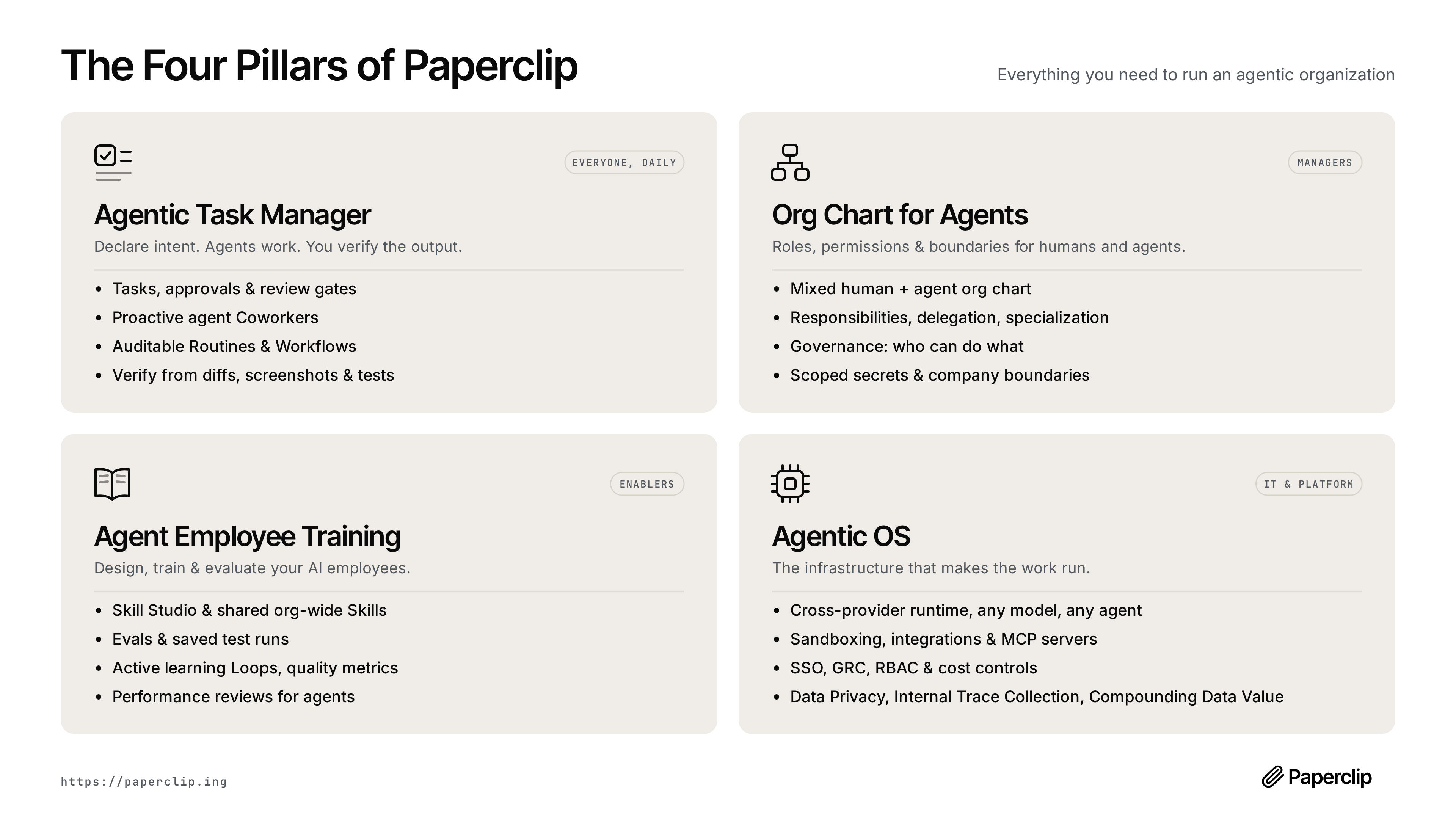
| Pillar | Built for | What it covers |
|---|---|---|
| Agentic Task Manager — Declare intent. Agents work. You verify the output. | Everyone, daily | Tasks, approvals & review gates · proactive agent coworkers · auditable routines & workflows · verify from diffs, screenshots & tests |
| Org Chart for Agents — Roles, permissions & boundaries for humans and agents. | Managers | Mixed human + agent org chart · responsibilities, delegation, specialization · governance: who can do what · scoped secrets & company boundaries · connection permissions & responsible-user identities |
| Agent Employee Training — Design, train & evaluate your AI employees. | Enablers | Skill Studio & shared org-wide skills · evals & saved test runs · active learning loops & quality metrics · performance reviews for agents · saved test inputs · skill version history & restore · reusable team templates |
| Agentic OS — The infrastructure that makes the work run. | IT & platform | Cross-provider runtime: any model, any agent · sandboxing, integrations & MCP servers · SSO, GRC, RBAC & cost controls · data privacy, internal trace collection, compounding data value · personal & shared app connections · run history & opt-in tracing |
Features
🔌 Bring Your Own AgentAny agent, any runtime, one org chart. If it can receive a heartbeat, it's hired. |
🎯 Goal AlignmentLink tasks and projects to your organization goals. Agents receive the goal context behind their work. |
💓 HeartbeatsAgents wake for assigned work, follow-up messages, or configured schedules. Delegation flows up and down the org chart. |
💰 Cost ControlCompany, agent, and project budgets. Track reported spend, get threshold alerts, and pause work at configured limits. |
🏢 Multi-OrganizationOne deployment, many organizations. Separate tasks, agents, permissions, and activity histories for each. |
🎫 Task ThreadsKeep conversations, plans, blockers, files, and run history attached to the work. Assign tasks to agents or people. |
🛡️ GovernanceConfigure review and approval stages, approve hires, and pause, reassign, or stop work when needed. |
📊 Org ChartHierarchies, roles, reporting lines. Your agents have a boss, a title, and a job description. |
📱 Mobile ReadyMonitor and manage your autonomous businesses from anywhere. |
🔗 Apps & ConnectionsConnect services such as GitHub, Notion, and Railway, or your own MCP server. Set gateway actions to Allowed, Ask first, or Off. |
👥 Shared Agents, Personal AccountsChoose who can use a connection and which agents can access it. Managed GitHub operations can use the account of the person directing the work. |
🧠 Skills & Skill StudioInstall or write shared skills, test them with saved inputs, inspect results, and restore earlier versions. |
📅 Scheduled RoutinesRun recurring work on a schedule or trigger it through an API or webhook. Each run has a task, an owner, and a history. |
📎 Artifacts & FeedbackFind the files and documents agents produce. Preview supported formats and leave comments on specific passages in documents. |
📦 Ready-Made TeamsPreview and install teams with roles, skills, projects, and routines. Choose their runtimes and make the setup your own. |
Experimental Agent Chat and chat/email connectors add conversations with agents in Paperclip and through configured services such as Slack, Discord, Telegram, and AgentMail. Enable the relevant instance settings to try them.
Problems Paperclip solves
| Without Paperclip | With Paperclip |
|---|---|
| ❌ You have 20 Claude Code tabs open and can't track which one does what. On reboot you lose everything. | ✅ Tasks are ticket-based, conversations are threaded, sessions persist across reboots. |
| ❌ You manually gather context from several places to remind your bot what you're actually doing. | ✅ Context flows from the task up through the project and company goals — your agent always knows what to do and why. |
| ❌ Folders of agent configs are disorganized and you're re-inventing task management, communication, and coordination between agents. | ✅ Paperclip gives you org charts, ticketing, delegation, and governance out of the box — so you run a company, not a pile of scripts. |
| ❌ Runaway loops waste hundreds of dollars of tokens and max your quota before you even know what happened. | ✅ Spend tracking, budget alerts, and automatic pauses help you control the cost of ongoing work. |
| ❌ You have recurring jobs (customer support, social, reports) and have to remember to manually kick them off. | ✅ Routines create assigned tasks on a schedule, with outputs and run history you can inspect. |
| ❌ You have an idea, you have to find your repo, fire up Claude Code, keep a tab open, and babysit it. | ✅ Add a task in Paperclip. Your coding agent works on it until it's done. Management reviews their work. |
Why Paperclip is special
Paperclip handles the hard orchestration details correctly.
| Atomic task checkout. | A single assignee and execution locks prevent competing runs from claiming the same task. |
| Persistent work context. | Tasks, comments, and documents stay in Paperclip. Supporting adapters resume saved sessions across runs. |
| Runtime skill injection. | Agents can learn Paperclip workflows and project context at runtime, without retraining. |
| Governance with rollback. | Approval gates are enforced, config changes are revisioned, and bad changes can be rolled back safely. |
| Accountable connections. | Human access, agent eligibility, and gateway action permissions are separate controls. Approve a call once or save a revocable rule. |
| Goal-aware execution. | Linked tasks and projects carry goal ancestry so agents see the "why," not just a title. |
| Portable company templates. | Export/import orgs, agents, and skills with secret scrubbing and collision handling. |
| Organization boundaries. | Company-scoped access checks keep each organization's work, agents, and activity separate within one deployment. |
What's Under the Hood
Paperclip is a full control plane, not a wrapper. Before you build any of this yourself, know that it already exists:
┌──────────────────────────────────────────────────────────────┐
│                       PAPERCLIP SERVER                       │
│                                                              │
│  ┌───────────┐  ┌───────────┐  ┌───────────┐  ┌───────────┐  │
│  │Identity & │  │  Work &   │  │ Heartbeat │  │Governance │  │
│  │  Access   │  │   Tasks   │  │ Execution │  │& Approvals│  │
│  └───────────┘  └───────────┘  └───────────┘  └───────────┘  │
│                                                              │
│  ┌───────────┐  ┌───────────┐  ┌───────────┐  ┌───────────┐  │
│  │ Org Chart │  │Workspaces │  │  Plugins  │  │  Budget   │  │
│  │ & Agents  │  │ & Runtime │  │           │  │ & Costs   │  │
│  └───────────┘  └───────────┘  └───────────┘  └───────────┘  │
│                                                              │
│  ┌───────────┐  ┌───────────┐  ┌───────────┐  ┌───────────┐  │
│  │ Routines  │  │ Secrets & │  │ Activity  │  │  Company  │  │
│  │& Schedules│  │  Storage  │  │ & Events  │  │Portability│  │
│  └───────────┘  └───────────┘  └───────────┘  └───────────┘  │
└──────────────────────────────────────────────────────────────┘
         ▲              ▲              ▲              ▲
   ┌─────┴─────┐  ┌─────┴─────┐  ┌─────┴─────┐  ┌─────┴─────┐
   │  Claude   │  │   Codex   │  │   CLI     │  │ HTTP/web  │
   │   Code    │  │           │  │  agents   │  │   bots    │
   └───────────┘  └───────────┘  └───────────┘  └───────────┘
The Systems
|
Identity & Access — Two deployment modes (trusted local or authenticated), human roles and permissions, agent API keys, short-lived run JWTs, company memberships, and invite flows. Responsible-user attribution follows work through delegation and supported managed connections. |
Org Chart & Agents — Agents have roles, titles, reporting lines, permissions, and budgets. Adapter examples match the diagram: Claude Code, Codex, CLI agents such as Cursor/Gemini/bash, HTTP/webhook bots such as OpenClaw, and external adapter plugins. If it can receive a heartbeat, it's hired. |
|
Work & Task System — Issues carry company/project/goal/parent links, atomic checkout with execution locks, first-class blocker dependencies, comments, documents, attachments, work products, labels, and inbox state. Search across work, review document revisions, and leave anchored feedback. |
Heartbeat Execution — DB-backed wakeup queue with coalescing, budget checks, workspace resolution, secret injection, skill loading, and adapter invocation. Runs produce logs, usage records, and adapter-specific session state. Bounded recovery handles supported failures and surfaces cases that need human action. |
|
Workspaces & Runtime — Project repositories and workspaces, optional isolated execution workspaces (git worktrees, operator branches), and runtime services (dev servers, preview URLs). Sandbox providers extend execution beyond the local host; availability depends on the configured environment and adapter. |
Governance & Approvals — Board approval workflows, execution policies with review/approval stages, decision tracking, budget hard-stops, and agent pause/resume/terminate. Configured task reviews govern completion; connection action approvals govern calls through the tool gateway. |
|
Budget & Cost Control — Token and cost tracking by company, agent, project, goal, issue, provider, and model. Scoped budget policies with warning thresholds and hard stops. Enforcement uses recorded spend; usage reporting and in-flight work can delay a stop. |
Routines & Schedules — Recurring tasks with cron, webhook, and API triggers. Concurrency and catch-up policies. Each routine execution creates a tracked issue and wakes the assigned agent — no manual kick-offs needed. |
|
Plugins — Instance-wide plugin system with out-of-process workers, capability-gated host services, job scheduling, tool exposure, and UI contributions. Extend Paperclip without forking it. |
Secrets & Storage — Company secrets and per-person secret values, encrypted credential storage, local or S3-compatible file storage, attachments, and work products. Secret references supply credentials to authorized runs without copying values into ordinary agent configuration. |
|
Activity & Events — Mutating actions, heartbeat state changes, cost events, approvals, comments, and work products are recorded as durable activity so operators can audit what happened and why. |
Company Portability — Preview, export, and import organization packages with agents, skills, and optional projects, routines, tasks, and attachments. Referenced secret values are omitted; review packages before sharing because plain environment values and local paths can remain. Packages share an operating setup; full-instance recovery uses backups. |
What Paperclip is not
| Not just a chatbot. | Conversations stay attached to tasks, plans, decisions, and outputs. Experimental Agent Chat can hand work off to assigned tasks. |
| Not an agent framework. | We don't tell you how to build agents. We tell you how to run a company made of them. |
| Not just a workflow builder. | Routines operate within an organization, with roles, goals, budgets, and governance. |
| Not a prompt manager. | Agents bring their own prompts, models, and runtimes. Paperclip manages the organization they work in. |
| Not limited to one agent. | Start with one agent and grow into a team with shared skills, delegation, and review. |
| Not only for code review. | Coding and PR review fit alongside research, operations, content, and other work. |
Quickstart
Open source. Self-hosted. No Paperclip account required. Follow the guided quickstart to set up your first agent.
Just ask your agent to install Paperclip
Share the installation guide with your agent.
Or install it yourself
With Node.js 24.11 or newer installed:
npx paperclipai@latest onboard --yes
The CLI runs from npm's cache; your instance configuration and data persist locally.
See the installation guide for managed installs, pinned versions, canary and git-ref installs, updates, rollback, service management, and uninstalling.
For an isolated manual test instance that is already initialized with a CEO
agent, use test-drive. It stays in the foreground, never installs a service
or creates a first task, and opens the browser only after setup succeeds:
ANTHROPIC_API_KEY=... npx paperclipai test-drive
OPENAI_API_KEY=... npx paperclipai test-drive --harness codex
OPENROUTER_API_KEY=... npx paperclipai test-drive \
  --harness opencode \
  --model openrouter/anthropic/claude-sonnet-4.5
Each run without --data-dir gets a unique, retained temporary directory; its
absolute path is printed at startup. Pass --data-dir to reuse one, or
--no-browser to leave the initialized instance unopened. When invoked from a
linked Git worktree, test-drive also enables task execution in that worktree.
See the test-drive guide for credential and
reuse behavior.
Troubleshooting: private npm registry
.npmrcIf this fails with an
E404forpaperclipai(or similar) and you use a private npm registry (for example GitHub Packages) via a global~/.npmrc,npxmay be resolvingpaperclipaiagainst that private registry instead of the public npm registry.Diagnostic:
npm config get registryWorkaround (cross-platform; force the public npm registry for this command):
npx --registry https://registry.npmjs.org paperclipai@latest onboard --yes
That quickstart path now defaults to trusted local loopback mode for the fastest first run. To start in authenticated/private mode instead, choose a bind preset explicitly:
npx paperclipai@latest onboard --yes --bind lan
# or:
npx paperclipai@latest onboard --yes --bind tailnet
If you already have Paperclip configured, rerunning onboard keeps the existing config in place. Use npx paperclipai configure to edit settings.
Or manually:
git clone https://github.com/paperclipai/paperclip.git
cd paperclip
pnpm install
pnpm dev
This starts the UI and API at http://localhost:3100. An embedded PostgreSQL database is created automatically — no setup required.
Requirements: Node.js 24.11+, pnpm 9.15+
Local Claude and Codex subscription sign-in also needs Python 3 and the corresponding provider CLI on the Paperclip host. The Docker image includes them.
Source development also builds the native Paperclip Runner when enabled (the self-hosted default). Install a Rust toolchain, or set PAPERCLIP_RUNNER_BINARY to a compatible prebuilt runner.
FAQ
Q: Is this project maintained or just slop?
A: Paperclip is maintained by the Paperclip team. We've merged over 2,700 pull requests.
Q: What does a typical setup look like?
A: Locally, a single Node.js process manages an embedded Postgres and local file storage. For production, point it at your own Postgres and deploy however you like. Configure projects, agents, and goals — the agents take care of the rest.
For remote access, use authenticated mode with a private-network bind such as Tailscale, or deploy the persistent server with Docker. See deployment modes and the Docker guide.
Q: Can I run multiple companies?
A: Yes. A single deployment can host multiple organizations with company-scoped data and access checks.
Q: How is Paperclip different from agents like OpenClaw or Claude Code?
A: Paperclip uses those agents. It orchestrates them into a company — with org charts, budgets, goals, governance, and accountability.
Q: Why should I use Paperclip instead of just pointing my OpenClaw to Asana or Trello?
A: Agent orchestration has subtleties in how you coordinate who has work checked out, how to maintain sessions, monitoring costs, establishing governance - Paperclip does this for you.
(Bring-your-own-ticket-system is on the Roadmap)
Q: Do agents run continuously?
A: Agents wake for assigned work and follow-up messages. Optional timer heartbeats let them check for work periodically; routines create recurring tasks on their own schedules. You can also connect externally running agents such as OpenClaw. A mention alone does not assign work or wake another agent.
Development
pnpm dev              # Full dev (API + UI, watch mode)
pnpm dev:once         # Full dev without file watching
pnpm dev:server       # Server only
pnpm dev:mobile       # Serve prebuilt UI on :3101 for phones/tablets (proxies /api → :3100)
pnpm dev:both         # Run `pnpm dev` and `pnpm dev:mobile` together
pnpm build            # Build all
pnpm typecheck        # Type checking
pnpm test             # Cheap default test run (Vitest only)
pnpm test:watch       # Vitest watch mode
pnpm test:e2e         # Playwright browser suite
pnpm db:generate      # Generate DB migration
pnpm db:migrate       # Apply migrations
pnpm test does not run Playwright. Browser suites stay separate and are typically run only when working on those flows or in CI.
See doc/DEVELOPING.md for the full development guide.
Roadmap
- ✅ Plugin system (e.g. add a knowledge base, custom tracing, queues, etc)
- ✅ Get OpenClaw / claw-style agent employees
- ✅ companies.sh - import and export entire organizations
- ✅ Easy AGENTS.md configurations
- ✅ Skills Manager, Skill Studio & Skills Store
- ✅ Scheduled Routines
- ✅ Better Budgeting
- ✅ Agent Reviews and Approvals
- ✅ Multiple Human Users
- ✅ Cloud / Sandbox agents (e2b, Cloudflare, Daytona, Modal, Novita, boxd, self-hosted Kubernetes)
- ✅ Artifacts & Work Products
- ✅ Deep Planning (planning mode, revisioned plans, plan approvals)
- ✅ Enforced Outcomes (watchdogs, recovery actions, review gates)
- ✅ MCP Tool Gateway & Apps (governed tool access)
- ✅ Secrets Manager with per-agent access
- ✅ Activity log & action attribution
- ✅ Self-healing runs & automatic recovery
- ✅ Agent evals & feedback
- ✅ Connected Apps
- ✅ Personal & Shared AI Accounts
- ✅ Shared Agents Use Personal GitHub Identities
- ✅ Skill Version History & Restore
- ✅ Document Comments & Revision History
- ✅ Company-Wide Search
- ✅ Multi-Model & Multi-Harness Teams
- 🟡 Memory / Knowledge
- ⚪ MAXIMIZER MODE
- ⚪ Work Queues
- ⚪ Self-Organization
- ⚪ Automatic Organizational Learning
- 🟡 Agent Chat
- 🟡 Cloud deployments
- ⚪ Desktop App
- ⚪ Bring-your-own-ticket-system (Asana / Linear / Jira as on-ramps)
This is the short roadmap preview. See the full roadmap in ROADMAP.md.
Community & Plugins
Find Plugins and more at awesome-paperclip
Observability
Paperclip ships with opt-in OpenTelemetry auto-instrumentation for the server (traces only). It activates when OTEL_EXPORTER_OTLP_ENDPOINT is set and supports grpc, http/protobuf, and http/json via the standard OTEL_EXPORTER_OTLP_PROTOCOL env var. @opentelemetry/api is a normal server dependency; the SDK, auto-instrumentation, and exporter packages are optional peer dependencies — install them only if you want tracing. See doc/observability.md for install commands and the full env-var reference.
Paperclip also ships with opt-in Sentry error monitoring for the server and the browser. Set SENTRY_DSN_FRONTEND to activate it for the browser and SENTRY_DSN_BACKEND to activate it for the server — each variable is optional, and the legacy SENTRY_DSN variable still works as a fallback for either component. The supported server SDK version is @sentry/node@10.71.0; it is an optional peer dependency for the server, so install it only if you want error monitoring. The browser SDK, @sentry/browser, is pinned to the same exact version. See doc/observability.md for the install command, the privacy settings, and the full default capture set.
Telemetry
Paperclip collects anonymous usage telemetry to help us understand how the product is used and improve it. No personal information, issue content, prompts, file paths, or secrets are ever collected. Private repository references are hashed with a per-install salt before being sent.
Contributors changing emitted telemetry events should follow the Telemetry Data Contract. For proposed first-party events that are not in the generated contract yet, follow Telemetry Workflow.
Telemetry is enabled by default and can be disabled with any of the following:
| Method | How |
|---|---|
| Environment variable | PAPERCLIP_TELEMETRY_DISABLED=1 |
| Standard convention | DO_NOT_TRACK=1 |
| CI environments | Automatically disabled when CI=true |
| Config file | Set telemetry.enabled: false in your Paperclip config |
Contributing
We welcome contributions. See the contributing guide for details.
Community
- Discord — Join the community
- Twitter / X — Follow updates and announcements
- GitHub Issues — bugs and feature requests
- GitHub Discussions — ideas and RFC
License
MIT © 2026 Paperclip Labs, Inc
Star History
Open source under MIT. Built for people who want to get work done, not babysit agents.