## Thinking Path

> - Paperclip orchestrates AI agents for zero-human companies, so when
an adapter fails, the platform must surface enough detail for the next
agent (or human reviewer) to act
> - The `acpx_local` adapter wraps `claude-agent-acp`, which in turn
drives the Claude Code SDK — three layers, three different permission
and error-handling models
> - A user created a `Claude Local ACPX` agent in PAPA-387 and it failed
instantly with the generic `acpx.error / "Internal error"` log,
stranding the work and triggering an opaque `stranded_assigned_issue`
recovery to the CTO
> - Once the diagnostic blackbox was opened, the underlying cause turned
out to be two SDK-level mismatches: a model-name allowlist that rejects
bare IDs like `claude-opus-4-7`, and a Claude Code
permission/Read-sandbox configuration that silently denies every
non-allowlisted tool when the user's `~/.claude/settings.json` has
`defaultMode: "dontAsk"`
> - This pull request fixes both classes of failure in the adapter
itself so new ACPX agents work seamlessly without per-host
configuration, and widens the diagnostic surface so the *next* failure
of any kind is actionable
> - The benefit is that ACPX-Claude can join the regular agent roster —
verified end to end on PAPA-401, where the agent successfully reached
the Paperclip API, opened a worktree, surveyed existing notification
PRs, and posted a structured plan

## What Changed

- Widen ACPX failure diagnostics
(`packages/adapters/acpx-local/src/server/execute.ts`):
- Capture `err.name`, ACP code, `cause.message`, retryable flag, and a
5-frame stack preview into `errorMeta`.
- Promote phase-specific error codes: `ensure_session →
acpx_session_init_failed`, `configure_session →
acpx_session_config_failed`, `turn → acpx_turn_failed`, plus mapping for
`ACP_BACKEND_MISSING` / `ACP_BACKEND_UNAVAILABLE`.
- Set `verbose: true` on the ACPX runtime so its session-event log flows
through `ctx.onLog`.
- Capture child-process stderr via a wrapper-script tee into
`<stateDir>/run-stderr/<runId>.log`, inline the tail into the
`acpx.error` payload as `childStderrTail`, and forward it through
`ctx.onLog("stderr", …)` so it lands in the heartbeat `stderrExcerpt`
column (existing redaction applies).
- Set the model via `ANTHROPIC_MODEL` env for the `claude` agent instead
of `set_config_option(model, …)`. The ACP server's `set_config_option`
handler validates against an internal allowlist and rejects bare IDs
like `claude-opus-4-7`. `ANTHROPIC_MODEL` is read during initialization
and bypasses that check.
- Seed `<worktree>/.claude/settings.local.json` before spawning
`claude-agent-acp` (the seamless-API fix). Since `claude-agent-acp`
hard-codes `settingSources: ["user", "project", "local"]` and "local"
has the highest precedence:
- Set `permissions.defaultMode: "default"`, but **only** if the user's
value is missing or `"dontAsk"` (the broken case). Other modes like
`acceptEdits`/`plan` are preserved.
- Pre-allow Paperclip's Bash surface (`Bash(curl:*)`, `Bash(env:*)`,
`Bash(<cwd>/scripts/paperclip-issue-update.sh:*)`,
`Bash(<cwd>/scripts/paperclip:*)`).
- Widen `permissions.additionalDirectories` to include `stateDir`,
`agentHome`, and the per-company instance root
(`~/.paperclip/instances/<id>/companies/<companyId>`). Scoped to this
company only — does not expose other tenants.
- Existing user entries are merged, not replaced. The resolved roots are
folded into the session fingerprint so warm-session handles invalidate
when they change.
- Sync the existing server-side integration test
(`server/src/__tests__/acpx-local-execute.test.ts`) to assert
`acpx_session_init_failed` instead of the now-removed
`acpx_protocol_error` for `ACP_SESSION_INIT_FAILED` (a follow-up to
commit 1).

## Verification

- `pnpm --filter "@paperclipai/adapter-acpx-local" run typecheck` —
passes.
- `pnpm vitest run` in `packages/adapters/acpx-local` — 35/35 pass,
includes 4 new tests covering the settings.local.json write path (claude
only, merge with pre-existing content, `dontAsk` override, codex no-op).
- `pnpm vitest run src/__tests__/acpx-local-execute.test.ts` in
`server/` — 15/15 pass after the test-sync commit.
- End-to-end manual verification (PAPA-401): the `Claude Local ACPX`
agent that previously hit "restricted environment" now successfully
reaches the Paperclip API, opens its worktree, posts structured plan
comments, and flips the issue to `in_review` without any external
configuration.

## Risks

- **Low**, scoped to the `acpx_local` adapter. The settings.local.json
write is per-worktree (worktrees live under
`.paperclip/worktrees/<issue>/`) and only triggers when `acpxAgent ===
"claude"`. Existing user content is merged with `[...existing,
...paperclip]` and deduped — nothing is overwritten outright.
- The `defaultMode` override is intentionally narrow: it only flips
`"dontAsk"` (which silently denies every tool and is the root cause) to
`"default"`. Users who explicitly picked `acceptEdits`, `plan`, or any
other mode keep their choice.
- Stderr capture goes through the existing `log-redaction` pass before
persisting, so `PAPERCLIP_API_KEY` and similar secrets in the wrapper
env don't leak into heartbeat logs.

> For core feature work, check [`ROADMAP.md`](ROADMAP.md) first and
discuss it in `#dev` before opening the PR. Feature PRs that overlap
with planned core work may need to be redirected — check the roadmap
first. See `CONTRIBUTING.md`.

## Model Used

- Claude Opus 4.7 (`claude-opus-4-7`), running in the `claude_local`
adapter via Paperclip's harness. Extended thinking enabled, tool use
enabled.

## Checklist

- [x] I have included a thinking path that traces from project context
to this change
- [x] I have specified the model used (with version and capability
details)
- [x] I have checked ROADMAP.md and confirmed this PR does not duplicate
planned core work
- [x] I have run tests locally and they pass
- [x] I have added or updated tests where applicable
- [ ] If this change affects the UI, I have included before/after
screenshots — N/A (adapter-only)
- [ ] I have updated relevant documentation to reflect my changes — no
user-facing docs changed; internal commentary in the code change
explains the SDK constraints
- [x] I have considered and documented any risks above
- [ ] I will address all Greptile and reviewer comments before
requesting merge

---------

Co-authored-by: Paperclip <noreply@paperclip.ing>
## Thinking Path
> - Paperclip orchestrates AI agents for zero-human companies.
> - Agent creation can happen through local runtimes, managed runtimes,
and external agents that onboard through invites.
> - The old OpenClaw-oriented invite UX lived under company
settings/invites and made a gateway-specific path look like a company
access setting.
> - That hid the broader bring-your-own-agent flow and forced operators
to leave the add-agent modal when adding an external agent.
> - This pull request moves external agent invite generation into the
add-agent modal and makes the copy agent-oriented instead of
OpenClaw-only.
> - The benefit is a clearer agent-first onboarding path while company
invites stay focused on human access.
## What Changed
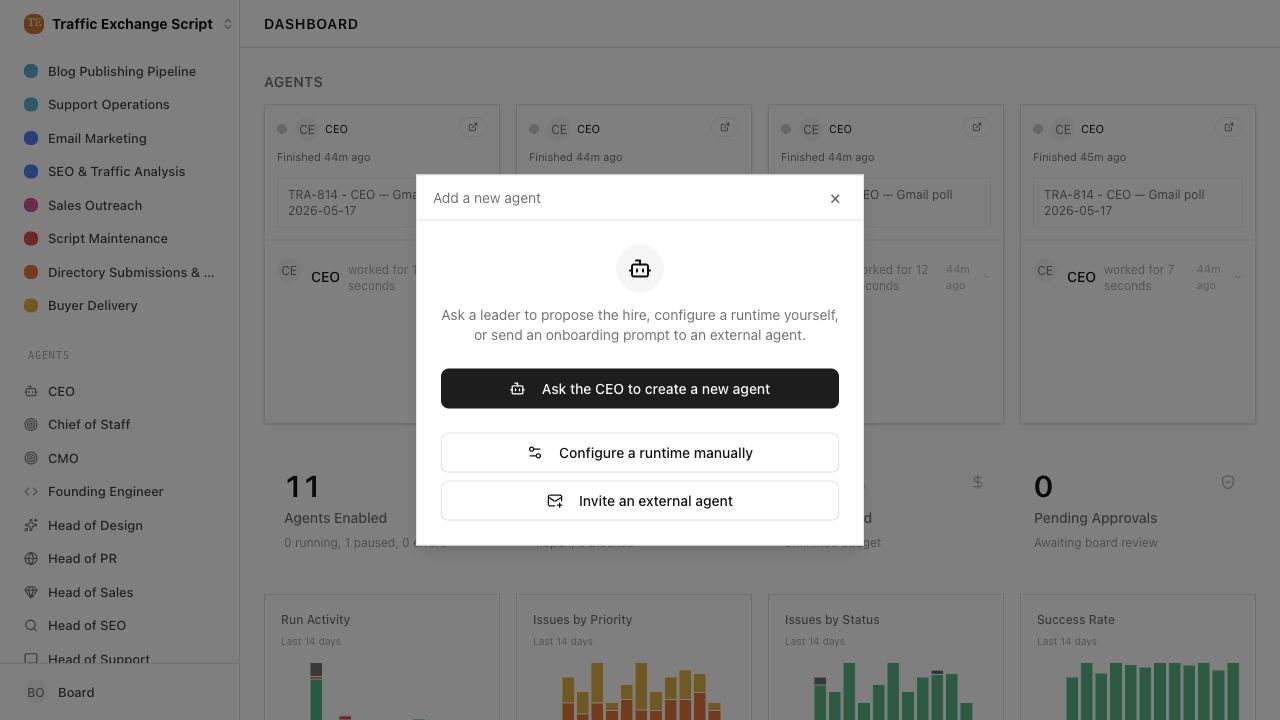
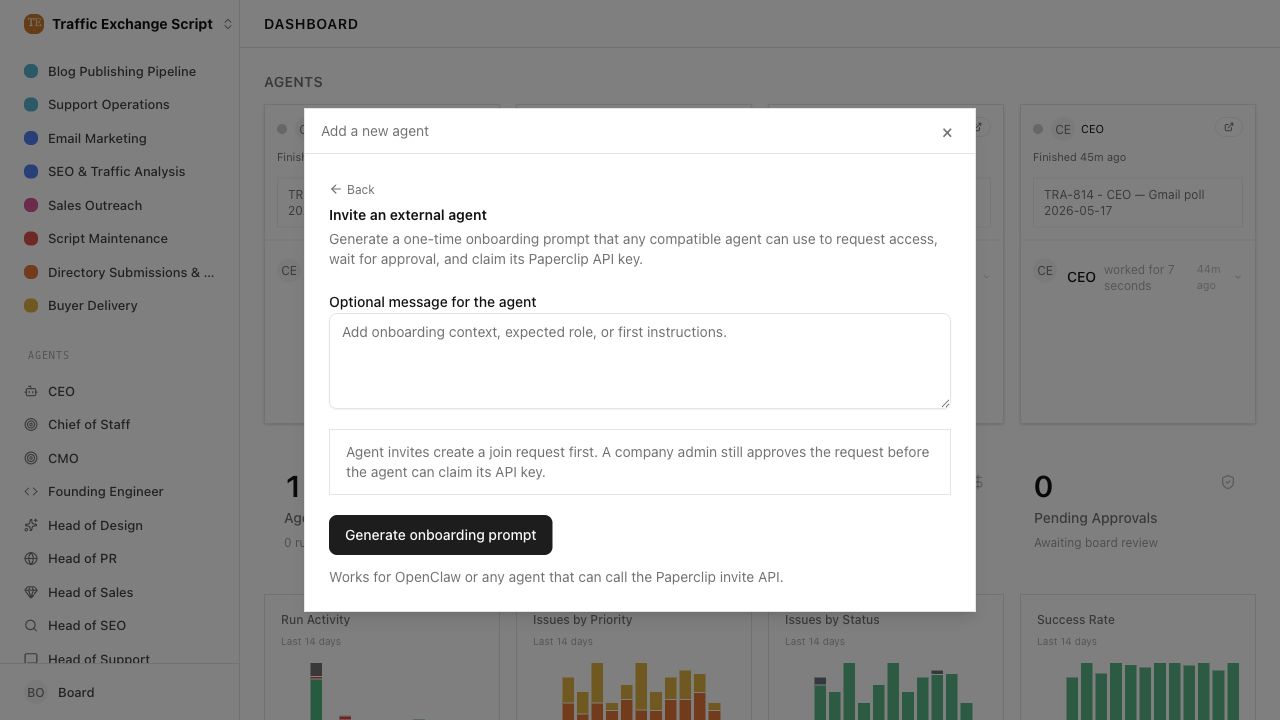
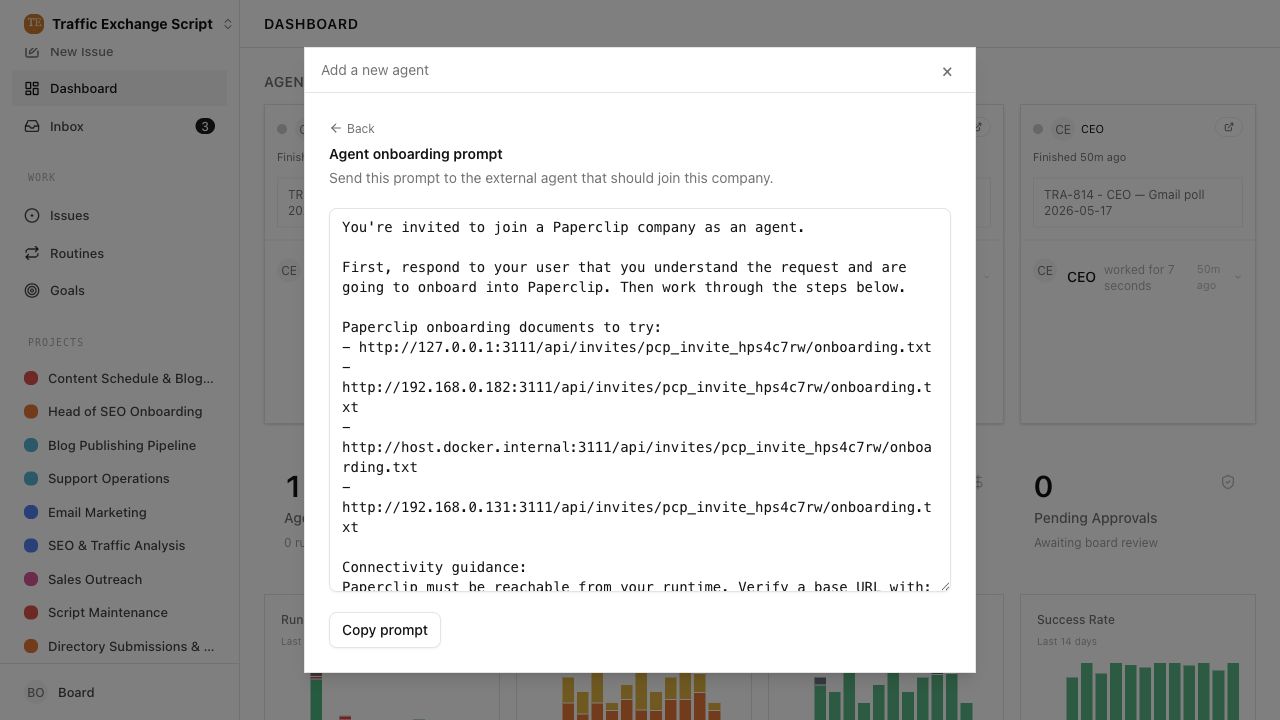
- Added an external-agent invite branch to the add-agent modal,
including a dedicated prompt result view with Back navigation.
- Added a shared agent onboarding prompt builder and focused modal
coverage for prompt replacement/back navigation.
- Removed the agent invite prompt UI from Company Settings and Company
Invites, leaving Company Invites focused on human access links and
invite history.
- Updated the hidden OpenClaw Gateway runtime hint to direct operators
to the add-agent invite flow instead of presenting it as a blocked
runtime card.
- Updated invite/onboarding docs, storybook coverage, and server-side
onboarding copy toward generic agent language while preserving existing
gateway compatibility.
## Verification
- `pnpm -r typecheck`
- `pnpm build`
- `FAKE_BIN="$(mktemp -d)/bin"; mkdir -p "$FAKE_BIN"; printf
'#!/bin/sh\nexit 1\n' > "$FAKE_BIN/tailscale"; chmod +x
"$FAKE_BIN/tailscale"; PATH="$FAKE_BIN:$PATH" pnpm test:run`
- `pnpm test:run` without the fake `tailscale` shim was also attempted;
it failed only in two pre-existing CLI tailnet fallback tests because
this host has a real Tailscale address (`100.125.202.3`) where those
tests expect no Tailscale.
- Focused confirmation for that host-env issue: `FAKE_BIN=...
PATH="$FAKE_BIN:$PATH" pnpm exec vitest run --project paperclipai
cli/src/__tests__/network-bind.test.ts
cli/src/__tests__/onboard.test.ts`
- Manual UI verification: served UI locally in light mode, opened
add-agent modal, generated external agent prompt, verified the generated
prompt replaces the form and Back returns to the form.
### Screenshots
## Risks
- Existing OpenClaw gateway compatibility remains, but operators now
discover external agent onboarding from the add-agent modal instead of
company settings.
- Agent invites still appear in the invite history table, so that page
may show agent-scoped invite rows even though it no longer creates agent
onboarding prompts.
- Low migration risk: no schema changes.
> For core feature work, check [`ROADMAP.md`](ROADMAP.md) first and
discuss it in `#dev` before opening the PR. Feature PRs that overlap
with planned core work may need to be redirected — check the roadmap
first. See `CONTRIBUTING.md`.
## Model Used
- OpenAI Codex, GPT-5 coding agent in Codex desktop; tool-enabled
repository, shell, browser, and GitHub workflow. Context window size was
not exposed by the runtime.
## Checklist
- [x] I have included a thinking path that traces from project context
to this change
- [x] I have specified the model used (with version and capability
details)
- [x] I have checked ROADMAP.md and confirmed this PR does not duplicate
planned core work
- [x] I have run tests locally and they pass
- [x] I have added or updated tests where applicable
- [x] If this change affects the UI, I have included before/after
screenshots
- [x] I have updated relevant documentation to reflect my changes
- [x] I have considered and documented any risks above
- [x] I will address all Greptile and reviewer comments before
requesting merge
## Thinking Path

> - Paperclip orchestrates AI agents for zero-human companies
> - Heartbeats run inside managed sandboxes (E2B, Cloudflare Sandbox),
and each run begins by uploading the agent's workspace as a tar archive
> - PAPA-381's E2B runs were failing at 5 and 11 minutes — two distinct
failure modes were entangled: workspace tar extraction errors on Linux,
and sandbox idle/lease timeouts during normal heartbeat gaps
> - Workspace tar extraction failed because macOS bsdtar embeds
`LIBARCHIVE.xattr.*` PAX headers that GNU tar on Linux rejects with
"This does not look like a tar archive"; the existing
`COPYFILE_DISABLE=1` only suppresses AppleDouble `._*` sidecars, not
inline PAX xattr entries
> - E2B sandboxes also expired between heartbeats because `timeoutMs`
defaulted to a short window and was never refreshed per execute, and
Cloudflare sandboxes idled out because `sleepAfter` defaulted to 10
minutes
> - This pull request adds `--no-xattrs` to the workspace tar
invocation, refreshes the E2B sandbox lifetime on each execute and bumps
the default `timeoutMs` to 1h, and raises the Cloudflare `sleepAfter`
default to 1h
> - The benefit is that long-running heartbeat-driven runs (Claude,
Codex, etc.) survive across both their initial workspace upload and the
natural idle gaps between executes on both E2B and Cloudflare

## What Changed

- `packages/adapter-utils/src/sandbox-managed-runtime.ts`: added
`--no-xattrs` to `createTarballFromDirectory` so macOS bsdtar produces a
clean POSIX tar that GNU tar on Linux can extract, with an inline
comment explaining why `COPYFILE_DISABLE=1` alone is insufficient.
- `packages/plugins/sandbox-providers/e2b/src/plugin.ts`: refresh the
sandbox lifetime on every execute (so long runs don't expire mid-job)
and raised the default `timeoutMs` to 1h.
- `packages/plugins/sandbox-providers/e2b/src/manifest.ts` and
`plugin.test.ts`: updated manifest defaults and added regression
coverage for the new behavior.
- `packages/plugins/sandbox-providers/cloudflare/src/config.ts`,
`manifest.ts`, `plugin.test.ts`: raised default `sleepAfter` from 10m to
1h, mirroring the E2B 1h default, and added a regression test asserting
the acquire-lease request body sends `sleepAfter: "1h"` when not
overridden.

## Verification

- `pnpm --filter @paperclipai/plugin-e2b test`
- `pnpm --filter @paperclipai/plugin-cloudflare-sandbox test`
- Locally cherry-picked the `--no-xattrs` fix onto master and confirmed
end-to-end via a real PAPA-381-style heartbeat-driven E2B run that the
workspace upload now extracts cleanly on Linux. The user (board
operator) tested this on master and reported "Ok, that worked."
- Manual reviewer steps: trigger an E2B heartbeat from a macOS host
(this is where the bsdtar xattr headers come from), confirm the
workspace tar extracts on the Linux sandbox side; run a long (>15 min)
Cloudflare sandbox flow and confirm no lost-lease/idle errors between
executes.

## Risks

- Low risk overall.
- `--no-xattrs` is widely supported by both macOS bsdtar and GNU tar
(Linux). Worst case it silently no-ops on a future host that doesn't
support it; in that case the existing failure mode reappears, it doesn't
introduce a new one.
- Raising default `timeoutMs` (E2B) and `sleepAfter` (Cloudflare) from
short values to 1h means sandboxes stay alive longer between executes by
default. This is the intended behavior — operators that want a tighter
idle window can still override via plugin config.
- E2B per-execute sandbox lifetime refresh adds a small API call per
execute; it is bounded by the same client that already handles execute
traffic, so no new dependencies or retry semantics.

## Model Used

- Claude (Anthropic), `claude-opus-4-7`, extended thinking enabled, tool
use enabled (file/grep/git tools and Paperclip control-plane API). Used
to diagnose the dual failure mode (workspace tar PAX xattr headers +
sandbox lifetime), write the fixes and tests, and drive the verification
loop with the board operator.

## Checklist

- [x] I have included a thinking path that traces from project context
to this change
- [x] I have specified the model used (with version and capability
details)
- [x] I have checked ROADMAP.md and confirmed this PR does not duplicate
planned core work
- [x] I have run tests locally and they pass
- [x] I have added or updated tests where applicable
- [ ] If this change affects the UI, I have included before/after
screenshots (N/A — no UI changes)
- [x] I have updated relevant documentation to reflect my changes
- [x] I have considered and documented any risks above
- [x] I will address all Greptile and reviewer comments before
requesting merge

---------

Co-authored-by: Paperclip <noreply@paperclip.ing>
## Thinking Path

> - Paperclip orchestrates AI agents for zero-human companies; humans
operate the board through the React UI.
> - The board gates company access via `CompanyProvider`
(CompanyContext) and onboards new humans through the invite landing page
at `/invite/:token`.
> - Reported symptom: opening an invite link and signing in works, but
the page then renders completely blank (black in dark mode).
> - End-to-end browser testing reproduced a client-side crash:
`companiesQuery.data?.some is not a function` and `Cannot read
properties of undefined (reading 'filter')`.
> - Root cause: `CompanyProvider` and `InviteLandingPage` both use the
React Query key `["companies"]` but return **different shapes** — `{
companies, unauthorized }` vs a bare `Company[]` — so they silently
corrupt the shared cache entry; whichever component reads the other's
shape calls `.some()`/`.filter()` on the wrong type and throws,
unmounting the tree.
> - Owners never hit it (they never mount the invite page); only
invitees landing on `/invite/:token` crash.
> - This PR unifies the `["companies"]` query into a single shared
definition so the cache entry always has one shape and the two consumers
can't drift apart again.
> - The benefit is a working invite/onboarding flow and removal of a
whole class of cache-shape bugs on this key.

## What Changed

- Add `ui/src/api/companies-query.ts` exporting a single shared
`companiesListQueryOptions` (and `CompanyListResult`) — one `queryKey` +
one `queryFn` that always returns the wrapped `{ companies, unauthorized
}` shape, documented with the shared-cache contract.
- `ui/src/context/CompanyContext.tsx` now uses
`useQuery(companiesListQueryOptions)` instead of an inline copy of that
query.
- `ui/src/pages/InviteLanding.tsx` uses the same
`companiesListQueryOptions` (with its own `enabled` gate), reads
`companiesQuery.data?.companies` for the membership checks, and uses
`queryClient.fetchQuery(companiesListQueryOptions)` in the post-auth
path — so it reads and writes the identical shape.

## Verification

- `pnpm --filter @paperclipai/ui typecheck` — clean.
- `vitest run src/pages/InviteLanding.test.tsx
src/context/CompanyContext.test.tsx` — 17/17 pass, unchanged.
- Manual end-to-end via a real browser against a LAN-exposed
authenticated instance:
  - Owner creates an Owner-role invite.
- New user opens the link and registers — **the "awaiting approval"
screen renders** (previously blank), `POST /api/invites/:token/accept`
returns `202`, no console errors.
- Owner approves at Company Settings → Access (`200`); invitee becomes
an active member.
- Invitee signs in — full board loads; smoke test of dashboard / issues
/ inbox / routines / goals / company settings — all render, zero
`pageerror`s.
- Before: invite page `#root` empty after sign-in (blank/black). After:
awaiting-approval panel renders. (Screenshots available on request.)

## Risks

- Low. `CompanyProvider`'s query behavior is unchanged (same `queryFn`
logic, just extracted into a shared module). `InviteLandingPage` now
reads the same shape it writes. No API, schema, or migration changes.
Existing tests pass unchanged.

## Model Used

- Claude (Anthropic), model ID `claude-opus-4-7` (Opus 4.7), 1M-context,
extended thinking + tool use; driving Claude Code with browser
automation for end-to-end reproduction and verification.

## Checklist

- [x] I have included a thinking path that traces from project context
to this change
- [x] I have specified the model used (with version and capability
details)
- [x] I have checked ROADMAP.md and confirmed this PR does not duplicate
planned core work
- [x] I have run tests locally and they pass
- [ ] I have added or updated tests where applicable (existing
InviteLanding/CompanyContext tests cover the touched code and pass; a
cross-provider regression test that mounts both consumers is a sensible
follow-up)
- [ ] If this change affects the UI, I have included before/after
screenshots (described textually above; this is a crash/blank-page fix,
screenshots available on request)
- [x] I have considered and documented any risks above
- [x] I will address all Greptile and reviewer comments before
requesting merge

Co-authored-by: Claude Opus 4.7 (1M context) <noreply@anthropic.com>
## Thinking Path
> - Paperclip orchestrates AI agents for zero-human companies.
> - Company creation is the first control-plane object operators create,
and the generated issue prefix becomes part of task identity.
> - The company service already retries when a generated issue prefix
collides with the `companies_issue_prefix_idx` unique constraint.
> - Drizzle 0.45.x wraps PostgreSQL errors in `DrizzleQueryError`,
leaving the real `23505` constraint error on the `.cause` chain.
> - The existing retry detector only inspected the top-level error, so
wrapped prefix collisions surfaced as 500s instead of retrying.
> - This pull request walks the error cause chain for the exact prefix
constraint and verifies the retry path against embedded Postgres.
> - The benefit is company creation no longer fails when generated
prefixes collide under Drizzle 0.45.x wrappers.
## What Changed
- Walk the error `.cause` chain when detecting
`companies_issue_prefix_idx` unique violations, with a cycle guard and
support for `constraint` / `constraint_name` fields.
- Added an embedded Postgres regression test that seeds `ARO`, creates
`Aron & Sharon`, and verifies the retry produces `AROA`.
- Stabilized existing async tests touched by full verification: instance
sidebar plugin rendering now waits for React Query results, and
Tailscale-unavailable CLI tests explicitly hide host `tailscale`
detection.
## Verification
- `pnpm --filter @paperclipai/server exec vitest run
src/__tests__/companies-service.test.ts`
- `pnpm --filter @paperclipai/server exec vitest run
src/__tests__/heartbeat-stale-queue-invalidation.test.ts`
- `pnpm --filter @paperclipai/ui exec vitest run
src/components/InstanceSidebar.test.tsx`
- `pnpm --filter paperclipai exec vitest run
src/__tests__/network-bind.test.ts src/__tests__/onboard.test.ts`
- `pnpm test:run`
- `pnpm -r typecheck`
- `pnpm build`
## Risks
- Low runtime risk: the retry behavior only expands detection for the
existing exact company issue-prefix unique constraint.
- The cause-chain walk is bounded by visited objects to avoid cycles.
- The sidebar and CLI changes are test-only stabilization and do not
change production behavior.
> For core feature work, check [`ROADMAP.md`](ROADMAP.md) first and
discuss it in `#dev` before opening the PR. Feature PRs that overlap
with planned core work may need to be redirected — check the roadmap
first. See `CONTRIBUTING.md`.
## Model Used
- OpenAI Codex, GPT-5 coding agent in Codex desktop, with local
shell/tool execution.
## Checklist
- [x] I have included a thinking path that traces from project context
to this change
- [x] I have specified the model used (with version and capability
details)
- [x] I have checked ROADMAP.md and confirmed this PR does not duplicate
planned core work
- [x] I have run tests locally and they pass
- [x] I have added or updated tests where applicable
- [x] If this change affects the UI, I have included before/after
screenshots (N/A: no UI behavior change)
- [x] I have updated relevant documentation to reflect my changes (N/A:
bug fix with no user-facing docs change)
- [x] I have considered and documented any risks above
- [x] I will address all Greptile and reviewer comments before
requesting merge
Closes#6350
## Thinking Path

> - Paperclip is the board UI and control plane for supervising AI-agent
companies.
> - Operators repeatedly use mobile navigation, issue creation, inbox
scanning, and markdown reading surfaces.
> - Small layout and interaction rough edges add friction to those
high-frequency workflows.
> - The branch included a set of related board UI polish changes that
were too small to review as many separate PRs.
> - This pull request groups the remaining mobile/navigation/markdown
polish into one standalone branch.
> - The benefit is smoother board operation without mixing in unrelated
backend feature work.

## What Changed

- Tightened company settings navigation behavior on mobile.
- Fixed mobile new issue dialog height and moved issue priority into the
overflow controls on small screens.
- Restored browser controls for home-screen app mode.
- Fixed plugin-route sidebar selection on nested page loads.
- Added markdown preformatted-block wrapping controls and coverage.
- Kept updated issue list pages sorted by updated time in the board UI.

## Verification

- `pnpm --filter @paperclipai/plugin-sdk build`
- `NODE_ENV=test pnpm exec vitest run ui/src/components/Layout.test.tsx
ui/src/components/MarkdownBody.test.tsx
ui/src/components/MarkdownBody.wrap.test.tsx
ui/src/components/NewIssueDialog.test.tsx
ui/src/components/access/CompanySettingsNav.test.tsx
ui/src/lib/pwa-install-mode.test.ts ui/src/pages/Inbox.test.tsx`

The targeted UI tests passed. React emitted existing act-wrapping
warnings in a few test files, but there were no test failures.

## Risks

- Medium-low: changes span several UI surfaces, but they are mostly
layout/interaction polish with targeted component tests.
- Visual screenshots are not newly captured in this split PR; follow-up
review should include browser/visual QA before marking ready.

> For core feature work, check [`ROADMAP.md`](ROADMAP.md) first and
discuss it in `#dev` before opening the PR. Feature PRs that overlap
with planned core work may need to be redirected — check the roadmap
first. See `CONTRIBUTING.md`.

## Model Used

- OpenAI GPT-5 Codex via `codex_local`, tool-enabled coding session;
exact context window not exposed by this runtime.

## Checklist

- [x] I have included a thinking path that traces from project context
to this change
- [x] I have specified the model used (with version and capability
details)
- [x] I have checked ROADMAP.md and confirmed this PR does not duplicate
planned core work
- [x] I have run tests locally and they pass
- [x] I have added or updated tests where applicable
- [x] If this change affects the UI, I have included before/after
screenshots
- [x] I have updated relevant documentation to reflect my changes
- [x] I have considered and documented any risks above
- [x] I will address all Greptile and reviewer comments before
requesting merge

---------

Co-authored-by: Paperclip <noreply@paperclip.ing>
## Thinking Path

> - Paperclip coordinates autonomous company work through local and
hosted runtime surfaces.
> - Local embedded Postgres and tenant import/export paths are
foundational reliability pieces.
> - A runtime failure in either path can stop agents or imports before
useful work begins.
> - The branch included remaining fixes for embedded native library
bootstrap and async tenant import handling.
> - This pull request groups those runtime/import reliability changes
into one standalone PR.
> - The benefit is a more robust local runtime and safer cloud tenant
import behavior.

## What Changed

- Prepared embedded Postgres native runtime before startup in
CLI/server/test entrypoints.
- Added embedded Postgres native bootstrap coverage.
- Added async tenant import job handling and deferred validation
coverage.
- Kept the runtime/import changes based directly on current
`origin/master` after related upstream PRs had already merged.

## Verification

- `pnpm --filter @paperclipai/plugin-sdk build`
- `NODE_ENV=test pnpm exec vitest run
packages/db/src/embedded-postgres-native.test.ts
server/src/__tests__/company-portability-routes.test.ts`

## Risks

- Medium-low: this touches startup/import paths, but the branch is small
and covered by targeted tests.
- The embedded Postgres change depends on platform-specific
native-library behavior, so CI and follow-up checks should still verify
supported runners.

> For core feature work, check [`ROADMAP.md`](ROADMAP.md) first and
discuss it in `#dev` before opening the PR. Feature PRs that overlap
with planned core work may need to be redirected — check the roadmap
first. See `CONTRIBUTING.md`.

## Model Used

- OpenAI GPT-5 Codex via `codex_local`, tool-enabled coding session;
exact context window not exposed by this runtime.

## Checklist

- [x] I have included a thinking path that traces from project context
to this change
- [x] I have specified the model used (with version and capability
details)
- [x] I have checked ROADMAP.md and confirmed this PR does not duplicate
planned core work
- [x] I have run tests locally and they pass
- [x] I have added or updated tests where applicable
- [x] If this change affects the UI, I have included before/after
screenshots
- [x] I have updated relevant documentation to reflect my changes
- [x] I have considered and documented any risks above
- [x] I will address all Greptile and reviewer comments before
requesting merge
## Thinking Path

> - Paperclip is the control plane for AI-agent companies.
> - Operators need a path to move local company state toward Paperclip
Cloud without losing local-first control.
> - The Cloud Upstream flow needs API, persistence, CLI, and board UI
surfaces that agree on the same manifest/run model.
> - The existing branch had the feature work plus UX and error-handling
follow-ups.
> - This pull request packages the remaining Cloud Upstream sync work
into one standalone branch.
> - The benefit is an inspectable local-to-cloud sync workflow with
preview, conflicts, activation, and captured UX review states.

## What Changed

- Added Cloud Upstream shared types, server routes/services, and
persisted run schema/migration.
- Added Paperclip Cloud CLI sync helpers and local connection storage.
- Added the Cloud Upstream board UI, settings entry points, query keys,
and UX lab page.
- Added preview/activation checklist behavior, redirect handling,
manifest-only preview support, friendly errors, in-flight hints, and
entity count summaries.

## Verification

- `pnpm --filter @paperclipai/plugin-sdk build`
- `NODE_ENV=test pnpm exec vitest run cli/src/__tests__/cloud.test.ts
server/src/__tests__/instance-settings-routes.test.ts
server/src/__tests__/instance-settings-service.test.ts
ui/src/pages/CloudUpstream.test.tsx
ui/src/components/CompanySettingsSidebar.test.tsx`
- `NODE_ENV=test pnpm exec vitest run
server/src/__tests__/cloud-upstreams.test.ts`

Worktree setup note: the isolated worktree install skipped native sqlite
build scripts, so I copied the already-built local sqlite binding from
the main checkout before running
`server/src/__tests__/cloud-upstreams.test.ts`. The test then passed.

## Risks

- Medium: this adds a database migration and a broad feature path across
CLI/server/UI.
- Merge order: this is the only PR in this split with a DB migration;
merge it before any future Cloud Upstream migration follow-up.
- Mitigation: the PR is based directly on current `origin/master`, has
targeted route/service/UI tests, and keeps the feature behind existing
experimental Cloud Sync settings.

> For core feature work, check [`ROADMAP.md`](ROADMAP.md) first and
discuss it in `#dev` before opening the PR. Feature PRs that overlap
with planned core work may need to be redirected — check the roadmap
first. See `CONTRIBUTING.md`.

## Model Used

- OpenAI GPT-5 Codex via `codex_local`, tool-enabled coding session;
exact context window not exposed by this runtime.

## Checklist

- [x] I have included a thinking path that traces from project context
to this change
- [x] I have specified the model used (with version and capability
details)
- [x] I have checked ROADMAP.md and confirmed this PR does not duplicate
planned core work
- [x] I have run tests locally and they pass
- [x] I have added or updated tests where applicable
- [x] If this change affects the UI, screenshot artifacts are
intentionally omitted per reviewer request
- [x] I have updated relevant documentation to reflect my changes
- [x] I have considered and documented any risks above
- [x] I will address all Greptile and reviewer comments before
requesting merge
## Thinking Path

> - Paperclip orchestrates AI-agent companies through a company-scoped
control plane.
> - Plugins extend that control plane, but plugin workers still call
back into host APIs.
> - Those worker-to-host calls need the same company boundary guarantees
as normal API routes.
> - Plugin action handlers also need authenticated actor context from
the host instead of trusting caller-supplied params.
> - This pull request hardens plugin bridge/action scope and keeps
plugin operation issues out of normal issue surfaces.
> - The benefit is safer plugin execution with clearer authorization
boundaries and better test coverage.

## What Changed

- Added host-owned invocation context plumbing for nested plugin worker
calls.
- Added actor context to plugin `performAction` calls and test harness
helpers.
- Enforced company invocation scope on worker-to-host calls and filtered
company lists to the active invocation scope.
- Extended plugin action route tests for board and agent actor context,
spoofed company params, and cross-company rejection.
- Extended plugin worker manager coverage for invocation-scope
propagation.
- Filtered typed and legacy plugin operation issue origins from default
issue/inbox lists.

## Verification

- `pnpm --filter @paperclipai/plugin-sdk build`
- `NODE_ENV=test pnpm exec vitest run
packages/plugins/sdk/tests/host-client-factory.test.ts
packages/plugins/sdk/tests/testing-actions.test.ts
server/src/__tests__/plugin-routes-authz.test.ts
server/src/__tests__/plugin-worker-manager.test.ts
server/src/__tests__/issues-service.test.ts`

Note: embedded Postgres issue-service tests reported host-level Postgres
init skip for 47 tests; the non-embedded targeted tests passed.

## Risks

- Medium: plugin host authorization paths are sensitive, and external
plugins may rely on previously loose company params.
- Mitigation: the change only tightens calls when the host attached a
company invocation scope and includes explicit tests for board, agent,
and nested worker calls.

> For core feature work, check [`ROADMAP.md`](ROADMAP.md) first and
discuss it in `#dev` before opening the PR. Feature PRs that overlap
with planned core work may need to be redirected — check the roadmap
first. See `CONTRIBUTING.md`.

## Model Used

- OpenAI GPT-5 Codex via `codex_local`, tool-enabled coding session;
exact context window not exposed by this runtime.

## Checklist

- [x] I have included a thinking path that traces from project context
to this change
- [x] I have specified the model used (with version and capability
details)
- [x] I have checked ROADMAP.md and confirmed this PR does not duplicate
planned core work
- [x] I have run tests locally and they pass
- [x] I have added or updated tests where applicable
- [x] If this change affects the UI, I have included before/after
screenshots
- [x] I have updated relevant documentation to reflect my changes
- [x] I have considered and documented any risks above
- [x] I will address all Greptile and reviewer comments before
requesting merge
## Thinking Path

> - Paperclip orchestrates AI agents for zero-human companies by keeping
task ownership, approvals, and operator control inside one control
plane.
> - Agent permissions and plugin-hosted company settings sit on the
boundary between autonomy and governance.
> - V1 needs scoped task assignment rules, plugin extension points, and
clearer company access surfaces without weakening company boundaries.
> - The branch builds the core authorization service, plugin SDK/host
APIs, and UI simplifications needed to support those controls.
> - Paperclip EE plugin surfaces were intentionally moved out of this
core PR per review direction, so this PR now carries only the public
core/plugin infrastructure work.
> - The latest updates preserve the PAP-9937 branch changes that belong
in this PR, remove the `design/` artifacts, and exclude the experimental
`plugin-briefs` package.
> - Greptile feedback was applied through the authorization/audit paths
and the final cleanup commit was re-reviewed at 5/5 with no unresolved
Greptile threads.
> - The benefit is safer assignment control with extension hooks for
richer permission products while preserving simple defaults for normal
operators.

## What Changed

- Added scoped task-assignment authorization decisions and routed
issue/agent assignment mutations through the authorization service.
- Added plugin SDK and host APIs for company settings slots,
authorization policy/grant management, assignment previews, and bridge
invocation scope propagation.
- Simplified core company access UI and moved advanced controls behind
plugin-provided settings surfaces.
- Added retry-now affordances for blocked issue next-step notices.
- Added protected-assignment enforcement for persisted
agent/project/issue policies, including explicit-grant fallback
behavior.
- Added incremental principal-access compatibility backfill for active
agent memberships and role-default human permission grants.
- Added the Markdown code block wrap action fix from the latest branch
changes.
- Removed `design/` artifacts from the PR and removed
`packages/plugins/plugin-briefs` from the final diff.
- Addressed Greptile feedback for plugin actor sanitization, legacy
membership handling, audit pagination, unknown grant-scope metadata, and
startup test mocks.

## Verification

- `pnpm exec vitest run server/src/__tests__/access-service.test.ts
server/src/__tests__/company-portability.test.ts` -> 2 files passed, 54
tests passed.
- `pnpm exec vitest run
server/src/__tests__/server-startup-feedback-export.test.ts
server/src/__tests__/access-service.test.ts
server/src/__tests__/company-portability.test.ts` -> 3 files passed, 62
tests passed.
- `pnpm exec vitest run
server/src/__tests__/authorization-service.test.ts
server/src/__tests__/plugin-access-authorization-host-services.test.ts
server/src/__tests__/server-startup-feedback-export.test.ts` -> 3 files
passed, 28 tests passed.
- `pnpm --filter @paperclipai/server typecheck` -> passed.
- `git diff --check` -> passed.
- `node ./scripts/check-docker-deps-stage.mjs` -> passed.
- `CI=true pnpm install --frozen-lockfile --ignore-scripts` -> passed
with no lockfile update.
- `pnpm exec vitest run
ui/src/components/MarkdownBody.interaction.test.tsx` -> 1 test passed.
- `git ls-files design packages/plugins/plugin-briefs | wc -l` -> 0.
- GitHub CI on `40cd83b53` -> all checks passed, merge state `CLEAN`.
- Greptile on `40cd83b53` -> 5/5, 102 files reviewed, 0
comments/annotations added, 0 unresolved review threads.
- Confirmed the PR diff contains no `design/`,
`packages/plugins/plugin-briefs`, `pnpm-lock.yaml`, or
`.github/workflows` changes.

## Risks

- Medium: task assignment authorization paths are behaviorally stricter
for protected/private policy data, so existing plugin-authored policies
may block assignment until explicit grants or approval flows are
configured.
- Medium: plugin-host authorization APIs expand the surface area
available to trusted plugins and need careful review for company
scoping.
- Low: startup now performs a principal-access compatibility backfill,
but the migration and runtime backfill use conflict-tolerant inserts.

> For core feature work, check [`ROADMAP.md`](ROADMAP.md) first and
discuss it in `#dev` before opening the PR. Feature PRs that overlap
with planned core work may need to be redirected — check the roadmap
first. See `CONTRIBUTING.md`.

## Model Used

- OpenAI Codex, GPT-5 coding agent, tool-enabled workflow with shell,
git, and GitHub CLI access.

## Checklist

- [x] I have included a thinking path that traces from project context
to this change
- [x] I have specified the model used (with version and capability
details)
- [x] I have checked ROADMAP.md and confirmed this PR does not duplicate
planned core work
- [x] I have run tests locally and they pass
- [x] I have added or updated tests where applicable
- [x] If this change affects the UI, I have included before/after
screenshots
- [x] I have updated relevant documentation to reflect my changes
- [x] I have considered and documented any risks above
- [x] I will address all Greptile and reviewer comments before
requesting merge

---------

Co-authored-by: Paperclip <noreply@paperclip.ing>
## Thinking Path

> - Paperclip orchestrates AI agents through a server-side control plane
> - That control plane depends on reliable issue state transitions,
plugin lifecycle behavior, import limits, and startup/shutdown handling
> - Several small runtime fixes had accumulated on the working branch
and were mixed with larger feature work
> - Keeping them separate makes the correctness fixes reviewable and
mergeable without waiting for cloud-sync UI work
> - This pull request groups the server/runtime control-plane fixes into
one standalone branch
> - The benefit is a tighter, safer runtime baseline for retries,
imports, plugin migrations, feedback flushing, and trusted cloud import
handling

## What Changed

- Fixed updated issue list pagination sorting and scheduled retry
comment handling.
- Re-applied pending plugin migrations during hot reload and fixed
plugin-schema worktree seed restore.
- Hardened public tenant DB startup, portable import body limits,
trusted cloud import errors, and trusted cloud tenant import mutation
access.
- Expired stale request confirmations after user comments.
- Added feedback export shutdown hardening so database-unavailable flush
loops stop cleanly.
- Guarded plugin worker `error` event emission when no listener is
registered.

## Verification

- `pnpm install --frozen-lockfile --ignore-scripts`
- `pnpm --filter @paperclipai/plugin-sdk build`
- `npm run install --prefix
node_modules/.pnpm/sqlite3@5.1.7/node_modules/sqlite3`
- `pnpm exec vitest run server/src/__tests__/issues-service.test.ts
server/src/__tests__/plugin-lifecycle-restart.test.ts
server/src/__tests__/server-startup-feedback-export.test.ts
server/src/__tests__/issue-comment-reopen-routes.test.ts
server/src/__tests__/issue-thread-interactions-service.test.ts
server/src/__tests__/issue-thread-interaction-routes.test.ts
server/src/__tests__/body-limits.test.ts
server/src/__tests__/feedback-flush-controller.test.ts
server/src/__tests__/error-handler.test.ts
server/src/__tests__/board-mutation-guard.test.ts
packages/db/src/backup-lib.test.ts` initially exposed local setup issues
and two 5s test timeouts.
- Rerun after local prereq build: `pnpm exec vitest run --testTimeout
15000 server/src/__tests__/issue-comment-reopen-routes.test.ts
server/src/__tests__/issue-thread-interaction-routes.test.ts
server/src/__tests__/feedback-flush-controller.test.ts
server/src/__tests__/server-startup-feedback-export.test.ts` passed.
- Some embedded Postgres-backed tests skipped on this host because local
Postgres init was unavailable.

## Risks

- Runtime-touching branch: startup/shutdown and issue interaction
behavior should be reviewed carefully.
- The feedback export change disables repeated flush attempts only for
database connection-refused failures; other upload failures still log
normally.
- The plugin worker error guard avoids process crashes from unhandled
EventEmitter errors but may hide errors from code paths that expected an
emitted listener.

> For core feature work, check [`ROADMAP.md`](ROADMAP.md) first and
discuss it in `#dev` before opening the PR. Feature PRs that overlap
with planned core work may need to be redirected — check the roadmap
first. See `CONTRIBUTING.md`.

## Model Used

- OpenAI Codex, GPT-5-based coding agent with local shell/git/tool use.
Exact hosted model ID and context-window size are not exposed by the
local Paperclip adapter runtime.

## Checklist

- [x] I have included a thinking path that traces from project context
to this change
- [x] I have specified the model used (with version and capability
details)
- [x] I have checked ROADMAP.md and confirmed this PR does not duplicate
planned core work
- [x] I have run tests locally and they pass
- [x] I have added or updated tests where applicable
- [x] If this change affects the UI, I have included before/after
screenshots
- [x] I have updated relevant documentation to reflect my changes
- [x] I have considered and documented any risks above
- [x] I will address all Greptile and reviewer comments before
requesting merge

---------

Co-authored-by: Paperclip <noreply@paperclip.ing>
## Thinking Path
> - Paperclip operators spend most of their time scanning the board,
inbox, sidebar, and local dev status surfaces
> - Small UI and dev-ops frictions make repeated operator workflows feel
slower than they need to be
> - The working branch contained several independent quality-of-life
improvements mixed with larger cloud work
> - Grouping these smaller UI/dev-ops changes together keeps review
overhead reasonable without merging them into feature PRs
> - This pull request collects the operator-facing QoL polish into one
standalone branch
> - The benefit is a cleaner board navigation and local dev recovery
experience without depending on cloud upstream sync
## What Changed
- Relaxed forced 44px touch targets for small inline widgets.
- Fixed mobile mention menu scrolling and sidebar spacing on
touch/mobile layouts.
- Synced inbox hover state with j/k selection.
- Moved plugin sidebar entries into the Work section.
- Added manual dev-server restart action/banner behavior.
- Logged plugin bridge 502 causes for better diagnosis.
## Verification
- `pnpm install --frozen-lockfile --ignore-scripts`
- `pnpm --filter @paperclipai/plugin-sdk build`
- `pnpm exec vitest run ui/src/components/MarkdownEditor.test.tsx
ui/src/components/Sidebar.test.tsx
ui/src/components/SidebarProjects.test.tsx ui/src/pages/Inbox.test.tsx
ui/src/components/DevRestartBanner.test.tsx
server/src/__tests__/dev-server-status.test.ts
server/src/__tests__/health-dev-server-token.test.ts
server/src/__tests__/plugin-routes-authz.test.ts` initially failed only
because plugin SDK `dist` was not built in the fresh worktree.
- Rerun after build: `pnpm exec vitest run
server/src/__tests__/plugin-routes-authz.test.ts` passed.
- The remaining targeted UI/dev-server tests passed on the first
post-install run.
## Visual Evidence
- Sidebar layout and plugin Work section: 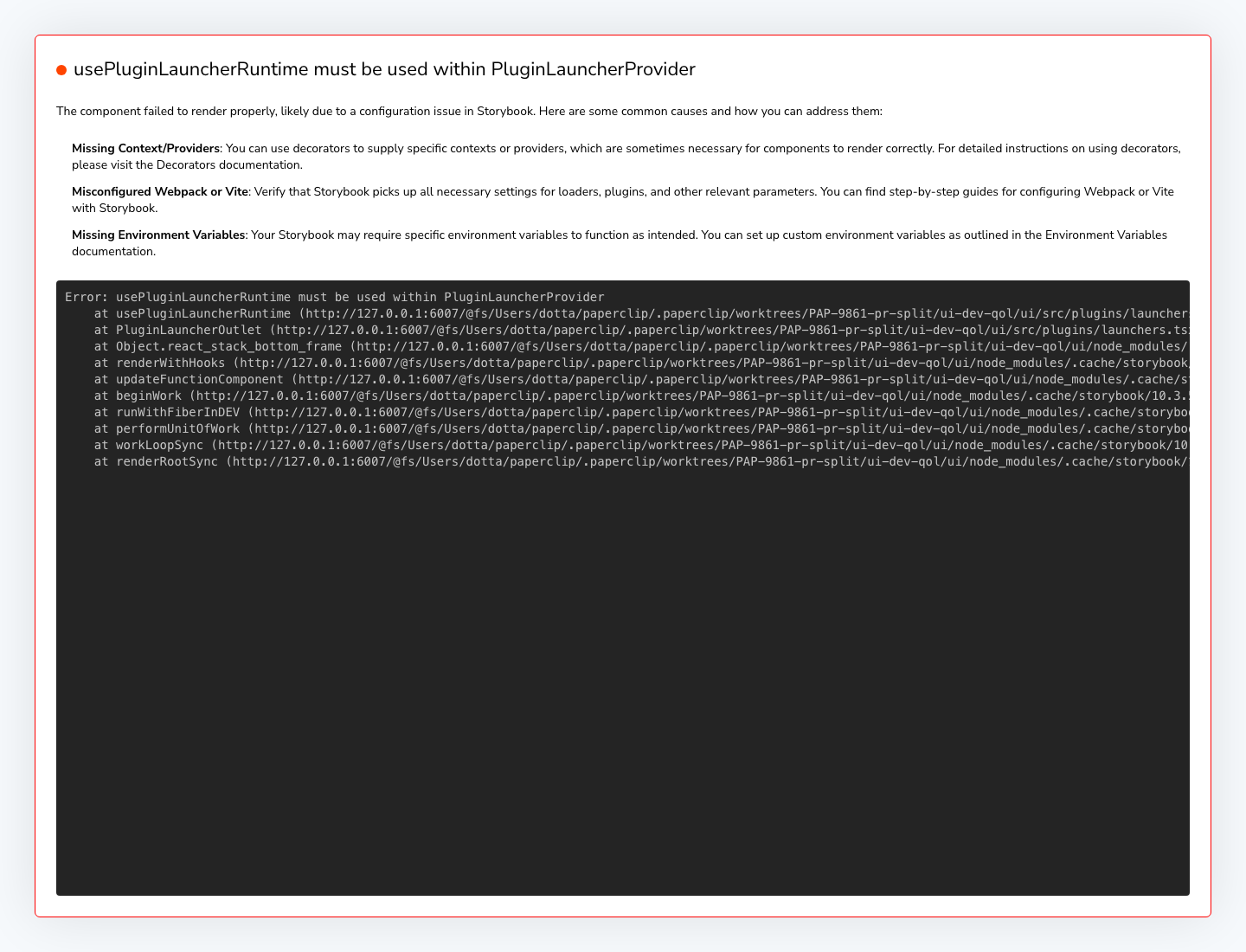
- Inbox/task row selection and hover-state surface: 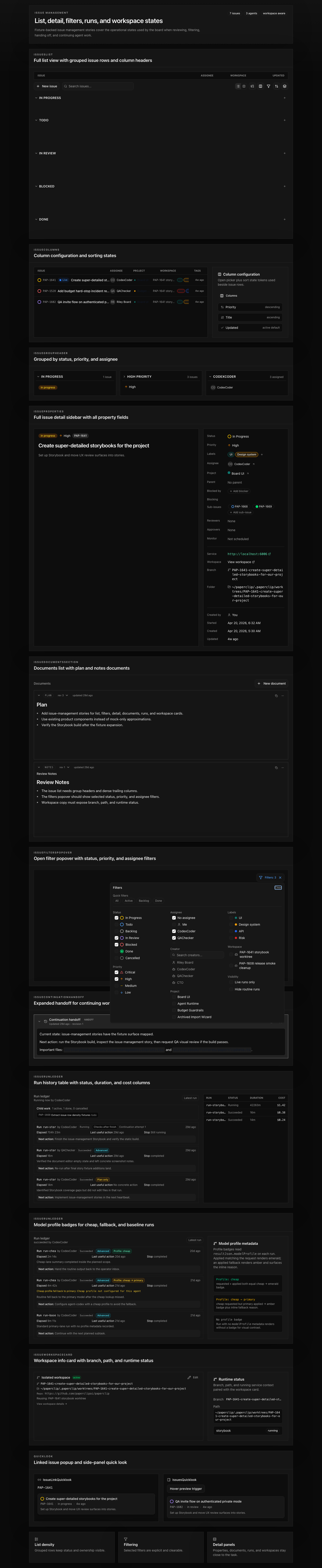
- Dev restart banner desktop: 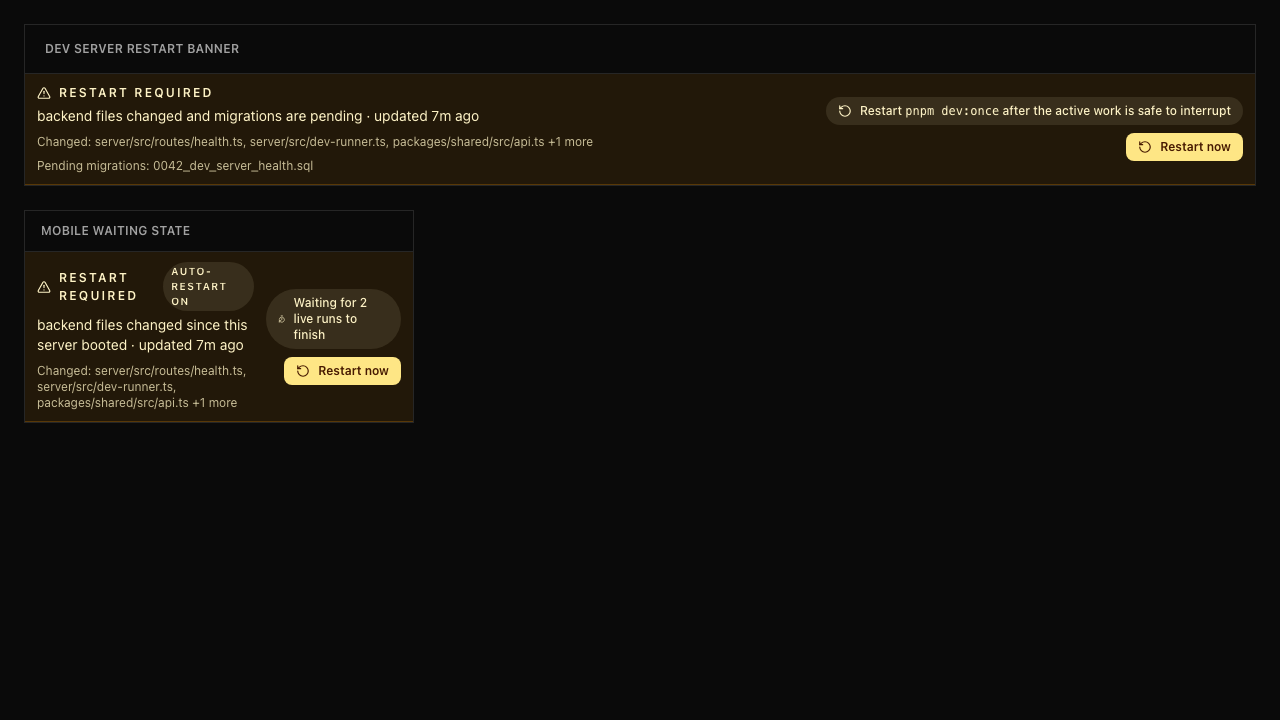
- Dev restart banner mobile: 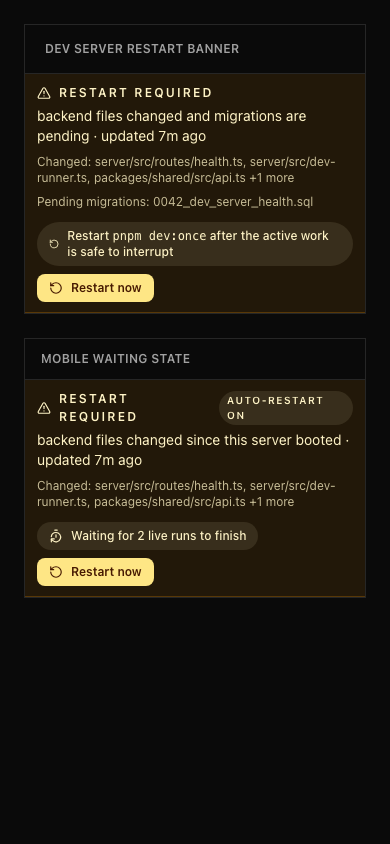
## Risks
- Mostly UI/dev ergonomics with low data risk.
- Sidebar and inbox changes touch frequently used navigation surfaces,
so visual review on desktop/mobile is still useful.
> For core feature work, check [`ROADMAP.md`](ROADMAP.md) first and
discuss it in `#dev` before opening the PR. Feature PRs that overlap
with planned core work may need to be redirected — check the roadmap
first. See `CONTRIBUTING.md`.
## Model Used
- OpenAI Codex, GPT-5-based coding agent with local shell/git/tool use.
Exact hosted model ID and context-window size are not exposed by the
local Paperclip adapter runtime.
## Checklist
- [x] I have included a thinking path that traces from project context
to this change
- [x] I have specified the model used (with version and capability
details)
- [x] I have checked ROADMAP.md and confirmed this PR does not duplicate
planned core work
- [x] I have run tests locally and they pass
- [x] I have added or updated tests where applicable
- [x] If this change affects the UI, I have included before/after
screenshots
- [x] I have updated relevant documentation to reflect my changes
- [x] I have considered and documented any risks above
- [x] I will address all Greptile and reviewer comments before
requesting merge
---------
Co-authored-by: Paperclip <noreply@paperclip.ing>
## Thinking Path

> - Paperclip gives operators a workspace diff plugin so they can
inspect agent changes before review
> - The diff view needs reliable base-ref defaults and controls that
stay usable while scrolling large diffs
> - The working branch mixed those plugin improvements with unrelated
server and cloud work
> - Keeping the workspace diff plugin changes isolated makes them easy
to test and review
> - This pull request polishes the workspace diff plugin controls,
base-ref behavior, and sticky headers
> - The benefit is a more predictable diff review surface for agent
workspaces

## What Changed

- Fixed workspace diff default base-ref resolution.
- Improved split/unified and working-tree/against-ref pane controls.
- Made workspace diff headers stay sticky while scrolling.
- Added a review screenshot at
`screenshots/PAP-9841-workspace-diff.png`.

## Verification

- `pnpm install --frozen-lockfile --ignore-scripts`
- `pnpm --filter @paperclipai/plugin-sdk build`
- `pnpm --filter @paperclipai/plugin-workspace-diff exec vitest run
tests/plugin.spec.ts`
- Result: 9 tests passed.

## Risks

- UI-only plugin branch with low data risk.
- The default base-ref inference should be reviewed against unusual
worktree/upstream combinations.

> For core feature work, check [`ROADMAP.md`](ROADMAP.md) first and
discuss it in `#dev` before opening the PR. Feature PRs that overlap
with planned core work may need to be redirected — check the roadmap
first. See `CONTRIBUTING.md`.

## Model Used

- OpenAI Codex, GPT-5-based coding agent with local shell/git/tool use.
Exact hosted model ID and context-window size are not exposed by the
local Paperclip adapter runtime.

## Checklist

- [x] I have included a thinking path that traces from project context
to this change
- [x] I have specified the model used (with version and capability
details)
- [x] I have checked ROADMAP.md and confirmed this PR does not duplicate
planned core work
- [x] I have run tests locally and they pass
- [x] I have added or updated tests where applicable
- [x] If this change affects the UI, I have included before/after
screenshots
- [x] I have updated relevant documentation to reflect my changes
- [x] I have considered and documented any risks above
- [x] I will address all Greptile and reviewer comments before
requesting merge

---------

Co-authored-by: Paperclip <noreply@paperclip.ing>
## Thinking Path
> - Paperclip orchestrates AI agents that need scoped, auditable access
to secrets
> - Hosted and external deployments need provider vault configuration
without exposing secret values in Paperclip metadata
> - AWS Secrets Manager vault setup previously required too much manual
operator knowledge
> - Provider vault discovery and removal belong together as an
independent secrets-management improvement
> - This pull request adds AWS provider vault discovery/prefill plus
vault removal flows
> - The benefit is a safer operator path for configuring external secret
storage before higher-level cloud workflows depend on it
## What Changed
- Added shared validators/types for AWS provider vault discovery
payloads and safe provider metadata.
- Implemented AWS provider vault discovery preview on the server.
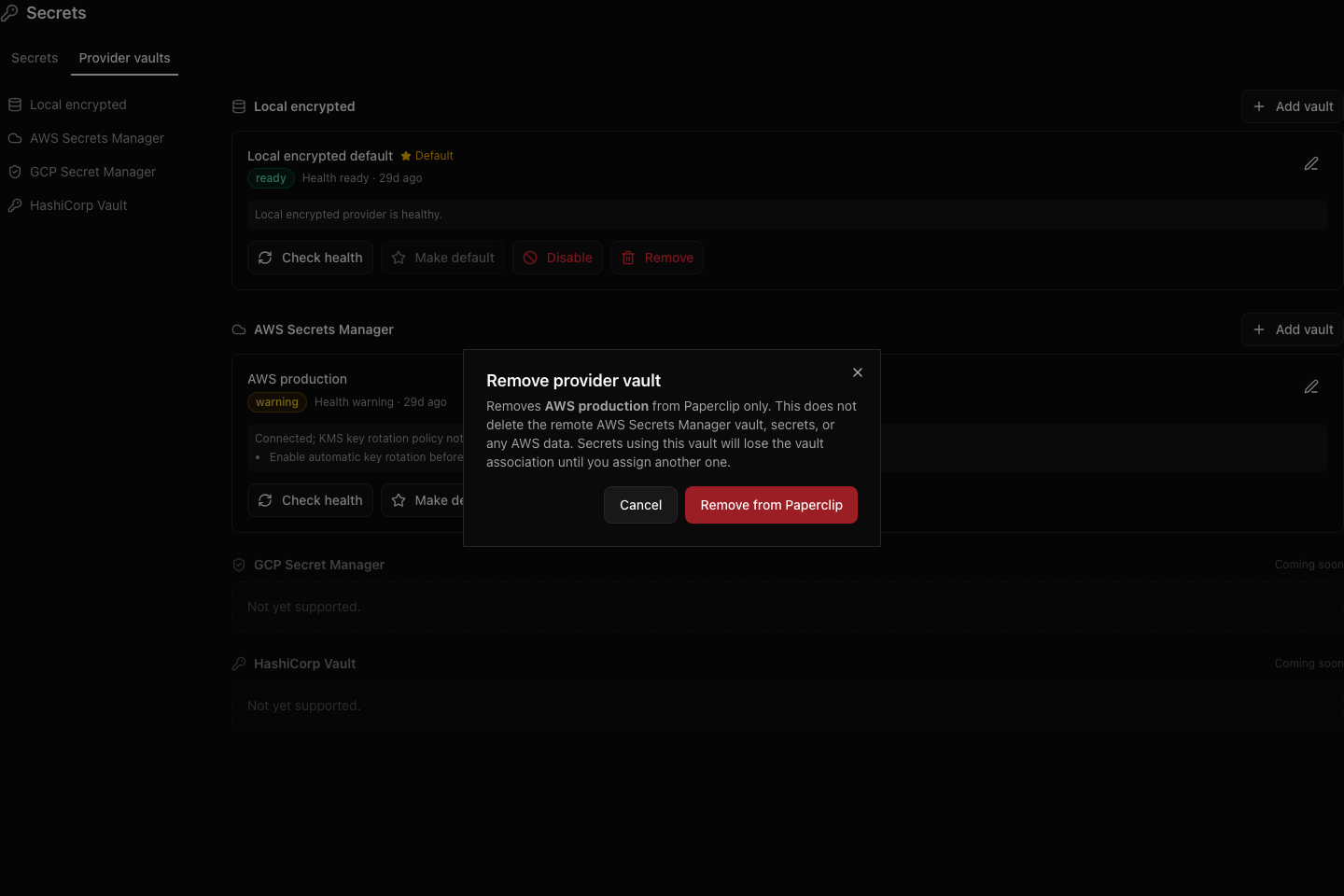
- Added provider vault removal service/route behavior.
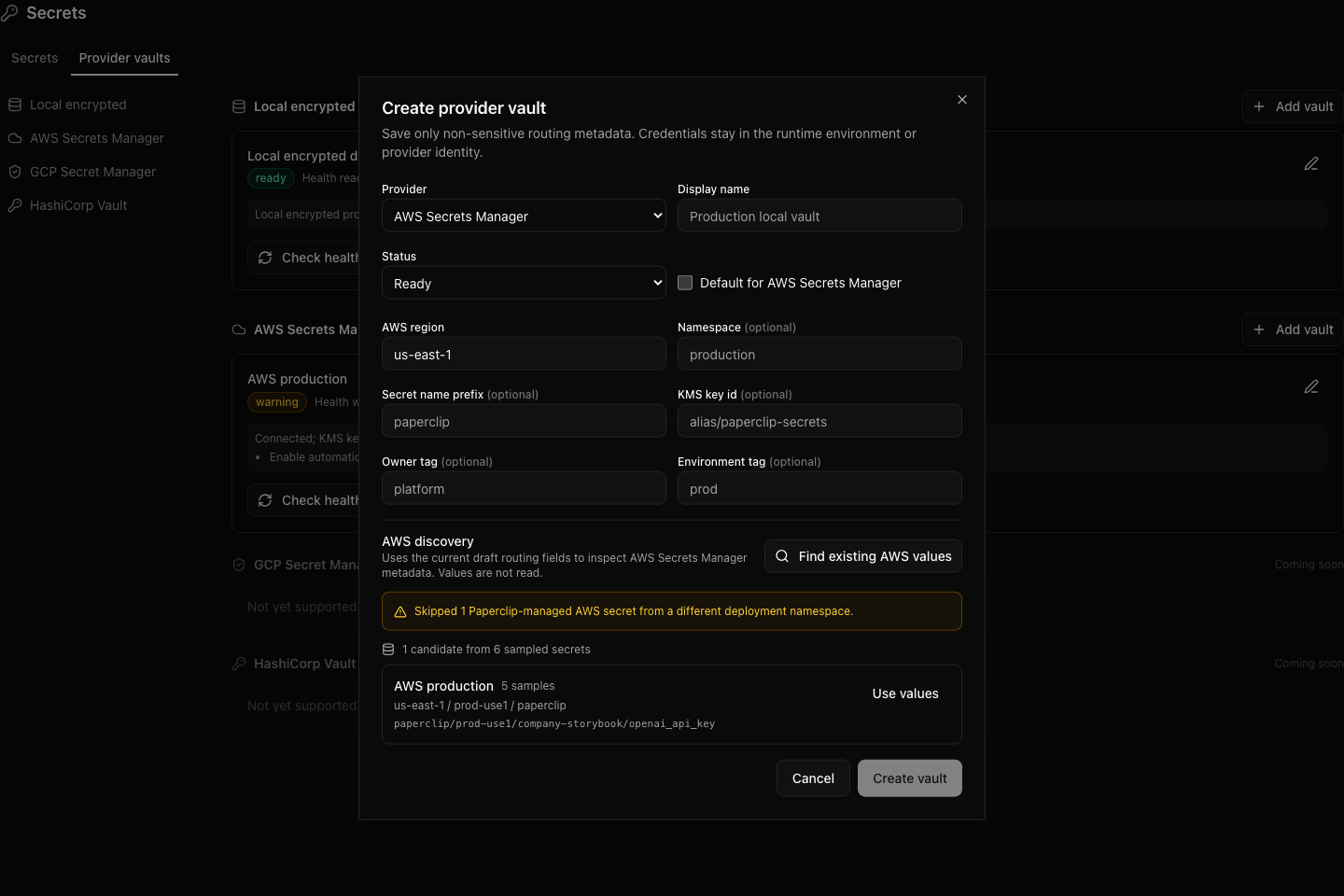
- Added Secrets page UI for discovery prefill, removal messaging, and
related rendering coverage.
- Added Storybook provider-vault fixtures and captured screenshots for
the new UX states.
## Verification
- `pnpm install --frozen-lockfile --ignore-scripts`
- `pnpm exec vitest run packages/shared/src/validators/secret.test.ts
server/src/__tests__/aws-secrets-manager-provider.test.ts
server/src/__tests__/secrets-routes.test.ts
server/src/__tests__/secrets-service.test.ts
ui/src/pages/Secrets.render.test.tsx`
- Result: 4 files passed, 1 embedded Postgres-backed file skipped on
this host because local Postgres init was unavailable.
- `pnpm --filter @paperclipai/ui exec vitest run
src/pages/Secrets.render.test.tsx`
- `pnpm --filter @paperclipai/ui typecheck`
- Storybook screenshot capture against `Product/Secrets` on
`http://127.0.0.1:60381/iframe.html?id=product-secrets--secrets-inventory&viewMode=story&globals=theme:dark`
## Screenshots
Provider vaults tab after this change:
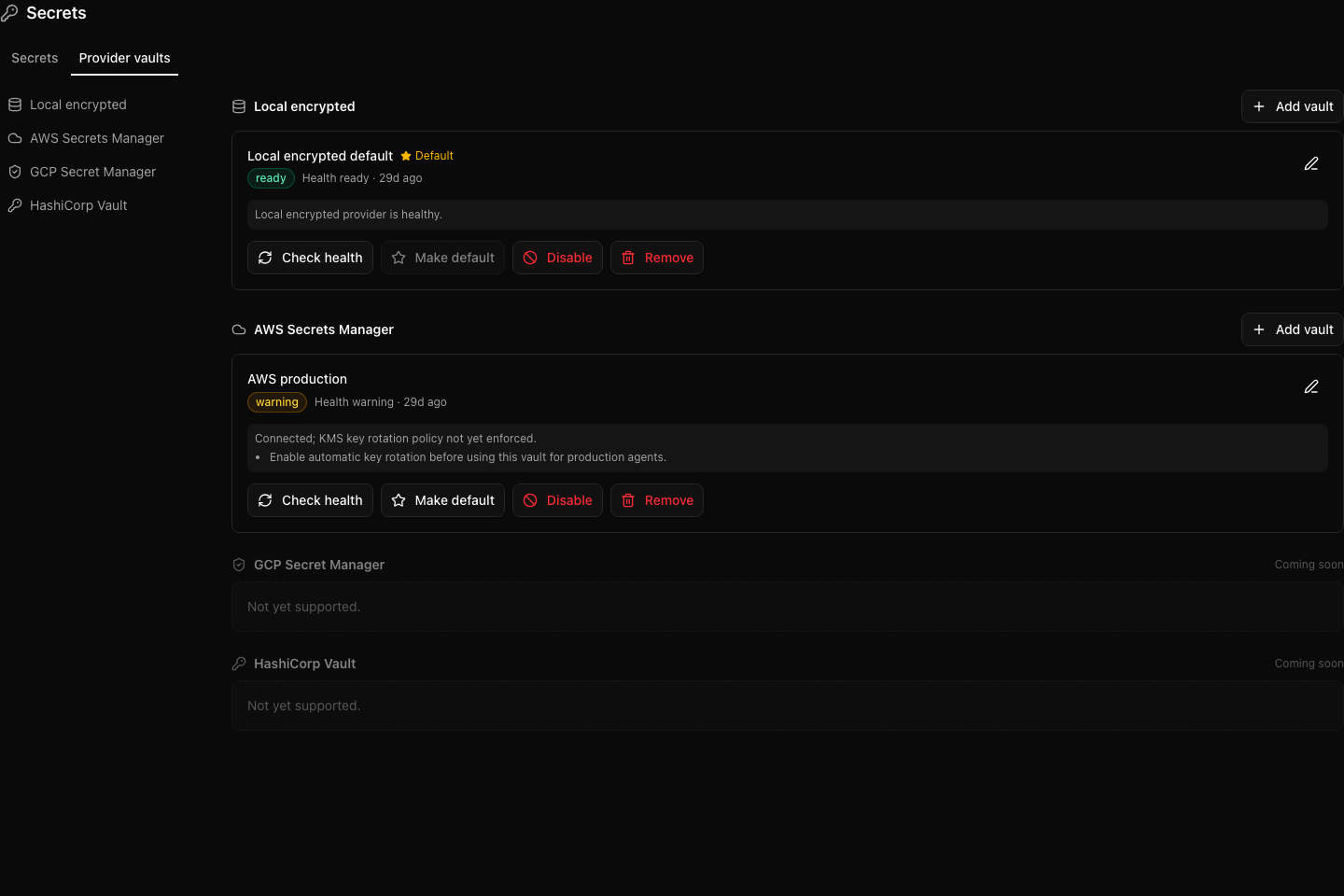
AWS discovery candidate flow:
Provider vault removal confirmation:
## Risks
- Secret provider metadata handling must remain non-sensitive;
validators reject credential-bearing Vault URLs and sensitive AWS
discovery keys.
- AWS discovery depends on deployment credentials being configured
correctly outside Paperclip-managed company secrets.
> For core feature work, check [`ROADMAP.md`](ROADMAP.md) first and
discuss it in `#dev` before opening the PR. Feature PRs that overlap
with planned core work may need to be redirected — check the roadmap
first. See `CONTRIBUTING.md`.
## Model Used
- OpenAI Codex, GPT-5-based coding agent with local shell/git/tool use.
Exact hosted model ID and context-window size are not exposed by the
local Paperclip adapter runtime.
## Checklist
- [x] I have included a thinking path that traces from project context
to this change
- [x] I have specified the model used (with version and capability
details)
- [x] I have checked ROADMAP.md and confirmed this PR does not duplicate
planned core work
- [x] I have run tests locally and they pass
- [x] I have added or updated tests where applicable
- [x] If this change affects the UI, I have included before/after
screenshots
- [x] I have updated relevant documentation to reflect my changes
- [x] I have considered and documented any risks above
- [x] I will address all Greptile and reviewer comments before
requesting merge
---------
Co-authored-by: Paperclip <noreply@paperclip.ing>
## Thinking Path

> - Paperclip orchestrates AI agents for zero-human companies.
> - Paperclip Cloud imports local company data into tenant Paperclip
stacks through trusted server-to-server calls.
> - Tenant imports authenticate as board actors with `source:
"cloud_tenant"` because they act on behalf of an authorized stack user.
> - The board mutation guard correctly protects browser session
mutations with trusted `Origin`/`Referer` checks.
> - But the guard treated trusted Cloud tenant calls like browser
session mutations, so server-to-server imports without a browser origin
failed with `403 Board mutation requires trusted browser origin`.
> - This pull request exempts trusted Cloud tenant actors from
browser-origin enforcement while preserving the session-backed browser
guard.
> - The benefit is that authorized Cloud imports can persist into tenant
Paperclip storage without weakening browser CSRF protections.

## What Changed

- Allow `req.actor.source === "cloud_tenant"` through
`boardMutationGuard` without requiring browser `Origin` or `Referer`
headers.
- Add a focused regression test for Cloud tenant POST mutations without
an origin.
- Preserve the existing session-backed rejection test for board
mutations that lack a trusted browser origin.

## Verification

- `pnpm exec vitest run
server/src/__tests__/board-mutation-guard.test.ts`
- Result: 10 tests passed.

## Risks

- Low risk: this only expands the existing non-browser exemption list to
trusted Cloud tenant actors that have already passed tenant-server-token
authentication.
- The browser-session path remains covered by the existing rejection
test, so missing-origin browser mutations still fail.

> For core feature work, check [`ROADMAP.md`](ROADMAP.md) first and
discuss it in `#dev` before opening the PR. Feature PRs that overlap
with planned core work may need to be redirected — check the roadmap
first. See `CONTRIBUTING.md`.

## Model Used

- OpenAI Codex, GPT-5 coding agent, tool-enabled local repository
editing and shell verification.

## Checklist

- [x] I have included a thinking path that traces from project context
to this change
- [x] I have specified the model used (with version and capability
details)
- [x] I have checked ROADMAP.md and confirmed this PR does not duplicate
planned core work
- [x] I have run tests locally and they pass
- [x] I have added or updated tests where applicable
- [x] If this change affects the UI, I have included before/after
screenshots
- [x] I have updated relevant documentation to reflect my changes
- [x] I have considered and documented any risks above
- [x] I will address all Greptile and reviewer comments before
requesting merge
 Dotta









