mirror of
https://github.com/paperclipai/paperclip.git
synced 2026-10-17 01:25:26 +02:00
bf3eecdd2d888fe548c59e459ab25a66520d652b
13
Commits
| Author | SHA1 | Message | Date | |
|---|---|---|---|---|
 Devin Foley Devin Foley
|
0f12721ee9 |
fix(server): let board users cancel issues with an active review stage (#10655)
## Thinking Path > - Paperclip is the open source app people use to manage AI agents for work > - The server enforces an issue execution policy. It gates status changes while a review or approval stage is active. > - A board user could not cancel a task while an agent reviewer held the active stage. The API returned "Only the active reviewer or approver can advance the current execution stage". > - Board users own the board. They must always be able to edit and cancel any task. > - This pull request adds a board override to the execution stage transition. A board cancel clears the pending stage state and proceeds instead of raising an error. > - The benefit is that board users can always stop work, even while a review is pending or the stored stage state has drifted. ## Linked Issues or Issue Description No public GitHub issue exists for this bug. Description follows `bug_report.yml`: **What happened?** A board user set a task to `cancelled` while the task had an active reviewer stage held by an agent. The PATCH failed with "Task Update Failed... only the assigned approver or reviewer...". The same failure occurred when the stored stage state had drifted: the server silently forced the task back to `in_review` instead of honoring the cancel. **Expected behavior** A board user can always edit and cancel any task. A board cancel must clear the pending review stage and apply the requested status. **Steps to reproduce** 1. Create a task assigned to agent A with agent B configured as reviewer in the execution policy. 2. Let agent A hand the task off so the review stage becomes active. 3. As the board user, set the task status to Cancelled. 4. The update fails with the reviewer-only error. Related work: #5487 touches the execution-policy approver UI. It does not address the board cancel path. ## What Changed - `server/src/routes/issues.ts`: the issue PATCH route now passes `allowBoardOverride` when the actor is a board user. - `server/src/services/issue-execution-policy.ts`: when `allowBoardOverride` is set and the requested status is not `in_review` or `in_progress`, the transition clears `executionState` and proceeds. This applies both while a stage decision is pending and when the stage state has drifted, so a board cancel is no longer rejected or silently flipped back to `in_review`. - Reviewer gating is unchanged for everyone else: a board user who is the active participant still uses the normal approve / request-changes flow, and non-participant agents still receive the 422 guard. - Assignee-only board updates on an `in_review` task keep the stage state coherent: reassigning to an eligible stage participant re-pends the stage with them as the current participant, while reassigning to a non-participant (or unassigning) dissolves the review back to `in_progress` instead of persisting an `in_review` issue with no execution state or an ineligible participant. - New unit tests and route tests cover board cancellation of an active review stage and of a drifted pending review, plus reviewer swap, non-participant reassignment, and unassignment during an active review. ## Verification - In `server/`: `pnpm exec vitest run src/__tests__/issue-execution-policy.test.ts src/__tests__/issue-execution-policy-routes.test.ts` — 2 files, 73/73 tests pass on top of current `master`. - In `server/`: `pnpm run typecheck` passes. ## Risks - Low risk. The override branch runs only for board actors and only for target statuses other than `in_review` and `in_progress`. Cancelling clears `executionState`, so a later reopen starts from a fresh stage state. Agent-facing flows and reviewer gating are unchanged. ## Model Used - Claude Fable 5 (Anthropic), model ID `claude-fable-5`, running in Claude Code (Claude Agent SDK) with extended thinking and agentic tool use. ## Checklist - [x] I have included a thinking path that traces from project context to this change - [x] I have specified the model used (with version and capability details) - [x] I have checked ROADMAP.md and confirmed this PR does not duplicate planned core work - [x] I have searched GitHub for duplicate or related PRs and linked them above - [x] I have either (a) linked existing issues with `Fixes: #` / `Closes #` / `Refs #` OR (b) described the issue in-PR following the relevant issue template - [x] I have not referenced internal/instance-local Paperclip issues or links (only public GitHub `#NNN` / `github.com/paperclipai/paperclip` URLs) - [x] My branch name describes the change (e.g. `docs/...`, `fix/...`) and contains no internal Paperclip ticket id or instance-derived details - [x] I have run tests locally and they pass - [x] I have added or updated tests where applicable - [x] I have updated relevant documentation to reflect my changes - [x] I have considered and documented any risks above - [ ] All Paperclip CI gates are green - [ ] Greptile is 5/5 with no open P2s, recommendations, or follow-ups - [x] I will address all Greptile and reviewer comments before requesting merge |
||
|
Devin Foley
|
27f8c8dbcf |
feat(server): cap agent review rounds and escalate exhausted reviews to the responsible human (#10650)
## Thinking Path > - Paperclip is the open source app people use to manage AI agents for work > - Execution policies let one agent implement and another review, cycling through changes-requested → addressed rounds > - Nothing bounds that cycle: no round counter, no escalation, no termination signal — two agents can ping-pong indefinitely, especially when the review's success criteria drift to something the implementer cannot satisfy > - On a real multi-agent instance this produced 6+ unattended rounds (~8 runs) that continued even after the human had merged the PR under review > - This pull request counts consecutive agent-initiated changes-requested rounds and, at a configurable cap, hands the still-pending review to the responsible human instead of bouncing back to the implementer > - The benefit is that unattended review loops terminate in a human decision instead of burning runs forever ## Linked Issues or Issue Description Fixes #10643 ## What Changed - `IssueExecutionState.changesRequestedCount` (schema + type, default 0): consecutive agent-initiated changes-requested rounds on the current stage. Carries through executor resubmissions, resets to 0 on approval, and resets when a **human** makes the changes-requested decision — the cap targets unattended agent↔agent ping-pong, never human review. - `IssueExecutionPolicy.maxReviewRounds` (optional, 1–50, default null → server default `DEFAULT_MAX_REVIEW_ROUNDS = 3`). - At the cap, the transition records the reviewer's changes-requested decision as usual but keeps the stage **pending** with the responsible human (`responsibleUserId`, falling back to `createdByUserId`) as the participant: the issue is assigned to that human and the pending review surfaces through the existing attention/review UI. The human then approves, requests changes (resetting the counter and handing back to the implementer), or re-scopes. - The escalated hold is sticky: transitions from anyone other than the escalated human no longer re-select a configured agent participant for the stage (which would have silently undone the escalation on the next unrelated PATCH). The escalated human's own decisions flow through the normal participant decision branch. - Issues with no responsible human keep today's hand-back behavior; the counter still accumulates so operators can see the churn. ## Verification - `pnpm vitest run server/src/__tests__/issue-execution-policy.test.ts` — 8 new cases: round counting on hand-back, count carried through resubmission, escalation at the default cap, sticky hold across unrelated transitions, human changes-requested resets the counter, human approval completes the stage, no-responsible-human fallback, and a `maxReviewRounds: 1` policy override. - `pnpm vitest run server/src/__tests__/issue-execution-policy-routes.test.ts` and the full `@paperclipai/shared` suite (387 tests) — schema additions are backward compatible (both fields optional with defaults; persisted states without the counter parse as 0). - `pnpm --filter @paperclipai/shared exec tsc --noEmit` and `cd server && pnpm run typecheck`. ## Risks - Behavior change: an agent-only review loop that previously ran forever now escalates to a human after 3 agent rounds by default. Instances that want longer loops can set `maxReviewRounds` per policy. Flows where a human participates are unaffected (human decisions reset the counter). - Escalation requires a `responsibleUserId`/`createdByUserId` on the issue; without one, behavior is unchanged. - Persisted execution states from before this change parse with `changesRequestedCount: 0` — no migration needed. ## Model Used Claude Fable 5 (`claude-fable-5`, Anthropic) via Claude Code — extended thinking, agentic tool use. No other models involved. ## Checklist - [x] I have included a thinking path that traces from project context to this change - [x] I have specified the model used (with version and capability details) - [x] I have checked ROADMAP.md and confirmed this PR does not duplicate planned core work - [x] I have searched GitHub for duplicate or related PRs and linked them above - [x] I have either (a) linked existing issues with `Fixes: #` / `Closes #` / `Refs #` OR (b) described the issue in-PR following the relevant issue template - [x] I have not referenced internal/instance-local Paperclip issues or links (only public GitHub `#NNN` / `github.com/paperclipai/paperclip` URLs) - [x] My branch name describes the change (e.g. `docs/...`, `fix/...`) and contains no internal Paperclip ticket id or instance-derived details - [x] I have run tests locally and they pass - [x] I have added or updated tests where applicable - [x] I have updated relevant documentation to reflect my changes - [x] I have considered and documented any risks above - [ ] All Paperclip CI gates are green - [ ] Greptile is 5/5 with no open P2s, recommendations, or follow-ups - [x] I will address all Greptile and reviewer comments before requesting merge |
||
|
SamandSami Rusani
|
39666aa906 |
fix(server): clarify execution policy decision comments (#9105)
## Thinking Path

> - Paperclip is the open source app people use to manage AI agents for
work.
> - Execution policies let issues move through enforced review and
approval stages before work is considered done.
> - Active reviewers and approvers must include decision rationale when
approving or requesting changes.
> - The server already requires the decision comment to arrive in the
same `PATCH /api/issues/:id` request as the status change.
> - When callers post a normal comment first and then send a status-only
`PATCH`, the existing 422 only says a comment is required.
> - This pull request keeps the atomic decision behavior but makes the
API error and docs explicit about the same-request requirement.
> - The benefit is that agents and API clients can recover immediately
by sending `{ status, comment }` together instead of dead-ending on an
ambiguous validation error.

## Linked Issues or Issue Description

Fixes #9049.

Duplicate/related search completed before implementation: searched open
PRs for `9049`, `Approving a review or approval stage requires a
comment`, `Requesting changes requires a comment`, and `same PATCH`. I
did not find a direct open PR for the same error-message/docs fix.
Related PRs found but not duplicates: #8302 documents cross-agent review
gates in the skill API reference, and #5487 covers human approval UI.

## What Changed

- Expanded execution-policy 422 messages for approve and request-changes
decisions to say the comment must be included in the same `PATCH`
request and prior comments are not considered.
- Tightened unit coverage so the comment-required branches assert the
new actionable guidance.
- Documented the same-request `{ status, comment }` decision shape in
the execution policy guide, issue API reference, and agent communication
guide.

## Verification

- `CI=true corepack pnpm --filter @paperclipai/server exec vitest run
src/__tests__/issue-execution-policy.test.ts --reporter verbose`
- `CI=true corepack pnpm --filter @paperclipai/plugin-sdk exec node
../../../scripts/ensure-plugin-build-deps.mjs`
- `CI=true corepack pnpm --filter @paperclipai/server exec tsc --noEmit`
- `git diff --check`

## Risks

Low risk. This does not change execution-policy state transitions or
relax the atomic decision guard; it only makes the existing requirement
explicit in errors and docs.

> For core feature work, check [`ROADMAP.md`](ROADMAP.md) first and
discuss it in `#dev` before opening the PR. Feature PRs that overlap
with planned core work may need to be redirected — check the roadmap
first. See `CONTRIBUTING.md`.

## Model Used

OpenAI Codex (GPT-5 Codex), operating in Codex desktop with repository
file access, shell validation, and GitHub CLI workflow. Exact context
window size is not surfaced by this environment.

## Checklist

- [x] I have included a thinking path that traces from project context
to this change
- [x] I have specified the model used (with version and capability
details)
- [x] I have checked ROADMAP.md and confirmed this PR does not duplicate
planned core work
- [x] I have searched GitHub for duplicate or related PRs and linked
them above
- [x] I have either (a) linked existing issues with `Fixes: #` / `Closes
#` / `Refs #` OR (b) described the issue in-PR following the relevant
issue template
- [x] I have not referenced internal/instance-local Paperclip issues or
links (only public GitHub `#NNN` / `github.com/paperclipai/paperclip`
URLs)
- [x] My branch name describes the change (e.g. `docs/...`, `fix/...`)
and contains no internal Paperclip ticket id or instance-derived details
- [x] I have run tests locally and they pass
- [x] I have added or updated tests where applicable
- [x] I have updated relevant documentation to reflect my changes
- [x] I have considered and documented any risks above
- [ ] All Paperclip CI gates are green
- [ ] Greptile is 5/5 with no open P2s, recommendations, or follow-ups
- [x] I will address all Greptile and reviewer comments before
requesting merge

Co-authored-by: Sami Rusani <sr@samirusani>
|
||
|
Harshit KhemaniandClaude Fable 5
|
3e1dc90bf2 |
fix(execution-policy): final-stage approval terminates the policy instead of rewinding to stage 1 (#7893) (#7936)
## Thinking Path > - Paperclip is the open source app people use to manage AI agents for work > - Issues can carry an embedded multi-stage `executionPolicy` (e.g. QA → CodeReviewer → CodePusher) driven by `applyIssueExecutionStageTransition` in `server/src/services/issue-execution-policy.ts` > - On approval, the next stage was picked with `nextPendingStage()`, which scans the **whole** stage list from index 0 for the first id not in `completedStageIds` > - Stage ids are regenerated whenever the embedded policy is re-sent or edited mid-flow (a supported operation — the existing "reassigns the active stage when the current participant is removed" test depends on it), so earlier `completedStageIds` can stop matching the current policy; a final-stage approve then "finds" stage 1 pending again and rebuilds a first-stage review (#7893) — an endless re-review loop that can recycle indefinitely against a moving main tip > - This pull request makes approvals advance with a forward-only scan (only stages *after* the one being approved), so approving the last stage always terminates the policy, and adds a guard so an already-completed execution state is terminal for `status=done` > - The benefit is final-stage approvals close the issue as the policy intends, with no behavior change for non-final advancement or reject/changes_requested verdicts ## Linked Issues or Issue Description Fixes #7893 ## What Changed - `server/src/services/issue-execution-policy.ts`: - New `nextPendingStageAfter(policy, completedStage, state)` helper — forward-only scan from the approved stage's index; the approval path uses it instead of `nextPendingStage()`. Approving the final stage therefore always yields `nextStage === null` → completed state → the caller's `done` flows through. - New guard: `requestedStatus === "done"` with an already-`completed` execution state returns without restarting the chain at stage 1 (closes the same loop when a stale completed state lingers). - Reject/`changes_requested` verdicts and intact-state forward advancement are untouched. - `server/src/__tests__/issue-execution-policy.test.ts`: 4 regression tests, including one that reproduces the exact rewind (regenerated stage ids + final-stage approve → previously reassigned QA at `currentStageIndex 0`; now terminal completed) and an explicit final-stage rejection test pinning the unchanged path. ## Verification - `npx vitest run server/src/__tests__/issue-execution-policy.test.ts` → 54 passed (50 pre-existing + 4 new). - `pnpm --filter @paperclipai/server typecheck` → clean. - The rewind was confirmed empirically against unmodified code first (a test asserting the buggy output passed pre-fix and flips post-fix), plus brute-forced realistic operation sequences (checkout dances, status round-trips, interim comments per the agent flow documented around #4889) to verify intact-state flows are unaffected. - Related suites (`issue-execution-policy-routes`, `issue-comment-reopen-routes`, `issues-service`, `issue-thread-interaction-routes`, `issue-agent-mutation-ownership-routes`) also pass locally. ## Risks - Behavior deliberately preserved: non-final approvals (forward scan is identical when state is intact), rejections at any stage, reopen-from-done (state cleared on reopen, fresh chain still starts at stage 1), and explicit `in_review` restarts. - The policy schema has no terminal-state field, so per the issue's Ask the policy simply terminates and the requested `done` status flows through. ## Model Used - Claude Fable 5 (`claude-fable-5`, Anthropic) via Claude Code, agentic mode with tool use (subagent implementation + independent adversarial review subagent), extended thinking enabled. ## Checklist - [x] I have included a thinking path that traces from project context to this change - [x] I have specified the model used (with version and capability details) - [x] I have checked ROADMAP.md and confirmed this PR does not duplicate planned core work - [x] I have searched GitHub for duplicate or related PRs and linked them above (none found for #7893) - [x] I have either (a) linked existing issues with `Fixes: #` / `Closes #` / `Refs #` OR (b) described the issue in-PR following the relevant issue template - [x] I have run tests locally and they pass - [x] I have added or updated tests where applicable - [x] If this change affects the UI, I have included before/after screenshots (N/A — server-only change) - [x] I have updated relevant documentation to reflect my changes (N/A — internal stage-advance semantics) - [x] I have considered and documented any risks above - [ ] All Paperclip CI gates are green (will confirm once CI runs on this PR) - [ ] Greptile is 5/5 with no open P2s, recommendations, or follow-ups (pending first review) - [x] I will address all Greptile and reviewer comments before requesting merge Co-authored-by: Claude Fable 5 <noreply@anthropic.com> |
||
|
DottaandPaperclip
|
57229d0f24 |
[codex] Add issue monitor liveness controls (#4988)
## Thinking Path > - Paperclip is a control plane for autonomous AI companies where work must stay observable, governable, and recoverable. > - The task/heartbeat subsystem owns agent execution continuity, issue state transitions, and visible recovery behavior. > - Waiting on an external service is not the same as being blocked when the assignee still owns a future check. > - The gap was that agents had no first-class one-shot monitor state for external-service waits, so recovery could look stalled or require ad hoc comments. > - This pull request adds bounded issue monitors that can wake the owner, clear exhausted waits, and produce explicit recovery behavior. > - It also surfaces monitor status in the board UI and documents when to use monitors versus `blocked`. > - The benefit is clearer liveness semantics for asynchronous waits without weakening single-assignee task ownership. ## What Changed - Added issue monitor fields, shared types, validators, constants, and an idempotent `0075` migration for scheduled monitor state. - Added server-side monitor scheduling, dispatch, recovery bounds, activity logging, and external-ref redaction. - Added board/agent route coverage for monitor permissions and child monitor scheduling. - Added issue detail/property UI for monitor state, a monitor activity card, and Storybook stories for review surfaces. - Documented monitor semantics and recovery policy behavior in `doc/execution-semantics.md`. - Addressed Greptile review feedback by preserving monitor state in skipped-stage builders and making board monitor saves send `scheduledBy: "board"`. ## Verification - `pnpm install --frozen-lockfile` - `pnpm run preflight:workspace-links && pnpm exec vitest run server/src/__tests__/issue-execution-policy-routes.test.ts server/src/__tests__/issue-execution-policy.test.ts server/src/__tests__/issue-monitor-scheduler.test.ts server/src/__tests__/recovery-classifiers.test.ts ui/src/components/IssueMonitorActivityCard.test.tsx ui/src/components/IssueProperties.test.tsx ui/src/lib/activity-format.test.ts` - First run passed 5 files and failed to collect 2 server suites because the worktree was missing the optional `acpx/runtime` dependency. - After `pnpm install --frozen-lockfile`, reran the 2 failed suites successfully. - `pnpm exec vitest run server/src/__tests__/issue-monitor-scheduler.test.ts server/src/__tests__/recovery-classifiers.test.ts` - `pnpm --filter @paperclipai/shared typecheck && pnpm --filter @paperclipai/db typecheck && pnpm --filter @paperclipai/server typecheck && pnpm --filter @paperclipai/ui typecheck` - `pnpm exec vitest run server/src/__tests__/issue-execution-policy.test.ts ui/src/components/IssueProperties.test.tsx` - `pnpm --filter @paperclipai/server typecheck && pnpm --filter @paperclipai/ui typecheck` - `pnpm exec vitest run ui/src/components/IssueMonitorActivityCard.test.tsx ui/src/components/IssueProperties.test.tsx` - `pnpm --filter @paperclipai/ui typecheck` - Storybook screenshot captured from `http://127.0.0.1:6006/iframe.html?viewMode=story&id=product-issue-monitor-surfaces--monitor-surfaces` with Playwright. ## Screenshots 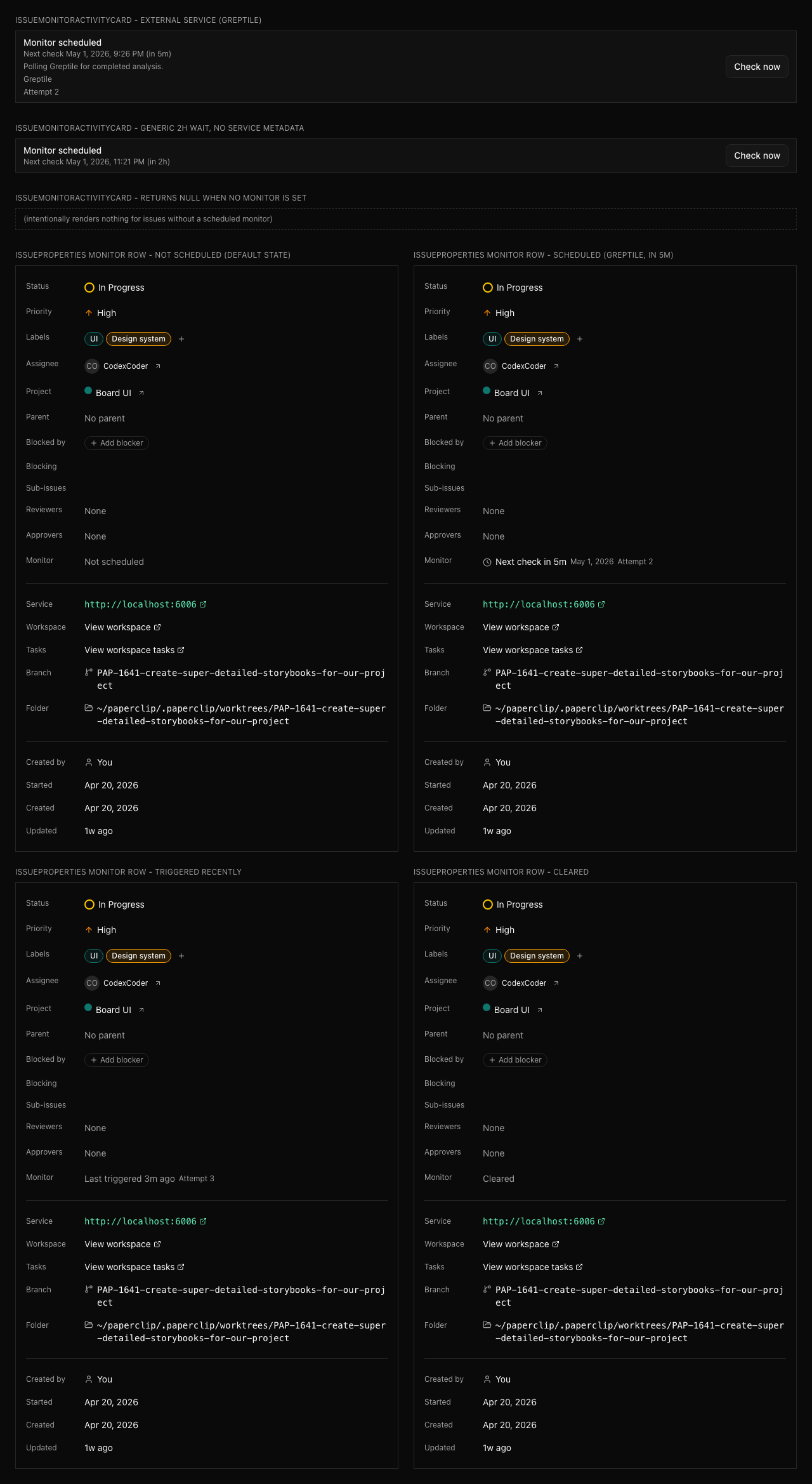 ## Risks - Medium: this changes heartbeat recovery behavior for scheduled external-service waits, so regressions could affect wake timing or recovery issue creation. - Migration risk is reduced by using `IF NOT EXISTS` for the new issue monitor columns and index. - External monitor references are treated as secret-adjacent and are intentionally omitted from visible activity/wake payloads. > For core feature work, check [`ROADMAP.md`](ROADMAP.md) first and discuss it in `#dev` before opening the PR. Feature PRs that overlap with planned core work may need to be redirected — check the roadmap first. See `CONTRIBUTING.md`. ## Model Used - OpenAI Codex, GPT-5 coding agent with repository tool use and terminal execution. ## Checklist - [x] I have included a thinking path that traces from project context to this change - [x] I have specified the model used (with version and capability details) - [x] I have checked ROADMAP.md and confirmed this PR does not duplicate planned core work - [x] I have run tests locally and they pass - [x] I have added or updated tests where applicable - [x] If this change affects the UI, I have included before/after screenshots or Storybook review surfaces - [x] I have updated relevant documentation to reflect my changes - [x] I have considered and documented any risks above - [x] I will address all Greptile and reviewer comments before requesting merge --------- Co-authored-by: Paperclip <noreply@paperclip.ing> |
||
|
DottaandPaperclip
|
7ad225a198 |
[codex] Improve issue thread review flow (#4381)
## Thinking Path > - Paperclip orchestrates AI agents for zero-human companies > - Issue detail is where operators coordinate review, approvals, and follow-up work with active runs > - That thread UI needs to surface blockers, descendants, review handoffs, and reply ergonomics clearly enough for humans to guide agent work > - Several small gaps in the issue-thread flow were making review and navigation clunkier than necessary > - This pull request improves the reply composer, descendant/blocker presentation, interaction folding, and review-request handoff plumbing together as one cohesive issue-thread workflow slice > - The benefit is a cleaner operator review loop without changing the broader task model ## What Changed - restored and refined the floating reply composer behavior in the issue thread - folded expired confirmation interactions and improved post-submit thread scrolling behavior - surfaced descendant issue context and inline blocker/paused-assignee notices on the issue detail view - tightened large-board first paint behavior in `IssuesList` - added loose review-request handoffs through the issue execution-policy/update path and covered them with tests ## Verification - `pnpm vitest run ui/src/pages/IssueDetail.test.tsx` - `pnpm vitest run server/src/__tests__/issues-service.test.ts server/src/__tests__/issue-execution-policy.test.ts` - `pnpm exec vitest run --project @paperclipai/ui ui/src/components/IssueChatThread.test.tsx ui/src/components/IssueProperties.test.tsx ui/src/components/IssuesList.test.tsx ui/src/lib/issue-tree.test.ts ui/src/api/issues.test.ts` - `pnpm exec vitest run --project @paperclipai/adapter-utils packages/adapter-utils/src/server-utils.test.ts` - `pnpm exec vitest run --project @paperclipai/server server/src/__tests__/issue-comment-reopen-routes.test.ts -t "coerces executor handoff patches into workflow-controlled review wakes|wakes the return assignee with execution_changes_requested"` - `pnpm exec vitest run --project @paperclipai/server server/src/__tests__/issue-execution-policy.test.ts server/src/__tests__/issues-service.test.ts` ## Visual Evidence - UI layout changes are covered by the focused issue-thread component and issue-detail tests listed above. Browser screenshots were not attachable from this automated greploop environment, so reviewers should use the running preview for final visual confirmation. ## Risks - Moderate UI-flow risk: these changes touch the issue detail experience in multiple spots, so regressions would most likely show up as thread-layout quirks or incorrect review-handoff behavior > For core feature work, check [`ROADMAP.md`](ROADMAP.md) first and discuss it in `#dev` before opening the PR. Feature PRs that overlap with planned core work may need to be redirected — check the roadmap first. See `CONTRIBUTING.md`. ## Model Used - OpenAI Codex GPT-5-based coding agent with tool use and code execution in the Codex CLI environment ## Checklist - [x] I have included a thinking path that traces from project context to this change - [x] I have specified the model used (with version and capability details) - [x] I have checked ROADMAP.md and confirmed this PR does not duplicate planned core work - [x] I have run tests locally and they pass - [x] I have added or updated tests where applicable - [x] If this change affects the UI, I have included before/after screenshots or documented the visual verification path - [ ] I have updated relevant documentation to reflect my changes - [x] I have considered and documented any risks above - [x] I will address all Greptile and reviewer comments before requesting merge --------- Co-authored-by: Paperclip <noreply@paperclip.ing> |
||
|
DottaandPaperclip
|
7f893ac4ec |
[codex] Harden execution reliability and heartbeat tooling (#3679)
## Thinking Path > - Paperclip orchestrates AI agents for zero-human companies > - Reliable execution depends on heartbeat routing, issue lifecycle semantics, telemetry, and a fast enough local verification loop to keep regressions visible > - The remaining commits on this branch were mostly server/runtime correctness fixes plus test and documentation follow-ups in that area > - Those changes are logically separate from the UI-focused issue-detail and workspace/navigation branches even when they touch overlapping issue APIs > - This pull request groups the execution reliability, heartbeat, telemetry, and tooling changes into one standalone branch > - The benefit is a focused review of the control-plane correctness work, including the follow-up fix that restored the implicit comment-reopen helpers after branch splitting ## What Changed - Hardened issue/heartbeat execution behavior, including self-review stage skipping, deferred mention wakes during active execution, stranded execution recovery, active-run scoping, assignee resolution, and blocked-to-todo wake resumption - Reduced noisy polling/logging overhead by trimming issue run payloads, compacting persisted run logs, silencing high-volume request logs, and capping heartbeat-run queries in dashboard/inbox surfaces - Expanded telemetry and status semantics with adapter/model fields on task completion plus clearer status guidance in docs/onboarding material - Updated test infrastructure and verification defaults with faster route-test module isolation, cheaper default `pnpm test`, e2e isolation from local state, and repo verification follow-ups - Included docs/release housekeeping from the branch and added a small follow-up commit restoring the implicit comment-reopen helpers that were dropped during branch reconstruction ## Verification - `pnpm vitest run server/src/__tests__/issue-comment-reopen-routes.test.ts server/src/__tests__/issue-telemetry-routes.test.ts` - `pnpm vitest run server/src/__tests__/http-log-policy.test.ts server/src/__tests__/heartbeat-run-log.test.ts server/src/__tests__/health.test.ts` - `server/src/__tests__/activity-service.test.ts`, `server/src/__tests__/heartbeat-comment-wake-batching.test.ts`, and `server/src/__tests__/heartbeat-process-recovery.test.ts` were attempted on this host but the embedded Postgres harness reported init-script/data-dir problems and skipped or failed to start, so they are noted as environment-limited ## Risks - Medium: this branch changes core issue/heartbeat routing and reopen/wakeup behavior, so regressions would affect agent execution flow rather than isolated UI polish - Because it also updates verification infrastructure, reviewers should pay attention to whether the new tests are asserting the right failure modes and not just reshaping harness behavior ## Model Used - OpenAI Codex coding agent (GPT-5-class runtime in Codex CLI; exact deployed model ID is not exposed in this environment), reasoning enabled, tool use and local code execution enabled ## Checklist - [x] I have included a thinking path that traces from project context to this change - [x] I have specified the model used (with version and capability details) - [ ] I have run tests locally and they pass - [x] I have added or updated tests where applicable - [ ] If this change affects the UI, I have included before/after screenshots - [x] I have updated relevant documentation to reflect my changes - [x] I have considered and documented any risks above - [x] I will address all Greptile and reviewer comments before requesting merge --------- Co-authored-by: Paperclip <noreply@paperclip.ing> |
||
|
dotta
|
4077ccd343 | Fix signoff stage access and comment wake retries | ||
|
dotta
|
27ec1e0c8b | Fix execution policy edits on in-review issues | ||
|
dotta
|
ec75cabcd8 | Enforce execution-policy stage handoffs | ||
|
dotta
|
bce58d353d | fix execution policy decision persistence | ||
|
dottaandPaperclip
|
2e31fb7c91 |
Add comprehensive e2e tests for signoff execution policy
Expands the execution policy test suite from 3 to 34 tests covering: - Full happy path (executor → review → approval → done) - Changes requested flow with re-submission - Review-only and approval-only policy variants - Access control (non-participant cannot advance stages) - Comment requirements (empty, whitespace-only, null) - Policy removal mid-flow with state cleanup - Reopening done/cancelled issues clears execution state - Multi-participant stage selection and exclusion - User-type reviewer participants - No-op transitions and edge cases Co-Authored-By: Paperclip <noreply@paperclip.ing> |
||
|
dottaandPaperclip
|
b3e0c31239 |
Add issue review policy and comment retry
Co-Authored-By: Paperclip <noreply@paperclip.ing> |
