mirror of
https://github.com/paperclipai/paperclip.git
synced 2026-10-30 05:16:50 +01:00
b8097eaf8347029cb9209e259462ba6ca9fc6aec
2404
Commits
| Author | SHA1 | Message | Date | |
|---|---|---|---|---|
 DottaandPaperclip |
b8097eaf83 |
Resolve LLM wiki manifest review gaps
Co-Authored-By: Paperclip <noreply@paperclip.ing> |
||
|
DottaandPaperclip
|
fc42373f70 |
Harden LLM wiki auto-apply failures
Co-Authored-By: Paperclip <noreply@paperclip.ing> |
||
|
DottaandPaperclip
|
aacd40a67a |
Stabilize LLM wiki work item ids
Co-Authored-By: Paperclip <noreply@paperclip.ing> |
||
|
DottaandPaperclip
|
a9d8d3eb79 |
Harden LLM wiki source redaction
Co-Authored-By: Paperclip <noreply@paperclip.ing> |
||
|
DottaandPaperclip
|
771efddc98 |
Stabilize LLM wiki cursor ids
Co-Authored-By: Paperclip <noreply@paperclip.ing> |
||
|
DottaandPaperclip
|
a7d685f495 |
Address LLM wiki Greptile feedback
Co-Authored-By: Paperclip <noreply@paperclip.ing> |
||
|
Dotta
|
2f89e2369c | Keep LLM wiki plugin lockfile-free | ||
|
Dotta
|
58f7063c6d | Cover LLM wiki plugin manifest in Docker deps | ||
|
Dotta
|
9529c5b3b0 | Add LLM wiki plugin | ||
|
DottaandPaperclip
|
d6bee62f02 |
Fix Cloud tenant issue identifier routes (#5196)
## Summary

- Allow Cloud tenant issue identifiers with alphanumeric prefixes, such
as `PC1897-1`, to normalize as issue references.
- Resolve those identifiers through issue detail/update routes, active
run/live run polling, activity, costs, and `issueService.getById`.
- Keep UI issue-link parsing aligned so tenant links normalize back to
`/issues/<IDENTIFIER>`.

## Root Cause

Cloud tenant issue prefixes include digits from the stack-id hash. The
app-side route normalization still accepted only all-letter prefixes, so
`/api/issues/PC1897-1` skipped identifier lookup and fell through as a
non-UUID id.

## Verification

- `pnpm exec vitest run packages/shared/src/issue-references.test.ts
ui/src/lib/issue-reference.test.ts
server/src/__tests__/issue-identifier-routes.test.ts
server/src/__tests__/activity-routes.test.ts
server/src/__tests__/costs-service.test.ts
server/src/__tests__/agent-live-run-routes.test.ts
server/src/__tests__/issues-service.test.ts`
- `pnpm --filter @paperclipai/shared typecheck && pnpm --filter
@paperclipai/server typecheck`
- `git diff --check`

Co-authored-by: Paperclip <noreply@paperclip.ing>
canary/v2026.504.0-canary.7 |
||
|
Dotta
|
edbb670c3b |
Merge pull request #5154 from paperclipai/pap-3474-docker-timeout
Raise Docker image build timeoutcanary/v2026.504.0-canary.6 |
||
|
DottaandPaperclip
|
fd10404374 |
Raise Docker image build timeout
Co-Authored-By: Paperclip <noreply@paperclip.ing> |
||
|
Devin FoleyandPaperclip
|
47920f9c47 |
Speed up PR CI critical path (#5147)
## Thinking Path

> - Paperclip orchestrates AI agents for autonomous companies, so
developer throughput on the control plane repo directly affects how fast
the product can evolve.
> - The PR workflow is part of that throughput surface because every
change waits on it before review and merge.
> - This branch started from measured evidence that the PR critical path
was dominated by work that was either serialized unnecessarily or placed
on the wrong part of the graph.
> - The biggest concrete problems were: the canary dry run living inside
`verify`, the server isolated suites running one-by-one in a single
lane, and duplicate CI work that the PR path was paying for without
increasing coverage proportionally.
> - This pull request restructures the PR workflow so those costs are
reduced without removing the important coverage that was already
protecting release and test quality.
> - Follow-up fixes on the branch hardened the new entrypoints so they
work on clean GitHub runners and so the reduced PR typecheck path stays
self-maintaining as workspace packages evolve.
> - The benefit is materially faster PR wall-clock time while keeping
canary packaging checks, serialized-suite isolation, plugin SDK
consumers, and explicit TypeScript coverage where builds do not already
provide it.

## What Changed

- Moved the PR canary dry run into its own `Canary Dry Run` job so it
still runs on PRs but no longer extends the `verify` critical path.
- Split the custom Vitest runner into `general`, `serialized`, and `all`
modes, and added shard support for the isolated server suites.
- Added `test:run:general` and `test:run:serialized` scripts, then
rewired PR CI to fan the serialized server suites out across a 4-way
matrix.
- Added the required `@paperclipai/plugin-sdk` build preflight before
the new reduced-scope typecheck and test entrypoints so they succeed on
clean CI runners.
- Replaced the hardcoded PR build-gap list with
`scripts/run-typecheck-build-gaps.mjs`, which discovers workspace
packages whose `build` scripts skip TypeScript and runs only their
explicit `typecheck` scripts.
- Removed the redundant `pnpm build` from the PR `e2e` job because the
Playwright onboarding path boots Paperclip from source.

## Verification

- `ruby -e "require 'yaml'; YAML.load_file('.github/workflows/pr.yml');
puts 'workflow ok'"`
- `node scripts/run-vitest-stable.mjs --mode general --dry-run`
- `node scripts/run-vitest-stable.mjs --mode serialized --shard-index 0
--shard-count 4 --dry-run`
- `pnpm run typecheck:build-gaps`
- `pnpm test:run:general`
- `pnpm test:run:serialized -- --shard-index 0 --shard-count 4`
- `pnpm build`
- `pnpm paperclipai onboard --yes --run`
- `curl http://127.0.0.1:3299/api/health`

## Risks

- Branch protection or required-check configuration may need to be
updated for the new standalone `Canary Dry Run` job and the
serialized-suite matrix job names.
- `scripts/run-typecheck-build-gaps.mjs` assumes packages that need
explicit PR-time typechecking are the ones whose `build` scripts omit
`tsc`; if build conventions change, that heuristic needs to stay
aligned.
- Serialized test sharding preserves per-suite isolation, but the first
few CI runs should still be watched for shard-balance or naming
assumptions in downstream tooling.

## Model Used

- OpenAI GPT-5.4 via the Codex local adapter, using high reasoning
effort with shell, git, and file-edit tool use in a local worktree.

## Checklist

- [x] I have included a thinking path that traces from project context
to this change
- [x] I have specified the model used (with version and capability
details)
- [x] I have checked ROADMAP.md and confirmed this PR does not duplicate
planned core work
- [x] I have run tests locally and they pass
- [x] I have added or updated tests where applicable
- [x] If this change affects the UI, I have included before/after
screenshots
- [x] I have updated relevant documentation to reflect my changes
- [x] I have considered and documented any risks above
- [x] I will address all Greptile and reviewer comments before
requesting merge

---------

Co-authored-by: Paperclip <noreply@paperclip.ing>
canary/v2026.504.0-canary.5
|
||
|
Dotta
|
e01ffc18d3 |
Merge pull request #5148 from paperclipai/pap-3474-tenant-identity-deploy
Support Cloud tenant identity bootstrapcanary/v2026.504.0-canary.4 |
||
|
DottaandPaperclip
|
ae23e02526 |
Support Cloud tenant identity bootstrap
Co-Authored-By: Paperclip <noreply@paperclip.ing> |
||
|
Devin Foley
|
29401b231b |
fix(ci): gate new release packages on npm bootstrap (#5146)
## Thinking Path

> - Paperclip is a control plane for autonomous agent companies, so its
release automation is part of the core operator trust boundary.
> - The affected subsystem is npm/GitHub Actions release publishing for
the public monorepo packages.
> - The concrete failure was that a newly added package reached
`master`, the canary workflow attempted its first publish, and npm
trusted publishing was not yet bootstrapped for that package.
> - That means the problem is not just one broken run; it is a missing
pre-merge guard that lets release-ineligible packages land and only fail
once `publish_canary` runs.
> - This pull request makes release enrollment explicit, validates that
enrollment in CI, and adds a PR-time bootstrap check against npm for
changed release-enabled package manifests.
> - The result is that we keep trusted publishing, avoid teaching CI to
`npm adduser`, and move this class of failure from post-merge canary
time to pre-merge review time.

## What Changed

- Added `scripts/release-package-manifest.json` so release-managed
public packages are explicitly enrolled instead of being inferred from
every non-private workspace package.
- Hardened `scripts/release-package-map.mjs` to validate the manifest
before release workflows rewrite versions or assemble publish payloads.
- Added `scripts/check-release-package-bootstrap.mjs` and wired it into
`.github/workflows/pr.yml` so PRs that change a release-enabled package
manifest fail if that package does not already exist on npm.
- Added release-package manifest coverage tests to
`scripts/release-package-map.test.mjs` and included them in `pnpm run
test:release-registry`.
- Wired manifest validation into `.github/workflows/release.yml` and
documented the first-publish bootstrap policy in `doc/PUBLISHING.md` and
`doc/RELEASE-AUTOMATION-SETUP.md`.

## Verification

- `pnpm run test:release-registry`
- `./scripts/release.sh canary --skip-verify --dry-run`
- Confirmed the committed diff contains no obvious PII/secrets via
targeted pattern scan before pushing.

## Risks

- Low risk overall: this is CI/release-policy code, not product runtime
logic.
- The new PR bootstrap check depends on npm metadata availability, so a
transient npm outage could block a PR that changes a release-enabled
package manifest.
- The manifest introduces a new source of truth that must stay aligned
with public package additions, but that is intentional and now enforced.

## Model Used

- OpenAI Codex via the `codex_local` Paperclip adapter; GPT-5-based
coding agent with tool use, terminal execution, git, and GitHub CLI.
Exact served model ID/context window are not exposed by the local
runtime.

## Checklist

- [x] I have included a thinking path that traces from project context
to this change
- [x] I have specified the model used (with version and capability
details)
- [x] I have checked ROADMAP.md and confirmed this PR does not duplicate
planned core work
- [x] I have run tests locally and they pass
- [x] I have added or updated tests where applicable
- [x] If this change affects the UI, I have included before/after
screenshots
- [x] I have updated relevant documentation to reflect my changes
- [x] I have considered and documented any risks above
- [x] I will address all Greptile and reviewer comments before
requesting merge
canary/v2026.504.0-canary.3 |
||
|
Devin Foley
|
a5430f010d |
Handle Gemini assistant message events in JSONL parser (#5143)
## Thinking Path

> - Paperclip orchestrates AI agents for zero-human companies, including
agents
>   running the Gemini CLI (`gemini-local` adapter)
> - The Gemini CLI emits a JSONL event stream during a run that the
adapter
> parses to extract the assistant's response text, tool results, and
usage
> - Recent versions of the Gemini CLI emit assistant responses as
> `{ "type": "message", "role": "assistant", "content": ... }` events in
>   addition to the previously-handled event shapes
> - The parser was not handling the new event type, so the assistant's
actual
> response text was being silently dropped from parsed output. Callers
ended
>   up with empty assistant messages even when Gemini had successfully
>   responded
> - This PR teaches the parser to recognize `{type: "message", role:
>   "assistant"}` events and extract their content text via the same
>   `collectMessageText` helper used for other message-shaped events
> - The benefit is that Gemini runs surface the assistant's real
response in
> downstream consumers (issue comments, run logs, downstream agent
context)
>   instead of vanishing

## What Changed

- `packages/adapters/gemini-local/src/server/parse.ts`: in
`parseGeminiJsonl(...)`, add a branch for `event.type === "message"`
with
  `role === "assistant"` that calls
  `messages.push(...collectMessageText(event.content))`.
- `packages/adapters/gemini-local/src/server/parse.test.ts`: ~19 lines
of
  coverage for the new branch.

## Verification

- `pnpm --filter @paperclipai/adapter-gemini-local test -- parse`
- Manual QA: run a Gemini agent on an issue, confirm the assistant's
response
appears as the issue comment / run output. Before this fix the comment
was
  empty even when the run completed successfully.

## Risks

- Tightly scoped: 8 lines of production code in one parser branch. No
effect
  on existing event shapes or other adapters.
- If the Gemini CLI changes its event schema again, this branch may need
to be
  revisited — but adding it is strictly additive over current behaviour.

## Model Used

- OpenAI GPT-5.4 (reasoning effort: high) via Codex CLI
- Provider: OpenAI
- Used to author the code changes in this PR

## Checklist

- [x] I have included a thinking path that traces from project context
to this change
- [x] I have specified the model used (with version and capability
details)
- [x] I have checked ROADMAP.md and confirmed this PR does not duplicate
planned core work
- [x] I have run tests locally and they pass
- [x] I have added or updated tests where applicable
- [ ] If this change affects the UI, I have included before/after
screenshots — N/A
- [ ] I have updated relevant documentation to reflect my changes — N/A
- [x] I have considered and documented any risks above
- [x] I will address all Greptile and reviewer comments before
requesting merge
|
||
|
Devin Foley
|
6c090f84a9 |
Strip inherited host shell env from SSH remote execution (#5142)
## Thinking Path

> - Paperclip orchestrates AI agents for zero-human companies
> - Agents executing on remote SSH hosts receive an env map built from
the host
>   process's env plus per-run additions like `PAPERCLIP_API_KEY`,
>   `PAPERCLIP_RUN_ID`, etc.
> - The env map currently includes inherited host vars by default,
including
> identity-bound ones like `PATH`, `HOME`, `USER`, `NVM_DIR`, `XDG_*` —
> variables whose values are meaningful only on the host they came from
> - Sending the host's `PATH` (containing host-only directories like a
local
> nvm install path) to a remote SSH box overrides the remote's actual
`PATH`
> and breaks command resolution. Same hazard for `HOME` (commands
looking for
> config files end up in a non-existent dir), `USER` (writes go to the
wrong
>   path), etc.
> - This PR adds `sanitizeSshRemoteEnv()` that drops inherited
identity-bound
> vars when their value matches the host process's value. Explicitly-set
> values pass through untouched, so callers that genuinely want to
override
>   remote `PATH` etc. still can — but accidental leakage from
>   `process.env` is filtered.
> - The benefit is that SSH remote execution stops corrupting the remote
> shell's environment with host-shaped paths, so commands resolve
correctly
>   against the remote PATH and config files land in the remote `HOME`

## What Changed

- New `sanitizeSshRemoteEnv(env, inheritedEnv = process.env)` in
`packages/adapter-utils/src/server-utils.ts`. The identity-bound key set
is:
    - `PATH`, `HOME`, `PWD`, `SHELL`, `USER`, `LOGNAME`
    - `NVM_DIR`, `TMPDIR`, `TMP`, `TEMP`
    - `XDG_CONFIG_HOME`, `XDG_CACHE_HOME`, `XDG_DATA_HOME`,
      `XDG_STATE_HOME`, `XDG_RUNTIME_DIR`
For any key in this set, the entry is dropped iff the env value equals
the
  inherited (host process) value. Other keys pass through unchanged.
- `readEnvValueCaseInsensitive(...)` helper handles Windows-style
  case-insensitive env var lookups.
- Wired into `resolveSpawnTarget(...)` for the SSH transport. Sandbox
and local
  paths are unaffected.
- Tests added in `server-utils.test.ts` (~50 lines) covering: matching
keys
filtered, mismatched keys preserved, non-identity keys passed through,
case
  insensitivity.

## Verification

- `pnpm --filter @paperclipai/adapter-utils test -- server-utils`
- Manual QA: run any adapter against an SSH-backed environment, confirm
remote command resolution works (e.g. `node`, `npm`, the adapter's CLI)
and
config files land in the remote user's `HOME`. Compare to the prior
behaviour
by transiently re-introducing the inherited `PATH` and watching commands
  fail with `command not found`.

## Risks

- Behavioural shift: SSH remote execution previously passed inherited
host env
  vars verbatim. Code that relied on that (e.g. a remote command somehow
  expecting the host's `PATH`) will see different behaviour. None of the
  adapter code in this repo has such a dependency.
- Edge case: if a caller explicitly sets `PATH` to the same value as the
host's
`PATH` (literally — same exact string), the sanitizer drops it as a
leak.
  In practice no caller constructs the env this way.
- Windows host: case-insensitive lookup handles `Path` vs `PATH`
correctly.
  Tested.

## Model Used

- OpenAI GPT-5.4 (reasoning effort: high) via Codex CLI
- Provider: OpenAI
- Used to author the code changes in this PR

## Checklist

- [x] I have included a thinking path that traces from project context
to this change
- [x] I have specified the model used (with version and capability
details)
- [x] I have checked ROADMAP.md and confirmed this PR does not duplicate
planned core work
- [x] I have run tests locally and they pass
- [x] I have added or updated tests where applicable
- [ ] If this change affects the UI, I have included before/after
screenshots — N/A
- [ ] I have updated relevant documentation to reflect my changes — N/A
- [x] I have considered and documented any risks above
- [x] I will address all Greptile and reviewer comments before
requesting merge
|
||
|
Devin Foley
|
90631b09b3 |
Let adapters declare runtime command spec for remote provisioning (#5141)
## Thinking Path

> - Paperclip orchestrates AI agents for zero-human companies, running
adapter
> commands like `claude`, `codex`, `pi` either locally or on remote
runtimes
>   (SSH hosts, sandboxes, etc.)
> - On a fresh remote runtime — particularly an ephemeral sandbox — the
> adapter's CLI may not be installed yet. Today operators handle this
via
> external configuration (e.g. a project-level `provisionCommand` shell
> script) that has to know about every adapter the operator might want
to use
> - This means every adapter has its own well-known npm package, but
operators
>   end up writing duplicate provision shell scripts that paste together
> `npm install -g @anthropic-ai/claude-code`, `npm install -g
@openai/codex`,
>   etc. — knowledge the adapter itself already has
> - This PR moves that knowledge into the adapter modules: each adapter
declares
> how its runtime command should be detected and (if applicable)
installed
> via `getRuntimeCommandSpec(config)`. The execution path runs the
adapter's
> own install command on remote sandbox targets before launching, so a
fresh
> sandbox bootstraps itself instead of requiring a hand-written
provision script
> - The benefit is fewer footguns for operators provisioning remote
runtimes,
>   and a clean place for new adapters to plug in their install recipe

## What Changed

- New types in `packages/adapter-utils/src/types.ts`:
    - `AdapterRuntimeCommandSpec` describing `command`, optional
      `detectCommand`, and optional `installCommand`
    - Optional `getRuntimeCommandSpec(config)` on `ServerAdapterModule`
- Optional `runtimeCommandSpec` on `AdapterExecutionContext` so adapters
      receive the resolved spec at execute time
- New helper `ensureAdapterExecutionTargetRuntimeCommandInstalled(...)`
in
`packages/adapter-utils/src/execution-target.ts` that runs the install
command
on remote targets when `transport === "sandbox"`. SSH and local targets
are
  no-ops. Throws on timeout or non-zero exit so failures surface early.
- Each of `claude-local`, `codex-local`, `cursor-local`, `gemini-local`,
  `opencode-local`, `pi-local`'s `execute.ts` now reads
`ctx.runtimeCommandSpec?.installCommand` and calls the helper before
launching
  the adapter command.
- `server/src/adapters/registry.ts` declares `getRuntimeCommandSpec` for
each
  adapter:
- claude/codex/gemini/opencode/pi-local: `npm install -g <package>`
recipe via
a shared `buildNpmRuntimeCommandSpec` helper, with a defensive guard
that
only auto-installs when the configured `command` matches the well-known
      fallback (custom binaries are left alone).
- cursor-local: declares `command` only; no auto-install (no public npm
      package), preserving the existing manual setup.
- `server/src/services/heartbeat.ts` resolves the spec via
`adapter.getRuntimeCommandSpec?.(runtimeConfig)` and passes it through
to
  `AdapterExecutionContext`.
- Tests added in `execution-target.test.ts` (~75 lines), e2b
`plugin.test.ts` (~32 lines), and `environment-run-orchestrator.test.ts`
  (~76 lines).

## Verification

- `pnpm --filter @paperclipai/adapter-utils test`
- `pnpm --filter @paperclipai/server test --
environment-run-orchestrator`
- `pnpm --filter @paperclipai/sandbox-providers-e2b test`
- Manual QA: run an adapter (claude/codex/etc.) against a fresh
sandbox-backed
environment that does NOT have the adapter CLI pre-installed. Confirm
the
install runs once at the start of the agent run and the adapter then
launches
successfully. Re-run on the same sandbox; confirm the install command is
  idempotent and the second run starts faster.
- Confirm SSH and local execution paths are unaffected (gated by
  `transport === "sandbox"`).

## Risks

- Behavioural shift on sandbox runs: a new install step now runs at the
start
  of every sandbox agent run for adapters with `installCommand` set. The
install commands are idempotent (`if ! command -v X >/dev/null 2>&1;
then
npm install -g <pkg>; fi`), so this is fast on warm sandboxes. On a cold
  sandbox, the first run takes longer.
- Operators who used the legacy project-level `provisionCommand` to
install
adapter CLIs can drop that part of their script; the adapter handles it
now.
  Existing scripts continue to work — installs are idempotent.
- The cursor-local adapter has no auto-install (no public npm package).
  Behaviour for cursor-local on sandboxes is unchanged.
- New optional surface on `ServerAdapterModule`. Plugins that don't
implement
  `getRuntimeCommandSpec` retain previous behaviour (no auto-install).

## Model Used

- OpenAI GPT-5.4 (reasoning effort: high) via Codex CLI
- Provider: OpenAI
- Used to author the code changes in this PR

## Checklist

- [x] I have included a thinking path that traces from project context
to this change
- [x] I have specified the model used (with version and capability
details)
- [x] I have checked ROADMAP.md and confirmed this PR does not duplicate
planned core work
- [x] I have run tests locally and they pass
- [x] I have added or updated tests where applicable
- [ ] If this change affects the UI, I have included before/after
screenshots — N/A
- [ ] I have updated relevant documentation to reflect my changes — N/A
- [x] I have considered and documented any risks above
- [x] I will address all Greptile and reviewer comments before
requesting merge
|
||
|
Devin Foley
|
2dce81fbf6 |
Add optional bridge proxy request logging via PAPERCLIP_BRIDGE_DEBUG (#5140)
## Thinking Path

> - Paperclip orchestrates AI agents for zero-human companies
> - Agents on remote sandboxes call back into the Paperclip control
plane via a
> callback bridge — the host process running the bridge proxies HTTP
requests
>   from the sandbox to the Paperclip API
> - When something goes wrong end-to-end (sandbox can't reach Paperclip,
requests
> timing out, malformed responses), it's hard to tell whether the bridge
> processed the request, what URL/method it used, and what the upstream
>   responded with
> - There was no built-in way to log bridge proxy traffic without
modifying
>   adapter code or attaching a debugger
> - This PR adds opt-in stdout logging of every bridge proxy request and
response
> (method, path, query, status), gated behind `PAPERCLIP_BRIDGE_DEBUG`
so it
>   stays off by default
> - The benefit is that operators can flip a single env var to get full
visibility
> into bridge traffic when debugging remote runs, without changing code

## What Changed

- `packages/adapter-utils/src/execution-target.ts`:
`startAdapterExecutionTargetPaperclipBridge`'s `handleRequest` now logs
each
  proxied request and response when `PAPERCLIP_BRIDGE_DEBUG` is truthy:
    - `[paperclip] Bridge proxy <METHOD> <path>?<query>` before fetch
- `[paperclip] Bridge proxy response <status> for <METHOD>
<path>?<query>` after
- Logging is no-op when the env var is unset/`"0"`/`"false"`.

## Verification

- Set `PAPERCLIP_BRIDGE_DEBUG=1` in the host process env, run an agent
against
a sandbox-backed environment, confirm the bridge log lines appear in
stdout.
- Unset the env var and confirm no extra log lines appear during normal
runs.

## Risks

- Off-by-default, no observable change for shipping users.
- When enabled, the logging is verbose — every API call from the sandbox
  produces 2 stdout lines. Operators should only enable it during active
  debugging.

## Model Used

- OpenAI GPT-5.4 (reasoning effort: high) via Codex CLI
- Provider: OpenAI
- Used to author the code changes in this PR

## Checklist

- [x] I have included a thinking path that traces from project context
to this change
- [x] I have specified the model used (with version and capability
details)
- [x] I have checked ROADMAP.md and confirmed this PR does not duplicate
planned core work
- [x] I have run tests locally and they pass
- [ ] I have added or updated tests where applicable — covered by
exercising the
      flag in dev; the underlying handleRequest behavior is unchanged
- [ ] If this change affects the UI, I have included before/after
screenshots — N/A
- [ ] I have updated relevant documentation to reflect my changes — N/A
- [x] I have considered and documented any risks above
- [x] I will address all Greptile and reviewer comments before
requesting merge
|
||
|
Devin Foley
|
0e51fa2b0d |
Honor reuse-existing preference and assignee default environment in issue runs (#5139)
## Thinking Path > - Paperclip orchestrates AI agents for zero-human companies > - Agents run inside execution workspaces (a per-issue cwd + env), and an issue > can prefer to reuse an existing workspace or get a fresh one each time > - The heartbeat service was reading the existing workspace's config to derive > environment selection regardless of whether the issue actually wanted to reuse > it. So fresh-run issues were inheriting stale config from a workspace that was > about to be discarded > - Separately, when an issue is assigned to an agent, the issue's execution > workspace settings weren't picking up the agent's `defaultEnvironmentId`, > even though the agent's choice is the natural default for that issue > - This PR makes both selection paths honor the obvious source of truth: > workspace config flows only when the issue actually wants `reuse_existing`, > and the assignee agent's default environment is applied at assignment time if > nothing else is set on the issue > - The benefit is that re-running a flaky issue picks up the right environment > instead of inheriting the previous run's config, and assigning an agent to an > issue does the obvious thing without operator intervention ## What Changed - `server/src/services/heartbeat.ts`: introduce `reusableExecutionWorkspaceConfig` that is non-null only when `shouldReuseExisting` is true. Both `resolveExecutionWorkspaceEnvironmentId(...)` and `applyPersistedExecutionWorkspaceConfig(...)` now read from it instead of unconditionally consulting `existingExecutionWorkspace?.config`. Fresh-run issues no longer inherit stale environment config from an in-flight workspace about to be discarded. - `server/src/services/issues.ts`: when an issue update sets a new `assigneeAgentId` and isolated workspaces are enabled, populate `executionWorkspaceSettings.environmentId` from the assignee agent's `defaultEnvironmentId` if the issue doesn't have an explicit `environmentId` set yet. - Tests added in `heartbeat-plugin-environment.test.ts` (~216 lines) and `issues-service.test.ts` (~85 lines) covering both paths. ## Verification - `pnpm --filter @paperclipai/server test -- heartbeat-plugin-environment issues-service` - Manual QA: assign an issue to an agent that has a non-default `defaultEnvironmentId`, confirm the issue's workspace settings now include that environment id without operator intervention. Trigger a rerun on an issue whose existing workspace points at a stale environment, confirm the rerun uses the freshly-resolved environment. ## Risks - Behavioural shift on assignment: previously assigning an agent didn't propagate the agent's default environment to the issue. Now it does. Callers that explicitly want the issue to keep its existing/null environment must set `executionWorkspaceSettings.environmentId` themselves; the new logic only fires when no explicit value is set. - Behavioural shift on rerun: stale workspace config is no longer applied to fresh runs. Operators who relied on this implicit inheritance may see different environment selection on the first rerun after deploy. Mitigation: the explicit isssue settings and project policy are still honored as before. ## Model Used - OpenAI GPT-5.4 (reasoning effort: high) via Codex CLI - Provider: OpenAI - Used to author the code changes in this PR ## Checklist - [x] I have included a thinking path that traces from project context to this change - [x] I have specified the model used (with version and capability details) - [x] I have checked ROADMAP.md and confirmed this PR does not duplicate planned core work - [x] I have run tests locally and they pass - [x] I have added or updated tests where applicable - [ ] If this change affects the UI, I have included before/after screenshots — N/A (no UI changes) - [ ] I have updated relevant documentation to reflect my changes — N/A - [x] I have considered and documented any risks above - [x] I will address all Greptile and reviewer comments before requesting merge |
||
|
Devin Foley
|
09eceb952a |
Avoid resuming stale remote sessions (Pi adapter) (#5120)
> **Stacked PR (part 7 of 7).** Depends on: - PR #5114 - PR #5115 - PR #5116 - PR #5117 - PR #5118 - PR #5119 > Diff against `master` includes commits from earlier PRs in the stack — the new commit in this PR is the topmost one. ## Thinking Path > - Paperclip orchestrates AI agents for zero-human companies > - The Pi adapter persists a session jsonl per agent so subsequent runs resume > conversation context instead of starting cold > - SSH testing reproduced a real failure: a verification issue reached terminal > `done` and the agent claimed success, but the proof artifact > `manual-qa/environment-matrix/ssh/pi_local.md` was missing from the realized > SSH workspace on the QA target box > - Root cause: the saved session header recorded a different cwd than the new > execution cwd, but the resume eligibility check only compared session-params > cwd via local-style `path.resolve` (which doesn't roundtrip on remote POSIX > paths). The stale session got resumed and writes landed in the wrong cwd > - This PR tightens resume eligibility for remote targets: it adds remote-aware > cwd normalisation, reads the first line of the session jsonl over SSH (`head > -n 1`) to verify the saved header cwd, and only resumes when both > session-params cwd *and* the on-disk header cwd match the realised execution > cwd. Stale sessions are skipped silently and the run starts cold > - The benefit is that Pi runs across cwd-changing environments stop > accidentally resuming each other's sessions, and proof artifacts land where > reviewers expect them ## What Changed - Added `normalizeExecutionCwd`, `executionCwdsMatch`, `readSessionHeaderCwd`, and `readSavedSessionCwd` helpers in `pi-local/src/server/execute.ts` - `readSavedSessionCwd` reads the first line of the session jsonl — locally via `fs.readFile`, remotely via `runAdapterExecutionTargetShellCommand` (`head -n 1`) - Resume eligibility now requires: 1. Saved session id is non-empty 2. Execution target shape matches (existing check) 3. Session-params cwd matches the realised execution cwd 4. Session-header cwd (from the on-disk jsonl) matches the realised execution cwd - Stale sessions are skipped silently (run starts cold) instead of resumed - `execute.remote.test.ts` extended with: matching header → resume; mismatched header → start fresh; missing/unreadable header → start fresh; remote head command failure → start fresh ## Verification - `pnpm --filter @paperclipai/adapter-pi-local test` - `pnpm test -- pi-local` - Manual QA: ran a Pi agent twice in two different remote cwds, confirmed the second run did not pick up the first run's session and that subsequent runs in the original cwd still resumed correctly ## Risks - Adds a `head -n 1` shell call per Pi run on remote targets. Negligible latency (single read of session jsonl), bounded by 15s timeout. - If the `head` call fails for unrelated reasons (transient remote unreachability), the run will start cold instead of resuming. This is the safe default but worth noting — operators may see one extra cold run if a remote glitches mid-session. - No data is deleted or migrated; stale sessions remain on disk for manual inspection if desired. ## Model Used - OpenAI GPT-5.4 (reasoning effort: high) via Codex CLI - Provider: OpenAI - Used to author the code changes in this PR ## Checklist - [x] I have included a thinking path that traces from project context to this change - [x] I have specified the model used (with version and capability details) - [x] I have checked ROADMAP.md and confirmed this PR does not duplicate planned core work - [x] I have run tests locally and they pass - [x] I have added or updated tests where applicable - [ ] If this change affects the UI, I have included before/after screenshots — N/A - [ ] I have updated relevant documentation to reflect my changes — N/A - [x] I have considered and documented any risks above - [x] I will address all Greptile and reviewer comments before requesting merge |
||
|
Devin Foley
|
d22e790bd4 |
Validate remote model probes on execution target (OpenCode) (#5119)
> **Stacked PR (part 6 of 7).** Depends on: - PR #5114 - PR #5115 - PR #5116 - PR #5117 - PR #5118 > Diff against `master` includes commits from earlier PRs in the stack — the new commit in this PR is the topmost one. ## Thinking Path > - Paperclip orchestrates AI agents for zero-human companies > - The OpenCode adapter validates that its configured model exists before letting > a run start so misconfiguration fails fast with a clear error > - SSH testing reproduced an OpenCode failure where issues stayed `backlog`, > timed out, and produced no comments. The root cause was in > `packages/adapters/opencode-local/src/server/execute.ts`: the local model > guard `ensureOpenCodeModelConfiguredAndAvailable(...)` only ran when execution > was *not* remote, so SSH OpenCode bypassed it and failed silently later > - Subsequent testing surfaced a related remote-only failure where the probe > (when wired up naively) hits `EACCES: permission denied, mkdir '/var/folders'` > on the SSH box because of how OpenCode's runtime config picks a tempdir > - This PR runs the model probe on the actual execution target — `opencode > models` via `runAdapterExecutionTargetProcess` — instead of the local CLI, > parses the output with the shared `parseOpenCodeModelsOutput` helper, and > reports a concrete error naming the offending model and a sample of available > remote models when the configured model isn't present > - The benefit is that mismatched OpenCode models surface as a clear pre-flight > error referencing the remote target instead of a silent run that never leaves > `backlog` ## What Changed - Added `ensureRemoteOpenCodeModelConfiguredAndAvailable` in `opencode-local/src/server/execute.ts` that runs `opencode models` via `runAdapterExecutionTargetProcess` and validates the configured model is in the parsed output - `models.ts` now exports `parseOpenCodeModelsOutput` and `requireOpenCodeModelId` so the remote path can reuse them - `execute.ts` calls the remote variant when `executionTargetIsRemote`, otherwise the existing local `ensureOpenCodeModelConfiguredAndAvailable` - Errors include the offending model id and a sample of available remote models so the operator knows exactly what's missing - `execute.remote.test.ts` extended with cases for: probe timeout, probe non-zero exit, empty model list, and missing-model error ## Verification - `pnpm --filter @paperclipai/adapter-opencode-local test` - `pnpm test -- opencode-local` - Manual QA: configured an OpenCode agent with a model that exists locally but not in the remote sandbox, and confirmed the new error fires before the run starts and references the remote target ## Risks - New behaviour: remote model validation adds a `~20s timeout` `opencode models` call on every remote run start. For most environments this is fast, but a network-slow sandbox could see startup latency rise. Timeout is bounded. - If the remote CLI is missing or misconfigured, the new error replaces the old generic startup failure — clearer message, but the failure point shifts earlier. Monitor for any QA flows that relied on the old failure shape. ## Model Used - OpenAI GPT-5.4 (reasoning effort: high) via Codex CLI - Provider: OpenAI - Used to author the code changes in this PR ## Checklist - [x] I have included a thinking path that traces from project context to this change - [x] I have specified the model used (with version and capability details) - [x] I have checked ROADMAP.md and confirmed this PR does not duplicate planned core work - [x] I have run tests locally and they pass - [x] I have added or updated tests where applicable - [ ] If this change affects the UI, I have included before/after screenshots — N/A - [ ] I have updated relevant documentation to reflect my changes — N/A - [x] I have considered and documented any risks above - [x] I will address all Greptile and reviewer comments before requesting merge |
||
|
Devin Foley
|
856c6cb192 |
Fix remote workspace environment shaping (#5118)
> **Stacked PR (part 5 of 7).** Depends on: - PR #5114 - PR #5115 - PR #5116 - PR #5117 > Diff against `master` includes commits from earlier PRs in the stack — the new commit in this PR is the topmost one. ## Thinking Path > - Paperclip orchestrates AI agents for zero-human companies > - Agents run with a Paperclip-shaped environment (`PAPERCLIP_WORKSPACE_CWD`, > worktree path, `PAPERCLIP_WORKSPACES_JSON` hints) so the CLI can locate the > correct project tree > - SSH testing reproduced a real failure: a Codex SSH run wrote to > `/tmp/paperclip-env-matrix-...` (the *host* path) instead of the realized > remote workspace at `/home/<user>/paperclip-env-matrix-ssh-claude/...` > because the adapter injected `PAPERCLIP_WORKSPACE_CWD=/tmp/...` into the > remote env > - Code review on the initial codex-only fix asked to roll the same approach > into every other SSH-capable adapter (claude, acpx, cursor, opencode, gemini, > pi) via a shared helper rather than duplicating per-adapter > - This PR adds `shapePaperclipWorkspaceEnvForExecution` in adapter-utils that, > when the execution target is remote: replaces local cwd with the realized > execution cwd, nulls out worktree path (which has no remote meaning), and > rewrites/strips `cwd` entries in workspace hints based on what was actually > synced. Every adapter calls it before invoking the remote runner > - The benefit is that remote runs see the realized remote workspace, host-local > paths stop leaking into remote env, and the rule is unit-tested in one place ## What Changed - Added `shapePaperclipWorkspaceEnvForExecution` to `packages/adapter-utils/src/server-utils.ts` with full unit coverage (`server-utils.test.ts`) - Each of acpx-local, claude-local, codex-local, cursor-local, gemini-local, opencode-local, pi-local now calls the new shaper before issuing the remote command and feeds the shaped values into `applyPaperclipWorkspaceEnv` - Per-adapter `execute.remote.test.ts` files extended to cover the new shaping behaviour: localhost paths replaced with remote cwd, foreign-cwd hints stripped, worktree path nulled out for remote targets - `acpx-local/src/server/execute.test.ts` extended with shaping coverage ## Verification - `pnpm test -- server-utils execute.remote` - `pnpm --filter @paperclipai/adapter-acpx-local test` - Manual QA reproducing the original failure: 1. Provision an E2B sandbox environment for the Paperclip QA company 2. Assign an issue to a remote-targeted claude-local agent and confirm the run starts in the correct remote cwd (no `/Users/...` path leakage in the run logs) 3. Repeat for opencode-local and pi-local ## Risks - Behavioural shift: hints whose `cwd` doesn't match the workspace cwd are now stripped on remote targets. If any adapter relied on a leaked local hint cwd, it will see a missing `cwd` instead. Reviewed all current callers — none do. - Adds a small per-run cost (path resolve + string normalisation) on every remote execution. Negligible. - Worktree path is now nulled out on remote (it has no meaning there). Adapters that previously read the value defensively will continue to work. ## Model Used - OpenAI GPT-5.4 (reasoning effort: high) via Codex CLI - Provider: OpenAI - Used to author the code changes in this PR ## Checklist - [x] I have included a thinking path that traces from project context to this change - [x] I have specified the model used (with version and capability details) - [x] I have checked ROADMAP.md and confirmed this PR does not duplicate planned core work - [x] I have run tests locally and they pass - [x] I have added or updated tests where applicable - [ ] If this change affects the UI, I have included before/after screenshots — N/A - [ ] I have updated relevant documentation to reflect my changes — N/A - [x] I have considered and documented any risks above - [x] I will address all Greptile and reviewer comments before requesting merge |
||
|
Devin Foley
|
bb7d040894 |
Switch OpenCode to explicit static/local-aware model selection (#5117)
> **Stacked PR (part 4 of 7).** Depends on: - PR #5114 - PR #5115 - PR #5116 > Diff against `master` includes commits from earlier PRs in the stack — the new commit in this PR is the topmost one. ## Thinking Path > - Paperclip orchestrates AI agents for zero-human companies > - When creating an OpenCode-local agent, Paperclip currently validates > `adapterConfig.model` against the *Paperclip host's* `opencode models` output > - SSH testing surfaced that this blocks creating an OpenCode agent for an SSH > environment: the model that exists on the SSH target isn't visible to the > host, so creation fails with "OpenCode requires `adapterConfig.model` in > provider/model format" even when the operator picked a real remote model > - The initial direction was environment-aware model discovery; the final > decision was to keep OpenCode on the same explicit-model pattern as other > adapters (default + curated list + manual override) and stop blocking > creation on host-side discovery > - This PR does both: the adapter-models endpoint now accepts `environmentId` and > probes against the target environment, and the create-time hard gate is > replaced by `requireOpenCodeModelId` which validates `provider/model` *format* > without requiring host-local discovery. Test/run-time still surfaces real > auth/availability problems > - The benefit is that operators can create OpenCode agents for remote > environments without out-of-band setup, and the model picker in the UI > reflects the actually-targeted environment ## What Changed - Added `requireOpenCodeModelId(input)` in `opencode-local/src/server/models.ts`, exported it from the adapter index - `ensureOpenCodeModelConfiguredAndAvailable` now delegates the format check to `requireOpenCodeModelId` - `agentsApi.adapterModels(companyId, adapterType, { environmentId })` now accepts an environment ID and passes it as a query parameter - `queryKeys.agents.adapterModels` now keys on `(companyId, adapterType, environmentId)` - `server/src/routes/agents.ts` reads and validates the new query parameter, forwarding it to the adapter's model probe - `AgentConfigForm.tsx` and `OnboardingWizard.tsx` build the model query key from the currently selected default environment ID and disable autodetect for `opencode_local` (model selection is explicit) - `NewAgent.tsx` simplified — no longer special-cases OpenCode autodetect - `company-portability.ts` no longer needs OpenCode-specific autodetect handling - Tests added/updated: `adapter-model-refresh-routes.test.ts`, `adapter-models.test.ts`, `agent-permissions-routes.test.ts`, `opencode-local/src/server/models.test.ts` ## Verification - `pnpm --filter @paperclipai/server test -- adapter-models adapter-model-refresh agent-permissions` - `pnpm --filter @paperclipai/adapter-opencode-local test` - `pnpm --filter @paperclipai/ui test -- AgentConfigForm OnboardingWizard NewAgent` - Manual QA in browser: 1. Boot Paperclip on Tailscale-bound port (so it's reachable from another machine), create an OpenCode-local agent, switch the default environment between two installed sandboxes, and confirm the model list refreshes per-environment 2. Submit with a malformed `provider/model` string and verify the new `requireOpenCodeModelId` error surfaces - Before/after screenshots attached for `AgentConfigForm` model picker ## Risks - Behavioural shift: switching default environment now triggers a model refetch. Should be cheap but introduces a new UI loading state for OpenCode users. - Removing dynamic autodetect for OpenCode: if any user configured an agent without specifying `model` and relied on autodetect populating it, that agent will now fail at submit time. Mitigation: validation error is explicit and actionable. - New query string parameter on `/api/companies/:id/adapter-models` — older clients that omit it still work (parameter is optional and defaults to null). ## Model Used - OpenAI GPT-5.4 (reasoning effort: high) via Codex CLI - Provider: OpenAI - Used to author the code changes in this PR ## Checklist - [x] I have included a thinking path that traces from project context to this change - [x] I have specified the model used (with version and capability details) - [x] I have checked ROADMAP.md and confirmed this PR does not duplicate planned core work - [x] I have run tests locally and they pass - [x] I have added or updated tests where applicable - [x] If this change affects the UI, I have included before/after screenshots - [ ] I have updated relevant documentation to reflect my changes — N/A - [x] I have considered and documented any risks above - [x] I will address all Greptile and reviewer comments before requesting merge |
||
|
Devin Foley
|
076067865f |
Migrate SSH environment callback to bridge (#5116)
> **Stacked PR (part 3 of 7).** Depends on: - PR #5114 - PR #5115 > Diff against `master` includes commits from earlier PRs in the stack — the new commit in this PR is the topmost one. ## Thinking Path > - Paperclip orchestrates AI agents for zero-human companies > - Agents executing on a remote SSH-backed environment need a way to call back into > the Paperclip control plane (run events, log streaming, signals) > - When the SSH host can't reach the Paperclip host (NAT, firewalls, or simply not > on the same network), the run silently fails or hangs — a recurring class of > failure during SSH testing > - In sandboxed environments we already solved this with a callback bridge that > tunnels back through the existing connection; SSH was the odd one out > - This PR migrates SSH execution to use the same callback bridge, so every > adapter's remote run uses one consistent reverse-channel. Per-adapter SSH glue > is deleted in favour of a shared `CommandManagedRuntimeRunner` built from the > SSH spec > - The benefit is fewer SSH-specific failure modes, a smaller code surface, and > one place to evolve the callback contract going forward ## What Changed - Added `createSshCommandManagedRuntimeRunner` in `packages/adapter-utils/src/ssh.ts` that adapts an SSH spec into a generic command-managed-runtime runner (with cwd, env, and timeout handling) - Removed `paperclipApiUrl` from `SshRemoteExecutionSpec`; the bridge URL now flows through the shared runner - Reworked `execution-target.ts` to use the SSH runner alongside sandbox runners via a unified `CommandManagedRuntimeRunner` interface - Simplified `remote-managed-runtime.ts` and `sandbox-managed-runtime.ts` to consume the shared runner abstraction - Deleted per-adapter SSH callback wiring from claude-local, codex-local, cursor-local, gemini-local, opencode-local, pi-local execute.ts files - Removed `environment-runtime-driver-contract.test.ts` (the contract is now enforced by `environment-execution-target.test.ts`) - Added/updated `execute.remote.test.ts` cases for each adapter to cover the SSH runner path ## Verification - `pnpm --filter @paperclipai/adapter-utils test` - `pnpm test -- execute.remote` (covers all six local adapters' SSH paths) - Manual QA: ran a claude-local agent against an SSH-backed environment, confirmed the agent successfully called back to `/api/agent-callback/*` endpoints during the run ## Risks - Refactor touches all six local adapters. If any adapter had subtle SSH-specific behaviour that wasn't captured in tests, it could regress. Mitigation: each adapter's `execute.remote.test.ts` was extended. - `paperclipApiUrl` removal from `SshRemoteExecutionSpec` is a breaking type change for any internal consumer. Verified no external plugins consume this type. - The new `CommandManagedRuntimeRunner` shape is a public surface in `@paperclipai/adapter-utils`; downstream plugins implementing custom runners may need updates, but no such plugins exist in this repo. ## Model Used - OpenAI GPT-5.4 (reasoning effort: high) via Codex CLI - Provider: OpenAI - Used to author the code changes in this PR ## Checklist - [x] I have included a thinking path that traces from project context to this change - [x] I have specified the model used (with version and capability details) - [x] I have checked ROADMAP.md and confirmed this PR does not duplicate planned core work - [x] I have run tests locally and they pass - [x] I have added or updated tests where applicable - [ ] If this change affects the UI, I have included before/after screenshots — N/A - [ ] I have updated relevant documentation to reflect my changes — N/A - [x] I have considered and documented any risks above - [x] I will address all Greptile and reviewer comments before requesting merge |
||
|
Devin Foley
|
a7b45938b7 |
Let sandbox providers declare shell defaults (#5114)
## Thinking Path

> - Paperclip orchestrates AI agents for zero-human companies
> - Agents execute in sandboxed remote environments served by pluggable
sandbox
>   providers (E2B today, more later)
> - Today every sandbox command runs under `sh -lc` regardless of what
the
>   provider's container actually ships
> - That misses bash-only shell init on E2B (which ships bash) and
prevents
> future providers from declaring a different default — there's no way
for a
>   provider to say "I have bash, use it"
> - This PR adds a `shellCommand` field to sandbox execution targets so
providers
> can declare their preferred shell ("bash" for E2B), threads it through
the
> sandbox-managed-runtime client, callback bridge, and execution-target
shell
>   helper, and validates the value at the lease-metadata boundary
> - The benefit is that sandbox commands run under the right shell on
the right
> provider, and adding new sandbox providers only needs to declare a
shell
>   preference

## What Changed

- Added `packages/adapter-utils/src/sandbox-shell.ts` exporting
`preferredShellForSandbox(shellCommand)` (returns `"bash"` if input is
`"bash"`,
  else `"sh"`)
- Added `shellCommand?: "bash" | "sh" | null` to
`AdapterSandboxExecutionTarget`
  and `CommandManagedRuntimeSpec`; threaded it through
`runAdapterExecutionTargetShellCommand`,
`prepareAdapterExecutionTargetRuntime`,
  and `startAdapterExecutionTargetPaperclipBridge`
- `createCommandManagedRuntimeClient`, `prepareCommandManagedRuntime`,
and
`createCommandManagedSandboxCallbackBridgeQueueClient` now take an
optional
  `shellCommand` and use `preferredShellForSandbox` to pick the shell
- `startSandboxCallbackBridgeServer` accepts a `shellCommand` for its
server
  startup, readiness probe, and stop hook
- E2B sandbox plugin declares `shellCommand: "bash"` in `leaseMetadata`
- `resolveEnvironmentExecutionTarget` reads `shellCommand` from lease
metadata
  (validating against `"bash" | "sh" | null`)
- `environment-runtime.ts` adds `"shellCommand"` to
`INTERNAL_PLUGIN_SANDBOX_CONFIG_KEYS`
so the field round-trips through internal plugin config without leaking
to
  external plugin metadata
- Updated tests in `command-managed-runtime.test.ts`,
  `execution-target-sandbox.test.ts`, `sandbox-callback-bridge.test.ts`,
  `environment-execution-target.test.ts`

## Verification

- `pnpm --filter @paperclipai/adapter-utils test`
- `pnpm --filter @paperclipai/server test --
environment-execution-target`
- `pnpm --filter @paperclipai/sandbox-providers-e2b test`
- Manual QA: boot a Paperclip instance, create an E2B-backed
environment, run a
claude_local agent against it, and confirm the run completes (verifies
bash
  shell semantics flow through the callback bridge end-to-end)

## Risks

- E2B sandbox commands now run under `bash -lc` instead of `sh -lc`.
Bash is a
strict superset for the commands we issue (no busybox-only flags in our
shell
scripts), so risk is low. The shellCommand field is opt-in via lease
metadata —
  providers that don't declare it stay on `sh`.
- New optional field on `CommandManagedRuntimeSpec` and
`AdapterSandboxExecutionTarget`.
  Consumers ignoring the field retain previous behaviour (sh).
- Lease metadata now carries an additional field. Existing leases
without
`shellCommand` resolve to `null` and fall back to sh — backwards
compatible.

## Model Used

- OpenAI GPT-5.4 (reasoning effort: high) via Codex CLI
- Provider: OpenAI
- Used to author the code changes in this PR

## Checklist

- [x] I have included a thinking path that traces from project context
to this change
- [x] I have specified the model used (with version and capability
details)
- [x] I have checked ROADMAP.md and confirmed this PR does not duplicate
planned core work
- [x] I have run tests locally and they pass
- [x] I have added or updated tests where applicable
- [ ] If this change affects the UI, I have included before/after
screenshots — N/A (no UI changes)
- [ ] I have updated relevant documentation to reflect my changes — N/A
- [x] I have considered and documented any risks above
- [x] I will address all Greptile and reviewer comments before
requesting merge
|
||
|
DottaandPaperclip
|
15eac43b43 |
[codex] Retry max-turn exhausted heartbeats (#5096)
## Thinking Path > - Paperclip orchestrates AI agents for autonomous companies, and heartbeat execution is the control-plane loop that keeps assigned work moving. > - Max-turn exhaustion is a recoverable local-adapter stop condition for Claude and Gemini agents when a run needs another heartbeat to continue safely. > - The previous behavior could leave max-turn continuation details hard to inspect, and duplicate/stale continuation wakes could keep running after issue state changed. > - The adapter layer also needed to avoid trusting arbitrary stdout/stderr text as scheduler control metadata. > - This pull request adds bounded max-turn continuation scheduling, visible retry state, structured stop metadata handling, and stale/duplicate continuation guards. > - The benefit is safer automatic continuation after max-turn stops, clearer operator visibility, and fewer duplicate or stale agent runs. ## What Changed - Replaces closed PR #4952, whose head repository was deleted. - Rebases the recovered max-turn continuation branch onto current `paperclipai/paperclip:master`. - Adds max-turn continuation scheduling and retry-state plumbing for heartbeat runs. - Adds stale/duplicate continuation suppression when issue status, ownership, or execution locks change. - Normalizes Claude/Gemini max-turn detection around structured stop metadata instead of unstructured stdout/stderr text. - Surfaces max-turn continuation settings and retry visibility in the board UI. - Adds focused server, adapter, and UI tests for max-turn stop metadata, retry scheduling, stale queued-run invalidation, adapter parsing/execution, run ledger display, and agent config patching. ## Verification - `pnpm install --no-frozen-lockfile` to refresh local dependencies after rebasing onto current `master`. - `pnpm run preflight:workspace-links && pnpm exec vitest run server/src/__tests__/claude-local-adapter.test.ts server/src/__tests__/claude-local-execute.test.ts server/src/__tests__/gemini-local-adapter.test.ts server/src/__tests__/gemini-local-execute.test.ts server/src/__tests__/heartbeat-retry-scheduling.test.ts server/src/__tests__/heartbeat-stale-queue-invalidation.test.ts server/src/services/heartbeat-stop-metadata.test.ts ui/src/components/IssueRunLedger.test.tsx ui/src/lib/agent-config-patch.test.ts ui/src/lib/runRetryState.test.ts --testTimeout=20000` - `pnpm --filter @paperclipai/adapter-claude-local typecheck && pnpm --filter @paperclipai/adapter-gemini-local typecheck && pnpm --filter @paperclipai/server typecheck && pnpm --filter @paperclipai/ui typecheck` - UI screenshot note: the UI changes are limited to config/ledger state rendering rather than layout changes; component/unit coverage above verifies the rendered behavior. ## Risks - Medium behavior risk: heartbeat retry gating now suppresses max-turn continuations when issue state or execution locks drift, so any callers that relied on stale continuations running will now see cancellation instead. - Low adapter risk: Claude/Gemini unstructured text no longer triggers max-turn scheduler metadata, so only structured stop signals and Gemini exit code 53 are trusted. - No database migrations. > For core feature work, check [`ROADMAP.md`](ROADMAP.md) first and discuss it in `#dev` before opening the PR. Feature PRs that overlap with planned core work may need to be redirected — check the roadmap first. See `CONTRIBUTING.md`. ## Model Used - OpenAI Codex coding agent, GPT-5-class model, tool-enabled local repository editing and command execution. ## Checklist - [x] I have included a thinking path that traces from project context to this change - [x] I have specified the model used (with version and capability details) - [x] I have checked ROADMAP.md and confirmed this PR does not duplicate planned core work - [x] I have run tests locally and they pass - [x] I have added or updated tests where applicable - [x] If this change affects the UI, I have included before/after screenshots (not applicable: state/default rendering only; covered by component/unit tests) - [x] I have updated relevant documentation to reflect my changes (not applicable: no user-facing command or docs contract changed) - [x] I have considered and documented any risks above - [x] I will address all Greptile and reviewer comments before requesting merge --------- Co-authored-by: Paperclip <noreply@paperclip.ing> |
||
|
DottaandPaperclip
|
57229d0f24 |
[codex] Add issue monitor liveness controls (#4988)
## Thinking Path > - Paperclip is a control plane for autonomous AI companies where work must stay observable, governable, and recoverable. > - The task/heartbeat subsystem owns agent execution continuity, issue state transitions, and visible recovery behavior. > - Waiting on an external service is not the same as being blocked when the assignee still owns a future check. > - The gap was that agents had no first-class one-shot monitor state for external-service waits, so recovery could look stalled or require ad hoc comments. > - This pull request adds bounded issue monitors that can wake the owner, clear exhausted waits, and produce explicit recovery behavior. > - It also surfaces monitor status in the board UI and documents when to use monitors versus `blocked`. > - The benefit is clearer liveness semantics for asynchronous waits without weakening single-assignee task ownership. ## What Changed - Added issue monitor fields, shared types, validators, constants, and an idempotent `0075` migration for scheduled monitor state. - Added server-side monitor scheduling, dispatch, recovery bounds, activity logging, and external-ref redaction. - Added board/agent route coverage for monitor permissions and child monitor scheduling. - Added issue detail/property UI for monitor state, a monitor activity card, and Storybook stories for review surfaces. - Documented monitor semantics and recovery policy behavior in `doc/execution-semantics.md`. - Addressed Greptile review feedback by preserving monitor state in skipped-stage builders and making board monitor saves send `scheduledBy: "board"`. ## Verification - `pnpm install --frozen-lockfile` - `pnpm run preflight:workspace-links && pnpm exec vitest run server/src/__tests__/issue-execution-policy-routes.test.ts server/src/__tests__/issue-execution-policy.test.ts server/src/__tests__/issue-monitor-scheduler.test.ts server/src/__tests__/recovery-classifiers.test.ts ui/src/components/IssueMonitorActivityCard.test.tsx ui/src/components/IssueProperties.test.tsx ui/src/lib/activity-format.test.ts` - First run passed 5 files and failed to collect 2 server suites because the worktree was missing the optional `acpx/runtime` dependency. - After `pnpm install --frozen-lockfile`, reran the 2 failed suites successfully. - `pnpm exec vitest run server/src/__tests__/issue-monitor-scheduler.test.ts server/src/__tests__/recovery-classifiers.test.ts` - `pnpm --filter @paperclipai/shared typecheck && pnpm --filter @paperclipai/db typecheck && pnpm --filter @paperclipai/server typecheck && pnpm --filter @paperclipai/ui typecheck` - `pnpm exec vitest run server/src/__tests__/issue-execution-policy.test.ts ui/src/components/IssueProperties.test.tsx` - `pnpm --filter @paperclipai/server typecheck && pnpm --filter @paperclipai/ui typecheck` - `pnpm exec vitest run ui/src/components/IssueMonitorActivityCard.test.tsx ui/src/components/IssueProperties.test.tsx` - `pnpm --filter @paperclipai/ui typecheck` - Storybook screenshot captured from `http://127.0.0.1:6006/iframe.html?viewMode=story&id=product-issue-monitor-surfaces--monitor-surfaces` with Playwright. ## Screenshots 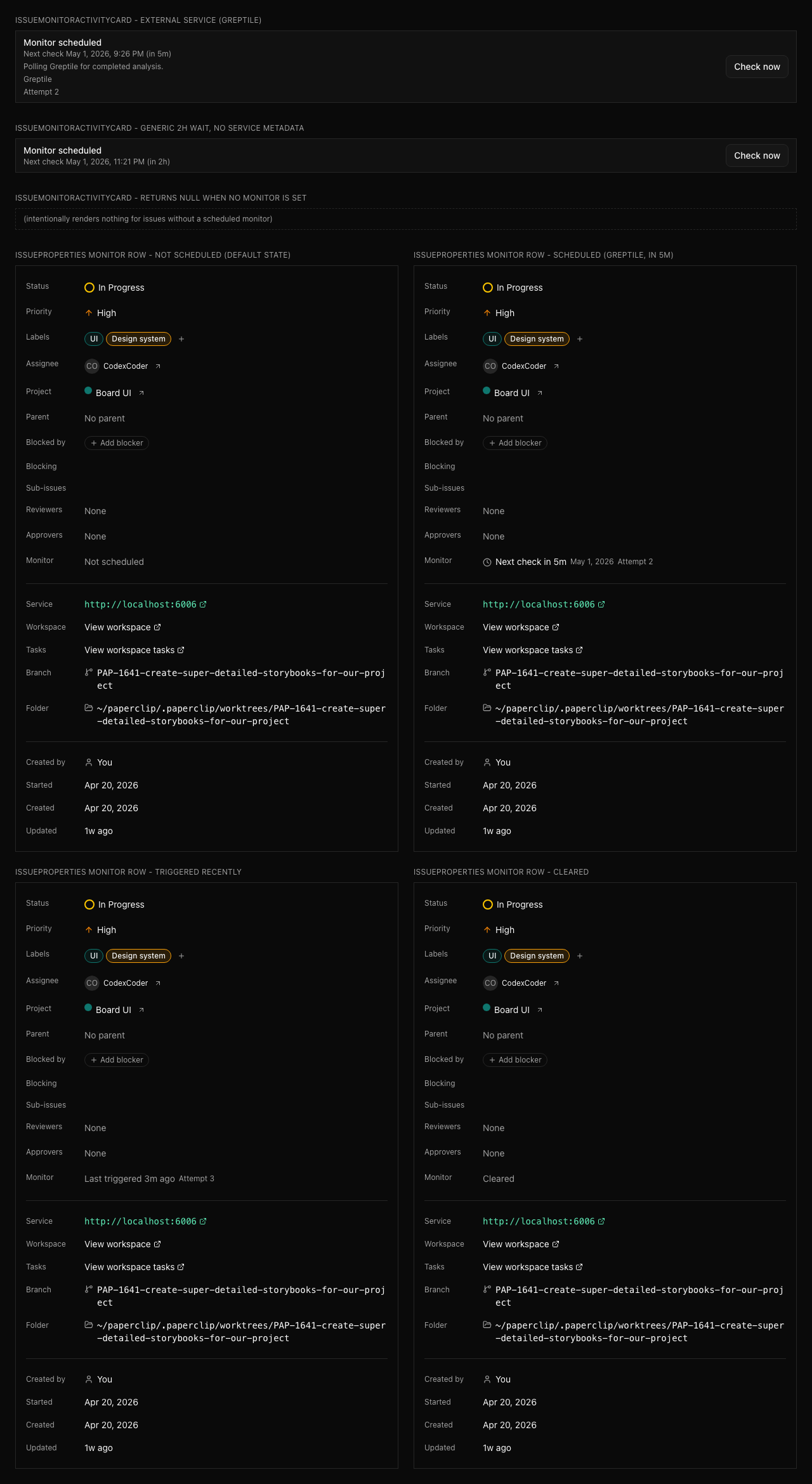 ## Risks - Medium: this changes heartbeat recovery behavior for scheduled external-service waits, so regressions could affect wake timing or recovery issue creation. - Migration risk is reduced by using `IF NOT EXISTS` for the new issue monitor columns and index. - External monitor references are treated as secret-adjacent and are intentionally omitted from visible activity/wake payloads. > For core feature work, check [`ROADMAP.md`](ROADMAP.md) first and discuss it in `#dev` before opening the PR. Feature PRs that overlap with planned core work may need to be redirected — check the roadmap first. See `CONTRIBUTING.md`. ## Model Used - OpenAI Codex, GPT-5 coding agent with repository tool use and terminal execution. ## Checklist - [x] I have included a thinking path that traces from project context to this change - [x] I have specified the model used (with version and capability details) - [x] I have checked ROADMAP.md and confirmed this PR does not duplicate planned core work - [x] I have run tests locally and they pass - [x] I have added or updated tests where applicable - [x] If this change affects the UI, I have included before/after screenshots or Storybook review surfaces - [x] I have updated relevant documentation to reflect my changes - [x] I have considered and documented any risks above - [x] I will address all Greptile and reviewer comments before requesting merge --------- Co-authored-by: Paperclip <noreply@paperclip.ing> |
||
|
DottaandPaperclip
|
76f09c8eb6 |
[PAP-3180] Move workspace switcher into sidebar (#4981)
## Thinking Path > - Paperclip is the control plane for autonomous AI companies. > - The board UI needs a clear persistent way to move between company workspaces. > - The previous layout kept company switching in a separate left rail, which made the sidebar feel split between workspace selection and navigation. > - The workspace switcher belongs in the sidebar header so navigation and workspace context stay together. > - This pull request removes the separate company rail from the layout and turns the sidebar company menu into the primary workspace switcher. > - The benefit is a cleaner sidebar structure that keeps workspace identity, switching, company actions, and navigation in one place. ## What Changed - Removed the standalone `CompanyRail` from the main layout. - Added the company/workspace switcher to the default, company settings, and instance settings sidebars. - Expanded `SidebarCompanyMenu` to list active workspaces, indicate the current workspace, navigate out of instance settings when switching, and expose add-company onboarding. - Updated focused component tests for the new workspace-switcher behavior. ## Verification - `pnpm --filter @paperclipai/ui exec vitest run src/components/SidebarCompanyMenu.test.tsx src/components/CompanySettingsSidebar.test.tsx` - `pnpm --filter @paperclipai/ui typecheck` - `git diff --check` - Visual smoke attempted against the managed dev server at `http://127.0.0.1:57385`; a fresh browser context reached the authenticated sign-in screen, so I could not capture an authenticated sidebar screenshot from this heartbeat. ## Risks - Low-to-medium UI risk: this changes the primary sidebar structure and workspace-switching entry point. - The instance-settings switch behavior now routes back to the selected company dashboard when a workspace is selected. - No migrations, API contracts, or lockfile changes. > For core feature work, check [`ROADMAP.md`](ROADMAP.md) first and discuss it in `#dev` before opening the PR. Feature PRs that overlap with planned core work may need to be redirected — check the roadmap first. See `CONTRIBUTING.md`. ## Model Used - OpenAI Codex, GPT-5 coding agent, tool-enabled, medium reasoning mode. ## Checklist - [x] I have included a thinking path that traces from project context to this change - [x] I have specified the model used (with version and capability details) - [x] I have checked ROADMAP.md and confirmed this PR does not duplicate planned core work - [x] I have run tests locally and they pass - [x] I have added or updated tests where applicable - [ ] If this change affects the UI, I have included before/after screenshots - [x] I have updated relevant documentation to reflect my changes - [x] I have considered and documented any risks above - [x] I will address all Greptile and reviewer comments before requesting merge Co-authored-by: Paperclip <noreply@paperclip.ing> |
||
|
DottaandPaperclip
|
685ee84e4a |
[codex] Document terminal bench dispatch config (#4961)
## Thinking Path > - Paperclip agents rely on skills for repeatable operating procedures > - The Terminal-Bench loop skill needs to preserve enough dispatch configuration to reproduce real heartbeat behavior > - A bare benchmark command can create unassigned work with no heartbeat-enabled agent, which is a harness setup failure rather than product evidence > - The Paperclip heartbeat skill also needs to keep escalation biased toward agent-owned follow-through > - This pull request documents dispatch runner config requirements and strengthens the agent follow-through rule > - The benefit is fewer misleading benchmark loops and clearer agent operating guidance ## What Changed - Documented `PAPERCLIP_HARBOR_RUNNER_CONFIG` / runner dispatch config as required Terminal-Bench loop input. - Updated the Terminal-Bench loop smoke check to require the dispatch config mention. - Added stronger Paperclip skill guidance to avoid asking humans for work an agent can perform. ## Verification - `pnpm smoke:terminal-bench-loop-skill` ## Risks - Low risk: documentation and smoke expectation changes only. The stricter smoke assertion is intentional so future edits do not drop the dispatch config requirement. > For core feature work, check [`ROADMAP.md`](ROADMAP.md) first and discuss it in `#dev` before opening the PR. Feature PRs that overlap with planned core work may need to be redirected — check the roadmap first. See `CONTRIBUTING.md`. ## Model Used - OpenAI Codex, GPT-5 coding agent, tool use and local command execution. Exact context window was not exposed in the runtime. ## Checklist - [x] I have included a thinking path that traces from project context to this change - [x] I have specified the model used (with version and capability details) - [x] I have checked ROADMAP.md and confirmed this PR does not duplicate planned core work - [x] I have run tests locally and they pass - [x] I have added or updated tests where applicable - [x] If this change affects the UI, I have included before/after screenshots - [x] I have updated relevant documentation to reflect my changes - [x] I have considered and documented any risks above - [x] I will address all Greptile and reviewer comments before requesting merge --------- Co-authored-by: Paperclip <noreply@paperclip.ing> |
||
|
DottaandPaperclip
|
d7719423e9 |
[codex] Harden non-system database backup schemas (#4960)
## Thinking Path > - Paperclip is a control plane whose database is the durable audit and work record > - Database backup needs to include operator/plugin schemas while excluding PostgreSQL-owned internals > - PostgreSQL reserves the `pg_` schema prefix for system schemas, including temp and toast variants > - A single escaped `pg_` prefix predicate is less brittle than enumerating individual `pg_toast` and `pg_temp` forms > - This pull request tightens non-system schema discovery for logical backups without changing the normal user/plugin schema path ## What Changed - Replaced narrow `pg_toast` and `pg_temp` schema exclusions with an escaped `pg_` reserved-prefix exclusion. - Kept `information_schema` excluded from logical backup metadata discovery. - Addressed Greptile feedback by removing redundant no-op additions from the prior iteration. ## Verification - `pnpm exec vitest run packages/db/src/backup-lib.test.ts` - PR checks on the latest pushed head: policy, verify, e2e, Greptile Review, and Snyk ## Risks - Low risk: PostgreSQL reserves `pg_` schema names for system use, so this should only exclude database-owned internals that should not be restored from Paperclip logical backups. > For core feature work, check [`ROADMAP.md`](ROADMAP.md) first and discuss it in `#dev` before opening the PR. Feature PRs that overlap with planned core work may need to be redirected - check the roadmap first. See `CONTRIBUTING.md`. ## Model Used - OpenAI Codex, GPT-5 coding agent, tool use and local command execution. Exact context window was not exposed in the runtime. ## Checklist - [x] I have included a thinking path that traces from project context to this change - [x] I have specified the model used (with version and capability details) - [x] I have checked ROADMAP.md and confirmed this PR does not duplicate planned core work - [x] I have run tests locally and they pass - [x] I have added or updated tests where applicable - [x] If this change affects the UI, I have included before/after screenshots - [x] I have updated relevant documentation to reflect my changes - [x] I have considered and documented any risks above - [x] I will address all Greptile and reviewer comments before requesting merge --------- Co-authored-by: Paperclip <noreply@paperclip.ing> |
||
|
DottaandPaperclip
|
fe401b7fa9 |
[codex] Polish inbox nested issue UI (#4959)
## Thinking Path > - Paperclip orchestrates AI agents through issue lists and issue-thread interactions > - The inbox must preserve nested issue visibility and keyboard navigation as work decomposes into deeper sub-issues > - Some UI polish issues made nested rows harder to scan and pending question cancellation less covered > - The issue list also had a small test indentation regression around load-more behavior > - This pull request tightens nested inbox rendering and related issue-thread/list polish > - The benefit is a more reliable operator inbox for multi-level work trees ## What Changed - Included nested grandchild issues in inbox keyboard navigation and recursive row rendering. - Sort parent rows by descendant activity so active subtrees remain visible. - Removed extra inbox card background styling in favor of the page surface. - Added regression coverage for pending question cancellation. - Cleaned up the issue-list load-more test indentation. ## Verification - `pnpm exec vitest run ui/src/lib/inbox.test.ts ui/src/components/IssueChatThread.test.tsx ui/src/components/IssuesList.test.tsx` - Screenshots were not captured in this PR split; the visible flow is covered by focused component/helper tests and should get browser QA in the follow-up issue. ## Risks - Medium risk: nested inbox rendering and keyboard navigation are user-visible. The changes are localized to inbox grouping/rendering helpers and covered by targeted tests. > For core feature work, check [`ROADMAP.md`](ROADMAP.md) first and discuss it in `#dev` before opening the PR. Feature PRs that overlap with planned core work may need to be redirected — check the roadmap first. See `CONTRIBUTING.md`. ## Model Used - OpenAI Codex, GPT-5 coding agent, tool use and local command execution. Exact context window was not exposed in the runtime. ## Checklist - [x] I have included a thinking path that traces from project context to this change - [x] I have specified the model used (with version and capability details) - [x] I have checked ROADMAP.md and confirmed this PR does not duplicate planned core work - [x] I have run tests locally and they pass - [x] I have added or updated tests where applicable - [ ] If this change affects the UI, I have included before/after screenshots - [x] I have updated relevant documentation to reflect my changes - [x] I have considered and documented any risks above - [x] I will address all Greptile and reviewer comments before requesting merge --------- Co-authored-by: Paperclip <noreply@paperclip.ing> |
||
|
DottaandPaperclip
|
2d72292ad6 |
[codex] Add workspace routine run tab (#4958)
## Thinking Path > - Paperclip orchestrates AI agents through reusable execution workspaces and routines > - Operators need a fast way to run workspace-aware routines against a specific execution workspace > - The existing workspace detail surface showed configuration, runtime logs, and linked issues, but not routines that depend on workspace variables > - Routine runs also needed to prefill the selected execution workspace so branch variables resolve correctly > - This pull request adds a workspace routines tab and prefilled routine-run dialog support > - The benefit is a tighter workflow for rerunning reviews, smoke checks, and other workspace-specific routines ## What Changed - Added an execution workspace `Routines` tab and company-prefixed routes. - Listed routines that declare or reference workspace-specific variables. - Added `Run now` support that preselects the current execution workspace in `RoutineRunVariablesDialog`. - Centralized reusable execution workspace ordering/deduplication for issue creation and workspace cards. - Added focused UI helper and dialog regression tests. ## Verification - `pnpm exec vitest run ui/src/lib/reusable-execution-workspaces.test.ts ui/src/lib/workspace-routines.test.ts ui/src/components/RoutineRunVariablesDialog.test.tsx ui/src/lib/company-routes.test.ts` - Screenshots were not captured in this PR split; the visible flow is covered by focused component/helper tests and should get browser QA in the follow-up issue. ## Risks - Medium risk: this adds a new workspace detail tab and routine-run path. It is isolated to workspace-scoped routines and uses existing routine run APIs. > For core feature work, check [`ROADMAP.md`](ROADMAP.md) first and discuss it in `#dev` before opening the PR. Feature PRs that overlap with planned core work may need to be redirected — check the roadmap first. See `CONTRIBUTING.md`. ## Model Used - OpenAI Codex, GPT-5 coding agent, tool use and local command execution. Exact context window was not exposed in the runtime. ## Checklist - [x] I have included a thinking path that traces from project context to this change - [x] I have specified the model used (with version and capability details) - [x] I have checked ROADMAP.md and confirmed this PR does not duplicate planned core work - [x] I have run tests locally and they pass - [x] I have added or updated tests where applicable - [ ] If this change affects the UI, I have included before/after screenshots - [x] I have updated relevant documentation to reflect my changes - [x] I have considered and documented any risks above - [x] I will address all Greptile and reviewer comments before requesting merge --------- Co-authored-by: Paperclip <noreply@paperclip.ing> |
||
|
DottaandPaperclip
|
570a4206da |
[codex] Recover productive terminal continuations (#4956)
## Thinking Path > - Paperclip orchestrates AI agents through issue-scoped heartbeat runs > - Recovery logic decides whether in-progress work still has a live path after a terminal run > - A productive terminal continuation can still leave an issue stranded when no active run or wake remains > - Treating that state as healthy leaves work stuck despite evidence that more action is needed > - This pull request re-enqueues recovery for productive terminal continuations that left no live path > - The benefit is fewer silently stranded in-progress issues after agents make partial progress ## What Changed - Reclassified successful-but-productive terminal continuations as recoverable when no live path remains. - Enqueue a follow-up recovery wake with the original run id and continuation metadata. - Added regression tests covering productive terminal continuation recovery and advanced liveness handoff. ## Verification - `pnpm exec vitest run server/src/__tests__/heartbeat-process-recovery.test.ts server/src/__tests__/run-continuations.test.ts` ## Risks - Medium risk: recovery may schedule one more follow-up where Paperclip previously considered the work observed. The existing uniqueness, budget, and escalation checks still constrain retry loops. > For core feature work, check [`ROADMAP.md`](ROADMAP.md) first and discuss it in `#dev` before opening the PR. Feature PRs that overlap with planned core work may need to be redirected — check the roadmap first. See `CONTRIBUTING.md`. ## Model Used - OpenAI Codex, GPT-5 coding agent, tool use and local command execution. Exact context window was not exposed in the runtime. ## Checklist - [x] I have included a thinking path that traces from project context to this change - [x] I have specified the model used (with version and capability details) - [x] I have checked ROADMAP.md and confirmed this PR does not duplicate planned core work - [x] I have run tests locally and they pass - [x] I have added or updated tests where applicable - [x] If this change affects the UI, I have included before/after screenshots - [x] I have updated relevant documentation to reflect my changes - [x] I have considered and documented any risks above - [x] I will address all Greptile and reviewer comments before requesting merge --------- Co-authored-by: Paperclip <noreply@paperclip.ing> |
||
|
DottaandPaperclip
|
3cd26a78fc |
[codex] Surface live run comment context (#4957)
## Thinking Path > - Paperclip orchestrates AI agents through issue comments and heartbeat runs > - The board UI needs to distinguish a comment that triggered a live run from comments queued after that run started > - The run payload already stores comment context, but active-run API responses did not expose the ids the UI needs > - Without those ids, the triggering comment can flash as queued while the agent is already responding to it > - This pull request exposes live-run comment context and teaches the optimistic comment helper to ignore the trigger comment > - The benefit is clearer issue-chat state during comment-triggered agent interruptions ## What Changed - Added `contextCommentId` and `contextWakeCommentId` to active/live run payloads. - Threaded those ids through server routes, heartbeat summaries, UI API types, and issue detail rendering. - Updated optimistic comment classification to avoid marking the triggering comment as queued. - Added server and UI regression coverage. ## Verification - `pnpm exec vitest run server/src/__tests__/agent-live-run-routes.test.ts ui/src/lib/optimistic-issue-comments.test.ts` ## Risks - Low-to-medium risk: adds optional fields to existing run payloads. Existing consumers should ignore unknown fields, and UI handling is null-safe. > For core feature work, check [`ROADMAP.md`](ROADMAP.md) first and discuss it in `#dev` before opening the PR. Feature PRs that overlap with planned core work may need to be redirected — check the roadmap first. See `CONTRIBUTING.md`. ## Model Used - OpenAI Codex, GPT-5 coding agent, tool use and local command execution. Exact context window was not exposed in the runtime. ## Checklist - [x] I have included a thinking path that traces from project context to this change - [x] I have specified the model used (with version and capability details) - [x] I have checked ROADMAP.md and confirmed this PR does not duplicate planned core work - [x] I have run tests locally and they pass - [x] I have added or updated tests where applicable - [ ] If this change affects the UI, I have included before/after screenshots - [x] I have updated relevant documentation to reflect my changes - [x] I have considered and documented any risks above - [x] I will address all Greptile and reviewer comments before requesting merge --------- Co-authored-by: Paperclip <noreply@paperclip.ing> |
||
|
DottaandPaperclip
|
e8275318ba |
[codex] Raise agent heartbeat concurrency default (#4954)
## Thinking Path > - Paperclip orchestrates AI agents for zero-human companies > - Agent heartbeat settings control how much parallel work one employee can run > - The previous default of 5 concurrent runs was too restrictive for active local agent teams > - The shared default, heartbeat clamp, docs, and route/import/UI expectations need to agree > - This pull request raises the default heartbeat concurrency to 20 while keeping explicit headroom up to 50 for power users > - The benefit is higher throughput for agent teams without each new agent needing manual runtime config edits ## What Changed - Raised `AGENT_DEFAULT_MAX_CONCURRENT_RUNS` from 5 to 20. - Raised the heartbeat service max clamp from 10 to 50, keeping the new default below the ceiling. - Updated V1 implementation docs and tests that assert default imported/exported runtime config. - Updated the new-agent UI runtime config test to assert the shared default constant instead of duplicating the numeric value. ## Verification - `pnpm exec vitest run server/src/__tests__/agent-permissions-routes.test.ts server/src/__tests__/company-portability.test.ts ui/src/lib/new-agent-runtime-config.test.ts` ## Risks - Medium risk: new agents can consume more local execution capacity by default. The heartbeat scheduler still respects configured max concurrency and budget/pause controls, and operators can lower or raise the per-agent cap within the `1..50` clamp. > For core feature work, check [`ROADMAP.md`](ROADMAP.md) first and discuss it in `#dev` before opening the PR. Feature PRs that overlap with planned core work may need to be redirected — check the roadmap first. See `CONTRIBUTING.md`. ## Model Used - OpenAI Codex, GPT-5 coding agent, tool use and local command execution. Exact context window was not exposed in the runtime. ## Checklist - [x] I have included a thinking path that traces from project context to this change - [x] I have specified the model used (with version and capability details) - [x] I have checked ROADMAP.md and confirmed this PR does not duplicate planned core work - [x] I have run tests locally and they pass - [x] I have added or updated tests where applicable - [x] If this change affects the UI, I have included before/after screenshots - [x] I have updated relevant documentation to reflect my changes - [x] I have considered and documented any risks above - [x] I will address all Greptile and reviewer comments before requesting merge --------- Co-authored-by: Paperclip <noreply@paperclip.ing> |
||
|
DottaandPaperclip
|
e273d621fc |
[PAP-3154] Stop padding /live-runs by default (#4963)
## Summary - Fix [PAP-3154](/PAP/issues/PAP-3154): the Sidebar's "Dashboard NN live" badge showed a constant 50 in every company because `GET /api/companies/:companyId/live-runs` was padding its response with up to 50 recent (non-live) heartbeat runs whenever the caller did not pass `minCount`. - Regression introduced by [#4875](https://github.com/paperclipai/paperclip/pull/4875) (commit `6445bef9`), which capped both `minCount` and `limit` at 50 with a fallback of 50 for omitted values. The cap is correct for `limit` (real unboundedness guard); for `minCount` it conflates "no padding" with "pad to the cap". - Default `minCount` to 0 so callers asking for "live runs" only get actually-live runs unless they explicitly request padding (`ActiveAgentsPanel` is the only caller that does). Keep `limit` capped at 50 by default. ## Test plan - [x] `pnpm exec vitest run server/src/__tests__/agent-live-run-routes.test.ts` — 7/7 pass, including new tests for the no-pad default and explicit padding. - [x] `pnpm exec vitest run ui/src/components/Sidebar.test.tsx ui/src/components/ActiveAgentsPanel.test.tsx ui/src/api/heartbeats.test.ts` — 6/6 pass. - [ ] Verify in dev: with ~8 truly-live runs in a company, the sidebar Dashboard badge shows the real count (not 50). 🤖 Generated with [Claude Code](https://claude.com/claude-code) Co-authored-by: Paperclip <noreply@paperclip.ing> |
||
|
DottaandPaperclip
|
42a299fb9d |
[codex] Bound productivity review recovery loops (#4948)
## Thinking Path > - Paperclip orchestrates AI agents for zero-human companies. > - The heartbeat/productivity review subsystem detects when assigned work is likely stuck or churning. > - Productivity reviews are useful, but repeated reconciliation can create noisy refresh comments or repeated review issues around the same source issue. > - That makes manager follow-up harder because the signal can get buried under duplicate review activity. > - This pull request bounds productivity review refreshes and creation loops while preserving the existing escalation path. > - The benefit is a quieter recovery loop that still surfaces stuck or high-churn work for manager attention. ## What Changed - Added refresh throttling for open productivity review issues, including a one-hour default interval and a maximum of three refresh comments per open review. - Added a rolling 24-hour creation cap so completed/closed reviews cannot immediately recreate review issues indefinitely for the same source issue. - Excluded cancelled productivity reviews from the creation cap so manager cancellations do not silently suppress future legitimate reviews. - Preserved productivity review timestamps in deterministic test paths and added targeted coverage for immediate refresh suppression, refresh caps, creation caps, and cancelled-review exclusion. ## Verification - `pnpm run preflight:workspace-links && pnpm exec vitest run server/src/__tests__/productivity-review-service.test.ts` - `pnpm exec vitest run server/src/__tests__/productivity-review-service.test.ts` - Greptile Review: 5/5 on commit `bcf25832d0ffae25890b2ee7eed112d1c2d114fe` with review threads resolved. - GitHub PR checks passed on the latest head: `policy`, `verify`, `e2e`, `Greptile Review`, and `security/snyk (cryppadotta)`. - Verified the branch is rebased onto `public-gh/master` with no conflicts. - Verified the diff does not include `pnpm-lock.yaml`, database schema changes, or migrations. ## Risks - Low-to-medium risk: this changes automation cadence for productivity reviews. A truly stuck issue may receive fewer repeated refresh comments, but the original review issue remains open and assigned for manager action. - No migration risk: this is server logic and tests only. > Checked [`ROADMAP.md`](ROADMAP.md) for overlapping planned core work; this is a targeted recovery-loop fix and does not add a new roadmap feature. ## Model Used - OpenAI Codex coding agent, GPT-5 model family, tool-using software engineering mode. Exact context window is not exposed in this runtime. ## Checklist - [x] I have included a thinking path that traces from project context to this change - [x] I have specified the model used (with version and capability details) - [x] I have checked ROADMAP.md and confirmed this PR does not duplicate planned core work - [x] I have run tests locally and they pass - [x] I have added or updated tests where applicable - [x] If this change affects the UI, I have included before/after screenshots (not applicable; server-only change) - [x] I have updated relevant documentation to reflect my changes (not applicable; no user-facing docs or commands changed) - [x] I have considered and documented any risks above - [x] I will address all Greptile and reviewer comments before requesting merge --------- Co-authored-by: Paperclip <noreply@paperclip.ing> |
||
|
Devin Foley
|
d2dd759caa |
plugins: make e2b template default explicit (#4901)
## Thinking Path > - Paperclip orchestrates AI agents for zero-human companies > - Remote execution environments are part of that control plane, including sandbox-provider plugins like E2B > - The E2B provider already normalizes config and runtime behavior around a `base` template default > - But the manifest still presented `template` as required, which forces redundant operator input and makes the UI contract stricter than runtime behavior > - That mismatch showed up while building a repeatable QA workflow for sandbox testing > - This pull request makes the manifest and validation contract line up with the existing `base` default > - The benefit is a simpler and more accurate E2B environment setup experience ## What Changed - Removed the E2B manifest's `required: ["template"]` requirement so the config schema matches runtime behavior - Clarified the manifest description to say the template defaults to `base` when omitted - Added a focused unit test proving that validation normalizes a missing template to `base` ## Verification - Ran the focused E2B plugin test for the new behavior: - `cd packages/plugins/sandbox-providers/e2b && pnpm test -- --testNamePattern "defaults a missing template to base"` ## Risks - Low risk. This only loosens the schema to match the plugin's existing runtime normalization and adds a test for that path. - The broader E2B plugin suite currently has unrelated existing failures outside this change; this PR does not modify those paths. ## Model Used - OpenAI Codex, GPT-5 Codex via Codex CLI agent tooling, large-context coding workflow with terminal tool use and local test execution. ## Checklist - [x] I have included a thinking path that traces from project context to this change - [x] I have specified the model used (with version and capability details) - [x] I have checked ROADMAP.md and confirmed this PR does not duplicate planned core work - [ ] I have run tests locally and they pass - [x] I have added or updated tests where applicable - [ ] If this change affects the UI, I have included before/after screenshots - [ ] I have updated relevant documentation to reflect my changes - [x] I have considered and documented any risks above - [ ] I will address all Greptile and reviewer comments before requesting merge |
||
|
Devin Foley
|
b02e67cea5 |
fix(ci): diff PR workflow paths from merge base (#4903)
## Thinking Path > - Paperclip’s PR workflow is part of the control-plane safety surface because it decides whether a branch is allowed to merge. > - This issue started in that workflow: the lockfile and manifest policy checks were diffing `base.sha..head.sha`, which incorrectly treated unrelated `master` commits as if they belonged to the PR branch. > - The right fix there is to diff from the PR merge base (`base...head`) so policy checks only evaluate files introduced by the branch itself. > - Once that workflow fix was in place, `/checkpr` exposed a second blocker on the PR merge ref: `verify` was failing in newer `master`-side tests that were not part of the original branch diff. > - The actionable repeated failure came from the ACPX local adapter test suite, where a test hard-coded the managed Codex home under `instances/default` even though the stable Vitest runner sets a non-default `PAPERCLIP_INSTANCE_ID`. > - This pull request now includes both the original CI diff-scope fix and the targeted ACPX test fix so the PR’s actual checks align with current base-branch execution. > - The benefit is that the original false-positive lockfile failure is removed, and the merge-ref verify path is hardened against the instance-id isolation used in CI. ## What Changed - Updated `.github/workflows/pr.yml` so the lockfile policy and manifest policy steps diff `pull_request.base.sha...pull_request.head.sha` from the merge base instead of using a two-dot base/head diff. - Added an inline workflow comment explaining why the three-dot diff is required for PR-scoped file detection. - Updated `packages/adapters/acpx-local/src/server/execute.test.ts` so the managed Codex home assertion uses a test-specific `PAPERCLIP_INSTANCE_ID` instead of hard-coding `default`. - Restored `PAPERCLIP_INSTANCE_ID` after that ACPX test finishes so the test remains isolated and does not leak process env changes. ## Verification - Reproduced the original false positive locally by comparing PR heads `#4901` and `#4902` with the old `base..head` logic; both incorrectly included `pnpm-lock.yaml` from unrelated `master` commits. - Verified the new `base...head` logic reduces those PRs to only their actual changed files and excludes `pnpm-lock.yaml`. - Verified a real manifest-changing PR (`#4893`) still reports `package.json` changes under the new logic. - Ran `pnpm -r typecheck` successfully. - Ran `pnpm vitest run packages/adapters/acpx-local/src/server/execute.test.ts` successfully after the ACPX test fix. - Ran `pnpm vitest run packages/db/src/backup-lib.test.ts` successfully against the merge-ref-related DB failure path observed during `/checkpr`. - Pushed commit `9520a976` and allowed PR `#4903` checks to rerun on the updated branch. ## Risks - Low risk: the workflow change only affects how PR policy checks determine the changed file set. - Low risk: the ACPX change is test-only and aligns the test with the instance-isolation behavior already used by `scripts/run-vitest-stable.mjs` in CI. - The remaining operational risk is limited to other unrelated merge-ref-only failures that were not reproduced in the targeted local verification above. > For core feature work, check [`ROADMAP.md`](ROADMAP.md) first and discuss it in `#dev` before opening the PR. Feature PRs that overlap with planned core work may need to be redirected — check the roadmap first. See `CONTRIBUTING.md`. ## Model Used - OpenAI Codex, `gpt-5-codex`, via the Codex local adapter in Paperclip. - Tool-using coding model with shell execution, git, GitHub CLI, and repository inspection in a local worktree. - Context included the current repo, the Paperclip task thread, PR check output, and the isolated execution workspace. ## Checklist - [x] I have included a thinking path that traces from project context to this change - [x] I have specified the model used (with version and capability details) - [x] I have checked ROADMAP.md and confirmed this PR does not duplicate planned core work - [x] I have run tests locally and they pass - [x] I have added or updated tests where applicable - [ ] If this change affects the UI, I have included before/after screenshots - [ ] I have updated relevant documentation to reflect my changes - [x] I have considered and documented any risks above - [x] I will address all Greptile and reviewer comments before requesting merge |
||
|
github-actions[bot]andlockfile-bot
|
6a7cca95ef |
chore(lockfile): refresh pnpm-lock.yaml (#4899)
Auto-generated lockfile refresh after dependencies changed on master. This PR only updates pnpm-lock.yaml. Co-authored-by: lockfile-bot <lockfile-bot@users.noreply.github.com> |
||
|
DottaandPaperclip
|
4272c1604d |
Add ACPX local adapter runtime (#4893)
## Thinking Path > - Paperclip orchestrates AI-agent companies through a control plane that can start, supervise, and recover agent runs. > - Local adapters are the bridge between Paperclip issues and concrete agent runtimes such as Claude, Codex, and other ACP-compatible tools. > - The roadmap calls out broader “bring your own agent” and claw-style agent support, and ACPX gives Paperclip one path to normalize multiple ACP agents behind a single adapter. > - The branch needed to become one reviewable PR against current `paperclipai/paperclip:master`, without carrying stale base conflicts or generated lockfile churn. > - This pull request adds an experimental built-in `acpx_local` adapter, integrates it through the server/CLI/UI adapter surfaces, and adds regression coverage for runtime execution, skill sync, stream parsing, diagnostics, and log redaction. > - The benefit is that Paperclip can run Claude/Codex/custom ACP agents through ACPX while keeping operator configuration, skills, logging, and transcript rendering inside the existing adapter model. ## What Changed - Added `@paperclipai/adapter-acpx-local` with server execution, config schema, ACPX session handling, CLI formatting, UI config helpers, and stdout parsing. - Registered `acpx_local` across CLI, server, shared constants, UI adapter metadata, adapter capabilities, and agent creation/editing surfaces. - Added ACPX runtime execution support with persistent sessions, local-agent JWT environment handling, skill snapshots, runtime skill materialization, and isolation/security regressions. - Added ACPX adapter diagnostics and marked the adapter experimental in the UI. - Added command/env secret redaction for resolved command metadata in adapter-utils, server event storage, and the Agent Detail invocation UI. - Added Storybook coverage for ACPX config, transcript rendering, and skill states, plus PR screenshots under `docs/pr-screenshots/pap-2944/`. - Rebased the branch onto current `public-gh/master`; `pnpm-lock.yaml` is intentionally not included and there are no migration/schema changes. ## Verification - `pnpm exec vitest run packages/adapters/acpx-local/src/server/execute.test.ts packages/adapters/acpx-local/src/server/test.test.ts packages/adapters/acpx-local/src/cli/format-event.test.ts packages/adapters/acpx-local/src/ui/parse-stdout.test.ts packages/adapter-utils/src/server-utils.test.ts server/src/__tests__/redaction.test.ts server/src/__tests__/acpx-local-execute.test.ts server/src/__tests__/acpx-local-skill-sync.test.ts server/src/__tests__/acpx-local-adapter-environment.test.ts server/src/__tests__/adapter-routes.test.ts server/src/__tests__/agent-skills-routes.test.ts ui/src/adapters/metadata.test.ts` — 12 files, 87 tests passed. - `pnpm --filter @paperclipai/adapter-acpx-local typecheck` — passed. - `pnpm --filter @paperclipai/server typecheck` — passed. - `pnpm --filter @paperclipai/ui typecheck` — passed. - Confirmed PR diff does not include `pnpm-lock.yaml`, database schema files, or migrations. Screenshots:    ## Risks - Medium risk: this introduces a new built-in adapter package and touches runtime execution, adapter registration, agent config, skills, and transcript rendering. - ACPX and ACP agent behavior can vary by installed tool versions; the adapter is marked experimental to set operator expectations. - `pnpm-lock.yaml` is excluded per repository PR policy, so dependency lock refresh must be handled by the repo’s automation or maintainers. - No database migration risk: no schema or migration files changed. > For core feature work, check [`ROADMAP.md`](ROADMAP.md) first and discuss it in `#dev` before opening the PR. Feature PRs that overlap with planned core work may need to be redirected — check the roadmap first. See `CONTRIBUTING.md`. ## Model Used - OpenAI Codex coding agent based on GPT-5, with repository tool use, shell execution, git operations, and local verification. Exact hosted context window was not exposed in this environment. ## Checklist - [x] I have included a thinking path that traces from project context to this change - [x] I have specified the model used (with version and capability details) - [x] I have checked ROADMAP.md and confirmed this PR does not duplicate planned core work - [x] I have run tests locally and they pass - [x] I have added or updated tests where applicable - [x] If this change affects the UI, I have included before/after screenshots - [x] I have updated relevant documentation to reflect my changes - [x] I have considered and documented any risks above - [x] I will address all Greptile and reviewer comments before requesting merge --------- Co-authored-by: Paperclip <noreply@paperclip.ing> |
||
|
DottaandPaperclip
|
ad5432fece |
[codex] Harden issue recovery reliability (#4875)
## Thinking Path

> - Paperclip is the control plane for autonomous agent companies, so
non-terminal issue state must always have a clear live, waiting, or
recovery owner.
> - This change stays inside the server reliability and liveness
subsystem for assigned issue recovery, blocker attention, and live-run
polling.
> - Closed PR #4860 mixed this reliability work with separate
mutation-boundary policy changes, which made review and merge risk too
broad.
> - [PAP-2981](/PAP/issues/PAP-2981) asked for a replacement PR
containing only the remaining reliability slice and explicitly excluding
user-assignment and execution-policy restrictions.
> - Follow-up review also split `advanced` run-liveness continuation
behavior out of this PR so it can be reviewed separately.
> - The implementation hardens repeated recovery escalation, expands
blocker-attention coverage for explicit waiting and recovery paths, and
caps company live-run polling defaults.
> - The benefit is a smaller reliability PR that improves liveness
behavior without changing agent/user mutation authorization boundaries
or `advanced` continuation semantics.

## What Changed

- Avoid repeated liveness escalation updates when the source issue is
already blocked by the same open escalation.
- Treat open liveness escalation recovery issues, their source issues,
and their leaf blockers as covered waiting paths in blocker attention.
- Cap default company live-run polling at 50 rows for both `minCount`
and `limit`, including explicit zero values, to avoid unbounded
responses.
- Preserve the existing behavior where succeeded `advanced` runs are
considered productive/healthy for stranded-work recovery and are not
actionable bounded run-liveness continuations.
- Added focused server coverage for recovery dedupe, blocker attention,
liveness escalation, run continuations, and live-run polling.

## Verification

- `pnpm install --frozen-lockfile`
- `pnpm exec vitest run
server/src/__tests__/heartbeat-process-recovery.test.ts
server/src/__tests__/heartbeat-issue-liveness-escalation.test.ts
server/src/__tests__/issue-blocker-attention.test.ts
server/src/__tests__/run-continuations.test.ts
server/src/__tests__/agent-live-run-routes.test.ts`
- Result: 5 files passed, 63 tests passed.
- `pnpm --filter @paperclipai/server typecheck`
- Result: passed.
- No UI changes; screenshots are not applicable.

## Risks

- Recovery and blocker-attention classification changes can affect which
blocked chains are shown as covered versus needing attention.
- Live-run polling now treats omitted, invalid, or non-positive `limit`
/ `minCount` values as the capped default of 50.
- `advanced` run-liveness continuation behavior is intentionally
excluded from this PR and split for separate review.

> For core feature work, check [`ROADMAP.md`](ROADMAP.md) first and
discuss it in `#dev` before opening the PR. Feature PRs that overlap
with planned core work may need to be redirected — check the roadmap
first. See `CONTRIBUTING.md`.

## Model Used

- OpenAI Codex, GPT-5, code execution and GitHub CLI tool use, medium
reasoning effort.

## Checklist

- [x] I have included a thinking path that traces from project context
to this change
- [x] I have specified the model used (with version and capability
details)
- [x] I have checked ROADMAP.md and confirmed this PR does not duplicate
planned core work
- [x] I have run tests locally and they pass
- [x] I have added or updated tests where applicable
- [x] If this change affects the UI, I have included before/after
screenshots
- [x] I have updated relevant documentation to reflect my changes
- [x] I have considered and documented any risks above
- [x] I will address all Greptile and reviewer comments before
requesting merge

---------

Co-authored-by: Paperclip <noreply@paperclip.ing>
canary/v2026.430.0-canary.7 |
||
|
|
a3de1d764d |
Add cheap model profiles for local adapters (#4881)
## Thinking Path

> - Paperclip is a control plane for autonomous AI companies, where
adapters are the boundary between the board, agents, and execution
runtimes.
> - Local adapters currently expose a primary runtime configuration, but
operators often need a cheaper model lane for routine or low-risk work.
> - That cheap lane has to stay adapter-owned: runtime profile settings
should not mutate the primary adapter config or bypass existing
auth/secret mediation.
> - Issue creation also needs an ergonomic way to request primary,
cheap, or custom model behavior for a selected assignee.
> - This pull request adds a first-class `cheap` model profile contract
across adapter capabilities, heartbeat config resolution, agent
configuration, and issue creation.
> - The benefit is cheaper task execution can be configured and
requested explicitly while preserving adapter boundaries, secret
handling, and audit visibility.

## What Changed

- Added adapter model-profile capability metadata and a `cheap` profile
contract for supported local adapters.
- Applied `runtimeConfig.modelProfiles.cheap.adapterConfig` during
heartbeat config resolution, including requested/applied/fallback run
metadata.
- Added agent configuration UI for cheap model profile settings without
writing those settings into primary `adapterConfig`.
- Added New Issue assignee model lane controls for Primary / Cheap /
Custom and request payload handling.
- Added run ledger profile badges and Storybook stories for the new
cheap-lane UI states.
- Added tests for validators, heartbeat model profile application,
permission/secret mediation, UI payload helpers, and run ledger
rendering.
- Added committed UI verification screenshots under
`docs/pr-screenshots/pap-2837/`.
- Addressed Greptile review feedback around cheap-profile defaults,
shared profile types, and fallback test data.

## Verification

Local:

- `pnpm exec vitest run packages/shared/src/validators/issue.test.ts
server/src/__tests__/adapter-registry.test.ts
server/src/__tests__/agent-permissions-routes.test.ts
server/src/__tests__/heartbeat-model-profile.test.ts
ui/src/components/IssueRunLedger.test.tsx
ui/src/lib/agent-config-patch.test.ts
ui/src/lib/issue-assignee-overrides.test.ts
ui/src/lib/new-agent-runtime-config.test.ts` — passed, 8 files / 103
tests.
- `pnpm exec vitest run ui/src/lib/new-agent-runtime-config.test.ts
ui/src/components/IssueRunLedger.test.tsx` — passed after
Greptile/rebase follow-up, 2 files / 17 tests.
- `pnpm --filter @paperclipai/ui typecheck` — passed after
Greptile/rebase follow-up.
- `pnpm -r typecheck` — passed.
- `pnpm build` — passed.
- `pnpm test:run` — did not complete successfully in this local
worktree: it stopped in pre-existing `@paperclipai/adapter-utils`
sandbox/SSH fixture suites outside this PR diff. Failures were 5s local
timeouts plus `git init -b` unsupported by this machine's Git 2.21.0.
The branch-specific targeted suites above passed.
- Branch was fetched/rebased onto `public-gh/master`; `git rev-list
--left-right --count public-gh/master...HEAD` reports `0 9`.

Remote PR checks on latest head
`e30bf399146451c86cee98ed528d51d33fa5af5a`:

- `policy` — passed.
- `verify` — passed.
- `e2e` — passed.
- `Greptile Review` — passed, confidence score 5/5; Greptile review
threads resolved.
- `security/snyk (cryppadotta)` — passed.

Screenshots:

- [New issue cheap lane
desktop](https://github.com/paperclipai/paperclip/blob/PAP-2837-plan-cheap-model-for-adapters-that-can-support-it/docs/pr-screenshots/pap-2837/newissue-cheap-desktop.png)
- [New issue custom lane
desktop](https://github.com/paperclipai/paperclip/blob/PAP-2837-plan-cheap-model-for-adapters-that-can-support-it/docs/pr-screenshots/pap-2837/newissue-custom-desktop.png)
- [New issue unsupported adapter
desktop](https://github.com/paperclipai/paperclip/blob/PAP-2837-plan-cheap-model-for-adapters-that-can-support-it/docs/pr-screenshots/pap-2837/newissue-unsupported-desktop.png)
- [Run ledger model profile badges
desktop](https://github.com/paperclipai/paperclip/blob/PAP-2837-plan-cheap-model-for-adapters-that-can-support-it/docs/pr-screenshots/pap-2837/runledger-profile-badges-desktop.png)
- Mobile variants are also in `docs/pr-screenshots/pap-2837/`.

## Risks

- Medium: heartbeat config mediation now merges runtime model profiles
into adapter configs, so adapter secret normalization and host-command
restrictions must keep covering nested config paths.
- Medium: the UI adds another issue creation choice; unsupported
adapters must keep hiding the cheap lane and preserve primary behavior.
- Low migration risk: no database migration is included.

> For core feature work, check [`ROADMAP.md`](ROADMAP.md) first and
discuss it in `#dev` before opening the PR. Feature PRs that overlap
with planned core work may need to be redirected — check the roadmap
first. See `CONTRIBUTING.md`.

## Model Used

OpenAI Codex coding agent using GPT-5-class reasoning with repo tool use
and command execution. Exact served model/context window was not exposed
by the runtime.

## Checklist

- [x] I have included a thinking path that traces from project context
to this change
- [x] I have specified the model used (with version and capability
details)
- [x] I have checked ROADMAP.md and confirmed this PR does not duplicate
planned core work
- [ ] I have run tests locally and they pass
- [x] I have added or updated tests where applicable
- [x] If this change affects the UI, I have included before/after
screenshots
- [x] I have updated relevant documentation to reflect my changes
- [x] I have considered and documented any risks above
- [x] I will address all Greptile and reviewer comments before
requesting merge

---------

Co-authored-by: Paperclip <noreply@paperclip.ing>
Co-authored-by: Claude Opus 4.7 <noreply@anthropic.com>
canary/v2026.430.0-canary.6 |
||
|
DottaandPaperclip
|
1fe1067361 |
Polish board settings and skills workflow (#4863)
## Thinking Path > - Paperclip's board UI and bundled skills are the operator layer for configuring agents, routines, issue workflows, and local troubleshooting loops. > - The prior rollup mixed this operator polish with database backups, backend reliability, thread scale, and cost/workflow primitives. > - This pull request isolates the remaining board QoL, settings, issue-detail integration, adapter config cleanup, and skills smoke tooling. > - It includes some integration-level overlap with the thread and workflow slices so this branch can run from `origin/master` while still preserving the full original work. > - Preferred merge order is the narrower primitives first, then this integration PR last. > - The benefit is that reviewers can inspect the user-facing board/settings/skills layer separately from backend infrastructure changes. ## What Changed - Added board/settings polish for agents, routines, company settings, project workspace detail, and issue detail controls. - Added agent/routine UI regression tests and New Issue dialog coverage. - Integrated issue-detail activity/cost/interaction surfaces and leaf work pause/resume controls. - Cleaned bundled adapter UI config defaults and onboarding copy. - Added terminal-bench loop and work-stoppage diagnosis skills plus a smoke test script. - Updated attachment type handling and Paperclip skill/API guidance. ## Verification - `pnpm install --frozen-lockfile` - `pnpm exec vitest run ui/src/pages/Agents.test.tsx ui/src/pages/Routines.test.tsx ui/src/components/NewIssueDialog.test.tsx ui/src/pages/IssueDetail.test.tsx server/src/__tests__/costs-service.test.ts server/src/__tests__/issue-thread-interaction-routes.test.ts server/src/__tests__/issue-thread-interactions-service.test.ts` - Result: 7 test files passed, 54 tests passed. - `pnpm run smoke:terminal-bench-loop-skill` - Result: JSON output included `"ok": true` and `"cleanup": true`. - UI screenshots not included because verification is focused component/page coverage for the changed board surfaces. ## Risks - This is the integration-heavy PR in the split and intentionally overlaps some component/API primitives with the issue-thread and workflow PRs so it can run from `origin/master`. - Preferred merge order: #4859, #4860, #4861, #4862, then this PR last. If earlier branches merge first, this PR may need a straightforward conflict refresh in shared UI files. - The terminal-bench smoke script creates temporary mock issues and relies on cleanup; the verified run returned `cleanup: true`. > For core feature work, check [`ROADMAP.md`](ROADMAP.md) first and discuss it in `#dev` before opening the PR. Feature PRs that overlap with planned core work may need to be redirected — check the roadmap first. See `CONTRIBUTING.md`. ## Model Used - OpenAI Codex, GPT-5.5, code execution and GitHub CLI tool use, medium reasoning effort. ## Checklist - [x] I have included a thinking path that traces from project context to this change - [x] I have specified the model used (with version and capability details) - [x] I have checked ROADMAP.md and confirmed this PR does not duplicate planned core work - [x] I have run tests locally and they pass - [x] I have added or updated tests where applicable - [x] If this change affects the UI, I have included before/after screenshots - [x] I have updated relevant documentation to reflect my changes - [x] I have considered and documented any risks above - [x] I will address all Greptile and reviewer comments before requesting merge --------- Co-authored-by: Paperclip <noreply@paperclip.ing> |
||
|
DottaandPaperclip
|
c4269bab59 |
Add workflow interaction cancellation and issue cost summaries (#4862)
## Thinking Path > - Paperclip coordinates work through issue-thread interactions, run history, and cost telemetry. > - Operators need workflow prompts to be cancellable and costs to be visible at the issue level. > - The earlier rollup mixed this workflow/cost work with database backups, reliability recovery, thread scaling, and settings polish. > - This pull request isolates the interaction and cost surfaces into a reviewable slice. > - The backend now supports cancelling pending question interactions and summarizing issue-tree costs. > - The UI component layer can render cancelled questions and interleave activity with run ledger rows. ## What Changed - Added `cancelled` as an issue-thread interaction status and result shape for question interactions. - Added the board-only `POST /issues/:id/interactions/:interactionId/cancel` route and service implementation. - Added issue-tree cost summary support in the cost service and `/issues/:id/cost-summary` API route. - Extended shared cost exports and UI API/query keys for issue cost summaries. - Updated `IssueThreadInteractionCard` and `IssueRunLedger` components for cancelled questions, issue cost surfaces, and activity/run interleaving. - Added focused server and component regression coverage. ## Verification - `pnpm install --frozen-lockfile` - `pnpm exec vitest run server/src/__tests__/costs-service.test.ts server/src/__tests__/issue-thread-interaction-routes.test.ts server/src/__tests__/issue-thread-interactions-service.test.ts ui/src/components/IssueRunLedger.test.tsx` - Result: 4 test files passed, 45 tests passed. - UI screenshots not included because this PR updates reusable components and API surfaces without wiring a new page-level layout. ## Risks - Adds a new interaction terminal status; clients that switch exhaustively on interaction status may need to handle `cancelled`. - Issue-tree cost summaries use recursive issue traversal and should be watched on unusually large issue trees. - Page-level issue detail wiring is intentionally left to the board QoL/issue-detail branch to keep this PR narrow. > For core feature work, check [`ROADMAP.md`](ROADMAP.md) first and discuss it in `#dev` before opening the PR. Feature PRs that overlap with planned core work may need to be redirected — check the roadmap first. See `CONTRIBUTING.md`. ## Model Used - OpenAI Codex, GPT-5.5, code execution and GitHub CLI tool use, medium reasoning effort. ## Checklist - [x] I have included a thinking path that traces from project context to this change - [x] I have specified the model used (with version and capability details) - [x] I have checked ROADMAP.md and confirmed this PR does not duplicate planned core work - [x] I have run tests locally and they pass - [x] I have added or updated tests where applicable - [x] If this change affects the UI, I have included before/after screenshots - [x] I have updated relevant documentation to reflect my changes - [x] I have considered and documented any risks above - [x] I will address all Greptile and reviewer comments before requesting merge --------- Co-authored-by: Paperclip <noreply@paperclip.ing> |
||
|
DottaandPaperclip
|
87f19cd9a6 |
Improve issue thread scale and markdown polish (#4861)
## Thinking Path

> - Paperclip's board UI is the operator surface for supervising
AI-agent companies.
> - Issue threads are where operators read progress, respond to agents,
inspect markdown, and jump through long histories.
> - Large threads and rich markdown had become difficult to navigate and
expensive to render.
> - The previous rollup mixed these UI scale fixes with unrelated
backend recovery, costs, backups, and settings changes.
> - This pull request isolates the issue-thread scale and markdown
polish work.
> - The benefit is a reviewable UI slice that can merge independently of
the backend reliability, database backup, workflow, and board QoL PRs.

## What Changed

- Virtualized long issue chat threads and stabilized
anchor/jump-to-latest behavior for large histories.
- Added incremental issue-list row loading and tests for
scroll-triggered pagination behavior.
- Hardened markdown body rendering and markdown editor behavior around
HTML tags, image drops, code-copy UI, and escaped newline handling.
- Added a long-thread measurement harness at
`scripts/measure-issue-chat-long-thread.mjs` plus
`perf:issue-chat-long-thread`.
- Added focused UI/lib regression coverage for thread rendering,
markdown, optimistic comments, and message building.

## Verification

- `pnpm install --frozen-lockfile`
- `pnpm exec vitest run ui/src/components/IssueChatThread.test.tsx
ui/src/components/IssuesList.test.tsx
ui/src/components/MarkdownBody.test.tsx
ui/src/components/MarkdownEditor.test.tsx
ui/src/lib/issue-chat-messages.test.ts
ui/src/lib/optimistic-issue-comments.test.ts`
- Result: 6 test files passed, 170 tests passed.
- UI screenshots not included because this PR is covered by targeted
component tests and does not introduce a new page layout.

## Risks

- Virtualization changes can affect scroll anchoring in edge cases on
very long threads.
- Markdown/editor hardening changes are intentionally defensive, but
malformed content may render differently than before.

> For core feature work, check [`ROADMAP.md`](ROADMAP.md) first and
discuss it in `#dev` before opening the PR. Feature PRs that overlap
with planned core work may need to be redirected — check the roadmap
first. See `CONTRIBUTING.md`.

## Model Used

- OpenAI Codex, GPT-5.5, code execution and GitHub CLI tool use, medium
reasoning effort.

## Checklist

- [x] I have included a thinking path that traces from project context
to this change
- [x] I have specified the model used (with version and capability
details)
- [x] I have checked ROADMAP.md and confirmed this PR does not duplicate
planned core work
- [x] I have run tests locally and they pass
- [x] I have added or updated tests where applicable
- [x] If this change affects the UI, I have included before/after
screenshots
- [x] I have updated relevant documentation to reflect my changes
- [x] I have considered and documented any risks above
- [x] I will address all Greptile and reviewer comments before
requesting merge

---------

Co-authored-by: Paperclip <noreply@paperclip.ing>
canary/v2026.430.0-canary.3 |
||
|
DottaandPaperclip
|
cd606563f6 |
Expand database backups to non-system schemas (#4859)
## Thinking Path > - Paperclip is the control plane for autonomous AI companies. > - Reliable backups are part of operating that control plane safely. > - The previous backup path was public-schema oriented and did not clearly cover plugin-owned schemas or migration history. > - Paperclip now has plugin database namespaces and Drizzle migration state that must survive backup/restore. > - This pull request expands logical database backups to non-system schemas and documents the backup boundary. > - The benefit is safer restore behavior for core and plugin-owned database state without implying full filesystem disaster recovery. ## What Changed - Include non-system database schemas in JavaScript and pg_dump backup paths. - Preserve enum, table, sequence, index, constraint, migration, and plugin-schema objects across backup/restore. - Add restore coverage for plugin-owned schemas and Drizzle migration history. - Clarify docs that DB backups are logical database backups, not full instance filesystem backups. ## Verification - `pnpm install --frozen-lockfile` - `pnpm exec vitest run packages/db/src/backup-lib.test.ts` - Result: 1 test file passed, 4 tests passed. - Confirmed this PR does not include `pnpm-lock.yaml` or `.github/workflows/*` changes. ## Risks - Medium: backup generation touches schema discovery and restore ordering, so unusual database objects may need additional coverage later. - No migrations are included. > For core feature work, check [`ROADMAP.md`](ROADMAP.md) first and discuss it in `#dev` before opening the PR. Feature PRs that overlap with planned core work may need to be redirected — check the roadmap first. See `CONTRIBUTING.md`. ## Model Used - OpenAI Codex, GPT-5 coding agent, tool use enabled, medium reasoning effort. Exact hosted context-window details are not exposed in this runtime. ## Checklist - [x] I have included a thinking path that traces from project context to this change - [x] I have specified the model used (with version and capability details) - [x] I have checked ROADMAP.md and confirmed this PR does not duplicate planned core work - [x] I have run tests locally and they pass - [x] I have added or updated tests where applicable - [x] If this change affects the UI, I have included before/after screenshots - [x] I have updated relevant documentation to reflect my changes - [x] I have considered and documented any risks above - [x] I will address all Greptile and reviewer comments before requesting merge Note: no UI changes are included in this PR, so screenshots are not applicable. --------- Co-authored-by: Paperclip <noreply@paperclip.ing> |
||
|
Devin Foley
|
c0ce35d1fb |
Improve E2B plugin configuration UX and fix execution timeouts (#4802)
## Thinking Path

> - Paperclip orchestrates AI agents for zero-human companies
> - E2B is a sandbox provider plugin that runs agent code in isolated
cloud environments
> - Operators configure E2B through the plugin settings page
> - But the E2B API key configuration was unclear — the settings field
description didn't explain that pasted keys are auto-saved as company
secrets, and the fallback to the host `E2B_API_KEY` variable wasn't
documented
> - Additionally, long-running E2B sandbox commands were timing out
because the plugin environment RPC driver used a fixed timeout, and
environment commands competed for the single foreground command slot
> - This PR clarifies the E2B configuration UX, fixes RPC timeouts for
plugin environment execution, and runs E2B environment commands in
background mode to avoid blocking the foreground slot
> - The benefit is clearer E2B setup for operators and more reliable
sandbox command execution

## What Changed

- Updated E2B plugin manifest and settings UI to clarify API key
configuration — field description now explains that pasted keys are
saved as company secrets and documents the `E2B_API_KEY` host fallback
- Added test coverage for the plugin settings page rendering
- Fixed `plugin-environment-driver.ts` to pass the configured timeout
through to RPC calls instead of using a hardcoded default
- Updated `environment-runtime.ts` to propagate timeout from the
environment lease to the plugin driver
- Changed E2B sandbox command execution to use background handles so
long-running agent commands don't block the foreground slot needed by
the callback bridge

## Verification

- `pnpm test` — all existing and new tests pass
- `pnpm typecheck` — clean
- Manual: navigate to plugin settings, verify E2B API key field shows
the updated description text
- Manual: run an E2B-backed agent task with a long-running command,
verify it completes without RPC timeout

## Risks

- Low risk. Configuration UX change is cosmetic. The timeout fix passes
an existing value through instead of dropping it. Background command
execution is a behavioral change but only affects E2B sandbox commands —
the foreground slot is still available for bridge health checks.

## Model Used

Codex GPT 5.4 high via Paperclip.

## Checklist

- [x] I have included a thinking path that traces from project context
to this change
- [x] I have specified the model used (with version and capability
details)
- [x] I have checked ROADMAP.md and confirmed this PR does not duplicate
planned core work
- [x] I have run tests locally and they pass
- [x] I have added or updated tests where applicable
- [x] If this change affects the UI, I have included before/after
screenshots
- [x] I have updated relevant documentation to reflect my changes
- [x] I have considered and documented any risks above
- [x] I will address all Greptile and reviewer comments before
requesting merge
canary/v2026.430.0-canary.1 |



