mirror of
https://github.com/paperclipai/paperclip.git
synced 2026-10-06 10:48:12 +02:00
8610e7934e50a0d7e2a8d0cc55692687427b2d48
284
Commits
| Author | SHA1 | Message | Date | |
|---|---|---|---|---|
 DottaandPaperclip DottaandPaperclip
|
8610e7934e |
fix(release): bundle vendored runner ACPX runtime (#12582)
## Thinking Path > - Paperclip is the open source app that people use to manage AI agents for work. > - The npm release includes the Paperclip server and a vendored runner. > - The vendored runner imports ACPX when it starts a Codex agent. > - The server package did not include the ACPX version that the runner needs. > - A fresh canary install therefore stopped with `ERR_MODULE_NOT_FOUND` after onboarding. > - This pull request bundles the patched ACPX runtime with the server package. > - The benefit is that a fresh npm install can load the vendored runner. ## Linked Issues or Issue Description No public issue exists for this bug. A GitHub search found no duplicate or related pull request. **What happened?** A fresh `npx paperclipai@canary onboard` command completed onboarding. The server then failed to start. Node could not resolve `acpx` from the vendored Paperclip runner. **Expected behavior** The server should start after onboarding from a fresh npm cache and a temporary data directory. **Steps to reproduce** 1. Run `npx paperclipai@canary onboard --data-dir "$(mktemp -d /tmp/paperclip-canary.XXXXXX)"`. 2. Select Quickstart. 3. Start Paperclip. 4. Observe `ERR_MODULE_NOT_FOUND` for `acpx`. **Paperclip version or commit** `paperclipai@2026.831.0-canary.6` **Deployment mode** Other: local trusted Quickstart through `npx`. **Installation method** npm through `npx`. **Agent adapter(s) involved** Codex. **Database mode** Embedded PGlite. **Access context** Board operator during onboarding. **Node.js version** Node.js 26.4.0. **Operating system** macOS. **Relevant logs or output** ```shell Cannot find package 'acpx' imported from .../node_modules/@paperclipai/server/dist/vendor/paperclip-runner/drivers/acpx/codex-runtime-adapter.js ``` **Relevant config (if applicable)** No custom configuration was required. **Additional context** The published adapter utilities contain a nested `acpx@0.12.0`. Node cannot resolve that nested package from the sibling vendored runner. Installing `acpx@0.13.1` at the clean package root makes the failing runner import succeed. **Privacy checklist** The log excerpt contains no user path, token, company name, or other private value. ## What Changed - Added `acpx@0.13.1` as a bundled server runtime dependency. - Added a version-specific patch check for the ACPX versions used by the server and adapter utilities. - Added release-package coverage for the server ACPX bundle. ## Verification - `pnpm test:release-registry` passed 98 tests. - `node --test scripts/acpx-patch-packaging.test.mjs` passed 12 tests. - `pnpm exec vitest run server/src/__tests__/server-package-build-script.test.ts` passed 4 tests. - `node --test scripts/release-package-map.test.mjs` passed 12 tests. - `pnpm -r typecheck` passed. - A clean extracted server tarball contained the patched `acpx@0.13.1` runtime. - The previously failing vendored runner module imported from that clean tarball. - The repository-wide test suite was stopped before completion at the maintainer's request because it takes too long for this urgent packaging fix. ## Risks - Risk is low. - The server tarball grows because it now contains ACPX and its production dependencies. - The release stager now uses a version-specific marker to verify the ACPX patch. > For core feature work, check [`ROADMAP.md`](ROADMAP.md) first and discuss it in `#dev` before opening the PR. Feature PRs that overlap with planned core work may need to be redirected — check the roadmap first. See `CONTRIBUTING.md`. ## Model Used - OpenAI Codex with `gpt-5.6-sol`. - The model used reasoning mode, tool use, and code execution. - The context window size was not disclosed. ## Checklist - [x] I have included a thinking path that traces from project context to this change - [x] I have specified the model used (with version and capability details) - [x] I have checked ROADMAP.md and confirmed this PR does not duplicate planned core work - [x] I have searched GitHub for duplicate or related PRs and linked them above - [x] I have either (a) linked existing issues with `Fixes: #` / `Closes #` / `Refs #` OR (b) described the issue in-PR following the relevant issue template - [x] I have not referenced internal/instance-local Paperclip issues or links (only public GitHub `#NNN` / `github.com/paperclipai/paperclip` URLs) - [x] My branch name describes the change (e.g. `docs/...`, `fix/...`) and contains no internal Paperclip ticket id or instance-derived details - [x] I have run tests locally and they pass - [x] I have added or updated tests where applicable - [x] I have updated relevant documentation to reflect my changes - [x] I have considered and documented any risks above - [ ] All Paperclip CI gates are green - [ ] Greptile is 5/5 with no open P2s, recommendations, or follow-ups - [x] I will address all Greptile and reviewer comments before requesting merge Co-authored-by: Paperclip <noreply@paperclip.ing> |
||
|
Dotta
|
9ca24bba3c |
feat(runner): pin the Codex ACPX runtime (#12400)
## Thinking Path > - Paperclip is the open source app people use to manage AI agents for work. > - The package-local host boundary is ready for a concrete ACP implementation, but the first production profile is Codex only. > - ACPX must not inherit the server process environment or choose an executable by pathname after admission. > - Codex must not re-enable ambient apps, memory, skills, MCP configuration, or instructions inside its isolated home. > - This pull request pins only the two required production packages and applies narrowly tested host patches. > - The benefit is a minimal dependency boundary that follows the repository's CI-owned lockfile process. ## Linked Issues or Issue Description **Agent or provider** Codex through `acpx@0.13.1` and `@agentclientprotocol/codex-acp@1.6.2`. **Why this adapter is useful** The injected runtime host needs a concrete ACP session manager and the exact reviewed Codex ACP server. Upstream ACPX does not yet expose a host-owned spawn callback, and upstream Codex ACP does not yet apply Paperclip's isolated instruction, MCP, app, memory, and skill boundary. Both behaviors are required before the dependency can execute inside the runner. **How the agent is invoked** The next pull request will adapt these pinned packages to the private runtime host. ACPX receives a host-owned callback that consumes the already verified executable lease. Codex receives only the isolated environment, explicit base instructions, explicit MCP servers, and the skills rooted in its private `CODEX_HOME`. This pull request alone does not spawn either package or register an adapter. **Additional context** This pull request is stacked on #12399. It adds no Pi, Claude, AWS, SDK, lab, browser, or UI dependency. It intentionally does not commit `pnpm-lock.yaml`: the repository policy job regenerates a manifest-only PR lockfile artifact for downstream frozen installs, and the lockfile bot updates master separately. ## What Changed - Pin `acpx` to `0.13.1` and the Codex ACP server to `1.6.2` in the runner package. - Register both patches in the pnpm 9 root configuration and newer-pnpm workspace configuration. - Preserve the existing embedded-Postgres and ACPX 0.12 patch entries used by other packages. - Patch ACPX to evaluate an allowlisted environment at child-spawn time and keep spawn cwd out of provider-visible session identity. - Patch ACPX to accept a host-owned spawn callback with the resolved arguments and options, allowing the verified command lease to own execution. - Patch Codex ACP to retain runner-owned MCP server identity in permission requests. - Patch Codex ACP to pass explicit Paperclip base instructions on both start and resume. - In isolated mode, disable ambient apps, memory, and existing MCP configuration; load skills only from `CODEX_HOME`; and configure only requested servers. - Add a package contract test that enforces exact versions, Codex-only dependency scope, both pnpm patch registries, and every required patch hook. ## Verification - Both patch files dry-apply successfully to fresh published tarballs for `acpx@0.13.1` and `@agentclientprotocol/codex-acp@1.6.2`. - A local no-lockfile install applied both patches; their runtime markers and exact installed versions were inspected. - Runner TypeScript typecheck — passed against the patched packages. - Runner package tests — passed: 16 Node protocol/package tests and 426 Vitest tests. - `pnpm -r typecheck` — passed for all applicable workspaces. - `pnpm build` — passed, including runner binary, server, UI, and workspace packages. - `git diff --check` — passed. - The diff contains 6 files and does not change `pnpm-lock.yaml`, a GitHub workflow, server selection, or UI behavior. ## Risks The primary risk is drift between published package contents and checked-in compiled patches. Exact versions are pinned, both patches are exercised by package-contract gates, and CI performs the authoritative regenerated-lockfile frozen install. The spawn callback does not grant a new executable path: the following adapter must consume the opaque verified command lease. Codex isolation changes activate only when `PAPERCLIP_ACPX_ISOLATED_CONTEXT=1`, so existing direct Codex adapters are unaffected. ## Model Used OpenAI Codex with GPT-5 and repository tool use. ## Checklist - [x] I have included a thinking path that traces from project context to this change - [x] I have specified the model used (with version and capability details) - [x] I have checked ROADMAP.md and confirmed this PR does not duplicate planned core work - [x] I have searched GitHub for duplicate or related PRs and linked them above - [x] I have either linked an existing public item or described the issue in this PR - [x] I have not referenced internal or instance-local Paperclip issues or links - [x] My branch name describes the change and contains no internal task identifier - [x] I have run the affected tests locally and they pass - [x] I have added or updated tests where applicable - [x] I have documented the dependency, patch, isolation, and lockfile boundaries - [ ] All applicable GitHub Actions are green - [ ] Greptile is 5/5 with every actionable comment resolved - [x] I will address all review findings before requesting merge |
||
|
Dotta
|
a560b48d6d |
feat(apps): refine Postman and Shopify setup (#12357)
## Thinking Path > - Paperclip is the open source app people use to manage AI agents for work. > - Apps give those agents governed access to external tools. > - Provider catalogs must match each provider's current protocol and credential contract. > - Postman method labels and API-key placement were outdated. > - Shopify now offers a UCP commerce endpoint that needs a managed agent-profile argument. > - This pull request updates both providers and documents the complete connection-authoring workflow. > - The benefit is accurate setup, safer runtime defaults, and a repeatable provider review process. ## Linked Issues or Issue Description Refs #11965 This is stack 10 of 11. It depends on stack 9 and preserves the final catalog work recovered from #11965. Related: #5904 covers Shopify skill routing. This pull request covers the Apps connection contract instead. ## What Changed - Update Postman hosted MCP methods, capability choices, default selection, and bearer-token placement. - Add Shopify UCP commerce and Storefront compatibility methods with public-store prerequisites. - Inject the reviewed Shopify UCP agent profile at runtime and remove that managed field from user input schemas. - Classify Shopify checkout completion and cancellation as destructive actions. - Expand the connection authoring runbook from provider research through verification and pull request handoff. - Add focused shared, server, and UI coverage. - Make the approved-execution waiter phase-aware so slow preparation cannot consume the provider execution timeout and grace period. - Settle legacy pre-execute-on-approve requests and invocations as failed, clear their stale idempotency key, and allow a fresh governed approval instead of leaving work stuck in `executing`. ## Verification - `pnpm exec vitest run packages/shared/src/app-definitions.test.ts server/src/__tests__/tool-access-service.test.ts ui/src/pages/apps/AppsConnect.test.tsx -t "Postman|Shopify|normalizeConnectionMethodConfig|classifyRisk"` (16 passed) - `pnpm exec vitest run server/src/services/approved-execution-wait.test.ts` (4 passed) - `pnpm exec vitest run server/src/__tests__/tool-gateway.test.ts -t "enforces policy, approvals, retries, rate limits, and company boundaries for connected remote MCP calls"` (1 passed) - `pnpm exec vitest run server/src/__tests__/tool-gateway-service.test.ts` (21 passed; includes legacy approval settlement and fresh-approval recovery) - `pnpm --filter @paperclipai/server typecheck` - `pnpm check:token-gates` - `pnpm -r typecheck` - `pnpm build` ## Risks - Shopify UCP calls now include a Paperclip-managed agent profile that overrides caller input at the same path. - Postman EU credentials now use the hosted MCP server's bearer-token contract instead of the general REST API header. - The catalog generator and checked-in definitions change together to prevent regeneration drift. - Approved execution preparation has an explicit two-minute bound; provider execution retains its own 65-second timeout and persistence grace starting from durable provider start. - Legacy approvals created before execute-on-approve are intentionally terminalized and must be requested again under the current signed contract. > I checked `ROADMAP.md`. This provider update does not duplicate planned core work. The related open Shopify PR addresses skill routing, not Apps connections. ## Model Used OpenAI Codex, GPT-5. The runtime exact model ID and context window were not exposed. The model used reasoning, tool use, and code execution. ## Checklist - [x] I have included a thinking path that traces from project context to this change - [x] I have specified the model used (with version and capability details) - [x] I have checked ROADMAP.md and confirmed this PR does not duplicate planned core work - [x] I have searched GitHub for duplicate or related PRs and linked them above - [x] I have either (a) linked existing issues with `Fixes: #` / `Closes #` / `Refs #` OR (b) described the issue in-PR following the relevant issue template - [x] I have not referenced internal/instance-local Paperclip issues or links (only public GitHub `#NNN` / `github.com/paperclipai/paperclip` URLs) - [x] My branch name describes the change and contains no internal Paperclip ticket id or instance-derived details - [x] I have run tests locally and they pass - [x] I have added or updated tests where applicable - [x] I have updated relevant documentation to reflect my changes - [x] I have considered and documented any risks above - [x] All Paperclip CI gates are green - [x] Greptile is 5/5 with no open P2s, recommendations, or follow-ups - [x] I will address all Greptile and reviewer comments before requesting merge |
||
|
DottaandPaperclip
|
fcb2e99e8f |
feat(apps): expand the self-serve connection catalog (#12344)
## Thinking Path > - Paperclip is the open source app people use to manage AI agents for work. > - A useful app store needs accurate and selectable provider definitions. > - Local brand assets now cover the expanded provider set. > - Provider methods differ in transport, authentication, ownership, and required scope. > - This pull request expands the catalog and encodes those provider contracts. > - The benefit is a larger self-serve store with explicit setup choices. ## Linked Issues or Issue Description Refs #11965 This is stack 6 of 11. It depends on stack 5 and replaces another reviewable part of #11965. ## What Changed - Add and update provider definitions for the self-serve catalog. - Add Google Workspace connection methods and capability profiles. - Add catalog generation, ingestion, URL matching, and contract tests. - Update legacy key tests to use a provider that still uses header credentials. ## Verification - `pnpm --filter @paperclipai/server typecheck` - `pnpm --filter @paperclipai/server exec vitest run src/__tests__/tool-access-service.test.ts` - Result: 164 tests passed. - `pnpm build` ## Risks - An incorrect provider definition can offer the wrong setup method. - Contract tests verify transport, authentication, and provider URL behavior. - The change does not add a database migration. > I checked `ROADMAP.md`. This stack continues the existing app connection work from #11965 and does not duplicate another planned item. ## Model Used OpenAI Codex, GPT-5. The runtime model ID and context window were not exposed. The model used reasoning, tool use, and code execution. ## Checklist - [x] I have included a thinking path that traces from project context to this change - [x] I have specified the model used (with version and capability details) - [x] I have checked ROADMAP.md and confirmed this PR does not duplicate planned core work - [x] I have searched GitHub for duplicate or related PRs and linked them above - [x] I have either (a) linked existing issues with `Refs #` or (b) described the issue in this pull request - [x] I have not referenced internal or instance-local Paperclip issues or links - [x] My branch name describes the change and contains no internal Paperclip ticket id or instance-derived details - [x] I have run tests locally and they pass - [x] I have added or updated tests where applicable - [x] I have updated relevant documentation to reflect my changes - [x] I have considered and documented any risks above - [x] All Paperclip CI gates are green - [x] Greptile is 5/5 with no open P2s, recommendations, or follow-ups - [x] I will address all Greptile and reviewer comments before requesting merge --------- Co-authored-by: Paperclip <noreply@paperclip.ing> |
||
|
DottaandPaperclip
|
6244e4cf32 |
feat(apps): add Composio and Gmail connectors (#12342)
## Thinking Path > - Paperclip is the open source app people use to manage AI agents for work. > - App connections need both direct providers and managed provider hubs. > - The grant layer now defines safe credential ownership. > - Composio needs parent and child connection lifecycle rules, and Gmail needs governed setup. > - This pull request adds both connector families on the grant foundation. > - The benefit is broader app access without weakening credential isolation. ## Linked Issues or Issue Description Refs #11965 This is stack 4 of 11. It depends on stack 3 and replaces another reviewable part of #11965. ## What Changed - Add Composio parent and child connection support. - Add Gmail connection setup and governance. - Preserve credential paths and remove duplicate binding declarations. - Cascade Composio pause and restore actions to child connections. ## Verification - `pnpm --filter @paperclipai/server typecheck` - `pnpm --filter @paperclipai/server exec vitest run src/__tests__/tool-access-service.test.ts` - Result: 164 tests passed. - `pnpm build` ## Risks - Parent lifecycle changes can affect every Composio child. - The service restores only children whose provider accounts remain active. - Credential binding paths are normalized before secret resolution. > I checked `ROADMAP.md`. This stack continues the existing app connection work from #11965 and does not duplicate another planned item. ## Model Used OpenAI Codex, GPT-5. The runtime model ID and context window were not exposed. The model used reasoning, tool use, and code execution. ## Checklist - [x] I have included a thinking path that traces from project context to this change - [x] I have specified the model used (with version and capability details) - [x] I have checked ROADMAP.md and confirmed this PR does not duplicate planned core work - [x] I have searched GitHub for duplicate or related PRs and linked them above - [x] I have either (a) linked existing issues with `Fixes: #` / `Closes #` / `Refs #` OR (b) described the issue in-PR following the relevant issue template - [x] I have not referenced internal/instance-local Paperclip issues or links - [x] My branch name describes the change and contains no internal Paperclip ticket id or instance-derived details - [x] I have run tests locally and they pass - [x] I have added or updated tests where applicable - [x] I have updated relevant documentation to reflect my changes - [x] I have considered and documented any risks above - [x] All Paperclip CI gates are green - [x] Greptile is 5/5 with no open P2s, recommendations, or follow-ups - [x] I will address all Greptile and reviewer comments before requesting merge --------- Co-authored-by: Paperclip <noreply@paperclip.ing> |
||
|
DottaandPaperclip
|
b51112798f |
feat(apps): improve gateway and workspace connection UX (#12340)
## Thinking Path > - Paperclip is the open source app people use to manage AI agents for work. > - App connections must work in both the operator UI and agent tool gateway. > - The first stack layer adds secure remote connections. > - Operators still need clear setup, test, and recovery states. > - This pull request adds the gateway behavior and the workspace connection experience. > - The benefit is a connection flow that is easier to understand and recover. ## Linked Issues or Issue Description Refs #11965 This is stack 2 of 11. It depends on stack 1 and replaces another reviewable part of #11965. ## What Changed - Improve remote tool gateway connection behavior. - Add clearer app setup, test, and recovery states. - Add focused server and UI tests for the new paths. - Keep the diff isolated from later identity and catalog work. - Stabilize DNS-pinned remote HTTP protocol fixtures and the managed-runtime public-origin fixture for this independently tested layer. ## Verification - `pnpm -r typecheck` - `pnpm --filter @paperclipai/server exec vitest run src/__tests__/tool-access-service.test.ts` (150 passed) - `pnpm test:run` - `pnpm check:token-gates` - `pnpm build` ## Risks - Gateway errors now surface through new user-facing states. - A stale connection can require a new setup attempt. - The change does not add a database migration. - The injected HTTP transport and public URL are test-only fixtures; production DNS pinning and runtime behavior are unchanged. > I checked `ROADMAP.md`. This stack continues the existing app connection work from #11965 and does not duplicate another planned item. ## Model Used OpenAI Codex, GPT-5. The runtime model ID and context window were not exposed. The model used reasoning, tool use, and code execution. ## Checklist - [x] I have included a thinking path that traces from project context to this change - [x] I have specified the model used (with version and capability details) - [x] I have checked ROADMAP.md and confirmed this PR does not duplicate planned core work - [x] I have searched GitHub for duplicate or related PRs and linked them above - [x] I have either (a) linked existing issues with `Fixes: #` / `Closes #` / `Refs #` OR (b) described the issue in-PR following the relevant issue template - [x] I have not referenced internal/instance-local Paperclip issues or links - [x] My branch name describes the change and contains no internal Paperclip ticket id or instance-derived details - [x] I have run tests locally and they pass - [x] I have added or updated tests where applicable - [x] I have updated relevant documentation to reflect my changes - [x] I have considered and documented any risks above - [x] All Paperclip CI gates are green - [x] Greptile is 5/5 with no open P2s, recommendations, or follow-ups - [x] I will address all Greptile and reviewer comments before requesting merge --------- Co-authored-by: Paperclip <noreply@paperclip.ing> |
||
|
DottaandPaperclip
|
cabc9146d0 |
feat(apps): add secure remote MCP and PostHog setup (#12339)
## Thinking Path > - Paperclip is the open source app people use to manage AI agents for work. > - Apps give those agents governed access to external tools. > - Remote MCP setup needs secure endpoint validation and durable credentials. > - PostHog needs both browser sign-in and personal API key setup paths. > - This pull request adds the shared remote MCP foundation and the PostHog definition. > - The benefit is a secure and reusable base for later app connection work. ## Linked Issues or Issue Description Refs #11965 This is stack 1 of 11. It replaces the first reviewable part of #11965. ## What Changed - Add guarded remote MCP setup and credential handling. - Add PostHog OAuth and API key connection methods. - Add focused server, shared contract, and UI coverage. - Keep the migration replay-safe and idempotent. - Give the late-close security regression the same 10-second CI headroom as the adjacent real-timer handshake test. - Synchronize fake-timer handshake tests at the exact ensure-session boundary so real filesystem setup cannot race the fake deadline. - Drive PTY overflow coverage only after listener registration so scheduling cannot reorder the test fixture. ## Verification - pnpm exec vitest run packages/adapter-utils/src/acpx-engine/execute.test.ts server/src/__tests__/plugin-worker-manager.test.ts (220 passed; affected cases also passed five focused stress repetitions) - `pnpm exec vitest run packages/adapter-utils/src/acpx-engine/execute.test.ts -t "never leaks a sandbox-provided value from a late close rejection into logs or the result"` (1 passed) - `pnpm exec vitest run packages/adapter-utils/src/acpx-engine/execute.test.ts -t "never promotes a late ensureSession resolution|closes a late-resolving real handle exactly once"` (2 passed) - `pnpm -r typecheck` - `pnpm --filter @paperclipai/server exec vitest run src/__tests__/tool-access-service.test.ts` - `pnpm --filter @paperclipai/db check:migrations` - `pnpm build` ## Risks - Remote endpoint validation can reject configurations that previously passed without checks. - OAuth configuration errors can block setup until the operator corrects the provider settings. - The migration uses guarded statements so repeated execution is safe. - The test-only synchronization changes do not affect runtime behavior; they remove filesystem/fake-clock and listener-registration races observed under parallel CI load. > I checked `ROADMAP.md`. This stack continues the existing app connection work from #11965 and does not duplicate another planned item. ## Model Used OpenAI Codex, GPT-5. The runtime model ID and context window were not exposed. The model used reasoning, tool use, and code execution. ## Checklist - [x] I have included a thinking path that traces from project context to this change - [x] I have specified the model used (with version and capability details) - [x] I have checked ROADMAP.md and confirmed this PR does not duplicate planned core work - [x] I have searched GitHub for duplicate or related PRs and linked them above - [x] I have either (a) linked existing issues with `Fixes: #` / `Closes #` / `Refs #` OR (b) described the issue in-PR following the relevant issue template - [x] I have not referenced internal/instance-local Paperclip issues or links (only public GitHub `#NNN` / `github.com/paperclipai/paperclip` URLs) - [x] My branch name describes the change and contains no internal Paperclip ticket id or instance-derived details - [x] I have run tests locally and they pass - [x] I have added or updated tests where applicable - [x] I have updated relevant documentation to reflect my changes - [x] I have considered and documented any risks above - [x] All Paperclip CI gates are green - [x] Greptile is 5/5 with no open P2s, recommendations, or follow-ups - [x] I will address all Greptile and reviewer comments before requesting merge --------- Co-authored-by: Paperclip <noreply@paperclip.ing> |
||
|
DottaandPaperclip
|
39b8ee2960 |
ci: optimize checks for stacked pull requests (#12507)
## Thinking Path > - Paperclip uses GitHub Actions to protect changes before they enter `master`. > - GitHub evaluates every pull request in a native stack against the stack base. > - The current workflow therefore starts the complete CI matrix for every layer in a stack. > - A large stack can queue many copies of the same integrated verification and delay every pull request. > - GitHub provides stack position and base metadata so workflows can select merge-relevant layers. > - This pull request keeps policy and required check names on every layer, but runs full CI only for ordinary pull requests, the top layer, and the lowest unmerged layer. > - The benefit is much lower CI load without weakening the required-check contract. ## Linked Issues or Issue Description **What existing behavior does this improve?** The trusted pull request workflow currently runs every test, build, canary, and E2E lane for every pull request in a native stack. **Subsystem affected** GitHub Actions pull request verification. **Current behavior** A stack with 61 pull requests can start 61 complete CI matrices after a cascading rebase. **Proposed behavior** Run the always-on policy job and stable required-check aggregators for every layer. Run the complete verification matrix only for ordinary pull requests, the top stack layer, and the lowest unmerged stack layer. **Reason and benefit** The top layer verifies the integrated stack. The lowest unmerged layer verifies the current merge candidate. Middle layers keep branch-protection checks without consuming the complete runner matrix. **Breaking changes** Middle stack layers no longer run the complete CI matrix. Their `ci / verify` and `ci / e2e` checks still require the policy job to pass and require every expensive lane to be intentionally skipped. ## What Changed - Add a fail-safe stack scope decision to the trusted PR runner gate. - Run typecheck, general tests, build, serialized tests, canary, and E2E shards only for ordinary, top, and lowest-unmerged pull requests. - Preserve the required `ci / verify` and `ci / e2e` names on every layer. - Make the required aggregators distinguish valid middle-layer skips from failures or missing scope decisions. - Add regression coverage for ordinary, top, bottom, middle, and malformed stack metadata. ## Verification - `node --test scripts/__tests__/e2e-shard.test.mjs` — 11 tests passed. - `actionlint .github/workflows/pr-trusted.yml .github/workflows/pr.yml` — passed. - `git diff --check origin/master...HEAD` — passed. - The caller remains pinned to the current trusted workflow. A separate activation change must advance the immutable SHA after this pull request lands. ## Risks - Incorrect stack classification could skip important jobs. Missing or malformed stack metadata defaults to full CI. - Middle-layer required checks depend on the policy job and verify that all expensive jobs have the `skipped` result. - The reusable workflow change does not become active until the immutable caller SHA advances in a separate change. > For core feature work, check [`ROADMAP.md`](ROADMAP.md) first and discuss it in `#dev` before opening the PR. Feature PRs that overlap with planned core work may need to be redirected — check the roadmap first. See `CONTRIBUTING.md`. ## Model Used - OpenAI Codex with GPT-5. The exact deployment suffix and context window are not exposed. The model used reasoning, repository tools, code execution, Git, and GitHub API access. ## Checklist - [x] I have included a thinking path that traces from project context to this change - [x] I have specified the model used (with version and capability details) - [x] I have checked ROADMAP.md and confirmed this PR does not duplicate planned core work - [x] I have searched GitHub for duplicate or related PRs and linked them above - [x] I have either (a) linked existing issues with `Fixes: #` / `Closes: #` / `Refs: #` OR (b) described the issue in-PR following the relevant issue template - [x] I have not referenced internal/instance-local Paperclip issues or links (only public GitHub `#NNN` / `github.com/paperclipai/paperclip` URLs) - [x] My branch name describes the change (e.g. `docs/...`, `fix/...`) and contains no internal Paperclip ticket id or instance-derived details - [x] I have run tests locally and they pass - [x] I have added or updated tests where applicable - [x] I have updated relevant documentation to reflect my changes - [x] I have considered and documented any risks above - [ ] All Paperclip CI gates are green - [x] Greptile is 5/5 with no open P2s, recommendations, or follow-ups - [x] I will address all Greptile and reviewer comments before requesting merge --------- Co-authored-by: Paperclip <noreply@paperclip.ing> |
||
|
Nicky LeachandPaperclip
|
a20a4944ec |
feat: add Grok device login to the sandbox login panel (#12469)
## Thinking Path > - Paperclip is the open source app people use to manage AI agents for work > - Paperclip uses adapters to connect agents and model providers to its control plane > - The sandbox login panel supports displayed-code login for selected adapters > - Grok users need the same login path and a private credential home for later runs > - This pull request adds Grok support to the shared device-login path and preserves the existing Codex path > - The benefit is one secure login flow for both adapters with company-scoped credential storage ## Linked Issues or Issue Description **Agent or provider** Grok Local needs displayed-code login support in the sandbox login panel. **Why this adapter is useful** This change lets users sign in to Grok from the sandbox login panel. It also gives later Grok runs access to the stored credential. **How the agent is invoked** The Grok local adapter uses its login command through the shared displayed-code login flow. Later runs receive the managed home through `GROK_HOME`. **Additional context** The change uses adapter-scoped login lifecycle handling. It stores the credential in a company-scoped directory with mode `0700`, and it stores the credential file with mode `0600`. ## What Changed - Rename the shared device-login modules to adapter-neutral names. - Scope the shared login lifecycle to a closed adapter set. - Return the device-login URL that the provider prints. - Add the Grok prompt parser, login command, capability, and login panel entry. - Store the Grok credential in a private, company-scoped home directory. - Pass `GROK_HOME` to later Grok runs. - Add tests for the Grok adapter, the Daytona sandbox provider, the server login path, and the user interface. ## Verification - Run `pnpm vitest run packages/adapters/grok-local/src/server/adapter-auth-promotion.test.ts`. - Run the Grok adapter package suite. - Run the Daytona sandbox provider suite. - Run the server device-login suites. - Run the user interface suite. - Confirm the full CI suite passes. ## Risks The change extends shared login lifecycle code to another adapter. A regression could affect Codex login. The credential path uses explicit `chmod` calls to keep the directory at mode `0700` and the file at mode `0600`. ## Model Used OpenAI Codex, GPT-5. The runtime used tool calls and code review support. The runtime did not provide a context-window value. ## Checklist - [x] I have included a thinking path that traces from project context to this change - [x] I have specified the model used (with version and capability details) - [x] I have checked ROADMAP.md and confirmed this PR does not duplicate planned core work - [x] I have searched GitHub for duplicate or related PRs and linked them above - [x] I have either (a) linked existing issues with `Fixes: #` / `Closes #` / `Refs #` OR (b) described the issue in-PR following the relevant issue template - [x] I have not referenced internal/instance-local Paperclip issues or links (only public GitHub `#NNN` / `github.com/paperclipai/paperclip` URLs) - [x] My branch name describes the change (e.g. `docs/...`, `fix/...`) and contains no internal Paperclip ticket id or instance-derived details - [x] I have run tests locally and they pass - [x] I have added or updated tests where applicable - [x] I have updated relevant documentation to reflect my changes - [x] I have considered and documented any risks above - [x] All Paperclip CI gates are green - [ ] Greptile is 5/5 with no open P2s, recommendations, or follow-ups - [x] I will address all Greptile and reviewer comments before requesting merge --------- Co-authored-by: Paperclip <noreply@paperclip.ing> |
||
|
Nicky LeachandPaperclip
|
64b7dce0ad |
refactor(adapter-utils): replace the process-wide byte ledger with route-local byte bounds (#12465)
## Thinking Path > - Paperclip is the open source app people use to manage AI agents for work. > - The adapter layer carries sandbox requests to host processes. > - The HTTP/2 bridge used one process-wide byte ledger for all routes. > - One busy route could exhaust that shared budget and move another route to file transport. > - This pull request gives each host retention site a fixed byte bound and limits concurrent HTTP/2 streams. > - The benefit is local protection: one route cannot consume the byte budget of another route. ## Linked Issues or Issue Description **What happened?** The HTTP/2 bridge used one aggregate byte ledger for retained bytes across all routes. A busy route could exhaust the shared budget and force an unrelated route to use file transport. **Expected behavior** Each route should protect its own retained bytes. A reset on one HTTP/2 stream should cancel only that stream's host forward. **Steps to reproduce** 1. Start the HTTP/2 bridge with multiple sandbox routes. 2. Send enough retained data through one route to reach the aggregate byte limit. 3. Send a request through a sibling route. 4. Observe that the sibling route can fall back to file transport because the first route used the shared ledger. **Paperclip version or commit** `47639e227e78e3c5e0dd1a3c0e2d792fe86895a3` **Deployment mode** Built from source with the adapter-utils and server test suites. ## What Changed - Bound each host retention site with a fixed local byte limit. - Limited concurrent live HTTP/2 streams with one built-in stream limit. - Bound each host forward and response-body read to its own HTTP/2 stream lifetime. - Removed the process-wide byte ledger, its environment override, its metrics, and its file-transport fallbacks. - Added tests for the stream limit, host body budget, and sibling-stream cancellation. ## Verification - Run `pnpm vitest run --project adapter-utils`. - Confirm that 996 adapter-utils tests pass. - Confirm that `test_live_forward_work_never_passes_the_stream_limit` passes. - Confirm that `test_the_host_body_budget_matches_the_stream_limit` passes. - Confirm that the sibling-stream cancellation test passes. - Run `pnpm tsc --noEmit`. - Confirm that all pull request checks pass. ## Risks The bridge no longer uses a process-wide byte ledger. A local bound or stream limit that is too low can reject or delay valid work. The tests cover the new limits and stream cancellation behavior. ## Model Used OpenAI GPT-5 Codex. Runtime model ID: GPT-5. The model used code execution and repository tools. The runtime does not expose the context window size. ## Checklist - [x] I have included a thinking path that traces from project context to this change - [x] I have specified the model used (with version and capability details) - [x] I have checked ROADMAP.md and confirmed this PR does not duplicate planned core work - [x] I have searched GitHub for duplicate or related PRs and linked them above - [x] I have either (a) linked existing issues with `Fixes: #` / `Closes: #` / `Refs #` OR (b) described the issue in-PR following the relevant issue template - [x] I have not referenced internal/instance-local Paperclip issues or links (only public GitHub `#NNN` / `github.com/paperclipai/paperclip` URLs) - [x] My branch name describes the change (e.g. `docs/...`, `fix/...`) and contains no internal Paperclip ticket id or instance-derived details - [x] I have run tests locally and they pass - [x] I have added or updated tests where applicable - [x] I have updated relevant documentation to reflect my changes - [x] I have considered and documented any risks above - [x] All Paperclip CI gates are green - [x] Greptile is 5/5 with no open P2s, recommendations, or follow-ups - [x] I will address all Greptile and reviewer comments before requesting merge --------- Co-authored-by: Paperclip <noreply@paperclip.ing> |
||
|
Dotta
|
1da6b37fc5 |
fix(ci): regenerate stale stacked lockfiles (#12461)
## Thinking Path > - Paperclip uses trusted GitHub Actions workflows to verify every pull request > - Native stacked pull requests use another pull request branch as their base > - A parent layer can change a package manifest without committing `pnpm-lock.yaml` > - A child layer can inherit that manifest change without changing a manifest itself > - The current policy skips lockfile regeneration for that child and downstream frozen installs fail > - This pull request validates the complete merge tree and shares a regenerated lockfile only when needed > - The benefit is reliable stacked pull request verification without weakening the trusted workflow boundary ## Linked Issues or Issue Description **What happened?** A stacked child pull request inherited a package manifest change from its parent. The child did not change a manifest itself. The policy job skipped lockfile regeneration. Downstream jobs tried to restore an artifact that did not exist and then failed during frozen dependency installation. **Expected behavior** The policy job must validate the complete pull request merge tree. It must upload a regenerated lockfile when the checked-in lockfile is stale, including on a stacked child layer. **Steps to reproduce** 1. Create a parent pull request that changes `package.json` without committing `pnpm-lock.yaml`. 2. Create a child pull request on that branch without another manifest change. 3. Run the trusted pull request workflow for the child. 4. Observe that frozen dependency installation fails because no `pr-lockfile` artifact exists. **Paperclip version or commit** `f173ee09fa5c2ced7806bba47b54c3df853ab4df` **Deployment mode** GitHub Actions trusted pull request workflow. **Agent adapter(s) involved** Not adapter-specific. This is a core CI workflow bug. ## What Changed - Regenerate the lockfile from every checked-out merge tree. - Compare the generated lockfile with the checked-in copy before upload. - Download the artifact only when the policy job reports that it uploaded one. - Fail closed when a reported artifact is missing. - Add a workflow contract test for stacked lockfile handling. - Keep the caller pinned to the last merged trusted SHA; after this implementation merges, a separate activation PR will advance the immutable pin to its merge commit. ## Verification - `actionlint .github/workflows/pr-trusted.yml` - `node --test scripts/__tests__/e2e-shard.test.mjs` ## Risks - The policy job runs one lockfile-only install for every pull request. This can add a small amount of CI time. - A missing artifact now fails immediately when the policy job reports an upload. This is intentional because it exposes workflow corruption. - No runtime or product behavior changes. - The implementation/activation split is intentional: unmerged PR-authored workflow code must never execute on trusted runners. ## Model Used OpenAI Codex with model `gpt-5`, reasoning, tool use, and code execution. ## Checklist - [x] I have included a thinking path that traces from project context to this change - [x] I have specified the model used (with version and capability details) - [x] I have checked ROADMAP.md and confirmed this PR does not duplicate planned core work - [x] I have searched GitHub for duplicate or related PRs and linked them above - [x] I have either (a) linked existing issues with `Fixes: #` / `Closes #` / `Refs #` OR (b) described the issue in-PR following the relevant issue template - [x] I have not referenced internal/instance-local Paperclip issues or links (only public GitHub `#NNN` / `github.com/paperclipai/paperclip` URLs) - [x] My branch name describes the change (e.g. `docs/...`, `fix/...`) and contains no internal Paperclip ticket id or instance-derived details - [x] I have run tests locally and they pass - [x] I have added or updated tests where applicable - [x] I have updated relevant documentation to reflect my changes - [x] I have considered and documented any risks above - [x] All Paperclip CI gates are green - [x] Greptile is 5/5 with no open P2s, recommendations, or follow-ups - [x] I will address all Greptile and reviewer comments before requesting merge |
||
|
Dotta
|
c916af0cc0 |
ci: call trusted PR workflow (#12439)
## Thinking Path > - Paperclip uses pull request CI to validate each proposed change > - The existing workflow defines every heavy job in a PR-controlled file > - A trusted reusable workflow now contains the synchronized CI definition > - The caller must use an immutable default-branch SHA > - This pull request replaces the duplicate job list with that pinned caller > - The benefit is automatic secure runner selection without workflow drift ## Linked Issues or Issue Description Refs #12436 Refs #12438 **What existing behavior does this improve?** This improves how the pull request workflow selects trusted CI capacity. **Subsystem affected** Cross-cutting CI automation. **Current behavior** The active workflow contains a duplicate list of all heavy jobs. It cannot use the administrator-controlled runner gate. **Proposed behavior** The active workflow calls the synchronized trusted workflow at an immutable SHA. The trusted workflow selects GitHub-hosted or isolated AWS capacity from the validated contributor identity. **Reason and benefit** The thin caller prevents pull request changes from replacing the external-runner security gate. It also keeps runner selection automatic. **Breaking changes** The check names gain the reusable workflow job prefix. AWS routing remains disabled until the canary starts. ## What Changed - Replaced the duplicated heavy CI job list with one reusable-workflow call. - Pinned the call to the reviewed default-branch commit. - Limited the caller token to actions, contents, and pull request read access. ## Verification - actionlint on both workflow files - Trusted-routing tests - Confirmed the pinned SHA contains the workflow and is an ancestor of master - Full AWS and GitHub runner-boundary verification with routing disabled ## Risks The check context names change when GitHub expands the reusable workflow. The rollout verifies the new aggregate contexts before branch rules change. The repository kill switch remains off during this pull request. ## Model Used OpenAI Codex with GPT-5, tool use, and code execution. ## Checklist - [x] I have included a thinking path that traces from project context to this change - [x] I have specified the model used (with version and capability details) - [x] I have checked ROADMAP.md and confirmed this PR does not duplicate planned core work - [x] I have searched GitHub for duplicate or related PRs and linked them above - [x] I have either linked a related public PR or described the issue with the matching template fields - [x] I have not referenced internal or instance-local Paperclip issues or links - [x] My branch name describes the change and contains no internal Paperclip ticket id - [x] I have run tests locally and they pass - [x] I have added or updated tests where applicable - [x] I have updated relevant documentation to reflect my changes - [x] I have considered and documented any risks above - [ ] All Paperclip CI gates are green - [ ] Greptile is 5/5 with no open P2s, recommendations, or follow-ups - [ ] I will address all Greptile and reviewer comments before requesting merge |
||
|
Devin Foley
|
dbf052577d |
Follow the current onboarding arc in the release smoke (#12423)
## Thinking Path
> - Paperclip is the open source app people use to manage AI agents for
work
> - A release is gated by the release smoke: it installs the published
`paperclipai` artifact into a Docker container and drives the sign-in →
onboarding → first-agent path with Playwright
> - That suite runs only from the release pipeline, never on a pull
request, so it sees the UI only after the UI has already changed
> - The onboarding wizard was rebuilt into the agent arc. The "Name your
organization" step, the "Start Onboarding" launcher, and the agent role
picker are all gone
> - The spec still waited for those, so it failed on its first assertion
and blocked every nightly and beta release
> - The failure was also hard to read. The workflow uploaded no
container logs, because it learned the container's name only after the
harness succeeded, and the harness ran the container with `--rm` and
deleted it before anything read it
> - This pull request rewrites the spec to follow the current arc, and
repairs the log capture at both ends
> - The benefit is that nightly and beta releases are unblocked, and the
next failure arrives with the logs attached
## Linked Issues or Issue Description
No existing issue. Describing it inline, following
`.github/ISSUE_TEMPLATE/bug_report.yml`.
Refs #12274 (removed the company-naming step from the wizard).
Refs #12135 (the previous alignment of this spec, before #12274).
Refs #12316 (open; also edits `scripts/docker-onboard-smoke.sh`, in the
bootstrap helpers rather than the container lifecycle, so the two
changes do
not overlap. Whichever lands second should rebase and re-run).
**What happened?**
The release smoke fails.
`tests/release-smoke/docker-auth-onboarding.spec.ts`
never gets past its first wait:
```
✘ tests/release-smoke/docker-auth-onboarding.spec.ts:43:3 › Docker authenticated onboarding smoke › logs in, completes onboarding, and hires the lead agent
Error: expect(locator).toBeVisible() failed — element(s) not found (timeout 20000ms)
> 33 | await expect(wizardHeading.or(startButton)).toBeVisible({ timeout: 20_000 });
```
The spec waits for an `h3` reading "Name your organization" or a
"Start Onboarding" button. Neither exists. #12274 removed the
company-naming
step; the string now survives only in a code comment and in
`ui/src/components/OnboardingWizard.step.test.tsx`, which asserts it is
*absent*. The steps after the first wait are stale too: the CTA on step
1 is
"Continue" and not "Next", the organization input's placeholder changed,
and
the agent step's `#onboarding-agent-role` picker is gone, so every
onboarding
hire is filed under the neutral `general` role.
The suite runs only from the release pipeline, so nothing on a pull
request
saw the drift. Both `smoke_nightly` and `smoke_beta` call the same
reusable
workflow, so every nightly and every beta was blocked.
The failure also arrived without diagnostics. The job's "Capture Docker
logs"
step is `if: always()`, but it is guarded on `SMOKE_CONTAINER_NAME`,
which the
"Launch Docker smoke harness" step writes to `$GITHUB_ENV` only *after*
the
harness returns. On any failure before that the guard is false, the step
does
nothing, and the upload reports "No files were found". Below that,
`scripts/docker-onboard-smoke.sh` starts the container with
`docker run -d --rm`, so the `docker stop` in its EXIT trap deletes the
container and its logs together — and a container that crashes on its
own is
removed the instant its process exits.
**Expected behavior**
The spec walks the onboarding arc the app actually presents, and proves
the
company is created, the lead agent is hired, and the first task is
seeded and
dispatched. When the smoke fails, the run's artifact carries the
container's
logs.
**Steps to reproduce**
1. Run the Release Smoke workflow against a published artifact that
carries
#12274, or run it locally:
`PAPERCLIPAI_VERSION=2026.828.0-canary.3 SMOKE_DETACH=true
./scripts/docker-onboard-smoke.sh`
2. Run `pnpm run test:release-smoke` against that container.
3. The single spec fails at `openOnboarding()` after 20 seconds.
4. In CI, open the run's `release-smoke` artifact. It has no
`docker-onboard-smoke.log`.
**Paperclip version or commit**
`2026.828.0-canary.3` (commit
|
||
|
Nicky LeachandPaperclip
|
7895f7f2b0 |
Install the declared Sentry server package into the hosted image (#12330)
## Thinking Path > - Paperclip is the open source app people use to manage AI agents for work. > - Paperclip supports opt-in Sentry error monitoring for server and browser errors. > - The hosted image must include the server package when an operator sets SENTRY_DSN. > - The server package is an optional peer in the source tree, so the image did not include it. > - This pull request installs the declared server package in the hosted image and checks the result. > - The benefit is a hosted tenant can send server errors without a manual package install. ## Linked Issues or Issue Description No public issue exists for this change. **What happened?** The hosted image did not include the declared @sentry/node server package. A hosted tenant could set SENTRY_DSN, but the server could not load the package from the image. **Expected behavior** The hosted image must include the exact @sentry/node version from server/package.json. The self-hosted image must remain without this optional package. **Steps to reproduce** 1. Build or pull the hosted image. 2. Resolve @sentry/node from the server package path. 3. Compare its version with server/package.json. 4. Confirm that the tsx loader path still resolves. **Paperclip version or commit** Commit b6ff556a33ebdbe764b7f495951cd59009776608. **Deployment mode** Docker hosted image. ## What Changed - Add a cloud-server-deps Docker stage that installs the declared @sentry/node version in isolation. - Copy the isolated package into the cloud image without changing the production image. - Add a probe that checks the tsx loader and the resolved Sentry version. - Run the probe after the hosted image push in the Docker workflow. - Add server tests and update the observability documentation. ## Verification - Run `pnpm exec vitest run --project @paperclipai/server server/src/__tests__/cloud-image-sentry.test.ts`. - Confirm that the changed test passes in CI. - Confirm that all pull request checks pass. - Note that the Docker workflow does not run for pull requests. It runs after a push to master, for configured tags, or after manual dispatch. ## Risks - Low risk. The production image body stays unchanged. - The cloud image adds the declared Sentry package and a small dependency tree. - The workflow probe fails if the image loses the tsx loader or resolves a different Sentry version. ## Model Used OpenAI GPT-5; exact model version supplied by the execution service; tool use and code execution; context window not specified. ## Checklist - [x] I have included a thinking path that traces from project context to this change - [x] I have specified the model used (with version and capability details) - [x] I have checked ROADMAP.md and confirmed this PR does not duplicate planned core work - [x] I have searched GitHub for duplicate or related PRs and linked them above - [x] I have either (a) linked existing issues with `Fixes: #` / `Closes: #` / `Refs: #` OR (b) described the issue in-PR following the relevant issue template - [x] I have not referenced internal/instance-local Paperclip issues or links (only public GitHub `#NNN` / `github.com/paperclipai/paperclip` URLs) - [x] My branch name describes the change (e.g. `docs/...`, `fix/...`) and contains no internal Paperclip ticket id or instance-derived details - [x] I have run tests locally and they pass - [x] I have added or updated tests where applicable - [x] I have updated relevant documentation to reflect my changes - [x] I have considered and documented any risks above - [x] All Paperclip CI gates are green - [x] Greptile is 5/5 with no open P2s, recommendations, or follow-ups - [x] I will address all Greptile and reviewer comments before requesting merge --------- Co-authored-by: Paperclip <noreply@paperclip.ing> |
||
|
Nicky LeachandPaperclip
|
8ed1f51f75 |
fix(scripts): silence pnpm DEP0169 at provisioning install call sites (#12228)
## Thinking Path > - Paperclip is the open source app people use to manage AI agents for work. > - Worktree provisioning prepares the dependencies and tools that these agents need. > - The pinned pnpm version calls the deprecated `url.parse()` function during each install. > - Node.js 24 reports this call as `DeprecationWarning [DEP0169]`. > - The provisioning scripts run more than one install, so the warning repeats in each run. > - This pull request disables only `DEP0169` at each affected pnpm install call site. > - The benefit is a clear provisioning log while other deprecation warnings remain visible. ## Linked Issues or Issue Description **What happened?** The worktree provisioning scripts printed `DeprecationWarning [DEP0169]` during each pnpm install. The warning came from pnpm 9.15.4 and its `toNerfDart` call to `url.parse()`. **Expected behavior** The provisioning scripts should hide this known warning from the pinned pnpm version. They should keep other deprecation warnings visible. **Steps to reproduce** 1. Use Node.js 24 with pnpm 9.15.4. 2. Run worktree provisioning with a base-workspace repair or dependency install. 3. Observe the repeated `DeprecationWarning [DEP0169]` output. **Paperclip version or commit** Commit `5cd41b1a9996713efdfdc62373da8045664c7f30`. **Deployment mode** Built from source. **Installation method** Built from source with pnpm. **Agent adapter(s) involved** Not adapter-specific (core bug). **Database mode** Not database-related. ## What Changed - Add `--disable-warning=DEP0169` to each affected pnpm install call site. - Append the flag to `NODE_OPTIONS` so the scripts keep existing values. - Add comments that name the source of the warning and the removal condition. - Add a regression test for all affected scripts and warning codes. ## Verification - `bash -n scripts/provision-worktree.sh` passes. - `bash -n scripts/provision-worktree-runtime.sh` passes. - `node --test scripts/__tests__/provision-worktree-self-heal.test.mjs` passes with 15 tests. - GitHub Actions must pass all required checks before merge. ## Risks This change has low risk. It changes warning output only for `DEP0169`. It does not overwrite existing `NODE_OPTIONS` values. Revert commit `5cd41b1a9996713efdfdc62373da8045664c7f30` to restore the prior output. ## Model Used OpenAI Codex, GPT-5. The model used tool calls and code execution. The runtime did not expose a context-window value. ## Checklist - [x] I have included a thinking path that traces from project context to this change - [x] I have specified the model used (with version and capability details) - [x] I have checked ROADMAP.md and confirmed this PR does not duplicate planned core work - [x] I have searched GitHub for duplicate or related PRs and linked them above - [x] I have either (a) linked existing issues with `Fixes: #` / `Closes: #` / `Refs: #` OR (b) described the issue in-PR following the relevant issue template - [x] I have not referenced internal/instance-local Paperclip issues or links (only public GitHub `#NNN` / `github.com/paperclipai/paperclip` URLs) - [x] My branch name describes the change (e.g. `docs/...`, `fix/...`) and contains no internal Paperclip ticket id or instance-derived details - [x] I have run tests locally and they pass - [x] I have added or updated tests where applicable - [x] I have updated relevant documentation to reflect my changes - [x] I have considered and documented any risks above - [x] All Paperclip CI gates are green - [x] Greptile is 5/5 with no open P2s, recommendations, or follow-ups - [x] I will address all Greptile and reviewer comments before requesting merge Co-authored-by: Paperclip <noreply@paperclip.ing> |
||
|
DottaandPaperclip
|
6524d2b67f |
fix(dev): honor --data-dir isolation (#12193)
## Thinking Path > - Paperclip is the open source app people use to manage AI agents for work. > - The development runner starts the local API, UI, and embedded PostgreSQL services. > - Developers need separate data roots when they run more than one local checkout. > - The runner forwarded `--data-dir` to a child process that did not use it. > - The migration check and server therefore continued to use the default Paperclip home. > - This pull request applies the data root before worktree setup and migration checks. > - The benefit is an isolated database and state root for each requested development run. ## Linked Issues or Issue Description Refs #7466 ## What Changed - Parse and consume `--data-dir`, `--data-dir=<path>`, and `-d` in the development runner. - Set isolated default home, config, and context paths before worktree setup and migration checks. - Keep explicit config and context paths unchanged. - Include the normalized data root in the local service identity. - Let `dev:list` and `dev:stop` select the matching isolated service registry. - Keep explicit option environments independent of ambient process instance values. - Add regression tests and development documentation. ## Verification - `PAPERCLIP_INSTANCE_ID=ambient-test-instance pnpm exec vitest run server/src/__tests__/dev-runner-options.test.ts` passes with 8 tests. - `pnpm --filter @paperclipai/server typecheck` passes. - `pnpm --filter @paperclipai/adapter-utils build` passes. - `pnpm -r typecheck` passes. - `pnpm build` passes. - `pnpm dev:list --data-dir ./tmp/dev-service-review-fixture` selects the isolated registry. - A live run of `pnpm dev --data-dir ./tmp/data-dir-pr-smoke` became healthy on port 3101 while another checkout used port 3100. - The live run used `./tmp/data-dir-pr-smoke/instances/default/db` on a separate PostgreSQL port. - The latest-head Linux CI matrix passes, including build, typecheck, canary, all general and serialized test shards, and all e2e shards. - `pnpm test:run` was attempted on macOS. Current `master` has unrelated workspace path failures because `/tmp` resolves to `/private/tmp`. The focused regression suite passes, and the full Linux matrix is green. ## Risks - Risk is low. The change only affects development runs that pass `--data-dir` and matching service-management commands. - Explicit `PAPERCLIP_CONFIG` and `PAPERCLIP_CONTEXT` values still take priority. > For core feature work, check [`ROADMAP.md`](ROADMAP.md) first and discuss it in `#dev` before opening the PR. Feature PRs that overlap with planned core work may need to be redirected — check the roadmap first. See `CONTRIBUTING.md`. ## Model Used - OpenAI Codex with `gpt-5.6-sol` produced this change. The run used tool-enabled reasoning and code execution. The runtime did not expose its context window size. ## Checklist - [x] I have included a thinking path that traces from project context to this change - [x] I have specified the model used (with version and capability details) - [x] I have checked ROADMAP.md and confirmed this PR does not duplicate planned core work - [x] I have searched GitHub for duplicate or related PRs and linked them above - [x] I have either (a) linked existing issues with `Fixes: #` / `Closes #` / `Refs #` OR (b) described the issue in-PR following the relevant issue template - [x] I have not referenced internal/instance-local Paperclip issues or links (only public GitHub `#NNN` / `github.com/paperclipai/paperclip` URLs) - [x] My branch name describes the change (e.g. `docs/...`, `fix/...`) and contains no internal Paperclip ticket id or instance-derived details - [x] I have run tests locally and they pass - [x] I have added or updated tests where applicable - [x] I have updated relevant documentation to reflect my changes - [x] I have considered and documented any risks above - [x] All Paperclip CI gates are green - [x] Greptile is 5/5 with no open P2s, recommendations, or follow-ups - [x] I will address all Greptile and reviewer comments before requesting merge --------- Co-authored-by: Paperclip <noreply@paperclip.ing> |
||
|
Zannis Kalampoukisandzannis
|
5db8ce3c44 |
fix(docker): make tini PID 1 in the server image so adopted orphans are reaped (#12137)
## Thinking Path

> - Paperclip is the open source app people use to manage AI agents for
work
> - Agent runs execute inside the server container, and they spawn many
short-lived descendants: git, the adapter CLI, esbuild, sh
> - The server image sets `ENTRYPOINT ["docker-entrypoint.sh"]`, and
that entrypoint ends in `exec`, so node becomes PID 1
> - Node reaps only the children it spawned itself. It installs no
`SIGCHLD`/`waitpid` handler for orphans that the kernel re-parents onto
PID 1, so those orphans stay as zombies forever
> - Zombies accumulate monotonically. When the cgroup pid limit is
reached, every `fork()` in the container fails and the instance is dead
> - This pull request installs `tini` and makes it PID 1 in front of the
existing entrypoint, adds a behavioural test that proves reaping, and
adds a `pids_limit` backstop to both compose files
> - The benefit is that a long-running container no longer degrades into
total fork failure, and a future regression is caught by CI instead of
by an outage

Depends-on: none — this change is self-contained in the image build and
its tests, and it touches no other in-flight branch

## Linked Issues or Issue Description

No public GitHub issue exists for this defect. It was found on a live
long-running instance. Description follows the bug report template.

**What happened?**

The server container ran for 22 hours and reached 2039 of 2048 pids in
its cgroup. Of 1760 processes, 1731 were zombies, and all 1731 had PID 1
as their parent. PID 1 was `node --import
./server/node_modules/tsx/dist/loader.mjs server/dist/index.js`. Zombies
accrued at about 79 per hour and were never reaped. The oldest zombie
was 20.8 hours old against a container uptime of 22.0 hours, so nothing
had been reaped since boot. Once the pid limit was reached, `git` and
`gh` failed with `pthread_create failed: Resource temporarily
unavailable`.

**Expected behavior**

PID 1 reaps orphaned processes that the kernel re-parents onto it. The
pid count of a long-running container stays flat instead of growing
without bound.

**Steps to reproduce**

1. Start the server image without `docker run --init` and without `init:
true`.
2. Run agent work that spawns descendants which outlive their immediate
parent.
3. Read `/sys/fs/cgroup/pids.current` and count processes in `Z` state
over several hours.
4. The zombie count grows monotonically and every zombie has PPID 1.

**Relevant logs or output**

```
cgroup pids.current / pids.max : 2039 / 2048
total processes                : 1760
  zombies                      : 1731  (98.4%)
  parent of every zombie       : PID 1  (1731/1731)
PID 1 cmdline                  : node --import .../tsx/dist/loader.mjs server/dist/index.js
container uptime               : 22.0 h
oldest zombie                  : 20.8 h    median: 14.4 h
zombie names                   : git 717, claude 280, MainThread 167, sleep 141,
                                 esbuild 138, postgres 76, sh 65, sccache 50
```

**Additional context**

The fix pattern is already in this repository.
`docker/agent-runtime/Dockerfile.base` installs `tini` and sets
`ENTRYPOINT ["/usr/bin/tini", "--"]`. It was never applied to the server
image.

## What Changed

- `Dockerfile`: install `tini` in the `base` stage and set `ENTRYPOINT
["/usr/bin/tini", "--", "docker-entrypoint.sh"]`. The entrypoint stays
in the exec chain, so UID/GID remapping, `gosu`, and graceful shutdown
are unchanged.
- `scripts/assert-orphan-reaping.sh` (new): a behavioural probe. It
spawns a leader that forks a grandchild, exits the leader, and asserts
that the orphaned grandchild leaves `Z` state instead of persisting. It
fails closed if the grandchild is not re-parented onto PID 1, so a pass
cannot mean the check ran too early.
- `.github/workflows/docker.yml`: run that probe against the pushed
image after the publish step. The publish step is multi-arch with `push:
true`, so nothing is loaded into the runner daemon and the pushed tag is
the only thing to test. The cloud variant is `FROM production` and
inherits the same `ENTRYPOINT`.
- `scripts/docker-build-test.sh`: run the same probe against a local
build.
- `docker/docker-compose.yml` and
`docker/docker-compose.quickstart.yml`: add `pids_limit: 2048` as a
backstop, so a future leak dies visibly at its own ceiling instead of
starving the host of pids.
- `server/src/__tests__/container-init-reaping.test.ts` (new): 13
assertions that guard the configuration the probe depends on.

No per-orchestrator init lever was added. The image owning PID 1 covers
compose, plain `docker run`, the quadlet units, and the ECS task
definition in one place. Adding `init: true` in compose or
`initProcessEnabled` on the ECS task would nest a second init around
`tini`, and `tini` then warns on every boot that it is not PID 1. The
new test asserts the absence of both levers across all three manifests,
so the decision survives the next edit.

## Verification

| Check | Result |
|---|---|
| `scripts/assert-orphan-reaping.sh` against a real init | Grandchild
re-parented to PPID 1, then reaped. Exit 0. |
| Same probe forced against a genuine zombie | Reports `Z` and fails.
The failure branch is not vacuous. |
| Config guard against the pre-fix files | Exactly the 3 relevant
assertions turn red. |
| Config guard with `tini` removed from `apt-get` but the comments kept
| Red. It checks the install, not a mention of the name. |
| `cd server && npx vitest run
src/__tests__/container-init-reaping.test.ts` | 13 passed |
| `npx tsc --noEmit -p server` | Clean |
| `node scripts/check-docker-deps-stage.mjs` | PASS |
| `node --test scripts/release-verify-workflow.test.mjs` | 8 passed |

Not verified locally: no container runtime is available in the authoring
environment, so the probe has not run against a build of this image. The
new `docker.yml` step runs it against the pushed image on this PR.

## Risks

Low risk, but it is an image and entrypoint change, so it affects
deployments.

- `tini` adds one small package to the `base` stage.
`docker/agent-runtime/Dockerfile.base` already installs it from the same
Debian archive.
- Signal handling changes shape: `tini` receives `SIGTERM` and forwards
it to the entrypoint, which `exec`s node. `tini` forwards signals to its
direct child by default, and the exec chain keeps node as that child, so
graceful shutdown is preserved. A reviewer should confirm this on a real
stop.
- `pids_limit: 2048` is new for compose users. A deployment that
legitimately needs more than 2048 processes would now hit the ceiling.
The measured steady state on a busy instance was under 400.
- If a deployment already passes `--init` or `init: true`, `tini` runs
under another init and prints a warning that it is not PID 1. Reaping
still works because the outer init handles it. The compose files in this
repository do not set `init: true`.

## Model Used

Claude Opus 5 (`claude-opus-5`), extended thinking, with tool use and
code execution in an agent harness.

## Checklist

- [x] I have included a thinking path that traces from project context
to this change
- [x] I have specified the model used (with version and capability
details)
- [x] I have checked ROADMAP.md and confirmed this PR does not duplicate
planned core work
- [x] I have searched GitHub for duplicate or related PRs and linked
them above
- [x] I have either (a) linked existing issues with `Fixes: #` / `Closes
#` / `Refs #` OR (b) described the issue in-PR following the relevant
issue template
- [x] I have not referenced internal/instance-local issues or links
- [x] My branch name describes the change and contains no internal
ticket id or instance-derived details
- [x] I have run tests locally and they pass
- [x] I have added or updated tests where applicable
- [x] I have updated relevant documentation to reflect my changes
- [x] I have considered and documented any risks above
- [x] All CI gates are green
- [x] Greptile is 5/5 with no open P2s, recommendations, or follow-ups
- [x] I will address all Greptile and reviewer comments before
requesting merge

---------

Co-authored-by: zannis <1011451+zannis@users.noreply.github.com>
|
||
|
DottaandPaperclip
|
ffff1fe6e3 |
feat(runner): define package API and verification boundary (#12129)
## Thinking Path > - Paperclip is the open source app people use to manage AI agents for work. > - The runner package now has protocol, transport, provider, catalog, and authorization foundations. > - Its first upstream package boundary should expose only the implemented runtime and test-helper surfaces. > - Rust correctness belongs in the repository existing build verification, without introducing a parallel release process. > - Direct package creation must build the files declared by the package manifest. > - This pull request defines the minimal package API and verifies the optimized runner binaries in the existing PR and release Build jobs. > - The benefit is a production-ready runner package boundary with minimal build-process change. ## Linked Issues or Issue Description Refs #11962 This pull request replaces one bounded part of the archived large runner change. It follows the package-local authorization change in #12126. ## What Changed - Export only `@paperclipai/paperclip-runner` and `@paperclipai/paperclip-runner/testing`. - Keep Node-only fixture loading and semantic conformance helpers out of the runtime root. - Add a provider-neutral semantic conformance kit with stable JSON comparison and fail-closed input checks. - Keep deferred SDK, eval, browser, React, lab, and command surfaces private. - Pin the runner Rust toolchain to 1.97.1 with the minimal profile and `rustfmt`. - Run the Rust workspace tests in release mode. - Launch the optimized `paperclip-runnerd` and fake-harness binaries in process-level integration coverage. - Add one `pnpm --filter @paperclipai/paperclip-runner check:all` step to each existing PR and release Build job. - Make the existing server `prepack` lifecycle run its existing build after it prepares UI assets. - Document that no production adapter starts runnerd yet. This revision adds no standalone GitHub Actions job. It adds no server runner dependency or runner vendoring. It adds no Docker bootstrap or clean-consumer harness. It does not change `pnpm-lock.yaml`. ## Verification - `pnpm --filter @paperclipai/paperclip-runner check:all` - 66 TypeScript tests - 8 protocol contract tests - 56 Rust unit and integration tests - Release-mode integration coverage launches the optimized runnerd and fake-harness binaries. - `pnpm --filter @paperclipai/server exec vitest run src/__tests__/server-package-build-script.test.ts` (2 tests) - Clean `pnpm pack` from `server/` rebuilt the server and produced both `package/dist/index.js` and `package/dist/index.d.ts`. - `node --test scripts/__tests__/release-verify-workflow.test.mjs` (8 tests) - `pnpm -r typecheck` - `pnpm build` - `pnpm check:token-gates` - `git diff --check` - No `pnpm-lock.yaml` diff. - The diff changes 12 files. ## Risks The runner adds Rust work to the existing Build jobs. These jobs can take longer on a cold cache. The pinned toolchain makes contributor and CI behavior reproducible. Cargo tests use `--release` to verify optimized executables. The server prepack lifecycle now performs the build that its published entry points require. This can make direct server packing slower. This pull request does not wire runnerd into the server. It does not select runnerd for any adapter. Existing application execution and finalization paths remain unchanged. ## Model Used OpenAI Codex with GPT-5. Agentic coding mode used repository tools, code execution, and automated tests. ## Checklist - [x] I have included a thinking path that traces from project context to this change - [x] I have specified the model used (with version and capability details) - [x] I have checked ROADMAP.md and confirmed this PR does not duplicate planned core work - [x] I have searched GitHub for duplicate or related PRs and linked them above - [x] I have either (a) linked existing issues with `Fixes: #` / `Closes #` / `Refs #` OR (b) described the issue in-PR following the relevant issue template - [x] I have not referenced internal/instance-local Paperclip issues or links (only public GitHub `#NNN` / `github.com/paperclipai/paperclip` URLs) - [x] My branch name describes the change (e.g. `docs/...`, `fix/...`) and contains no internal Paperclip ticket id or instance-derived details - [x] I have run tests locally and they pass - [x] I have added or updated tests where applicable - [x] I have updated relevant documentation to reflect my changes - [x] I have considered and documented any risks above - [x] All Paperclip CI gates are green - [x] Greptile is 5/5 with no open P2s, recommendations, or follow-ups - [x] I will address all Greptile and reviewer comments before requesting merge Co-authored-by: Paperclip <noreply@paperclip.ing> |
||
|
Devin Foley
|
0a01444514 |
test(release-smoke): cover the background-service leg of onboarding (#12151)
## Thinking Path > - Paperclip is the open source app people use to manage AI agents for work > - The release pipeline gates each nightly and beta on a smoke suite that onboards the published npm artifact and drives the golden path > - That smoke runs onboarding inside a Docker container, and containers have no service manager, so the background-service leg of onboarding has zero automated coverage > - v2026.824.0 shipped a service install that crash-looped on a missing shim, and every smoke check stayed green (#12148 fixed the defect itself) > - This pull request adds a `smoke_service` job that runs the same published artifact directly on the runner VM's systemd and requires the installed service to end up serving > - The benefit is that a release with a broken service install can no longer pass the release smoke suite ## Linked Issues or Issue Description Refs #12148 — the fix for the defect this coverage gap let through. The gap: the release smoke runs `onboard` with `--yes` inside Docker, which both skips the service prompt and lacks systemd, so no CI job ever executed `manager.install()` against a real service manager. ## What Changed - New `scripts/service-onboard-smoke.sh`: onboards the published artifact with `--yes --install-service` on a systemd host, then fails unless the managed shim exists and is executable, `paperclipai.service` is active, and `/api/health` answers. A health response while the unit is not active also fails, because that is the signature of something other than the service serving. The script refuses to run over an existing managed install unless `SMOKE_FORCE=true`, and cleans up after itself by default so it is safe to run locally. - New `smoke_service` job in `.github/workflows/release-smoke.yml`: starts a user systemd session on the hosted runner (`loginctl enable-linger` + exported `XDG_RUNTIME_DIR`/`DBUS_SESSION_BUS_ADDRESS`), runs the script against `inputs.paperclip_version`, and uploads `systemctl status` + journal output as diagnostics. - No `release.yml` changes needed: `smoke_nightly` and `smoke_beta` call this reusable workflow, and a `workflow_call` result aggregates all jobs, so the new job gates nightly promotion automatically. ## Verification - `bash -n scripts/service-onboard-smoke.sh` passes and the workflow YAML parses. - End-to-end: dispatched this branch's Release Smoke workflow against the published canary that contains #12148; the `smoke_service` job onboards, installs the service, and verifies the service serves health. (Run link in PR comments.) - Negative case: the same assertions fail against v2026.824.0 — reproduced in a systemd container during the #12148 investigation: shim missing, unit in a 203/EXEC restart loop. ## Risks - Low risk to the product: no application code changes. - Pipeline risk: a flaky user-session setup on the hosted runner would block nightly promotion. Mitigated by validating the job end-to-end from this branch before merge, a 30-minute job timeout, and diagnostics uploaded on every run. - The service leg only covers systemd. launchd (macOS) still has no CI coverage; a macOS runner job is a possible follow-up. ## Model Used - Claude Fable 5 (Anthropic, model ID `claude-fable-5`), extended thinking, agentic tool use via Claude Code. ## Checklist - [x] I have included a thinking path that traces from project context to this change - [x] I have specified the model used (with version and capability details) - [x] I have checked ROADMAP.md and confirmed this PR does not duplicate planned core work - [x] I have searched GitHub for duplicate or related PRs and linked them above - [x] I have either (a) linked existing issues with `Fixes: #` / `Closes #` / `Refs #` OR (b) described the issue in-PR following the relevant issue template - [x] I have not referenced internal/instance-local Paperclip issues or links (only public GitHub `#NNN` / `github.com/paperclipai/paperclip` URLs) - [x] My branch name describes the change (e.g. `docs/...`, `fix/...`) and contains no internal Paperclip ticket id or instance-derived details - [x] I have run tests locally and they pass - [x] I have added or updated tests where applicable - [x] I have updated relevant documentation to reflect my changes - [x] I have considered and documented any risks above - [ ] All Paperclip CI gates are green - [ ] Greptile is 5/5 with no open P2s, recommendations, or follow-ups - [x] I will address all Greptile and reviewer comments before requesting merge |
||
|
Devin Foley
|
890ab9acfe |
feat(release): thorough notes skeletons — nest each PR's summary at creation (#12124)
## Thinking Path > - Paperclip is the open source app people use to manage AI agents for work > - The release workflow drafts the upcoming stable's notes skeleton the moment a beta publishes > - That skeleton was a bare list of commit subjects, so the notes only reached the shipped stable's depth after a later authoring pass during the soak > - Stable release notes are consistently verbose and thorough; the initial draft should start that way too > - This pull request nests each referenced PR's own summary under its subject line at creation time, and states the density bar in the authoring skill > - The benefit is a thorough raw document from day one of the soak, with no LLM tokens in Actions ## Linked Issues or Issue Description **What existing behavior does this improve?** The `draft_stable_notes` skeleton generated at beta publish (`scripts/draft-stable-notes.sh`). **Current behavior** The skeleton groups bare commit subjects by conventional-commit type. All substance arrives later, when a maintainer or agent rewrites it — reviewed maintainer feedback: stable notes are a lot more verbose, and the initial beta notes should be consistent with that. **Proposed behavior** Each subject that references a PR carries that PR's own summary nested beneath it — the PR template's "What Changed" bullets, else the first prose lines — fetched best-effort via `gh` and skipped silently when unavailable. The release-changelog skill now states the density bar explicitly: the beta-keyed draft ships verbatim as the stable's notes and is written at the previous stable's depth from the first pass. **Reason and benefit** The notes author starts from a thorough raw document instead of a commit list, and beta-time notes match the verbosity the stable will ship with. ## What Changed - `scripts/draft-stable-notes.sh`: `enrich_pr` nests PR summaries under subjects; best-effort (`gh` failure or `DRAFT_NOTES_SKIP_PR_ENRICHMENT=1` degrades to today's output); pipefail-safe when a "What Changed" section has no bullets. - `.github/workflows/release.yml`: the `draft_stable_notes` step gets `GH_TOKEN` so `gh` can read PR bodies. - `.agents/skills/release-changelog/SKILL.md`: "write at full stable depth from the first pass" guideline. - `scripts/draft-stable-notes.test.mjs`: three new tests — enrichment rendering via a fake `gh`, silent degradation without one, and the sparse-body case that previously killed the script under `set -o pipefail`. ## Verification - `node --test scripts/draft-stable-notes.test.mjs` — 11 pass. - Live run against the real repository for the current beta (`2026.818.0-beta.1`, 172 commits): exit 0, 439 nested summary lines; spot-checked entries carry the correct PRs' What Changed bullets. - `bash -n` on the script; `release.yml` re-parsed as YAML. ## Risks - Low: the publish path is untouched; enrichment is read-only `gh` calls in the post-publish draft job and degrades to the current skeleton on any failure. Roughly one API call per commit in the range (~170 today) — well inside the token's rate budget, adds a couple of minutes to a job with a 10-minute timeout. ## Model Used Claude Fable 5 (Claude Code) ## Pre-submission checklist - [x] I have included a thinking path that traces from project context to this change - [x] I have specified the model used (with version and capability details) - [x] I have checked ROADMAP.md and confirmed this PR does not duplicate planned core work - [x] I have searched GitHub for duplicate or related PRs and linked them above - [x] I have either (a) linked existing issues with `Fixes: #` / `Closes #` / `Refs #` OR (b) described the issue in-PR following the relevant issue template |
||
|
Nicky LeachandPaperclip
|
d1573244b5 |
refactor: disambiguate the Telemetry and Observability data paths (#12128)
## Thinking Path > - Paperclip is the open source app people use to manage AI agents for work > - Paperclip records first-party events, OpenTelemetry data, and local run-log events > - The code and documents used one term for these three data paths > - This naming made the required review level unclear > - This pull request names each data path in the module names, documents, and code comments > - The benefit is a clear review rule without a runtime change ## Linked Issues or Issue Description **Issue type** Unclear or confusing. **Where is the issue?** `packages/shared/src/telemetry/README.md`, `doc/observability.md`, `doc/run-log-events.md`, and the duplex instrumentation modules. **What's wrong?** The repository used Telemetry for first-party events, OpenTelemetry data, and local run-log events. This usage made the data path and review level unclear. **Suggested fix** Use Telemetry only for Paperclip first-party events. Use Observability for OpenTelemetry data. Use the run log for rows in `heartbeat_run_events`. Related public pull requests: #8476 and #9672. ## What Changed - Rename the duplex instrumentation modules and identifiers from `Telemetry` to `Observability`. - Move the Observability and run-log contracts out of the Telemetry README. - Add `doc/observability.md` and `doc/run-log-events.md` as the canonical documents. - Add a file-path review rule to `AGENTS.md`. - Correct the remaining code comments that name the wrong data path. - Keep all event names, payloads, database records, spans, configuration keys, environment variables, and runtime paths unchanged. ## Verification - `npx vitest run packages/shared/src/telemetry/readme-contract.test.ts` passes. - `npx vitest run packages/adapter-utils/src/published-exports.test.ts` passes. - `npx vitest run packages/adapter-utils/src/acpx-engine/startup-timing.test.ts` passes with 42 tests. - `pnpm --filter @paperclipai/adapter-utils typecheck` passes. - `pnpm --filter server typecheck` passes. - The old module name does not remain in TypeScript or JSON files, except for the intentional publication guard. - CI and Greptile checks remain pending after PR creation. ## Risks - The old duplex module subpath no longer has a compatibility shim. The board accepted this intentional hard break. - The new duplex module subpath stays blocked from package publication. - The change has no runtime effect. The main risk is an incorrect document or module reference. ## Model Used OpenAI GPT-5 Codex, exact model ID `gpt-5`, with tool use and code review support. ## Checklist - [x] I have included a thinking path that traces from project context to this change - [x] I have specified the model used (with version and capability details) - [x] I have checked ROADMAP.md and confirmed this PR does not duplicate planned core work - [x] I have searched GitHub for duplicate or related PRs and linked them above - [x] I have described the issue in-PR with the documentation issue fields - [x] I have not referenced internal/instance-local Paperclip issues or links (only public GitHub `#NNN` / `github.com/paperclipai/paperclip` URLs) - [x] My branch name describes the change and contains no internal Paperclip ticket id or instance-derived details - [x] I have run tests locally and they pass - [x] I have added or updated tests where applicable - [x] I have updated relevant documentation to reflect my changes - [x] I have considered and documented any risks above - [x] All Paperclip CI gates are green - [x] Greptile is 5/5 with no open P2s, recommendations, or follow-ups - [x] I will address all Greptile and reviewer comments before requesting merge --------- Co-authored-by: Paperclip <noreply@paperclip.ing> |
||
|
Devin FoleyandClaude
|
0dfa0fb988 |
ci: refresh general-server shard duration manifest (#12075)
<!-- Write all pull request text in Simplified Technical English (ASD-STE100). --> ## Thinking Path > - Paperclip is the open source app people use to manage AI agents for work > - The PR verify workflow gates every pull request; its slowest check sets the feedback time for all contributors > - The general-server test lane splits its vitest suites across five runners with a duration-weighted partition (`scripts/general-server-shard.mjs`) > - The partition reads a duration manifest that was sampled on 2026-08-04, when the lane had 279 suites and 946s of serial time > - The lane has since grown to 405 suites and 1274s; 126 suites had no recorded duration and one suite grew from 37s to 123s > - The stale weights made the partition uneven: in the fully green actions run 32708351172, "General tests (server (2/5))" ran 364s and was the slowest check in the whole run, while sibling shards ran 292-330s > - This pull request refreshes the manifest with per-suite durations measured from that same run > - The benefit is a level five-shard split (255s ±1s of predicted suite time per shard), which removes ~50s from the slowest PR check ## Linked Issues or Issue Description **Describe the current behavior** In the fully green PR actions run [32708351172](https://github.com/paperclipai/paperclip/actions/runs/32708351172) (2026-08-24), the check "General tests (server (2/5))" completed in 364s. Its test step ran 315s while sibling shards ran 241-276s. It was the slowest check in the run. **Describe the improvement** The duration manifest `scripts/general-server-shard-durations.json` is stale. It holds 279 suites sampled on 2026-08-04, but the lane now has 405 suites. The 126 unknown suites fall back to the median weight (~1.3s), and `server/src/__tests__/workspace-runtime.test.ts` grew from 37.4s to 123.3s. The partition therefore predicts a level split but produces an uneven one. Refreshing the manifest restores the level split without any code change. **Expected impact** All five server shards level at ~255s of predicted suite time (~310s job time). The slowest PR check drops from 364s to about 317s, so the PR critical path improves by roughly 50s. ## What Changed - Regenerated `scripts/general-server-shard-durations.json` from actions run 32708351172 (2026-08-24): 405 suites, 1274s total serial time (was 279 suites, 946s from 2026-08-04) - Updated the `$comment` field to name the new sample run and date - No code changes; the partition logic in `scripts/general-server-shard.mjs` is untouched ## Verification - Parsed all five "General tests (server (n/5))" job logs from run 32708351172 with the consecutive-completion-timestamp method described in the manifest `$comment`; asserted that the parsed suite set equals the exact file list that `run-vitest-stable.mjs` collects (405/405, no misses, no extras) - Ran `node scripts/run-vitest-stable.mjs --mode general --group general-server --shard-index N --shard-count 5 --dry-run` for N=0..4 with the new manifest: each shard predicts 255s (±1s) of suite time, and the five shards form a complete, non-overlapping cover of all 405 suites - Ran `node --test ./scripts/__tests__/run-vitest-stable-shard.test.mjs`: 13/13 pass ## Risks - Low risk. The change is data-only. Wrong weights cannot break correctness: the partition always covers every suite exactly once, so the worst case of a bad weight is an uneven shard, which is the current state. ## Model Used - Claude (Anthropic), model ID `claude-fable-5`, agentic coding session with tool use (Claude Code / Claude Agent SDK) ## Checklist - [x] I have included a thinking path that traces from project context to this change - [x] I have specified the model used (with version and capability details) - [x] I have checked ROADMAP.md and confirmed this PR does not duplicate planned core work - [x] I have searched GitHub for duplicate or related PRs and linked them above - [x] I have either (a) linked existing issues with `Fixes: #` / `Closes #` / `Refs #` OR (b) described the issue in-PR following the relevant issue template - [x] I have not referenced internal/instance-local Paperclip issues or links (only public GitHub `#NNN` / `github.com/paperclipai/paperclip` URLs) - [x] My branch name describes the change (e.g. `docs/...`, `fix/...`) and contains no internal Paperclip ticket id or instance-derived details - [x] I have run tests locally and they pass - [x] I have added or updated tests where applicable (no code change; existing partition tests pass) - [x] I have updated relevant documentation to reflect my changes (manifest `$comment` updated) - [x] I have considered and documented any risks above - [x] All Paperclip CI gates are green - [x] Greptile is 5/5 with no open P2s, recommendations, or follow-ups - [x] I will address all Greptile and reviewer comments before requesting merge Related prior work: #11528 (balanced the serialized server shards by recorded duration), #10923 (split serialized tests into five shards), #11156 (split workspaces-a into two shards). Co-authored-by: Claude <noreply@paperclip.ing> |
||
|
Devin Foley
|
633e102971 |
fix: verify issue-update writes instead of inferring success (#12051)
## Thinking Path

> - Paperclip is the open source app people use to manage AI agents for
work
> - Agents report task state to the control plane with `PATCH
/api/issues/{id}` at the end of each heartbeat
> - On remote sandbox targets those writes cross a relay that can fail
at the connection level
> - An agent that pipes its status curl through `head` cannot see that
failure; the write is lost but the run reports success
> - The issue then stays `in_progress` with no disposition, and the
missing-disposition recovery must repair it
> - This pull request makes the issue-update helper verify every write,
and it teaches the shared skill to require verified writes
> - The benefit is that a lost status write becomes a visible, retried
failure instead of a silent success

## Linked Issues or Issue Description

No public issue exists for this defect. The description below follows
the bug report template.

**What happened?**

A sandboxed heartbeat run answered its issue in a comment. It then sent
`PATCH /api/issues/{id}` with `status: done` through `curl -sf ... |
head -c 400`. The relay dropped the connection. The `-f` flag suppressed
the error output, and the pipe replaced curl's exit code with the exit
code of `head`. The agent saw empty output and exit 0. It reported the
write as an "empty 2xx" success and exited. The issue stayed
`in_progress`, and the successful-run recovery had to close it in a
corrective run.

**Expected behavior**

A status write that does not reach the server must surface as a failure.
The helper script must retry transient failures. It must exit non-zero
when the write is unconfirmed. Skill guidance must forbid write patterns
that hide failures.

**Steps to reproduce**

1. Point `PAPERCLIP_API_URL` at an endpoint that drops connections
intermittently.
2. Finalize an issue with `curl -sf -X PATCH
"$PAPERCLIP_API_URL/api/issues/$ID" -d '{"status":"done"}' | head -c
400`.
3. Observe exit code 0 with empty output while the server never received
the PATCH.

## What Changed

- `scripts/paperclip-issue-update.sh` now captures `%{http_code}`,
retries a retryable failure (connection-level, 429, 5xx) once — two
attempts total, which matches the shared bounded-write-retry rule —
rejects an empty 2xx body, and confirms the response echoes the
requested status before it exits 0.
- Failure output states plainly that the write was NOT saved, so the
calling agent reports it accurately.
- `skills/paperclip/SKILL.md` Step 8 adds a required "Verify writes —
never infer them" rule: a successful PATCH always returns the updated
issue JSON, disposition writes must never run through `head`/`tail`
pipelines, and an unconfirmed write must be reported as FAILED.
- `server/src/__tests__/paperclip-skill-utils.test.ts` pins the new
skill rule; a new `paperclip-issue-update-helper.test.ts` exercises the
helper's behavior end-to-end.

## Verification

- `bash -n scripts/paperclip-issue-update.sh`
- `server/src/__tests__/paperclip-issue-update-helper.test.ts` runs the
helper end-to-end against a local HTTP server: confirmed-echo success
(exit 0), empty 2xx (exit 1), wrong echoed status (exit 1), 422 reject
(exit 1, exactly one request), 503 then success (two requests),
connection refused (two attempts, then exit 1 with a "NOT saved"
report).
- `npx vitest run
server/src/__tests__/paperclip-issue-update-helper.test.ts
server/src/__tests__/paperclip-skill-utils.test.ts
server/src/__tests__/cli-invocation-safety.test.ts` — 50 passed.

## Risks

- Low risk. The success-path output is unchanged (the updated issue
JSON).
- The helper now exits non-zero on unconfirmed writes. Callers that
previously missed silent failures now see explicit errors. That is the
intended behavior change.
- The single retry re-sends the PATCH after a retryable failure. If the
first request committed and only its response was lost, an attached
comment can post twice. The duplicate is visible and benign; the prior
behavior lost the write silently.

## Model Used

- Claude Fable 5 (Anthropic), model id `claude-fable-5`, extended
thinking enabled, agentic tool use via Claude Code (CLI harness), 200k
context window.

## Checklist

- [x] I have included a thinking path that traces from project context
to this change
- [x] I have specified the model used (with version and capability
details)
- [x] I have checked ROADMAP.md and confirmed this PR does not duplicate
planned core work
- [x] I have searched GitHub for duplicate or related PRs and linked
them above
- [x] I have either (a) linked existing issues with `Fixes: #` / `Closes
#` / `Refs #` OR (b) described the issue in-PR following the relevant
issue template
- [x] I have not referenced internal/instance-local Paperclip issues or
links (only public GitHub `#NNN` / `github.com/paperclipai/paperclip`
URLs)
- [x] My branch name describes the change (e.g. `docs/...`, `fix/...`)
and contains no internal Paperclip ticket id or instance-derived details
- [x] I have run tests locally and they pass
- [x] I have added or updated tests where applicable
- [x] I have updated relevant documentation to reflect my changes
- [x] I have considered and documented any risks above
- [x] All Paperclip CI gates are green
- [x] Greptile is 5/5 with no open P2s, recommendations, or follow-ups
- [x] I will address all Greptile and reviewer comments before
requesting merge
|
||
|
scotttongandPaperclip
|
dc5b070709 |
fix(runtime): guard empty Bash 3.2 array expansion (#11891)
## Thinking Path > - Paperclip is the open source app people use to manage AI agents for work. > - Agents can run in isolated worktrees with a separate Paperclip runtime. > - Runtime provisioning uses a Bash script on macOS hosts. > - macOS ships Bash 3.2, where an empty array expansion fails under `set -u`. > - The source-config argument array is empty when the base workspace already has a config. > - This pull request guards that expansion and tests the normal base-config path on Bash 3.2. > - The benefit is that managed worktree provisioning no longer fails before database seeding. ## Linked Issues or Issue Description No public GitHub issue exists for this problem. PR #11752 added the conditional source-config argument that exposed the failure. **What happened?** `scripts/provision-worktree-runtime.sh` expands an empty `source_config_args` array while `set -u` is active. Bash 3.2 reports `source_config_args[@]: unbound variable` and stops provisioning when the registered base workspace already has `.paperclip/config.json`. **Expected behavior** Runtime provisioning must call `worktree ensure-seeded` without a source override when the base workspace config exists. It must work with the Bash 3.2 version that macOS supplies. **Steps to reproduce** 1. Use macOS system Bash 3.2. 2. Create a base workspace with `.paperclip/config.json`. 3. Run `scripts/provision-worktree-runtime.sh` with `set -u` active in the script. 4. Observe the unbound-variable error before `worktree ensure-seeded` runs. **Paperclip version or commit** Reproduced on `origin/master` before this change. **Deployment mode** Local managed worktree runtime on macOS. ## What Changed - Guard all three optional source-config array expansions with Bash 3.2-compatible parameter expansion. - Add a regression test that uses the base-config path and verifies that no `--from-config` argument is sent. - Document the Bash 3.2 compatibility requirement in the runtime script. ## Verification - `/bin/bash -n scripts/provision-worktree-runtime.sh` - `node --test --test-name-pattern='runtime provisioning invokes ensure-seeded once|runtime provisioning omits the source override|runtime provisioning guards every optional source-config expansion' scripts/__tests__/provision-worktree-self-heal.test.mjs` - `git diff --check` ## Risks Low risk. The change only affects expansion of an optional two-element CLI argument array. The regression tests cover both the empty and non-empty paths. > For core feature work, check [`ROADMAP.md`](ROADMAP.md) first and discuss it in `#dev` before opening the PR. Feature PRs that overlap with planned core work may need to be redirected — check the roadmap first. See `CONTRIBUTING.md`. ## Model Used OpenAI Codex with model ID `gpt-5`. The runtime did not expose the context-window size. Reasoning, tool use, and code execution were enabled. ## Checklist - [x] I have included a thinking path that traces from project context to this change - [x] I have specified the model used (with version and capability details) - [x] I have checked ROADMAP.md and confirmed this PR does not duplicate planned core work - [x] I have searched GitHub for duplicate or related PRs and linked them above - [x] I have either (a) linked existing issues with `Fixes: #` / `Closes #` / `Refs #` OR (b) described the issue in-PR following the relevant issue template - [x] I have not referenced internal/instance-local Paperclip issues or links (only public GitHub `#NNN` / `github.com/paperclipai/paperclip` URLs) - [x] My branch name describes the change (e.g. `docs/...`, `fix/...`) and contains no internal Paperclip ticket id or instance-derived details - [x] I have run tests locally and they pass - [x] I have added or updated tests where applicable - [x] I have updated relevant documentation to reflect my changes - [x] I have considered and documented any risks above - [x] All Paperclip CI gates are green - [x] Greptile is 5/5 with no open P2s, recommendations, or follow-ups - [x] I will address all Greptile and reviewer comments before requesting merge --------- Co-authored-by: Paperclip <noreply@paperclip.ing> |
||
|
|
417336f8be |
fix(workspaces): attach PR preparation to existing branches (#11703)
<!-- Write all pull request text in Simplified Technical English (ASD-STE100): short sentences, one instruction per sentence, simple approved vocabulary, and the active voice. --> ## Thinking Path > - Paperclip is the open source app people use to manage AI agents for work. > - Execution workspaces isolate an agent task from the primary checkout. > - Pull request preparation can need a branch that already contains completed work. > - The workspace policy could not require an exact existing branch. > - Workspace cleanup also treated worktree creation as branch ownership. > - This pull request adds an exact existing-branch policy and separate branch ownership metadata. > - The benefit is safe pull request preparation that preserves every existing commit and operator-owned branch. ## Linked Issues or Issue Description **What happened?** A pull request preparation run could not pin its execution workspace to an exact existing branch. Workspace reuse and cleanup could also confuse worktree creation with branch ownership. **Expected behavior** The run must attach only to the requested branch in an isolated Git worktree. It must fail if the branch is missing, busy, or inconsistent. Cleanup must not delete a branch that Paperclip does not own. **Steps to reproduce** 1. Create a branch that contains completed work. 2. Configure a pull request preparation task to use that branch. 3. Start the task and observe that the prior policy cannot require the exact branch. **Paperclip version or commit** This behavior reproduces on the base revision before this pull request. **Deployment mode** Local development with isolated Git worktrees. ## What Changed - Add `existingBranch` to the execution workspace policy and shared validation contracts. - Require `existingBranch` to use an isolated Git worktree and reject conflicting branch templates. - Attach to the exact branch without creating, renaming, resetting, or deleting it. - Track branch ownership separately from worktree creation and use that ownership during cleanup. - Return HTTP 422 for invalid existing-branch settings on every issue-producing route. - Add a bounded repair script for existing pull request preparation tasks. - Add focused policy, route, heartbeat, runtime, and ready-comment tests. - Document the exact-branch behavior and safety rules. ## Verification - `pnpm exec vitest run server/src/__tests__/execution-workspace-policy.test.ts server/src/__tests__/heartbeat-workspace-session.test.ts server/src/__tests__/issue-existing-branch-validation-status.test.ts server/src/__tests__/workspace-runtime.test.ts server/src/services/workspace-runtime-exposure.test.ts server/src/services/workspace-runtime-ready-comment.test.ts` passed 335 tests. - `pnpm -r typecheck` passed for all workspace projects. - `pnpm test:run` passed 4,431 tests. Two unrelated embedded-Postgres setup hooks timed out under aggregate load. Their isolated rerun passed 74 tests. - `pnpm build` passed for all workspace projects. - The two review regressions passed with 139 unrelated tests skipped. - All latest-head CI gates passed after one unrelated timing-sensitive test passed on rerun. - Greptile scored the latest head 5/5 with no unresolved review threads. ## Risks - Invalid workspace settings now return HTTP 422 instead of a generic validation response. - The exact branch must already exist and must not be checked out by another worktree. - The new policy fails closed when it cannot prove branch identity or ownership. - This change has no database migration. > For core feature work, check [`ROADMAP.md`](ROADMAP.md) first and discuss it in `#dev` before opening the PR. Feature PRs that overlap with planned core work may need to be redirected — check the roadmap first. See `CONTRIBUTING.md`. ## Model Used OpenAI Codex from the GPT-5 family assisted with this change. The runtime did not expose its exact deployment ID or context window. The agent used high-reasoning mode, repository tools, shell execution, and code execution. ## Checklist - [x] I have included a thinking path that traces from project context to this change - [x] I have specified the model used (with version and capability details) - [x] I have checked ROADMAP.md and confirmed this PR does not duplicate planned core work - [x] I have searched GitHub for duplicate or related PRs and linked them above - [x] I have either (a) linked existing issues with `Fixes: #` / `Closes #` / `Refs #` OR (b) described the issue in-PR following the relevant issue template - [x] I have not referenced internal/instance-local Paperclip issues or links (only public GitHub `#NNN` / `github.com/paperclipai/paperclip` URLs) - [x] My branch name describes the change (e.g. `docs/...`, `fix/...`) and contains no internal Paperclip ticket id or instance-derived details - [x] I have run tests locally and they pass - [x] I have added or updated tests where applicable - [x] I have updated relevant documentation to reflect my changes - [x] I have considered and documented any risks above - [x] All Paperclip CI gates are green - [x] Greptile is 5/5 with no open P2s, recommendations, or follow-ups - [x] I will address all Greptile and reviewer comments before requesting merge --------- Co-authored-by: Paperclip <noreply@paperclip.ing> Co-authored-by: Claude Fable 5 <noreply@anthropic.com> |
||
|
Nicky LeachandPaperclip
|
38d8f37172 |
fix(build): enforce Node 24 across Paperclip (#11792)
## Thinking Path > - Paperclip is the open source app people use to manage AI agents for work. > - Paperclip runs across the CLI, server, adapters, plugins, CI, and container images. > - These surfaces declared different Node.js versions from 20 through 24. > - A newer `@types/node` major can expose APIs that the supported runtime does not provide. > - Node.js 20 is no longer a suitable project baseline, and Node.js 24 is the current LTS line. > - This pull request sets Node.js 24.11.0 as one repository-wide baseline, adds a drift check, and gives users actionable startup guidance when their runtime is too old. > - The benefit is one clear runtime contract for development, release, installation, and published packages. ## Linked Issues or Issue Description Refs #2734 Refs #11727 Refs #739 ## What Changed - Require Node.js 24.11.0 or newer in all 42 package manifests and runtime checks. - Use Node.js 24 in GitHub Actions, Docker images, smoke images, sandbox setup, portable installs, and esbuild targets. - Align every direct `@types/node` declaration on `^24.0.0`. - Prevent Dependabot from opening major `@types/node` upgrades without a matching runtime decision. - Add `.nvmrc` and a CI policy check for Node version drift. - Update ACP version gates, tests, and user documentation for the new minimum. - Print a non-blocking warning on CLI and server startup when Node is unsupported, with remediation through a version manager or the documented downloaded `install.sh` workflow. - Deduplicate that warning when `paperclipai run` boots the CLI and server in the same process. ## Verification - `node scripts/check-node-version-policy.mjs` - `node --check scripts/check-node-version-policy.mjs` - `node --check cli/esbuild.config.mjs` - `node --check scripts/generate-npm-package-json.mjs` - `bash -n scripts/install.sh scripts/test-install-sh-docker.sh scripts/e2e-install-lifecycle.sh` - Parsed all 42 package manifests and confirmed `engines.node` is `>=24.11.0`. - `git diff --check` - `vitest run packages/adapter-utils/src/sandbox-install-command.test.ts` passed with 3 tests. - `vitest run cli/src/node-version.test.ts` passed with 4 tests. - Directly exercised the shared warning helper for unsupported-version messaging and same-process deduplication. - The focused exe.dev suite could not resolve the locally unbuilt plugin SDK from this isolated worktree. A full offline workspace install was also blocked because the package-manager signature verifier requires registry access. The full suite was not run locally; draft CI performs a clean install and evaluates the wider impact. ## Risks - This is a breaking runtime change for users, plugins, and deployments that still use Node.js 20 or 22. - Published workspace packages will now produce an engine warning or failure in strict package managers on older Node.js releases. - Node.js 24 can reveal dependency, native module, Playwright, or agent CLI compatibility issues in CI. - The bootstrap installer now installs Node.js 24 when the current runtime is older than 24.11.0. - The portable sandbox fallback is pinned to Node.js 24.11.0 and depends on that upstream tarball remaining available. - Unsupported runtimes continue booting after a warning, so a later incompatibility can still fail at its point of use. - The CLI and server share the warning policy through the published `@paperclipai/shared` package; packaging checks must keep that subpath export available. - This PR does not commit `pnpm-lock.yaml` because repository policy assigns lockfile generation to CI. > For core feature work, check [`ROADMAP.md`](ROADMAP.md) first and discuss it in `#dev` before opening the PR. Feature PRs that overlap with planned core work may need to be redirected — check the roadmap first. See `CONTRIBUTING.md`. ## Model Used - OpenAI Codex based on GPT-5. The exact deployment ID and context window are not exposed in this session. Reasoning, repository tools, shell execution, and GitHub tools were enabled. ## Checklist - [x] I have included a thinking path that traces from project context to this change - [x] I have specified the model used (with version and capability details) - [x] I have checked ROADMAP.md and confirmed this PR does not duplicate planned core work - [x] I have searched GitHub for duplicate or related PRs and linked them above - [x] I have either (a) linked existing issues with `Fixes: #` / `Closes #` / `Refs #` OR (b) described the issue in-PR following the relevant issue template - [x] I have not referenced internal/instance-local Paperclip issues or links (only public GitHub `#NNN` / `github.com/paperclipai/paperclip` URLs) - [x] My branch name describes the change (e.g. `docs/...`, `fix/...`) and contains no internal Paperclip ticket id or instance-derived details - [x] I have run tests locally and they pass - [x] I have added or updated tests where applicable - [x] I have updated relevant documentation to reflect my changes - [x] I have considered and documented any risks above - [x] All Paperclip CI gates are green - [x] Greptile is 5/5 with no open P2s, recommendations, or follow-ups - [x] I will address all Greptile and reviewer comments before requesting merge --------- Co-authored-by: Paperclip <noreply@paperclip.ing> |
||
|
|
233c12f029 |
feat: add kimi-local adapter for Kimi Code CLI (CLI + ACP engines) (#9967)
## Thinking Path > - Paperclip is the open source app people use to manage AI agents for work > - Local agent adapters (`claude_local`, `gemini_local`, `grok_local`, …) are the integration surface that lets Paperclip run coding CLIs on the host machine > - The Kimi Code CLI (`kimi`, Moonshot AI) has a documented non-interactive mode, `kimi -p --output-format stream-json` with session resume via `kimi -r`, but Paperclip has no built-in adapter for it > - So Kimi users (especially Kimi membership / OAuth subscribers) cannot onboard their CLI to Paperclip agent teams > - This pull request adds a complete built-in `kimi_local` adapter (both execution engines, session management, instructions + skills delivery, thinking-effort control, environment test, UI and CLI modules, docs) following the established `gemini_local`/`grok_local` package pattern > - Kimi Code ships an ACP server (`kimi acp`), so the adapter runs on Paperclip's shared acpx engine by default (streaming transcript with live tool status, like `claude_local`/`gemini_local`) and falls back to a headless CLI lane (`kimi -p --output-format stream-json`) when ACP prerequisites are unavailable > - The benefit is that Kimi Code becomes a first-class Paperclip agent lane: selectable in the UI, resumable across heartbeats, with the same operating context (instruction bundle, skills, effort) and streaming transcript the other local adapters get ## Linked Issues or Issue Description - Supersedes #9880 (same branch; expanded from the CLI-only lane into a complete adapter with the default ACP engine lane, control-plane skill install, and live transcript wiring) - Refs #9879 (adapter request for Kimi Code CLI, filed with this PR) - Refs #163 (original Kimi support request) Duplicate/related prior PRs, per the dedup search (both appear stale: no updates or maintainer review since May 2026, and both target an older Kimi CLI interface; calling them out for reviewer context per CONTRIBUTING.md): - Refs #6276 (`feat: add kimi-local adapter`): targets an older array-based content format (`{type: think}`/`{type: text}` blocks), not the current documented stream-json schema - Refs #5202 (`feat(adapter): add Kimi CLI local adapter with Wire protocol support`): builds on a `--wire` JSON-RPC interface that current Kimi Code CLI (0.27.0) no longer documents; the current documented headless interface is `-p --output-format stream-json` This PR is a fresh implementation against current master and the currently documented/verified Kimi CLI behavior (see Verification). Happy to fold in anything useful from the earlier attempts if a reviewer prefers. ## What Changed - **New adapter package** `packages/adapters/kimi-local` (`@paperclipai/adapter-kimi-local`), modeled on `gemini-local`/`grok-local`: - `src/server/execute.ts`: spawns `kimi -p <prompt> --output-format stream-json` (argv array, no shell), `-m <model>` only when configured, `-r <sessionId>` when the stored session cwd matches the run cwd, automatic fresh-session retry on unrecoverable-session errors, headless-safe env (`CI=1`, `NO_COLOR=1`, `KIMI_CODE_NO_AUTO_UPDATE=1`, `TERM=dumb`; user-configured values win), full remote (ssh/sandbox) execution lane with runtime install via `@moonshot-ai/kimi-code` - **Instruction bundle delivery**: the prompt path directive now names the sibling instruction files (`./HEARTBEAT.md`, `./SOUL.md`, `./TOOLS.md`) alongside the prepended entry file, and local runs pass `--add-dir <instructions-dir>` so Kimi can actually open them (matching `claude_local`). Without this, only the entry file reached Kimi and agents improvised the operating workflow that `HEARTBEAT.md` documents - **Thinking effort**: a configured `effort` is forwarded as the `KIMI_MODEL_THINKING_EFFORT` operational override (Kimi has no per-invocation effort flag). It is only sent for models that advertise `support_efforts` (currently `kimi-code/k3`) to avoid provider rejections, and `medium` maps to `high` since Kimi has no medium tier (`low`/`high`/`max` pass through) - **Skills delivery**: desired Paperclip skills are delivered via Kimi's `--skills-dir` flag from a dedicated per-run directory (a local snapshot, or the synced snapshot on remote targets), so skills load reliably and in isolation. Paperclip never overwrites the shared `$KIMI_CODE_HOME/skills` home, so skills installed by the operator or other agents are left intact. `--skills-dir` is only passed when at least one skill is desired, so unconfigured agents keep Kimi's default skill discovery - **Live run status**: the adapter now forwards each streamed stream-json line to `onEvent` (assistant `content` as an assistant snippet, `tool_calls` as tool-name events), which drives the issue-thread activity indicator (`currentToolName` / `lastAssistantSnippet` / `lastEventAt`). Previously the adapter only wrote the raw run log, so the issue thread showed a stale "no output for N s" line with no tool or reasoning context while Kimi worked. Tool results are omitted so the last meaningful "Using X" / snippet is not overwritten by a generic label - `src/server/parse.ts`: parses the verified Kimi stream-json event shapes (`assistant` text, `assistant.tool_calls` with JSON-string arguments, `tool` results, trailing `meta.session.resume_hint` for session-id capture) plus failure classifiers (`kimi_auth_required`, transient network, unrecoverable session). A signaled exit (null exit code, not a timeout) is now reported as a failure rather than coalesced to success, and the error message names the terminating signal - `src/server/skills.ts`: lists/syncs Paperclip skills for the adapter's skill-management surface - `src/server/test.ts`: environment test covering CLI resolution + `kimi --version`, cwd check, auth detection (OAuth credential dirs, keyed `[providers.*]` in config.toml, or the `KIMI_MODEL_NAME` + `KIMI_MODEL_API_KEY` env pair), and a live hello probe - `src/ui/` (stdout-line parser for transcripts, config builder) and `src/cli/` (stream event formatter) modules - Root metadata: three managed model aliases (`kimi-code/kimi-for-coding`, `kimi-code/kimi-for-coding-highspeed`, `kimi-code/k3`), effort-capable-model metadata (`EFFORT_CAPABLE_MODELS`, effort mapping helpers), `agentConfigurationDoc` - Tests: 101 tests across parse, execute (args building, resume gating, retry, auth error code, timeout, signaled-exit failure, effort forwarding/gating/mapping, `--add-dir` instructions directive, `--skills-dir` gating, `onEvent` runtime-event forwarding), ACP engine (engine resolution, acpx config build, node-version gate), ACP transcript delegation, environment test, UI parse/build-config - **ACP engine lane (default)** (`src/server/acp.ts` + shared `adapter-utils/acpx-engine`): Kimi Code ships an ACP server (`kimi acp`), so `kimi_local` now runs on Paperclip's shared acpx engine by default, matching `claude_local`/`codex_local`/`gemini_local`. The issue-thread transcript streams live (assistant text deltas, tool calls with a `pending`->`completed` status lifecycle) instead of the CLI lane's bursty complete-message output. Registered `kimi_local -> "kimi"` in `ACPX_ADAPTER_AGENT_IDS` and resolved the built-in agent command to `kimi acp`; `execute.ts` dispatches to the ACP executor first with an automatic CLI fallback when ACP prerequisites fail (`engine=acp` requires ACP, `engine=cli` pins the headless lane); `index.ts` falls back to the shared acpx session codec; the UI/CLI delegate `acpx.*` events to the shared acpx transcript parser and event formatter. The headless CLI lane (above) remains as the fallback - **Registration** (one entry each, mirroring existing adapters): server adapter registry + `BUILTIN_ADAPTER_TYPES`, `AGENT_ADAPTER_TYPES` (shared), UI adapter registry + display registry (`Kimi Code`, Moon icon) + capabilities defaults, CLI adapter registry, `Dockerfile` (package copy + `npm install --global @moonshot-ai/kimi-code@latest`), `vitest.config.ts` workspace, `scripts/release-package-manifest.json` - **Behavioral sets** mirroring `gemini_local` (Kimi resumes sessions the same way): `GIT_SENSITIVE_LOCAL_ADAPTER_TYPES`, `SESSIONED_LOCAL_ADAPTERS` (heartbeat + recovery), `REMOTE_MANAGED_ADAPTERS`, ssh/sandbox execution-target allow-lists, `ADAPTER_DEFAULT_RULES_BY_TYPE` (`timeoutSec: 0`, `graceSec: 15`), and `LEGACY_SESSIONED_ADAPTER_TYPES` + `ADAPTER_SESSION_MANAGEMENT` in adapter-utils - **UI touch-points**: New Agent default-model branch, AgentConfigForm command map (`kimi_local: "kimi"`) + model defaults + a Kimi-specific thinking-effort option list (`Low`/`High`/`Max`, reflecting Kimi's tiers rather than borrowing Claude's), OnboardingWizard (command map, model default, `kimi login` / `KIMI_MODEL_NAME + KIMI_MODEL_API_KEY` auth hints, manual-debug command line), InviteLanding enabled adapters - **Control-plane skill install** (`cli/src/commands/client/agent.ts`): `paperclipai agent local-cli` seeded the Paperclip control-plane skills into `~/.codex/skills` and `~/.claude/skills` so Codex/Claude agents auto-discover the API reference every run. Kimi had no equivalent target, so `kimi_local` agents began each session without the control-plane skill and rediscovered routes (e.g. the company-scoped `POST /api/companies/{companyId}/issues`) by trial and error. Added `~/.kimi-code/skills` (honoring `KIMI_CODE_HOME`) as a third install target for parity. Independent of the per-run `--skills-dir` delivery, which only applies to explicitly configured skills. - **Docs**: `docs/adapters/kimi-local.md` (prerequisites, auth options, config fields including `effort`, session resume, instruction bundle, skills delivery, control-plane skill install) + a row in `docs/adapters/overview.md` Out of scope (deliberately): model profiles, built-in agent `allowedAdapterTypes` additions. ## Verification\n\nCurrent-master rebase verification (OpenAI Codex, 2026-08-03): 13 focused files / 231 tests pass; adapter-utils, server, UI, CLI, and Kimi adapter typechecks pass; full repository build and UI token gates pass. The branch is conflict-free against master at head `1249df117c5e12e5771b9a570a6340866450619e`.\n\nAutomated (all from repo root, pnpm 9.15.4, Node 22): - `vitest run packages/adapters/kimi-local`: 89/89 pass (includes coverage for the instruction `--add-dir` directive, effort forwarding/gating/mapping, `--skills-dir` gating, the signaled-exit failure path, and `onEvent` runtime-event forwarding with cross-chunk line buffering) - `vitest run server/src/__tests__/adapter-registry.test.ts server/src/__tests__/adapter-routes.test.ts server/src/services/heartbeat-stop-metadata.test.ts ui/src/adapters/adapter-display-registry.test.ts`: 37/37 pass - `vitest run cli/src/__tests__/skills.test.ts`: 13/13 pass (the control-plane skill install target follows the existing Codex/Claude install path, whose symlink logic is unchanged) - `vitest run packages/shared`: 307/307 pass; `vitest run packages/adapter-utils`: pass except one pre-existing, unrelated failure (`mcp-isolation.integration.test.ts` requires Claude CLI ≥ 2.1.207; host has 2.1.185, fails identically on unmodified master) - `pnpm --filter @paperclipai/adapter-kimi-local typecheck|build`, plus typecheck of `server`, `ui`, `cli`, `adapter-utils`: all clean - `pnpm install --frozen-lockfile`: passes (the PR diff itself contains no lockfile changes, per repo policy; verified against a locally regenerated lockfile) - `node scripts/check-no-git-push.mjs` and `node scripts/check-forbidden-tokens.mjs`: pass - CI note: the `policy` job's release-bootstrap step is expected to stay red until a maintainer bootstraps the first npm publish of `@paperclipai/adapter-kimi-local`; see the CI Note for Maintainers comment. All other contributor-actionable checks are green. Manual end-to-end (real Kimi CLI 0.27.0, OAuth login, dev server on an isolated instance): 1. Server `GET /api/adapters` lists `kimi_local` as builtin with correct capability flags; models endpoint returns the three Kimi models 2. `POST .../adapters/kimi_local/test-environment`: all checks pass, including a live `kimi -p` hello probe 3. Created a `kimi_local` agent and invoked two heartbeats: run 1 spawned `kimi -p ... --output-format stream-json`, Kimi used its `Read` tool, produced the expected answer, and the session id was captured from the `session.resume_hint` meta event; run 2 resumed the **same** Kimi session (`sessionIdBefore == sessionIdAfter`) via `-r` 4. UI: adapter appears in the New Agent dropdown; selecting it shows the Kimi command placeholder, the three models, and the Kimi config fields; the run transcript renders Kimi tool calls via the adapter's stdout parser The instruction-bundle, thinking-effort, and `--skills-dir` changes landed after the manual run above. They are covered by the unit tests listed under Automated, and the Kimi CLI flags they rely on (`--add-dir`, `--skills-dir`, `KIMI_MODEL_THINKING_EFFORT`) were confirmed against the installed Kimi Code CLI 0.27.0 (`kimi --help`, config-file thinking-effort docs). Screenshots (assets branch on the fork, not part of the diff): 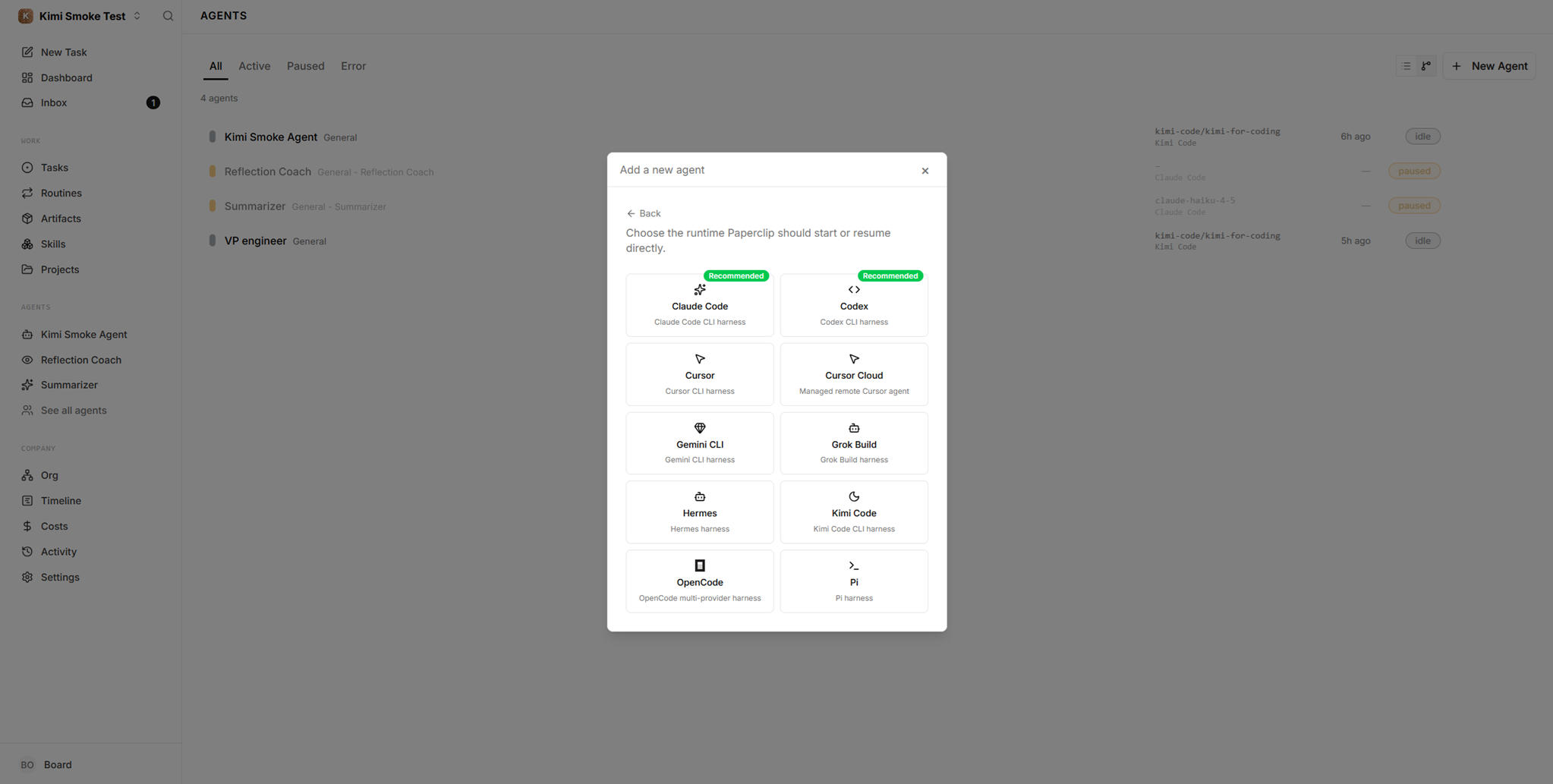 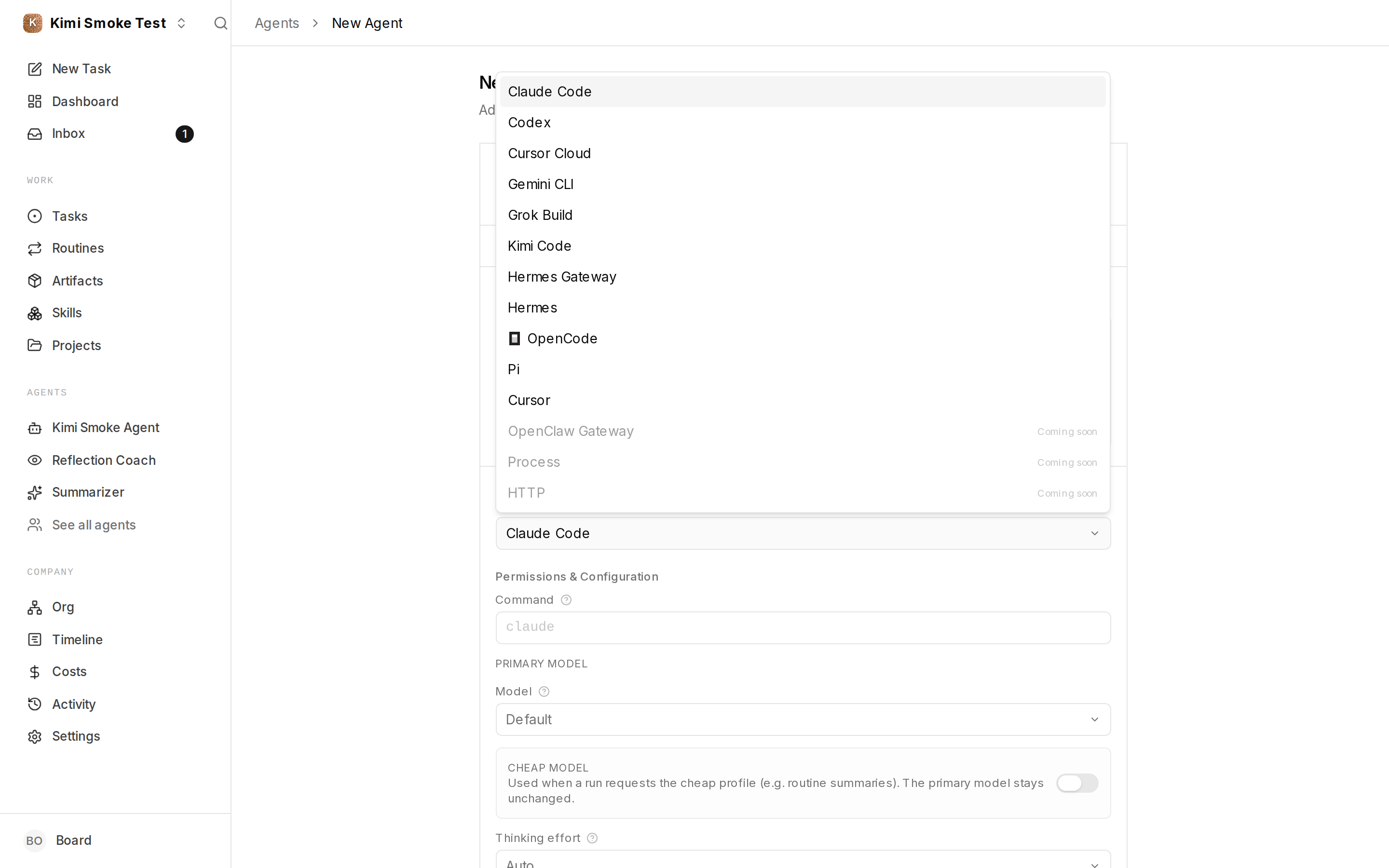 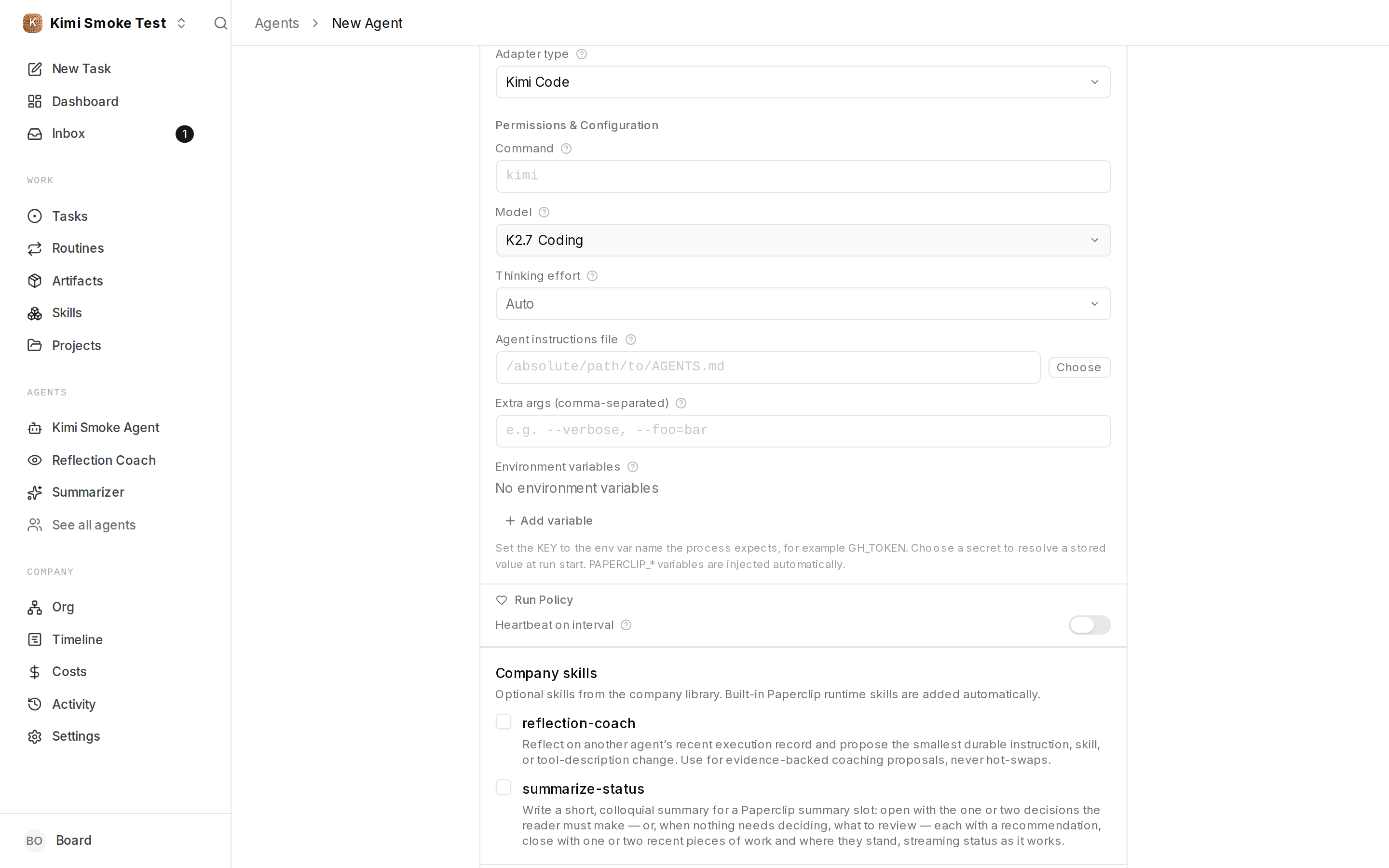 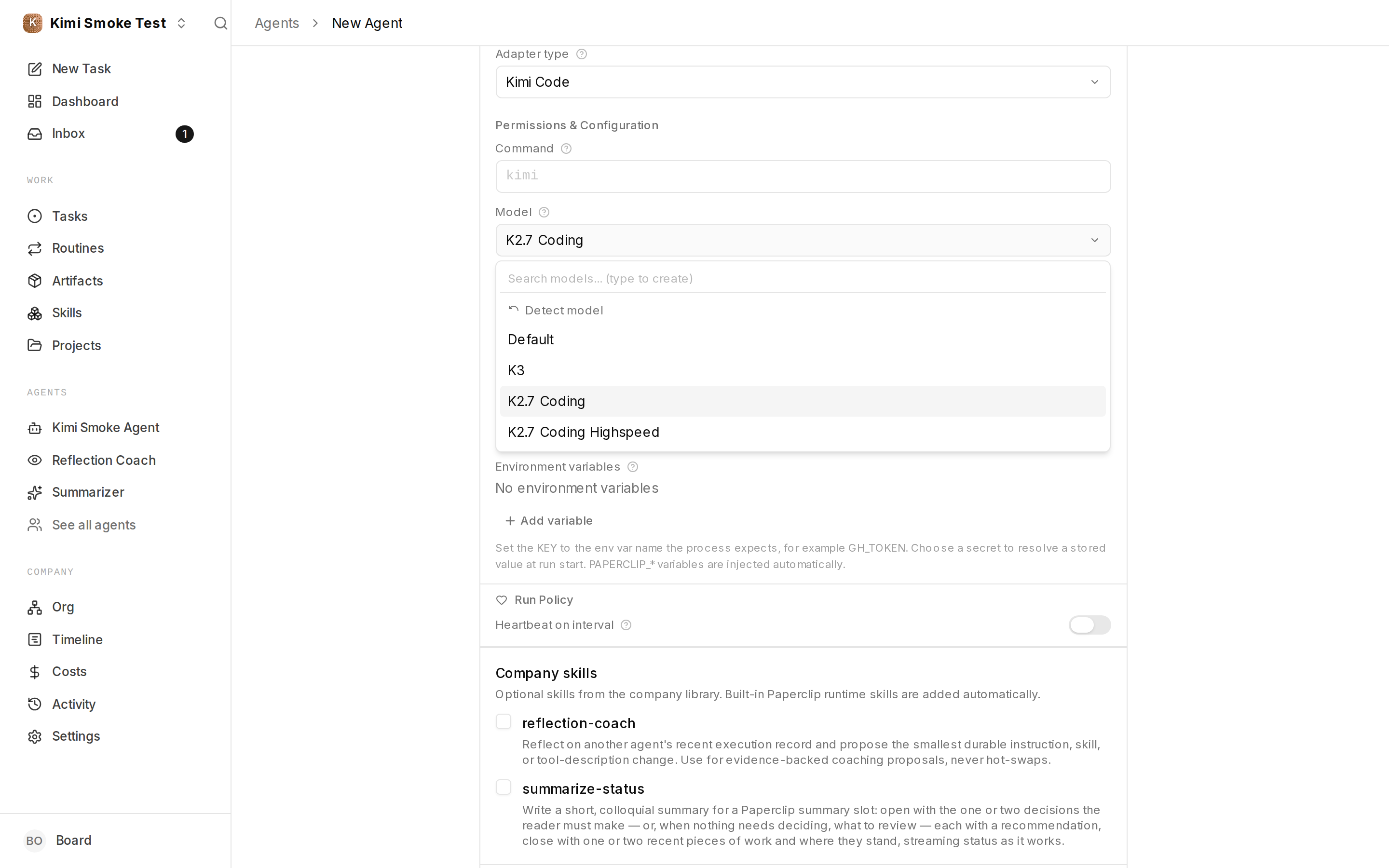   ## Risks - Low risk to existing behavior: the change is additive, one new workspace package plus single-entry registrations alongside existing adapters; no existing adapter code paths are modified. - The adapter invokes the locally installed `kimi` CLI; like other local adapters, run behavior depends on the host's Kimi version. The parser is written against the documented/verified 0.27.0 stream-json schema and degrades gracefully (malformed lines are skipped, failures surface as run errors). - `--skills-dir` overrides Kimi's auto-discovery of user and project skills for the run. This is intentional (paperclip-managed agents get a reproducible, isolated skill set), and it is only passed when at least one Paperclip skill is desired, so unconfigured agents keep default discovery. - Thinking effort is only forwarded to models that advertise `support_efforts` (currently `kimi-code/k3`); `EFFORT_CAPABLE_MODELS` must be extended when more Kimi models gain support, otherwise a configured effort is silently ignored for them. - `Dockerfile` now installs `@moonshot-ai/kimi-code@latest` globally alongside the other agent CLIs, so image size increases slightly. - Maintainer action needed for the npm bootstrap gate: the `policy` job's release-bootstrap step fails until the first npm publish of `@paperclipai/adapter-kimi-local` (the gate from #5146 that every new adapter package has passed through). Enrollment with `publishFromCi: true` is required by the manifest validator (dropping the entry, `false`, or `private` are all rejected), so this is intentionally left to a maintainer. Remaining CI lanes are expected to run once it is done. ## Model Used\n\n- **Current-master rebase, conflict adaptation, and registry-parity coverage:** OpenAI, **GPT-5 Codex** (Codex agent; exact serving model ID and context-window size were not exposed to the runtime), with repository, shell, Git, and GitHub tooling. It preserved Hawik’s commit authorship, reconciled ACPX and environment-capability changes, added current registry tests, and ran the verification above.\n- **Adapter implementation and initial review:** Moonshot AI, **Kimi K3 Coding** (latest), via **Kimi Code CLI v0.27.0** (`kimi-code/k3` alias, 1M-token context window, thinking mode, agentic tool use). The CLI agent explored the repo, wrote the adapter implementation (delegated to a coder sub-agent of the same model), ran tests, and drafted the first version of this PR body. A second model-driven review pass (read-only, same model) audited the diff for security/correctness before submission; its findings (shell-quoting hardening, auth-detection false positive, session-compaction registration, test gaps) were fixed and are included. - **Harness-context fixes and review responses:** Anthropic, **Claude Opus 4.8** (`claude-opus-4-8`) via Claude Code. Diagnosed from run logs that Kimi received only the entry instructions file (not the `HEARTBEAT.md`/`SOUL.md`/`TOOLS.md` bundle) and that `effort` was never wired, then implemented the instruction `--add-dir` delivery, `KIMI_MODEL_THINKING_EFFORT` forwarding, and `--skills-dir` skill delivery, added the accompanying tests and docs, and addressed the automated review comments (preserving external skills on remote sync, treating a signaled exit as a failure). Also extended the `paperclipai agent local-cli` installer to seed the control-plane skills into `~/.kimi-code/skills` for Codex/Claude parity, wired `onEvent` runtime events so the issue-thread activity indicator reflects Kimi's tool and reasoning output live, and built the ACP engine lane (`kimi acp` via the shared acpx engine, default) so the transcript streams with live tool status like the other ACP adapters. The Kimi CLI flags, subcommand, and env var relied on here were verified against the installed Kimi Code CLI 0.27.0. - All CLI behaviors claimed here (`-p`, `--output-format stream-json`, `-r` resume, event shapes, `--add-dir`, `--skills-dir`, `KIMI_MODEL_THINKING_EFFORT`) were verified empirically against the installed Kimi CLI, not assumed. ## Checklist - [x] I have included a thinking path that traces from project context to this change - [x] I have specified the model used (with version and capability details) - [x] I have checked ROADMAP.md and confirmed this PR does not duplicate planned core work - [x] I have searched GitHub for duplicate or related PRs and linked them above - [x] I have either (a) linked existing issues with `Fixes: #` / `Closes #` / `Refs #` OR (b) described the issue in-PR following the relevant issue template - [x] I have not referenced internal/instance-local Paperclip issues or links (only public GitHub `#NNN` / `github.com/paperclipai/paperclip` URLs) - [x] My branch name describes the change (e.g. `docs/...`, `fix/...`) and contains no internal Paperclip ticket id or instance-derived details - [x] I have run tests locally and they pass - [x] I have added or updated tests where applicable - [x] I have updated relevant documentation to reflect my changes - [x] I have considered and documented any risks above - [x] All Paperclip CI gates are green *(only the release-bootstrap step remains red, pending the maintainer npm publish described in Risks)* - [x] Greptile is 5/5 with no open P2s, recommendations, or follow-ups *(will address all Greptile comments as they arrive)* - [x] I will address all Greptile and reviewer comments before requesting merge --- ## Maintainer Addendum (2026-08-20) The shared acpx-engine and issue-chat changes (run-summary segmentation, placeholder tool-event coalescing, `ISSUE_CHAT_TRANSCRIPT_MAX_VISIBLE_ENTRIES` 30 → 400, live-reasoning UI) have been **extracted to #11761** so the cross-adapter behavior changes review and revert independently — both commits there preserve @hawikk's authorship. This PR is now the kimi-specific adapter only (60 files, +3,793/−8, essentially pure addition); the only shared-engine touch left is the `kimi acp` command resolution. `publishFromCi` is `true` — the package name is bootstrapped on npm. --------- Co-authored-by: Claude Opus 4.8 <noreply@anthropic.com> Co-authored-by: Paperclip <noreply@paperclip.ing> Co-authored-by: Dotta <bippadotta@protonmail.com> Co-authored-by: Devin Foley <devin@paperclip.ing> |
||
|
Nicky LeachandClaude Opus 5
|
a9d1f740f0 |
fix(workspaces): seed managed worktrees when the base checkout has no config (#11752)
## Thinking Path
> - Paperclip is the open source app people use to manage AI agents for
work
> - Agents do that work in isolated git worktrees, and a managed
worktree runs its own Paperclip instance with a cloned database
> - That clone needs a seed source, and the source must come from
server-owned registration, never from state the workspace itself can
rewrite
> - The seed-source resolver requires the registered base project
workspace to hold its own `.paperclip/config.json`
> - A managed project workspace is a plain `git clone`, and no code
writes that file into it
> - Every isolated worktree provision, deferred seed, and workspace
repair therefore fails on a managed checkout
> - This pull request lets a named source supply the config when the
base checkout has none
> - The benefit is that managed worktrees provision again, and the seed
source stays server-owned
## Linked Issues or Issue Description
No public GitHub issue exists for this problem. It is described below.
**What happened?**
Agent runs that need an isolated worktree fail during provisioning. The
provision command exits with this error (paths redacted):
```
Execution workspace provision command "bash ./scripts/provision-worktree.sh" failed:
Registered base project workspace has no canonical Paperclip config:
<instance-home>/instances/default/projects/<company-id>/<project-id>/<repo>/.paperclip/config.json
```
`resolveRegisteredWorktreeSeedSource` sets `registeredConfigPath` to
`<baseCwd>/.paperclip/config.json` whenever the caller names a
registered base workspace. It then requires that file to exist.
`scripts/provision-worktree.sh` applies the same rule.
A managed project workspace never has that file.
`materializeManagedProjectWorkspace` creates it with `git clone` and a
rename, so the checkout holds repository content only. The control plane
keeps its config at `<home>/instances/<id>/config.json` instead.
The failure reaches three paths: worktree provisioning, deferred seeding
through `worktree ensure-seeded`, and workspace repair.
The behavior changed in #11671. That pull request replaced a fallback
chain with a single hard requirement. Fixture code in
`scripts/__tests__/provision-worktree-self-heal.test.mjs` writes a
config into the fake base workspace, so tests kept passing.
**Expected behavior**
A managed worktree provisions and seeds from the registered source. The
seed manifest still never selects that source.
**Steps to reproduce**
1. Register the Paperclip repository as a project with a `repoUrl`, so
the server materializes a managed checkout.
2. Assign an issue to an agent whose workspace strategy is
`git_worktree`.
3. Watch the workspace operation log for the provision command.
4. The command exits non-zero with the error above.
**Paperclip version or commit**
Reproduced on `master` at
|
||
|
Devin Foley
|
b5a3a863c3 |
feat(release): bootstrap new npm packages with a placeholder publish (#11757)
## Thinking Path > - Paperclip is the open source app people use to manage AI agents for work > - Its release pipeline publishes a set of npm packages from CI with npm trusted publishing (GitHub OIDC), gated by `scripts/release-package-manifest.json` > - A brand-new package name cannot be published by CI directly: the PR bootstrap gate requires the name to resolve on npm, and a trusted-publisher rule can only be configured after the package page exists > - The current bootstrap helper closes that gap by building the package locally and publishing its real output from a maintainer machine — before the PR that adds the package has passed CI or review > - This pull request replaces that flow: the helper now publishes a minimal deprecated placeholder at version `0.0.0` that only reserves the name, so every real version ships from CI > - The benefit is that unreviewed build output never reaches npm, and the bootstrap runs from any checkout (including `master`, before the new package's PR merges) with no local build ## Linked Issues or Issue Description **What existing behavior does this improve?** The one-time npm bootstrap for a brand-new release package (`pnpm run release:bootstrap-package`). **Current behavior** The helper builds the target package locally and publishes the real build output from a maintainer machine. That content has not passed repository CI or review at publish time. The helper also requires the new package to exist in the local workspace, so it must run from the (unmerged) PR branch that adds the package. **Proposed behavior** The helper publishes a three-file placeholder at version `0.0.0` (manifest, README, and an `index.js` that throws a descriptive error), waits for the registry to show the package, then deprecates it. The PR bootstrap gate (`scripts/check-release-package-bootstrap.mjs`) only requires the name to resolve on the registry, so the placeholder satisfies it. The first real calver release from CI supersedes the placeholder, and a stable release moves `latest` off it — the same `latest` window that existed under the old flow, but containing an explicit inert stub instead of unreviewed code. **Reason and benefit** Real package content only ever reaches npm from CI, after review and merge. The bootstrap becomes safer (scope guard refuses names outside `@paperclipai/`, already-published names are rejected) and simpler (no local build, no workspace state, runs from any checkout). **Breaking changes** None at runtime. The helper's CLI surface changes: it now takes a package name only (no directory selector) and drops `--skip-build`. `doc/PUBLISHING.md` is updated to match. ## What Changed - `scripts/bootstrap-npm-package.mjs`: replaced the build-and-publish flow with a placeholder publish — stages `package.json` + `README.md` + throwing `index.js` at version `0.0.0` in a temp directory, previews with `npm publish --dry-run`, and publishes only with `--publish`. One-time passwords are prompted interactively (never passed as arguments, since they are single-use and would land in shell history), with re-prompt on a rejected or expired code. After publishing, the helper polls the registry until the package is visible (a first publish can lag by minutes; verified live at ~5 minutes), requiring two consecutive sightings before prompting for a second code and deprecating the placeholder so accidental installs warn loudly; on timeout or failure it prints the exact manual `npm deprecate` command. Added an `@paperclipai/`-scope guard and a fail-fast error when `--publish` runs without an interactive terminal. Removed the workspace-plan dependency so it runs from any checkout. - `scripts/bootstrap-npm-package.test.mjs`: rewrote for the new interface — argument parsing, scope validation, the generated placeholder files (manifest shape, throwing entry point, README), the OTP re-prompt loop, and the registry poll (consecutive-sighting requirement, timeout, transient-error tolerance) via injected fakes. - `doc/PUBLISHING.md`: rewrote the "One-time bootstrap sequence for a new package" section for the placeholder flow, including the `latest` dist-tag window and the trusted-publishing setup ordering (placeholder publish → trusted publisher rule → `"publishFromCi": true`). - `.github/scripts/check-pr-release-bootstrap.mjs` (+ test, + wiring in `run-quality-gates.mjs`): new informational commitperclip notice on PRs that need this bootstrap. It fires when the PR newly release-enables a package that is missing from npm, or adds an unpublished `publishFromCi: false` package that published packages declare a `workspace:*` dependency on, and names the exact maintainer command — so contributors know the red `policy` check is not theirs to fix. It never fails the gate (the `policy` job remains the enforcer), only looks up scope-validated names on the registry, and stays quiet on registry errors. ## Verification - `node --test scripts/bootstrap-npm-package.test.mjs`: 13/13 pass - `node --test .github/scripts/tests/*.test.mjs`: 147/147 pass (10 new for the PR notice) - `pnpm run test:release-registry`: 82/82 pass - Replayed the new PR notice against a real historical PR's live API data (files, manifest at base and head refs): with the registry in its pre-bootstrap state it produces the exact maintainer instruction; with the package bootstrapped it stays silent - Full live end-to-end run: the flow bootstrapped `@paperclipai/adapter-kimi-local` for real — dry-run preview (634-byte, 3-file tarball), publish, registry visibility after ~5 minutes of propagation lag, deprecation confirmed via `npm view ... deprecated` - Guards verified live: an already-published name is rejected, an out-of-scope name (`left-pad`) is rejected, unknown options (including the removed `--otp`) are rejected, and `--publish` in a non-interactive shell fails fast before any network call ## Risks - The `latest` dist-tag points at the deprecated `0.0.0` placeholder until the first stable release supersedes it. This window also existed under the old flow (which parked `latest` at a locally built version); internal consumers are unaffected because release version rewrites pin exact calver versions. - The registry poll caps at ~10 minutes. If propagation is slower than that, the helper prints the exact `npm deprecate ... --otp <code>` command to run manually once `npm view` resolves. - The helper no longer validates the name against the workspace release plan, so a typo within the `@paperclipai/` scope would reserve a wrong name. The dry-run preview shows the exact name before any publish. ## Model Used - Anthropic, **Claude Fable 5** (`claude-fable-5`) via Claude Code, with repository, shell, and Git tooling. It analyzed the existing bootstrap flow and the release scripts (`release-package-map.mjs`, `check-release-package-bootstrap.mjs`, `release.sh` dist-tag handling), wrote the replacement script and tests, updated the documentation, and ran the verification above. ## Checklist - [x] I have included a thinking path that traces from project context to this change - [x] I have specified the model used (with version and capability details) - [x] I have checked ROADMAP.md and confirmed this PR does not duplicate planned core work - [x] I have searched GitHub for duplicate or related PRs and linked them above - [x] I have either (a) linked existing issues with `Fixes: #` / `Closes #` / `Refs #` OR (b) described the issue in-PR following the relevant issue template - [x] I have not referenced internal/instance-local Paperclip issues or links (only public GitHub `#NNN` / `github.com/paperclipai/paperclip` URLs) - [x] My branch name describes the change (e.g. `docs/...`, `fix/...`) and contains no internal Paperclip ticket id or instance-derived details - [x] I have run tests locally and they pass - [x] I have added or updated tests where applicable - [x] I have updated relevant documentation to reflect my changes - [x] I have considered and documented any risks above - [ ] All Paperclip CI gates are green - [ ] Greptile is 5/5 with no open P2s, recommendations, or follow-ups - [x] I will address all Greptile and reviewer comments before requesting merge |
||
|
|
bd059a073d |
fix(workspaces): make managed runtimes reliable across restarts (#11740)
## Thinking Path > - Paperclip is the open source app people use to manage AI agents for work > - Execution workspaces need isolated databases, ports, and runtime services > - Concurrent workspaces could reuse ports or lose service ownership after a restart > - A markerless worktree also needed seed recovery, but normal markerless instances still needed to boot > - This pull request makes seed, port, and service ownership state explicit and recoverable > - It also checks live process and listener identity before it reclaims shared resources > - The benefit is reliable workspace startup, restart, adoption, and concurrent provisioning ## Linked Issues or Issue Description **What happened?** Managed workspaces could lose runtime service ownership after a control-plane restart. Concurrent worktrees could also reuse a port when their parent paths differed. A seed recovery change made every markerless instance resolve a worktree seed source, so normal instances without a source could not start. **Expected behavior** Paperclip must preserve healthy managed services across restarts. It must reserve unique ports across worktree parents. It must provision a registered markerless worktree, but it must skip seed work for a normal markerless instance. **Steps to reproduce** 1. Start two managed worktrees under different parent paths at the same time. 2. Restart the control plane while a managed service stays alive. 3. Start Paperclip with a config that has no seed markers and no registered worktree source. 4. Observe duplicate port selection, lost service adoption, or a seed-source startup error. **Paperclip version or commit** Current `master` plus the workspace runtime reliability changes in this pull request. **Deployment mode** Local development with managed execution workspaces and embedded Postgres. ## What Changed - Added a shared port registry with lease heartbeats, process identity checks, and live listener probes. - Reserved worktree ports across custom parent paths and repaired duplicate legacy assignments. - Preserved and adopted healthy managed services across control-plane restarts. - Reconciled guest bind modes and verified listener ownership before termination or reuse. - Provisioned registered markerless worktree databases and kept normal markerless instance startup as a no-op. - Added CLI, shared, server, and shell regression tests for seed, port, listener, restart, and adoption behavior. - Updated the worktree development documentation. ## Verification - `pnpm exec vitest run cli/src/__tests__/worktree.test.ts --reporter=verbose` — 63 tests passed. - `pnpm exec vitest run packages/shared/src/worktree-port-registry.test.ts --reporter=verbose` — 5 tests passed. - Focused runtime Vitest set — 199 tests passed across 37 suites. - `node --test scripts/__tests__/provision-worktree-self-heal.test.mjs` — 10 tests passed. - `git diff --check` passed. ## Risks - Port reservation now depends on lease and process identity data. The fallback listener probe prevents early reclamation when process metadata is incomplete. - Runtime adoption is stricter about bind and owner identity. The tests cover healthy adoption, stale records, PID reuse, and unrelated listeners. - Markerless seed detection now separates registered worktrees from normal instances. The tests cover both paths. - There are no database schema migrations. > For core feature work, check [`ROADMAP.md`](ROADMAP.md) first and discuss it in `#dev` before opening the PR. Feature PRs that overlap with planned core work may need to be redirected — check the roadmap first. See `CONTRIBUTING.md`. ## Model Used - OpenAI Codex with the `gpt-5` model family. The serving snapshot and context-window size are not exposed. The agent used reasoning, repository tools, code execution, and test execution. ## Checklist - [x] I have included a thinking path that traces from project context to this change - [x] I have specified the model used (with version and capability details) - [x] I have checked ROADMAP.md and confirmed this PR does not duplicate planned core work - [x] I have searched GitHub for duplicate or related PRs and linked them above - [x] I have either (a) linked existing issues with `Fixes: #` / `Closes #` / `Refs #` OR (b) described the issue in-PR following the relevant issue template - [x] I have not referenced internal/instance-local Paperclip issues or links (only public GitHub `#NNN` / `github.com/paperclipai/paperclip` URLs) - [x] My branch name describes the change (e.g. `docs/...`, `fix/...`) and contains no internal Paperclip ticket id or instance-derived details - [x] I have run tests locally and they pass - [x] I have added or updated tests where applicable - [x] I have updated relevant documentation to reflect my changes - [x] I have considered and documented any risks above - [x] All Paperclip CI gates are green - [x] Greptile is 5/5 with no open P2s, recommendations, or follow-ups - [x] I will address all Greptile and reviewer comments before requesting merge --------- Co-authored-by: Paperclip <noreply@paperclip.ing> Co-authored-by: Dev Agent <dev@paperclip.ing> |
||
|
DottaandPaperclip
|
a2bf936f9a |
feat(workspaces): sign the workspace login handoff and gate readiness (#11671)
## Thinking Path > - Paperclip is the open source app people use to manage AI agents for work. > - Managed worktree services run isolated Paperclip instances with cloned databases. > - A reachable service was reported as ready even when its database, runtime identity, or login path was not usable. > - The first candidate added verified database seeding and managed repair in #11665. > - This pull request consolidates that candidate with signed login handoff and a complete readiness contract. > - Post-QA fixes close five defects in repair identity, repair responses, UI retry, seed journal handling, and seed-source trust. > - The benefit is a workspace that either opens safely or reports one accurate recovery action. ## Linked Issues or Issue Description No public GitHub issue exists for this work, so the problem is described here. **What happened** Managed workspace URLs could return HTTP 200 and report ready while login failed. QA also found cases where repair used the wrong instance identity, returned a generic error, left the UI stuck, rejected a safe journal lag, or trusted a mutable workspace manifest. **Expected behavior** Opening a ready workspace signs the board user in to the correct isolated instance. Provisioning and repair use a registered source and report a structured recovery state. **Actual behavior** Entry depended on a password copied into the clone. Several failure paths could publish stale readiness, hide the repair precondition, or trust state that the workspace could modify. **Additional context** This pull request includes the commits first published in #11665. That pull request keeps the original base head for review history. This consolidated pull request is the merge candidate. Related open readiness work includes #11575 and #11621. ## What Changed - Adds a short-lived, signed, single-use login ticket. It binds the user, workspace, instance, and runtime origin. - Exchanges the ticket through Better Auth. It creates the session and cookie through the supported adapter path. - Adds protected workspace readiness fields for the database, clone data, login handoff, seed phase, and runtime identity. - Fails readiness closed when the guest has no company or execution-workspace binding. - Binds ticket issuance to the exact cloned user and active company membership selected for the handoff. - Verifies every current active board identity through the exact-user handoff before publication or reuse. - Gates managed runtime publication on the readiness contract and the recorded worktree instance identity. - Refreshes runtime work products from the live runtime row after a port change. - Adds one workspace access card with ready, degraded, repairing, and failed states. - Uses the runtime response identity for repair. It returns structured repair precondition errors. - Lets a valid source journal lag converge during provisioning. - Binds seed and repair manifests to a source registered outside the agent-writable worktree. - Clears recovered UI errors so a successful retry can open the workspace. - Makes runtime tests register canonical sources and avoid ports owned by live host listeners. - Keeps Vitest on source suites when compiled `dist` trees exist. - Isolates CLI and adapter tests from ambient AWS and runtime API environment variables. - Preserves a 404 response for cross-company workspace ID lookups before runtime authorization. - Makes concurrent single-flight coverage independent of path-canonicalization scheduling order. ## Verification The following checks passed on the integrated head: ```sh pnpm -r typecheck pnpm build pnpm check:token-gates pnpm --filter @paperclipai/db check:migrations ``` - The server source lane passed 420 files and 4,953 tests. Five tests were skipped. - The CLI lane passed 57 files and 385 tests. - The database lane passed 26 files and 97 tests. - The shared package passed 58 files and 506 tests. - The adapter utility lane passed 640 tests. Four tests were skipped. - The Claude adapter passed 220 tests. One test was skipped. - The Codex adapter passed 323 tests. - The OpenClaw adapter passed 13 tests. - The OpenCode adapter passed 42 tests. - The plugin SDK passed 45 tests. - The workspace runtime suite passed 124 tests. - The caller-scoped readiness and handoff suite passed 52 tests. - The workspace provisioning shell suite passed 7 tests. - The runtime exposure suite passed 17 tests while live host mappings occupied fixed test ports. - `git diff --check` passed and the worktree is clean. The serialized route lane will run in GitHub CI with its normal shards. No deployment or active-workspace migration was performed. ## Risks - This is a medium-risk authentication and runtime-readiness change. - The login ticket uses exact origin, workspace, instance, and user binding. It has a short expiry and a one-time nonce. - Runtime publication is stricter. A real readiness, identity, per-user handoff, or control-plane database disagreement now blocks publication. - This pull request supersedes #11665 as the merge candidate. Close #11665 after this pull request merges. - No new database migration is included. The lockfile and workflow files are unchanged. - Deployment and active-workspace migration are intentionally outside this pull request. > For core feature work, check [`ROADMAP.md`](ROADMAP.md) first and discuss it in `#dev` before opening the PR. Feature PRs that overlap with planned core work may need to be redirected — check the roadmap first. See `CONTRIBUTING.md`. ## Model Used Claude Opus 5 (`claude-opus-5[1m]`), 1M context, extended thinking, tool use, and code execution produced the main candidate. OpenAI GPT-5 (`gpt-5`) through Codex, with agentic reasoning, tool use, and code execution, integrated the post-QA fixes and hardened the test gates. The Codex context-window size was not exposed. ## Checklist - [x] I have included a thinking path that traces from project context to this change - [x] I have specified the model used (with version and capability details) - [x] I have checked ROADMAP.md and confirmed this PR does not duplicate planned core work - [x] I have searched GitHub for duplicate or related PRs and linked them above - [x] I have either (a) linked existing issues with `Fixes: #` / `Closes #` / `Refs #` OR (b) described the issue in-PR following the relevant issue template - [x] I have not referenced internal/instance-local Paperclip issues or links (only public GitHub `#NNN` / `github.com/paperclipai/paperclip` URLs) - [x] My branch name describes the change (e.g. `docs/...`, `fix/...`) and contains no internal Paperclip ticket id or instance-derived details - [x] I have run tests locally and they pass - [x] I have added or updated tests where applicable - [x] I have updated relevant documentation to reflect my changes - [x] I have considered and documented any risks above - [x] All Paperclip CI gates are green - [x] Greptile is 5/5 with no open P2s, recommendations, or follow-ups - [x] I will address all Greptile and reviewer comments before requesting merge --------- Co-authored-by: Paperclip <noreply@paperclip.ing> |
||
|
Devin Foley
|
e434829889 |
fix(release): draft-notes baseline survives candidate-cut stables (#11647)
## Thinking Path
> - Paperclip is the open source app people use to manage AI agents for
work
> - The release workflow drafts the upcoming stable's notes skeleton at
beta publish, ranging from the last stable to the beta's source commit
> - Stables cut from candidate branches leave their tag off master's
lineage, so the ancestor-only baseline rule skips them and falls back a
whole release too far
> - The first live draft did exactly that: it ranged from v2026.722.0
instead of the just-shipped v2026.817.0 and re-included everything
already released
> - This pull request replaces the baseline rule with a merge-base walk
over stable tags and adds a candidate-branch regression fixture
> - The benefit is a correct draft range for every stable lineage:
master-cut, candidate-cut, and promoted-older-source
## Linked Issues or Issue Description
**What happened?**
The first `draft_stable_notes` run (for beta `2026.818.0-beta.1`)
generated `releases/beta/v2026.818.0-beta.1.md` with the range
`v2026.722.0..664052f8e` — 311-commits-worth of already-shipped
v2026.817.0 content re-included.
**Expected behavior**
The draft ranges from the point the shipped stable's content diverges
from the beta source. For v2026.817.0 (cut from
`candidate/release-2026.817.0`) that is the promoted source commit
`8f7b8b3fd`, giving the 172 commits of genuinely-new work.
**Steps to reproduce**
Ship a stable from a candidate branch (tag lands off master's lineage),
then publish a beta from master and read the generated skeleton's range
line.
**Paperclip version or commit**
master at `664052f8e`.
Related (not duplicates): #11567 introduced the generator; its
ancestor-only rule was itself a review fix for the newest-by-version
rule, and this PR is the second iteration with the lineage case the
first fix missed.
## What Changed
- `scripts/draft-stable-notes.sh`: the range start comes from walking
stable tags newest-first and taking the first whose merge-base with the
beta source is a proper ancestor of the source. Candidate-cut stables
resolve to the promoted commit, master-lineage stables to the tag
itself, and tags containing the source are skipped (an older-source
promotion cannot produce an empty range). The skeleton header prints a
runnable short-sha range with the stable tag as a labeled baseline.
- `scripts/draft-stable-notes.test.mjs`: new regression fixture with the
stable tag on an unmerged candidate branch; the existing older-source
and fallback fixtures still pass unchanged.
## Verification
- `node --test scripts/draft-stable-notes.test.mjs` — 8 pass, including
the new fixture.
- Regenerated the live `2026.818.0-beta.1` draft against the real
repository: range start resolves to `v2026.817.0 (merge-base
|
||
|
Devin Foley
|
664052f8ea |
feat(release): draft stable notes at beta publish, read them from master at promotion (#11567)
## Thinking Path > - Paperclip is the open source app people use to manage AI agents for work > - The release channel system promotes builds canary → nightly → beta → stable, and stable releases publish a GitHub Release from `releases/vYYYY.MDD.P.md` > - The stable lane requires that notes file to exist inside the promoted source commit, but the file is named for the promotion date, which is unknown when the source commit is created > - A promoted beta can therefore never pass the notes check: every happy-path stable is forced through the candidate-branch fix path, with a soak-gate justification, for a notes-only change > - This pull request drafts the notes automatically when the beta is published and lets the stable promotion read them from `master` > - The benefit is a walkable stable happy path: the soak gate stays exact, notes get a real review window during the soak, and the justification path returns to its real purpose (cherry-picked fixes) ## Linked Issues or Issue Description **What existing behavior does this improve?** The stable promotion path in the release channel system (`release.yml`, `scripts/release.sh`). **Current behavior** `release.sh stable` requires `releases/vYYYY.MDD.P.md` in the checked-out source tree, and `publish_stable` checks out the exact promoted SHA. The soak gate requires a `beta/v*` tag to point at that same SHA. No commit can satisfy both for a promoted beta, so a stable promotion must cut a candidate branch with a notes-only commit and bypass the soak gate with a written justification. Release notes are also written at promotion time, under time pressure, with no review window. **Proposed behavior** When a beta publishes, a `draft_stable_notes` job generates a grouped notes skeleton at `releases/beta/v<beta-version>.md` and pushes it to a machine-owned branch; a human opens the PR and edits it during the 3-day soak. The stable preflight resolves notes before the `npm-stable` approval gate: source-tree notes first (the candidate fix path, unchanged), then the merged beta-keyed file on `master`; it fails early with the missing path named when neither exists. After the stable ships, a canonicalization job pushes a branch that moves the file to `releases/vYYYY.MDD.P.md`. Related (not duplicates): #11006 and #11008 introduced the nightly and beta lanes this builds on; older changelog PRs (for example #10669) authored notes manually at promotion time, which is the flow this replaces. **Reason and benefit** The happy path becomes: promote the exact soaked SHA, no justification, notes reviewed during the soak instead of written at the gate. The `releases/vYYYY.MDD.P.md` invariant still holds durably via the canonicalization PR. ## What Changed - `scripts/release.sh`: new `--notes-file PATH` (stable only) overrides where the pre-publish notes check looks, so notes can live outside the source checkout without dirtying the worktree. - `scripts/create-github-release.sh`: same `--notes-file` override for the GitHub Release body. - `scripts/draft-stable-notes.sh` (new): deterministic skeleton generator — commit subjects from the newest stable tag (falling back to the previous beta, then full history) to the beta's source commit, grouped into Features / Fixes / Other. - `.github/workflows/release.yml`: - `draft_stable_notes` job after `publish_beta`: runs the generator and force-pushes `release-notes/v<beta-version>`; the job summary links the compare page. It recreates the beta tag locally if the tag push was rejected (the known workflows-permission case), so drafting is not blocked on manual tag recovery. - `preflight_stable`: computes the target stable version (`release.sh stable --print-version`) and resolves the notes source (`source_tree` → `master_beta` → fail early / warn on dry run); new outputs. - `publish_stable`: materializes `master`-side notes into `RUNNER_TEMP` and passes `--notes-file` to both scripts; outputs the published stable version. - `canonicalize_stable_notes` job: pushes the `git mv` branch after a stable that used `master`-side notes. - `doc/RELEASING.md`, `doc/RELEASE-CHECKLIST.md`: document the drafted-notes flow, the preflight resolution order, and the canonicalization step; the LLM changelog flow now targets the draft branch during the soak. - `.agents/skills/release-changelog/SKILL.md`, `.agents/skills/release-changelog-discord-message/SKILL.md`: the notes-authoring skills now describe this flow — range ends at the beta source commit (not `HEAD`), the file is beta-keyed on the `release-notes/v<beta-version>` branch (seeded with `scripts/draft-stable-notes.sh` for betas that predate the automation), and the canonicalization link caveat is called out for announcements. ## Verification - `node --test scripts/draft-stable-notes.test.mjs` — 6 tests, temp git-repo fixtures: grouping, stable-tag range, previous-beta and full-history fallbacks, default output path, malformed version, missing tag. - `node --test scripts/release-lib.test.mjs` — unchanged suite still green. - `bash -n` on both changed shell scripts; `release.yml` re-parsed as YAML. - `./scripts/release.sh stable --print-version` unchanged (prints the next stable version); `--notes-file` on a non-stable channel fails with a clear error. - Not exercised end-to-end: the new workflow jobs need a real beta publish to run. The first beta after merge is the live test; the draft job is additive and cannot affect the publish result (it runs after `publish_beta` completes). ## Risks - Low risk to publishing itself: `--notes-file` defaults preserve today's behavior everywhere; the draft and canonicalization jobs are additive and run after the publishes succeed. - The preflight now fails a real stable run when no notes are found. That is the intended fail-early behavior (it previously failed later, inside `publish_stable`, after the `npm-stable` approval). - `draft_stable_notes` force-pushes only the machine-owned `release-notes/v<beta-version>` branch; a beta re-cut regenerates it cleanly. - The stable version computed at preflight could differ from the published one if a run crosses UTC midnight between the two jobs; the materialized notes are passed by path, so the publish still succeeds, and the canonicalization job uses the actually-published version. ## Model Used Claude Fable 5 (Claude Code) ## Pre-submission checklist - [x] I have included a thinking path that traces from project context to this change - [x] I have specified the model used (with version and capability details) - [x] I have checked ROADMAP.md and confirmed this PR does not duplicate planned core work - [x] I have searched GitHub for duplicate or related PRs and linked them above - [x] I have either (a) linked existing issues with `Fixes: #` / `Closes #` / `Refs #` OR (b) described the issue in-PR following the relevant issue template |
||
|
|
49217aadf0 |
refactor: balance serialized server shards by recorded suite duration (#11528)
<!-- Write all pull request text in Simplified Technical English (ASD-STE100). --> ## Thinking Path > - Paperclip is the open source app people use to manage AI agents for work > - The PR verify workflow gates every pull request; its wall-clock time sets the feedback loop for all contributors > - In a recent successful PR run (actions run 32012408876), the slowest check was "Verify serialized server suites (1/5)" at 337s, while its four sibling shards finished in 212-238s > - The serialized lane assigns suites to shards round-robin over an alphabetical list, so the heavy heartbeat and issues suites cluster on one runner > - The general-server lane already solves this with a duration-aware LPT partition backed by a recorded manifest > - This pull request reuses that partitioner for the serialized lane with a fresh per-suite duration manifest > - The benefit is a balanced serialized matrix: the measured 968s suite total levels to about 194s per shard, which removes about 80-100s from the run's slowest check ## Linked Issues or Issue Description **What existing behavior does this improve?** The `Verify serialized server suites` shard matrix in `.github/workflows/pr.yml` distributes route/authz test suites across five runners. **Subsystem affected** CI / test infrastructure (`scripts/run-vitest-stable.mjs`). **Current behavior** `selectSerializedSuites` assigns suites round-robin (`index % shardCount`) over the alphabetically sorted file list. The heavy suites cluster on shard 1/5. In actions run 32012408876, shard 1/5 spent 291s in its test step while the other shards spent 170-201s, which made that job (337s total) the slowest check of the whole PR run. **Proposed behavior** Partition the serialized suites with the same duration-aware LPT algorithm the general-server lane already uses (`scripts/general-server-shard.mjs`), backed by a new per-suite duration manifest. All five shards then carry about 194s of measured test time. **Reason and benefit** The slowest check bounds PR feedback time. Balancing the serialized matrix removes about 80-100s from that bound without adding runners. **Breaking changes** None. The partition remains deterministic, complete, and non-overlapping; suites missing from the manifest get the median weight. ## What Changed - Added `scripts/serialized-shard-durations.json`: per-suite wall-clock durations (ms) for all 134 serialized suites, sampled from actions run 32012408876 by diffing consecutive per-suite label timestamps in the shard logs (captures vitest spawn overhead, not just reported test time) - `scripts/run-vitest-stable.mjs`: `selectSerializedSuites` now uses the existing LPT partitioner (`selectGeneralServerShard`) with the new manifest instead of round-robin - `scripts/__tests__/run-vitest-stable-shard.test.mjs`: added a manifest-freshness test and a shard-balance test for the serialized lane, mirroring the general-server ones - `.github/workflows/pr.yml`: updated the serialized matrix comment with the new measurement and mechanism ## Verification - `node --test ./scripts/__tests__/run-vitest-stable-shard.test.mjs` passes (13 tests), including the existing test that the serialized shards form a complete, non-overlapping partition - Dry-run of all five shards shows estimated totals of 194/194/194/194/193s (round-robin was 276/175/160/172/187s): `node scripts/run-vitest-stable.mjs --mode serialized --shard-index N --shard-count 5 --dry-run` - The `Verify serialized server suites` jobs on this PR run the real partition end to end ## Risks - Low risk. Selection logic only; the vitest invocation per suite is unchanged - A stale manifest degrades gracefully: unknown suites get the median weight, and a dedicated test fails if fewer than half the current suites have recorded durations ## Model Used - Claude (Anthropic), model ID `claude-fable-5`, agentic coding session with tool use (Claude Code / Claude Agent SDK); no extended-thinking mode ## Checklist - [x] I have included a thinking path that traces from project context to this change - [x] I have specified the model used (with version and capability details) - [x] I have checked ROADMAP.md and confirmed this PR does not duplicate planned core work - [x] I have searched GitHub for duplicate or related PRs and linked them above - [x] I have either (a) linked existing issues with `Fixes: #` / `Closes #` / `Refs #` OR (b) described the issue in-PR following the relevant issue template - [x] I have not referenced internal/instance-local Paperclip issues or links (only public GitHub `#NNN` / `github.com/paperclipai/paperclip` URLs) - [x] My branch name describes the change (e.g. `docs/...`, `fix/...`) and contains no internal Paperclip ticket id or instance-derived details - [x] I have run tests locally and they pass - [x] I have added or updated tests where applicable - [x] I have updated relevant documentation to reflect my changes - [x] I have considered and documented any risks above - [x] All Paperclip CI gates are green - [x] Greptile is 5/5 with no open P2s, recommendations, or follow-ups - [x] I will address all Greptile and reviewer comments before requesting merge Related prior work: #10923 (split serialized tests into five shards), #10925 (general-server duration manifest), #11156 (workspaces-a native shards). Co-authored-by: Claude <noreply@anthropic.com> Co-authored-by: Paperclip <noreply@paperclip.ing> |
||
|
Devin Foley
|
2ec984502a |
fix(release): stop smoke_beta silently skipping on promote-mode betas (#11582)
## Thinking Path > - Paperclip is the open source app people use to manage AI agents for work > - The release channel system re-smokes every published beta as post-publish verification (`smoke_beta`) > - The candidate-branch beta lane (#11209) added `verify_beta_candidate` to `publish_beta`'s needs; that job is skipped on every normal promote-mode beta > - `smoke_beta`'s condition has no status-check function, so GitHub attaches an implicit `success()` that evaluates the needs chain transitively — a skipped ancestor makes it false > - This pull request makes the condition explicit so promote-mode betas smoke again, and pins the shape in the workflow wiring test > - The benefit is that the post-publish beta gate actually runs instead of silently skipping ## Linked Issues or Issue Description **What happened?** Beta `2026.818.0-beta.0` (run 32082007439) published successfully, but its post-publish `smoke_beta` job was skipped. No configuration or input asked for that: the run was a plain `channel: beta` dispatch with `dry_run` at its default `false`, and the same expression `!inputs.dry_run` evaluated true inside `publish_beta`'s own steps (the Docker dispatch step ran). **Expected behavior** Every non-dry-run beta publish is followed by the release smoke suite against the exact published version, as documented in `doc/RELEASING.md` and `doc/RELEASE-CHECKLIST.md`. **Steps to reproduce** Dispatch `release.yml` with `channel: beta` promoting a nightly (promote mode). `verify_beta_candidate` is skipped by design; `publish_beta` runs through its explicit `!cancelled()` condition; `smoke_beta` then skips because its implicit `success()` sees the skipped ancestor in the transitive needs chain (actions/runner#2205 semantics). The beta published on 2026-08-11 predated #11209, so this never surfaced before. **Paperclip version or commit** master at `43ab441f0` (workflow file, current head). Related (not duplicates): #11209 introduced the candidate lane whose skipped job triggers this; #11208 covers the adjacent tag-push failure playbooks. ## What Changed - `smoke_beta`'s condition becomes `!cancelled() && needs.publish_beta.result == 'success' && !inputs.dry_run` — an explicit status-check function suppresses the implicit `success()`, and the result check keeps the dependency on a successful publish. - A comment above the job records why the explicit form is load-bearing. - `scripts/__tests__/release-verify-workflow.test.mjs` pins the new shape so the implicit form cannot silently return. ## Verification - `node --test scripts/__tests__/release-verify-workflow.test.mjs` — 8 pass, including the new assertion. - `release.yml` re-parsed as YAML. - The exact skip is visible on run 32082007439 (`smoke_beta: skipped` after `publish_beta: success`); the coverage gap for that beta was closed manually by dispatching `release-smoke.yml` with `paperclip_version: beta` (run 32084880767). - Not exercised end-to-end: the corrected condition needs the next real promote-mode beta to demonstrate; the expression change is minimal and the semantics are the documented actions/runner behavior. ## Risks - Low risk: condition-only change on one job plus a test. Dry runs still skip the smoke (`!inputs.dry_run` retained). Candidate-mode betas, where `verify_beta_candidate` actually runs, behave as before. ## Model Used Claude Fable 5 (Claude Code) ## Pre-submission checklist - [x] I have included a thinking path that traces from project context to this change - [x] I have specified the model used (with version and capability details) - [x] I have checked ROADMAP.md and confirmed this PR does not duplicate planned core work - [x] I have searched GitHub for duplicate or related PRs and linked them above - [x] I have either (a) linked existing issues with `Fixes: #` / `Closes #` / `Refs #` OR (b) described the issue in-PR following the relevant issue template |
||
|
Dotta
|
4c349fe6b7 |
feat(runtime): managed Tailscale HTTPS lifecycle, durable runtime leases, and bounded control recovery (#11525)
<!-- Simplified Technical English (ASD-STE100). --> > **Stacked pull request.** This targets #11524. Merge #11524 first. Review only the second commit, `feat(runtime): managed Tailscale HTTPS lifecycle...`. ## Thinking Path > - Paperclip is the open source app people use to manage AI agents for work > - Paperclip starts and supervises managed runtime services, so an agent's branch can be previewed while the agent works > - The previous pull request added the host broker, the shared contract, and the database columns, but no code used them > - A managed runtime can only be exposed over HTTPS if it holds a stable loopback port pair for the whole life of the service. The current control path cannot promise this: two controls can race the same execution workspace, a stranded control can stay `running` forever, and a start can adopt a port it does not own > - This pull request adds the HTTPS lifecycle and the control-path hardening that the lifecycle depends on > - The benefit is that a managed preview becomes reachable from another device, and a managed control now always reaches a terminal state ## Linked Issues or Issue Description No public GitHub issue exists. The change follows the feature request template. **Subsystem affected** Managed workspace runtime services, workspace operations, the execution workspace routes, and the workspace runtime UI. **Problem or motivation** A managed runtime service is reachable only on loopback, so a preview cannot be opened from a phone or a second computer. Exposing it safely needs an exclusively held port pair. Three existing gaps block that. Overlapping controls can race the same workspace. A control whose owner dies stays `running` and blocks the lane forever. Port allocation does not confirm that the process holding a port is the process Paperclip spawned. **Proposed solution** Add the exposure lifecycle on top of the broker from #11524: reserve before spawn, expose after readiness, validate the public URL, and remove on stop. In the same change, make managed controls mutually exclusive per workspace, give each control a durable issue-owned lease and a terminal state, and verify port ownership before use. **Alternatives considered** - Add HTTPS exposure without the control hardening. This was rejected because a raced or stranded control makes exposure point at the wrong process. - Guard the lane with an in-memory lock only. This was rejected because the lock does not survive a server restart, so the lane can be lost or double-claimed. - Trust the requested bind address. This was rejected because a checkout that predates managed HTTPS overwrites `PAPERCLIP_BIND` from its own `--bind` argument, and then binds the wildcard address. **Roadmap alignment** This completes the managed workspace runtime capability that already exists. It adds no new product surface beyond the HTTPS link. **Additional context** This is the second of three pull requests. The third adds central mediation of leased port pairs. ## What Changed Exposure lifecycle: - Add the server-side broker client and the exposure lifecycle manager. The manager reserves the mapping before spawn, exposes after backend readiness, validates the public URL, and removes the mapping on stop. - Default managed worktree runtimes to `tailscale_https`, read exposure intent from legacy `expose` blocks, and backfill runtimes that are still HTTP-only. - Verify listener ownership for the app port and its Vite HMR companion before the broker is asked to expose anything. An unrelated listener on either port fails the start closed. - Force the loopback bind through argv instead of environment hints. Leave a non-Paperclip service's `--bind` argument alone. - Probe loopback for readiness instead of the public URL, and give Vite HMR its own loopback-bound server in middleware mode. - Preserve operator-declared Serve mappings across the managed lifecycle, so cleanup never removes a mapping that Paperclip did not create. - Name which listener predicate denied an expose, so an operator can act on the message. Control-path hardening: - Make `start`, `stop`, `restart`, and job `run` mutually exclusive per execution workspace. An overlap gets `409 workspace_runtime_control_in_progress`, and authorization is still checked first. - Take a durable exclusivity lease on the execution workspace, owned by the controlling issue. A different issue gets `409 workspace_runtime_lease_conflict` before any operation is recorded. Board and operator actions bypass the lease. - Give every control a terminal state. Each control stamps its owning process and pid, heartbeats while it runs, and has a wall-clock ceiling. Recovery of a stranded control uses a compare-and-swap on `updated_at`, so a live owner is never stolen. - Bound readiness probes, verify allocated port ownership on POSIX and Windows, harden sibling port allocation, and reconcile desired runtimes on server startup. - Surface exposure state and bounded runtime errors in the workspace runtime UI. - Record the new behavior in `doc/DEVELOPING.md`. ## Verification Focused checks, all run on this branch: - `npx tsc --noEmit -p server/tsconfig.json` — 139 errors, exactly the count on `master`. All 139 come from the unbuilt `@paperclipai/plugin-sdk` package. - `pnpm --filter @paperclipai/ui typecheck` — clean. - Server suites, 177 tests pass across 9 files: `workspace-runtime.test.ts`, `workspace-runtime-leases.test.ts`, `workspace-runtime-control-recovery.test.ts`, `execution-workspace-runtime-control-conflict.test.ts`, `execution-workspace-runtime-lease-route.test.ts`, `workspace-operations-reconciliation.test.ts`, `workspace-runtime-start-terminality.test.ts`, `app-hmr-port.test.ts`, and `workspace-runtime-ready-comment.test.ts`. - Exposure unit suites, 77 tests pass: `src/services/runtime-exposure/` and `workspace-runtime-exposure-backfill.test.ts`. - UI: `WorkspaceRuntimeControls.test.tsx` and `WorkspaceServiceControlBar.test.tsx` — 34 tests pass. **One suite is red on the development host and is expected to be green in CI.** `server/src/services/workspace-runtime-exposure.test.ts` has 10 failures on the machine used to write this branch. The cause is host contamination, not the code. That machine already runs an HTTPS canary that holds ports 42000, 42001, 52000, and 52001 on a tailnet address. The suite allocates from the same range, so the new listener-ownership check correctly reports: ``` listener_ownership_mismatch — port 42000 is bound to 100.123.243.20, 127.0.0.1, fd7a:115c:a1e0:0:0:0:dd3a:f314 ... instead of loopback only ``` A CI runner has no listener on those ports, so the check sees loopback only and the suite passes. Please confirm this from the CI result on this pull request rather than from a local run on a host that already exposes a managed runtime. This is a real weakness of the current test fixture, and the third pull request in the series removes it by allocating the pair through a central mediator instead of a stubbed availability check. `workspace-runtime-https-live-exercise.test.ts` needs a live `tailscale` host and was not run locally. ## Risks - This is the behavior-bearing pull request of the three, so it carries the most risk. - Two new `409` responses appear on managed control routes. A caller that assumed a control always starts must handle a conflict. Board and operator actions are deliberately exempt, so an agent lease cannot lock an operator out. - Managed worktree runtimes now default to `tailscale_https`. If the host has no working broker, the start fails closed and reports the exposure failure instead of silently serving plain HTTP. This is intended, and it is the reason the failure message names the denying predicate. - Startup reconciliation touches persisted runtime rows. It is scoped to desired state and does not resurrect a service that never came up. - The lease has a 30-minute time to live and explicit release paths, so a crashed owner cannot hold a lane forever. - No migration runs in this pull request. The tables and columns land in #11524. > For core feature work, check [`ROADMAP.md`](ROADMAP.md) first and discuss it in `#dev` before opening the PR. ## Model Used Claude Opus 5 (`claude-opus-5`), 1M context window, extended thinking, with tool use and code execution. ## Checklist - [x] I have included a thinking path that traces from project context to this change - [x] I have specified the model used (with version and capability details) - [x] I have checked ROADMAP.md and confirmed this PR does not duplicate planned core work - [x] I have searched GitHub for duplicate or related PRs and linked them above - [x] I have either (a) linked existing issues with `Fixes: #` / `Closes #` / `Refs #` OR (b) described the issue in-PR following the relevant issue template - [x] I have not referenced internal/instance-local Paperclip issues or links (only public GitHub `#NNN` / `github.com/paperclipai/paperclip` URLs) - [x] My branch name describes the change (e.g. `docs/...`, `fix/...`) and contains no internal Paperclip ticket id or instance-derived details - [x] I have run tests locally and they pass, with the one host-contaminated suite explained above - [x] I have added or updated tests where applicable - [x] I have updated relevant documentation to reflect my changes - [x] I have considered and documented any risks above - [ ] All Paperclip CI gates are green - [ ] Greptile is 5/5 with no open P2s, recommendations, or follow-ups - [x] I will address all Greptile and reviewer comments before requesting merge |
||
|
DottaandPaperclip
|
d2665ff6b4 |
fix(ui): align the mobile task chat composer with the thread (#11296)
## Thinking Path > - Paperclip is the open source app people use to manage AI agents for work. > - The task thread is where people read work and guide agents. > - The mobile composer should use the same content width as the thread. > - The composer kept the desktop 80% width on mobile, so its edges did not align with the thread. > - Long assignee-aware placeholder text could also clip inside the mobile editor. > - Some extracted style tokens used legacy HSL wrappers around complete semantic colors, which made those declarations invalid. > - This pull request makes the composer full width on mobile, preserves the narrower desktop layout, wraps the placeholder, and repairs the invalid color compositions. > - The benefit is a stable mobile composer that aligns with the task thread and keeps its intended visual styles. ## Linked Issues or Issue Description Related work: Refs #11263. **What happened?** At mobile widths, the task chat composer used the same 80% width as the desktop composer. Its horizontal edges did not align with the full task thread. A long assignee-aware placeholder could clip on one line. The composer's extracted shadow also used a legacy `hsl(var(...))` wrapper around complete semantic color values, so the browser could reject the declaration. **Expected behavior** The composer must match the task thread width on mobile. It must stay narrower on larger screens. Long placeholder text must wrap inside the editor. Semantic color tokens must form valid shadows and gradients. **Steps to reproduce** 1. Open a task with the chat-style thread on a mobile viewport. 2. Compare the composer edges with the task thread edges. 3. Select an assignee whose placeholder text wraps to two lines. 4. Inspect the computed composer shadow and the extracted semantic color styles. **Paperclip version or commit** The change is based on `dc6fcd1ff1` from `master`. **Deployment mode** Local build from source. The behavior also applies to packaged web builds. ## What Changed - Made the task chat composer full width below the medium breakpoint and kept the 80% desktop width. - Matched the composer dock padding to the task thread padding. - Allowed long composer placeholders to wrap and reserved enough mobile editor height for two lines. - Replaced invalid legacy HSL wrappers around full semantic colors in extracted shadows, gradients, and approval styles. - Added a token gate that prevents legacy `hsl(var(--token))` wrappers from returning. - Added focused regression tests for responsive width, padding, placeholder wrapping, mobile height, and semantic shadow validity. ## Verification - `pnpm check:token-gates` — all four gates pass. - `pnpm --filter @paperclipai/ui exec vitest run src/components/TaskChatThread.test.tsx src/components/task-chat/TaskChatComposer.test.tsx src/components/task-chat/TaskChatComposerStyles.test.ts` — 37 tests pass. - `pnpm --filter @paperclipai/ui typecheck` — passes. - `pnpm --filter @paperclipai/ui build` — passes. The build prints existing CSS optimizer and bundle-size warnings. ## Risks - Low risk. The width change is limited to the mobile breakpoint. The desktop 80% layout remains in place. - The semantic token fixes can affect shadows and gradients that were previously invalid. The new gate prevents the invalid wrapper pattern from returning. > For core feature work, check [`ROADMAP.md`](ROADMAP.md) first and discuss it in `#dev` before opening the PR. Feature PRs that overlap with planned core work may need to be redirected — check the roadmap first. See `CONTRIBUTING.md`. ## Model Used - OpenAI Codex with `gpt-5.6-sol`. The context-window size is not exposed in this environment. The model used reasoning, repository tools, code execution, and GitHub tools. ## Checklist - [x] I have included a thinking path that traces from project context to this change - [x] I have specified the model used (with version and capability details) - [x] I have checked ROADMAP.md and confirmed this PR does not duplicate planned core work - [x] I have searched GitHub for duplicate or related PRs and linked them above - [x] I have either (a) linked existing issues with `Fixes: #` / `Closes #` / `Refs #` OR (b) described the issue in-PR following the relevant issue template - [x] I have not referenced internal/instance-local Paperclip issues or links (only public GitHub `#NNN` / `github.com/paperclipai/paperclip` URLs) - [x] My branch name describes the change (e.g. `docs/...`, `fix/...`) and contains no internal Paperclip ticket id or instance-derived details - [x] I have run tests locally and they pass - [x] I have added or updated tests where applicable - [x] I have updated relevant documentation to reflect my changes - [x] I have considered and documented any risks above - [x] All Paperclip CI gates are green - [x] Greptile is 5/5 with no open P2s, recommendations, or follow-ups - [x] I will address all Greptile and reviewer comments before requesting merge --------- Co-authored-by: Paperclip <noreply@paperclip.ing> |
||
|
|
a8d118a779 |
Prefer public base URL for generated invite links (#7619)
Fixes #7623 ## Thinking Path > - Paperclip is the open source app people use to manage AI agents for work. > - Company invites are part of the access subsystem and must produce URLs that recipients can open from outside the host machine. > - Paperclip already has public/auth base URL configuration for deployments behind a public hostname, Tailscale, or a reverse proxy. > - Invite URL composition was still deriving its origin from the incoming request host, so loopback-bound servers emitted `http://127.0.0.1:3100/invite/...`. > - A loopback invite URL is not shareable with a remote human or agent, even when the token itself is valid. > - This pull request makes invite URL builders prefer the configured public base URL and keep the existing request-host fallback when it is unset. > - The benefit is that copied invite links use the reachable deployment origin without changing local-only behavior. ## Linked Issues or Issue Description Fixes #7623 No duplicate or related PRs/issues were found in a GitHub search for invite URL, loopback, public base URL, and `authPublicBaseUrl` terms. ## What Changed - Added base URL resolution in `server/src/routes/access.ts` that strips trailing slashes and prefers configured `authPublicBaseUrl` over the request-derived host. - Threaded `authPublicBaseUrl` through invite summary, invite onboarding manifest, onboarding text, access routes, `createApp`, and server startup wiring. - Added `server/src/__tests__/invite-url-public-base-url.test.ts` covering configured public-base precedence, unset fallback behavior, and trailing-slash normalization. - Registered the invite public-base URL test in the serialized Vitest server runner. ## Verification ```bash pnpm install --frozen-lockfile pnpm exec vitest run server/src/__tests__/invite-url-public-base-url.test.ts pnpm run test:run:serialized ``` Local results from the rebased PR branch: - `pnpm install --frozen-lockfile` exited 0. - Targeted invite URL test exited 0: 1 file, 3 tests passed. - Serialized server suite exited 0: 106 serialized suites completed; the new invite URL test passed inside that runner. Manual check after deployment: set `PAPERCLIP_AUTH_PUBLIC_BASE_URL` or equivalent public base URL config, create a company invite, and confirm the returned/copied invite URL uses that public origin instead of `127.0.0.1`. ## Risks Low risk. The new public base URL parameter is optional and falls back to existing request-derived behavior when unset. The main operational risk is misconfigured public base URL input; the implementation only trims trailing slashes and otherwise trusts the configured origin. ## Model Used - Original implementation: Anthropic `claude-sonnet-4-6`, 200k context, tool use and test execution. - Conflict repair and verification: OpenAI Codex GPT-5.5, coding agent with shell, git, GitHub CLI, and local test execution. ## Checklist - [x] I have included a thinking path that traces from project context to this change - [x] I have specified the model used (with version and capability details) - [x] I have checked ROADMAP.md and confirmed this PR does not duplicate planned core work - [x] I have searched GitHub for duplicate or related PRs and linked them above - [x] I have either (a) linked existing issues with `Fixes: #` / `Closes #` / `Refs #` OR (b) described the issue in-PR following the relevant issue template - [x] I have not referenced internal/instance-local Paperclip issues or links (only public GitHub `#NNN` / `github.com/paperclipai/paperclip` URLs) - [ ] My branch name describes the change (e.g. `docs/...`, `fix/...`) and contains no internal Paperclip ticket id or instance-derived details - [x] I have run tests locally and they pass - [x] I have added or updated tests where applicable - [x] I have updated relevant documentation to reflect my changes - [x] I have considered and documented any risks above - [ ] All Paperclip CI gates are green - [ ] Greptile is 5/5 with no open P2s, recommendations, or follow-ups - [x] I will address all Greptile and reviewer comments before requesting merge --------- Co-authored-by: Coder (Claude) <coder-claude@paperclip.ing> Co-authored-by: Paperclip <noreply@paperclip.ing> Co-authored-by: Paperclip Coder (Claude) <lad-agent@paperclip.ing> |
||
|
Devin Foley
|
71e9d6bb0b |
feat(release): candidate-branch beta builds and the release checklist (#11209)
> Follow-up to #11208 (merged): rebased onto master and ready for review. ## Thinking Path > - Paperclip is the open source app people use to manage AI agents for work > - The release channels promote artifacts along canary → nightly → beta → stable, with the happy path being promotion of an existing build > - When one or two targeted fixes are needed before a beta or stable, the only options today are waiting for the next nightly or absorbing a whole day of unrelated master changes > - The channel model was designed with an escape hatch for exactly this: short-lived candidate branches carrying only cherry-picked fixes > - This pull request implements candidate-branch beta builds with full verification, documents the stable fix path through the soak-justification gate, and adds the release captain's checklist > - The benefit is that a surgical fix can ship forward without either delay or blast radius, with its provenance recorded ## Linked Issues or Issue Description Refs #11008 — completes the fix-path half of the channel model introduced there. **Subsystem affected** Release automation: `scripts/release.sh`, `.github/workflows/release.yml`, `doc/RELEASING.md`, new `doc/RELEASE-CHECKLIST.md`, tests. **Problem or motivation** Beta promotion only accepts commits that already shipped as a nightly, and stable promotion expects a soaked beta. There is no supported way to ship one or two cherry-picked fixes between lanes: an urgent fix must wait for the nightly cycle or pull in every unrelated master change from the day. The original channel design called for candidate branches to cover this, and they were deferred from the initial implementation. **Proposed solution** Candidate-branch beta builds: cut `candidate/beta-<target>` from a nightly's source commit, cherry-pick the fixes, and dispatch `channel: beta` with the new `candidate_branch` input. Selection enforces the naming convention, rejects heads that already shipped as a beta or predate the candidate tooling, and records the cherry-picked commits in the job summary. Because candidate heads never went through a canary or nightly, publication is gated on a full `release-verify` run (promoted nightlies keep skipping re-verification). The stable fix path (`candidate/release-<target>` as `source_ref`) works through the existing soak gate: the justification requirement is the deliberate, recorded trade-off for shipping unsoaked bits, and is now documented as such. ## What Changed - `scripts/release.sh`: `--from-candidate` flag (beta only) waives the shipped-a-nightly requirement while keeping the duplicate-beta guard - `.github/workflows/release.yml`: `candidate_branch` dispatch input; candidate mode in `select_beta` (naming validation, duplicate and tooling-era rejection, cherry-pick recording); new `verify_beta_candidate` job gating candidate publishes on full verification - `doc/RELEASING.md`: beta fix-path and stable fix-path sections - `doc/RELEASE-CHECKLIST.md` (new): the release captain's checklist for all four lanes as built - Tests: dry-run fixture coverage for `--from-candidate` (waives the nightly guard, keeps the duplicate guard, rejected outside beta) and wiring tests for candidate validation plus the verification gate ## Verification - `node --test` on the four affected suites: 42 pass in total (17 + 25 across the two runs), including the 5 new tests - `bash -n` on `release.sh`; YAML parse of the workflow - After merge: exercise the path end to end the first time a real cherry-picked beta is needed — dispatch with a `candidate/beta-*` branch and confirm the summary records the picks and verification runs ## Risks - Candidate builds bypass the smoke-tested-nightly provenance by design; the compensating controls are full verification before publish, the post-publish beta smoke, the human `npm-beta` gate, and recorded cherry-picks - The stable fix path rides the existing justification mechanism rather than adding a second bypass — one recorded escape hatch, not two ## Model Used Claude Fable 5 (`claude-fable-5`, Anthropic) in Claude Code, with extended thinking and full tool use. All changes model-authored under human direction. ## Checklist - [x] I have included a thinking path that traces from project context to this change - [x] I have specified the model used (with version and capability details) - [x] I have checked ROADMAP.md and confirmed this PR does not duplicate planned core work - [x] I have searched GitHub for duplicate or related PRs and linked them above - [x] I have either (a) linked existing issues with `Fixes: #` / `Closes #` / `Refs #` OR (b) described the issue in-PR following the relevant issue template - [x] I have not referenced internal/instance-local Paperclip issues or links (only public GitHub `#NNN` / `github.com/paperclipai/paperclip` URLs) - [x] My branch name describes the change (e.g. `docs/...`, `fix/...`) and contains no internal Paperclip ticket id or instance-derived details - [x] I have run tests locally and they pass - [x] I have added or updated tests where applicable - [x] I have updated relevant documentation to reflect my changes - [x] I have considered and documented any risks above - [ ] All Paperclip CI gates are green (pending — will confirm before merge) - [ ] Greptile is 5/5 with no open P2s, recommendations, or follow-ups (pending — will confirm before merge) - [x] I will address all Greptile and reviewer comments before requesting merge |
||
|
Devin Foley
|
2da6a248c3 |
fix(release): surface recovery commands when a lane tag push is rejected (#11208)
## Thinking Path > - Paperclip is the open source app people use to manage AI agents for work > - The release subsystem's promotion lanes publish to npm, then push a lane tag and dispatch the Docker image build at that tag > - The first nightly of the beta-tooling merge published to npm and then died at the tag push: GITHUB_TOKEN may not create refs pointing at workflow-modifying commits from dispatch or scheduled runs > - The failure was a bare `remote rejected` with no guidance, leaving the release half-finished (npm live, no tag, no images) until an operator reverse-engineered the recovery > - This pull request makes every lane's tag push degrade into exact recovery instructions in the job summary > - The benefit is that a rare platform-permission rejection becomes a two-minute runbook operation instead of a forensic exercise ## Linked Issues or Issue Description Refs #11008 — the incident occurred promoting that change's own merge commit, the first workflow-modifying commit to flow through the lanes it introduced. **Subsystem affected** Release automation: `.github/workflows/release.yml`, `doc/RELEASING.md`, workflow wiring tests. **Problem or motivation** Run 31445344811 published `2026.811.0-nightly.0` to npm, then failed pushing `nightly/v2026.811.0-nightly.0`: `refusing to allow a GitHub App to create or update workflow .github/workflows/release.yml without workflows permission`. The tagged commit modifies workflow files, and GITHUB_TOKEN may not create refs pointing at such commits from dispatch or scheduled runs (push-event runs are exempt, which is why the canary tag on the same commit succeeded). The job failed with no explanation and the Docker dispatch never ran. **Proposed solution** Wrap the nightly, beta, and stable tag pushes: on rejection, write the exact recovery commands into the job summary — create and push the tag with maintainer credentials, dispatch `docker.yml` at the tag, and for stable also run `create-github-release.sh` — then fail the job. Document the cause and recovery in the failure playbooks and pin the three recovery blocks with a wiring test. ## What Changed - `.github/workflows/release.yml`: recovery-summary wrappers on the nightly, beta, and stable tag-push steps - `doc/RELEASING.md`: failure-playbook entry for the workflows-permission rejection - `scripts/__tests__/release-verify-workflow.test.mjs`: wiring test asserting all three lanes carry the recovery summary ## Verification - Wiring tests: 6 pass; YAML parse of the workflow - The recovery commands are exactly the ones used to resolve the real incident (tag push + `docker.yml` dispatch for `nightly/v2026.811.0-nightly.0`) ## Risks - Low. The happy path is unchanged (a successful push skips the wrapper); the failure path trades a bare error for actionable output and still fails the job, since the release state is genuinely incomplete ## Model Used Claude Fable 5 (`claude-fable-5`, Anthropic) in Claude Code, with extended thinking and full tool use. All changes model-authored under human direction. ## Checklist - [x] I have included a thinking path that traces from project context to this change - [x] I have specified the model used (with version and capability details) - [x] I have checked ROADMAP.md and confirmed this PR does not duplicate planned core work - [x] I have searched GitHub for duplicate or related PRs and linked them above - [x] I have either (a) linked existing issues with `Fixes: #` / `Closes #` / `Refs #` OR (b) described the issue in-PR following the relevant issue template - [x] I have not referenced internal/instance-local Paperclip issues or links (only public GitHub `#NNN` / `github.com/paperclipai/paperclip` URLs) - [x] My branch name describes the change (e.g. `docs/...`, `fix/...`) and contains no internal Paperclip ticket id or instance-derived details - [x] I have run tests locally and they pass - [x] I have added or updated tests where applicable - [x] I have updated relevant documentation to reflect my changes - [x] I have considered and documented any risks above - [ ] All Paperclip CI gates are green (pending — will confirm before merge) - [ ] Greptile is 5/5 with no open P2s, recommendations, or follow-ups (pending — will confirm before merge) - [x] I will address all Greptile and reviewer comments before requesting merge |
||
|
Devin FoleyandPaperclip
|
d648becb90 |
refactor(ci): split workspaces-a into two Vitest native shards
Split the slow workspaces-a CI lane into two Vitest native shards and keep release verification in parity. Co-Authored-By: Paperclip <noreply@paperclip.ing> |
||
|
Devin Foley
|
6601014898 |
fix(release): reject promotion sources that predate their channel tooling (#11197)
## Thinking Path > - Paperclip is the open source app people use to manage AI agents for work > - The release subsystem promotes builds along canary → nightly → beta → stable, and each publish job checks out the promotion's source commit and runs that tree's release tooling > - The first beta dispatch failed with `unexpected argument: beta`: the selected nightly's source predated the beta channel, so its `release.sh` did not know the argument > - The failure was clean (argument parsing, nothing published) but cryptic, and the same trap waits for any promotion of a source older than its target channel's tooling > - This pull request makes the selection jobs reject such sources with an actionable error and documents the property > - The benefit is that a bootstrapping or old-source promotion fails in seconds with instructions, instead of mid-publish with a parser error ## Linked Issues or Issue Description Refs #11008 — the guard hardens the beta promotion flow introduced there, after its first dispatch surfaced the gap described below. **Subsystem affected** Release automation: `.github/workflows/release.yml`, `doc/RELEASING.md`, workflow wiring tests. **Problem or motivation** Run 31444045044 (first beta dispatch) failed in `publish_beta` with `unexpected argument: beta`. Promotions deliberately build from the pinned source commit, which means they also run that commit's `scripts/release.sh` — and a source that predates the target channel's introduction cannot publish it. Nothing guards this today; the error surfaces deep in the publish job with no explanation. **Proposed solution** Guard at selection time: `select_nightly` requires the source canary's `release.sh` to know the nightly channel, and `select_beta` requires the source nightly's `release.sh` to know the beta channel. Each guard literally matches the channel case arm and fails closed with a clear message naming the remedy (promote a newer source). Document the tooling-era property in `RELEASING.md` and pin the guards with a wiring test. ## What Changed - `.github/workflows/release.yml`: tooling-era guards in `select_nightly` and `select_beta` - `doc/RELEASING.md`: documents that promotions run the source commit's release tooling - `scripts/__tests__/release-verify-workflow.test.mjs`: wiring test pinning both guards ## Verification - Wiring tests: 5 pass - Guard expressions exercised against real commits: accepts the beta-capable merge commit of the beta-channel change, rejects a pre-beta commit - YAML parse of the workflow - After merge: the next beta dispatch selects a beta-capable nightly and passes the guard ## Risks - Low. Selection-time check only; the guards match the channel case arm literally and fail closed (with the same actionable message) if that line is ever reformatted ## Model Used Claude Fable 5 (`claude-fable-5`, Anthropic) in Claude Code, with extended thinking and full tool use. All changes model-authored under human direction. ## Checklist - [x] I have included a thinking path that traces from project context to this change - [x] I have specified the model used (with version and capability details) - [x] I have checked ROADMAP.md and confirmed this PR does not duplicate planned core work - [x] I have searched GitHub for duplicate or related PRs and linked them above - [x] I have either (a) linked existing issues with `Fixes: #` / `Closes #` / `Refs #` OR (b) described the issue in-PR following the relevant issue template - [x] I have not referenced internal/instance-local Paperclip issues or links (only public GitHub `#NNN` / `github.com/paperclipai/paperclip` URLs) - [x] My branch name describes the change (e.g. `docs/...`, `fix/...`) and contains no internal Paperclip ticket id or instance-derived details - [x] I have run tests locally and they pass - [x] I have added or updated tests where applicable - [x] I have updated relevant documentation to reflect my changes - [x] I have considered and documented any risks above - [ ] All Paperclip CI gates are green (pending — will confirm before merge) - [ ] Greptile is 5/5 with no open P2s, recommendations, or follow-ups (pending — will confirm before merge) - [x] I will address all Greptile and reviewer comments before requesting merge |
||
|
Devin Foley
|
8f7b8b3fda |
feat(release): add human-gated beta channel with stable soak enforcement (#11008)
> Follow-up to #11006 (merged): rebased onto master and ready for review. ## Thinking Path > - Paperclip is the open source app people use to manage AI agents for work > - The release subsystem now publishes canary (every master push), nightly (scheduled, smoke-gated, added in #11006), and stable (manual) > - There is still no human-approved release-candidate lane between nightly and stable, and nothing enforces that a stable actually soaked anywhere before shipping > - Betas need a real approval gate, and stables need a soak policy that is data, not prose > - This pull request adds the beta channel: a manual promotion of a chosen nightly behind the `npm-beta` environment gate, re-smoked after publish, plus a stable preflight that enforces a 3-day beta soak with a written-justification bypass > - The benefit is a complete canary → nightly → beta → stable train where every stable shipped as a beta first, and emergencies leave a written trace ## Linked Issues or Issue Description **Subsystem affected** Release automation: `scripts/release.sh`, `scripts/release-lib.sh`, `.github/workflows/release.yml`, `.github/workflows/docker.yml`, `.github/workflows/release-smoke.yml`. **Problem or motivation** After #11006 the project has canary and nightly prerelease lanes, but no release-candidate lane. Stable promotion has no enforced soak: any ref can ship as stable directly. There is no approval boundary for a broader-audience prerelease, and no structured way to record why an emergency release skipped validation. **Proposed solution** Add a `beta` channel: a manual dispatch that promotes a chosen nightly's source commit, publishes behind the `npm-beta` GitHub environment (required reviewers are the gate), re-smokes the published beta, and tags `beta/vX`. Enforce in the stable path that the source commit shipped as a beta at least 3 days earlier (measured from the beta's npm publish time), with a `skip_soak_justification` input as the recorded emergency bypass. **Alternatives considered** Codifying the soak policy in docs only. Rejected: an unenforced policy decays; the preflight makes the policy executable while the justification input keeps the emergency path usable and auditable. ## What Changed - `scripts/release.sh` + `scripts/release-lib.sh`: `beta` channel — requires HEAD to carry a `nightly/v*` tag, publishes the package set as `YYYY.MDD.P-beta.N` under dist-tag `beta`, tags `beta/vYYYY.MDD.P-beta.N` - `.github/workflows/release.yml`: - `channel: beta` dispatch path: `select_beta` resolves the newest (or an explicit `source_version`) nightly and fails loudly on selection problems; `publish_beta` runs behind the `npm-beta` environment, pushes the tag, and dispatches `docker.yml`; `smoke_beta` re-runs the release smoke suite against the exact published beta version - stable path: new `preflight_stable` job enforces the 3-day beta soak from the beta's npm publish time; `skip_soak_justification` bypasses with the reason echoed into the job summary; dry runs report without blocking - `.github/workflows/docker.yml`: `beta/v*` tags publish `:beta` on both images, with exact version stamping - `.github/workflows/release-smoke.yml`: `beta` added to the dispatch choice list - Docs: `CHANNELS.md` beta entries; `RELEASING.md` beta lane, soak gate, and failure playbook; `RELEASE-AUTOMATION-SETUP.md` `npm-beta` environment setup, including the warning to create the environment before the first beta dispatch (GitHub auto-creates unprotected environments on first reference) - Tests: beta version-counting coverage in `scripts/release-registry-versions.test.mjs`; beta identity and nightly-tag guard coverage in `scripts/__tests__/release-dry-run-notes.test.mjs` ## Verification - `node --test` on the two touched suites: 17 pass, including the 3 new beta tests - `bash -n` on both shell scripts and YAML parse of all three workflows - After merge, in order: create the `npm-beta` environment, dispatch `channel: beta` with `dry_run: true` to preview, then a real promotion of a published nightly through the approval gate, then a stable dry-run against a young beta to see the soak gate report ## Risks - If the `npm-beta` environment does not exist when the first beta dispatch runs, GitHub creates it with no protection rules and the beta publishes without approval. Mitigated by documentation and by creating the environment before merge (operator step) - Until the first beta exists, every stable dispatch requires `skip_soak_justification`. This is deliberate — the first beta ships immediately after this merges — but it is a behavior change to the stable dispatch - The soak clock reads the beta's npm publish time from the registry; a registry outage makes the preflight fall back to requiring justification (fail-closed) ## Model Used Claude Fable 5 (`claude-fable-5`, Anthropic) in Claude Code, with extended thinking and full tool use (repository exploration, local test execution, live registry and git verification). All code, tests, and docs in this PR were model-authored under human direction. ## Checklist - [x] I have included a thinking path that traces from project context to this change - [x] I have specified the model used (with version and capability details) - [x] I have checked ROADMAP.md and confirmed this PR does not duplicate planned core work - [x] I have searched GitHub for duplicate or related PRs and linked them above - [x] I have either (a) linked existing issues with `Fixes: #` / `Closes #` / `Refs #` OR (b) described the issue in-PR following the relevant issue template - [x] I have not referenced internal/instance-local Paperclip issues or links (only public GitHub `#NNN` / `github.com/paperclipai/paperclip` URLs) - [x] My branch name describes the change (e.g. `docs/...`, `fix/...`) and contains no internal Paperclip ticket id or instance-derived details - [x] I have run tests locally and they pass - [x] I have added or updated tests where applicable - [x] I have updated relevant documentation to reflect my changes - [x] I have considered and documented any risks above - [ ] All Paperclip CI gates are green (pending — will confirm before merge) - [ ] Greptile is 5/5 with no open P2s, recommendations, or follow-ups (pending — will confirm before merge) - [x] I will address all Greptile and reviewer comments before requesting merge |
||
|
Devin Foley
|
f94f6003c6 |
fix(release-smoke): pin the smoke container to the lan bind preset (#11189)
## Thinking Path > - Paperclip is the open source app people use to manage AI agents for work > - The release subsystem's nightly lane gates every nightly on the release smoke suite, which boots the published artifact in a Docker container and drives real onboarding > - The gate kept failing even after the readiness budget fix (#11187), and the new container-log dump revealed the server was healthy but listening on 127.0.0.1 inside the container, unreachable through Docker's port mapping > - `onboard --yes` without an explicit `--bind` prefers trusted-local quickstart defaults: it writes a loopback bind into the instance config and ignores the deployment env vars the harness passes, and that config outranks `HOST` at runtime > - This pull request pins the smoke container to the `lan` bind preset and adds a wiring test for it > - The benefit is a working nightly gate, verified end to end against a real published canary ## Linked Issues or Issue Description **Subsystem affected** Release smoke testing: `docker/Dockerfile.onboard-smoke`, `scripts/__tests__/release-verify-workflow.test.mjs`. **Problem or motivation** Nightly run 31428558684 failed in smoke with the server unreachable at the mapped port for the full 420 second budget. The container logs (captured thanks to #11187) show a fully booted server with `Bind loopback (127.0.0.1)`. The harness sets `HOST=0.0.0.0` and the deployment env vars, but `onboard --yes` without `--bind` deliberately prefers trusted-local defaults, writes `bind: loopback` into the instance config, and the config outranks `HOST` at runtime. A loopback listener inside a container is invisible to the port mapping, so the health check can never pass. This behavior predates the current stable, so the harness was silently broken against every recent version — it only surfaced now because the nightly lane is the suite's first CI consumer. **Proposed solution** Pass `--bind lan` in the smoke container command (the flag is supported by `latest` and canary alike; it selects the all-interfaces preset and keeps the env-driven authenticated deployment), and pin the flag with a wiring test so it cannot regress silently. ## What Changed - `docker/Dockerfile.onboard-smoke`: the onboard command is now `onboard --yes --bind lan --data-dir ...`, with a comment explaining why the flag is load-bearing - `scripts/__tests__/release-verify-workflow.test.mjs`: wiring test asserting the smoke Dockerfile pins a non-loopback bind preset ## Verification - Full local harness run against the real nightly candidate `2026.810.0-canary.1`: container healthy, bind banner shows `lan (0.0.0.0)`, authenticated bootstrap completed (admin created, bootstrap invite accepted, board session verified), `/api/health` returns `bootstrapStatus: ready` - `node --test scripts/__tests__/release-verify-workflow.test.mjs`: 4 pass - After merge: dispatch `release.yml` with `channel: nightly` to run the gate end to end in CI ## Risks - Low. The change only affects the smoke container. `--bind lan` inside a container exposes the port to the container network only; reachability from outside still goes through Docker's explicit port mapping ## Model Used Claude Fable 5 (`claude-fable-5`, Anthropic) in Claude Code, with extended thinking and full tool use (CI log forensics, upstream source tracing, local Docker reproduction and verification). All changes model-authored under human direction. ## Checklist - [x] I have included a thinking path that traces from project context to this change - [x] I have specified the model used (with version and capability details) - [x] I have checked ROADMAP.md and confirmed this PR does not duplicate planned core work - [x] I have searched GitHub for duplicate or related PRs and linked them above - [x] I have either (a) linked existing issues with `Fixes: #` / `Closes #` / `Refs #` OR (b) described the issue in-PR following the relevant issue template - [x] I have not referenced internal/instance-local Paperclip issues or links (only public GitHub `#NNN` / `github.com/paperclipai/paperclip` URLs) - [x] My branch name describes the change (e.g. `docs/...`, `fix/...`) and contains no internal Paperclip ticket id or instance-derived details - [x] I have run tests locally and they pass - [x] I have added or updated tests where applicable - [x] I have updated relevant documentation to reflect my changes - [x] I have considered and documented any risks above - [ ] All Paperclip CI gates are green (pending — will confirm before merge) - [ ] Greptile is 5/5 with no open P2s, recommendations, or follow-ups (pending — will confirm before merge) - [x] I will address all Greptile and reviewer comments before requesting merge |
||
|
Devin Foley
|
30f6999cbe |
fix(release-smoke): configurable readiness timeout and diagnostics for slow containers (#11187)
## Thinking Path > - Paperclip is the open source app people use to manage AI agents for work > - The release subsystem's nightly lane (#11006) gates every nightly publish on the release smoke suite, which boots the published artifact in a Docker container > - The suite's first CI execution failed at the health readiness check: the harness hard-codes a 90 second budget, but a CI container cold-installs paperclipai from npm and initializes embedded postgres with no warm caches > - When the timeout expired with the container still running, the harness printed no container logs, so the failure gave no diagnostics > - This pull request makes the readiness budget configurable, raises it for CI, and dumps container logs on timeout > - The benefit is that the nightly gate measures the artifact, not the runner's cold caches, and a red smoke run is diagnosable from its logs ## Linked Issues or Issue Description **Subsystem affected** Release smoke testing: `scripts/docker-onboard-smoke.sh`, `.github/workflows/release-smoke.yml`. **Problem or motivation** Run 31426044332 (first forced nightly after #11006) failed in `smoke_nightly` with `server did not become ready at http://localhost:3232/api/health` after exactly 90 seconds. The harness's readiness window is hard-coded to 90 attempts at 1 second. Locally that works because the npm cache is warm; in CI the container downloads the full package set and embedded postgres first. The timeout path also printed no container logs when the container was still running, so there was no way to see how far boot had progressed. **Proposed solution** Make the readiness budget an environment variable (`SMOKE_READY_TIMEOUT_SECONDS`, default unchanged at 90 for local use), set it to 420 in the CI workflow, and dump the last 150 container log lines when the readiness check times out on a still-running container. ## What Changed - `scripts/docker-onboard-smoke.sh`: `SMOKE_READY_TIMEOUT_SECONDS` env var (default 90) replaces the hard-coded readiness budget; timeout with a still-running container now prints the tail of `docker logs` - `.github/workflows/release-smoke.yml`: sets `SMOKE_READY_TIMEOUT_SECONDS=420` for CI runs ## Verification - `bash -n` on the harness and YAML parse of the workflow - The real proof is the next `channel: nightly` dispatch of `release.yml`, which re-runs this suite in CI with the new budget ## Risks - Low. The local default is unchanged; CI runs simply wait longer before declaring failure, and a genuinely broken artifact still fails (with logs now) ## Model Used Claude Fable 5 (`claude-fable-5`, Anthropic) in Claude Code, with extended thinking and full tool use. Diagnosis from CI run logs; patch model-authored under human direction. ## Checklist - [x] I have included a thinking path that traces from project context to this change - [x] I have specified the model used (with version and capability details) - [x] I have checked ROADMAP.md and confirmed this PR does not duplicate planned core work - [x] I have searched GitHub for duplicate or related PRs and linked them above - [x] I have either (a) linked existing issues with `Fixes: #` / `Closes #` / `Refs #` OR (b) described the issue in-PR following the relevant issue template - [x] I have not referenced internal/instance-local Paperclip issues or links (only public GitHub `#NNN` / `github.com/paperclipai/paperclip` URLs) - [x] My branch name describes the change (e.g. `docs/...`, `fix/...`) and contains no internal Paperclip ticket id or instance-derived details - [x] I have run tests locally and they pass - [x] I have added or updated tests where applicable - [x] I have updated relevant documentation to reflect my changes - [x] I have considered and documented any risks above - [ ] All Paperclip CI gates are green (pending — will confirm before merge) - [ ] Greptile is 5/5 with no open P2s, recommendations, or follow-ups (pending — will confirm before merge) - [x] I will address all Greptile and reviewer comments before requesting merge |
||
|
Devin Foley
|
f9173782cd |
feat(release): add smoke-gated nightly channel and lane-separated Docker tags (#11006)
## Thinking Path > - Paperclip is the open source app people use to manage AI agents for work > - The release subsystem publishes the `paperclipai` npm package set and the Docker images on two lanes: canary on every master push, and stable on manual promotion > - There is no middle ground between those lanes. Users must track every merge or wait weeks for a stable. Docker `:latest` also tracks master, so Docker users have no stable image at all > - A calm prerelease lane needs to exist, and it must never ship a build that failed its checks > - This pull request adds the nightly channel: a scheduled job that selects the newest master commit with a green canary publish, runs the full release smoke suite against that exact published canary, and only then republishes it as the nightly. It also separates Docker tags by lane, so `:latest` finally means stable > - The benefit is that users can follow prereleases at a nightly cadence with a smoke-tested guarantee, and Docker users get real `:canary`, `:nightly`, and stable image tags ## Linked Issues or Issue Description **Subsystem affected** Release automation: `scripts/release.sh`, `scripts/release-lib.sh`, `.github/workflows/release.yml`, `.github/workflows/docker.yml`, `.github/workflows/release-smoke.yml`. **Problem or motivation** The project publishes only `canary` (every master push) and `latest` (manual stable). Users who want prereleases without per-merge churn have no option. Docker has a second problem: master builds overwrite `:latest`, and CI-published stables never produced Docker images, because tags pushed with `GITHUB_TOKEN` do not fire the `v*` tag trigger in `docker.yml`. No stable-versioned image exists in ghcr today. **Proposed solution** Add a `nightly` channel. A scheduled job selects the newest canary-tagged master commit, smoke-tests that exact published canary, and republishes the same commit as `YYYY.MDD.P-nightly.N` under the `nightly` dist-tag. Separate Docker tags by lane (`:canary` for master, `:nightly` for nightly tags, `:latest` plus version tags for stable tags only), and have the release jobs dispatch `docker.yml` at the new tag so lane images actually build. **Alternatives considered** Moving the `nightly` dist-tag to the existing canary version without a republish. Rejected: the version string would say `canary` while the user is on nightly, which breaks at-a-glance lane identification in bug reports and `--version` output. ## What Changed - `scripts/release-lib.sh`: channel-parameterized `next_prerelease_version` and `prerelease_tag_name` helpers (canary helpers delegate to them), a `require_channel_tag_at_head` guard, and the no-provenance retry for Sigstore transparency-log duplicates now covers the `nightly` dist-tag as well as `canary` - `scripts/release.sh`: new `nightly` channel. It requires HEAD to carry a `canary/v*` tag, publishes the full public package set as `YYYY.MDD.P-nightly.N` under dist-tag `nightly`, and tags the source commit `nightly/vYYYY.MDD.P-nightly.N` - `.github/workflows/release.yml`: scheduled nightly chain (09:00 UTC) — select candidate, smoke it via `release-smoke.yml`, publish on green under the existing `npm-canary` environment, push the tag, dispatch `docker.yml`. New `channel` dispatch input (default `stable`, so existing stable dispatches are unchanged) with `nightly_source_version` and `dry_run` support for forced runs. The stable path now also dispatches `docker.yml` at the new `v*` tag - `.github/workflows/docker.yml`: lane tag mapping for both image jobs — master pushes publish `:canary` and no longer move `:latest`; `nightly/v*` tags publish `:nightly`; only stable `v*` tags publish `:latest` and the versioned tags. New `workflow_dispatch` trigger for the release-job dispatches. Build-version stamping uses the exact nightly version on nightly tag builds - `.github/workflows/release-smoke.yml`: `nightly` added to the dispatch choice list - `doc/CHANNELS.md` (new): user-facing guide to the channels - `doc/RELEASING.md`: nightly lane documentation, Docker tag mapping table, and a nightly failure playbook - `doc/RELEASE-AUTOMATION-SETUP.md`: note that nightly reuses `npm-canary` and needs no npm trusted-publisher changes - Tests: channel-parameterized version helper coverage in `scripts/release-registry-versions.test.mjs`, and nightly flow coverage (publish identity, notes not required, canary-tag guard) in `scripts/__tests__/release-dry-run-notes.test.mjs` ## Verification - `node --test` on the release script suites: 68 pass, including 6 new tests. The only failure, `acpx-patch-packaging.test.mjs`, needs installed `node_modules` and fails identically on a pristine checkout of master in the same environment - `bash -n` on both shell scripts and YAML parse of all three workflows - Live fail-path check: `./scripts/release.sh nightly --print-version` from a master tip with no canary tag fails with `HEAD has no canary/v* tag` - Live success-path check: the same command from the `canary/v2026.806.0-canary.7` commit prints `2026.806.0-nightly.0` - Live selection check: the candidate-selection shell logic run against the real repository selects the commit of `canary/v2026.806.0-canary.7`, which matches the current npm `canary` dist-tag exactly - After merge: dispatch `release.yml` with `channel: nightly` and `dry_run: true` to preview, then a real forced run to validate end to end before the first scheduled run ## Risks - Docker `:latest` changes meaning from "latest master build" to "latest stable release". This is deliberate and will be announced. Users who want the old behavior pull `:canary`. Until the first stable release after this change, `:latest` stays at its current (master-built) image - The nightly is a rebuild of the same source commit, not the byte-identical canary artifact that was smoked. The lockfile pins dependencies, and the publish path's registry-visibility and clean-prefix install gates still run on the nightly artifacts - All npm publishing must stay inside `release.yml` because npm trusted publishing pins that workflow file per package. The nightly jobs were added to `release.yml` for exactly that reason; this constraint is now documented in `RELEASING.md` - The stable-lane Docker dispatch fails gracefully (a warning with manual instructions) when the source ref predates `docker.yml`'s `workflow_dispatch` trigger ## Model Used Claude Fable 5 (`claude-fable-5`, Anthropic) in Claude Code, with extended thinking and full tool use (repository exploration, local test execution, live registry and git verification). All code, tests, and docs in this PR were model-authored under human direction. ## Checklist - [x] I have included a thinking path that traces from project context to this change - [x] I have specified the model used (with version and capability details) - [x] I have checked ROADMAP.md and confirmed this PR does not duplicate planned core work - [x] I have searched GitHub for duplicate or related PRs and linked them above - [x] I have either (a) linked existing issues with `Fixes: #` / `Closes #` / `Refs #` OR (b) described the issue in-PR following the relevant issue template - [x] I have not referenced internal/instance-local Paperclip issues or links (only public GitHub `#NNN` / `github.com/paperclipai/paperclip` URLs) - [x] My branch name describes the change (e.g. `docs/...`, `fix/...`) and contains no internal Paperclip ticket id or instance-derived details - [x] I have run tests locally and they pass - [x] I have added or updated tests where applicable - [x] I have updated relevant documentation to reflect my changes - [x] I have considered and documented any risks above - [ ] All Paperclip CI gates are green (pending — will confirm before merge) - [ ] Greptile is 5/5 with no open P2s, recommendations, or follow-ups (pending — will confirm before merge) - [x] I will address all Greptile and reviewer comments before requesting merge |
||
|
|
03cfad7ceb |
feat(apps): connect Notion through MCP OAuth (#11009)
## Thinking Path > - Paperclip is the open source app people use to manage AI agents for work. > - Apps give agents governed access to external tools. > - The Apps gallery lists Notion, but the server required manually configured OAuth credentials. > - Notion's hosted MCP server supports OAuth discovery and dynamic client registration. > - Notion also requires HTTPS or a loopback HTTP redirect URI. > - This pull request adds a direct Notion MCP OAuth path with PKCE and reusable dynamic clients. > - It also adds the current Apps UI states for connect and reauthorization. > - The benefit is a secure Notion connection with no manual client credential setup. ## Linked Issues or Issue Description **What existing behavior does this improve?** The Apps gallery, Apps connect route, OAuth token lifecycle, and managed MCP gateway. **Subsystem affected** `server/`, `packages/shared/`, `scripts/`, and `ui/`. **Current behavior** The Notion gallery cards are disabled. The server uses the classic Notion OAuth endpoints and requires operator-supplied client credentials. It does not register an OAuth client from provider metadata. Concurrent refreshes can also replay a rotating refresh token. **Proposed behavior** Enable the Notion Apps flow. Discover OAuth metadata from `https://mcp.notion.com/mcp`. Register and reuse a public RFC 7591 client with PKCE. Require HTTPS or loopback HTTP callbacks. Serialize refreshes, store each rotated refresh token before the new access token can be used, and show a reconnect state for `invalid_grant`. **Reason and benefit** Operators can connect the built-in Notion MCP app without creating or copying OAuth credentials. Paperclip keeps dynamic clients and rotating tokens in the company secret store. **Breaking changes** None. Explicit environment client credentials still take priority. Existing Slack and Linear OAuth endpoint hints remain unchanged. Other OAuth apps remain disabled unless they are allowlisted. **Additional context** PR #10910 is a related, broader Connections v3 wizard replacement. This PR is the focused current Apps flow. The MCP Tool Gateway and Connected Apps items in `ROADMAP.md` cover this planned capability. ## What Changed - Classify all 20 reviewed Notion MCP tools with provider-scoped read and write defaults. - Require approval for selected Notion mutations, including move, duplicate, and convert actions that generic verb matching missed. - Preserve company-scoped connection and catalog resolution for Notion profiles and policies. - Add RFC 7591 dynamic client registration with `token_endpoint_auth_method=none` and mandatory PKCE. - Store the dynamic client ID on the connection and store any returned client secret in the company secret store. - Reuse the registered client for later connects and keep explicit environment credentials as the first choice. - Discover protected-resource and authorization-server metadata from the Notion MCP endpoint. - Add `redirectConstraints: "https-or-loopback-http"` to the generated Notion app definition and shared contract. - Reject non-loopback plain HTTP callbacks before network access with a TLS setup error. - Serialize client registration and token refresh operations within the server process. - Store a rotated refresh token before publishing the refreshed access token. - Treat `invalid_grant` as terminal and move the connection to a clear reauthorization state. - Add focused coverage for registration reuse, callback constraints, refresh rotation, and terminal grants. - Enable the Notion Apps route and add connect, redirect, success, error, and reconnect UI states. - Keep non-allowlisted OAuth apps blocked and cover the UI policy with regression tests. ## Verification - The focused Notion policy integration test passed with embedded PostgreSQL. - The focused 20-tool classification test passed. - The server typecheck passed on the governance head. - `pnpm -r typecheck` passed on the rebased head. - `pnpm --filter @paperclipai/server typecheck` passed after the security follow-up. - `pnpm exec vitest run server/src/__tests__/tool-access-service.test.ts -t \u0027DCR|refresh tokens|invalid_grant|abandoned lease\u0027` passed 10 focused security tests. - `pnpm build` passed on the rebased head. - `pnpm exec vitest run server/src/__tests__/tool-access-service.test.ts -t 'OAuth|oauth'` passed 14 tests. - `pnpm exec vitest run packages/shared/src/app-definitions.test.ts` passed 5 tests. - The complete server group passed 3,686 tests with 4 skipped. - The complete UI group passed 3,656 tests. - The full local runner found one environment-only CLI failure because this agent runtime injects static AWS credentials into a test that expects `AWS_PROFILE` only. `env -u AWS_ACCESS_KEY_ID -u AWS_SECRET_ACCESS_KEY pnpm exec vitest run cli/src/__tests__/secrets.test.ts` passed all 8 tests. - The prior UI verification passed 55 focused tests, `pnpm check:token-gates`, the Storybook build, and review of six 1440 x 1000 screenshots. - OAuth request sequence: protected-resource metadata `GET https://mcp.notion.com/.well-known/oauth-protected-resource/mcp`; authorization metadata `GET https://mcp.notion.com/.well-known/oauth-authorization-server`; dynamic registration `POST https://mcp.notion.com/register`; authorization `GET https://mcp.notion.com/authorize`; token exchange and refresh `POST https://mcp.notion.com/token`; MCP traffic `POST https://mcp.notion.com/mcp`. - The live metadata and registration probe confirmed that Notion accepts HTTPS and loopback HTTP redirects. It rejects a plain HTTP private hostname. - A later QA task owns the full browser consent and managed gateway tool-list dry run against a configured HTTPS deployment. ## Risks - Notion can add tools. Unrecognized names use the generic classifier, and new or changed risky tools stay quarantined after connection activation. - A deployment that uses a private non-loopback hostname must configure HTTPS before it can connect Notion. - Dynamic registration creates a provider-side client. Paperclip reuses it because registration does not provide a standard delete operation. - Refresh coordination uses a database CAS lease across service instances. An unclean crash leaves an uncertain lease and requires reconnect instead of risking refresh-token replay. - The current Apps surface overlaps with PR #10910. Merge order can require a small conflict resolution if that PR lands first. > For core feature work, check [`ROADMAP.md`](ROADMAP.md) first and discuss it in `#dev` before opening the PR. Feature PRs that overlap with planned core work may need to be redirected — check the roadmap first. See `CONTRIBUTING.md`. ## Model Used - OpenAI Codex on a GPT-5 runtime. The exact deployment ID and context window are not exposed. The runtime used reasoning, repository tools, code execution, and network tools. ## Checklist - [x] I have included a thinking path that traces from project context to this change - [x] I have specified the model used (with version and capability details) - [x] I have checked ROADMAP.md and confirmed this PR does not duplicate planned core work - [x] I have searched GitHub for duplicate or related PRs and linked them above - [x] I have either (a) linked existing issues with `Fixes: #` / `Closes #` / `Refs #` OR (b) described the issue in-PR following the relevant issue template - [x] I have not referenced internal/instance-local Paperclip issues or links (only public GitHub `#NNN` / `github.com/paperclipai/paperclip` URLs) - [x] My branch name describes the change (e.g. `docs/...`, `fix/...`) and contains no internal Paperclip ticket id or instance-derived details - [x] I have run tests locally and they pass - [x] I have added or updated tests where applicable - [x] I have updated relevant documentation to reflect my changes - [x] I have considered and documented any risks above - [x] All Paperclip CI gates are green - [x] Greptile is 5/5 with no open P2s, recommendations, or follow-ups - [x] I will address all Greptile and reviewer comments before requesting merge --------- Co-authored-by: Paperclip <noreply@paperclip.ing> Co-authored-by: Claude Fable 5 <noreply@anthropic.com> |
||
|
|
00a24d7e8f |
ci: split general-server tests into five shards with refreshed durations (#10925)
## Thinking Path > - Paperclip is the open source app people use to manage AI agents for work. > - The PR workflow runs the server vitest suite across sharded runners because the suite is pinned to one worker. > - In successful PR run 30930345729 (2026-08-04), shard `server (3/4)` took 311 seconds of wall time and was the slowest check in the run. > - The suite has grown to about 946 seconds of serial vitest time, but the duration manifest was last sampled on 2026-08-01 at about 882 seconds. > - This pull request refreshes the per-suite duration manifest from that run's logs and splits the lane into five shards. > - The benefit is a shorter PR critical path: each shard carries about 196 seconds of suite time, level with the other lanes. ## Linked Issues or Issue Description Refs #10663 (previous split of this lane into four shards). Related: #10923 splits the separate serialized-suites lane into five shards. Both PRs touch `.github/workflows/pr.yml` in different matrix blocks; whichever merges second needs a trivial rebase. **What existing behavior does this improve?** The `general-server` vitest lane runs in four shards with a duration manifest sampled on 2026-08-01. **Current behavior** In PR run 30930345729, shard 3/4 ran for 311 seconds (273 seconds in the test step) and was the longest check in the run. The suite now totals about 946 seconds of serial vitest time. **Proposed behavior** Run the same suite set in five shards, balanced with a per-suite duration manifest refreshed from that run's shard logs (279 suites measured by diffing consecutive completion timestamps). **Reason and benefit** The refreshed LPT partition balances at about 196 seconds of suite time per shard (about 240 seconds per job), level with the other PR lanes. No test coverage is lost. **Breaking changes** None. The change only alters the CI partition size and the duration manifest. ## What Changed - Bump the `general-server` shard matrix in `.github/workflows/pr.yml` from four to five shards. - Refresh `scripts/general-server-shard-durations.json` from the 2026-08-04 run's shard logs. - Update `SHARD_COUNT` in `scripts/__tests__/run-vitest-stable-shard.test.mjs` to five. ## Verification - `node --test scripts/__tests__/run-vitest-stable-shard.test.mjs` — 9/9 pass, including the complete non-overlapping partition proof and the duration-balance check. - `node --test scripts/__tests__/release-verify-workflow.test.mjs` — 2/2 pass. - `node --test scripts/__tests__/e2e-shard.test.mjs` — 7/7 pass. - A 5-way dry-run partition covers all suites exactly once with equal projected weights. ## Risks - Low risk. The change only alters CI partition size and duration weights; the suite set is unchanged. - One more runner is used per PR run for this lane. - Stale duration weights degrade gracefully: suites missing from the manifest get the median weight. ## Model Used - Claude (Anthropic), Claude Code CLI, model ID `claude-fable-5`, extended thinking with tool use enabled. ## Checklist - [x] I have included a thinking path that traces from project context to this change - [x] I have specified the model used (with version and capability details) - [x] I have checked ROADMAP.md and confirmed this PR does not duplicate planned core work - [x] I have searched GitHub for duplicate or related PRs and linked them above - [x] I have either (a) linked existing issues with `Fixes: #` / `Closes #` / `Refs #` OR (b) described the issue in-PR following the relevant issue template - [x] I have not referenced internal/instance-local Paperclip issues or links (only public GitHub `#NNN` / `github.com/paperclipai/paperclip` URLs) - [x] My branch name describes the change (e.g. `docs/...`, `fix/...`) and contains no internal Paperclip ticket id or instance-derived details - [x] I have run tests locally and they pass - [x] I have added or updated tests where applicable - [x] I have updated relevant documentation to reflect my changes (workflow comments explain the new shard math) - [x] I have considered and documented any risks above - [ ] All Paperclip CI gates are green - [ ] Greptile is 5/5 with no open P2s, recommendations, or follow-ups - [x] I will address all Greptile and reviewer comments before requesting merge Co-authored-by: Claude <claude@paperclip.ing> Co-authored-by: Paperclip <noreply@paperclip.ing> |
||
|
Devin FoleyandDevin Foley
|
b6e58019f2 |
ci: split serialized tests into five shards (#10923)
## Thinking Path > - Paperclip uses CI to keep control-plane changes safe and mergeable. > - The PR workflow splits serialized server tests across isolated runners. > - A recent successful run spent 305 seconds in serialized shard 2/4. > - That job was the slowest check in the run. > - The four shards reported about 739 seconds of Vitest suite time. > - This pull request adds a fifth serialized shard and keeps release verification aligned. > - The benefit is a shorter PR critical path with no loss of test coverage. ## Linked Issues or Issue Description **What existing behavior does this improve?** The PR and release verification workflows run serialized server tests in four shards. **Current behavior** Successful PR run 30876682788 spent 305 seconds in `Verify serialized server suites (2/4)`. The test step used 256 seconds and made this job the slowest check. **Proposed behavior** Run the same serialized suite set in five complete and non-overlapping shards. **Reason and benefit** The measured suites reported about 739 seconds of total Vitest time. Five runners reduce the expected average suite time from about 185 seconds to about 148 seconds before setup overhead. **Breaking changes** None. The change only alters CI partition size. ## What Changed - Split serialized server tests into five shards in the PR workflow. - Apply the same five-shard layout to release verification. - Add a partition test that proves complete and non-overlapping serialized coverage. - Update release workflow coverage tests for five shards. ## Verification - `node --test scripts/__tests__/run-vitest-stable-shard.test.mjs scripts/__tests__/release-verify-workflow.test.mjs` - `git diff --check` ## Risks - Low risk. CI uses one additional runner for the serialized lane. - Round-robin partition weights can still vary as suite timings change. > This change does not overlap with planned core work in `ROADMAP.md`. Related PR #10663 optimized the separate general-server lane. ## Model Used - OpenAI Codex, GPT-5, agentic coding with reasoning, tool use, and code execution. ## Checklist - [x] I have included a thinking path that traces from project context to this change - [x] I have specified the model used (with version and capability details) - [x] I have checked ROADMAP.md and confirmed this PR does not duplicate planned core work - [x] I have searched GitHub for duplicate or related PRs and linked them above - [x] I have either (a) linked existing issues with `Fixes: #` / `Closes #` / `Refs #` OR (b) described the issue in-PR following the relevant issue template - [x] I have not referenced internal/instance-local Paperclip issues or links (only public GitHub `#NNN` / `github.com/paperclipai/paperclip` URLs) - [ ] My branch name describes the change (e.g. `docs/...`, `fix/...`) and contains no internal Paperclip ticket id or instance-derived details - [x] I have run tests locally and they pass - [x] I have added or updated tests where applicable - [x] I have updated relevant documentation to reflect my changes - [x] I have considered and documented any risks above - [x] All Paperclip CI gates are green - [x] Greptile is 5/5 with no open P2s, recommendations, or follow-ups - [x] I will address all Greptile and reviewer comments before requesting merge Co-authored-by: Devin Foley <139239+devinfoley@users.noreply.github.com> |
||
|
|
c54936e2e9 |
fix(openclaw-gateway): use per-agent claimedApiKeyPath in wake text (#4668)
## Thinking Path > - Paperclip is the open source app people use to manage AI agents for work > - The `openclaw-gateway` adapter wakes a remote agent over a WebSocket gateway. It sends a wake prompt. That prompt tells the agent which environment variables to set and which file holds its Paperclip API key. > - Each agent stores its claimed key in its own JSON file. The adapter already exposes a `claimedApiKeyPath` config field for this. The field is documented in `src/index.ts`. It also has an input in the agent settings UI. > - `buildWakeText` ignored that field. It hardcoded the shared default path into the wake prompt text. > - Every agent therefore read the same key file at wake time. Agents authenticated as the wrong identity. The first API call failed. > - This pull request passes `ctx.config.claimedApiKeyPath` into `buildWakeText`. It uses the existing `resolveClaimedApiKeyPath` helper. That helper falls back to the documented default. > - The benefit is that each agent reads its own claimed-key file. Each agent authenticates as itself. ## Linked Issues or Issue Description Fixes #10071 Fixes #4976 Fixes #3098 Fixes #8076 These four open issues report the same defect. Earlier duplicates are already closed: Refs #2561, Refs #2592, Refs #930. Related pull requests that address the same root problem (duplicate search): - #3396 — same core change, no tests - #3370 — heavier approach, injects `PAPERCLIP_CLAIMED_API_KEY_PATH` into the wake env and adds server onboarding defaults - #5970 — renames the config field to `paperclipApiKeyPath` - #8072 — same core change, bundled with an unrelated protocol-version change - #784 — adds shell quoting and preflight instructions - #3296 — bundled with an unrelated Claude hello-probe fix ## What Changed - `packages/adapters/openclaw-gateway/src/server/execute.ts` - `buildWakeText` now accepts `claimedApiKeyPath` as a parameter. It no longer hardcodes the path. - The `execute` call site passes `resolveClaimedApiKeyPath(ctx.config.claimedApiKeyPath)`. That helper returns the documented default `~/.openclaw/workspace/paperclip-claimed-api-key.json` when the agent sets no override. - `resolveClaimedApiKeyPath` is now exported so tests can call it. - `packages/adapters/openclaw-gateway/src/server/execute.test.ts` — adds `resolveClaimedApiKeyPath` cases: a configured value, an empty string, a whitespace-only string, `undefined`, `null`, and non-string input. - `packages/adapters/openclaw-gateway/vitest.config.ts` (new) — package-level vitest config. It matches the config used by sibling adapters such as `opencode-local`. - `vitest.config.ts` (root) — adds the adapter to the workspace project list. - `scripts/run-vitest-stable.mjs` — adds `@paperclipai/adapter-openclaw-gateway` to `nonServerProjects`. **Maintainer-added during rebase.** The CI test lanes do not run a bare `vitest`. They call `run-vitest-stable.mjs`, which invokes vitest with an explicit `--project` allowlist. Without this entry the CI lanes skip this package, and the root project-list entry alone has no effect on CI. ## Verification Run the package suite directly: ``` pnpm install --frozen-lockfile pnpm exec vitest run --project @paperclipai/adapter-openclaw-gateway ``` The suite covers `resolveSessionKey`, `buildAgentParams`, and the new `resolveClaimedApiKeyPath` cases. The first two already existed in this file but never executed in CI before this change. Typecheck the package: ``` pnpm --filter @paperclipai/adapter-openclaw-gateway typecheck ``` Behavioural check, which no automated test covers: 1. Set `claimedApiKeyPath` to a per-agent value such as `~/.openclaw/workspace/paperclip-keys/<agent>.json` in the agent's gateway adapter settings. 2. Trigger a wake for that agent. 3. Confirm the rendered wake text names that file. It must not name the shared default. Maintainer note: this branch was rebased onto current `master` by a maintainer. The original branch was two months stale. Only two conflicts occurred, both additive: the import line and the tail of `execute.test.ts`, and the project list in the root `vitest.config.ts`. The `execute.ts` change applied without conflict. CI and Greptile re-run against the rebased head. ## Risks - Low for existing deployments. `resolveClaimedApiKeyPath` preserves the default path exactly. Any agent that never set `claimedApiKeyPath` receives the same wake text as before. - The behaviour changes only for agents that already set a per-agent path. Those agents previously received the wrong instruction. They now receive the correct one. - No database, schema, or API surface changes. - CI now runs this package's test file for the first time. That file includes the pre-existing `resolveSessionKey` and `buildAgentParams` tests, which were never executed before. - Five other adapters (`cursor-cloud`, `cursor-local`, `gemini-local`, `grok-local`, `pi-local`) sit in the root project list but remain absent from the CI allowlist. This pull request does not change them. That gap is tracked separately. ## Model Used - Contributor's change: Anthropic Claude, model ID `claude-opus-4-7`, approximately 200K context, extended thinking. Used for triage, patch authoring, and the original description. - Rebase, the `run-vitest-stable.mjs` entry, and this description: Anthropic Claude, model ID `claude-opus-5`, tool use enabled. Run by a Paperclip maintainer. ## Checklist - [x] I have included a thinking path that traces from project context to this change - [x] I have specified the model used (with version and capability details) - [x] I have checked ROADMAP.md and confirmed this PR does not duplicate planned core work - [x] I have searched GitHub for duplicate or related PRs and linked them above - [x] I have either (a) linked existing issues with `Fixes: #` / `Closes #` / `Refs #` OR (b) described the issue in-PR following the relevant issue template - [x] I have not referenced internal/instance-local Paperclip issues or links (only public GitHub `#NNN` / `github.com/paperclipai/paperclip` URLs) - [ ] My branch name describes the change (e.g. `docs/...`, `fix/...`) and contains no internal Paperclip ticket id or instance-derived details — the branch name carries an internal ticket id. A fork branch cannot be renamed without opening a new pull request, so this is left as-is. The internal reference has been removed from the description. - [ ] I have run tests locally and they pass — the contributor verified the pre-rebase branch. The rebased head is verified by CI on this pull request. - [x] I have added or updated tests where applicable - [x] I have updated relevant documentation to reflect my changes — `claimedApiKeyPath` is already documented in `src/index.ts` and exposed in the agent settings UI, so no documentation change is needed - [x] I have considered and documented any risks above - [ ] All Paperclip CI gates are green — pending the post-rebase run - [x] Greptile is 5/5 with no open P2s, recommendations, or follow-ups — pending re-review of the rebased head - [x] I will address all Greptile and reviewer comments before requesting merge --------- Co-authored-by: Pieter (CTO) <pieter@openclaw.local> Co-authored-by: Andrew Aymeloglu <aaymeloglu@gmail.com> |





