mirror of
https://github.com/paperclipai/paperclip.git
synced 2026-10-27 19:35:13 +01:00
83abfa46f628e5ff6bd8ee333ec130aba4e5016c
17
Commits
| Author | SHA1 | Message | Date | |
|---|---|---|---|---|
 Devin Foley |
e34ed9801b |
Let operators hide the Provider vaults and Proposals tabs (#12284)
## Thinking Path > - Paperclip is the open source app people use to manage AI agents for work > - Hosting operators (a managed cloud, an internal shared server) tune the settings surface with `PAPERCLIP_HIDDEN_SETTINGS`, which today hides whole pages > - The Secrets page bundles four tabs, and two of them — Provider vaults and Proposals — do not apply to deployments where the operator provisions provider credentials itself > - Hiding the whole Secrets page is too coarse: the Secrets and My secrets tabs stay essential everywhere > - This pull request adds per-tab visibility keys (`company.secrets.vaults`, `company.secrets.proposals`) as a new company-section registry group > - The benefit is that any hosting operator can trim the Secrets page to what fits their deployment, with self-hosted behavior unchanged by default ## Linked Issues or Issue Description No public issue exists; following the enhancement template: **What existing behavior does this improve?** `PAPERCLIP_HIDDEN_SETTINGS` can hide the whole Secrets page (`company.secrets`) but not individual tabs. Operators of managed deployments need to hide the Provider vaults and Proposals tabs while keeping the rest of the page. **Subsystem affected** Settings visibility (`packages/shared/src/settings-visibility.ts`) and the Secrets page UI (`ui/src/pages/Secrets.tsx`). **Current behavior** The Secrets page always renders all four tabs (Secrets, My secrets, Provider vaults, Proposals), polls pending proposals for the badge, and offers "manage vaults" affordances that jump to the vaults tab. **Proposed behavior** Two new registry keys, `company.secrets.vaults` and `company.secrets.proposals`, hide the corresponding tab: the tab-bar entry disappears, an active hidden tab snaps back to Secrets, the manage-vaults affordances are suppressed, and the pending-proposals poll stops. UI visibility only — the provider-config and proposal APIs stay live for agents and integrations, matching the existing `company.*` precedent. Nothing changes when the variable is unset. **Reason and benefit** Any hosting operator (a managed cloud, an internal shared server) can trim the Secrets page to what fits their deployment — for example when the operator provisions provider credentials itself, so the vault and proposal flows do not apply — without losing the Secrets and My secrets tabs, which stay essential everywhere. **Breaking changes** None. With `PAPERCLIP_HIDDEN_SETTINGS` unset (or set to existing keys only) nothing changes; older app versions receiving the new keys ignore them with a warning by design. ## What Changed - `packages/shared/src/settings-visibility.ts`: new `HIDEABLE_COMPANY_SECTIONS` group (`company.secrets.vaults`, `company.secrets.proposals`), `HideableCompanySection` type, `hidesCompanySection()` helper, wired into `HideableSettingKey` / `HIDEABLE_SETTING_KEYS`, re-exported from the package index. - `ui/src/pages/Secrets.tsx`: tab-bar filtering, hidden-tab snap-back effect, gated pending-proposals query, conditional `onManageVaults` on both the import button and dialog (the button's "AWS vault disabled — manage" affordance renders nothing when vaults are hidden), hidden `TabsContent` blocks. - Docs: new bullet in `docs/deploy/environment-variables.md` under "Hiding settings surfaces". - Tests: registry membership/parse cases in `settings-visibility.test.ts`; new render cases in `Secrets.render.test.tsx` (hidden tabs absent + proposals poll skipped; default render keeps both tabs and the poll). ## Verification - `npx vitest run packages/shared/src/settings-visibility.test.ts ui/src/pages/Secrets.render.test.tsx` — 43 tests passing. - `pnpm --filter @paperclipai/shared typecheck` and `pnpm --filter @paperclipai/ui typecheck` — clean. ## Risks - Low. Nothing changes with `PAPERCLIP_HIDDEN_SETTINGS` unset (covered by the default-render test). The keys are UI-visibility only, so agent/integration API access is unaffected. Older app versions receiving the new keys ignore them with a warning by design. ## Model Used Claude (Anthropic), model id `claude-fable-5`, extended thinking, agentic tool use via Claude Code. ## Checklist - [x] I have included a thinking path that traces from project context to this change - [x] I have specified the model used (with version and capability details) - [x] I have checked ROADMAP.md and confirmed this PR does not duplicate planned core work - [x] I have searched GitHub for duplicate or related PRs and linked them above - [x] I have either (a) linked existing issues with `Fixes: #` / `Closes #` / `Refs #` OR (b) described the issue in-PR following the relevant issue template - [x] I have not referenced internal/instance-local Paperclip issues or links (only public GitHub `#NNN` / `github.com/paperclipai/paperclip` URLs) - [x] My branch name describes the change (e.g. `docs/...`, `fix/...`) and contains no internal Paperclip ticket id or instance-derived details - [x] I have run tests locally and they pass - [x] I have added or updated tests where applicable - [x] I have updated relevant documentation to reflect my changes - [x] I have considered and documented any risks above - [ ] All Paperclip CI gates are green - [ ] Greptile is 5/5 with no open P2s, recommendations, or follow-ups - [x] I will address all Greptile and reviewer comments before requesting merge |
||
|
scotttong
|
4d82f5eaea | copy: unify user-facing "company" wording to "organization" (#12243) | ||
|
DottaandPaperclip
|
e826188e82 |
refactor(settings): unify settings and speed up exports (#11789)
## Thinking Path > - Paperclip is the open source app that people use to manage AI agents for work. > - Operators use the settings area to control a company and its Paperclip instance. > - The current navigation separates related settings and uses duplicate instance pages. > - Company exports also do independent reads in sequence and do extra work for previews. > - Hardened workspace commands can differ from their saved command after loopback binding. > - This pull request makes these related operator workflows consistent and faster. > - The benefit is one clear settings area, faster exports, and stable runtime command matching. ## Linked Issues or Issue Description Refs #338 Related: #9834 **What existing behavior does this improve?** This improves the company settings UI, company export preparation, and workspace runtime command matching. **Current behavior** Company and instance settings use separate navigation and duplicate pages. Export preparation reads many independent records in sequence. Preview generation can also build an unused organization image. A command with a forced loopback bind can fail to match its saved runtime command. **Proposed behavior** Use one settings navigation and put general instance controls on the company General page. Load independent export data with bounded concurrency, skip unused preview image work, and load the export page only when it is needed. Treat the loopback-bound form of a command as the same runtime command. **Reason and benefit** Operators get one clear settings area. Large company exports need fewer serialized reads. Export previews and initial UI loads do less work. Hardened runtime services remain linked to their saved command definitions. **Breaking changes** The obsolete instance General URL redirects to the unified settings page. Access and Heartbeats remain available, and legacy bookmarks keep their destinations. No API response shape or database schema changes. ## What Changed - Unified company and instance settings navigation and removed duplicate instance settings pages. - Embedded general instance controls in the company General page and kept access-sensitive navigation behavior. - Preserved instance Access and Heartbeats controls in the unified navigation and normalized old bookmarks to those destinations. - Improved environment and access-state handling when workspace seed requests overlap. - Added bounded export reads, a lighter preview path, deferred export preparation, and lazy export-page loading. - Matched loopback-bound runtime commands to their saved command definitions. - Added focused shared, server, and UI regression tests. ## Verification - `pnpm exec vitest run <18 changed test files>`: 18 files and 256 tests passed. - `pnpm check:token-gates`: passed all four token gates. - `pnpm -r typecheck`: passed for all workspace projects. - `pnpm build`: passed for all workspace projects. - `pnpm test:run`: tests ran without a reported failure, but the runner did not close after the server handoff tests. The process closed with status 0 after an interrupt. - Focused latest-head route tests: 2 files and 4 tests passed. - GitHub latest-head checks: all completed without failure. - Greptile: 5/5 with no unresolved review threads. ## Risks - Medium risk: settings routes and navigation changed across several operator roles. - Medium risk: bounded export concurrency increases simultaneous database reads. The limits stay below the normal pool size. - Low risk: runtime command matching accepts only the known Tailscale HTTPS loopback transformation. - No migrations are included. > For core feature work, check [`ROADMAP.md`](ROADMAP.md) first and discuss it in `#dev` before opening the PR. Feature PRs that overlap with planned core work may need to be redirected — check the roadmap first. See `CONTRIBUTING.md`. ## Model Used - OpenAI Codex with a GPT-5-family coding model. The runtime does not expose the exact deployed model ID or context-window size. Reasoning, tool use, and local code execution were enabled. ## Checklist - [x] I have included a thinking path that traces from project context to this change - [x] I have specified the model used (with version and capability details) - [x] I have checked ROADMAP.md and confirmed this PR does not duplicate planned core work - [x] I have searched GitHub for duplicate or related PRs and linked them above - [x] I have either (a) linked existing issues with `Fixes: #` / `Closes #` / `Refs #` OR (b) described the issue in-PR following the relevant issue template - [x] I have not referenced internal/instance-local Paperclip issues or links (only public GitHub `#NNN` / `github.com/paperclipai/paperclip` URLs) - [ ] My branch name describes the change (e.g. `docs/...`, `fix/...`) and contains no internal Paperclip ticket id or instance-derived details Exception: This task requires the existing execution branch. The harness does not permit a branch rename. - [x] I have run tests locally and they pass - [x] I have added or updated tests where applicable - [x] I have updated relevant documentation to reflect my changes - [x] I have considered and documented any risks above - [x] All Paperclip CI gates are green - [x] Greptile is 5/5 with no open P2s, recommendations, or follow-ups - [x] I will address all Greptile and reviewer comments before requesting merge --------- Co-authored-by: Paperclip <noreply@paperclip.ing> |
||
|
|
e43f187cad |
feat(secrets): add human-approved secret proposals (#9934)
## Thinking Path > - Paperclip is the control plane people use to manage AI-agent companies. > - Agents can encounter credentials during work. > - Directly creating live secrets or bindings would bypass human governance. > - Proposal records must remain inert and separate from live secret resolution until an authorized human approves them. > - Approval must reuse the existing secret-create and protected agent-config write paths. > - This pull request adds the propose, review, approve, and reject lifecycle. > - The benefit is that agents can safely hand credentials into Paperclip without exposing plaintext or gaining authority to activate them. ## Linked Issues or Issue Description Follow-on to #9921, which established run-bound agent secret access. **Problem / motivation:** Agents can receive credentials during work. There is no governed way for them to propose a credential or binding without exposing plaintext in work artifacts or immediately creating live access. **Proposed solution:** Store agent-authored proposals outside live secret tables. Encrypt each proposed value and register exact-value redaction when Paperclip receives it. Require an authorized human to approve or reject each proposal. Approval executes through the normal write paths as the human approver. Binding proposals can target only the proposer or its downward reporting chain under the restrictive V1 policy. **Alternatives considered:** We rejected live secrets with a `proposed` status. That design would put untrusted rows in resolver, list, and sync paths. It would also allow uniqueness squatting. We rejected direct agent binding writes because a binding is an agent-config write and must keep the existing human permission gate. **Roadmap alignment:** This change extends the run-bound agent secret-access foundation in #9921 with a governed proposal workflow. ## Security Verdict Q0 SecEng verdict: **PASS-with-required-changes**. The review accepted the separate proposal-table design and required the implementation to: - fail closed unless both encryption and exact-value run redaction registration succeed; - scrub ciphertext idempotently on reject, withdraw, and expiry, with audit-visible state; - treat agent justification as hostile input and foreground action, target, provenance, and approver permissions; - snapshot and re-check the target agent plus reports-to chain at approval to prevent org-chart laundering; - make cascade approval atomic and fail closed if either secret creation or binding authorization fails; - deny low-trust, `skill_test`, `task_bridge`, and non-run-bound sources consistently; and - execute approval through the normal human secret/config write paths, including protected-change gates. Those requirements are implemented and covered by focused service, route, and UI tests. Residual V1 risk remains the accepted 14-day encrypted retention window. Proposal-time redaction also cannot clean a value that leaked before the propose call. ## What Changed - Added `company_secret_proposals`, migration `0207`, shared proposal contracts, and a state-machine service for create, approve, reject, withdraw, cascade, expiry, and ciphertext scrubbing. - Added run-bound agent proposal routes and board review routes. The routes derive provenance from authentication and enforce source restrictions, company isolation, chain-of-command checks, approval-as-approver, wake-on-resolution, and dual audit trails. - Added durable per-run exact-value redaction registration so proposal values remain redacted on later read surfaces. - Added the Secrets **Proposals** tab and agent configuration **Proposed access** rows. The UI shows fingerprint and length only. It also frames agent justification as untrusted input, runs permission preflight, supports approve and reject actions, and confirms cascades. - Updated OpenAPI, agent skill guidance, API reference documentation, and focused server and UI regression coverage. - Rebased the branch onto current `master` and renumbered the proposal migration after `0206`. ## QA Acceptance Results Q5 QA verdict: **PASS — 9/9 acceptance criteria met**, with one Minor non-blocking follow-up. - **AC1:** proposed values never echo, never appear in live lists/resolvers, and expose only fingerprint + length to board reviewers. - **AC2:** restrictive `self_and_reports` matrix passes: self/downward allowed; upward/lateral denied. - **AC3:** secret approval uses the normal create path, honors rename overrides, records proposer/approver provenance, and scrubs ciphertext. - **AC4:** approved bindings materialize and resolve through the target agent's runtime list/fetch routes. - **AC5:** pending-secret bindings require cascade; cascade succeeds atomically and permission failures leave nothing applied. - **AC6:** reject, withdraw, dependent rejection, and expiry paths scrub ciphertext and preserve reasons/audit state. - **AC7:** token/source and approver denial matrix passes through live checks plus focused route tests. - **AC8:** proposal lifecycle events and reused `secret.created`/config-write events form the required dual audit trail; origin-issue notification and wake are queued. - **AC9:** both review surfaces render and execute correctly; UI approval materializes the binding. QA also confirmed zero plaintext occurrences for all exercised proposal values in server logs. The single finding is that the company-level `bindingTargetPolicy` toggle is not wired yet. V1 is hardcoded to the restrictive `self_and_reports` policy. The matrix is correct and the follow-up is tracked separately, so QA classified it as non-blocking. ## Verification - Focused server proposal and redaction suite: 83 tests pass. - Focused proposal review UI suite: 54 tests pass. - Embedded-Postgres migration reapply test: 1 test passes with the documented 30-second timeout. - `pnpm --filter @paperclipai/db typecheck` passes, including migration numbering and safety checks. - `pnpm --filter @paperclipai/shared typecheck` passes. - `pnpm --filter @paperclipai/ui typecheck` passes. - `pnpm check:token-gates` passes with all gates clean. - Q5 exercised the complete propose, review, approve, bind, and runtime-resolve flow over real HTTP, JWT, and database paths. It verified 9/9 acceptance criteria. ## Risks - Proposal ciphertext is retained encrypted for up to 14 days while pending. Terminal-state and expiry scrub paths reduce but do not remove server-compromise risk during that window. - The V1 target policy is restrictive but not yet company-configurable. A separate follow-up owns that change. - A new migration can require another renumber if another migration lands before maintainers merge this pull request. > For core feature work, check [`ROADMAP.md`](ROADMAP.md) first and discuss it in `#dev` before opening the PR. Feature PRs that overlap with planned core work may need to be redirected. See `CONTRIBUTING.md`. ## Model Used - OpenAI Codex coding agent. The exact runtime model ID and context-window size are not exposed. The agent used reasoning, repository editing, terminal execution, Paperclip API, and GitHub CLI capabilities. Q3 UI work also records Claude Opus 4.8 assistance in its commit trailers. ## Checklist - [x] I have included a thinking path that traces from project context to this change - [x] I have specified the model used (with version and capability details) - [x] I have checked ROADMAP.md and confirmed this PR does not duplicate planned core work - [x] I have searched GitHub for duplicate or related PRs and linked them above - [x] I have either (a) linked existing issues with `Fixes: #` / `Closes #` / `Refs #` OR (b) described the issue in-PR following the relevant issue template - [x] I have not referenced internal or instance-local Paperclip issues or links - [x] My branch name describes the change and contains no internal Paperclip ticket id or instance-derived details - [x] I have run tests locally and they pass - [x] I have added or updated tests where applicable - [x] I have updated relevant documentation to reflect my changes - [x] I have considered and documented any risks above - [x] All Paperclip CI gates are green - [x] Greptile is 5/5 with no open P2s, recommendations, or follow-ups - [x] I will address all Greptile and reviewer comments before requesting merge --------- Co-authored-by: Paperclip <noreply@paperclip.ing> Co-authored-by: Claude Fable 5 <noreply@anthropic.com> |
||
|
|
0cf64d36a5 |
feat(secrets): write through external values and deep-link details (#10196)
## Thinking Path > - Paperclip is the open source control plane people use to manage AI-agent companies. > - Its secrets subsystem can resolve external references such as AWS Secrets Manager values without copying those values into Paperclip custody. > - Operators also need to rotate a referenced secret's value while preserving the same provider reference for consumers inside and outside Paperclip. > - Previously, external-reference rotation could only retarget metadata, and secret detail sheets were driven by local component state rather than shareable navigation state. > - This pull request adds an optional provider write capability, implements AWS Secrets Manager write-through rotation, and exposes capability-aware rotate modes in the UI. > - It also makes secret and each-user definition detail sheets URL-driven and adds a copy-link action. > - The benefit is that operators can update the canonical external value safely while keeping AWS rotation tracking intact, and they can share or navigate directly to secret details. ## Linked Issues or Issue Description ### Subsystem affected Cross-cutting (`server/`, `ui/`, and `packages/shared`). ### Problem or motivation External-reference secrets can follow a provider-managed value, but Paperclip could not write a replacement value back to providers that support it. Operators had to leave Paperclip, update the value separately, and then return without an auditable Paperclip rotation record. Secret detail sheets also could not be shared or restored through browser history because their selection lived only in component state. ### Proposed solution Add an optional `updateExternalSecretValue` provider capability and surface it as `supportsExternalValueWrites`. Implement AWS writes with `PutSecretValue` while leaving the resolution `versionId` unset so future reads continue following `AWSCURRENT`. Add write-value and retarget modes to the rotate dialog for capable providers. Drive secret detail selection from `?secret=` / `?definition=` query parameters and provide a copy-link action. ### Alternatives considered Converting an external reference into a Paperclip-managed secret would break consumers that depend on the existing provider reference. Pinning reads to the newly written AWS version would prevent later out-of-band rotations from flowing through. Keeping sheet selection only in React state would not support browser Back or shareable links. ### Roadmap alignment This extends the completed “Secrets Manager with per-agent access” roadmap capability; it does not duplicate a separate planned roadmap item. Public GitHub searches found no duplicate or closely related issue or PR. ### Additional context The PR includes focused provider, service, and UI render coverage. Cutter also generated previews for the deep-linked detail sheet and capability-aware rotate modes. ## What Changed - Added optional external-value write support to the secret provider contract and provider descriptors. - Implemented AWS Secrets Manager write-through with `PutSecretValue`, audit material, and compensation when persistence fails after the provider write. - Allowed `secretService.rotate()` value updates for external references while rejecting ambiguous value-plus-retarget combinations and unsupported providers. - Added capability-aware “Write new value” and “Change reference” rotate modes with updated custody and action copy. - Made secret and each-user definition detail sheets source their selection from URL query parameters, compose with folder paths, close through browser history, and expose a copy-link action. - Added provider, service, and UI render coverage for write-through, rollback, capability messaging, dialog modes, and deep links. ## Verification - `pnpm vitest run server/src/__tests__/aws-secrets-manager-provider.test.ts` — 18 passed. - `pnpm vitest run server/src/__tests__/secrets-service.test.ts` — 75 passed. - `pnpm vitest run ui/src/pages/Secrets.render.test.tsx` — 31 passed. - `pnpm --filter @paperclipai/shared typecheck` — passed. - `pnpm --filter @paperclipai/server typecheck` — passed. - `pnpm --filter @paperclipai/ui typecheck` — passed. - `pnpm check:token-gates` — passed with all gates clean. ## Risks - External value writes affect the canonical provider secret and therefore all consumers of that AWS secret; the UI explicitly labels this custody behavior. - A provider write can succeed before Paperclip persistence fails. The service records the written version and AWS support includes compensation coverage to restore the prior value where possible; unrecoverable failures return explicit audit-safe error details. - URL-driven sheet state changes navigation behavior; render tests cover deep links, Back/close behavior, and composition with folder query state. - No database migration or breaking API requirement is introduced; providers without the optional capability retain reference-only behavior. > For core feature work, check [`ROADMAP.md`](ROADMAP.md) first and discuss it in `#dev` before opening the PR. Feature PRs that overlap with planned core work may need to be redirected — check the roadmap first. See `CONTRIBUTING.md`. ## Model Used - OpenAI Codex using exact model ID `gpt-5.6-sol`, high reasoning mode, Codex CLI `0.142.5`, with repository, shell, Git, GitHub CLI, and code-execution tools. The runtime did not expose a context-window size. - Earlier implementation commits were assisted by Anthropic `Claude Fable 5` as recorded in their commit trailers; the exact backend model ID and context-window size were not preserved in the workspace metadata. ## Checklist - [x] I have included a thinking path that traces from project context to this change - [x] I have specified the model used (with version and capability details) - [x] I have checked ROADMAP.md and confirmed this PR does not duplicate planned core work - [x] I have searched GitHub for duplicate or related PRs and linked them above - [x] I have either (a) linked existing issues with `Fixes: #` / `Closes #` / `Refs #` OR (b) described the issue in-PR following the relevant issue template - [x] I have not referenced internal/instance-local Paperclip issues or links (only public GitHub `#NNN` / `github.com/paperclipai/paperclip` URLs) - [x] My branch name describes the change and contains no internal Paperclip ticket id or instance-derived details - [x] I have run tests locally and they pass - [x] I have added or updated tests where applicable - [x] I have updated relevant documentation to reflect my changes, or confirmed no documentation change is required - [x] I have considered and documented any risks above - [x] All Paperclip CI gates are green - [x] Greptile is 5/5 with no open P2s, recommendations, or follow-ups - [x] I will address all Greptile and reviewer comments before requesting merge --------- Co-authored-by: Claude Fable 5 <noreply@anthropic.com> Co-authored-by: Paperclip <noreply@paperclip.ing> |
||
|
DottaandPaperclip
|
26890650b2 |
test(ui): cover secret creation within folders (#9927)
## Thinking Path > - Paperclip is the open source app people use to manage AI agents for work > - The Secrets UI lets operators navigate slash-delimited secret names as folders > - PR #9913 shipped create-in-folder behavior for company and per-user secrets > - The production behavior is already on master, but several create-in-folder interaction paths lack retained regression coverage there > - Without that coverage, prefix composition, derived keys, prefix removal, and staged empty folders could regress unnoticed > - This pull request adds focused render tests without changing production behavior > - The benefit is safer maintenance of the folder-based secrets workflow with a small, reviewable patch ## Linked Issues or Issue Description - Refs #9913 ## What Changed - Added render coverage for creating a company secret from a folder and deriving its key from the full slash-delimited name. - Added coverage for per-user secret prefixes and exposing the full name when the prefix chip is removed. - Added coverage for inline folder-name validation and URL-backed staging of an empty folder. ## Verification - `env -u PAPERCLIP_IN_WORKTREE -u PAPERCLIP_WORKTREE_NAME -u PAPERCLIP_CONFIG -u PAPERCLIP_HOME -u PAPERCLIP_INSTANCE_ID -u PAPERCLIP_CONTEXT pnpm exec vitest run ui/src/pages/Secrets.render.test.tsx` — 29 tests passed. - `pnpm check:token-gates` — reports five existing `#9627` literals in unrelated files; this PR changes no token-gated component code and introduces no new violation. ## Risks - Low risk: test-only change with no production, API, schema, migration, dependency, or runtime behavior changes. - The tests exercise existing DOM interactions and may need updates if the Secrets creation UI copy or controls intentionally change. > For core feature work, check [`ROADMAP.md`](ROADMAP.md) first and discuss it in `#dev` before opening the PR. Feature PRs that overlap with planned core work may need to be redirected — check the roadmap first. See `CONTRIBUTING.md`. ## Model Used - OpenAI Codex CLI managed coding agent with repository inspection, code execution, Git/GitHub, and Paperclip API tools. The managed harness does not expose the exact underlying model ID or context-window size. ## Checklist - [x] I have included a thinking path that traces from project context to this change - [x] I have specified the model used (with version and capability details) - [x] I have checked ROADMAP.md and confirmed this PR does not duplicate planned core work - [x] I have searched GitHub for duplicate or related PRs and linked them above - [x] I have either (a) linked existing issues with `Fixes: #` / `Closes #` / `Refs #` OR (b) described the issue in-PR following the relevant issue template - [x] I have not referenced internal/instance-local Paperclip issues or links (only public GitHub `#NNN` / `github.com/paperclipai/paperclip` URLs) - [ ] My branch name describes the change (e.g. `docs/...`, `fix/...`) and contains no internal Paperclip ticket id or instance-derived details — the assigned execution branch name is fixed by the task - [x] I have run tests locally and they pass - [x] I have added or updated tests where applicable - [x] I have updated relevant documentation to reflect my changes — no documentation change is needed for test-only coverage - [x] I have considered and documented any risks above - [x] All Paperclip CI gates are green - [x] Greptile is 5/5 with no open P2s, recommendations, or follow-ups - [x] I will address all Greptile and reviewer comments before requesting merge Co-authored-by: Paperclip <noreply@paperclip.ing> |
||
|
DottaandPaperclip
|
b9f4073a13 |
fix(ui): use searchable agent picker for secret access (#9918)
## Thinking Path > - Paperclip is the control plane people use to manage AI-agent companies. > - Operators need to grant secrets to specific agents safely and efficiently. > - The secrets access sheet previously used a native select while similar agent-assignment surfaces use a searchable picker. > - That inconsistency makes finding an agent slow and error-prone as companies grow. > - This pull request reuses the shared agent picker behavior for single-agent secret access grants. > - The benefit is a consistent, searchable selection experience without changing secret-access semantics. ## Linked Issues or Issue Description Refs #9797 **Problem / motivation:** The in-sheet agent access form introduced in #9797 renders every grantable agent in a native select. In companies with many agents, operators cannot filter by name or title and the experience differs from other agent-selection surfaces. **Proposed solution:** Add a single-select variant beside the existing `AgentMultiSelect`, then use it in the secret access grant form. **Alternatives considered:** Keeping a native select would preserve less code but would not scale or align with existing searchable agent selection. **Roadmap alignment:** This is a focused usability fix for an existing core control-plane surface and does not overlap an unstarted roadmap initiative. ## What Changed - Added `AgentSelect`, a searchable single-agent popover that filters by agent name and title. - Replaced the secret access form's native select with the shared searchable picker. - Added focused coverage for filtering, selecting, callback behavior, and popover closure. ## Verification - `pnpm exec vitest run ui/src/components/AgentMultiSelect.test.tsx` — passes (3 tests). - `pnpm --filter @paperclipai/ui typecheck` — passes. - `pnpm check:token-gates` — branch adds no violations; the command currently fails on five unchanged `#9627` literals already present on `master`. - Manual: open Secrets, choose a secret, add agent access, filter by agent name or title, select the result, and grant access. ## Risks - Low risk: the change is limited to agent selection UI and preserves the existing grant request payload. - The new picker depends on the existing popover/input primitives and resets its filter when closed. > For core feature work, check [`ROADMAP.md`](ROADMAP.md) first and discuss it in `#dev` before opening the PR. Feature PRs that overlap with planned core work may need to be redirected — check the roadmap first. See `CONTRIBUTING.md`. ## Model Used - OpenAI Codex, GPT-5-series coding agent (exact runtime model ID and context-window size are not exposed), with reasoning, repository tool use, terminal execution, and GitHub CLI capabilities. ## Checklist - [x] I have included a thinking path that traces from project context to this change - [x] I have specified the model used (with version and capability details) - [x] I have checked ROADMAP.md and confirmed this PR does not duplicate planned core work - [x] I have searched GitHub for duplicate or related PRs and linked them above - [x] I have either (a) linked existing issues with `Fixes: #` / `Closes #` / `Refs #` OR (b) described the issue in-PR following the relevant issue template - [x] I have not referenced internal/instance-local Paperclip issues or links (only public GitHub `#NNN` / `github.com/paperclipai/paperclip` URLs) - [x] My branch name describes the change (e.g. `docs/...`, `fix/...`) and contains no internal Paperclip ticket id or instance-derived details - [x] I have run tests locally and they pass - [x] I have added or updated tests where applicable - [x] I have updated relevant documentation to reflect my changes - [x] I have considered and documented any risks above - [x] All Paperclip CI gates are green - [x] Greptile is 5/5 with no open P2s, recommendations, or follow-ups - [x] I will address all Greptile and reviewer comments before requesting merge --------- Co-authored-by: Paperclip <noreply@paperclip.ing> |
||
|
|
b94907f8af |
feat(ui): navigate slash-named secrets as folders (#9913)
## Thinking Path > - Paperclip is the open source app people use to manage AI agents for work > - Operators store company and user secrets under human-readable names > - Slash-delimited names already express useful hierarchy, but the Secrets page previously rendered them as one flat list > - Large secret collections therefore became harder to scan, navigate, and create within consistently named groups > - A client-derived folder model preserves the existing server contract while making those names navigable > - This pull request adds folder browsing, URL-addressable paths, global search, and create-in-folder behavior without adding folder records > - The benefit is a more scalable secrets workflow with no migration or API compatibility risk ## Linked Issues or Issue Description Slash-delimited secret names such as `dev/github/oauth/clientid` currently appear as raw flat rows. This change treats name prefixes as client-side navigation folders on the main Secrets tab while leaving stored names, API contracts, validation, and the database unchanged. - Wireframes and interaction specification: https://pages.paperclip.ing/pap-14698-secrets-folders/ - Folder paths are derived only from secret names; there is no server-side folder entity or data-model change. ## What Changed - Added pure secret-path utilities for normalized segments, breadcrumbs, nested folder listings, counts, and leaf/path rendering. - Added a Folders/Flat view to the main Secrets tab with folder-first sorting, breadcrumbs, empty-folder states, filters, and global search results. - Added URL navigation through `?path=<normalized/path>` so deep links, reload, browser Back, and new-tab folder navigation work. - Persisted the preferred view in `localStorage` under `paperclip.secrets.viewMode`; an explicit `?path=` deep link takes precedence for that visit. - Added create-in-folder behavior with a removable prefix chip, staged New folder paths, inline segment validation, and full-name key derivation. - Kept My secrets flat while rendering slash-delimited names with muted paths and emphasized leaves. - Added unit/render coverage for path helpers, folder navigation, and create-in-folder behavior. ## Verification - `pnpm exec vitest run ui/src/pages/secrets/secret-path.test.ts ui/src/pages/Secrets.render.test.tsx` — 35 tests passed. - `pnpm -r typecheck` — passed. - `pnpm test:run` — server suite passed 2,707 tests and UI suite passed 3,022 tests; one unrelated CLI doctor test was environment-sensitive because this agent inherited AWS variables. - `env -u AWS_PROFILE -u AWS_ACCESS_KEY_ID -u AWS_SECRET_ACCESS_KEY -u AWS_SESSION_TOKEN -u AWS_REGION -u AWS_DEFAULT_REGION pnpm exec vitest run cli/src/__tests__/secrets.test.ts` — 8 tests passed. - `pnpm build` — passed. - `pnpm check:token-gates` — feature files are clean; the command reports five existing `#9627` color literals outside this diff. ## Risks - Low data risk: folders are derived client-side from existing names, with no schema, migration, API, or stored-name changes. - URL behavior changes only the main Secrets tab and uses the additive `?path=` contract. - View preference is browser-local and scoped to the `paperclip.secrets.viewMode` key. - Renaming or deleting the last secret under an open prefix intentionally leaves the user on an empty-folder state instead of redirecting. - “Move to folder…” bulk prefix rename remains deferred because it is a multi-secret mutation with separate conflict and partial-failure semantics. > For core feature work, check [`ROADMAP.md`](ROADMAP.md) first and discuss it in `#dev` before opening the PR. Feature PRs that overlap with planned core work may need to be redirected — check the roadmap first. See `CONTRIBUTING.md`. ## Model Used - OpenAI `gpt-5.5` via Codex CLI for PR preparation, verification, GitHub/Paperclip tool use, and codebase analysis; the managed harness does not expose the active context-window size. - Anthropic Claude Opus 4.8 (1M context) and Claude Fable 5 assisted earlier implementation/design commits, as recorded in their commit trailers; both used repository and code-editing tools. ## Checklist - [x] I have included a thinking path that traces from project context to this change - [x] I have specified the model used (with version and capability details) - [x] I have checked ROADMAP.md and confirmed this PR does not duplicate planned core work - [x] I have searched GitHub for duplicate or related PRs and linked them above - [x] I have either (a) linked existing issues with `Fixes: #` / `Closes #` / `Refs #` OR (b) described the issue in-PR following the relevant issue template - [x] I have not referenced internal/instance-local Paperclip issues or links (only public GitHub `#NNN` / `github.com/paperclipai/paperclip` URLs) - [ ] My branch name describes the change (e.g. `docs/...`, `fix/...`) and contains no internal Paperclip ticket id or instance-derived details — the assigned shared execution branch name is fixed for this work - [x] I have run tests locally and they pass - [x] I have added or updated tests where applicable - [x] I have updated relevant documentation to reflect my changes - [x] I have considered and documented any risks above - [x] All Paperclip CI gates are green - [x] Greptile is 5/5 with no open P2s, recommendations, or follow-ups - [x] I will address all Greptile and reviewer comments before requesting merge --------- Co-authored-by: Claude Fable 5 <noreply@anthropic.com> Co-authored-by: Paperclip <noreply@paperclip.ing> |
||
|
|
67616dd7ea |
Rework secrets dialog and add in-sheet agent access (#9797)
## Thinking Path > - Paperclip is the open source control plane people use to manage AI agents and the credentials those agents need for work. > - The secrets UI is responsible for making credential creation understandable and for showing where credentials are used. > - The create flow previously exposed an editable generated key too early, used an unnatural field order, and rendered uneven provider tab rows. > - The detail sheet also lacked an in-context way to see and manage which agents reference a selected secret. > - This pull request makes the create dialog follow a predictable name-to-value flow and adds agent access management directly to the secret details sheet. > - The benefit is a clearer secrets workflow with fewer accidental key edits and less navigation when granting or revoking agent access. ## Linked Issues or Issue Description **Subsystem affected:** `ui/` — React + Vite board UI **Problem or motivation:** Creating a secret currently makes its generated key look immediately editable, places fields in an awkward keyboard order, and applies provider-tab overrides that produce uneven rows. After creation, operators cannot inspect or change agent access from the selected secret's detail sheet. **Proposed solution:** Generate the key from the path-style name and keep it read-only until an explicit Edit action; place Value directly after Name; use the standard tab sizing; and add an Agent access section that reads and updates `secret_ref` / `user_secret_ref` environment bindings through agent adapter configuration. **Alternatives considered:** Keeping access management only on agent configuration screens was rejected because it hides a secret-centric question—“which agents can use this?”—and requires repetitive navigation. Keeping the key always editable was rejected because the generated value should be the safe default. **Roadmap alignment:** No matching item was found in `ROADMAP.md`; this is a focused usability and access-management improvement to the existing secrets surface. **Additional context:** GitHub search found no duplicate PR for this dialog and in-sheet access change. PR #9321 also mentions user-secret resolution but addresses unrelated skills-route behavior. ## What Changed - Auto-generate the create-secret key from Name, keep it read-only by default, and expose an explicit Edit action. - Use a path-style Name placeholder (`/dev/foo/bar`) and place Value immediately after Name for natural keyboard navigation. - Remove tab sizing/whitespace overrides that caused uneven provider-tab row heights. - Add an Agent access section to the Details tab that lists referencing agents and grants or revokes `secret_ref` / `user_secret_ref` environment bindings in place. - Cover company secrets and each-user definitions with focused render tests. ## Verification - `pnpm exec vitest run ui/src/pages/Secrets.render.test.tsx` — 17/17 passed. - `pnpm --filter @paperclipai/ui typecheck` — passed. - `pnpm check:token-gates` — changed files are clean; the repository-wide command currently reports five pre-existing `#9627` violations in unrelated files (`Sidebar.tsx`, `Inbox.tsx`, `IssueDetail.tsx`, `Issues.tsx`, and `Routines.tsx`). - Additional secrets verification completed during implementation: 35/35 adjacent secrets tests passed, and the flow was checked in a real browser in light and dark themes. ## Risks - Agent access mutations update adapter environment configuration, so malformed legacy env entries could affect how a binding is displayed or revoked. - Each-user definitions use `user_secret_ref` rather than `secret_ref`; focused tests cover selecting the correct binding type. - No database or API contract changes are included. > For core feature work, check [`ROADMAP.md`](ROADMAP.md) first and discuss it in `#dev` before opening the PR. Feature PRs that overlap with planned core work may need to be redirected — check the roadmap first. See `CONTRIBUTING.md`. ## Model Used - Anthropic Claude Fable 5 assisted with the implementation using repository-aware code editing and test execution. - OpenAI GPT-5.5 via Codex CLI assisted with PR preparation, branch hygiene, focused verification, GitHub operations, and review/check loops. ## Checklist - [x] I have included a thinking path that traces from project context to this change - [x] I have specified the model used (with version and capability details) - [x] I have checked ROADMAP.md and confirmed this PR does not duplicate planned core work - [x] I have searched GitHub for duplicate or related PRs and linked them above - [x] I have either (a) linked existing issues with `Fixes: #` / `Closes #` / `Refs #` OR (b) described the issue in-PR following the relevant issue template - [x] I have not referenced internal/instance-local Paperclip issues or links (only public GitHub `#NNN` / `github.com/paperclipai/paperclip` URLs) - [x] My branch name describes the change (e.g. `docs/...`, `fix/...`) and contains no internal Paperclip ticket id or instance-derived details - [x] I have run tests locally and they pass - [x] I have added or updated tests where applicable - [x] I have updated relevant documentation to reflect my changes - [x] I have considered and documented any risks above - [x] All Paperclip CI gates are green - [x] Greptile is 5/5 with no open P2s, recommendations, or follow-ups - [x] I will address all Greptile and reviewer comments before requesting merge --------- Co-authored-by: Claude Fable 5 <noreply@anthropic.com> Co-authored-by: Paperclip <noreply@paperclip.ing> |
||
|
DottaandPaperclip
|
8eff54bc47 |
[codex] Explain AWS secret creation failures in the UI (#9645)
## Thinking Path > - Paperclip is the open source control plane operators use to manage AI-agent companies. > - Operators can store runtime secrets in provider vaults such as AWS Secrets Manager. > - The server already preserves sanitized AWS failure details, including the failed operation, required IAM capability, region, and safe recovery options. > - The create-secret dialog reduced that structured response to a generic message, leaving operators unable to understand or fix failed AWS writes. > - This pull request keeps the safe structured error through the UI and presents concise, actionable diagnostics without exposing raw AWS principals or account details. > - The benefit is that operators can correct IAM access or link an existing AWS secret immediately instead of debugging an opaque failure. ## Linked Issues or Issue Description No public issue was found for this exact UI gap. Bug report: - What happened: creating a Paperclip-managed value in AWS Secrets Manager could fail with a generic dialog error even though the API returned safe, actionable provider details. - Expected behavior: the dialog should identify the AWS operation, required IAM capability, region, provider vault, and safe alternative while keeping raw cloud-provider details redacted. - Steps to reproduce: configure an AWS Secrets Manager provider vault without `secretsmanager:CreateSecret`, then create a Paperclip-managed secret using that vault. - Paperclip version/commit: current `master` before this PR. - Deployment mode: Paperclip server with an AWS Secrets Manager provider vault. Related prior server-side propagation work: - Refs #9161 ## What Changed - Preserve the structured `ApiError` returned by failed create-secret mutations instead of reducing it to a string. - Render AWS-specific, sanitized diagnostics with the required IAM capability, region, provider vault, operation, and external-reference recovery option. - Add a full dialog render regression test that verifies actionable details appear and raw AWS ARN/account information does not. ## Verification - `pnpm exec vitest run ui/src/pages/Secrets.render.test.tsx` — 1 file passed, 15 tests passed. - `pnpm --filter @paperclipai/ui typecheck` — passed. - `pnpm check:token-gates` — all gates clean. - `git diff --check public-gh/master...HEAD` — passed. ### Visual Verification QA verified both states in Chromium at head `357cd2271` using the real `Secrets` component and confirmed that raw AWS account, ARN, assumed-role, and provider exception details are absent from the rendered DOM. **AWS access-denied diagnostics** 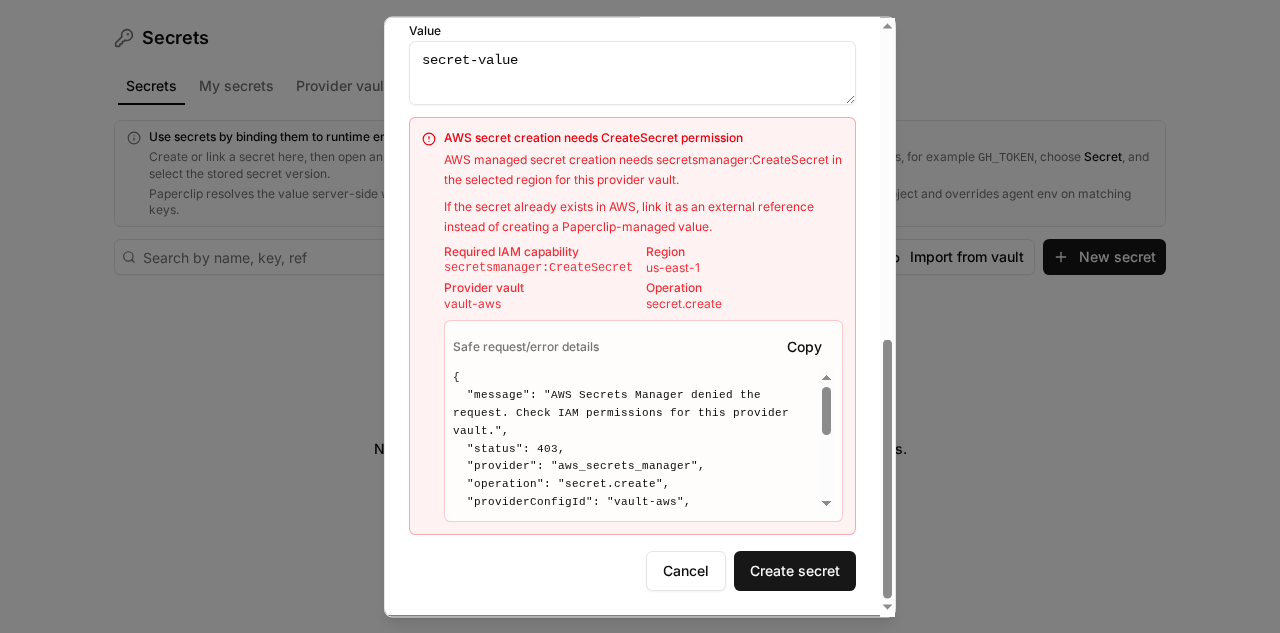 **Generic non-AWS fallback** 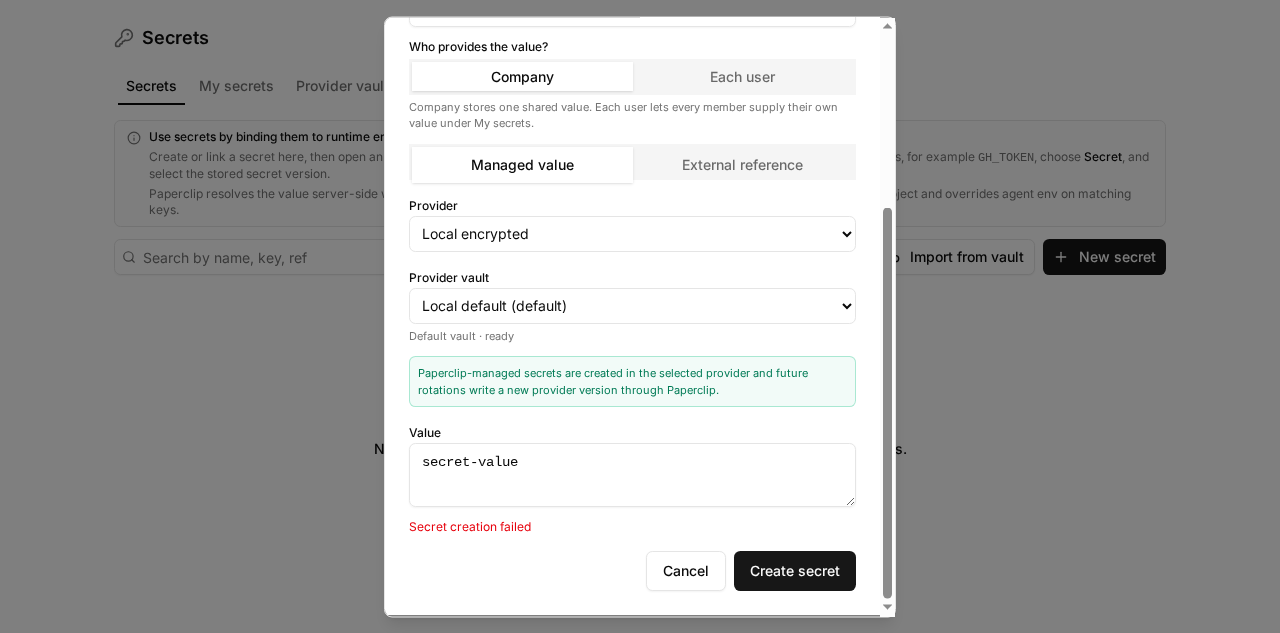 ## Risks Low risk. The change only affects failed create-secret presentation in the UI; successful secret creation, API contracts, schema, and migrations are unchanged. The structured details are server-sanitized, and the regression test confirms raw AWS principal/account data is not rendered. > For core feature work, check [`ROADMAP.md`](ROADMAP.md) first and discuss it in `#dev` before opening the PR. Feature PRs that overlap with planned core work may need to be redirected — check the roadmap first. See `CONTRIBUTING.md`. ## Model Used OpenAI `gpt-5.4` via Codex CLI, with tool-enabled repository editing, shell execution, Git, GitHub, and Paperclip API access. Reasoning mode and exact context-window size were not exposed by the runtime. ## Checklist - [x] I have included a thinking path that traces from project context to this change - [x] I have specified the model used (with version and capability details) - [x] I have checked ROADMAP.md and confirmed this PR does not duplicate planned core work - [x] I have searched GitHub for duplicate or related PRs and linked them above - [x] I have either (a) linked existing issues with `Fixes: #` / `Closes #` / `Refs #` OR (b) described the issue in-PR following the relevant issue template - [x] I have not referenced internal/instance-local Paperclip issues or links (only public GitHub `#NNN` / `github.com/paperclipai/paperclip` URLs) - [x] My branch name describes the change (e.g. `docs/...`, `fix/...`) and contains no internal Paperclip ticket id or instance-derived details - [x] I have run tests locally and they pass - [x] I have added or updated tests where applicable - [x] I have updated relevant documentation to reflect my changes - [x] I have considered and documented any risks above - [x] All Paperclip CI gates are green - [x] Greptile is 5/5 with no open P2s, recommendations, or follow-ups - [x] I will address all Greptile and reviewer comments before requesting merge --------- Co-authored-by: Paperclip <noreply@paperclip.ing> |
||
|
|
c07e650cd7 |
feat(ui): single-source design tokens, visual regression suite, and theme retune (#9134)
## Thinking Path > - Paperclip is the open source app people use to manage AI agents for work > - Its UI is the operator's daily surface: task lists, boards, budgets, agent status — all built on shadcn components and Tailwind > - Visual values (colors, spacing, type sizes, radii) were hardcoded at ~1,600 call sites: the same "small gray label" was 9/10/11px depending on the file, charts disagreed with chips about status colors, two toggle-switch implementations coexisted in two greens, and there was no visual regression coverage > - This made the UI drift-prone and made any restyle a hundreds-of-files project, which discourages design iteration > - This pull request extracts visual values into a single token layer in `ui/src/index.css`, adds a Storybook visual regression suite backed by external immutable baseline archives, and then applies a deliberate retune reviewed change-by-change on screenshot diffs > - The benefit is that Paperclip's look becomes a config surface: retheming is a token edit reviewed as a snapshot diff, drift is blocked by a token gate, and future UI PRs can prove exactly what changed visually without committing hundreds of PNGs ## Linked Issues or Issue Description No existing public issue covers this work (searched "design tokens", "visual regression", "design system" across issues and PRs). Related in spirit: Refs #8982 (theming a hardcoded panel — a one-off instance of the same problem class this PR addresses systematically). **Problem (feature-request form):** UI visual values are hardcoded per call site with no source of truth and no regression coverage; consistency depends on reviewer memory, and restyling requires mass file edits. **Proposed solution (this PR):** a single token layer + enforcement gate + externally stored visual snapshot suite, then an intentional restyle on top of that foundation. ## What Changed - **Token extraction (zero visual change, machine-verified during development):** committed codemods (`scripts/codemod-*.mjs`) moved ~1,600 hardcoded color/type/spacing/radius/shadow/misc values into named tokens in a non-inline `:root` block of `ui/src/index.css`. - **Visual regression suite:** `pnpm test:storybook-visual` covers 255 stories × light/dark = 510 Playwright screenshots at `maxDiffPixels: 0`, plus new primitive-coverage stories and deterministic-render fixes. - **External visual baselines:** committed PNG snapshots were removed. `tests/storybook-visual/baseline-manifest.json` pins an immutable archive URL/hash/size/count, and `scripts/storybook-visual-baseline.mjs` handles `download`, `verify`, `pack`, and trusted maintainer `upload` flows. - **Opt-in visual CI artifacts:** added a `Storybook Visual` workflow that runs on manual dispatch or PRs labeled `storybook-visual`, downloads/verifies the baseline, runs Playwright, and uploads Playwright report/test-result artifacts for review. Normal PR runs do not mutate baseline objects. - **Token gate:** `pnpm check:token-gates` — zero hex literals, zero arbitrary bracket values, zero raw font-sizes in `ui/src/components/**` and `ui/src/pages/**`, with a documented inline allowlist for legitimate opt-outs. - **Theme retune (intentional, snapshot-reviewed):** new base theme values; radius ladder derived from a single `--radius` knob; micro-type cluster collapsed to a named ladder (`--text-nano/micro/compact` + Tailwind `text-xs`/`text-sm`); letter-spacing collapsed to named steps. - **One status-color vocabulary:** charts, quota/budget bar fills, RUNNING/live chips, and liveness indicators all use the canonical `--status-*` hues. Light-mode legibility fixes for red alert surfaces that used dark-tuned text classes. - **One switch:** `ToggleSwitch` restyled to the registry capsule form, second hand-rolled implementation removed, and all call sites unified. - **Docs:** `DESIGN.md` is the design contract; `doc/design/` holds audit reports, decision logs, and updated guidance for external baseline review/update workflows. - Dead code removed (`agentStatusBadge` duplicate map), byte-identical contrast constants consolidated, semantic renames (`--project-seed`/`--project-none`, `--liveness-blue`). ## Verification - `pnpm check:token-gates` — 3/3 gates CLEAN during the design-system run - `pnpm typecheck` && `pnpm --filter @paperclipai/ui build` — green during the design-system run - `node --test scripts/__tests__/storybook-visual-baseline.test.mjs` — pass after external-baseline rework - `pnpm exec tsc --noEmit --pretty false --module NodeNext --moduleResolution NodeNext --target ES2022 --types node,@playwright/test tests/storybook-visual/playwright.config.ts tests/storybook-visual/storybook-visual.spec.ts` — pass after external-baseline rework - `git diff --check origin/pr/9134..HEAD` — pass after external-baseline rework - `find tests/storybook-visual -type f -name '*.png' -print | wc -l` — `0` - `node scripts/storybook-visual-baseline.mjs verify` — intentionally fails closed until the first trusted maintainer publishes the baseline archive and updates `baseline-manifest.json` ## Risks - **Large but shallow:** the PR still touches many UI files due to mechanical token extraction and retune work, but committed PNG snapshot churn has been removed from the branch. - **Baseline publication required before the visual suite can pass in clean clones:** the manifest currently has placeholder archive metadata. A trusted maintainer must publish the first immutable archive, then update `baseline-manifest.json`. - **Rendering platform variance:** the external baseline should be captured in the documented Linux/Chromium environment. Future CI runs verify against the pinned archive and fail closed on checksum/count mismatch. - **Visual CI is opt-in while stabilizing:** add the `storybook-visual` label or dispatch the workflow manually to produce downloadable Playwright report/test-result artifacts. - **Scheduled follow-ups, deliberately out of scope:** Tailwind palette classes map to semantic tokens in a dedicated pass; card/pill component consolidation; ESLint ratchet. Tracked in `doc/design/DECISION-SHEET.md`. ## Model Used Claude Fable 5 (Anthropic, `claude-fable-5`, Mythos-class tier) with extended thinking, running in Claude Code with tool use; mechanical phases delegated to Claude Sonnet subagents. Follow-up external-baseline rework assisted by OpenAI Codex (`gpt-5` coding agent with repository, terminal, and GitHub tool use). All bulk rewrites executed via deterministic, idempotent scripts committed in `scripts/`; intentional visual changes were human-reviewed on screenshot contact sheets. ## Checklist - [x] I have included a thinking path that traces from project context to this change - [x] I have specified the model used (with version and capability details) - [x] I have checked ROADMAP.md and confirmed this PR does not duplicate planned core work - [x] I have searched GitHub for duplicate or related PRs and linked them above - [x] I have either (a) linked existing issues with `Fixes: #` / `Closes #` / `Refs #` OR (b) described the issue in-PR following the relevant issue template - [x] I have not referenced internal/instance-local Paperclip issues or links (only public GitHub `#NNN` / `github.com/paperclipai/paperclip` URLs) - [x] My branch name describes the change (e.g. `docs/...`, `fix/...`) and contains no internal Paperclip ticket id or instance-derived details - [x] I have run targeted local verification and documented the intentional baseline-publication failure above - [x] I have added or updated tests where applicable - [x] I have updated relevant documentation to reflect my changes - [x] I have considered and documented any risks above - [ ] All Paperclip CI gates are green *(pending new CI run after this rework)* - [ ] Greptile is 5/5 with no open P2s, recommendations, or follow-ups *(pending review)* - [x] I will address all Greptile and reviewer comments before requesting merge 🤖 Generated with [Claude Code](https://claude.com/claude-code) and OpenAI Codex --------- Co-authored-by: Claude Fable 5 <noreply@anthropic.com> Co-authored-by: Dotta <bippadotta@protonmail.com> Co-authored-by: Paperclip <noreply@paperclip.ing> |
||
|
|
ad961227f5 |
feat(secrets): add user-specific runtime secrets (#8825)
## Thinking Path > - Paperclip is the open source app people use to manage AI agents for work. > - Agent runs often need provider credentials, API tokens, and other environment-bound secrets. > - Company-level secrets work for shared credentials, but they do not model values that should differ by human operator. > - Without a user-scoped model, a run can dispatch without knowing whether the responsible human has supplied the needed value. > - Paperclip also needs run attribution to make those user-scoped runtime checks deterministic and auditable. > - This pull request adds user-specific secret definitions, per-user values, environment bindings, responsible-user attribution, and runtime resolution gates. > - The benefit is that teams can define the secret once, let each user provide their own value, and block runs before dispatch when required user secrets or active definitions are unavailable. ## Linked Issues or Issue Description Refs #224 Refs #6057 This PR implements user-specific secret support as a core secret-management capability rather than a one-off adapter setting. It is related to existing public work on company secrets UI and runtime secret refs, but is distinct because the value is owned by the responsible user and resolved at run dispatch time. Related PR search before opening found existing secrets work such as #1550, #8256, #8614, #8634, and #8647; none of those add the full user-secret definition/value/runtime gate covered here. ## What Changed - Added user-secret definitions and per-user "My secrets" values, keeping stored values out of access metadata. - Added `user_secret_ref` environment bindings and UI affordances to pick them alongside existing secret refs. - Added responsible-user runtime resolution so user-secret refs resolve against the human responsible for the run. - Added pre-dispatch missing-secret gates so runs fail before adapter dispatch when required user values are absent or definitions are inactive. - Added low-trust allowlist hardening for user-secret runtime access. - Added issue, routine, run, and agent API key responsible-user attribution and fail-closed dispatch behavior when attribution cannot be resolved. - Added denial-copy mapping so responsible-user authorization failures surface as actionable run outcomes instead of opaque setup failures. - Added OpenAPI documentation for the user-secret routes. - Rebases cleanly on current `master`; migrations were renumbered incrementally as `0128_user_specific_secrets`, `0129_agent_api_key_responsible_user`, and `0130_run_responsible_user_invariant` after upstream `0126`/`0127` migrations. - Removed previously committed local design screenshots so the PR contains code/docs/tests only. ## Verification - PASS: PR head `2527febd106bcf3ca264ca0da7fca491084192d6` is based on `paperclipai/paperclip:master`. - PASS: `git diff --check` - PASS: `git diff --name-only public/master...HEAD | rg '^(pnpm-lock\\.yaml|\\.github/workflows/|screenshots/)' || true` produced no files. - PASS: migration journal audit confirmed unique indexes through `130` with tail entries `0126_issue_comment_derived_attribution`, `0127_environment_custom_images_instance_scoped`, `0128_user_specific_secrets`, `0129_agent_api_key_responsible_user`, and `0130_run_responsible_user_invariant`. - PASS: `pnpm --filter @paperclipai/ui typecheck` - PASS: `pnpm --filter @paperclipai/server typecheck` - PASS: `pnpm --filter @paperclipai/server exec vitest run src/__tests__/heartbeat-responsible-user-invariant.test.ts` - PASS: `pnpm --filter @paperclipai/server exec vitest run src/__tests__/heartbeat-active-run-output-watchdog.test.ts src/__tests__/heartbeat-stale-queue-invalidation.test.ts src/__tests__/heartbeat-workspace-finalize-branch.test.ts src/__tests__/issue-monitor-scheduler.test.ts` - PASS: `pnpm --filter @paperclipai/server exec vitest run src/__tests__/heartbeat-comment-wake-batching.test.ts src/__tests__/heartbeat-retry-scheduling.test.ts src/__tests__/heartbeat-accepted-plan-workspace-refresh.test.ts src/__tests__/heartbeat-plugin-environment.test.ts` - PASS: `pnpm --filter @paperclipai/server exec vitest run src/__tests__/low-trust-red-team-routes.test.ts` - PASS: `pnpm --filter @paperclipai/server exec vitest run src/__tests__/secrets-service.test.ts` (55 tests) - PASS: `pnpm vitest run server/src/__tests__/secrets-routes.test.ts server/src/__tests__/secrets-service.test.ts` (89 tests after final Greptile cleanup fixes) - PASS: `pnpm --filter @paperclipai/server exec vitest run src/__tests__/heartbeat-issue-liveness-escalation.test.ts` (17 tests after the final rebase CI fix) - PASS: focused server Vitest batches covering heartbeat recovery, project env, plugin env, routines, low-trust, pipelines, monitors, watchdog, and stale queue paths. - PASS: GitHub checks are green on `2527febd106bcf3ca264ca0da7fca491084192d6`, including Typecheck + Release Registry, Build, General tests, serialized server suites, e2e, Canary Dry Run, verify, security checks, and Greptile Review. - PASS: Greptile Review completed successfully on `2527febd106bcf3ca264ca0da7fca491084192d6` with Confidence Score 5/5, and GraphQL review-thread audit returned zero unresolved non-outdated threads. ## Risks - Runtime behavior now depends on a run having a correct responsible user; missing or incorrect responsibility assignment can block runs before adapter dispatch. - `user_secret_ref` bindings intentionally expose metadata without values, but UI/API callers may need to handle the new binding kind explicitly. - External secret providers and IAM policies are not automatically provisioned by this PR; operators still need to configure provider-side access for non-local vaults. - The PR is broad across db/shared/server/UI/runtime paths, so release validation should include both API and UI secret workflows before merge. - The migration renumbering is intentionally incremental after upstream migrations; the branch migrations use guarded column/table/index/constraint creation so users who tested the older draft numbering should not hit duplicate DDL for the existing objects. > For core feature work, check [`ROADMAP.md`](ROADMAP.md) first and discuss it in `#dev` before opening the PR. Feature PRs that overlap with planned core work may need to be redirected — check the roadmap first. See `CONTRIBUTING.md`. ## Model Used OpenAI Codex, GPT-5-based coding agent (`gpt-5`), Codex local adapter with shell/tool use and code execution. Context window and internal reasoning mode are not exposed by the runtime. ## Checklist - [x] I have included a thinking path that traces from project context to this change - [x] I have specified the model used (with version and capability details) - [x] I have checked ROADMAP.md and confirmed this PR does not duplicate planned core work - [x] I have searched GitHub for duplicate or related PRs and linked them above - [x] I have either (a) linked existing issues with `Fixes: #` / `Closes #` / `Refs #` OR (b) described the issue in-PR following the relevant issue template - [x] I have not referenced internal/instance-local Paperclip issues or links (only public GitHub `#NNN` / `github.com/paperclipai/paperclip` URLs) - [x] My branch name describes the change (e.g. `docs/...`, `fix/...`) and contains no internal Paperclip ticket id or instance-derived details - [x] I have run tests locally and they pass - [x] I have added or updated tests where applicable - [x] I have updated relevant documentation to reflect my changes - [x] I have considered and documented any risks above - [x] All Paperclip CI gates are green - [x] Greptile is 5/5 with no open P2s, recommendations, or follow-ups - [x] I will address all Greptile and reviewer comments before requesting merge --------- Co-authored-by: Paperclip <noreply@paperclip.ing> Co-authored-by: Claude Opus 4.8 <noreply@anthropic.com> |
||
|
DottaandClaude Opus 4.8
|
f3f50e2ecd |
[codex] Preselect vault when importing secrets (#8614)
## Thinking Path > - Paperclip is the open source app people use to manage AI agents for work. > - Operator secrets and provider vaults let a company connect external secret stores without copying every value manually. > - The existing AWS Secrets Manager import dialog already supports importing remote secrets from any eligible vault. > - From the Provider vaults tab, operators can see a specific vault row, but there was no row-level import action that preserved that vault context. > - That meant importing from a specific vault required opening the generic import dialog and reselecting the intended provider config. > - This pull request adds a row-level refresh/import action that opens the import dialog with the selected vault preselected. > - The benefit is a tighter, less error-prone flow when a company has multiple AWS provider vaults configured. ## Linked Issues or Issue Description No public issue exists for this small UI follow-up. Problem description: - Users with multiple AWS Secrets Manager provider vaults need to refresh/import secrets from the vault they are currently looking at. - The existing import dialog defaulted to the configured default vault or first eligible vault, even when the operator initiated the flow from a specific provider-vault row. - This creates extra selection work and makes it easier to import from the wrong vault. Related public PRs: Refs #5429, #8586. ## What Changed - Added a Provider vaults row action for AWS Secrets Manager configs to refresh/import existing remote secrets. - Threaded an optional initial provider config id into `ImportFromVaultDialog` so the selected vault is preselected when eligible. - Reset the initial vault selection when the dialog closes or routes to vault management. - Added render coverage proving the row action opens the import dialog and previews against the selected vault id. ## Verification - `pnpm exec vitest run ui/src/pages/Secrets.render.test.tsx` passed: 1 file, 9 tests. - `pnpm --filter @paperclipai/ui typecheck` passed. ## Risks Low risk. This is UI-only behavior scoped to AWS Secrets Manager provider-vault rows and the existing import dialog. The main risk is that future provider types may need their own row-level import labels or eligibility rules instead of sharing this AWS-specific action. > For core feature work, check [`ROADMAP.md`](ROADMAP.md) first and discuss it in `#dev` before opening the PR. Feature PRs that overlap with planned core work may need to be redirected — check the roadmap first. See `CONTRIBUTING.md`. ## Model Used OpenAI GPT-5 Codex via Paperclip/Codex local agent, with repository file access, shell command execution, GitHub CLI, and TypeScript/Vitest verification. Exact context-window metadata was not surfaced in this runtime. ## Checklist - [x] I have included a thinking path that traces from project context to this change - [x] I have specified the model used (with version and capability details) - [x] I have checked ROADMAP.md and confirmed this PR does not duplicate planned core work - [x] I have searched GitHub for duplicate or related PRs and linked them above - [x] I have either (a) linked existing issues with `Fixes: #` / `Closes #` / `Refs #` OR (b) described the issue in-PR following the relevant issue template - [x] I have not referenced internal/instance-local Paperclip issues or links (only public GitHub `#NNN` / `github.com/paperclipai/paperclip` URLs) - [x] My branch name describes the change (e.g. `docs/...`, `fix/...`) and contains no internal Paperclip ticket id or instance-derived details - [x] I have run tests locally and they pass - [x] I have added or updated tests where applicable - [x] I have updated relevant documentation to reflect my changes - [x] I have considered and documented any risks above - [x] All Paperclip CI gates are green - [x] Greptile is 5/5 with no open P2s, recommendations, or follow-ups - [x] I will address all Greptile and reviewer comments before requesting merge --------- Co-authored-by: Claude Opus 4.8 <noreply@anthropic.com> |
||
|
DottaandPaperclip
|
f88ac9d078 |
[codex] Fix local skill, secrets, and file viewer regressions (#8586)
## Thinking Path > - Paperclip is the open source app people use to manage AI agents for work. > - Agents rely on local skills, provider-backed secrets, and workspace file previews during normal execution. > - Local skill imports need bounded reference-file inventory so direct skill discovery stays accurate without accidentally walking too much of the filesystem. > - Secrets provider setup needs actionable AWS discovery errors so operators can recover from IAM/config problems without losing manual form input. > - The issue detail file viewer should reopen cleanly after the first close so users can keep inspecting files during task review. > - This pull request collects the small fixes and regression tests for those related operator workflows. > - The benefit is more predictable local skill imports, clearer secrets setup failure states, and a less brittle file preview interaction. ## Linked Issues or Issue Description - No public GitHub issue was found for this extracted local work. - Related prior sync context: #8536. - Problem: local skill reference discovery, AWS provider-vault discovery errors, and issue file preview reopening each had narrow workflow regressions that made operator recovery harder. - Expected behavior: skill imports inventory reference files within bounded local skill directories, AWS discovery failures present safe actionable guidance while preserving manual values, and closing the first file preview does not prevent opening another preview. - Reproduction scope: import a local skill with referenced files, attempt AWS Secrets Manager discovery with insufficient IAM/list permissions, and open/close/reopen file previews from an issue detail page. - Duplicate search: searched GitHub PRs/issues for `skill inventory secrets file viewer` and `skill inventory secrets AWS file viewer`; no matching public duplicate was found. ## What Changed - Bounded direct local skill file inventory discovery and added regression coverage for reference file imports. - Preserved and surfaced safe, actionable AWS Secrets Manager discovery/import errors in server responses and the secrets UI. - Kept AWS provider-vault manual form values intact when discovery fails or returns no candidates. - Fixed issue file viewer state so closing the first preview still allows later file previews to open. - Updated the secrets render test harness to avoid the missing `React.act` export in the current React package set. ## Verification - `pnpm run preflight:workspace-links && pnpm exec vitest run server/src/__tests__/company-skills-service.test.ts server/src/__tests__/secrets-routes.test.ts server/src/__tests__/secrets-service.test.ts ui/src/context/FileViewerContext.test.ts ui/src/pages/Secrets.render.test.tsx` - Result: 5 test files passed, 116 tests passed. - Install note: the isolated worktree needed `NODE_ENV=development pnpm install --frozen-lockfile --prod=false --force` before local verification because it initially had no dev dependencies installed. ## Risks - Low-to-medium risk: this touches skill import inventory, secrets-provider error handling, and file-viewer UI state, but each change is covered by focused regression tests. - No migrations. - No dependency or lockfile changes. - CI is rerunning on the latest head after review fixes; Greptile is 5/5 with no unresolved Greptile threads. > For core feature work, check [`ROADMAP.md`](ROADMAP.md) first and discuss it in `#dev` before opening the PR. Feature PRs that overlap with planned core work may need to be redirected — check the roadmap first. See `CONTRIBUTING.md`. ## Model Used - OpenAI Codex coding agent, GPT-5-family model as provided in the Paperclip run environment, with repository tool use and local command execution. ## Checklist - [x] I have included a thinking path that traces from project context to this change - [x] I have specified the model used (with version and capability details) - [x] I have checked ROADMAP.md and confirmed this PR does not duplicate planned core work - [x] I have searched GitHub for duplicate or related PRs and linked them above - [x] I have either (a) linked existing issues with `Fixes: #` / `Closes #` / `Refs #` OR (b) described the issue in-PR following the relevant issue template - [x] I have not referenced internal/instance-local Paperclip issues or links (only public GitHub `#NNN` / `github.com/paperclipai/paperclip` URLs) - [x] My branch name describes the change (e.g. `docs/...`, `fix/...`) and contains no internal Paperclip ticket id or instance-derived details - [x] I have run tests locally and they pass - [x] I have added or updated tests where applicable - [x] I have updated relevant documentation to reflect my changes - [x] I have considered and documented any risks above - [x] All Paperclip CI gates are green - [x] Greptile is 5/5 with no open P2s, recommendations, or follow-ups - [x] I will address all Greptile and reviewer comments before requesting merge --------- Co-authored-by: Paperclip <noreply@paperclip.ing> |
||
|
DottaandPaperclip
|
d67347be77 |
[codex] Provider vault secrets UX (#6381)
## Thinking Path > - Paperclip orchestrates AI agents that need scoped, auditable access to secrets > - Hosted and external deployments need provider vault configuration without exposing secret values in Paperclip metadata > - AWS Secrets Manager vault setup previously required too much manual operator knowledge > - Provider vault discovery and removal belong together as an independent secrets-management improvement > - This pull request adds AWS provider vault discovery/prefill plus vault removal flows > - The benefit is a safer operator path for configuring external secret storage before higher-level cloud workflows depend on it ## What Changed - Added shared validators/types for AWS provider vault discovery payloads and safe provider metadata. - Implemented AWS provider vault discovery preview on the server. - Added provider vault removal service/route behavior. - Added Secrets page UI for discovery prefill, removal messaging, and related rendering coverage. - Added Storybook provider-vault fixtures and captured screenshots for the new UX states. ## Verification - `pnpm install --frozen-lockfile --ignore-scripts` - `pnpm exec vitest run packages/shared/src/validators/secret.test.ts server/src/__tests__/aws-secrets-manager-provider.test.ts server/src/__tests__/secrets-routes.test.ts server/src/__tests__/secrets-service.test.ts ui/src/pages/Secrets.render.test.tsx` - Result: 4 files passed, 1 embedded Postgres-backed file skipped on this host because local Postgres init was unavailable. - `pnpm --filter @paperclipai/ui exec vitest run src/pages/Secrets.render.test.tsx` - `pnpm --filter @paperclipai/ui typecheck` - Storybook screenshot capture against `Product/Secrets` on `http://127.0.0.1:60381/iframe.html?id=product-secrets--secrets-inventory&viewMode=story&globals=theme:dark` ## Screenshots Provider vaults tab after this change: 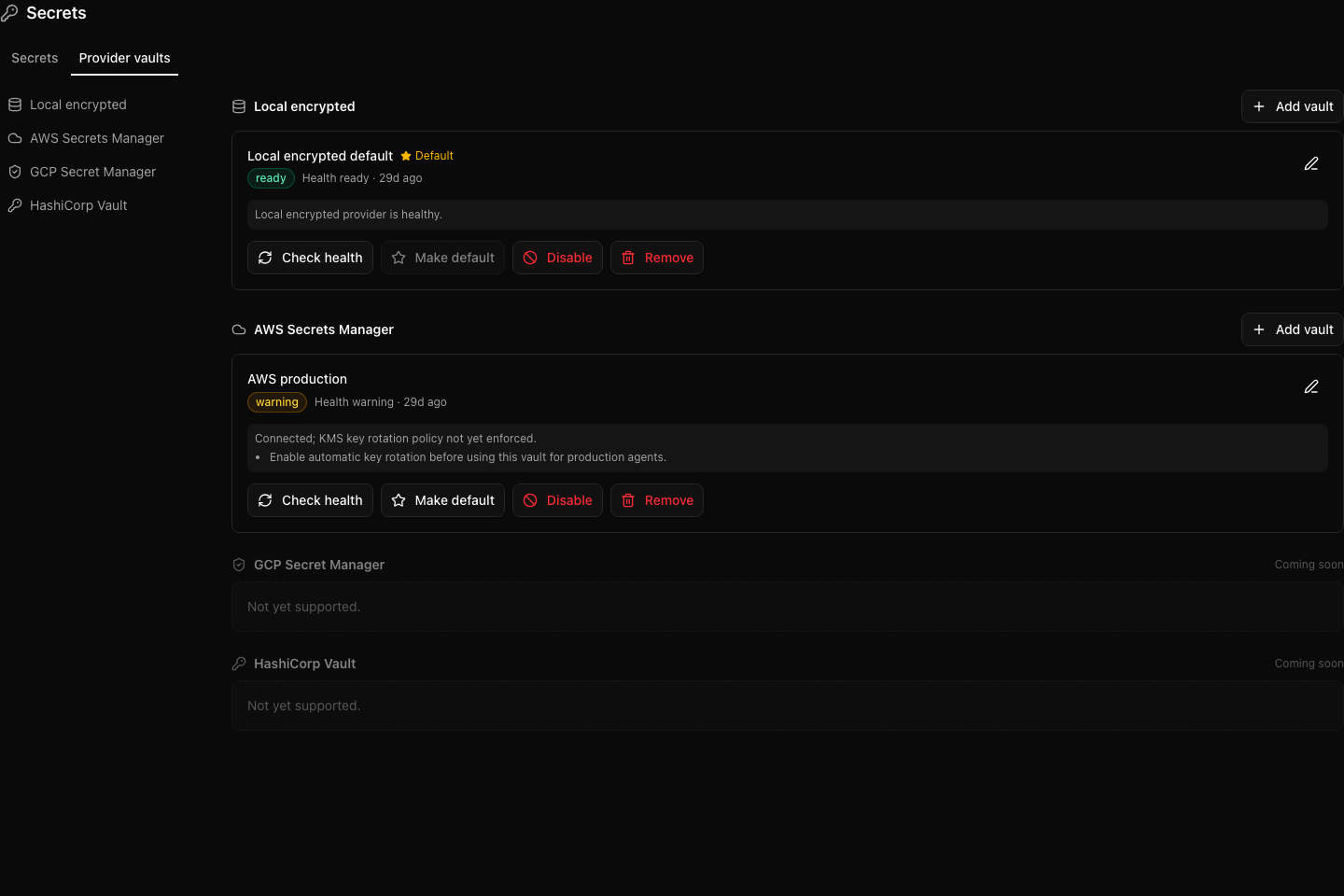 AWS discovery candidate flow: 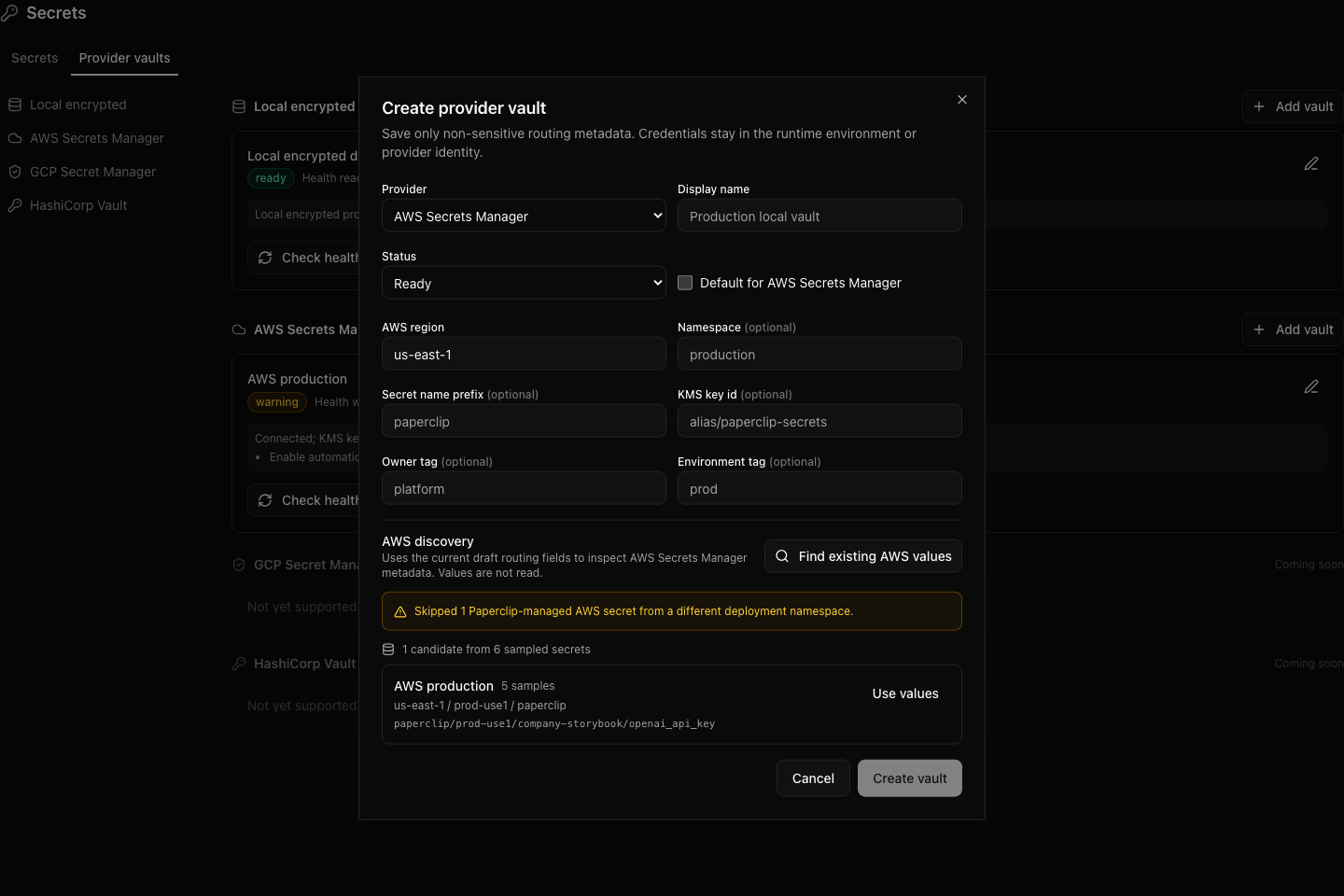 Provider vault removal confirmation: 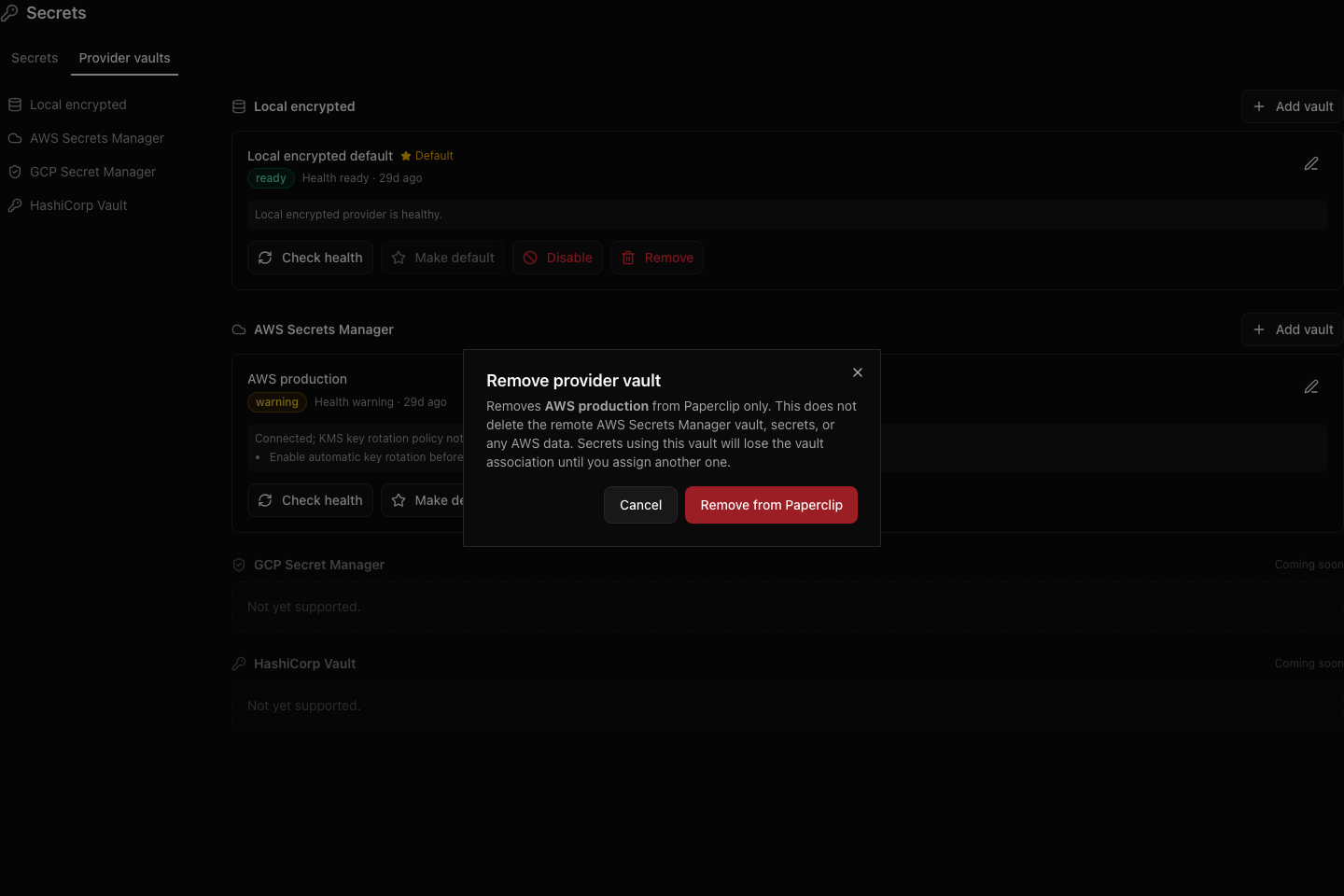 ## Risks - Secret provider metadata handling must remain non-sensitive; validators reject credential-bearing Vault URLs and sensitive AWS discovery keys. - AWS discovery depends on deployment credentials being configured correctly outside Paperclip-managed company secrets. > For core feature work, check [`ROADMAP.md`](ROADMAP.md) first and discuss it in `#dev` before opening the PR. Feature PRs that overlap with planned core work may need to be redirected — check the roadmap first. See `CONTRIBUTING.md`. ## Model Used - OpenAI Codex, GPT-5-based coding agent with local shell/git/tool use. Exact hosted model ID and context-window size are not exposed by the local Paperclip adapter runtime. ## Checklist - [x] I have included a thinking path that traces from project context to this change - [x] I have specified the model used (with version and capability details) - [x] I have checked ROADMAP.md and confirmed this PR does not duplicate planned core work - [x] I have run tests locally and they pass - [x] I have added or updated tests where applicable - [x] If this change affects the UI, I have included before/after screenshots - [x] I have updated relevant documentation to reflect my changes - [x] I have considered and documented any risks above - [x] I will address all Greptile and reviewer comments before requesting merge --------- Co-authored-by: Paperclip <noreply@paperclip.ing> |
||
|
Devin Foley
|
734385102c |
Fix new secret form textarea overflow (PAPA-348) (#6222)
## Thinking Path > - Paperclip orchestrates AI agents for zero-human companies > - Operators manage per-company secrets through the Secrets page in the web UI > - A long secret value pasted into the "New secret" textarea blew out the form's width, which pushed the Create/Cancel buttons off-screen and made the form unusable > - Root cause: the shadcn `Textarea` primitive sets `w-full` but does not constrain `min-width`, so a flex parent honors the textarea's intrinsic content width when a long unbreakable string is present > - This pull request adds `min-w-0 max-w-full` to the shared `Textarea` primitive and `min-w-0 overflow-x-hidden break-all` on the secret-value usage so a long token wraps inside the form bounds > - The benefit is the Create/Cancel buttons stay reachable regardless of pasted token length, and every other `Textarea` consumer also gets the flexbox-friendly width constraint ## What Changed - `ui/src/components/ui/textarea.tsx`: added `min-w-0 max-w-full` to the base shadcn `Textarea` so it cannot exceed its flex parent - `ui/src/pages/Secrets.tsx`: added `min-w-0 overflow-x-hidden break-all` on the new-secret value `Textarea` so long opaque tokens wrap instead of pushing the form - `ui/src/pages/Secrets.render.test.tsx`: new regression test that opens the New Secret dialog and asserts the value textarea carries the width-constraint classes ## Verification - `cd ui && npx vitest run src/pages/Secrets.render.test.tsx` — 3/3 pass - Manual: open the Secrets page, click "New secret", paste a long unbroken string (e.g. a 500-char token) into the value field. The form stays within its dialog and the Create/Cancel buttons remain in view. Before: <img width="1772" height="1432" alt="image" src="https://github.com/user-attachments/assets/cb31a290-f82a-41dc-9346-91d18cbb5911" /> After: <img width="672" height="734" alt="Screenshot 2026-05-17 at 5 39 38 PM" src="https://github.com/user-attachments/assets/a08800c2-b09b-43be-b0e8-114d9149b8f5" /> After: the value field wraps with `break-all` inside the dialog; Create/Cancel stay clickable. Covered by the new render test which asserts `min-w-0`, `overflow-x-hidden`, and `break-all` are present on `#new-secret-value`. ## Risks - Low risk. The base `Textarea` change adds `min-w-0 max-w-full`, which only affects layouts where a textarea was previously allowed to grow past its parent — those cases were already buggy. `break-all` on the secret-value textarea is the right behavior for opaque tokens; it would be wrong for prose, but this field is explicitly a secret token. ## Model Used - Provider: Anthropic Claude - Model: claude-opus-4-7 (Opus 4.7) - Mode: standard Claude Code agent, tool use enabled ## Checklist - [x] I have included a thinking path that traces from project context to this change - [x] I have specified the model used (with version and capability details) - [x] I have checked ROADMAP.md and confirmed this PR does not duplicate planned core work - [x] I have run tests locally and they pass - [x] I have added or updated tests where applicable - [x] If this change affects the UI, I have included before/after screenshots - [ ] I have updated relevant documentation to reflect my changes - [x] I have considered and documented any risks above - [x] I will address all Greptile and reviewer comments before requesting merge |
||
|
|
778e775c35 |
Add secrets provider vaults and remote import (#5429)
## Thinking Path > - Paperclip orchestrates AI-agent companies and needs secrets handling to work across local development, hosted operators, and governed agent execution. > - The affected subsystem is the company-scoped secrets control plane: database schema, server services/routes, CLI workflows, and the Secrets settings UI. > - The gap was that secrets were local-only and operators could not manage provider vaults or import existing remote references without exposing plaintext. > - This branch adds provider vault configuration plus an AWS Secrets Manager remote-import path while preserving company boundaries, binding context, and audit trails. > - I kept the PR to a single branch PR, removed unrelated lockfile/package drift, rebased the full branch onto the current `public-gh/master`, and addressed fresh Greptile findings. > - The benefit is a reviewable implementation of provider-backed secrets with focused tests covering provider selection, import conflicts, deleted secret reuse, rotation guards, and AWS signing behavior. ## What Changed - Added provider vault support for company secrets, including provider config storage, default vault handling, health checks, binding usage, access events, and remote import preview/commit. - Added an AWS Secrets Manager provider using SigV4 request signing, bounded request timeouts, namespace guardrails, cached runtime credential resolution, and external-reference linking without plaintext reads. - Added Secrets UI surfaces for vault management and remote import, plus CLI/API documentation for setup and operations. - Stabilized routine webhook secret binding paths and SSH environment-driver fixture bindings discovered during verification. - Addressed Greptile and CI findings: no lockfile/package drift, monotonic migration metadata, disabled-vault default races, soft-deleted secret hiding/recreate behavior, remove behavior with disabled vaults, soft-deleted external-reference re-import, non-active rotation guards, managed-secret soft deletion through PATCH, and per-call AWS SDK credential client churn. - Rebased this branch onto `public-gh/master` at `0e1a5828` and force-pushed with lease to keep this as the single PR for the branch. ## Verification - `git fetch public-gh master` - `git rebase public-gh/master` - `git diff --name-only public-gh/master...HEAD | grep '^pnpm-lock\.yaml$' || true` confirmed `pnpm-lock.yaml` is not in the PR diff. - Confirmed migration ordering: master ends at `0081_optimal_dormammu`; this PR adds `0082_dry_vision` and `0083_company_secret_provider_configs`. - Inspected migrations for repeat safety: new tables/indexes use `IF NOT EXISTS`; foreign keys are guarded by `DO $$ ... IF NOT EXISTS`; column additions use `ADD COLUMN IF NOT EXISTS`. - `pnpm -r typecheck` passed before the Greptile follow-up commits. - `pnpm test:run` ran the full stable Vitest path before the Greptile follow-up commits; it completed with 3 timing-related failures under parallel load: `codex-local-execute.test.ts`, `cursor-local-execute.test.ts`, and `environment-service.test.ts`. - `pnpm --filter @paperclipai/server exec vitest run src/__tests__/codex-local-execute.test.ts src/__tests__/cursor-local-execute.test.ts src/__tests__/environment-service.test.ts` passed on targeted rerun (`24/24`). - `pnpm build` passed before the Greptile follow-up commits. Vite reported existing chunk-size/dynamic-import warnings. - After Greptile follow-up commits: `pnpm --filter @paperclipai/server exec vitest run src/__tests__/secrets-service.test.ts` passed (`26/26`). - After Greptile follow-up commits: `pnpm --filter @paperclipai/server exec vitest run src/__tests__/aws-secrets-manager-provider.test.ts src/__tests__/secrets-service.test.ts` passed (`39/39`). - After Greptile follow-up commits: `pnpm --filter @paperclipai/server typecheck` passed. - Captured Storybook screenshots from `ui/storybook-static` for visual review. - Latest PR checks on `5ca3a5cf`: `policy`, serialized server suites 1/4-4/4, `Canary Dry Run`, `e2e`, `security/snyk`, and `Greptile Review` pass; aggregate `verify` is still registering the completed child checks. - Greptile review loop continued through the latest requested pass; all Greptile review threads are resolved and the latest `Greptile Review` check on `5ca3a5cf` passed with 0 comments added. ## Screenshots Before: the provider-vault and remote-import surfaces did not exist on `master`; these are after-state screenshots from the Storybook fixtures. 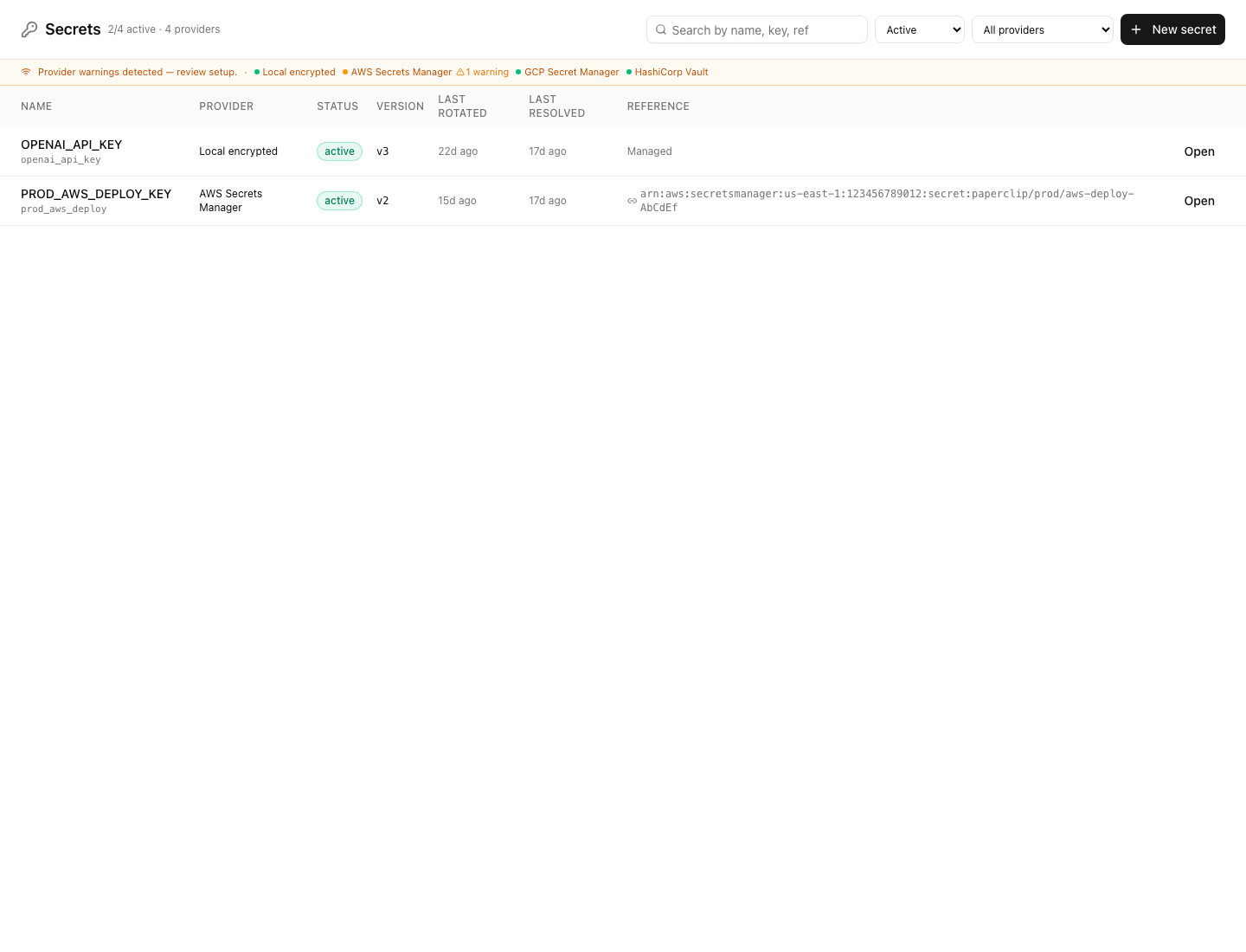 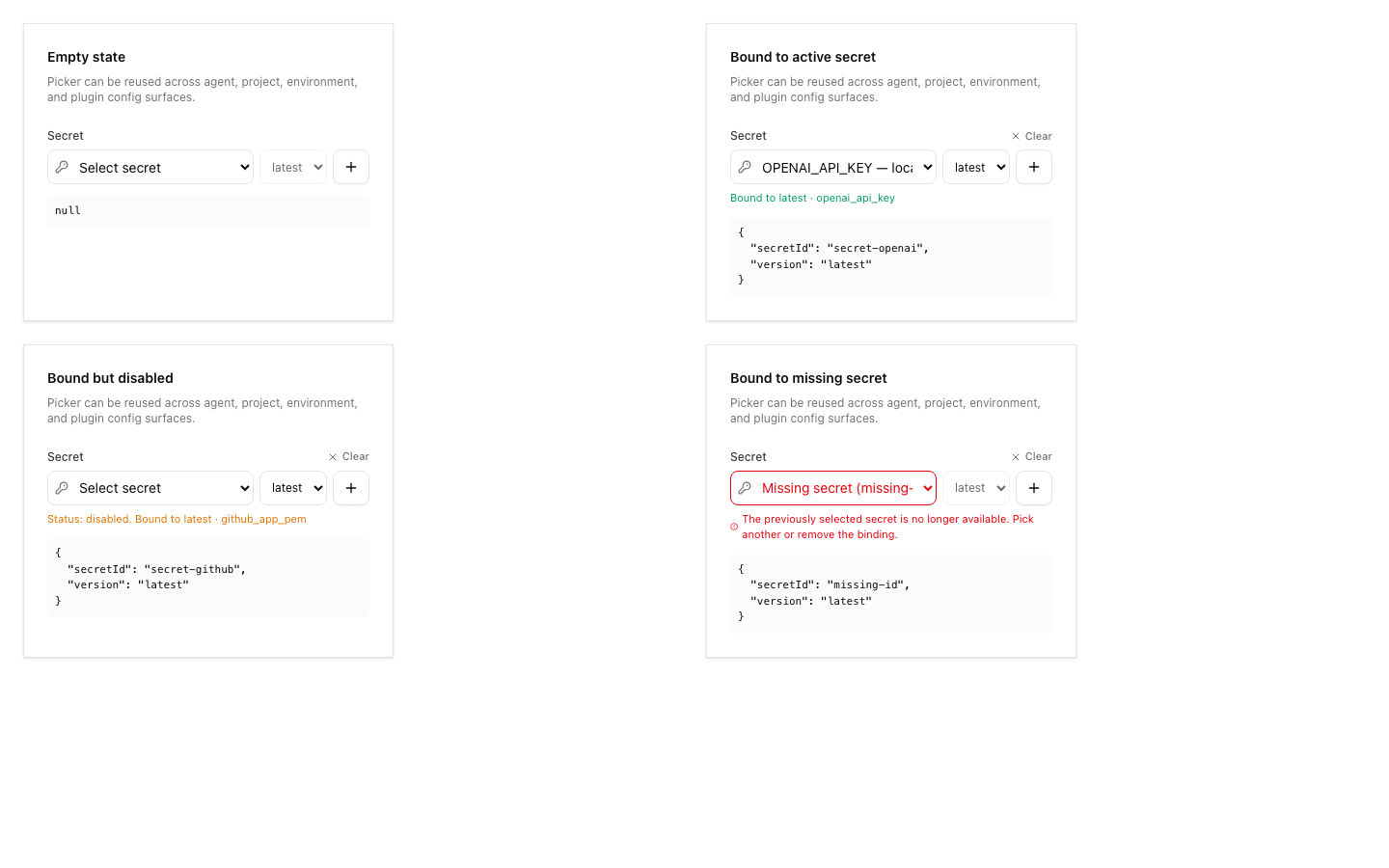 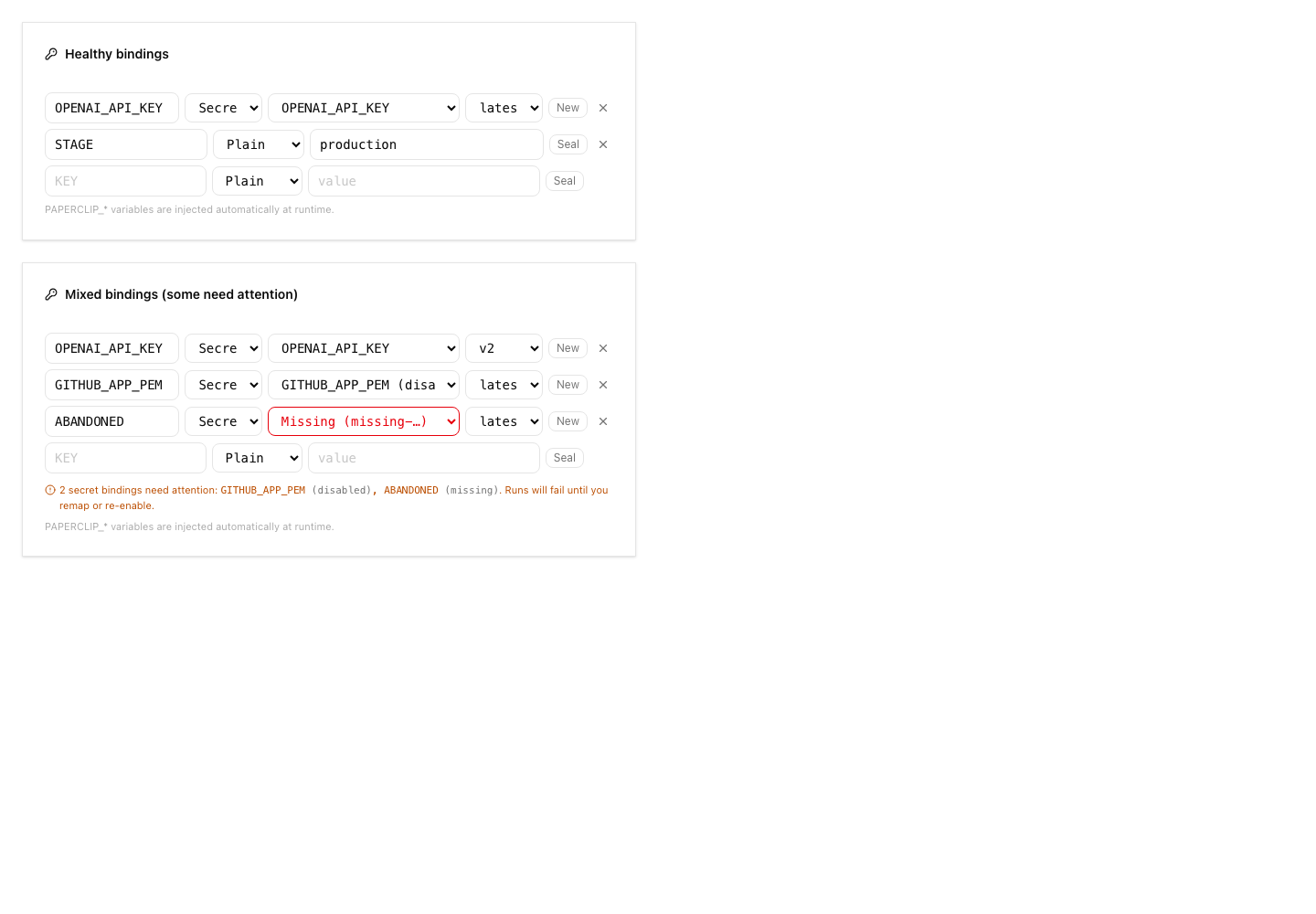 ## Risks - Migration risk: this adds new secret provider tables and extends existing secret rows. The migrations were checked for monotonic ordering and idempotent guards, but reviewers should still inspect upgrade behavior carefully. - Provider risk: AWS support uses direct SigV4 requests. Automated tests cover signing, request timeouts, vault-config selection, namespace guardrails, pending-version archival, sanitized provider errors, and service-level cleanup paths. A real-vault AWS smoke test remains deployment validation for an operator with AWS credentials rather than an unverified merge blocker in this local branch. - UI risk: the Secrets page and import dialog are large new surfaces; screenshots are included above for reviewer inspection. - Verification risk: the full local stable test command hit parallel-load timing failures, although the exact failed files passed when rerun directly. - Operational risk: remote import intentionally avoids plaintext reads; operators must understand that imported external references resolve at runtime and may fail if AWS permissions change. > For core feature work, check [`ROADMAP.md`](ROADMAP.md) first and discuss it in `#dev` before opening the PR. Feature PRs that overlap with planned core work may need to be redirected — check the roadmap first. See `CONTRIBUTING.md`. ## Model Used - OpenAI Codex, GPT-5 coding agent with local shell/tool use in the Paperclip worktree. Exact context-window size was not exposed by the runtime. ## Checklist - [x] I have included a thinking path that traces from project context to this change - [x] I have specified the model used (with version and capability details) - [x] I have checked ROADMAP.md and confirmed this PR does not duplicate planned core work - [ ] I have run tests locally and they pass - [x] I have added or updated tests where applicable - [x] If this change affects the UI, I have included before/after screenshots - [x] I have updated relevant documentation to reflect my changes - [x] I have considered and documented any risks above - [x] I will address all Greptile and reviewer comments before requesting merge --------- Co-authored-by: Paperclip <noreply@paperclip.ing> Co-authored-by: Claude Sonnet 4.6 <noreply@anthropic.com> |







