mirror of
https://github.com/paperclipai/paperclip.git
synced 2026-10-06 10:48:12 +02:00
83abfa46f628e5ff6bd8ee333ec130aba4e5016c
47
Commits
| Author | SHA1 | Message | Date | |
|---|---|---|---|---|
 scotttongandClaude Opus 5 scotttongandClaude Opus 5
|
8f69e0af9d |
fix(ui): confirm every copy action (#13603)
## Thinking Path

> - Paperclip is the open source app people use to manage AI agents for
work
> - Much of the work means moving an opaque value somewhere else: an
agent id, a callback URL, a webhook secret, an error payload for a bug
report
> - Copy buttons all over the app do that, and most already say whether
it worked — an icon that flips to a check, a label that reads "Copied"
> - Eleven did not. They passed the promise to `.catch(() => {})` and
showed nothing at all
> - A copy that says nothing looks exactly like a copy the browser
refused, and the only way to tell is to paste somewhere and look
> - The clipboard really does refuse: over plain HTTP on a non-secure
host the async Clipboard API is unavailable, and the fallback can still
fail
> - This pull request gives every copy action an affordance, through two
shared hooks
> - The benefit is that a person can tell a copy from a failure without
leaving the page

## Linked Issues or Issue Description

**What happened?**

Eleven copy buttons gave no feedback. They called `copyTextToClipboard`
and discarded the result:

```
onClick={() => void copyTextToClipboard(robotEmail).catch(() => {})}
```

Nothing changes on screen, whether the write succeeded or failed. This
is the same surface where most other copy buttons do show a check or a
"Copied" label, so the silent ones read as broken.

**Expected behavior**

Every copy action says whether the clipboard took the value. A rejected
write says so rather than staying silent or claiming success.

**Steps to reproduce**

1. Open the connector setup flow for an app that shows a sharing email
or a callback URL.
2. Press **Copy** next to that value.
3. Before this change nothing on screen changes. Compare with the copy
button on a login panel, which flips to a check.
4. To see the failure case, open Paperclip over plain HTTP on a
non-localhost host, where the async Clipboard API is not available.

**Paperclip version or commit**

`45586170e` on `master`.

**Deployment mode**

Local.

**Agent adapter(s) involved**

Not adapter-specific (core bug).

**Additional context**

Commit `1fa36be35` moved every copy through `lib/clipboard.ts`, so the
call sites are findable. Of 62 call sites, 51 already showed feedback
and 11 did not.

## What Changed

- New `ui/src/lib/use-copy-action.ts` with two hooks:
- `useCopyAction` for a control that stays on screen. It returns
`copied` and `failed` for the inline swap the rest of the app already
uses, and resets itself.
- `useCopyToast` for a menu item, which unmounts with its menu before an
inline state could be read, so its confirmation goes to the toast
viewport.
- Both wait for the write to resolve before reporting success, and both
report a rejection as a failure. `AdapterLoginChrome.test.tsx` already
held that line for one button; the helper now makes it the default.
- The eleven silent sites now use one of the two: the connector setup
flow's sharing-email and callback-URL buttons, the runner inspector's
copy-value and copy-path buttons, the agent bubble and skill studio menu
items, annotation "Copy link" on both its hosts, both secret-error
detail buttons, the chat webhook secret, and the motion tweak panel's
export box.
- The chat webhook secret follows its own file's convention: a label
that reads "Webhook secret copied", matching the manifest buttons beside
it.
- The 51 sites that already had feedback are untouched. Converting them
would be a large diff with no visible change.
- `clipboard-usage.test.ts` gains a static check, sibling to the one
that already keeps copies on the shared helper. It fails if a new copy
site ships with no affordance.

## Verification

- `npx vitest run ui/src/lib/use-copy-action.test.tsx
ui/src/lib/clipboard-usage.test.ts ui/src/lib/clipboard.test.ts
ui/src/components/AdapterLoginChrome.test.tsx` — 18 tests pass.
- The new hook tests cover the three cases that matter: no confirmation
while the write is still in flight, a failure state on a rejected write,
and a return to rest after the reset delay. The toast hook is covered
for both tones.
- `npx vitest run ui/src/pages/apps/AppsConnect.test.tsx
ui/src/components/task-chat ui/src/components/RunnerInspector.test.tsx
ui/src/components/DocumentAnnotation` — the suites over the touched
components pass.
- `npx tsc -b ui` — clean.

## Risks

Low. Each change is additive at its own call site and the copy path
itself is unchanged. The static check is the only part that touches
future contributors: it is one assertion, and its pattern list is easy
to extend or drop.

## Model Used

Claude Opus 5 (`claude-opus-5`), 1M context, extended thinking, with
tool use and code execution.

## Checklist

- [x] I have included a thinking path that traces from project context
to this change
- [x] I have specified the model used (with version and capability
details)
- [x] I have checked ROADMAP.md and confirmed this PR does not duplicate
planned core work
- [x] I have searched GitHub for duplicate or related PRs and linked
them above
- [x] I have either (a) linked existing issues with `Fixes: #` / `Closes
#` / `Refs #` OR (b) described the issue in-PR following the relevant
issue template
- [x] I have not referenced internal/instance-local Paperclip issues or
links (only public GitHub `#NNN` / `github.com/paperclipai/paperclip`
URLs)
- [x] My branch name describes the change (e.g. `docs/...`, `fix/...`)
and contains no internal Paperclip ticket id or instance-derived details
- [x] I have run tests locally and they pass
- [x] I have added or updated tests where applicable
- [x] I have updated relevant documentation to reflect my changes
- [x] I have considered and documented any risks above
- [ ] All Paperclip CI gates are green
- [ ] Greptile is 5/5 with no open P2s, recommendations, or follow-ups
- [ ] I will address all Greptile and reviewer comments before
requesting merge

---------

Co-authored-by: Claude Opus 5 (1M context) <noreply@anthropic.com>
|
||
|
scotttongandClaude Opus 5
|
34355e5109 |
fix(task-chat): selecting an option no longer jumps to the next question (#13602)
## Thinking Path > - Paperclip is the open source app people use to manage AI agents for work > - An agent that needs a decision asks in the task composer, which renders a question set one question per page > - Single-choice questions use radio options, and the composer also ships a "Next" button and pagination arrows > - Selecting a radio option also set a pending advance, waited for a short confirm animation, and turned the page on its own > - That takes the page away from the reader while they are still reading it, and a misclick costs them the question > - Nothing on the option says that clicking it will navigate > - This pull request makes selection answer the question and nothing else > - The benefit is that moving between questions is always something the reader chose to do ## Linked Issues or Issue Description **What happened?** In the task composer, selecting an option with a radio button jumps to the next question. `QuestionForm.toggleOption()` set `pendingAdvance` for any single-select question that was not on the last page, and an effect then read `--motion-question-confirm`, waited that long, and called `setPage(page + 1)`. With reduced motion it advanced immediately, with no pause at all. The result is that a click meant to answer a question also navigates away from it. There is no way to read the rest of the page after choosing, and no way to undo the jump other than pressing the back arrow. **Expected behavior** Selecting an option records the answer and stays on the question. Moving to the next question stays an explicit act. **Steps to reproduce** 1. Get an agent to ask a question set with two or more single-choice questions. 2. Open the question in the task composer. 3. Click one of the radio options. 4. Before this change the composer moves to the next question on its own. **Paperclip version or commit** `45586170e` on `master`. **Deployment mode** Local. **Agent adapter(s) involved** Not adapter-specific (core bug). **Additional context** Every route forward already shipped beside the options, so removing the shortcut traps no one: - a footer button that reads "Next" on any page but the last, and the submit label on the last; - previous and next pagination arrows; - "Skip" on questions that are not required. The same question sets render outside the composer in `IssueThreadInteractionCard`, which never had the auto-advance. This change brings the two surfaces to the same behavior. ## What Changed - `QuestionForm` no longer sets a pending advance when a single-choice option is selected. The effect that turned the page is removed with it. - Selecting an option still clears a submit error about a missing answer, which is the case that error is about. - The confirm-before-advance animation existed only to soften the jump. Its `--motion-question-confirm` token, its keyframes, its class, and the now-unused `confirming` prop on the option button are removed. - Tests that asserted the jump now assert the opposite: selection leaves the page number unchanged, "Next" advances, and number-key selection stays on the same question. ## Verification - `npx vitest run ui/src/components/task-chat` — the composer, interaction card, protocol card, and motion token suites pass. - `npx vitest run ui/src/components/task-chat/TaskChatComposer.test.tsx` — 87 tests pass, including four new tests for the stationary behavior. - `npx tsc -b ui` — clean. - Keyboard: options keep `role="radio"` inside a `radiogroup`, and a test asserts that number-key selection selects without navigating. ## Risks Low. One deliberate behavior is removed. It costs a reader one extra click per question on multi-question sets, and the explicit control for that click already existed and is already tested. ## Model Used Claude Opus 5 (`claude-opus-5`), 1M context, extended thinking, with tool use and code execution. ## Checklist - [x] I have included a thinking path that traces from project context to this change - [x] I have specified the model used (with version and capability details) - [x] I have checked ROADMAP.md and confirmed this PR does not duplicate planned core work - [x] I have searched GitHub for duplicate or related PRs and linked them above - [x] I have either (a) linked existing issues with `Fixes: #` / `Closes #` / `Refs #` OR (b) described the issue in-PR following the relevant issue template - [x] I have not referenced internal/instance-local Paperclip issues or links (only public GitHub `#NNN` / `github.com/paperclipai/paperclip` URLs) - [x] My branch name describes the change (e.g. `docs/...`, `fix/...`) and contains no internal Paperclip ticket id or instance-derived details - [x] I have run tests locally and they pass - [x] I have added or updated tests where applicable - [x] I have updated relevant documentation to reflect my changes - [x] I have considered and documented any risks above - [ ] All Paperclip CI gates are green - [ ] Greptile is 5/5 with no open P2s, recommendations, or follow-ups - [ ] I will address all Greptile and reviewer comments before requesting merge --------- Co-authored-by: Claude Opus 5 (1M context) <noreply@anthropic.com> |
||
|
scotttongandClaude Opus 5
|
378f11994b |
fix(connections): stop the sign-in screen from adding a phantom step (#13601)
## Thinking Path

> - Paperclip is the open source app people use to manage AI agents for
work
> - Agents reach other products through connections, which people create
in the connector setup wizard
> - That wizard shows a stepper: a row of dots, a label under each, and
"Step 1 of 2" in the header
> - When a curated OAuth app hands off to the provider, a waiting screen
replaces the wizard while Paperclip prepares sign-in
> - That waiting screen drew its own stepper with three hardcoded
labels, so the stepper grew a dot at the exact moment the person pressed
Connect
> - A stepper that grows mid-flow tells the person they missed a screen
> - This pull request makes the waiting screen show the step model of
the flow that opened it
> - The benefit is that the stepper keeps the same shape from the first
screen to the handoff

## Linked Issues or Issue Description

**What happened?**

The connector setup wizard shows a two-step stepper for a curated OAuth
app: two dots, labelled "Access" and "Sign in", with "Step 1 of 2" and
then "Step 2 of 2" in the header. When you press Connect, a third dot
appears, labelled "Ready".

The extra dot comes from the OAuth waiting screen.
`OAuthConnectStateScreen` rendered its own header with
`labels={["Access", "Sign in", "Ready"]}`, a constant that did not
depend on the wizard that opened it.

"Ready" is also not a step the wizard can reach. The success screen
hides the step header, so no one ever sees a third step become active.

**Expected behavior**

The stepper keeps the same number of steps from the first screen through
the provider handoff. Waiting for browser sign-in is part of the last
step, not a step of its own.

**Steps to reproduce**

1. Open **Apps → Connect** and pick a curated app that signs in through
OAuth, for example Notion.
2. Look at the stepper. It shows two dots and reads "Step 1 of 2".
3. Complete the Access step and press the button that starts sign-in.
4. Look at the stepper on the "Preparing secure sign-in" screen. Before
this change it shows three dots and adds a "Ready" label.

**Paperclip version or commit**

`45586170e` on `master`.

**Deployment mode**

Local.

**Agent adapter(s) involved**

Not adapter-specific (core bug).

**Additional context**

The reporter suggested removing the stepper, on the condition that no
connector flow has three or more steps. One does.
`ConnectionSetupFlow.tsx` keeps `STEP_LABELS = ["Pick app", "Access",
"Add your key"]` for the generic path, which a person walks when they
paste an MCP endpoint instead of choosing a curated app. The two-step
counts apply only after an app is selected. The condition fails, so this
pull request keeps the stepper and repairs the phantom step alone.

## What Changed

- `OAuthConnectStateScreen` takes a `steps` prop: the labels and active
index of the flow that opened it.
- The curated OAuth path passes its own two-step model, so the count
does not change at the handoff.
- The generic pasted-endpoint path passes the three-step model it was
already walking, so its count does not change either.
- The default for hosts without a wizard of their own, such as the
paste-a-config tab, is `["Access", "Sign in"]`. The invented "Ready"
step is gone.
- `AppsConnect.test.tsx` gains a test that reads the stepper before and
after the handoff and fails if the two differ.

## Verification

- `npx vitest run ui/src/pages/apps/AppsConnect.test.tsx
ui/src/features/connections ui/src/pages/tools/PasteConfigTab.test.tsx`
— 185 tests pass.
- `npx vitest run ui/src/pages/apps/generic-mcp-connect.test.ts` — 27
tests pass.
- `npx tsc -b ui` — clean.
- The new test fails on the previous code. With the old three-label
constant restored it reports `["Access", "Sign in", "Ready"]` where it
expects two labels.

## Risks

Low. The change is limited to which labels the waiting screen draws. No
connection logic, no network call, and no navigation changes.

## Model Used

Claude Opus 5 (`claude-opus-5`), 1M context, extended thinking, with
tool use and code execution.

## Checklist

- [x] I have included a thinking path that traces from project context
to this change
- [x] I have specified the model used (with version and capability
details)
- [x] I have checked ROADMAP.md and confirmed this PR does not duplicate
planned core work
- [x] I have searched GitHub for duplicate or related PRs and linked
them above
- [x] I have either (a) linked existing issues with `Fixes: #` / `Closes
#` / `Refs #` OR (b) described the issue in-PR following the relevant
issue template
- [x] I have not referenced internal/instance-local Paperclip issues or
links (only public GitHub `#NNN` / `github.com/paperclipai/paperclip`
URLs)
- [x] My branch name describes the change (e.g. `docs/...`, `fix/...`)
and contains no internal Paperclip ticket id or instance-derived details
- [x] I have run tests locally and they pass
- [x] I have added or updated tests where applicable
- [x] I have updated relevant documentation to reflect my changes
- [x] I have considered and documented any risks above
- [ ] All Paperclip CI gates are green
- [ ] Greptile is 5/5 with no open P2s, recommendations, or follow-ups
- [ ] I will address all Greptile and reviewer comments before
requesting merge

---------

Co-authored-by: Claude Opus 5 (1M context) <noreply@anthropic.com>
|
||
|
scotttong
|
3f1d897a7c | copy(connectors): say "organization" in the connector setup flow (#13589) | ||
|
scotttongandClaude Fable 5.1
|
dffc2b3ca1 |
fix(claude-local): skip expired credentials file when reading the Claude token (#13505)
## Thinking Path

> - Paperclip is the open source app people use to manage AI agents for
work
> - Agents on the Claude Local adapter run on a local Claude Code
subscription. A user connects that subscription from Agent → Harness /
Runtime → "Connect account".
> - The server verifies the login with `readClaudeToken` in
`packages/adapters/claude-local/src/server/quota.ts`. It reads
`~/.claude/.credentials.json` first and consults the macOS Keychain only
when no file is present.
> - On macOS the Claude CLI refreshes the Keychain item, not the file. A
leftover credentials file keeps an expired token forever, and the reader
ignores `claudeAiOauth.expiresAt`.
> - The stale file shadows the live Keychain login. The usage check
fails and the user sees "Could not verify the local subscription"
although `claude auth status` reports a valid login. Running `claude
auth login` again does not help.
> - This pull request skips a credentials file whose token has expired,
so the reader falls through to the Keychain or returns null.
> - The benefit is that a valid local Claude login connects on the first
try, and a dead token is never sent upstream.

## Linked Issues or Issue Description

No public issue exists for this bug. Description follows
`bug_report.yml`.

### What happened?

Agent → Harness / Runtime → "Connect account" → Claude (Subscription) →
Connect failed with:

> Could not verify the local subscription. Run claude auth login in a
terminal on the machine running Paperclip, then try Connect again.

`claude auth status` on the same machine reported `loggedIn: true`,
`authMethod: claude.ai`, `subscriptionType: max`. The Keychain item
`Claude Code-credentials` held a fresh token. `POST
/api/companies/:id/ai-connections/local/check` returned
`{"status":"sign_in_required"}`.

A leftover `~/.claude/.credentials.json` (written weeks earlier) held an
access token that expired the same day it was written. `readClaudeToken`
returned that token. `fetchClaudeQuota` got a non-OK response from
`/api/oauth/usage`, and the route threw the generic 422.

### Expected behavior

An expired credentials file must not block a valid login. The reader
skips the dead token and falls through to the Keychain. Connect
succeeds.

### Steps to reproduce

1. On macOS, sign in with `claude auth login` (credentials land in the
Keychain).
2. Place a `~/.claude/.credentials.json` with
`claudeAiOauth.accessToken` set and `claudeAiOauth.expiresAt` in the
past.
3. Open an agent → Harness / Runtime → Connect account → Claude
(Subscription) → Connect.
4. Before this change: the "Could not verify the local subscription"
error appears. After: the connection is created.

### Agent adapter(s) involved

Claude Code (`@paperclipai/adapter-claude-local`)

### Operating system

macOS (Keychain-backed credentials). On Linux the file is the live
store; an expired file token now returns null instead of a failing
request, so the user-facing message is unchanged.

## What Changed

- `packages/adapters/claude-local/src/server/quota.ts`:
`parseClaudeCredential` now returns the token plus `expiresAt` (epoch
ms) when the file records one. `readClaudeTokenFromFile` returns `null`
for a token whose `expiresAt` is in the past, so `readClaudeToken` moves
on to the next candidate (second file name, then Keychain when
`allowKeychain` is set). Files without an `expiresAt` keep the old
behavior. `parseClaudeCredentialToken` (used for the Keychain payload)
is unchanged in behavior.
- `packages/adapters/claude-local/src/server/quota-keychain.test.ts`:
three new cases — expired file falls through to Keychain; expired file
with no Keychain access returns `null`; a file with no expiry is still
accepted.

## Verification

- `pnpm --filter @paperclipai/adapter-claude-local exec vitest run
src/server/quota-keychain.test.ts` → 7 passed (4 existing + 3 new).
- `pnpm --filter @paperclipai/adapter-claude-local exec tsc --noEmit` →
clean.
- `pnpm --filter @paperclipai/server exec vitest run
src/__tests__/local-ai-credentials.test.ts` → 9 passed.
- Manual, on the affected machine: with the stale file in place, `POST
/api/companies/:id/ai-connections/local/check` (provider `anthropic`,
method `subscription`) returned `sign_in_required`; with the stale file
removed it returned `ready`. This change makes the first case behave
like the second without touching the file.

## Risks

- Low risk. The only behavior change is for a credentials file that
carries a numeric `expiresAt` in the past. Such a token is already
rejected upstream, so the change removes a guaranteed failure rather
than a working path.
- Clock skew: a machine clock that runs ahead of real time could treat a
token as expired slightly early. The fall-through then reads the
Keychain (macOS) or returns null, which triggers the same "sign in"
message the user already sees for an expired token.
- Keychain payloads are not expiry-checked in this PR. The CLI refreshes
that item itself, and `getQuotaWindows` already falls back to the CLI
`/usage` probe when the OAuth call fails.

## Model Used

- Claude — `claude-fable-5-1` (Claude Fable 5.1) via Claude Code, with
extended thinking and tool use (shell, file edit). Root cause found by
reproducing the server's read path against the local credential file and
Keychain.

## Checklist

- [x] I have included a thinking path that traces from project context
to this change
- [x] I have specified the model used (with version and capability
details)
- [x] I have checked ROADMAP.md and confirmed this PR does not duplicate
planned core work
- [x] I have searched GitHub for duplicate or related PRs and linked
them above
- [x] I have either (a) linked existing issues with `Fixes: #` / `Closes
#` / `Refs #` OR (b) described the issue in-PR following the relevant
issue template
- [x] I have not referenced internal/instance-local Paperclip issues or
links (only public GitHub `#NNN` / `github.com/paperclipai/paperclip`
URLs)
- [x] My branch name describes the change (e.g. `docs/...`, `fix/...`)
and contains no internal Paperclip ticket id or instance-derived details
- [x] I have run tests locally and they pass
- [x] I have added or updated tests where applicable
- [ ] I have updated relevant documentation to reflect my changes
- [x] I have considered and documented any risks above
- [ ] All Paperclip CI gates are green
- [ ] Greptile is 5/5 with no open P2s, recommendations, or follow-ups
- [x] I will address all Greptile and reviewer comments before
requesting merge

🤖 Generated with [Claude Code](https://claude.com/claude-code)

Co-authored-by: Claude Fable 5.1 <noreply@anthropic.com>
|
||
|
|
9b7bd41833 |
feat(ui): refine dashboard cards, charts, and recent lists (#13269)
## Thinking Path > - Paperclip is the open source app people use to manage AI agents for work. > - Operators use the dashboard and Live runs page to inspect current and recent runs. > - Large transcript cards take space and make it hard to compare run states. > - A compact card must show the agent, linked task, and time, with access to run details. > - This pull request applies the supplied card design to both views. > - Operators can scan more runs and open a run or task for details. ## Linked Issues or Issue Description **What existing behavior does this improve?** The agent run cards on the dashboard and Live runs page, plus dashboard charts and recent lists. **Subsystem affected** `ui/` — React board UI. **Current behavior** Both views show large cards with embedded transcripts. Queued and running cards share a live treatment. The dashboard chart grid leaves an empty column, recent lists use different row sizes, and some activity labels expose raw event names. **Proposed behavior** Both views use the same compact grid. Each card shows the existing initials avatar, the agent name, one linked task row, and a right-aligned timestamp. There is no status chip next to the agent name. The timestamp uses small Inter text and the same muted gray as dashboard metric descriptions. Recovery details remain in the task view. Run status remains in the header tooltip and accessible label, and run transcripts remain in the run detail view. The shared in-progress task icon is now an animated circular spinner across the app. **Reason and benefit** Operators can scan task states without scrolling through embedded output. The in-progress spinner keeps the shared task icon sizes, circular shape, and stroke width. It honors reduced-motion preferences. **Breaking changes** The dashboard and Live runs page no longer show transcripts inside cards. Open the agent header to inspect a run. There are no API or database changes. **Additional context** Related public work found during the duplicate search: - Refs #4317 — related run-state display concerns. This change does not change server state reconciliation. - Refs #11394 — related live-run cache updates. This change retains the existing data flow. - Refs #2118 — related navigation from agent cards. The card header here opens the specific run. ## What Changed - Apply compact cards to the dashboard and Live runs page, with status icons and theme tokens. - Use 16 × 16px status icons in the shared cards, including the missing-task clock. - Keep the existing circular initials avatar. Remove the status chip beside the agent name while preserving the run label for tooltips and accessibility. - Replace the shared in-progress task glyph with an animated open circle. Use the same 10-unit radius and 2-unit stroke as the other task glyphs, with a reduced-motion guard across all task status surfaces. This is the requested workflow-status indicator across the app, including between runs; live indicators separately report active execution. - Use the same Tailwind blue tokens as nav dots and Live labels for the progress icon: blue-400 in dark mode and blue-600 in light mode. Covered-blocked icons follow the same blue token. - Match the Tasks by Status chart's In Progress bar and legend to the spinner's theme-aware color token. - Distribute the three visible dashboard charts across equal-width desktop columns, preserving existing gaps, card padding, and page margins. Retain four columns when the optional priority chart is enabled. - Use the done task icon's `--status-task-icon-done` token for green bars in Run Activity, Tasks by Status, and Success Rate, including their legends. - Use the blocked task icon's `--status-task-icon-blocked` token for red bars and legends in Run Activity, Tasks by Status, Success Rate, and priority charts. - Align Recent Tasks live counts to the sidebar's right edge. Reveal the ellipsis over a fading row surface on hover, keyboard focus, and while its menu is open, without moving the label or count. - Keep the ellipsis backdrop synchronized with the row background during fade-out, using the actual sidebar surface in both themes to prevent a darker flash. - On coarse-pointer devices, reserve space for the always-visible ellipsis and disable its fade so the live count remains readable beside it. - Order desktop dashboard Recent Tasks as status icon, task title, agent avatar/name, 11px monospace task ID, then timestamp. In narrow cards, keep the ID right-aligned beside the truncated title and place the agent and timestamp on the second line. - Give both dashboard lists the same 48px desktop rows, 24px leading slots, 80px desktop task ID columns, and 64px right-aligned timestamp columns. Use an 8px icon-to-content gap matching the task detail heading. Narrow layouts use matching 76px rows with intrinsic-width IDs on the title line; activity timestamps stay below. - Order dashboard Recent Activity as actor avatar, actor name, verb, task title, 11px monospace task ID, then timestamp. Use direct verbs such as “Board read …” instead of “issue read marked”. Truncate titles to preserve IDs and timestamps; keep full names and titles in tooltips. - Use 12px task status icons in the top breadcrumb and Properties status row. Keep the main task title icon at 20px. - Reduce monospace task IDs to the 11px micro type token in breadcrumbs and shared run cards, aligning them to the adjacent task titles' text baseline while keeping status icons centered. - Show the task title and identifier in one bordered row. Keep missing-task links usable and show lookup failures. - Remove the recovery chip and place the timestamp below the task row. - Keep the link to all runs available when the dashboard has four or fewer runs. - Avoid transcript polling for compact cards. - Fix bundled Inter font URLs and update the design guide and Storybook fixtures. - Cover run navigation, task status, failed lookups, shared icon sizes and stroke, and reduced-motion-safe animation in tests. ## Verification - Latest review fixes: targeted SidebarRecentTasks, SidebarNavItem, StatusGlyph, StatusIcon, ActiveAgentsPanel, activity-format, ui-font-assets, and Dashboard suites — 65 tests pass, including read/unread verbs and reduced-motion-safe task animation. - `pnpm --filter @paperclipai/ui typecheck` — passes. - `pnpm check:token-gates` — all gates pass. - `git diff --check` — passes. - Related component suites passed during development: run cards, status glyphs, breadcrumbs, issue properties, charts, sidebar navigation, recent-task actions, and settings sidebar. - Full repository `pnpm -r typecheck` and `pnpm build` pass on the final commit using the temporary Rust toolchain. Storybook build passed earlier in preparation. - All CI gates pass on `c85e949b12b471d425d216caa609aee41dc58bde`: all general/workspace and serialized server test shards, all three browser shards, build/runner verification, typecheck/release registry, canary dry run, policy, and security checks. The duplicate local `pnpm test:run` was stopped after CI completed the same test suites; it is not claimed as a completed local pass. The two Storybook jobs are skipped by the configured draft-PR workflow. - Greptile reviewed the final commit at 5/5 with no actionable findings and zero unresolved review threads. - Browser measurements at 1654px, 860px, and 390px confirm matching 48px desktop and 76px narrow rows (plus 1px dividers), right-aligned IDs on the title line, 64px timestamp slots, and no horizontal overflow. Narrow Recent Tasks rows retain readable agent names below the title. Activity reads as actor, verb, title, ID, time. Additional reference details can expand an activity row. - Verified three equal-width desktop charts with 16px gaps and aligned outer edges. Chart blues, greens, and reds resolve to the matching task-icon tokens. - Verified real queued, running, succeeded, failed, cancelled, and timed-out runs in the dev dashboard. Checked compact cards, task/run links, timestamps, light/dark themes, and narrow layout. - To inspect: open Dashboard, then Live runs. Both pages use the same small cards. Open an agent header for run output, or the task row for task details. - Verified the updated spinner on the real dashboard cards, Recent tasks, and task list. Checked actual SVG circle radius, rendered size, and stroke width. Confirmed the spinner, nav dots, and Live labels resolve to the identical blue-400 color in the dark-mode preview; light mode uses their shared blue-600 token. - Verified 12px computed width and height in the task breadcrumb and Properties pane, the restored 20px main task icon, and 11px task IDs with baseline alignment in the breadcrumb and shared dashboard/Live runs cards. - Verified the chart bar and legend resolve to the spinner color; Recent Tasks counts align with Dashboard's count. Checked the fading ellipsis overlay with keyboard focus and its open-menu state, then dismissed the menu. ## Risks - Operators must open run details to read output that was previously embedded. - Run outcomes are available in the header tooltip and run details instead of a visible status chip. An in-progress task icon reflects task status, independently of an individual run's outcome. - Long names and task titles truncate within the compact layout. Full labels remain available through links and tooltips. - Font loading changes affect all UI text that uses the bundled Inter font. The files remain served from the existing public fonts directory. - No schema, API, adapter, or execution-policy changes. ## Model Used OpenAI Codex, GPT-6 Astra (`gpt-6-astra`), with extended reasoning, repository tools, code execution, and browser verification. The session does not expose the context-window size. ## Checklist - [x] I have included a thinking path that traces from project context to this change - [x] I have specified the model used (with version and capability details) - [x] I have checked ROADMAP.md and confirmed this PR does not duplicate planned core work - [x] I have searched GitHub for duplicate or related PRs and linked them above - [x] I have either (a) linked existing issues with `Fixes: #` / `Closes #` / `Refs #` OR (b) described the issue in-PR following the relevant issue template - [x] I have not referenced internal/instance-local Paperclip issues or links (only public GitHub `#NNN` / `github.com/paperclipai/paperclip` URLs) - [x] My branch name describes the change (e.g. `docs/...`, `fix/...`) and contains no internal Paperclip ticket id or instance-derived details - [x] I have run tests locally and they pass - [x] I have added or updated tests where applicable - [x] I have updated relevant documentation to reflect my changes - [x] I have considered and documented any risks above - [x] All Paperclip CI gates are green - [x] Greptile is 5/5 with no open P2s, recommendations, or follow-ups - [x] I will address all Greptile and reviewer comments before requesting merge --------- Co-authored-by: Scott Tong <scott@scotts-mbp-m5-max.local> Co-authored-by: Paperclip <noreply@paperclip.ing> |
||
|
scotttong
|
2d45f42e47 | fix(ui): refine mobile task surfaces (#13122) | ||
|
|
5acf56658b |
feat(onboarding): first task opens as a chat with a chief of staff (#13068)
## Thinking Path > - Paperclip is the open source app people use to manage AI agents for work > - Onboarding ends by handing a new user to their first agent on a seeded first task > - Today the wizard asks for a mission up front, the UI composes what the agent is told, and the agent starts running before the user says anything > - New users get a cold, ticket-shaped start, and nobody can edit the agent's brief or persona without a code change > - This pull request makes the first task a short chat: a four-step wizard, a chief-of-staff persona, a greeting plus a two-option opening card, server-owned markdown texts, and no run until the user answers > - It also gives question cards one consistent action row (Cancel / Skip / Next), makes agent hires idempotent within a run, and turns the Paperclip Runner flag on by default for self-hosted instances > - The benefit is a first run the user steers, with texts a board operator can edit as markdown ## Linked Issues or Issue Description No public GitHub issue exists for this change. The feature request fields follow. Related PRs and issues: - Refs #11043 — an earlier draft of the first-task onboarding experience. This PR supersedes it. - Refs #11280 — a report about the onboarding first-task route test. This PR extends that test file. ### Subsystem affected Onboarding wizard, the seeded first task and its texts, task-chat question cards, agent hiring, and the instance experimental settings. ### Problem or motivation The onboarding wizard collects a mission through two extra steps and a questionnaire. The UI then composes the first agent's instructions and the first task description from those answers. The first task wakes the agent at once, so the agent runs and posts before the user types a word. Board operators cannot change the greeting, the brief, or the persona without editing TypeScript. Question cards in chat behave differently per adapter, and a single-select pick submits on click. A misread hire response could create a duplicate agent that the creating agent cannot remove. ### Proposed solution Reduce the wizard to four steps and stop the UI from authoring agent texts. Move the greeting, the brief, the chief-of-staff persona, and the opening question into markdown and JSON files that the server loads at runtime. Seed the persona onto the first agent through an explicit hire marker. Do not wake the first task until the user answers the opening card or types. Give every question card the same Cancel / Skip / Next actions. Add an experimental toggle that switches the single-task proposal between one confirmation card and a plan document with a checkbox card. Make agent hires idempotent within a run. ### Alternatives considered - Keep the mission questionnaire and feed it into the brief. Rejected: the agent asks better questions in chat, and the wizard gets shorter. - Keep the first task open-ended with a plain composer. Rejected: a two-option card gives the user a clear first move. - Derive the plan-document behaviour from the user's intent only. Rejected in favour of an explicit experimental toggle so operators can choose. - Key the "pick does not submit" behaviour off the presence of a submit label. Rejected: several adapters set a submit label on single-select cards, and their cards would change behaviour. ### Roadmap alignment `ROADMAP.md` lists no planned core work on onboarding or the first task. This change refines the existing flow and does not duplicate planned work. ## What Changed - Wizard: four steps (Name your organization, Create your first agent, Connect a model, Review). The front door and both mission steps are removed with their state and saved-progress keys. The UI no longer composes the first agent's instructions or the first task description. - Server-owned texts: the greeting, the brief with two proposal variants, the chief-of-staff persona, the opening question, and a README live in `server/src/onboarding-assets/first-task/` and load at runtime. The create route stores the assembled brief and ignores any client description. - Persona seed: an `onboardingFirstAgent` marker on the hire lets the server seed the chief-of-staff persona over the first agent's entry file. Board-authored hires only. The persona tells the agent the hire response shape and to list agents before it acts on an unclear result. - No auto-run: the first task does not queue an assignment wake. The stranded-assignment reconciler leaves it idle until a user comment or an answered card exists. - Opening card: the server seeds an `ask_user_questions` card right after the greeting with two options: "Interview me and propose a plan and an agent team to execute it." and "I have a task in mind" with free text. Answering wakes the agent. - Experimental toggle `enableFirstTaskPlanProposal` (default off): the single-task proposal is one confirmation card, or a plan document plus a checkbox card when on. - Question cards: every `ask_user_questions` card renders Cancel, Skip, and Next (the submit label on the last question). Skip hides on required questions. Picking an option no longer advances or submits by itself. - Wizard guards: the dashboard's agentless offer ignores a cached empty agent list while a refetch is in flight. The hire step adopts an agent that already carries the typed name instead of hiring "Name 2". - Agent hires are idempotent within a run: a retry of the identical request under the same run id returns the existing agent with `200` and `idempotent: true`. The fingerprint covers the whole validated request, so a corrected payload is a new hire. Lookup, create, and activity record run under one lock per company and run, so overlapping retries cannot both create. - The Paperclip Runner experimental flag defaults to on for self-hosted instances. Cloud keeps its declared default: a managed instance whose tenant row and managed overlay omit the flag resolves it to off. - Question cards: a send that finds an earlier required answer missing returns to that question with a message instead of failing silently. - The two onboarding e2e specs follow the new wizard: the front door and growth intake shots are gone, and the planning-mode spec dismisses the opening card before it reads the composer. - Docs: `docs/board-operator/editing-first-task-texts.md` explains how to edit the texts and the toggle. ## Verification Commands, run from the repo root: ``` pnpm -r --filter './packages/*' --filter '!@paperclipai/paperclip-runner' build pnpm --filter ./packages/shared typecheck pnpm --filter ./ui typecheck pnpm --filter ./server exec tsc --noEmit pnpm check:token-gates pnpm --filter ./ui exec vitest run OnboardingWizard onboarding QuestionForm InteractionCard ProtocolCard TaskChatComposer Dashboard feature PAPERCLIP_IN_WORKTREE=false pnpm --filter ./server exec vitest run onboarding-first-task heartbeat-process-recovery agent-hire-idempotency instance-settings agent-skills-routes issue-onboarding onboarding-greeting --testTimeout=90000 ``` Results on this branch: - Typecheck is clean for shared, ui, and server. - Token gates: 4 of 4 clean. - UI: 344 tests pass across 23 files. - Server: all suites pass. The first test in `agent-skills-routes` has its own 10 s cap and needs about 15 s on my laptop for the app cold start. It passes with a longer cap. This PR does not change that cap. Manual steps on a dev instance: 1. Open `/onboarding`. Confirm four steps: Name your organization, Create your first agent, Connect a model, Review. 2. Finish the wizard. Confirm the first task shows the chief-of-staff greeting and the opening card with two options. Confirm no run starts. 3. Pick "Interview me…". Confirm no run starts. Press Continue. Confirm a run starts and an interview card of 3–4 questions arrives. 4. On a fresh organization, pick "I have a task in mind", type a task, and press Continue. Confirm a proposal arrives as one confirmation card. 5. Turn on Settings → Experimental → "First task: propose with a plan document" and repeat step 4. Confirm a plan document and a checkbox card arrive. 6. Visit the dashboard after the hire. Confirm the wizard does not reopen and one agent exists. 7. Open any question card. Confirm Cancel returns the plain composer with the card still pending, Skip advances an optional question, and Next moves to the next question. Design reference with flow diagrams, chat mock-ups, and live captures: https://pages.paperclip.ing/first-task-flow/proposed/ ## Risks - `pnpm dev` now builds the runner daemon because the Paperclip Runner flag is on by default. Developers without a Rust toolchain must set `PAPERCLIP_RUNNER_BINARY` or turn the flag off. Self-hosted instances that never set the flag now let qualified agents use the runner. - The wizard drops the mission steps and their saved-progress keys. A user who is mid-wizard on an older build restarts at step 1 after an upgrade. Existing organizations are not touched. - The first task no longer runs on its own. A user who neither answers the card nor types sees no agent activity. This is intended. - The persona seed applies only to hires that carry the marker from the wizard. API hires are unchanged. - Hire idempotency is scoped to one run id and to the exact request. Retries across runs, or with a changed payload, still create a second agent. The lock is per server process, which matches how an instance serves its API. - Single-select question cards no longer submit on pick. Users of adapters that relied on that behaviour now press Next. - No database migrations. > For core feature work, check [`ROADMAP.md`](ROADMAP.md) first and discuss it in `#dev` before opening the PR. Feature PRs that overlap with planned core work may need to be redirected — check the roadmap first. See `CONTRIBUTING.md`. ## Model Used - Claude (Anthropic) through Claude Code. `claude-fable-5-1` with extended thinking, tool use, and code execution wrote most commits. `claude-opus-4-8` wrote the toggle, texts, wizard, and idempotency commits, as the `Co-Authored-By` trailers show. ## Checklist - [x] I have included a thinking path that traces from project context to this change - [x] I have specified the model used (with version and capability details) - [x] I have checked ROADMAP.md and confirmed this PR does not duplicate planned core work - [x] I have searched GitHub for duplicate or related PRs and linked them above - [x] I have either (a) linked existing issues with `Fixes: #` / `Closes #` / `Refs #` OR (b) described the issue in-PR following the relevant issue template - [x] I have not referenced internal/instance-local Paperclip issues or links (only public GitHub `#NNN` / `github.com/paperclipai/paperclip` URLs) - [x] My branch name describes the change (e.g. `docs/...`, `fix/...`) and contains no internal Paperclip ticket id or instance-derived details - [x] I have run tests locally and they pass - [x] I have added or updated tests where applicable - [x] I have updated relevant documentation to reflect my changes - [x] I have considered and documented any risks above - [x] All Paperclip CI gates are green - [x] Greptile is 5/5 with no open P2s, recommendations, or follow-ups - [x] I will address all Greptile and reviewer comments before requesting merge --------- Co-authored-by: Paperclip <noreply@paperclip.ing> Co-authored-by: Claude Opus 4.8 <noreply@anthropic.com> |
||
|
|
5b56d430e9 |
feat(ui): refine core navigation and task detail (#12854)
## Thinking Path > - Paperclip is the open source app people use to manage AI agents for work. > - The main navigation and task detail view are core operator surfaces. > - Several controls used different hover states, popover layouts, and spacing rules. > - Recent task actions also needed a compact menu and correct inbox archive behavior. > - These differences made the interface feel inconsistent and caused some content to look crowded or clipped. > - This pull request aligns these surfaces with the Paperclip design tokens and current interaction patterns. > - The benefit is a simpler and more consistent operator experience in light and dark modes. ## Linked Issues or Issue Description **What happened?** Profile and organization popovers used inconsistent layouts. Navigation controls used different hover and selected backgrounds. Task warnings and the composer could crowd nearby content. Archiving a recent task could also remove it from more than the inbox. **Expected behavior** Popover menus should use the same compact visual language. Navigation controls should share readable hover and selected tokens. Task detail content should keep consistent spacing. Archiving should hide a task from the inbox while keeping it in the task list. **Steps to reproduce** 1. Open the main sidebar in light or dark mode. 2. Open the profile and organization menus. 3. Hover navigation items, the organization trigger, the profile trigger, and the feedback flag. 4. Open a task with a warning banner and a long thread. 5. Use the recent task overflow menu and archive a task. **Paperclip version or commit** Reproduced on `master` before this branch. **Deployment mode** Local dev (`pnpm dev`). ## What Changed - Rebuilt the profile and organization popovers with compact token-based layouts. - Matched organization popover width and alignment to the profile popover. - Unified sidebar hover and selected states in light and dark modes. - Added a recent task overflow menu with rename, archive, and pause or restart actions. - Kept archived tasks in the task list while removing them from the inbox. - Improved warning banner and composer spacing in task detail views. - Added and updated focused UI tests for the changed behavior. ## Verification - `pnpm check:token-gates` passed. - `pnpm --filter @paperclipai/ui typecheck` passed. - The seven affected UI test files passed with 216 tests. - `pnpm --filter @paperclipai/ui build` passed. - GitHub CI passed the full build, typecheck and release registry, general test, serialized server, canary dry-run, and end-to-end matrices. - Greptile reviewed commit `6e296be85` at 5/5 with no outstanding actionable findings. ## Risks - Risk is limited to sidebar presentation, recent task actions, and task detail layout. - The recent task archive action now follows inbox-only archive semantics. - No database schema or public API contract changed. > I checked [`ROADMAP.md`](ROADMAP.md). This pull request does not duplicate planned core work. ## Model Used - OpenAI Codex, GPT-5.6. The model used high reasoning, tool use, and code execution. The context window size was not exposed. ## Checklist - [x] I have included a thinking path that traces from project context to this change - [x] I have specified the model used (with version and capability details) - [x] I have checked ROADMAP.md and confirmed this PR does not duplicate planned core work - [x] I have searched GitHub for duplicate or related PRs and linked them above - [x] I have either (a) linked existing issues with `Fixes: #` / `Closes #` / `Refs #` OR (b) described the issue in-PR following the relevant issue template - [x] I have not referenced internal/instance-local Paperclip issues or links (only public GitHub `#NNN` / `github.com/paperclipai/paperclip` URLs) - [x] My branch name describes the change (e.g. `docs/...`, `fix/...`) and contains no internal Paperclip ticket id or instance-derived details - [x] I have run tests locally and they pass - [x] I have added or updated tests where applicable - [x] I have updated relevant documentation to reflect my changes - [x] I have considered and documented any risks above - [x] All Paperclip CI gates are green - [x] Greptile is 5/5 with no open P2s, recommendations, or follow-ups - [x] I will address all Greptile and reviewer comments before requesting merge --------- Co-authored-by: Scott Tong <scott@scottsmbpm5max.lan> Co-authored-by: Paperclip <noreply@paperclip.ing> |
||
|
|
871f7d1124 |
fix(ui): polish core navigation and task layout (#12793)
<!-- Write all pull request text in Simplified Technical English (ASD-STE100): short sentences, one instruction per sentence, simple approved vocabulary, and the active voice. --> ## Thinking Path > - Paperclip is the open source app people use to manage AI agents for work. > - Operators use the main navigation, contextual navigation, and task chat throughout the product. > - The recent core UI refactor left uneven spacing and inconsistent navigation styles. > - The Apps label also did not match the Connectors product language. > - The account area did not provide a clear direct path for feedback. > - This pull request aligns these related core UI surfaces and preserves their existing behavior. > - The benefit is a more consistent interface with clearer navigation and balanced task-chat layout. ## Linked Issues or Issue Description **What existing behavior does this improve?** This improves the core sidebar, Settings navigation, Connectors catalog, task-chat layout, and account controls. **Subsystem affected** `ui/` — React and Vite board UI. **Current behavior** The task chat had uneven edge treatment. Settings used a separate contextual-navigation style. Apps used inconsistent product labels. The account footer did not expose a direct feedback control. **Proposed behavior** The task chat keeps balanced content padding while its scrollbar sits at the properties boundary. Settings replaces the primary sidebar with a matching navigation surface and a Back to app link. Apps uses Connectors and Browse labels. The account footer provides a dedicated feedback icon with a tooltip. **Reason and benefit** These changes make related navigation and layout patterns predictable. They reduce duplicate labels and improve access to feedback. **Breaking changes** None. Routes, APIs, and stored data do not change. ## What Changed - Balanced the task-chat content gutter and moved its scrollbar to the properties-panel boundary. - Reworked Settings navigation to replace the main sidebar and use the shared primary-sidebar style. - Added a Back to app navigation item to Settings. - Renamed Apps to Connectors in the main navigation and added the `Unplug` icon. - Renamed the Connectors contextual item to Browse. - Added the Connectors top-level header and aligned the search field with the connector cards. - Added account-footer hover states and a direct feedback flag with a Share feedback tooltip. - Removed the duplicate Feedback item from the account popover. - Added regression coverage for each changed UI surface. ## Verification - `pnpm --filter @paperclipai/ui exec vitest run src/components/AppsSidebar.test.tsx src/components/CompanySettingsSidebar.test.tsx src/components/Layout.test.tsx src/components/Sidebar.test.tsx src/components/SidebarAccountMenu.test.tsx src/components/task-chat/TaskMessageScroller.test.tsx src/pages/apps/Browse.test.tsx` — 90 tests passed. - `pnpm --filter @paperclipai/ui typecheck` — passed. - `pnpm --filter @paperclipai/ui build` — passed. - `pnpm check:token-gates` — passed. - `git diff --check origin/master...HEAD` — passed. - `env PAPERCLIP_PLAYWRIGHT_CHANNEL=chrome PAPERCLIP_E2E_PORT=3201 pnpm exec playwright test --config tests/e2e/playwright.config.ts tests/e2e/apps-dark-mode-shots.spec.ts tests/e2e/sidebar-takeover.spec.ts` — 10 tests passed. - The full workspace typecheck and build reached the Rust runner and stopped because `cargo` is not installed on this machine. - The full test suite exposed unrelated server and workspace-runtime failures and was stopped after the affected suites completed. No changed UI test failed. - Manually verified the changed Settings, Connectors, task-chat, and account-menu surfaces in the running app. ## Risks - Low risk. The change affects layout and navigation presentation only. - The Settings sidebar now replaces the main sidebar by design. Users must use Back to app to return to the application navigation. - The task scrollbar offset depends on the existing responsive page gutters. Regression tests cover both narrow and desktop spacing. > For core feature work, check [`ROADMAP.md`](ROADMAP.md) first and discuss it in `#dev` before opening the PR. Feature PRs that overlap with planned core work may need to be redirected — check the roadmap first. See `CONTRIBUTING.md`. ## Model Used - OpenAI Codex, `gpt-5.6-sol`, extended reasoning with tool use and code execution. The host does not expose the context-window size. ## Checklist - [x] I have included a thinking path that traces from project context to this change - [x] I have specified the model used (with version and capability details) - [x] I have checked ROADMAP.md and confirmed this PR does not duplicate planned core work - [x] I have searched GitHub for duplicate or related PRs and linked them above - [x] I have either (a) linked existing issues with `Fixes: #` / `Closes #` / `Refs #` OR (b) described the issue in-PR following the relevant issue template - [x] I have not referenced internal/instance-local Paperclip issues or links (only public GitHub `#NNN` / `github.com/paperclipai/paperclip` URLs) - [x] My branch name describes the change (e.g. `docs/...`, `fix/...`) and contains no internal Paperclip ticket id or instance-derived details - [ ] I have run tests locally and they pass - [x] I have added or updated tests where applicable - [x] I have updated relevant documentation to reflect my changes - [x] I have considered and documented any risks above - [x] All Paperclip CI gates are green - [x] Greptile is 5/5 with no open P2s, recommendations, or follow-ups - [x] I will address all Greptile and reviewer comments before requesting merge --------- Co-authored-by: Scott Tong <scott@scottsmbpm5max.lan> Co-authored-by: Paperclip <noreply@paperclip.ing> |
||
|
scotttong
|
4d30efa8e3 | feat(ui): refine streamlined task experience (#12748) | ||
|
scotttong
|
b1f4910ee5 | feat(ui): refine streamlined workspace surfaces (#12747) | ||
|
scotttong
|
597fd63b61 | feat(ui): add streamlined navigation foundation (#12746) | ||
|
scotttong
|
4d82f5eaea | copy: unify user-facing "company" wording to "organization" (#12243) | ||
|
scotttongandPaperclip
|
dc5b070709 |
fix(runtime): guard empty Bash 3.2 array expansion (#11891)
## Thinking Path > - Paperclip is the open source app people use to manage AI agents for work. > - Agents can run in isolated worktrees with a separate Paperclip runtime. > - Runtime provisioning uses a Bash script on macOS hosts. > - macOS ships Bash 3.2, where an empty array expansion fails under `set -u`. > - The source-config argument array is empty when the base workspace already has a config. > - This pull request guards that expansion and tests the normal base-config path on Bash 3.2. > - The benefit is that managed worktree provisioning no longer fails before database seeding. ## Linked Issues or Issue Description No public GitHub issue exists for this problem. PR #11752 added the conditional source-config argument that exposed the failure. **What happened?** `scripts/provision-worktree-runtime.sh` expands an empty `source_config_args` array while `set -u` is active. Bash 3.2 reports `source_config_args[@]: unbound variable` and stops provisioning when the registered base workspace already has `.paperclip/config.json`. **Expected behavior** Runtime provisioning must call `worktree ensure-seeded` without a source override when the base workspace config exists. It must work with the Bash 3.2 version that macOS supplies. **Steps to reproduce** 1. Use macOS system Bash 3.2. 2. Create a base workspace with `.paperclip/config.json`. 3. Run `scripts/provision-worktree-runtime.sh` with `set -u` active in the script. 4. Observe the unbound-variable error before `worktree ensure-seeded` runs. **Paperclip version or commit** Reproduced on `origin/master` before this change. **Deployment mode** Local managed worktree runtime on macOS. ## What Changed - Guard all three optional source-config array expansions with Bash 3.2-compatible parameter expansion. - Add a regression test that uses the base-config path and verifies that no `--from-config` argument is sent. - Document the Bash 3.2 compatibility requirement in the runtime script. ## Verification - `/bin/bash -n scripts/provision-worktree-runtime.sh` - `node --test --test-name-pattern='runtime provisioning invokes ensure-seeded once|runtime provisioning omits the source override|runtime provisioning guards every optional source-config expansion' scripts/__tests__/provision-worktree-self-heal.test.mjs` - `git diff --check` ## Risks Low risk. The change only affects expansion of an optional two-element CLI argument array. The regression tests cover both the empty and non-empty paths. > For core feature work, check [`ROADMAP.md`](ROADMAP.md) first and discuss it in `#dev` before opening the PR. Feature PRs that overlap with planned core work may need to be redirected — check the roadmap first. See `CONTRIBUTING.md`. ## Model Used OpenAI Codex with model ID `gpt-5`. The runtime did not expose the context-window size. Reasoning, tool use, and code execution were enabled. ## Checklist - [x] I have included a thinking path that traces from project context to this change - [x] I have specified the model used (with version and capability details) - [x] I have checked ROADMAP.md and confirmed this PR does not duplicate planned core work - [x] I have searched GitHub for duplicate or related PRs and linked them above - [x] I have either (a) linked existing issues with `Fixes: #` / `Closes #` / `Refs #` OR (b) described the issue in-PR following the relevant issue template - [x] I have not referenced internal/instance-local Paperclip issues or links (only public GitHub `#NNN` / `github.com/paperclipai/paperclip` URLs) - [x] My branch name describes the change (e.g. `docs/...`, `fix/...`) and contains no internal Paperclip ticket id or instance-derived details - [x] I have run tests locally and they pass - [x] I have added or updated tests where applicable - [x] I have updated relevant documentation to reflect my changes - [x] I have considered and documented any risks above - [x] All Paperclip CI gates are green - [x] Greptile is 5/5 with no open P2s, recommendations, or follow-ups - [x] I will address all Greptile and reviewer comments before requesting merge --------- Co-authored-by: Paperclip <noreply@paperclip.ing> |
||
|
scotttongandClaude Fable 5
|
a7e689b3c3 |
feat(ui): rename "Agent mode" to "Auto mode" and show full work-mode labels (#11866)
## Thinking Path

> - Paperclip is the open source app people use to manage AI agents for
work
> - The task composer and the New Task dialog show a work-mode chip (how
the agent will run a task)
> - The default mode was labeled "Agent mode", and the New Task dialog
chip abbreviated every mode to one word ("Auto", "Plan", "Ask")
> - "Agent mode" is confusing because every mode runs an agent, and the
abbreviated chip hid what the label means
> - This pull request renames the mode to "Auto mode" and makes every
mode chip show the full label
> - The benefit is a clearer, consistent mode name in every place the
user selects a work mode

## Linked Issues or Issue Description

No public GitHub issue exists for this change. Description follows the
enhancement template:

**What existing behavior does this improve?**

The work-mode selector chips in the task composer and in the New Task
dialog.

**Subsystem affected**

UI (`ui/src/lib/work-mode-meta.ts`,
`ui/src/components/NewIssueDialog.tsx`).

**Current behavior**

The default work mode is labeled "Agent mode". The New Task dialog chip
shows a shortened label ("Auto", "Plan", "Ask") from a separate
`shortLabel` field.

**Proposed behavior**

The default work mode is labeled "Auto mode". Every chip shows the full
label ("Auto mode", "Plan mode", "Ask mode"). The `shortLabel` field is
removed so no surface can fall back to the short form.

**Reason and benefit**

"Agent mode" does not describe the behavior — all modes use an agent.
"Auto mode" states what the mode does. One label field keeps every
surface consistent.

**Breaking changes**

None. This is a display-string change only. No API, storage, or mode-key
changes.

## What Changed

- Renamed the `standard` work-mode label from "Agent mode" to "Auto
mode" in `ui/src/lib/work-mode-meta.ts`, the single source for all mode
chips.
- Changed the New Task dialog mode chip to render the full `label`
instead of `shortLabel`.
- Deleted the `shortLabel` field from `WorkModeMeta` so nothing can
silently regress to the short form.
- Updated unit tests and fixtures to pin the full labels.

## Verification

- Run `pnpm --filter @paperclipai/ui test --
src/lib/work-mode-meta.test.ts src/components/NewIssueDialog.test.tsx
src/components/IssueChatThread.test.tsx
src/components/task-chat/TaskChatComposer.test.tsx`. All tests pass. The
tests assert the labels are exactly "Auto mode", "Plan mode", and "Ask
mode".
- Manual: start the dev server, open the board, press `c` to open the
New Task dialog, and press Cmd+Period to cycle modes. The chip reads
"Auto mode", "Plan mode", then "Ask mode". The composer chip on an open
task shows the same labels.

## Risks

- Low risk. Display strings only. The chip is a few pixels wider in the
New Task dialog; no layout overflow was observed in any of the three
modes.

## Model Used

- Claude Fable 5 (Anthropic, model ID `claude-fable-5`), extended
thinking with tool use, run inside a Claude Code agent session.

## Checklist

- [x] I have included a thinking path that traces from project context
to this change
- [x] I have specified the model used (with version and capability
details)
- [x] I have checked ROADMAP.md and confirmed this PR does not duplicate
planned core work
- [x] I have searched GitHub for duplicate or related PRs and linked
them above
- [x] I have either (a) linked existing issues with `Fixes: #` / `Closes
#` / `Refs #` OR (b) described the issue in-PR following the relevant
issue template
- [x] I have not referenced internal/instance-local Paperclip issues or
links (only public GitHub `#NNN` / `github.com/paperclipai/paperclip`
URLs)
- [x] My branch name describes the change (e.g. `docs/...`, `fix/...`)
and contains no internal Paperclip ticket id or instance-derived details
- [x] I have run tests locally and they pass
- [x] I have added or updated tests where applicable
- [x] I have updated relevant documentation to reflect my changes
- [x] I have considered and documented any risks above
- [ ] All Paperclip CI gates are green
- [ ] Greptile is 5/5 with no open P2s, recommendations, or follow-ups
- [x] I will address all Greptile and reviewer comments before
requesting merge

---------

Co-authored-by: Claude Fable 5 <noreply@anthropic.com>
|
||
|
|
cbe6395cc5 |
fix(ui): task chat composer clears on send; align carets and composer with thread (#11772)
## Thinking Path > - Paperclip is the open source app people use to manage AI agents for work. > - The task detail view uses a chat-style thread: agent turns, activity phases, and a message composer. > - A colleague's UX review found three defects: the composer draft stayed visible after send, disclosure carets in turns and status pills were misaligned, and the composer was not horizontally aligned with the thread column. > - These defects make the chat surface feel unpolished and cause confusion about whether a message was sent. > - This pull request fixes all three defects with small, targeted UI changes and adds regression tests for each. > - The benefit is a chat surface that behaves and aligns like users expect from a messaging UI. ## Linked Issues or Issue Description No public GitHub issue exists for this. Description of the underlying problems: **What happened?** Three UI defects in the chat-style task view: 1. After a user pressed send, the composer kept the draft text until the server round-trip finished. Fast typers could see stale text and doubt the message was sent. 2. The disclosure carets on collapsed agent turns and the caret inside the status pill did not share one alignment axis. They rendered at different x-offsets and sizes. 3. The composer container had different horizontal padding than the thread column above it, so the input box did not line up with the message bubbles. **Expected behavior** The composer clears the instant a send starts. All disclosure carets sit on one vertical axis with one size. The composer's left and right edges align with the thread column. **Steps to reproduce** Open any task in the chat-style task view. Type a message and press Enter — watch the composer text. Collapse and expand agent turns — compare caret positions. Compare the composer's horizontal edges with the message bubbles above it. ## What Changed - `TaskChatComposer.tsx`: clear the draft synchronously when a send starts instead of after the request resolves; restore the draft if the send fails. - `TaskChatTurn.tsx` and `TaskChatStatusPill.tsx`: use one shared caret alignment (size, x-offset) for turn disclosure and status pill carets, with supporting utility styles in `ui/src/index.css`. - `TaskChatThread.tsx`: align the composer container with the thread column padding. - Added or updated unit tests in `TaskChatComposer.test.tsx`, `TaskChatTurn.test.tsx`, `TaskChatActivityPhase.test.tsx`, and `TaskChatThread.test.tsx`. ## Verification - Run `pnpm vitest run src/components/task-chat/TaskChatComposer.test.tsx src/components/task-chat/TaskChatActivityPhase.test.tsx src/components/task-chat/TaskChatTurn.test.tsx src/components/TaskChatThread.test.tsx` in `ui/` — 4 files, 64 tests, all pass. - Manual: open a task in the chat view, send a message, and confirm the composer clears immediately. Collapse/expand turns and confirm the carets align. Compare composer edges with the thread column; the alignment fixes were also pixel-verified with screenshots during local review. ## Risks - Low risk. All changes are render-layer only; no server or data changes. - The composer now clears optimistically. If a send fails, the draft is restored, so no user text is lost. - Caret alignment uses shared CSS utilities; visual regressions would show in the existing component tests and in any screenshot diff. ## Model Used - Implementation: OpenAI Codex CLI coding agent (Codex model family, agentic tool use) via Paperclip's Codex adapter. - Review, verification, rebase, and PR preparation: Anthropic Claude, model id `claude-fable-5` (extended thinking, tool use), via Claude Code. ## Checklist - [x] I have included a thinking path that traces from project context to this change - [x] I have specified the model used (with version and capability details) - [x] I have checked ROADMAP.md and confirmed this PR does not duplicate planned core work - [x] I have searched GitHub for duplicate or related PRs and linked them above - [x] I have either (a) linked existing issues with `Fixes: #` / `Closes #` / `Refs #` OR (b) described the issue in-PR following the relevant issue template - [x] I have not referenced internal/instance-local Paperclip issues or links (only public GitHub `#NNN` / `github.com/paperclipai/paperclip` URLs) - [x] My branch name describes the change (e.g. `docs/...`, `fix/...`) and contains no internal Paperclip ticket id or instance-derived details - [x] I have run tests locally and they pass - [x] I have added or updated tests where applicable - [x] I have updated relevant documentation to reflect my changes - [x] I have considered and documented any risks above - [ ] All Paperclip CI gates are green - [ ] Greptile is 5/5 with no open P2s, recommendations, or follow-ups - [x] I will address all Greptile and reviewer comments before requesting merge 🤖 Generated with [Claude Code](https://claude.com/claude-code) --------- Co-authored-by: Paperclip <noreply@paperclip.ing> Co-authored-by: Claude Fable 5 <noreply@anthropic.com> |
||
|
scotttongandClaude Opus 5
|
a1278e6ded |
fix(markdown): make rendered code blocks follow the active theme (#11591)
## Thinking Path > - Paperclip is the open source app people use to manage AI agents for work > - Agents report their work in task chat, and that chat renders markdown through `MarkdownBody` > - Agents post shell commands, API payloads and diffs, so a fenced code block is one of the most frequent things a person reads in the product > - The rendered code block was pinned to two literal colors, so it stayed dark in light mode and was the only dark surface on a light page > - The `prose` and the `prose-invert` variables held the same two values, so the theme could not change the block at all > - This pull request binds the block to the theme tokens that already exist and already carry a `.dark` override > - The benefit is that a code block now matches the page in both modes, and it follows any future change to the theme automatically ## Linked Issues or Issue Description No public issue exists. The problem is described below. **What happened?** A fenced code block in rendered markdown is always dark. It uses the background `#1e1e2e` and the text color `#cdd6f4` in light mode and in dark mode. In light mode the block is the only dark surface on the page. The rule is in `ui/src/index.css`. The variables `--tw-prose-pre-bg` and `--tw-prose-invert-pre-bg` are set to the same literal value, so `prose-invert` cannot change it. **Expected behavior** A code block uses a light surface with dark text in light mode. It uses a dark surface with light text in dark mode. It follows the theme like every other surface in the app. **Steps to reproduce** 1. Start the app and open a task that contains a fenced code block in its chat. 2. Set the theme to light. 3. Look at the code block. The block is dark. The page is light. 4. Set the theme to dark. The block does not change. **Paperclip version or commit** Reproduced on `master` at `4af55ba6b`. **Agent adapter(s) involved** Not adapter-specific (core bug). The defect is in the UI render path. **Deployment mode** Local development server. ## What Changed - Bind `.paperclip-markdown pre` to `--muted`, `--foreground`, `--border` and `--radius-lg` in `ui/src/index.css`. Remove the `#1e1e2e` and `#cdd6f4` literals. - Set the four `--tw-prose-*-pre-*` variables to the same tokens, so `prose` and `prose-invert` both follow the theme. - Apply the same four tokens to `.paperclip-mdxeditor-content pre`. - Change the fill of the copy button and the wrap button to `--background` in `ui/src/components/MarkdownBody.tsx`. The old fill was `color-mix(in oklab, var(--muted) 92%, var(--background) 8%)`. That value is almost equal to the block's new `--muted` surface, so the buttons would nearly disappear. - Update the stale comment above the rule. The comment said "Dark theme code blocks". - Add `ui/src/components/MarkdownCodeBlockStyles.test.ts`. It fails if a literal color returns to any themed code surface. - Export `codeBlockActionStyle` from `MarkdownBody.tsx` so the new test can read it. No new design token is added. Every token used here is already defined in `ui/src/index.css`, and each one already has a `.dark` override. ## Verification Automated: ```bash cd ui && npx vitest run --config vitest.config.ts src/components/MarkdownCodeBlockStyles.test.ts src/components/MarkdownBody.test.tsx src/components/MarkdownBody.wrap.test.tsx src/components/MarkdownAccentStyles.test.ts ``` 59 tests pass. `MarkdownCodeBlockStyles.test.ts` is new. It guards the defect directly. It reads `index.css` and asserts that each themed code surface rides a token and holds no hex, `rgb()` or `hsl()` literal. I confirmed the test fails on the original defect: restoring `#1e1e2e` and `#cdd6f4` fails 2 of the 5 tests. Manual. Open a task that has a fenced code block in its chat. Read the computed style of `.paperclip-markdown pre` in the browser. The measured values are: | Property | Light | Dark | | --- | --- | --- | | background | `oklch(0.97 0 0)` | `oklch(0.269 0 0)` | | color | `oklch(0.145 0 0)` | `oklch(0.985 0 0)` | | border | `oklch(0.922 0 0)` | `oklch(1 0 0 / 0.1)` | | radius | `8px` | `8px` | These values are `--muted`, `--foreground`, `--border` and `--radius-lg` for each mode. Toggle the theme and confirm the block changes with the page. ## Risks Low risk. The change is CSS and one inline style value. There is no migration and no schema change. Two behavioral notes for the reviewer: 1. The corner radius changes from `calc(var(--radius) - 3px)` (5px) to `var(--radius-lg)` (8px). This matches the approved design and removes an arbitrary offset. It is a small visual change on every code block. 2. The CodeMirror theme inside the MDXEditor still uses the Catppuccin literals (`ui/src/index.css`, the `.paperclip-mdxeditor .cm-editor` rules). That surface is an editor, not a rendered snippet, and a change there needs a full light CodeMirror theme. A code block therefore looks light when it is rendered and dark while a person edits it. This is intentional in this pull request. Tell me if you want it in scope. Syntax highlighting, line numbers and diff rows are not in this pull request. The repository has no highlighter dependency and no syntax or diff tokens. Those are separate changes. ## Model Used Claude Opus 5 (`claude-opus-5`), via Claude Code. Extended thinking was on. Tool use was on, with file edit, shell, browser automation and the Paper design tool. The design was produced first in Paper, then read back through the design tool for exact token values rather than from screenshots. ## Checklist - [x] I have included a thinking path that traces from project context to this change - [x] I have specified the model used (with version and capability details) - [x] I have checked ROADMAP.md and confirmed this PR does not duplicate planned core work - [x] I have searched GitHub for duplicate or related PRs and linked them above - [x] I have either (a) linked existing issues with `Fixes: #` / `Closes #` / `Refs #` OR (b) described the issue in-PR following the relevant issue template - [x] I have not referenced internal/instance-local Paperclip issues or links (only public GitHub `#NNN` / `github.com/paperclipai/paperclip` URLs) - [ ] My branch name describes the change (e.g. `docs/...`, `fix/...`) and contains no internal Paperclip ticket id or instance-derived details - [x] I have run tests locally and they pass - [x] I have added or updated tests where applicable - [x] I have updated relevant documentation to reflect my changes - [x] I have considered and documented any risks above - [ ] All Paperclip CI gates are green - [ ] Greptile is 5/5 with no open P2s, recommendations, or follow-ups - [x] I will address all Greptile and reviewer comments before requesting merge Notes on the unchecked boxes: - Branch name. The branch is `claude/paperclip-code-snippet-styling-202f7d`. It describes the change, but the `202f7d` suffix comes from the local worktree name. It carries no ticket id. I did not rename it, because the branch was already named when this work was requested. Tell me if you want it renamed before review. - CI and Greptile. Not yet run at the time of opening. --------- Co-authored-by: Claude Opus 5 <noreply@anthropic.com> |
||
|
|
1c366a9059 |
fix(server): reject invalid agent credentials instead of downgrading to the local user actor (#11589)
<!-- Write all pull request text in Simplified Technical English (ASD-STE100): short sentences, one instruction per sentence, simple approved vocabulary, and the active voice. --> ## Thinking Path > - Paperclip is the open source app people use to manage AI agents for work > - The server authenticates each agent request in `actorMiddleware` before it attributes chat comments > - When an agent bearer token failed verification, the middleware called `next()` with no error and the request continued without an agent actor > - The request then fell back to the local user actor, so the server stored agent replies as user comments > - The task chat UI renders user comments in blue bubbles, so agent messages appeared as blue user bubbles > - This pull request rejects invalid agent credentials with 401 instead of a silent downgrade > - The benefit is that agent messages keep agent attribution, and broken credentials fail loudly with a clear retry message ## Linked Issues or Issue Description **What happened?** A user cancelled an onboarding question card. The agent posted a follow-up reply. The reply appeared in a blue bubble, which the UI reserves for human messages. The agent run held an expired local agent JWT. The auth middleware could not verify the token, called `next()` without an actor, and the request fell back to the local user identity. The server stored the agent comment as a user comment. **Expected behavior** Agent messages always render as agent bubbles. A request with invalid agent credentials must fail with 401 so the adapter can refresh credentials and retry. It must not post content under a human identity. **Steps to reproduce** 1. Start a local Paperclip instance. 2. Give an agent run an expired or malformed agent JWT. 3. Let the agent post an issue comment through the API bridge. 4. Before this change: the comment is stored with the local user identity and renders as a blue bubble. After this change: the request fails with 401 and a message that tells the caller to obtain fresh credentials. ## What Changed - `server/src/middleware/auth.ts`: a bearer token that fails verification now produces a 401 `unauthorized` error instead of a silent fall-through to the anonymous/local-user actor. - The 401 message states the cause: expired token, unverifiable token, empty bearer token, missing agent record, agent record in another company, terminated agent, or agent pending approval. - The API-key path now also rejects an agent record whose company does not match the key. - `packages/adapter-utils/src/execution-target.ts`: the bridge proxy now writes a `comment id: <id>` marker to the run log for each posted issue comment, so misattributed comments can be traced to a run. - `ui/src/components/task-chat/task-chat-adapter.test.ts`: a regression test asserts that a recovered `local-board` comment with a derived agent author renders as an agent bubble, not a user bubble. - `server/src/__tests__/agent-auth-middleware.test.ts` and `packages/adapter-utils/src/execution-target-sandbox.test.ts`: new tests cover each rejection path and the log marker. ## Verification - Run `pnpm vitest run src/__tests__/agent-auth-middleware.test.ts` in `server/` — 14 tests pass. - Run `pnpm vitest run execution-target-sandbox` at the repo root — 44 tests pass. - Run `pnpm vitest run src/components/task-chat/task-chat-adapter.test.ts` in `ui/` — 4 tests pass. - Manual check: post an issue comment with an expired agent JWT; the API returns 401 with a retry message and no comment is stored. ## Risks - Behavioral shift: requests that previously continued as anonymous or local-user actors after a failed agent-token verification now receive 401. Any caller that relied on the silent downgrade must refresh its credentials. This is the intended fix, and the adapters already handle 401 with a credential refresh. - No schema or migration changes. Low risk otherwise. > For core feature work, check [`ROADMAP.md`](ROADMAP.md) first and discuss it in `#dev` before opening the PR. Feature PRs that overlap with planned core work may need to be redirected — check the roadmap first. See `CONTRIBUTING.md`. ## Model Used - Claude (Anthropic), model ID `claude-fable-5`, via Claude Code with extended thinking and tool use (agent harness with shell, file, and git tools). ## Checklist - [x] I have included a thinking path that traces from project context to this change - [x] I have specified the model used (with version and capability details) - [x] I have checked ROADMAP.md and confirmed this PR does not duplicate planned core work - [x] I have searched GitHub for duplicate or related PRs and linked them above - [x] I have either (a) linked existing issues with `Fixes: #` / `Closes #` / `Refs #` OR (b) described the issue in-PR following the relevant issue template - [x] I have not referenced internal/instance-local Paperclip issues or links (only public GitHub `#NNN` / `github.com/paperclipai/paperclip` URLs) - [x] My branch name describes the change (e.g. `docs/...`, `fix/...`) and contains no internal Paperclip ticket id or instance-derived details - [x] I have run tests locally and they pass - [x] I have added or updated tests where applicable - [x] I have updated relevant documentation to reflect my changes - [x] I have considered and documented any risks above - [ ] All Paperclip CI gates are green - [x] Greptile is 5/5 with no open P2s, recommendations, or follow-ups - [ ] I will address all Greptile and reviewer comments before requesting merge --------- Co-authored-by: Paperclip <noreply@paperclip.ing> Co-authored-by: Claude Fable 5 <noreply@anthropic.com> |
||
|
scotttongandPaperclip
|
eabecc6f77 |
feat(annotations): include issue document annotations in agent review context (#11332)
## Thinking Path > - Paperclip is the open source app people use to manage AI agents for work > - Reviewers annotate plans and issue documents with inline comments, and assigned agents act on that feedback > - The server already builds a bounded review context from open plan annotations and includes it in agent wake payloads > - Non-plan issue documents did not get the same treatment: their open annotation threads never reached the agent, and the properties pane did not surface their annotations > - This pull request extends the review-context path and the properties-pane UI to issue documents, at parity with plans > - The benefit is that agent feedback on any issue document reaches the assigned agent, not only feedback on the plan ## Linked Issues or Issue Description **What existing behavior does this improve?** The review-context pipeline that delivers inline annotation feedback to assigned agents, and the properties pane that surfaces those annotations to reviewers. **Subsystem affected** The server review-context path (`server/src/services/plan-review-context.ts`, wake payload assembly in `server/src/services/heartbeat.ts`, `server/src/routes/issues.ts`), shared wake-payload types (`packages/shared`, `packages/adapter-utils`), and the issue properties pane (`ui/src/components/issue-properties/`). **Current behavior** A reviewer can annotate any issue document, not only the plan. The agent wake payload includes open annotation threads for the plan document only. Feedback left on other issue documents is invisible to the assigned agent. In the properties pane, the Artifacts tab also gives no way to see or open a document's annotations. **Proposed behavior** Add `buildDocumentReviewContext` beside the existing plan builder. It collects open annotation threads for all non-plan issue documents, applies the same thread, comment, and character budgets across documents, and reports truncation. Include the result as a new `documentReviewContext` field in agent wake payloads and in the issue wake-context route. Keep the plan context on its legacy builder and field so plan-only wakes stay byte-for-byte compatible. Render the new context in the adapter wake-payload text, and surface annotation counts and the annotation panel for documents in the properties pane's Plans and Artifacts tabs. **Reason and benefit** The floating annotation popover and persistent highlight UI landed earlier; this change completes the loop so agent feedback on any issue document reaches the assigned agent, not only feedback on the plan. **Breaking changes** None. The wake payload gains a new optional `documentReviewContext` field; the existing plan context field and its legacy builder are unchanged, so plan-only wakes stay byte-for-byte compatible. ## What Changed - Add `buildDocumentReviewContext` in `server/src/services/plan-review-context.ts`: bounded review context (shared thread/comment/character budgets, per-document legacy limits) over all non-plan issue documents - Include `documentReviewContext` in agent wake payloads (`server/src/services/heartbeat.ts`) and in the issue wake-context response (`server/src/routes/issues.ts`) - Add shared `DocumentReviewContext` / `DocumentReviewContextDocument` types in `packages/shared` - Normalize and render the new context in adapter wake-payload text (`packages/adapter-utils/src/server-utils.ts`), with tests - Show a `DocumentAnnotationsCountChip` and the annotation panel for documents in the properties pane Plans and Artifacts tabs, with tests - Extend server document-annotations service tests to cover the new context builder ## Verification - Run `npx vitest run packages/adapter-utils/src/server-utils.test.ts server/src/__tests__/document-annotations-service.test.ts` from the repo root — 104 tests pass - Run `TZ=UTC npx vitest run ui/src/components/issue-properties/IssuePropertiesDocumentAnnotations.test.tsx ui/src/components/IssueProperties.test.tsx ui/src/components/IssueDocumentAnnotations.test.tsx ui/src/components/DocumentAnnotationPopover.test.tsx` from the repo root — 75 tests pass (one pre-existing monitor-row case asserts UTC timestamps, so use `TZ=UTC` locally; CI runs in UTC) - `pnpm run typecheck` in `server/` passes - Manual: annotate a non-plan issue document, then wake the assigned agent with a comment — the wake payload lists the open document annotation threads; the Artifacts tab shows the annotation count chip and opens the panel ## Risks - The wake payload gains a new optional `documentReviewContext` field; consumers that ignore unknown fields are unaffected, and the plan context field is unchanged - The context is new input to agent wakes; shared budgets (same limits as the plan context) bound token cost across all documents - Low UI risk: the properties-pane changes reuse the existing annotation components > For core feature work, check [`ROADMAP.md`](ROADMAP.md) first and discuss it in `#dev` before opening the PR. Feature PRs that overlap with planned core work may need to be redirected — check the roadmap first. See `CONTRIBUTING.md`. ## Model Used - Claude (Anthropic), model ID `claude-fable-5` (Claude Fable 5), with extended thinking and agentic tool use (Claude Code harness) ## Checklist - [x] I have included a thinking path that traces from project context to this change - [x] I have specified the model used (with version and capability details) - [x] I have checked ROADMAP.md and confirmed this PR does not duplicate planned core work - [x] I have searched GitHub for duplicate or related PRs and linked them above - [x] I have either (a) linked existing issues with `Fixes: #` / `Closes #` / `Refs #` OR (b) described the issue in-PR following the relevant issue template - [x] I have not referenced internal/instance-local Paperclip issues or links (only public GitHub `#NNN` / `github.com/paperclipai/paperclip` URLs) - [x] My branch name describes the change (e.g. `docs/...`, `fix/...`) and contains no internal Paperclip ticket id or instance-derived details - [x] I have run tests locally and they pass - [x] I have added or updated tests where applicable - [x] I have updated relevant documentation to reflect my changes - [x] I have considered and documented any risks above - [x] All Paperclip CI gates are green - [x] Greptile is 5/5 with no open P2s, recommendations, or follow-ups - [x] I will address all Greptile and reviewer comments before requesting merge Co-authored-by: Paperclip <noreply@paperclip.ing> |
||
|
|
0ee0543e5b |
feat(ui): refine the chat-style task workflow (#11263)
## Thinking Path > - Paperclip is the open source app people use to manage AI agents for work. > - The issue detail view is the main place where people read work and guide agents. > - The chat-style task view needs clear messages, controls, properties, and document feedback. > - Dense metadata and disconnected controls make active work harder to scan. > - This pull request refines the existing chat-style task workflow across desktop and mobile layouts. > - The benefit is a clearer issue thread with faster access to the controls that guide work. ## Linked Issues or Issue Description **What existing behavior does this improve?** The change improves the chat-style issue detail view that was introduced in [#10606](https://github.com/paperclipai/paperclip/pull/10606) and expanded in [#10707](https://github.com/paperclipai/paperclip/pull/10707). **Current behavior** The issue thread spreads task controls across the page. Agent-turn metadata competes with the message content. Document annotation comments use inline placement that limits the document reading area. The mobile composer can overlap the bottom navigation. **Proposed behavior** The issue view keeps the thread focused on message content. It moves supporting controls into the properties area, adds searchable assignment, restores the sub-task tree, docks document comments in a side gutter, and keeps the mobile composer clear of navigation. **Reason and benefit** People can scan active work faster and find task controls without leaving the issue. The layout also gives documents and mobile conversations more usable space. **Breaking changes** None. The change updates presentation and interaction behavior in the existing issue UI. ## What Changed - Refined task-chat message spacing, metadata, agent bubbles, and composer alignment. - Added searchable assignment and restored sub-task navigation in the properties pane. - Moved document annotation comments into a right-side gutter. - Kept the mobile composer above the auto-hiding bottom navigation. - Added and updated focused component tests for the changed interactions. ## Verification - `pnpm check:token-gates` - `TZ=UTC pnpm --filter @paperclipai/ui exec vitest run src/components/InlineEntitySelector.test.tsx src/components/IssueDocumentAnnotations.test.tsx src/components/IssueProperties.test.tsx src/components/TaskChatThread.test.tsx src/pages/IssueDetail.test.tsx` - The token gates report 3/3 clean. - The focused test run passes 124 tests in 5 files. - Visual snapshot baselines were not updated. This follows the `doc/design/DECISION-SHEET.md` entry "Per-change snapshot verification demoted to dormant (Jul 13 2026)." ## Risks - The changes affect several related issue-detail layouts. A browser review should cover desktop and mobile widths before merge. - The monitor-row test formats time in the host timezone. The verification command sets `TZ=UTC` to match CI. > For core feature work, check [`ROADMAP.md`](ROADMAP.md) first and discuss it in `#dev` before opening the PR. Feature PRs that overlap with planned core work may need to be redirected — check the roadmap first. See `CONTRIBUTING.md`. ## Model Used - OpenAI Codex with GPT-5. The context-window size is not exposed in this environment. The model used reasoning, repository tools, code execution, and GitHub tools. ## Checklist - [x] I have included a thinking path that traces from project context to this change - [x] I have specified the model used (with version and capability details) - [x] I have checked ROADMAP.md and confirmed this PR does not duplicate planned core work - [x] I have searched GitHub for duplicate or related PRs and linked them above - [x] I have either (a) linked existing issues with `Fixes: #` / `Closes #` / `Refs #` OR (b) described the issue in-PR following the relevant issue template - [x] I have not referenced internal/instance-local Paperclip issues or links (only public GitHub `#NNN` / `github.com/paperclipai/paperclip` URLs) - [x] My branch name describes the change (e.g. `docs/...`, `fix/...`) and contains no internal Paperclip ticket id or instance-derived details - [x] I have run tests locally and they pass - [x] I have added or updated tests where applicable - [x] I have updated relevant documentation to reflect my changes - [x] I have considered and documented any risks above - [ ] All Paperclip CI gates are green - [ ] Greptile is 5/5 with no open P2s, recommendations, or follow-ups - [x] I will address all Greptile and reviewer comments before requesting merge --------- Co-authored-by: Claude Opus 4.8 <noreply@anthropic.com> Co-authored-by: Paperclip <noreply@paperclip.ing> |
||
|
scotttongandClaude Fable 5
|
5bb2490b86 |
feat(ui): surface all issue documents and agent artifacts in chat-style sidebar (#11226)
## Thinking Path > - Paperclip is the open source app people use to manage AI agents for work > - The task detail page uses a chat-style thread with a right sidebar; the sidebar has a Plan tab and an Artifacts tab (#11101 made this UI the default) > - The Plan tab only showed the one issue document named `plan`, and the Artifacts tab only listed formal work products; other agent-authored documents (for example a `synthesis` doc) and agent-attached files were invisible in the sidebar > - Users could see an agent mention a document in the thread but had no way to find that document in the sidebar, which breaks trust in the task view as the record of the work > - This pull request surfaces every non-system issue document in the Plan tab, composes the Artifacts tab from work products, documents, and agent-created attachments, and gives thread images a full-screen lightbox with download > - The benefit is that anything an agent produces on a task is now reachable from the sidebar, while user uploads stay with their comments in the thread ## Linked Issues or Issue Description Refs #11101 (chat-style task UI default — this PR extends its sidebar). **Subsystem affected** Task detail UI (chat-style thread sidebar): Plan tab, Artifacts tab, and thread attachment rendering in `ui/src`. **Current behavior** The Plan tab renders only the issue document literally named `plan`. The Artifacts tab renders only formal work products. Agent-authored documents with any other name, and files agents attach to comments, do not appear anywhere in the sidebar. Thread images open as bare links. **Proposed behavior** The Plan tab lists every non-system issue document, with the `plan` document first and the others rendered inline below it. The Artifacts tab composes three sources — work products, issue documents, and agent-created comment attachments — deduplicated against attachment-backed work products via `metadata.attachmentId`, and shows whenever any source is non-empty. Work-product rows without a resolvable attachment or document fall back to links found in their metadata so they stay clickable. Images in the thread open a shared full-screen lightbox with a download action. Files uploaded by users stay thread-only and are not mixed into the Artifacts tab. **Reason and benefit** Agents routinely produce documents that are not named `plan` and attach files to their comments. Users reading the thread must be able to find every one of those outputs from the sidebar. Redundant surfacing is acceptable; an unfindable document is not. **Breaking changes** None. This is additive rendering; no schema or API changes. ## What Changed - `IssuePropertiesPlansTab.tsx`: renders all non-system issue documents, `plan` primary, others inline below via `MarkdownBody` - `IssuePropertiesArtifactsTab.tsx`: composes work products + documents + agent-created attachments with dedupe; rows without an attachment/document target fall back to `metadata` links - `IssueProperties.tsx`: Artifacts tab visibility now derives from the composed source set - New `ui/src/lib/issue-artifacts.ts`: pure composition/dedupe logic, unit-tested - New `ui/src/components/task-chat/task-chat-attachments.ts`: splits agent vs user comment attachments, unit-tested - `TaskChatBubble.tsx`: thread images open the shared full-screen lightbox with download - `useIssueDocuments.ts`: hook now exposes the full issue-document list ## Verification - `pnpm typecheck` — passes across the workspace - `pnpm check:token-gates` — 3/3 CLEAN - `cd ui && pnpm vitest run src/lib/issue-artifacts.test.ts src/components/task-chat/task-chat-attachments.test.ts src/pages/IssueDetail.test.tsx` — 74 tests pass - Manual: open a task whose agent created a document not named `plan` (for example `synthesis`); confirm it appears in the Plan tab below the plan and in the Artifacts tab; confirm an image the agent attached appears under Artifacts; confirm a user-uploaded image stays only in the thread and opens full screen with a download button Snapshot baselines are intentionally not updated for this visual change, per the `doc/design/DECISION-SHEET.md` entry "Per-change snapshot verification demoted to dormant (Jul 13 2026)". ## Risks - Low risk: rendering-only change scoped to the task sidebar and thread bubbles; composition logic is pure and unit-tested - Dedupe relies on `metadata.attachmentId` linkage; a work product with malformed metadata would render as a duplicate row (cosmetic only) ## Model Used - Claude (Anthropic), model id `claude-fable-5`, extended thinking enabled, agentic tool use via Claude Agent SDK (Claude Code harness) ## Checklist - [x] I have included a thinking path that traces from project context to this change - [x] I have specified the model used (with version and capability details) - [x] I have checked ROADMAP.md and confirmed this PR does not duplicate planned core work - [x] I have searched GitHub for duplicate or related PRs and linked them above - [x] I have either (a) linked existing issues with `Fixes: #` / `Closes #` / `Refs #` OR (b) described the issue in-PR following the relevant issue template - [x] I have not referenced internal/instance-local Paperclip issues or links (only public GitHub `#NNN` / `github.com/paperclipai/paperclip` URLs) - [x] My branch name describes the change (e.g. `docs/...`, `fix/...`) and contains no internal Paperclip ticket id or instance-derived details - [x] I have run tests locally and they pass - [x] I have added or updated tests where applicable - [x] I have updated relevant documentation to reflect my changes - [x] I have considered and documented any risks above - [ ] All Paperclip CI gates are green - [ ] Greptile is 5/5 with no open P2s, recommendations, or follow-ups - [x] I will address all Greptile and reviewer comments before requesting merge --------- Co-authored-by: Claude Fable 5 <noreply@anthropic.com> |
||
|
scotttong
|
815e49bb7c | feat: make chat-style tasks the default experience (#11101) | ||
|
scotttongandPaperclip
|
cc35c3c395 |
feat: structure and humanize recovery notices (#11075)
## Thinking Path > - Paperclip is the open source app people use to manage AI agents for work > - Paperclip posts system comments when automatic run recovery cannot continue > - These comments currently mix the main event with recovery identifiers and routing details > - The task chat shell also renders these comments as large raw text blocks > - Operators need a short explanation first and inspectable evidence on demand > - This pull request emits structured recovery notices and renders them as compact humanized rows > - The benefit is a quieter task thread that keeps the full recovery evidence available ## Linked Issues or Issue Description Related prior extraction source: #11070. This pull request replaces only its structured recovery notice slice with a focused branch based on current master. **What existing behavior does this improve?** Paperclip recovery escalations and the experimental task chat system-comment renderer. **Current behavior** Recovery escalation comments put action identifiers, owner details, run details, and failure codes into the visible markdown body. The task chat shell renders the complete system comment as a large text block. **Proposed behavior** The server emits a short system notice with typed metadata sections. The task chat shell classifies known recovery families and renders one compact row. An operator can expand the row to inspect the full body and metadata. **Reason and benefit** The main thread stays readable during repeated recovery activity. Typed links and evidence remain available without exposing raw failure text in the default view. **Breaking changes** The visible recovery comment body is shorter. Recovery action deduplication now reads the structured metadata and still recognizes legacy body markers. No API schema or database migration changes. ## What Changed - Emit stranded recovery escalations with `system_notice` presentation and typed recovery, owner, run, and failure-code metadata. - Share bounded metadata row builders across recovery notice producers and preserve legacy deduplication compatibility. - Humanize known recovery notice families and render compact expandable task-chat rows. - Route system-authored comments ahead of derived agent authorship so recovery notices do not appear as agent bubbles. - Add focused server and UI regression coverage. ## Verification - `pnpm check:token-gates` — 3/3 clean. - `pnpm --filter @paperclipai/server typecheck` — passed. - `pnpm --filter @paperclipai/ui typecheck` — passed. - `pnpm --filter @paperclipai/shared typecheck` — passed. - `pnpm --filter @paperclipai/shared exec vitest run src/validators/issue.test.ts` — 32 tests passed. - `pnpm --filter @paperclipai/server exec vitest run src/services/recovery/stranded-notice.test.ts src/__tests__/issue-recovery-actions.test.ts` — 57 tests passed. - `pnpm --filter @paperclipai/server exec vitest run src/services/recovery/successful-run-handoff.test.ts src/services/recovery/stranded-notice.test.ts` — 39 tests passed. - `pnpm --filter @paperclipai/server exec vitest run src/__tests__/heartbeat-process-recovery.test.ts -t 'escalates an exhausted failed successful-run handoff without using generic continuation recovery first|escalates an exhausted successful handoff run that still leaves no disposition'` — 2 tests passed. - `pnpm --filter @paperclipai/server exec vitest run src/__tests__/heartbeat-process-recovery.test.ts -t 'blocks assigned todo work after the one automatic dispatch recovery was already used'` — passed. - `pnpm --filter @paperclipai/ui exec vitest run src/lib/system-notice-humanizer.test.ts src/components/task-chat/TaskChatSystemNotice.test.tsx src/components/task-chat/task-chat-adapter.test.ts` — 15 tests passed. - Storybook visual baselines were not updated because this chat-shell path has no affected snapshot baseline. Focused rendering tests and token gates cover this change. ## Risks - Consumers that parse recovery action identifiers from comment markdown must move to structured metadata. Server deduplication remains backward compatible with legacy comments. - The humanizer uses stable recovery-family phrases. Unknown notices use a generic truncated first-sentence fallback. - The UI changes only the experimental task chat presentation. The stored comment body and expanded metadata remain available. > For core feature work, check [`ROADMAP.md`](ROADMAP.md) first and discuss it in `#dev` before opening the PR. Feature PRs that overlap with planned core work may need to be redirected — check the roadmap first. See `CONTRIBUTING.md`. ## Model Used - OpenAI Codex with GPT-5, reasoning mode, repository tools, shell execution, and GitHub integration. The runtime did not expose a context-window size. ## Checklist - [x] I have included a thinking path that traces from project context to this change - [x] I have specified the model used (with version and capability details) - [x] I have checked ROADMAP.md and confirmed this PR does not duplicate planned core work - [x] I have searched GitHub for duplicate or related PRs and linked them above - [x] I have either (a) linked existing issues with `Fixes: #` / `Closes #` / `Refs #` OR (b) described the issue in-PR following the relevant issue template - [x] I have not referenced internal/instance-local Paperclip issues or links (only public GitHub `#NNN` / `github.com/paperclipai/paperclip` URLs) - [x] My branch name describes the change (e.g. `docs/...`, `fix/...`) and contains no internal Paperclip ticket id or instance-derived details - [x] I have run tests locally and they pass - [x] I have added or updated tests where applicable - [x] I have updated relevant documentation to reflect my changes - [x] I have considered and documented any risks above - [x] All Paperclip CI gates are green - [x] Greptile is 5/5 with no open P2s, recommendations, or follow-ups - [x] I will address all Greptile and reviewer comments before requesting merge --------- Co-authored-by: Paperclip <noreply@paperclip.ing> |
||
|
scotttongandPaperclip
|
4e9a78db58 |
feat(ui): persist task chat composer drafts (#11076)
## Thinking Path > - Paperclip is the open source app people use to manage AI agents for work. > - People send task instructions through the board task chat. > - A page refresh or task switch can discard an unfinished message in the redesigned composer. > - The existing task chat already supplies a task-specific draft key. > - The redesigned composer must use that key without changing attachment or send behavior. > - This pull request restores, saves, and clears text drafts in the redesigned composer. > - The benefit is that users can return to unfinished task messages without losing their text. ## Linked Issues or Issue Description Related prior work: #11070. This pull request extracts only the final composer draft behavior from that larger draft. **Subsystem affected** ui/ — React + Vite board UI. **Problem or motivation** The redesigned task chat composer does not use the draft key that the task thread already provides. A refresh, navigation, or unmount can lose an unfinished message. **Proposed solution** Persist text drafts by task key in local storage. Restore a draft when the composer mounts. Save changes after a short delay and flush pending text during unload or unmount. Clear the draft only after a successful send. **Alternatives considered** The composer could save on every keystroke. A short delay avoids unnecessary synchronous storage writes. The feature could also stay in the larger predecessor PR, but a focused PR is easier to review and verify. **Roadmap alignment** This is a focused usability improvement for the task conversation surface. It does not add or duplicate a roadmap capability. ## What Changed - Added safe draft storage helpers for load, save, and clear operations. - Connected the task-specific draft key to the redesigned task chat composer. - Preserved drafts across debounce windows, unmounts, page unloads, failed sends, and React Strict Mode probes. - Cleared drafts after successful sends without changing current attachment safeguards. - Added focused composer and thread integration tests. ## Verification - `pnpm check:token-gates` - `pnpm --filter @paperclipai/ui typecheck` - `pnpm --filter @paperclipai/ui exec vitest run src/components/task-chat/TaskChatComposer.test.tsx src/components/TaskChatThread.test.tsx` ## Risks - Local storage can be unavailable or full. The helpers catch storage errors and keep the composer usable. - Only text is persisted. Attachments, work mode, and assignee selections remain session state. - Draft keys remain task-scoped, so text does not cross task boundaries. > For core feature work, check [`ROADMAP.md`](ROADMAP.md) first and discuss it in `#dev` before opening the PR. Feature PRs that overlap with planned core work may need to be redirected — check the roadmap first. See `CONTRIBUTING.md`. ## Model Used OpenAI Codex with model `gpt-5`. The context-window size is not exposed in this environment. The model used agentic reasoning, tool use, code execution, and test execution. ## Checklist - [x] I have included a thinking path that traces from project context to this change - [x] I have specified the model used (with version and capability details) - [x] I have checked ROADMAP.md and confirmed this PR does not duplicate planned core work - [x] I have searched GitHub for duplicate or related PRs and linked them above - [x] I have either (a) linked existing issues with `Fixes: #` / `Closes #` / `Refs #` OR (b) described the issue in-PR following the relevant issue template - [x] I have not referenced internal/instance-local Paperclip issues or links (only public GitHub `#NNN` / `github.com/paperclipai/paperclip` URLs) - [x] My branch name describes the change (e.g. `docs/...`, `fix/...`) and contains no internal Paperclip ticket id or instance-derived details - [x] I have run tests locally and they pass - [x] I have added or updated tests where applicable - [x] I have updated relevant documentation to reflect my changes - [x] I have considered and documented any risks above - [x] All Paperclip CI gates are green - [x] Greptile is 5/5 with no open P2s, recommendations, or follow-ups - [x] I will address all Greptile and reviewer comments before requesting merge Co-authored-by: Paperclip <noreply@paperclip.ing> |
||
|
scotttongandPaperclip
|
34fe57a024 |
fix(server): ignore sibling worktrees in dev watch (#11074)
## Thinking Path > - Paperclip is the open source app people use to manage AI agents for work. > - Developers can run Paperclip from linked Git worktrees. > - The server development watcher scans paths near the active checkout. > - A main checkout can contain many complete sibling worktrees under `.paperclip/worktrees`. > - Scanning those sibling checkouts can stall the watcher before it starts the server. > - This pull request excludes the shared worktree directory from the development watcher. > - The benefit is that development startup stays responsive as the number of worktrees grows. ## Linked Issues or Issue Description **What happened?** The server development watcher traversed sibling checkouts under `.paperclip/worktrees`. Large worktree collections could make `pnpm dev` stall before the watcher started the server process. **Expected behavior** The watcher must observe only source paths that can reload the active checkout. It must ignore sibling worktrees in both a main checkout and a linked worktree. **Steps to reproduce** 1. Create several linked worktrees under `.paperclip/worktrees`. 2. Add normal dependency and build output trees to those worktrees. 3. Run `pnpm dev` from the main checkout or one linked worktree. 4. Observe the watcher scan sibling worktrees before it starts the server. **Paperclip version or commit** Reproduced on `master` before this change. **Deployment mode** Local development with `pnpm dev`. ## What Changed - Detect whether the active server root is inside the managed linked-worktree directory. - Ignore the shared `.paperclip/worktrees` root from both main and linked checkouts. - Add regression coverage for the resolved ignore path and its globstar form. ## Verification - `./node_modules/.bin/vitest run server/src/__tests__/dev-watch-ignore.test.ts --reporter=verbose` - `pnpm --filter @paperclipai/server typecheck` ## Risks - Low risk. The change affects only local development watch exclusions. - A non-standard checkout that copies the same `.paperclip/worktrees` directory layout will receive the same exclusion. > For core feature work, check [`ROADMAP.md`](ROADMAP.md) first and discuss it in `#dev` before opening the PR. Feature PRs that overlap with planned core work may need to be redirected — check the roadmap first. See `CONTRIBUTING.md`. ## Model Used - OpenAI Codex, GPT-5, context window not disclosed, with reasoning, tool use, and code execution. ## Checklist - [x] I have included a thinking path that traces from project context to this change - [x] I have specified the model used (with version and capability details) - [x] I have checked ROADMAP.md and confirmed this PR does not duplicate planned core work - [x] I have searched GitHub for duplicate or related PRs and linked them above - [x] I have either (a) linked existing issues with `Fixes: #` / `Closes #` / `Refs #` OR (b) described the issue in-PR following the relevant issue template - [x] I have not referenced internal/instance-local Paperclip issues or links (only public GitHub `#NNN` / `github.com/paperclipai/paperclip` URLs) - [x] My branch name describes the change (e.g. `docs/...`, `fix/...`) and contains no internal Paperclip ticket id or instance-derived details - [x] I have run tests locally and they pass - [x] I have added or updated tests where applicable - [x] I have updated relevant documentation to reflect my changes - [x] I have considered and documented any risks above - [x] All Paperclip CI gates are green - [x] Greptile is 5/5 with no open P2s, recommendations, or follow-ups - [x] I will address all Greptile and reviewer comments before requesting merge Co-authored-by: Paperclip <noreply@paperclip.ing> |
||
|
|
b67c512f82 |
feat(ui): live run label → run detail, running row → task detail (#11034)
## Thinking Path > - Paperclip is the open source app people use to manage AI agents for work. > - The agent detail page has a Dashboard tab. The Dashboard tab shows a "Live Run" section for the agent's current heartbeat. > - The "Live Run" section has two clickable pieces: the section heading and the running row. Both pieces linked to the same run detail page. > - Two controls that go to the same place waste a navigation affordance and hide the task the agent runs. > - This pull request splits the two destinations. The heading goes to the run. The running row goes to the task. > - The benefit is that a user reaches the run internals from the label and the work item from the row, in one click each. ## Linked Issues or Issue Description No public GitHub issue exists for this change. The description follows the enhancement issue template. **What existing behavior does this improve?** The "Live Run" section on the agent detail page, Dashboard tab (the `LatestRunCard` component in `ui/src/pages/AgentDetail.tsx`). **Current behavior** The "Live Run" heading and the running row both link to the run detail page (`/agents/:agentId/runs/:runId`). The row shows the run code and an invocation-source chip. There is a separate "View details →" link that also goes to the run detail page. A user cannot reach the task the run works on from this section. **Proposed behavior** The heading becomes a link to the run detail page and appends the short run code, shown as `Live Run · <run code>`. The redundant "View details →" link is removed. The running row links to the task detail page when the run's context snapshot resolves to a known issue, and the row then shows the task status glyph, the task slug, and the task title. A pure timer heartbeat with no resolvable task keeps the previous behavior: run code plus source chip, linking to the run detail page. **Reason and benefit** The heading and the row now go to distinct, intuitive destinations. A user reaches the run internals from the label and the work item from the row, each in a single click. The fallback keeps heartbeats with no task readable and avoids a blank or broken row. ## What Changed - Made the "Live Run" / "Latest Run" heading a `Link` to the run detail page and appended the short run code (`run.id.slice(0, 8)`) in a mono span, formatted `Live Run · <run code>`. Kept the pulsing live dot. - Removed the redundant "View details →" link. - Changed the running row `Link` target to the task detail page (`/issues/:identifier`) when a task resolves, falling back to the run detail page otherwise. - Resolved the task from the run context snapshot (`contextSnapshot.issueId`, falling back to `contextSnapshot.taskId`) against a `Map` of the agent's assigned issues threaded in from `AgentOverview`. - When a task resolves, replaced the run code and source chip in the row with the task status glyph (`StatusGlyph`), the task slug, and the task title. Kept the running spinner, the run status badge, and the timestamp. ## Verification - `pnpm check:token-gates` → 3/3 gates clean. - `pnpm --filter ui typecheck` → passes. - `pnpm --filter ui exec vitest run src/pages/AgentDetail.progress.test.ts src/pages/AgentDetail.instructions.test.tsx` → 10/10 pass. - Manual (needs a reviewer with a browser): open an agent detail page → Dashboard tab. - For a live issue-execution run: the heading reads `Live Run · <run code>` and opens the run detail page; the row shows the task status icon, slug, and title and opens the task detail page. - For a pure timer heartbeat with no task: the row falls back to run code + source chip and opens the run detail page. No blank row. - Confirm both states in light and dark mode. ## Risks Low risk. The change is presentational and scoped to one component. The task lookup is defensive: it reads the context snapshot with a fallback key and only renders the task row when the issue is present in the already-loaded assigned-issue set, so an unknown or missing issue degrades to the previous run-detail behavior rather than breaking. ## Model Used - Provider: Anthropic (Claude). - Model: claude-opus-4-8 (Opus 4.8). - Context window: 200K. - Reasoning mode: extended thinking, tool use. ## Checklist - [x] I have included a thinking path that traces from project context to this change - [x] I have specified the model used (with version and capability details) - [x] I have checked ROADMAP.md and confirmed this PR does not duplicate planned core work - [x] I have searched GitHub for duplicate or related PRs and linked them above - [x] I have either (a) linked existing issues with `Fixes: #` / `Closes #` / `Refs #` OR (b) described the issue in-PR following the relevant issue template - [x] I have not referenced internal/instance-local Paperclip issues or links (only public GitHub `#NNN` / `github.com/paperclipai/paperclip` URLs) - [x] My branch name describes the change (e.g. `docs/...`, `fix/...`) and contains no internal Paperclip ticket id or instance-derived details - [x] I have run tests locally and they pass - [x] I have added or updated tests where applicable - [x] I have updated relevant documentation to reflect my changes - [x] I have considered and documented any risks above - [ ] All Paperclip CI gates are green - [ ] Greptile is 5/5 with no open P2s, recommendations, or follow-ups - [x] I will address all Greptile and reviewer comments before requesting merge --------- Co-authored-by: Paperclip <noreply@paperclip.ing> Co-authored-by: Claude Opus 4.8 <noreply@anthropic.com> |
||
|
scotttongandClaude Opus 4.8
|
ea83c5c822 |
feat(task-chat): bring back copy/👍/👎 actions on the agent bubble footer (#11025)
## Thinking Path > - Paperclip is the open source app people use to manage AI agents for work. > - The task view shows a threaded conversation between the user and the agent, with agent replies rendered as bubbles that carry a "✓ Worked · N tools" summary line. > - The conference-room chat already offers per-message copy and thumbs-up / thumbs-down feedback, but the redesigned task thread dropped these controls from the agent bubble footer. > - Users lose a quick way to copy an agent reply or send feedback on it, and the redesign silently ignored the feedback-vote props it was already given. > - This pull request prepends a copy · thumbs-up · thumbs-down cluster to the bubble summary line and wires the existing feedback-vote props through. > - The benefit is a consistent feedback surface across both chat views, with no new API. ## Linked Issues or Issue Description No public GitHub issue exists for this change; the underlying issue is described inline below following the feature template (`.github/ISSUE_TEMPLATE/feature_request.yml`). #### Problem or motivation The redesigned task thread renders each agent reply with a "✓ Worked · N tools · <timestamp>" summary line, but it dropped the copy and thumbs-up / thumbs-down controls that the conference-room chat still shows. Users can no longer copy an agent reply or vote feedback from the task thread. The redesign component already received `feedbackVotes` and `onVote` props but ignored them. #### Proposed solution Prepend a copy · 👍 · 👎 cluster to the summary line, leading the always-visible timestamp, reusing the shared `IssueChatFeedbackButtons` so both chat views speak the same feedback language. Anchor the cluster to the turn's summary row (a sibling of the expandable tool-history fold) so it stays on the summary line whether the tool history is collapsed or expanded. #### Alternatives considered Placing the cluster inside the expandable fold — rejected because expanding the tool history then re-centered the actions to the middle of the tall fold. #### Roadmap alignment UI polish to the task thread; no core-roadmap overlap. ## What Changed - Add `TaskChatBubbleActions`: a copy · thumbs-up · thumbs-down cluster built on the shared `IssueChatFeedbackButtons`. - Render the cluster on the agent bubble's "✓ Worked · …" summary line, leading the timestamp; runless agent replies get the same cluster with the timestamp trailing. Human and system bubbles are unchanged. - Add a `leading` slot to `TaskChatTurn` so the actions sit on the summary row, a sibling of the tool-history fold, and stay anchored when the fold expands. - Wire the redesign to the `feedbackVotes` / `onVote` props it already received. - Add a demo binding in the `TaskChatLab` dev harness. ## Verification - `pnpm check:token-gates` — 3/3 gates CLEAN. - `pnpm typecheck` — clean across all packages. - `cd ui && pnpm vitest run src/components/task-chat/TaskChatBubble.test.tsx src/components/task-chat/TaskChatTurn.test.tsx` — 31/31 pass. - Manual: open a task thread, confirm the copy / 👍 / 👎 cluster shows on the agent bubble summary line before the timestamp, copy works, votes toggle, and the cluster stays on the summary line when the tool history is expanded. Visual change: snapshot baselines are intentionally not updated, per the `doc/design/DECISION-SHEET.md` entry "Per-change snapshot verification demoted to dormant (Jul 13 2026)". ## Risks Low risk. UI-only change scoped to the redesigned task-chat bubble footer. It reuses an existing shared feedback component and existing vote props; no API, schema, or server change. Human and system bubbles are untouched. ## Model Used Claude Opus 4.8 (Anthropic), model id `claude-opus-4-8`, extended thinking enabled, tool use. ## Checklist - [x] I have included a thinking path that traces from project context to this change - [x] I have specified the model used (with version and capability details) - [x] I have checked ROADMAP.md and confirmed this PR does not duplicate planned core work - [x] I have searched GitHub for duplicate or related PRs and linked them above - [x] I have either (a) linked existing issues with `Fixes: #` / `Closes #` / `Refs #` OR (b) described the issue in-PR following the relevant issue template - [x] I have not referenced internal/instance-local Paperclip issues or links (only public GitHub `#NNN` / `github.com/paperclipai/paperclip` URLs) - [x] My branch name describes the change (e.g. `docs/...`, `fix/...`) and contains no internal Paperclip ticket id or instance-derived details - [x] I have run tests locally and they pass - [x] I have added or updated tests where applicable - [x] I have updated relevant documentation to reflect my changes - [x] I have considered and documented any risks above - [x] All Paperclip CI gates are green - [x] Greptile is 5/5 with no open P2s, recommendations, or follow-ups - [x] I will address all Greptile and reviewer comments before requesting merge --------- Co-authored-by: Claude Opus 4.8 <noreply@anthropic.com> |
||
|
|
d84c5eae7a |
feat(ui): hide task priority from the UI (keep data model) (#11024)
## Thinking Path > - Paperclip is the open source app people use to manage AI agents for work. > - Tasks and issues carry a `priority` field that renders across many product surfaces: the detail header, the Triage properties panel, Kanban and thread cards, the New Task composer, list Sort/Group/Filter menus, search filters, and the dashboard chart. > - Product feedback found the priority level adds visual noise and decision cost without clear value in day-to-day task flow. > - We want to remove priority from the interface, but keep the data model, API, validation, and search DSL fully intact so the choice is reversible with no migration. > - This pull request hides every priority indicator and control behind one compile-time flag, `SHOW_TASK_PRIORITY_UI`, set to `false`. > - The benefit is a calmer, simpler UI now, with a single-boolean revive path and zero data loss. ## Linked Issues or Issue Description <!-- No public GitHub issue exists. Describing in-PR per the feature template. --> **Subsystem affected** The web UI (`ui/src`): issue detail, properties panel, Kanban/thread cards, New Task dialog, issues list Sort/Group/Filter menus, search filter bar/sheet, dashboard charts, and the design-guide showcase. **Problem or motivation** The task/issue priority level appears across many surfaces and adds visual clutter and decision overhead without pulling its weight in normal task flow. We want it gone from the interface without discarding the underlying data or breaking anything that depends on it. **Proposed solution** Add a single compile-time UI flag, `SHOW_TASK_PRIORITY_UI` (default `false`), and gate every priority indicator and control behind it. Leave the data model, API params, Zod validation (including the `"medium"` default), and the search filter DSL untouched. Reviving priority is a one-line flip of the flag back to `true`. **Alternatives considered** Deleting the priority code and schema outright. Rejected: it is irreversible, needs a data migration, and throws away a field the API and search still support. A gated flag keeps the change reversible and low risk. **Roadmap alignment** UI simplification. This is a presentation-only change; it does not alter core agent or data behavior. ## What Changed - Added `ui/src/lib/ui-flags.ts` exporting `SHOW_TASK_PRIORITY_UI: boolean = false` (typed `boolean` so gated branches are not flagged as dead code). - Gated the priority row in the Triage properties panel and the editable priority control in the issue detail header (plus its skeleton seed). - Gated the per-card priority icon in `KanbanBoard` and in `IssueThreadInteractionCard`. - Hid the priority chip and the mobile "more" menu priority section in the New Task dialog. The submit path still sends the `"medium"` default. - Removed the Priority options from the issues list Sort and Group-by menus; the comparator and grouping logic stay dormant. - Hid the Priority sections in the issue filters popover and in the search filter bar and sheet. The `priority:` search DSL and filter state stay functional at the data layer. - Suppressed active-filter priority pills for consistency. - Gated the "Tasks by Priority" dashboard chart and the design-guide priority showcase subsection. - Left activity-feed "changed priority" history text intact as a historical record. - Updated call-site tests to assert priority UI is absent while the flag is off, added focused hidden-surface tests, and added a test that proves creating a task still persists `priority: "medium"`. ## Verification - `pnpm check:token-gates` — all 3 gates clean. - `pnpm --filter @paperclipai/ui typecheck` — clean. - `pnpm --filter @paperclipai/ui exec vitest run` on the touched surfaces (IssueProperties, IssueFiltersPopover, IssuesList, NewIssueDialog, IssueDetail, PriorityIcon and its interaction test) — all green under `TZ=UTC`. - Manual: with the flag off, priority does not appear in the detail header, Triage panel, New Task composer, Sort/Group/Filter menus, or the dashboard chart. Creating a task still persists `priority: "medium"`, and the `priority:` search token still filters at the data layer. ## Risks Low risk. The change is presentation-only and additive: no data model, API, validation, or search-DSL changes. The priority code paths remain compiled and tested; flipping `SHOW_TASK_PRIORITY_UI` to `true` restores the full UI. Visual snapshot baselines are intentionally not updated per the `doc/design/DECISION-SHEET.md` entry "Per-change snapshot verification demoted to dormant (Jul 13 2026)". ## Model Used Claude Opus 4.8 (Anthropic), model id `claude-opus-4-8`, extended thinking enabled, with tool use / code execution in an agentic coding harness. ## Checklist - [x] I have included a thinking path that traces from project context to this change - [x] I have specified the model used (with version and capability details) - [x] I have checked ROADMAP.md and confirmed this PR does not duplicate planned core work - [x] I have searched GitHub for duplicate or related PRs and linked them above - [x] I have either (a) linked existing issues with `Fixes: #` / `Closes #` / `Refs #` OR (b) described the issue in-PR following the relevant issue template - [x] I have not referenced internal/instance-local Paperclip issues or links (only public GitHub `#NNN` / `github.com/paperclipai/paperclip` URLs) - [x] My branch name describes the change and contains no internal Paperclip ticket id or instance-derived details - [x] I have run tests locally and they pass - [x] I have added or updated tests where applicable - [x] I have updated relevant documentation to reflect my changes - [x] I have considered and documented any risks above - [x] All Paperclip CI gates are green - [ ] Greptile is 5/5 with no open P2s, recommendations, or follow-ups - [x] I will address all Greptile and reviewer comments before requesting merge --------- Co-authored-by: Paperclip <noreply@paperclip.ing> Co-authored-by: Claude Opus 4.8 <noreply@anthropic.com> |
||
|
scotttongandClaude Opus 4.8
|
2ea22d6cea |
fix(ui): white text on light-mode user chat bubbles (#10952)
## Thinking Path > - Paperclip is the open source app people use to manage AI agents for work. > - The task detail view shows the conversation as chat bubbles. The requester's own messages sit in a solid accent-colored bubble. > - The bubble container sets `text-white`, but the message body renders through `MarkdownBody`. Tailwind prose tokens (`--tw-prose-body`) win over the inherited container color. > - `prose-invert` only lightens the prose text in dark mode. In light mode the prose body stayed its default dark color, so the text read as near-black on the blue bubble and was hard to read. > - This pull request maps the human bubble's prose tokens to the inherited text color in both themes. > - The benefit is that the requester's chat text is readable white-on-blue in light mode, and dark mode stays exactly as it was. ## Linked Issues or Issue Description <!-- No public GitHub issue exists; described in-PR per the bug report template. --> **What happened?** In light mode, the text inside the user's own chat bubbles in the task detail view rendered as dark (near-black) on the solid blue accent background. This made the requester's messages hard to read. **Expected behavior** The text inside the user's accent-colored chat bubbles should be white in light mode, matching the bubble's `text-white` intent. Dark mode already rendered correctly and should not change. **Steps to reproduce** 1. Open a chat-style task detail view in light mode. 2. Post a message as the requester (human) so it renders in the solid blue accent bubble. 3. Observe the body text renders dark on blue instead of white. **Paperclip version or commit** Reproduces on `master` (branched from `814cb3367`). **Agent adapter(s) involved** Not adapter-specific (core UI bug). ## What Changed - Add the existing `paperclip-markdown-on-accent` class to the human-branch `MarkdownBody` in `TaskChatBubble.tsx`. This class (already used by `IssueChatThread` for the same accent bubble) maps prose body/heading tokens to `currentColor`, so the text follows the bubble's `text-white` in both themes. - Apply the same class to the human-branch `MarkdownBody` in `TaskChatDescriptionBubble.tsx` (the description-as-first-bubble surface) for consistency. - Add unit tests covering that the human accent bubble carries the on-accent class and the agent/neutral bubbles do not. ## Verification - `pnpm check:token-gates` → 3/3 CLEAN. - `pnpm --filter ./ui vitest run src/components/task-chat/TaskChatBubble.test.tsx` → 9/9 passing. - Manual: in light mode, the requester's chat bubble text renders white on blue; agent/neutral bubbles unchanged; dark mode unchanged. This is a visual change. Snapshot baselines are intentionally not updated, per `doc/design/DECISION-SHEET.md` → "Per-change snapshot verification demoted to dormant (Jul 13 2026)". ## Risks Low risk. The change is scoped to the human-branch `MarkdownBody` className on two chat-bubble components and only remaps prose color tokens to the inherited text color. Agent and neutral bubbles are untouched, and dark mode behavior is unchanged. ## Model Used Claude Opus 4.8 (Anthropic), model id `claude-opus-4-8`, ~200K context window, extended thinking mode, with tool use / code execution. ## Checklist - [x] I have included a thinking path that traces from project context to this change - [x] I have specified the model used (with version and capability details) - [x] I have checked ROADMAP.md and confirmed this PR does not duplicate planned core work - [x] I have searched GitHub for duplicate or related PRs and linked them above - [x] I have either (a) linked existing issues with `Fixes: #` / `Closes #` / `Refs #` OR (b) described the issue in-PR following the relevant issue template - [x] I have not referenced internal/instance-local Paperclip issues or links (only public GitHub `#NNN` / `github.com/paperclipai/paperclip` URLs) - [x] My branch name describes the change (e.g. `docs/...`, `fix/...`) and contains no internal Paperclip ticket id or instance-derived details - [x] I have run tests locally and they pass - [x] I have added or updated tests where applicable - [x] I have updated relevant documentation to reflect my changes - [x] I have considered and documented any risks above - [ ] All Paperclip CI gates are green - [ ] Greptile is 5/5 with no open P2s, recommendations, or follow-ups - [x] I will address all Greptile and reviewer comments before requesting merge Co-authored-by: Claude Opus 4.8 <noreply@anthropic.com> |
||
|
scotttongandClaude Opus 4.8
|
f950952de7 |
fix: reliably show plans in the Plan pane and restore sticky plan confirmation CTAs (#10930)
## Thinking Path > - Paperclip is the open source app people use to manage AI agents for work > - Chat-style tasks show an agent's plan in a dedicated "Plan" pane, and a plan confirmation lets the user accept or request changes to that plan > - When an agent asked for confirmation but never actually published the plan document (it only wrote the plan in a comment or a question), the Plan pane rendered empty, and the confirmation call-to-action that used to sit pinned at the bottom of the pane had disappeared > - A user asked to confirm a plan they cannot see, with no visible CTA, is stuck — the feature silently fails > - This pull request closes the gap on both sides: it prevents plan confirmations that don't point at a real, latest plan revision, it teaches agents to publish the plan document before confirming, and it restores the sticky confirmation action bar and an explanatory empty state so the pane never goes silently blank > - The benefit is that when a plan is expected, it reliably shows up in the right pane with reachable accept/revise actions ## Linked Issues or Issue Description <!-- No public GitHub issue exists; describing in-PR per the bug template. --> **Bug report** - **What happened:** A task in planning mode could present a plan confirmation while the Plan pane stayed empty (no plan document rendered), and the plan-card confirmation CTAs that were previously pinned to the bottom of the Plan pane no longer appeared. - **Expected behavior:** When a plan is expected, the plan document appears in the Plan pane; when a plan is genuinely missing, the pane explains why rather than showing nothing; and the accept/request-changes CTAs stay visible and reachable while the plan scrolls. - **Steps to reproduce:** Put a task in planning mode with the chat-style task view enabled, have an agent create a plan confirmation without first publishing the `plan` document, and open the Plan tab — the pane is blank and the confirmation actions are missing. - **Deployment mode:** Local dev and self-hosted; UI + server. Related PR (not a duplicate): #9609 "Pin pending confirmations by composer" pins confirmations in a different surface (the composer); this PR restores the Plans-pane action bar and the server/agent guarantees behind it. ## What Changed - **Server:** Reject a `request_confirmation` whose target is a plan document unless a plan document exists and the target points at its *latest* revision, so a confirmation can never reference a plan the pane cannot render (`readPlanTarget` is now exported for reuse). - **Agent instructions:** The CEO and default agent instruction bundles now spell out a plan-publish contract — publish the `plan` document, re-`GET` it and capture `latestRevisionId`, then create the confirmation targeting that revision; never present a plan only in a thread comment or via `ask_user_questions`. - **UI — sticky CTAs:** Restore the plan confirmation action bar pinned to the bottom of the Plans tab so accept/revise stay reachable while the plan scrolls. - **UI — diagnostics:** Keep the Plan tab visible whenever an issue is in planning mode (even before a plan document exists) and show an empty state explaining why the pane is empty instead of rendering nothing. - **UI — annotations:** Add a `panelPlacement="inline"` mode so the plan-document annotation panel renders in document flow instead of as a floating side panel when hosted in the narrow task properties pane. ## Verification - `pnpm check:token-gates` → 3/3 CLEAN - `pnpm typecheck` → clean (all packages) - UI: `pnpm --filter @paperclipai/ui exec vitest run src/components/issue-properties/IssuePlanConfirmationActionBar.test.tsx src/components/IssueProperties.test.tsx src/components/IssueDocumentAnnotations.test.tsx` → 69 passed - Server: `pnpm --filter @paperclipai/server exec vitest run src/__tests__/issue-thread-interaction-routes.test.ts src/__tests__/agent-skills-routes.test.ts` → 60 passed - Manual: with a planning-mode task, the Plan tab stays visible, shows the plan document (or a diagnostic empty state), and the confirmation CTAs stay pinned at the bottom. Visual note: snapshot baselines are intentionally not updated — per `doc/design/DECISION-SHEET.md` "Per-change snapshot verification demoted to dormant (Jul 13 2026)". The `storybook-visual` label is intentionally not added. ## Risks Low-to-moderate. The server change adds a validation gate on plan-document confirmations: an interaction that targets a stale or nonexistent plan revision is now rejected with a 422 instead of being created. This is the intended guarantee, but any caller that relied on creating such confirmations will now need to publish the plan document first (which the updated agent instructions cover). UI changes are additive to the Plans tab and gated by the existing chat-style-task experimental flag. ## Model Used Claude Opus 4.8 (Anthropic), model id `claude-opus-4-8`, extended thinking enabled, with tool use (file editing, shell, test execution). ## Checklist - [x] I have included a thinking path that traces from project context to this change - [x] I have specified the model used (with version and capability details) - [x] I have checked ROADMAP.md and confirmed this PR does not duplicate planned core work - [x] I have searched GitHub for duplicate or related PRs and linked them above - [x] I have either (a) linked existing issues with `Fixes: #` / `Closes #` / `Refs #` OR (b) described the issue in-PR following the relevant issue template - [x] I have not referenced internal/instance-local Paperclip issues or links (only public GitHub `#NNN` / `github.com/paperclipai/paperclip` URLs) - [x] My branch name describes the change (e.g. `docs/...`, `fix/...`) and contains no internal Paperclip ticket id or instance-derived details - [x] I have run tests locally and they pass - [x] I have added or updated tests where applicable - [x] I have updated relevant documentation to reflect my changes - [x] I have considered and documented any risks above - [ ] All Paperclip CI gates are green - [ ] Greptile is 5/5 with no open P2s, recommendations, or follow-ups - [ ] I will address all Greptile and reviewer comments before requesting merge --------- Co-authored-by: Claude Opus 4.8 <noreply@anthropic.com> |
||
|
scotttongandClaude Opus 4.8
|
dc71fef6bf |
feat(ui): show task identifier in task-detail breadcrumb header (#10933)
## Thinking Path > - Paperclip is the open source app people use to manage AI agents for work. > - The task detail page shows a breadcrumb header with the task status glyph and the task title. > - The breadcrumb did not show the task identifier, so a reader could not name the task without opening extra context. > - Agents and people refer to tasks by identifier, so the identifier belongs next to the title. > - This pull request renders the task identifier in the breadcrumb header, between the status glyph and the title. > - The benefit is faster reference: a reader sees the task key and the title together at the top of the page. ## Linked Issues or Issue Description **What existing behavior does this improve?** The task detail breadcrumb header. It shows the status glyph and the task title, but not the task identifier. **Subsystem affected** Web UI — the breadcrumb bar on the task detail page (`ui/src/components/BreadcrumbBar.tsx`, `ui/src/context/BreadcrumbContext.tsx`, `ui/src/pages/IssueDetail.tsx`). **Current behavior** The breadcrumb header renders the status glyph and then the task title. The task identifier does not appear in the header. **Proposed behavior** The breadcrumb header renders the task identifier between the status glyph and the title. The identifier uses gray monospace styling from design tokens (`font-mono text-muted-foreground`). **Reason and benefit** A reader can name and reference the task from the header without opening more context. The identifier and the title appear together. **Breaking changes** None. The identifier field is optional. Crumbs without an identifier render as before. ## What Changed - Add an optional `identifier` field to the `Breadcrumb` type and include it in the `breadcrumbsEqual` comparison so an identifier change triggers a fresh render. - Add a `CrumbIdentifier` helper in `BreadcrumbBar` that renders the identifier in gray monospace (`font-mono text-muted-foreground`), placed after the leading status glyph in each crumb variant. - Wire the issue identifier onto the task crumb in `IssueDetail`. - Add unit tests that cover the identifier field in `breadcrumbsEqual` (fresh render on change, no-op on identical value). ## Verification - `pnpm check:token-gates` → 3/3 gates CLEAN (color literals, arbitrary bracket values, raw font-size). - `pnpm --filter @paperclipai/ui exec vitest run src/context/BreadcrumbContext.test.tsx` → 4/4 tests pass. - `pnpm typecheck` → the four changed files typecheck clean. - Manual: open a task detail page. The breadcrumb header shows the status glyph, then the task identifier in gray monospace, then the title. Visual change. Snapshot baselines are intentionally not updated, per `doc/design/DECISION-SHEET.md` → "Per-change snapshot verification demoted to dormant (Jul 13 2026)". ## Risks Low risk. The change is additive and the identifier field is optional. It touches only the breadcrumb header rendering and the equality check. No data model or API change. ## Model Used Claude Opus 4.8 (Anthropic), model id `claude-opus-4-8`, extended thinking enabled, tool use enabled. ## Checklist - [x] I have included a thinking path that traces from project context to this change - [x] I have specified the model used (with version and capability details) - [x] I have checked ROADMAP.md and confirmed this PR does not duplicate planned core work - [x] I have searched GitHub for duplicate or related PRs and linked them above - [x] I have either (a) linked existing issues with `Fixes: #` / `Closes #` / `Refs #` OR (b) described the issue in-PR following the relevant issue template - [x] I have not referenced internal/instance-local Paperclip issues or links (only public GitHub `#NNN` / `github.com/paperclipai/paperclip` URLs) - [x] My branch name describes the change (e.g. `docs/...`, `fix/...`) and contains no internal Paperclip ticket id or instance-derived details - [x] I have run tests locally and they pass - [x] I have added or updated tests where applicable - [x] I have updated relevant documentation to reflect my changes - [x] I have considered and documented any risks above - [ ] All Paperclip CI gates are green - [ ] Greptile is 5/5 with no open P2s, recommendations, or follow-ups - [x] I will address all Greptile and reviewer comments before requesting merge --------- Co-authored-by: Claude Opus 4.8 <noreply@anthropic.com> |
||
|
scotttongandClaude Opus 4.8
|
b1b7a9dff6 |
feat(settings): alphabetize experimental cards and drop the Experimental chip (#10924)
## Thinking Path > - Paperclip is the open source app people use to manage AI agents for work. > - The Instance Settings area exposes an Experimental page that lists opt-in feature toggles as cards. > - New experimental features were appended to the list over time, so the cards sat in insertion order with no predictable arrangement. > - An unordered list is hard to scan when you are looking for one specific feature. > - Each card also carried a small "Experimental" secondary badge, which is redundant on a page that is itself titled Experimental. > - This pull request sorts every card alphabetically by its title and removes that redundant badge. > - The benefit is a list that is faster to scan and headings that are less cluttered. ## Linked Issues or Issue Description No public GitHub issue exists for this change, so the enhancement is described inline following `.github/ISSUE_TEMPLATE/enhancement.yml`: **What existing behavior does this improve?** The Instance Settings → Experimental page, which lists opt-in feature toggles as a stack of cards. **Subsystem affected** UI — the Instance Experimental settings page (`ui/src/pages/InstanceExperimentalSettings.tsx`). **Current behavior** Cards render in insertion order (the order features happened to be added), so finding a specific feature means scanning the whole list. Several headings also carry a redundant "Experimental" secondary badge. **Proposed behavior** Cards render top-to-bottom in A→Z order by title, and no card shows an "Experimental" secondary badge. Toggle logic, footnotes, conditional visibility, and the "Managed by Paperclip Cloud" badge are unchanged. **Reason and benefit** Alphabetical order makes the list predictable and quick to scan for a specific feature. The "Experimental" badge repeats information already conveyed by the page title, so removing it declutters the headings. **Breaking changes** None. This touches card render order and the removal of a decorative badge only — no state, persistence, toggle, or visibility logic changes. ## What Changed - Sorted every card on the Instance Experimental settings page alphabetically by its heading title. - Removed the redundant "Experimental" secondary badge from the card headings (previously on Apps, Cases, and Chat-Style Tasks). - Added tests asserting the cards render in case-insensitive alphabetical order and that no card renders an "Experimental" secondary badge. - No behavior change: toggle handlers, footnotes, managed-key handling, and conditional cards (Conference Room Chat, worktree-scoped run) are untouched and now sort into their alphabetical slots. ## Verification - `pnpm check:token-gates` → all 3 gates CLEAN. - `npx vitest run ui/src/pages/InstanceExperimentalSettings.test.tsx` → 32/32 tests pass (the suite renders the real component and now covers ordering + badge removal). - `pnpm --filter @paperclipai/ui typecheck` (`tsc -b`) → clean. - Manual: open Instance Settings → Experimental. The cards read A→Z and no card shows an "Experimental" chip. ## Risks Low risk. The change is limited to one page component: card render order and the removal of a decorative badge, plus new tests. No state, persistence, toggle, or visibility logic is modified. ## Model Used Claude Opus 4.8 (Anthropic), model id `claude-opus-4-8`, extended thinking enabled, tool use enabled. ## Checklist - [x] I have included a thinking path that traces from project context to this change - [x] I have specified the model used (with version and capability details) - [x] I have checked ROADMAP.md and confirmed this PR does not duplicate planned core work - [x] I have searched GitHub for duplicate or related PRs and linked them above - [x] I have either (a) linked existing issues with `Fixes: #` / `Closes #` / `Refs #` OR (b) described the issue in-PR following the relevant issue template - [x] I have not referenced internal/instance-local Paperclip issues or links (only public GitHub `#NNN` / `github.com/paperclipai/paperclip` URLs) - [x] My branch name describes the change (e.g. `docs/...`, `fix/...`) and contains no internal Paperclip ticket id or instance-derived details - [x] I have run tests locally and they pass - [x] I have added or updated tests where applicable - [x] I have updated relevant documentation to reflect my changes - [x] I have considered and documented any risks above - [x] All Paperclip CI gates are green - [x] Greptile is 5/5 with no open P2s, recommendations, or follow-ups - [x] I will address all Greptile and reviewer comments before requesting merge --------- Co-authored-by: Claude Opus 4.8 <noreply@anthropic.com> |
||
|
|
9b9631b724 |
feat(ui): chat-style tasks polish — rich-text composer, attachment chips, live-turn interstitials, mobile layout (#10707)
## Thinking Path > - Paperclip is the open source app people use to manage AI agents for work. > - Operators talk to their agents on the issue detail page. An experimental "Chat-Style Tasks" view (#10606) makes that page read as a conversation instead of a ticket form. > - The first release of that view shipped with a plain-text composer, no visible narration while an agent works, and a desktop-only layout. > - Users write formatted replies, paste screenshots, and follow long agent runs from their phones. The experimental view should support all of that before it can graduate. > - This pull request is the next iteration of the same experiment: a rich-text composer with attachments, live-turn narration on the status line, cleaner settled-turn history, and a mobile layout. > - The benefit is a chat view that feels alive while the agent works and stays readable after it finishes, on desktop and mobile, still fully behind the existing opt-in flag. ## Linked Issues or Issue Description Refs #49 (chat with agents is a much-wanted feature). Refs #10606 (the merged first release of the experimental chat-style task view; this PR iterates on it). Related PRs found in the dedup search: - #8228 — open PR that polishes the classic issue chat composer. It targets the flag-off legacy path; this PR only changes the flag-on experimental view. - #10466 — merged blockquote-recovery fix in the shared MarkdownEditor. This PR now reuses that editor inside the chat composer. **What existing behavior does this improve?** The experimental "Chat-Style Tasks" view on the issue detail page (Settings → Experimental, `enableTaskChatRedesign`, default off). **Subsystem affected** UI (issue detail page, chat-style task view). **Current behavior** With the experiment enabled, the composer is a plain textarea with no formatting, no attachment preview, and no mention support. While an agent runs, the status line shows only a static label, and the agent's narration text is hidden. Finished runs render one settled row per turn, so a run with many short turns produces a long list of near-duplicate "Worked" rows, and turns without a comment append at the bottom out of order. On mobile, the desktop bounded-height thread makes the page scroll poorly. **Proposed behavior** The composer uses the shared MarkdownEditor: markdown formatting, mentions, image paste with thumbnail previews, and non-image attachment chips. Sending posts on Cmd/Ctrl+Enter. While an agent runs, the status line rotates playful status words and surfaces the agent's own narration as short interstitial updates: each update holds for a minimum dwell, is replaced only when superseded, and slides through a one-line viewport with tokenized motion. Back-to-back settled turns coalesce into one "Worked" row with summed durations and re-derived tool counts, and comment-less settled turns insert chronologically at their run's start time. On mobile, the thread renders in the document flow with window auto-follow and a sticky safe-area composer; the desktop layout is unchanged. **Reason and benefit** The chat view is only convincing if it feels like a conversation with a working agent. Rich text and screenshots are table stakes for chat input. Live narration gives moment-to-moment feedback without opening transcripts. Coalesced history keeps long-running tasks readable. Mobile support lets operators follow runs away from their desks. **Breaking changes** None. Every change is gated behind the existing `enableTaskChatRedesign` flag, which is off by default. The flag-off page is unchanged. ## What Changed - `TaskChatComposer` swaps its textarea for the shared `MarkdownEditor`: markdown formatting, mentions, image paste with object-URL thumbnail previews (revoked on clear and unmount), and posting on Cmd/Ctrl+Enter. - Non-image attachments render as chips on a new shared `ui/attachment.tsx` primitive (adds the `@base-ui/react` dependency it builds on). - New `status-whimsy.ts`: deterministic rotation of playful status words on the live status line. - Live interstitial narration: the transcript adapter tags agent self-talk, and the live status line shows it as ephemeral one-line updates with a ~4s minimum dwell, hold-until-superseded replacement, and a slide transition driven by new `--motion-line-scroll` tokens (cataloged in `motion-tokens.ts`, which a test keeps 1:1 with `index.css`). Hover affordance applies only to the status line, with no leading icon. - Settled-turn history: `coalesceSettledTurns` merges back-to-back settled agent turns into one "Worked" row (summed per-run durations, tool counts re-derived from the merged turn); `assembleThreadItems` inserts comment-less settled turns chronologically at run start instead of appending them at the bottom; settled turns render tool rows only (the separate thinking block component is removed). - The "Worked" summary attaches to the reply timestamp row, and thread timestamps are always visible. - Mobile layout: the thread renders with `scroll={false}` in the page scroll, a new `useWindowAutoFollow` hook keeps the window pinned to new content, the composer is sticky with safe-area padding, and the editor uses 16px text so iOS does not zoom on focus. The desktop bounded chain is untouched. - New `TaskChatDescriptionBubble` renders the issue description as the first chat bubble, and `McpIcon` gives MCP tools a distinct icon. - `IssueDetail.test.tsx` stubs `TaskChatThread`: the composer's `@mdxeditor` dependency cannot load under jsdom's CSSOM, and the suite exercises the flag-off path. ## Verification - `pnpm check:token-gates` — 3/3 CLEAN. - `node scripts/check-task-chat-motion.mjs` — OK (30 files scanned, seams present). - `cd ui && npx tsc -b` — clean. - `cd ui && pnpm vitest run` — 3,482 of 3,483 tests pass locally. The one failure is the `IssueProperties.test.tsx` monitor-row time-formatting test, which is timezone-sensitive: it fails identically on unmodified `origin/master` in a non-UTC timezone and passes with `TZ=UTC`. It is not related to this change. - Manual: enable "Chat-Style Tasks" in Settings → Experimental and open an issue with an assigned agent. Comment to start a run: the status line rotates status words and shows the agent's narration as short held updates. After the run, consecutive turns fold into one "Worked" row under the reply timestamp. Paste an image into the composer to see a thumbnail chip; attach a non-image file to see a file chip; send with Cmd+Enter. Open the same issue in a narrow viewport to see the document-flow layout with the sticky composer. - Visual snapshot baselines are intentionally not updated: per `doc/design/DECISION-SHEET.md`, "Per-change snapshot verification demoted to dormant (Jul 13 2026)". ## Risks - The composer now loads the shared MarkdownEditor inside the chat view. The editor is already used across the app (issue descriptions, comments), so its behavior is well exercised; composer-specific handling (paste, attachments, submit keys) is covered by new tests. - The transcript adapter changes how live narration and settled turns are derived from run logs. Malformed or legacy logs degrade to generic rows rather than crashing, and the adapter suites cover the merge and ordering rules. - Object URLs for paste previews are revoked on send-clear and unmount to avoid leaks; jsdom environments without `URL.createObjectURL` are guarded. - All changes are behind the default-off `enableTaskChatRedesign` flag. Overall risk with the flag off is low. ## Model Used - Claude (Anthropic), model id `claude-fable-5` (Claude Fable 5), extended thinking enabled, agentic tool use (file editing, shell, test execution) via Claude Code / Claude Agent SDK. ## Checklist - [x] I have included a thinking path that traces from project context to this change - [x] I have specified the model used (with version and capability details) - [x] I have checked ROADMAP.md and confirmed this PR does not duplicate planned core work - [x] I have searched GitHub for duplicate or related PRs and linked them above - [x] I have either (a) linked existing issues with `Fixes: #` / `Closes #` / `Refs #` OR (b) described the issue in-PR following the relevant issue template - [x] I have not referenced internal/instance-local Paperclip issues or links (only public GitHub `#NNN` / `github.com/paperclipai/paperclip` URLs) - [x] My branch name describes the change (e.g. `docs/...`, `fix/...`) and contains no internal Paperclip ticket id or instance-derived details - [x] I have run tests locally and they pass - [x] I have added or updated tests where applicable - [x] I have updated relevant documentation to reflect my changes - [x] I have considered and documented any risks above - [x] All Paperclip CI gates are green - [x] Greptile is 5/5 with no open P2s, recommendations, or follow-ups - [x] I will address all Greptile and reviewer comments before requesting merge --------- Co-authored-by: Paperclip <noreply@paperclip.ing> Co-authored-by: Claude Fable 5 <noreply@anthropic.com> |
||
|
scotttongandPaperclip
|
772fa98393 |
fix(ui): move IssueRow divider and hover wash to the row root (#10702)
## Thinking Path > - Paperclip is the open source app people use to manage AI agents for work > - The Inbox and Tasks screens render issues as a vertical list of `IssueRow` components > - A recent refactor split `IssueRow` into a root `div` plus a full-row overlay `Link`, and the divider and hover styles moved onto that overlay > - As a result every row shows a bottom border and hover greys the text instead of tinting the background > - This pull request moves the divider and hover/selected wash back onto the root row band and keeps only positioning on the overlay > - The benefit is the list reads cleanly again: no stray dividers, and hover tints the background behind the text ## Linked Issues or Issue Description No public GitHub issue exists. Describing the bug in-PR (bug report): **What happened** - In the Inbox and Tasks list views, every row shows a 1px bottom border, including the last row. - Hovering a row dims/greys the row text instead of showing a background tint behind the content. **Expected behavior** - List rows in Inbox and Tasks show no separator lines by default. - Hover shows a subtle background tint behind the row content; the text stays fully legible. - The blocked inbox view keeps its intentional separators. **Steps to reproduce** 1. Open the Inbox or Tasks list view. 2. Note the horizontal border under every row, including the last. 3. Hover a row and note the text greys out rather than the background tinting. **Root cause** - PR #10526 restructured `IssueRow` from a single root `Link` into a root `div` plus a full-row `absolute inset-0` overlay `Link` (to keep header controls clickable). The divider and hover/selected/checklist background classes moved onto the overlay `Link`. `last:border-b-0` no longer matched (the Link is the first child of a multi-child div), and the hover wash painted on top of the content instead of behind it. **Paperclip version/commit** - Base commit: `8b83d69e3` (branched from current `master`). **Deployment mode** - UI (web) list views: Inbox and Tasks. ## What Changed - `ui/src/components/IssueRow.tsx`: moved the divider classes and the hover/selected/checklist background wash from the overlay `Link` to the root row `div`, so the tint paints behind the content and `last:border-b-0` matches the real last row. The overlay `Link` now keeps only `absolute inset-0` positioning and the focus ring. Renamed the `hideDivider` prop to an opt-in `showDivider` (default `false`). Kept `[&_button]:relative [&_button]:z-10` on the root so the Archive button stays clickable above the overlay, and kept the `isArchiving` collapse animation on the root row. - `ui/src/components/IssuesList.tsx`: dropped the old `hideDivider` usage (dividers are now opt-in). - `ui/src/pages/Inbox.tsx`: dropped the old `hideDivider` usage. - `ui/src/components/BlockedInboxView.tsx`: added `showDivider` so this view keeps its separators. ## Verification - `cd ui && npx tsc -b` — typecheck passes with the change. - Manual (recommended for reviewer): in the Inbox and Tasks list views, confirm no per-row bottom border and that the last row has none. Because dark-mode `--border` is 10% white and near-invisible in screenshots, assert the computed `border-bottom-width` on a row element rather than eyeballing pixels. - Hover a row: text stays legible; a background tint appears behind the content. - Inbox: the Archive button appears on hover and is clickable (the overlay does not swallow the click). - Blocked inbox view: separators still render. ## Risks - Low risk. The change relocates existing Tailwind classes between two elements of the same row and renames one internal prop; no data or API surface changes. All `IssueRow` call sites were updated in this PR (verified: no remaining `hideDivider` references). ## Model Used - Claude, Opus 4.8 (`claude-opus-4-8`), extended thinking with tool use. ## Checklist - [x] I have included a thinking path that traces from project context to this change - [x] I have specified the model used (with version and capability details) - [x] I have checked ROADMAP.md and confirmed this PR does not duplicate planned core work - [x] I have searched GitHub for duplicate or related PRs and linked them above - [x] I have either (a) linked existing issues with `Fixes: #` / `Closes #` / `Refs #` OR (b) described the issue in-PR following the relevant issue template - [x] I have not referenced internal/instance-local Paperclip issues or links (only public GitHub `#NNN` / `github.com/paperclipai/paperclip` URLs) - [ ] My branch name describes the change (e.g. `docs/...`, `fix/...`) and contains no internal Paperclip ticket id or instance-derived details - [x] I have run tests locally and they pass - [ ] I have added or updated tests where applicable - [x] I have updated relevant documentation to reflect my changes - [ ] I have considered and documented any risks above - [ ] All Paperclip CI gates are green - [ ] Greptile is 5/5 with no open P2s, recommendations, or follow-ups - [x] I will address all Greptile and reviewer comments before requesting merge --------- Co-authored-by: Paperclip <noreply@paperclip.ing> |
||
|
scotttongandClaude Fable 5
|
c185e64b77 |
feat(ui): chat-style task view behind an experimental flag (#10606)
## Thinking Path > - Paperclip is the open source app people use to manage AI agents for work. > - Operators spend most of their time on the issue detail page. They talk to the assigned agent there through comments. > - The current page reads as a ticket form. The thread sits below properties, the composer sits mid-page, and live agent activity renders as dense transcript logs. > - Talking to an agent is a conversation. A chat-first layout matches that mental model better than a ticket form. > - A layout change this large must not disrupt current users. It needs a safe opt-in path and full parity with the existing thread features. > - This pull request adds a chat-style task view behind a new "Chat-Style Tasks" experiment toggle. The flag is off by default and the existing page is unchanged when it is off. > - The benefit is a focused, readable conversation with the agent: live tool activity folds into compact summaries, the composer stays at the bottom, and properties, plan, and artifacts move into header tabs. ## Linked Issues or Issue Description Refs #49 (chat with agents is a much-wanted feature). Related PRs found in the dedup search: - #4489 — an earlier, closed attempt to promote the conversation to the primary surface on issue detail. This PR is a fresh, flag-gated take on the same goal. - #8837 — an open PR that proposes a two-column task layout. It restructures the same page but keeps the ticket paradigm; this PR is orthogonal because it is opt-in and chat-first. **Subsystem affected** UI (issue detail page). **Problem or motivation** The issue detail page presents agent conversations as a ticket: properties first, thread below, composer in the middle of the page, and raw transcript noise during live runs. Users who mainly converse with their agents must scroll past chrome to follow the conversation, and live activity is hard to read. **Proposed solution** An opt-in chat-style view of the issue detail page, gated by a new "Chat-Style Tasks" experiment toggle in Settings → Experimental. With the flag on, the thread fills the center pane, the composer docks to the bottom of the viewport, Properties / Plan / Artifacts become header tabs, live turns show a status pill with the current tool action and elapsed time, and settled turns collapse to a "Worked · N tools" summary that expands into per-tool rows. With the flag off, nothing changes. **Alternatives considered** Restyling the existing layout in place (rejected: too disruptive without an opt-out), and a separate chat page beside the issue page (rejected: splits the task's single source of truth). A per-request lab page (`/task-chat-lab`, dev-only) was kept for design iteration instead. **Roadmap alignment** ROADMAP.md "CEO Chat" wants lighter conversations that still resolve to real work objects. This PR keeps the core task-and-comments model — it only changes presentation, opt-in — so it does not duplicate that planned work. ## What Changed - New `enableTaskChatRedesign` instance setting, exposed as a "Chat-Style Tasks" experiment card in Settings → Experimental (shared feature catalog, validators, server instance-settings service, and UI settings page). - New `ui/src/components/task-chat/` component family: chat thread with turn grouping, agent reply bubbles, live status pill, collapsible turn summaries with per-tool rows, plan tab with a sticky CTA action bar, inline interaction cards, per-request mode chips, and a bottom-docked composer. - A shared tool taxonomy (`tool-taxonomy.ts`) maps tool names to verbs and icons; the status pill, tool rows, and the classic transcript view all use it. - A transcript adapter converts stored run logs into chat turns; it dedupes tool-call updates by `toolUseId` so tool counts match the expanded rows, and it keeps a tool row's first real name when later generic updates arrive. - Composer: posts on Cmd/Ctrl+Enter, supports image paste with object-URL thumbnail previews (revoked on clear/unmount), and uploads through the issue attachments route. - `IssueDetail.tsx`: with the flag on, pane tabs move to the header bar, the header is not sticky, and the chat fills the center; with the flag off, the previous layout renders unchanged. - Motion tokens for the new animations live in `ui/src/index.css` with a `motion-tokens.ts` catalog and a test that keeps the two in sync (the catalog now also covers the shared enter/exit/swap tokens that the decision/quicklook block declares). - A dev-only `/task-chat-lab` page with fixtures and a tweak panel for motion tuning. ## Verification - `pnpm typecheck` — clean across the workspace. - `pnpm check:token-gates` — 3/3 CLEAN. - `cd ui && pnpm vitest run` — 3,344 of 3,345 tests pass locally. The one failure is `IssueProperties.test.tsx` monitor-row time formatting, which is timezone-sensitive: it also fails on unmodified `origin/master` in a non-UTC timezone and passes with `TZ=UTC`. It is not related to this change. - `cd server && pnpm vitest run src/__tests__/instance-settings-service.test.ts` — 21/21 pass (covers the new setting). - Manual: start the dev server, open Settings → Experimental, enable "Chat-Style Tasks", and open any issue. The thread fills the page, the composer docks to the bottom, and Properties / Plan / Artifacts appear as header tabs. Assign an agent and comment to watch a live run: the status pill shows the current tool action with elapsed time, and the finished turn folds into a "Worked · N tools" summary. Disable the toggle and confirm the classic page is unchanged. - Visual snapshot baselines are intentionally not updated: per `doc/design/DECISION-SHEET.md`, "Per-change snapshot verification demoted to dormant (Jul 13 2026)". ## Risks - The flag-off path goes through the same `IssueDetail.tsx` file, so a regression there would affect current users. Mitigation: the classic markup renders through the same components as before behind explicit flag conditionals, and the full UI suite passes. - The transcript adapter interprets stored run-log formats, including legacy entries without `toolUseId`. Malformed logs degrade to generic tool rows rather than crashing. - The new view changes no server behavior other than one additive instance setting; it is additive and default-off. Overall risk with the flag off is low. ## Model Used - Claude (Anthropic), model id `claude-fable-5` (Claude Fable 5), extended thinking enabled, agentic tool use (file editing, shell, test execution) via Claude Code / Claude Agent SDK. ## Checklist - [x] I have included a thinking path that traces from project context to this change - [x] I have specified the model used (with version and capability details) - [x] I have checked ROADMAP.md and confirmed this PR does not duplicate planned core work - [x] I have searched GitHub for duplicate or related PRs and linked them above - [x] I have either (a) linked existing issues with `Fixes: #` / `Closes #` / `Refs #` OR (b) described the issue in-PR following the relevant issue template - [x] I have not referenced internal/instance-local Paperclip issues or links (only public GitHub `#NNN` / `github.com/paperclipai/paperclip` URLs) - [x] My branch name describes the change (e.g. `docs/...`, `fix/...`) and contains no internal Paperclip ticket id or instance-derived details - [x] I have run tests locally and they pass - [x] I have added or updated tests where applicable - [x] I have updated relevant documentation to reflect my changes - [x] I have considered and documented any risks above - [ ] All Paperclip CI gates are green - [ ] Greptile is 5/5 with no open P2s, recommendations, or follow-ups - [x] I will address all Greptile and reviewer comments before requesting merge 🤖 Generated with [Claude Code](https://claude.com/claude-code) --------- Co-authored-by: Claude Fable 5 <noreply@anthropic.com> |
||
|
scotttongandClaude Fable 5
|
634ae1298f |
fix(ui): consolidate live/running blues; stop inbox unread badge indenting the row (#9383)
## Thinking Path > - Paperclip is the open source app people use to manage AI agents for work > - The web UI leans on a shared design-token + component system so surfaces stay visually consistent as they grow > - Two small inconsistencies had crept in: several distinct blues were used to signal "live/running" agent state across the sidebar, task header, and chat thread; and in the Inbox an unread task's mark-read dot was pushing that row's status icon and title one column right of read rows > - Both read as "not quite aligned" in daily use and undercut the polish of the lists work that just landed > - This pull request consolidates the live/running blues onto one shared recipe and stops the unread dot from indenting the row > - The benefit is one consistent "live" blue everywhere and Inbox rows that line up whether read or unread ## Linked Issues or Issue Description No public GitHub issue exists for this work; describing inline per the bug-report template. - **Problem**: (1) the same concept — an agent actively working — rendered in three visibly different blues: the sidebar `N live` dot, the task-detail "Live" badge, and the chat-thread "RUNNING" badge each used a different token/recipe. (2) In the Inbox, unread rows carry a leading mark-read dot that occupies the chevron column, but a per-row spacer was still rendering in that same column — so on unread rows the status icon + title were shifted one column (~24px) further right than read rows. Most visible when grouped by workspace. - **Steps to reproduce**: open the Inbox with a mix of read and unread tasks (group by workspace). The unread rows' status icons sit further right than the read rows'. Separately, compare the blue of the sidebar `N live` dot, a task's "Live" header badge, and a chat "RUNNING" badge — they don't match. - **Expected behavior**: unread and read rows align on the same status column, with the unread dot centered on the workspace group chevron; and all three "live/running" affordances share one blue. ## What Changed - Added a shared `liveBlueBadge` recipe in `ui/src/lib/status-colors.ts` and pointed the task-detail **Live** badge (`IssueDetail.tsx`) and the chat-thread **RUNNING** badge (`IssueChatThread.tsx`) at it; removed the now-redundant `brandChipBadge` usage from the chat thread and a stray `🔵` breadcrumb prefix. - Changed the sidebar **`N live`** dot (`SidebarNavItem.tsx`) to the same `blue-600 / dark:blue-400` as its adjacent label text. - **Inbox** (`Inbox.tsx`): skip the per-row leading spacer when the unread mark-read dot is present, so the dot alone fills the chevron column. Unread rows' status icon + title now sit in the same column as read rows, and the dot centers on the workspace group chevron. - **Test** (`Inbox.test.tsx`): added a regression test asserting an unread leaf row renders the mark-read dot and drops the spacer, while a read row keeps the spacer. ## Verification - `pnpm typecheck` — clean (all packages) - `pnpm check:token-gates` — 3/3 CLEAN - `cd ui && pnpm vitest run src/pages/Inbox.test.tsx` — 14/14 (includes the new regression test) - Full Storybook visual suite (514 stories, both themes) — green locally (CI cannot run this suite yet — the baseline-manifest archive is unpublished, a pre-existing condition from #9134) - Manual (workspace-grouped Inbox, 2× dark): measured the unread badge center at the same x as the workspace chevron (276 = 276) and the unread-row status icon at the same x as read-row status icons (292 = 292). Before/after screenshots in a PR comment below. ## Risks Low risk — presentation only. No data, routing, or state changes. The blue consolidation is a token/class swap; the Inbox change removes a redundant spacer element on unread rows only (read rows and non-grouped/mobile views are unaffected). The unread-row behavior is covered by the new unit test. ## Model Used Claude (Anthropic), Opus 4.8 — model id `claude-opus-4-8`; extended thinking + tool use, driving local verification (typecheck, token gates, vitest, Playwright visual suite + pixel measurements). ## Checklist - [x] I have included a thinking path that traces from project context to this change - [x] I have specified the model used (with version and capability details) - [x] I have checked ROADMAP.md and confirmed this PR does not duplicate planned core work - [x] I have searched GitHub for duplicate or related PRs and linked them above - [x] I have either (a) linked existing issues with `Fixes: #` / `Closes #` / `Refs #` OR (b) described the issue in-PR following the relevant issue template - [x] I have not referenced internal/instance-local Paperclip issues or links (only public GitHub `#NNN` / `github.com/paperclipai/paperclip` URLs) - [x] My branch name describes the change (e.g. `docs/...`, `fix/...`) and contains no internal Paperclip ticket id or instance-derived details - [x] I have run tests locally and they pass - [x] I have added or updated tests where applicable - [x] I have updated relevant documentation to reflect my changes - [x] I have considered and documented any risks above - [x] All Paperclip CI gates are green - [x] Greptile is 5/5 with no open P2s, recommendations, or follow-ups - [x] I will address all Greptile and reviewer comments before requesting merge --------- Co-authored-by: Claude Fable 5 <noreply@anthropic.com> |
||
|
scotttongandClaude Opus 4.8
|
7fd321d622 |
feat(ui): use Lucide icons for task status glyphs (#9395)
## Thinking Path > - Paperclip is the open source app people use to manage AI agents for work > - Operators scan task state constantly, so the task **status** vocabulary (backlog / todo / in progress / in review / done / blocked / cancelled) has to read instantly > - Those statuses render through one shared component, `StatusGlyph`, whose icons were hand-rolled SVG geometry lifted from an internal spec > - Hand-rolled glyphs are harder to reason about, drift from the rest of the UI (which uses Lucide everywhere else), and mix fill/stroke styles across statuses > - This pull request swaps the hand-rolled geometry for named Lucide icons — one clean, consistent icon family — with no change to colours, sizing, or accessibility > - The benefit is a status icon set that is consistent with the rest of the app's iconography, trivially adjustable (change a mapping, not SVG path math), and simpler to maintain ## Linked Issues or Issue Description No existing public GitHub issue. Describing the change in-PR (feature/polish): **Problem / motivation.** The task status icons in `StatusGlyph` were bespoke inline SVGs (a half-filled disc for *in progress*, a filled disc + knockout check for *done*, ring+bar for *blocked*, ring+slash for *cancelled*, etc.). The rest of the UI uses [Lucide](https://lucide.dev) icons, so the status set was the odd one out — and its mixed fill/stroke shapes were harder to scan and to tweak. **Proposed solution.** Map each status to a Lucide icon and render that instead: | Status | Lucide icon | | --- | --- | | backlog | `circle-dashed` | | todo | `circle` | | in_progress | `rotate-cw` | | in_review | `circle-dot` | | done | `circle-check` | | blocked | `circle-minus` | | cancelled | `ban` | | in_queue (covered-blocked) | `circle-minus`, recoloured blue | Colours (the `--status-task-icon-*` tokens), the `sm/md/lg` size scale, `currentColor` recolouring, and the `role="img"` / `aria-label` behaviour are all unchanged — only the shapes change. **Alternatives considered.** Keeping the bespoke geometry (rejected: inconsistent with the app and harder to maintain). **Related PRs** (linked for reviewer context, not dependencies): - Refs #8580 — the merged PR that established the current hand-rolled status glyphs this PR restyles. - Refs #8838 — open PR forwarding Radix trigger props through `StatusGlyph`; touches the same component (no overlap with this change). - Refs #1760 — open proposal to redesign the *cancelled* status icon specifically; this PR moves cancelled to Lucide `ban`. ## What Changed - `ui/src/components/StatusGlyph.tsx`: replaced the per-status hand-rolled SVG `glyphBody()` geometry with a `status → Lucide icon` map (`circle-dashed`, `circle`, `rotate-cw`, `circle-dot`, `circle-check`, `circle-minus`, `ban`). Kept the token-driven colour wiring, size scale, `currentColor` recolouring, a11y label handling, and the `in_queue` = blocked-icon-recoloured-blue behaviour. - `ui/src/components/StatusGlyph.test.tsx`: updated to lock the new icon mapping (per-status Lucide class, size scale, colour var, `in_queue`, a11y) instead of the old geometry. Net: two files, +74 / −138 (the component got smaller). Because every status surface (list, board, detail header, status picker, sub-task/blocked-by pills, chips) routes through `StatusGlyph`, this single-component edit covers them all. ## Verification - `pnpm check:token-gates` → **3/3 clean** (no hardcoded colour/spacing/font values introduced). - `pnpm typecheck` → clean across all packages. - `cd ui && pnpm vitest run` → **2509/2509 passing**, including the updated `StatusGlyph` test. - Manual: ran the worktree dev server and confirmed the new icons render everywhere (task list, task detail, related-task chips, and the status picker showing all seven). **Storybook visual-regression note:** this is an intentional visual change, so the status-icon stories will diff against the published baseline. The baseline snapshots need to be regenerated and republished by a maintainer (`pnpm test:storybook-visual:update` from a trusted environment) as part of accepting this change — the visual-regression CI check is expected to be red until then. No baseline is published in the environment this PR was authored in, so that step is left to a maintainer. ## Risks - **Low risk / cosmetic.** No logic, data, or API changes — only the rendered icon shapes. Colours, sizes, and accessibility labels are unchanged. - The most noticeable shifts are *in progress* (half-disc → rotating arrow), *done* (solid disc+check → outline circle+check), and *cancelled* (ring+slash → ban). These are deliberate. - The only CI check expected to fail is the Storybook visual-regression job, pending a maintainer baseline update (see Verification). ## Model Used Claude Opus 4.8 (`claude-opus-4-8`), run in Claude Code with extended thinking and tool use (file edits, local test runs, browser-driven visual verification). ## Checklist - [x] I have included a thinking path that traces from project context to this change - [x] I have specified the model used (with version and capability details) - [x] I have checked ROADMAP.md and confirmed this PR does not duplicate planned core work - [x] I have searched GitHub for duplicate or related PRs and linked them above - [x] I have either (a) linked existing issues with `Fixes: #` / `Closes #` / `Refs #` OR (b) described the issue in-PR following the relevant issue template - [x] I have not referenced internal/instance-local Paperclip issues or links (only public GitHub `#NNN` / `github.com/paperclipai/paperclip` URLs) - [x] My branch name describes the change (e.g. `docs/...`, `fix/...`) and contains no internal Paperclip ticket id or instance-derived details - [x] I have run tests locally and they pass - [x] I have added or updated tests where applicable - [ ] I have updated relevant documentation to reflect my changes - [x] I have considered and documented any risks above - [ ] All Paperclip CI gates are green - [ ] Greptile is 5/5 with no open P2s, recommendations, or follow-ups - [x] I will address all Greptile and reviewer comments before requesting merge Co-authored-by: Claude Opus 4.8 <noreply@anthropic.com> |
||
|
scotttongandClaude Fable 5
|
53d09d4c34 |
fix(ui): inbox/task list parity, nesting alignment, hover perf, and routine detail polish (#9317)
## Thinking Path > - Paperclip's UI is governed by the design system merged in #9134 and the component convergence in #9240 — one Card, one Badge, one nav row, one `IssueRow`, a single multiplicative radius ladder. > - With those primitives in place, the remaining rough edges were interaction and alignment details on the surfaces people use every day: the inbox, the task list, the sidebar, and the routine/task detail pages. > - Each item here was reported from live use and fixed against a running instance, then verified by measurement (pixel alignment, frame timing) rather than by eye alone. > - The result is that the inbox and task lists now behave as one system (same hover, keyboard nav, tree-guide, and archive language), list nesting reads correctly, list hover is smooth, and the routine detail page scrolls and aligns like the rest of the app. ## Linked Issues or Issue Description No public GitHub issue exists for this work; describing per the feature template. - **Problem**: after the design-system foundation (#9134) and component convergence (#9240), the inbox/task lists still had interaction and alignment gaps — hover lag on long lists, keyboard navigation that only partly matched between the two lists, workspace/parent nesting whose guides and chevrons didn't line up, an inbox that sat offset from the task list, and a routine detail page with an odd double-scroll and a bespoke sub-nav. - **Proposed behavior**: the inbox and task lists share one interaction contract (hover, keyboard nav, collapse, archive), list nesting aligns to the status column with clean chevrons, list hover is CSS-only (no per-hover re-render), and the routine detail page uses a fixed header/sub-nav with a single scrolling content region and a sub-nav that matches the primary nav. ## What Changed - **List hover performance**: hover is now painted purely by CSS `:hover` and records the hovered row in a ref, instead of writing list-selection state on every `mouseenter` (which re-rendered 100–300 non-memoized rows per hover). Keyboard nav reads the ref so it still continues from the hovered row; the keyboard band clears on the first real mouse move so hover and keyboard selection never show two bands at once. The row's `transition-colors` fade was removed so the highlight snaps (no comet-tail). Measured on a 100-row scrub: worst frame **333 ms → 33 ms**, long frames (>50 ms) **12 → 0**, avg **41 → 60 fps**. - **Inbox ↔ task-list parity**: keyboard navigation works on every inbox tab (archive/read keys stay scoped to the archivable tab); group headers and parent tasks collapse/expand with the arrow keys in both lists; the task list gains the same j/k / arrows / Enter selection model as the inbox; hover selection bands match; the `g` then `i` go-to-inbox chord works app-wide. - **List nesting & alignment**: the workspace group-header chevron lines up exactly with the task chevrons below it (both lists); the parent→child connector line drops from under the parent's **status icon** rather than its chevron and breaks with a 14px gap around a nested row's own chevron; and inbox rows line up with the task list (read rows no longer reserve a mark-read column). - **Inbox archive affordance**: moved from a bare `x` left of the status icon to an `Archive` icon + label button on the right (before the timestamp), revealed on row hover; the left slot now carries only the unread dot; swipe-to-archive is unchanged. - **Sidebar**: when no agent has a live run, the AGENTS section shows 3 recent agents (was 5) plus "See all agents"; the working-agents view is unchanged. - **Routine detail page**: the layout is bounded to the main scroll area so the header (Run now + automation toggle) and the sub-nav stay fixed and only the section content scrolls (was a page-level scroll competing with a `sticky` sub-nav). The sub-nav items adopt the primary nav's rhythm — row padding/height, inset rounded pill, type scale, and 16px icons — and its background matches the main nav. - **Task detail**: dropped the redundant `🔵` prefix the breadcrumb added for live/in-progress tasks; the status glyph already conveys that state. ## Verification - `pnpm check:token-gates` → 3/3 CLEAN - `pnpm typecheck` → green (all packages) - `cd ui && npx vitest run` → 2255/2255 (assertions updated in lockstep where behavior changed) - `pnpm --filter @paperclipai/ui build` → exit 0 - Storybook visual regression: run locally throughout (the baseline-manifest archive is still unpublished, so CI cannot run this suite — pre-existing condition from #9134). Every visible delta was reviewed against a live instance and, where it was intentional (nesting alignment, routine sub-nav restyle, unread-row shift), the affected snapshots were re-baselined locally. - Manual/measured: inbox + task lists (grouped and nested, light + dark), hover-scrub frame timing, keyboard navigation, and the routine detail scroll/alignment were exercised on a running instance. ## Risks - Behavior-and-alignment changes concentrated in `IssueRow` / `IssuesList` / `Inbox` (the shared task-row surfaces). The riskiest area — the hover/keyboard-selection model — is covered by unit tests (updated in lockstep) and was measured and driven live. - The routine detail scroll change restructures that page's layout container; verified the page's own scroll stays fixed while only the section content scrolls. - The visual suite cannot yet run in CI (unpublished baseline archive — pre-existing); snapshot coverage is local-only until that lands. ## Model Used - Claude Fable 5 (`claude-fable-5`, Anthropic) via Claude Code — agentic coding with tool use (file editing, test execution, Playwright measurement/screenshot verification); extended thinking enabled. ## Checklist - [x] I have included a thinking path that traces from project context to this change - [x] I have specified the model used (with version and capability details) - [x] I have checked ROADMAP.md and confirmed this PR does not duplicate planned core work - [x] I have searched GitHub for duplicate or related PRs and linked them above - [x] I have either (a) linked existing issues with `Fixes: #` / `Closes #` / `Refs #` OR (b) described the issue in-PR following the relevant issue template - [x] I have not referenced internal/instance-local Paperclip issues or links (only public GitHub `#NNN` / `github.com/paperclipai/paperclip` URLs) - [x] My branch name describes the change (e.g. `docs/...`, `fix/...`) and contains no internal Paperclip ticket id or instance-derived details - [x] I have run tests locally and they pass - [x] I have added or updated tests where applicable --------- Co-authored-by: Claude Fable 5 <noreply@anthropic.com> |
||
|
scotttongandClaude Fable 5
|
c90e66bdd6 |
feat(ui): design-system component convergence — Card/Badge adoption, multiplicative radius ladder, unified list surfaces (#9240)
## Thinking Path > - Paperclip is the open source app people use to manage AI agents for work > - Its UI is governed by a design system (`DESIGN.md` + the token layer in `ui/src/index.css`, merged in #9134) whose first principle is "one way to say each thing" — one Card, one Badge, one nav row > - After the token extraction landed, ~35 files still hand-rolled card containers, ~45 files hand-rolled pill spans, the sidebar agents section duplicated the nav-row chrome, and the inbox and tasks lists rendered the same task rows two subtly different ways > - Each divergence is a place where a future design change (radius, hover language, status vocabulary) silently misses surfaces, defeating the "edit tokens + run checks" model the design system exists for > - This pull request converges those surfaces onto the shared primitives, codifies the radius scale as the modern multiplicative shadcn ladder, and unifies the row/hover/tree-guide language across the inbox and tasks lists — every visible delta was human-reviewed screen-by-screen against a live instance across nine feedback rounds > - The benefit is that the app's look is now steerable from single knobs (one `--radius` anchor, one Card, one Badge, one row component), and the visual regression suite covers the result (514 snapshots including a new AgentDetail page story) ## Linked Issues or Issue Description No public GitHub issue exists for this work; describing per the feature template: - **Problem**: after the design-token foundation (#9134), component-level drift remained — hand-rolled cards/pills, duplicated sidebar row chrome, and two different renderings of task rows (inbox vs tasks list) meant design changes had to be applied per-surface and frequently missed spots (e.g. status glyphs rendered 16px in the inbox but 20px in the tasks list because a slot override silently beat the component default). - **Proposed behavior**: all card-shaped containers render via `Card`, all label pills via `Badge`, sidebar rows via `SidebarNavItem`, and both task-list surfaces via one `IssueRow` configuration; the radius scale is a single multiplicative ladder anchored at `--radius: 0.5rem`. - **Alternatives considered**: converting interactive `<button>`/`<Link>` cards to `Card` divs (rejected — breaks semantics; documented inline with `design-allow` comments instead); keeping the legacy additive radius ladder (rejected in favor of the standard shadcn multiplicative mapping). ## What Changed - `Card` adoption across ~35 files (settings pages, auth/board flows, dashboards, list containers, KPI tiles); non-adoptable sites (interactive cards, `<li>` rows, class-string props, chart tooltip) carry documented `design-allow(card-pattern)` comments - `Card` gains an `interactive` prop — one quiet hover affordance for clickable cards (cursor, border darken, shadow lift, focus ring), applied to skills tiles, artifact cards, and the company selector; cards carry no resting shadow - `Badge` adoption for 113 hand-rolled pill spans across ~45 files; `PropertyChip` wraps `Badge` internally; `StatusBadge`, external-object chips, and match chips stay bespoke by documented decision (WCAG-tuned status mechanics) - Radius ladder becomes the multiplicative shadcn mapping (`sm/md/lg/xl/2xl/3xl/4xl = 0.6/0.8/1.0/1.4/1.8/2.2/2.6 × --radius`, anchor `0.5rem`); every card surface unifies on `rounded-lg`; the orphaned 8px literal token is deleted - Sidebar: agent rows render via `SidebarNavItem` (new additive props: `iconNode`, `active`, `trailing`, `liveAccessory`); live dots use `--status-agent-running`; one row rhythm and inset rounded pill highlight; right-aligned trailing badges; every labeled section is collapsible - Inbox + tasks lists unified: md status glyphs, `accent/50` rounded row hovers, vertical tree guides under parent rows (opaque underlay so dark-mode translucent borders don't stack), no horizontal dividers under expanded parents; the swipe-to-archive reveal layer shows only mid-swipe; board toggle uses the `SquareKanban` glyph - Kanban: every column carries a status-hued tint; lanes default expanded (including empty); compact mode collapses empty lanes to labeled rails (fixes a clipped, label-less empty-column state) - Storybook: new AgentDetail page story (realistic fixtures, light+dark) joins the visual suite; suite captures with `reducedMotion: 'reduce'` and the ux-lab reasoning ticker honors `prefers-reduced-motion`; a stale lexical alias in `storybook/main.ts` is fixed (build was broken since the lexical 0.46 bump) - Keyboard navigation, from live review of the unified lists: inbox navigation keys work on every tab (archive keys stay scoped to the archivable tab); keyboard-driven scrolling no longer hands the selection to whatever row lands under the stationary cursor (hover selects only after real pointer movement); the tasks list view gains the same j/k / arrows / Enter selection model as the inbox; and the `g` then `i` go-to-inbox chord works app-wide instead of only on the issue detail page - Token gates restored to 3/3 CLEAN (tokenized a post-#9134 regression in the recovery card); decisions recorded in `doc/design/DECISION-SHEET.md` and `doc/design/COMPONENT-INVENTORY.md` (investigation verdicts: FileTree vs WorkspaceFileBrowser and the four entity pickers stay separate — evidence included) ## Verification - `pnpm check:token-gates` → 3/3 CLEAN - `pnpm typecheck` → green (all packages) - `cd ui && npx vitest run` → 2106/2106 (assertions updated in lockstep where they documented superseded decisions; new tests for the global go-to-inbox chord) - `pnpm --filter @paperclipai/ui build` → exit 0 - `pnpm build-storybook` → succeeds (also fixes the lexical-alias break on master) - Visual regression: 514-snapshot Playwright suite green against the updated baseline (zero diffs from the keyboard-navigation round — those changes are purely behavioral). Note: baselines live outside git per the suite design and the baseline-manifest archive is not yet published, so CI cannot run this suite — it was run locally throughout; every visible delta was reviewed screen-by-screen in a live instance across nine review rounds. Review evidence (before/after triplets) intentionally kept out of the repo for size; available on request. - Manual: exercised dashboard, tasks (list + board), inbox, agents, skills, costs, settings, and artifact surfaces in light and dark themes ## Risks - Wide but shallow visual surface: most changes are class-string substitutions with behavior preserved (props, handlers, roles, test ids). The riskiest areas — dnd-kit card refs (React 19 ref-as-prop), inbox swipe-to-archive, and sidebar overlays — are covered by existing unit tests (all green) and were manually exercised. - Intentional visual deltas (rounded cards, tinted kanban columns, md status glyphs, unified hovers) are design decisions recorded in `doc/design/DECISION-SHEET.md`; each maps to a re-baselined snapshot set locally. - The visual suite cannot yet run in CI (unpublished baseline archive — pre-existing condition from #9134); until that lands, snapshot coverage is local-only. ## Model Used - Claude Fable 5 (`claude-fable-5`, Anthropic) via Claude Code — agentic coding with tool use (file editing, test execution, Playwright screenshot verification); extended thinking enabled. ## Checklist - [x] I have included a thinking path that traces from project context to this change - [x] I have specified the model used (with version and capability details) - [x] I have checked ROADMAP.md and confirmed this PR does not duplicate planned core work - [x] I have searched GitHub for duplicate or related PRs and linked them above - [x] I have either (a) linked existing issues with `Fixes: #` / `Closes #` / `Refs #` OR (b) described the issue in-PR following the relevant issue template - [x] I have not referenced internal/instance-local Paperclip issues or links (only public GitHub `#NNN` / `github.com/paperclipai/paperclip` URLs) - [x] My branch name describes the change (e.g. `docs/...`, `fix/...`) and contains no internal Paperclip ticket id or instance-derived details - [x] I have run tests locally and they pass - [x] I have added or updated tests where applicable - [x] I have updated relevant documentation to reflect my changes - [x] I have considered and documented any risks above - [ ] All Paperclip CI gates are green (will confirm once CI runs) - [ ] Greptile is 5/5 with no open P2s, recommendations, or follow-ups (pending first review) - [x] I will address all Greptile and reviewer comments before requesting merge 🤖 Generated with [Claude Code](https://claude.com/claude-code) --------- Co-authored-by: Claude Fable 5 <noreply@anthropic.com> |
||
|
|
c07e650cd7 |
feat(ui): single-source design tokens, visual regression suite, and theme retune (#9134)
## Thinking Path > - Paperclip is the open source app people use to manage AI agents for work > - Its UI is the operator's daily surface: task lists, boards, budgets, agent status — all built on shadcn components and Tailwind > - Visual values (colors, spacing, type sizes, radii) were hardcoded at ~1,600 call sites: the same "small gray label" was 9/10/11px depending on the file, charts disagreed with chips about status colors, two toggle-switch implementations coexisted in two greens, and there was no visual regression coverage > - This made the UI drift-prone and made any restyle a hundreds-of-files project, which discourages design iteration > - This pull request extracts visual values into a single token layer in `ui/src/index.css`, adds a Storybook visual regression suite backed by external immutable baseline archives, and then applies a deliberate retune reviewed change-by-change on screenshot diffs > - The benefit is that Paperclip's look becomes a config surface: retheming is a token edit reviewed as a snapshot diff, drift is blocked by a token gate, and future UI PRs can prove exactly what changed visually without committing hundreds of PNGs ## Linked Issues or Issue Description No existing public issue covers this work (searched "design tokens", "visual regression", "design system" across issues and PRs). Related in spirit: Refs #8982 (theming a hardcoded panel — a one-off instance of the same problem class this PR addresses systematically). **Problem (feature-request form):** UI visual values are hardcoded per call site with no source of truth and no regression coverage; consistency depends on reviewer memory, and restyling requires mass file edits. **Proposed solution (this PR):** a single token layer + enforcement gate + externally stored visual snapshot suite, then an intentional restyle on top of that foundation. ## What Changed - **Token extraction (zero visual change, machine-verified during development):** committed codemods (`scripts/codemod-*.mjs`) moved ~1,600 hardcoded color/type/spacing/radius/shadow/misc values into named tokens in a non-inline `:root` block of `ui/src/index.css`. - **Visual regression suite:** `pnpm test:storybook-visual` covers 255 stories × light/dark = 510 Playwright screenshots at `maxDiffPixels: 0`, plus new primitive-coverage stories and deterministic-render fixes. - **External visual baselines:** committed PNG snapshots were removed. `tests/storybook-visual/baseline-manifest.json` pins an immutable archive URL/hash/size/count, and `scripts/storybook-visual-baseline.mjs` handles `download`, `verify`, `pack`, and trusted maintainer `upload` flows. - **Opt-in visual CI artifacts:** added a `Storybook Visual` workflow that runs on manual dispatch or PRs labeled `storybook-visual`, downloads/verifies the baseline, runs Playwright, and uploads Playwright report/test-result artifacts for review. Normal PR runs do not mutate baseline objects. - **Token gate:** `pnpm check:token-gates` — zero hex literals, zero arbitrary bracket values, zero raw font-sizes in `ui/src/components/**` and `ui/src/pages/**`, with a documented inline allowlist for legitimate opt-outs. - **Theme retune (intentional, snapshot-reviewed):** new base theme values; radius ladder derived from a single `--radius` knob; micro-type cluster collapsed to a named ladder (`--text-nano/micro/compact` + Tailwind `text-xs`/`text-sm`); letter-spacing collapsed to named steps. - **One status-color vocabulary:** charts, quota/budget bar fills, RUNNING/live chips, and liveness indicators all use the canonical `--status-*` hues. Light-mode legibility fixes for red alert surfaces that used dark-tuned text classes. - **One switch:** `ToggleSwitch` restyled to the registry capsule form, second hand-rolled implementation removed, and all call sites unified. - **Docs:** `DESIGN.md` is the design contract; `doc/design/` holds audit reports, decision logs, and updated guidance for external baseline review/update workflows. - Dead code removed (`agentStatusBadge` duplicate map), byte-identical contrast constants consolidated, semantic renames (`--project-seed`/`--project-none`, `--liveness-blue`). ## Verification - `pnpm check:token-gates` — 3/3 gates CLEAN during the design-system run - `pnpm typecheck` && `pnpm --filter @paperclipai/ui build` — green during the design-system run - `node --test scripts/__tests__/storybook-visual-baseline.test.mjs` — pass after external-baseline rework - `pnpm exec tsc --noEmit --pretty false --module NodeNext --moduleResolution NodeNext --target ES2022 --types node,@playwright/test tests/storybook-visual/playwright.config.ts tests/storybook-visual/storybook-visual.spec.ts` — pass after external-baseline rework - `git diff --check origin/pr/9134..HEAD` — pass after external-baseline rework - `find tests/storybook-visual -type f -name '*.png' -print | wc -l` — `0` - `node scripts/storybook-visual-baseline.mjs verify` — intentionally fails closed until the first trusted maintainer publishes the baseline archive and updates `baseline-manifest.json` ## Risks - **Large but shallow:** the PR still touches many UI files due to mechanical token extraction and retune work, but committed PNG snapshot churn has been removed from the branch. - **Baseline publication required before the visual suite can pass in clean clones:** the manifest currently has placeholder archive metadata. A trusted maintainer must publish the first immutable archive, then update `baseline-manifest.json`. - **Rendering platform variance:** the external baseline should be captured in the documented Linux/Chromium environment. Future CI runs verify against the pinned archive and fail closed on checksum/count mismatch. - **Visual CI is opt-in while stabilizing:** add the `storybook-visual` label or dispatch the workflow manually to produce downloadable Playwright report/test-result artifacts. - **Scheduled follow-ups, deliberately out of scope:** Tailwind palette classes map to semantic tokens in a dedicated pass; card/pill component consolidation; ESLint ratchet. Tracked in `doc/design/DECISION-SHEET.md`. ## Model Used Claude Fable 5 (Anthropic, `claude-fable-5`, Mythos-class tier) with extended thinking, running in Claude Code with tool use; mechanical phases delegated to Claude Sonnet subagents. Follow-up external-baseline rework assisted by OpenAI Codex (`gpt-5` coding agent with repository, terminal, and GitHub tool use). All bulk rewrites executed via deterministic, idempotent scripts committed in `scripts/`; intentional visual changes were human-reviewed on screenshot contact sheets. ## Checklist - [x] I have included a thinking path that traces from project context to this change - [x] I have specified the model used (with version and capability details) - [x] I have checked ROADMAP.md and confirmed this PR does not duplicate planned core work - [x] I have searched GitHub for duplicate or related PRs and linked them above - [x] I have either (a) linked existing issues with `Fixes: #` / `Closes #` / `Refs #` OR (b) described the issue in-PR following the relevant issue template - [x] I have not referenced internal/instance-local Paperclip issues or links (only public GitHub `#NNN` / `github.com/paperclipai/paperclip` URLs) - [x] My branch name describes the change (e.g. `docs/...`, `fix/...`) and contains no internal Paperclip ticket id or instance-derived details - [x] I have run targeted local verification and documented the intentional baseline-publication failure above - [x] I have added or updated tests where applicable - [x] I have updated relevant documentation to reflect my changes - [x] I have considered and documented any risks above - [ ] All Paperclip CI gates are green *(pending new CI run after this rework)* - [ ] Greptile is 5/5 with no open P2s, recommendations, or follow-ups *(pending review)* - [x] I will address all Greptile and reviewer comments before requesting merge 🤖 Generated with [Claude Code](https://claude.com/claude-code) and OpenAI Codex --------- Co-authored-by: Claude Fable 5 <noreply@anthropic.com> Co-authored-by: Dotta <bippadotta@protonmail.com> Co-authored-by: Paperclip <noreply@paperclip.ing> |
||
|
scotttongandClaude Opus 4.8
|
fb2b760915 |
fix(issues): attribute agent-authored comments instead of rendering them as "Board" (#8833)
## Thinking Path > - Paperclip is the open source app people use to manage AI agents for work > - Task/issue threads render each comment as a chat bubble; the author determines whether it shows as a left-aligned agent bubble (name + icon) or a right-aligned "Board" bubble > - Comments posted by an agent from a local execution environment are written with a non-human author id (`local-board`/system), so they were mis-rendered as blue "Board" bubbles instead of being attributed to the authoring agent > - This misattribution is confusing (it looks like the human board said something an agent actually said) and it can drive false wake/reconciliation behavior on the affected threads > - This pull request adds server-side attribution derivation (lossless run-id join first, then an explicit run-log post marker), persists the derived agent so the read path stops re-scanning run logs, and stops the client from labeling agent-derived comments "Board" > - The benefit is agent comments render as the correct agent, genuine human board comments are never reattributed, and reads get cheaper after a one-time persistence ## Linked Issues or Issue Description <!-- No public GitHub issue — describing the problem in-PR (bug report shape). --> **What happened?** In a task/issue comment thread, comments authored by an agent from a local execution environment are stored with a non-human author id (`local-board`/system). The UI renders these as right-aligned blue "Board" bubbles, implying a human board member authored them. The mislabeling is also a wake/reconciliation hazard: an agent comment that reads as "Board" can look like human board input. **Expected behavior** Such comments should render as the authoring agent (left-aligned bubble with agent name + icon). Genuine human/board comments must continue to render as "Board" and must never be reattributed to an agent. **Steps to reproduce** 1. Have an agent post a comment on an issue from a local execution environment (author id `local-board`). 2. Open the issue comment thread in the UI. 3. Observe the agent's comment rendered as a right-aligned blue "Board" bubble instead of the authoring agent. **Root cause** The read path did not resolve the authoring agent for these comments, and the client fell back to a "Board" label for the `local-board` author. ## What Changed - **Server derivation (`server/src/services/issues.ts`):** - Resolve the authoring agent from the comment's run id first (`createdByRunId`/`derivedCreatedByRunId` → `heartbeatRuns.agentId`) — lossless when present. - Second tier `run_log_comment_post`: read the run log lazily (only for still-unresolved comments) to match the explicit `comment id:` post marker. - **Guard:** never reattribute a comment whose author maps to a genuine user profile. Only the non-human sentinel (`local-board`, which is itself a `user` row) and authors absent from the `user` table are eligible. - Pure timing-overlap tiers are intentionally **not** used (Option A) — an agent comment and a human board comment posted during the same run are indistinguishable rows, so any timing guess risks mislabeling a real human comment. - **Persistence (`packages/db/src/migrations/0126_issue_comment_derived_attribution.sql`, `packages/db/src/schema/issue_comments.ts`):** add stored `derived_*` attribution columns and write the resolved agent back with a single bulk `UPDATE ... FROM (VALUES ...)`, so reads stop recomputing from run logs. Migration is additive (new nullable columns) with a batched, idempotent backfill of the lossless run-id tier over historical rows. - **Types (`packages/shared/src/types/issue.ts`):** expose the persisted attribution fields and the `IssueCommentDerivedAuthorSource` union. - **Client (`ui/src/lib/issue-chat-messages.test.ts`):** the message builder already prefers a resolved agent id (`authorAgentId ?? runAgentId ?? derivedAuthorAgentId`), so once the server persists the derived agent the bubble renders as the agent automatically — no client code change needed. Adds a regression guard confirming a genuine board comment with no derived agent is still rendered as "Board". - **Tests:** derivation + message-building tests, including assertions that genuine board/user comments are **not** reattributed. ## Verification - `cd server && npx vitest run issues-service` — 94 tests pass: run-id resolution, no-attribution on timing overlap alone (Option A), multi-run ambiguity, same-agent multi-run, and the genuine-user guard. Exercises the real persistence path (bulk UPDATE) against the test DB. - `cd ui && npx vitest run issue-chat-messages` — 27 tests pass; client no longer labels agent-derived comments "Board", and a genuine board comment with no derived agent is not re-labeled. - `cd server && npm run typecheck` — passes (exit 0). - Manual: on a thread containing old agent-authored comments, the blue "Board" bubbles render as the authoring agent; a genuine board comment on the same thread still renders as "Board". ## Risks - **Mis-reattributing a genuine board comment made during an agent run** → mitigated by the human-profile guard (only `local-board`/system authors are eligible) and by dropping pure timing tiers (Option A): only the lossless run-id join and the explicit run-log post marker attribute history. - **Backfill volume / run-log reads** → the migration backfill is batched (5000 rows/loop) and results are persisted so reads stop recomputing; the read-path persistence is a single bulk UPDATE rather than per-comment round-trips. Migration adds only nullable columns (no destructive change). - The persistence/backfill has **not** been run against any production database as part of opening this PR. ## Model Used Claude Opus 4.8 (`claude-opus-4-8`), extended thinking, via Claude Code with tool use. ## Checklist - [x] I have included a thinking path that traces from project context to this change - [x] I have specified the model used (with version and capability details) - [x] I have checked ROADMAP.md and confirmed this PR does not duplicate planned core work - [x] I have searched GitHub for duplicate or related PRs — related open PRs (#6006 narrow attribution run scan, #4729 attribution roll-up, #7014 reaped-run attribution) address different attribution paths; none fix the `local-board` "Board" bubble rendering this PR targets. Supersedes #8832 (same change; branch renamed to drop an internal ticket id per CONTRIBUTING → Branch Naming) - [x] I have either (a) linked existing issues with `Fixes: #` / `Closes #` / `Refs #` OR (b) described the issue in-PR following the relevant issue template - [x] I have not referenced internal/instance-local Paperclip issues or links (only public GitHub `#NNN` / `github.com/paperclipai/paperclip` URLs) - [x] My branch name describes the change and contains no internal Paperclip ticket id or instance-derived details - [x] I have run tests locally and they pass - [x] I have added or updated tests where applicable - [x] I have updated relevant documentation to reflect my changes - [x] I have considered and documented any risks above - [x] All Paperclip CI gates are green - [x] Greptile is 5/5 with no open P2s, recommendations, or follow-ups - [x] I will address all Greptile and reviewer comments before requesting merge Co-authored-by: Claude Opus 4.8 <noreply@anthropic.com> |
||
|
scotttongandPaperclip
|
ef6061a5e6 |
feat: project typeahead in ⌘K command palette (#8773)
## Thinking Path > - Paperclip is the open source app people use to manage AI agents for work > - The ⌘K command palette is the primary fast-navigation surface across tasks and projects > - When searching, projects were ranked below tasks, so typing a project name (e.g. "Paperclip") surfaced tasks first and buried matching projects — often only one project was visible even when several matched > - Users expect name-matching projects to appear at the top, like other quick-switchers > - This pull request promotes matching projects above tasks in the palette (with a sensible cap) and ensures the project name is always visible in the row > - The benefit is faster, more predictable project navigation from ⌘K ## Linked Issues or Issue Description No public GitHub issue exists for this, so the underlying problem is described inline below following the [feature request template](.github/ISSUE_TEMPLATE/feature_request.yml). **Subsystem affected** UI — the ⌘K command palette (`ui/src/components/CommandPalette.tsx`). **Problem or motivation** When typing in the ⌘K palette, projects were ranked *below* tasks. A query matching several projects (e.g. "paperclip") surfaced mostly tasks above the fold and pushed matching projects to the bottom of the list, so often only one — or zero — matching projects were visible. Users expect name-matching projects to appear at the top, the way other quick-switchers behave. **Proposed solution** Compute matching projects from the typed query client-side (exact > prefix > substring > description > fuzzy-subsequence ranking), promote them into a dedicated "Projects" group above the Tasks group, and cap both groups so neither crowds the other out. Keep the project name always visible in each row. **Alternatives considered** A dedicated "Projects" search mode/scope toggle — rejected as heavier and more UI for what is really a ranking problem. A backend search-ranking change — unnecessary since the project list is already loaded client-side. **Roadmap alignment** Small, self-contained UX improvement to an existing surface; not roadmap-level core feature work. ## What Changed - Added a `scoreProjectMatch` + `matchedProjects` memo in `CommandPalette` that ranks already-loaded projects against the typed query (exact > prefix > substring > description > fuzzy subsequence, capped at 5). - Promoted the matched "Projects" group above the Tasks group, and reduced the task cap from 10 → 6 when projects are promoted so neither group crowds the other out. Empty-query preview order is unchanged. - Fixed the project-name span so the name stays visible in the typeahead row (the name was being starved to 0px width by a flexible description span). ## Verification - `cd ui && npx vitest run CommandPalette` — added test seeds react-query project data and asserts matching projects are promoted to the top of the palette, non-matching projects are excluded, and selecting a promoted project navigates correctly (6/6 passing). - `pnpm --filter @paperclipai/ui typecheck` — passes. - Manual (screenshots below): open ⌘K, type "paperclip"; matching projects appear at the top with names visible. **Before** — typing "paperclip" surfaces Tasks first; matching projects are buried below the fold:  **After** — matching projects are promoted into a "Projects" group above Tasks, names visible:  ## Risks Low risk. UI-only change scoped to the command palette; no backend or data changes. Worst case is palette ordering for project-name queries. Ranking is pure and unit-tested; the prefix-score length penalty is clamped so the prefix > substring > description > fuzzy invariant holds even for pathologically long project names. ## Model Used Claude — claude-opus-4-8 (Opus 4.8), extended thinking, tool use (Claude Code agent). ## Checklist - [x] Thinking path included - [x] Model used specified - [x] Checked ROADMAP.md; small self-contained UX change - [x] Searched GitHub for duplicate/related PRs - [x] Described the issue in-PR (no public issue exists) - [x] No internal/instance-local references - [x] Branch name descriptive, no internal ticket id - [x] Tests run locally and pass - [x] Added/updated tests - [x] Screenshots included for the visual change - [ ] Docs updated (n/a — no user-facing docs for this) - [x] Risks documented - [ ] All CI gates green (verify after push) - [ ] Greptile 5/5 (drive after push) --------- Co-authored-by: Paperclip <noreply@paperclip.ing> |
||
|
|
bac15ebd09 |
feat: task status icons & colors (#8580)
## Thinking Path > - Paperclip is the open source app people use to manage AI agents for work, and task status is one of the most-scanned signals across its whole UI. > - The Tasks UI shows status through small coloured ring icons and chips spread across the list, kanban, task detail, the properties flyout, inline `@`-mentions and the breadcrumb. > - Those ring glyphs lean heavily on colour to distinguish states, which is hard to read for colour-blind users, and the status hues were hard-coded in component classes rather than a single source. > - We want color-blind-safe, distinct *shapes* per status plus a single `--status-*` colour-token system the chips and icons share. > - This pull request adds a unified `StatusGlyph` (one shape per status) and the `--status-*` colour-token system, and adopts them across every task-status surface so the new glyphs + colours render by default. > - The benefit is a more accessible, consistent status language with one source of truth for status hues. ## Linked Issues or Issue Description This is a **feature** (no public issue filed). Following the feature issue template: - **Problem / motivation:** Task status is communicated mostly by colour (ring fills/borders), which is hard to distinguish for colour-blind users, and the status hues are duplicated across component classes with no single source of truth. Several community PRs have nibbled at parts of this (see related PRs below). - **Proposed solution:** A single `StatusGlyph` component with a distinct *shape* per status (not just colour), backed by a `--status-*` CSS-variable colour system (base hues + AA-tuned icon hues + `.status-chip` / `.status-fill` color-mix helpers), adopted across all task-status surfaces. - **Alternatives considered:** Recolouring the existing rings in place (rejected — still colour-only, no shape differentiation). - **Roadmap alignment:** Additive UI only; no overlap with planned core work. Related community PRs (partial / different approaches to the same area — not duplicates): - Refs #3806 — Show issue ref and status icon in breadcrumbs and properties - Refs #1760 — Improve design of cancelled task status icon - Refs #1856 — a11y title/aria-label on status and priority icons ## What Changed - **Colour token system:** `--status-agent-*` / `--status-task-*` base hues, AA-tuned `--status-task-icon-*` hues (light + dark), and `.status-chip` / `.status-fill` color-mix helpers in `index.css`; matching status→CSS-var maps in `status-colors.ts`. - **`StatusGlyph`** — one `viewBox="0 0 24 24"` glyph per status with distinct, color-blind-safe shapes (dashed ring, open ring, half-fill, ring+dot, disc+check, ring+bar, ring+slash, and `in_queue` = the blocked shape recoloured blue). Sizes `sm`/`md`/`lg`. - **Adoption (renders by default)** across `StatusIcon`, `StatusBadge` (agent + issue chips), `MarkdownBody` inline mentions, `IssueRow`, `IssuesList`, `IssueProperties`, `BreadcrumbBar` + `BreadcrumbContext`, and the task-detail header/breadcrumb. - **Tests** for `StatusGlyph`, `StatusIcon`, `StatusBadge`, `IssueRow`, `IssuesList`, `MarkdownBody` lock the rendered behaviour. Scope notes: no experimental flag and no Theme Editor surfaces. The generic `StatusBadge` (runs/goals/approvals) is unchanged. Project-status recolour is deferred (no in-scope consumer). ## Verification - `pnpm --filter @paperclipai/shared build` — green (tsc). - `pnpm --filter @paperclipai/ui build` — green (tsc + vite). - Targeted unit tests green: `StatusGlyph`, `StatusIcon`, `StatusBadge`, `IssueRow`, `IssuesList`, `MarkdownBody`, plus consumer suites that render these (`IssueProperties`, `IssueDetail`, `Search`, `IssueChatThread`, `IssueFiltersPopover`, `InterruptHandoffViews`) — all passing. - Remaining: interactive light + dark visual confirmation across list / kanban / detail / properties / inline mentions / breadcrumb. The glyph shapes + AA-tuned hues were previously QA'd on the originating feature branch. ## Risks Low risk. Additive UI: a new component + CSS tokens, adopted at existing status call sites. The generic `StatusBadge` and all non-status UI are untouched; no schema/migration changes. Behaviour is exercised by unit + consumer test suites. ## Model Used Claude Opus 4.8 (`claude-opus-4-8`), extended thinking, with tool use / code execution (file edits, local builds + vitest). ## Checklist - [x] I have included a thinking path that traces from project context to this change - [x] I have specified the model used (with version and capability details) - [x] I have checked ROADMAP.md and confirmed this PR does not duplicate planned core work - [x] I have searched GitHub for duplicate or related PRs and linked them above - [x] I have either (a) linked existing issues with `Fixes: #` / `Closes #` / `Refs #` OR (b) described the issue in-PR following the relevant issue template - [x] I have not referenced internal/instance-local Paperclip issues or links (only public GitHub `#NNN` / `github.com/paperclipai/paperclip` URLs) - [x] My branch name describes the change and contains no internal Paperclip ticket id or instance-derived details - [x] I have run tests locally and they pass - [x] I have added or updated tests where applicable - [ ] I have updated relevant documentation to reflect my changes - [x] I have considered and documented any risks above - [x] All Paperclip CI gates are green - [x] Greptile is 5/5 with no open P2s, recommendations, or follow-ups - [x] I will address all Greptile and reviewer comments before requesting merge --------- Co-authored-by: Claude Opus 4.8 <noreply@anthropic.com> Co-authored-by: Paperclip <noreply@paperclip.ing> |
||
|
|
6f9801a46b |
feat(ui): NUX rework behind enableConferenceRoomChat experimental flag — capsule onboarding, conference-room chat, unified composer (#8000)
## Thinking Path
> - Paperclip is the open source app people use to manage AI agents for
work
> - The first-run experience (onboarding wizard) and the chat surfaces
(conference-room/board chat, task threads, composers) are the product's
front door — they decide whether a new operator understands "hire
agents, give them work, review results" in the first five minutes
> - Today those surfaces feel ticket-y and form-like: the wizard is a
static multi-step form that ends in an anticlimactic "Launch" screen,
the task composer and board chat behave differently from each other, and
agent-feed issue quicklooks misbehave (multiple flyouts open at once,
cards jump on hover)
> - We wanted to iterate toward a conversational, team-centric NUX — but
without risking the workflows of everyone already running Paperclip
> - This PR reworks the NUX behind a new default-OFF
`enableConferenceRoomChat` experimental flag: a capsule-motif onboarding
wizard that builds your team as you answer, a conference-room chat
surface, one shared ChatComposer across surfaces, brand-accurate status
chips, and feed-quicklook fixes — with the pre-existing UI
fork-and-frozen as `*Classic` components that flag-OFF users keep
> - The benefit is a complete, testable modern NUX that anyone can opt
into from Settings → Experimental, with zero default behavior change and
a clean path to either graduate or drop the experiment
## Linked Issues or Issue Description
No pre-existing GitHub issue — feature description per
`feature_request.yml`:
- **Problem / motivation:** Paperclip's onboarding wizard and chat
surfaces grew up as separate ticket-centric forms. New users get a
form-filling experience rather than the feeling of standing up a team;
the board chat and task threads use different composers with different
affordances; the agent feed's issue quicklook can stack multiple
popovers and shifts cards on hover.
- **Proposed solution:** A coherent NUX experiment behind one
experimental flag (`enableConferenceRoomChat`, Settings → Experimental,
default OFF): capsule onboarding wizard with an evolving team capsule,
conference-room chat, unified `ChatComposer`, team-centric copy, brand
status chips, quicklook single-flight fix. Flag-OFF users get the exact
pre-experiment UI via frozen `*Classic` forks, verified by an on/off
parity test matrix.
- **Alternatives considered:** (a) incremental unflagged restyling —
rejected: the changes interlock across surfaces and would drip risk into
every release; (b) a separate app shell / route for the new NUX —
rejected: too much divergence, the flag + classic-fork pattern keeps the
diff reviewable and reversible.
- **Roadmap alignment:** `ROADMAP.md` lists **CEO Chat** ("a
lighter-weight way to talk to leadership agents... should still resolve
to real work objects"). This experiment is groundwork in that direction
(conference-room chat resolves to issues/tasks via the same composer
used in task threads) and does not change the core task-and-comments
model.
Related PRs found in the dedup search (same area, none duplicate this
work — they target the classic wizard, which this PR intentionally
leaves intact and mergeable):
- #5385 — Coach-driven onboarding: conversational entry +
agent-companies package import
- #5378 — Onboarding wizard: reusable adapter picker + probe card
- #6636 — ui(onboarding): friendly error surface + retry for the wizard
- #7005 — fix(onboarding): explicitly await first-task wake
- #2616 — fix: restore workspace directory config in onboarding wizard
## What Changed
- **Experimental flag plumbing** — `enableConferenceRoomChat` in shared
types/validators, server instance-settings service + API, Settings →
Experimental card with explicit enable/disable copy
- **Onboarding wizard** — classic wizard forked and frozen
(`OnboardingWizardClassic`); flag-ON variant is a 5-step capsule wizard
with a persistent evolving `AgentCapsule` (gradient/glow motif),
team-centric reframed copy, and a typing-dots intro (hardened with
fake-timer tests)
- **Conference-room chat** — flag-ON board-chat surface with agent
bubble name/icon headers and copy/vote/timestamp action rows
(`AgentBubbleActionRow`)
- **Unified composer** — shared `ChatComposer` adopted across surfaces;
translucent surface + scroll-mask removal; "Agent mode"/"Plan mode"
relabels; no-assignee confirmation `AlertDialog` (new
`ui/alert-dialog.tsx` primitive); `@task` reference picker +
linkification in mentions
- **Agent feed** — single-flight issue-quicklook store (one popover at a
time), flyouts open to the left, removed hover translate-y jitter
- **Status chips** — brand-accurate task status chips behind the flag
(light/dark, 1px borders per paperclip.ing/brand)
- **Tests** — flag on/off parity matrix across IssueDetail,
NewIssueDialog, Sidebar, wizard, gate components; component tests for
all new pieces
- **Merge with `master`** — one conflict in
`ui/src/components/IssueChatThread.tsx`, resolved by keeping master's
new `AssigneeChip`/`HandoffWakeRow`/`RunStatusBadge` components inside
the flag-gated metadata-row chrome (details in commit `21a5642a`);
post-merge fixes: vitest 4 mock typing in `MarkdownEditor.test.tsx`,
flag hook made safe for provider-less mounts (master's new isolated
component tests)
- **Branch hygiene** — internal design wireframes/mockups stripped
before the PR (they live in the Paperclip issue threads)
- No user-facing documentation changes required: the flag is
intentionally experimental and self-described in the Settings card; no
existing docs reference the affected surfaces
## Verification
- `pnpm run typecheck` — green across the workspace (ui, server, shared,
plugins)
- Full UI suite (`vitest run` in `ui/`, clean worktree at this HEAD):
**1593/1595 passing, 223/224 files** — the 2 remaining failures are in
`src/components/artifacts/ArtifactCard.test.tsx` and **fail identically
on pristine `origin/master`** (pre-existing upstream, unrelated to this
branch)
- Full server suite (`vitest run` in `server/`, same clean worktree):
results in PR checks; flag plumbing covered by instance-settings tests
- Targeted post-merge resolution check: `IssueChatThread`,
`IssueChatThreadSystemNotice`, `IssueDetail`, `Sidebar`,
`ConferenceRoomChatGate`, `OnboardingWizardVariant`, `NewIssueDialog`,
`InstanceExperimentalSettings`, `MarkdownEditor` — 172/172 passing
- Manual walkthrough: flag OFF (default) → onboarding wizard, task
thread, board chat, composer all render the classic UI; flag ON via
Settings → Experimental → capsule wizard, conference-room chat, unified
composer, status chips active
- Screenshots: see below
**Flag on/off screenshots** (committed on this branch under
`screenshots/PR-8000-*`):
| Surface | Flag OFF (classic, default) | Flag ON (experimental) |
| --- | --- | --- |
| Settings → Experimental | 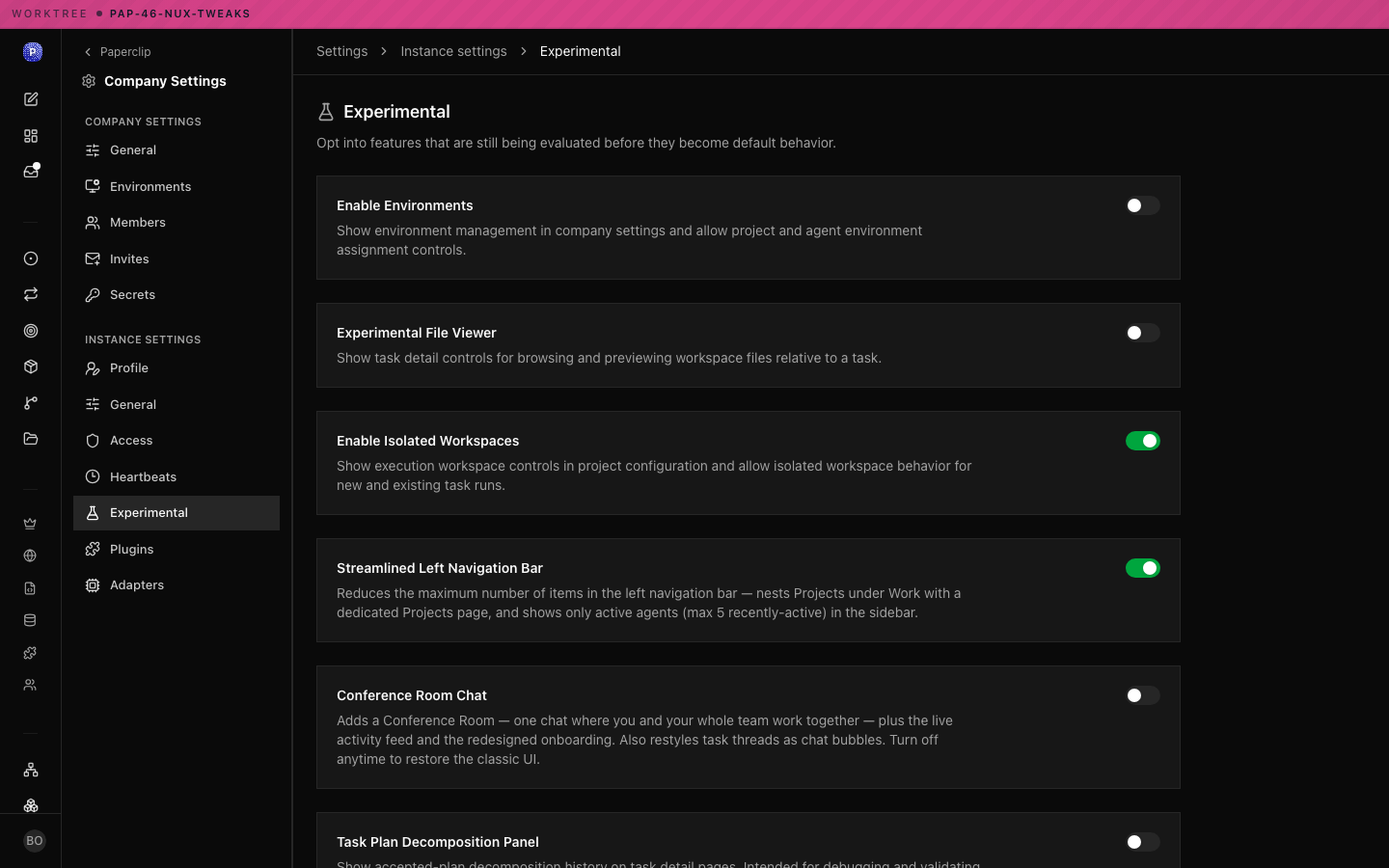
| 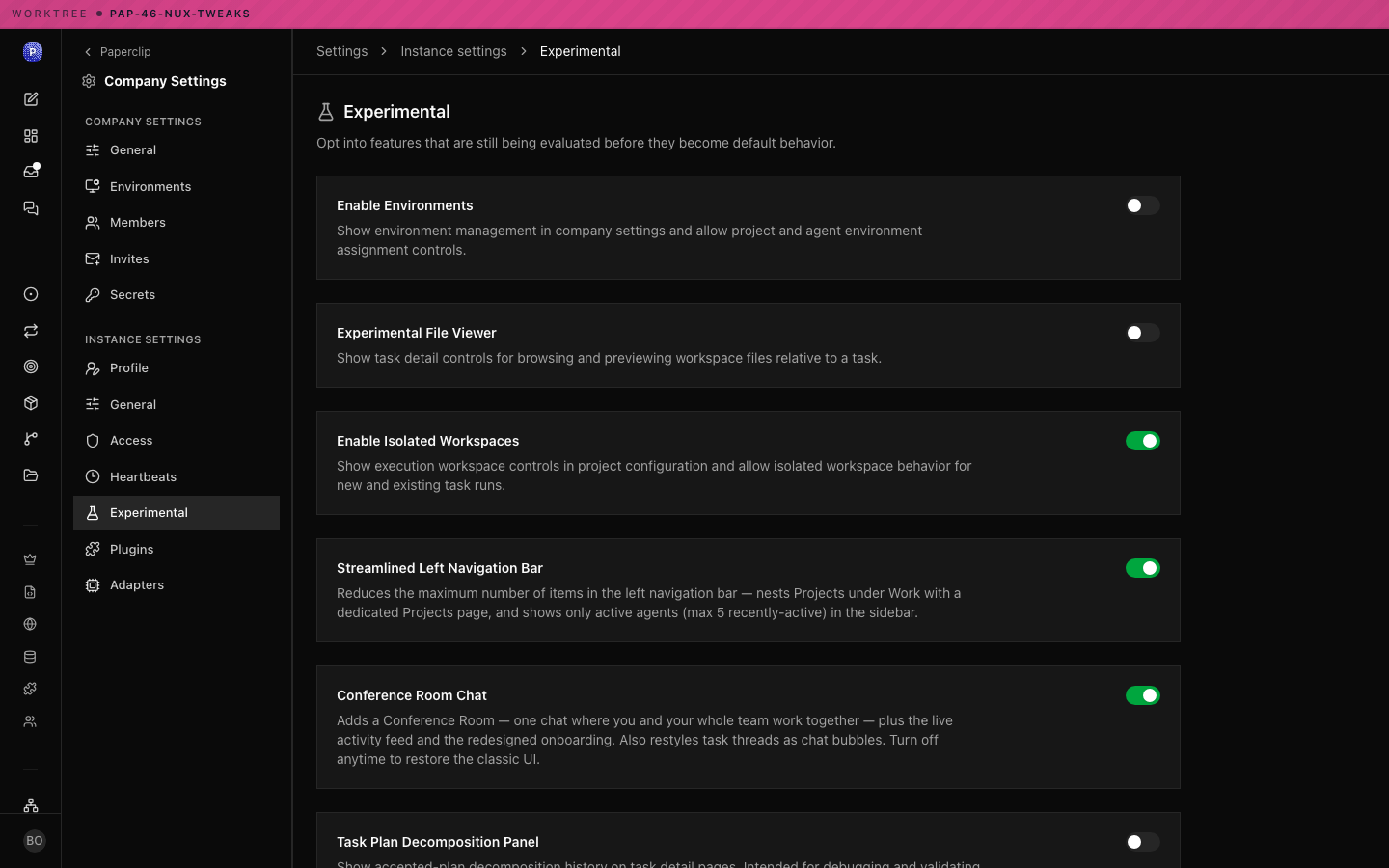
|
| Task thread | 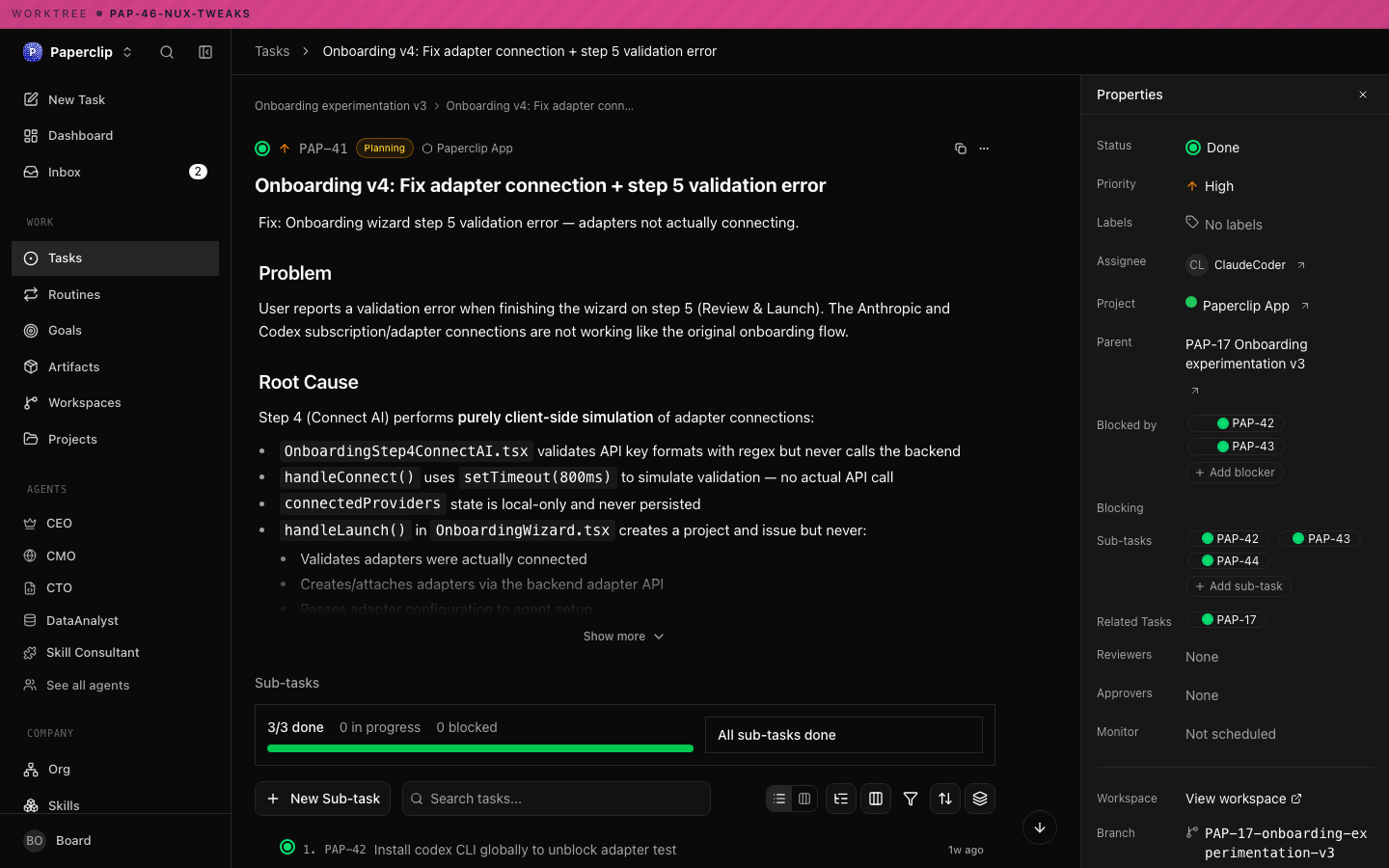
| 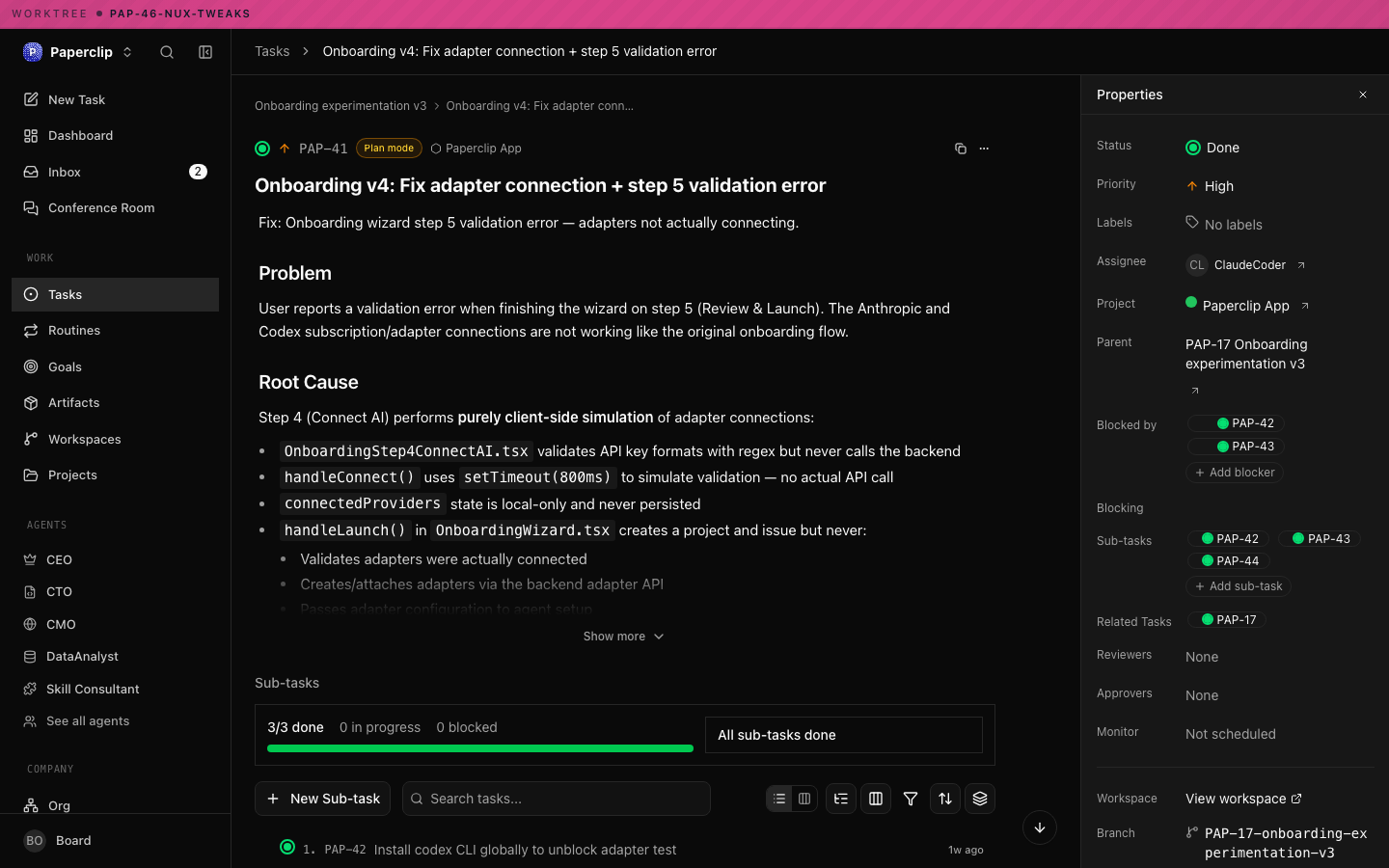
|
| Home / nav | 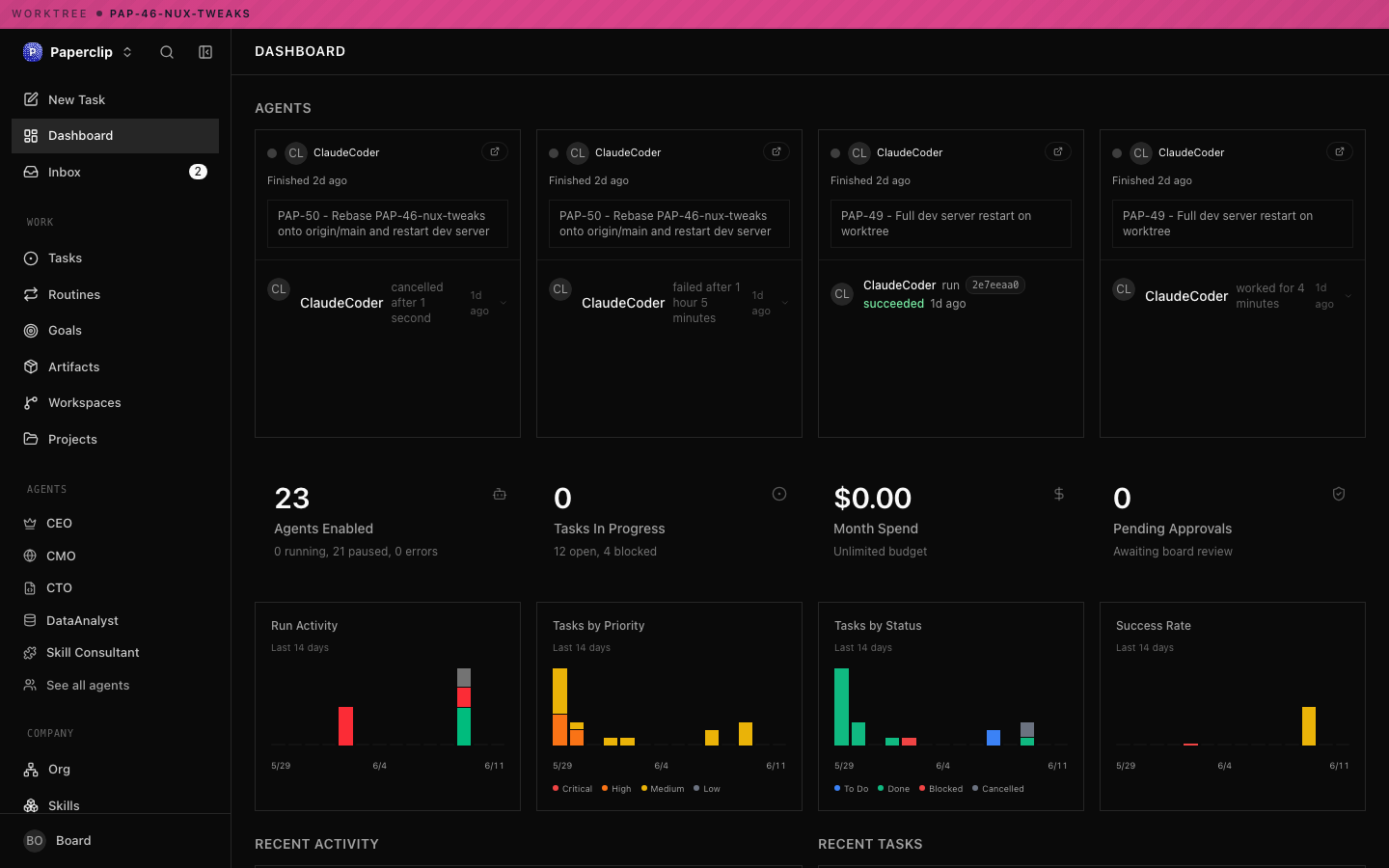
| 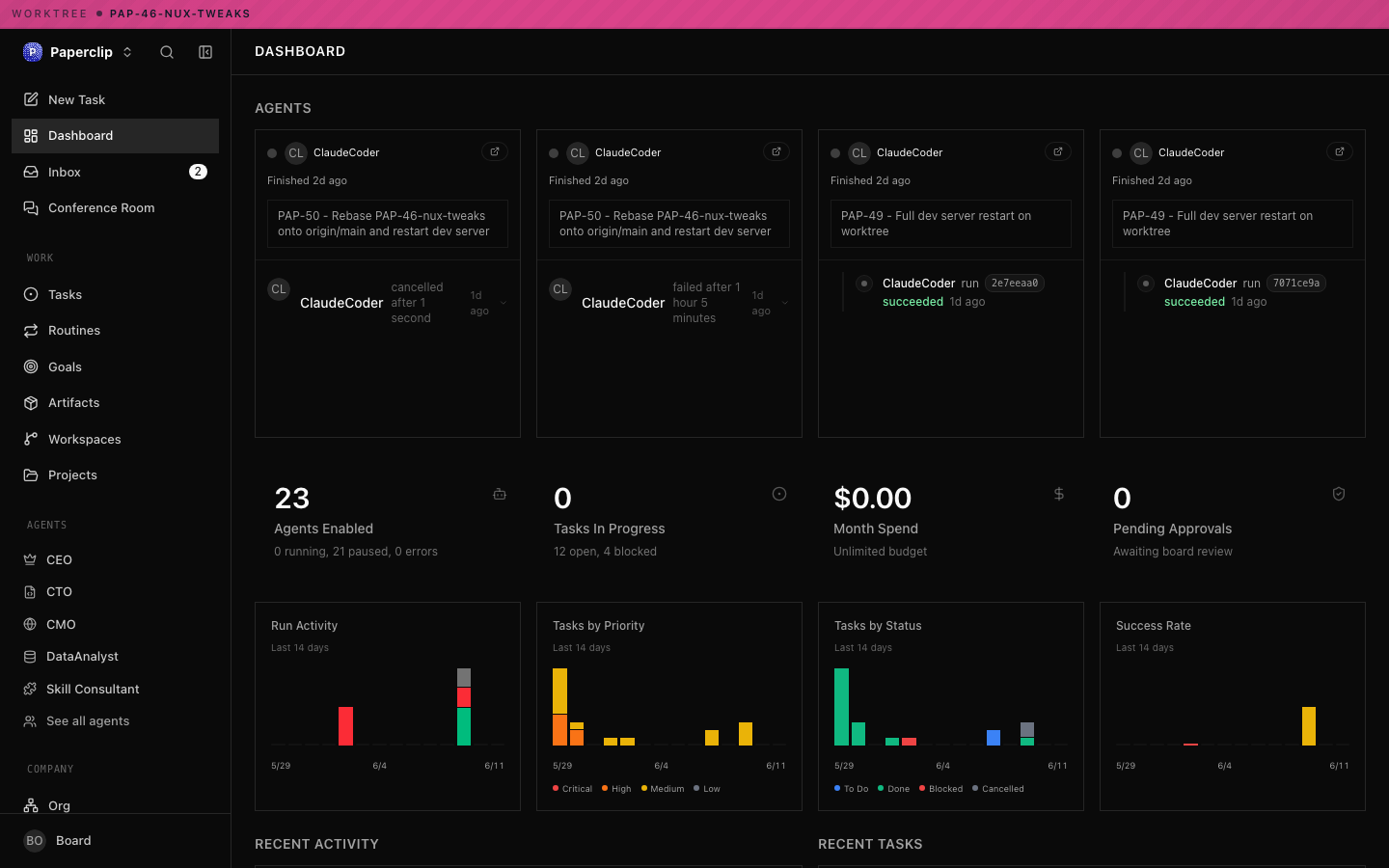
|
| Conference Room (flag-ON only surface) | — | 
|
Capsule onboarding wizard walkthrough screenshots (flag ON) are attached
to the Paperclip design/implementation threads; the wizard requires a
fresh instance so it is captured via the e2e harness
(`tests/e2e/nux-phase4-screenshots.spec.ts`).
## Risks
- **Large surface, but gated:** all new behavior sits behind
`enableConferenceRoomChat`, default OFF; flag-OFF rendering is locked by
frozen `*Classic` forks plus an on/off parity test suite
- **Classic forks are frozen at the fork point (`e3aada1d`):** master
features added to the live thread component after that point (assignee
handoff chips, run status badge, composer mention coach) render in the
flag-ON path; the flag-OFF task thread keeps the fork-point behavior
until the experiment graduates (forks deleted) or is dropped (forks
restored as canonical). Called out for reviewer attention.
- **Merge-conflict resolution in `IssueChatThread.tsx`** (commit
`21a5642a`) deserves reviewer eyes: master's new handoff/run-status
components were kept; the base toast-style no-assignee flow remains
replaced by the AlertDialog flow introduced on this branch
- Schema/server changes are additive (one optional boolean instance
setting); no migrations of existing data
## Model Used
- Claude (Anthropic) via Claude Code running in the Paperclip agent
harness (agent: ClaudeCoder)
- Branch implemented across multiple agent sessions on Claude Opus-class
models with extended thinking + tool use (file edits, shell, Playwright
screenshots); merge/PR session model ID as reported by the harness:
`claude-fable-5` (Claude Code CLI)
- All code was agent-authored and board-reviewed through Paperclip issue
threads (plans, wireframes, confirmations) before merging
## Checklist
- [x] I have included a thinking path that traces from project context
to this change
- [x] I have specified the model used (with version and capability
details)
- [x] I have checked ROADMAP.md and confirmed this PR does not duplicate
planned core work
- [x] I have searched GitHub for duplicate or related PRs and linked
them above
- [x] I have either (a) linked existing issues with `Fixes: #` / `Closes
#` / `Refs #` OR (b) described the issue in-PR following the relevant
issue template
- [x] I have run tests locally and they pass
- [x] I have added or updated tests where applicable
- [x] If this change affects the UI, I have included before/after
screenshots
- [x] I have updated relevant documentation to reflect my changes (none
required — experimental flag, self-documenting Settings card; noted
above)
- [x] I have considered and documented any risks above
- [x] All Paperclip CI gates are green (run 3 on `8af3041a`: all 16
gates SUCCESS, incl. e2e and all 4 serialized-suite shards)
- [x] Greptile is 5/5 with no open P2s, recommendations, or follow-ups
(re-review verdict: Confidence 5/5, “Safe to merge”; all 4 round-1
findings fixed + confirmed resolved; both summary notes addressed in
`8af3041a`)
- [x] I will address all Greptile and reviewer comments before
requesting merge
---------
Co-authored-by: Paperclip <noreply@paperclip.ing>
Co-authored-by: Claude Opus 4.8 <noreply@anthropic.com>
|
||
|
|
e3aada1df2 |
feat(ui): add Feedback item to the account flyout menu (PAP-107) (#7854)
## Thinking Path > - Paperclip is the open source app people use to manage AI agents for work > - The web UI has a bottom-left account flyout menu where users reach profile, docs, and the light/dark toggle > - There was no in-product way for users to send feedback or report issues — they had to find an external channel > - We want a low-friction, always-visible entry point for feedback, and a clean URL we can re-point later without shipping app changes > - This pull request adds a **Feedback** item (Megaphone icon) to the account flyout, between Documentation and the theme toggle, that opens `https://paperclip.ing/feedback` in a new tab > - `paperclip.ing/feedback` is a stable indirection (added to the marketing site) that currently 302-redirects to a Google Form, so the destination can be swapped for a richer solution later with no app release > - The benefit is a one-click feedback path for users and a future-proof link the team controls ## Linked Issues or Issue Description No public GitHub issue exists (tracked internally as Paperclip PAP-107). Describing the underlying request inline as a feature, per CONTRIBUTING.md path (B): ### Problem or motivation Users have no in-app affordance to give feedback or report issues; that friction loses signal we'd otherwise act on. ### Proposed solution Add a Feedback item to the account flyout (Megaphone icon, between Documentation and the theme toggle) that opens a stable `paperclip.ing/feedback` URL in a new tab. That URL redirects to a Google Form for now, keeping the client decoupled from the destination. ### Alternatives considered Linking the Google Form directly from the app — rejected because it bakes a throwaway URL into the client; the `/feedback` indirection keeps the link clean and swappable. ### Roadmap alignment Small, self-contained UX addition; no overlap with planned core work (checked ROADMAP.md). The `/feedback` redirect lives in the separate `paperclip-website` repo (Astro site on Cloudflare Pages), commit `f65b566`. No duplicate/related PRs found in this repo (searched feedback/flyout/menu). ## What Changed - `ui/src/components/SidebarAccountMenu.tsx`: import `Megaphone` from `lucide-react`; add `FEEDBACK_URL = "https://paperclip.ing/feedback"` const next to `DOCS_URL`; insert a `Feedback` `MenuAction` between Documentation and the theme toggle using the `external` prop so it opens in a new tab (`target="_blank"`, `rel="noreferrer"`) and closes the popover on click. - `ui/src/components/SidebarAccountMenu.test.tsx`: assert the Feedback item renders with the correct `href`, opens in a new tab, and is ordered after Documentation and before the theme toggle. - (Separate repo, for context) `paperclip-website` `public/_redirects`: `/feedback` → 302 → the feedback Google Form. ## Verification - **Unit tests:** `SidebarAccountMenu` tests pass (item renders, correct `href`, `target="_blank"`, ordering). Run: `cd ui && npm test -- SidebarAccountMenu`. - **Manual / canary:** The board previewed the canary build of the menu item and accepted it. Clicking **Feedback** opens a new tab to `paperclip.ing/feedback`. - **Redirect:** After the Cloudflare Pages deploy propagates, `curl -sI https://paperclip.ing/feedback` returns the Google Form in the `Location` header. _Screenshots:_ UI change was validated via the accepted canary preview; the item reuses the existing `MenuAction` styling, so it visually matches the Documentation/theme rows. ## Risks - **Low risk.** Additive, self-contained UI change with no new state or API calls. The only external dependency is the `paperclip.ing/feedback` redirect (separate repo, already deployed); if it were missing the link would 404, but it is in place. No migrations, no breaking changes. > For core feature work, check [`ROADMAP.md`](ROADMAP.md) first and discuss it in `#dev` before opening the PR. ## Model Used - **Claude (Anthropic).** PR authoring/orchestration: **claude-opus-4-8** (extended thinking + tool use). The implementation commit `b454a12d` was produced with assistance from **claude-sonnet-4-6**. All changes reviewed before pushing. ## Checklist - [x] I have included a thinking path that traces from project context to this change - [x] I have specified the model used (with version and capability details) - [x] I have checked ROADMAP.md and confirmed this PR does not duplicate planned core work - [x] I have searched GitHub for duplicate or related PRs and linked them above - [x] I have either (a) linked existing issues with `Fixes: #` / `Closes #` / `Refs #` OR (b) described the issue in-PR following the relevant issue template - [x] I have run tests locally and they pass - [x] I have added or updated tests where applicable - [ ] If this change affects the UI, I have included before/after screenshots - [x] I have updated relevant documentation to reflect my changes - [x] I have considered and documented any risks above - [ ] All Paperclip CI gates are green - [ ] Greptile is 5/5 with no open P2s, recommendations, or follow-ups - [x] I will address all Greptile and reviewer comments before requesting merge --------- Co-authored-by: Claude Sonnet 4.6 <noreply@anthropic.com> Co-authored-by: Paperclip <noreply@paperclip.ing> |
||
|
|
eaef47f4c7 |
Information Architecture + project/agent visual refresh (experimental) (#7543)
## Thinking Path > - Paperclip is the open source app people use to manage AI agents for work. > - The board UI is the control surface for issues, projects, agents, goals, workspaces, and operator settings. > - The existing navigation and list surfaces make several high-frequency workflows feel harder to scan than they should, especially around projects and agents. > - The product direction is to improve those surfaces without breaking the existing route model or forcing a new IA on every operator at once. > - This pull request now keeps the dependent IA, project identity, and agent-list visual refresh work together while the Issue-to-Task copy migration is split into #7651. > - The benefit is a clearer left nav, better project identity, denser agent/project list rows, and brand-aligned status treatment while preserving the classic default experience behind a flag. ## Linked Issues or Issue Description Refs #7645 Refs #7651 Internal planning/work references: PAP-53, PAP-56, PAP-58, PAP-59, PAP-60, PAP-61, PAP-68, PAP-69, PAP-70, PAP-71, PAP-72, PAP-75, PAP-76, PAP-80, PAP-85, PAP-86, PAP-87, PAP-88, PAP-89. ## What Changed - Adds `enableStreamlinedLeftNavigation`, defaulting off, and gates sidebar presentation so classic navigation remains the default. - Adds project icon persistence, validation, portability, picker UI, and `ProjectTile` rendering while defaulting new projects to neutral gray. - Adds projects-list task-count and budget summary data with focused server/shared/UI coverage. - Refreshes agent list rows, row actions, active/recent sidebar behavior, and status capsule/chip styling for the approved brand state system. - Removes the placeholder Conference room and Artifacts nav/routes from the finalized experimental nav direction. - Removes `pnpm-lock.yaml` and the Issue-to-Task copy migration from this PR diff; the copy migration now lives in #7651. ## Verification - Existing branch verification from the authored commits: UI typecheck, targeted unit tests, and light/dark visual checks for `/agents`, agent detail, and design-guide status states. - Maintainer cleanup verification on `75e34e5`: `git diff --check origin/master...HEAD` passed, the `design/` diff is empty, and the PR diff is 61 files, below Greptile's 100-file review limit. - `pnpm --filter @paperclipai/ui build` passed. - `NODE_ENV=test pnpm exec vitest run ui/src/components/Sidebar.test.tsx` passed: 1 file, 8 tests. - CI and Greptile should rerun on the latest push. ## Risks - Broad UI surface area: the experimental flag keeps the classic nav default, but changed shared components such as `EntityRow`, `ProjectTile`, and agent status badges could affect multiple pages. - Database migration: `projects.icon` is additive and nullable, but migration ordering and portability import/export must stay aligned. - The Issue-to-Task copy migration is now separated into #7651, so reviewers should evaluate this PR as IA/project/agent presentation work only. - Visual regressions are possible across smaller widths because the PR intentionally changes dense list-row layouts. ## Model Used Claude Opus 4.8 assisted the original feature commits. Paperclip-Paperclip agents assisted some planning/design commits. Codex / GPT-5-class coding agent with shell, GitHub CLI, and repository access performed this PR-readiness cleanup and split. ## Checklist - [x] I have included a thinking path that traces from project context to this change - [x] I have specified the model used (with version and capability details) - [x] I have checked ROADMAP.md and confirmed this PR does not duplicate planned core work - [x] I have searched GitHub for duplicate or related PRs and linked them above - [x] I have either (a) linked existing issues with `Fixes: #` / `Closes #` / `Refs #` OR (b) described the issue in-PR following the relevant issue template - [x] I have run tests locally and they pass - [x] I have added or updated tests where applicable - [x] If this change affects the UI, I have included before/after screenshots - [x] I have updated relevant documentation to reflect my changes - [x] I have considered and documented any risks above - [x] All Paperclip CI gates are green - [x] Greptile is 5/5 with no open P2s, recommendations, or follow-ups - [x] I will address all Greptile and reviewer comments before requesting merge --------- Co-authored-by: Paperclip <noreply@paperclip.ing> Co-authored-by: Claude Opus 4.8 <noreply@anthropic.com> Co-authored-by: Dotta <bippadotta@protonmail.com> |








