mirror of
https://github.com/paperclipai/paperclip.git
synced 2026-10-26 10:26:26 +01:00
83abfa46f628e5ff6bd8ee333ec130aba4e5016c
1056
Commits
| Author | SHA1 | Message | Date | |
|---|---|---|---|---|
 Devin FoleyandPaperclip |
83abfa46f6 |
feat(ui): enable Grok in Cloud agent setup (#13791)
## Thinking Path > - Paperclip manages AI agents and their execution settings. > - The new-agent flow selects an adapter before configuring credentials and a model. > - Cloud uses one adapter policy for the picker and direct setup links. > - That policy excludes Grok despite its existing adapter and xAI connection support. > - This change adds Grok to the Cloud policy. > - Cloud users can configure Grok with the existing subscription or API-key flow. ## Linked Issues or Issue Description **What existing behavior does this improve?** Agent creation on Cloud. **Current behavior** The Cloud picker offers Claude, Codex, and OpenCode. Direct Grok setup links also fail the shared adapter check. **Proposed behavior** Offer Grok alongside the existing choices. Use the existing xAI connection and managed sandbox setup. **Reason and benefit** Users can select an already-supported adapter through the Cloud creation flow. **Breaking changes** None. Loaded and enabled checks still apply. Other excluded adapters remain excluded. ## What Changed - Add `grok_local` to the shared Cloud creation policy. - Display four adapter choices in a 2×2 grid on desktop and mobile, and reuse the theme-aware provider mark on the connection step so Grok is visible in dark mode. - Verify picker navigation and both Grok authentication methods through sandbox setup, model testing, and agent creation. - Verify that probe and hire payloads carry the xAI connection binding without the entered API key. - Update the agent configuration specification. ## Verification - `cd ui && pnpm exec vitest run src/components/NewAgentDialog.test.tsx src/pages/NewAgent.test.tsx src/components/new-agent/AgentProviderConnection.test.tsx` — 69 tests passed. - Chromium checks against the production components and built stylesheet — four cards occupy two rows and two columns at 1280px and 390px; the connection step loads and displays the white Grok logo in dark mode and the black logo in light mode. - `pnpm --filter @paperclipai/ui typecheck` — passed. - `pnpm --filter @paperclipai/ui build` — passed. - `pnpm check:token-gates` — passed. - `git diff origin/master...HEAD | gitleaks stdin --redact --no-banner` — no leaks found; manual diff review found no private identifiers or user data. - `pnpm -r typecheck` and `pnpm build` — blocked at the existing runner package because `cargo` is not installed locally. - `pnpm test:run` — started locally, then stopped after the equivalent CI suites passed. - Initial [PR CI](https://github.com/paperclipai/paperclip/actions/runs/35681351752) passed, including full typecheck/build, general and serialized tests, Rust checks, and all eight browser-test shards. One unchanged Cursor test timed out on the first attempt; its five-test file passed locally and the failed CI shard passed on retry. - The [latest CI run](https://github.com/paperclipai/paperclip/actions/runs/35683642812) passed build, typecheck, all general and serialized tests, Rust checks, and all eight browser-test shards. One unchanged local-service-supervisor test failed its HTTP readiness check on the first attempt; its six-test file passed locally, and the failed server shard passed on retry. - Live xAI login and model execution were not run; the setup tests mock provider calls. ## Risks Small UI policy change. The existing Grok adapter, authentication, and secret storage paths remain in use. No schema or control-plane change is required. Cloud must deploy a tenant-app release containing this change. Revert the policy entry to hide Grok from new-agent setup again. ## Model Used - OpenAI GPT-6 (Codex), with repository inspection, code editing, and shell-based verification. ## Checklist - [x] I have included a thinking path that traces from project context to this change - [x] I have specified the model used (with version and capability details) - [x] I have checked ROADMAP.md and confirmed this PR does not duplicate planned core work - [x] I have searched GitHub for duplicate or related PRs and linked them above - [x] I have either (a) linked existing issues with `Fixes: #` / `Closes #` / `Refs #` OR (b) described the issue in-PR following the relevant issue template - [x] I have not referenced internal/instance-local Paperclip issues or links (only public GitHub `#NNN` / `github.com/paperclipai/paperclip` URLs) - [x] My branch name describes the change (e.g. `docs/...`, `fix/...`) and contains no internal Paperclip ticket id or instance-derived details - [x] I have run tests locally and they pass - [x] I have added or updated tests where applicable - [x] I have updated relevant documentation to reflect my changes - [x] I have considered and documented any risks above - [x] All Paperclip CI gates are green - [x] Greptile is 5/5 with no open P2s, recommendations, or follow-ups - [x] I will address all Greptile and reviewer comments before requesting merge --------- Co-authored-by: Paperclip <noreply@paperclip.ing> |
||
|
DottaandPaperclip
|
8725d6ce09 |
fix: make answered Slack conversations idle (#13809)
Settle published, successful Slack turns as Idle; resume the same conversation on an admitted message. Preserve unfinished work, delivery errors, and explicit dispositions. Verified through focused lifecycle/API/UI tests, full CI, and a real staging Slack conversation in the embedded browser. Co-Authored-By: Paperclip <noreply@paperclip.ing> |
||
|
Devin FoleyandPaperclip
|
df66219780 |
fix(ui): retry the latest failed task attempt (#13765)
## Thinking Path > - Paperclip manages work done by AI agents. > - The task thread lets an operator retry a failed run. > - Legacy runs with transcript output did not get a failure marker. > - The thread could therefore offer Try again for an older failure. > - The server correctly reused that failure's existing retry, even when it had already failed. > - This change keeps the latest failure actionable and reports stopped retry responses to the operator. ## Linked Issues or Issue Description **What happened?** Try again could return success without starting work. An initial setup failure had an empty transcript. Its later retry produced output and failed. Only the initial failure had a retry marker, so the button kept requesting the initial failure's already-failed successor. **Expected behavior** Try again targets the latest failed attempt. An already-stopped retry response shows an error and refreshes the task's run state. **Steps to reproduce** 1. Start a legacy adapter task that fails before producing transcript output. 2. Retry it. Let this attempt produce output and a final failure comment before it fails. 3. Click Try again in the task thread. 4. Before this fix, the click targets the original failure and replays the stopped successor. **Paperclip version or commit** Reproduced against `1483bb8bcf`; the regression is also present on the branch base `8813a50105`. **Deployment mode** Authenticated server with a legacy adapter. The bug is in the shared task UI and retry API client. Related: #11650 adds a different recovery-notice action. This change fixes failed-run markers and retry response handling. Searches found no duplicate of this failure case. ## What Changed - Render legacy failure markers even when the run has a transcript or final comment. - Keep later cancelled automatic retries from replacing the failed run's retry action. - Reject already-stopped retry responses in the API client so existing error feedback appears. - Refresh task run queries after both successful and failed retry requests. - Add regression coverage for failed and timed-out attempts, execution gates with output, and retry response states. ## Verification - Before the fix, the new regression tests failed: two selected the original failure, and four accepted a stopped successor as success. - Targeted task-thread, retry API, marker, and issue-page tests: 279 passed. - `pnpm --filter @paperclipai/ui typecheck`: passed. - `pnpm --filter @paperclipai/ui build`: passed. - `pnpm check:token-gates`: passed. - Full UI suite: 6,529 tests passed across 626 files. - [CI run 35650385023](https://github.com/paperclipai/paperclip/actions/runs/35650385023): all 53 checks passed, including full workspace build, typecheck, unit/integration suites, and browser tests. The redundant local full-workspace test run was stopped after CI passed; it is not counted as a completed local pass. - Greptile: 5/5 on `608ee58c99`, with no review threads or unresolved comments. The branch is mergeable. - `pnpm -r typecheck` and `pnpm build` were attempted. Both stop at the Runner's Rust checks because this host has no `cargo`. The full workspace checks passed in CI. ## Risks Low risk. This changes UI presentation and response handling only. The server's exact-retry idempotency, authorization, execution ownership, and recovery gates remain in place. No schema changes or live task mutations. Existing documentation describes this retry action; the fix restores that behavior. ## Model Used OpenAI GPT-6 (Codex), with reasoning, repository tools, and code execution. ## Checklist - [x] I have included a thinking path that traces from project context to this change - [x] I have specified the model used (with version and capability details) - [x] I have checked ROADMAP.md and confirmed this PR does not duplicate planned core work - [x] I have searched GitHub for duplicate or related PRs and linked them above - [x] I have either (a) linked existing issues with `Fixes: #` / `Closes #` / `Refs #` OR (b) described the issue in-PR following the relevant issue template - [x] I have not referenced internal/instance-local Paperclip issues or links (only public GitHub `#NNN` / `github.com/paperclipai/paperclip` URLs) - [x] My branch name describes the change (e.g. `docs/...`, `fix/...`) and contains no internal Paperclip ticket id or instance-derived details - [x] I have run tests locally and they pass (targeted checks; full-workspace limits described above) - [x] I have added or updated tests where applicable - [x] I have updated relevant documentation to reflect my changes (existing behavior restored; no documentation change needed) - [x] I have considered and documented any risks above - [x] All Paperclip CI gates are green - [x] Greptile is 5/5 with no open P2s, recommendations, or follow-ups - [x] I will address all Greptile and reviewer comments before requesting merge Co-authored-by: Paperclip <noreply@paperclip.ing> |
||
|
DottaandPaperclip
|
8813a50105 |
feat: run GitHub review bots through Paperclip agents (#13717)
## Thinking Path > - Paperclip manages agent work as tasks and runs. > - GitHub chat brings repository conversations into those tasks. > - A review bot needs the assigned agent, its authority, and governed provider tools. > - The existing channel connection did not supply that review workflow or a complete setup journey. > - This pull request adds GitHub App setup, account access, event prompts, task-bound review tools, and exact-commit checks. > - Operators can inspect each review through the same task, run, and activity systems. ## Linked Issues or Issue Description **Subsystem affected** GitHub chat, governed connection tools, task execution, shared/database contracts, and connector setup UI. **Problem or motivation** Operators need a GitHub review bot that runs their assigned Paperclip agent. Mentions and PR events must preserve task ownership and requester authority. Provider publication must use the bot App identity and enforce the configured permissions. **Proposed solution** Extend the existing GitHub chat connector with resumable App onboarding, linked-member and sponsored-guest access, editable event prompts, and governed review operations. Validate structured assessments on the server and compute a stable Paperclip Review check for the exact head commit. **Alternatives considered** A separate review scheduler would duplicate Paperclip execution and permissions. Reusing personal GitHub credentials would change the bot identity and credential boundary. **Roadmap alignment** This extends the existing Connected Apps and governed-tool infrastructure. The project owner requested and approved this design. Related PR #8645 imports external Codex review feedback; this change runs an assigned Paperclip agent and publishes its results through the existing chat connector. ## What Changed - Include the current Paperclip instance origin in the copied setup prompt. Storybook uses its configured Paperclip origin; callback parameters and URL credentials are excluded. - Add a Claude/Codex copy button in the real setup and Storybook opening step. Its detailed prompt asks four setup questions and guides embedded-browser setup, verification, and optional required checks. Clipboard failure exposes selectable instructions. - Add a tutorial that explains why App installation, review scheduling, and required checks are separate choices. - Add manifest registration, an existing-App path, separate installation and repository selection, repository refresh, and explicit account confirmation. - Add low-trust agent guidance, effective capability verification, member selection, and explicit restricted guests with a sponsor. - Add configurable PR events, prompts, repository overrides, rating thresholds, and separate formal-review permissions. - Give the assigned agent governed App tools to read PRs, comment, begin an assessment, submit findings, and optionally submit a formal review. - Bind review history, root PR events, and inline replies to ordinary tasks. Deduplicate deliveries/findings and reject stale publication. - Link check Details to the underlying task on the current trusted hostname, or to Reviews before task creation. - Add schema migration 0283, API contracts, production UI, and 49 interactive Storybook states. - Repair local lease recovery. Keep the Cloud Dockerfile identical to master; no provider-pack layer or runtime-default environment variable is added. - Retry only rolled-back wake-admission transactions after transient endpoint-lock contention. A deterministic held-lock regression proves one accepted wake. ## Verification - Current head: `7ba761fe007bb798400d3e62346fa964f607f0f8`, rebased on master `d9b3a5653e41f2ee5a1345b97c86a238f7a5c8e9`. Dockerfile has zero diff against master. Final workspace typecheck and build passed. The new PostgreSQL migration regression passed and preserves existing relation and constraint identities after replay. - Greptile reviewed this exact head at 5/5. There are zero unresolved review threads and no merge conflicts. - All current-head checks are green: 54 passed and two conditional Storybook jobs skipped. This includes complete server/workspace test suites, build, typechecks, policy checks, Runner suites, browser suites, and security status. One timing-sensitive callback-ordering test passed in isolation and its CI shard passed one retry. The duplicate local full-suite run was stopped after CI completed; it is not counted as a local full-suite pass. - Before the final Slack rebase and migration renumbering, 186 focused GitHub tests, 14 native bootstrap cases, token gates, and Storybook build passed. The final rebase retained the new Slack communication guidance. - The embedded-browser setup test copied the full detailed prompt, including the configured Paperclip instance URL. Desktop and narrow layouts were checked. Component tests cover successful copying and clipboard failure with selectable text and retry. - Live local and hosted GitHub acceptance evidence refers to application revision `cb703ac959876a07ebf3d7a295847f9f351eb6fc`. Real agent tasks exercised issue mentions, automatic PR reviews, inline findings, repeated mentions, task continuation, and failing-to-passing checks after a push. The Storybook agent generated, built, and browser-rendered pages; missing acceptance text failed, matching text passed, and broken JSX produced an incomplete result. - Live cases also covered independently disabled push events, prompt injection, duplicate signed deliveries, rapid pushes, stale-result rejection, finding deduplication, and restart recovery. Formal reviews were denied while disabled and published only after explicit enablement. Check Details links pointed to the underlying task on the trusted hostname. - Those hosted native Claude runs used the provider-pack layer now removed from this PR. They do not prove native Claude works on the standard Cloud image. A replacement hosted native Codex run is not yet verified: the disposable QA tenant has only an Anthropic AI connection. No new staging or production deployment was made for the packaging removal. - Required-check merge enforcement could not be tested because the private disposable repository's GitHub plan rejected the rules configuration. Published success/failure/incomplete check states were verified directly. ## Risks - Latest master allocated migration 0282 to Slack. The GitHub migration is regenerated as 0283 with replay-safe table/index/constraint creation; a PostgreSQL regression verifies existing relations and constraints are preserved. Existing preview tenants remain subject to the fleet migration-history compatibility preflight; no bypass is introduced. - Migration 0283 adds company-scoped configuration, registration, review, and publication records. Existing connections retain their behavior until reviews/tools are enabled. - Signed webhooks and expiring registration state remain required. Hosted installations also need the companion narrow Cloud gateway exemptions. - Agent assessments can be incomplete or wrong. The server enforces coverage/result structure, current-head publication, rating policy, and separate formal-review permission; it does not replace code-review judgment. - No Cloud image packaging changes are included. Remote native ACPX/Claude and OpenCode retain their existing operator-supplied provider-pack prerequisite. Native Codex and Codex with managed MCP tools do not require that pack. Earlier staging deployment evidence refers to its stated revision, not this packaging-removal head. Production rollout and merging remain outside this change. ## Model Used OpenAI GPT-6 through Codex, with repository, code execution, API, and embedded-browser tools. The exact serving model ID and context-window size were not exposed by the environment. ## Checklist - [x] I have included a thinking path that traces from project context to this change - [x] I have specified the model used (with version and capability details) - [x] I have checked ROADMAP.md and confirmed this PR does not duplicate planned core work - [x] I have searched GitHub for duplicate or related PRs and linked them above - [x] I have either (a) linked existing issues with `Fixes: #` / `Closes #` / `Refs #` OR (b) described the issue in-PR following the relevant issue template - [x] I have not referenced internal/instance-local Paperclip issues or links (only public GitHub `#NNN` / `github.com/paperclipai/paperclip` URLs) - [x] My branch name describes the change (e.g. `docs/...`, `fix/...`) and contains no internal Paperclip ticket id or instance-derived details - [x] I have run tests locally and they pass - [x] I have added or updated tests where applicable - [x] I have updated relevant documentation to reflect my changes - [x] I have considered and documented any risks above - [x] All Paperclip CI gates are green - [x] Greptile is 5/5 with no open P2s, recommendations, or follow-ups - [x] I will address all Greptile and reviewer comments before requesting merge --------- Co-authored-by: Paperclip <noreply@paperclip.ing> |
||
|
DottaandPaperclip
|
d9b3a5653e |
feat(chat): add initial Slack communication guidance and connection menus (#13760)
## Thinking Path > - Paperclip is the open source app people use to manage AI agents for work. > - Chat connectors let people use the same tasks and agent tools from external conversations. > - Agents need communication guidance that fits the conversation medium. > - That guidance belongs in the original task context, without repeated instructions on each turn. > - Connection owners also need clear settings and a consistent way to remove a connection. > - This pull request adds initial Slack guidance, optional connection instructions, and chat connection menus. > - The benefit is clearer Slack replies with the existing Paperclip workflow and permissions. ## Linked Issues or Issue Description **What existing behavior does this improve?** Agent replies in Slack and chat connection management in the Apps catalog. **Current behavior** Slack tasks do not carry a saved communication profile. The catalog shows a separate Manage button and does not offer removal on every chat connection row. **Proposed behavior** Save Slack guidance when a new conversation creates a task. Restore that original guidance when a model session is rebuilt. Do not append it to ordinary follow-ups. Expose optional additional instructions in Slack Settings. Put Manage and Remove connection in a three-dot menu for all chat providers. Keep Finish setup visible for drafts. **Reason and benefit** Small answers fit in Slack. Substantial deliverables use ordinary document or artifact tools with a useful Slack summary. Connection settings apply to new tasks and cannot change permissions. Users can remove both active and unfinished chat connections from the catalog. **Breaking changes** Two additive database columns store endpoint preferences and the initial conversation snapshot. Existing endpoints default to empty preferences. Existing conversations keep their original behavior. Non-Slack guidance is unchanged. Related public context: https://github.com/paperclipai/paperclip/pull/13741 improves native chat recovery. This change adds communication context to those existing execution paths. A search found no duplicate communication-guidance PR. ## What Changed - Add a provider-guidance registry, enabled for Slack first. - Persist optional endpoint communication instructions and capture an immutable snapshot when a conversation creates a task. - Resolve guidance from the verified company-scoped connection. Restore it for fresh native and legacy sessions without per-turn reminders, extra model calls, or extra context queries. - Add the Slack Settings field, validation, audit coverage, and Storybook save/error states. - Add Manage and Remove connection menus for all seven chat providers. Keep the draft setup button. Require removal confirmation and allow retry after failure. - Add regression coverage, an active/draft menu story, and connector documentation. ## Verification All CI checks are green for |
||
|
DottaandPaperclip
|
b82661b561 |
refactor(connections): retire the legacy Composio broker (#13758)
## Thinking Path > - Paperclip manages agents and their access to external tools. > - Connectors expose these tools through a governed MCP gateway. > - PR #13755 added a direct Composio MCP connection behind the experimental MCP aggregators flag. > - The old project API-key broker still created toolkit child connections and showed a separate Services tab. > - Keeping both paths leaves obsolete setup and session code in the product. > - This change removes the broker and preserves direct MCP setup, credentials, permissions, and execution. > - Saved legacy records fail closed and remain available for explicit removal. ## Linked Issues or Issue Description Related: #13755. This retirement supersedes the legacy-path fixes proposed in #12630, #12632, #12634, and #12906. It does not close those PRs. **What existing behavior does this improve?** Composio connector setup, management, and runtime dispatch. **Current behavior** Composio offers both direct MCP and a project API-key broker. The broker mints sessions and creates one child connection per toolkit. **Proposed behavior** Offer only direct MCP. Remove the toolkit Services UI, REST routes, API client, and session broker. Block saved legacy parent and child records from discovery, execution, health checks, reconnect, and OAuth. Preserve their records and credentials until the operator removes each connection. **Reason and benefit** The direct MCP connector becomes the single supported Composio workflow. Provider accounts remain managed in Composio. ## What Changed - Remove the API-key catalog method and its generated-source definition. - Delete Composio broker clients, session creation, account synchronization, child lifecycle, and toolkit routes. - Remove the Services tab, service rows, child provenance, and cascade-removal controls. Keep Vercel provenance intact. - Retain a shared retirement guard for stored legacy records. Show Retired status and replacement/removal guidance in the connection list and details; hide obsolete runtime controls. - Preserve the experimental MCP aggregators flag and direct MCP infrastructure. - Replace broker fixtures with retirement tests and extend direct Composio catalog/reconnect coverage. ## Verification - Focused shared, server, and UI tests passed with one worker. Server retirement tests use a name filter; no full local test suite was run, as requested. - Server and UI TypeScript checks passed. - Token gates and UI build passed. - Real browser: opened the saved Composio connection, refreshed all 11 tools, and ran the provider's read-only GitHub account-list operation through the standard Test dialog as an agent. The provider returned success using the existing OAuth credentials. - See `doc/connections/COMPOSIO-BROKER-RETIREMENT.md` for scope and live evidence. - Storybook build passed. A fresh real agent used `COMPOSIO_SEARCH_TOOLS` and `COMPOSIO_MULTI_EXECUTE_TOOL` to return the actual Paperclip DeepWiki hierarchy: one success, zero errors. Gateway audit records confirm both calls succeeded. - Browser retirement check: a credential-free legacy fixture showed the guidance, opened the direct MCP replacement flow, and was removed through the standard confirmation. - Focused regressions for the experimental settings copy and exact OpenAPI route coverage passed. All latest-head CI checks passed (54 successful, two intentionally skipped); Greptile scored 5/5 with no unresolved review threads. The PR has no merge conflicts. ## Risks This intentionally breaks the old Composio project API-key and child-connection workflow. Existing legacy records cannot run, even if their stored status is active. Operators must create a new direct MCP connection and choose access rules; credentials and grants are not migrated. Remove each old record separately to delete its credentials. No schema migration or data deletion runs automatically. Direct MCP connections keep their existing grants and secrets. ## Model Used OpenAI GPT-6 via Codex, with reasoning, code execution, and browser tools. The exact runtime variant and context-window size are not exposed in this session. ## Checklist - [x] I have included a thinking path that traces from project context to this change - [x] I have specified the model used (with version and capability details) - [x] I have checked ROADMAP.md and confirmed this PR does not duplicate planned core work - [x] I have searched GitHub for duplicate or related PRs and linked them above - [x] I have either (a) linked existing issues with `Fixes: #` / `Closes #` / `Refs #` OR (b) described the issue in-PR following the relevant issue template - [x] I have not referenced internal/instance-local Paperclip issues or links (only public GitHub `#NNN` / `github.com/paperclipai/paperclip` URLs) - [x] My branch name describes the change (e.g. `docs/...`, `fix/...`) and contains no internal Paperclip ticket id or instance-derived details - [x] I have run tests locally and they pass - [x] I have added or updated tests where applicable - [x] I have updated relevant documentation to reflect my changes - [x] I have considered and documented any risks above - [x] All Paperclip CI gates are green - [x] Greptile is 5/5 with no open P2s, recommendations, or follow-ups - [x] I will address all Greptile and reviewer comments before requesting merge --------- Co-authored-by: Paperclip <noreply@paperclip.ing> |
||
|
DottaandPaperclip
|
e8c8ba3c19 |
feat(apps): add experimental MCP aggregator connectors (#13755)
## Thinking Path > - Paperclip is the open source app people use to manage AI agents for work. > - Its tool gateway applies company access rules and approval controls to connected apps. > - MCP aggregators expose many apps through one provider endpoint. > - Each aggregator needs its own credential, catalog, grants, and lifecycle in Paperclip. > - This pull request adds independent Zapier, Arcade, Composio Connect, and Executor setup with a common Access → Connect layout. > - A default-off MCP aggregators flag lets operators opt in while we complete provider acceptance tests. > - Agents use the normal Paperclip permissions, Test screen, and gateway after setup. ## Linked Issues or Issue Description **Subsystem affected** Apps, connection setup, shared contracts, and the remote MCP gateway. **Problem or motivation** Aggregator endpoints need clear provider setup and correct MCP sessions. Generic setup does not explain each provider's authentication or broad execution tools. Provider approval must preserve the original execution instead of replaying a write. **Proposed solution** Add four separate connectors behind Settings → Experimental → MCP aggregators. Start with human and agent access, then connect the endpoint and read its tools. Enable tools by default. Use the existing Permissions and Test screens after setup. Keep legacy Composio API-key and child connections intact. **Alternatives considered** A shared connection for all providers would mix credentials and access rules. Separate provider-specific permission and test screens would duplicate existing controls. Vercel Connect is outside this change. **Roadmap alignment** Extends the existing MCP Tool Gateway & Apps capability and the Connected Apps roadmap area. This work was requested and reviewed by the maintainer. Related work: #11894, #12630, #12632, #12634, and #12906 concern the legacy Composio broker. #13102 also covers remote MCP pagination. This change preserves the broker path and adds initialized sessions, response matching, and provider resume handling alongside pagination. ## What Changed - Add branded setup and interactive Storybooks for Zapier, Arcade, Composio Connect, and Executor. Use the existing access controls and normal action tests. Do not request a connection name or action choices during setup. - Add the default-off `enableMcpAggregators` flag to settings, managed feature metadata, the catalog, and setup guards. Hidden connections keep running. Legacy Composio connections remain unchanged. - Reuse the vault, grants, policy, and catalog models. Support OAuth discovery, bearer tokens, custom headers, and credential-bearing URLs. Add no database tables or migrations. - Initialize and retain Streamable HTTP sessions by connection and effective credentials. Read paginated catalogs and match streaming responses to request IDs. - Classify unfamiliar aggregator tools as writes despite upstream read-only hints; only exact reviewed read capabilities enter the read-only allowlist. Legacy Composio child behavior is preserved. - Preserve provider authorization links and execution IDs. Support Executor approve/resume, decline, and cancel without automatic replay of uncertain writes. - Preserve Off and Ask first choices during refresh and reconnect. Allow new tools and retire removed tools. Keep agent access updates atomic and preserve an empty agent selection. - Document connector UX rules, provider branding sources, and live acceptance results. - Stabilize the existing Sentry release fixture after its repeated CI failure by reusing one module mock; production Sentry behavior is unchanged. ## Verification - Final head `d11781970`: [CI run](https://github.com/paperclipai/paperclip/actions/runs/35633534900) passed, including broad typecheck, test shards, build, and E2E. All 54 checks pass; 2 optional checks are skipped. Greptile is 5/5, Security Scan passes, and all review threads are resolved. - Passed 27 focused connector Vitest checks and 18 connector-only Storybook browser checks before the flag change. All 85 stories rendered at desktop and narrow widths. - Passed 5 connector lifecycle/server checks and 7 selected flag checks after adding the flag. The latter cover settings, managed defaults, cached catalog visibility, and all four setup routes. - Review fixes passed 13 risk/handoff/lifecycle checks, dedicated session-expiration and transport regressions, 13 selected connector/gateway CI cases, and 10 selected setup/reconnect UI cases. A real Composio connection-list call also succeeded through the refreshed UI on `9ab115f71`. - UI and server TypeScript checks passed. UI build, Storybook build, token gates, and diff whitespace checks passed during implementation. - Real browser and real Paperclip agent tests passed for Arcade, Composio, and Executor. Tested action permissions, denied agent access, reconnect, disconnect, and isolation. Tested Arcade catalog additions/removal and Executor provider approve/resume, decline, and cancel. - Zapier live acceptance is incomplete. Its dedicated provider server is configured, but its credential-copy dialog returned an empty clipboard through browser automation. No live Zapier action is claimed. - The three isolated Sentry release cases pass after the CI fixture fix. - Local verification is deliberately narrow at the maintainer's request. The full local suite, recursive typecheck, and repository-wide build were not run. CI provides the broader checks. ## Risks - Shared MCP transport changes affect other remote MCP servers. Protocol fixtures cover initialized sessions, streaming response matching, pagination, and isolation. - Broad execution tools remain broad permissions. The provider governs actions inside those tools. - Provider handoff links are retained briefly in memory. After a server restart, a one-time link may require reopening the provider dashboard. Paperclip does not replay the original call. - Zapier remains unproven live. Custom-header imports and self-hosted endpoints have fixture coverage rather than a separate live account for every variant. - Turning the experimental flag off hides setup; it does not revoke existing credentials or stop existing connections. ## Model Used OpenAI GPT-6 through Codex, with reasoning, repository tools, shell execution, and browser automation. The exact runtime model ID and context-window size are not exposed in this session. A separate Anthropic-backed Paperclip agent performed live gateway acceptance tasks. ## Checklist - [x] I have included a thinking path that traces from project context to this change - [x] I have specified the model used (with version and capability details) - [x] I have checked ROADMAP.md and confirmed this PR does not duplicate planned core work - [x] I have searched GitHub for duplicate or related PRs and linked them above - [x] I have either (a) linked existing issues with `Fixes: #` / `Closes #` / `Refs #` OR (b) described the issue in-PR following the relevant issue template - [x] I have not referenced internal/instance-local Paperclip issues or links (only public GitHub `#NNN` / `github.com/paperclipai/paperclip` URLs) - [x] My branch name describes the change (e.g. `docs/...`, `fix/...`) and contains no internal Paperclip ticket id or instance-derived details - [x] I have run tests locally and they pass - [x] I have added or updated tests where applicable - [x] I have updated relevant documentation to reflect my changes - [x] I have considered and documented any risks above - [x] All Paperclip CI gates are green - [x] Greptile is 5/5 with no open P2s, recommendations, or follow-ups - [x] I will address all Greptile and reviewer comments before requesting merge --------- Co-authored-by: Paperclip <noreply@paperclip.ing> |
||
|
DottaandPaperclip
|
57fd8b70d2 |
feat: add agent avatar download to Slack setup and settings (#13740)
## Thinking Path > - Paperclip helps people manage AI agents for work. > - Slack connections let a team talk to those agents in Slack. > - Agents now have a saved avatar, but Slack setup did not offer that image. > - A matching avatar helps a team recognize its agent. > - This pull request adds an optional avatar step and a download in connector Settings. > - Users download a PNG and upload it directly in Slack with clear instructions. ## Linked Issues or Issue Description **What existing behavior does this improve?** Slack connector onboarding and its Settings page. **Current behavior** Setup does not offer the assigned agent's avatar or explain how to upload it in Slack. **Proposed behavior** After Slack connection verification, users can download a 512 × 512 PNG of their agent's saved avatar. They can upload it in Slack, confirm, or skip. Settings keeps the download and upload instructions available after onboarding. **Reason and benefit** The same avatar helps people recognize the agent across Paperclip and Slack. Users who skip the optional step can return to it in Settings. **Breaking changes** None. No schema, authentication, Slack scope, or provider API change. Completed connections keep their existing completion state. Searched existing Slack avatar and Cliptoon PRs; no matching implementation was found. ## What Changed - Add an optional avatar step before personal Slack account linking. Keep the numbered sidebar and shared footer. - Resolve the selected agent's saved appearance for the preview and PNG download. - Add the same download and expandable upload instructions to connector Settings. - Remember uploaded or skipped per company and endpoint in browser storage. Treat uploaded as user confirmation, not provider verification. - Reject failed or non-PNG download responses and allow retry. - Reuse the production avatar components in onboarding and Settings stories. - Test wizard progression, resume, Settings, download recovery, storage isolation, and terminated assigned agents. - Exercise real PNG downloads in the Slack browser flow and keep default app names consistent with app creation. - Fetch the assigned agent directly so its saved avatar remains available after termination. ## Verification - Focused chat suites: 48 passed; the two affected suites passed again after the final naming fix (32 tests). - Slack browser E2E passed through setup, avatar download, account linking, and Settings download. PNG signature and 512 × 512 dimensions verified. - UI token gates passed. - Browser: downloaded the real 512 × 512 PNG; checked confirmation, return, mobile layout, and Settings instructions. - Full workspace typecheck, application build, and production Storybook build passed. - All latest-head CI checks passed (54 passed, 2 skipped), including all browser, chat, general, and serialized test groups. The unrelated Sentry test failed once and passed on the single CI rerun; its suite also passed locally. - Local full-suite attempt encountered a rapid Slack callback ordering failure under concurrent build load; that test passed in isolation, and all three chat shards passed in CI. The remaining local run was not used as the merge gate. - Review the Connections / Slack / Add avatar and Avatar in Settings stories. ## Risks - Slack upload is manual. Confirmation does not claim to verify the Slack icon. - Optional step progress is browser-local. Clearing storage or changing browsers can show it again. Setup still works when storage is unavailable. - The existing avatar API remains the image source. Download failures show a retry message. ## Model Used OpenAI GPT-6 through Codex, with reasoning, repository tools, code execution, and browser testing. The exact deployment model ID and context window are not exposed in this session. ## Checklist - [x] I have included a thinking path that traces from project context to this change - [x] I have specified the model used (with version and capability details) - [x] I have checked ROADMAP.md and confirmed this PR does not duplicate planned core work - [x] I have searched GitHub for duplicate or related PRs and linked them above - [x] I have either (a) linked existing issues with `Fixes: #` / `Closes #` / `Refs #` OR (b) described the issue in-PR following the relevant issue template - [x] I have not referenced internal/instance-local Paperclip issues or links (only public GitHub `#NNN` / `github.com/paperclipai/paperclip` URLs) - [x] My branch name describes the change (e.g. `docs/...`, `fix/...`) and contains no internal Paperclip ticket id or instance-derived details - [x] I have run tests locally and they pass - [x] I have added or updated tests where applicable - [x] I have updated relevant documentation to reflect my changes - [x] I have considered and documented any risks above - [x] All Paperclip CI gates are green - [x] Greptile is 5/5 with no open P2s, recommendations, or follow-ups - [x] I will address all Greptile and reviewer comments before requesting merge --------- Co-authored-by: Paperclip <noreply@paperclip.ing> |
||
|
Devin FoleyandPaperclip
|
c65fc9e3c8 |
fix: recover authentication and browser connection failures (#13724)
fix: recover authentication and browser connection failures Include connect timeouts in the bounded retry policy for idempotent actor synchronization. Handle WebSocket constructor failures through existing reconnect paths and preserve HTTP polling while realtime is unavailable. Refresh visible company queries until the socket recovers and clear all fallback timers on hiding or unmount. Verify 172 focused tests, server/UI typechecks, UI build, and design token gates. Full workspace build/typecheck require the unavailable Rust toolchain; the full test run is tracked separately. Co-Authored-By: Paperclip <noreply@paperclip.ing> |
||
|
DottaandPaperclip
|
da257c3069 |
Warn when routine webhook URLs may not be publicly reachable (#13684)
## Thinking Path > - Paperclip helps people manage AI agents and their work. > - Routines can start that work when another app sends a webhook. > - Local and private URLs often cannot receive events from public services. > - HTTPS alone does not make a Tailscale address public. > - This pull request explains these limits during setup and editing. > - Users can still finish setup for senders on their own network. ## Linked Issues or Issue Description Refs #13637. Webhook setup needs a clear warning when the generated URL appears local, private, or unencrypted. The warning must explain how to make the endpoint reachable without blocking private-network use. ## What Changed - Add a shared warning banner to the Connect, Check connection, and Edit webhook views. - Distinguish localhost, private network addresses and domains, HTTP, and Tailscale hostnames. - Explain the difference between Tailscale Serve and Funnel. Link to the Paperclip HTTPS guide. - Add five full-page Storybook examples, design guide examples, and documentation. - Add URL classification tests and a regression test that finishes setup despite the warning. ## Verification - Passed 41 focused URL and trigger-flow tests. - Passed workspace typecheck, workspace build, token gates, and Storybook build. - Browser-tested the Tailscale story through Check connection, Finish setup, and Edit webhook. The warning stays visible and does not block setup. - Open Product / Routines / Webhooks stories 11–15 to review the warning states. - All 54 PR checks passed, including the full test matrix and eight browser shards; two optional Storybook jobs were skipped by workflow policy. - The server supervisor readiness test timed out once in CI, then passed on rerun and locally (6 tests). - The duplicate local full-suite run was stopped after the complete CI matrix passed. - Greptile: 5/5 on the current commit, with no unresolved review comments. ## Risks - URL checks are hints. They do not test DNS, firewall rules, or actual reachability. - A Tailscale hostname can serve either private Serve traffic or public Funnel traffic. The warning explains this uncertainty and permits both. - No API, schema, authentication, or webhook delivery behavior changes. ## Model Used OpenAI Codex, based on GPT-6, with reasoning, repository tools, shell execution, and browser testing. The exact deployment model ID and context window size are not exposed in this session. ## Checklist - [x] I have included a thinking path that traces from project context to this change - [x] I have specified the model used (with version and capability details) - [x] I have checked ROADMAP.md and confirmed this PR does not duplicate planned core work - [x] I have searched GitHub for duplicate or related PRs and linked them above - [x] I have either (a) linked existing issues with `Fixes: #` / `Closes #` / `Refs #` OR (b) described the issue in-PR following the relevant issue template - [x] I have not referenced internal/instance-local Paperclip issues or links (only public GitHub `#NNN` / `github.com/paperclipai/paperclip` URLs) - [x] My branch name describes the change (e.g. `docs/...`, `fix/...`) and contains no internal Paperclip ticket id or instance-derived details - [x] I have run tests locally and they pass - [x] I have added or updated tests where applicable - [x] I have updated relevant documentation to reflect my changes - [x] I have considered and documented any risks above - [x] All Paperclip CI gates are green - [x] Greptile is 5/5 with no open P2s, recommendations, or follow-ups - [x] I will address all Greptile and reviewer comments before requesting merge Co-authored-by: Paperclip <noreply@paperclip.ing> |
||
|
DottaandPaperclip
|
f589660ec0 |
feat(routines): add safe webhook setup and in-routine run management (#13637)
## Thinking Path > - Paperclip is the open source app people use to manage AI agents for work. > - Routines turn scheduled work and external events into tasks for an assigned agent. > - Webhook setup was disabled, and actor authentication rejected valid webhook bearer keys. > - Operators need to connect and test a sending app before events can start work. > - This pull request adds a guided setup with durable connection tests that cannot dispatch a task. > - It keeps trigger management, execution tasks, and activity within the routine. > - The benefit is a webhook that can be configured, verified, and operated from one place. ## Linked Issues or Issue Description Fixes #11937. Related: #13216 adds provider-specific Sentry support. This PR addresses general routine setup and ingress. #6841 addresses legacy secret bindings; this PR retains the existing secret service. **Current behavior** Webhook creation is disabled. Bearer deliveries can fail in agent authentication before the routine checks its key. Setup has no safe connection test. Runs and Activity send the operator away from the routine. **Proposed behavior** Choose a schedule or a webhook. Follow the setup steps, copy credentials or complete agent instructions, and test delivery without creating work. Finish setup to allow future events to start tasks. Edit or remove compact trigger cards, undo removal, and inspect tasks and activity inside the routine. **Reason and benefit** An operator can verify credentials and delivery before enabling automatic work. Durable setup state survives refreshes and restarts. Retry receipts prevent an old test event from starting work after activation. ## What Changed - Add a production trigger wizard using reusable Slack setup navigation and footer components. - Add schedule and webhook choices, one-time credentials, agent instructions, and live connection feedback. - Persist pending setup, test delivery receipts, connection status, and reversible trigger removal. - Keep setup checks free of routine runs, tasks, and agent wakeups. Preserve delivery idempotency after activation. - Add compact trigger cards, inline editing, key rotation, pause controls, removal, and Undo. - Keep Runs and Activity in the routine. Use the shared task list and compact activity rows. - Permit only exact public delivery POSTs through actor authentication. Retain webhook authentication, JSON-object validation, and log redaction. - Add production-backed Storybook states and focused server, database, and UI coverage. - Document signing modes, setup checks, retries, rotation, HTTPS ingress, and navigation. ## Verification - Full workspace typecheck, build, and token gates passed on the rebased branch. Storybook also builds. - Focused routine, middleware, logging, shared wizard, and UI coverage passes on the rebased branch: 195 tests across 14 files. The migration passed on a fresh PostgreSQL database and on two repeated applications. - Browser testing used the real app, database, and a deterministic process worker through Tailscale HTTPS and the current Cloud proxy code. - Verified rejected keys, safe setup deliveries, persisted state after restart, activation, retry deduplication, key rotation, schedule editing, removal, and Undo. - Fresh bearer and GitHub-signed deliveries created tasks that the worker checked out and completed. Runs and Activity stayed within the routine. - Current Cloud ingress tests passed. Public delivery POSTs passed through without a browser session; management routes remained gated. - All 54 current-head PR checks pass, including general and serialized tests, all eight browser E2E shards, typecheck, build, runner checks, security checks, and the canary dry run. Two optional Storybook jobs are skipped by workflow conditions. - Greptile is 5/5 on commit `7ea63a61e`, with no unresolved review threads. The stale connection-status finding is fixed and covered by a regression test. - No production deployment was performed. ## Risks - Migration 0281 adds three trigger columns and a test-receipt table. It is additive and safe to reapply. Apply it before running the new server. Existing triggers remain live by default. - Requests without delivery IDs are new events after activation. Senders must reuse an event's delivery ID for retries. - Completed webhooks keep normal dispatch behavior. Their management connection check can start work; the UI states this. - Removing a trigger archives it. Undo restores the URL and credentials. Permanent deletion remains available through the existing API. - Public ingress must remain restricted to the delivery POST route. The tenant verifies credentials. Cloud sleeping-stack behavior is unchanged. - Shared setup components also serve Slack. Existing setup contracts and navigation tests cover that integration. - Senders must use application/json with an object. Other media types receive 415. ## Model Used OpenAI Codex, based on GPT-6, with reasoning, repository tools, shell execution, and browser testing. The exact deployment model ID and context-window size are not exposed in this session. ## Checklist - [x] I have included a thinking path that traces from project context to this change - [x] I have specified the model used (with version and capability details) - [x] I have checked ROADMAP.md and confirmed this PR does not duplicate planned core work - [x] I have searched GitHub for duplicate or related PRs and linked them above - [x] I have either (a) linked existing issues with `Fixes: #` / `Closes #` / `Refs #` OR (b) described the issue in-PR following the relevant issue template - [x] I have not referenced internal/instance-local Paperclip issues or links (only public GitHub `#NNN` / `github.com/paperclipai/paperclip` URLs) - [x] My branch name describes the change (e.g. `docs/...`, `fix/...`) and contains no internal Paperclip ticket id or instance-derived details - [x] I have run tests locally and they pass - [x] I have added or updated tests where applicable - [x] I have updated relevant documentation to reflect my changes - [x] I have considered and documented any risks above - [x] All Paperclip CI gates are green - [x] Greptile is 5/5 with no open P2s, recommendations, or follow-ups - [x] I will address all Greptile and reviewer comments before requesting merge --------- Co-authored-by: Paperclip <noreply@paperclip.ing> |
||
|
|
1ef3b08714 |
feat(ui): integrate agent personas across the app (#13171)
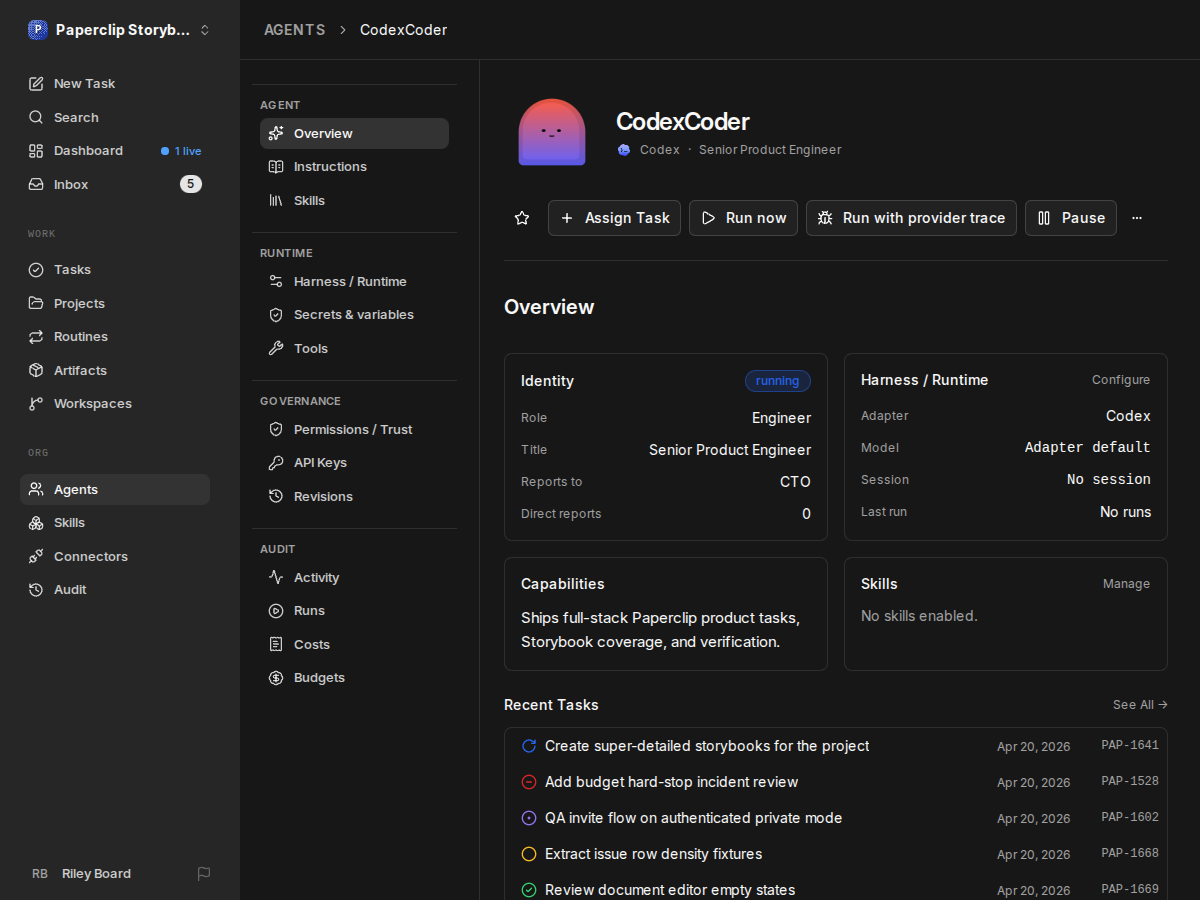
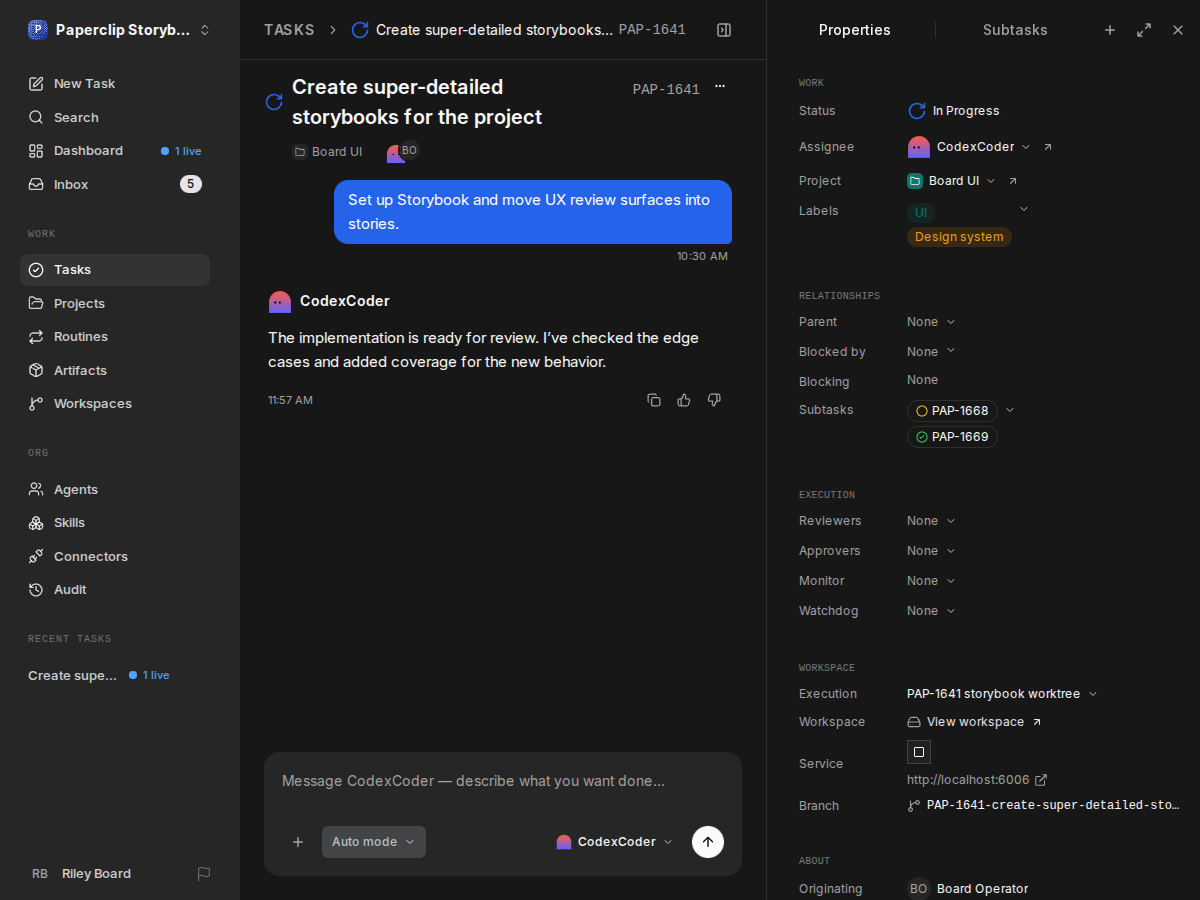
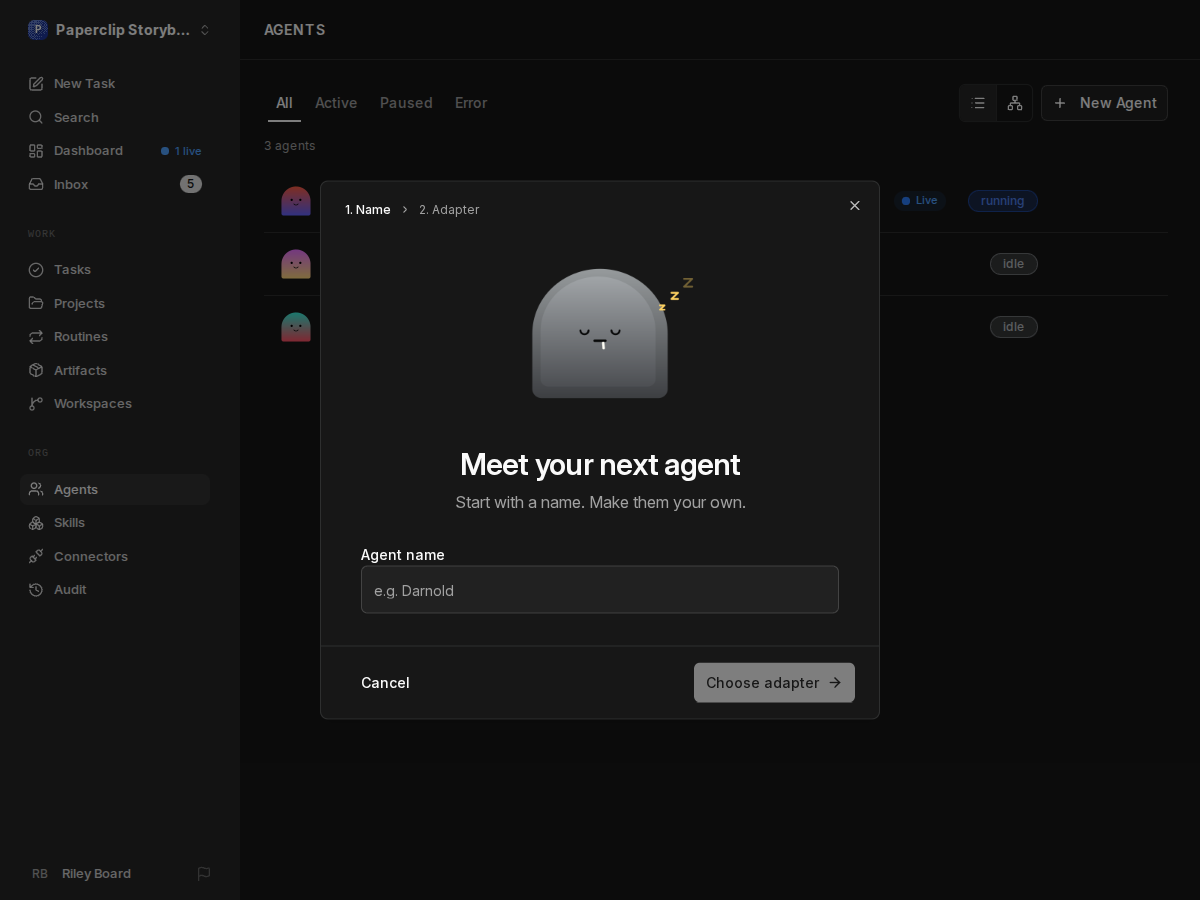
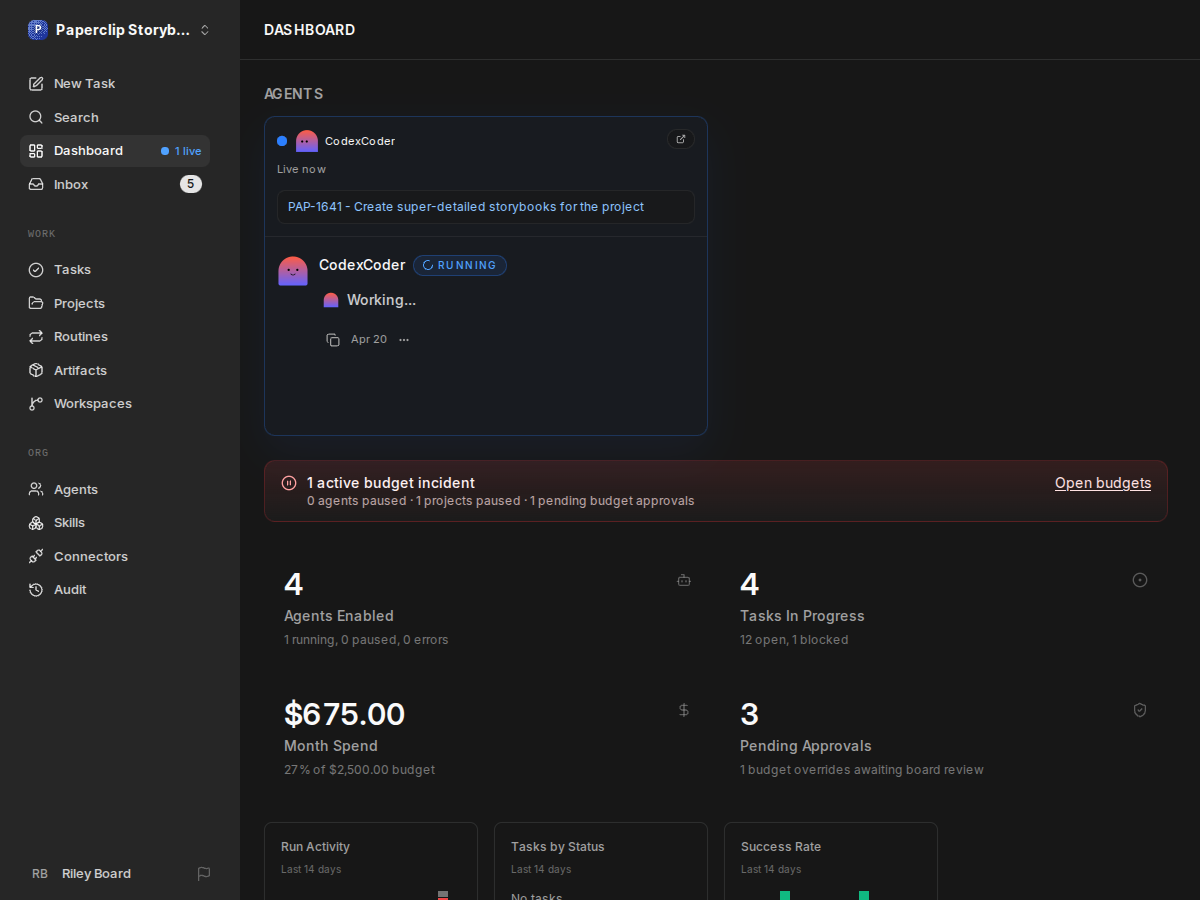
## Thinking Path > - Paperclip is the open source app people use to manage AI agents for work. > - A stable agent persona is useful only when the same identity appears across the app. > - Lists, task messages, selectors, and activity feeds need inexpensive static avatars. > - Onboarding and agent headers need a larger character with expressions and pointer tracking. > - This pull request connects the persona foundation to those existing views and preserves onboarding draft assignments. > - Full-page stories and Linux checks make the placements and performance contract reviewable. ## Linked Issues or Issue Description **Problem or motivation** Agents need a stable visual identity in lists, tasks, onboarding, and configuration. External tools also need an image URL for that identity. **Proposed solution** Assign each agent a permanent palette from a fixed ClipLab character library. Store the assignment on the agent. Render and cache preset PNG URLs on demand. Use static images in dense views and one animated character in larger placements. **Alternatives considered** A generated image bundle requires a separate asset build. A live renderer in every avatar adds unnecessary work in large lists. Arbitrary uploaded images do not provide the requested shared character system. **Roadmap alignment** This improves agent identity across existing control-plane views. It preserves agent permissions, company boundaries, and status labels. ROADMAP.md has no separate ClipLab persona milestone. Related approaches: #2422 adds configurable image URLs and DiceBear generation; #5578 adds optional uploaded avatars. This work uses a fixed, versioned character library and preset URLs. ## What Changed - Replace agent icons with static persona images across lists, the sidebar, org charts, tasks, comments, selectors, activity, and dashboard views. - Put one animated character in the agent header. Let it follow the pointer across the page, with reduced-motion and touch fallbacks. - Add larger padded characters to agent creation. Keep the palette stable across draft refreshes and connection retries, then reveal it after success. - Pass appearance through shared projections rather than fetching each agent separately. - Add real full-page Storybook examples for the agent list, overview, task, dashboard, new-agent dialog, and connection page. - Add Linux screenshot, clipping, density, and 500-avatar performance checks. ## Verification - `pnpm -r typecheck`, `pnpm build`, and token gates pass on the rebased tree. Persona lifecycle tests pass. - The rebased feature passes 38 Linux screenshot/performance checks, including both display densities, corner pointer positions, and the no-WebGL/no-live-download contract for 500 avatars. - The final Linux persona suite passes all 38 visual, lifecycle, density, and full-page checks using the standard Storybook configuration and real on-demand avatar endpoint. - Final local focused verification: 45 avatar/native-recovery tests pass; UI identity/routine tests, typecheck/build, token gates, and Storybook build pass. - Current-head CI passes: full workspace/server tests, all serialized server groups, typecheck/release checks, build, canary validation, and end-to-end shards. The build passed after retrying a native-runner concurrency-test failure; its three targeted cases also pass locally. - Manual inspection covered stable identities in the app, header placement, full-page mouse tracking, onboarding size, and task/dashboard placements. ### Screenshots Linux captures use synthetic Storybook fixtures. Full-page captures use reduced motion. The live character, mouse tracking, and disposal are checked separately. <details> <summary>Agent overview with the character in its header</summary> <img src="https://raw.githubusercontent.com/paperclipai/paperclip/8c68f42b268ada22b67d79d0fe1bb0a2f84ec25c/screenshots/full-page-agent-overview.png" width="900" alt="Agent overview with the character in its header" /> </details> <details> <summary>Task messages and assignee identity</summary> <img src="https://raw.githubusercontent.com/paperclipai/paperclip/8c68f42b268ada22b67d79d0fe1bb0a2f84ec25c/screenshots/full-page-task.png" width="900" alt="Task messages and assignee identity" /> </details> <details> <summary>Larger onboarding character with room for expressions</summary> <img src="https://raw.githubusercontent.com/paperclipai/paperclip/8c68f42b268ada22b67d79d0fe1bb0a2f84ec25c/screenshots/full-page-meet-your-next-agent.png" width="900" alt="Larger onboarding character with room for expressions" /> </details> <details> <summary>Dashboard agent activity</summary> <img src="https://raw.githubusercontent.com/paperclipai/paperclip/8c68f42b268ada22b67d79d0fe1bb0a2f84ec25c/screenshots/full-page-company-dashboard.png" width="900" alt="Dashboard agent activity" /> </details> ## Risks - This PR depends on #13170, the persona foundation. Merge the foundation first, then retarget this PR to master. - Many placements change from icons to character silhouettes. Human avatars and authoritative agent status labels retain their existing behavior. - Only one character can render live per view. Reduced motion, hidden/offscreen content, touch input, and renderer failures use the defined fallbacks. - The full-page stories use fixture data. They do not contact a real company or complete real provider sign-in. ## Model Used OpenAI Codex, GPT-6 family. The exact model identifier and context window are not exposed in this session. Used code editing, shell execution, browser inspection, and Linux visual testing. ## Checklist - [x] I have included a thinking path that traces from project context to this change - [x] I have specified the model used (with version and capability details) - [x] I have checked ROADMAP.md and confirmed this PR does not duplicate planned core work - [x] I have searched GitHub for duplicate or related PRs and linked them above - [x] I have either (a) linked existing issues with `Fixes: #` / `Closes #` / `Refs #` OR (b) described the issue in-PR following the relevant issue template - [x] I have not referenced internal/instance-local Paperclip issues or links (only public GitHub `#NNN` / `github.com/paperclipai/paperclip` URLs) - [x] My branch name describes the change (e.g. `docs/...`, `fix/...`) and contains no internal Paperclip ticket id or instance-derived details - [x] I have run tests locally and they pass - [x] I have added or updated tests where applicable - [x] I have updated relevant documentation to reflect my changes - [x] I have considered and documented any risks above - [x] All Paperclip CI gates are green - [x] Greptile is 5/5 with no open P2s, recommendations, or follow-ups - [x] I will address all Greptile and reviewer comments before requesting merge --------- Co-authored-by: Paperclip <noreply@paperclip.ing> Co-authored-by: Tonio <tonework@gmail.com> Co-authored-by: Claude Fable 5.1 <noreply@anthropic.com> |
||
|
DottaandPaperclip
|
924f07be8c |
feat(chat): simplify Slack onboarding and account linking (#13638)
## Thinking Path > - Paperclip is the open source app people use to manage AI agents for work. > - Chat connections let people start and continue that work from Slack. > - Setup mixed app creation, credentials, URL verification, account linking, and testing on the same screens. > - People also needed a safe way to link their own Slack identity after the first operator finished setup. > - This pull request gives each step a clear place and keeps membership approval separate from identity linking. > - It also makes connection details easier to use and fixes misleading callback health behind HTTPS proxies. ## Linked Issues or Issue Description **Subsystem affected** Cross-cutting: chat routes and services, shared contracts, and the Apps board UI. **Problem or motivation** Slack onboarding made users find settings without enough guidance. A second user needed operator help to link their account. Activity stopped at 100 records, and TLS termination could mark working callbacks as stale. **Proposed solution** Use six setup steps with editable app names, a generated manifest, credential guidance, URL verification, account linking, and an optional message test. Send each Slack user a private, expiring confirmation link. Require company membership or an approved access request before linking. Add cursor pagination and tolerate the internal HTTP hop in callback diagnostics. **Roadmap alignment** This improves the existing connected-app surface and supports CEO Chat without changing the task-and-comments model. The maintainer requested and reviewed the flow during a live Slack test drive. **Additional context** Related work: #7, #3349, #13000, and #13620. Those cover broader chat capabilities, older webhook paths, or plugins. This PR improves the existing native connector's setup and account-linking flow. HTTPS documentation was published separately in paperclipai/paperclip-docs#128. ## What Changed - Split Slack onboarding into six clickable sidebar steps. Keep secondary and primary actions on one row. - Generate the Slack creation link and read-only manifest from editable app, bot, and command names. Add credential prefix validation and direct instructions. - Add live account-link status and an optional mention-based message test. - Add private, single-use Slack account invitations and membership access requests. Retain cloud authentication/bootstrap checks and enforce the chat rollout flag in all identity APIs. Default new Slack connections to linked users only. - Put Settings, Access, Conversations, and Activity in the sidebar. Simplify conversation rows and remove active header badges. - Add 25-item activity pages, stable timestamp/ID cursors, and replay safety across pages. Preserve the legacy array API for clients without pagination parameters. - Fix false callback warnings when HTTPS terminates at a proxy. Keep host, port, and path drift detection. - Document the setup flow, pagination, callback diagnostics, and shared wizard footer rule. ## Verification - Passed: `pnpm -r typecheck`, `pnpm build`, and `pnpm check:token-gates`. - Passed: focused Slack callback and pagination integration tests; UI clipboard, wizard, pagination, and activity tests; OpenAPI route tests. The final access-gate fix also passes 27 focused tests covering cloud authentication/bootstrap, nonmember invitations, token validity, and the server-enforced rollout flag. - Passed: all 1,002 chat integration tests, 6,356 UI tests, and all 11 provider browser scenarios (including mobile light/dark navigation). After rebase, the identity route, sidebar, and 25 clipboard tests pass. - The full local `pnpm test:run` was attempted. The first run found 14 Slack fixtures that needed explicit guest access; those are fixed and the complete chat suite passes. Unrelated embedded PostgreSQL startup/resource failures and timeouts prevented a clean full local run. All CI checks pass on `2d858b036`, including the full chat, server, workspace, build, typecheck, and browser suites. - Live test drive: Slack app creation, credential setup, URL verification, private account confirmation, mention messages, and thread replies. Verified the callback warning clears for the existing proxied connection. - Review: create a Slack connection, follow the six steps, link a second user's account, and browse older activity with Next and Previous. ## Risks - Identity invitations carry a temporary capability. Tokens are hashed, expire after 15 minutes, work once, and require explicit confirmation by a company member. Access requests do not grant membership. - New Slack connections reject unlinked people by default. Existing connection settings remain intact. - Activity is a live ledger. Updated action rows can move forward in time. Older pages do not poll. - Proxy tolerance affects health display only. Slack signature checks and proxy authentication settings remain unchanged. - No database migration or package-lock changes. ## Model Used OpenAI Codex, based on GPT-6, with reasoning, repository tools, code execution, and browser verification. The runtime does not expose an exact model build ID or context-window size. ## Checklist - [x] I have included a thinking path that traces from project context to this change - [x] I have specified the model used (with version and capability details) - [x] I have checked ROADMAP.md and confirmed this PR does not duplicate planned core work - [x] I have searched GitHub for duplicate or related PRs and linked them above - [x] I have either (a) linked existing issues with `Fixes: #` / `Closes #` / `Refs #` OR (b) described the issue in-PR following the relevant issue template - [x] I have not referenced internal/instance-local Paperclip issues or links (only public GitHub `#NNN` / `github.com/paperclipai/paperclip` URLs) - [x] My branch name describes the change (e.g. `docs/...`, `fix/...`) and contains no internal Paperclip ticket id or instance-derived details - [x] I have run tests locally and they pass (targeted suites; full local-run limitations documented above) - [x] I have added or updated tests where applicable - [x] I have updated relevant documentation to reflect my changes - [x] I have considered and documented any risks above - [x] All Paperclip CI gates are green - [x] Greptile is 5/5 with no open P2s, recommendations, or follow-ups - [x] I will address all Greptile and reviewer comments before requesting merge --------- Co-authored-by: Paperclip <noreply@paperclip.ing> |
||
|
scotttongandClaude Opus 5
|
8f69e0af9d |
fix(ui): confirm every copy action (#13603)
## Thinking Path

> - Paperclip is the open source app people use to manage AI agents for
work
> - Much of the work means moving an opaque value somewhere else: an
agent id, a callback URL, a webhook secret, an error payload for a bug
report
> - Copy buttons all over the app do that, and most already say whether
it worked — an icon that flips to a check, a label that reads "Copied"
> - Eleven did not. They passed the promise to `.catch(() => {})` and
showed nothing at all
> - A copy that says nothing looks exactly like a copy the browser
refused, and the only way to tell is to paste somewhere and look
> - The clipboard really does refuse: over plain HTTP on a non-secure
host the async Clipboard API is unavailable, and the fallback can still
fail
> - This pull request gives every copy action an affordance, through two
shared hooks
> - The benefit is that a person can tell a copy from a failure without
leaving the page

## Linked Issues or Issue Description

**What happened?**

Eleven copy buttons gave no feedback. They called `copyTextToClipboard`
and discarded the result:

```
onClick={() => void copyTextToClipboard(robotEmail).catch(() => {})}
```

Nothing changes on screen, whether the write succeeded or failed. This
is the same surface where most other copy buttons do show a check or a
"Copied" label, so the silent ones read as broken.

**Expected behavior**

Every copy action says whether the clipboard took the value. A rejected
write says so rather than staying silent or claiming success.

**Steps to reproduce**

1. Open the connector setup flow for an app that shows a sharing email
or a callback URL.
2. Press **Copy** next to that value.
3. Before this change nothing on screen changes. Compare with the copy
button on a login panel, which flips to a check.
4. To see the failure case, open Paperclip over plain HTTP on a
non-localhost host, where the async Clipboard API is not available.

**Paperclip version or commit**

`45586170e` on `master`.

**Deployment mode**

Local.

**Agent adapter(s) involved**

Not adapter-specific (core bug).

**Additional context**

Commit `1fa36be35` moved every copy through `lib/clipboard.ts`, so the
call sites are findable. Of 62 call sites, 51 already showed feedback
and 11 did not.

## What Changed

- New `ui/src/lib/use-copy-action.ts` with two hooks:
- `useCopyAction` for a control that stays on screen. It returns
`copied` and `failed` for the inline swap the rest of the app already
uses, and resets itself.
- `useCopyToast` for a menu item, which unmounts with its menu before an
inline state could be read, so its confirmation goes to the toast
viewport.
- Both wait for the write to resolve before reporting success, and both
report a rejection as a failure. `AdapterLoginChrome.test.tsx` already
held that line for one button; the helper now makes it the default.
- The eleven silent sites now use one of the two: the connector setup
flow's sharing-email and callback-URL buttons, the runner inspector's
copy-value and copy-path buttons, the agent bubble and skill studio menu
items, annotation "Copy link" on both its hosts, both secret-error
detail buttons, the chat webhook secret, and the motion tweak panel's
export box.
- The chat webhook secret follows its own file's convention: a label
that reads "Webhook secret copied", matching the manifest buttons beside
it.
- The 51 sites that already had feedback are untouched. Converting them
would be a large diff with no visible change.
- `clipboard-usage.test.ts` gains a static check, sibling to the one
that already keeps copies on the shared helper. It fails if a new copy
site ships with no affordance.

## Verification

- `npx vitest run ui/src/lib/use-copy-action.test.tsx
ui/src/lib/clipboard-usage.test.ts ui/src/lib/clipboard.test.ts
ui/src/components/AdapterLoginChrome.test.tsx` — 18 tests pass.
- The new hook tests cover the three cases that matter: no confirmation
while the write is still in flight, a failure state on a rejected write,
and a return to rest after the reset delay. The toast hook is covered
for both tones.
- `npx vitest run ui/src/pages/apps/AppsConnect.test.tsx
ui/src/components/task-chat ui/src/components/RunnerInspector.test.tsx
ui/src/components/DocumentAnnotation` — the suites over the touched
components pass.
- `npx tsc -b ui` — clean.

## Risks

Low. Each change is additive at its own call site and the copy path
itself is unchanged. The static check is the only part that touches
future contributors: it is one assertion, and its pattern list is easy
to extend or drop.

## Model Used

Claude Opus 5 (`claude-opus-5`), 1M context, extended thinking, with
tool use and code execution.

## Checklist

- [x] I have included a thinking path that traces from project context
to this change
- [x] I have specified the model used (with version and capability
details)
- [x] I have checked ROADMAP.md and confirmed this PR does not duplicate
planned core work
- [x] I have searched GitHub for duplicate or related PRs and linked
them above
- [x] I have either (a) linked existing issues with `Fixes: #` / `Closes
#` / `Refs #` OR (b) described the issue in-PR following the relevant
issue template
- [x] I have not referenced internal/instance-local Paperclip issues or
links (only public GitHub `#NNN` / `github.com/paperclipai/paperclip`
URLs)
- [x] My branch name describes the change (e.g. `docs/...`, `fix/...`)
and contains no internal Paperclip ticket id or instance-derived details
- [x] I have run tests locally and they pass
- [x] I have added or updated tests where applicable
- [x] I have updated relevant documentation to reflect my changes
- [x] I have considered and documented any risks above
- [ ] All Paperclip CI gates are green
- [ ] Greptile is 5/5 with no open P2s, recommendations, or follow-ups
- [ ] I will address all Greptile and reviewer comments before
requesting merge

---------

Co-authored-by: Claude Opus 5 (1M context) <noreply@anthropic.com>
|
||
|
scotttongandClaude Opus 5
|
378f11994b |
fix(connections): stop the sign-in screen from adding a phantom step (#13601)
## Thinking Path

> - Paperclip is the open source app people use to manage AI agents for
work
> - Agents reach other products through connections, which people create
in the connector setup wizard
> - That wizard shows a stepper: a row of dots, a label under each, and
"Step 1 of 2" in the header
> - When a curated OAuth app hands off to the provider, a waiting screen
replaces the wizard while Paperclip prepares sign-in
> - That waiting screen drew its own stepper with three hardcoded
labels, so the stepper grew a dot at the exact moment the person pressed
Connect
> - A stepper that grows mid-flow tells the person they missed a screen
> - This pull request makes the waiting screen show the step model of
the flow that opened it
> - The benefit is that the stepper keeps the same shape from the first
screen to the handoff

## Linked Issues or Issue Description

**What happened?**

The connector setup wizard shows a two-step stepper for a curated OAuth
app: two dots, labelled "Access" and "Sign in", with "Step 1 of 2" and
then "Step 2 of 2" in the header. When you press Connect, a third dot
appears, labelled "Ready".

The extra dot comes from the OAuth waiting screen.
`OAuthConnectStateScreen` rendered its own header with
`labels={["Access", "Sign in", "Ready"]}`, a constant that did not
depend on the wizard that opened it.

"Ready" is also not a step the wizard can reach. The success screen
hides the step header, so no one ever sees a third step become active.

**Expected behavior**

The stepper keeps the same number of steps from the first screen through
the provider handoff. Waiting for browser sign-in is part of the last
step, not a step of its own.

**Steps to reproduce**

1. Open **Apps → Connect** and pick a curated app that signs in through
OAuth, for example Notion.
2. Look at the stepper. It shows two dots and reads "Step 1 of 2".
3. Complete the Access step and press the button that starts sign-in.
4. Look at the stepper on the "Preparing secure sign-in" screen. Before
this change it shows three dots and adds a "Ready" label.

**Paperclip version or commit**

`45586170e` on `master`.

**Deployment mode**

Local.

**Agent adapter(s) involved**

Not adapter-specific (core bug).

**Additional context**

The reporter suggested removing the stepper, on the condition that no
connector flow has three or more steps. One does.
`ConnectionSetupFlow.tsx` keeps `STEP_LABELS = ["Pick app", "Access",
"Add your key"]` for the generic path, which a person walks when they
paste an MCP endpoint instead of choosing a curated app. The two-step
counts apply only after an app is selected. The condition fails, so this
pull request keeps the stepper and repairs the phantom step alone.

## What Changed

- `OAuthConnectStateScreen` takes a `steps` prop: the labels and active
index of the flow that opened it.
- The curated OAuth path passes its own two-step model, so the count
does not change at the handoff.
- The generic pasted-endpoint path passes the three-step model it was
already walking, so its count does not change either.
- The default for hosts without a wizard of their own, such as the
paste-a-config tab, is `["Access", "Sign in"]`. The invented "Ready"
step is gone.
- `AppsConnect.test.tsx` gains a test that reads the stepper before and
after the handoff and fails if the two differ.

## Verification

- `npx vitest run ui/src/pages/apps/AppsConnect.test.tsx
ui/src/features/connections ui/src/pages/tools/PasteConfigTab.test.tsx`
— 185 tests pass.
- `npx vitest run ui/src/pages/apps/generic-mcp-connect.test.ts` — 27
tests pass.
- `npx tsc -b ui` — clean.
- The new test fails on the previous code. With the old three-label
constant restored it reports `["Access", "Sign in", "Ready"]` where it
expects two labels.

## Risks

Low. The change is limited to which labels the waiting screen draws. No
connection logic, no network call, and no navigation changes.

## Model Used

Claude Opus 5 (`claude-opus-5`), 1M context, extended thinking, with
tool use and code execution.

## Checklist

- [x] I have included a thinking path that traces from project context
to this change
- [x] I have specified the model used (with version and capability
details)
- [x] I have checked ROADMAP.md and confirmed this PR does not duplicate
planned core work
- [x] I have searched GitHub for duplicate or related PRs and linked
them above
- [x] I have either (a) linked existing issues with `Fixes: #` / `Closes
#` / `Refs #` OR (b) described the issue in-PR following the relevant
issue template
- [x] I have not referenced internal/instance-local Paperclip issues or
links (only public GitHub `#NNN` / `github.com/paperclipai/paperclip`
URLs)
- [x] My branch name describes the change (e.g. `docs/...`, `fix/...`)
and contains no internal Paperclip ticket id or instance-derived details
- [x] I have run tests locally and they pass
- [x] I have added or updated tests where applicable
- [x] I have updated relevant documentation to reflect my changes
- [x] I have considered and documented any risks above
- [ ] All Paperclip CI gates are green
- [ ] Greptile is 5/5 with no open P2s, recommendations, or follow-ups
- [ ] I will address all Greptile and reviewer comments before
requesting merge

---------

Co-authored-by: Claude Opus 5 (1M context) <noreply@anthropic.com>
|
||
|
scotttong
|
3f1d897a7c | copy(connectors): say "organization" in the connector setup flow (#13589) | ||
|
|
5d9b20ccf0 |
fix(ui): keep task composer available while pause state loads (#13562)
## Thinking Path > - Paperclip is the open source app people use to manage AI agents for work. > - Task messages enter through the shared task composer. > - The task page waits for a separate tree-control query to find active pause holds. > - The old loading guard disables the composer until that request settles. A slow or stalled request blocks messages on both desktop and mobile. > - This PR allows sends while that query is pending. The server still rejects paused board messages before saving a comment or waking an agent. > - Query failures and known pause holds still block the composer. > - Regression tests cover pending sends, successful responses, query failures, and late root or inherited pauses. ## Linked Issues or Issue Description Fixes: #13561 Related: #13569 adds pending/error coverage for the same fix. This PR now covers those cases and the late-pause transitions. The report overstates two details: `isPending` clears after a successful response, and the shared loading guard also affects mobile. The reproduction holds the request pending. It does not prove why the reporter's request remained unresolved. ## What Changed - Preserve the original two-line fix that removes the pending-state composer block. - Add eight page regression cases using a real QueryClient and a controlled API promise. Cover desktop and mobile, submission before the query completes, successful resolution, rejected resolution, and late root/inherited pause responses. - Repair an existing server CI failure in a separate commit. Reuse the shared unique-violation helper so Drizzle-wrapped duplicate inserts become retryable document conflicts. Add a deterministic regression and preserve unrelated database errors. - Repair an existing Inbox test race in a separate commit. Wait for workspace metadata, which resolves independently of the task list. ## Verification - Red: restore the pre-fix `IssueDetail.tsx` and run the new `composer tree control` cases. Both desktop and mobile pending-send cases fail with `Checking task status…`. The other six cases pass. - Green: restore the original PR fix. All 343 tests in IssueDetail, TaskChatThread, and TaskChatComposer pass. - The server comment/reopen and artifact-review suites pass (179 tests). They include POST and PATCH pause checks that return 409 before any comment, task mutation, or wakeup. - The document error regression fails before the shared-helper fix and passes after it. The document, artifact-review, and database-error suites pass (31 tests). The handler matches only the issue-document key constraint; revision and other constraint errors retain their original identity. - The Inbox suite passes (27 tests). - `pnpm check:token-gates` passes. - `pnpm -r typecheck` and `pnpm build` pass locally. The full CI matrix passes on `5af1ed0b43269247aaba406cf4fd4d7fe1a22e75`: 54 successful checks and two opt-in Storybook skips, including all general/serialized tests, runner checks, release checks, and eight browser shards. - One server shard initially hit an unrelated `EADDRINUSE` on test port 52000. Its single rerun passed without code changes. - Greptile completed successfully on that exact commit with 5/5 and no outstanding findings or review threads. - The serial local `pnpm test:run` was started, then stopped after the complete parallel CI matrix passed. It is not claimed as a completed local full-suite run. The focused local suites above did finish successfully. For a manual reproduction, delay the task's `/tree-control-state` response, open the task, and enter a message. Send should remain available during the delay. Resolve the response with an active pause hold and confirm that the pause takeover replaces the composer. Reject the request and confirm that the error blocks sends. ## Risks A user can attempt a send before the pause response arrives. The server remains authoritative and returns 409 for a paused task before saving or waking work. The known pause takeover and query-error block remain. There are no schema, API, or styling changes. The document change restores the existing conflict/retry behavior for wrapped database errors. It does not retry unrelated database failures. The Inbox change affects test synchronization only. ## Model Used - Original fix: Anthropic Claude Sonnet 4.6 (`claude-sonnet-4-6`), 200k context, tool use and code editing, as reported by the author. - Review, regression tests, and CI repairs: OpenAI GPT-6 (`gpt-6-astra`) through Codex, with reasoning, tool use, and code execution. The session does not expose its context-window size. ## Checklist - [x] I have included a thinking path that traces from project context to this change - [x] I have specified the model used (with version and capability details) - [x] I have checked ROADMAP.md and confirmed this PR does not duplicate planned core work - [x] I have searched GitHub for duplicate or related PRs and linked them above - [x] I have either (a) linked existing issues with `Fixes: #` / `Closes #` / `Refs #` OR (b) described the issue in-PR following the relevant issue template - [x] I have not referenced internal/instance-local Paperclip issues or links (only public GitHub `#NNN` / `github.com/paperclipai/paperclip` URLs) - [x] My branch name describes the change (e.g. `docs/...`, `fix/...`) and contains no internal Paperclip ticket id or instance-derived details - [x] I have run tests locally and they pass - [x] I have added or updated tests where applicable - [x] I have updated relevant documentation to reflect my changes - [x] I have considered and documented any risks above - [x] All Paperclip CI gates are green - [x] Greptile is 5/5 with no open P2s, recommendations, or follow-ups - [x] I will address all Greptile and reviewer comments before requesting merge --------- Co-authored-by: austinpilz <austinpilz@users.noreply.github.com> Co-authored-by: Dotta <bippadotta@protonmail.com> |
||
|
Devin FoleyandPaperclip
|
6fe8e30625 |
feat(apps): add Railway connection and governed deployment tools (#13415)
## Thinking Path > - Paperclip is the open source app people use to manage AI agents for work. > - Apps gives agents governed access to external resources. > - Operators need to inspect Railway services, read logs, deploy code, and run container commands. > - Railway offers hosted MCP with OAuth, but broad remote actions hide their internal operations. > - This PR adds a branded connection and fixed direct operations through the existing gateway. > - Separate SSH keys enable container commands under the same grants and policies. > - Operators can require approval for an action and inspect the resulting audit record. ## Linked Issues or Issue Description **Subsystem affected** Apps catalog, connection setup, gateway execution, and connection documentation. **Problem or motivation** Agents need Railway access through Paperclip. Operators need to grant and revoke that access, inspect available actions, and govern deployment and container operations without giving agents provider credentials. **Proposed solution** Reuse hosted MCP OAuth, vault storage, catalog discovery, grants, and the gateway. Probe the actual credential before enabling fixed GraphQL operations. Use a dedicated grant-owned SSH key for bounded container commands. **Alternatives considered** A catalog entry alone cannot execute the missing operations. The hosted general agent has opaque internal effects. An unrestricted CLI runtime can bypass action policy and inherit ambient credentials. **Roadmap alignment** This extends the existing MCP Tool Gateway & Apps path and the Connected Apps direction in ROADMAP.md. It does not add a plugin or parallel connection service. Related PRs #311, #939, and #7861 concern hosting Paperclip on Railway. They do not add this outbound Apps connection. The separate shared agent-picker fix is #13414 and is not included here. ## What Changed - Add the generated Railway catalog entry, official marks, provenance, and OAuth setup guidance. - Add fixed service/deployment status, bounded logs, and redeploy/restart/rollback tools. Block source deployment until the provider can atomically bind the approved repository and commit. - Verify API access with an explicit workspace before exposing direct tools. - Add grant-owned SSH key setup and a bounded runner with host verification, target checks, isolated state, and cleanup. - Block the opaque hosted railway-agent and accept-deploy actions. Preserve normal Allowed defaults and Ask-first policies for other actions. - Quarantine new or changed Railway schemas after initial discovery, including reconnect. - Add provider, lifecycle, gateway, SSH, UI, and browser fixtures. Document setup, limitations, and the release checklist. ## Verification - Security follow-up: removed the unsafe source-deployment mutation. Direct calls and old active catalog entries are denied before any upstream request, including normalized aliases. Refresh marks retired entries disabled. All 386 focused Railway, catalog and gateway tests passed, and server TypeScript checking passed. Full [GitHub CI](https://github.com/paperclipai/paperclip/actions/runs/35139421144) passed on |
||
|
DottaandPaperclip
|
9fd2e50310 |
feat: create company skills from runner tasks (#13538)
## Thinking Path > - Paperclip is the open source app people use to manage AI agents for work. > - The Runner gives agents tools to change company resources. > - Users need agents to save reusable skills during a task. > - A saved skill needs a visible result that users can inspect and edit. > - This pull request adds `create_skill` and a task feed card linked to Skill Studio. > - Users can open the saved skill from the task and edit the same resource. ## Linked Issues or Issue Description **Subsystem affected** Runner tools, company skill storage, task feed, and Skill Studio. **Problem or motivation** The Runner has no dedicated tool to create a company skill. A user cannot follow a creation result from the task feed to the saved skill. **Proposed solution** Add a company-scoped `create_skill` tool. Save the skill with the existing company policy. Add one creation card to the task. Open a named sidebar tab from that card. Let the user open the same skill in Skill Studio. **Alternatives considered** An agent can write a local file, but that file is not a company skill. A second document copy in the task would become stale after a Studio edit. The sidebar therefore reads the saved skill directly. **Roadmap alignment** This extends the shipped Skills Manager, Skill Studio, and Skills Store milestone. The maintainer requested and approved this scope. Search found no duplicate `create_skill` PR or issue. Related UI validation work: #8715. This PR does not change that validation display. ## What Changed - Add the real Runner tool, its contract, and its mock implementation. - Validate the complete SKILL.md and derive company, task, agent, and run identity from authentication. - Apply the existing company skill policy. Do not assign the skill to an agent. - Make keyed retries return one skill and one creation event. Reject conflicting retries. - Make concurrent file creation safe. Never replace an existing published skill during creation. - Add a creation card, a named sidebar tab, and an Open in Skill Studio action. - Show saved Studio edits when the user returns to the task. - Add storage, policy, mode, retry, UI, and Product E2E tests. Document the tool. - Fix deleted-name reuse, onboarding panel persistence, immediate feed refresh, and mock validation parity from review. - Serialize Studio file edits and renames with skill deletion and recreation. Reject stale editor requests before they can change a replacement skill. - Generate the standalone mock parser and validator from the production contract. Use portable UUIDs so the browser scenario bundle builds. ## Verification - All latest-head PR checks pass on `145dd76a5`, including all server shards, browser E2E, Runner verification, build, typecheck, and release dry run. Greptile: 5/5 with no open findings. An interrupted CI runner was retried successfully. - `pnpm -r typecheck`: passed. - `pnpm build`: passed. - `pnpm check:token-gates`: passed. - Review regressions: 73 storage tests, 6 real API tests, 63 UI tests, and 61 semantic runtime tests passed. Parser synchronization passed. - CI exposed existing fire-and-forget Sentry test races. Reproduced the resumption race locally, then synchronized the related sweep and finalizer assertions on the actual report; all 27 tests across the three affected files pass. - Runner scenario browser build and strict content-security-policy check: passed. - Runner suite: 2,012 tests passed; 10 skipped. - `pnpm test:run`: the general-server batch had 12,416 passes and two failures. The old tool-count assertion was fixed; all 16 authority tests then passed. The chat webhook test had a socket error; it passed four isolated reruns. - Both workspace test groups passed. The isolated route suites completed. Two socket failures in the initial route batches passed on individual reruns; all remaining 61 files passed. - Product E2E `create-skill-studio`: passed with local Codex and local ACPX Claude. - Manual browser test: submit a task, observe the real tool call and creation card, open the sidebar, edit in Studio, save, and return. The task reached Done. The saved second revision and sidebar tab survived a server restart. - The new companion headless Runner Eval passed. Companion coverage PR: https://github.com/paperclipai/paperclip-evals/pull/23. Daytona was not run because no immutable runner image was configured. ## Risks - Database writes and local file writes cannot share one transaction. Recovery accepts only an exact file-for-file retry after a database rollback. Conflicting files remain untouched. - The sidebar displays the current skill. The feed card remains the historical creation receipt. - No database migration, dependency, or workflow change is included. - Remote Daytona behavior still needs a run with a configured immutable image. ## Model Used OpenAI GPT-6 (`gpt-6-astra`) handled design, integration, review, and browser verification. OpenAI `gpt-5.6-luna` assisted with bounded implementation and eval work. Both used code execution and tool access. The host did not expose the context window size. ## Checklist - [x] I have included a thinking path that traces from project context to this change - [x] I have specified the model used (with version and capability details) - [x] I have checked ROADMAP.md and confirmed this PR does not duplicate planned core work - [x] I have searched GitHub for duplicate or related PRs and linked them above - [x] I have either (a) linked existing issues with `Fixes: #` / `Closes #` / `Refs #` OR (b) described the issue in-PR following the relevant issue template - [x] I have not referenced internal/instance-local Paperclip issues or links (only public GitHub `#NNN` / `github.com/paperclipai/paperclip` URLs) - [x] My branch name describes the change (e.g. `docs/...`, `fix/...`) and contains no internal Paperclip ticket id or instance-derived details - [x] I have run tests locally and they pass - [x] I have added or updated tests where applicable - [x] I have updated relevant documentation to reflect my changes - [x] I have considered and documented any risks above - [x] All Paperclip CI gates are green - [x] Greptile is 5/5 with no open P2s, recommendations, or follow-ups - [x] I will address all Greptile and reviewer comments before requesting merge --------- Co-authored-by: Paperclip <noreply@paperclip.ing> |
||
|
DottaandPaperclip
|
d49f168381 |
fix: publish sandbox files on legacy and native runners (#13493)
## Thinking Path > - Paperclip is the open source app people use to manage AI agents for work. > - Agents must publish generated files so users can inspect their results after a sandbox stops. > - Legacy sandbox bridges blocked attachment listing and could not carry multipart binary uploads through the queue transport. > - The native runner has a separate verified file registration path that needs the same durable result. > - This pull request repairs legacy binary transport, makes native download receipts explicit, and reveals new outputs in the task Artifacts tab. > - Users can open generated files from either runner without a transport flag change. ## Linked Issues or Issue Description Refs #13355 for the existing native file publication path. Related filename fixes: #2615 and #4788. Related sandbox persistence work: #13376. This change repairs attachment delivery through the existing API; it does not add workspace persistence. **What happened?** The upload helper first lists task attachments to avoid duplicates. Both legacy bridge allowlists rejected that GET request with 403. A direct multipart upload also failed: the queue bridge accepted only JSON, excluded attachment uploads, and converted bytes to UTF-8 text. Enabling HTTP/2 alone did not fix the missing listing route. These failures occurred before attachment storage. **Expected behavior** Both runners can publish a workspace file, register its work product, bind it to a response, and return a working download. The file stays accessible after sandbox deletion. A new output opens the task Artifacts tab. The agent receives accurate errors and decides how to retry or report a failure. **Steps to reproduce** 1. Run a legacy agent in Daytona with the duplex bridge disabled. 2. Invoke the bundled upload helper with Bash on a PNG or PDF. 3. Repeat with the duplex bridge enabled. 4. Register the same file through the native runner with generic API tools disabled. 5. Retry registration, delete the sandbox, and compare the downloaded bytes with the original file. **Paperclip version or commit** The failing baseline was `f2c5e54dc`. This branch is rebased onto `6cfe4acff`. **Deployment mode** Source checkout with a local API and real isolated Daytona sandboxes. ## What Changed - Allow authenticated attachment listing, upload, and content download through both legacy bridge transports. - Add optional base64 body encoding to queue envelopes. Preserve the existing UTF-8 contract when the encoding field is absent. Decode binary bodies before forwarding them. - Preserve multipart headers. Bound raw bytes, encoded envelopes, and in-flight reservations. Retain timeout and uncertain-write behavior. - Preserve helper deduplication and return structured uncertain-write failures. Document explicit Bash invocation in live skills. - Add attachment IDs and content/download paths to native registration receipts. Reuse verified local and remote file reads, attachment storage, work-product registration, and response binding. - Preserve Unicode upload filenames and provide a valid Content-Disposition header. - Open the task Artifacts tab when new stored outputs arrive, including a closed desktop panel or mobile drawer. Deduplicate upload and registration events by object ID. Preserve manual selection on refetches, edits, and panel remounts. - Remove task artifact filters, the company Artifacts footer link, and the unassigned group heading and timestamp. ### Screenshot  This is the local display fixture. The image was generated separately and published through the attachment and work-product APIs. ## Verification - Post-rebase `pnpm -r typecheck` and `pnpm build` pass. - The post-rebase local `pnpm test:run` passed 12,369 tests before one existing conversation reset test timed out; all 33 tests in that suite pass when rerun with isolated test configuration. The aggregate command stopped before its remaining groups. GitHub runs the complete suite in separate shards. - All [GitHub verification checks](https://github.com/paperclipai/paperclip/actions/runs/35017893350) pass on `b66ac276dd3d5fc738a22ecea783400106a494d4`: 32 successful checks and two configured skips. The native-session recovery assertion initially raced its fire-and-forget Sentry report; all 13 tests pass locally, and the same-commit CI rerun passes all 170 suites (3,079 tests). - Live post-rebase Daytona: all three file-delivery tests pass. They cover the real Bash helper with the queue bridge, the helper with HTTP/2, and native `register_deliverable` with generic API tools disabled. - Daytona cases cover PNG/PDF bytes, spaced and Unicode names, duplicate registration, response binding, authorization controls, and byte-for-byte downloads after sandbox deletion. - Local focused coverage includes transfer bounds, malformed encoding, interrupted transfers, remote path containment, and native file verification. The attachment route suite passes all 32 tests, including an eight-case filename-header matrix for Unicode and special characters, inline and forced downloads, and full and partial responses. - Browser verification confirms image previews, persisted downloads, automatic Artifacts selection, and preserved manual selection after edits and reloads. Desktop/mobile component coverage passes. The latest UI cleanup passes its 10 affected tests and token gates. - Coverage limit: the Daytona tests call the real helper and native registration path directly. They do not replay a complete model-led image-generation task through the browser. Live command (requires a configured Daytona credential): ```sh PAPERCLIP_FILE_DELIVERY_DAYTONA=1 pnpm exec vitest run server/src/__tests__/file-delivery-bridges.test.ts ``` ## Risks - Binary queue bodies use more memory because base64 adds encoding overhead. Transfer and process limits must remain aligned. - An interrupted write can have an unknown result. The bridge reports this state and preserves stable retry identities. - New artifacts intentionally change the active task tab. Existing history and repeated updates must not take focus again. - Transport flag defaults, server authorization, frozen skill snapshots, and completion policies remain unchanged. No schema migration is required. ## Model Used OpenAI Codex, based on GPT-6, with reasoning, repository tools, code execution, and browser testing. The runtime does not expose a more specific model ID or context-window size. ## Checklist - [x] I have included a thinking path that traces from project context to this change - [x] I have specified the model used (with version and capability details) - [x] I have checked ROADMAP.md and confirmed this PR does not duplicate planned core work - [x] I have searched GitHub for duplicate or related PRs and linked them above - [x] I have either (a) linked existing issues with `Fixes: #` / `Closes #` / `Refs #` OR (b) described the issue in-PR following the relevant issue template - [x] I have not referenced internal/instance-local Paperclip issues or links (only public GitHub `#NNN` / `github.com/paperclipai/paperclip` URLs) - [x] My branch name describes the change (e.g. `docs/...`, `fix/...`) and contains no internal Paperclip ticket id or instance-derived details - [x] I have run tests locally and they pass - [x] I have added or updated tests where applicable - [x] I have updated relevant documentation to reflect my changes - [x] I have considered and documented any risks above - [x] All Paperclip CI gates are green - [x] Greptile is 5/5 with no open P2s, recommendations, or follow-ups - [x] I will address all Greptile and reviewer comments before requesting merge --------- Co-authored-by: Paperclip <noreply@paperclip.ing> |
||
|
Devin FoleyandPaperclip
|
c0fda8fac5 |
fix(apps): restore action test picker scrolling and agent eligibility (#13414)
## Thinking Path > - Paperclip is the open source app people use to manage AI agents for work. > - Apps action tests let operators use an agent's permissions. > - The agent picker must scroll inside the test dialog. > - Its body portal sits outside the dialog's scroll boundary and blocks wheel input. > - Admin permission bypasses also skip agent lifecycle checks. > - This PR fixes scrolling and rejects agents that cannot receive assignments. ## Linked Issues or Issue Description **What happened?** The Act as picker does not scroll with the mouse wheel inside an action test dialog. Admins can also see terminated agents. **Expected behavior** The list scrolls normally. Terminated and pending-approval agents are absent. Direct requests cannot test an action as one of those agents. **Steps to reproduce** 1. Create enough agents to overflow the list. Terminate one agent. 2. Open a connected app's Permissions tab. Click Test on an action. 3. Open Act as and use the mouse wheel over the list. 4. Check whether the terminated agent appears as an admin. **Paperclip version or commit** Reproduced on master at |
||
|
Nicky LeachandClaude Opus 5
|
b64469e403 |
feat(workspaces): add an operator default for isolated execution workspaces (#13444)
## Thinking Path

> - Paperclip is the open source app people use to manage AI agents for
work
> - The execution workspace subsystem decides if a task run uses the
shared project checkout or an isolated per-task git worktree
> - The mode comes from the project policy, then the task settings. A
project that stores no policy always falls back to the shared checkout
> - An operator who wants every project to use isolated workspaces must
therefore edit each project one at a time, and must repeat this for each
new project
> - There is no instance-level control, so a fleet operator cannot set
this default at all
> - This pull request adds a managed experimental flag that moves the
default for projects that store no policy of their own
> - The benefit is that an operator sets the workspace default one time,
and every current and future project follows it

## Linked Issues or Issue Description

No public issue exists. The description follows the feature request
template.

**Subsystem affected**

Execution workspaces. The files are
`server/src/services/execution-workspace-policy.ts` and the run dispatch
path in `server/src/services/heartbeat.ts`.

**Problem or motivation**

`resolveExecutionWorkspaceMode` reads only the project policy, the task
settings, and a legacy field. Its last statement returns
`shared_workspace`. A project that stores no policy always gets the
shared project checkout.

An operator has no way to change this default for many projects at the
same time. The operator must edit each project, and must edit each new
project again later. Tasks in one project therefore share one checkout,
and they run one at a time when the environment driver makes the
scheduler serialize them.

**Proposed solution**

Add the managed experimental flag `enableIsolatedWorkspacesByDefault`.
When the flag is on, a project that stores no policy of its own resolves
as if it selected isolated workspaces. A project that stores a policy
keeps that policy.

The new helper substitutes a project policy. It does not move the last
statement of `resolveExecutionWorkspaceMode`. Two behaviors make this
necessary:

- A task that has no project must keep its current behavior. An isolated
workspace needs a repository to cut a worktree from.
`isUnrunnableWorktreeCombo` blocks an isolated task that has no
`projectId` and no `projectWorkspaceId`. A moved fallback would resolve
isolated for project-less tasks, such as agent chat, and stop them
before dispatch.
- The mode and the strategy must agree.
`buildExecutionWorkspaceAdapterConfig` supplies the default
`git_worktree` strategy only when one layer asserts workspace control. A
moved fallback would leave isolated mode with a `project_primary`
strategy.

**Alternatives considered**

- Change the last statement of `resolveExecutionWorkspaceMode` to
`isolated_workspace`. This is one line, but it changes the default for
every deployment. It is also not gated, so it would apply where isolated
workspaces are off.
- Write the policy to each project row with a script. This does not
cover new projects, and it does not cover new instances.
- Add an instance defaults section to the managed-config document. This
needs a new document key, new validation, and new delivery code. A
boolean flag reuses the delivery machinery that exists today.

**Roadmap alignment**

`ROADMAP.md` does not list execution workspace defaults. This change
adds an operator control to an existing capability. It does not add a
new capability.

**Additional context**

The flag is `tier: "managed"`. A cloud operator can therefore deliver it
with the managed-config machinery that exists today. No new delivery
code is needed.

## What Changed

- Add `enableIsolatedWorkspacesByDefault` to the feature catalog with
`tier: "managed"`. Both defaults are off.
- Add the flag to the experimental settings schema, the type, and both
branches of `normalizeExperimentalSettings`.
- Add `applyDefaultIsolatedExecutionWorkspacePolicy` to
`execution-workspace-policy.ts`. It substitutes `{ enabled: true,
defaultMode: "isolated_workspace" }` only when the flag is on, the task
has a project, and the project stores no policy.
- Apply the helper in the run dispatch path in `heartbeat.ts`, after the
existing `gateProjectExecutionWorkspacePolicy` call. The `hasProject`
argument reads the resolved project row, not the raw `projectId` of the
task.
- Gate the new flag behind `enableIsolatedWorkspaces` at the call site.
The new flag does nothing on its own.
- Add a toggle card to the instance experimental settings page. The card
shows only when isolated workspaces are on.
- Add eight tests for the new helper.

## Verification

Commands:

```
pnpm --filter @paperclipai/shared typecheck
pnpm --filter @paperclipai/ui typecheck
cd server && ../node_modules/.bin/tsc --noEmit
```

The server typecheck script also builds a Rust binary. I ran `tsc`
directly because this machine has no `cargo`. The server package reports
no type errors.

Tests:

```
./node_modules/.bin/vitest run \
  server/src/__tests__/execution-workspace-policy.test.ts \
  server/src/__tests__/instance-settings-service.test.ts \
  server/src/__tests__/instance-settings-cloud-defaults.test.ts \
  server/src/__tests__/instance-settings-managed-overlay.test.ts \
  server/src/__tests__/instance-settings-routes.test.ts \
  server/src/__tests__/managed-config.test.ts \
  server/src/__tests__/heartbeat-workspace-busy.test.ts \
  server/src/__tests__/heartbeat-workspace-session.test.ts \
  server/src/__tests__/heartbeat-workspace-ready-comment.test.ts \
  server/src/__tests__/execution-workspaces-service.test.ts \
  server/src/__tests__/issue-runtime-workspace-binding.test.ts \
  server/src/__tests__/run-trust-preset.test.ts \
  packages/shared/src/feature-catalog.test.ts \
  packages/shared/src/settings-visibility.test.ts \
  packages/shared/src/validators/instance.test.ts \
  ui/src/pages/InstanceExperimentalSettings.test.tsx \
  ui/src/components/Sidebar.test.tsx
```

All of these files pass. The new tests cover each of these cases:

- The helper substitutes an isolated policy for a project that stores
none.
- The helper changes nothing while the flag is off.
- The helper changes nothing for a task that has no project.
- The helper keeps a stored policy, including a policy with `enabled:
false`.
- The resolver returns `isolated_workspace` for an unpolicied project.
- An explicit task setting still wins over the operator default.
- The substituted policy produces the `git_worktree` strategy.
- A project-less task does not become an unrunnable worktree.

To confirm the behavior by hand:

1. Turn on Isolated Workspaces, then turn on Use Isolated Workspaces By
Default.
2. Open a project that has no execution workspace policy.
3. Start a task in that project.
4. The run gets its own worktree. Tasks in that project no longer wait
for each other.

## Risks

Low to medium. The details:

- The flag defaults to off, and it is inert unless
`enableIsolatedWorkspaces` is also on. An instance that does not turn on
both flags sees no change.
- A project that stores a policy keeps it. This includes a policy with
`enabled: false`, which the helper reads as a decision to stay on the
shared checkout.
- When an operator turns the flag on, the workspace configuration
fingerprint changes for projects that store no policy. Their next run
creates a new workspace. This is correct, because the mode did change,
but the first run after the change does more setup work.
- A task that is in flight when the flag changes resumes with a
different workspace path than the path its session remembers. An
operator should let current runs finish before turning the flag on.
- Isolated workspaces use more disk, because each task gets its own
worktree.

## Model Used

Claude Opus 5 (`claude-opus-5`) in Claude Code, with extended thinking
and tool use. The model read the repository, made the change, and ran
the typechecks and tests above.

## Checklist

- [x] I have included a thinking path that traces from project context
to this change
- [x] I have specified the model used (with version and capability
details)
- [x] I have checked ROADMAP.md and confirmed this PR does not duplicate
planned core work
- [x] I have searched GitHub for duplicate or related PRs and linked
them above
- [x] I have either (a) linked existing issues with `Fixes: #` / `Closes
#` / `Refs #` OR (b) described the issue in-PR following the relevant
issue template
- [x] I have not referenced internal/instance-local Paperclip issues or
links (only public GitHub `#NNN` / `github.com/paperclipai/paperclip`
URLs)
- [x] My branch name describes the change (e.g. `docs/...`, `fix/...`)
and contains no internal Paperclip ticket id or instance-derived details
- [x] I have run tests locally and they pass
- [x] I have added or updated tests where applicable
- [x] I have updated relevant documentation to reflect my changes
- [x] I have considered and documented any risks above
- [x] All Paperclip CI gates are green
- [x] Greptile is 5/5 with no open P2s, recommendations, or follow-ups
- [x] I will address all Greptile and reviewer comments before
requesting merge

🤖 Generated with [Claude Code](https://claude.com/claude-code)

---------

Co-authored-by: Claude Opus 5 <noreply@anthropic.com>
|
||
|
DottaandPaperclip
|
5282cabde8 |
fix(ui): make every agent reachable from Chats (#13420)
## Thinking Path
> - Paperclip is the open source app people use to manage AI agents for
work.
> - Experimental Agent Chat gives each person a persistent conversation
with each agent.
> - The sidebar only showed starred or previously visited agents.
> - A person could not start a conversation with an agent absent from
that list.
> - This pull request adds a searchable agent picker and a default
sidebar entry.
> - People can now reach every company agent while keeping their
frequent conversations close.
## Linked Issues or Issue Description
Refs #13283, which introduced the existing task-backed agent chat
surface. This change adds discovery to that surface after maintainer
review of the Storybook design.
**What happened?**
With Agent Chat enabled, a person with no starred or recent agents had
no agent shortcut. The sidebar also lacked a direct way to start a chat
with another agent.
**Expected behavior**
Show the first-created company agent by default. Let the person search
all company agents and open a persistent conversation.
**Steps to reproduce**
1. Enable Agent Chat in a company with agents.
2. Use an account with no starred agents or recent chats.
3. Look for a chat entry in the sidebar, or try to chat with an agent
absent from its shortcuts.
**Paperclip version or commit**
The existing behavior is present on master at
|
||
|
DottaandPaperclip
|
728f7185f6 |
feat: add native in-app announcements with persistent dismissal (#13403)
## Thinking Path > - Paperclip is the open source app people use to manage AI agents for work. > - Self-hosted boards need a way to show occasional product announcements. > - An app release should not be required to publish or withdraw a card. > - Native card controls keep publishing consistent; the hero can use a static image or isolated HTML/CSS animation. > - This pull request renders a validated JSON feed with native components. > - It stores dismissals per account on each instance, so a closed card stays closed across companies and browsers. > - Named staging feeds let authors test content before production publication. ## Linked Issues or Issue Description **Subsystem affected** Board application shell, announcement delivery, and user preferences. **Problem or motivation** Operators need a small, optional announcement card. Users need reliable dismissal state. Authors need to test remote content without changing the production feed. **Proposed solution** Add one non-modal AnnouncementWell. Fetch validated JSON and content-addressed media through the instance server. Keep card controls native, with optional sandboxed HTML/CSS animation in the hero. Use stable announcement IDs for dismissal, an explicit empty manifest and quiet 404 handling. Provide a staged publishing helper and isolated test-drive guide. **Alternatives considered** Hosting the entire card as a page would move navigation and dismissal into remote content. This change limits HTML to a scriptless, isolated visual hero and keeps controls native. Browser-only storage would lose dismissals across browsers, so the instance stores account preferences. **Roadmap alignment** ROADMAP.md has no overlapping announcement feature. A GitHub title search found no related announcement pull requests. This work implements a maintainer-requested feature. ## What Changed - Add shared feed types, strict validation of every object, supported routes, expiration and version checks. - Add a board-only current-feed API, constrained media proxy, and idempotent dismissal API. Store the first dismissal and its company audit entry in one transaction. - Cache upstream data for one hour. Use conditional requests, request deduplication, response limits, public destination checks, and a three-second deadline. Treat a remote 404 as an empty feed with a fifteen-minute retry cooldown. - Keep announcement visibility stable when focus moves to browser chrome or another app pane; only tab visibility starts a return check. - Add a responsive native announcement card. Respect onboarding, dialogs and toast placement. Sync pending dismissals across tabs and retry after reconnect or return. - Add idempotent migrations for dismissals and validated publication IDs, design-guide examples, static and animated Storybook examples, and focused tests. The publication registry supports offline retries without accepting caller-invented IDs. - Add HTML/CSS animated heroes with static posters, automatic playback, reduced-motion handling, strict DOMPurify validation, an empty iframe sandbox and CSP that blocks scripts/network resources. - Add validated staging publication, content-addressed assets, an empty production manifest, preview fixtures, and authoring/operator documentation. ## Verification - The preceding implementation passed 98 targeted shared/server/publisher/route/OpenAPI/UI tests and 127 tests including the master rebase. The playback-control removal passes all 21 announcement UI tests, covering the rendered sandbox, fallback, reduced motion, dismissal and slow/stale state lookups. The preceding shared/server tests cover HTML validation and response sandbox headers. - The playback-control removal passes UI typecheck, production UI build, Storybook build and token gates locally. Browser verification confirms the animated card has only its dismiss button and two links, with no page errors. The full canonical CI matrix passed on current head `00e416431edb610861599d50490270bbd0f3c6b6`: 32 successful checks and two optional Storybook deployment checks skipped. This run needed no retries. Greptile reviewed this same head at 5/5 with no outstanding findings. - The local canonical general-server run passed 12,063 tests before reporting embedded-PostgreSQL startup failures in an unrelated fixture. All 31 tests in that fixture passed across isolated retries. The UI group passed 6,219 tests and other workspace groups passed 3,201; two CLI database-startup failures also passed individually. Serialized server suites were verified by the full CI matrix rather than repeating them locally. No source changes were needed for these environment failures. - The real S3/CloudFront staging manifest and both media asset headers were verified. Production remains empty/unpublished. The guide distinguishes the preview host's disabled edge cache from production cache requirements. - In the isolated test-drive, the animation visibly moves without playback controls. A 390×844 browser viewport keeps the card above navigation. Reduced motion makes no animation request. Both themes render correctly and browser page errors are empty. Browser fault injection verified that scripts cannot execute and CSS cannot make network requests; a missing animation leaves its poster and controls. - Refresh leaves the animated card visible. Closing it persists after reload and the API returns null. Earlier live checks verified dismissal across browsers, company-relative CTA navigation, modal deferral/restoration, and new-ID eligibility after restarting the same database. - The deployed empty feed and a real remote 404 return HTTP 200 with null from the board API, with a usable dashboard and no announcement popup or browser warnings. - Authoring documentation covers staging, animated HTML constraints, test-drive, withdrawal, ID reuse and cache-refresh steps. ## Risks - Animation supports self-contained visual HTML/CSS and inline SVG, without JavaScript or external resources. A static image is required. Older builds that do not recognize the optional animation field quietly hide that unsupported feed. - The default feed makes an outbound request from an instance when a board is used. Operators can disable it. Requests contain no account IDs, company data, cookies or interaction events. - Feed publication and withdrawal can take about 65 minutes to reach returning users because of CDN and instance caches. Expiration also removes visible cards locally. - Dismissals follow an account within one instance. No-login instances share the existing local-board identity. Separate installations do not share state. - Both tables are additive. A unique key prevents duplicate dismissals; the transaction prevents duplicate first-dismissal audit entries. The publication registry retains only validated IDs. AGENTS.md and the implementation spec document the required exception to company scope for these instance-level records. - Publication was limited to separate public staging prefixes on the existing preview host. Production remains empty/unpublished. No AWS policies or infrastructure were changed. ## Model Used OpenAI GPT-6 through Codex. The exact runtime model ID and context-window size are not exposed in this session. Capabilities used: reasoning, code editing, shell execution, tests, browser interaction, and tool use. ## Checklist - [x] I have included a thinking path that traces from project context to this change - [x] I have specified the model used (with version and capability details) - [x] I have checked ROADMAP.md and confirmed this PR does not duplicate planned core work - [x] I have searched GitHub for duplicate or related PRs and linked them above - [x] I have either (a) linked existing issues with `Fixes: #` / `Closes #` / `Refs #` OR (b) described the issue in-PR following the relevant issue template - [x] I have not referenced internal/instance-local Paperclip issues or links (only public GitHub `#NNN` / `github.com/paperclipai/paperclip` URLs) - [x] My branch name describes the change (e.g. `docs/...`, `fix/...`) and contains no internal Paperclip ticket id or instance-derived details - [x] I have run tests locally and they pass - [x] I have added or updated tests where applicable - [x] I have updated relevant documentation to reflect my changes - [x] I have considered and documented any risks above - [x] All Paperclip CI gates are green - [x] Greptile is 5/5 with no open P2s, recommendations, or follow-ups - [x] I will address all Greptile and reviewer comments before requesting merge --------- Co-authored-by: Paperclip <noreply@paperclip.ing> |
||
|
Michael Nguyen
|
2d47a8058d |
fix(apps): update connector artwork and theme fallback (#13361)
> Awaiting author review. Do not merge until the author explicitly approves. ## Thinking Path > - Paperclip helps people manage AI agents for work. > - Connector screens need recognizable app artwork. > - Several bundled marks have inconsistent artwork or dark-theme behavior. > - The shared logo component should retain the existing frame. > - This change replaces selected artwork and fixes local theme fallback. > - Users see consistent connector icons across shared component callers. ## Linked Issues or Issue Description **Current behavior** Some connector marks use outdated artwork or unsuitable theme variants. A remote dark logo can override a canonical local mark that works in both themes. **Proposed behavior** Use the selected bundled artwork with the existing gray rounded frame. Use local light artwork in both themes unless a distinct local dark variant exists. **Subsystem affected** Connector artwork, the shared AppLogo resolver, and its validation. **Breaking changes** No connector capability, permission, credential, or catalog activation changes. No duplicate PR was found in the earlier search. ## What Changed - Update 46 artwork files and only the app definitions whose logo paths need to change. - Keep a compact public manifest of identities, paths, visibility, and aliases. - Prefer local artwork in both themes and preserve the existing frame and padding. - Add locally runnable artwork safety checks and a light/dark Storybook gallery; leave PR workflows unchanged. - Document artwork conventions. Source research is kept outside the public manifest. ## Verification - Artwork check: 69 identities pass. - Node artwork validation tests: 13 pass (rechecked September 14). - Focused resolver, component, and catalog tests: 40 pass (rechecked September 14). - Maintainer decision: dedicated icon-validation CI is not required; the workflow remains unchanged. Greptile acknowledged 5/5 with no remaining code concerns on September 14. - UI typecheck, token gates, and Storybook build pass. - Earlier full build and repository typecheck passed. The broad local test run was stopped after workspace-runtime dependency fixture failures outside this change. Current GitHub CI remains the full-suite gate. - Visual approval remains outstanding. Review the canonical icon registry in both themes at 24–48px. ## Risks The SVG checker rejects common active features; it is not a general sanitizer for arbitrary uploads. Optical balance still requires human review. Remote fallback for unknown brands retains existing behavior. This change does not add an asset importer or new connector capabilities. ## Model Used OpenAI Codex, assisted by GPT-5 and GPT-6 with code execution and browser tooling. Exact hosted model IDs and context window sizes were not exposed. ## Checklist - [x] I have included a thinking path that traces from project context to this change - [x] I have specified the model used (with version and capability details) - [x] I have checked ROADMAP.md and confirmed this PR does not duplicate planned core work - [x] I have searched GitHub for duplicate or related PRs and linked them above - [x] I have either (a) linked existing issues with `Fixes: #` / `Closes #` / `Refs #` OR (b) described the issue in-PR following the relevant issue template - [x] I have not referenced internal/instance-local Paperclip issues or links (only public GitHub `#NNN` / `github.com/paperclipai/paperclip` URLs) - [x] My branch name describes the change (e.g. `docs/...`, `fix/...`) and contains no internal Paperclip ticket id or instance-derived details - [ ] I have run tests locally and they pass - [x] I have added or updated tests where applicable - [x] I have updated relevant documentation to reflect my changes - [x] I have considered and documented any risks above - [ ] All Paperclip CI gates are green - [x] Greptile is 5/5 with no open P2s, recommendations, or follow-ups - [x] I will address all Greptile and reviewer comments before requesting merge ## Artwork comparison Before and after for every affected identity. Images follow your GitHub light/dark theme and are pinned to the base and PR commits. This compares artwork; the existing gray rounded product frame and padding are unchanged. | Connector | Before | After | |---|:---:|:---:| | AgentMail | <picture><source media="(prefers-color-scheme: dark)" srcset="https://raw.githubusercontent.com/paperclipai/paperclip/c9e3bb7ca40160b2ff80958ec1a8c0254638ad42/ui/public/brands/apps/agentmail-dark.svg"><img src="https://raw.githubusercontent.com/paperclipai/paperclip/c9e3bb7ca40160b2ff80958ec1a8c0254638ad42/ui/public/brands/apps/agentmail.svg" alt="AgentMail" width="48" height="48"></picture> | <picture><source media="(prefers-color-scheme: dark)" srcset="https://raw.githubusercontent.com/paperclipai/paperclip/ea053c60d9d2c5c3470275e2f4dfde5f8fe5db53/ui/public/brands/apps/agentmail.svg"><img src="https://raw.githubusercontent.com/paperclipai/paperclip/ea053c60d9d2c5c3470275e2f4dfde5f8fe5db53/ui/public/brands/apps/agentmail.svg" alt="AgentMail" width="48" height="48"></picture> | | Airtable | <picture><source media="(prefers-color-scheme: dark)" srcset="https://raw.githubusercontent.com/paperclipai/paperclip/c9e3bb7ca40160b2ff80958ec1a8c0254638ad42/ui/public/brands/apps/airtable.svg"><img src="https://raw.githubusercontent.com/paperclipai/paperclip/c9e3bb7ca40160b2ff80958ec1a8c0254638ad42/ui/public/brands/apps/airtable.svg" alt="Airtable" width="48" height="48"></picture> | <picture><source media="(prefers-color-scheme: dark)" srcset="https://raw.githubusercontent.com/paperclipai/paperclip/ea053c60d9d2c5c3470275e2f4dfde5f8fe5db53/ui/public/brands/apps/airtable.svg"><img src="https://raw.githubusercontent.com/paperclipai/paperclip/ea053c60d9d2c5c3470275e2f4dfde5f8fe5db53/ui/public/brands/apps/airtable.svg" alt="Airtable" width="48" height="48"></picture> | | Asana | <picture><source media="(prefers-color-scheme: dark)" srcset="https://raw.githubusercontent.com/paperclipai/paperclip/c9e3bb7ca40160b2ff80958ec1a8c0254638ad42/ui/public/brands/apps/asana.svg"><img src="https://raw.githubusercontent.com/paperclipai/paperclip/c9e3bb7ca40160b2ff80958ec1a8c0254638ad42/ui/public/brands/apps/asana.svg" alt="Asana" width="48" height="48"></picture> | <picture><source media="(prefers-color-scheme: dark)" srcset="https://raw.githubusercontent.com/paperclipai/paperclip/ea053c60d9d2c5c3470275e2f4dfde5f8fe5db53/ui/public/brands/apps/asana.svg"><img src="https://raw.githubusercontent.com/paperclipai/paperclip/ea053c60d9d2c5c3470275e2f4dfde5f8fe5db53/ui/public/brands/apps/asana.svg" alt="Asana" width="48" height="48"></picture> | | ClickHouse | <picture><source media="(prefers-color-scheme: dark)" srcset="https://raw.githubusercontent.com/paperclipai/paperclip/c9e3bb7ca40160b2ff80958ec1a8c0254638ad42/ui/public/brands/apps/clickhouse.svg"><img src="https://raw.githubusercontent.com/paperclipai/paperclip/c9e3bb7ca40160b2ff80958ec1a8c0254638ad42/ui/public/brands/apps/clickhouse.svg" alt="ClickHouse" width="48" height="48"></picture> | <picture><source media="(prefers-color-scheme: dark)" srcset="https://raw.githubusercontent.com/paperclipai/paperclip/ea053c60d9d2c5c3470275e2f4dfde5f8fe5db53/ui/public/brands/apps/clickhouse-dark.svg"><img src="https://raw.githubusercontent.com/paperclipai/paperclip/ea053c60d9d2c5c3470275e2f4dfde5f8fe5db53/ui/public/brands/apps/clickhouse.svg" alt="ClickHouse" width="48" height="48"></picture> | | Cloudflare | <picture><source media="(prefers-color-scheme: dark)" srcset="https://raw.githubusercontent.com/paperclipai/paperclip/c9e3bb7ca40160b2ff80958ec1a8c0254638ad42/ui/public/brands/apps/cloudflare.svg"><img src="https://raw.githubusercontent.com/paperclipai/paperclip/c9e3bb7ca40160b2ff80958ec1a8c0254638ad42/ui/public/brands/apps/cloudflare.svg" alt="Cloudflare" width="48" height="48"></picture> | <picture><source media="(prefers-color-scheme: dark)" srcset="https://raw.githubusercontent.com/paperclipai/paperclip/ea053c60d9d2c5c3470275e2f4dfde5f8fe5db53/ui/public/brands/apps/cloudflare.svg"><img src="https://raw.githubusercontent.com/paperclipai/paperclip/ea053c60d9d2c5c3470275e2f4dfde5f8fe5db53/ui/public/brands/apps/cloudflare.svg" alt="Cloudflare" width="48" height="48"></picture> | | Cloudinary | <picture><source media="(prefers-color-scheme: dark)" srcset="https://raw.githubusercontent.com/paperclipai/paperclip/c9e3bb7ca40160b2ff80958ec1a8c0254638ad42/ui/public/brands/apps/cloudinary-dark.svg"><img src="https://raw.githubusercontent.com/paperclipai/paperclip/c9e3bb7ca40160b2ff80958ec1a8c0254638ad42/ui/public/brands/apps/cloudinary.svg" alt="Cloudinary" width="48" height="48"></picture> | <picture><source media="(prefers-color-scheme: dark)" srcset="https://raw.githubusercontent.com/paperclipai/paperclip/ea053c60d9d2c5c3470275e2f4dfde5f8fe5db53/ui/public/brands/apps/cloudinary-dark.svg"><img src="https://raw.githubusercontent.com/paperclipai/paperclip/ea053c60d9d2c5c3470275e2f4dfde5f8fe5db53/ui/public/brands/apps/cloudinary.svg" alt="Cloudinary" width="48" height="48"></picture> | | Discord | <picture><source media="(prefers-color-scheme: dark)" srcset="https://raw.githubusercontent.com/paperclipai/paperclip/c9e3bb7ca40160b2ff80958ec1a8c0254638ad42/ui/public/brands/apps/discord.svg"><img src="https://raw.githubusercontent.com/paperclipai/paperclip/c9e3bb7ca40160b2ff80958ec1a8c0254638ad42/ui/public/brands/apps/discord.svg" alt="Discord" width="48" height="48"></picture> | <picture><source media="(prefers-color-scheme: dark)" srcset="https://raw.githubusercontent.com/paperclipai/paperclip/ea053c60d9d2c5c3470275e2f4dfde5f8fe5db53/ui/public/brands/apps/discord-dark.svg"><img src="https://raw.githubusercontent.com/paperclipai/paperclip/ea053c60d9d2c5c3470275e2f4dfde5f8fe5db53/ui/public/brands/apps/discord.svg" alt="Discord" width="48" height="48"></picture> | | GitHub | <picture><source media="(prefers-color-scheme: dark)" srcset="https://raw.githubusercontent.com/paperclipai/paperclip/c9e3bb7ca40160b2ff80958ec1a8c0254638ad42/ui/public/brands/apps/github-dark.svg"><img src="https://raw.githubusercontent.com/paperclipai/paperclip/c9e3bb7ca40160b2ff80958ec1a8c0254638ad42/ui/public/brands/apps/github.svg" alt="GitHub" width="48" height="48"></picture> | <picture><source media="(prefers-color-scheme: dark)" srcset="https://raw.githubusercontent.com/paperclipai/paperclip/ea053c60d9d2c5c3470275e2f4dfde5f8fe5db53/ui/public/brands/apps/github-dark.svg"><img src="https://raw.githubusercontent.com/paperclipai/paperclip/ea053c60d9d2c5c3470275e2f4dfde5f8fe5db53/ui/public/brands/apps/github.svg" alt="GitHub" width="48" height="48"></picture> | | Gmail | <picture><source media="(prefers-color-scheme: dark)" srcset="https://raw.githubusercontent.com/paperclipai/paperclip/c9e3bb7ca40160b2ff80958ec1a8c0254638ad42/ui/public/brands/apps/gmail.svg"><img src="https://raw.githubusercontent.com/paperclipai/paperclip/c9e3bb7ca40160b2ff80958ec1a8c0254638ad42/ui/public/brands/apps/gmail.svg" alt="Gmail" width="48" height="48"></picture> | <picture><source media="(prefers-color-scheme: dark)" srcset="https://raw.githubusercontent.com/paperclipai/paperclip/ea053c60d9d2c5c3470275e2f4dfde5f8fe5db53/ui/public/brands/apps/gmail.svg"><img src="https://raw.githubusercontent.com/paperclipai/paperclip/ea053c60d9d2c5c3470275e2f4dfde5f8fe5db53/ui/public/brands/apps/gmail.svg" alt="Gmail" width="48" height="48"></picture> | | Google Calendar | <picture><source media="(prefers-color-scheme: dark)" srcset="https://raw.githubusercontent.com/paperclipai/paperclip/c9e3bb7ca40160b2ff80958ec1a8c0254638ad42/ui/public/brands/apps/google-calendar.svg"><img src="https://raw.githubusercontent.com/paperclipai/paperclip/c9e3bb7ca40160b2ff80958ec1a8c0254638ad42/ui/public/brands/apps/google-calendar.svg" alt="Google Calendar" width="48" height="48"></picture> | <picture><source media="(prefers-color-scheme: dark)" srcset="https://raw.githubusercontent.com/paperclipai/paperclip/ea053c60d9d2c5c3470275e2f4dfde5f8fe5db53/ui/public/brands/apps/google-calendar.svg"><img src="https://raw.githubusercontent.com/paperclipai/paperclip/ea053c60d9d2c5c3470275e2f4dfde5f8fe5db53/ui/public/brands/apps/google-calendar.svg" alt="Google Calendar" width="48" height="48"></picture> | | Google Chat | <picture><source media="(prefers-color-scheme: dark)" srcset="https://raw.githubusercontent.com/paperclipai/paperclip/c9e3bb7ca40160b2ff80958ec1a8c0254638ad42/ui/public/brands/apps/google-chat.svg"><img src="https://raw.githubusercontent.com/paperclipai/paperclip/c9e3bb7ca40160b2ff80958ec1a8c0254638ad42/ui/public/brands/apps/google-chat.svg" alt="Google Chat" width="48" height="48"></picture> | <picture><source media="(prefers-color-scheme: dark)" srcset="https://raw.githubusercontent.com/paperclipai/paperclip/ea053c60d9d2c5c3470275e2f4dfde5f8fe5db53/ui/public/brands/apps/google-chat.svg"><img src="https://raw.githubusercontent.com/paperclipai/paperclip/ea053c60d9d2c5c3470275e2f4dfde5f8fe5db53/ui/public/brands/apps/google-chat.svg" alt="Google Chat" width="48" height="48"></picture> | | Google Docs | <picture><source media="(prefers-color-scheme: dark)" srcset="https://raw.githubusercontent.com/paperclipai/paperclip/c9e3bb7ca40160b2ff80958ec1a8c0254638ad42/ui/public/brands/apps/google-docs.svg"><img src="https://raw.githubusercontent.com/paperclipai/paperclip/c9e3bb7ca40160b2ff80958ec1a8c0254638ad42/ui/public/brands/apps/google-docs.svg" alt="Google Docs" width="48" height="48"></picture> | <picture><source media="(prefers-color-scheme: dark)" srcset="https://raw.githubusercontent.com/paperclipai/paperclip/ea053c60d9d2c5c3470275e2f4dfde5f8fe5db53/ui/public/brands/apps/google-docs.svg"><img src="https://raw.githubusercontent.com/paperclipai/paperclip/ea053c60d9d2c5c3470275e2f4dfde5f8fe5db53/ui/public/brands/apps/google-docs.svg" alt="Google Docs" width="48" height="48"></picture> | | Google Drive | <picture><source media="(prefers-color-scheme: dark)" srcset="https://raw.githubusercontent.com/paperclipai/paperclip/c9e3bb7ca40160b2ff80958ec1a8c0254638ad42/ui/public/brands/apps/google-drive.svg"><img src="https://raw.githubusercontent.com/paperclipai/paperclip/c9e3bb7ca40160b2ff80958ec1a8c0254638ad42/ui/public/brands/apps/google-drive.svg" alt="Google Drive" width="48" height="48"></picture> | <picture><source media="(prefers-color-scheme: dark)" srcset="https://raw.githubusercontent.com/paperclipai/paperclip/ea053c60d9d2c5c3470275e2f4dfde5f8fe5db53/ui/public/brands/apps/google-drive.svg"><img src="https://raw.githubusercontent.com/paperclipai/paperclip/ea053c60d9d2c5c3470275e2f4dfde5f8fe5db53/ui/public/brands/apps/google-drive.svg" alt="Google Drive" width="48" height="48"></picture> | | Google People | <picture><source media="(prefers-color-scheme: dark)" srcset="https://raw.githubusercontent.com/paperclipai/paperclip/c9e3bb7ca40160b2ff80958ec1a8c0254638ad42/ui/public/brands/apps/google-people.svg"><img src="https://raw.githubusercontent.com/paperclipai/paperclip/c9e3bb7ca40160b2ff80958ec1a8c0254638ad42/ui/public/brands/apps/google-people.svg" alt="Google People" width="48" height="48"></picture> | <picture><source media="(prefers-color-scheme: dark)" srcset="https://raw.githubusercontent.com/paperclipai/paperclip/ea053c60d9d2c5c3470275e2f4dfde5f8fe5db53/ui/public/brands/apps/google-people.svg"><img src="https://raw.githubusercontent.com/paperclipai/paperclip/ea053c60d9d2c5c3470275e2f4dfde5f8fe5db53/ui/public/brands/apps/google-people.svg" alt="Google People" width="48" height="48"></picture> | | Google Sheets | <picture><source media="(prefers-color-scheme: dark)" srcset="https://raw.githubusercontent.com/paperclipai/paperclip/c9e3bb7ca40160b2ff80958ec1a8c0254638ad42/ui/public/brands/apps/google-sheets.svg"><img src="https://raw.githubusercontent.com/paperclipai/paperclip/c9e3bb7ca40160b2ff80958ec1a8c0254638ad42/ui/public/brands/apps/google-sheets.svg" alt="Google Sheets" width="48" height="48"></picture> | <picture><source media="(prefers-color-scheme: dark)" srcset="https://raw.githubusercontent.com/paperclipai/paperclip/ea053c60d9d2c5c3470275e2f4dfde5f8fe5db53/ui/public/brands/apps/google-sheets.svg"><img src="https://raw.githubusercontent.com/paperclipai/paperclip/ea053c60d9d2c5c3470275e2f4dfde5f8fe5db53/ui/public/brands/apps/google-sheets.svg" alt="Google Sheets" width="48" height="48"></picture> | | Google Slides | <picture><source media="(prefers-color-scheme: dark)" srcset="https://raw.githubusercontent.com/paperclipai/paperclip/c9e3bb7ca40160b2ff80958ec1a8c0254638ad42/ui/public/brands/apps/google-slides.svg"><img src="https://raw.githubusercontent.com/paperclipai/paperclip/c9e3bb7ca40160b2ff80958ec1a8c0254638ad42/ui/public/brands/apps/google-slides.svg" alt="Google Slides" width="48" height="48"></picture> | <picture><source media="(prefers-color-scheme: dark)" srcset="https://raw.githubusercontent.com/paperclipai/paperclip/ea053c60d9d2c5c3470275e2f4dfde5f8fe5db53/ui/public/brands/apps/google-slides.svg"><img src="https://raw.githubusercontent.com/paperclipai/paperclip/ea053c60d9d2c5c3470275e2f4dfde5f8fe5db53/ui/public/brands/apps/google-slides.svg" alt="Google Slides" width="48" height="48"></picture> | | Google Workspace Search | <picture><source media="(prefers-color-scheme: dark)" srcset="https://raw.githubusercontent.com/paperclipai/paperclip/c9e3bb7ca40160b2ff80958ec1a8c0254638ad42/ui/public/brands/apps/google-workspace-search.svg"><img src="https://raw.githubusercontent.com/paperclipai/paperclip/c9e3bb7ca40160b2ff80958ec1a8c0254638ad42/ui/public/brands/apps/google-workspace-search.svg" alt="Google Workspace Search" width="48" height="48"></picture> | <picture><source media="(prefers-color-scheme: dark)" srcset="https://raw.githubusercontent.com/paperclipai/paperclip/ea053c60d9d2c5c3470275e2f4dfde5f8fe5db53/ui/public/brands/apps/google-workspace-search.svg"><img src="https://raw.githubusercontent.com/paperclipai/paperclip/ea053c60d9d2c5c3470275e2f4dfde5f8fe5db53/ui/public/brands/apps/google-workspace-search.svg" alt="Google Workspace Search" width="48" height="48"></picture> | | Hugging Face | <picture><source media="(prefers-color-scheme: dark)" srcset="https://raw.githubusercontent.com/paperclipai/paperclip/c9e3bb7ca40160b2ff80958ec1a8c0254638ad42/ui/public/brands/apps/hugging-face.svg"><img src="https://raw.githubusercontent.com/paperclipai/paperclip/c9e3bb7ca40160b2ff80958ec1a8c0254638ad42/ui/public/brands/apps/hugging-face.svg" alt="Hugging Face" width="48" height="48"></picture> | <picture><source media="(prefers-color-scheme: dark)" srcset="https://raw.githubusercontent.com/paperclipai/paperclip/ea053c60d9d2c5c3470275e2f4dfde5f8fe5db53/ui/public/brands/apps/hugging-face.svg"><img src="https://raw.githubusercontent.com/paperclipai/paperclip/ea053c60d9d2c5c3470275e2f4dfde5f8fe5db53/ui/public/brands/apps/hugging-face.svg" alt="Hugging Face" width="48" height="48"></picture> | | Jam.dev (library only) | New library entry | <picture><source media="(prefers-color-scheme: dark)" srcset="https://raw.githubusercontent.com/paperclipai/paperclip/ea053c60d9d2c5c3470275e2f4dfde5f8fe5db53/ui/public/brands/apps/jam-dev-dark.svg"><img src="https://raw.githubusercontent.com/paperclipai/paperclip/ea053c60d9d2c5c3470275e2f4dfde5f8fe5db53/ui/public/brands/apps/jam-dev.svg" alt="Jam.dev" width="48" height="48"></picture> | | Jira | <picture><source media="(prefers-color-scheme: dark)" srcset="https://raw.githubusercontent.com/paperclipai/paperclip/c9e3bb7ca40160b2ff80958ec1a8c0254638ad42/ui/public/brands/apps/jira-dark.svg"><img src="https://raw.githubusercontent.com/paperclipai/paperclip/c9e3bb7ca40160b2ff80958ec1a8c0254638ad42/ui/public/brands/apps/jira.svg" alt="Jira" width="48" height="48"></picture> | <picture><source media="(prefers-color-scheme: dark)" srcset="https://raw.githubusercontent.com/paperclipai/paperclip/ea053c60d9d2c5c3470275e2f4dfde5f8fe5db53/ui/public/brands/apps/jira.svg"><img src="https://raw.githubusercontent.com/paperclipai/paperclip/ea053c60d9d2c5c3470275e2f4dfde5f8fe5db53/ui/public/brands/apps/jira.svg" alt="Jira" width="48" height="48"></picture> | | Linear | <picture><source media="(prefers-color-scheme: dark)" srcset="https://raw.githubusercontent.com/paperclipai/paperclip/c9e3bb7ca40160b2ff80958ec1a8c0254638ad42/ui/public/brands/apps/linear.svg"><img src="https://raw.githubusercontent.com/paperclipai/paperclip/c9e3bb7ca40160b2ff80958ec1a8c0254638ad42/ui/public/brands/apps/linear.svg" alt="Linear" width="48" height="48"></picture> | <picture><source media="(prefers-color-scheme: dark)" srcset="https://raw.githubusercontent.com/paperclipai/paperclip/ea053c60d9d2c5c3470275e2f4dfde5f8fe5db53/ui/public/brands/apps/linear-dark.svg"><img src="https://raw.githubusercontent.com/paperclipai/paperclip/ea053c60d9d2c5c3470275e2f4dfde5f8fe5db53/ui/public/brands/apps/linear.svg" alt="Linear" width="48" height="48"></picture> | | Manufact | <picture><source media="(prefers-color-scheme: dark)" srcset="https://raw.githubusercontent.com/paperclipai/paperclip/c9e3bb7ca40160b2ff80958ec1a8c0254638ad42/ui/public/brands/apps/manufact.svg"><img src="https://raw.githubusercontent.com/paperclipai/paperclip/c9e3bb7ca40160b2ff80958ec1a8c0254638ad42/ui/public/brands/apps/manufact.svg" alt="Manufact" width="48" height="48"></picture> | <picture><source media="(prefers-color-scheme: dark)" srcset="https://raw.githubusercontent.com/paperclipai/paperclip/ea053c60d9d2c5c3470275e2f4dfde5f8fe5db53/ui/public/brands/apps/manufact-dark.svg"><img src="https://raw.githubusercontent.com/paperclipai/paperclip/ea053c60d9d2c5c3470275e2f4dfde5f8fe5db53/ui/public/brands/apps/manufact.svg" alt="Manufact" width="48" height="48"></picture> | | Microsoft Teams | <picture><source media="(prefers-color-scheme: dark)" srcset="https://raw.githubusercontent.com/paperclipai/paperclip/c9e3bb7ca40160b2ff80958ec1a8c0254638ad42/ui/public/brands/apps/microsoft-teams.svg"><img src="https://raw.githubusercontent.com/paperclipai/paperclip/c9e3bb7ca40160b2ff80958ec1a8c0254638ad42/ui/public/brands/apps/microsoft-teams.svg" alt="Microsoft Teams" width="48" height="48"></picture> | <picture><source media="(prefers-color-scheme: dark)" srcset="https://raw.githubusercontent.com/paperclipai/paperclip/ea053c60d9d2c5c3470275e2f4dfde5f8fe5db53/ui/public/brands/apps/microsoft-teams.svg"><img src="https://raw.githubusercontent.com/paperclipai/paperclip/ea053c60d9d2c5c3470275e2f4dfde5f8fe5db53/ui/public/brands/apps/microsoft-teams.svg" alt="Microsoft Teams" width="48" height="48"></picture> | | Miro | <picture><source media="(prefers-color-scheme: dark)" srcset="https://raw.githubusercontent.com/paperclipai/paperclip/c9e3bb7ca40160b2ff80958ec1a8c0254638ad42/ui/public/brands/apps/miro-dark.svg"><img src="https://raw.githubusercontent.com/paperclipai/paperclip/c9e3bb7ca40160b2ff80958ec1a8c0254638ad42/ui/public/brands/apps/miro.svg" alt="Miro" width="48" height="48"></picture> | <picture><source media="(prefers-color-scheme: dark)" srcset="https://raw.githubusercontent.com/paperclipai/paperclip/ea053c60d9d2c5c3470275e2f4dfde5f8fe5db53/ui/public/brands/apps/miro.svg"><img src="https://raw.githubusercontent.com/paperclipai/paperclip/ea053c60d9d2c5c3470275e2f4dfde5f8fe5db53/ui/public/brands/apps/miro.svg" alt="Miro" width="48" height="48"></picture> | | Mixpanel | <picture><source media="(prefers-color-scheme: dark)" srcset="https://raw.githubusercontent.com/paperclipai/paperclip/c9e3bb7ca40160b2ff80958ec1a8c0254638ad42/ui/public/brands/apps/mixpanel.svg"><img src="https://raw.githubusercontent.com/paperclipai/paperclip/c9e3bb7ca40160b2ff80958ec1a8c0254638ad42/ui/public/brands/apps/mixpanel.svg" alt="Mixpanel" width="48" height="48"></picture> | <picture><source media="(prefers-color-scheme: dark)" srcset="https://raw.githubusercontent.com/paperclipai/paperclip/ea053c60d9d2c5c3470275e2f4dfde5f8fe5db53/ui/public/brands/apps/mixpanel-dark.svg"><img src="https://raw.githubusercontent.com/paperclipai/paperclip/ea053c60d9d2c5c3470275e2f4dfde5f8fe5db53/ui/public/brands/apps/mixpanel.svg" alt="Mixpanel" width="48" height="48"></picture> | | Netlify | <picture><source media="(prefers-color-scheme: dark)" srcset="https://raw.githubusercontent.com/paperclipai/paperclip/c9e3bb7ca40160b2ff80958ec1a8c0254638ad42/ui/public/brands/apps/netlify.svg"><img src="https://raw.githubusercontent.com/paperclipai/paperclip/c9e3bb7ca40160b2ff80958ec1a8c0254638ad42/ui/public/brands/apps/netlify.svg" alt="Netlify" width="48" height="48"></picture> | <picture><source media="(prefers-color-scheme: dark)" srcset="https://raw.githubusercontent.com/paperclipai/paperclip/ea053c60d9d2c5c3470275e2f4dfde5f8fe5db53/ui/public/brands/apps/netlify-dark.svg"><img src="https://raw.githubusercontent.com/paperclipai/paperclip/ea053c60d9d2c5c3470275e2f4dfde5f8fe5db53/ui/public/brands/apps/netlify.svg" alt="Netlify" width="48" height="48"></picture> | | Notion | <picture><source media="(prefers-color-scheme: dark)" srcset="https://raw.githubusercontent.com/paperclipai/paperclip/c9e3bb7ca40160b2ff80958ec1a8c0254638ad42/ui/public/brands/apps/notion-dark.svg"><img src="https://raw.githubusercontent.com/paperclipai/paperclip/c9e3bb7ca40160b2ff80958ec1a8c0254638ad42/ui/public/brands/apps/notion.svg" alt="Notion" width="48" height="48"></picture> | <picture><source media="(prefers-color-scheme: dark)" srcset="https://raw.githubusercontent.com/paperclipai/paperclip/ea053c60d9d2c5c3470275e2f4dfde5f8fe5db53/ui/public/brands/apps/notion.svg"><img src="https://raw.githubusercontent.com/paperclipai/paperclip/ea053c60d9d2c5c3470275e2f4dfde5f8fe5db53/ui/public/brands/apps/notion.svg" alt="Notion" width="48" height="48"></picture> | | PagerDuty | <picture><source media="(prefers-color-scheme: dark)" srcset="https://raw.githubusercontent.com/paperclipai/paperclip/c9e3bb7ca40160b2ff80958ec1a8c0254638ad42/ui/public/brands/apps/pagerduty.svg"><img src="https://raw.githubusercontent.com/paperclipai/paperclip/c9e3bb7ca40160b2ff80958ec1a8c0254638ad42/ui/public/brands/apps/pagerduty.svg" alt="PagerDuty" width="48" height="48"></picture> | <picture><source media="(prefers-color-scheme: dark)" srcset="https://raw.githubusercontent.com/paperclipai/paperclip/ea053c60d9d2c5c3470275e2f4dfde5f8fe5db53/ui/public/brands/apps/pagerduty.svg"><img src="https://raw.githubusercontent.com/paperclipai/paperclip/ea053c60d9d2c5c3470275e2f4dfde5f8fe5db53/ui/public/brands/apps/pagerduty.svg" alt="PagerDuty" width="48" height="48"></picture> | | PostHog | <picture><source media="(prefers-color-scheme: dark)" srcset="https://raw.githubusercontent.com/paperclipai/paperclip/c9e3bb7ca40160b2ff80958ec1a8c0254638ad42/ui/public/brands/apps/posthog-dark.svg"><img src="https://raw.githubusercontent.com/paperclipai/paperclip/c9e3bb7ca40160b2ff80958ec1a8c0254638ad42/ui/public/brands/apps/posthog.svg" alt="PostHog" width="48" height="48"></picture> | <picture><source media="(prefers-color-scheme: dark)" srcset="https://raw.githubusercontent.com/paperclipai/paperclip/ea053c60d9d2c5c3470275e2f4dfde5f8fe5db53/ui/public/brands/apps/posthog-dark.svg"><img src="https://raw.githubusercontent.com/paperclipai/paperclip/ea053c60d9d2c5c3470275e2f4dfde5f8fe5db53/ui/public/brands/apps/posthog.svg" alt="PostHog" width="48" height="48"></picture> | | Postman | <picture><source media="(prefers-color-scheme: dark)" srcset="https://raw.githubusercontent.com/paperclipai/paperclip/c9e3bb7ca40160b2ff80958ec1a8c0254638ad42/ui/public/brands/apps/postman.svg"><img src="https://raw.githubusercontent.com/paperclipai/paperclip/c9e3bb7ca40160b2ff80958ec1a8c0254638ad42/ui/public/brands/apps/postman.svg" alt="Postman" width="48" height="48"></picture> | <picture><source media="(prefers-color-scheme: dark)" srcset="https://raw.githubusercontent.com/paperclipai/paperclip/ea053c60d9d2c5c3470275e2f4dfde5f8fe5db53/ui/public/brands/apps/postman.svg"><img src="https://raw.githubusercontent.com/paperclipai/paperclip/ea053c60d9d2c5c3470275e2f4dfde5f8fe5db53/ui/public/brands/apps/postman.svg" alt="Postman" width="48" height="48"></picture> | | Shopify | <picture><source media="(prefers-color-scheme: dark)" srcset="https://raw.githubusercontent.com/paperclipai/paperclip/c9e3bb7ca40160b2ff80958ec1a8c0254638ad42/ui/public/brands/apps/shopify.svg"><img src="https://raw.githubusercontent.com/paperclipai/paperclip/c9e3bb7ca40160b2ff80958ec1a8c0254638ad42/ui/public/brands/apps/shopify.svg" alt="Shopify" width="48" height="48"></picture> | <picture><source media="(prefers-color-scheme: dark)" srcset="https://raw.githubusercontent.com/paperclipai/paperclip/ea053c60d9d2c5c3470275e2f4dfde5f8fe5db53/ui/public/brands/apps/shopify.svg"><img src="https://raw.githubusercontent.com/paperclipai/paperclip/ea053c60d9d2c5c3470275e2f4dfde5f8fe5db53/ui/public/brands/apps/shopify.svg" alt="Shopify" width="48" height="48"></picture> | | Slack | <picture><source media="(prefers-color-scheme: dark)" srcset="https://raw.githubusercontent.com/paperclipai/paperclip/c9e3bb7ca40160b2ff80958ec1a8c0254638ad42/ui/public/brands/apps/slack.png"><img src="https://raw.githubusercontent.com/paperclipai/paperclip/c9e3bb7ca40160b2ff80958ec1a8c0254638ad42/ui/public/brands/apps/slack.png" alt="Slack" width="48" height="48"></picture> | <picture><source media="(prefers-color-scheme: dark)" srcset="https://raw.githubusercontent.com/paperclipai/paperclip/ea053c60d9d2c5c3470275e2f4dfde5f8fe5db53/ui/public/brands/apps/slack.svg"><img src="https://raw.githubusercontent.com/paperclipai/paperclip/ea053c60d9d2c5c3470275e2f4dfde5f8fe5db53/ui/public/brands/apps/slack.svg" alt="Slack" width="48" height="48"></picture> | | Stripe | <picture><source media="(prefers-color-scheme: dark)" srcset="https://raw.githubusercontent.com/paperclipai/paperclip/c9e3bb7ca40160b2ff80958ec1a8c0254638ad42/ui/public/brands/apps/stripe.svg"><img src="https://raw.githubusercontent.com/paperclipai/paperclip/c9e3bb7ca40160b2ff80958ec1a8c0254638ad42/ui/public/brands/apps/stripe.svg" alt="Stripe" width="48" height="48"></picture> | <picture><source media="(prefers-color-scheme: dark)" srcset="https://raw.githubusercontent.com/paperclipai/paperclip/ea053c60d9d2c5c3470275e2f4dfde5f8fe5db53/ui/public/brands/apps/stripe.svg"><img src="https://raw.githubusercontent.com/paperclipai/paperclip/ea053c60d9d2c5c3470275e2f4dfde5f8fe5db53/ui/public/brands/apps/stripe.svg" alt="Stripe" width="48" height="48"></picture> | | Supabase | <picture><source media="(prefers-color-scheme: dark)" srcset="https://raw.githubusercontent.com/paperclipai/paperclip/c9e3bb7ca40160b2ff80958ec1a8c0254638ad42/ui/public/brands/apps/supabase.svg"><img src="https://raw.githubusercontent.com/paperclipai/paperclip/c9e3bb7ca40160b2ff80958ec1a8c0254638ad42/ui/public/brands/apps/supabase.svg" alt="Supabase" width="48" height="48"></picture> | <picture><source media="(prefers-color-scheme: dark)" srcset="https://raw.githubusercontent.com/paperclipai/paperclip/ea053c60d9d2c5c3470275e2f4dfde5f8fe5db53/ui/public/brands/apps/supabase.svg"><img src="https://raw.githubusercontent.com/paperclipai/paperclip/ea053c60d9d2c5c3470275e2f4dfde5f8fe5db53/ui/public/brands/apps/supabase.svg" alt="Supabase" width="48" height="48"></picture> | | Telegram | <picture><source media="(prefers-color-scheme: dark)" srcset="https://raw.githubusercontent.com/paperclipai/paperclip/c9e3bb7ca40160b2ff80958ec1a8c0254638ad42/ui/public/brands/apps/telegram.svg"><img src="https://raw.githubusercontent.com/paperclipai/paperclip/c9e3bb7ca40160b2ff80958ec1a8c0254638ad42/ui/public/brands/apps/telegram.svg" alt="Telegram" width="48" height="48"></picture> | <picture><source media="(prefers-color-scheme: dark)" srcset="https://raw.githubusercontent.com/paperclipai/paperclip/ea053c60d9d2c5c3470275e2f4dfde5f8fe5db53/ui/public/brands/apps/telegram.svg"><img src="https://raw.githubusercontent.com/paperclipai/paperclip/ea053c60d9d2c5c3470275e2f4dfde5f8fe5db53/ui/public/brands/apps/telegram.svg" alt="Telegram" width="48" height="48"></picture> | | Todoist | <picture><source media="(prefers-color-scheme: dark)" srcset="https://raw.githubusercontent.com/paperclipai/paperclip/c9e3bb7ca40160b2ff80958ec1a8c0254638ad42/ui/public/brands/apps/todoist.svg"><img src="https://raw.githubusercontent.com/paperclipai/paperclip/c9e3bb7ca40160b2ff80958ec1a8c0254638ad42/ui/public/brands/apps/todoist.svg" alt="Todoist" width="48" height="48"></picture> | <picture><source media="(prefers-color-scheme: dark)" srcset="https://raw.githubusercontent.com/paperclipai/paperclip/ea053c60d9d2c5c3470275e2f4dfde5f8fe5db53/ui/public/brands/apps/todoist.svg"><img src="https://raw.githubusercontent.com/paperclipai/paperclip/ea053c60d9d2c5c3470275e2f4dfde5f8fe5db53/ui/public/brands/apps/todoist.svg" alt="Todoist" width="48" height="48"></picture> | | Wix | <picture><source media="(prefers-color-scheme: dark)" srcset="https://raw.githubusercontent.com/paperclipai/paperclip/c9e3bb7ca40160b2ff80958ec1a8c0254638ad42/ui/public/brands/apps/wix.svg"><img src="https://raw.githubusercontent.com/paperclipai/paperclip/c9e3bb7ca40160b2ff80958ec1a8c0254638ad42/ui/public/brands/apps/wix.svg" alt="Wix" width="48" height="48"></picture> | <picture><source media="(prefers-color-scheme: dark)" srcset="https://raw.githubusercontent.com/paperclipai/paperclip/ea053c60d9d2c5c3470275e2f4dfde5f8fe5db53/ui/public/brands/apps/wix-dark.svg"><img src="https://raw.githubusercontent.com/paperclipai/paperclip/ea053c60d9d2c5c3470275e2f4dfde5f8fe5db53/ui/public/brands/apps/wix.svg" alt="Wix" width="48" height="48"></picture> | | Zapier | <picture><source media="(prefers-color-scheme: dark)" srcset="https://raw.githubusercontent.com/paperclipai/paperclip/c9e3bb7ca40160b2ff80958ec1a8c0254638ad42/ui/public/brands/apps/zapier.svg"><img src="https://raw.githubusercontent.com/paperclipai/paperclip/c9e3bb7ca40160b2ff80958ec1a8c0254638ad42/ui/public/brands/apps/zapier.svg" alt="Zapier" width="48" height="48"></picture> | <picture><source media="(prefers-color-scheme: dark)" srcset="https://raw.githubusercontent.com/paperclipai/paperclip/ea053c60d9d2c5c3470275e2f4dfde5f8fe5db53/ui/public/brands/apps/zapier.svg"><img src="https://raw.githubusercontent.com/paperclipai/paperclip/ea053c60d9d2c5c3470275e2f4dfde5f8fe5db53/ui/public/brands/apps/zapier.svg" alt="Zapier" width="48" height="48"></picture> | |
||
|
DottaandPaperclip
|
ef84f363b7 |
fix(ui): remove execution workspace access card (#13406)
## Thinking Path > - Paperclip helps people manage AI agents and their work. > - Execution workspace pages show the tools and state for one isolated workspace. > - The workspace access card repeats runtime state that the page already shows. > - The card also adds open and repair actions that are not needed on this page. > - This pull request removes the complete workspace access card from execution workspace detail pages. > - The benefit is a smaller page that keeps attention on workspace controls and work results. ## Linked Issues or Issue Description **What existing behavior does this improve?** The execution workspace detail page shows a workspace access status card. **Current behavior** The page can show Ready, preparation, degraded, failed, or Workspace is not running states. The card can also show Open workspace and repair actions. **Proposed behavior** The page does not show the workspace access status card or its page-only actions. **Reason and benefit** The card adds status and controls that are not needed on this page. Its removal makes the isolated workspace page simpler. **Breaking changes** The workspace access card and its actions are no longer available from the execution workspace detail page. Workspace runtime controls remain available. ## What Changed - Removed the workspace access status card from execution workspace detail pages. - Removed the page-only login handoff and repair mutations that served the card. - Added a regression test for the removed card and text. ## Verification - `pnpm exec vitest run ui/src/pages/ExecutionWorkspaceDetail.test.tsx` passes with 8 tests. - `pnpm typecheck` passes. - `pnpm check:token-gates` passes. - `pnpm build` passes. - `pnpm test:run` found unrelated failures in `server/src/__tests__/workspace-runtime.test.ts` during the local broad run. The focused changed-area tests pass. - The complete GitHub Actions matrix passes on the latest run, including build, typecheck, server tests, runner verification, and e2e tests. ## Risks - Low risk. The change removes one UI card and the page-only code that supported it. - Users must use the remaining workspace runtime controls instead of this card. > This change is focused UI cleanup. It does not add a roadmap feature. ## Model Used - OpenAI Codex based on GPT-5, with reasoning, tool use, and code execution. The exact context window is not exposed in this environment. ## Checklist - [x] I have included a thinking path that traces from project context to this change - [x] I have specified the model used (with version and capability details) - [x] I have checked ROADMAP.md and confirmed this PR does not duplicate planned core work - [x] I have searched GitHub for duplicate or related PRs and linked them above - [x] I have either (a) linked existing issues with `Fixes: #` / `Closes #` / `Refs #` OR (b) described the issue in-PR following the relevant issue template - [x] I have not referenced internal/instance-local Paperclip issues or links (only public GitHub `#NNN` / `github.com/paperclipai/paperclip` URLs) - [x] My branch name describes the change (e.g. `docs/...`, `fix/...`) and contains no internal Paperclip ticket id or instance-derived details - [x] I have run tests locally and they pass - [x] I have added or updated tests where applicable - [x] I have updated relevant documentation to reflect my changes - [x] I have considered and documented any risks above - [x] All Paperclip CI gates are green - [x] Greptile is 5/5 with no open P2s, recommendations, or follow-ups - [x] I will address all Greptile and reviewer comments before requesting merge Co-authored-by: Paperclip <noreply@paperclip.ing> |
||
|
DottaandPaperclip
|
c9e3bb7ca4 |
fix: preserve queued work after native Stop and honor steering support (#13354)
## Thinking Path > - Paperclip lets people manage AI agents and their tasks. > - The runner owns execution, while the task keeps user instructions and status. > - Stop must stop the current response without losing instructions that the user already sent. > - The queue stored its original reason inside saved context. Recovery checked the outer deferred reason and left the message waiting. > - Claude also exposed Steer through a shared method even though its driver did not support it. A rejected request could remove its own error row. > - This pull request keeps queued work until execution has stopped, uses the driver's real capability, and preserves completion event order. > - Users can continue work without repairing task state or repeating messages. ## Linked Issues or Issue Description Refs #13338. Related recovery work: #13353. **What happened?** A message sent during a native run stayed queued after Stop. Claude exposed an unsupported Steer action. A steering failure could hide the queued row and its error. A terminal event could also precede the final provider result, and subtree Stop omitted the board actor. **Expected behavior** Stop ends the current execution. Once Paperclip proves that execution has stopped, it delivers the saved instruction once through normal admission. Pause and recovery holds still prevent dispatch. Unsupported controls stay disabled, and a rejected action leaves an actionable error visible. Final results precede terminal events. **Steps to reproduce** 1. Start a Claude or Codex task that writes a file and then waits. 2. Send a follow-up instruction while it runs. 3. Press Stop. Check that the queued instruction runs once and preserves the file. 4. Check Claude's Steer control and simulate a server rejection on the only queued message. ## What Changed - Recover saved native comments after acknowledged Stop using their original wake reason. - Require durable remote termination receipts or verified local process termination before dispatch. - Preserve actor identity, queued-message deduplication, Pause, and recovery gates. - Derive steering support from the driver descriptor and reject unsupported calls. - Keep the queue mounted until a steering request succeeds so its error remains visible. - Emit provider results before terminal events and pass the board actor into subtree Stop. - Document Stop and steering behavior. ## Verification - Final-head continuation suite: 104 passed, after failing regressions for saved wake reasons, cleanup proof, and deduplication of every queued message. Steering UI: 121 passed. Driver capability: 26 passed. Runner backend/transport: 205 passed; Rust library: 285 passed. - Real Claude and Codex browser journeys both preserved the saved file, delivered the queued instruction once after Stop, and reached Done with exactly two total runs. The process Stop browser fixture also passed. - Local full repository typecheck and build passed on `afaa35139`; server typecheck and the affected 104-test suite passed after the final queue changes. Token gates passed. Final-head CI verifies the complete integrated source. - Local aggregate evidence has explicit limits: the general-server invocation overlapped the queue fixes and finished with 11,989 passed, 2 failed, and 80 skipped; both failures are covered by the final 104-test pass. The UI and CLI then passed all 6,184 and 485 tests; the complete 145-file serialized rerun passed all 2470 tests. The shared-package lock fixture passed unchanged on rerun, but the package phase subsequently stopped at an embedded-Postgres bootstrap resource failure. No single pristine green local full aggregate is claimed. - Greptile reviewed `fa66e2bd5` at [5/5 with no unresolved findings](https://github.com/paperclipai/paperclip/pull/13354#issuecomment-5650334242). [Final-head CI completed successfully](https://github.com/paperclipai/paperclip/actions/runs/34733781888/attempts/2): 33 successful checks, 2 conditional skips, including all server, package, UI, browser, runner, typecheck, and build gates. The first attempt hit a preview-readiness/port-collision fixture; its unchanged local control passed 25 tests with 3 skips, and one supported unchanged CI retry passed the affected shard and aggregate gates. ## Risks - Queue recovery must never overlap an old execution. Unknown cleanup state remains blocked. - Driver descriptors are now authoritative for steering; a wrong descriptor disables the action instead of attempting it. - No schema migration or historical status reconciliation is included. ## Model Used OpenAI GPT-6 through Codex, with reasoning, code execution, browser testing, and tool use. The exact hosted model ID and context-window size are not exposed in this task. ## Checklist - [x] I have included a thinking path that traces from project context to this change - [x] I have specified the model used (with version and capability details) - [x] I have checked ROADMAP.md and confirmed this PR does not duplicate planned core work - [x] I have searched GitHub for duplicate or related PRs and linked them above - [x] I have either (a) linked existing issues with `Fixes: #` / `Closes #` OR (b) described the issue in-PR following the relevant issue template - [x] I have not referenced internal/instance-local Paperclip issues or links (only public GitHub `#NNN` / `github.com/paperclipai/paperclip` URLs) - [x] My branch name describes the change (e.g. `docs/...`, `fix/...`) and contains no internal Paperclip ticket id or instance-derived details - [x] I have run tests locally and they pass - [x] I have added or updated tests where applicable - [x] I have updated relevant documentation to reflect my changes - [x] I have considered and documented any risks above - [x] All Paperclip CI gates are green - [x] Greptile is 5/5 with no open P2s, recommendations, or follow-ups - [x] I will address all Greptile and reviewer comments before requesting merge --------- Co-authored-by: Paperclip <noreply@paperclip.ing> |
||
|
DottaandPaperclip
|
8d1f0c20af |
fix: let responsible users choose either AI subscription or API key (#13351)
## Thinking Path > - Paperclip is the open source app people use to manage AI agents for work. > - AI Connections select the account used for each run. > - A responsible-user binding must follow the person whose work the agent performs. > - The saved sign-in method currently blocks users with another method for the same provider. > - This pull request resolves a personal default by company, user, and provider. > - Each user can use a subscription or API key with the same bot and model. ## Linked Issues or Issue Description Refs #13247, #13248, #13346, #13347. **What happened?** A bot configured with a Claude subscription rejects another responsible user’s Claude API key. Inline repair also limits that person to the original sign-in method. **Expected behavior** The same bot uses each responsible user’s default Claude account, whether it is a subscription or API key. Explicit shared account selections remain fixed. **Steps to reproduce** 1. User A connects a Claude subscription and creates a bot using the responsible user’s connection. 2. User C connects a personal Claude API key. 3. User C runs the same bot. Before this fix, credential resolution fails. ## What Changed - Add a personal provider-default table. Preserve legacy per-method preferences and backfill the most recently updated preference, including unavailable defaults. Repeated migration does not replace a selection. A database trigger propagates old-server default updates without treating new accounts as replacement defaults. - Resolve responsible-user bindings by provider. Retain the method as a wire compatibility hint for old servers. Explicit selections still require the exact method and grant. - Use the selected account’s method for credential isolation, refresh locking, and run attribution. - Update onboarding, agent setup, the picker, and inline task repair. Keep existing authentication components and harness/model settings. - Add mixed-method runtime, migration, repair, and Storybook coverage. Include upstream’s duplicate Anthropic option fix through the base branch. ## Verification - Focused resolver, migration, connection-intent, onboarding, agent setup, model, and connector UI suites: 331 tests passed. - Onboarding and new-agent regression suites passed during the initial focused run. - UI typecheck, token gates, and Storybook build passed. - Live browser checks passed for Claude and Codex API-default execution, switching both back to subscriptions, and both existing shared-account bots. Bot configuration remained unchanged. - One Daytona startup command stalled before Claude launched. The test run was cancelled, its sandbox stopped, and the same account/task passed on retry. Startup cancellation remains a separate environment finding; this PR does not change that command transport. - Browser review: all eight assertions passed in the new mixed-method story, including shared selection, return to responsible-user selection, and unchanged harness/model. - Repository build and typecheck passed after refreshing upstream dependencies. Final resolver and historical rollback verification: 38 tests passed. All latest-head CI gates passed, including server/workspace/serialized suites, browser E2E, build, typecheck, and runner verification. The extra serial local full-suite run was stopped after equivalent CI passed; focused local checks completed. ## Risks - Users with both historical method defaults get their most recently updated preference as the initial provider default. They can change it explicitly in Connections. - A revoked or unavailable default blocks. Connecting an additional account does not silently replace it. - Existing legacy authentication is unchanged. Managed responsible-user bindings intentionally stop pinning a method. - Live staging: the same Claude and Codex bots completed real API-key runs after changing only the personal default, then completed subscription runs after restoring the original defaults. Read-only database verification confirms unchanged bot configuration and actual method attribution. Distinct-user concurrency is covered by automated real-database tests with synthetic credentials, not two live human logins. ## Model Used OpenAI GPT-6 (Codex), with reasoning, repository tools, code execution, and browser interaction. The runtime does not expose a more specific model ID or context-window size. ## Checklist - [x] I have included a thinking path that traces from project context to this change - [x] I have specified the model used (with version and capability details) - [x] I have checked ROADMAP.md and confirmed this PR does not duplicate planned core work - [x] I have searched GitHub for duplicate or related PRs and linked them above - [x] I have either (a) linked existing issues with `Fixes: #` / `Closes #` / `Refs #` OR (b) described the issue in-PR following the relevant issue template - [x] I have not referenced internal/instance-local Paperclip issues or links (only public GitHub `#NNN` / `github.com/paperclipai/paperclip` URLs) - [x] My branch name describes the change (e.g. `docs/...`, `fix/...`) and contains no internal Paperclip ticket id or instance-derived details - [x] I have run tests locally and they pass - [x] I have added or updated tests where applicable - [x] I have updated relevant documentation to reflect my changes - [x] I have considered and documented any risks above - [x] All Paperclip CI gates are green - [x] Greptile is 5/5 with no open P2s, recommendations, or follow-ups - [x] I will address all Greptile and reviewer comments before requesting merge --------- Co-authored-by: Paperclip <noreply@paperclip.ing> |
||
|
DottaandPaperclip
|
422287eecd |
fix: preserve runner recovery, warm sessions, and task outcomes (#13338)
## Thinking Path > - Paperclip is the open source app people use to manage AI agents for work. > - The native runner connects task messages, provider execution, and task outcomes. > - First-time user tests exposed gaps in recovery, completion permissions, message delivery, and Stop behavior. > - These gaps left usable output hidden, completed work waiting for bookkeeping, or safe work unable to continue. > - This pull request fixes the shared lifecycle and receipt paths while preserving process ownership and action checks. > - Users can continue work with accurate task state and durable messages. ## Linked Issues or Issue Description **What happened?** A stopped local Codex execution could remain blocked even after its processes had stopped and its complete transcript proved that no external action needed replay. Claude under Conservative permissions could fail to call task completion tools. Recovery could reuse an assistant item ID and overwrite prior output. A delivered comment could remain marked uncertain after navigation. Stop could look like Pause or a new recovery incident. Workspace contention could look like cancellation. A direct reply reopening Done could enter a clarification loop. **Expected behavior** Recover automatically only with verified termination and complete action receipts. Preserve answers and messages. Keep task completion available under Conservative permissions without broad tool access. Show crashes as Blocked, actual human decisions as In Review, and ordinary workspace contention as waiting. Stop the current response and allow a new direction. **Steps to reproduce** 1. Create ordinary response tasks with local Codex and Claude Code, then send follow-up messages through the task composer. 2. Interrupt a disposable local Codex runner during text-only work. Verify automatic continuation and retained output. 3. Stop a response, send a new request, answer a clarification, and reopen completed work with another message. 4. Navigate or reload while a comment submission is pending. Confirm the exact persisted request receipt settles it without removing newer draft text. 5. Run two tasks in a shared Daytona workspace. Confirm waiting does not appear as failure. **Paperclip version or commit** Initial acceptance baseline: `c9021c6721f91e2c74bd9fee9d3fd41c999d17b7`. Current integration base: `6cef9743c`. Both operator-interruption and workspace-waiting guards are preserved; native restart and legacy permission rules remain documented. **Deployment mode** An isolated source-built test-drive instance, with real local Codex and Claude Code providers and disposable Daytona environments. Related work: #13314, #13316, #13327, #13344, #13239, #13254, #13163. This PR addresses additional failures from ordinary task journeys, including controller restart handoff and repeated warm sandbox setup. Historical task status reconciliation is excluded. ## What Changed - Persist runner ownership immediately at spawn and resume an explicitly adopted runner even when the controller crashed before the first driver checkpoint. Detach the controller safely across graceful restarts, including session startup. Prevent an old finalizer from suspending or signaling an adopted runner. Checkpoint idle warm sessions before shutdown. Preserve the same run and queued follow-up messages. - Scope saved legacy queue successor checks to the queue owner while preserving ordinary task locks, operator identity, assignment gates, and exactly-once delivery. - Preserve managed Codex credential files when an old session is detached for restart; normal owned cleanup still copies refreshed auth back and removes the scoped copy. - Reuse the bound warm shared sandbox and fully verify an existing staged provider pack before using it. This avoids repeated uploads when the pack is already valid. - Add a narrow local Codex replacement path with stopped-process proof, a closed transcript inventory, exact completion receipts, and fresh-session lineage. Preserve no-replay holds when evidence is incomplete. Recovery may clear only the same run's recorded Blocked status version; manual re-blocking and dependency changes invalidate that receipt, while queued comments do not. Later blocks stop scheduled, queued, and final dispatch; queued/final checks re-read dependencies even when the task status stays In Progress. - Permit only task delivery and human-input tools through the isolated Claude runner's exact task bridge. - Scope assistant item identity to the provider turn and ignore only authority-free Codex skill-change notifications during startup. - Reconcile composer submissions by client request ID across response loss, navigation, and reload. Retain text typed during delivery. - Keep acknowledged run-only Stop neutral and show workspace contention as waiting. Project exhausted native failures as Blocked. - Restore the guarded task-page retry action for failed legacy runs, including the server-supported explicit new-attempt path for stopped conversation adapters. Preserve native/process recovery holds and avoid promising Retry while a decision or execution gate hides it. - Refresh delivered artifacts and handle direct user replies that reopen completed work without a clarification loop. - Check the embedded PostgreSQL PID, data directory, and actual port before connecting or migrating. - Document accepted behavior and add focused regressions at lifecycle, route, transcript, and UI boundaries. ## Verification - Final head `fece606ac2` passes the complete GitHub CI matrix: **34 green checks, two expected Storybook skips, no failures or pending checks**, including `ci / verify`, `ci / e2e`, full runner verification, typecheck, build, every server/workspace shard, and all browser shards. [CI run](https://github.com/paperclipai/paperclip/actions/runs/34727183287). Greptile is **5/5 with no open findings**. The final two commits only refine test fixtures; both affected suites pass 24/24 locally and in CI, with server typecheck green. - Complete local Vitest coverage uses the canonical groups/shards: all 635 general server suites, all 145 serialized suites, and all workspace packages. The aggregate began on `0a8001c18` while the final queue fix arrived: 23,903 passed, five failed, 87 skipped. The five port/socket/timing failures passed unchanged in follow-ups (60 tests in the exposure/file suites and 412 tests covering the serialized failures and unrun tails). The final queue/operator-identity suites separately passed 52/52. This is aggregate coverage plus explicit reruns, not a pristine single-command final-head run. - After integration with current master, queue/operator-identity/continuation suites passed 162/162 and affected UI suites passed 140/140. ACP Stop/continuation and legacy task/Inbox/message browser suites passed 9/9, including both task recovery Retry and thread Try again, automatic saved-message delivery, exactly one new run, Done, and retained output after reload. The default process Stop/Pause/Resume browser case passed (the native-provider case is opt-in and skipped by default). The complete Board attachment/receipt browser suite passed 11/11 on a disposable instance, covering both composers, exact receipts after lost responses, no replay, bound attachments, and newer drafts after reload. - Blocking-intent regressions cover pre-existing Blocked, a mismatched run/cause, an explicit manual re-block, changed dependencies, a queued comment after failure, and a block arriving between scheduling and provider dispatch. The negative cases reproduced before the fix. All 478 affected executor/recovery/dispatch tests passed; both database suites ran separately after availability-probe skips in the first combined command. The final late-dependency check passed all 143 affected recovery/dispatch tests (zero skips) after two new negative cases reproduced the bug. - Focused runtime regressions cover awaited runner ownership publication, authenticated adoption before the first checkpoint, old-finalizer detachment, idle and busy warm-session shutdown, rejected checkpoint propagation, provider-pack verification, and managed-Codex credential preservation. Four managed credential detachment cases reproduced the bug before the fix; normal owned cleanup still succeeds exactly once. - Live local Claude: SIGKILL 2.6 seconds into startup recovered the same run automatically in 53 seconds, then a normal follow-up completed in 24 seconds. SIGTERM 2.5 seconds into startup preserved the same run (54 seconds) and its queued follow-up (21 seconds). Answers remained visible and the task reached Done. - Live Claude Daytona: a warm follow-up retained its sandbox and fell from 121 seconds to 44 seconds. A separate cold turn took 127 seconds; after controller shutdown and checkpointing, its follow-up completed in 33 seconds with the same sandbox, workspace, native session, and runner. Both answers remained visible and the task was Done. - Other live journeys covered task completion and follow-up with local and Daytona Codex, local Codex crash recovery, Stop then new direction, clarification response, live artifact refresh, and shared-workspace waiting. - Validation limits: the opt-in native composer Stop/Pause→subtree Resume fixture exposes terminal/result ordering and subtree-cancellation attribution bugs that can leave a child task blocked; that new finding is assigned to a separate follow-up and is not claimed fixed here. Default CI skips this optional native-provider fixture. Managed-Codex credential handoff and the queue-agent integration use automated regression evidence. Cold custom provider-pack uploads still add startup latency. ## Risks - Automatic replacement remains deliberately narrow: local Codex, verified stopped identities, unchanged retained state, and a complete text/completion-only turn. Unknown actions, partial history, or changed ownership remain blocked. - Claude completion permission handling changes an upstream package patch. The exact isolated task bridge must remain pinned; unrelated tools keep their existing permissions. - New task failure projection changes user-visible status. No historical status backfill or database migration is included. - This is a broad lifecycle fix across server and UI. Live proof covers graceful local Claude restart during startup and idle Claude Daytona session recovery across controller shutdown. Live abrupt SIGKILL during local Claude startup also recovered the same run. Unknown ownership or missing action evidence still blocks reuse. Cold custom provider-pack uploads still add startup latency; this change avoids unnecessary repeat uploads. ## Model Used OpenAI GPT-6 (Codex), with reasoning, code execution, browser automation, and tool use. The exact hosted model ID and context window are not exposed in this task. ## Checklist - [x] I have included a thinking path that traces from project context to this change - [x] I have specified the model used (with version and capability details) - [x] I have checked ROADMAP.md and confirmed this PR does not duplicate planned core work - [x] I have searched GitHub for duplicate or related PRs and linked them above - [x] I have either (a) linked existing issues with `Fixes: #` / `Closes #` / `Refs #` OR (b) described the issue in-PR following the relevant issue template - [x] I have not referenced internal/instance-local Paperclip issues or links (only public GitHub `#NNN` / `github.com/paperclipai/paperclip` URLs) - [x] My branch name describes the change (e.g. `docs/...`, `fix/...`) and contains no internal Paperclip ticket id or instance-derived details - [x] I have run tests locally and they pass - [x] I have added or updated tests where applicable - [x] I have updated relevant documentation to reflect my changes - [x] I have considered and documented any risks above - [x] All Paperclip CI gates are green - [x] Greptile is 5/5 with no open P2s, recommendations, or follow-ups - [x] I will address all Greptile and reviewer comments before requesting merge --------- Co-authored-by: Paperclip <noreply@paperclip.ing> |
||
|
DottaandPaperclip
|
13bae6fa21 |
fix: reject unsupported REST tool connections without stdio validation (#13346)
## Thinking Path > - Paperclip manages AI agents and their connections. > - Connection checks must use the configured transport. > - The tool service treated every remaining transport as local stdio. > - Anthropic's old REST method therefore failed with a templateId error. A REST connection with a valid stdio template could incorrectly pass. > - Anthropic now has a supported AI-account flow. This pull request removes its obsolete REST setup option and limits stdio checks to stdio connections. > - Users can connect an AI account, and existing unsupported connections receive an accurate error. ## Linked Issues or Issue Description Related: #13248 added the supported AI-account flow. Searches for related REST health and templateId bugs found no duplicate fix. **What happened?** The Anthropic REST API-key connection showed `Local stdio MCP connections must use an approved templateId`. Health checks and catalog discovery both fell through to the local stdio path. A REST connection with an approved template could report success and expose the template's catalog without a REST integration. **Expected behavior** Only local stdio connections use command templates. Unsupported transports return an accurate HTTP 422 error. New Anthropic accounts use the supported runtime authentication flow. **Steps to reproduce** 1. Check out the test-only commit `924e6e85a` in a separate worktree and install dependencies. 2. Run `pnpm exec vitest run packages/shared/src/app-definitions.test.ts server/src/__tests__/tool-access-service.test.ts -t 'unsupported REST|obsolete Anthropic'`. 3. The tests exercise saved Anthropic REST configuration and an unsupported REST connection containing an approved stdio template. They cover health checks and catalog discovery separately. 4. Run the same tests on the fix commit. They pass. The full affected files also pass. **Paperclip version or commit** Reproduced against master `6cef9743c`. **Deployment mode** Server transport handling. Reproduced with an isolated embedded PostgreSQL test database. No provider account or live credentials are required. ## What Changed - Restrict stdio health checks and tool discovery to `local_stdio`. - Return and audit `tool_connection_transport_unsupported` with HTTP 422 for unsupported tool transports. - Remove Anthropic's obsolete REST method from the generated catalog and its durable ingestion source. Keep its subscription and API-key AI methods. - Cover the reported error, false-success case, rejected obsolete setup, connection removal, and the UI's AI-account submission path. - Replace impossible reconnect forms for removed methods with supported setup, while preserving connection removal. - Preserve AI-versus-tool intent isolation for legacy requests and reject new unsupported Anthropic tool requests. - Document recovery for existing unsupported connections. ## Verification - Clean-worktree red/green: the same command failed all six regression cases at `924e6e85a` and passed all six at `4d3de9de0`. The failing run includes the reported templateId error. - Green: all 555 tests across the six affected test files passed. - Recovery UI red/green: three added cases failed before the recovery fix and passed afterward; all 200 tests across setup, detail, and advanced controls passed. - After the recovery UI update, UI typecheck/build and token gates passed again. - `pnpm -r typecheck` — passed. - `pnpm build` — passed. - `pnpm check:token-gates` — passed. - Catalog regeneration — passed with the documented `PAPERCLIP_CONTENT_TEMPLATES` override for the local capture corpus. - Full CI on `69fb31fd4` — passed all general and serialized test shards, browser shards, typecheck, build, runner verification, and canary dry run: https://github.com/paperclipai/paperclip/actions/runs/34726975425. - The local serial `pnpm test:run` was stopped after the fixture correction superseded that run; full-suite verification above comes from CI. All 555 affected tests passed locally, including all 17 connection-intent tests after the correction. - Greptile — 5/5, successful check on final commit `69fb31fd4`, no unresolved findings. - No live Anthropic validation was performed. The UI regression uses a fake key and a mocked AI-account response. ## Risks Existing obsolete REST connections remain in needs-attention state. Users must add an account through the supported flow and remove the old connection. Credentials and grants are not transferred automatically. Removal remains covered. The specialized AgentMail and Composio paths keep their existing behavior. There are no schema or permission changes. ## Model Used OpenAI GPT-6 through Codex. The exact serving model ID and context-window capacity are not exposed in this session. Used reasoning, code editing, shell tools, and test execution. ## Checklist - [x] I have included a thinking path that traces from project context to this change - [x] I have specified the model used (with version and capability details) - [x] I have checked ROADMAP.md and confirmed this PR does not duplicate planned core work - [x] I have searched GitHub for duplicate or related PRs and linked them above - [x] I have either (a) linked existing issues with `Fixes: #` / `Closes #` / `Refs #` OR (b) described the issue in-PR following the relevant issue template - [x] I have not referenced internal/instance-local Paperclip issues or links (only public GitHub `#NNN` / `github.com/paperclipai/paperclip` URLs) - [x] My branch name describes the change (e.g. `docs/...`, `fix/...`) and contains no internal Paperclip ticket id or instance-derived details - [x] I have run tests locally and they pass - [x] I have added or updated tests where applicable - [x] I have updated relevant documentation to reflect my changes - [x] I have considered and documented any risks above - [x] All Paperclip CI gates are green - [x] Greptile is 5/5 with no open P2s, recommendations, or follow-ups - [x] I will address all Greptile and reviewer comments before requesting merge --------- Co-authored-by: Paperclip <noreply@paperclip.ing> |
||
|
DottaandPaperclip
|
df984cbc2c |
fix: dispatch queued legacy messages with operator identity and task permissions (#13315)
## Thinking Path > - Paperclip is the open source app people use to manage AI agents for work. > - Task conversations save messages that arrive during an active turn. > - Legacy adapters deliver these messages in a later turn. > - A run can stop before the saved queue is delivered. > - The Interrupt button previously required an active run, so it could not release this queue. > - This pull request lets a board operator send the saved queue after the run stops and retries queues missed during finalization. > - Manual dispatch must use the clicking operator and must not require permission to create agents. > - The task can continue without a duplicate message or a second execution owner. ## Linked Issues or Issue Description **What happened?** A legacy task retained a queued message after its run stopped. Interrupt was disabled because the queue had no active target. Finalization and deferred message admission can also leave a queue without a successor. **Expected behavior** Interrupt sends the saved messages when no runner is active. Messages that arrive during normal completion are delivered automatically. An uncertain previous execution still requires proof that its process or sandbox stopped. **Steps to reproduce** 1. Queue a user message during a legacy conversation turn. 2. Let the turn stop or simulate a server restart before queue promotion. 3. Open the task with a deferred queue and no active run. 4. Try Interrupt. Before this change, the button is disabled. **Paperclip version or commit** Reproduced against `8f40b4ad4`. **Deployment mode** Legacy conversation adapter. The same persisted queue state is covered with an isolated PostgreSQL fixture. Related public work: #13275 adds active legacy interruption. #13291 addresses automatic sandbox conversation recovery. This change handles explicit saved-queue delivery and late queue promotion. ## What Changed - Accept a null Interrupt target while retaining queue identity, revision, company, and assignee checks. - Save the operator's request on the existing queue. Reuse normal admission after verified stop, including older messages, different authors, and queues whose original wake came from the system. - Strip interruption authority from caller-supplied wake payloads. Only the board queue route can persist that authority. - Retry durable interruption requests after restart and deferred queues after legacy cleanup. - Let an explicit Interrupt retry cleanup for its stopped run, including old ephemeral leases that recorded success without a provider stop receipt. Preserve retained resources, other lease owners, and the automatic retry limit. - Preserve the server's waiting explanation when normalizing and combining queue entries. - Revalidate the consumed board queue receipt at dispatch so a different message author does not cause setup failure. - Use the Interrupt user's execution identity for the new run. Preserve original message authors. Validate the receipt independently at startup and inherit the resulting identity on retry. - Persist authenticated board authority for ordinary manual wakes too. Adopting someone else's queued messages cannot switch a manual run to that author's permissions. Strip caller-supplied authority markers and retain private conversation ownership checks. - Keep the clicking user when a manual wake is merged into an older deferred receipt. Update its requester and payload in the same transaction. - Use the same current-queue/revision API on task details and pipeline conversations; show Interrupt after a legacy target stops. - Keep manual wakes out of active runs, including unscoped agent wakes. They receive their own execution identity; a matching receipt requester is not sufficient because an exact retry can retain a different originating identity. - Authorize both existing-agent wake endpoints with `agent:wake`, available to active non-viewer company members. Keep `agents:create` for hiring. Validate the stored task and current assignee before an exact task retry. - Reject viewer Interrupt requests before saving intent or stopping execution. Keep external chat retry authorization and per-action agent/user permission checks. - Preserve edits and discards until dispatch. Prevent another queue promotion when the same agent already has a successor. Keep independent reviewer recovery available. - Suppress cancelled/failed run toasts for intentional operator interruption. Keep ordinary runtime error notices. - Add UI, route, admission, restart, successor ownership, and toast regression tests. Document the behavior. - Reuse the existing socket reservation helper for both credential-quorum test cases after CI exposed an ambient-port collision. This changes test preparation only; production credential staging is still called exactly once. ## Verification - Failing regression tests reproduced the message-author identity bug and an operator's `agents:create` rejection before the fixes. - All 316 focused tests pass across eight route, queue, identity, authorization, continuation, and responsible-user suites, including the 44-test rerun of queue admission and actual startup after the final manual-wake restriction. Regressions reproduce cross-user merging both with and without a task, and same-requester receipt ambiguity. The cross-company existence guard also passes both tests. - Startup integration tests reach adapter execution under the clicking operator and retain that identity through follow-up. Coverage includes mixed authors, adopted queues, system-origin queues, restarts, forged or stale receipts, viewers, suspended memberships, changed assignees, private conversations, and caller-supplied authority markers. - The earlier queue/cleanup/UI regression suite passed 402 tests. The final review corrections pass another 180 tests across queue admission/persistence, real heartbeat startup, UI API, conversation rendering, and pipeline suites. Regression tests reproduced both review findings before correction. The final head has a 5/5 review with no unresolved threads. Full CI passes on `c2002979c`, including every general and serialized server shard, all browser shards, Paperclip Runner verification, typecheck, build, canary dry run, and the aggregate gates. - Full `pnpm -r typecheck`, `pnpm build`, and UI token gates pass after the final application changes. CI identified an outdated task-page API mock after the shared helper extraction; the fixture now exercises the real helper, and all 131 task-page/API tests pass. The final application build passes with the additional manual-wake restriction. - CI exposed a pre-existing port collision in the Codex credential-quorum fixture. It reproduced locally; both listener cases now use the existing bounded reservation helper. All 41 credential tests pass on rerun. One intervening local run hit a separate ambient bind collision in the two-occupied-port case. - The full local `pnpm test:run` attempt was stopped after host contention caused focused-suite timeouts. The affected focused tests passed on rerun. An expiring trace fixture and a missing private-conversation state were corrected. The successful full CI run is the complete-suite verification. - Hosted Interrupt previously cleared the original queue and produced exactly one successor with neutral interruption feedback. It exposed the dispatch authorization defect. Retry on that earlier build was rejected for missing `agents:create` before creating another run. - Deployed the final application build (`38257f391`) to the scoped hosted instance and verified readiness. The latest PR commit changes only the credential test fixture; application code matches that deployment. A live Retry by the same operator without `agents:create` created one successor attributed to that operator, passing the former dispatch permission gate. Startup then stopped at `configuration_incomplete` because that operator has not configured their required personal Claude Code OAuth secret; the post-deployment run page confirms the operator identity and no provider work started, and the My secrets UI still shows the token as not set. Provider execution remains unverified pending that credential. No permission grants or credentials were changed. ## Risks Queue admission and finalization can race. The task lock, durable queue receipt, current comment IDs, and successor guard prevent duplicate dispatch. Process and lease stop checks, task pauses, approvals, ownership, and budgets remain in force. The API change only allows null on legacy Interrupt; native steering still requires an active run. No schema migration is required. Active non-viewer board members can now invoke existing agents without agent-creation permission. Agent self-invocation rules, raw provider-trace admin access, task retry scope, external chat authorization, and action-specific user/agent permissions remain enforced. ## Model Used OpenAI GPT-6 through Codex. The session does not expose an exact backend model ID or context-window size. Used reasoning, repository search, code execution, tests, and browser tools. ## Checklist - [x] I have included a thinking path that traces from project context to this change - [x] I have specified the model used (with version and capability details) - [x] I have checked ROADMAP.md and confirmed this PR does not duplicate planned core work - [x] I have searched GitHub for duplicate or related PRs and linked them above - [x] I have either (a) linked existing issues with `Fixes: #` / `Closes #` OR (b) described the issue in-PR following the relevant issue template - [x] I have not referenced internal/instance-local Paperclip issues or links (only public GitHub `#NNN` / `github.com/paperclipai/paperclip` URLs) - [x] My branch name describes the change (e.g. `docs/...`, `fix/...`) and contains no internal Paperclip ticket id or instance-derived details - [x] I have run tests locally and they pass - [x] I have added or updated tests where applicable - [x] I have updated relevant documentation to reflect my changes - [x] I have considered and documented any risks above - [x] All Paperclip CI gates are green - [x] Greptile is 5/5 with no open P2s, recommendations, or follow-ups - [x] I will address all Greptile and reviewer comments before requesting merge --------- Co-authored-by: Paperclip <noreply@paperclip.ing> |
||
|
DottaandPaperclip
|
8d6232e7b0 |
feat: reuse provider sign-in across AI connection workflows (#13248)
## Thinking Path > - Paperclip is the open source app people use to manage AI agents for work. > - Users connect provider accounts during onboarding and agent setup. > - They should reuse and manage those accounts through the existing Connectors interface. > - A second login wizard would diverge from the established provider workflows. > - This pull request composes the existing sign-in components into Connections and agent configuration. > - Users can select accounts without changing their agent's harness or model. ## Linked Issues or Issue Description **Problem or motivation** AI credentials are configured separately from Connections. Agents cannot consistently reuse a responsible user's account or a permitted shared account. **Proposed solution** Manage AI accounts with the existing Connections grants and permissions. Keep model and harness selection independent from credential selection. Preserve legacy authentication until validated adoption. **Alternatives considered** A separate credential registry would duplicate ownership and access policy. Automatic fallback would risk using the wrong account. **Roadmap alignment** This extends the shipped Apps, multi-user, secrets, and agent-runtime capabilities. The maintainer requested the feature and reviewed the UI. Related groundwork: #11899 (connection permissions), #10910 (connection wizard), #11692 (Claude subscription profiles), and #11854 (Codex account rotation). ## What Changed - Add compact AI-account management to the existing Connectors pages. - Reuse AgentProviderConnection, AdapterLoginPanel, AdapterLoginChrome, and authentication controllers. - Add the shared connection picker to agent setup/settings and task requests. - Preserve onboarding's sequence and reuse existing accounts. - Add local-login recovery, retry, cancellation, and React StrictMode handling. - Add interactive Storybook scenarios, design-guide examples, and app acceptance checks. This is part 2 of the AI Connections change. The runtime foundation in #13247 is merged. This PR now targets master. ## Verification - Updated against master `47ded8bf9`, including the landed runtime foundation and upstream task-search changes. - Full workspace typecheck, production build, Storybook build, and token gates passed on the integrated branch. Final local-login changes passed 59 focused tests; new-agent and inbox regression suites passed 63 tests. - Browser checks verified automatic local Claude account detection, resumable Codex login commands, retry, focus restoration, and desktop/phone layouts. Commands create their isolated directory before invoking the CLI. - All CI test, browser, build, packaging, and runner jobs passed on final head `dd17d3211931dd70aaa6ea619d83a7f9966dd18e`. The fresh Greptile review is 5/5, the security scan passed, and there are no unresolved review threads. The final CI aggregate gates passed. - Local general-server coverage passed 11,804 tests; three port-collision failures passed in an isolated 25-test rerun. All 6,111 UI tests passed. CLI coverage passed 484 tests; its remaining doctor test requires port 3199, which is occupied by an unrelated report server on this Mac. The complete CLI suite passed in CI. - Live browser testing verified Codex API-key reconnect inside a task card on desktop and phone. Real provider runs resumed and completed with unchanged connection/grant identity and agent routing. - Tested opening, cancelling, reopening, and completing connection creation. A regression confirms Connect another account cannot submit the new-agent form or copy provider keys into agent settings. - Added shared inline repair, automatic local sign-in checks, and responsive connection dialogs. Standalone Daytona installation ignores workspace configuration and suppresses dependency scripts. Its standalone build also passed with CI's exact pnpm 9.15.4. - Destructive live tests are excluded by default. Explicit opt-in, local deployment checks, and matching disposable fixture identities are required before any mutation. ## Risks - Local Codex/Grok creation requires the connection-specific terminal login command. - Browser sign-in uses the existing supported-environment controllers. - This update verifies live local Claude detection and Codex API-key task repair. New subscription authorization/refresh and independent-human/native-runner isolation were not reverified in this update. - No agent automatically adopts managed Connections. ## Model Used OpenAI GPT-6 through Codex, with reasoning, repository tools, code execution, and browser testing. The exact runtime model identifier and context-window size are not exposed in this session. ## Checklist - [x] I have included a thinking path that traces from project context to this change - [x] I have specified the model used (with version and capability details) - [x] I have checked ROADMAP.md and confirmed this PR does not duplicate planned core work - [x] I have searched GitHub for duplicate or related PRs and linked them above - [x] I have either (a) linked existing issues with `Fixes: #` / `Closes #` / `Refs #` OR (b) described the issue in-PR following the relevant issue template - [x] I have not referenced internal/instance-local Paperclip issues or links (only public GitHub `#NNN` / `github.com/paperclipai/paperclip` URLs) - [x] My branch name describes the change (e.g. `docs/...`, `fix/...`) and contains no internal Paperclip ticket id or instance-derived details - [x] I have run tests locally and they pass - [x] I have added or updated tests where applicable - [x] I have updated relevant documentation to reflect my changes - [x] I have considered and documented any risks above - [x] All Paperclip CI gates are green - [x] Greptile is 5/5 with no open P2s, recommendations, or follow-ups - [x] I will address all Greptile and reviewer comments before requesting merge --------- Co-authored-by: Paperclip <noreply@paperclip.ing> |
||
|
DottaandPaperclip
|
1652a5c7f2 |
fix: improve task search relevance with a PostgreSQL rubric (#13335)
Unify full and quick task search around PostgreSQL term coverage, explicit relevance bands, and conservative typo recovery. Preserve matching evidence and navigation, and add a judged corpus, regression tests, and documented performance measurements. Validation: local typecheck, build, focused PostgreSQL tests, and task-list tests pass. All final-head CI gates pass and Greptile is 5/5. Co-Authored-By: Paperclip <noreply@paperclip.ing> |
||
|
DottaandPaperclip
|
4d317274ce |
feat(channels): add experimental iMessage Photon (#13299)
## Thinking Path > - Paperclip is the open source app people use to manage AI agents for work. > - Channels connect external conversations to company tasks and agent execution. > - Slack, Discord, and AgentMail already provide durable delivery and access controls. > - People also need to reach an agent from Apple Messages and send photos. > - Photon provides shared Pro DMs, dedicated numbers, and authenticated event recovery. > - This pull request connects Photon to the existing channel services. > - People can message an agent while Paperclip retains task ownership and approval authority. ## Linked Issues or Issue Description **Subsystem affected** Cross-cutting: channel services, shared contracts, database constraints, Apps, and agent Channels UI. **Problem or motivation** Paperclip has no iMessage channel. A person cannot use Apple Messages to start a task, send a photo, or answer an agent's pending question. **Proposed solution** Add experimental **iMessage Photon** with Pro-compatible shared DMs or a dedicated Photon Cloud number per agent channel. Reuse channel admission, identity links, task generations, publication, and interaction continuation. Keep groups disabled for shared allocation. Dedicated lines support groups that an operator explicitly enables. Require a fresh linked message and a published agent response before setup completes. **Alternatives considered** Shared allocation has no owned phone number, so it reserves one project and allows DMs only. Dedicated allocation reserves one stable number. Local Mac access needs a separate deployment model. The upstream Photon Chat SDK adapter does not persist the poll mappings and send receipts required here. This change uses the lower-level SDK without adding another agent runtime. **Roadmap alignment** This extends Connected Apps and agent communication through the existing channel subsystem. It does not add a parallel tool connection or agent loop. GitHub searches for Photon and iMessage found no matching provider implementation. **Additional context** This ships behind the existing experimental channel gate. Dedicated-line release qualification remains incomplete. Real Photon Pro DMs passed task/reply, native poll, text answers, confirmation rejection, media, restart, pause, reconnect, revocation, and removal tests. An operator-supplied iPhone camera HEIC also passed the full round trip. Dedicated groups remain unqualified. See [the verification record](doc/connections/IMESSAGE-PHOTON-VERIFICATION.md) and [the implementation plan](doc/plans/2026-09-11-imessage-photon.md). ## What Changed - Add the provider catalog entry, shared setup contracts, and a forward migration. A global partial index reserves the dedicated number or shared project until its endpoint is archived. - Add Cloud project inspection, vaulted project credentials, selected-line token renewal, and a leased receiver. Persist checkpoint updates under the receiver lease. Shared project replay accepts sparse increasing sequences only after a complete recovery barrier. - Connect DMs and enabled groups to existing task generations, sender authorization, ordered delivery, and publication services. Keep each iMessage conversation on its task after completion; only explicit `/new` or `/close` releases the binding. Publish committed inbound comments live and label their human bubbles “Sent from iMessage” in both task-chat renderers. - Persist immutable text/file send identities, upload receipts, poll IDs, option IDs, per-person drafts, and canonical interaction continuation proofs. - Add source-bound file recovery, bounded HEIC/HEIF conversion, JPEG previews, and related Live Photo companion video retention. - Add the three-step setup flow and channel management surfaces with official branding. Preserve the experimental gate and existing pause/disconnect behavior. - Add interactive production-component Storybooks for setup, access, recovery, and ongoing conversations. Add provider, integration, catalog, and browser regression coverage. Document setup, recovery, supported boundaries, and qualification gaps. ## Verification - Live Photon Pro, SDK 2.1.0: linked iPhone messages create a task and receive native Codex replies in Apple Messages. Unlinked senders cannot start work. - Three real follow-ups each reopened the same completed task. Incoming bubbles appeared on its open page without reload and showed “Sent from iMessage.” The third follow-up ran after restarting the server on `4d7222110`; the agent correctly repeated its previous reply from before the restart. - Native polls after restart, sequential text drafts, required-field correction, explicit submission, approval rejection with a required reason, and native continuation passed against Photon. - PNG, text documents, synthetic HEIC, and a real iPhone camera HEIC passed in both directions. The camera photo produced a 3024×4032 JPEG preview. The native agent described it and returned the received HEIC byte-for-byte. - Pause/resume, reconnect, identity revocation, removal, `/status`, `/new`, `/close`, and stale answers after close passed live. Messages suppressed by pause did not become work on resume. Removal stopped intake and removed credential bindings. - All 304 focused tests passed on `4d7222110`. These cover Photon unit/integration behavior, both task-chat renderers, live comment hydration, completed-task continuity after restart, enabled groups, duplicate delivery, and explicit reset/close. The selected Teams completion-boundary regression also passed. Full workspace typecheck/build and token gates passed for the conversation fix; the final UI changes passed their affected typecheck/build and tests. - All 26 new Photon Storybook Playwright cases passed in light and dark themes, including the complete shared-DM setup journey and 390px mobile follow-ups. UI typecheck and the Storybook build passed. These stories use simulated Photon responses and do not replace the live evidence above. - The full chat-adapters browser suite previously passed all 39 cases. Migration checks passed, and migration 0275 applied to the isolated live instance with the earlier Photon migration already applied. - The local full Vitest run was previously interrupted by the host's embedded-Postgres shared-memory limit; it is not a full-suite pass. All 30 applicable CI checks passed on preceding head `7a5419cac`, with two skipped checks and Greptile 5/5. Head `24f8e1aae` adds an explicit required-story discovery guard to the 26 passing Storybook cases. Greptile rates this final head 5/5 with no unresolved review threads. All 30 applicable CI checks passed, with two optional checks skipped. - A repeated live send key suppressed the duplicate but returned gRPC 6 / SDK `internalError` without an original receipt. Paperclip keeps unknown delivery unresolved. This provider behavior is covered by a regression test. - See [the verification record](doc/connections/IMESSAGE-PHOTON-VERIFICATION.md) for package versions, redacted live evidence, deterministic coverage, and remaining qualification gaps. ## Risks - Dedicated group qualification remains unrun; groups are disabled for the approved Pro scope. Real iPhone camera HEIC passed transport, preview generation, agent inspection, and return. Keep the channel experimental; the dedicated-line release matrix remains incomplete. - Shared recovery and attachment aliases were verified against the live gateway. Duplicate writes currently return an error without the original receipt; unresolved sends require operator resolution. The implementation fails visibly on invalid replay ordering, a reset cursor, or changed identity. - The HEIF converter passed on macOS arm64 and in Linux CI. Windows HEIF binaries have not been executed in this work. Linux musl has no packaged converter. Unsupported conversion retains the original and reports the missing preview. - The migration adds a global reservation across companies for Photon numbers and shared projects. Paused and revoked endpoints keep that reservation until removal. - Integration touches shared channel services. Existing provider browser coverage passes; broad repository verification is recorded above. - `pnpm-lock.yaml` is intentionally excluded under repository policy. The repository bot owns lockfile updates. The additional Superagent supply-chain scan is neutral/inconclusive because these new dependencies are not yet in the committed lockfile. Its security scan passed; all required CI checks pass. ## Model Used OpenAI Codex, GPT-6 family, with reasoning, repository inspection, code execution, browser testing, and tool use. The exact served model identifier and context-window size are not exposed in this session. No sub-agents were used. ## Checklist - [x] I have included a thinking path that traces from project context to this change - [x] I have specified the model used (with version and capability details) - [x] I have checked ROADMAP.md and confirmed this PR does not duplicate planned core work - [x] I have searched GitHub for duplicate or related PRs and linked them above - [x] I have either (a) linked existing issues with `Fixes: #` / `Closes #` / `Refs #` OR (b) described the issue in-PR following the relevant issue template - [x] I have not referenced internal/instance-local Paperclip issues or links (only public GitHub `#NNN` / `github.com/paperclipai/paperclip` URLs) - [x] My branch name describes the change (e.g. `docs/...`, `fix/...`) and contains no internal Paperclip ticket id or instance-derived details - [x] I have run tests locally and they pass - [x] I have added or updated tests where applicable - [x] I have updated relevant documentation to reflect my changes - [x] I have considered and documented any risks above - [x] All Paperclip CI gates are green - [x] Greptile is 5/5 with no open P2s, recommendations, or follow-ups - [x] I will address all Greptile and reviewer comments before requesting merge --------- Co-authored-by: Paperclip <noreply@paperclip.ing> |
||
|
DottaandPaperclip
|
ab15aff390 |
feat: add experimental persistent agent chat (#13284)
## Thinking Path > - Paperclip is the open source app people use to manage AI agents for work. > - Conversations must use the same tasks, controls, and execution history. > - Users need an ongoing chat with an agent without managing task properties. > - Agents should clarify and plan work, then hand execution to assigned project tasks. > - This pull request combines the reviewed Agent Chat stack for one squash merge. > - The benefit is persistent conversation with normal task governance and shared UI. ## Linked Issues or Issue Description **Subsystem affected** Task lifecycle, agent runtime tools, shared task UI, and browser/paid runner tests. **Problem or motivation** Users need one persistent conversation with each agent. A separate chat store or renderer would duplicate task behavior and bypass existing controls. **Proposed solution** Use a task-backed chat per company, user, and agent. Reuse the task composer and transcript. Clarify and plan in chat, then create assigned project tasks with the relevant plan. Keep Agent Chat behind its own disabled-by-default experimental setting. **Roadmap alignment** This implements the task-backed direction in [CEO Chat](https://github.com/paperclipai/paperclip/blob/master/ROADMAP.md#-ceo-chat). Related proposals: #2504 and #9693. Related request: #7981. The maintainer requested one squash merge of the complete stack. Consolidates the reviewed runtime [#13281](https://github.com/paperclipai/paperclip/pull/13281), backend [#13282](https://github.com/paperclipai/paperclip/pull/13282), and UI [#13283](https://github.com/paperclipai/paperclip/pull/13283) layers with this PR's E2E coverage. All four layers passed CI and received Greptile 5/5 before consolidation. This PR targets master and includes the complete feature. ## What Changed - Add personal canonical chat tasks with ordinary company visibility, immutable identity, idempotent first sends, and an idle waiting state. - Process `/new` in queue order. Preserve history, release a chat pause, and fence old provider context and delayed writes. - Keep chat lifecycle rules across recovery, finalization, assignment, task lists, and rollups. - Support research and plan revision in chat. Hand plans to ordinary assigned project tasks before execution starts. Reject new chat subtasks. - Add repository-aware project creation and discovery tools, including multiple repository IDs and GitHub URLs, authorization, idempotency, and durable project-created cards. - Reuse task UI components for chat, with starred/recent agent navigation and a separate `enableAgentChat` experimental flag. - Add deterministic browser tests and 24 paid chat cells across four Codex/Claude profiles, with validated reports and screenshots. - Integrate current master recovery, controller lease, queued-message, and task UI changes. Gate chat interruption and deferred promotion on ownership/feature policy. Guarantee lease renewal and active controls are stopped even if teardown fails. - Preserve master's migration 0273 and generate chat migration 0274 with idempotent replay for development databases. ## Verification - Prior exact heads of all four PRs passed Linux CI, including build, typecheck, general/serialized tests, and browser E2E. Each had Greptile 5/5 and no unresolved findings. - Integrated local verification passed: full repository typecheck and production build, Storybook build, token gates, 340 focused UI tests, all 20 deterministic chat browser tests, two migration replay tests, 88 focused chat/queue/native/controller tests, and provider/session regressions including real lease expiry. These include the three lifecycle regressions for the final admission/teardown fixes; server typecheck also passes. Current head `1268eda16cc2af892055917e7292f068820be135` has Greptile 5/5 with no unresolved findings and passing security scans. All final-head CI gates passed: build, full Runner verification, typecheck/release registry, canary, all general/serialized test shards, and all browser E2E shards ([CI run](https://github.com/paperclipai/paperclip/actions/runs/34696739927)). Local PostgreSQL startup contention required serialized retries; skipped fixtures do not count as passing coverage. - The earlier paid campaign passed all 24 chat cells and retained 32 screenshots: [report](https://d1p6rlowie26tp.cloudfront.net/runner-e2e/campaigns/gha-34648511170-1/index.html?report=agent-chat#suite-agent-chat). It tested `abacbdfd2f660709ec37312cdb758284c8399d04`; it is prior evidence, not a paid run of this integrated head. - Manual check: enable Agent Chat in Experimental settings, open an agent, clarify and revise a plan, then hand off to an assigned project task. Stop a reply, send `/new`, and verify fresh context with retained history. Disable the setting and verify agent shortcuts/new chat turns are blocked. ## Risks - Queue/session integration can affect retries and delayed writes. Tests cover ownership, cancellation, reset boundaries, idle recovery, and ordinary task behavior. - Migration 0274 adds conversation fields and constraints. Replay is idempotent and preserves existing development chat history. - This combines the previously reviewed stack at the maintainer's request. Agent Chat remains off by default and is separate from Conference Room. ## Model Used OpenAI Codex, GPT-6 Astra (`gpt-6-astra`), with reasoning, code execution, browser tools, and parallel review. The exact context-window size is not exposed in this session. Codex and Claude also ran as test subjects in the linked paid campaign. ## Checklist - [x] I have included a thinking path that traces from project context to this change - [x] I have specified the model used (with version and capability details) - [x] I have checked ROADMAP.md and confirmed this PR does not duplicate planned core work - [x] I have searched GitHub for duplicate or related PRs and linked them above - [x] I have either (a) linked existing issues with `Fixes: #` / `Closes #` / `Refs #` OR (b) described the issue in-PR following the relevant issue template - [x] I have not referenced internal/instance-local Paperclip issues or links (only public GitHub `#NNN` / `github.com/paperclipai/paperclip` URLs) - [x] My branch name describes the change (e.g. `docs/...`, `fix/...`) and contains no internal Paperclip ticket id or instance-derived details - [x] I have run tests locally and they pass - [x] I have added or updated tests where applicable - [x] I have updated relevant documentation to reflect my changes - [x] I have considered and documented any risks above - [x] All Paperclip CI gates are green - [x] Greptile is 5/5 with no open P2s, recommendations, or follow-ups - [x] I will address all Greptile and reviewer comments before requesting merge --------- Co-authored-by: Paperclip <noreply@paperclip.ing> |
||
|
DottaandPaperclip
|
586b5ec828 |
fix(ui): improve mobile task spacing (#13304)
## Thinking Path > - Paperclip helps people manage AI agents and their work. > - The task detail view is the main place for task conversation. > - The mobile view used too much horizontal space for gutters and controls. > - The status control and identifier also reduced the title width. > - This pull request gives the title its own mobile row and reduces mobile padding. > - The benefit is a clearer task view with more space for useful content. ## Linked Issues or Issue Description **What existing behavior does this improve?** The mobile task detail header, conversation list, and message composer. **Current behavior** The title shares one row with status and identifier controls. The conversation and composer also use larger mobile gutters than needed. **Proposed behavior** The title uses the full mobile width. Status and metadata use the next row. The conversation and composer use smaller mobile gutters. **Reason and benefit** Long titles have more readable line lengths. The reduced padding gives task content more room on small screens. **Breaking changes** None. ## What Changed - Put the task title on a full-width mobile row. - Move the mobile status and metadata below the title. - Reduce the mobile conversation and composer padding. - Update the composer dock class test. ## Verification - `pnpm --filter @paperclipai/ui typecheck` - `pnpm exec vitest run ui/src/components/TaskChatThread.test.tsx ui/src/components/task-chat/TaskChatComposer.test.tsx ui/src/pages/IssueDetail.test.tsx --reporter=dot` - `pnpm --filter @paperclipai/ui build` - `pnpm check:token-gates` - `git diff --check` ## Risks - Low risk. The layout changes apply only at the mobile breakpoint. - Desktop spacing stays unchanged. > For core feature work, check [`ROADMAP.md`](ROADMAP.md) first and discuss it in `#dev` before opening the PR. Feature PRs that overlap with planned core work may need to be redirected — check the roadmap first. See `CONTRIBUTING.md`. ## Model Used - OpenAI Codex, GPT-5.6, with reasoning and tool use. ## Checklist - [x] I have included a thinking path that traces from project context to this change - [x] I have specified the model used (with version and capability details) - [x] I have checked ROADMAP.md and confirmed this PR does not duplicate planned core work - [x] I have searched GitHub for duplicate or related PRs and linked them above - [x] I have either (a) linked existing issues with `Fixes: #` / `Closes #` / `Refs #` OR (b) described the issue in-PR following the relevant issue template - [x] I have not referenced internal/instance-local Paperclip issues or links (only public GitHub `#NNN` / `github.com/paperclipai/paperclip` URLs) - [ ] My branch name describes the change (e.g. `docs/...`, `fix/...`) and contains no internal Paperclip ticket id or instance-derived details - [x] I have run tests locally and they pass - [x] I have added or updated tests where applicable - [x] I have updated relevant documentation to reflect my changes - [x] I have considered and documented any risks above - [x] All Paperclip CI gates are green - [x] Greptile is 5/5 with no open P2s, recommendations, or follow-ups - [x] I will address all Greptile and reviewer comments before requesting merge --------- Co-authored-by: Paperclip <noreply@paperclip.ing> |
||
|
DottaandPaperclip
|
8f40b4ad4b |
fix(connections): repair and simplify Google Workspace setup (#13289)
## Thinking Path
> - Paperclip is the open source app people use to manage AI agents for
work.
> - App connections give agents controlled access to external services.
> - Managed Google Workspace methods depend on profiles enabled for each
Paperclip instance.
> - The catalog used those profiles, but connection creation used static
availability and rejected enabled connections.
> - Switching capabilities also reset personal ownership to company-wide
ownership.
> - This PR uses the same availability rules for catalog and setup, and
preserves supported ownership choices.
> - Paperclip is the default Google authentication method. A small link
opens custom OAuth settings when needed.
> - Local and cloud instances can start the selected Workspace
connection without broadening its audience.
## Linked Issues or Issue Description
**What happened?**
A fresh enrolled instance showed managed Google Workspace apps as
available. The issue was first found with Gmail. Selecting Continue to
sign in returned HTTP 422 with “This app does not have an available
connection method.” Changing from Read & create drafts to Read only also
reset Just me to company-wide ownership.
**Expected behavior**
Start Google authorization for an enabled profile. Keep personal
ownership when the selected method supports it. Reject profiles that the
instance cannot use.
**Steps to reproduce**
1. Start a fresh source test-drive and enroll the instance with
Paperclip Cloud.
2. Open Apps and select Gmail.
3. Select Just me and choose the agents that can use the connection.
4. Continue to setup and select Read only.
5. Go back to inspect ownership, then continue to sign in.
**Paperclip version or commit**
Reproduced on master commit
|
||
|
|
9b7bd41833 |
feat(ui): refine dashboard cards, charts, and recent lists (#13269)
## Thinking Path > - Paperclip is the open source app people use to manage AI agents for work. > - Operators use the dashboard and Live runs page to inspect current and recent runs. > - Large transcript cards take space and make it hard to compare run states. > - A compact card must show the agent, linked task, and time, with access to run details. > - This pull request applies the supplied card design to both views. > - Operators can scan more runs and open a run or task for details. ## Linked Issues or Issue Description **What existing behavior does this improve?** The agent run cards on the dashboard and Live runs page, plus dashboard charts and recent lists. **Subsystem affected** `ui/` — React board UI. **Current behavior** Both views show large cards with embedded transcripts. Queued and running cards share a live treatment. The dashboard chart grid leaves an empty column, recent lists use different row sizes, and some activity labels expose raw event names. **Proposed behavior** Both views use the same compact grid. Each card shows the existing initials avatar, the agent name, one linked task row, and a right-aligned timestamp. There is no status chip next to the agent name. The timestamp uses small Inter text and the same muted gray as dashboard metric descriptions. Recovery details remain in the task view. Run status remains in the header tooltip and accessible label, and run transcripts remain in the run detail view. The shared in-progress task icon is now an animated circular spinner across the app. **Reason and benefit** Operators can scan task states without scrolling through embedded output. The in-progress spinner keeps the shared task icon sizes, circular shape, and stroke width. It honors reduced-motion preferences. **Breaking changes** The dashboard and Live runs page no longer show transcripts inside cards. Open the agent header to inspect a run. There are no API or database changes. **Additional context** Related public work found during the duplicate search: - Refs #4317 — related run-state display concerns. This change does not change server state reconciliation. - Refs #11394 — related live-run cache updates. This change retains the existing data flow. - Refs #2118 — related navigation from agent cards. The card header here opens the specific run. ## What Changed - Apply compact cards to the dashboard and Live runs page, with status icons and theme tokens. - Use 16 × 16px status icons in the shared cards, including the missing-task clock. - Keep the existing circular initials avatar. Remove the status chip beside the agent name while preserving the run label for tooltips and accessibility. - Replace the shared in-progress task glyph with an animated open circle. Use the same 10-unit radius and 2-unit stroke as the other task glyphs, with a reduced-motion guard across all task status surfaces. This is the requested workflow-status indicator across the app, including between runs; live indicators separately report active execution. - Use the same Tailwind blue tokens as nav dots and Live labels for the progress icon: blue-400 in dark mode and blue-600 in light mode. Covered-blocked icons follow the same blue token. - Match the Tasks by Status chart's In Progress bar and legend to the spinner's theme-aware color token. - Distribute the three visible dashboard charts across equal-width desktop columns, preserving existing gaps, card padding, and page margins. Retain four columns when the optional priority chart is enabled. - Use the done task icon's `--status-task-icon-done` token for green bars in Run Activity, Tasks by Status, and Success Rate, including their legends. - Use the blocked task icon's `--status-task-icon-blocked` token for red bars and legends in Run Activity, Tasks by Status, Success Rate, and priority charts. - Align Recent Tasks live counts to the sidebar's right edge. Reveal the ellipsis over a fading row surface on hover, keyboard focus, and while its menu is open, without moving the label or count. - Keep the ellipsis backdrop synchronized with the row background during fade-out, using the actual sidebar surface in both themes to prevent a darker flash. - On coarse-pointer devices, reserve space for the always-visible ellipsis and disable its fade so the live count remains readable beside it. - Order desktop dashboard Recent Tasks as status icon, task title, agent avatar/name, 11px monospace task ID, then timestamp. In narrow cards, keep the ID right-aligned beside the truncated title and place the agent and timestamp on the second line. - Give both dashboard lists the same 48px desktop rows, 24px leading slots, 80px desktop task ID columns, and 64px right-aligned timestamp columns. Use an 8px icon-to-content gap matching the task detail heading. Narrow layouts use matching 76px rows with intrinsic-width IDs on the title line; activity timestamps stay below. - Order dashboard Recent Activity as actor avatar, actor name, verb, task title, 11px monospace task ID, then timestamp. Use direct verbs such as “Board read …” instead of “issue read marked”. Truncate titles to preserve IDs and timestamps; keep full names and titles in tooltips. - Use 12px task status icons in the top breadcrumb and Properties status row. Keep the main task title icon at 20px. - Reduce monospace task IDs to the 11px micro type token in breadcrumbs and shared run cards, aligning them to the adjacent task titles' text baseline while keeping status icons centered. - Show the task title and identifier in one bordered row. Keep missing-task links usable and show lookup failures. - Remove the recovery chip and place the timestamp below the task row. - Keep the link to all runs available when the dashboard has four or fewer runs. - Avoid transcript polling for compact cards. - Fix bundled Inter font URLs and update the design guide and Storybook fixtures. - Cover run navigation, task status, failed lookups, shared icon sizes and stroke, and reduced-motion-safe animation in tests. ## Verification - Latest review fixes: targeted SidebarRecentTasks, SidebarNavItem, StatusGlyph, StatusIcon, ActiveAgentsPanel, activity-format, ui-font-assets, and Dashboard suites — 65 tests pass, including read/unread verbs and reduced-motion-safe task animation. - `pnpm --filter @paperclipai/ui typecheck` — passes. - `pnpm check:token-gates` — all gates pass. - `git diff --check` — passes. - Related component suites passed during development: run cards, status glyphs, breadcrumbs, issue properties, charts, sidebar navigation, recent-task actions, and settings sidebar. - Full repository `pnpm -r typecheck` and `pnpm build` pass on the final commit using the temporary Rust toolchain. Storybook build passed earlier in preparation. - All CI gates pass on `c85e949b12b471d425d216caa609aee41dc58bde`: all general/workspace and serialized server test shards, all three browser shards, build/runner verification, typecheck/release registry, canary dry run, policy, and security checks. The duplicate local `pnpm test:run` was stopped after CI completed the same test suites; it is not claimed as a completed local pass. The two Storybook jobs are skipped by the configured draft-PR workflow. - Greptile reviewed the final commit at 5/5 with no actionable findings and zero unresolved review threads. - Browser measurements at 1654px, 860px, and 390px confirm matching 48px desktop and 76px narrow rows (plus 1px dividers), right-aligned IDs on the title line, 64px timestamp slots, and no horizontal overflow. Narrow Recent Tasks rows retain readable agent names below the title. Activity reads as actor, verb, title, ID, time. Additional reference details can expand an activity row. - Verified three equal-width desktop charts with 16px gaps and aligned outer edges. Chart blues, greens, and reds resolve to the matching task-icon tokens. - Verified real queued, running, succeeded, failed, cancelled, and timed-out runs in the dev dashboard. Checked compact cards, task/run links, timestamps, light/dark themes, and narrow layout. - To inspect: open Dashboard, then Live runs. Both pages use the same small cards. Open an agent header for run output, or the task row for task details. - Verified the updated spinner on the real dashboard cards, Recent tasks, and task list. Checked actual SVG circle radius, rendered size, and stroke width. Confirmed the spinner, nav dots, and Live labels resolve to the identical blue-400 color in the dark-mode preview; light mode uses their shared blue-600 token. - Verified 12px computed width and height in the task breadcrumb and Properties pane, the restored 20px main task icon, and 11px task IDs with baseline alignment in the breadcrumb and shared dashboard/Live runs cards. - Verified the chart bar and legend resolve to the spinner color; Recent Tasks counts align with Dashboard's count. Checked the fading ellipsis overlay with keyboard focus and its open-menu state, then dismissed the menu. ## Risks - Operators must open run details to read output that was previously embedded. - Run outcomes are available in the header tooltip and run details instead of a visible status chip. An in-progress task icon reflects task status, independently of an individual run's outcome. - Long names and task titles truncate within the compact layout. Full labels remain available through links and tooltips. - Font loading changes affect all UI text that uses the bundled Inter font. The files remain served from the existing public fonts directory. - No schema, API, adapter, or execution-policy changes. ## Model Used OpenAI Codex, GPT-6 Astra (`gpt-6-astra`), with extended reasoning, repository tools, code execution, and browser verification. The session does not expose the context-window size. ## Checklist - [x] I have included a thinking path that traces from project context to this change - [x] I have specified the model used (with version and capability details) - [x] I have checked ROADMAP.md and confirmed this PR does not duplicate planned core work - [x] I have searched GitHub for duplicate or related PRs and linked them above - [x] I have either (a) linked existing issues with `Fixes: #` / `Closes #` / `Refs #` OR (b) described the issue in-PR following the relevant issue template - [x] I have not referenced internal/instance-local Paperclip issues or links (only public GitHub `#NNN` / `github.com/paperclipai/paperclip` URLs) - [x] My branch name describes the change (e.g. `docs/...`, `fix/...`) and contains no internal Paperclip ticket id or instance-derived details - [x] I have run tests locally and they pass - [x] I have added or updated tests where applicable - [x] I have updated relevant documentation to reflect my changes - [x] I have considered and documented any risks above - [x] All Paperclip CI gates are green - [x] Greptile is 5/5 with no open P2s, recommendations, or follow-ups - [x] I will address all Greptile and reviewer comments before requesting merge --------- Co-authored-by: Scott Tong <scott@scotts-mbp-m5-max.local> Co-authored-by: Paperclip <noreply@paperclip.ing> |
||
|
DottaandPaperclip
|
f12b647ae8 |
fix: reliably interrupt and resume legacy message queues (#13275)
## Thinking Path > - Paperclip is the open source app people use to manage AI agents for work. > - A task can collect more messages while its agent works. > - Legacy runners must stop the active process before they can receive those messages. > - The old Interrupt action cancelled the run but could leave the queue idle and hidden. > - Codex could also classify a cancelled run as successful or start a fresh process after cancellation. > - This pull request joins cancellation, preserves the provider session, and dispatches the current queue after cleanup. > - The benefit is reliable interruption with the saved message order, edits, and deletions. ## Linked Issues or Issue Description **What happened?** Interrupt could strand a legacy message queue. The UI could hide pending messages after the run stopped. A Codex signal exit could race the cancellation write. A stale session warning could also trigger a fresh process after an interrupted resume. **Expected behavior** Interrupt stops the active turn and sends the remaining messages once, in their saved order. Deleted messages stay deleted. An interrupted Codex turn keeps its session and does not restart itself. **Steps to reproduce** 1. Assign a task to a legacy Codex agent that runs a long command. 2. Queue three messages. Edit one, discard another, and move the last message first. 3. Click Interrupt in the queue. 4. Repeat the interruption while the resumed session runs another command. Related work: Refs #13160, which moves native queue steering into the wake-queue module. This change fixes legacy interruption and keeps native steering unchanged. ## What Changed - Add a revision-checked, company-scoped endpoint for legacy queue interruption. - Promote only the requested queue after the provider stops and releases its lease. Retry its persisted interrupt intent from the scheduler after a promotion error or server restart. - Keep pending legacy queues visible after a run stops. Use server state for the interrupt result. - Serialize owned process cancellation before classifying the adapter result. Preserve late session and log metadata. Acknowledge cancellation only when an actual process or process group was owned; scheduler placeholders retain their normal release policy. - Send Ctrl-C to legacy Codex. Prevent missing-session fallback once the session has started. - Add cancellation race, multi-actor queue order, durable retry, resume fallback, and stale request regression tests. Document the behavior. ## Verification - Real browser tests passed with legacy Codex CLI and ACP engines, using Codex 0.153.4 and gpt-5.6-sol. - All three automated ACP browser scenarios passed locally: immediate Interrupt delivery, no replay of an unfinished write, and pause requiring Resume. Updated the old test expectation that required a separate “go” after Interrupt. - Browser tests covered queued edits, deletion, reordering, deleting the final message, and repeated interruption. - Two consecutive CLI interrupts kept one provider session. Both stopped processes exited. The final message arrived once. - `pnpm -r typecheck` passed. - `pnpm check:token-gates` passed. - All 346 post-review scheduling, recovery, queue-route, archived-company, worktree-suppression, and stale-queue regression tests passed. - All 318 process-recovery and durable-chat tests passed after the final cancellation guard. - Codex adapter, queue UI, issue-page, and OpenAPI contract tests passed. - `pnpm build` passed. - Full local suite coverage completed with `PAPERCLIP_IN_WORKTREE=false`, using the stable runner and its CI shards: 618 general server suites, all 145 serialized server suites, and all workspace groups. Every failing suite passed a targeted rerun after the fixes, rebuilding the native test fixture, correcting macOS temporary-path setup, or retrying setup/timing failures. Existing skips remain. - The original monolithic run reported failures before the final fixes; its failed suites were rerun rather than rerunning all 618 suites again. The final process-recovery/durable-chat regression run passed all 318 tests. - All CI checks passed for `e30eaf787f23a5511a3cb3cdb5abbccab9ed001d`: [run 34654820774, attempt 2](https://github.com/paperclipai/paperclip/actions/runs/34654820774/attempts/2), including typecheck, build, all test shards, E2E, and canary. The signoff and Cursor sandbox tests each hit a timeout in the initial attempt; both suites passed locally, and both failed shards passed their single CI rerun. All three corrected ACP browser scenarios passed in CI. - Greptile reviewed `e30eaf787f23a5511a3cb3cdb5abbccab9ed001d`: 5/5, no open review threads. ## Risks Cancellation order affects local adapters. The tests cover signal exits, graceful exits, adapter exceptions, termination errors, and cancellation write errors. Embedded adapters keep their cancellation controls. Ordinary run cancellation and task pause keep their distinct queue policies. No database migration is required. ## Model Used OpenAI Codex, GPT-6, with reasoning, tool use, browser testing, and code execution. The exact serving model ID and context-window size are not exposed in this session. The live test runner used OpenAI gpt-5.6-sol. ## Checklist - [x] I have included a thinking path that traces from project context to this change - [x] I have specified the model used (with version and capability details) - [x] I have checked ROADMAP.md and confirmed this PR does not duplicate planned core work - [x] I have searched GitHub for duplicate or related PRs and linked them above - [x] I have either (a) linked existing issues with `Fixes: #` / `Closes #` / `Refs #` OR (b) described the issue in-PR following the relevant issue template - [x] I have not referenced internal/instance-local Paperclip issues or links (only public GitHub `#NNN` / `github.com/paperclipai/paperclip` URLs) - [x] My branch name describes the change (e.g. `docs/...`, `fix/...`) and contains no internal Paperclip ticket id or instance-derived details - [x] I have run tests locally and they pass - [x] I have added or updated tests where applicable - [x] I have updated relevant documentation to reflect my changes - [x] I have considered and documented any risks above - [x] All Paperclip CI gates are green - [x] Greptile is 5/5 with no open P2s, recommendations, or follow-ups - [x] I will address all Greptile and reviewer comments before requesting merge --------- Co-authored-by: Paperclip <noreply@paperclip.ing> |
||
|
DottaandPaperclip
|
9031516a7e |
fix: recover legacy Daytona startup failures from task and inbox (#13272)
## Thinking Path > - Paperclip is the open source app people use to manage AI agents for work. > - Legacy conversation adapters can run in Daytona sandboxes. > - A server restart during provisioning can occur before the invocation event exists. > - Recovery then lacks the old adapter identity and leaves a hold that ordinary user retries cannot clear. > - A remote launch can also fail when its host relay looks for Node in the sandbox PATH. > - This pull request records the adapter at claim time and restores explicit user continuation after verified cleanup. > - Users can recover from the task or inbox while the failed run and uncertain action history remain intact. ## Linked Issues or Issue Description Refs #13237, #13239, #13254. Those changes cover recorded conversation runs, native user continuation, and explicit remote Stop. This change covers legacy failure before `adapter.invoke` and exact task/inbox Retry. Refs #9771 for overlapping generated-command quoting. This change also supplies the absolute host Node executable. Refs #13163 and #13264 for the separate native restart and retained-workspace work. **What happened?** A legacy Daytona run interrupted during provisioning became `process_lost` without an invocation event. Recovery preserved an execution hold, and Retry or a new task reply could not resume it. Cleanup could also run before the Daytona plugin was ready. On a macOS host, a subsequent ACP relay launch failed with `env: node: No such file or directory` because the remote launch environment did not contain the host Node path. **Expected behavior** An interrupted conversation can continue after its previous execution stops. Explicit Retry and new user replies should start a fresh turn with the task history. Cleanup failures must remain visible and recoverable. The host relay must use the host Node executable. **Steps to reproduce** 1. Use a legacy Claude adapter with a Daytona environment. 2. Interrupt the server after it acquires the sandbox lease and before it records `adapter.invoke`. 3. Restart and inspect the task hold. 4. Retry from the task or inbox, or send a new task reply. 5. Confirm the old sandbox has stopped and one new response arrives. **Paperclip version or commit** Reproduced from master at `3bafac12f796fbea02e609e1074a9639f872e9c4`. The branch is rebased on `51b0e01ea`, including #13261 and #13270. **Deployment mode** Built from source on macOS with a real Daytona sandbox and the legacy Claude ACP adapter. ## What Changed - Count new browser specs with the scheduler's median duration in the shard-balance check. This fixes a false policy failure after new specs arrive from both branches. The balance threshold is unchanged. - Persist server-owned adapter identity in the queued-to-running claim before provisioning starts. - Wait for provider plugin startup before restart cleanup. Keep failed cleanup leases as active ownership blockers. - Admit exact board retries and new user comments after verified termination. Retain the old run, task history, approvals, and unknown action outcomes. - Adopt repeated Retry requests. Permit one scoped cleanup attempt per explicit user Retry after the automatic limit, with an activity record. A later user Retry can recover after a transient provider failure; automatic attempts remain capped. - Resume replies deferred during cleanup, including historical legacy startup failures. - Launch the host ACP relay through the absolute host Node executable. - Add a task-level Retry button and return actionable blockers when retry admission is refused. - Add database regressions and three browser recovery journeys. Exclude installed third-party dependency skills from the shipped-skill audit. ## Verification - Current head: `d23c84181`, rebased on `51b0e01ea`. Conflict resolution retains the saved-message recovery, local stop receipts, and wait reasons from #13270 alongside exact legacy Retry support. - Real Daytona: interrupted the server after lease acquisition and before adapter invocation. Restart cleanup confirmed provider termination. Task Retry cleared a seeded historical hold and a real Claude agent returned `Recovery verified.` in the task. Removed the disposable sandbox and environment after testing. - All three browser recovery journeys passed again after the final rebase. Task Retry, Inbox Retry, and a new reply each produced one fresh successor, completed the task, preserved the failed run, and retained the answer after reload. - All 29 e2e/server shard-partition tests passed. The balance check now uses the scheduler's median fallback for unmeasured specs, with the same balance threshold. - Server typecheck passed after rebuilding the generated runner dependencies. The combined recovery/route run passed 136 of 137 tests. Its remaining route test timed out during the first cold module import at its explicit 10-second limit; an isolated rerun reproduced that timeout and passed the other 51 route cases. The complete CI suite passed on this head. The same route file passed all 52 cases in CI, including the first cold import in 7.5 seconds. - Before the final rebase, recursive typecheck, full build, UI token gates, 132 targeted server tests, and the complete [CI workflow](https://github.com/paperclipai/paperclip/actions/runs/34650004085) passed. The subsequent CI failure was the shard-balance accounting mismatch fixed here. - Greptile reviewed `d23c84181` at 5/5 with no outstanding actionable findings. The complete [current CI workflow](https://github.com/paperclipai/paperclip/actions/runs/34653327949) passed on attempt 2. All test, typecheck, build, and canary jobs passed on the first attempt. Docker setup timed out fetching BuildKit from Docker Hub; retrying that job and its dependent aggregate succeeded. ## Risks - Recovery admission changes executable authority. Company, task, agent, user, approvals, process ownership, and provider termination checks remain required. - Explicit continuation starts a fresh conversation with history. It does not certify unknown external action outcomes or rerun non-conversation adapters automatically. - Changing task status alone does not clear an execution hold. The task now offers an explicit Retry action. - Historical adapter claims and invocation events take precedence over current agent settings. Known process or webhook runs retain their hold. Pre-upgrade rows with no adapter evidence may receive only a new explicit user turn after termination proof; they do not become eligible for automatic replay. - No schema migration or sandbox-image change is required. This branch has not been deployed to production. ## Model Used OpenAI GPT-6 through Codex, with repository inspection, code execution, browser automation, and test execution. The exact deployment model ID and context window are not exposed in this session. ## Checklist - [x] I have included a thinking path that traces from project context to this change - [x] I have specified the model used (with version and capability details) - [x] I have checked ROADMAP.md and confirmed this PR does not duplicate planned core work - [x] I have searched GitHub for duplicate or related PRs and linked them above - [x] I have either (a) linked existing issues with `Fixes: #` / `Closes #` / `Refs #` OR (b) described the issue in-PR following the relevant issue template - [x] I have not referenced internal/instance-local Paperclip issues or links (only public GitHub `#NNN` / `github.com/paperclipai/paperclip` URLs) - [x] My branch name describes the change (e.g. `docs/...`, `fix/...`) and contains no internal Paperclip ticket id or instance-derived details - [ ] I have run tests locally and they pass - [x] I have added or updated tests where applicable - [x] I have updated relevant documentation to reflect my changes - [x] I have considered and documented any risks above - [x] All Paperclip CI gates are green - [x] Greptile is 5/5 with no open P2s, recommendations, or follow-ups - [x] I will address all Greptile and reviewer comments before requesting merge --------- Co-authored-by: Paperclip <noreply@paperclip.ing> |
||
|
DottaandPaperclip
|
f2e2d38972 |
feat(ui): summarize completed runner activity groups (#13274)
## Thinking Path > - Paperclip is the open source app people use to manage AI agents for work. > - Task chat shows tool activity between agent updates. > - Finished groups currently keep the last raw command on screen. > - Failure totals add visual weight to normal retries. > - This pull request summarizes finished groups with short action phrases. > - Users can expand each group to inspect the original activity and output. > - The benefit is a quieter history that still explains the work. ## Linked Issues or Issue Description **What existing behavior does this improve?** Runner activity in live task chat and saved history. **Current behavior** A finished group shows its last command or tool target. A separate failure count remains visible after retries. **Proposed behavior** Show short phrases such as “Ran commands” or “Read files, ran commands” when a commentary group finishes. Remove failure counts in both active and finished groups. Keep original output in expandable history. **Reason and benefit** The activity summary describes the work without filling the conversation with shell arguments or treating each retry as an alarm. Unsuccessful reads and edits use “Checked files” and “Worked on files” to avoid claiming success. **Additional context** Refs: #13255. This builds on the merged rolling activity groups. Related open PR #13246 covers steering and status presentation; this change concerns completed summaries and failure counts. The design was reviewed in desktop and mobile Storybook previews. ## What Changed - Add a deterministic summary shared by builtin and provider-native activity. - Combine repeated categories and retries, preserve category order, and bound long summaries. - Summarize each inactive commentary group while the next group can still be running. - Keep expansion, individual output disclosures, and active rolling rows. - Use the production component in eight review stories, including animated desktop and mobile transitions. - Cover retries, unsuccessful edits, unknown tools, reasoning-only groups, saved history, and resuming work. ## Verification - Focused summary, group, and runner-turn tests pass: 62 tests. - Token gates pass. - The approved Storybook previews passed browser checks for desktop, mobile, keyboard expansion, live-to-completed transitions, and original retry output. - `pnpm -r typecheck`, `pnpm build`, and the production Storybook build pass. - The complete UI suite passes: 582 files and 6,005 tests. The full repository test run is in progress after repairing missing symlinks in the local PostgreSQL dependency. A native workspace suite that hit the setup failure now passes all six tests. - Greptile is 5/5 on the current commit, with no review threads. Security checks pass. All individual CI jobs pass except server shard 4/5, where one plugin-worker output timing assertion failed. The complete plugin-worker suite passes locally (83 tests). The workflow finished. One retry of the failed shard and aggregate check was dispatched and is queued. Squash auto-merge is enabled and remains gated on required checks. - Rechecked the production stories in the browser: mobile history stays on one line, and expansion survives completion while the next group remains active. - Review in Storybook under Tasks → Completed activity preview. Use Next to finish one group while the next group remains active. Open a completed summary to inspect its history. ## Risks - Summaries classify observed activity; “Ran commands” does not mean exit code zero. - Unknown tools use a generic description. Full names and outputs remain in history. - No API, database, or runner protocol contracts change. > Reviewed ROADMAP.md. This is a focused improvement to the existing task-chat presentation. ## Model Used OpenAI GPT-6 through Codex, with reasoning, tool use, code execution, and browser testing. The runtime does not expose a more specific model version or context-window size. ## Checklist - [x] I have included a thinking path that traces from project context to this change - [x] I have specified the model used (with version and capability details) - [x] I have checked ROADMAP.md and confirmed this PR does not duplicate planned core work - [x] I have searched GitHub for duplicate or related PRs and linked them above - [x] I have either (a) linked existing issues with `Fixes: #` / `Closes #` / `Refs #` OR (b) described the issue in-PR following the relevant issue template - [x] I have not referenced internal/instance-local Paperclip issues or links (only public GitHub `#NNN` / `github.com/paperclipai/paperclip` URLs) - [x] My branch name describes the change (e.g. `docs/...`, `fix/...`) and contains no internal Paperclip ticket id or instance-derived details - [x] I have run tests locally and they pass - [x] I have added or updated tests where applicable - [x] I have updated relevant documentation to reflect my changes - [x] I have considered and documented any risks above - [ ] All Paperclip CI gates are green - [x] Greptile is 5/5 with no open P2s, recommendations, or follow-ups - [x] I will address all Greptile and reviewer comments before requesting merge --------- Co-authored-by: Paperclip <noreply@paperclip.ing> |
||
|
DottaandPaperclip
|
2083bf6f9a |
feat(connections): add AgentMail inboxes and email tasks (#13256)
## Thinking Path > - Paperclip is the open source app people use to manage AI agents for work. > - Connections give agents controlled access to external services. > - Experimental channels already map conversations to tasks and durable work queues. > - Email needs inbox ownership, recipient envelopes, delivery records, and explicit sends. > - This pull request adds AgentMail to that infrastructure and keeps the provider key in the server vault. > - Agents can receive and send email from local or sandbox execution while the board follows each conversation in its task. ## Linked Issues or Issue Description **Problem or motivation** Agents need dedicated email addresses. Incoming email should become assigned work. Internal task comments and progress must never become outgoing email by accident. **Proposed solution** Add experimental AgentMail connections, an inbox assignment wizard, durable email intake and publication, task email cards, and authenticated API, CLI, and native runtime actions. Agents use Paperclip credentials to request sends. Paperclip owns the provider key and enforces access and task authority. **Alternatives considered** A general mailbox MCP connector does not provide durable task binding or publication boundaries. A separate mailbox application duplicates task collaboration. The board instead directs the agent through the normal task conversation. **Roadmap alignment** This extends the existing experimental connections and task infrastructure. Product scope and interaction design were reviewed with the maintainer. Related connection authority work: #11831 and #11818. The duplicate search found no competing task-based AgentMail integration. ## What Changed - Add AgentMail catalog data, shared contracts, company-scoped email records, and an additive migration. - Add vaulted setup, inbox assignment, access grants, trust guidance, and provider-side allowlist guidance. - Support WebSocket and signed-webhook intake through a shared durable pipeline, deduplication, catch-up, and task wakeups. - Queue explicit new conversations and replies with immutable send intents, idempotency, delivery state, and uncertain-send resolution. - Show inbound and outbound email cards in normal task conversations. Keep internal messages internal. - Add task-scoped CLI actions and the sandbox callback routes required for Daytona execution. - Provide a dedicated AgentMail skill automatically only to agents with active authorized inbox assignments. Keep email instructions out of the universal Paperclip skill. - Advertise connector-owned `agentmail_inboxes`, `agentmail_read_thread`, `agentmail_send`, and `agentmail_delivery` tools only in eligible native sessions. Recheck live authority on execution. - Isolate Codex CLI connector skills by agent and skill revision. Deliver the assigned skill in the run prompt for adapters that use shared skill directories, including resumed turns. Keep automatic skills out of manual persistent sync. Show them as read-only and document the pattern in the connector playbook. - Fix AgentMail health checks that entered local-stdio validation and optional missing Codex credential cleanup in sandboxes. - Add API, pipeline, authorization, sandbox, browser, and Storybook coverage. ## Verification - Live AgentMail testing covered WebSocket intake, signed webhooks, restart catch-up, and a full receive → task → Daytona Codex CLI → explicit reply → Delivered round trip. The reply was verified in the other inbox. The normal task composer also initiated an outgoing email child task. - The connector-skill change was verified in the browser: AgentMail appears once as an automatic, read-only skill with its assigned address. Disabling experimental chat connections removes it; re-enabling restores it. A regression test covers assignment data arriving after library data. - Connector regression coverage passed 178 runtime utility, email integration, skill-route, and heartbeat tests. All 17 Codex execution tests passed, including per-agent skill isolation, model identity, revision changes, removal, and prompt delivery without shared skill files. - After rebasing onto master, all 44 focused email, heartbeat, and native-authority tests passed. All 313 native-session executor tests passed. The UI regression suite passed all 3 tests. These test sets overlap earlier focused runs. - Full workspace typecheck and build passed after the rebase. Token gates passed. Earlier focused Playwright task/setup coverage and the Storybook build also passed. - Native connector tool execution uses deterministic integration tests. Live Daytona qualification used the Codex CLI adapter; the new shared-home prompt fallback has deterministic coverage. - The full repository suite is run by CI. The earlier unsharded local full-suite attempt was stopped after the equivalent CI suites passed and is not reported as a completed local run. Greptile reviewed `7e57dc267a8446d3c906e3cc5b8abc94fb8860eb` at 5/5 with no unresolved threads. All server, workspace, serialized server, and browser suites passed in CI. The build job hit a five-second timeout in a runner transport test; both variants and the full 80-test file passed locally with unchanged timeouts. The build passed on retry on the same commit without code or timeout changes. All required CI gates, including the final `ci / verify` and `ci / e2e` summaries, are green on `7e57dc267a8446d3c906e3cc5b8abc94fb8860eb`. ## Risks - Email from external senders can start normal agent work. Setup recommends a low-trust agent and AgentMail sender controls. Sender addresses never grant board membership. - Provider timeouts can leave uncertain sends. Retries retain their idempotency key; expired windows require reconciliation or operator resolution. - Connector skills and native tools are assignment-dependent and require current access. Revocation denies retained calls; assignment changes select a new runtime context. - Activation remains behind the experimental-channel setting. The native runner path has deterministic coverage; live Daytona qualification used the Codex CLI adapter. - Schema changes are additive. Inbox ownership is unique across companies. Disconnect preserves provider inboxes and task history. ## Model Used OpenAI GPT-6 (Codex). Used reasoning, repository tools, code execution, and browser testing. The exact deployment model ID and context-window size were not exposed in this session. ## Checklist - [x] I have included a thinking path that traces from project context to this change - [x] I have specified the model used (with version and capability details) - [x] I have checked ROADMAP.md and confirmed this PR does not duplicate planned core work - [x] I have searched GitHub for duplicate or related PRs and linked them above - [x] I have either (a) linked existing issues with `Fixes: #` / `Closes #` / `Refs #` OR (b) described the issue in-PR following the relevant issue template - [x] I have not referenced internal/instance-local Paperclip issues or links (only public GitHub `#NNN` / `github.com/paperclipai/paperclip` URLs) - [x] My branch name describes the change (e.g. `docs/...`, `fix/...`) and contains no internal Paperclip ticket id or instance-derived details - [x] I have run tests locally and they pass - [x] I have added or updated tests where applicable - [x] I have updated relevant documentation to reflect my changes - [x] I have considered and documented any risks above - [x] All Paperclip CI gates are green - [x] Greptile is 5/5 with no open P2s, recommendations, or follow-ups - [x] I will address all Greptile and reviewer comments before requesting merge --------- Co-authored-by: Paperclip <noreply@paperclip.ing> |
||
|
DottaandPaperclip
|
3bafac12f7 |
refactor: remove automatic productivity reviews (#13263)
## Thinking Path > - Paperclip is the open source app people use to manage AI agents for work. > - Its recovery loop keeps assigned work moving after execution failures. > - Productivity review used run counts, comment counts, and elapsed time to create management tasks. > - Infrastructure failures could satisfy those rules and create more tasks without evidence that the source work needed management review. > - This pull request removes that detector and its continuation holds. > - Bounded recovery, budgets, explicit blockers, and normal review stages remain in place. > - Existing task records stay readable and unchanged. ## Linked Issues or Issue Description Refs #5897. That request describes unwanted automatic productivity reviews and asks to preserve existing tasks. This change retires the feature instead of adding another configuration switch. Related prior approaches: Refs #9191, Refs #12489. Those changes excluded infrastructure failures or bounded review creation. This removal replaces the detector rather than tuning its thresholds. ## What Changed - Delete the scheduled detector, automatic task creation, evidence refresh, and productivity continuation holds. - Remove computed productivity fields, special attention items, badges, and Storybook fixtures. - Retain historical origin values, decision compatibility, and recovery recursion exclusions. Add no migration and change no existing task data. - Update the execution contract. Replace feature tests with regressions for legacy task reads, ordinary attention, and bounded continuation in the presence of an old review. ## Verification - Targeted attention, issue-route, startup, and UI tests: 4 files and 101 tests passed. - Updated issue-route and UI tests: 2 files and 61 tests passed. - Bounded continuation regression: 2 cases passed, including a legacy review plus pre-dispatch cancellation churn. - `pnpm check:token-gates`: all four gates passed. - `git diff --check`: passed. - `pnpm build-storybook`: passed. - Greptile: 5/5 on `a5a612eea`, with no actionable findings. - Scheduler and historical recovery regressions: 2 files and 28 tests passed. - Repository `pnpm -r typecheck` and `pnpm build`: passed. - The complete `pnpm test:run` suite passed across the CI server, serialized-server, and workspace shards on `a5a612eea`. Stopped the duplicate local monolithic run after the full CI suite passed; no completed local full-suite result is claimed. The targeted local suites above passed. - CI serialized shard 5 initially hit a 10-second timeout in the first interaction-route test. The complete file passed locally (78 tests), then the single CI rerun passed. - All CI gates are green, including the build and end-to-end suites. - A local merge check against current `master` (`ce09ea40b`) completed without conflicts. ## Risks - API responses no longer include the computed `productivityReview` field. Consumers must stop using it. - The scheduler no longer creates management work from elapsed time, run counts, or missing comments. This is the intended behavior change. - Existing review tasks and explicit dependencies remain in place. Historical origins still prevent recursive recovery treatment. No task cleanup or data migration occurs. - The native review handoff repair is separate from this removal. ## Model Used OpenAI GPT-6 through Codex, with reasoning, tool use, and code execution. The exact runtime model identifier and context-window size are not exposed in this session. ## Checklist - [x] I have included a thinking path that traces from project context to this change - [x] I have specified the model used (with version and capability details) - [x] I have checked ROADMAP.md and confirmed this PR does not duplicate planned core work - [x] I have searched GitHub for duplicate or related PRs and linked them above - [x] I have either (a) linked existing issues with `Fixes: #` / `Closes #` / `Refs #` OR (b) described the issue in-PR following the relevant issue template - [x] I have not referenced internal/instance-local Paperclip issues or links (only public GitHub `#NNN` / `github.com/paperclipai/paperclip` URLs) - [x] My branch name describes the change (e.g. `docs/...`, `fix/...`) and contains no internal Paperclip ticket id or instance-derived details - [x] I have run tests locally and they pass - [x] I have added or updated tests where applicable - [x] I have updated relevant documentation to reflect my changes - [x] I have considered and documented any risks above - [x] All Paperclip CI gates are green - [x] Greptile is 5/5 with no open P2s, recommendations, or follow-ups - [x] I will address all Greptile and reviewer comments before requesting merge --------- Co-authored-by: Paperclip <noreply@paperclip.ing> |
||
|
DottaandPaperclip
|
a27dd722a2 |
fix(ui): restore task page archive shortcut (#13253)
## Thinking Path > - Paperclip is the open source app people use to manage AI agents for work. > - The task detail page gives operators keyboard shortcuts for fast task work. > - The `y` shortcut must archive the open task from the inbox and return the operator to the inbox. > - A streamlined UI gate limited this shortcut to tasks opened from a selected inbox row. > - Direct task pages no longer ran the shortcut. > - This pull request removes that gate and adds regression coverage. > - The benefit is consistent keyboard operation from every visible task page. ## Linked Issues or Issue Description **What happened?** The `y` keyboard shortcut did nothing on a task page opened outside the inbox. **Expected behavior** The `y` shortcut archives the open task from the inbox and returns the operator to `/inbox`. **Steps to reproduce** 1. Enable keyboard shortcuts. 2. Open a visible task from the Tasks page. 3. Press `y` while focus is outside an editor. 4. Observe that the task does not archive. **Paperclip version or commit** Current `master` before this pull request. **Deployment mode** Local development. ## What Changed - Enable the `y` archive shortcut on every visible task detail page when keyboard shortcuts are enabled. - Keep the existing input, dialog, modifier, hidden-task, and pending-request guards. - Verify that `y` archives the task and navigates to `/inbox` for a task opened from the Tasks page. ## Verification - `pnpm exec vitest run ui/src/pages/IssueDetail.test.tsx ui/src/lib/keyboardShortcuts.test.ts ui/src/lib/issueDetailBreadcrumb.test.ts` (139 tests passed) - `pnpm --filter @paperclipai/ui typecheck` - `pnpm check:token-gates` - `pnpm --filter @paperclipai/ui build` - The full workspace typecheck and build reached the Rust runner. This environment does not include `cargo`, so the Rust steps did not run. - The full test suite entered unrelated serialized external-chat integration tests. It was stopped after the affected UI suite passed. ## Risks - Low risk. The change restores the shortcut behavior that existed before the streamlined UI gate. - The shortcut still ignores text inputs, open dialogs, modifier keys, and hidden tasks. > For core feature work, check [`ROADMAP.md`](ROADMAP.md) first and discuss it in `#dev` before opening the PR. Feature PRs that overlap with planned core work may need to be redirected — check the roadmap first. See `CONTRIBUTING.md`. ## Model Used - OpenAI Codex. The Paperclip runtime did not expose the exact model ID or context window. The model used reasoning, repository tools, code execution, and test execution. ## Checklist - [x] I have included a thinking path that traces from project context to this change - [x] I have specified the model used (with version and capability details) - [x] I have checked ROADMAP.md and confirmed this PR does not duplicate planned core work - [x] I have searched GitHub for duplicate or related PRs and linked them above - [x] I have either (a) linked existing issues with `Fixes: #` / `Closes #` / `Refs #` OR (b) described the issue in-PR following the relevant issue template - [x] I have not referenced internal/instance-local Paperclip issues or links (only public GitHub `#NNN` / `github.com/paperclipai/paperclip` URLs) - [ ] My branch name describes the change (e.g. `docs/...`, `fix/...`) and contains no internal Paperclip ticket id or instance-derived details - [x] I have run tests locally and they pass - [x] I have added or updated tests where applicable - [x] I have updated relevant documentation to reflect my changes - [x] I have considered and documented any risks above - [ ] All Paperclip CI gates are green - [ ] Greptile is 5/5 with no open P2s, recommendations, or follow-ups - [x] I will address all Greptile and reviewer comments before requesting merge Co-authored-by: Paperclip <noreply@paperclip.ing> |
||
|
DottaandPaperclip
|
ce09ea40b0 |
feat(ui): show one rolling runner activity per commentary group (#13255)
## Thinking Path > - Paperclip is the open source app people use to manage AI agents for work. > - Task chat shows commentary and runner activity as work proceeds. > - The expanded activity list uses multiple text lines and an indented rail. > - The folded view can repeat reasoning and the current tool in separate places. > - This pull request shows one rolling activity between commentary messages. > - Users can open a group to follow its full history and inspect each item. > - The benefit is a compact feed with aligned icons and stable row height. ## Linked Issues or Issue Description **What existing behavior does this improve?** The runner activity groups in task chat, during live work and in saved history. **Current behavior** Activity is spread across a group summary, a reasoning ticker, and a current-tool row. Expanded rows have different alignment and can span several lines. **Proposed behavior** Keep one latest activity per commentary group. Roll new activities upward. Keep each expanded history row on one line. Use neutral failure text without an X icon. Keep the full details available by opening an individual row. **Additional context** Refs: #13246. That open PR covers related folded activity, steering timestamps, and status alignment. This change implements the separately reviewed activity-group design, including animated replacement, single-line expanded history, and neutral failures. It does not change steering timestamps or status pills. ## What Changed - Add a shared runner activity group with persistent expansion and reduced-motion support. - Use the group in the production runner turn and remove duplicate narration and current-tool rows. - Preserve commentary, plan cards, request receipts, and final-response placement. - Keep tool output, reasoning, research sources, file previews, and failure details accessible. - Render the production turn in desktop and mobile animated Storybook fixtures. - Add tests for animation identity, failure visibility, expansion persistence, and timeline order. - Validate resource link schemes and omit disclosure controls for items with no details. ## Verification - Focused activity, runner turn, protocol detail, and task-thread tests pass: 161 tests. - `pnpm check:token-gates` passes. - Browser checks confirm a 32-pixel compact row, centered icons, and one-line expanded rows. - `pnpm -r typecheck` and `pnpm build` pass. The final UI build also passes. - Two real native Codex runs completed in an isolated local instance. Each run created the expected file, performed separate delayed tool calls, reported a deliberate missing-file failure, recovered, and finished the task. - Browser verification confirmed that the open three-row activity group remained expanded after the second run moved into saved history. Saved error output remained accessible without red styling or an X. - The complete UI suite passes: 581 files and 5,979 tests. - `pnpm --filter @paperclipai/ui build-storybook` passes for the final production fixtures. - Greptile rates the latest commit 5/5, with zero new comments and no unresolved review threads. The security scan passes. - All repository test shards pass in CI. The duplicate local `pnpm test:run` was stopped after CI completed the full test coverage. The CI build failed twice because the worker ran out of disk space compiling the Rust runner tests (`No space left on device`, error 28). The build and its aggregate verify gate remain blocked by CI capacity. GitHub squash auto-merge is enabled and will wait for required checks to pass. ## Risks - This changes presentation and disclosure behavior. Users open a group to see earlier activity. - Animation uses stable item IDs. A provider that replaces IDs can trigger another transition. - No API, database, or runner protocol contracts change. > Reviewed `ROADMAP.md`. This improves an existing task-chat surface. ## Model Used OpenAI GPT-6 through Codex, with reasoning, tool use, code execution, and browser testing. The runtime does not expose a more specific model version or context-window size. ## Checklist - [x] I have included a thinking path that traces from project context to this change - [x] I have specified the model used (with version and capability details) - [x] I have checked ROADMAP.md and confirmed this PR does not duplicate planned core work - [x] I have searched GitHub for duplicate or related PRs and linked them above - [x] I have either (a) linked existing issues with `Fixes: #` / `Closes #` / `Refs #` OR (b) described the issue in-PR following the relevant issue template - [x] I have not referenced internal/instance-local Paperclip issues or links (only public GitHub `#NNN` / `github.com/paperclipai/paperclip` URLs) - [x] My branch name describes the change (e.g. `docs/...`, `fix/...`) and contains no internal Paperclip ticket id or instance-derived details - [x] I have run tests locally and they pass - [x] I have added or updated tests where applicable - [x] I have updated relevant documentation to reflect my changes - [x] I have considered and documented any risks above - [ ] All Paperclip CI gates are green - [x] Greptile is 5/5 with no open P2s, recommendations, or follow-ups - [x] I will address all Greptile and reviewer comments before requesting merge --------- Co-authored-by: Paperclip <noreply@paperclip.ing> |
||
|
DottaandPaperclip
|
847d00bdc3 |
fix(ui): use full mobile width for task tree (#13250)
## Thinking Path > - Paperclip is the open source app that people use to manage AI agents for work. > - The task detail page gives operators a task tree in a mobile side panel. > - The mobile sheet did not set an explicit full width. > - A maximum width rule could make the task tree narrower than the phone viewport. > - This pull request makes the mobile task tree sheet use the full viewport width. > - The benefit is a consistent and readable task tree on phones. ## Linked Issues or Issue Description **What happened?** The task tree sheet could use less than the full viewport width on a mobile task page. **Expected behavior** The task tree sheet must use the full available phone width. **Steps to reproduce** 1. Open a task on a phone viewport. 2. Open the task side panel. 3. Select the Tasks tab. 4. Compare the sheet width with the viewport width. **Paperclip version or commit** `7b829efdf` **Deployment mode** Built from source. ## What Changed - Set the mobile task side panel to `w-full` and `max-w-none`. - Add regression assertions for both width classes. ## Verification - `vitest run src/pages/IssueDetail.test.tsx --config vitest.config.ts` passes 103 tests. - `node scripts/check-token-gates.mjs` passes all four token gates. - `git diff --check` passes. ## Risks - Low risk. The change only affects the mobile task side panel width. - The desktop panel and other sheet variants do not change. > For core feature work, check [`ROADMAP.md`](ROADMAP.md) first and discuss it in `#dev` before opening the PR. Feature PRs that overlap with planned core work may need to be redirected — check the roadmap first. See `CONTRIBUTING.md`. ## Model Used - OpenAI Codex, GPT-5.6, agentic coding with reasoning and tool use. ## Checklist - [x] I have included a thinking path that traces from project context to this change - [x] I have specified the model used (with version and capability details) - [x] I have checked ROADMAP.md and confirmed this PR does not duplicate planned core work - [x] I have searched GitHub for duplicate or related PRs and linked them above - [x] I have either (a) linked existing issues with `Fixes: #` / `Closes #` / `Refs #` OR (b) described the issue in-PR following the relevant issue template - [x] I have not referenced internal/instance-local Paperclip issues or links (only public GitHub `#NNN` / `github.com/paperclipai/paperclip` URLs) - [x] My branch name describes the change (e.g. `docs/...`, `fix/...`) and contains no internal Paperclip ticket id or instance-derived details - [x] I have run tests locally and they pass - [x] I have added or updated tests where applicable - [x] I have updated relevant documentation to reflect my changes - [x] I have considered and documented any risks above - [ ] All Paperclip CI gates are green - [ ] Greptile is 5/5 with no open P2s, recommendations, or follow-ups - [x] I will address all Greptile and reviewer comments before requesting merge Co-authored-by: Paperclip <noreply@paperclip.ing> |
||
|
DottaandPaperclip
|
7b829efdf6 |
feat: show tasks created from a task by project (#13241)
## Thinking Path > - Paperclip is the open source app people use to manage AI agents for work. > - A task can cause an agent to create more tasks. > - Those tasks can belong to other projects or have another parent. > - The subtask view does not show all work created from the current task. > - This pull request adds a Tasks tab with separate subtask and creation groups. > - Operators can follow created work without changing its parent or project. ## Linked Issues or Issue Description **Problem or motivation** Operators need to see all work that an agent creates while running for a task. Parentage alone does not describe this relationship. Legacy and native runs must follow the same rules. **Proposed solution** Show all subtasks in one section. Separately group tasks created from the source task by their current project, with a No project group when needed. A created subtask appears in both sections. Use saved run context and recorded creation activity to find the source task. **Alternatives considered** Making all created tasks children would change their hierarchy. Removing overlap between sections would hide the creation relationship. This change keeps the two memberships separate. **Roadmap alignment** This extends the existing Activity log & action attribution capability. It does not add a new roadmap area. Related PR: #9727 adds a stored source-task field and inbound attribution UI. This PR adds the outgoing task list using existing run and activity records and does not require that schema change. ## What Changed - Add a company-scoped createdFromIssueId filter to issue lists. - Save the actor run during task creation, including legacy child-helper calls. - Recover historical run attribution from creation activity when the origin run is absent. - Render the production Tasks panel with all subtasks and independently grouped created work. - Keep progress only for subtasks. Add folding, hover fades and project links. - Fetch all result pages and refresh on issue activity. Show load failures with Retry. - Add database, API, UI and pagination tests, design-guide examples and Storybook pages. ## Verification - Before rebase: 158 targeted tests passed. Workspace typecheck, UI/server builds, Storybook build and token gates passed. - After rebase: full workspace typecheck and build passed. The cursor fix passes 26 focused tests and UI/server typechecks. - The full local test command completed its general-server group with 10,563 passing tests and two failures: a missing native-runner fixture and a concurrency-test timeout. Building the fixture and rerunning both affected files passed all 41 tests. The local command stopped before its remaining groups; all corresponding GitHub test shards passed on the submitted head. - GitHub checks on commit |
||
|
DottaandPaperclip
|
1d26ae965e |
fix(ui): keep active runner status current and say Working (#13238)
## Thinking Path
> - Paperclip is the open source app people use to manage AI agents for
work.
> - The task transcript shows a running agent's progress.
> - The active-run query stops polling when the live-run list has data.
> - The transcript still preferred that initial snapshot, so an old
execution-confirmation state could remain after work resumed.
> - This pull request uses the refreshed snapshot for the same run and
keeps active status text at Working.
> - Operators can see current activity without connection-state jargon.
## Linked Issues or Issue Description
**What happened?**
The task transcript said Reconnecting while the runner continued sending
messages and calling tools. The stale projection could also hide the
Thinking tail or stop the status spinner and timer.
**Expected behavior**
The selected run uses its current live snapshot. Active transcripts say
Working and show current activity. Completed and failed runs say Worked
and Stopped.
**Steps to reproduce**
1. Open a running task before its execution confirmation arrives.
2. Let the active-run query stop polling when the live-run list returns
the run.
3. Let the list refresh to working while the cached active-run snapshot
still says reconnecting.
4. Inspect the transcript status and activity tail.
**Paperclip version or commit**
Base commit:
|
||
|
DottaandPaperclip
|
52811c6ce6 |
fix(tasks): require resume before sending to paused tasks (#13232)
## Thinking Path > - Paperclip is the open source app people use to manage AI agents for work. > - Task execution controls let board users pause a task or its subtree. > - The composer still accepted messages while a pause hold was active. > - A paused task must require an explicit resume before the user can send another message. > - This pull request replaces the composer with an amber pause card and checks board comment writes on the server. > - The user keeps their draft and resumes through the existing task controls. ## Linked Issues or Issue Description Refs #13104. Refs #13119. **What existing behavior does this improve?** The task composer and existing task/subtree pause controls. **Current behavior** A paused task can still receive a board message. The pause notice sits outside the composer, which leaves the send action available. **Proposed behavior** Show an amber takeover in both task chat and the classic composer. Preserve the draft. Require the user to resume the task or the ancestor subtree before sending. Reject board comment writes through either supported write route while the pause hold is active. **Breaking changes** Board comment writes to a paused task now return HTTP 409. Agent run reports remain supported during a pause. There is no schema migration. ## What Changed - Add a shared amber composer takeover with task, subtree, saved draft, pending, and error states. - Use effective ancestor pause state in both composer interfaces. Refresh it after pause events, task updates, and rejected sends. - Preserve draft text and attachments. Hide editor, send, queued edit, and pending question controls while paused. - Check active pause holds before board comment writes can mutate tasks, store comments, or wake agents. - Connect the approved Storybook examples to the production component and update the design and behavior docs. - Add browser coverage for both composers, draft persistence, resume, inherited holds, and rejected writes. Update ACP continuation coverage for the explicit resume requirement. ## Verification - Passed: `pnpm -r typecheck`. - Passed: `pnpm build`. - Passed: `pnpm build-storybook`. - Passed: `pnpm check:token-gates` and `git diff --check`. - Passed: focused UI tests (398 tests) and server route tests (127 tests). - Passed: `pnpm exec playwright test --config tests/e2e/playwright.config.ts tests/e2e/paused-composer.spec.ts tests/e2e/acp-stop-continuation.spec.ts` (5 tests). - Passed: manual browser walkthrough in a disposable local instance. Pause with a draft, refresh while paused, resume, send, and reopen. The draft returned, and one message persisted. The amber card and resume dialog were readable with no clipping. - Full local `pnpm test:run` did not pass: the general-server stage recorded 9,072 passing tests, 6 database setup failures from macOS shared-memory exhaustion, and 4 failed tests. This stopped the script before its later groups. Latest-head CI runs those groups independently. - Local follow-up: the Git file-resource load test passed on rerun (4 tests); native finalization migration passed after clearing the abandoned browser-test database allocation. Building the native debug fixtures fixed the missing fake provider. The remaining native-session recovery assertion also reproduces on untouched base commit `87b3e5fc6` (36 pass, 1 fail on both base and PR). It expects a settled-session error but receives a semantic-input-digest error. - The final UI build, UI typecheck, token gates, both thread suites (182 tests), and all five browser tests passed after the queued-action review fix. All 31 latest-head CI checks passed, including all server, workspace, browser, build, release, and security gates. Two optional Storybook jobs were skipped by workflow policy. Greptile reviewed `32d8fb5f5` at 5/5 with no open findings. - Review the Paused Composer and Tasks / Execution Controls stories. Pause a task with a draft, verify the amber card, resume, and verify the draft can be sent once. ## Risks - Clients that used board comments to continue paused work must resume first. The response is an explicit HTTP 409. - Pause state can change while a page is open. Live updates refresh the composer, and the server rejects stale sends before their side effects. - Resume keeps the existing dialog and optional agent wake behavior. Agent reports from interrupted runs remain allowed. ## Model Used OpenAI Codex, based on GPT-6, assisted with design, implementation, code execution, and browser verification. The exact runtime model ID and context window are not exposed in this session. The agent used reasoning and tool calls. ## Checklist - [x] I have included a thinking path that traces from project context to this change - [x] I have specified the model used (with version and capability details) - [x] I have checked ROADMAP.md and confirmed this PR does not duplicate planned core work - [x] I have searched GitHub for duplicate or related PRs and linked them above - [x] I have either (a) linked existing issues with `Fixes: #` / `Closes #` / `Refs #` OR (b) described the issue in-PR following the relevant issue template - [x] I have not referenced internal/instance-local Paperclip issues or links (only public GitHub `#NNN` / `github.com/paperclipai/paperclip` URLs) - [x] My branch name describes the change (e.g. `docs/...`, `fix/...`) and contains no internal Paperclip ticket id or instance-derived details - [x] I have run the relevant tests locally and they pass; the full local-suite limits are documented above - [x] I have added or updated tests where applicable - [x] I have updated relevant documentation to reflect my changes - [x] I have considered and documented any risks above - [x] All Paperclip CI gates are green - [x] Greptile is 5/5 with no open P2s, recommendations, or follow-ups - [x] I will address all Greptile and reviewer comments before requesting merge --------- Co-authored-by: Paperclip <noreply@paperclip.ing> |
||
|
DottaandPaperclip
|
a05b828bcd |
Reduce run polling and workspace inspection amplification (#13174)
## Thinking Path > - Paperclip manages agent work and shows run progress to operators. > - Run lists, live events, transcripts, and workspace details must remain responsive as usage grows. > - Run-list redaction rereads the full context for every run. Hidden tabs can still trigger requests through live events and manual timers. > - Workspace detail reads repeat Git inspection even when concurrent callers request the same state. > - This pull request batches registry reads, pauses hidden-tab refreshes, and caches Git inspection for display. > - Cleanup keeps fresh Git checks, and redaction keeps company and run boundaries. ## Linked Issues **What happened?** Run-list responses perform one extra database read per run and parse full context JSON to obtain small secret registries. Hidden tabs continue transcript reads and event-triggered refetches. Workspace detail requests repeat Git scans. **Expected behavior** A run list reads registries once. Hidden tabs stop recurring run reads and reconcile when visible. Concurrent workspace detail reads share a short-lived Git result. **Steps to reproduce** 1. Open run lists and task transcripts in several tabs while agents run. 2. Hide some tabs and observe transcript and event-triggered requests. 3. Request a 200-run list and count redaction database queries. 4. Request the same workspace detail concurrently and count Git inspections. Related: #5255 adjusts polling cadence. This change addresses hidden-tab lifecycle, batched registry reads, and workspace inspection reuse. No duplicate with this scope was found. ## What Changed - Batch heartbeat and live-run redaction into one company-scoped registry query. Select only registry JSON for run and issue redaction. - Resolve duplicate secret values once per request. Preserve each run's registry and remove registry material from responses. - Suspend company event sockets and transcript reads while hidden. Refresh active queries and resume transcript offsets on return. - Prevent queued event invalidations and developer health polling from fetching in hidden tabs. Gate legacy run-log readers in both UI variants. - Exclude legacy plugin placeholder connections from remote health probes. Select only due connection IDs in SQL before the sweep limit. Preserve existing plugin records. - Cache concurrent Git display inspections for five seconds, with at most 256 entries. Leave close-readiness and cleanup checks uncached. - Add regression coverage and document the performance behavior. - Stabilize the existing Rust descendant-lineage fixture: allow a bounded 30 seconds for 300 durable notifications under concurrent test load, retaining every correctness assertion and adding timeout diagnostics. ## Verification - Regression coverage verifies one registry query for 200 runs, per-run isolation, request-local secret resolution, decryption failures, Git cache expiry/bounds, hidden-tab pause, and visibility recovery. - Real PostgreSQL redaction/run-route suites passed all 57 tests; workspace-service coverage passed. The health-sweep regression verifies plugin placeholders and chat connections remain untouched and do not consume the sweep limit. - Both legacy transcript viewers retain history and resume their byte offset after visibility changes. The related visibility/progress/chunk suites passed all 29 tests. Other focused UI suites and token gates passed. - Full `pnpm -r typecheck` and `pnpm build` passed. Affected-package typechecks/builds passed after review fixes. The concurrent Rust provider suite passed 84 tests (two ignored), and Rust formatting passed. - Full local `pnpm test:run` stopped after the general-server group: 10,538 passed, 65 skipped, four failed. Fresh chat-delivery and health-sweep reruns passed; building the debug runner fixture cleared the native-event test. One unchanged native-session recovery assertion still fails locally with a semantic-digest error instead of the expected settled-session message. The full local command is therefore not green. CI runs the later groups separately and skips the two native-session tests requiring a prebuilt runner binary (confirmed in its 37-test native-session suite). - All CI gates pass on final head `ee610e737`: typechecking, general and serialized tests, browser tests, runner verification, build, and canary dry run. One server shard passed on its single retry after exposure fixtures encountered port 42001 where they assumed 42000; that suite also passed locally (25 passed, three platform-specific skips). - Greptile reviewed the final head at 5/5 with no actionable findings. ## Risks - Workspace delivery display can lag local Git changes by five seconds. Destructive operations still inspect current state. - Hidden tabs do not receive company live-event notifications until visible. Active queries refresh on return. - This change preserves legacy plugin records and does not repair instance-specific workspace rows. There is no database migration. ## Model Used OpenAI Codex, GPT-6 family, with reasoning, repository tools, code execution, and browser inspection. The exact model identifier and context-window size are not exposed in this session. ## Checklist - [x] I have included a thinking path that traces from project context to this change - [x] I have specified the model used (with version and capability details) - [x] I have checked ROADMAP.md and confirmed this PR does not duplicate planned core work - [x] I have searched GitHub for duplicate or related PRs and linked them above - [x] I have either (a) linked existing issues with `Fixes: #` / `Closes #` / `Refs #` OR (b) described the issue in-PR following the relevant issue template - [x] I have not referenced internal/instance-local Paperclip issues or links (only public GitHub `#NNN` / `github.com/paperclipai/paperclip` URLs) - [x] My branch name describes the change (e.g. `docs/...`, `fix/...`) and contains no internal Paperclip ticket id or instance-derived details - [x] I have run tests locally and they pass (targeted regressions; full-suite limitation documented above) - [x] I have added or updated tests where applicable - [x] I have updated relevant documentation to reflect my changes - [x] I have considered and documented any risks above - [x] All Paperclip CI gates are green - [x] Greptile is 5/5 with no open P2s, recommendations, or follow-ups - [x] I will address all Greptile and reviewer comments before requesting merge --------- Co-authored-by: Paperclip <noreply@paperclip.ing> |