mirror of
https://github.com/paperclipai/paperclip.git
synced 2026-10-23 17:33:51 +02:00
5584df174777c2fed39874f287ccc246bc1577f3
2532
Commits
| Author | SHA1 | Message | Date | |
|---|---|---|---|---|
 Dotta |
5584df1747 | fix(briefs): harden card persistence | ||
|
Dotta
|
915c796d58 | test(plugin-sdk): align bridge context fallback | ||
|
Dotta
|
7c304a8943 | fix(briefs): address review feedback | ||
|
Dotta
|
6676b48b6c | fix(release): register briefing plugin package | ||
|
Dotta
|
181cea97e7 | fix(docker): include briefing plugin manifest | ||
|
Dotta
|
71734b3d73 | test(briefs): cover bridge host context | ||
|
Dotta
|
59dd63fde6 | chore: drop generated lockfile change | ||
|
Dotta
|
f9a88c02da | fix(briefs): add settings and dismissal controls | ||
|
DottaandPaperclip
|
602c68370c |
Backup briefing plugin workspace
Co-Authored-By: Paperclip <noreply@paperclip.ing> |
||
|
DottaandClaude Opus 4.7
|
70d42ae864 |
fix(plugins): export IssueRow from sdk-ui shim
The Briefs plugin imports IssueRow from @paperclipai/plugin-sdk/ui, but the host's runtime shim in slots.tsx never declared or re-exported it. ESM evaluation of the rewritten bundle failed with "does not provide an export named 'IssueRow'", so the entire plugin tree collapsed to the placeholder slot on /PAP/briefs and in the sidebar. Co-Authored-By: Claude Opus 4.7 <noreply@anthropic.com> |
||
|
Dotta
|
9b72007c58 | test: stabilize PR handoff gate | ||
|
DottaandPaperclip
|
a2a1b9d8cc |
fix(briefs): tighten release readiness gaps
Co-Authored-By: Paperclip <noreply@paperclip.ing> |
||
|
DottaandPaperclip
|
8f3b5ab4b4 |
fix(briefs): make mobile section filter actually hide sections
The injected responsive stylesheet for the Briefing page tried to hide section headers and non-active sections at <=700px, but the inline `display: flex` on <section data-briefs-section> and its <header> beat the attribute-selector rules on specificity. The result was that on a real 390px render the MobileTabs toggle did nothing — every section stayed visible. Add `!important` to the two media-query rules so they win against the inline styles, plus a small mobile reflow rule that drops the page-meta line to its own row instead of orphaning the timestamp. Also rebuild the screenshot fixture to mount the real <BriefingPage> component (via the same SDK mock pattern the brief-card vitest already uses) instead of hand-writing the page shell. The previous fixture re-implemented the layout in static HTML and never rendered MobileTabs or Legend, which masked the specificity bug and produced PNGs that didn't match what a user actually sees. Add briefing-page.spec.tsx as a regression guard for the chrome the screenshot fixture exercises: MobileTabs sticky bar, Legend, the data-mobile-hidden attribute on non-active sections, and the new header data attributes. Re-captured desktop, mobile, and empty-state PNGs against the real React tree. The mobile shot now shows the All / Needs you / Live / Done tab bar and only the active filter section. Refs PAP-9963. Co-Authored-By: Paperclip <noreply@paperclip.ing> |
||
|
DottaandPaperclip
|
8320e7e172 |
Enforce trusted plugin bridge user scope
Co-Authored-By: Paperclip <noreply@paperclip.ing> |
||
|
DottaandPaperclip
|
7938babf19 |
Harden Briefs summary safety
Co-Authored-By: Paperclip <noreply@paperclip.ing> |
||
|
DottaandPaperclip
|
28e258d34e |
chore(briefs): keep screenshot scaffold out of pr-screenshots dir
The briefing screenshot spec now writes the intermediate HTML into a test-local mkdtemp directory and cleans it up after capture, so the pr-screenshots/pap-9963 folder ships only the PNG deliverables. Co-Authored-By: Paperclip <noreply@paperclip.ing> |
||
|
DottaandPaperclip
|
3a0f9b5c83 |
feat(briefs): capture briefing page screenshots and pin playwright
Adds a screenshot-capture spec gated behind BRIEFS_CAPTURE_SCREENSHOTS=1 that renders the Briefing page fixture set and writes desktop, mobile, and empty-state PNGs into docs/pr-screenshots/pap-9963/ for UX handoff. Co-Authored-By: Paperclip <noreply@paperclip.ing> |
||
|
DottaandPaperclip
|
0f84cb9aed |
feat(briefs): add managed analyst resources
Co-Authored-By: Paperclip <noreply@paperclip.ing> |
||
|
Dotta
|
602902ca3d | feat(briefs): add deterministic card service | ||
|
Devin FoleyandPaperclip
|
96f0279e08 |
Make ACPX-Claude adapter work seamlessly (PAPA-388) (#6590)
## Thinking Path

> - Paperclip orchestrates AI agents for zero-human companies, so when
an adapter fails, the platform must surface enough detail for the next
agent (or human reviewer) to act
> - The `acpx_local` adapter wraps `claude-agent-acp`, which in turn
drives the Claude Code SDK — three layers, three different permission
and error-handling models
> - A user created a `Claude Local ACPX` agent in PAPA-387 and it failed
instantly with the generic `acpx.error / "Internal error"` log,
stranding the work and triggering an opaque `stranded_assigned_issue`
recovery to the CTO
> - Once the diagnostic blackbox was opened, the underlying cause turned
out to be two SDK-level mismatches: a model-name allowlist that rejects
bare IDs like `claude-opus-4-7`, and a Claude Code
permission/Read-sandbox configuration that silently denies every
non-allowlisted tool when the user's `~/.claude/settings.json` has
`defaultMode: "dontAsk"`
> - This pull request fixes both classes of failure in the adapter
itself so new ACPX agents work seamlessly without per-host
configuration, and widens the diagnostic surface so the *next* failure
of any kind is actionable
> - The benefit is that ACPX-Claude can join the regular agent roster —
verified end to end on PAPA-401, where the agent successfully reached
the Paperclip API, opened a worktree, surveyed existing notification
PRs, and posted a structured plan

## What Changed

- Widen ACPX failure diagnostics
(`packages/adapters/acpx-local/src/server/execute.ts`):
- Capture `err.name`, ACP code, `cause.message`, retryable flag, and a
5-frame stack preview into `errorMeta`.
- Promote phase-specific error codes: `ensure_session →
acpx_session_init_failed`, `configure_session →
acpx_session_config_failed`, `turn → acpx_turn_failed`, plus mapping for
`ACP_BACKEND_MISSING` / `ACP_BACKEND_UNAVAILABLE`.
- Set `verbose: true` on the ACPX runtime so its session-event log flows
through `ctx.onLog`.
- Capture child-process stderr via a wrapper-script tee into
`<stateDir>/run-stderr/<runId>.log`, inline the tail into the
`acpx.error` payload as `childStderrTail`, and forward it through
`ctx.onLog("stderr", …)` so it lands in the heartbeat `stderrExcerpt`
column (existing redaction applies).
- Set the model via `ANTHROPIC_MODEL` env for the `claude` agent instead
of `set_config_option(model, …)`. The ACP server's `set_config_option`
handler validates against an internal allowlist and rejects bare IDs
like `claude-opus-4-7`. `ANTHROPIC_MODEL` is read during initialization
and bypasses that check.
- Seed `<worktree>/.claude/settings.local.json` before spawning
`claude-agent-acp` (the seamless-API fix). Since `claude-agent-acp`
hard-codes `settingSources: ["user", "project", "local"]` and "local"
has the highest precedence:
- Set `permissions.defaultMode: "default"`, but **only** if the user's
value is missing or `"dontAsk"` (the broken case). Other modes like
`acceptEdits`/`plan` are preserved.
- Pre-allow Paperclip's Bash surface (`Bash(curl:*)`, `Bash(env:*)`,
`Bash(<cwd>/scripts/paperclip-issue-update.sh:*)`,
`Bash(<cwd>/scripts/paperclip:*)`).
- Widen `permissions.additionalDirectories` to include `stateDir`,
`agentHome`, and the per-company instance root
(`~/.paperclip/instances/<id>/companies/<companyId>`). Scoped to this
company only — does not expose other tenants.
- Existing user entries are merged, not replaced. The resolved roots are
folded into the session fingerprint so warm-session handles invalidate
when they change.
- Sync the existing server-side integration test
(`server/src/__tests__/acpx-local-execute.test.ts`) to assert
`acpx_session_init_failed` instead of the now-removed
`acpx_protocol_error` for `ACP_SESSION_INIT_FAILED` (a follow-up to
commit 1).

## Verification

- `pnpm --filter "@paperclipai/adapter-acpx-local" run typecheck` —
passes.
- `pnpm vitest run` in `packages/adapters/acpx-local` — 35/35 pass,
includes 4 new tests covering the settings.local.json write path (claude
only, merge with pre-existing content, `dontAsk` override, codex no-op).
- `pnpm vitest run src/__tests__/acpx-local-execute.test.ts` in
`server/` — 15/15 pass after the test-sync commit.
- End-to-end manual verification (PAPA-401): the `Claude Local ACPX`
agent that previously hit "restricted environment" now successfully
reaches the Paperclip API, opens its worktree, posts structured plan
comments, and flips the issue to `in_review` without any external
configuration.

## Risks

- **Low**, scoped to the `acpx_local` adapter. The settings.local.json
write is per-worktree (worktrees live under
`.paperclip/worktrees/<issue>/`) and only triggers when `acpxAgent ===
"claude"`. Existing user content is merged with `[...existing,
...paperclip]` and deduped — nothing is overwritten outright.
- The `defaultMode` override is intentionally narrow: it only flips
`"dontAsk"` (which silently denies every tool and is the root cause) to
`"default"`. Users who explicitly picked `acceptEdits`, `plan`, or any
other mode keep their choice.
- Stderr capture goes through the existing `log-redaction` pass before
persisting, so `PAPERCLIP_API_KEY` and similar secrets in the wrapper
env don't leak into heartbeat logs.

> For core feature work, check [`ROADMAP.md`](ROADMAP.md) first and
discuss it in `#dev` before opening the PR. Feature PRs that overlap
with planned core work may need to be redirected — check the roadmap
first. See `CONTRIBUTING.md`.

## Model Used

- Claude Opus 4.7 (`claude-opus-4-7`), running in the `claude_local`
adapter via Paperclip's harness. Extended thinking enabled, tool use
enabled.

## Checklist

- [x] I have included a thinking path that traces from project context
to this change
- [x] I have specified the model used (with version and capability
details)
- [x] I have checked ROADMAP.md and confirmed this PR does not duplicate
planned core work
- [x] I have run tests locally and they pass
- [x] I have added or updated tests where applicable
- [ ] If this change affects the UI, I have included before/after
screenshots — N/A (adapter-only)
- [ ] I have updated relevant documentation to reflect my changes — no
user-facing docs changed; internal commentary in the code change
explains the SDK constraints
- [x] I have considered and documented any risks above
- [ ] I will address all Greptile and reviewer comments before
requesting merge

---------

Co-authored-by: Paperclip <noreply@paperclip.ing>
canary/v2026.523.0-canary.1
|
||
|
Aron Prins
|
897cc322c7 |
Improve external agent invite flow (#6183)
## Thinking Path > - Paperclip orchestrates AI agents for zero-human companies. > - Agent creation can happen through local runtimes, managed runtimes, and external agents that onboard through invites. > - The old OpenClaw-oriented invite UX lived under company settings/invites and made a gateway-specific path look like a company access setting. > - That hid the broader bring-your-own-agent flow and forced operators to leave the add-agent modal when adding an external agent. > - This pull request moves external agent invite generation into the add-agent modal and makes the copy agent-oriented instead of OpenClaw-only. > - The benefit is a clearer agent-first onboarding path while company invites stay focused on human access. ## What Changed - Added an external-agent invite branch to the add-agent modal, including a dedicated prompt result view with Back navigation. - Added a shared agent onboarding prompt builder and focused modal coverage for prompt replacement/back navigation. - Removed the agent invite prompt UI from Company Settings and Company Invites, leaving Company Invites focused on human access links and invite history. - Updated the hidden OpenClaw Gateway runtime hint to direct operators to the add-agent invite flow instead of presenting it as a blocked runtime card. - Updated invite/onboarding docs, storybook coverage, and server-side onboarding copy toward generic agent language while preserving existing gateway compatibility. ## Verification - `pnpm -r typecheck` - `pnpm build` - `FAKE_BIN="$(mktemp -d)/bin"; mkdir -p "$FAKE_BIN"; printf '#!/bin/sh\nexit 1\n' > "$FAKE_BIN/tailscale"; chmod +x "$FAKE_BIN/tailscale"; PATH="$FAKE_BIN:$PATH" pnpm test:run` - `pnpm test:run` without the fake `tailscale` shim was also attempted; it failed only in two pre-existing CLI tailnet fallback tests because this host has a real Tailscale address (`100.125.202.3`) where those tests expect no Tailscale. - Focused confirmation for that host-env issue: `FAKE_BIN=... PATH="$FAKE_BIN:$PATH" pnpm exec vitest run --project paperclipai cli/src/__tests__/network-bind.test.ts cli/src/__tests__/onboard.test.ts` - Manual UI verification: served UI locally in light mode, opened add-agent modal, generated external agent prompt, verified the generated prompt replaces the form and Back returns to the form. ### Screenshots 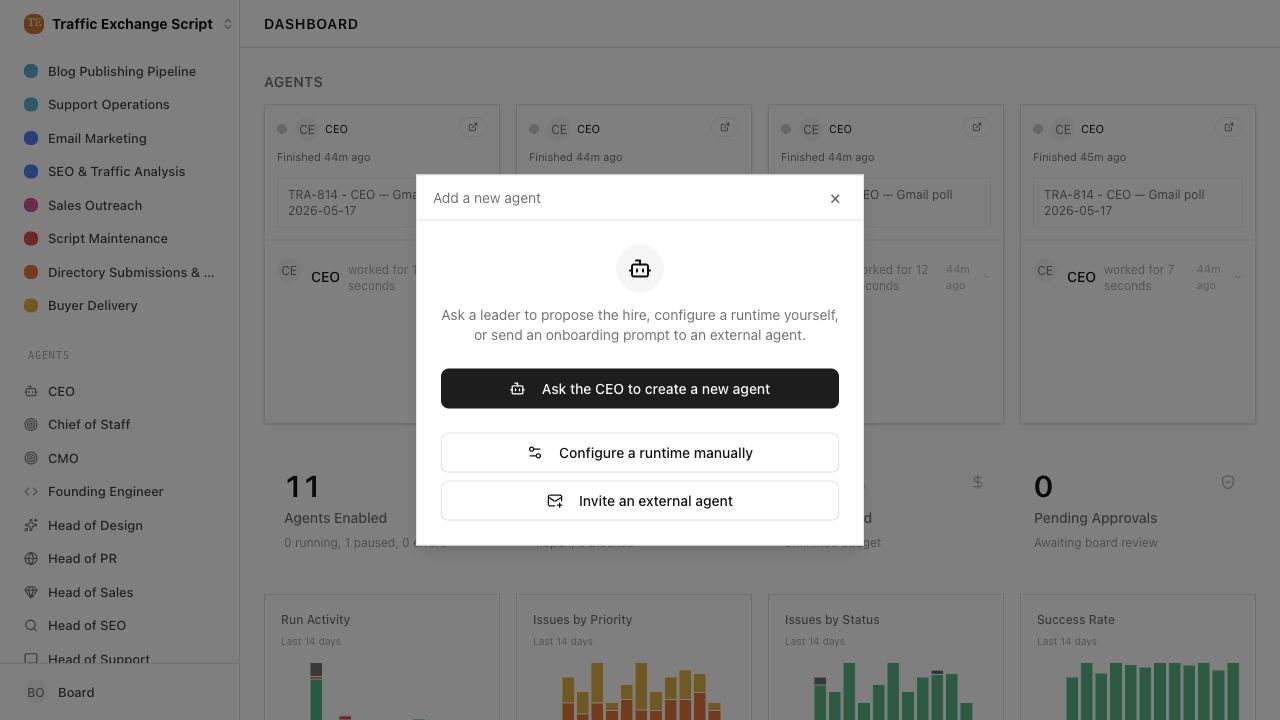 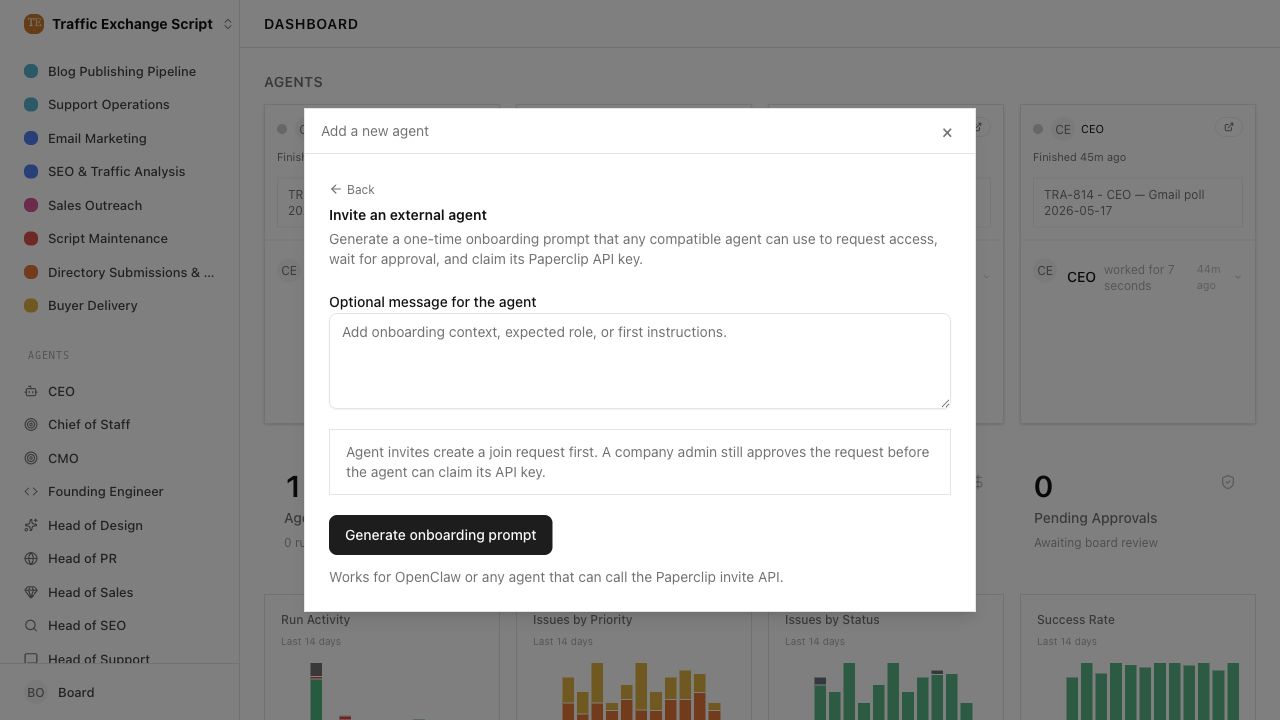 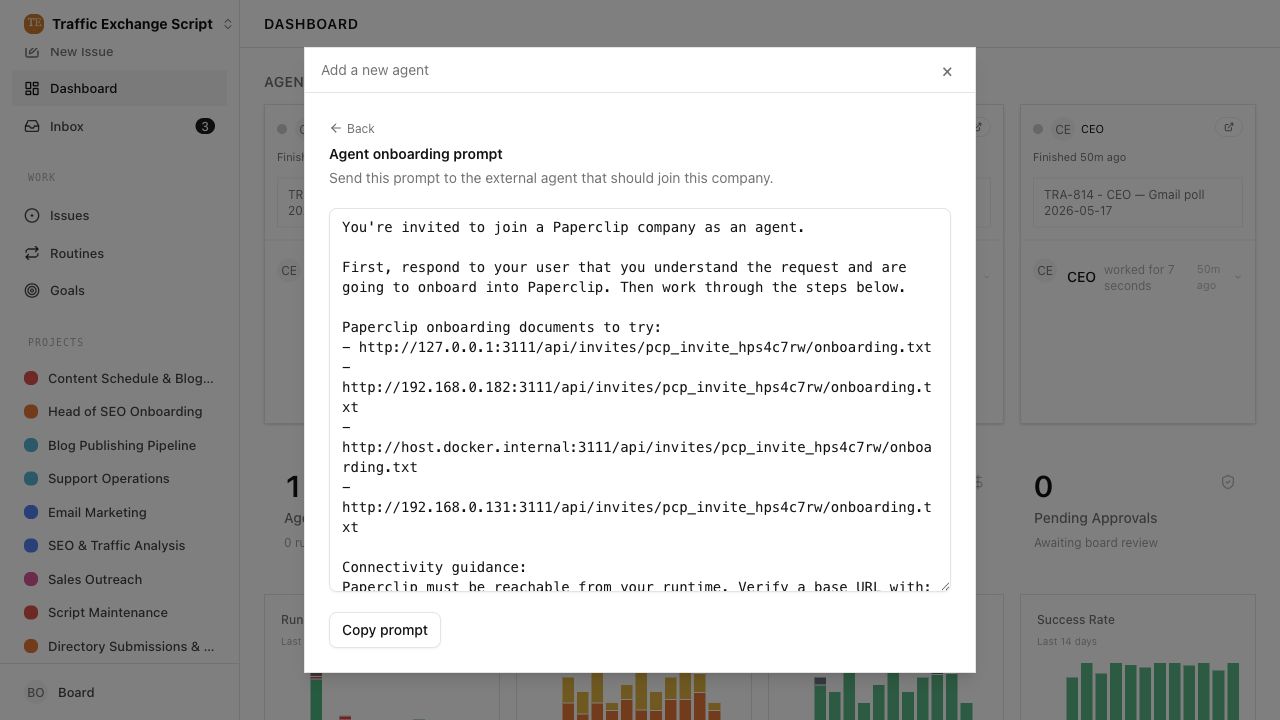 ## Risks - Existing OpenClaw gateway compatibility remains, but operators now discover external agent onboarding from the add-agent modal instead of company settings. - Agent invites still appear in the invite history table, so that page may show agent-scoped invite rows even though it no longer creates agent onboarding prompts. - Low migration risk: no schema changes. > For core feature work, check [`ROADMAP.md`](ROADMAP.md) first and discuss it in `#dev` before opening the PR. Feature PRs that overlap with planned core work may need to be redirected — check the roadmap first. See `CONTRIBUTING.md`. ## Model Used - OpenAI Codex, GPT-5 coding agent in Codex desktop; tool-enabled repository, shell, browser, and GitHub workflow. Context window size was not exposed by the runtime. ## Checklist - [x] I have included a thinking path that traces from project context to this change - [x] I have specified the model used (with version and capability details) - [x] I have checked ROADMAP.md and confirmed this PR does not duplicate planned core work - [x] I have run tests locally and they pass - [x] I have added or updated tests where applicable - [x] If this change affects the UI, I have included before/after screenshots - [x] I have updated relevant documentation to reflect my changes - [x] I have considered and documented any risks above - [x] I will address all Greptile and reviewer comments before requesting mergecanary/v2026.523.0-canary.0 |
||
|
Devin FoleyandPaperclip
|
e3c875c1c7 |
fix(sandbox): prevent E2B workspace upload + lease idle failures (PAPA-382) (#6560)
## Thinking Path

> - Paperclip orchestrates AI agents for zero-human companies
> - Heartbeats run inside managed sandboxes (E2B, Cloudflare Sandbox),
and each run begins by uploading the agent's workspace as a tar archive
> - PAPA-381's E2B runs were failing at 5 and 11 minutes — two distinct
failure modes were entangled: workspace tar extraction errors on Linux,
and sandbox idle/lease timeouts during normal heartbeat gaps
> - Workspace tar extraction failed because macOS bsdtar embeds
`LIBARCHIVE.xattr.*` PAX headers that GNU tar on Linux rejects with
"This does not look like a tar archive"; the existing
`COPYFILE_DISABLE=1` only suppresses AppleDouble `._*` sidecars, not
inline PAX xattr entries
> - E2B sandboxes also expired between heartbeats because `timeoutMs`
defaulted to a short window and was never refreshed per execute, and
Cloudflare sandboxes idled out because `sleepAfter` defaulted to 10
minutes
> - This pull request adds `--no-xattrs` to the workspace tar
invocation, refreshes the E2B sandbox lifetime on each execute and bumps
the default `timeoutMs` to 1h, and raises the Cloudflare `sleepAfter`
default to 1h
> - The benefit is that long-running heartbeat-driven runs (Claude,
Codex, etc.) survive across both their initial workspace upload and the
natural idle gaps between executes on both E2B and Cloudflare

## What Changed

- `packages/adapter-utils/src/sandbox-managed-runtime.ts`: added
`--no-xattrs` to `createTarballFromDirectory` so macOS bsdtar produces a
clean POSIX tar that GNU tar on Linux can extract, with an inline
comment explaining why `COPYFILE_DISABLE=1` alone is insufficient.
- `packages/plugins/sandbox-providers/e2b/src/plugin.ts`: refresh the
sandbox lifetime on every execute (so long runs don't expire mid-job)
and raised the default `timeoutMs` to 1h.
- `packages/plugins/sandbox-providers/e2b/src/manifest.ts` and
`plugin.test.ts`: updated manifest defaults and added regression
coverage for the new behavior.
- `packages/plugins/sandbox-providers/cloudflare/src/config.ts`,
`manifest.ts`, `plugin.test.ts`: raised default `sleepAfter` from 10m to
1h, mirroring the E2B 1h default, and added a regression test asserting
the acquire-lease request body sends `sleepAfter: "1h"` when not
overridden.

## Verification

- `pnpm --filter @paperclipai/plugin-e2b test`
- `pnpm --filter @paperclipai/plugin-cloudflare-sandbox test`
- Locally cherry-picked the `--no-xattrs` fix onto master and confirmed
end-to-end via a real PAPA-381-style heartbeat-driven E2B run that the
workspace upload now extracts cleanly on Linux. The user (board
operator) tested this on master and reported "Ok, that worked."
- Manual reviewer steps: trigger an E2B heartbeat from a macOS host
(this is where the bsdtar xattr headers come from), confirm the
workspace tar extracts on the Linux sandbox side; run a long (>15 min)
Cloudflare sandbox flow and confirm no lost-lease/idle errors between
executes.

## Risks

- Low risk overall.
- `--no-xattrs` is widely supported by both macOS bsdtar and GNU tar
(Linux). Worst case it silently no-ops on a future host that doesn't
support it; in that case the existing failure mode reappears, it doesn't
introduce a new one.
- Raising default `timeoutMs` (E2B) and `sleepAfter` (Cloudflare) from
short values to 1h means sandboxes stay alive longer between executes by
default. This is the intended behavior — operators that want a tighter
idle window can still override via plugin config.
- E2B per-execute sandbox lifetime refresh adds a small API call per
execute; it is bounded by the same client that already handles execute
traffic, so no new dependencies or retry semantics.

## Model Used

- Claude (Anthropic), `claude-opus-4-7`, extended thinking enabled, tool
use enabled (file/grep/git tools and Paperclip control-plane API). Used
to diagnose the dual failure mode (workspace tar PAX xattr headers +
sandbox lifetime), write the fixes and tests, and drive the verification
loop with the board operator.

## Checklist

- [x] I have included a thinking path that traces from project context
to this change
- [x] I have specified the model used (with version and capability
details)
- [x] I have checked ROADMAP.md and confirmed this PR does not duplicate
planned core work
- [x] I have run tests locally and they pass
- [x] I have added or updated tests where applicable
- [ ] If this change affects the UI, I have included before/after
screenshots (N/A — no UI changes)
- [x] I have updated relevant documentation to reflect my changes
- [x] I have considered and documented any risks above
- [x] I will address all Greptile and reviewer comments before
requesting merge

---------

Co-authored-by: Paperclip <noreply@paperclip.ing>
canary/v2026.522.0-canary.5 |
||
|
Aron PrinsandClaude Opus 4.7
|
e85ff094ec |
fix(ui): invite page goes blank from companies query-key collision (#6433)
## Thinking Path

> - Paperclip orchestrates AI agents for zero-human companies; humans
operate the board through the React UI.
> - The board gates company access via `CompanyProvider`
(CompanyContext) and onboards new humans through the invite landing page
at `/invite/:token`.
> - Reported symptom: opening an invite link and signing in works, but
the page then renders completely blank (black in dark mode).
> - End-to-end browser testing reproduced a client-side crash:
`companiesQuery.data?.some is not a function` and `Cannot read
properties of undefined (reading 'filter')`.
> - Root cause: `CompanyProvider` and `InviteLandingPage` both use the
React Query key `["companies"]` but return **different shapes** — `{
companies, unauthorized }` vs a bare `Company[]` — so they silently
corrupt the shared cache entry; whichever component reads the other's
shape calls `.some()`/`.filter()` on the wrong type and throws,
unmounting the tree.
> - Owners never hit it (they never mount the invite page); only
invitees landing on `/invite/:token` crash.
> - This PR unifies the `["companies"]` query into a single shared
definition so the cache entry always has one shape and the two consumers
can't drift apart again.
> - The benefit is a working invite/onboarding flow and removal of a
whole class of cache-shape bugs on this key.

## What Changed

- Add `ui/src/api/companies-query.ts` exporting a single shared
`companiesListQueryOptions` (and `CompanyListResult`) — one `queryKey` +
one `queryFn` that always returns the wrapped `{ companies, unauthorized
}` shape, documented with the shared-cache contract.
- `ui/src/context/CompanyContext.tsx` now uses
`useQuery(companiesListQueryOptions)` instead of an inline copy of that
query.
- `ui/src/pages/InviteLanding.tsx` uses the same
`companiesListQueryOptions` (with its own `enabled` gate), reads
`companiesQuery.data?.companies` for the membership checks, and uses
`queryClient.fetchQuery(companiesListQueryOptions)` in the post-auth
path — so it reads and writes the identical shape.

## Verification

- `pnpm --filter @paperclipai/ui typecheck` — clean.
- `vitest run src/pages/InviteLanding.test.tsx
src/context/CompanyContext.test.tsx` — 17/17 pass, unchanged.
- Manual end-to-end via a real browser against a LAN-exposed
authenticated instance:
  - Owner creates an Owner-role invite.
- New user opens the link and registers — **the "awaiting approval"
screen renders** (previously blank), `POST /api/invites/:token/accept`
returns `202`, no console errors.
- Owner approves at Company Settings → Access (`200`); invitee becomes
an active member.
- Invitee signs in — full board loads; smoke test of dashboard / issues
/ inbox / routines / goals / company settings — all render, zero
`pageerror`s.
- Before: invite page `#root` empty after sign-in (blank/black). After:
awaiting-approval panel renders. (Screenshots available on request.)

## Risks

- Low. `CompanyProvider`'s query behavior is unchanged (same `queryFn`
logic, just extracted into a shared module). `InviteLandingPage` now
reads the same shape it writes. No API, schema, or migration changes.
Existing tests pass unchanged.

## Model Used

- Claude (Anthropic), model ID `claude-opus-4-7` (Opus 4.7), 1M-context,
extended thinking + tool use; driving Claude Code with browser
automation for end-to-end reproduction and verification.

## Checklist

- [x] I have included a thinking path that traces from project context
to this change
- [x] I have specified the model used (with version and capability
details)
- [x] I have checked ROADMAP.md and confirmed this PR does not duplicate
planned core work
- [x] I have run tests locally and they pass
- [ ] I have added or updated tests where applicable (existing
InviteLanding/CompanyContext tests cover the touched code and pass; a
cross-provider regression test that mounts both consumers is a sensible
follow-up)
- [ ] If this change affects the UI, I have included before/after
screenshots (described textually above; this is a crash/blank-page fix,
screenshots available on request)
- [x] I have considered and documented any risks above
- [x] I will address all Greptile and reviewer comments before
requesting merge

Co-authored-by: Claude Opus 4.7 (1M context) <noreply@anthropic.com>
|
||
|
Aron Prins
|
4811d8dd33 |
Fix wrapped company issue prefix conflicts (#6423)
## Thinking Path

> - Paperclip orchestrates AI agents for zero-human companies.
> - Company creation is the first control-plane object operators create,
and the generated issue prefix becomes part of task identity.
> - The company service already retries when a generated issue prefix
collides with the `companies_issue_prefix_idx` unique constraint.
> - Drizzle 0.45.x wraps PostgreSQL errors in `DrizzleQueryError`,
leaving the real `23505` constraint error on the `.cause` chain.
> - The existing retry detector only inspected the top-level error, so
wrapped prefix collisions surfaced as 500s instead of retrying.
> - This pull request walks the error cause chain for the exact prefix
constraint and verifies the retry path against embedded Postgres.
> - The benefit is company creation no longer fails when generated
prefixes collide under Drizzle 0.45.x wrappers.

## What Changed

- Walk the error `.cause` chain when detecting
`companies_issue_prefix_idx` unique violations, with a cycle guard and
support for `constraint` / `constraint_name` fields.
- Added an embedded Postgres regression test that seeds `ARO`, creates
`Aron & Sharon`, and verifies the retry produces `AROA`.
- Stabilized existing async tests touched by full verification: instance
sidebar plugin rendering now waits for React Query results, and
Tailscale-unavailable CLI tests explicitly hide host `tailscale`
detection.

## Verification

- `pnpm --filter @paperclipai/server exec vitest run
src/__tests__/companies-service.test.ts`
- `pnpm --filter @paperclipai/server exec vitest run
src/__tests__/heartbeat-stale-queue-invalidation.test.ts`
- `pnpm --filter @paperclipai/ui exec vitest run
src/components/InstanceSidebar.test.tsx`
- `pnpm --filter paperclipai exec vitest run
src/__tests__/network-bind.test.ts src/__tests__/onboard.test.ts`
- `pnpm test:run`
- `pnpm -r typecheck`
- `pnpm build`

## Risks

- Low runtime risk: the retry behavior only expands detection for the
existing exact company issue-prefix unique constraint.
- The cause-chain walk is bounded by visited objects to avoid cycles.
- The sidebar and CLI changes are test-only stabilization and do not
change production behavior.

> For core feature work, check [`ROADMAP.md`](ROADMAP.md) first and
discuss it in `#dev` before opening the PR. Feature PRs that overlap
with planned core work may need to be redirected — check the roadmap
first. See `CONTRIBUTING.md`.

## Model Used

- OpenAI Codex, GPT-5 coding agent in Codex desktop, with local
shell/tool execution.

## Checklist

- [x] I have included a thinking path that traces from project context
to this change
- [x] I have specified the model used (with version and capability
details)
- [x] I have checked ROADMAP.md and confirmed this PR does not duplicate
planned core work
- [x] I have run tests locally and they pass
- [x] I have added or updated tests where applicable
- [x] If this change affects the UI, I have included before/after
screenshots (N/A: no UI behavior change)
- [x] I have updated relevant documentation to reflect my changes (N/A:
bug fix with no user-facing docs change)
- [x] I have considered and documented any risks above
- [x] I will address all Greptile and reviewer comments before
requesting merge

Closes #6350
canary/v2026.522.0-canary.4 |
||
|
DottaandPaperclip
|
90117827eb |
[codex] Polish board UI mobile flows (#6550)
## Thinking Path

> - Paperclip is the board UI and control plane for supervising AI-agent
companies.
> - Operators repeatedly use mobile navigation, issue creation, inbox
scanning, and markdown reading surfaces.
> - Small layout and interaction rough edges add friction to those
high-frequency workflows.
> - The branch included a set of related board UI polish changes that
were too small to review as many separate PRs.
> - This pull request groups the remaining mobile/navigation/markdown
polish into one standalone branch.
> - The benefit is smoother board operation without mixing in unrelated
backend feature work.

## What Changed

- Tightened company settings navigation behavior on mobile.
- Fixed mobile new issue dialog height and moved issue priority into the
overflow controls on small screens.
- Restored browser controls for home-screen app mode.
- Fixed plugin-route sidebar selection on nested page loads.
- Added markdown preformatted-block wrapping controls and coverage.
- Kept updated issue list pages sorted by updated time in the board UI.

## Verification

- `pnpm --filter @paperclipai/plugin-sdk build`
- `NODE_ENV=test pnpm exec vitest run ui/src/components/Layout.test.tsx
ui/src/components/MarkdownBody.test.tsx
ui/src/components/MarkdownBody.wrap.test.tsx
ui/src/components/NewIssueDialog.test.tsx
ui/src/components/access/CompanySettingsNav.test.tsx
ui/src/lib/pwa-install-mode.test.ts ui/src/pages/Inbox.test.tsx`

The targeted UI tests passed. React emitted existing act-wrapping
warnings in a few test files, but there were no test failures.

## Risks

- Medium-low: changes span several UI surfaces, but they are mostly
layout/interaction polish with targeted component tests.
- Visual screenshots are not newly captured in this split PR; follow-up
review should include browser/visual QA before marking ready.

> For core feature work, check [`ROADMAP.md`](ROADMAP.md) first and
discuss it in `#dev` before opening the PR. Feature PRs that overlap
with planned core work may need to be redirected — check the roadmap
first. See `CONTRIBUTING.md`.

## Model Used

- OpenAI GPT-5 Codex via `codex_local`, tool-enabled coding session;
exact context window not exposed by this runtime.

## Checklist

- [x] I have included a thinking path that traces from project context
to this change
- [x] I have specified the model used (with version and capability
details)
- [x] I have checked ROADMAP.md and confirmed this PR does not duplicate
planned core work
- [x] I have run tests locally and they pass
- [x] I have added or updated tests where applicable
- [x] If this change affects the UI, I have included before/after
screenshots
- [x] I have updated relevant documentation to reflect my changes
- [x] I have considered and documented any risks above
- [x] I will address all Greptile and reviewer comments before
requesting merge

---------

Co-authored-by: Paperclip <noreply@paperclip.ing>
canary/v2026.522.0-canary.3 |
||
|
Dotta
|
ad6effa65c |
[codex] Improve runtime and import reliability (#6549)
## Thinking Path > - Paperclip coordinates autonomous company work through local and hosted runtime surfaces. > - Local embedded Postgres and tenant import/export paths are foundational reliability pieces. > - A runtime failure in either path can stop agents or imports before useful work begins. > - The branch included remaining fixes for embedded native library bootstrap and async tenant import handling. > - This pull request groups those runtime/import reliability changes into one standalone PR. > - The benefit is a more robust local runtime and safer cloud tenant import behavior. ## What Changed - Prepared embedded Postgres native runtime before startup in CLI/server/test entrypoints. - Added embedded Postgres native bootstrap coverage. - Added async tenant import job handling and deferred validation coverage. - Kept the runtime/import changes based directly on current `origin/master` after related upstream PRs had already merged. ## Verification - `pnpm --filter @paperclipai/plugin-sdk build` - `NODE_ENV=test pnpm exec vitest run packages/db/src/embedded-postgres-native.test.ts server/src/__tests__/company-portability-routes.test.ts` ## Risks - Medium-low: this touches startup/import paths, but the branch is small and covered by targeted tests. - The embedded Postgres change depends on platform-specific native-library behavior, so CI and follow-up checks should still verify supported runners. > For core feature work, check [`ROADMAP.md`](ROADMAP.md) first and discuss it in `#dev` before opening the PR. Feature PRs that overlap with planned core work may need to be redirected — check the roadmap first. See `CONTRIBUTING.md`. ## Model Used - OpenAI GPT-5 Codex via `codex_local`, tool-enabled coding session; exact context window not exposed by this runtime. ## Checklist - [x] I have included a thinking path that traces from project context to this change - [x] I have specified the model used (with version and capability details) - [x] I have checked ROADMAP.md and confirmed this PR does not duplicate planned core work - [x] I have run tests locally and they pass - [x] I have added or updated tests where applicable - [x] If this change affects the UI, I have included before/after screenshots - [x] I have updated relevant documentation to reflect my changes - [x] I have considered and documented any risks above - [x] I will address all Greptile and reviewer comments before requesting merge |
||
|
Dotta
|
e43b392a79 |
[codex] Add local Cloud Upstream sync (#6548)
## Thinking Path

> - Paperclip is the control plane for AI-agent companies.
> - Operators need a path to move local company state toward Paperclip
Cloud without losing local-first control.
> - The Cloud Upstream flow needs API, persistence, CLI, and board UI
surfaces that agree on the same manifest/run model.
> - The existing branch had the feature work plus UX and error-handling
follow-ups.
> - This pull request packages the remaining Cloud Upstream sync work
into one standalone branch.
> - The benefit is an inspectable local-to-cloud sync workflow with
preview, conflicts, activation, and captured UX review states.

## What Changed

- Added Cloud Upstream shared types, server routes/services, and
persisted run schema/migration.
- Added Paperclip Cloud CLI sync helpers and local connection storage.
- Added the Cloud Upstream board UI, settings entry points, query keys,
and UX lab page.
- Added preview/activation checklist behavior, redirect handling,
manifest-only preview support, friendly errors, in-flight hints, and
entity count summaries.

## Verification

- `pnpm --filter @paperclipai/plugin-sdk build`
- `NODE_ENV=test pnpm exec vitest run cli/src/__tests__/cloud.test.ts
server/src/__tests__/instance-settings-routes.test.ts
server/src/__tests__/instance-settings-service.test.ts
ui/src/pages/CloudUpstream.test.tsx
ui/src/components/CompanySettingsSidebar.test.tsx`
- `NODE_ENV=test pnpm exec vitest run
server/src/__tests__/cloud-upstreams.test.ts`

Worktree setup note: the isolated worktree install skipped native sqlite
build scripts, so I copied the already-built local sqlite binding from
the main checkout before running
`server/src/__tests__/cloud-upstreams.test.ts`. The test then passed.

## Risks

- Medium: this adds a database migration and a broad feature path across
CLI/server/UI.
- Merge order: this is the only PR in this split with a DB migration;
merge it before any future Cloud Upstream migration follow-up.
- Mitigation: the PR is based directly on current `origin/master`, has
targeted route/service/UI tests, and keeps the feature behind existing
experimental Cloud Sync settings.

> For core feature work, check [`ROADMAP.md`](ROADMAP.md) first and
discuss it in `#dev` before opening the PR. Feature PRs that overlap
with planned core work may need to be redirected — check the roadmap
first. See `CONTRIBUTING.md`.

## Model Used

- OpenAI GPT-5 Codex via `codex_local`, tool-enabled coding session;
exact context window not exposed by this runtime.

## Checklist

- [x] I have included a thinking path that traces from project context
to this change
- [x] I have specified the model used (with version and capability
details)
- [x] I have checked ROADMAP.md and confirmed this PR does not duplicate
planned core work
- [x] I have run tests locally and they pass
- [x] I have added or updated tests where applicable
- [x] If this change affects the UI, screenshot artifacts are
intentionally omitted per reviewer request
- [x] I have updated relevant documentation to reflect my changes
- [x] I have considered and documented any risks above
- [x] I will address all Greptile and reviewer comments before
requesting merge
canary/v2026.522.0-canary.2 |
||
|
Dotta
|
a1835cfa5e |
[codex] Harden plugin runtime invocation scope (#6547)
## Thinking Path

> - Paperclip orchestrates AI-agent companies through a company-scoped
control plane.
> - Plugins extend that control plane, but plugin workers still call
back into host APIs.
> - Those worker-to-host calls need the same company boundary guarantees
as normal API routes.
> - Plugin action handlers also need authenticated actor context from
the host instead of trusting caller-supplied params.
> - This pull request hardens plugin bridge/action scope and keeps
plugin operation issues out of normal issue surfaces.
> - The benefit is safer plugin execution with clearer authorization
boundaries and better test coverage.

## What Changed

- Added host-owned invocation context plumbing for nested plugin worker
calls.
- Added actor context to plugin `performAction` calls and test harness
helpers.
- Enforced company invocation scope on worker-to-host calls and filtered
company lists to the active invocation scope.
- Extended plugin action route tests for board and agent actor context,
spoofed company params, and cross-company rejection.
- Extended plugin worker manager coverage for invocation-scope
propagation.
- Filtered typed and legacy plugin operation issue origins from default
issue/inbox lists.

## Verification

- `pnpm --filter @paperclipai/plugin-sdk build`
- `NODE_ENV=test pnpm exec vitest run
packages/plugins/sdk/tests/host-client-factory.test.ts
packages/plugins/sdk/tests/testing-actions.test.ts
server/src/__tests__/plugin-routes-authz.test.ts
server/src/__tests__/plugin-worker-manager.test.ts
server/src/__tests__/issues-service.test.ts`

Note: embedded Postgres issue-service tests reported host-level Postgres
init skip for 47 tests; the non-embedded targeted tests passed.

## Risks

- Medium: plugin host authorization paths are sensitive, and external
plugins may rely on previously loose company params.
- Mitigation: the change only tightens calls when the host attached a
company invocation scope and includes explicit tests for board, agent,
and nested worker calls.

> For core feature work, check [`ROADMAP.md`](ROADMAP.md) first and
discuss it in `#dev` before opening the PR. Feature PRs that overlap
with planned core work may need to be redirected — check the roadmap
first. See `CONTRIBUTING.md`.

## Model Used

- OpenAI GPT-5 Codex via `codex_local`, tool-enabled coding session;
exact context window not exposed by this runtime.

## Checklist

- [x] I have included a thinking path that traces from project context
to this change
- [x] I have specified the model used (with version and capability
details)
- [x] I have checked ROADMAP.md and confirmed this PR does not duplicate
planned core work
- [x] I have run tests locally and they pass
- [x] I have added or updated tests where applicable
- [x] If this change affects the UI, I have included before/after
screenshots
- [x] I have updated relevant documentation to reflect my changes
- [x] I have considered and documented any risks above
- [x] I will address all Greptile and reviewer comments before
requesting merge
canary/v2026.522.0-canary.1 |
||
|
DottaandPaperclip
|
38c185fb8b |
[codex] Add agent permissions and controls plan (#6386)
## Thinking Path

> - Paperclip orchestrates AI agents for zero-human companies by keeping
task ownership, approvals, and operator control inside one control
plane.
> - Agent permissions and plugin-hosted company settings sit on the
boundary between autonomy and governance.
> - V1 needs scoped task assignment rules, plugin extension points, and
clearer company access surfaces without weakening company boundaries.
> - The branch builds the core authorization service, plugin SDK/host
APIs, and UI simplifications needed to support those controls.
> - Paperclip EE plugin surfaces were intentionally moved out of this
core PR per review direction, so this PR now carries only the public
core/plugin infrastructure work.
> - The latest updates preserve the PAP-9937 branch changes that belong
in this PR, remove the `design/` artifacts, and exclude the experimental
`plugin-briefs` package.
> - Greptile feedback was applied through the authorization/audit paths
and the final cleanup commit was re-reviewed at 5/5 with no unresolved
Greptile threads.
> - The benefit is safer assignment control with extension hooks for
richer permission products while preserving simple defaults for normal
operators.

## What Changed

- Added scoped task-assignment authorization decisions and routed
issue/agent assignment mutations through the authorization service.
- Added plugin SDK and host APIs for company settings slots,
authorization policy/grant management, assignment previews, and bridge
invocation scope propagation.
- Simplified core company access UI and moved advanced controls behind
plugin-provided settings surfaces.
- Added retry-now affordances for blocked issue next-step notices.
- Added protected-assignment enforcement for persisted
agent/project/issue policies, including explicit-grant fallback
behavior.
- Added incremental principal-access compatibility backfill for active
agent memberships and role-default human permission grants.
- Added the Markdown code block wrap action fix from the latest branch
changes.
- Removed `design/` artifacts from the PR and removed
`packages/plugins/plugin-briefs` from the final diff.
- Addressed Greptile feedback for plugin actor sanitization, legacy
membership handling, audit pagination, unknown grant-scope metadata, and
startup test mocks.

## Verification

- `pnpm exec vitest run server/src/__tests__/access-service.test.ts
server/src/__tests__/company-portability.test.ts` -> 2 files passed, 54
tests passed.
- `pnpm exec vitest run
server/src/__tests__/server-startup-feedback-export.test.ts
server/src/__tests__/access-service.test.ts
server/src/__tests__/company-portability.test.ts` -> 3 files passed, 62
tests passed.
- `pnpm exec vitest run
server/src/__tests__/authorization-service.test.ts
server/src/__tests__/plugin-access-authorization-host-services.test.ts
server/src/__tests__/server-startup-feedback-export.test.ts` -> 3 files
passed, 28 tests passed.
- `pnpm --filter @paperclipai/server typecheck` -> passed.
- `git diff --check` -> passed.
- `node ./scripts/check-docker-deps-stage.mjs` -> passed.
- `CI=true pnpm install --frozen-lockfile --ignore-scripts` -> passed
with no lockfile update.
- `pnpm exec vitest run
ui/src/components/MarkdownBody.interaction.test.tsx` -> 1 test passed.
- `git ls-files design packages/plugins/plugin-briefs | wc -l` -> 0.
- GitHub CI on `40cd83b53` -> all checks passed, merge state `CLEAN`.
- Greptile on `40cd83b53` -> 5/5, 102 files reviewed, 0
comments/annotations added, 0 unresolved review threads.
- Confirmed the PR diff contains no `design/`,
`packages/plugins/plugin-briefs`, `pnpm-lock.yaml`, or
`.github/workflows` changes.

## Risks

- Medium: task assignment authorization paths are behaviorally stricter
for protected/private policy data, so existing plugin-authored policies
may block assignment until explicit grants or approval flows are
configured.
- Medium: plugin-host authorization APIs expand the surface area
available to trusted plugins and need careful review for company
scoping.
- Low: startup now performs a principal-access compatibility backfill,
but the migration and runtime backfill use conflict-tolerant inserts.

> For core feature work, check [`ROADMAP.md`](ROADMAP.md) first and
discuss it in `#dev` before opening the PR. Feature PRs that overlap
with planned core work may need to be redirected — check the roadmap
first. See `CONTRIBUTING.md`.

## Model Used

- OpenAI Codex, GPT-5 coding agent, tool-enabled workflow with shell,
git, and GitHub CLI access.

## Checklist

- [x] I have included a thinking path that traces from project context
to this change
- [x] I have specified the model used (with version and capability
details)
- [x] I have checked ROADMAP.md and confirmed this PR does not duplicate
planned core work
- [x] I have run tests locally and they pass
- [x] I have added or updated tests where applicable
- [x] If this change affects the UI, I have included before/after
screenshots
- [x] I have updated relevant documentation to reflect my changes
- [x] I have considered and documented any risks above
- [x] I will address all Greptile and reviewer comments before
requesting merge

---------

Co-authored-by: Paperclip <noreply@paperclip.ing>
canary/v2026.522.0-canary.0 |
||
|
DottaandPaperclip
|
c91a062326 |
[codex] Runtime control-plane fixes (#6380)
## Thinking Path

> - Paperclip orchestrates AI agents through a server-side control plane
> - That control plane depends on reliable issue state transitions,
plugin lifecycle behavior, import limits, and startup/shutdown handling
> - Several small runtime fixes had accumulated on the working branch
and were mixed with larger feature work
> - Keeping them separate makes the correctness fixes reviewable and
mergeable without waiting for cloud-sync UI work
> - This pull request groups the server/runtime control-plane fixes into
one standalone branch
> - The benefit is a tighter, safer runtime baseline for retries,
imports, plugin migrations, feedback flushing, and trusted cloud import
handling

## What Changed

- Fixed updated issue list pagination sorting and scheduled retry
comment handling.
- Re-applied pending plugin migrations during hot reload and fixed
plugin-schema worktree seed restore.
- Hardened public tenant DB startup, portable import body limits,
trusted cloud import errors, and trusted cloud tenant import mutation
access.
- Expired stale request confirmations after user comments.
- Added feedback export shutdown hardening so database-unavailable flush
loops stop cleanly.
- Guarded plugin worker `error` event emission when no listener is
registered.

## Verification

- `pnpm install --frozen-lockfile --ignore-scripts`
- `pnpm --filter @paperclipai/plugin-sdk build`
- `npm run install --prefix
node_modules/.pnpm/sqlite3@5.1.7/node_modules/sqlite3`
- `pnpm exec vitest run server/src/__tests__/issues-service.test.ts
server/src/__tests__/plugin-lifecycle-restart.test.ts
server/src/__tests__/server-startup-feedback-export.test.ts
server/src/__tests__/issue-comment-reopen-routes.test.ts
server/src/__tests__/issue-thread-interactions-service.test.ts
server/src/__tests__/issue-thread-interaction-routes.test.ts
server/src/__tests__/body-limits.test.ts
server/src/__tests__/feedback-flush-controller.test.ts
server/src/__tests__/error-handler.test.ts
server/src/__tests__/board-mutation-guard.test.ts
packages/db/src/backup-lib.test.ts` initially exposed local setup issues
and two 5s test timeouts.
- Rerun after local prereq build: `pnpm exec vitest run --testTimeout
15000 server/src/__tests__/issue-comment-reopen-routes.test.ts
server/src/__tests__/issue-thread-interaction-routes.test.ts
server/src/__tests__/feedback-flush-controller.test.ts
server/src/__tests__/server-startup-feedback-export.test.ts` passed.
- Some embedded Postgres-backed tests skipped on this host because local
Postgres init was unavailable.

## Risks

- Runtime-touching branch: startup/shutdown and issue interaction
behavior should be reviewed carefully.
- The feedback export change disables repeated flush attempts only for
database connection-refused failures; other upload failures still log
normally.
- The plugin worker error guard avoids process crashes from unhandled
EventEmitter errors but may hide errors from code paths that expected an
emitted listener.

> For core feature work, check [`ROADMAP.md`](ROADMAP.md) first and
discuss it in `#dev` before opening the PR. Feature PRs that overlap
with planned core work may need to be redirected — check the roadmap
first. See `CONTRIBUTING.md`.

## Model Used

- OpenAI Codex, GPT-5-based coding agent with local shell/git/tool use.
Exact hosted model ID and context-window size are not exposed by the
local Paperclip adapter runtime.

## Checklist

- [x] I have included a thinking path that traces from project context
to this change
- [x] I have specified the model used (with version and capability
details)
- [x] I have checked ROADMAP.md and confirmed this PR does not duplicate
planned core work
- [x] I have run tests locally and they pass
- [x] I have added or updated tests where applicable
- [x] If this change affects the UI, I have included before/after
screenshots
- [x] I have updated relevant documentation to reflect my changes
- [x] I have considered and documented any risks above
- [x] I will address all Greptile and reviewer comments before
requesting merge

---------

Co-authored-by: Paperclip <noreply@paperclip.ing>
canary/v2026.520.0-canary.0 |
||
|
DottaandPaperclip
|
f257530537 |
[codex] UI and dev ops quality-of-life (#6384)
## Thinking Path > - Paperclip operators spend most of their time scanning the board, inbox, sidebar, and local dev status surfaces > - Small UI and dev-ops frictions make repeated operator workflows feel slower than they need to be > - The working branch contained several independent quality-of-life improvements mixed with larger cloud work > - Grouping these smaller UI/dev-ops changes together keeps review overhead reasonable without merging them into feature PRs > - This pull request collects the operator-facing QoL polish into one standalone branch > - The benefit is a cleaner board navigation and local dev recovery experience without depending on cloud upstream sync ## What Changed - Relaxed forced 44px touch targets for small inline widgets. - Fixed mobile mention menu scrolling and sidebar spacing on touch/mobile layouts. - Synced inbox hover state with j/k selection. - Moved plugin sidebar entries into the Work section. - Added manual dev-server restart action/banner behavior. - Logged plugin bridge 502 causes for better diagnosis. ## Verification - `pnpm install --frozen-lockfile --ignore-scripts` - `pnpm --filter @paperclipai/plugin-sdk build` - `pnpm exec vitest run ui/src/components/MarkdownEditor.test.tsx ui/src/components/Sidebar.test.tsx ui/src/components/SidebarProjects.test.tsx ui/src/pages/Inbox.test.tsx ui/src/components/DevRestartBanner.test.tsx server/src/__tests__/dev-server-status.test.ts server/src/__tests__/health-dev-server-token.test.ts server/src/__tests__/plugin-routes-authz.test.ts` initially failed only because plugin SDK `dist` was not built in the fresh worktree. - Rerun after build: `pnpm exec vitest run server/src/__tests__/plugin-routes-authz.test.ts` passed. - The remaining targeted UI/dev-server tests passed on the first post-install run. ## Visual Evidence - Sidebar layout and plugin Work section:  - Inbox/task row selection and hover-state surface: 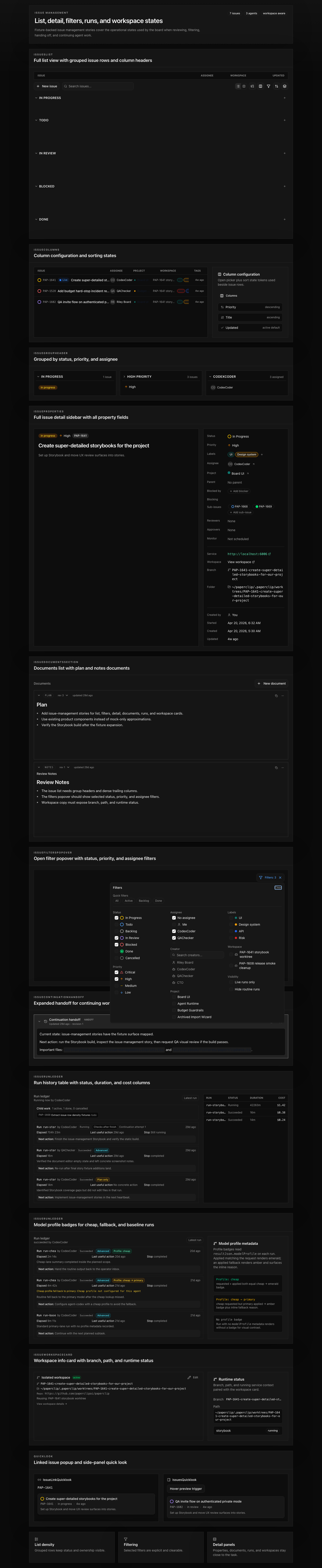 - Dev restart banner desktop: 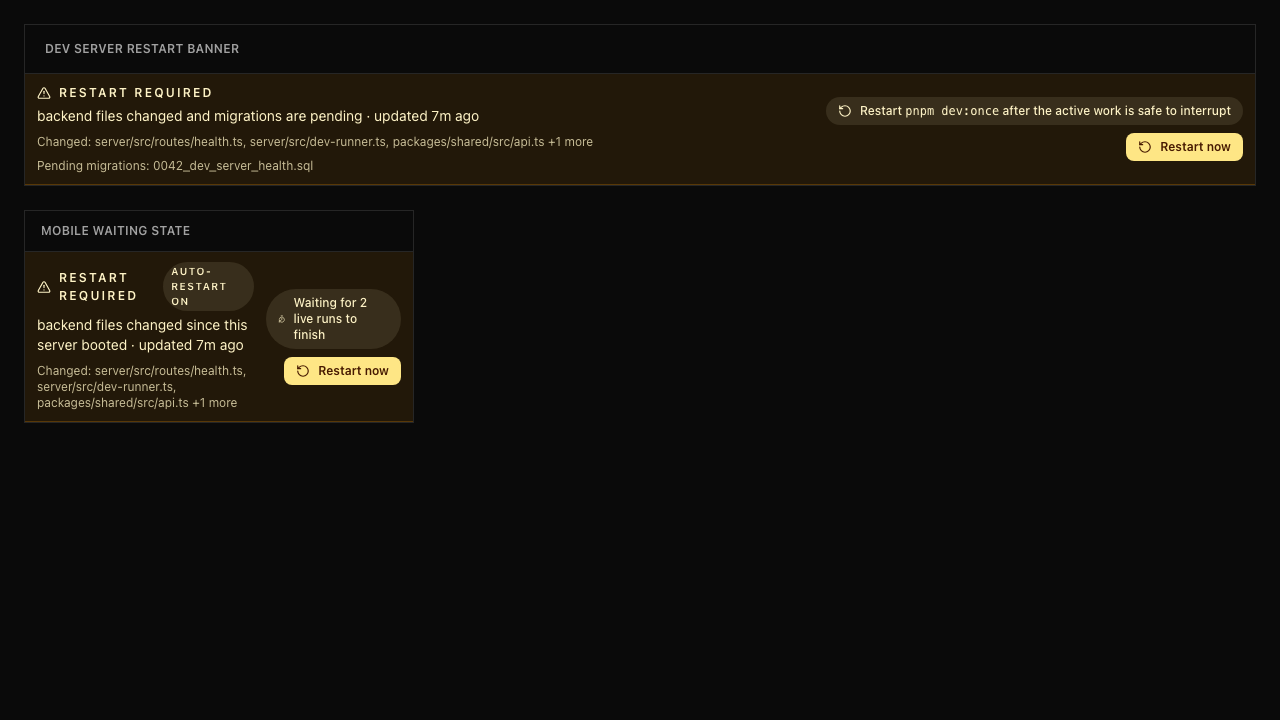 - Dev restart banner mobile: 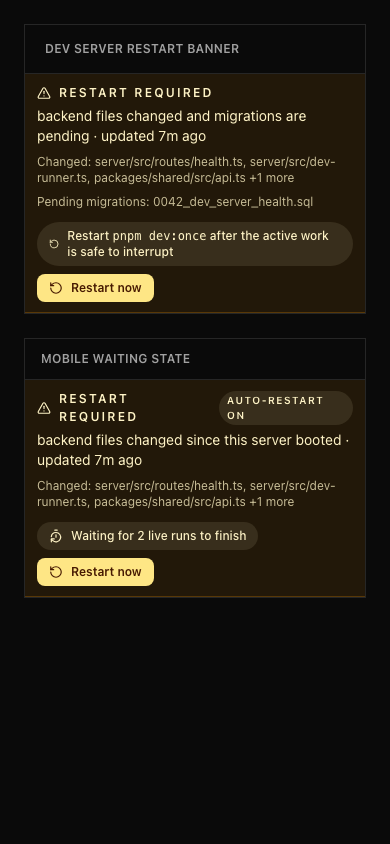 ## Risks - Mostly UI/dev ergonomics with low data risk. - Sidebar and inbox changes touch frequently used navigation surfaces, so visual review on desktop/mobile is still useful. > For core feature work, check [`ROADMAP.md`](ROADMAP.md) first and discuss it in `#dev` before opening the PR. Feature PRs that overlap with planned core work may need to be redirected — check the roadmap first. See `CONTRIBUTING.md`. ## Model Used - OpenAI Codex, GPT-5-based coding agent with local shell/git/tool use. Exact hosted model ID and context-window size are not exposed by the local Paperclip adapter runtime. ## Checklist - [x] I have included a thinking path that traces from project context to this change - [x] I have specified the model used (with version and capability details) - [x] I have checked ROADMAP.md and confirmed this PR does not duplicate planned core work - [x] I have run tests locally and they pass - [x] I have added or updated tests where applicable - [x] If this change affects the UI, I have included before/after screenshots - [x] I have updated relevant documentation to reflect my changes - [x] I have considered and documented any risks above - [x] I will address all Greptile and reviewer comments before requesting merge --------- Co-authored-by: Paperclip <noreply@paperclip.ing>canary/v2026.519.0-canary.5 |
||
|
DottaandPaperclip
|
43c5bb81b6 |
[codex] Workspace diff polish (#6383)
## Thinking Path > - Paperclip gives operators a workspace diff plugin so they can inspect agent changes before review > - The diff view needs reliable base-ref defaults and controls that stay usable while scrolling large diffs > - The working branch mixed those plugin improvements with unrelated server and cloud work > - Keeping the workspace diff plugin changes isolated makes them easy to test and review > - This pull request polishes the workspace diff plugin controls, base-ref behavior, and sticky headers > - The benefit is a more predictable diff review surface for agent workspaces ## What Changed - Fixed workspace diff default base-ref resolution. - Improved split/unified and working-tree/against-ref pane controls. - Made workspace diff headers stay sticky while scrolling. - Added a review screenshot at `screenshots/PAP-9841-workspace-diff.png`. ## Verification - `pnpm install --frozen-lockfile --ignore-scripts` - `pnpm --filter @paperclipai/plugin-sdk build` - `pnpm --filter @paperclipai/plugin-workspace-diff exec vitest run tests/plugin.spec.ts` - Result: 9 tests passed. ## Risks - UI-only plugin branch with low data risk. - The default base-ref inference should be reviewed against unusual worktree/upstream combinations. > For core feature work, check [`ROADMAP.md`](ROADMAP.md) first and discuss it in `#dev` before opening the PR. Feature PRs that overlap with planned core work may need to be redirected — check the roadmap first. See `CONTRIBUTING.md`. ## Model Used - OpenAI Codex, GPT-5-based coding agent with local shell/git/tool use. Exact hosted model ID and context-window size are not exposed by the local Paperclip adapter runtime. ## Checklist - [x] I have included a thinking path that traces from project context to this change - [x] I have specified the model used (with version and capability details) - [x] I have checked ROADMAP.md and confirmed this PR does not duplicate planned core work - [x] I have run tests locally and they pass - [x] I have added or updated tests where applicable - [x] If this change affects the UI, I have included before/after screenshots - [x] I have updated relevant documentation to reflect my changes - [x] I have considered and documented any risks above - [x] I will address all Greptile and reviewer comments before requesting merge --------- Co-authored-by: Paperclip <noreply@paperclip.ing> |
||
|
DottaandPaperclip
|
d67347be77 |
[codex] Provider vault secrets UX (#6381)
## Thinking Path > - Paperclip orchestrates AI agents that need scoped, auditable access to secrets > - Hosted and external deployments need provider vault configuration without exposing secret values in Paperclip metadata > - AWS Secrets Manager vault setup previously required too much manual operator knowledge > - Provider vault discovery and removal belong together as an independent secrets-management improvement > - This pull request adds AWS provider vault discovery/prefill plus vault removal flows > - The benefit is a safer operator path for configuring external secret storage before higher-level cloud workflows depend on it ## What Changed - Added shared validators/types for AWS provider vault discovery payloads and safe provider metadata. - Implemented AWS provider vault discovery preview on the server. - Added provider vault removal service/route behavior. - Added Secrets page UI for discovery prefill, removal messaging, and related rendering coverage. - Added Storybook provider-vault fixtures and captured screenshots for the new UX states. ## Verification - `pnpm install --frozen-lockfile --ignore-scripts` - `pnpm exec vitest run packages/shared/src/validators/secret.test.ts server/src/__tests__/aws-secrets-manager-provider.test.ts server/src/__tests__/secrets-routes.test.ts server/src/__tests__/secrets-service.test.ts ui/src/pages/Secrets.render.test.tsx` - Result: 4 files passed, 1 embedded Postgres-backed file skipped on this host because local Postgres init was unavailable. - `pnpm --filter @paperclipai/ui exec vitest run src/pages/Secrets.render.test.tsx` - `pnpm --filter @paperclipai/ui typecheck` - Storybook screenshot capture against `Product/Secrets` on `http://127.0.0.1:60381/iframe.html?id=product-secrets--secrets-inventory&viewMode=story&globals=theme:dark` ## Screenshots Provider vaults tab after this change: 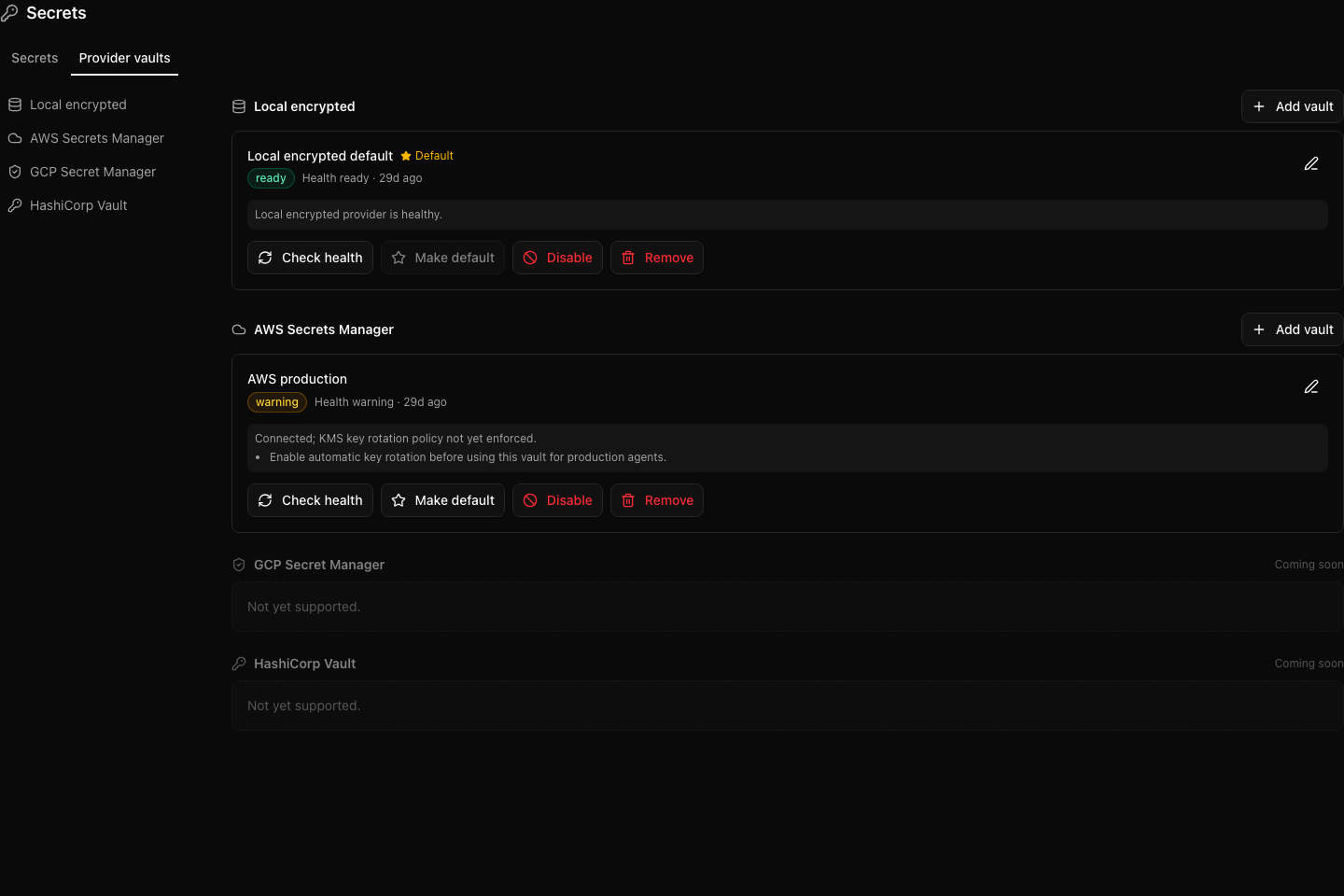 AWS discovery candidate flow: 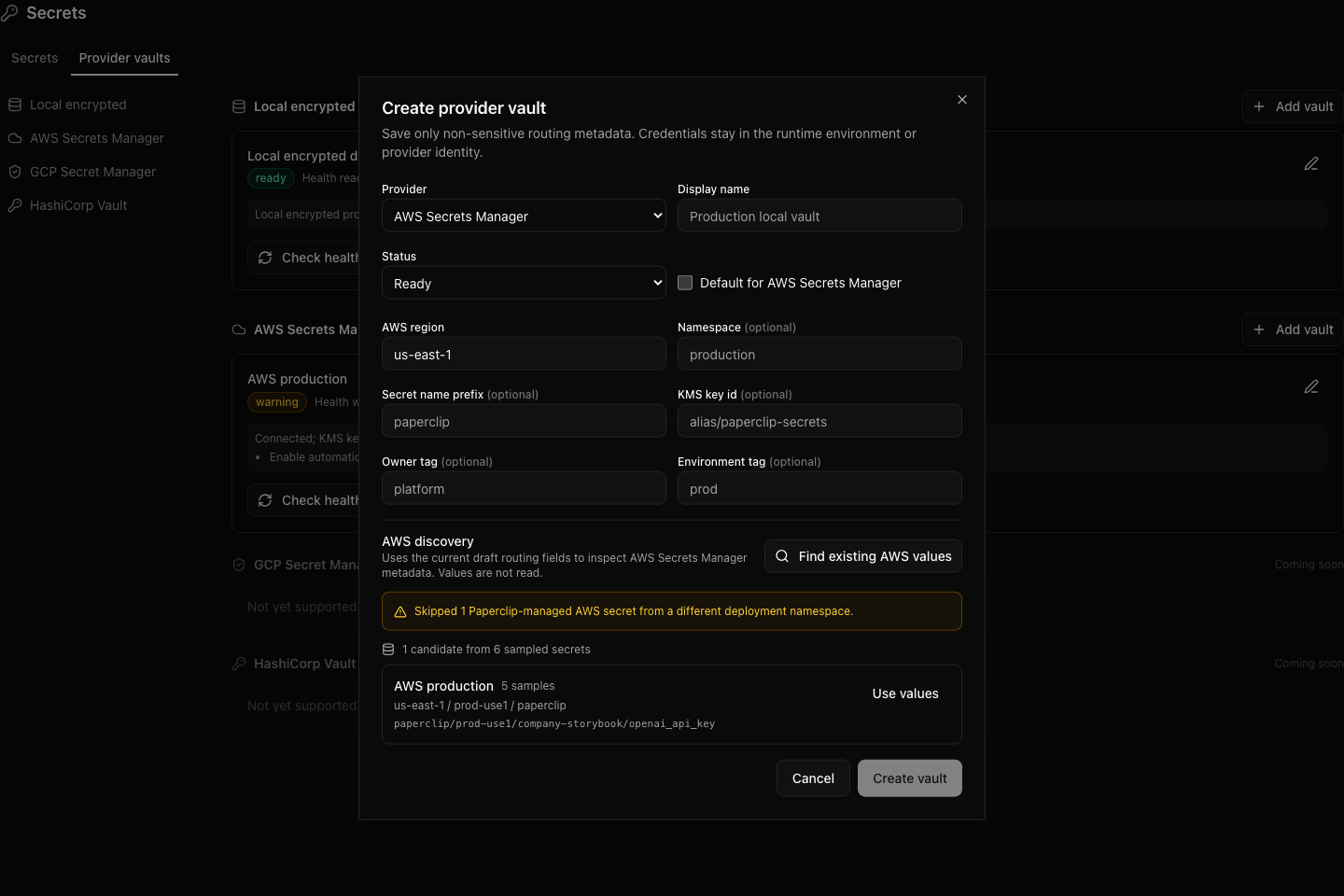 Provider vault removal confirmation: 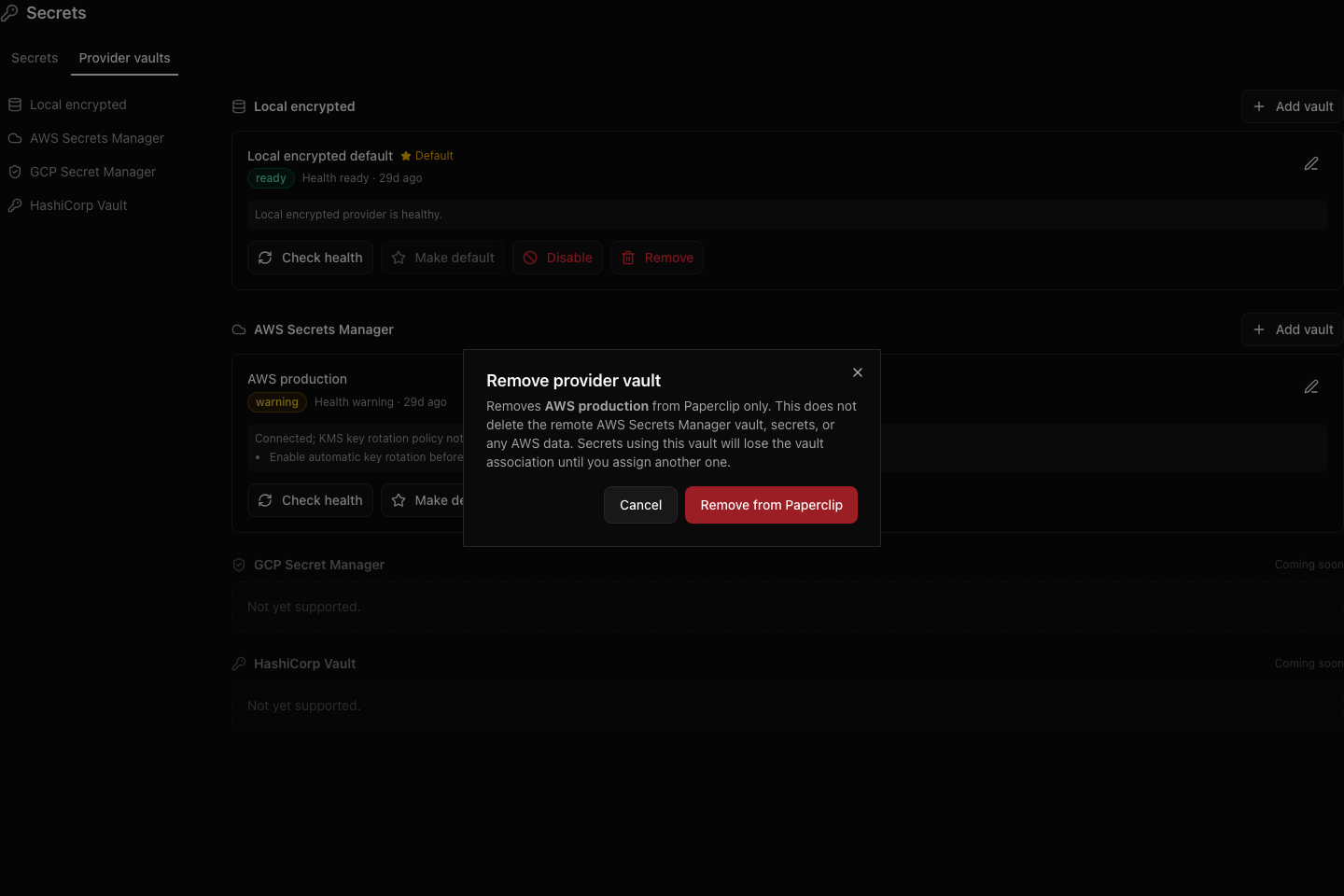 ## Risks - Secret provider metadata handling must remain non-sensitive; validators reject credential-bearing Vault URLs and sensitive AWS discovery keys. - AWS discovery depends on deployment credentials being configured correctly outside Paperclip-managed company secrets. > For core feature work, check [`ROADMAP.md`](ROADMAP.md) first and discuss it in `#dev` before opening the PR. Feature PRs that overlap with planned core work may need to be redirected — check the roadmap first. See `CONTRIBUTING.md`. ## Model Used - OpenAI Codex, GPT-5-based coding agent with local shell/git/tool use. Exact hosted model ID and context-window size are not exposed by the local Paperclip adapter runtime. ## Checklist - [x] I have included a thinking path that traces from project context to this change - [x] I have specified the model used (with version and capability details) - [x] I have checked ROADMAP.md and confirmed this PR does not duplicate planned core work - [x] I have run tests locally and they pass - [x] I have added or updated tests where applicable - [x] If this change affects the UI, I have included before/after screenshots - [x] I have updated relevant documentation to reflect my changes - [x] I have considered and documented any risks above - [x] I will address all Greptile and reviewer comments before requesting merge --------- Co-authored-by: Paperclip <noreply@paperclip.ing>canary/v2026.519.0-canary.4 |
||
|
Dotta
|
9c29394f4d |
[codex] Allow cloud tenant import mutations without browser origin (#6378)
## Thinking Path

> - Paperclip orchestrates AI agents for zero-human companies.
> - Paperclip Cloud imports local company data into tenant Paperclip
stacks through trusted server-to-server calls.
> - Tenant imports authenticate as board actors with `source:
"cloud_tenant"` because they act on behalf of an authorized stack user.
> - The board mutation guard correctly protects browser session
mutations with trusted `Origin`/`Referer` checks.
> - But the guard treated trusted Cloud tenant calls like browser
session mutations, so server-to-server imports without a browser origin
failed with `403 Board mutation requires trusted browser origin`.
> - This pull request exempts trusted Cloud tenant actors from
browser-origin enforcement while preserving the session-backed browser
guard.
> - The benefit is that authorized Cloud imports can persist into tenant
Paperclip storage without weakening browser CSRF protections.

## What Changed

- Allow `req.actor.source === "cloud_tenant"` through
`boardMutationGuard` without requiring browser `Origin` or `Referer`
headers.
- Add a focused regression test for Cloud tenant POST mutations without
an origin.
- Preserve the existing session-backed rejection test for board
mutations that lack a trusted browser origin.

## Verification

- `pnpm exec vitest run
server/src/__tests__/board-mutation-guard.test.ts`
- Result: 10 tests passed.

## Risks

- Low risk: this only expands the existing non-browser exemption list to
trusted Cloud tenant actors that have already passed tenant-server-token
authentication.
- The browser-session path remains covered by the existing rejection
test, so missing-origin browser mutations still fail.

> For core feature work, check [`ROADMAP.md`](ROADMAP.md) first and
discuss it in `#dev` before opening the PR. Feature PRs that overlap
with planned core work may need to be redirected — check the roadmap
first. See `CONTRIBUTING.md`.

## Model Used

- OpenAI Codex, GPT-5 coding agent, tool-enabled local repository
editing and shell verification.

## Checklist

- [x] I have included a thinking path that traces from project context
to this change
- [x] I have specified the model used (with version and capability
details)
- [x] I have checked ROADMAP.md and confirmed this PR does not duplicate
planned core work
- [x] I have run tests locally and they pass
- [x] I have added or updated tests where applicable
- [x] If this change affects the UI, I have included before/after
screenshots
- [x] I have updated relevant documentation to reflect my changes
- [x] I have considered and documented any risks above
- [x] I will address all Greptile and reviewer comments before
requesting merge
canary/v2026.519.0-canary.3 |
||
|
Dotta
|
bfe6369ef5 |
Guard cheap recovery model usage (#6371)
## Thinking Path

> - Paperclip is the control plane that coordinates AI-agent work
through issues, heartbeats, comments, approvals, and auditable recovery
paths.
> - The affected subsystem is heartbeat/recovery orchestration,
especially the optional cheap model profile used for operational
recovery overhead.
> - Cheap recovery should repair status and liveness, but it must not
become the worker lane that writes deliverables, continues source work,
or propagates cheap execution hints into downstream retries.
> - The gap was that cheap-profile hints could follow recovery wake
contexts and assignment overrides farther than intended, making real
work eligible to run on the cheap model.
> - This pull request separates status-only cheap recovery from normal
source-work continuations, adds route guards for deliverable mutations
during cheap status-only runs, and documents the invariant.
> - The benefit is safer retry/recovery behavior: cheap runs can clean
up control-plane state, while any remaining source work resumes through
a normal/original model path.

## What Changed

- Added recovery model-profile work classes so status-only recovery
carries explicit guard context and normal-model continuations scrub
cheap hints.
- Updated heartbeat, productivity review, liveness continuation, and
recovery service wakeups to request cheap only for bounded status-only
recovery work.
- Blocked cheap status-only recovery runs from writing issue documents,
plans, attachments, work products, or assigning downstream work back to
`modelProfile: "cheap"`.
- Added/updated server tests for cheap profile propagation,
artifact/document guards, route authorization, retry scheduling, and
successful-run handoff behavior.
- Documented the recovery model-profile lane in
`doc/SPEC-implementation.md` and `doc/execution-semantics.md`.
- After rebasing onto current `public-gh/master`, stabilized the new
`InstanceSidebar` plugin-filter tests so the PR check lane stays green.

## Verification

- Local: `pnpm exec vitest run --config vitest.config.ts
src/services/recovery/model-profile-hint.test.ts
src/__tests__/issue-agent-mutation-ownership-routes.test.ts
src/__tests__/issue-document-restore-routes.test.ts` from `server/` - 3
files, 37 tests passed after final edits.
- Local: `pnpm exec vitest run --config vitest.config.ts
src/__tests__/heartbeat-process-recovery.test.ts` from `server/` - 44
tests passed after rerunning the cleanup-sensitive file alone.
- Local: `pnpm --filter @paperclipai/ui exec vitest run
src/components/InstanceSidebar.test.tsx` - 4 tests passed.
- Local: `pnpm --filter @paperclipai/server typecheck` - passed.
- Local: `pnpm --filter @paperclipai/ui typecheck` - passed.
- PR checks on latest head `6f8c3b1380f5bd872c6f49f6f7188ecf3bb6d263` -
all green, including `verify`, build, typecheck,
server/general/serialized tests, e2e, Snyk, and policy.
- Greptile: pass 3 returned Confidence Score 5/5 with zero unresolved
Greptile review threads.

## Risks

- Medium risk: recovery behavior is intentionally stricter, so any path
that incorrectly relies on cheap recovery to keep doing source work will
now need to hand back to a normal-model run.
- Low migration risk: no schema changes.
- No product UI changes; the UI file touched is a test-only
stabilization after rebasing onto current `master`.

> For core feature work, check [`ROADMAP.md`](ROADMAP.md) first and
discuss it in `#dev` before opening the PR. Feature PRs that overlap
with planned core work may need to be redirected — check the roadmap
first. See `CONTRIBUTING.md`.

## Model Used

- OpenAI Codex coding agent, GPT-5 model family (`gpt-5`), tool use and
local code execution enabled; context window not exposed in this
environment.

## Checklist

- [x] I have included a thinking path that traces from project context
to this change
- [x] I have specified the model used (with version and capability
details)
- [x] I have checked ROADMAP.md and confirmed this PR does not duplicate
planned core work
- [x] I have run tests locally and they pass
- [x] I have added or updated tests where applicable
- [x] If this change affects the UI, I have included before/after
screenshots (N/A: no product UI changes)
- [x] I have updated relevant documentation to reflect my changes
- [x] I have considered and documented any risks above
- [x] I will address all Greptile and reviewer comments before
requesting merge
canary/v2026.519.0-canary.2 |
||
|
Devin FoleyandPaperclip
|
24748de421 |
fix(ui): hide sandbox-provider plugins from Instance Settings sidebar (#6341)
## Thinking Path > - Paperclip orchestrates AI agents for zero-human companies > - Plugins extend Paperclip with new capabilities; the Instance Settings sidebar exposes per-plugin settings pages under a "Plugins" group > - Some plugins contribute only sandbox-provider drivers (E2B, exe.dev, Modal). They have no per-plugin settings UI — `PluginSettings` already redirects sandbox-provider-only plugins to the Environments page > - As a result, listing them as their own sidebar rows produced confusing entries that visually nested below the "Adapters" group and only lead to a stub redirect — there was no value to the user > - This pull request hides sandbox-provider-only plugins from the Instance Settings sidebar, and reorders the indented plugin list so it sits directly under the "Plugins" group it actually belongs to > - The benefit is a cleaner sidebar that only surfaces plugins with real per-plugin settings, and removes the visual mis-nesting under Adapters ## What Changed - `ui/src/components/InstanceSidebar.tsx`: filter out plugins whose only contribution is `sandboxProviders` (hybrid plugins that contribute sandbox providers *plus* something else still get a sidebar entry). Move the indented plugin list so it renders between the "Plugins" row and the "Adapters" row instead of after Adapters. - `ui/src/components/InstanceSidebar.test.tsx`: new test file with 4 cases — sandbox-only plugins hidden, hybrid plugins shown, ordering (plugin list appears under Plugins and before Adapters), and the existing non-plugin sidebar items still render. ## Verification - `pnpm -C ui vitest run src/components/InstanceSidebar.test.tsx` → 4/4 pass. - `pnpm typecheck` clean on the changed files. - Manual: visit `/instance/settings/plugins` — "E2B Sandbox Provider" and "exe.dev Sandbox Provider" rows no longer appear in the sidebar; remaining plugins are listed directly under the "Plugins" group, not below Adapters. **Before:** see the screenshot embedded in the linked issue (`PAPA-375`) — sandbox-provider plugins show as sidebar rows visually nested under "Adapters". **After:** sandbox-provider-only rows are gone; plugin list sits directly under the "Plugins" group. (A live runtime screenshot was not captured for this PR because the local server requires an authenticated browser session not currently available to the agent — happy to add one on request.) ## Risks - Low risk. Pure UI filter + reorder, scoped to `InstanceSidebar.tsx`. No backend or plugin-loader changes. Hybrid plugins that legitimately need a settings entry are explicitly preserved by the filter. Covered by 4 new unit tests. ## Model Used - Claude Opus 4.7 (`claude-opus-4-7`), Anthropic, via Claude Code in a Paperclip heartbeat. Standard tool-use mode (no extended thinking). 200K context. ## Checklist - [x] I have included a thinking path that traces from project context to this change - [x] I have specified the model used (with version and capability details) - [x] I have checked ROADMAP.md and confirmed this PR does not duplicate planned core work - [x] I have run tests locally and they pass - [x] I have added or updated tests where applicable - [ ] If this change affects the UI, I have included before/after screenshots — before is in the linked issue; after pending live capture (see Verification) - [x] I have updated relevant documentation to reflect my changes - [x] I have considered and documented any risks above - [x] I will address all Greptile and reviewer comments before requesting merge Closes PAPA-375. Co-authored-by: Paperclip <noreply@paperclip.ing> |
||
|
Devin FoleyandPaperclip
|
c0c5a8263d |
feat(ui): wire SecretBindingPicker into JsonSchemaForm secret-ref fields (#6339)
## Thinking Path

> - Paperclip orchestrates AI agents for zero-human companies
> - Plugin authors expose configuration via JSON schemas, including
secret fields marked `format: "secret-ref"`
> - At the same time, Paperclip already has a first-class secrets store,
and `SecretBindingPicker` is the canonical UI for binding to one of
those stored secrets
> - But `JsonSchemaForm`'s `SecretField` rendered only a plain password
input, so configuring an E2B (or Modal / Cloudflare / Daytona) sandbox
required leaving the form, copying a secret UUID, and pasting it back
> - This pull request wires `SecretBindingPicker` into `SecretField` so
every plugin secret-ref field gets the picker plus an optional raw-value
fallback
> - The benefit is that secret reuse becomes one click instead of a tab
switch, and the raw-paste path still works for one-off keys or long
SSH-style secrets

## What Changed

- `ui/src/components/JsonSchemaForm.tsx` `SecretField` now renders
`SecretBindingPicker` above the existing password/textarea input.
UUID-shaped values are treated as bound refs (no raw input shown).
Non-UUID values keep the password/textarea visible (auto-opened) for SSH
keys and other long secrets. Empty fields show the picker plus a small
"Or paste a raw value" toggle.
- Selecting a secret writes the secret UUID to the form value — the
server-side resolution in `server/src/services/environment-config.ts`
(`resolveConfigSecretRefsForRuntime` / `collectEnvironmentSecretRefs`)
is unchanged. The version selector on the picker is suppressed
(`allowVersionSelector={false}`) because plugin secret refs always
resolve at `"latest"`.
- `ui/src/components/JsonSchemaForm.test.tsx` mocks the picker (which
requires `CompanyContext` + `QueryClient` providers) and adds coverage
for: picker render, UUID-bound state hides the raw input, picker
selection writes the UUID through `onChange`, raw text keeps the
password fallback. The original multiline (SSH key) case still asserts a
textarea + no password input.

## Verification

- `pnpm --filter @paperclipai/ui test
src/components/JsonSchemaForm.test.tsx` → 4/4 passing
- `pnpm --filter @paperclipai/ui test src/pages/PluginSettings.test.tsx`
→ 5/5 passing (existing consumer of `JsonSchemaForm`)
- `pnpm --filter @paperclipai/ui exec tsc --noEmit` → clean
- Manual: in the company Environments page, edit an environment with a
sandbox driver that exposes a `secret-ref` field (e.g., E2B `apiKey`).
The field should render the secret dropdown above the raw-value toggle;
selecting an active secret persists its UUID, and saving the form
continues to resolve the secret at runtime.

Before/after screenshots: deferred — change was validated by
[@devinfoley](https://github.com/devinfoley) on the main Paperclip
instance before this PR was opened. Happy to add screenshots if a
reviewer wants them.

## Risks

- Low risk. The change is additive in the SecretField: the raw-value
password/textarea path is preserved and auto-opens whenever the stored
value is not a UUID, so existing SSH-key entries and unsaved raw values
are untouched.
- The new heuristic is "if `value` is a UUID, treat it as a bound
secret". A user who somehow pasted a UUID as a literal value (not as a
secret ref) would now see it rendered as a bound (possibly missing)
secret in the picker. The previous UI already treated UUID values as
opaque secret refs at save time (server converts UUIDs straight
through), so the runtime behavior is unchanged.
- Picker pulls company secrets via the existing `secretsApi.list` query.
No new endpoints, no migrations.

## Model Used

- Provider: Anthropic
- Model: Claude Opus 4.7 (`claude-opus-4-7`)
- Capabilities: tool use, extended reasoning
- Surfaced through: Claude Code via Paperclip heartbeat (issue PAPA-377)

## Checklist

- [x] I have included a thinking path that traces from project context
to this change
- [x] I have specified the model used (with version and capability
details)
- [x] I have checked ROADMAP.md and confirmed this PR does not duplicate
planned core work
- [x] I have run tests locally and they pass
- [x] I have added or updated tests where applicable
- [ ] If this change affects the UI, I have included before/after
screenshots — deferred; user validated locally before opening the PR.
Will add if requested.
- [x] I have updated relevant documentation to reflect my changes (no
docs needed — internal behavior of an existing form field)
- [x] I have considered and documented any risks above
- [x] I will address all Greptile and reviewer comments before
requesting merge

---------

Co-authored-by: Paperclip <noreply@paperclip.ing>
canary/v2026.519.0-canary.1
|
||
|
Devin FoleyandPaperclip
|
f343bae119 |
fix(ci): copy link-plugin-dev-sdk.mjs into Docker deps stage (#6338)
## Thinking Path

> - Paperclip orchestrates AI agents for zero-human companies
> - Releases ship via a Docker image built in the `build-and-push` CI
workflow
> - A recent change added `plugin-workspace-diff` to the pnpm workspace;
its `postinstall` hook calls `scripts/link-plugin-dev-sdk.mjs`
> - The Dockerfile's `deps` stage runs `pnpm install` before the full
repo is copied, so the script was missing and `pnpm install` failed with
`Cannot find module`
> - Sandbox-provider plugins have the same hook but are excluded from
the pnpm workspace, so they were unaffected — this was specific to
`plugin-workspace-diff`
> - This pull request copies `scripts/link-plugin-dev-sdk.mjs` into the
`deps` stage alongside the package.json files
> - The benefit is restoring the `build-and-push` CI workflow with a
minimal one-line change

## What Changed

- Add `COPY scripts/link-plugin-dev-sdk.mjs scripts/` to the
Dockerfile's `deps` stage so the `plugin-workspace-diff` postinstall
hook succeeds during `pnpm install`.

## Verification

- Reproduces the original failure on `master` by running `docker build
--target deps .` — fails at `pnpm install` with `Cannot find module
'/app/scripts/link-plugin-dev-sdk.mjs'`.
- With this patch, `docker build --target deps .` completes successfully
through the `deps` stage.
- CI `build-and-push` job (previously failing on
https://github.com/paperclipai/paperclip/actions/runs/26055610103/job/76602841176)
should now pass.

## Risks

- Low risk. One-line addition that copies a single script earlier in the
Docker build. No runtime behavior changes, no app code changes, no
schema changes.

## Model Used

- Claude (Anthropic), model ID `claude-opus-4-7`, extended thinking
enabled, 200K context. Used via Claude Code CLI with tool use (Bash,
Read, Edit, Grep) running inside the Paperclip agent harness.

## Checklist

- [x] I have included a thinking path that traces from project context
to this change
- [x] I have specified the model used (with version and capability
details)
- [x] I have checked ROADMAP.md and confirmed this PR does not duplicate
planned core work
- [x] I have run tests locally and they pass
- [x] I have added or updated tests where applicable
- [x] If this change affects the UI, I have included before/after
screenshots
- [x] I have updated relevant documentation to reflect my changes
- [x] I have considered and documented any risks above
- [x] I will address all Greptile and reviewer comments before
requesting merge

Co-authored-by: Paperclip <noreply@paperclip.ing>
canary/v2026.519.0-canary.0 |
||
|
DottaandPaperclip
|
a07e6cef7b |
[codex] Fix new issue autocomplete pointer selection (#6311)
## Thinking Path > - Paperclip orchestrates AI agents for zero-human companies. > - Human operators create and edit issues through modal-heavy board UI workflows. > - The new-issue dialog embeds markdown editors that render autocomplete menus through body-level portals. > - Radix Dialog treats those portal clicks as outside-dialog pointer events and prevents their default behavior. > - That prevention made completion items hard or impossible to select from inside the new-issue dialog. > - This pull request marks the markdown editor floating autocomplete menu as allowed dialog-external UI and extends the dialog outside-pointer handler to preserve those interactions. > - The benefit is that users can click/tap autocomplete completions while keeping the existing modal behavior intact. ## What Changed - Added a stable `data-paperclip-floating-ui` marker and explicit pointer event handling to the markdown editor mention/autocomplete portal. - Updated the new issue dialog outside-pointer guard so editor autocomplete portals are handled like Radix popover portals. - Added regression coverage for markdown editor portal markup and new issue dialog completion selection behavior. ## Verification - `pnpm exec vitest run ui/src/components/MarkdownEditor.test.tsx ui/src/components/NewIssueDialog.test.tsx` passed: 2 files, 38 tests. - Confirmed the branch is rebased onto current `public-gh/master` before opening this PR. - Confirmed the diff does not include `pnpm-lock.yaml` or `.github/workflows` changes. ## Risks - Low risk. The change is scoped to allowing pointer events from known body-level UI portals while keeping other outside-dialog pointer events under Radix Dialog control. > For core feature work, check [`ROADMAP.md`](ROADMAP.md) first and discuss it in `#dev` before opening the PR. Feature PRs that overlap with planned core work may need to be redirected — check the roadmap first. See `CONTRIBUTING.md`. ## Model Used - OpenAI Codex, GPT-5 coding agent with repository tool use and local command execution. Exact hosted context window is not surfaced in this runtime. ## Checklist - [x] I have included a thinking path that traces from project context to this change - [x] I have specified the model used (with version and capability details) - [x] I have checked ROADMAP.md and confirmed this PR does not duplicate planned core work - [x] I have run tests locally and they pass - [x] I have added or updated tests where applicable - [x] If this change affects the UI, I have included before/after screenshots - [x] I have updated relevant documentation to reflect my changes - [x] I have considered and documented any risks above - [x] I will address all Greptile and reviewer comments before requesting merge Screenshot note: this is an interaction/event-handling fix with no visible UI change; verification is covered by the focused regression tests above. Co-authored-by: Paperclip <noreply@paperclip.ing> |
||
|
Devin Foley
|
988689947a |
fix(release): publish modal plugin from ci (#6290)
## Thinking Path

> - Paperclip keeps its core release process declarative through
`scripts/release-package-manifest.json`, which decides which packages CI
is allowed to publish.
> - The Modal sandbox provider now exists as a first-party plugin
package under `packages/plugins/sandbox-providers/modal`.
> - The original Modal PR intentionally left `publishFromCi` disabled
until the package had been published and the registry bootstrap concern
was cleared.
> - The latest reviewer comment confirms that bootstrap step is
complete, so the remaining gap is only release automation configuration.
> - This pull request flips the Modal manifest entry to `publishFromCi:
true` so future CI-driven releases can publish
`@paperclipai/plugin-modal` the same way the other releasable packages
do.
> - The benefit is that Modal releases no longer require a manual
exception in the release pipeline.

## What Changed

- Updated the `@paperclipai/plugin-modal` entry in
`scripts/release-package-manifest.json` to set `publishFromCi` to
`true`.

## Verification

- Ran `node -e 'const
m=require("./scripts/release-package-manifest.json"); const
e=m.find(x=>x.name==="@paperclipai/plugin-modal");
if(!e||e.publishFromCi!==true){throw new Error("modal publishFromCi not
true")}; console.log(JSON.stringify(e))'`

## Risks

- Low risk. This only changes release-manifest metadata; the main
failure mode is CI attempting to publish the Modal package before
registry credentials or release conditions are ready.

## Model Used

- OpenAI Codex local agent, GPT-5-based coding model in the Codex
runtime (exact deployment model ID not exposed in this workspace), with
tool use and shell execution.

## Checklist

- [x] I have included a thinking path that traces from project context
to this change
- [x] I have specified the model used (with version and capability
details)
- [x] I have checked ROADMAP.md and confirmed this PR does not duplicate
planned core work
- [x] I have run tests locally and they pass
- [x] I have added or updated tests where applicable
- [ ] If this change affects the UI, I have included before/after
screenshots
- [x] I have updated relevant documentation to reflect my changes
- [x] I have considered and documented any risks above
- [x] I will address all Greptile and reviewer comments before
requesting merge
canary/v2026.518.0-canary.7
|
||
|
Devin FoleyandPaperclip
|
e5a0f5debd |
fix(plugin): raise environmentProbe RPC timeout to 120s for cold-start sandboxes (#6289)
## Thinking Path

> - Paperclip orchestrates AI agents for zero-human companies
> - Companies provision execution environments via sandbox provider
plugins (Modal, Daytona, E2B, etc.)
> - At provision time, the server probes each plugin's environment /
sandbox-provider driver over a worker RPC to validate config
> - `workerManager.call()` defaults to a 30s timeout, but cold-start
sandboxes — Modal in particular — take ~31s to boot
> - Result: every fresh Modal environment probe fails with a worker RPC
timeout, blocking environment provisioning end-to-end
> - This PR passes `timeoutMs=120_000` to the two probe call sites
(`probePluginEnvironmentDriver`, `probePluginSandboxProviderDriver`)
> - The benefit is Modal — and any future provider with similar
cold-start latency — can be successfully probed without false-negative
timeout failures

## What Changed

- Pass `timeoutMs=120_000` to `workerManager.call()` in
`probePluginEnvironmentDriver`
(`server/src/services/plugin-environment-driver.ts`)
- Pass `timeoutMs=120_000` to `workerManager.call()` in
`probePluginSandboxProviderDriver` (same file)

## Verification

- Targeted unit tests:
  ```
  pnpm --filter @paperclipai/server exec vitest run \
    src/__tests__/plugin-environment-driver-seam.test.ts \
    src/__tests__/heartbeat-plugin-environment.test.ts
  ```
  5/5 tests pass.
- Manual: provision a fresh Modal sandbox environment from the UI.
Previously failed with a worker RPC timeout at ~30s; now succeeds.

## Risks

- Low risk. The change only raises a per-call timeout (default 30s →
explicit 120s) on two probe call sites. Fast providers are unaffected
since probe completes well below either bound. Worst case: a genuinely
hung worker now blocks the probe for 120s instead of 30s before giving
up — still bounded, and only on the provision-time probe path (not the
heartbeat/run path).

## Model Used

- Provider: Anthropic
- Model: `claude-opus-4-7` (Claude Opus 4.7, 1M context window)
- Capabilities: extended thinking, tool use, code execution
- Scope of AI assistance: the underlying 4-line code change was
human-authored by the committer; this PR (verification commands, message
structuring, and submission) was prepared with Claude per the
`paperclip-dev` skill.

## Checklist

- [x] I have included a thinking path that traces from project context
to this change
- [x] I have specified the model used (with version and capability
details)
- [x] I have checked ROADMAP.md and confirmed this PR does not duplicate
planned core work
- [x] I have run tests locally and they pass
- [ ] I have added or updated tests where applicable — n/a, this is a
per-call timeout configuration bump; existing tests cover the probe call
path
- [x] If this change affects the UI, I have included before/after
screenshots — n/a, no UI change
- [ ] I have updated relevant documentation to reflect my changes — n/a,
the timeout is an internal worker-RPC tuning value with no documented
contract
- [x] I have considered and documented any risks above
- [x] I will address all Greptile and reviewer comments before
requesting merge

Co-authored-by: Paperclip <noreply@paperclip.ing>
canary/v2026.518.0-canary.6
|
||
|
Devin FoleyandPaperclip
|
4b1e92a588 |
feat(plugins): add Modal sandbox provider plugin (#6245)
## Thinking Path

> - Paperclip orchestrates AI agents through company-scoped
control-plane workflows and extensible runtime integrations.
> - Sandbox providers are part of that extension surface because they
let agents execute isolated work without baking each provider into the
core server.
> - Modal already offers managed sandboxes with filesystem, process,
timeout, and networking controls that map onto Paperclip's sandbox
provider contract.
> - The repo did not have a Modal provider plugin, so teams wanting
Modal-backed sandboxes had no first-party integration path.
> - This pull request adds a standalone
`packages/plugins/sandbox-providers/modal` plugin that implements the
provider contract, worker entrypoint, docs, and tests.
> - The benefit is that Modal can now be installed as a provider plugin
without expanding the core control-plane surface area.

## What Changed

- Added a new `packages/plugins/sandbox-providers/modal` package with
the plugin manifest, worker entrypoint, and exported plugin surface.
- Implemented Modal-backed sandbox lifecycle support for creation,
command execution, file operations, networking options, termination, and
metadata translation.
- Added focused Vitest coverage for config validation, env handling,
lifecycle flows, networking behavior, and error mapping.
- Documented installation, configuration, and usage requirements in the
plugin README.
- Removed misleading `MODAL_TOKEN_*` fallback behavior so authentication
relies on supported Modal credentials only.

## Verification

- `pnpm -r typecheck`
- `pnpm test:run`
- `pnpm build`
- `cd packages/plugins/sandbox-providers/modal && pnpm test`

## Risks

- Low to medium risk: this is isolated to a new plugin package, but
runtime behavior still depends on live Modal account credentials and
service-side sandbox semantics.
- Modal's current docs target a newer Node baseline than the repo
default, so the first live install should confirm credential loading and
sandbox startup behavior in a real Modal workspace.
- No UI or schema changes are included in this PR.

> For core feature work, check [`ROADMAP.md`](ROADMAP.md) first and
discuss it in `#dev` before opening the PR. Feature PRs that overlap
with planned core work may need to be redirected — check the roadmap
first. See `CONTRIBUTING.md`.

## Model Used

- OpenAI Codex via Paperclip `codex_local` agent (GPT-5-class Codex
coding model; exact backend model ID is not exposed by the runtime),
with tool use, shell execution, and code-editing capabilities enabled.

## Checklist

- [x] I have included a thinking path that traces from project context
to this change
- [x] I have specified the model used (with version and capability
details)
- [x] I have checked ROADMAP.md and confirmed this PR does not duplicate
planned core work
- [x] I have run tests locally and they pass
- [x] I have added or updated tests where applicable
- [x] If this change affects the UI, I have included before/after
screenshots
- [x] I have updated relevant documentation to reflect my changes
- [x] I have considered and documented any risks above
- [x] I will address all Greptile and reviewer comments before
requesting merge

---------

Co-authored-by: Paperclip <noreply@paperclip.ing>
canary/v2026.518.0-canary.5 |
||
|
DottaandPaperclip
|
8f45d12447 |
docs: update plugin authoring guide for managed resources (#6261)
## Thinking Path

<!--
Required. Trace your reasoning from the top of the project down to this
  specific change. Start with what Paperclip is, then narrow through the
  subsystem, the problem, and why this PR exists. Use blockquote style.
  Aim for 5-8 steps. See CONTRIBUTING.md for full examples.
-->

> - Paperclip orchestrates AI agents for zero-human companies.
> - The plugin system is how optional capabilities extend the control
plane without adding hidden core behavior.
> - Plugin authors need accurate guidance for the current managed
capabilities model.
> - The existing docs under-described managed skills and the
routine-first pattern for durable plugin automation.
> - Content-oriented plugins such as LLM Wiki should model recurring
work with visible managed agents, projects, routines, and skills.
> - This pull request aligns the authoring guide, local development
guide, and longer plugin spec with that model.
> - The benefit is clearer plugin guidance that preserves Paperclip
visibility, budgets, pause controls, and audit trails.

## What Changed

<!-- Bullet list of concrete changes. One bullet per logical unit. -->

- Documented plugin-managed skills alongside managed agents, projects,
and routines.
- Added guidance for content-oriented plugins to use managed projects,
agents, skills, and routines instead of private daemon-like state.
- Updated the manifest/spec examples and capability lists for current
plugin-managed surfaces.
- Clarified when to use managed routines instead of plugin runtime jobs
for board-visible recurring work.
- Added a short local plugin development note pointing authors toward
routine-first automation.
- Addressed Greptile docs feedback by marking top-level `launchers` as
legacy and removing a redundant `slug` from the managed skill example.

## Verification

<!--
  How can a reviewer confirm this works? Include test commands, manual
  steps, or both. For UI changes, include before/after screenshots.
-->

- `git diff --check public-gh/master...HEAD`
- Reviewed `ROADMAP.md`; this is docs alignment for the completed plugin
system milestone and does not add roadmap-level core feature work.
- Greptile Review: success on the latest head; `3 files reviewed, 0
comments added` after follow-up fixes.
- GitHub PR checks are green on the latest head, including Build,
Typecheck + Release Registry, General tests, serialized server suites,
e2e, Canary Dry Run, policy, Snyk, and aggregate `verify`.

## Risks

<!--
  What could go wrong? Mention migration safety, breaking changes,
  behavioral shifts, or "Low risk" if genuinely minor.
-->

- Low risk: documentation-only changes.
- Main risk is documentation drift if the plugin API changes again
before these docs are reviewed.

> For core feature work, check [`ROADMAP.md`](ROADMAP.md) first and
discuss it in `#dev` before opening the PR. Feature PRs that overlap
with planned core work may need to be redirected - check the roadmap
first. See `CONTRIBUTING.md`.

## Model Used

<!--
  Required. Specify which AI model was used to produce or assist with
  this change. Be as descriptive as possible - include:
    • Provider and model name (e.g., Claude, GPT, Gemini, Codex)
• Exact model ID or version (e.g., claude-opus-4-6,
gpt-4-turbo-2024-04-09)
    • Context window size if relevant (e.g., 1M context)
• Reasoning/thinking mode if applicable (e.g., extended thinking,
chain-of-thought)
• Any other relevant capability details (e.g., tool use, code execution)
  If no AI model was used, write "None — human-authored".
-->

- OpenAI Codex, GPT-5 coding agent with shell and GitHub connector tool
use.

## Checklist

- [x] I have included a thinking path that traces from project context
to this change
- [x] I have specified the model used (with version and capability
details)
- [x] I have checked ROADMAP.md and confirmed this PR does not duplicate
planned core work
- [x] I have run tests locally and they pass
- [x] I have added or updated tests where applicable
- [x] If this change affects the UI, I have included before/after
screenshots
- [x] I have updated relevant documentation to reflect my changes
- [x] I have considered and documented any risks above
- [x] I will address all Greptile and reviewer comments before
requesting merge

---------

Co-authored-by: Paperclip <noreply@paperclip.ing>
canary/v2026.518.0-canary.4
|
||
|
|
32605b71ad |
Remove planning badge from inbox issue rows (PAP-9691) (#6269)
## Summary

- Removes the amber "Planning" pill from inbox / issue-list rows in
`IssueRow`
- Updates the focused IssueRow test to assert the badge is no longer
rendered
- Per [PAP-9691](https://paperclip.ing/PAP/issues/PAP-9691): user just
doesn't want to see the badge in list rows

The underlying `issue.workMode === "planning"` data, the issue detail
composer toggle, and the server/plugin/heartbeat work-mode contract
introduced in #5353 are all untouched. Planning mode still functions;
the list-row indicator is just gone.

## Test plan

- [x] `pnpm exec vitest run --project @paperclipai/ui
ui/src/components/IssueRow.test.tsx` (11 passed)
- [ ] Visual: open `/PAP/inbox` with a planning-mode issue assigned and
confirm no amber Planning pill on the row

🤖 Generated with [Claude Code](https://claude.com/claude-code)

---------

Co-authored-by: Paperclip <noreply@paperclip.ing>
Co-authored-by: Claude Opus 4.7 <noreply@anthropic.com>
canary/v2026.518.0-canary.3 |
||
|
github-actions[bot]andlockfile-bot
|
85510f0e5b |
chore(lockfile): refresh pnpm-lock.yaml (#6263)
Auto-generated lockfile refresh after dependencies changed on master. This PR only updates pnpm-lock.yaml. Co-authored-by: lockfile-bot <lockfile-bot@users.noreply.github.com> |
||
|
DottaandPaperclip
|
5071c4c776 |
[codex] Add workspace diff viewer plugin (#6071)
## Thinking Path

> - Paperclip orchestrates AI agents for zero-human companies.
> - Operators need to inspect what agents changed inside execution and
project workspaces.
> - The existing workspace detail views did not provide a first-party
rich diff surface for staged, unstaged, head, renamed, binary,
oversized, and untracked changes.
> - The plugin system is the intended extension point for optional rich
UI surfaces.
> - This pull request adds a workspace diff plugin plus host services
and shared contracts so Changes tabs can render workspace diffs through
plugin slots.
> - The diff-renderer dependency should stay owned by the plugin package
rather than the core UI app.
> - The dependency surface must stay aligned with repository PR policy,
including intentionally omitting `pnpm-lock.yaml` from the PR.
> - The benefit is a more reviewable workspace surface without
hard-coding the renderer into every page.

## What Changed

- Added `@paperclipai/plugin-workspace-diff`, including diff
normalization, plugin manifest/worker/UI entrypoints, and focused plugin
tests.
- Kept `@pierre/diffs` scoped to `@paperclipai/plugin-workspace-diff`;
removed the core UI lab diff-renderer surface and direct UI package
dependency.
- Added shared workspace diff types and validators, plus plugin SDK
surface for workspace diff host services.
- Added server workspace diff service support and route coverage for
execution/project workspace diff flows.
- Wired Execution Workspace and Project Workspace Changes tabs to load
the diff plugin, including loading/error fallback behavior.
- Added UI tests and fixtures for the Changes tabs and plugin bridge
behavior.
- Added the new plugin package manifest to the Docker deps stage so PR
policy can validate dependency coverage.
- Addressed review hardening around empty untracked patches, workspace
path exposure, project workspace read capability checks, and default
base refs.

## Verification

- `pnpm --filter @paperclipai/plugin-workspace-diff test`
- `pnpm exec vitest run
packages/shared/src/validators/workspace-diff.test.ts
server/src/__tests__/workspace-diff-service.test.ts
ui/src/pages/ProjectWorkspaceDetail.test.tsx
ui/src/pages/ExecutionWorkspaceDetail.test.tsx`
- `pnpm exec vitest run ui/src/plugins/bridge.test.ts
server/src/__tests__/workspace-runtime-routes-authz.test.ts`
- `pnpm --filter @paperclipai/shared typecheck`
- `pnpm --filter @paperclipai/plugin-workspace-diff typecheck`
- `pnpm --filter @paperclipai/server typecheck`
- `pnpm --filter @paperclipai/ui typecheck`
- `node ./scripts/check-docker-deps-stage.mjs`
- Browser screenshot captured from the local worktree dev server:
https://files.catbox.moe/ofdpsp.png
- Confirmed branch is rebased onto `public-gh/master`,
`.github/workflows/pr.yml` is not included in the PR diff,
`ui/package.json` is not included in the PR diff, and `pnpm-lock.yaml`
is not included in the PR diff.

## Risks

- Medium UI integration risk: the Changes tab depends on the plugin slot
and host diff service path.
- Medium dependency risk: this adds `@pierre/diffs` in the plugin
package, but `pnpm-lock.yaml` is intentionally omitted per packaging
instructions because repository automation manages lockfile updates.
- Current CI blocker: downstream frozen installs fail until the
repository policy path for new plugin package dependencies is chosen.
- Diff rendering edge cases are covered for common working-tree and head
diff states, but very large repositories may still expose performance
limits.
- No migrations are included.

> For core feature work, check [`ROADMAP.md`](ROADMAP.md) first and
discuss it in `#dev` before opening the PR. Feature PRs that overlap
with planned core work may need to be redirected — check the roadmap
first. See `CONTRIBUTING.md`.

## Model Used

- OpenAI Codex, GPT-5 class coding model, tool-enabled local execution
environment. Exact context window was not exposed by the runtime.

## Checklist

- [x] I have included a thinking path that traces from project context
to this change
- [x] I have specified the model used (with version and capability
details)
- [x] I have checked ROADMAP.md and confirmed this PR does not duplicate
planned core work
- [x] I have run tests locally and they pass
- [x] I have added or updated tests where applicable
- [x] If this change affects the UI, I have included before/after
screenshots
- [x] I have updated relevant documentation to reflect my changes
- [x] I have considered and documented any risks above
- [x] I will address all Greptile and reviewer comments before
requesting merge

---------

Co-authored-by: Paperclip <noreply@paperclip.ing>
canary/v2026.518.0-canary.2 |
||
|
Devin FoleyandPaperclip
|
242a2c2f2b |
fix(cli): stop worktree init --force from wiping repo worktrees/ (#6240)
## Thinking Path

> - Paperclip orchestrates AI agents for zero-human companies
> - Each working tree gets an isolated Paperclip instance; the CLI's
`paperclip worktree init` is what bootstraps that instance and writes
`<repo>/.paperclip/config.json` + `.env`
> - When `--force` was passed, the init path tried to "start clean" by
recursively removing the entire `<repo>/.paperclip/` directory before
rewriting those two files
> - But `<repo>/.paperclip/` also holds `worktrees/`, which contains
every repo-managed worktree checkout (70+ on this machine). The
recursive rm silently nuked all of them.
> - This PR narrows the `--force` reset so it only deletes the two files
it's about to rewrite (`config.json`, `.env`), instead of wiping the
whole `repoConfigDir`
> - It also adds a regression test that drops a sentinel file into
`<repoConfigDir>/worktrees/` and asserts it survives a `--force` init
> - The benefit is that `worktree init --force` becomes safe to run from
inside the main repo without destroying every sibling worktree checkout

## What Changed

- `cli/src/commands/worktree.ts`: in the `--force` branch of
`runWorktreeInit`, replace `rmSync(paths.repoConfigDir, { recursive:
true, force: true })` with targeted removals of `paths.configPath` and
`paths.envPath`. `paths.instanceRoot` removal is unchanged — that path
is per-instance and safe to wipe.
- `cli/src/__tests__/worktree.test.ts`: new regression test that seeds a
fake `worktrees/<name>/` checkout inside the repo's `.paperclip/` and
verifies `runWorktreeInit({ force: true, ... })` does not delete it.

## Verification

- `pnpm --filter @paperclip/cli test -- worktree` — the new regression
test fails on the old code and passes on the fix
- Manual: from a repo checkout, `npx paperclipai worktree init --force
…` no longer removes `<repo>/.paperclip/worktrees/`; only `config.json`
and `.env` are rewritten

## Risks

- Low. The change strictly narrows what `--force` removes. Any caller
that depended on `--force` also wiping unrelated files under
`<repo>/.paperclip/` (there shouldn't be any — it's documented as just
config + env) would see those files persist. `instanceRoot` cleanup is
unchanged.

## Model Used

- Claude (Anthropic), model `claude-opus-4-7`, ~200K context,
extended-thinking + tool-use enabled, run via the Paperclip
`claude_local` adapter.

## Checklist

- [x] I have included a thinking path that traces from project context
to this change
- [x] I have specified the model used (with version and capability
details)
- [x] I have checked ROADMAP.md and confirmed this PR does not duplicate
planned core work
- [x] I have run tests locally and they pass
- [x] I have added or updated tests where applicable
- [ ] If this change affects the UI, I have included before/after
screenshots (N/A — CLI-only fix)
- [x] I have updated relevant documentation to reflect my changes (no
doc surface affected)
- [x] I have considered and documented any risks above
- [x] I will address all Greptile and reviewer comments before
requesting merge

Co-authored-by: Paperclip <noreply@paperclip.ing>
canary/v2026.518.0-canary.1
|
||
|
Devin Foley
|
734385102c |
Fix new secret form textarea overflow (PAPA-348) (#6222)
## Thinking Path

> - Paperclip orchestrates AI agents for zero-human companies
> - Operators manage per-company secrets through the Secrets page in the
web UI
> - A long secret value pasted into the "New secret" textarea blew out
the form's width, which pushed the Create/Cancel buttons off-screen and
made the form unusable
> - Root cause: the shadcn `Textarea` primitive sets `w-full` but does
not constrain `min-width`, so a flex parent honors the textarea's
intrinsic content width when a long unbreakable string is present
> - This pull request adds `min-w-0 max-w-full` to the shared `Textarea`
primitive and `min-w-0 overflow-x-hidden break-all` on the secret-value
usage so a long token wraps inside the form bounds
> - The benefit is the Create/Cancel buttons stay reachable regardless
of pasted token length, and every other `Textarea` consumer also gets
the flexbox-friendly width constraint

## What Changed

- `ui/src/components/ui/textarea.tsx`: added `min-w-0 max-w-full` to the
base shadcn `Textarea` so it cannot exceed its flex parent
- `ui/src/pages/Secrets.tsx`: added `min-w-0 overflow-x-hidden
break-all` on the new-secret value `Textarea` so long opaque tokens wrap
instead of pushing the form
- `ui/src/pages/Secrets.render.test.tsx`: new regression test that opens
the New Secret dialog and asserts the value textarea carries the
width-constraint classes

## Verification

- `cd ui && npx vitest run src/pages/Secrets.render.test.tsx` — 3/3 pass
- Manual: open the Secrets page, click "New secret", paste a long
unbroken string (e.g. a 500-char token) into the value field. The form
stays within its dialog and the Create/Cancel buttons remain in view.

Before:

<img width="1772" height="1432" alt="image"
src="https://github.com/user-attachments/assets/cb31a290-f82a-41dc-9346-91d18cbb5911"
/>

After:

<img width="672" height="734" alt="Screenshot 2026-05-17 at 5 39 38 PM"
src="https://github.com/user-attachments/assets/a08800c2-b09b-43be-b0e8-114d9149b8f5"
/>

After: the value field wraps with `break-all` inside the dialog;
Create/Cancel stay clickable. Covered by the new render test which
asserts `min-w-0`, `overflow-x-hidden`, and `break-all` are present on
`#new-secret-value`.

## Risks

- Low risk. The base `Textarea` change adds `min-w-0 max-w-full`, which
only affects layouts where a textarea was previously allowed to grow
past its parent — those cases were already buggy. `break-all` on the
secret-value textarea is the right behavior for opaque tokens; it would
be wrong for prose, but this field is explicitly a secret token.

## Model Used

- Provider: Anthropic Claude
- Model: claude-opus-4-7 (Opus 4.7)
- Mode: standard Claude Code agent, tool use enabled

## Checklist

- [x] I have included a thinking path that traces from project context
to this change
- [x] I have specified the model used (with version and capability
details)
- [x] I have checked ROADMAP.md and confirmed this PR does not duplicate
planned core work
- [x] I have run tests locally and they pass
- [x] I have added or updated tests where applicable
- [x] If this change affects the UI, I have included before/after
screenshots
- [ ] I have updated relevant documentation to reflect my changes
- [x] I have considered and documented any risks above
- [x] I will address all Greptile and reviewer comments before
requesting merge
canary/v2026.518.0-canary.0 |
||
|
DottaandPaperclip
|
d734bd43d1 |
[codex] Roll up May 17 branch changes (#6210)
## Thinking Path

> - Paperclip is the control plane for autonomous AI companies, so agent
work needs visible ownership, recovery, and operator controls.
> - This local branch had accumulated several related control-plane
reliability and operator-experience fixes across recovery actions,
watchdog folding, model-profile defaults, mentions, markdown editing,
plugin launchers, and small UI polish.
> - The branch needed to be converted into a PR against the current
`origin/master` without losing dirty work or including lockfile/workflow
churn.
> - The safest standalone shape is a single rollup PR because the
recovery/server/UI files overlap heavily across the local commits and
splitting would create avoidable conflicts.
> - This pull request replays the local branch onto latest
`origin/master`, preserves the uncommitted work as logical commits, and
adds a Zod 4 validator compatibility fix found during verification.
> - The benefit is that the May 17 local branch can be reviewed and
merged as one coherent, conflict-free branch under the 100-file Greptile
limit.

## What Changed

- Rebased the local May 17 branch work onto current `origin/master` in a
dedicated worktree.
- Preserved and committed previously dirty changes for recovery retry
handling, plugin/sidebar launcher polish, and `.herenow` ignores.
- Added recovery-action behavior for returning source issues to `todo`
when retrying source-scoped recovery.
- Included the existing local recovery/liveness/watchdog fold, Codex
cheap-profile, markdown/mention, duplicate-agent, and UI polish commits
from the branch.
- Normalized shared validator `z.record(...)` schemas to explicit
string-key records for Zod 4 compatibility.
- Confirmed the PR has no `pnpm-lock.yaml` or `.github/workflows/*`
changes and stays below the 100-file Greptile limit.

## Verification

- `pnpm install --frozen-lockfile --ignore-scripts`
- `npm run install` in
`node_modules/.pnpm/sqlite3@5.1.7/node_modules/sqlite3` to build the
local native sqlite3 binding after installing with scripts disabled
- `pnpm exec vitest run packages/shared/src/validators/issue.test.ts
packages/shared/src/project-mentions.test.ts
packages/adapter-utils/src/server-utils.test.ts
server/src/__tests__/heartbeat-model-profile.test.ts
server/src/__tests__/issue-recovery-actions.test.ts
server/src/__tests__/issue-agent-mutation-ownership-routes.test.ts
server/src/__tests__/heartbeat-active-run-output-watchdog.test.ts
server/src/__tests__/plugin-local-folders.test.ts
ui/src/components/IssueRecoveryActionCard.test.tsx
ui/src/components/Sidebar.test.tsx
ui/src/components/SidebarAccountMenu.test.tsx
ui/src/components/IssueProperties.test.tsx
ui/src/components/MarkdownEditor.test.tsx
ui/src/components/MarkdownBody.test.tsx
ui/src/lib/duplicate-agent-payload.test.ts
ui/src/pages/Routines.test.tsx`
- First pass: 13 files passed with 201 passing tests; 3 server files
failed before sqlite3 native binding was built.
- After rebuilding sqlite3:
`server/src/__tests__/heartbeat-model-profile.test.ts`,
`server/src/__tests__/issue-recovery-actions.test.ts`, and
`server/src/__tests__/heartbeat-active-run-output-watchdog.test.ts`
passed/loaded; embedded Postgres tests were skipped by the local host
guard.
- `pnpm --filter @paperclipai/shared typecheck`
- `pnpm --filter @paperclipai/adapter-utils typecheck`
- `pnpm --filter @paperclipai/server typecheck`
- `pnpm --filter @paperclipai/ui typecheck`

## Risks

- Medium risk: this is a broad rollup PR across recovery semantics,
server tests, shared validators, and UI surfaces.
- Some embedded Postgres tests skipped locally due the host guard, so CI
should provide the stronger database-backed signal.
- UI changes were covered by component tests, but no browser screenshot
was captured in this PR creation pass.
- This branch may overlap with existing recovery/liveness PR work; merge
this PR independently or restack/close overlapping branches rather than
merging duplicate implementations together.

> For core feature work, check [`ROADMAP.md`](ROADMAP.md) first and
discuss it in `#dev` before opening the PR. Feature PRs that overlap
with planned core work may need to be redirected — check the roadmap
first. See `CONTRIBUTING.md`.

## Model Used

- OpenAI Codex, GPT-5-based coding agent, tool-enabled local repository
and GitHub workflow, medium reasoning effort.

## Checklist

- [x] I have included a thinking path that traces from project context
to this change
- [x] I have specified the model used (with version and capability
details)
- [x] I have checked ROADMAP.md and confirmed this PR does not duplicate
planned core work
- [x] I have run tests locally and they pass
- [x] I have added or updated tests where applicable
- [ ] If this change affects the UI, I have included before/after
screenshots
- [x] I have updated relevant documentation to reflect my changes
- [x] I have considered and documented any risks above
- [x] I will address all Greptile and reviewer comments before
requesting merge

---------

Co-authored-by: Paperclip <noreply@paperclip.ing>
canary/v2026.517.1-canary.1 |
||
|
DottaandPaperclip
|
705c1b8d81 |
[codex] Add routine env secrets support (#6212)
## Thinking Path

> - Paperclip orchestrates AI agents for zero-human companies.
> - Scheduled routines are the control-plane path for recurring agent
work.
> - Routines already had dispatch/history, but their runtime environment
did not carry routine-owned secret bindings through execution.
> - Operators need routine-specific secrets that can override
project/agent env without exposing secret values in history, logs, or
access events.
> - This pull request adds the routine env runtime contract, wires it
into execution, and makes the routine UI/history surfaces show safe
secret metadata.
> - The benefit is that routine executions can use scoped secret refs
predictably while preserving company boundaries and auditability.

## What Changed

- Added routine env persistence/runtime support, including
`routines.env`, `routine_runs.routine_revision_id`, revision snapshots,
and idempotent migration `0086_routine_env_runtime_contract`.
- Resolved routine env during heartbeat adapter config assembly with
precedence `agent < project < routine` and secret access events recorded
against the routine consumer.
- Added secret binding synchronization for routine create/update/restore
flows and guarded cross-company, missing, disabled, and deleted secret
cases.
- Added a Secrets tab to routine detail, env/secret history diff
rendering, and Storybook coverage for the new UI states.
- Added server/UI regression tests, including an embedded-Postgres QA
path for routine secret execution and restore behavior.
- Updated implementation/database docs for routine env and
secret-binding behavior.

## Verification

- `pnpm install --frozen-lockfile` after rebasing onto
`public-gh/master` to refresh workspace links for the newly-added
upstream Grok adapter package.
- `pnpm exec vitest run
server/src/__tests__/heartbeat-project-env.test.ts
server/src/__tests__/routines-service.test.ts
server/src/__tests__/secrets-service.test.ts
server/src/__tests__/qa-routine-secrets-e2e.test.ts
ui/src/components/RoutineHistoryTab.test.tsx` passed: 5 files, 92 tests.
- `pnpm -r typecheck` passed across the workspace.
- `pnpm build` passed. Vite emitted the existing
large-chunk/dynamic-import warnings.
- UI screenshots were captured locally during QA in
`artifacts/pap-9521/` and `artifacts/pap-9522/`; generated screenshots
are not committed to avoid adding binary artifacts to the repo.

## Risks

- Migration risk is limited by `IF NOT EXISTS` guards for the new
columns, FK, and index, and the migration is ordered as `0086`
immediately after upstream `0085`.
- Runtime behavior changes env precedence for routine executions by
adding routine env as the highest-precedence layer; tests cover
agent/project/routine precedence.
- Secret handling is security-sensitive; tests cover value-free
manifests/events/errors, disabled/missing/deleted secrets, and
cross-company rejection.
- UI history now renders routine env/secret diffs; tests and Storybook
stories cover the main rendering paths.

> For core feature work, check [`ROADMAP.md`](ROADMAP.md) first and
discuss it in `#dev` before opening the PR. Feature PRs that overlap
with planned core work may need to be redirected — check the roadmap
first. See `CONTRIBUTING.md`.

## Model Used

- OpenAI Codex coding agent based on GPT-5, with shell/tool use and
medium reasoning effort.

## Checklist

- [x] I have included a thinking path that traces from project context
to this change
- [x] I have specified the model used (with version and capability
details)
- [x] I have checked ROADMAP.md and confirmed this PR does not duplicate
planned core work
- [x] I have run tests locally and they pass
- [x] I have added or updated tests where applicable
- [x] If this change affects the UI, I have included before/after
screenshots
- [x] I have updated relevant documentation to reflect my changes
- [x] I have considered and documented any risks above
- [x] I will address all Greptile and reviewer comments before
requesting merge

---------

Co-authored-by: Paperclip <noreply@paperclip.ing>
canary/v2026.517.1-canary.0 |