mirror of
https://github.com/paperclipai/paperclip.git
synced 2026-11-08 01:57:31 +01:00
2f31e660e2004a50be93f10bb897cd148fd85c35
6
Commits
| Author | SHA1 | Message | Date | |
|---|---|---|---|---|
 DottaandPaperclip |
b2acc674be |
fix: enable isolated subscription login on authenticated self-hosted instances (#13344)
## Thinking Path > - Paperclip is the open source app people use to manage AI agents for work. > - AI Connections store reusable provider credentials with company and owner boundaries. > - Self-hosted instances can require board authentication while running agents on the local server. > - The login UI treated those instances as unsupported and displayed instructions without a command. > - Removing that restriction must not expose the server operator's existing CLI account. > - This pull request enables owner-scoped login attempts and reuses the existing login UI. > - Users can connect Codex and Claude subscriptions on an authenticated self-hosted instance. ## Linked Issues or Issue Description **What happened?** On an authenticated self-hosted instance, OpenAI subscription setup displayed terminal instructions with no command and a disabled Connect button. Claude also could not complete the local connection flow. **Expected behavior** An authorized board user can prepare an isolated sign-in attempt, sign in on the server, and save the verified account as a Connection. This must not import another user's or the operator's ambient credentials. **Steps to reproduce** Run Paperclip in authenticated mode with a local environment. Open Connections, choose OpenAI or Anthropic, and select Subscription. The previous UI never enabled local login preparation. Related: #13247, #13248, and #10751. This fix preserves the restriction on remote access to the operator's ambient Claude login. ## What Changed - Allow company-authorized users to create, check, cancel, and complete their own isolated local login attempts. - Keep ambient Claude credential import restricted to the local operator. - Support isolated Claude credential files without falling back to the host account or mutating process-wide environment variables. - Use Codex device authorization so sign-in does not depend on a browser callback to the remote server's localhost. - Gate server-host login on authenticated public deployments unless a trusted runtime host is configured. Publish the capability through health so setup shows supported alternatives. - Read isolated Claude credential files through bounded, descriptor-bound opens with ownership, permission, and symlink checks. Try the alternate filename after malformed JSON. - Reuse shared login instructions and lifecycle hooks in onboarding, agent setup, and Connections. Show health-query failures explicitly. - Document authenticated self-hosted behavior and add authorization, isolation, lifecycle, and UI regression tests. ## Verification - Passed 71 focused tests across connection routes, credential isolation, legacy compatibility, the shared login hook, and agent setup. - Passed 89 onboarding regression tests. - Passed `pnpm -r typecheck`, `pnpm build`, Storybook build, and `pnpm check:token-gates`. - Completed real Codex device authorization and Claude browser authorization on an authenticated Linux self-hosted instance. Both accounts were detected automatically and saved as Connected. Both completed attempt directories were removed. - These live checks cover login, credential validation, and connection creation. They do not establish a new model execution or long-running refresh result. - Review follow-up: 68 focused checks passed after rerunning one route socket error; the full route/health rerun passed all 49 tests. The 70-test onboarding suite also passed. Final workspace typecheck, production build, and Storybook build passed again. - The broad local run exposed an instance-name assumption in two new assertions. The fixture now uses an explicit non-default instance, and all 32 connection tests passed with a different inherited instance name. The superseded broad run was stopped; this is not a claim that the full local suite completed. Full CI results will be recorded before merge. ## Risks - The server must have the provider CLI installed. Users still run the displayed command on the server that hosts Paperclip. - Authorization checks must keep login attempts scoped to the company, owner, provider, and reconnect target. Regression tests cover cross-user and cross-company access. - Existing local-trusted Claude behavior stays available. Authenticated remote users cannot use its ambient import path. - No database migration, dependency change, agent binding change, or provider routing change is included. ## Model Used OpenAI GPT-6 through Codex, with reasoning, code execution, and browser tools. The runtime does not expose a more specific model version or context-window size. ## Checklist - [x] I have included a thinking path that traces from project context to this change - [x] I have specified the model used (with version and capability details) - [x] I have checked ROADMAP.md and confirmed this PR does not duplicate planned core work - [x] I have searched GitHub for duplicate or related PRs and linked them above - [x] I have either (a) linked existing issues with `Fixes: #` / `Closes #` / `Refs #` OR (b) described the issue in-PR following the relevant issue template - [x] I have not referenced internal/instance-local Paperclip issues or links (only public GitHub `#NNN` / `github.com/paperclipai/paperclip` URLs) - [x] My branch name describes the change (e.g. `docs/...`, `fix/...`) and contains no internal Paperclip ticket id or instance-derived details - [x] I have run tests locally and they pass - [x] I have added or updated tests where applicable - [x] I have updated relevant documentation to reflect my changes - [x] I have considered and documented any risks above - [ ] All Paperclip CI gates are green - [x] Greptile is 5/5 with no open P2s, recommendations, or follow-ups - [x] I will address all Greptile and reviewer comments before requesting merge --------- Co-authored-by: Paperclip <noreply@paperclip.ing> |
||
|
Dotta
|
7b094724e6 |
fix(runner): recover native sessions across restarts (#12845)
## Thinking Path > - Paperclip is the open source app people use to manage AI agents for work. > - The Paperclip Runner keeps durable run and provider state outside one server process. > - A server restart can leave that runner alive or can interrupt it after a provider checkpoint. > - The old startup path used handoff intent and PID evidence, but it did not reconstruct native ownership. > - That gap could block the issue, create a replacement run, or start duplicate provider work. > - This pull request adds durable same-run recovery for coordinated and uncoordinated restarts. > - The benefit is exact recovery of the run, runner, session, provider, steering, and finalization state. ## Linked Issues or Issue Description Refs #9628. That pull request added earlier local-adapter hot-restart work. This change adds native PRP authority reconstruction and same-run provider resume. Refs #10935. That pull request handles missing hot-restart snapshots. This change also supports hard restarts with no snapshot. Refs #11624. That pull request prevents unsafe retry after an adopted legacy process exits. This change reconciles native terminal evidence before provider recovery. Refs #12070. That pull request improves process liveness checks. This change also binds recovery to a process-start fingerprint and fails closed on ambiguity. **What happened?** The server could record hot-restart intent, but startup did not rebuild native runner ownership. A live runner could not re-register its PRP authority. A dead runner could not resume the exact native and provider session on the same heartbeat run. Generic recovery could then block the issue or create replacement work. **Expected behavior** A live native runner must reconnect with the same PID and logical identities. A dead runner must resume the same durable session and heartbeat run with only a new operating-system PID. A proposed or terminal result must finalize once before any provider turn starts. Ambiguous process or session evidence must stay blocked without a signal or duplicate spawn. **Steps to reproduce** 1. Start a Paperclip Runner heartbeat and wait for an active provider turn. 2. Restart only the Paperclip server, with or without a hot-restart marker. 3. Observe that the old startup path does not reconstruct the native control-plane authority. 4. Kill both the server and runner after a provider checkpoint. 5. Observe that the old path cannot resume the exact native session on the original heartbeat run. **Paperclip version or commit** The defect was reproduced from commit `1991f31fd53e7f7794d5c2e4b93be384ade2b41d`. This branch is rebased onto the current `master`. **Deployment mode** Local development and self-hosted server deployments that use the local Paperclip Runner. ## What Changed - Added correlated hot-restart requests and version-compatible native handoff fields. - Added controller boot identity, process-start identity, controller generation, recovery state, request id, and bounded history to the native finalization ledger. - Added transactional recovery claims for live-runner reattach, dead-runner resume, and incomplete bootstrap. - Added fail-closed ownership takeover rules and process identity validation. - Added live runner adoption to the local runner transport without a duplicate spawn. - Added same-run provider checkpoint resume and legacy retry-row compatibility. - Reconciled proposed and terminal results before runner or provider recovery. - Bound the HTTP and PRP listener before startup recovery and delayed scheduling and generic reapers until classification completes. - Added restart-aware health diagnostics, run-log recovery transitions, durable runner diagnostics, and bounded shutdown finalizer draining. - Moved restart-survivable diagnostics into runner-owned, pre-redacted bounded writes; raw stdout and stderr are never persisted. - Added process-start fencing for controller, runner, and provider PIDs; startup classifies every candidate without an implicit cap. - Added crash-recoverable, contention-safe development restart-request coordination and failed-startup listener cleanup. - Added a credential-free real-process restart suite for eight restart, scale, and identity scenarios. - Documented native restart operation, persistence, diagnostics, and verification. ## Verification - The documented native restart commands passed. They ran eight real-process/database recovery scenarios and the live runner adoption transport test. - Native executor tests passed: 111 tests. - Heartbeat recovery tests passed: 124 tests. - Hot restart, health, and shutdown tests passed: 52 tests. - The broader affected server suite passed: 350 tests. - Focused native recovery and startup tests passed: 49 tests. - Runner transport and control-plane tests passed: 63 tests. - Runner-owned diagnostic tests passed for write-time bounding, credential redaction, private file modes, and raw stream non-persistence. - Development restart coordination tests passed: 11 tests. - Database migration checks and the partial-application/replay regression test passed. - Server, database, and Paperclip Runner typechecks passed. - `git diff --check` passed. - Full Paperclip PR CI passed, including build, canary, all five general server shards, all five serialized server shards, all three browser E2E shards, workspace suites, and release-registry verification. - Greptile completed at 5/5 with no outstanding findings, recommendations, follow-ups, or open review threads. ## Risks - Moderate risk. This changes startup ordering and ownership transfer for active native runs. - The migration adds nullable columns and does not rewrite existing rows. - Recovery fails closed when process or durable session identity is incomplete or contradictory. - The first implementation supports the local Paperclip Runner. Remote targets keep their existing behavior. - The real-process suite covers cleanup and asserts that no runner or provider process survives each test. > For core feature work, check [`ROADMAP.md`](ROADMAP.md) first and discuss it in `#dev` before opening the PR. Feature PRs that overlap with planned core work may need to be redirected — check the roadmap first. See `CONTRIBUTING.md`. ## Model Used - OpenAI Codex with GPT-5. The runtime did not expose a more specific model revision or context-window size. Repository editing, shell execution, database tests, and real-process test execution were enabled. ## Checklist - [x] I have included a thinking path that traces from project context to this change - [x] I have specified the model used (with version and capability details) - [x] I have checked ROADMAP.md and confirmed this PR does not duplicate planned core work - [x] I have searched GitHub for duplicate or related PRs and linked them above - [x] I have either (a) linked existing issues with `Fixes: #` / `Closes #` / `Refs #` OR (b) described the issue in-PR following the relevant issue template - [x] I have not referenced internal/instance-local Paperclip issues or links (only public GitHub `#NNN` / `github.com/paperclipai/paperclip` URLs) - [x] My branch name describes the change (e.g. `docs/...`, `fix/...`) and contains no internal Paperclip ticket id or instance-derived details - [x] I have run tests locally and they pass - [x] I have added or updated tests where applicable - [x] I have updated relevant documentation to reflect my changes - [x] I have considered and documented any risks above - [x] All Paperclip CI gates are green - [x] Greptile is 5/5 with no open P2s, recommendations, or follow-ups - [x] I will address all Greptile and reviewer comments before requesting merge |
||
|
Devin Foley
|
51bb41c7e3 |
Expose the running build commit on the unauthenticated health response (#10563)
## Thinking Path > - Paperclip is the open source app people use to manage AI agents for work > - Instances run self-hosted or under hosting/deploy tooling, and operators need to observe what build a server is actually running > - `/api/health` carries the git SHA only inside `serverInfo`, which is gated to board/agent actors — anonymous callers get a redacted body with no version signal at all > - Deploy tooling that manages instances from outside (fleet rollouts, hosting providers, upgrade scripts) therefore cannot ground-truth that a deploy actually shipped without holding credentials > - A build commit is a plain git SHA of this public repository — it is not a secret, and gating it buys no security while blocking legitimate verification > - This pull request surfaces the running build commit as a top-level `commit` field on every `/api/health` response, including the redacted anonymous one > - The benefit is credential-free deploy verification: any operator or tool can confirm which commit an instance serves, while the fuller `serverInfo` block stays access-controlled as before ## Linked Issues or Issue Description No existing public issue — inline description following the feature request template: **Subsystem affected** Server (API, runs, routes) **Problem or motivation** An anonymous `GET /api/health` returns a redacted body with no version information; the running git SHA exists only in `serverInfo.git.fullSha`, which requires a board/agent actor. External deploy tooling (fleet rollouts, hosting providers, upgrade scripts) therefore cannot verify that an instance is actually serving the build it was just upgraded to — a rollout that silently keeps running the old image is indistinguishable from a successful one at the health endpoint. **Proposed solution** Surface the running build commit as a top-level nullable `commit` field on every `/api/health` response shape, including the redacted anonymous one, while keeping the fuller `serverInfo` block access-controlled as before. A build commit is a plain git SHA of this public repository — exposing it costs nothing and enables credential-free deploy verification, like the `version` endpoints on most server software. **Alternatives considered** Authenticating deploy tooling as a board actor to read `serverInfo` — rejected: it forces credential plumbing into infrastructure that only needs a public SHA, and adds a whole class of auth-misconfiguration failure to deploy verification. **Roadmap alignment** Not on ROADMAP.md; a small operational observability improvement, no overlap with planned core work. ## What Changed - `server/src/routes/health.ts`: derive `commit` from the server info snapshot (`serverInfo.git.fullSha` when git metadata is available, else `null`) and include it as a top-level field on every `/api/health` response shape — the redacted anonymous body, the full-details body, the no-db body, and the 503 database-unreachable body. - `serverInfo` itself remains gated to full-details responses exactly as before; only the bare commit is newly public. - `server/src/__tests__/health.test.ts`: updated exact-shape assertions to include `commit`, and added an assertion that `commit` is `null` (not omitted) when git metadata is unavailable. The redacted-response tests now pin that anonymous callers receive the commit. ## Verification - `pnpm vitest run src/__tests__/health.test.ts` in `server/` — 13 tests pass, including the redacted-anonymous shapes (which now pin the `commit` field) and the git-unavailable `null` case. - `tsc -p server/tsconfig.json --noEmit` — clean. - Manual: `curl -s https://<instance>/api/health` as an anonymous caller returns `"commit": "<full sha>"` alongside the existing redacted fields. ## Risks - **Version disclosure:** anonymous callers can now fingerprint the exact running commit. This is a deliberate trade-off: the builds are of a public repository (the SHA reveals no private code), the endpoint already responds to anonymous callers, and the operational value — verifying deploys actually shipped — outweighs the marginal fingerprinting surface. Operators who consider this sensitive are typically fronting `/api` with their own access controls already. - Otherwise low risk: no behavioral change to any gated field, no schema or API-surface removal; `commit: null` keeps the field shape stable when git metadata is absent (e.g. non-git installs). ## Model Used Claude Opus 4.8 (`claude-opus-4-8`, extended thinking, via Claude Code with tool use and code execution) authored the change and tests; finalized and PR'd under Claude Fable 5 (`claude-fable-5`). ## Checklist - [x] I have included a thinking path that traces from project context to this change - [x] I have specified the model used (with version and capability details) - [x] I have checked ROADMAP.md and confirmed this PR does not duplicate planned core work - [x] I have searched GitHub for duplicate or related PRs and linked them above - [x] I have either (a) linked existing issues with `Fixes: #` / `Closes #` / `Refs #` OR (b) described the issue in-PR following the relevant issue template - [x] I have not referenced internal/instance-local Paperclip issues or links (only public GitHub `#NNN` / `github.com/paperclipai/paperclip` URLs) - [x] My branch name describes the change (e.g. `docs/...`, `fix/...`) and contains no internal Paperclip ticket id or instance-derived details - [x] I have run tests locally and they pass - [x] I have added or updated tests where applicable - [x] I have updated relevant documentation to reflect my changes (none needed beyond code comments — health endpoint has no standalone doc) - [x] I have considered and documented any risks above - [x] All Paperclip CI gates are green - [x] Greptile is 5/5 with no open P2s, recommendations, or follow-ups - [x] I will address all Greptile and reviewer comments before requesting merge |
||
|
DottaandPaperclip
|
8da50dbcf8 |
[codex] Add private browser first-admin claim flow (#6755)
## Thinking Path > - Paperclip orchestrates AI agents for zero-human companies. > - Fresh self-hosted deployments need an operator path before any invite exists. > - Umbrel installs are private LAN deployments, so a one-time browser claim is appropriate only when the deployment is private and unclaimed. > - Public deployments and installs with active invites must keep the existing invite-only model so admin creation is not exposed broadly. > - GitHub PR #2927 established the useful direction, but it needed to be adapted onto current `master` rather than merged as-is. > - This pull request adds that adapted private-only claim flow across server, UI, docs, and regression coverage. > - The benefit is that a fresh private Umbrel-style install can be claimed from the browser without weakening public deployment access. ## What Changed - Added a first-admin claim service and access route support for one-time admin claim eligibility on private unclaimed deployments. - Updated the bootstrap/access UI so eligible private installs show a setup claim path, while public and invited deployments keep invite-first behavior. - Added a bootstrap-pending setup UX lab covering claim, invite, public, and signed-in access states. - Updated deployment and local development docs for authenticated private/public behavior and the Umbrel-style claim path. - Added server and UI regression tests for private claim, public no-claim, active invite fallback, existing board/no-access flows, and health exposure reporting. - Stabilized PR handoff verification by serializing the aggregate server Vitest workspace run, forcing `NODE_ENV=test`, and relaxing the heartbeat batching test around legitimate recovery follow-up runs. ## Verification - `pnpm -r typecheck` - `pnpm build` - `pnpm vitest --run server/src/__tests__/heartbeat-comment-wake-batching.test.ts` - `pnpm vitest --run server/src/__tests__/health-dev-server-token.test.ts` - `pnpm test:run` - QA validation: PAP-10115 passed browser validation with screenshots for private fresh install claim, active invite versus claim conflict, public invite-only/claim-absent behavior, existing invite fallback, and normal board/no-access flows. - GitHub closeout: issue #2579 and PR #2927 were updated with the accepted direction: adapt the implementation, do not direct-merge #2927 as-is. ## Risks - The claim endpoint must remain private-only and one-time; a regression here could expose admin creation on public deployments. - Existing invite behavior must remain intact for public deployments and installs that already have an active invite. - The stable Vitest harness now serializes the aggregate server workspace group; this is slower, but it avoids DB-backed suite collisions under root workspace mode. > For core feature work, check [`ROADMAP.md`](ROADMAP.md) first and discuss it in `#dev` before opening the PR. Feature PRs that overlap with planned core work may need to be redirected - check the roadmap first. See `CONTRIBUTING.md`. > > ROADMAP.md checked: this is a scoped deployment bootstrap/access fix and does not duplicate a listed roadmap project. ## Model Used - OpenAI GPT-5 Codex via Paperclip `codex_local` for product engineering, implementation, and verification, with tool-enabled local code execution. Paperclip QA browser validation was performed in PAP-10115 by the assigned QA agent; exact adapter model metadata for that QA run is not exposed in this PR context. ## Checklist - [x] I have included a thinking path that traces from project context to this change - [x] I have specified the model used (with version and capability details) - [x] I have checked ROADMAP.md and confirmed this PR does not duplicate planned core work - [x] I have run tests locally and they pass - [x] I have added or updated tests where applicable - [x] If this change affects the UI, I have included before/after screenshots - [x] I have updated relevant documentation to reflect my changes - [x] I have considered and documented any risks above - [x] I will address all Greptile and reviewer comments before requesting merge --------- Co-authored-by: Paperclip <noreply@paperclip.ing> |
||
|
DottaandPaperclip
|
f257530537 |
[codex] UI and dev ops quality-of-life (#6384)
## Thinking Path > - Paperclip operators spend most of their time scanning the board, inbox, sidebar, and local dev status surfaces > - Small UI and dev-ops frictions make repeated operator workflows feel slower than they need to be > - The working branch contained several independent quality-of-life improvements mixed with larger cloud work > - Grouping these smaller UI/dev-ops changes together keeps review overhead reasonable without merging them into feature PRs > - This pull request collects the operator-facing QoL polish into one standalone branch > - The benefit is a cleaner board navigation and local dev recovery experience without depending on cloud upstream sync ## What Changed - Relaxed forced 44px touch targets for small inline widgets. - Fixed mobile mention menu scrolling and sidebar spacing on touch/mobile layouts. - Synced inbox hover state with j/k selection. - Moved plugin sidebar entries into the Work section. - Added manual dev-server restart action/banner behavior. - Logged plugin bridge 502 causes for better diagnosis. ## Verification - `pnpm install --frozen-lockfile --ignore-scripts` - `pnpm --filter @paperclipai/plugin-sdk build` - `pnpm exec vitest run ui/src/components/MarkdownEditor.test.tsx ui/src/components/Sidebar.test.tsx ui/src/components/SidebarProjects.test.tsx ui/src/pages/Inbox.test.tsx ui/src/components/DevRestartBanner.test.tsx server/src/__tests__/dev-server-status.test.ts server/src/__tests__/health-dev-server-token.test.ts server/src/__tests__/plugin-routes-authz.test.ts` initially failed only because plugin SDK `dist` was not built in the fresh worktree. - Rerun after build: `pnpm exec vitest run server/src/__tests__/plugin-routes-authz.test.ts` passed. - The remaining targeted UI/dev-server tests passed on the first post-install run. ## Visual Evidence - Sidebar layout and plugin Work section: 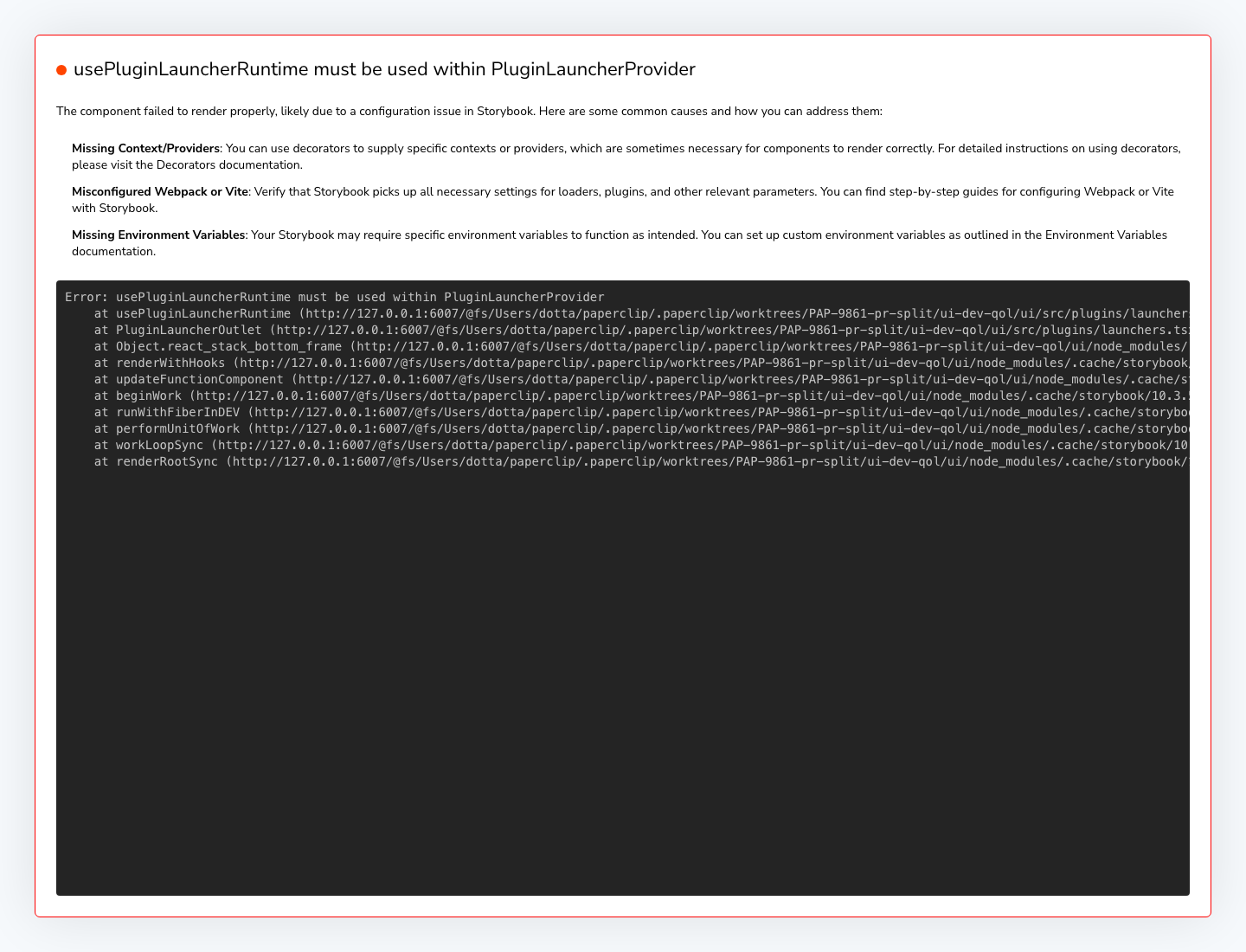 - Inbox/task row selection and hover-state surface: 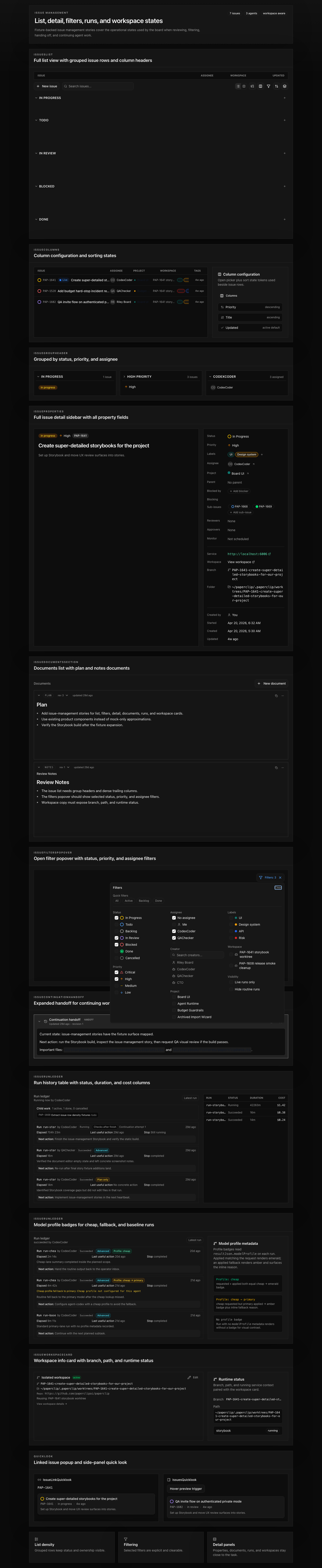 - Dev restart banner desktop: 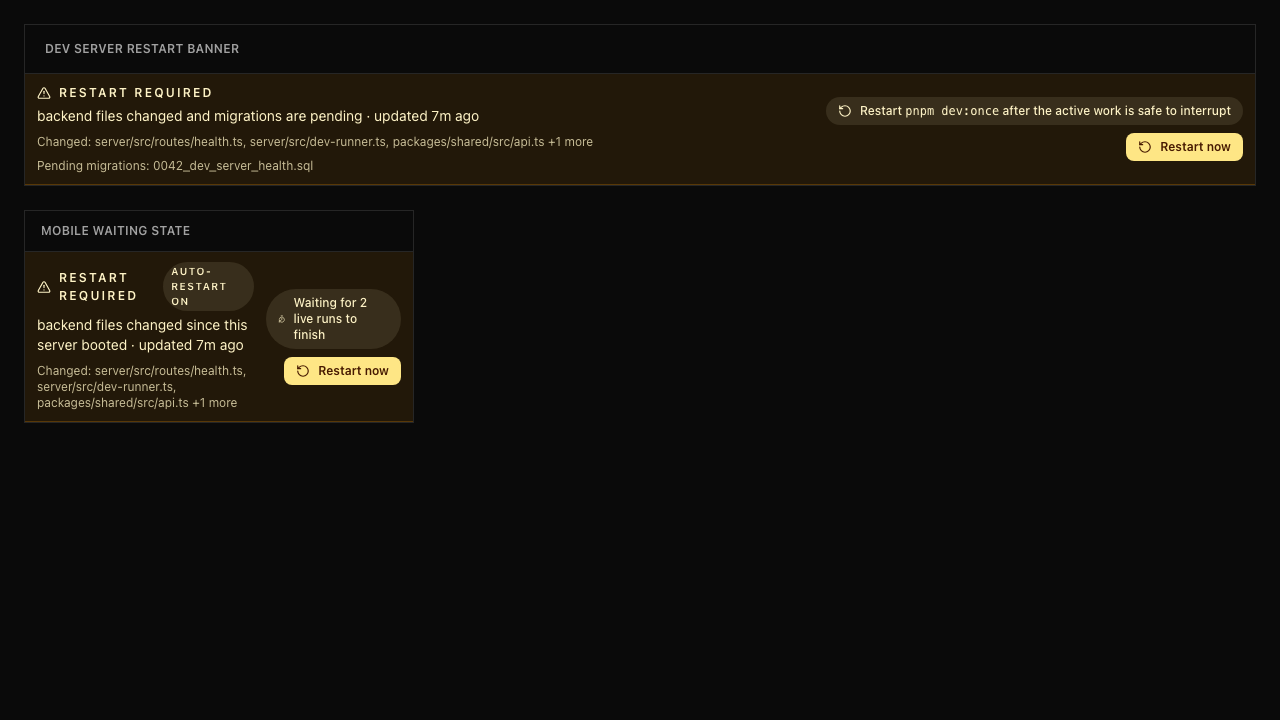 - Dev restart banner mobile: 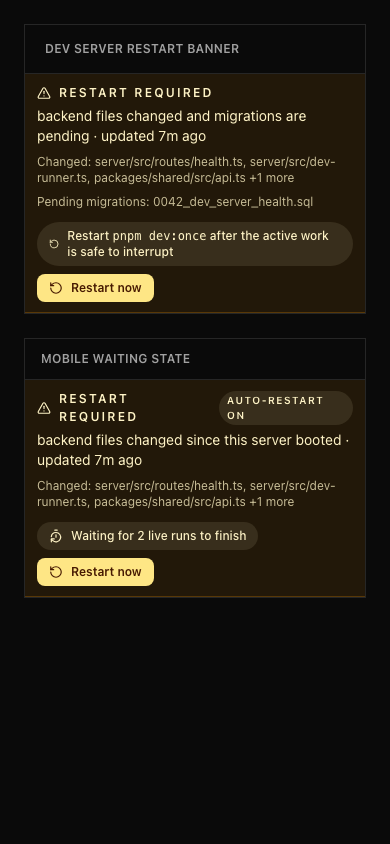 ## Risks - Mostly UI/dev ergonomics with low data risk. - Sidebar and inbox changes touch frequently used navigation surfaces, so visual review on desktop/mobile is still useful. > For core feature work, check [`ROADMAP.md`](ROADMAP.md) first and discuss it in `#dev` before opening the PR. Feature PRs that overlap with planned core work may need to be redirected — check the roadmap first. See `CONTRIBUTING.md`. ## Model Used - OpenAI Codex, GPT-5-based coding agent with local shell/git/tool use. Exact hosted model ID and context-window size are not exposed by the local Paperclip adapter runtime. ## Checklist - [x] I have included a thinking path that traces from project context to this change - [x] I have specified the model used (with version and capability details) - [x] I have checked ROADMAP.md and confirmed this PR does not duplicate planned core work - [x] I have run tests locally and they pass - [x] I have added or updated tests where applicable - [x] If this change affects the UI, I have included before/after screenshots - [x] I have updated relevant documentation to reflect my changes - [x] I have considered and documented any risks above - [x] I will address all Greptile and reviewer comments before requesting merge --------- Co-authored-by: Paperclip <noreply@paperclip.ing> |
||
|
DottaandPaperclip
|
e89d3f7e11 |
[codex] Add backup endpoint and dev runtime hardening (#4087)
## Thinking Path > - Paperclip is a local-first control plane for AI-agent companies. > - Operators need predictable local dev behavior, recoverable instance data, and scripts that do not churn the running app. > - Several accumulated changes improve backup streaming, dev-server health, static UI caching/logging, diagnostic-file ignores, and instance isolation. > - These are operational improvements that can land independently from product UI work. > - This pull request groups the dev-infra and backup changes from the split branch into one standalone branch. > - The benefit is safer local operation, easier manual backups, less noisy dev output, and less cross-instance auth leakage. ## What Changed - Added a manual instance database backup endpoint and route tests. - Streamed backup/restore handling to avoid materializing large payloads at once. - Reduced dev static UI log/cache churn and ignored Node diagnostic report captures. - Added guarded dev auto-restart health polling coverage. - Preserved worktree config during provisioning and scoped auth cookies by instance. - Added a Discord daily digest helper script and environment documentation. - Hardened adapter-route and startup feedback export tests around the changed infrastructure. ## Verification - `pnpm install --frozen-lockfile` - `pnpm exec vitest run packages/db/src/backup-lib.test.ts server/src/__tests__/instance-database-backups-routes.test.ts server/src/__tests__/server-startup-feedback-export.test.ts server/src/__tests__/adapter-routes.test.ts server/src/__tests__/dev-runner-paths.test.ts server/src/__tests__/health-dev-server-token.test.ts server/src/__tests__/http-log-policy.test.ts server/src/__tests__/vite-html-renderer.test.ts server/src/__tests__/workspace-runtime.test.ts server/src/__tests__/better-auth.test.ts` - Split integration check: merged after the runtime/governance branch and before UI branches with no merge conflicts. - Confirmed this branch does not include `pnpm-lock.yaml`. ## Risks - Medium risk: touches server startup, backup streaming, auth cookie naming, dev health checks, and worktree provisioning. - Backup endpoint behavior depends on existing board/admin access controls and database backup helpers. - No database migrations are included. > For core feature work, check [`ROADMAP.md`](ROADMAP.md) first and discuss it in `#dev` before opening the PR. Feature PRs that overlap with planned core work may need to be redirected — check the roadmap first. See `CONTRIBUTING.md`. ## Model Used - OpenAI Codex, GPT-5.4 tool-enabled coding model, agentic code-editing/runtime with local shell and GitHub CLI access; exact context window and reasoning mode are not exposed by the Paperclip harness. ## Checklist - [x] I have included a thinking path that traces from project context to this change - [x] I have specified the model used (with version and capability details) - [x] I have checked ROADMAP.md and confirmed this PR does not duplicate planned core work - [x] I have run tests locally and they pass - [x] I have added or updated tests where applicable - [x] If this change affects the UI, I have included before/after screenshots - [x] I have updated relevant documentation to reflect my changes - [x] I have considered and documented any risks above - [x] I will address all Greptile and reviewer comments before requesting merge --------- Co-authored-by: Paperclip <noreply@paperclip.ing> |



