mirror of
https://github.com/paperclipai/paperclip.git
synced 2026-10-26 18:31:34 +01:00
0823957a28264169912287a3788e00a0d4c9de88
2711
Commits
| Author | SHA1 | Message | Date | |
|---|---|---|---|---|
 Dotta |
0823957a28 | Keep unversioned skill assignments live | ||
|
Dotta
|
cf9542f6a3 | Reject mutations on deleted skill comments | ||
|
Dotta
|
1a894984b4 | Tighten skill comment threading | ||
|
Dotta
|
74b3932eb4 | Seed versions for forked skills | ||
|
Dotta
|
d77a64475b | Address Greptile skills service feedback | ||
|
Dotta
|
1a30ddbd38 | Fix skills store PR route verification | ||
|
Dotta
|
b46797f4ba | Fix skills store PR verification failures | ||
|
Dotta
|
30c57ebd5f | Preserve runtime skill version pins | ||
|
DottaandClaude Opus 4.8
|
c1c6242043 |
Stop skill-detail tabs from shifting the page on switch (PAP-10907)
Switching between tall tabs (Overview/Files) and short ones (Versions/Agents) toggled the desktop main content's vertical scrollbar, which widened the page and shifted content right. Reserve the scrollbar gutter on the main scroll container (scrollbar-gutter: stable) so its width stays constant whether or not the scrollbar is visible. Scoped to the gutter only — the scrollbar styling is unchanged. No-op on overlay-scrollbar systems. Co-Authored-By: Claude Opus 4.8 <noreply@anthropic.com> |
||
|
DottaandPaperclip
|
bb87e49ab2 |
Add Skills Store version diff regression test
Co-Authored-By: Paperclip <noreply@paperclip.ing> |
||
|
DottaandClaude Opus 4.8
|
a33e533dc4 |
Richer source attribution + catalog page polish (PAP-10907)
- Sidebar Source now surfaces the upstream catalog provenance: for catalog- installed skills, match the company skill to its catalog entry by key and show the GitHub owner/repo/path with a real link + ref/short-commit, instead of a long local staging path. - Middle-truncate the non-catalog source locator so long file paths stay readable in the narrow sidebar. - Catalog install CTA now reads "Install skill in this organization". - "Back to store" preserves the tab/category/source filters the user arrived with instead of dropping to the bare /skills root. - Settings button in the sidebar loses its outline. Co-Authored-By: Claude Opus 4.8 <noreply@anthropic.com> |
||
|
DottaandClaude Opus 4.8
|
cad64d2280 |
Open catalog/bundled skills as a regular page, not a modal (PAP-10907)
Round-3 routed catalog/optional/bundled cards to the install dialog, which the user reported as a "weird modal." Catalog skills now open a standalone full page in the new store instead: - Clicking a catalog/bundled/optional card opens /skills?catalog=<ref>, a regular full page (back-to-store link + Files tree + skill body + Install CTA) rather than the install modal or the legacy split view. - The install confirmation modal now only appears on an explicit Install click. - Catalog detail/file queries are keyed off the selected catalog ref instead of the removed view=catalog tab; legacy ?view=catalog deep links still redirect onto the new surface. - Removed the now-unused setViewParam helper. Co-Authored-By: Claude Opus 4.8 <noreply@anthropic.com> |
||
|
DottaandClaude Opus 4.8
|
c9b1fb82d1 |
Apply PAP-10907 round-3 Skills Store changes
- Discovery grid: one fewer column per breakpoint (min track 15rem -> 19rem) - Detail header: skill icon top-aligned, GitHub-style "by <author>" line, description clamped to 4 lines with a "View all" toggle - Drop the GitHub source-hash chip under the description (already shown in the Updates section); Updates uses a Pin icon instead of the word "Pin" - Sidebar: new Source section below attached agents (org/path, linked) - Fork/Create wizard: cap dialog + content textarea height so the modal no longer overflows the viewport - Retire the legacy split catalog view: catalog/bundled cards open the install dialog inline and legacy ?view=catalog deep links redirect to the new discovery surface Co-Authored-By: Claude Opus 4.8 <noreply@anthropic.com> |
||
|
DottaandClaude Opus 4.7
|
94c27257ec |
Fix skills store file reads and version snapshots (PAP-10910)
- readFile: fall back to stored markdown when a local/catalog source file is missing instead of 500ing on ENOENT; treat an explicit "."/"" github repoSkillDir as repo root instead of appending the slug; fall back to stored markdown when the github fetch fails for SKILL.md - updateFile: snapshot a version after each changed save (skips no-op saves) and thread the acting user/agent through the route - createLocalSkill: seed an "Initial version" so the Versions tab is populated from creation - migration 0100: backfill null install_count and enforce default/not-null Co-Authored-By: Claude Opus 4.7 <noreply@anthropic.com> |
||
|
Dotta
|
e8d2920977 | Add canonical skill detail URLs | ||
|
DottaandClaude Opus 4.8
|
115b4ebf47 |
Apply PAP-10907 round-2 Skills Store frontend changes
- Top-bar "installs" now counts agents that have the skill attached (attachedAgentCount) instead of the stored installCount (D) - Fix "Add to agent": the agents-tab and sidebar popovers shared one controlled open flag, which made both mount open and swallow clicks so the button looked dead; each popover now owns its open state (H) - Files sidebar narrowed from 18rem to 13rem (I) - Sharing moved into a gear-triggered Settings modal (sharing dropdown + danger-zone Remove); replaces the inline sidebar Sharing section (A) - GitHub check-updates / install-update controls moved to the sidebar under Agents, above the Settings gear (F) - Store/catalog cards show a source icon (where the skill is from) and the discovery grid gains a Source filter (github / skills.sh / local / …) (E) - Floating "Unsaved changes" save bar while a file edit is dirty, plus a beforeunload guard so the page isn't left accidentally (J) Storybook: discovery mocks now carry varied sourceBadge so the source filter/icons render; detail story updated for the popover prop change. Co-Authored-By: Claude Opus 4.8 <noreply@anthropic.com> |
||
|
DottaandClaude Opus 4.8
|
d4cd147a33 |
Apply PAP-10907 Skills Store store + detail polish
Store cards / discovery grid: - Bundled tab no longer appends "(required)"; card badge reads "Bundled" - Card stats reordered to installed-agents · stars · forks, hiding stars and forks when zero - Hover border-highlight (border-primary) on cards - Missing descriptions render a reserved blank line so cards align - Installed badge moved ahead of the other tags, checkmark dropped - Category sidebar scrolls independently of the results pane on desktop - Search field height/typography matched to the sort/action buttons (and 16px font on mobile to stop iOS zoom) Skill detail page: - Source icon moved after the H1 with a "Installed from …" tooltip - Top-level description capped at max-w-2xl - Installs · stars · fork relocated to a GitHub-style top-right cluster; stars and fork are buttons, installs is a stat - Remove moved into the sidebar Sharing section, gated on edit permission - Overview/Files/Versions/Agents tabs given a visible underline - Comments tab removed (and its dead queries/mutations/component) - Agents tab lists only attached agents with a full "Add to agent" button - Sidebar "Add to agent" is now a big button opening the multi-selector, with a preview of up to 3 attached agents (icon + name, "and n more") - Multi-selector sorts checked agents up top and shows agent icon + paused - Related skills section removed Adds a Storybook story (Skills Store/Skill detail) covering the detail page. Co-Authored-By: Claude Opus 4.8 <noreply@anthropic.com> |
||
|
DottaandPaperclip
|
3d377ea1f9 |
Fix Skills Store rollout polish
Co-Authored-By: Paperclip <noreply@paperclip.ing> |
||
|
DottaandPaperclip
|
a151e4618c |
Apply Skills Store detail-page polish from PAP-10882 UX review
Three small but board-feedback-grounded fixes on the new full-page skill detail (PAP-10846): - Hide the trust-level (TrustChip) and compatibility (CompatChip) pills from the detail header. Round-1 #8 said trust stays internal in v1; the "Includes scripts" pill was the explicit user-facing surface to remove. Round-2 #1.f also dropped compatibility from the stats redistribution. Source pin moved to a github-icon + tooltip next to the categories. - Add an installs count next to the Star control in the header (Star, N installs, Fork, ...) — round-2 #1.a's redistribution target for the removed stats bar. - Reorder the right rail to Attach to agent → Related skills → Sharing (round-2 #2). Sharing is still rendered on this surface because the control is editable; the read-only scope pill was already absent. Plus one small discovery-grid fallback: - Bundled SKILL.md files with frontmatter-only bodies stored their extracted description as ">" (raw blockquote glyph), which showed up literally on cards. cardDescriptionText() strips leading markdown punctuation and falls through to "No description yet." when nothing meaningful remains. Co-Authored-By: Paperclip <noreply@paperclip.ing> |
||
|
DottaandPaperclip
|
2f93dc99a6 |
Build skills store creation flows
Co-Authored-By: Paperclip <noreply@paperclip.ing> |
||
|
Dotta
|
85902696c8 | Fix mobile skill detail overflow | ||
|
Dotta
|
568f649c81 | Fix skill detail related skills overflow | ||
|
Dotta
|
ab6f3d58a3 | Build skill detail tabs | ||
|
DottaandClaude Opus 4.8
|
4672a31bff |
Build Skills Store discovery grid and category navigation (PAP-10879)
Replace the /skills list surface with the approved discovery layout: card grid, category sidebar, search, sort, and an end-of-strip Bundled (required) tab. Cards merge installed company skills with the install catalog, consume Phase 1 metadata (icon/color/tagline/ categories/social-proof), and degrade gracefully when fields are absent. Required/bundled skills are demoted out of rankings and get their own tab treatment. The main app nav collapses to its rail throughout the /skills section while the category sidebar is present. Adds a Storybook story covering the all/installed/bundled/empty states. Co-Authored-By: Claude Opus 4.8 <noreply@anthropic.com> |
||
|
DottaandPaperclip
|
db599edadf |
Implement skills store API foundation
Co-Authored-By: Paperclip <noreply@paperclip.ing> |
||
|
Jannes StubbemannandClaude Opus 4.8
|
69a368ed51 |
fix(gemini-local): pre-select gemini-api-key auth in managed-HOME settings.json for headless runs (#7918)
## Thinking Path

> - Paperclip is the open source app people use to manage AI agents for
work
> - The gemini-local adapter runs gemini-cli headlessly, including on
remote/sandboxed execution targets where the adapter manages a dedicated
HOME under the runtime root
> - gemini-cli hard-refuses headless runs with "Invalid auth method
selected." unless `$HOME/.gemini/settings.json` persists an auth
selection; setting `GEMINI_DEFAULT_AUTH_TYPE` alone does NOT satisfy it
(proven in an isolated pod)
> - With a managed HOME the runtime root replaces the image home, so any
settings.json baked into the agent image (or the user's real home) is
invisible to the CLI, and every sandboxed gemini run dies before doing
any work
> - This affects any sandbox provider that runs gemini with API-key auth
through the managed-HOME path (SSH, E2B, Daytona, Kubernetes, or any
other remote execution target); it is a headless-execution bug fix, not
gateway- or deployment-specific behavior
> - This pull request makes the adapter pre-select the `gemini-api-key`
auth type in the managed `$HOME/.gemini/settings.json` whenever a
Gemini/Google API key is present, writing both settings schema
generations and never touching an existing settings.json
> - The benefit is that gemini agents actually run headlessly on remote
and sandboxed execution targets without any manual settings provisioning

## Linked Issues or Issue Description

No existing issue; describing the bug in-PR (bug template fields):

- **What happened:** Headless gemini-local runs on remote/sandboxed
execution targets fail immediately with `Invalid auth method selected.`
even though `GEMINI_API_KEY` is provided.
- **Expected:** Providing the API key should be enough for a headless
run to authenticate and proceed.
- **Root cause:** gemini-cli requires an auth selection persisted in
`$HOME/.gemini/settings.json` for non-interactive runs; the
`GEMINI_DEFAULT_AUTH_TYPE` env var does not substitute for it (verified
in an isolated pod with only the env var set). The adapter's
managed-HOME execution path points HOME at the runtime root, so any
pre-existing settings.json (image-baked or user home) is hidden and the
CLI finds no auth selection.
- **Reproduction:** Run the gemini-local adapter against a
remote/sandboxed execution target with `GEMINI_API_KEY` set and no
settings.json under the managed HOME; the run aborts with the error
above.
- Duplicate/related search: no existing PR or issue addresses this;
closest related is #7693 (bundles gemini-cli in the Docker image), which
makes the CLI available but does not fix headless auth selection.

## What Changed

- `packages/adapters/gemini-local/src/server/execute.ts`: after
provisioning the managed HOME, when a Gemini/Google API key is present,
write `$HOME/.gemini/settings.json` pre-selecting `gemini-api-key` auth.
Both settings schema generations are written (legacy top-level
`selectedAuthType` and current `security.auth.selectedType`) so old and
new gemini-cli versions are covered.
- The write is strictly scoped to the managed HOME (the per-run runtime
root on sandbox transports). On non-managed remote targets (SSH), where
the remote home is the user's real home and existing settings remain
visible to the CLI, the adapter creates nothing (review feedback, P1).
- The write is guarded by `[ -f ... ] ||` so a user-shipped
settings.json (e.g. via workspace) is never overwritten.
- The key-presence gate checks the run env AND the host process env
(`GEMINI_API_KEY` / `GOOGLE_API_KEY`): in sandboxed paths the key never
enters the adapter's run env; it reaches the agent pod via the sandbox
provider's per-run secret (env passthrough from the host env), so the
host env is the correct signal there.
- `packages/adapters/gemini-local/src/server/execute.remote.test.ts`: a
new sandbox-transport test asserts the settings.json write lands under
the per-run runtime root (path + `gemini-api-key` content), and the SSH
test asserts no settings.json is created on a non-managed home.

## Verification

- `npx vitest run packages/adapters/gemini-local`: 3 files, 17 tests,
all pass.
- `pnpm --filter @paperclipai/adapter-gemini-local typecheck` and
`build`: clean (test file is covered by the package tsconfig `include`).
- Negative control: in an isolated pod, gemini-cli with `GEMINI_API_KEY`
+ `GEMINI_DEFAULT_AUTH_TYPE` set but no settings.json still fails with
`Invalid auth method selected.`; with the settings.json written by this
change, the run proceeds.
- Verified end-to-end: a gemini agent in a hardened Kubernetes (gVisor)
sandbox completed a real task (with `GOOGLE_GEMINI_BASE_URL` pointing at
a GenAI-compatible endpoint), producing a billed usage row. That
deployment supplies the verification evidence; the fix applies to any
sandbox provider running gemini with API-key auth.

## Risks

- Low risk. The new write only fires on the managed-HOME path (per-run
runtime root) when an API key is present, and only when no settings.json
exists yet, so existing setups, real user homes on SSH targets, and
user-provided settings are unaffected.
- If a future gemini-cli changes the settings schema again, the file may
need a third generation key; both current generations are written today.

## Model Used

- Claude (Anthropic), Claude Opus 4.8, 1M context, extended thinking,
with tool use (code execution / shell) via Claude Code.

## Checklist

- [x] I have included a thinking path that traces from project context
to this change
- [x] I have specified the model used (with version and capability
details)
- [x] I have checked ROADMAP.md and confirmed this PR does not duplicate
planned core work
- [x] I have searched GitHub for duplicate or related PRs and linked
them above
- [x] I have either (a) linked existing issues with `Fixes: #` / `Closes
#` / `Refs #` OR (b) described the issue in-PR following the relevant
issue template
- [x] I have run tests locally and they pass
- [x] I have added or updated tests where applicable
- [ ] If this change affects the UI, I have included before/after
screenshots (no UI change)
- [x] I have updated relevant documentation to reflect my changes (code
comments document the behavior; no doc pages cover managed-home auth)
- [x] I have considered and documented any risks above
- [x] All Paperclip CI gates are green
- [ ] Greptile is 5/5 with no open P2s, recommendations, or follow-ups
(review requested)
- [x] I will address all Greptile and reviewer comments before
requesting merge

🤖 Generated with [Claude Code](https://claude.com/claude-code)

---------

Co-authored-by: Claude Opus 4.8 (1M context) <noreply@anthropic.com>
canary/v2026.611.0-canary.4 |
||
|
Jannes StubbemannandClaude Opus 4.8
|
9e750d3e92 |
feat(codex-local): env-driven gateway routing via PAPERCLIP_CODEX_PROVIDERS config.toml (#7919)
## Thinking Path > - Paperclip is the open source app people use to manage AI agents for work > - The `codex-local` adapter runs the OpenAI Codex CLI; Paperclip already maintains a managed `CODEX_HOME` per company and ships it to remote/sandboxed execution targets > - Deployments increasingly put an OpenAI-compatible LLM gateway between the harness and the model for cost, governance, or data-residency reasons: LiteLLM, OpenRouter, Portkey, Kong, a corporate proxy, self-hosted models (vLLM/Ollama), or region-pinned/sovereign endpoints. But Codex has no CLI flag or env var for a custom endpoint: its only mechanism is `[model_providers.<id>]` tables (with `base_url`, `env_key`, `wire_api`) in `$CODEX_HOME/config.toml`, selected by a root-level `model_provider` key > - Today there is no supported way to get such provider config into the managed `CODEX_HOME`, so gateway routing requires hand-editing files the adapter owns and regenerates > - This pull request adds the codex analogue of #7837's opencode mechanism: a `PAPERCLIP_CODEX_PROVIDERS` JSON env var whose shape maps 1:1 onto codex's TOML schema, merged into the managed `config.toml` so the existing asset-shipping + `env.CODEX_HOME` mechanics deliver it to local and sandboxed runs alike; nothing here is specific to one hosting setup > - The benefit is Codex works behind any OpenAI-compatible gateway with config only; with no env set, behavior is unchanged ## Linked Issues or Issue Description No existing issue; describing in-PR (feature / adapter enhancement). - **Gap:** there is no supported way to register a custom/gateway `[model_providers.*]` endpoint for `codex-local`. Codex's only custom-endpoint mechanism is `config.toml` (`base_url` + `env_key` + `wire_api`, selected via the root `model_provider` key), and the adapter owns/regenerates the managed `CODEX_HOME`, so operators cannot durably hand-edit it. - Related: #7837 (the opencode-local analogue of this change, same env-driven gateway-routing pattern). Searched for duplicate/related PRs: no existing codex-local gateway/provider-routing PR found. > Note on ROADMAP: this is adapter-level, opt-in config (defaults unchanged) that *enables* gateway routing for one harness; it is not the core "Cloud / Sandbox agents" platform work itself. ## What Changed - New `prepareCodexRuntimeConfig()` (`packages/adapters/codex-local/src/server/runtime-config.ts`): reads `PAPERCLIP_CODEX_PROVIDERS` (run env first, then `process.env`), shaped as `{"providers": {"<id>": {base_url, env_key, wire_api, ...}}, "model_provider": "<id>"}`, and merges it into the managed `CODEX_HOME`'s `config.toml`. No-op when unset or empty. - A malformed value (invalid JSON, not a JSON object, no `providers` object, no usable provider entries, or individual entries with empty names or non-object values, which are skipped by name) is never silently dropped: each case surfaces a distinct, user-visible note (via the prepare notes, which flow into command notes + `onLog`) and unusable input leaves `config.toml` untouched. - Merge is marker-delimited and TOML-correct: existing `config.toml` content is preserved between two managed blocks. Root keys (e.g. `model_provider`) are prepended **before the first table header** (TOML root-region rule), `[model_providers.*]` tables are appended. Pre-existing same-name provider sections and root `model_provider` keys are excised so the managed definitions win without duplicate-table parse errors. - `{env:VAR}` placeholders are expanded server-side for literal-credential fields; `env_key` indirection remains the preferred path. - Crash-safe restore: prepare writes a pre-run backup (`config.toml.paperclip-backup`) before the merged file; `cleanup()` restores the original in the execute `finally` and removes the backup. If a run never reaches `cleanup()` (a throw during the setup between prepare and execution, or SIGKILL), the next prepare restores the original from the backup with full fidelity, including user `[model_providers.*]` sections the merge excised (review feedback, P2); plain block-stripping remains the fallback for pre-backup state. - An explicit adapter-config `env.CODEX_HOME` override is treated as user-managed: no merge, surfaced as a command note. - Dependency-free hand-emitted TOML (strings/numbers/booleans, arrays of scalars, plain objects as inline tables); basic strings escape U+0000-U+001F and U+007F per TOML 1.0 (review feedback, P2). Merged output was additionally validated locally with python tomllib during development; the committed tests assert the structural invariants. - `execute.ts` wiring: `prepareCodexRuntimeConfig` runs after `prepareManagedCodexHome` (before the home ships to the remote target), notes surface via `onLog` + command notes, and the `finally` calls `cleanup()`. **Note for reviewers:** current codex removed `wire_api = "chat"` (openai/codex#10157, Feb 2026), so gateway provider configs must use `wire_api = "responses"`, i.e. the gateway must speak `/v1/responses`. The adapter passes the value through verbatim; this is a codex-side constraint worth knowing when configuring it. ## Verification - `pnpm --filter @paperclipai/adapter-codex-local build` and `typecheck`: tsc clean against current `master` - `pnpm exec vitest run packages/adapters/codex-local`: 45 passing (incl. 17 `runtime-config` tests: fresh-merge + cleanup restore, root-region placement, same-name provider override, inline tables/arrays, DEL escaping, `{env:}` expansion from run env + `process.env`, per-case malformed-input notes with `config.toml` untouched, skipped-entry notes alongside a successful merge, silent no-op when unset/empty, explicit-`CODEX_HOME` skip note, backup restore of excised user sections after an interrupted run, backup removal on cleanup, stale-block self-heal, re-run replacement) - Verified end-to-end: a codex agent in a hardened Kubernetes (gVisor) sandbox completed a real task routed through an OpenAI-compatible gateway's `/v1/responses`, with a billed usage row recorded on the gateway. That deployment supplies the verification evidence; the mechanism is gateway-agnostic. ## Risks Low. Entirely env-driven and opt-in; with `PAPERCLIP_CODEX_PROVIDERS` unset the adapter never touches `config.toml` and behavior is byte-identical to before. The merge preserves user content, restores the original file on cleanup, and survives interrupted runs via the pre-run backup; malformed input surfaces a visible note and is ignored without touching `config.toml`. No migration/UI impact. ## Model Used Claude Opus 4.8 (`claude-opus-4-8`, 1M context), extended thinking + tool use, via Claude Code. ## Checklist - [x] I have included a thinking path that traces from project context to this change - [x] I have specified the model used (with version and capability details) - [x] I have checked ROADMAP.md (adapter-level opt-in config enabling gateway routing; not the core sandbox-platform work, noted above) - [x] I have searched GitHub for duplicate or related PRs and linked them above (#7837 is the opencode analogue; no codex-local duplicate found) - [x] I have either (a) linked existing issues OR (b) described the issue in-PR following the relevant issue template - [x] I have run tests locally and they pass - [x] I have added or updated tests where applicable - [ ] If this change affects the UI, I have included before/after screenshots (n/a, no UI) - [ ] I have updated relevant documentation to reflect my changes (env var documented inline; no central doc references the adapter env yet) - [x] I have considered and documented any risks above - [x] All Paperclip CI gates are green (green on the previous head; re-running on the final note-copy polish commit) - [x] Greptile is 5/5 with no open P2s, recommendations, or follow-ups (both review P2s are fixed at head: the interrupted-run restore via the pre-run backup and the U+007F escaping; a re-review is requested for the note-copy polish) - [x] I will address all Greptile and reviewer comments before requesting merge 🤖 Generated with [Claude Code](https://claude.com/claude-code) --------- Co-authored-by: Claude Opus 4.8 (1M context) <noreply@anthropic.com> |
||
|
Jannes StubbemannandClaude Opus 4.8
|
6e4aca9c67 |
feat(pi-local): env-driven gateway routing via PAPERCLIP_PI_PROVIDERS models.json (#7920)
## Thinking Path > - Paperclip is the open source app people use to manage AI agents for work > - The `pi-local` adapter runs the Pi coding agent, including inside remote/sandboxed execution targets; Pi resolves `--provider P --model M` by an exact (provider, id) match against its model registry, and it has no base-url CLI flag or env var: a `models.json` in its agent config dir (`$PI_CODING_AGENT_DIR`, falling back to `$HOME/.pi/agent`) is its only mechanism for custom or OpenAI/Anthropic-compatible endpoints > - Deployments increasingly put an LLM gateway between the harness and the model for cost, governance, or data-residency reasons: LiteLLM, OpenRouter, Portkey, Kong, a corporate proxy, self-hosted models (vLLM/Ollama), or region-pinned/sovereign endpoints. Today there is no supported way to get such provider config into Pi's registry for orchestrated runs > - The opencode adapter gained the equivalent capability in #7837 and codex in #7919; this pull request is the Pi analogue, so the harness layer stays gateway-agnostic regardless of which CLI an agent uses; nothing here is specific to one hosting setup > - This pull request reads `PAPERCLIP_PI_PROVIDERS` (Pi's `models.json` `providers` shape), materialises a managed `models.json` in a temp agent-config dir, points `PI_CODING_AGENT_DIR` at it, and ships it to remote execution targets with the run > - The benefit is Pi works behind any compatible gateway with config only; with no env set, behavior is unchanged ## Linked Issues or Issue Description No existing issue; describing in-PR (feature / adapter enhancement). - **Gap:** there is no supported way to register custom/gateway providers + models for `pi-local`. Pi's only custom-endpoint mechanism is a `models.json` in its agent config dir, and orchestrated (especially sandboxed) runs have no way to provision one declaratively. - Related: #7837 (the opencode-local analogue, same env-driven gateway-routing pattern) and #7919 (the codex-local analogue). Searched for duplicate or related PRs: no existing pi-local gateway/provider-routing PR found. > Note on ROADMAP: this is adapter-level, opt-in config (defaults unchanged) that *enables* gateway routing for one harness; it is not the core "Cloud / Sandbox agents" platform work itself. ## What Changed - New `packages/adapters/pi-local/src/server/runtime-config.ts`: `preparePiRuntimeConfig()` reads `PAPERCLIP_PI_PROVIDERS` (a JSON object in pi's `models.json` `providers` shape) from the run env, then `process.env`. When set, it expands `{env:VAR}` placeholders (run env first, then process env; unresolvable placeholders left intact), writes `{"providers": ...}` to a managed temp dir as `models.json`, and returns env with `PI_CODING_AGENT_DIR` pointing at it plus a cleanup handle. - `execute.ts`: the prepared dir ships to remote execution targets as the managed-runtime asset `agentConfig` (same mechanism as opencode's `xdgConfig`), and `PI_CODING_AGENT_DIR` is repointed to the in-target path; cleanup runs in `finally`. - Misconfiguration is visible, not silent: a set-but-unusable `PAPERCLIP_PI_PROVIDERS` (invalid JSON, not an object, no provider objects) surfaces an explanatory note instead of proceeding unconfigured into an opaque model-not-found failure later, and provider entries with non-object values are skipped with a note naming them. Unset/empty stays a silent no-op (feature off). - Defaults unchanged: with `PAPERCLIP_PI_PROVIDERS` unset, the adapter behaves byte-for-byte as before, for local runs and for every existing sandbox provider. ## Verification - All pi-local tests green against this base (new: providers written verbatim, `{env:VAR}` expansion from run env/process env/unresolvable, no-op when unset, `PI_CODING_AGENT_DIR` set and shipped, the misconfiguration notes incl. skipped non-object entries, remote asset sync + env repoint). Typecheck and build clean. - Production end-to-end evidence (our deployment, used as verification, not as the scope of the change): a pi agent in a Kubernetes gVisor sandbox resolved a custom provider from the shipped `models.json`, completed an assigned issue through an Anthropic-compatible gateway, and landed a billed usage row. ## Risks Low. The entire feature is opt-in behind one env var; the only behavior change when it is set is the intended one. The managed dir replaces the host agent dir for the run by design (credentials travel inside the provider config or via env-key indirection), which is the correct posture for orchestrated runs. No migration/UI impact. ## Model Used Claude Opus 4.8 (`claude-opus-4-8`, 1M context), extended thinking + tool use, via Claude Code. ## Checklist - [x] I have included a thinking path that traces from project context to this change - [x] I have specified the model used (with version and capability details) - [x] I have checked ROADMAP.md (adapter-level opt-in config enabling gateway routing; not the core sandbox-platform work, noted above) - [x] I have searched GitHub for duplicate or related PRs and linked them above (#7837 and #7919 are the opencode/codex analogues; no pi-local duplicate found) - [x] I have either (a) linked existing issues OR (b) described the issue in-PR following the relevant issue template - [x] I have run tests locally and they pass - [x] I have added or updated tests where applicable - [ ] If this change affects the UI, I have included before/after screenshots (n/a, no UI) - [ ] I have updated relevant documentation to reflect my changes (env var documented inline; no central doc references the adapter env yet) - [x] I have considered and documented any risks above - [x] All Paperclip CI gates are green (green on the previous head; re-running on the final note-copy polish commit) - [x] Greptile is 5/5 with no open P2s, recommendations, or follow-ups (both prior review findings are fixed at head: the indirect notes-based guard is now an explicit `agentConfigDir` handle, and a failed `models.json` write no longer leaks the temp dir; a re-review is requested for the note-copy polish) - [x] I will address all Greptile and reviewer comments before requesting merge 🤖 Generated with [Claude Code](https://claude.com/claude-code) --------- Co-authored-by: Claude Opus 4.8 (1M context) <noreply@anthropic.com> |
||
|
Jannes StubbemannandClaude Opus 4.8
|
1ac1ba5442 |
feat(opencode-local): env-driven gateway routing (custom providers, small/cheap model, remote allow-all) (#7837)
## Thinking Path
> - Paperclip is the open source app people use to manage AI agents for
work
> - The `opencode-local` adapter runs the OpenCode harness; its
model/provider routing assumes built-in providers (anthropic/openai/...)
and their default models
> - Deployments increasingly put an OpenAI/Anthropic-compatible LLM
gateway between the harness and the model for cost, governance, or
data-residency reasons: LiteLLM, OpenRouter, Portkey, Kong, a corporate
proxy, self-hosted models (vLLM/Ollama), or region-pinned/sovereign
endpoints. But OpenCode only resolves `--model provider/model` when the
model is registered in a provider's `models` map, and
`OPENCODE_ALLOW_ALL_MODELS` does NOT bypass its internal `getModel()`
> - Several lanes also fall back to built-in default models the gateway
may not serve: the auxiliary/title model (e.g. `claude-haiku-*`) and the
budget/recovery "cheap" lane (`openai/gpt-5.1-codex-mini`); these abort
runs with "no keys found that support model"
> - This pull request makes the adapter's provider/model wiring
declarative via env, so any such deployment can register gateway models
+ pin the auxiliary/budget lanes without code changes; nothing here is
specific to one hosting setup
> - The benefit is OpenCode works behind any compatible gateway with
config only; with no env set, behavior is unchanged
## Linked Issues or Issue Description
No existing issue; describing in-PR (feature / adapter enhancement).
- **Gap:** there is no supported way to register custom/gateway
providers + models for `opencode-local`, nor to pin the auxiliary
(title-gen) and budget (recovery) model lanes, so routing OpenCode
through a gateway fails at `getModel()` or on the default helper models.
- Related: #5737 (exe.dev sandbox installs for gemini/opencode local),
#5823 (unblock claude_local on remote sandbox providers).
> Note on ROADMAP: this is adapter-level, opt-in config (defaults
unchanged) that *enables* gateway routing for one harness; it is not the
core "Cloud / Sandbox agents" platform work itself. Happy to
redirect/discuss in #dev if preferred.
## What Changed
- `PAPERCLIP_OPENCODE_PROVIDERS`: merge custom/extended providers
(OpenCode `provider` shape) into the runtime `opencode.json`, so gateway
models are registered and `--model provider/model` resolves. `{env:VAR}`
placeholders are expanded server-side (so a key need not depend on the
sandbox run env).
- A malformed `PAPERCLIP_OPENCODE_PROVIDERS` is no longer silently
ignored: invalid JSON, a non-object value, and individual provider
entries with non-object values (which are skipped by name) each append a
visible note to the run notes so the misconfiguration is diagnosable
(addresses both review P1s).
- `PAPERCLIP_OPENCODE_SMALL_MODEL` / `PAPERCLIP_OPENCODE_CHEAP_MODEL`:
pin the auxiliary (title-generation) and budget (recovery-retry) lanes
to gateway-served models; defaults unchanged.
- Honour `OPENCODE_ALLOW_ALL_MODELS` on the **remote** execution path
too (was local-only, a parity gap).
- `PAPERCLIP_OPENCODE_PRINT_LOGS`: optional toggle adding `--print-logs`
so OpenCode logs surface on stderr for diagnosing remote/sandbox runs.
- `buildOpenCodeModelProfiles()` guards its `process.env` default with
`typeof process` so the shared client/server module stays browser-safe
(a bare `process.env` at module load threw ReferenceError in the browser
under Vite dev middleware and broke UI rendering in the e2e lane).
## Verification
- `pnpm --filter @paperclipai/adapter-opencode-local build` and
`typecheck` (tsc clean)
- `pnpm exec vitest run packages/adapters/opencode-local/src` shows 33
passing (incl. new tests for the provider merge, `{env:}` expansion, the
malformed/non-object/skipped-entry provider notes, small/cheap-model
resolution, and the remote allow-all bypass)
- Manually verified end-to-end against a real
OpenAI-/Anthropic-compatible gateway: with the providers + small/cheap
model set, both the title-gen and main task route to the configured
gateway model and the agent completes (a real completion is returned and
billed). That deployment supplies the verification evidence; the
mechanism is gateway-agnostic.
## Risks
Low. Everything is env-driven and opt-in; with no env set the generated
config output is unchanged, and the cheap model profile keeps its model
(the only difference is its updated human-readable description).
Defaults preserved: built-in providers, Codex-mini cheap lane with
`variant: low`, no `--print-logs`. No migration/UI impact.
## Model Used
Claude Opus 4.8 (`claude-opus-4-8`, 1M context), extended thinking +
tool use, via Claude Code.
## Checklist
- [x] I have included a thinking path that traces from project context
to this change
- [x] I have specified the model used (with version and capability
details)
- [x] I have checked ROADMAP.md (adapter-level opt-in config enabling
gateway routing; not the core sandbox-platform work, noted above)
- [x] I have searched GitHub for duplicate or related PRs and linked
them above (#5737, #5823)
- [x] I have either (a) linked existing issues OR (b) described the
issue in-PR following the relevant issue template
- [x] I have run tests locally and they pass
- [x] I have added or updated tests where applicable
- [ ] If this change affects the UI, I have included before/after
screenshots (n/a, no UI)
- [ ] I have updated relevant documentation to reflect my changes (env
vars documented inline via comments; no central doc references the
adapter env yet)
- [x] I have considered and documented any risks above
- [x] All Paperclip CI gates are green
- [x] Greptile is 5/5 with no open P2s, recommendations, or follow-ups
(the P1 about silently dropped malformed providers JSON is addressed in
|
||
|
Jannes StubbemannandClaude Opus 4.8
|
398d746093 |
build(agent-runtime): harness runtime images for sandboxed execution (stage 3/3) (#7934)
> [!NOTE] > This is **stage 3 of 3** of the staged Kubernetes contribution: stage 1 is the kubernetes sandbox-provider plugin (#5790), stage 2 is the provider backend/hardening refresh filed separately, and this stage ships the runtime images those sandboxes run. ## Thinking Path > - Paperclip is the open source app people use to manage AI agents for work > - Sandboxed agent execution (Refs #248) runs each agent turn in an isolated environment; the kubernetes sandbox provider (stage 1, #5790) schedules those runs as hardened pods > - A sandbox pod needs a runtime image with the harness CLI preinstalled: installing CLIs at run start is slow, flaky, and needs network egress the sandbox should not have > - There is no first-party image family for this, so every deployer would have to hand-roll Ubuntu + Node + CLI images per harness and solve signal handling, non-root, and image chaining themselves > - This PR ships the agent-runtime image family: a hardened base (non-root uid 1000, tini, git, the agent shim) plus one derived image per harness, a buildx bake file that chains them, and a publish workflow with cosign keyless signing > - The benefit is that any sandbox infrastructure, the kubernetes provider or otherwise, gets ready-made, signed, security-hardened per-harness runtime images that are verified in production across five harnesses ## Linked Issues or Issue Description Refs #248 (sandboxed agent execution proposal) and #5790 (the kubernetes sandbox provider, stage 1 of this contribution, which consumes these images as per-run runtime images via its adapter defaults). No issue covers the image gap itself, described in-PR: sandbox providers reference `ghcr.io/paperclipai/agent-runtime-*` images, but the repository contains neither the Dockerfiles nor the workflow that builds and publishes them. Without this, self-deployers cannot reproduce or audit the images their agent runs execute in. ## What Changed - `docker/agent-runtime/Dockerfile.base`: foundation image. Ubuntu 22.04 + Node 22 + git + tini (PID 1, signal propagation) + non-root `paperclip` user (uid/gid 1000) + the agent shim compiled in a Go build stage. `WORKDIR /workspace`, entrypoint `tini -- paperclip-agent-shim`. - One derived Dockerfile per harness: `opencode` (opencode-ai), `pi` (@mariozechner/pi-coding-agent), `codex` (@openai/codex), `gemini` (@google/gemini-cli, plus headless auth-mode settings), `claude` (@anthropic-ai/claude-code, symlinked as `claude-code`). Each installs the CLI as root, returns to uid 1000, and asserts the binary is on PATH at build time. - `acpx` and `hermes` Dockerfiles are included in the bake group but are not in the default publish scope (hermes is a stub until a CLI package exists). - `docker/agent-runtime/buildx-bake.hcl`: builds the whole family in one pass. Derived targets chain off the `base` target through bake `contexts` (the literal registry in each `FROM` is overridden to `target:base` at build time, so no intermediate push is needed). `REGISTRY` (default `ghcr.io/paperclipai`) and `VERSION` are overridable variables. - `tools/agent-shim/`: a small Go shim that runs as the container command. It reads `/run/paperclip/runtime-command.json` (`{ "command", "args" }`), resolves the harness CLI on PATH, and `syscall.Exec`s it so SIGTERM from the kubelet reaches the harness directly. Harness-agnostic, with unit tests. - `.github/workflows/agent-runtime-images.yml`: builds and pushes the default scope (base, opencode, pi, codex, gemini, claude) for linux/amd64 on `workflow_dispatch` (explicit version tag) or pushes to `master` touching these paths, then signs every digest with cosign keyless OIDC. Uses only `GITHUB_TOKEN`; no extra secrets. - `docker/agent-runtime/README.md`: image lineup, base contents, local build instructions, the runtime-command contract, and the security model. Additive only: nothing in the product loads these images. Deployments opt in via their sandbox provider configuration (for example the kubernetes plugin's image settings). ## Verification - `cd tools/agent-shim && go build ./... && go test ./... && go vet ./...`: all passing. - `docker buildx bake -f docker/agent-runtime/buildx-bake.hcl --print base opencode pi codex gemini claude`: resolves cleanly; every tag and build context lands on `ghcr.io/paperclipai/agent-runtime-*` and derived targets map the base ref to `target:base`. - Workflow YAML validated (parses, single job, no org-specific secrets). - This exact image family (built from these Dockerfiles, bake file, and workflow) is what runs agent execution in production on paperclip.inc, verified end-to-end across five harnesses (opencode, pi, codex, gemini, claude): each as a full loop from assigned issue to per-run runtime image in a sandboxed pod to completed run. ## Risks - Low risk: purely additive, nothing in paperclip-server or the UI references these files. The workflow only triggers on its own paths. - Derived images install harness CLIs `@latest` at build time; a broken upstream CLI release would surface at image build, not at run time, and the PATH assertion fails the build rather than shipping a broken image. - The hermes image is an explicit stub (documented in its Dockerfile) until a hermes CLI package exists; it is outside the default publish scope. - cosign signing is keyless OIDC with the workflow identity; no long-lived signing keys are introduced. ## Model Used Claude Opus 4.8 (claude-opus-4-8, 1M context, extended thinking, tool use via Claude Code). ## Checklist - [x] I have included a thinking path that traces from project context to this change - [x] I have specified the model used (with version and capability details) - [x] I have checked ROADMAP.md and confirmed this PR does not duplicate planned core work - [x] I have searched GitHub for duplicate or related PRs and linked them above - [x] I have either (a) linked existing issues with `Fixes: #` / `Closes #` / `Refs #` OR (b) described the issue in-PR following the relevant issue template - [x] I have run tests locally and they pass - [x] I have added or updated tests where applicable - [x] If this change affects the UI, I have included before/after screenshots (no UI changes) - [x] I have updated relevant documentation to reflect my changes - [x] I have considered and documented any risks above - [ ] All Paperclip CI gates are green - [ ] Greptile is 5/5 with no open P2s, recommendations, or follow-ups - [x] I will address all Greptile and reviewer comments before requesting merge --------- Co-authored-by: Claude Opus 4.8 (1M context) <noreply@anthropic.com> |
||
|
Jannes StubbemannandClaude Opus 4.8
|
4ad94d0bde |
feat(server): kubernetes execution integration for sandbox-provider plugins (stage 2/3) (#7938)
## Thinking Path > - Paperclip is the open source app people use to manage AI agents for work > - The execution subsystem runs those agents in environments (local, ssh, sandbox), and sandbox-provider plugins let an environment materialize per-run sandboxes > - Stage 1 (#5790) contributed a first-party Kubernetes sandbox-provider plugin, but the server core has no way to adopt it operationally: no per-run adapter selection, no way to force an instance onto sandboxed execution, no declarative adapter/model configuration, and the plugin must be installed by hand > - Without this, a multi-tenant or security-conscious deployment cannot guarantee that agent runs never execute on the host, and a single environment cannot serve agents with different harnesses > - This pull request adds the server + SDK integration: per-run adapterType on the lease protocol, an env-gated forced-Kubernetes execution policy with provisioning and a per-run allowlist guard, a declarative adapter registry and model list, in-cluster env passthrough for sandbox plugin workers, fail-safe auto-install of the bundled plugin, and the matching UI affordance > - The benefit is that sandbox-provider plugins become fully usable for Kubernetes execution: operators configure everything via environment variables and GitOps, while self-hosters who set none of the variables see exactly the behavior they have today ## Linked Issues or Issue Description Refs #5790 (stage 1 of 3: the Kubernetes sandbox-provider plugin package). No existing issue. Feature description: the server core lacks the integration seams to operate a sandbox-provider plugin as the mandatory execution path of an instance. This PR is stage 2 of 3 of the staged Kubernetes contribution; stage 3 will contribute the agent runtime images and their build pipeline. ## What Changed One line per piece: - `packages/plugins/sdk/protocol.ts`: optional `adapterType` on `PluginEnvironmentAcquireLeaseParams` so a provider can select the runtime image per run; existing providers simply ignore it - `server/services/environment-runtime.ts` + `environment-run-orchestrator.ts`: thread the agent's adapter type into both lease-acquiring drivers, including the heartbeat path (the two call sites have historically drifted, hence the pinned test) - `server/services/environments.ts`: `ensureKubernetesEnvironment` / `findKubernetesEnvironment`, an idempotent managed Kubernetes environment per company, identified by a metadata marker and refreshed (not recreated) on config change; `timeoutMs` rides on the config for slow cold-start leases - `server/services/execution-allowlist.ts`: pure (driver, provider, policy) -> allow/deny guard; `executionMode=kubernetes` only allows the kubernetes sandbox provider - `server/services/execution-policy-bootstrap.ts` + startup hook in `server/index.ts`: parse `PAPERCLIP_EXECUTION_MODE` / `PAPERCLIP_K8S_*`, persist `executionMode` into instance general settings, and provision the managed environment for every company; fails loud on misconfiguration - `server/services/heartbeat.ts`: when the policy forces Kubernetes, pin run selection to the managed environment (also overriding any persisted workspace environment id), refuse to fall back to local, and re-check the actually acquired environment against the allowlist as defense in depth - `server/services/adapter-registry-bootstrap.ts` + shared `AdapterRegistryEntry` type/validator: declarative `PAPERCLIP_ADAPTERS` registry (inline JSON or file) that reconciles adapter availability at startup and rides on the Kubernetes environment config - `server/services/adapter-models-env.ts` + `adapters/registry.ts`: `PAPERCLIP_ADAPTER_MODELS` lets an operator declare picker model lists the server cannot CLI-discover - `server/services/plugin-loader.ts`: pass `KUBERNETES_SERVICE_HOST/PORT(_HTTPS)` through to plugin workers that register environment drivers, so in-cluster API clients can be constructed; all other host env stays stripped - `server/app.ts`: fail-safe auto-install of the bundled kubernetes plugin at boot; no-ops when the bundle is absent and never blocks startup on error - `packages/shared` types/validators: `InstanceExecutionMode` on general settings (optional, strict schema) - `ui/lib/forced-kubernetes-environment.ts` + `AgentConfigForm`: when the policy is active, show a read-only Kubernetes environment instead of the environment picker and default new agents onto the managed environment - Tests for every new module plus the adapterType pin in `heartbeat-plugin-environment` and the managed-environment lifecycle in `environment-service` Everything is gated: with `PAPERCLIP_EXECUTION_MODE`, `PAPERCLIP_ADAPTERS`, and `PAPERCLIP_ADAPTER_MODELS` unset (and no bundled plugin present), every code path reduces to current behavior. The per-run `adapterType` is an optional SDK parameter that existing providers ignore. ## Verification - `cd server && npx tsc --noEmit`: clean (0 errors); `ui` typecheck also clean - Targeted suites all green (11 files, 90 tests): `npx vitest run server/src/__tests__/heartbeat-plugin-environment.test.ts server/src/__tests__/environment-service.test.ts server/src/__tests__/environment-runtime.test.ts server/src/__tests__/environment-run-orchestrator.test.ts server/src/__tests__/plugin-database.test.ts server/src/services/execution-policy-bootstrap.test.ts server/src/services/execution-allowlist.test.ts server/src/services/adapter-registry-bootstrap.test.ts server/src/services/adapter-registry-bootstrap.reconcile.test.ts server/src/services/adapter-models-env.test.ts packages/shared/src/validators/adapter-registry.test.ts` - `npx vitest run ui/src/components/AgentConfigForm.test.ts`: green (6 tests) - Full `npx vitest run server/src/__tests__`: 2323 passed, 1 skipped; the only failures (heartbeat-process-recovery pid-retry, workspace-runtime symbolic-ref/git tests) reproduce identically on pristine `master` in the same environment, so they are machine-environment issues unrelated to this change; `server-startup-feedback-export` needed its `services/index.js` mock extended with the new export and is green - This integration has been running in production on a hosted multi-tenant deployment, where it executes agent runs across five different harnesses through the stage 1 plugin ## Risks - Low for existing deployments: every behavior is env-gated and the defaults preserve current semantics; the auto-install block is wrapped fail-safe and skips silently when the plugin bundle is absent - `executionMode` is a new optional field on a strict zod schema; absent input normalizes exactly as before - The forced policy intentionally fails runs loudly (rather than falling back to local) when no managed Kubernetes environment exists; this only affects instances that explicitly set `PAPERCLIP_EXECUTION_MODE=kubernetes` ## Model Used Claude Opus 4.8 (claude-opus-4-8, 1M context), extended thinking, agentic tool use via Claude Code. ## UI screenshots The UI change is a new read-only "Execution" section in `AgentConfigForm`, shown only when the instance execution policy forces Kubernetes (`executionMode=kubernetes`); there is no "before" state for it (the section did not exist, and instances without the forced policy render the existing picker unchanged). Captured from the new Storybook stories added in this PR (`Product/Agent Management`): Managed Kubernetes environment present (read-only display, no local/SSH picker): 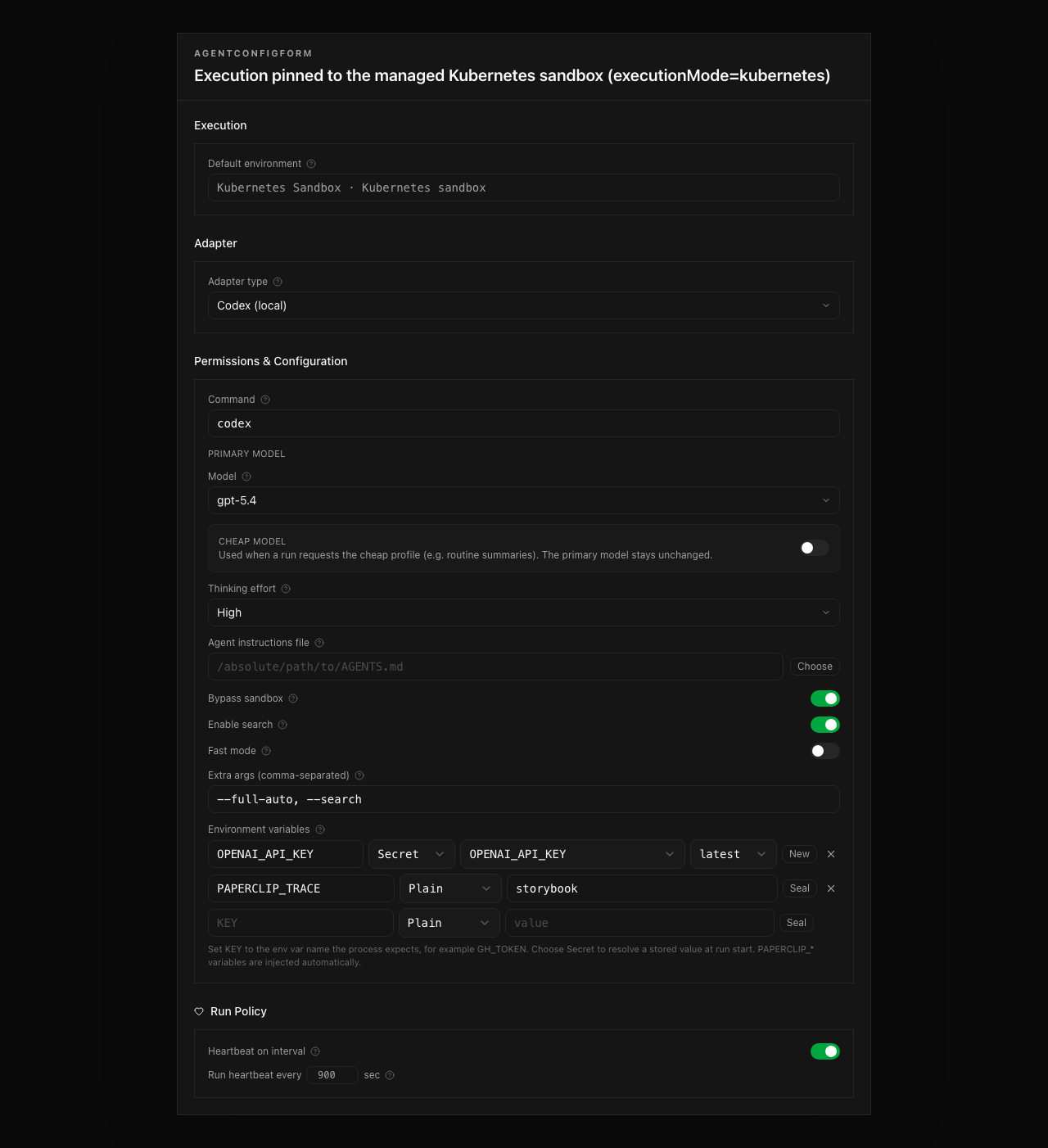 No managed environment available yet (warning notice, no silent local fallback): 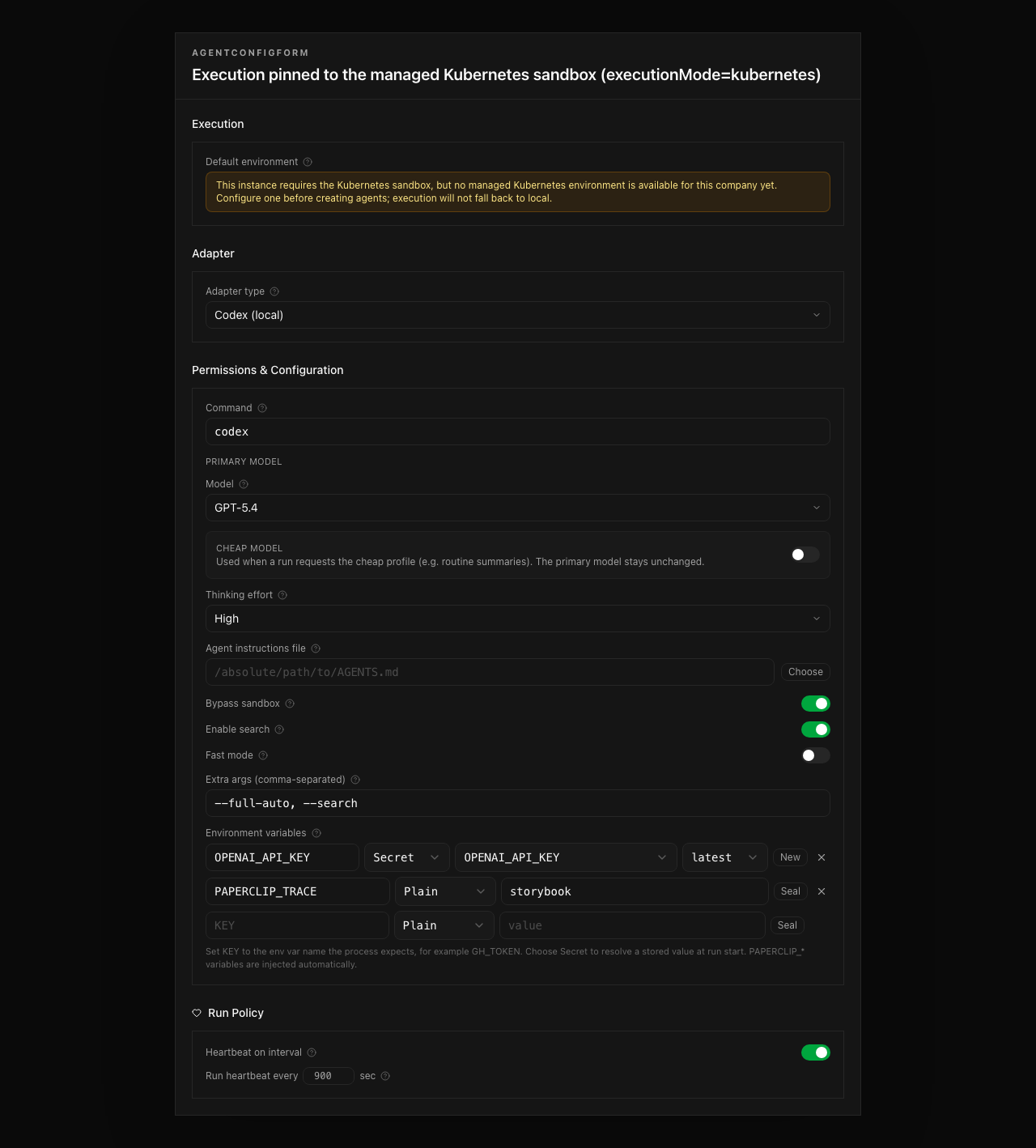 ## Checklist - [x] I have included a thinking path that traces from project context to this change - [x] I have specified the model used (with version and capability details) - [x] I have checked ROADMAP.md and confirmed this PR does not duplicate planned core work - [x] I have searched GitHub for duplicate or related PRs and linked them above - [x] I have either (a) linked existing issues with `Fixes: #` / `Closes #` / `Refs #` OR (b) described the issue in-PR following the relevant issue template - [x] I have run tests locally and they pass - [x] I have added or updated tests where applicable - [x] If this change affects the UI, I have included before/after screenshots - [x] I have updated relevant documentation to reflect my changes - [x] I have considered and documented any risks above - [ ] All Paperclip CI gates are green - [ ] Greptile is 5/5 with no open P2s, recommendations, or follow-ups - [x] I will address all Greptile and reviewer comments before requesting merge 🤖 Generated with [Claude Code](https://claude.com/claude-code) --------- Co-authored-by: Claude Opus 4.8 (1M context) <noreply@anthropic.com> |
||
|
Jannes StubbemannandClaude Opus 4.8
|
05ab45225a |
feat(plugin-kubernetes): self-hostable Kubernetes sandbox provider (stage 1/3: plugin package) (#5790)
## Thinking Path > - Paperclip is the open source app people use to manage AI agents for work > - Sandbox providers are the seam that lets agent runs execute in isolated environments; today the only first-party remote provider is Daytona, a hosted third-party service > - Self-hosters running Paperclip on their own infrastructure (often Kubernetes already) have no first-party way to run agent sandboxes on a cluster they control > - That gap matters for teams with data-residency, sovereignty, or cost constraints who cannot or will not send workloads to a hosted sandbox service > - This pull request adds a Kubernetes sandbox-provider plugin as a standalone, workspace-excluded package: it implements every SandboxProvider hook the Daytona provider does, on infrastructure the operator owns > - The benefit is that any Paperclip deployment with a Kubernetes cluster gets multi-tenant, network-isolated, quota-bounded agent sandboxes with zero new external dependencies ## Linked Issues or Issue Description No existing issue. Following the feature template: - **Problem:** Paperclip's remote sandbox execution requires a hosted third-party provider. Self-hosters cannot run agent sandboxes on their own Kubernetes clusters with a first-party provider. - **Proposed solution:** A `@paperclipai/plugin-kubernetes` sandbox-provider plugin with two backends: long-lived sandboxes via the [kubernetes-sigs/agent-sandbox](https://github.com/kubernetes-sigs/agent-sandbox) CRD (multi-command exec, adapter-install pattern) and one-shot `batch/v1` Jobs (stable APIs only, no extra controllers). - **Alternatives considered:** Driving kubectl from a generic shell provider (no lifecycle/lease semantics), or requiring a hosted provider (exactly the constraint this removes). ## What Changed This is **stage 1 of 3** of a staged contribution (direction agreed with maintainers): the plugin package alone. Stage 2 (server integration: lease params, provider registration) and stage 3 (agent runtime images + CI) are companion PRs that will be cross-linked from a comment here. - New package `packages/plugins/sandbox-providers/kubernetes` (workspace-excluded, like the path already carved out in `pnpm-workspace.yaml`): src, unit + kind integration tests, operator prerequisite manifests, README, smoke-test guide - Implements the full SandboxProvider hook surface the Daytona provider implements: `validateConfig`, `probe`, `acquireLease`, `resumeLease`, `releaseLease`, `destroyLease`, `realizeWorkspace`, `execute` - Two backends: `sandbox-cr` (default; long-lived pod via the agent-sandbox `Sandbox` CR, supports multi-command exec) and `job` (one-shot `batch/v1` Job; nothing beyond k8s 1.27+ required) - Per-run adapter resolution: one environment serves mixed harnesses; the per-run `adapterType` hint is read through a local optional type extension, so the plugin typechecks and builds against the current plugin SDK and simply falls back to the environment's configured default adapter until stage 2 lands - Exec-env wrapping: the Kubernetes exec API carries no environment, so commands are wrapped to receive the run's env - Fast-upload interception for workspace realization, scoped per lease - Per-tenant isolation: derived namespace per company, RBAC, ResourceQuota, restricted-PSS pod security (runAsNonRoot, drop ALL, seccomp RuntimeDefault, no SA token automount) - Network egress policy in two flavors: native `NetworkPolicy` and `CiliumNetworkPolicy` (FQDN allowlists) - Image allowlist with glob matching, registry override, and per-run image override validation - Per-run Kubernetes Secrets carrying agent credentials, ownerRef'd to the Job or Sandbox CR for cascade GC ## Verification - Standalone build, exactly as the README documents: ```bash cd packages/plugins/sandbox-providers/kubernetes pnpm install --ignore-workspace pnpm test # 147 unit tests, 17 files, all green pnpm typecheck # clean against the in-repo plugin SDK on master pnpm build # dist/ emitted, manifest + worker entrypoints present ``` - A kind-cluster end-to-end integration test is included (`RUN_K8S_INTEGRATION_TESTS=1 pnpm test test/integration/end-to-end-run.test.ts`) - Beyond CI: this provider has been verified in a production multi-tenant deployment against five harnesses (opencode, pi, codex, gemini, claude code) with real billed runs ## Risks - **Zero behavior change for any existing deployment.** The package is workspace-excluded; nothing in the server imports or loads it until stage 2's integration lands. No existing code paths are touched. - The default `sandbox-cr` backend depends on an alpha CRD (`agents.x-k8s.io/v1alpha1`); the README flags this and the `job` backend uses only stable APIs as a fallback. - Risk surface is confined to deployments that explicitly install and configure the plugin. - The default runtime images (`ghcr.io/paperclipai/agent-runtime-*`) are published by the stage 3 companion PR (#7934); until that lands, deployments must point `runtimeImage` at their own images. ## Model Used Claude Opus 4.8 (1M context), extended thinking, with tool use (Claude Code). ## Checklist - [x] I have included a thinking path that traces from project context to this change - [x] I have specified the model used (with version and capability details) - [x] I have checked ROADMAP.md and confirmed this PR does not duplicate planned core work - [x] I have searched GitHub for duplicate or related PRs and linked them above - [x] I have either (a) linked existing issues with `Fixes: #` / `Closes #` / `Refs #` OR (b) described the issue in-PR following the relevant issue template - [x] I have run tests locally and they pass - [x] I have added or updated tests where applicable - [ ] If this change affects the UI, I have included before/after screenshots (no UI changes) - [x] I have updated relevant documentation to reflect my changes - [x] I have considered and documented any risks above - [ ] All Paperclip CI gates are green (pending this push) - [ ] Greptile is 5/5 with no open P2s, recommendations, or follow-ups - [x] I will address all Greptile and reviewer comments before requesting merge --------- Co-authored-by: Claude Opus 4.8 (1M context) <noreply@anthropic.com> |
||
|
Devin FoleyandPaperclip
|
c139d6c025 |
fix(codex-local): omit default model so codex CLI picks per auth mode (#7971)
## Thinking Path

> - Paperclip orchestrates AI agents through pluggable local adapters;
codex_local wraps OpenAI's `codex` CLI.
> - The codex_local adapter declares a hard-coded
`DEFAULT_CODEX_LOCAL_MODEL = "gpt-5.3-codex"` and multiple Paperclip
consumers (UI build-config, server route, OnboardingWizard, NewAgent
form, AgentConfigForm) fall back to it when the operator doesn't pick a
model.
> - That model — and every `*-codex` model plus the older
`gpt-5/5.1/5.2` lines — is API-key-only. Codex CLI rejects them on
ChatGPT subscription auth with "The 'gpt-5.3-codex' model is not
supported when using Codex with a ChatGPT account."
> - Every codex_local agent created through the default onboarding path
inherits this pin and breaks on its first heartbeat for any user authed
via `codex login` (ChatGPT).
> - claude_local already takes the right shape: its build-config only
sets `adapterConfig.model` when the operator actually picked one, and
falls through to whatever default `claude` CLI uses.
> - Codex CLI's own default is auth-mode-aware. ChatGPT-subscription
accounts get `gpt-5.5`; API-key accounts get the codex-tuned default. A
Paperclip-side pin masks this and downgrades whichever group it wasn't
built for.
> - This PR makes codex_local match claude_local's shape: omit
`adapterConfig.model` when the user picks "default," and let the CLI
choose. Subscription users stop breaking; API-key users stop getting
downgraded.
> - The benefit is auth-mode-correct defaults with no Paperclip-side
hard pin, plus future-proofing: when OpenAI bumps the CLI default we
inherit it for free.

## What Changed

- `packages/adapters/codex-local/src/ui/build-config.ts` — only set
`adapterConfig.model` when the operator picked one (parity with
`packages/adapters/claude-local/src/ui/build-config.ts`).
- `server/src/routes/agents.ts` — drop the codex_local-specific
`next.model = DEFAULT_CODEX_LOCAL_MODEL` fallback in
`applyCreateDefaultsByAdapterType`. Bypass-sandbox default is left in
place (security posture, not a model choice).
- `ui/src/pages/NewAgent.tsx`, `ui/src/components/AgentConfigForm.tsx`,
`ui/src/components/OnboardingWizard.tsx` — stop pre-populating the model
field with `DEFAULT_CODEX_LOCAL_MODEL` when the user selects the Codex
adapter. Other adapters' defaults (gemini_local, cursor, opencode_local)
are unchanged.
- `DEFAULT_CODEX_LOCAL_MODEL` is preserved as an exported constant for
downstream consumers / plugin authors who want to opt in to a pin; we
just stop forcing it on operators who didn't ask for one.
- Test: assert `buildCodexLocalConfig` omits `model` when input is
blank.

## Verification

- `pnpm exec vitest run
packages/adapters/codex-local/src/ui/build-config.test.ts
packages/adapters/codex-local/src/server/codex-args.test.ts
server/src/__tests__/adapter-registry.test.ts
server/src/__tests__/heartbeat-model-profile.test.ts
server/src/__tests__/agent-permissions-routes.test.ts` → 74/74 passing
- `pnpm exec vitest run ui/src/lib/duplicate-agent-payload.test.ts
ui/src/lib/acpx-model-filter.test.ts` → passing
- `pnpm tsc --noEmit -p .` → clean
- Live: I separately verified live during initial investigation that on
ChatGPT-subscription auth, `gpt-5.3-codex` is rejected and `gpt-5.5` is
what Codex CLI picks by default. Omitting model lets the CLI handle
that.

## Risks

- Telemetry: any sink that reads `adapterConfig.model` for cost
attribution will now see the empty/omitted case more often. The CLI
emits the actually-used model in its event stream; downstream telemetry
should already read from there for accuracy, but worth a check.
- Operator UX: "default" now means "whatever the CLI picks" instead of a
Paperclip-known model. The selectable catalog still includes `gpt-5.5`,
`gpt-5.4`, `gpt-5.3-codex`, etc. for operators who want to pin
explicitly.
- Existing agents are unaffected — their `adapterConfig.model` is
already set; this only changes the *new-agent* default flow.

## Related work

- Depends on: an open catalog-add PR adding `gpt-5.5` to the selectable
model list and to `CODEX_LOCAL_FAST_MODE_SUPPORTED_MODELS`. Operators
who want to switch to `gpt-5.5` explicitly need that PR merged first;
this PR is the structural change that makes "default" mean "let the CLI
choose."
- Closes #5371 — codex_local default model selection persists
`gpt-5.3-codex` instead of adapter default (this PR is the exact fix
#5371 proposes).
- Related: #5132 (opencode-local: hire-time default model fails on
ChatGPT-OAuth accounts) — same problem shape on a sibling adapter; not
fixed here but worth tracking for a parallel.
- Related: #5939 (codex_local adapter hardcodes `gpt-5.3-codex-spark`
validation, fails on ChatGPT OAuth accounts regardless of configured
model) — separate validation-path bug; not fixed here.

## Model Used

Claude (Sonnet-class), running inside Paperclip as a claude_local
executor.


## Checklist

- [x] I have included a thinking path that traces from project context
to this change
- [x] I have specified the model used (with version and capability
details)
- [x] I have checked ROADMAP.md and confirmed this PR does not duplicate
planned core work
- [x] I have searched GitHub for duplicate or related PRs and linked
them above
- [x] I have either (a) linked existing issues with `Fixes: #` / `Closes
#` / `Refs #` OR (b) described the issue in-PR following the relevant
issue template
- [x] I have run tests locally and they pass
- [x] I have added or updated tests where applicable
- [x] If this change affects the UI, I have included before/after
screenshots
- [x] I have updated relevant documentation to reflect my changes
- [x] I have considered and documented any risks above
- [x] All Paperclip CI gates are green
- [x] Greptile is 5/5 with no open P2s, recommendations, or follow-ups
- [x] I will address all Greptile and reviewer comments before
requesting merge

Co-authored-by: Paperclip <noreply@paperclip.ing>
canary/v2026.611.0-canary.3 |
||
|
|
9a48d92104 |
Add GPT-5.5 to Codex local model options (#5575)
## Related work

This PR is the cleanest "add `gpt-5.5` to the codex-local catalog"
change open against master. Several other PRs propose the same
catalog/fast-mode update; they should close as duplicates once this
lands:

- #4646 — Add Codex gpt-5.5 model option
- #6044 — feat(codex-local): add gpt-5.5 to model catalog, default
reasoning to medium, cheap profile xhigh
- #6045 — feat(codex-local): add gpt-5.5 to model catalog, default
medium reasoning, xhigh cheap profile
- #6595 — feat(adapters): add new Codex models (gpt-5.5, gpt-5.4-mini,
gpt-5.3-codex, gpt-5.2)

Related issues this enables (catalog-level surface area):

- #5371 — codex_local default model selection persists `gpt-5.3-codex`
instead of adapter default. This PR makes `gpt-5.5` selectable in the
dropdown; a separate follow-up changes the *default* behavior so users
who don't pick a model are subscription-compatible.
- #5132 — opencode-local: hire-time default model fails on ChatGPT-OAuth
accounts. Sibling adapter, same problem shape; not fixed here but worth
tracking as a parallel for the opencode side.

---

## Thinking Path

> - Paperclip orchestrates AI agents through adapter-backed local and
remote runtimes.
> - The `codex_local` adapter declares built-in model options that feed
the server model list and, in turn, the agent configuration UI dropdown.
> - GPT-5.5 is available in newer Codex environments but was missing
from Paperclip's fallback `codex_local` model list.
> - Operators could still type a manual model ID, but the default
dropdown made the supported path look unavailable.
> - Codex fast mode support is declared separately, so adding GPT-5.5 to
the visible list should also include it in the supported fast-mode set.
> - This pull request adds GPT-5.5 to the built-in Codex local model
options and updates focused tests around argument generation and adapter
model listing.
> - The benefit is a clearer default setup path for agents using GPT-5.5
without changing existing defaults or migrations.

## What Changed

- Added `gpt-5.5` to the `codex_local` fallback model list.
- Added `gpt-5.5` to `CODEX_LOCAL_FAST_MODE_SUPPORTED_MODELS`.
- Updated Codex argument tests to cover GPT-5.5 fast mode and preserve
manual-model fast mode behavior.
- Updated adapter model listing tests to assert the Codex fallback list
includes GPT-5.5.

## Verification

- `pnpm exec vitest run
packages/adapters/codex-local/src/server/codex-args.test.ts
server/src/__tests__/adapter-models.test.ts`
- `git diff --check`
- UI note: this is a dropdown data-source change rather than a
layout/component change; the adapter model listing test covers the list
consumed by the UI.

## Risks

- Low risk. This only extends a static fallback model list and fast-mode
allowlist.
- Existing defaults remain unchanged (`gpt-5.3-codex`).
- If a local Codex CLI does not support `gpt-5.5`, selecting it will
still fail at execution time the same way any unavailable manual model
would.

> For core feature work, check [`ROADMAP.md`](ROADMAP.md) first and
discuss it in `#dev` before opening the PR. Feature PRs that overlap
with planned core work may need to be redirected — check the roadmap
first. See `CONTRIBUTING.md`.

## Model Used

- OpenAI Codex desktop coding agent, GPT-5-family model. The exact
backing model ID was not exposed by the local runtime; the session used
shell, Git, test execution, and GitHub CLI tool access.


## Checklist

- [x] I have included a thinking path that traces from project context
to this change
- [x] I have specified the model used (with version and capability
details)
- [x] I have checked ROADMAP.md and confirmed this PR does not duplicate
planned core work
- [x] I have searched GitHub for duplicate or related PRs and linked
them above
- [x] I have either (a) linked existing issues with `Fixes: #` / `Closes
#` / `Refs #` OR (b) described the issue in-PR following the relevant
issue template
- [x] I have run tests locally and they pass
- [x] I have added or updated tests where applicable
- [x] If this change affects the UI, I have included before/after
screenshots
- [x] I have updated relevant documentation to reflect my changes
- [x] I have considered and documented any risks above
- [x] All Paperclip CI gates are green
- [x] Greptile is 5/5 with no open P2s, recommendations, or follow-ups
- [x] I will address all Greptile and reviewer comments before
requesting merge

---------

Co-authored-by: apple <apple@appledeMacBook-Pro.local>
Co-authored-by: Paperclip <noreply@paperclip.ing>
Co-authored-by: Devin Foley <devin@paperclip.ing>
canary/v2026.611.0-canary.2 |
||
|
Jannes StubbemannandClaude Opus 4.8
|
93cdc5c1ce |
fix(adapter-utils): tar sandbox workspace by entry, not '.', to avoid EPERM on unowned target dir (#7836)
## Thinking Path

> - Paperclip is the open source app people use to manage AI agents for
work
> - Agents can run in remote/sandboxed environments via the shared
sandbox managed-runtime in `@paperclipai/adapter-utils` (used by
SSH/E2B/Daytona and other sandbox providers), which syncs the workspace
into the sandbox by tarring it up and extracting it inside the pod/host
> - When the sandbox runs the harness as a non-root user whose
home/workspace dir it does not own (for example a hardened, non-root,
gVisor pod with an `emptyDir`-mounted workspace), the workspace upload
aborts before the agent can start
> - Root cause: `createTarballFromDirectory` archives `.`, embedding a
`./` self-entry whose mode/mtime tar then tries to restore onto the
**extraction target directory**; `chmod`/`utime` of `.` fails with
`Operation not permitted` for a non-owner
> - This is not specific to any one deployment: the `.` self-entry EPERM
can bite every sandbox provider built on the shared managed runtime as
soon as the extracting user does not own the target directory, which is
the norm for hardened non-root sandboxes
> - This pull request archives the directory's top-level entries by name
instead of `.`, so there is no `./` self-entry and extraction never
touches the target dir's metadata
> - The benefit is that workspace sync works in any sandbox where the
target dir is non-root or not owned by the extracting user, without
GNU-only tar flags

## Linked Issues or Issue Description

No existing issue; describing in-PR (bug).

- **What happens:** managed sandbox runs that sync the workspace fail at
upload with `tar: .: Cannot utime: Operation not permitted` / `tar: .:
Cannot change mode to ... : Operation not permitted`, aborting the run
before the harness starts.
- **Where:** `packages/adapter-utils/src/sandbox-managed-runtime.ts`, in
`createTarballFromDirectory` (archives `.`).
- **When:** the extraction target directory is not owned by the
(non-root) user extracting the tar inside the sandbox.
- Closely related (different root cause): #6560 (E2B workspace upload +
lease idle failures).

## What Changed

- `createTarballFromDirectory` enumerates the directory's top-level
entries with `fs.readdir` and passes them by name after `--` (guards
flag-like filenames) instead of archiving `.`, eliminating the `./`
self-entry that triggers the EPERM.
- Empty workspaces (legitimate for blank-workspace runs) write a valid
1024-byte all-zero EOF tar instead of invoking `tar` with no paths.
- `--exclude` patterns continue to apply (to nested matches and any
named entry).

## Verification

- `pnpm --filter @paperclipai/adapter-utils build` (tsc clean)
- `pnpm exec vitest run
packages/adapter-utils/src/sandbox-managed-runtime.test.ts` runs green
- New tests: uploaded workspace/asset tarballs contain no `.`/`./`
member yet still extract correctly; empty workspace produces a valid
(no-op) tarball. Existing managed-runtime sync test unchanged.
- Manually verified in a hardened (non-root, gVisor) sandbox pod: with
the fix, the workspace upload that previously aborted with the EPERM now
succeeds. That deployment is the reproduction and verification
environment; the fix itself is provider-agnostic.

## Risks

Low. Behavior is unchanged for owned/root targets; the archive contents
are the same minus the `./` self-entry (which tar recreates implicitly
on extract). Portable across GNU/BSD/busybox tar (no GNU-only
`--no-overwrite-dir`). No API/migration/UI impact.

## Model Used

Claude Opus 4.8 (`claude-opus-4-8`, 1M context), extended thinking +
tool use, via Claude Code.

## Checklist

- [x] I have included a thinking path that traces from project context
to this change
- [x] I have specified the model used (with version and capability
details)
- [x] I have checked ROADMAP.md and confirmed this PR does not duplicate
planned core work (bug fix in shared sandbox utils, not core feature
work)
- [x] I have searched GitHub for duplicate or related PRs and linked
them above (#6560)
- [x] I have either (a) linked existing issues OR (b) described the
issue in-PR following the relevant issue template
- [x] I have run tests locally and they pass
- [x] I have added or updated tests where applicable
- [ ] If this change affects the UI, I have included before/after
screenshots (n/a, no UI)
- [ ] I have updated relevant documentation to reflect my changes (n/a,
internal behavior, no docs reference this)
- [x] I have considered and documented any risks above
- [x] All Paperclip CI gates are green
- [x] Greptile is 5/5 with no open P2s, recommendations, or follow-ups
(the only finding was the description-template P2, resolved by this
description; the latest review covers the current head with no code
findings and all CI gates are green)
- [x] I will address all Greptile and reviewer comments before
requesting merge

🤖 Generated with [Claude Code](https://claude.com/claude-code)

---------

Co-authored-by: Claude Opus 4.8 (1M context) <noreply@anthropic.com>
canary/v2026.611.0-canary.1 |
||
|
Dotta
|
11a64819f9 |
Keep agent-created follow-ups in run workspace
Reviewed and merged for PAP-10871/PAP-10873.\n\nVerification:\n- pnpm vitest run server/src/__tests__/issue-agent-mutation-ownership-routes.test.ts\n- git diff --check origin/master...HEAD\n- GitHub PR checks green before merge |
||
|
|
b8fb81dee9 |
fix(gemini-local): treat token-overflow as a fresh-session signal (#4932)
## Thinking Path

The same 2026-04-30 audit that produced PR #4118 (`Invalid session`
regex extension) and the ENOTFOUND classifier (#4931) identified a third
stuck-session pattern: **13 failures in 7 days, all on a single agent
(Ernest)**, with stderr matching:

```
_ApiError: {"error":{"code":400,"message":"The input token count exceeds
the maximum number of tokens allowed 1048576","status":"INVALID_ARGUMENT"}}
  at ChatCompressionService.compress
```

The root cause is that gemini-cli's `ChatCompressionService` blew the 1M
token context limit **during its compression step itself**. Resuming the
same session ID will hit the same wall on the next attempt — the session
is effectively dead the same way it is when "Invalid session identifier"
fires (PR #4118).

## What Changed

Extends the `isGeminiUnknownSessionError` regex in `parse.ts` with two
phrases:
- `exceeds\s+the\s+maximum\s+number\s+of\s+tokens`
- `input\s+token\s+count\s+exceeds`

Both trigger the **existing** fresh-session retry path in
`execute.ts:596` — no new code path. Same extension pattern as PR #4118.

## Verification

- `npx vitest run --project @paperclipai/adapter-gemini-local` → 14/14
pass (11 in `parse.test.ts` + 3 existing in `execute.remote.test.ts`)
- 2 new tests cover the token-overflow patterns
- `pnpm --filter @paperclipai/adapter-gemini-local typecheck` → clean
- Audit query against `heartbeat_runs.stderr_excerpt` confirms regex
matches all 13 occurrences

## Stacking

This PR is stacked on top of #4931 (the ENOTFOUND classifier) which adds
the `parse.test.ts` file. If #4931 merges first, this PR's diff is just
the regex + 2 tests. If this PR is reviewed first, please merge #4931
first to avoid touching the same test scaffolding twice.

## Risks

- **Low.** Single-line regex extension. No new code paths.
- The session-reset path is well-trodden (PR #4118 in flight).
- If a non-Gemini caller produces a stderr containing "exceeds the
maximum number of tokens" by coincidence, they would trigger one
unnecessary fresh-session retry. Not plausible in the gemini-cli output
context where this stderr is sourced.

## Model Used

Claude Opus 4.7 (1M context), Anthropic SDK via Claude Code CLI.

## Checklist

- [x] Thinking path traces from audit data to single-line regex change
- [x] Model specified
- [x] No duplicate of planned core work
- [x] Tests pass locally
- [x] Tests added (2 new)
- [x] N/A — server-side regex
- [x] Internal pattern; no docs change
- [x] Risks documented
- [x] Will address Greptile + reviewer comments before merge
- [x] I searched the GitHub PR list for similar PRs and confirmed this
is not a duplicate (related: #4118 covers the "Invalid session
identifier" regex; this PR extends the same regex with token-overflow
phrases)

🤖 Generated with [Claude Code](https://claude.com/claude-code)

---------

Co-authored-by: Devin Foley <devin@paperclip.ing>
Co-authored-by: Paperclip <noreply@paperclip.ing>
canary/v2026.611.0-canary.0 |
||
|
|
b853ce5183 |
Fix heartbeat task-session reuse when agent model changes (#4195)
## Thinking Path

> - Paperclip orchestrates AI agents for zero-human companies.
> - Heartbeats wake agents and resume prior adapter task sessions so
work is continuous.
> - A persisted task session can contain adapter-specific state (for
Codex, a resumable thread/session) created under the agent's
then-current model.
> - When an operator changes an agent's configured model, the next run
should not blindly reuse a session created under a different model —
context window, capabilities, and prompt assumptions may differ.
> - The existing wake reset logic handles wake reasons
(forceFreshSession, comment wakes, etc.) but not model drift between
current agent config and persisted task-session metadata.
> - This pull request adds model-aware task-session reset and persists
the configured model into task-session metadata.
> - The benefit is that heartbeat runs reliably honor the current agent
model configuration and avoid stale session/model mismatches.

## Linked Issues or Issue Description

**What happened?**

After an operator changes an agent's configured model (for example,
swapping a Codex agent from one model variant to another), the heartbeat
reuses the persisted adapter task session that was created under the
previous model. The new model never takes effect on resume — the run
continues on the prior session and prior model assumptions.

**Expected behavior**

A model change in agent configuration should invalidate the persisted
task session for that agent and force a fresh session start on the next
run, so the configured model is the one actually used.

**Steps to reproduce**

1. Run an agent with model `A` so it persists an adapter task session
under model `A`.
2. Change the agent's configured model to `B`.
3. Trigger a heartbeat for the same issue/agent.
4. Observe: the run resumes the prior task session (still under model
`A`) instead of starting fresh under model `B`.

## What Changed

- Added task-session model metadata support in heartbeat session
handling via `__paperclipConfiguredModel`.
- Persisted the current configured adapter model into
`agent_task_sessions.sessionParamsJson` whenever heartbeat upserts
task-session state.
- Added `shouldResetTaskSessionForModelChange(...)` to explicitly detect
model drift between current config and persisted session metadata.
- Updated run startup logic to force a fresh session when model drift is
detected, with a clear reason message in runtime warnings.
- Strips the internal `__paperclipConfiguredModel` key from
`sessionParamsJson` before it is forwarded to adapters so the metadata
stays internal.
- Added focused tests in
`server/src/__tests__/heartbeat-workspace-session.test.ts` covering
model-drift reset behavior, non-reset cases, and the strip helper.

## Verification

- `pnpm --filter @paperclipai/server test
src/__tests__/heartbeat-workspace-session.test.ts`
- `pnpm --filter @paperclipai/server typecheck`

## Risks

Low. Sessions without persisted model metadata are not reset (backward
compatible). The model key is namespaced (`__paperclip...`) to avoid
colliding with adapter-forwarded params. Drift detection only fires when
both current config and persisted metadata are present and differ.

## Model Used

Claude (Opus 4.6) — used to design the metadata persistence, add the
drift detection helper, and write unit coverage.

## Checklist

- [x] I have included a thinking path that traces from project context
to this change
- [x] I have specified the model used (with version and capability
details)
- [x] I have checked ROADMAP.md and confirmed this PR does not duplicate
planned core work
- [x] I have searched GitHub for duplicate or related PRs and linked
them above
- [x] I have either (a) linked existing issues with `Fixes: #` / `Closes
#` / `Refs #` OR (b) described the issue in-PR following the relevant
issue template
- [x] I have run tests locally and they pass
- [x] I have added or updated tests where applicable
- [x] If this change affects the UI, I have included before/after
screenshots (N/A — no UI changes)
- [x] I have updated relevant documentation to reflect my changes
- [x] I have considered and documented any risks above
- [ ] All Paperclip CI gates are green (in progress)
- [ ] Greptile is 5/5 with no open P2s, recommendations, or follow-ups
- [x] I will address all Greptile and reviewer comments before
requesting merge

---------

Co-authored-by: Paperclip <noreply@paperclip.ing>
Co-authored-by: Devin Foley <devin@paperclip.ing>
canary/v2026.610.0-canary.9 |
||
|
|
c32193c85e |
test(codex-local): cover EEXIST race rejection with mismatched symlink (#5269)
## Thinking Path

> - The `codex-local` adapter sets up a per-company Codex home with an
auth symlink. Between `lstat` and `symlink` there is a race where two
concurrent setups can both try to create the same symlink, surfacing
`EEXIST`.
> - Master already handles this at runtime via `createExpectedSymlink`,
which accepts `EEXIST` only when the raced-in entry resolves to the
expected source, and ships a regression test for the tolerated-race path
(symlink already points at the right place).
> - The symmetric path — `EEXIST` raised by a symlink pointing somewhere
else — must stay strictly rejected so a future refactor cannot silently
weaken the guard.
> - This PR locks that in with a single additive test. No production
code change.

## What Changed

- Added one regression test in
`packages/adapters/codex-local/src/server/codex-home.test.ts` that
injects an `EEXIST` whose raced-in symlink target points at a different
file, and asserts:
  - `prepareManagedCodexHome` rejects with `code: "EEXIST"`.
- The mismatched symlink is left on disk (we do not blindly overwrite
the raced-in entry).

Complements the existing "treats a concurrently-created expected auth
symlink as success" test already on master.

Refs #5240 (Stack B — codex-home adapter session/auth handling).

## Verification

- `pnpm --filter @paperclipai/adapter-codex-local exec vitest run
src/server/codex-home.test.ts` — passes.
- `pnpm --filter @paperclipai/adapter-codex-local typecheck` — clean.

## Risks

- Test-only change. No production code is modified.

## Model Used

- Provider: Anthropic
- Model: Claude (Opus 4.7)
- Mode/capabilities: tool-using coding agent with shell execution and
test verification

## Checklist

- [x] I have included a thinking path that traces from project context
to this change
- [x] I have specified the model used (with version and capability
details)
- [x] I have checked ROADMAP.md and confirmed this PR does not duplicate
planned core work
- [x] I have run tests locally and they pass
- [x] I have added or updated tests where applicable
- [x] If this change affects the UI, I have included before/after
screenshots
- [x] I have updated relevant documentation to reflect my changes
- [x] I have considered and documented any risks above
- [x] I will address all Greptile and reviewer comments before
requesting merge
- [x] I searched the GitHub PR list for similar PRs and confirmed this
is not a duplicate

Co-authored-by: Devin Foley <devin@paperclip.ing>
Co-authored-by: Paperclip <noreply@paperclip.ing>
canary/v2026.610.0-canary.8 |
||
|
|
f3db7b88ea |
Clear stale checkoutRunId on run finalization and add backstop sweeper (#6008)
## Thinking Path

> - Paperclip is the open source app people use to manage AI agents for
work
> - The issue subsystem holds per-row lock columns (`checkoutRunId`,
`executionRunId`, `executionAgentNameKey`, `executionLockedAt`) that
gate checkout, ownership, and release
> - When a heartbeat run terminates, `releaseIssueExecutionAndPromote`
clears the execution-lock columns but stale checkout locks could remain
attached to dead runs in edge paths
> - The original fix closed the finalization, checkout, release, and
sweeper paths, but PR CI exposed one more process-loss retry path where
a queued retry advanced `executionRunId` while leaving `checkoutRunId`
pinned to the failed run
> - This pull request closes the asymmetry: terminal-run cleanup and
process-loss retry recovery release dead checkout locks while preserving
live execution ownership
> - The benefit is permanent, automatic self-heal of stale lock columns
and fewer false checkout 409s requiring board intervention
> - Related upstream issue: #6007

## Linked Issues or Issue Description

Refs #6007.

Duplicate/related PR search performed on 2026-06-10 with query
`checkoutRunId process loss retry stale checkout lock
repo:paperclipai/paperclip`.

Related PRs found and reviewed for overlap:

- #7727 `fix(heartbeat): atomically advance checkoutRunId on
process-loss retry`
- #7707 `test: cover same-agent stale checkout adoption`
- #3068 `fix: clear checkoutRunId when releasing issue execution lock`

## What Changed

- `server/src/services/heartbeat.ts` `releaseIssueExecutionAndPromote`:
extend the per-issue update to also null `checkoutRunId` when it matches
the terminating run id. WHERE clause scoped to `executionRunId = run.id
OR checkoutRunId = run.id` for idempotence.
- `server/src/services/heartbeat.ts` process-loss retry: when queuing
the retry run, move `executionRunId` to the retry and clear the failed
run's `checkoutRunId` so the dead run no longer owns checkout.
- `server/src/services/issues.ts`: add `clearCheckoutRunIfTerminal`
helper, symmetric to `clearExecutionRunIfTerminal`. No assignee/status
precondition. Wired into `checkout`, `assertCheckoutOwner`, and
`release`. Exported on the issue service.
- `server/src/services/recovery/service.ts`: add `sweepStaleIssueLocks`.
Scans `issues` where `checkoutRunId IS NOT NULL OR executionRunId IS NOT
NULL`, joins each referenced run, and clears all lock columns on issues
whose referenced runs are all terminal or missing. Emits one
`issue.stale_lock_cleared` activity log row per cleared issue.
- `server/src/services/heartbeat.ts`: re-export the sweeper on the
heartbeat facade.
- `server/src/index.ts`: invoke `sweepStaleIssueLocks` in both the
startup recovery sequence and the periodic heartbeat timer chain.
- Tests: route-level coverage of the new self-heal path on the next
checkout attempt, service-level sweeper coverage, and heartbeat recovery
assertions that terminal process-loss cleanup releases `checkoutRunId`.

## Verification

```bash
pnpm --filter @paperclipai/server typecheck
pnpm --filter @paperclipai/server exec vitest run \
  src/__tests__/recovery-stale-issue-lock-sweep.test.ts \
  src/__tests__/issue-stale-execution-lock-routes.test.ts
NODE_ENV=test pnpm exec vitest run src/__tests__/heartbeat-process-recovery.test.ts -t "queues exactly one retry when the recorded local pid is dead|does not block paused-tree work when immediate continuation recovery is suppressed by the hold"
NODE_ENV=test pnpm exec vitest run src/__tests__/heartbeat-process-recovery.test.ts
```

All listed local checks pass. The new and updated tests cover:

- Run termination clears `checkoutRunId` when it points at the
terminating run.
- Process-loss retry clears the failed run's `checkoutRunId` while
assigning `executionRunId` to the queued retry.
- A different agent calling `POST /api/issues/:id/checkout` on an issue
whose prior owner died self-heals via `clearCheckoutRunIfTerminal` and
succeeds.
- Sweeper clears stale lock columns for issues whose run row is
terminal.
- Sweeper leaves issues alone while the referenced run is still running.
- Sweeper leaves issues alone when `executionRunId` is still running
even if `checkoutRunId` is terminal.
- Sweeper is idempotent; second pass clears nothing.

Manual reproduction of the original bug shape:

1. Create an issue assigned to agent A, set `status='in_progress'`,
`checkoutRunId=R1`, `executionRunId=null`, where `heartbeat_runs.status
= 'failed'` for `R1`.
2. Reassign to agent B and move to `status='todo'`.
3. Before this PR: agent B `POST /checkout` returns `409 Issue checkout
conflict` indefinitely. After this PR: succeeds, lock columns rewritten
to agent B's current run id.

## Risks

- Low. All clears are scoped by run id, so they only fire when the lock
column unambiguously points at the terminating or terminal run. No
schema change. No migration. No API surface change.
- Behavioral shift: an issue that previously stayed `in_progress` with a
dead `checkoutRunId` after run termination now self-heals. Downstream
code that reads stale `checkoutRunId` as a proxy for recent run history
should already be reading `executionRunId` or the `heartbeat_runs`
table.
- Sweeper cost: one indexed scan per recovery tick over rows where
`checkoutRunId IS NOT NULL OR executionRunId IS NOT NULL` plus a single
batched `heartbeatRuns` lookup per candidate. Negligible at expected
cardinality; further bounded by the existing recovery cadence.

> For core feature work, check [`ROADMAP.md`](ROADMAP.md) first and
discuss it in `#dev` before opening the PR. Feature PRs that overlap
with planned core work may need to be redirected — check the roadmap
first. See `CONTRIBUTING.md`.

This is a bug fix, not a feature. No roadmap overlap.

## Model Used

- Claude (Anthropic), model ID `claude-opus-4-7`, extended-thinking off,
tool use enabled.
- OpenAI Codex, GPT-5-based coding agent, tool use enabled, used for the
follow-up process-loss retry fix and PR body update.

## Checklist

- [x] I have included a thinking path that traces from project context
to this change
- [x] I have specified the model used (with version and capability
details)
- [x] I have checked ROADMAP.md and confirmed this PR does not duplicate
planned core work
- [x] I have searched GitHub for duplicate or related PRs and linked
them above
- [x] I have either (a) linked existing issues with `Fixes: #` / `Closes
#` / `Refs #` OR (b) described the issue in-PR following the relevant
issue template
- [x] I have run tests locally and they pass
- [x] I have added or updated tests where applicable
- [x] If this change affects the UI, I have included before/after
screenshots
- [x] I have updated relevant documentation to reflect my changes
- [x] I have considered and documented any risks above
- [x] All Paperclip CI gates are green
- [ ] Greptile is 5/5 with no open P2s, recommendations, or follow-ups
- [ ] I will address all Greptile and reviewer comments before
requesting merge

---------

Co-authored-by: Paperclip <noreply@paperclip.ing>
Co-authored-by: Dotta <bippadotta@protonmail.com>
canary/v2026.610.0-canary.7 |
||
|
|
c297ba2a80 |
fix(codex-local): replace stale auth.json copy with symlink on prepare (#5028) (#5240)
## Thinking Path

> - Paperclip orchestrates AI agents for zero-human companies
> - codex_local runs Codex CLI under a per-company "managed home" so
multiple companies don't trample on each other's session state
> - For `auth.json` specifically, the managed home keeps a SYMLINK to
the user's real `~/.codex/auth.json` rather than a copy — Codex refresh
tokens rotate and are single-use, so any copy goes stale the moment the
source rotates and every subsequent run dies with `401
refresh_token_reused`
> - Older Paperclip versions copied `auth.json` instead. After
upgrading, `ensureSymlink()` saw a regular file at the target, hit `if
(!existing.isSymbolicLink()) return;`, and silently kept the stale copy
> - This pull request makes the upgrade path self-healing inside
`ensureSymlink()` itself: when the target is a regular file, unlink it
and create the symlink, since the target lives under the
Paperclip-managed home and is safe to delete. Directories are skipped to
avoid `EISDIR` on Unix (and inconsistent behavior on Windows)
> - The benefit is operators who upgraded from a copy-based version stop
getting refresh-token-reused failures without having to manually purge
`companies/<id>/codex-home/auth.json`, and the healing is
defense-in-depth even outside the `prepareManagedCodexHome` cleanup path

## What Changed

- `packages/adapters/codex-local/src/server/codex-home.ts` —
`ensureSymlink()` previously bailed out of the
`!existing.isSymbolicLink()` branch, leaving any pre-existing regular
file untouched. Now unlinks and recreates the symlink in that branch via
the existing `createExpectedSymlink()` helper (preserves the EEXIST
race-tolerance behavior added in #5119). A guard skips directories so
the call never throws `EISDIR` and aborts `prepareManagedCodexHome`.
Inline comment explains the safety: target is always under the
company-scoped managed home
(`<paperclipHome>/instances/<id>/companies/<companyId>/codex-home/`),
never the user's real `~/.codex`.
- `packages/adapters/codex-local/src/server/codex-home.test.ts` — adds a
regression test for #5028: pre-seed a stale copy at the target, run
`prepareManagedCodexHome`, assert the target is now a symlink and reads
through to the fresh source. The existing concurrent-symlink test is
preserved.

## Verification

```
pnpm --filter @paperclipai/adapter-codex-local exec vitest run
# Test Files  8 passed (8)
# Tests       26 passed (26)
pnpm --filter @paperclipai/adapter-codex-local exec tsc --noEmit
# clean
```

Manual repro flow that the regression test mirrors:
1. Create a stale copy: `echo '{"token":"old"}' >
<managedHome>/auth.json`.
2. Rotate source: `echo '{"token":"new"}' > ~/.codex/auth.json`.
3. Trigger any codex_local run — `prepareManagedCodexHome` is called
from the execute path, the managed file is now a symlink to the source,
and the CLI sees the fresh token.

## Risks

- **Low risk.** The new branch only fires when the target file is a
regular file (the upgrade path) — a pure copy that Codex couldn't have
written, since Codex never writes into the managed home. Operators in
steady-state on the symlink-based version are unaffected.
- The `fs.unlink` only runs against the per-company managed-home path,
never the user's real `~/.codex`. Inline comment makes this guarantee
explicit.
- A directory at the auth.json path is left in place (no silent `EISDIR`
crash) — this requires operator inspection rather than autonomous
deletion.
- The healing uses `createExpectedSymlink()` so it remains tolerant of
EEXIST races with concurrent prepare calls (the concurrent-symlink test
still passes).
- No DB / migration / schema impact.

## Model Used

- Anthropic Claude Opus 4.7 (claude-opus-4-7), via Claude Code CLI with
extended tool use (Read / Edit / Bash / Grep). No extended-thinking
budget consumed beyond default.

## Checklist

- [x] I have included a thinking path that traces from project context
to this change
- [x] I have specified the model used (with version and capability
details)
- [x] I have checked ROADMAP.md and confirmed this PR does not duplicate
planned core work
- [x] I have run tests locally and they pass
- [x] I have added or updated tests where applicable
- [ ] If this change affects the UI, I have included before/after
screenshots — N/A, adapter-only
- [x] I have updated relevant documentation to reflect my changes —
inline comment explains the why and the safety of the unlink
- [x] I have considered and documented any risks above
- [x] I will address all Greptile and reviewer comments before
requesting merge
- [x] I searched the GitHub PR list for similar PRs and confirmed this
is not a duplicate

Fixes #5028.

---------

Co-authored-by: Devin Foley <devin@paperclip.ing>
Co-authored-by: Paperclip <noreply@paperclip.ing>
canary/v2026.610.0-canary.6 |
||
|
|
dfd3ed44c5 |
fix: auto-retry on Claude "Could not process image" 400 during session resume (#3276)
## Thinking Path

> - Paperclip orchestrates AI agents for zero-human companies.
> - The Claude-local adapter resumes prior sessions via `claude --resume
<session-id>` so work continues across heartbeats.
> - When a resumed session contains an image whose content is no longer
accessible, Claude returns a 400 "Could not process image" — but the
session itself is poisoned and will keep returning the same error on
every resume.
> - The existing retry path only catches the "unknown session" 400 case;
image-processing 400s on resume fall through and the run fails for the
user.
> - This PR adds an `isClaudeImageProcessingError` detector mirroring
`isClaudeUnknownSessionError` and wires it into the same fresh-session
retry branch in `execute.ts`.
> - The benefit is that a poisoned-image resume self-recovers by
retrying once with a fresh session, exactly like the existing
unknown-session path.

## Linked Issues or Issue Description

Fixes #3275
Refs #3123

## What Changed

- Added `isClaudeImageProcessingError()` in
`packages/adapters/claude-local/src/server/parse.ts` that matches `Could
not process image` in 400 error messages.
- Wired the new detector into the existing session-resume retry branch
in `packages/adapters/claude-local/src/server/execute.ts` alongside
`isClaudeUnknownSessionError`.
- Retry only fires when `sessionId` is present (i.e. we were resuming),
so fresh-session runs that hit the same error are not retried (no
infinite loop).

## Verification

- `pnpm --filter @paperclipai/adapter-claude-local test` covers
`parse.ts` patterns and the resume-retry decision branch.
- `pnpm --filter @paperclipai/adapter-claude-local typecheck`

## Risks

Low. Behavior change is narrowly additive: a previously-fatal 400 on
resume now triggers a single fresh-session retry. No effect on
fresh-session runs, unknown-session retries, or non-image 400s.

## Model Used

Claude (Opus 4.6) — used to mirror the existing unknown-session pattern
and verify the guard against infinite loops.

## Checklist

- [x] I have included a thinking path that traces from project context
to this change
- [x] I have specified the model used (with version and capability
details)
- [x] I have checked ROADMAP.md and confirmed this PR does not duplicate
planned core work
- [x] I have searched GitHub for duplicate or related PRs and linked
them above
- [x] I have either (a) linked existing issues with `Fixes: #` / `Closes
#` / `Refs #` OR (b) described the issue in-PR following the relevant
issue template
- [x] I have run tests locally and they pass
- [x] I have added or updated tests where applicable
- [x] If this change affects the UI, I have included before/after
screenshots (N/A — no UI changes)
- [x] I have updated relevant documentation to reflect my changes
- [x] I have considered and documented any risks above
- [ ] All Paperclip CI gates are green (in progress)
- [ ] Greptile is 5/5 with no open P2s, recommendations, or follow-ups
- [x] I will address all Greptile and reviewer comments before
requesting merge

Co-authored-by: Devin Foley <devin@paperclip.ing>
Co-authored-by: Paperclip <noreply@paperclip.ing>
canary/v2026.610.0-canary.5 |
||
|
|
058381349e |
fix(heartbeat): don't reuse runtime.sessionId across an adapter swap (#4109)
## Thinking Path

> - Paperclip orchestrates AI agents on pluggable adapters
(`claude_local`, `opencode_local`, `codex_local`, …); each adapter wraps
an external CLI.
> - The heartbeat service stores a session ID per agent and replays it
back to the adapter via `--resume` so within-task continuity is
preserved.
> - Session IDs are adapter-specific in format: claude expects a UUID,
opencode emits `ses_…`, etc. They cannot be cross-replayed.
> - When the cross-adapter session ID does slip through (operator
changes `adapterType`, edge cases in the resume path, foreign-format ID
in stored task sessions), the claude CLI hard-fails with a validation
error and every subsequent heartbeat loops on the same error until the
stored ID is manually cleared.
> - Master now ships a canonical-session-ID guard at `heartbeat.ts:8450`
(via #5972) that prevents most of this at the source, and
`isClaudePoisonedPreviousMessageIdError` recovers from the 400-class API
error.
> - This PR adds defense-in-depth at the adapter layer: the `--resume
requires a valid session ID … not a UUID …` validation error from the
claude CLI is now classified as an unknown-session signal, so the
existing fresh-session retry recovers instead of hard-failing.

## Linked Issues or Issue Description

Refs #5972 — sibling fix on the same cluster (recovers from poisoned
`previous_message_id` 400). This PR complements it by handling the
CLI-layer `--resume` validation error class.

## What Changed

- `packages/adapters/claude-local/src/server/parse.ts` — broaden
`isClaudeUnknownSessionError` regex to also match `--resume requires a
valid session`, `is not a UUID`, and `does not match any session title`.
The existing fresh-session retry at `execute.ts:612-625` now fires for
this error class.
- `packages/adapters/claude-local/src/server/parse.test.ts` — adds 4 new
test cases for `isClaudeUnknownSessionError` covering the legacy and new
patterns plus a negative case.

**Dropped from the original PR on rebase** (already on master, would
conflict):
- `server/src/services/heartbeat.ts` runtimeSessionFallback gate —
superseded by the stricter `isCanonicalSessionIdForAdapter` check on
master (#5972 lineage).
- `packages/adapters/claude-local/vitest.config.ts` and
`vitest.config.ts` projects entry — both already in master.

## Verification

```sh
pnpm --filter @paperclipai/adapter-claude-local vitest run
# 19/19 passed (3 files, includes 4 new isClaudeUnknownSessionError cases)
```

Pre-existing failure on
`server/src/__tests__/heartbeat-process-recovery.test.ts > queues
exactly one retry when the recorded local pid is dead` reproduces on
`origin/master` — unrelated to this PR.

## Risks

- **Low-to-medium.** The added regex fragments are narrow. `--resume
requires a valid session` and `does not match any session title` are
unambiguously session-related. `is not a UUID` is more generic; worst
case is one extra retry on an unrelated CLI validation error that would
also fail on the same root issue. Happy to drop `is not a UUID` if
reviewers prefer.
- **No DB migration; no schema change; no behavior change when adapter
types match (the common path).**

## Model Used

- Provider: Anthropic (Claude)
- Model: `claude-opus-4-7` (Opus 4.7), 1M context window
- Tool: Claude Code CLI with extended thinking + tool use; human review
on the rebase and the regex narrowing tradeoffs

## Checklist

- [x] I searched the GitHub PR list for similar PRs and confirmed this
is not a duplicate (related: #5972 already merged, complementary scope)
- [x] I have included a thinking path that traces from project context
to this change
- [x] I have specified the model used (with version and capability
details)
- [x] I have checked ROADMAP.md and confirmed this PR does not duplicate
planned core work
- [x] I have run tests locally and they pass (19/19 claude-local)
- [x] I have added or updated tests where applicable
- [x] I have considered and documented any risks above
- [x] I will address all Greptile and reviewer comments before
requesting merge

Co-authored-by: Devin Foley <devin@paperclip.ing>
Co-authored-by: Paperclip <noreply@paperclip.ing>
canary/v2026.610.0-canary.4 |
||
|
|
0713dfa41f |
fix: validate session ID as UUID before --resume + error diagnostics (DLD-889) (#1742)
## Thinking Path

> - Paperclip orchestrates AI agents for zero-human companies.
> - The Claude-local adapter uses `claude --resume <session-id>` to
continue prior sessions; the `--resume` value MUST be a UUID per
Claude's CLI contract.
> - Paperclip internally uses session IDs prefixed with `ses_` (not
UUIDs); these get passed straight through to `--resume` and crash the
run.
> - On top of the crash, when the underlying error path triggers a
secret-decryption failure or heartbeat setup failure, the diagnostics
are too thin to tell key-mismatch from other failures, and the heartbeat
error code is mis-classified as `adapter_failed` instead of
`setup_failed`.
> - This PR validates `runtimeSessionId` against a UUID regex before
letting `canResumeSession` become true, adds `not a valid UUID` to
Claude's own retry-error regex, improves AES-256-GCM decryption
diagnostics in the local encrypted provider, and re-classifies
pre-adapter setup failures.
> - The benefit is that Paperclip session IDs are detected and skipped
gracefully (logged, no crash), legitimate Claude UUID-rejection errors
are treated as retriable, and operators can diagnose decryption/setup
failures from the run log.

## Linked Issues or Issue Description

**What happened?**

The `claude-local` adapter passes Paperclip's internal session
identifiers (e.g. `ses_…`) straight to `claude --resume <session-id>`.
Because Claude's CLI requires the `--resume` argument to be a UUID, the
run crashes with a `not a valid UUID` error. When the surrounding code
path also hits a secret-decryption failure, the heartbeat reports it as
`adapter_failed`, hiding the real `setup_failed` cause and making
diagnosis hard.

**Expected behavior**

Non-UUID session IDs should be detected before `--resume` is called, the
run should fall back to a fresh session with a clear log line, and any
decryption / setup failure should be reported with enough detail (and
the correct error code) for an operator to tell what failed.

**Steps to reproduce**

1. Have a persisted task session whose ID is not a UUID
(Paperclip-issued `ses_…` form).
2. Trigger a heartbeat that resumes that session via the `claude-local`
adapter.
3. Observe: the adapter crashes with a UUID-validation error; if the
path also involves a decryption failure, the heartbeat surfaces
`adapter_failed` instead of `setup_failed`.

## What Changed

- `packages/adapters/claude-local/src/server/execute.ts`: Validates
`runtimeSessionId` against a UUID regex before setting
`canResumeSession`; non-UUID IDs are logged and skipped gracefully.
Guards the cwd-mismatch log block on `isValidUuid` so it does not fire
for non-UUID session IDs.
- `packages/adapters/claude-local/src/server/parse.ts`: Adds `not a
valid UUID` to the session-error retry regex so Claude's own UUID
rejection is treated as a retriable error.
- `server/src/services/secrets/local-encrypted-provider.ts`: Wraps
AES-256-GCM decryption in try/catch and re-throws with a key fingerprint
hint to aid key-mismatch diagnosis.
- `server/src/services/heartbeat.ts`: Corrects the outer-catch
`errorCode` from `adapter_failed` to `setup_failed` for pre-adapter
setup failures.
- `AGENTS.md`: Adds task/PR/CI governance sections (10–13) and expands
the Definition of Done.

## Verification

- `pnpm --filter @paperclipai/adapter-claude-local test` covers UUID
validation and the parse retry regex.
- `pnpm --filter @paperclipai/server test src/services/secrets` covers
decryption diagnostics.
- `pnpm --filter @paperclipai/server typecheck`

## Risks

Low. UUID validation is strictly additive (non-UUIDs that previously
crashed now log and skip). Decryption diagnostics only fire on failure
paths. The `setup_failed` error code change is a clearer classification,
not a behavior change.

## Model Used

Claude (Opus 4.6) — used to identify the UUID-validation root cause,
mirror existing parse patterns, and re-classify the heartbeat setup
error code.

## Checklist

- [x] I have included a thinking path that traces from project context
to this change
- [x] I have specified the model used (with version and capability
details)
- [x] I have checked ROADMAP.md and confirmed this PR does not duplicate
planned core work
- [x] I have searched GitHub for duplicate or related PRs and linked
them above
- [x] I have either (a) linked existing issues with `Fixes: #` / `Closes
#` / `Refs #` OR (b) described the issue in-PR following the relevant
issue template
- [x] I have run tests locally and they pass
- [x] I have added or updated tests where applicable
- [x] If this change affects the UI, I have included before/after
screenshots (N/A — no UI changes)
- [x] I have updated relevant documentation to reflect my changes
- [x] I have considered and documented any risks above
- [ ] All Paperclip CI gates are green (in progress)
- [ ] Greptile is 5/5 with no open P2s, recommendations, or follow-ups
- [x] I will address all Greptile and reviewer comments before
requesting merge

---------

Co-authored-by: CTO Agent <cto@paperclip.ing>
Co-authored-by: Paperclip <noreply@paperclip.ing>
Co-authored-by: Claude Opus 4.6 (1M context) <noreply@anthropic.com>
Co-authored-by: Devin Foley <devin@paperclip.ing>
canary/v2026.610.0-canary.3 |
||
|
|
67b22d872f |
[codex] Clarify interrupt handoffs and scoped wake semantics (#7855)
## Thinking Path

> - Paperclip is the open source app people use to manage AI agents for
work.
> - The issue thread is the operator surface where comments, assignee
changes, pauses, resumes, and wakeups turn human intent into agent
execution.
> - Interrupting a live run and handing work to another assignee needs
clear semantics so the product does not accidentally keep work alive,
wake the wrong participant, or hide why an agent stopped.
> - Comment-driven wakes also need strict boundaries so closed, blocked,
and dependency-driven work only resumes when there is real actionable
input.
> - This pull request codifies the interrupt handoff contract,
implements backend scheduling behavior, and gives the UI clearer
handoff/pause language.
> - The benefit is a more inspectable and predictable task lifecycle for
both operators and agents.

## Linked Issues or Issue Description

Paperclip issue: `PAP-10664` / `PAP-10751`.

Problem: interrupting or reassigning live agent work could be ambiguous
in the UI and backend. Operators needed clearer feedback about whether a
handoff wakes an agent, what pause/cancel affects, and when comments
should revive execution. The backend also needed stronger tests around
comment wake boundaries, retry supersession, and structured agent
mention dispatch.

Related GitHub PR search found broad workflow-adjacent PRs #5082, #6359,
and #4083, but no exact duplicate for this head branch or
interrupt-handoff scope.

## What Changed

- Added an interrupt handoff semantics document covering destination
behavior, wake expectations, and live-run interruption states.
- Implemented backend interrupt handoff behavior and comment wake/reopen
handling in issue routes/services and heartbeat scheduling.
- Hardened structured agent mention dispatch so mentions resolve through
the intended dispatch path.
- Added UI helpers and components for handoff chips, wake rows,
interrupt banners, pause-affects summaries, and composer guidance.
- Updated the issue properties assignee picker and issue chat/composer
surfaces to make interrupt/reassign behavior clearer.
- Added backend, UI utility, component, and Storybook coverage for the
new behavior.
- Stabilized the new UI component tests with a local `flushSync`-backed
act helper matching existing repo practice in this dependency set.
- Addressed Greptile feedback by threading historical run `errorCode`
through issue-run data and operator-interrupted chat labels.
- Addressed Greptile's cancel ordering concern by terminating/deleting
in-memory heartbeat processes before cancellation status persistence,
with regression coverage for DB update failure.

## Verification

- `git diff --check $(git merge-base HEAD origin/master)..HEAD`
- `pnpm --filter @paperclipai/ui exec vitest run
src/lib/interrupt-handoff.test.ts src/lib/issue-chat-messages.test.ts
src/components/IssueProperties.test.tsx
src/components/interrupt-handoff/InterruptHandoffViews.test.tsx
--no-file-parallelism --maxWorkers=1` — 4 files / 91 tests passed before
the Greptile follow-ups.
- `pnpm run preflight:workspace-links && pnpm exec vitest run
server/src/__tests__/heartbeat-process-recovery.test.ts
server/src/__tests__/heartbeat-retry-scheduling.test.ts
server/src/__tests__/issue-comment-reopen-routes.test.ts
server/src/__tests__/issue-tree-control-service.test.ts
server/src/__tests__/issue-update-comment-wakeup-routes.test.ts
server/src/__tests__/issues-service.test.ts --no-file-parallelism
--maxWorkers=1` — 6 files / 191 tests passed before the Greptile
follow-ups.
- `pnpm --filter @paperclipai/ui exec vitest run
src/lib/issue-chat-messages.test.ts --no-file-parallelism
--maxWorkers=1` — 1 file / 24 tests passed after the historical
`errorCode` follow-up.
- `pnpm exec vitest run server/src/__tests__/activity-service.test.ts
server/src/__tests__/activity-routes.test.ts --no-file-parallelism
--maxWorkers=1` — 2 files / 11 tests passed after the historical
`errorCode` follow-up.
- `pnpm exec vitest run
server/src/__tests__/heartbeat-process-recovery.test.ts
--no-file-parallelism --maxWorkers=1` — 1 file / 52 tests passed after
the cancel ordering follow-up.
- Greptile is green for head `272647636287d034bab8d981eaf5305865aa0f96`;
the old inline P2 is resolved/outdated.
- GitHub Actions, Socket, security-review, and Greptile checks are green
for head `272647636287d034bab8d981eaf5305865aa0f96`. The external
`security/snyk (cryppadotta)` status was still pending at
`https://app.snyk.io/org/cryppadotta/pr-checks/85b3e8f4-04e1-4f8e-9362-899c8148c23c`
after a bounded wait.

## Risks

- Medium: changes touch issue comments, wake scheduling, and live-run
interruption semantics, so regressions could affect when agents resume
or stay stopped.
- Medium: UI copy and state grouping for assignee changes may need
reviewer tuning after product review.
- Low migration risk: no database schema migration is included.
- The branch was created before the latest `origin/master` commits;
reviewers should confirm CI merge-base behavior and resolve any merge
conflicts if GitHub reports them.

> For core feature work, check [`ROADMAP.md`](ROADMAP.md) first and
discuss it in `#dev` before opening the PR. Feature PRs that overlap
with planned core work may need to be redirected — check the roadmap
first. See `CONTRIBUTING.md`.

## Model Used

OpenAI Codex, GPT-5-based coding agent, tool use and local command
execution enabled. Exact hosted model build and context window were not
exposed by the runtime.

## Checklist

- [x] I have included a thinking path that traces from project context
to this change
- [x] I have specified the model used (with version and capability
details)
- [x] I have checked ROADMAP.md and confirmed this PR does not duplicate
planned core work
- [x] I have searched GitHub for duplicate or related PRs and linked
them above
- [x] I have either (a) linked existing issues with `Fixes: #` / `Closes
#` / `Refs #` OR (b) described the issue in-PR following the relevant
issue template
- [x] I have run tests locally and they pass
- [x] I have added or updated tests where applicable
- [ ] If this change affects the UI, I have included before/after
screenshots
- [x] I have updated relevant documentation to reflect my changes
- [x] I have considered and documented any risks above
- [x] All Paperclip CI gates are green
- [x] Greptile is 5/5 with no open P2s, recommendations, or follow-ups
- [x] I will address all Greptile and reviewer comments before
requesting merge

Screenshot note: this PR includes Storybook coverage for the new
interrupt handoff UI states rather than captured before/after browser
screenshots in this PR-creation heartbeat.

---------

Co-authored-by: Paperclip <noreply@paperclip.ing>
Co-authored-by: Claude Opus 4.8 <noreply@anthropic.com>
canary/v2026.610.0-canary.2 |
||
|
xiduiandDevin Foley
|
5d315ab778 |
Defer same-issue forceFreshSession wakes into follow-up runs (#4080)
## Thinking Path

> - Paperclip is the open source app people use to manage AI agents for
work
> - The heartbeat service governs how agent wake events get queued,
deferred, or folded into the currently-running adapter run
> - `forceFreshSession: true` wakes on a same-agent/same-issue path get
silently folded into the active run, so callers can never request a true
cold-start follow-up
> - This breaks phased workflows that need to drop a poisoned session
and restart cleanly on the same issue without bouncing to another agent
> - This PR extracts the existing same-issue follow-up decision into
`shouldDeferFollowupWakeForSameIssue` and extends it to also defer
`forceFreshSession: true` wakes into a follow-up run boundary
> - The benefit is that `forceFreshSession` now behaves as documented:
it actually starts a fresh session, even when the wake targets the same
agent/issue/runtime that is currently executing

## Linked Issues or Issue Description

**What happened?**

A wake event posted with `forceFreshSession: true` against an issue
whose current adapter run is still `running` on the same execution agent
is silently coalesced into that in-flight run instead of starting a cold
session. Callers that explicitly request a fresh-session reset see no
behavior change until the run naturally completes.

**Expected behavior**

`forceFreshSession: true` should always force a fresh session start,
even when the wake targets the same agent/issue that is currently
executing. The wake should defer into a follow-up run boundary if the
current run is still in-flight.

**Steps to reproduce**

1. Start an adapter run for some issue.
2. While the run is still `running`, post a wake event for the same
issue/agent with `forceFreshSession: true`.
3. Observe: the active run continues without resetting the session; the
fresh-session signal is dropped.

## What Changed

- Extracted same-issue follow-up decision into exported helper
`shouldDeferFollowupWakeForSameIssue` in
`server/src/services/heartbeat.ts`
- Extended that helper so `forceFreshSession: true` (not only
`wakeCommentId`) defers into a follow-up run when the current run is
still `running` for the same execution agent
- Added stickiness to `mergeCoalescedContextSnapshot`: if either side of
a wake-merge has `forceFreshSession: true`, the merged snapshot keeps it
set so it is not silently dropped while queued wakes coalesce
- Added five unit tests in `heartbeat-workspace-session.test.ts`
covering each decision branch of the helper

## Verification

- `pnpm --filter @paperclipai/server test
src/__tests__/heartbeat-workspace-session.test.ts`
- `pnpm --filter @paperclipai/server typecheck`

## Risks

Low. Behavior change only affects the narrow case where a
same-agent/same-issue wake carries `forceFreshSession: true` while the
active run is still `running`. Other wake paths (cross-agent,
queued/failed runs) are untouched. The helper extraction is a pure
refactor preserving the prior comment-wake deferral.

## Model Used

Claude (Opus 4.7) — extended thinking enabled, used to extract the
helper, extend the deferral condition to cover `forceFreshSession`, and
write unit coverage.

## Checklist

- [x] I have included a thinking path that traces from project context
to this change
- [x] I have specified the model used (with version and capability
details)
- [x] I have checked ROADMAP.md and confirmed this PR does not duplicate
planned core work
- [x] I have searched GitHub for duplicate or related PRs and linked
them above
- [x] I have either (a) linked existing issues with `Fixes: #` / `Closes
#` / `Refs #` OR (b) described the issue in-PR following the relevant
issue template
- [x] I have run tests locally and they pass
- [x] I have added or updated tests where applicable
- [x] If this change affects the UI, I have included before/after
screenshots (N/A — no UI changes)
- [x] I have updated relevant documentation to reflect my changes
- [x] I have considered and documented any risks above
- [ ] All Paperclip CI gates are green (in progress)
- [ ] Greptile is 5/5 with no open P2s, recommendations, or follow-ups
- [x] I will address all Greptile and reviewer comments before
requesting merge

---------

Co-authored-by: Devin Foley <devin@paperclip.ing>
canary/v2026.610.0-canary.1 |
||
|
DottaandClaude Opus 4.8
|
fae7e920a9 |
[codex] Polish routine layout follow-ups (#7858)
## Thinking Path > - Paperclip is the open source app people use to manage AI agents for work > - Routines are the recurring-work surface that lets a company keep operating without a human manually kicking off every task > - The base routine detail Variation C shell already landed in #7848, but the follow-up branch still had polish work for scheduling, section ergonomics, and the list layout > - Operators need routine edit screens to explain trigger behavior clearly, keep long detail pages usable on mobile/touch devices, and make grouped routine lists easier to scan > - This pull request rebases the remaining branch work onto current `master`, drops the duplicate commits already merged through #7848, and keeps only the new routine UI follow-ups > - The benefit is a cleaner routines workflow without reopening the already-merged shell work or carrying unrelated lockfile, workflow, or screenshot changes ## Linked Issues or Issue Description Refs #7848 Feature follow-up: polish the routines UI after the Variation C routine-detail shell landed. Problem / motivation: - Routine trigger configuration needs clearer previews for manual, schedule, API, and webhook execution modes. - Routine detail sections need better responsive spacing and touch ergonomics. - The routines list grouping should scan like grouped records instead of a table with heavy row dividers. - The routine tests need a React 19-compatible render helper so the focused routine suite can run in this workspace. Proposed solution: - Add cron-fire preview helpers and routine-run display helpers with focused tests. - Expand the routine editable and operate sections with richer trigger, variable, run, activity, and history presentation. - Adjust the routine detail shell and sub-sidebar spacing for mobile/touch layout. - Update grouped routine list presentation to use bordered group headers with borderless rows. - Switch affected routine tests to the repo's `flushSync` render-helper pattern. Alternatives considered: - Leaving the duplicate pre-#7848 commits in the branch would recreate conflicts and make the PR review much larger than the remaining change. - Keeping grouped routine rows inside one bordered table was simpler, but made the grouping hierarchy less legible. Roadmap alignment: - ROADMAP.md lists Scheduled Routines as a core shipped capability and Output/Enforced Outcomes as ongoing priorities. This is polish on that existing routines capability, not a new roadmap-level feature. ## What Changed - Added routine scheduling preview helpers and tests for cron/manual/API/webhook fire-policy display. - Added routine run display helpers and tests for deduped trigger labels and run-row subtitles. - Polished routine detail sections, including trigger summaries, operate views, and env/variable editing ergonomics. - Adjusted routine detail page and sub-sidebar spacing so the title/header area is less pinned and touch layouts center better. - Reworked the routines list grouped layout so group headers are bordered cards and routine rows are borderless inside each group. - Added Storybook coverage for the routines list grouped layout and updated the existing routine detail story. - Repaired routine tests to use `flushSync` helpers compatible with the installed React 19 runtime. ## Verification - `pnpm exec vitest run ui/src/lib/cron-fires.test.ts ui/src/lib/routine-run-display.test.ts ui/src/pages/Routines.test.tsx ui/src/components/RoutineSubSidebar.test.tsx ui/src/components/RoutineSaveBar.test.tsx` - Result: 5 test files passed, 37 tests passed. - Confirmed the rebased PR diff does not include `pnpm-lock.yaml`, `.github/workflows/*`, or committed screenshots. - Confirmed `origin/master` is an ancestor of the pushed branch head after rebase. ## Risks - Medium UI risk: this touches the routine detail and routine list surfaces, so visual regressions are possible in edge cases not covered by the focused tests. - Low data risk: no schema, migration, server API, or lockfile changes are included. - Review note: the branch intentionally force-pushed after rebasing because the original first three commits were already merged through #7848. > For core feature work, check [`ROADMAP.md`](ROADMAP.md) first and discuss it in `#dev` before opening the PR. Feature PRs that overlap with planned core work may need to be redirected — check the roadmap first. See `CONTRIBUTING.md`. ## Model Used OpenAI Codex, GPT-5-based coding agent runtime, with repository shell/tool access. Exact hosted runtime model identifier and context-window size were not exposed in the execution environment. ## Checklist - [x] I have included a thinking path that traces from project context to this change - [x] I have specified the model used (with version and capability details) - [x] I have checked ROADMAP.md and confirmed this PR does not duplicate planned core work - [x] I have searched GitHub for duplicate or related PRs and linked them above - [x] I have either (a) linked existing issues with `Fixes: #` / `Closes #` / `Refs #` OR (b) described the issue in-PR following the relevant issue template - [x] I have run tests locally and they pass - [x] I have added or updated tests where applicable - [ ] If this change affects the UI, I have included before/after screenshots - [x] I have updated relevant documentation to reflect my changes - [x] I have considered and documented any risks above - [x] All Paperclip CI gates are green - [x] Greptile is 5/5 with no open P2s, recommendations, or follow-ups - [x] I will address all Greptile and reviewer comments before requesting merge --------- Co-authored-by: Claude Opus 4.8 <noreply@anthropic.com> |
||
|
|
e3aada1df2 |
feat(ui): add Feedback item to the account flyout menu (PAP-107) (#7854)
## Thinking Path

> - Paperclip is the open source app people use to manage AI agents for
work
> - The web UI has a bottom-left account flyout menu where users reach
profile, docs, and the light/dark toggle
> - There was no in-product way for users to send feedback or report
issues — they had to find an external channel
> - We want a low-friction, always-visible entry point for feedback, and
a clean URL we can re-point later without shipping app changes
> - This pull request adds a **Feedback** item (Megaphone icon) to the
account flyout, between Documentation and the theme toggle, that opens
`https://paperclip.ing/feedback` in a new tab
> - `paperclip.ing/feedback` is a stable indirection (added to the
marketing site) that currently 302-redirects to a Google Form, so the
destination can be swapped for a richer solution later with no app
release
> - The benefit is a one-click feedback path for users and a
future-proof link the team controls

## Linked Issues or Issue Description

No public GitHub issue exists (tracked internally as Paperclip PAP-107).
Describing the underlying request inline as a feature, per
CONTRIBUTING.md path (B):

### Problem or motivation

Users have no in-app affordance to give feedback or report issues; that
friction loses signal we'd otherwise act on.

### Proposed solution

Add a Feedback item to the account flyout (Megaphone icon, between
Documentation and the theme toggle) that opens a stable
`paperclip.ing/feedback` URL in a new tab. That URL redirects to a
Google Form for now, keeping the client decoupled from the destination.

### Alternatives considered

Linking the Google Form directly from the app — rejected because it
bakes a throwaway URL into the client; the `/feedback` indirection keeps
the link clean and swappable.

### Roadmap alignment

Small, self-contained UX addition; no overlap with planned core work
(checked ROADMAP.md). The `/feedback` redirect lives in the separate
`paperclip-website` repo (Astro site on Cloudflare Pages), commit
`f65b566`. No duplicate/related PRs found in this repo (searched
feedback/flyout/menu).

## What Changed

- `ui/src/components/SidebarAccountMenu.tsx`: import `Megaphone` from
`lucide-react`; add `FEEDBACK_URL = "https://paperclip.ing/feedback"`
const next to `DOCS_URL`; insert a `Feedback` `MenuAction` between
Documentation and the theme toggle using the `external` prop so it opens
in a new tab (`target="_blank"`, `rel="noreferrer"`) and closes the
popover on click.
- `ui/src/components/SidebarAccountMenu.test.tsx`: assert the Feedback
item renders with the correct `href`, opens in a new tab, and is ordered
after Documentation and before the theme toggle.
- (Separate repo, for context) `paperclip-website` `public/_redirects`:
`/feedback` → 302 → the feedback Google Form.

## Verification

- **Unit tests:** `SidebarAccountMenu` tests pass (item renders, correct
`href`, `target="_blank"`, ordering). Run: `cd ui && npm test --
SidebarAccountMenu`.
- **Manual / canary:** The board previewed the canary build of the menu
item and accepted it. Clicking **Feedback** opens a new tab to
`paperclip.ing/feedback`.
- **Redirect:** After the Cloudflare Pages deploy propagates, `curl -sI
https://paperclip.ing/feedback` returns the Google Form in the
`Location` header.

_Screenshots:_ UI change was validated via the accepted canary preview;
the item reuses the existing `MenuAction` styling, so it visually
matches the Documentation/theme rows.

## Risks

- **Low risk.** Additive, self-contained UI change with no new state or
API calls. The only external dependency is the `paperclip.ing/feedback`
redirect (separate repo, already deployed); if it were missing the link
would 404, but it is in place. No migrations, no breaking changes.

> For core feature work, check [`ROADMAP.md`](ROADMAP.md) first and
discuss it in `#dev` before opening the PR.

## Model Used

- **Claude (Anthropic).** PR authoring/orchestration:
**claude-opus-4-8** (extended thinking + tool use). The implementation
commit `b454a12d` was produced with assistance from
**claude-sonnet-4-6**. All changes reviewed before pushing.

## Checklist

- [x] I have included a thinking path that traces from project context
to this change
- [x] I have specified the model used (with version and capability
details)
- [x] I have checked ROADMAP.md and confirmed this PR does not duplicate
planned core work
- [x] I have searched GitHub for duplicate or related PRs and linked
them above
- [x] I have either (a) linked existing issues with `Fixes: #` / `Closes
#` / `Refs #` OR (b) described the issue in-PR following the relevant
issue template
- [x] I have run tests locally and they pass
- [x] I have added or updated tests where applicable
- [ ] If this change affects the UI, I have included before/after
screenshots
- [x] I have updated relevant documentation to reflect my changes
- [x] I have considered and documented any risks above
- [ ] All Paperclip CI gates are green
- [ ] Greptile is 5/5 with no open P2s, recommendations, or follow-ups
- [x] I will address all Greptile and reviewer comments before
requesting merge

---------

Co-authored-by: Claude Sonnet 4.6 <noreply@anthropic.com>
Co-authored-by: Paperclip <noreply@paperclip.ing>
canary/v2026.610.0-canary.0 |
||
|
|
8ee3987d12 |
adapter-claude-local: recover from poisoned previous_message_id 400 (detect + clearSession) (#5972)
## Thinking Path

> - Paperclip's `claude_local` adapter persists Claude Code session
jsonls under `~/.claude/projects/…/{sessionId}.jsonl` and resumes them
on the next heartbeat
> - When Claude Code injects `<synthetic>` placeholder assistant
messages (after rate-limit, max-turn exhaustion, or transient-upstream
failures) those placeholders get UUID-format `message.id`s rather than
`msg_…`-format ids
> - On the next `--resume`, Claude Code passes that UUID as
`previous_message_id` and Anthropic's API rejects it with a 400:
``diagnostics.previous_message_id: must be the `id` from a prior
/v1/messages response (starts with `msg_`)``
> - The adapter had a session-rotation fallback only for "unknown
session" errors, so the poisoned session was `--resume`-d indefinitely
and the agent flipped between `idle` and `error` every heartbeat
> - Even worse, the *result* event of the failing run still carried a
`session_id`, and the adapter was persisting that id into the
issue-scoped session store (`agentTaskSessions`). So even after we
detected the 400, every subsequent continuation re-loaded the same
poisoned id and hit the same 400 again — the issue was permanently
stranded
> - We observed this on multiple agents in our deployment; the only
manual fix was to rename the `.jsonl`, which is not a viable long-term
workaround
> - This PR detects the 400, runs the same session-rotation fallback the
unknown-session path uses **and** stops persisting the poisoned id, so
the next attempt starts genuinely fresh

## Linked Issues or Issue Description

No external GitHub issue is linked. Describing the problem inline
following the bug-report template:

**What happened:** `claude_local` agents flipped between `idle` and
`error` on every heartbeat because the persisted session jsonl carried a
synthetic UUID `previous_message_id` (from `<synthetic>` assistant
placeholders injected after rate-limit/max-turn/upstream errors).
Anthropic's API rejected every `--resume` with a 400:
``diagnostics.previous_message_id: must be the `id` from a prior
/v1/messages response (starts with `msg_`)``.

**Expected behavior:** When the persisted session is poisoned and
unrecoverable, the adapter should rotate to a fresh session — the same
fallback path already used for unknown-session errors — and stop
re-persisting the poisoned `session_id`.

**Actual behavior:** The session-rotation fallback only matched the
"unknown session" pattern, so the poisoned session was `--resume`-d
forever. The result event of the failing run still carried `session_id`,
which was being persisted into `agentTaskSessions`, so every subsequent
continuation reloaded the same poisoned id and hit the same 400.

**Reproduction:** Inject any flow that causes Claude Code to emit a
`<synthetic>` placeholder (rate-limit, max-turn exhaustion, transient
upstream failure). The next `--resume` will fail with the 400 and the
agent will not self-recover.

**Scope of fix:** Add a `previous_message_id` 400 detector; route it
through the existing unknown-session fallback; drop the poisoned
`sessionId` and emit `clearSession: true` so the heartbeat service wipes
the persisted row; best-effort delete the local poisoned `.jsonl`.

## What Changed

Two commits:

1. **`adapter-claude-local: auto-rotate session on previous_message_id
400 (synthetic-msg poisoning)`** — detector + execute-time rotation
2. **`adapter-claude-local: guard against persisting poisoned
sessionId`** — validate-before-persist + `clearSession`

Combined diff:

- `parse.ts`: new `isClaudePoisonedPreviousMessageIdError(parsed)`
matching ``/diagnostics\.previous_message_id.*starts with `msg_`/i``
against `parsed.result` and `extractClaudeErrorMessages(parsed)`
- `parse.ts`: `isClaudeTransientUpstreamError()` excludes the new error
from transient classification so it isn't masked as retryable upstream
noise
- `execute.ts`: expand the resume-fallback branch so it triggers on both
`isClaudeUnknownSessionError` and the new
`isClaudePoisonedPreviousMessageIdError`, with a distinct log line
(`"returned a poisoned message-id"` vs `"is unavailable"`)
- `execute.ts`: for local (non-remote) execution targets, best-effort
delete the poisoned `~/.claude/projects/.../{sessionId}.jsonl` before
retrying so the file can't be accidentally resumed by an out-of-band
caller. The `fs.unlink` and follow-up log call are in separate try/catch
blocks so a closed log stream cannot mask a successful unlink (and vice
versa)
- `execute.ts` / `toAdapterResult`: when a result carries the poisoned
400, **drop** `sessionId`/`sessionParams`/`sessionDisplayId` (return
`null`) and emit `clearSession: true` so the heartbeat service's
`resolveNextSessionState` wipes the persisted row. The result also
surfaces `errorCode: "claude_poisoned_previous_message_id"` for
observability
- `docs/adapters/claude-local.md`: runbook entry — symptom,
auto-recovery flow, on-call checklist
- Tests:
- 4 new `parse.test.ts` cases covering positive detection in `result`
and `errors[]`, negative cases, and non-transient classification
- 3 new `claude-local-execute.test.ts` cases: (a) fresh run reports the
poisoned error → sessionId dropped + `clearSession: true`; (b) recovery
retry also reports the poisoned error → same guards apply; (c)
session-rotation success on retry

## Verification

```bash
pnpm --filter @paperclipai/adapter-claude-local exec vitest run src/server/parse.test.ts
pnpm --filter @paperclipai/server exec vitest run src/__tests__/claude-local-execute.test.ts
```

Both suites green locally. This patch is also currently running as a
hot-patch over the published `2026.513.0` adapter on the reporting
deployment — sessions that previously looped indefinitely now
self-recover on the first heartbeat after the 400 surfaces.

## Risks

- Low risk. The detector is conservative (regex over `result` +
`errors[]` only) and the rotation reuses the existing unknown-session
fallback path
- The local-only `fs.unlink` of the poisoned `.jsonl` is wrapped in
`try/catch` and ignored on failure — strictly an optimization; the
server-side session clear is the authoritative reset
- Remote execution targets (`executionTargetIsRemote`) skip the disk
cleanup because the file lives on a remote host that we can't safely
reach from the adapter
- The `clearSession: true` + nulled session fields path is a no-op on
healthy runs; it only fires when the new detector matches, so existing
successful continuations are unaffected
- No DB schema changes, no public API changes, no new dependencies

## Model Used

- Provider: Anthropic Claude
- Model: `claude-opus-4-7` (Opus 4.7)
- Context window: 1M
- Capabilities: extended reasoning, tool use, code execution
- Role: implemented the detector, expanded the fallback branch, added
the persist-guard + `clearSession`, wrote the unit + integration tests,
validated locally, and applied the equivalent hot-patch to the deployed
`2026.513.0` install while this PR is in review

## Checklist

- [x] I have included a thinking path that traces from project context
to this change
- [x] I have specified the model used (with version and capability
details)
- [x] I have checked ROADMAP.md and confirmed this PR does not duplicate
planned core work
- [x] I have searched GitHub for similar or duplicate PRs and linked
them — closed #2295, #2361, #3572, #5438 as duplicates of this canonical
fix; complementary fixes #4838 (heartbeat_timer reset) and #4932 (gemini
context-overflow rotation) target different code paths
- [x] I have run tests locally and they pass
- [x] I have added or updated tests where applicable
- [x] If this change affects the UI, I have included before/after
screenshots — N/A, adapter-only change
- [x] I have updated relevant documentation
(`docs/adapters/claude-local.md` runbook entry)
- [x] I have considered and documented any risks above
- [x] I will address all Greptile and reviewer comments before
requesting merge

---------

Co-authored-by: Danial Jawaid <danial.jawaid@gmail.com>
Co-authored-by: Paperclip <noreply@paperclip.ing>
Co-authored-by: Devin Foley <devin@paperclip.ing>
canary/v2026.609.1-canary.2
|
||
|
Devin FoleyandPaperclip
|
47bd02647c |
fix(commitperclip): stop security gate from hanging the review check (#7847)
## Thinking Path > - Paperclip is the open source app people use to manage AI agents for work > - The commitperclip review workflow runs a security gate as part of CI on every PR > - The security script's header promises it always exits 0 and stays silent/informational, but PRs that triggered a flag were failing with a 5-minute timeout > - Two compounding bugs: `findExistingDraftAdvisory` paginated without an upper bound, and the workflow step did not have `continue-on-error: true`, so any hang inside the script turned into a hard `review` check failure that blocked merge > - This pull request caps the advisory pagination at 20 pages and adds `continue-on-error: true` to the workflow step, aligning runtime behavior with the script's documented "always exit 0" contract > - The benefit is that future PRs flagged by the security gate no longer block merge on a 5-minute timeout, and the gate stays silent/informational as intended ## Linked Issues or Issue Description Fixes: #7849 ## What Changed - `.github/workflows/commitperclip-review.yml`: added `continue-on-error: true` to the `Run security gates` step so a hang or non-zero exit cannot fail the `review` check (matches the script's documented "always exit 0" contract). - `.github/scripts/check-pr-security.mjs`: capped `findExistingDraftAdvisory` pagination at 20 pages (= 2000 advisories) and short-circuited with a `console.warn` when the cap is hit; if no match is found within the cap, callers will simply create a new draft instead of hanging forever. - `.github/scripts/tests/check-pr-security.test.mjs`: added a test asserting the pagination cap is enforced. ## Verification - `node .github/scripts/tests/check-pr-security.test.mjs` — 31/31 pass, including the new cap test. - Step-level guarantee: `continue-on-error: true` makes the `Run security gates` step non-blocking for the job, so even an unexpected hang/timeout in this step can no longer fail the `review` check. ## Risks - Low risk. Pagination cap is a defensive bound; the worst case is a duplicate draft advisory (acceptable — the workflow continues). `continue-on-error: true` is exactly what the script header already promised; the workflow now matches its stated contract. ## Model Used - Claude (claude-opus-4-7), extended thinking, tool use ## Checklist - [x] I have included a thinking path that traces from project context to this change - [x] I have specified the model used (with version and capability details) - [x] I have checked ROADMAP.md and confirmed this PR does not duplicate planned core work - [x] I have searched GitHub for duplicate or related PRs and linked them above - [x] I have either (a) linked existing issues with `Fixes: #` / `Closes #` / `Refs #` OR (b) described the issue in-PR following the relevant issue template - [x] I have run tests locally and they pass - [x] I have added or updated tests where applicable - [x] If this change affects the UI, I have included before/after screenshots - [x] I have updated relevant documentation to reflect my changes - [x] I have considered and documented any risks above - [ ] All Paperclip CI gates are green - [ ] Greptile is 5/5 with no open P2s, recommendations, or follow-ups - [ ] I will address all Greptile and reviewer comments before requesting merge Co-authored-by: Paperclip <noreply@paperclip.ing> |

