mirror of
https://github.com/paperclipai/paperclip.git
synced 2026-10-06 10:48:12 +02:00
master
24
Commits
| Author | SHA1 | Message | Date | |
|---|---|---|---|---|
 Aron Prins Aron Prins
|
4a2447da3c |
[codex] Fix markdown contrast on accent bubbles (#8689)
## Thinking Path > - Paperclip is the open source app people use to manage AI agents for work. > - The issue/task chat subsystem renders board and agent comments as markdown inside chat bubbles. > - Human board comments use a saturated blue bubble so the message can be distinguished from agent output. > - The shared `.paperclip-markdown` rule forced `var(--foreground)` for body text and related markdown elements. > - On the blue bubble, that foreground color is too dark, so paragraphs, lists, links, and emphasis lose contrast. > - This pull request adds an explicit on-accent markdown treatment for blue/current-user message bubbles. > - The benefit is readable markdown without changing neutral markdown surfaces elsewhere in the app. ## Linked Issues or Issue Description Fixes #8688 ## What Changed - Added a `paperclip-markdown-on-accent` class for markdown rendered on accent-colored message bubbles. - Updated current-user issue chat messages to use the accent-safe markdown class. - Added CSS overrides for body text, list markers, headings, emphasis, links, blockquotes, and inline code on accent backgrounds. - Added a regression test proving current-user blue-bubble markdown receives the accent-safe class. ## Before Screenshot: <img width="816" height="618" alt="Screenshot 2026-06-27 at 14 22 59" src="https://github.com/user-attachments/assets/2a982326-9ff3-40ce-9955-ceb081d8a2e0" /> ## After Screenshot: <img width="821" height="624" alt="Screenshot 2026-06-27 at 15 05 17" src="https://github.com/user-attachments/assets/4722a0db-9f6a-4775-a7eb-47328c2f71e0" /> ## Verification - `CI=true corepack pnpm exec vitest run ui/src/components/IssueChatThread.test.tsx` - `CI=true corepack pnpm --filter @paperclipai/ui typecheck` - GitHub Actions PR workflow passed on latest head `f645cca3fc9675071c201471c0df938880c0c351`, including Build, Typecheck + Release Registry, e2e, general test shards, serialized server shards, Canary Dry Run, and aggregate verify. - Greptile Review passed with Confidence Score 5/5 on latest head `f645cca3fc9675071c201471c0df938880c0c351`. ## Risks Low risk. The new color treatment is opt-in and only applied to current-user issue chat markdown on accent bubbles. Neutral comment, document, artifact, and skill markdown surfaces keep the existing `.paperclip-markdown` colors. > For core feature work, check [`ROADMAP.md`](ROADMAP.md) first and discuss it in `#dev` before opening the PR. Feature PRs that overlap with planned core work may need to be redirected — check the roadmap first. See `CONTRIBUTING.md`. ## Model Used OpenAI GPT-5 Codex in Codex desktop, with repository tool use and local command execution. ## Checklist - [x] I have included a thinking path that traces from project context to this change - [x] I have specified the model used (with version and capability details) - [x] I have checked ROADMAP.md and confirmed this PR does not duplicate planned core work - [x] I have searched GitHub for duplicate or related PRs and linked them above - [x] I have either (a) linked existing issues with `Fixes: #` / `Closes #` / `Refs #` OR (b) described the issue in-PR following the relevant issue template - [x] I have not referenced internal/instance-local Paperclip issues or links (only public GitHub `#NNN` / `github.com/paperclipai/paperclip` URLs) - [x] My branch name describes the change (e.g. `docs/...`, `fix/...`) and contains no internal Paperclip ticket id or instance-derived details - [x] I have run tests locally and they pass - [x] I have added or updated tests where applicable - [x] I have updated relevant documentation to reflect my changes - [x] I have considered and documented any risks above - [x] All Paperclip CI gates are green - [x] Greptile is 5/5 with no open P2s, recommendations, or follow-ups - [x] I will address all Greptile and reviewer comments before requesting merge |
||
|
Aron PrinsandPaperclip
|
e93d78b46c |
fix(server): harden live events upgrade sockets (#8383)
## Thinking Path > - Paperclip is the open source app people use to manage AI agents for work > - The server exposes live event updates to board and agent clients over WebSocket upgrade requests > - WebSocket upgrade authorization can be asynchronous, leaving the raw HTTP upgrade socket in server-owned code before `ws` takes over > - If the client disconnects during that authorization window, the server can still try to reject or upgrade a closed socket > - A raw socket write after peer disconnect can emit `EPIPE` / `ECONNRESET`, and without a listener that can become process-fatal > - This pull request hardens the pre-`ws` upgrade socket path and adds regression coverage for disconnect/error races > - The benefit is that live event reconnect churn degrades gracefully instead of risking a server crash ## Linked Issues or Issue Description External public context: Refs https://github.com/aronprins/paperclip-desktop/issues/14 No matching open upstream issue or PR was found when searching `paperclipai/paperclip` for `EPIPE`, `rejectUpgrade`, `live-events-ws`, `websocket upgrade`, and related socket-write terms. ### Bug report **What happened?** The live events WebSocket upgrade handler could write a rejection response to the raw upgrade socket after the peer had already disconnected during async authorization. A transport-level `EPIPE` or similar socket error on that raw socket can terminate the server process if it is emitted without an error listener. **Expected behavior** The server should not write to destroyed/non-writable upgrade sockets, should tolerate raw socket errors while authorization is pending, and should not call `handleUpgrade()` after the socket is no longer writable. **Steps to reproduce** 1. Start a Paperclip server with live events enabled. 2. Open a raw WebSocket upgrade request to `/api/companies/:companyId/events/ws`. 3. Disconnect the client before async authorization resolves. 4. Let the server take the reject or upgrade path. 5. Observe that the pre-fix path can still write to or upgrade a closed socket. **Paperclip version or commit** Reproduced by static inspection on `master` before this PR at `950484d20`. **Deployment mode** Any mode using live event WebSocket upgrades. The report was originally observed from local Desktop embedding, but the vulnerable code is in the server package. ## What Changed - Added a writable-state guard for raw upgrade sockets before rejecting or completing an upgrade. - Changed rejection responses from raw `write()` + `destroy()` to guarded `end()` with warning logging if rejection fails synchronously. - Attached a temporary raw socket error listener during the async upgrade authorization window and cleaned it up on socket close or successful `ws.handleUpgrade()`. - Added regression tests for rejecting after an early socket close and for handling raw socket `error` events while authorization is pending. ## Verification - `pnpm exec vitest run server/src/__tests__/live-events-ws.test.ts` - `pnpm --filter @paperclipai/server typecheck` - `git diff --check` ## Risks - Low risk: the change is scoped to the live-events WebSocket upgrade path before `ws` takes ownership of the socket. - Rejected upgrade responses now use graceful `socket.end(...)`; clients should still receive the same HTTP status text when the socket is writable. - The temporary error listener is removed before successful `handleUpgrade()` so normal WebSocket client error handling remains owned by the existing `connection` path. > For core feature work, check [`ROADMAP.md`](ROADMAP.md) first and discuss it in `#dev` before opening the PR. Feature PRs that overlap with planned core work may need to be redirected — check the roadmap first. See `CONTRIBUTING.md`. ## Model Used OpenAI Codex, GPT-5 coding agent with repository-aware tool use, shell command execution, GitHub connector access, and local code editing. ## Checklist - [x] I have included a thinking path that traces from project context to this change - [x] I have specified the model used (with version and capability details) - [x] I have checked ROADMAP.md and confirmed this PR does not duplicate planned core work - [x] I have searched GitHub for duplicate or related PRs and linked them above - [x] I have either (a) linked existing issues with `Fixes: #` / `Closes #` / `Refs #` OR (b) described the issue in-PR following the relevant issue template - [x] I have not referenced internal/instance-local Paperclip issues or links (only public GitHub `#NNN` / `github.com/paperclipai/paperclip` URLs) - [x] My branch name describes the change (e.g. `docs/...`, `fix/...`) and contains no internal Paperclip ticket id or instance-derived details - [x] I have run tests locally and they pass - [x] I have added or updated tests where applicable - [x] If this change affects the UI, I have included before/after screenshots - [x] I have updated relevant documentation to reflect my changes - [x] I have considered and documented any risks above - [ ] All Paperclip CI gates are green - [ ] Greptile is 5/5 with no open P2s, recommendations, or follow-ups - [x] I will address all Greptile and reviewer comments before requesting merge --------- Co-authored-by: Paperclip <noreply@paperclip.ing> |
||
|
Aron PrinsandClaude Fable 5
|
a5b3cc98b0 |
fix(server): cache Intl.DateTimeFormat per timezone in cron minute-stepper (#8033) (#8034)
## Thinking Path > - Paperclip is the open source app people use to manage AI agents for work > - The routine scheduler lets agents and users run work on cron schedules; every 30s a tick computes each trigger's next occurrence > - `computeNextRun`/`nextCronTickInTimeZone` find that occurrence by stepping forward one minute at a time (capped at 2.6M iterations), constructing a fresh `Intl.DateTimeFormat` on every step — ~1ms of ICU work each > - Sparse schedules (monthly ≈ 43k steps ≈ 40s) and never-matching crons (the #7529 midnight bug → full 2.6M steps ≈ 45 min) block the Node event loop for the whole scan, every tick > - In production this pegs the server at 100% CPU, health checks time out, and Paperclip Desktop repeatedly shows "the embedded server is no longer responding" (diagnosed via a CPU sample: 74% of samples inside `Builtin_DateTimeFormatConstructor`) > - This pull request caches the formatter per timezone, since `Intl.DateTimeFormat` instances are immutable and reusable > - The benefit is each minute-step pays only `formatToParts` (~1µs): a 43k-step scan drops from ~40s of blocked event loop to under a second, and the server stays responsive while routines are active ## Linked Issues or Issue Description - Fixes: #8033 - Refs #7529 — a never-matching midnight cron forces the minute-stepper through its full 2.6M-iteration cap, which is the worst-case trigger for this perf bug; the two compound - Refs #7922 — in-flight fix for #7529 touching the same function (`getZonedMinuteParts`); the changes are compatible (this PR changes formatter construction, that PR changes hour normalization) ## What Changed - `server/src/services/routines.ts`: added a per-timezone `Intl.DateTimeFormat` cache (`getZonedMinuteFormatter`) used by `getZonedMinuteParts` and `assertTimeZone`, replacing per-call construction - Exported `nextCronTickInTimeZone` so the behavior is testable (same export PR #7922 makes) - Added `server/src/services/routines-formatter-cache.test.ts`: verifies a sparse monthly cron resolves to the correct next occurrence across a DST-bearing timezone, and asserts at most one formatter construction for a ~43k-minute-step scan (and zero on a warm cache) ## Verification - `npx vitest run server/src/services/routines-formatter-cache.test.ts` — 2 tests pass - `pnpm --filter @paperclipai/server exec tsc --noEmit` — clean - Live validation: applied the same patch to the server bundled in Paperclip Desktop 3.2.9, which was hitting 99.3% CPU with 5s health-check timeouts within 60s of boot on a real workload; after the patch, CPU idles at 0–3% across scheduler ticks and `/api/health` answers in ~1ms (observed over multiple 30s ticks) ## Risks - Low risk. `Intl.DateTimeFormat` instances are immutable and safe to reuse; the cache key is the timezone string, and entries are small and bounded by the number of distinct timezones in use - Invalid timezones still throw in the constructor before anything is cached, so `assertTimeZone` semantics are unchanged - Does not change cron matching semantics; minute-stepping remains (replacing it with cron-field arithmetic is noted in #8033 as a follow-up) ## Model Used - Claude (Anthropic), model ID `claude-fable-5` (Fable 5), via Claude Code CLI with extended thinking and tool use (profiling, patching, and live verification performed by the model under user supervision) ## Checklist - [x] I have included a thinking path that traces from project context to this change - [x] I have specified the model used (with version and capability details) - [x] I have checked ROADMAP.md and confirmed this PR does not duplicate planned core work - [x] I have searched GitHub for duplicate or related PRs and linked them above - [x] I have either (a) linked existing issues with `Fixes: #` / `Closes #` / `Refs #` OR (b) described the issue in-PR following the relevant issue template - [x] I have run tests locally and they pass - [x] I have added or updated tests where applicable - [ ] If this change affects the UI, I have included before/after screenshots (N/A — server-only change) - [ ] I have updated relevant documentation to reflect my changes (N/A — internal perf fix, no doc surface) - [x] I have considered and documented any risks above - [x] All Paperclip CI gates are green - [ ] Greptile is 5/5 with no open P2s, recommendations, or follow-ups (pending review) - [x] I will address all Greptile and reviewer comments before requesting merge --------- Co-authored-by: Claude Fable 5 <noreply@anthropic.com> |
||
|
Aron PrinsandClaude Opus 4.8
|
8b85fdfa3c |
fix(cli): send X-Paperclip-Run-Id so agents can mutate their issues via the CLI (#7642)
## Thinking Path > - Paperclip is the open source app people use to manage AI agents for work. > - Agents act on issues through the `paperclipai` CLI as well as the HTTP API; the server gates agent-authenticated **mutations** of an in-progress issue (checkout, release, interactions, PATCH, attachment upload) behind the `X-Paperclip-Run-Id` header (`requireAgentRunId` / `assertAgentIssueMutationAllowed`). > - The CLI's HTTP client (`client/http.ts`) already supports sending that header, but `resolveCommandContext` never populated `runId`, so there was no way to provide it — every agent-authenticated mutation via the CLI failed with `401 Agent run id required`. > - Separately, `issue attachment:upload` hand-rolls its own multipart `fetch` (bypassing the JSON client), so it never forwarded the run-id at all, and its `inferContentTypeFromPath` couldn't produce `text/html` and appended `; charset=utf-8` to `md`/`txt` — which fails the server's exact-match content-type allowlist (`422 Unsupported attachment content type`). > - This PR lets the CLI send `X-Paperclip-Run-Id` from a new global `--run-id` flag (falling back to `$PAPERCLIP_RUN_ID`), and fixes `attachment:upload` to forward the run-id and emit server-allowed bare MIME types. > - The benefit is that an embodied agent can drive the full issue lifecycle (checkout → work → disposition → upload deliverable) entirely through the official CLI, instead of dropping to raw HTTP. ## Linked Issues or Issue Description No issue exactly covers the CLI **send** side, so describing it here (bug path). Related: - `Refs #2063` — "Sub-agents cannot post comments on subtickets — Agent run id required" (same error string; that report focuses on the server gate, this PR fixes the CLI not sending the header for agent mutations). - `Refs #1199` — injects `X-Paperclip-Run-Id` on the **http adapter's** outbound request (server side). This PR is the complementary **CLI client** side. **Bug (per `bug_report.yml`):** - **What happened:** Running agent-authenticated CLI mutations (`issue checkout` / `issue update` on an in-progress issue / `issue attachment:upload`) returns `401 Agent run id required`, even with `--run-id`/`$PAPERCLIP_RUN_ID` set; `attachment:upload` of an HTML/markdown deliverable additionally returns `422 Unsupported attachment content type`. - **Expected:** The CLI forwards the agent run-id so the server authorizes the mutation, and uploads use a content-type the server accepts. - **Steps to reproduce:** As an agent token, `paperclipai issue checkout <id> --agent-id <id>` then `paperclipai issue update <id> --status done` (→ 401); `paperclipai issue attachment:upload <id> ./report.html` (→ 401, then 422 once run-id is wired). - **Deployment mode:** local_trusted (applies to all modes — server-side gate is mode-independent). ## What Changed - `cli/src/commands/client/common.ts`: resolve `runId` in `resolveCommandContext` from a new global `--run-id` flag, falling back to `$PAPERCLIP_RUN_ID`, so the existing HTTP client sends `X-Paperclip-Run-Id`; thread `runId` into the attachment-upload path; align `inferContentTypeFromPath` with the server's `DEFAULT_ALLOWED_TYPES` (add `html`/`htm`/`csv`/`zip`/`mp4`/`m4v`/`webm`/`mov`/`qt`, drop the `; charset` suffix). - `cli/src/commands/client/issue.ts`: pass `ctx.api.runId` into `uploadAttachment` and send the `X-Paperclip-Run-Id` header on the hand-rolled multipart request (matching what the JSON client injects automatically). - Tests: CLI asserts `attachment:upload` forwards `x-paperclip-run-id` + the inferred bare MIME type, and that `inferContentTypeFromPath` covers the allowed types; a server test locks the contract that an in-progress checkout owner without a run-id is rejected `401` on attachment upload. ## Verification ```bash # CLI tests (no DB) node_modules/.bin/vitest run \ cli/src/__tests__/common.test.ts \ cli/src/__tests__/issue-subresources.test.ts # → 2 files, 13 tests passed # Server contract test (embedded postgres) node_modules/.bin/vitest run \ server/src/__tests__/issue-agent-mutation-ownership-routes.test.ts # → 37 tests passed ``` Manual: with an agent token and a valid `$PAPERCLIP_RUN_ID`, `issue checkout` / `issue update --status done` / `issue attachment:upload ./report.html` now succeed where they previously returned 401/422. ## Risks Low. Additive only: - `--run-id` is a new optional flag; behavior is unchanged when it (and `$PAPERCLIP_RUN_ID`) are unset — the header is simply omitted as before. - The content-type map only **widens** the allowed set to match the server's existing allowlist and removes a suffix the server already rejected, so no previously-accepted upload changes type. - No schema/migration changes; no server behavior changes (the server test only documents the existing gate). ## Model Used Claude Opus 4.8 (1M context window), via Claude Code (tool use / agentic file edits + local test execution). Extended reasoning enabled. ## Checklist - [x] I have included a thinking path that traces from project context to this change - [x] I have specified the model used (with version and capability details) - [x] I have checked ROADMAP.md and confirmed this PR does not duplicate planned core work - [x] I have searched GitHub for duplicate or related PRs and linked them above - [x] I have either (a) linked existing issues with `Fixes: #` / `Closes #` / `Refs #` OR (b) described the issue in-PR following the relevant issue template - [x] I have run tests locally and they pass - [x] I have added or updated tests where applicable - [x] If this change affects the UI, I have included before/after screenshots — N/A (CLI-only) - [x] I have considered and documented any risks above - [x] All Paperclip CI gates are green — pending CI run on this PR - [x] Greptile is 5/5 with no open P2s, recommendations, or follow-ups — pending review - [x] I will address all Greptile and reviewer comments before requesting merge --------- Co-authored-by: Claude Opus 4.8 (1M context) <noreply@anthropic.com> |
||
|
Aron PrinsandClaude Opus 4.7
|
1227bb8ead |
Improve OpenAPI spec coverage and auth metadata (#4579)
## Thinking Path

> - Paperclip orchestrates AI agents for zero-human companies
> - Its REST API is the control-plane contract for the board UI, agents,
plugins, and external integrations
> - This branch adds `/api/openapi.json`, which makes the generated
OpenAPI document part of that contract instead of an internal
implementation detail
> - Once the spec is published, it has to match the mounted Express
routes, auth model, and real HTTP behavior closely enough for client
generation and review
> - The existing spec drifted from the live server: it missed mounted
routes, documented a few nonexistent ones, omitted auth semantics, and
normalized response codes too aggressively
> - This pull request makes the generated spec track the real API
surface, exposes security requirements, and adds regression coverage so
drift is caught automatically
> - The benefit is that Paperclip's published API description becomes
trustworthy for integrators, SDK generation, and review without changing
runtime auth enforcement

## What Changed

- Added the OpenAPI endpoint wiring under `server/src/routes/openapi.ts`
so `/api/openapi.json` is generated from the current route-backed
OpenAPI builder.
- Replaced generic request/response bodies with typed schemas where
available so the generated document carries useful structure instead of
opaque blobs.
- Expanded the generated spec to cover the mounted route set, including
access/member flows, CLI auth challenge routes, invite acceptance, issue
thread interaction routes, adapter environment testing, budget policy
routes, resource memberships, secret provider routes, cloud upstream
routes, and `/api/openapi.json` itself.
- Corrected documented path mismatches such as `skills/scan` vs
`skills/scan-projects`, and other route-name/path drift.
- Added security schemes plus operation-level security metadata so
public, authenticated, board-only, and instance-admin endpoints are
distinguishable in the generated contract.
- Fixed reviewed response-code mismatches for create/accept flows and
authz failures, including `201`, `202`, and `403` cases that were
previously flattened away.
- Added `server/src/__tests__/openapi-routes.test.ts` to diff the
generated spec against mounted server routes and assert key
auth/response invariants.
- Hardened the route-drift test after review feedback: it now handles
single/double/template route literals, fails on unlisted route files
that declare router methods, and filters OpenAPI path-item keys to HTTP
methods only.

## Verification

- `pnpm exec vitest run server/src/__tests__/openapi-routes.test.ts`
- `pnpm --filter @paperclipai/ui exec vitest run
src/pages/Inbox.test.tsx`
- `pnpm -r typecheck`
- `pnpm test:run`
- `pnpm build`

Manual notes:
- Confirmed the generated spec now matches the mounted route set in the
focused regression test.
- Confirmed `/api/plugins/install` is marked privileged in the generated
security metadata.
- Confirmed `POST /api/invites/{token}/accept` documents `202`.
- Addressed the Greptile route coverage comments and reran the focused
OpenAPI test, typecheck, and build successfully.

## Risks

- Medium-low risk. The main risk is ongoing spec drift if new routes are
added without updating the OpenAPI builder, but the regression test now
fails on unknown route files that declare router methods.
- The auth metadata is descriptive only; it does not change runtime
enforcement. If reviewers assume this PR hardens server auth behavior,
that would be an incorrect expectation.
- This change increases the amount of hand-maintained OpenAPI mapping in
`server/src/routes/openapi.ts`, so future API additions still need
discipline.

> For core feature work, check [`ROADMAP.md`](ROADMAP.md) first and
discuss it in `#dev` before opening the PR. Feature PRs that overlap
with planned core work may need to be redirected. See `CONTRIBUTING.md`.

## Model Used

- OpenAI Codex, GPT-5-based coding agent in Codex desktop. Exact
internal model variant/version and context-window size are not exposed
in this environment. Tool-enabled coding workflow with terminal
execution, git, and GitHub integration.

## Checklist

- [x] I have included a thinking path that traces from project context
to this change
- [x] I have specified the model used (with version and capability
details)
- [x] I have checked ROADMAP.md and confirmed this PR does not duplicate
planned core work
- [x] I have run tests locally and they pass
- [x] I have added or updated tests where applicable
- [x] If this change affects the UI, I have included before/after
screenshots or confirmed screenshots are not applicable
- [x] I have updated relevant documentation to reflect my changes
- [x] I have considered and documented any risks above
- [x] I will address all Greptile and reviewer comments before
requesting merge

---------

Co-authored-by: Claude Opus 4.7 (1M context) <noreply@anthropic.com>
|
||
|
Aron PrinsandDevin Foley
|
70b1a9109d |
Improve CLI API parity coverage (#6626)
## Thinking Path > - Paperclip is a control plane for AI-agent companies, with the CLI acting as a scriptable operator and agent interface to that control plane. > - The REST API surface has grown across companies, agents, issues, routines, plugins, auth, workspaces, secrets, and operational inspection commands. > - The CLI had drifted from that API surface: some commands were missing, some command shapes differed from docs/reference material, and several edge cases only failed during end-to-end local-source testing. > - The local development runbook requires these tests to be disposable and isolated from a real `~/.paperclip`, `~/.codex`, or `~/.claude` installation. > - This pull request adds broad CLI/API parity coverage, fixes the actionable bugs found during that pass, and records the reproducible test log under `doc/logs`. > - The benefit is a more complete, scriptable CLI surface with regression coverage for the command families exercised by the parity run. ## What Changed - Added or expanded CLI command coverage for access/auth, companies, agents, projects, goals, issues and subresources, routines, plugins, workspaces, activity/run/cost/dashboard inspection, assets, skills, secrets, tokens, prompt/wake flows, and local setup helpers. - Fixed CLI/API parity bugs found during the run, including context profile patching, issue interaction optional payloads, malformed tree-hold errors, environment duplicate handling, configure invalid-section exit codes, worktree pnpm invocation, token agent ID resolution, plugin tool worker lookup, and routine webhook secret cleanup. - Added missing CLI wrappers and route coverage for health/access, invite resolution URL forwarding, join status normalization, secret lifecycle commands, LLM docs routes, available-skill isolation, positive board-claim coverage, and interactive `connect` prompt-flow tests. - Added a schema-backed `/api/openapi.json` route sufficient for CLI parity and `paperclipai openapi --json` smoke coverage. - Added `doc/logs/2026-05-24-cli-api-parity-e2e-log.md` with the detailed living test/bug log and renamed the log directory from `doc/bugs` to `doc/logs`. - Added `doc/plans/2026-05-23-cli-api-parity.md` and the OpenAPI parity reference used during the pass. OpenAPI note: this PR intentionally does not try to subsume `feature/openapi-spec`. The OpenAPI implementation here is schema-backed and better than the earlier route-inventory stub, but `feature/openapi-spec` is the fuller/better OpenAPI branch because it includes exact mounted-route coverage tests and additional current route coverage. That branch should stay as its own PR and can supersede this OpenAPI route implementation. ## Verification Targeted automated checks run: - `pnpm exec vitest run server/src/__tests__/openapi-routes.test.ts` - `pnpm exec vitest run server/src/__tests__/board-claim.test.ts` - `pnpm exec vitest run cli/src/__tests__/connect.test.ts` - `pnpm exec vitest run cli/src/__tests__/agent-lifecycle.test.ts` - `pnpm exec vitest run server/src/__tests__/plugin-database.test.ts` - `pnpm exec vitest run server/src/__tests__/routines-service.test.ts` - `pnpm --dir cli typecheck` - `pnpm --dir server typecheck` Manual/local E2E verification: - Ran the full disposable local-source CLI/API parity pass with isolated `PAPERCLIP_HOME`, `PAPERCLIP_CONFIG`, `PAPERCLIP_CONTEXT`, `PAPERCLIP_AUTH_STORE`, `CODEX_HOME`, and `CLAUDE_HOME` under `tmp/cli-api-parity`. - Verified `DATABASE_URL` and `DATABASE_MIGRATION_URL` stayed unset for the scratch server. - Verified live health and schema-backed OpenAPI responses on non-default port `3197`. - Revoked created board/agent tokens and cleaned up temporary plugins, secrets, non-default environments, and project workspaces. - See `doc/logs/2026-05-24-cli-api-parity-e2e-log.md` for the full command-by-command reproduction log. Not run: - Full `pnpm test`, `pnpm test:run`, or `pnpm build` were not run after the entire branch because the branch is broad and the parity pass used focused test/typecheck verification plus live isolated CLI reruns. ## Risks - This is a broad PR and touches many CLI command modules, so review surface is high. The changes are grouped around one theme, but a split may be easier if maintainers prefer narrower PRs. - The OpenAPI route in this PR is not the final/best OpenAPI implementation. `feature/openapi-spec` has stronger exact-route coverage and should remain the source for the dedicated OpenAPI PR. - The living log is intentionally detailed and large. It is useful for reproducibility but adds documentation weight. - No UI changes are intended; screenshots are not applicable. > For core feature work, check [`ROADMAP.md`](ROADMAP.md) first and discuss it in `#dev` before opening the PR. Feature PRs that overlap with planned core work may need to be redirected — check the roadmap first. See `CONTRIBUTING.md`. ## Model Used - OpenAI Codex, GPT-5-based coding agent in Codex desktop. Exact served model/context-window identifier was not exposed in the local app. Work used shell/Git/GitHub CLI tooling, local source inspection, targeted test execution, and live isolated Paperclip CLI/API smoke testing. ## Checklist - [x] I have included a thinking path that traces from project context to this change - [x] I have specified the model used (with version and capability details) - [x] I have checked ROADMAP.md and confirmed this PR does not duplicate planned core work - [x] I have run tests locally and they pass - [x] I have added or updated tests where applicable - [x] If this change affects the UI, I have included before/after screenshots - [x] I have updated relevant documentation to reflect my changes - [x] I have considered and documented any risks above - [x] I will address all Greptile and reviewer comments before requesting merge --------- Co-authored-by: Devin Foley <devin@devinfoley.com> |
||
|
Aron Prins
|
897cc322c7 |
Improve external agent invite flow (#6183)
## Thinking Path > - Paperclip orchestrates AI agents for zero-human companies. > - Agent creation can happen through local runtimes, managed runtimes, and external agents that onboard through invites. > - The old OpenClaw-oriented invite UX lived under company settings/invites and made a gateway-specific path look like a company access setting. > - That hid the broader bring-your-own-agent flow and forced operators to leave the add-agent modal when adding an external agent. > - This pull request moves external agent invite generation into the add-agent modal and makes the copy agent-oriented instead of OpenClaw-only. > - The benefit is a clearer agent-first onboarding path while company invites stay focused on human access. ## What Changed - Added an external-agent invite branch to the add-agent modal, including a dedicated prompt result view with Back navigation. - Added a shared agent onboarding prompt builder and focused modal coverage for prompt replacement/back navigation. - Removed the agent invite prompt UI from Company Settings and Company Invites, leaving Company Invites focused on human access links and invite history. - Updated the hidden OpenClaw Gateway runtime hint to direct operators to the add-agent invite flow instead of presenting it as a blocked runtime card. - Updated invite/onboarding docs, storybook coverage, and server-side onboarding copy toward generic agent language while preserving existing gateway compatibility. ## Verification - `pnpm -r typecheck` - `pnpm build` - `FAKE_BIN="$(mktemp -d)/bin"; mkdir -p "$FAKE_BIN"; printf '#!/bin/sh\nexit 1\n' > "$FAKE_BIN/tailscale"; chmod +x "$FAKE_BIN/tailscale"; PATH="$FAKE_BIN:$PATH" pnpm test:run` - `pnpm test:run` without the fake `tailscale` shim was also attempted; it failed only in two pre-existing CLI tailnet fallback tests because this host has a real Tailscale address (`100.125.202.3`) where those tests expect no Tailscale. - Focused confirmation for that host-env issue: `FAKE_BIN=... PATH="$FAKE_BIN:$PATH" pnpm exec vitest run --project paperclipai cli/src/__tests__/network-bind.test.ts cli/src/__tests__/onboard.test.ts` - Manual UI verification: served UI locally in light mode, opened add-agent modal, generated external agent prompt, verified the generated prompt replaces the form and Back returns to the form. ### Screenshots 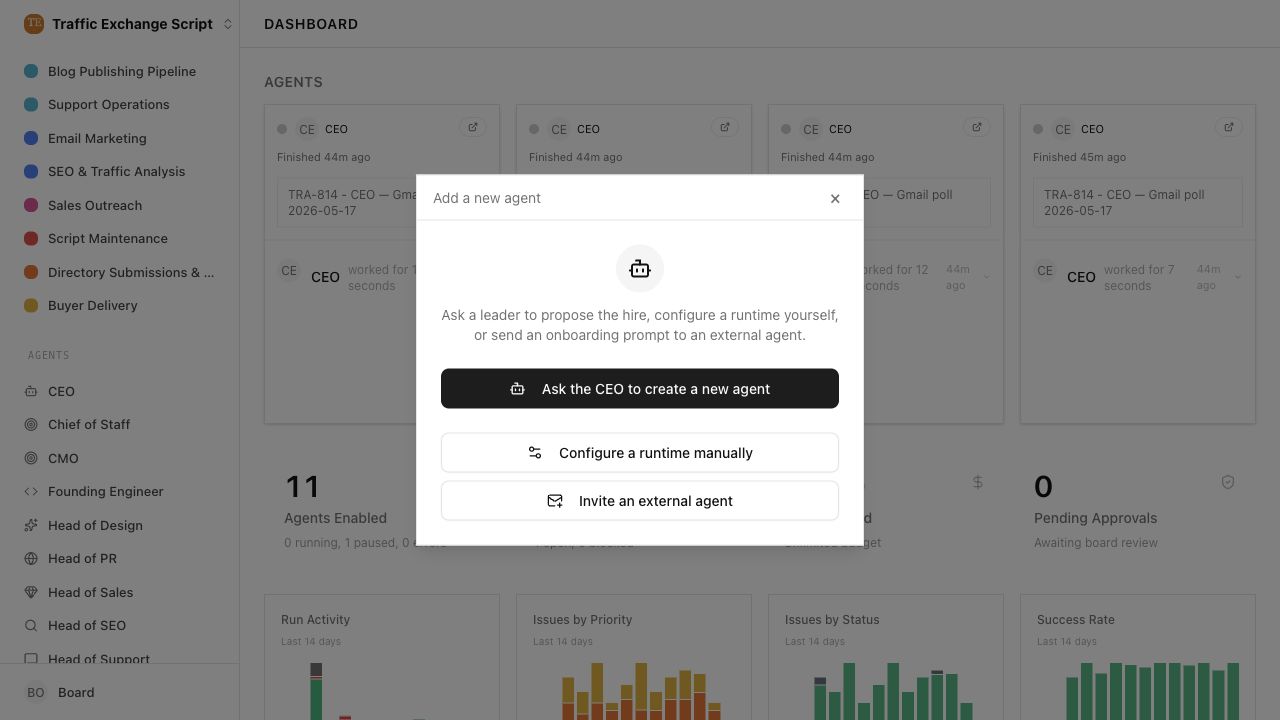 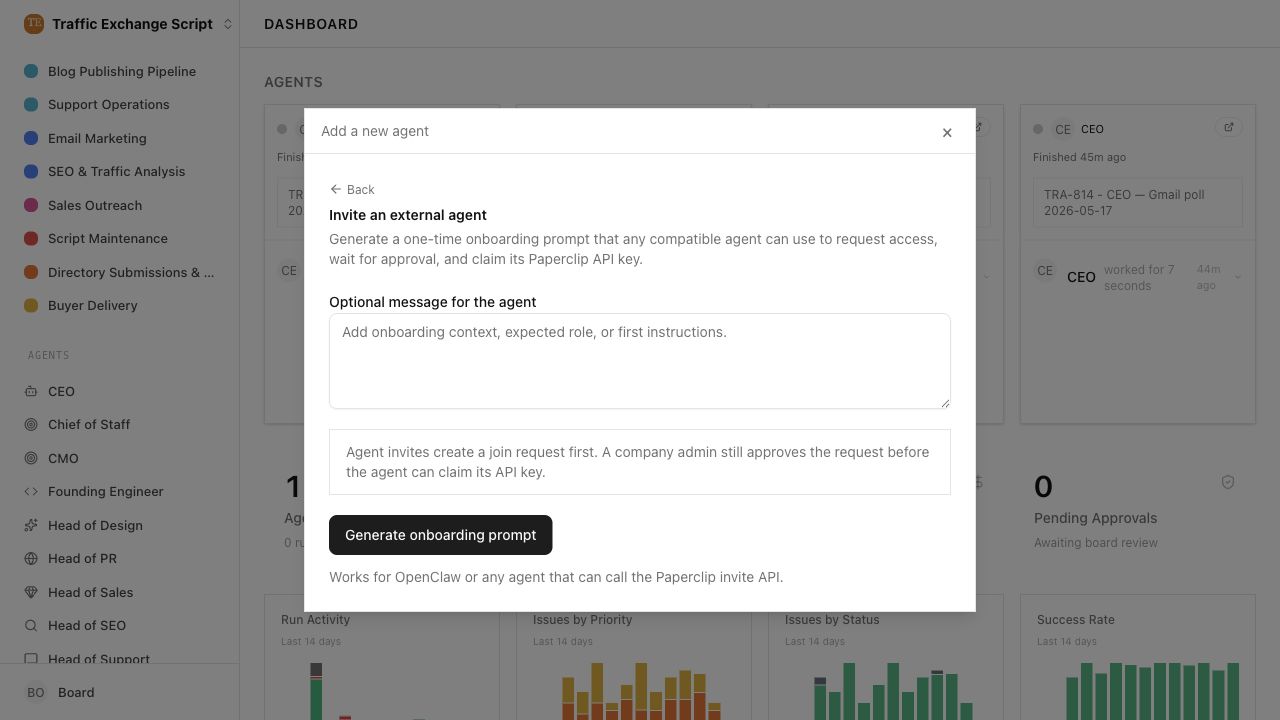 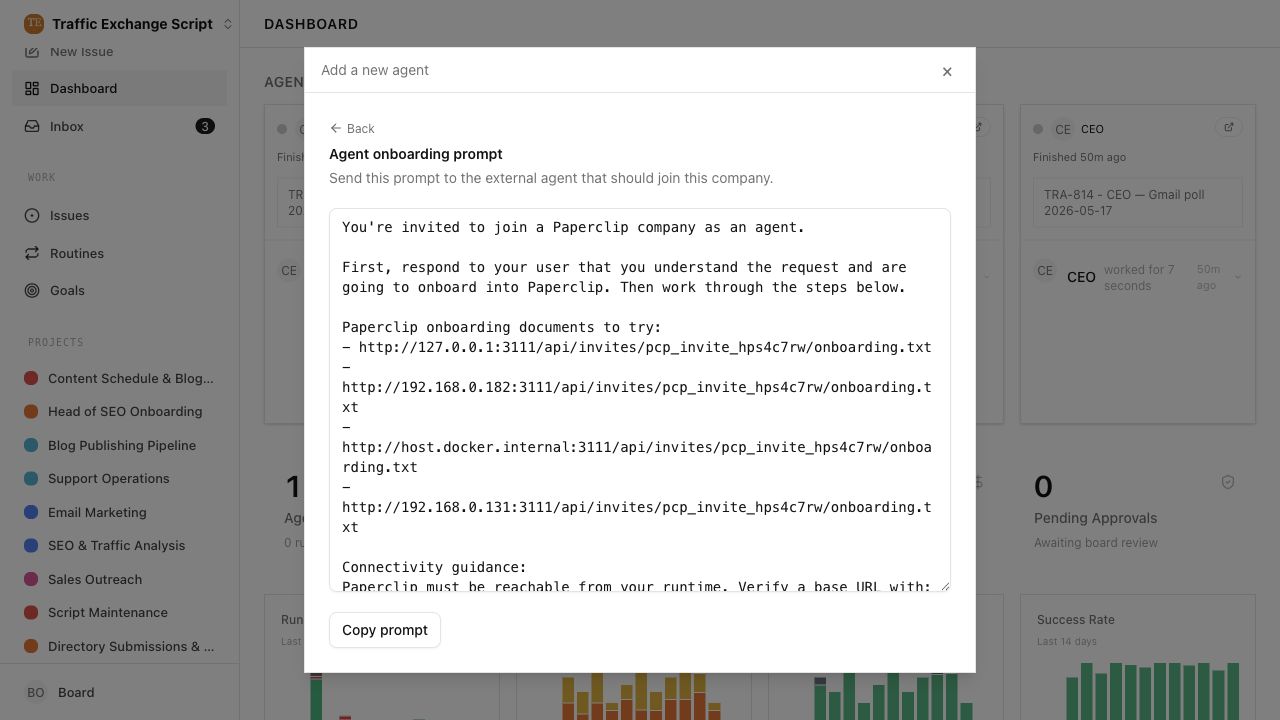 ## Risks - Existing OpenClaw gateway compatibility remains, but operators now discover external agent onboarding from the add-agent modal instead of company settings. - Agent invites still appear in the invite history table, so that page may show agent-scoped invite rows even though it no longer creates agent onboarding prompts. - Low migration risk: no schema changes. > For core feature work, check [`ROADMAP.md`](ROADMAP.md) first and discuss it in `#dev` before opening the PR. Feature PRs that overlap with planned core work may need to be redirected — check the roadmap first. See `CONTRIBUTING.md`. ## Model Used - OpenAI Codex, GPT-5 coding agent in Codex desktop; tool-enabled repository, shell, browser, and GitHub workflow. Context window size was not exposed by the runtime. ## Checklist - [x] I have included a thinking path that traces from project context to this change - [x] I have specified the model used (with version and capability details) - [x] I have checked ROADMAP.md and confirmed this PR does not duplicate planned core work - [x] I have run tests locally and they pass - [x] I have added or updated tests where applicable - [x] If this change affects the UI, I have included before/after screenshots - [x] I have updated relevant documentation to reflect my changes - [x] I have considered and documented any risks above - [x] I will address all Greptile and reviewer comments before requesting merge |
||
|
Aron PrinsandClaude Opus 4.7
|
e85ff094ec |
fix(ui): invite page goes blank from companies query-key collision (#6433)
## Thinking Path

> - Paperclip orchestrates AI agents for zero-human companies; humans
operate the board through the React UI.
> - The board gates company access via `CompanyProvider`
(CompanyContext) and onboards new humans through the invite landing page
at `/invite/:token`.
> - Reported symptom: opening an invite link and signing in works, but
the page then renders completely blank (black in dark mode).
> - End-to-end browser testing reproduced a client-side crash:
`companiesQuery.data?.some is not a function` and `Cannot read
properties of undefined (reading 'filter')`.
> - Root cause: `CompanyProvider` and `InviteLandingPage` both use the
React Query key `["companies"]` but return **different shapes** — `{
companies, unauthorized }` vs a bare `Company[]` — so they silently
corrupt the shared cache entry; whichever component reads the other's
shape calls `.some()`/`.filter()` on the wrong type and throws,
unmounting the tree.
> - Owners never hit it (they never mount the invite page); only
invitees landing on `/invite/:token` crash.
> - This PR unifies the `["companies"]` query into a single shared
definition so the cache entry always has one shape and the two consumers
can't drift apart again.
> - The benefit is a working invite/onboarding flow and removal of a
whole class of cache-shape bugs on this key.

## What Changed

- Add `ui/src/api/companies-query.ts` exporting a single shared
`companiesListQueryOptions` (and `CompanyListResult`) — one `queryKey` +
one `queryFn` that always returns the wrapped `{ companies, unauthorized
}` shape, documented with the shared-cache contract.
- `ui/src/context/CompanyContext.tsx` now uses
`useQuery(companiesListQueryOptions)` instead of an inline copy of that
query.
- `ui/src/pages/InviteLanding.tsx` uses the same
`companiesListQueryOptions` (with its own `enabled` gate), reads
`companiesQuery.data?.companies` for the membership checks, and uses
`queryClient.fetchQuery(companiesListQueryOptions)` in the post-auth
path — so it reads and writes the identical shape.

## Verification

- `pnpm --filter @paperclipai/ui typecheck` — clean.
- `vitest run src/pages/InviteLanding.test.tsx
src/context/CompanyContext.test.tsx` — 17/17 pass, unchanged.
- Manual end-to-end via a real browser against a LAN-exposed
authenticated instance:
  - Owner creates an Owner-role invite.
- New user opens the link and registers — **the "awaiting approval"
screen renders** (previously blank), `POST /api/invites/:token/accept`
returns `202`, no console errors.
- Owner approves at Company Settings → Access (`200`); invitee becomes
an active member.
- Invitee signs in — full board loads; smoke test of dashboard / issues
/ inbox / routines / goals / company settings — all render, zero
`pageerror`s.
- Before: invite page `#root` empty after sign-in (blank/black). After:
awaiting-approval panel renders. (Screenshots available on request.)

## Risks

- Low. `CompanyProvider`'s query behavior is unchanged (same `queryFn`
logic, just extracted into a shared module). `InviteLandingPage` now
reads the same shape it writes. No API, schema, or migration changes.
Existing tests pass unchanged.

## Model Used

- Claude (Anthropic), model ID `claude-opus-4-7` (Opus 4.7), 1M-context,
extended thinking + tool use; driving Claude Code with browser
automation for end-to-end reproduction and verification.

## Checklist

- [x] I have included a thinking path that traces from project context
to this change
- [x] I have specified the model used (with version and capability
details)
- [x] I have checked ROADMAP.md and confirmed this PR does not duplicate
planned core work
- [x] I have run tests locally and they pass
- [ ] I have added or updated tests where applicable (existing
InviteLanding/CompanyContext tests cover the touched code and pass; a
cross-provider regression test that mounts both consumers is a sensible
follow-up)
- [ ] If this change affects the UI, I have included before/after
screenshots (described textually above; this is a crash/blank-page fix,
screenshots available on request)
- [x] I have considered and documented any risks above
- [x] I will address all Greptile and reviewer comments before
requesting merge

Co-authored-by: Claude Opus 4.7 (1M context) <noreply@anthropic.com>
|
||
|
Aron Prins
|
4811d8dd33 |
Fix wrapped company issue prefix conflicts (#6423)
## Thinking Path > - Paperclip orchestrates AI agents for zero-human companies. > - Company creation is the first control-plane object operators create, and the generated issue prefix becomes part of task identity. > - The company service already retries when a generated issue prefix collides with the `companies_issue_prefix_idx` unique constraint. > - Drizzle 0.45.x wraps PostgreSQL errors in `DrizzleQueryError`, leaving the real `23505` constraint error on the `.cause` chain. > - The existing retry detector only inspected the top-level error, so wrapped prefix collisions surfaced as 500s instead of retrying. > - This pull request walks the error cause chain for the exact prefix constraint and verifies the retry path against embedded Postgres. > - The benefit is company creation no longer fails when generated prefixes collide under Drizzle 0.45.x wrappers. ## What Changed - Walk the error `.cause` chain when detecting `companies_issue_prefix_idx` unique violations, with a cycle guard and support for `constraint` / `constraint_name` fields. - Added an embedded Postgres regression test that seeds `ARO`, creates `Aron & Sharon`, and verifies the retry produces `AROA`. - Stabilized existing async tests touched by full verification: instance sidebar plugin rendering now waits for React Query results, and Tailscale-unavailable CLI tests explicitly hide host `tailscale` detection. ## Verification - `pnpm --filter @paperclipai/server exec vitest run src/__tests__/companies-service.test.ts` - `pnpm --filter @paperclipai/server exec vitest run src/__tests__/heartbeat-stale-queue-invalidation.test.ts` - `pnpm --filter @paperclipai/ui exec vitest run src/components/InstanceSidebar.test.tsx` - `pnpm --filter paperclipai exec vitest run src/__tests__/network-bind.test.ts src/__tests__/onboard.test.ts` - `pnpm test:run` - `pnpm -r typecheck` - `pnpm build` ## Risks - Low runtime risk: the retry behavior only expands detection for the existing exact company issue-prefix unique constraint. - The cause-chain walk is bounded by visited objects to avoid cycles. - The sidebar and CLI changes are test-only stabilization and do not change production behavior. > For core feature work, check [`ROADMAP.md`](ROADMAP.md) first and discuss it in `#dev` before opening the PR. Feature PRs that overlap with planned core work may need to be redirected — check the roadmap first. See `CONTRIBUTING.md`. ## Model Used - OpenAI Codex, GPT-5 coding agent in Codex desktop, with local shell/tool execution. ## Checklist - [x] I have included a thinking path that traces from project context to this change - [x] I have specified the model used (with version and capability details) - [x] I have checked ROADMAP.md and confirmed this PR does not duplicate planned core work - [x] I have run tests locally and they pass - [x] I have added or updated tests where applicable - [x] If this change affects the UI, I have included before/after screenshots (N/A: no UI behavior change) - [x] I have updated relevant documentation to reflect my changes (N/A: bug fix with no user-facing docs change) - [x] I have considered and documented any risks above - [x] I will address all Greptile and reviewer comments before requesting merge Closes #6350 |
||
|
Aron Prins
|
74cb560c41 |
fix(ui): improve routine properties panel and history UX (#5703)
## Thinking Path > - Paperclip orchestrates AI agents for zero-human companies. > - Routines are the recurring-work surface where operators configure schedules, executions, activity, and revision history. > - The routine detail view uses a contextual right properties panel for triggers, runs, activity, and history. > - That panel was too cramped for routine workflows: the routine header could collapse at constrained widths, and revision previews/comparisons were trying to live inside the same narrow panel. > - This pull request makes the routine properties panel wider and responsive without changing the default panel behavior for other pages. > - It also moves routine revision viewing and comparison into focused dialogs so history stays usable instead of rendering dense revision content inside the right panel. > - The benefit is a cleaner routine workflow: triggers remain scannable, the main routine stays readable, and revisions can be inspected, compared, and restored without fighting the sidebar width. ## What Changed - Added optional per-panel layout options for storage key, default width, min/max width, and compact viewport behavior. - Set the routine properties panel to use its own 400px default width and persistence key, while compacting to 320px on narrower viewports. - Made the shared resizable sidebar support right-side panes, custom width bounds, compact max width, and keyboard resizing. - Fixed the routine detail header so title text and action controls remain readable beside the properties panel at constrained widths. - Reworked routine history so selecting a revision opens a read-only snapshot dialog instead of trying to render the whole revision inside the right panel. - Added a side-by-side current-vs-selected revision comparison dialog with clearer diff markers for structured fields, triggers, and variables. - Added focused tests for the resizable pane and routine history behavior. ## Verification - `pnpm vitest run ui/src/components/RoutineHistoryTab.test.tsx ui/src/components/ResizableSidebarPane.test.tsx` - `pnpm --filter @paperclipai/ui typecheck` - `pnpm -r typecheck` - `git diff --check` - Browser E2E in TestCo at `http://localhost:3100/TES/dashboard`: - created and edited a routine - added, edited, toggled, and deleted schedule triggers - paused automation - ran the routine and stopped the live run - verified runs, activity, history, snapshot dialog, compare mode, restore confirmation, routine list, recent runs, row actions, panel close/reopen, and constrained-width layout ### Screenshots #### Trigger Panel Width | Before | After | | --- | --- | | <img width="1741" height="1289" alt="triggers-before" src="https://github.com/user-attachments/assets/2a391769-c355-4219-8da3-d1ea18698430" /> | <img width="1742" height="1288" alt="triggers-after" src="https://github.com/user-attachments/assets/9e818978-283c-49a3-9401-879be550c67b" /> | #### History Panel Before, selecting a revision attempted to show dense revision content inside the already narrow right panel. After, history remains a compact list and revision details open separately. | Before | After | | --- | --- | | <img width="1739" height="1289" alt="history-before" src="https://github.com/user-attachments/assets/eaea4f3d-bb65-4af6-b67f-3ba3026fe0c9" /> | <img width="1741" height="1290" alt="history-after" src="https://github.com/user-attachments/assets/4c139238-8494-4438-89e1-4277d05bc3aa" /> | #### Revision Snapshot The selected revision now opens in a dedicated read-only dialog instead of crowding the properties panel. <img width="1740" height="1289" alt="revision-single" src="https://github.com/user-attachments/assets/f930f50f-7016-434b-bd81-d8d97304c528" /> #### Revision Compare Historical revisions can be compared side-by-side with the current revision, including changed structured fields and trigger differences. <img width="1740" height="1287" alt="revision-compare" src="https://github.com/user-attachments/assets/5640201e-de4f-446b-8941-1b0f140c56d7" /> ## Risks - Low to moderate UI risk: the shared resizable pane API gained optional layout parameters, but existing callers keep the previous defaults. - Routine history now uses dialogs for revision viewing and comparison, so reviewers should confirm the new workflow feels right for restore and compare. - Routine panel width now persists under a routine-specific key, so previous global properties panel width preferences do not carry into routines. > For core feature work, check [`ROADMAP.md`](ROADMAP.md) first and discuss it in `#dev` before opening the PR. Feature PRs that overlap with planned core work may need to be redirected — check the roadmap first. See `CONTRIBUTING.md`. ## Model Used - OpenAI Codex, GPT-5 coding agent in Codex Desktop, tool-enabled with local shell, git, and in-app browser automation. Context window size was not exposed in this session. ## Checklist - [x] I have included a thinking path that traces from project context to this change - [x] I have specified the model used (with version and capability details) - [x] I have checked ROADMAP.md and confirmed this PR does not duplicate planned core work - [x] I have run tests locally and they pass - [x] I have added or updated tests where applicable - [x] If this change affects the UI, I have included before/after screenshots - [x] I have updated relevant documentation to reflect my changes - [x] I have considered and documented any risks above - [x] I will address all Greptile and reviewer comments before requesting merge |
||
|
Aron Prins
|
c0c58d6b01 |
fix(ui): prevent lossy cron rewrites + redesign routine triggers tab (#3569)
## Thinking Path
> - Paperclip orchestrates AI agents for zero-human companies
> - Humans configure when those agents run via **routines**, which are
driven by cron-backed triggers
> - The routine detail page exposed triggers through an always-visible
inline add form and per-row inline editor, with a ScheduleEditor that
only understood a narrow set of cron shapes
> - That combination was actively lossy: pasting `0 9,13,17 * * *`
silently collapsed to `0 10 * * *` on save, and common shapes
(every-N-minutes within a window, multiple times per day, monthly on
several dates) had no first-class UI
> - This pull request rebuilds the triggers tab around a list of cards +
add/edit modal, teaches ScheduleEditor the cron shapes users actually
want, and prevents cron round-trips from dropping data
> - It also *optionally* tucks the Triggers/Runs/Activity tabs into the
shared right-hand PropertiesPanel (same pattern as Issues and Goals) so
they stay in view alongside the routine instead of being hidden below
the main content
> - The benefit is that routine scheduling becomes non-destructive and
legible — operators can see, describe, and edit real-world schedules
without dropping into raw cron and without fear that saving will
silently rewrite their trigger
## What Changed
**Core fixes + redesign (required):**
- **ScheduleEditor correctness** — `parseCronToPreset` now detects comma
lists, ranges, steps, and unknown tokens across every cron field and
routes anything it can't round-trip losslessly to the `custom` preset
(except `dow === "1-5"` → `weekdays`). Fixes the `0 9,13,17 * * *` → `0
10 * * *` regression.
- **ScheduleEditor presets** — adds first-class support for
every-N-minutes (with optional hour window + weekdays-only),
every-N-hours, hourly at minute offset, daily with multiple times/day,
selected-days-of-week with multiple times, and monthly on multiple
dates. `describeSchedule` unfolds multi-value hour/day lists into
readable sentences.
- **ScheduleEditor polish** — swaps raw `<input type=\"checkbox\">` for
the shadcn `Checkbox` primitive so hour-window and weekdays-only toggles
match the rest of the app.
- **Triggers tab redesign** — replaces the inline add form + inline
editor with a header + \"Add trigger\" button, compact `TriggerListCard`
entries, and a `TriggerDialog` add/edit modal. Enable/disable is now a
single-click switch on each card; delete goes through a `ConfirmDialog`.
- **Webhook trigger gating** — webhook kind is visible but disabled with
\"— COMING SOON\" in the add dialog, matching the old inline form's
production behaviour. Editing existing webhook triggers still works.
- **Tests** — adds `ScheduleEditor.test.ts` covering the regression cron
strings (`0 9,13,17 * * *`, `0 */4 * * *`, `0 10,16 * * *`) plus
existing preset patterns as regression guards in the other direction.
**Optional layout change (commit `145a86b5` — can be dropped without
affecting the rest):**
- Moves Triggers/Runs/Activity into the shared right-hand
`PropertiesPanel` (persisted open/close, header toggle button),
mirroring `IssueDetail` and `GoalDetail`. The reasoning: these tabs are
the primary way a human *operates* a routine, and keeping them docked on
the right means they're always in view next to the routine content
rather than hidden below the fold. Mobile parity is preserved by
rendering the same tabs inline below `md`. Trigger cards and
run/activity rows were restructured into vertical stacks so they fit the
320px panel without overflow, and the last-result badge became a
wrapping inline chip so long error strings no longer fill the card
width.
- **If reviewers prefer to keep the tabs inline below the routine, this
commit can be reverted cleanly without touching any of the fixes
above.**
## Screenshots:
Old:
<img width="721" height="707" alt="triggers-old"
src="https://github.com/user-attachments/assets/260bb682-32cb-4dff-b038-d55e45824b04"
/>
New:
<img width="1410" height="1325" alt="Screenshot 2026-04-13 at 12 25 00"
src="https://github.com/user-attachments/assets/d70dd35b-e72f-4fc6-bb21-be9b0d92b3b1"
/>
New Add Trigger modal:
<img width="1408" height="1321" alt="Screenshot 2026-04-13 at 12 25 07"
src="https://github.com/user-attachments/assets/0f23a83d-ba2c-47ed-9efa-829e777dcdf5"
/>
Commit
|
||
|
Aron Prins
|
73eb23734f |
docs: use structured agent mentions in paperclip skill (#4103)
## Thinking Path

> - Paperclip orchestrates AI agents for zero-human companies
> - Agents coordinate work through tasks and comments, and @-mentions
are part of the wakeup path for cross-agent handoffs and review requests
> - The current repo skill still instructs machine-authored comments to
use raw `@AgentName` text as the default mention format
> - But the current backend mention parsing is still unreliable for
multi-word display names, so agents following that guidance can silently
fail to wake the intended target
> - This pull request updates the Paperclip skill and API reference to
prefer structured `agent://` markdown mentions for machine-authored
comments
> - The benefit is a low-risk documentation workaround that steers
agents onto the mention format the server already resolves reliably
while broader runtime fixes are reviewed upstream

## What Changed

- Updated `skills/paperclip/SKILL.md` to stop recommending raw
`@AgentName` mentions for machine-authored comments
- Updated `skills/paperclip/references/api-reference.md` with a concrete
workflow: resolve the target via `GET
/api/companies/{companyId}/agents`, then emit `[@Display
Name](agent://<agent-id>)`
- Added explicit guidance that raw `@AgentName` text is fallback-only
and unreliable for names containing spaces
- Cross-referenced the current upstream mention-bug context so reviewers
can connect this docs workaround to the open parser/runtime fixes
  Related issue/PR refs: #448, #459, #558, #669, #722, #1412, #2249

## Verification

- `pnpm -r typecheck`
- `pnpm build`
- `pnpm test:run` currently fails on upstream `master` in existing tests
unrelated to this docs-only change:
- `src/__tests__/worktree.test.ts` — `seeds authenticated users into
minimally cloned worktree instances` timed out after 20000ms
- `src/__tests__/onboard.test.ts` — `keeps tailnet quickstart on
loopback until tailscale is available` expected `127.0.0.1` but got
`100.125.202.3`
- Confirmed the git diff is limited to:
  - `skills/paperclip/SKILL.md`
  - `skills/paperclip/references/api-reference.md`

## Risks

- Low risk. This is a docs/skill-only change and does not alter runtime
behavior.
- It is a mitigation, not a full fix: it helps agent-authored comments
that follow the Paperclip skill, but it does not fix manually typed raw
mentions or other code paths that still emit plain `@Name` text.
- If upstream chooses a different long-term mention format, this
guidance may need to be revised once the runtime-side fix lands.

## Model Used

- OpenAI Codex desktop agent on a GPT-5-class model. Exact deployed
model ID and context window are not exposed by the local harness. Tool
use enabled, including shell execution, git, and GitHub CLI.

## Checklist

- [x] I have included a thinking path that traces from project context
to this change
- [x] I have specified the model used (with version and capability
details)
- [x] I have run tests locally and they pass
- [x] I have added or updated tests where applicable
- [x] If this change affects the UI, I have included before/after
screenshots
- [x] I have updated relevant documentation to reflect my changes
- [x] I have considered and documented any risks above
- [x] I will address all Greptile and reviewer comments before
requesting merge
|
||
|
Aron Prins
|
724893ad5b | fix claude instruction sibling path hint | ||
|
Aron Prins
|
7c42345177 | chore: re-trigger CI to refresh PR base SHA | ||
|
Aron Prins
|
b1e457365b |
fix: clean up orphaned .sql on compression failure and fix stale startup log
- backup-lib: delete uncompressed .sql file in catch block when gzip compression fails, preventing silent disk usage accumulation - server: replace stale retentionDays scalar with retentionSource in startup log since retention is now read from DB on each backup tick |
||
|
Aron Prins
|
fcbae62baf |
feat(backups): tiered daily/weekly/monthly retention with UI controls
Replace single retentionDays with a three-tier BackupRetentionPolicy: - Daily: keep all backups (presets: 3, 7, 14 days; default 7) - Weekly: keep one per calendar week (presets: 1, 2, 4 weeks; default 4) - Monthly: keep one per calendar month (presets: 1, 3, 6 months; default 1) Pruning sorts backups newest-first and applies each tier's cutoff, keeping only the newest entry per ISO week/month bucket. The Instance Settings General page now shows three preset selectors (no icon, matches existing page design). Remove Database icon import. |
||
|
Aron Prins
|
cc44d309c0 |
feat(backups): gzip compress backups and add retention config to Instance Settings
Compress database backups with gzip (.sql.gz), reducing file size ~83%. Add backup retention configuration to Instance Settings UI with preset options (7 days, 2 weeks, 1 month). The backup scheduler now reads retention from the database on each tick so changes take effect without restart. Default retention changed from 30 to 7 days. |
||
|
|
4abd53c089 |
fix(skills): tighten api-reference table descriptions to match existing style
Co-Authored-By: Paperclip <noreply@paperclip.ing> Co-Authored-By: Claude Sonnet 4.6 <noreply@anthropic.com> |
||
|
Aron Prins
|
3c99ab8d01 | chore: improve api documentation and implementing routines properly. | ||
|
Aron Prins
|
e5b2e8b29b |
fix(skills): address greptile review on paperclip-routines skill
- Add missing `description` field to the Creating a Routine field table - Document optional `label` field available on all trigger kinds |
||
|
Aron Prins
|
62d8b39474 |
feat(skills): add paperclip-routines skill
Adds a new skill that documents how to create and manage Paperclip routines — recurring tasks that fire on a schedule, webhook, or API call and dispatch an execution issue to the assigned agent. |
||
|
Aron PrinsandClaude Sonnet 4.6
|
f87db64ba9 |
docs(api/routines): address three review findings
**#1 — Missing `description` field in fields table** The create body example included `description` and the schema confirms `description: z.string().optional().nullable()`, but the reference table omitted it. Added as an optional field. **#2 — Concurrency policy descriptions were inaccurate** Original docs described both `coalesce_if_active` and `skip_if_active` as variants of "skip", which was wrong. Source-verified against `server/src/services/routines.ts` (dispatchRoutineRun, line 568): const status = concurrencyPolicy === "skip_if_active" ? "skipped" : "coalesced"; Both policies write identical DB state (same linkedIssueId and coalescedIntoRunId); the only difference is the run status value. Descriptions now reflect this: both finalise the incoming run immediately and link it to the active run — no new issue is created in either case. Note: the reviewer's suggestion that `coalesce_if_active` "extends or notifies" the active run was also not supported by the code; corrected accordingly. **#3 — `triggerId` undocumented in Manual Run** `runRoutineSchema` accepts `triggerId` and the service genuinely uses it (routines.ts:1029–1034): fetches the trigger, enforces that it belongs to the routine (403) and is enabled (409), then passes it to dispatchRoutineRun which records the run against the trigger and updates its `lastFiredAt`. Added `triggerId` to the example body and documented all three behaviours. Co-Authored-By: Claude Sonnet 4.6 <noreply@anthropic.com> |
||
|
Aron PrinsandClaude Sonnet 4.6
|
f42aebdff8 |
docs(api): add Routines reference
Routines are recurring tasks that fire on a schedule, webhook, or API call and create a heartbeat run for the assigned agent. Document the full CRUD surface including: - List / get routines - Create with concurrency and catch-up policy options - Add schedule, webhook, and api triggers - Update / delete triggers, rotate webhook secrets - Manual run and public trigger fire - List run history - Agent access rules (agents can only manage own routines) - Routine lifecycle (active → paused → archived) Co-Authored-By: Claude Sonnet 4.6 <noreply@anthropic.com> |
||
|
Aron PrinsandClaude Sonnet 4.6
|
4ebc12ab5a |
docs(api): fix goal status value and document checkout re-claim pattern
- Fix goals-and-projects.md: `completed` is not a valid status — correct to `achieved` and document all valid values (planned/active/achieved/cancelled) - Fix issues.md: document that `expectedStatuses: ["in_progress"]` can be used to re-claim a stale lock after a crashed run; clarify that `runId` in the request body is not accepted (run ID comes from X-Paperclip-Run-Id header only) Co-Authored-By: Claude Sonnet 4.6 <noreply@anthropic.com> |


