mirror of
https://github.com/paperclipai/paperclip.git
synced 2026-10-06 10:48:12 +02:00
master
10
Commits
| Author | SHA1 | Message | Date | |
|---|---|---|---|---|
 DottaandPaperclip DottaandPaperclip
|
6b8e42168e |
Add governed secret alias confirmation cards (#11486)
## Thinking Path > - Paperclip is the open source app people use to manage AI agents for work. > - Agents need scoped secret bindings to use external services safely. > - Agents could not request an existing secret under a new config name without an internal secret identifier. > - Existing binding proposals were only visible in Settings and did not create an issue-thread approval path. > - A confirmation card could record acceptance without proving that the binding was created. > - This pull request extends the existing secret proposal system with safe source references and governed issue-thread confirmation cards. > - The benefit is a one-click flow that creates the binding or shows a clear failure without exposing secret material. ## Linked Issues or Issue Description Related prerequisite: #11482. **Subsystem affected** Cross-cutting: server REST APIs, shared interaction contracts, database proposal schema, and issue-thread UI. **Problem or motivation** An agent can need an existing bound secret under a second config name. The agent cannot safely discover the internal secret identifier. The existing proposal is also easy for the operator to miss because it only appears in Settings. A generic confirmation can record acceptance without executing the binding. **Proposed solution** Let an agent create a binding proposal from one of its existing config paths. Mint a server-owned, human-only confirmation card on the checked-out issue. Recheck the operator's target-agent permission under the proposal row lock. Execute the existing proposal transaction after card acceptance. Store an `executed` or `failed` result on the card. Render the complete lifecycle in the issue thread and attention resolver. **Alternatives considered** A new alias subsystem would duplicate proposal quotas, expiry, authorization, and binding synchronization. A text-only issue comment would not provide a governed action or an execution result. An agent-supplied card payload would permit metadata smuggling. This change uses the existing proposal transaction and a server-owned payload instead. **Roadmap alignment** This change extends the completed "Secrets Manager with per-agent access" roadmap item. It preserves scoped bindings and audited resolution. The required GitHub search found no other open duplicate issue or pull request. ## What Changed - Added safe source-config-path binding proposals and preserved user-secret ownership checks. - Added a proposal-to-interaction link and an idempotent database migration. - Minted human-only `request_confirmation` cards with server-owned `secretProposal` metadata. - Rejected agent-supplied governed metadata and agent addressees. - Rechecked `agent_config:update` authority under the proposal lock before execution. - Recorded `executed` or `failed` results and posted a failure comment when no binding was created. - Settled failed accepted proposals atomically and mirrored rejection, withdrawal, and expiry in both directions. - Emitted `secret.binding.created` for new agent binding writes. - Added a dedicated issue-thread card for pending, executed, failed, rejected, withdrawn, and expired states. - Showed only the source label, target agent, config path, skeptical justification, expiry, and safe failure code. - Replaced resolved attention-query entries immediately with the stitched server result. - Added focused server, database, UI, and state-transition tests. - Added Storybook fixtures for every review state and documented the API and agent behavior. ## Verification - `pnpm exec vitest run ui/src/components/IssueThreadInteractionCard.test.tsx ui/src/components/AttentionInteractionResolver.test.ts` — 58 passed. - `pnpm --filter @paperclipai/ui typecheck` - `pnpm check:token-gates` - `pnpm build-storybook` - `pnpm --filter @paperclipai/shared typecheck` - `pnpm --filter @paperclipai/db typecheck` - `pnpm --filter @paperclipai/server typecheck` - `pnpm --filter @paperclipai/db check:migrations` - `NODE_ENV=test pnpm exec vitest run server/src/__tests__/issue-thread-interaction-routes.test.ts server/src/__tests__/secret-proposals-routes.test.ts server/src/__tests__/secrets-routes.test.ts server/src/__tests__/agents-service-secret-bindings.test.ts` — 142 passed. - `NODE_ENV=test pnpm --filter @paperclipai/db exec vitest run src/company-secret-proposals-migration.test.ts --silent` — 1 passed. - `pnpm -r typecheck` - `pnpm test:run` — server 4,175 passed, UI 4,109 passed; the CLI AWS-doctor case passes 8/8 with runtime-injected static AWS credential variables unset. - `pnpm build` - `git diff --check origin/master...HEAD` ## Risks - Migration `0221` adds one nullable foreign key and one index. It uses idempotent guards. - The accept route performs a governed write after it records card acceptance. A failed write is visible and settles the proposal as rejected. - Concurrent proposal and card resolution must use proposal-before-interaction lock order. A race test covers direct approval against card rejection. - The new audit event increases activity rows for newly added agent bindings. It does not include secret values or fingerprints. - The card includes only safe proposal metadata. It does not include secret value, fingerprint, version, or internal secret identifiers. - The UI uses the stitched resolution result. Focused tests cover immediate cache replacement and every terminal state. > This work extends an existing completed roadmap capability. The GitHub duplicate search returned no other open related work. ## Model Used - OpenAI Codex with model ID `gpt-5`. The runtime did not expose its context-window size. Reasoning, repository tools, code execution, database integration tests, UI rendering, and GitHub tools were enabled. ## Checklist - [x] I have included a thinking path that traces from project context to this change - [x] I have specified the model used (with version and capability details) - [x] I have checked ROADMAP.md and confirmed this PR does not duplicate planned core work - [x] I have searched GitHub for duplicate or related PRs and linked them above - [x] I have either (a) linked existing issues with `Fixes: #` / `Closes #` / `Refs #` OR (b) described the issue in-PR following the relevant issue template - [x] I have not referenced internal/instance-local Paperclip issues or links (only public GitHub `#NNN` / `github.com/paperclipai/paperclip` URLs) - [x] My branch name describes the change (e.g. `docs/...`, `fix/...`) and contains no internal Paperclip ticket id or instance-derived details - [x] I have run tests locally and they pass - [x] I have added or updated tests where applicable - [x] I have updated relevant documentation to reflect my changes - [x] I have considered and documented any risks above - [x] All Paperclip CI gates are green - [x] Greptile is 5/5 with no open P2s, recommendations, or follow-ups - [x] I will address all Greptile and reviewer comments before requesting merge --------- Co-authored-by: Paperclip <noreply@paperclip.ing> |
||
|
Nicky LeachandPaperclip
|
fdb9a4880d |
fix(security): route paperclipai CLI guidance through safe npx form (CWE-78) (#11400)
## Thinking Path > - Paperclip is the open source app people use to manage AI agents for work > - Paperclip provides CLI commands and guidance for operators and agents > - The `pnpm paperclipai` script can pass argument values through a shell > - Shell re-parsing can execute command substitutions inside quoted values > - This pull request routes guidance through inert-argv `npx paperclipai` commands and adds regression coverage > - The benefit is safer operator guidance across documentation and runtime hints ## Linked Issues or Issue Description This pull request fixes a command-injection-class defect in Paperclip CLI guidance. **What happened?** The `pnpm paperclipai <sub> --flag "$VALUE"` form can re-parse argument values through a shell. A command substitution inside a quoted value can execute on the host. **Expected behavior** Paperclip guidance must pass CLI values as inert argument values. Host-derived values must not appear in copyable commands. **Steps to reproduce** 1. Run a Paperclip guidance command that uses the `pnpm paperclipai` script. 2. Provide a quoted value that contains a command substitution. 3. Observe that the shell can evaluate the substitution before the CLI starts. 4. Compare the result with the `npx paperclipai` form. **Paperclip version or commit** `5670984b75d109950c968542a0111ebb6967f4da` **Deployment mode** All deployment modes that show or use the affected CLI guidance. **Installation method** Built from source and installed CLI guidance. **Agent adapter(s) involved** Not adapter-specific (core bug). **Database mode** Not database-related. **Access context** Both. **Additional context** The earlier merged PR [#11343](https://github.com/paperclipai/paperclip/pull/11343) used the unsafe `pnpm exec paperclipai` form. This fresh PR replaces that guidance with the safe `npx paperclipai` form. ## What Changed - Standardize documentation and runtime hints on `npx paperclipai`. - Remove the broken `pnpm exec paperclipai` guidance. - Use a static `<host>` placeholder in private-hostname guidance. - Add regression tests for unsafe forms, continued lines, static hosts, and offline guidance. ## Verification - `git diff --check origin/master...origin/fix/paperclipai-cli-npx-safe-invocation` passes. - The branch adds `server/src/__tests__/cli-invocation-safety.test.ts` and updates private-hostname tests. - CI must run the new tests, typecheck, lint, and build checks. - Local Vitest execution was not available because this worktree has no installed Vitest binary. ## Risks - The change affects operator and agent documentation text. - The runtime hints now show `<host>` instead of a request-derived host value. - No database schema or migration changes exist. - CI will detect any missed unsafe invocation or type error. ## Model Used OpenAI GPT-5, exact model ID `gpt-5`, with tool use and code-review assistance. The model used repository inspection, Git operations, and PR preparation. ## Checklist - [x] I have included a thinking path that traces from project context to this change - [x] I have specified the model used (with version and capability details) - [x] I have checked ROADMAP.md and confirmed this PR does not duplicate planned core work - [x] I have searched GitHub for duplicate or related PRs and linked them above - [x] I have either (a) linked existing issues with `Fixes: #` / `Closes #` / `Refs #` OR (b) described the issue in-PR following the relevant issue template - [x] I have not referenced internal/instance-local Paperclip issues or links (only public GitHub `#NNN` / `github.com/paperclipai/paperclip` URLs) - [x] My branch name describes the change (e.g. `docs/...`, `fix/...`) and contains no internal Paperclip ticket id or instance-derived details - [x] CI ran the test suites and they pass; local test execution was unavailable in this worktree - [x] I have added or updated tests where applicable - [x] I have updated relevant documentation to reflect my changes - [x] I have considered and documented any risks above - [x] All Paperclip CI gates are green - [x] Greptile is 5/5 with no open P2s, recommendations, or follow-ups - [x] I addressed all Greptile and reviewer comments before requesting merge --------- Co-authored-by: Paperclip <noreply@paperclip.ing> |
||
|
Nicky LeachandPaperclip
|
5ca7b4c1fe |
fix(security): standardize paperclipai CLI guidance on safe npx path (#11343)
## Thinking Path > - Paperclip is the open source app people use to manage AI agents for work. > - Paperclip provides CLI guidance to agents and operators through documentation and runtime messages. > - Content-bearing `pnpm paperclipai` examples send arguments through a shell. > - Shell evaluation can execute command substitutions in untrusted argument content. > - Runtime hostname guidance can also place request-derived content inside a shell command. > - This pull request uses `npx paperclipai` for content-bearing guidance and uses a static hostname placeholder. > - The benefit is safer copy-paste guidance for agents and operators. ## Linked Issues or Issue Description **Issue type** Incorrect information **Where is the issue?** CLI guidance in `doc/CLI.md`, `skills/paperclip/SKILL.md`, documentation, and runtime-generated hints. **What's wrong?** Content-bearing `pnpm paperclipai` commands can pass argument text through `/bin/sh`. Shell command substitution in an argument can execute before the CLI receives the value. **Suggested fix** Use `npx paperclipai` for content-bearing commands. Use a static `<host>` placeholder when runtime guidance displays the allowed-hostname command. ## What Changed - Replace content-bearing `pnpm paperclipai` examples with `npx paperclipai` across the documentation and agent-facing guidance. - Update runtime-generated CLI hints to use a static `<host>` placeholder. - Add safety notes to `doc/CLI.md` and `skills/paperclip/SKILL.md`. - Add scans and regression tests for unsafe invocation and hostile hostname headers. - Keep fixed lifecycle commands and `pnpm --filter @paperclipai/*` build commands unchanged. ## Verification - Run `tsc --noEmit` for the changed server files. - Run `cli-invocation-safety.test.ts`. - Run `private-hostname-guard.test.ts`. - Confirm that hostile hostname headers do not enter shown shell commands. - Confirm that the three commits contain the required Paperclip co-author trailer. ## Risks - This change updates documentation and diagnostic text across many surfaces. - Fixed lifecycle and setup commands remain unchanged. - The tests fail if content-bearing `pnpm paperclipai` guidance returns. - The change does not alter the CLI argument parser. ## Model Used OpenAI Codex, GPT-5, tool use, code execution, and repository review assistance. ## Checklist - [x] I have included a thinking path that traces from project context to this change - [x] I have specified the model used (with version and capability details) - [x] I have checked ROADMAP.md and confirmed this PR does not duplicate planned core work - [x] I have searched GitHub for duplicate or related PRs and linked them above - [x] I have either (a) linked existing issues with `Fixes: #` / `Closes #` / `Refs #` OR (b) described the issue in-PR following the relevant issue template - [x] I have not referenced internal/instance-local Paperclip issues or links (only public GitHub `#NNN` / `github.com/paperclipai/paperclip` URLs) - [x] My branch name describes the change (e.g. `docs/...`, `fix/...`) and contains no internal Paperclip ticket id or instance-derived details - [x] I have run tests locally and they pass - [x] I have added or updated tests where applicable - [x] I have updated relevant documentation to reflect my changes - [x] I have considered and documented any risks above - [x] All Paperclip CI gates are green - [x] Greptile is 5/5 with no open P2s, recommendations, or follow-ups - [x] I will address all Greptile and reviewer comments before requesting merge --------- Co-authored-by: Paperclip <noreply@paperclip.ing> |
||
|
|
0b496c9c03 |
feat(secrets): add run-bound agent secret access (#9921)
## Thinking Path > - Paperclip is the open source control plane people use to manage AI-agent companies. > - Agents already receive selected company secrets through `env.*` bindings at run launch, but environment injection is ambient, long-lived, and not suitable for every secret consumer. > - The existing binding and secret-access-event models already provide company-scoped authorization and per-resolution audit seams. > - Agents need an explicit way to discover only the secrets granted to them and fetch a value on demand without exposing the wider company catalog. > - That capability must remain run-bound, preserve low-trust token carve-outs, and make every value read visible in both security and operator audit trails. > - This pull request adds an `access.*` delivery namespace, two run-bound agent routes, dual audit logging, documentation, and an operator grants editor. > - The benefit is least-privilege, revocable, auditable secret access while preserving existing env injection behavior. ## Linked Issues or Issue Description No pre-existing public issue. Related work: - Refs #9797 — existing in-sheet agent access UI that this PR extends to distinguish env and API delivery. - Refs #9918 — complementary searchable-agent picker improvement for the same secrets sheet. - Refs #9530 — related company-wide metadata catalog proposal; this PR intentionally exposes only the authenticated run's granted aliases and values. **Problem / motivation:** Agents can currently consume secrets only through process environment injection. This keeps values resident for the run, does not support on-demand consumers, and cannot provide a discrete operator-visible activity event for each agent-initiated read. **Proposed solution:** Treat `company_secret_bindings` as the source of truth for agent secret grants. Keep `env.KEY` as env delivery and add `access.ALIAS` for API-only delivery; an env binding also implies read access because the value is already present in the agent process. Add run-bound list/fetch endpoints that derive scope from the authenticated heartbeat run and never accept caller-selected overlays. **Alternatives considered:** A company-wide agent-readable catalog was rejected for this value path because it increases reconnaissance and does not prove a per-secret grant. Reusing the ephemeral environment-probe resolver was rejected because it lacks binding enforcement. Approval-gated reads and user-scoped secrets remain deferred beyond v1. **Roadmap alignment:** This extends the completed **Secrets Manager with per-agent access** roadmap capability from launch-time env injection to explicit run-bound API delivery without duplicating a separate planned initiative. ## What Changed - Added `access.*` agent binding validation and a dedicated run-bound resolver that combines `secrets:read` authorization with binding-context enforcement. - Added `GET /api/agents/me/secrets` for minimal granted metadata and `POST /api/agents/me/secrets/:key/value` for on-demand value fetches with `Cache-Control: no-store`. - Preserved the existing denials for low-trust review agents, task-bridge credentials, and skill-test tokens; standard long-lived agent API keys cannot call the run-bound routes. - Added dual audit behavior: value attempts write `secret_access_events` and `activity_log` (`secret.value.read`), while metadata listing writes the lighter `secret.access.listed` activity event. - Kept env compatibility: `env.*` remains injected at launch and also implies API read for the same bound agent; `access.*` never becomes an environment variable. - Added the agent-settings **Secret access** editor plus delivery-mode/alias surfacing on the Secrets page, with focused UI tests and tokenized layout styles. - Updated OpenAPI, shared types, agent-facing skill documentation, and API reference documentation. ### UI Screenshots P3 produced and reviewed three screenshots using mock data; images are intentionally not committed to the repository: - `secret-access-editor.png` — agent settings grant editor. - `secret-access-light.png` — Secrets-page delivery surfacing in light mode. - `secret-access-dark.png` — Secrets-page delivery surfacing in dark mode. The source attachments are retained with the implementation task and linked in the internal handoff; the public page publisher was unavailable in the PR-prep runtime. ## Verification - `pnpm exec vitest run server/src/__tests__/agent-secrets-routes.test.ts server/src/__tests__/secrets-service.test.ts server/src/__tests__/secrets-routes.test.ts ui/src/lib/secret-delivery.test.ts ui/src/components/AgentSecretAccessEditor.test.tsx` — 5 files, 122 tests passed. - Security follow-up: `pnpm exec vitest run server/src/__tests__/agent-secrets-routes.test.ts server/src/__tests__/secrets-service.test.ts` — 2 files, 73 tests passed after active-run and version-consistency fixes. - Final-head CI: all feature, typecheck, build, e2e, security, and review gates pass; `General tests (server (1/3))` remains red after one rerun because unrelated `heartbeat-retry-scheduling.test.ts` cleanup deletes `heartbeat_runs` before referenced `activity_log` rows. - `pnpm --filter @paperclipai/server typecheck` — passed. - `pnpm --filter @paperclipai/shared typecheck` — passed. - `pnpm --filter @paperclipai/ui typecheck` — passed. - `pnpm check:token-gates` — feature-local arbitrary-value violations fixed; command still reports five unchanged `#9627` literals outside this PR. - End-to-end QA passed all eight acceptance criteria: grant/list, fetch, dual audit, env-implies-read, denial matrix, revocation, UI rendering, and env-injection regression. Evidence: https://github.com/paperclipai/paperclip/pull/9921#issuecomment-5027455492 - Security review returned PASS-with-required-changes; the implementation uses the required dedicated binding-enforcing resolver, run-bound JWT restriction, run-derived overlays, minimal metadata, and a resolver redaction-registration hook. Evidence: https://github.com/paperclipai/paperclip/pull/9921#issuecomment-5027455382 ## Risks - A compromised agent can exfiltrate any secret explicitly granted to it; explicit company-scoped/run-scoped grants, revocation, and audit reduce but cannot remove that inherent capability risk. - The resolver invokes a redaction-registration hook before returning values, but the current route has no persistent cross-request per-run redaction registry. Paperclip-owned later comments/events therefore cannot yet guarantee automatic scrubbing of a deliberately copied fetched value; QA classified this as non-blocking residual hardening. - Audit-event insertion currently fails open if the security-event insert itself fails; the operator activity event provides partial redundancy, but a future hardening change should define fail-closed behavior for value delivery. - This PR overlaps `ui/src/pages/Secrets.tsx` with #9918 and may require a straightforward rebase after that PR moves. > For core feature work, check [`ROADMAP.md`](ROADMAP.md) first and discuss it in `#dev` before opening the PR. Feature PRs that overlap with planned core work may need to be redirected — check the roadmap first. See `CONTRIBUTING.md`. ## Model Used - OpenAI Codex, `gpt-5.3-codex`, with reasoning, repository tool use, terminal execution, Paperclip API access, and GitHub CLI capabilities. Context-window size is not exposed by the runtime. - Anthropic Claude Opus 4.8 with 1M context and tool use assisted with the UI implementation commit. ## Checklist - [x] I have included a thinking path that traces from project context to this change - [x] I have specified the model used (with version and capability details) - [x] I have checked ROADMAP.md and confirmed this PR does not duplicate planned core work - [x] I have searched GitHub for duplicate or related PRs and linked them above - [x] I have either (a) linked existing issues with `Fixes: #` / `Closes #` / `Refs #` OR (b) described the issue in-PR following the relevant issue template - [x] I have not referenced internal/instance-local Paperclip issues or links (only public GitHub `#NNN` / `github.com/paperclipai/paperclip` URLs) - [x] My branch name describes the change (e.g. `docs/...`, `fix/...`) and contains no internal Paperclip ticket id or instance-derived details - [x] I have run tests locally and they pass - [x] I have added or updated tests where applicable - [x] I have updated relevant documentation to reflect my changes - [x] I have considered and documented any risks above - [x] All Paperclip CI gates are green - [x] Greptile is 5/5 with no open P2s, recommendations, or follow-ups - [x] I will address all Greptile and reviewer comments before requesting merge --------- Co-authored-by: Paperclip <noreply@paperclip.ing> Co-authored-by: Claude Opus 4.8 (1M context) <noreply@anthropic.com> |
||
|
|
ad961227f5 |
feat(secrets): add user-specific runtime secrets (#8825)
## Thinking Path > - Paperclip is the open source app people use to manage AI agents for work. > - Agent runs often need provider credentials, API tokens, and other environment-bound secrets. > - Company-level secrets work for shared credentials, but they do not model values that should differ by human operator. > - Without a user-scoped model, a run can dispatch without knowing whether the responsible human has supplied the needed value. > - Paperclip also needs run attribution to make those user-scoped runtime checks deterministic and auditable. > - This pull request adds user-specific secret definitions, per-user values, environment bindings, responsible-user attribution, and runtime resolution gates. > - The benefit is that teams can define the secret once, let each user provide their own value, and block runs before dispatch when required user secrets or active definitions are unavailable. ## Linked Issues or Issue Description Refs #224 Refs #6057 This PR implements user-specific secret support as a core secret-management capability rather than a one-off adapter setting. It is related to existing public work on company secrets UI and runtime secret refs, but is distinct because the value is owned by the responsible user and resolved at run dispatch time. Related PR search before opening found existing secrets work such as #1550, #8256, #8614, #8634, and #8647; none of those add the full user-secret definition/value/runtime gate covered here. ## What Changed - Added user-secret definitions and per-user "My secrets" values, keeping stored values out of access metadata. - Added `user_secret_ref` environment bindings and UI affordances to pick them alongside existing secret refs. - Added responsible-user runtime resolution so user-secret refs resolve against the human responsible for the run. - Added pre-dispatch missing-secret gates so runs fail before adapter dispatch when required user values are absent or definitions are inactive. - Added low-trust allowlist hardening for user-secret runtime access. - Added issue, routine, run, and agent API key responsible-user attribution and fail-closed dispatch behavior when attribution cannot be resolved. - Added denial-copy mapping so responsible-user authorization failures surface as actionable run outcomes instead of opaque setup failures. - Added OpenAPI documentation for the user-secret routes. - Rebases cleanly on current `master`; migrations were renumbered incrementally as `0128_user_specific_secrets`, `0129_agent_api_key_responsible_user`, and `0130_run_responsible_user_invariant` after upstream `0126`/`0127` migrations. - Removed previously committed local design screenshots so the PR contains code/docs/tests only. ## Verification - PASS: PR head `2527febd106bcf3ca264ca0da7fca491084192d6` is based on `paperclipai/paperclip:master`. - PASS: `git diff --check` - PASS: `git diff --name-only public/master...HEAD | rg '^(pnpm-lock\\.yaml|\\.github/workflows/|screenshots/)' || true` produced no files. - PASS: migration journal audit confirmed unique indexes through `130` with tail entries `0126_issue_comment_derived_attribution`, `0127_environment_custom_images_instance_scoped`, `0128_user_specific_secrets`, `0129_agent_api_key_responsible_user`, and `0130_run_responsible_user_invariant`. - PASS: `pnpm --filter @paperclipai/ui typecheck` - PASS: `pnpm --filter @paperclipai/server typecheck` - PASS: `pnpm --filter @paperclipai/server exec vitest run src/__tests__/heartbeat-responsible-user-invariant.test.ts` - PASS: `pnpm --filter @paperclipai/server exec vitest run src/__tests__/heartbeat-active-run-output-watchdog.test.ts src/__tests__/heartbeat-stale-queue-invalidation.test.ts src/__tests__/heartbeat-workspace-finalize-branch.test.ts src/__tests__/issue-monitor-scheduler.test.ts` - PASS: `pnpm --filter @paperclipai/server exec vitest run src/__tests__/heartbeat-comment-wake-batching.test.ts src/__tests__/heartbeat-retry-scheduling.test.ts src/__tests__/heartbeat-accepted-plan-workspace-refresh.test.ts src/__tests__/heartbeat-plugin-environment.test.ts` - PASS: `pnpm --filter @paperclipai/server exec vitest run src/__tests__/low-trust-red-team-routes.test.ts` - PASS: `pnpm --filter @paperclipai/server exec vitest run src/__tests__/secrets-service.test.ts` (55 tests) - PASS: `pnpm vitest run server/src/__tests__/secrets-routes.test.ts server/src/__tests__/secrets-service.test.ts` (89 tests after final Greptile cleanup fixes) - PASS: `pnpm --filter @paperclipai/server exec vitest run src/__tests__/heartbeat-issue-liveness-escalation.test.ts` (17 tests after the final rebase CI fix) - PASS: focused server Vitest batches covering heartbeat recovery, project env, plugin env, routines, low-trust, pipelines, monitors, watchdog, and stale queue paths. - PASS: GitHub checks are green on `2527febd106bcf3ca264ca0da7fca491084192d6`, including Typecheck + Release Registry, Build, General tests, serialized server suites, e2e, Canary Dry Run, verify, security checks, and Greptile Review. - PASS: Greptile Review completed successfully on `2527febd106bcf3ca264ca0da7fca491084192d6` with Confidence Score 5/5, and GraphQL review-thread audit returned zero unresolved non-outdated threads. ## Risks - Runtime behavior now depends on a run having a correct responsible user; missing or incorrect responsibility assignment can block runs before adapter dispatch. - `user_secret_ref` bindings intentionally expose metadata without values, but UI/API callers may need to handle the new binding kind explicitly. - External secret providers and IAM policies are not automatically provisioned by this PR; operators still need to configure provider-side access for non-local vaults. - The PR is broad across db/shared/server/UI/runtime paths, so release validation should include both API and UI secret workflows before merge. - The migration renumbering is intentionally incremental after upstream migrations; the branch migrations use guarded column/table/index/constraint creation so users who tested the older draft numbering should not hit duplicate DDL for the existing objects. > For core feature work, check [`ROADMAP.md`](ROADMAP.md) first and discuss it in `#dev` before opening the PR. Feature PRs that overlap with planned core work may need to be redirected — check the roadmap first. See `CONTRIBUTING.md`. ## Model Used OpenAI Codex, GPT-5-based coding agent (`gpt-5`), Codex local adapter with shell/tool use and code execution. Context window and internal reasoning mode are not exposed by the runtime. ## Checklist - [x] I have included a thinking path that traces from project context to this change - [x] I have specified the model used (with version and capability details) - [x] I have checked ROADMAP.md and confirmed this PR does not duplicate planned core work - [x] I have searched GitHub for duplicate or related PRs and linked them above - [x] I have either (a) linked existing issues with `Fixes: #` / `Closes #` / `Refs #` OR (b) described the issue in-PR following the relevant issue template - [x] I have not referenced internal/instance-local Paperclip issues or links (only public GitHub `#NNN` / `github.com/paperclipai/paperclip` URLs) - [x] My branch name describes the change (e.g. `docs/...`, `fix/...`) and contains no internal Paperclip ticket id or instance-derived details - [x] I have run tests locally and they pass - [x] I have added or updated tests where applicable - [x] I have updated relevant documentation to reflect my changes - [x] I have considered and documented any risks above - [x] All Paperclip CI gates are green - [x] Greptile is 5/5 with no open P2s, recommendations, or follow-ups - [x] I will address all Greptile and reviewer comments before requesting merge --------- Co-authored-by: Paperclip <noreply@paperclip.ing> Co-authored-by: Claude Opus 4.8 <noreply@anthropic.com> |
||
|
|
778e775c35 |
Add secrets provider vaults and remote import (#5429)
## Thinking Path > - Paperclip orchestrates AI-agent companies and needs secrets handling to work across local development, hosted operators, and governed agent execution. > - The affected subsystem is the company-scoped secrets control plane: database schema, server services/routes, CLI workflows, and the Secrets settings UI. > - The gap was that secrets were local-only and operators could not manage provider vaults or import existing remote references without exposing plaintext. > - This branch adds provider vault configuration plus an AWS Secrets Manager remote-import path while preserving company boundaries, binding context, and audit trails. > - I kept the PR to a single branch PR, removed unrelated lockfile/package drift, rebased the full branch onto the current `public-gh/master`, and addressed fresh Greptile findings. > - The benefit is a reviewable implementation of provider-backed secrets with focused tests covering provider selection, import conflicts, deleted secret reuse, rotation guards, and AWS signing behavior. ## What Changed - Added provider vault support for company secrets, including provider config storage, default vault handling, health checks, binding usage, access events, and remote import preview/commit. - Added an AWS Secrets Manager provider using SigV4 request signing, bounded request timeouts, namespace guardrails, cached runtime credential resolution, and external-reference linking without plaintext reads. - Added Secrets UI surfaces for vault management and remote import, plus CLI/API documentation for setup and operations. - Stabilized routine webhook secret binding paths and SSH environment-driver fixture bindings discovered during verification. - Addressed Greptile and CI findings: no lockfile/package drift, monotonic migration metadata, disabled-vault default races, soft-deleted secret hiding/recreate behavior, remove behavior with disabled vaults, soft-deleted external-reference re-import, non-active rotation guards, managed-secret soft deletion through PATCH, and per-call AWS SDK credential client churn. - Rebased this branch onto `public-gh/master` at `0e1a5828` and force-pushed with lease to keep this as the single PR for the branch. ## Verification - `git fetch public-gh master` - `git rebase public-gh/master` - `git diff --name-only public-gh/master...HEAD | grep '^pnpm-lock\.yaml$' || true` confirmed `pnpm-lock.yaml` is not in the PR diff. - Confirmed migration ordering: master ends at `0081_optimal_dormammu`; this PR adds `0082_dry_vision` and `0083_company_secret_provider_configs`. - Inspected migrations for repeat safety: new tables/indexes use `IF NOT EXISTS`; foreign keys are guarded by `DO $$ ... IF NOT EXISTS`; column additions use `ADD COLUMN IF NOT EXISTS`. - `pnpm -r typecheck` passed before the Greptile follow-up commits. - `pnpm test:run` ran the full stable Vitest path before the Greptile follow-up commits; it completed with 3 timing-related failures under parallel load: `codex-local-execute.test.ts`, `cursor-local-execute.test.ts`, and `environment-service.test.ts`. - `pnpm --filter @paperclipai/server exec vitest run src/__tests__/codex-local-execute.test.ts src/__tests__/cursor-local-execute.test.ts src/__tests__/environment-service.test.ts` passed on targeted rerun (`24/24`). - `pnpm build` passed before the Greptile follow-up commits. Vite reported existing chunk-size/dynamic-import warnings. - After Greptile follow-up commits: `pnpm --filter @paperclipai/server exec vitest run src/__tests__/secrets-service.test.ts` passed (`26/26`). - After Greptile follow-up commits: `pnpm --filter @paperclipai/server exec vitest run src/__tests__/aws-secrets-manager-provider.test.ts src/__tests__/secrets-service.test.ts` passed (`39/39`). - After Greptile follow-up commits: `pnpm --filter @paperclipai/server typecheck` passed. - Captured Storybook screenshots from `ui/storybook-static` for visual review. - Latest PR checks on `5ca3a5cf`: `policy`, serialized server suites 1/4-4/4, `Canary Dry Run`, `e2e`, `security/snyk`, and `Greptile Review` pass; aggregate `verify` is still registering the completed child checks. - Greptile review loop continued through the latest requested pass; all Greptile review threads are resolved and the latest `Greptile Review` check on `5ca3a5cf` passed with 0 comments added. ## Screenshots Before: the provider-vault and remote-import surfaces did not exist on `master`; these are after-state screenshots from the Storybook fixtures. 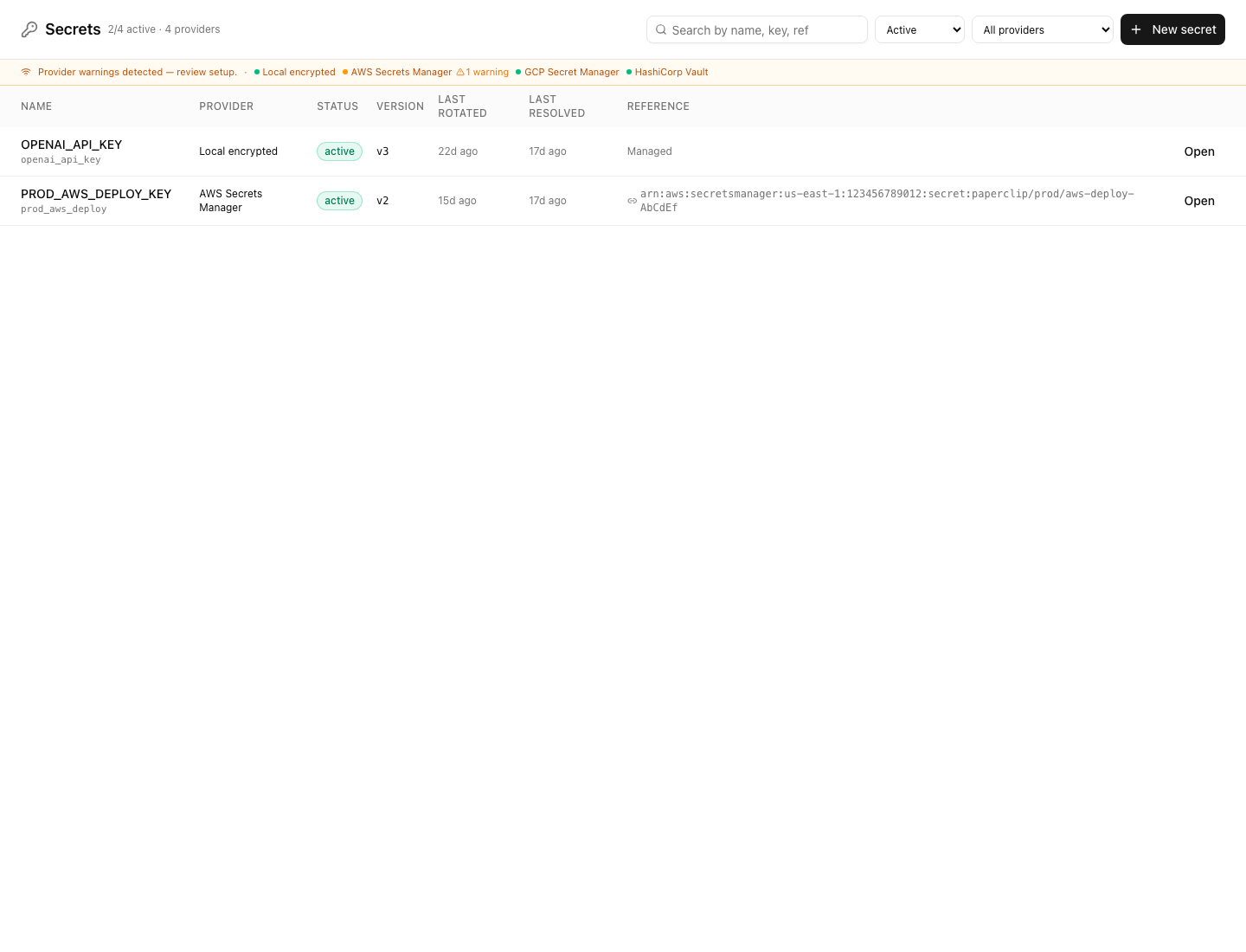 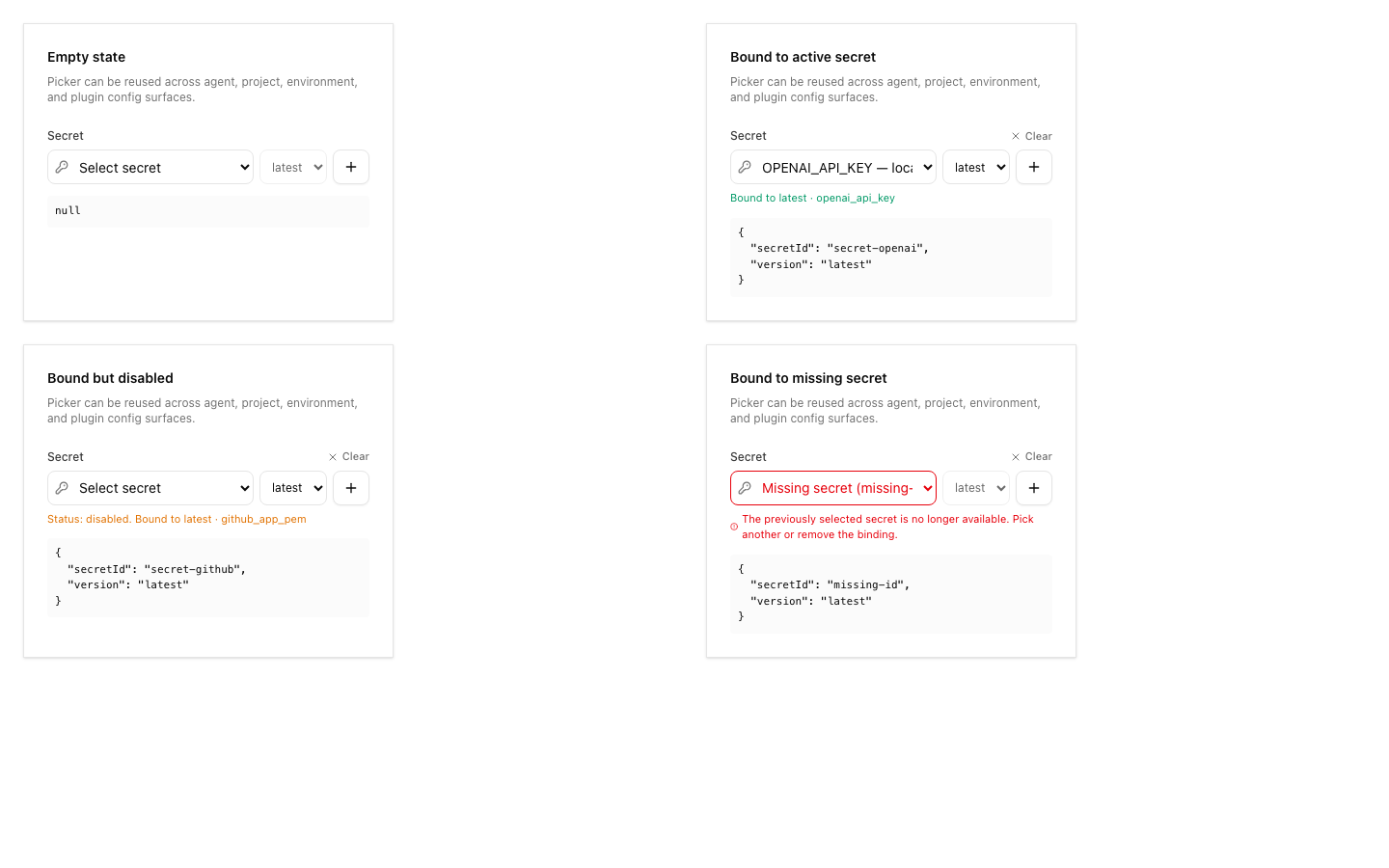 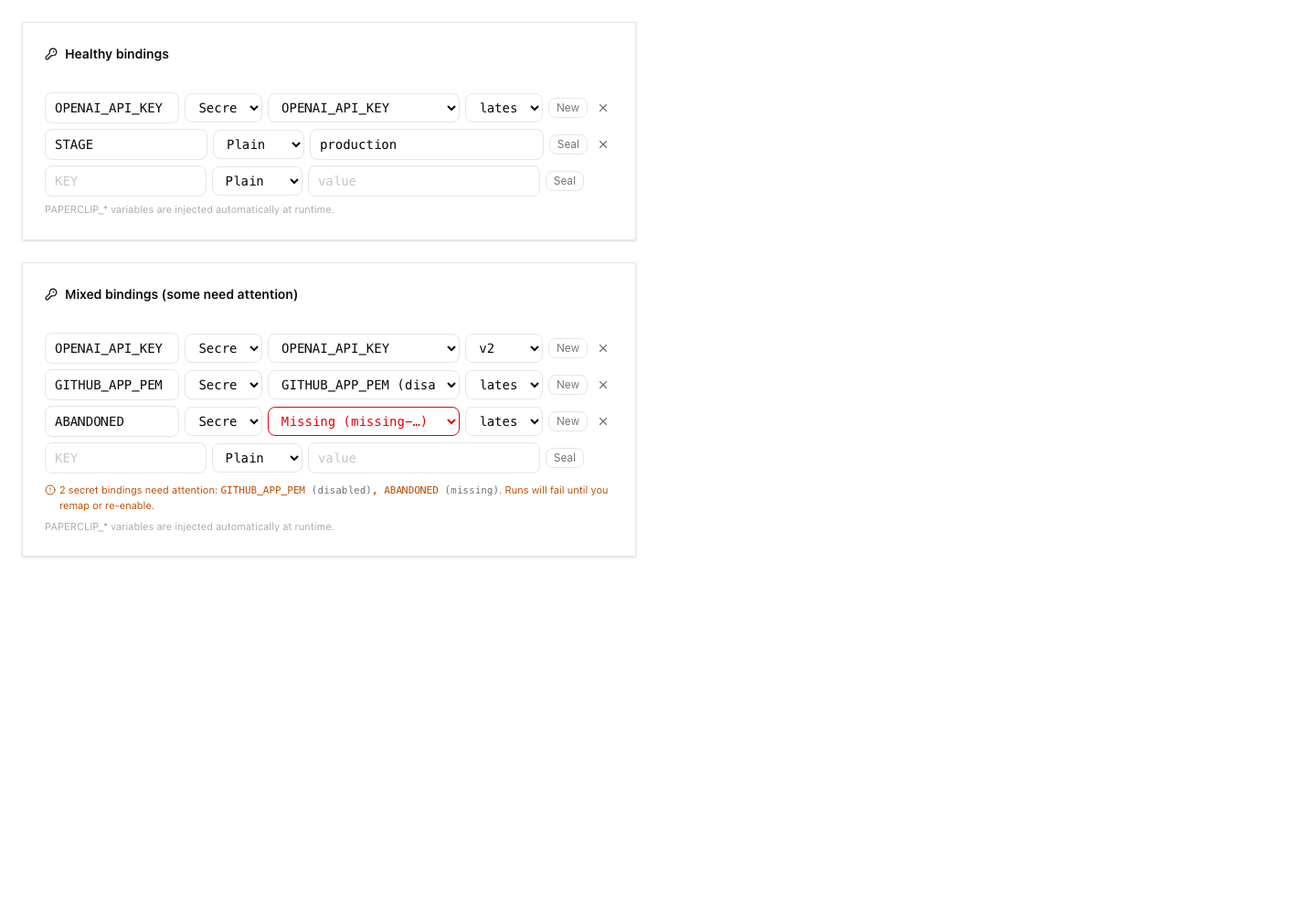 ## Risks - Migration risk: this adds new secret provider tables and extends existing secret rows. The migrations were checked for monotonic ordering and idempotent guards, but reviewers should still inspect upgrade behavior carefully. - Provider risk: AWS support uses direct SigV4 requests. Automated tests cover signing, request timeouts, vault-config selection, namespace guardrails, pending-version archival, sanitized provider errors, and service-level cleanup paths. A real-vault AWS smoke test remains deployment validation for an operator with AWS credentials rather than an unverified merge blocker in this local branch. - UI risk: the Secrets page and import dialog are large new surfaces; screenshots are included above for reviewer inspection. - Verification risk: the full local stable test command hit parallel-load timing failures, although the exact failed files passed when rerun directly. - Operational risk: remote import intentionally avoids plaintext reads; operators must understand that imported external references resolve at runtime and may fail if AWS permissions change. > For core feature work, check [`ROADMAP.md`](ROADMAP.md) first and discuss it in `#dev` before opening the PR. Feature PRs that overlap with planned core work may need to be redirected — check the roadmap first. See `CONTRIBUTING.md`. ## Model Used - OpenAI Codex, GPT-5 coding agent with local shell/tool use in the Paperclip worktree. Exact context-window size was not exposed by the runtime. ## Checklist - [x] I have included a thinking path that traces from project context to this change - [x] I have specified the model used (with version and capability details) - [x] I have checked ROADMAP.md and confirmed this PR does not duplicate planned core work - [ ] I have run tests locally and they pass - [x] I have added or updated tests where applicable - [x] If this change affects the UI, I have included before/after screenshots - [x] I have updated relevant documentation to reflect my changes - [x] I have considered and documented any risks above - [x] I will address all Greptile and reviewer comments before requesting merge --------- Co-authored-by: Paperclip <noreply@paperclip.ing> Co-authored-by: Claude Sonnet 4.6 <noreply@anthropic.com> |
||
|
DottaandClaude Opus 4.6
|
09d2ef1a37 |
fix: restore docs deleted in v0.2.3 release, add Paperclip branding
- Restored docs/ directory that was accidentally deleted by `git add -A` in the v0.2.3 release script - Replaced generic "P" favicon with actual paperclip icon using brand primary color (#2563EB) - Added light/dark logo SVGs for Mintlify navbar (paperclip icon + wordmark) - Updated docs.json with logo configuration for dark/light mode - Fixed release.sh to stage only release-related files instead of `git add -A` to prevent sweeping unrelated changes into release commits Co-Authored-By: Claude Opus 4.6 <noreply@anthropic.com> |
||
|
Dotta
|
28bf5e9e9b | chore: release v0.2.3 | ||
|
Dotta
|
cabd16bc70 | docs: sync docs and skills updates from backup branch | ||
|
ForgottenandClaude Opus 4.6
|
02dc46e782 |
docs: add external documentation site content
Add structured documentation covering quickstart, architecture, core concepts, API reference, adapter guides, CLI commands, deployment options, and operator/developer guides. Co-Authored-By: Claude Opus 4.6 <noreply@anthropic.com> |


