mirror of
https://github.com/paperclipai/paperclip.git
synced 2026-10-22 00:30:19 +02:00
 233c12f029
## Thinking Path > - Paperclip is the open source app people use to manage AI agents for work > - Local agent adapters (`claude_local`, `gemini_local`, `grok_local`, …) are the integration surface that lets Paperclip run coding CLIs on the host machine > - The Kimi Code CLI (`kimi`, Moonshot AI) has a documented non-interactive mode, `kimi -p --output-format stream-json` with session resume via `kimi -r`, but Paperclip has no built-in adapter for it > - So Kimi users (especially Kimi membership / OAuth subscribers) cannot onboard their CLI to Paperclip agent teams > - This pull request adds a complete built-in `kimi_local` adapter (both execution engines, session management, instructions + skills delivery, thinking-effort control, environment test, UI and CLI modules, docs) following the established `gemini_local`/`grok_local` package pattern > - Kimi Code ships an ACP server (`kimi acp`), so the adapter runs on Paperclip's shared acpx engine by default (streaming transcript with live tool status, like `claude_local`/`gemini_local`) and falls back to a headless CLI lane (`kimi -p --output-format stream-json`) when ACP prerequisites are unavailable > - The benefit is that Kimi Code becomes a first-class Paperclip agent lane: selectable in the UI, resumable across heartbeats, with the same operating context (instruction bundle, skills, effort) and streaming transcript the other local adapters get ## Linked Issues or Issue Description - Supersedes #9880 (same branch; expanded from the CLI-only lane into a complete adapter with the default ACP engine lane, control-plane skill install, and live transcript wiring) - Refs #9879 (adapter request for Kimi Code CLI, filed with this PR) - Refs #163 (original Kimi support request) Duplicate/related prior PRs, per the dedup search (both appear stale: no updates or maintainer review since May 2026, and both target an older Kimi CLI interface; calling them out for reviewer context per CONTRIBUTING.md): - Refs #6276 (`feat: add kimi-local adapter`): targets an older array-based content format (`{type: think}`/`{type: text}` blocks), not the current documented stream-json schema - Refs #5202 (`feat(adapter): add Kimi CLI local adapter with Wire protocol support`): builds on a `--wire` JSON-RPC interface that current Kimi Code CLI (0.27.0) no longer documents; the current documented headless interface is `-p --output-format stream-json` This PR is a fresh implementation against current master and the currently documented/verified Kimi CLI behavior (see Verification). Happy to fold in anything useful from the earlier attempts if a reviewer prefers. ## What Changed - **New adapter package** `packages/adapters/kimi-local` (`@paperclipai/adapter-kimi-local`), modeled on `gemini-local`/`grok-local`: - `src/server/execute.ts`: spawns `kimi -p <prompt> --output-format stream-json` (argv array, no shell), `-m <model>` only when configured, `-r <sessionId>` when the stored session cwd matches the run cwd, automatic fresh-session retry on unrecoverable-session errors, headless-safe env (`CI=1`, `NO_COLOR=1`, `KIMI_CODE_NO_AUTO_UPDATE=1`, `TERM=dumb`; user-configured values win), full remote (ssh/sandbox) execution lane with runtime install via `@moonshot-ai/kimi-code` - **Instruction bundle delivery**: the prompt path directive now names the sibling instruction files (`./HEARTBEAT.md`, `./SOUL.md`, `./TOOLS.md`) alongside the prepended entry file, and local runs pass `--add-dir <instructions-dir>` so Kimi can actually open them (matching `claude_local`). Without this, only the entry file reached Kimi and agents improvised the operating workflow that `HEARTBEAT.md` documents - **Thinking effort**: a configured `effort` is forwarded as the `KIMI_MODEL_THINKING_EFFORT` operational override (Kimi has no per-invocation effort flag). It is only sent for models that advertise `support_efforts` (currently `kimi-code/k3`) to avoid provider rejections, and `medium` maps to `high` since Kimi has no medium tier (`low`/`high`/`max` pass through) - **Skills delivery**: desired Paperclip skills are delivered via Kimi's `--skills-dir` flag from a dedicated per-run directory (a local snapshot, or the synced snapshot on remote targets), so skills load reliably and in isolation. Paperclip never overwrites the shared `$KIMI_CODE_HOME/skills` home, so skills installed by the operator or other agents are left intact. `--skills-dir` is only passed when at least one skill is desired, so unconfigured agents keep Kimi's default skill discovery - **Live run status**: the adapter now forwards each streamed stream-json line to `onEvent` (assistant `content` as an assistant snippet, `tool_calls` as tool-name events), which drives the issue-thread activity indicator (`currentToolName` / `lastAssistantSnippet` / `lastEventAt`). Previously the adapter only wrote the raw run log, so the issue thread showed a stale "no output for N s" line with no tool or reasoning context while Kimi worked. Tool results are omitted so the last meaningful "Using X" / snippet is not overwritten by a generic label - `src/server/parse.ts`: parses the verified Kimi stream-json event shapes (`assistant` text, `assistant.tool_calls` with JSON-string arguments, `tool` results, trailing `meta.session.resume_hint` for session-id capture) plus failure classifiers (`kimi_auth_required`, transient network, unrecoverable session). A signaled exit (null exit code, not a timeout) is now reported as a failure rather than coalesced to success, and the error message names the terminating signal - `src/server/skills.ts`: lists/syncs Paperclip skills for the adapter's skill-management surface - `src/server/test.ts`: environment test covering CLI resolution + `kimi --version`, cwd check, auth detection (OAuth credential dirs, keyed `[providers.*]` in config.toml, or the `KIMI_MODEL_NAME` + `KIMI_MODEL_API_KEY` env pair), and a live hello probe - `src/ui/` (stdout-line parser for transcripts, config builder) and `src/cli/` (stream event formatter) modules - Root metadata: three managed model aliases (`kimi-code/kimi-for-coding`, `kimi-code/kimi-for-coding-highspeed`, `kimi-code/k3`), effort-capable-model metadata (`EFFORT_CAPABLE_MODELS`, effort mapping helpers), `agentConfigurationDoc` - Tests: 101 tests across parse, execute (args building, resume gating, retry, auth error code, timeout, signaled-exit failure, effort forwarding/gating/mapping, `--add-dir` instructions directive, `--skills-dir` gating, `onEvent` runtime-event forwarding), ACP engine (engine resolution, acpx config build, node-version gate), ACP transcript delegation, environment test, UI parse/build-config - **ACP engine lane (default)** (`src/server/acp.ts` + shared `adapter-utils/acpx-engine`): Kimi Code ships an ACP server (`kimi acp`), so `kimi_local` now runs on Paperclip's shared acpx engine by default, matching `claude_local`/`codex_local`/`gemini_local`. The issue-thread transcript streams live (assistant text deltas, tool calls with a `pending`->`completed` status lifecycle) instead of the CLI lane's bursty complete-message output. Registered `kimi_local -> "kimi"` in `ACPX_ADAPTER_AGENT_IDS` and resolved the built-in agent command to `kimi acp`; `execute.ts` dispatches to the ACP executor first with an automatic CLI fallback when ACP prerequisites fail (`engine=acp` requires ACP, `engine=cli` pins the headless lane); `index.ts` falls back to the shared acpx session codec; the UI/CLI delegate `acpx.*` events to the shared acpx transcript parser and event formatter. The headless CLI lane (above) remains as the fallback - **Registration** (one entry each, mirroring existing adapters): server adapter registry + `BUILTIN_ADAPTER_TYPES`, `AGENT_ADAPTER_TYPES` (shared), UI adapter registry + display registry (`Kimi Code`, Moon icon) + capabilities defaults, CLI adapter registry, `Dockerfile` (package copy + `npm install --global @moonshot-ai/kimi-code@latest`), `vitest.config.ts` workspace, `scripts/release-package-manifest.json` - **Behavioral sets** mirroring `gemini_local` (Kimi resumes sessions the same way): `GIT_SENSITIVE_LOCAL_ADAPTER_TYPES`, `SESSIONED_LOCAL_ADAPTERS` (heartbeat + recovery), `REMOTE_MANAGED_ADAPTERS`, ssh/sandbox execution-target allow-lists, `ADAPTER_DEFAULT_RULES_BY_TYPE` (`timeoutSec: 0`, `graceSec: 15`), and `LEGACY_SESSIONED_ADAPTER_TYPES` + `ADAPTER_SESSION_MANAGEMENT` in adapter-utils - **UI touch-points**: New Agent default-model branch, AgentConfigForm command map (`kimi_local: "kimi"`) + model defaults + a Kimi-specific thinking-effort option list (`Low`/`High`/`Max`, reflecting Kimi's tiers rather than borrowing Claude's), OnboardingWizard (command map, model default, `kimi login` / `KIMI_MODEL_NAME + KIMI_MODEL_API_KEY` auth hints, manual-debug command line), InviteLanding enabled adapters - **Control-plane skill install** (`cli/src/commands/client/agent.ts`): `paperclipai agent local-cli` seeded the Paperclip control-plane skills into `~/.codex/skills` and `~/.claude/skills` so Codex/Claude agents auto-discover the API reference every run. Kimi had no equivalent target, so `kimi_local` agents began each session without the control-plane skill and rediscovered routes (e.g. the company-scoped `POST /api/companies/{companyId}/issues`) by trial and error. Added `~/.kimi-code/skills` (honoring `KIMI_CODE_HOME`) as a third install target for parity. Independent of the per-run `--skills-dir` delivery, which only applies to explicitly configured skills. - **Docs**: `docs/adapters/kimi-local.md` (prerequisites, auth options, config fields including `effort`, session resume, instruction bundle, skills delivery, control-plane skill install) + a row in `docs/adapters/overview.md` Out of scope (deliberately): model profiles, built-in agent `allowedAdapterTypes` additions. ## Verification\n\nCurrent-master rebase verification (OpenAI Codex, 2026-08-03): 13 focused files / 231 tests pass; adapter-utils, server, UI, CLI, and Kimi adapter typechecks pass; full repository build and UI token gates pass. The branch is conflict-free against master at head `1249df117c5e12e5771b9a570a6340866450619e`.\n\nAutomated (all from repo root, pnpm 9.15.4, Node 22): - `vitest run packages/adapters/kimi-local`: 89/89 pass (includes coverage for the instruction `--add-dir` directive, effort forwarding/gating/mapping, `--skills-dir` gating, the signaled-exit failure path, and `onEvent` runtime-event forwarding with cross-chunk line buffering) - `vitest run server/src/__tests__/adapter-registry.test.ts server/src/__tests__/adapter-routes.test.ts server/src/services/heartbeat-stop-metadata.test.ts ui/src/adapters/adapter-display-registry.test.ts`: 37/37 pass - `vitest run cli/src/__tests__/skills.test.ts`: 13/13 pass (the control-plane skill install target follows the existing Codex/Claude install path, whose symlink logic is unchanged) - `vitest run packages/shared`: 307/307 pass; `vitest run packages/adapter-utils`: pass except one pre-existing, unrelated failure (`mcp-isolation.integration.test.ts` requires Claude CLI ≥ 2.1.207; host has 2.1.185, fails identically on unmodified master) - `pnpm --filter @paperclipai/adapter-kimi-local typecheck|build`, plus typecheck of `server`, `ui`, `cli`, `adapter-utils`: all clean - `pnpm install --frozen-lockfile`: passes (the PR diff itself contains no lockfile changes, per repo policy; verified against a locally regenerated lockfile) - `node scripts/check-no-git-push.mjs` and `node scripts/check-forbidden-tokens.mjs`: pass - CI note: the `policy` job's release-bootstrap step is expected to stay red until a maintainer bootstraps the first npm publish of `@paperclipai/adapter-kimi-local`; see the CI Note for Maintainers comment. All other contributor-actionable checks are green. Manual end-to-end (real Kimi CLI 0.27.0, OAuth login, dev server on an isolated instance): 1. Server `GET /api/adapters` lists `kimi_local` as builtin with correct capability flags; models endpoint returns the three Kimi models 2. `POST .../adapters/kimi_local/test-environment`: all checks pass, including a live `kimi -p` hello probe 3. Created a `kimi_local` agent and invoked two heartbeats: run 1 spawned `kimi -p ... --output-format stream-json`, Kimi used its `Read` tool, produced the expected answer, and the session id was captured from the `session.resume_hint` meta event; run 2 resumed the **same** Kimi session (`sessionIdBefore == sessionIdAfter`) via `-r` 4. UI: adapter appears in the New Agent dropdown; selecting it shows the Kimi command placeholder, the three models, and the Kimi config fields; the run transcript renders Kimi tool calls via the adapter's stdout parser The instruction-bundle, thinking-effort, and `--skills-dir` changes landed after the manual run above. They are covered by the unit tests listed under Automated, and the Kimi CLI flags they rely on (`--add-dir`, `--skills-dir`, `KIMI_MODEL_THINKING_EFFORT`) were confirmed against the installed Kimi Code CLI 0.27.0 (`kimi --help`, config-file thinking-effort docs). Screenshots (assets branch on the fork, not part of the diff): 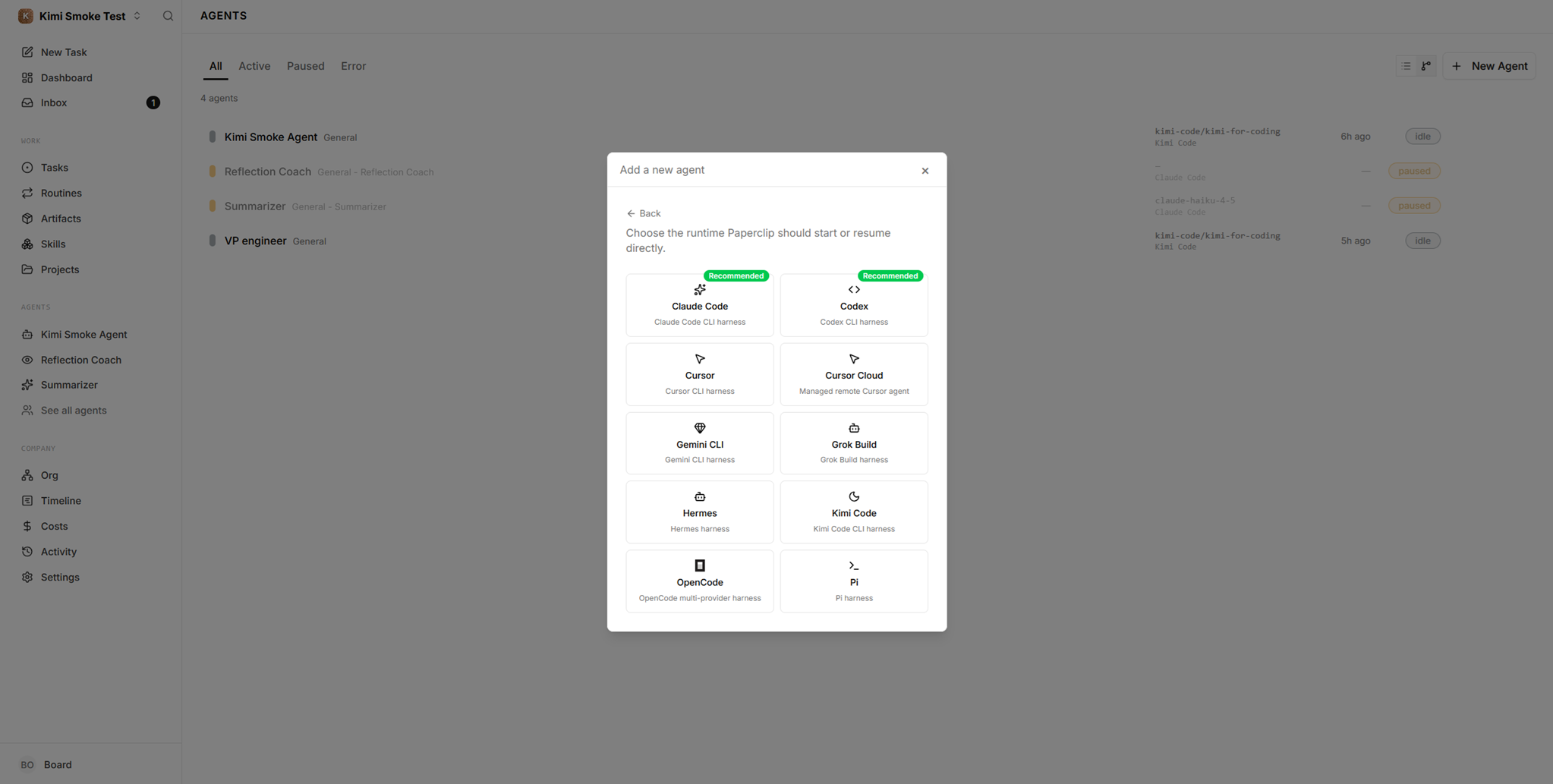 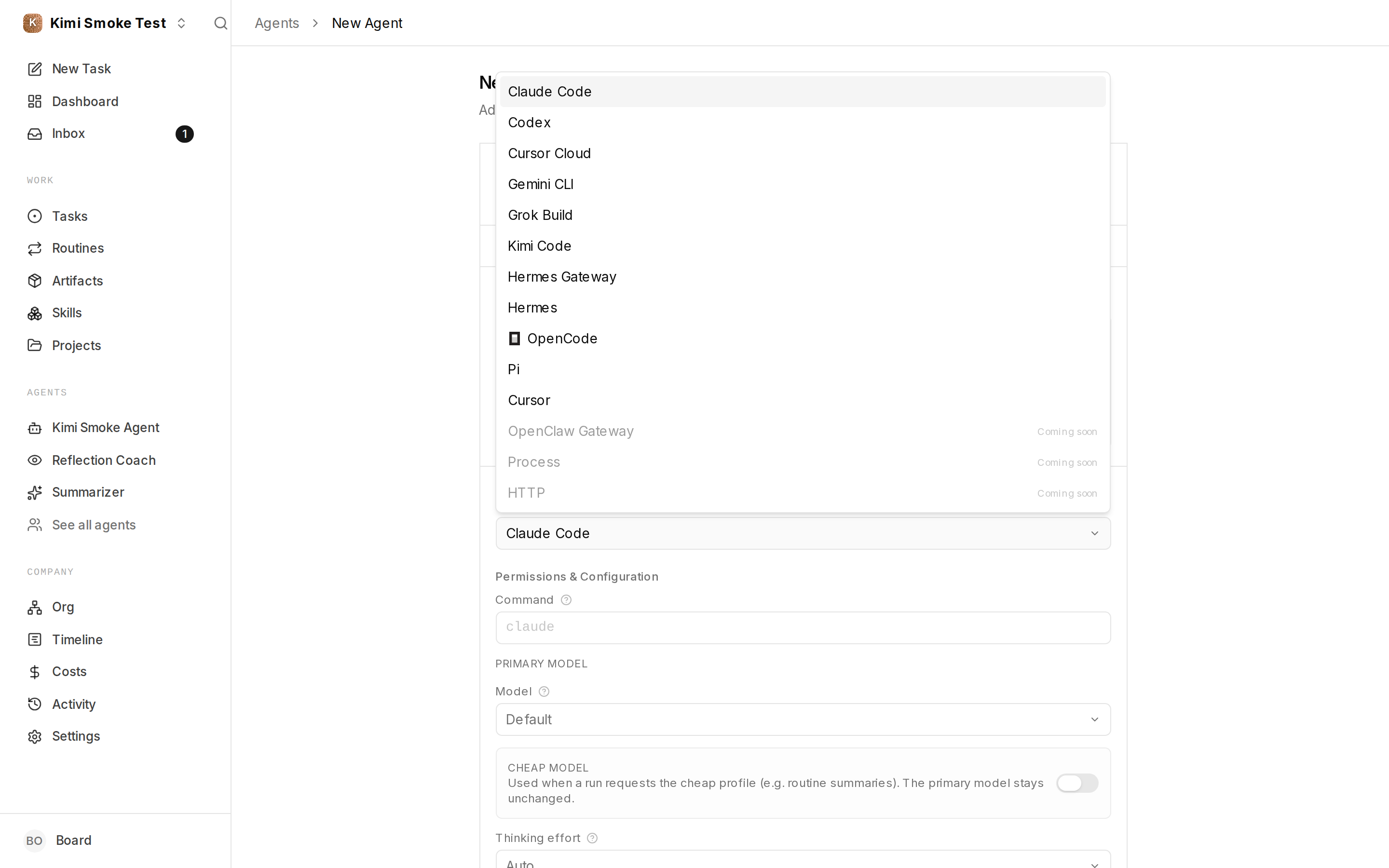 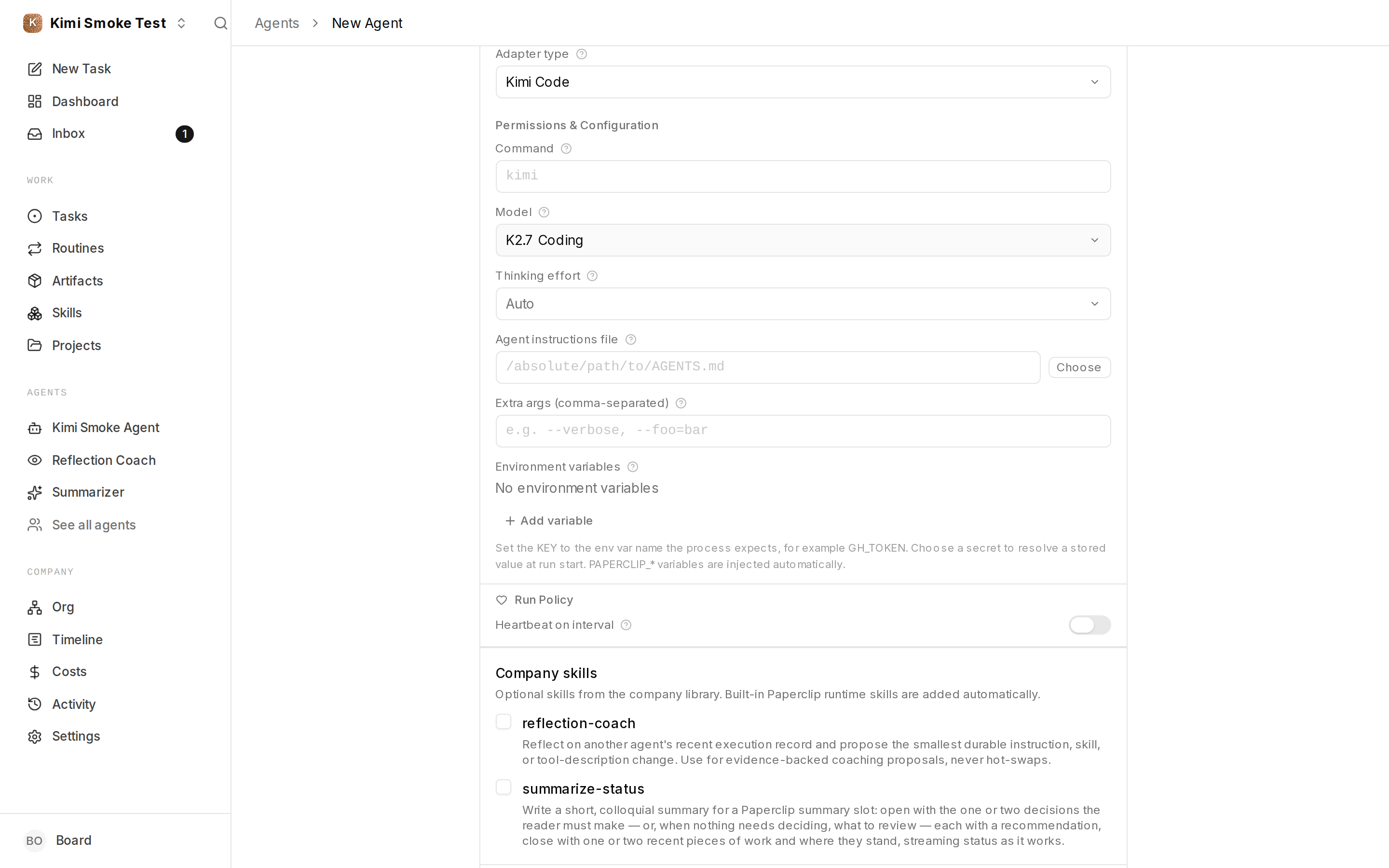 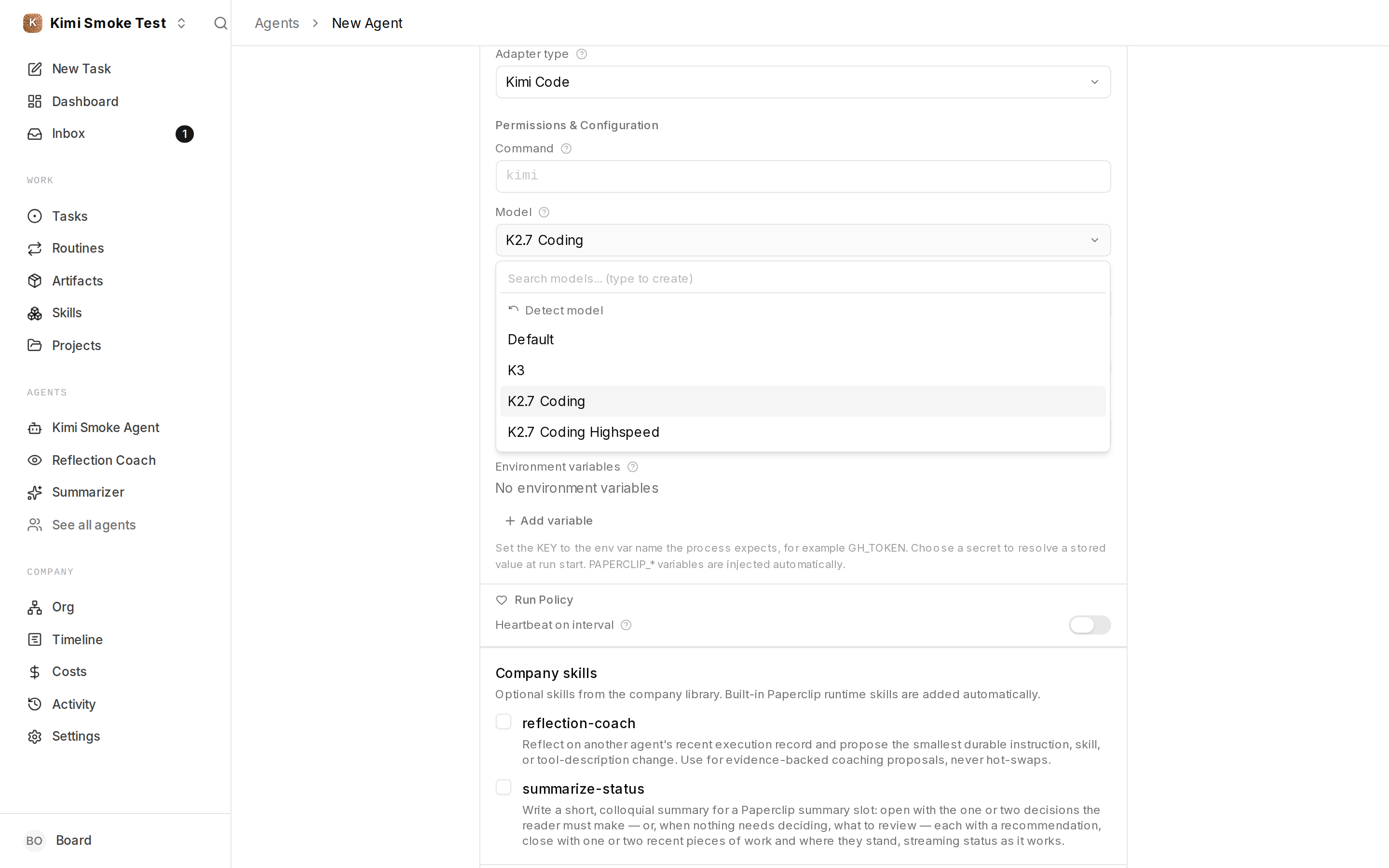 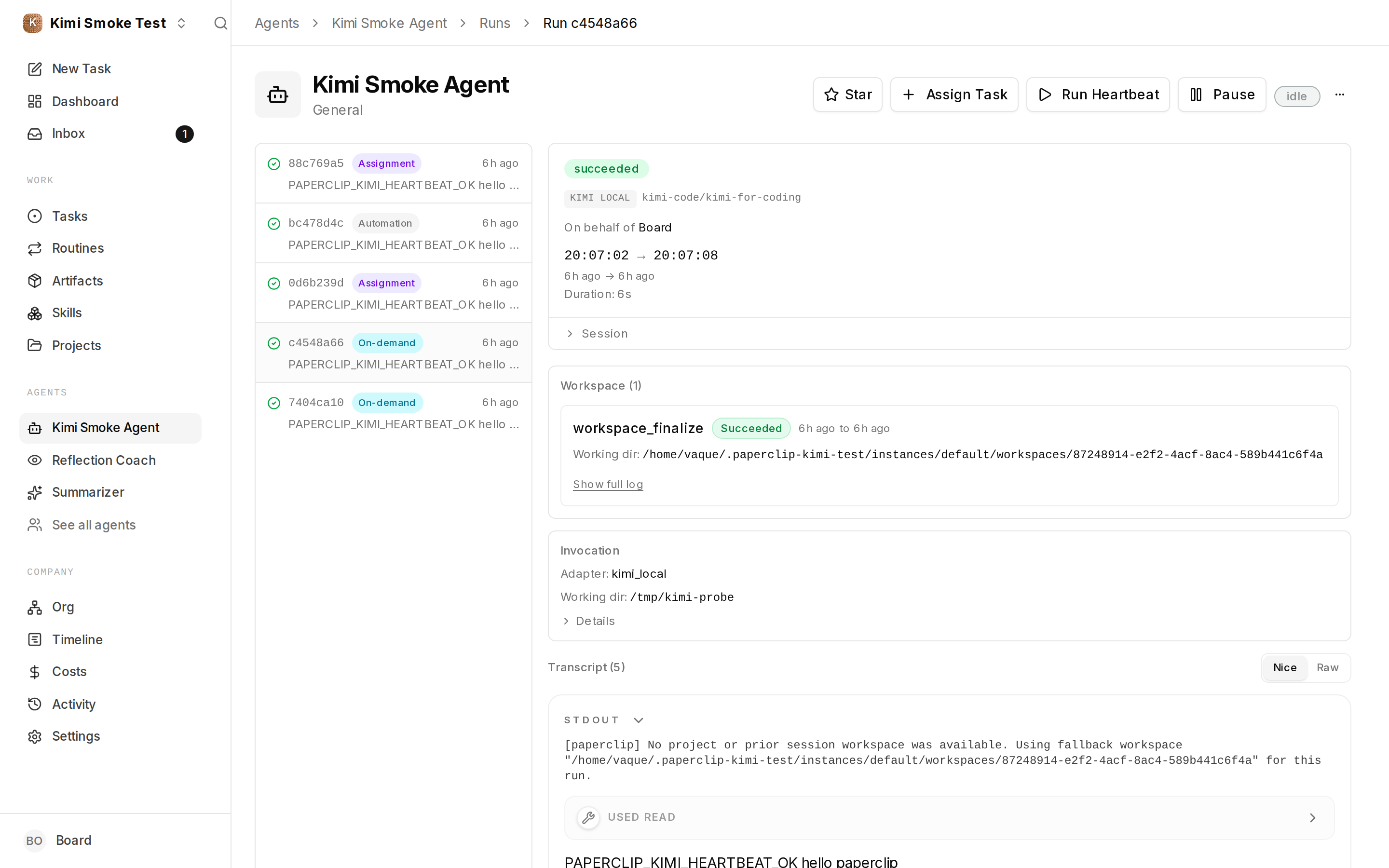 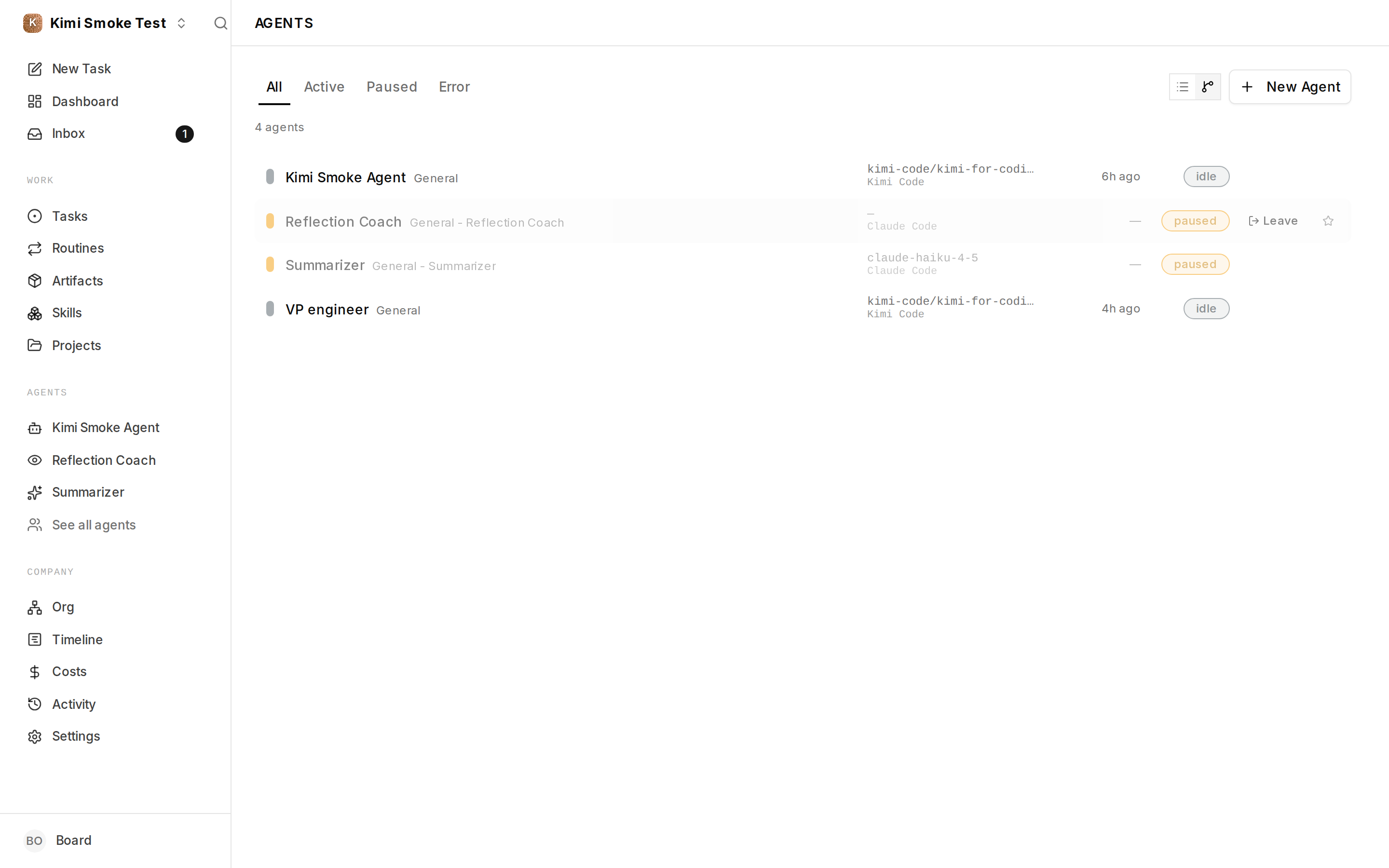 ## Risks - Low risk to existing behavior: the change is additive, one new workspace package plus single-entry registrations alongside existing adapters; no existing adapter code paths are modified. - The adapter invokes the locally installed `kimi` CLI; like other local adapters, run behavior depends on the host's Kimi version. The parser is written against the documented/verified 0.27.0 stream-json schema and degrades gracefully (malformed lines are skipped, failures surface as run errors). - `--skills-dir` overrides Kimi's auto-discovery of user and project skills for the run. This is intentional (paperclip-managed agents get a reproducible, isolated skill set), and it is only passed when at least one Paperclip skill is desired, so unconfigured agents keep default discovery. - Thinking effort is only forwarded to models that advertise `support_efforts` (currently `kimi-code/k3`); `EFFORT_CAPABLE_MODELS` must be extended when more Kimi models gain support, otherwise a configured effort is silently ignored for them. - `Dockerfile` now installs `@moonshot-ai/kimi-code@latest` globally alongside the other agent CLIs, so image size increases slightly. - Maintainer action needed for the npm bootstrap gate: the `policy` job's release-bootstrap step fails until the first npm publish of `@paperclipai/adapter-kimi-local` (the gate from #5146 that every new adapter package has passed through). Enrollment with `publishFromCi: true` is required by the manifest validator (dropping the entry, `false`, or `private` are all rejected), so this is intentionally left to a maintainer. Remaining CI lanes are expected to run once it is done. ## Model Used\n\n- **Current-master rebase, conflict adaptation, and registry-parity coverage:** OpenAI, **GPT-5 Codex** (Codex agent; exact serving model ID and context-window size were not exposed to the runtime), with repository, shell, Git, and GitHub tooling. It preserved Hawik’s commit authorship, reconciled ACPX and environment-capability changes, added current registry tests, and ran the verification above.\n- **Adapter implementation and initial review:** Moonshot AI, **Kimi K3 Coding** (latest), via **Kimi Code CLI v0.27.0** (`kimi-code/k3` alias, 1M-token context window, thinking mode, agentic tool use). The CLI agent explored the repo, wrote the adapter implementation (delegated to a coder sub-agent of the same model), ran tests, and drafted the first version of this PR body. A second model-driven review pass (read-only, same model) audited the diff for security/correctness before submission; its findings (shell-quoting hardening, auth-detection false positive, session-compaction registration, test gaps) were fixed and are included. - **Harness-context fixes and review responses:** Anthropic, **Claude Opus 4.8** (`claude-opus-4-8`) via Claude Code. Diagnosed from run logs that Kimi received only the entry instructions file (not the `HEARTBEAT.md`/`SOUL.md`/`TOOLS.md` bundle) and that `effort` was never wired, then implemented the instruction `--add-dir` delivery, `KIMI_MODEL_THINKING_EFFORT` forwarding, and `--skills-dir` skill delivery, added the accompanying tests and docs, and addressed the automated review comments (preserving external skills on remote sync, treating a signaled exit as a failure). Also extended the `paperclipai agent local-cli` installer to seed the control-plane skills into `~/.kimi-code/skills` for Codex/Claude parity, wired `onEvent` runtime events so the issue-thread activity indicator reflects Kimi's tool and reasoning output live, and built the ACP engine lane (`kimi acp` via the shared acpx engine, default) so the transcript streams with live tool status like the other ACP adapters. The Kimi CLI flags, subcommand, and env var relied on here were verified against the installed Kimi Code CLI 0.27.0. - All CLI behaviors claimed here (`-p`, `--output-format stream-json`, `-r` resume, event shapes, `--add-dir`, `--skills-dir`, `KIMI_MODEL_THINKING_EFFORT`) were verified empirically against the installed Kimi CLI, not assumed. ## Checklist - [x] I have included a thinking path that traces from project context to this change - [x] I have specified the model used (with version and capability details) - [x] I have checked ROADMAP.md and confirmed this PR does not duplicate planned core work - [x] I have searched GitHub for duplicate or related PRs and linked them above - [x] I have either (a) linked existing issues with `Fixes: #` / `Closes #` / `Refs #` OR (b) described the issue in-PR following the relevant issue template - [x] I have not referenced internal/instance-local Paperclip issues or links (only public GitHub `#NNN` / `github.com/paperclipai/paperclip` URLs) - [x] My branch name describes the change (e.g. `docs/...`, `fix/...`) and contains no internal Paperclip ticket id or instance-derived details - [x] I have run tests locally and they pass - [x] I have added or updated tests where applicable - [x] I have updated relevant documentation to reflect my changes - [x] I have considered and documented any risks above - [x] All Paperclip CI gates are green *(only the release-bootstrap step remains red, pending the maintainer npm publish described in Risks)* - [x] Greptile is 5/5 with no open P2s, recommendations, or follow-ups *(will address all Greptile comments as they arrive)* - [x] I will address all Greptile and reviewer comments before requesting merge --- ## Maintainer Addendum (2026-08-20) The shared acpx-engine and issue-chat changes (run-summary segmentation, placeholder tool-event coalescing, `ISSUE_CHAT_TRANSCRIPT_MAX_VISIBLE_ENTRIES` 30 → 400, live-reasoning UI) have been **extracted to #11761** so the cross-adapter behavior changes review and revert independently — both commits there preserve @hawikk's authorship. This PR is now the kimi-specific adapter only (60 files, +3,793/−8, essentially pure addition); the only shared-engine touch left is the `kimi acp` command resolution. `publishFromCi` is `true` — the package name is bootstrapped on npm. --------- Co-authored-by: Claude Opus 4.8 <noreply@anthropic.com> Co-authored-by: Paperclip <noreply@paperclip.ing> Co-authored-by: Dotta <bippadotta@protonmail.com> Co-authored-by: Devin Foley <devin@paperclip.ing>






3290 lines
136 KiB
TypeScript
3290 lines
136 KiB
TypeScript
import { useState, useEffect, useRef, useMemo, useCallback } from "react";
|
|
import { useMutation, useQuery, useQueryClient } from "@tanstack/react-query";
|
|
import type {
|
|
Agent,
|
|
AdapterAuthSessionPrompt,
|
|
AdapterAuthSessionStatus,
|
|
AdapterEnvironmentTestResult,
|
|
CompanySecret,
|
|
EnvBinding,
|
|
EnvSecretRefBinding,
|
|
Environment,
|
|
} from "@paperclipai/shared";
|
|
import { AGENT_DEFAULT_MAX_CONCURRENT_RUNS, supportedEnvironmentDriversForAdapter, isValidBrowserCode, ADAPTER_AUTH_MISSING_CHECK_CODE } from "@paperclipai/shared";
|
|
import type { AdapterModel } from "../api/agents";
|
|
import { agentsApi } from "../api/agents";
|
|
import { ApiError } from "../api/client";
|
|
import { environmentsApi } from "../api/environments";
|
|
import { instanceSettingsApi } from "../api/instanceSettings";
|
|
import { secretsApi } from "../api/secrets";
|
|
import { assetsApi } from "../api/assets";
|
|
import { DEFAULT_CODEX_LOCAL_BYPASS_APPROVALS_AND_SANDBOX } from "@paperclipai/adapter-codex-local";
|
|
import { DEFAULT_CURSOR_LOCAL_MODEL } from "@paperclipai/adapter-cursor-local";
|
|
import { DEFAULT_GEMINI_LOCAL_MODEL } from "@paperclipai/adapter-gemini-local";
|
|
import { DEFAULT_KIMI_LOCAL_MODEL } from "@paperclipai/adapter-kimi-local";
|
|
import { DEFAULT_OPENCODE_LOCAL_MODEL } from "@paperclipai/adapter-opencode-local";
|
|
import {
|
|
Popover,
|
|
PopoverContent,
|
|
PopoverTrigger,
|
|
} from "@/components/ui/popover";
|
|
import { Button } from "@/components/ui/button";
|
|
import { FolderOpen, Heart, ChevronDown, X, Copy, Check, ExternalLink, Loader2, TriangleAlert } from "lucide-react";
|
|
import { asBoolean, asFiniteNumber, asObject, cn } from "../lib/utils";
|
|
import { copyTextToClipboard } from "../lib/clipboard";
|
|
import { resolveAdapterTestEnvironmentId } from "../lib/adapter-test-environment";
|
|
import { extractModelName, extractProviderId } from "../lib/model-utils";
|
|
import { queryKeys } from "../lib/queryKeys";
|
|
import { useCompany } from "../context/CompanyContext";
|
|
import {
|
|
Field,
|
|
ToggleField,
|
|
ToggleWithNumber,
|
|
CollapsibleSection,
|
|
DraftInput,
|
|
DraftNumberInput,
|
|
help,
|
|
adapterLabels,
|
|
} from "./agent-config-primitives";
|
|
import { ToggleSwitch } from "@/components/ui/toggle-switch";
|
|
import { defaultCreateValues } from "./agent-config-defaults";
|
|
import { getUIAdapter } from "../adapters";
|
|
import { ClaudeLocalAdvancedFields } from "../adapters/claude-local/config-fields";
|
|
import { MarkdownEditor } from "./MarkdownEditor";
|
|
import { ChoosePathButton } from "./PathInstructionsModal";
|
|
import { OpenCodeLogoIcon } from "./OpenCodeLogoIcon";
|
|
import { ReportsToPicker } from "./ReportsToPicker";
|
|
import {
|
|
EnvironmentVariablesEditor,
|
|
type EnvironmentVariablesEditorHandle,
|
|
} from "./environment-variables-editor";
|
|
import { buildFixedClaudeOAuthBinding, CLAUDE_OAUTH_TOKEN_ENV_KEY } from "./environment-variables-editor/model";
|
|
import { AgentSecretAccessEditor } from "./AgentSecretAccessEditor";
|
|
import { useProposalReview } from "../pages/secrets/proposal-review";
|
|
import { AGENT_ACCESS_CONFIG_PATH_PREFIX } from "../lib/secret-delivery";
|
|
import { shouldShowLegacyWorkingDirectoryField } from "../lib/legacy-agent-config";
|
|
import { listAdapterOptions, listVisibleAdapterTypes } from "../adapters/metadata";
|
|
import { getAdapterDisplay, getAdapterLabel } from "../adapters/adapter-display-registry";
|
|
import { useDisabledAdaptersSync } from "../adapters/use-disabled-adapters";
|
|
import { buildAgentUpdatePatch, omitUndefinedEntries, type AgentConfigOverlay } from "../lib/agent-config-patch";
|
|
import { useAdapterCapabilities } from "../adapters/use-adapter-capabilities";
|
|
import { resolveForcedKubernetesEnvironment } from "../lib/forced-kubernetes-environment";
|
|
|
|
/* ---- Create mode values ---- */
|
|
|
|
// Canonical type lives in @paperclipai/adapter-utils; re-exported here
|
|
// so existing imports from this file keep working.
|
|
export type { CreateConfigValues } from "@paperclipai/adapter-utils";
|
|
import type { CreateConfigValues } from "@paperclipai/adapter-utils";
|
|
import { Badge } from "@/components/ui/badge";
|
|
|
|
/* ---- Props ---- */
|
|
|
|
type AgentConfigFormProps = {
|
|
adapterModels?: AdapterModel[];
|
|
onDirtyChange?: (dirty: boolean) => void;
|
|
onSaveActionChange?: (save: (() => void) | null) => void;
|
|
onCancelActionChange?: (cancel: (() => void) | null) => void;
|
|
onTestActionChange?: (test: (() => void) | null) => void;
|
|
onTestActionStateChange?: (state: { disabled: boolean; pending: boolean }) => void;
|
|
onTestFeedbackChange?: (feedback: {
|
|
errorMessage: string | null;
|
|
result: AdapterEnvironmentTestResult | null;
|
|
// The login panel descriptor when the current target is a sandbox with no
|
|
// ready authentication, otherwise null. A parent that lifts the test
|
|
// feedback must render `AdapterLoginPanel` from this descriptor. The inline
|
|
// feedback branch renders the panel itself, so this descriptor is the only
|
|
// way the panel reaches a parent that hides the inline branch.
|
|
login: AdapterLoginDescriptor | null;
|
|
}) => void;
|
|
hideInlineSave?: boolean;
|
|
showAdapterTypeField?: boolean;
|
|
showAdapterTestEnvironmentButton?: boolean;
|
|
showCreateRunPolicySection?: boolean;
|
|
hideInstructionsFile?: boolean;
|
|
/** Hide the prompt template field from the Identity section (used when it's shown in a separate Prompts tab). */
|
|
hidePromptTemplate?: boolean;
|
|
/** Render the main configuration sections or the dedicated edit-only Secrets surface. */
|
|
content?: "configuration" | "secrets";
|
|
/** "cards" renders each section as heading + bordered card (for settings pages). Default: "inline" (border-b dividers). */
|
|
sectionLayout?: "inline" | "cards";
|
|
} & (
|
|
| {
|
|
mode: "create";
|
|
values: CreateConfigValues;
|
|
onChange: (patch: Partial<CreateConfigValues>) => void;
|
|
}
|
|
| {
|
|
mode: "edit";
|
|
agent: Agent;
|
|
onSave: (patch: Record<string, unknown>) => void | Promise<unknown>;
|
|
isSaving?: boolean;
|
|
}
|
|
);
|
|
|
|
/* ---- Edit mode overlay (dirty tracking) ---- */
|
|
|
|
const emptyOverlay: AgentConfigOverlay = {
|
|
identity: {},
|
|
adapterConfig: {},
|
|
heartbeat: {},
|
|
runtime: {},
|
|
};
|
|
|
|
/** Stable empty object used as fallback for missing env config to avoid new-object-per-render. */
|
|
const EMPTY_ENV: Record<string, EnvBinding> = {};
|
|
|
|
export function supportsAdapterModelRefresh(adapterType: string): boolean {
|
|
return adapterType === "claude_local" || adapterType === "codex_local";
|
|
}
|
|
|
|
function isOverlayDirty(o: AgentConfigOverlay): boolean {
|
|
return (
|
|
Object.keys(o.identity).length > 0 ||
|
|
o.adapterType !== undefined ||
|
|
Object.keys(o.adapterConfig).length > 0 ||
|
|
Object.keys(o.heartbeat).length > 0 ||
|
|
Object.keys(o.runtime).length > 0 ||
|
|
o.modelProfiles?.cheap !== undefined
|
|
);
|
|
}
|
|
|
|
/* ---- Shared input class ---- */
|
|
const inputClass =
|
|
"w-full rounded-md border border-border px-2.5 py-1.5 bg-transparent outline-none text-sm font-mono placeholder:text-muted-foreground/40";
|
|
|
|
function parseCommaArgs(value: string): string[] {
|
|
return value
|
|
.split(",")
|
|
.map((item) => item.trim())
|
|
.filter(Boolean);
|
|
}
|
|
|
|
function formatArgList(value: unknown): string {
|
|
if (Array.isArray(value)) {
|
|
return value
|
|
.filter((item): item is string => typeof item === "string")
|
|
.join(", ");
|
|
}
|
|
return typeof value === "string" ? value : "";
|
|
}
|
|
|
|
const codexThinkingEffortOptions = [
|
|
{ id: "", label: "Auto" },
|
|
{ id: "minimal", label: "Minimal" },
|
|
{ id: "low", label: "Low" },
|
|
{ id: "medium", label: "Medium" },
|
|
{ id: "high", label: "High" },
|
|
{ id: "xhigh", label: "X-High" },
|
|
] as const;
|
|
|
|
const openCodeThinkingEffortOptions = [
|
|
{ id: "", label: "Auto" },
|
|
{ id: "minimal", label: "Minimal" },
|
|
{ id: "low", label: "Low" },
|
|
{ id: "medium", label: "Medium" },
|
|
{ id: "high", label: "High" },
|
|
{ id: "xhigh", label: "X-High" },
|
|
{ id: "max", label: "Max" },
|
|
] as const;
|
|
|
|
const cursorModeOptions = [
|
|
{ id: "", label: "Auto" },
|
|
{ id: "plan", label: "Plan" },
|
|
{ id: "ask", label: "Ask" },
|
|
] as const;
|
|
|
|
const claudeThinkingEffortOptions = [
|
|
{ id: "", label: "Auto" },
|
|
{ id: "low", label: "Low" },
|
|
{ id: "medium", label: "Medium" },
|
|
{ id: "high", label: "High" },
|
|
] as const;
|
|
|
|
// Kimi exposes low/high/max (no "medium") via each model's support_efforts;
|
|
// the kimi_local adapter maps a legacy "medium" onto "high" at runtime.
|
|
const kimiThinkingEffortOptions = [
|
|
{ id: "", label: "Auto" },
|
|
{ id: "low", label: "Low" },
|
|
{ id: "high", label: "High" },
|
|
{ id: "max", label: "Max" },
|
|
] as const;
|
|
|
|
const MAX_TURN_CONTINUATION_DEFAULT_MAX_ATTEMPTS = 2;
|
|
const MAX_TURN_CONTINUATION_MAX_ATTEMPTS_CAP = 10;
|
|
const MAX_TURN_CONTINUATION_DEFAULT_DELAY_SEC = 1;
|
|
const MAX_TURN_CONTINUATION_MAX_DELAY_SEC = 300;
|
|
|
|
function clampInteger(value: number, min: number, max: number) {
|
|
return Math.max(min, Math.min(max, Math.floor(value)));
|
|
}
|
|
|
|
function clampDelayMsFromSeconds(value: number) {
|
|
return clampInteger(value, 0, MAX_TURN_CONTINUATION_MAX_DELAY_SEC) * 1000;
|
|
}
|
|
|
|
/* ---- Form ---- */
|
|
|
|
export function AgentConfigForm(props: AgentConfigFormProps) {
|
|
const { mode, adapterModels: externalModels } = props;
|
|
const isCreate = mode === "create";
|
|
const cards = props.sectionLayout === "cards";
|
|
const showAdapterTypeField = props.showAdapterTypeField ?? true;
|
|
const showAdapterTestEnvironmentButton = props.showAdapterTestEnvironmentButton ?? true;
|
|
const showInlineAdapterTestEnvironmentButton =
|
|
showAdapterTestEnvironmentButton && !props.onTestActionChange;
|
|
const showInlineAdapterTestEnvironmentFeedback = !props.onTestFeedbackChange;
|
|
const showCreateRunPolicySection = props.showCreateRunPolicySection ?? true;
|
|
const hideInstructionsFile = props.hideInstructionsFile ?? false;
|
|
const { selectedCompanyId } = useCompany();
|
|
const queryClient = useQueryClient();
|
|
const environmentVariablesEditorRef = useRef<EnvironmentVariablesEditorHandle | null>(null);
|
|
|
|
// Sync disabled adapter types from server so dropdown filters them out
|
|
const disabledTypes = useDisabledAdaptersSync();
|
|
|
|
const { data: availableSecrets = [] } = useQuery({
|
|
queryKey: selectedCompanyId ? queryKeys.secrets.list(selectedCompanyId) : ["secrets", "none"],
|
|
queryFn: () => secretsApi.list(selectedCompanyId!),
|
|
enabled: Boolean(selectedCompanyId),
|
|
});
|
|
// User-secret definitions power the "User secret" env binding source. Requires
|
|
// secret-admin; non-admins simply get the free-text key fallback in the editor.
|
|
const { data: userSecretDefinitions = [] } = useQuery({
|
|
queryKey: selectedCompanyId
|
|
? queryKeys.secrets.userDefinitions(selectedCompanyId)
|
|
: ["user-secret-definitions", "none"],
|
|
queryFn: () => secretsApi.listUserSecretDefinitions(selectedCompanyId!),
|
|
enabled: Boolean(selectedCompanyId),
|
|
retry: false,
|
|
});
|
|
// Pending binding proposals targeting this agent (PAP-14731). Board-only route;
|
|
// non-permitted viewers simply get an empty list.
|
|
const editAgentId = !isCreate ? props.agent.id : null;
|
|
const { data: pendingProposals = [] } = useQuery({
|
|
queryKey: selectedCompanyId
|
|
? queryKeys.secrets.proposals(selectedCompanyId, "pending")
|
|
: ["secret-proposals", "none"],
|
|
queryFn: () => secretsApi.listProposals(selectedCompanyId!, "pending"),
|
|
enabled: Boolean(selectedCompanyId) && !isCreate,
|
|
retry: false,
|
|
});
|
|
const agentBindingProposals = useMemo(
|
|
() =>
|
|
pendingProposals.filter(
|
|
(proposal) => proposal.kind === "binding" && proposal.target?.id === editAgentId,
|
|
),
|
|
[pendingProposals, editAgentId],
|
|
);
|
|
const proposalReview = useProposalReview(selectedCompanyId, []);
|
|
const { data: experimentalSettings } = useQuery({
|
|
queryKey: queryKeys.instance.experimentalSettings,
|
|
queryFn: () => instanceSettingsApi.getExperimental(),
|
|
retry: false,
|
|
});
|
|
const environmentsEnabled = experimentalSettings?.enableEnvironments === true;
|
|
|
|
// Instance execution policy (general settings). When `executionMode` is
|
|
// "kubernetes" the instance FORCES all execution onto the managed Kubernetes
|
|
// sandbox; "any"/absent leaves the full environment/adapter choice intact.
|
|
// Reuses the same general-settings query the rest of the UI uses.
|
|
const { data: generalSettings } = useQuery({
|
|
queryKey: queryKeys.instance.generalSettings,
|
|
queryFn: () => instanceSettingsApi.getGeneral(),
|
|
retry: false,
|
|
});
|
|
const { data: instanceSettings } = useQuery({
|
|
queryKey: queryKeys.instance.settings,
|
|
queryFn: () => instanceSettingsApi.get(),
|
|
retry: false,
|
|
});
|
|
|
|
const { data: environments = [] } = useQuery<Environment[]>({
|
|
queryKey: selectedCompanyId ? queryKeys.environments.list(selectedCompanyId) : ["environments", "none"],
|
|
queryFn: () => environmentsApi.list(selectedCompanyId!),
|
|
// Load environments when the picker is enabled OR when execution is forced
|
|
// onto Kubernetes (so we can resolve and default to the managed K8s env even
|
|
// when the experimental environments picker is otherwise hidden).
|
|
enabled:
|
|
Boolean(selectedCompanyId) &&
|
|
(environmentsEnabled || generalSettings?.executionMode === "kubernetes"),
|
|
});
|
|
|
|
// Setting-driven: resolve whether the instance forces Kubernetes execution and
|
|
// which loaded environment is the managed Kubernetes sandbox.
|
|
const { forced: forcedKubernetes, kubernetesEnvironment } = useMemo(
|
|
() => resolveForcedKubernetesEnvironment(generalSettings?.executionMode, environments),
|
|
[generalSettings?.executionMode, environments],
|
|
);
|
|
const createSecret = useMutation({
|
|
mutationFn: (input: { name: string; value: string }) => {
|
|
if (!selectedCompanyId) throw new Error("Select a company to create secrets");
|
|
return secretsApi.create(selectedCompanyId, input);
|
|
},
|
|
onSuccess: () => {
|
|
if (!selectedCompanyId) return;
|
|
queryClient.invalidateQueries({ queryKey: queryKeys.secrets.list(selectedCompanyId) });
|
|
},
|
|
});
|
|
|
|
const uploadMarkdownImage = useMutation({
|
|
mutationFn: async ({ file, namespace }: { file: File; namespace: string }) => {
|
|
if (!selectedCompanyId) throw new Error("Select a company to upload images");
|
|
return assetsApi.uploadImage(selectedCompanyId, file, namespace);
|
|
},
|
|
});
|
|
|
|
// ---- Edit mode: overlay for dirty tracking ----
|
|
const [overlay, setOverlay] = useState<AgentConfigOverlay>(emptyOverlay);
|
|
const agentRef = useRef<Agent | null>(null);
|
|
|
|
// Clear overlay when agent data refreshes (after save)
|
|
useEffect(() => {
|
|
if (!isCreate) {
|
|
if (agentRef.current !== null && props.agent !== agentRef.current) {
|
|
setOverlay({ ...emptyOverlay });
|
|
}
|
|
agentRef.current = props.agent;
|
|
}
|
|
}, [isCreate, !isCreate ? props.agent : undefined]); // eslint-disable-line react-hooks/exhaustive-deps
|
|
|
|
const isDirty = !isCreate && isOverlayDirty(overlay);
|
|
|
|
type RecordOverlayGroup = "identity" | "adapterConfig" | "heartbeat" | "runtime";
|
|
|
|
/** Read effective value: overlay if dirty, else original */
|
|
function eff<T>(group: RecordOverlayGroup, field: string, original: T): T {
|
|
const o = overlay[group];
|
|
if (field in o) return o[field] as T;
|
|
return original;
|
|
}
|
|
|
|
/** Mark field dirty in overlay */
|
|
function mark(group: RecordOverlayGroup, field: string, value: unknown) {
|
|
setOverlay((prev) => ({
|
|
...prev,
|
|
[group]: { ...prev[group], [field]: value },
|
|
}));
|
|
}
|
|
|
|
function flushEnvironmentDraft() {
|
|
return environmentVariablesEditorRef.current?.flushPendingDraft() ?? null;
|
|
}
|
|
|
|
/**
|
|
* Replace the agent's API-access grants (top-level `access.<ALIAS>` keys) with
|
|
* the complete set emitted by the Secret access editor. Added/changed aliases
|
|
* are marked into the overlay; aliases dropped from the set are marked
|
|
* `undefined` so `buildAgentUpdatePatch` strips them.
|
|
*/
|
|
const applyAccessGrants = useCallback((next: Record<string, EnvSecretRefBinding>) => {
|
|
if (isCreate) return;
|
|
setOverlay((prev) => {
|
|
const effective = { ...(props.agent.adapterConfig ?? {}), ...prev.adapterConfig } as Record<string, unknown>;
|
|
const nextAdapterConfig: Record<string, unknown> = { ...prev.adapterConfig };
|
|
for (const [alias, binding] of Object.entries(next)) {
|
|
nextAdapterConfig[`${AGENT_ACCESS_CONFIG_PATH_PREFIX}${alias}`] = binding;
|
|
}
|
|
for (const key of Object.keys(effective)) {
|
|
if (!key.startsWith(AGENT_ACCESS_CONFIG_PATH_PREFIX)) continue;
|
|
const alias = key.slice(AGENT_ACCESS_CONFIG_PATH_PREFIX.length);
|
|
if (!(alias in next)) nextAdapterConfig[key] = undefined;
|
|
}
|
|
return { ...prev, adapterConfig: nextAdapterConfig };
|
|
});
|
|
}, [isCreate, !isCreate ? props.agent : undefined]); // eslint-disable-line react-hooks/exhaustive-deps
|
|
|
|
/** Build accumulated patch and send to parent */
|
|
const handleCancel = useCallback(() => {
|
|
setOverlay({ ...emptyOverlay });
|
|
}, []);
|
|
|
|
const handleSave = useCallback(async () => {
|
|
if (isCreate) return;
|
|
const flushedEnv = flushEnvironmentDraft();
|
|
const nextOverlay = flushedEnv
|
|
? {
|
|
...overlay,
|
|
adapterConfig: {
|
|
...overlay.adapterConfig,
|
|
env: flushedEnv,
|
|
},
|
|
}
|
|
: overlay;
|
|
if (!isOverlayDirty(nextOverlay)) return;
|
|
await props.onSave(buildAgentUpdatePatch(props.agent, nextOverlay));
|
|
}, [isCreate, isDirty, overlay, props]);
|
|
|
|
useEffect(() => {
|
|
if (!isCreate) {
|
|
props.onDirtyChange?.(isDirty);
|
|
props.onSaveActionChange?.(handleSave);
|
|
props.onCancelActionChange?.(handleCancel);
|
|
}
|
|
}, [isCreate, isDirty, props.onDirtyChange, props.onSaveActionChange, props.onCancelActionChange, handleSave, handleCancel]);
|
|
|
|
useEffect(() => {
|
|
if (isCreate) return;
|
|
return () => {
|
|
props.onSaveActionChange?.(null);
|
|
props.onCancelActionChange?.(null);
|
|
props.onDirtyChange?.(false);
|
|
};
|
|
}, [isCreate, props.onDirtyChange, props.onSaveActionChange, props.onCancelActionChange]);
|
|
|
|
// ---- Resolve values ----
|
|
const config = !isCreate ? ((props.agent.adapterConfig ?? {}) as Record<string, unknown>) : {};
|
|
const runtimeConfig = !isCreate ? ((props.agent.runtimeConfig ?? {}) as Record<string, unknown>) : {};
|
|
const heartbeat = !isCreate ? ((runtimeConfig.heartbeat ?? {}) as Record<string, unknown>) : {};
|
|
|
|
const adapterType = isCreate
|
|
? props.values.adapterType
|
|
: overlay.adapterType ?? props.agent.adapterType;
|
|
const getCapabilities = useAdapterCapabilities();
|
|
const adapterCaps = getCapabilities(adapterType);
|
|
const isLocal = adapterCaps.supportsInstructionsBundle || adapterCaps.supportsSkills || adapterCaps.supportsLocalAgentJwt;
|
|
|
|
const showLegacyWorkingDirectoryField =
|
|
isLocal && shouldShowLegacyWorkingDirectoryField({ isCreate, adapterConfig: config });
|
|
const uiAdapter = useMemo(() => getUIAdapter(adapterType), [adapterType]);
|
|
const supportedEnvironmentDrivers = useMemo(
|
|
() => new Set(supportedEnvironmentDriversForAdapter(adapterType)),
|
|
[adapterType],
|
|
);
|
|
const val = isCreate ? props.values : null;
|
|
const set = isCreate
|
|
? (patch: Partial<CreateConfigValues>) => props.onChange(patch)
|
|
: null;
|
|
|
|
// Create mode holds the non-secret stored-session claim after a Claude
|
|
// subscription login reaches the server `stored` state. The claim marks the
|
|
// fixed `CLAUDE_CODE_OAUTH_TOKEN` binding as present. The form sends the claim
|
|
// in the create request; the server binds and enforces the token
|
|
// independently. The claim never carries a token value.
|
|
const claudeStoredSessionId = isCreate ? val!.claudeStoredSessionId ?? null : null;
|
|
|
|
// After a login binds CLAUDE_CODE_OAUTH_TOKEN, the user-secret-definitions list
|
|
// in the cache is stale. The form reads that list once at page load, so it does
|
|
// not contain the definition the login just bound. The bound row then compares
|
|
// its key against the stale list and shows a false "no longer exists" health
|
|
// error. Invalidate the list so the row reads the fresh definitions and clears
|
|
// the error.
|
|
const invalidateUserSecretDefinitions = () => {
|
|
if (!selectedCompanyId) return;
|
|
void queryClient.invalidateQueries({
|
|
queryKey: queryKeys.secrets.userDefinitions(selectedCompanyId),
|
|
});
|
|
};
|
|
|
|
// Add the fixed binding to the create-mode form state after the login stores.
|
|
// Keep every unrelated binding. Hold the claim so the create request sends it.
|
|
const handleClaudeLoginStored = (storedSessionId: string) => {
|
|
if (!isCreate || !set) return;
|
|
const existingBindings = (val!.envBindings ?? {}) as Record<string, EnvBinding>;
|
|
set({
|
|
envBindings: { ...existingBindings, ...buildFixedClaudeOAuthBinding() },
|
|
claudeStoredSessionId: storedSessionId,
|
|
});
|
|
invalidateUserSecretDefinitions();
|
|
};
|
|
|
|
// Edit mode: after a login stores the token, add the fixed binding to the
|
|
// existing agent and persist it at once. The server already stored the token;
|
|
// this step binds `CLAUDE_CODE_OAUTH_TOKEN` to the agent's environment through
|
|
// the normal agent-update patch path, so no manual bind step remains. Flush any
|
|
// pending editor draft first, keep every unrelated binding, and mark the merged
|
|
// set into the overlay so the editor and the saved patch agree.
|
|
//
|
|
// An update can never consume a fresh login's stored-session claim -- only the
|
|
// create and hire paths can, per `enforceClaudeOAuthBindingClaim`. So this save
|
|
// must set `applyStoredClaudeLogin`, the same way `handleApplyStoredClaudeLoginEdit`
|
|
// does, or the server rejects the patch with the fixed claim error even though
|
|
// the login already stored the token. Without the flag every fresh login on an
|
|
// existing agent's own page fails to save the binding.
|
|
const handleClaudeLoginStoredEdit = async () => {
|
|
if (isCreate) return;
|
|
const flushedEnv = flushEnvironmentDraft();
|
|
const baseEnv =
|
|
flushedEnv ??
|
|
(eff("adapterConfig", "env", (config.env ?? EMPTY_ENV) as Record<string, EnvBinding>));
|
|
const nextEnv = { ...baseEnv, ...buildFixedClaudeOAuthBinding() };
|
|
const nextOverlay: AgentConfigOverlay = {
|
|
...overlay,
|
|
adapterConfig: { ...overlay.adapterConfig, env: nextEnv },
|
|
};
|
|
setOverlay(nextOverlay);
|
|
await props.onSave({
|
|
...buildAgentUpdatePatch(props.agent, nextOverlay),
|
|
applyStoredClaudeLogin: true,
|
|
});
|
|
invalidateUserSecretDefinitions();
|
|
};
|
|
|
|
// Create mode: bind the fixed reference to an existing stored login with no new
|
|
// login round trip. Add the fixed binding and set the apply-existing flag. The
|
|
// create request sends the flag; the server binds the token only for a user
|
|
// actor and only when a stored value exists. Keep every unrelated binding.
|
|
const handleApplyStoredClaudeLogin = () => {
|
|
if (!isCreate || !set) return;
|
|
const existingBindings = (val!.envBindings ?? {}) as Record<string, EnvBinding>;
|
|
set({
|
|
envBindings: { ...existingBindings, ...buildFixedClaudeOAuthBinding() },
|
|
claudeApplyStoredLogin: true,
|
|
});
|
|
invalidateUserSecretDefinitions();
|
|
};
|
|
|
|
// Edit mode: bind the fixed reference to an existing stored login with no new
|
|
// login round trip, then persist it at once. Add the fixed binding to the
|
|
// existing agent and save the patch with the apply-existing flag. Flush any
|
|
// pending editor draft first and keep every unrelated binding.
|
|
const handleApplyStoredClaudeLoginEdit = async () => {
|
|
if (isCreate) return;
|
|
const flushedEnv = flushEnvironmentDraft();
|
|
const baseEnv =
|
|
flushedEnv ??
|
|
(eff("adapterConfig", "env", (config.env ?? EMPTY_ENV) as Record<string, EnvBinding>));
|
|
const nextEnv = { ...baseEnv, ...buildFixedClaudeOAuthBinding() };
|
|
const nextOverlay: AgentConfigOverlay = {
|
|
...overlay,
|
|
adapterConfig: { ...overlay.adapterConfig, env: nextEnv },
|
|
};
|
|
setOverlay(nextOverlay);
|
|
await props.onSave({
|
|
...buildAgentUpdatePatch(props.agent, nextOverlay),
|
|
applyStoredClaudeLogin: true,
|
|
});
|
|
invalidateUserSecretDefinitions();
|
|
};
|
|
|
|
const rawCurrentDefaultEnvironmentId = isCreate
|
|
? val!.defaultEnvironmentId ?? ""
|
|
: eff("identity", "defaultEnvironmentId", props.agent.defaultEnvironmentId ?? "");
|
|
const currentDefaultEnvironmentId = useMemo(() => {
|
|
if (!rawCurrentDefaultEnvironmentId) return "";
|
|
const selected = environments.find((environment) => environment.id === rawCurrentDefaultEnvironmentId) ?? null;
|
|
return selected?.driver === "local" ? "" : rawCurrentDefaultEnvironmentId;
|
|
}, [environments, rawCurrentDefaultEnvironmentId]);
|
|
const currentDefaultEnvironment = useMemo(
|
|
() => environments.find((environment) => environment.id === currentDefaultEnvironmentId) ?? null,
|
|
[currentDefaultEnvironmentId, environments],
|
|
);
|
|
const instanceDefaultEnvironmentId = useMemo(() => {
|
|
const environmentId = instanceSettings?.defaultEnvironmentId ?? null;
|
|
if (!environmentId) return "";
|
|
const selected = environments.find((environment) => environment.id === environmentId) ?? null;
|
|
return selected?.driver === "local" ? "" : environmentId;
|
|
}, [environments, instanceSettings?.defaultEnvironmentId]);
|
|
const instanceDefaultEnvironment = useMemo(
|
|
() => environments.find((environment) => environment.id === instanceDefaultEnvironmentId) ?? null,
|
|
[environments, instanceDefaultEnvironmentId],
|
|
);
|
|
|
|
// The environment a login session runs in. It mirrors the Test resolution: the
|
|
// agent's own environment wins, otherwise the instance default. The login
|
|
// affordance shows only when this environment is a sandbox, because the
|
|
// canonical auth-missing check comes only from a sandbox target.
|
|
const effectiveLoginEnvironmentId = useMemo(
|
|
() =>
|
|
resolveAdapterTestEnvironmentId({
|
|
agentDefaultEnvironmentId: rawCurrentDefaultEnvironmentId || null,
|
|
instanceDefaultEnvironmentId: instanceSettings?.defaultEnvironmentId ?? null,
|
|
}),
|
|
[rawCurrentDefaultEnvironmentId, instanceSettings?.defaultEnvironmentId],
|
|
);
|
|
const effectiveLoginEnvironment = useMemo(
|
|
() => environments.find((environment) => environment.id === effectiveLoginEnvironmentId) ?? null,
|
|
[environments, effectiveLoginEnvironmentId],
|
|
);
|
|
// Load the sandbox provider capabilities. A login that runs on a real
|
|
// pseudo-terminal needs a provider that advertises the login pseudo-terminal
|
|
// capability. The login panel gate reads this to hide the panel for a provider
|
|
// without the capability. Enable the query from the adapter login transport,
|
|
// not the adapter name: only a pseudo-terminal login consults this data. The
|
|
// gate is advisory; the server resolves the capability again and fails closed.
|
|
const { data: environmentCapabilities } = useQuery({
|
|
queryKey: selectedCompanyId
|
|
? queryKeys.environments.capabilities(selectedCompanyId)
|
|
: ["environment-capabilities", "none"],
|
|
queryFn: () => environmentsApi.capabilities(selectedCompanyId!),
|
|
enabled:
|
|
Boolean(selectedCompanyId) &&
|
|
adapterCaps.login?.sandboxTransport === "pseudo_terminal",
|
|
});
|
|
|
|
// When the instance forces Kubernetes execution, new agents must default to the
|
|
// managed Kubernetes sandbox environment (never the implicit local default).
|
|
// Only applies in create mode and only once the K8s environment is loaded; if
|
|
// none is available the UI surfaces a notice instead of silently selecting it.
|
|
useEffect(() => {
|
|
if (!isCreate || !set || !forcedKubernetes || !kubernetesEnvironment) return;
|
|
if (currentDefaultEnvironmentId === kubernetesEnvironment.id) return;
|
|
set({ defaultEnvironmentId: kubernetesEnvironment.id });
|
|
}, [isCreate, set, forcedKubernetes, kubernetesEnvironment, currentDefaultEnvironmentId]);
|
|
|
|
const runnableEnvironments = useMemo(
|
|
() => environments.filter((environment) => {
|
|
if (!supportedEnvironmentDrivers.has(environment.driver)) return false;
|
|
if (environment.driver === "local") return false;
|
|
if (environment.driver !== "sandbox") return true;
|
|
const provider = typeof environment.config?.provider === "string" ? environment.config.provider : null;
|
|
return provider !== null && provider !== "fake";
|
|
}),
|
|
[environments, supportedEnvironmentDrivers],
|
|
);
|
|
const environmentOptions = useMemo(() => {
|
|
if (!currentDefaultEnvironment) return runnableEnvironments;
|
|
if (runnableEnvironments.some((environment) => environment.id === currentDefaultEnvironment.id)) {
|
|
return runnableEnvironments;
|
|
}
|
|
return [...runnableEnvironments, currentDefaultEnvironment];
|
|
}, [currentDefaultEnvironment, runnableEnvironments]);
|
|
// `runnableEnvironments` excludes the always-available Local environment, so a
|
|
// single entry already means the user has more than one environment configured
|
|
// (Local + that environment) and the override selector is meaningful.
|
|
const showEnvironmentOverrideControl = environmentsEnabled && (
|
|
forcedKubernetes ||
|
|
currentDefaultEnvironmentId.length > 0 ||
|
|
runnableEnvironments.length >= 1
|
|
);
|
|
const managedSandboxOnly = experimentalSettings?.enableManagedSandboxOnly === true;
|
|
const inheritedEnvironmentLabel = instanceDefaultEnvironment
|
|
? `${instanceDefaultEnvironment.name} (${instanceDefaultEnvironment.driver})`
|
|
: managedSandboxOnly
|
|
? "Managed sandbox"
|
|
: "Local";
|
|
|
|
// Fetch adapter models for the effective adapter type
|
|
const modelQueryKey = selectedCompanyId
|
|
? queryKeys.agents.adapterModels(selectedCompanyId, adapterType, currentDefaultEnvironmentId || null)
|
|
: ["agents", "none", "adapter-models", adapterType];
|
|
const {
|
|
data: fetchedModels,
|
|
error: fetchedModelsError,
|
|
} = useQuery({
|
|
queryKey: modelQueryKey,
|
|
queryFn: () => agentsApi.adapterModels(selectedCompanyId!, adapterType, {
|
|
environmentId: currentDefaultEnvironmentId || null,
|
|
}),
|
|
enabled: Boolean(selectedCompanyId),
|
|
});
|
|
const [refreshModelsError, setRefreshModelsError] = useState<string | null>(null);
|
|
const [refreshingModels, setRefreshingModels] = useState(false);
|
|
const models = fetchedModels ?? externalModels ?? [];
|
|
const adapterCommandField = "command";
|
|
const {
|
|
data: detectedModelData,
|
|
refetch: refetchDetectedModel,
|
|
} = useQuery({
|
|
queryKey: selectedCompanyId
|
|
? queryKeys.agents.detectModel(selectedCompanyId, adapterType)
|
|
: ["agents", "none", "detect-model", adapterType],
|
|
queryFn: () => {
|
|
if (!selectedCompanyId) {
|
|
throw new Error("Select a company to detect the model");
|
|
}
|
|
return agentsApi.detectModel(selectedCompanyId, adapterType);
|
|
},
|
|
enabled: Boolean(selectedCompanyId && isLocal && adapterType !== "opencode_local"),
|
|
});
|
|
const detectedModel = detectedModelData?.model ?? null;
|
|
const detectedModelCandidates = detectedModelData?.candidates ?? [];
|
|
|
|
const { data: companyAgents = [] } = useQuery({
|
|
queryKey: selectedCompanyId ? queryKeys.agents.list(selectedCompanyId) : ["agents", "none", "list"],
|
|
queryFn: () => agentsApi.list(selectedCompanyId!),
|
|
enabled: Boolean(!isCreate && selectedCompanyId),
|
|
});
|
|
|
|
/** Props passed to adapter-specific config field components */
|
|
const adapterFieldProps = {
|
|
mode,
|
|
isCreate,
|
|
adapterType,
|
|
values: isCreate ? props.values : null,
|
|
set: isCreate ? (patch: Partial<CreateConfigValues>) => props.onChange(patch) : null,
|
|
config,
|
|
eff: eff as <T>(group: "adapterConfig", field: string, original: T) => T,
|
|
mark: mark as (group: "adapterConfig", field: string, value: unknown) => void,
|
|
models,
|
|
hideInstructionsFile,
|
|
};
|
|
|
|
// Section toggle state — advanced always starts collapsed
|
|
const [runPolicyAdvancedOpen, setRunPolicyAdvancedOpen] = useState(false);
|
|
// Popover states
|
|
const [modelOpen, setModelOpen] = useState(false);
|
|
const [cheapModelOpen, setCheapModelOpen] = useState(false);
|
|
const [thinkingEffortOpen, setThinkingEffortOpen] = useState(false);
|
|
|
|
// Cheap model profile state — only relevant when the adapter advertises
|
|
// `supportsModelProfiles`. Defaults are sourced from the adapter's
|
|
// /model-profiles endpoint so the UI does not encode adapter-specific
|
|
// cheap defaults.
|
|
const supportsModelProfiles = adapterCaps.supportsModelProfiles;
|
|
const { data: adapterCheapProfileDefinitions } = useQuery({
|
|
queryKey: selectedCompanyId
|
|
? queryKeys.agents.adapterModelProfiles(selectedCompanyId, adapterType)
|
|
: ["agents", "none", "adapter-model-profiles", adapterType],
|
|
queryFn: () => agentsApi.adapterModelProfiles(selectedCompanyId!, adapterType),
|
|
enabled: Boolean(selectedCompanyId) && supportsModelProfiles,
|
|
});
|
|
const adapterCheapDefault = useMemo(() => {
|
|
return (adapterCheapProfileDefinitions ?? []).find((profile) => profile.key === "cheap") ?? null;
|
|
}, [adapterCheapProfileDefinitions]);
|
|
const adapterCheapDefaultModel = useMemo(() => {
|
|
const adapterConfig = adapterCheapDefault?.adapterConfig ?? {};
|
|
const value = (adapterConfig as Record<string, unknown>).model;
|
|
return typeof value === "string" ? value : "";
|
|
}, [adapterCheapDefault]);
|
|
|
|
function buildAdapterConfigForTest(adapterConfigPatch?: Record<string, unknown>): Record<string, unknown> {
|
|
if (isCreate) {
|
|
const next = uiAdapter.buildAdapterConfig(val!);
|
|
if (adapterConfigPatch) {
|
|
Object.assign(next, adapterConfigPatch);
|
|
}
|
|
return omitUndefinedEntries(next);
|
|
}
|
|
const base = config as Record<string, unknown>;
|
|
const next = { ...base, ...overlay.adapterConfig };
|
|
if (adapterConfigPatch) {
|
|
Object.assign(next, adapterConfigPatch);
|
|
}
|
|
return omitUndefinedEntries(next);
|
|
}
|
|
|
|
function buildCheapAdapterConfigForTest(adapterConfigPatch?: Record<string, unknown>): Record<string, unknown> {
|
|
const adapterDefaultConfig = asObject(adapterCheapDefault?.adapterConfig);
|
|
const createCheapModel = isCreate ? (val!.cheapModel ?? "").trim() : "";
|
|
const cheapAdapterConfig = isCreate
|
|
? {
|
|
...adapterDefaultConfig,
|
|
...(createCheapModel ? { model: createCheapModel } : {}),
|
|
}
|
|
: {
|
|
...adapterDefaultConfig,
|
|
...cheapProfileFromAgent.adapterConfig,
|
|
...asObject(cheapOverlay?.adapterConfig),
|
|
};
|
|
return buildAdapterConfigForTest({ ...cheapAdapterConfig, ...adapterConfigPatch });
|
|
}
|
|
|
|
function getCheapModelTestCase(adapterConfigPatch?: Record<string, unknown>): { model: string; adapterConfig: Record<string, unknown> } | null {
|
|
if (!currentCheapEnabled) return null;
|
|
const adapterConfig = buildCheapAdapterConfigForTest(adapterConfigPatch);
|
|
const configModel = typeof adapterConfig.model === "string" ? adapterConfig.model.trim() : "";
|
|
const model = configModel || currentCheapModel.trim();
|
|
if (!model) return null;
|
|
adapterConfig.model = model;
|
|
return { model, adapterConfig };
|
|
}
|
|
|
|
function prefixEnvironmentTestChecks(
|
|
result: AdapterEnvironmentTestResult,
|
|
label: string,
|
|
model: string | null,
|
|
): AdapterEnvironmentTestResult {
|
|
const modelLabel = model ? ` (${model})` : "";
|
|
return {
|
|
...result,
|
|
checks: [
|
|
{
|
|
code: `${label.toLowerCase().replace(/[^a-z0-9]+/g, "_")}_test_started`,
|
|
level: "info",
|
|
message: `${label} test${modelLabel}`,
|
|
},
|
|
...result.checks.map((check) => ({
|
|
...check,
|
|
message: `${label} test${modelLabel}: ${check.message}`,
|
|
})),
|
|
],
|
|
};
|
|
}
|
|
|
|
async function runEnvironmentTestCase(
|
|
label: string,
|
|
model: string | null,
|
|
adapterConfig: Record<string, unknown>,
|
|
environmentId: string | null,
|
|
): Promise<AdapterEnvironmentTestResult> {
|
|
const result = await agentsApi.testEnvironment(selectedCompanyId!, adapterType, {
|
|
adapterConfig,
|
|
environmentId,
|
|
});
|
|
return prefixEnvironmentTestChecks(result, label, model);
|
|
}
|
|
|
|
function mergeEnvironmentTestResults(
|
|
results: AdapterEnvironmentTestResult[],
|
|
): AdapterEnvironmentTestResult {
|
|
const checks = results.flatMap((result) => result.checks);
|
|
const status = results.some((result) => result.status === "fail")
|
|
? "fail"
|
|
: results.some((result) => result.status === "warn")
|
|
? "warn"
|
|
: "pass";
|
|
const testedAt = results[results.length - 1]?.testedAt ?? new Date().toISOString();
|
|
|
|
return {
|
|
adapterType,
|
|
status,
|
|
checks,
|
|
testedAt,
|
|
};
|
|
}
|
|
|
|
const testEnvironment = useMutation({
|
|
mutationFn: async () => {
|
|
if (!selectedCompanyId) {
|
|
throw new Error("Select a company to test adapter environment");
|
|
}
|
|
const flushedEnv = flushEnvironmentDraft();
|
|
const adapterConfigPatch = flushedEnv ? { env: flushedEnv } : undefined;
|
|
const primaryModel = currentModelId.trim() || null;
|
|
const cheapTestCase = getCheapModelTestCase(adapterConfigPatch);
|
|
// Probe where a real run would actually execute: the agent's own
|
|
// environment, else the instance default. Testing the host for an
|
|
// agent that runs in the instance-default sandbox reports failures
|
|
// (e.g. a CLI that only exists in the sandbox image) a real run would
|
|
// never hit. The raw id is sent even for a local environment — the
|
|
// server resolves the driver and probes the host in that case.
|
|
//
|
|
// Test can be clicked before the settings query settles (or after it
|
|
// failed with retry:false), so when the agent relies on the instance
|
|
// default, resolve the settings here rather than trusting the
|
|
// render-time cache. A fetch that still fails FAILS the test with an
|
|
// honest diagnostic — silently probing the host instead would report
|
|
// the exact false command-not-found failure this resolution exists to
|
|
// fix. Agents with their own environment never need the settings.
|
|
let settings = instanceSettings;
|
|
if (!rawCurrentDefaultEnvironmentId && settings === undefined) {
|
|
try {
|
|
settings = await queryClient.ensureQueryData({
|
|
queryKey: queryKeys.instance.settings,
|
|
queryFn: () => instanceSettingsApi.get(),
|
|
});
|
|
} catch {
|
|
throw new Error(
|
|
"Could not load instance settings to determine which environment to test in. Retry the test.",
|
|
);
|
|
}
|
|
}
|
|
const environmentId = resolveAdapterTestEnvironmentId({
|
|
agentDefaultEnvironmentId: rawCurrentDefaultEnvironmentId || null,
|
|
instanceDefaultEnvironmentId: settings?.defaultEnvironmentId ?? null,
|
|
});
|
|
const testResults: Array<{ label: string; model: string | null; result: AdapterEnvironmentTestResult }> = [
|
|
{
|
|
label: "Primary model",
|
|
model: primaryModel,
|
|
result: await runEnvironmentTestCase(
|
|
"Primary model",
|
|
primaryModel,
|
|
buildAdapterConfigForTest(adapterConfigPatch),
|
|
environmentId,
|
|
),
|
|
},
|
|
];
|
|
|
|
if (cheapTestCase) {
|
|
testResults.push({
|
|
label: "Cheap model",
|
|
model: cheapTestCase.model,
|
|
result: await runEnvironmentTestCase(
|
|
"Cheap model",
|
|
cheapTestCase.model,
|
|
cheapTestCase.adapterConfig,
|
|
environmentId,
|
|
),
|
|
});
|
|
}
|
|
|
|
return testResults.length > 1
|
|
? mergeEnvironmentTestResults(testResults.map(({ result }) => result))
|
|
: testResults[0]!.result;
|
|
},
|
|
});
|
|
const [testActionPending, setTestActionPending] = useState(false);
|
|
const [testActionError, setTestActionError] = useState<string | null>(null);
|
|
const testActionLabel = "Test";
|
|
const isSavePending = !isCreate && Boolean(props.isSaving);
|
|
const testEnvironmentDisabled = testActionPending || isSavePending || !selectedCompanyId;
|
|
|
|
// Drop a stale Test result when the adapter type or the effective environment
|
|
// changes. A held result would keep the login affordance visible for a target
|
|
// the user no longer selected. The reset unmounts the login panel too, so its
|
|
// session state clears with it. Hold `reset` in a ref so the effect does not
|
|
// re-run on every render (the mutation object has a new identity each render).
|
|
const resetTestEnvironmentRef = useRef(testEnvironment.reset);
|
|
resetTestEnvironmentRef.current = testEnvironment.reset;
|
|
|
|
// Clear a stale Claude login claim when the adapter type or the effective
|
|
// environment changes. A login binds `CLAUDE_CODE_OAUTH_TOKEN` to one specific
|
|
// environment. After the environment changes, the held claim and the fixed
|
|
// binding no longer match the new target. The create request would still send
|
|
// the claim, and the server would reject it. So drop the claim, the
|
|
// apply-existing flag, and the fixed binding, and return the login panel to
|
|
// its initial state. Only create mode holds this form state; edit mode saves
|
|
// the binding at login time. Hold the clear in a ref so the effect does not
|
|
// re-run on every render (`set` and `val` have a new identity each render).
|
|
const clearClaudeLoginClaimRef = useRef<() => void>(() => {});
|
|
clearClaudeLoginClaimRef.current = () => {
|
|
if (!isCreate || !set) return;
|
|
const bindings = (val!.envBindings ?? {}) as Record<string, EnvBinding>;
|
|
const hasClaim =
|
|
val!.claudeStoredSessionId != null || val!.claudeApplyStoredLogin === true;
|
|
const hasBinding = CLAUDE_OAUTH_TOKEN_ENV_KEY in bindings;
|
|
if (!hasClaim && !hasBinding) return;
|
|
const nextBindings = { ...bindings };
|
|
delete nextBindings[CLAUDE_OAUTH_TOKEN_ENV_KEY];
|
|
set({
|
|
envBindings: nextBindings,
|
|
claudeStoredSessionId: null,
|
|
claudeApplyStoredLogin: false,
|
|
});
|
|
};
|
|
|
|
useEffect(() => {
|
|
resetTestEnvironmentRef.current();
|
|
setTestActionError(null);
|
|
clearClaudeLoginClaimRef.current();
|
|
}, [adapterType, effectiveLoginEnvironmentId]);
|
|
|
|
// Show the login affordance only for a current sandbox adapter that declares a
|
|
// login capability, and whose most recent Test result carries the canonical
|
|
// auth-missing check. The form reads the projected capability, not the adapter
|
|
// name. The result keeps its own `adapterType`, so the form reads the
|
|
// capability for that result adapter; a result from an adapter with no login
|
|
// capability never gates the panel.
|
|
const adapterSupportsSandboxLogin = adapterCaps.login != null;
|
|
const testResult = testEnvironment.data;
|
|
const testResultSupportsSandboxLogin =
|
|
testResult != null && getCapabilities(testResult.adapterType).login != null;
|
|
const authMissingCheck =
|
|
testResult && testResultSupportsSandboxLogin
|
|
? testResult.checks.find((check) => check.code === ADAPTER_AUTH_MISSING_CHECK_CODE) ?? null
|
|
: null;
|
|
// A login that runs on a real pseudo-terminal needs a provider that advertises
|
|
// the login pseudo-terminal capability. Read the capability for the effective
|
|
// environment provider. The form reads the adapter login transport, not the
|
|
// adapter name: a login with a streamed-exec transport does not gate on this
|
|
// capability, so the requirement applies to a pseudo-terminal login only.
|
|
const effectiveLoginProvider =
|
|
typeof effectiveLoginEnvironment?.config?.provider === "string"
|
|
? effectiveLoginEnvironment.config.provider
|
|
: null;
|
|
const providerSupportsLoginPty =
|
|
effectiveLoginProvider != null &&
|
|
environmentCapabilities?.sandboxProviders?.[effectiveLoginProvider]?.supportsLoginPty === true;
|
|
const loginNeedsPty = adapterCaps.login?.sandboxTransport === "pseudo_terminal";
|
|
const showAdapterLogin =
|
|
adapterSupportsSandboxLogin &&
|
|
effectiveLoginEnvironment?.driver === "sandbox" &&
|
|
Boolean(effectiveLoginEnvironmentId) &&
|
|
Boolean(selectedCompanyId) &&
|
|
Boolean(authMissingCheck) &&
|
|
(!loginNeedsPty || providerSupportsLoginPty);
|
|
const runEnvironmentTest = useCallback(async () => {
|
|
if (!selectedCompanyId) {
|
|
throw new Error("Select a company to test adapter environment");
|
|
}
|
|
setTestActionPending(true);
|
|
setTestActionError(null);
|
|
testEnvironment.reset();
|
|
try {
|
|
return await testEnvironment.mutateAsync();
|
|
} catch (error) {
|
|
setTestActionError(error instanceof Error ? error.message : "Environment test failed");
|
|
throw error;
|
|
} finally {
|
|
setTestActionPending(false);
|
|
}
|
|
}, [selectedCompanyId, testEnvironment]);
|
|
// `runEnvironmentTest` (and `testEnvironmentDisabled`) change identity on every
|
|
// render because `useMutation` returns a fresh result object each time. Hold the
|
|
// latest behavior in a ref so the trigger handed to the parent stays referentially
|
|
// stable — otherwise the `onTestActionChange` effect below re-runs every render,
|
|
// pushing a new function into parent state and causing an infinite update loop.
|
|
const triggerRef = useRef<() => void>(() => {});
|
|
useEffect(() => {
|
|
triggerRef.current = () => {
|
|
if (testEnvironmentDisabled) return;
|
|
void runEnvironmentTest().catch(() => undefined);
|
|
};
|
|
}, [runEnvironmentTest, testEnvironmentDisabled]);
|
|
const triggerTestEnvironment = useCallback(() => {
|
|
triggerRef.current();
|
|
}, []);
|
|
|
|
useEffect(() => {
|
|
if (!showAdapterTestEnvironmentButton || !props.onTestActionChange) return;
|
|
props.onTestActionChange(triggerTestEnvironment);
|
|
return () => {
|
|
props.onTestActionChange?.(null);
|
|
};
|
|
}, [showAdapterTestEnvironmentButton, props.onTestActionChange, triggerTestEnvironment]);
|
|
|
|
useEffect(() => {
|
|
if (!showAdapterTestEnvironmentButton || !props.onTestActionStateChange) return;
|
|
props.onTestActionStateChange({
|
|
disabled: testEnvironmentDisabled,
|
|
pending: testActionPending,
|
|
});
|
|
return () => {
|
|
props.onTestActionStateChange?.({ disabled: true, pending: false });
|
|
};
|
|
}, [
|
|
showAdapterTestEnvironmentButton,
|
|
props.onTestActionStateChange,
|
|
testEnvironmentDisabled,
|
|
testActionPending,
|
|
]);
|
|
|
|
useEffect(() => {
|
|
if (!props.onTestFeedbackChange) return;
|
|
props.onTestFeedbackChange({
|
|
errorMessage: testActionError
|
|
?? (testEnvironment.error instanceof Error
|
|
? testEnvironment.error.message
|
|
: testEnvironment.error
|
|
? "Environment test failed"
|
|
: null),
|
|
result: testEnvironment.data ?? null,
|
|
// `showAdapterLogin` already requires a selected company and a non-empty
|
|
// environment id, so both are present here.
|
|
login:
|
|
showAdapterLogin && selectedCompanyId && effectiveLoginEnvironmentId
|
|
? { companyId: selectedCompanyId, adapterType, environmentId: effectiveLoginEnvironmentId }
|
|
: null,
|
|
});
|
|
return () => {
|
|
props.onTestFeedbackChange?.({ errorMessage: null, result: null, login: null });
|
|
};
|
|
}, [
|
|
props.onTestFeedbackChange,
|
|
testActionError,
|
|
testEnvironment.data,
|
|
testEnvironment.error,
|
|
showAdapterLogin,
|
|
selectedCompanyId,
|
|
adapterType,
|
|
effectiveLoginEnvironmentId,
|
|
]);
|
|
|
|
// Current model for display
|
|
const currentModelValue = isCreate
|
|
? val!.model ?? ""
|
|
: eff("adapterConfig", "model", String(config.model ?? ""));
|
|
const currentModelId = typeof currentModelValue === "string" ? currentModelValue : "";
|
|
|
|
async function handleRefreshModels() {
|
|
if (!selectedCompanyId) return;
|
|
setRefreshingModels(true);
|
|
setRefreshModelsError(null);
|
|
try {
|
|
const refreshed = await agentsApi.adapterModels(selectedCompanyId, adapterType, { refresh: true });
|
|
queryClient.setQueryData(modelQueryKey, refreshed);
|
|
} catch (error) {
|
|
setRefreshModelsError(error instanceof Error ? error.message : "Failed to refresh adapter models.");
|
|
} finally {
|
|
setRefreshingModels(false);
|
|
}
|
|
}
|
|
|
|
const thinkingEffortKey =
|
|
adapterType === "codex_local"
|
|
? "modelReasoningEffort"
|
|
: adapterType === "cursor"
|
|
? "mode"
|
|
: adapterType === "opencode_local"
|
|
? "variant"
|
|
: "effort";
|
|
const thinkingEffortOptions =
|
|
adapterType === "codex_local"
|
|
? codexThinkingEffortOptions
|
|
: adapterType === "cursor"
|
|
? cursorModeOptions
|
|
: adapterType === "opencode_local"
|
|
? openCodeThinkingEffortOptions
|
|
: adapterType === "kimi_local"
|
|
? kimiThinkingEffortOptions
|
|
: claudeThinkingEffortOptions;
|
|
const currentThinkingEffort = isCreate
|
|
? val!.thinkingEffort
|
|
: adapterType === "codex_local"
|
|
? eff(
|
|
"adapterConfig",
|
|
"modelReasoningEffort",
|
|
String(config.modelReasoningEffort ?? config.reasoningEffort ?? ""),
|
|
)
|
|
: adapterType === "cursor"
|
|
? eff("adapterConfig", "mode", String(config.mode ?? ""))
|
|
: adapterType === "opencode_local"
|
|
? eff("adapterConfig", "variant", String(config.variant ?? ""))
|
|
: eff("adapterConfig", "effort", String(config.effort ?? ""));
|
|
const showThinkingEffort = adapterType !== "gemini_local" && adapterType !== "cursor_cloud";
|
|
const codexSearchEnabled = adapterType === "codex_local"
|
|
? (isCreate ? Boolean(val!.search) : eff("adapterConfig", "search", Boolean(config.search)))
|
|
: false;
|
|
// Cheap profile read/write helpers. Edit-mode values come from
|
|
// runtimeConfig.modelProfiles.cheap with overlay overrides on top; create-mode
|
|
// values come straight from CreateConfigValues (cheapModel + cheapModelEnabled).
|
|
const cheapProfileFromAgent = useMemo(() => {
|
|
const profiles = (runtimeConfig.modelProfiles ?? {}) as Record<string, unknown>;
|
|
const cheap = (profiles.cheap ?? {}) as Record<string, unknown>;
|
|
const cheapAdapterConfig = asObject(cheap.adapterConfig);
|
|
return {
|
|
enabled: cheap.enabled !== false,
|
|
adapterConfig: cheapAdapterConfig,
|
|
model: typeof cheapAdapterConfig.model === "string" ? cheapAdapterConfig.model : "",
|
|
};
|
|
}, [runtimeConfig]);
|
|
const cheapOverlay = !isCreate ? overlay.modelProfiles?.cheap : undefined;
|
|
const currentCheapEnabled = isCreate
|
|
? val!.cheapModelEnabled ?? false
|
|
: cheapOverlay?.enabled ?? cheapProfileFromAgent.enabled;
|
|
const currentCheapModel = isCreate
|
|
? val!.cheapModel ?? ""
|
|
: (() => {
|
|
const overlayModel = (cheapOverlay?.adapterConfig as Record<string, unknown> | undefined)?.model;
|
|
if (typeof overlayModel === "string") return overlayModel;
|
|
return cheapProfileFromAgent.model;
|
|
})();
|
|
|
|
function setCheapEnabled(next: boolean) {
|
|
if (isCreate) {
|
|
set!({ cheapModelEnabled: next });
|
|
return;
|
|
}
|
|
setOverlay((prev) => ({
|
|
...prev,
|
|
modelProfiles: {
|
|
cheap: {
|
|
...(prev.modelProfiles?.cheap ?? {}),
|
|
enabled: next,
|
|
},
|
|
},
|
|
}));
|
|
}
|
|
|
|
function setCheapModel(next: string) {
|
|
if (isCreate) {
|
|
set!({ cheapModel: next });
|
|
return;
|
|
}
|
|
setOverlay((prev) => {
|
|
const existing = prev.modelProfiles?.cheap ?? {};
|
|
const nextAdapterConfig = {
|
|
...((existing.adapterConfig ?? {}) as Record<string, unknown>),
|
|
model: next || undefined,
|
|
};
|
|
return {
|
|
...prev,
|
|
modelProfiles: {
|
|
cheap: {
|
|
...existing,
|
|
adapterConfig: nextAdapterConfig,
|
|
},
|
|
},
|
|
};
|
|
});
|
|
}
|
|
|
|
const effectiveRuntimeConfig = useMemo(() => {
|
|
if (isCreate) {
|
|
return {
|
|
heartbeat: {
|
|
enabled: val!.heartbeatEnabled,
|
|
intervalSec: val!.intervalSec,
|
|
},
|
|
};
|
|
}
|
|
const mergedHeartbeat = {
|
|
...(runtimeConfig.heartbeat && typeof runtimeConfig.heartbeat === "object"
|
|
? runtimeConfig.heartbeat as Record<string, unknown>
|
|
: {}),
|
|
...overlay.heartbeat,
|
|
};
|
|
return {
|
|
...runtimeConfig,
|
|
heartbeat: mergedHeartbeat,
|
|
};
|
|
}, [isCreate, overlay.heartbeat, runtimeConfig, val]);
|
|
const effectiveHeartbeat = asObject(effectiveRuntimeConfig.heartbeat);
|
|
const maxTurnContinuation = asObject(effectiveHeartbeat.maxTurnContinuation);
|
|
const maxTurnContinuationEnabled = asBoolean(maxTurnContinuation.enabled, true);
|
|
const maxTurnContinuationMaxAttempts = clampInteger(
|
|
asFiniteNumber(maxTurnContinuation.maxAttempts, MAX_TURN_CONTINUATION_DEFAULT_MAX_ATTEMPTS),
|
|
0,
|
|
MAX_TURN_CONTINUATION_MAX_ATTEMPTS_CAP,
|
|
);
|
|
const maxTurnContinuationDelaySec = clampInteger(
|
|
asFiniteNumber(maxTurnContinuation.delayMs, MAX_TURN_CONTINUATION_DEFAULT_DELAY_SEC * 1000) / 1000,
|
|
0,
|
|
MAX_TURN_CONTINUATION_MAX_DELAY_SEC,
|
|
);
|
|
|
|
function updateMaxTurnContinuation(patch: Record<string, unknown>) {
|
|
mark("heartbeat", "maxTurnContinuation", {
|
|
...maxTurnContinuation,
|
|
...patch,
|
|
});
|
|
}
|
|
|
|
if (!isCreate && props.content === "secrets") {
|
|
return (
|
|
<div className={cn("relative", cards && "space-y-6")}>
|
|
{isDirty && !props.hideInlineSave && (
|
|
<div className="sticky top-0 z-10 flex items-center justify-end border-b border-primary/20 bg-background/90 px-4 py-2 backdrop-blur-sm">
|
|
<div className="flex items-center gap-3">
|
|
<span className="text-xs text-muted-foreground">Unsaved changes</span>
|
|
<Button size="sm" onClick={handleSave} disabled={props.isSaving}>
|
|
{props.isSaving ? "Saving..." : "Save"}
|
|
</Button>
|
|
</div>
|
|
</div>
|
|
)}
|
|
|
|
<div className={cn(!cards && "border-b border-border")}>
|
|
{cards
|
|
? <h3 className="mb-3 text-sm font-medium">Secret access</h3>
|
|
: <div className="px-4 py-2 text-xs font-medium text-muted-foreground">Secret access</div>
|
|
}
|
|
<div className={cn(cards ? "space-y-3 rounded-lg border border-border p-4" : "space-y-3 px-4 pb-3")}>
|
|
<p className="text-xs text-muted-foreground">{help.secretAccess}</p>
|
|
<AgentSecretAccessEditor
|
|
config={{ ...config, ...overlay.adapterConfig }}
|
|
secrets={availableSecrets}
|
|
onChange={applyAccessGrants}
|
|
onCreateSecret={(name, value) => createSecret.mutateAsync({ name, value })}
|
|
proposals={agentBindingProposals}
|
|
onApproveProposal={proposalReview.requestApprove}
|
|
onRejectProposal={proposalReview.requestReject}
|
|
/>
|
|
{proposalReview.dialogs}
|
|
</div>
|
|
</div>
|
|
</div>
|
|
);
|
|
}
|
|
|
|
return (
|
|
<div className={cn("relative", cards && "space-y-6")}>
|
|
{/* ---- Floating Save button (edit mode, when dirty) ---- */}
|
|
{isDirty && !props.hideInlineSave && (
|
|
<div className="sticky top-0 z-10 flex items-center justify-end px-4 py-2 bg-background/90 backdrop-blur-sm border-b border-primary/20">
|
|
<div className="flex items-center gap-3">
|
|
<span className="text-xs text-muted-foreground">Unsaved changes</span>
|
|
<Button
|
|
size="sm"
|
|
onClick={handleSave}
|
|
disabled={!isCreate && props.isSaving}
|
|
>
|
|
{!isCreate && props.isSaving ? "Saving..." : "Save"}
|
|
</Button>
|
|
</div>
|
|
</div>
|
|
)}
|
|
|
|
{/* ---- Identity (edit only) ---- */}
|
|
{!isCreate && (
|
|
<div className={cn(!cards && "border-b border-border")}>
|
|
{cards
|
|
? <h3 className="text-sm font-medium mb-3">Identity</h3>
|
|
: <div className="px-4 py-2 text-xs font-medium text-muted-foreground">Identity</div>
|
|
}
|
|
<div className={cn(cards ? "border border-border rounded-lg p-4 space-y-3" : "px-4 pb-3 space-y-3")}>
|
|
<Field label="Name" hint={help.name}>
|
|
<DraftInput
|
|
value={eff("identity", "name", props.agent.name)}
|
|
onCommit={(v) => mark("identity", "name", v)}
|
|
immediate
|
|
className={inputClass}
|
|
placeholder="Agent name"
|
|
/>
|
|
</Field>
|
|
<Field label="Title" hint={help.title}>
|
|
<DraftInput
|
|
value={eff("identity", "title", props.agent.title ?? "")}
|
|
onCommit={(v) => mark("identity", "title", v || null)}
|
|
immediate
|
|
className={inputClass}
|
|
placeholder="e.g. VP of Engineering"
|
|
/>
|
|
</Field>
|
|
<Field label="Reports to" hint={help.reportsTo}>
|
|
<ReportsToPicker
|
|
agents={companyAgents}
|
|
value={eff("identity", "reportsTo", props.agent.reportsTo ?? null)}
|
|
onChange={(id) => mark("identity", "reportsTo", id)}
|
|
excludeAgentIds={[props.agent.id]}
|
|
chooseLabel="Choose manager…"
|
|
/>
|
|
</Field>
|
|
<Field label="Capabilities" hint={help.capabilities}>
|
|
<MarkdownEditor
|
|
value={eff("identity", "capabilities", props.agent.capabilities ?? "") ?? ""}
|
|
onChange={(v) => mark("identity", "capabilities", v || null)}
|
|
placeholder="Describe what this agent can do..."
|
|
contentClassName="min-h-(--sz-44px) text-sm font-mono"
|
|
imageUploadHandler={async (file) => {
|
|
const asset = await uploadMarkdownImage.mutateAsync({
|
|
file,
|
|
namespace: `agents/${props.agent.id}/capabilities`,
|
|
});
|
|
return asset.contentPath;
|
|
}}
|
|
/>
|
|
</Field>
|
|
{isLocal && !props.hidePromptTemplate && (
|
|
<>
|
|
<Field label="Prompt Template" hint={help.promptTemplate}>
|
|
<MarkdownEditor
|
|
value={eff(
|
|
"adapterConfig",
|
|
"promptTemplate",
|
|
String(config.promptTemplate ?? ""),
|
|
)}
|
|
onChange={(v) => mark("adapterConfig", "promptTemplate", v ?? "")}
|
|
placeholder="You are agent {{ agent.name }}. Your role is {{ agent.role }}..."
|
|
contentClassName="min-h-(--sz-88px) text-sm font-mono"
|
|
imageUploadHandler={async (file) => {
|
|
const namespace = `agents/${props.agent.id}/prompt-template`;
|
|
const asset = await uploadMarkdownImage.mutateAsync({ file, namespace });
|
|
return asset.contentPath;
|
|
}}
|
|
/>
|
|
</Field>
|
|
<div className="rounded-md border border-amber-500/25 bg-amber-500/10 px-3 py-2 text-xs text-amber-900 dark:text-amber-100">
|
|
Prompt template is replayed on every heartbeat. Keep it compact and dynamic to avoid recurring token cost and cache churn.
|
|
</div>
|
|
</>
|
|
)}
|
|
</div>
|
|
</div>
|
|
)}
|
|
|
|
{/* ---- Execution ---- */}
|
|
{forcedKubernetes ? (
|
|
// Instance execution policy forces the managed Kubernetes sandbox
|
|
// (executionMode=kubernetes): never offer local / non-Kubernetes targets.
|
|
// Render the environment read-only instead of the selectable picker.
|
|
<div className={cn(!cards && (isCreate ? "border-t border-border" : "border-b border-border"))}>
|
|
{cards
|
|
? <h3 className="text-sm font-medium mb-3">Environment</h3>
|
|
: <div className="px-4 py-2 text-xs font-medium text-muted-foreground">Environment</div>
|
|
}
|
|
<div className={cn(cards ? "border border-border rounded-lg p-4 space-y-3" : "px-4 pb-3 space-y-3")}>
|
|
<Field
|
|
label="Default environment"
|
|
hint="This instance runs all agents in the Kubernetes sandbox. Local execution is disabled."
|
|
>
|
|
{kubernetesEnvironment ? (
|
|
<div className={cn(inputClass, "flex items-center text-muted-foreground")}>
|
|
{kubernetesEnvironment.name} · Kubernetes sandbox
|
|
</div>
|
|
) : (
|
|
<div className="rounded-md border border-amber-500/25 bg-amber-500/10 px-3 py-2 text-xs text-amber-800 dark:text-amber-200">
|
|
This instance requires the Kubernetes sandbox, but no managed Kubernetes
|
|
environment is available for this company yet. Configure one before creating
|
|
agents; execution will not fall back to local.
|
|
</div>
|
|
)}
|
|
</Field>
|
|
</div>
|
|
</div>
|
|
) : showEnvironmentOverrideControl ? (
|
|
<div className={cn(!cards && (isCreate ? "border-t border-border" : "border-b border-border"))}>
|
|
{cards
|
|
? <h3 className="text-sm font-medium mb-3">Environment</h3>
|
|
: <div className="px-4 py-2 text-xs font-medium text-muted-foreground">Environment</div>
|
|
}
|
|
<div className={cn(cards ? "border border-border rounded-lg p-4 space-y-3" : "px-4 pb-3 space-y-3")}>
|
|
<Field label="Environment override">
|
|
<div className="space-y-2">
|
|
<select
|
|
className={inputClass}
|
|
value={currentDefaultEnvironmentId}
|
|
onChange={(event) => {
|
|
const nextValue = event.target.value;
|
|
if (isCreate) {
|
|
set!({ defaultEnvironmentId: nextValue });
|
|
return;
|
|
}
|
|
mark("identity", "defaultEnvironmentId", nextValue || null);
|
|
}}
|
|
>
|
|
<option value="">Default: {inheritedEnvironmentLabel}</option>
|
|
{environmentOptions.map((environment) => (
|
|
<option key={environment.id} value={environment.id}>
|
|
{environment.name} · {environment.driver}
|
|
</option>
|
|
))}
|
|
</select>
|
|
</div>
|
|
</Field>
|
|
</div>
|
|
</div>
|
|
) : null}
|
|
|
|
{/* ---- Adapter ---- */}
|
|
<div className={cn(!cards && (isCreate ? "border-t border-border" : "border-b border-border"))}>
|
|
<div className={cn(cards ? "flex items-center justify-between mb-3" : "px-4 py-2 flex items-center justify-between gap-2")}>
|
|
{cards
|
|
? <h3 className="text-sm font-medium">Adapter</h3>
|
|
: <span className="text-xs font-medium text-muted-foreground">Adapter</span>
|
|
}
|
|
{showInlineAdapterTestEnvironmentButton && (
|
|
<Button
|
|
type="button"
|
|
variant="outline"
|
|
size="sm"
|
|
className="h-7 px-2.5 text-xs"
|
|
onClick={triggerTestEnvironment}
|
|
disabled={testEnvironmentDisabled}
|
|
>
|
|
{testActionPending ? `${testActionLabel}...` : testActionLabel}
|
|
</Button>
|
|
)}
|
|
</div>
|
|
<div className={cn(cards ? "border border-border rounded-lg p-4 space-y-3" : "px-4 pb-3 space-y-3")}>
|
|
{showAdapterTypeField && (
|
|
<Field label="Adapter type" hint={help.adapterType}>
|
|
<AdapterTypeDropdown
|
|
value={adapterType}
|
|
disabledTypes={disabledTypes}
|
|
onChange={(t) => {
|
|
if (isCreate) {
|
|
// Reset all adapter-specific fields to defaults when switching adapter type
|
|
const { adapterType: _at, ...defaults } = defaultCreateValues;
|
|
const nextValues: CreateConfigValues = { ...defaults, adapterType: t };
|
|
if (t === "codex_local") {
|
|
nextValues.dangerouslyBypassSandbox =
|
|
DEFAULT_CODEX_LOCAL_BYPASS_APPROVALS_AND_SANDBOX;
|
|
} else if (t === "gemini_local") {
|
|
nextValues.model = DEFAULT_GEMINI_LOCAL_MODEL;
|
|
} else if (t === "kimi_local") {
|
|
nextValues.model = DEFAULT_KIMI_LOCAL_MODEL;
|
|
} else if (t === "cursor") {
|
|
nextValues.model = DEFAULT_CURSOR_LOCAL_MODEL;
|
|
} else if (t === "opencode_local") {
|
|
nextValues.model = DEFAULT_OPENCODE_LOCAL_MODEL;
|
|
}
|
|
set!(nextValues);
|
|
} else {
|
|
// Clear all adapter config and explicitly blank out model + effort/mode keys
|
|
// so the old adapter's values don't bleed through via eff()
|
|
setOverlay((prev) => ({
|
|
...prev,
|
|
adapterType: t,
|
|
modelProfiles: { cheap: { cleared: true } },
|
|
adapterConfig: {
|
|
model:
|
|
t === "gemini_local"
|
|
? DEFAULT_GEMINI_LOCAL_MODEL
|
|
: t === "kimi_local"
|
|
? DEFAULT_KIMI_LOCAL_MODEL
|
|
: t === "opencode_local"
|
|
? DEFAULT_OPENCODE_LOCAL_MODEL
|
|
: t === "cursor"
|
|
? DEFAULT_CURSOR_LOCAL_MODEL
|
|
: "",
|
|
effort: "",
|
|
modelReasoningEffort: "",
|
|
variant: "",
|
|
mode: "",
|
|
...(t === "codex_local"
|
|
? {
|
|
dangerouslyBypassApprovalsAndSandbox:
|
|
DEFAULT_CODEX_LOCAL_BYPASS_APPROVALS_AND_SANDBOX,
|
|
}
|
|
: {}),
|
|
},
|
|
}));
|
|
}
|
|
}}
|
|
/>
|
|
</Field>
|
|
)}
|
|
|
|
{showInlineAdapterTestEnvironmentFeedback && (testActionError || testEnvironment.error) && (
|
|
<div className="rounded-md border border-destructive/30 bg-destructive/10 px-3 py-2 text-xs text-destructive">
|
|
{testActionError
|
|
?? (testEnvironment.error instanceof Error
|
|
? testEnvironment.error.message
|
|
: "Environment test failed")}
|
|
</div>
|
|
)}
|
|
|
|
{showInlineAdapterTestEnvironmentFeedback && testEnvironment.data && (
|
|
<AdapterEnvironmentResult result={testEnvironment.data} />
|
|
)}
|
|
|
|
{showInlineAdapterTestEnvironmentFeedback && showAdapterLogin && (
|
|
<AdapterLoginPanel
|
|
key={`${adapterType}:${effectiveLoginEnvironmentId}`}
|
|
companyId={selectedCompanyId!}
|
|
adapterType={adapterType}
|
|
environmentId={effectiveLoginEnvironmentId!}
|
|
onStored={isCreate ? handleClaudeLoginStored : handleClaudeLoginStoredEdit}
|
|
onApplyStored={
|
|
isCreate ? handleApplyStoredClaudeLogin : handleApplyStoredClaudeLoginEdit
|
|
}
|
|
/>
|
|
)}
|
|
|
|
{/* Working directory */}
|
|
{showLegacyWorkingDirectoryField && (
|
|
<Field label="Working directory (deprecated)" hint={help.cwd}>
|
|
<div className="flex items-center gap-2 rounded-md border border-border px-2.5 py-1.5">
|
|
<FolderOpen className="h-3.5 w-3.5 text-muted-foreground shrink-0" />
|
|
<DraftInput
|
|
value={
|
|
isCreate
|
|
? val!.cwd
|
|
: eff("adapterConfig", "cwd", String(config.cwd ?? ""))
|
|
}
|
|
onCommit={(v) =>
|
|
isCreate
|
|
? set!({ cwd: v })
|
|
: mark("adapterConfig", "cwd", v || undefined)
|
|
}
|
|
immediate
|
|
className="w-full bg-transparent outline-none text-sm font-mono placeholder:text-muted-foreground/40"
|
|
placeholder="/path/to/project"
|
|
/>
|
|
<ChoosePathButton />
|
|
</div>
|
|
</Field>
|
|
)}
|
|
|
|
{!isLocal && <uiAdapter.ConfigFields {...adapterFieldProps} />}
|
|
|
|
{/* Local adapter-specific fields are rendered inside Permissions & Configuration */}
|
|
</div>
|
|
|
|
</div>
|
|
|
|
{/* ---- Permissions & Configuration ---- */}
|
|
{isLocal && (
|
|
<div className={cn(!cards && "border-b border-border")}>
|
|
{cards
|
|
? <h3 className="text-sm font-medium mb-3">Permissions & Configuration</h3>
|
|
: <div className="px-4 py-2 text-xs font-medium text-muted-foreground">Permissions & Configuration</div>
|
|
}
|
|
<div className={cn(cards ? "border border-border rounded-lg p-4 space-y-3" : "px-4 pb-3 space-y-3")}>
|
|
<Field label="Command" hint={help.localCommand}>
|
|
<DraftInput
|
|
value={
|
|
isCreate
|
|
? val!.command
|
|
: eff(
|
|
"adapterConfig",
|
|
adapterCommandField,
|
|
String(
|
|
config.command ?? "",
|
|
),
|
|
)
|
|
}
|
|
onCommit={(v) =>
|
|
isCreate
|
|
? set!({ command: v })
|
|
: mark("adapterConfig", adapterCommandField, v || null)
|
|
}
|
|
immediate
|
|
className={inputClass}
|
|
placeholder={
|
|
({
|
|
claude_local: "claude",
|
|
codex_local: "codex",
|
|
gemini_local: "gemini",
|
|
kimi_local: "kimi",
|
|
pi_local: "pi",
|
|
cursor: "agent",
|
|
opencode_local: "opencode",
|
|
} as Record<string, string>)[adapterType] ?? adapterType.replace(/_local$/, "")
|
|
}
|
|
/>
|
|
</Field>
|
|
|
|
{supportsModelProfiles && (
|
|
<div className="text-(length:--text-micro) uppercase tracking-wide text-muted-foreground">Primary model</div>
|
|
)}
|
|
<ModelDropdown
|
|
models={models}
|
|
value={currentModelId}
|
|
onChange={(v) =>
|
|
isCreate
|
|
? set!({ model: v })
|
|
: mark("adapterConfig", "model", v || undefined)
|
|
}
|
|
open={modelOpen}
|
|
onOpenChange={setModelOpen}
|
|
allowDefault={adapterType !== "opencode_local"}
|
|
required={adapterType === "opencode_local"}
|
|
groupByProvider={adapterType === "opencode_local"}
|
|
creatable
|
|
detectedModel={detectedModel}
|
|
detectedModelCandidates={[]}
|
|
onDetectModel={adapterType === "opencode_local"
|
|
? undefined
|
|
: async () => {
|
|
const result = await refetchDetectedModel();
|
|
return result.data?.model ?? null;
|
|
}}
|
|
onRefreshModels={
|
|
supportsAdapterModelRefresh(adapterType)
|
|
? handleRefreshModels
|
|
: undefined
|
|
}
|
|
refreshingModels={refreshingModels}
|
|
detectModelLabel="Detect model"
|
|
emptyDetectHint="No model detected. Select or enter one manually."
|
|
/>
|
|
{(refreshModelsError || fetchedModelsError) && (
|
|
<p className="text-xs text-destructive">
|
|
{refreshModelsError
|
|
?? (fetchedModelsError instanceof Error
|
|
? fetchedModelsError.message
|
|
: "Failed to load adapter models.")}
|
|
</p>
|
|
)}
|
|
{adapterType === "opencode_local"
|
|
&& currentDefaultEnvironment
|
|
&& currentDefaultEnvironment.driver !== "local" && (
|
|
<p className="text-xs text-muted-foreground">
|
|
Live OpenCode model discovery only runs for Local environments. Using the curated list and manual entry for {currentDefaultEnvironment.name}.
|
|
</p>
|
|
)}
|
|
|
|
{supportsModelProfiles && (
|
|
<CheapModelSection
|
|
enabled={currentCheapEnabled}
|
|
model={currentCheapModel}
|
|
models={models}
|
|
adapterType={adapterType}
|
|
adapterDefaultModel={adapterCheapDefaultModel}
|
|
onEnabledChange={setCheapEnabled}
|
|
onModelChange={setCheapModel}
|
|
open={cheapModelOpen}
|
|
onOpenChange={setCheapModelOpen}
|
|
/>
|
|
)}
|
|
|
|
{showThinkingEffort && (
|
|
<>
|
|
<ThinkingEffortDropdown
|
|
value={currentThinkingEffort}
|
|
options={thinkingEffortOptions}
|
|
onChange={(v) =>
|
|
isCreate
|
|
? set!({ thinkingEffort: v })
|
|
: mark("adapterConfig", thinkingEffortKey, v || undefined)
|
|
}
|
|
open={thinkingEffortOpen}
|
|
onOpenChange={setThinkingEffortOpen}
|
|
/>
|
|
{adapterType === "codex_local" &&
|
|
codexSearchEnabled &&
|
|
currentThinkingEffort === "minimal" && (
|
|
<p className="text-xs text-amber-400">
|
|
Codex may reject `minimal` thinking when search is enabled.
|
|
</p>
|
|
)}
|
|
</>
|
|
)}
|
|
{!isCreate && typeof config.bootstrapPromptTemplate === "string" && config.bootstrapPromptTemplate && (
|
|
<>
|
|
<Field label="Bootstrap prompt (legacy)" hint={help.bootstrapPrompt}>
|
|
<MarkdownEditor
|
|
value={eff(
|
|
"adapterConfig",
|
|
"bootstrapPromptTemplate",
|
|
String(config.bootstrapPromptTemplate ?? ""),
|
|
)}
|
|
onChange={(v) =>
|
|
mark("adapterConfig", "bootstrapPromptTemplate", v || undefined)
|
|
}
|
|
placeholder="Optional initial setup prompt for the first run"
|
|
contentClassName="min-h-(--sz-44px) text-sm font-mono"
|
|
imageUploadHandler={async (file) => {
|
|
const namespace = `agents/${props.agent.id}/bootstrap-prompt`;
|
|
const asset = await uploadMarkdownImage.mutateAsync({ file, namespace });
|
|
return asset.contentPath;
|
|
}}
|
|
/>
|
|
</Field>
|
|
<div className="rounded-md border border-amber-500/25 bg-amber-500/10 px-3 py-2 text-xs text-amber-800 dark:text-amber-200">
|
|
Bootstrap prompt is legacy and will be removed in a future release. Consider moving this content into the agent's prompt template or instructions file instead.
|
|
</div>
|
|
</>
|
|
)}
|
|
{adapterType === "claude_local" && (
|
|
<ClaudeLocalAdvancedFields {...adapterFieldProps} />
|
|
)}
|
|
<uiAdapter.ConfigFields {...adapterFieldProps} />
|
|
|
|
<Field label="Extra args (comma-separated)" hint={help.extraArgs}>
|
|
<DraftInput
|
|
value={
|
|
isCreate
|
|
? val!.extraArgs
|
|
: eff("adapterConfig", "extraArgs", formatArgList(config.extraArgs))
|
|
}
|
|
onCommit={(v) =>
|
|
isCreate
|
|
? set!({ extraArgs: v })
|
|
: mark("adapterConfig", "extraArgs", v?.trim() ? parseCommaArgs(v) : null)
|
|
}
|
|
className={inputClass}
|
|
placeholder="e.g. --verbose, --foo=bar"
|
|
/>
|
|
</Field>
|
|
|
|
<Field label="Environment variables" hint={help.envVars}>
|
|
<EnvironmentVariablesEditor
|
|
ref={environmentVariablesEditorRef}
|
|
value={
|
|
isCreate
|
|
? ((val!.envBindings ?? EMPTY_ENV) as Record<string, EnvBinding>)
|
|
: (eff("adapterConfig", "env", (config.env ?? EMPTY_ENV) as Record<string, EnvBinding>))
|
|
}
|
|
secrets={availableSecrets}
|
|
userSecretDefinitions={userSecretDefinitions}
|
|
onCreateSecret={async (name, value) => {
|
|
const created = await createSecret.mutateAsync({ name, value });
|
|
return created;
|
|
}}
|
|
onChange={(env) =>
|
|
isCreate
|
|
? set!({ envBindings: env ?? {}, envVars: "" })
|
|
: mark("adapterConfig", "env", env)
|
|
}
|
|
/>
|
|
</Field>
|
|
|
|
{/* Edit-only: timeout + grace period */}
|
|
{!isCreate && (
|
|
<>
|
|
<Field label="Timeout (sec)" hint={help.timeoutSec}>
|
|
<DraftNumberInput
|
|
value={eff(
|
|
"adapterConfig",
|
|
"timeoutSec",
|
|
Number(config.timeoutSec ?? 0),
|
|
)}
|
|
onCommit={(v) => mark("adapterConfig", "timeoutSec", v)}
|
|
immediate
|
|
className={inputClass}
|
|
/>
|
|
</Field>
|
|
<Field label="Interrupt grace period (sec)" hint={help.graceSec}>
|
|
<DraftNumberInput
|
|
value={eff(
|
|
"adapterConfig",
|
|
"graceSec",
|
|
Number(config.graceSec ?? 15),
|
|
)}
|
|
onCommit={(v) => mark("adapterConfig", "graceSec", v)}
|
|
immediate
|
|
className={inputClass}
|
|
/>
|
|
</Field>
|
|
</>
|
|
)}
|
|
</div>
|
|
</div>
|
|
)}
|
|
|
|
{/* ---- Run Policy ---- */}
|
|
{isCreate && showCreateRunPolicySection ? (
|
|
<div className={cn(!cards && "border-b border-border")}>
|
|
{cards
|
|
? <h3 className="text-sm font-medium flex items-center gap-2 mb-3"><Heart className="h-3 w-3" /> Run Policy</h3>
|
|
: <div className="px-4 py-2 text-xs font-medium text-muted-foreground flex items-center gap-2"><Heart className="h-3 w-3" /> Run Policy</div>
|
|
}
|
|
<div className={cn(cards ? "border border-border rounded-lg p-4 space-y-3" : "px-4 pb-3 space-y-3")}>
|
|
<ToggleWithNumber
|
|
label="Heartbeat on interval"
|
|
hint={help.heartbeatInterval}
|
|
checked={val!.heartbeatEnabled}
|
|
onCheckedChange={(v) => set!({ heartbeatEnabled: v })}
|
|
number={val!.intervalSec}
|
|
onNumberChange={(v) => set!({ intervalSec: v })}
|
|
numberLabel="sec"
|
|
numberPrefix="Run heartbeat every"
|
|
numberHint={help.intervalSec}
|
|
showNumber={val!.heartbeatEnabled}
|
|
/>
|
|
</div>
|
|
</div>
|
|
) : !isCreate ? (
|
|
<div className={cn(!cards && "border-b border-border")}>
|
|
{cards
|
|
? <h3 className="text-sm font-medium flex items-center gap-2 mb-3"><Heart className="h-3 w-3" /> Run Policy</h3>
|
|
: <div className="px-4 py-2 text-xs font-medium text-muted-foreground flex items-center gap-2"><Heart className="h-3 w-3" /> Run Policy</div>
|
|
}
|
|
<div className={cn(cards ? "border border-border rounded-lg overflow-hidden" : "")}>
|
|
<div className={cn(cards ? "p-4 space-y-3" : "px-4 pb-3 space-y-3")}>
|
|
<ToggleWithNumber
|
|
label="Heartbeat on interval"
|
|
hint={help.heartbeatInterval}
|
|
checked={eff("heartbeat", "enabled", heartbeat.enabled === true)}
|
|
onCheckedChange={(v) => mark("heartbeat", "enabled", v)}
|
|
number={eff("heartbeat", "intervalSec", Number(heartbeat.intervalSec ?? 300))}
|
|
onNumberChange={(v) => mark("heartbeat", "intervalSec", v)}
|
|
numberLabel="sec"
|
|
numberPrefix="Run heartbeat every"
|
|
numberHint={help.intervalSec}
|
|
showNumber={eff("heartbeat", "enabled", heartbeat.enabled === true)}
|
|
/>
|
|
</div>
|
|
<CollapsibleSection
|
|
title="Advanced Run Policy"
|
|
bordered={cards}
|
|
open={runPolicyAdvancedOpen}
|
|
onToggle={() => setRunPolicyAdvancedOpen(!runPolicyAdvancedOpen)}
|
|
>
|
|
<div className="space-y-3">
|
|
<ToggleField
|
|
label="Wake on demand"
|
|
hint={help.wakeOnDemand}
|
|
checked={eff(
|
|
"heartbeat",
|
|
"wakeOnDemand",
|
|
heartbeat.wakeOnDemand !== false,
|
|
)}
|
|
onChange={(v) => mark("heartbeat", "wakeOnDemand", v)}
|
|
/>
|
|
<Field label="Cooldown (sec)" hint={help.cooldownSec}>
|
|
<DraftNumberInput
|
|
value={eff(
|
|
"heartbeat",
|
|
"cooldownSec",
|
|
Number(heartbeat.cooldownSec ?? 10),
|
|
)}
|
|
onCommit={(v) => mark("heartbeat", "cooldownSec", v)}
|
|
immediate
|
|
className={inputClass}
|
|
/>
|
|
</Field>
|
|
<Field label="Max concurrent runs" hint={help.maxConcurrentRuns}>
|
|
<DraftNumberInput
|
|
value={eff(
|
|
"heartbeat",
|
|
"maxConcurrentRuns",
|
|
Number(heartbeat.maxConcurrentRuns ?? AGENT_DEFAULT_MAX_CONCURRENT_RUNS),
|
|
)}
|
|
onCommit={(v) => mark("heartbeat", "maxConcurrentRuns", v)}
|
|
immediate
|
|
className={inputClass}
|
|
/>
|
|
</Field>
|
|
<div className="rounded-md border border-border/70 px-3 py-2">
|
|
<ToggleField
|
|
label="Continue after max-turn stop"
|
|
hint={help.maxTurnContinuationEnabled}
|
|
checked={maxTurnContinuationEnabled}
|
|
onChange={(v) => updateMaxTurnContinuation({ enabled: v })}
|
|
/>
|
|
{maxTurnContinuationEnabled ? (
|
|
<div className="mt-3 grid gap-3 sm:grid-cols-2">
|
|
<Field label="Continuation attempts" hint={help.maxTurnContinuationMaxAttempts}>
|
|
<DraftNumberInput
|
|
value={maxTurnContinuationMaxAttempts}
|
|
onCommit={(v) =>
|
|
updateMaxTurnContinuation({
|
|
maxAttempts: clampInteger(v, 0, MAX_TURN_CONTINUATION_MAX_ATTEMPTS_CAP),
|
|
})}
|
|
immediate
|
|
className={inputClass}
|
|
/>
|
|
</Field>
|
|
<Field label="Continuation delay (sec)" hint={help.maxTurnContinuationDelaySec}>
|
|
<DraftNumberInput
|
|
value={maxTurnContinuationDelaySec}
|
|
onCommit={(v) =>
|
|
updateMaxTurnContinuation({
|
|
delayMs: clampDelayMsFromSeconds(v),
|
|
})}
|
|
immediate
|
|
className={inputClass}
|
|
/>
|
|
</Field>
|
|
</div>
|
|
) : null}
|
|
</div>
|
|
</div>
|
|
</CollapsibleSection>
|
|
</div>
|
|
</div>
|
|
) : null}
|
|
|
|
</div>
|
|
);
|
|
}
|
|
|
|
// The public session states that end a login. The panel stops the status poll
|
|
// and shows a terminal message when the session reaches one of these.
|
|
const ADAPTER_LOGIN_TERMINAL_STATUSES = new Set<AdapterAuthSessionStatus>([
|
|
"authenticated",
|
|
"failed",
|
|
"timed_out",
|
|
"cancelled",
|
|
]);
|
|
|
|
// The status route poll interval while a session is active (Decision A). The
|
|
// poll stops at a terminal state.
|
|
const ADAPTER_LOGIN_POLL_INTERVAL_MS = 2000;
|
|
|
|
// A copy-to-clipboard button. It mirrors the workspace service control bar: a
|
|
// short "copied" flash, then it returns to the copy icon.
|
|
function AdapterLoginCopyButton({ value, label }: { value: string; label: string }) {
|
|
const [copied, setCopied] = useState(false);
|
|
const timeoutRef = useRef<ReturnType<typeof setTimeout> | null>(null);
|
|
useEffect(
|
|
() => () => {
|
|
if (timeoutRef.current) clearTimeout(timeoutRef.current);
|
|
},
|
|
[],
|
|
);
|
|
return (
|
|
<Button
|
|
type="button"
|
|
variant="ghost"
|
|
size="icon-xs"
|
|
aria-label={label}
|
|
title={label}
|
|
className="text-muted-foreground hover:text-foreground"
|
|
onClick={async () => {
|
|
try {
|
|
await copyTextToClipboard(value);
|
|
setCopied(true);
|
|
} catch {
|
|
setCopied(false);
|
|
}
|
|
if (timeoutRef.current) clearTimeout(timeoutRef.current);
|
|
timeoutRef.current = setTimeout(() => setCopied(false), 1500);
|
|
}}
|
|
>
|
|
{copied ? <Check className="size-3" /> : <Copy className="size-3" />}
|
|
</Button>
|
|
);
|
|
}
|
|
|
|
// The terminal message for a finished login. It never shows a secret. It shows
|
|
// only the fixed, non-secret failure message the server returns.
|
|
function AdapterLoginTerminalState({
|
|
status,
|
|
message,
|
|
}: {
|
|
status: AdapterAuthSessionStatus;
|
|
message: string | null;
|
|
}) {
|
|
if (status === "authenticated") {
|
|
return (
|
|
<div className="flex items-center gap-2 text-(length:--text-micro) text-foreground">
|
|
<Check className="size-3 shrink-0" />
|
|
<span>Authenticated. The sandbox has credentials now.</span>
|
|
</div>
|
|
);
|
|
}
|
|
const label =
|
|
status === "timed_out"
|
|
? "Login timed out"
|
|
: status === "cancelled"
|
|
? "Login cancelled"
|
|
: "Login failed";
|
|
return (
|
|
<div className="flex items-start gap-2 text-(length:--text-micro) text-destructive">
|
|
<TriangleAlert className="size-3 shrink-0" />
|
|
<span>
|
|
{label}
|
|
{message ? `: ${message}` : "."}
|
|
</span>
|
|
</div>
|
|
);
|
|
}
|
|
|
|
// The login panel for one adapter in one sandbox environment. It starts a login
|
|
// session, polls the status route, and shows the one-time code and the
|
|
// authentication URL with copy and open actions. It shows the terminal states.
|
|
// It never writes the code, the URL, or any credential byte to a log line.
|
|
//
|
|
// The panel holds its own session state. The parent gives it a stable `key` from
|
|
// the adapter type and the environment id, so a change to either remounts the
|
|
// panel with a fresh session state.
|
|
// The props that identify one login panel: one adapter in one sandbox
|
|
// environment for one company. A parent that lifts the test feedback renders
|
|
// the panel from this descriptor.
|
|
export type AdapterLoginDescriptor = {
|
|
companyId: string;
|
|
adapterType: string;
|
|
environmentId: string;
|
|
};
|
|
|
|
// The panel props. `onStored` reports the non-secret `storedSessionId` claim from
|
|
// a Claude login that reaches the server `stored` state. The create-mode form
|
|
// holds that claim for the fixed binding; the callback never carries a token.
|
|
// `onApplyStored` binds the fixed reference to an existing stored login with no
|
|
// new login round trip. The panel shows the apply-existing affordance only when
|
|
// the status route reports a stored value.
|
|
export type AdapterLoginPanelProps = AdapterLoginDescriptor & {
|
|
onStored?: (storedSessionId: string) => void;
|
|
onApplyStored?: () => void;
|
|
};
|
|
|
|
// The login panel dispatcher. It picks the panel from the projected panel mode,
|
|
// not from the adapter name. The `submitted_browser_code` mode shows the
|
|
// submitted-browser-code panel; every other mode shows the displayed-code panel.
|
|
export function AdapterLoginPanel(props: AdapterLoginPanelProps) {
|
|
const getCapabilities = useAdapterCapabilities();
|
|
const panelMode = getCapabilities(props.adapterType).login?.panelMode;
|
|
if (panelMode === "submitted_browser_code") {
|
|
return <SubmittedBrowserCodeLoginPanel {...props} />;
|
|
}
|
|
return <DisplayedCodeLoginPanel {...props} />;
|
|
}
|
|
|
|
function DisplayedCodeLoginPanel({
|
|
companyId,
|
|
adapterType,
|
|
environmentId,
|
|
}: AdapterLoginPanelProps) {
|
|
const [sessionId, setSessionId] = useState<string | null>(null);
|
|
const [startError, setStartError] = useState<string | null>(null);
|
|
// The server delivers the one-time prompt on the first owner read only. Latch
|
|
// it so a later poll that returns a null prompt does not hide the code and the
|
|
// URL.
|
|
const [latchedPrompt, setLatchedPrompt] = useState<AdapterAuthSessionPrompt | null>(null);
|
|
|
|
const startLogin = useMutation({
|
|
mutationFn: () => agentsApi.startAdapterAuthLogin(companyId, adapterType, { environmentId }),
|
|
onSuccess: (session) => {
|
|
setStartError(null);
|
|
setLatchedPrompt(null);
|
|
setSessionId(session.sessionId);
|
|
},
|
|
onError: (error) => {
|
|
setStartError(error instanceof Error ? error.message : "Could not start the login.");
|
|
},
|
|
});
|
|
|
|
const cancelLogin = useMutation({
|
|
mutationFn: () => agentsApi.cancelAdapterAuthLogin(companyId, adapterType, sessionId!),
|
|
onSuccess: () => {
|
|
// Reset local state, so the panel returns to its idle start state and the
|
|
// Log in button is available again.
|
|
setSessionId(null);
|
|
setLatchedPrompt(null);
|
|
setStartError(null);
|
|
},
|
|
onError: (error) => {
|
|
setStartError(error instanceof Error ? error.message : "Could not cancel the login.");
|
|
},
|
|
});
|
|
|
|
const statusQuery = useQuery({
|
|
queryKey: ["adapter-login-status", companyId, adapterType, sessionId],
|
|
queryFn: () => agentsApi.getAdapterAuthLoginStatus(companyId, adapterType, sessionId!),
|
|
enabled: Boolean(sessionId),
|
|
refetchInterval: (query) => {
|
|
const status = query.state.data?.status;
|
|
return status && ADAPTER_LOGIN_TERMINAL_STATUSES.has(status)
|
|
? false
|
|
: ADAPTER_LOGIN_POLL_INTERVAL_MS;
|
|
},
|
|
});
|
|
|
|
// Latch the first non-null prompt for the current session. A later poll
|
|
// returns a null prompt after the one-time delivery, so keep the latched value.
|
|
useEffect(() => {
|
|
const next = statusQuery.data?.prompt ?? null;
|
|
if (next) setLatchedPrompt(next);
|
|
}, [statusQuery.data]);
|
|
|
|
const session = statusQuery.data ?? startLogin.data ?? null;
|
|
const status = session?.status ?? null;
|
|
const prompt = latchedPrompt;
|
|
const isTerminal = status ? ADAPTER_LOGIN_TERMINAL_STATUSES.has(status) : false;
|
|
const isActive = Boolean(sessionId) && !isTerminal;
|
|
const startDisabled = startLogin.isPending || isActive;
|
|
|
|
return (
|
|
<div className="rounded-md border border-border bg-muted/40 px-3 py-2 space-y-2">
|
|
<div className="flex items-center justify-between gap-2">
|
|
<span className="text-xs font-medium text-foreground">Sign in to the sandbox</span>
|
|
<div className="flex items-center gap-1.5">
|
|
{isActive && (
|
|
<Button
|
|
type="button"
|
|
variant="ghost"
|
|
size="sm"
|
|
className="h-7 px-2.5 text-xs text-muted-foreground hover:text-foreground"
|
|
disabled={cancelLogin.isPending}
|
|
onClick={() => cancelLogin.mutate()}
|
|
>
|
|
Cancel
|
|
</Button>
|
|
)}
|
|
<Button
|
|
type="button"
|
|
variant="outline"
|
|
size="sm"
|
|
className="h-7 px-2.5 text-xs"
|
|
disabled={startDisabled}
|
|
onClick={() => startLogin.mutate()}
|
|
>
|
|
Log in
|
|
</Button>
|
|
</div>
|
|
</div>
|
|
|
|
{startError && (
|
|
<div role="alert" className="text-(length:--text-micro) text-destructive">
|
|
{startError}
|
|
</div>
|
|
)}
|
|
|
|
{/* One live region announces the loading, prompt, and terminal states, so a
|
|
screen reader reports each transition without a re-navigation. */}
|
|
<div role="status" aria-live="polite" className="space-y-2 empty:hidden">
|
|
{isActive && !prompt && (
|
|
<div className="flex items-center gap-2 text-(length:--text-micro) text-muted-foreground">
|
|
<Loader2 className="size-3 animate-spin shrink-0" />
|
|
<span>Preparing the login…</span>
|
|
</div>
|
|
)}
|
|
|
|
{isActive && prompt && (
|
|
<div className="space-y-2">
|
|
<div className="text-(length:--text-micro) text-muted-foreground">
|
|
Open the authentication page and enter the code.
|
|
</div>
|
|
<div className="flex items-center justify-between gap-2">
|
|
<div className="min-w-0">
|
|
<div className="text-(length:--text-micro) uppercase tracking-wide text-muted-foreground">
|
|
Code
|
|
</div>
|
|
<span className="font-mono text-xs text-foreground break-all">{prompt.code}</span>
|
|
</div>
|
|
<AdapterLoginCopyButton value={prompt.code} label="Copy code" />
|
|
</div>
|
|
<div className="flex items-center justify-between gap-2">
|
|
<div className="min-w-0">
|
|
<div className="text-(length:--text-micro) uppercase tracking-wide text-muted-foreground">
|
|
Authentication URL
|
|
</div>
|
|
<span className="font-mono text-xs text-foreground break-all">{prompt.url}</span>
|
|
</div>
|
|
<div className="flex items-center">
|
|
<AdapterLoginCopyButton value={prompt.url} label="Copy URL" />
|
|
<Button
|
|
asChild
|
|
type="button"
|
|
variant="ghost"
|
|
size="icon-xs"
|
|
aria-label="Open the authentication page"
|
|
title="Open the authentication page"
|
|
className="text-muted-foreground hover:text-foreground"
|
|
>
|
|
<a href={prompt.url} target="_blank" rel="noreferrer noopener">
|
|
<ExternalLink className="size-3" />
|
|
</a>
|
|
</Button>
|
|
</div>
|
|
</div>
|
|
</div>
|
|
)}
|
|
|
|
{isTerminal && status && (
|
|
<AdapterLoginTerminalState status={status} message={session?.failure?.message ?? null} />
|
|
)}
|
|
</div>
|
|
</div>
|
|
);
|
|
}
|
|
|
|
// The public session states that fail a Claude login. The panel returns to its
|
|
// start state and shows a fixed message at one of these.
|
|
const CLAUDE_LOGIN_FAILURE_STATUSES = new Set<AdapterAuthSessionStatus>([
|
|
"failed",
|
|
"timed_out",
|
|
"cancelled",
|
|
]);
|
|
|
|
// The fixed, non-secret message for a failed Claude login. The panel shows this
|
|
// text and returns to its start state. It never shows a provider message that
|
|
// could carry a secret.
|
|
const CLAUDE_LOGIN_FAILED_MESSAGE = "The login did not finish. Start the login again.";
|
|
|
|
// The client wall-clock cap for one active login. The panel polls the status
|
|
// route and the prompt route every two seconds. The server can leave a session
|
|
// short of a terminal status, and the prompt route returns 404 until the URL is
|
|
// ready. Without a cap, the panel polls forever. When this cap passes, the panel
|
|
// stops both polls and shows the timed-out state, so the user can start again.
|
|
// A generous client failsafe for a live login whose server deadline has not
|
|
// arrived yet. The server `expiresAt` is the real cutoff; the panel drives the
|
|
// timer from it. This failsafe only bounds a stuck poll while the status route
|
|
// has not yet returned `expiresAt`, so a login can never poll forever. The
|
|
// value is far longer than the server budget, so it never cuts a normal login
|
|
// short (the earlier fixed 60-second cutoff did, which drove this fix).
|
|
const CLAUDE_LOGIN_FAILSAFE_TIMEOUT_MS = 15 * 60_000;
|
|
|
|
// The fixed, non-secret message for a timed-out Claude login. The panel shows
|
|
// this text, stops both polls, and returns to its start state.
|
|
const CLAUDE_LOGIN_TIMED_OUT_MESSAGE = "The login timed out. Start the login again.";
|
|
|
|
// The submitted-browser-code login panel for the Claude adapter. It starts a
|
|
// setup-token login, polls the status route, and reads the authorization URL
|
|
// from the guarded prompt route. The user opens the URL, reads the browser code,
|
|
// and submits it. The panel clears the code right after submit. The panel treats
|
|
// only the server `stored` state as success, and it never shows the OAuth token.
|
|
function SubmittedBrowserCodeLoginPanel({
|
|
companyId,
|
|
environmentId,
|
|
onStored,
|
|
onApplyStored,
|
|
}: AdapterLoginPanelProps) {
|
|
const [sessionId, setSessionId] = useState<string | null>(null);
|
|
const [startError, setStartError] = useState<string | null>(null);
|
|
// The server delivers the authorization URL on the guarded prompt read only.
|
|
// Latch it so a later poll does not hide the URL.
|
|
const [authorizationUrl, setAuthorizationUrl] = useState<string | null>(null);
|
|
// True when the guarded prompt read reports a non-confidential transport. The
|
|
// server does not block a plain-HTTP login. The panel shows a non-blocking
|
|
// disclaimer and the login still proceeds. Latch it beside the URL.
|
|
const [transportInsecure, setTransportInsecure] = useState(false);
|
|
// The browser code the user submits. The panel clears it right after submit, so
|
|
// the secret never lingers in the input.
|
|
const [browserCode, setBrowserCode] = useState("");
|
|
// The non-secret stored-session claim from a completed login. It marks the
|
|
// server `stored` state, the only success state.
|
|
const [storedSessionId, setStoredSessionId] = useState<string | null>(null);
|
|
// True after a completion read fails. The panel returns to its start state.
|
|
const [completionFailed, setCompletionFailed] = useState(false);
|
|
// True after the client wall-clock cap passes for the active login. The panel
|
|
// stops both polls and shows the timed-out state.
|
|
const [timedOut, setTimedOut] = useState(false);
|
|
// True after the status poll returns 404. The server removes the row and the
|
|
// in-memory session at once on any non-stored terminal state, so a status 404
|
|
// means the login failed and the server cleaned up. The panel stops both
|
|
// polls and shows a terminal failure state. It shows no credential material.
|
|
const [statusGone, setStatusGone] = useState(false);
|
|
// Guards the one completion read per session.
|
|
const completionStartedRef = useRef(false);
|
|
// True after the owner applies an existing stored login in this panel. The
|
|
// apply-existing path binds the fixed reference with no new login round trip,
|
|
// so the panel shows the applied confirmation and hides the apply affordance.
|
|
const [appliedStored, setAppliedStored] = useState(false);
|
|
|
|
const resetLocalState = () => {
|
|
setStartError(null);
|
|
setAuthorizationUrl(null);
|
|
setTransportInsecure(false);
|
|
setBrowserCode("");
|
|
setStoredSessionId(null);
|
|
setCompletionFailed(false);
|
|
setTimedOut(false);
|
|
setStatusGone(false);
|
|
completionStartedRef.current = false;
|
|
};
|
|
|
|
// Read the stored Claude OAuth token status when the panel mounts. A 200 body
|
|
// carries the secret id and the version of the owner value; a 404 means the
|
|
// owner has no stored value. The panel applies the stored token first: when a
|
|
// value exists, a replacement login rotates it under the captured version
|
|
// instead of a blind first write. The server rejects a stale capture, so a
|
|
// change by another process after the capture fails the overwrite.
|
|
const storedTokenQuery = useQuery({
|
|
queryKey: ["claude-oauth-token-status", companyId],
|
|
queryFn: async () => {
|
|
try {
|
|
return await agentsApi.getClaudeOAuthTokenStatus(companyId);
|
|
} catch (error) {
|
|
// A 404 means the owner has no stored value (indistinguishable from a
|
|
// foreign value). The panel treats it as "no stored token".
|
|
if (error instanceof ApiError && error.status === 404) return null;
|
|
throw error;
|
|
}
|
|
},
|
|
retry: (failureCount, error) => {
|
|
if (error instanceof ApiError && error.status === 404) return false;
|
|
return failureCount < 2;
|
|
},
|
|
});
|
|
const storedToken = storedTokenQuery.data ?? null;
|
|
|
|
const startLogin = useMutation({
|
|
mutationFn: () =>
|
|
agentsApi.startClaudeSetupTokenLogin(companyId, {
|
|
environmentId,
|
|
// When the owner already has a stored token, the login rotates it under
|
|
// the captured version, so a replacement login never conflicts with an
|
|
// existing value. Without a stored token the login is a first write.
|
|
...(storedToken
|
|
? {
|
|
overwrite: {
|
|
expectedSecretId: storedToken.secretId,
|
|
expectedLatestVersion: storedToken.latestVersion,
|
|
},
|
|
}
|
|
: {}),
|
|
}),
|
|
onSuccess: (session) => {
|
|
resetLocalState();
|
|
setSessionId(session.sessionId);
|
|
},
|
|
onError: (error) => {
|
|
setStartError(error instanceof Error ? error.message : "Could not start the login.");
|
|
},
|
|
});
|
|
|
|
const clearActiveSession = () => {
|
|
// Return the panel to its idle start state. The Log in button is available
|
|
// again, and both polls stop because the session id is null.
|
|
setSessionId(null);
|
|
resetLocalState();
|
|
};
|
|
|
|
const cancelLogin = useMutation({
|
|
mutationFn: () => agentsApi.cancelClaudeSetupTokenLogin(companyId, sessionId!),
|
|
onSuccess: () => {
|
|
clearActiveSession();
|
|
},
|
|
onError: (error) => {
|
|
// The cancel is resilient. The server removes a terminal session, so a
|
|
// cancel of an already-terminal or unknown session can return a 404. Treat
|
|
// that 404 the same as a successful cancel: clear the session and stop the
|
|
// polls. The panel never keeps polling a session the server no longer
|
|
// holds. Any other error surfaces and keeps the active login.
|
|
if (error instanceof ApiError && error.status === 404) {
|
|
clearActiveSession();
|
|
return;
|
|
}
|
|
setStartError(error instanceof Error ? error.message : "Could not cancel the login.");
|
|
},
|
|
});
|
|
|
|
// Release the server session at once, without a change to the panel state. The
|
|
// client-cutoff timer and the unmount path both use this. The server holds a
|
|
// per-owner reservation until the session reaches a terminal state, so an
|
|
// abandoned session locks the owner out until the server deadline. A best-
|
|
// effort cancel frees that reservation now, so the same owner can start a new
|
|
// login and does not hit the "too many active sessions" cap. The server
|
|
// removes a terminal session, so a 404 means the session is already gone. Treat
|
|
// that 404 the same as a successful cancel. This is a fire-and-forget cleanup,
|
|
// so it drops every error. The manual Cancel button uses the `cancelLogin`
|
|
// mutation instead, because that path also returns the panel to its idle start
|
|
// state.
|
|
const releaseServerSession = useCallback(
|
|
(id: string) => {
|
|
void agentsApi.cancelClaudeSetupTokenLogin(companyId, id).catch(() => {
|
|
// Drop the error. A 404 means the server already removed the session. A
|
|
// cleanup path cannot surface any other error, so it stays silent.
|
|
});
|
|
},
|
|
[companyId],
|
|
);
|
|
|
|
// Both polls run only while a session is active and the client cap has not
|
|
// passed. The timeout stops the polls, so the panel never polls forever. A
|
|
// status 404 also stops the polls: the server cleaned up the session, so the
|
|
// panel enters a terminal failure state instead.
|
|
const pollingEnabled = Boolean(sessionId) && !timedOut && !statusGone;
|
|
|
|
const statusQuery = useQuery({
|
|
queryKey: ["claude-setup-token-status", companyId, sessionId],
|
|
queryFn: () => agentsApi.getClaudeSetupTokenLoginStatus(companyId, sessionId!),
|
|
enabled: pollingEnabled,
|
|
// A status 404 is terminal. The server removes a cleaned-up session at once,
|
|
// so a retry cannot recover it. Stop at once and fail loudly.
|
|
retry: (failureCount, error) => {
|
|
if (error instanceof ApiError && error.status === 404) return false;
|
|
return failureCount < 3;
|
|
},
|
|
refetchInterval: (query) => {
|
|
if (timedOut || statusGone) return false;
|
|
const status = query.state.data?.status;
|
|
return status && ADAPTER_LOGIN_TERMINAL_STATUSES.has(status)
|
|
? false
|
|
: ADAPTER_LOGIN_POLL_INTERVAL_MS;
|
|
},
|
|
});
|
|
|
|
// Fail loudly on a status 404. The server cleans up the reservation, the row,
|
|
// and the in-memory session at once on any non-stored terminal state, so the
|
|
// status route returns 404 when a login fails and the server cleanup wins the
|
|
// race against the next poll. React Query keeps the last successful data on
|
|
// error, so without this branch the panel would hold stale data and show
|
|
// nothing. Enter the terminal failure state, which stops both polls.
|
|
useEffect(() => {
|
|
const error = statusQuery.error;
|
|
if (error instanceof ApiError && error.status === 404) {
|
|
setStatusGone(true);
|
|
}
|
|
}, [statusQuery.error]);
|
|
|
|
// Poll the guarded prompt route until it returns the authorization URL. The
|
|
// route returns 404 until the URL is ready, so the panel treats a 404 as
|
|
// not-ready and keeps polling.
|
|
const promptQuery = useQuery({
|
|
queryKey: ["claude-setup-token-prompt", companyId, sessionId],
|
|
enabled: pollingEnabled && !authorizationUrl,
|
|
queryFn: async () => {
|
|
try {
|
|
return await agentsApi.getClaudeSetupTokenLoginPrompt(companyId, sessionId!);
|
|
} catch (error) {
|
|
if (error instanceof ApiError && error.status === 404) return null;
|
|
throw error;
|
|
}
|
|
},
|
|
refetchInterval: (query) =>
|
|
timedOut || query.state.data?.authorizationUrl ? false : ADAPTER_LOGIN_POLL_INTERVAL_MS,
|
|
});
|
|
|
|
useEffect(() => {
|
|
const url = promptQuery.data?.authorizationUrl ?? null;
|
|
if (url) setAuthorizationUrl(url);
|
|
// The advisory rides the same guarded prompt read as the URL. Latch it, so a
|
|
// later poll does not clear the disclaimer.
|
|
if (promptQuery.data?.transportAdvisory) setTransportInsecure(true);
|
|
}, [promptQuery.data]);
|
|
|
|
const submitCode = useMutation({
|
|
mutationFn: (code: string) =>
|
|
agentsApi.submitClaudeSetupTokenBrowserCode(companyId, sessionId!, code),
|
|
onError: (error) => {
|
|
setStartError(error instanceof Error ? error.message : "Could not submit the browser code.");
|
|
},
|
|
});
|
|
|
|
const completeLogin = useMutation({
|
|
mutationFn: () => agentsApi.completeClaudeSetupTokenLogin(companyId, sessionId!),
|
|
onSuccess: (result) => {
|
|
// The server reached the `stored` state. Hold the non-secret claim and
|
|
// report it to the parent. The response carries no token.
|
|
setStoredSessionId(result.storedSessionId);
|
|
onStored?.(result.storedSessionId);
|
|
},
|
|
onError: () => {
|
|
setCompletionFailed(true);
|
|
},
|
|
});
|
|
|
|
const status = statusQuery.data?.status ?? startLogin.data?.status ?? null;
|
|
// The server deadline for the active session (ISO string). The status route
|
|
// and the start response both carry it. The panel drives the client cutoff
|
|
// from this value, so the client and the server share one deadline.
|
|
const expiresAt = statusQuery.data?.expiresAt ?? startLogin.data?.expiresAt ?? null;
|
|
|
|
// Complete the login once the server authenticates the session. The completion
|
|
// read returns the non-secret stored-session claim. Fire it once per session.
|
|
const completeLoginRef = useRef(completeLogin.mutate);
|
|
completeLoginRef.current = completeLogin.mutate;
|
|
useEffect(() => {
|
|
if (status === "authenticated" && !completionStartedRef.current) {
|
|
completionStartedRef.current = true;
|
|
completeLoginRef.current();
|
|
}
|
|
}, [status]);
|
|
|
|
const isStored = storedSessionId !== null;
|
|
const isFailure =
|
|
completionFailed ||
|
|
statusGone ||
|
|
Boolean(status && CLAUDE_LOGIN_FAILURE_STATUSES.has(status));
|
|
const isCompleting = status === "authenticated" && !isStored && !completionFailed;
|
|
const isActive = Boolean(sessionId) && !isStored && !isFailure && !timedOut;
|
|
const startDisabled = startLogin.isPending || isActive;
|
|
|
|
// Hold the active session id for the unmount cleanup. The panel updates it on
|
|
// every render. When the panel unmounts, or the parent removes it as the login
|
|
// closes, with an active, non-terminal session, the cleanup releases that
|
|
// session on the server. The ref is null once the session leaves the active
|
|
// state, so the cleanup never cancels a session the server already removed.
|
|
const activeSessionRef = useRef<string | null>(null);
|
|
activeSessionRef.current = isActive ? sessionId : null;
|
|
|
|
useEffect(() => {
|
|
return () => {
|
|
const id = activeSessionRef.current;
|
|
if (id) releaseServerSession(id);
|
|
};
|
|
}, [releaseServerSession]);
|
|
|
|
// Cap the active login at the server deadline. The timer arms when the login
|
|
// becomes active and clears when the login leaves the active state (a terminal
|
|
// status, a stored success, or a new login). It re-arms when `expiresAt`
|
|
// arrives or changes. When it fires, the panel enters the timed-out state. The
|
|
// `isActive` guard already excludes `timedOut`, so the timer does not re-arm
|
|
// after it fires.
|
|
//
|
|
// The delay comes from the server `expiresAt`, so the client cutoff matches
|
|
// the server session budget instead of a fixed short window. While `expiresAt`
|
|
// has not arrived for the live session, the panel uses a generous failsafe, so
|
|
// a stuck poll still stops.
|
|
useEffect(() => {
|
|
if (!isActive) return;
|
|
const deadlineMs = expiresAt !== null ? new Date(expiresAt).getTime() : Number.NaN;
|
|
const remainingMs = Number.isFinite(deadlineMs)
|
|
? Math.max(0, deadlineMs - Date.now())
|
|
: CLAUDE_LOGIN_FAILSAFE_TIMEOUT_MS;
|
|
const timer = setTimeout(() => {
|
|
// Release the server session first, then show the timed-out state. The
|
|
// cancel frees the server reservation now, so an immediate retry by the
|
|
// same owner starts a new session instead of a lockout on the per-owner
|
|
// cap. The panel keeps the timed-out state, so the user sees why the login
|
|
// stopped.
|
|
if (sessionId) releaseServerSession(sessionId);
|
|
setTimedOut(true);
|
|
}, remainingMs);
|
|
return () => clearTimeout(timer);
|
|
}, [isActive, expiresAt, sessionId, releaseServerSession]);
|
|
|
|
const trimmedCode = browserCode.trim();
|
|
const canSubmit =
|
|
isActive &&
|
|
Boolean(authorizationUrl) &&
|
|
!isCompleting &&
|
|
isValidBrowserCode(trimmedCode) &&
|
|
!submitCode.isPending;
|
|
|
|
const handleSubmit = () => {
|
|
if (!canSubmit) return;
|
|
submitCode.mutate(trimmedCode);
|
|
// Clear the browser code right after submit, so the secret never lingers in
|
|
// the input.
|
|
setBrowserCode("");
|
|
};
|
|
|
|
return (
|
|
<div className="rounded-md border border-border bg-muted/40 px-3 py-2 space-y-2">
|
|
<div className="flex items-center justify-between gap-2">
|
|
<span className="text-xs font-medium text-foreground">Sign in to the sandbox</span>
|
|
<div className="flex items-center gap-1.5">
|
|
{isActive && (
|
|
<Button
|
|
type="button"
|
|
variant="ghost"
|
|
size="sm"
|
|
className="h-7 px-2.5 text-xs text-muted-foreground hover:text-foreground"
|
|
disabled={cancelLogin.isPending}
|
|
onClick={() => cancelLogin.mutate()}
|
|
>
|
|
Cancel
|
|
</Button>
|
|
)}
|
|
{/* Apply the existing stored login with no new login round trip. The
|
|
affordance shows only when the status route reports a stored value
|
|
and no active or completed login runs in this panel. */}
|
|
{onApplyStored && storedToken && !isActive && !isStored && !appliedStored && (
|
|
<Button
|
|
type="button"
|
|
variant="default"
|
|
size="sm"
|
|
className="h-7 px-2.5 text-xs"
|
|
onClick={() => {
|
|
onApplyStored();
|
|
setAppliedStored(true);
|
|
}}
|
|
>
|
|
Use saved login
|
|
</Button>
|
|
)}
|
|
<Button
|
|
type="button"
|
|
variant="outline"
|
|
size="sm"
|
|
className="h-7 px-2.5 text-xs"
|
|
disabled={startDisabled}
|
|
onClick={() => startLogin.mutate()}
|
|
>
|
|
{storedToken && !isActive && !isStored ? "Log in to replace" : "Log in"}
|
|
</Button>
|
|
</div>
|
|
</div>
|
|
|
|
{/* When the owner already has a stored Claude login, the panel applies it
|
|
first and does not force a fresh login. Use saved login binds the stored
|
|
token; a replacement login rotates it under the captured version. */}
|
|
{storedToken && !isActive && !isStored && !appliedStored && (
|
|
<div className="text-(length:--text-micro) text-muted-foreground">
|
|
You have a saved Claude login. Use it to bind this agent, or log in again to replace the
|
|
stored token.
|
|
</div>
|
|
)}
|
|
|
|
{appliedStored && (
|
|
<div className="flex items-center gap-2 text-(length:--text-micro) text-foreground">
|
|
<Check className="size-3 shrink-0" />
|
|
<span>The saved Claude login is bound to this agent now.</span>
|
|
</div>
|
|
)}
|
|
|
|
{startError && (
|
|
<div role="alert" className="text-(length:--text-micro) text-destructive">
|
|
{startError}
|
|
</div>
|
|
)}
|
|
|
|
{/* One live region announces the loading, prompt, completing, and terminal
|
|
states, so a screen reader reports each transition. */}
|
|
<div role="status" aria-live="polite" className="space-y-2 empty:hidden">
|
|
{isActive && !authorizationUrl && !isCompleting && (
|
|
<div className="flex items-center gap-2 text-(length:--text-micro) text-muted-foreground">
|
|
<Loader2 className="size-3 animate-spin shrink-0" />
|
|
<span>Preparing the login…</span>
|
|
</div>
|
|
)}
|
|
|
|
{isActive && authorizationUrl && !isCompleting && (
|
|
<div className="space-y-2">
|
|
{transportInsecure && (
|
|
<div
|
|
className="flex items-start gap-2 rounded-md border border-amber-300 bg-amber-50 px-2 py-1.5 text-(length:--text-micro) text-amber-800 dark:border-amber-500/40 dark:bg-amber-500/10 dark:text-amber-200"
|
|
>
|
|
<TriangleAlert className="size-3 shrink-0 mt-0.5" />
|
|
<span>
|
|
This connection is not encrypted. The login code travels in clear text on this
|
|
network. Continue only on a network you trust.
|
|
</span>
|
|
</div>
|
|
)}
|
|
<div className="text-(length:--text-micro) text-muted-foreground">
|
|
Open the authorization page, then enter the browser code it shows.
|
|
</div>
|
|
<div className="flex items-center justify-between gap-2">
|
|
<div className="min-w-0">
|
|
<div className="text-(length:--text-micro) uppercase tracking-wide text-muted-foreground">
|
|
Authorization URL
|
|
</div>
|
|
<span className="font-mono text-xs text-foreground break-all">{authorizationUrl}</span>
|
|
</div>
|
|
<div className="flex items-center">
|
|
<AdapterLoginCopyButton value={authorizationUrl} label="Copy URL" />
|
|
<Button
|
|
asChild
|
|
type="button"
|
|
variant="ghost"
|
|
size="icon-xs"
|
|
aria-label="Open the authorization page"
|
|
title="Open the authorization page"
|
|
className="text-muted-foreground hover:text-foreground"
|
|
>
|
|
<a href={authorizationUrl} target="_blank" rel="noreferrer noopener">
|
|
<ExternalLink className="size-3" />
|
|
</a>
|
|
</Button>
|
|
</div>
|
|
</div>
|
|
<div className="space-y-1">
|
|
<div className="text-(length:--text-micro) uppercase tracking-wide text-muted-foreground">
|
|
Browser code
|
|
</div>
|
|
<div className="flex items-center gap-2">
|
|
<input
|
|
aria-label="Browser code"
|
|
type="text"
|
|
autoComplete="off"
|
|
spellCheck={false}
|
|
value={browserCode}
|
|
onChange={(event) => setBrowserCode(event.target.value)}
|
|
onKeyDown={(event) => {
|
|
if (event.key === "Enter") {
|
|
event.preventDefault();
|
|
handleSubmit();
|
|
}
|
|
}}
|
|
className="flex-1 min-w-0 rounded-md border border-border bg-background px-2 py-1 font-mono text-xs text-foreground"
|
|
/>
|
|
<Button
|
|
type="button"
|
|
variant="outline"
|
|
size="sm"
|
|
className="h-7 px-2.5 text-xs"
|
|
disabled={!canSubmit}
|
|
onClick={handleSubmit}
|
|
>
|
|
Submit
|
|
</Button>
|
|
</div>
|
|
</div>
|
|
</div>
|
|
)}
|
|
|
|
{isCompleting && (
|
|
<div className="flex items-center gap-2 text-(length:--text-micro) text-muted-foreground">
|
|
<Loader2 className="size-3 animate-spin shrink-0" />
|
|
<span>Completing the login…</span>
|
|
</div>
|
|
)}
|
|
|
|
{isStored && (
|
|
<div className="flex items-center gap-2 text-(length:--text-micro) text-foreground">
|
|
<Check className="size-3 shrink-0" />
|
|
<span>Authenticated. The sandbox has credentials now.</span>
|
|
</div>
|
|
)}
|
|
|
|
{isFailure && (
|
|
<div className="flex items-start gap-2 text-(length:--text-micro) text-destructive">
|
|
<TriangleAlert className="size-3 shrink-0" />
|
|
<span>{CLAUDE_LOGIN_FAILED_MESSAGE}</span>
|
|
</div>
|
|
)}
|
|
|
|
{timedOut && !isFailure && !isStored && (
|
|
<div className="flex items-start gap-2 text-(length:--text-micro) text-destructive">
|
|
<TriangleAlert className="size-3 shrink-0" />
|
|
<span>{CLAUDE_LOGIN_TIMED_OUT_MESSAGE}</span>
|
|
</div>
|
|
)}
|
|
</div>
|
|
</div>
|
|
);
|
|
}
|
|
|
|
export function AdapterEnvironmentResult({ result }: { result: AdapterEnvironmentTestResult }) {
|
|
const statusLabel =
|
|
result.status === "pass" ? "Passed" : result.status === "warn" ? "Warnings" : "Failed";
|
|
const statusClass =
|
|
result.status === "pass"
|
|
? "text-green-700 dark:text-green-300 border-green-300 dark:border-green-500/40 bg-green-50 dark:bg-green-500/10"
|
|
: result.status === "warn"
|
|
? "text-amber-700 dark:text-amber-300 border-amber-300 dark:border-amber-500/40 bg-amber-50 dark:bg-amber-500/10"
|
|
: "text-red-700 dark:text-red-300 border-red-300 dark:border-red-500/40 bg-red-50 dark:bg-red-500/10";
|
|
|
|
return (
|
|
<div className={`rounded-md border px-3 py-2 text-xs ${statusClass}`}>
|
|
<div className="flex items-center justify-between gap-2">
|
|
<span className="font-medium">{statusLabel}</span>
|
|
<span className="text-(length:--text-micro) opacity-80">
|
|
{new Date(result.testedAt).toLocaleTimeString()}
|
|
</span>
|
|
</div>
|
|
<div className="mt-2 space-y-1.5">
|
|
{result.checks.map((check, idx) => (
|
|
<div key={`${check.code}-${idx}`} className="text-(length:--text-micro) leading-relaxed break-words">
|
|
<span className="font-medium uppercase tracking-wide opacity-80">
|
|
{check.level}
|
|
</span>
|
|
<span className="mx-1 opacity-60">·</span>
|
|
<span>{check.message}</span>
|
|
{check.detail && <span className="block opacity-75 break-all">({check.detail})</span>}
|
|
{check.hint && <span className="block opacity-90 break-words">Hint: {check.hint}</span>}
|
|
</div>
|
|
))}
|
|
</div>
|
|
</div>
|
|
);
|
|
}
|
|
|
|
/* ---- Internal sub-components ---- */
|
|
|
|
export function AdapterTypeDropdown({
|
|
value,
|
|
onChange,
|
|
disabledTypes,
|
|
}: {
|
|
value: string;
|
|
onChange: (type: string) => void;
|
|
disabledTypes: Set<string>;
|
|
}) {
|
|
const [open, setOpen] = useState(false);
|
|
const selectedDisplay = getAdapterDisplay(value);
|
|
const adapterList = useMemo(
|
|
() =>
|
|
listAdapterOptions((type) => adapterLabels[type] ?? getAdapterLabel(type)).filter(
|
|
(item) => !disabledTypes.has(item.value),
|
|
),
|
|
[disabledTypes],
|
|
);
|
|
|
|
return (
|
|
<Popover open={open} onOpenChange={setOpen}>
|
|
<PopoverTrigger asChild>
|
|
<button className="inline-flex items-center gap-1.5 rounded-md border border-border px-2.5 py-1.5 text-sm hover:bg-accent/50 transition-colors w-full justify-between">
|
|
<span className="inline-flex min-w-0 items-center gap-1.5">
|
|
{value === "opencode_local" ? <OpenCodeLogoIcon className="h-3.5 w-3.5" /> : null}
|
|
<span className="truncate">{adapterLabels[value] ?? getAdapterLabel(value)}</span>
|
|
{selectedDisplay.experimental && <ExperimentalBadge />}
|
|
</span>
|
|
<ChevronDown className="h-3 w-3 text-muted-foreground" />
|
|
</button>
|
|
</PopoverTrigger>
|
|
<PopoverContent className="w-(--radix-popover-trigger-width) p-1" align="start">
|
|
{adapterList.map((item) => (
|
|
<button
|
|
key={item.value}
|
|
disabled={item.comingSoon}
|
|
className={cn(
|
|
"flex items-center justify-between w-full px-2 py-1.5 text-sm rounded",
|
|
item.comingSoon
|
|
? "opacity-40 cursor-not-allowed"
|
|
: "hover:bg-accent/50",
|
|
item.value === value && !item.comingSoon && "bg-accent",
|
|
)}
|
|
onClick={() => {
|
|
if (!item.comingSoon) {
|
|
onChange(item.value);
|
|
setOpen(false);
|
|
}
|
|
}}
|
|
>
|
|
<span className="inline-flex items-center gap-1.5">
|
|
{item.value === "opencode_local" ? <OpenCodeLogoIcon className="h-3.5 w-3.5" /> : null}
|
|
<span>{item.label}</span>
|
|
{item.experimental && <ExperimentalBadge />}
|
|
</span>
|
|
{item.comingSoon && (
|
|
<span className="text-(length:--text-nano) text-muted-foreground">Coming soon</span>
|
|
)}
|
|
</button>
|
|
))}
|
|
</PopoverContent>
|
|
</Popover>
|
|
);
|
|
}
|
|
|
|
function ExperimentalBadge() {
|
|
return (
|
|
<span className="shrink-0 rounded border border-amber-500/30 bg-amber-500/10 px-1.5 py-0.5 text-(length:--text-nano) font-medium leading-none text-amber-700 dark:text-amber-200">
|
|
Experimental
|
|
</span>
|
|
);
|
|
}
|
|
|
|
export function ModelDropdown({
|
|
models,
|
|
value,
|
|
onChange,
|
|
open,
|
|
onOpenChange,
|
|
allowDefault,
|
|
required,
|
|
groupByProvider,
|
|
creatable,
|
|
detectedModel,
|
|
detectedModelCandidates,
|
|
onDetectModel,
|
|
onRefreshModels,
|
|
refreshingModels,
|
|
detectModelLabel,
|
|
emptyDetectHint,
|
|
defaultLabel,
|
|
}: {
|
|
models: AdapterModel[];
|
|
value: string;
|
|
onChange: (id: string) => void;
|
|
open: boolean;
|
|
onOpenChange: (open: boolean) => void;
|
|
allowDefault: boolean;
|
|
required: boolean;
|
|
groupByProvider: boolean;
|
|
creatable?: boolean;
|
|
detectedModel?: string | null;
|
|
detectedModelCandidates?: string[];
|
|
onDetectModel?: () => Promise<string | null>;
|
|
onRefreshModels?: () => Promise<void>;
|
|
refreshingModels?: boolean;
|
|
detectModelLabel?: string;
|
|
emptyDetectHint?: string;
|
|
defaultLabel?: string;
|
|
}) {
|
|
const [modelSearch, setModelSearch] = useState("");
|
|
const [detectingModel, setDetectingModel] = useState(false);
|
|
const selected = models.find((m) => m.id === value);
|
|
const manualModel = modelSearch.trim();
|
|
const canCreateManualModel = Boolean(
|
|
creatable &&
|
|
manualModel &&
|
|
!models.some((m) => m.id.toLowerCase() === manualModel.toLowerCase()),
|
|
);
|
|
// Model IDs already shown as detected/candidate badges — exclude from regular list
|
|
const promotedModelIds = useMemo(() => {
|
|
const set = new Set<string>();
|
|
if (detectedModel) set.add(detectedModel);
|
|
for (const c of detectedModelCandidates ?? []) {
|
|
if (c) set.add(c);
|
|
}
|
|
return set;
|
|
}, [detectedModel, detectedModelCandidates]);
|
|
|
|
const filteredModels = useMemo(() => {
|
|
return models.filter((m) => {
|
|
if (promotedModelIds.has(m.id)) return false;
|
|
if (!modelSearch.trim()) return true;
|
|
const q = modelSearch.toLowerCase();
|
|
const provider = extractProviderId(m.id) ?? "";
|
|
return (
|
|
m.id.toLowerCase().includes(q) ||
|
|
m.label.toLowerCase().includes(q) ||
|
|
provider.toLowerCase().includes(q)
|
|
);
|
|
});
|
|
}, [models, modelSearch, promotedModelIds]);
|
|
const groupedModels = useMemo(() => {
|
|
if (!groupByProvider) {
|
|
return [
|
|
{
|
|
provider: "models",
|
|
entries: [...filteredModels].sort((a, b) => a.id.localeCompare(b.id)),
|
|
},
|
|
];
|
|
}
|
|
const map = new Map<string, AdapterModel[]>();
|
|
for (const model of filteredModels) {
|
|
const provider = extractProviderId(model.id) ?? "other";
|
|
const group = map.get(provider) ?? [];
|
|
group.push(model);
|
|
map.set(provider, group);
|
|
}
|
|
return Array.from(map.entries())
|
|
.sort(([a], [b]) => a.localeCompare(b))
|
|
.map(([provider, entries]) => ({
|
|
provider,
|
|
entries: [...entries].sort((a, b) => a.id.localeCompare(b.id)),
|
|
}));
|
|
}, [filteredModels, groupByProvider]);
|
|
|
|
async function handleDetectModel() {
|
|
if (!onDetectModel) return;
|
|
setDetectingModel(true);
|
|
try {
|
|
const nextModel = await onDetectModel();
|
|
if (nextModel) {
|
|
onChange(nextModel);
|
|
onOpenChange(false);
|
|
setModelSearch("");
|
|
}
|
|
} finally {
|
|
setDetectingModel(false);
|
|
}
|
|
}
|
|
|
|
return (
|
|
<Field label="Model" hint={help.model}>
|
|
<Popover
|
|
open={open}
|
|
onOpenChange={(nextOpen) => {
|
|
onOpenChange(nextOpen);
|
|
if (!nextOpen) setModelSearch("");
|
|
}}
|
|
>
|
|
<PopoverTrigger asChild>
|
|
<button type="button" className="inline-flex items-center gap-1.5 rounded-md border border-border px-2.5 py-1.5 text-sm hover:bg-accent/50 transition-colors w-full justify-between">
|
|
<span className={cn(!value && "text-muted-foreground")}>
|
|
{selected
|
|
? selected.label
|
|
: value
|
|
|| (allowDefault ? (defaultLabel ?? "Default") : required ? "Select model (required)" : "Select model")}
|
|
</span>
|
|
<ChevronDown className="h-3 w-3 text-muted-foreground" />
|
|
</button>
|
|
</PopoverTrigger>
|
|
<PopoverContent className="w-(--radix-popover-trigger-width) p-1" align="start">
|
|
<div className="relative mb-1">
|
|
<input
|
|
className="w-full px-2 py-1.5 pr-6 text-xs bg-transparent outline-none border-b border-border placeholder:text-muted-foreground/50"
|
|
placeholder={creatable ? "Search models... (type to create)" : "Search models..."}
|
|
value={modelSearch}
|
|
onChange={(e) => setModelSearch(e.target.value)}
|
|
autoFocus
|
|
/>
|
|
{modelSearch && (
|
|
<button
|
|
type="button"
|
|
className="absolute right-1.5 top-1/2 -translate-y-1/2 text-muted-foreground hover:text-foreground"
|
|
onClick={() => setModelSearch("")}
|
|
>
|
|
<svg aria-hidden="true" focusable="false" className="h-3 w-3" viewBox="0 0 24 24" fill="none" stroke="currentColor" strokeWidth="2" strokeLinecap="round" strokeLinejoin="round">
|
|
<line x1="18" y1="6" x2="6" y2="18" />
|
|
<line x1="6" y1="6" x2="18" y2="18" />
|
|
</svg>
|
|
</button>
|
|
)}
|
|
</div>
|
|
{onDetectModel && !modelSearch.trim() && (
|
|
<button
|
|
type="button"
|
|
className="flex items-center gap-1.5 w-full px-2 py-1.5 text-xs rounded hover:bg-accent/50 text-muted-foreground"
|
|
onClick={() => {
|
|
void handleDetectModel();
|
|
}}
|
|
disabled={detectingModel}
|
|
>
|
|
<svg aria-hidden="true" focusable="false" className="h-3 w-3" viewBox="0 0 24 24" fill="none" stroke="currentColor" strokeWidth="2" strokeLinecap="round" strokeLinejoin="round">
|
|
<path d="M21 12a9 9 0 0 0-9-9 9.75 9.75 0 0 0-6.74 2.74L3 8" />
|
|
<path d="M3 3v5h5" />
|
|
</svg>
|
|
{detectingModel ? "Detecting..." : detectedModel ? (detectModelLabel?.replace(/^Detect\b/, "Re-detect") ?? "Re-detect from config") : (detectModelLabel ?? "Detect from config")}
|
|
</button>
|
|
)}
|
|
{onRefreshModels && !modelSearch.trim() && (
|
|
<button
|
|
type="button"
|
|
className="flex items-center gap-1.5 w-full px-2 py-1.5 text-xs rounded hover:bg-accent/50 text-muted-foreground"
|
|
onClick={() => {
|
|
void onRefreshModels();
|
|
}}
|
|
disabled={refreshingModels}
|
|
>
|
|
<svg aria-hidden="true" focusable="false" className="h-3 w-3" viewBox="0 0 24 24" fill="none" stroke="currentColor" strokeWidth="2" strokeLinecap="round" strokeLinejoin="round">
|
|
<path d="M3 12a9 9 0 0 1 15.28-6.36L21 8" />
|
|
<path d="M21 3v5h-5" />
|
|
<path d="M21 12a9 9 0 0 1-15.28 6.36L3 16" />
|
|
<path d="M8 16H3v5" />
|
|
</svg>
|
|
{refreshingModels ? "Refreshing..." : "Refresh models"}
|
|
</button>
|
|
)}
|
|
{value && (!models.some((m) => m.id === value) || promotedModelIds.has(value)) && (
|
|
<button
|
|
type="button"
|
|
className={cn(
|
|
"flex items-center w-full px-2 py-1.5 text-sm rounded bg-accent/50",
|
|
)}
|
|
onClick={() => {
|
|
onOpenChange(false);
|
|
}}
|
|
>
|
|
<span className="block w-full text-left truncate font-mono text-xs" title={value}>
|
|
{models.find((m) => m.id === value)?.label ?? value}
|
|
</span>
|
|
<Badge variant="outline" className="ml-auto text-(length:--text-nano) px-1.5 bg-green-500/15 text-green-400 border-green-500/20">
|
|
current
|
|
</Badge>
|
|
</button>
|
|
)}
|
|
{detectedModel && detectedModel !== value && (
|
|
<button
|
|
type="button"
|
|
className={cn(
|
|
"flex items-center w-full px-2 py-1.5 text-sm rounded hover:bg-accent/50",
|
|
)}
|
|
onClick={() => {
|
|
onChange(detectedModel);
|
|
onOpenChange(false);
|
|
}}
|
|
>
|
|
<span className="block w-full text-left truncate font-mono text-xs" title={detectedModel}>
|
|
{models.find((m) => m.id === detectedModel)?.label ?? detectedModel}
|
|
</span>
|
|
<Badge variant="outline" className="ml-auto text-(length:--text-nano) px-1.5 bg-blue-500/15 text-blue-400 border-blue-500/20">
|
|
detected
|
|
</Badge>
|
|
</button>
|
|
)}
|
|
{detectedModelCandidates
|
|
?.filter((candidate) => candidate && candidate !== detectedModel && candidate !== value)
|
|
.map((candidate) => {
|
|
const entry = models.find((m) => m.id === candidate);
|
|
return (
|
|
<button
|
|
key={`detected-${candidate}`}
|
|
type="button"
|
|
className={cn(
|
|
"flex items-center w-full px-2 py-1.5 text-sm rounded hover:bg-accent/50",
|
|
)}
|
|
onClick={() => {
|
|
onChange(candidate);
|
|
onOpenChange(false);
|
|
}}
|
|
>
|
|
<span className="block w-full text-left truncate font-mono text-xs" title={candidate}>
|
|
{entry?.label ?? candidate}
|
|
</span>
|
|
<Badge variant="outline" className="ml-auto text-(length:--text-nano) px-1.5 bg-sky-500/15 text-sky-400 border-sky-500/20">
|
|
config
|
|
</Badge>
|
|
</button>
|
|
);
|
|
})}
|
|
<div className="max-h-(--sz-240px) overflow-y-auto">
|
|
{allowDefault && (
|
|
<button
|
|
type="button"
|
|
className={cn(
|
|
"flex items-center gap-2 w-full px-2 py-1.5 text-sm rounded hover:bg-accent/50",
|
|
!value && "bg-accent",
|
|
)}
|
|
onClick={() => {
|
|
onChange("");
|
|
onOpenChange(false);
|
|
}}
|
|
>
|
|
Default
|
|
</button>
|
|
)}
|
|
{canCreateManualModel && (
|
|
<button
|
|
type="button"
|
|
className="flex items-center justify-between gap-2 w-full px-2 py-1.5 text-sm rounded hover:bg-accent/50"
|
|
onClick={() => {
|
|
onChange(manualModel);
|
|
onOpenChange(false);
|
|
setModelSearch("");
|
|
}}
|
|
>
|
|
<span>Use manual model</span>
|
|
<span className="text-xs font-mono text-muted-foreground">{manualModel}</span>
|
|
</button>
|
|
)}
|
|
{groupedModels.map((group) => (
|
|
<div key={group.provider} className="mb-1 last:mb-0">
|
|
{groupByProvider && (
|
|
<div className="px-2 py-1 text-(length:--text-nano) uppercase tracking-wide text-muted-foreground">
|
|
{group.provider} ({group.entries.length})
|
|
</div>
|
|
)}
|
|
{group.entries.map((m) => (
|
|
<button
|
|
type="button"
|
|
key={m.id}
|
|
className={cn(
|
|
"flex items-center w-full px-2 py-1.5 text-sm rounded hover:bg-accent/50",
|
|
m.id === value && "bg-accent",
|
|
)}
|
|
onClick={() => {
|
|
onChange(m.id);
|
|
onOpenChange(false);
|
|
}}
|
|
>
|
|
<span className="block w-full text-left truncate" title={m.id}>
|
|
{groupByProvider ? extractModelName(m.id) : m.label}
|
|
</span>
|
|
</button>
|
|
))}
|
|
</div>
|
|
))}
|
|
{filteredModels.length === 0 && !canCreateManualModel && promotedModelIds.size === 0 && (
|
|
<div className="px-2 py-2 space-y-2">
|
|
<p className="text-xs text-muted-foreground">
|
|
{onDetectModel
|
|
? (emptyDetectHint ?? "No model detected yet. Enter a provider/model manually.")
|
|
: "No models found."}
|
|
</p>
|
|
</div>
|
|
)}
|
|
</div>
|
|
</PopoverContent>
|
|
</Popover>
|
|
</Field>
|
|
);
|
|
}
|
|
|
|
function CheapModelSection({
|
|
enabled,
|
|
model,
|
|
models,
|
|
adapterType,
|
|
adapterDefaultModel,
|
|
onEnabledChange,
|
|
onModelChange,
|
|
open,
|
|
onOpenChange,
|
|
}: {
|
|
enabled: boolean;
|
|
model: string;
|
|
models: AdapterModel[];
|
|
adapterType: string;
|
|
adapterDefaultModel: string;
|
|
onEnabledChange: (next: boolean) => void;
|
|
onModelChange: (next: string) => void;
|
|
open: boolean;
|
|
onOpenChange: (open: boolean) => void;
|
|
}) {
|
|
const placeholderHint = adapterDefaultModel
|
|
? `Adapter default · ${adapterDefaultModel}`
|
|
: "No adapter default — choose a cheaper model";
|
|
return (
|
|
<div className="rounded-md border border-border/70 bg-muted/20 p-3 space-y-3">
|
|
<div className="flex items-center justify-between gap-3">
|
|
<div className="min-w-0">
|
|
<div className="text-(length:--text-micro) uppercase tracking-wide text-muted-foreground">Cheap model</div>
|
|
<p className="text-xs text-muted-foreground">
|
|
Used when a run requests the cheap profile (e.g. routine summaries). The primary model stays unchanged.
|
|
</p>
|
|
</div>
|
|
<ToggleSwitch checked={enabled} onCheckedChange={onEnabledChange} />
|
|
</div>
|
|
{enabled ? (
|
|
<ModelDropdown
|
|
models={models}
|
|
value={model}
|
|
onChange={onModelChange}
|
|
open={open}
|
|
onOpenChange={onOpenChange}
|
|
allowDefault
|
|
required={false}
|
|
groupByProvider={adapterType === "opencode_local"}
|
|
creatable
|
|
detectedModel={null}
|
|
detectedModelCandidates={[]}
|
|
emptyDetectHint={placeholderHint}
|
|
defaultLabel={placeholderHint}
|
|
/>
|
|
) : null}
|
|
{enabled && !model && adapterDefaultModel ? (
|
|
<p className="text-(length:--text-micro) text-muted-foreground">
|
|
No explicit cheap model selected — runtime falls back to <code>{adapterDefaultModel}</code>.
|
|
</p>
|
|
) : null}
|
|
{enabled && !model && !adapterDefaultModel ? (
|
|
<p className="text-(length:--text-micro) text-amber-500">
|
|
No cheap model selected and the adapter has no default. Cheap-lane runs will continue on the primary model with a fallback note.
|
|
</p>
|
|
) : null}
|
|
</div>
|
|
);
|
|
}
|
|
|
|
function ThinkingEffortDropdown({
|
|
value,
|
|
options,
|
|
onChange,
|
|
open,
|
|
onOpenChange,
|
|
}: {
|
|
value: string;
|
|
options: ReadonlyArray<{ id: string; label: string }>;
|
|
onChange: (id: string) => void;
|
|
open: boolean;
|
|
onOpenChange: (open: boolean) => void;
|
|
}) {
|
|
const selected = options.find((option) => option.id === value) ?? options[0];
|
|
|
|
return (
|
|
<Field label="Thinking effort" hint={help.thinkingEffort}>
|
|
<Popover open={open} onOpenChange={onOpenChange}>
|
|
<PopoverTrigger asChild>
|
|
<button className="inline-flex items-center gap-1.5 rounded-md border border-border px-2.5 py-1.5 text-sm hover:bg-accent/50 transition-colors w-full justify-between">
|
|
<span className={cn(!value && "text-muted-foreground")}>{selected?.label ?? "Auto"}</span>
|
|
<ChevronDown className="h-3 w-3 text-muted-foreground" />
|
|
</button>
|
|
</PopoverTrigger>
|
|
<PopoverContent className="w-(--radix-popover-trigger-width) p-1" align="start">
|
|
{options.map((option) => (
|
|
<button
|
|
key={option.id || "auto"}
|
|
className={cn(
|
|
"flex items-center justify-between w-full px-2 py-1.5 text-sm rounded hover:bg-accent/50",
|
|
option.id === value && "bg-accent",
|
|
)}
|
|
onClick={() => {
|
|
onChange(option.id);
|
|
onOpenChange(false);
|
|
}}
|
|
>
|
|
<span>{option.label}</span>
|
|
{option.id ? <span className="text-xs text-muted-foreground font-mono">{option.id}</span> : null}
|
|
</button>
|
|
))}
|
|
</PopoverContent>
|
|
</Popover>
|
|
</Field>
|
|
);
|
|
}
|