mirror of
https://github.com/paperclipai/paperclip.git
synced 2026-10-30 21:49:18 +01:00
 Jannes StubbemannandClaude Opus 4.8
4ad94d0bde
## Thinking Path > - Paperclip is the open source app people use to manage AI agents for work > - The execution subsystem runs those agents in environments (local, ssh, sandbox), and sandbox-provider plugins let an environment materialize per-run sandboxes > - Stage 1 (#5790) contributed a first-party Kubernetes sandbox-provider plugin, but the server core has no way to adopt it operationally: no per-run adapter selection, no way to force an instance onto sandboxed execution, no declarative adapter/model configuration, and the plugin must be installed by hand > - Without this, a multi-tenant or security-conscious deployment cannot guarantee that agent runs never execute on the host, and a single environment cannot serve agents with different harnesses > - This pull request adds the server + SDK integration: per-run adapterType on the lease protocol, an env-gated forced-Kubernetes execution policy with provisioning and a per-run allowlist guard, a declarative adapter registry and model list, in-cluster env passthrough for sandbox plugin workers, fail-safe auto-install of the bundled plugin, and the matching UI affordance > - The benefit is that sandbox-provider plugins become fully usable for Kubernetes execution: operators configure everything via environment variables and GitOps, while self-hosters who set none of the variables see exactly the behavior they have today ## Linked Issues or Issue Description Refs #5790 (stage 1 of 3: the Kubernetes sandbox-provider plugin package). No existing issue. Feature description: the server core lacks the integration seams to operate a sandbox-provider plugin as the mandatory execution path of an instance. This PR is stage 2 of 3 of the staged Kubernetes contribution; stage 3 will contribute the agent runtime images and their build pipeline. ## What Changed One line per piece: - `packages/plugins/sdk/protocol.ts`: optional `adapterType` on `PluginEnvironmentAcquireLeaseParams` so a provider can select the runtime image per run; existing providers simply ignore it - `server/services/environment-runtime.ts` + `environment-run-orchestrator.ts`: thread the agent's adapter type into both lease-acquiring drivers, including the heartbeat path (the two call sites have historically drifted, hence the pinned test) - `server/services/environments.ts`: `ensureKubernetesEnvironment` / `findKubernetesEnvironment`, an idempotent managed Kubernetes environment per company, identified by a metadata marker and refreshed (not recreated) on config change; `timeoutMs` rides on the config for slow cold-start leases - `server/services/execution-allowlist.ts`: pure (driver, provider, policy) -> allow/deny guard; `executionMode=kubernetes` only allows the kubernetes sandbox provider - `server/services/execution-policy-bootstrap.ts` + startup hook in `server/index.ts`: parse `PAPERCLIP_EXECUTION_MODE` / `PAPERCLIP_K8S_*`, persist `executionMode` into instance general settings, and provision the managed environment for every company; fails loud on misconfiguration - `server/services/heartbeat.ts`: when the policy forces Kubernetes, pin run selection to the managed environment (also overriding any persisted workspace environment id), refuse to fall back to local, and re-check the actually acquired environment against the allowlist as defense in depth - `server/services/adapter-registry-bootstrap.ts` + shared `AdapterRegistryEntry` type/validator: declarative `PAPERCLIP_ADAPTERS` registry (inline JSON or file) that reconciles adapter availability at startup and rides on the Kubernetes environment config - `server/services/adapter-models-env.ts` + `adapters/registry.ts`: `PAPERCLIP_ADAPTER_MODELS` lets an operator declare picker model lists the server cannot CLI-discover - `server/services/plugin-loader.ts`: pass `KUBERNETES_SERVICE_HOST/PORT(_HTTPS)` through to plugin workers that register environment drivers, so in-cluster API clients can be constructed; all other host env stays stripped - `server/app.ts`: fail-safe auto-install of the bundled kubernetes plugin at boot; no-ops when the bundle is absent and never blocks startup on error - `packages/shared` types/validators: `InstanceExecutionMode` on general settings (optional, strict schema) - `ui/lib/forced-kubernetes-environment.ts` + `AgentConfigForm`: when the policy is active, show a read-only Kubernetes environment instead of the environment picker and default new agents onto the managed environment - Tests for every new module plus the adapterType pin in `heartbeat-plugin-environment` and the managed-environment lifecycle in `environment-service` Everything is gated: with `PAPERCLIP_EXECUTION_MODE`, `PAPERCLIP_ADAPTERS`, and `PAPERCLIP_ADAPTER_MODELS` unset (and no bundled plugin present), every code path reduces to current behavior. The per-run `adapterType` is an optional SDK parameter that existing providers ignore. ## Verification - `cd server && npx tsc --noEmit`: clean (0 errors); `ui` typecheck also clean - Targeted suites all green (11 files, 90 tests): `npx vitest run server/src/__tests__/heartbeat-plugin-environment.test.ts server/src/__tests__/environment-service.test.ts server/src/__tests__/environment-runtime.test.ts server/src/__tests__/environment-run-orchestrator.test.ts server/src/__tests__/plugin-database.test.ts server/src/services/execution-policy-bootstrap.test.ts server/src/services/execution-allowlist.test.ts server/src/services/adapter-registry-bootstrap.test.ts server/src/services/adapter-registry-bootstrap.reconcile.test.ts server/src/services/adapter-models-env.test.ts packages/shared/src/validators/adapter-registry.test.ts` - `npx vitest run ui/src/components/AgentConfigForm.test.ts`: green (6 tests) - Full `npx vitest run server/src/__tests__`: 2323 passed, 1 skipped; the only failures (heartbeat-process-recovery pid-retry, workspace-runtime symbolic-ref/git tests) reproduce identically on pristine `master` in the same environment, so they are machine-environment issues unrelated to this change; `server-startup-feedback-export` needed its `services/index.js` mock extended with the new export and is green - This integration has been running in production on a hosted multi-tenant deployment, where it executes agent runs across five different harnesses through the stage 1 plugin ## Risks - Low for existing deployments: every behavior is env-gated and the defaults preserve current semantics; the auto-install block is wrapped fail-safe and skips silently when the plugin bundle is absent - `executionMode` is a new optional field on a strict zod schema; absent input normalizes exactly as before - The forced policy intentionally fails runs loudly (rather than falling back to local) when no managed Kubernetes environment exists; this only affects instances that explicitly set `PAPERCLIP_EXECUTION_MODE=kubernetes` ## Model Used Claude Opus 4.8 (claude-opus-4-8, 1M context), extended thinking, agentic tool use via Claude Code. ## UI screenshots The UI change is a new read-only "Execution" section in `AgentConfigForm`, shown only when the instance execution policy forces Kubernetes (`executionMode=kubernetes`); there is no "before" state for it (the section did not exist, and instances without the forced policy render the existing picker unchanged). Captured from the new Storybook stories added in this PR (`Product/Agent Management`): Managed Kubernetes environment present (read-only display, no local/SSH picker): 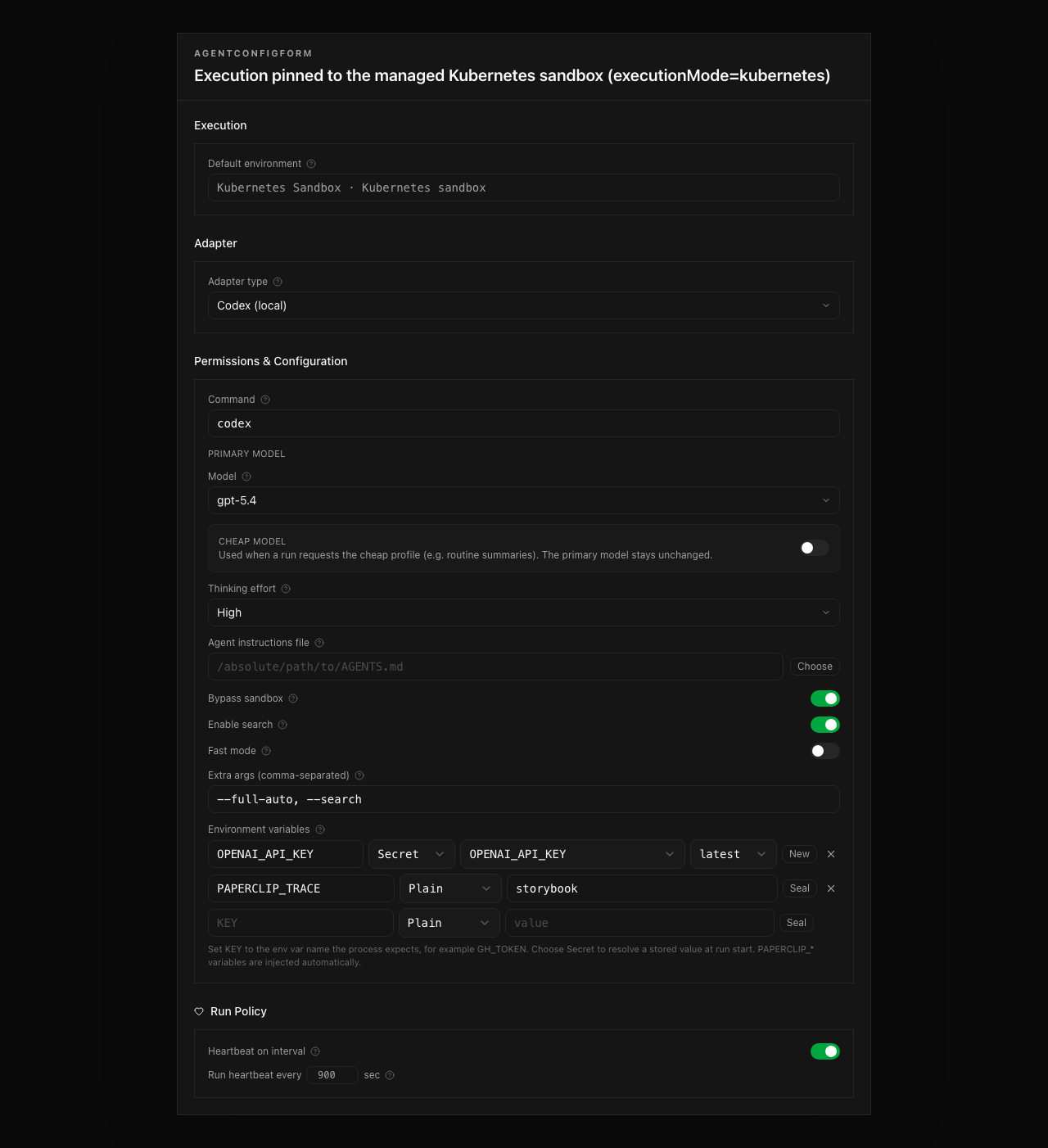 No managed environment available yet (warning notice, no silent local fallback): 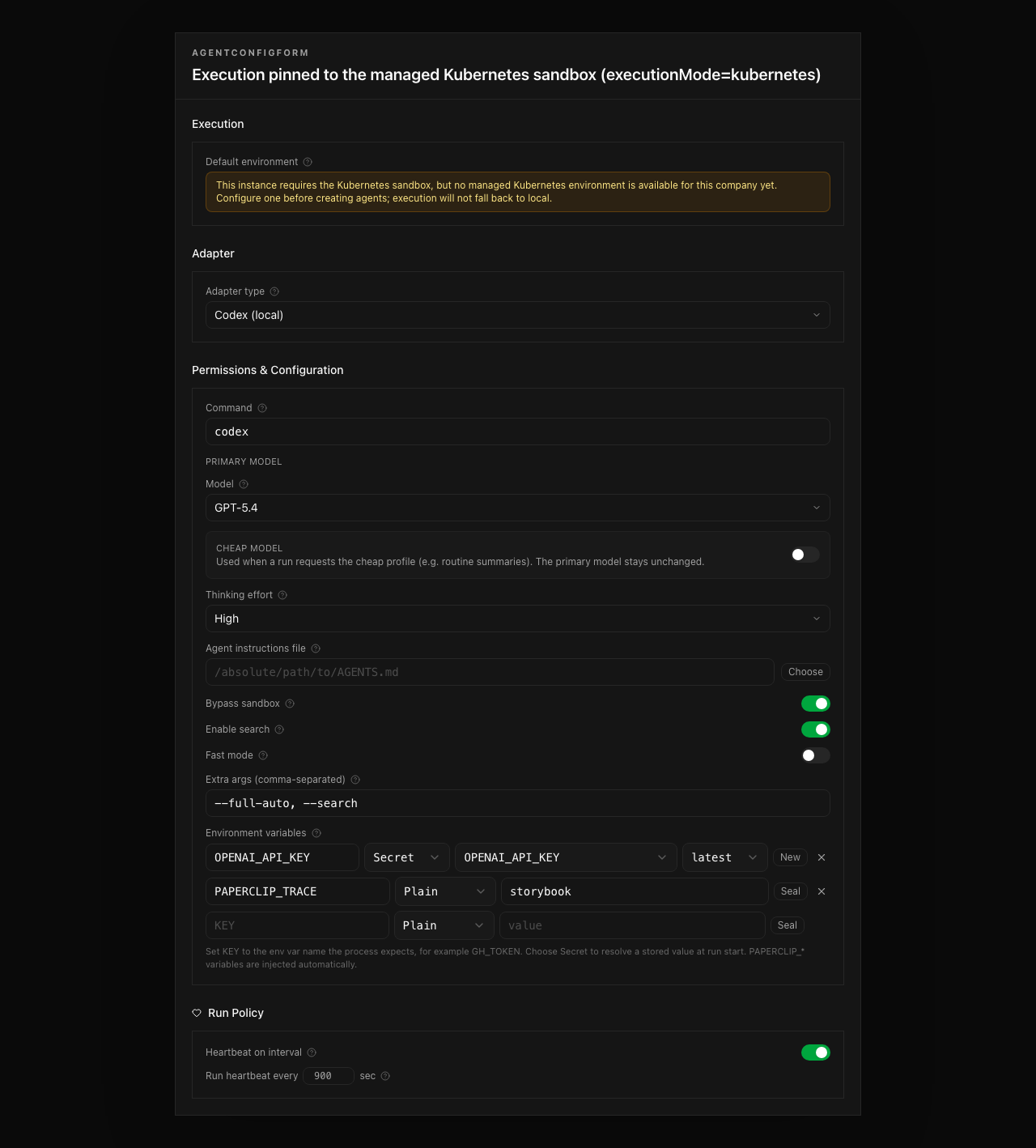 ## Checklist - [x] I have included a thinking path that traces from project context to this change - [x] I have specified the model used (with version and capability details) - [x] I have checked ROADMAP.md and confirmed this PR does not duplicate planned core work - [x] I have searched GitHub for duplicate or related PRs and linked them above - [x] I have either (a) linked existing issues with `Fixes: #` / `Closes #` / `Refs #` OR (b) described the issue in-PR following the relevant issue template - [x] I have run tests locally and they pass - [x] I have added or updated tests where applicable - [x] If this change affects the UI, I have included before/after screenshots - [x] I have updated relevant documentation to reflect my changes - [x] I have considered and documented any risks above - [ ] All Paperclip CI gates are green - [ ] Greptile is 5/5 with no open P2s, recommendations, or follow-ups - [x] I will address all Greptile and reviewer comments before requesting merge 🤖 Generated with [Claude Code](https://claude.com/claude-code) --------- Co-authored-by: Claude Opus 4.8 (1M context) <noreply@anthropic.com>


578 lines
19 KiB
TypeScript
578 lines
19 KiB
TypeScript
/**
|
|
* Centralized environment run orchestrator.
|
|
*
|
|
* Owns the full environment lifecycle for a heartbeat run:
|
|
* 1. Resolve selected environment
|
|
* 2. Validate environment is active and allowed
|
|
* 3. Acquire or resume lease
|
|
* 4. Realize workspace in the environment
|
|
* 5. Resolve execution target for the adapter
|
|
* 6. Release / retain / fail lease according to policy
|
|
* 7. Record activity and operator-visible status
|
|
*
|
|
* Heartbeat callers delegate to this service instead of inlining
|
|
* environment resolution, lease management, workspace realization,
|
|
* and transport logic.
|
|
*/
|
|
|
|
import type { Db } from "@paperclipai/db";
|
|
import type {
|
|
Environment,
|
|
EnvironmentLease,
|
|
EnvironmentLeasePolicy,
|
|
EnvironmentLeaseStatus,
|
|
ExecutionWorkspace,
|
|
ExecutionWorkspaceConfig,
|
|
} from "@paperclipai/shared";
|
|
import { environmentService } from "./environments.js";
|
|
import {
|
|
environmentRuntimeService,
|
|
buildEnvironmentLeaseContext,
|
|
type EnvironmentRuntimeLeaseRecord,
|
|
type EnvironmentRuntimeService,
|
|
} from "./environment-runtime.js";
|
|
import {
|
|
resolveEnvironmentExecutionTarget,
|
|
resolveEnvironmentExecutionTransport,
|
|
} from "./environment-execution-target.js";
|
|
import {
|
|
adapterExecutionTargetToRemoteSpec,
|
|
type AdapterExecutionTarget,
|
|
type AdapterRemoteExecutionSpec,
|
|
} from "@paperclipai/adapter-utils/execution-target";
|
|
import { buildWorkspaceRealizationRequest } from "./workspace-realization.js";
|
|
import { executionWorkspaceService } from "./execution-workspaces.js";
|
|
import { logActivity } from "./activity-log.js";
|
|
import { parseObject } from "../adapters/utils.js";
|
|
import type { RealizedExecutionWorkspace } from "./workspace-runtime.js";
|
|
import type { PluginWorkerManager } from "./plugin-worker-manager.js";
|
|
|
|
// ---------------------------------------------------------------------------
|
|
// Error types
|
|
// ---------------------------------------------------------------------------
|
|
|
|
export type EnvironmentErrorCode =
|
|
| "environment_not_found"
|
|
| "environment_inactive"
|
|
| "unsupported_environment"
|
|
| "unsupported_adapter_environment"
|
|
| "probe_failed"
|
|
| "lease_acquire_failed"
|
|
| "workspace_realization_failed"
|
|
| "transport_resolution_failed"
|
|
| "lease_release_failed"
|
|
| "lease_cleanup_failed";
|
|
|
|
export class EnvironmentRunError extends Error {
|
|
code: EnvironmentErrorCode;
|
|
environmentId?: string;
|
|
driver?: string;
|
|
provider?: string;
|
|
cause?: unknown;
|
|
|
|
constructor(
|
|
code: EnvironmentErrorCode,
|
|
message: string,
|
|
details?: {
|
|
environmentId?: string;
|
|
driver?: string;
|
|
provider?: string;
|
|
cause?: unknown;
|
|
},
|
|
) {
|
|
super(message);
|
|
this.name = "EnvironmentRunError";
|
|
this.code = code;
|
|
this.environmentId = details?.environmentId;
|
|
this.driver = details?.driver;
|
|
this.provider = details?.provider;
|
|
this.cause = details?.cause;
|
|
}
|
|
}
|
|
|
|
// ---------------------------------------------------------------------------
|
|
// Orchestration result types
|
|
// ---------------------------------------------------------------------------
|
|
|
|
export interface EnvironmentAcquisitionResult {
|
|
environment: Environment;
|
|
lease: EnvironmentLease;
|
|
leaseContext: ReturnType<typeof buildEnvironmentLeaseContext>;
|
|
executionTransport: Record<string, unknown> | null;
|
|
}
|
|
|
|
export interface EnvironmentRealizationResult {
|
|
lease: EnvironmentLease;
|
|
workspaceRealization: Record<string, unknown>;
|
|
executionTarget: AdapterExecutionTarget | null;
|
|
remoteExecution: AdapterRemoteExecutionSpec | null;
|
|
persistedExecutionWorkspace: ExecutionWorkspace | null;
|
|
}
|
|
|
|
export interface EnvironmentReleaseResult {
|
|
released: EnvironmentRuntimeLeaseRecord[];
|
|
errors: Array<{ leaseId: string; error: unknown }>;
|
|
}
|
|
|
|
function firstNonEmptyLine(text: string | null | undefined): string | null {
|
|
if (!text) return null;
|
|
for (const rawLine of text.split(/\r?\n/)) {
|
|
const line = rawLine.trim();
|
|
if (line) return line;
|
|
}
|
|
return null;
|
|
}
|
|
|
|
function formatProvisionFailureDetail(result: {
|
|
exitCode: number | null;
|
|
signal?: string | null;
|
|
timedOut: boolean;
|
|
stdout: string;
|
|
stderr: string;
|
|
}): string {
|
|
if (result.timedOut) {
|
|
return "provision command timed out";
|
|
}
|
|
const signal = typeof result.signal === "string" && result.signal.trim().length > 0
|
|
? ` (signal ${result.signal.trim()})`
|
|
: "";
|
|
const detail = firstNonEmptyLine(result.stderr) ?? firstNonEmptyLine(result.stdout);
|
|
const status = `exit code ${result.exitCode ?? "null"}${signal}`;
|
|
return detail ? `${status}: ${detail}` : status;
|
|
}
|
|
|
|
// ---------------------------------------------------------------------------
|
|
// Service factory
|
|
// ---------------------------------------------------------------------------
|
|
|
|
export function environmentRunOrchestrator(
|
|
db: Db,
|
|
options: {
|
|
pluginWorkerManager?: PluginWorkerManager;
|
|
environmentRuntime?: EnvironmentRuntimeService;
|
|
} = {},
|
|
) {
|
|
const environmentsSvc = environmentService(db);
|
|
const executionWorkspacesSvc = executionWorkspaceService(db);
|
|
const environmentRuntime = options.environmentRuntime ?? environmentRuntimeService(db, {
|
|
pluginWorkerManager: options.pluginWorkerManager,
|
|
});
|
|
|
|
/**
|
|
* Resolve the selected environment for a run. Ensures a local default
|
|
* exists and resolves the priority chain:
|
|
* execution workspace config > issue settings > project policy > agent default > company default
|
|
*/
|
|
async function resolveEnvironment(input: {
|
|
companyId: string;
|
|
selectedEnvironmentId: string;
|
|
defaultEnvironmentId: string;
|
|
}): Promise<Environment> {
|
|
const environmentId =
|
|
input.selectedEnvironmentId || input.defaultEnvironmentId;
|
|
|
|
const environment =
|
|
environmentId === input.defaultEnvironmentId
|
|
? await environmentsSvc.ensureLocalEnvironment(input.companyId)
|
|
: await environmentsSvc.getById(environmentId);
|
|
|
|
if (!environment) {
|
|
throw new EnvironmentRunError("environment_not_found", `Environment "${environmentId}" not found.`, {
|
|
environmentId,
|
|
});
|
|
}
|
|
|
|
if (environment.companyId !== input.companyId) {
|
|
throw new EnvironmentRunError("environment_not_found", `Environment "${environmentId}" does not belong to this company.`, {
|
|
environmentId,
|
|
});
|
|
}
|
|
|
|
if (environment.status !== "active") {
|
|
throw new EnvironmentRunError("environment_inactive", `Environment "${environment.name}" is not active (status: ${environment.status}).`, {
|
|
environmentId: environment.id,
|
|
driver: environment.driver,
|
|
});
|
|
}
|
|
|
|
return environment;
|
|
}
|
|
|
|
/**
|
|
* Acquire an environment lease for a heartbeat run.
|
|
* Wraps the runtime driver's acquire call with standardized error handling.
|
|
*/
|
|
async function acquireLease(input: {
|
|
companyId: string;
|
|
environment: Environment;
|
|
issueId: string | null;
|
|
heartbeatRunId: string;
|
|
persistedExecutionWorkspace: Pick<ExecutionWorkspace, "id" | "mode"> | null;
|
|
adapterType: string | null;
|
|
}): Promise<EnvironmentRuntimeLeaseRecord> {
|
|
try {
|
|
return await environmentRuntime.acquireRunLease(input);
|
|
} catch (err) {
|
|
throw new EnvironmentRunError(
|
|
"lease_acquire_failed",
|
|
`Failed to acquire lease for environment "${input.environment.name}" (${input.environment.driver}): ${err instanceof Error ? err.message : String(err)}`,
|
|
{
|
|
environmentId: input.environment.id,
|
|
driver: input.environment.driver,
|
|
cause: err,
|
|
},
|
|
);
|
|
}
|
|
}
|
|
|
|
/**
|
|
* Resolve the execution transport for an adapter based on the acquired lease.
|
|
*/
|
|
async function resolveTransport(input: {
|
|
companyId: string;
|
|
adapterType: string;
|
|
environment: Environment;
|
|
leaseMetadata: Record<string, unknown> | null;
|
|
}): Promise<Record<string, unknown> | null> {
|
|
try {
|
|
return await resolveEnvironmentExecutionTransport({
|
|
db,
|
|
companyId: input.companyId,
|
|
adapterType: input.adapterType,
|
|
environment: input.environment,
|
|
leaseMetadata: input.leaseMetadata,
|
|
});
|
|
} catch (err) {
|
|
throw new EnvironmentRunError(
|
|
"transport_resolution_failed",
|
|
`Failed to resolve execution transport for "${input.environment.name}": ${err instanceof Error ? err.message : String(err)}`,
|
|
{
|
|
environmentId: input.environment.id,
|
|
driver: input.environment.driver,
|
|
cause: err,
|
|
},
|
|
);
|
|
}
|
|
}
|
|
|
|
/**
|
|
* Full acquisition flow: resolve environment, acquire lease, resolve transport.
|
|
* This is the primary entry point for heartbeat run setup.
|
|
*/
|
|
async function acquireForRun(input: {
|
|
companyId: string;
|
|
selectedEnvironmentId: string;
|
|
defaultEnvironmentId: string;
|
|
adapterType: string;
|
|
issueId: string | null;
|
|
heartbeatRunId: string;
|
|
agentId: string;
|
|
persistedExecutionWorkspace: Pick<ExecutionWorkspace, "id" | "mode"> | null;
|
|
}): Promise<EnvironmentAcquisitionResult> {
|
|
// Step 1: Resolve environment
|
|
const environment = await resolveEnvironment({
|
|
companyId: input.companyId,
|
|
selectedEnvironmentId: input.selectedEnvironmentId,
|
|
defaultEnvironmentId: input.defaultEnvironmentId,
|
|
});
|
|
|
|
// Step 2: Acquire lease
|
|
const leaseRecord = await acquireLease({
|
|
companyId: input.companyId,
|
|
environment,
|
|
issueId: input.issueId,
|
|
heartbeatRunId: input.heartbeatRunId,
|
|
persistedExecutionWorkspace: input.persistedExecutionWorkspace,
|
|
adapterType: input.adapterType ?? null,
|
|
});
|
|
|
|
// Step 3: Log lease acquisition activity
|
|
await logActivity(db, {
|
|
companyId: input.companyId,
|
|
actorType: "agent",
|
|
actorId: input.agentId,
|
|
agentId: input.agentId,
|
|
runId: input.heartbeatRunId,
|
|
action: "environment.lease_acquired",
|
|
entityType: "environment_lease",
|
|
entityId: leaseRecord.lease.id,
|
|
details: {
|
|
environmentId: environment.id,
|
|
driver: environment.driver,
|
|
leasePolicy: leaseRecord.lease.leasePolicy,
|
|
provider: leaseRecord.lease.provider,
|
|
executionWorkspaceId: leaseRecord.leaseContext.executionWorkspaceId,
|
|
issueId: input.issueId,
|
|
},
|
|
});
|
|
|
|
// Step 4: Resolve execution transport
|
|
const executionTransport = await resolveTransport({
|
|
companyId: input.companyId,
|
|
adapterType: input.adapterType,
|
|
environment,
|
|
leaseMetadata: leaseRecord.lease.metadata,
|
|
});
|
|
|
|
return {
|
|
environment,
|
|
lease: leaseRecord.lease,
|
|
leaseContext: leaseRecord.leaseContext,
|
|
executionTransport,
|
|
};
|
|
}
|
|
|
|
/**
|
|
* Realize workspace in the environment and resolve the execution target.
|
|
*
|
|
* After lease acquisition, this method:
|
|
* 1. Builds a workspace realization request
|
|
* 2. Calls the environment runtime driver to realize the workspace
|
|
* 3. Persists realization metadata on the lease and execution workspace
|
|
* 4. Resolves the adapter execution target (local/ssh/sandbox)
|
|
*
|
|
* Returns the updated lease, realization metadata, and the execution
|
|
* target spec that the adapter needs to run.
|
|
*/
|
|
async function realizeForRun(input: {
|
|
environment: Environment;
|
|
lease: EnvironmentLease;
|
|
adapterType: string;
|
|
companyId: string;
|
|
issueId: string | null;
|
|
heartbeatRunId: string;
|
|
executionWorkspace: RealizedExecutionWorkspace;
|
|
effectiveExecutionWorkspaceMode: string | null;
|
|
persistedExecutionWorkspace: ExecutionWorkspace | null;
|
|
}): Promise<EnvironmentRealizationResult> {
|
|
const {
|
|
environment,
|
|
adapterType,
|
|
companyId,
|
|
issueId,
|
|
heartbeatRunId,
|
|
executionWorkspace,
|
|
effectiveExecutionWorkspaceMode,
|
|
} = input;
|
|
let { lease, persistedExecutionWorkspace } = input;
|
|
|
|
// Step 1: Build workspace realization request
|
|
const workspaceRealizationRequest = buildWorkspaceRealizationRequest({
|
|
adapterType,
|
|
companyId,
|
|
environmentId: environment.id,
|
|
executionWorkspaceId: persistedExecutionWorkspace?.id ?? null,
|
|
issueId,
|
|
heartbeatRunId,
|
|
requestedMode: persistedExecutionWorkspace?.mode ?? effectiveExecutionWorkspaceMode,
|
|
workspace: executionWorkspace,
|
|
workspaceConfig: persistedExecutionWorkspace?.config ?? null,
|
|
});
|
|
|
|
// Step 2: Realize workspace in the environment via the runtime driver
|
|
let workspaceRealization: Record<string, unknown> = {};
|
|
let realizedWorkspaceCwd: string | null = null;
|
|
if (
|
|
environment.driver === "local" ||
|
|
environment.driver === "ssh" ||
|
|
environment.driver === "sandbox"
|
|
) {
|
|
try {
|
|
const remoteCwd =
|
|
typeof lease.metadata?.remoteCwd === "string" && lease.metadata.remoteCwd.trim().length > 0
|
|
? lease.metadata.remoteCwd
|
|
: undefined;
|
|
const workspaceRealizationResult = await environmentRuntime.realizeWorkspace({
|
|
environment,
|
|
lease,
|
|
workspace: {
|
|
localPath: executionWorkspace.cwd,
|
|
remotePath: remoteCwd,
|
|
mode: persistedExecutionWorkspace?.mode ?? effectiveExecutionWorkspaceMode ?? undefined,
|
|
metadata: {
|
|
workspaceRealizationRequest,
|
|
},
|
|
},
|
|
});
|
|
realizedWorkspaceCwd =
|
|
typeof workspaceRealizationResult.cwd === "string" && workspaceRealizationResult.cwd.trim().length > 0
|
|
? workspaceRealizationResult.cwd.trim()
|
|
: null;
|
|
workspaceRealization = parseObject(workspaceRealizationResult.metadata?.workspaceRealization);
|
|
} catch (err) {
|
|
throw new EnvironmentRunError(
|
|
"workspace_realization_failed",
|
|
`Failed to realize workspace for environment "${environment.name}" (${environment.driver}): ${err instanceof Error ? err.message : String(err)}`,
|
|
{
|
|
environmentId: environment.id,
|
|
driver: environment.driver,
|
|
cause: err,
|
|
},
|
|
);
|
|
}
|
|
}
|
|
|
|
const provisionCommand = workspaceRealizationRequest.runtimeOverlay.provisionCommand?.trim() ?? "";
|
|
const realizedCwd =
|
|
realizedWorkspaceCwd ??
|
|
(typeof lease.metadata?.remoteCwd === "string" && lease.metadata.remoteCwd.trim().length > 0
|
|
? lease.metadata.remoteCwd.trim()
|
|
: executionWorkspace.cwd);
|
|
if (provisionCommand && environment.driver !== "local") {
|
|
try {
|
|
const provisionResult = await environmentRuntime.execute({
|
|
environment,
|
|
lease,
|
|
command: "bash",
|
|
args: ["-lc", provisionCommand],
|
|
cwd: realizedCwd,
|
|
env: {
|
|
SHELL: "/bin/bash",
|
|
},
|
|
timeoutMs: 300_000,
|
|
});
|
|
if (provisionResult.exitCode !== 0 || provisionResult.timedOut) {
|
|
throw new Error(formatProvisionFailureDetail(provisionResult));
|
|
}
|
|
} catch (err) {
|
|
throw new EnvironmentRunError(
|
|
"workspace_realization_failed",
|
|
`Failed to provision workspace for environment "${environment.name}" (${environment.driver}): ${err instanceof Error ? err.message : String(err)}`,
|
|
{
|
|
environmentId: environment.id,
|
|
driver: environment.driver,
|
|
cause: err,
|
|
},
|
|
);
|
|
}
|
|
}
|
|
|
|
// Step 3: Persist realization metadata on lease and execution workspace
|
|
if (Object.keys(workspaceRealization).length > 0) {
|
|
const nextLeaseMetadata = {
|
|
...(lease.metadata ?? {}),
|
|
workspaceRealization,
|
|
};
|
|
const updatedLease = await environmentsSvc.updateLeaseMetadata(lease.id, nextLeaseMetadata);
|
|
if (updatedLease) {
|
|
lease = updatedLease;
|
|
}
|
|
if (persistedExecutionWorkspace) {
|
|
const updatedEw = await executionWorkspacesSvc.update(persistedExecutionWorkspace.id, {
|
|
metadata: {
|
|
...(persistedExecutionWorkspace.metadata ?? {}),
|
|
workspaceRealizationRequest,
|
|
workspaceRealization,
|
|
},
|
|
});
|
|
if (updatedEw) {
|
|
persistedExecutionWorkspace = updatedEw;
|
|
}
|
|
}
|
|
}
|
|
|
|
// Step 4: Resolve execution target for the adapter
|
|
let executionTarget: AdapterExecutionTarget | null;
|
|
try {
|
|
executionTarget = await resolveEnvironmentExecutionTarget({
|
|
db,
|
|
companyId,
|
|
adapterType,
|
|
environment,
|
|
leaseId: lease.id,
|
|
leaseMetadata: (lease.metadata as Record<string, unknown> | null) ?? null,
|
|
lease,
|
|
environmentRuntime,
|
|
});
|
|
} catch (err) {
|
|
throw new EnvironmentRunError(
|
|
"transport_resolution_failed",
|
|
`Failed to resolve execution target for "${environment.name}": ${err instanceof Error ? err.message : String(err)}`,
|
|
{
|
|
environmentId: environment.id,
|
|
driver: environment.driver,
|
|
cause: err,
|
|
},
|
|
);
|
|
}
|
|
|
|
return {
|
|
lease,
|
|
workspaceRealization,
|
|
executionTarget,
|
|
remoteExecution: adapterExecutionTargetToRemoteSpec(executionTarget),
|
|
persistedExecutionWorkspace,
|
|
};
|
|
}
|
|
|
|
/**
|
|
* Release all active leases for a heartbeat run.
|
|
* Tracks cleanup status per lease. Errors during individual lease release
|
|
* are captured but do not prevent other leases from being released.
|
|
* The original run failure (if any) is never hidden by cleanup errors.
|
|
*/
|
|
async function releaseForRun(input: {
|
|
heartbeatRunId: string;
|
|
companyId: string;
|
|
agentId: string;
|
|
status?: Extract<EnvironmentLeaseStatus, "released" | "expired" | "failed">;
|
|
failureReason?: string;
|
|
}): Promise<EnvironmentReleaseResult> {
|
|
const status = input.status ?? "released";
|
|
const result: EnvironmentReleaseResult = { released: [], errors: [] };
|
|
|
|
let releasedLeases: EnvironmentRuntimeLeaseRecord[];
|
|
try {
|
|
releasedLeases = await environmentRuntime.releaseRunLeases(input.heartbeatRunId, status);
|
|
} catch (err) {
|
|
result.errors.push({ leaseId: "*", error: err });
|
|
return result;
|
|
}
|
|
|
|
for (const released of releasedLeases) {
|
|
try {
|
|
await logActivity(db, {
|
|
companyId: input.companyId,
|
|
actorType: "agent",
|
|
actorId: input.agentId,
|
|
agentId: input.agentId,
|
|
runId: input.heartbeatRunId,
|
|
action: "environment.lease_released",
|
|
entityType: "environment_lease",
|
|
entityId: released.lease.id,
|
|
details: {
|
|
environmentId: released.lease.environmentId,
|
|
driver: released.environment.driver,
|
|
leasePolicy: released.lease.leasePolicy,
|
|
provider: released.lease.provider,
|
|
executionWorkspaceId: released.lease.executionWorkspaceId,
|
|
issueId: released.lease.issueId,
|
|
status: released.lease.status,
|
|
cleanupStatus: released.lease.cleanupStatus,
|
|
failureReason: input.failureReason ?? released.lease.failureReason,
|
|
},
|
|
});
|
|
} catch {
|
|
// Activity logging failure should not block lease release
|
|
}
|
|
result.released.push(released);
|
|
}
|
|
|
|
return result;
|
|
}
|
|
|
|
return {
|
|
resolveEnvironment,
|
|
acquireLease,
|
|
resolveTransport,
|
|
acquireForRun,
|
|
realizeForRun,
|
|
releaseForRun,
|
|
|
|
// Expose the underlying runtime for cases that need direct driver access
|
|
runtime: environmentRuntime,
|
|
};
|
|
}
|
|
|
|
export type EnvironmentRunOrchestrator = ReturnType<typeof environmentRunOrchestrator>;
|