 DottaandPaperclip
631cca509d
DottaandPaperclip
631cca509d
## Thinking Path > - Paperclip is the open source control plane people use to organize and govern companies of AI agents > - The README is the project’s front door, while `ROADMAP.md` is the detailed statement of shipped and planned product direction > - The existing README roadmap had fallen behind capabilities that are already available and did not explain the product’s organizing model > - That drift made current features look unfinished and left the relationship between tasks, organization, training, and infrastructure implicit > - This pull request synchronizes the roadmap preview with the detailed roadmap and introduces the four-pillar product framing > - The benefit is a more accurate, coherent first impression for users and contributors, with theme-aware visuals that render correctly on GitHub ## Linked Issues or Issue Description - **Subsystem affected:** Documentation (`README.md`, `ROADMAP.md`, and documentation assets); no runtime subsystem changes. - **Problem or motivation:** The README roadmap understated shipped capabilities, the detailed roadmap had corresponding stale statuses, and the README did not clearly explain the four product pillars that connect Paperclip’s task, organization, training, and infrastructure surfaces. - **Proposed solution:** Refresh both roadmap views from one ordered list, add the four-pillars section and light/dark graphic, and keep future capabilities explicitly marked as planned or partial. - **Alternatives considered:** Updating only `ROADMAP.md` would leave the project’s front page stale; updating only the README would create a second source of truth; a single non-theme-aware image would be less legible for half of GitHub’s color schemes. - **Roadmap alignment:** This change directly updates `ROADMAP.md` and its README preview rather than introducing an unplanned runtime feature. - **Additional context:** Searched open pull requests for related README roadmap/four-pillars work and found no duplicate. ## What Changed - Added a **The four pillars** section covering Agentic Task Manager, Org Chart for Agents, Agent Employee Training, and Agentic OS, with a theme-aware `<picture>` graphic. - Flipped four roadmap entries from ⚪ to ✅: Cloud / Sandbox agents, Artifacts & Work Products, Deep Planning, and Enforced Outcomes. - Added shipped ✅ entries for MCP Tool Gateway & Apps, per-agent Secrets Manager access, activity logging and action attribution, self-healing recovery, and agent evals/feedback; expanded the skills entry to include Skill Studio and Skills Store. - Added planned ⚪ entries for Bring-your-own-ticket-system and Connected Apps, resolving the README FAQ inconsistency around external ticket systems. - Moved Cloud deployments to 🟡 and documented the shipped multi-tenant isolation, local-to-cloud sync, and cloud-managed bootstrap scope. - Synchronized the README preview and `ROADMAP.md` ordering/statuses: 18 ✅, 9 ⚪, and 1 🟡 entry. ## Verification - `git diff --check origin/master...HEAD` - Focused Node consistency check confirms README and `ROADMAP.md` have the same 28 ordered entries/statuses and expected 18 ✅ / 9 ⚪ / 1 🟡 counts. - `file doc/assets/four-pillars-light.png doc/assets/four-pillars-dark.png` confirms both assets are valid 3840×2160 RGB PNGs. - Visual QA rendered the README through GitHub’s GFM API in Chromium at GitHub content width under both light and dark `prefers-color-scheme` modes; the correct graphic swapped per theme, all links resolved, the section placement/table were correct, and `ROADMAP.md` matched the README preview. ### Visual Evidence **Light theme** 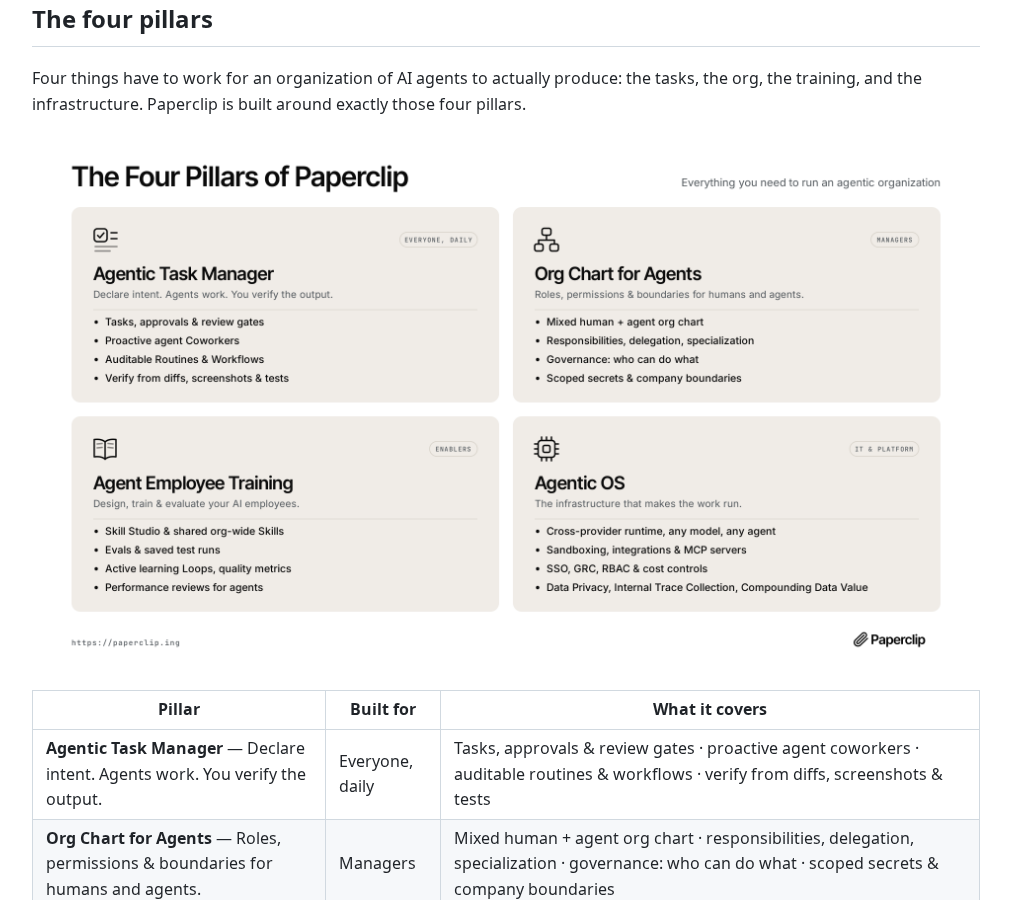 **Dark theme** 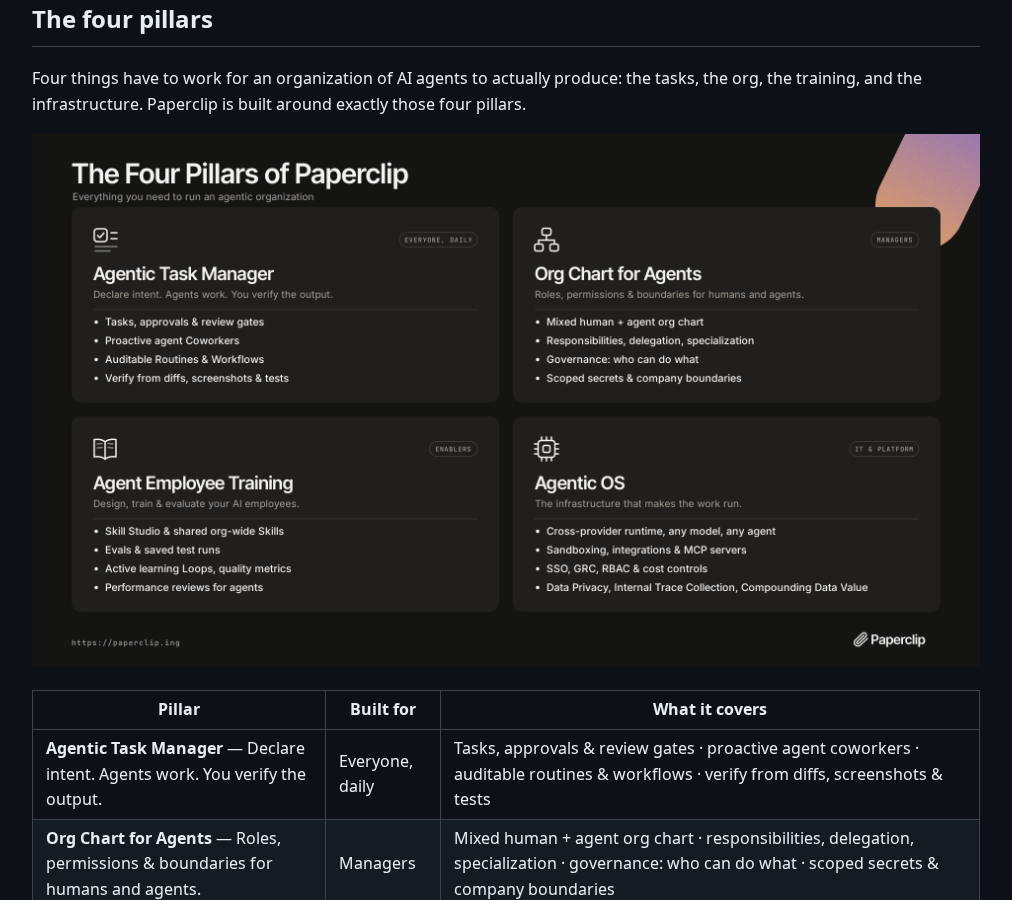 - Prettier was not run because this repository does not expose a configured `prettier` binary; markdown whitespace was checked with `git diff --check` and the rendered QA above. ## Risks - Low risk: documentation and image assets only; no application code, API contract, schema, dependencies, lockfile, or workflow changes. - Roadmap status wording can become stale as product work evolves, so future shipped capabilities should update both the README preview and `ROADMAP.md` together. > For core feature work, check [`ROADMAP.md`](ROADMAP.md) first and discuss it in `#dev` before opening the PR. Feature PRs that overlap with planned core work may need to be redirected — check the roadmap first. See `CONTRIBUTING.md`. ## Model Used - OpenAI Codex, exact model ID `gpt-5.6-sol`, with reasoning, terminal/tool use, GitHub API access, and Paperclip control-plane integration. The model context-window size was not exposed by this execution environment. ## Checklist - [x] I have included a thinking path that traces from project context to this change - [x] I have specified the model used (with version and capability details) - [x] I have checked ROADMAP.md and confirmed this PR does not duplicate planned core work - [x] I have searched GitHub for duplicate or related PRs and linked them above - [x] I have either (a) linked existing issues with `Fixes: #` / `Closes #` / `Refs #` OR (b) described the issue in-PR following the relevant issue template - [x] I have not referenced internal/instance-local Paperclip issues or links (only public GitHub `#NNN` / `github.com/paperclipai/paperclip` URLs) - [x] My branch name describes the change (e.g. `docs/...`, `fix/...`) and contains no internal Paperclip ticket id or instance-derived details - [x] I have run tests locally and they pass - [x] I have added or updated tests where applicable - [x] I have updated relevant documentation to reflect my changes - [x] I have considered and documented any risks above - [x] All Paperclip CI gates are green - [x] Greptile is 5/5 with no open P2s, recommendations, or follow-ups - [x] I will address all Greptile and reviewer comments before requesting merge --------- Co-authored-by: Paperclip <noreply@paperclip.ing>


8.5 KiB
Roadmap
This document expands the roadmap preview in README.md.
Paperclip is still moving quickly. The list below is directional, not promised, and priorities may shift as we learn from users and from operating real AI companies with the product.
We value community involvement and want to make sure contributor energy goes toward areas where it can land.
We may accept contributions in the areas below, but if you want to work on roadmap-level core features, please coordinate with us first in Discord (#dev) before writing code. Bugs, docs, polish, and tightly scoped improvements are still the easiest contributions to merge.
If you want to extend Paperclip today, the best path is often the plugin system. Community reference implementations are also useful feedback even when they are not merged directly into core.
Milestones
✅ Plugin system
Paperclip should keep a thin core and rich edges. Plugins are the path for optional capabilities like knowledge bases, custom tracing, queues, doc editors, and other product-specific surfaces that do not need to live in the control plane itself.
✅ Get OpenClaw / claw-style agent employees
Paperclip should be able to hire and manage real claw-style agent workers, not just a narrow built-in runtime. This is part of the larger "bring your own agent" story and keeps the control plane useful across different agent ecosystems.
✅ companies.sh - import and export entire organizations
Reusable companies matter. Import/export is the foundation for moving org structures, agent definitions, and reusable company setups between environments and eventually for broader company-template distribution.
✅ Easy AGENTS.md configurations
Agent setup should feel repo-native and legible. Simple AGENTS.md-style configuration lowers the barrier to getting an agent team running and makes it easier for contributors to understand how a company is wired together.
✅ Skills Manager, Skill Studio & Skills Store
Agents need a practical way to discover, install, create, test, and share skills without every setup becoming bespoke. Skills Manager, Skill Studio, and the Skills Store make the skills layer reusable across an organization and easier to operate.
✅ Scheduled Routines
Recurring work should be native. Routine tasks like reports, reviews, and other periodic work need first-class scheduling so the company keeps operating even when no human is manually kicking work off.
✅ Better Budgeting
Budgets are a core control-plane feature, not an afterthought. Better budgeting means clearer spend visibility, safer hard stops, and better operator control over how autonomy turns into real cost.
✅ Agent Reviews and Approvals
Paperclip should support explicit review and approval stages as first-class workflow steps, not just ad hoc comments. That means reviewer routing, approval gates, change requests, and durable audit trails that fit the same task model as the rest of the control plane.
✅ Multiple Human Users
Paperclip needs a clearer path from solo operator to real human teams. That means shared board access, safer collaboration, and a better model for several humans supervising the same autonomous company.
✅ Cloud / Sandbox agents (e2b, Cloudflare, Daytona, Modal, Novita, self-hosted Kubernetes)
We want agents to run in more remote and sandboxed environments while preserving the same Paperclip control-plane model. This makes the system safer, more flexible, and more useful outside a single trusted local machine.
✅ Artifacts & Work Products
Paperclip should make outputs first-class. That means generated artifacts, previews, deployable outputs, and the handoff from "agent did work" to "here is the result" should become more visible and easier to operate.
✅ Deep Planning (planning mode, revisioned plans, plan approvals)
Some work needs more than a task description before execution starts. Deeper planning means a dedicated planning mode, revisioned plans, and explicit plan approvals for strategy-heavy work before agents begin execution.
✅ Enforced Outcomes (watchdogs, recovery actions, review gates)
Paperclip should get stricter about what counts as finished work. Watchdogs, recovery actions, and review gates keep execution moving toward clear outcomes like merged code, published artifacts, shipped docs, or explicit decisions instead of vague status updates.
✅ MCP Tool Gateway & Apps (governed tool access)
MCP tools and apps should be available through a governed gateway instead of unmanaged direct access. Paperclip can apply company boundaries, approval gates, and activity attribution while giving agents the tools they need.
✅ Secrets Manager with per-agent access
Secrets need to be centrally managed without giving every agent every credential. Per-agent access, scoped bindings, and audited resolution keep sensitive integrations usable while preserving least privilege.
✅ Activity log & action attribution
Operators need a durable record of what changed and who initiated it. Activity history and clear action attribution make human, agent, and system actions inspectable across the control plane.
✅ Self-healing runs & automatic recovery
Agent work should recover from routine failures without waiting for a human to notice every stalled run. Recovery policies can retry safe work, route failures, and keep the issue lifecycle aligned with what actually happened.
✅ Agent evals & feedback
Agent performance should be measurable over time, not judged only from anecdotes. Evals, saved results, and structured feedback create a loop for improving skills, prompts, models, and employee quality.
⚪ Memory / Knowledge
We want a stronger memory and knowledge surface for companies, agents, and projects. That includes durable memory, better recall of prior decisions and context, and a clearer path for knowledge-style capabilities without turning Paperclip into a generic chat app.
⚪ MAXIMIZER MODE
This is the direction for higher-autonomy execution: more aggressive delegation, deeper follow-through, and stronger operating loops with clear budgets, visibility, and governance. The point is not hidden autonomy; the point is more output per human supervisor.
⚪ Work Queues
Paperclip should support queue-style work streams for repeatable inputs like support, triage, review, and backlog intake. That would make it easier to route work continuously without turning every system into a one-off workflow.
⚪ Self-Organization
As companies grow, agents should be able to propose useful structural changes such as role adjustments, delegation changes, and new recurring routines. The goal is adaptive organizations that still stay within governance and approval boundaries.
⚪ Automatic Organizational Learning
Paperclip should get better at turning completed work into reusable organizational knowledge. That includes capturing playbooks, recurring fixes, and decision patterns so future work starts from what the company has already learned.
⚪ CEO Chat
We want a lighter-weight way to talk to leadership agents, but those conversations should still resolve to real work objects like plans, issues, approvals, or decisions. This should improve interaction without changing the core task-and-comments model.
🟡 Cloud deployments (multi-tenant isolation & local→cloud sync shipped)
Local-first remains important, but Paperclip also needs a cleaner shared deployment story. Teams should be able to run the same product in hosted or semi-hosted environments without changing the mental model.
Shipped so far: multi-tenant isolation with per-company JWT keys and company-scoped cloud tenants, local→cloud upstream sync, and cloud-managed instance bootstrap.
⚪ Desktop App
A desktop app can make Paperclip feel more accessible and persistent for day-to-day operators. The goal is easier access, better local ergonomics, and a smoother default experience for users who want the control plane always close at hand.
⚪ Bring-your-own-ticket-system (Asana / Linear / Jira as on-ramps)
Existing ticket systems should be able to feed work into Paperclip without becoming the agent control plane themselves. Asana, Linear, and Jira can act as familiar on-ramps while Paperclip owns execution, governance, and outcomes.
⚪ Connected Apps (one-click integrations, e.g. Vercel)
Common services should connect without bespoke setup for every company. One-click integrations can package credentials, permissions, and useful workflows for apps such as Vercel while keeping access governed and auditable.