mirror of
https://github.com/paperclipai/paperclip.git
synced 2026-11-21 02:43:25 +01:00
f4e025a1cf749f4416f6646bbe4f83c3e92df653
6
Commits
| Author | SHA1 | Message | Date | |
|---|---|---|---|---|
 DottaandClaude Opus 5.5 |
7fd98682ca |
fix(workspaces): give every subtask its own execution workspace (#19860)
## Thinking Path > - Paperclip is the open source app people use to manage AI agents for work > - Agents split work into child tasks, and each task runs in an execution workspace (a checkout, branch, or sandbox folder) > - Since early 2026, a new child task used its parent's realized workspace by default: the same checkout, branch and sandbox > - A parent and its child often run at the same time. Two writers in one folder lose each other's files, the waking parent is cancelled with `workspace_busy`, and sandbox lease ownership crosses from the parent into the child, so retained-file recovery refuses the workspace as ambiguous > - The product rule is simple: a subtask gets its own workspace, independent of the parent's saved files. Paperclip never needs to carry a parent's unmerged changes into a child > - This pull request makes that the only behaviour on every creation path, and moves existing shared children to their own workspace on their next run, with no user or admin action > - The benefit is that parents and children never block or overwrite each other, and recovery ownership stays with one task ## Linked Issues or Issue Description **What happened?** A child task inherited its parent's realized execution workspace by default (`createChild` defaulted to `executionWorkspaceInheritanceMode: "linkage"`, and `issueService.create` fell back from `inheritExecutionWorkspaceFromIssueId` to `parentId`). When the parent woke while the child wrote to the shared workspace, the parent run was cancelled with `workspace_busy`. In sandbox environments, the lease ownership chain crossed from the parent into the child, and retained-file recovery refused the workspace with `allocation_ownership_ambiguous`. **Expected behavior** Every new child task gets its own execution workspace, realized from the project base exactly as a top-level task in that project. It never uses the parent's checkout, branch, saved snapshot or unmerged changes. A parent and its descendant never share a workspace by any route. **Steps to reproduce** 1. Run a parent task in a project with isolated (git worktree) or sandbox workspaces, so the parent has a realized execution workspace. 2. From the parent run, create a child task with only `parentId` (or through the runner `create_task` tool, chat suggestions, decision effects, plugins, or the New sub-task dialog). 3. See that the child's `executionWorkspaceId` is the parent's, with `executionWorkspacePreference: "reuse_existing"`. 4. Wake the parent while the child runs in a sandbox environment. The parent run is cancelled with `workspace_busy`. **Additional context** Refs #9233 (the existing `strategy_only` opt-out). The opt-out `executionWorkspaceInheritanceMode: "strategy_only"` already existed for accepted-plan decomposition. This change makes that behaviour (tightened to drop a pinned existing branch) the only behaviour. ## What Changed - **One rule for every creation path (`server/src/services/issues.ts`).** `issueService.create` still uses the parent (or `inheritExecutionWorkspaceFromIssueId`) as a source for the project, project workspace and workspace *strategy*, but it never copies the source's `executionWorkspaceId`, `reuse_existing` preference, or pinned existing branch. All server paths that create a task go through `create()`/`createChild()`: issue routes (`POST /issues`, `POST /issues/:id/children`, the run-bound default parent and run workspace source), runner `create_task`, chat suggestion acceptance, native status decisions, accepted-plan decomposition, decision effects, plugins (`ctx.issues.create`), external agents, watchdog follow-ups, monitor recovery issues, case handoffs and email channels. - **Explicit ancestor workspaces are dropped.** If a create names an `executionWorkspaceId` (or an `existing` workspace selection) that an ancestor of the new task created or is bound to, `create()` drops it and keeps only the strategy. Older clients and skills that copied the parent's id keep working and get an independent workspace. - **`createChild` no longer has a "linkage" mode.** `executionWorkspaceInheritanceMode` is still accepted from internal callers and is ignored. - **`inheritExecutionWorkspaceFromIssueId` decision.** I kept the field for API compatibility, but it now copies only the source issue's project and workspace strategy. I removed its workspace-sharing behaviour for every pair, not only parent/child: the source task and its follow-up can run at the same time (the runner, watchdog and status-decision callers all create the follow-up while the source run is live), so sharing would again let two tasks write one folder. Explicit sharing between unrelated tasks stays available through an explicit `existing` workspace selection. - **New `server/src/services/task-workspace-lineage.ts`.** `buildIndependentTaskWorkspaceSettings` (strategy only: mode, environment, runtime, network egress, shared-workspace concurrency, base ref, branch template, commands; no `reuse_existing`, no `operator_branch`, no `existingBranch`), `loadTaskLineageIssueIds` (the parent chain plus, for a task that depth placement put beside its requester, the requester's chain via `privacyParentIssueId`) and `isAncestorExecutionWorkspace` (the workspace's `sourceIssueId` is in that lineage, or a lineage issue is bound to it). A child in another project does not take the parent's strategy. - **Upgrade-safe rebind at admission.** `executionWorkspaceService.releaseAncestorWorkspaceBindingAtAdmission` runs at the same admission point as the pending workspace selection (`heartbeat.ts`). For a child (or a flattened task beside its requester) that an older release bound to an ancestor's workspace, it clears the child's binding (keeps the project workspace and strategy, bumps the binding revision) so the run realizes the child's own workspace. It does nothing while another run of the child is running, while the child's earlier run still owns workspace finalization or recovery, for native restart/lease-owner recovery, for a process-loss retry, or for a Retry that keeps the current workspace. The parent and its workspace are never changed. - **Projects without a project workspace (per-task repository acquisition).** A parent with no project workspace worked in its own task files, so its settings (for example `isolated_workspace`) do not describe the project base. A child of such a parent, and an older child released from one, takes the project's defaults exactly like a top-level task, instead of an isolated mode that would resolve to a git worktree with no git base ("needs a project / project workspace"). When the child's new workspace is created at admission, `executionWorkspaceRepositoryService.prepareForAdmission` repeats the parent's (or requester's) repository requests as the child's own pending requests (identity, URL, catalog id and requested ref only; no pinned commit, branch or files). The normal acquisition path then clones a fresh copy into the child's task files with the child's own access checks. This runs only for a workspace created by that admission, so existing tasks never gain repositories. - **UI.** The New sub-task dialog no longer pre-selects the parent's workspace. `buildSubIssueDefaults` drops `executionWorkspaceId` and `reuse_existing`, and derives the parent's independent mode (`shared_workspace`, `isolated_workspace` or `agent_default`) from its preference, saved settings or current workspace. The "This sub-task will no longer use the parent task workspace" warning is removed. - **Contracts and docs.** Shared validator and plugin SDK comments describe the new meaning of `inheritExecutionWorkspaceFromIssueId`. Updated `doc/execution-semantics.md` (new rule in §6 and a wording fix in the retained-sandbox paragraph), `doc/SPEC-implementation.md` (child workspace rule, requester keeps *strategy* inheritance, watchdog follow-ups), `doc/SPEC.md` (task workspace ownership), `docs/specs/external-task-protocol.md`, `skills/paperclip/SKILL.md` (step 9 and the workspace bullet), `skills/paperclip/references/issue-workspaces.md`, the CEO onboarding `HEARTBEAT.md`, and the plugin SDK README. ### Previous-release story (`rules/upgrade-safe-run-state.mdc`) - **Migrated on next admission.** A child that the previous release bound to its parent's (or any ancestor's) execution workspace keeps that binding until its next normal admission. Then the server clears the binding and the run realizes the child's own workspace from the project base. No schema migration is needed. No user or admin action is needed. - **In-flight writers finish first.** A running child is not interrupted. Its current run, its native restart recovery (admitted native input or lease owner), a process-loss retry, and a Retry that keeps the current workspace all finish in the shared workspace. While a child's earlier run is still running or its workspace finalization or recovery is unsettled, the binding stays and a later admission releases it. - **No files are dropped.** The release changes only the child's binding row. The parent keeps its binding, and the shared workspace row, folder, branch and saved snapshots are not touched. Anything the child left there stays in the parent's workspace. - **No new refusal codes.** Saved run identity (native execution input, leases, checkpoints) is not changed or refused; the rebind only affects new admissions. ## Verification - New `server/src/__tests__/subtask-workspace-independence.test.ts` (embedded Postgres): `create` with `parentId`, `createChild` with no mode / `"linkage"` / `"strategy_only"`, `inheritExecutionWorkspaceFromIssueId` pointing at the parent, explicit parent and grandparent `executionWorkspaceId`, a non-child follow-up, and unchanged top-level defaults and explicit top-level reuse. 7 creation cases fail on `master` and pass with this change. Admission cases: an old-release child is rebound while its parent is running and the parent keeps its workspace; a running child is not rebound (deploy lands mid-run); an unrelated explicit share is kept; the parent is never rebound. - New heartbeat case in `server/src/__tests__/heartbeat-workspace-busy.test.ts`: an old-release child bound to its running parent's workspace in a sandbox environment runs to `succeeded` with no `workspace_busy`, gets a new workspace, and the parent run and binding stay unchanged. It fails on `master` (the child waits with `workspace_busy`). - Updated tests that asserted the old inheritance in `issues-service.test.ts`, `task-workspace-binding.test.ts`, `chat-project-tools.test.ts`, `task-workspace-child-trust.test.ts`, `heartbeat-git-restore-point-resume.test.ts` (a child bound to a closed parent's expired workspace now starts from the project base and leaves the parent's restore point alone), and `ui/src/lib/subIssueDefaults.test.ts`. Remote-workspace reservation, continuation and writer-wait suites now seed the older-release shared shape directly (or an unrelated explicit share), so those safety paths stay covered. - `npx vitest run` on the changed suites and about 45 related server suites (heartbeat workspace, recovery admission, issue routes, routines, plugins), `ui` `subIssueDefaults` and `NewIssueDialog` tests, `pnpm check:token-gates`, `pnpm -r typecheck`. - New `server/src/__tests__/heartbeat-subtask-acquired-repository.test.ts`: a project with no project workspace, a parent whose task files hold an acquired repository with an unmerged change, and a child (new, and the older-release shape bound to the parent's workspace) that runs to `succeeded` in its own task files with a fresh clone at the project base and its own ready repository receipt. The parent's checkout keeps its change. Both cases fail on the previous head with "needs a project / project workspace". ## Risks - **Project-level configuration still applies to children exactly as to top-level tasks.** In a project configured for `shared_workspace`, every task (top-level or child) uses the project's one folder under the existing shared-workspace concurrency policy. A branch that the project itself pins applies to every task in the project. This PR removes only the parent-to-child carry-over of the realized workspace; it does not change those project defaults. - **Standalone follow-ups that an older release bound through `inheritExecutionWorkspaceFromIssueId`** are migrated only when the source is in their recorded lineage (parent or privacy parent). Others keep their explicit share and the existing writer-wait serialization. - **Behaviour change for agents that relied on a shared checkout.** A child or follow-up no longer sees the parent's unpushed or uncommitted changes. Agents must push or merge code they want a subtask to build on. The skill and onboarding text now say this. - **Explicit ancestor workspace ids are silently dropped** instead of rejected, so older clients do not break. The task gets an independent workspace. - **First run of a migrated child starts from the project base.** If an older child had uncommitted work in the parent's workspace, that work stays in the parent's workspace and is not copied into the child's new workspace. - **Admission adds one indexed read** for tasks with a parent and a bound workspace; the locking transaction and ancestor query run only when the bound workspace was created by another issue. ## Model Used - Claude Opus 5.5 (Anthropic), model ID `claude-opus-5-5`, used through Claude Code with tool use (file edits, shell, test execution) and extended reasoning. ## Checklist - [x] I have included a thinking path that traces from project context to this change - [x] I have specified the model used (with version and capability details) - [x] I have checked ROADMAP.md and confirmed this PR does not duplicate planned core work - [x] I have searched GitHub for duplicate or related PRs and linked them above - [x] I have either (a) linked existing issues with `Fixes: #` / `Closes #` / `Refs #` OR (b) described the issue in-PR following the relevant issue template - [x] I have not referenced internal/instance-local Paperclip issues or links (only public GitHub `#NNN` / `github.com/paperclipai/paperclip` URLs) - [x] My branch name describes the change (e.g. `docs/...`, `fix/...`) and contains no internal Paperclip ticket id or instance-derived details - [x] I have run tests locally and they pass - [x] I have added or updated tests where applicable - [x] I have updated relevant documentation to reflect my changes - [x] I have considered and documented any risks above - [x] All Paperclip CI gates are green - [x] Greptile is 5/5 with no open P2s, recommendations, or follow-ups - [x] I will address all Greptile and reviewer comments before requesting merge 🤖 Generated with [Claude Code](https://claude.com/claude-code) --------- Co-authored-by: Claude Opus 5.5 <noreply@anthropic.com> |
||
|
DottaandPaperclip
|
f554d67377 |
fix(server): add explicit review verdict policies (#10931)
## Thinking Path > - Paperclip is the open source app people use to manage AI agents for work > - Issues use `in_review` to request a final decision from an authorized writer > - The server rejected an assignee agent that tried to close its own review, even when the issue had no independent-review rule > - This rejection stopped the default agent workflow and did not represent the configured execution-stage rules > - Paperclip needs an open default and explicit issue-level constraints for teams that require an independent or human verdict > - This pull request removes the unconditional rejection and adds `anyone`, `not_creator`, and `human_only` review policies > - The benefit is a working default path with opt-in, authenticated verdict controls ## Linked Issues or Issue Description Refs #10635, #4429, and #10671. The related public work covers execution-stage independence, self-approval fallback behavior, and durable review paths. This change is distinct. It controls who can resolve an issue review verdict. It keeps configured execution stages active. ## What Changed - Added a nullable `review_policy` issue column. Null has the same meaning as `anyone`. The migration does not backfill existing issues. - Added shared create, update, response, and compact issue contracts for `anyone`, `not_creator`, and `human_only`. - Removed the unconditional agent self-approval rejection for `in_review` issues. - Added one reusable verdict-actor check for terminal status changes and pending interaction accept or reject actions. - Used the authenticated principal type for `human_only`. Agent keys and run tokens remain agent principals. - Used the latest transition into `in_review` to identify the requester for `not_creator`. - Added actionable 403 responses that name the policy, the allowed actor, and the next step. - Kept the configured execution-stage transition and signoff behavior. - Added focused contract, helper, status-route, interaction-route, and execution-stage regression tests. - Updated the implementation specification for the new issue field. ## Verification - `pnpm exec vitest run packages/shared/src/validators/issue.test.ts server/src/__tests__/issue-review-policy.test.ts server/src/__tests__/issue-stalled-review-decision-routes.test.ts --reporter=dot` passed: 42 tests. - `pnpm --filter @paperclipai/shared typecheck` passed. - `pnpm --filter @paperclipai/db typecheck` passed, including migration numbering and safety checks. - `pnpm --filter @paperclipai/server typecheck` passed. - `pnpm run typecheck:build-gaps` passed across server, CLI, plugin SDK/examples, plugin wiki, and UI. - `git diff --check origin/master...HEAD` passed. - SecurityEngineer review approved the authenticated-principal checks and accepted policy-relaxation tradeoff with no required changes. - Greptile reviewed the latest head at 5/5 with zero inline comments or follow-ups. - The latest-head GitHub rollup passed build, typecheck, server/workspace tests, serialized suites, canary, e2e, and external security checks. ## Risks - The migration adds one nullable text column. It has no default and no backfill. - `not_creator` reads the latest recorded transition into `in_review`. It denies the verdict when it cannot identify the requester. - Agents can change or relax `reviewPolicy` when they have issue write access. This is intentional for this issue-level control. - Null and `anyone` do not add a database query to the verdict path. - Configured execution-stage checks still run after the issue-level policy check. > This work aligns with the completed "Agent Reviews and Approvals" and "Enforced Outcomes" roadmap items. It does not add a new roadmap capability. ## Model Used - OpenAI Codex, GPT-5. The exact deployment ID and context-window size are not exposed to the agent. The run used reasoning, repository tools, code execution, and GitHub CLI access. ## Checklist - [x] I have included a thinking path that traces from project context to this change - [x] I have specified the model used (with version and capability details) - [x] I have checked ROADMAP.md and confirmed this PR does not duplicate planned core work - [x] I have searched GitHub for duplicate or related PRs and linked them above - [x] I have either (a) linked existing issues with `Fixes: #` / `Closes #` / `Refs #` OR (b) described the issue in-PR following the relevant issue template - [x] I have not referenced internal/instance-local Paperclip issues or links (only public GitHub `#NNN` / `github.com/paperclipai/paperclip` URLs) - [x] My branch name describes the change (e.g. `docs/...`, `fix/...`) and contains no internal Paperclip ticket id or instance-derived details - [x] I have run tests locally and they pass - [x] I have added or updated tests where applicable - [x] I have updated relevant documentation to reflect my changes - [x] I have considered and documented any risks above - [x] All Paperclip CI gates are green - [x] Greptile is 5/5 with no open P2s, recommendations, or follow-ups - [x] I will address all Greptile and reviewer comments before requesting merge --------- Co-authored-by: Paperclip <noreply@paperclip.ing> |
||
|
DottaandPaperclip
|
72b509c895 |
Recognize delivered workspaces and reap terminal worktrees (#10908)
## Thinking Path > - Paperclip separates workspace provisioning lifecycle from whether the work was actually delivered. > - Git ancestry alone cannot recognize squash merges or deliveries into a branch other than the workspace base. > - A merged pull request linked from a terminal issue is stronger delivery evidence for those cases. > - The read contract should expose that evidence without changing persisted workspace schema. > - Cleanup must remain conservative: terminal descendants, delivered work, and no active run checkout are all required. > - Reusing the existing cleanup primitives keeps service shutdown, lease cleanup, activity logging, and archival behavior consistent. > - Focused regression coverage locks in both the honest read signal and the fail-closed reaper guards. ## Linked Issues or Issue Description **What existing behavior does this improve?** Execution workspace close-readiness payloads and terminal workspace cleanup. **Current behavior** Delivered squash-merged or cross-branch workspaces can remain `active` and report a permanent “not merged” warning because git ancestry does not contain their original commits. **Proposed behavior** Read payloads distinguish PR-confirmed delivery, ancestry delivery, unmerged work, and unknown state. Fully terminal delivered workspace trees are archived only when no active run holds the checkout. **Reason and benefit** Operators and automation receive an honest delivery signal, while shipped worktrees stop looking active forever and genuinely unmerged work retains its warning. **Breaking changes** The workspace payload gains a derived field. Existing fields and persistence remain unchanged; no database migration is required. **What happened?** A delivered workspace can remain `active` and warn that it is not merged forever after its issue ships through a squash or cross-branch pull request. **Expected behavior** Pull-request delivery should be represented honestly, and a fully terminal delivered workspace should become cleanup-eligible when no run holds its checkout. **Steps to reproduce** 1. Create an issue workspace with commits ahead of its configured base. 2. Deliver those commits with a squash merge or into a different target branch. 3. Mark the source issue and descendants done, then read workspace close readiness. Before this change, the workspace remains active with a “not merged” warning indefinitely. ## What Changed - Added the derived `deliveryState` workspace contract: `merged_via_pr`, `merged_by_ancestry`, `unmerged`, or `unknown`. - Extracted a shared GitHub pull-request merge classifier and reused it for merge confirmations and workspace delivery checks. - Suppressed false ancestry warnings when a terminal issue has ground-truth merged-PR evidence. - Added an idempotent terminality reaper with descendant-terminal, active-run, and delivered-work guards. - Restricted PR delivery evidence to the source issue, then required live merged state plus matching GitHub repository, head branch, and current workspace HEAD; persisted status, stale PRs, lexical mentions, inbound references, and descendant PRs cannot authorize cleanup. - Preserved workspaces with modified or untracked files even when their committed HEAD was delivered. - Bounded both long-lived pull-request state caches to 1,000 entries with oldest-entry eviction. - Routed eligible workspaces through existing runtime shutdown, lease cleanup, activity logging, and archival machinery with exclusive Git index, HEAD, and branch-ref locks plus non-forced removal. - Added regression coverage for delivery derivation, warning behavior, reaper guards, scheduler wiring, and squash/cross-branch delivery. ## Verification - `pnpm -r typecheck` - `pnpm --filter @paperclipai/server exec vitest run src/__tests__/execution-workspaces-service.test.ts src/__tests__/merged-pr-confirmation-sweep.test.ts src/__tests__/server-startup-feedback-export.test.ts --reporter=verbose` — 63 passed - `pnpm --filter @paperclipai/server exec vitest run src/__tests__/execution-workspaces-service.test.ts --reporter=verbose` after review hardening — 43 passed - `pnpm --filter @paperclipai/server exec vitest run src/__tests__/execution-workspaces-service.test.ts src/__tests__/merged-pr-confirmation-sweep.test.ts src/__tests__/external-objects-service.test.ts --reporter=dot` on the final local head — 73 passed - `pnpm --filter @paperclipai/server exec vitest run src/__tests__/heartbeat-workspace-busy.test.ts --reporter=verbose` — 15 passed - `env -u AWS_ACCESS_KEY_ID -u AWS_SECRET_ACCESS_KEY pnpm test:run` — server 3,662 passed (4 skipped), UI 3,599 passed, CLI 327 passed, shared 415 passed, and skills catalog 20 passed; the aggregate DB stage ran both source and built copies of one unrelated embedded-Postgres migration test and both reached its 5-second timeout - `pnpm --filter @paperclipai/db exec vitest run src/status-card-migrations.test.ts --reporter=verbose` — isolated aggregate-timeout verification passed in 3.99 seconds - `NODE_ENV=production pnpm build` - `pnpm check:token-gates` ## Risks The reaper intentionally fails closed when issue terminality, pull-request state, git ancestry, or checkout ownership cannot be proven. GitHub lookups can delay classification and cleanup but cannot cause an unproven workspace to be archived. Automated terminal archival holds exclusive Git index, HEAD, and branch-ref locks across validation and removal, skips configured destructive hooks, and uses non-forced removal so dirty writes fail closed. Reopening a source issue does not restore an archived workspace; it emits an audit event so a human or agent can re-provision explicitly. ## Model Used OpenAI Codex, GPT-5. The runtime did not expose a more specific model ID or context-window size. Reasoning, tool use, repository editing, test execution, and GitHub CLI access were enabled. ## Checklist - [x] I have included a thinking path that traces from project context to this change - [x] I have specified the model used (with version and capability details) - [x] I have checked ROADMAP.md and confirmed this PR does not duplicate planned core work - [x] I have searched GitHub for duplicate or related PRs and linked them above - [x] I have either (a) linked existing issues with `Fixes: #` / `Closes #` / `Refs #` OR (b) described the issue in-PR following the relevant issue template - [x] I have not referenced internal/instance-local Paperclip issues or links (only public GitHub `#NNN` / `github.com/paperclipai/paperclip` URLs) - [x] My branch name describes the change and contains no internal Paperclip ticket id or instance-derived details - [x] I have run tests locally and they pass - [x] I have added or updated tests where applicable - [x] I have updated relevant documentation to reflect my changes - [x] I have considered and documented any risks above - [x] All Paperclip CI gates are green - [x] Greptile is 5/5 with no open P2s, recommendations, or follow-ups - [x] I will address all Greptile and reviewer comments before requesting merge --------- Co-authored-by: Paperclip <noreply@paperclip.ing> --------- Co-authored-by: Paperclip <noreply@paperclip.ing> |
||
|
|
ad961227f5 |
feat(secrets): add user-specific runtime secrets (#8825)
## Thinking Path > - Paperclip is the open source app people use to manage AI agents for work. > - Agent runs often need provider credentials, API tokens, and other environment-bound secrets. > - Company-level secrets work for shared credentials, but they do not model values that should differ by human operator. > - Without a user-scoped model, a run can dispatch without knowing whether the responsible human has supplied the needed value. > - Paperclip also needs run attribution to make those user-scoped runtime checks deterministic and auditable. > - This pull request adds user-specific secret definitions, per-user values, environment bindings, responsible-user attribution, and runtime resolution gates. > - The benefit is that teams can define the secret once, let each user provide their own value, and block runs before dispatch when required user secrets or active definitions are unavailable. ## Linked Issues or Issue Description Refs #224 Refs #6057 This PR implements user-specific secret support as a core secret-management capability rather than a one-off adapter setting. It is related to existing public work on company secrets UI and runtime secret refs, but is distinct because the value is owned by the responsible user and resolved at run dispatch time. Related PR search before opening found existing secrets work such as #1550, #8256, #8614, #8634, and #8647; none of those add the full user-secret definition/value/runtime gate covered here. ## What Changed - Added user-secret definitions and per-user "My secrets" values, keeping stored values out of access metadata. - Added `user_secret_ref` environment bindings and UI affordances to pick them alongside existing secret refs. - Added responsible-user runtime resolution so user-secret refs resolve against the human responsible for the run. - Added pre-dispatch missing-secret gates so runs fail before adapter dispatch when required user values are absent or definitions are inactive. - Added low-trust allowlist hardening for user-secret runtime access. - Added issue, routine, run, and agent API key responsible-user attribution and fail-closed dispatch behavior when attribution cannot be resolved. - Added denial-copy mapping so responsible-user authorization failures surface as actionable run outcomes instead of opaque setup failures. - Added OpenAPI documentation for the user-secret routes. - Rebases cleanly on current `master`; migrations were renumbered incrementally as `0128_user_specific_secrets`, `0129_agent_api_key_responsible_user`, and `0130_run_responsible_user_invariant` after upstream `0126`/`0127` migrations. - Removed previously committed local design screenshots so the PR contains code/docs/tests only. ## Verification - PASS: PR head `2527febd106bcf3ca264ca0da7fca491084192d6` is based on `paperclipai/paperclip:master`. - PASS: `git diff --check` - PASS: `git diff --name-only public/master...HEAD | rg '^(pnpm-lock\\.yaml|\\.github/workflows/|screenshots/)' || true` produced no files. - PASS: migration journal audit confirmed unique indexes through `130` with tail entries `0126_issue_comment_derived_attribution`, `0127_environment_custom_images_instance_scoped`, `0128_user_specific_secrets`, `0129_agent_api_key_responsible_user`, and `0130_run_responsible_user_invariant`. - PASS: `pnpm --filter @paperclipai/ui typecheck` - PASS: `pnpm --filter @paperclipai/server typecheck` - PASS: `pnpm --filter @paperclipai/server exec vitest run src/__tests__/heartbeat-responsible-user-invariant.test.ts` - PASS: `pnpm --filter @paperclipai/server exec vitest run src/__tests__/heartbeat-active-run-output-watchdog.test.ts src/__tests__/heartbeat-stale-queue-invalidation.test.ts src/__tests__/heartbeat-workspace-finalize-branch.test.ts src/__tests__/issue-monitor-scheduler.test.ts` - PASS: `pnpm --filter @paperclipai/server exec vitest run src/__tests__/heartbeat-comment-wake-batching.test.ts src/__tests__/heartbeat-retry-scheduling.test.ts src/__tests__/heartbeat-accepted-plan-workspace-refresh.test.ts src/__tests__/heartbeat-plugin-environment.test.ts` - PASS: `pnpm --filter @paperclipai/server exec vitest run src/__tests__/low-trust-red-team-routes.test.ts` - PASS: `pnpm --filter @paperclipai/server exec vitest run src/__tests__/secrets-service.test.ts` (55 tests) - PASS: `pnpm vitest run server/src/__tests__/secrets-routes.test.ts server/src/__tests__/secrets-service.test.ts` (89 tests after final Greptile cleanup fixes) - PASS: `pnpm --filter @paperclipai/server exec vitest run src/__tests__/heartbeat-issue-liveness-escalation.test.ts` (17 tests after the final rebase CI fix) - PASS: focused server Vitest batches covering heartbeat recovery, project env, plugin env, routines, low-trust, pipelines, monitors, watchdog, and stale queue paths. - PASS: GitHub checks are green on `2527febd106bcf3ca264ca0da7fca491084192d6`, including Typecheck + Release Registry, Build, General tests, serialized server suites, e2e, Canary Dry Run, verify, security checks, and Greptile Review. - PASS: Greptile Review completed successfully on `2527febd106bcf3ca264ca0da7fca491084192d6` with Confidence Score 5/5, and GraphQL review-thread audit returned zero unresolved non-outdated threads. ## Risks - Runtime behavior now depends on a run having a correct responsible user; missing or incorrect responsibility assignment can block runs before adapter dispatch. - `user_secret_ref` bindings intentionally expose metadata without values, but UI/API callers may need to handle the new binding kind explicitly. - External secret providers and IAM policies are not automatically provisioned by this PR; operators still need to configure provider-side access for non-local vaults. - The PR is broad across db/shared/server/UI/runtime paths, so release validation should include both API and UI secret workflows before merge. - The migration renumbering is intentionally incremental after upstream migrations; the branch migrations use guarded column/table/index/constraint creation so users who tested the older draft numbering should not hit duplicate DDL for the existing objects. > For core feature work, check [`ROADMAP.md`](ROADMAP.md) first and discuss it in `#dev` before opening the PR. Feature PRs that overlap with planned core work may need to be redirected — check the roadmap first. See `CONTRIBUTING.md`. ## Model Used OpenAI Codex, GPT-5-based coding agent (`gpt-5`), Codex local adapter with shell/tool use and code execution. Context window and internal reasoning mode are not exposed by the runtime. ## Checklist - [x] I have included a thinking path that traces from project context to this change - [x] I have specified the model used (with version and capability details) - [x] I have checked ROADMAP.md and confirmed this PR does not duplicate planned core work - [x] I have searched GitHub for duplicate or related PRs and linked them above - [x] I have either (a) linked existing issues with `Fixes: #` / `Closes #` / `Refs #` OR (b) described the issue in-PR following the relevant issue template - [x] I have not referenced internal/instance-local Paperclip issues or links (only public GitHub `#NNN` / `github.com/paperclipai/paperclip` URLs) - [x] My branch name describes the change (e.g. `docs/...`, `fix/...`) and contains no internal Paperclip ticket id or instance-derived details - [x] I have run tests locally and they pass - [x] I have added or updated tests where applicable - [x] I have updated relevant documentation to reflect my changes - [x] I have considered and documented any risks above - [x] All Paperclip CI gates are green - [x] Greptile is 5/5 with no open P2s, recommendations, or follow-ups - [x] I will address all Greptile and reviewer comments before requesting merge --------- Co-authored-by: Paperclip <noreply@paperclip.ing> Co-authored-by: Claude Opus 4.8 <noreply@anthropic.com> |
||
|
DottaandPaperclip
|
a1b30c9f35 |
Add planning mode for issue work (#5353)
## Thinking Path > - Paperclip is a control plane for autonomous AI companies. > - Issues are the core unit of work, and issue comments are how board users and agents coordinate execution. > - Some issue conversations need to produce plans and approvals instead of immediate implementation work. > - The existing issue contract did not distinguish standard execution comments from planning-oriented issue work. > - This pull request adds an issue work-mode contract and board UI affordances for standard vs planning mode. > - The benefit is that planning-mode issues can be created, displayed, discussed, and carried through agent heartbeat context without losing the normal issue workflow. ## What Changed - Added `standard` / `planning` issue work-mode contracts across DB, shared validators/types, server issue flows, plugin protocol, and adapter heartbeat payloads. - Added an idempotent `0081_optimal_dormammu` migration for `issues.work_mode`, ordered after current `public-gh/master` migrations. - Updated heartbeat/context summaries and issue-thread interaction behavior so planning work mode is preserved when creating suggested follow-up issues. - Added UI support for planning-mode issue creation, issue rows, detail composer styling, and composer work-mode toggles. - Added focused server/shared/UI tests plus a Playwright visual verification spec for planning-mode surfaces. - Rebased the branch onto current `public-gh/master` and added durable planning-mode screenshots under `doc/assets/pap-3368/`. ## Verification - `pnpm --filter @paperclipai/db run check:migrations` - `pnpm exec vitest run --project @paperclipai/shared packages/shared/src/validators/issue.test.ts` - `pnpm exec vitest run --project @paperclipai/server server/src/__tests__/heartbeat-context-summary.test.ts server/src/__tests__/issue-thread-interactions-service.test.ts server/src/__tests__/issues-goal-context-routes.test.ts --pool=forks --poolOptions.forks.isolate=true` - `pnpm exec vitest run --project @paperclipai/ui ui/src/components/IssueChatThread.test.tsx ui/src/components/NewIssueDialog.test.tsx ui/src/components/IssueRow.test.tsx ui/src/pages/IssueDetail.test.tsx` - `pnpm exec vitest run --project @paperclipai/adapter-utils packages/adapter-utils/src/server-utils.test.ts` - `PAPERCLIP_E2E_SKIP_LLM=true npx playwright test --config tests/e2e/playwright.config.ts tests/e2e/planning-mode-visual-verification.spec.ts` ## Screenshots Desktop planning detail: 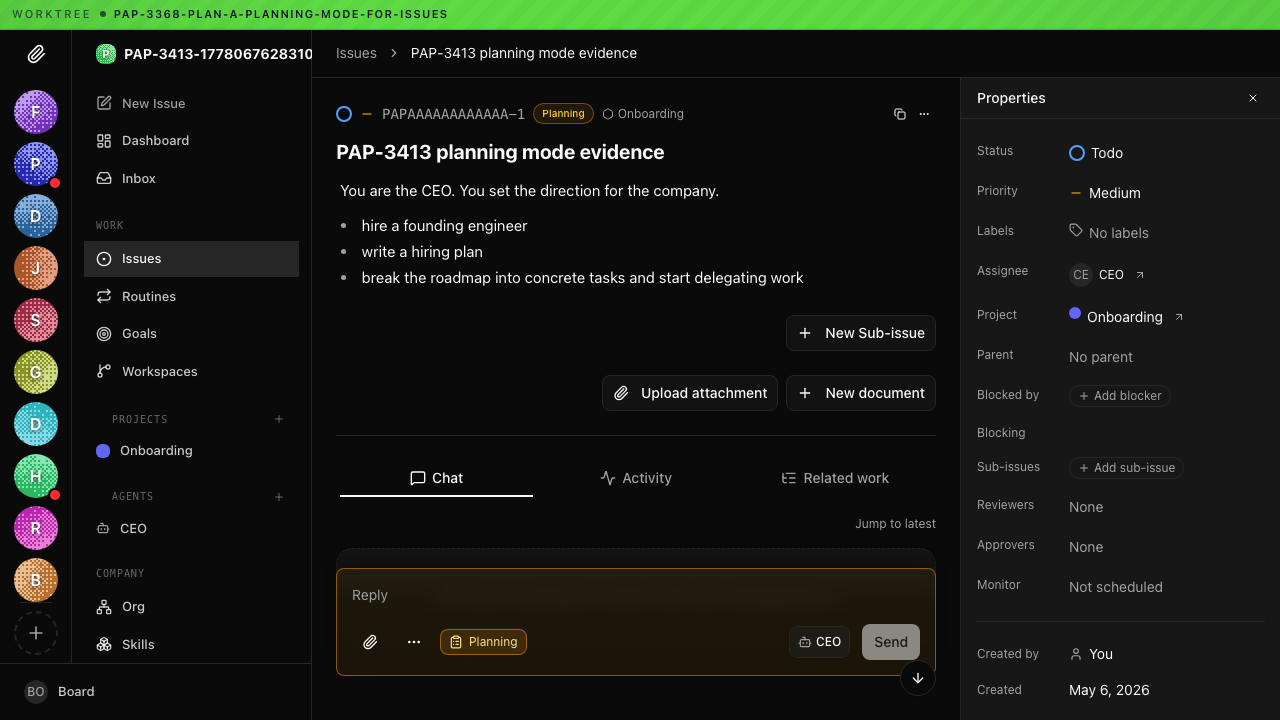 Desktop planning row: 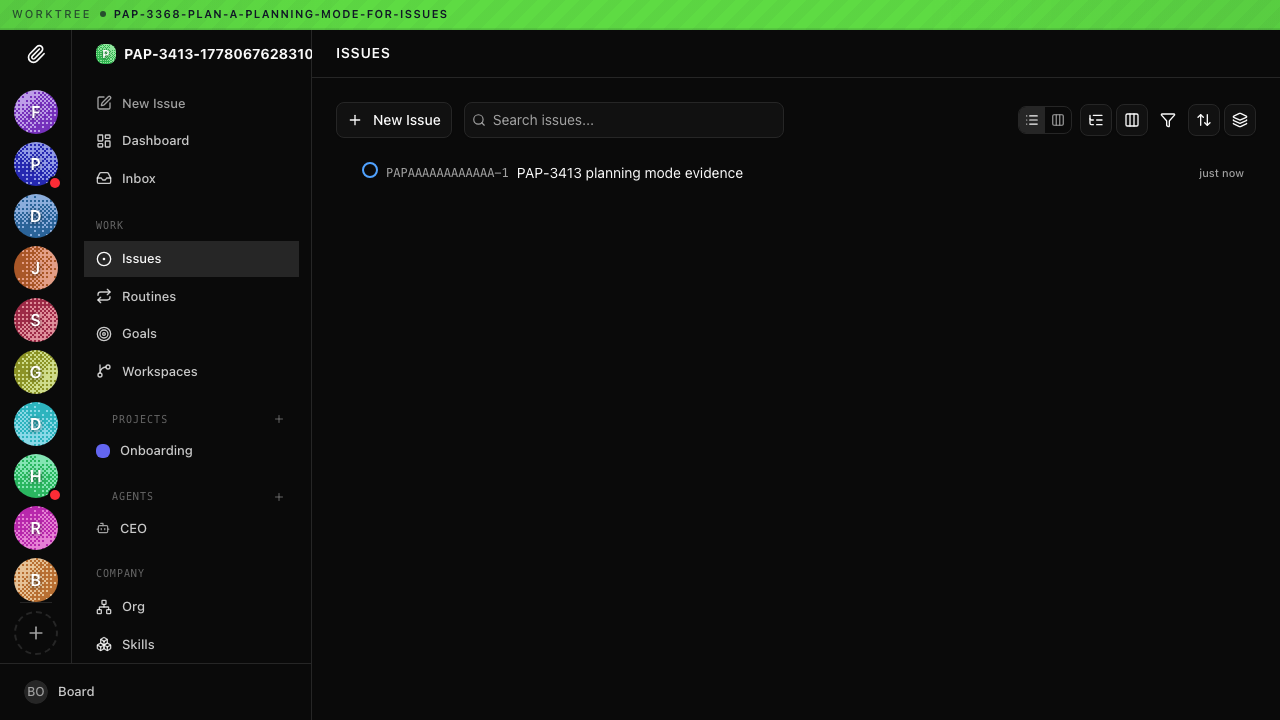 Desktop staged standard toggle: 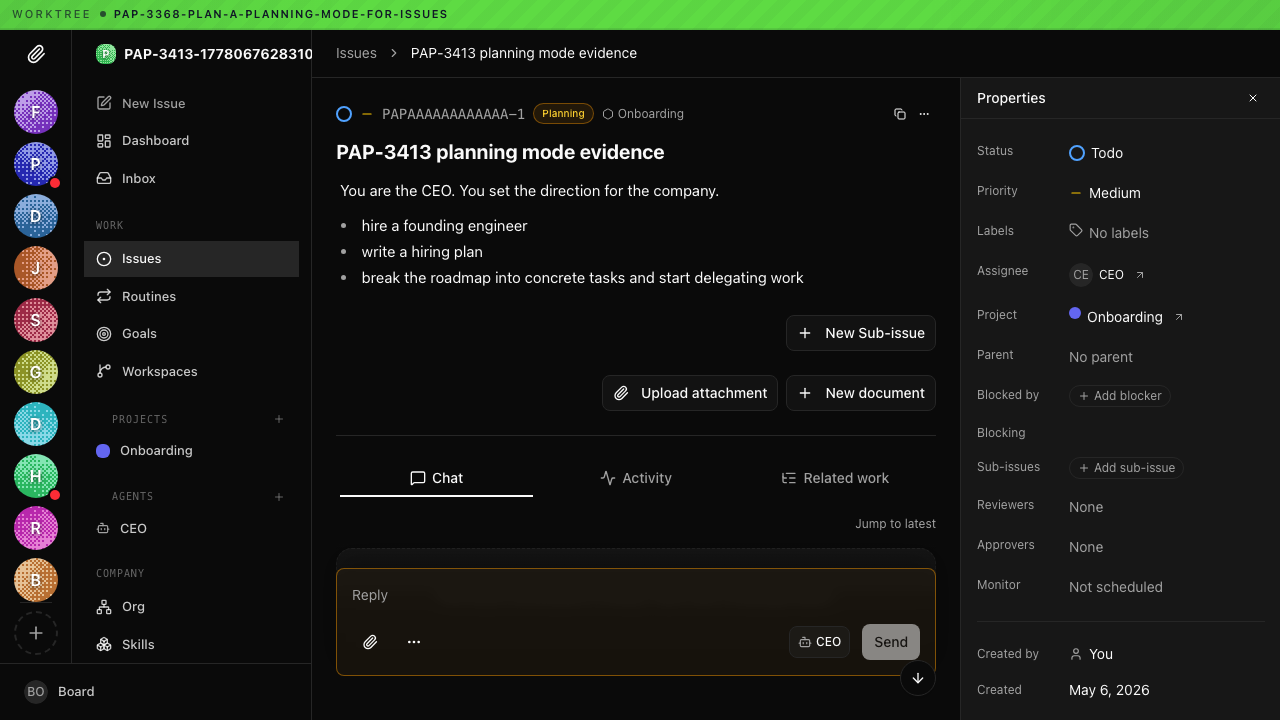 Mobile planning detail: 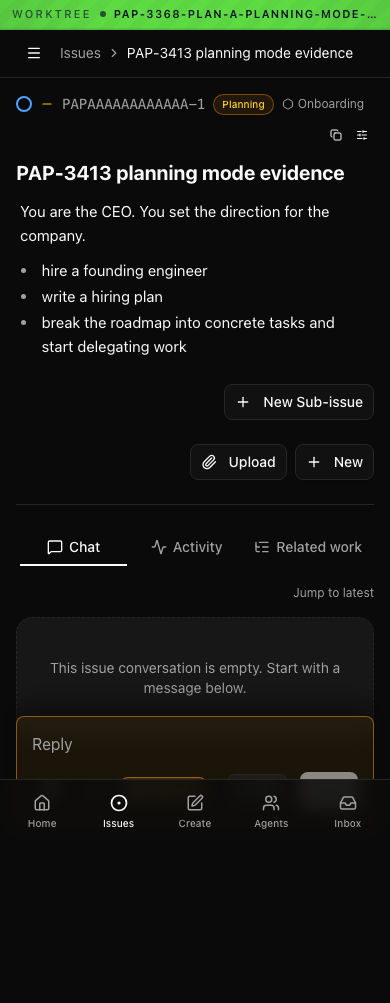 Mobile planning row: 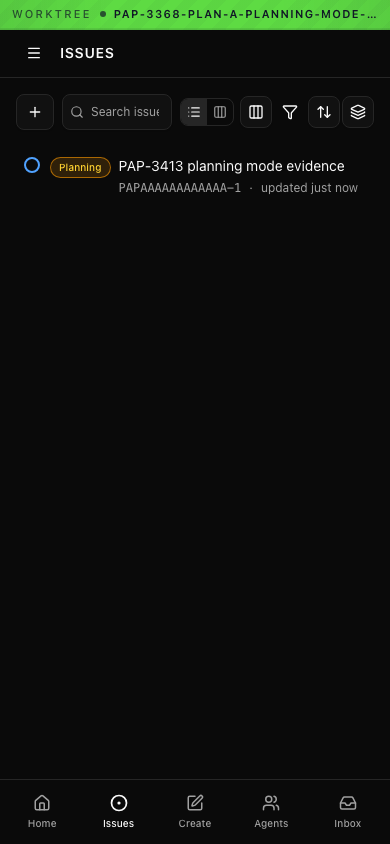 ## Risks - Medium migration risk: this adds a non-null issue column. The migration uses `ADD COLUMN IF NOT EXISTS` so installations that applied an older branch-local migration number can still apply the final numbered migration safely. - Medium contract risk: issue payloads, plugin payloads, and adapter heartbeat payloads now include work mode; compatibility is handled by defaulting missing values to `standard`. - UI risk is moderate because composer controls changed; focused component tests and visual e2e coverage exercise standard vs planning display and toggle behavior. > For core feature work, check [`ROADMAP.md`](ROADMAP.md) first and discuss it in `#dev` before opening the PR. Feature PRs that overlap with planned core work may need to be redirected — check the roadmap first. See `CONTRIBUTING.md`. ## Model Used - OpenAI Codex, GPT-5 coding agent in a local Paperclip worktree, with shell/tool use. Exact context-window size is not exposed in this runtime. ## Checklist - [x] I have included a thinking path that traces from project context to this change - [x] I have specified the model used (with version and capability details) - [x] I have checked ROADMAP.md and confirmed this PR does not duplicate planned core work - [x] I have run tests locally and they pass - [x] I have added or updated tests where applicable - [x] If this change affects the UI, I have included before/after screenshots - [x] I have updated relevant documentation to reflect my changes - [x] I have considered and documented any risks above - [x] I will address all Greptile and reviewer comments before requesting merge --------- Co-authored-by: Paperclip <noreply@paperclip.ing> |
||
|
DottaandPaperclip
|
6e6f538630 |
[codex] Improve issue detail and issue-list UX (#3678)
## Thinking Path > - Paperclip orchestrates AI agents for zero-human companies > - A core part of that is the operator experience around reading issue state, agent chat, and sub-task structure > - The current branch had a long run of issue-detail and issue-list UX fixes that all improve how humans follow and steer active work > - Those changes mostly live in the UI/chat surface and should be reviewed together instead of mixed with workspace/runtime work > - This pull request packages the issue-detail, chat, markdown, and sub-issue list improvements into one standalone change > - The benefit is a cleaner, less jumpy, more reliable issue workflow on desktop and mobile without coupling it to unrelated server/runtime refactors ## What Changed - Stabilized issue chat runtime wiring, optimistic comment handling, queued-comment cancellation, and composer anchoring during live updates - Fixed several issue-detail rendering and navigation regressions including placeholder bleed, local polling scope, mobile inbox-to-issue transitions, and visible refresh resets - Improved markdown and rich-content handling with advisory image normalization, editor fallback behavior, touch mention recovery, and `issue:` quicklook links - Refined sub-issue behavior with parent-derived defaults, current-user inheritance fixes, empty-state cleanup, and a reusable issue-list presentation for sub-issues - Added targeted UI tests for the new issue-detail, chat scroll/message, placeholder-data, markdown, and issue-list behaviors ## Verification - `pnpm vitest run ui/src/components/IssueChatThread.test.tsx ui/src/components/MarkdownEditor.test.tsx ui/src/components/IssuesList.test.tsx ui/src/context/LiveUpdatesProvider.test.tsx ui/src/lib/issue-chat-messages.test.ts ui/src/lib/issue-chat-scroll.test.ts ui/src/lib/issue-detail-subissues.test.ts ui/src/lib/query-placeholder-data.test.tsx ui/src/hooks/usePaperclipIssueRuntime.test.tsx` ## Risks - Medium: this branch touches the highest-traffic issue-detail UI paths, so regressions would show up as chat/thread or sub-issue UX glitches - The changes are UI-heavy and would benefit from reviewer screenshots or a quick manual browser pass before merge ## Model Used - OpenAI Codex coding agent (GPT-5-class runtime in Codex CLI; exact deployed model ID is not exposed in this environment), reasoning enabled, tool use and local code execution enabled ## Checklist - [x] I have included a thinking path that traces from project context to this change - [x] I have specified the model used (with version and capability details) - [x] I have run tests locally and they pass - [x] I have added or updated tests where applicable - [ ] If this change affects the UI, I have included before/after screenshots - [ ] I have updated relevant documentation to reflect my changes - [x] I have considered and documented any risks above - [x] I will address all Greptile and reviewer comments before requesting merge --------- Co-authored-by: Paperclip <noreply@paperclip.ing> |




