mirror of
https://github.com/paperclipai/paperclip.git
synced 2026-10-06 10:48:12 +02:00
f4802b1bbcea064ad6f6839d53642b11720f1ace
43
Commits
| Author | SHA1 | Message | Date | |
|---|---|---|---|---|
 Dotta Dotta
|
f4802b1bbc |
feat(runtime-exposure): least-privilege Tailscale HTTPS broker, shared contract, and persisted exposure state (#11524)
<!-- Simplified Technical English (ASD-STE100). --> ## Thinking Path > - Paperclip is the open source app people use to manage AI agents for work > - Paperclip starts and supervises managed runtime services for a project's execution workspaces, so an agent's branch can be previewed while it works > - Those services only listen on plain loopback HTTP. A person on another device, or on a phone, cannot open the preview > - A Tailscale HTTPS mapping solves this, but `tailscale serve` needs host privileges that the Paperclip server process must not hold > - This pull request adds the foundation only: a separate least-privilege host broker, the shared exposure contract, and the database columns that hold exposure state > - Nothing calls the broker yet, so there is no behavior change. The benefit is that the privileged surface is small, reviewable, and isolated before any lifecycle code depends on it ## Linked Issues or Issue Description No public GitHub issue exists. The change follows the feature request template. **Subsystem affected** Managed workspace runtime services, the shared type and validator package, and the database schema. **Problem or motivation** A managed runtime service binds to loopback only. There is no supported way to reach that preview from another device. Adding HTTPS directly to the server would mean the server process runs `tailscale serve`, which needs privileges far wider than the task requires. A compromised or buggy server could then map any port to the tailnet. **Proposed solution** Split the privileged work into a separate broker process with a narrow protocol, and define one shared contract that the server, the UI, the runtime, and the broker all read. Land this foundation first, with no caller, so the privileged code can be reviewed on its own. **Alternatives considered** - Call `tailscale serve` from the server process. This was rejected because it gives the server unrestricted mapping authority. - Use `sudo` for single `tailscale` commands. This was rejected because the argument list is the only guard, and it is easy to widen by accident. - Use a generic reverse proxy. This was rejected because it does not remove the need for a privileged Tailscale mapping step. **Roadmap alignment** This supports the existing managed workspace runtime capability. It adds no new product surface on its own. **Additional context** The broker is the security boundary of the feature, so it is deliberately the first slice. Three later pull requests build on it: the server exposure lifecycle, the runtime lease and recovery integration, and the leased-port mediator. ## What Changed - Add the `@paperclipai/tailscale-https-broker` workspace package. The broker listens on a unix socket, authorizes each peer with `SO_PEERCRED`, and answers a small request protocol. - Restrict what the broker will map. It accepts only same-number HTTPS-to-loopback pairs inside the Paperclip port range, refuses protected ports, and confirms that the loopback port belongs to a Paperclip-owned listener. - Parse every request with a strict JSON reader that rejects duplicate keys, prototype keys, and unknown fields. - Write an append-only audit record for each broker decision. - Add the shared exposure contract in `@paperclipai/shared`: the `RuntimeExposureConfig`, `RuntimeExposureState`, and `RuntimeExposureStatus` types, their zod validators, the app and HMR port rules, and the loopback-bind helpers. - Persist exposure state on `workspace_runtime_services` with the new `exposure` column, plus the server-private `exposure_handle` and `backend_url` columns that are never serialized to API clients. - Add the `execution_workspace_runtime_leases` table that the later lease slice uses. - Extend the runtime read-model test fixture for the three new columns. ## Verification Focused checks, all run on this branch: - `pnpm --filter @paperclipai/tailscale-https-broker test` — 12 files, 82 tests pass. This covers peer credentials, port policy, protected ports, the serve config writer, the strict JSON reader, argv parsing, and the socket server. - `pnpm --filter @paperclipai/tailscale-https-broker typecheck` — clean. - `npx vitest run --root packages/shared src/runtime-exposure src/validators/runtime-exposure.test.ts` — 3 files, 40 tests pass. - `pnpm --filter @paperclipai/db typecheck` — runs `check:migrations` first. Migration numbering and migration safety both pass. - `pnpm --filter @paperclipai/shared typecheck` — clean. - `pnpm --filter @paperclipai/ui typecheck` — clean. - `npx vitest run --root server src/services/workspace-runtime-read-model.test.ts` — 3 tests pass. - `npx tsc --noEmit -p server/tsconfig.json` — 139 errors, which is exactly the count on `master` before this branch. All 139 come from the unbuilt `@paperclipai/plugin-sdk` package. To confirm the exposure state is inert, start a managed runtime service as usual. The new columns stay null and the service behaves as it does today. ## Risks - Migration risk is low. Both migrations only add a table and three nullable columns. No column is backfilled and no existing column changes. The migration safety check passes. - Behavior risk is low. No code path calls the broker in this pull request, and the shared exposure fields are optional. - The broker is privileged, so it is the real risk surface. It is mitigated by peer-credential authorization, a fixed port range, a protected-port deny list, same-number pair enforcement, listener-ownership checks, strict JSON parsing, and an audit trail. Reviewers should read `packages/tailscale-https-broker/src/authorization.ts` and `src/port-policy.ts` closely. - The broker requires a `tailscale` version floor, which its README records. An older host CLI makes the broker refuse to start rather than map incorrectly. - `pnpm-lock.yaml` changes because a new workspace package is added. The diff is the new importer block, plus one duplicate `tinyexec` entry that pnpm removed. > For core feature work, check [`ROADMAP.md`](ROADMAP.md) first and discuss it in `#dev` before opening the PR. ## Model Used Claude Opus 5 (`claude-opus-5`), 1M context window, extended thinking, with tool use and code execution. ## Checklist - [x] I have included a thinking path that traces from project context to this change - [x] I have specified the model used (with version and capability details) - [x] I have checked ROADMAP.md and confirmed this PR does not duplicate planned core work - [x] I have searched GitHub for duplicate or related PRs and linked them above - [x] I have either (a) linked existing issues with `Fixes: #` / `Closes #` / `Refs #` OR (b) described the issue in-PR following the relevant issue template - [x] I have not referenced internal/instance-local Paperclip issues or links (only public GitHub `#NNN` / `github.com/paperclipai/paperclip` URLs) - [x] My branch name describes the change (e.g. `docs/...`, `fix/...`) and contains no internal Paperclip ticket id or instance-derived details - [x] I have run tests locally and they pass - [x] I have added or updated tests where applicable - [x] I have updated relevant documentation to reflect my changes - [x] I have considered and documented any risks above - [ ] All Paperclip CI gates are green - [ ] Greptile is 5/5 with no open P2s, recommendations, or follow-ups - [x] I will address all Greptile and reviewer comments before requesting merge |
||
|
Devin Foley
|
ea0dd3917e |
build: make image layer caching actually hit (#10571)
## Thinking Path > - Paperclip is the open source app people use to manage AI agents for work > - Published container images are the deployable unit for self-hosted and managed instances, so merge-to-image latency bounds every deploy iteration > - The docker workflow configures BuildKit caching, but builds still ran ~12+ minutes essentially cold > - Two causes: the most expensive layer (four CLI toolchains + apt) is ordered after the always-changing app copy so it can never cache, and the type=gha cache's 10GB repo cap means the two multi-arch mode=max jobs evict each other > - This pull request reorders the tool layer above the app copy (with a weekly epoch so @latest tools keep advancing) and switches both jobs to registry-backed cache in ghcr > - The benefit is that warm builds shrink to roughly the app build + push, targeting the sub-5-minute range together with the amd64-only cloud variant ## Linked Issues or Issue Description No existing public issue — inline description following the feature request template: **Subsystem affected** CI / release publishing (docker workflow, Dockerfile) **Problem or motivation** Despite `cache-from/cache-to` being configured, image builds run effectively cold: (1) the production stage installs four CLI toolchains + apt packages *after* `COPY --from=build /app /app`, and since the app copy changes every commit, that most-expensive layer rebuilds every build, per arch; (2) the `type=gha` BuildKit cache is capped at 10GB per repository, and two multi-arch `mode=max` jobs overflow and evict each other's entries. **Proposed solution** Order the tool/OS layer before the app copy (it references nothing from `/app`), refresh it weekly via a `CLI_TOOLS_CACHE_EPOCH` build arg so the `@latest` tools don't freeze in the cache, and move both jobs to registry-backed BuildKit cache (`:buildcache` / `:buildcache-cloud` refs in ghcr, no size cap, separate refs so the parallel jobs don't clobber each other). **Alternatives considered** Pinning CLI tool versions instead of the weekly epoch — more deterministic, but adds a version-bump chore; the weekly epoch preserves current freshness semantics with bounded staleness. Keeping type=gha with `mode=min` — smaller cache but loses intermediate-stage reuse, which is where most of the win is. **Roadmap alignment** Not on ROADMAP.md; CI/publishing speed improvement only. ## What Changed - `Dockerfile`: the production stage's tool/OS `RUN` (npm --global CLIs, apt, `/paperclip` setup) moves above `COPY --from=build /app /app`; new `CLI_TOOLS_CACHE_EPOCH` arg consumed by that layer. The `cloud` stage is unaffected — it only layers plugin dists on top of the finished production stage. - `.github/workflows/docker.yml`: both jobs stamp the ISO week into `CLI_TOOLS_CACHE_EPOCH`, and both switch `cache-from/cache-to` from `type=gha` to `type=registry` with per-job refs. - Includes the one-line amd64-only cloud-variant commit from #10570 so the two PRs can't conflict; if #10570 merges first, this PR rebases down to a single commit automatically. ## Verification - Image content is unchanged by layer reordering: the moved `RUN` references nothing from `/app`, and Docker layer ordering only affects caching, not the final filesystem (tool installs and app copy touch disjoint paths). - The cache ref is written only by this workflow — `docker.yml` runs on master/tag pushes, never on PRs — so the workflow's existing "no shared caches into build inputs" supply-chain stance is unchanged (BuildKit layer cache was already accepted via type=gha; the registry backend has the same writer trust). - Runtime proof lands with the first two master builds after merge: the first warms the cache, the second should show the tool layer and deps/build stages as CACHED in the build log, with wall clock dropping accordingly. I'll be watching those as part of managed-deploy work. ## Risks - Low. Worst case the registry cache misses (cold-build behavior, same as today). The weekly epoch means CLI tools update at most a week late inside images; a release built mid-week ships the tools from that week's first build. Cache refs add two small artifacts to ghcr. ## Model Used Claude Fable 5 (`claude-fable-5`, extended thinking, via Claude Code with tool use and code execution). ## Checklist - [x] I have included a thinking path that traces from project context to this change - [x] I have specified the model used (with version and capability details) - [x] I have checked ROADMAP.md and confirmed this PR does not duplicate planned core work - [x] I have searched GitHub for duplicate or related PRs and linked them above - [x] I have either (a) linked existing issues with `Fixes: #` / `Closes #` / `Refs #` OR (b) described the issue in-PR following the relevant issue template - [x] I have not referenced internal/instance-local Paperclip issues or links (only public GitHub `#NNN` / `github.com/paperclipai/paperclip` URLs) - [x] My branch name describes the change (e.g. `docs/...`, `fix/...`) and contains no internal Paperclip ticket id or instance-derived details - [x] I have run tests locally and they pass (no test-affecting changes) - [x] I have added or updated tests where applicable (n/a — build config and layer ordering only) - [x] I have updated relevant documentation to reflect my changes (in-file comments document both mechanisms) - [x] I have considered and documented any risks above - [ ] All Paperclip CI gates are green - [ ] Greptile is 5/5 with no open P2s, recommendations, or follow-ups - [x] I will address all Greptile and reviewer comments before requesting merge |
||
|
Devin Foley
|
521271ebb7 |
build: bake the build commit into published images (#10566)
## Thinking Path > - Paperclip is the open source app people use to manage AI agents for work > - Instances commonly run from published container images, and operators need to observe which build a container actually serves > - `/api/health` now reports the running build commit, and server-info already falls back to `PAPERCLIP_BUILD_COMMIT` when git is unavailable > - But published images carry no `.git` and never received `PAPERCLIP_BUILD_COMMIT`, so containers report `commit: null` — verified live against a current image > - That leaves the new deployment-verification field inert exactly where it matters most: containerized deploys > - This pull request bakes the exact build commit into both image variants at build time, mirroring how `PAPERCLIP_BUILD_VERSION` is already stamped > - The benefit is that containers report their true commit on `/api/health`, so deploy tooling can verify a rollout actually shipped ## Linked Issues or Issue Description Companion to #10563 (which exposed the `commit` field on `/api/health`). Inline description following the bug report template: **What happened?** A container from a published image responds to `GET /api/health` with `"commit": null`. The image has no `.git` directory and the `PAPERCLIP_BUILD_COMMIT` fallback that `server-info` supports is never provided at build time, so git metadata resolves as unavailable. **Expected behavior** A container reports the commit it was built from, the same way it already reports its build version via the baked `PAPERCLIP_BUILD_VERSION`. **Steps to reproduce** Run any published image (e.g. `ghcr.io/paperclipai/paperclip:sha-c4f6264-cloud`) and `curl /api/health` — `commit` is `null` even though the build commit is known at image-build time. **Paperclip version or commit** `sha-c4f6264-cloud` (first image containing #10563). ## What Changed - `Dockerfile`: new `PAPERCLIP_BUILD_COMMIT` build arg, exported as an ENV in the production stage (the `cloud` stage inherits it), directly parallel to `PAPERCLIP_BUILD_VERSION`. Empty for local `docker build`, which keeps the normal fallbacks. - `.github/workflows/docker.yml`: both build jobs pass `PAPERCLIP_BUILD_COMMIT=${{ github.sha }}`. ## Verification - Reviewed the plumbing end-to-end: `build-commit.ts` reads `PAPERCLIP_BUILD_COMMIT` (validated as a full SHA), `server-info.ts` `readGitInfo` falls back to it when the git CLI fails, producing `available: true, fullSha` — which `/api/health` surfaces as `commit`. - Verified live that a current published image reports `commit: null`; this change repairs that on the next build. Post-merge, the first master image should report its commit — I'll be verifying that as part of managed-deploy validation. - No test changes: the fallback path is already covered by existing server-info tests; this PR only supplies the env at image build. ## Risks - Low. Two build-time stamps; no runtime code changes. A wrong SHA would only mislabel the build (same failure mode `PAPERCLIP_BUILD_VERSION` already carries), and `${{ github.sha }}` is the exact commit the workflow builds. ## Model Used Claude Fable 5 (`claude-fable-5`, extended thinking, via Claude Code with tool use and code execution); diagnosis included live probes of a running container's `/api/health`. ## Checklist - [x] I have included a thinking path that traces from project context to this change - [x] I have specified the model used (with version and capability details) - [x] I have checked ROADMAP.md and confirmed this PR does not duplicate planned core work - [x] I have searched GitHub for duplicate or related PRs and linked them above - [x] I have either (a) linked existing issues with `Fixes: #` / `Closes #` / `Refs #` OR (b) described the issue in-PR following the relevant issue template - [x] I have not referenced internal/instance-local Paperclip issues or links (only public GitHub `#NNN` / `github.com/paperclipai/paperclip` URLs) - [x] My branch name describes the change (e.g. `docs/...`, `fix/...`) and contains no internal Paperclip ticket id or instance-derived details - [x] I have run tests locally and they pass (no test-affecting changes; server suites unaffected) - [x] I have added or updated tests where applicable (n/a — build-time stamps only) - [x] I have updated relevant documentation to reflect my changes (Dockerfile comments document the arg) - [x] I have considered and documented any risks above - [x] All Paperclip CI gates are green - [x] Greptile is 5/5 with no open P2s, recommendations, or follow-ups - [x] I will address all Greptile and reviewer comments before requesting merge |
||
|
Devin FoleyandPaperclip
|
d1b9448b57 |
fix(server): stamp the real build version into images instead of the package.json placeholder (#10257)
## Thinking Path > - Paperclip is the open source app people use to manage AI agents for work; it ships as a Docker image that self-hosters and managed deployments run. > - The server resolves its own version at runtime in `server/src/version.ts` (`resolveServerVersion()`), which feeds analytics and the server debug panel. > - That resolver derives the real version from `git describe`, and falls back to `server/package.json`'s `version` when git isn't available. > - But `server/package.json`'s version is a static placeholder — CI only stamps the real CalVer at publish, so in source it is never the real version (currently `0.3.1`). > - A Docker image has no `.git` (it's dockerignored), so `git describe` can't run inside it. Every image therefore falls back to the placeholder and reports `0.3.1` in analytics and the debug panel, regardless of which commit it was built from. > - This PR computes the real version once on the CI build runner (where `.git` and tags exist), bakes it into the image, and has `resolveServerVersion()` prefer that stamp when `git describe` is unavailable. > - The benefit: self-hosted and cloud images report their true version instead of a misleading placeholder, with no change to dev checkouts, `git describe`-based resolution, or local `docker build`. ## Linked Issues or Issue Description No public issue exists — describing the bug inline (per the bug report template). **What happened?** Docker images built from `master` (and release tags) report the server version as the `0.3.1` placeholder in analytics and the server debug panel, instead of the real version of the commit the image was built from. **Expected behavior** An image reports the real version of its build commit (e.g. `2026.722.0+51.git.<sha>`), so operators can tell which build is running. **Steps to reproduce** 1. Build the server Docker image from any `master` commit (the `Docker` workflow, `production` target). 2. Run the image and open the server debug panel (or inspect the version reported to analytics). 3. Observe the version is `0.3.1` rather than the commit's real version. **Root cause** `resolveServerVersion()` derives the real version from `git describe`, but the image has no `.git` (dockerignored), so it falls back to `server/package.json`'s `version` — a static placeholder CI only replaces with the real CalVer at publish time. Nothing bakes the real version into the image. **Paperclip version or commit:** reproduces on `master` (`4c55f0d8`) and any published image. **Deployment mode:** self-hosted and managed (both the `production` and `-cloud` images). **Installation method:** Docker image (`ghcr.io/paperclipai/paperclip`). **Related PRs (dedup search):** #9103 (merged — added the `git describe`-based source-install resolution this builds on) and #9637 (closed). Neither bakes a version into the image; this PR closes that gap. No duplicate found. ## What Changed - **`.github/workflows/docker.yml`** — checkout with full history + tags (`fetch-depth: 0`), and a new `Compute build version` step that runs `git describe --tags --match 'v*' --long --dirty` on the pristine runner checkout. The result is passed as a `PAPERCLIP_BUILD_VERSION` build-arg to both the `production` and `-cloud` image builds. - **`Dockerfile`** — the `production` stage takes an `ARG PAPERCLIP_BUILD_VERSION` (default empty) and bakes it into the runtime `ENV`; the `cloud` stage inherits it via `FROM production`. - **`server/src/build-version.ts`** (new) — `readBuildVersion()` / `parseBuildVersion()`, mirroring `build-commit.ts`: reads `PAPERCLIP_BUILD_VERSION` (or a `.paperclip-build-version` file) as a single-token stamp. - **`server/src/version.ts`** — `resolveServerVersion()` prefers the baked build version when `git describe` is unavailable, parsing it with the same rules as a live checkout (`parseGitDescribeVersion`), and falling through to the existing `build-commit` stamp and package version when unset. A live checkout's `git describe` still wins over any stamp. - Tests for the new behavior and the precedence. ## Verification - `pnpm --filter @paperclipai/plugin-sdk ensure-build-deps && tsc --noEmit` in `server/` — clean. - `vitest run server/src/__tests__/version.test.ts server/src/__tests__/build-version.test.ts` — **23 tests pass**, covering: stamped version used when git describe fails, stamp parsed to real CalVer, stamp preferred over the build-commit fallback, on-tag stamp collapses to the release version, a pre-resolved stamp used verbatim, and a live git describe still winning over a stamp. - `git describe --tags --match 'v*' --long` for this commit → `v2026.722.0-51-g<sha>`, which `resolveServerVersion()` reports as `2026.722.0+51.git.<sha>` — no longer `0.3.1`. - Not run locally: the full multi-arch image build (CI-only). The workflow change is verified by inspection; the version is computed on the pristine checkout before any lockfile refresh, so it carries no spurious `-dirty`. ## Risks Low. Additive and image-only: - No runtime behavior changes for dev checkouts (git describe still primary and wins over any stamp) or for local `docker build` (empty arg → server keeps its existing fallbacks). - Not a breaking change; no schema or API surface. The stamp is informational (version reporting only). - `fetch-depth: 0` makes the release-image checkout fetch full history/tags — a modest cost on a workflow that already runs at release cadence with a 60-minute budget. - Rollback: revert the commit; images simply return to reporting the placeholder. ## Model Used Claude Opus 4.8 (`claude-opus-4-8`, 1M-context variant), extended thinking, with tool use / code execution — agentic edits, `tsc` + `vitest` runs, and a `git describe` resolution check. ## Checklist - [x] I have included a thinking path that traces from project context to this change - [x] I have specified the model used (with version and capability details) - [x] I have checked ROADMAP.md and confirmed this PR does not duplicate planned core work (bugfix, not core feature work) - [x] I have searched GitHub for duplicate or related PRs and linked them above (#9103, #9637 — related, not duplicates) - [x] I have either (a) linked existing issues with `Fixes: #` / `Closes #` / `Refs #` OR (b) described the issue in-PR following the relevant issue template - [x] I have not referenced internal/instance-local Paperclip issues or links (only public GitHub `#NNN` / `github.com/paperclipai/paperclip` URLs) - [x] My branch name describes the change (`fix/build-version-stamp`) and contains no internal Paperclip ticket id or instance-derived details - [x] I have run tests locally and they pass - [x] I have added or updated tests where applicable - [x] I have updated relevant documentation to reflect my changes (no user-facing docs affected; behavior is documented inline in `version.ts` / `build-version.ts` and the workflow/Dockerfile) - [x] I have considered and documented any risks above - [ ] All Paperclip CI gates are green - [ ] Greptile is 5/5 with no open P2s, recommendations, or follow-ups - [x] I will address all Greptile and reviewer comments before requesting merge Co-authored-by: Paperclip <noreply@paperclip.ing> |
||
|
Devin Foley
|
965a827ee7 |
feat(docker): publish a cloud image variant with built bundled plugins (#10157)
## Thinking Path > - Paperclip is the open source app people use to manage AI agents for work > - Managed (cloud-hosted) deployments configure instances through `PAPERCLIP_MANAGED_CONFIG`, including a `plugins.autoInstall` key list that the boot-time installer resolves against the bundled plugin catalog > - The installer requires each bundled plugin's `dist/manifest.js` (`server/src/services/bundled-plugins.ts`), but the published image only ships the sandbox providers' *source* — they are intentionally excluded from the pnpm workspace, and the Dockerfile never builds them > - Every managed auto-install therefore logs `bundled plugin bundle not present; skipping auto-install` and no sandbox provider can be provisioned through managed config > - Baking built plugins into the single published image would fix it but makes every self-hosted pull carry the providers' `node_modules` for a managed-only mechanism > - This pull request adds a `cloud` Dockerfile target extending `production` with built bundled plugins — parameterized by build arg and currently just `daytona` — published alongside the default image with a `-cloud` tag suffix > - The benefit is working plugin auto-provisioning for managed deployments while the self-hosted image stays byte-identical and the cloud variant only carries what is actually deployed ## Linked Issues or Issue Description Fixes #10158 (filed for this problem; no prior issue existed — searched for duplicate/related PRs and issues around bundled plugins, docker image variants, and auto-install). Summary: **What happened:** on a managed instance with `plugins.autoInstall: ["daytona"]` delivered via `PAPERCLIP_MANAGED_CONFIG`, boot logs `bundled plugin bundle not present; skipping auto-install` with `pluginPath: /app/packages/plugins/sandbox-providers/daytona`, and the plugin is never installed. **Expected:** the advertised bundled-catalog keys are installable from the published image. **Why:** the image ships plugin source without `dist/` — nothing in the Dockerfile builds the workspace-excluded sandbox providers. ## What Changed - `Dockerfile`: new `cloud-plugins` stage (based on `build`, so devDependencies are available for `tsc`) that installs and builds each provider named in the `CLOUD_BUNDLED_PLUGINS` build arg standalone (`pnpm install --ignore-workspace --no-lockfile && pnpm build`, exactly as the providers' READMEs prescribe), asserting `dist/manifest.js` exists per plugin and failing loudly on unknown names; new `cloud` stage = `production` + the built plugin tree. The arg defaults to `daytona` — the only provider managed deployments auto-install today; every entry adds its `node_modules` to the image, so the list grows only with actual need (a one-line workflow change). - `.github/workflows/docker.yml`: the existing build step is pinned to `target: production` (without this, the new trailing stage would silently become the default build target — this pin is what keeps the self-hosted image identical); new metadata + build-push steps publish the `cloud` target (with `CLOUD_BUNDLED_PLUGINS=daytona`) under the same tag set with a `-cloud` suffix (`sha-<short>-cloud`, `latest-cloud`, `<version>-cloud`), same schema labels, reusing the GHA layer cache ## Verification - All seven sandbox providers build standalone from a clean checkout with the exact commands the new stage runs, each producing `dist/manifest.js` — so the current `daytona` default works and future list additions are known-good - The stage's shell loop was dry-run against the checkout (directory existence + per-plugin assertion logic) - Workflow YAML lints clean - **Not run:** a full multi-arch `docker build` (no local docker daemon). The `cloud` stage is additive and the default target is pinned, so the risk is contained to the new build step; the first master build after merge proves it end-to-end ## Risks - Self-hosted behavior: unchanged. The default image build is pinned to the `production` target, which produces the same layers as before this change; the `cloud` stages run only for the new build step. - The plugin installs in the `cloud-plugins` stage use `--no-lockfile` (the providers are workspace-excluded and lockfile-less by design), so plugin dependency resolution is not pinned at image-build time. This mirrors the existing Plugins-page install path, which resolves from npm at install time. - CI cost: one additional build-push per master push. It reuses the layer cache from the production build, so the marginal work is the single plugin's build layers. - An unknown name in `CLOUD_BUNDLED_PLUGINS`, or a provider that stops producing `dist/manifest.js`, fails the cloud build loudly rather than publishing a broken variant. ## Model Used Claude (Anthropic), model ID `claude-fable-5[1m]` via Claude Code CLI — extended thinking and tool use (code edits, standalone plugin build verification, workflow lint). ## Checklist - [x] I have searched GitHub for duplicate or related PRs and linked them above - [x] Self-hosted behavior unchanged (default build target pinned to `production`) - [x] One clear change: publish a cloud image variant with built bundled plugins |
||
|
DottaandPaperclip
|
7b35de65aa |
feat(mcp) [split 1/8]: add fixture demo servers (#9556)
## Thinking Path > - Paperclip is the open source app people use to manage AI agents for work > - Governed MCP access spans contracts, runtime enforcement, adapters, UI surfaces, and operator verification > - The parity reference PR #9534 is too large for effective automated or human review > - The feature therefore needs a linear stack whose individual diffs stay below the 100-file review limit > - This pull request is split 1/8 and focuses on fixture and demo MCP servers > - The benefit is a standalone, testable review boundary while preserving byte-for-byte parity at the top of the stack ## Linked Issues or Issue Description - Related parity reference: #9534 - Problem: Developers need deterministic local MCP fixtures and visible demo servers without pulling in the governed production runtime. - Proposed solution: Adds the Google Sheets and KV demo MCP packages, fixture catalog/servers, smoke harness, guide, and the root smoke/typecheck registration hunks. - Alternatives considered: keeping #9534 as one 403-file review, or rewriting the feature to manufacture seams; both were rejected in favor of path extraction plus compile-driven boundary moves. - Roadmap alignment: this advances the existing governed MCP/tool-access work already represented by #9534; it does not introduce a separate roadmap initiative. - Stack position: base branch is `master`. - Merge policy: merge bottom-up, in order, only after the complete eight-PR stack has been reviewed and the top-of-stack parity gate remains empty. - Requested review: QA for fixture and smoke coverage; Greptile on every PR. ## What Changed - Adds the Google Sheets and KV demo MCP packages, fixture catalog/servers, smoke harness, guide, and the root smoke/typecheck registration hunks. - Keeps this PR below 100 changed files and independently typecheckable. - Preserves the final tree from #9534 when combined with the other seven stack levels. ## Verification - `pnpm typecheck` - `pnpm --filter @paperclipai/google-sheets-mcp-server test` — 27 tests passed - `pnpm --filter @paperclipai/kv-demo-mcp-server test` — 12 tests passed ## Risks - The new packages add dependencies that are intentionally not committed to `pnpm-lock.yaml`, per repository policy. - Stack risk: merging out of order can expose incomplete layers; mitigate by following the documented bottom-up merge policy. - Parity risk: later edits to an intermediate branch can drift from #9534; mitigate by re-running the empty top-of-stack diff before merge. > For core feature work, check [`ROADMAP.md`](ROADMAP.md) first and discuss it in `#dev` before opening the PR. Feature PRs that overlap with planned core work may need to be redirected — check the roadmap first. See `CONTRIBUTING.md`. ## Model Used - OpenAI Codex, exact model ID `gpt-5.4`; runtime-managed context window; medium reasoning with repository, shell, Git, GitHub CLI, and code-execution tools enabled. ## Checklist - [x] I have included a thinking path that traces from project context to this change - [x] I have specified the model used (with version and capability details) - [x] I have checked ROADMAP.md and confirmed this PR does not duplicate planned core work - [x] I have searched GitHub for duplicate or related PRs and linked them above - [x] I have either (a) linked existing issues with `Fixes: #` / `Closes #` / `Refs #` OR (b) described the issue in-PR following the relevant issue template - [x] Internal references are omitted except the execution-plan link explicitly required for this coordinated split stack - [x] My branch name describes the change and contains no internal Paperclip ticket id or instance-derived details - [x] I have run tests locally and they pass - [x] I have added or updated tests where applicable - [x] I have updated relevant documentation to reflect my changes - [x] I have considered and documented any risks above - [ ] All Paperclip CI gates are green - [ ] Greptile is 5/5 with no open P2s, recommendations, or follow-ups - [x] I will address all Greptile and reviewer comments before requesting merge ## Stack Coordination - Internal execution plan: [PAP-13874](/PAP/issues/PAP-13874#document-plan) - Parity reference: #9534 - Stack: #9556 → #9557 → #9558 → #9559 → #9560 → #9561 → #9562 → #9563 - Merge bottom-up only after full-stack review and an empty parity diff at #9563. --------- Co-authored-by: Paperclip <noreply@paperclip.ing> |
||
|
Devin FoleyandPaperclip
|
eedc7ddef2 |
Make ACP the default engine for local adapters (#9238)
## Thinking Path > - Paperclip is the open source app people use to manage AI agents for work. > - Adapter packages are the bridge between the control plane and local agent harnesses such as Claude Code, Codex, and Gemini CLI. > - ACP support was concentrated in a separate `acpx_local` adapter, which made ACP feel like a separate agent choice instead of an execution capability of the harness adapters. > - Claude, Codex, and Gemini now have ACP-capable harnesses, so the native adapter should own ACP selection, fallback, config, transcript parsing, and environment diagnostics. > - The standalone ACPX adapter still needs a compatibility path for existing rows, but it should not be offered as an active adapter for new agents. > - This pull request moves the shared ACP runtime into `@paperclipai/acpx-engine`, wires Claude/Codex/Gemini local adapters to prefer ACP when prerequisites are available, and retires `acpx_local` to a tombstone. > - The benefit is one adapter per harness, richer ACP transcripts by default where possible, and a migration path for existing Claude/Codex ACPX agents. ## Linked Issues or Issue Description Closes #5932 — the broken default `acpx_local` Claude path is replaced by native `claude_local` ACP support, existing Claude/Codex ACPX rows migrate to native adapters, and new agents no longer choose the standalone ACPX adapter. Refs #4893 — original merged ACPX local adapter runtime that this PR replaces with native per-harness ACP engines. Refs #6590 — prior ACPX-Claude seamlessness work folded into the new native Claude ACP path. Refs #197 — related open generic ACP/Kiro adapter work; this PR does not close it because Kiro/custom generic ACP remains a separate adapter decision. Refs #7018 — related Kimi-specific `acpx_local` shell failure; this PR retires the built-in standalone adapter but does not add a native Kimi adapter. Refs #8864 — related ACPX prompt/API guidance PR; this PR moves runtime guidance into the shared/native ACP engine path instead of the old standalone adapter. Refs #8881 — related `acpx_local` POSIX shell failure from the old `acpx` pin; this PR updates ACP dependencies but does not claim custom/OMP ACP support as a first-class native adapter. Refs #8964 — related open `acpx_local` stderr cleanup PR; this PR makes the old runtime path obsolete for new agents but keeps it as a non-closing reference. Problem description: - The standalone `acpx_local` adapter duplicates Claude/Codex agent choices that already have first-class local adapters. - ACP should be an execution engine capability of each harness adapter when the underlying harness supports ACP. - Existing `acpx_local` agents should either migrate to native harness adapters or fail with an explicit retirement message instead of silently falling back to the process adapter. ## What Changed - Added `@paperclipai/acpx-engine` as the shared ACP execution, session-codec, CLI formatter, and UI parser package. - Wired `claude_local`, `codex_local`, and `gemini_local` to auto-select ACP by default when prerequisites pass, with `engine=cli` opt-out and `engine=acp` strict mode. - Added ACP config schema/UI fields, environment checks, session-codec preservation, transcript parsing, and adapter capability metadata for the native adapters. - Retired `acpx_local` to a server tombstone, removed its UI/package/runtime image surface, and added a migration for existing Claude/Codex ACPX agents. - Updated package manifests, lockfile, release tooling, docs, Kubernetes sandbox defaults, and tests. ## Verification - `corepack pnpm --filter @paperclipai/acpx-engine typecheck` - `corepack pnpm --filter @paperclipai/adapter-claude-local typecheck` - `corepack pnpm --filter @paperclipai/adapter-codex-local typecheck` - `corepack pnpm --filter @paperclipai/adapter-gemini-local typecheck` - `corepack pnpm --filter @paperclipai/acpx-engine exec vitest run` - `corepack pnpm --filter @paperclipai/adapter-claude-local exec vitest run src/server/acp.test.ts src/server/execute.acp-fallback.test.ts src/ui/build-config.test.ts` - `corepack pnpm --filter @paperclipai/adapter-codex-local exec vitest run src/server/acp.test.ts src/ui/build-config.test.ts` - `corepack pnpm --filter @paperclipai/adapter-gemini-local exec vitest run src/server/acp.test.ts src/ui/build-config.test.ts src/ui/parse-stdout.test.ts` - `corepack pnpm --filter @paperclipai/plugin-sdk ensure-build-deps && corepack pnpm --filter @paperclipai/server exec tsc --noEmit` - `corepack pnpm --filter @paperclipai/server exec vitest run src/__tests__/adapter-routes.test.ts src/__tests__/adapter-session-codecs.test.ts src/__tests__/adapter-models.test.ts` - `corepack pnpm --filter @paperclipai/ui typecheck` - `corepack pnpm --filter @paperclipai/ui exec vitest run src/adapters/metadata.test.ts src/adapters/adapter-display-registry.test.ts src/components/AgentConfigForm.test.ts src/components/AgentConfigForm.render.test.tsx src/components/transcript/RunTranscriptView.test.tsx` - `node --test scripts/bootstrap-npm-package.test.mjs scripts/release-package-map.test.mjs scripts/verify-release-registry-state.test.mjs` Note: the server typecheck script calls `pnpm` internally; this dev shell exposes pnpm through Corepack only, so I ran the two script steps manually with `corepack pnpm`. ## Risks - Migration changes existing `acpx_local` Claude/Codex agents to native adapter types and clears old ACPX task sessions/runtime state. - Custom ACP commands remain on the retired tombstone and will need a separate future adapter/plugin path. - ACP auto-selection depends on local Node and ACP server command prerequisites; remote and unsupported environments fall back to CLI unless `engine=acp` is explicit. - `@paperclipai/acpx-engine` is a new public package and needs npm trusted-publishing bootstrap before release automation can publish it. > For core feature work, check [`ROADMAP.md`](ROADMAP.md) first and discuss it in `#dev` before opening the PR. Feature PRs that overlap with planned core work may need to be redirected — check the roadmap first. See `CONTRIBUTING.md`. ## Model Used OpenAI GPT-5 via Codex coding agent. Exact hosted model build and context-window size are not exposed in this runtime. Tool use included shell execution, repository editing, GitHub CLI operations, and local test/typecheck execution. ## Checklist - [x] I have included a thinking path that traces from project context to this change - [x] I have specified the model used (with version and capability details) - [x] I have checked ROADMAP.md and confirmed this PR does not duplicate planned core work - [x] I have searched GitHub for duplicate or related PRs and linked them above - [x] I have either (a) linked existing issues with `Fixes: #` / `Closes #` / `Refs #` OR (b) described the issue in-PR following the relevant issue template - [x] I have not referenced internal/instance-local Paperclip issues or links (only public GitHub `#NNN` / `github.com/paperclipai/paperclip` URLs) - [x] My branch name describes the change (e.g. `docs/...`, `fix/...`) and contains no internal Paperclip ticket id or instance-derived details - [x] I have run tests locally and they pass - [x] I have added or updated tests where applicable - [x] I have updated relevant documentation to reflect my changes - [x] I have considered and documented any risks above - [x] All Paperclip CI gates are green - [x] Greptile is 5/5 with no open P2s, recommendations, or follow-ups - [x] I will address all Greptile and reviewer comments before requesting merge --------- Co-authored-by: Paperclip <noreply@paperclip.ing> |
||
|
DottaandPaperclip
|
fd2f82ac5b |
[codex] Add built-in Hermes adapters (#8543)
## Thinking Path > - Paperclip is the open source app people use to manage AI agents for work. > - Agent adapters are the boundary between the control plane and the runtimes that actually do work. > - Hermes support needs to be available as first-class local and gateway adapters while still preserving the adapter-manager override path for external packages. > - The adapter work touches runtime execution, UI adapter metadata, onboarding prompts, scoped credentials, release packaging, and smoke coverage, so the handoff needs concrete verification rather than only unit tests. > - This pull request adds built-in Hermes local and Hermes gateway support, keeps external adapter overrides compatible, and documents/tests the gateway flow end to end. > - The benefit is that operators can hire Hermes-backed agents without a manual plugin install, while self-hosted installs can still override/shadow the built-ins through Adapter manager packages. ## Linked Issues or Issue Description No public GitHub issue exists for this exact Hermes built-in adapter, gateway onboarding, and release-source work. Problem description: - Hermes local and gateway adapters need a public, reviewable source path in the monorepo so package artifacts and built-in adapter behavior match the application source. - Operators need built-in `hermes_local` and `hermes_gateway` adapter choices without losing the ability to install external Hermes packages as overrides. - Gateway onboarding needs secure defaults for API server URLs, API keys, and generated agent setup text. - Hermes-originated task bridge credentials need narrower API-key scope configuration. - Related public PRs found during duplicate search include #3027, #2363, #7544, #7950, #8095, and #8543. ## What Changed - Added the unified Hermes adapter package with local and gateway server/UI/CLI exports, config schemas, transcript parsing, model detection, and package metadata. - Registered `hermes_local` and `hermes_gateway` as built-in adapters across shared constants, server registries, CLI packaging, and UI adapter registries. - Kept the external adapter override path compatible so installed Hermes packages can shadow built-ins and restore the built-in parser when disabled. - Added Hermes gateway onboarding docs, board-operator docs, Docker smoke assets, and shell smoke harnesses for join/e2e validation. - Added scoped task-bridge API-key support, authorization checks, issue-origin handling, and tests for Hermes-created Paperclip tasks. - Hardened gateway transport and redaction behavior for API keys, headers, session data, and smoke diagnostics. - Updated release packaging/bootstrap checks for the Hermes packages while leaving `pnpm-lock.yaml` out of the PR per repository policy. ## Verification Targeted local verification recorded before PR handoff: - `pnpm --filter @paperclipai/hermes-paperclip-adapter exec vitest run src/gateway/server/execute.test.ts` — 14/14 passed. - `pnpm test:hermes-gateway-smoke` — 6/6 passed. - Hermes package typecheck/build checks passed. - Focused server/UI adapter tests passed — 31/31. - Release helper Node tests passed — 18/18. - `git diff --check origin/master..HEAD` passed. Fresh Docker E2E smoke evidence: - Ran `pnpm smoke:hermes-gateway-e2e` on 2026-06-26 with a fresh state directory and fresh Docker container against a live Paperclip dev server. - Hermes direct execution reached `completed`. - Hermes stop/cancel path reached `cancelled`. - Hermes gateway created a Paperclip task, Paperclip ran the Hermes agent, and the task reached `done` with the expected marker response. - Temporary board auth keys, token files, smoke state, and Docker containers were cleaned up after the run. PR checks on head `b5eae40ce`: - GitHub Actions passed: `policy`, `review`, `Typecheck + Release Registry`, all general test shards, all serialized server shards, `Build`, `Canary Dry Run`, `e2e`, and aggregate `verify`. - External checks passed: Snyk and Socket Project Report. - External Socket Pull Request Alerts remained pending after the first-party CI matrix completed. ## Risks - Medium risk: this spans adapter registration, package publishing, gateway execution, onboarding docs, API-key scoping, and UI adapter metadata. - Migration risk is low: the scope-config migration adds a nullable column and does not rewrite existing keys. - Gateway execution depends on operator-provided Hermes API configuration; the smoke covers the Docker gateway path but real deployments may differ by network/auth setup. - Direct Greptile review on the latest expanded diff is file-count limited, although the commitperclip review gate passed. > For core feature work, check [`ROADMAP.md`](ROADMAP.md) first and discuss it in `#dev` before opening the PR. Feature PRs that overlap with planned core work may need to be redirected — check the roadmap first. See `CONTRIBUTING.md`. ## Model Used OpenAI Codex, GPT-5 coding agent, tool use enabled in a local repository workspace. Context window size is not exposed in this environment. ## Checklist - [x] I have included a thinking path that traces from project context to this change - [x] I have specified the model used (with version and capability details) - [x] I have checked ROADMAP.md and confirmed this PR does not duplicate planned core work - [x] I have searched GitHub for duplicate or related PRs and linked them above - [x] I have either (a) linked existing issues with `Fixes: #` / `Closes #` / `Refs #` OR (b) described the issue in-PR following the relevant issue template - [x] I have not referenced internal/instance-local Paperclip issues or links (only public GitHub `#NNN` / `github.com/paperclipai/paperclip` URLs) - [x] My branch name describes the change (e.g. `docs/...`, `fix/...`) and contains no internal Paperclip ticket id or instance-derived details - [x] I have run tests locally and they pass - [x] I have added or updated tests where applicable - [x] I have updated relevant documentation to reflect my changes - [x] I have considered and documented any risks above - [x] All Paperclip CI gates are green - [x] Commitperclip review gate is green; direct Greptile review is file-count limited on the latest expanded diff - [x] I will address all Greptile and reviewer comments before requesting merge --------- Co-authored-by: Paperclip <noreply@paperclip.ing> |
||
|
br-creativeandClaude Opus 4.6
|
1b89a8e3b8 |
fix: remove VOLUME keyword for Railway compatibility (#2619)
Railway bans VOLUME in Dockerfiles — persistent storage is handled via
Railway volumes instead.

## Thinking Path

<!--
Required. Trace your reasoning from the top of the project down to this
  specific change. Start with what Paperclip is, then narrow through the
  subsystem, the problem, and why this PR exists. Use blockquote style.
  Aim for 5–8 steps. See CONTRIBUTING.md for full examples.
-->

> - Paperclip orchestrates AI agents for zero-human companies
> - [Which subsystem or capability is involved]
> - [What problem or gap exists]
> - [Why it needs to be addressed]
> - This pull request ...
> - The benefit is ...

## What Changed

<!-- Bullet list of concrete changes. One bullet per logical unit. -->

-

## Verification

<!--
  How can a reviewer confirm this works? Include test commands, manual
  steps, or both. For UI changes, include before/after screenshots.
-->

-

## Risks

<!--
  What could go wrong? Mention migration safety, breaking changes,
  behavioral shifts, or "Low risk" if genuinely minor.
-->

-

## Model Used

<!--
  Required. Specify which AI model was used to produce or assist with
  this change. Be as descriptive as possible — include:
    • Provider and model name (e.g., Claude, GPT, Gemini, Codex)
• Exact model ID or version (e.g., claude-opus-4-6,
gpt-4-turbo-2024-04-09)
    • Context window size if relevant (e.g., 1M context)
• Reasoning/thinking mode if applicable (e.g., extended thinking,
chain-of-thought)
• Any other relevant capability details (e.g., tool use, code execution)
  If no AI model was used, write "None — human-authored".
-->

-

## Checklist

- [ ] I have included a thinking path that traces from project context
to this change
- [ ] I have specified the model used (with version and capability
details)
- [ ] I have run tests locally and they pass
- [ ] I have added or updated tests where applicable
- [ ] If this change affects the UI, I have included before/after
screenshots
- [ ] I have updated relevant documentation to reflect my changes
- [ ] I have considered and documented any risks above
- [ ] I will address all Greptile and reviewer comments before
requesting merge

Co-authored-by: Claude Opus 4.6 (1M context) <noreply@anthropic.com>
|
||
|
Darren DavisonandClaude Opus 4.8
|
9802636be3 |
build(docker): bundle Gemini CLI in image for gemini_local adapter (#7693)
## Thinking Path > - Paperclip is the open source app people use to manage AI agents for work, and it runs agents through pluggable adapters. > - One of those adapters, `gemini_local` (`packages/adapters/gemini-local/`), runs Google's Gemini CLI on the same host as the server. > - For local (in-container) execution, the adapter only probes `PATH` for the binary (`packages/adapter-utils/src/execution-target.ts`); it does **not** auto-install — only `sandbox` transport targets install on demand via `SANDBOX_INSTALL_COMMAND`. > - The production Docker image bakes in `claude`, `codex`, and `opencode` so their `*_local` adapters work out of the box, but `gemini` was never added — so `gemini_local` fails inside the container with a missing-binary error. > - This PR adds `@google/gemini-cli@latest` to the image's global install so `gemini_local` works locally like the other bundled CLIs, sets `GEMINI_SANDBOX=false` for safe in-container CLI use, and documents all bundled CLIs. > - The benefit is plug-and-play Gemini support in Docker with no per-deployment CLI install step, plus accurate docs (including a previously-undocumented `opencode` bundle) and a heads-up about Google's imminent unrestricted-API-key block. ## Linked Issues or Issue Description No existing issue. Following the **adapter/feature** template fields: - **Capability:** Run the existing `gemini_local` adapter inside the official Docker image without a manual CLI install. - **Problem/motivation:** The image pre-installs `claude`, `codex`, and `opencode`, but not `gemini`. Because local execution probes `PATH` and never auto-installs (only sandbox targets do), `gemini_local` runs fail in-container with a missing-binary error. Operators currently have to maintain a forked image. - **Proposed solution:** Add `@google/gemini-cli@latest` to the existing global `npm install` line; set `GEMINI_SANDBOX=false` in `ENV`. - **Alternatives considered:** Runtime install at container start (slower, network-dependent, inconsistent with how the other three CLIs are handled). **Related / superseded PRs** (both make the same Dockerfile change and can be closed if this merges): - #5912 — `fix(docker): install gemini-cli and normalize persistent volume permissions`. Same Dockerfile line, but also bundles unrelated volume-permission and heartbeat-test changes, and a maintainer noted it now has a merge conflict. I corrected Greptile's `GEMINI_SANDBOX` reasoning there and it was re-scored 5/5 (see [resolved thread](https://github.com/paperclipai/paperclip/pull/5912#discussion_r3367332785)) — this PR is the rebased, docs-complete, single-purpose version of that change. - #2731 — `Added @google/gemini-cli to the Dockerfile`. One-liner, now stale and merge-conflicting (predates the `opencode-ai` addition). > **Note for Greptile:** the `--sandbox=none` reasoning for the Gemini CLI sandbox concern was already validated on #5912's `Dockerfile:59` thread and accepted (re-scored 5/5). This PR additionally bakes `GEMINI_SANDBOX=false` into `ENV` as defense-in-depth, so the concern is covered both at the adapter layer and the image layer. ## What Changed - **Dockerfile:** add `@google/gemini-cli@latest` to the production global npm install (after `opencode-ai`). - **Dockerfile:** add `GEMINI_SANDBOX=false` to the `ENV` block (matches the existing `OPENCODE_ALLOW_ALL_MODELS=true` precedent) so a manually-invoked `gemini` inside the container does not attempt a Docker-in-Docker sandbox. - **docs/deploy/docker.md:** rename the section to "Local Adapter CLIs in Docker"; list all four bundled CLIs mapped to their adapter type keys (fixes a pre-existing gap — `opencode` was bundled but undocumented); add `GEMINI_API_KEY` to the example; document per-provider credentials, the `GEMINI_SANDBOX=false` default, and Google's 2026-06-19 unrestricted-key block with the `gemini auth login` (OAuth) alternative. ## Verification - `npm view @google/gemini-cli` confirms the package exists, provides the `gemini` bin, and requires Node `>=20` (the base image is Node 22 LTS). ✅ - Adapter already disables the CLI sandbox per run: `packages/adapters/gemini-local/src/server/execute.ts` pushes `--sandbox=none` whenever `config.sandbox` is false (the default). ✅ - Confirmed neither file was modified on `upstream/master`, so this rebases cleanly with no conflicts. ✅ - Full image build is exercised by CI. (I did not run the multi-stage `docker build` locally; the change adds one package to an existing, working `npm install` line.) - Reviewer manual check: `docker build -t paperclip-local . && docker run --rm paperclip-local gemini --version` should print the CLI version. ## Risks - **Low risk.** Adds one npm package to an existing global install and one inert env var; no application code paths change. - Minor image-size increase from the additional CLI (consistent with the three already bundled). - `@latest` is unpinned — intentionally consistent with the sibling `@anthropic-ai/claude-code@latest` / `@openai/codex@latest` on the same line; pinning all of them is a separate decision out of scope here. ## Model Used Claude Opus 4.8 (model ID `claude-opus-4-8`, 1M-context variant), via Claude Code with tool use / agentic file editing and web research. ## Checklist - [x] I have included a thinking path that traces from project context to this change - [x] I have specified the model used (with version and capability details) - [x] I have checked ROADMAP.md and confirmed this PR does not duplicate planned core work - [x] I have searched GitHub for duplicate or related PRs and linked them above - [x] I have either (a) linked existing issues OR (b) described the issue in-PR following the relevant issue template - [ ] I have run tests locally and they pass (no unit tests cover the Dockerfile; package/bin/engine verified via `npm view`, full build runs in CI) - [ ] I have added or updated tests where applicable (N/A — Docker image + docs change) - [ ] If this change affects the UI, I have included before/after screenshots (N/A) - [x] I have updated relevant documentation to reflect my changes - [x] I have considered and documented any risks above - [x] All Paperclip CI gates are green (pending CI run on this PR) - [x] Greptile is 5/5 with no open P2s, recommendations, or follow-ups (pending review) - [x] I will address all Greptile and reviewer comments before requesting merge Co-authored-by: Claude Opus 4.8 (1M context) <noreply@anthropic.com> |
||
|
|
fff3832a01 |
[codex] Add teams catalog extraction (#7550)
Fixes #7551 ## Thinking Path > - Paperclip is the control plane for AI-agent companies, and reusable company/team setup is part of making those companies faster to launch. > - The teams catalog work introduces app-shipped team templates that can be browsed, previewed, and installed into a company. > - Catalog installation crosses several contracts: bundled package contents, shared API types, server import/install behavior, CLI workflows, and the board UI. > - Agents also need a safe path through catalog installs: scoped company selection, explicit source policy, approval fallback for agent creation, and preserved catalog provenance. > - This pull request extracts the completed teams catalog branch into one reviewable PR on top of `public-gh/master`. > - The benefit is a reusable teams catalog foundation with server, CLI, package, docs, and hidden UI surfaces kept in sync. ## What Changed - Added the `@paperclipai/teams-catalog` package with bundled/optional team definitions, generated manifest, validators, catalog builder tests, and migration notes. - Added shared teams catalog types/validators plus server routes and services for listing, previewing, and installing catalog teams. - Integrated catalog install with company portability, skill/source policy checks, provenance metadata, origin hashes, target-manager reparenting, and installed/out-of-date detection. - Added CLI `teams` commands and agent-safe company selection behavior, including `company current` and approval fallback for forbidden agent-run installs. - Added hidden Team Catalog UI/API/query surfaces, Storybook fixtures, and targeted UI tests while keeping the UI route out of primary navigation. - Added docs for CLI/company/teams catalog behavior and removed generated screenshot artifacts from the PR diff. ## Verification - `pnpm exec vitest run cli/src/__tests__/company.test.ts cli/src/__tests__/teams.test.ts packages/teams-catalog/src/catalog-builder.test.ts packages/teams-catalog/src/shipped-catalog.test.ts server/src/__tests__/agent-permissions-service.test.ts server/src/__tests__/company-portability.test.ts server/src/__tests__/company-skills-service.test.ts server/src/__tests__/teams-catalog-routes.test.ts server/src/__tests__/teams-catalog-service.test.ts server/src/__tests__/teams-catalog-install-no-overrides.test.ts ui/src/lib/company-routes.test.ts ui/src/pages/TeamCard.test.tsx ui/src/pages/TeamCatalog.test.tsx ui/src/pages/useInstallTeamCatalogEntry.test.tsx` - `pnpm --filter @paperclipai/shared typecheck && pnpm --filter @paperclipai/teams-catalog typecheck && pnpm --filter paperclipai typecheck && pnpm --filter @paperclipai/server typecheck && pnpm --filter @paperclipai/ui typecheck` - Confirmed branch is rebased onto `public-gh/master` (`78dc3625a`) and `public-gh/master` is an ancestor of `HEAD`. - Confirmed PR diff excludes `pnpm-lock.yaml`, `.github/workflows/*`, generated screenshot images, and screenshot helper scripts. ## Risks - Medium review surface: this crosses package generation, shared contracts, server install behavior, CLI, docs, and hidden UI code. - Catalog install behavior creates agents/projects/tasks/skills and must keep company scoping, permissions, source policy, and provenance checks strict. - `pnpm-lock.yaml` is intentionally excluded per repo policy; CI/default-branch automation owns lockfile refresh. - The Team Catalog UI is included but hidden from primary navigation, so future enablement should re-check visual QA before exposure. > For core feature work, check [`ROADMAP.md`](ROADMAP.md) first and discuss it in `#dev` before opening the PR. Feature PRs that overlap with planned core work may need to be redirected — check the roadmap first. See `CONTRIBUTING.md`. > > ROADMAP checked: this aligns with reusable companies/templates and plugin-adjacent onboarding work. This PR packages work already developed on the Paperclip task branch for review. ## Model Used - OpenAI Codex, GPT-5 series coding agent in this Paperclip session; exact runtime context window was not exposed. Used shell, git, `gh`, and local test/typecheck tooling. ## Checklist - [x] I have included a thinking path that traces from project context to this change - [x] I have specified the model used (with version and capability details) - [x] I have checked ROADMAP.md and confirmed this PR does not duplicate planned core work - [x] I have run tests locally and they pass - [x] I have added or updated tests where applicable - [x] If this change affects the UI, I have included before/after screenshots, or documented why screenshots are intentionally omitted - [x] I have updated relevant documentation to reflect my changes - [x] I have considered and documented any risks above - [x] I will address all Greptile and reviewer comments before requesting merge --------- Co-authored-by: Paperclip <noreply@paperclip.ing> Co-authored-by: Claude Opus 4.8 <noreply@anthropic.com> |
||
|
DottaandPaperclip
|
9eac727cf1 |
[codex] Add skills CLI and catalog management (#6782)
## Thinking Path > - Paperclip orchestrates AI agents for zero-human companies through company-scoped control-plane workflows. > - Agents need reusable, inspectable skills that can be installed, reset, audited, exported, and assigned without bespoke local setup. > - The existing skill truth model needed cleanup so bundled skills, optional catalog skills, runtime skills, and adapter-provided skills have clear provenance. > - Operators also need a practical CLI and board UI for discovering and managing company skills. > - This pull request adds the skills CLI, packaged skills catalog, company skills APIs, and catalog-aware board UI. > - The benefit is a more reusable Paperclip company setup where skills are portable, auditable, and easier for operators and agents to manage. ## What Changed - Added `paperclipai skills` CLI commands and coverage for catalog listing, installing, resetting, and inspecting company skills. - Added a packaged `@paperclipai/skills-catalog` workspace with bundled and optional skill content plus validation/build tests. - Added shared company-skill types and validators used across CLI, server, and UI contracts. - Added server catalog APIs/services for company skill catalog operations, reset semantics, audit behavior, and portability provenance. - Updated adapter skill handling so runtime/catalog provenance remains explicit across local adapters. - Added board UI support for browsing and managing catalog-backed company skills. - Updated docs for the skills CLI/catalog flow and the company skills Paperclip skill reference. - Rebased the branch onto current `paperclipai/paperclip:master`; no `pnpm-lock.yaml`, `.github/workflows`, or migration files are included in the final PR diff. ## Verification - Passed: `pnpm run preflight:workspace-links && pnpm exec vitest run cli/src/__tests__/skills.test.ts packages/skills-catalog/src/catalog-builder.test.ts packages/skills-catalog/src/shipped-catalog.test.ts packages/shared/src/validators/company-skill.test.ts packages/adapter-utils/src/server-utils.test.ts packages/plugins/create-paperclip-plugin/src/entrypoints.test.ts server/src/__tests__/company-skills-catalog-service.test.ts server/src/__tests__/company-skills-routes.test.ts server/src/__tests__/company-portability.test.ts`. - Passed: `pnpm exec vitest run server/src/__tests__/workspace-runtime.test.ts -t "default branch|origin/master|symbolic-ref"`. - Attempted: full `server/src/__tests__/workspace-runtime.test.ts`. Four provisioning tests failed while seeding an isolated worktree database from the local Paperclip instance because the local plugin schema dump contains a duplicate-column foreign key (`plugin_content_machine_18a7bc327b.content_case_signals`). The default-branch tests touched by the rebase conflict passed in the focused run above. - Checked final diff: no `pnpm-lock.yaml`, no `.github/workflows`, and no migration-file changes relative to `master`. ## Risks - Medium: this is a broad skills/catalog change touching CLI, server APIs, shared contracts, adapter skill sync, and UI. - Catalog validation and reset semantics need careful reviewer attention because they affect reusable company setup and portability. - No database migrations are included in this PR, so there is no migration ordering/idempotency risk in the final diff. - No lockfile is included by design; dependency resolution will be handled by the repository lockfile workflow. ## Model Used - OpenAI Codex coding agent based on GPT-5, running in Paperclip via the `codex_local` adapter with shell, git, GitHub CLI, and code-editing tool access. Exact hosted model build/context-window metadata is not exposed in this runtime. ## Checklist - [x] I have included a thinking path that traces from project context to this change - [x] I have specified the model used (with version and capability details) - [x] I have checked ROADMAP.md and confirmed this PR does not duplicate planned core work - [x] I have run targeted tests locally and documented the local workspace-runtime seed failure above - [x] I have added or updated tests where applicable - [x] If this change affects the UI, screenshots were intentionally omitted per PAP-10124 instructions; UI behavior is covered by tests and reviewer inspection - [x] I have updated relevant documentation to reflect my changes - [x] I have considered and documented any risks above - [x] I will address all Greptile and reviewer comments before requesting merge --------- Co-authored-by: Paperclip <noreply@paperclip.ing> |
||
|
Devin FoleyandPaperclip
|
f343bae119 |
fix(ci): copy link-plugin-dev-sdk.mjs into Docker deps stage (#6338)
## Thinking Path > - Paperclip orchestrates AI agents for zero-human companies > - Releases ship via a Docker image built in the `build-and-push` CI workflow > - A recent change added `plugin-workspace-diff` to the pnpm workspace; its `postinstall` hook calls `scripts/link-plugin-dev-sdk.mjs` > - The Dockerfile's `deps` stage runs `pnpm install` before the full repo is copied, so the script was missing and `pnpm install` failed with `Cannot find module` > - Sandbox-provider plugins have the same hook but are excluded from the pnpm workspace, so they were unaffected — this was specific to `plugin-workspace-diff` > - This pull request copies `scripts/link-plugin-dev-sdk.mjs` into the `deps` stage alongside the package.json files > - The benefit is restoring the `build-and-push` CI workflow with a minimal one-line change ## What Changed - Add `COPY scripts/link-plugin-dev-sdk.mjs scripts/` to the Dockerfile's `deps` stage so the `plugin-workspace-diff` postinstall hook succeeds during `pnpm install`. ## Verification - Reproduces the original failure on `master` by running `docker build --target deps .` — fails at `pnpm install` with `Cannot find module '/app/scripts/link-plugin-dev-sdk.mjs'`. - With this patch, `docker build --target deps .` completes successfully through the `deps` stage. - CI `build-and-push` job (previously failing on https://github.com/paperclipai/paperclip/actions/runs/26055610103/job/76602841176) should now pass. ## Risks - Low risk. One-line addition that copies a single script earlier in the Docker build. No runtime behavior changes, no app code changes, no schema changes. ## Model Used - Claude (Anthropic), model ID `claude-opus-4-7`, extended thinking enabled, 200K context. Used via Claude Code CLI with tool use (Bash, Read, Edit, Grep) running inside the Paperclip agent harness. ## Checklist - [x] I have included a thinking path that traces from project context to this change - [x] I have specified the model used (with version and capability details) - [x] I have checked ROADMAP.md and confirmed this PR does not duplicate planned core work - [x] I have run tests locally and they pass - [x] I have added or updated tests where applicable - [x] If this change affects the UI, I have included before/after screenshots - [x] I have updated relevant documentation to reflect my changes - [x] I have considered and documented any risks above - [x] I will address all Greptile and reviewer comments before requesting merge Co-authored-by: Paperclip <noreply@paperclip.ing> |
||
|
DottaandPaperclip
|
5071c4c776 |
[codex] Add workspace diff viewer plugin (#6071)
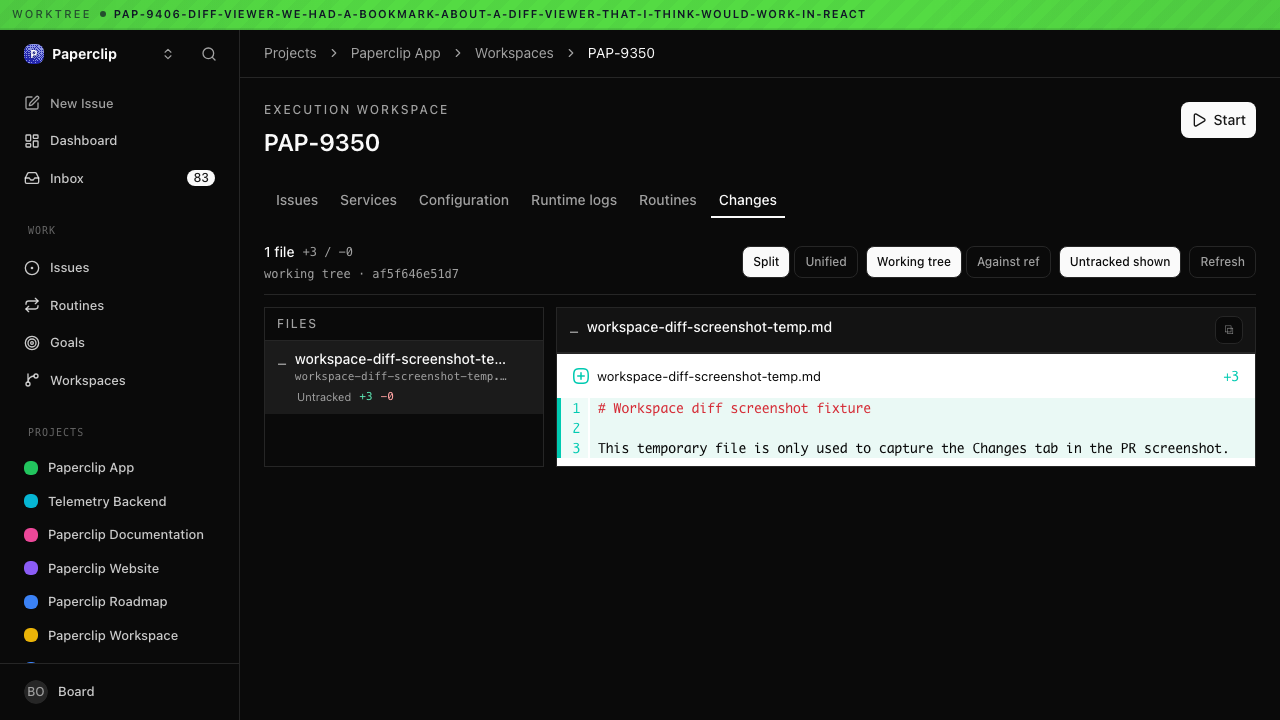
## Thinking Path > - Paperclip orchestrates AI agents for zero-human companies. > - Operators need to inspect what agents changed inside execution and project workspaces. > - The existing workspace detail views did not provide a first-party rich diff surface for staged, unstaged, head, renamed, binary, oversized, and untracked changes. > - The plugin system is the intended extension point for optional rich UI surfaces. > - This pull request adds a workspace diff plugin plus host services and shared contracts so Changes tabs can render workspace diffs through plugin slots. > - The diff-renderer dependency should stay owned by the plugin package rather than the core UI app. > - The dependency surface must stay aligned with repository PR policy, including intentionally omitting `pnpm-lock.yaml` from the PR. > - The benefit is a more reviewable workspace surface without hard-coding the renderer into every page. ## What Changed - Added `@paperclipai/plugin-workspace-diff`, including diff normalization, plugin manifest/worker/UI entrypoints, and focused plugin tests. - Kept `@pierre/diffs` scoped to `@paperclipai/plugin-workspace-diff`; removed the core UI lab diff-renderer surface and direct UI package dependency. - Added shared workspace diff types and validators, plus plugin SDK surface for workspace diff host services. - Added server workspace diff service support and route coverage for execution/project workspace diff flows. - Wired Execution Workspace and Project Workspace Changes tabs to load the diff plugin, including loading/error fallback behavior. - Added UI tests and fixtures for the Changes tabs and plugin bridge behavior. - Added the new plugin package manifest to the Docker deps stage so PR policy can validate dependency coverage. - Addressed review hardening around empty untracked patches, workspace path exposure, project workspace read capability checks, and default base refs. ## Verification - `pnpm --filter @paperclipai/plugin-workspace-diff test` - `pnpm exec vitest run packages/shared/src/validators/workspace-diff.test.ts server/src/__tests__/workspace-diff-service.test.ts ui/src/pages/ProjectWorkspaceDetail.test.tsx ui/src/pages/ExecutionWorkspaceDetail.test.tsx` - `pnpm exec vitest run ui/src/plugins/bridge.test.ts server/src/__tests__/workspace-runtime-routes-authz.test.ts` - `pnpm --filter @paperclipai/shared typecheck` - `pnpm --filter @paperclipai/plugin-workspace-diff typecheck` - `pnpm --filter @paperclipai/server typecheck` - `pnpm --filter @paperclipai/ui typecheck` - `node ./scripts/check-docker-deps-stage.mjs` - Browser screenshot captured from the local worktree dev server: https://files.catbox.moe/ofdpsp.png - Confirmed branch is rebased onto `public-gh/master`, `.github/workflows/pr.yml` is not included in the PR diff, `ui/package.json` is not included in the PR diff, and `pnpm-lock.yaml` is not included in the PR diff. ## Risks - Medium UI integration risk: the Changes tab depends on the plugin slot and host diff service path. - Medium dependency risk: this adds `@pierre/diffs` in the plugin package, but `pnpm-lock.yaml` is intentionally omitted per packaging instructions because repository automation manages lockfile updates. - Current CI blocker: downstream frozen installs fail until the repository policy path for new plugin package dependencies is chosen. - Diff rendering edge cases are covered for common working-tree and head diff states, but very large repositories may still expose performance limits. - No migrations are included. > For core feature work, check [`ROADMAP.md`](ROADMAP.md) first and discuss it in `#dev` before opening the PR. Feature PRs that overlap with planned core work may need to be redirected — check the roadmap first. See `CONTRIBUTING.md`. ## Model Used - OpenAI Codex, GPT-5 class coding model, tool-enabled local execution environment. Exact context window was not exposed by the runtime. ## Checklist - [x] I have included a thinking path that traces from project context to this change - [x] I have specified the model used (with version and capability details) - [x] I have checked ROADMAP.md and confirmed this PR does not duplicate planned core work - [x] I have run tests locally and they pass - [x] I have added or updated tests where applicable - [x] If this change affects the UI, I have included before/after screenshots - [x] I have updated relevant documentation to reflect my changes - [x] I have considered and documented any risks above - [x] I will address all Greptile and reviewer comments before requesting merge --------- Co-authored-by: Paperclip <noreply@paperclip.ing> |
||
|
Devin Foley
|
ab8b471685 |
Add built-in grok_local adapter (#6087)
## Thinking Path > - Paperclip orchestrates AI agents for zero-human companies, so adapter quality directly affects what runtimes the control plane can supervise. > - Local CLI adapters are one of the core execution surfaces because they turn real coding tools into Paperclip-managed employees with heartbeats, transcripts, and reviewability. > - Grok Build was installed on the Paperclip host, but Paperclip had no built-in `grok_local` adapter, so the runtime could not be configured through the normal server/UI/CLI adapter path. > - That gap needed to be closed with the same built-in registry, environment diagnostics, transcript parsing, and skill/instructions behavior that the other local adapters already rely on. > - After the initial adapter landed, a real follow-up run showed that Grok streaming text was being rendered one fragment per line, which made transcripts harder to read even though the runtime itself was working. > - This pull request adds the built-in `grok_local` adapter end-to-end and then fixes the transcript parser so streamed Grok output is coalesced into readable assistant/thinking blocks. > - The benefit is that Grok Build becomes a first-class Paperclip runtime with a usable operator experience instead of a partially wired runtime with noisy transcript output. ## What Changed - Added a new built-in `@paperclipai/adapter-grok-local` package with server, UI, and CLI entrypoints. - Implemented Grok execution, session handling, environment diagnostics, config building, skill syncing, and parser coverage inside the new adapter package. - Registered `grok_local` across the built-in adapter inventories and capability/display metadata in server, UI, CLI, and shared constants. - Added adapter route coverage for the new built-in type. - Fixed Grok transcript readability by emitting streamed `text` and `thought` fragments as deltas so the shared transcript builder coalesces them into readable message blocks. - Added regression tests for the Grok parser and transcript coalescing behavior. ## Verification - `pnpm vitest run packages/adapters/grok-local/src/ui/parse-stdout.test.ts ui/src/adapters/transcript.test.ts` - `pnpm --filter @paperclipai/adapter-grok-local build` - Manual runtime verification on the Paperclip host during implementation and follow-up review: - confirmed the Grok CLI was installed and authenticated - confirmed the worktree dev server could be restarted cleanly and health-checked after the parser follow-up - No screenshots attached. This change is primarily adapter plumbing plus transcript formatting behavior; reviewers can verify via the Grok-backed run surfaces directly. ## Risks - This adds a new built-in adapter, so any missed registration surface could create inconsistencies between server, UI, and CLI behavior. - The adapter depends on Grok Build's current event/output shape; if upstream Grok streaming JSON changes, transcript parsing or session extraction may need follow-up updates. - The transcript readability fix intentionally changes how Grok fragments are grouped, so any downstream code that implicitly expected one entry per fragment would behave differently. > For core feature work, check [`ROADMAP.md`](ROADMAP.md) first and discuss it in `#dev` before opening the PR. Feature PRs that overlap with planned core work may need to be redirected — check the roadmap first. See `CONTRIBUTING.md`. ## Model Used - OpenAI Codex via Paperclip `codex_local` agent runtime. - GPT-5-class coding model with tool use, shell execution, file editing, and repo inspection enabled. - Exact backend model ID/context window were not surfaced to the agent in this Paperclip session. ## Checklist - [x] I have included a thinking path that traces from project context to this change - [x] I have specified the model used (with version and capability details) - [x] I have checked ROADMAP.md and confirmed this PR does not duplicate planned core work - [x] I have run tests locally and they pass - [x] I have added or updated tests where applicable - [ ] If this change affects the UI, I have included before/after screenshots - [ ] I have updated relevant documentation to reflect my changes - [x] I have considered and documented any risks above - [x] I will address all Greptile and reviewer comments before requesting merge |
||
|
DottaandPaperclip
|
508355b8fc |
[codex] Add LLM Wiki plugin package to master (#5716)
## Thinking Path > - Paperclip orchestrates AI agents for zero-human companies. > - The plugin system is the extension surface for optional product capabilities without baking every workflow into core. > - The LLM Wiki plugin package was reviewed in stacked PR #5592, which targeted `pap-9173-llm-wiki-rest`. > - The stack base PR #5597 merged to `master` before #5592 was merged into that branch, so the plugin package never reached `master`. > - A direct PR from `pap-9173-llm-wiki-rest` back to `master` would be noisy because that branch has diverged from current `master`. > - This pull request reapplies the reviewed `packages/plugins/plugin-llm-wiki/` package onto current `master` and updates Docker deps-stage manifest coverage. > - The branch intentionally no longer changes `pnpm-workspace.yaml` after maintainer feedback; because the new package is now a root workspace importer, the remaining integration question is how maintainers want the root lockfile handled under the current PR policy. ## What Changed - Added the LLM Wiki plugin package under `packages/plugins/plugin-llm-wiki/` from the merged PR #5592 head. - Preserved the post-review cleanup from #5592: generated design/screenshot artifacts are not committed, and `src/ui/index.tsx` / `src/wiki.ts` are small public entrypoints. - Added the new plugin package manifest to the Docker deps stage so policy can validate package manifest coverage. - Removed the earlier `pnpm-workspace.yaml` exclusion per maintainer request, so the plugin is included by the existing `packages/plugins/*` workspace glob. ## Verification Current head: - PGlite migration harness: ran migrations 001-003, verified old non-space distillation unique constraints were removed, inserted duplicate cursor and work-item keys in a second space, then reran migration 003 successfully - `node ./scripts/check-docker-deps-stage.mjs` - `git diff --check` Known current-head install result after removing the workspace exclusion: - `pnpm install --frozen-lockfile` fails because `pnpm-lock.yaml` has no importer for `packages/plugins/plugin-llm-wiki/package.json`. Previously verified on the same plugin source before the workspace-exclusion removal: - `pnpm --filter @paperclipai/plugin-sdk build` - `cd packages/plugins/plugin-llm-wiki && pnpm install --lockfile=false && pnpm test` ## Risks - The branch now includes `packages/plugins/plugin-llm-wiki` in the root workspace but does not update `pnpm-lock.yaml`. Root frozen install will fail until maintainers choose a lockfile path that fits repo policy. - Committing `pnpm-lock.yaml` directly on this PR conflicts with the current PR policy check, while excluding the package from `pnpm-workspace.yaml` was rejected in maintainer feedback. - The package includes UI code already reviewed in #5592; generated screenshot/design artifacts were intentionally removed per maintainer request, so visual review should regenerate screenshots locally if needed. - The package depends on plugin host support from #5597, which is already merged to `master`. > For core feature work, check [`ROADMAP.md`](ROADMAP.md) first and discuss it in `#dev` before opening the PR. Feature PRs that overlap with planned core work may need to be redirected — check the roadmap first. See `CONTRIBUTING.md`. ## Model Used - OpenAI GPT-5 Codex via Codex CLI, tool use and local code execution enabled; context window not exposed. ## Checklist - [x] I have included a thinking path that traces from project context to this change - [x] I have specified the model used (with version and capability details) - [x] I have checked ROADMAP.md and confirmed this PR does not duplicate planned core work - [x] I have run the targeted checks listed above - [x] I have added or updated tests where applicable - [ ] If this change affects the UI, I have included before/after screenshots - [x] I have updated relevant documentation to reflect my changes - [x] I have considered and documented any risks above - [x] I will address all Greptile and reviewer comments before requesting merge Stack context: #5592 was merged into `pap-9173-llm-wiki-rest` after #5597 had already merged that branch to `master`, so this follow-up PR is needed to carry the plugin package itself into `master`. Co-authored-by: Paperclip <noreply@paperclip.ing> |
||
|
DottaandPaperclip
|
21404e8a34 |
[codex] Fix Docker build without LLM wiki plugin package (#5714)
## Thinking Path > - Paperclip is the control plane for autonomous AI companies, and its Docker image needs to build from the checked-in core repository. > - The Docker `deps` stage copies workspace package manifests before running `pnpm install --frozen-lockfile` so dependency installation can be cached. > - Current `master` copied `packages/plugins/plugin-llm-wiki/package.json`, but that plugin package has not been merged into core yet. > - Docker fails before install with a missing build-context path, so the release image cannot build from the current repository state. > - This pull request removes the premature plugin manifest copy while leaving the plugin SDK and existing sandbox plugin package copies intact. > - The benefit is that the Docker build no longer depends on an unmerged plugin package. ## What Changed - Removed the `packages/plugins/plugin-llm-wiki/package.json` copy from the Dockerfile `deps` stage. ## Verification - `git diff --check` - Static Dockerfile source validation: parsed non-stage `COPY` sources and confirmed every source exists in the build context. - Attempted `docker build --target deps --progress=plain -t paperclip-pap-9235-deps-check .`, but Docker is unavailable in this execution environment: `Cannot connect to the Docker daemon at unix:///Users/dotta/.docker/run/docker.sock`. ## Risks - Low risk. The removed path points to a package that is absent from the repository, so retaining it is what breaks the build. The plugin can add its manifest copy back when the package itself lands. > For core feature work, check [`ROADMAP.md`](ROADMAP.md) first and discuss it in `#dev` before opening the PR. Feature PRs that overlap with planned core work may need to be redirected — check the roadmap first. See `CONTRIBUTING.md`. ## Model Used - OpenAI Codex using GPT-5, tool-enabled coding agent in a local repository workspace. Exact context-window metadata is not exposed in this runtime. ## Checklist - [x] I have included a thinking path that traces from project context to this change - [x] I have specified the model used (with version and capability details) - [x] I have checked ROADMAP.md and confirmed this PR does not duplicate planned core work - [x] I have run tests locally and they pass - [x] I have added or updated tests where applicable - [x] If this change affects the UI, I have included before/after screenshots - [x] I have updated relevant documentation to reflect my changes - [x] I have considered and documented any risks above - [x] I will address all Greptile and reviewer comments before requesting merge Co-authored-by: Paperclip <noreply@paperclip.ing> |
||
|
Devin FoleyandPaperclip
|
534aee66ae |
Add cursor_cloud adapter for Cursor SDK + Cloud Agents API v1 (#5664)
## Thinking Path

> - Paperclip orchestrates AI agents for zero-human companies
> - There are many adapter types, one per agent-runtime product (Claude,
Codex, OpenCode, Cursor local CLI, etc.)
> - Cursor shipped a public TypeScript SDK on 2026-04-29 that exposes
Cursor's full hosted-agent platform (cloud VMs, harness, MCP, skills,
hooks)
> - Paperclip had no first-class adapter for this — agents that wanted
to use Cursor's managed cloud runtime had to fall back to the local CLI
adapter, which loses the cloud session, streaming, and durable run model
> - This PR adds a new `cursor_cloud` adapter built directly on
`@cursor/sdk`, with Paperclip's heartbeat mapped to Cursor's
durable-agent + per-run model
> - The benefit is that any Paperclip agent can now drive a Cursor cloud
agent across heartbeats with native session reuse, streaming, and
cancellation, while Paperclip remains the source of truth for issue/task
state

## What Changed

- New built-in adapter package `packages/adapters/cursor-cloud` (15
files, ~1.7k LOC) backed by `@cursor/sdk` ^1.0.12
- `src/server/execute.ts` — SDK-first lifecycle: `Agent.create` /
`Agent.resume` / `Agent.getRun` / `agent.send` / `run.stream` /
`run.wait`, with session reuse keyed on the (runtime env type, env name,
repo set) tuple
- `src/server/session.ts` — codec for `cursorAgentId` + `latestRunId` +
repo metadata, persisted in `runtime.sessionParams`
- `src/server/test.ts` — environment probe via `Cursor.me()` and
optional model validation via `Cursor.models.list()`
- `src/ui/parse-stdout.ts` + `src/cli/format-event.ts` — normalize
Cursor SDK message types (`status`, `thinking`, `assistant`, `user`,
`tool_call`, `tool_result`, `result`) into Paperclip transcript events
for the UI and CLI
- Registrations: `packages/shared/src/constants.ts`,
`packages/adapter-utils/src/session-compaction.ts`,
`server/src/adapters/{registry,builtin-adapter-types}.ts`,
`ui/src/adapters/{registry,adapter-display-registry}.ts` +
`ui/src/adapters/cursor-cloud/index.ts`, `cli/src/adapters/registry.ts`,
plus workspace deps in `cli`/`server`/`ui` `package.json`
- `ui/src/components/AgentConfigForm.tsx` — hide local-Cursor
`mode`/thinking-effort field for `cursor_cloud` (different config
surface)
- 11 vitest tests covering execute paths (fresh create, matching-resume,
active-run reattach, non-finished result), session codec round-trip,
transcript parsing, and config building

## Verification

Reviewer steps:

```bash
pnpm install
pnpm --filter @paperclipai/adapter-cursor-cloud typecheck   # → clean
pnpm vitest run packages/adapters/cursor-cloud              # → 11/11 passing
```

End-to-end check against a real Cursor cloud agent (requires
`CURSOR_API_KEY` and Cursor GitHub-app install on the target repo):

1. Create a `cursor_cloud` agent in Paperclip with `repoUrl` set to the
test repo, `repoStartingRef: main`, and `env.CURSOR_API_KEY` set
2. Trigger a heartbeat → adapter calls `Agent.create({ cloud: { env: {
type: "cloud" }, repos: [...] } })`, streams events, terminates on
`finished`
3. Trigger a second heartbeat → adapter calls `Agent.resume` or
`agent.send` follow-up depending on prior-run state, reusing
`cursorAgentId`
4. The Paperclip UI/CLI transcript reflects Cursor `status` / `thinking`
/ `assistant` events as they stream
5. Cancellation from Paperclip maps to `run.cancel()` or Cloud API v1
`cancelRun` for cross-heartbeat cancellation

A direct-SDK smoke run against a real repo (devinfoley/my_test_project @
main) confirmed: `Cursor.me()` ok → `Agent.create` → `agent.send` →
`run.stream()` (30 events) → terminal status `finished` in ~11s.

## Risks

- **New adapter, additive only.** No existing adapter or registry is
replaced; current `cursor` local-CLI adapter is untouched. Default
behavior of any existing agent is unchanged.
- **External dependency on `@cursor/sdk`.** Cursor's SDK is v1.0.x and
may evolve. Mocked unit tests cover the public surface used here; if the
SDK breaks compatibility we update the adapter independently.
- **Cost/budget.** `cursor_cloud` runs on Cursor's billed cloud VMs;
operators must understand they are spending money outside Paperclip's
budget controls when they enable this adapter. Same shape as other
API-billed adapters.
- **No webhook support in V1.** The SDK already provides
stream/wait/cancel/reattach, so V1 does not require a public callback
URL. If a future use case needs out-of-band wakes, we add a Cloud API v1
webhook bridge as a separate change. This is called out in the issue
plan document.
- **Lockfile.** Per repo policy, `pnpm-lock.yaml` is intentionally not
in this PR — CI's lockfile workflow will update it on merge given the
manifest changes.

## Model Used

- Provider: Anthropic Claude (via Claude Code / Paperclip `claude_local`
adapter)
- Model: `claude-opus-4-7` (Claude Opus 4.7), knowledge cutoff January
2026
- Mode: standard tool-use with extended reasoning
- Context: ~200k token window
- Capabilities used: code generation, multi-file edits, shell/test
execution, GitHub PR workflow

## Checklist

- [x] I have included a thinking path that traces from project context
to this change
- [x] I have specified the model used (with version and capability
details)
- [x] I have checked ROADMAP.md and confirmed this PR does not duplicate
planned core work
- [x] I have run tests locally and they pass (11/11 in
`packages/adapters/cursor-cloud`)
- [x] I have added or updated tests where applicable (4 new test files,
11 cases)
- [ ] If this change affects the UI, I have included before/after
screenshots (the only UI change is hiding the local-Cursor mode field on
the `cursor_cloud` adapter — happy to attach a screenshot if the
reviewer wants one)
- [x] I have updated relevant documentation to reflect my changes (issue
plan document supersedes the pre-SDK design; tracked in PAPA-203)
- [x] I have considered and documented any risks above
- [x] I will address all Greptile and reviewer comments before
requesting merge

---------

Co-authored-by: Paperclip <noreply@paperclip.ing>
|
||
|
DottaandPaperclip
|
0096b56a1c |
[codex] Add LLM Wiki plugin host support (#5597)
## Thinking Path > - Paperclip orchestrates AI agents for zero-human companies. > - The plugin system needs host contracts and runtime support before large plugins can integrate cleanly. > - The source branch mixed the LLM Wiki package with supporting host/runtime work, managed plugin skills, root-level storage spaces, and a bookmarks reference plugin. > - [PAP-9173](/PAP/issues/PAP-9173) asked for the current branch to be split by file boundary: plugin package separately from everything else. > - [PAP-9188](/PAP/issues/PAP-9188) clarified that LLM Wiki may have plugin-local spaces, but Paperclip core should not reorganize top-level local storage into spaces. > - Follow-up review clarified that the bookmarks example should not ship in this PR either. > - This pull request contains the non-`packages/plugins/plugin-llm-wiki/` host/runtime work, keeps runtime state under the selected Paperclip instance root, and no longer includes the bookmarks example. ## What Changed - Added/updated plugin host contracts, SDK types, worker RPC plumbing, managed plugin skill support, and related server tests. - Removed the bookmarks example plugin package and its bundled-example/workspace references. - Removed the root-level local spaces CLI/migration surface and restored instance-root runtime defaults for config, db, logs, storage, secrets, workspaces, projects, and adapter homes. - Replaced shared root `space-paths` helpers with `home-paths` helpers for core runtime storage. - Tightened stranded recovery unique-conflict detection so concurrent recovery scans reuse the raced recovery issue when Postgres errors are wrapped. - Kept `packages/plugins/plugin-llm-wiki/` out of this PR diff; plugin-local spaces remain in the stacked plugin-only PR. ## Verification - `pnpm exec vitest run cli/src/__tests__/data-dir.test.ts cli/src/__tests__/home-paths.test.ts cli/src/__tests__/onboard.test.ts packages/shared/src/home-paths.test.ts packages/db/src/runtime-config.test.ts server/src/__tests__/agent-instructions-service.test.ts server/src/__tests__/claude-local-execute.test.ts server/src/__tests__/codex-local-execute.test.ts` - `pnpm exec vitest run packages/db/src/runtime-config.test.ts` - `pnpm exec vitest run server/src/__tests__/plugin-routes-authz.test.ts` - `pnpm --filter @paperclipai/server typecheck` - `pnpm exec vitest run server/src/__tests__/heartbeat-process-recovery.test.ts -t "reuses the raced stranded recovery issue"` skipped locally because embedded Postgres did not initialize on this macOS temp host; the code path was typechecked and is covered by Linux CI. - Boundary check: no core references remain for `PAPERCLIP_SPACE_ID`, `spaces migrate-default`, `@paperclipai/shared/space-paths`, `registerSpacesCommands`, or the removed bookmarks example. - Previous PR head `4f23e034` had green GitHub checks: `verify`, all four serialized server shards, `e2e`, `Canary Dry Run`, `policy`, Snyk, and `Greptile Review`. Current head `582f466d` is re-running checks after the bookmarks deletion. ## Risks - Plugin host changes touch shared runtime paths, so regressions would most likely appear in adapter startup, plugin loading, or local dev path defaults. - Removing the bookmarks example also removes one demonstration of plugin database namespaces plus local-folder persistence; remaining plugin examples still cover bundled example discovery and plugin host flows. - The plugin package itself is intentionally deferred to the stacked plugin-only PR, where LLM Wiki plugin-local spaces live. - Existing installs that tested the transient root-level spaces CLI should stop using it; this PR intentionally removes that unsupported migration surface before merge. > For core feature work, check [`ROADMAP.md`](ROADMAP.md) first and discuss it in `#dev` before opening the PR. Feature PRs that overlap with planned core work may need to be redirected — check the roadmap first. See `CONTRIBUTING.md`. ## Model Used - OpenAI GPT-5 Codex via Codex CLI, tool use and local code execution enabled; context window not exposed. ## Checklist - [x] I have included a thinking path that traces from project context to this change - [x] I have specified the model used (with version and capability details) - [x] I have checked ROADMAP.md and confirmed this PR does not duplicate planned core work - [x] I have run tests locally and they pass, except where noted above for host-specific embedded Postgres initialization - [x] I have added or updated tests where applicable - [x] If this change affects the UI, I have included before/after screenshots - [x] I have updated relevant documentation to reflect my changes - [x] I have considered and documented any risks above - [x] I will address all Greptile and reviewer comments before requesting merge Stacked follow-up: PR #5592 contains only `packages/plugins/plugin-llm-wiki/` and targets this branch. --------- Co-authored-by: Paperclip <noreply@paperclip.ing> |
||
|
DottaandPaperclip
|
4272c1604d |
Add ACPX local adapter runtime (#4893)
## Thinking Path > - Paperclip orchestrates AI-agent companies through a control plane that can start, supervise, and recover agent runs. > - Local adapters are the bridge between Paperclip issues and concrete agent runtimes such as Claude, Codex, and other ACP-compatible tools. > - The roadmap calls out broader “bring your own agent” and claw-style agent support, and ACPX gives Paperclip one path to normalize multiple ACP agents behind a single adapter. > - The branch needed to become one reviewable PR against current `paperclipai/paperclip:master`, without carrying stale base conflicts or generated lockfile churn. > - This pull request adds an experimental built-in `acpx_local` adapter, integrates it through the server/CLI/UI adapter surfaces, and adds regression coverage for runtime execution, skill sync, stream parsing, diagnostics, and log redaction. > - The benefit is that Paperclip can run Claude/Codex/custom ACP agents through ACPX while keeping operator configuration, skills, logging, and transcript rendering inside the existing adapter model. ## What Changed - Added `@paperclipai/adapter-acpx-local` with server execution, config schema, ACPX session handling, CLI formatting, UI config helpers, and stdout parsing. - Registered `acpx_local` across CLI, server, shared constants, UI adapter metadata, adapter capabilities, and agent creation/editing surfaces. - Added ACPX runtime execution support with persistent sessions, local-agent JWT environment handling, skill snapshots, runtime skill materialization, and isolation/security regressions. - Added ACPX adapter diagnostics and marked the adapter experimental in the UI. - Added command/env secret redaction for resolved command metadata in adapter-utils, server event storage, and the Agent Detail invocation UI. - Added Storybook coverage for ACPX config, transcript rendering, and skill states, plus PR screenshots under `docs/pr-screenshots/pap-2944/`. - Rebased the branch onto current `public-gh/master`; `pnpm-lock.yaml` is intentionally not included and there are no migration/schema changes. ## Verification - `pnpm exec vitest run packages/adapters/acpx-local/src/server/execute.test.ts packages/adapters/acpx-local/src/server/test.test.ts packages/adapters/acpx-local/src/cli/format-event.test.ts packages/adapters/acpx-local/src/ui/parse-stdout.test.ts packages/adapter-utils/src/server-utils.test.ts server/src/__tests__/redaction.test.ts server/src/__tests__/acpx-local-execute.test.ts server/src/__tests__/acpx-local-skill-sync.test.ts server/src/__tests__/acpx-local-adapter-environment.test.ts server/src/__tests__/adapter-routes.test.ts server/src/__tests__/agent-skills-routes.test.ts ui/src/adapters/metadata.test.ts` — 12 files, 87 tests passed. - `pnpm --filter @paperclipai/adapter-acpx-local typecheck` — passed. - `pnpm --filter @paperclipai/server typecheck` — passed. - `pnpm --filter @paperclipai/ui typecheck` — passed. - Confirmed PR diff does not include `pnpm-lock.yaml`, database schema files, or migrations. Screenshots:    ## Risks - Medium risk: this introduces a new built-in adapter package and touches runtime execution, adapter registration, agent config, skills, and transcript rendering. - ACPX and ACP agent behavior can vary by installed tool versions; the adapter is marked experimental to set operator expectations. - `pnpm-lock.yaml` is excluded per repository PR policy, so dependency lock refresh must be handled by the repo’s automation or maintainers. - No database migration risk: no schema or migration files changed. > For core feature work, check [`ROADMAP.md`](ROADMAP.md) first and discuss it in `#dev` before opening the PR. Feature PRs that overlap with planned core work may need to be redirected — check the roadmap first. See `CONTRIBUTING.md`. ## Model Used - OpenAI Codex coding agent based on GPT-5, with repository tool use, shell execution, git operations, and local verification. Exact hosted context window was not exposed in this environment. ## Checklist - [x] I have included a thinking path that traces from project context to this change - [x] I have specified the model used (with version and capability details) - [x] I have checked ROADMAP.md and confirmed this PR does not duplicate planned core work - [x] I have run tests locally and they pass - [x] I have added or updated tests where applicable - [x] If this change affects the UI, I have included before/after screenshots - [x] I have updated relevant documentation to reflect my changes - [x] I have considered and documented any risks above - [x] I will address all Greptile and reviewer comments before requesting merge --------- Co-authored-by: Paperclip <noreply@paperclip.ing> |
||
|
Devin Foley
|
4ef969f084 |
Add E2B sandbox provider plugin (#4452)
## Thinking Path > - Paperclip orchestrates AI agents for zero-human companies > - Sandbox environments are part of that execution layer, and the recent core refactor moved provider-specific behavior to a generic plugin seam > - This pull request adds a dedicated `@paperclipai/plugin-e2b` package so E2B can live entirely outside core host code > - Because the feature is still unreleased, the plugin should model third-party packaging directly instead of carrying extra backward-compatibility complexity in core or the workspace lockfile > - This branch therefore makes the E2B provider a standalone publishable package, documents the package-local dev flow, and keeps the publish manifest/runtime dependency story correct > - The benefit is that E2B becomes a true plugin reference implementation that can be installed by package name without reopening core Paperclip code ## What Changed - Added `packages/plugins/paperclip-plugin-e2b` as the E2B sandbox provider plugin package - Implemented config validation, lease acquire/resume/release/destroy handlers, workspace realization, and command execution for E2B sandboxes - Excluded the E2B plugin package from the root workspace so the repo no longer needs `pnpm-lock.yaml` churn for its third-party dependency graph - Added package-local development/install support plus a prepack manifest generator so the published tarball still declares `@paperclipai/plugin-sdk` and `e2b` runtime dependencies - Addressed review feedback by fixing sandbox cleanup on acquire failures, rejecting blank templates, normalizing fractional `timeoutMs`, and always passing the configured template name to the E2B SDK - Updated focused Vitest coverage for config normalization, validation, acquire cleanup, command execution, and lease release behavior - Updated the Dockerfile deps stage to copy the E2B package manifest so the policy check stays in sync ## Verification - `cd packages/plugins/paperclip-plugin-e2b && pnpm install --ignore-workspace --no-lockfile` - `cd packages/plugins/paperclip-plugin-e2b && pnpm build` - `cd packages/plugins/paperclip-plugin-e2b && pnpm --ignore-workspace test` - `cd packages/plugins/paperclip-plugin-e2b && pnpm --ignore-workspace typecheck` - `cd packages/plugins/paperclip-plugin-e2b && npm pack --dry-run` ## Risks - The package now relies on a prepack manifest rewrite so the publish-time dependency list stays correct while the repo-local dev manifest stays workspace-light - The current repo snapshot is still unreleased, so the generated publish manifest points at the repo SDK version until the normal release flow rewrites versions before publish - Real-world E2B environments may still expose edge cases around lifecycle timing or sandbox metadata beyond the mocked unit coverage > For core feature work, check [`ROADMAP.md`](ROADMAP.md) first and discuss it in `#dev` before opening the PR. Feature PRs that overlap with planned core work may need to be redirected — check the roadmap first. See `CONTRIBUTING.md`. ## Model Used - OpenAI Codex via `codex_local` - Model ID: `gpt-5.4` - Reasoning effort: `high` - Context window observed in runtime session metadata: `258400` tokens - Capabilities used: terminal tool execution, git, GitHub CLI, and local build/test inspection ## Checklist - [x] I have included a thinking path that traces from project context to this change - [x] I have specified the model used (with version and capability details) - [x] I have checked ROADMAP.md and confirmed this PR does not duplicate planned core work - [x] I have run tests locally and they pass - [x] I have added or updated tests where applicable - [ ] If this change affects the UI, I have included before/after screenshots - [x] I have updated relevant documentation to reflect my changes - [x] I have considered and documented any risks above - [x] I will address all Greptile and reviewer comments before requesting merge |
||
|
Devin Foley
|
70679a3321 |
Add sandbox environment support (#4415)
## Thinking Path > - Paperclip orchestrates AI agents for zero-human companies. > - The environment/runtime layer decides where agent work executes and how the control plane reaches those runtimes. > - Today Paperclip can run locally and over SSH, but sandboxed execution needs a first-class environment model instead of one-off adapter behavior. > - We also want sandbox providers to be pluggable so the core does not hardcode every provider implementation. > - This branch adds the Sandbox environment path, the provider contract, and a deterministic fake provider plugin. > - That required synchronized changes across shared contracts, plugin SDK surfaces, server runtime orchestration, and the UI environment/workspace flows. > - The result is that sandbox execution becomes a core control-plane capability while keeping provider implementations extensible and testable. ## What Changed - Added sandbox runtime support to the environment execution path, including runtime URL discovery, sandbox execution targeting, orchestration, and heartbeat integration. - Added plugin-provider support for sandbox environments so providers can be supplied via plugins instead of hardcoded server logic. - Added the fake sandbox provider plugin with deterministic behavior suitable for local and automated testing. - Updated shared types, validators, plugin protocol definitions, and SDK helpers to carry sandbox provider and workspace-runtime contracts across package boundaries. - Updated server routes and services so companies can create sandbox environments, select them for work, and execute work through the sandbox runtime path. - Updated the UI environment and workspace surfaces to expose sandbox environment configuration and selection. - Added test coverage for sandbox runtime behavior, provider seams, environment route guards, orchestration, and the fake provider plugin. ## Verification - Ran locally before the final fixture-only scrub: - `pnpm -r typecheck` - `pnpm test:run` - `pnpm build` - Ran locally after the final scrub amend: - `pnpm vitest run server/src/__tests__/runtime-api.test.ts` - Reviewer spot checks: - create a sandbox environment backed by the fake provider plugin - run work through that environment - confirm sandbox provider execution does not inherit host secrets implicitly ## Risks - This touches shared contracts, plugin SDK plumbing, server runtime orchestration, and UI environment/workspace flows, so regressions would likely show up as cross-layer mismatches rather than isolated type errors. - Runtime URL discovery and sandbox callback selection are sensitive to host/bind configuration; if that logic is wrong, sandbox-backed callbacks may fail even when execution succeeds. - The fake provider plugin is intentionally deterministic and test-oriented; future providers may expose capability gaps that this branch does not yet cover. ## Model Used - OpenAI Codex coding agent on a GPT-5-class backend in the Paperclip/Codex harness. Exact backend model ID is not exposed in-session. Tool-assisted workflow with shell execution, file editing, git history inspection, and local test execution. ## Checklist - [x] I have included a thinking path that traces from project context to this change - [x] I have specified the model used (with version and capability details) - [x] I have checked ROADMAP.md and confirmed this PR does not duplicate planned core work - [x] I have run tests locally and they pass - [x] I have added or updated tests where applicable - [ ] If this change affects the UI, I have included before/after screenshots - [x] I have updated relevant documentation to reflect my changes - [x] I have considered and documented any risks above - [x] I will address all Greptile and reviewer comments before requesting merge |
||
|
Roman Barinov
|
e93e418cbf |
fix: add ssh client and jq to production image (#3826)
## Thinking Path > - Paperclip is the control plane that runs long-lived AI-agent work in production. > - The production container image is the runtime boundary for agent tools and shell access. > - In our deployment, Paperclip agents now need a native SSH client and `jq` available inside the final runtime container. > - Installing those tools only via ai-rig entrypoint hacks is brittle and drifts from the image source of truth. > - This pull request updates the production Docker image itself so the required binaries are present whenever the image is built. > - The change is intentionally scoped to the final production stage so build/deps stages do not gain extra packages unnecessarily. > - The benefit is a cleaner, reproducible runtime image with fewer deploy-specific workarounds. ## What Changed - Added `openssh-client` to the production Docker image stage. - Added `jq` to the production Docker image stage. - Kept the package install in the final `production` stage instead of the shared base stage to minimize scope. ## Verification - Reviewed the final Dockerfile diff to confirm the packages are installed in the `production` stage only. - Attempted local image build with: - `docker build --target production -t paperclip:ssh-jq-test .` - Local build could not be completed in this environment because the local Docker daemon was unavailable: - `Cannot connect to the Docker daemon at unix:///Users/roman/.docker/run/docker.sock. Is the docker daemon running?` ## Risks - Low risk: image footprint increases slightly because two Debian packages are added. - `openssh-client` expands runtime capability, so this is appropriate only because the deployed Paperclip runtime explicitly needs SSH access. ## Model Used - OpenAI Codex / `gpt-5.4` - Tool-using agent workflow via Hermes - Context from local repository inspection, git, and shell tooling ## Checklist - [x] I have included a thinking path that traces from project context to this change - [x] I have specified the model used (with version and capability details) - [ ] I have run tests locally and they pass - [ ] I have added or updated tests where applicable - [ ] If this change affects the UI, I have included before/after screenshots - [ ] I have updated relevant documentation to reflect my changes - [x] I have considered and documented any risks above - [x] I will address all Greptile and reviewer comments before requesting merge |
||
|
DottaandPaperclip
|
407e76c1db |
[codex] Fix Docker gh installation (#3844)
## Thinking Path > - Paperclip is the control plane for autonomous AI companies, and the Docker image is the no-local-Node path for running that control plane. > - The deploy workflow builds and pushes that image from the repository `Dockerfile`. > - The current image setup adds GitHub CLI through GitHub's external apt repository and verifies a mutable keyring URL with a pinned SHA256. > - GitHub rotated the CLI Linux package signing key, so that pinned keyring checksum now fails before Buildx can publish the image. > - Paperclip already has a repo-local precedent in `docker/untrusted-review/Dockerfile`: install Debian trixie's packaged `gh` directly from the base distribution. > - This pull request removes the external GitHub CLI apt keyring/repository path from the production image and installs `gh` with the rest of the Debian packages. > - The benefit is a simpler Docker build that no longer fails when GitHub rotates the apt keyring file. ## What Changed - Updated the main `Dockerfile` base stage to install `gh` from Debian trixie's package repositories. - Removed the mutable GitHub CLI apt keyring download, pinned checksum verification, extra apt source, second `apt-get update`, and separate `gh` install step. ## Verification - `git diff --check` - `./scripts/docker-build-test.sh` skipped because Docker is installed but the daemon is not running on this machine. - Confirmed `https://packages.debian.org/trixie/gh` returns HTTP 200, matching the base image distribution package source. ## Risks - Debian's `gh` package can lag the latest upstream GitHub CLI release. This is acceptable for the current image contract, which requires `gh` availability but does not document a latest-upstream version guarantee. - A full image build still needs to run in CI because the local Docker daemon is unavailable in this environment. ## Model Used - OpenAI Codex, GPT-5-based coding agent. Exact backend model ID was not exposed in this runtime; tool use and shell execution were enabled. ## Checklist - [x] I have included a thinking path that traces from project context to this change - [x] I have specified the model used (with version and capability details) - [x] I have run tests locally and they pass - [x] I have added or updated tests where applicable - [x] If this change affects the UI, I have included before/after screenshots - [x] I have updated relevant documentation to reflect my changes - [x] I have considered and documented any risks above - [x] I will address all Greptile and reviewer comments before requesting merge Co-authored-by: Paperclip <noreply@paperclip.ing> |
||
|
dottaandPaperclip
|
85ca675311 |
fix(docker): include mcp server manifest in deps stage
Co-Authored-By: Paperclip <noreply@paperclip.ing> |
||
|
Cody (Radius Red)andPaperclip
|
420cd4fd8d |
chore(docker): improve base image and organize docker files
- Add wget, ripgrep, python3, and GitHub CLI (gh) to base image - Add OPENCODE_ALLOW_ALL_MODELS=true to production ENV - Move compose files, onboard-smoke Dockerfile to docker/ - Move entrypoint script to scripts/docker-entrypoint.sh - Add Podman Quadlet unit files (pod, app, db containers) - Add docker/README.md with build, compose, and quadlet docs - Add scripts/docker-build-test.sh for local build validation - Update all doc references for new file locations - Keep main Dockerfile at project root (no .dockerignore changes needed) Co-Authored-By: Paperclip <noreply@paperclip.ing> |
||
|
Cody (Radius Red)andPaperclip
|
d134d5f3a1 |
fix: support host UID/GID mapping for volume mounts
- Add USER_UID/USER_GID build args to Dockerfile - Install gosu and remap node user/group at build time - Set node home directory to /paperclip so agent credentials resolve correctly - Add docker-entrypoint.sh for runtime UID/GID remapping via gosu Co-Authored-By: Paperclip <noreply@paperclip.ing> |
||
|
Devin FoleyandClaude Opus 4.6
|
0a952dc93d |
fix(docker): copy patches directory into deps stage
pnpm install needs the patches/ directory to resolve patched dependencies (embedded-postgres). Without it, --frozen-lockfile fails with ENOENT on the patch file. Co-Authored-By: Claude Opus 4.6 <noreply@anthropic.com> |
||
|
Devin FoleyandClaude Opus 4.6
|
fd4df4db48 |
fix(docker): add plugin-sdk to Dockerfile build
The plugin framework landed without updating the Dockerfile. The server now imports @paperclipai/plugin-sdk, so the deps stage needs its package.json for install and the build stage needs to compile it before building the server. Co-Authored-By: Claude Opus 4.6 <noreply@anthropic.com> |
||
|
zvictor
|
9c6a913ef1 | fix(docker): include gemini adapter manifest in deps stage | ||
|
AiMagic5000
|
57406dbc90 |
fix(docker): run production server as non-root node user
Switch the production stage to the built-in node user from node:lts-trixie-slim, fixing two runtime failures: 1. Claude CLI rejects --dangerously-skip-permissions when the process UID is 0, making the claude-local adapter unusable. 2. The server crashed at startup (EACCES) because /paperclip was root-owned and the process could not write logs or instance data. Changes vs the naive fix: - Use COPY --chown=node:node instead of a separate RUN chown -R, avoiding a duplicate image layer that would double the size of the /app tree in the final image. - Consolidate mkdir /paperclip + chown into the same RUN layer as the npm global install (already runs as root) to keep layer count minimal. - Add USER node before CMD so the process runs unprivileged. The VOLUME declaration comes after chown so freshly-mounted anonymous volumes inherit the correct node:node ownership. Fixes #344 |
||
|
Dotta
|
b090c33ca1 |
Merge pull request #283 from mingfang/patch-1
Add pi-local package.json to Dockerfile |
||
|
Ming Fang
|
ff3f04ff48 | Add opencode-ai to global npm install in Dockerfile | ||
|
Ming Fang
|
77e06c57f9 | Add pi-local package.json to Dockerfile | ||
|
Dotta
|
048e2b1bfe | Remove legacy OpenClaw adapter and keep gateway-only flow | ||
|
zvictor
|
201d91b4f5 |
add support to cursor and opencode in containerized instances
|
||
|
zvictor
|
0d36cf00f8 | Add artifact-check to fail fast on broken builds | ||
|
zvictor
|
1f261d90f3 |
add missing openclaw adapter from deps stage
|
||
|
zvictor
|
d2dd8d0cc5 | fix incorrect pkg scope | ||
|
Victor Duarte
|
e08362b667 | update docker base image | ||
|
Victor Duarte
|
2c809d55c0 |
move docker into authenticated deployment mode
|
||
|
ForgottenandClaude Opus 4.6
|
1e11806fa3 |
feat: Docker quickstart with Compose, docs, and improved Dockerfile
Rewrites Dockerfile to use bookworm-slim base, installs Claude and Codex CLIs, adds docker-compose.quickstart.yml for one-command setup, and adds DOCKER.md with usage instructions. Co-Authored-By: Claude Opus 4.6 <noreply@anthropic.com> |
||
|
ForgottenandClaude Opus 4.6
|
481b3a46db |
Add project scaffolding and infrastructure config
pnpm monorepo with shared packages, server, and UI workspaces. Includes Docker multi-stage build, Postgres compose, and root TypeScript/Vitest config. Co-Authored-By: Claude Opus 4.6 <noreply@anthropic.com> |