mirror of
https://github.com/paperclipai/paperclip.git
synced 2026-11-20 09:50:48 +01:00
f0bd99ba8a5cccec7f8c0b91736aa2576e002de7
13
Commits
| Author | SHA1 | Message | Date | |
|---|---|---|---|---|
 Nicky LeachandPaperclip |
f05b90508a |
refactor(core): remove retired compatibility paths (#22055)
## Thinking Path > - Paperclip is the open source app people use to manage AI agents for work. > - Core manages chat authorization, AI connection defaults, navigation, and the plugin host. > - Core still writes old default rows and checks an Agent Chat flag that always reads true. > - It also carries a desktop rail that cannot open and private aliases with canonical equivalents. > - This pull request removes those paths and moves their tests onto the paths Core uses. > - The result is fewer Core database operations and less code to maintain. ## Linked Issues or Issue Description **What existing behavior does this improve?** Core AI default writes, Agent Chat execution and delivery, private plugin host and Runner setup, and board navigation. **Subsystem affected** Cross-cutting. Core server, board UI, private Runner helpers, and a repository guard script. **Current behavior** The server writes provider-scoped and per-method AI defaults, then reads only the provider-scoped rows. It reads settings to decide whether to block Agent Chat, although every settings view enables it. The desktop sidebar renders expanded while still tracking requests to open and close a retired icon rail. The agent client retries conflicts that the server already resolves when there is exactly one active match. **Proposed behavior** Write provider-scoped defaults directly. Use the existing Agent Chat authorization and retry checks without the redundant settings reads. Render the current sidebar directly and let the API report true agent reference conflicts. **Reason and benefit** A personal non-custom connection save or explicit default selection sends one fewer SQL statement. It also avoids the provider-default write that the legacy trigger performed when the old statement inserted or updated a row. A successful task-to-chat send or receipt replay avoids two transaction settings SELECTs when the singleton row already exists. Conversation comment, wake release, and retry paths also avoid a transaction settings read when they previously entered the gate. Savings in other settings paths depend on cache hits. Core-to-plugin RPC and plugin-to-Launcher HTTP traffic stay the same. **Breaking changes** The public plugin SDK, host navigation, and organization-switcher fields retain their existing interfaces and behavior. The settings API still accepts and reports the Agent Chat compatibility key. This change needs no schema migration or rollout ordering. **Additional context** Refs #10610 for prior reporting on the retired sidebar rail. Refs #21756 for adjacent Coordinator plugin slots, which remain a separate change. ## What Changed - Stop writing per-method AI defaults. Preserve the provider-scope upsert and first-account behavior. Keep the existing tables and migration trigger. - Remove Agent Chat checks that read a constant true value. Keep conversation ownership, task scope, session, and request-retry checks. - Remove unused lock-owner fields and private plugin lifecycle, secret extraction, Gmail connector, PRP setup, heartbeat resolver, and ACPX aliases. - Use a single API request for agent references. Remove retired sidebar rail state, hooks, and branches across the active and production snapshot layouts. Preserve desktop resizing, mobile drawer controls, contextual navigation, and public plugin slot inputs. - Remove unused FeedCard and AgentDetail inputs and the test-only Git push matcher alias. - Keep the cleanup that erases historical plaintext chat retries from browser storage. Production source in the touched files is 106,800 → 105,633 nonblank lines, down 1,167. The production Git diff adds 251 physical lines and removes 1,480, down 1,229. Those figures exclude tests, fixtures, docs, and Storybook. The entire Git diff adds 482 physical lines and removes 2,325, down 1,843. ## Verification - Merged master at `b56f240f45` into the PR branch as `f73fea4009`. The five sidebar files retain the expanded navigation cleanup and master’s explicit session-replay masking contract. The merge also preserves master’s account-repair recovery guard and GitHub star-prompt behavior. - Focused UI Vitest run passed 361 tests across 11 files. This covers analytics privacy and replay masking, sidebar and layout, GitHub star prompt, and agent detail. - Focused server Vitest run passed 45 tests across three files. This covers restored configuration handling, conversation recovery, and Agent Chat authority and receipt replay. - `pnpm --filter @paperclipai/ui typecheck`, the Git push guard and its 14 tests, and `git diff --check origin/master...HEAD` passed. - `pnpm verify --base origin/master` classified the Git-push guard as a global CI input and returned exit 2. GitHub CI supplied the broader coverage. - GitHub CI and Runner image checks passed on `f73fea4009`. Both required checks, `ci / verify` and `ci / e2e`, passed. [CI workflow](https://github.com/paperclipai/paperclip/actions/runs/44181261752) · [Runner image workflow](https://github.com/paperclipai/paperclip/actions/runs/44181261413) - Standard Greptile reported 5/5 with no actionable findings or open review threads. [Greptile review](https://github.com/paperclipai/paperclip/pull/22055#issuecomment-6959078925) - The optional Superagent Security Scan finished neutral with an inconclusive workflow result and zero annotations. The final rollup had 61 successes, five skips, and one neutral, with no failed or pending checks. [PR checks](https://github.com/paperclipai/paperclip/pull/22055/checks) ## Risks Agent Chat authorization and retry are sensitive to small query changes. The final diff keeps the conversation agent field and all existing authorization and idempotency checks. The tests cover revoked defaults, legacy migration reads, bound-listener authority, and mobile and desktop navigation. Installations that still run software old enough to read the per-method AI table will no longer see new defaults in that table. Current Core reads the provider-scoped table. ## Model Used OpenAI Codex, GPT-6.1 Sol (`gpt-6.1-sol`), with source inspection and shell-based tests. ## Checklist - [x] I have included a thinking path that traces from project context to this change - [x] I have specified the model used (with version and capability details) - [x] I have checked ROADMAP.md and confirmed this PR does not duplicate planned core work - [x] I have searched GitHub for duplicate or related PRs and linked them above - [x] I have either (a) linked existing issues with `Fixes: #` / `Closes #` / `Refs #` OR (b) described the issue in-PR following the relevant issue template - [x] I have not referenced internal/instance-local Paperclip issues or links (only public GitHub `#NNN` / `github.com/paperclipai/paperclip` URLs) - [x] My branch name describes the change (e.g. `docs/...`, `fix/...`) and contains no internal Paperclip ticket id or instance-derived details - [x] I have run tests locally and they pass - [x] I have added or updated tests where applicable - [x] I have updated relevant documentation to reflect my changes - [x] I have considered and documented any risks above - [x] All Paperclip CI gates are green - [x] Greptile is 5/5 with no open P2s, recommendations, or follow-ups - [x] I will address all Greptile and reviewer comments before requesting merge --------- Co-authored-by: Paperclip <noreply@paperclip.ing> |
||
|
DottaandPaperclip
|
7f9867895c |
fix(ui): keep automated work out of personal recents (#22024)
## Thinking Path > - Paperclip is the open source app people use to manage AI agents for work. > - The sidebar helps each person return to their own work. > - A task visit previously added any readable task to personal recents. > - Automated updates also moved old tasks above newer personal work. > - The Mine inbox already defines personal participation. > - This pull request applies that rule to recent task candidates and preserves their order during background updates. > - Users can see current task status without a stream of unrelated automated work. ## Linked Issues or Issue Description **What happened?** Routine tasks and imported GitHub review tasks appeared in personal recents after a read. Later agent updates moved these tasks up the list. A connected account or stored creator ID could make these tasks look like personal work. **Expected behavior** A task must pass the viewer's existing Mine participation rule before it appears in personal recents. Routine ownership, connected-account provenance and reads alone do not qualify. A viewer can qualify through manual creation, assignment, a direct comment, an allowed user action or a live request addressed to them. Inbox archive state does not remove personal history. Passive reads and machine updates must not advance its order. **Steps to reproduce** 1. Open an automated routine task or imported review task without participating in it. 2. Check the sidebar recents. 3. Let an agent update an older task while newer personal work is in the list. 4. Before this fix, the automated task appears and background updates can move older tasks up. ## What Changed - Add a viewer participation field to bounded navigation summaries. Reuse the canonical Mine query and existing access checks. The field is a read projection; no database migration is needed. - Show only confirmed personal tasks. Remove old nonparticipants after a successful read. Do not trust participation from local storage or full task caches. - Keep status and title snapshots current without changing personal order. Explicit local edits and comments can advance recency. - Migrate browser history once to a new storage version. Older tabs cannot restore machine-driven ordering. - Keep confirmed rows visible if a new batch request fails. Keep these facts within the current account and company. Hidden candidates do not bypass the one-second reorder delay. - Record sidebar renames as local activity. Place a first passive visit below existing history. - Use the saved comment time for comments sent with reassignment or custom run settings. Pending sends do not advance recency. - Keep readable subtasks as context beneath qualifying parents. Keep inbox archive independent of recents. - Update the design rules, UI behavior notes, regression tests and Runner source contract pin. ## Verification - Current head: `92ece0e61859a6c54b714b3611f062ff9b5633bb`. The PR merges cleanly with current master. - Latest red/green: both configured-comment cases failed before the fix and now pass. Reassignment and custom run settings advance recency only after the comment saves, using its saved time. - Latest local checks: 339 tests passed across IssueDetail and recent storage, hooks and sidebar. UI typecheck and diff checks passed. - Earlier local coverage: 592 targeted API/UI tests passed. After the master conflict resolution, all 29 overlapping Gmail tests and the 548-input source registry check passed. - Both Greptile and Paperclip Review report 5/5 on the current head. All four review threads are resolved. - Current-head [CI attempt 2](https://github.com/paperclipai/paperclip/actions/runs/44132164473) passed, including the final verify gate, build, typecheck, browser shards, serialized tests, Runner checks and all general-test shards. The workspace-a (1/2) retry passed after the first attempt hit an asynchronous jsdom/Radix event error in NewAgentDialog. - `pnpm verify` requires broader CI because DESIGN.md changed. No full local suite or deployed-browser acceptance was claimed. This change is not deployed. ## Risks - Unknown eligibility stays hidden until the summary succeeds. Failed requests preserve saved candidates and previously confirmed state within the current account and company, including after batch changes. - This intentionally removes automated tasks from old personal history when the viewer has no qualifying participation. - Readable subtasks under a personal parent remain context. They do not become independent recent entries from machine activity. - No task ownership, routine definition, inbox membership or permission rule changes. ## Model Used OpenAI GPT-6, running as Codex, with reasoning, repository tools and focused test execution. No additional model workers were used. ## Checklist - [x] I have included a thinking path that traces from project context to this change - [x] I have specified the model used (with version and capability details) - [x] I have checked ROADMAP.md and confirmed this PR does not duplicate planned core work - [x] I have searched GitHub for duplicate or related PRs and linked them above - [x] I have either (a) linked existing issues with `Fixes: #` / `Closes #` / `Refs #` OR (b) described the issue in-PR following the relevant issue template - [x] I have not referenced internal/instance-local Paperclip issues or links (only public GitHub `#NNN` / `github.com/paperclipai/paperclip` URLs) - [x] My branch name describes the change (e.g. `docs/...`, `fix/...`) and contains no internal Paperclip ticket id or instance-derived details - [x] I have run tests locally and they pass - [x] I have added or updated tests where applicable - [x] I have updated relevant documentation to reflect my changes - [x] I have considered and documented any risks above - [x] All Paperclip CI gates are green - [x] Greptile is 5/5 with no open P2s, recommendations, or follow-ups - [x] I will address all Greptile and reviewer comments before requesting merge --------- Co-authored-by: Paperclip <noreply@paperclip.ing> |
||
|
DottaandClaude Opus 5.5
|
ee6922f705 |
perf(tasks): open recent tasks without waiting on a slow ten-task preload (#21939)
## Thinking Path > - Paperclip is the open source app people use to manage AI agents for work > - A person opens a task from the sidebar's Recent Tasks, the Inbox or the Tasks list, and the task chat shows its first frame from a `chat-bootstrap` read > - On staging, a task opened from Recent Tasks soon after a page load took 15.3 s to show its chat. The same task from the Inbox took 0.19 s > - Two defects cause this. Every task's bootstrap paid a fixed ~1.8 s for its latest runs. Recent Tasks preloaded ten tasks in one request (17.7 s), and an open waited for that whole request > - Recent Tasks also warmed its tasks only once per page load. Unread cache entries are dropped after five minutes, so its tasks were cold for the rest of the session > - This pull request makes the runs read use indexes, lets an open read its own task instead of waiting for a ten-task preload, and re-warms Recent Tasks on navigation > - The benefit is that a task from Recent Tasks opens as fast as from a task list ## Linked Issues or Issue Description Refs #19818, Refs #16713 (earlier proposals of the same `runsForIssue` rewrite; this PR adds a query-plan regression test and the client fixes). **What happened?** On staging, a click on a Recent Tasks link about 6 s after a page load took 15.3 s until the chat thread showed. The Inbox opened the same task in 0.19 s. **Steps to reproduce** 1. Load a page with a populated Recent Tasks sidebar. 2. Within a few seconds, click a recent task. 3. The chat stays on its loading state for many seconds. **Expected behavior** The task opens about as fast as from the Inbox or the Tasks list. **Root cause (measured on staging)** - `GET /issues/:id/runs?view=recent` took 1.7–1.9 s of server time for tasks with 1 to 24 runs. Every other first-frame read took 80–350 ms. The query filtered with `issue_id = $1 OR EXISTS (activity_log … run_id = heartbeat_runs.id)`, so Postgres walked every run of the company. - The bootstrap reads two tasks at a time, so the Recents preload of ten tasks took 17.7 s. Each task in a batch settles only with the whole request, and the page's reads wait for it (up to the 5 s share deadline, then read again under load). - `useRecentTaskOpenWarmup` remembered preloaded task ids for the life of the page and never preloaded them again. ## What Changed - `activityService.runsForIssue`: select the task's runs by `id IN (runs with issue_id = task UNION run ids from the task's activity)`. Each half uses its own index. The results are the same. - `startIssueChatBootstrap`: when the only request for a task is a background batch that is still loading, send a request for that task alone. All refs of the task point to the new request. The later batch answer only fills keys that are still empty or older. - `loadIssueChatBootstraps` (background): a task whose answer did not arrive is not held back for five minutes, so the next preload can retry it. - `useRecentTaskOpenWarmup`: use the background preload (five-minute repeat, the same as the cache GC time) and run again after each navigation (`navigationKey`). It no longer keeps a per-page-load set. `SidebarRecentTasks` and `CoordinatorSidebar` pass the pathname. ## Verification - `server/src/__tests__/issue-runs-read-cost.test.ts` (new): a company with 20,003 runs, and a task with 3 runs. EXPLAIN ANALYZE of the runs reads examined **40,011** run rows before the fix and **15** after (red/green). The test also checks the run order and the run that is linked only through activity. - `ui/src/lib/issue-chat-bootstrap.test.ts`: a new test opens a task while a ten-task preload is still loading. Before the fix it timed out waiting on the batch. After the fix it reads its own request. A second new test checks that a single-task request is still shared. - `ui/src/hooks/useRecentTaskOpenWarmup.test.tsx`: a new test re-warms Recents on a navigation after five minutes (red on the old hook). Another new test sends nothing for navigations inside five minutes. - Existing suites pass: activity service/routes, task cold open, agent conversations (197 tests); sidebar, Recents, navigation prefetch, issue detail cache, IssueDetail (341 tests). - `tsc --noEmit` is clean for `server` and `ui` (apart from the pre-existing Storybook index errors). - `pnpm verify` exits 2 (an opaque server setup dependency), so CI supplies the broad coverage. - After deploy: on staging, time a Recent Tasks click a few seconds after a cold load, and time `runs?view=recent`. ## Risks - Low risk. The SQL change keeps the same filter. It changes only how Postgres finds the candidate runs. The existing activity tests cover retry, credential and conversation cases. - An open during a background preload now sends one more bootstrap request for that task. This happens only on an open or a resting hover, never for each row. - Recents now sends at most one preload per five minutes while the person navigates. It sends nothing while the tab is idle or hidden. ## Model Used - Claude Opus 5.5 (`claude-opus-5-5`) in Claude Code, with tool use (shell, browser measurement on staging, code execution). ## Checklist - [x] I have included a thinking path that traces from project context to this change - [x] I have specified the model used (with version and capability details) - [x] I have checked ROADMAP.md and confirmed this PR does not duplicate planned core work - [x] I have searched GitHub for duplicate or related PRs and linked them above - [x] I have either (a) linked existing issues with `Fixes: #` / `Closes #` / `Refs #` OR (b) described the issue in-PR following the relevant issue template - [x] I have not referenced internal/instance-local Paperclip issues or links (only public GitHub `#NNN` / `github.com/paperclipai/paperclip` URLs) - [x] My branch name describes the change (e.g. `docs/...`, `fix/...`) and contains no internal Paperclip ticket id or instance-derived details - [x] I have run tests locally and they pass - [x] I have added or updated tests where applicable - [x] I have updated relevant documentation to reflect my changes - [x] I have considered and documented any risks above - [ ] All Paperclip CI gates are green - [ ] Greptile is 5/5 with no open P2s, recommendations, or follow-ups - [x] I will address all Greptile and reviewer comments before requesting merge 🤖 Generated with [Claude Code](https://claude.com/claude-code) --------- Co-authored-by: Claude Opus 5.5 <noreply@anthropic.com> |
||
|
DottaandPaperclip
|
5b750fdf25 |
feat(ui): add foldable sidebar subtasks with bounded refreshes (#21649)
## Thinking Path > - Paperclip helps people manage AI agents for work. > - The sidebar helps people return to recent tasks. > - Recent parents need foldable child tasks. > - Busy companies must not refresh every child group for unrelated work. > - Exact unread counts must preserve personal reads and task access. > - This pull request adds child groups and bounds their refresh work. > - People can scan subtasks without repeated background requests. ## Linked Issues or Issue Description **Subsystem affected** Task navigation in the standard and Classic sidebars. **Problem or motivation** Recent parent tasks did not show their subtasks. The first implementation refreshed every previously viewed group. One unrelated update caused 52 child-page requests and one summary request after viewing 50 groups. Exact child counts also repeated privacy and unread checks per child. **Proposed solution** Show direct subtasks with independent folding and ten-row pages. Refresh affected groups and summary batches. Stop offscreen reads. Bound child-request concurrency. Aggregate viewer facts once and preserve the existing inbox unread rule. **Roadmap alignment** This extends existing task navigation. The existing feature PR is reused for its performance repair. No new PR duplicates it. ## What Changed - Add shared parent groups to both sidebar layouts. Preserve Classic row actions and active-child visibility. - Keep unread state personal to each task. Folding and paging do not mark tasks read. Counts include readable children beyond ten. - Target live refreshes with authorized current and previous parent IDs. Reuse parent metadata from the narrow run-binding read. Resolve fallback lookups once per delivery batch. Keep the previous summary fallback for older servers. - Limit child requests to three at a time. Cancel active and queued reads when groups leave the viewport. - Discard extra cached pages on Show less and collapse. - Compute exact navigation counts in one SQL statement. Materialize readable candidate IDs once. Use indexed participation sources and conservative unread candidates before the shared inbox rule. - Skip recursive privacy walks for standalone open tasks without a project. Keep the recursive rule for all restricted or inherited shapes and all delegated principals. - Add request-count, cancellation, reparenting, read-receipt, inbox-parity and privacy regressions. Include a disposable PostgreSQL benchmark. - Update product and API documentation. Retain the production Storybook states. ## Verification - Published head: `4148861437c1b6b635479ad92509dbc71155a232`. Its tree matches local `04be9d66d481d9bcd1c4d6158acf063a1e65ac7e`: `a23533e93d3d155918f0254d296a7fd2f0c7c12f`. - Rebased on master `ca23330c69b1f2b25bdadfcbda68317db97deaef`. Remote publication preserves prior feature commits. - The request regression failed before the fix and passes after it. An unrelated event now sends zero child requests. Current servers also avoid the unrelated summary request. Old-server events keep one summary fallback. - A relevant update after Show less reads one page. Reparenting refreshes two affected groups. Offscreen reads stay at zero and resume once on return. Active and queued cancellation tests pass. - The same synthetic authenticated HTTP workload with 50,000 read children improved from 767 ms to 92.84 ms median. Five warm samples per case. The all-unread case improved from 463.85 to 351.65 ms. Untouched children improved from 208.01 to 131.09 ms. The old-receipt case improved from 799.70 to 245.80 ms. These local measurements are not a production capacity guarantee. - Focused PostgreSQL routes, inbox-parity, privacy and WebSocket tests passed: 38 tests. - All 325 affected UI tests passed. All 38 focused PostgreSQL, privacy and WebSocket tests passed. UI typecheck and low-memory server declaration checks passed. - All 41 Chromium Storybook checks passed. They cover 20 states in both themes and keyboard, folding, paging and unread behavior. They use production components with HTTP fixtures. - Both new review findings failed as regressions before their fixes and pass afterward. Explicit child reads include waiting external conversations. Deleting a child publishes a separate parent-authorized update without deleted-child content. Both review threads are resolved. - `pnpm verify --explain` returned exit 2 because product documentation requires broader CI. [The prior CI run](https://github.com/paperclipai/paperclip/actions/runs/43711489306) found type errors in the new test fixtures. The same errors failed locally. The fixture fix passes `node server/scripts/typecheck-layers.mjs --layer test-tree-0` and all 21 issue summary route tests. Production code is unchanged. That CI run then found a live-delivery read regression. The existing test failed locally with eight statements against its six-statement budget. A new PostgreSQL regression also found three parent lookups for two same-batch calls. Run delivery now reuses parent metadata from its narrow run-binding query. Fallback lookups resolve to one promise. Both regressions pass without increasing the budgets. All 74 targeted route, WebSocket and privacy tests pass. The affected below, above and test-tree-0 typecheck layers pass. [CI attempt 2](https://github.com/paperclipai/paperclip/actions/runs/43715541480/attempts/2) passes on the published head. All 62 check runs are terminal and clean: 57 succeeded, two were neutral and three were skipped. Typecheck, build, policy, all general and serialized server suites, E2E and the [final verify gate](https://github.com/paperclipai/paperclip/actions/runs/43715541480/job/132829783231) pass. The separate security status passes. Attempt 1's server shard 7/12 reached its 20-minute job limit without a test verdict. One retry of that job passed without a source change. [Greptile completed successfully on this head](https://github.com/paperclipai/paperclip/runs/132816163906) with a [5/5 score](https://github.com/paperclipai/paperclip/pull/21649#issuecomment-6883916606). All five review threads are resolved. The final CI gate is complete. - A full local Storybook build exceeded available memory while server typechecking ran. Browser verification uses the current-source development server. Rebuilding stale Runner and SDK declarations resolved the initial server check errors. The first browser attempt lacked Chromium; all checks passed after installation. - Reproduce the database measurements with `pnpm --filter @paperclipai/server exec tsx scripts/benchmark-sidebar-subtasks.ts`. - Extra local shard diagnosis ran 164 suites. Under this shell's `0077` creation mask, 157 suites passed and three had fixture permission or timing failures. Rerunning those three with `0022` resolved the permission failures. The remaining ten cases passed with one worker: two workspace cases and eight archive cases. The eight archive cases also passed on the pre-performance-fix revision, whose archive source is identical. The broad local shard is not claimed as one passing execution. The same-head CI retry supplies complete final CI coverage. - Nothing is merged or deployed. ## Risks - Exact counts still grow with the readable hierarchy and comment history. The change reduces repeated work; it does not cap or approximate counts. - A relevant summary batch can contain several recent parents. Older servers retain a broader summary fallback until upgraded. - Live delivery adds bounded, permission-checked parent lookups. Short delivery-window reuse limits repeated reads. - The authorization fast path applies only to open tasks with no privacy parent and no project. Restricted cases retain the shared predicate. - No migration is required. ## Model Used OpenAI Codex, based on GPT-6. Used code execution, native GitHub tools, PostgreSQL and Chromium verification. ## Checklist - [x] I have included a thinking path that traces from project context to this change - [x] I have specified the model used (with version and capability details) - [x] I have checked ROADMAP.md and confirmed this PR does not duplicate planned core work - [x] I have searched GitHub for duplicate or related PRs and linked them above - [x] I have either linked a public issue or described the issue in this PR - [x] I have not referenced internal or instance-local Paperclip issues or links - [x] My branch name describes the change and contains no internal issue id - [x] I have run focused tests locally and they pass - [x] I have added or updated tests where applicable - [x] I have updated relevant documentation - [x] I have considered and documented risks - [x] All Paperclip CI gates are green - [x] Greptile is 5/5 with no open findings - [x] I will address all review comments before requesting merge --------- Co-authored-by: Paperclip <noreply@paperclip.ing> |
||
|
DottaandClaude Opus 5.5
|
7329eaf353 |
perf(ui): open sidebar Recents tasks from cache (#20450)
## Thinking Path
> - Paperclip is the open source app people use to manage AI agents for
work
> - The board UI sidebar has a Recents list of the tasks a person opened
last
> - The Recents list renders from a local snapshot, but its links had no
warm-up. A click waited for the task-detail code and about nine
first-frame reads
> - Task lists (Inbox, Tasks) already warm a task on hover, press and
click, and #20355 added a batched `chat-bootstrap` read that had no UI
consumer
> - The hosted database is CPU-bound, so a fix must add at most one read
per page load and must not compete with the page's own reads
> - This pull request gives Recents the same open-intent prefetch as
task lists, warms the task-detail code, and preloads the top ten recent
tasks with one `chat-bootstrap` request after the page is idle
> - The benefit is that a click on a recent task shows its chat from
cache, without a wait for the API
## Linked Issues or Issue Description
Refs #20355 (server read this PR consumes). Builds on #20389, #20398 and
#20419.
**Is your feature request related to a problem?**
Opening a task from the sidebar's Recents was slower than opening it
from a task list. The Recents links had no prefetch. The task page
waited for its first-frame reads after the click.
**Describe the solution you'd like**
Recents links use the task lists' open-intent prefetch. When the page is
idle, one batched request loads the first frame of the most recent tasks
into the task page's caches.
**Describe alternatives you've considered**
Per-task prefetch of every recent task. That makes up to ten times nine
requests per page load, which the hosted database cannot afford.
**Additional context**
I searched open PRs and remote branches for "chat-bootstrap" and
"instant task opens". The only related work is the server-side branches
that merged as #20355. There is no other in-flight UI consumer of
`chat-bootstrap`.
## What Changed
- `ui/src/hooks/useIssueNavigationPrefetch.ts`: the open-intent handlers
from `IssueLinkQuicklook` move into one hook (light warm on pass-over;
`history: true` on a resting hover or focus, a mouse or pen press, and a
click). `IssueLinkQuicklook` now uses the hook. Its behavior does not
change.
- `ui/src/components/RecentTaskNavItem.tsx`: one Recents link wrapper
that applies the hook. The classic list (`SidebarRecentTasks`), the
Coordinator task rows and `DesignSidebar` use it. `SidebarNavItem`
accepts the handlers through a new optional `linkHandlers` prop.
- Classic Recents links now open `/issues/<identifier>` (Coordinator
already did). The old UUID link remounted the task page after a redirect
to the identifier route.
- `ui/src/hooks/useRecentTaskOpenWarmup.ts`: when Recents shows a task,
it fires the task-detail code warm-up (`useWarmTaskDetailCode`). After
two frames, a visible tab, no fetching queries and an idle callback, it
sends one `issues/chat-bootstrap?ids=` request for the ten most recent
tasks. It skips tasks whose first frame is cached and fresh. It sends no
request for an empty list or a hidden tab. It sends at most one request
per account per page load. Unmount or an account change aborts the
request.
- `ui/src/lib/issueChatBootstrapCache.ts`: `seedIssueChatBootstrap`
writes each field under the keys the task page reads, for the requested
ref, the id and the identifier: core issue, recent comments, comment
input facts (one batch, through the new `seedIssueIdBatch`), recent
activity, the recent run window (through the new shared
`buildRecentIssueRunWindow`), interactions, attachments, live runs and
active run. An explicit `null` active run is stored. A missing field is
not stored. It does not replace data that is as new or newer, data with
a read in flight, or data with a pending invalidation. Keys whose page
merges observed history (comments, activity, runs, input facts) are
filled only when empty. Items for another company are ignored.
- The seed fills the `?view=core` key, not the full detail key.
`seedIssueDetailCache` is not used: the core payload cannot stand in for
the detail read's related data, and seeding it there would suppress that
read.
- `issuesApi.chatBootstrap` client method.
- `tests/perf/collections/recent-task-open.spec.ts` and its README
section.
## Verification
Local disposable instance (`local_trusted`, production UI build,
embedded PostgreSQL, collection fixture plus 12 comments on each of 8
recent tasks, streamlined UI with the Coordinator sidebar). Journey:
open Projects with 8 Recents, wait for network idle plus 3 s, click a
recent task, measure until its latest comment is on screen. Each run
uses a fresh browser context (empty HTTP cache and storage apart from
Recents). Median of 5 runs, same server and fixture for both arms:
| Arm | Click to first chat frame | Idle page API requests |
| --- | --- | --- |
| `master` (
|
||
|
DottaandClaude Opus 5.5
|
d807887534 |
fix(ui): use one status glyph mapping for every task view (#19329)
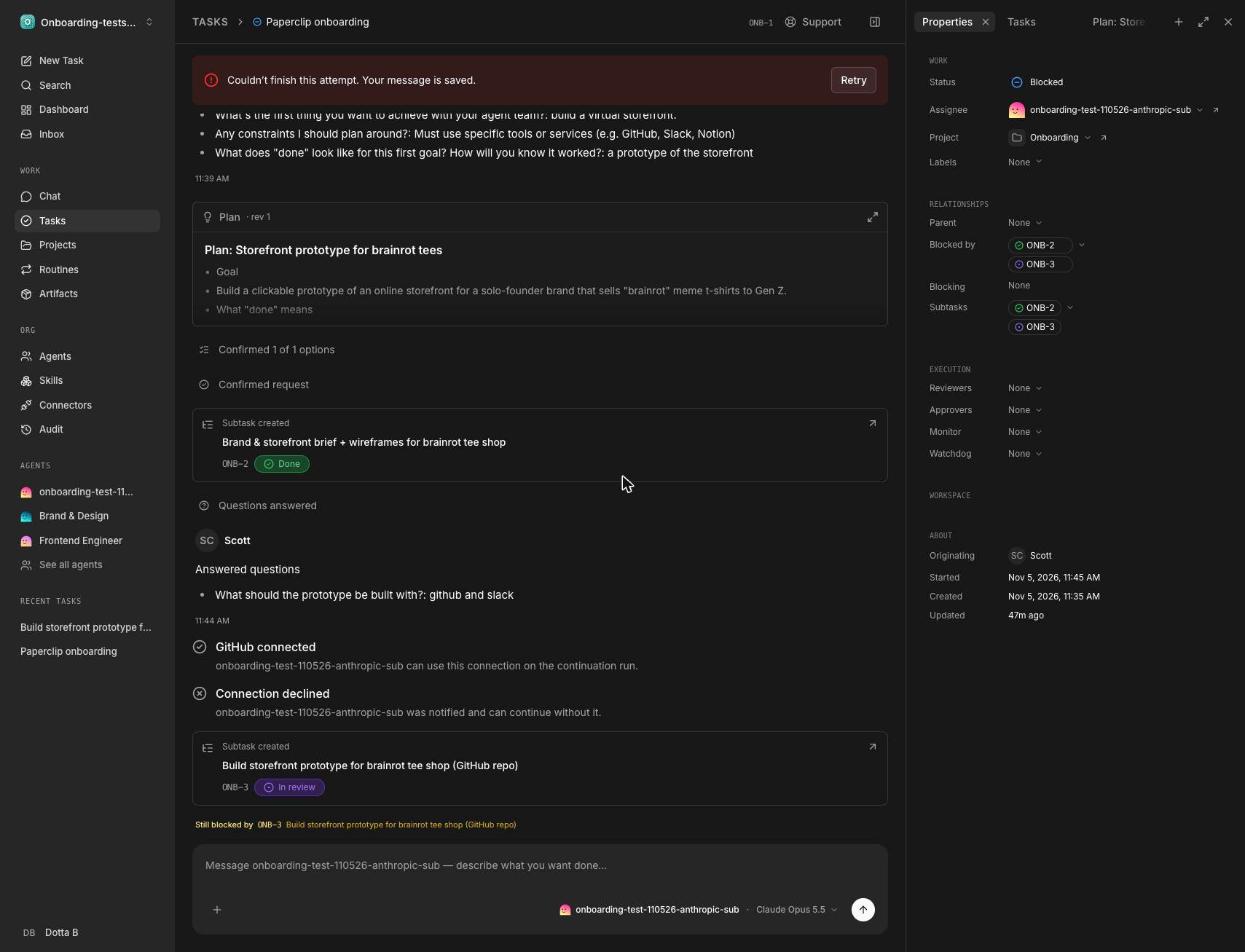
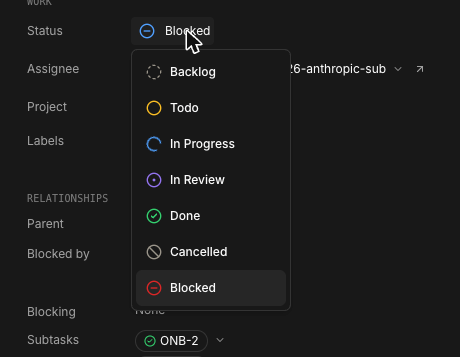
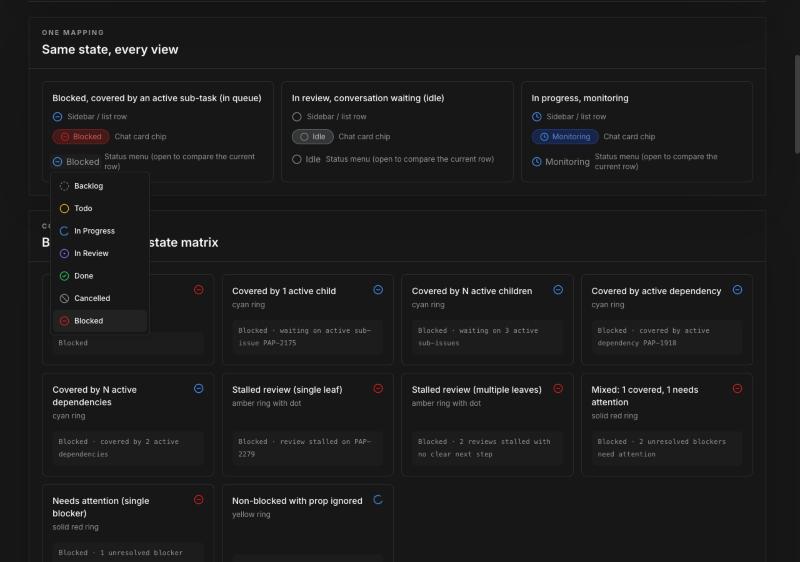
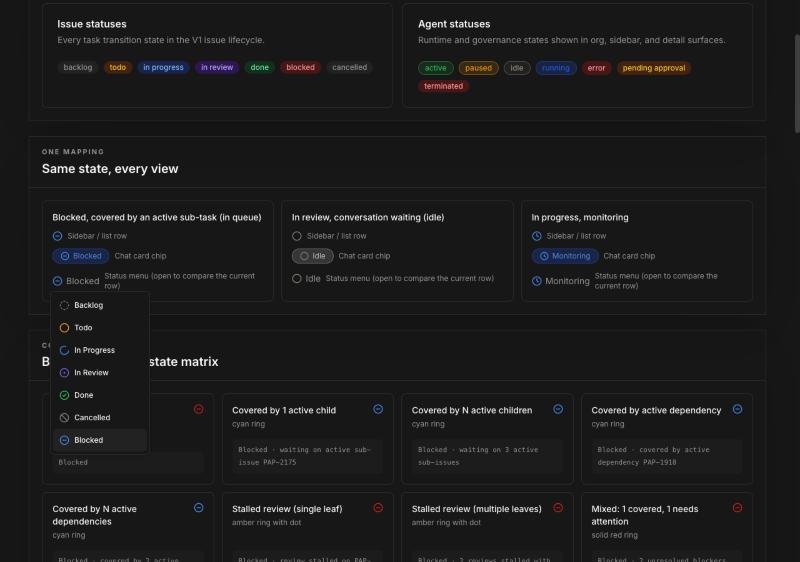
## Thinking Path > - Paperclip is the open source app people use to manage AI agents for work. > - Task status is the main signal on every task surface: sidebar rows, the task header, the status menu, lists, the inbox, pills and chat cards. > - One task state rendered different status icons in different views. A blocked task that waits on an active sub-task showed the blue "in queue" glyph in the task header. The status menu, the chat chip and the sidebar rows showed the red "Blocked" glyph for the same task. > - The cause: each view passed its own subset of the presentation fields to `StatusIcon`. Many views dropped `blockerAttention` and some dropped `externalConversationState`. The status menu rendered its current row from the bare status. The summaries API did not return `blockerAttention`, so the recent-task sidebar could not know the state. > - This pull request puts the state-to-glyph/label mapping in one resolver and makes every task view pass all of its fields. > - The benefit is that the same state uses the same icon and label everywhere. ## Linked Issues or Issue Description No public issue. Found in a hands-on onboarding test on a staging cloud workspace. **What happened?** The sidebar and the task pane/status menu showed different status icons for the same state. On the test task (blocked, waiting on an active sub-task), the task header and the status button showed the blue "in queue" glyph. The selected "Blocked" row in the status menu showed the red blocked glyph. The coordinator sidebar "Recents" and project rows also showed the red blocked glyph, and the chat "Subtask created" chip showed a red "Blocked" chip. **Expected behavior** The same underlying state uses the same icon and label everywhere. **Steps to reproduce** 1. Create a task with a sub-task. Block the parent on the sub-task, and let the sub-task's agent run (the parent is "blocked, covered"). 2. Open the parent task. The header shows the blue "in queue" glyph. 3. Open the status menu. The current "Blocked" row shows the red glyph. 4. With the coordinator sidebar on, look at the task in Recents or in its expanded project. It shows the red glyph. **Paperclip version or commit** `master` at |
||
|
DottaandPaperclip
|
40b8075916 |
feat(ui): show scheduled task waits as Monitoring (#18624)
## Thinking Path
> - Paperclip is the open source app people use to manage AI agents for
work.
> - Task indicators tell an operator whether work is active, waiting, or
complete.
> - An agent can yield until a saved monitor checks CI or another
external result.
> - The task currently keeps the In Progress icon between those runs.
> - Changing the stored status would affect monitor admission and
recovery.
> - This pull request adds a read-only Monitoring display state with a
blue clock.
> - Operators can see and filter scheduled waits while execution keeps
its existing rules.
## Linked Issues or Issue Description
**What existing behavior does this improve?**
Task status indicators, task collection filters, board columns, and
search facets.
**Current behavior**
A task that waits for a scheduled monitor shows the same In Progress
icon as active work.
**Proposed behavior**
Show Monitoring with a static blue clock when an agent-owned task has a
saved ordinary monitor and no active run, execution lock, review
participant, or active recovery action. Return to the normal task
indicator when the check starts. Preserve review, blocked, terminal, and
quota-recovery states.
**Reason and benefit**
Operators can distinguish scheduled waits from current agent work
without reading the task history.
**Breaking changes**
None to stored task statuses or execution rules. Task reads gain
optional displayStatus. Collections and search gain a separate read
filter. Existing status filters keep their lifecycle meaning.
Related historical work: #4396 covered a monitoring label exemption.
This change uses the saved monitor and a read projection.
## What Changed
- Add one SQL projection for task detail, compact lists, summaries,
relations, search results, and display-status counts.
- Show the blue clock in shared task icons and chips, task detail and
breadcrumbs, properties, references, list rows, recent navigation, and
agent task cards.
- Add Monitoring to task filtering, grouping, sorting, board columns,
and search facets. Prevent a drag from creating this derived state.
- Keep stored lifecycle statuses, monitor scheduling, checkout,
recovery, permissions, and agent status filters unchanged.
- Add database and UI regression coverage, full-page Storybook examples,
and product and access-map documentation.
## Verification
- Passed `pnpm -r typecheck`.
- Passed `pnpm build`.
- Passed `pnpm check:token-gates` and the map/catalog structural checks.
- Ran the new database suite on a disposable PostgreSQL 17 database. It
covers read surfaces, filter pagination/counts, queued/running checks,
rescheduling, completion, retained monitors, review, and recovery holds.
- Ran existing search, list, board, sidebar, task status, and filter
tests. Corrected board queries use displayStatus and eight columns.
- The full local `pnpm test:run` stopped in a chat integration shard: 12
failures (four timeouts and eight FIFO publication assertions). That run
spanned a rebase. A focused rerun on the current source passed all 21
selected cases without assertion or timeout changes. The original cause
is not established; this does not claim the full local suite passed.
Final-head required CI passed (ci / verify and ci / e2e, run
41488267209).
- Passed 82 tests for task API summaries, recovery precedence, search,
and optimistic updates; 54 tests for status cards, database reads, and
board moves; and 27 tests for blocker relations and recent-task cache
updates. One intermediate database setup hit its 20-second hook timeout;
the serial rerun passed.
- Greptile is 5/5 on
|
||
|
DottaandPaperclip
|
3e5a9f5afe |
perf(ui): load recent tasks with bounded summaries (#16851)
Replace passive recent-task detail reads with bounded, authorized summaries. Keep account isolation, stored history, task actions, and live recovery behavior. Overlap access checks with shell settings and avoid duplicate session and health reads on the first healthy socket opening. Retain domain reconciliation. Add focused coverage and local performance evidence. Isolate the existing cache capacity test from entry expiry on slow CI runners. Co-Authored-By: Paperclip <noreply@paperclip.ing> |
||
|
DottaandPaperclip
|
8725d6ce09 |
fix: make answered Slack conversations idle (#13809)
Settle published, successful Slack turns as Idle; resume the same conversation on an admitted message. Preserve unfinished work, delivery errors, and explicit dispositions. Verified through focused lifecycle/API/UI tests, full CI, and a real staging Slack conversation in the embedded browser. Co-Authored-By: Paperclip <noreply@paperclip.ing> |
||
|
DottaandPaperclip
|
d351e08dee |
fix(ui): stop Recent Tasks storage feedback across tabs (#13402)
Version recent-task snapshots separately from activity, reject stale cache updates, and publish only on query or membership changes. Migrate history into an isolated storage namespace while preserving restart retries. Add regression coverage for conflicting caches, migration, comments, unchanged writes, and storage implementations on Node 24 and Node 26. Co-Authored-By: Paperclip <noreply@paperclip.ing> |
||
|
|
9b7bd41833 |
feat(ui): refine dashboard cards, charts, and recent lists (#13269)
## Thinking Path > - Paperclip is the open source app people use to manage AI agents for work. > - Operators use the dashboard and Live runs page to inspect current and recent runs. > - Large transcript cards take space and make it hard to compare run states. > - A compact card must show the agent, linked task, and time, with access to run details. > - This pull request applies the supplied card design to both views. > - Operators can scan more runs and open a run or task for details. ## Linked Issues or Issue Description **What existing behavior does this improve?** The agent run cards on the dashboard and Live runs page, plus dashboard charts and recent lists. **Subsystem affected** `ui/` — React board UI. **Current behavior** Both views show large cards with embedded transcripts. Queued and running cards share a live treatment. The dashboard chart grid leaves an empty column, recent lists use different row sizes, and some activity labels expose raw event names. **Proposed behavior** Both views use the same compact grid. Each card shows the existing initials avatar, the agent name, one linked task row, and a right-aligned timestamp. There is no status chip next to the agent name. The timestamp uses small Inter text and the same muted gray as dashboard metric descriptions. Recovery details remain in the task view. Run status remains in the header tooltip and accessible label, and run transcripts remain in the run detail view. The shared in-progress task icon is now an animated circular spinner across the app. **Reason and benefit** Operators can scan task states without scrolling through embedded output. The in-progress spinner keeps the shared task icon sizes, circular shape, and stroke width. It honors reduced-motion preferences. **Breaking changes** The dashboard and Live runs page no longer show transcripts inside cards. Open the agent header to inspect a run. There are no API or database changes. **Additional context** Related public work found during the duplicate search: - Refs #4317 — related run-state display concerns. This change does not change server state reconciliation. - Refs #11394 — related live-run cache updates. This change retains the existing data flow. - Refs #2118 — related navigation from agent cards. The card header here opens the specific run. ## What Changed - Apply compact cards to the dashboard and Live runs page, with status icons and theme tokens. - Use 16 × 16px status icons in the shared cards, including the missing-task clock. - Keep the existing circular initials avatar. Remove the status chip beside the agent name while preserving the run label for tooltips and accessibility. - Replace the shared in-progress task glyph with an animated open circle. Use the same 10-unit radius and 2-unit stroke as the other task glyphs, with a reduced-motion guard across all task status surfaces. This is the requested workflow-status indicator across the app, including between runs; live indicators separately report active execution. - Use the same Tailwind blue tokens as nav dots and Live labels for the progress icon: blue-400 in dark mode and blue-600 in light mode. Covered-blocked icons follow the same blue token. - Match the Tasks by Status chart's In Progress bar and legend to the spinner's theme-aware color token. - Distribute the three visible dashboard charts across equal-width desktop columns, preserving existing gaps, card padding, and page margins. Retain four columns when the optional priority chart is enabled. - Use the done task icon's `--status-task-icon-done` token for green bars in Run Activity, Tasks by Status, and Success Rate, including their legends. - Use the blocked task icon's `--status-task-icon-blocked` token for red bars and legends in Run Activity, Tasks by Status, Success Rate, and priority charts. - Align Recent Tasks live counts to the sidebar's right edge. Reveal the ellipsis over a fading row surface on hover, keyboard focus, and while its menu is open, without moving the label or count. - Keep the ellipsis backdrop synchronized with the row background during fade-out, using the actual sidebar surface in both themes to prevent a darker flash. - On coarse-pointer devices, reserve space for the always-visible ellipsis and disable its fade so the live count remains readable beside it. - Order desktop dashboard Recent Tasks as status icon, task title, agent avatar/name, 11px monospace task ID, then timestamp. In narrow cards, keep the ID right-aligned beside the truncated title and place the agent and timestamp on the second line. - Give both dashboard lists the same 48px desktop rows, 24px leading slots, 80px desktop task ID columns, and 64px right-aligned timestamp columns. Use an 8px icon-to-content gap matching the task detail heading. Narrow layouts use matching 76px rows with intrinsic-width IDs on the title line; activity timestamps stay below. - Order dashboard Recent Activity as actor avatar, actor name, verb, task title, 11px monospace task ID, then timestamp. Use direct verbs such as “Board read …” instead of “issue read marked”. Truncate titles to preserve IDs and timestamps; keep full names and titles in tooltips. - Use 12px task status icons in the top breadcrumb and Properties status row. Keep the main task title icon at 20px. - Reduce monospace task IDs to the 11px micro type token in breadcrumbs and shared run cards, aligning them to the adjacent task titles' text baseline while keeping status icons centered. - Show the task title and identifier in one bordered row. Keep missing-task links usable and show lookup failures. - Remove the recovery chip and place the timestamp below the task row. - Keep the link to all runs available when the dashboard has four or fewer runs. - Avoid transcript polling for compact cards. - Fix bundled Inter font URLs and update the design guide and Storybook fixtures. - Cover run navigation, task status, failed lookups, shared icon sizes and stroke, and reduced-motion-safe animation in tests. ## Verification - Latest review fixes: targeted SidebarRecentTasks, SidebarNavItem, StatusGlyph, StatusIcon, ActiveAgentsPanel, activity-format, ui-font-assets, and Dashboard suites — 65 tests pass, including read/unread verbs and reduced-motion-safe task animation. - `pnpm --filter @paperclipai/ui typecheck` — passes. - `pnpm check:token-gates` — all gates pass. - `git diff --check` — passes. - Related component suites passed during development: run cards, status glyphs, breadcrumbs, issue properties, charts, sidebar navigation, recent-task actions, and settings sidebar. - Full repository `pnpm -r typecheck` and `pnpm build` pass on the final commit using the temporary Rust toolchain. Storybook build passed earlier in preparation. - All CI gates pass on `c85e949b12b471d425d216caa609aee41dc58bde`: all general/workspace and serialized server test shards, all three browser shards, build/runner verification, typecheck/release registry, canary dry run, policy, and security checks. The duplicate local `pnpm test:run` was stopped after CI completed the same test suites; it is not claimed as a completed local pass. The two Storybook jobs are skipped by the configured draft-PR workflow. - Greptile reviewed the final commit at 5/5 with no actionable findings and zero unresolved review threads. - Browser measurements at 1654px, 860px, and 390px confirm matching 48px desktop and 76px narrow rows (plus 1px dividers), right-aligned IDs on the title line, 64px timestamp slots, and no horizontal overflow. Narrow Recent Tasks rows retain readable agent names below the title. Activity reads as actor, verb, title, ID, time. Additional reference details can expand an activity row. - Verified three equal-width desktop charts with 16px gaps and aligned outer edges. Chart blues, greens, and reds resolve to the matching task-icon tokens. - Verified real queued, running, succeeded, failed, cancelled, and timed-out runs in the dev dashboard. Checked compact cards, task/run links, timestamps, light/dark themes, and narrow layout. - To inspect: open Dashboard, then Live runs. Both pages use the same small cards. Open an agent header for run output, or the task row for task details. - Verified the updated spinner on the real dashboard cards, Recent tasks, and task list. Checked actual SVG circle radius, rendered size, and stroke width. Confirmed the spinner, nav dots, and Live labels resolve to the identical blue-400 color in the dark-mode preview; light mode uses their shared blue-600 token. - Verified 12px computed width and height in the task breadcrumb and Properties pane, the restored 20px main task icon, and 11px task IDs with baseline alignment in the breadcrumb and shared dashboard/Live runs cards. - Verified the chart bar and legend resolve to the spinner color; Recent Tasks counts align with Dashboard's count. Checked the fading ellipsis overlay with keyboard focus and its open-menu state, then dismissed the menu. ## Risks - Operators must open run details to read output that was previously embedded. - Run outcomes are available in the header tooltip and run details instead of a visible status chip. An in-progress task icon reflects task status, independently of an individual run's outcome. - Long names and task titles truncate within the compact layout. Full labels remain available through links and tooltips. - Font loading changes affect all UI text that uses the bundled Inter font. The files remain served from the existing public fonts directory. - No schema, API, adapter, or execution-policy changes. ## Model Used OpenAI Codex, GPT-6 Astra (`gpt-6-astra`), with extended reasoning, repository tools, code execution, and browser verification. The session does not expose the context-window size. ## Checklist - [x] I have included a thinking path that traces from project context to this change - [x] I have specified the model used (with version and capability details) - [x] I have checked ROADMAP.md and confirmed this PR does not duplicate planned core work - [x] I have searched GitHub for duplicate or related PRs and linked them above - [x] I have either (a) linked existing issues with `Fixes: #` / `Closes #` / `Refs #` OR (b) described the issue in-PR following the relevant issue template - [x] I have not referenced internal/instance-local Paperclip issues or links (only public GitHub `#NNN` / `github.com/paperclipai/paperclip` URLs) - [x] My branch name describes the change (e.g. `docs/...`, `fix/...`) and contains no internal Paperclip ticket id or instance-derived details - [x] I have run tests locally and they pass - [x] I have added or updated tests where applicable - [x] I have updated relevant documentation to reflect my changes - [x] I have considered and documented any risks above - [x] All Paperclip CI gates are green - [x] Greptile is 5/5 with no open P2s, recommendations, or follow-ups - [x] I will address all Greptile and reviewer comments before requesting merge --------- Co-authored-by: Scott Tong <scott@scotts-mbp-m5-max.local> Co-authored-by: Paperclip <noreply@paperclip.ing> |
||
|
|
5b56d430e9 |
feat(ui): refine core navigation and task detail (#12854)
## Thinking Path > - Paperclip is the open source app people use to manage AI agents for work. > - The main navigation and task detail view are core operator surfaces. > - Several controls used different hover states, popover layouts, and spacing rules. > - Recent task actions also needed a compact menu and correct inbox archive behavior. > - These differences made the interface feel inconsistent and caused some content to look crowded or clipped. > - This pull request aligns these surfaces with the Paperclip design tokens and current interaction patterns. > - The benefit is a simpler and more consistent operator experience in light and dark modes. ## Linked Issues or Issue Description **What happened?** Profile and organization popovers used inconsistent layouts. Navigation controls used different hover and selected backgrounds. Task warnings and the composer could crowd nearby content. Archiving a recent task could also remove it from more than the inbox. **Expected behavior** Popover menus should use the same compact visual language. Navigation controls should share readable hover and selected tokens. Task detail content should keep consistent spacing. Archiving should hide a task from the inbox while keeping it in the task list. **Steps to reproduce** 1. Open the main sidebar in light or dark mode. 2. Open the profile and organization menus. 3. Hover navigation items, the organization trigger, the profile trigger, and the feedback flag. 4. Open a task with a warning banner and a long thread. 5. Use the recent task overflow menu and archive a task. **Paperclip version or commit** Reproduced on `master` before this branch. **Deployment mode** Local dev (`pnpm dev`). ## What Changed - Rebuilt the profile and organization popovers with compact token-based layouts. - Matched organization popover width and alignment to the profile popover. - Unified sidebar hover and selected states in light and dark modes. - Added a recent task overflow menu with rename, archive, and pause or restart actions. - Kept archived tasks in the task list while removing them from the inbox. - Improved warning banner and composer spacing in task detail views. - Added and updated focused UI tests for the changed behavior. ## Verification - `pnpm check:token-gates` passed. - `pnpm --filter @paperclipai/ui typecheck` passed. - The seven affected UI test files passed with 216 tests. - `pnpm --filter @paperclipai/ui build` passed. - GitHub CI passed the full build, typecheck and release registry, general test, serialized server, canary dry-run, and end-to-end matrices. - Greptile reviewed commit `6e296be85` at 5/5 with no outstanding actionable findings. ## Risks - Risk is limited to sidebar presentation, recent task actions, and task detail layout. - The recent task archive action now follows inbox-only archive semantics. - No database schema or public API contract changed. > I checked [`ROADMAP.md`](ROADMAP.md). This pull request does not duplicate planned core work. ## Model Used - OpenAI Codex, GPT-5.6. The model used high reasoning, tool use, and code execution. The context window size was not exposed. ## Checklist - [x] I have included a thinking path that traces from project context to this change - [x] I have specified the model used (with version and capability details) - [x] I have checked ROADMAP.md and confirmed this PR does not duplicate planned core work - [x] I have searched GitHub for duplicate or related PRs and linked them above - [x] I have either (a) linked existing issues with `Fixes: #` / `Closes #` / `Refs #` OR (b) described the issue in-PR following the relevant issue template - [x] I have not referenced internal/instance-local Paperclip issues or links (only public GitHub `#NNN` / `github.com/paperclipai/paperclip` URLs) - [x] My branch name describes the change (e.g. `docs/...`, `fix/...`) and contains no internal Paperclip ticket id or instance-derived details - [x] I have run tests locally and they pass - [x] I have added or updated tests where applicable - [x] I have updated relevant documentation to reflect my changes - [x] I have considered and documented any risks above - [x] All Paperclip CI gates are green - [x] Greptile is 5/5 with no open P2s, recommendations, or follow-ups - [x] I will address all Greptile and reviewer comments before requesting merge --------- Co-authored-by: Scott Tong <scott@scottsmbpm5max.lan> Co-authored-by: Paperclip <noreply@paperclip.ing> |
||
|
scotttong
|
597fd63b61 | feat(ui): add streamlined navigation foundation (#12746) |