mirror of
https://github.com/paperclipai/paperclip.git
synced 2026-10-06 10:48:12 +02:00
efc2e6810e9bc0dc8cb412b0e7647c0db9821caa
111
Commits
| Author | SHA1 | Message | Date | |
|---|---|---|---|---|
 DottaandPaperclip DottaandPaperclip
|
efc2e6810e |
fix: show each task once in dashboard agent cards (#14847)
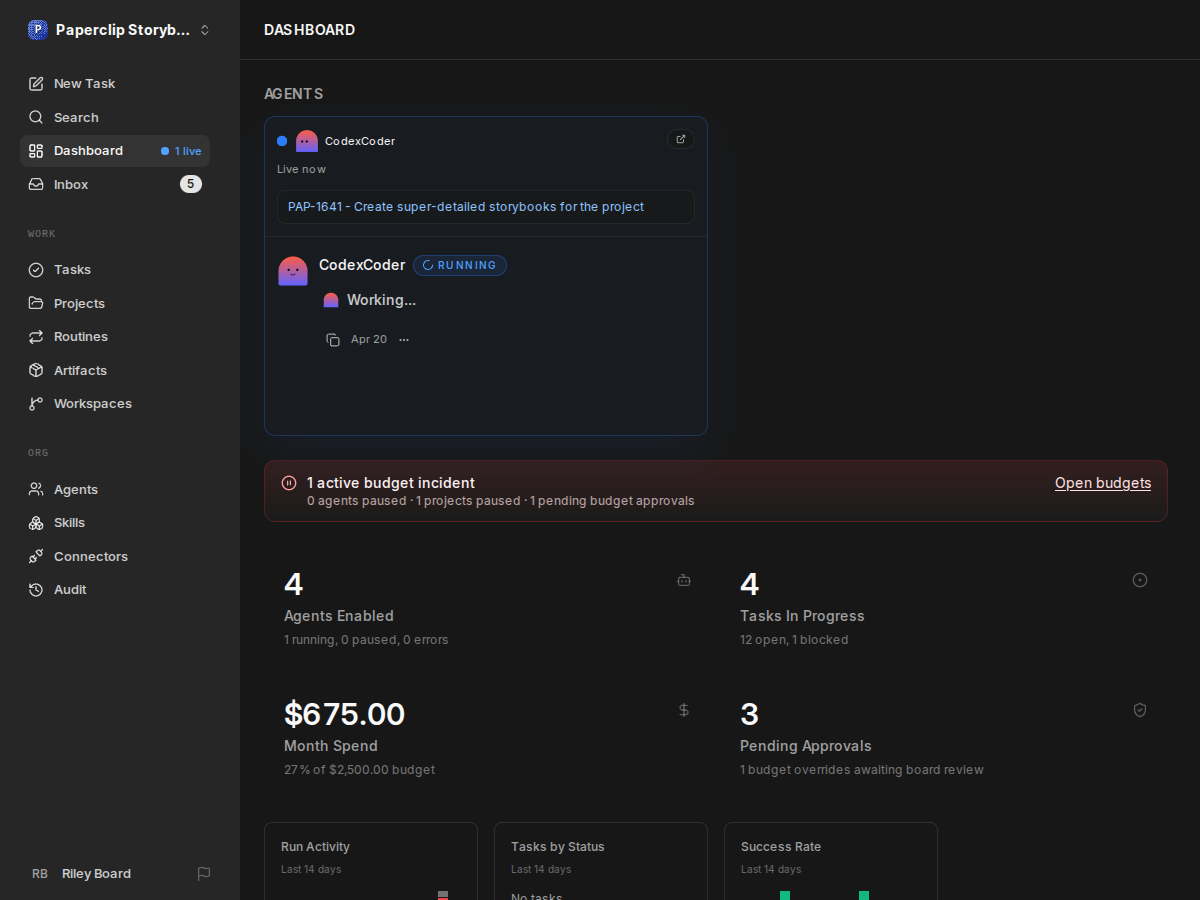
## Thinking Path > - Paperclip helps people manage AI agents and their tasks. > - The dashboard shows recent agent activity in compact cards. > - Those cards use run records, so two runs for one task can create duplicate task cards. > - An operator needs to see each task once when scanning the dashboard. > - This pull request selects one run per linked task before it applies the card limit. > - The live runs page still shows each run for run inspection. ## Linked Issues or Issue Description **What happened?** The dashboard showed the same task in two agent cards when that task had both an active run and a completed run. **Expected behavior** The dashboard should show a linked task at most once. It should keep the active run card when one is present. **Steps to reproduce** 1. Start an agent run for a task that already has a completed run. 2. Open the company dashboard. 3. Observe two cards linked to the same task. **Paperclip version or commit** Reproduced on the pre-change master at `8b4aa0692`. **Deployment mode** Local dev, built from source. The bug is in the core dashboard UI and does not depend on an agent adapter or database mode. ## What Changed - Select distinct linked tasks from capped active and recent run samples before applying the dashboard card limit. - Keep separate cards for runs without a linked task. - Preserve the dashboard's count of additional distinct cards behind the live-runs link. - Add UI and embedded Postgres regression tests for duplicate runs and document the dashboard rule. - Give the existing multi-request cross-tenant authorization test enough time on loaded CI runners. ## Verification - `pnpm --filter @paperclipai/ui exec vitest run src/components/ActiveAgentsPanel.test.tsx` - `pnpm --filter @paperclipai/ui exec vitest run src/api/heartbeats.test.ts` - `pnpm exec vitest run server/src/__tests__/dashboard-service.test.ts server/src/__tests__/agent-live-run-routes.test.ts` - `pnpm exec vitest run server/src/__tests__/agent-cross-tenant-authz-routes.test.ts` - `pnpm --filter @paperclipai/ui typecheck` - `pnpm --filter @paperclipai/server typecheck` - `pnpm --filter @paperclipai/ui build` - `pnpm -r typecheck` - `pnpm build` - `pnpm check:token-gates` - Review the dashboard with an active and a completed run on the same task. Confirm that it shows one card. Open Live agent runs to inspect both run records. ## Risks - A very high volume of recent runs for one task can fill the capped sample and leave older tasks off the dashboard. The Live runs page remains available for full run inspection. - The dashboard may fetch up to 50 distinct run representatives to preserve its overflow count. The default run API response and persisted data are unchanged. > For core feature work, check [`ROADMAP.md`](ROADMAP.md) first and discuss it in `#dev` before opening the PR. Feature PRs that overlap with planned core work may need to be redirected — check the roadmap first. See `CONTRIBUTING.md`. ## Model Used - OpenAI Codex, GPT-6. The runtime does not expose the exact model ID or context window size to this task. The model used reasoning, tool calls, and code execution. ## Checklist - [x] I have included a thinking path that traces from project context to this change - [x] I have specified the model used (with version and capability details) - [x] I have checked ROADMAP.md and confirmed this PR does not duplicate planned core work - [x] I have searched GitHub for duplicate or related PRs and linked them above - [x] I have either (a) linked existing issues with `Fixes: #` / `Closes #` / `Refs #` OR (b) described the issue in-PR following the relevant issue template - [x] I have not referenced internal/instance-local Paperclip issues or links (only public GitHub `#NNN` / `github.com/paperclipai/paperclip` URLs) - [x] My branch name describes the change (e.g. `docs/...`, `fix/...`) and contains no internal Paperclip ticket id or instance-derived details - [x] I have run tests locally and they pass - [x] I have added or updated tests where applicable - [x] I have updated relevant documentation to reflect my changes - [x] I have considered and documented any risks above - [x] All Paperclip CI gates are green - [x] Greptile is 5/5 with no open P2s, recommendations, or follow-ups - [x] I will address all Greptile and reviewer comments before requesting merge --------- Co-authored-by: Paperclip <noreply@paperclip.ing> |
||
|
DottaandPaperclip
|
33a00d2f1e |
fix(ui): reopen last visited agent chat (#14848)
## Thinking Path > - Paperclip helps people manage AI agents and their work. > - Agent Chat keeps one conversation for each agent and board user. > - The Chat sidebar entry opens the agent chooser each time. > - A user must then find and reopen the chat they just used. > - The browser already records recent agent chat visits by company and user. > - This pull request uses that record to reopen the last available chat. > - The chooser still serves users who have no available saved chat. ## Linked Issues or Issue Description Related: #14706 added the secondary Agent Chat navigation. **What happened?** The Chat sidebar entry opened the agent chooser, even after a user opened an agent chat. **Expected behavior** The Chat entry should reopen the last agent chat visited by the current user in the current company. **Steps to reproduce** 1. Enable Agent Chat and open a chat with an agent. 2. Open another page. 3. Select Chat in the sidebar. 4. Observe the agent chooser instead of the chat. **Paperclip version or commit** Reproduced on master at `0829d94af`. **Deployment mode** Local development, browser UI. The change also uses the same browser storage path in authenticated mode. ## What Changed - Use the existing recent chat record when the Chat landing route opens. - Check saved agents against the current roster and chat history before redirecting. - Keep the chooser when no saved chat is available, and show a retry state for load errors. - Add route tests and update the Agent Chat implementation spec. ## Verification - `pnpm exec vitest run ui/src/pages/AgentChats.test.tsx ui/src/lib/recent-agent-chats.test.ts` — 16 tests passed. - `pnpm check:token-gates` — passed. - `pnpm exec playwright test --config tests/e2e/playwright.config.ts tests/e2e/agent-chat-sessions.spec.ts --grep 'secondary chat navigation preserves layout'` — passed. - `pnpm --filter @paperclipai/ui typecheck` — passed on the final commit. - `pnpm -r typecheck` and `pnpm build` — passed earlier in this branch; latest-head CI completed all 47 jobs successfully. - `pnpm test:run` reported an unrelated native runtime test failure before it was stopped. That test and an unrelated external object refresh test passed in isolation. CI runs the same suites on the PR. - To check in the UI: open an agent chat, leave it, and select Chat. The same chat should open. Clear the recent chat record or use another company to see the chooser. ## Risks - The recent order is stored in the browser. Clearing browser storage returns the user to the chooser. - An existing chat ID is stored with its visit. If the chat is removed, the landing route skips that visit when history loads. Cross-tab storage removal clears the identity; failed writes retain an in-tab fallback. - The landing route waits for the agent roster and validates saved issue IDs against chat history when available. If history fails, an active agent chat can still open; roster or session failures show a retry action. - No database or API contract changes are required. > For core feature work, check [`ROADMAP.md`](ROADMAP.md) first and discuss it in `#dev` before opening the PR. Feature PRs that overlap with planned core work may need to be redirected — check the roadmap first. See `CONTRIBUTING.md`. ## Model Used OpenAI Codex, GPT-6 family. The runtime did not expose an exact API model ID or context window. It used reasoning, repository tools, shell commands, and code execution. ## Checklist - [x] I have included a thinking path that traces from project context to this change - [x] I have specified the model used (with version and capability details) - [x] I have checked ROADMAP.md and confirmed this PR does not duplicate planned core work - [x] I have searched GitHub for duplicate or related PRs and linked them above - [x] I have either (a) linked existing issues with `Fixes: #` / `Closes #` / `Refs #` OR (b) described the issue in-PR following the relevant issue template - [x] I have not referenced internal/instance-local Paperclip issues or links (only public GitHub `#NNN` / `github.com/paperclipai/paperclip` URLs) - [x] My branch name describes the change (e.g. `docs/...`, `fix/...`) and contains no internal Paperclip ticket id or instance-derived details - [x] I have run tests locally and they pass - [x] I have added or updated tests where applicable - [x] I have updated relevant documentation to reflect my changes - [x] I have considered and documented any risks above - [x] All Paperclip CI gates are green - [x] Greptile is 5/5 with no open P2s, recommendations, or follow-ups - [x] I will address all Greptile and reviewer comments before requesting merge --------- Co-authored-by: Paperclip <noreply@paperclip.ing> |
||
|
DottaandPaperclip
|
0829d94af2 |
fix(auth): derive low-trust human direction from existing execution records (#14775)
## Thinking Path > - Paperclip is the open source app people use to manage AI agents for work. > - Low-trust review contains work that may include hostile input. > - Its default intake boundary currently blocks direct human chat and tasks outside that boundary. > - Human direction should authorize the assigned work while preserving containment. > - Existing conversations and execution requests already identify direct human instructions. > - This pull request derives exact-task authority from those records and the current assignee. > - The agent can perform that work without gaining access to unrelated tasks or privileged tools. ## Linked Issues or Issue Description **What happened?** A low-trust agent with a project boundary rejects its owner's direct Agent Chat before provider execution. Human-assigned tasks outside that project fail the same check. **Expected behavior** An authorized human can talk to the agent or assign it a task. The exact task runs with its existing sandbox, credential, and tool restrictions. **Steps to reproduce** 1. Enable Agent Chat and isolated workspaces. Configure a sandbox agent with low-trust review scoped to an intake project. 2. Send the agent a direct board chat message, or assign it a projectless task. 3. Observe `low_trust_boundary_mismatch` before execution. Related: #14766 adds private task directories for repo-free low-trust execution. It is now merged into master and included in the branch base, so CI and staging verify the combined behavior. ## What Changed - Derive owner-chat access from existing conversation identity. - Derive exact-task access from the existing human requester and server-owned request origin, including coalesced requests. Plugin and external sender attribution do not authorize work. - Follow existing `retryOfRunId` database links for automatic continuations, checking company, agent, and task throughout; cancelled ancestors cannot grant authority. - Require a live run and current assignment. Preserve sandbox, credential, privileged-tool, responsible-user, and quarantined-output checks. - Retain board backlog assignments in existing request records without starting execution. Reassignment cancels old human requests in the common service transaction, including plugin writes; late settlement cannot revive them. - Add real database and HTTP coverage for request provenance, retry ancestry, cancelled runs, concurrent reassignment, spoofing, and containment. Document the rule. - Preserve legacy board assignment requests through their existing source, reason, and human requester. - Use the existing wrapped-error helper for concurrent chat-question idempotency; a deterministic race test reproduces the CI failure before the fix and passes after it. - No new schema, migrations, or user-identity fields. Existing requester columns hold attribution. ## Verification - Passed the focused database, policy-retention, HTTP, and reassignment tests locally. The HTTP test creates a task through the real board route and checks the resulting persisted wakeup before exercising agent reads, comments, mutations, and review handoff. - Database tests hold a reassignment transaction open to verify coherent authorization before and after commit, with a two-connection pool. They cover retries, coalesced requests, cancelled ancestry, invalid cross-company/agent/task links, cycles, and forged attribution. - Full local `pnpm -r typecheck` and `pnpm build` passed on the final commit (`d107c26df`). [Latest-head CI](https://github.com/paperclipai/paperclip/actions/runs/36815589542) passed: 54 successful checks, two expected skips, including all eight browser-test shards. Greptile is 5/5 on this exact commit with no unresolved threads. Local tests were targeted; the full test suite ran through CI’s test matrix. - The revised HTTP suite passed all 13 tests; database authorization tests passed all 11, including legacy compatibility and late watchdog settlement; the backlog route contract passed all 3 tests. Another 102 tests covering durable chat admission, wake queues, and Cursor execution passed. - All 90 interaction-service tests passed with both create calls deliberately held until their optimistic reads complete, forcing duplicate-key recovery. That forced race failed before switching to the shared wrapped-error helper. - Previous staging proof covered owner chat and projectless task persistence. The simplified revision has not been redeployed; that earlier proof is not claimed for the new implementation. ## Risks - This is an authorization change: only the live run's exact task qualifies, and normal responsible-user restrictions still apply. - Existing request and retry records are authoritative. Merely naming a responsible/originating user or an external connector sender does not qualify. - Reassignment invalidates existing human request records transactionally. A cancelled run or request cannot regain authority when the task is assigned back. - Ordinary task exceptions require server-owned origin or the legacy board assignment source/reason/actor combination. Existing owner chats use conversation identity. ## Model Used OpenAI GPT-6 in Codex, with reasoning, repository tools, code execution, and browser testing. The runtime does not expose a more specific model ID or context-window size. ## Checklist - [x] I have included a thinking path that traces from project context to this change - [x] I have specified the model used (with version and capability details) - [x] I have checked ROADMAP.md and confirmed this PR does not duplicate planned core work - [x] I have searched GitHub for duplicate or related PRs and linked them above - [x] I have either (a) linked existing issues with `Fixes: #` / `Closes #` / `Refs #` OR (b) described the issue in-PR following the relevant issue template - [x] I have not referenced internal/instance-local Paperclip issues or links (only public GitHub `#NNN` / `github.com/paperclipai/paperclip` URLs) - [x] My branch name describes the change (e.g. `docs/...`, `fix/...`) and contains no internal Paperclip ticket id or instance-derived details - [x] I have run tests locally and they pass - [x] I have added or updated tests where applicable - [x] I have updated relevant documentation to reflect my changes - [x] I have considered and documented any risks above - [x] All Paperclip CI gates are green - [x] Greptile is 5/5 with no open P2s, recommendations, or follow-ups - [x] I will address all Greptile and reviewer comments before requesting merge --------- Co-authored-by: Paperclip <noreply@paperclip.ing> |
||
|
DottaandPaperclip
|
018993140f |
feat: let agents name prompt-only tasks (#14761)
## Thinking Path > - Paperclip is the open source app people use to manage AI agents for work. > - Users create tasks with a title and a description. > - A required title adds work when the prompt already explains the request. > - An agent can name the task once it reads that request. > - This pull request accepts prompt-only tasks and starts them with a short prompt slice. > - A scoped title tool lets the assigned agent replace that slice early without changing execution state. > - A live browser eval checks the real agent call, saved title, audit entry, and preservation of user titles. ## Linked Issues or Issue Description **Subsystem affected** Cross-cutting: task creation, shared contracts, database, server, runner tools, and board UI. **Problem or motivation** Users must currently write a title before they can submit a detailed task prompt. The agent has enough context to write a useful title itself. **Proposed solution** Make the title optional when a description is present. Save the first 120 characters of the normalized prompt as a provisional title. Ask the assigned agent to call `set_task_title` early. Use an atomic provisional-title guard to preserve titles supplied or edited by users. Keep explicit titles supported. Related: #14543 and #14556 concern empty-title submission. This change intentionally enables that submission when a prompt is present, instead of requiring a title. ## What Changed - Add the `titleNeedsGeneration` field with an idempotent migration. Keep existing titles unchanged. - Add `PUT /api/issues/:id/title` and the native and legacy `set_task_title` tool. Enforce company access, active-run ownership, shared, bounded retry receipts across native/HTTP calls, and transactional audit logging. Refresh external-object links after commit, with the same feature gate and plugin detectors as ordinary title edits. - Add early naming guidance in Standard, Ask, and Plan task context. Preserve the description, status, and assignment. - Allow prompt-only root and child task creation, plus draft restoration in the New Task dialog. Keep user titles supported. - Add an opt-in Product E2E suite for prompt-only Standard and Ask tasks, plus an explicit-title control. It checks actual provider calls within the first five tools, persisted state, audit attribution, and the reloaded UI. - Preserve a closed vocabulary of API key maintenance phrases in declared prose while rejecting opaque credential suffixes. Add one bounded naming retry after wording is rejected, without treating the rejected call as a saved title. - Repair the native cleanup receipt check exposed during full verification: accept matching input digests, retain legacy input checks, and reject conflicting receipts. ## Verification - Live Product E2E on `f43478473800e3a46b85c5ee79677efdb15108e7`: **3/3 passed** with native Codex `gpt-5.4-mini`, first attempts only, automatic retries disabled. Standard and Ask each saved “Rotate expired API key” on their first tool call, with matching persisted state and a single same-run audit entry. The explicit-title control retained its user title with zero title writes. All three verified the reloaded browser UI. - Campaign: `local-2026-09-30T21-30-11-021Z`. Earlier failed campaigns are retained separately; they exposed credential-prose handling and prompted the naming recovery fix. No failed result was regraded or deleted. - Reproduce with `pnpm test:e2e:runner -- --id task-titles.runner-codex-mini.local.prompt-title-standard --id task-titles.runner-codex-mini.local.prompt-title-ask --id task-titles.runner-codex-mini.local.preserve-explicit-title --max-automatic-retries 0` and an authorized provider key. - Full `pnpm -r typecheck` and `pnpm build` passed on the latest commit. The runner build used the configured external eval source tree. - Product E2E unit suite: **61 files, 818 tests passed**; E2E typecheck and UI token gates passed. - Title API/native regressions cover prompt-only and explicit child creation, user edits, ownership/company isolation, external reference refresh, cross-surface retry replay, and the 64-key limit without receipt eviction. All passed. Prompt-context coverage: **44 tests passed**. - Rust credential regressions: **35 tests passed**, including benign maintenance qualifiers and opaque credential rejection in every declared prose field. Catalog/report reconciliation: **28 tests passed**. Native recovery: **560 tests passed**. - Broad local `pnpm test:run`: **14,555 tests passed** in the general server group; two suites failed to initialize embedded PostgreSQL and the existing 40,000-file Git streaming stress test exceeded its 300-second macOS timeout. All three suites then passed in isolation (**5 tests passed**) without code or timeout changes. The original full local command exited nonzero and is not being represented as a clean full run. - Latest-head GitHub checks are green: **53 passed, 4 skipped, zero failed or pending**, including all test shards and the canary packaging dry run. Greptile reviewed the same commit at **5/5**, with zero unresolved review threads. ## Risks - The additive database field must reach the server and UI together. The migration uses `IF NOT EXISTS` and defaults existing tasks to a final title. - Title generation depends on the assigned agent running. Tasks without a run keep their provisional title. - Live qualification covers the native Codex path in Standard and Ask modes. API/legacy and Plan behavior have deterministic coverage. - The credential-prose exception validates the entire suffix against a closed maintenance vocabulary. Unknown suffixes, assignments, quoted values, credential prefixes, and diagnostics retain strict checks. ## Model Used OpenAI Codex, based on GPT-6, with reasoning, tool use, and code execution. The exact deployment ID and context window are not exposed in this session. The live eval uses the native Codex `gpt-5.4-mini` profile. ## Checklist - [x] I have included a thinking path that traces from project context to this change - [x] I have specified the model used (with version and capability details) - [x] I have checked ROADMAP.md and confirmed this PR does not duplicate planned core work - [x] I have searched GitHub for duplicate or related PRs and linked them above - [x] I have either (a) linked existing issues with `Fixes: #` / `Closes #` / `Refs #` OR (b) described the issue in-PR following the relevant issue template - [x] I have not referenced internal/instance-local Paperclip issues or links (only public GitHub `#NNN` / `github.com/paperclipai/paperclip` URLs) - [x] My branch name describes the change (e.g. `docs/...`, `fix/...`) and contains no internal Paperclip ticket id or instance-derived details - [x] I have run tests locally and they pass - [x] I have added or updated tests where applicable - [x] I have updated relevant documentation to reflect my changes - [x] I have considered and documented any risks above - [x] All Paperclip CI gates are green - [x] Greptile is 5/5 with no open P2s, recommendations, or follow-ups - [x] I will address all Greptile and reviewer comments before requesting merge --------- Co-authored-by: Paperclip <noreply@paperclip.ing> |
||
|
DottaandPaperclip
|
cbd278dc03 |
fix(interactions): derive chat recipients and validate explicit users (#14742)
## Thinking Path > - Paperclip helps people manage AI agents and their work. > - Agents use saved questions to get human input and continue the same task. > - The standard question example recently told models to copy a user ID. > - A model can omit an identity prefix and create a question its intended recipient cannot answer. > - Agent Chat already knows the conversation owner, so the server can supply that identity. > - This pull request removes the blanket instruction and validates explicit recipients before saving. > - Ordinary questions stay simple, and explicit addressing remains available for decisions that need a particular person. ## Linked Issues or Issue Description Refs #14707, #14188. Related: #14238 handles legacy email recipients; this change prevents invalid recipients in new cards and retains exact ID matching. **What happened?** A model copied a Cloud user ID without its prefix into `addresseeUserId`. Creation succeeded. The intended user's answer then failed the exact recipient check. **Expected behavior** Ordinary chat questions use the saved conversation owner. A task may optionally name a specific recipient. The API rejects an unknown or unauthorized recipient before it creates a card. **Steps to reproduce** Create a chat question for a user whose ID is `paperclip-id:example`. Supply `example` as the addressee. Before this change, creation accepts the invalid recipient and the owner cannot answer. With this change, creation returns 422. Omitting the field saves the full owner ID and allows that owner to answer. ## What Changed - Remove `addresseeUserId` from standard question examples and remove the blanket requester-ID instruction. - Derive the recipient of ordinary chat questions from the persisted conversation owner. Reject conflicting explicit user IDs. - Keep explicit task recipients optional. Validate supplied user IDs with the existing board mutation policy, including company, viewer, and Cloud restrictions. - Preserve explicit agent routing, connector intents, confirmations, exact recipient checks, idempotent retries, and no-login local-board authority in local-trusted mode. - Update the blocker grader to accept an omitted recipient and verify the actual requester answered. - Add database and HTTP tests for prefixed identities, denied recipients, concurrent retries, saved answers, and response delivery. ## Verification - Database interaction service suite: 90 tests passed, including implicit local-board creation/answering and authenticated/Cloud denial. - Interaction HTTP route suite: 84 tests passed. - Affected interaction/native/connector/documentation suites: 231 tests passed across six files after valid-user fixtures were updated. - Resolver and interaction unit suites: 29 tests passed. - Product E2E unit/calibration suite: 793 tests passed; Product E2E typecheck and blocker catalog discovery passed. - Generated API-reference and capability contract checks passed. - `pnpm -r typecheck` and `pnpm build` passed. - Full local `pnpm test:run` did not finish green: its initial general-server pass had 14,416 passing assertions, one unrelated native-resume assertion failure on macOS, and three teardowns from an intermediate fixture cleanup fixed above. Separate broad local groups also encountered timeout/live-port failures under host load. Local UI (7,026), CLI (502), shared (817), and skills-catalog (20) tests passed; the complete final-head CI matrix is the broad verification gate. - After two CI cold-start readiness timeouts, a separate test-only commit gives the first exposure lifecycle fixture the existing normal 30-second readiness budget. Its real HTTP, ordering, and cleanup assertions remain intact; the targeted case and final Linux CI shard passed. Production deadlines are unchanged. - A separate OpenCode fixture failed twice on GitHub-hosted Ubuntu because its cached Node executable was group-writable; the same case passed on AWS runners. The fixture now qualifies its own Linux copy with mode `0500` and the actual copy digest. Host files and production security checks are unchanged. The focused macOS case passed; the new Linux-copy branch also passed on the final AWS-hosted Linux runner (1,125 passing Runner tests, 3 skipped). The final run was not on a GitHub-hosted runner. - Final-head [CI run 36762078176](https://github.com/paperclipai/paperclip/actions/runs/36762078176) passed for `116b968b24fa0a8c5724a7bf96e73a8dda5f0425`: 54 successful checks and two conditional Storybook skips, with no pending or failed checks. The 27 general/serialized test jobs reported 28,635 passing tests. Typecheck, build, Runner, browser E2E, and Canary gates passed. Greptile reviewed that exact head at 5/5; both review threads are resolved, with no open follow-ups. - No live provider replay is claimed by this PR. ## Risks - New explicitly addressed cards reject users who cannot mutate the issue, including viewers, inactive members, and invalid IDs. Callers that supplied invalid recipients must correct their request. - Existing addressed cards are not rewritten. Existing authorization checks remain strict. - Chat inference applies only to questions without an agent addressee. Connector intents and governed confirmations retain their own recipient paths. - No schema change or migration is required. ## Model Used OpenAI Codex, GPT-6 (exact serving variant and context window are not exposed in this environment). Used reasoning, tool use, code editing, and test execution. ## Checklist - [x] I have included a thinking path that traces from project context to this change - [x] I have specified the model used (with version and capability details) - [x] I have checked ROADMAP.md and confirmed this PR does not duplicate planned core work - [x] I have searched GitHub for duplicate or related PRs and linked them above - [x] I have either (a) linked existing issues with `Fixes: #` / `Closes #` / `Refs #` OR (b) described the issue in-PR following the relevant issue template - [x] I have not referenced internal/instance-local Paperclip issues or links (only public GitHub `#NNN` / `github.com/paperclipai/paperclip` URLs) - [x] My branch name describes the change (e.g. `docs/...`, `fix/...`) and contains no internal Paperclip ticket id or instance-derived details - [x] I have run tests locally and they pass - [x] I have added or updated tests where applicable - [x] I have updated relevant documentation to reflect my changes - [x] I have considered and documented any risks above - [x] All Paperclip CI gates are green - [x] Greptile is 5/5 with no open P2s, recommendations, or follow-ups - [x] I will address all Greptile and reviewer comments before requesting merge --------- Co-authored-by: Paperclip <noreply@paperclip.ing> |
||
|
DottaandPaperclip
|
d432dc7fa3 |
Add GitHub-synced skill sources (#14713)
## Thinking Path > - Paperclip is the open source app people use to manage AI agents for work. > - Company skills supply instructions and files to those agents. > - GitHub imports already exist, but users cannot manage repositories as skill sources. > - Repository refresh also needs caller-authorized access and complete local packages. > - This pull request adds Sources inside Skills and reuses GitHub connections from Apps. > - Installed snapshots let agents use skills without fetching GitHub during a run. > - Manual refresh preserves skill identity and leaves failed imports on their last good version. ## Linked Issues or Issue Description **Subsystem affected** Cross-cutting: skills UI, server, database, shared contracts, and runtime materialization. **Problem or motivation** Users keep skills in GitHub repositories. They need a clear way to select, import, and refresh those skills. Existing imports do not expose repository management or consistently preserve supporting files. **Proposed solution** Add company-scoped skill sources. Browse repositories from all accessible GitHub connections, or paste a public repository or branch URL. Select whole skill packages, inspect included files and reference warnings, and install complete, immutable snapshots. Refresh each source manually. **Alternatives considered** Project repository settings hide the workflow from Skills. A second GitHub connector would duplicate credentials and grants. Upstream editing and PR creation are separate work. **Roadmap alignment** This implements the Skills Manager direction in ROADMAP.md. The maintainer requested this scope and reviewed the component and full-app journey stories before implementation. Related reports: Refs #10285, Refs #10949, Refs #13464. Related work: #14356, #13656, #9268. ## What Changed - Add source and entry records, an idempotent migration, company-scoped APIs, and legacy GitHub import adoption. - Reuse current caller grants and credential refresh. Combine and deduplicate repository inventories across accessible connections. Pasted public URLs also prefer the active user’s authorized connections. Tokens stay in the Git child environment, never argv or disk. - Fetch a shallow Git snapshot at one immutable commit. Scan the full local tree, including hidden and nested folders. Read Git objects without checkout or archive transformations and enforce nested package boundaries. - Bound Git downloads to 128 MiB and three minutes. Cancel active process groups and remove incomplete downloads. Preserve cancellation and deadlines while progress drains; close stalled HTTP progress streams after 30 seconds. Reuse caller-scoped temporary snapshots for preview/import after reauthorization. - Index repository package boundaries once and cap expanded work at 1,000 packages, 10,000 files, and 100 MiB, including repeated copies of shared blobs. Bound path depth and the shared path index. Discovery keeps audited manifests without retaining all package bodies. - Resolve moving branches before fetching so unchanged discovery reuses caller-scoped snapshots. Limit active scans, scan frequency, and new downloads per caller and company; quotas apply before metadata reads and across connections, and cached scans do not consume the download quota. - Store complete versions with script content, binary bytes, and executable modes. Preserve these through copies, runtime caches, and runner packaging. - Stage downloads before publication. Use source leases, revision checks, and transactional activity records. Keep installed versions after failures, upstream deletion, deselection, and disconnect. - Add the approved import flow, Sources page, selection tree, provenance, read-only Studio behavior, and saved return from GitHub setup. - Add package manifests, commit-pinned file previews, and separate runtime requirements and reference warnings. Supporting files are included together; nested skills remain independently selectable. Preview requests reauthorize the caller and re-audit package content. - Show installed skills as compact links beneath each source. Repository titles open GitHub. Keep Refresh, Select skills, and Disconnect source in a three-dot menu. Source rows omit the branch, imported count, and refresh timestamp; action alignment and repository titles work at narrow widths. - Stream discovery metadata over an opt-in NDJSON response. Show measured Git download progress and real package/file counts, animate newly checked skills, support cancellation, and require a complete scan before selection. Keep the existing JSON API. - Retain component stories and add a separate full-app journey story group. Include fixed progress states and interactive scan, large-repository, interruption, and saving stories. - Update Skills documentation and product contracts. Suppress private GitHub skill references in telemetry. Privacy review requested for the telemetry changes. ## Verification - Local repository typecheck, full build, token gates, and Storybook build passed during this work. Focused transport, authorization, scanner, persistence, route, and UI tests pass. The final UI refinement passes all eight focused UI tests, UI typecheck/build, and token gates. The scanner resource and repeated-discovery fixes pass 132 focused scanner, transport, authorization, source-service, route, and rate-limit tests, plus server typecheck/build. Full-suite verification comes from CI; the older full local Vitest run was stopped after unrelated chat failures and a font-test failure, all of which passed in fresh focused runs. At commit `1098d5996`, all 54 active checks pass; two optional Storybook jobs are skipped. CI covers repository typecheck, build, the full test suites, browser shards, and the canary dry run. Greptile is 5/5 with no open findings; the security scan also passes. - Adversarial scanner tests verify repeated-blob byte accounting with and without declared sizes, package/file/path caps, one-time repository indexing, metadata-only discovery audits, and nested package boundaries. Additional tests cover branch movement, snapshot reuse, caller/company quotas, isolation across connections, active-lease cleanup, quota recovery, and rejection before any metadata API call. - Real Git tests verify hidden paths, exact binary bytes, executable modes, export-ignore preservation, symlink/submodule reporting, pinned commits, caller-scoped cache reuse, cancellation, cleanup, and credential isolation. Regression tests hold both download slots with permanently blocked progress callbacks, verify timeout/cancellation cleanup and retry, and exercise HTTP backpressure cancellation. Access tests cover automatic public-URL connection selection and revoked grants. Database tests verify company and grant audiences. - Live isolated browser test: the public `anthropics/skills` scan now completes and discovers all 20 skills without connecting an account. Imported canvas-design with all 83 files, opened it from Sources, and verified the installed binary-font preview/download control. Package previews also expose the complete file inventory before import. Cancelled an active Git download and retried successfully to all 20 discovered skills; the browser displayed measured download progress. The current audits reject four other packages; eligible selections remain importable. - Browser checks verify the simplified source rows at desktop and narrow widths, keyboard navigation into the actions menu, Refresh from the menu, selection, and fixture disconnect with installed skills retained. Storybook includes a menu-open checkpoint and a 320px layout. - Storybook includes receiving/preparing download checkpoints and a timed full-app import journey, plus cancellation, retry, large-repository, and saving states. Streaming tests cover split UTF-8 frames, incomplete streams, late responses, cross-company requests, HTTP errors, and JSON compatibility. - Earlier live acceptance on this PR imported `stitch-skill` with `DESIGN.md`, assigned it to an agent, disconnected its source, and ran a successful Studio test that read both installed files. An editable copy changed independently. Both Skills variants, mobile selection, and return from GitHub setup were exercised. - Private access, revoked credentials, OAuth success return, binary/script preservation, concurrent refresh, transaction rollback, version pins, and legacy adoption have automated coverage. A real private-repository OAuth grant was not created during this test. ## Risks - The migration groups recognizable legacy imports without provider calls. Their first successful refresh completes the local package snapshot. - Reference checks are advisory. They cover Markdown links and explicit relative resource paths, not arbitrary runtime dependency graphs. Preview text is capped at 64 KiB; imported bytes remain complete. - Git must be installed on the server. Shallow fetches still download the branch snapshot, including files outside selected packages. Downloads have size/time/concurrency limits. Temporary caches are bounded and caller-scoped. GitHub API quota still applies to repository metadata and the connection picker; content no longer uses per-file API requests. Failed scans retain installed content. - Sources depend on the current caller's GitHub access. A saved connection does not grant access to another person's token. - GitHub script support and immediate manual refresh are explicit maintainer-approved requirements. The operator trusts the selected repository and accepts upstream script and executable-mode changes on refresh. Static audits are not a sandbox or a guarantee of safe code; agents may later invoke installed helpers under their runtime permissions. Import and refresh do not execute scripts, hooks, package installation, or builds. Raw URL and skills.sh imports keep their prior script restrictions. - Source originals remain read-only. Refresh affects subsequent unpinned runs; explicit pins and active runs retain their versions. - The telemetry change removes source-managed GitHub identifiers from skill-reference events. It introduces no event or field. Please review the privacy boundary. ## Model Used OpenAI Codex, based on GPT-6, with reasoning, code execution, and browser tools. The exact serving model ID and context-window size are not exposed in this session. ## Checklist - [x] I have included a thinking path that traces from project context to this change - [x] I have specified the model used (with version and capability details) - [x] I have checked ROADMAP.md and confirmed this PR does not duplicate planned core work - [x] I have searched GitHub for duplicate or related PRs and linked them above - [x] I have either (a) linked existing issues with `Fixes: #` / `Closes #` / `Refs #` OR (b) described the issue in-PR following the relevant issue template - [x] I have not referenced internal/instance-local Paperclip issues or links (only public GitHub `#NNN` / `github.com/paperclipai/paperclip` URLs) - [x] My branch name describes the change (e.g. `docs/...`, `fix/...`) and contains no internal Paperclip ticket id or instance-derived details - [x] I have run tests locally and they pass - [x] I have added or updated tests where applicable - [x] I have updated relevant documentation to reflect my changes - [x] I have considered and documented any risks above - [x] All Paperclip CI gates are green - [x] Greptile is 5/5 with no open P2s, recommendations, or follow-ups - [x] I will address all Greptile and reviewer comments before requesting merge --------- Co-authored-by: Paperclip <noreply@paperclip.ing> |
||
|
DottaandPaperclip
|
1b48e73e0b |
feat(ui): add secondary navigation for agent chat (#14706)
## Thinking Path > - Paperclip is the open source app people use to manage AI agents for work. > - Agent Chat already provides a persistent conversation with each agent. > - Its shortcuts share the primary navigation and do not give chats a dedicated place. > - People need to find agents, start a chat, and switch conversations without moving the page layout. > - This pull request adds a secondary chat sidebar and a landing page around the existing chat surface. > - The same conversation, composer, history, and context panel remain in use. ## Linked Issues or Issue Description Refs #13283 and #13420. This extends the existing experimental Agent Chat navigation after review of the component and page stories. It supports the CEO Chat roadmap item through the existing task-backed conversation model. **Subsystem affected** The board UI and the company-scoped conversation list API. **Current behavior** Chat shortcuts sit inside the primary navigation. There is no dedicated landing page with a searchable conversation list. A separate landing header also moves the sidebar when an agent is selected. **Proposed behavior** Show a Chat entry in primary navigation. Keep a searchable agent sidebar beside the chat content. The plus button starts or reopens the current user's single conversation with that agent. Keep the header and sidebar in the same positions before and after selection. **Reason and benefit** People can find agents and return to persistent conversations without leaving the chat area or creating duplicate chats. **Breaking changes** The experimental chat navigation changes. Explicitly adding a chat now resolves its conversation immediately. Direct visits to unused agent chat URLs remain read-only. The existing per-agent routes and message contracts remain compatible. No database migration is required. ## What Changed - Add an account- and company-scoped conversation list endpoint with the existing access checks, feature gate, and OpenAPI entry. - Add the live secondary sidebar, landing page, avatars, search, loading states, errors, and retry controls. - Make the agent picker wait for chat creation and display failures. Existing agents reopen the same conversation. A dismissed selection cannot close a reopened picker or navigate over a newer choice. - Preserve recent-activity ordering and terminated agents’ chat history. Scope live list refreshes to the current user’s conversation events. A failed historical-agent lookup leaves healthy chats usable and offers a focused retry. - Keep the sidebar and header stable across chat routes. Keep mobile selection in the navigation drawer. - Use the production components in Storybook. Prepare the theme and mobile viewport before mounting the page to avoid the startup flash. - Update product documentation, the design guide, and navigation tests. Replace old browser expectations for stars and recent shortcuts with persistent conversation and layout coverage. ## Verification - `pnpm -r typecheck`, `pnpm build`, and `pnpm check:token-gates` pass after rebasing onto master. - Focused UI tests pass, including 105 sidebar, picker, and live-update checks after review fixes. The 33 conversation service and route tests and 10 OpenAPI checks pass, including ownership, feature gating, and concurrent creation. - The full local test run passed 14,163 server tests before three environment or timeout failures. The embedded Postgres startup, connector socket, and native runner failures all passed direct reruns. - Browser test-drive verification covers a real provider reply, add and reopen, persisted history after reload, no-match search recovery, mobile drawer dismissal, and top-aligned context panels. - Browser measurements confirm that the sidebar has the same position and dimensions on the landing page and an agent conversation. - Storybook builds and its add-and-reopen interaction passes. - The revised browser regression passes locally against a freshly built throwaway instance. It covers stable sidebar geometry, add/reopen uniqueness, drafts, search, history, and terminated-agent history after reload. The full CI browser suite also passes. - Latest commit `b323577d9523180104df4000eaceedea2772608c`: all 54 completed checks pass, including the complete server/workspace/browser suites, aggregate verification, build/typecheck, security scans, and canary packaging. The two Storybook jobs are skipped by their workflow conditions. [CI run](https://github.com/paperclipai/paperclip/actions/runs/36714052050). - Greptile reviewed this same commit at 5/5 with no remaining actionable findings; all review threads are resolved. - Reviewer path: enable Agent Chat, click Chat, use plus to choose an agent, send a message, switch away, and reopen that agent. One conversation must remain, with its history intact. ## Risks - The new sidebar lists persistent conversations instead of starred and recent shortcuts. - Chat creation is asynchronous. Errors stay visible in the picker, and delayed responses cannot navigate into a previous company or account. - The shell adjustment is limited to chat routes and preserves the existing conversation implementation. ## Model Used OpenAI GPT-6 through Codex, with reasoning, code execution, and browser tools. The session does not expose the exact API model ID or context-window size. ## Checklist - [x] I have included a thinking path that traces from project context to this change - [x] I have specified the model used (with version and capability details) - [x] I have checked ROADMAP.md and confirmed this PR does not duplicate planned core work - [x] I have searched GitHub for duplicate or related PRs and linked them above - [x] I have either (a) linked existing issues with `Fixes: #` / `Closes #123` / `Refs #123` OR (b) described the issue in-PR following the relevant issue template - [x] I have not referenced internal/instance-local Paperclip issues or links (only public GitHub `#NNN` / `github.com/paperclipai/paperclip` URLs) - [x] My branch name describes the change (e.g. `docs/...`, `fix/...`) and contains no internal Paperclip ticket id or instance-derived details - [x] I have run tests locally and they pass - [x] I have added or updated tests where applicable - [x] I have updated relevant documentation to reflect my changes - [x] I have considered and documented any risks above - [x] All Paperclip CI gates are green - [x] Greptile is 5/5 with no open P2s, recommendations, or follow-ups - [x] I will address all Greptile and reviewer comments before requesting merge --------- Co-authored-by: Paperclip <noreply@paperclip.ing> |
||
|
DottaandPaperclip
|
2f6fa3b6dc |
fix: recover provider authentication inside tasks (#14629)
## Thinking Path > - Paperclip is the open source app people use to manage AI agents for work. > - Agents need a working model provider connection to run a task. > - A provider can reject a stored credential after the task starts. > - The failed run must ask the responsible user to repair that connection. > - This pull request adds that request directly to the task and reuses Connections sign-in. > - The user can choose an API key or subscription, then continue the task with a fresh session. ## Linked Issues or Issue Description **What happened?** A run that ended with `acpx_auth_required` or another known provider authentication error did not immediately offer an inline way to connect the provider. A repair form could also lock the user to the failed account's sign-in method. **Expected behavior** Show a provider connection card in the task as soon as the authentication failure is saved. Allow the responsible user to connect or repair the provider with any supported sign-in method. Keep the connection name automatic and resume the task after successful setup. **Steps to reproduce** 1. Run a task with a supported provider and an expired or invalid credential. 2. Let the run fail with a provider authentication error. 3. Open the task and attempt to repair the connection. Related work: Refs #13724 and #13726. This change adds the inline task repair flow and method choice. ## What Changed - Classify provider authentication failures and create one connection request for the current task. A persisted blocked classification suppresses automatic retries only after the repair card is created; unsupported providers retain their existing recovery path. - Mark only the attributed, unchanged credential as needing sign-in. Preserve credentials that were refreshed after the failed run started. - Reuse the provider sign-in controls inside the task. Allow API key and subscription choices for Claude, Codex, and Grok. Keep names hidden and generate a default from the user, provider, and method. - Keep the existing account when reconnecting with the same method. Create and select another account when the method changes. Validate updates to explicit agent bindings through the normal agent save path. - Require explicit adoption for legacy agent authentication. Validate in the agent environment, then commit the binding, connection install, audit, and card completion in one transaction. Keep failed setup and account selection visible and retryable. - Add regression tests and update the specification and Connections documentation. ## Verification - Fresh local verification: 199 tests passed across the inline form, provider method selector, default naming, authentication and recovery classifiers, run liveness, OpenAPI routes, database adoption/rollback, and Cursor execution suites. The adoption database suite also passed against disposable Docker PostgreSQL. - Full repository `pnpm build` and `pnpm -r typecheck` passed on the latest commit. Token gates are clean. - Embedded browser: opened real task cards from seeded authentication failures; switched Claude from API key to subscription and back; switched Codex from subscription to API key; confirmed the name field stays hidden. Provider sign-in was not completed with real credentials. - The broad local `pnpm test:run` started before review fixes and was interrupted after the working tree changed; it is not counted as a passing full run. Fresh focused tests passed. CI supplies the full test and browser suite results for the current commit. - CI is green on commit `4b97a4e447045ff3d7516525a187a5d1d21e0d4c`: 54 checks passed and two Storybook checks were skipped by their path rules. The workspace preview job passed on one rerun after a local-server startup timeout; its rerun passed 835 tests. - Greptile is 5/5 on the same commit with no actionable findings and no unresolved review threads. ## Risks - Incorrect authentication classification could prompt for a connection unnecessarily. Tests exclude tool authorization, quota, and unrelated runtime failures. - A method change selects the new personal provider default, which also applies to other agents that use that user's default. Explicit account bindings use the existing permission and runtime validation path. - Credential invalidation must not race with refresh or reconnect. The code compares the saved credential generation and grant update time under locks. - No database migration or new credential storage format is required. ## Model Used OpenAI GPT-6 through Codex. The exact model ID and context window size were not exposed in this session. Capabilities used: reasoning, repository editing, shell commands, database tests, and embedded-browser interaction. ## Checklist - [x] I have included a thinking path that traces from project context to this change - [x] I have specified the model used (with version and capability details) - [x] I have checked ROADMAP.md and confirmed this PR does not duplicate planned core work - [x] I have searched GitHub for duplicate or related PRs and linked them above - [x] I have either (a) linked existing issues with `Fixes: #` / `Closes #` / `Refs #` OR (b) described the issue in-PR following the relevant issue template - [x] I have not referenced internal/instance-local Paperclip issues or links (only public GitHub `#NNN` / `github.com/paperclipai/paperclip` URLs) - [x] My branch name describes the change (e.g. `docs/...`, `fix/...`) and contains no internal Paperclip ticket id or instance-derived details - [x] I have run tests locally and they pass (focused tests listed above) - [x] I have added or updated tests where applicable - [x] I have updated relevant documentation to reflect my changes - [x] I have considered and documented any risks above - [x] All Paperclip CI gates are green - [x] Greptile is 5/5 with no open P2s, recommendations, or follow-ups - [x] I will address all Greptile and reviewer comments before requesting merge --------- Co-authored-by: Paperclip <noreply@paperclip.ing> |
||
|
Devin Foley
|
f38b5693f6 |
fix: always enable keyboard shortcuts (#14643)
## Thinking Path > - Paperclip is the open source app people use to manage AI agents for work > - The web UI has keyboard shortcuts for the inbox, task lists, cases, and task detail, plus global shortcuts such as `c`, `/`, `?`, `[`, and `]` > - Shortcut enablement was an instance-wide General setting until #14141 moved it to a per-user preference that defaults to off > - The move did not carry the old instance value over, so every existing user lost shortcuts on upgrade and had to find a new toggle under Profile settings > - A toggle that only turns off a standard, input-safe feature costs a setting, a database column, two API routes, and a React context for little benefit > - This pull request removes both the instance setting and the personal preference and enables keyboard shortcuts for every signed-in user > - The benefit is one less thing to configure, no silent loss of shortcuts on upgrade, and less code to maintain ## Linked Issues or Issue Description Refs #14141 (the change that introduced the personal preference). **What existing behavior does this improve?** Keyboard shortcuts in the web UI stay off unless each user turns them on in Profile settings. **Subsystem affected** Web UI shortcuts, Profile settings, instance general settings, the `/api/auth/preferences` routes, and the `user` table. **Current behavior** Shortcuts default to off per user. #14141 moved the toggle from Instance settings → General to Profile settings and did not carry the old instance value over. Users who had shortcuts on lost them after the upgrade and had to find the new toggle. **Proposed behavior** Keyboard shortcuts are always enabled for every signed-in user. There is no instance setting and no personal preference. Shortcuts already ignore key presses inside text inputs and modal dialogs, so an opt-out is not needed. **Reason and benefit** Fewer settings, no silent loss of shortcuts on upgrade, and removal of a database column, two API routes, a query hook, and a React context that existed only to gate this feature. **Breaking changes** `GET` and `PATCH /api/auth/preferences` are removed. `PATCH /api/instance/settings/general` no longer accepts `keyboardShortcuts`; that schema is strict, so the key now returns 400. `instance.general.keyboardShortcuts` is no longer a valid `PAPERCLIP_HIDDEN_SETTINGS` key; the parser ignores unknown keys with a warning. ## What Changed - Removed the Keyboard shortcuts section from Profile settings, the `useUserPreferences` hook, `queryKeys.auth.preferences`, and `authApi.getPreferences` / `authApi.updatePreferences`. - Removed `GeneralSettingsContext`. The inbox, legacy inbox, task list, legacy task list, cases, and task detail pages no longer gate their key handlers. - Removed the `enabled` option from `useKeyboardShortcuts`. The app shell always registers the global shortcuts. - Removed `GET` and `PATCH /api/auth/preferences`, their OpenAPI entries, and the `currentUserPreferencesSchema` / `updateCurrentUserPreferencesSchema` validators. - Removed `keyboardShortcuts` from `InstanceGeneralSettings`, the general settings zod schema, the settings service defaults, and `HIDEABLE_GENERAL_SECTIONS`. - Added migration `0289_drop_user_keyboard_shortcuts`, which drops `user.keyboard_shortcuts`. - Updated `AGENTS.md`, `doc/SPEC.md`, `doc/SPEC-implementation.md`, and `docs/deploy/environment-variables.md`. - Parsed the stored general settings row with `instanceGeneralSettingsSchema.strip()` in the feedback vote path, so a retired key left in the row cannot reset the sharing preference to `prompt` and overwrite the stored choice. - Kept every bare global shortcut (`c`, `?`, `[`, `]`, `/`) out of open modal dialogs in `useKeyboardShortcuts`; only `/` had that guard before. - Updated the affected tests and added a Profile settings test that asserts the toggle is gone, a hook test for the modal dialog guard, and a feedback service regression test for the retired-key case. ## Verification - Typecheck passes for `@paperclipai/shared`, `@paperclipai/db` (including the migration numbering and safety checks), `@paperclipai/server`, and `ui`. - `pnpm exec vitest run server/src/__tests__/instance-settings-routes.test.ts server/src/__tests__/openapi-routes.test.ts server/src/__tests__/auth-routes.test.ts server/src/__tests__/sentry.test.ts` → 119 passed. - `pnpm exec vitest run ui/src/components/Layout.test.tsx ui/src/pages/ProfileSettings.test.tsx ui/src/pages/IssueDetail.test.tsx ui/src/pages/Inbox.test.tsx ui/src/pages/Cases.test.tsx ui/src/hooks/useKeyboardShortcuts.test.tsx ui/src/pages/Agents.test.tsx ui/src/pages/InstanceGeneralSettings.test.tsx` → 286 passed. - `pnpm exec vitest run packages/shared/src/settings-visibility.test.ts` → 16 passed. - `pnpm exec vitest run ui/src/hooks/useKeyboardShortcuts.test.tsx` → 7 passed. - `pnpm exec vitest run server/src/__tests__/feedback-service.test.ts` (embedded Postgres) → the new retired-key test passes with the fix and fails without it. - Manual: sign in with no settings changed, open the inbox, press `j` and `k` to move the selection, press `?` to open the cheatsheet. Open Settings → Profile and confirm there is no Keyboard shortcuts section. ## Risks - The migration drops a column. It uses `DROP COLUMN IF EXISTS`, and the column has no readers after this change. If you roll back to a build from before this PR after the migration has run, re-add the column first: `ALTER TABLE "user" ADD COLUMN "keyboard_shortcuts" boolean DEFAULT false NOT NULL;`. The older build's ORM selects that column when it loads users. - Any external client that still sends `keyboardShortcuts` to `PATCH /api/instance/settings/general` receives a 400. No in-repo client does. - Stored `instance_settings.general.keyboardShortcuts` values are stripped on read and ignored. - Users who never turned the toggle on now get shortcuts. The handlers skip text inputs, contenteditable regions, and modal dialogs, so typing is unaffected. ## Model Used Claude Fable 5.1 (`claude-fable-5-1`) in Claude Code, with extended thinking and tool use. ## Checklist - [x] I have included a thinking path that traces from project context to this change - [x] I have specified the model used (with version and capability details) - [x] I have checked ROADMAP.md and confirmed this PR does not duplicate planned core work - [x] I have searched GitHub for duplicate or related PRs and linked them above - [x] I have either (a) linked existing issues with `Fixes: #` / `Closes #` / `Refs #` OR (b) described the issue in-PR following the relevant issue template - [x] I have not referenced internal/instance-local Paperclip issues or links (only public GitHub `#NNN` / `github.com/paperclipai/paperclip` URLs) - [x] My branch name describes the change (e.g. `docs/...`, `fix/...`) and contains no internal Paperclip ticket id or instance-derived details - [x] I have run tests locally and they pass - [x] I have added or updated tests where applicable - [x] I have updated relevant documentation to reflect my changes - [x] I have considered and documented any risks above - [x] All Paperclip CI gates are green - [x] Greptile is 5/5 with no open P2s, recommendations, or follow-ups - [x] I will address all Greptile and reviewer comments before requesting merge |
||
|
DottaandPaperclip
|
1778075155 |
fix(server): continue unfinished tasks after status replies (#14626)
## Thinking Path > - Paperclip is the open source app people use to manage AI agents for work. > - Native runs report their task outcome through a structured finish result. > - A Board comment can permit a passive wait for the next response. > - That exception accepted reports that also admitted blocking unfinished work. > - The task then stayed In Progress without a runner, and recovery treated the wait as healthy. > - This pull request rejects that contradiction and uses the existing bounded continuation path. > - Real wait conditions and protection against obsolete requests remain in force. ## Linked Issues or Issue Description **What happened?** An agent answered a status inquiry with `yielded` and `response_wake`. The same result listed blocking remaining work. The server accepted an indefinite wait without a question, approval, dependency, or pause. No further run was queued. **Expected behavior** Unfinished ordinary tasks must continue or have a recorded reason to wait. A status reply alone must not suspend the work. **Steps to reproduce** 1. Add a Board status inquiry to an unfinished assigned task. 2. Submit a successful native result with `yielded`, `response_wake`, and `remainingWork[].blocksCompletion: true`. 3. Leave the task without any real wait condition. 4. Observe that the old policy preserves In Progress with no continuation and suppresses recovery. **Paperclip version or commit** Reproduced in the native status policy at `da887ea3e`. The branch is based on current master. **Deployment mode** Authenticated server with the native Paperclip Runner. Related work: Refs #13338 (native response waits and recovery). Refs #12071 (separate legacy recovery and retry-state work). This change fixes the native unfinished-response-wait exception. ## What Changed - Reject contradictory finish reports while the provider can still correct them. - Route accepted unfinished response waits through the existing one-follow-up continuation budget. Repeated incomplete results create a visible recovery action. - Preserve questions, approvals, dependencies, pauses, conversation lifecycles, and superseded Board requests. - Recheck the current Board source in the decision transaction before queuing repair. - Let normal recovery reconsider old committed waits that report blocking work and still have a current source. - Add policy and database regression tests. Document the rule. ## Verification - `pnpm exec vitest run server/src/services/native-runtime/status-arbiter.test.ts server/src/__tests__/heartbeat-process-recovery.test.ts --no-file-parallelism`: 346 tests passed, no skips. - `pnpm -r typecheck`: passed. - `pnpm build`: passed. - `git diff --check origin/master...HEAD`: passed. - Final head `8f0824d9bb4d631f2347f8afffe5fff6d574cb69`: all CI checks green (54 passed, 2 intentionally skipped), including all general tests, serialized server suites, runner tests, eight E2E shards, and the canary dry run. - Greptile: 5/5 on the final head, with no unresolved review threads. - The broad local `pnpm test:run` encountered an unrelated timing failure in `workspace-runtime.test.ts` (waiting for managed process-tree listeners). That test passed on an isolated rerun. The duplicate broad run was stopped; the complete CI suite passed on the final commit. - The transaction-race regression reproduced an obsolete continuation before the fix. All 12 source-change cases now pass, covering passive waits, corrective continuations, and exhausted-repair decisions. ## Risks - Agents that previously parked unfinished ordinary tasks must now continue or record an actual wait condition. - Old contradictory waits become eligible for normal recovery. Existing ownership, budget, pause, and supersession checks still apply. - The rule uses the structured blocking-work flag. It does not infer omitted work from prose. - No schema, dependency, or UI change. ## Model Used OpenAI GPT-6 through Codex, with reasoning, repository inspection, code editing, and test execution. The session does not expose a more specific deployment identifier or context-window size. ## Checklist - [x] I have included a thinking path that traces from project context to this change - [x] I have specified the model used (with version and capability details) - [x] I have checked ROADMAP.md and confirmed this PR does not duplicate planned core work - [x] I have searched GitHub for duplicate or related PRs and linked them above - [x] I have either (a) linked existing issues with `Fixes: #` / `Closes #` / `Refs #` OR (b) described the issue in-PR following the relevant issue template - [x] I have not referenced internal/instance-local Paperclip issues or links (only public GitHub `#NNN` / `github.com/paperclipai/paperclip` URLs) - [x] My branch name describes the change (e.g. `docs/...`, `fix/...`) and contains no internal Paperclip ticket id or instance-derived details - [x] I have run tests locally and they pass - [x] I have added or updated tests where applicable - [x] I have updated relevant documentation to reflect my changes - [x] I have considered and documented any risks above - [x] All Paperclip CI gates are green - [x] Greptile is 5/5 with no open P2s, recommendations, or follow-ups - [x] I will address all Greptile and reviewer comments before requesting merge --------- Co-authored-by: Paperclip <noreply@paperclip.ing> |
||
|
DottaandPaperclip
|
2de43fc909 |
fix(issues): keep agent mentions as context and defer personal app authorization (#14577)
## Thinking Path > - Paperclip is the open source app people use to manage AI agents for work. > - Each task has one assignee. Explicit assignment and review requests select who should act. > - An agent mention started another agent on a task it did not own. Native attachment staging then rejected that run. > - Allowing that run through startup could also let two agents work on the same task. > - Mentions should identify relevant context. They should not start work or forward comments to other tasks. > - A personal app installed on a shared agent must also wait until tool use to resolve the current user's grant. > - This pull request removes mention dispatch and keeps missing personal app credentials from blocking startup. ## Linked Issues or Issue Description **What happened?** A native agent mentioned on another agent's task failed with `paperclip_runner_attachment_staging_not_authorized`. The source task could already be complete. A nearby optional-app warning was a separate problem: personal app tools were excluded when their shared health state required attention. **Expected behavior** An agent mention is context only. It does not wake the agent, take ownership, or copy a comment onto another task. Normal feedback still reaches the assignee. Assignment and explicit review requests still dispatch work. An unavailable personal app does not block startup or produce a startup warning. Tool use requests the current user's authorization and never uses another user's grant. **Steps to reproduce** 1. Assign a task to agent A. Post a comment that mentions agent B, including a comment that closes A's task or references B's child task. 2. Confirm the comment retains its agent link and B receives no run or deferred wake. A can still receive normal feedback. 3. Install an active personal MCP connection on B. Give only Alice a grant and leave shared health at `error`. 4. Explicitly assign work to B for another user. Confirm it can finish without using the app. 5. Ask B to use the app. Confirm its tool call shows an inline connection request for the current user. Related work: Refs #11144. This change uses the existing execution-time personal grant resolution. ## What Changed - Remove mention dispatch from standalone comments and issue updates. Remove implicit forwarding of parent comments to a mentioned worker's child task. - Ignore new requests with the legacy mention wake reason before creating a run or deferred request. Preserve already accepted queue entries, which can combine assignments and feedback with a later mention. - Remove the native mention admission, staging, and finalization exceptions from this PR. Native task ownership checks remain intact. - Keep active, installed personal app tools available despite shared health errors. Remove optional-app startup warnings. Tool execution retains the current user's grant and policy checks. - Update agent instructions and product/API docs. Refresh generated capability source anchors. ## Verification - Red: comment-route regressions reproduced extra agent wakes and child comment forwarding. A separate regression proved that cancelling by the last coalesced reason could drop an accepted assignment. - Green: the targeted route, wake queue, heartbeat, workspace, responsible-user, MCP discovery, and HTTP gateway suites passed. The final queue and heartbeat rerun passed 104 tests, the restored queue adapter passed 56, and both comment-route suites passed 135. These include accepted assignment preservation, rejection of new mention requests, and normal assignee feedback. - `pnpm -r typecheck` and `pnpm build` passed locally. The full local `pnpm test:run` attempt was interrupted for review/CI fixes, so it is not claimed as a completed local pass. It exposed a cleanup timing race in the concurrent-mention assertion, now fixed and verified across 10 repetitions. CI also exposed an obsolete test waiting for the removed mention lookup; it was reproduced and fixed, then both comment suites passed. Final full-suite verification is through CI. - Final head `bd9ea4cb05a8f081c54e017760a8999f9ea6ef44`: 54 checks passed, 2 Storybook checks intentionally skipped; no pending or failing checks. Full CI includes general and serialized suites, all 8 browser shards, runner verification, typecheck, build, and canary dry run. Greptile is 5/5 on this exact commit, with no unresolved findings. - One unchanged Cursor adapter test hit its 10-second CI timeout. All 5 tests in that file passed locally; one retry of its CI shard passed all 674 tests (3 skipped). The aggregate verification gate then passed. No code or timeout was changed for that retry. - Live browser check: inserted a structured mention with the picker on a human-owned task. The saved link remained visible. Database checks found zero new runs and zero wake requests. - Live Codex runner check: explicitly assigned that task with the unavailable personal app attached. The run succeeded and committed completion without using the app or creating a connection card. - Live browser follow-up: asked the assignee to call PostHog and mentioned another enabled agent as context. Only the assignee ran. It succeeded and displayed the existing inline connection card. Only Alice's grant existed; the run belonged to a different user. - The HTTP regression covers tool discovery with no provider calls or connection cards, first use returning the current user's authorization request, and successful retry after that user's grant exists. - App checks use an isolated local fixture and a fake MCP provider. They do not use production app credentials. ## Risks - Intentional behavior change: workflows that used mentions to wake agents must use assignment, a bounded child task, or an explicit review request. - Already accepted queue entries retain their prior rules. An old entry can combine assignment or feedback with a later mention; its last reason cannot safely identify mention-only work. New mention requests create no run or deferred wake. - Personal apps with a shared health error remain discoverable. Actual tool use still requires the responsible user's grant and existing policy gates. - No database migration or public API schema change. ## Model Used - OpenAI GPT-6 through Codex, with reasoning, repository tools, code execution, and browser testing. The exact serving model ID and context-window size are not exposed in this session. - Live native-run verification used `gpt-6-astra` through the Codex provider. ## Checklist - [x] I have included a thinking path that traces from project context to this change - [x] I have specified the model used (with version and capability details) - [x] I have checked ROADMAP.md and confirmed this PR does not duplicate planned core work - [x] I have searched GitHub for duplicate or related PRs and linked them above - [x] I have either (a) linked existing issues with `Fixes: #` / `Closes #` / `Refs #` OR (b) described the issue in-PR following the relevant issue template - [x] I have not referenced internal/instance-local Paperclip issues or links (only public GitHub `#NNN` / `github.com/paperclipai/paperclip` URLs) - [x] My branch name describes the change (e.g. `docs/...`, `fix/...`) and contains no internal Paperclip ticket id or instance-derived details - [x] I have run tests locally and they pass - [x] I have added or updated tests where applicable - [x] I have updated relevant documentation to reflect my changes - [x] I have considered and documented any risks above - [x] All Paperclip CI gates are green - [x] Greptile is 5/5 with no open P2s, recommendations, or follow-ups - [x] I will address all Greptile and reviewer comments before requesting merge --------- Co-authored-by: Paperclip <noreply@paperclip.ing> |
||
|
DottaandPaperclip
|
7636966452 |
fix(inbox): keep other users’ failed runs out of Mine (#14572)
## Thinking Path > - Paperclip is the open source app people use to manage AI agents for work. > - The Mine inbox shows work that needs the current user. > - Failed-run rows used the latest run for every agent in the company. > - A failure from another user therefore appeared in Mine and its badge. > - Run list responses also omitted the responsible user needed to filter these rows. > - This pull request uses run ownership for personal failure routing. > - Users see their own failures and can still inspect company failures in All. ## Linked Issues or Issue Description **What happened?** An agent run started for one user failed. Its row and failure badge appeared in another user's Mine inbox. **Expected behavior** Mine and its badge include failed runs for the current responsible user. Other users' failures remain available in All and run details. **Steps to reproduce** 1. Use a company with two human users. 2. Create a failed or timed-out run attributed to the first user. 3. Open Mine as the second user. Before this fix, the failed run appears there and increases the badge. **Paperclip version or commit** Reproduced in regression tests on master at `24beb0057`. **Deployment mode** Authenticated deployment with multiple users. Tests also cover the local single-user board. Related prior work: #933 addressed inbox dismissal and badge consistency. No duplicate ownership fix was found. ## What Changed - Return `responsibleUserId` in normal and summary run lists. - Share one ownership rule across both inbox versions and client/server badges. - Select the latest run per agent before applying the ownership filter. This prevents old failures from resurfacing on shared agents. - Keep unattributed historical failures in the local board's Mine view. Hide them from authenticated users with no matching owner. - Keep company health alerts outside the personal badge, consistent with the client. - Document the routing contract and add page, badge, and database regression coverage. ## Verification - Red: the new badge cases failed with three company failures instead of one personal failure; eight Mine page cases failed across both inbox versions. - Green: 113 focused tests pass in `ui/src/lib/inbox.test.ts`, `ui/src/pages/Inbox.test.tsx`, `server/src/__tests__/heartbeat-list.test.ts`, and `server/src/__tests__/inbox-dismissals.test.ts`. - `pnpm check:token-gates` passes. - Agent calls on behalf of a user have two additional red-to-green API regressions. - Full `pnpm -r typecheck` and `pnpm build` pass. Server typecheck also passes after the agent-call fix. - All CI test shards and browser tests pass on `243bfa681`. The duplicate local `pnpm test:run` was stopped after the CI test lanes completed; it did not finish locally. ## Risks - Authenticated users no longer receive unattributed legacy failures in Mine. Those failures remain visible in All. - The server badge no longer counts company health alerts, matching the existing client badge. - No migration, run state, retry behavior, or company access rules change. ## Model Used - OpenAI GPT-6 through Codex, with reasoning, terminal execution, and browser tools. The exact deployment variant and context window size are not exposed in this session. ## Checklist - [x] I have included a thinking path that traces from project context to this change - [x] I have specified the model used (with version and capability details) - [x] I have checked ROADMAP.md and confirmed this PR does not duplicate planned core work - [x] I have searched GitHub for duplicate or related PRs and linked them above - [x] I have either (a) linked existing issues with `Fixes: #` / `Closes #` / `Refs #` OR (b) described the issue in-PR following the relevant issue template - [x] I have not referenced internal/instance-local Paperclip issues or links (only public GitHub `#NNN` / `github.com/paperclipai/paperclip` URLs) - [x] My branch name describes the change (e.g. `docs/...`, `fix/...`) and contains no internal Paperclip ticket id or instance-derived details - [x] I have run tests locally and they pass - [x] I have added or updated tests where applicable - [x] I have updated relevant documentation to reflect my changes - [x] I have considered and documented any risks above - [x] All Paperclip CI gates are green - [x] Greptile is 5/5 with no open P2s, recommendations, or follow-ups - [x] I will address all Greptile and reviewer comments before requesting merge --------- Co-authored-by: Paperclip <noreply@paperclip.ing> |
||
|
DottaandPaperclip
|
c9b93d7e8c |
fix: preserve terminal task owners during release (#14561)
## Thinking Path > - Paperclip is the open source app people use to manage AI agents for work. > - Tasks record an assigned owner and separate checkout and execution locks. > - A completed task must retain its owner after execution ends. > - The release endpoint currently clears that owner when it clears the locks. > - This pull request preserves the assignee of Done and Cancelled tasks during release. > - Unfinished tasks keep the existing relinquishment behavior. > - The benefit is stable task attribution without retaining execution locks. ## Linked Issues or Issue Description **What happened?** An agent completed an assigned task, then called the release endpoint. The task stayed Done, but its assignee became null. The same defect affects Cancelled tasks. It caused the legacy Claude clarification/reuse and multiple-repository handoff E2E assertions to fail. **Expected behavior** Release must clear execution locks on terminal tasks and preserve their assignee, final status, and disposition timestamps. Release of unfinished tasks must still clear the agent assignee. Only In Progress work returns to Todo. **Steps to reproduce** 1. Create an assigned task with checkout and execution locks. 2. Complete or cancel the task. 3. Call `POST /api/issues/:id/release` as the assigned agent. 4. Read the saved task. Before this fix, its assignee is null. **Paperclip version or commit** Reproduced on master commit `d172197117a14b80a1eb2d2835a0e7cce2679656`. **Deployment mode** Local tests against real PostgreSQL through the production issue routes and services. This is a core lifecycle defect, independent of the agent adapter. Refs: #11689, #6899, #7769. These are related open release proposals. This is an independent fix limited to terminal task ownership. It does not include timer scheduling changes. ## What Changed - Preserve the current assignee when releasing Done or Cancelled tasks. - Keep all execution-lock cleanup and existing unfinished-task behavior. - Cover all seven task statuses through the release API and read back saved state. - Check disposition timestamps, activity attribution, and repeated board cleanup. - Update the API contract, agent reference, and CLI help. ## Verification - Red commit `ddaabb754`: the two terminal-owner regressions failed with `assigneeAgentId: null`; 12 other route tests passed. - Green: all 14 route tests pass, plus the existing successor-checkout race test (15 selected tests total). - Command: `pnpm --filter @paperclipai/server exec vitest run src/__tests__/issue-stale-execution-lock-routes.test.ts src/__tests__/issues-service.test.ts -t 'stale issue execution lock routes|does not let stale release clobber a successor checkout lock'`. - The local host has exhausted its SysV semaphore pool. The red/green runs used the existing test-provider hook to start disposable Docker PostgreSQL 17 instances. Routes, services, migrations, and assertions were unchanged. No database tests in the selected set were skipped. The other 134 tests were excluded by the name filter. - Capability contract and inventory drift checks pass. - `pnpm build` and `pnpm -r typecheck` pass. - The local `pnpm test:run` was interrupted after environment failures while the complete sharded CI suite ran in parallel: native PostgreSQL bootstrap fails under the host semaphore limit, and the large Git fixture hits macOS `ENAMETOOLONG`. A focused rerun confirmed these happen before the relevant assertions. The interrupted local run is not counted as a full pass. - Greptile completed on `1caeeb827e9cb658ddb71f16c2421ec20f80634e` with **5/5**, a successful check, and no review threads. - All CI gates pass on the current head: typecheck, build, general and serialized tests, Runner checks, browser E2E, release packaging, and security checks. Server shard 11 passed on one targeted retry; the first attempt had 836 passing tests but an unhandled workspace-runtime startup rejection caused by an existing timing window. All other successful jobs were reused. - No paid provider evaluations were run. ## Risks - A caller that used release to erase ownership from terminal work will now retain that owner. An explicit assignment update or the board force-release option with `clearAssignee=true` can still clear it. - No schema or migration changes. The transaction, company access, assignee/run checks, and activity log remain in place. ## Model Used - OpenAI GPT-6 through Codex, with tool use, code execution, and test debugging. The session does not expose a more specific backend model version or context-window size. - OpenAI `gpt-6-luna` assisted with read-only test discovery and review. ## Checklist - [x] I have included a thinking path that traces from project context to this change - [x] I have specified the model used (with version and capability details) - [x] I have checked ROADMAP.md and confirmed this PR does not duplicate planned core work - [x] I have searched GitHub for duplicate or related PRs and linked them above - [x] I have either (a) linked existing issues with `Fixes: #` / `Closes #` / `Refs #` OR (b) described the issue in-PR following the relevant issue template - [x] I have not referenced internal/instance-local Paperclip issues or links (only public GitHub `#NNN` / `github.com/paperclipai/paperclip` URLs) - [x] My branch name describes the change (e.g. `docs/...`, `fix/...`) and contains no internal Paperclip ticket id or instance-derived details - [x] I have run tests locally and they pass - [x] I have added or updated tests where applicable - [x] I have updated relevant documentation to reflect my changes - [x] I have considered and documented any risks above - [x] All Paperclip CI gates are green - [x] Greptile is 5/5 with no open P2s, recommendations, or follow-ups - [x] I will address all Greptile and reviewer comments before requesting merge --------- Co-authored-by: Paperclip <noreply@paperclip.ing> |
||
|
DottaandFry
|
3ca196b0a6 |
feat(agents): persist agent files across tasks without revision history (#14420)
## Thinking Path > - Paperclip is the open source app people use to manage AI agents for work. > - An agent needs personal files across tasks and sessions. > - AGENTS.md is one file in that directory. Supporting files need the same persistence. > - The Instructions Editor and agent runs must share one current directory. > - Concurrent runs should apply only the files they change. The last sync of the same file wins. > - This pull request uses existing file transport and removes temporary copies after sync. > - Old instruction-only sessions keep their restore contract. New saves do not create revision history. ## Linked Issues or Issue Description Refs #14325. This replaces its revision-oriented design with persistent agent files. Keep #14325 unmerged. Transport prerequisite #14416 merged first at `d172197117a14b80a1eb2d2835a0e7cce2679656`. This PR now targets master and remains below 100 changed files. Related work: #4513 and #8798 cover instruction tooling. This change handles run synchronization, cross-task personal files, browser editing, and old-session restoration. ## What Changed - Keep one current directory per company and agent. Point AGENT_HOME at a temporary working copy for each active run. Keep task files and provider HOME separate. - Restore text, binary files, and nested folders through workspace transport. Exclude remote agent files from task Git snapshots with a self-ignoring file inside the reserved runtime directory; never write through repository-controlled Git metadata. - Collect after the provider and child processes have stopped. Keep resumable conversation state. - Apply changed and deleted files under the agent lock. The last sync wins for the same file. Unrelated concurrent changes survive. - Remove temporary copies after successful sync, rejected sync, and staging failure. Register ownership before copying so restart recovery can remove interrupted preparation. Retry transient synchronization up to three times. Preserve the original remote lease reference until deletion succeeds; restart cleanup never acquires a replacement sandbox. Do not create captured directories or a conflict-review queue for new runs. - Keep browser editing, stale-draft protection, and streaming binary downloads. Keep the instruction entry and text editor limited to 1 MiB. - Keep historical agent-folder sync failures on their affected runs instead of repeating them above current saved instructions. Preserve legacy candidate review and current browser-save errors. Avoid duplicate quota warnings while retaining separate sync failures when they describe a different problem. - Require target-scoped caller grants for peer instruction access, while preserving self edits, responsible-user checks, and protected-change consent. - Treat full storage as a nonblocking run warning, never an agent pause or run-admission failure. Restore already-over-quota saved folders so ordinary agent cleanup can recover; warn on each run until cleanup. The run detail view shows the warning. - Allow 256 MiB per file, 2 GiB per directory, and 100,000 entries. Hash large files as streams. Check editor-save quotas with metadata instead of hashing unrelated files. - Preserve old native inputs, instruction-only copies, paths, digests, and pending legacy candidates. Adopt old revision heads once. New writes do not append history rows. - Add idempotent migration 0287 and verify upgrades from the preview tables and receipts. - Add nine interactive stories under **Agents / Persistent files**, including automatic incoming edits, stale browser drafts, and storage-limit diagnostics. ## Verification - Merge candidate: `4f5390107ec6ffd80a76d1d2e85530e66f21d079`, after merging current master and the landed transport prerequisite. Integration required no manual conflict resolution; the feature remains 99 changed files. Full workspace typecheck, production build, token gates, and 715 focused tests passed on this merge candidate. Fresh Greptile review is 5/5 with no unresolved findings. All 55 checks passed, with four conditional skips, including the build, typecheck, browser E2E, and canary dry run. A single retry recovered four jobs interrupted by runner shutdowns; no source changes were required. - Historical-warning UI fix: all 6,834 UI tests across 640 files passed, including regression coverage for three old failures, legacy preserved edits, and warnings scoped to the affected run. Full workspace typecheck, production build, Storybook build, and token gates passed. Browser-verified Storybook playtests passed for Historical Failures After Successful Save, Storage Limit, and Full Storage Run Warning. - Review follow-ups at `4e20c9fb2`: all 18 focused tests passed, including external Git directories, linked worktrees, symlinks, hardlinks, and distinct I/O failures alongside storage warnings. Server and UI typechecks, token gates, and the production build passed. - Storage warning regressions at `0724f3012`: all 33 directory tests and all five heartbeat-list tests passed, with no skips in their successful runs. They cover repeated runs while full, an already-over-quota saved folder, cleanup, warnings retained after unrelated save failures, and bounded warnings in large result JSON. Server typecheck passed after the final warning fixes. - Full workspace typecheck, production build, and token gates passed during this follow-up. Product E2E harness: 631 tests passed across 52 files; harness typecheck passed. Earlier native session/context and directory/legacy collection suites passed 537 tests; Runner unit/transport suites passed 329 tests. - **Real E2E at `0724f3012` (before this follow-up):** legacy local Codex and native Daytona Codex each passed six tasks, one server restart, seven independent assertions, and cleanup verification. Both prove browser-to-agent edits, agent-to-browser edits, nested/binary restoration, per-file last-sync-wins, a successful run after an oversized save rejection, and cleanup clearing the warning. - Native local Codex also passed the six-task quota flow before the final warning-retention fixes. That pass began at `918d1ed02` while the bounded-result warning fix was being edited, so it is not claimed as exact-final-head evidence. Its final-head rerun failed during embedded PostgreSQL bootstrap before any provider run: the macOS host had 87,365 of 87,381 SysV semaphores occupied. No unrelated services or kernel limits were changed. - The final-source report intentionally records **2/3 cells passed**, preserving the blocked native-local attempt: `tests/runner-e2e/results/agent-files-quota-final-20260928-report/`. Earlier failed attempts and provenance notes remain under `tests/runner-e2e/results/agent-files-quota-final-20260928-input/` and the original campaign directories. - Daytona used immutable image `ghcr.io/paperclipai/paperclip-daytona-runner@sha256:5643f0d801417cae3581833a1a3bc6715b325e028602738d2652c44cac5dc6bf` and its exact Linux runner binary. Controller source is `0724f3012`; image source is recorded separately. - Legacy-session compatibility and all three ACP Stop/resume browser regressions passed on the prior validated feature head `169fab46d5af21caa2269b4c1b29b69c933a6951`. They assert the same provider session is retained and interrupted writes are not replayed. Migration upgrade tests also passed earlier. - Nine interactive stories are under **Agents / Persistent files**, including **Full Storage Run Warning**. Its playtest and visual browser inspection passed; the warning states that runs continue and the editor remains available. - Prior-head checks on `4e20c9fb2`: 55 passed, two conditional jobs skipped, no failures or pending checks. All eight browser E2E shards and their aggregate passed. Fresh Greptile review is 5/5 with no findings; all review threads are resolved, the security scan passed, and GitHub reports no merge conflicts. - The broad local follow-up test run was interrupted after host semaphore exhaustion affected isolated PostgreSQL instances. It also encountered the existing macOS long-path fixture failure and two timeout failures. This is not a claim that the full local suite passed. Logs are retained; focused storage/warning tests passed. ## Risks - A later sync can overwrite an earlier edit to the same file, including a saved browser edit. There is no text merge or retained version. This is the intended last-sync-wins policy. - A save that exceeds a storage limit is rejected and its temporary copy is discarded. The run itself continues normally, and later runs restore the last saved files with a warning until cleanup. Transient sync failures get bounded retries. An I/O failure partway through a sync can leave some files updated; a failed receipt does not claim whole-folder success. - Larger folders increase copy time, network traffic, and temporary disk usage. Active runs still need working copies. Terminal runs do not accumulate archives. Operators must provision disk for agents and configured concurrency; these limits are not company-wide quotas. - A restored old native session remains instruction-only until a fresh session starts. Its original conflict fence and existing pending candidates remain compatible. - Provider processes close at the collection boundary. Conversation resume remains available, but warm process reuse is lost. - Backups must include the instance filesystem and database. External bundles keep their existing behavior until explicitly moved to managed storage. ## Model Used OpenAI Codex, GPT-6 family. The session does not expose a more specific model ID or context-window size. Reasoning, code execution, and browser tools assisted this change. Real provider E2E uses `gpt-5.6-sol`. ## Checklist - [x] I have included a thinking path that traces from project context to this change - [x] I have specified the model used (with version and capability details) - [x] I have checked ROADMAP.md and confirmed this PR does not duplicate planned core work - [x] I have searched GitHub for duplicate or related PRs and linked them above - [x] I have either (a) linked existing issues with `Fixes: #` / `Closes #` / `Refs #` OR (b) described the issue in-PR following the relevant issue template - [x] I have not referenced internal/instance-local Paperclip issues or links (only public GitHub `#NNN` / `github.com/paperclipai/paperclip` URLs) - [x] My branch name describes the change (e.g. `docs/...`, `fix/...`) and contains no internal Paperclip ticket id or instance-derived details - [x] I have run tests locally and they pass - [x] I have added or updated tests where applicable - [x] I have updated relevant documentation to reflect my changes - [x] I have considered and documented any risks above - [x] All Paperclip CI gates are green - [x] Greptile is 5/5 with no open P2s, recommendations, or follow-ups - [x] I will address all Greptile and reviewer comments before requesting merge --------- Co-authored-by: Fry (Paperclip) <noreply@paperclip.ing> |
||
|
|
0be2afcca6 |
feat(ui): improve task composer controls and pending input (#14322)
## Thinking Path > - Paperclip lets operators assign tasks to AI agents and review their work. > - The task composer controls the next message and its assigned agent. > - Operators needed a way to choose that agent's model and effort without leaving the composer. > - The old mode selector, upload button, and input cards made the mobile composer crowded and hid normal messaging during a pending decision. > - Harnesses publish different model and effort capabilities, so the picker must follow the selected agent. > - This pull request adds one responsive composer flow, keeps pending cards visible above it, and protects Codex ACP authentication in the local test path. > - Operators can choose run settings, send a message, and answer a pending card as separate actions. ## Linked Issues or Issue Description **Subsystem affected** Task composer UI, issue thread interactions, Codex ACP credential handling, and Storybook. **Problem or motivation** The composer did not expose model or effort for the selected agent. Mobile actions wrapped poorly. Pending questions and confirmations replaced the composer. A local Codex ACP test could also reuse host authentication after the managed key was removed. **Proposed solution** Put assignee search, model search, exact model IDs, effort, and fast mode in one picker. Use a mobile dialog. Replace the direct-upload plus action and separate mode selector with an Add menu and removable Plan or Ask chips. Place pending interaction cards above the usable composer. Keep these cards pending after an ordinary message unless their creator asks for comment superseding. Replace managed ACP auth files atomically and isolate the test key from host credentials. **Roadmap alignment** ROADMAP.md does not list an overlapping composer milestone. This change improves the existing task and review flows. ## What Changed - Added the combined assignee, model, and effort picker to both task composers. Search matches agent name, role, and harness. The server uses a curated Codex list by default and honors instance-declared models. Manual IDs remain available. - Added an effort slider for known model capabilities, a conditional Codex fast control, and reset. The picker opens in a modal on mobile. - Added the Add menu for files, supported goals, Plan mode, and Ask mode. Plan and Ask are exclusive removable chips. Keyboard mode cycling remains available. - Adjusted mobile spacing, avatars, wrapping, and Send placement. Removed the composer divider. - Moved pending question, confirmation, review, and related cards above the composer. Ordinary comments now leave question and confirmation cards pending by default. The onboarding prompt retains explicit comment superseding. - Updated the Storybook composer group with responsive states and the production picker. Added UI, service, route, and browser regression coverage. - Isolated Codex ACP API-key authentication, skipped subscription auth merge and shared-home copy-back for remote API-key runs, and replaced the managed auth file atomically. ## Verification - `pnpm -r typecheck` — passed on the final local head. - `pnpm check:token-gates` — passed on the final local head. - `pnpm exec vitest run server/src/__tests__/adapter-models.test.ts ui/src/components/task-chat/ComposerRunSettingsPicker.test.tsx` — 31 tests passed, including role and harness search, declared Codex models, and filtering general OpenAI models. - `pnpm exec vitest run server/src/__tests__/issue-thread-interactions-service.test.ts` — 74 tests passed. - `pnpm exec vitest run packages/adapters/codex-local/src/server/acp.test.ts` — 42 tests passed, including remote API-key copy-back isolation. - `pnpm test:run` — attempted locally; the embedded PostgreSQL test database could not initialize on macOS. The isolated `heartbeat-run-event-sequencing` suite reproduced that environment failure. GitHub CI runs the full test matrix for this head. - `pnpm build` — passed on the final head. `pnpm build-storybook` passed after the last UI change; only server code, tests, and docs changed afterward. - Live local test drive — Codex ACP ran a task with a managed API key. The test agent was restored to its default ACP configuration afterward. - Review the interactive stories under the top-level Composer group with `pnpm storybook`. Check a narrow desktop width and mobile Plan, Ask, picker, and pending-question states. ## Risks - A pending card stays open when an ordinary comment changes the discussion. Its creator can set `supersedeOnUserComment: true` when a new comment should replace it. - Model and effort overrides persist on the task until reset or changed. An unlisted manual model ID may fail when the provider runs it. - Some harness catalogs do not report effort support. The picker hides effort for those models. - No database migration is required. > For core feature work, check [`ROADMAP.md`](ROADMAP.md) first and discuss it in `#dev` before opening the PR. Feature PRs that overlap with planned core work may need to be redirected — check the roadmap first. See `CONTRIBUTING.md`. ## Model Used OpenAI GPT-6 via Codex. This runtime does not expose the exact model ID or context window to the task. The model used code execution and browser tools. ## Checklist - [x] I have included a thinking path that traces from project context to this change - [x] I have specified the model used (with version and capability details) - [x] I have checked ROADMAP.md and confirmed this PR does not duplicate planned core work - [x] I have searched GitHub for duplicate or related PRs and linked them above - [x] I have either (a) linked existing issues with `Fixes: #` / `Closes #` / `Refs #` OR (b) described the issue in-PR following the relevant issue template - [x] I have not referenced internal/instance-local Paperclip issues or links (only public GitHub `#NNN` / `github.com/paperclipai/paperclip` URLs) - [x] My branch name describes the change (e.g. `docs/...`, `fix/...`) and contains no internal Paperclip ticket id or instance-derived details - [x] I have run tests locally and they pass - [x] I have added or updated tests where applicable - [x] I have updated relevant documentation to reflect my changes - [x] I have considered and documented any risks above - [ ] All Paperclip CI gates are green - [x] Greptile is 5/5 with no open P2s, recommendations, or follow-ups - [x] I will address all Greptile and reviewer comments before requesting merge --------- Co-authored-by: Paperclip <noreply@paperclip.ing> Co-authored-by: OpenAI Codex <codex@openai.com> |
||
|
DottaandPaperclip
|
14795136f5 |
fix(runtime): finalize and recover sandbox workspace exports safely (#14402)
Serialize native workspace finalization, validate streamed archives within bounded limits, and quietly recover unsafe exports from saved results. Preserve exact allocations for exhausted transient failures and provide export-only retry without rerunning the provider. Consolidates #14314, #14315, #14329, and #14334 while preserving the already-merged finalization label changes. Co-Authored-By: Paperclip <noreply@paperclip.ing> |
||
|
DottaandPaperclip
|
3447609d22 |
fix(runner): stream and page large API responses within capture budgets (#14301)
## Thinking Path

> - Paperclip is the open source app people use to manage AI agents for
work.
> - Agents use governed API tools to inspect task evidence.
> - Large API results become saved assets with short previews.
> - Reading an asset through the same tool used to create another asset,
so the agent could not reach the rest of the evidence.
> - The 10 MiB response cap also blocked useful large results. Removing
all bounds allowed excessive disk use.
> - This pull request streams responses up to 1 GiB and makes saved text
readable in bounded pages. It adds durable run budgets and capture
admission limits.
> - Agents can inspect complete evidence while tool results, memory use,
and capture work stay bounded.

## Linked Issues or Issue Description

**What happened?**
A large response became an asset. Reading that asset returned another
asset and the same preview. Responses above 10 MiB failed before the
agent could read any page.

**Expected behavior**
The agent can fetch a large response and read its saved text to EOF.
Each page stays bounded. New snapshots have a generous finite limit and
a durable run budget. Existing larger assets remain readable through
byte ranges.

**Steps to reproduce**
1. Call a GET operation that returns more than 10 MiB of text or JSON.
2. Before the fix, the tool returns `api_transport_failure`.
3. With this change, responses up to 1 GiB become streamed snapshots
with artifact references.
4. Read `GET /api/assets/{assetId}/content` with `responseText:
{offsetBytes: 0, limitBytes: 8192}`. Follow `nextOffsetBytes` until
null.

Related work: #14186 added the API fallback tools. #14218 bounded API
discovery.

## What Changed

- Add authenticated UTF-8 text windows to `call_api`, with byte offsets
and total size. Keep each page at or below 24 KiB.
- Stream new responses above 24 KiB through private temporary files into
company-owned assets. Bound each capture to 1 GiB of decoded bytes.
Reject oversized declared lengths before reading and count streamed
bytes before writing.
- Reserve capture budget in the run record before spilling. Allow 4 GiB
per run. Settle successful captures to their actual size. Failed or
interrupted captures retain their full 1 GiB reservation. Run restarts
do not reset the budget.
- Enforce a 20 GiB company snapshot quota with database reservations.
Count legacy snapshots and unfinished storage work across runs and
processes. Asset deletion frees quota.
- Limit large captures to two per company and four per server process.
Hold slots through storage upload and temporary-file cleanup. Use a
10-minute download deadline and 30-second connection/idle-read timeouts.
- Return explicit size, budget, busy, and timeout errors. Preserve
unknown outcomes for mutations whose response cannot be captured.
- Read saved assets through authenticated storage ranges, with at most
two extra bytes for UTF-8 and EOF handling. Unpaged reads return the
existing asset and digest with a bounded preview. Reads create no copies
and do not consume capture budget.
- Keep existing assets above 1 GiB readable in pages. Use safe integer
offsets and PostgreSQL `bigint` asset sizes.
- Stream large S3 uploads through ordered multipart requests. Abort
failed uploads and remove partial local files.
- Revalidate run authority during downloads. Keep company authorization,
GET-only text paging, redirect denial, and mutation replay receipts.
- Document the separate 10 MiB upload limits. This PR does not raise
memory-buffered attachment ingestion limits. Future large video uploads
need streamed ingestion and storage quotas.

## Verification

- Full workspace `pnpm -r typecheck` and `pnpm build` pass after
rebasing on master.
- Focused API and response tests: 1,761 pass. Cover declared and chunked
oversize responses, incorrect Content-Length, exact-limit success,
active-stream deadline, cancellation, cleanup, concurrency admission,
and mutation outcome handling.
- Real HTTP integration: 28 tests pass, including runnerd → PRP →
authority → HTTP, a 12 MiB snapshot, final-page/EOF reads, cross-company
denial, a persisted 3 GiB sparse asset, and large mutation receipt
replay.
- The HTTP suite verifies durable run-budget accounting, simultaneous
runs competing for company quota, legacy snapshot accounting, deletion
refunds, failed-storage reservations, cleaned-failure refunds,
metadata-rollback cleanup refunds, preservation after a lost commit
acknowledgement, and small/saved reads after capture-budget exhaustion.
- A standalone proof streams exactly 1 GiB through the production
capture helper, verifies the final bytes, and removes its temporary
file. It uses repeated 256 KiB chunks and records a peak process RSS of
191 MiB.
- Earlier storage verification covers exact S3 multipart boundaries,
cleanup/abort failures, and a 17 MiB transfer through the real AWS SDK
to a local HTTP S3 endpoint. No cloud S3 qualification was run for this
follow-up.
- The local full test run was interrupted for the company-quota changes.
A later targeted run hit exhausted macOS shared-memory slots before
tests started; two unattached PostgreSQL segments with dead owners were
reclaimed before retrying. All 55 current-head checks pass at
`aebb80ceeeee77d5a56b67bfffd835f2f846878c`, including the full CI test
suite, typecheck, build, browser suites, security scan, and Greptile
(5/5). There are no unresolved review threads. The combined rebased test
catalog also passes (48 tests).
- Earlier paging acceptance passed Daytona and separate staging at
`7739879e9`. Those runs predate the streaming and budget changes.

## Risks

- The 1 GiB response cap and 10-minute active-download deadline are
intentional product limits. Larger live results must use endpoint
pagination or a direct file workflow. Existing larger assets remain
readable through bounded ranges.
- A durable 20 GiB company snapshot quota counts stored runner-api
assets and active/orphan reservations across runs and processes. The
operator can set PAPERCLIP_RUNNER_API_COMPANY_CAPTURE_MAX_BYTES to a
finite value of at least 1 GiB. Deleting snapshots frees capacity;
possible orphan storage must be reconciled before releasing its
reservation.
- A failed capture uses its full reservation. A new large capture needs
a full 1 GiB available, even if it later completes at a smaller size.
Small reads and existing asset pages remain available.
- Concurrency limits apply per server process. The run byte budget is
shared through the database.
- The `integer` to `bigint` migration rewrites asset metadata and takes
an exclusive table lock. File bytes stay in storage.
- A live endpoint is fetched once before returning its snapshot.
Continue reading the saved artifact for stable pages. Mutations may
commit before any size or transport error; inspect state before
retrying.
- Attachment uploads and native file handoffs still default to 10 MiB.
Raising buffered ingestion paths to GiB sizes is separate work.

## Model Used

OpenAI Codex, based on GPT-6, with code execution and repository tools.
The runtime does not expose an exact serving model variant or
context-window size. The earlier paging work also used browser testing
and subagents.

## Checklist

- [x] I have included a thinking path that traces from project context
to this change
- [x] I have specified the model used (with version and capability
details)
- [x] I have checked ROADMAP.md and confirmed this PR does not duplicate
planned core work
- [x] I have searched GitHub for duplicate or related PRs and linked
them above
- [x] I have either (a) linked existing issues with `Fixes: #` / `Closes
#` / `Refs #` OR (b) described the issue in-PR following the relevant
issue template
- [x] I have not referenced internal/instance-local Paperclip issues or
links (only public GitHub `#NNN` / `github.com/paperclipai/paperclip`
URLs)
- [x] My branch name describes the change (e.g. `docs/...`, `fix/...`)
and contains no internal Paperclip ticket id or instance-derived details
- [x] I have run tests locally and they pass
- [x] I have added or updated tests where applicable
- [x] I have updated relevant documentation to reflect my changes
- [x] I have considered and documented any risks above
- [x] All Paperclip CI gates are green
- [x] Greptile is 5/5 with no open P2s, recommendations, or follow-ups
- [x] I will address all Greptile and reviewer comments before
requesting merge

---------

Co-authored-by: Paperclip <noreply@paperclip.ing>
|
||
|
DottaandCodie
|
01d9a12185 |
fix: make keyboard shortcut enablement a personal preference (#14141)
Store keyboard shortcut enablement per user and expose it in Profile settings. Co-Authored-By: Codie <Codie@users.noreply.github.com> |
||
|
Devin FoleyandPaperclip
|
7f3c06dac4 |
refactor(ui): remove the legacy Cloud organization switcher (#14061)
## Thinking Path > - Paperclip is the open source app people use to manage AI agents for work. > - Its sidebar provides navigation between organizations. > - The generic organization switcher slot lets installed plugins own that navigation. > - Both Core UI shells still contain the old Cloud portfolio menu. > - Cloud now uses its private Account plugin for this menu. > - This pull request removes the duplicate Cloud menu and keeps the built-in company menu. > - This reduces Cloud-specific code without changing the plugin host contract. ## Linked Issues or Issue Description Refs #13832 and #13854. Related #14060 changes the account popup, not this organization switcher. **What existing behavior does this improve?** Organization navigation in both sidebar shells. **Current behavior** Core retains Cloud portfolio fetching, stack rows and stack-entry links behind the plugin replacement slot. **Proposed behavior** The installed switcher plugin owns Cloud navigation. Core lists local companies when no usable replacement exists. The Members-page Cloud invitation action keeps its existing portfolio API; it is a live caller, not an old-image fallback. ## What Changed - Remove Cloud portfolio queries, stack rendering and Cloud creation/entry branches from both built-in menus. - Remove the unused stack-entry URL helper. - Keep company selection, ordering, invitations, logout and plugin error handling. Hide local company creation on managed hosts, where the server forbids it. - Update switcher tests and the navigation contract. ## Verification - `pnpm -r typecheck` passed, including Rust checks with the installed Cargo toolchain on PATH. - `pnpm exec vitest run --project @paperclipai/ui`: 637 files and 6,727 tests passed. - Focused switcher, plugin host and Cloud link tests: 26 passed after the managed-host creation guard. - `pnpm check:token-gates` passed. - Full `pnpm test:run` was attempted, then stopped after failures in unchanged server tests. Targeted reproduction found an ancestor skills-directory collision for Slack and macOS EACCES errors renaming the company skills cache. Other local failures appeared in email connector skill setup and a process-turn test. This is not a local full-suite pass; clean Linux CI covers the complete suite. - Full `pnpm build`, UI production build and Storybook build passed. All [latest-head CI checks](https://github.com/paperclipai/paperclip/actions/runs/36201814444) passed, including the full Linux test matrix, browser tests, typecheck, build and release checks. Greptile is 5/5 with no unresolved comments. ## Risks - A managed host without a usable switcher plugin now gets the ordinary company menu. It no longer gets the old Cloud portfolio menu, and local company creation remains unavailable there. - The Cloud portfolio endpoint remains required by the Members-page invitation action. This PR does not remove that live endpoint or change its authorization. - No database, authentication, plugin protocol or deployment changes. ## Model Used OpenAI Codex, GPT-6, with reasoning, repository inspection and code execution. The exact deployment identifier and context-window size are not exposed by this session. ## Checklist - [x] I have included a thinking path that traces from project context to this change - [x] I have specified the model used (with version and capability details) - [x] I have checked ROADMAP.md and confirmed this PR does not duplicate planned core work - [x] I have searched GitHub for duplicate or related PRs and linked them above - [x] I have either (a) linked existing issues with `Fixes: #` / `Closes #` / `Refs #` OR (b) described the issue in-PR following the relevant issue template - [x] I have not referenced internal/instance-local Paperclip issues or links (only public GitHub `#NNN` / `github.com/paperclipai/paperclip` URLs) - [x] My branch name describes the change (e.g. `docs/...`, `fix/...`) and contains no internal Paperclip ticket id or instance-derived details - [x] I have run tests locally and they pass - [x] I have added or updated tests where applicable - [x] I have updated relevant documentation to reflect my changes - [x] I have considered and documented any risks above - [x] All Paperclip CI gates are green - [x] Greptile is 5/5 with no open P2s, recommendations, or follow-ups - [x] I will address all Greptile and reviewer comments before requesting merge --------- Co-authored-by: Paperclip <noreply@paperclip.ing> |
||
|
DottaandPaperclip
|
96bf004a79 |
fix: use persisted state for lifecycle continuation and retry budgets (#13888)
## Thinking Path > - Paperclip is the open source app people use to manage AI agents for work. > - Its control plane decides when a task can continue, wait, stop, or complete. > - Legacy continuation could change when an agent changed its wording without changing task state. > - Shared attempt counts also let repair and infrastructure retries affect each other's limits. > - This pull request uses persisted state and separate, bounded allowances for these decisions. > - If automatic repair stops, the task explains what happened and offers a guarded retry. > - Paired tests and real-provider evaluations verify that Stop, approvals, ownership, and spending limits remain authoritative. ## Linked Issues or Issue Description Related work: Refs #13761, Refs #11126, Refs #13610. These cover obsolete continuation dispatch and retry storms. Open and closed issues and PRs were searched for related lifecycle, continuation, and retry work. **What happened?** Legacy continuation depended on English wording and progress heuristics. Repair, failure retry, and productive continuation could consume shared counts. When bounded repair stopped, the task showed a technical recovery message without a clear next action. **Expected behavior** Persisted disposition and owned execution paths determine the next action. Missing disposition prompts bounded agent repair. Explicit work mode determines planning mode. Narrative changes and raw activity counts cannot replenish allowances. An exhausted repair shows a readable notice. An explicit retry checks current controls and preserves the assigned agent. **Steps to reproduce** Run `pnpm test:lifecycle-baseline`. The paired probes keep structured state constant while varying completion, planning, blocker, and progress prose. Run the explicit `lifecycle-baseline` and `continuation-accounting` Product E2E suites for real-provider coverage. In Storybook, open **Design previews / Recovery notice** to inspect the production component's normal, pending, acknowledged, unavailable, failure, and mobile states. ## What Changed - Hide the image attachment button, icon, and drop/paste hint in answer composers. Image paste and drop support remains available. - Merge current master and retain both browser regression sets. Use a production-stamped service worker in the offline recovery browser fixture. - Share one state-based legacy continuation decision across immediate, delayed, and recovered dispatch. Bind bounded repairs to their source run and episode. - Remove title and description wording from work-mode authority. Agents can still write requested plans in execution mode. - Persist separate failure-retry and productive-continuation counters. Disposition repair and resource waits cannot consume or reset those allowances. - Validate delayed repair identity, then recheck current gates before provider dispatch. Fence native startup cancellation. - Show **Agent needs attention**, a plain-language explanation, **Retry agent**, and expandable details in both task interfaces. Report request progress, acknowledgement, and errors inline. - Store typed recovery notice metadata. Recognize older active notices only through exact stored action and run IDs. Notice text never grants retry authority. - Use the existing recovery-action endpoint for retry. Recheck current action, status, owner, agent availability, dependencies, active runs, pending questions and confirmations, approvals, pause controls, and budget. Duplicate requests do not wake twice. - Add component, page, route, database, contract, and Storybook coverage. Keep the scenario inventory and executable evals here. Historical reports and snapshots live in the [commit-pinned paperclip-evals archive](https://github.com/paperclipai/paperclip-evals/blob/ce3e5afcd4a1184650f586a2b5b8be5874c66c8b/experiments/2026-09-lifecycle-authority/README.md). - Preserve unsaved project fields while the same project URL changes to its canonical alias. Do not reuse data across projects or companies. This separate fix addresses the repeated repository-editor browser failure without changing the browser test. - Keep the development service worker from intercepting Vite module reloads. Update the connection-intent browser fixture to record progress and completion through the agent API. ## Verification Merge preparation on September 25, commit `c1e8e4b7ddd9fbc4913ed55ce21b8e12906c2f97`: - Merged master `bd2030932` and resolved the browser test-list conflict by keeping both sets of regressions. - Deterministic lifecycle baseline: 1,090/1,090 assertions passed; no failures, skips, or missing selected evidence. Unit 423, runner 184, database integration 397, grading 86. - Browser support: 17/17 passed. The offline recovery test first failed with an unstamped development worker, then passed with the production stamp. Its assertions are unchanged. - Focused interaction UI and offline fallback tests: 19/19 passed. Verified the custom-answer composer in Storybook: no attachment controls or hint; entering an answer enables Next. - Recursive typecheck, production build, token gates, and diff checks passed. The worktree is clean. No new real-provider campaign was run. - Current CI and review: [Current PR CI passed](https://github.com/paperclipai/paperclip/actions/runs/36166011243): 55 successful checks and two optional Storybook skips. Greptile scored this exact commit 5/5. Hiding the question attachment controls is an intentional UI change; paste/drop remains available. Earlier recovery UI verification, commit `21be0fec0e90e86b6d662b8ee4831847cd041cdb`: - Recursive typecheck, production build, token gates, and diff checks passed. - Focused UI coverage: 338 tests passed across six suites (336 before the interaction guard, with the two affected suites rerun at 149 passed after it). Covers both task interfaces, the real page mutation, pending/error acknowledgement, stale state, and unavailable controls. - Recovery database integration: 352 tests passed before the interaction guard. The complete recovery-action and mutation-route suites passed 181 tests after it. The two new pending question/confirmation regressions failed before the fix and passed afterward, including resolved-interaction controls. Shared validator suite: 31 passed. E2E catalog suites: 34 passed. - Browser inspection passed for light/dark themes, mobile layout, expandable details, pending retry, acknowledgement, failure, and disabled retry. Storybook renders the production component; its request is simulated. - The broad local run hit two chat callback-order wait failures and was stopped after all CI unit/database/runner shards passed. Both local failures passed when rerun without the competing full-suite process. - CI exposed a repeated project-repository draft-loss race during canonical redirects. A new unit regression failed before the fix; all nine project-page tests now pass, including controls for other projects and companies. Both unchanged repository browser tests passed against a fresh local server. UI typecheck, production UI build, and token gates passed after this fix. - [Earlier PR CI passed](https://github.com/paperclipai/paperclip/actions/runs/36072486798) on `21be0fec0e90e86b6d662b8ee4831847cd041cdb`: 55 successful checks, two optional Storybook skips, and no failed or pending checks. The repository browser shard passed with the production fix. Greptile is 5/5 on this exact commit with no unresolved review threads. The PR is mergeable. Historical, source-qualified lifecycle evidence: - Lifecycle baseline: 1,074 assertions. Native session coverage: 447 tests. Product E2E support: 515 tests. Browser support: 11 tests. Full earlier verification is retained in the archive. - [Real-provider campaign: 8/8 passed, zero retries](https://d1p6rlowie26tp.cloudfront.net/runner-e2e/campaigns/gha-35881382080-1/index.html), source `e88d210417280140b44a36449027290adcb1aeaa`. Evidence and cleanup checks passed. This includes deliberately exhausted repair cases that correctly remain blocked; it does not mean every task finished Done. This campaign predates the recovery UI change. - Archive migration verified all 16 original JSON files byte-for-byte and all 24 checksum entries. App tests do not need private archive access. [Archive PR #27](https://github.com/paperclipai/paperclip-evals/pull/27) is merged. ## Risks - Agents that omit durable disposition receive at most two repair attempts by default. Prose-only completion exposes missing state rather than silently changing scheduling. - A retry is an explicit board action. The server rechecks current controls. A successful response confirms the task returned to To do; it does not claim that the provider has already started. - Existing notice metadata remains valid. Only older active notices with matching structured evidence receive the new UI. Historical notices without that evidence keep their existing rendering. No schema migration is required. - Old run records require conservative retry accounting. Tests cover old counters, alternating retry lanes, restarts, and exhausted repairs. - Historical snapshots require private `paperclip-evals` access. The app index retains public campaign links. Live campaigns qualify specific sources and scenarios; no new real-provider campaign has run for the recovery UI commit. > This fixes existing lifecycle and recovery behavior and does not duplicate planned core work. ## Model Used OpenAI GPT-6 through Codex assisted implementation, reasoning, code execution, and review. The exact serving model ID and context window are not exposed in this task. Historical real-provider evaluations used Codex model `gpt-5.6-sol`, separately from the implementation assistant. ## Checklist - [x] I have included a thinking path that traces from project context to this change - [x] I have specified the model used (with version and capability details) - [x] I have checked ROADMAP.md and confirmed this PR does not duplicate planned core work - [x] I have searched GitHub for duplicate or related PRs and linked them above - [x] I have either (a) linked existing issues with `Fixes: #` / `Closes #` / `Refs #` OR (b) described the issue in-PR following the relevant issue template - [x] I have not referenced internal/instance-local Paperclip issues or links (only public GitHub `#NNN` / `github.com/paperclipai/paperclip` URLs) - [x] My branch name describes the change and contains no internal Paperclip ticket id or instance-derived details - [x] I have run tests locally and they pass - [x] I have added or updated tests where applicable - [x] I have updated relevant documentation to reflect my changes - [x] I have considered and documented any risks above - [x] All Paperclip CI gates are green - [x] Greptile is 5/5 with no open P2s, recommendations, or follow-ups - [x] I will address all Greptile and reviewer comments before requesting merge --------- Co-authored-by: Paperclip <noreply@paperclip.ing> |
||
|
Devin FoleyandPaperclip
|
c341588bdb |
fix(ui): add Cloud invitations to the Members page (#13922)
## Thinking Path > - Paperclip is the open source app people use to manage AI agents for work. > - People manage collaborators from the Members page. > - Cloud manages invitations outside the tenant's local invitation system. > - The local Invites tab is hidden on Cloud, so this page has no way to invite a person. > - This pull request adds an Invite people action for the current Cloud stack's owner or admin. > - The action opens the existing Cloud People settings for that stack. ## Linked Issues or Issue Description **What happened?** A Cloud owner opens Organization Settings → Members and finds no invitation action. The tenant-local Invites tab is hidden, and the page does not link to Cloud's invitation flow. **Expected behavior** Cloud owners and admins can start an invitation from Members. **Steps to reproduce** 1. Sign in to a Cloud-managed instance as the current stack's owner or admin. 2. Open Organization Settings → Members with `company.invites` hidden. 3. Look for an invitation action beside the page heading. **Paperclip version or commit** `7b7c4d4172d6aac14919e2682b702ae87bc17653`. **Deployment mode** Cloud-managed, authenticated. Related search: #2388 proposes broader member-management UI. This change only connects the existing Members page to Cloud invitations. No duplicate Cloud invitation action PR was found. ## What Changed - Add **Invite people** beside the Members heading for the current Cloud stack's owner/admin. - Read the role from the authenticated Cloud portfolio. Ownership of another stack does not enable the action. - Navigate to the current stack's People settings on the configured Cloud origin. Keep the local Invites tab hidden when configured. - Cover allowed roles, denied roles, loading, failed refresh, missing configuration, current-stack selection, and self-hosted behavior. Document the navigation contract. ## Verification - Focused Members and Cloud link tests: 23 passed. - Full UI suite: 6,669 passed across 634 files. - UI typecheck and `pnpm check:token-gates`: passed. - `pnpm build`: passed. - `pnpm -r typecheck`: passed. - All PR CI checks passed, including the full general, serialized, browser, and runner test jobs. The duplicate local repository-wide `pnpm test:run` was stopped after CI completed; it is not reported as a local pass. - Manual acceptance after tenant rollout: an owner/admin opens Members, selects **Invite people**, and reaches the same stack's Cloud People settings. A member does not see the action. ## Risks - The action needs a tenant app update before it appears on an existing stack. - The portfolio request must identify the current stack and its role. The action stays hidden when that information is unavailable or the request fails. - Cloud rechecks invitation authorization at the destination. No schema, API, or invitation-acceptance behavior changes. ## Model Used - OpenAI Codex, GPT-6, with reasoning, code execution, and repository tools. The session does not expose a more specific model identifier or context-window size. ## Checklist - [x] I have included a thinking path that traces from project context to this change - [x] I have specified the model used (with version and capability details) - [x] I have checked ROADMAP.md and confirmed this PR does not duplicate planned core work - [x] I have searched GitHub for duplicate or related PRs and linked them above - [x] I have either (a) linked existing issues with `Fixes: #` / `Closes #` / `Refs #` OR (b) described the issue in-PR following the relevant issue template - [x] I have not referenced internal/instance-local Paperclip issues or links (only public GitHub `#NNN` / `github.com/paperclipai/paperclip` URLs) - [x] My branch name describes the change (e.g. `docs/...`, `fix/...`) and contains no internal Paperclip ticket id or instance-derived details - [x] I have run tests locally and they pass - [x] I have added or updated tests where applicable - [x] I have updated relevant documentation to reflect my changes - [x] I have considered and documented any risks above - [x] All Paperclip CI gates are green - [x] Greptile is 5/5 with no open P2s, recommendations, or follow-ups - [x] I will address all Greptile and reviewer comments before requesting merge Co-authored-by: Paperclip <noreply@paperclip.ing> |
||
|
|
1ef3b08714 |
feat(ui): integrate agent personas across the app (#13171)
## Thinking Path > - Paperclip is the open source app people use to manage AI agents for work. > - A stable agent persona is useful only when the same identity appears across the app. > - Lists, task messages, selectors, and activity feeds need inexpensive static avatars. > - Onboarding and agent headers need a larger character with expressions and pointer tracking. > - This pull request connects the persona foundation to those existing views and preserves onboarding draft assignments. > - Full-page stories and Linux checks make the placements and performance contract reviewable. ## Linked Issues or Issue Description **Problem or motivation** Agents need a stable visual identity in lists, tasks, onboarding, and configuration. External tools also need an image URL for that identity. **Proposed solution** Assign each agent a permanent palette from a fixed ClipLab character library. Store the assignment on the agent. Render and cache preset PNG URLs on demand. Use static images in dense views and one animated character in larger placements. **Alternatives considered** A generated image bundle requires a separate asset build. A live renderer in every avatar adds unnecessary work in large lists. Arbitrary uploaded images do not provide the requested shared character system. **Roadmap alignment** This improves agent identity across existing control-plane views. It preserves agent permissions, company boundaries, and status labels. ROADMAP.md has no separate ClipLab persona milestone. Related approaches: #2422 adds configurable image URLs and DiceBear generation; #5578 adds optional uploaded avatars. This work uses a fixed, versioned character library and preset URLs. ## What Changed - Replace agent icons with static persona images across lists, the sidebar, org charts, tasks, comments, selectors, activity, and dashboard views. - Put one animated character in the agent header. Let it follow the pointer across the page, with reduced-motion and touch fallbacks. - Add larger padded characters to agent creation. Keep the palette stable across draft refreshes and connection retries, then reveal it after success. - Pass appearance through shared projections rather than fetching each agent separately. - Add real full-page Storybook examples for the agent list, overview, task, dashboard, new-agent dialog, and connection page. - Add Linux screenshot, clipping, density, and 500-avatar performance checks. ## Verification - `pnpm -r typecheck`, `pnpm build`, and token gates pass on the rebased tree. Persona lifecycle tests pass. - The rebased feature passes 38 Linux screenshot/performance checks, including both display densities, corner pointer positions, and the no-WebGL/no-live-download contract for 500 avatars. - The final Linux persona suite passes all 38 visual, lifecycle, density, and full-page checks using the standard Storybook configuration and real on-demand avatar endpoint. - Final local focused verification: 45 avatar/native-recovery tests pass; UI identity/routine tests, typecheck/build, token gates, and Storybook build pass. - Current-head CI passes: full workspace/server tests, all serialized server groups, typecheck/release checks, build, canary validation, and end-to-end shards. The build passed after retrying a native-runner concurrency-test failure; its three targeted cases also pass locally. - Manual inspection covered stable identities in the app, header placement, full-page mouse tracking, onboarding size, and task/dashboard placements. ### Screenshots Linux captures use synthetic Storybook fixtures. Full-page captures use reduced motion. The live character, mouse tracking, and disposal are checked separately. <details> <summary>Agent overview with the character in its header</summary> <img src="https://raw.githubusercontent.com/paperclipai/paperclip/8c68f42b268ada22b67d79d0fe1bb0a2f84ec25c/screenshots/full-page-agent-overview.png" width="900" alt="Agent overview with the character in its header" /> </details> <details> <summary>Task messages and assignee identity</summary> <img src="https://raw.githubusercontent.com/paperclipai/paperclip/8c68f42b268ada22b67d79d0fe1bb0a2f84ec25c/screenshots/full-page-task.png" width="900" alt="Task messages and assignee identity" /> </details> <details> <summary>Larger onboarding character with room for expressions</summary> <img src="https://raw.githubusercontent.com/paperclipai/paperclip/8c68f42b268ada22b67d79d0fe1bb0a2f84ec25c/screenshots/full-page-meet-your-next-agent.png" width="900" alt="Larger onboarding character with room for expressions" /> </details> <details> <summary>Dashboard agent activity</summary> <img src="https://raw.githubusercontent.com/paperclipai/paperclip/8c68f42b268ada22b67d79d0fe1bb0a2f84ec25c/screenshots/full-page-company-dashboard.png" width="900" alt="Dashboard agent activity" /> </details> ## Risks - This PR depends on #13170, the persona foundation. Merge the foundation first, then retarget this PR to master. - Many placements change from icons to character silhouettes. Human avatars and authoritative agent status labels retain their existing behavior. - Only one character can render live per view. Reduced motion, hidden/offscreen content, touch input, and renderer failures use the defined fallbacks. - The full-page stories use fixture data. They do not contact a real company or complete real provider sign-in. ## Model Used OpenAI Codex, GPT-6 family. The exact model identifier and context window are not exposed in this session. Used code editing, shell execution, browser inspection, and Linux visual testing. ## Checklist - [x] I have included a thinking path that traces from project context to this change - [x] I have specified the model used (with version and capability details) - [x] I have checked ROADMAP.md and confirmed this PR does not duplicate planned core work - [x] I have searched GitHub for duplicate or related PRs and linked them above - [x] I have either (a) linked existing issues with `Fixes: #` / `Closes #` / `Refs #` OR (b) described the issue in-PR following the relevant issue template - [x] I have not referenced internal/instance-local Paperclip issues or links (only public GitHub `#NNN` / `github.com/paperclipai/paperclip` URLs) - [x] My branch name describes the change (e.g. `docs/...`, `fix/...`) and contains no internal Paperclip ticket id or instance-derived details - [x] I have run tests locally and they pass - [x] I have added or updated tests where applicable - [x] I have updated relevant documentation to reflect my changes - [x] I have considered and documented any risks above - [x] All Paperclip CI gates are green - [x] Greptile is 5/5 with no open P2s, recommendations, or follow-ups - [x] I will address all Greptile and reviewer comments before requesting merge --------- Co-authored-by: Paperclip <noreply@paperclip.ing> Co-authored-by: Tonio <tonework@gmail.com> Co-authored-by: Claude Fable 5.1 <noreply@anthropic.com> |
||
|
DottaandPaperclip
|
728f7185f6 |
feat: add native in-app announcements with persistent dismissal (#13403)
## Thinking Path > - Paperclip is the open source app people use to manage AI agents for work. > - Self-hosted boards need a way to show occasional product announcements. > - An app release should not be required to publish or withdraw a card. > - Native card controls keep publishing consistent; the hero can use a static image or isolated HTML/CSS animation. > - This pull request renders a validated JSON feed with native components. > - It stores dismissals per account on each instance, so a closed card stays closed across companies and browsers. > - Named staging feeds let authors test content before production publication. ## Linked Issues or Issue Description **Subsystem affected** Board application shell, announcement delivery, and user preferences. **Problem or motivation** Operators need a small, optional announcement card. Users need reliable dismissal state. Authors need to test remote content without changing the production feed. **Proposed solution** Add one non-modal AnnouncementWell. Fetch validated JSON and content-addressed media through the instance server. Keep card controls native, with optional sandboxed HTML/CSS animation in the hero. Use stable announcement IDs for dismissal, an explicit empty manifest and quiet 404 handling. Provide a staged publishing helper and isolated test-drive guide. **Alternatives considered** Hosting the entire card as a page would move navigation and dismissal into remote content. This change limits HTML to a scriptless, isolated visual hero and keeps controls native. Browser-only storage would lose dismissals across browsers, so the instance stores account preferences. **Roadmap alignment** ROADMAP.md has no overlapping announcement feature. A GitHub title search found no related announcement pull requests. This work implements a maintainer-requested feature. ## What Changed - Add shared feed types, strict validation of every object, supported routes, expiration and version checks. - Add a board-only current-feed API, constrained media proxy, and idempotent dismissal API. Store the first dismissal and its company audit entry in one transaction. - Cache upstream data for one hour. Use conditional requests, request deduplication, response limits, public destination checks, and a three-second deadline. Treat a remote 404 as an empty feed with a fifteen-minute retry cooldown. - Keep announcement visibility stable when focus moves to browser chrome or another app pane; only tab visibility starts a return check. - Add a responsive native announcement card. Respect onboarding, dialogs and toast placement. Sync pending dismissals across tabs and retry after reconnect or return. - Add idempotent migrations for dismissals and validated publication IDs, design-guide examples, static and animated Storybook examples, and focused tests. The publication registry supports offline retries without accepting caller-invented IDs. - Add HTML/CSS animated heroes with static posters, automatic playback, reduced-motion handling, strict DOMPurify validation, an empty iframe sandbox and CSP that blocks scripts/network resources. - Add validated staging publication, content-addressed assets, an empty production manifest, preview fixtures, and authoring/operator documentation. ## Verification - The preceding implementation passed 98 targeted shared/server/publisher/route/OpenAPI/UI tests and 127 tests including the master rebase. The playback-control removal passes all 21 announcement UI tests, covering the rendered sandbox, fallback, reduced motion, dismissal and slow/stale state lookups. The preceding shared/server tests cover HTML validation and response sandbox headers. - The playback-control removal passes UI typecheck, production UI build, Storybook build and token gates locally. Browser verification confirms the animated card has only its dismiss button and two links, with no page errors. The full canonical CI matrix passed on current head `00e416431edb610861599d50490270bbd0f3c6b6`: 32 successful checks and two optional Storybook deployment checks skipped. This run needed no retries. Greptile reviewed this same head at 5/5 with no outstanding findings. - The local canonical general-server run passed 12,063 tests before reporting embedded-PostgreSQL startup failures in an unrelated fixture. All 31 tests in that fixture passed across isolated retries. The UI group passed 6,219 tests and other workspace groups passed 3,201; two CLI database-startup failures also passed individually. Serialized server suites were verified by the full CI matrix rather than repeating them locally. No source changes were needed for these environment failures. - The real S3/CloudFront staging manifest and both media asset headers were verified. Production remains empty/unpublished. The guide distinguishes the preview host's disabled edge cache from production cache requirements. - In the isolated test-drive, the animation visibly moves without playback controls. A 390×844 browser viewport keeps the card above navigation. Reduced motion makes no animation request. Both themes render correctly and browser page errors are empty. Browser fault injection verified that scripts cannot execute and CSS cannot make network requests; a missing animation leaves its poster and controls. - Refresh leaves the animated card visible. Closing it persists after reload and the API returns null. Earlier live checks verified dismissal across browsers, company-relative CTA navigation, modal deferral/restoration, and new-ID eligibility after restarting the same database. - The deployed empty feed and a real remote 404 return HTTP 200 with null from the board API, with a usable dashboard and no announcement popup or browser warnings. - Authoring documentation covers staging, animated HTML constraints, test-drive, withdrawal, ID reuse and cache-refresh steps. ## Risks - Animation supports self-contained visual HTML/CSS and inline SVG, without JavaScript or external resources. A static image is required. Older builds that do not recognize the optional animation field quietly hide that unsupported feed. - The default feed makes an outbound request from an instance when a board is used. Operators can disable it. Requests contain no account IDs, company data, cookies or interaction events. - Feed publication and withdrawal can take about 65 minutes to reach returning users because of CDN and instance caches. Expiration also removes visible cards locally. - Dismissals follow an account within one instance. No-login instances share the existing local-board identity. Separate installations do not share state. - Both tables are additive. A unique key prevents duplicate dismissals; the transaction prevents duplicate first-dismissal audit entries. The publication registry retains only validated IDs. AGENTS.md and the implementation spec document the required exception to company scope for these instance-level records. - Publication was limited to separate public staging prefixes on the existing preview host. Production remains empty/unpublished. No AWS policies or infrastructure were changed. ## Model Used OpenAI GPT-6 through Codex. The exact runtime model ID and context-window size are not exposed in this session. Capabilities used: reasoning, code editing, shell execution, tests, browser interaction, and tool use. ## Checklist - [x] I have included a thinking path that traces from project context to this change - [x] I have specified the model used (with version and capability details) - [x] I have checked ROADMAP.md and confirmed this PR does not duplicate planned core work - [x] I have searched GitHub for duplicate or related PRs and linked them above - [x] I have either (a) linked existing issues with `Fixes: #` / `Closes #` / `Refs #` OR (b) described the issue in-PR following the relevant issue template - [x] I have not referenced internal/instance-local Paperclip issues or links (only public GitHub `#NNN` / `github.com/paperclipai/paperclip` URLs) - [x] My branch name describes the change (e.g. `docs/...`, `fix/...`) and contains no internal Paperclip ticket id or instance-derived details - [x] I have run tests locally and they pass - [x] I have added or updated tests where applicable - [x] I have updated relevant documentation to reflect my changes - [x] I have considered and documented any risks above - [x] All Paperclip CI gates are green - [x] Greptile is 5/5 with no open P2s, recommendations, or follow-ups - [x] I will address all Greptile and reviewer comments before requesting merge --------- Co-authored-by: Paperclip <noreply@paperclip.ing> |
||
|
DottaandPaperclip
|
47ded8bf97 |
feat: manage AI runtime credentials through Connections (#13247)
## Thinking Path > - Paperclip is the open source app people use to manage AI agents for work. > - Agent runs need credentials for a specific provider and sign-in method. > - Connections already owns accounts, grants, and access permissions. > - AI authentication should use those same boundaries. > - This pull request adds the storage, API, adoption, and runtime foundation. > - Legacy agents keep their authentication until they explicitly adopt a managed connection. ## Linked Issues or Issue Description **Problem or motivation** AI credentials are configured separately from Connections. Agents cannot consistently reuse a responsible user's account or a permitted shared account. **Proposed solution** Manage AI accounts with the existing Connections grants and permissions. Keep model and harness selection independent from credential selection. Preserve legacy authentication until validated adoption. **Alternatives considered** A separate credential registry would duplicate ownership and access policy. Automatic fallback would risk using the wrong account. **Roadmap alignment** This extends the shipped Apps, multi-user, secrets, and agent-runtime capabilities. The maintainer requested the feature and reviewed the UI. Related groundwork: #11899 (connection permissions), #10910 (connection wizard), #11692 (Claude subscription profiles), and #11854 (Codex account rotation). ## What Changed - Add AI-purpose/runtime-auth contracts and an additive, idempotent migration. - Add Claude, OpenAI, OpenRouter, and Grok provider capabilities and catalog entries. - Store credentials on grants. Resolve responsible-user defaults or explicit permitted grants. - Isolate managed credentials and provider sessions across accounts. Block missing credentials without ambient fallback. - Keep imported legacy secrets unchanged during reconnect. Use independent local Codex/Grok sign-in attempts for rotating credentials. - Add authorization, migration, concurrent refresh, retry, cancellation, and legacy-compatibility tests. This is part 1 of a two-PR stack. The app UI follows in #13248. Merge the foundation first. ## Verification - Updated against master `04e364236`, preserving upstream provider login and connector workflows. - Full workspace typecheck, production build, Storybook build, and token gates passed on the integrated branch. Final local-login changes passed 59 focused tests; new-agent and inbox regression suites passed 63 tests. - Browser checks verified automatic local Claude account detection, resumable Codex login commands, retry, focus restoration, and desktop/phone layouts. Commands create their isolated directory before invoking the CLI. - All current-head CI checks passed on `2a996560a`, including all server/workspace tests, browser shards, runner verification, typecheck, build, and canary dry run. Greptile reviewed that commit at 5/5 with no unresolved threads. Earlier local full-suite attempts hit the Mac PostgreSQL shared-memory limit; the complete suites passed in CI. - Renumbered the additive AI migration to `0276` after upstream migrations and regenerated its snapshot. Existing legacy agents retain their configuration. - Added local login status checks, owner-scoped retry, managed OpenCode remote homes, credential-aware model discovery, and task connection-repair delivery. ## Risks - Managed credential failures intentionally block execution. They do not restore legacy fallback. - Preview-era copied Codex/Grok subscriptions require independent reconnect. - The integrated branch has live provider acceptance coverage. This update verifies local Claude detection and Codex API-key task repair; it does not add a new subscription authorization/refresh or Daytona stress pass. - Runtime-auth connections must stay excluded from tool and channel handling. ## Model Used OpenAI GPT-6 through Codex, with reasoning, repository tools, code execution, and browser testing. The exact runtime model identifier and context-window size are not exposed in this session. ## Checklist - [x] I have included a thinking path that traces from project context to this change - [x] I have specified the model used (with version and capability details) - [x] I have checked ROADMAP.md and confirmed this PR does not duplicate planned core work - [x] I have searched GitHub for duplicate or related PRs and linked them above - [x] I have either (a) linked existing issues with `Fixes: #` / `Closes #` / `Refs #` OR (b) described the issue in-PR following the relevant issue template - [x] I have not referenced internal/instance-local Paperclip issues or links (only public GitHub `#NNN` / `github.com/paperclipai/paperclip` URLs) - [x] My branch name describes the change (e.g. `docs/...`, `fix/...`) and contains no internal Paperclip ticket id or instance-derived details - [x] I have run tests locally and they pass - [x] I have added or updated tests where applicable - [x] I have updated relevant documentation to reflect my changes - [x] I have considered and documented any risks above - [x] All Paperclip CI gates are green - [x] Greptile is 5/5 with no open P2s, recommendations, or follow-ups - [x] I will address all Greptile and reviewer comments before requesting merge --------- Co-authored-by: Paperclip <noreply@paperclip.ing> |
||
|
DottaandPaperclip
|
1652a5c7f2 |
fix: improve task search relevance with a PostgreSQL rubric (#13335)
Unify full and quick task search around PostgreSQL term coverage, explicit relevance bands, and conservative typo recovery. Preserve matching evidence and navigation, and add a judged corpus, regression tests, and documented performance measurements. Validation: local typecheck, build, focused PostgreSQL tests, and task-list tests pass. All final-head CI gates pass and Greptile is 5/5. Co-Authored-By: Paperclip <noreply@paperclip.ing> |
||
|
DottaandPaperclip
|
4d317274ce |
feat(channels): add experimental iMessage Photon (#13299)
## Thinking Path > - Paperclip is the open source app people use to manage AI agents for work. > - Channels connect external conversations to company tasks and agent execution. > - Slack, Discord, and AgentMail already provide durable delivery and access controls. > - People also need to reach an agent from Apple Messages and send photos. > - Photon provides shared Pro DMs, dedicated numbers, and authenticated event recovery. > - This pull request connects Photon to the existing channel services. > - People can message an agent while Paperclip retains task ownership and approval authority. ## Linked Issues or Issue Description **Subsystem affected** Cross-cutting: channel services, shared contracts, database constraints, Apps, and agent Channels UI. **Problem or motivation** Paperclip has no iMessage channel. A person cannot use Apple Messages to start a task, send a photo, or answer an agent's pending question. **Proposed solution** Add experimental **iMessage Photon** with Pro-compatible shared DMs or a dedicated Photon Cloud number per agent channel. Reuse channel admission, identity links, task generations, publication, and interaction continuation. Keep groups disabled for shared allocation. Dedicated lines support groups that an operator explicitly enables. Require a fresh linked message and a published agent response before setup completes. **Alternatives considered** Shared allocation has no owned phone number, so it reserves one project and allows DMs only. Dedicated allocation reserves one stable number. Local Mac access needs a separate deployment model. The upstream Photon Chat SDK adapter does not persist the poll mappings and send receipts required here. This change uses the lower-level SDK without adding another agent runtime. **Roadmap alignment** This extends Connected Apps and agent communication through the existing channel subsystem. It does not add a parallel tool connection or agent loop. GitHub searches for Photon and iMessage found no matching provider implementation. **Additional context** This ships behind the existing experimental channel gate. Dedicated-line release qualification remains incomplete. Real Photon Pro DMs passed task/reply, native poll, text answers, confirmation rejection, media, restart, pause, reconnect, revocation, and removal tests. An operator-supplied iPhone camera HEIC also passed the full round trip. Dedicated groups remain unqualified. See [the verification record](doc/connections/IMESSAGE-PHOTON-VERIFICATION.md) and [the implementation plan](doc/plans/2026-09-11-imessage-photon.md). ## What Changed - Add the provider catalog entry, shared setup contracts, and a forward migration. A global partial index reserves the dedicated number or shared project until its endpoint is archived. - Add Cloud project inspection, vaulted project credentials, selected-line token renewal, and a leased receiver. Persist checkpoint updates under the receiver lease. Shared project replay accepts sparse increasing sequences only after a complete recovery barrier. - Connect DMs and enabled groups to existing task generations, sender authorization, ordered delivery, and publication services. Keep each iMessage conversation on its task after completion; only explicit `/new` or `/close` releases the binding. Publish committed inbound comments live and label their human bubbles “Sent from iMessage” in both task-chat renderers. - Persist immutable text/file send identities, upload receipts, poll IDs, option IDs, per-person drafts, and canonical interaction continuation proofs. - Add source-bound file recovery, bounded HEIC/HEIF conversion, JPEG previews, and related Live Photo companion video retention. - Add the three-step setup flow and channel management surfaces with official branding. Preserve the experimental gate and existing pause/disconnect behavior. - Add interactive production-component Storybooks for setup, access, recovery, and ongoing conversations. Add provider, integration, catalog, and browser regression coverage. Document setup, recovery, supported boundaries, and qualification gaps. ## Verification - Live Photon Pro, SDK 2.1.0: linked iPhone messages create a task and receive native Codex replies in Apple Messages. Unlinked senders cannot start work. - Three real follow-ups each reopened the same completed task. Incoming bubbles appeared on its open page without reload and showed “Sent from iMessage.” The third follow-up ran after restarting the server on `4d7222110`; the agent correctly repeated its previous reply from before the restart. - Native polls after restart, sequential text drafts, required-field correction, explicit submission, approval rejection with a required reason, and native continuation passed against Photon. - PNG, text documents, synthetic HEIC, and a real iPhone camera HEIC passed in both directions. The camera photo produced a 3024×4032 JPEG preview. The native agent described it and returned the received HEIC byte-for-byte. - Pause/resume, reconnect, identity revocation, removal, `/status`, `/new`, `/close`, and stale answers after close passed live. Messages suppressed by pause did not become work on resume. Removal stopped intake and removed credential bindings. - All 304 focused tests passed on `4d7222110`. These cover Photon unit/integration behavior, both task-chat renderers, live comment hydration, completed-task continuity after restart, enabled groups, duplicate delivery, and explicit reset/close. The selected Teams completion-boundary regression also passed. Full workspace typecheck/build and token gates passed for the conversation fix; the final UI changes passed their affected typecheck/build and tests. - All 26 new Photon Storybook Playwright cases passed in light and dark themes, including the complete shared-DM setup journey and 390px mobile follow-ups. UI typecheck and the Storybook build passed. These stories use simulated Photon responses and do not replace the live evidence above. - The full chat-adapters browser suite previously passed all 39 cases. Migration checks passed, and migration 0275 applied to the isolated live instance with the earlier Photon migration already applied. - The local full Vitest run was previously interrupted by the host's embedded-Postgres shared-memory limit; it is not a full-suite pass. All 30 applicable CI checks passed on preceding head `7a5419cac`, with two skipped checks and Greptile 5/5. Head `24f8e1aae` adds an explicit required-story discovery guard to the 26 passing Storybook cases. Greptile rates this final head 5/5 with no unresolved review threads. All 30 applicable CI checks passed, with two optional checks skipped. - A repeated live send key suppressed the duplicate but returned gRPC 6 / SDK `internalError` without an original receipt. Paperclip keeps unknown delivery unresolved. This provider behavior is covered by a regression test. - See [the verification record](doc/connections/IMESSAGE-PHOTON-VERIFICATION.md) for package versions, redacted live evidence, deterministic coverage, and remaining qualification gaps. ## Risks - Dedicated group qualification remains unrun; groups are disabled for the approved Pro scope. Real iPhone camera HEIC passed transport, preview generation, agent inspection, and return. Keep the channel experimental; the dedicated-line release matrix remains incomplete. - Shared recovery and attachment aliases were verified against the live gateway. Duplicate writes currently return an error without the original receipt; unresolved sends require operator resolution. The implementation fails visibly on invalid replay ordering, a reset cursor, or changed identity. - The HEIF converter passed on macOS arm64 and in Linux CI. Windows HEIF binaries have not been executed in this work. Linux musl has no packaged converter. Unsupported conversion retains the original and reports the missing preview. - The migration adds a global reservation across companies for Photon numbers and shared projects. Paused and revoked endpoints keep that reservation until removal. - Integration touches shared channel services. Existing provider browser coverage passes; broad repository verification is recorded above. - `pnpm-lock.yaml` is intentionally excluded under repository policy. The repository bot owns lockfile updates. The additional Superagent supply-chain scan is neutral/inconclusive because these new dependencies are not yet in the committed lockfile. Its security scan passed; all required CI checks pass. ## Model Used OpenAI Codex, GPT-6 family, with reasoning, repository inspection, code execution, browser testing, and tool use. The exact served model identifier and context-window size are not exposed in this session. No sub-agents were used. ## Checklist - [x] I have included a thinking path that traces from project context to this change - [x] I have specified the model used (with version and capability details) - [x] I have checked ROADMAP.md and confirmed this PR does not duplicate planned core work - [x] I have searched GitHub for duplicate or related PRs and linked them above - [x] I have either (a) linked existing issues with `Fixes: #` / `Closes #` / `Refs #` OR (b) described the issue in-PR following the relevant issue template - [x] I have not referenced internal/instance-local Paperclip issues or links (only public GitHub `#NNN` / `github.com/paperclipai/paperclip` URLs) - [x] My branch name describes the change (e.g. `docs/...`, `fix/...`) and contains no internal Paperclip ticket id or instance-derived details - [x] I have run tests locally and they pass - [x] I have added or updated tests where applicable - [x] I have updated relevant documentation to reflect my changes - [x] I have considered and documented any risks above - [x] All Paperclip CI gates are green - [x] Greptile is 5/5 with no open P2s, recommendations, or follow-ups - [x] I will address all Greptile and reviewer comments before requesting merge --------- Co-authored-by: Paperclip <noreply@paperclip.ing> |
||
|
DottaandPaperclip
|
c9021c6721 |
fix: require explicit native completion reviews (#13314)
## Thinking Path > - Paperclip is the open source app people use to manage AI agents for work. > - Native runs report their outcome through paperclip_finish. > - The server previously turned incomplete reports into human approval requests. > - Those requests could block a later successful run, even when no person had requested review. > - This pull request creates review cards only for explicit attention requests and withdraws proven old fallback cards. > - Agents receive useful completion feedback, while explicit approval gates and task state protections remain in force. ## Linked Issues or Issue Description Related: #13266 removed reviews caused by policy upgrades. This change removes the separate completion fallback. **What happened?** An agent reported needs_review while waiting for checks without requesting a human decision. Paperclip created a generic Native completion review. A later successful report could not complete the task because that old card remained pending. **Expected behavior** Ordinary low-risk work completes after a valid done report, a successful run, and workspace finalization. Incomplete work stays with the agent. Explicit approval requests remain visible and must be resolved. **Steps to reproduce** 1. Complete a native run with needs_review and no attention requests. 2. Continue the task and submit a successful done report. 3. Observe that the old implementation leaves the task in review behind a generic confirmation card. ## What Changed - Require explicit attention requests to create native review cards. Route each request independently and preserve pending or declined decisions. - Withdraw only pending system cards with matching old decision, assessment, effect, contract, and prompt provenance. Preserve history and explicit or answered requests. - Reassess an affected current result without overwriting later task edits, runs, contracts, or workspace failures. - Return pending approval links and required actions through the completion tool. Reject contradictory done reports and empty review requests before accepting a result. - Allow one corrective continuation for incomplete results, then expose a recovery action. - Update status fixtures, database regressions, runner tests, and the completion contract documentation. ## Verification - `pnpm -r typecheck` passed after merging current master. - `pnpm build` passed after merging current master. - The combined branch passed 89 completion and Agent Chat tests. Other targeted tests passed: 170 external-chat and reconciliation tests; 50 runner-resume and control-plane tests; 13 arbiter tests; 7 chat delivery tests; 21 runner completion and runtime-context tests. - The full local test attempt exposed old review fixtures and a missing fake-provider binary. The fixtures are fixed and the helper is built. All affected suites pass in fresh reruns. The timing-sensitive Discord test also passed on rerun. - All latest-head CI checks passed, including build, typecheck, general and serialized tests, runner verification, browser tests, and canary dry run. Greptile is 5/5 with zero unresolved comments. ## Risks - Cleanup changes existing pending cards. It requires exact system provenance and only applies to low-risk agent-claim contracts. It does not delete history or dismiss explicit requests. - Status still commits after the turn and workspace finalization. Completion feedback reports current constraints and does not claim an early status commit. - Incomplete reports now request a bounded corrective run instead of an automatic approval. Repeated failures expose recovery. ## Model Used OpenAI Codex, GPT-6, with repository inspection, code execution, and test tools. The exact deployment identifier and context window size are not exposed in this session. ## Checklist - [x] I have included a thinking path that traces from project context to this change - [x] I have specified the model used (with version and capability details) - [x] I have checked ROADMAP.md and confirmed this PR does not duplicate planned core work - [x] I have searched GitHub for duplicate or related PRs and linked them above - [x] I have either (a) linked existing issues with `Fixes: #` / `Closes #` / `Refs #` OR (b) described the issue in-PR following the relevant issue template - [x] I have not referenced internal/instance-local Paperclip issues or links (only public GitHub `#NNN` / `github.com/paperclipai/paperclip` URLs) - [x] My branch name describes the change (e.g. `docs/...`, `fix/...`) and contains no internal Paperclip ticket id or instance-derived details - [x] I have run tests locally and they pass - [x] I have added or updated tests where applicable - [x] I have updated relevant documentation to reflect my changes - [x] I have considered and documented any risks above - [x] All Paperclip CI gates are green - [x] Greptile is 5/5 with no open P2s, recommendations, or follow-ups - [x] I will address all Greptile and reviewer comments before requesting merge --------- Co-authored-by: Paperclip <noreply@paperclip.ing> |
||
|
DottaandPaperclip
|
ab15aff390 |
feat: add experimental persistent agent chat (#13284)
## Thinking Path > - Paperclip is the open source app people use to manage AI agents for work. > - Conversations must use the same tasks, controls, and execution history. > - Users need an ongoing chat with an agent without managing task properties. > - Agents should clarify and plan work, then hand execution to assigned project tasks. > - This pull request combines the reviewed Agent Chat stack for one squash merge. > - The benefit is persistent conversation with normal task governance and shared UI. ## Linked Issues or Issue Description **Subsystem affected** Task lifecycle, agent runtime tools, shared task UI, and browser/paid runner tests. **Problem or motivation** Users need one persistent conversation with each agent. A separate chat store or renderer would duplicate task behavior and bypass existing controls. **Proposed solution** Use a task-backed chat per company, user, and agent. Reuse the task composer and transcript. Clarify and plan in chat, then create assigned project tasks with the relevant plan. Keep Agent Chat behind its own disabled-by-default experimental setting. **Roadmap alignment** This implements the task-backed direction in [CEO Chat](https://github.com/paperclipai/paperclip/blob/master/ROADMAP.md#-ceo-chat). Related proposals: #2504 and #9693. Related request: #7981. The maintainer requested one squash merge of the complete stack. Consolidates the reviewed runtime [#13281](https://github.com/paperclipai/paperclip/pull/13281), backend [#13282](https://github.com/paperclipai/paperclip/pull/13282), and UI [#13283](https://github.com/paperclipai/paperclip/pull/13283) layers with this PR's E2E coverage. All four layers passed CI and received Greptile 5/5 before consolidation. This PR targets master and includes the complete feature. ## What Changed - Add personal canonical chat tasks with ordinary company visibility, immutable identity, idempotent first sends, and an idle waiting state. - Process `/new` in queue order. Preserve history, release a chat pause, and fence old provider context and delayed writes. - Keep chat lifecycle rules across recovery, finalization, assignment, task lists, and rollups. - Support research and plan revision in chat. Hand plans to ordinary assigned project tasks before execution starts. Reject new chat subtasks. - Add repository-aware project creation and discovery tools, including multiple repository IDs and GitHub URLs, authorization, idempotency, and durable project-created cards. - Reuse task UI components for chat, with starred/recent agent navigation and a separate `enableAgentChat` experimental flag. - Add deterministic browser tests and 24 paid chat cells across four Codex/Claude profiles, with validated reports and screenshots. - Integrate current master recovery, controller lease, queued-message, and task UI changes. Gate chat interruption and deferred promotion on ownership/feature policy. Guarantee lease renewal and active controls are stopped even if teardown fails. - Preserve master's migration 0273 and generate chat migration 0274 with idempotent replay for development databases. ## Verification - Prior exact heads of all four PRs passed Linux CI, including build, typecheck, general/serialized tests, and browser E2E. Each had Greptile 5/5 and no unresolved findings. - Integrated local verification passed: full repository typecheck and production build, Storybook build, token gates, 340 focused UI tests, all 20 deterministic chat browser tests, two migration replay tests, 88 focused chat/queue/native/controller tests, and provider/session regressions including real lease expiry. These include the three lifecycle regressions for the final admission/teardown fixes; server typecheck also passes. Current head `1268eda16cc2af892055917e7292f068820be135` has Greptile 5/5 with no unresolved findings and passing security scans. All final-head CI gates passed: build, full Runner verification, typecheck/release registry, canary, all general/serialized test shards, and all browser E2E shards ([CI run](https://github.com/paperclipai/paperclip/actions/runs/34696739927)). Local PostgreSQL startup contention required serialized retries; skipped fixtures do not count as passing coverage. - The earlier paid campaign passed all 24 chat cells and retained 32 screenshots: [report](https://d1p6rlowie26tp.cloudfront.net/runner-e2e/campaigns/gha-34648511170-1/index.html?report=agent-chat#suite-agent-chat). It tested `abacbdfd2f660709ec37312cdb758284c8399d04`; it is prior evidence, not a paid run of this integrated head. - Manual check: enable Agent Chat in Experimental settings, open an agent, clarify and revise a plan, then hand off to an assigned project task. Stop a reply, send `/new`, and verify fresh context with retained history. Disable the setting and verify agent shortcuts/new chat turns are blocked. ## Risks - Queue/session integration can affect retries and delayed writes. Tests cover ownership, cancellation, reset boundaries, idle recovery, and ordinary task behavior. - Migration 0274 adds conversation fields and constraints. Replay is idempotent and preserves existing development chat history. - This combines the previously reviewed stack at the maintainer's request. Agent Chat remains off by default and is separate from Conference Room. ## Model Used OpenAI Codex, GPT-6 Astra (`gpt-6-astra`), with reasoning, code execution, browser tools, and parallel review. The exact context-window size is not exposed in this session. Codex and Claude also ran as test subjects in the linked paid campaign. ## Checklist - [x] I have included a thinking path that traces from project context to this change - [x] I have specified the model used (with version and capability details) - [x] I have checked ROADMAP.md and confirmed this PR does not duplicate planned core work - [x] I have searched GitHub for duplicate or related PRs and linked them above - [x] I have either (a) linked existing issues with `Fixes: #` / `Closes #` / `Refs #` OR (b) described the issue in-PR following the relevant issue template - [x] I have not referenced internal/instance-local Paperclip issues or links (only public GitHub `#NNN` / `github.com/paperclipai/paperclip` URLs) - [x] My branch name describes the change (e.g. `docs/...`, `fix/...`) and contains no internal Paperclip ticket id or instance-derived details - [x] I have run tests locally and they pass - [x] I have added or updated tests where applicable - [x] I have updated relevant documentation to reflect my changes - [x] I have considered and documented any risks above - [x] All Paperclip CI gates are green - [x] Greptile is 5/5 with no open P2s, recommendations, or follow-ups - [x] I will address all Greptile and reviewer comments before requesting merge --------- Co-authored-by: Paperclip <noreply@paperclip.ing> |
||
|
Nicky LeachandPaperclip
|
dbf5ea432d |
fix: protect starting runs during overlapping deployments (#13285)
## Thinking Path > - Paperclip controls agent work across service deployments. > - A run can provision a remote sandbox before a process or invocation event exists. > - Each container previously treated its own missing process handle as proof that the run was orphaned. > - Overlapping deployments could therefore fail a run owned by another container. > - This pull request records and renews a controller lease before provisioning. > - A recovery worker must revoke an expired owner before it finalizes the run. ## Linked Issues or Issue Description Merged PR #13272 records startup adapter identity and restores explicit user continuation. This PR adds controller ownership on top of current master. Refs #7997 and #10442 for related replica and ownership problems. Related #13138 addresses silence and detached local processes; this change does not infer death from silence. **What happened?** During an overlapping hosted service deployment, a new container reaped a legacy conversation run that another container was provisioning. The run had no PID or adapter invocation yet. **Expected behavior** A live controller keeps its run. After controller loss, one recovery worker takes cleanup authority and the old controller cannot dispatch further work. **Steps to reproduce** Claim a legacy run in controller A. Start controller B against the same database before A finishes provisioning. Run the startup reaper in B. **Paperclip version or commit** Observed on `663c44cb2b9c28336d38d0b4a6971f4f1964bce6` in a hosted Railway deployment with a Daytona environment. ## What Changed - Add nullable controller boot ID, lease deadline, and execution stage columns. Claim ownership in the queued-to-running update. - Renew ownership independently of run output. Abort and reject dispatch if renewal fails. - Serialize reaper revocation against renewal. Let unfinished recovery claims expire after a restart. - Restrict graceful shutdown to legacy runs owned by the current controller. - Hand ownership back to the existing native coordinator when runtime selection becomes native. - Add twelve database regressions and document the lease contract. Update the task-drain regression to require controller expiry before reaping. ## Verification - `pnpm exec vitest run server/src/services/legacy-controller-lease.test.ts server/src/__tests__/heartbeat-task-drain-admission-release.test.ts`: 14 passed after rebasing onto master (`f12b647ae`). - Queue-interruption regressions in `heartbeat-process-recovery.test.ts`: 2 passed after preserving the new cleanup promotion from #13275. - `pnpm --filter @paperclipai/server exec tsc --noEmit`: passed after rebuilding runner TypeScript outputs for the updated master. Broad local tests are omitted at the maintainer’s request; CI owns broad coverage. - Latest-head CI passed on `f255e8e4d5ab2b24b12638a02434e6aa8a2285c5`: [run 34658248569](https://github.com/paperclipai/paperclip/actions/runs/34658248569). All test shards, browser suites, typecheck, build, canary, and security checks passed. Greptile is 5/5 with no unresolved review threads. ## Risks - Additive, idempotent migration; historical rows retain the previous recovery behavior. - Database unavailability aborts new dispatch rather than permitting an unfenced controller to continue. - Lease expiry is permission to clean up, not evidence that remote inference stopped. Follow-up PRs add persistent cleanup and automatic continuation. - Mixed-version deployment still includes old binaries whose reapers do not understand controller leases. ## Model Used OpenAI GPT-6 through Codex, using reasoning, repository inspection, code execution, and test tools. The precise backend revision and context-window size are not exposed in this session. ## Checklist - [x] I have included a thinking path that traces from project context to this change - [x] I have specified the model used (with version and capability details) - [x] I have checked ROADMAP.md and confirmed this PR does not duplicate planned core work - [x] I have searched GitHub for duplicate or related PRs and linked them above - [x] I have either (a) linked existing issues with `Fixes: #` / `Closes #` / `Refs #` OR (b) described the issue in-PR following the relevant issue template - [x] I have not referenced internal/instance-local Paperclip issues or links (only public GitHub `#NNN` / `github.com/paperclipai/paperclip` URLs) - [x] My branch name describes the change (e.g. `docs/...`, `fix/...`) and contains no internal Paperclip ticket id or instance-derived details - [x] I have run tests locally and they pass - [x] I have added or updated tests where applicable - [x] I have updated relevant documentation to reflect my changes - [x] I have considered and documented any risks above - [x] All Paperclip CI gates are green - [x] Greptile is 5/5 with no open P2s, recommendations, or follow-ups - [x] I will address all Greptile and reviewer comments before requesting merge --------- Co-authored-by: Paperclip <noreply@paperclip.ing> |
||
|
DottaandPaperclip
|
9031516a7e |
fix: recover legacy Daytona startup failures from task and inbox (#13272)
## Thinking Path > - Paperclip is the open source app people use to manage AI agents for work. > - Legacy conversation adapters can run in Daytona sandboxes. > - A server restart during provisioning can occur before the invocation event exists. > - Recovery then lacks the old adapter identity and leaves a hold that ordinary user retries cannot clear. > - A remote launch can also fail when its host relay looks for Node in the sandbox PATH. > - This pull request records the adapter at claim time and restores explicit user continuation after verified cleanup. > - Users can recover from the task or inbox while the failed run and uncertain action history remain intact. ## Linked Issues or Issue Description Refs #13237, #13239, #13254. Those changes cover recorded conversation runs, native user continuation, and explicit remote Stop. This change covers legacy failure before `adapter.invoke` and exact task/inbox Retry. Refs #9771 for overlapping generated-command quoting. This change also supplies the absolute host Node executable. Refs #13163 and #13264 for the separate native restart and retained-workspace work. **What happened?** A legacy Daytona run interrupted during provisioning became `process_lost` without an invocation event. Recovery preserved an execution hold, and Retry or a new task reply could not resume it. Cleanup could also run before the Daytona plugin was ready. On a macOS host, a subsequent ACP relay launch failed with `env: node: No such file or directory` because the remote launch environment did not contain the host Node path. **Expected behavior** An interrupted conversation can continue after its previous execution stops. Explicit Retry and new user replies should start a fresh turn with the task history. Cleanup failures must remain visible and recoverable. The host relay must use the host Node executable. **Steps to reproduce** 1. Use a legacy Claude adapter with a Daytona environment. 2. Interrupt the server after it acquires the sandbox lease and before it records `adapter.invoke`. 3. Restart and inspect the task hold. 4. Retry from the task or inbox, or send a new task reply. 5. Confirm the old sandbox has stopped and one new response arrives. **Paperclip version or commit** Reproduced from master at `3bafac12f796fbea02e609e1074a9639f872e9c4`. The branch is rebased on `51b0e01ea`, including #13261 and #13270. **Deployment mode** Built from source on macOS with a real Daytona sandbox and the legacy Claude ACP adapter. ## What Changed - Count new browser specs with the scheduler's median duration in the shard-balance check. This fixes a false policy failure after new specs arrive from both branches. The balance threshold is unchanged. - Persist server-owned adapter identity in the queued-to-running claim before provisioning starts. - Wait for provider plugin startup before restart cleanup. Keep failed cleanup leases as active ownership blockers. - Admit exact board retries and new user comments after verified termination. Retain the old run, task history, approvals, and unknown action outcomes. - Adopt repeated Retry requests. Permit one scoped cleanup attempt per explicit user Retry after the automatic limit, with an activity record. A later user Retry can recover after a transient provider failure; automatic attempts remain capped. - Resume replies deferred during cleanup, including historical legacy startup failures. - Launch the host ACP relay through the absolute host Node executable. - Add a task-level Retry button and return actionable blockers when retry admission is refused. - Add database regressions and three browser recovery journeys. Exclude installed third-party dependency skills from the shipped-skill audit. ## Verification - Current head: `d23c84181`, rebased on `51b0e01ea`. Conflict resolution retains the saved-message recovery, local stop receipts, and wait reasons from #13270 alongside exact legacy Retry support. - Real Daytona: interrupted the server after lease acquisition and before adapter invocation. Restart cleanup confirmed provider termination. Task Retry cleared a seeded historical hold and a real Claude agent returned `Recovery verified.` in the task. Removed the disposable sandbox and environment after testing. - All three browser recovery journeys passed again after the final rebase. Task Retry, Inbox Retry, and a new reply each produced one fresh successor, completed the task, preserved the failed run, and retained the answer after reload. - All 29 e2e/server shard-partition tests passed. The balance check now uses the scheduler's median fallback for unmeasured specs, with the same balance threshold. - Server typecheck passed after rebuilding the generated runner dependencies. The combined recovery/route run passed 136 of 137 tests. Its remaining route test timed out during the first cold module import at its explicit 10-second limit; an isolated rerun reproduced that timeout and passed the other 51 route cases. The complete CI suite passed on this head. The same route file passed all 52 cases in CI, including the first cold import in 7.5 seconds. - Before the final rebase, recursive typecheck, full build, UI token gates, 132 targeted server tests, and the complete [CI workflow](https://github.com/paperclipai/paperclip/actions/runs/34650004085) passed. The subsequent CI failure was the shard-balance accounting mismatch fixed here. - Greptile reviewed `d23c84181` at 5/5 with no outstanding actionable findings. The complete [current CI workflow](https://github.com/paperclipai/paperclip/actions/runs/34653327949) passed on attempt 2. All test, typecheck, build, and canary jobs passed on the first attempt. Docker setup timed out fetching BuildKit from Docker Hub; retrying that job and its dependent aggregate succeeded. ## Risks - Recovery admission changes executable authority. Company, task, agent, user, approvals, process ownership, and provider termination checks remain required. - Explicit continuation starts a fresh conversation with history. It does not certify unknown external action outcomes or rerun non-conversation adapters automatically. - Changing task status alone does not clear an execution hold. The task now offers an explicit Retry action. - Historical adapter claims and invocation events take precedence over current agent settings. Known process or webhook runs retain their hold. Pre-upgrade rows with no adapter evidence may receive only a new explicit user turn after termination proof; they do not become eligible for automatic replay. - No schema migration or sandbox-image change is required. This branch has not been deployed to production. ## Model Used OpenAI GPT-6 through Codex, with repository inspection, code execution, browser automation, and test execution. The exact deployment model ID and context window are not exposed in this session. ## Checklist - [x] I have included a thinking path that traces from project context to this change - [x] I have specified the model used (with version and capability details) - [x] I have checked ROADMAP.md and confirmed this PR does not duplicate planned core work - [x] I have searched GitHub for duplicate or related PRs and linked them above - [x] I have either (a) linked existing issues with `Fixes: #` / `Closes #` / `Refs #` OR (b) described the issue in-PR following the relevant issue template - [x] I have not referenced internal/instance-local Paperclip issues or links (only public GitHub `#NNN` / `github.com/paperclipai/paperclip` URLs) - [x] My branch name describes the change (e.g. `docs/...`, `fix/...`) and contains no internal Paperclip ticket id or instance-derived details - [ ] I have run tests locally and they pass - [x] I have added or updated tests where applicable - [x] I have updated relevant documentation to reflect my changes - [x] I have considered and documented any risks above - [x] All Paperclip CI gates are green - [x] Greptile is 5/5 with no open P2s, recommendations, or follow-ups - [x] I will address all Greptile and reviewer comments before requesting merge --------- Co-authored-by: Paperclip <noreply@paperclip.ing> |
||
|
DottaandPaperclip
|
51b0e01ead |
fix: resume saved user messages after execution recovery (#13270)
Preserve verified native process-stop evidence and retry saved user messages through normal continuation admission after recovery cleanup. Show the current wait reason and serialize delivery so a saved message starts one fresh turn. Validated with 410 focused tests, typecheck, build, token gates, all PR CI checks, and Greptile 5/5. Co-Authored-By: Paperclip <noreply@paperclip.ing> |
||
|
DottaandPaperclip
|
2083bf6f9a |
feat(connections): add AgentMail inboxes and email tasks (#13256)
## Thinking Path > - Paperclip is the open source app people use to manage AI agents for work. > - Connections give agents controlled access to external services. > - Experimental channels already map conversations to tasks and durable work queues. > - Email needs inbox ownership, recipient envelopes, delivery records, and explicit sends. > - This pull request adds AgentMail to that infrastructure and keeps the provider key in the server vault. > - Agents can receive and send email from local or sandbox execution while the board follows each conversation in its task. ## Linked Issues or Issue Description **Problem or motivation** Agents need dedicated email addresses. Incoming email should become assigned work. Internal task comments and progress must never become outgoing email by accident. **Proposed solution** Add experimental AgentMail connections, an inbox assignment wizard, durable email intake and publication, task email cards, and authenticated API, CLI, and native runtime actions. Agents use Paperclip credentials to request sends. Paperclip owns the provider key and enforces access and task authority. **Alternatives considered** A general mailbox MCP connector does not provide durable task binding or publication boundaries. A separate mailbox application duplicates task collaboration. The board instead directs the agent through the normal task conversation. **Roadmap alignment** This extends the existing experimental connections and task infrastructure. Product scope and interaction design were reviewed with the maintainer. Related connection authority work: #11831 and #11818. The duplicate search found no competing task-based AgentMail integration. ## What Changed - Add AgentMail catalog data, shared contracts, company-scoped email records, and an additive migration. - Add vaulted setup, inbox assignment, access grants, trust guidance, and provider-side allowlist guidance. - Support WebSocket and signed-webhook intake through a shared durable pipeline, deduplication, catch-up, and task wakeups. - Queue explicit new conversations and replies with immutable send intents, idempotency, delivery state, and uncertain-send resolution. - Show inbound and outbound email cards in normal task conversations. Keep internal messages internal. - Add task-scoped CLI actions and the sandbox callback routes required for Daytona execution. - Provide a dedicated AgentMail skill automatically only to agents with active authorized inbox assignments. Keep email instructions out of the universal Paperclip skill. - Advertise connector-owned `agentmail_inboxes`, `agentmail_read_thread`, `agentmail_send`, and `agentmail_delivery` tools only in eligible native sessions. Recheck live authority on execution. - Isolate Codex CLI connector skills by agent and skill revision. Deliver the assigned skill in the run prompt for adapters that use shared skill directories, including resumed turns. Keep automatic skills out of manual persistent sync. Show them as read-only and document the pattern in the connector playbook. - Fix AgentMail health checks that entered local-stdio validation and optional missing Codex credential cleanup in sandboxes. - Add API, pipeline, authorization, sandbox, browser, and Storybook coverage. ## Verification - Live AgentMail testing covered WebSocket intake, signed webhooks, restart catch-up, and a full receive → task → Daytona Codex CLI → explicit reply → Delivered round trip. The reply was verified in the other inbox. The normal task composer also initiated an outgoing email child task. - The connector-skill change was verified in the browser: AgentMail appears once as an automatic, read-only skill with its assigned address. Disabling experimental chat connections removes it; re-enabling restores it. A regression test covers assignment data arriving after library data. - Connector regression coverage passed 178 runtime utility, email integration, skill-route, and heartbeat tests. All 17 Codex execution tests passed, including per-agent skill isolation, model identity, revision changes, removal, and prompt delivery without shared skill files. - After rebasing onto master, all 44 focused email, heartbeat, and native-authority tests passed. All 313 native-session executor tests passed. The UI regression suite passed all 3 tests. These test sets overlap earlier focused runs. - Full workspace typecheck and build passed after the rebase. Token gates passed. Earlier focused Playwright task/setup coverage and the Storybook build also passed. - Native connector tool execution uses deterministic integration tests. Live Daytona qualification used the Codex CLI adapter; the new shared-home prompt fallback has deterministic coverage. - The full repository suite is run by CI. The earlier unsharded local full-suite attempt was stopped after the equivalent CI suites passed and is not reported as a completed local run. Greptile reviewed `7e57dc267a8446d3c906e3cc5b8abc94fb8860eb` at 5/5 with no unresolved threads. All server, workspace, serialized server, and browser suites passed in CI. The build job hit a five-second timeout in a runner transport test; both variants and the full 80-test file passed locally with unchanged timeouts. The build passed on retry on the same commit without code or timeout changes. All required CI gates, including the final `ci / verify` and `ci / e2e` summaries, are green on `7e57dc267a8446d3c906e3cc5b8abc94fb8860eb`. ## Risks - Email from external senders can start normal agent work. Setup recommends a low-trust agent and AgentMail sender controls. Sender addresses never grant board membership. - Provider timeouts can leave uncertain sends. Retries retain their idempotency key; expired windows require reconciliation or operator resolution. - Connector skills and native tools are assignment-dependent and require current access. Revocation denies retained calls; assignment changes select a new runtime context. - Activation remains behind the experimental-channel setting. The native runner path has deterministic coverage; live Daytona qualification used the Codex CLI adapter. - Schema changes are additive. Inbox ownership is unique across companies. Disconnect preserves provider inboxes and task history. ## Model Used OpenAI GPT-6 (Codex). Used reasoning, repository tools, code execution, and browser testing. The exact deployment model ID and context-window size were not exposed in this session. ## Checklist - [x] I have included a thinking path that traces from project context to this change - [x] I have specified the model used (with version and capability details) - [x] I have checked ROADMAP.md and confirmed this PR does not duplicate planned core work - [x] I have searched GitHub for duplicate or related PRs and linked them above - [x] I have either (a) linked existing issues with `Fixes: #` / `Closes #` / `Refs #` OR (b) described the issue in-PR following the relevant issue template - [x] I have not referenced internal/instance-local Paperclip issues or links (only public GitHub `#NNN` / `github.com/paperclipai/paperclip` URLs) - [x] My branch name describes the change (e.g. `docs/...`, `fix/...`) and contains no internal Paperclip ticket id or instance-derived details - [x] I have run tests locally and they pass - [x] I have added or updated tests where applicable - [x] I have updated relevant documentation to reflect my changes - [x] I have considered and documented any risks above - [x] All Paperclip CI gates are green - [x] Greptile is 5/5 with no open P2s, recommendations, or follow-ups - [x] I will address all Greptile and reviewer comments before requesting merge --------- Co-authored-by: Paperclip <noreply@paperclip.ing> |
||
|
DottaandPaperclip
|
7b829efdf6 |
feat: show tasks created from a task by project (#13241)
## Thinking Path > - Paperclip is the open source app people use to manage AI agents for work. > - A task can cause an agent to create more tasks. > - Those tasks can belong to other projects or have another parent. > - The subtask view does not show all work created from the current task. > - This pull request adds a Tasks tab with separate subtask and creation groups. > - Operators can follow created work without changing its parent or project. ## Linked Issues or Issue Description **Problem or motivation** Operators need to see all work that an agent creates while running for a task. Parentage alone does not describe this relationship. Legacy and native runs must follow the same rules. **Proposed solution** Show all subtasks in one section. Separately group tasks created from the source task by their current project, with a No project group when needed. A created subtask appears in both sections. Use saved run context and recorded creation activity to find the source task. **Alternatives considered** Making all created tasks children would change their hierarchy. Removing overlap between sections would hide the creation relationship. This change keeps the two memberships separate. **Roadmap alignment** This extends the existing Activity log & action attribution capability. It does not add a new roadmap area. Related PR: #9727 adds a stored source-task field and inbound attribution UI. This PR adds the outgoing task list using existing run and activity records and does not require that schema change. ## What Changed - Add a company-scoped createdFromIssueId filter to issue lists. - Save the actor run during task creation, including legacy child-helper calls. - Recover historical run attribution from creation activity when the origin run is absent. - Render the production Tasks panel with all subtasks and independently grouped created work. - Keep progress only for subtasks. Add folding, hover fades and project links. - Fetch all result pages and refresh on issue activity. Show load failures with Retry. - Add database, API, UI and pagination tests, design-guide examples and Storybook pages. ## Verification - Before rebase: 158 targeted tests passed. Workspace typecheck, UI/server builds, Storybook build and token gates passed. - After rebase: full workspace typecheck and build passed. The cursor fix passes 26 focused tests and UI/server typechecks. - The full local test command completed its general-server group with 10,563 passing tests and two failures: a missing native-runner fixture and a concurrency-test timeout. Building the fixture and rerunning both affected files passed all 41 tests. The local command stopped before its remaining groups; all corresponding GitHub test shards passed on the submitted head. - GitHub checks on commit |
||
|
DottaandPaperclip
|
5545f6d166 |
feat: let user messages continue stopped native tasks (#13239)
## Thinking Path > - Paperclip manages AI agents and their tasks. > - A failed native run can leave a durable execution hold. > - The hold prevents automatic replay of actions with unknown outcomes. > - It can also prevent the agent from answering a new user message. > - A new user message should authorize a fresh turn after the prior execution stops. > - This pull request adds that admission path and preserves the existing execution gates. > - Users can continue the conversation without certifying every past action. ## Linked Issues or Issue Description **Subsystem affected** Server task wake admission and native execution recovery. **Problem or motivation** A native task can remain blocked after automatic recovery stops. A new user message is saved, but its run is cancelled before the agent can answer. **Proposed solution** Use a new authenticated user comment to authorize a fresh turn. Check stopped predecessor ownership and available history. Retain uncertain action outcomes. Commit the new run and hold retirement together. **Roadmap alignment** This is a focused improvement to the existing self-healing runs and recovery behavior. Builds on merged #13237, which covers legacy conversation continuation. This PR adds native admission and preserves native automatic-recovery eligibility and budgets. ## What Changed - Admit a fresh native turn for a new user comment after every held predecessor has stopped. - Validate the comment author, task, timing, process ownership, controller, and cleanup leases. - Preserve failed runs, unknown action outcomes, and the failed incident's attempt count. - Record the new comment and run in the existing recovery audit history. - Validate the saved continuation source and discard consumed user-wake authority from later automatic replacements. - Keep pause, approval, budget, ownership, and dependency interaction rules. - Add database and actual wake-path regressions. Update the execution contract. ## Verification - [Full CI run 34626750213](https://github.com/paperclipai/paperclip/actions/runs/34626750213) passed on `c58e6c087e0df7530c747d80b27d491da925a9c4`: all 31 reported checks passed, including all server/workspace suites, browser shards, native runner verification, build, typecheck, release dry run, and aggregate gates. The two conditional Storybook checks were skipped. - Greptile reviewed this exact head at 5/5. All review threads are resolved, and security checks passed. - All 218 local targeted tests passed across explicit native continuation, continuation history, safe replacement, durable chat wakeups, wake queue, issue liveness, native session resume, and run dispatch. The native implementation is unchanged by the final rebase onto master. - Full workspace `pnpm -r typecheck` and `pnpm build` passed on the final head. Complete test coverage is supplied by the green CI suites; local tests used the targeted suites above. - Regressions cover scoped authorization, concurrent delivery, live ownership, later admission gates, retained message receipts, and automatic replacement after terminal-task or reviewer changes. ## Risks - A fresh model turn can choose to repeat an action. Paperclip preserves prior history and does not replay recorded calls. - Missing process identity and remote ownership without a target-aware stop proof retain the hold. A terminal database row alone does not prove that execution stopped. - No schema or dependency changes. Existing historical tasks are not awakened by deployment. ## Model Used OpenAI GPT-6 through Codex, with reasoning, repository tools, code execution, and test execution. This session does not expose a more specific model build ID or context-window size. ## Checklist - [x] I have included a thinking path that traces from project context to this change - [x] I have specified the model used (with version and capability details) - [x] I have checked ROADMAP.md and confirmed this PR does not duplicate planned core work - [x] I have searched GitHub for duplicate or related PRs and linked them above - [x] I have either (a) linked existing issues with `Fixes: #` / `Closes #` / `Refs #` OR (b) described the issue in-PR following the relevant issue template - [x] I have not referenced internal/instance-local Paperclip issues or links (only public GitHub `#NNN` / `github.com/paperclipai/paperclip` URLs) - [x] My branch name describes the change (e.g. `docs/...`, `fix/...`) and contains no internal Paperclip ticket id or instance-derived details - [x] I have run tests locally and they pass - [x] I have added or updated tests where applicable - [x] I have updated relevant documentation to reflect my changes - [x] I have considered and documented any risks above - [x] All Paperclip CI gates are green - [x] Greptile is 5/5 with no open P2s, recommendations, or follow-ups - [x] I will address all Greptile and reviewer comments before requesting merge --------- Co-authored-by: Paperclip <noreply@paperclip.ing> |
||
|
DottaandPaperclip
|
b1efd65edc |
fix: continue interrupted task conversations with bounded retries (#13237)
## Thinking Path > - Paperclip manages AI agents and their tasks. > - A task can outlive a provider process or a server restart. > - Legacy recovery treated unknown tool outcomes as a permanent execution hold. > - That hold could also reject a later user message. > - A conversation turn can use prior history without replaying prior tool calls. > - This pull request lets supported conversation adapters continue within the existing retry budget. > - Users can send a new message after automatic attempts stop. ## Linked Issues or Issue Description **What happened?** A server restart could interrupt a local ACP run and leave its task behind a permanent recovery hold. A later user message could be cancelled before the provider answered. The immediate recovery path could also create a successor outside the durable failure counter. **Expected behavior** Continue with a bounded new conversation turn. Preserve a compatible provider session or use full task context when it is unavailable. Do not replay recorded tools. When automatic attempts stop, allow a new user request through the normal execution gates. **Steps to reproduce** 1. Start a task with a local conversation adapter. 2. Restart the server while the provider is working. 3. Let the previous run become interrupted. 4. Send a follow-up message and observe the recovery hold on the old behavior. Related work: Refs #13075 for durable task recovery. Refs #12946 for retry-limit and checkout-lock handling. This change routes conversation recovery through the existing bounded scheduler. ## What Changed - Mark supported local conversation failures for continuation. Keep native-runner and non-conversation recovery rules. - Carry an interruption notice into the next turn. Retain stopped ACP session history even when a write outcome is unknown. - Clear unavailable ACP sessions so the next bounded attempt can use full task context. - Route immediate failure recovery through the same durable scheduler as process-loss recovery. Release only the predecessor checkout when its retry takes ownership. - Retire obsolete conversation holds using immutable run evidence, in bounded batches with an activity record. Preserve outcome evidence and do not wake historical tasks. - Block actual admission and Resume while a predecessor process or environment lease is still active. Keep the original interruption notice after a rejected wake. Preserve the upstream blocked-wake waiting contract: bounded retry planning can happen during cleanup, while deferred messages and execution remain gated. - Add subprocess and database regression tests. Update the execution contract. - Add the current thread-status field to the native recovery provider fixture so its damaged-journal test reaches the intended boundary. Tolerate an already-exited fixture process during test cleanup while still asserting both processes terminate. ## Verification - Workspace typecheck passed: `pnpm -r typecheck`. - Build passed: `pnpm build`. - Module boundaries passed: `pnpm check:module-boundaries`. - Focused tests passed: 293 recovery/session/dispatch tests, 66 retry and response-gate tests, and 37 native-session tests. Some suites overlap. - Tests cover interrupted writes, missing sessions, concurrent retries, restart persistence, pending questions and approvals, execution gates, and historical holds. - Built the Rust test executables with `pnpm --filter @paperclipai/paperclip-runner build:rust` for native-runner verification. - Full Vitest coverage verified locally using the repository’s general and serialized shards, with focused reruns for failures and files not reached after a shard stopped. The ownership-gate regression is fixed and the complete affected server shard passes (1,390 tests). Local parallel runs also hit temporary-directory, resource, and timing failures; those suites pass with canonical temporary paths and sequential reruns. No test timeouts were increased. - Final merged-branch regression run: 577 tests pass across process recovery, retry scheduling, liveness, durable chat, wake-queue application/adapter, dispatch, continuation, native sessions, and task chat. Earlier focused verification also passed 19 native control tests. Token gates and whitespace validation pass. - Browser verification passed all three ACP Stop/continue/pause scenarios, including a rerun after merging the upstream waiting behavior: `PAPERCLIP_E2E_PORT=3397 pnpm test:e2e tests/e2e/acp-stop-continuation.spec.ts`. The interrupted-write case verifies that follow-up completes without a repeated write. - Final-head [CI run 34625037394](https://github.com/paperclipai/paperclip/actions/runs/34625037394) passed on `06ac4bd9d150f8b209a96e5fd609c696958794a0`: all 31 reported checks are green, including server/workspace suites, all browser shards, native runner verification, build, typecheck, release dry run, and aggregate gates. The two conditional Storybook checks were skipped. Greptile reviewed this exact commit at 5/5; all review threads are resolved. ## Risks - A new model turn can choose to repeat an action. Paperclip does not replay recorded tool calls and does not certify unknown action outcomes. - Conversation adapters now stop after their retry budget instead of requiring action reconciliation. Explicit Stop, pause, dependency, approval, budget, and ownership gates remain in force. - No schema migration or dependency changes. Historical holds are folded without changing task status or waking work. ## Model Used OpenAI GPT-6 through Codex, with reasoning, repository tools, code execution, and test execution. The session does not expose a more specific model build ID or context-window size. ## Checklist - [x] I have included a thinking path that traces from project context to this change - [x] I have specified the model used (with version and capability details) - [x] I have checked ROADMAP.md and confirmed this PR does not duplicate planned core work - [x] I have searched GitHub for duplicate or related PRs and linked them above - [x] I have either (a) linked existing issues with `Fixes: #` / `Closes #` / `Refs #` OR (b) described the issue in-PR following the relevant issue template - [x] I have not referenced internal/instance-local Paperclip issues or links (only public GitHub `#NNN` / `github.com/paperclipai/paperclip` URLs) - [x] My branch name describes the change (e.g. `docs/...`, `fix/...`) and contains no internal Paperclip ticket id or instance-derived details - [x] I have run tests locally and they pass - [x] I have added or updated tests where applicable - [x] I have updated relevant documentation to reflect my changes - [x] I have considered and documented any risks above - [x] All Paperclip CI gates are green - [x] Greptile is 5/5 with no open P2s, recommendations, or follow-ups - [x] I will address all Greptile and reviewer comments before requesting merge --------- Co-authored-by: Paperclip <noreply@paperclip.ing> |
||
|
DottaandPaperclip
|
52811c6ce6 |
fix(tasks): require resume before sending to paused tasks (#13232)
## Thinking Path > - Paperclip is the open source app people use to manage AI agents for work. > - Task execution controls let board users pause a task or its subtree. > - The composer still accepted messages while a pause hold was active. > - A paused task must require an explicit resume before the user can send another message. > - This pull request replaces the composer with an amber pause card and checks board comment writes on the server. > - The user keeps their draft and resumes through the existing task controls. ## Linked Issues or Issue Description Refs #13104. Refs #13119. **What existing behavior does this improve?** The task composer and existing task/subtree pause controls. **Current behavior** A paused task can still receive a board message. The pause notice sits outside the composer, which leaves the send action available. **Proposed behavior** Show an amber takeover in both task chat and the classic composer. Preserve the draft. Require the user to resume the task or the ancestor subtree before sending. Reject board comment writes through either supported write route while the pause hold is active. **Breaking changes** Board comment writes to a paused task now return HTTP 409. Agent run reports remain supported during a pause. There is no schema migration. ## What Changed - Add a shared amber composer takeover with task, subtree, saved draft, pending, and error states. - Use effective ancestor pause state in both composer interfaces. Refresh it after pause events, task updates, and rejected sends. - Preserve draft text and attachments. Hide editor, send, queued edit, and pending question controls while paused. - Check active pause holds before board comment writes can mutate tasks, store comments, or wake agents. - Connect the approved Storybook examples to the production component and update the design and behavior docs. - Add browser coverage for both composers, draft persistence, resume, inherited holds, and rejected writes. Update ACP continuation coverage for the explicit resume requirement. ## Verification - Passed: `pnpm -r typecheck`. - Passed: `pnpm build`. - Passed: `pnpm build-storybook`. - Passed: `pnpm check:token-gates` and `git diff --check`. - Passed: focused UI tests (398 tests) and server route tests (127 tests). - Passed: `pnpm exec playwright test --config tests/e2e/playwright.config.ts tests/e2e/paused-composer.spec.ts tests/e2e/acp-stop-continuation.spec.ts` (5 tests). - Passed: manual browser walkthrough in a disposable local instance. Pause with a draft, refresh while paused, resume, send, and reopen. The draft returned, and one message persisted. The amber card and resume dialog were readable with no clipping. - Full local `pnpm test:run` did not pass: the general-server stage recorded 9,072 passing tests, 6 database setup failures from macOS shared-memory exhaustion, and 4 failed tests. This stopped the script before its later groups. Latest-head CI runs those groups independently. - Local follow-up: the Git file-resource load test passed on rerun (4 tests); native finalization migration passed after clearing the abandoned browser-test database allocation. Building the native debug fixtures fixed the missing fake provider. The remaining native-session recovery assertion also reproduces on untouched base commit `87b3e5fc6` (36 pass, 1 fail on both base and PR). It expects a settled-session error but receives a semantic-input-digest error. - The final UI build, UI typecheck, token gates, both thread suites (182 tests), and all five browser tests passed after the queued-action review fix. All 31 latest-head CI checks passed, including all server, workspace, browser, build, release, and security gates. Two optional Storybook jobs were skipped by workflow policy. Greptile reviewed `32d8fb5f5` at 5/5 with no open findings. - Review the Paused Composer and Tasks / Execution Controls stories. Pause a task with a draft, verify the amber card, resume, and verify the draft can be sent once. ## Risks - Clients that used board comments to continue paused work must resume first. The response is an explicit HTTP 409. - Pause state can change while a page is open. Live updates refresh the composer, and the server rejects stale sends before their side effects. - Resume keeps the existing dialog and optional agent wake behavior. Agent reports from interrupted runs remain allowed. ## Model Used OpenAI Codex, based on GPT-6, assisted with design, implementation, code execution, and browser verification. The exact runtime model ID and context window are not exposed in this session. The agent used reasoning and tool calls. ## Checklist - [x] I have included a thinking path that traces from project context to this change - [x] I have specified the model used (with version and capability details) - [x] I have checked ROADMAP.md and confirmed this PR does not duplicate planned core work - [x] I have searched GitHub for duplicate or related PRs and linked them above - [x] I have either (a) linked existing issues with `Fixes: #` / `Closes #` / `Refs #` OR (b) described the issue in-PR following the relevant issue template - [x] I have not referenced internal/instance-local Paperclip issues or links (only public GitHub `#NNN` / `github.com/paperclipai/paperclip` URLs) - [x] My branch name describes the change (e.g. `docs/...`, `fix/...`) and contains no internal Paperclip ticket id or instance-derived details - [x] I have run the relevant tests locally and they pass; the full local-suite limits are documented above - [x] I have added or updated tests where applicable - [x] I have updated relevant documentation to reflect my changes - [x] I have considered and documented any risks above - [x] All Paperclip CI gates are green - [x] Greptile is 5/5 with no open P2s, recommendations, or follow-ups - [x] I will address all Greptile and reviewer comments before requesting merge --------- Co-authored-by: Paperclip <noreply@paperclip.ing> |
||
|
DottaandPaperclip
|
2991a59b17 |
fix(adapters): prevent engine fallback and preserve usable runtime defaults (#13105)
## Thinking Path > - Paperclip manages agents that must write work and report task outcomes through its API. > - Local adapters select an execution engine and its permission settings. > - A higher ACP Node requirement can make an unchanged installation lose access to its default engine. > - The adapter then silently selects CLI, which can change permissions and block API access. > - This pull request keeps the engine choice fixed and reports missing prerequisites before work starts. > - It also gives explicit Codex CLI runs usable defaults and keeps managed services on a supported Node runtime. ## Linked Issues or Issue Description Refs #12215. Related changes: #11792 raised the Node requirement; #13094 addressed separate runner networking behavior. This change fixes the engine-selection and managed-launcher paths. **What happened?** An unchanged agent could switch from ACP to CLI after an upgrade. Codex CLI then used read-only permissions with networking disabled. The run could finish without updating its task. Repeated recovery attempts used the same unavailable setup. Managed updates also skipped the Node check and did not refresh old launchers. **Expected behavior** An unavailable engine must fail with a clear setup error. It must not silently select another engine. Explicit CLI runs must be able to write workspace files and call the API unless the operator configures stricter settings. Managed updates must validate Node and keep child tools on that runtime. **Steps to reproduce** 1. Run an ACP-default agent under Node 22 after the ACP minimum rises to 24.11. 2. Leave the engine unset and disable the approval/sandbox bypass. 3. Observe the old adapter select CLI and fail to write task disposition through the API. 4. Start a managed service with an old launcher and a supervisor PATH that selects a different Node for child tools. ## What Changed - Remove automatic engine fallback for Codex, Claude, Gemini, and Kimi. Check prerequisites for default and explicit ACP selections. - Return a configuration error with proof that provider work did not start. Stop automatic continuation retries for this error. - Enable Codex ACP workspace networking at the actual turn boundary. Upstream mode presets otherwise force it off even when config.toml enables it. Preserve explicit network denial and read-only mode. - Set workspace-write and network access defaults for explicit Codex CLI runs. Preserve explicit sandbox modes, profiles, and network restrictions. - Pin the validated Node directory in managed launcher PATH. Refresh legacy launchers during installs and npm/Git updates. - Reject updates on unsupported Node. Keep update checks, dry runs, and rollback available. - Synchronize the qualified Codex ACP executable identity across server, TypeScript runner, Rust runner, and provider-pack launch paths. - Add regression tests and update engine and installation documentation. ## Verification - [Full CI passed on the final head](https://github.com/paperclipai/paperclip/actions/runs/34387099695): typecheck, build/native runner verification, all general and serialized test shards, all browser shards, release registry, canary dry run, and policy checks. - Greptile: 5/5 on `2c1d6e2815830a5cd39e36c8a082cc0c4441b6c0`, with no unresolved review findings. Security gates are green. - Full workspace typecheck and build also passed locally. The final deployed Linux build passed. - Full Codex, Claude, Gemini, and Kimi source test suites: 804 passed, 2 skipped. Installer, updater, and launcher tests: 47 passed. Installed ACP turn-boundary tests: 3 passed. ACP packaging tests: 14 passed. Focused recovery classification tests also passed. - Real Linux Codex CLI runs, both fresh and resumed, wrote a workspace file and reached the control-plane health API with the new defaults. - Explicit read-only and network-disabled control probes retained those restrictions. - A real ACP run on the final deployed Linux build wrote a file and reached the control-plane API with HTTP 200, without engine fallback. The same probe failed DNS before the turn-policy patch. - Executable-identity and installed-policy contracts: 12 passed. Affected native server tests: 197 passed. Runner factory tests: 21 passed. Rust qualification and native provider integration tests: 11 passed. - Deployed the production changes to a Linux service on Node 24.20 after a verified database backup. Health, bootstrap readiness, static UI, executable/cwd identity, and guarded restart checks passed. The restart lost no runs. - Corrected stale Kimi skill-default and Gemini remote-archive fixtures; both suites pass. ## Risks - Default or legacy auto engine settings now fail when ACP is unavailable. Operators who intend to use CLI must select it explicitly. - Codex CLI now permits workspace writes and networking by default, and ACP workspace-write turns permit networking by default. Explicit operator sandbox settings remain authoritative. - Old managed launchers keep their pinned Node until they are reinstalled under a supported runtime. An old updater cannot repair itself; the documentation gives the current installer command. - Custom service wrappers and global/source installations must configure their runtime PATH. No database migration is required. ## Model Used OpenAI Codex, based on GPT-6, with reasoning, repository inspection, shell execution, and test tools. The exact serving model identifier and context-window size are not exposed in this session. ## Checklist - [x] I have included a thinking path that traces from project context to this change - [x] I have specified the model used (with version and capability details) - [x] I have checked ROADMAP.md and confirmed this PR does not duplicate planned core work - [x] I have searched GitHub for duplicate or related PRs and linked them above - [x] I have either (a) linked existing issues with `Fixes: #` / `Closes #` / `Refs #` OR (b) described the issue in-PR following the relevant issue template - [x] I have not referenced internal/instance-local Paperclip issues or links (only public GitHub `#NNN` / `github.com/paperclipai/paperclip` URLs) - [x] My branch name describes the change (e.g. `docs/...`, `fix/...`) and contains no internal Paperclip ticket id or instance-derived details - [x] I have run tests locally and they pass - [x] I have added or updated tests where applicable - [x] I have updated relevant documentation to reflect my changes - [x] I have considered and documented any risks above - [x] All Paperclip CI gates are green - [x] Greptile is 5/5 with no open P2s, recommendations, or follow-ups - [x] I will address all Greptile and reviewer comments before requesting merge --------- Co-authored-by: Paperclip <noreply@paperclip.ing> |
||
|
DottaandPaperclip
|
e200104727 |
feat: review connection actions from tasks (#13063)
Bring governed connection reviews into task history and composer approvals. Share resolution with Connections, add scoped remembered permissions, and resume agents through durable outcome receipts. Keep cards compact, collapse raw results, isolate untrusted provider output, bound continuation payloads, and reconcile missed live events. Add Storybook coverage, browser journeys, and service regression tests. Verification: all PR CI gates passed, Greptile 5/5, security scans passed, five connection-review browser journeys passed, and real native Codex approval/continuation was verified against the local MCP fixture. Co-Authored-By: Paperclip <noreply@paperclip.ing> |
||
|
DottaandPaperclip
|
7ed122911b |
Add end-to-end session goals to Paperclip Runner
Add capability-aware slash-goal controls, durable provider goal state, PRP v2 negotiation, autonomous goal execution, and safe local session recovery. Integrate with current master, preserve provider session identity, and verify the browser goal/chat/replacement/clear workflow and unsupported-agent rejection. Co-Authored-By: Paperclip <noreply@paperclip.ing> |
||
|
DottaandPaperclip
|
b97101893f |
feat(projects): select multiple GitHub source repositories (#13010)
## Thinking Path > - Paperclip is the open source app people use to manage AI agents for work. > - Projects give tasks a common source repository and execution context. > - The current project form asks for a raw URL and unrelated metadata. > - Teams need to select several repos from GitHub connections they can use. > - This pull request implements the reviewed project form and repository editor. > - The server checks credential ownership and shared audiences before discovery. > - Existing workspace URLs and runtime identity rules remain compatible. ## Linked Issues or Issue Description **Problem or motivation** Project creation accepts one raw repository URL. It does not help users select repos from their usable GitHub connections or attach several repos together. **Proposed solution** Add a shared GitHub repository picker to project creation and Configuration. Support multiple selections, transactional persistence, and the existing GitHub setup flow. Simplify the project form and Configuration tab as reviewed. **Alternatives considered** Keep a raw URL field or add a separate repository table. The existing workspace collection already supports several repositories and keeps legacy URLs compatible. **Roadmap alignment** This builds on the shipped MCP Tool Gateway and Apps capability. It does not change runtime credential delegation. Related work: #11662 addresses the existing dialog's viewport limits. #4552 addresses generic Git URLs; this change preserves those URLs in existing workspaces. ## What Changed - Add company-scoped repository discovery from usable personal and shared GitHub grants, with provider-ID deduplication, PAT pagination, and partial failure handling. - Document the repository endpoints and board access requirements in OpenAPI. - Validate new selections and save projects with multiple repository workspaces in one transaction. Preserve legacy URLs and existing selections whose access was lost. - Implement the reviewed Create project dialog, shared repository editor, scrolling, and mobile layout. - Move repositories above environment variables, remove Status and Goals controls and env help paragraphs, move Created to the bottom, and redirect Overview to Configuration. - Reuse GitHub setup in dialogs, preserve project drafts, and verify popup completion through the API. - Replace the configuration story's DOM adapter with explicit production composition. Keep the reviewed mobile and short-viewport stories. ## Verification - Passed: `pnpm build`, `pnpm -r typecheck`, `pnpm build-storybook`, and `pnpm check:token-gates`. - Passed: focused repository access, database persistence, configuration, and connection setup tests. - Passed: `pnpm exec playwright test --config tests/e2e/playwright.config.ts tests/e2e/project-repositories.spec.ts`. - The browser tests use a real temporary server/database. They cover create, forty persisted repos, mobile scrolling, save/reload, legacy URL editing, and rejection without a partial project. - GitHub responses and popup completion use deterministic fixtures. No real GitHub account was authorized by the test suite. - All CI general, serialized server, and browser test shards pass on the final commit. - The local full-suite run overlapped review edits and was stopped; fresh repository, OpenAPI, UI/CLI, and connection tests pass. Unrelated local worker, built-in-agent, and routine timing/socket failures passed isolated reruns. - Final commit `1b3308dca`: all CI gates pass, including build, runner verification, typecheck, canary dry run, and security checks. Greptile is 5/5 with no unresolved review threads. - Storybook visual regression is opt-in and was skipped by CI; the Storybook build passed locally. ## Risks - Repository discovery depends on provider availability. Failed connections are reported while successful results stay usable. - Selections identify source workspaces; they do not grant agents new credentials. The existing primary-workspace and responsible-user identity rules still apply. - No database migration is needed. Existing API status, goals, dates, and manual workspace URLs remain supported. ## Model Used OpenAI Codex, based on GPT-6, with repository inspection, code execution, and browser tools. The runtime does not expose a more specific model deployment ID or context-window size. ## Checklist - [x] I have included a thinking path that traces from project context to this change - [x] I have specified the model used (with version and capability details) - [x] I have checked ROADMAP.md and confirmed this PR does not duplicate planned core work - [x] I have searched GitHub for duplicate or related PRs and linked them above - [x] I have either (a) linked existing issues with `Fixes: #` / `Closes #` / `Refs #` OR (b) described the issue in-PR following the relevant issue template - [x] I have not referenced internal/instance-local Paperclip issues or links (only public GitHub `#NNN` / `github.com/paperclipai/paperclip` URLs) - [x] My branch name describes the change (e.g. `docs/...`, `fix/...`) and contains no internal Paperclip ticket id or instance-derived details - [x] I have run tests locally and they pass - [x] I have added or updated tests where applicable - [x] I have updated relevant documentation to reflect my changes - [x] I have considered and documented any risks above - [x] All Paperclip CI gates are green - [x] Greptile is 5/5 with no open P2s, recommendations, or follow-ups - [x] I will address all Greptile and reviewer comments before requesting merge --------- Co-authored-by: Paperclip <noreply@paperclip.ing> |
||
|
DottaandPaperclip
|
9dd6526b47 |
fix(security): harden privileged server boundaries (#12776)
## Thinking Path > - Paperclip is the open source app people use to manage AI agents for work > - The server controls secrets, host files, outbound requests, and workspace commands > - A red-team review found cases where restricted callers could cross these trust boundaries > - These cases could expose credentials or let untrusted input reach privileged resources > - This pull request applies least-privilege checks at each affected server boundary > - The benefit is safer agent execution without changing the private-instance bootstrap contract ## Linked Issues or Issue Description **What happened?** Several server paths used authorization, redaction, or content-delivery rules that were too broad. Restricted agent keys could obtain company-level operational data. Some adapter and instruction paths could reach server-owned network or file resources without the required owner approval. **Expected behavior** Paperclip must redact credential values, enforce restricted-key scopes, guard outbound network access, prevent same-origin script execution, and reserve host-level file and command controls for authorized operators. **Steps to reproduce** 1. Configure an authenticated development instance at the parent commit. 2. Exercise the affected APIs with a restricted agent key or a non-instance-admin company user. 3. Observe that the parent commit returns privileged data or accepts a privileged operation. 4. Repeat on this branch and observe a redacted response, a safe download, or an HTTP 403 response. **Paperclip version or commit** The findings reproduce from commit `39898ab22` and are fixed by this pull request. **Deployment mode** Authenticated self-hosted server and local development modes. **Installation method** Built from source with pnpm. ## What Changed - Redact generic secret `value` and `token` fields recursively in structured logs. - Classify exact and separator-suffixed `KEY` environment names as secrets in company exports. - Limit restricted self-identity responses and protect company run, log, and secret catalog APIs. - Route HTTP adapter requests through DNS-pinned SSRF protection with exact private-origin allowlisting. - Download HTML, SVG, and other script-capable assets with `nosniff` and a sandbox CSP. - Require instance-admin access for external instruction roots and exports that read them. - Block agent-authenticated host command persistence across supported workspace runtime shapes. - Apply the central runtime-management decision before workspace command controls. - Keep the documented first-user instance-admin claim contract unchanged. - Add regression tests and server-owner configuration documentation. ## Verification - `pnpm -r typecheck` passes. - The Node 24 remediation suite passes with 365 tests. It skips 25 environment-gated tests. - `pnpm build` passes under Node 24. - `git diff --check` passes. - The full local runner reaches known macOS-only general-server harness failures before the serialized route lane. The Linux PR matrix is the authoritative full-suite gate. ## Risks - Restricted agent keys now receive HTTP 403 responses from company-wide run, log, and secret catalog endpoints. - Script-capable assets now download instead of rendering inline. - External instruction roots now require instance-admin access. - Private HTTP adapter endpoints now require an exact origin in `PAPERCLIP_HTTP_ADAPTER_PRIVATE_ENDPOINT_ALLOWLIST`. - Public HTTP adapter endpoints remain enabled. Redirects and metadata or link-local targets remain blocked. - No database migration is required. > For core feature work, check [`ROADMAP.md`](ROADMAP.md) first and discuss it in `#dev` before opening the PR. Feature PRs that overlap with planned core work may need to be redirected — check the roadmap first. See `CONTRIBUTING.md`. ## Model Used OpenAI Codex, GPT-5. The exact serving snapshot and context-window size are not exposed. The model used tool-enabled reasoning, repository access, code execution, and test execution. ## Checklist - [x] I have included a thinking path that traces from project context to this change - [x] I have specified the model used (with version and capability details) - [x] I have checked ROADMAP.md and confirmed this PR does not duplicate planned core work - [x] I have searched GitHub for duplicate or related PRs and linked them above - [x] I have either (a) linked existing issues with `Fixes: #` / `Closes #` / `Refs #` OR (b) described the issue in-PR following the relevant issue template - [x] I have not referenced internal/instance-local Paperclip issues or links (only public GitHub `#NNN` / `github.com/paperclipai/paperclip` URLs) - [x] My branch name describes the change (e.g. `docs/...`, `fix/...`) and contains no internal Paperclip ticket id or instance-derived details - [x] I have run tests locally and they pass - [x] I have added or updated tests where applicable - [x] I have updated relevant documentation to reflect my changes - [x] I have considered and documented any risks above - [x] All Paperclip CI gates are green - [x] Greptile is 5/5 with no open P2s, recommendations, or follow-ups - [x] I will address all Greptile and reviewer comments before requesting merge --------- Co-authored-by: Paperclip <noreply@paperclip.ing> |
||
|
DottaandPaperclip
|
8f9f850c20 |
fix: limit plan-to-auto transition to plan confirmation (#12695)
<!-- This pull request uses ASD-STE100 Simplified Technical English. --> ## Thinking Path > - Paperclip is the open source app people use to manage AI agents for work. > - The issue thread controls plan review and agent work modes. > - A user can accept a full plan or confirm a smaller checkbox action. > - Only full plan acceptance must start automatic agent work. > - The current transition did not check the interaction kind. > - This pull request limits the transition to an accepted plan confirmation. > - The benefit is a safe and clear start of agent work after plan approval. ## Linked Issues or Issue Description **What happened?** An accepted confirmation that targeted a plan could change an issue from planning mode to standard mode. This included a checkbox confirmation. A checkbox action is not approval of the full plan. **Expected behavior** Only acceptance of a current full-plan confirmation starts automatic agent work. Other interaction kinds and rejected confirmations keep the current work mode. **Steps to reproduce** 1. Put an issue in planning mode. 2. Create a checkbox confirmation that targets the current plan revision. 3. Accept the checkbox confirmation. 4. Observe that the issue enters standard mode before this fix. **Paperclip version or commit** The problem was present on `master` before this change. **Deployment mode** The problem is in the core server logic and is not deployment-specific. ## What Changed - Require a full `request_confirmation` interaction before plan acceptance starts automatic work. - Add service tests for acceptance, rejection, stale interaction kinds, and unchanged standard-mode behavior. - Check the route activity log for the planning-to-standard mode change. - Document the plan acceptance transition in the V1 contract. ## Verification - `pnpm exec vitest run server/src/__tests__/issue-thread-interactions-service.test.ts server/src/__tests__/issue-thread-interaction-routes.test.ts` passes 140 tests. - `pnpm -r typecheck` passes. - `pnpm build` passes. - `pnpm test:run` was also started. Unrelated workspace-runtime tests failed because fixed local runtime ports were occupied or offset on the shared host. The same failures reproduce alone. The changed test files pass alone. ## Risks - Risk is low. The change adds one interaction-kind guard to the existing transition. - A full accepted plan confirmation still changes planning mode to standard mode and an eligible review issue to todo in one transaction. - Checkbox confirmations, questions, rejection, and standard-mode issues keep their previous behavior. > For core feature work, check [`ROADMAP.md`](ROADMAP.md) first and discuss it in `#dev` before opening the PR. Feature PRs that overlap with planned core work may need to be redirected — check the roadmap first. See `CONTRIBUTING.md`. ## Model Used OpenAI Codex with GPT-5, reasoning, tool use, and code execution. The runtime does not expose the exact model suffix or context window. ## Checklist - [x] I have included a thinking path that traces from project context to this change - [x] I have specified the model used (with version and capability details) - [x] I have checked ROADMAP.md and confirmed this PR does not duplicate planned core work - [x] I have searched GitHub for duplicate or related PRs and linked them above - [x] I have either (a) linked existing issues with `Fixes: #` / `Closes #` / `Refs #` OR (b) described the issue in-PR following the relevant issue template - [x] I have not referenced internal/instance-local Paperclip issues or links (only public GitHub `#NNN` / `github.com/paperclipai/paperclip` URLs) - [x] My branch name describes the change (e.g. `docs/...`, `fix/...`) and contains no internal Paperclip ticket id or instance-derived details - [x] I have run tests locally and they pass - [x] I have added or updated tests where applicable - [x] I have updated relevant documentation to reflect my changes - [x] I have considered and documented any risks above - [x] All Paperclip CI gates are green - [x] Greptile is 5/5 with no open P2s, recommendations, or follow-ups - [x] I will address all Greptile and reviewer comments before requesting merge Co-authored-by: Paperclip <noreply@paperclip.ing> |
||
|
DottaandPaperclip
|
4b6de5327e |
Remove cheap model profiles (#12683)
## Thinking Path > - Paperclip manages agents that use different model providers and adapters. > - Paperclip must keep agent execution rules clear and predictable. > - The cheap-model profile added a second execution mode across adapters, task recovery, APIs, and the UI. > - That mode increased configuration and recovery complexity. > - This pull request removes the cheap-model profile as a product feature. > - The benefit is one model-selection path for normal work and recovery work. ## Linked Issues or Issue Description **What existing behavior does this improve?** This change simplifies model selection across agent configuration, task execution, recovery, and adapter capabilities. **Current behavior** Paperclip exposes cheap-model profiles in adapter metadata, agent runtime configuration, task overrides, recovery rules, APIs, and the board UI. Recovery work can select a different model profile from the agent's configured model. **Proposed behavior** Paperclip uses the agent's configured model for normal work and recovery work. Status-only recovery stays limited to coordination work. The API rejects legacy model-profile configuration. A migration removes stored model-profile values from existing agent, issue, and historical revision records. **Reason and benefit** One model path reduces configuration, API, UI, and recovery complexity. It also prevents status recovery from becoming a separate product-level model-routing feature. **Breaking changes** This change removes model-profile fields and adapter capability metadata. Existing stored model-profile values are removed by an idempotent migration. The validators reject new legacy profile values with clear errors. ## What Changed - Removed model-profile types, adapter capabilities, API fields, and model selection logic. - Removed cheap-model controls from agent and task UI surfaces. - Kept status-only recovery limited to coordination context while normal continuations use the configured agent model. - Added an idempotent migration that removes stored model-profile values from agents, issues, and configuration revisions without changing issue update timestamps. - Updated tests and product documentation for the single-model behavior. ## Verification - `pnpm check:token-gates` passes. - `pnpm -r typecheck` passes. - `pnpm build` passes. - `pnpm test:run` completed with 5,607 passing tests and 8 environment-sensitive failures in unrelated fixed-port and database-deadlock suites. The same failures repeated in an isolated rerun. CI is the final clean-room result. ## Risks - This is an intentional breaking change for clients that send model-profile fields. - The migration changes legacy agent, issue, and configuration-revision JSON. It is idempotent and preserves unrelated fields and issue update timestamps. - The change is cross-cutting because the removed feature existed in adapters, shared contracts, the server, plugins, and the UI. > For core feature work, check [`ROADMAP.md`](ROADMAP.md) first and discuss it in `#dev` before opening the PR. Feature PRs that overlap with planned core work may need to be redirected — check the roadmap first. See `CONTRIBUTING.md`. ## Model Used - OpenAI Codex with `gpt-5`. Reasoning and tool use were enabled. The runtime did not expose the context-window size. ## Checklist - [x] I have included a thinking path that traces from project context to this change - [x] I have specified the model used (with version and capability details) - [x] I have checked ROADMAP.md and confirmed this PR does not duplicate planned core work - [x] I have searched GitHub for duplicate or related PRs and linked them above - [x] I have either (a) linked existing issues with `Fixes: #` / `Closes #` / `Refs #` OR (b) described the issue in-PR following the relevant issue template - [x] I have not referenced internal/instance-local Paperclip issues or links (only public GitHub `#NNN` / `github.com/paperclipai/paperclip` URLs) - [ ] My branch name describes the change (e.g. `docs/...`, `fix/...`) and contains no internal Paperclip ticket id or instance-derived details - [ ] I have run tests locally and they pass - [x] I have added or updated tests where applicable - [x] I have updated relevant documentation to reflect my changes - [x] I have considered and documented any risks above - [x] All Paperclip CI gates are green - [x] Greptile is 5/5 with no open P2s, recommendations, or follow-ups - [x] I will address all Greptile and reviewer comments before requesting merge --------- Co-authored-by: Paperclip <noreply@paperclip.ing> |
||
|
DottaandPaperclip
|
20ccf3f476 |
feat(apps): add connection grants and delegated identities (#12341)
## Thinking Path > - Paperclip is the open source app people use to manage AI agents for work. > - External tools need explicit identity and access boundaries. > - Shared connection credentials cannot represent every user-scoped use case. > - Grants must stay company-scoped and support safe delegation. > - This pull request adds connection grants, identity rules, and their database contract. > - The benefit is durable control over which identity an agent may use. ## Linked Issues or Issue Description Refs #11965 This is stack 3 of 11. It depends on stack 2 and replaces another reviewable part of #11965. ## What Changed - Add company and user connection grants. - Add delegated identity and membership rules. - Synchronize database, shared, server, and UI contracts. - Register the grant-member replacement route in the OpenAPI surface in the same layer that mounts it. - Add migration 0231 with replay-safe guards and coverage. ## Verification - `pnpm -r typecheck` - `pnpm --filter @paperclipai/server exec vitest run src/__tests__/tool-access-service.test.ts` - `pnpm --filter @paperclipai/server exec vitest run src/__tests__/openapi-routes.test.ts` (5 passed) - `pnpm --filter @paperclipai/db check:migrations` - `pnpm build` ## Risks - Incorrect grant selection could expose the wrong credential scope. - The service enforces company and subject boundaries before credential use. - Migration 0231 is generated, ordered after 0230, and safe to replay. > I checked `ROADMAP.md`. This stack continues the existing app connection work from #11965 and does not duplicate another planned item. ## Model Used OpenAI Codex, GPT-5. The runtime model ID and context window were not exposed. The model used reasoning, tool use, and code execution. ## Checklist - [x] I have included a thinking path that traces from project context to this change - [x] I have specified the model used (with version and capability details) - [x] I have checked ROADMAP.md and confirmed this PR does not duplicate planned core work - [x] I have searched GitHub for duplicate or related PRs and linked them above - [x] I have either linked a public issue or pull request with `Refs #` - [x] I have not referenced internal or instance-local Paperclip issues or links - [x] My branch name describes the change and contains no internal Paperclip ticket id or instance-derived details - [x] I have run tests locally and they pass - [x] I have added or updated tests where applicable - [x] I have updated relevant documentation to reflect my changes - [x] I have considered and documented any risks above - [x] All Paperclip CI gates are green - [x] Greptile is 5/5 with no open P2s, recommendations, or follow-ups - [x] I will address all Greptile and reviewer comments before requesting merge --------- Co-authored-by: Paperclip <noreply@paperclip.ing> |
||
|
Devin Foley
|
bc1a21564f |
Remove the company brand color and per-company attachment limit (#12291)
## Thinking Path

> - Paperclip is the open source app people use to manage AI agents for
work
> - A company is the top-level container, and the company General page
holds its settings
> - Two of those settings did almost nothing: the brand color only
tinted the generated company icon, and the attachment size limit sat
under the deployment-level `PAPERCLIP_ATTACHMENT_MAX_BYTES` cap that
already bounded every upload
> - A setting that changes one icon hue, and a setting that can only
lower a limit the operator already set, are not worth the page space or
the code that carries them
> - This pull request deletes both settings from the UI, the validators,
the API contract, the server, and the database
> - With the deployment cap as the only limit left, the message a person
sees when an upload is rejected has to name that limit in terms they can
act on, so the raw byte count becomes a human-readable size
> - The benefit is a shorter company General page for every deployment,
one attachment limit instead of two, and less code between an upload and
its ceiling

## Linked Issues or Issue Description

No existing issue. The description below follows
`.github/ISSUE_TEMPLATE/enhancement.yml`.

**What existing behavior does this improve?**

The company General page (`/company/settings`), the `PATCH
/api/companies/{companyId}` and `PATCH
/api/companies/{companyId}/branding` request contracts, and the
attachment upload limit on task, case, and company-import uploads.

**Subsystem affected**

Cross-cutting: `ui/`, `server/`, `packages/shared`, `packages/db`.

**Current behavior**

The company General page shows an "Appearance" section with three
controls: Logo, Brand color, and Attachment size limit. The brand color
is a hex value that feeds one thing — the hue of the generated company
pattern icon. Companies that never set one already get a hue derived
from the company name. The attachment size limit is a per-company byte
count stored on `companies.attachment_max_bytes`. Every upload path
clamps it against the deployment-level `PAPERCLIP_ATTACHMENT_MAX_BYTES`
cap, so the per-company value can only lower a limit the operator
already chose.

**Proposed behavior**

The Appearance section keeps the Logo control only. The company pattern
icon always derives its hue from the company name. Every attachment path
reads the deployment cap directly, so `PAPERCLIP_ATTACHMENT_MAX_BYTES`
is the single limit. An upload rejected by that limit says so in human
units — "File is larger than the 10 MB limit" rather than a raw byte
count. The `companies.brand_color` and `companies.attachment_max_bytes`
columns are dropped, and both fields leave the company API contract.

**Reason and benefit**

Both settings ask an operator to make a decision that changes almost
nothing. The brand color moves one icon hue on a page that also lets you
upload a real logo, which overrides the icon entirely. The attachment
limit reads as a real control but cannot raise anything, so it is a
second place to look when an upload is rejected. Removing both shortens
the page every deployment sees, removes a company-scoped read from the
task attachment upload path, and leaves one attachment limit to reason
about instead of two.

**Breaking changes**

The company API responses no longer include `brandColor` or
`attachmentMaxBytes`, and `GET /api/invites/{token}` no longer includes
`companyBrandColor`. `PATCH /api/companies/{companyId}/branding` is
strict, so a request that sends `brandColor` now returns 400; the
non-strict `PATCH /api/companies/{companyId}` schema strips it. Company
packages exported by older versions still import: the portability
company manifest schema is non-strict, so the retired keys are stripped
and ignored rather than rejected. Companies that stored a brand color
lose it — their icon reverts to the name-derived hue that every company
without a color already used.

## What Changed

- Removed the "Brand color" and "Attachment size limit" fields from the
company General page, along with their state, dirty checks, save
payload, and Save-button gating.
- Removed `brandColor` and `attachmentMaxBytes` from
`createCompanySchema`, `updateCompanySchema`, and
`updateCompanyBrandingSchema`, and deleted the now-orphaned
`DEFAULT_COMPANY_ATTACHMENT_MAX_BYTES` and
`MAX_COMPANY_ATTACHMENT_MAX_BYTES` constants.
- Removed both fields from the `Company` type, the portability manifest
type and schema, and the `companiesApi.update` payload allowlist.
- Dropped `brandColor` from `CompanyPatternIcon` and its callers, so the
icon hue always comes from the company name. Deleted the now-unused
`hexToHue` helper and the now-unused `pickTextColorForSolidBg` export.
- Stopped emitting `brandColor` from the company service selection and
from the invite-summary and invite-branding payloads in
`server/src/routes/access.ts`.
- Replaced `normalizeIssueAttachmentMaxBytes` with the deployment cap:
task attachments, case attachments, and company import now use
`MAX_ATTACHMENT_BYTES` directly. The helper is deleted.
- Added `formatAttachmentSize()` next to `MAX_ATTACHMENT_BYTES` and
routed every over-limit message through it, so a rejected upload names
the limit in human units instead of raw bytes: `Image exceeds 10485760
bytes` becomes `Image is larger than the 10 MB limit`. Enforcement is
unchanged — the same single cap, the same multer limits, the same status
codes and response shapes.
- Added migration
`0229_drop_company_brand_color_and_attachment_max_bytes.sql` and removed
both columns from the Drizzle `companies` schema.
- Kept legacy imports working: the portability company manifest schema
is non-strict, so older packages carrying the retired keys still import
with the keys ignored.
- Updated the skill API reference and the implementation spec, and
pruned the token-extraction allowlist entries that the removed code made
stale.

## Verification

Commands run from the repository root:

- `pnpm --filter @paperclipai/shared typecheck` — pass
- `pnpm --filter @paperclipai/db typecheck` — pass (includes
`check:migrations`, which validates the new migration number and journal
entry)
- `pnpm --filter @paperclipai/ui typecheck` — pass
- server typecheck via `node_modules/.bin/tsc --noEmit` in `server/` —
pass. `pnpm --filter @paperclipai/server typecheck` could not run
locally because it builds the Rust runner first and `cargo` is not
installed on this machine; the TypeScript step it wraps is the command
above.
- `npx vitest run packages/shared/src/validators/company.test.ts` — 6
passed
- `npx vitest run server/src/__tests__/company-portability.test.ts` — 90
passed
- `npx vitest run server/src/__tests__/attachment-types.test.ts
server/src/__tests__/assets.test.ts
server/src/__tests__/issue-attachment-routes.test.ts
server/src/__tests__/company-portability.test.ts
server/src/__tests__/cases-routes.test.ts` — 165 passed (the
human-readable limit messages)
- `npx vitest run server/src/__tests__/company-branding-route.test.ts
server/src/__tests__/issue-attachment-routes.test.ts
server/src/__tests__/invite-summary-route.test.ts
server/src/__tests__/openclaw-invite-prompt-route.test.ts
server/src/__tests__/companies-route-cross-company-authz.test.ts` — all
passed
- `npx vitest run cli/src/__tests__/company.test.ts
cli/src/__tests__/company-delete.test.ts` — 27 passed
- `npx vitest run` in `ui/` — 4425 passed, 1 pre-existing failure
unrelated to this change (`OnboardingWizard.test.tsx` "renders instead
of throwing when the browser denies storage access", which also fails on
`master`)
- `npx vitest run` in `server/` — see the note below
- `node scripts/check-token-gates.mjs` — no new violations; the only
reported violations are the pre-existing `PillGuy.tsx` ones present on
`master`

New tests added:

- `packages/shared/src/validators/company.test.ts` — the create and
update schemas strip the retired keys, the strict branding schema
rejects `brandColor`, and the portability manifest schema accepts a
legacy entry carrying both keys and drops them.
- `server/src/__tests__/company-branding-route.test.ts` — `PATCH
/api/companies/{companyId}/branding` returns 400 for `brandColor` and
does not call the company service.
- `server/src/__tests__/company-portability.test.ts` — a legacy package
that declares `brandColor` and `attachmentMaxBytes` imports
successfully, and neither key reaches `companies.create`.
- `server/src/__tests__/issue-attachment-routes.test.ts` — the effective
task attachment limit is the deployment cap, and the route no longer
loads the company to size an upload.
- `server/src/__tests__/attachment-types.test.ts` —
`formatAttachmentSize()` renders the default cap as `10 MB`, keeps one
decimal place for fractional sizes and drops a trailing `.0`, falls back
to KB and bytes for small caps, steps up to GB, and never emits `NaN`
for a degenerate input.
- `server/src/__tests__/assets.test.ts` — the asset-image and
company-logo routes both return the human-readable limit message on an
over-cap upload.

## Merge with master

`master` moved while this was open, and the merge needed two
resolutions:

- **`ui/src/pages/CompanySettings.tsx`.** #12243 reworded the
user-facing
copy from "company" to "organization", and that rewording landed inside
  the "Brand color" and "Attachment size limit" hints — the two fields
this change deletes. Both fields are removed, so the conflicted block is
dropped whole. The Logo field and every other copy change from #12243
are
  kept.
- **Migration renumbered 0228 -> 0229.** #12307 landed
  `0228_nasty_grim_reaper`, so this migration is now
`0229_drop_company_brand_color_and_attachment_max_bytes`. Its snapshot
is
rebuilt from master's `0228_snapshot.json` with only the two `companies`
  columns removed, and `meta/_journal.json` is master's journal plus a
single `idx: 229` entry. `pnpm --filter @paperclipai/db
check:migrations`
  passes.

The snapshot was rebuilt by hand rather than taken from `drizzle-kit
generate`, because master's `0228_snapshot.json` has drifted from
master's
own schema: `issue_question_response_deliveries.error_count` is created
by
master's 0228 SQL but missing from its snapshot, and the snapshot still
carries `decision_archive_notification_outbox.error_count`. Regenerating
folds both into this migration, and the resulting `ADD COLUMN
error_count`
would fail on a fresh database where master's 0228 already created that
column. Rebuilding from master's snapshot leaves that drift exactly
where
it is and keeps this migration to the two column drops. The drift is
pre-existing on master and is not addressed here.

## Risks

- **The migration is a destructive column drop.**
`0229_drop_company_brand_color_and_attachment_max_bytes.sql` removes
`companies.brand_color` and `companies.attachment_max_bytes`. It is safe
because both features are removed in the same change and nothing reads
either column after it. The statements use `DROP COLUMN IF EXISTS`,
matching the convention of the recent drop migrations in this
repository. The drop is not reversible: a downgrade after this migration
loses any stored values.
- **Stored brand colors are lost.** A company that had set a color now
renders the name-derived icon hue that every company without a color
already used. No other surface changes, and an uploaded logo still
overrides the icon.
- **API response shape narrows.** `brandColor` and `attachmentMaxBytes`
leave the company payloads, and `companyBrandColor` leaves the invite
summary payload. A client reading those fields now sees `undefined`. The
bundled UI and CLI are updated in this change.
- **Legacy imports are covered.** Packages exported by older versions
still carry both keys. The manifest schema is non-strict, so the keys
are stripped rather than rejected, and a test locks that in.
- **The over-limit message strings changed.** Anything matching on the
old `... exceeds N bytes` text — a test, a script, or a client that
string-matches `body.error` — needs updating. The status codes (422) and
response shapes are unchanged, so structured clients are unaffected.
- **Attachment limits can only widen.** A deployment that had lowered a
company below the deployment cap now allows uploads up to the cap for
that company. Lower `PAPERCLIP_ATTACHMENT_MAX_BYTES` if a smaller
ceiling is needed.
- **Storybook visual baselines shift** for the `CompanyPatternIcon`
matrix story, because those fixtures had brand colors. That workflow
runs only on a PR labeled `storybook-visual`, so it does not gate this
PR; regenerate the baselines if the label is added.

## Model Used

Claude (Anthropic), Claude Opus, agentic tool use via Claude Code.

## Checklist

- [x] I have included a thinking path that traces from project context
to this change
- [x] I have specified the model used (with version and capability
details)
- [x] I have checked ROADMAP.md and confirmed this PR does not duplicate
planned core work
- [x] I have searched GitHub for duplicate or related PRs and linked
them above
- [x] I have either (a) linked existing issues with `Fixes: #` / `Closes
#` / `Refs #` OR (b) described the issue in-PR following the relevant
issue template
- [x] I have not referenced internal/instance-local Paperclip issues or
links (only public GitHub `#NNN` / `github.com/paperclipai/paperclip`
URLs)
- [x] My branch name describes the change (e.g. `docs/...`, `fix/...`)
and contains no internal Paperclip ticket id or instance-derived details
- [x] I have run tests locally and they pass
- [x] I have added or updated tests where applicable
- [x] I have updated relevant documentation to reflect my changes
- [x] I have considered and documented any risks above
- [x] All Paperclip CI gates are green
- [x] Greptile is 5/5 with no open P2s, recommendations, or follow-ups
- [x] I will address all Greptile and reviewer comments before
requesting merge
|
||
|
DottaandPaperclip
|
75b6d22aac |
fix(recovery): make silent-run detection UI-only (#12242)
## Thinking Path > - Paperclip is the open source app people use to manage AI agents for work. > - The recovery service detects active runs that stop producing output. > - The dashboard already shows suspicious and critical silence to the board. > - The recovery scan also creates delegated evaluation work for the same signal. > - Output silence alone does not prove that the run or source task needs recovery. > - This pull request keeps the signal and removes automatic recovery artifacts. > - The benefit is a visible watchdog signal without assignment changes, wake requests, or issue noise. ## Linked Issues or Issue Description - Refs #6596 - Refs #7036 - Refs #9475 - Refs #11544 - Refs #11839 - Refs #11961 ## What Changed - Keep the one-hour suspicious level and four-hour critical level in active-run API summaries. - Stop output silence from creating or changing issues, recovery actions, comments, relations, assignments, and wake requests. - Store snooze, continue, and false-positive decisions against the run without an evaluation issue. - Preserve terminal-source folding, orphan cleanup, and open legacy evaluation links. - Show informational watchdog copy and board controls without requiring an evaluation-task link. - Document the UI-only watchdog contract. - Add focused server and UI coverage for artifact-free scans and board decisions. ## Verification - `pnpm -r typecheck` - `pnpm exec vitest run server/src/__tests__/heartbeat-active-run-output-watchdog.test.ts ui/src/components/IssueRunLedger.test.tsx` (32 tests passed) - `pnpm build` - `pnpm check:token-gates` - `git diff --check` - `pnpm test:run` completed locally with 4,772 passing tests. It found 30 unrelated macOS test-harness failures in eight workspace, skill, listener, and runtime exposure files. The failures use `/tmp` and `/private/tmp` as different paths, require Linux `/proc` listener data, or derive invalid HMR ports from the macOS ephemeral range. - The full Linux CI matrix passed on the latest commit. It includes build, typecheck, server tests, worker tests, serialization tests, canary, and e2e tests. - Greptile reviewed the latest commit at 5/5 with no actionable findings. ## Risks - The recovery scan keeps its existing result shape, but its created and escalated counts remain zero for output silence. - A false-positive decision now suppresses the signal for the full life of that run. - Open legacy evaluation issues remain visible and manually resolvable. The scan does not refresh or reprioritize them. - There is no database migration and no API schema change. > I checked `ROADMAP.md`. This change corrects existing watchdog behavior and does not duplicate planned core work. ## Model Used - OpenAI Codex, GPT-5, with extended reasoning, tool use, and code execution. ## Checklist - [x] I have included a thinking path that traces from project context to this change - [x] I have specified the model used (with version and capability details) - [x] I have checked ROADMAP.md and confirmed this PR does not duplicate planned core work - [x] I have searched GitHub for duplicate or related PRs and linked them above - [x] I have either (a) linked existing issues with `Fixes: #` / `Closes #` / `Refs #` OR (b) described the issue in-PR following the relevant issue template - [x] I have not referenced internal/instance-local Paperclip issues or links (only public GitHub `#NNN` / `github.com/paperclipai/paperclip` URLs) - [x] My branch name describes the change (e.g. `docs/...`, `fix/...`) and contains no internal Paperclip ticket id or instance-derived details - [x] I have run tests locally and the focused tests and non-platform gates pass - [x] I have added or updated tests where applicable - [x] I have updated relevant documentation to reflect my changes - [x] I have considered and documented any risks above - [x] All Paperclip CI gates are green - [x] Greptile is 5/5 with no open P2s, recommendations, or follow-ups - [x] I will address all Greptile and reviewer comments before requesting merge Co-authored-by: Paperclip <noreply@paperclip.ing> |
||
|
DottaandPaperclip
|
ae6761e2b0 |
fix(server): authorize agent resume through direct grants (#12047)
## Thinking Path > - Paperclip is the open source app people use to manage AI agents for work > - Paperclip keeps agent lifecycle changes behind control-plane authorization > - Plugins can create agents in a paused state until an operator activates them > - An agent with a direct configuration grant could not resume these agents > - A paused plugin-managed agent also had no stable provenance in its pause reason > - This pull request adds one protected resume path and preserves every other lifecycle gate > - The benefit is safe recovery from plugin provisioning without a broad permission change ## Linked Issues or Issue Description Refs #8168. That pull request uses a role capability and also opens clear-error. This change uses the current grant system and keeps clear-error closed. **What happened?** A plugin can create a paused managed agent. An agent actor cannot resume that agent, even when the actor has a direct `agents:configure` grant. The paused agent can also have a null pause reason. **Expected behavior** An agent with a direct `agents:configure` grant can resume an accessible paused agent. An agent without that grant cannot resume it. Plugin-managed paused agents show stable plugin provenance. A completed resume stays in effect after reconcile. **Steps to reproduce** 1. Install a plugin that declares a managed agent with `status: paused`. 2. Give a same-company agent a direct `agents:configure` grant. 3. Call `POST /api/agents/{id}/resume` with the granted agent key. 4. On the base revision, observe a board-only authorization error. **Paperclip version or commit** `master` at `63df7ad2b3`. **Deployment mode** All deployment modes. This is a server authorization and reconcile behavior. ## What Changed - The resume route now uses the protected `agent_config:update` decision with `requiresChangeGrant: true` for agent actors. - The route keeps board access, tenant non-disclosure, and invalid organization-chain protection. - Resume activity now records the real user or agent actor, run, and API key. - Plugin-managed paused agents now receive a stable provenance reason and pause time at creation. - Reconcile backfills only a null reason on an agent that is still declared and stored as paused. - Reconcile preserves manual, budget, system, and other pause reasons. It does not pause a resumed agent again. - The implementation specification now records the narrow resume exception. ## Verification - `pnpm exec vitest run server/src/__tests__/agent-cross-tenant-authz-routes.test.ts server/src/__tests__/plugin-managed-agents.test.ts` passed: 2 files and 26 tests. - `pnpm --filter @paperclipai/server typecheck` passed. - `pnpm -r typecheck` passed. - `pnpm build` passed. - GitHub CI passed all policy, typecheck, build, test, e2e, canary, and security gates on commit `306edf469c`. - Greptile reviewed all 5 changed files. Its check passed with 0 comments and 0 unresolved threads. - The host uses Node 22.22.2. The repository requests Node 24.11 or newer, so pnpm printed engine warnings. - A broad `pnpm test:run` attempt did not complete its general-server group. Runtime port fixtures failed because host port `52000` was already bound. The isolated failing fixture reproduced the same port conflict. The focused feature tests passed before and after the final commit. ## Risks The main risk is an unintended lifecycle permission increase. The change limits agent access to resume only. It requires a protected direct-change decision. It does not open pause, clear-error, terminate, approval, or key-management routes. Tests cover denial, self-denial, tenant isolation, organization-chain checks, and activity attribution. There is no database migration. > This change fixes a narrow gap in the completed plugin, approval, and activity-log roadmap areas. It does not add a new roadmap feature. ## Model Used OpenAI Codex `gpt-5.6-sol`, with xhigh reasoning, tool use, and code execution. The runtime did not expose its context-window size. ## Checklist - [x] I have included a thinking path that traces from project context to this change - [x] I have specified the model used (with version and capability details) - [x] I have checked ROADMAP.md and confirmed this PR does not duplicate planned core work - [x] I have searched GitHub for duplicate or related PRs and linked them above - [x] I have either (a) linked existing issues with `Fixes: #` / `Closes #` / `Refs #` OR (b) described the issue in-PR following the relevant issue template - [x] I have not referenced internal/instance-local Paperclip issues or links (only public GitHub `#NNN` / `github.com/paperclipai/paperclip` URLs) - [x] My branch name describes the change (e.g. `docs/...`, `fix/...`) and contains no internal Paperclip ticket id or instance-derived details - [x] I have run tests locally and they pass - [x] I have added or updated tests where applicable - [x] I have updated relevant documentation to reflect my changes - [x] I have considered and documented any risks above - [x] All Paperclip CI gates are green - [x] Greptile is 5/5 with no open P2s, recommendations, or follow-ups - [x] I will address all Greptile and reviewer comments before requesting merge Co-authored-by: Paperclip <noreply@paperclip.ing> |
||
|
DottaandPaperclip
|
f572e08678 |
fix(recovery): stop automatic stranded-task takeovers (#11961)
## Thinking Path > - Paperclip is the open source app people use to manage AI agents for work. > - The recovery service restores execution when a task loses its live path. > - The service retries the original agent for a limited number of attempts. > - The old fallback could select a manager or an executive and wake that agent. > - That fallback changed the effective recovery owner without a board decision. > - This pull request keeps the source owner and gives the exhausted recovery decision to the board. > - The benefit is a clear ownership rule with no automatic task takeover. ## Linked Issues or Issue Description Refs: #11807 Refs: #11817 **What existing behavior does this improve?** This improves stranded-task recovery in the server and the recovery action card in the board UI. **Subsystem affected** Cross-cutting: server recovery orchestration, recovery observability, board UI, and execution documentation. **Current behavior** Paperclip retries the original agent for a limited number of attempts. After the retry limit, it can select a manager, task creator, CTO, or CEO as a recovery owner. It can then wake that substitute agent. The source task keeps its assignee, but the automatic substitute wake creates an implicit takeover path. **Proposed behavior** Paperclip keeps the limited retry path for the original agent. If recovery is exhausted or unsafe, Paperclip creates one board-owned source recovery action. It keeps both source assignee fields. It does not wake a substitute agent. The board can repair, retry the original owner, explicitly reassign, or resolve the task. **Reason and benefit** Source task ownership must remain stable until a person or an approved policy changes it. The new rule removes implicit manager and executive takeover. It also gives operators clear evidence through the `board_escalation_no_takeover_v1` routing marker. **Breaking changes** Automatic recovery no longer wakes a manager or executive after the original-agent retry limit. Existing active agent-owned recovery actions remain visible and can resolve. Paperclip does not schedule a new takeover wake for those legacy actions. ## What Changed - Route exhausted and unsafe stranded recovery to a board-owned source action. - Preserve agent and user assignee fields during automatic escalation. - Keep limited same-agent continuity repair and provider quota monitoring. - Stop new manager, creator, CTO, and CEO recovery wakes. - Keep legacy agent-owned recovery actions readable and resolvable. - Add the routing marker to new board escalation evidence and observability. - Update recovery notices, the board UI card, tests, and execution documentation. ## Verification - Run `pnpm -r typecheck`. - Run `pnpm build`. - Run `pnpm check:token-gates`. - Run `pnpm --filter @paperclipai/server exec vitest run src/__tests__/heartbeat-process-recovery.test.ts`. - Run `pnpm --filter @paperclipai/server exec vitest run src/__tests__/heartbeat-workspace-branch-containment.test.ts`. - Run the focused recovery and UI Vitest files changed by this pull request. - Confirm that a paused or over-budget source owner creates one board action, keeps the source assignee, and creates no substitute wake. ## Risks - Operators must now make the final recovery decision after the original-agent limit. - Legacy agent-owned actions use their stored contract. This avoids a rollout-time ownership rewrite. - No database migration or API response shape changes are included. - The tests cover concurrent escalation, paused and over-budget owners, legacy actions, provider quota monitoring, and UI presentation. > For core feature work, check [`ROADMAP.md`](ROADMAP.md) first and discuss it in `#dev` before opening the PR. Feature PRs that overlap with planned core work may need to be redirected — check the roadmap first. See `CONTRIBUTING.md`. ## Model Used OpenAI Codex with GPT-5. The hosted exact model revision and context window are not exposed. Reasoning, tool use, and code execution were enabled. ## Checklist - [x] I have included a thinking path that traces from project context to this change - [x] I have specified the model used (with version and capability details) - [x] I have checked ROADMAP.md and confirmed this PR does not duplicate planned core work - [x] I have searched GitHub for duplicate or related PRs and linked them above - [x] I have either (a) linked existing issues with `Fixes: #` / `Closes #` / `Refs #` OR (b) described the issue in-PR following the relevant issue template - [x] I have not referenced internal/instance-local Paperclip issues or links (only public GitHub `#NNN` / `github.com/paperclipai/paperclip` URLs) - [x] My branch name describes the change (e.g. `docs/...`, `fix/...`) and contains no internal Paperclip ticket id or instance-derived details - [x] I have run tests locally and they pass - [x] I have added or updated tests where applicable - [x] I have updated relevant documentation to reflect my changes - [x] I have considered and documented any risks above - [x] All Paperclip CI gates are green - [x] Greptile is 5/5 with no open P2s, recommendations, or follow-ups - [x] I will address all Greptile and reviewer comments before requesting merge Co-authored-by: Paperclip <noreply@paperclip.ing> |
||
|
Nicky LeachandPaperclip
|
38d8f37172 |
fix(build): enforce Node 24 across Paperclip (#11792)
## Thinking Path > - Paperclip is the open source app people use to manage AI agents for work. > - Paperclip runs across the CLI, server, adapters, plugins, CI, and container images. > - These surfaces declared different Node.js versions from 20 through 24. > - A newer `@types/node` major can expose APIs that the supported runtime does not provide. > - Node.js 20 is no longer a suitable project baseline, and Node.js 24 is the current LTS line. > - This pull request sets Node.js 24.11.0 as one repository-wide baseline, adds a drift check, and gives users actionable startup guidance when their runtime is too old. > - The benefit is one clear runtime contract for development, release, installation, and published packages. ## Linked Issues or Issue Description Refs #2734 Refs #11727 Refs #739 ## What Changed - Require Node.js 24.11.0 or newer in all 42 package manifests and runtime checks. - Use Node.js 24 in GitHub Actions, Docker images, smoke images, sandbox setup, portable installs, and esbuild targets. - Align every direct `@types/node` declaration on `^24.0.0`. - Prevent Dependabot from opening major `@types/node` upgrades without a matching runtime decision. - Add `.nvmrc` and a CI policy check for Node version drift. - Update ACP version gates, tests, and user documentation for the new minimum. - Print a non-blocking warning on CLI and server startup when Node is unsupported, with remediation through a version manager or the documented downloaded `install.sh` workflow. - Deduplicate that warning when `paperclipai run` boots the CLI and server in the same process. ## Verification - `node scripts/check-node-version-policy.mjs` - `node --check scripts/check-node-version-policy.mjs` - `node --check cli/esbuild.config.mjs` - `node --check scripts/generate-npm-package-json.mjs` - `bash -n scripts/install.sh scripts/test-install-sh-docker.sh scripts/e2e-install-lifecycle.sh` - Parsed all 42 package manifests and confirmed `engines.node` is `>=24.11.0`. - `git diff --check` - `vitest run packages/adapter-utils/src/sandbox-install-command.test.ts` passed with 3 tests. - `vitest run cli/src/node-version.test.ts` passed with 4 tests. - Directly exercised the shared warning helper for unsupported-version messaging and same-process deduplication. - The focused exe.dev suite could not resolve the locally unbuilt plugin SDK from this isolated worktree. A full offline workspace install was also blocked because the package-manager signature verifier requires registry access. The full suite was not run locally; draft CI performs a clean install and evaluates the wider impact. ## Risks - This is a breaking runtime change for users, plugins, and deployments that still use Node.js 20 or 22. - Published workspace packages will now produce an engine warning or failure in strict package managers on older Node.js releases. - Node.js 24 can reveal dependency, native module, Playwright, or agent CLI compatibility issues in CI. - The bootstrap installer now installs Node.js 24 when the current runtime is older than 24.11.0. - The portable sandbox fallback is pinned to Node.js 24.11.0 and depends on that upstream tarball remaining available. - Unsupported runtimes continue booting after a warning, so a later incompatibility can still fail at its point of use. - The CLI and server share the warning policy through the published `@paperclipai/shared` package; packaging checks must keep that subpath export available. - This PR does not commit `pnpm-lock.yaml` because repository policy assigns lockfile generation to CI. > For core feature work, check [`ROADMAP.md`](ROADMAP.md) first and discuss it in `#dev` before opening the PR. Feature PRs that overlap with planned core work may need to be redirected — check the roadmap first. See `CONTRIBUTING.md`. ## Model Used - OpenAI Codex based on GPT-5. The exact deployment ID and context window are not exposed in this session. Reasoning, repository tools, shell execution, and GitHub tools were enabled. ## Checklist - [x] I have included a thinking path that traces from project context to this change - [x] I have specified the model used (with version and capability details) - [x] I have checked ROADMAP.md and confirmed this PR does not duplicate planned core work - [x] I have searched GitHub for duplicate or related PRs and linked them above - [x] I have either (a) linked existing issues with `Fixes: #` / `Closes #` / `Refs #` OR (b) described the issue in-PR following the relevant issue template - [x] I have not referenced internal/instance-local Paperclip issues or links (only public GitHub `#NNN` / `github.com/paperclipai/paperclip` URLs) - [x] My branch name describes the change (e.g. `docs/...`, `fix/...`) and contains no internal Paperclip ticket id or instance-derived details - [x] I have run tests locally and they pass - [x] I have added or updated tests where applicable - [x] I have updated relevant documentation to reflect my changes - [x] I have considered and documented any risks above - [x] All Paperclip CI gates are green - [x] Greptile is 5/5 with no open P2s, recommendations, or follow-ups - [x] I will address all Greptile and reviewer comments before requesting merge --------- Co-authored-by: Paperclip <noreply@paperclip.ing> |
||
|
|
cb0009b097 |
fix: preserve recovery retries across restarts (#11817)
## Thinking Path > - Paperclip is the open source app people use to manage AI agents for work. > - The control plane must keep each active issue on a clear execution or recovery path. > - A missing issue disposition can require more than one bounded repair attempt. > - A server restart could lose that repair path or move source ownership to the recovery owner. > - A parked or expired retry could also make the user interface show a false healthy state. > - Concurrent recovery loops must not schedule the same repair attempt twice. > - This pull request keeps retry state durable, makes scheduling atomic, and keeps source ownership stable. > - The benefit is that recovery continues after a restart and operators see the correct state. ## Linked Issues or Issue Description **What happened?** A run that ended without a valid issue disposition could lose its repair path after a server restart. Manager recovery could also change the source owner. In addition, a parked or expired retry could make the issue look healthy when no active work existed. Concurrent reconciliation could also schedule the same repair attempt twice. **Expected behavior** Paperclip must keep bounded source and manager repair attempts across restarts. Recovery ownership must stay separate from source issue ownership. The server and user interface must report only a live retry as active work. Each repair attempt must be scheduled at most once per company. **Steps to reproduce** 1. Start an agent run on an issue. 2. End the run without a valid issue disposition. 3. Let the first repair attempt schedule a retry. 4. Restart the server, let the retry time pass without a live run, or start two reconciliation loops together. 5. Observe that the repair path can stop, the issue can show a false healthy state, or duplicate retries can be created. **Paperclip version or commit** The problem existed on `master` before candidate head `d8e620fe86bade7df18decac332007f5821ae04f`. **Deployment mode** The problem affects self-hosted servers and local builds that use automatic recovery. ## What Changed - Persist bounded source-owner and manager repair lineages with stable fingerprints and retry limits. - Resume incomplete disposition repairs after a server restart. - Keep recovery ownership separate from source issue ownership and enforce source mutation authority. - Project live retry evidence into issue and blocker summaries. - Show recovery owner, return owner, attempt count, and retry state in the board user interface. - Treat expired or parked retries as attention states unless a queued or running attempt exists. - Atomically deduplicate disposition-repair wake requests with a company-scoped partial unique index. - Reuse the winning run when concurrent reconciliation loses the uniqueness race, without duplicate scheduling activity. - Honor disabled on-demand wake policy before recovery scheduling and again before delayed retry promotion. - Keep the new index migration safe for lagging seeded databases that already contain the index. - Add server and user interface tests for recovery, restart, ownership, retry, concurrency, and blocker states. - Update the implementation and execution semantics documents. ## Verification - Focused server recovery and ownership suites: 282 tests passed on the repaired base candidate. - Focused user interface recovery suites: 128 tests passed on the repaired base candidate. - Atomic-deduplication schema and recovery suites: 111 tests passed on the first Greptile repair. - Recovery and scheduled-retry wake-policy suites: 126 tests passed at `d8e620fe86bade7df18decac332007f5821ae04f`. - The exact lagging-source migration-order test passed after the index migration became idempotent: 1 test passed and 62 unrelated tests were skipped. - `@paperclipai/db` and `@paperclipai/server` typechecks passed at the current head. - Migration generation and migration safety checks passed for migration `0226_tan_colossus.sql`. - `pnpm check:token-gates` passed on the repaired base candidate. - `pnpm -r typecheck` passed on the repaired base candidate. - `pnpm build` passed on the repaired base candidate. - `pnpm test:run` passed 4,540 tests on the repaired base candidate. Four fixed-port cases met listeners that already existed on the host. - The two unchanged fixed-port files passed in an isolated network namespace: 129 tests passed and 27 tests were skipped. - Independent Security and QA reviews approved `63c0423aab54c66f2293a20b0fb3f3b013ee3ba8`; exact-head re-review is required after automated checks settle on `d8e620fe86bade7df18decac332007f5821ae04f`. ## Risks - Recovery orchestration affects issue liveness and ownership. The new paths use bounded attempts, stable fingerprints, row locks, authority checks, and database uniqueness. - A conservative attention state can show more warnings when a scheduled retry has no queued or running attempt. It does not hide stopped work. - Migration `0226_tan_colossus.sql` creates a partial unique index on a known-large table. Migrations run transactionally, so `CONCURRENTLY` is unavailable. The matching disposition-repair key namespace is introduced by this release, so deployed databases have no matching rows before the index is added. > For core feature work, check [`ROADMAP.md`](ROADMAP.md) first and discuss it in `#dev` before opening the PR. Feature PRs that overlap with planned core work may need to be redirected — check the roadmap first. See `CONTRIBUTING.md`. ## Model Used - OpenAI Codex from the GPT-5 model family used agentic reasoning, tool use, and code execution. The runtime did not expose the exact model ID or context window. - Anthropic Claude Opus 5 used a 1M context window, tool use, and code execution for part of the user interface repair, as recorded in the commit history. ## Checklist - [x] I have included a thinking path that traces from project context to this change - [x] I have specified the model used (with version and capability details) - [x] I have checked ROADMAP.md and confirmed this PR does not duplicate planned core work - [x] I have searched GitHub for duplicate or related PRs and linked them above - [x] I have either (a) linked existing issues with `Fixes: #` / `Closes #` / `Refs #` OR (b) described the issue in-PR following the relevant issue template - [x] I have not referenced internal/instance-local Paperclip issues or links (only public GitHub `#NNN` / `github.com/paperclipai/paperclip` URLs) - [x] My branch name describes the change (e.g. `docs/...`, `fix/...`) and contains no internal Paperclip ticket id or instance-derived details - [x] I have run tests locally and they pass - [x] I have added or updated tests where applicable - [x] I have updated relevant documentation to reflect my changes - [x] I have considered and documented any risks above - [x] All Paperclip CI gates are green - [x] Greptile is 5/5 with no open P2s, recommendations, or follow-ups - [x] I will address all Greptile and reviewer comments before requesting merge --------- Co-authored-by: Paperclip <noreply@paperclip.ing> Co-authored-by: Claude Opus 5 (1M context) <noreply@anthropic.com> |