mirror of
https://github.com/paperclipai/paperclip.git
synced 2026-10-11 05:31:46 +02:00
eefd3f22ea3038964a0eeb5f472fc6df7e5e11ff
4
Commits
| Author | SHA1 | Message | Date | |
|---|---|---|---|---|

|
1477d1ecea |
test: remove the no-op sequential describe modifier (#15286)
## Thinking Path > - Paperclip is the open source app people use to manage AI agents for work. > - Paperclip runs the server and runner test suites with Vitest. > - Vitest 5 removes the deprecated `describe.sequential` property, so the pending Vitest 5 upgrade fails the type-check and test jobs. > - `describe.sequential` only changes behaviour inside a `describe.concurrent` suite, or when `sequence.concurrent` is on. > - This repository has neither, so the modifier changed nothing at run time. > - The benefit is that the Vitest 5 upgrade can land, and the test files lose a modifier that did no work. ## Linked Issues or Issue Description Refs: #12969 ## What Changed - Replace every `describe.sequential` use with a plain `describe` call. - Drop the `{ concurrent: false }` suite option from the two runner test files. - Add a comment to `server/vitest.config.ts` that records why these suites must run one test at a time. - Leave the package manifests and the lockfile unchanged. ## Why the modifier did nothing The Vitest documentation states that `describe.sequential` is useful to run tests in sequence inside a `describe.concurrent` suite, or with the `--sequence.concurrent` option. `sequence.concurrent` defaults to `false`. This repository satisfies neither condition: - No test file uses `describe.concurrent`, `it.concurrent`, or `test.concurrent`. - `server/vitest.config.ts` sets `sequence.concurrent: false`, with `maxWorkers: 1`, `maxConcurrency: 1`, and `isolate: true`. - `packages/paperclip-runner/vitest.config.ts` sets no `sequence` block, so the `false` default applies. `packages/db` and `cli` already run the same embedded-Postgres suites with a plain `describe`, and those jobs are green. The server package was the only outlier. The modifier did carry one real piece of knowledge: these suites need their tests to run one at a time. The new comment in `server/vitest.config.ts` records that reason next to the setting that enforces it. ## Verification - `git grep` for `describe.sequential` returns nothing outside `node_modules`. - The author ran the changed server test files under the installed Vitest 4, and the results match the results without this change. - Two very large embedded-Postgres test files exceeded the author's local memory limit, so the CI test jobs cover those two. - The two changed runner test files have pre-existing local failures caused by a missing Rust toolchain and a missing global `pnpm` binary. The failures are identical with and without this change. - The author type-checked the changed files and found no new error. - CI must pass the typecheck, build, server test, and runner verify jobs. ## Risks - Low risk. Suite execution stays serial, because the Vitest config enforces it. - The change adds no dependency and changes no package manifest or lockfile. - A future change that turns `sequence.concurrent` on would break these suites. The new config comment warns against it. ## Model Used - Claude Sonnet 5 — code edits and local verification. - OpenAI Codex, GPT-5 — the earlier revision of this branch. ## Test plan - [x] Every CI check reaches a terminal green state. A pending or queued check is not a pass. - [x] The `Typecheck + Release Registry` job passes. This change must not introduce a type error. - [x] The `Build` job passes. - [x] The server test jobs and the runner verify jobs pass. - [x] Greptile re-reviews this commit set and posts a passing verdict. The dependabot waiver does not apply to this pull request. - [x] `mergeable` reads `MERGEABLE` as a terminal value. ## Checklist - [x] I have included a thinking path that traces from project context to this change - [x] I have specified the model used (with version and capability details) - [x] I have checked ROADMAP.md and confirmed this PR does not duplicate planned core work - [x] I have searched GitHub for duplicate or related PRs and linked them above - [x] I have linked the related public issue with `Refs: #12969` - [x] I have not referenced internal/instance-local Paperclip issues or links (only public GitHub `#NNN` / `github.com/paperclipai/paperclip` URLs) - [x] My branch name describes the change and contains no internal Paperclip ticket id or instance-derived details - [x] I have run tests locally and they pass - [x] I have added or updated tests where applicable - [x] I have updated relevant documentation to reflect my changes - [x] I have considered and documented any risks above - [x] All Paperclip CI gates are green - [x] Greptile is 5/5 with no open P2s, recommendations, or follow-ups - [x] I will address all Greptile and reviewer comments before requesting merge Co-Authored-By: Priya Raman <priya.raman@paperclip.ing> --------- Co-authored-by: Priya Raman <priya.raman@paperclip.ing> Co-authored-by: Paperclip <noreply@paperclip.ing> Co-authored-by: Claude Sonnet 5 <noreply@anthropic.com> Co-authored-by: nickyleach <331803+nickyleach@users.noreply.github.com> |
||
|
DottaandPaperclip
|
8d6232e7b0 |
feat: reuse provider sign-in across AI connection workflows (#13248)
## Thinking Path > - Paperclip is the open source app people use to manage AI agents for work. > - Users connect provider accounts during onboarding and agent setup. > - They should reuse and manage those accounts through the existing Connectors interface. > - A second login wizard would diverge from the established provider workflows. > - This pull request composes the existing sign-in components into Connections and agent configuration. > - Users can select accounts without changing their agent's harness or model. ## Linked Issues or Issue Description **Problem or motivation** AI credentials are configured separately from Connections. Agents cannot consistently reuse a responsible user's account or a permitted shared account. **Proposed solution** Manage AI accounts with the existing Connections grants and permissions. Keep model and harness selection independent from credential selection. Preserve legacy authentication until validated adoption. **Alternatives considered** A separate credential registry would duplicate ownership and access policy. Automatic fallback would risk using the wrong account. **Roadmap alignment** This extends the shipped Apps, multi-user, secrets, and agent-runtime capabilities. The maintainer requested the feature and reviewed the UI. Related groundwork: #11899 (connection permissions), #10910 (connection wizard), #11692 (Claude subscription profiles), and #11854 (Codex account rotation). ## What Changed - Add compact AI-account management to the existing Connectors pages. - Reuse AgentProviderConnection, AdapterLoginPanel, AdapterLoginChrome, and authentication controllers. - Add the shared connection picker to agent setup/settings and task requests. - Preserve onboarding's sequence and reuse existing accounts. - Add local-login recovery, retry, cancellation, and React StrictMode handling. - Add interactive Storybook scenarios, design-guide examples, and app acceptance checks. This is part 2 of the AI Connections change. The runtime foundation in #13247 is merged. This PR now targets master. ## Verification - Updated against master `47ded8bf9`, including the landed runtime foundation and upstream task-search changes. - Full workspace typecheck, production build, Storybook build, and token gates passed on the integrated branch. Final local-login changes passed 59 focused tests; new-agent and inbox regression suites passed 63 tests. - Browser checks verified automatic local Claude account detection, resumable Codex login commands, retry, focus restoration, and desktop/phone layouts. Commands create their isolated directory before invoking the CLI. - All CI test, browser, build, packaging, and runner jobs passed on final head `dd17d3211931dd70aaa6ea619d83a7f9966dd18e`. The fresh Greptile review is 5/5, the security scan passed, and there are no unresolved review threads. The final CI aggregate gates passed. - Local general-server coverage passed 11,804 tests; three port-collision failures passed in an isolated 25-test rerun. All 6,111 UI tests passed. CLI coverage passed 484 tests; its remaining doctor test requires port 3199, which is occupied by an unrelated report server on this Mac. The complete CLI suite passed in CI. - Live browser testing verified Codex API-key reconnect inside a task card on desktop and phone. Real provider runs resumed and completed with unchanged connection/grant identity and agent routing. - Tested opening, cancelling, reopening, and completing connection creation. A regression confirms Connect another account cannot submit the new-agent form or copy provider keys into agent settings. - Added shared inline repair, automatic local sign-in checks, and responsive connection dialogs. Standalone Daytona installation ignores workspace configuration and suppresses dependency scripts. Its standalone build also passed with CI's exact pnpm 9.15.4. - Destructive live tests are excluded by default. Explicit opt-in, local deployment checks, and matching disposable fixture identities are required before any mutation. ## Risks - Local Codex/Grok creation requires the connection-specific terminal login command. - Browser sign-in uses the existing supported-environment controllers. - This update verifies live local Claude detection and Codex API-key task repair. New subscription authorization/refresh and independent-human/native-runner isolation were not reverified in this update. - No agent automatically adopts managed Connections. ## Model Used OpenAI GPT-6 through Codex, with reasoning, repository tools, code execution, and browser testing. The exact runtime model identifier and context-window size are not exposed in this session. ## Checklist - [x] I have included a thinking path that traces from project context to this change - [x] I have specified the model used (with version and capability details) - [x] I have checked ROADMAP.md and confirmed this PR does not duplicate planned core work - [x] I have searched GitHub for duplicate or related PRs and linked them above - [x] I have either (a) linked existing issues with `Fixes: #` / `Closes #` / `Refs #` OR (b) described the issue in-PR following the relevant issue template - [x] I have not referenced internal/instance-local Paperclip issues or links (only public GitHub `#NNN` / `github.com/paperclipai/paperclip` URLs) - [x] My branch name describes the change (e.g. `docs/...`, `fix/...`) and contains no internal Paperclip ticket id or instance-derived details - [x] I have run tests locally and they pass - [x] I have added or updated tests where applicable - [x] I have updated relevant documentation to reflect my changes - [x] I have considered and documented any risks above - [x] All Paperclip CI gates are green - [x] Greptile is 5/5 with no open P2s, recommendations, or follow-ups - [x] I will address all Greptile and reviewer comments before requesting merge --------- Co-authored-by: Paperclip <noreply@paperclip.ing> |
||
|
|
3ae2c30f2f |
feat(skills): import skills from projects (#9620)
## Thinking Path > - Paperclip is the open source control plane people use to manage AI-agent companies. > - Company skills make reusable agent behavior discoverable and editable from one place. > - Projects already contain skill directories, but operators had to import each skill path manually. > - Copying those skills would break the desired write-through workflow between Skill Studio and the source project. > - The server therefore needs a safe preview/select/import contract that only accepts rediscovered, workspace-contained candidates. > - The UI needs a guided project picker that explains reference semantics, handles conflicts, and remains usable on mobile. > - This pull request adds that end-to-end project skill import flow with authorization, tenant-scope, traversal, and symlink regression coverage. > - The benefit is faster bulk onboarding while keeping project files as the single source of truth. ## Linked Issues or Issue Description **Feature request** **Problem:** Importing several skills already stored in a Paperclip project requires operators to discover and submit each local path individually. This is slow, hides which well-known directories were searched, and makes conflict/already-imported states difficult to evaluate before mutation. **Proposed solution:** Add an “Import skills from project” flow that previews skills from well-known directories, lets operators selectively import eligible candidates, and stores local-path references so Skill Studio edits write through to the project files. **Alternatives considered:** Copying files into company-managed skill storage was rejected because it creates divergent copies. Trusting client-supplied paths was rejected because imports must be constrained to server-rediscovered, workspace-contained candidates. **Additional context:** GitHub duplicate search found no existing issue or PR for this exact workflow. Refs #3799 for related skill-import inventory behavior; this PR does not claim to close that issue. ## What Changed - Extend `scan-projects` with backward-compatible preview and selective-import modes, typed validation, candidate statuses, and OpenAPI coverage. - Discover project skills under `skills`, `.agents/skills`, `.claude/skills`, `.codex/skills`, `.cursor/skills`, `.opencode/skills`, and `.gemini/skills`. - Re-discover selections server-side, enforce company/project/workspace scope, and reject traversal or symlink escapes before creating `local_path` references. - Add the Skills-page menu entry and responsive project import dialog with project selection, grouped candidates, select all/deselect all, conflicts, empty/error/403 states, and import results. - Add route, service, and component regressions for preview authorization, cross-tenant selections, traversal/symlink safety, selection counts, grouping, and result semantics. ### Screenshots **Choose a project** 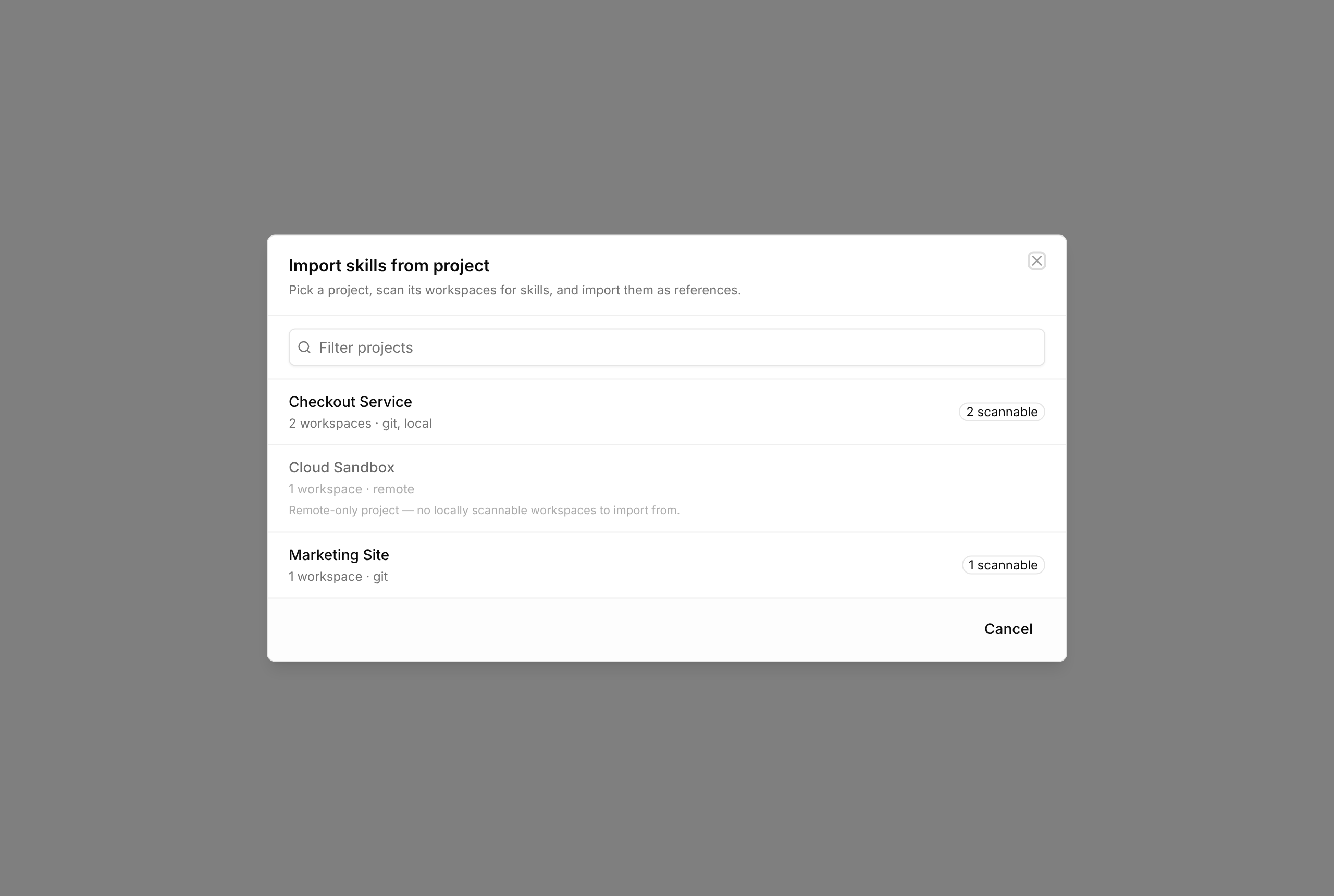 **Review discovered skills** 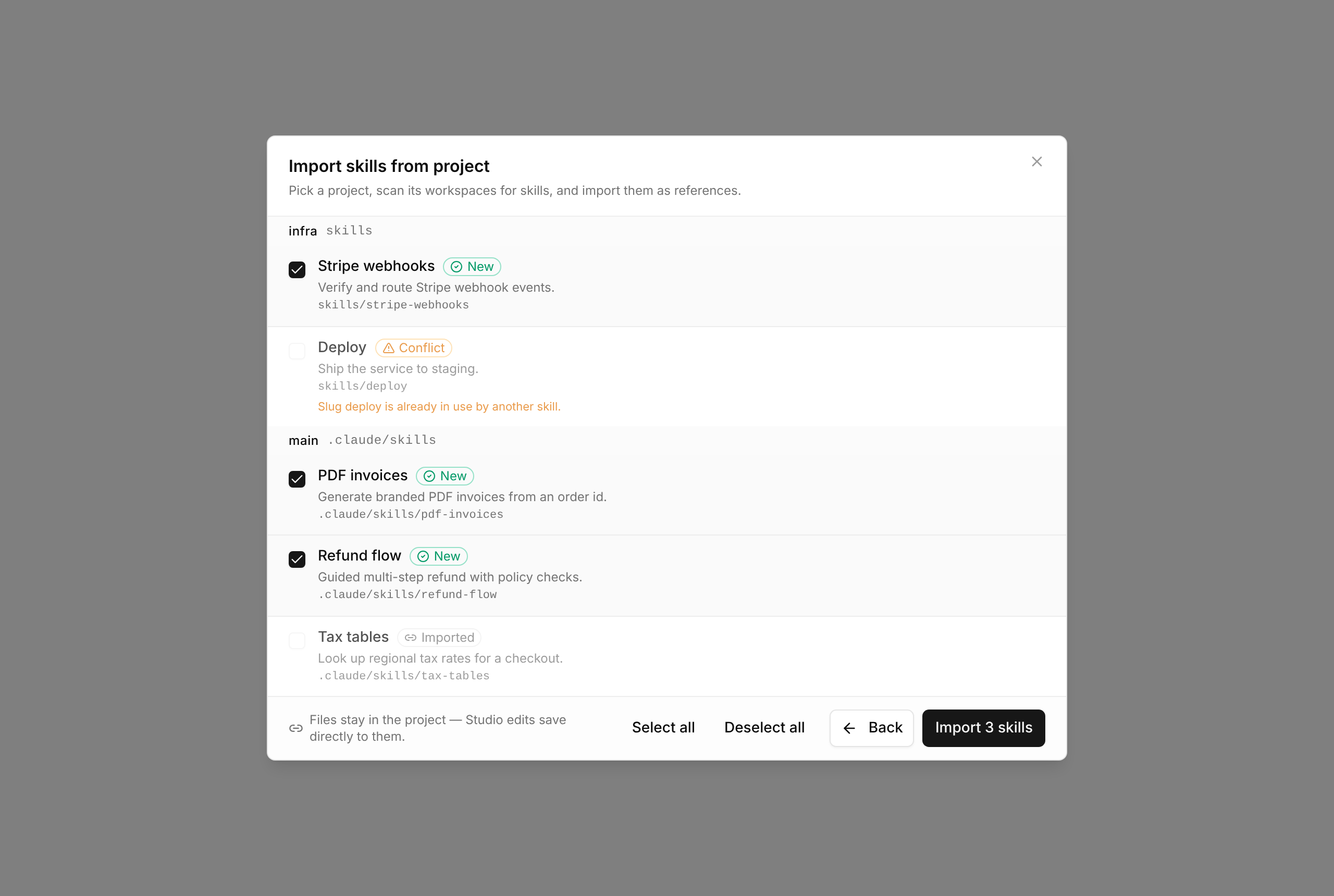 **Mobile selection footer** 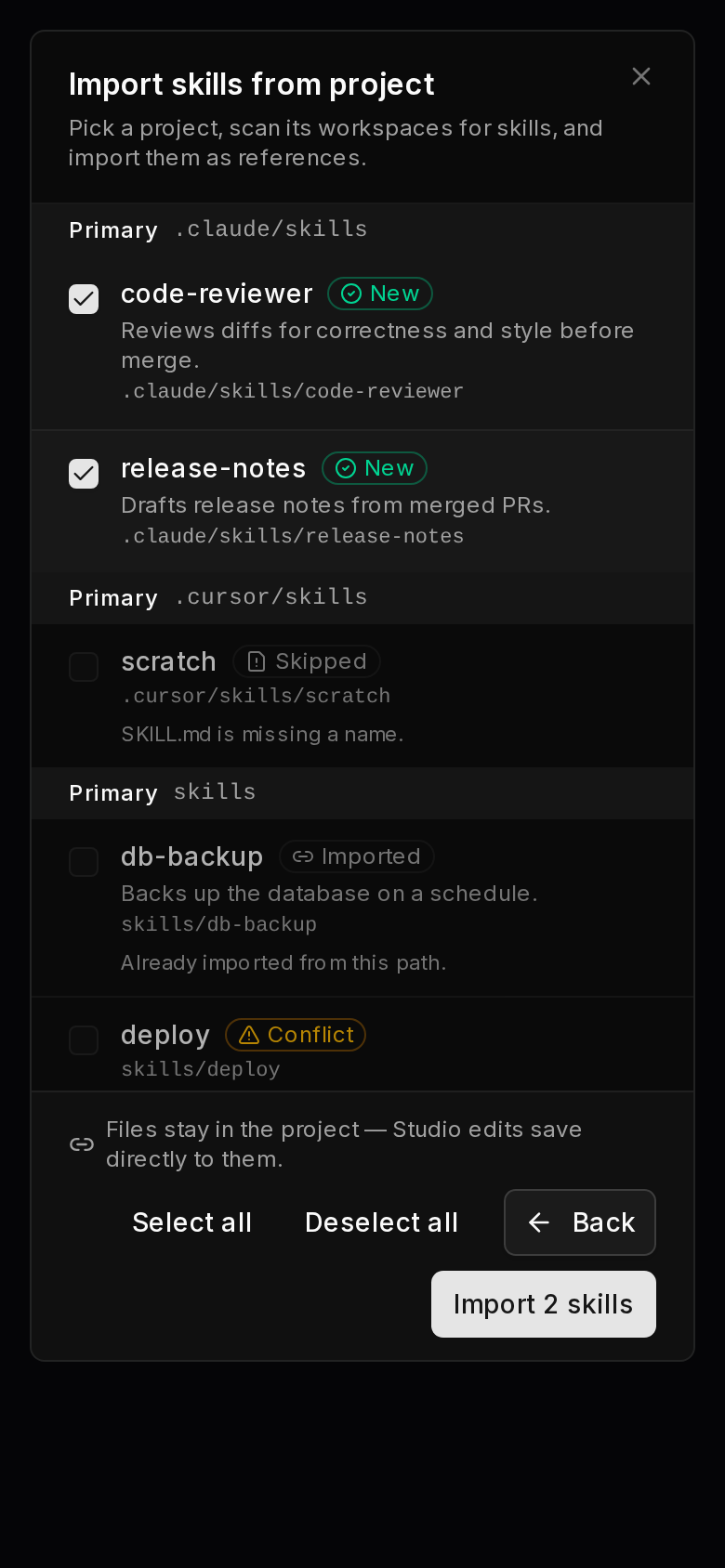 **Import result** 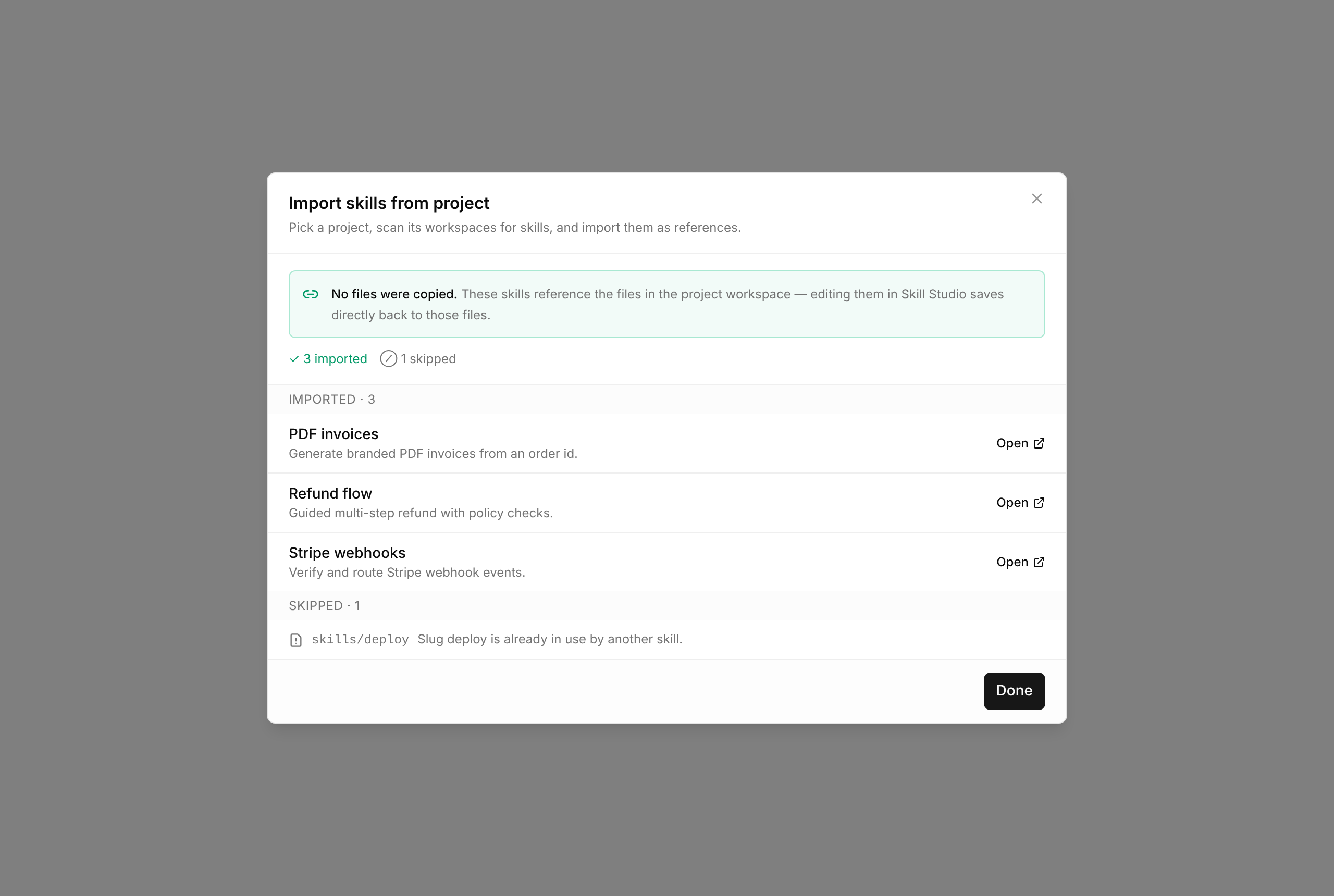 ## Verification - `pnpm exec vitest run server/src/__tests__/company-skills-service.test.ts server/src/__tests__/company-skills-routes.test.ts ui/src/pages/skills/ImportSkillsFromProjectDialog.test.tsx` — 3 files, 81 tests passed. - `pnpm check:token-gates` — all token gates clean. - `pnpm --filter @paperclipai/shared typecheck` — passed. - `pnpm --filter @paperclipai/server typecheck` — passed. - `pnpm --filter @paperclipai/ui typecheck` — passed. - Security review passed after adding tenant-scope and unauthorized-preview regressions; UX re-review approved desktop/mobile surfaces; QA passed all seven acceptance areas including write-through editing, deduplication, conflicts, empty state, and permission denial. ## Risks - Files remain referenced in project workspaces, so moving or deleting a source directory can make an imported skill unavailable; the UI explicitly communicates the reference behavior. - New well-known directory scans may discover more candidates than older versions, but preview mode prevents mutation until the operator confirms a selection. - The endpoint remains backward compatible: omitting `mode` preserves the prior full-import behavior. - No schema migration or telemetry event changes. > For core feature work, check [`ROADMAP.md`](ROADMAP.md) first and discuss it in `#dev` before opening the PR. Feature PRs that overlap with planned core work may need to be redirected — check the roadmap first. See `CONTRIBUTING.md`. ## Model Used - Anthropic Claude Opus 4.8 with tool use/code execution assisted with the UI implementation and UX polish. OpenAI Codex CLI with tool use/code execution assisted with server implementation, security fixes, regression coverage, integration, and PR preparation; the runtime did not expose Codex's exact backing model ID or context-window size. ## Checklist - [x] I have included a thinking path that traces from project context to this change - [x] I have specified the model used (with version and capability details) - [x] I have checked ROADMAP.md and confirmed this PR does not duplicate planned core work - [x] I have searched GitHub for duplicate or related PRs and linked them above - [x] I have either (a) linked existing issues with `Fixes: #` / `Closes #` / `Refs #` OR (b) described the issue in-PR following the relevant issue template - [x] I have not referenced internal/instance-local Paperclip issues or links (only public GitHub `#NNN` / `github.com/paperclipai/paperclip` URLs) - [x] My branch name describes the change (e.g. `docs/...`, `fix/...`) and contains no internal Paperclip ticket id or instance-derived details - [x] I have run tests locally and they pass - [x] I have added or updated tests where applicable - [x] I have updated relevant documentation to reflect my changes - [x] I have considered and documented any risks above - [x] All Paperclip CI gates are green - [x] Greptile is 5/5 with no open P2s, recommendations, or follow-ups - [x] I will address all Greptile and reviewer comments before requesting merge --------- Co-authored-by: Paperclip <noreply@paperclip.ing> Co-authored-by: Claude Opus 4.8 <noreply@anthropic.com> |
||
|
Devin FoleyandPaperclip
|
d47b4da655 |
Auto-build bundled plugins on install (#8254)
## Thinking Path > - Paperclip is the open source app people use to manage AI agents for work > - Plugins extend the server with worker/UI surfaces, and bundled local plugins under `packages/plugins/**` ship as TS source — their compiled `dist/` is not checked in > - On a fresh checkout, installing a bundled local plugin via the in-app **Install** button failed because `paperclipPlugin.manifest` points at `./dist/manifest.js`, which does not exist until the package is built > - The error surfaces as `Package … does not appear to be a Paperclip plugin (no manifest found)`, which is misleading — the manifest is real, the dist is just missing — and forces every contributor to run `pnpm --filter … build` by hand before the bundled-plugin installer works at all > - This pull request teaches the install path to detect that case and run the package's build (plus standalone runtime bootstrap for plugins outside the root workspace) before manifest resolution, gated by a kill switch and a bounded timeout > - The benefit is bundled plugins like `@paperclipai/plugin-workspace-diff` install in one click on a fresh checkout, with a clear error message and manual fallback when the autobuild itself fails ## Linked Issues or Issue Description No existing GitHub issue. Underlying bug, following the bug-report template: **What happened?** Installing a bundled local plugin from a fresh checkout fails with `Package @paperclipai/plugin-workspace-diff at packages/plugins/plugin-workspace-diff does not appear to be a Paperclip plugin (no manifest found)`. The manifest is declared in `package.json` (`paperclipPlugin.manifest = ./dist/manifest.js`) but `dist/` is not built/committed, so the loader cannot find it. **Expected behavior** Clicking **Install** on a bundled plugin builds it if needed and registers it, without a manual build step. **Steps to reproduce** 1. Fresh checkout of `master` 2. Start the server, open Plugin Manager 3. Click **Install** next to `@paperclipai/plugin-workspace-diff` 4. Observe the "no manifest found" failure **Scope** Same failure mode affects every bundled plugin without a checked-in `dist/` (`plugin-llm-wiki`, examples, sandbox-provider plugins, etc.). ## What Changed - `server/src/services/plugin-loader.ts`: added `ensureLocalPluginBuilt(packageRoot, pkgJson)` — when the package lives under `packages/plugins/**` and its declared paperclipPlugin entrypoints (`manifest`, `worker`, `ui`) are missing, run `pnpm --filter <name> build` (and a standalone runtime-deps bootstrap for plugins outside the root pnpm workspace) before manifest resolution - `server/src/routes/plugins.ts`: invoke the autobuild from the local-path install path; surface a `hasBuiltEntrypoints` boolean on the `AvailableBundledPlugin` listing; invalidate the bundled-plugins cache after a successful install so a freshly built plugin no longer reports `hasBuiltEntrypoints: false` - `ui/src/api/plugins.ts` + `ui/src/pages/PluginManager.tsx`: type and consume `hasBuiltEntrypoints` so the installer can show that an autobuild will run on install - `server/src/__tests__/plugin-install-autobuild.test.ts`: new suite — 9 tests covering success, kill-switch, build failure, timeout, manifest still missing after build, standalone variant, and the existing `plugin-routes-authz` listing assertion - `doc/plugins/LOCAL_PLUGIN_DEVELOPMENT.md`: documents the autobuild, the `PAPERCLIP_DISABLE_PLUGIN_AUTOBUILD=1` kill switch, and the manual fallback command - Detect the autobuild timeout via the child-process `killed` flag rather than string-matching the error message, so the "after timing out" context is actually emitted Knobs: - `PAPERCLIP_DISABLE_PLUGIN_AUTOBUILD=1` — skip autobuild entirely; restore prior behavior - Build timeout: 120s, with a clear error that points at the manual `pnpm --filter <name> build` recovery command ## Verification - `cd server && pnpm vitest run src/__tests__/plugin-install-autobuild.test.ts src/__tests__/plugin-routes-authz.test.ts` → 44/44 pass - End-to-end on a clean checkout: `rm -rf packages/plugins/plugin-workspace-diff/dist`, invoke `ensureLocalPluginBuilt()` against the real package, all declared entrypoints (`dist/manifest.js`, `dist/worker.js`, `dist/ui/index.js`) regenerated. The original `no manifest found` symptom no longer reproduces. ## Risks Low. The autobuild only fires when (a) the package sits under `packages/plugins/**`, (b) at least one declared entrypoint is missing, and (c) the kill switch is not set. In a packaged production server the `packages/plugins/**` path does not exist on disk, so the helper short-circuits and never shells out to `pnpm`. Failures from the spawned build are surfaced as an install error with the exact manual command to retry, so the worst-case is the same UX as before plus a clearer message. ## Model Used Claude Opus 4.7 (claude-opus-4-7), extended thinking enabled, tool use (filesystem + bash). ## Checklist - [x] I have included a thinking path that traces from project context to this change - [x] I have specified the model used (with version and capability details) - [x] I have checked ROADMAP.md and confirmed this PR does not duplicate planned core work - [x] I have searched GitHub for duplicate or related PRs and linked them above - [x] I have either (a) linked existing issues with `Fixes: #` / `Closes #` / `Refs #` OR (b) described the issue in-PR following the relevant issue template - [x] I have run tests locally and they pass - [x] I have added or updated tests where applicable - [ ] If this change affects the UI, I have included before/after screenshots - [x] I have updated relevant documentation to reflect my changes - [x] I have considered and documented any risks above - [ ] All Paperclip CI gates are green - [ ] Greptile is 5/5 with no open P2s, recommendations, or follow-ups - [x] I will address all Greptile and reviewer comments before requesting merge Co-authored-by: Paperclip <noreply@paperclip.ing> |



