mirror of
https://github.com/paperclipai/paperclip.git
synced 2026-10-26 10:26:26 +01:00
ee11cd65d9b42568cf3312e9cd50969fedec02e3
27
Commits
| Author | SHA1 | Message | Date | |
|---|---|---|---|---|
 Dotta |
ee11cd65d9 | fix(runner): persist warm Daytona workspaces | ||
|
Dotta
|
bcc6fe7a44 |
fix(runner): restore multi-turn remote sessions (#12840)
## Thinking Path > - Paperclip manages AI agents and their work. > - The runner executes agent turns on local and remote providers. > - A remote per-turn session must save its state before Paperclip releases its sandbox. > - The session runtime returned after 100 milliseconds while the remote checkpoint still ran. > - The next turn also checked the local state path instead of the verified remote backup. > - This pull request waits for the bounded remote close and accepts only a verified suspended backup. > - The benefit is reliable multi-turn execution without weaker identity checks. ## Linked Issues or Issue Description **What happened?** A successful remote agent turn released its sandbox before the runner saved the verified continuation backup. The next turn failed with `runner_state_identity_mismatch`. **Expected behavior** Paperclip must finish the bounded remote checkpoint before it releases the sandbox. A later turn must validate and restore the digest-matched suspended backup. **Steps to reproduce** 1. Run a native ACPX Claude Plan test in a non-reusable Daytona sandbox. 2. Reject the first plan to start a second turn. 3. Observe that the second turn fails before provider execution. **Paperclip version or commit** The failure reproduced at `13775a90b078ff64872f50961ea1b83d575e7bc6`. **Deployment mode** GitHub Actions with a Daytona sandbox. ## What Changed - Wait for the internally bounded remote runner close and checkpoint before the host returns. - Preserve the existing short cleanup bound for other providers. - Validate remote continuation lifecycle from a complete digest-verified backup when local runner state is absent. - Keep corrupt, non-suspended, mismatched, and unverified state fail-closed. - Make native Plan completion and accepted-Plan wake prompts deterministic. ## Verification - A prior 45-cell local campaign passed 44 cells. The only failure was the OpenCode Plan prompt variance fixed here. - A focused OpenCode local Plan rerun passed. - ACPX Claude Daytona message and question cells passed. - Focused regressions cover delayed checkpoint close and verified remote backup lifecycle. - GitHub Build and the focused ACPX Claude Daytona Plan cell will validate this exact head. ## Risks Remote runnerd sessions now wait for their internally bounded close/checkpoint path before returning; generic provider cleanup retains the existing 100 millisecond bound. Durable run success still cannot be reversed. The environment release guard still blocks sandbox destruction when no verified backup stamp exists. ## Model Used OpenAI Codex, GPT-5.6, extended reasoning, with code execution and GitHub Actions inspection. ## Checklist - [x] I have included a thinking path that traces from project context to this change - [x] I have specified the model used (with version and capability details) - [x] I have checked ROADMAP.md and confirmed this PR does not duplicate planned core work - [x] I have searched GitHub for duplicate or related PRs and linked them above - [x] I have either (a) linked existing issues with `Fixes: #` / `Closes #` / `Refs #` OR (b) described the issue in-PR following the relevant issue template - [x] I have not referenced internal/instance-local Paperclip issues or links (only public GitHub `#NNN` / `github.com/paperclipai/paperclip` URLs) - [x] My branch name describes the change and contains no internal task id - [ ] I have run tests locally and they pass - [x] I have added or updated tests where applicable - [ ] I have updated relevant documentation to reflect my changes - [x] I have considered and documented any risks above - [ ] All Paperclip CI gates are green - [ ] Greptile is 5/5 with no open findings - [ ] I will address all Greptile and reviewer comments before requesting merge |
||
|
Dotta
|
0a422fda52 |
feat(runner): add remote execution substrate (#12638)
## Thinking Path > - Paperclip is the open source app people use to manage AI agents for work. > - Paperclip Runner gives native runs a durable and governed execution path. > - The current native path runs on the control-plane host. > - Remote environments need an authenticated execution-target contract. > - The contract must not change direct adapters or enable new runtimes by default. > - This pull request adds the remote execution substrate and Daytona ingress. > - The benefit is a bounded base for later remote runner transport work. ## Linked Issues or Issue Description Refs #12616. Refs #12352. **Subsystem affected** Cross-cutting. This change touches runner transport, server orchestration, plugin contracts, and shared settings. **Problem or motivation** Native execution cannot resolve an authenticated runner ingress through a remote environment. The server also lacks one provider-neutral contract for remote execution targets. **Proposed solution** Add a default-off runner preview ingress capability. Add transport-neutral runner connectivity. Add remote execution target and lifecycle handling. Add a Daytona ingress implementation with redacted credentials. **Alternatives considered** A provider-specific server path would duplicate orchestration and authorization. A public endpoint without an environment contract would weaken the trust boundary. **Roadmap alignment** This work supports the Cloud and Sandbox agents milestone. It also supports self-healing runs and governed tool access. ## What Changed - Added execution-target traits for local, SSH, and sandbox environments. - Added plugin RPC contracts for runner ingress endpoints. - Added authenticated Daytona preview ingress. - Added transport-neutral PRP outbound connections. - Added remote runner artifact verification and fail-closed provider selection. - Added bounded native session resume, cancellation, and lifecycle recovery. - Preserved Codex-only selection for fresh experimental runner starts. - Preserved all direct adapter execution and finalization paths. - Removed stale Pi provider-pack requirements that security review rejected. - Kept the rollout controls off by default. - Did not change pnpm-lock.yaml, Cargo, database migrations, or GitHub workflows. ## Verification - GitHub Actions will run the repository test, typecheck, build, security, and policy gates. - Focused tests cover ingress validation, redaction, execution targets, remote lifecycle, cancellation, resume, and legacy adapter selection. - Local tests were not run. The requested verification policy uses GitHub Actions for this series. - `git diff --check origin/master...HEAD` passes. - The diff contains 52 files. ## Risks - Remote execution crosses a trust boundary. - The implementation validates target capabilities, artifact digests, provider-pack pins, and connection metadata. - The feature remains default-off. - Fresh native selection remains Codex-only. - Existing direct adapters remain on the legacy path. - This PR does not yet make remote Codex runnable. The next PR adds the Rust WSS and TLS transport. ## Model Used OpenAI Codex with GPT-5.6. The work used high-reasoning agent mode, repository tools, GitHub tools, and parallel code-audit agents. ## Checklist - [x] I have included a thinking path that traces from project context to this change - [x] I have specified the model used (with version and capability details) - [x] I have checked ROADMAP.md and confirmed this PR does not duplicate planned core work - [x] I have searched GitHub for duplicate or related PRs and linked them above - [x] I have either (a) linked existing issues with Fixes: / Closes / Refs OR (b) described the issue in-PR following the relevant issue template - [x] I have not referenced internal or instance-local Paperclip issues or links - [x] My branch name describes the change and contains no internal Paperclip ticket id - [ ] I have run tests locally and they pass - [x] I have added or updated tests where applicable - [x] I have updated relevant documentation to reflect my changes - [x] I have considered and documented risks above - [ ] All Paperclip CI gates are green - [ ] Greptile is 5/5 with no open P2s, recommendations, or follow-ups - [x] I will address all Greptile and reviewer comments before requesting merge |
||
|
Nicky LeachandPaperclip
|
a14e51d592 |
refactor(environment): classify environment capabilities from static driver definitions (#12045)
## Thinking Path > - Paperclip is the open source app people use to manage AI agents for work > - Environment runtime drivers provide workspace, lease, and custom image behavior > - Runtime code used driver identity checks and several capability-specific members > - These checks spread capability rules across the runtime and made new drivers harder to verify > - This pull request adds one general capability classifier and one static driver support table > - The benefit is one fail-closed capability model that keeps current behavior and supports future drivers ## Linked Issues or Issue Description **What existing behavior does this improve?** Environment runtime capability checks for workspace realization, custom images, lease capabilities, and duplex authorization. **Subsystem affected** Cross-cutting (multiple of the above) **Current behavior** The runtime selects several capability paths from driver identity and separate capability members. Custom image gates also trust provider declarations without checking every matching live worker method. **Proposed behavior** The runtime uses one general capability classifier and one static support table. Custom image gates require both the provider declaration and every matching live worker method. The public capability names remain unchanged. **Reason and benefit** The change keeps capability rules in one place. It removes identity conditions from runtime consumers and makes unsupported drivers fail closed. **Breaking changes** None. The public names sandboxCapabilities, sandboxProviders, and EffectiveSandboxCapabilities remain available. ## What Changed - Add classifyEnvironmentCapabilities and static support definitions for all four driver families. - Add resolveCapabilities to every environment runtime driver. - Move driver traits into environment-driver-traits.ts and migrate runtime consumers. - Require provider declarations and matching live worker methods for all custom image gates. - Migrate duplex authorization to the general resolver and remove the dead sandbox-only member. - Delete the unused resolveEffectiveSandboxCapabilities wrapper and update its test. ## Verification - pnpm --filter @paperclipai/server typecheck - pnpm exec vitest run server/src/__tests__/environment-capability-contract.test.ts server/src/__tests__/environment-runtime.test.ts — 92 tests pass - pnpm exec vitest run server/src/__tests__/environment-driver-traits.test.ts server/src/__tests__/general-capability-classifier.test.ts — 12 tests pass - pnpm exec vitest run server/src/__tests__/environment-custom-images-service.test.ts server/src/__tests__/environment-execution-target-capabilities.test.ts server/src/__tests__/environment-execution-target-duplex.test.ts server/src/__tests__/environment-execution-target-duplex-kill-switch.test.ts — 66 tests pass ## Risks The main risk is a capability gate that denies a valid driver or permits an invalid driver. The static support matrix, live worker method checks, and regression tests reduce this risk. No database, public API, or published type name changes. ## Model Used OpenAI Codex, GPT-5, with tool use and code execution. The deployment does not provide a separate context-window value. ## Checklist - [x] I have included a thinking path that traces from project context to this change - [x] I have specified the model used (with version and capability details) - [x] I have checked ROADMAP.md and confirmed this PR does not duplicate planned core work - [x] I have searched GitHub for duplicate or related PRs and linked them above - [x] I have either (a) linked existing issues with Fixes: # / Closes # / Refs # OR (b) described the issue in-PR following the relevant issue template - [x] I have not referenced internal/instance-local Paperclip issues or links (only public GitHub #NNN / github.com/paperclipai/paperclip URLs) - [x] My branch name describes the change (for example, docs/... or fix/...) and contains no internal Paperclip ticket id or instance-derived details - [x] I have run tests locally and they pass - [x] I have added or updated tests where applicable - [x] I have updated relevant documentation to reflect my changes - [x] I have considered and documented any risks above - [x] All Paperclip CI gates are green - [x] Greptile is 5/5 with no open P2s, recommendations, or follow-ups - [x] I will address all Greptile and reviewer comments before requesting merge --------- Co-authored-by: Paperclip <noreply@paperclip.ing> |
||
|
Devin Foley
|
c62bb4b16b |
feat: environment delete with agent reassignment and consented sandbox destroy (#12053)
## Thinking Path > - Paperclip is the open source app people use to manage AI agents for work > - Environments define where agent runs execute: local, SSH, or provider sandboxes > - Operators can create and edit environments, but the UI has no way to delete one > - The server already exposes `DELETE /environments/:id` and a delete-blast-radius preflight, but no UI consumes them, and a delete blocked by reusable sandbox leases gives the operator no path forward > - This pull request adds the delete flow to the environment configuration page: a preflight-driven modal that reassigns dependent agents, names the workspaces that hold blocking sandbox leases, and can destroy those sandboxes with explicit consent > - The benefit is that operators can retire stale environments from the UI without database surgery, and dependent agents move to a chosen replacement instead of silently falling back ## Linked Issues or Issue Description Refs #8554 Refs #11124 **Subsystem affected** Environments (server routes, environment runtime service, and the environment settings UI). **Problem or motivation** The environment configuration page has no delete control. The server delete endpoint exists, but nothing in the UI calls it. When reusable sandbox leases block a delete, the 409 error names no owner, so the operator cannot find the blocking workspace. Agents that use the environment as their default lose it silently through the FK `on delete set null`. **Proposed solution** Add a delete button with a confirmation modal on the environment edit page. The modal reads the delete-blast-radius preflight. It offers a dropdown to reassign dependent agents to another environment before the delete. It lists each workspace that holds a blocking reusable sandbox lease, with a link. When those leases are the only blocker, the confirm button destroys the sandboxes inline (`?destroyReusableSandboxLeases=true`) and then deletes. A failed teardown falls back to `pending_cleanup` for the sweep, so no sandbox is orphaned. ## What Changed - `ui/src/pages/CompanyEnvironments.tsx`: delete button on the edit page header, confirmation modal with agent reassignment select, lease-holder list, impact notes, and a consent-labeled destroy-and-delete action - `ui/src/api/environments.ts`: `deleteBlastRadius` and `remove` client methods; `remove` takes an optional `destroyReusableSandboxLeases` flag - `server/src/routes/environments.ts`: `DELETE /environments/:id` accepts `?destroyReusableSandboxLeases=true`; it destroys the environment's reusable sandbox leases first, but only when those leases are the sole delete blocker, then re-checks the blast radius before it deletes - `server/src/services/environment-runtime.ts`: new `destroyReusableSandboxLeasesForEnvironment` — destroys every reusable sandbox lease an environment still owns while the environment config (provider credentials) is still available - `server/src/services/environments.ts`: the delete blast radius now returns `reusableSandboxLeaseHolders` (lease id, workspace, issue) so clients can name what blocks a delete - `packages/shared/src/types/environment.ts`: `EnvironmentDeleteReusableLeaseHolder` type on the blast radius - Tests: route gating for the consent flag (destroy runs, mixed-blocker rejection, surviving-lease rejection), runtime destroy scoped to an environment, blast-radius holder join, and UI tests for the reassignment flow, holder links, and the consent button ## Verification - `npx vitest run server/src/__tests__/environment-routes.test.ts server/src/__tests__/environment-service.test.ts server/src/__tests__/environment-runtime.test.ts ui/src/pages/CompanyEnvironments.test.tsx` - Manual: open Settings → Environments → edit an environment. The trash icon opens the modal. With agents on the environment, pick a reassignment target and confirm; agents move and the environment deletes. With reusable sandbox leases, the modal names the holding workspaces and the confirm button reads "Destroy N sandboxes and delete". ## Risks - The consented path destroys provider sandboxes. It runs only when reusable leases are the sole blocker, so a delete that would still be rejected never destroys anything. A failed teardown routes to `pending_cleanup` and the delete stays blocked until the sweep resolves it. - Agent reassignment issues one PATCH per agent from the client. A mid-sequence failure leaves some agents reassigned; the reassignments are valid on their own and the UI refreshes to the actual state. - Hard blockers (managed local, instance default, pending cleanup) keep the existing 409 behavior and disable the confirm button. ## Model Used - Claude (Anthropic) — Fable 5, model id `claude-fable-5`, extended thinking, agentic tool use via Claude Code CLI. ## Checklist - [x] I have included a thinking path that traces from project context to this change - [x] I have specified the model used (with version and capability details) - [x] I have checked ROADMAP.md and confirmed this PR does not duplicate planned core work - [x] I have searched GitHub for duplicate or related PRs and linked them above - [x] I have either (a) linked existing issues with `Fixes: #` / `Closes #` / `Refs #` OR (b) described the issue in-PR following the relevant issue template - [x] I have not referenced internal/instance-local Paperclip issues or links (only public GitHub `#NNN` / `github.com/paperclipai/paperclip` URLs) - [x] My branch name describes the change (e.g. `docs/...`, `fix/...`) and contains no internal Paperclip ticket id or instance-derived details - [x] I have run tests locally and they pass - [x] I have added or updated tests where applicable - [ ] I have updated relevant documentation to reflect my changes - [x] I have considered and documented any risks above - [ ] All Paperclip CI gates are green - [ ] Greptile is 5/5 with no open P2s, recommendations, or follow-ups - [x] I will address all Greptile and reviewer comments before requesting merge |
||
|
Nicky LeachandPaperclip
|
c1c46f1e4e |
feat: Claude login on the new-agent page before agent creation (#11347)
## Thinking Path > - Paperclip is the open source app people use to manage AI agents for work > - The Claude local adapter supports subscription login through a sandbox > - The new-agent page must show login before the user creates an agent > - Test results must not expose raw sandbox diagnostics or secret values > - This pull request adds the login UI to both Test lanes and closes the diagnostic boundary > - The branch also adds durable cleanup recovery for failed sandbox teardown > - Reusable sandboxes must retain both their recorded teardown configuration and a valid lifecycle path until destruction succeeds > - The benefit is a usable login flow with fixed public checks, redacted server logs, and recoverable sandbox cleanup ## Linked Issues or Issue Description Related public work: [#9488](https://github.com/paperclipai/paperclip/pull/9488) adds first-class recognition for `CLAUDE_CODE_OAUTH_TOKEN` in headless and remote runs. Related public issue: [#2681](https://github.com/paperclipai/paperclip/issues/2681) requests Claude Code subscription support. This pull request adds the login transport and new-agent UI flow that those changes do not provide. **Subsystem affected:** Claude local adapter, server login probes, sandbox provider setup, cleanup recovery, and the new-agent UI. **Problem or motivation:** The Test lanes did not show the sandbox login panel in all supported cases. Test results also exposed raw probe diagnostics, and JSON escapes could end secret redaction early. **Proposed solution:** Surface the login capability through the bundled provider manifest. Prepare the same probe runtime in the ACP lane. Send diagnostics only to redacted server logs. Keep Test checks on fixed public messages. Normalize login URL hints to allowlisted HTTPS Claude and Anthropic hosts. Consume JSON escapes during redaction. Preserve failed sandbox cleanup state across retries and restarts, and prevent deletion from severing the lifecycle context of a live reusable sandbox. **Alternatives considered:** Keep raw diagnostics in Test checks or trust login URL text from the sandbox. Both choices increase information exposure. Keep separate probe behavior in the ACP lane. That choice would leave the two Test lanes inconsistent. ## What Changed - Surface the sandbox login panel on both Test lanes. - Reconcile the bundled Daytona plugin manifest so `supportsSetupTokenLogin` reaches the UI capability gate. - Prepare the ACP Test lane with the same probe runtime as the CLI Test lane. - Add the `claude_acp_login_probe_unavailable` warning when the ACP probe cannot run. - Send raw sandbox diagnostics only to redacted server logs. - Keep Test checks on fixed public messages in the ACP, managed-config, and CLI paths. - Normalize login URL hints to allowlisted HTTPS Claude and Anthropic hosts. - Redact JSON and escaped-JSON secret values, including escaped quotes and backslashes. - Preserve orphan cleanup records across provider failures, restarts, and unavailable plugins. - Atomically block environment deletion while a live reusable sandbox lease still depends on it. - Verify pending cleanup destroys plugin sandboxes with the provider configuration recorded on the lease, even after the current environment configuration changes. ## Verification - Head under review: `506b7fa2d83c36bfa5fd722ee9d95b0c7431c241`. - Focused environment route/service/runtime coverage passes: 196 tests across 3 files. - `pnpm -r typecheck` passes. - `pnpm build` passes. - The full Vitest run completed with 4,754 passing and 28 failing tests. All 23 source-test failures reproduce unchanged on parent head `58cfe61a33191ce03d965d65085d26064b4888ba`; the other 5 are duplicate executions from stale `server/dist` output. The failures are unrelated macOS path/listener and scheduler-fixture failures, so there is no new bad commit for bisect to localize. - All required CI checks pass for the current head, including build, typecheck/release registry, all server and workspace shards, serialized server suites, canary, and e2e. - A fresh Greptile review for `506b7fa2d83c36bfa5fd722ee9d95b0c7431c241` reports 5/5, “safe to merge,” with no blocking failure remaining. ## Risks - A probe or redaction change could hide useful server diagnostics. - An allowlist change could reject a valid Claude login URL. - Cleanup recovery changes could affect provider teardown ordering. - An environment with a live reusable sandbox can no longer be deleted until the owning issue or execution workspace completes teardown. - The implementation keeps public Test messages fixed and sends detail to redacted server logs. ## Model Used OpenAI GPT-5 via Codex — exact model ID: GPT-5; tool use and code execution enabled; extended reasoning enabled. The implementation author used AI-assisted development. ## Checklist - [x] I have included a thinking path that traces from project context to this change - [x] I have specified the model used (with version and capability details) - [x] I have checked ROADMAP.md and confirmed this PR does not duplicate planned core work - [x] I have searched GitHub for duplicate or related PRs and linked them above - [x] I have either (a) linked existing issues with `Fixes: #` / `Closes: #` / `Refs: #` OR (b) described the issue in-PR following the relevant issue template - [x] I have not referenced internal/instance-local Paperclip issues or links (only public GitHub `#NNN` / `github.com/paperclipai/paperclip` URLs) - [x] My branch name describes the change (e.g. `docs/...`, `fix/...`) and contains no internal Paperclip ticket id or instance-derived details - [x] I have run tests locally and documented the result - [x] I have added or updated tests where applicable - [x] I have updated relevant documentation or confirmed no separate documentation change is needed - [x] I have considered and documented any risks above - [x] All Paperclip CI gates are green - [x] Greptile is 5/5 with no open P2s, recommendations, or follow-ups - [x] I will address all Greptile and reviewer comments before requesting merge --------- Co-authored-by: Paperclip <noreply@paperclip.ing> |
||
|
Nicky LeachandPaperclip
|
e71ce9a9d3 |
feat: sandbox provider capability contract with fail-closed effective resolution (#11463)
## Thinking Path > - Paperclip is the open source app people use to manage AI agents for work > - Paperclip runs work through adapters and sandbox providers > - Providers need a clear contract so the server can use only verified capabilities > - A declared capability must not grant a method that the live worker did not verify > - This pull request adds manifest declarations and fail-closed effective capability resolution > - The benefit is safe provider reuse across execution targets and run lifecycles ## Linked Issues or Issue Description **Subsystem affected** Cross-cutting (multiple of the above) **Problem or motivation** Sandbox providers expose different runtime methods. The server needs one safe capability contract that accounts for provider declarations, worker verification, and narrowing configuration. **Proposed solution** Add strict manifest validation for five sandbox capabilities. Resolve effective capabilities as the subset of verified, declared, and narrowed values. Store the result as a frozen execution-target snapshot. **Alternatives considered** Trusting the manifest alone could grant methods that the worker does not support. Trusting only a fixed built-in list would reject valid third-party providers. The intersection rule keeps the verified runtime ceiling and supports both provider types. **Roadmap alignment** This change supports the ACP run lifecycle track and the sandbox provider contract work in the current roadmap. **Additional context** The legacy `supportsReusableLeases` field remains supported. The nested capability validator rejects unknown keys. Missing or unavailable verification resolves all capabilities to `false`. ## What Changed - Add strict `sandboxCapabilities` manifest validation with legacy reusable-lease compatibility. - Carry declarations through the ready-driver projection. - Add fail-closed effective resolution from verified, declared, and narrowed capabilities. - Add narrowing for provider configuration, Kubernetes Job leases, and Daytona sessions. - Add a frozen read-only capability snapshot to execution targets. - Add focused tests and keep existing characterization baselines covered. - Add and update sandbox provider capability documentation. ## Verification - `npx vitest run packages/shared/src/validators/plugin.test.ts` - `npx vitest run server/src/__tests__/plugin-environment-driver-sandbox-capabilities.test.ts` - `npx vitest run server/src/__tests__/sandbox-capability-contract.test.ts` - `npx vitest run server/src/__tests__/environment-execution-target-capabilities.test.ts` - `npx vitest run packages/adapter-utils/src/acpx-engine/startup-characterization.test.ts packages/adapter-utils/src/acpx-engine/turn-characterization.test.ts packages/adapter-utils/src/acpx-engine/settlement-characterization.test.ts packages/adapter-utils/src/acpx-engine/composed-run-characterization.test.ts` - Package typechecks for shared, server, and adapter-utils pass. - Stage-2 security review suites pass with 28 tests. ## Risks The resolver fails closed when verification is absent or unavailable. Providers that rely on undeclared capabilities may see narrower behavior until they expose verified worker methods. The change does not alter the existing native-sync guard. ## Model Used OpenAI Codex, GPT-5, exact runtime model ID `gpt-5`, tool use and code execution. The implementation author used this model to assist with the change. ## Checklist - [x] I have included a thinking path that traces from project context to this change - [x] I have specified the model used (with version and capability details) - [x] I have checked ROADMAP.md and confirmed this PR does not duplicate planned core work - [x] I have searched GitHub for duplicate or related PRs and linked them above - [x] I have either (a) linked existing issues with `Fixes: #` / `Closes: #` / `Refs: #` OR (b) described the issue in-PR following the relevant issue template - [x] I have not referenced internal/instance-local Paperclip issues or links (only public GitHub `#NNN` / `github.com/paperclipai/paperclip` URLs) - [x] My branch name describes the change (e.g. `docs/...`, `fix/...`) and contains no internal Paperclip ticket id or instance-derived details - [x] I have run tests locally and they pass - [x] I have added or updated tests where applicable - [x] I have updated relevant documentation to reflect my changes - [x] I have considered and documented any risks above - [x] All Paperclip CI gates are green - [x] Greptile is 5/5 with no open P2s, recommendations, or follow-ups - [x] I will address all Greptile and reviewer comments before requesting merge --------- Co-authored-by: Paperclip <noreply@paperclip.ing> |
||
|
Nicky LeachandPaperclip
|
e52b8a343f |
fix: ACP run lifecycle corrections — failure settlement, workspace sync-back, lease cleanup (#11454)
## Thinking Path > - Paperclip is the open source app people use to manage AI agents for work. > - Agent adapters run ACP sessions and manage runtime, workspace, and lease resources. > - Several failure paths left runtime bridges, staged workspaces, or environment leases active after an error. > - These leaks reduce run reliability and can leave later runs without clean resources. > - This pull request closes the failure paths, applies one teardown policy, and adds regression tests. > - The benefit is consistent failure settlement and safer reuse of agent workspaces and leases. ## Linked Issues or Issue Description **What happened?** ACP runs could leave runtime bridges, staged workspaces, or environment leases active after failures. Claude and Gemini ACP runs did not restore the sandbox workspace on teardown. Lease release stopped when one lease returned an error. **Expected behavior** Each ACP failure must return an error result and settle its resources. Teardown must run each step, release leases independently, and restore the host workspace when the sandbox ends. Pending cleanup leases must receive bounded retry attempts. **Steps to reproduce** 1. Run an ACP session that fails after runtime creation or during turn preparation. 2. Run an ACP session that fails during a warm hit or staged runtime handoff. 3. Run lease cleanup with more than one lease when the first release returns an error. 4. Inspect the result phase, teardown calls, workspace state, and lease metadata. 5. Run the regression suites listed in the Verification section. ## What Changed - Settle every ACP failure after runtime creation with an error result and one sandbox.startup span closure. - Close the ACP runtime and remove warm entries after every pre-turn failure. - Run all teardown steps, record teardown errors, release staging leases in finally, and prevent duplicate teardown. - Dispose staged runtimes after seam failures and remove borrowed staged entries with identity guards. - Add fail-open workspace sync-back teardown for Claude and Gemini ACP adapters. - Isolate lease release errors and add bounded retry sweeps for stranded pending_cleanup leases. - Atomically claim pending_cleanup retries and clamp attempt readers to keep the five-attempt bound. - Default absent provider reusableLeases values to false and align the fake provider with its runtime declaration. - Add regression tests for engine, adapter, server, and shared environment behavior. ## Verification - [x] `npx vitest run packages/adapter-utils/src/acpx-engine/execute.test.ts` — 124 tests passed. - [x] `npx vitest run packages/adapters/codex-local/src/server/acp.test.ts packages/adapters/claude-local/src/server/acp.test.ts packages/adapters/gemini-local/src/server/acp.test.ts` — 61 tests passed. - [x] `npx vitest run server/src/__tests__/environment-runtime.test.ts server/src/__tests__/heartbeat-pending-cleanup-sweep.test.ts server/src/__tests__/reusable-leases-default.test.ts server/src/__tests__/environment-routes.test.ts packages/shared/src/environment-support.test.ts` — passed. - [x] All listed suites ran from the repository root. - [x] GitHub CI completed successfully for `cfc349c9f232711433897915112a1c52c0e462ca`. - [x] Greptile completed with a 5/5 confidence score and no blocking finding. ## Risks The engine changes affect failure settlement and teardown order across ACP runs. The server changes add retry state to existing lease metadata without a schema migration. The adapter changes restore workspaces after sandbox execution. Regression tests cover the changed paths. GitHub CI and Greptile passed for the current head. > For core feature work, check [`ROADMAP.md`](ROADMAP.md) first and discuss it in `#dev` before opening the PR. This change fixes runtime reliability and does not duplicate a roadmap feature. ## Model Used OpenAI GPT-5 Codex. The model used tool-based repository inspection, GitHub operations, and code review support. The runtime does not expose a context-window value. ## Checklist - [x] I have included a thinking path that traces from project context to this change - [x] I have specified the model used (with version and capability details) - [x] I have checked ROADMAP.md and confirmed this PR does not duplicate planned core work - [x] I have searched GitHub for duplicate or related PRs and linked them above - [x] I have either (a) linked existing issues with `Fixes: #` / `Closes #` / `Refs #` OR (b) described the issue in-PR following the relevant issue template - [x] I have not referenced internal/instance-local Paperclip issues or links (only public GitHub `#NNN` / `github.com/paperclipai/paperclip` URLs) - [x] My branch name describes the change (for example, `docs/...` or `fix/...`) and contains no internal Paperclip ticket id or instance-derived details - [x] I have run tests locally and they pass - [x] I have added or updated tests where applicable - [x] I have updated relevant documentation to reflect my changes - [x] I have considered and documented any risks above - [x] All Paperclip CI gates are green - [x] Greptile is 5/5 with no open P2s, recommendations, or follow-ups - [x] I will address all Greptile and reviewer comments before requesting merge --------- Co-authored-by: Paperclip <noreply@paperclip.ing> |
||
|
Jannes Stubbemann
|
6d2eab742f |
fix(server): retry runs that hit a sandbox provider worker restart window instead of failing setup (#10212)
## Thinking Path

> - Paperclip is the open source app people use to manage AI agents for
work
> - Agent runs execute in sandbox environments acquired through provider
plugins (e.g. the Kubernetes sandbox provider)
> - Lease acquisition happens during run setup, before the adapter
executes
> - When a provider plugin's worker is momentarily unavailable (a server
or plugin restart window), lease acquisition throws "Sandbox provider
... is installed via plugin ..., but its worker is not running."
> - The heartbeat setup path records that as a terminal `setup_failed`:
no retry classifier matches the message, so the run dies instantly even
though the worker returns seconds later
> - This PR classifies that transient condition as retryable
infrastructure so the run is retried instead of being lost to a restart
blip
> - The benefit is that routine restarts no longer produce spurious
instant run failures

## Linked Issues or Issue Description

No public GitHub issue exists; describing inline following the bug
report template.

**What happened**

During a brief sandbox-provider-worker restart window, several runs
failed instantly with `setup_failed` ("... but its worker is not
running."), while runs on the same agent moments earlier and later
succeeded.

**Expected behavior**

A transient, self-healing worker-unavailable condition should schedule a
bounded retry, not terminally fail the run.

**Steps to reproduce**

Trigger a run while the sandbox provider plugin worker is momentarily
unavailable (a server or plugin restart). Lease acquisition throws the
worker-not-running error and the run is finalized as `setup_failed` with
no retry. The recovery test added here reproduces the classification
path.

**Deployment mode**

Cloud multi-tenant execution (Kubernetes sandbox provider plugin).

## What Changed

- Added a dedicated, readable predicate that recognizes the transient
sandbox-provider-worker-unavailable lease failure and treats it as
retryable infrastructure, so the heartbeat schedules a bounded
continuation retry instead of finalizing terminally
- The predicate is anchored to the full lease-failure phrasing (`is
installed via plugin ... but its worker is not running`) so it cannot
match the permanent "provider not installed" message emitted by config
validation
- Added tests proving the readiness poll already waits the full deadline
while the worker handle is absent or `starting` (registered-late
coverage); no poll behavior change was needed

## Verification

- `cd server && npx vitest run
src/__tests__/environment-runtime.test.ts` — poll exhaustion +
registered-late cases
- `npx vitest run src/__tests__/heartbeat-process-recovery.test.ts` —
worker-unavailable message schedules a retry; a non-matching permanent
provider failure still escalates terminally (negative case)

## Risks

Low risk. The retry is bounded by the existing
infrastructure-continuation attempt cap (max 3), the message match is
narrow enough to exclude the permanent provider-not-installed failure
(covered by a negative test), and no readiness-poll or lease-acquisition
behavior changed.
## Model Used

Claude (Anthropic) via Claude Code. Implementation and tests authored by
a Claude Sonnet-class model (`claude-sonnet-5`) dispatched as isolated
per-task implementer agents under a multi-agent orchestration workflow;
root-cause investigation, planning, and two-stage adversarial code
review performed by additional Claude agents. Extended thinking and tool
use enabled throughout.

## Checklist

- [x] I have included a thinking path that traces from project context
to this change
- [x] I have specified the model used (with version and capability
details)
- [x] I have checked ROADMAP.md and confirmed this PR does not duplicate
planned core work
- [x] I have searched GitHub for duplicate or related PRs and linked
them above
- [x] I have either (a) linked existing issues with `Fixes: #` / `Closes
#` / `Refs #` OR (b) described the issue in-PR following the relevant
issue template
- [x] I have not referenced internal/instance-local Paperclip issues or
links (only public GitHub `#NNN` / `github.com/paperclipai/paperclip`
URLs)
- [x] My branch name describes the change and contains no internal
Paperclip ticket id or instance-derived details
- [x] I have run tests locally and they pass
- [x] I have added or updated tests where applicable
- [ ] I have updated relevant documentation to reflect my changes
- [x] I have considered and documented any risks above
- [ ] All Paperclip CI gates are green
- [ ] Greptile is 5/5 with no open P2s, recommendations, or follow-ups
- [x] I will address all Greptile and reviewer comments before
requesting merge
|
||
|
Nicky LeachandPaperclip
|
6b7e0814a0 |
feat(acp): stream Daytona sandbox agent output and remove the host output poll (#11049)
## Thinking Path > - Paperclip is the open source app that manages AI agents for work > - Sandbox providers let agents run in remote and isolated environments > - Daytona session commands need a path that sends agent output to the host without host polling > - Host polling adds delay and repeats provider output work > - This pull request adds typed execute.log notifications and a log sink for incremental output > - This pull request adds an optional ACP session stream with final-result replay protection > - The benefit is lower output delay while the default flags keep current behavior unchanged ## Linked Issues or Issue Description **Subsystem affected** Cross-cutting. The change spans the plugin SDK, Daytona provider, adapter utilities, and server execution services. **Problem or motivation** The Daytona ACP bridge polls a host output file while an agent command runs. This adds delay and can repeat work. The host also needs a safe route for provider output chunks. **Proposed solution** Add a typed `execute.log` notification with host-issued invocation correlation. Add an ordered log sink to the environment execute path. Add an optional ACP session-log path that parses newline-delimited JSON frames and removes the host output poll for that path. **Alternatives considered** Keep the output-file poll as the only path. This keeps the current behavior but does not provide timely output. The new path stays behind flags, so the existing path remains the default fallback. **Roadmap alignment** This change supports the shipped Cloud / Sandbox agents milestone in `ROADMAP.md`, including Daytona support. ## What Changed - Add the typed `execute.log` worker-to-host notification and company-scoped host route. - Add ordered `stdout` and `stderr` chunk delivery before the final execute result. - Add the Daytona session log sink and the optional ACP streamed session path. - Add monotonic frame handling so live and final output reach the host once. - Keep `useLogStream` and `streamAgentSessionOutput` off by default. - Add unit and integration coverage for the notification, execution target, runtime, and Daytona paths. ## Verification - Run adapter-utils tests: 445 tests pass locally. - Run server environment tests: 73 tests pass locally. - Run Daytona plugin tests: 131 tests pass locally. - Run TypeScript checks for shared, adapter-utils, and server. - Review the pull request checks after GitHub completes them. - All required GitHub checks pass on the current head. ## Risks The new paths change output delivery only when a feature flag enables them. The final execute result remains available for parsing and fallback. The main risk is a provider stream or frame-order error; the final-result parser limits that risk. ## Model Used OpenAI Codex, GPT-5, tool use and code execution. The runtime did not supply a context-window value. ## Checklist - [x] I have included a thinking path that traces from project context to this change - [x] I have specified the model used (with version and capability details) - [x] I have checked ROADMAP.md and confirmed this PR does not duplicate planned core work - [x] I have searched GitHub for duplicate or related PRs and linked them above - [x] I have either (a) linked existing issues with `Fixes: #` / `Closes #` / `Refs #` OR (b) described the issue in-PR following the relevant issue template - [x] I have not referenced internal/instance-local Paperclip issues or links (only public GitHub `#NNN` / `github.com/paperclipai/paperclip` URLs) - [x] My branch name describes the change (e.g. `docs/...`, `fix/...`) and contains no internal Paperclip ticket id or instance-derived details - [x] I have run tests locally and they pass - [x] I have added or updated tests where applicable - [x] I have updated relevant documentation to reflect my changes No operator documentation change applies because both new flags remain disabled by default. - [x] I have considered and documented any risks above - [x] All Paperclip CI gates are green - [x] Greptile is 5/5 with no open P2s, recommendations, or follow-ups - [x] I will address all Greptile and reviewer comments before requesting merge --------- Co-authored-by: Paperclip <noreply@paperclip.ing> |
||
|
Nicky LeachandPaperclip
|
9ace548fd2 |
feat(observability): rename sandbox provider spans and add run-time wrapper spans (#10999)
## Thinking Path > - Paperclip is the open source app people use to manage AI agents for work > - Paperclip uses adapter and sandbox code to start agents and run sandbox work > - The current sandbox spans use mixed names and do not group related run-time work > - Mixed names make traces harder to read and compare across providers > - This pull request renames provider spans, adds run-time wrapper spans, and keeps the host allowlist closed > - The benefit is clearer traces with the same sandbox behavior and trust boundary ## Linked Issues or Issue Description **What existing behavior does this improve?** This improves OpenTelemetry span names and grouping for sandbox startup, execution, callback relay, and agent session work. **Subsystem affected** Cross-cutting (multiple of the above): adapter utilities, sandbox providers, shared telemetry documentation, and server instrumentation. **Current behavior** Sandbox provider spans use mixed names. Related run-time operations expose inner `sandbox.exec` spans without a named wrapper span. The host mapper uses a closed allowlist for provider span names. **Proposed behavior** Use descriptive provider-scoped span names. Add wrapper spans for agent session input, agent session output polling, and callback relay. Keep the host mapper allowlist closed and map unknown names to `other`. **Reason and benefit** Clear names make traces easier to read and reduce ambiguity during sandbox operation analysis. Wrapper spans show the full operation while preserving the inner execution spans. **Breaking changes** None. This change updates telemetry span names and grouping only. It does not change sandbox behavior, endpoint behavior, or the host trust boundary. **Additional context** Related prior work: [#10758](https://github.com/paperclipai/paperclip/pull/10758). ## What Changed - Rename Daytona provider sync and session spans with descriptive provider-scoped names. - Add three run-time wrapper spans for agent session input, output polling, and callback relay. - Add a shared span runner that preserves no-op behavior without a real tracer. - Keep the host mapper allowlist closed and map unknown names to `other`. - Update telemetry documentation and span-name tests. ## Verification - Focused adapter-utils span tests pass for startup timing, callback relay, and sandbox execution. - Focused Daytona plugin span tests pass for renamed leaf spans and session open or close spans. - Focused server tests pass for host mapping and instrumentation. - The stacked diff contains one commit on top of `feat/daytona-persistent-session-model`. ## Risks - Span names change for existing telemetry consumers. - The wrapper spans add trace structure but do not change sandbox execution. - The host mapper keeps the existing closed allowlist and `other` bucket. > For core feature work, check [`ROADMAP.md`](ROADMAP.md) first and discuss it in `#dev` before opening the PR. Feature PRs that overlap with planned core work may need to be redirected — check the roadmap first. See `CONTRIBUTING.md`. ## Model Used OpenAI GPT-5 (Codex agent); exact deployment revision and context window are not exposed in this run; tool use and code execution enabled. ## Checklist - [x] I have included a thinking path that traces from project context to this change - [x] I have specified the model used (with version and capability details) - [x] I have checked ROADMAP.md and confirmed this PR does not duplicate planned core work - [x] I have searched GitHub for duplicate or related PRs and linked them above - [x] I have either (a) linked existing issues with `Fixes: #` / `Closes: #` / `Refs: #` OR (b) described the issue in-PR following the relevant issue template - [x] I have not referenced internal/instance-local Paperclip issues or links (only public GitHub `#NNN` / `github.com/paperclipai/paperclip` URLs) - [x] My branch name describes the change (e.g. `docs/...`, `fix/...`) and contains no internal Paperclip ticket id or instance-derived details - [x] I have run tests locally and they pass - [x] I have added or updated tests where applicable - [x] I have updated relevant documentation to reflect my changes - [x] All Paperclip CI gates are green - [x] Greptile is 5/5 with no open P2s, recommendations, or follow-ups - [x] I will address all Greptile and reviewer comments before requesting merge Co-authored-by: Paperclip <noreply@paperclip.ing> |
||
|
Nicky LeachandPaperclip
|
cfed36ea6b |
feat(plugin-daytona): persistent session model with plain command dispatch (#10941)
## Thinking Path > - Paperclip is the control plane for autonomous AI companies > - One core subsystem runs agent work inside sandboxes > - The Daytona provider uses that path to run user commands > - The current one-shot model does not keep a shell alive across commands > - This pull request adds an opt-in persistent session model for Daytona > - The benefit is faster command dispatch with the same sandbox boundaries ## Linked Issues or Issue Description ### Subsystem affected Cross-cutting. This change touches `packages/adapters`, provider tests, span names, and sandbox command behavior. ### Problem or motivation The Daytona provider needs a persistent shell for repeated command dispatch. The old advisory wrapper path does not reach that goal. It also adds cost and removes the session speed gain. ### Proposed solution Add a `useSessions` driver flag. Keep it off by default. Open one Daytona session per lease when the flag is on. Send each user command into that session. Read stdout and stderr from the session logs endpoint. Run each command in a subshell so `exit` does not stop the shell. Remove the advisory `bwrap` wrapper path and its lease metadata. Add session setup and teardown spans. Keep a hard delete on teardown. ### Alternatives considered Keep the advisory `bwrap` wrapper. That path does not give a real persistent session. It also keeps extra command overhead. Keep a one-shot fallback for user commands. That would weaken the session model and hide a missing session case. ### Roadmap alignment This work fits the `Cloud / Sandbox agents` milestone in `ROADMAP.md`. It also supports the control plane goal of safe remote sandbox execution. ### Additional context The handoff verification reported `tsc --noEmit` clean and 119 Daytona unit tests passing. The handoff also reported a clean host span allowlist test and five expected commits on the branch. The security review gate remains required before merge. ## What Changed - Added an opt-in persistent session model for the Daytona sandbox provider. - Routed user commands through `executeSessionCommand` when sessions are enabled. - Removed the advisory `bwrap` command wrapper path and the lease metadata it used. - Added session lifecycle spans and span allowlist coverage. - Documented the leak bound in `DIRECTORY-CONSTRAINT-FINDINGS.md`. ## Verification - `tsc --noEmit` clean for the Daytona plugin, per handoff verification. - Daytona unit suite passes, with 119 tests, per handoff verification. - Host span allowlist test passes, per handoff verification. ## Risks - Persistent sessions can leak if teardown fails. - Session logs must keep stdout and stderr separate. - The flag stays off by default to limit rollout risk. ## Model Used OpenAI GPT-5, Codex, tool use enabled. ## Checklist - [x] I have included a thinking path that traces from project context to this change - [x] I have specified the model used (with version and capability details) - [x] I have checked ROADMAP.md and confirmed this PR does not duplicate planned core work - [x] I have searched GitHub for duplicate or related PRs and linked them above - [x] I have either (a) linked existing issues with `Fixes: #` / `Closes #` / `Refs #` OR (b) described the issue in-PR following the relevant issue template - [x] I have not referenced internal/instance-local Paperclip issues or links (only public GitHub `#NNN` / `github.com/paperclipai/paperclip` URLs) - [x] My branch name describes the change (e.g. `docs/...`, `fix/...`) and contains no internal Paperclip ticket id or instance-derived details - [x] I have run tests locally and they pass - [x] I have added or updated tests where applicable - [x] I have updated relevant documentation to reflect my changes - [x] I have considered and documented any risks above - [x] All Paperclip CI gates are green - [x] Greptile is 5/5 with no open P2s, recommendations, or follow-ups - [x] I will address all Greptile and reviewer comments before requesting merge --------- Co-authored-by: Paperclip <noreply@paperclip.ing> |
||
|
Nicky LeachandPaperclip
|
53bcf3897f |
feat: sync @-mentioned projects into remote sandboxes (confined sandbox transport, flag ON) (#10564)
## Thinking Path > - Paperclip is the open source app people use to manage AI agents for work > - The run layer must move project context into the sandbox that executes the agent > - Local sandboxes already stage referenced projects for @-mentions > - Remote confined sandboxes dropped the whole referenced set, so the agent lost needed files and paths > - This pull request keeps the confined sandbox transport aligned with the local behavior for referenced projects > - It does this behind a remote-only flag that defaults on, while SSH keeps the old drop-only path > - The benefit is that remote runs can read the same referenced project context that local runs already provide ## Linked Issues or Issue Description **Subsystem affected** Cross-cutting. This change touches server orchestration, sandbox transport, and observability. **Problem or motivation** A run can @-mention another project. Local targets stage each referenced project and give the agent a path. Remote confined sandboxes dropped the full referenced set, so the agent could not read those project files or paths. **Proposed solution** Enable referenced-project sync for the confined sandbox transport behind `PAPERCLIP_MULTI_PROJECT_WORKSPACE_SYNC_REMOTE`, which defaults on. Keep the SSH transport out of scope and keep it dropping referenced projects. Repoint each referenced workspace hint at its staged `project-<projectId>` sandbox directory. Publish `PAPERCLIP_WORKSPACES_JSON` on the confined sandbox lane. Count each per-project remote staging failure as a `staging` failure in the requested-vs-synced metrics. **Alternatives considered** Keep the remote path drop-only. That keeps the gap open. Move the change into SSH too. That expands scope beyond the target transport and adds risk. **Roadmap alignment** No matching item in `ROADMAP.md` showed up in this review. **Additional context** The change lands in three commits. The first commit opens the gate for the confined sandbox transport. The second commit repoints the workspace hints and publishes the workspace map. The third commit records per-project staging failure data. ## What Changed - Opened remote referenced-project sync for the confined sandbox transport behind `PAPERCLIP_MULTI_PROJECT_WORKSPACE_SYNC_REMOTE`. - Repointed referenced workspace hints to the staged `project-<projectId>` sandbox directories and published `PAPERCLIP_WORKSPACES_JSON`. - Counted per-project remote staging failures as first-class `staging` failures in the requested-vs-synced observability. ## Verification - The pushed ref `refs/heads/feat/sync-referenced-projects-remote-sandbox` resolves to the authorized submit SHA. - `git log --oneline origin/master..origin/feat/sync-referenced-projects-remote-sandbox` shows exactly the three expected commits. - The handoff reports server typecheck clean, adapter-utils typecheck clean, and the listed unit tests passing. - The handoff also reports no open review comments and no Greptile score yet. ## Risks - The change touches authorization and sandbox path handling, so regressions could block remote runs or expose the wrong project context. - The new flag defaults on, so any bug in the remote path affects normal remote use. - SSH stays out of scope, so the two transport paths must remain distinct. ## Model Used OpenAI GPT-5 via Codex. Tool use enabled. Context window not reported in this run. ## Checklist - [x] I have included a thinking path that traces from project context to this change - [x] I have specified the model used (with version and capability details) - [x] I have checked ROADMAP.md and confirmed this PR does not duplicate planned core work - [x] I have searched GitHub for duplicate or related PRs and linked them above - [x] I have either (a) linked existing issues with `Fixes: #` / `Closes: #` / `Refs: #` OR (b) described the issue in-PR following the relevant issue template - [x] I have not referenced internal/instance-local Paperclip issues or links (only public GitHub `#NNN` / `github.com/paperclipai/paperclip` URLs) - [x] My branch name describes the change (e.g. `docs/...`, `fix/...`) and contains no internal Paperclip ticket id or instance-derived details - [x] I have run tests locally and they pass - [x] I have added or updated tests where applicable - [x] I have updated relevant documentation to reflect my changes - [x] I have considered and documented any risks above - [x] All Paperclip CI gates are green - [x] Greptile is 5/5 with no open P2s, recommendations, or follow-ups - [x] I will address all Greptile and reviewer comments before requesting merge --------- Co-authored-by: Paperclip <noreply@paperclip.ing> |
||
|
Nicky LeachandPaperclip
|
7083c275c8 |
refactor(sandbox): retire the dead noProfile flag from the exec path (#10461)
## Thinking Path > - Paperclip is the open source app people use to manage AI agents for work > - The sandbox exec path starts agent commands and passes runtime options to the server and plugin layers > - This path kept a noProfile flag after the exec wrappers stopped sourcing a login profile > - The flag no longer changed behavior, so it left dead API surface in the protocol and runtime helpers > - This pull request removes that dead flag from the plugin protocol, the server drivers, and the managed-runtime helpers > - It also updates the tests and points the agent runtime README at the sandbox requirements file > - The benefit is a smaller and clearer exec-path contract with no behavior change ## Linked Issues or Issue Description - No public GitHub issue exists. ### What happened? The sandbox exec path kept a `noProfile` field after the exec wrappers stopped sourcing a login profile. ### Expected behavior The plugin protocol, server drivers, and managed-runtime helpers should not expose or forward a dead field. ### Steps to reproduce 1. Run a managed-runtime command through the sandbox exec path. 2. Inspect the protocol payload and runtime helper inputs. 3. Observe that `noProfile` is present even though it no longer changes behavior. ### Paperclip version or commit `60c7da86fc7a6c1dbf37bbcd86e25ecaaff01607` ### Deployment mode Built from source (pnpm dev / pnpm build) ### Additional context This pull request removes the dead field, updates the affected tests, and updates the README note for the sandbox profile path. ## What Changed - Removed noProfile from the plugin protocol and the server exec-path call sites. - Updated the managed-runtime helpers to use the narrower exec-path contract. - Updated the affected tests and added the README pointer to SANDBOX-REQUIREMENTS.md. ## Verification - `git grep -n "noProfile" -- packages/ server/` returns zero matches. - `tsc --noEmit` passed for `@paperclipai/adapter-utils`, `@paperclipai/plugin-sdk`, and `@paperclipai/server`. - `command-managed-runtime.test.ts` passed: 22/22. - `environment-runtime.test.ts` passed: 24/24. ## Risks - Low risk. The flag was already a no-op. - A hidden external caller may still send the removed field. ## Model Used - OpenAI GPT-5, tool-enabled. ## Checklist - [x] I have included a thinking path that traces from project context to this change - [x] I have specified the model used (with version and capability details) - [x] I have checked ROADMAP.md and confirmed this PR does not duplicate planned core work - [x] I have searched GitHub for duplicate or related PRs and linked them above - [x] I have either (a) linked existing issues with `Fixes: #` / `Closes: #` / `Refs: #` OR (b) described the issue in-PR following the relevant issue template - [x] I have not referenced internal/instance-local Paperclip issues or links (only public GitHub `#NNN` / `github.com/paperclipai/paperclip` URLs) - [x] My branch name describes the change (e.g. `docs/...`, `fix/...`) and contains no internal Paperclip ticket id or instance-derived details - [x] I have run tests locally and they pass - [x] I have added or updated tests where applicable - [x] I have updated relevant documentation to reflect my changes - [x] I have considered and documented any risks above - [x] All Paperclip CI gates are green - [x] Greptile is 5/5 with no open P2s, recommendations, or follow-ups - [x] I will address all Greptile and reviewer comments before requesting merge --------- Co-authored-by: Paperclip <noreply@paperclip.ing> |
||
|
Devin Foley
|
9f5af4ea5d |
fix(server): accept secret_ref binding objects in sandbox provider environment config (#10355)
## Thinking Path

> - Paperclip is the open source app people use to manage AI agents for
work
> - Agents execute in environments; sandbox provider plugins (Daytona,
Modal, e2b, …) declare their config via a JSON schema, with credentials
marked `format: "secret-ref"`
> - The environments UI renders those fields with a secret picker that
submits `{ type: "secret_ref", secretId, version }` binding objects,
while the server-side environment config paths only understood raw
string values and bare secret-id strings
> - The binding object reached the plugin worker's
`environmentValidateConfig` untouched; plugins parse non-string config
values as absent, so saving or testing an environment with a
picker-bound secret always failed validation (e.g. "Daytona sandbox
environments require an API key in config or DAYTONA_API_KEY.", "Modal
sandbox environments require tokenId and tokenSecret.")
> - Worse, an environment first saved with raw pasted values becomes
uneditable: the stored value is a secret reference, the edit form
re-submits it as a binding object, and every subsequent save fails the
same way
> - This pull request canonicalizes binding objects to the bare secret
id before plugin validation, and teaches the persistence/runtime/probe
secret-ref resolvers to accept the object shape defensively
> - The benefit is that picker-bound secrets work for every
schema-driven sandbox provider — create, edit, and Test — with no plugin
changes required

## Linked Issues or Issue Description

Fixes #10105

The same failure reproduces with the Daytona provider: Settings →
Instance settings → Environments → New, driver sandbox, provider
daytona, bind Api Key to an existing secret via the picker → Save fails
with "Daytona sandbox environments require an API key in config or
DAYTONA_API_KEY."

## What Changed

- `server/src/services/json-schema-secret-refs.ts`: new
`parseSecretRefBindingObject()` that recognizes the `{ type:
"secret_ref", secretId, version? }` shape the secret picker submits
(version defaults to `"latest"`; malformed objects return null).
- `server/src/services/plugin-environment-driver.ts`:
`validatePluginSandboxProviderConfig()` now canonicalizes binding
objects at the driver schema's `format: "secret-ref"` paths to the bare
secret id (the persisted shape) before invoking the plugin worker's
`environmentValidateConfig`. Pinned numeric versions are rejected with a
clear 422, since sandbox provider references always resolve the latest
version — silently resolving a different version would be worse.
- `server/src/services/environment-config.ts`: the persistence, runtime,
and probe secret-ref resolvers plus `collectEnvironmentSecretRefs()`
accept the binding-object shape defensively, so any previously persisted
object-shaped refs (from providers whose validation tolerated them)
resolve instead of being silently skipped; the missing-companyId runtime
guard also now fails closed for object-shaped refs.

## Verification

- `npx vitest run server/src/__tests__/json-schema-secret-refs.test.ts
server/src/__tests__/plugin-sandbox-provider-config-validation.test.ts
server/src/__tests__/environment-routes.test.ts
server/src/__tests__/environment-config.test.ts` — 82 tests pass,
including new coverage: binding-object canonicalization before plugin
validation, pinned-version rejection, raw-string pass-through, and a
route-level create with a picker-submitted binding object persisting the
bare secret id without minting a duplicate secret.
- `npx vitest run server/src/__tests__/environment-runtime.test.ts` — 24
tests pass against embedded Postgres, including a new test that persists
an object-shaped ref and verifies runtime resolution produces the
plaintext credential for the plugin worker.
- `pnpm typecheck` in `server/` — clean.

## Risks

- Low. The canonical persisted shape (bare secret-id string) is
unchanged, so existing saved environments and lease-resume fingerprints
are unaffected; raw pasted values and bare-id strings take exactly the
same code path as before.
- New behavior only triggers where a save/probe previously failed 422
(binding objects at secret-ref paths) or where an object-shaped ref was
previously skipped silently at runtime (now resolved, or failed closed
without a companyId).
- Pinned binding versions at sandbox-provider paths are now an explicit
422 instead of an accidental validation failure; no UI submits pinned
versions today (`allowVersionSelector={false}`).

## Model Used

Claude Fable 5 (`claude-fable-5`, Anthropic) with extended thinking and
agentic tool use (Claude Code harness): source diagnosis, fix, and
tests.

## Checklist

- [x] I have included a thinking path that traces from project context
to this change
- [x] I have specified the model used (with version and capability
details)
- [x] I have checked ROADMAP.md and confirmed this PR does not duplicate
planned core work
- [x] I have searched GitHub for duplicate or related PRs and linked
them above
- [x] I have either (a) linked existing issues with `Fixes: #` / `Closes
#` / `Refs #` OR (b) described the issue in-PR following the relevant
issue template
- [x] I have not referenced internal/instance-local Paperclip issues or
links (only public GitHub `#NNN` / `github.com/paperclipai/paperclip`
URLs)
- [x] My branch name describes the change (e.g. `docs/...`, `fix/...`)
and contains no internal Paperclip ticket id or instance-derived details
- [x] I have run tests locally and they pass
- [x] I have added or updated tests where applicable
- [x] I have updated relevant documentation to reflect my changes (no
doc surface changed)
- [x] I have considered and documented any risks above
- [ ] All Paperclip CI gates are green
- [ ] Greptile is 5/5 with no open P2s, recommendations, or follow-ups
- [x] I will address all Greptile and reviewer comments before
requesting merge
|
||
|
Nicky LeachandPaperclip
|
7797995038 |
perf(plugin-daytona): opt-in no-profile fast path for default-PATH execs (#10352)
## Thinking Path > - Paperclip is the control plane for autonomous AI companies > - The Daytona adapter turns tasks into shell commands and manages execution overhead > - Many short-lived exec calls still pay for login-shell profile sourcing even when the binary already resolves on the sandbox default PATH > - That extra startup work adds latency on the hot path for repeated command execution > - This pull request adds an opt-in fast path that skips profile sourcing only when the caller explicitly requests it and the command does not need shell initialization > - The benefit is lower per-call latency for eligible commands without changing the conservative default behavior for commands that need the profile ## Linked Issues or Issue Description This change does not reference a public GitHub issue. It follows the same Daytona startup-speed work as merged PR #10335 and narrows the execution path for eligible commands while keeping the default login-shell behavior intact. ## What Changed - Added an optional `noProfile` flag to `PluginEnvironmentExecuteParams`. - Refactored Daytona login-shell script assembly so the profile and nvm sourcing block is omitted only on the explicit fast path. - Preserved environment prefixing, `cd`, shell quoting, `NONINTERACTIVE_GIT_ENV`, stdin handling, and `durationMs` behavior on both paths. - Added regression tests for the fast path omission, the preserved execution parameters, and the default profile-sourcing path. ## Verification - `pnpm --filter @paperclipai/sandbox-provider-daytona exec vitest run src/plugin.test.ts` - `pnpm --filter @paperclipai/plugin-sdk tsc --noEmit` - Reverted the guard locally to confirm the two behavior tests fail again, then restored the change. ## Risks - If a caller opts into `noProfile` for a command that depends on shell initialization, the command can fail to resolve its binary. - The API comment and opt-in design keep that risk narrow; the default path remains unchanged. ## Model Used OpenAI GPT-5 (Codex tool-using coding agent) ## Checklist - [x] I have included a thinking path that traces from project context to this change - [x] I have specified the model used (with version and capability details) - [x] I have checked ROADMAP.md and confirmed this PR does not duplicate planned core work - [x] I have searched GitHub for duplicate or related PRs and linked them above - [x] I have either (a) linked existing issues with `Fixes: #` / `Closes: #` / `Refs: #` OR (b) described the issue in-PR following the relevant issue template - [x] I have not referenced internal/instance-local Paperclip issues or links (only public GitHub `#NNN` / `github.com/paperclipai/paperclip` URLs) - [x] My branch name describes the change (e.g. `docs/...`, `fix/...`) and contains no internal Paperclip ticket id or instance-derived details - [x] I have run tests locally and they pass - [x] I have added or updated tests where applicable - [x] I have updated relevant documentation to reflect my changes - [x] I have considered and documented any risks above - [x] All Paperclip CI gates are green - [x] Greptile is 5/5 with no open P2s, recommendations, or follow-ups - [x] I will address all Greptile and reviewer comments before requesting merge --------- Co-authored-by: Paperclip <noreply@paperclip.ing> |
||
|
DottaandPaperclip
|
7f766526a6 |
feat(sandbox): add task-scoped egress grants (#10155)
## Thinking Path > - Paperclip is the open source app people use to manage AI agents for work > - Confinement providers protect agent runs with default-deny network policies > - Kubernetes environments currently apply only provider-level, namespace-wide egress allowances > - Tasks that legitimately need GitHub or package registries therefore cannot request narrow access, while network failures do not explain the governing policy or how to request a grant > - This pull request adds issue-scoped egress grants that become workload-owned, run-label-selected policies and carries the effective grant through lease audit metadata > - The benefit is that internet-dependent work can run without enabling broad egress for every concurrent task, and denied requests point operators to the exact grant path ## Linked Issues or Issue Description No public issue exists. Related but distinct: Refs #9944, which adds a provider-wide open-internet posture; this PR keeps provider defaults narrow and adds per-task grants. **Problem / motivation** Kubernetes sandbox egress is configured at the provider/tenant level. A task that needs to clone from GitHub or install from PyPI cannot request those destinations without changing the policy for every run in the tenant namespace. DNS/connectivity failures also surface as generic tool errors with no policy name or remediation path. **Proposed solution** Accept `executionWorkspaceSettings.networkEgress.allowFqdns` and `allowCidrs`, forward the setting through heartbeat environment acquisition, and create a workload-owned NetworkPolicy or CiliumNetworkPolicy selected by `paperclip.io/run-id`. Record the effective grant in lease activity/metadata, expose policy context through `PAPERCLIP_NETWORK_EGRESS_*`, and append the grant path to likely policy-related stderr failures. **Alternatives considered** A provider-wide open-internet switch is broader than required and is already covered by #9944. Mutating the existing namespace policy would leak each task's destinations to other concurrent runs. Standard Kubernetes NetworkPolicy cannot enforce FQDNs exactly, so standard mode uses the existing hardened public-IPv4 TCP 80/443 fallback only for the selected run; Cilium mode remains exact. **Roadmap alignment** This extends the existing cloud/sandbox agent roadmap capability with task-level control-plane policy and does not duplicate a planned roadmap item. ## What Changed - Added validated `networkEgress` grants to issue execution workspace settings and forwarded them through environment lease acquisition. - Added workload-owned, run-label-scoped NetworkPolicy/CiliumNetworkPolicy resources for task FQDN/CIDR grants. - Added lease audit metadata, sandbox policy environment variables, and actionable network-denial stderr guidance. - Added focused parser, manifest, policy creation, and denial-message tests plus Kubernetes provider documentation. ## Verification - `pnpm -C packages/shared exec vitest run src/validators/issue.test.ts` — 27 passed. - `pnpm -C packages/plugins/sandbox-providers/kubernetes test -- --run test/unit/network-policy.test.ts test/unit/cilium-network-policy.test.ts test/unit/scoped-network-egress.test.ts` — 21 passed. - `pnpm -C server exec vitest run src/__tests__/execution-workspace-policy.test.ts` — 15 passed. - `pnpm exec vitest run server/src/__tests__/heartbeat-plugin-environment.test.ts server/src/__tests__/environment-runtime.test.ts` — 26 passed. - `pnpm --dir packages/db build && pnpm --dir packages/shared build && pnpm --dir packages/plugins/sdk build` — passed, including migration safety checks. - `pnpm --dir packages/plugins/sandbox-providers/kubernetes typecheck && pnpm --dir server typecheck` — passed after refreshing the worktree's frozen offline dependencies. - End-to-end cluster validation of the `build-cython-ext` benchmark remains for CI/maintainer Kubernetes infrastructure; the focused tests assert `github.com` and `pypi.org` produce a policy selected only by the granted run. ## Risks - Standard NetworkPolicy cannot express FQDNs, so an FQDN grant allows hardened public IPv4 TCP 80/443 for that run; use Cilium mode for exact hostname enforcement. - The new field is additive and absent by default, so existing runs keep the current provider-level policy. - Workload owner references garbage-collect scoped policies with the Job/Sandbox; a cluster/controller that ignores owner references could temporarily strand a policy that still selects no future run ID. > For core feature work, check [`ROADMAP.md`](ROADMAP.md) first and discuss it in `#dev` before opening the PR. Feature PRs that overlap with planned core work may need to be redirected — check the roadmap first. See `CONTRIBUTING.md`. ## Model Used OpenAI Codex, exact model ID `gpt-5.6-sol`, high reasoning mode, tool use and code execution. The runtime did not expose a context-window size. ## Checklist - [x] I have included a thinking path that traces from project context to this change - [x] I have specified the model used (with version and capability details) - [x] I have checked ROADMAP.md and confirmed this PR does not duplicate planned core work - [x] I have searched GitHub for duplicate or related PRs and linked them above - [x] I have either (a) linked existing issues with `Fixes: #` / `Closes #` / `Refs #` OR (b) described the issue in-PR following the relevant issue template - [x] I have not referenced internal/instance-local Paperclip issues or links (only public GitHub `#NNN` / `github.com/paperclipai/paperclip` URLs) - [x] My branch name describes the change (e.g. `docs/...`, `fix/...`) and contains no internal Paperclip ticket id or instance-derived details - [x] I have run tests locally and they pass - [x] I have added or updated tests where applicable - [x] I have updated relevant documentation to reflect my changes - [x] I have considered and documented any risks above - [x] All Paperclip CI gates are green - [x] Greptile is 5/5 with no open P2s, recommendations, or follow-ups - [x] I will address all Greptile and reviewer comments before requesting merge --------- Co-authored-by: Paperclip <noreply@paperclip.ing> |
||
|
|
a8f0ebaa80 |
Refresh run config before reusing workspaces (#8797)
## Thinking Path > - Paperclip is the open source app people use to manage AI agents for work. > - Agent runs are assembled by the heartbeat service from agent config, project workspaces, environment config, secret bindings, skills, and runtime session state. > - The heartbeat service intentionally reuses adapter sessions, execution workspaces, and sandbox leases when that preserves useful state. > - Reuse becomes incorrect when the effective next-run config changes after a saved session, workspace, or lease was created. > - Stale reuse can make a later run appear pinned to old agent, environment, secret, instruction, or workspace settings. > - This pull request records non-sensitive fingerprints for the effective session, workspace, and lease config at run boundaries. > - When those fingerprints drift, Paperclip refreshes persisted runtime config or starts fresh execution instead of reusing stale state. > - The benefit is predictable next-run config freshness without storing raw secret values, full env maps, provider credentials, or private path details. ## Linked Issues or Issue Description - Refs #8058 - Related PRs checked during dedup search: #4968, #4155, #84, #8480. These cover nearby workspace/session routing or model-config freshness areas, but do not duplicate this effective run config fingerprinting path. ## What Changed - Added effective run config fingerprinting for session, workspace, and lease reuse decisions, with canonicalization that ignores generated runtime noise and redacts sensitive values. - Updated heartbeat reuse logic to compare stored and next-run fingerprints, reset stale saved sessions, refresh persisted workspace config snapshots, replace stale reused workspaces when required, and avoid stale sandbox lease reuse. - Included plain environment value drift via value hashes, without storing the raw env values. - Root-bound instruction content hashing so legacy direct absolute instruction paths are represented but not read for config fingerprints. - Batched secret/version metadata lookups for environment lease fingerprinting. - Added workspace operation/run result freshness metadata so operators can inspect non-sensitive decision categories. - Surfaced config freshness labels and next-run copy in the UI and docs. - Added focused coverage for fingerprint redaction, session reset decisions, workspace refresh/replace behavior, environment lease drift, and persisted workspace restoration. ## Verification - `git diff --check` - Sensitive-data scan before push: - `git diff --unified=0 origin/master...HEAD | rg -n --pcre2 "(AWS_ACCESS_KEY_ID|AWS_SECRET_ACCESS_KEY|ghp_[A-Za-z0-9_]{20,}|github_pat_[A-Za-z0-9_]{20,}|sk-[A-Za-z0-9]{20,}|-----BEGIN (RSA |OPENSSH |EC |DSA )?PRIVATE KEY-----|AKIA[0-9A-Z]{16})"` - `git diff --unified=0 origin/master...HEAD | rg -n --pcre2 "[A-Za-z0-9._%+-]+@[A-Za-z0-9.-]+\\.[A-Za-z]{2,}"` - `pnpm exec vitest run server/src/__tests__/effective-run-config-fingerprints.test.ts server/src/__tests__/heartbeat-workspace-session.test.ts server/src/__tests__/environment-runtime.test.ts` - `pnpm --filter @paperclipai/server typecheck` - `pnpm -r typecheck` - `pnpm --filter @paperclipai/db clean` - `pnpm test:run` - `pnpm build` - UI screenshots from Cutter: - https://artifacts.cutter.sh/8797/run-2f4827c-2026-06-30T18-57-25/preview/change-01.png - https://artifacts.cutter.sh/8797/run-2f4827c-2026-06-30T18-57-25/preview/change-02.png - https://artifacts.cutter.sh/8797/run-2f4827c-2026-06-30T18-57-25/preview/change-03.png ## Risks - Medium: overly broad fingerprints could start fresh sessions, workspaces, or sandbox leases more often than necessary. - Medium: missing a config category would allow stale reuse to persist for that category. - Medium: legacy direct absolute instruction paths are no longer content-hashed unless they are paired with an absolute managed instructions root. - Low data risk: fingerprint metadata stores hashes and category names, not raw secrets, raw env values, provider credentials, or private path details. > For core feature work, check [`ROADMAP.md`](ROADMAP.md) first and discuss it in `#dev` before opening the PR. Feature PRs that overlap with planned core work may need to be redirected — check the roadmap first. See `CONTRIBUTING.md`. ## Model Used OpenAI GPT-5 via Codex CLI / Codex coding agent, tool-enabled with shell, Git, GitHub CLI, local test execution, and code editing. The exact deployed model variant and context window are not exposed by this environment. ## Checklist - [x] I have included a thinking path that traces from project context to this change - [x] I have specified the model used (with version and capability details) - [x] I have checked ROADMAP.md and confirmed this PR does not duplicate planned core work - [x] I have searched GitHub for duplicate or related PRs and linked them above - [x] I have either (a) linked existing issues with `Fixes: #` / `Closes #` / `Refs #` OR (b) described the issue in-PR following the relevant issue template - [x] I have not referenced internal/instance-local Paperclip issues or links (only public GitHub `#NNN` / `github.com/paperclipai/paperclip` URLs) - [x] My branch name describes the change (e.g. `docs/...`, `fix/...`) and contains no internal Paperclip ticket id or instance-derived details - [x] I have run tests locally and they pass - [x] I have added or updated tests where applicable - [x] I have updated relevant documentation to reflect my changes - [x] I have considered and documented any risks above - [x] All Paperclip CI gates are green - [x] Greptile is 5/5 with no open P2s, recommendations, or follow-ups - [x] I will address all Greptile and reviewer comments before requesting merge --------- Co-authored-by: Paperclip <noreply@paperclip.ing> Co-authored-by: Cody <cody@paperclip.ing> |
||
|
Devin Foley
|
cd38c150b0 |
feat: reuse Daytona sandbox leases (#8513)
Add opt-in reusable Daytona sandbox lease support, including retryable pending cleanup handling.\n\nPR: https://github.com/paperclipai/paperclip/pull/8513 |
||
|
Devin Foley
|
547463d3a2 |
refactor(environments): make execution environments instance-scoped (#8375)
## Thinking Path > - Paperclip is the control plane for AI-agent companies, so execution environment selection has to stay inspectable and predictable across companies, agents, and runs. > - The environment subsystem decides where an agent heartbeat actually runs and how remote sandbox state is realized and restored. > - That subsystem previously mixed company-scoped environment catalogs with issue-level environment stamping, so a reassigned issue could keep executing in the previous assignee's sandbox. > - That behavior breaks the control-plane contract: changing the assignee should change the executing agent/environment path unless there is an explicit current override. > - Fixing it cleanly required more than a narrow patch; the environment model had to move to instance scope with a single inherited default and per-agent override semantics. > - This pull request rewires the schema, server/API surface, runtime resolution, and UI around that model, then adds regression coverage for cross-company inheritance and per-agent isolation. > - The benefit is that environment choice now follows the approved instance/agent configuration path instead of stale issue state, while shared environments only need to be configured once per instance. ## Linked Issues or Issue Description - No directly matching public GitHub issue or PR was found while searching for this refactor. ### What happened? Reassigning work between agents with different execution environments could keep running in the previous sandbox because environment choice was stamped onto the issue and outranked the current assignee. The same subsystem also forced environment catalogs to be duplicated per company even though the underlying execution environments were instance-wide resources. ### Expected behavior Execution should resolve through the current instance and agent configuration path, with one instance-scoped environment catalog, one instance default, optional per-agent override, and no stale issue-level environment authority surviving reassignment. ### Steps to reproduce 1. Configure two agents to use different execution environments. 2. Assign an issue to the first agent so the issue records execution state in that environment. 3. Reassign the same issue to the second agent and run another heartbeat. 4. Observe that the pre-fix runtime can still sync or execute in the original sandbox instead of the second agent's environment. ### Paperclip version or commit Current `master` before this PR. ### Deployment mode Self-hosted server. ### Installation method Built from source (`pnpm dev` / `pnpm build`). ### Agent adapter(s) involved - Claude Code - Not adapter-specific (core bug in environment authority / resolution) ### Database mode External Postgres. ### Access context Both board reassignment and agent heartbeats were involved. ## What Changed - Moved environments and their default selection contract to instance scope in DB/shared types, including the migration that dedupes legacy per-company environments and seeds the instance local default. - Reworked environment CRUD/auth flows to use instance-scoped APIs and added route/service coverage for instance-level environment management. - Changed runtime resolution to prefer `agent default -> instance default -> built-in local`, removed issue-level environment stamping from the active execution path, and isolated sandbox/plugin leases by `(executionWorkspaceId, agentId)`. - Added environment env-var runtime precedence so environment-provided values act as the baseline for agent execution. - Moved the environment UI into instance settings and updated agent configuration surfaces to reflect inherit/override behavior. - Added regression coverage for instance-default inheritance across companies and for the new runtime resolution behavior. - Fixed a rebase-only duplicate `enableTaskWatchdogs` flag regression in instance settings types/validators/services so the branch typechecks cleanly on current `master`. - Updated stale server tests so CI matches the shipped instance-scoped environment contract. ## Verification - `git diff --check` - `pnpm --filter @paperclipai/shared typecheck` - `pnpm --filter @paperclipai/db typecheck` - `pnpm exec vitest run server/src/__tests__/environment-runtime-driver-contract.test.ts server/src/__tests__/agent-permissions-routes.test.ts server/src/__tests__/environment-routes.test.ts server/src/__tests__/environment-instance-routes.test.ts server/src/__tests__/execution-workspace-policy.test.ts server/src/__tests__/heartbeat-plugin-environment.test.ts server/src/__tests__/instance-settings-routes.test.ts` ## Risks - The migration changes environment scope and dedupes existing rows, so installs with unusual legacy environment combinations should be reviewed carefully during upgrade. - Remote execution behavior now depends on instance-default inheritance semantics instead of issue-level stamping, so any remaining code paths that still assume issue-scoped environment authority would surface as follow-up bugs. - This PR includes both server/runtime behavior and UI relocation, so reviewers should watch for authorization edge cases around instance settings and environment management. > I checked [`ROADMAP.md`](ROADMAP.md). This work fits the existing Cloud / Sandbox agents direction as a bug-fix/refactor to current behavior, not a new parallel product surface. ## Model Used - OpenAI Codex coding agent in this Paperclip/Codex session; GPT-5-class tool-using model with code execution and shell access. The exact backend model ID is not exposed to the session runtime. ## Checklist - [x] I have included a thinking path that traces from project context to this change - [x] I have specified the model used (with version and capability details) - [x] I have checked ROADMAP.md and confirmed this PR does not duplicate planned core work - [x] I have searched GitHub for duplicate or related PRs and linked them above - [x] I have either (a) linked existing issues with `Fixes: #` / `Closes #` / `Refs #` OR (b) described the issue in-PR following the relevant issue template - [x] I have not referenced internal/instance-local Paperclip issues or links (only public GitHub `#NNN` / `github.com/paperclipai/paperclip` URLs) - [x] My branch name describes the change (e.g. `docs/...`, `fix/...`) and contains no internal Paperclip ticket id or instance-derived details - [x] I have run tests locally and they pass - [x] I have added or updated tests where applicable - [ ] If this change affects the UI, I have included before/after screenshots - [x] I have updated relevant documentation to reflect my changes - [x] I have considered and documented any risks above - [ ] All Paperclip CI gates are green - [ ] Greptile is 5/5 with no open P2s, recommendations, or follow-ups - [x] I will address all Greptile and reviewer comments before requesting merge |
||
|
Devin FoleyandPaperclip
|
486fb88a15 |
Add Cloudflare sandbox provider plugin (#5687)
> _Stacked on top of #5685 → #5686. Diff against master includes commits from earlier PRs in the stack — review focuses on the two new commits (`Extend sandbox callback bridge for Worker-hosted plugins` + `Add Cloudflare sandbox provider plugin`)._ ## Thinking Path > - Paperclip orchestrates AI agents for zero-human companies > - Each agent runs in a sandbox environment, and operators choose which provider backs that sandbox — today E2B and Daytona are bundled with the platform > - Cloudflare Workers + Durable Objects + the Sandbox SDK offer a credible new option: globally distributed, cheap idle, and operator-deployable as a single Worker > - To plug it in, Paperclip needs (a) a provider plugin that speaks the `PaperclipPluginManifestV1` lifecycle and (b) a small operator-deployed Worker — the **bridge** — that adapts Paperclip's runtime RPCs to the Cloudflare Sandbox SDK > - The plugin extends the existing sandbox-callback-bridge with a `bridge.transport: "worker"` discriminator so the platform routes runtime RPCs through the Worker bridge instead of the in-process runner > - This pull request adds the plugin, the bridge Worker template, and the supporting adapter-utils + server hooks the new transport needs > - The benefit is that operators can run sandboxes on Cloudflare's edge with no new platform code beyond installing the plugin and deploying the Worker ## What Changed **Shared support (`Extend sandbox callback bridge for Worker-hosted plugins`):** - `packages/adapter-utils/src/sandbox-callback-bridge.{ts,test.ts}`: expose `expectedHostHeader` so plugin-side bridge clients can verify the canonical request envelope before forwarding. - `packages/adapter-utils/src/command-managed-runtime.{ts,test.ts}`: relax the always-fresh runner construction so callers can re-use a runner across exec calls (Worker-hosted bridges hold the runner inside a Durable Object). - `server/src/services/environment-runtime.ts` + `environment-runtime.test.ts`: route Worker-hosted bridges through the same env-shaping path as E2B and pin the `requestEnv` contract. - `server/src/services/plugin-environment-driver.ts`: thread an optional `issueId` through the runtime descriptor so bridges can scope leases to the originating issue (used by Cloudflare to map a sandbox to the issue/workflow for billing and audit). - `packages/plugins/sdk/src/protocol.ts`: add `issueId?` to `PluginEnvironmentDriverBaseParams` and the new `bridge.transport: "worker"` discriminator that the new plugin declares. - `server/__tests__/heartbeat-plugin-environment.test.ts`: pin the heartbeat path against the new runtime descriptor. **The Cloudflare plugin itself (`Add Cloudflare sandbox provider plugin`):** - `packages/plugins/sandbox-providers/cloudflare/`: plugin entry, manifest, plugin runtime (lifecycle + bridge client), config parsing, and Vitest coverage. Manifest declares `bridge.transport: "worker"` so the platform routes runtime RPCs through the bridge client. - `bridge-template/`: a Worker template the operator deploys with `wrangler`. Owns Durable Object-backed sessions (`sessions.ts`), exec/stream routes (`exec.ts`, `routes.ts`), and an HMAC auth layer (`auth.ts`) that pins the `Host` header surface. Includes the SDK-contract-correct exec implementation, lease recovery, and chunked stdout/stderr streaming. - Tests cover lease/session handoff (`bridge-template/src/exec.test.ts`, `routes.test.ts`), bridge client request shaping (`src/bridge-client.test.ts`), and end-to-end plugin behavior (`src/plugin.test.ts`) including streamed exec output. 27 tests in total. - `README.md` walks the operator through deploying the bridge Worker, registering the plugin, and configuring the runtime. ## Verification - `pnpm typecheck` - `pnpm exec vitest run --no-coverage packages/adapter-utils/src/sandbox-callback-bridge.test.ts packages/adapter-utils/src/command-managed-runtime.test.ts server/src/__tests__/environment-runtime.test.ts server/src/__tests__/heartbeat-plugin-environment.test.ts` - `(cd packages/plugins/sandbox-providers/cloudflare && pnpm test)` — 27 passing For an operator-side smoke test: 1. Deploy the bridge: `cd packages/plugins/sandbox-providers/cloudflare/bridge-template && wrangler deploy` 2. Register the plugin in your Paperclip instance, point its bridge URL at the deployed Worker, set the HMAC shared secret. 3. Create a sandbox environment whose provider is `cloudflare`, then run a Codex or Claude job against it. ## Risks - Adds a new `bridge.transport: "worker"` code path, but the existing E2B / Daytona transports go through the same shaped helpers and have explicit test coverage that pins their behavior unchanged. - The Worker bridge stores session state in a Durable Object; operator instances must be aware of the corresponding Cloudflare costs (DO requests, storage). Documented in the README. - The `issueId` plumbing is optional throughout — existing plugins that don't supply it continue to work. ## Model Used - Provider: Anthropic - Model: Claude Opus 4.7 (1M context) - Capabilities used: extended reasoning, tool use (Read/Edit/Bash/Grep) ## Checklist - [x] I have included a thinking path that traces from project context to this change - [x] I have specified the model used (with version and capability details) - [x] I have checked ROADMAP.md and confirmed this PR does not duplicate planned core work - [x] I have run tests locally and they pass - [x] I have added or updated tests where applicable - [ ] If this change affects the UI, I have included before/after screenshots — N/A, no UI change - [x] I have updated relevant documentation to reflect my changes (plugin README, bridge-template README) - [x] I have considered and documented any risks above - [x] I will address all Greptile and reviewer comments before requesting merge --------- Co-authored-by: Paperclip <noreply@paperclip.ing> |
||
|
|
778e775c35 |
Add secrets provider vaults and remote import (#5429)
## Thinking Path > - Paperclip orchestrates AI-agent companies and needs secrets handling to work across local development, hosted operators, and governed agent execution. > - The affected subsystem is the company-scoped secrets control plane: database schema, server services/routes, CLI workflows, and the Secrets settings UI. > - The gap was that secrets were local-only and operators could not manage provider vaults or import existing remote references without exposing plaintext. > - This branch adds provider vault configuration plus an AWS Secrets Manager remote-import path while preserving company boundaries, binding context, and audit trails. > - I kept the PR to a single branch PR, removed unrelated lockfile/package drift, rebased the full branch onto the current `public-gh/master`, and addressed fresh Greptile findings. > - The benefit is a reviewable implementation of provider-backed secrets with focused tests covering provider selection, import conflicts, deleted secret reuse, rotation guards, and AWS signing behavior. ## What Changed - Added provider vault support for company secrets, including provider config storage, default vault handling, health checks, binding usage, access events, and remote import preview/commit. - Added an AWS Secrets Manager provider using SigV4 request signing, bounded request timeouts, namespace guardrails, cached runtime credential resolution, and external-reference linking without plaintext reads. - Added Secrets UI surfaces for vault management and remote import, plus CLI/API documentation for setup and operations. - Stabilized routine webhook secret binding paths and SSH environment-driver fixture bindings discovered during verification. - Addressed Greptile and CI findings: no lockfile/package drift, monotonic migration metadata, disabled-vault default races, soft-deleted secret hiding/recreate behavior, remove behavior with disabled vaults, soft-deleted external-reference re-import, non-active rotation guards, managed-secret soft deletion through PATCH, and per-call AWS SDK credential client churn. - Rebased this branch onto `public-gh/master` at `0e1a5828` and force-pushed with lease to keep this as the single PR for the branch. ## Verification - `git fetch public-gh master` - `git rebase public-gh/master` - `git diff --name-only public-gh/master...HEAD | grep '^pnpm-lock\.yaml$' || true` confirmed `pnpm-lock.yaml` is not in the PR diff. - Confirmed migration ordering: master ends at `0081_optimal_dormammu`; this PR adds `0082_dry_vision` and `0083_company_secret_provider_configs`. - Inspected migrations for repeat safety: new tables/indexes use `IF NOT EXISTS`; foreign keys are guarded by `DO $$ ... IF NOT EXISTS`; column additions use `ADD COLUMN IF NOT EXISTS`. - `pnpm -r typecheck` passed before the Greptile follow-up commits. - `pnpm test:run` ran the full stable Vitest path before the Greptile follow-up commits; it completed with 3 timing-related failures under parallel load: `codex-local-execute.test.ts`, `cursor-local-execute.test.ts`, and `environment-service.test.ts`. - `pnpm --filter @paperclipai/server exec vitest run src/__tests__/codex-local-execute.test.ts src/__tests__/cursor-local-execute.test.ts src/__tests__/environment-service.test.ts` passed on targeted rerun (`24/24`). - `pnpm build` passed before the Greptile follow-up commits. Vite reported existing chunk-size/dynamic-import warnings. - After Greptile follow-up commits: `pnpm --filter @paperclipai/server exec vitest run src/__tests__/secrets-service.test.ts` passed (`26/26`). - After Greptile follow-up commits: `pnpm --filter @paperclipai/server exec vitest run src/__tests__/aws-secrets-manager-provider.test.ts src/__tests__/secrets-service.test.ts` passed (`39/39`). - After Greptile follow-up commits: `pnpm --filter @paperclipai/server typecheck` passed. - Captured Storybook screenshots from `ui/storybook-static` for visual review. - Latest PR checks on `5ca3a5cf`: `policy`, serialized server suites 1/4-4/4, `Canary Dry Run`, `e2e`, `security/snyk`, and `Greptile Review` pass; aggregate `verify` is still registering the completed child checks. - Greptile review loop continued through the latest requested pass; all Greptile review threads are resolved and the latest `Greptile Review` check on `5ca3a5cf` passed with 0 comments added. ## Screenshots Before: the provider-vault and remote-import surfaces did not exist on `master`; these are after-state screenshots from the Storybook fixtures. 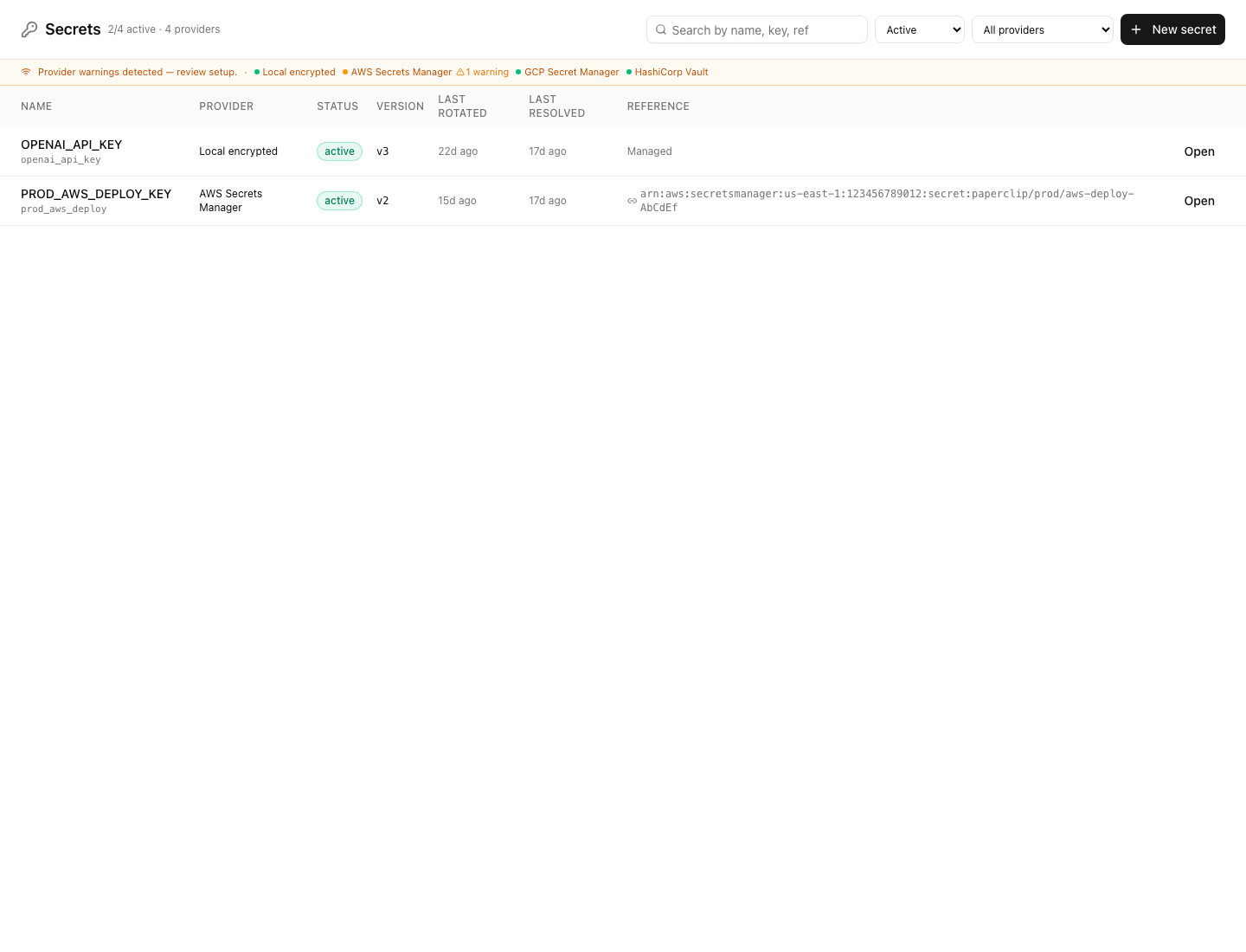 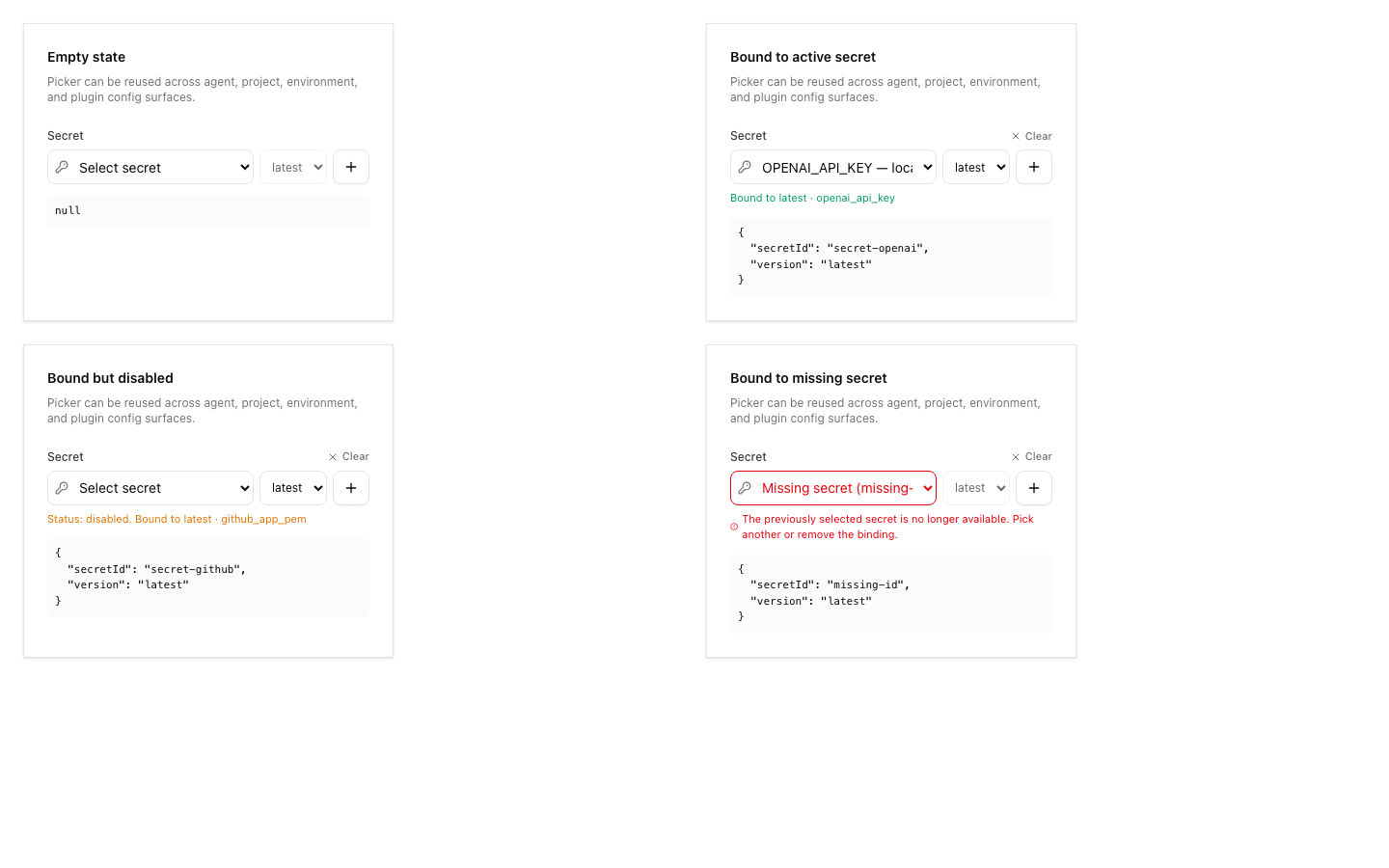 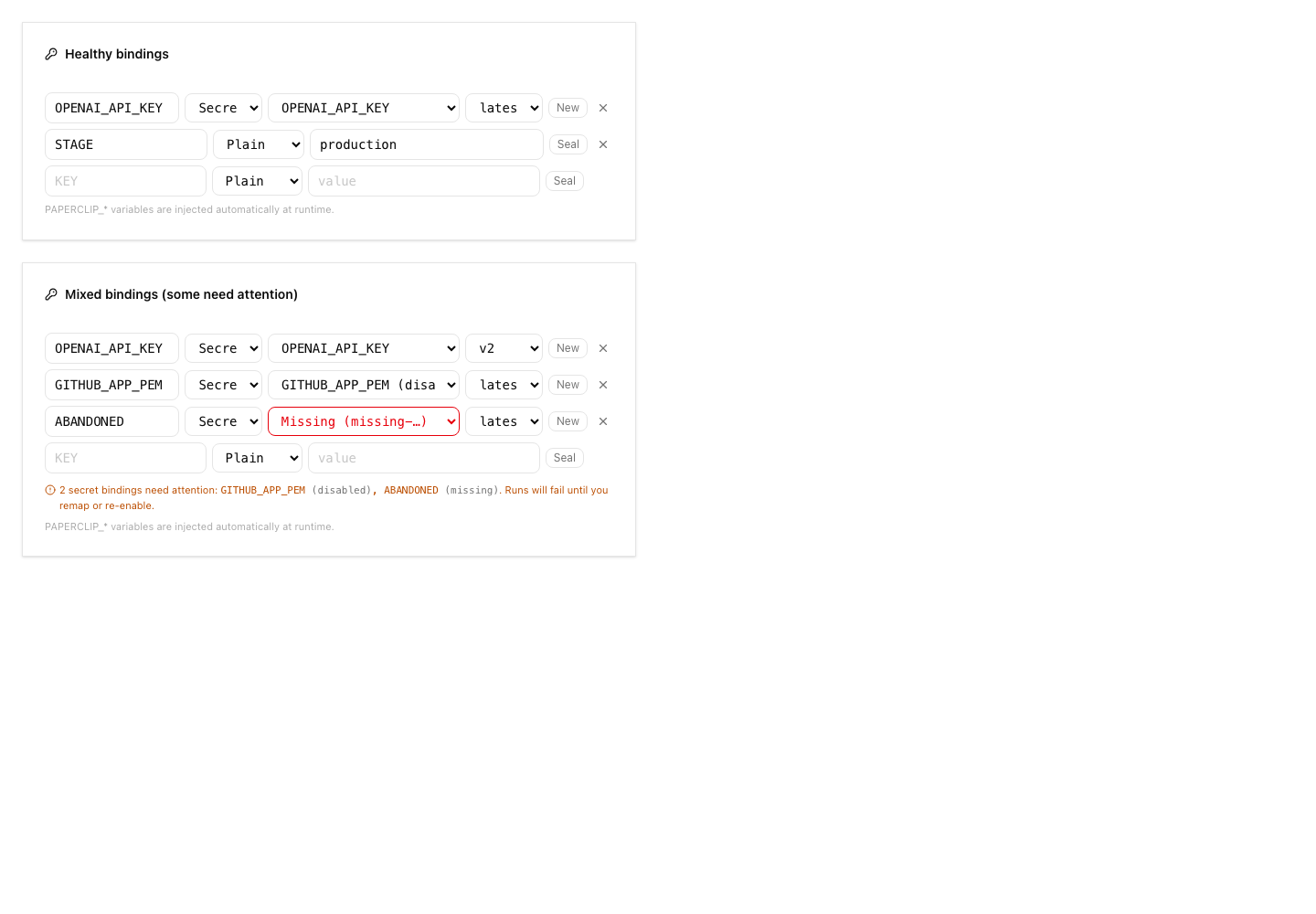 ## Risks - Migration risk: this adds new secret provider tables and extends existing secret rows. The migrations were checked for monotonic ordering and idempotent guards, but reviewers should still inspect upgrade behavior carefully. - Provider risk: AWS support uses direct SigV4 requests. Automated tests cover signing, request timeouts, vault-config selection, namespace guardrails, pending-version archival, sanitized provider errors, and service-level cleanup paths. A real-vault AWS smoke test remains deployment validation for an operator with AWS credentials rather than an unverified merge blocker in this local branch. - UI risk: the Secrets page and import dialog are large new surfaces; screenshots are included above for reviewer inspection. - Verification risk: the full local stable test command hit parallel-load timing failures, although the exact failed files passed when rerun directly. - Operational risk: remote import intentionally avoids plaintext reads; operators must understand that imported external references resolve at runtime and may fail if AWS permissions change. > For core feature work, check [`ROADMAP.md`](ROADMAP.md) first and discuss it in `#dev` before opening the PR. Feature PRs that overlap with planned core work may need to be redirected — check the roadmap first. See `CONTRIBUTING.md`. ## Model Used - OpenAI Codex, GPT-5 coding agent with local shell/tool use in the Paperclip worktree. Exact context-window size was not exposed by the runtime. ## Checklist - [x] I have included a thinking path that traces from project context to this change - [x] I have specified the model used (with version and capability details) - [x] I have checked ROADMAP.md and confirmed this PR does not duplicate planned core work - [ ] I have run tests locally and they pass - [x] I have added or updated tests where applicable - [x] If this change affects the UI, I have included before/after screenshots - [x] I have updated relevant documentation to reflect my changes - [x] I have considered and documented any risks above - [x] I will address all Greptile and reviewer comments before requesting merge --------- Co-authored-by: Paperclip <noreply@paperclip.ing> Co-authored-by: Claude Sonnet 4.6 <noreply@anthropic.com> |
||
|
Devin Foley
|
076067865f |
Migrate SSH environment callback to bridge (#5116)
> **Stacked PR (part 3 of 7).** Depends on: - PR #5114 - PR #5115 > Diff against `master` includes commits from earlier PRs in the stack — the new commit in this PR is the topmost one. ## Thinking Path > - Paperclip orchestrates AI agents for zero-human companies > - Agents executing on a remote SSH-backed environment need a way to call back into > the Paperclip control plane (run events, log streaming, signals) > - When the SSH host can't reach the Paperclip host (NAT, firewalls, or simply not > on the same network), the run silently fails or hangs — a recurring class of > failure during SSH testing > - In sandboxed environments we already solved this with a callback bridge that > tunnels back through the existing connection; SSH was the odd one out > - This PR migrates SSH execution to use the same callback bridge, so every > adapter's remote run uses one consistent reverse-channel. Per-adapter SSH glue > is deleted in favour of a shared `CommandManagedRuntimeRunner` built from the > SSH spec > - The benefit is fewer SSH-specific failure modes, a smaller code surface, and > one place to evolve the callback contract going forward ## What Changed - Added `createSshCommandManagedRuntimeRunner` in `packages/adapter-utils/src/ssh.ts` that adapts an SSH spec into a generic command-managed-runtime runner (with cwd, env, and timeout handling) - Removed `paperclipApiUrl` from `SshRemoteExecutionSpec`; the bridge URL now flows through the shared runner - Reworked `execution-target.ts` to use the SSH runner alongside sandbox runners via a unified `CommandManagedRuntimeRunner` interface - Simplified `remote-managed-runtime.ts` and `sandbox-managed-runtime.ts` to consume the shared runner abstraction - Deleted per-adapter SSH callback wiring from claude-local, codex-local, cursor-local, gemini-local, opencode-local, pi-local execute.ts files - Removed `environment-runtime-driver-contract.test.ts` (the contract is now enforced by `environment-execution-target.test.ts`) - Added/updated `execute.remote.test.ts` cases for each adapter to cover the SSH runner path ## Verification - `pnpm --filter @paperclipai/adapter-utils test` - `pnpm test -- execute.remote` (covers all six local adapters' SSH paths) - Manual QA: ran a claude-local agent against an SSH-backed environment, confirmed the agent successfully called back to `/api/agent-callback/*` endpoints during the run ## Risks - Refactor touches all six local adapters. If any adapter had subtle SSH-specific behaviour that wasn't captured in tests, it could regress. Mitigation: each adapter's `execute.remote.test.ts` was extended. - `paperclipApiUrl` removal from `SshRemoteExecutionSpec` is a breaking type change for any internal consumer. Verified no external plugins consume this type. - The new `CommandManagedRuntimeRunner` shape is a public surface in `@paperclipai/adapter-utils`; downstream plugins implementing custom runners may need updates, but no such plugins exist in this repo. ## Model Used - OpenAI GPT-5.4 (reasoning effort: high) via Codex CLI - Provider: OpenAI - Used to author the code changes in this PR ## Checklist - [x] I have included a thinking path that traces from project context to this change - [x] I have specified the model used (with version and capability details) - [x] I have checked ROADMAP.md and confirmed this PR does not duplicate planned core work - [x] I have run tests locally and they pass - [x] I have added or updated tests where applicable - [ ] If this change affects the UI, I have included before/after screenshots — N/A - [ ] I have updated relevant documentation to reflect my changes — N/A - [x] I have considered and documented any risks above - [x] I will address all Greptile and reviewer comments before requesting merge |
||
|
Devin Foley
|
c0ce35d1fb |
Improve E2B plugin configuration UX and fix execution timeouts (#4802)
## Thinking Path > - Paperclip orchestrates AI agents for zero-human companies > - E2B is a sandbox provider plugin that runs agent code in isolated cloud environments > - Operators configure E2B through the plugin settings page > - But the E2B API key configuration was unclear — the settings field description didn't explain that pasted keys are auto-saved as company secrets, and the fallback to the host `E2B_API_KEY` variable wasn't documented > - Additionally, long-running E2B sandbox commands were timing out because the plugin environment RPC driver used a fixed timeout, and environment commands competed for the single foreground command slot > - This PR clarifies the E2B configuration UX, fixes RPC timeouts for plugin environment execution, and runs E2B environment commands in background mode to avoid blocking the foreground slot > - The benefit is clearer E2B setup for operators and more reliable sandbox command execution ## What Changed - Updated E2B plugin manifest and settings UI to clarify API key configuration — field description now explains that pasted keys are saved as company secrets and documents the `E2B_API_KEY` host fallback - Added test coverage for the plugin settings page rendering - Fixed `plugin-environment-driver.ts` to pass the configured timeout through to RPC calls instead of using a hardcoded default - Updated `environment-runtime.ts` to propagate timeout from the environment lease to the plugin driver - Changed E2B sandbox command execution to use background handles so long-running agent commands don't block the foreground slot needed by the callback bridge ## Verification - `pnpm test` — all existing and new tests pass - `pnpm typecheck` — clean - Manual: navigate to plugin settings, verify E2B API key field shows the updated description text - Manual: run an E2B-backed agent task with a long-running command, verify it completes without RPC timeout ## Risks - Low risk. Configuration UX change is cosmetic. The timeout fix passes an existing value through instead of dropping it. Background command execution is a behavioral change but only affects E2B sandbox commands — the foreground slot is still available for bridge health checks. ## Model Used Codex GPT 5.4 high via Paperclip. ## Checklist - [x] I have included a thinking path that traces from project context to this change - [x] I have specified the model used (with version and capability details) - [x] I have checked ROADMAP.md and confirmed this PR does not duplicate planned core work - [x] I have run tests locally and they pass - [x] I have added or updated tests where applicable - [x] If this change affects the UI, I have included before/after screenshots - [x] I have updated relevant documentation to reflect my changes - [x] I have considered and documented any risks above - [x] I will address all Greptile and reviewer comments before requesting merge |
||
|
Devin Foley
|
4cf612a92d |
Fix runtime state race, workspace sync, plugin startup, and orphaned leases (#4804)
## Thinking Path > - Paperclip orchestrates AI agents for zero-human companies > - Agents run inside environments that are leased, and the server manages runtime state, workspace configuration, and plugin lifecycle > - Several edge cases caused failures during concurrent operations: a race condition in runtime state insertion could produce duplicate-key errors, reused workspaces didn't sync their configuration when the parent issue was updated, sandbox provider plugins could be queried before registration completed, and orphaned environment leases from failed runs were never released > - This PR fixes these four runtime/environment issues > - The benefit is more reliable concurrent agent execution and proper resource cleanup ## What Changed - `services/heartbeat.ts`: Fixed a race condition where concurrent runtime state inserts could fail with a duplicate-key error by using an upsert pattern - `services/issues.ts`: Sync reused workspace configuration when an issue is updated, so the workspace reflects the latest issue state - `services/environment-runtime.ts`: Fixed a startup race where sandbox provider plugins could be queried before registration completed, by awaiting plugin readiness before resolving environment drivers - `services/heartbeat.ts`: Release environment leases for orphaned runs that lost their process without cleanup ## Verification - `pnpm test` — all existing and new tests pass, including new tests for runtime state upsert and process recovery lease cleanup - `pnpm typecheck` — clean - Manual: trigger concurrent agent runs to verify no duplicate-key failures; verify orphaned leases are released after process loss ## Risks - Low risk. The runtime state upsert changes insert-to-upsert behavior, which could mask a legitimate duplicate if two different runs produce the same key — but this is prevented by the run ID being part of the key. The plugin startup await is bounded by the existing registration timeout. ## Model Used Codex GPT 5.4 high via Paperclip. ## Checklist - [x] I have included a thinking path that traces from project context to this change - [x] I have specified the model used (with version and capability details) - [x] I have checked ROADMAP.md and confirmed this PR does not duplicate planned core work - [x] I have run tests locally and they pass - [x] I have added or updated tests where applicable - [ ] If this change affects the UI, I have included before/after screenshots - [x] I have updated relevant documentation to reflect my changes - [x] I have considered and documented any risks above - [x] I will address all Greptile and reviewer comments before requesting merge |
||
|
Devin Foley
|
5bd0f578fd |
Generalize sandbox provider core for plugin-only providers (#4449)
## Thinking Path > - Paperclip is a control plane, so optional execution providers should sit at the plugin edge instead of hardcoding provider-specific behavior into core shared/server/ui layers. > - Sandbox environments are already first-class, and the fake provider proves the built-in path; the remaining gap was that real providers still leaked provider-specific config and runtime assumptions into core. > - That coupling showed up in config normalization, secret persistence, capabilities reporting, lease reconstruction, and the board UI form fields. > - As long as core knew about those provider-shaped details, shipping a provider as a pure third-party plugin meant every new provider would still require host changes. > - This pull request generalizes the sandbox provider seam around schema-driven plugin metadata and generic secret-ref handling. > - The runtime and UI now consume provider metadata generically, so core only special-cases the built-in fake provider while third-party providers can live entirely in plugins. ## What Changed - Added generic sandbox-provider capability metadata so plugin-backed providers can expose `configSchema` through shared environment support and the environments capabilities API. - Reworked sandbox config normalization/persistence/runtime resolution to handle schema-declared secret-ref fields generically, storing them as Paperclip secrets and resolving them for probe/execute/release flows. - Generalized plugin sandbox runtime handling so provider validation, reusable-lease matching, lease reconstruction, and plugin worker calls all operate on provider-agnostic config instead of provider-shaped branches. - Replaced hardcoded sandbox provider form fields in Company Settings with schema-driven rendering and blocked agent environment selection from the built-in fake provider. - Added regression coverage for the generic seam across shared support helpers plus environment config, probe, routes, runtime, and sandbox-provider runtime tests. ## Verification - `pnpm vitest --run packages/shared/src/environment-support.test.ts server/src/__tests__/environment-config.test.ts server/src/__tests__/environment-probe.test.ts server/src/__tests__/environment-routes.test.ts server/src/__tests__/environment-runtime.test.ts server/src/__tests__/sandbox-provider-runtime.test.ts` - `pnpm -r typecheck` ## Risks - Plugin sandbox providers now depend more heavily on accurate `configSchema` declarations; incorrect schemas can misclassify secret-bearing fields or omit required config. - Reusable lease matching is now metadata-driven for plugin-backed providers, so providers that fail to persist stable metadata may reprovision instead of resuming an existing lease. - The UI form is now fully schema-driven for plugin-backed sandbox providers; provider manifests without good defaults or descriptions may produce a rougher operator experience. ## Model Used - OpenAI Codex via `codex_local` - Model ID: `gpt-5.4` - Reasoning effort: `high` - Context window observed in runtime session metadata: `258400` tokens - Capabilities used: terminal tool execution, git, and local code/test inspection ## Checklist - [x] I have included a thinking path that traces from project context to this change - [x] I have specified the model used (with version and capability details) - [x] I have checked ROADMAP.md and confirmed this PR does not duplicate planned core work - [x] I have run tests locally and they pass - [x] I have added or updated tests where applicable - [ ] If this change affects the UI, I have included before/after screenshots - [x] I have updated relevant documentation to reflect my changes - [x] I have considered and documented any risks above - [x] I will address all Greptile and reviewer comments before requesting merge |
||
|
Devin Foley
|
70679a3321 |
Add sandbox environment support (#4415)
## Thinking Path > - Paperclip orchestrates AI agents for zero-human companies. > - The environment/runtime layer decides where agent work executes and how the control plane reaches those runtimes. > - Today Paperclip can run locally and over SSH, but sandboxed execution needs a first-class environment model instead of one-off adapter behavior. > - We also want sandbox providers to be pluggable so the core does not hardcode every provider implementation. > - This branch adds the Sandbox environment path, the provider contract, and a deterministic fake provider plugin. > - That required synchronized changes across shared contracts, plugin SDK surfaces, server runtime orchestration, and the UI environment/workspace flows. > - The result is that sandbox execution becomes a core control-plane capability while keeping provider implementations extensible and testable. ## What Changed - Added sandbox runtime support to the environment execution path, including runtime URL discovery, sandbox execution targeting, orchestration, and heartbeat integration. - Added plugin-provider support for sandbox environments so providers can be supplied via plugins instead of hardcoded server logic. - Added the fake sandbox provider plugin with deterministic behavior suitable for local and automated testing. - Updated shared types, validators, plugin protocol definitions, and SDK helpers to carry sandbox provider and workspace-runtime contracts across package boundaries. - Updated server routes and services so companies can create sandbox environments, select them for work, and execute work through the sandbox runtime path. - Updated the UI environment and workspace surfaces to expose sandbox environment configuration and selection. - Added test coverage for sandbox runtime behavior, provider seams, environment route guards, orchestration, and the fake provider plugin. ## Verification - Ran locally before the final fixture-only scrub: - `pnpm -r typecheck` - `pnpm test:run` - `pnpm build` - Ran locally after the final scrub amend: - `pnpm vitest run server/src/__tests__/runtime-api.test.ts` - Reviewer spot checks: - create a sandbox environment backed by the fake provider plugin - run work through that environment - confirm sandbox provider execution does not inherit host secrets implicitly ## Risks - This touches shared contracts, plugin SDK plumbing, server runtime orchestration, and UI environment/workspace flows, so regressions would likely show up as cross-layer mismatches rather than isolated type errors. - Runtime URL discovery and sandbox callback selection are sensitive to host/bind configuration; if that logic is wrong, sandbox-backed callbacks may fail even when execution succeeds. - The fake provider plugin is intentionally deterministic and test-oriented; future providers may expose capability gaps that this branch does not yet cover. ## Model Used - OpenAI Codex coding agent on a GPT-5-class backend in the Paperclip/Codex harness. Exact backend model ID is not exposed in-session. Tool-assisted workflow with shell execution, file editing, git history inspection, and local test execution. ## Checklist - [x] I have included a thinking path that traces from project context to this change - [x] I have specified the model used (with version and capability details) - [x] I have checked ROADMAP.md and confirmed this PR does not duplicate planned core work - [x] I have run tests locally and they pass - [x] I have added or updated tests where applicable - [ ] If this change affects the UI, I have included before/after screenshots - [x] I have updated relevant documentation to reflect my changes - [x] I have considered and documented any risks above - [x] I will address all Greptile and reviewer comments before requesting merge |