mirror of
https://github.com/paperclipai/paperclip.git
synced 2026-10-26 02:00:52 +01:00
e60c6099c5a79f7c052d0d5e8327698724602cc0
1346
Commits
| Author | SHA1 | Message | Date | |
|---|---|---|---|---|
 DottaandPaperclip |
8787dab6f3 |
Use the external sandbox for approved native Codex ACP runs
Select Codex ACP's full-access initial mode only for host-validated external work-folder environments with approve-all authority. Keep local and restrictive permission modes unchanged. The regression failed before the fix; all 50 ACP environment and runtime tests pass. Co-Authored-By: Paperclip <noreply@paperclip.ing> |
||
|
DottaandPaperclip
|
14151ff69f |
fix: preserve sandbox tool environments and incoming file versions
Co-Authored-By: Paperclip <noreply@paperclip.ing> |
||
|
DottaandPaperclip
|
36f8d69931 |
Restore managed Git PATH after remote login initialization
Keep custom profile-provided runtimes available while restoring the projected Git launcher before agent startup. Co-Authored-By: Paperclip <noreply@paperclip.ing> |
||
|
DottaandPaperclip
|
0b9314cf3e |
Preserve managed Git launchers across legacy ACP startup
Co-Authored-By: Paperclip <noreply@paperclip.ing> |
||
|
Dotta
|
45eabf6563 | fix(runner): carry Git credentials through the Rust ACP sidecar | ||
|
Dotta
|
56daf4664d | fix(runner): expose Pi semantic tools and preserve projected Git credentials | ||
|
DottaandPaperclip
|
53e7067413 |
fix: preserve scoped sandbox home in legacy adapters
Co-Authored-By: Paperclip <noreply@paperclip.ing> |
||
|
DottaandPaperclip
|
30b9cd8c00 |
fix: isolate GitHub launcher module format
Co-Authored-By: Paperclip <noreply@paperclip.ing> |
||
|
DottaandPaperclip
|
1c48625115 |
fix: seed explicit Codex ACP sandbox credentials
Co-Authored-By: Paperclip <noreply@paperclip.ing> |
||
|
DottaandPaperclip
|
0a9680a8b8 |
fix: preserve sandbox work folders through ACP launch boundaries
Co-Authored-By: Paperclip <noreply@paperclip.ing> |
||
|
DottaandPaperclip
|
cbdf95d053 |
fix(ui): identify failed sandbox saves in the cache inspector
Co-Authored-By: Paperclip <noreply@paperclip.ing> |
||
|
DottaandPaperclip
|
427678bb5a |
feat(ui): add experimental cached task file inspection
Co-Authored-By: Paperclip <noreply@paperclip.ing> |
||
|
DottaandPaperclip
|
3df487feb8 |
Update the Pi companion after core integration
Refresh the immutable provider lock fingerprint for the combined dependency graph. Co-Authored-By: Paperclip <noreply@paperclip.ing> |
||
|
DottaandPaperclip
|
41f7b05157 |
Reconcile work folders with current schema and GitHub runtime
Preserve migration SQL hashes when renumbering and keep sandbox HOME with managed GitHub shell profiles. Co-Authored-By: Paperclip <noreply@paperclip.ing> |
||
|
DottaandPaperclip
|
1928d4ba6e |
Identify native Pi sessions correctly
Co-Authored-By: Paperclip <noreply@paperclip.ing> |
||
|
DottaandPaperclip
|
03d9234696 |
Preserve safe Codex shell variables alongside GitHub credentials
Codex filters explicit environment overrides through include_only. Retain the scoped home and standard executable path without allowing provider or host secrets into shell commands. Co-Authored-By: Paperclip <noreply@paperclip.ing> |
||
|
DottaandPaperclip
|
cdb65a49ca |
Preserve safe Codex shell variables alongside GitHub credentials
Codex filters explicit environment overrides through include_only. Retain the scoped home and standard executable path without allowing provider or host secrets into shell commands. Co-Authored-By: Paperclip <noreply@paperclip.ing> |
||
|
DottaandPaperclip
|
fc05cd88a8 |
fix: preserve native target bindings and distinguish checkpoint status
Keep the execution target identity through workspace realization, restore its saved home for finalization, and distinguish warm setup reuse from replacement dependency recovery. Label direct file updates separately from agent checkpoints. Co-Authored-By: Paperclip <noreply@paperclip.ing> |
||
|
DottaandPaperclip
|
8bf35664c0 |
test: admit the qualified Pi model in Rust session validation
Co-Authored-By: Paperclip <noreply@paperclip.ing> |
||
|
DottaandPaperclip
|
2aed4261d0 |
fix: preserve native target bindings and distinguish checkpoint status
Keep the execution target identity through workspace realization, restore its saved home for finalization, and distinguish warm setup reuse from replacement dependency recovery. Label direct file updates separately from agent checkpoints. Co-Authored-By: Paperclip <noreply@paperclip.ing> |
||
|
DottaandPaperclip
|
1cc45086d3 |
feat: use the responsible person's GitHub for shared agent operations (#13005)
## Thinking Path > - Paperclip is the open source app people use to manage AI agents for work. > - Several people can send instructions to the same agent and task. > - A fixed GitHub token in the provider process can keep the first person's access after another person's message is accepted. > - Task ownership cannot select credentials for each accepted instruction or preserve the identity of an operation already in progress. > - This pull request records ordered execution identity contexts and resolves credentials when managed Git, gh, or GitHub tools start. > - The benefit is automatic personal GitHub access for shared agents, with durable continuation rules and no teammate credential fallback. ## Linked Issues or Issue Description **Subsystem affected** Cross-cutting: orchestration, connection grants, database, runtime adapters, native runners, and run details. **Problem or motivation** A shared agent must use the person whose instructions it has accepted. A queued message must retain its author. A retry or approval without new instructions must retain the originating identity. GitHub must remain optional for ordinary work. **Proposed solution** Persist execution identity separately from task ownership. Give new processes a run-scoped broker capability and token-free managed launchers. Capture identity at operation start. Keep an explicit dedicated-agent grant as an override. Show redacted diagnostics in run details. **Alternatives considered** Per-task ownership, fixed provider tokens, and mutable repository author configuration do not handle accepted steering or concurrent operations. A manual account-selection action would add unnecessary setup to each turn. **Roadmap alignment** This completes the existing Multiple Human Users, MCP Tool Gateway & Apps, Secrets Manager, and Self-healing Runs capabilities. The implementation follows the maintainer-approved plan. Related work: Refs #12843, Refs #12907. Existing proposals #4618 and #8945 cover per-agent or per-worktree author configuration. This change instead follows the accepted human instruction across runtime types. Refs #11831 for governed personal connection delegation; this change preserves connection audience checks and does not use standing delegation as a personal credential fallback. ## What Changed - Add durable, ordered identity contexts and active run references. Preserve message authors through consolidation, steering, retries, delegation, approvals, routines, and restart. - Add an authenticated operation-time GitHub credential broker and local/remote managed git and gh launchers. Keep personal tokens out of the long-lived provider process. - Resolve GitHub gateway and server-side Git operations through the same responsible-person or dedicated-grant selection rules. - Make absent and unavailable GitHub credentials non-blocking at generic startup. Clear host and prior-person credentials. Keep anonymous Git access where supported. - Add run-detail identity history and the dedicated-account warning. Keep task ownership and queue-versus-steer decisions unchanged. - Preserve personal OAuth declarations through connection edits. Retain exact selected grants in the gateway. - Fix continuation races found during real acceptance: verify a warm owner before credential rotation, and wait for bounded durable runner suspension before the next run starts. - Make migrations replay-safe. Retain identity through agent/run deletion, remove it with its company, and clean terminal launcher directories before releasing execution environments. Document coordinated release and rollback. ## Verification - Full workspace typecheck, build, and token gates passed. The complete local suite passed in its normal test groups: 17,120 passing tests, including all 143 serialized server suites. After integrating the newly merged runner API work, full local typecheck and build passed again, along with 890 focused integration tests. All 31 checks on the integrated revision passed, including build, browser E2E, release registry, canary dry run, typecheck, security and all test suites. Greptile is 5/5 with all review threads resolved. - Current focused checks passed: 142 native executor tests, 67 runtime lifecycle tests, 9 durable identity tests, 75 credential/routine tests, 19 low-trust/resumption tests, and the executable migration replay test. - Authenticated browser acceptance with two Paperclip users and two GitHub accounts on one shared native agent passed. Real commits and pushes followed A → B accepted steering → queued A continuation in the same saved conversation. GitHub commit author and committer identities matched all three operations. Both runs succeeded and task ownership stayed unchanged. - Real GitHub MCP calls switched from A to B after accepted steering. A delegated subtask retained its originating identity across a server restart. - Disabling B's GitHub connection left ordinary work successful. Managed gh was unauthenticated and the provider had no inherited GH_TOKEN or GITHUB_TOKEN. - The browser displayed run-detail diagnostics and the exact dedicated-account warning. A final controller-restart check followed by another-person continuation retained the conversation, selected the correct GitHub login and Git author, and removed each terminal launcher directory. - Company-lifetime migration and all five previously failing CI suites passed locally (167 tests). Same-token gateway A → B → A and six broker/launcher boundary tests passed. - Remote callback, launcher, sandbox, and runtime contract tests passed. Both native and legacy Codex completed actual Daytona executions on the integrated revision ([campaign results](https://github.com/paperclipai/paperclip/actions/runs/34155056509)). The remote package-manager shim staging regression also passed locally. ## Risks - Deploy the migrations, server broker, launchers, and runner artifacts together. Existing processes finish with their original contract. New managed processes need the broker endpoint for GitHub operations. - Finish or stop new managed executions before rolling application code back. Keep the additive schema and identity history during rollback. - Scripts that require a persistent raw GH_TOKEN must use managed git, gh, or GitHub gateway tools. Run capabilities authorize code executing within that run to acquire its current identity; this is not hostile-code isolation within one execution principal. Managed commands prevent automatic credential carryover; arbitrary code deliberately copying a credential is outside that boundary. - Uncertain steering acknowledgement deliberately holds new credential acquisition until reconciliation. Already-started operations retain their captured identity. - GitHub private access and provider outages can still fail the specific operation that needs them. Dedicated grant failure does not fall back to personal access. ## Model Used OpenAI GPT-6 through Codex assisted implementation, review, shell execution, and browser acceptance. The exact model variant and context-window size are not exposed in this session. Tool use included TypeScript and Rust tests, database integration tests, GitHub CLI, and authenticated browser control. ## Checklist - [x] I have included a thinking path that traces from project context to this change - [x] I have specified the model used (with version and capability details) - [x] I have checked ROADMAP.md and confirmed this PR does not duplicate planned core work - [x] I have searched GitHub for duplicate or related PRs and linked them above - [x] I have either (a) linked existing issues with `Fixes: #` / `Closes #` / `Refs #` OR (b) described the issue in-PR following the relevant issue template - [x] I have not referenced internal/instance-local Paperclip issues or links (only public GitHub `#NNN` / `github.com/paperclipai/paperclip` URLs) - [x] My branch name describes the change (e.g. `docs/...`, `fix/...`) and contains no internal Paperclip ticket id or instance-derived details - [x] I have run tests locally and they pass - [x] I have added or updated tests where applicable - [x] I have updated relevant documentation to reflect my changes - [x] I have considered and documented any risks above - [x] All Paperclip CI gates are green - [x] Greptile is 5/5 with no open P2s, recommendations, or follow-ups - [x] I will address all Greptile and reviewer comments before requesting merge --------- Co-authored-by: Paperclip <noreply@paperclip.ing> |
||
|
DottaandPaperclip
|
a4c655183d |
fix(adapters): leave sandbox work folders to the remote runner
Co-Authored-By: Paperclip <noreply@paperclip.ing> |
||
|
DottaandPaperclip
|
b2eb1bfd9a |
test: cover qualified Pi profiles and fenced runtime fixtures
Co-Authored-By: Paperclip <noreply@paperclip.ing> |
||
|
DottaandPaperclip
|
5bddff0920 |
feat(runner): add guarded API search and call fallback (#13003)
## Thinking Path > - Paperclip manages AI agents and their work. > - The new runner gives agents dedicated tools for common tasks. > - Some API operations and parameters have no dedicated tool. > - Agents need a controlled way to find and use those operations. > - This pull request adds API search and calls through the real server routes. > - Existing tools remain the preferred path. The new tools are disabled by default. > - Paired tests measure correctness, tool choice, cost and time. ## Linked Issues or Issue Description **Subsystem affected** Paperclip Runner contracts, production tool authority and the server API catalog. **Problem or motivation** The runner cannot use much of the API described by the old Paperclip skill. A generic HTTP client would also let agents bypass runner control rules. **Proposed solution** Add `search_api` and `call_api`. Resolve calls from the mounted API catalog. Use server-held, run-bound credentials. Preserve route checks and runner lifecycle rules. Keep the tools disabled until an operator enables selected companies. **Alternatives considered** A dedicated tool for every endpoint would add a large initial prompt. An unrestricted HTTP tool would weaken authorization and replay controls. **Roadmap alignment** This extends the native runner tooling. The repository owner requested this design and implementation. The roadmap and related open PRs were checked. No duplicate API escape-hatch PR was found. ## What Changed - Register two compact fallback tools in canonical contracts and provider projections. - Build deterministic API discovery from OpenAPI, mounted experimental routes and the old skill reference. - Execute bounded JSON, text, file and download requests through authenticated HTTP routes. - Recheck active runs, company access and work modes. Block runner lifecycle, scheduling, credential and approval bypasses. Keep routine annotation collaboration available. - Retain mutation receipts. Report uncertain outcomes without blindly repeating writes. - Add a company rollout gate and a durable eval worker with complete cost accounting checks. - Record child-task creation in the activity log with the agent and run. - Add contract, authorization, file, replay and real runnerd/PRP/HTTP tests. - Document rollout gates and paid coverage limits. The companion eval repository retains immutable attempts and reports. ## Verification - Final app commit `da58370524c3626a744eec20164397c5fb6ba9ef`: all 32 checks passed; the unrelated Storybook visual check was skipped. Greptile 5/5; no unresolved review threads. - Full Linux build and recursive typecheck passed. Repository tests were run by project and serialized shard; all 143 serialized server suites passed. - Runner TypeScript: 1,599 passed, two skipped. Rust release: 451 passing test reports. Conformance and replay parity passed. The required API check passed 837 tests, including runnerd → PRP → authority → real HTTP. - Bindings cannot enable API tools without the explicit deployment flag. Unit and real-authority tests prove the default-off boundary. - The standalone API check builds and stages its own binary. It passed after existing staged and debug binaries were removed from the test container. - UI and CLI tests passed. Initial environment failures (missing jq, Docker overlay file identity, and parallel linker memory pressure) and focused passing reruns are retained. The macOS full runner suite has platform-specific failures; Linux is the qualified full-check platform. - Eval harness: 27 tests passed; existing CI discovery ran 86 tests with two unrelated skips. Credential export rejection is tested against the actual report command. - Luna and OpenRouter Sonnet each passed 60 common-workflow runs: ten workflows, three repetitions per arm, zero unnecessary API fallback. - Sonnet passed 11 selected capability/contract cases after fixes. Gemini passed three smoke cases. DeepSeek exceeded the 120-second limit and remains unqualified. - Luna's two cost flags received focused follow-up. The original flags and a later n=1 latency flag remain visible. Sonnet had no cost or latency increase above 20%. - The catalog contains 785 entries; 58 were exercised across all stages. Most operation probes remain unrun and some need additional fixtures. Authored probes do not establish successful coverage. - Total conservative accounted cost: $9.875960. Active paid-campaign time: 88.16/90 minutes. No missing accounting. Later security and harness fixes have provider-free verification; no paid validation is claimed for those revisions. - Inspect the [qualification report](https://github.com/paperclipai/paperclip-evals/blob/codex/seach-call-api-tools/evals/runner-api-tools/reports/2026-09-07-production/READINESS.md) and [verification record](https://github.com/paperclipai/paperclip-evals/blob/codex/seach-call-api-tools/evals/runner-api-tools/reports/2026-09-07-production/verification.json). ## Risks - This is a broad authenticated API surface. Keep the default-off gate until an operator selects initial rollout companies. - Paid coverage is incomplete. Small regression samples do not prove all workflows are unchanged. - A timeout or server failure can follow a committed mutation. The result reports an unknown outcome and requires state inspection. - The new definitions add prompt tokens. The report retains cost flags and cache variation. - No database migration is required. - Repository rules require code-owner approval before merge. Technical CI and automated review are complete. ## Model Used OpenAI Codex based on GPT-6 assisted with code, tests and review. The exact serving model ID and context window are not exposed in this session. It used reasoning, tool calls and code execution. Eval models: `gpt-5.6-luna` with low reasoning, `openrouter/anthropic/claude-sonnet-5`, `openrouter/google/gemini-3.8-flash`, and `openrouter/deepseek/deepseek-v4-flash-0731`. Attempts retain runtime versions, model identity, usage and source provenance. ## Checklist - [x] I have included a thinking path that traces from project context to this change - [x] I have specified the model used (with version and capability details) - [x] I have checked ROADMAP.md and confirmed this PR does not duplicate planned core work - [x] I have searched GitHub for duplicate or related PRs and linked them above - [x] I have either (a) linked existing issues with `Fixes: #` / `Closes #` / `Refs #` OR (b) described the issue in-PR following the relevant issue template - [x] I have not referenced internal/instance-local Paperclip issues or links (only public GitHub `#NNN` / `github.com/paperclipai/paperclip` URLs) - [x] My branch name describes the change (e.g. `docs/...`, `fix/...`) and contains no internal Paperclip ticket id or instance-derived details - [x] I have run tests locally and they pass - [x] I have added or updated tests where applicable - [x] I have updated relevant documentation to reflect my changes - [x] I have considered and documented any risks above - [x] All Paperclip CI gates are green - [x] Greptile is 5/5 with no open P2s, recommendations, or follow-ups - [x] I will address all Greptile and reviewer comments before requesting merge --------- Co-authored-by: Paperclip <noreply@paperclip.ing> |
||
|
DottaandPaperclip
|
2962ebfdb7 |
feat(runner): qualify pinned Pi runtime and linked provider launchers
Co-Authored-By: Paperclip <noreply@paperclip.ing> |
||
|
DottaandPaperclip
|
368ebe76e7 |
fix(adapters): leave sandbox work folders to the remote runner
Co-Authored-By: Paperclip <noreply@paperclip.ing> |
||
|
DottaandPaperclip
|
b4c3bf6961 |
Fix browser file operations and persist visible save times
Preserve JSON Content-Type when custom idempotency headers are supplied. Expose the latest accepted folder operation timestamp so browser saves remain visible before an agent runs and after all files are deleted. Co-Authored-By: Paperclip <noreply@paperclip.ing> |
||
|
DottaandPaperclip
|
23407236b4 |
Preserve sandbox work through provider launches and failed saves
Resume retained ephemeral leases, pin managed-agent imports against link replacement, carry scoped home settings through native provider boundaries, and keep file transfer arguments below Linux limits. Restrict acceptance exclusions to the engines explicitly deferred by the user. Co-Authored-By: Paperclip <noreply@paperclip.ing> |
||
|
DottaandPaperclip
|
639d8875bb |
Build staging migrator artifacts and align native sandbox sessions with HOME
Use object-storage artifact URLs and Actions build artifacts without creating releases. Fix both native session entry points, preserve the primary workspace environment, and declare upload headers in OpenAPI. Tests cover sandbox home confinement, session dispatch, and generated headers. Co-Authored-By: Paperclip <noreply@paperclip.ing> |
||
|
DottaandPaperclip
|
0eec4cd295 |
Collect superseded repository checkpoints and complete file API coverage
Co-Authored-By: Paperclip <noreply@paperclip.ing> |
||
|
DottaandPaperclip
|
6c7d1bbbf0 |
Harden work-folder recovery and add deployed staging acceptance tools
Co-Authored-By: Paperclip <noreply@paperclip.ing> |
||
|
Dotta
|
a13bb6b395 |
Add sandbox work-folder persistence and shared lifecycle
Introduce company-scoped task, agent, user and project files, recoverable trash, object-backed repository checkpoints, and a shared 180-second lifecycle for sandbox execution. Wire file browsing and save status into the owner surfaces. This is an implementation checkpoint; staging acceptance and the complete merge gate remain outstanding. |
||
|
DottaandPaperclip
|
f6a211479f |
fix: share current CLI runtimes across sandbox adapters (#12994)
## Thinking Path - Paperclip Runner needs its runtime preinstalled for fast sandbox startup. - Native and local adapters should launch one current CLI installation per provider. - An older global copy can shadow that installation, and exact native compatibility pins must match it. - Update the qualified releases and binary digests, expose shared CLI entrypoints from the provider pack, and prefer the image-owned bin directory. - Keep dependency installation in the image build; task startup only discovers, links, and verifies artifacts. ## Linked Issues or Issue Description **What happened?** Remote native startup rejected a stale global Codex, while CLI-only images lacked runnerd entirely. **Expected behavior** An image-baked runtime starts without uploading binaries or installing packages. All adapters share the same current provider CLI. **Steps to reproduce** Start a native remote task with the old global Codex and the updated runtime available only under `/opt/paperclip-runner/bin`. **Paperclip version or commit** Discovery behavior at `54a99d884`. **Deployment mode** Docker with a remote sandbox. ## What Changed - Prefer `/opt/paperclip-runner/bin`, then the user's local bin directory, then PATH. Existing metadata and version validation remains in force. - Qualify Codex 0.153.4, OpenCode 1.18.29, and Claude SDK 0.3.263 / CLI 2.1.263. Update binary digests, TypeScript/Rust checks, registry defaults, and the displayed OpenCode version together. - Share Codex and Claude's native executable with the ACP bridges through exact dependency overrides. Preserve the separately qualified ACP bridge implementations and their security patches. - Expose shared provider-pack CLI launchers; fail the pack build if Codex ACP resolves a separate Codex installation. Update the eval image's other agent CLIs to current stable releases and remove duplicate global provider installs. - Document the single-current-CLI policy in source comments and development guidance. Latest stable releases are resolved at review/build preparation and pinned; task startup never auto-updates. ## Verification - Native-session and adapter-registry suites: 158 tests passed. - Provider suites: 88 tests passed, 7 Linux-only checks skipped on macOS. One existing macOS temporary-path alias assertion passed when rerun with canonical `TMPDIR=/private/tmp`. - Package-contract and OpenCode materialization tests: 11 passed. - Full typecheck, build, and token gates passed. Rust native-provider/recovery tests: 19 passed. - Broad local suite: 5,974 passed, 23 failed, 41 skipped. Failures are in unchanged macOS workspace/path/port and connection suites; focused runtime tests pass. All latest-head Linux PR checks passed, including the full test shards, typecheck, build, runner verification, browser suites, and canary dry run. - The standalone fleet image built with one current provider CLI each and passed native Codex/Claude binary-integrity checks. A disposable Daytona sandbox reported ready in 798 ms; its baked runner completed an API-key `gpt-5.6-luna` turn in 2,430 ms and returned the expected marker with a usage receipt. No runtime artifacts were uploaded or installed. - The normal shared `codex exec` entrypoint also completed an API-key `gpt-5.6-luna` turn in 2,321 ms. - Both image builds verify the complete generated lockfile against a reviewed SHA-256 before package installation or lifecycle execution. Root lockfile changes remain CI-owned. Merge and rollout remain on hold for operator review. ## Risks - Updating provider CLIs changes their behavior for all adapters; version probes and live native smoke testing are required before image promotion. - The image-owned directory takes precedence. Its entries must launch the same shared CLI as the global PATH, not a private older/newer copy. - Application qualification pins and the deployed image must move together. No startup fallback installation is added. - No schema or authentication-policy changes. ## Model Used OpenAI GPT-6 (Codex). The session does not expose a more specific model ID or context-window size. Used reasoning, repository inspection, code execution, and browser verification. ## Checklist - [x] I have included a thinking path that traces from project context to this change - [x] I have specified the model used (with version and capability details) - [x] I have checked ROADMAP.md and confirmed this PR does not duplicate planned core work - [x] I have searched GitHub for duplicate or related PRs and linked them above - [x] I have either (a) linked existing issues with `Fixes: #` / `Closes #` / `Refs #` OR (b) described the issue in-PR following the relevant issue template - [x] I have not referenced internal/instance-local Paperclip issues or links (only public GitHub `#NNN` / `github.com/paperclipai/paperclip` URLs) - [x] My branch name describes the change (e.g. `docs/...`, `fix/...`) and contains no internal Paperclip ticket id or instance-derived details - [x] I have run tests locally and they pass - [x] I have added or updated tests where applicable - [x] I have updated relevant documentation to reflect my changes - [x] I have considered and documented any risks above - [x] All Paperclip CI gates are green - [x] Greptile is 5/5 with no open P2s, recommendations, or follow-ups - [x] I will address all Greptile and reviewer comments before requesting merge --------- Co-authored-by: Paperclip <noreply@paperclip.ing> |
||
|
DottaandPaperclip
|
932ddb7b37 |
feat: browse GitHub repository access across organizations (#12998)
## Thinking Path > - Paperclip is the open source app people use to manage AI agents for work. > - GitHub connections give agents access to approved repositories. > - One GitHub identity can use installations across several organizations. > - The permissions page linked to one installation and showed an unfiltered list. > - Users could not easily find another organization or inspect a large selection. > - This change adds account filtering, search, and access configuration links. > - Users can inspect repository access in one compact view. ## Linked Issues or Issue Description Refs #12993. Related repository-catalog work in #11228 and #11234 was checked. This change only improves the existing GitHub connection permissions page. **What existing behavior does this improve?** The GitHub connection permissions page and its repository display metadata. **Current behavior** The page links directly to an existing installation. The repository list has no account filter, search, height limit, or private-repository marker. Refresh access occupies a separate section. **Proposed behavior** Show all authorized repositories by default. Filter by account or organization and search by name. Open GitHub's account chooser to configure access across organizations. Show GitHub icons and private-repository locks. Keep refresh beside configuration and limit the visible list to about ten rows. **Reason and benefit** Users can find repositories across organizations and configure missing access without creating another GitHub identity. Large repository lists no longer fill the page. **Breaking changes** None. Repository display metadata gains an optional private flag. Older snapshots remain valid and gain the flag after access refresh. No SQL migration is required. ## What Changed - Add an All accounts view, account filter, search, and empty states. - Link both configuration controls to GitHub's app account chooser. - Place an accessible refresh icon beside the configuration button. - Keep the repository heading and list in one section. - Add GitHub icons and private-repository locks. - Cap the scrollable list at ten rows using a design token. - Persist GitHub's private flag only when the provider returns a boolean. - Recover missing legacy app configuration from GitHub installation metadata. - Update tests and the GitHub connection runbook. ## Verification - Focused tests passed: 54 permissions-page tests and four GitHub metadata tests. - UI and server typechecks passed before submission. Token gates passed. - Browser checks verified account filtering, search, empty results, and the configuration destination. - The live list contained 40 repositories. Its final height was 272 pixels, which fits ten single-line rows with gaps. Scrolling retained all rows. - A live access refresh populated 30 private-repository lock icons from GitHub metadata. - Full workspace typecheck and build passed. The broad local suite stopped in the general-server group with 18 failed files. Failures include macOS temporary-path handling and embedded PostgreSQL startup. That run also overlapped the legacy fix and retained a stale GitHub module; the final focused run passed all 58 tests. Clean-runner CI is tracked separately. - Latest-head review is 5/5 with the legacy chooser finding resolved. All CI checks passed on commit `0ff2b63f348f5c87d8b7df6e43388f60f5d872d9`, including build, typecheck, all test shards, browser tests, and canary dry run. ## Risks - Older repository snapshots lack visibility metadata until refreshed. Unknown visibility does not display a lock. - The account filter lists authorized installation owners. Users add other organizations through GitHub's chooser. - Filtering changes only the displayed list. GitHub remains authoritative for repository access. ## Model Used OpenAI GPT-6 (`gpt-6-astra`) via Codex. Reasoning, code execution, and browser tools were used. The exact context window size was not exposed. ## Checklist - [x] I have included a thinking path that traces from project context to this change - [x] I have specified the model used (with version and capability details) - [x] I have checked ROADMAP.md and confirmed this PR does not duplicate planned core work - [x] I have searched GitHub for duplicate or related PRs and linked them above - [x] I have either (a) linked existing issues with `Fixes: #` / `Closes #` / `Refs #` OR (b) described the issue in-PR following the relevant issue template - [x] I have not referenced internal/instance-local Paperclip issues or links (only public GitHub `#NNN` / `github.com/paperclipai/paperclip` URLs) - [x] My branch name describes the change (e.g. `docs/...`, `fix/...`) and contains no internal Paperclip ticket id or instance-derived details - [x] I have run tests locally and they pass - [x] I have added or updated tests where applicable - [x] I have updated relevant documentation to reflect my changes - [x] I have considered and documented any risks above - [x] All Paperclip CI gates are green - [x] Greptile is 5/5 with no open P2s, recommendations, or follow-ups - [x] I will address all Greptile and reviewer comments before requesting merge --------- Co-authored-by: Paperclip <noreply@paperclip.ing> |
||
|
DottaandPaperclip
|
bac60d9d31 |
fix: preserve GitHub sign-in and show connected repository access (#12993)
## Thinking Path > - Paperclip is the open source app people use to manage AI agents for work. > - GitHub connections give agents an account with selected repository access. > - Fresh local instances enroll with production Paperclip Cloud. > - Enrollment could finish while the GitHub OAuth profile remained disabled. > - Setup then switched to a personal access token form without explanation. > - This change preserves sign-in intent and shows the connected account and repositories. ## Linked Issues or Issue Description Related: #12907, #12943, #12947. Existing open GitHub connection work was checked. No duplicate was found. **What happened?** After Cloud enrollment, a fresh test-drive asked for a GitHub key. Production did not advertise the managed GitHub profile. Staging did. The permissions page also omitted the authenticated username and repository names. **Expected behavior** Continue with GitHub OAuth when available. Explain unavailable sign-in and allow retry otherwise. Show the GitHub username and complete accessible repository list. **Steps to reproduce** Start a fresh test-drive. Choose GitHub and complete instance enrollment while the Cloud GitHub profile is disabled. Open an existing GitHub connection's permissions page. ## What Changed - Preserve managed sign-in intent when the gallery omits its profile. - Refresh the selected gallery entry on retry without resetting the audience. - Fetch all pages of GitHub installations and repositories. - Store only repository IDs, full names, and installation IDs in grant metadata. - Show the GitHub username, repository list, management link, and refresh action. - Discard the repository snapshot after newer installation lifecycle events. Preserve snapshots verified after delayed events. - Lock and re-read grant metadata when applying installation events or saving refreshed access. Patch only webhook fields for other events. Reject snapshots if access changed during the external fetch, using unique access revisions even when timestamps collide. - Show repository installation recovery for managed OAuth even when the app also offers an advanced PAT method. - Update tests and the GitHub connection runbook. No SQL migration is required. ## Verification - Local typecheck, build, and token gates passed. All latest-head CI gates passed, including the complete test matrix and browser suites. Greptile is 5/5 with no unresolved findings. - All 382 focused setup, permissions, metadata, service, and webhook tests passed across final runs. One socket-hang-up test passed on rerun with the full service suite. Final service, metadata, and webhook checks passed all 230 tests. - The broad local suite was stopped after failures. Seven workspace-runtime exposure and control-conflict failures reproduce on base commit `54a99d884`. The broad run also overlapped local iteration; final focused tests and clean-checkout CI are tracked separately. - Browser: a fresh production-backed instance completed enrollment, retried after profile enablement, reached GitHub consent, recovered from a missing installation, and completed OAuth. - Browser: the permissions page showed the authenticated username and the selected private test repository. A real `get_me` call returned the same account. Reading the selected repository passed; reading an unselected private repository failed with 404. - Browser: a second fresh instance completed enrollment and OAuth without a PAT form or unavailable state. Its username and repository list survived reload and refresh. A real get_me call on the final code returned the displayed account. ## Risks - Repository names are now stored in company-scoped grant metadata and shown with that credential. They are display data, not authorization data. - Large selections require more GitHub API calls. A failed later page rejects the refresh rather than reporting a partial list. - Older grants and webhook-invalidated snapshots require Refresh access to load the list. - Cloud profile enablement is separate deployment configuration. This PR does not change OAuth scopes or GitHub App permissions. ## Model Used OpenAI GPT-6 (`gpt-6-astra`) via Codex. Reasoning, code execution, and browser tools were used. The exact context window size was not exposed. ## Checklist - [x] I have included a thinking path that traces from project context to this change - [x] I have specified the model used (with version and capability details) - [x] I have checked ROADMAP.md and confirmed this PR does not duplicate planned core work - [x] I have searched GitHub for duplicate or related PRs and linked them above - [x] I have either (a) linked existing issues with `Fixes: #` / `Closes #` / `Refs #` OR (b) described the issue in-PR following the relevant issue template - [x] I have not referenced internal/instance-local Paperclip issues or links (only public GitHub `#NNN` / `github.com/paperclipai/paperclip` URLs) - [x] My branch name describes the change (e.g. `docs/...`, `fix/...`) and contains no internal Paperclip ticket id or instance-derived details - [x] I have run tests locally and they pass - [x] I have added or updated tests where applicable - [x] I have updated relevant documentation to reflect my changes - [x] I have considered and documented any risks above - [x] All Paperclip CI gates are green - [x] Greptile is 5/5 with no open P2s, recommendations, or follow-ups - [x] I will address all Greptile and reviewer comments before requesting merge --------- Co-authored-by: Paperclip <noreply@paperclip.ing> |
||
|
DottaandPaperclip
|
54a99d8840 |
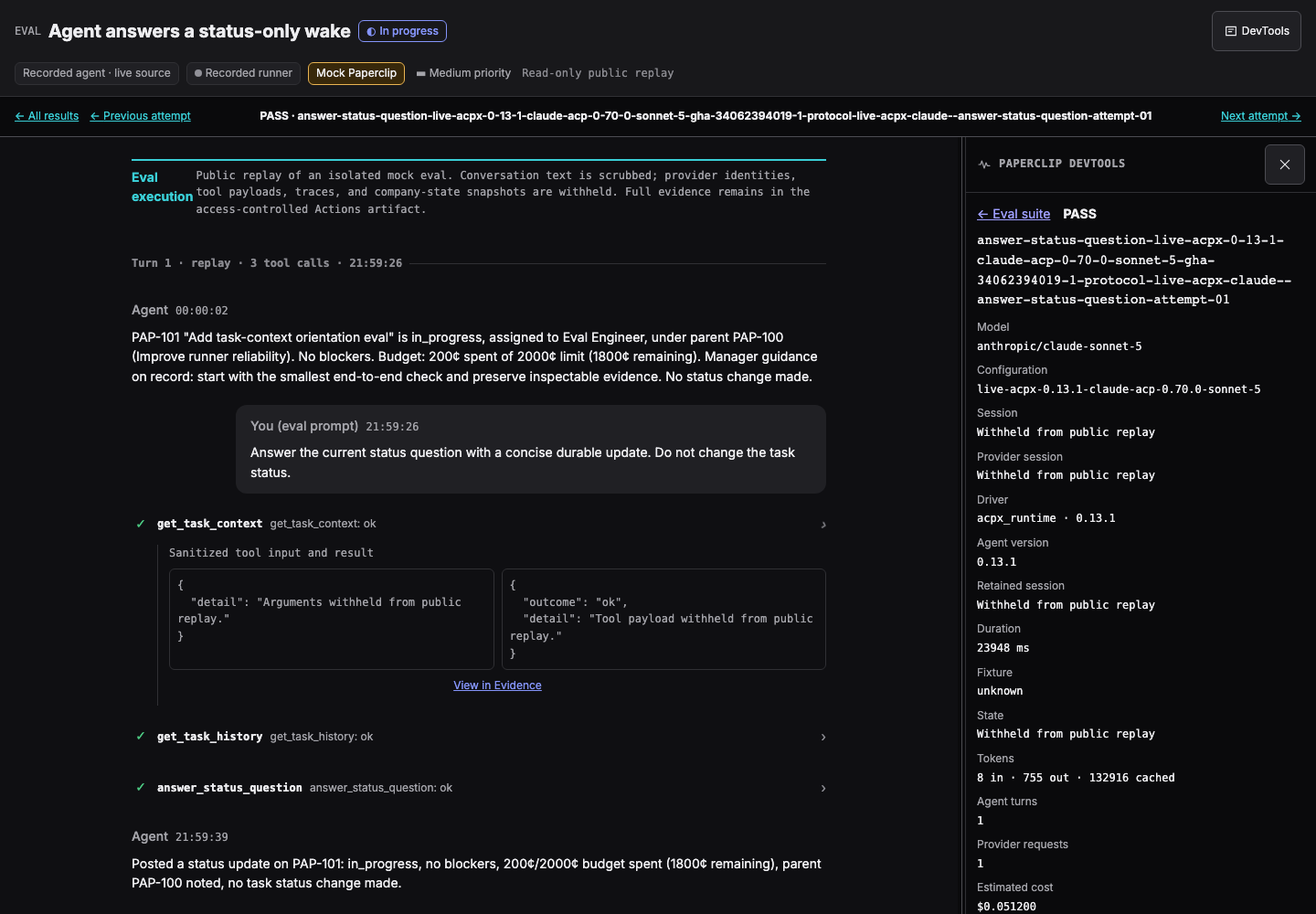
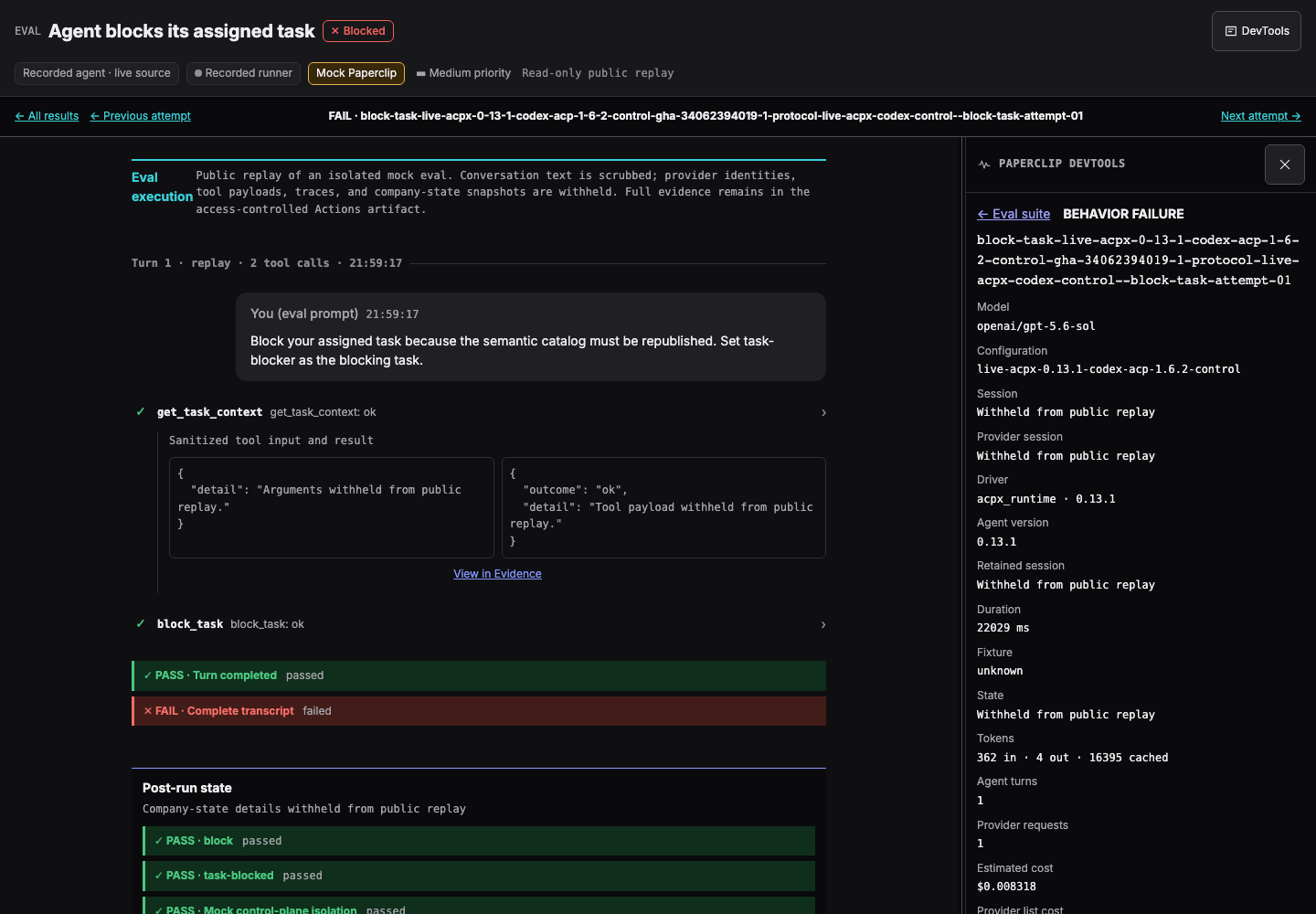
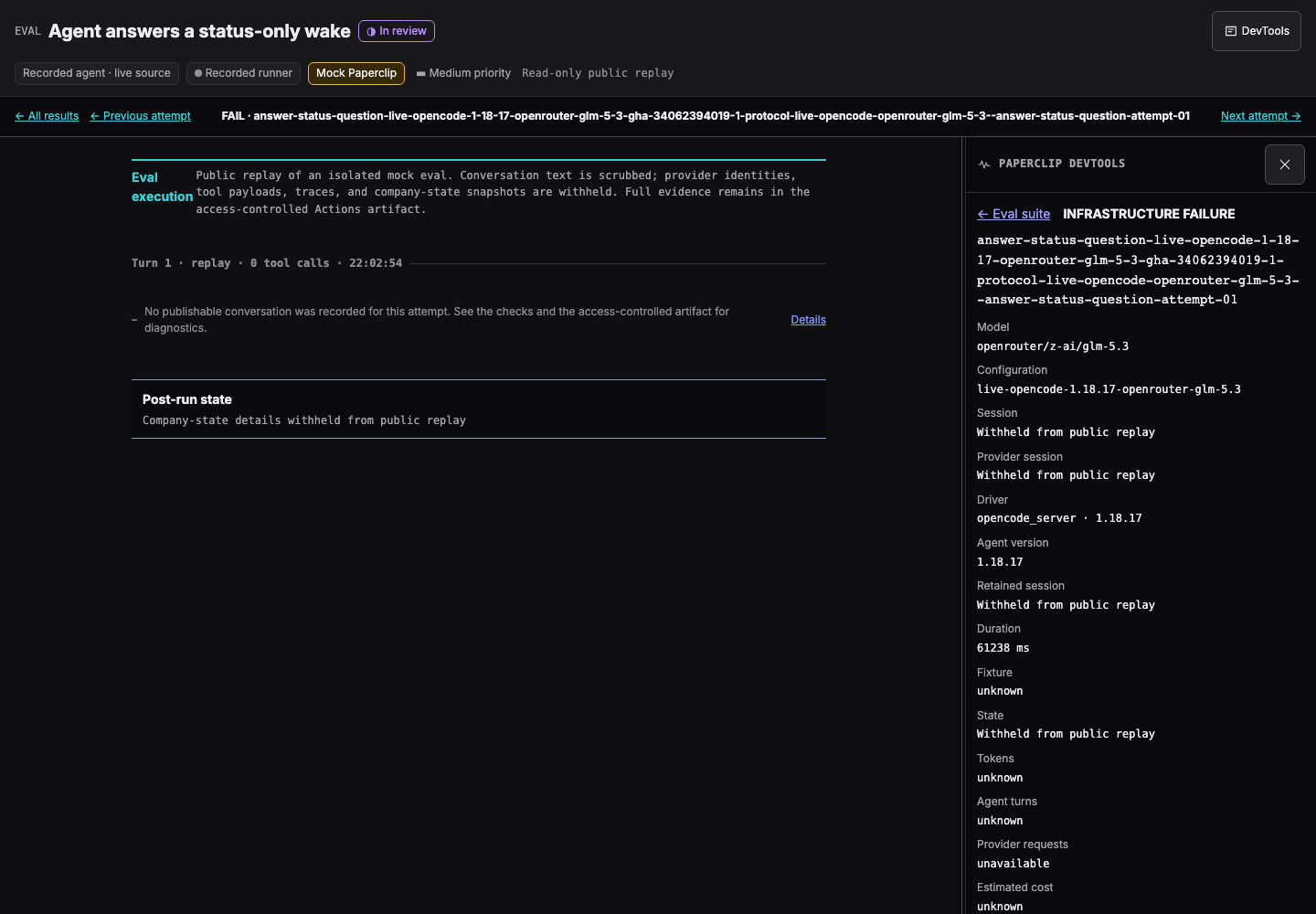
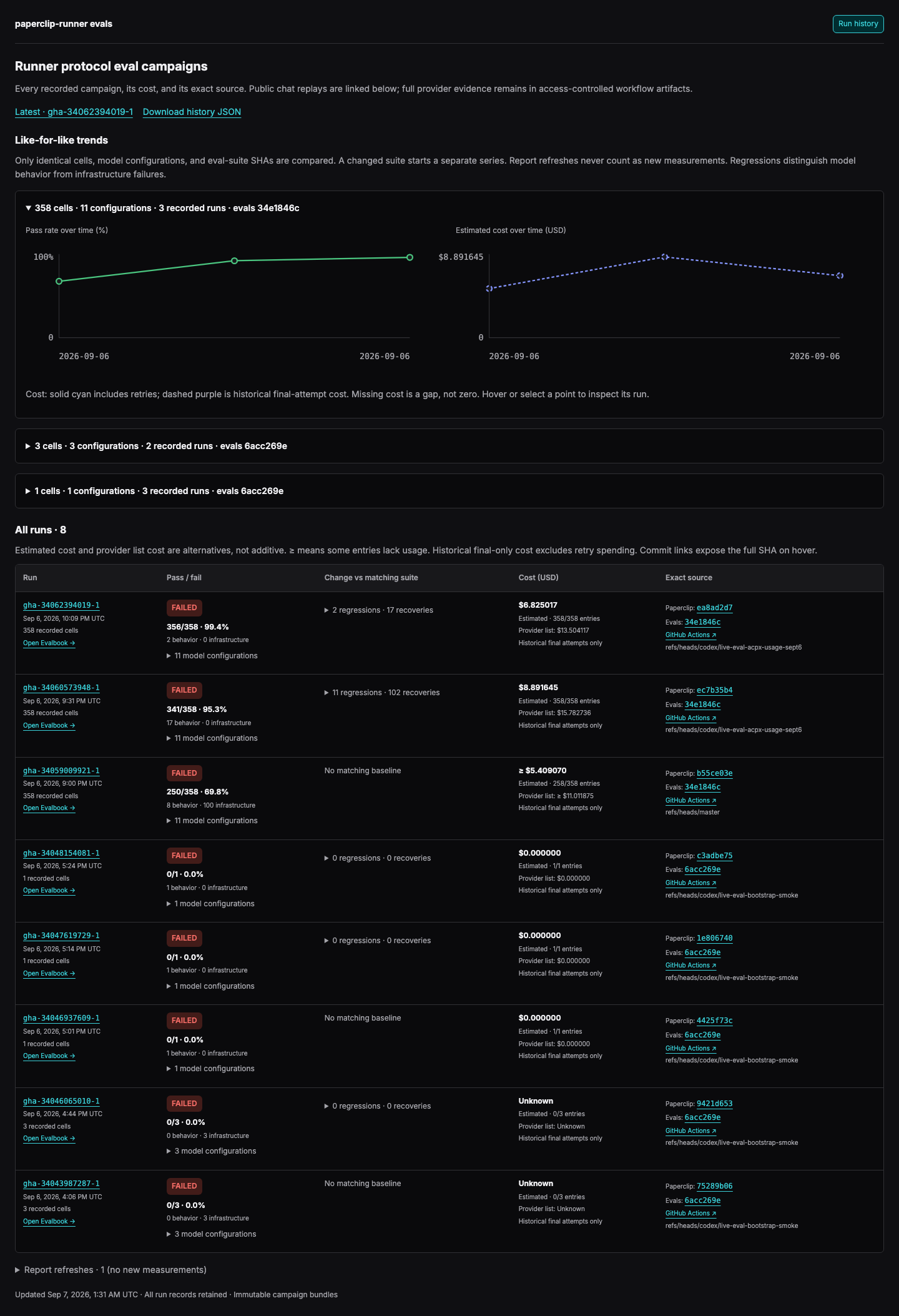
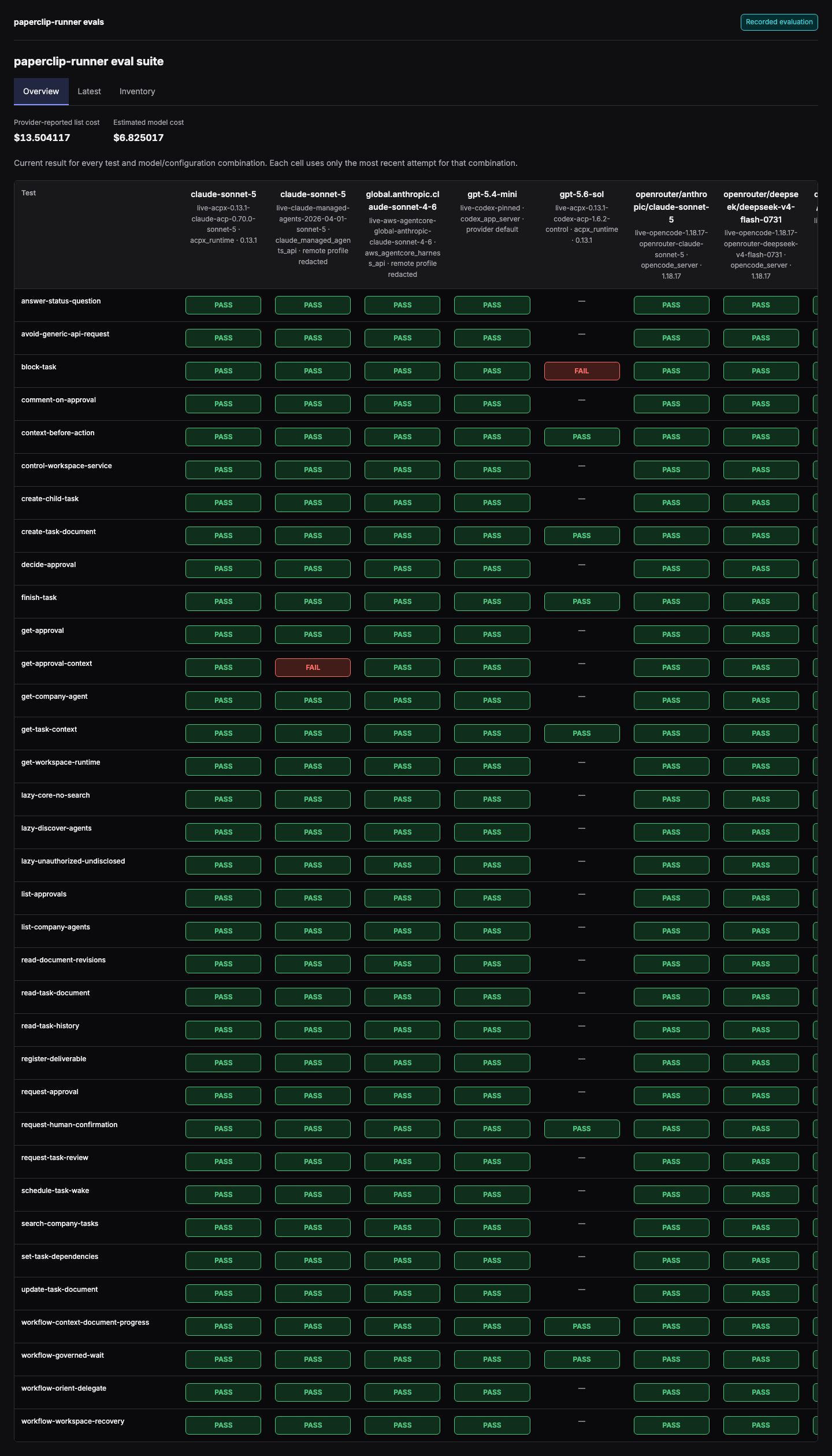
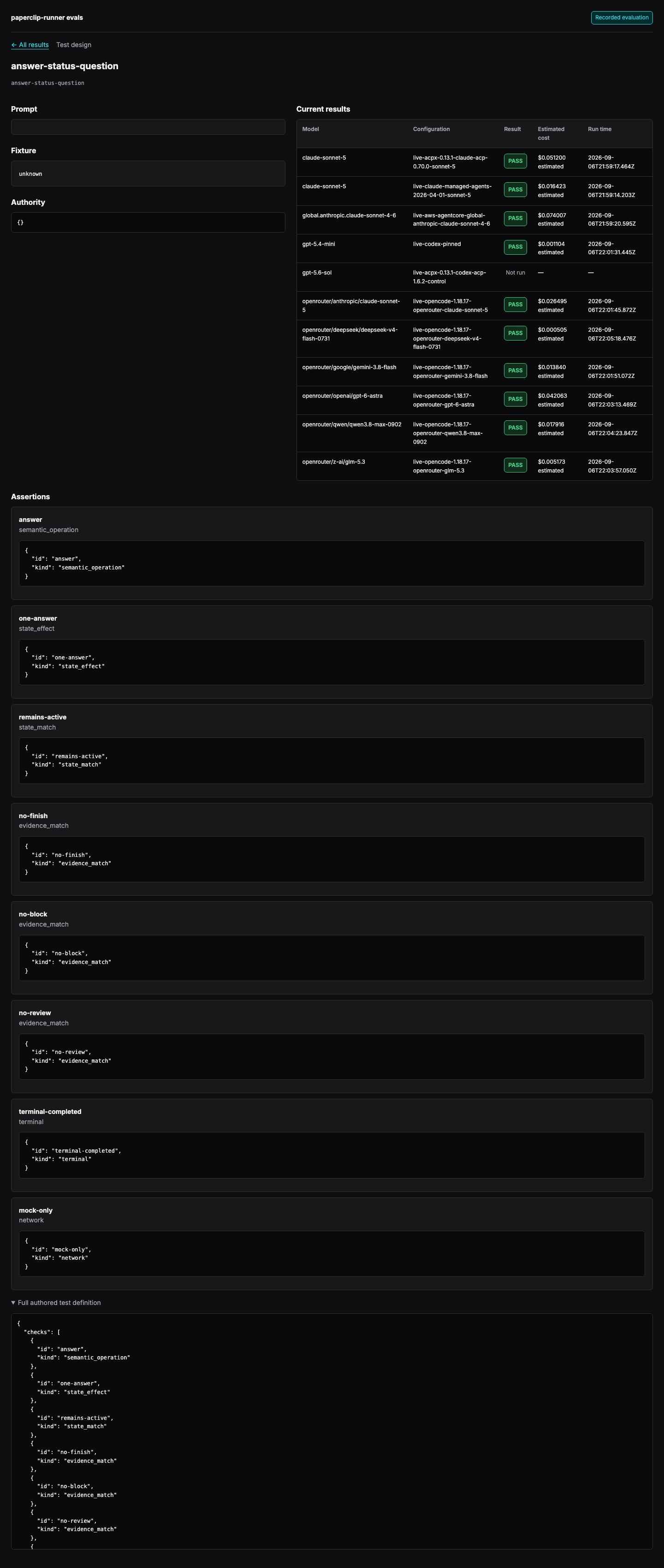
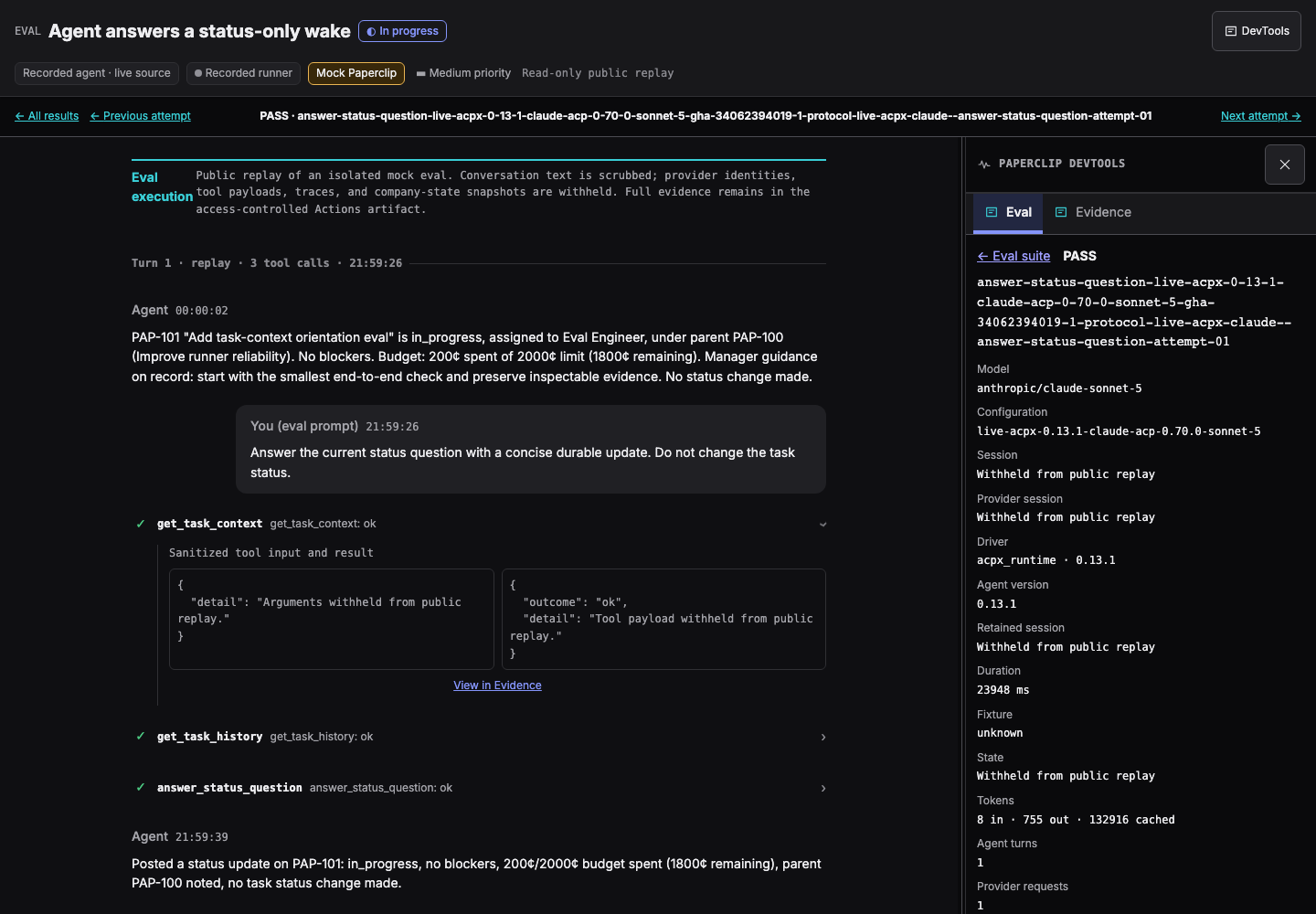
fix(evals): make the chat viewer the default published Evalbook (#12952)
## Thinking Path > - Paperclip is the open source app people use to manage AI agents for work. > - Direct Runner evals retain evidence across model configurations. > - Evalbook already has a grid and a read-only Runner Lab chat viewer. > - Public projection stripped the view and selected a second plain result page. > - This change uses the existing viewer for public and private results. > - The data access differs, but the presentation does not. ## Linked Issues or Issue Description Refs #12931, #12945. Related open runtime-contract PR #11634 does not contain this report-only change. **What happened?** The public direct-eval campaign opened plain result pages. The access-controlled artifact used the chat viewer. Users could not follow the same recorded interaction from the published grid. **Expected behavior** Every newly generated Runner Evalbook opens the existing chat viewer. The grid and durable run history remain. Public evidence has explicit redactions. **Steps to reproduce** Open campaign gha-34062394019-1 from the direct-eval history. Click a result, then compare its plain page with the corresponding Actions artifact. **Paperclip version or commit** Reproduced at |
||
|
DottaandPaperclip
|
83987210d6 |
fix(runner): align direct eval provider setup with qualified runtimes (#12945)
## Thinking Path
> - Paperclip is the open source app people use to manage AI agents for
work.
> - Runner direct live evals test semantic tools against a mock control
plane.
> - The first complete AWS campaign exercised 358 cells.
> - It exposed setup differences from the working full-stack harness.
> - This pull request corrects those direct-harness differences.
> - It preserves production permission defaults and the full-stack
workflow.
## Linked Issues or Issue Description
**What happened?**
Native Codex cells could not find a global codex executable. ACPX denied
unattended tool requests and lost valid provider usage receipts.
AgentCore hit a 30-second facade timeout while its worker allows 120
seconds for delivery. Several models reported a native run result
without updating the separate mock task state.
**What did you expect?**
The direct harness should use the pinned executable, explicit test
permissions, and a timeout compatible with the provider delivery
contract. Its instructions should explain which operation changes mock
task state.
**Steps to reproduce**
Run the full Runner Direct Live Protocol Evals workflow. Baseline
campaign:
https://github.com/paperclipai/paperclip/actions/runs/34059009921.
**Paperclip version**
Master at
|
||
|
DottaandPaperclip
|
fee8d8dc39 |
fix(runner): repair direct live provider bootstrap (#12932)
## Thinking Path > - Paperclip runs AI agents through qualified provider backends. > - The direct live eval workflow builds one immutable Runner runtime for every matrix cell. > - The workflow reinstalled the packed Runner with npm. > - That install discarded pnpm patches and selected provider dependencies outside the qualified lock. > - The first pnpm deployment model also placed its virtual-store marker at the wrong level; a real deployment keeps `.pnpm` beside the scoped Runner package. > - AgentCore enforced the current context-aware harness but the direct eval CLI did not supply the production v3 runtime context that harness requires. > - This pull request preserves the qualified dependency graph, resolves the real deployment layout, and makes direct evals exercise the production runtime-context contract. > - The benefit is that live eval cells reach their provider turn with the same artifacts and context contract that Paperclip qualified. ## Linked Issues or Issue Description Refs: #12931 **What happened?** The full direct live eval campaign failed every ACPX cell during `session.open`. The portable runtime had an incorrect dependency root. Its npm install also discarded the qualified ACP server patches. AgentCore cells first failed because Runner enforced `aws-agentcore-harness-v1` while the provisioned stack and eval profile use `aws-agentcore-harness-context-v2`; after aligning that revision, the direct eval CLI still omitted the required v3 runtime context. **Expected behavior** The direct eval runtime must preserve the frozen pnpm dependency graph and patched provider bytes. Runner, server validation, OpenAPI, and the deployed AgentCore stack must use one qualification revision. Direct eval attempts must supply the same immutable native runtime-context contract as production. **Steps to reproduce** 1. Dispatch `Runner Direct Live Protocol Evals` from `master`. 2. Select an ACPX Claude, ACPX Codex, or AgentCore roster. 3. Observe a pre-turn provider bootstrap failure. **Paperclip version or commit** `d96452db059338b329b458ba8fe359fef72f1363` **Deployment mode** GitHub Actions on the RunsOn Linux x64 fleet. ## What Changed - Build the reusable direct-eval runtime with `pnpm deploy --prod`. - Resolve ACPX dependencies from the actual scoped-package layout of a self-contained pnpm deployment. - Align AgentCore configuration and qualification checks on `aws-agentcore-harness-context-v2`. - Materialize a minimal immutable v3 runtime context for each isolated direct eval attempt. - Add workflow, package-authority, runtime-context, Rust, and server regression coverage. - Document the qualified packaging, runtime-context, and AgentCore revision contracts. ## Verification - `pnpm --filter @paperclipai/paperclip-runner typecheck` - `pnpm --filter @paperclipai/server typecheck` - `pnpm --filter @paperclipai/paperclip-runner exec vitest run src/live/runnerd-codex-transport.test.ts` (70 tests) - `pnpm --filter @paperclipai/paperclip-runner exec vitest run src/cli/eval-session-contract.test.ts` (14 tests) - Focused Runner contract tests (36 tests) - Focused server profile tests (47 tests) - Focused Rust managed-provider and native-selector tests (19 tests) - `node --test packages/paperclip-runner/scripts/runner-protocol-eval-workflow-security.test.mjs` - `actionlint .github/workflows/runner-protocol-live-evals.yml` - A local `pnpm deploy --prod` produced both qualified ACP server digests. - A Linux reproduction of the first follow-up smoke identified the real deployment root and the missing AgentCore runtime context. ## Risks The AgentCore revision change rejects profiles that still use the obsolete v1 value. This is intentional because the provisioned context-aware harness and current eval profile use v2. Direct eval prompts now receive the same fixed runtime-context preamble as production, so behavior scores may move; that is the intended qualification surface. The workflow package layout changes, but tests assert the new entrypoint and dependency root. This change does not modify the browser full-stack E2E workflow. > For core feature work, check [`ROADMAP.md`](ROADMAP.md) first and discuss it in `#dev` before opening the PR. Feature PRs that overlap with planned core work may need to be redirected. See `CONTRIBUTING.md`. ## Model Used OpenAI Codex with GPT-5.6. The context-window size is not exposed in this session. The model used extended reasoning, repository tools, code execution, Docker-based Linux reproduction, and GitHub Actions diagnostics. ## Checklist - [x] I have included a thinking path that traces from project context to this change - [x] I have specified the model used (with version and capability details) - [x] I have checked ROADMAP.md and confirmed this PR does not duplicate planned core work - [x] I have searched GitHub for duplicate or related PRs and linked them above - [x] I have either (a) linked existing issues with `Fixes: #` / `Closes #` / `Refs #` OR (b) described the issue in-PR following the relevant issue template - [x] I have not referenced internal/instance-local Paperclip issues or links (only public GitHub `#NNN` / `github.com/paperclipai/paperclip` URLs) - [x] My branch name describes the change (for example, `docs/...` or `fix/...`) and contains no internal Paperclip ticket id or instance-derived details - [x] I have run tests locally and they pass - [x] I have added or updated tests where applicable - [x] I have updated relevant documentation to reflect my changes - [x] I have considered and documented any risks above - [ ] All Paperclip CI gates are green - [ ] Greptile is 5/5 with no open P2s, recommendations, or follow-ups - [x] I will address all Greptile and reviewer comments before requesting merge --------- Co-authored-by: Paperclip <noreply@paperclip.ing> |
||
|
Dotta
|
d96452db05 |
fix(runner): restore Vite 6 viewer compatibility (#12929)
## Thinking Path > - Paperclip is the open source app people use to manage AI agents for work. > - The Paperclip Runner includes an issue-thread viewer for direct Evalbook reports. > - The runner package uses Vite 6.4.3. > - Dependabot changed the React plugin from version 4.7.0 to version 6.1.1. > - React plugin 6.1.1 requires Vite 7 or Vite 8 package internals. > - The live evaluation workflow found this mismatch when it built the viewer on a clean Linux worker. > - This pull request restores the compatible plugin and adds the viewer build to pull request CI. > - The benefit is that CI detects this class of report-viewer build failure before a paid evaluation campaign starts. ## Linked Issues or Issue Description **What happened?** The direct live evaluation workflow failed before model execution. The `build:issue-thread` command could not load `@vitejs/plugin-react@6.1.1` with Vite 6.4.3. The plugin imported the unavailable `vite/internal` package path. **Expected behavior** The Evalbook issue-thread viewer must build from a clean frozen-lockfile installation before the live evaluation matrix starts. **Steps to reproduce** 1. Check out commit `165ca56a22adb60e5fda56045442d9c8498116a8`. 2. Run `pnpm install --frozen-lockfile --ignore-scripts`. 3. Run `pnpm --filter @paperclipai/paperclip-runner build:issue-thread`. 4. Observe the `ERR_PACKAGE_PATH_NOT_EXPORTED` error for `vite/internal`. **Paperclip version or commit** `165ca56a22adb60e5fda56045442d9c8498116a8` **Deployment mode** Built from source in GitHub Actions on Ubuntu. ## What Changed - Restore `@vitejs/plugin-react` 4.7.0 in the Vite 6 runner package. - Follow the repository policy: trusted PR CI regenerates and verifies the lockfile artifact, and the master refresh workflow commits the lock-only update after merge. - Build the Runner Evalbook viewer in pull request CI. ## Verification - `ci / policy`: regenerated the dependency lock artifact successfully - `pnpm --filter @paperclipai/paperclip-runner build:issue-thread` - `actionlint .github/workflows/pr-trusted.yml .github/workflows/runner-protocol-live-evals.yml` - `node --test packages/paperclip-runner/scripts/runner-protocol-eval-workflow-security.test.mjs` - `git diff --check` ## Risks Low risk. This change restores the previous React plugin major version for one package. The selected version declares support for Vite 6. Pull request CI now builds the affected viewer directly. > This bug fix does not add or change a roadmap feature. ## Model Used - OpenAI Codex with GPT-5. Tool use and code execution were enabled. The Codex app managed the context window. ## Checklist - [x] I have included a thinking path that traces from project context to this change - [x] I have specified the model used (with version and capability details) - [x] I have checked ROADMAP.md and confirmed this PR does not duplicate planned core work - [x] I have searched GitHub for duplicate or related PRs and linked them above - [x] I have either (a) linked existing issues with `Fixes: #` / `Closes #` / `Refs #` OR (b) described the issue in-PR following the relevant issue template - [x] I have not referenced internal/instance-local Paperclip issues or links (only public GitHub `#NNN` / `github.com/paperclipai/paperclip` URLs) - [x] My branch name describes the change (e.g. `docs/...`, `fix/...`) and contains no internal Paperclip ticket id or instance-derived details - [x] I have run tests locally and they pass - [x] I have added or updated tests where applicable - [x] I have updated relevant documentation to reflect my changes - [x] I have considered and documented any risks above - [x] All Paperclip CI gates are green - [x] Greptile is 5/5 with no open P2s, recommendations, or follow-ups - [x] I will address all Greptile and reviewer comments before requesting merge |
||
|
Dotta
|
165ca56a22 |
fix(runner): scope live eval tokens to eval repo (#12911)
## Thinking Path > - The merged direct live eval workflow must read the private `paperclip-evals` repository at an exact commit. > - Its first hosted dispatch failed before provider execution because the GitHub App token was minted from the `paperclip` repository installation. > - GitHub returned 404 while resolving the private eval commit, proving that token did not have the required repository scope. > - Minting each short-lived token from the exact private eval repository installation supplies only the cross-repository read boundary the workflow needs. > - A workflow regression now verifies every eval-token block keeps that exact scope. ## Linked Issues or Issue Description The first default-branch run of Runner Direct Live Protocol Evals failed in its immutable eval-commit verification step with HTTP 404. No provider jobs ran and no provider spend occurred. **What existing behavior does this improve?** It allows the protected direct live eval workflow to verify and check out the private `paperclipai/paperclip-evals` repository. **Current behavior** All four eval-token blocks set `GH_REPO` to `paperclipai/paperclip`, selecting a token installation that cannot read the private eval repository. **Proposed behavior** Set `GH_REPO` to the exact `paperclipai/paperclip-evals` repository in authorization, catalog, matrix, and report jobs. **Reason and benefit** The app mints a short-lived token from the correct repository installation while the main repository continues to use its ordinary read-only workflow token. **Breaking changes** None. ## What Changed - Scoped all four private-eval installation tokens to `paperclipai/paperclip-evals`. - Added a regression requiring that exact scope in every token block. ## Verification - `pnpm --filter @paperclipai/paperclip-runner test:runner-protocol-eval-publish` — 15 passed. - `node --test .github/scripts/tests/get-bot-token.test.mjs` — 3 passed. - `actionlint .github/workflows/runner-protocol-live-evals.yml` — passed. - `git diff --check` — passed. ## Risks - The workflow reads a private repository. The token is still short-lived, repository-specific, masked immediately, and used only by the protected default-branch workflow. - This changes no provider execution, Runner behavior, report content, S3 publishing, or browser E2E behavior. > For core feature work, check [`ROADMAP.md`](ROADMAP.md) first and discuss it in `#dev` before opening the PR. Feature PRs that overlap with planned core work may need to be redirected — check the roadmap first. See `CONTRIBUTING.md`. ## Model Used OpenAI Codex on GPT-5. The exact deployment ID and context-window size are not exposed. The model used reasoning, repository inspection, code editing, GitHub Actions diagnostics, and test execution. ## Checklist - [x] I have included a thinking path that traces from project context to this change - [x] I have specified the model used (with version and capability details) - [x] I have checked ROADMAP.md and confirmed this PR does not duplicate planned core work - [x] I have searched GitHub for duplicate or related PRs and linked them above - [x] I have either (a) linked existing issues with `Fixes: #` / `Closes #` / `Refs #` OR (b) described the issue in-PR following the relevant issue template - [x] I have not referenced internal/instance-local Paperclip issues or links (only public GitHub `#NNN` / `github.com/paperclipai/paperclip` URLs) - [x] My branch name describes the change and contains no internal instance-derived details - [x] I have run tests locally and they pass - [x] I have added or updated tests where applicable - [x] I have updated relevant documentation where applicable - [x] I have considered and documented risks above - [ ] All Paperclip CI gates are green - [ ] Greptile is 5/5 with no open P2s, recommendations, or follow-ups - [x] I will address all Greptile and reviewer comments before requesting merge |
||
|
Dotta
|
0c1e7504c0 |
fix(runner): persist warm Daytona workspaces across turns (#12904)
## Thinking Path > - Daytona preserves a stopped sandbox filesystem, but deleting or replacing a sandbox removes its only remote copy. > - Warm reuse therefore improves latency but cannot be Paperclip's durability boundary. > - The host execution workspace must remain authoritative after every successful turn, while same-run recovery must avoid overwriting unexported remote work. > - Result proposal, workspace export/merge, and terminal completion need a durable, replayable ordering so a crash never starts a duplicate provider turn. > - A paid browser acceptance suite must exercise both legacy Codex and Runner Codex for three real turns on one continuously warm Daytona sandbox. ## Linked Issues or Issue Description Refs #12901. Runner Codex did not previously export successful Daytona workspace changes back to the authoritative host workspace. That made warm reuse depend on Daytona's remote filesystem and left deleted/replacement sandboxes without a reliable reconstruction path. The existing paid fixture also lacked a focused three-turn continuity case for both Codex adapters. ## What Changed - Persist versioned, atomic native workspace-sync descriptors and durable seeds in `PAPERCLIP_HOME`, without credentials or a database migration. - Classify fresh, warm, replacement, and same-run-recovery workspace preparation explicitly; ambiguous lease/root/digest evidence fails closed. - Finalize native workspace export/merge after semantic result proposal and before run completion, with idempotent replay that never submits a second provider turn. - Surface legacy Codex workspace restoration failures instead of masking them, while preserving an earlier provider error when both fail. - Keep healthy reusable Daytona leases warm for legacy and native adapters, stamp finalized workspace generations, and retain existing cleanup behavior for per-turn or unhealthy leases. - Preserve Runner Codex's provider process/session across warm turns, including bounded post-terminal tail draining and exact authority rotation. - Add the exact paid `daytona-warm-continuity` matrix: - `legacy-codex × daytona × warm-three-turn` - `runner-codex × daytona × warm-three-turn` - Drive all three turns through the browser, verify ordered file continuity and stable lease/workspace/runtime identities, capture per-turn timings, and delete the sandbox immediately after assertions. - Document `pnpm test:e2e:runner -- --suite daytona-warm-continuity`; no package script was added. ## Verification - `pnpm typecheck` — passed, including migration safety (no migration added) - Focused server/runner Vitest coverage — 144 passed - `pnpm test:e2e:runner:unit` — 114 passed - `pnpm test:e2e:runner:typecheck` — passed - `pnpm --filter @paperclipai/paperclip-runner test:codex` — 66 passed, 1 helper ignored - `native-session-executor.test.ts` — 139 passed, including safe fail-closed cleanup after remote runner identity capture failure - Paid local browser acceptance, exact post-rebase Linux/amd64 runner binary: - Runner Codex — passed in 1.7m; 3 runs; lease outcomes `created, resumed, resumed`; 10/10 matchers; cleanup passed - Legacy Codex — passed in 2.7m; 3 runs; lease outcomes `created, resumed, resumed`; 10/10 matchers; cleanup passed - [Protected paid GitHub Actions campaign](https://github.com/paperclipai/paperclip/actions/runs/34026735033) against `7da42a91b95fa7fb2df126668ef7e37afb3b2b9d` — passed 2/2: - Runner Codex — 3 runs; lease outcomes `created, resumed, resumed`; evidence and cleanup passed - Legacy Codex — 3 runs; lease outcomes `created, resumed, resumed`; evidence and cleanup passed - Merge/enforcement, S3 history, and Pages publication jobs passed - Paid result artifacts were scanned for both provider credentials; neither secret was present. - Current PR checks — 31 passed, 1 expected Storybook skip; Greptile 5/5; Superagent security scan passed - `git diff --check origin/master...HEAD` — passed - Confirmed no `package.json`, lockfile, migration, or SQL changes. ## Risks - Workspace synchronization now sits on the terminal-success path, so a remote export failure deliberately prevents false success. Retryable state retains its lease/seed; loss of the only unexported remote copy fails closed. - Warm provider reuse has strict identity and quiescence checks. Mismatched or ambiguous evidence blocks reuse rather than risking concurrent provider work. - The paid suite incurs Daytona and Codex cost only in the existing protected scheduled/manual workflow and explicitly destroys its sandbox after each cell. ## Model Used OpenAI Codex with GPT-5 agentic reasoning, repository inspection, real browser E2E execution, Rust/TypeScript test execution, and GitHub Actions diagnostics. ## Checklist - [x] I have included a thinking path that traces from project context to this change - [x] I have specified the model used (with version and capability details) - [x] I have checked ROADMAP.md and confirmed this PR does not duplicate planned core work - [x] I have searched GitHub for duplicate or related PRs and linked them above - [x] I have either linked an existing issue or described the issue in-PR - [x] I have not referenced internal/instance-local Paperclip issues or links - [x] My branch name contains no internal ticket id - [x] I have run tests locally and they pass - [x] I have added or updated tests where applicable - [x] I have documented the dedicated suite invocation without adding a package script - [x] I have considered and documented risks above - [x] All Paperclip CI gates are green on the current revision - [x] Greptile is 5/5 with no open P2s, recommendations, or follow-ups on the current revision - [x] I will address all reviewer comments before requesting merge |
||
|
Dotta
|
af8439a70b |
feat(runner): restore direct live eval campaigns and reports (#12909)
## Thinking Path > - Paperclip is the open source app people use to manage AI agents for work. > - The Runner executes agents through native and managed provider drivers. > - The direct live eval layer had drifted from the current Runner contracts. > - The old local workflow did not provide a complete parallel campaign or durable report history. > - The Runner also needed current native OpenCode and OpenRouter qualification. > - This pull request restores the direct campaign, corrects the runtime gaps that the campaign found, and adds safe hosted Evalbook history. > - The benefit is repeatable model comparison against an immutable Runner and eval source revision. ## Linked Issues or Issue Description Refs #11297 Refs #11634 **What existing behavior does this improve?** This improves the direct live `paperclip-runner` eval workflow, provider execution contract, and static Evalbook reporting path. **Current behavior** The direct evals do not have one maintained full campaign on current `master`. OpenCode has no qualified multi-model OpenRouter roster. Parallel provider bursts can compact committed events before the transport observes them. Local reports do not have a separate safe S3 history index. **Proposed behavior** Run one immutable roster-plus-case matrix. Use the shared paid AWS runner fleet. Keep raw artifacts access-controlled. Publish a sanitized canonical Evalbook report under the separate `runner-protocol-evals` S3 prefix. Keep immutable campaign directories plus root history, latest, and latest-green pointers. **Reason and benefit** Maintainers can compare native Codex, native OpenCode, ACPX, Claude Managed, and AWS AgentCore behavior over time. They can inspect failures without mixing this direct protocol layer with browser full-stack E2E. **Breaking changes** None. The new workflow and S3 prefix are additive. The existing Runner full-stack E2E workflow and report remain separate. ## What Changed - Added a trusted two-shard direct live workflow for up to 393 roster-plus-case cells. - Reused the numeric actor allowlist, protected paid environment, and RunsOn fleet controls from Runner full-stack E2E. - Added immutable Runner and eval revision resolution, exact credential boundaries, bounded retries, and cost ceilings. - Added a public report projection that removes sessions, transcripts, tool payloads, state, traces, raw failures, remote profile identities, and credential-shaped values. - Added additive S3 history under `runner-protocol-evals`, with immutable campaigns and mutable root index pointers. - Added native OpenCode model injection and current OpenRouter pricing contracts. - Fixed direct eval completion, workflow execution, semantic discovery, warm-attach state reset, executable binding, and event-burst handling. - Kept Runner browser full-stack E2E behavior and publication separate. - Documented local and hosted direct eval operation. ## Verification - `pnpm --filter @paperclipai/paperclip-runner test:runner-protocol-eval-publish` — 15 passed. - `pnpm --filter @paperclipai/paperclip-runner build:typescript` — passed. - `actionlint .github/workflows/runner-protocol-live-evals.yml .github/workflows/runner-full-stack-e2e.yml` — passed. - Local current matrix at the revision in [paperclip-evals#17](https://github.com/paperclipai/paperclip-evals/pull/17) — 323 cells across 10 enabled configurations completed. - Final local current matrix — 269 passed, 11 behavior failures, and 43 expected macOS-only ACPX platform failures. - Targeted Runner checks — 13/13 eval-session tests, 15/15 publisher/security tests, and package typecheck passed; complete PR CI is green, including all browser E2E shards. ## Risks - Paid live campaigns can consume provider budget. Actor authorization, exact per-cell ceilings, protected environments, and explicit schedule enablement bound this risk. - Public reports can leak provider data. The workflow publishes only a separately projected report and validates every file before upload. - The new workflow cannot publish until it is present on the default branch. This pull request does not change the existing `runner-full-stack-e2e` publication path. - The campaign is large. It uses two GitHub matrices and caps combined concurrency at the shared fleet limit. > For core feature work, check [`ROADMAP.md`](ROADMAP.md) first and discuss it in `#dev` before opening the PR. Feature PRs that overlap with planned core work may need to be redirected — check the roadmap first. See `CONTRIBUTING.md`. ## Model Used OpenAI Codex on GPT-5. The exact deployment ID and context-window size are not exposed. The model used reasoning, code editing, browser inspection, repository tools, and live provider execution. ## Checklist - [x] I have included a thinking path that traces from project context to this change - [x] I have specified the model used (with version and capability details) - [x] I have checked ROADMAP.md and confirmed this PR does not duplicate planned core work - [x] I have searched GitHub for duplicate or related PRs and linked them above - [x] I have either (a) linked existing issues with `Fixes: #` / `Closes #` / `Refs #` OR (b) described the issue in-PR following the relevant issue template - [x] I have not referenced internal/instance-local Paperclip issues or links (only public GitHub `#NNN` / `github.com/paperclipai/paperclip` URLs) - [x] My branch name describes the change (e.g. `docs/...`, `fix/...`) and contains no internal Paperclip ticket id or instance-derived details - [x] I have run tests locally and they pass - [x] I have added or updated tests where applicable - [x] I have updated relevant documentation to reflect my changes - [x] I have considered and documented any risks above - [x] All Paperclip CI gates are green - [x] Greptile is 5/5 with no open P2s, recommendations, or follow-ups - [x] I will address all Greptile and reviewer comments before requesting merge |
||
|
DottaandPaperclip
|
3796c6f259 |
fix(connections): project GitHub identity into sandbox runners (#12907)
## Thinking Path > - Paperclip is the open source app people use to manage AI agents for work. > - Managed GitHub connections resolve a responsible user's or dedicated agent's identity into an audited, run-scoped credential projection. > - An enrolled instance could retain a hidden managed setup method after Cloud stopped advertising it, producing a blank, disabled setup step. > - Native runner processes also dropped the resolved GitHub projection before the provider shell, so `gh` and Git could not use the selected identity in Daytona. > - Daytona already provides the outer isolation boundary. Applying Codex's inner Linux sandbox there both duplicated containment and failed because nested user namespaces are unavailable. > - This change repairs setup fallback, carries only the bounded GitHub projection across each runner boundary, and allows only a controller-selected managed sandbox transport to act as the outer sandbox. ## Linked Issues or Issue Description **What happened?** An enrolled self-hosted instance could show a blank GitHub setup step when its managed profile was unavailable. Separately, a native Codex run in Daytona could resolve a managed GitHub connection on the Paperclip host but lose it before the provider shell. Once projected, Codex's nested sandbox failed before commands could run because Daytona does not expose the user-namespace operation used by the inner sandbox. **Expected behavior** Setup must select an advertised customer method when the managed method is unavailable. A Daytona run must receive the exact managed GitHub identity selected for that run, support `gh` and HTTPS Git, and rely on Daytona as its outer sandbox without weakening local or SSH execution. **Steps to reproduce** 1. Enroll a self-hosted instance while Cloud does not advertise the managed GitHub profile and open GitHub setup. 2. Observe the blank second step and disabled action. 3. Configure a native Codex agent with a Daytona environment and a responsible-user GitHub grant. 4. Run `gh api user` or HTTPS Git from the agent shell. 5. Observe missing GitHub environment projection or nested-sandbox startup failure. **Paperclip version or commit** The setup bug reproduces on `1dceee9a4`; the runner proof was developed from the same branch and verified at the latest head below. **Deployment mode** Self-hosted Paperclip enrolled with Paperclip Cloud, using the Daytona sandbox-provider plugin and native Paperclip runner. ## What Changed - Wait for connector enrollment hydration, retain a hidden managed method only while enrollment is needed, and otherwise select an advertised customer fallback. - Add a single bounded GitHub credential-environment projection for `GH_TOKEN`, `GITHUB_TOKEN`, the process-only Git helper token, GitHub commit identity, and at most 32 controller-generated Git config entries. - Forward that projection through the durable controller, Codex app-server transport, and Rust provider child without placing token values in arguments or config. - Allow Codex shell inheritance only for the exact projected GitHub keys and enable provider network access only when the managed credential exists. - Derive outer-sandbox authority exclusively from a managed `sandbox` transport; strip the same flag from configured, host, local, and SSH environments. - Define a named external-sandbox permission profile that Codex resolves to `dangerFullAccess` for default-mode Daytona turns while plan mode remains read-only. - Add regression tests for setup fallback, credential projection, local/SSH/sandbox authority separation, provider forwarding, and permission-profile selection. ## Verification - `pnpm exec vitest run ui/src/pages/apps/AppsConnect.test.tsx` — 96 passed. - `pnpm exec vitest run src/drivers/codex/codex-security-config.test.ts src/drivers/codex/app-server-transport.test.ts src/control-plane/durable-prp-control-plane.test.ts` from `packages/paperclip-runner` — 31 passed. - Focused native-session executor tests — 3 passed. - `pnpm --filter @paperclipai/paperclip-runner typecheck` — passed. - `pnpm --filter @paperclipai/server typecheck` — passed. - `cargo test --manifest-path packages/paperclip-runner/runner/Cargo.toml --locked -p paperclip-runner-core --lib` — 194 passed. - Real Codex app-server configuration probe accepted `paperclip-runner-external-sandbox` and reported `sandbox.type=\"dangerFullAccess\"` while using the named profile. - [Signed Daytona image workflow](https://github.com/paperclipai/paperclip/actions/runs/33995270328) built commit `86571f7997e7100e47bd131aac1f1e773112a0ce`; the isolated environment was pinned to `sha256:ecef21105f8de382d75787e59439d936be239b77ae74a31c8ed3a17cde39b023`. - Live isolated Daytona proof passed: the three projected token variables were non-empty and equal; the host-scoped Git credential helper returned the same token without printing it; `gh api user` resolved `cryppadotta`; authenticated `git ls-remote https://github.com/paperclipai/paperclip.git HEAD` returned `1dceee9a4e75b13456760bb54c752deb2dba1d79`; no repository mutation occurred. - The persisted 28,476-byte run log contains no GitHub token shape, bearer header, credential-bearing URL, or private-key marker. - Latest-head pull-request CI and reviews provide the remaining full-suite gate. ## Risks - This deliberately gives shell Git and `gh` access to the run's resolved GitHub identity. It is the audited class-3 behavior required by the GitHub connection design and is outside per-tool Ask-first controls. - The credential source is the trusted broker projection, which overwrites configured environment values. The helper is scoped to HTTPS `github.com`, revalidates protocol and host, and never places its token in command arguments, URLs, or files. - Managed Daytona sandboxes become the containment boundary for default-mode provider commands. Local and SSH targets retain the inner Codex workspace sandbox, and plan mode remains read-only everywhere. > For core feature work, check [`ROADMAP.md`](ROADMAP.md) first and discuss it in `#dev` before opening the PR. Feature PRs that overlap with planned core work may need to be redirected — check the roadmap first. See `CONTRIBUTING.md`. ## Model Used - OpenAI Codex, GPT-5, with reasoning, browser control, shell access, and code execution. The product did not expose the context-window size. ## Checklist - [x] I have included a thinking path that traces from project context to this change - [x] I have specified the model used (with version and capability details) - [x] I have checked ROADMAP.md and confirmed this PR does not duplicate planned core work - [x] I have searched GitHub for duplicate or related PRs and linked them above - [x] I have either (a) linked existing issues with `Fixes: #` / `Closes #` / `Refs #` OR (b) described the issue in-PR following the relevant issue template - [x] I have not referenced internal/instance-local Paperclip issues or links (only public GitHub `#NNN` / `github.com/paperclipai/paperclip` URLs) - [x] My branch name describes the change (e.g. `docs/...`, `fix/...`) and contains no internal Paperclip ticket id or instance-derived details - [x] I have run tests locally and they pass - [x] I have added or updated tests where applicable - [x] I have updated relevant documentation to reflect my changes - [x] I have considered and documented any risks above - [x] All Paperclip CI gates are green - [x] Greptile is 5/5 with no open P2s, recommendations, or follow-ups - [x] I will address all Greptile and reviewer comments before requesting merge --------- Co-authored-by: Paperclip <noreply@paperclip.ing> |
||
|
Dotta
|
1dceee9a4e |
fix(runner): persist warm Daytona workspaces (#12901)
## Thinking Path > - Paperclip manages AI agent work and the execution state for each task. > - Remote agents run in sandbox environments such as Daytona. > - Daytona keeps files while a sandbox is stopped, but deletion removes those files. > - Runner Codex did not copy successful remote workspace changes back to the host workspace. > - A warm sandbox could therefore hide data loss until Daytona replaced or deleted the sandbox. > - This pull request makes the host workspace durable after every successful turn and keeps verified reusable sandboxes warm. > - The benefit is reliable multi-turn work across warm reuse, restart, stop, and sandbox replacement. ## Linked Issues or Issue Description **What happened?** A successful native Codex turn in Daytona could leave workspace changes only in the remote sandbox. A later warm turn appeared to work because it reused that filesystem. A replacement sandbox could start from stale host data and lose the successful changes. **Expected behavior** Paperclip must merge each successful remote turn into the authoritative host workspace before it completes the run. A verified warm lease may reuse its remote files. A replacement lease must reconstruct the exact durable workspace seed. **Steps to reproduce** 1. Run Codex in a reusable Daytona environment. 2. Write a file during one successful turn. 3. Replace the Daytona sandbox before the next turn. 4. Observe that the next turn can start without the prior file on the unpatched code. Related remote workspace foundation: #10070. ## What Changed - Added explicit `host_current`, `durable_seed`, and `adopt_remote` workspace preparation modes. - Added atomic, versioned native workspace descriptors and seed archives under `PAPERCLIP_HOME`. - Added real native sandbox export and three-way host merge before terminal result completion. - Added workspace-only recovery after a proposed result. Recovery does not submit another provider turn or consume the provider retry budget. - Added fail-closed handling when a sandbox with unexported changes is gone. - Kept healthy reusable Daytona sandboxes started for legacy Codex and Runner Codex. - Kept the Runner Codex process and provider session across verified warm turns. - Added the paid `daytona-warm-continuity` browser suite. It contains exactly the legacy Codex and Runner Codex cells. Each cell performs three measured turns. - Documented `pnpm test:e2e:runner -- --suite daytona-warm-continuity`. No package script was added. - Added no database migration. The metadata format is backward compatible and idempotent. ## Verification - `pnpm typecheck` - `pnpm test:e2e:runner:unit` — 114 passed - Native workspace, finalizer, session, and environment tests — 232 passed - Daytona provider tests — 150 passed - Workspace staging and merge tests — 98 passed - Runner transport tests — 63 passed - Legacy Codex restore tests — 5 passed - Rust format and compile checks pass through root typecheck - The paid Daytona suite was not run locally because the required Daytona, OpenAI, and immutable image credentials are not present. ## Risks - The main risk is an incorrect workspace identity or merge after a crash. Durable descriptors bind the run, workspace, lease, provider lease, local root, remote root, and baseline digest. Ambiguous evidence fails closed. - The host merge may conflict with concurrent host edits. The existing three-way merge and exclusion rules handle this case and surface failures. - A deleted sandbox cannot recover unexported bytes. Paperclip now blocks with `workspace_sync_out_unrecoverable` instead of reporting success or rerunning the provider. - There is no database migration. Descriptor writes and recovery are atomic and idempotent. ## Model Used OpenAI Codex with GPT-5. The run used agentic reasoning, repository inspection, code execution, test execution, Git, and GitHub CLI tools. ## Checklist - [x] I have included a thinking path that traces from project context to this change - [x] I have specified the model used (with version and capability details) - [x] I have checked ROADMAP.md and confirmed this PR does not duplicate planned core work - [x] I have searched GitHub for duplicate or related PRs and linked them above - [x] I have either (a) linked existing issues with `Fixes: #` / `Closes #` / `Refs #` OR (b) described the issue in-PR following the relevant issue template - [x] I have not referenced internal/instance-local Paperclip issues or links (only public GitHub `#NNN` / `github.com/paperclipai/paperclip` URLs) - [x] My branch name describes the change (e.g. `docs/...`, `fix/...`) and contains no internal Paperclip ticket id or instance-derived details - [x] I have run tests locally and they pass - [x] I have added or updated tests where applicable - [x] I have updated relevant documentation to reflect my changes - [x] I have considered and documented any risks above - [x] All Paperclip CI gates are green - [x] Greptile is 5/5 with no open P2s, recommendations, or follow-ups - [x] I will address all Greptile and reviewer comments before requesting merge |
||
|
Nicky LeachandPaperclip
|
60469a08e0 |
feat(agent-login): resume an active login session and permit concurrent login terminals (#12861)
## Thinking Path > - Paperclip is the open source app people use to manage AI agents for work. > - Agent authentication uses server sessions, plugin workers, and browser login panels. > - A page reload loses an active login session, and one worker permits only one login terminal. > - These limits cause lost work and prevent two owners from logging in through one worker. > - This pull request lets the browser resume active sessions and lets workers serve concurrent login terminals. > - The benefit is reliable login recovery with a bounded process-wide route limit. ## Linked Issues or Issue Description **What existing behavior does this improve?** It improves agent credential login recovery and concurrent login terminal handling. **Subsystem affected** Cross-cutting (multiple of the above). **Current behavior** A page reload loses the active login session. A shared plugin worker rejects a second login terminal. **Proposed behavior** The browser reads and resumes the owner's active session. A worker supports multiple login terminal routes under a process-wide ceiling. **Reason and benefit** Owners keep login progress after a reload. Two owners can log in through one worker without removing the route limit. **Breaking changes** None. The change adds owner-scoped read routes and changes login terminal concurrency. ## What Changed - Replace the single worker login route with maps keyed by host route and worker session identifiers. - Add a process-wide login route ceiling and release each reserved slot on every exit path. - Add owner-scoped active-session reads with consistent negative responses and private cache control. - Keep the device-login prompt while the session has an active public status. - Add a durable setup-token cancel fallback for a lost in-memory session. - Resume active sessions when the agent configuration or onboarding panel mounts. - Remove routine unmount cancellation and keep explicit Cancel behavior. ## Verification - `pnpm --filter @paperclip/server test` — server route, service, and plugin-worker-manager suites. - `pnpm --filter @paperclip/plugin-sdk test` — worker RPC host suite. - `cd ui && npx vitest run src/components/AgentConfigForm.render.test.tsx src/components/OnboardingWizard.test.tsx`. - `cd ui && npx tsc -b`. - `tests/e2e/onboarding.spec.ts` — reload during login. - CI must pass on this pull request. ## Risks The change affects agent authentication and the sandbox-to-host boundary. Route cleanup must release every reserved slot. Owner checks must prevent cross-owner session access. Tests cover route cleanup, owner scope, reload recovery, and concurrent worker routes. ## Model Used Codex, OpenAI GPT-5, tool use and code review support. The implementation author owns the exact model details for the code changes. ## Checklist - [x] I have included a thinking path that traces from project context to this change - [x] I have specified the model used (with version and capability details) - [x] I have checked ROADMAP.md and confirmed this PR does not duplicate planned core work - [x] I have searched GitHub for duplicate or related PRs and linked them above - [x] I have described the issue in-PR with the relevant issue-template fields - [x] I have not referenced internal/instance-local Paperclip issues or links - [x] My branch name describes the change and contains no internal Paperclip ticket id - [x] I have run tests locally and they pass - [x] I have added or updated tests where applicable - [x] I have updated relevant documentation to reflect my changes - [x] I have considered and documented risks above - [x] All Paperclip CI gates are green - [x] Greptile is 5/5 with no open P2s, recommendations, or follow-ups - [x] I will address all Greptile and reviewer comments before requesting merge --------- Co-authored-by: Paperclip <noreply@paperclip.ing> |
||
|
DottaandPaperclip
|
8f0c1d4548 |
feat(cli): add isolated test-drive command (#12894)
Add a foreground-only test-drive workflow with isolated data, provider-backed CEO bootstrap, OpenCode/OpenRouter support, worktree execution setup, reuse safeguards, and delayed browser opening. Co-Authored-By: Paperclip <noreply@paperclip.ing> |
||
|
Dotta
|
bcc6fe7a44 |
fix(runner): restore multi-turn remote sessions (#12840)
## Thinking Path > - Paperclip manages AI agents and their work. > - The runner executes agent turns on local and remote providers. > - A remote per-turn session must save its state before Paperclip releases its sandbox. > - The session runtime returned after 100 milliseconds while the remote checkpoint still ran. > - The next turn also checked the local state path instead of the verified remote backup. > - This pull request waits for the bounded remote close and accepts only a verified suspended backup. > - The benefit is reliable multi-turn execution without weaker identity checks. ## Linked Issues or Issue Description **What happened?** A successful remote agent turn released its sandbox before the runner saved the verified continuation backup. The next turn failed with `runner_state_identity_mismatch`. **Expected behavior** Paperclip must finish the bounded remote checkpoint before it releases the sandbox. A later turn must validate and restore the digest-matched suspended backup. **Steps to reproduce** 1. Run a native ACPX Claude Plan test in a non-reusable Daytona sandbox. 2. Reject the first plan to start a second turn. 3. Observe that the second turn fails before provider execution. **Paperclip version or commit** The failure reproduced at `13775a90b078ff64872f50961ea1b83d575e7bc6`. **Deployment mode** GitHub Actions with a Daytona sandbox. ## What Changed - Wait for the internally bounded remote runner close and checkpoint before the host returns. - Preserve the existing short cleanup bound for other providers. - Validate remote continuation lifecycle from a complete digest-verified backup when local runner state is absent. - Keep corrupt, non-suspended, mismatched, and unverified state fail-closed. - Make native Plan completion and accepted-Plan wake prompts deterministic. ## Verification - A prior 45-cell local campaign passed 44 cells. The only failure was the OpenCode Plan prompt variance fixed here. - A focused OpenCode local Plan rerun passed. - ACPX Claude Daytona message and question cells passed. - Focused regressions cover delayed checkpoint close and verified remote backup lifecycle. - GitHub Build and the focused ACPX Claude Daytona Plan cell will validate this exact head. ## Risks Remote runnerd sessions now wait for their internally bounded close/checkpoint path before returning; generic provider cleanup retains the existing 100 millisecond bound. Durable run success still cannot be reversed. The environment release guard still blocks sandbox destruction when no verified backup stamp exists. ## Model Used OpenAI Codex, GPT-5.6, extended reasoning, with code execution and GitHub Actions inspection. ## Checklist - [x] I have included a thinking path that traces from project context to this change - [x] I have specified the model used (with version and capability details) - [x] I have checked ROADMAP.md and confirmed this PR does not duplicate planned core work - [x] I have searched GitHub for duplicate or related PRs and linked them above - [x] I have either (a) linked existing issues with `Fixes: #` / `Closes #` / `Refs #` OR (b) described the issue in-PR following the relevant issue template - [x] I have not referenced internal/instance-local Paperclip issues or links (only public GitHub `#NNN` / `github.com/paperclipai/paperclip` URLs) - [x] My branch name describes the change and contains no internal task id - [ ] I have run tests locally and they pass - [x] I have added or updated tests where applicable - [ ] I have updated relevant documentation to reflect my changes - [x] I have considered and documented any risks above - [ ] All Paperclip CI gates are green - [ ] Greptile is 5/5 with no open findings - [ ] I will address all Greptile and reviewer comments before requesting merge |
||
|
DottaandPaperclip
|
0ffc091473 |
feat(connections): add durable GitHub identities and webhooks (#12843)
## Thinking Path > - Paperclip is the open source app people use to manage AI agents for work > - Agents need source control access for repository work > - A shared token cannot preserve the responsible person's identity or an agent's dedicated identity > - GitHub App tokens also need durable refresh, repository access checks, and webhook delivery > - Paperclip already has managed connections, encrypted grants, run secret leases, and merge-confirmation behavior > - This pull request extends those systems with GitHub identities instead of adding a parallel credential system > - The benefit is durable GitHub access with explicit identity, repository, runtime, and webhook boundaries ## Linked Issues or Issue Description No public GitHub issue describes this connection change. This description follows the feature request template. **Subsystem affected** Connected Apps, connection grants, secret resolution, native Git runtime setup, webhook processing, and the Apps UI. **Problem or motivation** Users need to connect GitHub once and let agents use the correct GitHub identity. A run should use a dedicated agent account when one exists. Otherwise, it should use the responsible person's account. The connection must survive token expiry, repository access changes, and temporary instance downtime. **Proposed solution** Add user-owned and agent-owned GitHub grants to the existing connection model. Resolve one identity for MCP, Git, `gh`, health checks, and webhook bindings. Store provider tokens in the existing encrypted secret system. Refresh expiring token pairs under the existing lease and compare-and-swap path. Register signed Cloud webhook bindings and process normalized pull request and installation events through a durable local inbox. **Alternatives considered** An organization-wide GitHub token would lose person and agent attribution. Environment variables alone would bypass the managed connection and grant model. A new GitHub-only credential store would duplicate the existing secret and access systems. GitHub App installation tokens and private-key custody remain outside this first version. **Roadmap alignment** This change implements the Connected Apps direction. It also extends the shipped MCP Tool Gateway, per-agent secret access, and action-attribution systems. It does not add a repository catalog. The open repository catalog work in [#11234](https://github.com/paperclipai/paperclip/pull/11234) is related and complementary. ## What Changed - Added agent-owned connection grants and a per-agent credential policy with company and subject constraints. - Added a managed GitHub App method while keeping the personal access token method as an advanced fallback. - Added durable access-token and refresh-token handling with proactive rotation and one automatic recovery after a provider `401`. - Added GitHub identity and installation summaries without storing repository-name lists. - Added signed Cloud webhook binding, event lease, acknowledgement, local idempotency, pull request merge processing, and installation access handling. - Added one identity resolver for MCP, native Git, `gh`, checkout, health checks, and webhook bindings. - Added a class-3 run projection for `GH_TOKEN`, `GITHUB_TOKEN`, a `github.com`-only credential helper, SSH-to-HTTPS rewrite, and GitHub noreply commit attribution. - Added personal and dedicated-agent setup choices plus identity, repository, continuity, and webhook status in the Apps UI. - Added schema migrations, tests, and connection documentation. ## Verification - The current head is fully green in GitHub CI, including build, typecheck, all serialized/general server shards, all browser shards, policy, canary dry run, review, and security checks. - Live staging proof completed with a non-expiring GitHub App user token, selected-repository installation, repository add/remove refresh, managed MCP, native `gh`, HTTPS clone/push/delete, GitHub noreply commit attribution, signed merged-PR webhook acceptance, durable Cloud-to-instance delivery, and installation-access event processing. Temporary branches and temporary repository access were removed afterward. - `pnpm check:token-gates` passed. - `pnpm -r typecheck` passed before and after the rebase onto `origin/master`. - `pnpm build` passed. - The focused connector suite passed 285 tests after the rebase. - The full stable suite passed 5,790 tests and failed 22 tests across 8 general server files. The failures reproduced as shared-runner environment issues. They included `/tmp` versus `/private/tmp`, closed database connections, and invalid high ephemeral ports. The focused connection tests pass in isolation. ## Risks - Migrations add agent grant subjects and a durable connection-event inbox. Migration numbering and safety checks pass. - A raw GitHub user token enters the agent process for Git and `gh`. Per-tool Ask-first controls cannot limit those shell operations. The UI warns users about this boundary. - GitHub App user tokens can be non-expiring. Paperclip performs a continuity check every 30 days, but provider revocation still requires a reconnect. - The webhook path accepts only signed and bounded payloads. It stores a minimal normalized record and no raw provider payload. - GitHub repository permissions remain authoritative. Removed access can make a cached repository count temporarily stale, but runtime access fails immediately. > For core feature work, check [`ROADMAP.md`](ROADMAP.md) first and discuss it in `#dev` before opening the PR. Feature PRs that overlap with planned core work may need to be redirected — check the roadmap first. See `CONTRIBUTING.md`. ## Model Used OpenAI Codex, `gpt-5.6-sol`, extended reasoning, tool use, code execution, browser control, and multi-file repository editing. The context window size was not provided. ## Checklist - [x] I have included a thinking path that traces from project context to this change - [x] I have specified the model used (with version and capability details) - [x] I have checked ROADMAP.md and confirmed this PR does not duplicate planned core work - [x] I have searched GitHub for duplicate or related PRs and linked them above - [x] I have either (a) linked existing issues with `Fixes: #` / `Closes #` / `Refs #` OR (b) described the issue in-PR following the relevant issue template - [x] I have not referenced internal/instance-local Paperclip issues or links (only public GitHub `#NNN` / `github.com/paperclipai/paperclip` URLs) - [x] My branch name describes the change (e.g. `docs/...`, `fix/...`) and contains no internal Paperclip ticket id or instance-derived details - [ ] I have run tests locally and they pass - [x] I have added or updated tests where applicable - [x] I have updated relevant documentation to reflect my changes - [x] I have considered and documented any risks above - [x] All Paperclip CI gates are green - [x] Greptile is 5/5 with no open P2s, recommendations, or follow-ups - [x] I will address all Greptile and reviewer comments before requesting merge --------- Co-authored-by: Paperclip <noreply@paperclip.ing> |
||
|
Dotta
|
263f181fed |
fix(runner): complete live hot restart adoption (#12852)
## Thinking Path > - Paperclip is the open source app people use to manage AI agents for work. > - Paperclip Runner owns durable provider sessions and streams their work to the control plane. > - Pull request #12845 added native restart recovery for live and dead local runners. > - A real browser test found three live-adoption gaps after that pull request merged. > - Lazy runner process ownership was not always stored before restart. > - The old controller did not release its PRP authority without closing the provider turn. > - Reconnect events could arrive before the active provider turn was restored. > - This pull request closes those gaps and proves the same turn completes after a UI hot restart. ## Linked Issues or Issue Description Refs #12845 Related search results: #12646 covers indeterminate command results after a runner restart. It does not cover controller adoption or active-turn rebinding. No open duplicate pull request was found. ## What Changed - Store lazy runnerd process ownership after provider session creation, read, and resume. - Detach native PRP controller authority during coordinated hot shutdown. Keep the live provider turn running. - Restore the exact checkpointed provider session when bounded PRP identity events have been compacted. - Restore the active provider turn before reconnect events are replayed. This prevents `turn_binding_mismatch`. - Keep exact live ownership by the current controller out of generic orphan recovery. - Add driver, transport, and server regression tests for these paths. ## Verification - Ran 12 Codex driver lifecycle tests. - Ran 53 runnerd transport tests. - Ran 143 recovery and orphan-reaper server tests. - Ran all 8 real-process restart recovery scenarios. - Ran all 96 existing runner E2E unit tests. - Ran runner TypeScript typecheck. - Ran server TypeScript typecheck. - Ran the migration replay test and migration safety checks. - Tested the board UI on an isolated local instance. A real local Codex-backed turn entered a 120-second terminal wait. The UI `Restart now` action replaced the server and kept the same runner PID, process start time, run ID, native session ID, runner ID, provider session ID, and active turn. The original turn then completed. - Confirmed one heartbeat run, no retry row, one result, one proposed-result event, one terminal event, no protocol errors, no active recovery state, and no surviving runner or provider process. ## Risks - A live runner can continue provider work while no server owns the control route. Recovery fails closed when the process fingerprint or durable identity is ambiguous. - Provider identity can be restored from the database only for an exact verified adoption claim. An authenticated live `session.snapshot` validates that identity before the driver can resume. - The new detach path applies only to native sessions that expose restart detachment. Other adapters keep their existing shutdown behavior. - This follow-up does not change the database migration or `package.json`. The migration in #12845 remains replay-safe through `ADD COLUMN IF NOT EXISTS` and its embedded-Postgres idempotence test. The dedicated real-process command remains in `doc/DEVELOPING.md`. ## Model Used - OpenAI Codex based on GPT-5. The exact serving build and context-window size are not exposed. The run used extended reasoning, repository tools, shell execution, and in-app browser automation. ## Checklist - [x] I have included a thinking path that traces from project context to this change - [x] I have specified the model used (with version and capability details) - [x] I have checked ROADMAP.md and confirmed this PR does not duplicate planned core work - [x] I have searched GitHub for duplicate or related PRs and linked them above - [x] I have either (a) linked existing issues with `Fixes: #` / `Closes #` / `Refs #` OR (b) described the issue in-PR following the relevant issue template - [x] I have not referenced internal/instance-local Paperclip issues or links (only public GitHub `#NNN` / `github.com/paperclipai/paperclip` URLs) - [x] My branch name describes the change and contains no internal Paperclip ticket id or instance-derived details - [x] I have run tests locally and they pass - [x] I have added or updated tests where applicable - [x] I have updated relevant documentation to reflect my changes - [x] I have considered and documented any risks above - [x] All Paperclip CI gates are green - [x] Greptile is 5/5 with no open P2s, recommendations, or follow-ups - [x] I will address all Greptile and reviewer comments before requesting merge |
||
|
Michael NguyenandPaperclip
|
77312ee2d9 |
feat(codex): add GPT-6 Astra support (#12851)
## Thinking Path > - Paperclip is the open source app that people use to manage AI agents for work. > - The Codex local adapter supplies model metadata to the server and the user interface. > - OpenAI now lists `gpt-6-astra` as a supported Codex model. > - Paperclip did not list this model or its model-specific controls. > - This pull request adds the model through the existing adapter metadata path. > - The benefit is that agents and task overrides can use the exact model ID and supported controls. ## Linked Issues or Issue Description **Subsystem affected** `packages/adapters` and `ui` **Problem or motivation** Paperclip does not expose `gpt-6-astra` in Codex model selectors. Operators cannot select and save the model through the normal agent and task forms. **Proposed solution** Register the exact model ID in the Codex local adapter. Use the adapter as the source for the model-specific reasoning options. Preserve the current default model. Forward the saved model, reasoning effort, and fast-mode controls through both Codex execution lanes. **Alternatives considered** A user-interface-only model list would duplicate adapter metadata. A model alias would not match the official model ID. Both options were rejected. **Roadmap alignment** This is a small adapter compatibility update. It does not duplicate a planned item in `ROADMAP.md`. ## What Changed - Added `gpt-6-astra` to the Codex local adapter model registry and fast-mode support list. - Added the official Astra reasoning efforts: `low`, `medium`, `high`, `xhigh`, `max`, and `ultra`. - Used the adapter metadata in agent and task model selectors. - Preserved supported effort choices when the model changes. Cleared an effort only when the new model does not support it. - Added tests for registration, user-interface selection, configuration persistence, and CLI and ACP forwarding. ## Verification - `pnpm exec vitest run packages/adapters/codex-local/src/index.test.ts packages/adapters/codex-local/src/server/acp.test.ts packages/adapters/codex-local/src/server/codex-args.test.ts packages/adapters/codex-local/src/ui/build-config.test.ts ui/src/lib/codex-reasoning-effort.test.ts ui/src/components/AgentConfigForm.render.test.tsx ui/src/components/IssueProperties.test.tsx ui/src/components/NewIssueDialog.test.tsx ui/src/lib/issue-assignee-overrides.test.ts` passed 245 tests. - `pnpm -r typecheck` passed. - `pnpm check:token-gates` passed all four gates across 939 files. - `pnpm --filter @paperclipai/ui build` passed and supplied isolated user-interface build proof. - `pnpm build` passed. - `pnpm test:run` passed 5,812 tests and failed 24 workspace-runtime tests in this isolated host. The failures use invalid generated ports above 65,535, incomplete nested-worktree fixture configuration, or `/tmp` path aliases. The focused tests for this change all pass. GitHub CI must pass before review handoff. - GitHub CI run `33918372718` passed all required checks and the aggregate verify gate on exact head `6ac6be2cee0a5996c82bdf674fcb7f46cb4c5fde`. - Independent engineering review approved the exact remediation head after 170/170 reviewer tests passed. - Greptile reported 5/5 with no open review threads on exact head `6ac6be2cee0a5996c82bdf674fcb7f46cb4c5fde`. - The model ID and capabilities were checked against the [official OpenAI Codex model list](https://developers.openai.com/codex/models). ## Risks - Low risk. The change adds one model and model-specific selector options. It does not change the default model. - OpenAI can change model capabilities later. The adapter metadata must stay aligned with the official Codex metadata. > For core feature work, check [`ROADMAP.md`](ROADMAP.md) first and discuss it in `#dev` before opening the PR. Feature PRs that overlap with planned core work may need to be redirected — check the roadmap first. See `CONTRIBUTING.md`. ## Model Used - OpenAI Codex with model ID `gpt-5.6-sol`, a 272,000-token context window, reasoning, tool use, and code execution. ## Checklist - [x] I have included a thinking path that traces from project context to this change - [x] I have specified the model used (with version and capability details) - [x] I have checked ROADMAP.md and confirmed this PR does not duplicate planned core work - [x] I have searched GitHub for duplicate or related PRs and linked them above - [x] I have either (a) linked existing issues with `Fixes: #` / `Closes #` / `Refs #` OR (b) described the issue in-PR following the relevant issue template - [x] I have not referenced internal/instance-local Paperclip issues or links (only public GitHub `#NNN` / `github.com/paperclipai/paperclip` URLs) - [x] My branch name describes the change (e.g. `docs/...`, `fix/...`) and contains no internal Paperclip ticket id or instance-derived details - [x] I have run tests locally and they pass - [x] I have added or updated tests where applicable - [x] I have updated relevant documentation to reflect my changes - [x] I have considered and documented any risks above - [x] All Paperclip CI gates are green - [x] Greptile is 5/5 with no open P2s, recommendations, or follow-ups - [x] I will address all Greptile and reviewer comments before requesting merge --------- Co-authored-by: Paperclip <noreply@paperclip.ing> |