mirror of
https://github.com/paperclipai/paperclip.git
synced 2026-10-23 00:53:38 +02:00
e1df4c6068fea684a1e9714ebd64bce95f3db19a
121
Commits
| Author | SHA1 | Message | Date | |
|---|---|---|---|---|
 DottaandPaperclip |
1b4de0b65c |
fix(workspaces): recover degraded runtime databases (#11651)
## Thinking Path

> - Paperclip is the open source app people use to manage AI agents for
work
> - Managed workspaces run local web services and embedded PostgreSQL
databases
> - A listening process could return an unhealthy response and still be
reused
> - Embedded PostgreSQL failures had no bounded restart owner
> - Cleanup inferred ownership from a branch slug instead of exact
persisted instance data
> - This pull request validates runtime health, supervises database
recovery, and uses exact cleanup ownership
> - The benefit is reliable replacement of degraded services without
deleting active instances

## Linked Issues or Issue Description

**What happened?**

Workspace reconciliation could reuse a degraded Paperclip process after
any successful HTTP response. Embedded PostgreSQL could stop without
bounded recovery. Cleanup could infer database ownership from a branch
slug and select the wrong instance.

**Expected behavior**

Paperclip must require a semantic healthy response from the assigned
loopback listener. It must replace degraded processes. It must supervise
embedded PostgreSQL with bounded restarts. Cleanup must use exact
persisted worktree and instance-root ownership.

**Steps to reproduce**

1. Start a managed workspace runtime.
2. Make its health endpoint return HTTP 200 with an unhealthy status, or
stop its embedded PostgreSQL process.
3. Reconcile the workspace or run instance cleanup.
4. Observe that the old implementation can reuse the degraded runtime or
infer ownership from its branch slug.

**Paperclip version or commit**

Current `master` before this pull request.

**Deployment mode**

Local dev with managed workspace services.

## What Changed

- Require `{ "status": "ok" }` from the assigned loopback health
endpoint before runtime reuse or adoption.
- Refresh persisted runtime health and replace degraded managed
processes.
- Add bounded embedded PostgreSQL restart supervision with coordinated
shutdown and hot-restart support.
- Stop the unhealthy web process when PostgreSQL recovery is exhausted
so reconciliation can replace it.
- Require exact persisted instance-root ownership before cleanup can
reclaim an embedded database.
- Add focused regression tests for degraded HTTP responses, ownership
mismatches, bounded recovery, active instance preservation, and
confirmed orphan reclamation.

## Verification

- `pnpm --filter @paperclipai/server typecheck`
- `pnpm --filter @paperclipai/server test --
src/embedded-postgres-supervisor.test.ts
src/services/workspace-instance-cleanup.test.ts
src/services/workspace-runtime.test.ts
src/services/execution-workspaces-service.test.ts`
- `pnpm -r typecheck`
- `pnpm build`
- `git diff --check`
- The full local stable test runner also found host-owned listeners on
ports 42000 and 52000. Those listeners conflict with the exposure test
fixture. The focused changed suites pass, and CI runs on a clean host.

## Risks

- A custom process that returns HTTP 2xx without the Paperclip health
contract is now degraded by design.
- Restart exhaustion terminates the managed web process. The runtime
reconciler then starts a clean process.
- Cleanup now fails closed when persisted ownership is missing. This can
retain an ambiguous orphan for manual review.

> For core feature work, check [`ROADMAP.md`](ROADMAP.md) first and
discuss it in `#dev` before opening the PR. Feature PRs that overlap
with planned core work may need to be redirected — check the roadmap
first. See `CONTRIBUTING.md`.

## Model Used

- OpenAI GPT-5 Codex. The exact serving revision and context-window size
are not exposed. The model used agentic reasoning, repository tools,
code execution, and test execution.

## Checklist

- [x] I have included a thinking path that traces from project context
to this change
- [x] I have specified the model used (with version and capability
details)
- [x] I have checked ROADMAP.md and confirmed this PR does not duplicate
planned core work
- [x] I have searched GitHub for duplicate or related PRs and linked
them above
- [x] I have either (a) linked existing issues with `Fixes: #` / `Closes
#` / `Refs #` OR (b) described the issue in-PR following the relevant
issue template
- [x] I have not referenced internal/instance-local Paperclip issues or
links (only public GitHub `#NNN` / `github.com/paperclipai/paperclip`
URLs)
- [ ] My branch name describes the change (e.g. `docs/...`, `fix/...`)
and contains no internal Paperclip ticket id or instance-derived details
- [x] I have run tests locally and they pass
- [x] I have added or updated tests where applicable
- [x] I have updated relevant documentation to reflect my changes
- [x] I have considered and documented any risks above
- [ ] All Paperclip CI gates are green
- [ ] Greptile is 5/5 with no open P2s, recommendations, or follow-ups
- [x] I will address all Greptile and reviewer comments before
requesting merge

---------

Co-authored-by: Paperclip <noreply@paperclip.ing>
|
||
|
|
fe803bedf1 |
feat(server): add a configurable cooldown to the terminal workspace reaper (#11642)
## Thinking Path > - Paperclip is an open source app that manages AI agents for work. > - The server manages execution workspaces and their worktrees. > - The terminal workspace reaper removes a workspace when its issue tree reaches a terminal state. > - Immediate removal prevents a person from reopening recently completed work. > - This pull request adds a configurable cooldown before the reaper archives the workspace. > - The cooldown keeps recent work available and keeps immediate cleanup available with value `0`. ## Linked Issues or Issue Description Refs: #7790 **Problem** The reaper archives an execution workspace and deletes its worktree as soon as the issue tree becomes terminal. A person cannot reopen recent work without extra effort. **Expected behavior** The reaper should keep a recently completed workspace during a configurable cooldown window. It should archive older work and support immediate cleanup when the value is `0`. **Proposed solution** Read the cooldown from `PAPERCLIP_WORKSPACE_REAPER_COOLDOWN_DAYS`. Use a seven-day default. Use the latest terminal timestamp in the source issue tree as the cooldown anchor. ## What Changed - Add `PAPERCLIP_WORKSPACE_REAPER_COOLDOWN_DAYS` with a seven-day default. - Treat `0` as no cooldown and use the default for negative or non-numeric values. - Use the latest `completedAt` or `cancelledAt` value in the source issue tree. - Use `updatedAt` when a terminal timestamp is null. - Skip candidates inside the cooldown and report them in `skippedCooldown`. - Recheck the cutoff during the guarded archive operation. - Document the environment variable and add focused tests. ## Verification - Run `npx vitest run server/src/__tests__/execution-workspaces-service.test.ts`. - Confirm that the test run passes 66 tests. - Confirm that the tests cover a recent tree, an old tree, value `0`, and a null terminal timestamp. - Confirm that the changed files pass `tsc --noEmit`. ## Risks The default changes terminal workspace cleanup from immediate removal to a seven-day delay. A value of `0` preserves immediate cleanup. The guarded archive check limits race risk during concurrent lifecycle changes. > For core feature work, check [`ROADMAP.md`](ROADMAP.md) first and discuss it in `#dev` before opening the PR. Feature PRs that overlap with planned core work may need to be redirected — check the roadmap. ## Model Used OpenAI Codex, GPT-5, tool use and code execution. This model assisted with the implementation review and PR preparation. ## Checklist - [x] I have included a thinking path that traces from project context to this change - [x] I have specified the model used (with version and capability details) - [x] I have checked ROADMAP.md and confirmed this PR does not duplicate planned core work - [x] I have searched GitHub for duplicate or related PRs and linked them above - [x] I have either (a) linked existing issues with `Fixes: #` / `Closes: #` / `Refs: #` OR (b) described the issue in-PR following the relevant issue template - [x] I have not referenced internal/instance-local Paperclip issues or links (only public GitHub `#NNN` / `github.com/paperclipai/paperclip` URLs) - [x] My branch name describes the change (e.g. `docs/...`, `fix/...`) and contains no internal Paperclip ticket id or instance-derived details - [x] I have run tests locally and they pass - [x] I have added or updated tests where applicable - [x] I have updated relevant documentation to reflect my changes - [x] I have considered and documented any risks above - [x] All Paperclip CI gates are green - [x] Greptile is 5/5 with no open P2s, recommendations, or follow-ups - [x] I will address all Greptile and reviewer comments before requesting merge --------- Co-authored-by: Paperclip <noreply@paperclip.ing> Co-authored-by: greptile-apps[bot] <165735046+greptile-apps[bot]@users.noreply.github.com> |
||
|
Nicky LeachandPaperclip
|
c1c46f1e4e |
feat: Claude login on the new-agent page before agent creation (#11347)
## Thinking Path > - Paperclip is the open source app people use to manage AI agents for work > - The Claude local adapter supports subscription login through a sandbox > - The new-agent page must show login before the user creates an agent > - Test results must not expose raw sandbox diagnostics or secret values > - This pull request adds the login UI to both Test lanes and closes the diagnostic boundary > - The branch also adds durable cleanup recovery for failed sandbox teardown > - Reusable sandboxes must retain both their recorded teardown configuration and a valid lifecycle path until destruction succeeds > - The benefit is a usable login flow with fixed public checks, redacted server logs, and recoverable sandbox cleanup ## Linked Issues or Issue Description Related public work: [#9488](https://github.com/paperclipai/paperclip/pull/9488) adds first-class recognition for `CLAUDE_CODE_OAUTH_TOKEN` in headless and remote runs. Related public issue: [#2681](https://github.com/paperclipai/paperclip/issues/2681) requests Claude Code subscription support. This pull request adds the login transport and new-agent UI flow that those changes do not provide. **Subsystem affected:** Claude local adapter, server login probes, sandbox provider setup, cleanup recovery, and the new-agent UI. **Problem or motivation:** The Test lanes did not show the sandbox login panel in all supported cases. Test results also exposed raw probe diagnostics, and JSON escapes could end secret redaction early. **Proposed solution:** Surface the login capability through the bundled provider manifest. Prepare the same probe runtime in the ACP lane. Send diagnostics only to redacted server logs. Keep Test checks on fixed public messages. Normalize login URL hints to allowlisted HTTPS Claude and Anthropic hosts. Consume JSON escapes during redaction. Preserve failed sandbox cleanup state across retries and restarts, and prevent deletion from severing the lifecycle context of a live reusable sandbox. **Alternatives considered:** Keep raw diagnostics in Test checks or trust login URL text from the sandbox. Both choices increase information exposure. Keep separate probe behavior in the ACP lane. That choice would leave the two Test lanes inconsistent. ## What Changed - Surface the sandbox login panel on both Test lanes. - Reconcile the bundled Daytona plugin manifest so `supportsSetupTokenLogin` reaches the UI capability gate. - Prepare the ACP Test lane with the same probe runtime as the CLI Test lane. - Add the `claude_acp_login_probe_unavailable` warning when the ACP probe cannot run. - Send raw sandbox diagnostics only to redacted server logs. - Keep Test checks on fixed public messages in the ACP, managed-config, and CLI paths. - Normalize login URL hints to allowlisted HTTPS Claude and Anthropic hosts. - Redact JSON and escaped-JSON secret values, including escaped quotes and backslashes. - Preserve orphan cleanup records across provider failures, restarts, and unavailable plugins. - Atomically block environment deletion while a live reusable sandbox lease still depends on it. - Verify pending cleanup destroys plugin sandboxes with the provider configuration recorded on the lease, even after the current environment configuration changes. ## Verification - Head under review: `506b7fa2d83c36bfa5fd722ee9d95b0c7431c241`. - Focused environment route/service/runtime coverage passes: 196 tests across 3 files. - `pnpm -r typecheck` passes. - `pnpm build` passes. - The full Vitest run completed with 4,754 passing and 28 failing tests. All 23 source-test failures reproduce unchanged on parent head `58cfe61a33191ce03d965d65085d26064b4888ba`; the other 5 are duplicate executions from stale `server/dist` output. The failures are unrelated macOS path/listener and scheduler-fixture failures, so there is no new bad commit for bisect to localize. - All required CI checks pass for the current head, including build, typecheck/release registry, all server and workspace shards, serialized server suites, canary, and e2e. - A fresh Greptile review for `506b7fa2d83c36bfa5fd722ee9d95b0c7431c241` reports 5/5, “safe to merge,” with no blocking failure remaining. ## Risks - A probe or redaction change could hide useful server diagnostics. - An allowlist change could reject a valid Claude login URL. - Cleanup recovery changes could affect provider teardown ordering. - An environment with a live reusable sandbox can no longer be deleted until the owning issue or execution workspace completes teardown. - The implementation keeps public Test messages fixed and sends detail to redacted server logs. ## Model Used OpenAI GPT-5 via Codex — exact model ID: GPT-5; tool use and code execution enabled; extended reasoning enabled. The implementation author used AI-assisted development. ## Checklist - [x] I have included a thinking path that traces from project context to this change - [x] I have specified the model used (with version and capability details) - [x] I have checked ROADMAP.md and confirmed this PR does not duplicate planned core work - [x] I have searched GitHub for duplicate or related PRs and linked them above - [x] I have either (a) linked existing issues with `Fixes: #` / `Closes: #` / `Refs: #` OR (b) described the issue in-PR following the relevant issue template - [x] I have not referenced internal/instance-local Paperclip issues or links (only public GitHub `#NNN` / `github.com/paperclipai/paperclip` URLs) - [x] My branch name describes the change (e.g. `docs/...`, `fix/...`) and contains no internal Paperclip ticket id or instance-derived details - [x] I have run tests locally and documented the result - [x] I have added or updated tests where applicable - [x] I have updated relevant documentation or confirmed no separate documentation change is needed - [x] I have considered and documented any risks above - [x] All Paperclip CI gates are green - [x] Greptile is 5/5 with no open P2s, recommendations, or follow-ups - [x] I will address all Greptile and reviewer comments before requesting merge --------- Co-authored-by: Paperclip <noreply@paperclip.ing> |
||
|
Dotta
|
4c349fe6b7 |
feat(runtime): managed Tailscale HTTPS lifecycle, durable runtime leases, and bounded control recovery (#11525)
<!-- Simplified Technical English (ASD-STE100). --> > **Stacked pull request.** This targets #11524. Merge #11524 first. Review only the second commit, `feat(runtime): managed Tailscale HTTPS lifecycle...`. ## Thinking Path > - Paperclip is the open source app people use to manage AI agents for work > - Paperclip starts and supervises managed runtime services, so an agent's branch can be previewed while the agent works > - The previous pull request added the host broker, the shared contract, and the database columns, but no code used them > - A managed runtime can only be exposed over HTTPS if it holds a stable loopback port pair for the whole life of the service. The current control path cannot promise this: two controls can race the same execution workspace, a stranded control can stay `running` forever, and a start can adopt a port it does not own > - This pull request adds the HTTPS lifecycle and the control-path hardening that the lifecycle depends on > - The benefit is that a managed preview becomes reachable from another device, and a managed control now always reaches a terminal state ## Linked Issues or Issue Description No public GitHub issue exists. The change follows the feature request template. **Subsystem affected** Managed workspace runtime services, workspace operations, the execution workspace routes, and the workspace runtime UI. **Problem or motivation** A managed runtime service is reachable only on loopback, so a preview cannot be opened from a phone or a second computer. Exposing it safely needs an exclusively held port pair. Three existing gaps block that. Overlapping controls can race the same workspace. A control whose owner dies stays `running` and blocks the lane forever. Port allocation does not confirm that the process holding a port is the process Paperclip spawned. **Proposed solution** Add the exposure lifecycle on top of the broker from #11524: reserve before spawn, expose after readiness, validate the public URL, and remove on stop. In the same change, make managed controls mutually exclusive per workspace, give each control a durable issue-owned lease and a terminal state, and verify port ownership before use. **Alternatives considered** - Add HTTPS exposure without the control hardening. This was rejected because a raced or stranded control makes exposure point at the wrong process. - Guard the lane with an in-memory lock only. This was rejected because the lock does not survive a server restart, so the lane can be lost or double-claimed. - Trust the requested bind address. This was rejected because a checkout that predates managed HTTPS overwrites `PAPERCLIP_BIND` from its own `--bind` argument, and then binds the wildcard address. **Roadmap alignment** This completes the managed workspace runtime capability that already exists. It adds no new product surface beyond the HTTPS link. **Additional context** This is the second of three pull requests. The third adds central mediation of leased port pairs. ## What Changed Exposure lifecycle: - Add the server-side broker client and the exposure lifecycle manager. The manager reserves the mapping before spawn, exposes after backend readiness, validates the public URL, and removes the mapping on stop. - Default managed worktree runtimes to `tailscale_https`, read exposure intent from legacy `expose` blocks, and backfill runtimes that are still HTTP-only. - Verify listener ownership for the app port and its Vite HMR companion before the broker is asked to expose anything. An unrelated listener on either port fails the start closed. - Force the loopback bind through argv instead of environment hints. Leave a non-Paperclip service's `--bind` argument alone. - Probe loopback for readiness instead of the public URL, and give Vite HMR its own loopback-bound server in middleware mode. - Preserve operator-declared Serve mappings across the managed lifecycle, so cleanup never removes a mapping that Paperclip did not create. - Name which listener predicate denied an expose, so an operator can act on the message. Control-path hardening: - Make `start`, `stop`, `restart`, and job `run` mutually exclusive per execution workspace. An overlap gets `409 workspace_runtime_control_in_progress`, and authorization is still checked first. - Take a durable exclusivity lease on the execution workspace, owned by the controlling issue. A different issue gets `409 workspace_runtime_lease_conflict` before any operation is recorded. Board and operator actions bypass the lease. - Give every control a terminal state. Each control stamps its owning process and pid, heartbeats while it runs, and has a wall-clock ceiling. Recovery of a stranded control uses a compare-and-swap on `updated_at`, so a live owner is never stolen. - Bound readiness probes, verify allocated port ownership on POSIX and Windows, harden sibling port allocation, and reconcile desired runtimes on server startup. - Surface exposure state and bounded runtime errors in the workspace runtime UI. - Record the new behavior in `doc/DEVELOPING.md`. ## Verification Focused checks, all run on this branch: - `npx tsc --noEmit -p server/tsconfig.json` — 139 errors, exactly the count on `master`. All 139 come from the unbuilt `@paperclipai/plugin-sdk` package. - `pnpm --filter @paperclipai/ui typecheck` — clean. - Server suites, 177 tests pass across 9 files: `workspace-runtime.test.ts`, `workspace-runtime-leases.test.ts`, `workspace-runtime-control-recovery.test.ts`, `execution-workspace-runtime-control-conflict.test.ts`, `execution-workspace-runtime-lease-route.test.ts`, `workspace-operations-reconciliation.test.ts`, `workspace-runtime-start-terminality.test.ts`, `app-hmr-port.test.ts`, and `workspace-runtime-ready-comment.test.ts`. - Exposure unit suites, 77 tests pass: `src/services/runtime-exposure/` and `workspace-runtime-exposure-backfill.test.ts`. - UI: `WorkspaceRuntimeControls.test.tsx` and `WorkspaceServiceControlBar.test.tsx` — 34 tests pass. **One suite is red on the development host and is expected to be green in CI.** `server/src/services/workspace-runtime-exposure.test.ts` has 10 failures on the machine used to write this branch. The cause is host contamination, not the code. That machine already runs an HTTPS canary that holds ports 42000, 42001, 52000, and 52001 on a tailnet address. The suite allocates from the same range, so the new listener-ownership check correctly reports: ``` listener_ownership_mismatch — port 42000 is bound to 100.123.243.20, 127.0.0.1, fd7a:115c:a1e0:0:0:0:dd3a:f314 ... instead of loopback only ``` A CI runner has no listener on those ports, so the check sees loopback only and the suite passes. Please confirm this from the CI result on this pull request rather than from a local run on a host that already exposes a managed runtime. This is a real weakness of the current test fixture, and the third pull request in the series removes it by allocating the pair through a central mediator instead of a stubbed availability check. `workspace-runtime-https-live-exercise.test.ts` needs a live `tailscale` host and was not run locally. ## Risks - This is the behavior-bearing pull request of the three, so it carries the most risk. - Two new `409` responses appear on managed control routes. A caller that assumed a control always starts must handle a conflict. Board and operator actions are deliberately exempt, so an agent lease cannot lock an operator out. - Managed worktree runtimes now default to `tailscale_https`. If the host has no working broker, the start fails closed and reports the exposure failure instead of silently serving plain HTTP. This is intended, and it is the reason the failure message names the denying predicate. - Startup reconciliation touches persisted runtime rows. It is scoped to desired state and does not resurrect a service that never came up. - The lease has a 30-minute time to live and explicit release paths, so a crashed owner cannot hold a lane forever. - No migration runs in this pull request. The tables and columns land in #11524. > For core feature work, check [`ROADMAP.md`](ROADMAP.md) first and discuss it in `#dev` before opening the PR. ## Model Used Claude Opus 5 (`claude-opus-5`), 1M context window, extended thinking, with tool use and code execution. ## Checklist - [x] I have included a thinking path that traces from project context to this change - [x] I have specified the model used (with version and capability details) - [x] I have checked ROADMAP.md and confirmed this PR does not duplicate planned core work - [x] I have searched GitHub for duplicate or related PRs and linked them above - [x] I have either (a) linked existing issues with `Fixes: #` / `Closes #` / `Refs #` OR (b) described the issue in-PR following the relevant issue template - [x] I have not referenced internal/instance-local Paperclip issues or links (only public GitHub `#NNN` / `github.com/paperclipai/paperclip` URLs) - [x] My branch name describes the change (e.g. `docs/...`, `fix/...`) and contains no internal Paperclip ticket id or instance-derived details - [x] I have run tests locally and they pass, with the one host-contaminated suite explained above - [x] I have added or updated tests where applicable - [x] I have updated relevant documentation to reflect my changes - [x] I have considered and documented any risks above - [ ] All Paperclip CI gates are green - [ ] Greptile is 5/5 with no open P2s, recommendations, or follow-ups - [x] I will address all Greptile and reviewer comments before requesting merge |
||
|
Eric BrookfieldandClaude Opus 4.8
|
166f381d3f |
fix(runtime): only rewrite base-URL port for loopback hosts (#10258)
## Thinking Path > - Paperclip is the open source app people use to manage AI agents for work > - The server derives each spawned agent's `PAPERCLIP_API_URL` from `authPublicBaseUrl` via `choosePrimaryRuntimeApiUrl` → `buildPaperclipEnv` > - At startup, `rewriteLocalUrlPort` rewrote the port of the configured `auth.publicBaseUrl` to the internal listen port > - The rewrite was applied to *any* explicit-port URL, not just loopback ones — so an external base URL on a non-default port (e.g. a Tailscale Serve listener on `:8443`) got clobbered to the internal HTTP port `:3101` > - `https://host:3101` (HTTPS scheme against the plaintext HTTP port) is unreachable, and that dead value propagated to every spawned agent's `PAPERCLIP_API_URL` > - This pull request preserves explicit external base URLs at startup while keeping the worktree path's intended per-worktree port rewrite > - The benefit is that agents following the documented `curl "$PAPERCLIP_API_URL/..."` pattern no longer hit a dead endpoint ## Linked Issues or Issue Description No public GitHub issue; describing inline (bug report). **Summary:** at server startup, `rewriteLocalUrlPort` corrupts an explicit external `auth.publicBaseUrl`, leaking a dead `PAPERCLIP_API_URL` to spawned agents. **Steps to reproduce:** 1. Configure `auth.publicBaseUrl = https://<host>:8443` (an external listener on a non-default port, e.g. Tailscale Serve). 2. Start the server (internal listen port `3101`). 3. Inspect a spawned agent run's env: `PAPERCLIP_API_URL=https://<host>:3101`. **Expected:** the agent-facing URL points at a reachable origin. **Actual:** `curl "$PAPERCLIP_API_URL/..."` → `http_code=000` (HTTPS against the plaintext HTTP port; TLS handshake fails). The fleet stays healthy only because the runtime falls through its candidate list, but any agent following the documented curl pattern silently hits a dead endpoint first. Related open PRs in the same area (dedup — none merged; this is a smaller, targeted fix with regression tests): - Refs #9916 (PAPERCLIP_RUNTIME_API_URL precedence + authPublicBaseUrl port preservation) - Refs #7342 (preserve explicit authPublicBaseUrl during startup, GH#7341) - Refs #9228 (prefer reachable runtime API URLs for local adapters) ## What Changed - New `server/src/url-utils.ts` with two intent-revealing helpers (single source of truth): - `rewriteUrlPort` — rewrite any explicit-port URL to a new port. - `rewriteLoopbackUrlPort` — rewrite **only** loopback hosts; explicit external URLs survive untouched. - `isLoopbackHost` — bracket-tolerant so a URL hostname form `[::1]` matches. - `server/src/index.ts` (startup, the bug): `authPublicBaseUrl` now uses `rewriteLoopbackUrlPort`, so an external Serve URL keeps its port. Nested helper copies removed in favor of the shared module. - `server/src/worktree-config.ts` (worktree path): uses `rewriteUrlPort` — **behavior unchanged**; a worktree still advertises its own server port even on a non-loopback host (this is intended and asserted by the existing worktree suite). - `server/src/url-utils.test.ts`: regression coverage for both helpers. - Updated one stale assertion in `server-startup-feedback-export.test.ts` that had encoded the old (buggy) external-host rewrite at startup. ## Verification - `vitest run src/url-utils.test.ts src/__tests__/worktree-config.test.ts src/__tests__/server-startup-feedback-export.test.ts` → **33 passed**; the only local failure is a pre-existing, environment-coupled test (`derives trusted origins…`) that leaks the dev machine's real Tailscale identity into an origins list and passes in CI (it is unrelated to this change — its `authPublicBaseUrl` is loopback and rewrites identically before/after). - `npm run typecheck` (`tsc --noEmit`) → **clean, exit 0**. - PR CI: Build, Typecheck + Release Registry, serialized server suites, and `review` gate green. ## Risks Low risk. The only behavioral change is at startup: an explicit *external* base URL on a non-default port is no longer rewritten to the internal listen port (the bug). Loopback/worktree behavior is unchanged. No schema/migration changes. ## Model Used Claude Opus 4.8, 1M context (`claude-opus-4-8[1m]`), extended thinking, with tool use / code execution (Claude Code). ## Checklist - [x] I have included a thinking path that traces from project context to this change - [x] I have specified the model used (with version and capability details) - [x] I have checked ROADMAP.md and confirmed this PR does not duplicate planned core work - [x] I have searched GitHub for duplicate or related PRs and linked them above - [x] I have either (a) linked existing issues with `Fixes: #` / `Closes #` / `Refs #` OR (b) described the issue in-PR following the relevant issue template - [x] I have not referenced internal/instance-local Paperclip issues or links (only public GitHub `#NNN` / `github.com/paperclipai/paperclip` URLs) - [ ] My branch name describes the change (e.g. `docs/...`, `fix/...`) and contains no internal Paperclip ticket id or instance-derived details - [x] I have run tests locally and they pass - [x] I have added or updated tests where applicable - [ ] I have updated relevant documentation to reflect my changes - [x] I have considered and documented any risks above - [ ] All Paperclip CI gates are green - [ ] Greptile is 5/5 with no open P2s, recommendations, or follow-ups - [x] I will address all Greptile and reviewer comments before requesting merge --------- Co-authored-by: Claude Opus 4.8 (1M context) <noreply@anthropic.com> |
||
|
|
a8d118a779 |
Prefer public base URL for generated invite links (#7619)
Fixes #7623 ## Thinking Path > - Paperclip is the open source app people use to manage AI agents for work. > - Company invites are part of the access subsystem and must produce URLs that recipients can open from outside the host machine. > - Paperclip already has public/auth base URL configuration for deployments behind a public hostname, Tailscale, or a reverse proxy. > - Invite URL composition was still deriving its origin from the incoming request host, so loopback-bound servers emitted `http://127.0.0.1:3100/invite/...`. > - A loopback invite URL is not shareable with a remote human or agent, even when the token itself is valid. > - This pull request makes invite URL builders prefer the configured public base URL and keep the existing request-host fallback when it is unset. > - The benefit is that copied invite links use the reachable deployment origin without changing local-only behavior. ## Linked Issues or Issue Description Fixes #7623 No duplicate or related PRs/issues were found in a GitHub search for invite URL, loopback, public base URL, and `authPublicBaseUrl` terms. ## What Changed - Added base URL resolution in `server/src/routes/access.ts` that strips trailing slashes and prefers configured `authPublicBaseUrl` over the request-derived host. - Threaded `authPublicBaseUrl` through invite summary, invite onboarding manifest, onboarding text, access routes, `createApp`, and server startup wiring. - Added `server/src/__tests__/invite-url-public-base-url.test.ts` covering configured public-base precedence, unset fallback behavior, and trailing-slash normalization. - Registered the invite public-base URL test in the serialized Vitest server runner. ## Verification ```bash pnpm install --frozen-lockfile pnpm exec vitest run server/src/__tests__/invite-url-public-base-url.test.ts pnpm run test:run:serialized ``` Local results from the rebased PR branch: - `pnpm install --frozen-lockfile` exited 0. - Targeted invite URL test exited 0: 1 file, 3 tests passed. - Serialized server suite exited 0: 106 serialized suites completed; the new invite URL test passed inside that runner. Manual check after deployment: set `PAPERCLIP_AUTH_PUBLIC_BASE_URL` or equivalent public base URL config, create a company invite, and confirm the returned/copied invite URL uses that public origin instead of `127.0.0.1`. ## Risks Low risk. The new public base URL parameter is optional and falls back to existing request-derived behavior when unset. The main operational risk is misconfigured public base URL input; the implementation only trims trailing slashes and otherwise trusts the configured origin. ## Model Used - Original implementation: Anthropic `claude-sonnet-4-6`, 200k context, tool use and test execution. - Conflict repair and verification: OpenAI Codex GPT-5.5, coding agent with shell, git, GitHub CLI, and local test execution. ## Checklist - [x] I have included a thinking path that traces from project context to this change - [x] I have specified the model used (with version and capability details) - [x] I have checked ROADMAP.md and confirmed this PR does not duplicate planned core work - [x] I have searched GitHub for duplicate or related PRs and linked them above - [x] I have either (a) linked existing issues with `Fixes: #` / `Closes #` / `Refs #` OR (b) described the issue in-PR following the relevant issue template - [x] I have not referenced internal/instance-local Paperclip issues or links (only public GitHub `#NNN` / `github.com/paperclipai/paperclip` URLs) - [ ] My branch name describes the change (e.g. `docs/...`, `fix/...`) and contains no internal Paperclip ticket id or instance-derived details - [x] I have run tests locally and they pass - [x] I have added or updated tests where applicable - [x] I have updated relevant documentation to reflect my changes - [x] I have considered and documented any risks above - [ ] All Paperclip CI gates are green - [ ] Greptile is 5/5 with no open P2s, recommendations, or follow-ups - [x] I will address all Greptile and reviewer comments before requesting merge --------- Co-authored-by: Coder (Claude) <coder-claude@paperclip.ing> Co-authored-by: Paperclip <noreply@paperclip.ing> Co-authored-by: Paperclip Coder (Claude) <lad-agent@paperclip.ing> |
||
|
Devin Foley
|
2c53437fc9 |
fix(server): authenticate cloud-proxied browsers on the live-events websocket (#11290)
## Thinking Path > - Paperclip is the open source app people use to manage AI agents for work > - The UI receives live run/issue events over a websocket at `/api/companies/:id/events/ws`; the server authorizes upgrades with a bearer token or a Better Auth session > - On a cloud-managed deployment, browsers authenticate through trusted `x-paperclip-cloud-*` headers injected by the managing front door — they never hold a local Better Auth session, and the Express middleware lane that understands those headers is not consulted for websocket upgrades > - Every browser websocket upgrade behind the front door therefore resolves no identity and is rejected 403: the live-events socket has never connected on a managed instance, leaving permanent reconnect churn and console failure noise while the UI silently degrades to polling > - This pull request adds a cloud-actor lane to the upgrade authorization, reusing the same trusted-header resolver the HTTP middleware uses > - The benefit is working realtime updates on managed instances, an end to the reconnect churn, and unchanged self-hosted behavior ## Linked Issues or Issue Description No existing issue. Description follows the bug template: **What happened?** On a cloud-managed instance, the browser console shows `WebSocket connection to 'wss://…/api/companies/<id>/events/ws' failed:` repeating indefinitely for every company, on a healthy instance. The server rejects each upgrade with 403 because `authorizeUpgrade` in `server/src/realtime/live-events-ws.ts` only knows bearer tokens and Better Auth sessions, while cloud-proxied browsers authenticate via `x-paperclip-cloud-*` trusted headers (handled only by the Express `actorMiddleware` lane in `server/src/middleware/auth.ts`). **Expected behavior** A browser that authenticates through the trusted cloud headers can open the live-events websocket for any company in its membership scope, exactly as it can call the HTTP API for those companies. **Steps to reproduce** 1. Run Paperclip in `authenticated` mode behind a proxy that injects the `x-paperclip-cloud-*` headers with a valid `PAPERCLIP_CLOUD_TENANT_SERVER_TOKEN`. 2. Load any company page in a browser (no local Better Auth session). 3. HTTP API calls succeed; every `/events/ws` upgrade is rejected 403 and the UI retries forever. ## What Changed - `server/src/middleware/auth.ts`: `resolveCloudTenantActor` now accepts a minimal `CloudActorHeaderSource` (`header(name)`) instead of an Express `Request` — `Request` satisfies it unchanged — plus `cloudActorHeaderSourceFromHeaders` to adapt raw `IncomingMessage.headers`. - `server/src/realtime/live-events-ws.ts`: `authorizeUpgrade` gains an injected `resolveCloudActor` lane, tried before the Better Auth session fallback in `authenticated` mode. A resolved cloud actor is authoritative: the upgrade is authorized only for a company in the actor's membership scope (`companyIds`, the same scope the HTTP lane grants). Absent/unresolvable cloud headers fall through to the session path. - `server/src/index.ts`: wires `resolveCloudActor` through `resolveCloudTenantActor` + the header shim. The resolver self-gates: without `PAPERCLIP_CLOUD_TENANT_SERVER_TOKEN` and a matching trust token it returns null, so self-hosted deployments never take this path. - Tests: upgrade authorized for an in-scope company (session resolver not consulted), rejected for an out-of-scope company, fall-through to session auth when no cloud actor resolves; header-shim resolution from a raw lowercased header map including `string[]` values. ## Verification - `pnpm vitest run server/src/__tests__/live-events-ws.test.ts server/src/middleware/cloud-tenant-actor.test.ts` — 25 tests pass. - `pnpm typecheck` in `server/` — clean. - Not verified live end-to-end: that requires a managed instance running this build; the direct probe evidence (HTTP authenticated fine, every WS upgrade 403) matches the code path exactly. ## Risks Low risk. The new lane only activates when the deployment configures the cloud trust token and the request presents it; both checks already protect the HTTP lane. Authorization scope is the same `companyIds` set the HTTP middleware computes (primary stack company plus the user's real membership rows). The cloud resolver's user/company materialization writes are debounced (existing behavior shared with the HTTP lane), so websocket reconnect storms do not amplify database writes. Self-hosted instances see no behavioral change, covered by the fall-through test. ## Model Used - Claude (Anthropic), Claude Fable 5 (`claude-fable-5`), via Claude Code CLI with extended thinking and tool use (code search, edit, test execution; diagnosis included live websocket handshake probes against a managed instance). ## Checklist - [x] I have included a thinking path that traces from project context to this change - [x] I have specified the model used (with version and capability details) - [x] I have checked ROADMAP.md and confirmed this PR does not duplicate planned core work - [x] I have searched GitHub for duplicate or related PRs and linked them above - [x] I have either (a) linked existing issues with `Fixes: #` / `Closes #` / `Refs #` OR (b) described the issue in-PR following the relevant issue template - [x] I have not referenced internal/instance-local Paperclip issues or links (only public GitHub `#NNN` / `github.com/paperclipai/paperclip` URLs) - [x] My branch name describes the change (e.g. `docs/...`, `fix/...`) and contains no internal Paperclip ticket id or instance-derived details - [x] I have run tests locally and they pass - [x] I have added or updated tests where applicable - [x] I have updated relevant documentation to reflect my changes - [x] I have considered and documented any risks above - [ ] All Paperclip CI gates are green - [ ] Greptile is 5/5 with no open P2s, recommendations, or follow-ups - [x] I will address all Greptile and reviewer comments before requesting merge |
||
|
Nicky LeachandPaperclip
|
f9bd0438e1 |
fix(server): stop terminal workspace reaper starving on oldest candidates (#11238)
## Thinking Path > - Paperclip is the open source app people use to manage AI agents for work. > - The server runs a scheduled reaper that archives terminal workspaces after it checks their state. > - The reaper reads candidates in `updatedAt` order and skips candidates that do not qualify for archive. > - The fixed page kept the same skipped candidates at the front, so the reaper did not inspect later eligible workspaces. > - This pull request adds a keyset cursor and a throttled log for sweeps that archive no workspace. > - The benefit is that the reaper inspects all candidates over time and reports an inert sweep. ## Linked Issues or Issue Description **What happened?** The terminal workspace reaper inspected a fixed page of old candidates. Ineligible candidates stayed in that page, so the reaper skipped later eligible workspaces on every sweep. **Expected behavior** The reaper must inspect each candidate over time and archive every eligible terminal workspace. **Steps to reproduce** 1. Create more than 50 terminal workspace candidates. 2. Keep the oldest page ineligible for archive. 3. Place an eligible workspace after that page. 4. Run repeated reaper sweeps. 5. Observe that the later eligible workspace remains unarchived. **Paperclip version or commit** Commit `3efdf555e6e14a46747c796c3c554438bfc03261`. **Deployment mode** Built from source with the server test suite. **Installation method** Built from source. **Agent adapter(s) involved** Not adapter-specific (core bug). **Database mode** Not database-related. ## What Changed - Add a keyset cursor that uses `(updatedAt, id)` order across reaper pages. - Reset the cursor at the end of the candidate set so the next sweep starts at the beginning. - Add a throttled log when a sweep inspects candidates but archives none. - Add regression tests for archive delivery and starvation. ## Verification - `pnpm --filter @paperclipai/server exec vitest run src/__tests__/execution-workspaces-service.test.ts` — 45 tests pass. - `pnpm --filter @paperclipai/server exec vitest run src/__tests__/server-startup-feedback-export.test.ts` — 16 tests pass. - `pnpm --filter @paperclipai/server typecheck` — clean. ## Risks Low risk. The change affects only candidate paging and the related reaper log. The cursor resets after the candidate set, so the sweep remains periodic. ## Model Used Codex, OpenAI GPT-5, extended reasoning, tool use, and code execution. ## Checklist - [x] I have included a thinking path that traces from project context to this change - [x] I have specified the model used (with version and capability details) - [x] I have checked ROADMAP.md and confirmed this PR does not duplicate planned core work - [x] I have searched GitHub for duplicate or related PRs and linked them above (no exact duplicate found; related scheduler PR #10911 is distinct) - [x] I have either (a) linked existing issues with `Fixes: #` / `Closes #` / `Refs #` OR (b) described the issue in-PR following the relevant issue template - [x] I have not referenced internal/instance-local Paperclip issues or links (only public GitHub `#NNN` / `github.com/paperclipai/paperclip` URLs) - [x] My branch name describes the change (e.g. `docs/...`, `fix/...`) and contains no internal Paperclip ticket id or instance-derived details - [x] I have run tests locally and they pass - [x] I have added or updated tests where applicable - [x] I have updated relevant documentation to reflect my changes (no documentation applies; this is an internal reaper behavior change) - [x] All Paperclip CI gates are green - [x] Greptile is 5/5 with no open P2s, recommendations, or follow-ups - [x] I will address all Greptile and reviewer comments before requesting merge --------- Co-authored-by: Paperclip <noreply@paperclip.ing> |
||
|
Nicky LeachandPaperclip
|
e5a7fd7038 |
Add sandbox device-login for the Codex adapter (#11237)
## Thinking Path > - Paperclip helps people manage AI agents for work. > - Agent adapters connect Paperclip to tools such as the Codex command line tool. > - A sandboxed Codex agent may start without a credential. > - The operator needs a safe sign-in flow that does not expose credentials to the shared package or the sandbox. > - This pull request adds a company-scoped device-login flow with a temporary Daytona sandbox. > - The flow promotes the credential only after readiness checks pass and removes the temporary sandbox after use. > - The result lets an operator sign in to a sandboxed Codex agent from the agent form. ## Linked Issues or Issue Description **Subsystem affected** Cross-cutting (multiple of the above) **Problem or motivation** A Codex adapter that runs in a sandbox cannot authenticate when the company has no pre-provisioned Codex credential. **Proposed solution** Add a company-scoped device-login session. Start a temporary sandbox, run `codex login --device-auth`, stream the code and URL, verify readiness, promote the credential, and delete the sandbox. **Alternatives considered** Pre-provisioning a credential does not support first-time sandbox login. Keeping the credential in the login sandbox does not provide a durable company credential. **Roadmap alignment** This supports the roadmap item for cloud and sandbox agents. **Additional context** The flow uses a five-minute cleanup reaper, compare-and-set status changes, and a PostgreSQL advisory lock to protect promotion and cleanup. ## What Changed - Add the adapter login-session contract, database table, and migration. - Add company-scoped server routes and a service for sandbox device login. - Add credential promotion, readiness checks, and cleanup after login. - Add restart-safe cleanup for abandoned login sandboxes. - Add sandbox login controls to the agent creation and edit forms. - Keep device-login and vendor identifiers out of public shared and adapter UI symbols. ## Verification - `pnpm --filter @paperclipai/adapter-codex-local exec vitest run` passed with 310 tests at the submitted commit. - The server login route, service, and reaper tests passed with 45 tests at the submitted commit. - The agent form render tests passed with 26 tests at the submitted commit. - The public-symbol leak check passed at the submitted commit. - A live Daytona sign-in flow still requires confirmation by a user with a live sandbox. ## Risks The migration adds a new company-scoped table. A promotion or cleanup race could remove a credential or leave a sandbox active, so the service uses claims, compare-and-set transitions, and an advisory lock. The live Daytona flow needs operator confirmation because local tests do not provide a real browser sign-in. ## Model Used OpenAI Codex, GPT-5, tool use and code execution, extended reasoning. ## Checklist - [x] I have included a thinking path that traces from project context to this change - [x] I have specified the model used (with version and capability details) - [x] I have checked ROADMAP.md and confirmed this PR does not duplicate planned core work - [x] I have searched GitHub for duplicate or related PRs and linked them above - [x] I have either (a) linked existing issues with `Fixes: #` / `Closes: #` / `Refs: #` OR (b) described the issue in-PR following the relevant issue template - [x] I have not referenced internal/instance-local Paperclip issues or links (only public GitHub `#NNN` / `github.com/paperclipai/paperclip` URLs) - [x] My branch name describes the change (e.g. `docs/...`, `fix/...`) and contains no internal Paperclip ticket id or instance-derived details - [x] I have run tests locally and they pass - [x] I have added or updated tests where applicable - [x] I have updated relevant documentation to reflect my changes - [x] I have considered and documented any risks above - [x] All Paperclip CI gates are green - [x] Greptile is 5/5 with no open P2s, recommendations, or follow-ups - [x] I will address all Greptile and reviewer comments before requesting merge --------- Co-authored-by: Paperclip <noreply@paperclip.ing> |
||
|
DottaandClaude Fable 5
|
52b8741b8e |
perf(server): cut steady-state DB hot paths in dashboard, attention, and productivity sweeps (#10992)
<!-- ASD-STE100 --> ## Thinking Path > - Paperclip is the open source app people use to manage AI agents for work > - The server keeps fleet health with periodic sweeps and shows a dashboard with run activity > - The Paperclip instance became slow again after the first round of recovery-sweep indexes landed > - Live profiling found four steady-state hot paths that read much more data than they use > - This pull request bounds the dashboard recursion, adds the missing taskKey index, and narrows two wide reads > - The benefit is a large drop in constant database load and a responsive server ## Linked Issues or Issue Description **Describe the bug** The server becomes slow while agents work. Live query sampling shows four hot paths: 1. The dashboard run-activity recursive CTE reads every run a company ever had on each call. One call takes 2.85 seconds. The UI calls it after almost every fleet event through the dashboard and sidebar-badges routes. 2. The productivity-review sweep runs each 30 seconds. Its run-scope filter is `issueId OR taskId OR taskKey` on the run context JSONB. No index exists for `taskKey`. The planner must detoast every run snapshot for the agent. One query takes 444 ms and the sweep makes one for each of ~152 candidate issues. 3. The attention failed-run section selects the full `context_snapshot` for every run newer than the oldest exhausted run. That fetch moves 29 MB for each feed build. 4. The retention sweep pages the attention feed with a cursor. Each page makes a full feed rebuild. **Expected behavior** Periodic sweeps and dashboard queries read only the data they use, and use indexes. **Actual behavior** The database stays saturated. Users see a slow server. ## What Changed - `server/src/services/dashboard.ts`: bound both arms of the `recovered_runs` recursive CTE to the chart window. A retry is always newer than the run it retries, so the bound cannot change visible chart data. Live time went from 2,852 ms to 54 ms. - `packages/db/src/migrations/0210_heartbeat_context_taskkey_index.sql`: add the `taskKey` expression index that completes the issueId/taskId/taskKey trio. With all three, the planner uses a BitmapOr. Live time for the productivity run-scope query went from 444 ms to 1.9 ms. - `packages/db/src/schema/heartbeat_runs.ts`: mirror the new index in the Drizzle schema. - `server/src/services/productivity-review.ts`: select only the seven run fields the evidence code reads. Before, the query pulled full rows with `result_json` (up to 43 kB per row, 100 rows per issue). - `server/src/services/attention.ts`: project `issueId`/`taskId` text fields instead of the full `context_snapshot` in the failed-run newer-runs query (29 MB per feed build before). - `server/src/index.ts`: the retention sweep now builds the attention feed once per company with `all: true` instead of one full rebuild per cursor page. - `packages/db/src/heartbeat-context-snapshot-index-migration.test.ts`: cover the new index and re-run migration 0210 statements to prove idempotency. ## Verification - `pnpm --filter @paperclipai/db typecheck` (includes migration numbering and safety checks) — pass. - `npx tsc --noEmit` in `server/` — pass. - `npx vitest run packages/db/src/heartbeat-context-snapshot-index-migration.test.ts` — pass (embedded Postgres, full migration chain, planner assertions, idempotent re-run of 0209 and 0210). - `npx vitest run` on attention, dashboard, productivity-review, decision-retention, issue-blocker-attention, and issue-review-attention test files — 72/72 pass. - Live EXPLAIN ANALYZE before/after numbers are in the What Changed list. ## Risks - Migration 0210 builds one btree index without CONCURRENTLY inside the transactional migration runner. The table is not in the large-table bucket. The 0209 twin built in seconds on a 100k-row live table. - The CTE bound excludes retry ancestors that are older than the chart window. Those rows are not visible to the chart query, so chart output does not change. - The attention projection changes JSONB scalar handling in one edge case: a non-string `issueId`/`taskId` value now casts to text instead of reading as absent. These keys are always strings in practice. - The retention sweep now holds one full feed in memory per company. The cursor loop already accumulated all pages into one array, so peak memory is unchanged. ## Model Used Claude Fable 5 (`claude-fable-5`, Anthropic, Mythos-class tier, extended thinking + tool use) via Paperclip agent runtime. - [x] I searched existing PRs and issues and this change is not a duplicate. Co-authored-by: Claude Fable 5 <noreply@anthropic.com> |
||
|
|
e43f187cad |
feat(secrets): add human-approved secret proposals (#9934)
## Thinking Path > - Paperclip is the control plane people use to manage AI-agent companies. > - Agents can encounter credentials during work. > - Directly creating live secrets or bindings would bypass human governance. > - Proposal records must remain inert and separate from live secret resolution until an authorized human approves them. > - Approval must reuse the existing secret-create and protected agent-config write paths. > - This pull request adds the propose, review, approve, and reject lifecycle. > - The benefit is that agents can safely hand credentials into Paperclip without exposing plaintext or gaining authority to activate them. ## Linked Issues or Issue Description Follow-on to #9921, which established run-bound agent secret access. **Problem / motivation:** Agents can receive credentials during work. There is no governed way for them to propose a credential or binding without exposing plaintext in work artifacts or immediately creating live access. **Proposed solution:** Store agent-authored proposals outside live secret tables. Encrypt each proposed value and register exact-value redaction when Paperclip receives it. Require an authorized human to approve or reject each proposal. Approval executes through the normal write paths as the human approver. Binding proposals can target only the proposer or its downward reporting chain under the restrictive V1 policy. **Alternatives considered:** We rejected live secrets with a `proposed` status. That design would put untrusted rows in resolver, list, and sync paths. It would also allow uniqueness squatting. We rejected direct agent binding writes because a binding is an agent-config write and must keep the existing human permission gate. **Roadmap alignment:** This change extends the run-bound agent secret-access foundation in #9921 with a governed proposal workflow. ## Security Verdict Q0 SecEng verdict: **PASS-with-required-changes**. The review accepted the separate proposal-table design and required the implementation to: - fail closed unless both encryption and exact-value run redaction registration succeed; - scrub ciphertext idempotently on reject, withdraw, and expiry, with audit-visible state; - treat agent justification as hostile input and foreground action, target, provenance, and approver permissions; - snapshot and re-check the target agent plus reports-to chain at approval to prevent org-chart laundering; - make cascade approval atomic and fail closed if either secret creation or binding authorization fails; - deny low-trust, `skill_test`, `task_bridge`, and non-run-bound sources consistently; and - execute approval through the normal human secret/config write paths, including protected-change gates. Those requirements are implemented and covered by focused service, route, and UI tests. Residual V1 risk remains the accepted 14-day encrypted retention window. Proposal-time redaction also cannot clean a value that leaked before the propose call. ## What Changed - Added `company_secret_proposals`, migration `0207`, shared proposal contracts, and a state-machine service for create, approve, reject, withdraw, cascade, expiry, and ciphertext scrubbing. - Added run-bound agent proposal routes and board review routes. The routes derive provenance from authentication and enforce source restrictions, company isolation, chain-of-command checks, approval-as-approver, wake-on-resolution, and dual audit trails. - Added durable per-run exact-value redaction registration so proposal values remain redacted on later read surfaces. - Added the Secrets **Proposals** tab and agent configuration **Proposed access** rows. The UI shows fingerprint and length only. It also frames agent justification as untrusted input, runs permission preflight, supports approve and reject actions, and confirms cascades. - Updated OpenAPI, agent skill guidance, API reference documentation, and focused server and UI regression coverage. - Rebased the branch onto current `master` and renumbered the proposal migration after `0206`. ## QA Acceptance Results Q5 QA verdict: **PASS — 9/9 acceptance criteria met**, with one Minor non-blocking follow-up. - **AC1:** proposed values never echo, never appear in live lists/resolvers, and expose only fingerprint + length to board reviewers. - **AC2:** restrictive `self_and_reports` matrix passes: self/downward allowed; upward/lateral denied. - **AC3:** secret approval uses the normal create path, honors rename overrides, records proposer/approver provenance, and scrubs ciphertext. - **AC4:** approved bindings materialize and resolve through the target agent's runtime list/fetch routes. - **AC5:** pending-secret bindings require cascade; cascade succeeds atomically and permission failures leave nothing applied. - **AC6:** reject, withdraw, dependent rejection, and expiry paths scrub ciphertext and preserve reasons/audit state. - **AC7:** token/source and approver denial matrix passes through live checks plus focused route tests. - **AC8:** proposal lifecycle events and reused `secret.created`/config-write events form the required dual audit trail; origin-issue notification and wake are queued. - **AC9:** both review surfaces render and execute correctly; UI approval materializes the binding. QA also confirmed zero plaintext occurrences for all exercised proposal values in server logs. The single finding is that the company-level `bindingTargetPolicy` toggle is not wired yet. V1 is hardcoded to the restrictive `self_and_reports` policy. The matrix is correct and the follow-up is tracked separately, so QA classified it as non-blocking. ## Verification - Focused server proposal and redaction suite: 83 tests pass. - Focused proposal review UI suite: 54 tests pass. - Embedded-Postgres migration reapply test: 1 test passes with the documented 30-second timeout. - `pnpm --filter @paperclipai/db typecheck` passes, including migration numbering and safety checks. - `pnpm --filter @paperclipai/shared typecheck` passes. - `pnpm --filter @paperclipai/ui typecheck` passes. - `pnpm check:token-gates` passes with all gates clean. - Q5 exercised the complete propose, review, approve, bind, and runtime-resolve flow over real HTTP, JWT, and database paths. It verified 9/9 acceptance criteria. ## Risks - Proposal ciphertext is retained encrypted for up to 14 days while pending. Terminal-state and expiry scrub paths reduce but do not remove server-compromise risk during that window. - The V1 target policy is restrictive but not yet company-configurable. A separate follow-up owns that change. - A new migration can require another renumber if another migration lands before maintainers merge this pull request. > For core feature work, check [`ROADMAP.md`](ROADMAP.md) first and discuss it in `#dev` before opening the PR. Feature PRs that overlap with planned core work may need to be redirected. See `CONTRIBUTING.md`. ## Model Used - OpenAI Codex coding agent. The exact runtime model ID and context-window size are not exposed. The agent used reasoning, repository editing, terminal execution, Paperclip API, and GitHub CLI capabilities. Q3 UI work also records Claude Opus 4.8 assistance in its commit trailers. ## Checklist - [x] I have included a thinking path that traces from project context to this change - [x] I have specified the model used (with version and capability details) - [x] I have checked ROADMAP.md and confirmed this PR does not duplicate planned core work - [x] I have searched GitHub for duplicate or related PRs and linked them above - [x] I have either (a) linked existing issues with `Fixes: #` / `Closes #` / `Refs #` OR (b) described the issue in-PR following the relevant issue template - [x] I have not referenced internal or instance-local Paperclip issues or links - [x] My branch name describes the change and contains no internal Paperclip ticket id or instance-derived details - [x] I have run tests locally and they pass - [x] I have added or updated tests where applicable - [x] I have updated relevant documentation to reflect my changes - [x] I have considered and documented any risks above - [x] All Paperclip CI gates are green - [x] Greptile is 5/5 with no open P2s, recommendations, or follow-ups - [x] I will address all Greptile and reviewer comments before requesting merge --------- Co-authored-by: Paperclip <noreply@paperclip.ing> Co-authored-by: Claude Fable 5 <noreply@anthropic.com> |
||
|
DottaandPaperclip
|
72b509c895 |
Recognize delivered workspaces and reap terminal worktrees (#10908)
## Thinking Path > - Paperclip separates workspace provisioning lifecycle from whether the work was actually delivered. > - Git ancestry alone cannot recognize squash merges or deliveries into a branch other than the workspace base. > - A merged pull request linked from a terminal issue is stronger delivery evidence for those cases. > - The read contract should expose that evidence without changing persisted workspace schema. > - Cleanup must remain conservative: terminal descendants, delivered work, and no active run checkout are all required. > - Reusing the existing cleanup primitives keeps service shutdown, lease cleanup, activity logging, and archival behavior consistent. > - Focused regression coverage locks in both the honest read signal and the fail-closed reaper guards. ## Linked Issues or Issue Description **What existing behavior does this improve?** Execution workspace close-readiness payloads and terminal workspace cleanup. **Current behavior** Delivered squash-merged or cross-branch workspaces can remain `active` and report a permanent “not merged” warning because git ancestry does not contain their original commits. **Proposed behavior** Read payloads distinguish PR-confirmed delivery, ancestry delivery, unmerged work, and unknown state. Fully terminal delivered workspace trees are archived only when no active run holds the checkout. **Reason and benefit** Operators and automation receive an honest delivery signal, while shipped worktrees stop looking active forever and genuinely unmerged work retains its warning. **Breaking changes** The workspace payload gains a derived field. Existing fields and persistence remain unchanged; no database migration is required. **What happened?** A delivered workspace can remain `active` and warn that it is not merged forever after its issue ships through a squash or cross-branch pull request. **Expected behavior** Pull-request delivery should be represented honestly, and a fully terminal delivered workspace should become cleanup-eligible when no run holds its checkout. **Steps to reproduce** 1. Create an issue workspace with commits ahead of its configured base. 2. Deliver those commits with a squash merge or into a different target branch. 3. Mark the source issue and descendants done, then read workspace close readiness. Before this change, the workspace remains active with a “not merged” warning indefinitely. ## What Changed - Added the derived `deliveryState` workspace contract: `merged_via_pr`, `merged_by_ancestry`, `unmerged`, or `unknown`. - Extracted a shared GitHub pull-request merge classifier and reused it for merge confirmations and workspace delivery checks. - Suppressed false ancestry warnings when a terminal issue has ground-truth merged-PR evidence. - Added an idempotent terminality reaper with descendant-terminal, active-run, and delivered-work guards. - Restricted PR delivery evidence to the source issue, then required live merged state plus matching GitHub repository, head branch, and current workspace HEAD; persisted status, stale PRs, lexical mentions, inbound references, and descendant PRs cannot authorize cleanup. - Preserved workspaces with modified or untracked files even when their committed HEAD was delivered. - Bounded both long-lived pull-request state caches to 1,000 entries with oldest-entry eviction. - Routed eligible workspaces through existing runtime shutdown, lease cleanup, activity logging, and archival machinery with exclusive Git index, HEAD, and branch-ref locks plus non-forced removal. - Added regression coverage for delivery derivation, warning behavior, reaper guards, scheduler wiring, and squash/cross-branch delivery. ## Verification - `pnpm -r typecheck` - `pnpm --filter @paperclipai/server exec vitest run src/__tests__/execution-workspaces-service.test.ts src/__tests__/merged-pr-confirmation-sweep.test.ts src/__tests__/server-startup-feedback-export.test.ts --reporter=verbose` — 63 passed - `pnpm --filter @paperclipai/server exec vitest run src/__tests__/execution-workspaces-service.test.ts --reporter=verbose` after review hardening — 43 passed - `pnpm --filter @paperclipai/server exec vitest run src/__tests__/execution-workspaces-service.test.ts src/__tests__/merged-pr-confirmation-sweep.test.ts src/__tests__/external-objects-service.test.ts --reporter=dot` on the final local head — 73 passed - `pnpm --filter @paperclipai/server exec vitest run src/__tests__/heartbeat-workspace-busy.test.ts --reporter=verbose` — 15 passed - `env -u AWS_ACCESS_KEY_ID -u AWS_SECRET_ACCESS_KEY pnpm test:run` — server 3,662 passed (4 skipped), UI 3,599 passed, CLI 327 passed, shared 415 passed, and skills catalog 20 passed; the aggregate DB stage ran both source and built copies of one unrelated embedded-Postgres migration test and both reached its 5-second timeout - `pnpm --filter @paperclipai/db exec vitest run src/status-card-migrations.test.ts --reporter=verbose` — isolated aggregate-timeout verification passed in 3.99 seconds - `NODE_ENV=production pnpm build` - `pnpm check:token-gates` ## Risks The reaper intentionally fails closed when issue terminality, pull-request state, git ancestry, or checkout ownership cannot be proven. GitHub lookups can delay classification and cleanup but cannot cause an unproven workspace to be archived. Automated terminal archival holds exclusive Git index, HEAD, and branch-ref locks across validation and removal, skips configured destructive hooks, and uses non-forced removal so dirty writes fail closed. Reopening a source issue does not restore an archived workspace; it emits an audit event so a human or agent can re-provision explicitly. ## Model Used OpenAI Codex, GPT-5. The runtime did not expose a more specific model ID or context-window size. Reasoning, tool use, repository editing, test execution, and GitHub CLI access were enabled. ## Checklist - [x] I have included a thinking path that traces from project context to this change - [x] I have specified the model used (with version and capability details) - [x] I have checked ROADMAP.md and confirmed this PR does not duplicate planned core work - [x] I have searched GitHub for duplicate or related PRs and linked them above - [x] I have either (a) linked existing issues with `Fixes: #` / `Closes #` / `Refs #` OR (b) described the issue in-PR following the relevant issue template - [x] I have not referenced internal/instance-local Paperclip issues or links (only public GitHub `#NNN` / `github.com/paperclipai/paperclip` URLs) - [x] My branch name describes the change and contains no internal Paperclip ticket id or instance-derived details - [x] I have run tests locally and they pass - [x] I have added or updated tests where applicable - [x] I have updated relevant documentation to reflect my changes - [x] I have considered and documented any risks above - [x] All Paperclip CI gates are green - [x] Greptile is 5/5 with no open P2s, recommendations, or follow-ups - [x] I will address all Greptile and reviewer comments before requesting merge --------- Co-authored-by: Paperclip <noreply@paperclip.ing> --------- Co-authored-by: Paperclip <noreply@paperclip.ing> |
||
|
DottaandPaperclip
|
ca6416da81 |
fix(server): preserve hot-restart shutdown snapshots (#10815)
## Thinking Path > - Paperclip is the open source app people use to manage AI agents for work. > - A guarded hot restart must preserve or finalize every active agent run. > - The server uses embedded PostgreSQL when `DATABASE_URL` is not set. > - The database dependency installs signal handlers before Paperclip installs its coordinated shutdown handler. > - Those handlers can stop PostgreSQL before Paperclip writes the shutdown snapshot. > - ACP runs also use server-owned stdio and cannot be adopted after that server exits. > - This pull request keeps PostgreSQL available through snapshot and drain, then uses the existing ordered stop. > - The benefit is a complete restart report with no false adoption and no missing snapshot loss. ## Linked Issues or Issue Description **What happened?** A guarded hot restart with a valid marker can report a live preflight run as lost with reason `missing_shutdown_snapshot`. The `embedded-postgres` package imports `async-exit-hook`. That package registers `SIGINT` and `SIGTERM` listeners before Paperclip registers its own shutdown listener. The dependency can close PostgreSQL while Paperclip queries active heartbeat runs and writes the snapshot. **Expected behavior** Paperclip must keep its database available until it persists the shutdown snapshot and completes any required run drain. A detached CLI run must remain eligible for adoption. An ACP run must finish as interrupted and queue a retry because its server-owned stdio cannot survive the server. **Steps to reproduce** 1. Run Paperclip from source with embedded PostgreSQL. 2. Start a local ACP-backed agent run. 3. Write a valid hot-restart marker for the current server process. 4. send `SIGTERM` through the service manager. 5. Inspect the restart report and server log. 6. Observe that PostgreSQL can close before the shutdown snapshot query completes. **Paperclip version or commit** The defect reproduces on `2ab797dcbed0031c45c7335a0f497fea2a20bd9a`. **Deployment mode** Self-hosted server built from source, with embedded PostgreSQL and a systemd service. Related work: #9628 introduced hot-restart continuity. #10556 explores a broader database ownership transfer. #10775 addresses ACP continuity after replacement startup. This pull request uses a smaller path: it keeps the current database owner alive through snapshot and drain, then performs the existing explicit database stop. ## What Changed - Remove only the `SIGINT` and `SIGTERM` listeners added by the embedded PostgreSQL import. - Preserve Paperclip's existing ordered database stop after heartbeat snapshot and drain. - Detect active ACP and server-stdio local runs before shutdown. - Persist their complete snapshot before changing the marker to an ACP drain request. - Drain only ACP runs to an interrupted terminal state and queue their retry. - Keep detached CLI runs eligible for adoption in the same mixed restart. - Quiesce already-running scheduler queue claims before capturing the snapshot and selective drain set. - Report a selected ACP run as lost if process termination succeeds but its terminal database write does not persist. - Add the drain reason to the restart report. - Document the normal path and the one-time recovery path across an older affected build. ## Verification - `PAPERCLIP_TEST_DATABASE_MODE=native pnpm --filter @paperclipai/server exec vitest run src/__tests__/heartbeat-process-recovery.test.ts` — 100 passed. - `pnpm exec vitest run server/src/shutdown.test.ts server/src/services/hot-restart.test.ts` — 24 passed. - The shutdown suite imports the real `embedded-postgres` package and verifies that its eager signal listeners are absent after the guarded import. - The embedded PostgreSQL recovery suite verifies snapshot, pre-snapshot scheduler quiescence, selective ACP drain, detached CLI adoption, queued retry, original-run finalization, `lostRunIds=[]` in a mixed restart, and fail-closed reporting when terminal persistence fails. - `pnpm --filter @paperclipai/server typecheck` — passed. - `git diff --check` — passed. - A full workspace typecheck reached the UI and stopped because the shared local install does not contain its declared `@base-ui/react` dependency. All server and preceding package checks passed. CI uses a clean install and remains the authoritative full gate. ## Risks - Low to moderate risk. This changes shutdown signal ownership and local run behavior during guarded restarts. - Paperclip already stops its managed embedded database explicitly. The change removes only the dependency listeners that race the coordinated path. - ACP runs now retry instead of receiving an unsafe bare-process adoption. Detached CLI runs keep their existing adoption behavior. - The report adds one field. There is no schema migration or breaking API change. > For core feature work, check [`ROADMAP.md`](ROADMAP.md) first and discuss it in `#dev` before opening the PR. Feature PRs that overlap with planned core work may need to be redirected — check the roadmap first. See `CONTRIBUTING.md`. ## Model Used - OpenAI Codex with GPT-5. The runtime did not expose a more specific model revision or context-window size. Reasoning, repository editing, shell execution, and test execution were enabled. ## Checklist - [x] I have included a thinking path that traces from project context to this change - [x] I have specified the model used (with version and capability details) - [x] I have checked ROADMAP.md and confirmed this PR does not duplicate planned core work - [x] I have searched GitHub for duplicate or related PRs and linked them above - [x] I have either (a) linked existing issues with `Fixes: #` / `Closes #` / `Refs #` OR (b) described the issue in-PR following the relevant issue template - [x] I have not referenced internal/instance-local Paperclip issues or links (only public GitHub `#NNN` / `github.com/paperclipai/paperclip` URLs) - [x] My branch name describes the change and contains no internal Paperclip ticket id or instance-derived details - [x] I have run tests locally and they pass - [x] I have added or updated tests where applicable - [x] I have updated relevant documentation to reflect my changes - [x] I have considered and documented any risks above - [x] All Paperclip CI gates are green - [x] Greptile is 5/5 with no open P2s, recommendations, or follow-ups - [x] I will address all Greptile and reviewer comments before requesting merge --------- Co-authored-by: Paperclip <noreply@paperclip.ing> |
||
|
DottaandPaperclip
|
8e7f1c03eb |
feat(decisions): improve desk triage and queue parity (#10785)
## Thinking Path > - Paperclip is the open source app people use to manage AI agents for work. > - The decisions desk and queue help operators find work that needs a human decision. > - The current views use different grouping, sorting, and labels. > - Repeated confirmation requests can also leave stale pending actions in the queue. > - Blocked-work attention can point at an intermediate issue instead of the terminal blocker. > - This pull request aligns the server contract and both user interfaces. > - The benefit is a smaller, clearer queue that ranks the decisions with the largest impact. ## Linked Issues or Issue Description Related PR: #10774 **What existing behavior does this improve?** The decisions desk and queue currently use different triage rules. They can show stale repeated confirmations and can rank blocked work by an intermediate issue. **Subsystem affected** This change affects attention aggregation, issue thread interactions, shared attention contracts, and the decisions user interface. **Current behavior** The desk uses a can-wait group that has no clear arrival meaning. The queue has fewer controls than the desk. Repeated pending confirmations remain actionable. Blocked-work rows do not always identify the terminal actionable blocker. **Proposed behavior** Group desk items by arrival date, and reserve Decide now for explicit due dates. Use one toolbar and shelf model on both pages. Supersede older repeated pending confirmations. Aggregate blocked work under the terminal actionable blocker and rank it by impact. **Reason and benefit** Operators get one consistent triage model. The badge reflects new and overdue work. High-impact blockers move to the top. Duplicate confirmation work no longer consumes attention. **Breaking changes** The attention summary field `decideNowCount` changes to `deskBadgeCount`. Consumers must use the new field. Older repeated confirmation interactions can now finish with the `superseded_by_newer_request` outcome. ## What Changed - Supersede older pending confirmation requests for the same issue and record the mutation in activity history. - Resolve blocked-work attention to actionable terminal blockers, suppress live blocker trees, and rank rows by blocked-work impact. - Group the decisions desk into New today and Earlier, and count new plus overdue work in the desk badge. - Share the decision toolbar and shelf components across the desk and queue. - Add queue grouping, sorting, filtering, aging, visible training controls, and clearer recommendation copy. - Add server, shared-contract, and user-interface tests for the new behavior. ## Verification - `pnpm check:token-gates` - `pnpm -r typecheck` - `env -u AWS_ACCESS_KEY_ID -u AWS_SECRET_ACCESS_KEY pnpm test:run` (all server, UI, CLI, shared, and catalog tests passed; one fixed five-second DB timeout flaked under full-suite load) - `NODE_ENV=test pnpm --filter @paperclipai/db exec vitest run src/status-card-migrations.test.ts` (passed in isolation) - `pnpm build` ## Risks - The attention summary field rename requires synchronized consumers. - Terminal-blocker traversal uses cycle and depth guards. A malformed dependency graph can stop at the last safe node. - The new arrival grouping changes which items contribute to the decisions badge. - Superseding repeated confirmations changes the terminal state of older pending interactions. > For core feature work, check [`ROADMAP.md`](ROADMAP.md) first and discuss it in `#dev` before opening the PR. Feature PRs that overlap with planned core work may need to be redirected — check the roadmap first. See `CONTRIBUTING.md`. ## Model Used OpenAI Codex with GPT-5. The runtime did not expose a dated model snapshot or context-window size. The model used reasoning, repository tools, code execution, and test execution. ## Checklist - [x] I have included a thinking path that traces from project context to this change - [x] I have specified the model used (with version and capability details) - [x] I have checked ROADMAP.md and confirmed this PR does not duplicate planned core work - [x] I have searched GitHub for duplicate or related PRs and linked them above - [x] I have either (a) linked existing issues with `Fixes: #` / `Closes #` / `Refs #` OR (b) described the issue in-PR following the relevant issue template - [x] I have not referenced internal/instance-local Paperclip issues or links (only public GitHub `#NNN` / `github.com/paperclipai/paperclip` URLs) - [x] My branch name describes the change (e.g. `docs/...`, `fix/...`) and contains no internal Paperclip ticket id or instance-derived details - [x] I have run tests locally and they pass - [x] I have added or updated tests where applicable - [x] I have updated relevant documentation to reflect my changes - [x] I have considered and documented any risks above - [x] All Paperclip CI gates are green - [x] Greptile is 5/5 with no open P2s, recommendations, or follow-ups - [x] I will address all Greptile and reviewer comments before requesting merge --------- Co-authored-by: Paperclip <noreply@paperclip.ing> |
||
|
Devin FoleyandPaperclip
|
185515c97b |
fix(external-objects): refresh PR status labels (#10704)
## Thinking Path > - Paperclip is the open source app people use to manage AI agents for work. > - The issue properties panel can show external objects such as GitHub pull requests. > - Those objects are resolved by external-object providers and then displayed as compact status labels. > - A GitHub pull request could remain in the fallback `unknown` state and appear as `Not yet resolved`. > - That label is confusing when the object is known but has not been refreshed yet. > - This pull request refreshes due external objects from the heartbeat scheduler and improves the unknown-status copy. > - The benefit is a properties panel that moves from pending refresh to the real pull request state without a manual refresh. ## Linked Issues or Issue Description No public GitHub issue exists for this bug. I searched for related public issues and pull requests using the terms `Not yet refreshed`, `external objects refresh`, and `external PR status`, and did not find a duplicate implementation. **What happened?** The issue properties panel could show a GitHub pull request as `Not yet resolved` even when the referenced pull request was valid. The object stayed stale unless a manual refresh path ran. **Expected behavior** A known external object should show pending-refresh copy while it waits for provider data. When the scheduler refreshes it, the properties panel should show the provider status such as open, merged, or closed. **Steps to reproduce** 1. Create or view an issue that references a GitHub pull request. 2. Open the issue properties panel. 3. Observe the external object row before a manual refresh has run. **Paperclip version or commit** Current `master` before this pull request. **Deployment mode** Local dev and self-hosted server. **Installation method** Built from source. **Agent adapter(s) involved** Not adapter-specific. **Database mode** Not database-related. **Access context** Board view. **Privacy checklist** I reviewed this description and did not include logs, credentials, private URLs, internal issue IDs, or PII. ## What Changed - Added a heartbeat scheduler tick that refreshes due external objects for active companies. - Kept manual external-object refresh behavior on the same service path. - Changed display copy so known provider objects use liveness labels such as `Not yet refreshed`, while fresh unknown provider statuses show `Status unavailable`. - Added server and UI tests for scheduled refresh and label behavior. ## Verification - `corepack pnpm install --frozen-lockfile` - `pnpm check:token-gates` - `pnpm exec vitest run server/src/__tests__/external-objects-service.test.ts server/src/__tests__/server-startup-feedback-export.test.ts ui/src/components/ExternalObjectPill.test.tsx ui/src/components/IssueProperties.test.tsx ui/src/lib/external-objects.test.ts` - `pnpm --filter @paperclipai/ui typecheck` - `pnpm --filter @paperclipai/server typecheck` - `pnpm --filter @paperclipai/server build` - `pnpm --filter @paperclipai/ui build` - `pnpm run typecheck:build-gaps` - GitHub PR checks passed on head `0e7fcd30` - Greptile reported 5/5 on head `0e7fcd30` with no unresolved review threads Notes: - I ran recursive typecheck and build first. Both hit container resource limits with exit 137 during concurrent package work, so I reran the affected server and UI targets separately. - An unrelated workspace-runtime auto-port test fails in this container with a PID ownership mismatch. It is outside the files changed here. ## Risks Low to medium risk. The scheduler does more periodic external-object work, so the main risk is extra provider refresh load. The implementation bounds the work to active companies, due non-terminal objects, and 50 objects per company per tick. The path also stays behind the external-objects experimental setting. ## Model Used OpenAI GPT-5 Codex in the Codex execution environment, with shell and GitHub CLI tool use. The runtime did not expose a more specific internal model ID or context window. ## Checklist - [x] I have included a thinking path that traces from project context to this change - [x] I have specified the model used (with version and capability details) - [x] I have checked ROADMAP.md and confirmed this PR does not duplicate planned core work - [x] I have searched GitHub for duplicate or related PRs and linked them above - [x] I have either (a) linked existing issues with `Fixes: #` / `Closes #` / `Refs #` OR (b) described the issue in-PR following the relevant issue template - [x] I have not referenced internal/instance-local Paperclip issues or links (only public GitHub `#NNN` / `github.com/paperclipai/paperclip` URLs) - [x] My branch name describes the change (e.g. `docs/...`, `fix/...`) and contains no internal Paperclip ticket id or instance-derived details - [x] I have run tests locally and they pass - [x] I have added or updated tests where applicable - [x] I have updated relevant documentation to reflect my changes - [x] I have considered and documented any risks above - [x] All Paperclip CI gates are green - [x] Greptile is 5/5 with no open P2s, recommendations, or follow-ups - [x] I will address all Greptile and reviewer comments before requesting merge --------- Co-authored-by: Paperclip <noreply@paperclip.ing> |
||
|
|
0a09e4d975 |
feat(decisions): add desk workflow and retention (#10672)
## Thinking Path > - Paperclip is the open source app people use to manage AI agents for work > - The Decisions desk shows work that needs a human decision > - The queue foundation can group and rank decision work > - Operators also need a focused daily view and a safe way to handle old work > - This pull request adds the desk controls, the aging shelf, and reversible retention > - It also binds bulk archive decisions to the exact reviewed item set > - The benefit is a smaller daily queue without lost or orphaned work ## Linked Issues or Issue Description **Subsystem affected** Cross-cutting: server, UI, database, and shared contracts. **Problem or motivation** Decision work can grow into one large company list. Operators need quick queue and date controls. Old items also need a safe retention path that does not delete work. **Proposed solution** Add queue and date controls to the Decisions desk. Compute the aging shelf on the server. Archive idle items after 90 days unless an operator keeps them. Keep archived items searchable and revivable. Notify origin agents in one batch per sweep. Bind bulk archive proposals to a signed, exact item manifest. **Alternatives considered** Client-only aging can drift across browsers and source kinds. Deleting old rows removes audit and recovery paths. An unsigned dynamic bulk query can archive items that the reviewer did not inspect. **Roadmap alignment** This work supports the Work Queues and decision-memory directions in `ROADMAP.md`. It extends the Decisions and attention-feed foundation from #10651. Related earlier work includes #9380, #10010, and #10474. ## What Changed - Added the queue rail, date chips, decide split, triage strip, queue page, and aging shelf UI. - Added server-owned shelf state with per-queue retention overrides. - Added reversible retention state, archive history, and an idempotent notification outbox. - Added the 90-day archive sweeper, Keep exemption, archived feed query, and revive actions. - Added one origin-agent notification per agent and sweep. - Added signed bulk archive proposals with exact-set and version checks. - Persisted queue-exclusion reasons atomically and kept cross-domain source resolution per-item until it has an exact-set transaction contract. - Added API contracts, OpenAPI entries, migration coverage, focused tests, and Storybook screens. ## Verification - `pnpm -r typecheck` - `pnpm test:run` (server: 329 files and 3,453 tests passed; UI: 408 files and 3,362 tests passed) - `env -u AWS_ACCESS_KEY_ID -u AWS_SECRET_ACCESS_KEY pnpm exec vitest run cli/src/__tests__/secrets.test.ts` - `pnpm build` - `pnpm check:token-gates` - Focused retention, attention, decisions, migration replay, startup, and UI API tests. - Complete queue snapshot regression with 51 items across the normal 50-item page boundary. The unmodified CLI test reports one warning assertion in this runtime because the harness injects static AWS credential variables. The isolated test passes when those two variables are removed. ## Risks - The migration adds retention and notification outbox tables. It uses idempotent table, index, and foreign-key creation. - Retention runs on the heartbeat scheduler interval. Compare-and-set version checks prevent stale archive writes. - Bulk archive acceptance fails closed when authority, activity, version, or the reviewed set changes. - Archive is reversible and does not delete source records. > For core feature work, check [`ROADMAP.md`](ROADMAP.md) first and discuss it in `#dev` before opening the PR. Feature PRs that overlap with planned core work may need to be redirected — check the roadmap first. See `CONTRIBUTING.md`. ## Model Used OpenAI Codex with `gpt-5.6-sol`. The model used tool calls, code execution, database migration generation, and test execution. The context-window size is not exposed in this runtime. ## Checklist - [x] I have included a thinking path that traces from project context to this change - [x] I have specified the model used (with version and capability details) - [x] I have checked ROADMAP.md and confirmed this PR does not duplicate planned core work - [x] I have searched GitHub for duplicate or related PRs and linked them above - [x] I have either (a) linked existing issues with `Fixes: #` / `Closes #` / `Refs #` OR (b) described the issue in-PR following the relevant issue template - [x] I have not referenced internal/instance-local Paperclip issues or links (only public GitHub `#NNN` / `github.com/paperclipai/paperclip` URLs) - [x] My branch name describes the change (e.g. `docs/...`, `fix/...`) and contains no internal Paperclip ticket id or instance-derived details - [x] I have run tests locally and they pass - [x] I have added or updated tests where applicable - [x] I have updated relevant documentation to reflect my changes - [x] I have considered and documented any risks above - [x] All Paperclip CI gates are green - [x] Greptile is 5/5 with no open P2s, recommendations, or follow-ups - [x] I will address all Greptile and reviewer comments before requesting merge --------- Co-authored-by: Claude Opus 4.8 <noreply@anthropic.com> Co-authored-by: Paperclip <noreply@paperclip.ing> |
||
|
DottaandPaperclip
|
92c3d9f0d9 |
fix(server): stop requiring PAPERCLIP_DECISION_SIGNING_SECRET at startup (#10594)
## Thinking Path > - Paperclip is the open source app people use to manage AI agents for work > - The server signs decision specifications with an HMAC > - PR #10010 made `PAPERCLIP_DECISION_SIGNING_SECRET` a hard startup requirement > - Existing installs do not have this new environment variable > - Those installs now stop during startup > - This pull request uses a secure persisted instance key when the override is absent > - The benefit is that existing installs start without new configuration and decision signing remains fail-closed ## Linked Issues or Issue Description **What happened?** After #10010, `startServer()` throws when `PAPERCLIP_DECISION_SIGNING_SECRET` is unset or shorter than 32 characters. Existing installs without the new environment variable stop at startup. **Expected behavior** The server starts without manual configuration. A new optional feature must not add a required environment variable for existing installs. **Steps to reproduce** 1. Check out `master` at |
||
|
|
9c1f8e7887 |
feat(decisions): add first-class propose mode (#10010)
## Thinking Path > - Paperclip is the open source app people use to manage AI agents for work > - Agents can currently perform many mutations directly, while humans often need a durable review point before cross-issue or destructive actions occur > - Existing approvals and issue-thread interactions do not provide a standalone, reusable object for presenting options, collecting typed inputs, detecting stale targets, and auditing effect execution > - The control plane therefore needs a first-class propose mode that separates an agent's recommendation from the governed mutation it may cause > - This pull request adds Decisions v1 across the database, shared contracts, server execution and telemetry, agent skill guidance, and operator UI > - The benefit is that agents can propose multi-option actions safely while operators get explicit provenance, fail-closed execution, per-effect results, and a focused attention workflow ## Linked Issues or Issue Description ### Subsystem affected Cross-cutting: `packages/db`, `packages/shared`, `server`, and `ui`. ### Problem or motivation Agents need a governed way to propose consequential work without immediately mutating issues, especially when one choice can affect several issue trees. Existing approvals and issue-thread interactions do not provide a standalone object with typed options, target snapshots, effect-level authorization, expiration, execution outcomes, and reusable attention-feed presentation. ### Proposed solution Add first-class Decisions that store options and typed inputs, surface open proposals in the operator attention feed, validate target freshness and the origin-agent/operator authorization intersection at decision time, execute a bounded set of auditable effects, and retain terminal outcomes. Decisions v1 supports comments, status and assignee changes, follow-up issue creation, blocker resolution, and issue-tree cancellation, plus bundle grouping, expiration/dismissal, rule-key telemetry, and agent-facing API guidance. ### Alternatives considered - Extend approvals with arbitrary effects: rejected because approvals represent governed yes/no actions and would become an unsafe generic mutation envelope. - Model every proposal as an issue-thread interaction: rejected because decisions can span several targets and need independent lifecycle, telemetry, idempotency, and effect results. - Let agents perform the mutation and ask for retrospective review: rejected because it removes the pre-execution governance boundary this feature is meant to provide. ### Roadmap alignment Aligns with `ROADMAP.md` sections **Agent Reviews and Approvals**, **Enforced Outcomes**, **MCP Tool Gateway & Apps (governed tool access)**, and **Activity History** by making explicit decisions, authorization gates, auditable execution, and terminal outcomes first-class control-plane objects. ### Additional context This does not replace existing approvals or issue-thread interactions, and it does not add an unrestricted generic mutation effect. ## What Changed - Added company-scoped decision, option, target, and effect-execution schema plus migration and shared TypeScript/Zod contracts. - Added decision routes and services for propose, list/get, decide, dismiss, cancel, target freshness checks, authorization intersection, idempotency, activity logging, and execution auditing. - Added rule-key decision telemetry and attention-feed metadata so open decisions are visible and measurable. - Added agent skill documentation for proposing and resolving decisions through the Paperclip API. - Added the Decisions UI: API client, query keys, inline attention resolver, bundle grouping, target-issue strip, terminal history, destructive confirmation, and per-effect result rendering. - Added server service coverage, DecisionCard state tests, and Storybook stories for the supported visual states. ## Verification - `pnpm -r typecheck` — passed. - `pnpm test:run` — 2,876 passed, 1 skipped, with one unrelated cross-suite cleanup-order failure in `heartbeat-responsible-user-invariant.test.ts`; the failing file passes in isolation (`6/6`). - `pnpm --filter @paperclipai/server exec vitest run src/__tests__/heartbeat-responsible-user-invariant.test.ts` — passed. - `pnpm --filter @paperclipai/ui exec vitest run src/components/DecisionCard.test.tsx` — passed (`9/9`). - `pnpm --filter @paperclipai/server exec vitest run src/__tests__/authz-existence-oracle-guard.test.ts src/__tests__/openapi-routes.test.ts` — passed (`5/5`). - `pnpm --filter @paperclipai/server exec vitest run src/__tests__/decisions-service.test.ts` — passed (`16/16`). - `pnpm --filter paperclipai exec vitest run src/__tests__/company-import-export-e2e.test.ts` — passed (`1/1`). - `pnpm --filter @paperclipai/server typecheck` and `pnpm --filter paperclipai typecheck` — passed. - `pnpm build` — passed. - Rebased-head focused suite — passed (`6` files, `88` tests): shared decision contracts, Decisions service, OpenAPI routes, startup feedback export, DecisionCard states, and attention helpers. The follow-up stale-secondary-target regression passes in the DecisionCard suite (`10/10`). - Rebased-head scoped typechecks — passed for `@paperclipai/shared`, `@paperclipai/db`, `@paperclipai/server`, and `@paperclipai/ui`. - Rebased-head migration numbering and safety checks — passed after renumbering the additive migration to `0193` and making it replay-safe for environments that applied the earlier feature-branch number. - `pnpm check:token-gates` — passed with all gates clean. - GitHub PR workflow and Greptile review for `1f9f7645882d05dfdd9c99377c03a1f53f20e8be` — running after the stale-secondary-target fix and PR metadata refresh on July 27, 2026. - `pnpm --filter @paperclipai/ui build-storybook` exposes an existing Storybook version mismatch (`storybook` 10.4.6 vs `@storybook/addon-docs` 10.5.0); Decisions stories were validated with the docs addon temporarily disabled and the tracked config remains unchanged. ## Risks - **Migration:** Adds replay-safe migration `0193`; migration numbering and safety checks pass. The new tables and indexes are additive. - **Authorization:** Effect execution intersects the proposing agent's permissions with the responsible user context and fails closed; mistakes could reject a valid proposal rather than silently over-authorize it. - **Concurrency:** Target snapshots and idempotency keys protect against stale or duplicate execution, but reviewers should focus on mixed-effect partial outcomes and retry behavior. - **UI:** Decisions are integrated into the existing attention feed rather than a separate navigation surface, reducing routing risk but increasing the importance of attention-item metadata compatibility. > For core feature work, check [`ROADMAP.md`](ROADMAP.md) first and discuss it in `#dev` before opening the PR. Feature PRs that overlap with planned core work may need to be redirected — check the roadmap first. See `CONTRIBUTING.md`. ## Model Used - OpenAI Codex CLI using `gpt-5.6-sol` for final PR preparation, review fixes, and verification; repository tools and code execution were enabled, and context-window size is not exposed in this runtime. - Anthropic Claude Opus 4.8 with 1M context assisted with the Decisions UI implementation, as recorded in the relevant commits. ## Checklist - [x] I have included a thinking path that traces from project context to this change - [x] I have specified the model used (with version and capability details) - [x] I have checked ROADMAP.md and confirmed this PR does not duplicate planned core work - [x] I have searched GitHub for duplicate or related PRs and linked them above - [x] I have either (a) linked existing issues with `Fixes: #` / `Closes #` / `Refs #` OR (b) described the issue in-PR following the relevant issue template - [x] I have not referenced internal/instance-local Paperclip issues or links (only public GitHub `#NNN` / `github.com/paperclipai/paperclip` URLs) - [x] My branch name describes the change (e.g. `docs/...`, `fix/...`) and contains no internal Paperclip ticket id or instance-derived details - [x] I have run tests locally and they pass - [x] I have added or updated tests where applicable - [x] I have updated relevant documentation to reflect my changes - [x] I have considered and documented any risks above - [x] All Paperclip CI gates are green - [x] Greptile is 5/5 with no open P2s, recommendations, or follow-ups - [x] I will address all Greptile and reviewer comments before requesting merge --------- Co-authored-by: Paperclip <noreply@paperclip.ing> Co-authored-by: Claude Opus 4.8 (1M context) <noreply@anthropic.com> |
||
|
|
fc5a30805e |
feat(cli): add managed install, update, and service lifecycle (#10045)
## Thinking Path > - Paperclip is the open source control plane people use to manage AI-agent companies > - Operators need a predictable installation path that survives beyond an ephemeral `npx` process > - A durable installation needs an owned per-user payload store, stable command shim, safe shell integration, and supported service lifecycle > - Updates must preserve recoverability by backing up data, installing side-by-side, verifying the new payload, and retaining rollback state > - Bootstrap scripts and privileged service operations must fail closed across download, filesystem, ownership, and consent boundaries > - This pull request integrates managed install, update, rollback, service, uninstall, doctor, bootstrap-installer, and runtime-serving support into one workflow > - The benefit is a recoverable, inspectable, and documented installation lifecycle with explicit safety boundaries across Linux, macOS, containers, WSL, npm, npx, and source checkouts ## Linked Issues or Issue Description ### Problem Paperclip lacks a first-class durable installation and lifecycle workflow. Operators currently have to assemble npm/npx installation, PATH setup, background-service management, updates, rollback, diagnostics, and uninstall behavior themselves. That makes upgrades harder to recover, creates inconsistent behavior across platforms, and leaves shell/download/service trust boundaries without one documented implementation. ### Proposed Solution Add a managed per-user install store and stable shim, a verified shell bootstrap installer, service lifecycle commands, install-mode-aware update/rollback behavior, doctor checks, and documentation. Managed updates back up the database, install and smoke-test a side-by-side payload, atomically switch `current`, and retain prior payloads. The shell installer pins registry/download trust boundaries and requires explicit consent for non-interactive privileged actions. ### Alternatives Considered - Keep recommending `npx`: simple for evaluation, but ephemeral and unsuitable for stable services, atomic updates, or rollback. - Require global npm installation only: familiar, but cannot provide the owned side-by-side payload store and retained rollback semantics. - Split the capability across multiple PRs: rejected because install, update, service, uninstall, bootstrap, and serving behavior share contracts and security boundaries that need review together. ### Related Pull Requests - Supersedes #10042 and #10044 with one integrated final diff. - Incorporates and replaces the closed preparatory work in #10032 and #10034. ## What Changed - Added `paperclipai install`, `update`/`upgrade`, rollback, uninstall, service lifecycle, onboarding integration, and managed-install doctor checks. - Added a private managed payload store, verified manifest/marker ownership, exclusive mutation locks, atomic manifest/current/shim writes, retained previous payloads, and provenance validation. - Added npm and GitHub-ref install sources with exact target resolution, registry isolation, database backup, side-by-side verification, atomic activation, service restart coordination, and failure rollback. - Made managed-update backups report actionable service-start and `--no-backup` recovery guidance for unreachable databases, while clean never-onboarded instances skip an empty backup. - Added systemd user and launchd service definitions, status/health/log commands, single-instance coordination, stale-port recovery, and explicit sudo/lingering consent handling. - Added the `scripts/install.sh` bootstrap path with checked two-stage downloads, pinned public npm registry usage, platform checks, dry-run/non-interactive controls, and Docker fixtures. - Added embedded Postgres/native bootstrap integration, hot-restart/systemd-notify serving support, passive update notices, configuration contracts, README/CLI/install documentation, and focused regression tests. - Security re-review should explicitly re-verify: (1) `addManagedPathBlock`/`removeManagedPathBlock` reject symlinked or non-regular rc files, assert current-user ownership, preserve restrictive modes, and replace atomically; (2) managed shim replacement rejects unsafe parents, foreign-owned or multiply linked files, and uses checked atomic replacement; (3) the shell installer and sudo path preserve explicit consent and checked downloads; and (4) installed service/runtime serving remains bound to the validated managed shim and instance configuration. ## Verification - `bash -n scripts/install.sh scripts/clean-install-git.sh scripts/clean-install-npm.sh scripts/test-install-sh-docker.sh` - `pnpm exec vitest run cli/src/__tests__/install-store.test.ts cli/src/__tests__/install-command.test.ts cli/src/__tests__/managed-install-check.test.ts cli/src/__tests__/onboard-service.test.ts cli/src/__tests__/service-health-check.test.ts cli/src/__tests__/service-manager.test.ts cli/src/__tests__/update-command.test.ts cli/src/__tests__/update-notice.test.ts packages/db/src/embedded-postgres-native.test.ts` — 9 files, 66 tests passed - `pnpm --dir cli typecheck` - `pnpm --dir cli build` - Follow-up verification: `pnpm exec vitest run cli/src/__tests__/update-command.test.ts` (14/14), `pnpm --dir cli typecheck`, `pnpm --dir cli build`, and `pnpm --filter @paperclipai/server typecheck`. - `pnpm -r typecheck` - `pnpm build` - Full `pnpm test:run` exercised all suites; an injected static AWS credential changed one unrelated doctor expectation, which passed when those credentials were removed. A second run cleared that case and exposed stale pre-existing adapter-utils `dist` output; rebuilding `@paperclipai/adapter-utils` made the isolated test pass. The updated PR CI is the authoritative clean-workspace full-suite run. ## Risks - Installer/update code writes executable shims, symlinks, shell rc blocks, service definitions, and managed payloads; ownership, regular-file, symlink, hard-link, marker, and path-containment checks fail closed before destructive changes. - The bootstrap installer executes downloaded tooling; downloads are staged and checked before execution, npm traffic is pinned to the public registry, and non-interactive privileged behavior requires explicit consent. - Linux lingering may invoke `sudo`; the command is surfaced and confirmed before execution, and unsupported service managers fall back to foreground-run guidance. - Database migrations remain forward-only; payload rollback does not reverse migrations, so managed updates create a backup before activation unless explicitly disabled. - Service restart and runtime serving touch process/port ownership; lifecycle locks, health/version checks, and stable-shim service definitions reduce split-brain and stale-process risk. > For core feature work, check [`ROADMAP.md`](ROADMAP.md) first and discuss it in `#dev` before opening the PR. Feature PRs that overlap with planned core work may need to be redirected — check the roadmap first. See `CONTRIBUTING.md`. ## Model Used - OpenAI Codex coding agents using GPT-5.5 and GPT-5.6-sol, with reasoning, repository/API access, shell execution, and test tooling. The runtime did not expose a reliable context-window size. ## Checklist - [x] I have included a thinking path that traces from project context to this change - [x] I have specified the model used (with version and capability details) - [x] I have checked ROADMAP.md and confirmed this PR does not duplicate planned core work - [x] I have searched GitHub for duplicate or related PRs and linked them above - [x] I have either (a) linked existing issues with `Fixes: #` / `Closes #` / `Refs #` OR (b) described the issue in-PR following the relevant issue template - [x] I have not referenced internal/instance-local Paperclip issues or links (only public GitHub `#NNN` / `github.com/paperclipai/paperclip` URLs) - [x] My branch name describes the change (e.g. `docs/...`, `fix/...`) and contains no internal Paperclip ticket id or instance-derived details - [x] I have run tests locally and they pass - [x] I have added or updated tests where applicable - [x] I have updated relevant documentation to reflect my changes - [x] I have considered and documented any risks above - [x] All Paperclip CI gates are green - [x] Greptile is 5/5 with no open P2s, recommendations, or follow-ups - [x] I will address all Greptile and reviewer comments before requesting merge --------- Co-authored-by: Paperclip <noreply@paperclip.ing> Co-authored-by: Claude Fable 5 <noreply@anthropic.com> |
||
|
Devin Foley
|
187a90b7bc |
Add opt-in in-flight run-log mirroring with graceful-shutdown flush (#10512)
## Thinking Path > - Paperclip is the open source app people use to manage AI agents for work > - The run-log store records each agent run's output and can mirror completed logs to S3-compatible object storage > - The mirror uploads only on finalize, so a server restart mid-run loses the whole in-flight log > - Deployments and crashes are routine on ephemeral hosts, and lost run output makes failed runs impossible to debug > - This pull request adds an opt-in throttled mirror for still-running logs plus a graceful-shutdown flush > - The benefit is that a restart mid-run keeps the log tail up to the last mirror interval, and an orderly restart keeps everything ## Linked Issues or Issue Description No public issue exists — describing the feature inline (per the feature request template). **Subsystem affected** server/ — REST API & orchestration services **Problem or motivation** `RUN_LOG_S3_BUCKET` gives finished run logs durability, but the mirror uploads only on finalize. A run that is still writing when the server restarts leaves nothing in object storage. On hosts with ephemeral disks the local file is gone too, so the run's output is lost end to end and failed runs cannot be debugged. **Proposed solution** Mirror the in-flight log to the same object key on a throttled cadence (`RUN_LOG_S3_INFLIGHT_MIRROR_SECONDS`), and flush dirty tails during graceful shutdown. Keep it opt-in so existing deployments see zero new upload traffic unless they ask for it. **Alternatives considered** Per-append uploads (rejected: one PUT per output chunk is hostile to S3 endpoints and run latency). Chunked part objects with read-time stitching (rejected: complicates the read path, and S3 multipart minimum part sizes do not fit small tails). Persistent volumes (rejected upstream already: the data dir is deliberately an emptyDir in hardened cloud_tenant deployments). **Roadmap alignment** Not on ROADMAP.md; extends the existing run-log durability mirror without changing any default behavior. **Additional context** Ranged reads already serve partial objects like a live tail, so the read path needs no change; finalize overwrites the mirror with the complete file. **Related PRs (dedup search):** the finalize-only S3 mirror landed previously and this extends it; no duplicate or competing PR found for in-flight run-log mirroring. ## What Changed - `server/src/services/run-log-store.ts`: new opt-in `inflightMirrorMs` on the S3 options (`RUN_LOG_S3_INFLIGHT_MIRROR_SECONDS` env). When set, appends schedule at most one upload of the current file per interval, to the same key finalize uses. Ranged reads already serve that key, so a partial object behaves like a live tail and needs no read-path change. Finalize retires the in-flight bookkeeping and waits out an upload already on the wire, so a stale partial can never overwrite a finalized log. Upload failures warn, re-mark the tail dirty, and retry at most once per interval. - `server/src/services/run-log-store.ts`: new `flushInflightMirrors()` on the store and a module-level `flushInFlightRunLogMirrors()` for the shutdown path. Both are no-ops when the mirror is off. - `server/src/index.ts`: graceful shutdown flushes dirty in-flight tails after the heartbeat run drain, so runs the drain did not finalize (timeouts, the hot-restart skip path) still persist their output. - `server/src/services/run-log-store.test.ts`: five new tests — off-by-default (no uploads before finalize), tail preserved after a wipe without finalize, throttle coalescing with a single flush upload, finalize superseding the in-flight mirror and retiring its timer, and upload failures never breaking appends with recovery on the next flush. ## Verification - `pnpm vitest run server/src/services/run-log-store.test.ts` — 13 passed (8 existing + 5 new). - `pnpm vitest run server/src/__tests__/heartbeat-run-log.test.ts server/src/__tests__/heartbeat-active-run-output-watchdog.test.ts` — 21 passed (consumers of the store, unchanged behavior). - `pnpm -C server run typecheck` — clean. - Self-hosted behavior is unchanged unless `RUN_LOG_S3_INFLIGHT_MIRROR_SECONDS` is set: with the variable unset there are zero new uploads and the finalize-only mirroring is byte-identical (asserted by the off-by-default test). ## Risks - Low. The feature is opt-in; unset env preserves today's behavior exactly. When enabled, worst case is one extra PUT per interval per active run, and every upload is best-effort — a failing endpoint warns and never breaks appends, finalization, or shutdown. The finalize path awaits any in-flight upload before writing the complete file, closing the only overwrite race the design introduces. Timers are `unref`ed so the mirror never keeps the process alive. ## Model Used Claude Fable 5 (`claude-fable-5`, Anthropic; Claude Code CLI with extended thinking and tool use; tests executed locally via Vitest). ## Checklist - [x] I have included a thinking path that traces from project context to this change - [x] I have specified the model used (with version and capability details) - [x] I have checked ROADMAP.md and confirmed this PR does not duplicate planned core work - [x] I have searched GitHub for duplicate or related PRs and linked them above (no duplicates found for in-flight run-log mirroring; the finalize-only mirror landed previously and this extends it) - [x] I have either (a) linked existing issues with `Fixes: #` / `Closes #` / `Refs #` OR (b) described the issue in-PR following the relevant issue template - [x] I have not referenced internal/instance-local Paperclip issues or links (only public GitHub `#NNN` / `github.com/paperclipai/paperclip` URLs) - [x] My branch name describes the change (e.g. `docs/...`, `fix/...`) and contains no internal Paperclip ticket id or instance-derived details - [x] I have run tests locally and they pass - [x] I have added or updated tests where applicable - [x] I have updated relevant documentation to reflect my changes - [x] I have considered and documented any risks above - [x] All Paperclip CI gates are green - [x] Greptile is 5/5 with no open P2s, recommendations, or follow-ups - [x] I will address all Greptile and reviewer comments before requesting merge |
||
|
Devin Foley
|
916c13501f |
Replace host-to-host Cloud Sync with full-fidelity company Import/Export (#10507)
## Thinking Path > - Paperclip is the open source app people use to manage AI agents for work > - A company accumulates real state — issues, labels, blockers, documents, work products, monitors, attachments, agents, routines — and people need to move that state between instances: self-hosted to cloud, cloud back to self-hosted, or plain backups > - The experimental, flag-gated Cloud Sync transport (#6548) tried to solve this host-to-host: the source pushed into a receiver over HTTPS with a cross-instance consent/token handshake, which required the destination to be publicly reachable and broke for common self-hosted topologies (plain-HTTP LAN/VPN origins); the receiver half never landed upstream at all > - Meanwhile the portability bundle and the existing export/import pages already move companies offline with none of those networking constraints — but silently dropped labels, blockers, issue documents, work products, monitors, and every attachment > - This pull request removes the host-to-host transport and makes Import/Export the single data-movement path: the pages become first-class company-settings destinations, exports declare exactly what they do not carry, and bundle schemaVersion 6 now carries all of the above, with attachments as content-addressed sha256 blobs verified before a single row is written > - The benefit is a migration and backup flow that works between any two instances with no reachability requirements, no cross-instance auth, and no silent data loss ## Linked Issues or Issue Description - Refs #6548 — the original Cloud Sync sender this PR supersedes and removes. - Related, not duplicates: #1697 (goals in the portability manifest — orthogonal field addition), #954 (an earlier import/export + skill-visibility proposal predating the current portability bundle). - No open issue describes this directly, so in brief (feature-request shape): **Problem** — moving a company between instances silently lost labels (imports with label references actually hard-failed), blocker relations, issue documents, work products, monitor state, and all attachments, and the alternative Cloud Sync transport required the destination to be publicly reachable over HTTPS plus a consent handshake, which failed for typical self-hosted setups. **Desired behavior** — one Import/Export flow in company settings that produces a portable bundle carrying all of that data, tells the operator up front what it cannot carry, imports with automations paused, and offers real one-click activation afterwards. ## What Changed - New export fidelity report (`GET /api/companies/:companyId/export/fidelity`) + an "Export fidelity" panel on the Export page listing anything a bundle will not include (now only: approvals, cost history, activity history) - Imports accept `pauseAutomations`; imported agents and routines land paused, the import result reports created routines, and the Import page ends in an activation panel that actually resumes selected agents/activates routines - Export and Import pages promoted into the company-settings nav; the Cloud Upstream wizard, ux-lab page, and API client removed; the old settings route redirects to Export - Host-to-host transport removed: upstream-sync/receiver-client routes and services, CLI `cloud connect`/`cloud push` + keypair store, the shared upstream transfer contract, and the `enableCloudSync` flag; migration `0196` drops the two experimental `cloud_upstream_*` sender tables - Bundle schemaVersion 6: labels (definitions + per-task names, remapped by name on import), blocker relations (`blockedBy` slugs, cycle-tolerant), issue documents (`tasks/<slug>/documents/<key>.md`), work products (system refs nulled), monitors (notes/scheduledBy restored, imported un-armed) - Attachments travel as content-addressed `blobs/<sha256>` entries (deduped; comment-scoped attachments re-link via comment index); every blob is hash-verified **before any write**, so a corrupted bundle cannot leave a partially imported company; both zip codecs now round-trip extensionless/binary entries byte-exactly; the Import page preflights the inline body limit and offers continue-without-attachments - v5 (and older) bundles still import, with an informational warning; bundles newer than v6 are rejected cleanly - Docs: board-operator import/export guide, CLI README, README/ROADMAP updated ## Verification - `pnpm -r` typechecks (shared, db incl. migration numbering/safety checks, server, ui, cli) and `pnpm check:token-gates` — clean - Vitest: full server + shared sweep 4,888 passed / 1 skipped, with the only 3 failures being pre-existing on `master` (2× heartbeat-workspace-branch-containment, 1× workspace-runtime auto-port; reproduced identically with this change stashed); ui + cli suites green; the embedded-Postgres export-fidelity suite applies the full migration chain including the new `0196` against a fresh database - Live end-to-end on a scratch instance: seeded a company with labels, a blocker pair, an issue document, a work product, a monitor, an agent, a routine, and two binary attachments (one comment-scoped) → export → import into a fresh company → labels remapped to new ids, blocker edge and document restored, monitor un-armed with notes intact, attachments byte-identical (sha256-compared through the API), agents/routines paused → activation panel resumed them; a v5-shaped bundle imported with only the info warning; flipping one byte in a blob made the import 422 with **zero** rows created - Reviewer repro: create a company with a labeled issue + attachment → Settings → Export → download → Settings → Import on another company/instance → watch the preview, apply with "start paused", then activate ## Risks - Migration `0196` drops `cloud_upstream_connections`/`cloud_upstream_runs` — experimental tables behind a default-off flag; their connection/run history is intentionally discarded - Breaking removals are all of experimental, flag-gated surface: `/api/upstream-sync/*` + `/api/cloud-upstreams/*` routes, `paperclipai cloud connect|push`, and the `enableCloudSync` flag (stale keys in stored instance settings parse harmlessly) - Import remains non-atomic on mid-apply errors generally (pre-existing behavior); the new blob verification specifically moved ahead of all writes so tampered bundles cannot create partial state - GitHub-sourced imports do not fetch `blobs/*` and skip attachments with a warning ## Model Used - Claude Fable 5 (`claude-fable-5`, Anthropic), via Claude Code CLI with extended thinking, tool use, and subagent orchestration; implementation and review split across Fable 5 subagents, with live end-to-end verification against a running instance ## Checklist - [x] I have included a thinking path that traces from project context to this change - [x] I have specified the model used (with version and capability details) - [x] I have checked ROADMAP.md and confirmed this PR does not duplicate planned core work - [x] I have searched GitHub for duplicate or related PRs and linked them above - [x] I have either (a) linked existing issues with `Fixes: #` / `Closes #` / `Refs #` OR (b) described the issue in-PR following the relevant issue template - [x] I have not referenced internal/instance-local Paperclip issues or links (only public GitHub `#NNN` / `github.com/paperclipai/paperclip` URLs) - [x] My branch name describes the change (e.g. `docs/...`, `fix/...`) and contains no internal Paperclip ticket id or instance-derived details - [x] I have run tests locally and they pass - [x] I have added or updated tests where applicable - [x] I have updated relevant documentation to reflect my changes - [x] I have considered and documented any risks above - [ ] All Paperclip CI gates are green - [ ] Greptile is 5/5 with no open P2s, recommendations, or follow-ups - [x] I will address all Greptile and reviewer comments before requesting merge |
||
|
Devin Foley
|
dc12197cce |
fix: prevent duplicate built-in agents and self-heal reconciliation (#10223)
## Thinking Path

> - Paperclip is the open source app people use to manage AI agents for
work.
> - Every company is auto-provisioned a set of built-in agents (e.g. the
Summarizer), and a startup reconciler keeps that set correct across
every company on boot.
> - Provisioning marks these agents with
`metadata.paperclipBuiltInAgent.key`, but nothing in the database
enforced one active agent per `(company, key)` —
`provision()`/`ensure()` did a check-then-insert with no guard.
> - Two concurrent server processes (e.g. a `tsx watch` double-boot)
could both read "no summarizer exists" and both insert, leaving a
company with duplicate built-in agents plus paired orphan pending
`hire_agent` approvals.
> - That data blemish then became a recurring outage: `findSingleAgent`
throws on >1 marked row, and because the throw escaped
`reconcileBuiltInAgentsOnStartup`'s sequential loop, **every company
after the affected one was silently skipped** on each boot — no
auto-provisioning, no default grants — until manual DB surgery.
> - This pull request closes the race at the database level and makes
reconciliation self-healing and fault-isolated.
> - The benefit is that concurrent provisioning can no longer create
duplicates, and even pre-existing duplicates are resolved automatically
instead of bricking startup reconciliation for unrelated companies.

## Linked Issues or Issue Description

- [x] I searched the GitHub PR list (open and recently closed) for
similar PRs and confirmed this is not a duplicate.

No public GitHub issue exists; describing the bug in-PR (bug-report
shape):

**What happened**

A dev instance booted with two concurrent server processes. Both ran
built-in agent provisioning for the same company at the same time, and
the check-then-insert in `provision()`/`ensure()`
(`server/src/services/built-in-agents.ts`) let both writers see "no
summarizer exists" and each create one — the company ended up with two
identical Summarizer agents (identical `paperclipBuiltInAgent` markers)
plus two paired pending `hire_agent` approvals.

From then on, **every** server boot logged:

```
ERROR: startup reconciliation of built-in agents failed
       Multiple built-in agents found for summarizer (built_in_agent_duplicate_instance)
```

because `findSingleAgent` throws on >1 marked row rather than resolving
the duplicate. Worse, `reconcileBuiltInAgentsOnStartup` loops companies
sequentially and the throw escaped the loop, so every company *after*
the affected one was silently skipped on every boot.

**Expected behavior**

1. Concurrent provisioning must not create duplicate built-in agents
(there was no DB uniqueness constraint on the marker key per company).
2. Reconciliation should be resilient: if duplicates exist anyway,
self-heal (keep the oldest row, terminate the newer dupe, cancel its
orphan pending `hire_agent` approval), and never let one bad company
abort reconciliation for the rest.

**Steps to reproduce**

- Race two `provision(companyId, "summarizer")` calls for a company with
board approval for new agents enabled (or simulate a double-boot); both
insert.
- Restart the server → startup reconciliation error fires, companies
later in the loop are never reconciled.

## What Changed

**Part 1 — stop creating duplicates**

- Migration `0192_built_in_agent_unique_marker` adds a **partial unique
index** on `(company_id, metadata->'paperclipBuiltInAgent'->>'key')`
where the marker exists and `status != 'terminated'`. It first resolves
any pre-existing duplicates (keep oldest by `created_at`, terminate
newer dupes, cancel their orphan pending `hire_agent` approvals, revoke
their API keys) so the index can be created on already-affected
instances.
- `provision()`/`ensure()` now catch the losing race's `23505` unique
violation (walking the driver's wrapped cause chain) and re-resolve to
the winning row instead of surfacing the error.

**Part 2 — resilient reconciliation**

- `findSingleAgent` self-heals: keeps the oldest marked row, terminates
the newer duplicates, and cancels each one's orphan pending `hire_agent`
approval (idempotent) instead of throwing.
- `reconcileBuiltInAgentsOnStartup` isolates per-company failures in
both loops so one bad company can't abort reconciliation for the rest;
it surfaces a `companyFailures` count in the startup log.
- Adds `approvalService.cancel()` for system-initiated cancellation of
an orphan approval.

## Verification

- `pnpm --filter @paperclipai/db run check:migrations` → numbering +
safety checks pass.
- `packages/db` migration test (real embedded Postgres) — seeds
pre-index duplicate state, runs the migration, asserts dupes resolved +
index enforced: **1 passed**.
- `server` `built-in-agents.test.ts` — self-heal, concurrent races
(plain and board-gated), and startup
self-heal-without-aborting-later-companies: **34 passed**.

```
pnpm --filter @paperclipai/db exec vitest run src/built-in-agent-unique-marker-migration.test.ts
pnpm --filter @paperclipai/server exec vitest run src/__tests__/built-in-agents.test.ts
```

## Risks

- **Migration safety**: the migration mutates data (terminates duplicate
rows, cancels their orphan pending approvals, revokes their API keys)
before creating the index. It keeps the oldest row per `(company, key)`
and only touches non-terminated marked rows; the destructive step is
covered by the migration test and the safety-check baseline. On a clean
instance it is a no-op cleanup followed by `CREATE UNIQUE INDEX IF NOT
EXISTS`.
- Otherwise low risk: the unique index is partial (excludes terminated
rows, so re-provisioning after a termination stays possible), and the
conflict handling degrades gracefully to re-resolving the existing
winner.

## Model Used

Claude Opus 4.8 (`claude-opus-4-8`), 1M context window, extended
thinking, with tool use.
|
||
|
Devin Foley
|
273315a4d0 |
feat(server): provision managed sandbox environments from the managed config (#10324)
## Thinking Path > - Paperclip is the open source app people use to manage AI agents for work > - Hosted/managed deployments configure instances entirely from the control plane: `PAPERCLIP_MANAGED_CONFIG` already delivers feature flags and `plugins.autoInstall` (bundled sandbox provider plugins), parsed fail-closed at boot > - A plugin alone is not usable for execution: runs need an instance-level `driver: "sandbox"` environment row pointing at the provider, and today only Kubernetes has a boot path for that (`PAPERCLIP_EXECUTION_MODE` → `ensureKubernetesEnvironment`); every other provider requires a manual product-API call the control plane cannot make on a managed instance > - Adding one `ensureXxxEnvironment` per provider would multiply near-identical boot hooks and env-var surfaces > - This pull request generalizes the existing Kubernetes machinery: the managed-config document gains an optional `environments` section that declares a sandbox environment for any bundled provider, ensured idempotently at boot by a provider-agnostic service function (the Kubernetes hook becomes a thin wrapper over it) > - The benefit is that a managed fleet can provision any sandbox provider (Daytona, Modal, E2B, …) purely from configuration — no per-provider code, no manual API calls, no secrets in the document — while self-hosted behavior is untouched ## Linked Issues or Issue Description No public issue exists. Refs #10157 (the cloud image variant that bundles sandbox provider plugins — this PR is the configuration half that makes an installed provider usable). **Problem (feature-request shape):** on a managed instance the control plane can auto-install a bundled sandbox provider plugin via `PAPERCLIP_MANAGED_CONFIG.plugins.autoInstall`, but cannot create the environment row that makes the provider schedulable. The only boot-time environment provisioning is Kubernetes-specific (`PAPERCLIP_EXECUTION_MODE=kubernetes` + `PAPERCLIP_K8S_*`). A generic, config-driven path is needed so any bundled provider can be provisioned without per-plugin code or manual API calls. ## What Changed - `server/src/services/managed-config.ts`: optional `environments` top-level section — `[{ name, description?, provider, config? }]` — validated fail-closed: unknown keys, more than one entry (the DB permits exactly one Paperclip-managed sandbox row, `environments_managed_sandbox_idx`), a `provider` not present in `plugins.autoInstall`, `config.provider`, or secret-looking config keys at any depth (`api_key`/`token`/`secret`/`password`/`credential`) all refuse startup. Absent section ⇒ `environments: []`, so pre-section documents keep booting newer builds. - `server/src/services/environments.ts`: new provider-agnostic `ensureManagedSandboxEnvironment({ name, description?, provider, config?, extraMetadata? })` — idempotently owns the single managed sandbox row: refreshes name/description/config each call, adopts the slot across provider switches (dropping the stale `managedKubernetesSandbox` marker), adopts a same-name unmanaged sandbox row (stamping it managed) instead of colliding on `environments_name_idx` every boot, and falls back to keeping the current name if the desired name belongs to a different row. `ensureKubernetesEnvironment` is now a thin wrapper that pins `provider: "kubernetes"` and stamps the legacy marker. - `server/src/services/managed-environments.ts` (new): `applyManagedEnvironments` boot step — no-op for self-hosted/empty; throws (fail startup) when `PAPERCLIP_EXECUTION_MODE` is also set, since both would own the same managed sandbox row; otherwise ensures each declared environment fail-safe per entry (log + continue boot, matching bundled-plugin provisioning posture). - `server/src/index.ts`: runs the new boot step right after the execution-policy bootstrap, before the heartbeat resumes queued runs. - `server/src/services/index.ts`: exports `applyManagedEnvironments` and `ManagedEnvironmentSpec`. - Secrets stay out of the document by construction: provider credentials reach managed instances only as process env vars (each provider's documented fallback, e.g. `DAYTONA_API_KEY` for the Daytona plugin). ## Verification ```sh cd server pnpm exec tsc --noEmit -p tsconfig.json pnpm exec vitest run \ src/__tests__/managed-config.test.ts \ src/services/managed-environments.test.ts \ src/services/execution-policy-bootstrap.test.ts \ src/__tests__/environment-service.test.ts \ src/__tests__/environment-instance-routes.test.ts \ src/__tests__/environment-routes.test.ts \ src/__tests__/plugin-install-guard.test.ts \ src/__tests__/environment-execution-target.test.ts \ src/__tests__/instance-settings-managed-overlay.test.ts \ src/__tests__/bundled-plugins.test.ts ``` All pass locally (typecheck clean; environment-service suite runs against embedded Postgres and exercises the refactored Kubernetes wrapper plus the new generic ensure: create/refresh, provider switch, unmanaged-row adoption, name-conflict fallback). New tests cover the parser (12 cases incl. secret-key rejection at depth) and the boot step (no-op, mutual exclusion, pass-through, fail-safe). ## Risks - **Self-hosted: none intended.** Without `PAPERCLIP_MANAGED_CONFIG` nothing new executes; the `PAPERCLIP_EXECUTION_MODE=kubernetes` path is regression-covered by the existing bootstrap/service/route suites (all green). - **Behavioral shift in `ensureKubernetesEnvironment` (deliberate):** it now also refreshes `name`/`description` to their managed defaults each boot (desired-state semantics, same as config today) and adopts a `managedByPaperclip` sandbox row that lacks the Kubernetes marker — previously that state made the ensure throw every boot. - **New startup failure modes are all explicit misconfigurations** (malformed section, provider not auto-installed, secret in config, execution-mode conflict) and fail with precise errors; DB-side ensure failures never block boot (fail-safe per entry, logged). - No migrations; no API surface changes. ## Model Used Claude Fable 5 (Anthropic, model ID `claude-fable-5`) with extended thinking and tool use, driving the change end-to-end inside a Claude Code / agent-harness session (code, tests, and verification runs). ## Checklist - [x] I have included a thinking path that traces from project context to this change - [x] I have specified the model used (with version and capability details) - [x] I have checked ROADMAP.md and confirmed this PR does not duplicate planned core work - [x] I have searched GitHub for duplicate or related PRs and linked them above - [x] I have either (a) linked existing issues with `Fixes: #` / `Closes #` / `Refs #` OR (b) described the issue in-PR following the relevant issue template - [x] I have not referenced internal/instance-local Paperclip issues or links (only public GitHub `#NNN` / `github.com/paperclipai/paperclip` URLs) - [x] My branch name describes the change (e.g. `docs/...`, `fix/...`) and contains no internal Paperclip ticket id or instance-derived details - [x] I have run tests locally and they pass - [x] I have added or updated tests where applicable - [x] I have updated relevant documentation to reflect my changes (the managed-config module header is the contract doc) - [x] I have considered and documented any risks above - [ ] All Paperclip CI gates are green - [ ] Greptile is 5/5 with no open P2s, recommendations, or follow-ups - [x] I will address all Greptile and reviewer comments before requesting merge |
||
|
|
7e40ed8c43 |
feat(status-cards): add experimental status card update view (#10101)
## Thinking Path > - Paperclip is the open source control plane people use to manage AI-agent companies. > - Operators need a board-level way to monitor a changing slice of company work without repeatedly rebuilding filters or reading raw task threads. > - Existing summaries are useful snapshots, but they do not provide a dedicated query-backed card with refresh policy, change tracking, update history, and per-update cost visibility. > - The capability needs to be safe to evaluate before it becomes part of the default product surface. > - This pull request adds end-to-end experimental Status Cards, from schema and query compilation through update orchestration and operator UI. > - The entire feature is gated behind the `enableStatusCards` experimental toggle, including its route and sidebar entry. > - The benefit is a governed, inspectable way to keep focused operational rollups current while preserving explicit controls over refresh frequency and spend. ## Linked Issues or Issue Description ### Subsystem affected Cross-cutting (`packages/db`, `packages/shared`, `server/`, `ui/`, and bundled skills/docs). ### Problem or motivation Operators cannot currently define a reusable natural-language view of company work, compile it into an inspectable query, and keep its summary current as matching issues change. Rebuilding filters and rereading task threads makes board-level monitoring repetitive and hides the relationship between source changes, refresh cost, and the resulting summary. ### Proposed solution Add experimental Status Cards that compile operator intent into a query, summarize matched work, record each update, expose manual/interval/reactive refresh policies and costs, and preserve the last good result across stale, updating, paused, and error states. The capability is off by default and fully gated behind `enableStatusCards`, including its route and navigation entry. ### Alternatives considered - Extend existing one-off summaries: rejected because status cards require persistent query provenance, refresh policy, update history, and card-specific cost controls. - Add a dashboard-only filter widget: rejected because it would not provide governed background refresh, an update ledger, or an inspectable compile pipeline. - Ship the surface by default: rejected in favor of an experimental toggle while behavior and operator value are evaluated. ### Roadmap alignment This advances Paperclip’s board-level execution visibility and output-first product goals. `ROADMAP.md` was checked and no duplicate status-card initiative was found. ### Additional context No related open PR was found in the public GitHub search for status cards. The PR-only design wireframes were removed from the repository after review; the published prototype remains external to the production source tree. ## What Changed - Added company-scoped status-card schema, CRUD APIs, compile provenance, update ledger, shared contracts, validators, and OpenAPI coverage. - Added the text-to-query compile pipeline, bundled `status-card-query` agent skill, query versioning, and authorized write-back flow. - Added the experimental board, create flow, lifecycle tiles, detail/settings/debug drawers, archived view, routing, navigation, and instance setting. - Added a change-gated update engine with manual, interval, and reactive refresh policies, trigger selection, active hours, and daily token caps. - Added per-update token/cost recording, today and lifetime rollups, and policy-derived cost previews. - Added operator documentation and agent-authoring hardening for compile and update behavior. - Added PR-prep integration coverage for settings/startup wiring and replaced raw UI values with design-system tokens. - Removed the PR-only `design/pap-15023-status-cards` wireframe artifacts so the repository contains only production feature assets. ## Verification - `pnpm -r typecheck` — passes on the PR head; includes `ui` `tsc -b` passing. The UI compile gate was also independently recorded as passing at `6d7f3cf96b` on July 23, 2026. - `pnpm build` — passes. - `pnpm check:token-gates` — passes with all three gates clean. - `pnpm test:run` — 2,880 tests passed and 1 skipped; the sole failure was an unrelated 10-second `afterAll` database-cleanup timeout in `execution-workspaces-service.test.ts`. - `pnpm --filter @paperclipai/server exec vitest run src/__tests__/execution-workspaces-service.test.ts` — passes on immediate focused rerun (25/25). - `pnpm --filter @paperclipai/server exec vitest run src/__tests__/instance-settings-service.test.ts src/__tests__/server-startup-feedback-export.test.ts` — passes (31/31). - `pnpm --filter @paperclipai/ui exec vitest run src/pages/StatusCards/StatusCardSettingsForm.test.tsx src/pages/StatusCards/StatusCardTile.test.tsx src/pages/StatusCards/format.test.ts src/lib/status-card-state.test.ts` — passes (26/26). - Recorded pre-PR QA: compile-pipeline e2e PASS; full lifecycle and cost QA PASS; security re-review PASS after write-back hardening; UX approved. - `pnpm exec vitest run packages/db/src/status-card-migrations.test.ts` — passes; reapplies migrations `0185`–`0189` against an already-migrated embedded Postgres database. - `pnpm --filter /db check:migrations` — passes migration numbering and safety checks. - `pnpm --filter /db typecheck` — passes. - Merged current `origin/master` on July 24, 2026 with no conflicts; migrations `0185`–`0189` remain unclaimed on master. ## Risks - The feature introduces five database migrations and a new background update path; all new DDL is repeat-safe after partial application, migration numbering/safety checks pass, and update execution is company-scoped and change-gated. - Natural-language compilation can produce invalid or overly broad queries; compile provenance, query validation, debug visibility, and version history make failures inspectable and recoverable. - Reactive or interval refresh could increase spend; active hours, max refresh frequency, daily token caps, per-update cost records, and budget-paused states bound and expose that risk. - The branch name contains an internal execution identifier because it is a fixed handoff branch; it was intentionally not renamed or rebased per the release handoff instructions. - Overall rollout risk is limited because the route, navigation, services, and UI are disabled by default behind `enableStatusCards`. > For core feature work, check [`ROADMAP.md`](ROADMAP.md) first and discuss it in `#dev` before opening the PR. Feature PRs that overlap with planned core work may need to be redirected — check the roadmap first. See `CONTRIBUTING.md`. ## Model Used - OpenAI Codex using GPT-5.5 with reasoning, repository tool use, shell execution, GitHub CLI, and test/build execution. The runtime did not expose a context-window size. ## Checklist - [x] I have included a thinking path that traces from project context to this change - [x] I have specified the model used (with version and capability details) - [x] I have checked ROADMAP.md and confirmed this PR does not duplicate planned core work - [x] I have searched GitHub for duplicate or related PRs and linked them above - [x] I have either (a) linked existing issues with `Fixes: #` / `Closes #` / `Refs #` OR (b) described the issue in-PR following the relevant issue template - [x] I have not referenced internal/instance-local Paperclip issues or links (only public GitHub `#NNN` / `github.com/paperclipai/paperclip` URLs) - [x] My branch name describes the change; the fixed execution-workspace identifier is documented as an authorized handoff exception - [x] I have run tests locally and they pass, with the one cleanup timeout passing on focused rerun - [x] I have added or updated tests where applicable - [x] I have updated relevant documentation to reflect my changes - [x] I have considered and documented any risks above - [x] All Paperclip CI gates are green - [x] Greptile is 5/5 with no open P2s, recommendations, or follow-ups - [x] I will address all Greptile and reviewer comments before requesting merge --------- Co-authored-by: Claude Fable 5 <noreply@anthropic.com> Co-authored-by: Paperclip <noreply@paperclip.ing> |
||
|
Devin FoleyandPaperclip
|
c4cdcc4826 |
Generalize bundled plugin provisioning: ensureBundledKubernetesPlugin → ensureBundledPlugins (#10063)
**Builds on** #10058 — reads `plugins.autoInstall` from the parsed managed-config contract #10058 introduces (the interim `readManagedPluginAutoInstall` shim is retired at rebase). **Summary.** Boot-time bundled-plugin provisioning becomes catalog-driven. A new bundled-plugin catalog lists the sandbox providers shipped in-tree (keys like `kubernetes`, `daytona` → plugin key + path under the catalog root). Managed instances read `plugins.autoInstall` from `PAPERCLIP_MANAGED_CONFIG`; unknown keys or paths escaping the catalog root (symlinks resolved) **throw before listen** — a managed instance refuses to start rather than boot half-provisioned. Installation keeps today's mechanism: an in-process, fail-safe `loader.installPlugin({ localPath })` under a system actor — no HTTP route, no user, no role widening. Self-hosted boot is unchanged (kubernetes bundle only, existing env override honored, install failures still log-and-continue). **Semantics.** A plugin already present in any non-uninstalled state is skipped, so an operator-disabled plugin is never silently re-enabled; managed mode reinstalls soft-uninstalled bundles (the control plane owns provisioning); removal from the autoInstall list never auto-uninstalls. ## Thinking Path > - Paperclip is the open source app people use to manage AI agents for work > - Sandbox-provider plugins ship in-tree, but boot-time provisioning is hard-coded to exactly one of them (Kubernetes) via a bespoke function > - On managed hosting, tenant users have no install privileges, so any bundled plugin that is not provisioned at boot is unusable > - Widening install routes or granting roles to fix that would trade a provisioning gap for a security regression > - This pull request generalizes the existing boot installer into a catalog-driven `ensureBundledPlugins`, fed by `plugins.autoInstall` from `PAPERCLIP_MANAGED_CONFIG` > - The benefit is that managed tenants get working bundled plugins out of the box, through the same in-process, role-free mechanism the codebase already trusts, while self-hosted boot is unchanged ## Linked Issues or Issue Description No public issue exists; `feature_request` template fields: - **Problem or motivation:** on managed instances tenant users cannot install plugins (by design they never hold instance admin), so even plugins shipped with the product are unusable; boot provisioning currently knows only the Kubernetes bundle. - **Proposed solution:** a bundled-plugin catalog plus `ensureBundledPlugins(keys)` driven by the managed config; same in-process `loader.installPlugin({ localPath })` under a system actor; unknown keys or catalog-escaping paths fail startup; already-present plugins are skipped so operator-disabled plugins are never silently re-enabled. - **Alternatives considered:** granting tenant users install privileges (widens secrets/adapters/settings access to solve a one-button problem); a separate non-admin install route for bundled plugins (new authz surface; provisioning removes the need for any install action at all). - **Roadmap alignment:** supports the in-progress "Cloud deployments" milestone and builds on the shipped sandbox-provider milestone in `ROADMAP.md`. Refs #10058. ## What Changed - New `server/src/services/bundled-plugins.ts`: the bundled-plugin catalog, the fail-to-start resolver (`resolveBundledPluginInstalls`, positive allowlist + catalog-root containment with symlinks resolved), and the fail-safe installer (`ensureBundledPlugins`). - `server/src/app.ts`: replaces the hard-coded `ensureBundledKubernetesPlugin` boot hook with resolver + installer wiring, with test hooks (`managedPluginAutoInstall`, `bundledPluginCatalogRoot` options). - `server/src/index.ts`: passes `plugins.autoInstall` from the single fail-closed `PAPERCLIP_MANAGED_CONFIG` startup parse (#10058) into `createApp`; absent env means self-hosted and changes nothing. ## Verification - 24 new tests in `server/src/__tests__/bundled-plugins.test.ts` (catalog resolution, containment incl. symlink and `..` escapes, skip/reinstall matrix, self-hosted invariants, installer error paths) — all green. - 85 adjacent startup/plugin-route/auto-build/managed-config tests green (`managed-config`, `instance-settings-managed-overlay`, `plugin-install-autobuild`, `plugin-routes-authz`, `server-startup-feedback-export`). - Server `tsc --noEmit` clean. ```bash cd server npx vitest run src/__tests__/bundled-plugins.test.ts npx vitest run src/__tests__/managed-config.test.ts src/__tests__/instance-settings-managed-overlay.test.ts src/__tests__/plugin-install-autobuild.test.ts src/__tests__/plugin-routes-authz.test.ts src/__tests__/server-startup-feedback-export.test.ts npx tsc --noEmit ``` ## Risks - Managed instances with a malformed or unknown `plugins.autoInstall` entry now **refuse to start** (fail closed, by design) instead of booting half-provisioned; harness misconfiguration surfaces as a precise startup error. - Self-hosted behavior is unchanged (kubernetes bundle only, `PAPERCLIP_KUBERNETES_PLUGIN_PATH` honored without containment, install failures log-and-continue), so the default deployment path carries low risk. - No uninstall path exists in this module; removal from the autoInstall list can leave a previously provisioned plugin installed (intentional v1 semantics, documented in code). ## Model Used Claude Fable 5 (`claude-fable-5`), extended thinking, agentic tool use; independently peer-reviewed by a second AI agent before push. ## Checklist - [x] I have included a thinking path that traces from project context to this change - [x] I have specified the model used (with version and capability details) - [x] I have checked ROADMAP.md and confirmed this PR does not duplicate planned core work - [x] I have searched GitHub for duplicate or related PRs and linked them above - [x] I have either (a) linked existing issues with `Fixes: #` / `Closes #` / `Refs #` OR (b) described the issue in-PR following the relevant issue template - [x] I have not referenced internal/instance-local Paperclip issues or links (only public GitHub `#NNN` / `github.com/paperclipai/paperclip` URLs) - [x] My branch name describes the change (e.g. `docs/...`, `fix/...`) and contains no internal Paperclip ticket id or instance-derived details - [x] I have run tests locally and they pass - [x] I have added or updated tests where applicable - [x] I have updated relevant documentation to reflect my changes - [x] I have considered and documented any risks above - [ ] All Paperclip CI gates are green - [ ] Greptile is 5/5 with no open P2s, recommendations, or follow-ups - [x] I will address all Greptile and reviewer comments before requesting merge --------- Co-authored-by: Paperclip <noreply@paperclip.ing> |
||
|
Devin FoleyandPaperclip
|
216d3d2680 |
Managed-instance config: fail-closed PAPERCLIP_MANAGED_CONFIG parsing and read-time settings overlay (#10058)
**Builds on.** #10055 — the `catalogVersion` this config document pins is the feature-catalog artifact #10055 emits. **Summary.** Instances operated by a managed hosting control plane can now receive instance configuration through a single environment variable, `PAPERCLIP_MANAGED_CONFIG` (versioned JSON: `mode`, `catalogVersion`, `features`, `plugins.autoInstall`). When the variable is absent the instance is self-hosted and nothing changes. When present, parsing is strict and **fail-closed**: blank value, malformed JSON, unknown feature key, a feature key this build's feature catalog does not mark tier `managed`, missing required section, or unsupported version refuses startup with a precise error — a typo that silently does nothing is how a security control quietly fails. Managed feature values are overlaid **at read time** inside the instance settings service (never persisted), so a DB restore or manual row edit cannot resurrect a disabled capability; responses expose per-key `managedKeys` metadata (`managed: true`, `managedBy`) so clients can render locked state. ## Thinking Path > - Paperclip is the open source app people use to manage AI agents for work > - Paperclip runs both self-hosted and under managed hosting, where an operator's control plane owns instance configuration > - Today instance feature settings live only in the tenant database; a hosting control plane has no way to enforce a configuration that tenant-side writes or restores cannot undo > - Managed configuration will carry security posture, so delivery must be atomic and parsing must fail closed — a typo that silently does nothing is how a security control quietly fails > - This pull request adds strict parsing of one `PAPERCLIP_MANAGED_CONFIG` env var and overlays its feature values at read time inside the settings service, never persisting them > - The benefit is a minimal, auditable managed-hosting contract: absent var ⇒ self-hosted instances are byte-for-byte unchanged; present ⇒ deterministic, locked configuration surfaced to clients via per-key managed metadata ## Linked Issues or Issue Description Refs #966 — this PR delivers that issue's "managed config injection" hook, via a strict env-var contract rather than the config-file path it sketches; the issue's other hooks (identity header, health, usage webhook, lifecycle, external secrets, IAM auth) are out of scope, so the PR refs rather than closes it. *Mechanism differs from #966's proposal, so the `feature_request` fields are also filled in:* - **Problem or motivation:** managed hosting deployments need to centrally enable/disable instance features; DB-stored settings can be edited, restored, or migrated back to permissive values, and nothing marks a value as operator-enforced. - **Proposed solution:** one versioned JSON env var; fail-closed parse at startup; read-time overlay in the settings service (precedence: managed value over stored value over schema default); `managedKeys` metadata in settings responses so clients can render locked state. - **Alternatives considered:** per-feature env vars (non-atomic across a half-updated env set, unbounded env surface); seeding the DB at boot (persisted values can be edited or restored over, and cannot express "forced"); lenient warn-and-drop parsing (fails open — unacceptable for a security-bearing control). - **Roadmap alignment:** supports the in-progress "Cloud deployments" milestone in `ROADMAP.md`. ## What Changed - New `server/src/services/managed-config.ts` (pure parser over the env record) - Startup parse ordered before the first `instanceSettingsService` construction in `server/src/index.ts` - Read-time merge + `managedKeys` in the settings service - Shared validator updates ## Verification - 29 parser/overlay tests (fail-closed matrix incl. blank/whitespace env, missing sections, catalog-tier mismatch, empty-section happy path): `pnpm vitest run src/__tests__/managed-config.test.ts src/__tests__/instance-settings-managed-overlay.test.ts` (from `server/`) - 40 existing settings route/service tests green: `pnpm vitest run src/__tests__/instance-settings-routes.test.ts src/__tests__/instance-settings-service.test.ts` (from `server/`) - 15 shared validator tests: `pnpm vitest run src/validators/instance.test.ts` (from `packages/shared/`) - Server `tsc --noEmit` clean: `pnpm typecheck` (from `server/`) ## Risks - Self-hosted instances (no `PAPERCLIP_MANAGED_CONFIG` set) are byte-for-byte unchanged — the parser only runs when the variable is present. - For managed instances, a malformed document now refuses startup by design (fail-closed). This is an intentional behavioral guarantee, not a regression: the control plane owns the variable and a precise startup error is the contract. - Overlay values are never persisted, so no migration or data-shape risk. ## Model Used Claude Fable 5 (`claude-fable-5`), extended thinking, agentic tool use; independently peer-reviewed by a second AI agent before push. ## Checklist - [x] I have included a thinking path that traces from project context to this change - [x] I have specified the model used (with version and capability details) - [x] I have checked ROADMAP.md and confirmed this PR does not duplicate planned core work - [x] I have searched GitHub for duplicate or related PRs and linked them above - [x] I have either (a) linked existing issues with `Fixes: #` / `Closes #` / `Refs #` OR (b) described the issue in-PR following the relevant issue template - [x] I have not referenced internal/instance-local Paperclip issues or links (only public GitHub `#NNN` / `github.com/paperclipai/paperclip` URLs) - [x] My branch name describes the change (e.g. `docs/...`, `fix/...`) and contains no internal Paperclip ticket id or instance-derived details - [x] I have run tests locally and they pass - [x] I have added or updated tests where applicable - [x] I have updated relevant documentation to reflect my changes - [x] I have considered and documented any risks above - [ ] All Paperclip CI gates are green - [ ] Greptile is 5/5 with no open P2s, recommendations, or follow-ups - [x] I will address all Greptile and reviewer comments before requesting merge --------- Co-authored-by: Paperclip <noreply@paperclip.ing> |
||
|
DottaandPaperclip
|
263316609e |
fix(server): avoid hot restart shutdown deadlock (#9670)
## Thinking Path > - Paperclip is the open source control plane people use to manage AI agents and their work > - The server coordinates agent heartbeats and preserves eligible live runs during a hot restart > - Shutdown previously waited for all heartbeat scheduler work before capturing the hot-restart snapshot > - A deployment heartbeat can itself be in that scheduler set while waiting for the restart, creating a circular wait > - The missing snapshot prevents startup from classifying and adopting the still-running agent process > - This pull request captures the snapshot first and skips scheduler/drain waits only for an eligible hot restart > - The benefit is a single SIGTERM can restart the server without losing eligible live agent runs ## Linked Issues or Issue Description - **Preflight:** Searched open and closed PRs for the hot-restart shutdown deadlock; no duplicate found. Reproduced on `master` and confirmed this is core Paperclip behavior. - **What happened:** During a hot restart initiated by a running deployment heartbeat, the SIGTERM handler waited for `heartbeatSchedulerInFlight` before calling `prepareHotRestartShutdown()`. The heartbeat was itself in that set and waited for restart completion, so shutdown never wrote the adoption snapshot. - **Expected behavior:** An eligible hot restart captures its snapshot before waiting for scheduler work, preserves live child processes, and exits after one SIGTERM. - **Steps to reproduce:** 1. Start a heartbeat that remains active while requesting a hot restart. 2. Send SIGTERM to the server process. 3. Observe shutdown waiting on the active scheduler task and startup finding an intent without a shutdown snapshot. - **Paperclip commit:** `992389480a243b97bda214227e0767eb8c3672af` - **Deployment/install:** Self-hosted server built from source. - **Adapter:** Not adapter-specific; reproduced with a Codex heartbeat. - **Database/access:** Embedded PGlite; agent bearer context. - **Environment:** Node `v22.22.2` on `Linux 6.17.0-1015-aws aarch64 GNU/Linux`. - **Privacy:** No secrets, private logs, user paths, or internal issue references are included. ## What Changed - Add a focused shutdown coordinator that prepares hot-restart state before waiting for heartbeat scheduler idleness. - Skip scheduler-idle and graceful-drain waits only when the hot-restart service returns `skipDrain: true`. - Preserve normal graceful shutdown behavior when no eligible intent exists or preparation fails. - Add regression coverage for pending scheduler work, normal shutdown, and preparation failure. ## Verification - `pnpm exec vitest run server/src/shutdown.test.ts` — 3 passed. - `pnpm --filter @paperclipai/server typecheck` — passed. - `pnpm exec vitest run server/src/__tests__/heartbeat-process-recovery.test.ts -t 'hot-restart'` — 3 passed, 88 skipped. - `git diff --check origin/master...HEAD` — passed. ## Risks - Low-to-moderate risk: shutdown ordering changes, but only the explicitly eligible hot-restart path bypasses scheduler-idle and run-drain waits. - Normal shutdown and hot-restart preparation failures retain the existing graceful behavior. > For core feature work, check [`ROADMAP.md`](ROADMAP.md) first and discuss it in `#dev` before opening the PR. This is a focused bug fix and does not duplicate planned roadmap work. ## Model Used - OpenAI Codex coding agent; exact runtime model ID and context-window size are not exposed to the agent. Tool use, shell execution, repository editing, and test execution were enabled. ## Checklist - [x] I have included a thinking path that traces from project context to this change - [x] I have specified the model used (with version and capability details) - [x] I have checked ROADMAP.md and confirmed this PR does not duplicate planned core work - [x] I have searched GitHub for duplicate or related PRs and linked them above - [x] I have either (a) linked existing issues with `Fixes: #` / `Closes #` / `Refs #` OR (b) described the issue in-PR following the relevant issue template - [x] I have not referenced internal/instance-local Paperclip issues or links (only public GitHub `#NNN` / `github.com/paperclipai/paperclip` URLs) - [x] My branch name describes the change and contains no internal Paperclip ticket id or instance-derived details - [x] I have run tests locally and they pass - [x] I have added or updated tests where applicable - [x] I have updated relevant documentation to reflect my changes (no documentation change required for this internal shutdown-order fix) - [x] I have considered and documented any risks above - [x] All Paperclip CI gates are green - [x] Greptile is 5/5 with no open P2s, recommendations, or follow-ups - [x] I will address all Greptile and reviewer comments before requesting merge --------- Co-authored-by: Paperclip <noreply@paperclip.ing> |
||
|
DottaandPaperclip
|
992389480a |
fix(server): restore hot-restart run adoption (#9647)
## Thinking Path > - Paperclip is the open source app people use to manage AI agents for work. > - The local heartbeat/runtime subsystem starts long-running local agent processes and records their run state. > - Operators sometimes need to rebuild and restart the Paperclip server while local agent processes are still alive. > - A normal restart should remain conservative, but a guarded production hot restart needs an explicit marker, startup reconciliation, and an inspectable report. > - The broader hot-restart PR is currently merge-conflicted, so this pull request lands the minimal server-side recovery path on current `master`. > - The benefit is that deploy operators can restart from a current branch without reverting production changes and without marking adopted live runs as `process_lost`. ## Linked Issues or Issue Description No public GitHub issue exists for this deploy-safety fix. Bug fix: - What happened: the current deployable `master` branch did not include the hot-restart marker CLI, startup adoption report path, or health version proof needed by guarded service restarts. - Expected behavior: a deploy operator can write a one-shot marker before restarting, the old server snapshots eligible running child processes, the new server reports adopted/finalized/lost runs, and adopted live runs are not reaped as `process_lost`. - Steps to reproduce: restart a server with running local child-process heartbeat runs without the marker/adoption path; startup orphan reaping has no adoption metadata and treats live detached children as lost. - Paperclip version/commit: fixed on top of `master` at `b606869a6`. - Deployment mode: production/local-service style deployments that rebuild and restart the primary `paperclip.service`. - Related PR: Refs #9628. This PR intentionally lands a smaller deploy-safe subset because #9628 is currently merge-conflicted. - Duplicate search: searched public PRs/issues for `hot restart` and `process_lost adoption`; #9628 is the directly related prior implementation. ## What Changed - Added `scripts/request-hot-restart.ts` to write a one-shot hot-restart intent marker under `PAPERCLIP_HOME`. - Added `server/src/services/hot-restart.ts` for intent/report path resolution, parsing, atomic writes, shutdown snapshots, and marker cleanup. - Wired server shutdown/startup so explicit hot restarts snapshot active runs, skip the normal heartbeat drain, reconcile live child processes on boot, and write `hot-restart-report.json`. - Preserved adopted run metadata so normal orphan reaping does not regress adopted live runs to `process_lost`. - Added `serverVersion` health proof alongside existing `version`, plus docs and regression coverage. ## Verification - `pnpm vitest run server/src/__tests__/health.test.ts server/src/__tests__/heartbeat-process-recovery.test.ts` — 2 files passed, 100 tests passed. - `pnpm --filter @paperclipai/server typecheck` - `env PAPERCLIP_HOME="$PAPERCLIP_RUN_SCRATCH_DIR/hot-restart-cli-smoke" pnpm --filter @paperclipai/server exec tsx ../scripts/request-hot-restart.ts --server-pid 12345` - Branch ancestry checked after `git fetch origin master`: `origin/master` was `b606869a6`, and `HEAD..origin/master` was empty. ## Risks - Medium risk: process adoption depends on PID/PGID metadata and the service manager leaving child processes alive for the guarded restart. - Normal restarts remain conservative, but an incorrect marker PID intentionally falls back to graceful drain instead of adoption. - The PR is server-only and does not include the broader UI/experimental-setting work from #9628. > For core feature work, check [`ROADMAP.md`](ROADMAP.md) first and discuss it in `#dev` before opening the PR. Feature PRs that overlap with planned core work may need to be redirected — check the roadmap first. See `CONTRIBUTING.md`. ## Model Used - OpenAI GPT-5 via Codex coding agent in a Paperclip execution workspace; tool use and shell/code execution enabled; context window not surfaced by this runtime. ## Checklist - [x] I have included a thinking path that traces from project context to this change - [x] I have specified the model used (with version and capability details) - [x] I have checked ROADMAP.md and confirmed this PR does not duplicate planned core work - [x] I have searched GitHub for duplicate or related PRs and linked them above - [x] I have either (a) linked existing issues with `Fixes: #` / `Closes #` / `Refs #` OR (b) described the issue in-PR following the relevant issue template - [x] I have not referenced internal/instance-local Paperclip issues or links (only public GitHub `#NNN` / `github.com/paperclipai/paperclip` URLs) - [x] My branch name describes the change (e.g. `docs/...`, `fix/...`) and contains no internal Paperclip ticket id or instance-derived details - [x] I have run tests locally and they pass - [x] I have added or updated tests where applicable - [x] I have updated relevant documentation to reflect my changes - [x] I have considered and documented any risks above - [x] All Paperclip CI gates are green - [x] Greptile is 5/5 with no open P2s, recommendations, or follow-ups - [x] I will address all Greptile and reviewer comments before requesting merge --------- Co-authored-by: Paperclip <noreply@paperclip.ing> |
||
|
DottaandPaperclip
|
931eec3fbf |
feat(mcp) [split 4/8]: wire gateway runtime and Smoke Lab (#9559)
## Thinking Path > - Paperclip is the open source app people use to manage AI agents for work > - Governed MCP access spans contracts, runtime enforcement, adapters, UI surfaces, and operator verification > - The parity reference PR #9534 is too large for effective automated or human review > - The feature therefore needs a linear stack whose individual diffs stay below the 100-file review limit > - This pull request is split 4/8 and focuses on gateway runtime, Smoke Lab, plugins, and server wiring > - The benefit is a standalone, testable review boundary while preserving byte-for-byte parity at the top of the stack ## Linked Issues or Issue Description - Related parity reference: #9534 - Problem: The policy core needs runtime execution, endpoint guards, route registration, heartbeat integration, and adapter MCP injection to become operational. - Proposed solution: Adds the remaining server routes/wiring/consumers, runtime tests, adapter-utils MCP contracts, and Claude/Codex injection implementations required by the server layer. - Alternatives considered: keeping #9534 as one 403-file review, or rewriting the feature to manufacture seams; both were rejected in favor of path extraction plus compile-driven boundary moves. - Roadmap alignment: this advances the existing governed MCP/tool-access work already represented by #9534; it does not introduce a separate roadmap initiative. - Stack position: base branch is `pap10341-split/03-server-tool-access`. - Merge policy: merge bottom-up, in order, only after the complete eight-PR stack has been reviewed and the top-of-stack parity gate remains empty. - Requested review: SecurityEngineer for gateway, endpoint guard, token issuance, and runtime wiring; Greptile on every PR. ## What Changed - Adds the remaining server routes/wiring/consumers, runtime tests, adapter-utils MCP contracts, and Claude/Codex injection implementations required by the server layer. - Keeps this PR below 100 changed files and independently typecheckable. - Preserves the final tree from #9534 when combined with the other seven stack levels. ## Verification - `pnpm typecheck` - Changed server test set — 26 files, 382 tests passed - Affected server adapter tests — 38 tests passed after concrete adapter boundary move - Adapter-utils and Codex focused tests — 76 tests passed ## Risks - Remote endpoint validation, token handling, and runtime supervision are security-sensitive and can fail closed or deny legitimate access if misconfigured. - Stack risk: merging out of order can expose incomplete layers; mitigate by following the documented bottom-up merge policy. - Parity risk: later edits to an intermediate branch can drift from #9534; mitigate by re-running the empty top-of-stack diff before merge. > For core feature work, check [`ROADMAP.md`](ROADMAP.md) first and discuss it in `#dev` before opening the PR. Feature PRs that overlap with planned core work may need to be redirected — check the roadmap first. See `CONTRIBUTING.md`. ## Model Used - OpenAI Codex, exact model ID `gpt-5.4`; runtime-managed context window; medium reasoning with repository, shell, Git, GitHub CLI, and code-execution tools enabled. ## Checklist - [x] I have included a thinking path that traces from project context to this change - [x] I have specified the model used (with version and capability details) - [x] I have checked ROADMAP.md and confirmed this PR does not duplicate planned core work - [x] I have searched GitHub for duplicate or related PRs and linked them above - [x] I have either (a) linked existing issues with `Fixes: #` / `Closes #` / `Refs #` OR (b) described the issue in-PR following the relevant issue template - [x] Internal references are omitted except the execution-plan link explicitly required for this coordinated split stack - [x] My branch name describes the change and contains no internal Paperclip ticket id or instance-derived details - [x] I have run tests locally and they pass - [x] I have added or updated tests where applicable - [x] I have updated relevant documentation to reflect my changes - [x] I have considered and documented any risks above - [ ] All Paperclip CI gates are green - [ ] Greptile is 5/5 with no open P2s, recommendations, or follow-ups - [x] I will address all Greptile and reviewer comments before requesting merge ## Stack Coordination - Internal execution plan: [PAP-13874](/PAP/issues/PAP-13874#document-plan) - Parity reference: #9534 - Stack: #9556 → #9557 → #9558 → #9559 → #9560 → #9561 → #9562 → #9563 - Merge bottom-up only after full-stack review and an empty parity diff at #9563. --------- Co-authored-by: Paperclip <noreply@paperclip.ing> |
||
|
|
70ce005bef |
Ensure worktree execution starts only after activation (#9374)
## Thinking Path > - Paperclip is the open-source control plane people use to manage AI agents and their work. > - Its scheduler, routines, and heartbeat services decide when agents automatically begin work. > - Experimental per-worktree execution is useful for isolated development, but enabling it previously allowed automatic services to consider an existing backlog. > - A worktree activation must therefore create a durable eligibility boundary rather than merely toggle execution on. > - This pull request records an activation cutoff and applies it consistently to automatic routine and heartbeat dispatch. > - The result is that an enabled worktree executes only work created after its own activation, while non-worktree behavior remains unchanged. ## Linked Issues or Issue Description **Problem type:** Bug / safety regression **Summary:** Enabling experimental run execution in an existing worktree could start automatic scheduler, routine, watchdog, and heartbeat activity for work created before that worktree was explicitly armed. **Expected behavior:** A worktree that has execution enabled only considers automatically dispatched work created on or after its activation timestamp. Ambiguous activation state fails closed. Non-worktree instances keep their existing behavior. **Related public work:** Refs #8275 (runtime worktree policy gating); this PR adds an activation-time boundary for automatic execution rather than changing the general runtime policy. ## What Changed - Persist a worktree execution activation timestamp and originating instance ID; stamp them only when the experimental toggle changes from disabled to enabled. - Resolve activation state fail-closed when the cutoff is missing, invalid, disabled, or belongs to another instance. - Gate automatic routine scheduling, webhooks, watchdog activity, and heartbeat selection at the activation cutoff; manual runs remain available. - Share the canonical worktree truthy-environment helper across routine dispatch and agent inbox filtering. - Add cutoff and truthy-runtime regression coverage, plus experimental-settings UI states that explain armed and suppressed execution. ## Verification - `pnpm exec vitest run server/src/__tests__/routines-service.test.ts server/src/__tests__/instance-settings-service.test.ts` — passes: 2 files, 60 tests. - `pnpm --filter @paperclipai/server typecheck` — passes. - Existing CI completed successfully before the follow-up review fixes; this branch was rebased onto the latest `origin/master` before retesting. ## Risks - **Behavioral:** Automatic worktree execution is intentionally more restrictive; pre-existing work is suppressed until newly created after activation. - **Operational:** A malformed or cross-instance activation record fails closed, requiring an operator to disable and re-enable the experimental toggle on the intended worktree. - **Compatibility:** The worktree environment now accepts all canonical truthy values (`1`, `true`, `yes`, and `on`) consistently; non-worktree instances are unaffected. - **Branch metadata:** This existing execution-workspace branch predates the current naming rule and cannot be renamed under this task's workspace contract; the code and PR title do not include internal ticket references. > `ROADMAP.md` was checked; this targeted execution-safety fix does not duplicate planned core work. ## Model Used - Anthropic Claude Code — assisted with the original implementation; exact model identifier and context window were not recorded in the repository metadata. - OpenAI Codex CLI — assisted with PR preparation and review fixes; exact model identifier and context window are not exposed in this execution environment. Used with terminal tooling, code editing, and targeted test execution. ## Checklist - [x] I have included a thinking path that traces from project context to this change - [x] I have specified the model used (with version and capability details) - [x] I have checked ROADMAP.md and confirmed this PR does not duplicate planned core work - [x] I have searched GitHub for duplicate or related PRs and linked them above - [x] I have either (a) linked existing issues with `Fixes: #` / `Closes #` / `Refs #` OR (b) described the issue in-PR following the relevant issue template - [x] I have not referenced internal/instance-local Paperclip issues or links (only public GitHub `#NNN` / `github.com/paperclipai/paperclip` URLs) - [ ] My branch name describes the change (e.g. `docs/...`, `fix/...`) and contains no internal Paperclip ticket id or instance-derived details - [x] I have run tests locally and they pass - [x] I have added or updated tests where applicable - [x] I have updated relevant documentation to reflect my changes - [x] I have considered and documented any risks above - [ ] All Paperclip CI gates are green - [ ] Greptile is 5/5 with no open P2s, recommendations, or follow-ups - [x] I will address all Greptile and reviewer comments before requesting merge --------- Co-authored-by: Paperclip <noreply@paperclip.ing> Co-authored-by: Claude Opus 4.8 <noreply@anthropic.com> |
||
|
DottaandPaperclip
|
8b6a06ee25 |
[codex] Add built-in agents and Reflection Coach bundle (#9206)
## Thinking Path > - Paperclip is the open source app people use to manage AI agents for work. > - Operators need first-party agent capabilities for repeatable company work, not just manually created one-off agents. > - Built-in agents need to behave like normal company-scoped agents while preserving approval gates, permissions, budgets, and audit trails. > - Reflection and coaching work also needs bundled instructions, skill content, and a routine so the feature can be installed and reset predictably. > - The API, database, UI, portability, and tests all need to agree on the built-in lifecycle from not provisioned through setup, approval, ready, paused, and reset. > - This pull request adds built-in agent provisioning and the Reflection Coach bundle end-to-end. > - The benefit is a safer first-party path for Paperclip-managed agents without bypassing the same governance model used for operator-created agents. ## Linked Issues or Issue Description No public GitHub issue was found for this exact built-in agent and Reflection Coach bundle work. Problem/motivation: - Paperclip did not have a first-party built-in agent lifecycle for product-owned agents. - Bundled agent resources such as default instructions, skills, and routines needed managed ownership and reset semantics. - Approval-gated companies needed built-in setup to preserve requested adapter, budget, manager, and permission state through board approval. - The board UI needed clear built-in badges, setup affordances, readiness state, and bundle status without exposing secrets. Proposed solution: - Add a company-scoped built-in agent registry, provisioning/reset/reconcile/status APIs, and Reflection Coach bundled resources. - Track bundled managed resources in the database with idempotent migration behavior. - Reuse existing agent approval, authorization, budget, and activity-log paths instead of creating a bypass. - Add UI setup, badges, gates, bundle panels, and route coverage for built-in agents. Duplicate search: - Searched GitHub PRs for `built-in agents Reflection Coach repo:paperclipai/paperclip`; only this PR was returned. - Searched GitHub issues for the same query; no public issues were returned. ## What Changed - Added built-in agent definitions, lifecycle state derivation, provisioning, reset, reconcile, status, and routine-control routes. - Added the `built_in_managed_resources` migration and schema exports for bundled instructions, skill, and routine ownership. - Added the Reflection Coach built-in bundle with default instructions, skill catalog content, routine template, default permissions, and managed-resource drift handling. - Added approval-aware provisioning behavior that preserves requested adapter config, budgets, manager assignment, and built-in permissions through hire approval. - Added authorization and mutation gates for built-in agent and skill changes, including consented Reflection Coach change paths. - Added UI surfaces for built-in agent setup, roster/detail badges, readiness gates, bundle status, routine controls, and route filtering. - Added company import/export and validator coverage for built-in managed resources and low-trust/red-team presets. - Addressed Greptile follow-ups for pending approval reconciliation, consent-gate error propagation, config-read authorization fallback, approval-path manager preservation, and non-model adapter provisioning. ## Verification Local verification: - `git diff --check public/master..HEAD` passed. - `pnpm check:token-gates` passed with all gates clean. - `pnpm exec vitest run ui/src/components/ConfigureBuiltInAgentModal.test.tsx` passed: 1 file, 4 tests. - `pnpm exec vitest run ui/src/components/EntityRow.test.tsx ui/src/pages/Agents.test.tsx ui/src/components/BuiltInAgentGate.test.tsx ui/src/components/ConfigureBuiltInAgentModal.test.tsx ui/src/components/BuiltInBundlePanel.test.tsx ui/src/pages/InstanceExperimentalSettings.test.tsx ui/src/pages/Routines.test.tsx` passed: 7 files, 64 tests. - `pnpm --filter @paperclipai/server exec vitest run src/__tests__/built-in-agents.test.ts src/__tests__/authorization-service.test.ts src/__tests__/company-skills-routes.test.ts` passed: 3 files, 91 tests. - `pnpm --filter @paperclipai/db check:migrations` passed. - `pnpm -r typecheck` passed after the rebase; `pnpm --filter ui typecheck` passed after the final UI review fix. Remote verification on latest head `1c61f693a4ec881d739022b0e75a8ca8bf8c2cd8`: - Merge state: `CLEAN`. - Greptile: `5/5`, zero unresolved Greptile threads. - PR check rollup: all checks successful, neutral, or skipped as expected. - Passing gates include Build, Typecheck + Release Registry, all server shards, all workspace shards, all serialized server suites, e2e, Canary Dry Run, policy, review, verify, Socket, Superagent, and Snyk. ## Risks - This adds a new managed-resource table and migration; the migration uses idempotent create/add/index guards and passed migration safety checks. - Built-in agent provisioning touches approval and authorization paths; tests cover pending approval preservation, stale retry rejection, consent gates, and config-read fallback behavior. - Reflection Coach creates managed instructions, skill, and routine resources; drift/reset behavior is covered by service tests and redacted API responses. - Non-model adapter setup now provisions a `needs_setup` built-in row before command/endpoint fields are complete; this matches the server lifecycle and is covered by the setup modal regression test. ## Model Used OpenAI Codex coding agent based on GPT-5. Exact hosted model ID, context-window size, and reasoning-mode labels are not exposed in this runtime; tool use, shell execution, GitHub CLI/API access, and local code editing were enabled. ## Checklist - [x] I have included a thinking path that traces from project context to this change - [x] I have specified the model used (with version and capability details) - [x] I have checked ROADMAP.md and confirmed this PR does not duplicate planned core work - [x] I have searched GitHub for duplicate or related PRs and linked them above - [x] I have either (a) linked existing issues with `Fixes: #` / `Closes #` / `Refs #` OR (b) described the issue in-PR following the relevant issue template - [x] I have not referenced internal/instance-local Paperclip issues or links (only public GitHub `#NNN` / `github.com/paperclipai/paperclip` URLs) - [x] My branch name describes the change (e.g. `docs/...`, `fix/...`) and contains no internal Paperclip ticket id or instance-derived details - [x] I have run tests locally and they pass - [x] I have added or updated tests where applicable - [x] I have updated relevant documentation to reflect my changes - [x] I have considered and documented any risks above - [x] All Paperclip CI gates are green - [x] Greptile is 5/5 with no open P2s, recommendations, or follow-ups - [x] I will address all Greptile and reviewer comments before requesting merge --------- Co-authored-by: Paperclip <noreply@paperclip.ing> |
||
|
|
b13eb5b2b5 |
Skill Studio: three-pane skill IDE with sandboxed test runs (#9241)
## Thinking Path > - Paperclip is the open source app people use to manage AI agents for work. > - The Skills Manager gives operators a reusable skill layer, but iteration still required manual edits, ad hoc prompts, and indirect run inspection. > - Skill authors need a focused workflow for editing skill files, saving representative test inputs, and running those inputs through an agent without exposing harness tasks as normal company work. > - The backend therefore needs durable test inputs, reusable run templates, hidden harness issues, scoped run execution, retention metadata, and read-containment rules around hidden work. > - The frontend needs a three-pane Studio that keeps skill files, saved inputs/templates, and run output/history visible together while preserving the existing design system and token rules. > - This pull request ships that Skill Studio surface end to end: database migrations, shared contracts, server APIs/services, hidden harness execution behavior, UI routes/components, and focused tests. > - The benefit is faster and safer skill iteration, with inspectable outputs and fewer ways for internal harness work to leak into normal task lists, costs, or adjacent read APIs. ## Linked Issues or Issue Description No public GitHub issue exists for this feature. Feature request summary: - Problem: Skill authors need to edit and test company skills in one place instead of switching between the skill detail page, task creation, run output, and manual prompt history. - Proposed solution: Add a Skill Studio workbench with saved inputs, reusable templates, hidden sandboxed test runs, live run status, output inspection, run history, rerun/delete controls, and frontmatter-aware editing. - Expected users: Paperclip operators and agent-company maintainers who create, fork, import, and tune skills. - Related public PRs: Supersedes #9205, which was replaced so the public PR branch name follows contributor policy. - Duplicate search: searched public GitHub issues and PRs for "Skill Studio"; no other active public issue or PR directly covers this feature. ## What Changed - Added database migrations for Skill Studio test inputs, test runs, test run retention, and reusable run templates. - Added shared Skill Studio types, validators, route helpers, frontmatter utilities, and status handling. - Added server services and routes for saved inputs, test runs, templates, reruns, terminal-run deletion, hidden harness issue execution, and run-detail hydration. - Strengthened hidden-issue read containment across issue-adjacent routes and cost rollups used by skill test harness work. - Added the Skill Studio UI with skill file editing, frontmatter editing, saved inputs, templates, run creation/cancel/rerun/delete flows, output rendering, history, route support, and responsive pane behavior. - Added focused backend, shared, and UI tests for the new APIs, routing logic, editor/run behavior, hidden-issue containment, and migration safety. - Rebased onto current `master`, removed the generated lockfile diff from the PR, and verified no workflow files are changed. ## Verification - [x] `pnpm --filter @paperclipai/db check:migrations` - [x] `pnpm check:token-gates` - [x] `pnpm exec vitest run server/src/__tests__/company-skills-service.test.ts server/src/__tests__/company-skills-routes.test.ts server/src/__tests__/company-skill-test-runs-service.test.ts ui/src/lib/skill-studio.test.ts ui/src/pages/SkillStudio.test.tsx` — 5 files, 132 tests passed - [x] Greptile review on the latest PR head - [x] GitHub PR checks on the latest PR head ## Risks - Medium risk because this is a broad feature touching database schema, server orchestration, issue visibility, and a large UI surface. - Hidden harness issue containment is security-sensitive; this PR includes regression coverage for adjacent read paths and cost rollups. - The new migrations are additive and use idempotent guards where applicable, but deployed databases that previously tested draft migration numbers should still be checked carefully. - The UI depends on a new resizable panels package in `ui/package.json`; the lockfile is intentionally left to repository automation. > For core feature work, check [`ROADMAP.md`](ROADMAP.md) first and discuss it in `#dev` before opening the PR. Feature PRs that overlap with planned core work may need to be redirected — check the roadmap first. See `CONTRIBUTING.md`. ## Model Used OpenAI Codex, GPT-5 coding agent with shell, git, and GitHub CLI tool use. Earlier feature commits include assistance from other Paperclip coding agents; this PR preparation, rebase, cleanup commit, and PR body were completed by OpenAI Codex in a Paperclip worktree. ## Checklist - [x] I have included a thinking path that traces from project context to this change - [x] I have specified the model used (with version and capability details) - [x] I have checked ROADMAP.md and confirmed this PR does not duplicate planned core work - [x] I have searched GitHub for duplicate or related PRs and linked them above - [x] I have either (a) linked existing issues with `Fixes: #` / `Closes #` / `Refs #` OR (b) described the issue in-PR following the relevant issue template - [x] I have not referenced internal/instance-local Paperclip issues or links (only public GitHub `#NNN` / `github.com/paperclipai/paperclip` URLs) - [x] My branch name describes the change (e.g. `docs/...`, `fix/...`) and contains no internal Paperclip ticket id or instance-derived details - [x] I have run tests locally and they pass - [x] I have added or updated tests where applicable - [x] I have updated relevant documentation to reflect my changes - [x] I have considered and documented any risks above - [x] All Paperclip CI gates are green - [x] Greptile is 5/5 with no open P2s, recommendations, or follow-ups - [x] I will address all Greptile and reviewer comments before requesting merge --------- Co-authored-by: Paperclip <noreply@paperclip.ing> Co-authored-by: Claude Opus 4.8 <noreply@anthropic.com> |
||
|
DottaandPaperclip
|
555391fed7 |
fix: run restart recovery, workspace self-heal, quota-aware retries, failed-run metrics (#9183)
## Thinking Path
> - Paperclip is the open source app people use to manage AI agents for
work
> - Agents run in heartbeat runs orchestrated by the server; run
lifecycle, retry scheduling, and the dashboard's run-activity metrics
are the subsystems involved
> - A spike in "failed" tasks traced to three causes: server restarts
killing in-flight runs and mislabeling them as failures, deterministic
workspace-validation loops when a worktree's branch diverged, and
provider quota/usage-limit errors being classified as generic transient
failures (putting agents into error state and polluting metrics)
> - Killed-then-recovered runs and quota waits are not product failures,
so both the runtime behavior and the reporting needed to distinguish
them
> - This pull request drains runs gracefully on shutdown with idempotent
restart retries, self-heals workspace branch mismatches, adds a
quota-aware failure class with reset-time retry, separates recovered
restart kills from true failures on the dashboard, and documents restart
hygiene for operators
> - The benefit is fewer spurious failures, automatic recovery instead
of manual repair, and dashboard metrics that reflect real failure rates
## Linked Issues or Issue Description
No public GitHub issue exists; describing the bug inline per the
bug-report template:
**What happened?**
In-flight heartbeat runs are marked `failed` when the server restarts,
even though a retry later succeeds. Worktrees whose checked-out branch
diverges from the issue branch fail workspace validation on every
subsequent run with no recovery path. Provider quota/usage-limit
responses are treated as generic transient upstream errors, putting
agents into an error state and retrying before the quota window resets.
The dashboard counts all of these as true failures, inflating failure
metrics.
**Expected behavior**
Graceful shutdown should interrupt (not fail) running runs and chain
exactly one recovery retry. Workspace validation should repair
recoverable branch mismatches automatically. Quota errors should get
their own error class with the retry scheduled at the provider reset
time and the agent left idle. The dashboard should report recovered
restart kills separately from true failures.
**Steps to reproduce**
1. Start a heartbeat run, then restart the server (SIGTERM) while it is
in flight — the run lands as `failed` with a process-loss error code
even when its retry succeeds
2. Check out an issue whose worktree branch has diverged (e.g. after a
force-moved branch) — every subsequent run fails
`workspace_validation_failed` deterministically
3. Drive an agent into a provider usage-limit window — the run fails as
a generic transient upstream error and the agent enters an error state
instead of idling until the reset time
**Paperclip version or commit**
master (base
|
||
|
DottaandPaperclip
|
390627b46e |
[codex] Suppress worktree heartbeat scheduling (#9163)
Suppress heartbeat scheduling in worktree and restore runtimes while keeping routine ticks and setup cleanup active. Co-Authored-By: Paperclip <noreply@paperclip.ing> |
||
|
DottaandPaperclip
|
be821a4f7e |
Fix DB backup health alerts (#9147)
## Thinking Path > - Paperclip is the open source app people use to manage AI agents for work. > - Operators depend on `/api/health` and OpenAPI status surfaces to know whether the local control plane is healthy. > - Database backups are a safety-critical background process, but backup failures were not represented in health responses. > - That gap means an instance can look healthy while backup state is stale, failing, or unavailable. > - This pull request adds backup-health evaluation and exposes it through the health route, server startup wiring, and OpenAPI contract. > - The benefit is earlier operator visibility when automatic backups stop protecting instance data. ## Linked Issues or Issue Description No public GitHub issue exists. Inline bug report: **Pre-submission checklist** - [x] I have searched existing open and closed issues and this is not a duplicate. - [x] I am on the latest released version of Paperclip (or can reproduce on `master`). - [x] I have confirmed the error originates in Paperclip itself — not in my agent adapter, API provider, or local configuration. **What happened?** Automatic database backup health was not included in the app health response, so backup failures or stale backups could be missed while `/api/health` still looked otherwise usable. **Expected behavior** The health endpoint should include backup-health details that let operators identify disabled, stale, failing, or healthy backup states. **Steps to reproduce** 1. Configure a Paperclip instance with automatic database backups. 2. Force backup status into a stale or failing state. 3. Call `/api/health` and inspect whether backup state is represented. **Paperclip version or commit** `master` at the PR base. **Deployment mode** Local dev (`pnpm dev`) and self-hosted server deployments. **Installation method** Built from source (`pnpm dev` / `pnpm build`). **Agent adapter(s) involved** - [x] Not adapter-specific (core bug) **Database mode** Embedded development Postgres and external Postgres backup paths. **Access context** Board/operator health checks. **Relevant logs or output** Covered by the added `server/src/__tests__/health.test.ts` cases. **Relevant config (if applicable)** Not applicable. **Additional context** This surfaces backup status only; it does not change backup execution scheduling. **Privacy checklist** - [x] I have reviewed all pasted output for PII (usernames, file paths, API keys, tokens, company names) and redacted where necessary. ## What Changed - Added a database backup health service that classifies backup recency, status, and failure conditions. - Wired backup health into app/server startup and the health route response. - Documented the backup-health behavior in development docs and OpenAPI output. - Added focused health route tests for healthy, stale, disabled, and failing backup states. ## Verification - `/srv/paperclip/home/paperclipai/paperclip/node_modules/.bin/vitest run server/src/__tests__/health.test.ts` ## Risks Low-to-medium risk. This changes health response content and may affect external health consumers that parse fields strictly. It should not alter backup execution itself. > For core feature work, check [`ROADMAP.md`](ROADMAP.md) first and discuss it in `#dev` before opening the PR. Feature PRs that overlap with planned core work may need to be redirected — check the roadmap first. See `CONTRIBUTING.md`. ## Model Used OpenAI Codex, GPT-5.5 coding agent with repository tool use and local shell execution. Context window was not surfaced by the runtime. ## Checklist - [x] I have included a thinking path that traces from project context to this change - [x] I have specified the model used (with version and capability details) - [x] I have checked ROADMAP.md and confirmed this PR does not duplicate planned core work - [x] I have searched GitHub for duplicate or related PRs and linked them above - [x] I have either (a) linked existing issues with `Fixes: #` / `Closes #` / `Refs #` OR (b) described the issue in-PR following the relevant issue template - [x] I have not referenced internal/instance-local Paperclip issues or links (only public GitHub `#NNN` / `github.com/paperclipai/paperclip` URLs) - [x] My branch name describes the change (e.g. `docs/...`, `fix/...`) and contains no internal Paperclip ticket id or instance-derived details - [x] I have run tests locally and they pass - [x] I have added or updated tests where applicable - [x] I have updated relevant documentation to reflect my changes - [x] I have considered and documented any risks above - [ ] All Paperclip CI gates are green - [ ] Greptile is 5/5 with no open P2s, recommendations, or follow-ups - [ ] I will address all Greptile and reviewer comments before requesting merge --------- Co-authored-by: Paperclip <noreply@paperclip.ing> |
||
|
Nicky Leach
|
7bfaaadcb8 | Add dependency wake reconciliation backstop (#8943) | ||
|
Devin FoleyandPaperclip
|
bcac517f3b |
Add browser SSH terminal for custom image setup (#8911)
## Thinking Path > - Paperclip is the open source app people use to manage AI agents for work. > - Environment sandboxes already support custom image creation and refresh through a temporary SSH setup session. > - The existing workflow makes operators copy an SSH command into an external terminal before they can install packages or make image changes. > - That extra context switch is slower, easier to get wrong, and less integrated with the setup session Paperclip already tracks. > - This pull request adds an embedded browser SSH terminal for custom image setup, so operators can start working in the target sandbox directly from the environment configuration flow. > - The implementation uses short-lived websocket attachment tokens, session-lifetime SSH host-key pinning, and server-managed terminal cleanup so the feature fits the existing setup-session boundary. > - The benefit is a smoother custom image creation and refresh experience without asking users to leave Paperclip for routine sandbox setup work. ## Linked Issues or Issue Description No public GitHub issue exists. ### Subsystem affected Cross-cutting: `server/` custom image setup APIs and websocket handling, `ui/` environment configuration UI, and shared custom image contracts. ### Problem or motivation Custom image creation and refresh require an operator to open a separate SSH client, paste the command shown by Paperclip, perform setup work, then return to the browser to finish the image flow. This is functional but awkward for a setup process that already starts and tracks a temporary sandbox session. ### Proposed solution Embed an SSH terminal in the custom image setup UI. When a setup session exposes an SSH payload, Paperclip should open a browser terminal backed by a server-side websocket session, let the operator run setup commands in-place, and then close the terminal when setup is finished, cancelled, expired, or disconnected. ### Alternatives considered - Keep the existing copy/paste SSH command workflow. This remains a fallback, but it does not streamline the common path. - Put SSH credentials directly into websocket URLs. This was avoided so terminal authentication can happen in an explicit first websocket auth frame rather than in logged URLs. - Trust the SSH host blindly for every reconnect. This PR instead pins the observed host-key fingerprint for the setup-session lifetime. ### Roadmap alignment This fits the roadmap theme of making agent workspaces usable in more remote and sandboxed environments while preserving Paperclip's control-plane model. ### Additional context Public GitHub search did not find a duplicate issue or PR for `custom image terminal ssh` in `paperclipai/paperclip`. ## What Changed - Added server-side terminal session tracking for custom image setup sessions, including connect-token issuance, websocket attachment, expiry, resize, input, and shutdown handling. - Added an embedded browser terminal to the custom image creation and refresh flow when a setup session provides SSH connection details. - Moved terminal token authentication out of the websocket URL and into the first websocket JSON auth frame. - Added SSH host-key SHA-256 pinning for each terminal session and documented the provider convention for username-embedded SSH credentials. - Updated the custom image environment API and UI so the setup terminal can open, reconnect, show status, authenticate, resize, and remain active for the setup-session lifetime once attached. - Kept custom image setup routes company-scoped and closed active terminal sessions on setup finish/cancel. - Added focused unit/integration/UI coverage for token expiry, setup-session expiry, websocket close paths, host-key pinning, and terminal session lifecycle behavior. - Removed the generated lockfile delta from the PR; CI owns temporary lockfile regeneration for manifest-changing PRs. ## Verification - `pnpm exec vitest run server/src/__tests__/server-startup-feedback-export.test.ts server/src/__tests__/environment-custom-image-terminal-ws.test.ts server/src/services/environment-custom-image-terminal-sessions.test.ts server/src/__tests__/environment-custom-image-routes.test.ts packages/shared/src/environment-custom-images.test.ts ui/src/pages/CompanyEnvironments.test.tsx` - 6 test files passed - 58 tests passed - `pnpm --filter @paperclipai/server typecheck` - `pnpm --filter @paperclipai/ui typecheck` - `pnpm --filter @paperclipai/server build` - `pnpm --filter @paperclipai/ui build` - `pnpm run typecheck:build-gaps` - `git diff --check` - Local sensitive-content scan over the PR diff using patterns for API keys, private keys, private hostnames, local paths, token fields, and credential-like strings. - Findings were limited to removed URL-token code and synthetic test placeholders such as `ssh-token-secret` and `terminal-token-terminal-token-123456`. - No real credentials, private hostnames, local filesystem paths, or instance-local links were found. - Remote PR checks were green after the implementation commit, including Build, Typecheck + Release Registry, General tests, serialized server suites, e2e, verify, Socket, Snyk, Superagent, and Greptile 5/5. - Post-merge PR hardening on July 3, 2026: merged `origin/master` at `47448721e` into the branch, resolved the `CompanyEnvironments.tsx` import conflict, reran focused tests, server/UI typechecks, server/UI builds, `pnpm run typecheck:build-gaps`, and `git diff --check`, scanned the final diff for sensitive content, pushed `4b43558cc`, and confirmed all remote checks plus Greptile 5/5 were green. - PR metadata correction on July 3, 2026: changed the title/body framing from bug-fix language to feature-request language. No source files changed for this metadata-only update. ## Risks - Moderate surface area because this adds websocket routing, setup-session runtime state, package dependencies, and a new custom image UI path. - New websocket attachments still require valid short-lived tokens; established terminal sessions remain bounded by setup-session expiry, explicit finish/cancel, client close, or server shutdown. - The terminal-session store is in-memory, so active terminal websocket tokens and host-key pins do not survive server restarts. - SSH host-key verification uses session-lifetime TOFU pinning because the current provider payload does not expose a trusted host-key fingerprint. - The external SSH command remains important as a fallback if a browser, proxy, or network environment cannot sustain the websocket terminal. > For core feature work, check [`ROADMAP.md`](ROADMAP.md) first and discuss it in `#dev` before opening the PR. Feature PRs that overlap with planned core work may need to be redirected — check the roadmap first. See `CONTRIBUTING.md`. ## Model Used OpenAI Codex, GPT-5 coding agent with shell/tool execution. Context window size was not exposed in this runtime. ## Checklist - [x] I have included a thinking path that traces from project context to this change - [x] I have specified the model used (with version and capability details) - [x] I have checked ROADMAP.md and confirmed this PR does not duplicate planned core work - [x] I have searched GitHub for duplicate or related PRs and linked them above - [x] I have either (a) linked existing issues with `Fixes: #` / `Closes #` / `Refs #` OR (b) described the issue in-PR following the relevant issue template - [x] I have not referenced internal/instance-local Paperclip issues or links (only public GitHub `#NNN` / `github.com/paperclipai/paperclip` URLs) - [x] My branch name describes the change (e.g. `docs/...`, `fix/...`) and contains no internal Paperclip ticket id or instance-derived details - [x] I have run tests locally and they pass - [x] I have added or updated tests where applicable - [x] I have updated relevant documentation to reflect my changes - [x] I have considered and documented any risks above - [x] All Paperclip CI gates are green - [x] Greptile is 5/5 with no open P2s, recommendations, or follow-ups - [x] I will address all Greptile and reviewer comments before requesting merge --------- Co-authored-by: Paperclip <noreply@paperclip.ing> |
||
|
Devin FoleyandPaperclip
|
8d9f9fd240 |
Add reusable sandbox custom images (#8794)
## Thinking Path > - Paperclip is the open source app people use to manage AI agents for work. > - A growing part of that work runs in sandboxed environments rather than on the operator's local machine. > - Today sandbox providers can start fresh workspaces and run probes, but they do not have a shared contract for capturing and reusing prepared sandbox state. > - Operators need a way to set up tools, credentials, and project dependencies once, then reuse that prepared image for later agent runs. > - This pull request adds reusable sandbox custom images across the provider contract, server runtime, and board UI. > - It also keeps probes and sandbox copy flows aligned with pre-authenticated/custom-image environments. > - The benefit is faster, more reliable sandbox runs without repeatedly rebuilding the same environment setup. ## Linked Issues or Issue Description No public GitHub issue was found for this change. Inline feature request follows. ### Problem or motivation Sandboxed agents need reusable prepared runtime state so repeated runs do not require manual setup every time. Operators often need system packages, CLIs, SDKs, dependency caches, credentials, and project tooling available before an agent can work productively. ### Proposed solution Add a provider-level custom-image capability, server-side setup/capture lifecycle, Daytona/fake provider support, and board UI controls for creating, testing, selecting, and deleting custom images. ### Alternatives considered Leaving this as provider-specific setup outside Paperclip would keep the control plane blind to image state and would not give agents consistent environment metadata. Re-running setup commands for every lease is simpler, but slower and less reliable for interactive or credentialed setup. ### Roadmap alignment Checked `ROADMAP.md`; this aligns with the Cloud / Sandbox agents roadmap area and does not duplicate any related public issue or PR found by search. Additional context: - Subsystem affected: cross-cutting (`packages/db`, `packages/shared`, `packages/plugins`, `server`, `ui`). - Duplicate search: searched GitHub for `sandbox custom image` and `sandbox template environment`; no related public issues or PRs were found. ## What Changed - Added custom-image shared types, validators, constants, API paths, and database schema/migration. - Added server services/routes for custom-image templates and setup sessions, including runtime cleanup and provider metadata handling. - Extended plugin/sandbox provider capabilities for interactive setup, template capture, and template deletion. - Implemented custom-image support in the fake sandbox provider and Daytona provider. - Updated environment runtime/config handling so active custom images flow into leases, probes, and agent execution. - Added board UI controls and API client support for custom-image setup, capture, selection, status, and error states. - Hardened sandbox copy/probe behavior for insecure clipboard contexts and pre-authenticated sandbox images. - Added targeted coverage across shared validators, DB schema, server routes/services, provider plugins, adapter probes, and UI flows. ## Verification - `pnpm install --frozen-lockfile --ignore-scripts` - `pnpm vitest run packages/adapters/claude-local/src/server/test.probe.test.ts packages/adapters/claude-local/src/server/test.ts packages/adapters/codex-local/src/server/test.remote.test.ts packages/adapters/codex-local/src/server/test.ts` - `pnpm --filter @paperclipai/adapter-claude-local typecheck` - `pnpm --filter @paperclipai/adapter-codex-local typecheck` - `pnpm vitest run packages/db/src/environment-custom-images-schema.test.ts packages/shared/src/environment-custom-images.test.ts packages/shared/src/validators/plugin.test.ts server/src/__tests__/environment-custom-images-service.test.ts server/src/__tests__/workspace-runtime.test.ts packages/plugins/sandbox-providers/daytona/src/plugin.test.ts ui/src/pages/CompanyEnvironments.test.tsx ui/src/pages/CompanySettings.test.tsx` - `pnpm -r typecheck` - `pnpm build` - `rm -rf packages/db/dist && pnpm test:run` - Public-safety scan of the final diff found no internal Paperclip issue links, private instance URLs, or real secret patterns. ## Risks - Adds a database migration and new environment runtime tables, so migration ordering and rollback need care. - Provider implementations may differ in how reliably they can capture/delete images; unsupported providers surface capability-gated UI states. - Custom-image state can contain operator-prepared tooling and credentials inside the provider image, so providers must enforce their own access controls and cleanup semantics. - Broad surface area across shared contracts, server runtime, plugins, adapters, and UI means CI and Greptile review should be watched closely. > For core feature work, check [`ROADMAP.md`](ROADMAP.md) first and discuss it in `#dev` before opening the PR. Feature PRs that overlap with planned core work may need to be redirected — check the roadmap first. See `CONTRIBUTING.md`. ## Model Used OpenAI GPT-5 (`gpt-5`) via Codex CLI with tool use and code execution. Assisted with branch cleanup, conflict resolution, local verification, and PR preparation. Earlier branch implementation work was assisted by Paperclip-managed Claude/Codex agents. ## Checklist - [x] I have included a thinking path that traces from project context to this change - [x] I have specified the model used (with version and capability details) - [x] I have checked ROADMAP.md and confirmed this PR does not duplicate planned core work - [x] I have searched GitHub for duplicate or related PRs and linked them above - [x] I have either (a) linked existing issues with `Fixes: #` / `Closes #` / `Refs #` OR (b) described the issue in-PR following the relevant issue template - [x] I have not referenced internal/instance-local Paperclip issues or links (only public GitHub `#NNN` / `github.com/paperclipai/paperclip` URLs) - [x] My branch name describes the change (e.g. `docs/...`, `fix/...`) and contains no internal Paperclip ticket id or instance-derived details - [x] I have run tests locally and they pass - [x] I have added or updated tests where applicable - [x] I have updated relevant documentation to reflect my changes - [x] I have considered and documented any risks above - [ ] All Paperclip CI gates are green - [ ] Greptile is 5/5 with no open P2s, recommendations, or follow-ups - [x] I will address all Greptile and reviewer comments before requesting merge --------- Co-authored-by: Paperclip <noreply@paperclip.ing> |
||
|
|
a27e5ad002 |
Add ephemeral sandbox runtime status plumbing (#8593)
## Thinking Path > - Paperclip is the open source app people use to manage AI agents for work. > - Sandboxed agent runs can spend meaningful time preparing a remote workspace before the agent transcript shows useful output. > - Operators need short, current progress text for those setup phases, but that text should not become durable run history. > - The existing live-run websocket path already carries run updates to the UI, so the backend can reuse that channel instead of adding polling. > - This pull request adds an ephemeral runtime-progress contract, a process-local status store, and heartbeat integration for sandbox-managed runs. > - The benefit is a clearer active-run experience without database migrations or persistent progress rows. ## Linked Issues or Issue Description Refs #248 No exact public GitHub issue was found for this status-message plumbing. The underlying problem is that active sandboxed runs currently have setup phases, such as workspace sync and restore, where the operator cannot see concise current progress through the live run state. This PR addresses that gap for the backend/runtime layer while keeping progress messages ephemeral. GitHub search performed for related or duplicate work: `sandbox runtime status`, `sandbox restore index`, and `runtime progress`. No direct duplicate PR was found. ## What Changed - Added shared runtime-progress types and the `heartbeat.run.progress` live event type. - Added a process-local heartbeat run runtime-status store with TTL, bounded/redacted messages, and terminal cleanup. - Threaded runtime progress callbacks through heartbeat execution and active/live run serialization. - Emitted sandbox-managed runtime phase updates for sync, adapter startup, restore/export, and finalization paths. - Added backend and adapter-utils tests for ephemeral status behavior, terminal cleanup, live serialization, and sandbox progress callbacks. ## Verification - `pnpm install --frozen-lockfile` - Local PII scan before push: high-confidence secret patterns, internal issue links, local user paths, and private URL patterns checked across all three split diffs; no real secrets or internal links found. The only secret-like text is an intentional fake test fixture (`sk-test-secret`). - `git diff --check origin/master..feat/sandbox-runtime-status` - `pnpm exec vitest run server/src/services/heartbeat-run-runtime-status.test.ts server/src/__tests__/heartbeat-runtime-state.test.ts server/src/__tests__/agent-live-run-routes.test.ts packages/adapter-utils/src/sandbox-managed-runtime.test.ts` — 4 files, 23 tests passed. - `pnpm run typecheck` passed on both top stacks that include this branch: `feat/sandbox-status-ui` and `fix/sandbox-restore-index-sync`. - `pnpm run build` passed on both top stacks that include this branch; Vite reported existing CSS `::highlight` and chunk-size warnings. - `pnpm run test:run` was attempted on `fix/sandbox-restore-index-sync`; it failed in two unrelated broad-suite tests. One depends on this host's Git default branch behavior, and one depends on local Claude model-discovery environment. The changed focused suites above pass. ## Risks - Runtime progress is process-local by design, so status disappears after TTL, terminal cleanup, or server restart. - Clients that do not consume `heartbeat.run.progress` simply keep existing behavior. - Message redaction is intentionally generic; overly specific phase details should stay out of runtime-progress payloads. > For core feature work, check [`ROADMAP.md`](ROADMAP.md) first and discuss it in `#dev` before opening the PR. Feature PRs that overlap with planned core work may need to be redirected — check the roadmap first. See `CONTRIBUTING.md`. ## Model Used OpenAI GPT-5 via Codex coding agent, with shell/tool execution in a local worktree. Exact context-window metadata is not exposed by the runtime. ## Checklist - [x] I have included a thinking path that traces from project context to this change - [x] I have specified the model used (with version and capability details) - [x] I have checked ROADMAP.md and confirmed this PR does not duplicate planned core work - [x] I have searched GitHub for duplicate or related PRs and linked them above - [x] I have either (a) linked existing issues with `Fixes: #` / `Closes #` / `Refs #` OR (b) described the issue in-PR following the relevant issue template - [x] I have not referenced internal/instance-local Paperclip issues or links (only public GitHub `#NNN` / `github.com/paperclipai/paperclip` URLs) - [x] My branch name describes the change (e.g. `docs/...`, `fix/...`) and contains no internal Paperclip ticket id or instance-derived details - [x] I have run tests locally and they pass - [x] I have added or updated tests where applicable - [x] I have updated relevant documentation to reflect my changes - [x] I have considered and documented any risks above - [x] All Paperclip CI gates are green - [x] Greptile is 5/5 with no open P2s, recommendations, or follow-ups - [x] I will address all Greptile and reviewer comments before requesting merge --------- Co-authored-by: Paperclip CTO <cto@paperclip.local> Co-authored-by: Paperclip CTO <noreply@paperclip.ing> |
||
|
Devin FoleyandPaperclip
|
67ca8287e8 |
fix(codex-local): seed managed auth into isolated homes (#8403)
## Thinking Path > - Paperclip is the open source app people use to manage AI agents for work > - The `codex_local` adapter isolates local Codex runs by assigning managed `CODEX_HOME` state per company and per agent > - PR #8272 tightened that isolation, but it left a gap: once `CODEX_HOME` became explicit, the adapter treated it like a user-managed override and skipped auth seeding > - That meant newly isolated agents could launch with no usable `auth.json`, hit OpenAI unauthenticated, and fail with `401 Missing bearer` > - Users who had already persisted one of those broken managed homes could remain stranded even after config changes unless Paperclip repaired the home itself > - This pull request teaches Paperclip to seed managed homes correctly, backfill already-stranded managed homes on startup, and reject credential-less managed homes before they reach the provider > - The benefit is that affected managed `codex_local` agents recover automatically after upgrade and restart, without manual `CODEX_HOME` surgery ## Linked Issues or Issue Description - Fixes #497 - Refs #5028 - Related PR: #8272 - Related PR: #8399 ## What Changed - Distinguished Paperclip-managed `CODEX_HOME` paths from genuine external overrides and always seeded auth into managed homes, even when `CODEX_HOME` is explicit in config. - Wrote API-key-backed `auth.json` files for managed homes when `OPENAI_API_KEY` is configured, otherwise symlinked the shared Codex auth for subscription/OAuth flows. - Added a startup reconciliation pass that backfills already-isolated managed homes created by the broken release so upgrade plus restart repairs stranded agents automatically. - Preserved previously resolved API-key auth when the stored `OPENAI_API_KEY` binding is secret-backed and startup cannot resolve the secret value directly. - Hardened the managed-home preflight to require a credential-bearing `auth.json`, not just file presence, and documented the recovery behavior. - Added regression tests covering managed-home seeding, fail-fast behavior, and server-side startup reconciliation. ## Verification ```bash pnpm exec vitest run packages/adapters/codex-local/src/server/codex-home.test.ts packages/adapters/codex-local/src/server/execute.auth.test.ts server/src/__tests__/codex-auth-reconciliation.test.ts server/src/__tests__/codex-local-execute.test.ts server/src/__tests__/server-startup-feedback-export.test.ts pnpm --filter @paperclipai/adapter-codex-local typecheck pnpm --filter @paperclipai/server typecheck pnpm check:tokens pnpm exec vitest run server/src/__tests__/server-startup-feedback-export.test.ts ``` GitHub Actions `PR` workflow is green on latest head `e5b1e08d4`, including policy, typecheck, test shards, build, e2e, serialized server suites, and canary dry run. Greptile Review is green on latest head with 0 comments added. No UI changes. ## Risks - Startup reconciliation now mutates persisted managed Codex homes at boot. Risk is low because it only touches Paperclip-managed company/agent home paths and no-ops when a home already has usable auth. - Genuine external `CODEX_HOME` overrides remain intentionally self-managed, so those users still own repair steps inside their custom home. - Hosts with neither shared Codex auth nor an explicit per-agent API key now fail earlier with a clearer adapter error instead of surfacing a downstream `401`, which changes timing but not capability. ## Model Used - OpenAI Codex, GPT-5-based coding agent in a local Codex session; exact served model ID/context window were not exposed to the session. Tool use and code execution were enabled. ## Checklist - [x] I have included a thinking path that traces from project context to this change - [x] I have specified the model used (with version and capability details) - [x] I have checked ROADMAP.md and confirmed this PR does not duplicate planned core work - [x] I have searched GitHub for duplicate or related PRs and linked them above - [x] I have either (a) linked existing issues with `Fixes: #` / `Closes #` / `Refs #` OR (b) described the issue in-PR following the relevant issue template - [x] I have not referenced internal/instance-local Paperclip issues or links (only public GitHub `#NNN` / `github.com/paperclipai/paperclip` URLs) - [x] My branch name describes the change and contains no internal Paperclip ticket id or instance-derived details - [x] I have run tests locally and they pass - [x] I have added or updated tests where applicable - [x] If this change affects the UI, I have included before/after screenshots - [x] I have updated relevant documentation to reflect my changes - [x] I have considered and documented any risks above - [x] All Paperclip CI gates are green - [x] Greptile is 5/5 with no open P2s, recommendations, or follow-ups - [x] I will address all Greptile and reviewer comments before requesting merge --------- Co-authored-by: Paperclip <noreply@paperclip.ing> |
||
|
|
a71c4b6782 |
[codex] feat(watchdog): add task watchdog control plane (#8339)
## Thinking Path > - Paperclip is the open source app people use to manage AI agents for work. > - The task lifecycle and recovery subsystems decide when agent work is still productive, stalled, or ready for review. > - Existing recovery paths can observe stopped or incomplete work, but there was no first-class per-task watchdog model with scoped review permissions. > - Watchdog follow-ups also need strict boundaries so recovery/status-only runs cannot mutate approvals or perform deliverable work. > - This pull request adds the task watchdog data model, API/service layer, scheduler/review flow, adapter wake context, UI configuration surfaces, and docs. > - The branch has been rebased onto current `paperclipai/paperclip` `master`; the watchdog migration is now ordered after master's latest migrations as `0104_issue_watchdogs`. > - The benefit is a more explicit task-review loop that preserves Paperclip's single-assignee and governance invariants while making stalled work easier to route. ## Linked Issues or Issue Description No linked GitHub issue. Paperclip task: [PAP-11275](/PAP/issues/PAP-11275). ## Problem or motivation Task recovery needs a first-class watchdog path that can inspect stopped work and create scoped follow-ups without bypassing normal task ownership. Board/UI users need a way to configure watchdogs on tasks and see watchdog-related live work. Recovery/status-only runs must remain limited to status reporting and must not create approvals, link approvals, or submit approval comments. ## Proposed solution Add a task-watchdog data model, scheduler/classifier, scoped mutation guard, adapter wake context, API/UI configuration surfaces, and documentation so watchdog agents can review stopped task subtrees under explicit boundaries. ## Alternatives considered Reuse the existing recovery-action flow only. That would keep stopped-work detection implicit, make per-task watchdog assignment harder to expose in the UI, and would not provide a durable scoped-review issue for stalled task trees. ## Roadmap alignment This is Paperclip control-plane lifecycle infrastructure for task execution and recovery. I checked `ROADMAP.md`; this PR does not duplicate an existing planned core item. ## What Changed - Added issue watchdog schema, migration, shared contracts, validators, CRUD API, and service support. - Added task watchdog scheduler/classifier behavior, scoped mutation enforcement, adapter wake context, and default watchdog mandate guidance. - Added UI surfaces for configuring watchdogs on new/existing tasks, viewing watchdog activity, and exposing the experimental setting. - Added docs for the user-facing task watchdog workflow and implementation semantics. - Gated new-task watchdog setup behind `enableTaskWatchdogs` and blocked cheap status-only recovery runs from approval mutations. - Rebased onto current `master` and renumbered the idempotent watchdog migration from the branch-local `0102_issue_watchdogs` slot to `0104_issue_watchdogs`. - Addressed Greptile feedback by loading watchdog classifier input with a recursive subtree query and centralizing the watchdog origin-kind constant. - Added and updated focused server/UI tests for watchdog routes, scheduler/classifier behavior, scope boundaries, live task visibility, settings, and new issue dialog behavior. ## Verification - `pnpm vitest run server/src/__tests__/task-watchdogs-scheduler.test.ts server/src/__tests__/task-watchdogs-classifier.test.ts` - `pnpm vitest run server/src/__tests__/approval-routes-idempotency.test.ts server/src/__tests__/issue-agent-mutation-ownership-routes.test.ts` - `pnpm vitest run ui/src/components/NewIssueDialog.test.tsx` - `pnpm --filter @paperclipai/server typecheck` - `git diff --check` - Verified the PR diff does not include `pnpm-lock.yaml` or `.github/workflows`. ## Risks - Medium risk: this introduces a new task lifecycle surface touching DB schema, server routes/services, adapter wake context, and UI task configuration. - Watchdog scheduling behavior depends on the new experimental setting and runtime context checks behaving consistently across local and production agents. - The watchdog migration is idempotent (`IF NOT EXISTS` / duplicate-object guards) so users who tried the previous branch-local migration number should not get duplicate-object failures. - CI and the second Greptile pass are pending after the latest review-fix push. > For core feature work, check [`ROADMAP.md`](ROADMAP.md) first and discuss it in `#dev` before opening the PR. Feature PRs that overlap with planned core work may need to be redirected — check the roadmap first. See `CONTRIBUTING.md`. ## Model Used OpenAI Codex, GPT-5-class coding agent in the Paperclip workspace. Exact runtime model id and context window were not exposed to the agent; tool use and local command execution were enabled. ## Checklist - [x] I have included a thinking path that traces from project context to this change - [x] I have specified the model used (with version and capability details) - [x] I have checked ROADMAP.md and confirmed this PR does not duplicate planned core work - [x] I have searched GitHub for duplicate or related PRs and linked them above - [x] I have either (a) linked existing issues with `Fixes: #` / `Closes #` / `Refs #` OR (b) described the issue in-PR following the relevant issue template - [x] I have run tests locally and they pass - [x] I have added or updated tests where applicable - [x] If this change affects the UI, I have included before/after screenshots — N/A per Paperclip task instruction: do not add screenshots/images to this PR unless they are specifically part of the work. - [x] I have updated relevant documentation to reflect my changes - [x] I have considered and documented any risks above - [ ] All Paperclip CI gates are green - [ ] Greptile is 5/5 with no open P2s, recommendations, or follow-ups - [x] I will address all Greptile and reviewer comments before requesting merge --------- Co-authored-by: Paperclip <noreply@paperclip.ing> Co-authored-by: Claude Opus 4.8 <noreply@anthropic.com> |
||
|
Jannes StubbemannandClaude Opus 4.7
|
362c30ccdc |
feat(server): opt-in OpenTelemetry auto-instrumentation (#3735)
## Thinking Path > - Paperclip orchestrates AI agents for zero-human companies > - Production self-hosters increasingly expect telemetry out of the box — Jaeger, Tempo, Honeycomb, Datadog, Grafana Cloud, Dynatrace all speak OTLP > - Today there is no OpenTelemetry bootstrap in the server, so operators who want traces have to patch their fork or run a sidecar that captures only HTTP-level info > - An opt-in bootstrap that costs nothing when disabled is the minimum-viable surface for this audience > - The OpenTelemetry packages are heavyweight enough that we don't want them in the default dependency graph — they should load only when the operator configures an OTLP endpoint > - This pull request adds a self-contained `server/src/instrumentation.ts` that dynamically imports the OTel SDK and starts it when `OTEL_EXPORTER_OTLP_ENDPOINT` is set, and is a complete no-op otherwise ## Linked Issues or Issue Description No existing issue covers this directly — feature-gap description following the feature-request template: **Problem or motivation** Production self-hosters increasingly expect telemetry out of the box — Jaeger, Tempo, Honeycomb, Datadog, Grafana Cloud, Dynatrace all speak OTLP — but the server has no OpenTelemetry bootstrap. Operators who want traces today must patch their fork or run a sidecar that captures only HTTP-level information. **Proposed solution** An opt-in OTel bootstrap gated on `OTEL_EXPORTER_OTLP_ENDPOINT`, loaded via dynamic `import()` only when configured, so the heavyweight OTel packages stay out of the default dependency graph. **Alternatives considered** Related open PRs found during the duplicate-PR search approach observability differently: #4894 adds OTLP instrumentation to Paperclip core unconditionally, and #3752 proposes an observability plugin. Not duplicates — different layering: this PR keeps the default install dependency-free via opt-in dynamic import. ## What Changed - New `server/src/instrumentation.ts` — opt-in OpenTelemetry auto-instrumentation. Gated on `OTEL_EXPORTER_OTLP_ENDPOINT`. Respects the standard OTel env vars (`OTEL_SERVICE_NAME`, `OTEL_SERVICE_VERSION`, `OTEL_EXPORTER_OTLP_ENDPOINT`). Skips the fs/dns/net auto-instrumentations (too chatty). `sdk.start()` is wrapped in try/catch so a bad endpoint or missing native bindings doesn't crash the server. `process.once("SIGTERM" / "SIGINT", …)` for clean shutdown on the first signal only. OTel packages are loaded via dynamic `import()` so they are true optional runtime dependencies — no entries in `package.json`, no lockfile churn. - `server/src/index.ts` — import `./instrumentation.js` as the very first statement so auto-instrumentation can patch `http` / `express` / `pg` before they are evaluated by downstream modules. ## Verification - `OTEL_EXPORTER_OTLP_ENDPOINT=http://localhost:4317 pnpm start` after `pnpm install @opentelemetry/{sdk-node,auto-instrumentations-node,exporter-trace-otlp-grpc,resources,semantic-conventions}` in `server/` — traces show up in the configured collector; HTTP, Express, and Postgres spans are populated. - `OTEL_EXPORTER_OTLP_ENDPOINT` unset — server starts with no OTel-shaped output in logs, no behavior change. - `OTEL_EXPORTER_OTLP_ENDPOINT=…` set but packages not installed — single `console.warn` at startup telling the operator which packages to install. ## Risks Low. No behavior change unless the env var is set. The bootstrap never throws into the caller; every failure path ends in `console.warn` / `console.error` and falls through to non-traced operation. ## Model Used Claude Opus 4.6 (1M context), extended thinking mode. ## Checklist - [x] I have searched GitHub for duplicate or related PRs and linked them above - [x] Thinking path traces from project context to this change - [x] Model used specified - [x] Tests run locally and pass - [x] CI green - [x] Greptile review addressed --------- Co-authored-by: Claude Opus 4.7 (1M context) <noreply@anthropic.com> |
||
|
Dale CarmanandDevin Foley
|
d782c4cd53 |
fix(heartbeat): prevent zombie run coalescing and ensure startup reap completes before timer ticks (#1731)
## Thinking Path > - Paperclip orchestrates AI agents for zero-human companies > - Agents run in heartbeats — short execution windows triggered by the heartbeat service > - The heartbeat service coalesces overlapping wakeups: if a run for an agent is already active, a new wakeup merges into it rather than creating a duplicate > - But when the server restarts, in-progress runs are left in `"running"` status in the database — their child processes are gone, but the DB rows persist as orphans > - The startup `reapOrphanedRuns()` was fired as a `void` promise — the timer interval started immediately in parallel, so the first timer tick could coalesce a new wakeup into an orphaned "running" row before the reap had a chance to remove it > - Once coalesced, the orphan's `updatedAt` refreshed, making the reaper skip it as "not old enough" — a zombie run that prevents the agent from ever waking again > - This PR fixes both the coalescing guard (do not coalesce into a zombie) and the startup ordering (await reap before starting the timer), eliminating the death spiral ## What Changed - **`server/src/index.ts`** — `startServer` now `await`s `reapOrphanedRuns()` (with one retry) before calling `setInterval`. Timer ticks cannot start until orphaned runs are cleaned up. - **`server/src/services/heartbeat.ts`** — Added two exported pure functions: - `isZombieRun(run, tracked)` — returns `true` if a run is `"running"` in the DB but has no live entry in the in-memory `runningProcesses` Map - `filterZombieCoalesceTarget(target, tracked)` — returns `null` if the coalesce candidate is a zombie, letting the wakeup fall through to create a new queued run instead - Both coalescing call sites now use `filterZombieCoalesceTarget` before deciding to coalesce - **`server/src/__tests__/heartbeat-zombie-guard.test.ts`** — 8 new behavioral tests covering `isZombieRun` and `filterZombieCoalesceTarget`, including the critical zombie scenario, legitimate live runs, queued runs (must never be filtered), and null pass-through ## Verification ```bash # Run the new tests pnpm test:run ``` Manual reproduction (before fix): 1. Start an agent on a timer heartbeat 2. Kill the server mid-run (child process dies, DB row stays `"running"`) 3. Restart the server 4. Observe: agent never wakes again — subsequent wakeups coalesce into the dead run, refreshing `updatedAt`, keeping it alive forever After fix: startup reap clears the orphan before the timer starts; subsequent wakeups create fresh queued runs. The one pre-existing test failure (`worktree helpers > copies shared git hooks`) is unrelated — it fails on `upstream/master` as well due to a `pnpm install` failure in the test environment. ## Risks - **Startup latency**: `await reapOrphanedRuns()` adds a small delay before the timer starts. In practice this is a fast DB query. The retry adds at most one extra attempt on transient failure. - **Behavior change**: Wakeups that previously coalesced into zombie runs will now create new queued runs instead. This is the correct behavior — the zombie was preventing any forward progress. - **Queued runs unaffected**: `isZombieRun` only flags `"running"` status. Queued runs pass through `filterZombieCoalesceTarget` unchanged (covered by tests). ## Model Used - OpenAI GPT-5 via a Codex-style terminal coding agent with tool use and git/gh access. Exact hosted alias is not exposed in this environment. ## Checklist - [x] I have included a thinking path that traces from project context to this change - [x] I have run tests locally and they pass - [x] I have added or updated tests where applicable - [x] If this change affects the UI, I have included before/after screenshots - [x] I have updated relevant documentation to reflect my changes - [x] I have considered and documented any risks above - [x] I will address all Greptile and reviewer comments before requesting merge ## Cross-references and status (maintainer) Refs #3168 Refs #4174 Refs #4697 Refs #6399 Related PRs checked: #4075, #4705, #5232, #6952 - [x] I have searched GitHub for duplicate or related PRs and linked them above --------- Co-authored-by: Devin Foley <devin@paperclip.ing> |
||
|
Jannes StubbemannandClaude Opus 4.8
|
4ad94d0bde |
feat(server): kubernetes execution integration for sandbox-provider plugins (stage 2/3) (#7938)
## Thinking Path > - Paperclip is the open source app people use to manage AI agents for work > - The execution subsystem runs those agents in environments (local, ssh, sandbox), and sandbox-provider plugins let an environment materialize per-run sandboxes > - Stage 1 (#5790) contributed a first-party Kubernetes sandbox-provider plugin, but the server core has no way to adopt it operationally: no per-run adapter selection, no way to force an instance onto sandboxed execution, no declarative adapter/model configuration, and the plugin must be installed by hand > - Without this, a multi-tenant or security-conscious deployment cannot guarantee that agent runs never execute on the host, and a single environment cannot serve agents with different harnesses > - This pull request adds the server + SDK integration: per-run adapterType on the lease protocol, an env-gated forced-Kubernetes execution policy with provisioning and a per-run allowlist guard, a declarative adapter registry and model list, in-cluster env passthrough for sandbox plugin workers, fail-safe auto-install of the bundled plugin, and the matching UI affordance > - The benefit is that sandbox-provider plugins become fully usable for Kubernetes execution: operators configure everything via environment variables and GitOps, while self-hosters who set none of the variables see exactly the behavior they have today ## Linked Issues or Issue Description Refs #5790 (stage 1 of 3: the Kubernetes sandbox-provider plugin package). No existing issue. Feature description: the server core lacks the integration seams to operate a sandbox-provider plugin as the mandatory execution path of an instance. This PR is stage 2 of 3 of the staged Kubernetes contribution; stage 3 will contribute the agent runtime images and their build pipeline. ## What Changed One line per piece: - `packages/plugins/sdk/protocol.ts`: optional `adapterType` on `PluginEnvironmentAcquireLeaseParams` so a provider can select the runtime image per run; existing providers simply ignore it - `server/services/environment-runtime.ts` + `environment-run-orchestrator.ts`: thread the agent's adapter type into both lease-acquiring drivers, including the heartbeat path (the two call sites have historically drifted, hence the pinned test) - `server/services/environments.ts`: `ensureKubernetesEnvironment` / `findKubernetesEnvironment`, an idempotent managed Kubernetes environment per company, identified by a metadata marker and refreshed (not recreated) on config change; `timeoutMs` rides on the config for slow cold-start leases - `server/services/execution-allowlist.ts`: pure (driver, provider, policy) -> allow/deny guard; `executionMode=kubernetes` only allows the kubernetes sandbox provider - `server/services/execution-policy-bootstrap.ts` + startup hook in `server/index.ts`: parse `PAPERCLIP_EXECUTION_MODE` / `PAPERCLIP_K8S_*`, persist `executionMode` into instance general settings, and provision the managed environment for every company; fails loud on misconfiguration - `server/services/heartbeat.ts`: when the policy forces Kubernetes, pin run selection to the managed environment (also overriding any persisted workspace environment id), refuse to fall back to local, and re-check the actually acquired environment against the allowlist as defense in depth - `server/services/adapter-registry-bootstrap.ts` + shared `AdapterRegistryEntry` type/validator: declarative `PAPERCLIP_ADAPTERS` registry (inline JSON or file) that reconciles adapter availability at startup and rides on the Kubernetes environment config - `server/services/adapter-models-env.ts` + `adapters/registry.ts`: `PAPERCLIP_ADAPTER_MODELS` lets an operator declare picker model lists the server cannot CLI-discover - `server/services/plugin-loader.ts`: pass `KUBERNETES_SERVICE_HOST/PORT(_HTTPS)` through to plugin workers that register environment drivers, so in-cluster API clients can be constructed; all other host env stays stripped - `server/app.ts`: fail-safe auto-install of the bundled kubernetes plugin at boot; no-ops when the bundle is absent and never blocks startup on error - `packages/shared` types/validators: `InstanceExecutionMode` on general settings (optional, strict schema) - `ui/lib/forced-kubernetes-environment.ts` + `AgentConfigForm`: when the policy is active, show a read-only Kubernetes environment instead of the environment picker and default new agents onto the managed environment - Tests for every new module plus the adapterType pin in `heartbeat-plugin-environment` and the managed-environment lifecycle in `environment-service` Everything is gated: with `PAPERCLIP_EXECUTION_MODE`, `PAPERCLIP_ADAPTERS`, and `PAPERCLIP_ADAPTER_MODELS` unset (and no bundled plugin present), every code path reduces to current behavior. The per-run `adapterType` is an optional SDK parameter that existing providers ignore. ## Verification - `cd server && npx tsc --noEmit`: clean (0 errors); `ui` typecheck also clean - Targeted suites all green (11 files, 90 tests): `npx vitest run server/src/__tests__/heartbeat-plugin-environment.test.ts server/src/__tests__/environment-service.test.ts server/src/__tests__/environment-runtime.test.ts server/src/__tests__/environment-run-orchestrator.test.ts server/src/__tests__/plugin-database.test.ts server/src/services/execution-policy-bootstrap.test.ts server/src/services/execution-allowlist.test.ts server/src/services/adapter-registry-bootstrap.test.ts server/src/services/adapter-registry-bootstrap.reconcile.test.ts server/src/services/adapter-models-env.test.ts packages/shared/src/validators/adapter-registry.test.ts` - `npx vitest run ui/src/components/AgentConfigForm.test.ts`: green (6 tests) - Full `npx vitest run server/src/__tests__`: 2323 passed, 1 skipped; the only failures (heartbeat-process-recovery pid-retry, workspace-runtime symbolic-ref/git tests) reproduce identically on pristine `master` in the same environment, so they are machine-environment issues unrelated to this change; `server-startup-feedback-export` needed its `services/index.js` mock extended with the new export and is green - This integration has been running in production on a hosted multi-tenant deployment, where it executes agent runs across five different harnesses through the stage 1 plugin ## Risks - Low for existing deployments: every behavior is env-gated and the defaults preserve current semantics; the auto-install block is wrapped fail-safe and skips silently when the plugin bundle is absent - `executionMode` is a new optional field on a strict zod schema; absent input normalizes exactly as before - The forced policy intentionally fails runs loudly (rather than falling back to local) when no managed Kubernetes environment exists; this only affects instances that explicitly set `PAPERCLIP_EXECUTION_MODE=kubernetes` ## Model Used Claude Opus 4.8 (claude-opus-4-8, 1M context), extended thinking, agentic tool use via Claude Code. ## UI screenshots The UI change is a new read-only "Execution" section in `AgentConfigForm`, shown only when the instance execution policy forces Kubernetes (`executionMode=kubernetes`); there is no "before" state for it (the section did not exist, and instances without the forced policy render the existing picker unchanged). Captured from the new Storybook stories added in this PR (`Product/Agent Management`): Managed Kubernetes environment present (read-only display, no local/SSH picker): 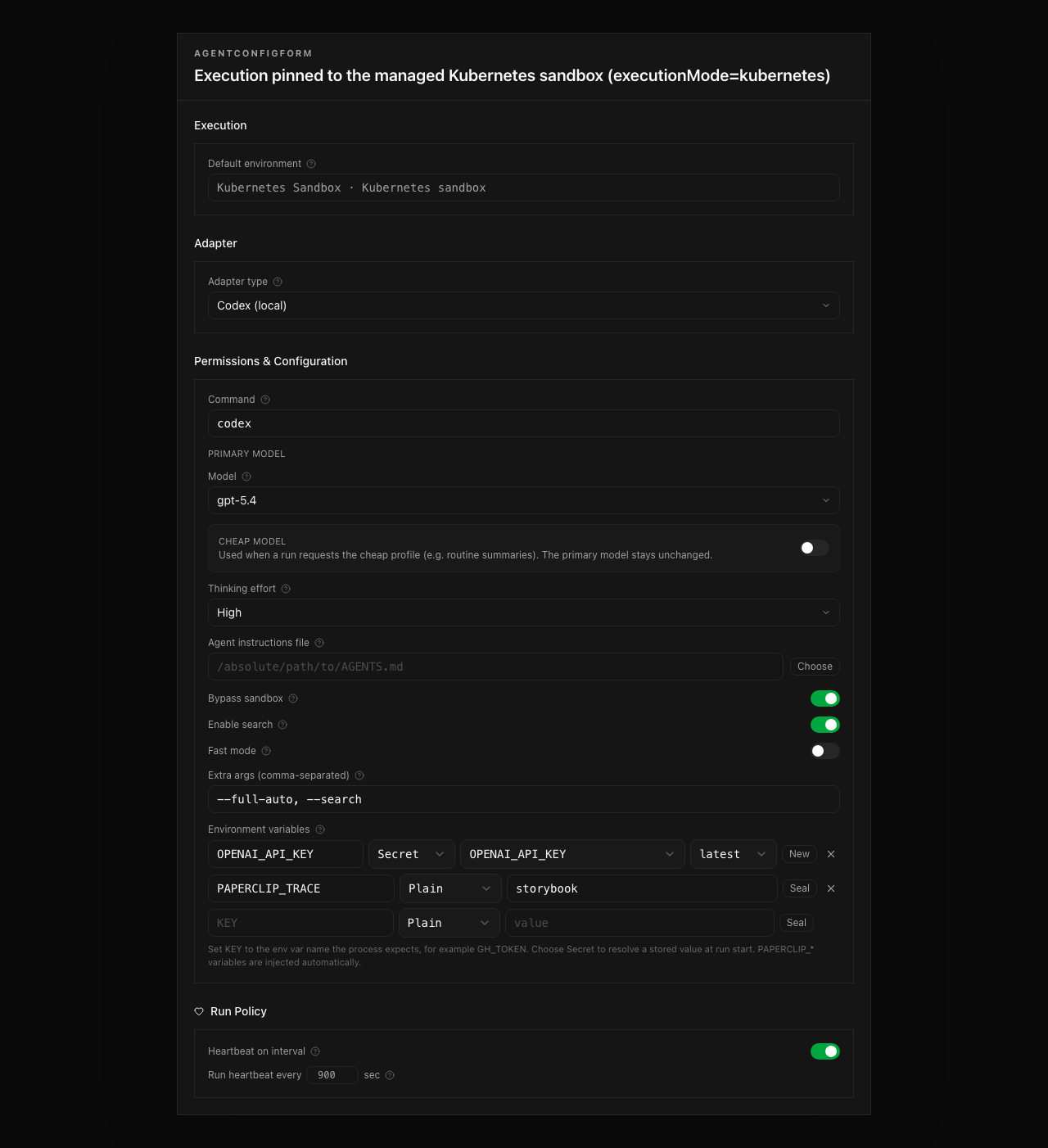 No managed environment available yet (warning notice, no silent local fallback): 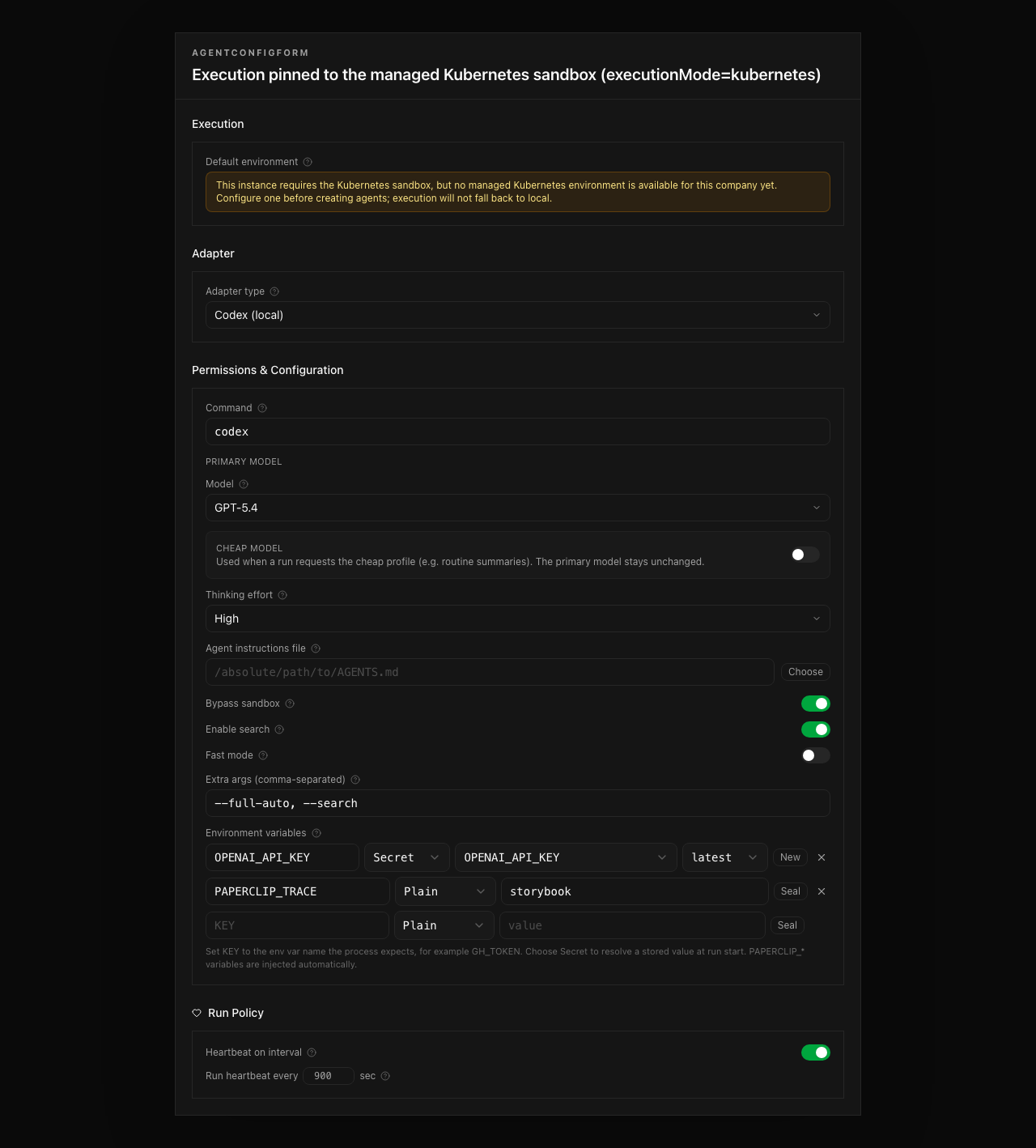 ## Checklist - [x] I have included a thinking path that traces from project context to this change - [x] I have specified the model used (with version and capability details) - [x] I have checked ROADMAP.md and confirmed this PR does not duplicate planned core work - [x] I have searched GitHub for duplicate or related PRs and linked them above - [x] I have either (a) linked existing issues with `Fixes: #` / `Closes #` / `Refs #` OR (b) described the issue in-PR following the relevant issue template - [x] I have run tests locally and they pass - [x] I have added or updated tests where applicable - [x] If this change affects the UI, I have included before/after screenshots - [x] I have updated relevant documentation to reflect my changes - [x] I have considered and documented any risks above - [ ] All Paperclip CI gates are green - [ ] Greptile is 5/5 with no open P2s, recommendations, or follow-ups - [x] I will address all Greptile and reviewer comments before requesting merge 🤖 Generated with [Claude Code](https://claude.com/claude-code) --------- Co-authored-by: Claude Opus 4.8 (1M context) <noreply@anthropic.com> |
||
|
|
f3db7b88ea |
Clear stale checkoutRunId on run finalization and add backstop sweeper (#6008)
## Thinking Path > - Paperclip is the open source app people use to manage AI agents for work > - The issue subsystem holds per-row lock columns (`checkoutRunId`, `executionRunId`, `executionAgentNameKey`, `executionLockedAt`) that gate checkout, ownership, and release > - When a heartbeat run terminates, `releaseIssueExecutionAndPromote` clears the execution-lock columns but stale checkout locks could remain attached to dead runs in edge paths > - The original fix closed the finalization, checkout, release, and sweeper paths, but PR CI exposed one more process-loss retry path where a queued retry advanced `executionRunId` while leaving `checkoutRunId` pinned to the failed run > - This pull request closes the asymmetry: terminal-run cleanup and process-loss retry recovery release dead checkout locks while preserving live execution ownership > - The benefit is permanent, automatic self-heal of stale lock columns and fewer false checkout 409s requiring board intervention > - Related upstream issue: #6007 ## Linked Issues or Issue Description Refs #6007. Duplicate/related PR search performed on 2026-06-10 with query `checkoutRunId process loss retry stale checkout lock repo:paperclipai/paperclip`. Related PRs found and reviewed for overlap: - #7727 `fix(heartbeat): atomically advance checkoutRunId on process-loss retry` - #7707 `test: cover same-agent stale checkout adoption` - #3068 `fix: clear checkoutRunId when releasing issue execution lock` ## What Changed - `server/src/services/heartbeat.ts` `releaseIssueExecutionAndPromote`: extend the per-issue update to also null `checkoutRunId` when it matches the terminating run id. WHERE clause scoped to `executionRunId = run.id OR checkoutRunId = run.id` for idempotence. - `server/src/services/heartbeat.ts` process-loss retry: when queuing the retry run, move `executionRunId` to the retry and clear the failed run's `checkoutRunId` so the dead run no longer owns checkout. - `server/src/services/issues.ts`: add `clearCheckoutRunIfTerminal` helper, symmetric to `clearExecutionRunIfTerminal`. No assignee/status precondition. Wired into `checkout`, `assertCheckoutOwner`, and `release`. Exported on the issue service. - `server/src/services/recovery/service.ts`: add `sweepStaleIssueLocks`. Scans `issues` where `checkoutRunId IS NOT NULL OR executionRunId IS NOT NULL`, joins each referenced run, and clears all lock columns on issues whose referenced runs are all terminal or missing. Emits one `issue.stale_lock_cleared` activity log row per cleared issue. - `server/src/services/heartbeat.ts`: re-export the sweeper on the heartbeat facade. - `server/src/index.ts`: invoke `sweepStaleIssueLocks` in both the startup recovery sequence and the periodic heartbeat timer chain. - Tests: route-level coverage of the new self-heal path on the next checkout attempt, service-level sweeper coverage, and heartbeat recovery assertions that terminal process-loss cleanup releases `checkoutRunId`. ## Verification ```bash pnpm --filter @paperclipai/server typecheck pnpm --filter @paperclipai/server exec vitest run \ src/__tests__/recovery-stale-issue-lock-sweep.test.ts \ src/__tests__/issue-stale-execution-lock-routes.test.ts NODE_ENV=test pnpm exec vitest run src/__tests__/heartbeat-process-recovery.test.ts -t "queues exactly one retry when the recorded local pid is dead|does not block paused-tree work when immediate continuation recovery is suppressed by the hold" NODE_ENV=test pnpm exec vitest run src/__tests__/heartbeat-process-recovery.test.ts ``` All listed local checks pass. The new and updated tests cover: - Run termination clears `checkoutRunId` when it points at the terminating run. - Process-loss retry clears the failed run's `checkoutRunId` while assigning `executionRunId` to the queued retry. - A different agent calling `POST /api/issues/:id/checkout` on an issue whose prior owner died self-heals via `clearCheckoutRunIfTerminal` and succeeds. - Sweeper clears stale lock columns for issues whose run row is terminal. - Sweeper leaves issues alone while the referenced run is still running. - Sweeper leaves issues alone when `executionRunId` is still running even if `checkoutRunId` is terminal. - Sweeper is idempotent; second pass clears nothing. Manual reproduction of the original bug shape: 1. Create an issue assigned to agent A, set `status='in_progress'`, `checkoutRunId=R1`, `executionRunId=null`, where `heartbeat_runs.status = 'failed'` for `R1`. 2. Reassign to agent B and move to `status='todo'`. 3. Before this PR: agent B `POST /checkout` returns `409 Issue checkout conflict` indefinitely. After this PR: succeeds, lock columns rewritten to agent B's current run id. ## Risks - Low. All clears are scoped by run id, so they only fire when the lock column unambiguously points at the terminating or terminal run. No schema change. No migration. No API surface change. - Behavioral shift: an issue that previously stayed `in_progress` with a dead `checkoutRunId` after run termination now self-heals. Downstream code that reads stale `checkoutRunId` as a proxy for recent run history should already be reading `executionRunId` or the `heartbeat_runs` table. - Sweeper cost: one indexed scan per recovery tick over rows where `checkoutRunId IS NOT NULL OR executionRunId IS NOT NULL` plus a single batched `heartbeatRuns` lookup per candidate. Negligible at expected cardinality; further bounded by the existing recovery cadence. > For core feature work, check [`ROADMAP.md`](ROADMAP.md) first and discuss it in `#dev` before opening the PR. Feature PRs that overlap with planned core work may need to be redirected — check the roadmap first. See `CONTRIBUTING.md`. This is a bug fix, not a feature. No roadmap overlap. ## Model Used - Claude (Anthropic), model ID `claude-opus-4-7`, extended-thinking off, tool use enabled. - OpenAI Codex, GPT-5-based coding agent, tool use enabled, used for the follow-up process-loss retry fix and PR body update. ## Checklist - [x] I have included a thinking path that traces from project context to this change - [x] I have specified the model used (with version and capability details) - [x] I have checked ROADMAP.md and confirmed this PR does not duplicate planned core work - [x] I have searched GitHub for duplicate or related PRs and linked them above - [x] I have either (a) linked existing issues with `Fixes: #` / `Closes #` / `Refs #` OR (b) described the issue in-PR following the relevant issue template - [x] I have run tests locally and they pass - [x] I have added or updated tests where applicable - [x] If this change affects the UI, I have included before/after screenshots - [x] I have updated relevant documentation to reflect my changes - [x] I have considered and documented any risks above - [x] All Paperclip CI gates are green - [ ] Greptile is 5/5 with no open P2s, recommendations, or follow-ups - [ ] I will address all Greptile and reviewer comments before requesting merge --------- Co-authored-by: Paperclip <noreply@paperclip.ing> Co-authored-by: Dotta <bippadotta@protonmail.com> |
||
|
Dotta
|
ad6effa65c |
[codex] Improve runtime and import reliability (#6549)
## Thinking Path > - Paperclip coordinates autonomous company work through local and hosted runtime surfaces. > - Local embedded Postgres and tenant import/export paths are foundational reliability pieces. > - A runtime failure in either path can stop agents or imports before useful work begins. > - The branch included remaining fixes for embedded native library bootstrap and async tenant import handling. > - This pull request groups those runtime/import reliability changes into one standalone PR. > - The benefit is a more robust local runtime and safer cloud tenant import behavior. ## What Changed - Prepared embedded Postgres native runtime before startup in CLI/server/test entrypoints. - Added embedded Postgres native bootstrap coverage. - Added async tenant import job handling and deferred validation coverage. - Kept the runtime/import changes based directly on current `origin/master` after related upstream PRs had already merged. ## Verification - `pnpm --filter @paperclipai/plugin-sdk build` - `NODE_ENV=test pnpm exec vitest run packages/db/src/embedded-postgres-native.test.ts server/src/__tests__/company-portability-routes.test.ts` ## Risks - Medium-low: this touches startup/import paths, but the branch is small and covered by targeted tests. - The embedded Postgres change depends on platform-specific native-library behavior, so CI and follow-up checks should still verify supported runners. > For core feature work, check [`ROADMAP.md`](ROADMAP.md) first and discuss it in `#dev` before opening the PR. Feature PRs that overlap with planned core work may need to be redirected — check the roadmap first. See `CONTRIBUTING.md`. ## Model Used - OpenAI GPT-5 Codex via `codex_local`, tool-enabled coding session; exact context window not exposed by this runtime. ## Checklist - [x] I have included a thinking path that traces from project context to this change - [x] I have specified the model used (with version and capability details) - [x] I have checked ROADMAP.md and confirmed this PR does not duplicate planned core work - [x] I have run tests locally and they pass - [x] I have added or updated tests where applicable - [x] If this change affects the UI, I have included before/after screenshots - [x] I have updated relevant documentation to reflect my changes - [x] I have considered and documented any risks above - [x] I will address all Greptile and reviewer comments before requesting merge |
||
|
Dotta
|
e43b392a79 |
[codex] Add local Cloud Upstream sync (#6548)
## Thinking Path > - Paperclip is the control plane for AI-agent companies. > - Operators need a path to move local company state toward Paperclip Cloud without losing local-first control. > - The Cloud Upstream flow needs API, persistence, CLI, and board UI surfaces that agree on the same manifest/run model. > - The existing branch had the feature work plus UX and error-handling follow-ups. > - This pull request packages the remaining Cloud Upstream sync work into one standalone branch. > - The benefit is an inspectable local-to-cloud sync workflow with preview, conflicts, activation, and captured UX review states. ## What Changed - Added Cloud Upstream shared types, server routes/services, and persisted run schema/migration. - Added Paperclip Cloud CLI sync helpers and local connection storage. - Added the Cloud Upstream board UI, settings entry points, query keys, and UX lab page. - Added preview/activation checklist behavior, redirect handling, manifest-only preview support, friendly errors, in-flight hints, and entity count summaries. ## Verification - `pnpm --filter @paperclipai/plugin-sdk build` - `NODE_ENV=test pnpm exec vitest run cli/src/__tests__/cloud.test.ts server/src/__tests__/instance-settings-routes.test.ts server/src/__tests__/instance-settings-service.test.ts ui/src/pages/CloudUpstream.test.tsx ui/src/components/CompanySettingsSidebar.test.tsx` - `NODE_ENV=test pnpm exec vitest run server/src/__tests__/cloud-upstreams.test.ts` Worktree setup note: the isolated worktree install skipped native sqlite build scripts, so I copied the already-built local sqlite binding from the main checkout before running `server/src/__tests__/cloud-upstreams.test.ts`. The test then passed. ## Risks - Medium: this adds a database migration and a broad feature path across CLI/server/UI. - Merge order: this is the only PR in this split with a DB migration; merge it before any future Cloud Upstream migration follow-up. - Mitigation: the PR is based directly on current `origin/master`, has targeted route/service/UI tests, and keeps the feature behind existing experimental Cloud Sync settings. > For core feature work, check [`ROADMAP.md`](ROADMAP.md) first and discuss it in `#dev` before opening the PR. Feature PRs that overlap with planned core work may need to be redirected — check the roadmap first. See `CONTRIBUTING.md`. ## Model Used - OpenAI GPT-5 Codex via `codex_local`, tool-enabled coding session; exact context window not exposed by this runtime. ## Checklist - [x] I have included a thinking path that traces from project context to this change - [x] I have specified the model used (with version and capability details) - [x] I have checked ROADMAP.md and confirmed this PR does not duplicate planned core work - [x] I have run tests locally and they pass - [x] I have added or updated tests where applicable - [x] If this change affects the UI, screenshot artifacts are intentionally omitted per reviewer request - [x] I have updated relevant documentation to reflect my changes - [x] I have considered and documented any risks above - [x] I will address all Greptile and reviewer comments before requesting merge |
||
|
DottaandPaperclip
|
38c185fb8b |
[codex] Add agent permissions and controls plan (#6386)
## Thinking Path > - Paperclip orchestrates AI agents for zero-human companies by keeping task ownership, approvals, and operator control inside one control plane. > - Agent permissions and plugin-hosted company settings sit on the boundary between autonomy and governance. > - V1 needs scoped task assignment rules, plugin extension points, and clearer company access surfaces without weakening company boundaries. > - The branch builds the core authorization service, plugin SDK/host APIs, and UI simplifications needed to support those controls. > - Paperclip EE plugin surfaces were intentionally moved out of this core PR per review direction, so this PR now carries only the public core/plugin infrastructure work. > - The latest updates preserve the PAP-9937 branch changes that belong in this PR, remove the `design/` artifacts, and exclude the experimental `plugin-briefs` package. > - Greptile feedback was applied through the authorization/audit paths and the final cleanup commit was re-reviewed at 5/5 with no unresolved Greptile threads. > - The benefit is safer assignment control with extension hooks for richer permission products while preserving simple defaults for normal operators. ## What Changed - Added scoped task-assignment authorization decisions and routed issue/agent assignment mutations through the authorization service. - Added plugin SDK and host APIs for company settings slots, authorization policy/grant management, assignment previews, and bridge invocation scope propagation. - Simplified core company access UI and moved advanced controls behind plugin-provided settings surfaces. - Added retry-now affordances for blocked issue next-step notices. - Added protected-assignment enforcement for persisted agent/project/issue policies, including explicit-grant fallback behavior. - Added incremental principal-access compatibility backfill for active agent memberships and role-default human permission grants. - Added the Markdown code block wrap action fix from the latest branch changes. - Removed `design/` artifacts from the PR and removed `packages/plugins/plugin-briefs` from the final diff. - Addressed Greptile feedback for plugin actor sanitization, legacy membership handling, audit pagination, unknown grant-scope metadata, and startup test mocks. ## Verification - `pnpm exec vitest run server/src/__tests__/access-service.test.ts server/src/__tests__/company-portability.test.ts` -> 2 files passed, 54 tests passed. - `pnpm exec vitest run server/src/__tests__/server-startup-feedback-export.test.ts server/src/__tests__/access-service.test.ts server/src/__tests__/company-portability.test.ts` -> 3 files passed, 62 tests passed. - `pnpm exec vitest run server/src/__tests__/authorization-service.test.ts server/src/__tests__/plugin-access-authorization-host-services.test.ts server/src/__tests__/server-startup-feedback-export.test.ts` -> 3 files passed, 28 tests passed. - `pnpm --filter @paperclipai/server typecheck` -> passed. - `git diff --check` -> passed. - `node ./scripts/check-docker-deps-stage.mjs` -> passed. - `CI=true pnpm install --frozen-lockfile --ignore-scripts` -> passed with no lockfile update. - `pnpm exec vitest run ui/src/components/MarkdownBody.interaction.test.tsx` -> 1 test passed. - `git ls-files design packages/plugins/plugin-briefs | wc -l` -> 0. - GitHub CI on `40cd83b53` -> all checks passed, merge state `CLEAN`. - Greptile on `40cd83b53` -> 5/5, 102 files reviewed, 0 comments/annotations added, 0 unresolved review threads. - Confirmed the PR diff contains no `design/`, `packages/plugins/plugin-briefs`, `pnpm-lock.yaml`, or `.github/workflows` changes. ## Risks - Medium: task assignment authorization paths are behaviorally stricter for protected/private policy data, so existing plugin-authored policies may block assignment until explicit grants or approval flows are configured. - Medium: plugin-host authorization APIs expand the surface area available to trusted plugins and need careful review for company scoping. - Low: startup now performs a principal-access compatibility backfill, but the migration and runtime backfill use conflict-tolerant inserts. > For core feature work, check [`ROADMAP.md`](ROADMAP.md) first and discuss it in `#dev` before opening the PR. Feature PRs that overlap with planned core work may need to be redirected — check the roadmap first. See `CONTRIBUTING.md`. ## Model Used - OpenAI Codex, GPT-5 coding agent, tool-enabled workflow with shell, git, and GitHub CLI access. ## Checklist - [x] I have included a thinking path that traces from project context to this change - [x] I have specified the model used (with version and capability details) - [x] I have checked ROADMAP.md and confirmed this PR does not duplicate planned core work - [x] I have run tests locally and they pass - [x] I have added or updated tests where applicable - [x] If this change affects the UI, I have included before/after screenshots - [x] I have updated relevant documentation to reflect my changes - [x] I have considered and documented any risks above - [x] I will address all Greptile and reviewer comments before requesting merge --------- Co-authored-by: Paperclip <noreply@paperclip.ing> |
||
|
DottaandPaperclip
|
c91a062326 |
[codex] Runtime control-plane fixes (#6380)
## Thinking Path > - Paperclip orchestrates AI agents through a server-side control plane > - That control plane depends on reliable issue state transitions, plugin lifecycle behavior, import limits, and startup/shutdown handling > - Several small runtime fixes had accumulated on the working branch and were mixed with larger feature work > - Keeping them separate makes the correctness fixes reviewable and mergeable without waiting for cloud-sync UI work > - This pull request groups the server/runtime control-plane fixes into one standalone branch > - The benefit is a tighter, safer runtime baseline for retries, imports, plugin migrations, feedback flushing, and trusted cloud import handling ## What Changed - Fixed updated issue list pagination sorting and scheduled retry comment handling. - Re-applied pending plugin migrations during hot reload and fixed plugin-schema worktree seed restore. - Hardened public tenant DB startup, portable import body limits, trusted cloud import errors, and trusted cloud tenant import mutation access. - Expired stale request confirmations after user comments. - Added feedback export shutdown hardening so database-unavailable flush loops stop cleanly. - Guarded plugin worker `error` event emission when no listener is registered. ## Verification - `pnpm install --frozen-lockfile --ignore-scripts` - `pnpm --filter @paperclipai/plugin-sdk build` - `npm run install --prefix node_modules/.pnpm/sqlite3@5.1.7/node_modules/sqlite3` - `pnpm exec vitest run server/src/__tests__/issues-service.test.ts server/src/__tests__/plugin-lifecycle-restart.test.ts server/src/__tests__/server-startup-feedback-export.test.ts server/src/__tests__/issue-comment-reopen-routes.test.ts server/src/__tests__/issue-thread-interactions-service.test.ts server/src/__tests__/issue-thread-interaction-routes.test.ts server/src/__tests__/body-limits.test.ts server/src/__tests__/feedback-flush-controller.test.ts server/src/__tests__/error-handler.test.ts server/src/__tests__/board-mutation-guard.test.ts packages/db/src/backup-lib.test.ts` initially exposed local setup issues and two 5s test timeouts. - Rerun after local prereq build: `pnpm exec vitest run --testTimeout 15000 server/src/__tests__/issue-comment-reopen-routes.test.ts server/src/__tests__/issue-thread-interaction-routes.test.ts server/src/__tests__/feedback-flush-controller.test.ts server/src/__tests__/server-startup-feedback-export.test.ts` passed. - Some embedded Postgres-backed tests skipped on this host because local Postgres init was unavailable. ## Risks - Runtime-touching branch: startup/shutdown and issue interaction behavior should be reviewed carefully. - The feedback export change disables repeated flush attempts only for database connection-refused failures; other upload failures still log normally. - The plugin worker error guard avoids process crashes from unhandled EventEmitter errors but may hide errors from code paths that expected an emitted listener. > For core feature work, check [`ROADMAP.md`](ROADMAP.md) first and discuss it in `#dev` before opening the PR. Feature PRs that overlap with planned core work may need to be redirected — check the roadmap first. See `CONTRIBUTING.md`. ## Model Used - OpenAI Codex, GPT-5-based coding agent with local shell/git/tool use. Exact hosted model ID and context-window size are not exposed by the local Paperclip adapter runtime. ## Checklist - [x] I have included a thinking path that traces from project context to this change - [x] I have specified the model used (with version and capability details) - [x] I have checked ROADMAP.md and confirmed this PR does not duplicate planned core work - [x] I have run tests locally and they pass - [x] I have added or updated tests where applicable - [x] If this change affects the UI, I have included before/after screenshots - [x] I have updated relevant documentation to reflect my changes - [x] I have considered and documented any risks above - [x] I will address all Greptile and reviewer comments before requesting merge --------- Co-authored-by: Paperclip <noreply@paperclip.ing> |
||
|
DottaandPaperclip
|
454edfe81e |
Add recovery handoff system notices (#5289)
## Thinking Path > - Paperclip orchestrates AI agents for zero-human companies. > - Agent runs can end productively while the source issue still lacks a durable final disposition. > - That leaves the control plane unsure whether to resume, escalate, or close the work. > - Issue comments also need a presentation contract so system-authored recovery notices can render as first-class thread messages without overloading normal comments. > - This pull request adds successful-run handoff recovery, comment presentation metadata, and system notice rendering. > - The benefit is stricter task liveness with clearer operator-facing recovery state. ## What Changed - Added successful-run handoff decisions, wake payloads, escalation behavior, and recovery tests. - Added issue comment presentation metadata with migration `0078_white_darwin.sql` and shared/server/company portability support. - Rendered recovery/system notices in issue chat with dedicated UI components, fixtures, tests, and storybook/lab coverage. - Included the current recovery model-profile hint patch so automatic recovery follow-ups use the cheap profile. ## Verification - `pnpm install --frozen-lockfile` - `pnpm exec vitest run server/src/services/recovery/successful-run-handoff.test.ts ui/src/components/SystemNotice.test.tsx ui/src/lib/system-notice-comment.test.ts ui/src/components/IssueChatThreadSystemNotice.test.tsx` ## Risks - Migration-bearing PR: merge this before any other branch that might later add a migration. - The branch touches both recovery services and issue-thread rendering, so review should pay attention to recovery wake idempotency and comment metadata compatibility. ## Model Used - OpenAI GPT-5 Codex via Paperclip `codex_local` adapter, with shell/git/GitHub CLI tool use. ## Checklist - [x] I have included a thinking path that traces from project context to this change - [x] I have specified the model used (with version and capability details) - [x] I have checked ROADMAP.md and confirmed this PR does not duplicate planned core work - [x] I have run tests locally and they pass - [x] I have added or updated tests where applicable - [x] If this change affects the UI, I have included before/after screenshots - [x] I have updated relevant documentation to reflect my changes - [x] I have considered and documented any risks above - [x] I will address all Greptile and reviewer comments before requesting merge --------- Co-authored-by: Paperclip <noreply@paperclip.ing> |

