mirror of
https://github.com/paperclipai/paperclip.git
synced 2026-10-21 08:22:20 +02:00
dc6fcd1ff1eaa52df7685c8d12257b650dbf611c
105
Commits
| Author | SHA1 | Message | Date | |
|---|---|---|---|---|
 DottaandPaperclip |
dc6fcd1ff1 |
fix(ui): move agent secret access to searchable secrets tab (#11283)
## Thinking Path > - Paperclip is the open source app people use to manage AI agents for work. > - The agent configuration UI controls each agent and its allowed secrets. > - The environment variable editor already has a secret selector with search and folder navigation. > - The secret access editor used a basic list and made large secret stores hard to use. > - The secret access controls also occupied the main Configuration tab. > - This pull request reuses the rich selector and moves secret access to a dedicated Secrets tab. > - The benefit is one consistent secret selection workflow with clearer agent configuration navigation. ## Linked Issues or Issue Description **What existing behavior does this improve?** The agent detail configuration view and its secret access editor. **Subsystem affected** `ui/` — React and Vite board UI. **Current behavior** The secret access editor uses a basic select control. It does not provide the search and folder navigation available in the environment variable editor. The editor also appears inside the Configuration tab. **Proposed behavior** The secret access editor uses the shared secret picker. Users can search secrets and browse slash-delimited folders. Agent details provide a dedicated Secrets tab for this editor. **Reason and benefit** Large secret stores are slow to scan in a flat list. Reusing one selector reduces UI differences and makes scoped secret access easier to manage. **Breaking changes** None. The API and saved secret access data do not change. ## What Changed - Reused the environment variable secret picker in the agent secret access editor. - Preserved secret version selection and the create-secret action, including nested-popover focus handling. - Added a route-backed Secrets tab to agent details and removed secret access controls from Configuration. - Guarded unsaved configuration across tab, link, browser-history, and action-triggered navigation. - Rechecked dirty state when navigation-producing agent actions finish, covering edits made while a request is pending. - Added component, page, and Storybook coverage for the workflow. ## Verification - `pnpm --filter @paperclipai/ui exec vitest run src/components/AgentActionButtons.test.tsx src/components/AgentConfigForm.render.test.tsx src/components/AgentSecretAccessEditor.test.tsx src/components/environment-variables-editor/EnvironmentVariablesEditor.test.tsx src/pages/AgentDetail.progress.test.ts` — 82 tests passed. - `pnpm --filter @paperclipai/ui typecheck` - `pnpm check:token-gates` - All GitHub PR checks passed on `5209c5b787`, including build, canary, general and serialized tests, and all three e2e shards. - Greptile completed at 5/5 with zero unresolved review threads. ## Risks - Low risk. The API and persisted binding format are unchanged; this changes agent configuration navigation and secret selection UI. - Dirty-state guards now cover direct navigation, Back/Forward history, and navigation-producing agent actions, including pending-request races. - Tests cover tab separation, secret access updates, search, folder navigation, focus restoration, and navigation rejection. - No documentation change is required because commands, contracts, and setup steps do not change. > For core feature work, check [`ROADMAP.md`](ROADMAP.md) first and discuss it in `#dev` before opening the PR. Feature PRs that overlap with planned core work may need to be redirected — check the roadmap first. See `CONTRIBUTING.md`. ## Model Used OpenAI Codex with GPT-5. This runtime did not expose a more specific model ID or context window. The model used agentic reasoning, repository tools, and code execution. ## Checklist - [x] I have included a thinking path that traces from project context to this change - [x] I have specified the model used (with version and capability details) - [x] I have checked ROADMAP.md and confirmed this PR does not duplicate planned core work - [x] I have searched GitHub for duplicate or related PRs and linked them above - [x] I have either (a) linked existing issues with `Fixes: #` / `Closes #` / `Refs #` OR (b) described the issue in-PR following the relevant issue template - [x] I have not referenced internal/instance-local Paperclip issues or links (only public GitHub `#NNN` / `github.com/paperclipai/paperclip` URLs) - [x] My branch name describes the change (e.g. `docs/...`, `fix/...`) and contains no internal Paperclip ticket id or instance-derived details - [x] I have run tests locally and they pass - [x] I have added or updated tests where applicable - [x] I have updated relevant documentation to reflect my changes - [x] I have considered and documented any risks above - [x] All Paperclip CI gates are green - [x] Greptile is 5/5 with no open P2s, recommendations, or follow-ups - [x] I will address all Greptile and reviewer comments before requesting merge --------- Co-authored-by: Paperclip <noreply@paperclip.ing> |
||
|
Nicky LeachandPaperclip
|
e5a7fd7038 |
Add sandbox device-login for the Codex adapter (#11237)
## Thinking Path > - Paperclip helps people manage AI agents for work. > - Agent adapters connect Paperclip to tools such as the Codex command line tool. > - A sandboxed Codex agent may start without a credential. > - The operator needs a safe sign-in flow that does not expose credentials to the shared package or the sandbox. > - This pull request adds a company-scoped device-login flow with a temporary Daytona sandbox. > - The flow promotes the credential only after readiness checks pass and removes the temporary sandbox after use. > - The result lets an operator sign in to a sandboxed Codex agent from the agent form. ## Linked Issues or Issue Description **Subsystem affected** Cross-cutting (multiple of the above) **Problem or motivation** A Codex adapter that runs in a sandbox cannot authenticate when the company has no pre-provisioned Codex credential. **Proposed solution** Add a company-scoped device-login session. Start a temporary sandbox, run `codex login --device-auth`, stream the code and URL, verify readiness, promote the credential, and delete the sandbox. **Alternatives considered** Pre-provisioning a credential does not support first-time sandbox login. Keeping the credential in the login sandbox does not provide a durable company credential. **Roadmap alignment** This supports the roadmap item for cloud and sandbox agents. **Additional context** The flow uses a five-minute cleanup reaper, compare-and-set status changes, and a PostgreSQL advisory lock to protect promotion and cleanup. ## What Changed - Add the adapter login-session contract, database table, and migration. - Add company-scoped server routes and a service for sandbox device login. - Add credential promotion, readiness checks, and cleanup after login. - Add restart-safe cleanup for abandoned login sandboxes. - Add sandbox login controls to the agent creation and edit forms. - Keep device-login and vendor identifiers out of public shared and adapter UI symbols. ## Verification - `pnpm --filter @paperclipai/adapter-codex-local exec vitest run` passed with 310 tests at the submitted commit. - The server login route, service, and reaper tests passed with 45 tests at the submitted commit. - The agent form render tests passed with 26 tests at the submitted commit. - The public-symbol leak check passed at the submitted commit. - A live Daytona sign-in flow still requires confirmation by a user with a live sandbox. ## Risks The migration adds a new company-scoped table. A promotion or cleanup race could remove a credential or leave a sandbox active, so the service uses claims, compare-and-set transitions, and an advisory lock. The live Daytona flow needs operator confirmation because local tests do not provide a real browser sign-in. ## Model Used OpenAI Codex, GPT-5, tool use and code execution, extended reasoning. ## Checklist - [x] I have included a thinking path that traces from project context to this change - [x] I have specified the model used (with version and capability details) - [x] I have checked ROADMAP.md and confirmed this PR does not duplicate planned core work - [x] I have searched GitHub for duplicate or related PRs and linked them above - [x] I have either (a) linked existing issues with `Fixes: #` / `Closes: #` / `Refs: #` OR (b) described the issue in-PR following the relevant issue template - [x] I have not referenced internal/instance-local Paperclip issues or links (only public GitHub `#NNN` / `github.com/paperclipai/paperclip` URLs) - [x] My branch name describes the change (e.g. `docs/...`, `fix/...`) and contains no internal Paperclip ticket id or instance-derived details - [x] I have run tests locally and they pass - [x] I have added or updated tests where applicable - [x] I have updated relevant documentation to reflect my changes - [x] I have considered and documented any risks above - [x] All Paperclip CI gates are green - [x] Greptile is 5/5 with no open P2s, recommendations, or follow-ups - [x] I will address all Greptile and reviewer comments before requesting merge --------- Co-authored-by: Paperclip <noreply@paperclip.ing> |
||
|
Devin Foley
|
d5bb396518 |
fix: pass sandbox provider credential env vars to plugin workers; hide Local default under managed-sandbox-only (#11244)
<!-- Write all pull request text in Simplified Technical English (ASD-STE100): short sentences, one instruction per sentence, simple approved vocabulary, and the active voice. --> ## Thinking Path > - Paperclip is the open source app people use to manage AI agents for work > - Environments give each agent run an execution target, and sandbox providers (Daytona, E2B, Novita, exe.dev) run as plugin workers > - A managed deployment provisions one platform-managed sandbox row with no credential in config; the provider is documented to fall back to its process env var (for example `DAYTONA_API_KEY`) > - Plugin workers spawn with a scrubbed environment, so that fallback never sees the host env var — probe and lease acquisition fail with "require an API key in config or DAYTONA_API_KEY" even when the deployment sets the var > - Separately, the managed-sandbox-only mode hides local rows from every list, but the instance Default picker renders a hardcoded synthetic "Local" option that no filter touches > - This pull request forwards each bundled provider's documented credential env var to its own plugin worker, and gates the synthetic Local option on the flag > - The benefit is that the documented host-env credential fallback works for plugin-backed providers, and managed-sandbox-only instances no longer offer Local anywhere ## Linked Issues or Issue Description **Subsystem affected** Plugin worker environment construction (`server/src/services/plugin-loader.ts`) and the environments UI (instance Default picker, agent form inherited-environment label). **Problem or motivation** Two follow-ups to the managed-sandbox-only mode (#11200), both found on a live managed deployment: 1. The deployment sets `DAYTONA_API_KEY` as a server env var and the managed sandbox row omits `config.apiKey` by contract. "Test Connection" fails with `Sandbox environment probe failed for provider "daytona". Daytona sandbox environments require an API key in config or DAYTONA_API_KEY.` A real agent run fails the same way at lease acquisition. The cause: sandbox providers run as plugin workers, and `buildPluginWorkerEnv` passes only model-provider keys and in-cluster Kubernetes vars. The provider's own documented credential env var never reaches the worker, so the in-plugin `process.env` fallback reads nothing. The self-hosted path has the same gap: the Daytona plugin README documents `DAYTONA_API_KEY` as a host-level fallback, and it does not work today. 2. With `enableManagedSandboxOnly` on, the instance Default environment picker still shows "Local". The server filters local *rows* out of the list, and the client filter mirrors that for cached lists, but this option is a hardcoded `<option value="">Local</option>` — not a list row — so no filter removes it. Selecting it writes a null default, which run selection then rejects fail-closed. **Proposed solution** Forward each bundled sandbox provider's documented credential env var into its plugin worker, keyed by the manifest's declared `environmentDrivers[].driverKey` so a worker only receives its own provider's credential (daytona → `DAYTONA_API_KEY`, e2b → `E2B_API_KEY`, exe-dev → `EXE_API_KEY`, novita → `NOVITA_API_KEY`). Keep the existing gate: only plugins that declare `environment.drivers.register` receive any passthrough. In the UI, render the synthetic Local option only when managed-sandbox-only is off; under the flag show a disabled "Select environment" placeholder only while no default is stamped yet, and stop the agent form's inherited label from reading "Local". **Alternatives considered** Adding `DAYTONA_API_KEY` to the existing `ADAPTER_ENV_PASSTHROUGH` list was rejected: that list goes to every environment-driver plugin, so each provider would receive every other provider's credential. A manifest schema field for declared credential env vars was rejected as heavier than needed: the bundled providers are known, and the mapping lives next to the two existing passthrough lists. ## What Changed - `server/src/services/plugin-loader.ts`: new `SANDBOX_PROVIDER_CREDENTIAL_ENV_PASSTHROUGH` map (driverKey → documented credential env vars). `buildPluginWorkerEnv` reads the manifest's `environmentDrivers` and forwards only the matching vars, after the existing `environment.drivers.register` gate. Blank values stay excluded. - `server/src/__tests__/plugin-database.test.ts`: the daytona worker receives `DAYTONA_API_KEY` and not another provider's key; a plugin whose drivers have no mapping (kubernetes) receives no credential var. - `ui/src/pages/CompanyEnvironments.tsx`: the Default picker's synthetic Local option renders only when managed-sandbox-only is off. Under the flag, a disabled "Select environment" placeholder renders only while the default is unset. - `ui/src/pages/CompanyEnvironments.test.tsx`: the Local option is present by default and absent under the flag; saved non-local environments stay selectable. - `ui/src/components/AgentConfigForm.tsx`: the inherited-environment label falls back to "Managed sandbox" instead of "Local" under the flag. ## Verification - `server`: `npx vitest run src/__tests__/plugin-database.test.ts -t buildPluginWorkerEnv` — 5 passed (3 existing, 2 new). - `ui`: `npx vitest run src/pages/CompanyEnvironments.test.tsx` — 22 passed (2 new); `npx vitest run src/components/AgentConfigForm.render.test.tsx` — 10 passed. - `tsc --noEmit` clean in `server` and `ui`. - Live managed deployment: confirmed the tenant service env carries `DAYTONA_API_KEY` while the probe fails with the exact message above, which pins the root cause to the worker env, not delivery. ## Risks - The worker env grows by exactly one var per matching bundled provider, only when the deployment sets it and only for plugins that declare a matching environment driver. Plugins without a mapping see no change. - Self-hosted behavioral shift is the fix itself: a host-level `DAYTONA_API_KEY` (or E2B/EXE/NOVITA equivalent) now reaches the provider as its README documents. Deployments that set the var but expected it to stay inert had no working configuration to preserve — the provider errored on every keyless probe and run. - UI change is inert unless `enableManagedSandboxOnly` is on (default false everywhere). ## Model Used Claude Fable 5 (`claude-fable-5`) via Claude Code — extended thinking, tool use, parallel read-only subagents for the two root-cause traces. ## Checklist - [x] I have included a thinking path that traces from project context to this change - [x] I have specified the model used (with version and capability details) - [x] I have checked ROADMAP.md and confirmed this PR does not duplicate planned core work - [x] I have searched GitHub for duplicate or related PRs and linked them above - [x] I have either (a) linked existing issues with `Fixes: #` / `Closes #` / `Refs #` OR (b) described the issue in-PR following the relevant issue template - [x] I have not referenced internal/instance-local Paperclip issues or links (only public GitHub `#NNN` / `github.com/paperclipai/paperclip` URLs) - [x] My branch name describes the change (e.g. `docs/...`, `fix/...`) and contains no internal Paperclip ticket id or instance-derived details - [x] I have run tests locally and they pass - [x] I have added or updated tests where applicable - [x] I have updated relevant documentation to reflect my changes - [x] I have considered and documented any risks above - [x] All Paperclip CI gates are green - [x] Greptile is 5/5 with no open P2s, recommendations, or follow-ups - [x] I will address all Greptile and reviewer comments before requesting merge |
||
|
|
e43f187cad |
feat(secrets): add human-approved secret proposals (#9934)
## Thinking Path > - Paperclip is the control plane people use to manage AI-agent companies. > - Agents can encounter credentials during work. > - Directly creating live secrets or bindings would bypass human governance. > - Proposal records must remain inert and separate from live secret resolution until an authorized human approves them. > - Approval must reuse the existing secret-create and protected agent-config write paths. > - This pull request adds the propose, review, approve, and reject lifecycle. > - The benefit is that agents can safely hand credentials into Paperclip without exposing plaintext or gaining authority to activate them. ## Linked Issues or Issue Description Follow-on to #9921, which established run-bound agent secret access. **Problem / motivation:** Agents can receive credentials during work. There is no governed way for them to propose a credential or binding without exposing plaintext in work artifacts or immediately creating live access. **Proposed solution:** Store agent-authored proposals outside live secret tables. Encrypt each proposed value and register exact-value redaction when Paperclip receives it. Require an authorized human to approve or reject each proposal. Approval executes through the normal write paths as the human approver. Binding proposals can target only the proposer or its downward reporting chain under the restrictive V1 policy. **Alternatives considered:** We rejected live secrets with a `proposed` status. That design would put untrusted rows in resolver, list, and sync paths. It would also allow uniqueness squatting. We rejected direct agent binding writes because a binding is an agent-config write and must keep the existing human permission gate. **Roadmap alignment:** This change extends the run-bound agent secret-access foundation in #9921 with a governed proposal workflow. ## Security Verdict Q0 SecEng verdict: **PASS-with-required-changes**. The review accepted the separate proposal-table design and required the implementation to: - fail closed unless both encryption and exact-value run redaction registration succeed; - scrub ciphertext idempotently on reject, withdraw, and expiry, with audit-visible state; - treat agent justification as hostile input and foreground action, target, provenance, and approver permissions; - snapshot and re-check the target agent plus reports-to chain at approval to prevent org-chart laundering; - make cascade approval atomic and fail closed if either secret creation or binding authorization fails; - deny low-trust, `skill_test`, `task_bridge`, and non-run-bound sources consistently; and - execute approval through the normal human secret/config write paths, including protected-change gates. Those requirements are implemented and covered by focused service, route, and UI tests. Residual V1 risk remains the accepted 14-day encrypted retention window. Proposal-time redaction also cannot clean a value that leaked before the propose call. ## What Changed - Added `company_secret_proposals`, migration `0207`, shared proposal contracts, and a state-machine service for create, approve, reject, withdraw, cascade, expiry, and ciphertext scrubbing. - Added run-bound agent proposal routes and board review routes. The routes derive provenance from authentication and enforce source restrictions, company isolation, chain-of-command checks, approval-as-approver, wake-on-resolution, and dual audit trails. - Added durable per-run exact-value redaction registration so proposal values remain redacted on later read surfaces. - Added the Secrets **Proposals** tab and agent configuration **Proposed access** rows. The UI shows fingerprint and length only. It also frames agent justification as untrusted input, runs permission preflight, supports approve and reject actions, and confirms cascades. - Updated OpenAPI, agent skill guidance, API reference documentation, and focused server and UI regression coverage. - Rebased the branch onto current `master` and renumbered the proposal migration after `0206`. ## QA Acceptance Results Q5 QA verdict: **PASS — 9/9 acceptance criteria met**, with one Minor non-blocking follow-up. - **AC1:** proposed values never echo, never appear in live lists/resolvers, and expose only fingerprint + length to board reviewers. - **AC2:** restrictive `self_and_reports` matrix passes: self/downward allowed; upward/lateral denied. - **AC3:** secret approval uses the normal create path, honors rename overrides, records proposer/approver provenance, and scrubs ciphertext. - **AC4:** approved bindings materialize and resolve through the target agent's runtime list/fetch routes. - **AC5:** pending-secret bindings require cascade; cascade succeeds atomically and permission failures leave nothing applied. - **AC6:** reject, withdraw, dependent rejection, and expiry paths scrub ciphertext and preserve reasons/audit state. - **AC7:** token/source and approver denial matrix passes through live checks plus focused route tests. - **AC8:** proposal lifecycle events and reused `secret.created`/config-write events form the required dual audit trail; origin-issue notification and wake are queued. - **AC9:** both review surfaces render and execute correctly; UI approval materializes the binding. QA also confirmed zero plaintext occurrences for all exercised proposal values in server logs. The single finding is that the company-level `bindingTargetPolicy` toggle is not wired yet. V1 is hardcoded to the restrictive `self_and_reports` policy. The matrix is correct and the follow-up is tracked separately, so QA classified it as non-blocking. ## Verification - Focused server proposal and redaction suite: 83 tests pass. - Focused proposal review UI suite: 54 tests pass. - Embedded-Postgres migration reapply test: 1 test passes with the documented 30-second timeout. - `pnpm --filter @paperclipai/db typecheck` passes, including migration numbering and safety checks. - `pnpm --filter @paperclipai/shared typecheck` passes. - `pnpm --filter @paperclipai/ui typecheck` passes. - `pnpm check:token-gates` passes with all gates clean. - Q5 exercised the complete propose, review, approve, bind, and runtime-resolve flow over real HTTP, JWT, and database paths. It verified 9/9 acceptance criteria. ## Risks - Proposal ciphertext is retained encrypted for up to 14 days while pending. Terminal-state and expiry scrub paths reduce but do not remove server-compromise risk during that window. - The V1 target policy is restrictive but not yet company-configurable. A separate follow-up owns that change. - A new migration can require another renumber if another migration lands before maintainers merge this pull request. > For core feature work, check [`ROADMAP.md`](ROADMAP.md) first and discuss it in `#dev` before opening the PR. Feature PRs that overlap with planned core work may need to be redirected. See `CONTRIBUTING.md`. ## Model Used - OpenAI Codex coding agent. The exact runtime model ID and context-window size are not exposed. The agent used reasoning, repository editing, terminal execution, Paperclip API, and GitHub CLI capabilities. Q3 UI work also records Claude Opus 4.8 assistance in its commit trailers. ## Checklist - [x] I have included a thinking path that traces from project context to this change - [x] I have specified the model used (with version and capability details) - [x] I have checked ROADMAP.md and confirmed this PR does not duplicate planned core work - [x] I have searched GitHub for duplicate or related PRs and linked them above - [x] I have either (a) linked existing issues with `Fixes: #` / `Closes #` / `Refs #` OR (b) described the issue in-PR following the relevant issue template - [x] I have not referenced internal or instance-local Paperclip issues or links - [x] My branch name describes the change and contains no internal Paperclip ticket id or instance-derived details - [x] I have run tests locally and they pass - [x] I have added or updated tests where applicable - [x] I have updated relevant documentation to reflect my changes - [x] I have considered and documented any risks above - [x] All Paperclip CI gates are green - [x] Greptile is 5/5 with no open P2s, recommendations, or follow-ups - [x] I will address all Greptile and reviewer comments before requesting merge --------- Co-authored-by: Paperclip <noreply@paperclip.ing> Co-authored-by: Claude Fable 5 <noreply@anthropic.com> |
||
|
Devin Foley
|
2ffebd4836 |
Test adapters in the environment a run would actually use (#10698)
## Thinking Path

> - Paperclip is the open source app people use to manage AI agents for
work
> - Agents execute in environments — local, SSH, or sandboxes — resolved
at run time as agent environment → instance default → local
> - The Configuration page has a Test button that probes the adapter
(working directory, command, a model call) in the environment it will
run in
> - But the Test sent only the agent's own environment id, with no
instance-default fallback, so agents relying on the instance default
were probed on the Paperclip host instead
> - A sandbox image carrying an extra CLI then fails the Test with
"command not found" even though every real run would resolve to the
sandbox and succeed — the Test lies about a working setup
> - This pull request mirrors the run-time resolution in the Test call
via a small shared helper with tests
> - The benefit is that the Test button reports the truth about where
the agent actually runs

## Linked Issues or Issue Description

No existing public issue — inline description following the bug report
template:

**What happened?**

With the instance default environment set to a sandbox (whose image
includes the adapter CLI) and an agent that leaves its environment unset
("use instance default"), the Configuration page's Test fails with
`command not found` for that CLI.

**Expected behavior**

The Test probes the environment a real run would use — here the
instance-default sandbox, where the CLI exists — and passes.

**Steps to reproduce**

1. Set the instance default environment to a sandbox whose image carries
an adapter CLI not installed on the Paperclip host (e.g. `grok`).
2. Create a `grok_local` agent without selecting an environment.
3. Press Test on the agent's Configuration page → `command not found`,
while a real heartbeat run resolves to the sandbox and works.

**Paperclip version or commit**

Reproduced on `sha-53bcf38-cloud`-era master; root-caused in
`ui/src/components/AgentConfigForm.tsx` (`environmentId =
currentDefaultEnvironmentId || null`) versus the server's
`resolveExecutionWorkspaceEnvironmentId` (agent → instance default →
local).

## What Changed

- New `ui/src/lib/adapter-test-environment.ts`:
`resolveAdapterTestEnvironmentId` — agent environment first, else
instance default, else null (host probe) — documented as the mirror of
the server's run-time resolution.
- `AgentConfigForm` uses it in the Test mutation. The raw agent
environment id is now sent even when it points at the local environment:
the server already resolves the driver and probes the host for local, so
explicit-local behavior is unchanged, and the test-environment route's
remote paths (SSH/sandbox lease + custom-image template) engage exactly
as they do for the fallback environment.
- Tests pin the fallback (agent wins; instance default when agent unset;
null when neither).

Deliberately untouched: the onboarding wizard's adapter test still sends
no environment — during onboarding an instance default frequently
doesn't exist yet, and changing that flow deserves its own look.

## Verification

- `vitest run` on the new helper suite plus both `AgentConfigForm`
suites — 19 tests pass; `tsc` clean in `ui/`.
- Root cause verified against a live deployment: an agent with
`default_environment_id = NULL`, instance default = sandbox environment;
the Test posted `environmentId: null` and probed the host (no `Probing
inside environment: …` check in the result), which lacks the CLI that
the sandbox image carries.

## Risks

- Low. The change only widens which environment the Test probes,
matching run-time reality. Sandbox-backed tests boot a throwaway sandbox
(existing route behavior — lease, custom-image template,
archive-on-release), so Tests for instance-default-sandbox agents now
take sandbox-boot time instead of failing fast and wrongly.

## Model Used

Claude Fable 5 (`claude-fable-5`, extended thinking, via Claude Code
with tool use and code execution); diagnosis included live inspection of
a deployed instance's agent/environment configuration.

## Checklist

- [x] I have included a thinking path that traces from project context
to this change
- [x] I have specified the model used (with version and capability
details)
- [x] I have checked ROADMAP.md and confirmed this PR does not duplicate
planned core work
- [x] I have searched GitHub for duplicate or related PRs and linked
them above
- [x] I have either (a) linked existing issues with `Fixes: #` / `Closes
#` / `Refs #` OR (b) described the issue in-PR following the relevant
issue template
- [x] I have not referenced internal/instance-local Paperclip issues or
links (only public GitHub `#NNN` / `github.com/paperclipai/paperclip`
URLs)
- [x] My branch name describes the change (e.g. `docs/...`, `fix/...`)
and contains no internal Paperclip ticket id or instance-derived details
- [x] I have run tests locally and they pass
- [x] I have added or updated tests where applicable
- [x] I have updated relevant documentation to reflect my changes
(helper doc-comment carries the rationale; no user-facing doc covers the
Test button)
- [x] I have considered and documented any risks above
- [x] All Paperclip CI gates are green
- [x] Greptile is 5/5 with no open P2s, recommendations, or follow-ups
- [x] I will address all Greptile and reviewer comments before
requesting merge
|
||
|
|
0b496c9c03 |
feat(secrets): add run-bound agent secret access (#9921)
## Thinking Path > - Paperclip is the open source control plane people use to manage AI-agent companies. > - Agents already receive selected company secrets through `env.*` bindings at run launch, but environment injection is ambient, long-lived, and not suitable for every secret consumer. > - The existing binding and secret-access-event models already provide company-scoped authorization and per-resolution audit seams. > - Agents need an explicit way to discover only the secrets granted to them and fetch a value on demand without exposing the wider company catalog. > - That capability must remain run-bound, preserve low-trust token carve-outs, and make every value read visible in both security and operator audit trails. > - This pull request adds an `access.*` delivery namespace, two run-bound agent routes, dual audit logging, documentation, and an operator grants editor. > - The benefit is least-privilege, revocable, auditable secret access while preserving existing env injection behavior. ## Linked Issues or Issue Description No pre-existing public issue. Related work: - Refs #9797 — existing in-sheet agent access UI that this PR extends to distinguish env and API delivery. - Refs #9918 — complementary searchable-agent picker improvement for the same secrets sheet. - Refs #9530 — related company-wide metadata catalog proposal; this PR intentionally exposes only the authenticated run's granted aliases and values. **Problem / motivation:** Agents can currently consume secrets only through process environment injection. This keeps values resident for the run, does not support on-demand consumers, and cannot provide a discrete operator-visible activity event for each agent-initiated read. **Proposed solution:** Treat `company_secret_bindings` as the source of truth for agent secret grants. Keep `env.KEY` as env delivery and add `access.ALIAS` for API-only delivery; an env binding also implies read access because the value is already present in the agent process. Add run-bound list/fetch endpoints that derive scope from the authenticated heartbeat run and never accept caller-selected overlays. **Alternatives considered:** A company-wide agent-readable catalog was rejected for this value path because it increases reconnaissance and does not prove a per-secret grant. Reusing the ephemeral environment-probe resolver was rejected because it lacks binding enforcement. Approval-gated reads and user-scoped secrets remain deferred beyond v1. **Roadmap alignment:** This extends the completed **Secrets Manager with per-agent access** roadmap capability from launch-time env injection to explicit run-bound API delivery without duplicating a separate planned initiative. ## What Changed - Added `access.*` agent binding validation and a dedicated run-bound resolver that combines `secrets:read` authorization with binding-context enforcement. - Added `GET /api/agents/me/secrets` for minimal granted metadata and `POST /api/agents/me/secrets/:key/value` for on-demand value fetches with `Cache-Control: no-store`. - Preserved the existing denials for low-trust review agents, task-bridge credentials, and skill-test tokens; standard long-lived agent API keys cannot call the run-bound routes. - Added dual audit behavior: value attempts write `secret_access_events` and `activity_log` (`secret.value.read`), while metadata listing writes the lighter `secret.access.listed` activity event. - Kept env compatibility: `env.*` remains injected at launch and also implies API read for the same bound agent; `access.*` never becomes an environment variable. - Added the agent-settings **Secret access** editor plus delivery-mode/alias surfacing on the Secrets page, with focused UI tests and tokenized layout styles. - Updated OpenAPI, shared types, agent-facing skill documentation, and API reference documentation. ### UI Screenshots P3 produced and reviewed three screenshots using mock data; images are intentionally not committed to the repository: - `secret-access-editor.png` — agent settings grant editor. - `secret-access-light.png` — Secrets-page delivery surfacing in light mode. - `secret-access-dark.png` — Secrets-page delivery surfacing in dark mode. The source attachments are retained with the implementation task and linked in the internal handoff; the public page publisher was unavailable in the PR-prep runtime. ## Verification - `pnpm exec vitest run server/src/__tests__/agent-secrets-routes.test.ts server/src/__tests__/secrets-service.test.ts server/src/__tests__/secrets-routes.test.ts ui/src/lib/secret-delivery.test.ts ui/src/components/AgentSecretAccessEditor.test.tsx` — 5 files, 122 tests passed. - Security follow-up: `pnpm exec vitest run server/src/__tests__/agent-secrets-routes.test.ts server/src/__tests__/secrets-service.test.ts` — 2 files, 73 tests passed after active-run and version-consistency fixes. - Final-head CI: all feature, typecheck, build, e2e, security, and review gates pass; `General tests (server (1/3))` remains red after one rerun because unrelated `heartbeat-retry-scheduling.test.ts` cleanup deletes `heartbeat_runs` before referenced `activity_log` rows. - `pnpm --filter @paperclipai/server typecheck` — passed. - `pnpm --filter @paperclipai/shared typecheck` — passed. - `pnpm --filter @paperclipai/ui typecheck` — passed. - `pnpm check:token-gates` — feature-local arbitrary-value violations fixed; command still reports five unchanged `#9627` literals outside this PR. - End-to-end QA passed all eight acceptance criteria: grant/list, fetch, dual audit, env-implies-read, denial matrix, revocation, UI rendering, and env-injection regression. Evidence: https://github.com/paperclipai/paperclip/pull/9921#issuecomment-5027455492 - Security review returned PASS-with-required-changes; the implementation uses the required dedicated binding-enforcing resolver, run-bound JWT restriction, run-derived overlays, minimal metadata, and a resolver redaction-registration hook. Evidence: https://github.com/paperclipai/paperclip/pull/9921#issuecomment-5027455382 ## Risks - A compromised agent can exfiltrate any secret explicitly granted to it; explicit company-scoped/run-scoped grants, revocation, and audit reduce but cannot remove that inherent capability risk. - The resolver invokes a redaction-registration hook before returning values, but the current route has no persistent cross-request per-run redaction registry. Paperclip-owned later comments/events therefore cannot yet guarantee automatic scrubbing of a deliberately copied fetched value; QA classified this as non-blocking residual hardening. - Audit-event insertion currently fails open if the security-event insert itself fails; the operator activity event provides partial redundancy, but a future hardening change should define fail-closed behavior for value delivery. - This PR overlaps `ui/src/pages/Secrets.tsx` with #9918 and may require a straightforward rebase after that PR moves. > For core feature work, check [`ROADMAP.md`](ROADMAP.md) first and discuss it in `#dev` before opening the PR. Feature PRs that overlap with planned core work may need to be redirected — check the roadmap first. See `CONTRIBUTING.md`. ## Model Used - OpenAI Codex, `gpt-5.3-codex`, with reasoning, repository tool use, terminal execution, Paperclip API access, and GitHub CLI capabilities. Context-window size is not exposed by the runtime. - Anthropic Claude Opus 4.8 with 1M context and tool use assisted with the UI implementation commit. ## Checklist - [x] I have included a thinking path that traces from project context to this change - [x] I have specified the model used (with version and capability details) - [x] I have checked ROADMAP.md and confirmed this PR does not duplicate planned core work - [x] I have searched GitHub for duplicate or related PRs and linked them above - [x] I have either (a) linked existing issues with `Fixes: #` / `Closes #` / `Refs #` OR (b) described the issue in-PR following the relevant issue template - [x] I have not referenced internal/instance-local Paperclip issues or links (only public GitHub `#NNN` / `github.com/paperclipai/paperclip` URLs) - [x] My branch name describes the change (e.g. `docs/...`, `fix/...`) and contains no internal Paperclip ticket id or instance-derived details - [x] I have run tests locally and they pass - [x] I have added or updated tests where applicable - [x] I have updated relevant documentation to reflect my changes - [x] I have considered and documented any risks above - [x] All Paperclip CI gates are green - [x] Greptile is 5/5 with no open P2s, recommendations, or follow-ups - [x] I will address all Greptile and reviewer comments before requesting merge --------- Co-authored-by: Paperclip <noreply@paperclip.ing> Co-authored-by: Claude Opus 4.8 (1M context) <noreply@anthropic.com> |
||
|
Devin FoleyandPaperclip
|
ac66fd65cb |
Fix Cody default model adapter test config (#9365)
## Thinking Path

> - Paperclip is the open source app people use to manage AI agents for
work.
> - Agent configuration includes adapter-specific model settings and a
built-in adapter test action so operators can verify runtime
configuration before saving changes.
> - Cody/Codex-style local adapters can use an adapter default model
when the user clears the explicit model field.
> - The adapter test path still passed an object containing `model:
undefined` in some create/edit flows, which is different from omitting
the model and can break default-model behavior.
> - The previous fix was reverted because it also included an unrelated
skill documentation edit.
> - This pull request reapplies only the UI default-model test-config
fix, with no doc or skill changes.
> - The benefit is that testing Cody/Codex adapter settings with the
default model follows the same contract as saving default model
settings: no explicit model key is sent.

## Linked Issues or Issue Description

Bug report:

- Summary: Testing a Cody/Codex local agent after selecting the default
model could send an adapter config with an undefined model value instead
of omitting the model key.
- Expected behavior: Clearing the model to use the adapter default
should test with `adapterConfig: {}` unless another model is explicitly
selected.
- Actual behavior: The UI test-config path could preserve `model:
undefined`, causing the adapter test to fail instead of exercising the
default model.
- Related PRs: Reapplies the UI-only portion of #9361 after #9363
reverted the original PR.

## What Changed

- Exported and reused `omitUndefinedEntries` so adapter test config
payloads drop undefined adapter config entries before calling the test
endpoint.
- Hardened the current model display value so create-mode values that
are nullish or non-string do not crash the model selector/test flow.
- Added render coverage for editing a Codex agent back to the default
model and for testing a create form with the default model.

## Verification

- `pnpm exec vitest run
ui/src/components/AgentConfigForm.render.test.tsx`
- `pnpm check:token-gates`
- Confirmed `git diff origin/master --name-only` contains only:
  - `ui/src/components/AgentConfigForm.render.test.tsx`
  - `ui/src/components/AgentConfigForm.tsx`
  - `ui/src/lib/agent-config-patch.ts`

## Risks

Low risk. The change only removes `undefined` adapter config entries
from the UI adapter-test payload and adds focused render coverage.
Explicit model values and other adapter config fields are preserved.

> For core feature work, check [`ROADMAP.md`](ROADMAP.md) first and
discuss it in `#dev` before opening the PR. Feature PRs that overlap
with planned core work may need to be redirected — check the roadmap
first. See `CONTRIBUTING.md`.

## Model Used

OpenAI Codex, GPT-5 coding agent, tool-use enabled. Context window size
not exposed in this runtime.

## Checklist

- [x] I have included a thinking path that traces from project context
to this change
- [x] I have specified the model used (with version and capability
details)
- [x] I have checked ROADMAP.md and confirmed this PR does not duplicate
planned core work
- [x] I have searched GitHub for duplicate or related PRs and linked
them above
- [x] I have either (a) linked existing issues with `Fixes: #` / `Closes
#` / `Refs #` OR (b) described the issue in-PR following the relevant
issue template
- [x] I have not referenced internal/instance-local Paperclip issues or
links (only public GitHub `#NNN` / `github.com/paperclipai/paperclip`
URLs)
- [x] My branch name describes the change (e.g. `docs/...`, `fix/...`)
and contains no internal Paperclip ticket id or instance-derived details
- [x] I have run tests locally and they pass
- [x] I have added or updated tests where applicable
- [x] I have updated relevant documentation to reflect my changes
- [x] I have considered and documented any risks above
- [ ] All Paperclip CI gates are green
- [ ] Greptile is 5/5 with no open P2s, recommendations, or follow-ups
- [x] I will address all Greptile and reviewer comments before
requesting merge

Co-authored-by: Paperclip <noreply@paperclip.ing>
|
||
|
Devin Foley
|
e84731af70 |
Revert "Fix default model adapter test config" (#9363)
Reverts paperclipai/paperclip#9361 |
||
|
Devin FoleyandCody
|
ebd62ca5ae |
Fix default model adapter test config (#9361)
## Thinking Path > - Paperclip is the open source app people use to manage AI agents for work. > - The board UI lets operators create and edit agent adapter configuration, including a primary model field and an adapter test action. > - For Cody and similar adapter forms, selecting the default model means the model value is intentionally unset so the adapter can use its default. > - The adapter test path still allowed `model: undefined` to survive in the generated adapter config, which could send an invalid test payload instead of omitting the field. > - This pull request normalizes create/edit adapter test config so default-model selections omit `model` entirely. > - The benefit is that testing an agent configured to use the adapter default model exercises the same clean config shape that should be saved and run. ## Linked Issues or Issue Description No public GitHub issue was found for this local UI bug, so the problem is described inline. Bug description: - What happened: using the adapter test action after choosing the default model could include `model: undefined` in adapter config and surface a UI/runtime error instead of testing with the adapter default. - Expected behavior: choosing the default model should omit the `model` field from adapter config so the adapter default is used. - Steps to reproduce: edit a Codex/Cody-style agent with a concrete model, switch the model selector to Default, then run the adapter Test action. - Paperclip version/commit: current `master` before this PR. - Deployment mode: board UI, deployment-mode independent. ## What Changed - Sanitized adapter test config assembly so undefined adapter config entries are omitted before the test request is sent. - Made create-mode current model display resilient when the model is unset for adapter defaults. - Added regression coverage for editing an existing agent from a concrete model back to Default and testing it. - Added regression coverage for create-mode testing with an unset/default model. - Hardened the developer skill wording used by the existing server skill utility contract test. ## Verification - `pnpm --filter @paperclipai/ui exec vitest run src/components/AgentConfigForm.render.test.tsx` - `pnpm exec vitest run server/src/__tests__/paperclip-skill-utils.test.ts` - GitHub PR checks on this branch are green, including Typecheck + Release Registry, Build, General tests, e2e, verify, security scans, and Greptile Review. ## Risks - Low risk: this only removes undefined values from adapter test config payloads, which aligns with the existing persisted patch behavior. - Low risk: default-model display now treats unset create-mode model values as an empty string. - No database, API schema, migration, auth, or adapter runtime contract changes. > For core feature work, check [`ROADMAP.md`](ROADMAP.md) first and discuss it in `#dev` before opening the PR. Feature PRs that overlap with planned core work may need to be redirected - check the roadmap first. See `CONTRIBUTING.md`. ## Model Used OpenAI Codex, GPT-5 coding agent, tool-enabled software-engineering session. Exact context window size was not exposed by the runtime. ## Checklist - [x] I have included a thinking path that traces from project context to this change - [x] I have specified the model used (with version and capability details) - [x] I have checked ROADMAP.md and confirmed this PR does not duplicate planned core work - [x] I have searched GitHub for duplicate or related PRs and linked them above - [x] I have either (a) linked existing issues with `Fixes: #` / `Closes #` / `Refs #` OR (b) described the issue in-PR following the relevant issue template - [x] I have not referenced internal/instance-local Paperclip issues or links (only public GitHub `#NNN` / `github.com/paperclipai/paperclip` URLs) - [x] My branch name describes the change (e.g. `docs/...`, `fix/...`) and contains no internal Paperclip ticket id or instance-derived details - [x] I have run tests locally and they pass - [x] I have added or updated tests where applicable - [x] I have updated relevant documentation to reflect my changes - [x] I have considered and documented any risks above - [x] All Paperclip CI gates are green - [x] Greptile is 5/5 with no open P2s, recommendations, or follow-ups - [x] I will address all Greptile and reviewer comments before requesting merge --------- Co-authored-by: Cody <cody@paperclip.ing> |
||
|
DottaandPaperclip
|
8b6a06ee25 |
[codex] Add built-in agents and Reflection Coach bundle (#9206)
## Thinking Path > - Paperclip is the open source app people use to manage AI agents for work. > - Operators need first-party agent capabilities for repeatable company work, not just manually created one-off agents. > - Built-in agents need to behave like normal company-scoped agents while preserving approval gates, permissions, budgets, and audit trails. > - Reflection and coaching work also needs bundled instructions, skill content, and a routine so the feature can be installed and reset predictably. > - The API, database, UI, portability, and tests all need to agree on the built-in lifecycle from not provisioned through setup, approval, ready, paused, and reset. > - This pull request adds built-in agent provisioning and the Reflection Coach bundle end-to-end. > - The benefit is a safer first-party path for Paperclip-managed agents without bypassing the same governance model used for operator-created agents. ## Linked Issues or Issue Description No public GitHub issue was found for this exact built-in agent and Reflection Coach bundle work. Problem/motivation: - Paperclip did not have a first-party built-in agent lifecycle for product-owned agents. - Bundled agent resources such as default instructions, skills, and routines needed managed ownership and reset semantics. - Approval-gated companies needed built-in setup to preserve requested adapter, budget, manager, and permission state through board approval. - The board UI needed clear built-in badges, setup affordances, readiness state, and bundle status without exposing secrets. Proposed solution: - Add a company-scoped built-in agent registry, provisioning/reset/reconcile/status APIs, and Reflection Coach bundled resources. - Track bundled managed resources in the database with idempotent migration behavior. - Reuse existing agent approval, authorization, budget, and activity-log paths instead of creating a bypass. - Add UI setup, badges, gates, bundle panels, and route coverage for built-in agents. Duplicate search: - Searched GitHub PRs for `built-in agents Reflection Coach repo:paperclipai/paperclip`; only this PR was returned. - Searched GitHub issues for the same query; no public issues were returned. ## What Changed - Added built-in agent definitions, lifecycle state derivation, provisioning, reset, reconcile, status, and routine-control routes. - Added the `built_in_managed_resources` migration and schema exports for bundled instructions, skill, and routine ownership. - Added the Reflection Coach built-in bundle with default instructions, skill catalog content, routine template, default permissions, and managed-resource drift handling. - Added approval-aware provisioning behavior that preserves requested adapter config, budgets, manager assignment, and built-in permissions through hire approval. - Added authorization and mutation gates for built-in agent and skill changes, including consented Reflection Coach change paths. - Added UI surfaces for built-in agent setup, roster/detail badges, readiness gates, bundle status, routine controls, and route filtering. - Added company import/export and validator coverage for built-in managed resources and low-trust/red-team presets. - Addressed Greptile follow-ups for pending approval reconciliation, consent-gate error propagation, config-read authorization fallback, approval-path manager preservation, and non-model adapter provisioning. ## Verification Local verification: - `git diff --check public/master..HEAD` passed. - `pnpm check:token-gates` passed with all gates clean. - `pnpm exec vitest run ui/src/components/ConfigureBuiltInAgentModal.test.tsx` passed: 1 file, 4 tests. - `pnpm exec vitest run ui/src/components/EntityRow.test.tsx ui/src/pages/Agents.test.tsx ui/src/components/BuiltInAgentGate.test.tsx ui/src/components/ConfigureBuiltInAgentModal.test.tsx ui/src/components/BuiltInBundlePanel.test.tsx ui/src/pages/InstanceExperimentalSettings.test.tsx ui/src/pages/Routines.test.tsx` passed: 7 files, 64 tests. - `pnpm --filter @paperclipai/server exec vitest run src/__tests__/built-in-agents.test.ts src/__tests__/authorization-service.test.ts src/__tests__/company-skills-routes.test.ts` passed: 3 files, 91 tests. - `pnpm --filter @paperclipai/db check:migrations` passed. - `pnpm -r typecheck` passed after the rebase; `pnpm --filter ui typecheck` passed after the final UI review fix. Remote verification on latest head `1c61f693a4ec881d739022b0e75a8ca8bf8c2cd8`: - Merge state: `CLEAN`. - Greptile: `5/5`, zero unresolved Greptile threads. - PR check rollup: all checks successful, neutral, or skipped as expected. - Passing gates include Build, Typecheck + Release Registry, all server shards, all workspace shards, all serialized server suites, e2e, Canary Dry Run, policy, review, verify, Socket, Superagent, and Snyk. ## Risks - This adds a new managed-resource table and migration; the migration uses idempotent create/add/index guards and passed migration safety checks. - Built-in agent provisioning touches approval and authorization paths; tests cover pending approval preservation, stale retry rejection, consent gates, and config-read fallback behavior. - Reflection Coach creates managed instructions, skill, and routine resources; drift/reset behavior is covered by service tests and redacted API responses. - Non-model adapter setup now provisions a `needs_setup` built-in row before command/endpoint fields are complete; this matches the server lifecycle and is covered by the setup modal regression test. ## Model Used OpenAI Codex coding agent based on GPT-5. Exact hosted model ID, context-window size, and reasoning-mode labels are not exposed in this runtime; tool use, shell execution, GitHub CLI/API access, and local code editing were enabled. ## Checklist - [x] I have included a thinking path that traces from project context to this change - [x] I have specified the model used (with version and capability details) - [x] I have checked ROADMAP.md and confirmed this PR does not duplicate planned core work - [x] I have searched GitHub for duplicate or related PRs and linked them above - [x] I have either (a) linked existing issues with `Fixes: #` / `Closes #` / `Refs #` OR (b) described the issue in-PR following the relevant issue template - [x] I have not referenced internal/instance-local Paperclip issues or links (only public GitHub `#NNN` / `github.com/paperclipai/paperclip` URLs) - [x] My branch name describes the change (e.g. `docs/...`, `fix/...`) and contains no internal Paperclip ticket id or instance-derived details - [x] I have run tests locally and they pass - [x] I have added or updated tests where applicable - [x] I have updated relevant documentation to reflect my changes - [x] I have considered and documented any risks above - [x] All Paperclip CI gates are green - [x] Greptile is 5/5 with no open P2s, recommendations, or follow-ups - [x] I will address all Greptile and reviewer comments before requesting merge --------- Co-authored-by: Paperclip <noreply@paperclip.ing> |
||
|
Devin FoleyandPaperclip
|
eedc7ddef2 |
Make ACP the default engine for local adapters (#9238)
## Thinking Path > - Paperclip is the open source app people use to manage AI agents for work. > - Adapter packages are the bridge between the control plane and local agent harnesses such as Claude Code, Codex, and Gemini CLI. > - ACP support was concentrated in a separate `acpx_local` adapter, which made ACP feel like a separate agent choice instead of an execution capability of the harness adapters. > - Claude, Codex, and Gemini now have ACP-capable harnesses, so the native adapter should own ACP selection, fallback, config, transcript parsing, and environment diagnostics. > - The standalone ACPX adapter still needs a compatibility path for existing rows, but it should not be offered as an active adapter for new agents. > - This pull request moves the shared ACP runtime into `@paperclipai/acpx-engine`, wires Claude/Codex/Gemini local adapters to prefer ACP when prerequisites are available, and retires `acpx_local` to a tombstone. > - The benefit is one adapter per harness, richer ACP transcripts by default where possible, and a migration path for existing Claude/Codex ACPX agents. ## Linked Issues or Issue Description Closes #5932 — the broken default `acpx_local` Claude path is replaced by native `claude_local` ACP support, existing Claude/Codex ACPX rows migrate to native adapters, and new agents no longer choose the standalone ACPX adapter. Refs #4893 — original merged ACPX local adapter runtime that this PR replaces with native per-harness ACP engines. Refs #6590 — prior ACPX-Claude seamlessness work folded into the new native Claude ACP path. Refs #197 — related open generic ACP/Kiro adapter work; this PR does not close it because Kiro/custom generic ACP remains a separate adapter decision. Refs #7018 — related Kimi-specific `acpx_local` shell failure; this PR retires the built-in standalone adapter but does not add a native Kimi adapter. Refs #8864 — related ACPX prompt/API guidance PR; this PR moves runtime guidance into the shared/native ACP engine path instead of the old standalone adapter. Refs #8881 — related `acpx_local` POSIX shell failure from the old `acpx` pin; this PR updates ACP dependencies but does not claim custom/OMP ACP support as a first-class native adapter. Refs #8964 — related open `acpx_local` stderr cleanup PR; this PR makes the old runtime path obsolete for new agents but keeps it as a non-closing reference. Problem description: - The standalone `acpx_local` adapter duplicates Claude/Codex agent choices that already have first-class local adapters. - ACP should be an execution engine capability of each harness adapter when the underlying harness supports ACP. - Existing `acpx_local` agents should either migrate to native harness adapters or fail with an explicit retirement message instead of silently falling back to the process adapter. ## What Changed - Added `@paperclipai/acpx-engine` as the shared ACP execution, session-codec, CLI formatter, and UI parser package. - Wired `claude_local`, `codex_local`, and `gemini_local` to auto-select ACP by default when prerequisites pass, with `engine=cli` opt-out and `engine=acp` strict mode. - Added ACP config schema/UI fields, environment checks, session-codec preservation, transcript parsing, and adapter capability metadata for the native adapters. - Retired `acpx_local` to a server tombstone, removed its UI/package/runtime image surface, and added a migration for existing Claude/Codex ACPX agents. - Updated package manifests, lockfile, release tooling, docs, Kubernetes sandbox defaults, and tests. ## Verification - `corepack pnpm --filter @paperclipai/acpx-engine typecheck` - `corepack pnpm --filter @paperclipai/adapter-claude-local typecheck` - `corepack pnpm --filter @paperclipai/adapter-codex-local typecheck` - `corepack pnpm --filter @paperclipai/adapter-gemini-local typecheck` - `corepack pnpm --filter @paperclipai/acpx-engine exec vitest run` - `corepack pnpm --filter @paperclipai/adapter-claude-local exec vitest run src/server/acp.test.ts src/server/execute.acp-fallback.test.ts src/ui/build-config.test.ts` - `corepack pnpm --filter @paperclipai/adapter-codex-local exec vitest run src/server/acp.test.ts src/ui/build-config.test.ts` - `corepack pnpm --filter @paperclipai/adapter-gemini-local exec vitest run src/server/acp.test.ts src/ui/build-config.test.ts src/ui/parse-stdout.test.ts` - `corepack pnpm --filter @paperclipai/plugin-sdk ensure-build-deps && corepack pnpm --filter @paperclipai/server exec tsc --noEmit` - `corepack pnpm --filter @paperclipai/server exec vitest run src/__tests__/adapter-routes.test.ts src/__tests__/adapter-session-codecs.test.ts src/__tests__/adapter-models.test.ts` - `corepack pnpm --filter @paperclipai/ui typecheck` - `corepack pnpm --filter @paperclipai/ui exec vitest run src/adapters/metadata.test.ts src/adapters/adapter-display-registry.test.ts src/components/AgentConfigForm.test.ts src/components/AgentConfigForm.render.test.tsx src/components/transcript/RunTranscriptView.test.tsx` - `node --test scripts/bootstrap-npm-package.test.mjs scripts/release-package-map.test.mjs scripts/verify-release-registry-state.test.mjs` Note: the server typecheck script calls `pnpm` internally; this dev shell exposes pnpm through Corepack only, so I ran the two script steps manually with `corepack pnpm`. ## Risks - Migration changes existing `acpx_local` Claude/Codex agents to native adapter types and clears old ACPX task sessions/runtime state. - Custom ACP commands remain on the retired tombstone and will need a separate future adapter/plugin path. - ACP auto-selection depends on local Node and ACP server command prerequisites; remote and unsupported environments fall back to CLI unless `engine=acp` is explicit. - `@paperclipai/acpx-engine` is a new public package and needs npm trusted-publishing bootstrap before release automation can publish it. > For core feature work, check [`ROADMAP.md`](ROADMAP.md) first and discuss it in `#dev` before opening the PR. Feature PRs that overlap with planned core work may need to be redirected — check the roadmap first. See `CONTRIBUTING.md`. ## Model Used OpenAI GPT-5 via Codex coding agent. Exact hosted model build and context-window size are not exposed in this runtime. Tool use included shell execution, repository editing, GitHub CLI operations, and local test/typecheck execution. ## Checklist - [x] I have included a thinking path that traces from project context to this change - [x] I have specified the model used (with version and capability details) - [x] I have checked ROADMAP.md and confirmed this PR does not duplicate planned core work - [x] I have searched GitHub for duplicate or related PRs and linked them above - [x] I have either (a) linked existing issues with `Fixes: #` / `Closes #` / `Refs #` OR (b) described the issue in-PR following the relevant issue template - [x] I have not referenced internal/instance-local Paperclip issues or links (only public GitHub `#NNN` / `github.com/paperclipai/paperclip` URLs) - [x] My branch name describes the change (e.g. `docs/...`, `fix/...`) and contains no internal Paperclip ticket id or instance-derived details - [x] I have run tests locally and they pass - [x] I have added or updated tests where applicable - [x] I have updated relevant documentation to reflect my changes - [x] I have considered and documented any risks above - [x] All Paperclip CI gates are green - [x] Greptile is 5/5 with no open P2s, recommendations, or follow-ups - [x] I will address all Greptile and reviewer comments before requesting merge --------- Co-authored-by: Paperclip <noreply@paperclip.ing> |
||
|
scotttongandClaude Fable 5
|
c90e66bdd6 |
feat(ui): design-system component convergence — Card/Badge adoption, multiplicative radius ladder, unified list surfaces (#9240)
## Thinking Path > - Paperclip is the open source app people use to manage AI agents for work > - Its UI is governed by a design system (`DESIGN.md` + the token layer in `ui/src/index.css`, merged in #9134) whose first principle is "one way to say each thing" — one Card, one Badge, one nav row > - After the token extraction landed, ~35 files still hand-rolled card containers, ~45 files hand-rolled pill spans, the sidebar agents section duplicated the nav-row chrome, and the inbox and tasks lists rendered the same task rows two subtly different ways > - Each divergence is a place where a future design change (radius, hover language, status vocabulary) silently misses surfaces, defeating the "edit tokens + run checks" model the design system exists for > - This pull request converges those surfaces onto the shared primitives, codifies the radius scale as the modern multiplicative shadcn ladder, and unifies the row/hover/tree-guide language across the inbox and tasks lists — every visible delta was human-reviewed screen-by-screen against a live instance across nine feedback rounds > - The benefit is that the app's look is now steerable from single knobs (one `--radius` anchor, one Card, one Badge, one row component), and the visual regression suite covers the result (514 snapshots including a new AgentDetail page story) ## Linked Issues or Issue Description No public GitHub issue exists for this work; describing per the feature template: - **Problem**: after the design-token foundation (#9134), component-level drift remained — hand-rolled cards/pills, duplicated sidebar row chrome, and two different renderings of task rows (inbox vs tasks list) meant design changes had to be applied per-surface and frequently missed spots (e.g. status glyphs rendered 16px in the inbox but 20px in the tasks list because a slot override silently beat the component default). - **Proposed behavior**: all card-shaped containers render via `Card`, all label pills via `Badge`, sidebar rows via `SidebarNavItem`, and both task-list surfaces via one `IssueRow` configuration; the radius scale is a single multiplicative ladder anchored at `--radius: 0.5rem`. - **Alternatives considered**: converting interactive `<button>`/`<Link>` cards to `Card` divs (rejected — breaks semantics; documented inline with `design-allow` comments instead); keeping the legacy additive radius ladder (rejected in favor of the standard shadcn multiplicative mapping). ## What Changed - `Card` adoption across ~35 files (settings pages, auth/board flows, dashboards, list containers, KPI tiles); non-adoptable sites (interactive cards, `<li>` rows, class-string props, chart tooltip) carry documented `design-allow(card-pattern)` comments - `Card` gains an `interactive` prop — one quiet hover affordance for clickable cards (cursor, border darken, shadow lift, focus ring), applied to skills tiles, artifact cards, and the company selector; cards carry no resting shadow - `Badge` adoption for 113 hand-rolled pill spans across ~45 files; `PropertyChip` wraps `Badge` internally; `StatusBadge`, external-object chips, and match chips stay bespoke by documented decision (WCAG-tuned status mechanics) - Radius ladder becomes the multiplicative shadcn mapping (`sm/md/lg/xl/2xl/3xl/4xl = 0.6/0.8/1.0/1.4/1.8/2.2/2.6 × --radius`, anchor `0.5rem`); every card surface unifies on `rounded-lg`; the orphaned 8px literal token is deleted - Sidebar: agent rows render via `SidebarNavItem` (new additive props: `iconNode`, `active`, `trailing`, `liveAccessory`); live dots use `--status-agent-running`; one row rhythm and inset rounded pill highlight; right-aligned trailing badges; every labeled section is collapsible - Inbox + tasks lists unified: md status glyphs, `accent/50` rounded row hovers, vertical tree guides under parent rows (opaque underlay so dark-mode translucent borders don't stack), no horizontal dividers under expanded parents; the swipe-to-archive reveal layer shows only mid-swipe; board toggle uses the `SquareKanban` glyph - Kanban: every column carries a status-hued tint; lanes default expanded (including empty); compact mode collapses empty lanes to labeled rails (fixes a clipped, label-less empty-column state) - Storybook: new AgentDetail page story (realistic fixtures, light+dark) joins the visual suite; suite captures with `reducedMotion: 'reduce'` and the ux-lab reasoning ticker honors `prefers-reduced-motion`; a stale lexical alias in `storybook/main.ts` is fixed (build was broken since the lexical 0.46 bump) - Keyboard navigation, from live review of the unified lists: inbox navigation keys work on every tab (archive keys stay scoped to the archivable tab); keyboard-driven scrolling no longer hands the selection to whatever row lands under the stationary cursor (hover selects only after real pointer movement); the tasks list view gains the same j/k / arrows / Enter selection model as the inbox; and the `g` then `i` go-to-inbox chord works app-wide instead of only on the issue detail page - Token gates restored to 3/3 CLEAN (tokenized a post-#9134 regression in the recovery card); decisions recorded in `doc/design/DECISION-SHEET.md` and `doc/design/COMPONENT-INVENTORY.md` (investigation verdicts: FileTree vs WorkspaceFileBrowser and the four entity pickers stay separate — evidence included) ## Verification - `pnpm check:token-gates` → 3/3 CLEAN - `pnpm typecheck` → green (all packages) - `cd ui && npx vitest run` → 2106/2106 (assertions updated in lockstep where they documented superseded decisions; new tests for the global go-to-inbox chord) - `pnpm --filter @paperclipai/ui build` → exit 0 - `pnpm build-storybook` → succeeds (also fixes the lexical-alias break on master) - Visual regression: 514-snapshot Playwright suite green against the updated baseline (zero diffs from the keyboard-navigation round — those changes are purely behavioral). Note: baselines live outside git per the suite design and the baseline-manifest archive is not yet published, so CI cannot run this suite — it was run locally throughout; every visible delta was reviewed screen-by-screen in a live instance across nine review rounds. Review evidence (before/after triplets) intentionally kept out of the repo for size; available on request. - Manual: exercised dashboard, tasks (list + board), inbox, agents, skills, costs, settings, and artifact surfaces in light and dark themes ## Risks - Wide but shallow visual surface: most changes are class-string substitutions with behavior preserved (props, handlers, roles, test ids). The riskiest areas — dnd-kit card refs (React 19 ref-as-prop), inbox swipe-to-archive, and sidebar overlays — are covered by existing unit tests (all green) and were manually exercised. - Intentional visual deltas (rounded cards, tinted kanban columns, md status glyphs, unified hovers) are design decisions recorded in `doc/design/DECISION-SHEET.md`; each maps to a re-baselined snapshot set locally. - The visual suite cannot yet run in CI (unpublished baseline archive — pre-existing condition from #9134); until that lands, snapshot coverage is local-only. ## Model Used - Claude Fable 5 (`claude-fable-5`, Anthropic) via Claude Code — agentic coding with tool use (file editing, test execution, Playwright screenshot verification); extended thinking enabled. ## Checklist - [x] I have included a thinking path that traces from project context to this change - [x] I have specified the model used (with version and capability details) - [x] I have checked ROADMAP.md and confirmed this PR does not duplicate planned core work - [x] I have searched GitHub for duplicate or related PRs and linked them above - [x] I have either (a) linked existing issues with `Fixes: #` / `Closes #` / `Refs #` OR (b) described the issue in-PR following the relevant issue template - [x] I have not referenced internal/instance-local Paperclip issues or links (only public GitHub `#NNN` / `github.com/paperclipai/paperclip` URLs) - [x] My branch name describes the change (e.g. `docs/...`, `fix/...`) and contains no internal Paperclip ticket id or instance-derived details - [x] I have run tests locally and they pass - [x] I have added or updated tests where applicable - [x] I have updated relevant documentation to reflect my changes - [x] I have considered and documented any risks above - [ ] All Paperclip CI gates are green (will confirm once CI runs) - [ ] Greptile is 5/5 with no open P2s, recommendations, or follow-ups (pending first review) - [x] I will address all Greptile and reviewer comments before requesting merge 🤖 Generated with [Claude Code](https://claude.com/claude-code) --------- Co-authored-by: Claude Fable 5 <noreply@anthropic.com> |
||
|
|
c07e650cd7 |
feat(ui): single-source design tokens, visual regression suite, and theme retune (#9134)
## Thinking Path > - Paperclip is the open source app people use to manage AI agents for work > - Its UI is the operator's daily surface: task lists, boards, budgets, agent status — all built on shadcn components and Tailwind > - Visual values (colors, spacing, type sizes, radii) were hardcoded at ~1,600 call sites: the same "small gray label" was 9/10/11px depending on the file, charts disagreed with chips about status colors, two toggle-switch implementations coexisted in two greens, and there was no visual regression coverage > - This made the UI drift-prone and made any restyle a hundreds-of-files project, which discourages design iteration > - This pull request extracts visual values into a single token layer in `ui/src/index.css`, adds a Storybook visual regression suite backed by external immutable baseline archives, and then applies a deliberate retune reviewed change-by-change on screenshot diffs > - The benefit is that Paperclip's look becomes a config surface: retheming is a token edit reviewed as a snapshot diff, drift is blocked by a token gate, and future UI PRs can prove exactly what changed visually without committing hundreds of PNGs ## Linked Issues or Issue Description No existing public issue covers this work (searched "design tokens", "visual regression", "design system" across issues and PRs). Related in spirit: Refs #8982 (theming a hardcoded panel — a one-off instance of the same problem class this PR addresses systematically). **Problem (feature-request form):** UI visual values are hardcoded per call site with no source of truth and no regression coverage; consistency depends on reviewer memory, and restyling requires mass file edits. **Proposed solution (this PR):** a single token layer + enforcement gate + externally stored visual snapshot suite, then an intentional restyle on top of that foundation. ## What Changed - **Token extraction (zero visual change, machine-verified during development):** committed codemods (`scripts/codemod-*.mjs`) moved ~1,600 hardcoded color/type/spacing/radius/shadow/misc values into named tokens in a non-inline `:root` block of `ui/src/index.css`. - **Visual regression suite:** `pnpm test:storybook-visual` covers 255 stories × light/dark = 510 Playwright screenshots at `maxDiffPixels: 0`, plus new primitive-coverage stories and deterministic-render fixes. - **External visual baselines:** committed PNG snapshots were removed. `tests/storybook-visual/baseline-manifest.json` pins an immutable archive URL/hash/size/count, and `scripts/storybook-visual-baseline.mjs` handles `download`, `verify`, `pack`, and trusted maintainer `upload` flows. - **Opt-in visual CI artifacts:** added a `Storybook Visual` workflow that runs on manual dispatch or PRs labeled `storybook-visual`, downloads/verifies the baseline, runs Playwright, and uploads Playwright report/test-result artifacts for review. Normal PR runs do not mutate baseline objects. - **Token gate:** `pnpm check:token-gates` — zero hex literals, zero arbitrary bracket values, zero raw font-sizes in `ui/src/components/**` and `ui/src/pages/**`, with a documented inline allowlist for legitimate opt-outs. - **Theme retune (intentional, snapshot-reviewed):** new base theme values; radius ladder derived from a single `--radius` knob; micro-type cluster collapsed to a named ladder (`--text-nano/micro/compact` + Tailwind `text-xs`/`text-sm`); letter-spacing collapsed to named steps. - **One status-color vocabulary:** charts, quota/budget bar fills, RUNNING/live chips, and liveness indicators all use the canonical `--status-*` hues. Light-mode legibility fixes for red alert surfaces that used dark-tuned text classes. - **One switch:** `ToggleSwitch` restyled to the registry capsule form, second hand-rolled implementation removed, and all call sites unified. - **Docs:** `DESIGN.md` is the design contract; `doc/design/` holds audit reports, decision logs, and updated guidance for external baseline review/update workflows. - Dead code removed (`agentStatusBadge` duplicate map), byte-identical contrast constants consolidated, semantic renames (`--project-seed`/`--project-none`, `--liveness-blue`). ## Verification - `pnpm check:token-gates` — 3/3 gates CLEAN during the design-system run - `pnpm typecheck` && `pnpm --filter @paperclipai/ui build` — green during the design-system run - `node --test scripts/__tests__/storybook-visual-baseline.test.mjs` — pass after external-baseline rework - `pnpm exec tsc --noEmit --pretty false --module NodeNext --moduleResolution NodeNext --target ES2022 --types node,@playwright/test tests/storybook-visual/playwright.config.ts tests/storybook-visual/storybook-visual.spec.ts` — pass after external-baseline rework - `git diff --check origin/pr/9134..HEAD` — pass after external-baseline rework - `find tests/storybook-visual -type f -name '*.png' -print | wc -l` — `0` - `node scripts/storybook-visual-baseline.mjs verify` — intentionally fails closed until the first trusted maintainer publishes the baseline archive and updates `baseline-manifest.json` ## Risks - **Large but shallow:** the PR still touches many UI files due to mechanical token extraction and retune work, but committed PNG snapshot churn has been removed from the branch. - **Baseline publication required before the visual suite can pass in clean clones:** the manifest currently has placeholder archive metadata. A trusted maintainer must publish the first immutable archive, then update `baseline-manifest.json`. - **Rendering platform variance:** the external baseline should be captured in the documented Linux/Chromium environment. Future CI runs verify against the pinned archive and fail closed on checksum/count mismatch. - **Visual CI is opt-in while stabilizing:** add the `storybook-visual` label or dispatch the workflow manually to produce downloadable Playwright report/test-result artifacts. - **Scheduled follow-ups, deliberately out of scope:** Tailwind palette classes map to semantic tokens in a dedicated pass; card/pill component consolidation; ESLint ratchet. Tracked in `doc/design/DECISION-SHEET.md`. ## Model Used Claude Fable 5 (Anthropic, `claude-fable-5`, Mythos-class tier) with extended thinking, running in Claude Code with tool use; mechanical phases delegated to Claude Sonnet subagents. Follow-up external-baseline rework assisted by OpenAI Codex (`gpt-5` coding agent with repository, terminal, and GitHub tool use). All bulk rewrites executed via deterministic, idempotent scripts committed in `scripts/`; intentional visual changes were human-reviewed on screenshot contact sheets. ## Checklist - [x] I have included a thinking path that traces from project context to this change - [x] I have specified the model used (with version and capability details) - [x] I have checked ROADMAP.md and confirmed this PR does not duplicate planned core work - [x] I have searched GitHub for duplicate or related PRs and linked them above - [x] I have either (a) linked existing issues with `Fixes: #` / `Closes #` / `Refs #` OR (b) described the issue in-PR following the relevant issue template - [x] I have not referenced internal/instance-local Paperclip issues or links (only public GitHub `#NNN` / `github.com/paperclipai/paperclip` URLs) - [x] My branch name describes the change (e.g. `docs/...`, `fix/...`) and contains no internal Paperclip ticket id or instance-derived details - [x] I have run targeted local verification and documented the intentional baseline-publication failure above - [x] I have added or updated tests where applicable - [x] I have updated relevant documentation to reflect my changes - [x] I have considered and documented any risks above - [ ] All Paperclip CI gates are green *(pending new CI run after this rework)* - [ ] Greptile is 5/5 with no open P2s, recommendations, or follow-ups *(pending review)* - [x] I will address all Greptile and reviewer comments before requesting merge 🤖 Generated with [Claude Code](https://claude.com/claude-code) and OpenAI Codex --------- Co-authored-by: Claude Fable 5 <noreply@anthropic.com> Co-authored-by: Dotta <bippadotta@protonmail.com> Co-authored-by: Paperclip <noreply@paperclip.ing> |
||
|
|
ad961227f5 |
feat(secrets): add user-specific runtime secrets (#8825)
## Thinking Path > - Paperclip is the open source app people use to manage AI agents for work. > - Agent runs often need provider credentials, API tokens, and other environment-bound secrets. > - Company-level secrets work for shared credentials, but they do not model values that should differ by human operator. > - Without a user-scoped model, a run can dispatch without knowing whether the responsible human has supplied the needed value. > - Paperclip also needs run attribution to make those user-scoped runtime checks deterministic and auditable. > - This pull request adds user-specific secret definitions, per-user values, environment bindings, responsible-user attribution, and runtime resolution gates. > - The benefit is that teams can define the secret once, let each user provide their own value, and block runs before dispatch when required user secrets or active definitions are unavailable. ## Linked Issues or Issue Description Refs #224 Refs #6057 This PR implements user-specific secret support as a core secret-management capability rather than a one-off adapter setting. It is related to existing public work on company secrets UI and runtime secret refs, but is distinct because the value is owned by the responsible user and resolved at run dispatch time. Related PR search before opening found existing secrets work such as #1550, #8256, #8614, #8634, and #8647; none of those add the full user-secret definition/value/runtime gate covered here. ## What Changed - Added user-secret definitions and per-user "My secrets" values, keeping stored values out of access metadata. - Added `user_secret_ref` environment bindings and UI affordances to pick them alongside existing secret refs. - Added responsible-user runtime resolution so user-secret refs resolve against the human responsible for the run. - Added pre-dispatch missing-secret gates so runs fail before adapter dispatch when required user values are absent or definitions are inactive. - Added low-trust allowlist hardening for user-secret runtime access. - Added issue, routine, run, and agent API key responsible-user attribution and fail-closed dispatch behavior when attribution cannot be resolved. - Added denial-copy mapping so responsible-user authorization failures surface as actionable run outcomes instead of opaque setup failures. - Added OpenAPI documentation for the user-secret routes. - Rebases cleanly on current `master`; migrations were renumbered incrementally as `0128_user_specific_secrets`, `0129_agent_api_key_responsible_user`, and `0130_run_responsible_user_invariant` after upstream `0126`/`0127` migrations. - Removed previously committed local design screenshots so the PR contains code/docs/tests only. ## Verification - PASS: PR head `2527febd106bcf3ca264ca0da7fca491084192d6` is based on `paperclipai/paperclip:master`. - PASS: `git diff --check` - PASS: `git diff --name-only public/master...HEAD | rg '^(pnpm-lock\\.yaml|\\.github/workflows/|screenshots/)' || true` produced no files. - PASS: migration journal audit confirmed unique indexes through `130` with tail entries `0126_issue_comment_derived_attribution`, `0127_environment_custom_images_instance_scoped`, `0128_user_specific_secrets`, `0129_agent_api_key_responsible_user`, and `0130_run_responsible_user_invariant`. - PASS: `pnpm --filter @paperclipai/ui typecheck` - PASS: `pnpm --filter @paperclipai/server typecheck` - PASS: `pnpm --filter @paperclipai/server exec vitest run src/__tests__/heartbeat-responsible-user-invariant.test.ts` - PASS: `pnpm --filter @paperclipai/server exec vitest run src/__tests__/heartbeat-active-run-output-watchdog.test.ts src/__tests__/heartbeat-stale-queue-invalidation.test.ts src/__tests__/heartbeat-workspace-finalize-branch.test.ts src/__tests__/issue-monitor-scheduler.test.ts` - PASS: `pnpm --filter @paperclipai/server exec vitest run src/__tests__/heartbeat-comment-wake-batching.test.ts src/__tests__/heartbeat-retry-scheduling.test.ts src/__tests__/heartbeat-accepted-plan-workspace-refresh.test.ts src/__tests__/heartbeat-plugin-environment.test.ts` - PASS: `pnpm --filter @paperclipai/server exec vitest run src/__tests__/low-trust-red-team-routes.test.ts` - PASS: `pnpm --filter @paperclipai/server exec vitest run src/__tests__/secrets-service.test.ts` (55 tests) - PASS: `pnpm vitest run server/src/__tests__/secrets-routes.test.ts server/src/__tests__/secrets-service.test.ts` (89 tests after final Greptile cleanup fixes) - PASS: `pnpm --filter @paperclipai/server exec vitest run src/__tests__/heartbeat-issue-liveness-escalation.test.ts` (17 tests after the final rebase CI fix) - PASS: focused server Vitest batches covering heartbeat recovery, project env, plugin env, routines, low-trust, pipelines, monitors, watchdog, and stale queue paths. - PASS: GitHub checks are green on `2527febd106bcf3ca264ca0da7fca491084192d6`, including Typecheck + Release Registry, Build, General tests, serialized server suites, e2e, Canary Dry Run, verify, security checks, and Greptile Review. - PASS: Greptile Review completed successfully on `2527febd106bcf3ca264ca0da7fca491084192d6` with Confidence Score 5/5, and GraphQL review-thread audit returned zero unresolved non-outdated threads. ## Risks - Runtime behavior now depends on a run having a correct responsible user; missing or incorrect responsibility assignment can block runs before adapter dispatch. - `user_secret_ref` bindings intentionally expose metadata without values, but UI/API callers may need to handle the new binding kind explicitly. - External secret providers and IAM policies are not automatically provisioned by this PR; operators still need to configure provider-side access for non-local vaults. - The PR is broad across db/shared/server/UI/runtime paths, so release validation should include both API and UI secret workflows before merge. - The migration renumbering is intentionally incremental after upstream migrations; the branch migrations use guarded column/table/index/constraint creation so users who tested the older draft numbering should not hit duplicate DDL for the existing objects. > For core feature work, check [`ROADMAP.md`](ROADMAP.md) first and discuss it in `#dev` before opening the PR. Feature PRs that overlap with planned core work may need to be redirected — check the roadmap first. See `CONTRIBUTING.md`. ## Model Used OpenAI Codex, GPT-5-based coding agent (`gpt-5`), Codex local adapter with shell/tool use and code execution. Context window and internal reasoning mode are not exposed by the runtime. ## Checklist - [x] I have included a thinking path that traces from project context to this change - [x] I have specified the model used (with version and capability details) - [x] I have checked ROADMAP.md and confirmed this PR does not duplicate planned core work - [x] I have searched GitHub for duplicate or related PRs and linked them above - [x] I have either (a) linked existing issues with `Fixes: #` / `Closes #` / `Refs #` OR (b) described the issue in-PR following the relevant issue template - [x] I have not referenced internal/instance-local Paperclip issues or links (only public GitHub `#NNN` / `github.com/paperclipai/paperclip` URLs) - [x] My branch name describes the change (e.g. `docs/...`, `fix/...`) and contains no internal Paperclip ticket id or instance-derived details - [x] I have run tests locally and they pass - [x] I have added or updated tests where applicable - [x] I have updated relevant documentation to reflect my changes - [x] I have considered and documented any risks above - [x] All Paperclip CI gates are green - [x] Greptile is 5/5 with no open P2s, recommendations, or follow-ups - [x] I will address all Greptile and reviewer comments before requesting merge --------- Co-authored-by: Paperclip <noreply@paperclip.ing> Co-authored-by: Claude Opus 4.8 <noreply@anthropic.com> |
||
|
|
b5c914126e |
Redesign environment variables editor (#8930)
## Thinking Path > - Paperclip is the open source control plane people use to manage AI agents for work. > - Environment variables and secrets sit in the configuration surfaces that let agents, projects, routines, and company environments run with the right runtime inputs. > - The previous editor was a single legacy component with cramped row behavior, weak secret conversion affordances, and duplicated handling across several call sites. > - Operators need a clearer editor that handles text values, secret references, draft rows, and sensitive-value warnings consistently wherever environment variables are configured. > - This pull request replaces the legacy editor with a reusable environment variables editor and migrates the existing configuration surfaces to it. > - The benefit is a more reliable editing workflow with targeted test coverage around row state, dotenv parsing, secret selection, and affected page integrations. ## Linked Issues or Issue Description No public GitHub issue exists, so this PR describes the issue inline following the feature request template. ### Subsystem affected ui/ — React + Vite board UI ### Problem or motivation Environment variables are edited in several Paperclip configuration surfaces, including agent config, project properties, stage secrets, routine sections, company environments, and company settings. The legacy editor made common operator work difficult: rows could feel cramped, secret conversion was inconsistent, draft rows and imported dotenv data were easy to mishandle, and sensitive-value warnings did not have a consistent place in the workflow. ### Proposed solution Introduce a reusable environment variables editor component that consistently supports text values, secret references, draft rows, dotenv import parsing, sensitive-value hints, secret picking, secret creation, and conversion to stored secrets. Migrate the existing environment-variable call sites to the shared editor so behavior and tests live in one component family. ### Alternatives considered Keeping the existing `EnvVarEditor` and patching individual call sites would preserve duplication and leave each surface responsible for its own row and secret handling. This PR instead centralizes the behavior so future fixes cover all migrated surfaces. ### Roadmap alignment Checked `ROADMAP.md`; this does not duplicate a named roadmap item. It supports the existing local-first and deployment-oriented product direction by improving the UI where operators configure runtime environment values. ### Additional context The PR includes targeted tests for the editor model, dotenv parsing, sensitive-value detection, component behavior, affected page integrations, and Greptile review regressions around external saves and bulk import immutability. ## What Changed - Replaced the legacy `EnvVarEditor` with a reusable `environment-variables-editor` component family. - Added editor model helpers for draft rows, dotenv parsing, sensitive-value detection, secret picking, secret creation, and conversion to secret references. - Migrated agent config, project properties, stage secrets, routine editable sections, company environments, company settings, design guide examples, and Storybook stories to the new editor. - Added targeted tests for the editor model, parsing, sensitive-value detection, component behavior, and affected company environment/settings integrations. - Fixed the company settings test harness to use the repo’s `flushSync`-based React test helper pattern under the current React build. - Addressed Greptile feedback by flushing pending editor drafts before enclosing form submits or external save-button clicks, cloning bulk-import rows before mutation, and deferring the overflow store-as-secret popover open path. ## Verification - `pnpm exec vitest run ui/src/components/environment-variables-editor/EnvironmentVariablesEditor.test.tsx ui/src/pages/CompanyEnvironments.test.tsx ui/src/components/AgentConfigForm.render.test.tsx` — passed, 3 files / 40 tests. - Earlier focused Vitest coverage for model, dotenv parsing, sensitive detection, company environments, and company settings passed, 6 files / 78 tests. - `pnpm --filter @paperclipai/ui typecheck` — passed. - GitHub PR checks on head `0aa49c6f8afed1f62d9e26da07fc466fbf299850` — passed; CI checks green, security review neutral, Greptile check success. - Greptile review — 5/5 confidence on head `0aa49c6f8afed1f62d9e26da07fc466fbf299850`; 0 unresolved review threads. ## Risks - Medium UI risk: several environment-variable entry surfaces now share the new editor, so regressions could affect multiple configuration workflows at once. - Secret conversion, draft-row behavior, external save flushing, and bulk import behavior are covered by targeted tests, but reviewer attention should still focus on manual editing flows, focus retention, and save/cancel affordances. - No database or API contract changes. > For core feature work, check [`ROADMAP.md`](ROADMAP.md) first and discuss it in `#dev` before opening the PR. Feature PRs that overlap with planned core work may need to be redirected — check the roadmap first. See `CONTRIBUTING.md`. ## Model Used - OpenAI Codex, GPT-5-based coding agent with tool use and local command execution; medium reasoning mode. Exact context-window metadata is not exposed in this runtime. ## Checklist - [x] I have included a thinking path that traces from project context to this change - [x] I have specified the model used (with version and capability details) - [x] I have checked ROADMAP.md and confirmed this PR does not duplicate planned core work - [x] I have searched GitHub for duplicate or related PRs and linked them above - [x] I have either (a) linked existing issues with `Fixes: #` / `Closes #` / `Refs #` OR (b) described the issue in-PR following the relevant issue template - [x] I have not referenced internal/instance-local Paperclip issues or links (only public GitHub `#NNN` / `github.com/paperclipai/paperclip` URLs) - [x] My branch name describes the change (e.g. `docs/...`, `fix/...`) and contains no internal Paperclip ticket id or instance-derived details - [x] I have run tests locally and they pass - [x] I have added or updated tests where applicable - [x] I have updated relevant documentation to reflect my changes - [x] I have considered and documented any risks above - [x] All Paperclip CI gates are green - [x] Greptile is 5/5 with no open P2s, recommendations, or follow-ups - [x] I will address all Greptile and reviewer comments before requesting merge --------- Co-authored-by: Claude Opus 4.8 <noreply@anthropic.com> Co-authored-by: Paperclip <noreply@paperclip.ing> |
||
|
DottaandPaperclip
|
d77fab6aae |
fix(adapters/hermes-gateway): improve onboarding configuration (#8678)
## Thinking Path > - Paperclip is the open source app people use to manage AI agents for work. > - Paperclip runs agents through adapters, including built-in local and gateway-style adapters. > - Hermes gateway users need to connect Paperclip to an already-running Hermes API server. > - The gateway setup flow was missing clear non-local adapter configuration fields and accepted fewer URL shapes than operators naturally paste from Hermes. > - It also surfaced sparse diagnostics when the gateway was unreachable or when Paperclip generated onboarding prompts for gateway agents. > - This pull request tightens Hermes gateway configuration, URL normalization, diagnostics, and onboarding defaults. > - The benefit is that Hermes gateway setup is easier to complete and easier to debug without affecting unrelated adapters. ## Linked Issues or Issue Description No public issue found for this exact follow-up. Related prior/in-flight Hermes work: - Refs #2363 - Refs #4359 - Refs #6473 Problem statement: - **Type:** Adapter follow-up / setup reliability - **Adapter:** `hermes_gateway` - **Motivation:** Operators configure `hermes_gateway` against a running Hermes API server, but the UI and onboarding flow did not expose enough gateway-specific configuration or diagnostics. - **Expected behavior:** Paperclip should render the gateway fields, normalize common Hermes dashboard/API URL inputs, preserve sensible gateway onboarding defaults, and report reachability failures with actionable detail. - **Deployment mode:** Built-in adapter package in the Paperclip monorepo. ## What Changed - Added UI config fields for non-local Hermes gateway settings, including tests for rendering and field behavior. - Accepted Hermes dashboard URLs by normalizing them to gateway API URLs for execution. - Improved gateway reachability and run URL diagnostics. - Updated Hermes gateway onboarding text/default behavior so join prompts preserve gateway configuration. - Added focused server, UI, and adapter tests for the gateway configuration and onboarding paths. ## Verification - `pnpm install --frozen-lockfile --prefer-offline` - `pnpm --filter @paperclipai/hermes-paperclip-adapter exec vitest run src/gateway/server/execute.test.ts` — 20 passed - `pnpm exec vitest run server/src/__tests__/invite-accept-gateway-defaults.test.ts server/src/__tests__/invite-onboarding-text.test.ts ui/src/adapters/hermes-gateway/config-fields.test.tsx ui/src/components/AgentConfigForm.render.test.tsx ui/src/lib/agent-onboarding-prompt.test.ts` — 23 passed across 5 files - Confirmed the PR diff excludes `pnpm-lock.yaml` and `.github/workflows`. ## Risks Low to moderate risk. The changes are scoped to Hermes gateway configuration/onboarding and generic non-local adapter field rendering. The main risk is rejecting an unusual Hermes URL shape that should be accepted; the normalization tests cover dashboard and API URL variants added here. > For core feature work, check [`ROADMAP.md`](ROADMAP.md) first and discuss it in `#dev` before opening the PR. Feature PRs that overlap with planned core work may need to be redirected — check the roadmap first. See `CONTRIBUTING.md`. ## Model Used OpenAI Codex, GPT-5-based coding agent in a tool-enabled local CLI environment, with shell/GitHub/Paperclip API access. Exact runtime model identifier was not exposed in this session. ## Checklist - [x] I have included a thinking path that traces from project context to this change - [x] I have specified the model used (with version and capability details) - [x] I have checked ROADMAP.md and confirmed this PR does not duplicate planned core work - [x] I have searched GitHub for duplicate or related PRs and linked them above - [x] I have either (a) linked existing issues with `Fixes: #` / `Closes #` / `Refs #` OR (b) described the issue in-PR following the relevant issue template - [x] I have not referenced internal/instance-local Paperclip issues or links (only public GitHub `#NNN` / `github.com/paperclipai/paperclip` URLs) - [x] My branch name describes the change (e.g. `docs/...`, `fix/...`) and contains no internal Paperclip ticket id or instance-derived details - [x] I have run tests locally and they pass - [x] I have added or updated tests where applicable - [x] I have updated relevant documentation to reflect my changes - [x] I have considered and documented any risks above - [x] All Paperclip CI gates are green - [x] Greptile is 5/5 with no open P2s, recommendations, or follow-ups - [x] I will address all Greptile and reviewer comments before requesting merge --------- Co-authored-by: Paperclip <noreply@paperclip.ing> |
||
|
DottaandPaperclip
|
fd2f82ac5b |
[codex] Add built-in Hermes adapters (#8543)
## Thinking Path > - Paperclip is the open source app people use to manage AI agents for work. > - Agent adapters are the boundary between the control plane and the runtimes that actually do work. > - Hermes support needs to be available as first-class local and gateway adapters while still preserving the adapter-manager override path for external packages. > - The adapter work touches runtime execution, UI adapter metadata, onboarding prompts, scoped credentials, release packaging, and smoke coverage, so the handoff needs concrete verification rather than only unit tests. > - This pull request adds built-in Hermes local and Hermes gateway support, keeps external adapter overrides compatible, and documents/tests the gateway flow end to end. > - The benefit is that operators can hire Hermes-backed agents without a manual plugin install, while self-hosted installs can still override/shadow the built-ins through Adapter manager packages. ## Linked Issues or Issue Description No public GitHub issue exists for this exact Hermes built-in adapter, gateway onboarding, and release-source work. Problem description: - Hermes local and gateway adapters need a public, reviewable source path in the monorepo so package artifacts and built-in adapter behavior match the application source. - Operators need built-in `hermes_local` and `hermes_gateway` adapter choices without losing the ability to install external Hermes packages as overrides. - Gateway onboarding needs secure defaults for API server URLs, API keys, and generated agent setup text. - Hermes-originated task bridge credentials need narrower API-key scope configuration. - Related public PRs found during duplicate search include #3027, #2363, #7544, #7950, #8095, and #8543. ## What Changed - Added the unified Hermes adapter package with local and gateway server/UI/CLI exports, config schemas, transcript parsing, model detection, and package metadata. - Registered `hermes_local` and `hermes_gateway` as built-in adapters across shared constants, server registries, CLI packaging, and UI adapter registries. - Kept the external adapter override path compatible so installed Hermes packages can shadow built-ins and restore the built-in parser when disabled. - Added Hermes gateway onboarding docs, board-operator docs, Docker smoke assets, and shell smoke harnesses for join/e2e validation. - Added scoped task-bridge API-key support, authorization checks, issue-origin handling, and tests for Hermes-created Paperclip tasks. - Hardened gateway transport and redaction behavior for API keys, headers, session data, and smoke diagnostics. - Updated release packaging/bootstrap checks for the Hermes packages while leaving `pnpm-lock.yaml` out of the PR per repository policy. ## Verification Targeted local verification recorded before PR handoff: - `pnpm --filter @paperclipai/hermes-paperclip-adapter exec vitest run src/gateway/server/execute.test.ts` — 14/14 passed. - `pnpm test:hermes-gateway-smoke` — 6/6 passed. - Hermes package typecheck/build checks passed. - Focused server/UI adapter tests passed — 31/31. - Release helper Node tests passed — 18/18. - `git diff --check origin/master..HEAD` passed. Fresh Docker E2E smoke evidence: - Ran `pnpm smoke:hermes-gateway-e2e` on 2026-06-26 with a fresh state directory and fresh Docker container against a live Paperclip dev server. - Hermes direct execution reached `completed`. - Hermes stop/cancel path reached `cancelled`. - Hermes gateway created a Paperclip task, Paperclip ran the Hermes agent, and the task reached `done` with the expected marker response. - Temporary board auth keys, token files, smoke state, and Docker containers were cleaned up after the run. PR checks on head `b5eae40ce`: - GitHub Actions passed: `policy`, `review`, `Typecheck + Release Registry`, all general test shards, all serialized server shards, `Build`, `Canary Dry Run`, `e2e`, and aggregate `verify`. - External checks passed: Snyk and Socket Project Report. - External Socket Pull Request Alerts remained pending after the first-party CI matrix completed. ## Risks - Medium risk: this spans adapter registration, package publishing, gateway execution, onboarding docs, API-key scoping, and UI adapter metadata. - Migration risk is low: the scope-config migration adds a nullable column and does not rewrite existing keys. - Gateway execution depends on operator-provided Hermes API configuration; the smoke covers the Docker gateway path but real deployments may differ by network/auth setup. - Direct Greptile review on the latest expanded diff is file-count limited, although the commitperclip review gate passed. > For core feature work, check [`ROADMAP.md`](ROADMAP.md) first and discuss it in `#dev` before opening the PR. Feature PRs that overlap with planned core work may need to be redirected — check the roadmap first. See `CONTRIBUTING.md`. ## Model Used OpenAI Codex, GPT-5 coding agent, tool use enabled in a local repository workspace. Context window size is not exposed in this environment. ## Checklist - [x] I have included a thinking path that traces from project context to this change - [x] I have specified the model used (with version and capability details) - [x] I have checked ROADMAP.md and confirmed this PR does not duplicate planned core work - [x] I have searched GitHub for duplicate or related PRs and linked them above - [x] I have either (a) linked existing issues with `Fixes: #` / `Closes #` / `Refs #` OR (b) described the issue in-PR following the relevant issue template - [x] I have not referenced internal/instance-local Paperclip issues or links (only public GitHub `#NNN` / `github.com/paperclipai/paperclip` URLs) - [x] My branch name describes the change (e.g. `docs/...`, `fix/...`) and contains no internal Paperclip ticket id or instance-derived details - [x] I have run tests locally and they pass - [x] I have added or updated tests where applicable - [x] I have updated relevant documentation to reflect my changes - [x] I have considered and documented any risks above - [x] All Paperclip CI gates are green - [x] Commitperclip review gate is green; direct Greptile review is file-count limited on the latest expanded diff - [x] I will address all Greptile and reviewer comments before requesting merge --------- Co-authored-by: Paperclip <noreply@paperclip.ing> |
||
|
Devin FoleyandPaperclip
|
5170a9d35d |
Test cheap model during agent config check (#8632)
## Thinking Path > - Paperclip is the open source app people use to manage AI agents for work. > - Agent configuration includes adapter model settings and optional cheap model profiles used by runtime lanes. > - The agent configuration screen already exposes a Test action for adapter environment checks. > - When a cheap model profile is configured, that Test action only exercised the primary model configuration. > - That left users able to save a cheap model profile that had not been validated by the same configuration test flow. > - This pull request makes the Test action probe both the primary model and the configured cheap model. > - The benefit is earlier feedback when the cheap model is unavailable or misconfigured. ## Linked Issues or Issue Description No exact public issue found. Problem description: - What happened: the agent configuration Test action validated the primary adapter model but did not validate an enabled cheap model profile. - Expected behavior: when a cheap model is configured and enabled, the Test action should also test that cheap model using the same environment selection. - Steps to reproduce: configure an agent with a primary model and enabled cheap model profile, then click Test in the agent configuration UI. - Paperclip version/commit: current `master` at PR creation. - Deployment mode: local development UI behavior. Related public context found during GitHub search: - #4881 added cheap model profiles for local adapters. - #6534 is related cheap-primary-model preservation work. - #6956 tracks broader agent configuration settings exposure. GitHub searches performed: - `cheap model config test` - `AgentConfigForm cheap model` - `modelProfiles cheap` - `adapter environment cheap model` ## What Changed - Updated `AgentConfigForm` so the adapter environment Test action runs the primary model check first. - Added a second cheap model check when the cheap profile is enabled and resolves to a model. - Built the cheap test payload from the resolved cheap profile config instead of a model-only override, preserving adapter-default and saved cheap-profile fields. - Merged the individual results into a single labeled result so the UI can show both outcomes together. - Preserved request/API failures so they still surface through the existing error UI instead of becoming synthetic adapter checks. - Added render coverage asserting both primary and cheap test calls, non-model cheap-profile fields, and request failure handling. ## Verification - `git diff origin/master...HEAD | rg -n "(API[_-]?KEY|SECRET|TOKEN|PASSWORD|PRIVATE[_-]?KEY|BEGIN RSA|BEGIN OPENSSH|Bearer [A-Za-z0-9._-]+|ghp_[A-Za-z0-9_]+|sk-[A-Za-z0-9]+|AIza[0-9A-Za-z_-]+|OPENAI_API_KEY|ANTHROPIC_API_KEY)" || true` produced no matches. - `git diff --check origin/master...HEAD` - `pnpm --filter @paperclipai/ui exec vitest run src/components/AgentConfigForm.render.test.tsx --reporter=dot` - `pnpm --filter @paperclipai/ui typecheck` - GitHub PR checks on head `3d9ba15d2` are green, including Build, Typecheck + Release Registry, General tests, serialized server suites, e2e, Canary Dry Run, security scans, and policy/review checks. - Greptile Review passed on head `3d9ba15d2`; all review threads are resolved. ## Risks Low risk. The change is limited to the agent configuration UI test action and its render test. The cheap-model probe now preserves adapter-default and saved cheap-profile fields, matching the runtime merge order more closely. The main residual risk is adapter-specific UI coverage for cheap-profile fields that are stored but not directly editable in this form. ## Model Used OpenAI GPT-5 Codex via the Codex local agent environment, with terminal/tool use for repository inspection, implementation, GitHub CLI operations, and local verification. Exact context window was not exposed by the runtime. ## Checklist - [x] I have included a thinking path that traces from project context to this change - [x] I have specified the model used (with version and capability details) - [x] I have checked ROADMAP.md and confirmed this PR does not duplicate planned core work - [x] I have searched GitHub for duplicate or related PRs and linked them above - [x] I have either (a) linked existing issues with `Fixes: #` / `Closes #` / `Refs #` OR (b) described the issue in-PR following the relevant issue template - [x] I have not referenced internal/instance-local Paperclip issues or links (only public GitHub `#NNN` / `github.com/paperclipai/paperclip` URLs) - [x] My branch name describes the change (e.g. `docs/...`, `fix/...`) and contains no internal Paperclip ticket id or instance-derived details - [x] I have run tests locally and they pass - [x] I have added or updated tests where applicable - [x] I have updated relevant documentation to reflect my changes - [x] I have considered and documented any risks above - [x] All Paperclip CI gates are green - [x] Greptile is 5/5 with no open P2s, recommendations, or follow-ups - [x] I will address all Greptile and reviewer comments before requesting merge --------- Co-authored-by: Paperclip <noreply@paperclip.ing> |
||
|
Devin FoleyandPaperclip
|
03362b347d |
Clean up agent config environment selector (#8504)
## Thinking Path > - Paperclip is the open source app people use to manage AI agents for work. > - Agent configuration is where operators set identity, adapter behavior, and execution environment defaults. > - The environment override control should only appear when there is a meaningful choice beyond the always-available local environment, or when an existing saved override must remain visible so it can be inspected or cleared. > - The previous UI used an "Execution" header, explanatory helper copy, and verbose inherited-default wording that made the agent config feel noisier than necessary. > - This pull request narrows the selector visibility to real alternatives and forced Kubernetes mode, then updates the visible copy to match the environment-focused mental model. > - The benefit is a cleaner agent configuration surface that only asks operators to make an environment choice when that choice exists. ## Linked Issues or Issue Description No public GitHub issue exists for this change. Public GitHub searches for related issues and PRs returned no matches: - `agent config environment selector` - `execution environment agent config` Bug-style issue description: What happened? The agent config form could surface an environment override section even when the operator had no meaningful non-local execution environment choice. The section was labeled "Execution", included helper/inheritance text, and described the inherited local default as "Inherit instance default (Local)". Expected behavior: The selector should stay hidden unless there is more than one configured environment choice, the section should be labeled "Environment", helper text should be removed, and the inherited default option should read like `Default: Local`. Existing saved non-local overrides should remain visible even if the target environment is no longer runnable, so operators can inspect or clear the stale selection. Steps to reproduce: 1. Run Paperclip from `master` with environments enabled and only the implicit local default, or Local plus one runnable non-local environment. 2. Open an agent configuration form. 3. Inspect the environment override section visibility and copy. Paperclip version or commit: `0b945f449` / current `master` before this branch. Deployment mode: Local dev (`pnpm dev`). Installation method: Built from source. Agent adapters involved: Not adapter-specific. Database mode: Not database-related. Access context: Board operator UI. ## What Changed - Shows the environment override selector only for forced Kubernetes mode, at least one runnable non-local environment, or an existing saved non-local override. - Keeps Local out of the runnable environment count so Local-only setups do not show a redundant selector. - Preserves stale saved non-local overrides in the selector options so operators can see and clear them. - Renames the section header from "Execution" to "Environment". - Removes the helper/inheritance text above the selector. - Changes the inherited option copy from `Inherit instance default (...)` to `Default: ...`. - Adds focused render tests for Local-only hiding, Local plus one runnable non-local environment showing the concise selector copy, and stale non-runnable override recovery. ## Verification - `pnpm --filter @paperclipai/ui exec vitest run src/components/AgentConfigForm.render.test.tsx` - `pnpm --filter @paperclipai/ui typecheck` - `git diff --check origin/master...HEAD` - Checked `ROADMAP.md` for overlapping planned core work. - Searched public GitHub issues and PRs for duplicate or related work; no matches found. ## Screenshots Before, when the selector was visible: ```text Execution Environment override Inheriting the instance default: Local. [Inherit instance default (Local)] ``` After, when Local plus a runnable non-local environment exists: ```text Environment Environment override [Default: Local] [E2B · sandbox] ``` After, when only Local is configured: ```text (no Environment section is rendered) ``` ## Risks Low risk. This is isolated to the agent config UI. The main behavioral risk is hiding the selector in an environment edge case; the current branch keeps forced Kubernetes mode, runnable non-local environments, and pre-existing saved non-local overrides visible. The added render tests cover the Local-only, single non-local alternative, and stale override cases. ## Model Used OpenAI Codex local adapter, GPT-5-based Codex coding session. The exact hosted backend model ID is not exposed in the runtime. Tool use and local shell execution were enabled. ## Checklist - [x] I have included a thinking path that traces from project context to this change - [x] I have specified the model used (with version and capability details) - [x] I have checked ROADMAP.md and confirmed this PR does not duplicate planned core work - [x] I have searched GitHub for duplicate or related PRs and linked them above - [x] I have either (a) linked existing issues with `Fixes: #` / `Closes #` / `Refs #` OR (b) described the issue in-PR following the relevant issue template - [x] I have not referenced internal/instance-local Paperclip issues or links (only public GitHub `#NNN` / `github.com/paperclipai/paperclip` URLs) - [x] My branch name describes the change (e.g. `docs/...`, `fix/...`) and contains no internal Paperclip ticket id or instance-derived details - [x] I have run tests locally and they pass - [x] I have added or updated tests where applicable - [x] I have updated relevant documentation to reflect my changes - [x] I have considered and documented any risks above - [x] All Paperclip CI gates are green - [x] Greptile is 5/5 with no open P2s, recommendations, or follow-ups - [x] I will address all Greptile and reviewer comments before requesting merge --------- Co-authored-by: Paperclip <noreply@paperclip.ing> |
||
|
Devin FoleyandPaperclip
|
e281095cb4 |
fix(ui): make adapter test button test only (#8405)
## Thinking Path > - Paperclip is the open source app people use to manage AI agents for work. > - Agent adapter configuration is where operators edit the runtime settings that control how each agent is invoked. > - The adapter form includes a test action so operators can validate the in-progress configuration before saving it. > - In edit mode, that test action changed into `Save + Test` when the form was dirty, which mixed validation with persistence. > - Operators already have an explicit Save action for committing adapter changes. > - This pull request makes the adapter test action test-only so validation never implicitly saves a dirty draft. > - The benefit is clearer operator control: Test validates the current draft, Save persists it. ## Linked Issues or Issue Description No matching public GitHub issue or in-flight PR was found, so this PR describes the bug inline. ### Pre-submission checklist - I searched existing open and closed issues and did not find a duplicate. - I can reproduce this behavior on current `master` before this branch. - I confirmed this originates in the Paperclip UI, not in a specific local agent CLI or provider configuration. ### What happened? When editing an existing agent adapter configuration, changing an adapter setting made the adapter environment test button change from `Test` to `Save + Test`. Clicking it saved dirty edits before running the environment test. ### Expected behavior The test action should always be a test action. Dirty draft values should be validated without persisting them, and the explicit Save button should be the only save path. ### Steps to reproduce 1. Open an existing agent adapter configuration. 2. Edit an adapter setting so the form becomes dirty. 3. Observe the adapter environment test action label and behavior. ### Paperclip version or commit Current `master` before this branch, `c0743482b`. ### Deployment mode Local dev/private operator UI. ### Installation method Built from source with pnpm. ### Agent adapter(s) involved Not adapter-specific. The behavior lives in the shared agent adapter config form. ### Database mode Not database-related. ### Access context Board operator UI. ### Additional context Public searches performed before opening this PR: - `adapter test save` - `Save + Test` - `AgentConfigForm testEnvironment` - `adapter configuration test button` No logs or local config are needed for this UI-only behavior report. ## What Changed - Removed the helper that converted dirty edit-mode adapter tests into `Save + Test`. - Removed the save-before-test helper path so clicking Test only invokes the adapter environment test mutation. - Kept draft testing behavior by continuing to build the test payload from the current in-progress adapter config. - Dropped unit tests that asserted the old save-and-test behavior. ## Verification - `pnpm vitest run ui/src/components/AgentConfigForm.test.ts` -> 6/6 passed. - `pnpm --filter @paperclipai/ui typecheck` was attempted locally and failed on the existing unrelated `packages/plugins/sdk/src/ui/components.ts` React module-resolution error before reaching this change. - Static review: `Save + Test`, `getAgentConfigTestActionLabel`, and `runAgentConfigEnvironmentTest` no longer appear in `ui/src`. - Before/after visual state for the dirty edit-mode adapter test action: - Before: `Save + Test` - After: `Test` - PR CI passed: policy, commitperclip review, typecheck/release-registry, build, general tests, serialized server suites, e2e, canary dry run, aggregate verify, and security scans. - Greptile passed with 5/5 confidence. The remaining screenshot/documentation thread was answered and resolved because this is a text-only button-label state already captured above. ## Risks Low risk. This is a narrow UI behavior change in the adapter config form. The main behavior change is intentional: testing a dirty adapter draft no longer persists it. If an operator expected Test to save edits, they must now use the explicit Save button. ## Model Used - Anthropic Claude via Paperclip `claude_local` produced the initial implementation commit. - OpenAI GPT-5 Codex via Paperclip `codex_local` reviewed the change, amended public commit metadata, pushed the branch, and prepared this pull request. The adapter did not expose an exact context-window value in the run payload; tool use and local shell execution were used. ## Checklist - [x] I have included a thinking path that traces from project context to this change - [x] I have specified the model used (with version and capability details) - [x] I have checked ROADMAP.md and confirmed this PR does not duplicate planned core work - [x] I have searched GitHub for duplicate or related PRs and linked them above - [x] I have either (a) linked existing issues with `Fixes: #` / `Closes #` / `Refs #` OR (b) described the issue in-PR following the relevant issue template - [x] I have not referenced internal/instance-local Paperclip issues or links (only public GitHub `#NNN` / `github.com/paperclipai/paperclip` URLs) - [x] My branch name describes the change (e.g. `docs/...`, `fix/...`) and contains no internal Paperclip ticket id or instance-derived details - [x] I have run tests locally and they pass - [x] I have added or updated tests where applicable - [x] If this change affects the UI, I have included before/after screenshots - [x] I have updated relevant documentation to reflect my changes - [x] I have considered and documented any risks above - [x] All Paperclip CI gates are green - [x] Greptile is 5/5 with no open P2s, recommendations, or follow-ups - [x] I will address all Greptile and reviewer comments before requesting merge Co-authored-by: Paperclip <noreply@paperclip.ing> |
||
|
Devin Foley
|
547463d3a2 |
refactor(environments): make execution environments instance-scoped (#8375)
## Thinking Path > - Paperclip is the control plane for AI-agent companies, so execution environment selection has to stay inspectable and predictable across companies, agents, and runs. > - The environment subsystem decides where an agent heartbeat actually runs and how remote sandbox state is realized and restored. > - That subsystem previously mixed company-scoped environment catalogs with issue-level environment stamping, so a reassigned issue could keep executing in the previous assignee's sandbox. > - That behavior breaks the control-plane contract: changing the assignee should change the executing agent/environment path unless there is an explicit current override. > - Fixing it cleanly required more than a narrow patch; the environment model had to move to instance scope with a single inherited default and per-agent override semantics. > - This pull request rewires the schema, server/API surface, runtime resolution, and UI around that model, then adds regression coverage for cross-company inheritance and per-agent isolation. > - The benefit is that environment choice now follows the approved instance/agent configuration path instead of stale issue state, while shared environments only need to be configured once per instance. ## Linked Issues or Issue Description - No directly matching public GitHub issue or PR was found while searching for this refactor. ### What happened? Reassigning work between agents with different execution environments could keep running in the previous sandbox because environment choice was stamped onto the issue and outranked the current assignee. The same subsystem also forced environment catalogs to be duplicated per company even though the underlying execution environments were instance-wide resources. ### Expected behavior Execution should resolve through the current instance and agent configuration path, with one instance-scoped environment catalog, one instance default, optional per-agent override, and no stale issue-level environment authority surviving reassignment. ### Steps to reproduce 1. Configure two agents to use different execution environments. 2. Assign an issue to the first agent so the issue records execution state in that environment. 3. Reassign the same issue to the second agent and run another heartbeat. 4. Observe that the pre-fix runtime can still sync or execute in the original sandbox instead of the second agent's environment. ### Paperclip version or commit Current `master` before this PR. ### Deployment mode Self-hosted server. ### Installation method Built from source (`pnpm dev` / `pnpm build`). ### Agent adapter(s) involved - Claude Code - Not adapter-specific (core bug in environment authority / resolution) ### Database mode External Postgres. ### Access context Both board reassignment and agent heartbeats were involved. ## What Changed - Moved environments and their default selection contract to instance scope in DB/shared types, including the migration that dedupes legacy per-company environments and seeds the instance local default. - Reworked environment CRUD/auth flows to use instance-scoped APIs and added route/service coverage for instance-level environment management. - Changed runtime resolution to prefer `agent default -> instance default -> built-in local`, removed issue-level environment stamping from the active execution path, and isolated sandbox/plugin leases by `(executionWorkspaceId, agentId)`. - Added environment env-var runtime precedence so environment-provided values act as the baseline for agent execution. - Moved the environment UI into instance settings and updated agent configuration surfaces to reflect inherit/override behavior. - Added regression coverage for instance-default inheritance across companies and for the new runtime resolution behavior. - Fixed a rebase-only duplicate `enableTaskWatchdogs` flag regression in instance settings types/validators/services so the branch typechecks cleanly on current `master`. - Updated stale server tests so CI matches the shipped instance-scoped environment contract. ## Verification - `git diff --check` - `pnpm --filter @paperclipai/shared typecheck` - `pnpm --filter @paperclipai/db typecheck` - `pnpm exec vitest run server/src/__tests__/environment-runtime-driver-contract.test.ts server/src/__tests__/agent-permissions-routes.test.ts server/src/__tests__/environment-routes.test.ts server/src/__tests__/environment-instance-routes.test.ts server/src/__tests__/execution-workspace-policy.test.ts server/src/__tests__/heartbeat-plugin-environment.test.ts server/src/__tests__/instance-settings-routes.test.ts` ## Risks - The migration changes environment scope and dedupes existing rows, so installs with unusual legacy environment combinations should be reviewed carefully during upgrade. - Remote execution behavior now depends on instance-default inheritance semantics instead of issue-level stamping, so any remaining code paths that still assume issue-scoped environment authority would surface as follow-up bugs. - This PR includes both server/runtime behavior and UI relocation, so reviewers should watch for authorization edge cases around instance settings and environment management. > I checked [`ROADMAP.md`](ROADMAP.md). This work fits the existing Cloud / Sandbox agents direction as a bug-fix/refactor to current behavior, not a new parallel product surface. ## Model Used - OpenAI Codex coding agent in this Paperclip/Codex session; GPT-5-class tool-using model with code execution and shell access. The exact backend model ID is not exposed to the session runtime. ## Checklist - [x] I have included a thinking path that traces from project context to this change - [x] I have specified the model used (with version and capability details) - [x] I have checked ROADMAP.md and confirmed this PR does not duplicate planned core work - [x] I have searched GitHub for duplicate or related PRs and linked them above - [x] I have either (a) linked existing issues with `Fixes: #` / `Closes #` / `Refs #` OR (b) described the issue in-PR following the relevant issue template - [x] I have not referenced internal/instance-local Paperclip issues or links (only public GitHub `#NNN` / `github.com/paperclipai/paperclip` URLs) - [x] My branch name describes the change (e.g. `docs/...`, `fix/...`) and contains no internal Paperclip ticket id or instance-derived details - [x] I have run tests locally and they pass - [x] I have added or updated tests where applicable - [ ] If this change affects the UI, I have included before/after screenshots - [x] I have updated relevant documentation to reflect my changes - [x] I have considered and documented any risks above - [ ] All Paperclip CI gates are green - [ ] Greptile is 5/5 with no open P2s, recommendations, or follow-ups - [x] I will address all Greptile and reviewer comments before requesting merge |
||
|
Devin Foley
|
8f4b491d9a |
fix(ui): fix blank page when creating an agent (#8336)
## Thinking Path

> - Paperclip is the open source app people use to manage AI agents for
work
> - Creating an agent starts at **New Agent → "manually" → pick an
adapter**, which routes to
`/{company}/agents/new?adapterType=claude_local` and renders the
`NewAgent` page with the `AgentConfigForm`
> - `AgentConfigForm` hands the parent a `triggerTestEnvironment`
callback via an `onTestActionChange` effect so the page can wire up its
"Test"/"Save + Test" button
> - That trigger was rebuilt on every render: it depended on
`runEnvironmentTest`, which is derived from a react-query `useMutation`
result, and `useMutation` returns a **brand-new result object identity
on every render**
> - So the `onTestActionChange` effect re-fired every render and pushed
a new function into the parent's state, producing an infinite `setState`
loop ("Maximum update depth exceeded") that threw during render
> - The app's custom router updates location **without remounting**, and
there was no error boundary around the routed outlet, so the throw left
a dead render tree — a fully **blank page** that stayed blank on
back-navigation until a hard refresh
> - This pull request stabilizes the trigger with a latest-ref pattern
so the effect no longer re-fires, and adds a route-keyed error boundary
so any future render throw degrades to a recoverable error card instead
of a blank screen
> - The benefit is that creating an agent works again, and render-time
failures anywhere in the routed UI are contained and recoverable rather
than silently blanking the app

## Linked Issues or Issue Description

No public GitHub issue exists, so the underlying bug is described inline
following the bug report template
(`.github/ISSUE_TEMPLATE/bug_report.yml`):

### What happened?

In the UI, choosing **New Agent → "manually" → (any adapter, e.g.
Claude)** navigates to the agent-config page and renders a **completely
blank page**. The browser console shows React's `Maximum update depth
exceeded`. Using the back button changes the URL but the page stays
blank until a full hard refresh.

### Expected behavior

Selecting an adapter shows the agent configuration form so the agent can
be created.

### Steps to reproduce

1. Open the app and click **New Agent**.
2. Choose **manually**.
3. Pick an adapter (e.g. Claude / `claude_local`).
4. Observe the blank page (URL becomes
`/{company}/agents/new?adapterType=claude_local`).

### Paperclip version or commit

Reproduces on `master` (base of this PR).

### Deployment mode

Reproduces regardless of deployment mode — it is a client-side render
loop.

### Root cause

`useMutation` returns a new result object identity each render, so the
`runEnvironmentTest`-derived `triggerTestEnvironment` callback was
unstable, which made the `onTestActionChange` effect push a new function
into parent state every render → infinite update loop → render throw →
no boundary → blank tree.

## What Changed

- **`ui/src/components/AgentConfigForm.tsx`** — Stabilize the
environment-test trigger handed to the parent using a latest-ref
pattern: the churny behavior (`runEnvironmentTest`,
`testEnvironmentDisabled`) lives in a `useRef` updated by an effect, and
the exposed `triggerTestEnvironment` is a `useCallback(() =>
triggerRef.current(), [])` with an empty dep array, so its identity is
stable across renders and the `onTestActionChange` effect no longer
re-fires every render.
- **`ui/src/components/RouteErrorBoundary.tsx`** (new) — A route-keyed
React error boundary that catches render throws and renders a
recoverable error card (showing the error message, with "Go back" and
"Reload page" actions). It resets automatically when the route
(`pathname + search`) changes.
- **`ui/src/components/Layout.tsx`** — Wrap the routed `<Outlet />` in
`<RouteErrorBoundary>` so a render throw degrades to the error card
instead of a blank page.
- **`ui/src/components/RouteErrorBoundary.test.tsx`** (new) — Regression
test: a throwing child is contained as a recoverable error card (showing
the message), "Go back" calls `navigate(-1)`, and the boundary resets to
render children again after the route changes.

## Verification

- `npx vitest run ui/src/components/RouteErrorBoundary.test.tsx` → 3
passed (regression test for this fix).
- `npx vitest run ui/src/components/AgentConfigForm.test.ts` → 9 passed.
- `npx tsc -b` in `ui` → 0 errors.
- Manual: ran the dev server, clicked **New Agent → manually → Claude**.
- **Before:** blank page; console logs `Maximum update depth exceeded`;
back button leaves the page blank until hard refresh.
- **After:** the agent configuration form renders normally and the agent
can be created; navigating away and back works without a hard refresh.
- Boundary check: with the loop still in place (pre-fix), the new
boundary catches the throw and shows a recoverable error card instead of
a blank screen; "Go back" / route change resets it.

_Screenshots: the before-state is the React `Maximum update depth
exceeded` error and a blank `/agents/new` page; the after-state is the
rendered agent-config form. Both were observed locally; rendered images
can be attached on request._

## Risks

- **Low risk.** Changes are confined to three UI files with no API,
schema, or behavioral change to agent creation beyond fixing the loop.
- The latest-ref pattern preserves identical runtime behavior of the
test trigger (same guard, same `runEnvironmentTest()` call) — it only
stabilizes the callback identity.
- The error boundary is additive; on the happy path it renders its
children unchanged. Its only behavior is to catch render throws that
previously blanked the app.

## Model Used

Claude (Anthropic), model `claude-opus-4-8` — extended-thinking-capable,
tool-use (file edit, shell, tests). Used to diagnose the infinite render
loop, implement the latest-ref fix and route error boundary, and verify
via local typecheck/tests.

## Checklist

- [x] I have included a thinking path that traces from project context
to this change
- [x] I have specified the model used (with version and capability
details)
- [x] I have checked ROADMAP.md and confirmed this PR does not duplicate
planned core work
- [x] I have searched GitHub for duplicate or related PRs and linked
them above
- [x] I have either (a) linked existing issues with `Fixes: #` / `Closes
#` / `Refs #` OR (b) described the issue in-PR following the relevant
issue template
- [x] I have not referenced internal/instance-local Paperclip issues or
links (only public GitHub `#NNN` / `github.com/paperclipai/paperclip`
URLs)
- [x] I have run tests locally and they pass
- [x] I have added or updated tests where applicable
- [ ] If this change affects the UI, I have included before/after
screenshots (described textually in Verification — see note)
- [ ] I have updated relevant documentation to reflect my changes (N/A —
bug fix, no docs affected)
- [x] I have considered and documented any risks above
- [ ] All Paperclip CI gates are green
- [ ] Greptile is 5/5 with no open P2s, recommendations, or follow-ups
- [x] I will address all Greptile and reviewer comments before
requesting merge
|
||
|
Devin FoleyandPaperclip
|
fc95699fde |
fix(server): enforce agent secret binding sync across lifecycle flows (#8307)
## Thinking Path > - Paperclip is the control plane people use to create, configure, and run AI agents for work. > - This change sits in the server-side agent lifecycle and secret-binding subsystem, where adapter config `env` entries can reference company secrets. > - An incident (while trying to configure a Novita sandbox) showed that an agent can reach a broken runtime state if `adapterConfig.env` contains `secret_ref` entries but the matching `company_secret_bindings` rows are missing. > - The immediate run-path guard and error-surfacing work made the failure diagnosable, but they did not fully prevent new broken agents from being created. > - The risk came from create and approval flows being responsible for remembering to sync bindings at each call site, which is easy to miss as new flows are added. > - This pull request moves the invariant into `agentService` create/update/activate paths, keeps the existing hire-flow fix, and adds regression coverage for create, update, and legacy pending-approval recovery. > - The benefit is that agent secret binding integrity is enforced closer to the data mutation point, so future callers inherit the protection automatically. ## Linked Issues or Issue Description Refs #8309 ### What happened? A Paperclip agent could persist `adapterConfig.env` `secret_ref` entries without matching agent-scoped `company_secret_bindings` rows. When that happened, the config UI could still look configured, but the real run path failed pre-dispatch because the secret was not actually bound to that agent. ### Expected behavior Every normal agent create, config-update, and pending-approval activation flow should leave the agent with secret bindings that match its persisted secret-ref env config. ### Steps to reproduce 1. Create or activate an agent through a flow that persists `adapterConfig.env` secret refs without synchronizing `company_secret_bindings`. 2. Observe that the config state can still appear populated. 3. Start a run for that agent. 4. Observe that pre-dispatch binding validation fails because the secret reference exists but the agent binding does not. ### Deployment mode Local dev (`pnpm dev`) ### Installation method Built from source (`pnpm dev` / `pnpm build`) ### Agent adapter(s) involved - Claude Code - Not adapter-specific (core bug) ### Database mode Embedded PGlite / embedded local dev database flow ### Access context Board (human operator) created or approved the agent; agent runtime later consumed the config. ### Additional context This PR focuses on preventing new broken states from normal service flows and on backfilling the covered legacy pending-approval activation path. ## What Changed - Kept the existing branch-local hire-flow fix that synchronized bindings for route and approval paths. - Moved the binding integrity invariant into `agentService.create()`, `agentService.update()` when `adapterConfig` changes, and `agentService.activatePendingApproval()`. - Added `server/src/__tests__/agents-service-secret-bindings.test.ts` covering create-time sync, update-time resync, and backfill for legacy pending-approval agents. - Removed now-redundant route-layer and approval-layer binding sync calls once the service layer became authoritative. - Simplified the affected unit tests so route/approval tests no longer assert service-owned binding writes directly. ## Verification - `pnpm --filter @paperclipai/server typecheck` - `pnpm exec vitest run server/src/__tests__/agents-service-secret-bindings.test.ts server/src/__tests__/approvals-service.test.ts server/src/__tests__/agent-skills-routes.test.ts` ## Risks - Low to medium risk. - This changes where secret-binding synchronization is enforced, so any unexpected caller that relied on upper-layer manual sync behavior could behave differently. - Agent create/update/activation flows now perform binding synchronization consistently, which adds binding-table writes at those mutation points. - This PR does not retroactively scan and heal every already-broken historical agent row; it prevents and backfills through the covered service flows. > For core feature work, check [`ROADMAP.md`](ROADMAP.md) first and discuss it in `#dev` before opening the PR. Feature PRs that overlap with planned core work may need to be redirected — check the roadmap first. See `CONTRIBUTING.md`. ## Model Used - OpenAI Codex / GPT-5 Codex class model via `codex_local` - Session model family: GPT-5 Codex - Tool-assisted coding with shell, git, HTTP, and local test execution - Reasoning mode: medium interactive tool-use workflow ## Checklist - [x] I have included a thinking path that traces from project context to this change - [x] I have specified the model used (with version and capability details) - [x] I have checked ROADMAP.md and confirmed this PR does not duplicate planned core work - [x] I have searched GitHub for duplicate or related PRs and linked them above - [x] I have either (a) linked existing issues with `Fixes: #` / `Closes #` / `Refs #` OR (b) described the issue in-PR following the relevant issue template - [x] I have run tests locally and they pass - [x] I have added or updated tests where applicable - [x] If this change affects the UI, I have included before/after screenshots - [x] I have updated relevant documentation to reflect my changes - [x] I have considered and documented any risks above - [x] All Paperclip CI gates are green - [x] Greptile is 5/5 with no open P2s, recommendations, or follow-ups - [x] I will address all Greptile and reviewer comments before requesting merge --------- Co-authored-by: Paperclip <noreply@paperclip.ing> |
||
|
|
5b0ec394bb |
fix: extra args field mangles comma-separated values during typing (#2125)
### Thinking Path - Paperclip manages AI agent configuration via `AgentConfigForm` - Agents can be given extra CLI args via a comma-separated input field - `DraftInput` with `immediate` mode commits on every keystroke - The `parseCommaArgs` → `formatArgList` round-trip resets the draft via `useEffect`, corrupting mid-edit input - Removing `immediate` defers parsing to blur, fixing the corruption - This matches how all other transformed fields in the form already behave ### What changed Removed the `immediate` prop from the Extra args `DraftInput` so the value is only parsed on blur instead of every keystroke. ### Note Upon further investigation, the bug only affects **typing** into the field character by character — the round-trip reformats on each keystroke and corrupts the value. **Copy-pasting** works fine on master since it's a single input event. Still worth fixing since users who type args manually (or edit an existing value) will hit the corruption. ### Test plan - [ ] Go to any agent's Configuration tab - [ ] **Type** comma-separated args character by character in the "Extra args" field (e.g. `--verbose, --foo=bar`) - [ ] Click elsewhere to blur, then Save - [ ] Verify via API that `adapterConfig.extraArgs` is a properly split array (not a mangled single string) 🤖 Generated with [Claude Code](https://claude.com/claude-code) ### Before trying to type in a comma -> will not appear copy paste into element -> i guess this works out  ### After typing works and copy paste works as well  Co-authored-by: tvskart <tvskart@users.noreply.github.com> Co-authored-by: Claude Opus 4.6 (1M context) <noreply@anthropic.com> |
||
|
Jannes StubbemannandClaude Opus 4.8
|
4ad94d0bde |
feat(server): kubernetes execution integration for sandbox-provider plugins (stage 2/3) (#7938)
## Thinking Path > - Paperclip is the open source app people use to manage AI agents for work > - The execution subsystem runs those agents in environments (local, ssh, sandbox), and sandbox-provider plugins let an environment materialize per-run sandboxes > - Stage 1 (#5790) contributed a first-party Kubernetes sandbox-provider plugin, but the server core has no way to adopt it operationally: no per-run adapter selection, no way to force an instance onto sandboxed execution, no declarative adapter/model configuration, and the plugin must be installed by hand > - Without this, a multi-tenant or security-conscious deployment cannot guarantee that agent runs never execute on the host, and a single environment cannot serve agents with different harnesses > - This pull request adds the server + SDK integration: per-run adapterType on the lease protocol, an env-gated forced-Kubernetes execution policy with provisioning and a per-run allowlist guard, a declarative adapter registry and model list, in-cluster env passthrough for sandbox plugin workers, fail-safe auto-install of the bundled plugin, and the matching UI affordance > - The benefit is that sandbox-provider plugins become fully usable for Kubernetes execution: operators configure everything via environment variables and GitOps, while self-hosters who set none of the variables see exactly the behavior they have today ## Linked Issues or Issue Description Refs #5790 (stage 1 of 3: the Kubernetes sandbox-provider plugin package). No existing issue. Feature description: the server core lacks the integration seams to operate a sandbox-provider plugin as the mandatory execution path of an instance. This PR is stage 2 of 3 of the staged Kubernetes contribution; stage 3 will contribute the agent runtime images and their build pipeline. ## What Changed One line per piece: - `packages/plugins/sdk/protocol.ts`: optional `adapterType` on `PluginEnvironmentAcquireLeaseParams` so a provider can select the runtime image per run; existing providers simply ignore it - `server/services/environment-runtime.ts` + `environment-run-orchestrator.ts`: thread the agent's adapter type into both lease-acquiring drivers, including the heartbeat path (the two call sites have historically drifted, hence the pinned test) - `server/services/environments.ts`: `ensureKubernetesEnvironment` / `findKubernetesEnvironment`, an idempotent managed Kubernetes environment per company, identified by a metadata marker and refreshed (not recreated) on config change; `timeoutMs` rides on the config for slow cold-start leases - `server/services/execution-allowlist.ts`: pure (driver, provider, policy) -> allow/deny guard; `executionMode=kubernetes` only allows the kubernetes sandbox provider - `server/services/execution-policy-bootstrap.ts` + startup hook in `server/index.ts`: parse `PAPERCLIP_EXECUTION_MODE` / `PAPERCLIP_K8S_*`, persist `executionMode` into instance general settings, and provision the managed environment for every company; fails loud on misconfiguration - `server/services/heartbeat.ts`: when the policy forces Kubernetes, pin run selection to the managed environment (also overriding any persisted workspace environment id), refuse to fall back to local, and re-check the actually acquired environment against the allowlist as defense in depth - `server/services/adapter-registry-bootstrap.ts` + shared `AdapterRegistryEntry` type/validator: declarative `PAPERCLIP_ADAPTERS` registry (inline JSON or file) that reconciles adapter availability at startup and rides on the Kubernetes environment config - `server/services/adapter-models-env.ts` + `adapters/registry.ts`: `PAPERCLIP_ADAPTER_MODELS` lets an operator declare picker model lists the server cannot CLI-discover - `server/services/plugin-loader.ts`: pass `KUBERNETES_SERVICE_HOST/PORT(_HTTPS)` through to plugin workers that register environment drivers, so in-cluster API clients can be constructed; all other host env stays stripped - `server/app.ts`: fail-safe auto-install of the bundled kubernetes plugin at boot; no-ops when the bundle is absent and never blocks startup on error - `packages/shared` types/validators: `InstanceExecutionMode` on general settings (optional, strict schema) - `ui/lib/forced-kubernetes-environment.ts` + `AgentConfigForm`: when the policy is active, show a read-only Kubernetes environment instead of the environment picker and default new agents onto the managed environment - Tests for every new module plus the adapterType pin in `heartbeat-plugin-environment` and the managed-environment lifecycle in `environment-service` Everything is gated: with `PAPERCLIP_EXECUTION_MODE`, `PAPERCLIP_ADAPTERS`, and `PAPERCLIP_ADAPTER_MODELS` unset (and no bundled plugin present), every code path reduces to current behavior. The per-run `adapterType` is an optional SDK parameter that existing providers ignore. ## Verification - `cd server && npx tsc --noEmit`: clean (0 errors); `ui` typecheck also clean - Targeted suites all green (11 files, 90 tests): `npx vitest run server/src/__tests__/heartbeat-plugin-environment.test.ts server/src/__tests__/environment-service.test.ts server/src/__tests__/environment-runtime.test.ts server/src/__tests__/environment-run-orchestrator.test.ts server/src/__tests__/plugin-database.test.ts server/src/services/execution-policy-bootstrap.test.ts server/src/services/execution-allowlist.test.ts server/src/services/adapter-registry-bootstrap.test.ts server/src/services/adapter-registry-bootstrap.reconcile.test.ts server/src/services/adapter-models-env.test.ts packages/shared/src/validators/adapter-registry.test.ts` - `npx vitest run ui/src/components/AgentConfigForm.test.ts`: green (6 tests) - Full `npx vitest run server/src/__tests__`: 2323 passed, 1 skipped; the only failures (heartbeat-process-recovery pid-retry, workspace-runtime symbolic-ref/git tests) reproduce identically on pristine `master` in the same environment, so they are machine-environment issues unrelated to this change; `server-startup-feedback-export` needed its `services/index.js` mock extended with the new export and is green - This integration has been running in production on a hosted multi-tenant deployment, where it executes agent runs across five different harnesses through the stage 1 plugin ## Risks - Low for existing deployments: every behavior is env-gated and the defaults preserve current semantics; the auto-install block is wrapped fail-safe and skips silently when the plugin bundle is absent - `executionMode` is a new optional field on a strict zod schema; absent input normalizes exactly as before - The forced policy intentionally fails runs loudly (rather than falling back to local) when no managed Kubernetes environment exists; this only affects instances that explicitly set `PAPERCLIP_EXECUTION_MODE=kubernetes` ## Model Used Claude Opus 4.8 (claude-opus-4-8, 1M context), extended thinking, agentic tool use via Claude Code. ## UI screenshots The UI change is a new read-only "Execution" section in `AgentConfigForm`, shown only when the instance execution policy forces Kubernetes (`executionMode=kubernetes`); there is no "before" state for it (the section did not exist, and instances without the forced policy render the existing picker unchanged). Captured from the new Storybook stories added in this PR (`Product/Agent Management`): Managed Kubernetes environment present (read-only display, no local/SSH picker): 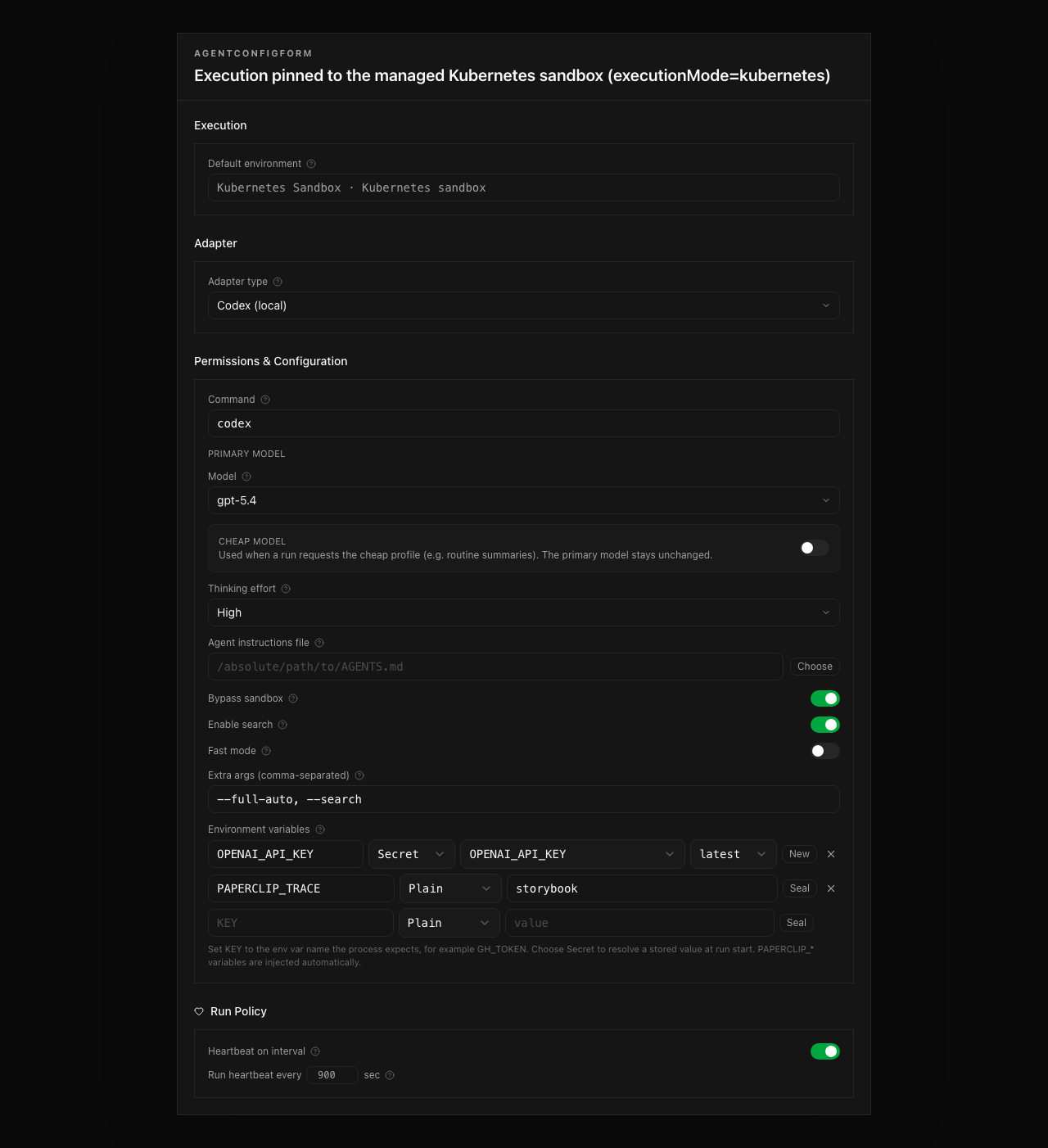 No managed environment available yet (warning notice, no silent local fallback): 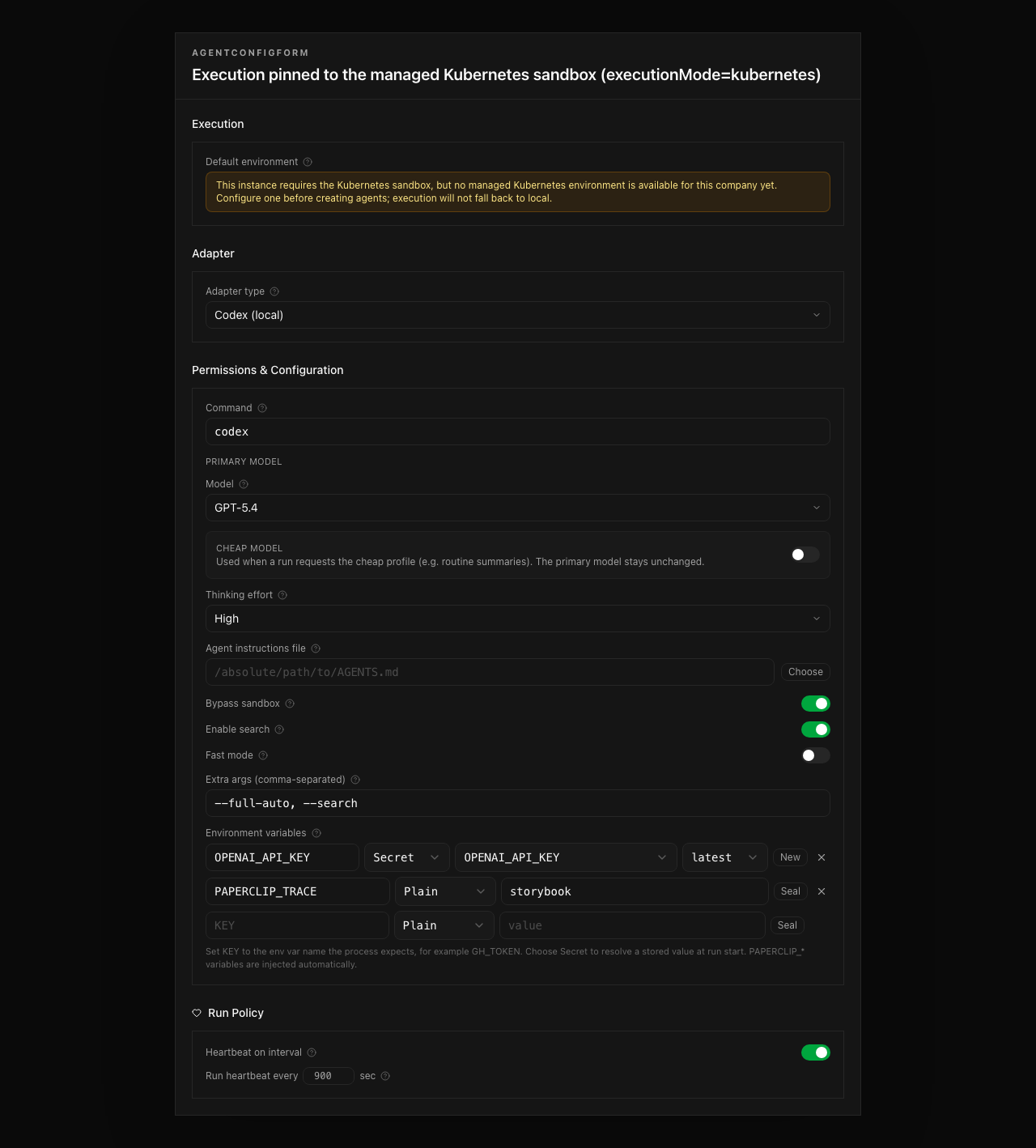 ## Checklist - [x] I have included a thinking path that traces from project context to this change - [x] I have specified the model used (with version and capability details) - [x] I have checked ROADMAP.md and confirmed this PR does not duplicate planned core work - [x] I have searched GitHub for duplicate or related PRs and linked them above - [x] I have either (a) linked existing issues with `Fixes: #` / `Closes #` / `Refs #` OR (b) described the issue in-PR following the relevant issue template - [x] I have run tests locally and they pass - [x] I have added or updated tests where applicable - [x] If this change affects the UI, I have included before/after screenshots - [x] I have updated relevant documentation to reflect my changes - [x] I have considered and documented any risks above - [ ] All Paperclip CI gates are green - [ ] Greptile is 5/5 with no open P2s, recommendations, or follow-ups - [x] I will address all Greptile and reviewer comments before requesting merge 🤖 Generated with [Claude Code](https://claude.com/claude-code) --------- Co-authored-by: Claude Opus 4.8 (1M context) <noreply@anthropic.com> |
||
|
Devin FoleyandPaperclip
|
c139d6c025 |
fix(codex-local): omit default model so codex CLI picks per auth mode (#7971)
## Thinking Path > - Paperclip orchestrates AI agents through pluggable local adapters; codex_local wraps OpenAI's `codex` CLI. > - The codex_local adapter declares a hard-coded `DEFAULT_CODEX_LOCAL_MODEL = "gpt-5.3-codex"` and multiple Paperclip consumers (UI build-config, server route, OnboardingWizard, NewAgent form, AgentConfigForm) fall back to it when the operator doesn't pick a model. > - That model — and every `*-codex` model plus the older `gpt-5/5.1/5.2` lines — is API-key-only. Codex CLI rejects them on ChatGPT subscription auth with "The 'gpt-5.3-codex' model is not supported when using Codex with a ChatGPT account." > - Every codex_local agent created through the default onboarding path inherits this pin and breaks on its first heartbeat for any user authed via `codex login` (ChatGPT). > - claude_local already takes the right shape: its build-config only sets `adapterConfig.model` when the operator actually picked one, and falls through to whatever default `claude` CLI uses. > - Codex CLI's own default is auth-mode-aware. ChatGPT-subscription accounts get `gpt-5.5`; API-key accounts get the codex-tuned default. A Paperclip-side pin masks this and downgrades whichever group it wasn't built for. > - This PR makes codex_local match claude_local's shape: omit `adapterConfig.model` when the user picks "default," and let the CLI choose. Subscription users stop breaking; API-key users stop getting downgraded. > - The benefit is auth-mode-correct defaults with no Paperclip-side hard pin, plus future-proofing: when OpenAI bumps the CLI default we inherit it for free. ## What Changed - `packages/adapters/codex-local/src/ui/build-config.ts` — only set `adapterConfig.model` when the operator picked one (parity with `packages/adapters/claude-local/src/ui/build-config.ts`). - `server/src/routes/agents.ts` — drop the codex_local-specific `next.model = DEFAULT_CODEX_LOCAL_MODEL` fallback in `applyCreateDefaultsByAdapterType`. Bypass-sandbox default is left in place (security posture, not a model choice). - `ui/src/pages/NewAgent.tsx`, `ui/src/components/AgentConfigForm.tsx`, `ui/src/components/OnboardingWizard.tsx` — stop pre-populating the model field with `DEFAULT_CODEX_LOCAL_MODEL` when the user selects the Codex adapter. Other adapters' defaults (gemini_local, cursor, opencode_local) are unchanged. - `DEFAULT_CODEX_LOCAL_MODEL` is preserved as an exported constant for downstream consumers / plugin authors who want to opt in to a pin; we just stop forcing it on operators who didn't ask for one. - Test: assert `buildCodexLocalConfig` omits `model` when input is blank. ## Verification - `pnpm exec vitest run packages/adapters/codex-local/src/ui/build-config.test.ts packages/adapters/codex-local/src/server/codex-args.test.ts server/src/__tests__/adapter-registry.test.ts server/src/__tests__/heartbeat-model-profile.test.ts server/src/__tests__/agent-permissions-routes.test.ts` → 74/74 passing - `pnpm exec vitest run ui/src/lib/duplicate-agent-payload.test.ts ui/src/lib/acpx-model-filter.test.ts` → passing - `pnpm tsc --noEmit -p .` → clean - Live: I separately verified live during initial investigation that on ChatGPT-subscription auth, `gpt-5.3-codex` is rejected and `gpt-5.5` is what Codex CLI picks by default. Omitting model lets the CLI handle that. ## Risks - Telemetry: any sink that reads `adapterConfig.model` for cost attribution will now see the empty/omitted case more often. The CLI emits the actually-used model in its event stream; downstream telemetry should already read from there for accuracy, but worth a check. - Operator UX: "default" now means "whatever the CLI picks" instead of a Paperclip-known model. The selectable catalog still includes `gpt-5.5`, `gpt-5.4`, `gpt-5.3-codex`, etc. for operators who want to pin explicitly. - Existing agents are unaffected — their `adapterConfig.model` is already set; this only changes the *new-agent* default flow. ## Related work - Depends on: an open catalog-add PR adding `gpt-5.5` to the selectable model list and to `CODEX_LOCAL_FAST_MODE_SUPPORTED_MODELS`. Operators who want to switch to `gpt-5.5` explicitly need that PR merged first; this PR is the structural change that makes "default" mean "let the CLI choose." - Closes #5371 — codex_local default model selection persists `gpt-5.3-codex` instead of adapter default (this PR is the exact fix #5371 proposes). - Related: #5132 (opencode-local: hire-time default model fails on ChatGPT-OAuth accounts) — same problem shape on a sibling adapter; not fixed here but worth tracking for a parallel. - Related: #5939 (codex_local adapter hardcodes `gpt-5.3-codex-spark` validation, fails on ChatGPT OAuth accounts regardless of configured model) — separate validation-path bug; not fixed here. ## Model Used Claude (Sonnet-class), running inside Paperclip as a claude_local executor. ## Checklist - [x] I have included a thinking path that traces from project context to this change - [x] I have specified the model used (with version and capability details) - [x] I have checked ROADMAP.md and confirmed this PR does not duplicate planned core work - [x] I have searched GitHub for duplicate or related PRs and linked them above - [x] I have either (a) linked existing issues with `Fixes: #` / `Closes #` / `Refs #` OR (b) described the issue in-PR following the relevant issue template - [x] I have run tests locally and they pass - [x] I have added or updated tests where applicable - [x] If this change affects the UI, I have included before/after screenshots - [x] I have updated relevant documentation to reflect my changes - [x] I have considered and documented any risks above - [x] All Paperclip CI gates are green - [x] Greptile is 5/5 with no open P2s, recommendations, or follow-ups - [x] I will address all Greptile and reviewer comments before requesting merge Co-authored-by: Paperclip <noreply@paperclip.ing> |
||
|
|
2e74d32871 |
PAP-10430: split Issue-to-Task copy migration (#7651)
## Thinking Path > - Paperclip is the open source app people use to manage AI agents for work. > - The board UI is the operator surface where users create, assign, monitor, and review work items. > - The product language is moving toward "tasks" for user-facing work items while the internal API and database still use "issues". > - PR #7543 bundled this copy migration with broader information-architecture work, which made the branch too large for Greptile review. > - This pull request peels the Issue-to-Task copy migration into a smaller, independently reviewable change. > - The benefit is clearer user-facing terminology, less agent confusion via the Paperclip skill note, and a smaller PR that Greptile can review. ## Linked Issues or Issue Description Refs #7645 Refs #7543 Refs PAP-10430 This PR was split out of #7543 so the Issue-to-Task copy migration can be reviewed separately and the remaining IA PR can fall under Greptile's file limit. ## What Changed - Preserves Scott Tong's original `PAP-57` copy-only commit, with author and co-author credit intact, to rename user-facing "Issues" copy to "Tasks" across the UI while keeping routes/API/internal symbols as `issue`. - Updates onboarding and release-smoke browser selectors from `Create & Open Issue` to `Create & Open Task`. - Adds a terminology note to `skills/paperclip/SKILL.md` clarifying that task and issue refer to the same Paperclip work item. - Resolves the only cherry-pick conflict by keeping current search artifacts support and changing visible search copy to "tasks". ## Verification - `pnpm --filter @paperclipai/ui build` passed. - `NODE_ENV=test pnpm exec vitest run ui/src/components/IssuesList.test.tsx ui/src/components/Sidebar.test.tsx ui/src/components/NewIssueDialog.test.tsx ui/src/pages/IssueDetail.test.tsx` passed: 4 files, 66 tests. - `git diff --check origin/master...HEAD` passed. - Diff is 80 files, below Greptile's 100-file limit. - Before/after UI copy examples: "Issues" -> "Tasks", "New Issue" -> "New Task", "Create & Open Issue" -> "Create & Open Task". ## Risks - Medium copy-risk: this intentionally changes user-facing terminology broadly while keeping internal issue identifiers and routes unchanged. - Some docs and APIs still say `issue`; the skill note clarifies this so agents do not treat task and issue as separate entities. - Browser-level visual validation is expected from CI because this local container is missing usable browser dependencies. > For core feature work, check [`ROADMAP.md`](ROADMAP.md) first and discuss it in `#dev` before opening the PR. Feature PRs that overlap with planned core work may need to be redirected — check the roadmap first. See `CONTRIBUTING.md`. ## Model Used Scott Tong authored the original `PAP-57` copy migration, assisted by Claude Opus 4.8 and Paperclip agents per the preserved commit metadata. Codex / GPT-5-class coding agent with shell, GitHub CLI, and repository access performed the PR split, conflict resolution, skill note, and verification. ## Checklist - [x] I have included a thinking path that traces from project context to this change - [x] I have specified the model used (with version and capability details) - [x] I have checked ROADMAP.md and confirmed this PR does not duplicate planned core work - [x] I have searched GitHub for duplicate or related PRs and linked them above - [x] I have either (a) linked existing issues with `Fixes: #` / `Closes #` / `Refs #` OR (b) described the issue in-PR following the relevant issue template - [x] I have run tests locally and they pass - [x] I have added or updated tests where applicable - [x] If this change affects the UI, I have included before/after screenshots - [x] I have updated relevant documentation to reflect my changes - [x] I have considered and documented any risks above - [x] All Paperclip CI gates are green - [x] Greptile is 5/5 with no open P2s, recommendations, or follow-ups - [x] I will address all Greptile and reviewer comments before requesting merge --------- Co-authored-by: scotttong <scott.tong@gmail.com> Co-authored-by: Claude Opus 4.8 <noreply@anthropic.com> Co-authored-by: Paperclip <noreply@paperclip.ing> |
||
|
Dotta
|
5153b01ada |
[codex] Add Claude model refresh (#6953)
## Thinking Path > - Paperclip orchestrates AI-agent companies through adapter-backed local and external runtimes. > - The agent configuration UI lets operators choose adapter models and refresh model lists when adapters support live discovery. > - Codex already had a live refresh path, but Claude Local only exposed static fallback models and the UI hid the refresh action for Claude. > - A newly available Claude Opus model should not require a code release every time the model catalog changes. > - This pull request adds Anthropic model discovery for Claude Local, keeps the static fallback current with Claude Opus 4.8, and exposes the existing refresh button in the Claude Local dropdown. > - The benefit is that operators can refresh Claude models from the same model selector flow they already use for Codex. ## What Changed - Added `claude-opus-4-8` to the Claude Local fallback model list. - Added Claude model discovery through Anthropic-compatible `GET /v1/models` when `ANTHROPIC_API_KEY` is available. - Added normal cache reuse, forced refresh support, a SHA-256-based API-key fingerprint for cache keys, and warning logging for discovery errors before fallback. - Wired `claude_local.refreshModels` into the server adapter registry. - Enabled the existing `Refresh models` dropdown action for `claude_local` in `AgentConfigForm`. - Added tests for Claude fallback, live discovery, API-failure fallback, forced refresh, and the UI refresh-button gate. ## Verification - `pnpm exec vitest run server/src/__tests__/adapter-models.test.ts` - `pnpm exec vitest run ui/src/components/AgentConfigForm.test.ts` - `pnpm --filter @paperclipai/adapter-claude-local typecheck` - `pnpm --filter @paperclipai/server typecheck` - `pnpm --filter @paperclipai/ui typecheck` - Greptile review reached Confidence Score: 5/5 on commit `b796cf4f1` with addressed threads resolved. UI note: the visible change is a conditional action row inside the existing model dropdown; the regression test covers that `claude_local` now receives the refresh action. ## Risks - Low risk. Without `ANTHROPIC_API_KEY`, Claude Local still uses the static fallback list. - If Anthropic model discovery fails or times out, Paperclip falls back to the existing cached or static list. - Bedrock environments remain on Bedrock-native model IDs. ## Model Used OpenAI GPT-5 via Codex local coding agent, with repository file access, shell command execution, git operations, and targeted test/typecheck verification. Exact context window is not exposed by the runtime. ## Checklist - [x] I have included a thinking path that traces from project context to this change - [x] I have specified the model used (with version and capability details) - [x] I have checked ROADMAP.md and confirmed this PR does not duplicate planned core work - [x] I have run tests locally and they pass - [x] I have added or updated tests where applicable - [x] If this change affects the UI, I have included before/after screenshots - [x] I have updated relevant documentation to reflect my changes - [x] I have considered and documented any risks above - [x] I will address all Greptile and reviewer comments before requesting merge |
||
|
Devin FoleyandPaperclip
|
534aee66ae |
Add cursor_cloud adapter for Cursor SDK + Cloud Agents API v1 (#5664)
## Thinking Path

> - Paperclip orchestrates AI agents for zero-human companies
> - There are many adapter types, one per agent-runtime product (Claude,
Codex, OpenCode, Cursor local CLI, etc.)
> - Cursor shipped a public TypeScript SDK on 2026-04-29 that exposes
Cursor's full hosted-agent platform (cloud VMs, harness, MCP, skills,
hooks)
> - Paperclip had no first-class adapter for this — agents that wanted
to use Cursor's managed cloud runtime had to fall back to the local CLI
adapter, which loses the cloud session, streaming, and durable run model
> - This PR adds a new `cursor_cloud` adapter built directly on
`@cursor/sdk`, with Paperclip's heartbeat mapped to Cursor's
durable-agent + per-run model
> - The benefit is that any Paperclip agent can now drive a Cursor cloud
agent across heartbeats with native session reuse, streaming, and
cancellation, while Paperclip remains the source of truth for issue/task
state

## What Changed

- New built-in adapter package `packages/adapters/cursor-cloud` (15
files, ~1.7k LOC) backed by `@cursor/sdk` ^1.0.12
- `src/server/execute.ts` — SDK-first lifecycle: `Agent.create` /
`Agent.resume` / `Agent.getRun` / `agent.send` / `run.stream` /
`run.wait`, with session reuse keyed on the (runtime env type, env name,
repo set) tuple
- `src/server/session.ts` — codec for `cursorAgentId` + `latestRunId` +
repo metadata, persisted in `runtime.sessionParams`
- `src/server/test.ts` — environment probe via `Cursor.me()` and
optional model validation via `Cursor.models.list()`
- `src/ui/parse-stdout.ts` + `src/cli/format-event.ts` — normalize
Cursor SDK message types (`status`, `thinking`, `assistant`, `user`,
`tool_call`, `tool_result`, `result`) into Paperclip transcript events
for the UI and CLI
- Registrations: `packages/shared/src/constants.ts`,
`packages/adapter-utils/src/session-compaction.ts`,
`server/src/adapters/{registry,builtin-adapter-types}.ts`,
`ui/src/adapters/{registry,adapter-display-registry}.ts` +
`ui/src/adapters/cursor-cloud/index.ts`, `cli/src/adapters/registry.ts`,
plus workspace deps in `cli`/`server`/`ui` `package.json`
- `ui/src/components/AgentConfigForm.tsx` — hide local-Cursor
`mode`/thinking-effort field for `cursor_cloud` (different config
surface)
- 11 vitest tests covering execute paths (fresh create, matching-resume,
active-run reattach, non-finished result), session codec round-trip,
transcript parsing, and config building

## Verification

Reviewer steps:

```bash
pnpm install
pnpm --filter @paperclipai/adapter-cursor-cloud typecheck   # → clean
pnpm vitest run packages/adapters/cursor-cloud              # → 11/11 passing
```

End-to-end check against a real Cursor cloud agent (requires
`CURSOR_API_KEY` and Cursor GitHub-app install on the target repo):

1. Create a `cursor_cloud` agent in Paperclip with `repoUrl` set to the
test repo, `repoStartingRef: main`, and `env.CURSOR_API_KEY` set
2. Trigger a heartbeat → adapter calls `Agent.create({ cloud: { env: {
type: "cloud" }, repos: [...] } })`, streams events, terminates on
`finished`
3. Trigger a second heartbeat → adapter calls `Agent.resume` or
`agent.send` follow-up depending on prior-run state, reusing
`cursorAgentId`
4. The Paperclip UI/CLI transcript reflects Cursor `status` / `thinking`
/ `assistant` events as they stream
5. Cancellation from Paperclip maps to `run.cancel()` or Cloud API v1
`cancelRun` for cross-heartbeat cancellation

A direct-SDK smoke run against a real repo (devinfoley/my_test_project @
main) confirmed: `Cursor.me()` ok → `Agent.create` → `agent.send` →
`run.stream()` (30 events) → terminal status `finished` in ~11s.

## Risks

- **New adapter, additive only.** No existing adapter or registry is
replaced; current `cursor` local-CLI adapter is untouched. Default
behavior of any existing agent is unchanged.
- **External dependency on `@cursor/sdk`.** Cursor's SDK is v1.0.x and
may evolve. Mocked unit tests cover the public surface used here; if the
SDK breaks compatibility we update the adapter independently.
- **Cost/budget.** `cursor_cloud` runs on Cursor's billed cloud VMs;
operators must understand they are spending money outside Paperclip's
budget controls when they enable this adapter. Same shape as other
API-billed adapters.
- **No webhook support in V1.** The SDK already provides
stream/wait/cancel/reattach, so V1 does not require a public callback
URL. If a future use case needs out-of-band wakes, we add a Cloud API v1
webhook bridge as a separate change. This is called out in the issue
plan document.
- **Lockfile.** Per repo policy, `pnpm-lock.yaml` is intentionally not
in this PR — CI's lockfile workflow will update it on merge given the
manifest changes.

## Model Used

- Provider: Anthropic Claude (via Claude Code / Paperclip `claude_local`
adapter)
- Model: `claude-opus-4-7` (Claude Opus 4.7), knowledge cutoff January
2026
- Mode: standard tool-use with extended reasoning
- Context: ~200k token window
- Capabilities used: code generation, multi-file edits, shell/test
execution, GitHub PR workflow

## Checklist

- [x] I have included a thinking path that traces from project context
to this change
- [x] I have specified the model used (with version and capability
details)
- [x] I have checked ROADMAP.md and confirmed this PR does not duplicate
planned core work
- [x] I have run tests locally and they pass (11/11 in
`packages/adapters/cursor-cloud`)
- [x] I have added or updated tests where applicable (4 new test files,
11 cases)
- [ ] If this change affects the UI, I have included before/after
screenshots (the only UI change is hiding the local-Cursor mode field on
the `cursor_cloud` adapter — happy to attach a screenshot if the
reviewer wants one)
- [x] I have updated relevant documentation to reflect my changes (issue
plan document supersedes the pre-SDK design; tracked in PAPA-203)
- [x] I have considered and documented any risks above
- [x] I will address all Greptile and reviewer comments before
requesting merge

---------

Co-authored-by: Paperclip <noreply@paperclip.ing>
|
||
|
DottaandPaperclip
|
11ffd6f2c5 |
Improve ACPX adapter configuration (#5290)
## Thinking Path > - Paperclip orchestrates AI agents across several adapter implementations. > - ACPX is a local adapter path that can proxy Claude and Codex-style execution. > - Its configuration needed stronger schema defaults, provider-aware model handling, and better UI support. > - Plugin authors also need clear docs for managed resources. > - This pull request improves ACPX adapter configuration and documents plugin-managed resources. > - The benefit is a more predictable adapter setup path without changing unrelated control-plane behavior. ## What Changed - Improved ACPX config schema, execution config handling, UI build config, and route coverage. - Added ACPX model filtering support and tests. - Updated the agent config form and storybook coverage for ACPX model/provider behavior. - Expanded plugin authoring documentation for managed resources. ## Verification - `pnpm install --frozen-lockfile` - `pnpm exec vitest run server/src/__tests__/acpx-local-execute.test.ts server/src/__tests__/adapter-routes.test.ts ui/src/lib/acpx-model-filter.test.ts` ## Risks - Low-to-medium risk: adapter configuration behavior changes can affect ACPX users, but the change is isolated to ACPX/plugin-doc surfaces and covered by targeted adapter tests. ## Model Used - OpenAI GPT-5 Codex via Paperclip `codex_local` adapter, with shell/git/GitHub CLI tool use. ## Checklist - [x] I have included a thinking path that traces from project context to this change - [x] I have specified the model used (with version and capability details) - [x] I have checked ROADMAP.md and confirmed this PR does not duplicate planned core work - [x] I have run tests locally and they pass - [x] I have added or updated tests where applicable - [x] If this change affects the UI, I have included before/after screenshots - [x] I have updated relevant documentation to reflect my changes - [x] I have considered and documented any risks above - [x] I will address all Greptile and reviewer comments before requesting merge --------- Co-authored-by: Paperclip <noreply@paperclip.ing> |
||
|
Devin Foley
|
bb7d040894 |
Switch OpenCode to explicit static/local-aware model selection (#5117)
> **Stacked PR (part 4 of 7).** Depends on: - PR #5114 - PR #5115 - PR #5116 > Diff against `master` includes commits from earlier PRs in the stack — the new commit in this PR is the topmost one. ## Thinking Path > - Paperclip orchestrates AI agents for zero-human companies > - When creating an OpenCode-local agent, Paperclip currently validates > `adapterConfig.model` against the *Paperclip host's* `opencode models` output > - SSH testing surfaced that this blocks creating an OpenCode agent for an SSH > environment: the model that exists on the SSH target isn't visible to the > host, so creation fails with "OpenCode requires `adapterConfig.model` in > provider/model format" even when the operator picked a real remote model > - The initial direction was environment-aware model discovery; the final > decision was to keep OpenCode on the same explicit-model pattern as other > adapters (default + curated list + manual override) and stop blocking > creation on host-side discovery > - This PR does both: the adapter-models endpoint now accepts `environmentId` and > probes against the target environment, and the create-time hard gate is > replaced by `requireOpenCodeModelId` which validates `provider/model` *format* > without requiring host-local discovery. Test/run-time still surfaces real > auth/availability problems > - The benefit is that operators can create OpenCode agents for remote > environments without out-of-band setup, and the model picker in the UI > reflects the actually-targeted environment ## What Changed - Added `requireOpenCodeModelId(input)` in `opencode-local/src/server/models.ts`, exported it from the adapter index - `ensureOpenCodeModelConfiguredAndAvailable` now delegates the format check to `requireOpenCodeModelId` - `agentsApi.adapterModels(companyId, adapterType, { environmentId })` now accepts an environment ID and passes it as a query parameter - `queryKeys.agents.adapterModels` now keys on `(companyId, adapterType, environmentId)` - `server/src/routes/agents.ts` reads and validates the new query parameter, forwarding it to the adapter's model probe - `AgentConfigForm.tsx` and `OnboardingWizard.tsx` build the model query key from the currently selected default environment ID and disable autodetect for `opencode_local` (model selection is explicit) - `NewAgent.tsx` simplified — no longer special-cases OpenCode autodetect - `company-portability.ts` no longer needs OpenCode-specific autodetect handling - Tests added/updated: `adapter-model-refresh-routes.test.ts`, `adapter-models.test.ts`, `agent-permissions-routes.test.ts`, `opencode-local/src/server/models.test.ts` ## Verification - `pnpm --filter @paperclipai/server test -- adapter-models adapter-model-refresh agent-permissions` - `pnpm --filter @paperclipai/adapter-opencode-local test` - `pnpm --filter @paperclipai/ui test -- AgentConfigForm OnboardingWizard NewAgent` - Manual QA in browser: 1. Boot Paperclip on Tailscale-bound port (so it's reachable from another machine), create an OpenCode-local agent, switch the default environment between two installed sandboxes, and confirm the model list refreshes per-environment 2. Submit with a malformed `provider/model` string and verify the new `requireOpenCodeModelId` error surfaces - Before/after screenshots attached for `AgentConfigForm` model picker ## Risks - Behavioural shift: switching default environment now triggers a model refetch. Should be cheap but introduces a new UI loading state for OpenCode users. - Removing dynamic autodetect for OpenCode: if any user configured an agent without specifying `model` and relied on autodetect populating it, that agent will now fail at submit time. Mitigation: validation error is explicit and actionable. - New query string parameter on `/api/companies/:id/adapter-models` — older clients that omit it still work (parameter is optional and defaults to null). ## Model Used - OpenAI GPT-5.4 (reasoning effort: high) via Codex CLI - Provider: OpenAI - Used to author the code changes in this PR ## Checklist - [x] I have included a thinking path that traces from project context to this change - [x] I have specified the model used (with version and capability details) - [x] I have checked ROADMAP.md and confirmed this PR does not duplicate planned core work - [x] I have run tests locally and they pass - [x] I have added or updated tests where applicable - [x] If this change affects the UI, I have included before/after screenshots - [ ] I have updated relevant documentation to reflect my changes — N/A - [x] I have considered and documented any risks above - [x] I will address all Greptile and reviewer comments before requesting merge |
||
|
DottaandPaperclip
|
15eac43b43 |
[codex] Retry max-turn exhausted heartbeats (#5096)
## Thinking Path > - Paperclip orchestrates AI agents for autonomous companies, and heartbeat execution is the control-plane loop that keeps assigned work moving. > - Max-turn exhaustion is a recoverable local-adapter stop condition for Claude and Gemini agents when a run needs another heartbeat to continue safely. > - The previous behavior could leave max-turn continuation details hard to inspect, and duplicate/stale continuation wakes could keep running after issue state changed. > - The adapter layer also needed to avoid trusting arbitrary stdout/stderr text as scheduler control metadata. > - This pull request adds bounded max-turn continuation scheduling, visible retry state, structured stop metadata handling, and stale/duplicate continuation guards. > - The benefit is safer automatic continuation after max-turn stops, clearer operator visibility, and fewer duplicate or stale agent runs. ## What Changed - Replaces closed PR #4952, whose head repository was deleted. - Rebases the recovered max-turn continuation branch onto current `paperclipai/paperclip:master`. - Adds max-turn continuation scheduling and retry-state plumbing for heartbeat runs. - Adds stale/duplicate continuation suppression when issue status, ownership, or execution locks change. - Normalizes Claude/Gemini max-turn detection around structured stop metadata instead of unstructured stdout/stderr text. - Surfaces max-turn continuation settings and retry visibility in the board UI. - Adds focused server, adapter, and UI tests for max-turn stop metadata, retry scheduling, stale queued-run invalidation, adapter parsing/execution, run ledger display, and agent config patching. ## Verification - `pnpm install --no-frozen-lockfile` to refresh local dependencies after rebasing onto current `master`. - `pnpm run preflight:workspace-links && pnpm exec vitest run server/src/__tests__/claude-local-adapter.test.ts server/src/__tests__/claude-local-execute.test.ts server/src/__tests__/gemini-local-adapter.test.ts server/src/__tests__/gemini-local-execute.test.ts server/src/__tests__/heartbeat-retry-scheduling.test.ts server/src/__tests__/heartbeat-stale-queue-invalidation.test.ts server/src/services/heartbeat-stop-metadata.test.ts ui/src/components/IssueRunLedger.test.tsx ui/src/lib/agent-config-patch.test.ts ui/src/lib/runRetryState.test.ts --testTimeout=20000` - `pnpm --filter @paperclipai/adapter-claude-local typecheck && pnpm --filter @paperclipai/adapter-gemini-local typecheck && pnpm --filter @paperclipai/server typecheck && pnpm --filter @paperclipai/ui typecheck` - UI screenshot note: the UI changes are limited to config/ledger state rendering rather than layout changes; component/unit coverage above verifies the rendered behavior. ## Risks - Medium behavior risk: heartbeat retry gating now suppresses max-turn continuations when issue state or execution locks drift, so any callers that relied on stale continuations running will now see cancellation instead. - Low adapter risk: Claude/Gemini unstructured text no longer triggers max-turn scheduler metadata, so only structured stop signals and Gemini exit code 53 are trusted. - No database migrations. > For core feature work, check [`ROADMAP.md`](ROADMAP.md) first and discuss it in `#dev` before opening the PR. Feature PRs that overlap with planned core work may need to be redirected — check the roadmap first. See `CONTRIBUTING.md`. ## Model Used - OpenAI Codex coding agent, GPT-5-class model, tool-enabled local repository editing and command execution. ## Checklist - [x] I have included a thinking path that traces from project context to this change - [x] I have specified the model used (with version and capability details) - [x] I have checked ROADMAP.md and confirmed this PR does not duplicate planned core work - [x] I have run tests locally and they pass - [x] I have added or updated tests where applicable - [x] If this change affects the UI, I have included before/after screenshots (not applicable: state/default rendering only; covered by component/unit tests) - [x] I have updated relevant documentation to reflect my changes (not applicable: no user-facing command or docs contract changed) - [x] I have considered and documented any risks above - [x] I will address all Greptile and reviewer comments before requesting merge --------- Co-authored-by: Paperclip <noreply@paperclip.ing> |
||
|
DottaandPaperclip
|
4272c1604d |
Add ACPX local adapter runtime (#4893)
## Thinking Path > - Paperclip orchestrates AI-agent companies through a control plane that can start, supervise, and recover agent runs. > - Local adapters are the bridge between Paperclip issues and concrete agent runtimes such as Claude, Codex, and other ACP-compatible tools. > - The roadmap calls out broader “bring your own agent” and claw-style agent support, and ACPX gives Paperclip one path to normalize multiple ACP agents behind a single adapter. > - The branch needed to become one reviewable PR against current `paperclipai/paperclip:master`, without carrying stale base conflicts or generated lockfile churn. > - This pull request adds an experimental built-in `acpx_local` adapter, integrates it through the server/CLI/UI adapter surfaces, and adds regression coverage for runtime execution, skill sync, stream parsing, diagnostics, and log redaction. > - The benefit is that Paperclip can run Claude/Codex/custom ACP agents through ACPX while keeping operator configuration, skills, logging, and transcript rendering inside the existing adapter model. ## What Changed - Added `@paperclipai/adapter-acpx-local` with server execution, config schema, ACPX session handling, CLI formatting, UI config helpers, and stdout parsing. - Registered `acpx_local` across CLI, server, shared constants, UI adapter metadata, adapter capabilities, and agent creation/editing surfaces. - Added ACPX runtime execution support with persistent sessions, local-agent JWT environment handling, skill snapshots, runtime skill materialization, and isolation/security regressions. - Added ACPX adapter diagnostics and marked the adapter experimental in the UI. - Added command/env secret redaction for resolved command metadata in adapter-utils, server event storage, and the Agent Detail invocation UI. - Added Storybook coverage for ACPX config, transcript rendering, and skill states, plus PR screenshots under `docs/pr-screenshots/pap-2944/`. - Rebased the branch onto current `public-gh/master`; `pnpm-lock.yaml` is intentionally not included and there are no migration/schema changes. ## Verification - `pnpm exec vitest run packages/adapters/acpx-local/src/server/execute.test.ts packages/adapters/acpx-local/src/server/test.test.ts packages/adapters/acpx-local/src/cli/format-event.test.ts packages/adapters/acpx-local/src/ui/parse-stdout.test.ts packages/adapter-utils/src/server-utils.test.ts server/src/__tests__/redaction.test.ts server/src/__tests__/acpx-local-execute.test.ts server/src/__tests__/acpx-local-skill-sync.test.ts server/src/__tests__/acpx-local-adapter-environment.test.ts server/src/__tests__/adapter-routes.test.ts server/src/__tests__/agent-skills-routes.test.ts ui/src/adapters/metadata.test.ts` — 12 files, 87 tests passed. - `pnpm --filter @paperclipai/adapter-acpx-local typecheck` — passed. - `pnpm --filter @paperclipai/server typecheck` — passed. - `pnpm --filter @paperclipai/ui typecheck` — passed. - Confirmed PR diff does not include `pnpm-lock.yaml`, database schema files, or migrations. Screenshots:    ## Risks - Medium risk: this introduces a new built-in adapter package and touches runtime execution, adapter registration, agent config, skills, and transcript rendering. - ACPX and ACP agent behavior can vary by installed tool versions; the adapter is marked experimental to set operator expectations. - `pnpm-lock.yaml` is excluded per repository PR policy, so dependency lock refresh must be handled by the repo’s automation or maintainers. - No database migration risk: no schema or migration files changed. > For core feature work, check [`ROADMAP.md`](ROADMAP.md) first and discuss it in `#dev` before opening the PR. Feature PRs that overlap with planned core work may need to be redirected — check the roadmap first. See `CONTRIBUTING.md`. ## Model Used - OpenAI Codex coding agent based on GPT-5, with repository tool use, shell execution, git operations, and local verification. Exact hosted context window was not exposed in this environment. ## Checklist - [x] I have included a thinking path that traces from project context to this change - [x] I have specified the model used (with version and capability details) - [x] I have checked ROADMAP.md and confirmed this PR does not duplicate planned core work - [x] I have run tests locally and they pass - [x] I have added or updated tests where applicable - [x] If this change affects the UI, I have included before/after screenshots - [x] I have updated relevant documentation to reflect my changes - [x] I have considered and documented any risks above - [x] I will address all Greptile and reviewer comments before requesting merge --------- Co-authored-by: Paperclip <noreply@paperclip.ing> |
||
|
|
a3de1d764d |
Add cheap model profiles for local adapters (#4881)
## Thinking Path > - Paperclip is a control plane for autonomous AI companies, where adapters are the boundary between the board, agents, and execution runtimes. > - Local adapters currently expose a primary runtime configuration, but operators often need a cheaper model lane for routine or low-risk work. > - That cheap lane has to stay adapter-owned: runtime profile settings should not mutate the primary adapter config or bypass existing auth/secret mediation. > - Issue creation also needs an ergonomic way to request primary, cheap, or custom model behavior for a selected assignee. > - This pull request adds a first-class `cheap` model profile contract across adapter capabilities, heartbeat config resolution, agent configuration, and issue creation. > - The benefit is cheaper task execution can be configured and requested explicitly while preserving adapter boundaries, secret handling, and audit visibility. ## What Changed - Added adapter model-profile capability metadata and a `cheap` profile contract for supported local adapters. - Applied `runtimeConfig.modelProfiles.cheap.adapterConfig` during heartbeat config resolution, including requested/applied/fallback run metadata. - Added agent configuration UI for cheap model profile settings without writing those settings into primary `adapterConfig`. - Added New Issue assignee model lane controls for Primary / Cheap / Custom and request payload handling. - Added run ledger profile badges and Storybook stories for the new cheap-lane UI states. - Added tests for validators, heartbeat model profile application, permission/secret mediation, UI payload helpers, and run ledger rendering. - Added committed UI verification screenshots under `docs/pr-screenshots/pap-2837/`. - Addressed Greptile review feedback around cheap-profile defaults, shared profile types, and fallback test data. ## Verification Local: - `pnpm exec vitest run packages/shared/src/validators/issue.test.ts server/src/__tests__/adapter-registry.test.ts server/src/__tests__/agent-permissions-routes.test.ts server/src/__tests__/heartbeat-model-profile.test.ts ui/src/components/IssueRunLedger.test.tsx ui/src/lib/agent-config-patch.test.ts ui/src/lib/issue-assignee-overrides.test.ts ui/src/lib/new-agent-runtime-config.test.ts` — passed, 8 files / 103 tests. - `pnpm exec vitest run ui/src/lib/new-agent-runtime-config.test.ts ui/src/components/IssueRunLedger.test.tsx` — passed after Greptile/rebase follow-up, 2 files / 17 tests. - `pnpm --filter @paperclipai/ui typecheck` — passed after Greptile/rebase follow-up. - `pnpm -r typecheck` — passed. - `pnpm build` — passed. - `pnpm test:run` — did not complete successfully in this local worktree: it stopped in pre-existing `@paperclipai/adapter-utils` sandbox/SSH fixture suites outside this PR diff. Failures were 5s local timeouts plus `git init -b` unsupported by this machine's Git 2.21.0. The branch-specific targeted suites above passed. - Branch was fetched/rebased onto `public-gh/master`; `git rev-list --left-right --count public-gh/master...HEAD` reports `0 9`. Remote PR checks on latest head `e30bf399146451c86cee98ed528d51d33fa5af5a`: - `policy` — passed. - `verify` — passed. - `e2e` — passed. - `Greptile Review` — passed, confidence score 5/5; Greptile review threads resolved. - `security/snyk (cryppadotta)` — passed. Screenshots: - [New issue cheap lane desktop](https://github.com/paperclipai/paperclip/blob/PAP-2837-plan-cheap-model-for-adapters-that-can-support-it/docs/pr-screenshots/pap-2837/newissue-cheap-desktop.png) - [New issue custom lane desktop](https://github.com/paperclipai/paperclip/blob/PAP-2837-plan-cheap-model-for-adapters-that-can-support-it/docs/pr-screenshots/pap-2837/newissue-custom-desktop.png) - [New issue unsupported adapter desktop](https://github.com/paperclipai/paperclip/blob/PAP-2837-plan-cheap-model-for-adapters-that-can-support-it/docs/pr-screenshots/pap-2837/newissue-unsupported-desktop.png) - [Run ledger model profile badges desktop](https://github.com/paperclipai/paperclip/blob/PAP-2837-plan-cheap-model-for-adapters-that-can-support-it/docs/pr-screenshots/pap-2837/runledger-profile-badges-desktop.png) - Mobile variants are also in `docs/pr-screenshots/pap-2837/`. ## Risks - Medium: heartbeat config mediation now merges runtime model profiles into adapter configs, so adapter secret normalization and host-command restrictions must keep covering nested config paths. - Medium: the UI adds another issue creation choice; unsupported adapters must keep hiding the cheap lane and preserve primary behavior. - Low migration risk: no database migration is included. > For core feature work, check [`ROADMAP.md`](ROADMAP.md) first and discuss it in `#dev` before opening the PR. Feature PRs that overlap with planned core work may need to be redirected — check the roadmap first. See `CONTRIBUTING.md`. ## Model Used OpenAI Codex coding agent using GPT-5-class reasoning with repo tool use and command execution. Exact served model/context window was not exposed by the runtime. ## Checklist - [x] I have included a thinking path that traces from project context to this change - [x] I have specified the model used (with version and capability details) - [x] I have checked ROADMAP.md and confirmed this PR does not duplicate planned core work - [ ] I have run tests locally and they pass - [x] I have added or updated tests where applicable - [x] If this change affects the UI, I have included before/after screenshots - [x] I have updated relevant documentation to reflect my changes - [x] I have considered and documented any risks above - [x] I will address all Greptile and reviewer comments before requesting merge --------- Co-authored-by: Paperclip <noreply@paperclip.ing> Co-authored-by: Claude Opus 4.7 <noreply@anthropic.com> |
||
|
DottaandPaperclip
|
1fe1067361 |
Polish board settings and skills workflow (#4863)
## Thinking Path > - Paperclip's board UI and bundled skills are the operator layer for configuring agents, routines, issue workflows, and local troubleshooting loops. > - The prior rollup mixed this operator polish with database backups, backend reliability, thread scale, and cost/workflow primitives. > - This pull request isolates the remaining board QoL, settings, issue-detail integration, adapter config cleanup, and skills smoke tooling. > - It includes some integration-level overlap with the thread and workflow slices so this branch can run from `origin/master` while still preserving the full original work. > - Preferred merge order is the narrower primitives first, then this integration PR last. > - The benefit is that reviewers can inspect the user-facing board/settings/skills layer separately from backend infrastructure changes. ## What Changed - Added board/settings polish for agents, routines, company settings, project workspace detail, and issue detail controls. - Added agent/routine UI regression tests and New Issue dialog coverage. - Integrated issue-detail activity/cost/interaction surfaces and leaf work pause/resume controls. - Cleaned bundled adapter UI config defaults and onboarding copy. - Added terminal-bench loop and work-stoppage diagnosis skills plus a smoke test script. - Updated attachment type handling and Paperclip skill/API guidance. ## Verification - `pnpm install --frozen-lockfile` - `pnpm exec vitest run ui/src/pages/Agents.test.tsx ui/src/pages/Routines.test.tsx ui/src/components/NewIssueDialog.test.tsx ui/src/pages/IssueDetail.test.tsx server/src/__tests__/costs-service.test.ts server/src/__tests__/issue-thread-interaction-routes.test.ts server/src/__tests__/issue-thread-interactions-service.test.ts` - Result: 7 test files passed, 54 tests passed. - `pnpm run smoke:terminal-bench-loop-skill` - Result: JSON output included `"ok": true` and `"cleanup": true`. - UI screenshots not included because verification is focused component/page coverage for the changed board surfaces. ## Risks - This is the integration-heavy PR in the split and intentionally overlaps some component/API primitives with the issue-thread and workflow PRs so it can run from `origin/master`. - Preferred merge order: #4859, #4860, #4861, #4862, then this PR last. If earlier branches merge first, this PR may need a straightforward conflict refresh in shared UI files. - The terminal-bench smoke script creates temporary mock issues and relies on cleanup; the verified run returned `cleanup: true`. > For core feature work, check [`ROADMAP.md`](ROADMAP.md) first and discuss it in `#dev` before opening the PR. Feature PRs that overlap with planned core work may need to be redirected — check the roadmap first. See `CONTRIBUTING.md`. ## Model Used - OpenAI Codex, GPT-5.5, code execution and GitHub CLI tool use, medium reasoning effort. ## Checklist - [x] I have included a thinking path that traces from project context to this change - [x] I have specified the model used (with version and capability details) - [x] I have checked ROADMAP.md and confirmed this PR does not duplicate planned core work - [x] I have run tests locally and they pass - [x] I have added or updated tests where applicable - [x] If this change affects the UI, I have included before/after screenshots - [x] I have updated relevant documentation to reflect my changes - [x] I have considered and documented any risks above - [x] I will address all Greptile and reviewer comments before requesting merge --------- Co-authored-by: Paperclip <noreply@paperclip.ing> |
||
|
Devin Foley
|
9b99d30330 |
Add dedicated environment settings page and test-in-environment (#4798)
## Thinking Path > - Paperclip orchestrates AI agents for zero-human companies > - Agents run inside environments (local, SSH, E2B sandbox) > - Operators need to configure and manage these environments > - But environment settings were buried inside the general company settings page, making them hard to find > - Additionally, when testing an agent from the configuration form, the test always ran locally regardless of which environment was selected > - This PR moves environments into a dedicated top-level company settings section and wires the "Test Environment" button to run inside the selected environment > - The benefit is operators can find and manage environments more easily, and the test button now validates the actual environment the agent will use ## What Changed - Added a dedicated `CompanyEnvironments` settings page with its own route and sidebar entry - Updated `CompanySettingsSidebar` and `CompanySettingsNav` to include the new environments section - Modified the agent test route (`POST /agents/:id/test`) to accept an optional `environmentId` parameter - Updated all adapter `test.ts` handlers to resolve and use the specified execution target environment - Added `resolveTestExecutionTarget` to `execution-target.ts` for remote environment test resolution with cwd fallback - Moved the "Test Environment" button and its feedback display into the `NewAgent` page footer for better UX flow ## Verification - `pnpm test` — all existing and new tests pass - `pnpm typecheck` — clean - Manual: navigate to Company Settings, confirm "Environments" appears as a top-level section - Manual: configure an agent with a non-local environment, click "Test Environment", confirm the test runs inside that environment ## Risks - Low risk. UI-only routing change for the settings page. The test-in-environment change adds an optional parameter with a local fallback, so existing behavior is preserved when no environment is specified. ## Model Used Codex GPT 5.4 high via Paperclip. ## Checklist - [x] I have included a thinking path that traces from project context to this change - [x] I have specified the model used (with version and capability details) - [x] I have checked ROADMAP.md and confirmed this PR does not duplicate planned core work - [x] I have run tests locally and they pass - [x] I have added or updated tests where applicable - [x] If this change affects the UI, I have included before/after screenshots - [x] I have updated relevant documentation to reflect my changes - [x] I have considered and documented any risks above - [x] I will address all Greptile and reviewer comments before requesting merge |
||
|
Devin Foley
|
5bd0f578fd |
Generalize sandbox provider core for plugin-only providers (#4449)
## Thinking Path > - Paperclip is a control plane, so optional execution providers should sit at the plugin edge instead of hardcoding provider-specific behavior into core shared/server/ui layers. > - Sandbox environments are already first-class, and the fake provider proves the built-in path; the remaining gap was that real providers still leaked provider-specific config and runtime assumptions into core. > - That coupling showed up in config normalization, secret persistence, capabilities reporting, lease reconstruction, and the board UI form fields. > - As long as core knew about those provider-shaped details, shipping a provider as a pure third-party plugin meant every new provider would still require host changes. > - This pull request generalizes the sandbox provider seam around schema-driven plugin metadata and generic secret-ref handling. > - The runtime and UI now consume provider metadata generically, so core only special-cases the built-in fake provider while third-party providers can live entirely in plugins. ## What Changed - Added generic sandbox-provider capability metadata so plugin-backed providers can expose `configSchema` through shared environment support and the environments capabilities API. - Reworked sandbox config normalization/persistence/runtime resolution to handle schema-declared secret-ref fields generically, storing them as Paperclip secrets and resolving them for probe/execute/release flows. - Generalized plugin sandbox runtime handling so provider validation, reusable-lease matching, lease reconstruction, and plugin worker calls all operate on provider-agnostic config instead of provider-shaped branches. - Replaced hardcoded sandbox provider form fields in Company Settings with schema-driven rendering and blocked agent environment selection from the built-in fake provider. - Added regression coverage for the generic seam across shared support helpers plus environment config, probe, routes, runtime, and sandbox-provider runtime tests. ## Verification - `pnpm vitest --run packages/shared/src/environment-support.test.ts server/src/__tests__/environment-config.test.ts server/src/__tests__/environment-probe.test.ts server/src/__tests__/environment-routes.test.ts server/src/__tests__/environment-runtime.test.ts server/src/__tests__/sandbox-provider-runtime.test.ts` - `pnpm -r typecheck` ## Risks - Plugin sandbox providers now depend more heavily on accurate `configSchema` declarations; incorrect schemas can misclassify secret-bearing fields or omit required config. - Reusable lease matching is now metadata-driven for plugin-backed providers, so providers that fail to persist stable metadata may reprovision instead of resuming an existing lease. - The UI form is now fully schema-driven for plugin-backed sandbox providers; provider manifests without good defaults or descriptions may produce a rougher operator experience. ## Model Used - OpenAI Codex via `codex_local` - Model ID: `gpt-5.4` - Reasoning effort: `high` - Context window observed in runtime session metadata: `258400` tokens - Capabilities used: terminal tool execution, git, and local code/test inspection ## Checklist - [x] I have included a thinking path that traces from project context to this change - [x] I have specified the model used (with version and capability details) - [x] I have checked ROADMAP.md and confirmed this PR does not duplicate planned core work - [x] I have run tests locally and they pass - [x] I have added or updated tests where applicable - [ ] If this change affects the UI, I have included before/after screenshots - [x] I have updated relevant documentation to reflect my changes - [x] I have considered and documented any risks above - [x] I will address all Greptile and reviewer comments before requesting merge |
||
|
DottaandPaperclip
|
8f1cd0474f |
[codex] Improve transient recovery and Codex model refresh (#4383)
## Thinking Path > - Paperclip orchestrates AI agents for zero-human companies > - Adapter execution and retry classification decide whether agent work pauses, retries, or recovers automatically > - Transient provider failures need to be classified precisely so Paperclip does not convert retryable upstream conditions into false hard failures > - At the same time, operators need an up-to-date model list for Codex-backed agents and prompts should nudge agents toward targeted verification instead of repo-wide sweeps > - This pull request tightens transient recovery classification for Claude and Codex, updates the agent prompt guidance, and adds Codex model refresh support end-to-end > - The benefit is better automatic retry behavior plus fresher operator-facing model configuration ## What Changed - added Codex usage-limit retry-window parsing and Claude extra-usage transient classification - normalized the heartbeat transient-recovery contract across adapter executions and heartbeat scheduling - documented that deferred comment wakes only reopen completed issues for human/comment-reopen interactions, while system follow-ups leave closed work closed - updated adapter-utils prompt guidance to prefer targeted verification - added Codex model refresh support in the server route, registry, shared types, and agent config form - added adapter/server tests covering the new parsing, retry scheduling, and model-refresh behavior ## Verification - `pnpm exec vitest run --project @paperclipai/adapter-utils packages/adapter-utils/src/server-utils.test.ts` - `pnpm exec vitest run --project @paperclipai/adapter-claude-local packages/adapters/claude-local/src/server/parse.test.ts` - `pnpm exec vitest run --project @paperclipai/adapter-codex-local packages/adapters/codex-local/src/server/parse.test.ts` - `pnpm exec vitest run --project @paperclipai/server server/src/__tests__/adapter-model-refresh-routes.test.ts server/src/__tests__/adapter-models.test.ts server/src/__tests__/claude-local-execute.test.ts server/src/__tests__/codex-local-execute.test.ts server/src/__tests__/heartbeat-process-recovery.test.ts server/src/__tests__/heartbeat-retry-scheduling.test.ts` ## Risks - Moderate behavior risk: retry classification affects whether runs auto-recover or block, so mistakes here could either suppress needed retries or over-retry real failures - Low workflow risk: deferred comment wake reopening is intentionally scoped to human/comment-reopen interactions so system follow-ups do not revive completed issues unexpectedly > For core feature work, check [`ROADMAP.md`](ROADMAP.md) first and discuss it in `#dev` before opening the PR. Feature PRs that overlap with planned core work may need to be redirected — check the roadmap first. See `CONTRIBUTING.md`. ## Model Used - OpenAI Codex GPT-5-based coding agent with tool use and code execution in the Codex CLI environment ## Checklist - [x] I have included a thinking path that traces from project context to this change - [x] I have specified the model used (with version and capability details) - [x] I have checked ROADMAP.md and confirmed this PR does not duplicate planned core work - [x] I have run tests locally and they pass - [x] I have added or updated tests where applicable - [ ] If this change affects the UI, I have included before/after screenshots - [ ] I have updated relevant documentation to reflect my changes - [x] I have considered and documented any risks above - [x] I will address all Greptile and reviewer comments before requesting merge --------- Co-authored-by: Paperclip <noreply@paperclip.ing> |
||
|
Devin Foley
|
e4995bbb1c |
Add SSH environment support (#4358)
## Thinking Path > - Paperclip orchestrates AI agents for zero-human companies > - The environments subsystem already models execution environments, but before this branch there was no end-to-end SSH-backed runtime path for agents to actually run work against a remote box > - That meant agents could be configured around environment concepts without a reliable way to execute adapter sessions remotely, sync workspace state, and preserve run context across supported adapters > - We also need environment selection to participate in normal Paperclip control-plane behavior: agent defaults, project/issue selection, route validation, and environment probing > - Because this capability is still experimental, the UI surface should be easy to hide and easy to remove later without undoing the underlying implementation > - This pull request adds SSH environment execution support across the runtime, adapters, routes, schema, and tests, then puts the visible environment-management UI behind an experimental flag > - The benefit is that we can validate real SSH-backed agent execution now while keeping the user-facing controls safely gated until the feature is ready to come out of experimentation ## What Changed - Added SSH-backed execution target support in the shared adapter runtime, including remote workspace preparation, skill/runtime asset sync, remote session handling, and workspace restore behavior after runs. - Added SSH execution coverage for supported local adapters, plus remote execution tests across Claude, Codex, Cursor, Gemini, OpenCode, and Pi. - Added environment selection and environment-management backend support needed for SSH execution, including route/service work, validation, probing, and agent default environment persistence. - Added CLI support for SSH environment lab verification and updated related docs/tests. - Added the `enableEnvironments` experimental flag and gated the environment UI behind it on company settings, agent configuration, and project configuration surfaces. ## Verification - `pnpm exec vitest run packages/adapters/claude-local/src/server/execute.remote.test.ts packages/adapters/cursor-local/src/server/execute.remote.test.ts packages/adapters/gemini-local/src/server/execute.remote.test.ts packages/adapters/opencode-local/src/server/execute.remote.test.ts packages/adapters/pi-local/src/server/execute.remote.test.ts` - `pnpm exec vitest run server/src/__tests__/environment-routes.test.ts` - `pnpm exec vitest run server/src/__tests__/instance-settings-routes.test.ts` - `pnpm exec vitest run ui/src/lib/new-agent-hire-payload.test.ts ui/src/lib/new-agent-runtime-config.test.ts` - `pnpm -r typecheck` - `pnpm build` - Manual verification on a branch-local dev server: - enabled the experimental flag - created an SSH environment - created a Linux Claude agent using that environment - confirmed a run executed on the Linux box and synced workspace changes back ## Risks - Medium: this touches runtime execution flow across multiple adapters, so regressions would likely show up in remote session setup, workspace sync, or environment selection precedence. - The UI flag reduces exposure, but the underlying runtime and route changes are still substantial and rely on migration correctness. - The change set is broad across adapters, control-plane services, migrations, and UI gating, so review should pay close attention to environment-selection precedence and remote workspace lifecycle behavior. ## Model Used - OpenAI Codex via Paperclip's local Codex adapter, GPT-5-class coding model with tool use and code execution in the local repo workspace. The local adapter does not surface a more specific public model version string in this branch workflow. ## Checklist - [x] I have included a thinking path that traces from project context to this change - [x] I have specified the model used (with version and capability details) - [x] I have checked ROADMAP.md and confirmed this PR does not duplicate planned core work - [x] I have run tests locally and they pass - [x] I have added or updated tests where applicable - [ ] If this change affects the UI, I have included before/after screenshots - [x] I have updated relevant documentation to reflect my changes - [x] I have considered and documented any risks above - [x] I will address all Greptile and reviewer comments before requesting merge |
||
|
Hiuri NoronhaandNoronhaH
|
1bf2424377 |
fix: honor Hermes local command override (#3503)
## Summary This fixes the Hermes local adapter so that a configured command override is respected during both environment tests and execution. ## Problem The Hermes adapter expects `adapterConfig.hermesCommand`, but the generic local command path in the UI was storing `adapterConfig.command`. As a result, changing the command in the UI did not reliably affect runtime behavior. In real use, the adapter could still fall back to the default `hermes` binary. This showed up clearly in setups where Hermes is launched through a wrapper command rather than installed directly on the host. ## What changed - switched the Hermes local UI adapter to the Hermes-specific config builder - updated the configuration form to read and write `hermesCommand` for `hermes_local` - preserved the override correctly in the test-environment path - added server-side normalization from legacy `command` to `hermesCommand` ## Compatibility The server-side normalization keeps older saved agent configs working, including configs that still store the value under `command`. ## Validation Validated against a Docker-based Hermes workflow using a local wrapper exposed through a symlinked command: - `Command = hermes-docker` - environment test respects the override - runs no longer fall back to `hermes` Typecheck also passed for both UI and server. Co-authored-by: NoronhaH <NoronhaH@users.noreply.github.com> |
||
|
DottaandPaperclip
|
16b2b84d84 |
[codex] Improve agent runtime recovery and governance (#4086)
## Thinking Path > - Paperclip orchestrates AI agents for zero-human companies. > - The heartbeat runtime, agent import path, and agent configuration defaults determine whether work is dispatched safely and predictably. > - Several accumulated fixes all touched agent execution recovery, wake routing, import behavior, and runtime concurrency defaults. > - Those changes need to land together so the heartbeat service and agent creation defaults stay internally consistent. > - This pull request groups the runtime/governance changes from the split branch into one standalone branch. > - The benefit is safer recovery for stranded runs, bounded high-volume reads, imported-agent approval correctness, skill-template support, and a clearer default concurrency policy. ## What Changed - Fixed stranded continuation recovery so successful automatic retries are requeued instead of incorrectly blocking the issue. - Bounded high-volume issue/log reads across issue, heartbeat, agent, project, and workspace paths. - Fixed imported-agent approval and instruction-path permission handling. - Quarantined seeded worktree execution state during worktree provisioning. - Queued approval follow-up wakes and hardened SQL_ASCII heartbeat output handling. - Added reusable agent instruction templates for hiring flows. - Set the default max concurrent agent runs to five and updated related UI/tests/docs. ## Verification - `pnpm install --frozen-lockfile` - `pnpm exec vitest run server/src/__tests__/company-portability.test.ts server/src/__tests__/heartbeat-process-recovery.test.ts server/src/__tests__/heartbeat-comment-wake-batching.test.ts server/src/__tests__/heartbeat-list.test.ts server/src/__tests__/issues-service.test.ts server/src/__tests__/agent-permissions-routes.test.ts packages/adapter-utils/src/server-utils.test.ts ui/src/lib/new-agent-runtime-config.test.ts` - Split integration check: merged this branch first, followed by the other [PAP-1614](/PAP/issues/PAP-1614) branches, with no merge conflicts. - Confirmed this branch does not include `pnpm-lock.yaml`. ## Risks - Medium risk: touches heartbeat recovery, queueing, and issue list bounds in central runtime paths. - Imported-agent and concurrency default behavior changes may affect existing automation that assumes one-at-a-time default runs. - No database migrations are included. > For core feature work, check [`ROADMAP.md`](ROADMAP.md) first and discuss it in `#dev` before opening the PR. Feature PRs that overlap with planned core work may need to be redirected — check the roadmap first. See `CONTRIBUTING.md`. ## Model Used - OpenAI Codex, GPT-5.4 tool-enabled coding model, agentic code-editing/runtime with local shell and GitHub CLI access; exact context window and reasoning mode are not exposed by the Paperclip harness. ## Checklist - [x] I have included a thinking path that traces from project context to this change - [x] I have specified the model used (with version and capability details) - [x] I have checked ROADMAP.md and confirmed this PR does not duplicate planned core work - [x] I have run tests locally and they pass - [x] I have added or updated tests where applicable - [x] If this change affects the UI, I have included before/after screenshots - [x] I have updated relevant documentation to reflect my changes - [x] I have considered and documented any risks above - [x] I will address all Greptile and reviewer comments before requesting merge --------- Co-authored-by: Paperclip <noreply@paperclip.ing> |
||
|
|
50cd76d8a3 |
feat(adapters): add capability flags to ServerAdapterModule (#3540)
## Thinking Path > - Paperclip orchestrates AI agents via adapters (`claude_local`, `codex_local`, etc.) > - Each adapter type has different capabilities — instructions bundles, skill materialization, local JWT — but these were gated by 5 hardcoded type lists scattered across server routes and UI components > - External adapter plugins (e.g. a future `opencode_k8s`) cannot add themselves to those hardcoded lists without patching Paperclip source > - The existing `supportsLocalAgentJwt` field on `ServerAdapterModule` proves the right pattern already exists; it just wasn't applied to the other capability gates > - This pull request replaces the 4 remaining hardcoded lists with declarative capability flags on `ServerAdapterModule`, exposed through the adapter listing API > - The benefit is that external adapter plugins can now declare their own capabilities without any changes to Paperclip source code ## What Changed - **`packages/adapter-utils/src/types.ts`** — added optional capability fields to `ServerAdapterModule`: `supportsInstructionsBundle`, `instructionsPathKey`, `requiresMaterializedRuntimeSkills` - **`server/src/routes/agents.ts`** — replaced `DEFAULT_MANAGED_INSTRUCTIONS_ADAPTER_TYPES` and `ADAPTERS_REQUIRING_MATERIALIZED_RUNTIME_SKILLS` hardcoded sets with capability-aware helper functions that fall back to the legacy sets for adapters that don't set flags - **`server/src/routes/adapters.ts`** — `GET /api/adapters` now includes a `capabilities` object per adapter (all four flags + derived `supportsSkills`) - **`server/src/adapters/registry.ts`** — all built-in adapters (`claude_local`, `codex_local`, `process`, `cursor`) now declare flags explicitly - **`ui/src/adapters/use-adapter-capabilities.ts`** — new hook that fetches adapter capabilities from the API - **`ui/src/pages/AgentDetail.tsx`** — replaced hardcoded `isLocal` allowlist with `capabilities.supportsInstructionsBundle` from the API - **`ui/src/components/AgentConfigForm.tsx`** / **`OnboardingWizard.tsx`** — replaced `NONLOCAL_TYPES` denylist with capability-based checks - **`server/src/__tests__/adapter-registry.test.ts`** / **`adapter-routes.test.ts`** — tests covering flag exposure, undefined-when-unset, and per-adapter values - **`docs/adapters/creating-an-adapter.md`** — new "Capability Flags" section documenting all flags and an example for external plugin authors ## Verification - Run `pnpm test --filter=@paperclip/server -- adapter-registry adapter-routes` — all new tests pass - Run `pnpm test --filter=@paperclip/adapter-utils` — existing tests still pass - Spin up dev server, open an agent with `claude_local` type — instructions bundle tab still visible - Create/open an agent with a non-local type — instructions bundle tab still hidden - Call `GET /api/adapters` and verify each adapter includes a `capabilities` object with the correct flags ## Risks - **Low risk overall** — all new flags are optional with backwards-compatible fallbacks to the existing hardcoded sets; no adapter behaviour changes unless a flag is explicitly set - Adapters that do not declare flags continue to use the legacy lists, so there is no regression risk for built-in adapters - The UI capability hook adds one API call to AgentDetail mount; this is a pre-existing endpoint, so no new latency path is introduced ## Model Used - Provider: Anthropic - Model: Claude Sonnet 4.6 (`claude-sonnet-4-6`) - Context: 200k token context window - Mode: Agentic tool use (code editing, bash, grep, file reads) ## Checklist - [x] I have included a thinking path that traces from project context to this change - [x] I have specified the model used (with version and capability details) - [x] I have run tests locally and they pass - [x] I have added or updated tests where applicable - [ ] If this change affects the UI, I have included before/after screenshots - [x] I have updated relevant documentation to reflect my changes - [x] I have considered and documented any risks above - [x] I will address all Greptile and reviewer comments before requesting merge --------- Co-authored-by: Pawla Abdul (Bot) <pawla@groombook.dev> Co-authored-by: Paperclip <noreply@paperclip.ing> |
||
|
Asish Kumar
|
44d94d0add |
fix(ui): persist cleared agent env bindings on save
Agent configuration edits already had an API path for replacing the full adapterConfig, but the edit form was still sending merge-style patches. That meant clearing the last environment variable serialized as undefined, the key disappeared from JSON, and the server merged the old env bindings back into the saved config. Build adapter config save payloads as full replacement patches, strip undefined keys before send, and reuse the existing replaceAdapterConfig contract so explicit clears persist correctly. Add regression coverage for the cleared-env case and for adapter-type changes that still need to preserve adapter-agnostic fields. Fixes #3179 |
||
|
dotta
|
844b061267 | Disable timer heartbeats by default for new agents | ||
|
Dotta
|
f2a2049d17 |
Merge pull request #2442 from sparkeros/fix/capabilities-field-blank-screen
fix: prevent blank screen when clearing Capabilities field |
||
|
dottaandPaperclip
|
8f23270f35 |
Add project-level environment variables
Co-Authored-By: Paperclip <noreply@paperclip.ing> |
||
|
plind
|
23eea392c8 | Merge branch 'master' into fix/clear-extra-args-config | ||
|
HenkDz
|
47f3cdc1bb |
fix(ui): external adapter selection, config field placement, and transcript parser freshness
- Fix external adapters (hermes, droid) not auto-selected when navigating with ?adapterType= param — was using a stale module-level Set built before async adapter registration - Move SchemaConfigFields to render after thinking effort (same visual area as Claude's chrome toggle) instead of bottom of config section - Extract SelectField into its own component to fix React hooks order violation when schema fields change between renders - Add onAdapterChange() subscription in registry.ts so registerUIAdapter() notifies components when dynamic parsers load, fixing stale parser for old runs - Add parserTick to both RunTranscriptView and useLiveRunTranscripts to force recomputation on parser change |
||
|
HenkDz
|
14d59da316 |
feat(adapters): external adapter plugin system with dynamic UI parser
- Plugin loader: install/reload/remove/reinstall external adapters from npm packages or local directories - Plugin store persisted at ~/.paperclip/adapter-plugins.json - Self-healing UI parser resolution with version caching - UI: Adapter Manager page, dynamic loader, display registry with humanized names for unknown adapter types - Dev watch: exclude adapter-plugins dir from tsx watcher to prevent mid-request server restarts during reinstall - All consumer fallbacks use getAdapterLabel() for consistent display - AdapterTypeDropdown uses controlled open state for proper close behavior - Remove hermes-local from built-in UI (externalized to plugin) - Add docs for external adapters and UI parser contract |
||
|
plind-dm
|
87d46bba57 |
fix(ui): use null instead of undefined when clearing extra args
Clearing the extra args field set the overlay value to undefined, which gets dropped during object spread when building the PATCH payload. The existing extraArgs from the agent config survived the merge, making it impossible to clear the field. Use null so the value explicitly overwrites the existing config entry. Closes #2350 |




