mirror of
https://github.com/paperclipai/paperclip.git
synced 2026-11-05 21:02:34 +01:00
db8a273562b596dd646f5edeccbe263edb4f8021
11
Commits
| Author | SHA1 | Message | Date | |
|---|---|---|---|---|
 TonioandClaude Opus 5.5 |
8ea240218d |
feat(ui): bring the Refine-v2 layout to the agent page (#18378)
## Thinking Path > - Paperclip is the open source app people use to manage AI agents for work. > - The agent page is where an operator reads and changes one agent. > - The page grew one tab at a time. Ten tabs sit in one flat list, the header holds many buttons, and the audit links leave the agent. > - A design pass, called Refine-v2, made a calmer layout for this page. It ran in a prototype on fixture data only. > - This pull request moves the Refine-v2 layout and behavior into the live agent page. Where the prototype and the live page differ, the live behavior stays. For example, the floating save bar stays on screen. > - The benefit is a shorter navigation, edits in place, and audit data that stays inside the agent. ## Linked Issues or Issue Description Refs #13716 Refs #9166 Both pull requests mount plugin tabs or slots on the agent page. They touch the same files, so one of the three needs a rebase after the others merge. **Subsystem affected** The agent detail page in `ui/` (`ui/src/pages/AgentDetail.tsx`, its sidebar, header actions, and the shared agent config form). **Problem or motivation** The agent page is hard to scan. The navigation shows ten items in one list. The header shows Run now, Pause, Clear error, and Assign task as separate buttons. The name, title, and manager are form fields deep in the Harness tab. Activity, Runs, Costs, and Budgets open company-wide pages, so the operator loses the agent context. Each tab uses a different card and table style. **Proposed solution** Use one layout system for every agent tab. Group the navigation into Agent and Audit. Edit the name and title in the header. Move the work actions into the actions menu. Show audit views inside the agent. Keep the persistent save bar and add a status dot to it. **Alternatives considered** We considered a flag that lets operators opt in to the new layout. We did not use a flag, because two layouts on one page double the test surface. We also considered moving the save button to the end of the scrolling content, as the prototype did. We kept the floating save bar, because it is always visible. **Roadmap alignment** `ROADMAP.md` has no item for the agent page. This change is a UI refinement of an existing page. It adds one optional field to an existing API request and no database schema change. ## What Changed - **Navigation.** The agent sidebar shows two groups. Agent has Overview, Identity, Harness / Runtime, Secrets & variables, Permissions / Trust, and Advanced. Audit has Activity, Runs, Costs, and Budgets. Skills, Tools, Channels, and API Keys leave the navigation. Their URLs still open. The Instructions tab is now Identity, at `/identity`. The old `/instructions` URL redirects. - **Header.** The agent character shows at a larger size. The name and title edit in place. Enter or blur saves. Escape cancels. An error restores the old value. A rename updates the URL. While a tab has unsaved changes, the header refuses the edit and asks the operator to save or discard first. The third line shows the title and a link to the manager. A crown button to the right of the name replaces the "Set as my primary" link and the separate primary indicator. It is outlined and dimmed until the agent is your primary, then fills with a short pop. Replacing an existing primary asks for confirmation first, and the pop plays after the dialog closes. Reduced motion skips the pop. Run now, Pause or Resume, Clear error, and Agent history move into the actions menu. Assign task is the primary button. For an agent that still needs setup, Finish setup is the primary button and Assign task moves into the menu. - **Agent history.** A new dialog in the actions menu replaces the Revisions entry. Each row shows a plain-language summary, the person or agent who made the change, the date, and Restore. Restore asks for confirmation. A failed restore shows its reason inside the confirmation. - **Overview.** Four metric tiles show activity this week, runs this week, costs this month, and budget used. Each tile links to its audit view. When the list behind a count is capped, the tile shows a lower bound, for example 200+. The activity tile follows live updates. Profile, Skills, and Recent tasks panels follow. The Profile panel lists direct reports under their label in at most two rows, then a "+N more" button that expands the list. The Latest run card is removed. - **Identity.** The file preview shows the raw text. A pencil button switches to a plain text editor. Copy and Delete are icon buttons. A chip next to the file name says "Managed by you" or "Managed externally". Per-file history and unsaved edits stay. - **External instructions.** "Advanced settings" opens Root path and Entry file fields and a Load profile button. Load profile asks the server to switch only if the root directory and the entry file already exist. If either is missing, the server refuses and the panel shows the reason. The entry file can have any name inside the root. - **Instructions bundle API.** `PATCH /agents/:id/instructions-bundle` accepts an optional `requireExistingEntry` flag (`packages/shared` validator, `server` service, `ui` client). With the flag, the server checks the root directory and entry file before it creates or copies anything. Without the flag, the behavior does not change. - **Harness / Runtime.** The config form gets a `panels` layout: Harness and Execution side by side, then the runtime test, then environment variables. The identity and run-policy sections are hidden from this tab. - **Secrets & variables and Advanced.** These tabs use the same filled panels and table headers. - **Permissions / Trust.** The trust presets show as selectable cards. An Allowed connectors panel shows up to three connector logos and links to Apps, filtered to installed connectors. Capabilities sit in their own panel. Changes on this tab save at once, with no save bar. - **Audit inside the agent.** Activity, Runs, Costs, and Budgets render inside the agent page. Runs is locked to the current agent. A failed budget incident action shows its reason under the incident. - **Save bar.** The floating save bar stays. It shows an amber dot for unsaved changes and a green dot with "Changes saved" after a save. Discard stays. - **Leave guard.** If the form has unsaved changes and the operator clicks a link, a dialog asks to keep editing or discard the changes. Browser back and the header actions keep the native confirm. - **Apps.** `/apps?source=installed` opens the Apps page on the Installed filter. - **Tokens.** New `--agent-detail-*` tokens in `ui/src/index.css` hold every spacing and fill value. Each fill is a mix of foreground into background, so one value works in light and dark themes. - **Tests and maps.** Tests cover the navigation model, sidebar, header menu, Overview layout, Identity editor, and helpers. The agent-configuration recipe in `maps/feature-map/agents.md` describes the new page. ## Verification - `cd ui && npx vitest run`: 849 test files and 10,081 tests pass. - `cd server && npx vitest run src/__tests__/agent-instructions-routes.test.ts src/__tests__/agent-instructions-service.test.ts`: 40 tests pass. - `npx playwright test --config tests/e2e/playwright.config.ts tests/e2e/onboarding.spec.ts tests/e2e/chat-adapters-ui-providers.spec.ts`: 26 tests pass. - `cd ui && pnpm typecheck` passes. This includes the Storybook catalog check. The `server` and `packages/shared` typechecks pass. - `cd ui && pnpm build` passes. - `pnpm run check:token-gates` reports all gates clean. - `node scripts/check-maps.mjs` and `node scripts/storybook-catalog.mjs --check` pass. - Manual check on a local instance, in light and dark themes: 1. Open an agent. Confirm the sidebar shows the Agent and Audit groups. 2. Click the agent name in the header. Type a new name and press Enter. Confirm the URL changes. Rename it back. 3. Open the actions menu. Open Agent history. Confirm the rows and the Restore confirmation. 4. Open Identity. Click the pencil. Change a line. Confirm the save bar shows the amber dot. Click a sidebar link. Confirm the discard dialog. Click Keep editing, then save. Confirm the green dot. 5. Open Harness / Runtime, Secrets & variables, and Permissions / Trust. Confirm the panels and the trust cards. 6. Open Runs under Audit. Confirm the list shows only this agent and the page stays inside the agent. ## Risks - This changes a high-traffic page for every operator at once. There is no flag to switch back. - Run policy and Reports to are no longer editable on the agent page. The header shows the manager as a link only. - Skills, Tools, Channels, and API Keys are reachable by URL only. Operators who use them from the sidebar must use the URL. - The pull request conflicts with #13716 and #9166 in `AgentDetail.tsx` and the agent sidebar. - Storybook stories for the agent page and `DESIGN.md` are not updated in this pull request. - The new `requireExistingEntry` flag is opt-in. Existing API callers keep the old behavior, which creates a missing external directory and entry file. - I ran two e2e spec files locally, not the full `pnpm test:e2e` or `pnpm test:release-smoke`. CI runs the full e2e suite. I did not run the repo-wide `pnpm -r typecheck`, because the local toolchain has no Rust. > For core feature work, check [`ROADMAP.md`](ROADMAP.md) first and discuss it in `#dev` before opening the PR. Feature PRs that overlap with planned core work may need to be redirected — check the roadmap first. See `CONTRIBUTING.md`. ## Model Used - Anthropic Claude Opus 5.5 (`claude-opus-5-5`), in Claude Code, with reasoning and tool use (shell, file edits, and a browser for visual checks). A person directed every design decision. ## Checklist - [x] I have included a thinking path that traces from project context to this change - [x] I have specified the model used (with version and capability details) - [x] I have checked ROADMAP.md and confirmed this PR does not duplicate planned core work - [x] I have searched GitHub for duplicate or related PRs and linked them above - [x] I have either (a) linked existing issues with `Fixes: #` / `Closes #` / `Refs #` OR (b) described the issue in-PR following the relevant issue template - [x] I have not referenced internal/instance-local Paperclip issues or links (only public GitHub `#NNN` / `github.com/paperclipai/paperclip` URLs) - [x] My branch name describes the change (e.g. `docs/...`, `fix/...`) and contains no internal Paperclip ticket id or instance-derived details - [x] I have run tests locally and they pass - [x] I have added or updated tests where applicable - [x] I have updated relevant documentation to reflect my changes - [x] I have considered and documented any risks above - [x] All Paperclip CI gates are green - [x] Greptile is 5/5 with no open P2s, recommendations, or follow-ups - [x] I will address all Greptile and reviewer comments before requesting merge 🤖 Generated with [Claude Code](https://claude.com/claude-code) --------- Co-authored-by: Claude Opus 5.5 <noreply@anthropic.com> |
||
|
DottaandPaperclip
|
61bd4ac691 |
feat(agents): set up Antigravity with saved Google subscriptions (#18189)
## Thinking Path > - Paperclip manages agents and their work. > - Users choose providers and managed accounts while adding agents. > - Antigravity was missing from the ordinary additional-agent picker and its saved Google path did not complete native readiness. > - A user needs a successful Test, an enabled task action, and a stable account binding. > - This pull request connects the ordinary setup flow to the native candidate. > - It also preserves retired credential refreshes across database failures and server restarts. ## Linked Issues or Issue Description Built on merged #18188 and #18187. Refs: #12503, #14938 for related legacy CLI proposals. **Agent or provider** Google Antigravity ACP 1.4.3. **Why this adapter is useful** Users need to set up an Antigravity agent and run real work through their managed Google subscription. **How the agent is invoked** Native Paperclip Runner uses the pinned Antigravity ACP runtime. Exact operator admission remains required; the local candidate result does not enable general release. ## What Changed - Show Google Antigravity in the ordinary adapter grid and preserve the draft choice when setup resumes. - Reuse the same user’s saved personal default Google subscription and discover the exact low model through the native account. - Run a prompt-free native Test and wait for authoritative readiness before enabling task assignment. - Carry the managed account through native runs and recover retired refreshes through the existing encrypted, fsynced journal with exact generation checks. - Retain the latest rotated credential through verification, storage, and partial home-removal failures. Retry the exact account’s retained cleanup before another provider use. - Reconcile cleanup before taking the credential mutation lock, fence owners arriving during lock acquisition, and support nested lock holders without a join cycle. - Bound sign-in retirement outside database transactions and preserve claims for the existing cleanup owner; one pending sign-in does not block unrelated accounts. - Cover Gemini and Pi API-key recovery, keep API-key bulk manual-model editing usable, and keep adapter discovery available after candidate expiry. - Skip taskless native timer work before run or credential admission. Preserve current master monitor and deadline scheduling. ## Verification - The registered local saved-Google-subscription journey passed all 16 matchers in 196,520 ms using eval source `12aba` against actual serving source `4a37ee7c`. Both turns stayed in one conversation, produced exact downloaded files of 61 and 119 bytes after reload, and used distinct native primary processes. All observed owners retired, leases released, and credential fences settled. Independent readback confirmed Done work, no active owned runs, a connected saved account, and the retained agent paused for inspection. - The measured runtime is production-equivalent to pre-restack `65ef31dc` except its test-only transport fixture correction. Current-master head `ff7c9249` preserves all 99 product paths: 98 exact blobs and only eight inherited plugin-panel lines in `agents.ts`. Its native binary was rebuilt for inherited Codex-only diagnostic changes; the changed Rust behavior is outside Antigravity's ACPX execution path. Shared native/UI changes have focused regression coverage. The recorded live result is not represented as a measured replay of `ff7c9249`. - Full workspace build and typecheck passed on `ff7c9249`. All 376 focused tests in 14 files passed, covering Google credential/retirement controls and the inherited native-tool, redaction, route, and UI recovery changes. Token gates, maps, and diff checks passed. The required-close fixture was separately demonstrated red, then passed all 317 selected provider-wiring cases. - [Current-head CI](https://github.com/paperclipai/paperclip/actions/runs/40959387972) is green: 55 successful checks, two skipped workflow checks, and an optional neutral review check. Required `ci / verify` and `ci / e2e` passed. Greptile and Paperclip Review both report 5/5 on exact `ff7c9249`, with zero unresolved review threads. - This qualifies the selected operator-authorized local saved-subscription candidate. The original exploratory journey remains historical evidence; the repeatable fixed-driver eval is in the next PR. ## Risks - Google refresh recovery must preserve the exact grant, account, and credential generation. An uncertain native owner or failed encrypted handoff retains the private home and blocks cleanup. - A successful local saved-subscription candidate does not qualify fresh OAuth, API keys, Cloud, Linux, other models, or general release. - Timer filtering changes only taskless native Runner admissions. Existing task-bound monitors and legacy adapters retain their owners. ## Model Used OpenAI Codex (GPT-6). The host did not expose the exact model revision or context limit. The model used tools for code edits, tests, and review. ## Checklist - [x] I have included a thinking path that traces from project context to this change - [x] I have specified the model used (with version and capability details) - [x] I have checked ROADMAP.md and confirmed this PR does not duplicate planned core work - [x] I have searched GitHub for duplicate or related PRs and linked them above - [x] I have either (a) linked existing issues with `Fixes: #` / `Closes #` / `Refs #` OR (b) described the issue in-PR following the relevant issue template - [x] I have not referenced internal/instance-local Paperclip issues or links (only public GitHub `#NNN` / `github.com/paperclipai/paperclip` URLs) - [x] My branch name describes the change (e.g. `docs/...`, `fix/...`) and contains no internal Paperclip ticket id or instance-derived details - [x] I have run tests locally and they pass - [x] I have added or updated tests where applicable - [x] I have updated relevant documentation to reflect my changes - [x] I have considered and documented any risks above - [x] All Paperclip CI gates are green - [x] Greptile is 5/5 with no open P2s, recommendations, or follow-ups - [x] I will address all Greptile and reviewer comments before requesting merge --------- Co-authored-by: Paperclip <noreply@paperclip.ing> |
||
|
Devin FoleyandPaperclip
|
75754ffb7a |
fix: offer setup instead of Run for unfinished agents (#17976)
## Thinking Path > - Paperclip is the open source app people use to manage AI agents for work. > - An agent can have a saved record before its setup is complete. > - This record stays paused with the setup reason and cannot run. > - Its shared action controls still offer Run beside Finish setup. > - Run then produces a generic refusal instead of taking the user to setup. > - This change makes Finish setup replace Run for that state. > - The user returns to the saved agent and can run it after setup completes. ## Linked Issues or Issue Description **What happened?** The header of a saved agent with unfinished setup offers Run. Clicking it produces "Agent is not invokable in its current state." Finish setup is a separate control that the user must discover. **Expected behavior** Show one Finish setup action in place of Run and Resume while the setup hold is present. Open the existing setup record with its selected runner. Restore normal controls when setup finishes. **Steps to reproduce** 1. Start creating an agent and save it before setup completes. 2. Open the agent from the roster to view its header. 3. Click Run and observe the generic refusal. Related: #17965 fixes the managed Runner connection-test result. This change fixes the controls for a saved setup record. No open duplicate was found in the title search. ## What Changed - Replace Run with one Finish setup action for a unfinished setup record. - Use the existing paused-state fallback when lifecycle details are absent. - Keep the saved agent ID and runner selection in the setup route. - Check unsaved changes before leaving the detail page. - Refresh pause reason and time with lifecycle state so completing setup in another tab restores Run without overwriting editable configuration. - Keep setup available when a caller hides Run or disables work actions. - Extend the agent action tests, onboarding browser journey and feature map. ## Verification - Red: three component regressions fail before the fix. The old UI keeps Run, lacks setup without lifecycle details, and skips the navigation guard. - Three more regressions fail before the preparation-state fix. Preparation, verification and pause transitions retain Finish setup; terminal states cannot reopen setup. - Green: 211 focused tests pass across agent actions, duplication, detail pages and saved setup. The final control suite passes 36 tests. - A real QueryClient, lifecycle hook and action-control regression fails before the pause-field refresh fix, then passes after it. The short-URL editable snapshot stays unchanged while the UUID lifecycle query restores Run. - UI typecheck and production build pass. Token and map checks pass. - The real Chromium onboarding journey passes on final source `67c4c59f6fbfc5bc8eca8f70e12b8dc1c3763f4f`: no Run or Resume, one Finish setup after reload, and the same saved agent reopens. The first attempt could not initialize the disposable PostgreSQL instance at the local shared-memory limit; no app assertion ran. After removing only a verified detached segment from this task’s completed browser run, the unchanged journey passes. No staging deployment is claimed. - A separate local integration branch combines this PR with the final write-recovery fixes from #17960. Its 36 action-control tests and the real onboarding browser journey pass too. This integration preview is not pushed to the PR branch. - All hosted CI gates pass on the final commit, including typecheck, tests, build and E2E. Apex is 5/5 with no unresolved findings. ## Risks - The change uses the existing setup pause reason through preparation and verification. Terminating and terminal records cannot reopen setup. Manual pauses retain Resume, and ready agents retain Run. - The API remains authoritative if state changes while the page is open. No admission, permission, account or credential rule changes. - The browser journey stops at setup configuration. It does not claim provider execution or deployment acceptance. ## Model Used OpenAI Codex, GPT-6 family, with reasoning, repository inspection, tool use and code execution. The session does not expose its exact serving model ID or context window size. ## Checklist - [x] I have included a thinking path that traces from project context to this change - [x] I have specified the model used (with version and capability details) - [x] I have checked ROADMAP.md and confirmed this PR does not duplicate planned core work - [x] I have searched GitHub for duplicate or related PRs and linked them above - [x] I have either (a) linked existing issues with `Fixes: #` / `Closes #` / `Refs #` OR (b) described the issue in-PR following the relevant issue template - [x] I have not referenced internal/instance-local Paperclip issues or links (only public GitHub `#NNN` / `github.com/paperclipai/paperclip` URLs) - [x] My branch name describes the change (e.g. `docs/...`, `fix/...`) and contains no internal Paperclip ticket id or instance-derived details - [x] I have run tests locally and they pass - [x] I have added or updated tests where applicable - [x] I have updated relevant documentation to reflect my changes - [x] I have considered and documented any risks above - [x] All Paperclip CI gates are green - [x] Greptile is 5/5 with no open P2s, recommendations, or follow-ups - [x] I will address all Greptile and reviewer comments before requesting merge --------- Co-authored-by: Paperclip <noreply@paperclip.ing> |
||
|
DottaandPaperclip
|
25f2d05282 |
fix(ui): remove the provider trace run button (#17211)
## Thinking Path > - Paperclip is the open source app people use to manage AI agents for work. > - The agent header provides actions to assign work and start runs. > - A second run button starts a run with raw provider tracing. > - Agent configuration already has a switch for raw tracing on future runs. > - This pull request removes the extra run button and its unused code. > - The header keeps one normal run action and the saved tracing status. ## Linked Issues or Issue Description **What existing behavior does this improve?** The action buttons in the agent detail header. **Current behavior** Administrators see Run now and Run with provider trace next to each other. **Proposed behavior** Remove Run with provider trace from the header. Use Capture raw provider traces in the configuration Debugging section to enable tracing for future runs. **Reason and benefit** Keep the normal run action clear. Put the tracing setting with the other agent settings. **Breaking changes** The separate trace button is removed. The tracing configuration, trace API, and run inspector actions stay available. ## What Changed - Remove the trace button, its property, and its mutation. - Remove the property from the agent detail page. - Update tests for normal runs with saved tracing on and off. - Check normal actions for Codex, Dot, and Muse. - Document the tracing setting in the feature map. ## Verification - Passed: 178 focused UI tests across AgentActionButtons, AgentDetail.accounting, RunnerInspector, AgentConfigForm, and AgentConfigForm.render. - Passed: pnpm check:token-gates. - Passed: node scripts/check-maps.mjs. - Passed: git diff --check. - Passed: [PR CI workflow](https://github.com/paperclipai/paperclip/actions/runs/39796866659), including the required verify and e2e gates. - Passed: Greptile 5/5 with no open review threads. - Two optional job badges still say running. Their test, cleanup, and final job steps passed. The parent workflow completed with success. - The broad local checks could not complete with the installed dependencies. The full typecheck and build require smol-toml. The UI checks also require @spekoai/client and the plugin SDK UI build. The full test run was stopped after many suites could not load. The PR workflow and both required gates passed for the current head. - To inspect the UI, open an agent. Confirm there is one Run now action. Enable Capture raw provider traces under configuration, Debugging. Save the change. Confirm the header shows Raw tracing on and still has one run action. ## Risks - Low risk. This removes one UI action and its unused code. - Administrators use the saved Debugging setting for tracing future runs. - No API, database, or permission changes. ## Model Used OpenAI GPT-6 through Codex, with reasoning, tool use, and code execution. The exact serving model ID and context window are not exposed in this run. ## Checklist - [x] I have included a thinking path that traces from project context to this change - [x] I have specified the model used (with version and capability details) - [x] I have checked ROADMAP.md and confirmed this PR does not duplicate planned core work - [x] I have searched GitHub for duplicate or related PRs and linked them above - [x] I have either (a) linked existing issues with `Fixes: #` / `Closes #` / `Refs #` OR (b) described the issue in-PR following the relevant issue template - [x] I have not referenced internal/instance-local Paperclip issues or links (only public GitHub `#NNN` / `github.com/paperclipai/paperclip` URLs) - [x] My branch name describes the change (e.g. `docs/...`, `fix/...`) and contains no internal Paperclip ticket id or instance-derived details - [x] I have run tests locally and they pass - [x] I have added or updated tests where applicable - [x] I have updated relevant documentation to reflect my changes - [x] I have considered and documented any risks above - [x] All Paperclip CI gates are green - [x] Greptile is 5/5 with no open P2s, recommendations, or follow-ups - [x] I will address all Greptile and reviewer comments before requesting merge Co-authored-by: Paperclip <noreply@paperclip.ing> |
||
|
Nicky LeachandPaperclip
|
79b2bf78dd |
Create agent records when onboarding names are submitted (#17005)
## Thinking Path > - Paperclip is the open source app people use to manage AI agents for work. > - Core onboarding selects an agent and connects its provider account. > - The current flow creates the agent record after authentication. > - Setup needs a stable agent identity as soon as the user submits its name. > - This PR saves a paused setup record on name submission and finishes the hire on that same record. > - The existing sandbox authentication and approval paths continue to apply. ## Linked Issues or Issue Description **Subsystem affected** Core agent lifecycle, shared validators, and onboarding UI. **Current behavior** Onboarding creates the database record at the final hire step. Earlier authentication and saved setup have no agent record. **Proposed behavior** Create a paused agent with a setup hold when the user submits its name. Do this before adapter selection or authentication. Update that same record after adapter selection. Reuse its ID on retries and saved setup. Finish that record through the existing hire path. **Reason and benefit** Give setup a stable identity without coupling this refactor to computer provisioning or a new execution backend. **Breaking changes** Incomplete setup now leaves an inactive agent record. Existing clients can still create and hire agents without the new optional fields. The sandbox authentication flow and API key support remain in place. **Additional context** Requested Core-only refactor. Related work: #15422 changes runner defaults. This PR preserves those choices. No duplicate early-record refactor was found in the issue and PR search. ## What Changed - Save the agent when the user submits its name in both onboarding entry points. Use a provisional adapter until the user chooses one. Reopen name-only drafts at adapter selection. - Add retry-safe setup creation and same-record hire completion. Keep approval checks at final hire. - Save and restore setup configuration in both onboarding entry points. Show Finish setup for paused setup agents. - Restrict setup changes to authorized board users. Block generic resume until setup finishes. - Add lifecycle, authorization, connection, and UI coverage. Update the specification and feature maps. ## Verification - Latest focused server run: 126 lifecycle and AI-connection tests passed after the Apex fixes. An earlier broader run passed 301 lifecycle, instruction, adapter-validation, and AI-connection tests. Earlier authentication, retry, cross-company, and direct-create regressions also passed. - Name-save verification: 336 tests across the wizard, naming dialog, New agent, action-button, and wizard-step suites passed. Coverage includes retry identity, repeated submission, closing during a save, saved-model restoration, and a disabled process adapter. - Shared, server, and UI TypeScript checks passed. The latest UI package check and direct server TypeScript check passed. The server package preparation command could not finish locally because Cargo is unavailable; full build preparation runs in CI. Map checks, token gates, and `git diff --check` passed; each pushed diff was scanned for credentials and PII. - All six onboarding browser tests passed together with installed Chrome against a fresh throwaway instance after the Apex fixes. They include numbered duplicate names, first-time Copilot without a connected account, and Grok’s saved model. They verify early persistence in both entry points, closing and reopening a name-only draft, same-record adapter selection, sandbox sign-in, login reload, and failed-connection gating. Provider responses are simulated; Core persistence is real. - Regression coverage includes incomplete Copilot creation versus final validation, Kimi settings through redacted responses, stale local drafts, company switches during creation, saved environments, and provider changes with personal/shared old bindings. - Apex found five name-only setup gaps: numbered names, early Copilot account validation, the Grok model default, same-name draft ownership, and provisional runner restoration. The fixes preserve server names, defer implicit account binding until hire, set Grok’s model, avoid name-based reuse of unfinished records, and restore Auto for pending adapter choices. UI, database, and browser regressions cover these cases. - Standard Greptile found a Grok provider mismatch in the new adapter save. The save now uses ACPX with the Grok profile. Both the 129-test dialog/setup run and a real-API browser regression passed after the fix. The first browser attempt stopped on an ambiguous empty-roster button selector; it now scopes the click to the toolbar. - Moving the save point exposed a saved-model reset and timing assumptions in the same-name and portal fixtures. The source choice now preserves the restored model, and tests cover same-name recovery without a second hire. - Initial CI exposed direct-create compatibility, concurrent setup effects, fixture assumptions, and a missing-fields assumption in the provider-validation guard. These were fixed and verified locally. Review findings were addressed with authorization, recovery, credential-persistence, and restored-configuration regressions. - The final desktop capture passed after host resource cleanup. A repeat first failed before Core started because macOS had exhausted shared-memory IDs. Standalone PostgreSQL initialization reproduced the same error. Releasing only unattached control segments from this task’s stopped test databases allowed the unchanged revision to pass. No Core or system setting changed. - Local database tests required port access outside the sandbox. Missing declared development dependencies were supplied outside the branch. No live provider sign-in was tested locally. - [Full monorepo CI](https://github.com/paperclipai/paperclip/actions/runs/39522434236) is green on `82b82fec189a172a885d4dd565ae2f4a18c73efc`. Standard Greptile scored 5/5 with zero new comments (check `118969424903`). The subsequent Apex review also scored 5/5 with zero new comments (check `118972866331`) on that same commit. All review threads are resolved. - The separate Superagent Security scan returned neutral/inconclusive because its pinned merge-base checkout failed or timed out. GitHub returned 404 for check and suite rerun requests. This is not a successful security scan; the CI workflow and other security checks passed. ## Risks - Users can leave inactive setup records behind, including after name submission alone. These records cannot run until hire completes. - Setup completion touches hiring and approval boundaries. Tests cover retries, company isolation, creator permissions, and approval snapshots. - An uncertain credential-save result retains its new secret reference for retry. A confirmed client rejection removes only credentials staged by that attempt. - No schema migration or VM provisioning change is required. Agent-computer integration is out of scope. ## Model Used OpenAI Codex, based on GPT-6, with repository search, code editing, and tool execution. The exact deployment ID and context window are not exposed in this session. ## Checklist - [x] I have included a thinking path that traces from project context to this change - [x] I have specified the model used (with version and capability details) - [x] I have checked ROADMAP.md and confirmed this PR does not duplicate planned core work - [x] I have searched GitHub for duplicate or related PRs and linked them above - [x] I have either (a) linked existing issues with `Fixes: #` / `Closes #` / `Refs #` OR (b) described the issue in-PR following the relevant issue template - [x] I have not referenced internal/instance-local Paperclip issues or links (only public GitHub `#NNN` / `github.com/paperclipai/paperclip` URLs) - [x] My branch name describes the change (e.g. `docs/...`, `fix/...`) and contains no internal Paperclip ticket id or instance-derived details - [x] I have run tests locally and they pass - [x] I have added or updated tests where applicable - [x] I have updated relevant documentation to reflect my changes - [x] I have considered and documented any risks above - [x] All Paperclip CI gates are green - [x] Greptile is 5/5 with no open P2s, recommendations, or follow-ups - [x] Apex Greptile is also 5/5 on the same commit as standard review and green CI - [x] I will address all Greptile and reviewer comments before requesting merge --------- Co-authored-by: Paperclip <noreply@paperclip.ing> |
||
|
Nicky LeachandPaperclip
|
5badea4798 |
Use the agent lifecycle contract for plugin setup and status (#15391)
## Thinking Path > - Paperclip is the open source app people use to manage AI agents for work. > - Some plugins must prepare resources before an agent can work. > - Those resources must stop or be removed when the agent pauses or terminates. > - The agent lifecycle module now owns these steps and their durable completion. > - Plugins use its required callback contract instead of a separate readiness query. > - This PR documents that contract and shows its progress and retry action on the agent page. ## Linked Issues or Issue Description Refs: #15631 **Subsystem affected** Required plugin lifecycle work and the agent detail page. **Problem or motivation** The lifecycle module exposes `onAgentLifecycle` and `agents.lifecycle.manage`, but the plugin authoring guide does not explain their use. The agent page displays legacy status. Setup therefore looks paused and offers Resume. Termination leaves the page before resource cleanup completes. **Proposed solution** Use the callback, admission guards, persisted state, and retry route supplied by the lifecycle module. Show pending phases and fixed host errors. Keep the detail page open during incomplete termination. Use lifecycle state for pause and resume controls. **Alternatives considered** A separate plugin readiness query would duplicate the module's state and admission rules. The final diff contains no readiness API, database commit hooks, or second admission check. ## What Changed - Document the manifest declaration, callback results, phase ordering, capability scope, retry behavior, and provider revision requirements. - Correct SDK comments for lifecycle, routing, and external object callbacks. - Show preparation, verification, pause, resume, termination, and cleanup progress from the existing agent fields. - Refresh pending steps every two seconds and other states every thirty seconds. Keep these reads separate from the agent record used by editable forms. Use the existing authorized retry route for failed steps. - Offer Pause during setup. Disable pause and resume while stop or cleanup is incomplete. Keep cleanup failures reachable on the detail page. Disable new work after termination starts. - Test required resource work across setup, pause, resume, and confirmed deletion. Test every worker callback phase, missing handlers, retry authorization, and UI behavior. ## Verification - Focused UI tests: 139 passed across lifecycle status, action buttons, API tests, and the configuration form. A regression preserves unsaved edits during an in-flight lifecycle refresh and a failed refresh. - Focused host and shared tests: 113 passed across lifecycle integration, retry authorization, plugin RPC, and manifest validation. The database suite used isolated local PostgreSQL 18 through a temporary loader outside the repository. - Module boundary tests: 11 passed. Module import/write checks and UI token gates passed. - Plugin SDK build, server direct TypeScript check, and UI TypeScript check passed. - `git diff --check` and an added-line secrets/private-reference scan passed. Fixtures use synthetic identities. - Full `pnpm -r typecheck` and `pnpm build` passed using the existing local Rust toolchain. - Visually checked all six progress phases with the application components and styles. Captured preparation and cleanup failure screenshots from the production UI build with synthetic API data; artifacts are kept outside git. - Full local `pnpm test:run` was attempted and stopped after a native-runner failure reproduced in isolation: `native-session-resume.test.ts` / `archives a damaged prior epoch before completing guarded same-task replacement with real runnerd` returns a failed Codex fixture result instead of success. The native-runtime and runner trees are unchanged from the base. No full local test pass is claimed. - All latest-head CI checks passed, including test shards, verification, E2E, and the canary packaging check. Greptile reviewed commit `96473e03a` at 5/5 with no unresolved comments. ## Risks - Selected required plugins remain a dependency for lifecycle completion. The lifecycle module retains their requirements when a plugin is disabled or removed. - Plugins must make repeated provider operations safe and fence older revisions. Host revision checks do not cancel external requests. - Polling adds one agent-detail read every two seconds during pending work and every thirty seconds otherwise. - No schema change, private VM provider implementation, resource backfill, or deployment is included. No live provider test was run. ## Model Used OpenAI GPT-6 through Codex, with reasoning, repository inspection, code editing, and command execution. The exact model revision and context window were not reported by the runtime. ## Checklist - [x] I have included a thinking path that traces from project context to this change - [x] I have specified the model used (with version and capability details) - [x] I have checked ROADMAP.md and confirmed this PR does not duplicate planned core work - [x] I have searched GitHub for duplicate or related PRs and linked them above - [x] I have either linked existing issues or described the issue in-PR - [x] I have not referenced internal or instance-local Paperclip issues or links - [x] My branch name describes the change and contains no internal ticket id - [x] I have run focused tests locally and they pass - [x] I have added or updated tests where applicable - [x] I have updated relevant documentation to reflect my changes - [x] I have considered and documented risks - [x] All Paperclip CI gates are green - [x] Greptile is 5/5 with no unresolved comments - [x] I will address all Greptile and reviewer comments before requesting merge --------- Co-authored-by: Paperclip <noreply@paperclip.ing> |
||
|
Dotta
|
131f5c4065 |
feat(runner): add administration and observability (#12641)
## Thinking Path > - Paperclip is the open source app people use to manage AI agents for work. > - Administrators need bounded controls for experimental native execution. > - The lower stack adds remote Codex execution and the task workspace. > - Operators need to configure Codex safely and inspect provider traces. > - Unsupported providers must not appear as runnable choices. > - This pull request adds Codex-only administration and observability. > - The benefit is a default-off operational surface for production diagnosis. ## Linked Issues or Issue Description Refs #12640. Refs #12616. Refs #12352. **Subsystem affected** Agent configuration, instance experimental settings, run ledger, provider trace inspector, and administrator actions. **Problem or motivation** The native runner lacks one safe operator surface for Codex permissions, lifecycle, raw trace capture, and run inspection. The integration branch also contains provider choices that the production backend cannot execute yet. **Proposed solution** Expose only the qualified Codex controls. Keep Paperclip Developer Mode and runner preview ingress off by default. Gate raw trace actions by administrator access and existing trace authorization. **Alternatives considered** Exposing unfinished providers would create configurations that fail at runtime. Always-on tracing would increase sensitive data and storage risk. **Roadmap alignment** This work supports governed Cloud and Sandbox agents and production diagnostics. ## Stack - Base PR: #12640. - Lower PRs: #12639 and #12638. - This PR contains only its 54-file administration and observability delta. - This is the final feature PR in the Codex production stack. ## What Changed - Added Codex-only Paperclip Runner permission and lifecycle controls. - Added bounded warm idle configuration. - Kept the provider field fixed to Codex. - Added administrator-only one-run raw trace requests. - Added a persistent future-run raw trace toggle. - Added trace status, metadata, ledger, and canonical runner inspection. - Added JSON-RPC request-origin grouping and finalization lineage. - Restored the stateful PRP transcript parser and focused projection tests required by trace inspection. - Added default-off Paperclip Developer Mode. - Added Honeycomb run links for authorized developer mode. - Disabled the legacy operational skill for `paperclip_runner`. - Did not expose OpenCode, ACPX, Pi, Claude Managed, or AWS runner choices. - Did not change migrations, workflows, dependencies, or `pnpm-lock.yaml`. ## Verification - GitHub Actions will run UI tests, server tests, repository typecheck, build, browser tests, security, and policy gates. - Tests cover Codex configuration defaults and bounds, administrator trace actions, persistent settings, ledger inspection, trace lineage, and Honeycomb links. - Existing server trace authorization and retention tests remain the backend authority. - Local tests were not run. The requested verification policy uses GitHub Actions for this series. - `git diff --check runner/task-workspace-experience...HEAD` passes. - The delta contains 54 files. ## Risks - Raw provider traces can contain sensitive provider data. - Existing server authorization controls access, reveal, download, retention, and deletion. - The UI gates trace actions by administrator access and developer mode. - All new instance settings remain off by default. - Fresh Paperclip Runner configuration remains Codex-only. - Direct adapters and legacy task behavior do not change in this PR. > For core feature work, check [`ROADMAP.md`](ROADMAP.md) first and discuss it in `#dev` before opening the PR. Feature PRs that overlap with planned core work may need to be redirected — check the roadmap first. See `CONTRIBUTING.md`. ## Model Used OpenAI Codex with GPT-5.6. The work used high-reasoning agent mode, repository tools, GitHub tools, and parallel code-audit agents. ## Checklist - [x] I have included a thinking path that traces from project context to this change - [x] I have specified the model used (with version and capability details) - [x] I have checked ROADMAP.md and confirmed this PR does not duplicate planned core work - [x] I have searched GitHub for duplicate or related PRs and linked them above - [x] I have either (a) linked existing issues with Fixes: / Closes / Refs OR (b) described the issue in-PR following the relevant issue template - [x] I have not referenced internal or instance-local Paperclip issues or links - [x] My branch name describes the change and contains no internal Paperclip ticket id - [ ] I have run tests locally and they pass - [x] I have added or updated tests where applicable - [x] I have updated relevant documentation to reflect my changes - [x] I have considered and documented risks above - [ ] All Paperclip CI gates are green - [ ] Greptile is 5/5 with no open P2s, recommendations, or follow-ups - [x] I will address all Greptile and reviewer comments before requesting merge |
||
|
DottaandPaperclip
|
dc6fcd1ff1 |
fix(ui): move agent secret access to searchable secrets tab (#11283)
## Thinking Path > - Paperclip is the open source app people use to manage AI agents for work. > - The agent configuration UI controls each agent and its allowed secrets. > - The environment variable editor already has a secret selector with search and folder navigation. > - The secret access editor used a basic list and made large secret stores hard to use. > - The secret access controls also occupied the main Configuration tab. > - This pull request reuses the rich selector and moves secret access to a dedicated Secrets tab. > - The benefit is one consistent secret selection workflow with clearer agent configuration navigation. ## Linked Issues or Issue Description **What existing behavior does this improve?** The agent detail configuration view and its secret access editor. **Subsystem affected** `ui/` — React and Vite board UI. **Current behavior** The secret access editor uses a basic select control. It does not provide the search and folder navigation available in the environment variable editor. The editor also appears inside the Configuration tab. **Proposed behavior** The secret access editor uses the shared secret picker. Users can search secrets and browse slash-delimited folders. Agent details provide a dedicated Secrets tab for this editor. **Reason and benefit** Large secret stores are slow to scan in a flat list. Reusing one selector reduces UI differences and makes scoped secret access easier to manage. **Breaking changes** None. The API and saved secret access data do not change. ## What Changed - Reused the environment variable secret picker in the agent secret access editor. - Preserved secret version selection and the create-secret action, including nested-popover focus handling. - Added a route-backed Secrets tab to agent details and removed secret access controls from Configuration. - Guarded unsaved configuration across tab, link, browser-history, and action-triggered navigation. - Rechecked dirty state when navigation-producing agent actions finish, covering edits made while a request is pending. - Added component, page, and Storybook coverage for the workflow. ## Verification - `pnpm --filter @paperclipai/ui exec vitest run src/components/AgentActionButtons.test.tsx src/components/AgentConfigForm.render.test.tsx src/components/AgentSecretAccessEditor.test.tsx src/components/environment-variables-editor/EnvironmentVariablesEditor.test.tsx src/pages/AgentDetail.progress.test.ts` — 82 tests passed. - `pnpm --filter @paperclipai/ui typecheck` - `pnpm check:token-gates` - All GitHub PR checks passed on `5209c5b787`, including build, canary, general and serialized tests, and all three e2e shards. - Greptile completed at 5/5 with zero unresolved review threads. ## Risks - Low risk. The API and persisted binding format are unchanged; this changes agent configuration navigation and secret selection UI. - Dirty-state guards now cover direct navigation, Back/Forward history, and navigation-producing agent actions, including pending-request races. - Tests cover tab separation, secret access updates, search, folder navigation, focus restoration, and navigation rejection. - No documentation change is required because commands, contracts, and setup steps do not change. > For core feature work, check [`ROADMAP.md`](ROADMAP.md) first and discuss it in `#dev` before opening the PR. Feature PRs that overlap with planned core work may need to be redirected — check the roadmap first. See `CONTRIBUTING.md`. ## Model Used OpenAI Codex with GPT-5. This runtime did not expose a more specific model ID or context window. The model used agentic reasoning, repository tools, and code execution. ## Checklist - [x] I have included a thinking path that traces from project context to this change - [x] I have specified the model used (with version and capability details) - [x] I have checked ROADMAP.md and confirmed this PR does not duplicate planned core work - [x] I have searched GitHub for duplicate or related PRs and linked them above - [x] I have either (a) linked existing issues with `Fixes: #` / `Closes #` / `Refs #` OR (b) described the issue in-PR following the relevant issue template - [x] I have not referenced internal/instance-local Paperclip issues or links (only public GitHub `#NNN` / `github.com/paperclipai/paperclip` URLs) - [x] My branch name describes the change (e.g. `docs/...`, `fix/...`) and contains no internal Paperclip ticket id or instance-derived details - [x] I have run tests locally and they pass - [x] I have added or updated tests where applicable - [x] I have updated relevant documentation to reflect my changes - [x] I have considered and documented any risks above - [x] All Paperclip CI gates are green - [x] Greptile is 5/5 with no open P2s, recommendations, or follow-ups - [x] I will address all Greptile and reviewer comments before requesting merge --------- Co-authored-by: Paperclip <noreply@paperclip.ing> |
||
|
Devin FoleyandPaperclip
|
4c8d92f086 |
fix(ui): leave agent detail after termination (#10451)
## Thinking Path > - Paperclip is the open source app people use to manage AI agents for work > - The agent detail page lets operators inspect one agent and run lifecycle actions from that context > - Terminated agents are removed from the normal active-agent surface, so the current detail route may no longer be fetchable after termination > - Before this change, terminating an agent from its detail page invalidated agent queries while leaving the browser on the now-stale detail route > - That refetch could surface an "Agent not found" error even though the terminate action itself succeeded > - The shared action button already owns the terminate mutation, so it can notify detail-page callers when termination succeeds > - This pull request redirects the detail page back to the agents list after a successful terminate action > - The benefit is that operators land on a valid route and the Back button does not return them to the stale terminated-agent detail route ## Linked Issues or Issue Description No direct public GitHub issue or PR was found for this detail-page termination flow. ### What happened? After terminating an agent from its detail page, the UI could remain on that agent's detail route and show an "Agent not found" error after query invalidation/refetch. ### Expected behavior Once termination succeeds, the operator should leave the now-stale detail page and land on a valid agents view. ### Steps to reproduce 1. Open a non-built-in agent detail page. 2. Use the overflow actions menu to terminate the agent. 3. Observe the post-termination route/error state. ### Paperclip version or commit Current `master` before this PR. ### Deployment mode Browser UI behavior, independent of a specific deployment mode. Duplicate search: searched public GitHub issues and PRs for `agent not found terminate`, `terminate agent detail`, and `Agent not found`; no direct duplicate or viable in-flight PR was found. ## What Changed - Added an optional `onTerminateSuccess` callback to `AgentActionButtons`, fired only after the shared terminate mutation succeeds. - Wired `AgentDetail` to replace-navigate to `/agents/all` after successful termination. - Extended `AgentActionButtons` coverage for the terminate success path, including API args, callback payload, and query invalidations. ## Verification - `corepack pnpm exec vitest run ui/src/components/AgentActionButtons.test.tsx` - `corepack pnpm check:token-gates` - `git diff --check origin/master..HEAD` - Local diff scan for obvious tokens, credential filenames, and email addresses found no matches. ## Risks Low risk. The new callback is optional, only fires for successful terminate actions, and preserves existing behavior for other `AgentActionButtons` callers. ## Model Used OpenAI Codex, GPT-5-based coding agent (`gpt-5`), tool use enabled for repository inspection, editing, local verification, and GitHub CLI operations. Context window details were not exposed by the runtime. ## Checklist - [x] I have included a thinking path that traces from project context to this change - [x] I have specified the model used (with version and capability details) - [x] I have checked ROADMAP.md and confirmed this PR does not duplicate planned core work - [x] I have searched GitHub for duplicate or related PRs and linked them above - [x] I have either (a) linked existing issues with `Fixes: #` / `Closes #` / `Refs #` OR (b) described the issue in-PR following the relevant issue template - [x] I have not referenced internal/instance-local Paperclip issues or links (only public GitHub `#NNN` / `github.com/paperclipai/paperclip` URLs) - [x] My branch name describes the change (e.g. `docs/...`, `fix/...`) and contains no internal Paperclip ticket id or instance-derived details - [x] I have run tests locally and they pass - [x] I have added or updated tests where applicable - [x] I have updated relevant documentation to reflect my changes - [x] I have considered and documented any risks above - [x] All Paperclip CI gates are green - [x] Greptile is 5/5 with no open P2s, recommendations, or follow-ups - [x] I will address all Greptile and reviewer comments before requesting merge Co-authored-by: Paperclip <noreply@paperclip.ing> |
||
|
|
6f9801a46b |
feat(ui): NUX rework behind enableConferenceRoomChat experimental flag — capsule onboarding, conference-room chat, unified composer (#8000)
## Thinking Path
> - Paperclip is the open source app people use to manage AI agents for
work
> - The first-run experience (onboarding wizard) and the chat surfaces
(conference-room/board chat, task threads, composers) are the product's
front door — they decide whether a new operator understands "hire
agents, give them work, review results" in the first five minutes
> - Today those surfaces feel ticket-y and form-like: the wizard is a
static multi-step form that ends in an anticlimactic "Launch" screen,
the task composer and board chat behave differently from each other, and
agent-feed issue quicklooks misbehave (multiple flyouts open at once,
cards jump on hover)
> - We wanted to iterate toward a conversational, team-centric NUX — but
without risking the workflows of everyone already running Paperclip
> - This PR reworks the NUX behind a new default-OFF
`enableConferenceRoomChat` experimental flag: a capsule-motif onboarding
wizard that builds your team as you answer, a conference-room chat
surface, one shared ChatComposer across surfaces, brand-accurate status
chips, and feed-quicklook fixes — with the pre-existing UI
fork-and-frozen as `*Classic` components that flag-OFF users keep
> - The benefit is a complete, testable modern NUX that anyone can opt
into from Settings → Experimental, with zero default behavior change and
a clean path to either graduate or drop the experiment
## Linked Issues or Issue Description
No pre-existing GitHub issue — feature description per
`feature_request.yml`:
- **Problem / motivation:** Paperclip's onboarding wizard and chat
surfaces grew up as separate ticket-centric forms. New users get a
form-filling experience rather than the feeling of standing up a team;
the board chat and task threads use different composers with different
affordances; the agent feed's issue quicklook can stack multiple
popovers and shifts cards on hover.
- **Proposed solution:** A coherent NUX experiment behind one
experimental flag (`enableConferenceRoomChat`, Settings → Experimental,
default OFF): capsule onboarding wizard with an evolving team capsule,
conference-room chat, unified `ChatComposer`, team-centric copy, brand
status chips, quicklook single-flight fix. Flag-OFF users get the exact
pre-experiment UI via frozen `*Classic` forks, verified by an on/off
parity test matrix.
- **Alternatives considered:** (a) incremental unflagged restyling —
rejected: the changes interlock across surfaces and would drip risk into
every release; (b) a separate app shell / route for the new NUX —
rejected: too much divergence, the flag + classic-fork pattern keeps the
diff reviewable and reversible.
- **Roadmap alignment:** `ROADMAP.md` lists **CEO Chat** ("a
lighter-weight way to talk to leadership agents... should still resolve
to real work objects"). This experiment is groundwork in that direction
(conference-room chat resolves to issues/tasks via the same composer
used in task threads) and does not change the core task-and-comments
model.
Related PRs found in the dedup search (same area, none duplicate this
work — they target the classic wizard, which this PR intentionally
leaves intact and mergeable):
- #5385 — Coach-driven onboarding: conversational entry +
agent-companies package import
- #5378 — Onboarding wizard: reusable adapter picker + probe card
- #6636 — ui(onboarding): friendly error surface + retry for the wizard
- #7005 — fix(onboarding): explicitly await first-task wake
- #2616 — fix: restore workspace directory config in onboarding wizard
## What Changed
- **Experimental flag plumbing** — `enableConferenceRoomChat` in shared
types/validators, server instance-settings service + API, Settings →
Experimental card with explicit enable/disable copy
- **Onboarding wizard** — classic wizard forked and frozen
(`OnboardingWizardClassic`); flag-ON variant is a 5-step capsule wizard
with a persistent evolving `AgentCapsule` (gradient/glow motif),
team-centric reframed copy, and a typing-dots intro (hardened with
fake-timer tests)
- **Conference-room chat** — flag-ON board-chat surface with agent
bubble name/icon headers and copy/vote/timestamp action rows
(`AgentBubbleActionRow`)
- **Unified composer** — shared `ChatComposer` adopted across surfaces;
translucent surface + scroll-mask removal; "Agent mode"/"Plan mode"
relabels; no-assignee confirmation `AlertDialog` (new
`ui/alert-dialog.tsx` primitive); `@task` reference picker +
linkification in mentions
- **Agent feed** — single-flight issue-quicklook store (one popover at a
time), flyouts open to the left, removed hover translate-y jitter
- **Status chips** — brand-accurate task status chips behind the flag
(light/dark, 1px borders per paperclip.ing/brand)
- **Tests** — flag on/off parity matrix across IssueDetail,
NewIssueDialog, Sidebar, wizard, gate components; component tests for
all new pieces
- **Merge with `master`** — one conflict in
`ui/src/components/IssueChatThread.tsx`, resolved by keeping master's
new `AssigneeChip`/`HandoffWakeRow`/`RunStatusBadge` components inside
the flag-gated metadata-row chrome (details in commit `21a5642a`);
post-merge fixes: vitest 4 mock typing in `MarkdownEditor.test.tsx`,
flag hook made safe for provider-less mounts (master's new isolated
component tests)
- **Branch hygiene** — internal design wireframes/mockups stripped
before the PR (they live in the Paperclip issue threads)
- No user-facing documentation changes required: the flag is
intentionally experimental and self-described in the Settings card; no
existing docs reference the affected surfaces
## Verification
- `pnpm run typecheck` — green across the workspace (ui, server, shared,
plugins)
- Full UI suite (`vitest run` in `ui/`, clean worktree at this HEAD):
**1593/1595 passing, 223/224 files** — the 2 remaining failures are in
`src/components/artifacts/ArtifactCard.test.tsx` and **fail identically
on pristine `origin/master`** (pre-existing upstream, unrelated to this
branch)
- Full server suite (`vitest run` in `server/`, same clean worktree):
results in PR checks; flag plumbing covered by instance-settings tests
- Targeted post-merge resolution check: `IssueChatThread`,
`IssueChatThreadSystemNotice`, `IssueDetail`, `Sidebar`,
`ConferenceRoomChatGate`, `OnboardingWizardVariant`, `NewIssueDialog`,
`InstanceExperimentalSettings`, `MarkdownEditor` — 172/172 passing
- Manual walkthrough: flag OFF (default) → onboarding wizard, task
thread, board chat, composer all render the classic UI; flag ON via
Settings → Experimental → capsule wizard, conference-room chat, unified
composer, status chips active
- Screenshots: see below
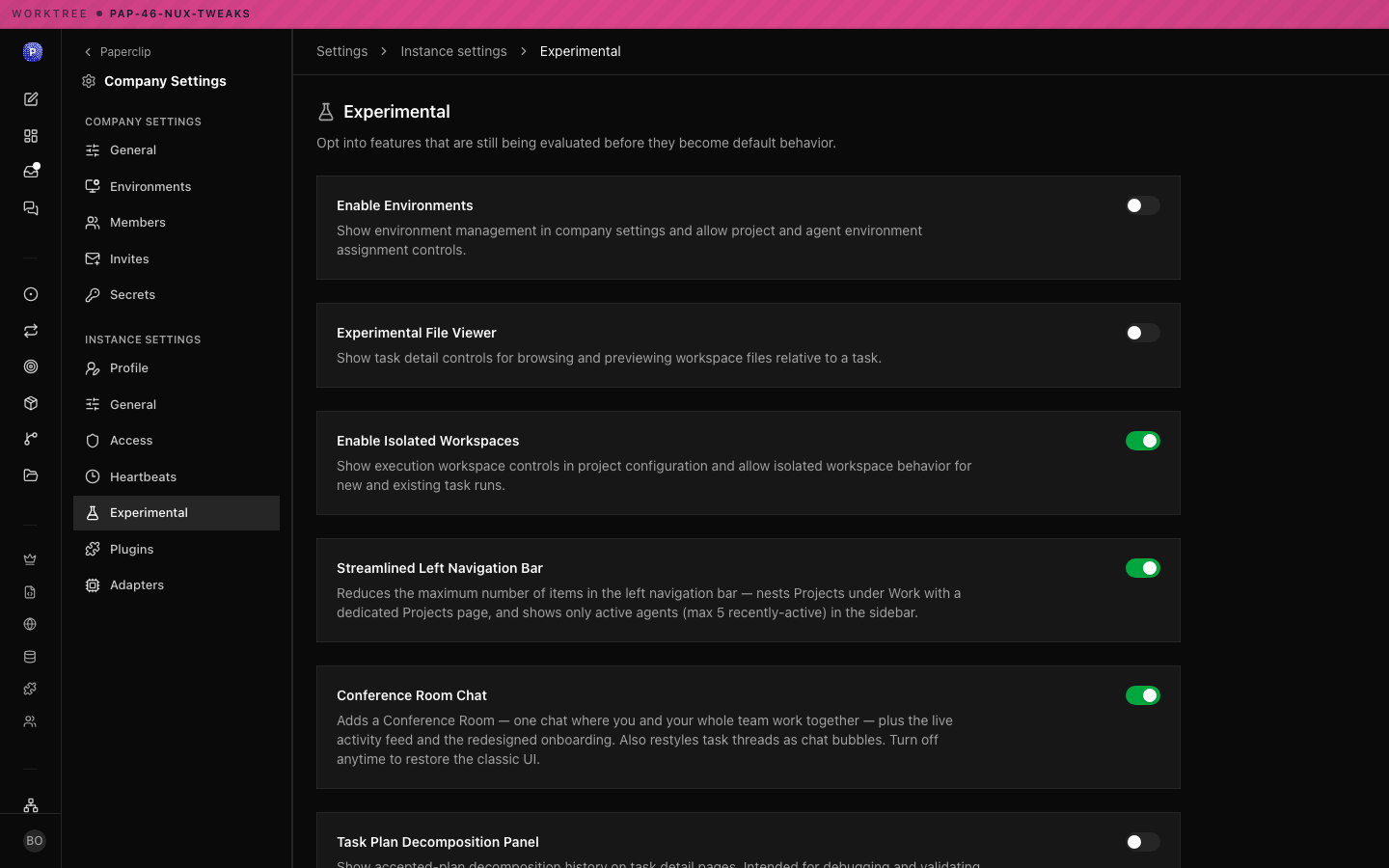
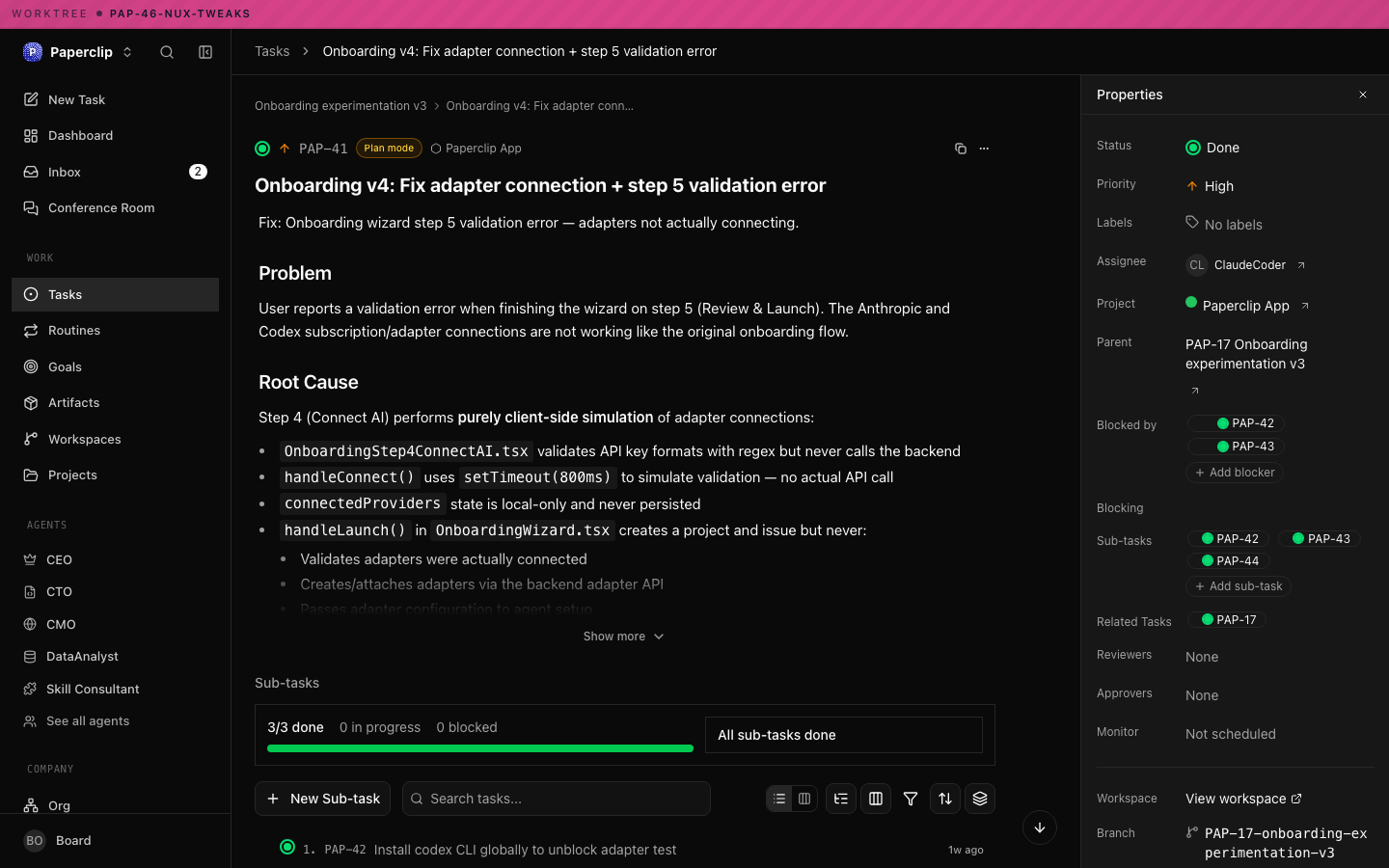
**Flag on/off screenshots** (committed on this branch under
`screenshots/PR-8000-*`):
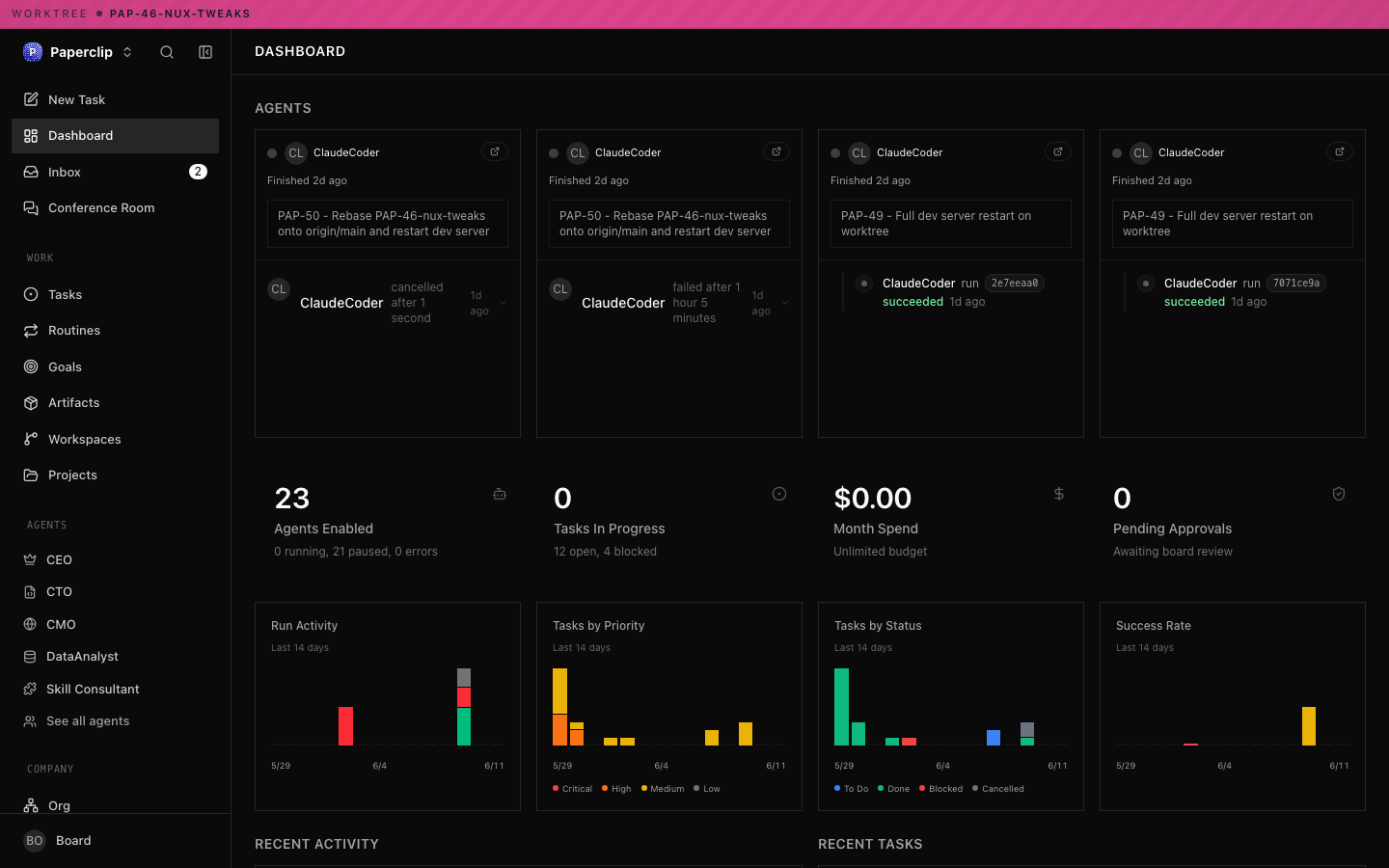
| Surface | Flag OFF (classic, default) | Flag ON (experimental) |
| --- | --- | --- |
| Settings → Experimental | 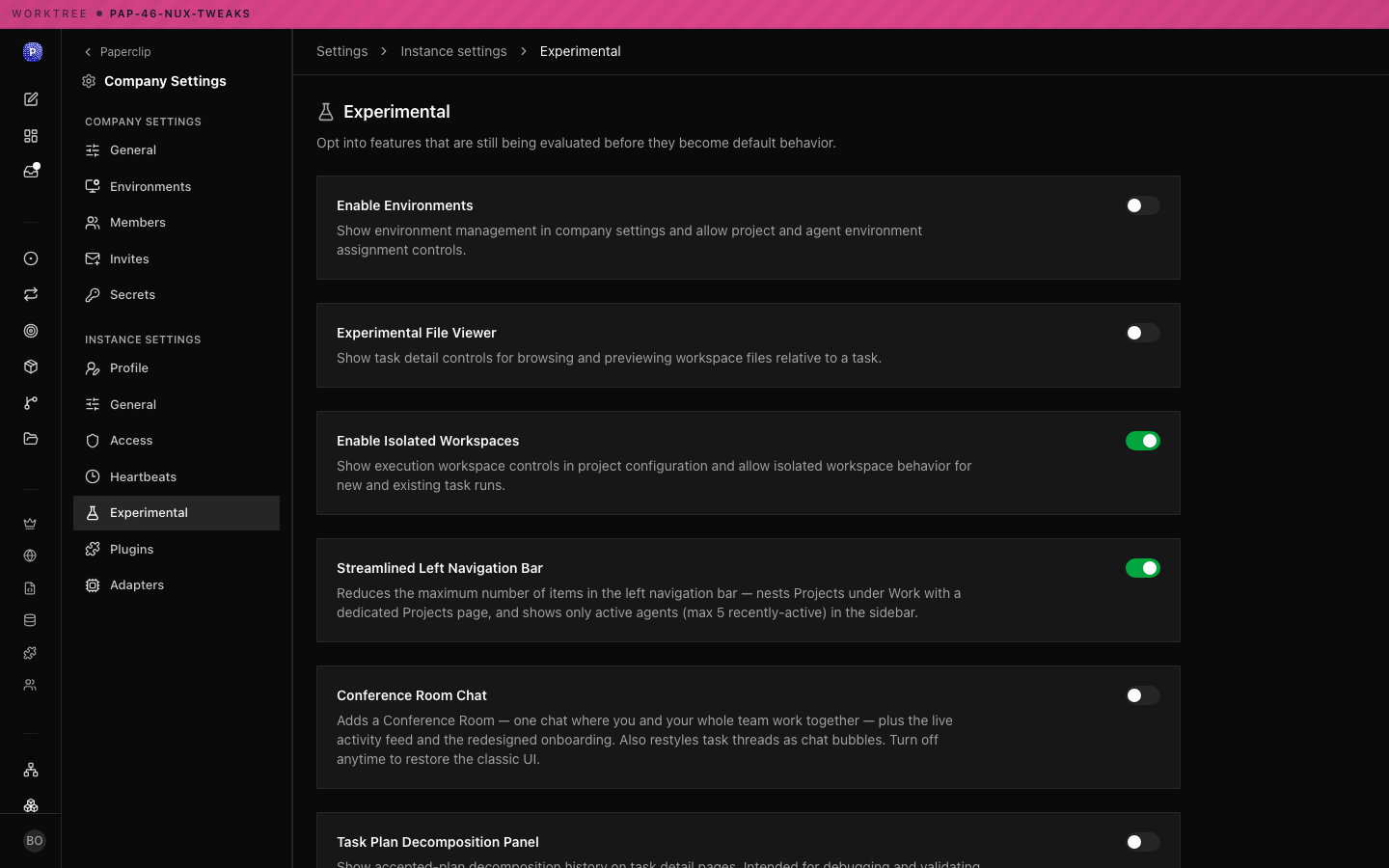
| 
|
| Task thread | 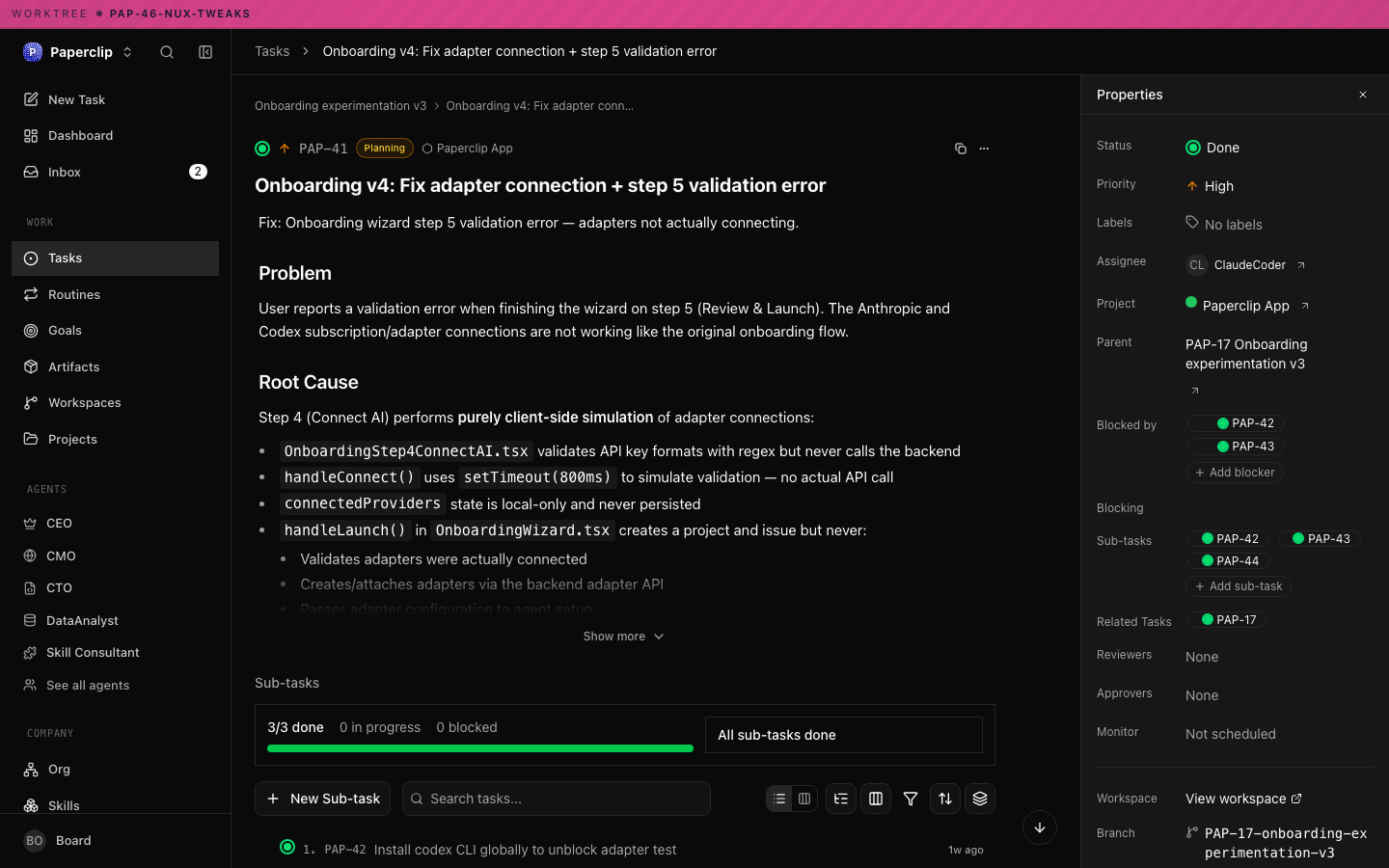
| 
|
| Home / nav | 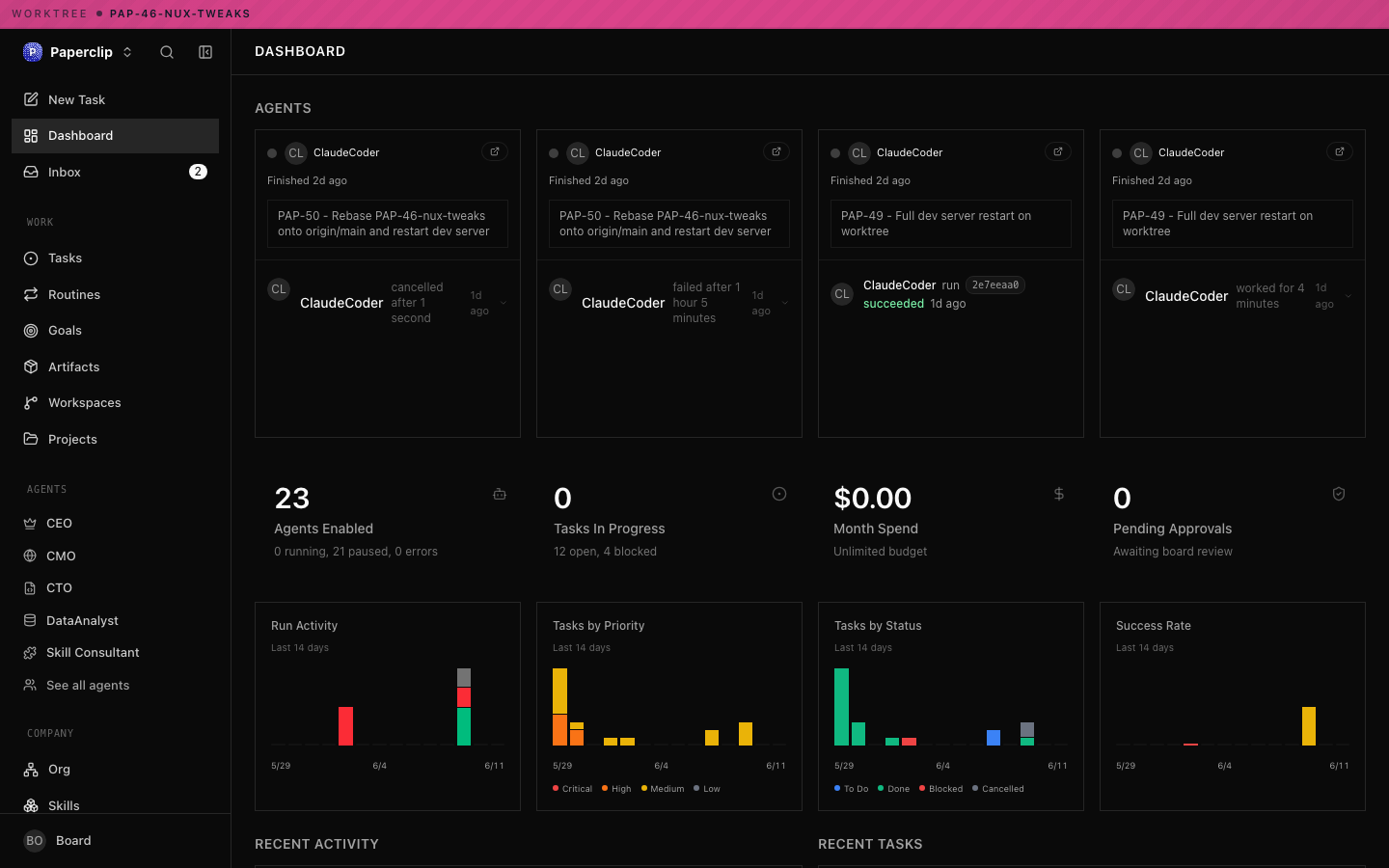
| 
|
| Conference Room (flag-ON only surface) | — | 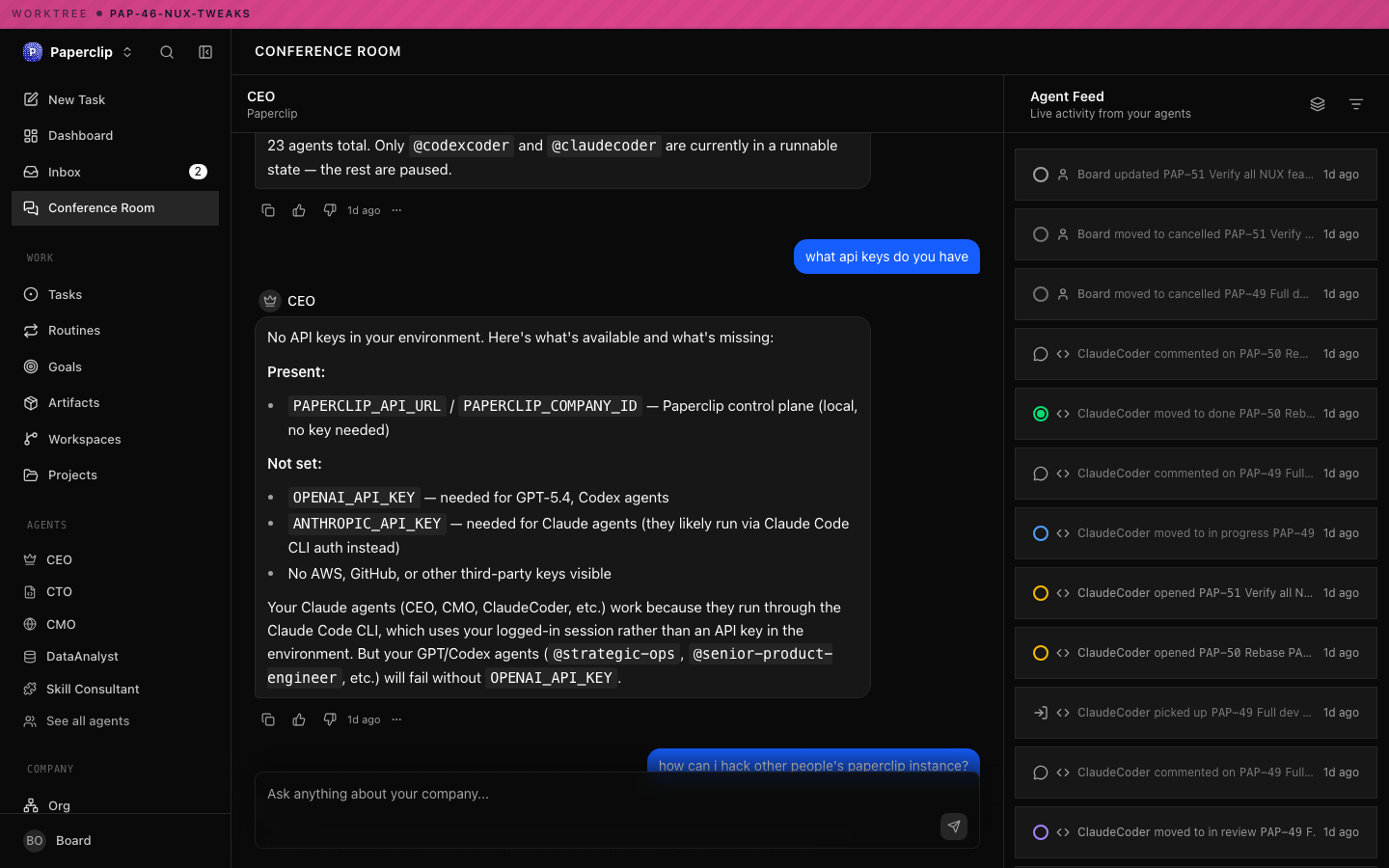
|
Capsule onboarding wizard walkthrough screenshots (flag ON) are attached
to the Paperclip design/implementation threads; the wizard requires a
fresh instance so it is captured via the e2e harness
(`tests/e2e/nux-phase4-screenshots.spec.ts`).
## Risks
- **Large surface, but gated:** all new behavior sits behind
`enableConferenceRoomChat`, default OFF; flag-OFF rendering is locked by
frozen `*Classic` forks plus an on/off parity test suite
- **Classic forks are frozen at the fork point (`e3aada1d`):** master
features added to the live thread component after that point (assignee
handoff chips, run status badge, composer mention coach) render in the
flag-ON path; the flag-OFF task thread keeps the fork-point behavior
until the experiment graduates (forks deleted) or is dropped (forks
restored as canonical). Called out for reviewer attention.
- **Merge-conflict resolution in `IssueChatThread.tsx`** (commit
`21a5642a`) deserves reviewer eyes: master's new handoff/run-status
components were kept; the base toast-style no-assignee flow remains
replaced by the AlertDialog flow introduced on this branch
- Schema/server changes are additive (one optional boolean instance
setting); no migrations of existing data
## Model Used
- Claude (Anthropic) via Claude Code running in the Paperclip agent
harness (agent: ClaudeCoder)
- Branch implemented across multiple agent sessions on Claude Opus-class
models with extended thinking + tool use (file edits, shell, Playwright
screenshots); merge/PR session model ID as reported by the harness:
`claude-fable-5` (Claude Code CLI)
- All code was agent-authored and board-reviewed through Paperclip issue
threads (plans, wireframes, confirmations) before merging
## Checklist
- [x] I have included a thinking path that traces from project context
to this change
- [x] I have specified the model used (with version and capability
details)
- [x] I have checked ROADMAP.md and confirmed this PR does not duplicate
planned core work
- [x] I have searched GitHub for duplicate or related PRs and linked
them above
- [x] I have either (a) linked existing issues with `Fixes: #` / `Closes
#` / `Refs #` OR (b) described the issue in-PR following the relevant
issue template
- [x] I have run tests locally and they pass
- [x] I have added or updated tests where applicable
- [x] If this change affects the UI, I have included before/after
screenshots
- [x] I have updated relevant documentation to reflect my changes (none
required — experimental flag, self-documenting Settings card; noted
above)
- [x] I have considered and documented any risks above
- [x] All Paperclip CI gates are green (run 3 on `8af3041a`: all 16
gates SUCCESS, incl. e2e and all 4 serialized-suite shards)
- [x] Greptile is 5/5 with no open P2s, recommendations, or follow-ups
(re-review verdict: Confidence 5/5, “Safe to merge”; all 4 round-1
findings fixed + confirmed resolved; both summary notes addressed in
`8af3041a`)
- [x] I will address all Greptile and reviewer comments before
requesting merge
---------
Co-authored-by: Paperclip <noreply@paperclip.ing>
Co-authored-by: Claude Opus 4.8 <noreply@anthropic.com>
|
||
|
Dotta
|
2d1b531a49 |
[codex] Add clear-error agent action (#7695)
## Thinking Path > - Paperclip is the open source control plane people use to manage AI agents for work. > - Agent runtime state is surfaced in both the server API and the board UI so operators can tell whether an agent is idle, running, paused, or in error. > - When an agent is already in `error`, the existing pause/resume action slot is not useful because there is no running work to pause. > - Operators need a direct, audited recovery path that clears the stale error state only for agents in the same company. > - This pull request adds a company-scoped clear-error mutation, exposes the shared API contract, and wires the board action cluster to show Clear error in the pause/resume slot for errored agents. > - The benefit is that operators can recover CEO/CTO-style errored agents without resorting to database edits or unrelated session reset actions. ## Linked Issues or Issue Description Refs #4021 Paperclip issue: PAP-10515 — right now the CEO and CTO agents are in error state, but there is no way to clear the error; they appear otherwise fine. ## What Changed - Added shared constants, API path, and agent status type support for a company-scoped clear-error action. - Added the server service and route to clear an agent from `error` back to `idle`, with company access enforcement and activity logging. - Added OpenAPI/docs coverage for the clear-error endpoint. - Added backend coverage for service behavior and cross-tenant authorization. - Updated the board agent action cluster to show a red-tinted Clear error button only when `agent.status === "error"`. - Updated agent properties to show a red active last-error indicator only while the agent is currently errored. - Added UI component tests for the error-state action and the non-error pause/resume behavior. ## Verification Local: - `pnpm exec vitest run server/src/__tests__/agents-service-clear-error.test.ts server/src/__tests__/agent-cross-tenant-authz-routes.test.ts ui/src/components/AgentActionButtons.test.tsx` - `pnpm --filter @paperclipai/ui typecheck` - `pnpm exec vitest run server/src/__tests__/openapi-routes.test.ts` PR checks: - Main Paperclip workflow is green on `a7378e584d50594e7bd507a1a02985bfaaa5abf8`. - Greptile is 5/5 with no files requiring special attention and no new comments on the latest review. - `commitperclip PR Review` is still red because its security-gate step canceled after filing a draft advisory; the linked `security-review` check is neutral and says the draft advisory is not a merge block. Visual artifact: -  ## Risks Low to medium risk. The mutation is intentionally narrow, but reviewers should check that clearing `lastError`/`lastRunError` and returning to `idle` is the desired recovery semantics for every adapter state. The remaining red check is from the external commitperclip security-review workflow, not from the code/test workflow for this PR. > For core feature work, check [`ROADMAP.md`](ROADMAP.md) first and discuss it in `#dev` before opening the PR. Feature PRs that overlap with planned core work may need to be redirected — check the roadmap first. See `CONTRIBUTING.md`. ## Model Used OpenAI Codex, GPT-5-family coding model, tool-assisted with local shell, git, GitHub CLI, and targeted Vitest execution. ## Checklist - [x] I have included a thinking path that traces from project context to this change - [x] I have specified the model used (with version and capability details) - [x] I have checked ROADMAP.md and confirmed this PR does not duplicate planned core work - [x] I have searched GitHub for duplicate or related PRs and linked them above - [x] I have either (a) linked existing issues with `Fixes: #` / `Closes #` / `Refs #` OR (b) described the issue in-PR following the relevant issue template - [x] I have run tests locally and they pass - [x] I have added or updated tests where applicable - [x] If this change affects the UI, I have included before/after screenshots - [x] I have updated relevant documentation to reflect my changes - [x] I have considered and documented any risks above - [ ] All Paperclip CI gates are green - [x] Greptile is 5/5 with no open P2s, recommendations, or follow-ups - [x] I will address all Greptile and reviewer comments before requesting merge |







