mirror of
https://github.com/paperclipai/paperclip.git
synced 2026-10-20 06:02:18 +02:00
db65a0863ea54292ceca3d60cf019ac64ec29357
15
Commits
| Author | SHA1 | Message | Date | |
|---|---|---|---|---|
 Nicky LeachandPaperclip |
db65a0863e |
Deliver durable resource lifecycle events to plugins without polling (#16203)
## Thinking Path > - Paperclip manages AI agents and their work. > - Plugins keep external resources aligned with Paperclip projects and agents. > - The durable resource journal stores changes, but its plugin interface requires polling. > - Project deletion has no journal entry, so consumers must scan for missing projects. > - This PR delivers committed journal events through a native plugin callback and records deletion. > - Plugins can recover unfinished work without periodic change scans. ## Linked Issues or Issue Description Related: #15343 introduced the durable inbox. #15631 added required agent lifecycle participation. This change keeps both contracts and adds automatic delivery for the resource inbox. **What happened?** Plugins must schedule reads of the durable inbox. A deleted project has no durable deletion event. Consumers must scan saved bindings to detect its removal. **Expected behavior** Core should deliver committed resource events and replay unfinished work. Empty queues should have no polling timer. Project removal should leave a durable event. **Steps to reproduce** 1. Install a plugin that consumes project lifecycle events. 2. Create or update a project. The plugin must call `listLifecycle` to discover it. 3. Delete the project. The journal has no deletion entry. ## What Changed - Add `resourceLifecycle` to the manifest and `onResourceLifecycle` to the SDK. Require `events.subscribe` and a configured, enabled company scope. - Reuse transaction-aware work signals and the delivery coordinator. Wake after commit, on startup and plugin activation, and after configuration changes. - Acknowledge only a matching successful result. Retry unfinished or interrupted work. Retain deferred events without an idle retry timer. - Wake again after successful worker configuration application, and retain failed scans through idle drain (both Apex findings fixed). - Keep ordering per resource and deliver past failed or deferred resources. Keep the manual inbox methods for existing consumers. - Record project deletion in the removal transaction. Extend the journal constraint with a generated migration. ## Verification - Apex follow-up: 129 focused worker, delivery, coordinator, and application tests passed; server typecheck passed. Regression coverage verifies configuration-application races and failed scans across idle drain. - Focused lifecycle, transaction coordinator, manifest, and SDK dispatch suites: 105 tests passed, including single-connection saves, redacted failure diagnostics, wakeups retained during idle drain, and per-event retry deadlines. - Complete SDK suite plus delivery database tests: 128 tests passed. - Shared, database, and SDK typechecks passed. Direct server `tsc --noEmit` passed against rebuilt SDK declarations. - Full local `pnpm test:run` finished with 19,491 passed, 148 skipped, and 6 failed tests across 5 files (plus two suite setup errors). This run overlapped branch updates and is not final-head evidence: failures included missing Cargo, local Git default-branch assumptions, and stale in-process lifecycle modules. Final Apex-fix commit `75d028788` passed all CI gates, including the full test shards, and received Apex 5/5 with no unresolved comments. - `pnpm -r typecheck` and `pnpm build` were attempted. Both stopped because Cargo is unavailable locally. CI supplies the Rust toolchain. - Local installation used the repository's documented lockfile fallback because master has dependencies missing from its lockfile. No dependency changes are included here. ## Risks - Delivery is at least once. Plugins must re-read current state and make external effects idempotent. - Signals are process-local, like the other delivery queues. Startup recovers committed rows. Independent database writers or multiple active server processes require an explicit ownership and wake protocol. - Apply migration `0340_open_warlock.sql` before running code that records project deletion. Earlier deletions cannot be reconstructed. - Automatic delivery selects plugins with company configuration rows. `deferred` waits for a later startup, configuration change, or other work notification. - This does not replace required agent lifecycle participation or establish that external mounts are unused. ## Model Used OpenAI Codex (GPT-6), with tool-assisted code editing, code inspection, and test execution. ## Checklist - [x] I have included a thinking path that traces from project context to this change - [x] I have specified the model used (with version and capability details) - [x] I have checked ROADMAP.md and confirmed this PR does not duplicate planned core work - [x] I have searched GitHub for duplicate or related PRs and linked them above - [x] I have either (a) linked existing issues with `Fixes: #` / `Closes #` / `Refs #` OR (b) described the issue in-PR following the relevant issue template - [x] I have not referenced internal/instance-local Paperclip issues or links (only public GitHub `#NNN` / `github.com/paperclipai/paperclip` URLs) - [x] My branch name describes the change (e.g. `docs/...`, `fix/...`) and contains no internal Paperclip ticket id or instance-derived details - [ ] I have run tests locally and they pass - [x] I have added or updated tests where applicable - [x] I have updated relevant documentation to reflect my changes - [x] I have considered and documented any risks above - [x] All Paperclip CI gates are green - [x] Greptile is 5/5 with no open P2s, recommendations, or follow-ups - [x] I will address all Greptile and reviewer comments before requesting merge --------- Co-authored-by: Paperclip <noreply@paperclip.ing> |
||
|
Nicky LeachandPaperclip
|
2dd9811e8b |
Own agent hiring and termination in a lifecycle module (#15631)
## Thinking Path > - Paperclip manages AI agents and their work. > - Agent creation, approval, pause, and termination change whether an agent can work. > - These changes currently use separate service and database paths. > - Some agents need setup after their record exists and before their harness can run. > - This PR adds one module that owns those state changes and their transactions. > - The module records progress and retries incomplete work after a server restart. ## Linked Issues or Issue Description **Problem or motivation** A hire can become active before its execution environment is ready. Direct agent state writes also bypass one common lifecycle boundary. Termination does not have a durable step for resource cleanup. **Proposed solution** Use agent lifecycle commands for hiring, approval, pause, resume, and termination. Keep proposed hires pending until approval. Prepare each approved hire, test its saved harness configuration, and then permit work. Wait for required plugin work before completing a step. **Alternatives considered** A general database commit hook would expose transaction details to callers. A timer alone would delay each new hire. This module owns each command transaction and starts its worker after commit. A periodic scan recovers work after a process stops. **Roadmap alignment** This change adds the lifecycle boundary for the existing agent and plugin systems. It does not add a user interface or a provider implementation. It replaces the lifecycle delivery approach in #15391. Related proposals include #11475 and #13099; this change does not add their external executor protocols. ## What Changed - Add durable approval, preparation, verification, pause, resume, stop, and cleanup states. - Keep agent creation, lifecycle state, configuration writes, and agent record deletion behind `modules/agent-lifecycle`. Keep validation, credential rules, reads, onboarding, invitations, general approvals, and company data deletion in their services. - Commit a hire before the remaining onboarding or invitation work. Serialize requests with the existing dedicated database connection helper. Reuse the hire after a failed attempt. - Keep accepted work in the run queue during setup. Require execution and cleanup evidence before completing pause or termination. - Retain the original credential owner when approving migrated hires. - Start lifecycle work after each command commits. Use database leases and revision checks for retries and late results. - Add a generic required plugin method and capability. Store the required plugin IDs for each agent. Track host and plugin completion separately. - Keep harness verification and credential rules in services. Supply their results to lifecycle through explicit ports. Reject failed logins and incomplete probes. - Remove reverse imports from lifecycle adapters into services. Share record queries and validation below both layers. - Use one hire decision path for agent IDs and approval IDs. Resolve the approval and agent change in one transaction. Expose policy reconciliation on the command object. - Save configuration and verification invalidation through one module operation. Ordinary commands own their transaction. Restrict the shared transaction integration to its listed callers. Reject identity, company, accounting, timestamp, and unknown fields. - Require completed termination before deleting agent records. The company deletion service calls the module through a separate deletion interface. - Save an approved secret before applying its agent binding. A failed binding leaves the secret approved. A retry reuses it. - Remove old permission and metadata export files. Move hire configuration rules out of lifecycle persistence. - Report failed worker steps and scans with operation context and known error codes. Omit provider messages, stacks, and configuration values. Document ordinary application use and extension rules. - Recover expired native owners only after execution stops. Retry cleanup of failed retained leases. Wait for setup in the live smoke script. - Keep manual, budget, and company pause reasons separate. Guard execution status writes with the ready state. - Add a migration, boundary checks, regression tests, and a lifecycle guide. Keep the current UI. - Limit periodic policy checks to 100 eligible agents per minute. Continue from the last agent ID. Exclude pending hires and agents in termination or a final state. Keep explicit company and budget updates immediate. ## Verification - Latest head `ccc3c86b0` aligns the shared status update schema with the PATCH route. All 15 shared tests, 104 server route/OpenAPI tests, 2 CLI tests, and shared/server/CLI TypeScript checks pass. The Greptile comment is fixed. CI is running; no new Apex review was requested for this small fix. - Rebase `75708ac94` rebases onto master at `2eb5187e4`. The backup test uses the shared 90-second timeout from master; the older timeout commit was removed. The affected backup test passes. - Agent budget edits now pass the target agent ID through enforcement. All 50 affected tests, server TypeScript, and 11 boundary tests pass. Both configuration update paths have regression coverage. CI is running on the latest head. No new Apex review was requested for these small fixes. - Rebase `9b568666a` preserves the run-control extraction and delivery-work startup changes from master. All 559 affected tests, server TypeScript, and 11 boundary tests pass. CI and Apex review are running on the final head. - The policy scan fix passes 56 lifecycle and diagnostic tests, 24 policy and caller tests, and 11 boundary tests. A regression test checks the page limit, interval, excluded states, and cursor wraparound. - Rebase `fd4698750` passes all 611 tests in eight affected lifecycle, route, and heartbeat suites. Server TypeScript and all 11 module boundary tests pass. The company deletion rollback and concurrent hire tests are included. - Follow-up `00aac7646` fixes the failed decision deletion test and the public update schema. All 126 affected server tests, 8 shared tests, 2 CLI tests, and 11 boundary tests pass. Shared, server, CLI, and UI TypeScript checks pass. - Server TypeScript passes: `pnpm --filter @paperclipai/server exec tsc --noEmit`. - All 11 boundary tests pass: `node --test scripts/check-module-boundaries.test.mjs`. The repository boundary scan also passes. - All 68 lifecycle, failure diagnostic, and harness verification tests pass. Tests reject forbidden fields through the root command, combined transition command, and restricted transaction integration. They also check invalid fields returned by configuration preparation. - Failure tests cover host work, plugin work, claims, renewals, deferrals, and scans. Log tests check known error codes and exclusion of private error contents. - All 355 tests in 10 existing caller suites pass. These tests cover secret approval, pairing, pending hires, credentials, company import, built-in agents, managed agents, instructions, and skills. - The branch is rebased onto `origin/master` at `2eb5187e4`. The queue guards and cancellation lock fix use the extracted heartbeat queue. Agent cancellation uses the extracted run-control file. The source diff scan found no secrets or private URLs. - Earlier checks cover approval retries, rollback, late verification results, policy holds, deletion rollback, concurrent company deletion, and queue admission during setup. - Before the rebase, CI passed on `00aac7646` and Greptile Apex rated it 5/5 with no open comments. CI and a new Apex review are pending for the rebased commit. The branch has no merge conflicts. - The full local build and native Dot suite were not run. The host has no Cargo. No live provider test was run. ## Risks - Background policy recovery takes more than one minute when more than 100 agents are eligible. Explicit company and budget updates still reconcile immediately. - The restricted configuration integration keeps an agent reference and its dependent records in one transaction. It cannot change a budget or invoke a lifecycle transition. A periodic scan starts pending setup after that transaction commits. - Secret approval and binding use separate transactions. A failed binding can leave an approved secret with no agent binding. - New approved hires remain unavailable until setup and verification complete. Existing clients see `paused` during these steps. This PR does not change the UI. - Migration `0320_daily_onslaught.sql` maps existing statuses and pause reasons. It does not create external resources or claim that an existing harness passed verification. - Use a coordinated server update for this migration. Older server versions can write legacy status without the new lifecycle checks. - A failed onboarding or invitation request can leave a committed hire. A retry reuses that hire and completes the remaining records. - Deletion requires completed termination. Company deletion can require another request while cleanup is pending. - Required plugins must make repeated calls safe and reject older revisions. A disabled or removed required plugin blocks completion until it is restored. - A new hire can run a second harness test after the existing UI test. Some adapters can charge for this test. - No live provider test was run. Provider implementation and resource backfill remain separate work. ## Model Used OpenAI GPT-6 through Codex, with reasoning, code tools, and local test execution. ## Checklist - [x] I have included a thinking path that traces from project context to this change - [x] I have specified the model used (with version and capability details) - [x] I have checked ROADMAP.md and confirmed this PR does not duplicate planned core work - [x] I have searched GitHub for duplicate or related PRs and linked them above - [x] I have described the issue in this PR with the feature request field labels - [x] I have not referenced internal or instance-local issues or links - [x] My branch name describes the change - [x] I have added or updated tests where applicable - [x] I have updated relevant documentation - [x] I have considered and documented risks - [x] Targeted local tests pass - [x] All Paperclip CI gates are green on the new commit - [x] Greptile Apex is 5/5 with no open comments on the new commit - [x] I will address review comments before requesting merge --------- Co-authored-by: Paperclip <noreply@paperclip.ing> |
||
|
DottaandPaperclip
|
0e0b63e5a5 |
feat(connections): add experimental task-pinned AI routing (#14967)
## Thinking Path > - Paperclip manages AI agents and their work. > - AI Connections separate account access from models and harnesses. > - A pool must act as one connection while retaining each task’s account. > - Core must enforce member access and preserve session and recovery rules. > - A plugin supplies rotation policy without receiving credentials. > - This change adds durable routing and native connector setup and management. ## Linked Issues or Issue Description **Subsystem affected** AI Connections, Connectors, plugins, run dispatch, and session compatibility. **Problem or motivation** Operators need to rotate new tasks across saved accounts while each task keeps its account and session. Pool setup must fit the existing connector catalog and account workflow. **Proposed solution** Add an experimental router binding, a capability-gated plugin hook, and transactional task pins. Plugins declare native pooled connectors through `aiConnectionRouter`. Core hosts the existing-account picker, ordering step, and account settings. Related usage contract: #14936. Companion private plugin: https://github.com/paperclipai/paperclip-cloud/pull/643. **Roadmap alignment** This extends Apps and AI Connections. Core supplies generic enforcement and native connector UI; the private plugin owns rotation and quota policy. The prior duplicate search found no matching router implementation. ## What Changed - Add a router binding without changing existing concrete bindings. Keep the instance flag and new pools disabled by default. Require manual operator configuration. Show no routing toggle in Experimental settings on either open-source or Cloud installs, even after routing is enabled. - Persist company-scoped pools, one shared cursor per pool, and pins keyed by company, pool, agent, and task. Commit pins and cursor advances together with revision checks and bounded retries. Persist run-ID affinity before allocation. - Pass only authorized metadata and normalized usage to plugins. Core retains credential handling, member access checks, runtime qualification, and recovery evidence. Probe outside locks with a shared 15-second budget and freshness cache. - Resolve routing before credential preparation and backend selection. Preserve pins through turns, session resets, removed members, and quota waits. Retain admitted recovery after disable or uninstall. - Separate credential session epochs from token generations. Verified refresh preserves the epoch; reconnect and manual replacement change it. Include the credential slot ID in session and usage-cache identity, so reconnecting an indexed legacy account invalidates its old session even when both epochs are zero. - Validate pool member installations before accepting saved-agent bindings and recheck compatibility when the harness changes. Install only authorized members in the new-agent transaction and record their IDs in local activity. Pool membership cannot install a restricted shared connection. - Preserve pool bindings when agents hire teammates through either creation API or native caller runtime inheritance. Block stale manager credential references; retain explicit child authentication precedence and reject incompatible inherited pools. - Add native connector registration through plugin metadata. Reuse the Connectors catalog, setup header, account header, sidebar, dialogs, and usage display. Setup selects and orders saved connections. Advanced settings hold usage rules and member runtime defaults. New-account setup opens in another tab. - Use revision-checked pool archival from the Connectors catalog and account page. Keep task pins, cursors, recovery evidence, and underlying connections. Reject ordinary connection updates or removals that bypass pool revisions. - Add pool selectors, composer models, override notes, quota status, run details, activity records, and local run-log records. Keep session-adoption copy minimal. - Show **Used by** below the pool connections. List current company agents with shared avatars and profile links. Include paused agents; exclude terminated agents and agents using another pool. - Add Core stories for the generic connector workflow and runtime surfaces. Cloud stories reuse these production routes and tokens through a preview-only alias. ## Verification - Final head `73cb953bca30ed83e4505dd820edd9b5edffd28b`: full workspace `pnpm -r typecheck`, `pnpm build`, and `pnpm check:token-gates` pass locally. - All 422 focused connector/settings/shared-contract/migration tests and all 156 database-backed AI connection, hiring, reconnect, and durable-routing cases pass (69 hiring cases rerun after the final auth-precedence fix). The merged shared contract retains connection instructions and pool metadata. The pool migration is generated at sequence 0299 after the latest upstream migrations; this PR makes no lockfile changes. - All four full-app Playwright tests pass on the final head after a cold restart and migration, against the installed private plugin and isolated database, with no route or pool-API mocks. They cover hidden routing controls after manual opt-in, native pool creation, ordering, membership edits, rename, paused defaults, enabling/save/refresh persistence, stale edits, cancellation/removal, preserved underlying accounts, unavailable routers, and Used by avatars and profile links. Exact command: `PAPERCLIP_CONNECTION_POOL_E2E=1 AI_CONNECTIONS_TEST_COMPANY_ID=a37b9625-5ecf-4e29-8081-04df3d6e7d6f AI_CONNECTIONS_TEST_URL=http://127.0.0.1:3108 pnpm exec playwright test --config tests/ai-connections-app/playwright.config.ts connection-pools.spec.ts`. - [Native setup, ordering, and management screenshots](https://github.com/paperclipai/paperclip/pull/14967#issuecomment-6006976278) address the review follow-up. [Earlier selector, quota, and run-detail screenshots](https://github.com/paperclipai/paperclip/pull/14967#issuecomment-5971537316) show the runtime surfaces. Core previews: `pnpm --filter @paperclipai/ui storybook`, then **Connectors / Pool host** or **AI Connections / Connection pools**. Cloud owns its host-backed plugin stories; both repositories’ Operator Setup Required story assertions pass. - Live acceptance used OpenAI/Codex and Anthropic/Claude ACPX, resumed both exact sessions after restart, preserved pinned accounts through explicit reset and controlled quota deferral/recovery, and committed only two allocations across fourteen runs. A later UI-created task test again rotated OpenAI then Anthropic and resumed OpenAI through follow-up/restart/quota recovery. That later Anthropic execution was blocked by its saved OAuth token expiring (provider 401). No live usage probes ran. - The full local `pnpm test:run` was attempted earlier and did not complete because of macOS embedded PostgreSQL bootstrap/shared-memory failures and the 40,000-file Git fixture timeout. The focused database suites above now pass; full-suite verification is provided by the split CI lanes. The preceding CI run had one runtime readiness timeout; it passes locally both alone and inside the larger runtime suite. That larger local suite also encountered an embedded PostgreSQL setup failure and two macOS temporary-path alias assertions; those two assertions pass with canonical TMPDIR=/private/tmp. All final-head CI checks are terminal green, including full general/serialized server suites, Runner checks, browser E2E shards, canary verification, build, and typecheck. Greptile is 5/5 on that exact head with no unresolved threads. ## Risks - The migration adds routing tables and a credential epoch column. Install the private plugin only with the compatible Core contract. - Routing and each pool require opt-in. Production distribution and fleet defaults remain unchanged. - Unknown usage stays eligible. Known pinned exhaustion waits; revoked access requires operator repair. - Legacy adapters require compatible members. Runner model and effort overrides remain limited by qualified backend support. ## Model Used OpenAI GPT-6 through Codex, with reasoning, repository editing, code execution, and browser testing. The exact deployment model ID and context window are not exposed in this session. ## Checklist - [x] I have included a thinking path that traces from project context to this change - [x] I have specified the model used (with version and capability details) - [x] I have checked ROADMAP.md and confirmed this PR does not duplicate planned core work - [x] I have searched GitHub for duplicate or related PRs and linked them above - [x] I have either (a) linked existing issues with `Fixes:` / `Closes:` / `Refs:` OR (b) described the issue in-PR following the relevant issue template - [x] I have not referenced internal/instance-local Paperclip issues or links - [x] My branch name describes the change and contains no internal Paperclip ticket id or instance-derived details - [x] I have run tests locally and they pass (targeted suites; full-suite limitations are reported above) - [x] I have added or updated tests where applicable - [x] I have updated relevant documentation to reflect my changes - [x] I have considered and documented any risks above - [x] All Paperclip CI gates are green - [x] Greptile is 5/5 with no open P2s, recommendations, or follow-ups - [x] I will address all Greptile and reviewer comments before requesting merge --------- Co-authored-by: Paperclip <noreply@paperclip.ing> |
||
|
Devin FoleyandPaperclip
|
ffa32373bc |
fix(runtime): honor provider acquisition timeout defaults (#14097)
Declare provider acquisition budgets so slow Daytona creation does not hit the host’s 30-second fallback. Bound creation and setup to one deadline and preserve scoped cleanup ownership after timeout. Legacy drivers retain their original call shape. Validated by 238 provider/manifest tests, focused database and heartbeat regressions, root and standalone provider typecheck/build, and full CI. Local broad tests also expose recorded Mac baseline limitations. Greptile 5/5. Co-Authored-By: Paperclip <noreply@paperclip.ing> |
||
|
Nicky LeachandPaperclip
|
233be4b36c |
feat: parallelize sandbox file-sync behind a provider opt-in capability (#11736)
## Thinking Path > - Paperclip runs AI agents through local and remote execution adapters. > - Sandbox providers move workspace and asset files before and after agent runs. > - Serial file transfers delay startup and teardown when several operations do not depend on each other. > - Providers need an opt-in contract so existing providers keep their serial behavior. > - This pull request adds a bounded scheduler and routes inbound and outbound sync operations through it. > - The benefit is shorter sandbox setup and teardown with stable errors, clear telemetry, and a safe opt-in path. ## Linked Issues or Issue Description **Subsystem affected** Cross-cutting (multiple of the above): packages/shared, packages/adapter-utils, packages/plugins, and server. **Problem or motivation** Sandbox sync processes the workspace, assets, and referenced projects in series. This adds avoidable wait time to agent startup and teardown. **Proposed solution** Add a fail-closed provider capability named concurrentSyncOperations. Use a bounded scheduler with a limit of four operations. Preserve operation order for error reporting. Keep non-opted-in providers on the serial path. **Alternatives considered** Increase the serial transfer speed or add provider-specific schedulers. Those options do not provide one shared contract or stable behavior across providers. **Roadmap alignment** ROADMAP.md lists cloud and sandbox agents as a product area. This change improves sandbox execution without changing the control-plane contract. **Additional context** The Daytona provider opts in. Board trials on this commit showed overlap for inbound sync and outbound restore, with no referenced-project staging failures. ## What Changed - Add the concurrentSyncOperations sandbox capability and fail-closed parsing. - Add a bounded settle-all scheduler with stable input-order errors. - Parallelize inbound workspace, asset, and referenced-project sync operations when the provider opts in. - Parallelize outbound workspace and asset restore operations when the provider opts in. - Surface referenced-project failure text in run logs and server telemetry. - Add Daytona sync spans and the capability declaration. - Preserve in-flight upload scratch tarballs during workspace wipe. - Add unit and regression tests for the scheduler, coordinators, provider behavior, telemetry, and wipe race. ## Verification - Run the adapter-utils and server type checks. - Run the targeted adapter-utils, server, and Daytona test suites. - Run the full automated sweep. - Review six cold Daytona trials, with three serial and three parallel runs. - Confirm that parallel trials show inbound overlap and outbound restore overlap. - Confirm that providers without the capability keep serial behavior. ## Risks - Providers must opt in only when their file operations can run safely at the same time. - A provider that declares the capability incorrectly can expose transfer races. - The scheduler keeps a limit of four to bound resource use. - Providers without the capability keep the prior serial behavior. ## Model Used OpenAI GPT-5 in the Codex runtime. The model used tool calls, code inspection, and GitHub workflow support. The model did not author the implementation commits. ## Checklist - [x] I have included a thinking path that traces from project context to this change - [x] I have specified the model used (with version and capability details) - [x] I have checked ROADMAP.md and confirmed this PR does not duplicate planned core work - [x] I have searched GitHub for duplicate or related PRs and linked them above - [x] I have either (a) linked existing issues with Fixes: # / Closes # / Refs # OR (b) described the issue in-PR following the relevant issue template - [x] I have not referenced internal/instance-local Paperclip issues or links (only public GitHub #NNN / github.com/paperclipai/paperclip URLs) - [x] My branch name describes the change and contains no internal Paperclip ticket id or instance-derived details - [x] I have run tests locally and they pass - [x] I have added or updated tests where applicable - [x] I have updated relevant documentation to reflect my changes - [x] I have considered and documented any risks above - [x] All Paperclip CI gates are green - [x] Greptile is 5/5 with no open P2s, recommendations, or follow-ups - [x] I will address all Greptile and reviewer comments before requesting merge --------- Co-authored-by: Paperclip <noreply@paperclip.ing> |
||
|
Nicky LeachandPaperclip
|
e0b64529b3 |
feat(auth): normalize agent login in the sandbox onto one session table and a capability contract (#11730)
## Thinking Path > - Paperclip is the open source app people use to manage AI agents for work > - Sandbox agents need a safe login path for each supported adapter > - Codex device login and Claude setup-token login used separate session stores and route logic > - Separate stores made session lookup, expiry, and login capability checks harder to keep consistent > - This pull request unifies both flows on one session table and one capability contract > - The benefit is one company-scoped login model with public session identifiers and shared lifecycle rules ## Linked Issues or Issue Description **Subsystem affected** Cross-cutting (multiple of the above) **Problem or motivation** Codex and Claude sandbox login used separate session stores and different route paths. This split increased the risk of inconsistent company scoping, session lookup, and cleanup. **Proposed solution** Use `adapter_auth_sessions` for both login flows. Use public session identifiers for API access. Select login behavior from projected adapter capability data. Share the route spine, lease arguments, runner lifecycle, and reaper rules. **Alternatives considered** Keep two session tables and add matching fixes to both routes. This keeps duplicate logic and does not provide one capability contract, so this pull request uses shared infrastructure. **Roadmap alignment** This change supports the shipped Cloud / Sandbox agents milestone in `ROADMAP.md`. ## What Changed - Unify Codex device login and Claude setup-token login on `adapter_auth_sessions`. - Return and look up sessions with company-scoped public session identifiers. - Enforce one active session for each company, owner, and adapter. - Share the login route spine, sandbox lease arguments, runner lifecycle, and missing-auth check. - Add a standalone setup-token reaper with adapter-specific row selection. - Add optional login capability projection for adapters and drive route and UI selection from that data. - Rename the provider flag to `supportsLoginPty` and validate its deprecated alias. - Remove the old Claude setup-token session table and add the required migrations. ## Verification - Server typecheck passed with `tsc`. - Database typecheck passed. - UI typecheck passed with `tsc -b`. - Codex login service and route suites passed. - Setup-token session, route, and reaper suites passed. - Adapter session schema, plugin validator, capability projection, UI render, and Daytona suites passed. - GitHub Actions must confirm the complete CI gate after pull request creation. ## Risks - The migrations remove short-lived in-flight login rows during deployment. A login that spans the migration can continue until its provider lease expires. - The Codex credential store remains company-scoped. A cross-owner credential race remains a documented, board-accepted risk. - API clients that use internal session row identifiers no longer work. The API accepts only public session identifiers. ## Model Used Codex, GPT-5, exact runtime model ID not exposed in this handoff, large context window, reasoning, and repository tool use. The implementing engineer produced the code with AI assistance. ## Checklist - [x] I have included a thinking path that traces from project context to this change - [x] I have specified the model used (with version and capability details) - [x] I have checked ROADMAP.md and confirmed this PR does not duplicate planned core work - [x] I have searched GitHub for duplicate or related PRs and linked them above - [x] I have either (a) linked existing issues with `Fixes: #` / `Closes: #` / `Refs: #` OR (b) described the issue in-PR following the relevant issue template - [x] I have not referenced internal/instance-local Paperclip issues or links (only public GitHub `#NNN` / `github.com/paperclipai/paperclip` URLs) - [x] My branch name describes the change (e.g. `docs/...`, `fix/...`) and contains no internal Paperclip ticket id or instance-derived details - [x] I have run tests locally and they pass - [x] I have added or updated tests where applicable - [x] I have updated relevant documentation to reflect my changes - [x] I have considered and documented any risks above - [x] All Paperclip CI gates are green - [x] Greptile is 5/5 with no open P2s, recommendations, or follow-ups - [x] I will address all Greptile and reviewer comments before requesting merge --------- Co-authored-by: Paperclip <noreply@paperclip.ing> |
||
|
Nicky LeachandPaperclip
|
3061ce6901 |
feat(sandbox): stream session output by capability, drop three operator flags (#11557)
## Thinking Path > - Paperclip is the open source app people use to manage AI agents for work > - Sandboxed agents use provider capabilities to select safe execution paths > - Session output still depends on three operator flags that duplicate capability data > - Duplicate flags can drift from the verified sandbox capability snapshot > - This pull request makes the capability snapshot the only streaming decision and removes the obsolete flags > - The benefit is default streaming with a poll fallback when a capability or stream fails ## Linked Issues or Issue Description **What existing behavior does this improve?** ACP sandbox session-output streaming and sandbox execution configuration. **Subsystem affected** Cross-cutting (multiple of the above): server/, packages/shared/, packages/adapter-utils/, and packages/plugins/. **Current behavior** Session-output streaming requires operator flags in the server and Daytona plugin configuration. Saved configurations can retain a removed key. **Proposed behavior** The verified capability snapshot selects streaming. The Daytona plugin uses persistent sessions by default, keeps bypass commands one-shot, and falls back from the log stream to polling. Removed configuration keys become inert. **Reason and benefit** One capability source prevents configuration drift. The fallback keeps output available when capability resolution or log streaming fails. **Breaking changes** The three operator flags no longer control session-output streaming. Existing saved keys load but have no effect. ## What Changed - Remove `useSessions` and `useLogStream` from the Daytona plugin configuration and manifest. - Remove `streamAgentSessionOutput` from server configuration, shared types, and execution-target plumbing. - Select streaming from `persistentProcessSessions` and `independentControlCommands`. - Keep poll fallback on capability resolution failure and stream failure. - Strip removed keys from strict fake-sandbox and catchall plugin configuration. - Update the sandbox capability documentation and focused tests. ## Verification - `tsc --noEmit` passed in `packages/shared`, `packages/adapter-utils`, `server`, and the Daytona plugin. - Daytona `plugin.test.ts` passed 139 tests. - Server capability, configuration, route, and runtime suites passed 160 tests. - `packages/adapter-utils` `execution-target-sandbox.test.ts` passed 44 tests. - The capability matrix covers stream, poll, and resolution-failure paths. - Removed-key tests cover strict fake-sandbox and catchall plugin schemas. ## Risks - A capability snapshot that lacks either required session capability uses polling. - A log stream failure uses polling and can increase request count. - Existing removed configuration keys no longer change behavior. - The isolated-worktree Daytona Vitest run has a pre-existing missing `packages/adapters/droid-local` reference. CI and standard checkouts use the committed configuration. ## Model Used OpenAI Codex, GPT-5, tool use and code review assistance. The exact runtime context window is managed by the Codex platform. ## Checklist - [x] I have included a thinking path that traces from project context to this change - [x] I have specified the model used (with version and capability details) - [x] I have checked ROADMAP.md and confirmed this PR does not duplicate planned core work - [x] I have searched GitHub for duplicate or related PRs and linked them above - [x] I have either (a) linked existing issues with `Fixes: #` / `Closes: #` / `Refs: #` OR (b) described the issue in-PR following the relevant issue template - [x] I have not referenced internal/instance-local Paperclip issues or links (only public GitHub `#NNN` / `github.com/paperclipai/paperclip` URLs) - [x] My branch name describes the change (e.g. `docs/...`, `fix/...`) and contains no internal Paperclip ticket id or instance-derived details - [x] I have run tests locally and they pass - [x] I have added or updated tests where applicable - [x] I have updated relevant documentation to reflect my changes - [x] I have considered and documented any risks above - [x] All Paperclip CI gates are green - [x] Greptile is 5/5 with no open P2s, recommendations, or follow-ups - [x] I will address all Greptile and reviewer comments before requesting merge --------- Co-authored-by: Paperclip <noreply@paperclip.ing> |
||
|
Nicky LeachandPaperclip
|
e71ce9a9d3 |
feat: sandbox provider capability contract with fail-closed effective resolution (#11463)
## Thinking Path > - Paperclip is the open source app people use to manage AI agents for work > - Paperclip runs work through adapters and sandbox providers > - Providers need a clear contract so the server can use only verified capabilities > - A declared capability must not grant a method that the live worker did not verify > - This pull request adds manifest declarations and fail-closed effective capability resolution > - The benefit is safe provider reuse across execution targets and run lifecycles ## Linked Issues or Issue Description **Subsystem affected** Cross-cutting (multiple of the above) **Problem or motivation** Sandbox providers expose different runtime methods. The server needs one safe capability contract that accounts for provider declarations, worker verification, and narrowing configuration. **Proposed solution** Add strict manifest validation for five sandbox capabilities. Resolve effective capabilities as the subset of verified, declared, and narrowed values. Store the result as a frozen execution-target snapshot. **Alternatives considered** Trusting the manifest alone could grant methods that the worker does not support. Trusting only a fixed built-in list would reject valid third-party providers. The intersection rule keeps the verified runtime ceiling and supports both provider types. **Roadmap alignment** This change supports the ACP run lifecycle track and the sandbox provider contract work in the current roadmap. **Additional context** The legacy `supportsReusableLeases` field remains supported. The nested capability validator rejects unknown keys. Missing or unavailable verification resolves all capabilities to `false`. ## What Changed - Add strict `sandboxCapabilities` manifest validation with legacy reusable-lease compatibility. - Carry declarations through the ready-driver projection. - Add fail-closed effective resolution from verified, declared, and narrowed capabilities. - Add narrowing for provider configuration, Kubernetes Job leases, and Daytona sessions. - Add a frozen read-only capability snapshot to execution targets. - Add focused tests and keep existing characterization baselines covered. - Add and update sandbox provider capability documentation. ## Verification - `npx vitest run packages/shared/src/validators/plugin.test.ts` - `npx vitest run server/src/__tests__/plugin-environment-driver-sandbox-capabilities.test.ts` - `npx vitest run server/src/__tests__/sandbox-capability-contract.test.ts` - `npx vitest run server/src/__tests__/environment-execution-target-capabilities.test.ts` - `npx vitest run packages/adapter-utils/src/acpx-engine/startup-characterization.test.ts packages/adapter-utils/src/acpx-engine/turn-characterization.test.ts packages/adapter-utils/src/acpx-engine/settlement-characterization.test.ts packages/adapter-utils/src/acpx-engine/composed-run-characterization.test.ts` - Package typechecks for shared, server, and adapter-utils pass. - Stage-2 security review suites pass with 28 tests. ## Risks The resolver fails closed when verification is absent or unavailable. Providers that rely on undeclared capabilities may see narrower behavior until they expose verified worker methods. The change does not alter the existing native-sync guard. ## Model Used OpenAI Codex, GPT-5, exact runtime model ID `gpt-5`, tool use and code execution. The implementation author used this model to assist with the change. ## Checklist - [x] I have included a thinking path that traces from project context to this change - [x] I have specified the model used (with version and capability details) - [x] I have checked ROADMAP.md and confirmed this PR does not duplicate planned core work - [x] I have searched GitHub for duplicate or related PRs and linked them above - [x] I have either (a) linked existing issues with `Fixes: #` / `Closes: #` / `Refs: #` OR (b) described the issue in-PR following the relevant issue template - [x] I have not referenced internal/instance-local Paperclip issues or links (only public GitHub `#NNN` / `github.com/paperclipai/paperclip` URLs) - [x] My branch name describes the change (e.g. `docs/...`, `fix/...`) and contains no internal Paperclip ticket id or instance-derived details - [x] I have run tests locally and they pass - [x] I have added or updated tests where applicable - [x] I have updated relevant documentation to reflect my changes - [x] I have considered and documented any risks above - [x] All Paperclip CI gates are green - [x] Greptile is 5/5 with no open P2s, recommendations, or follow-ups - [x] I will address all Greptile and reviewer comments before requesting merge --------- Co-authored-by: Paperclip <noreply@paperclip.ing> |
||
|
DottaandPaperclip
|
30ff3d7c58 |
feat(routines): expose activity gate API (#9438)
## Thinking Path > - Paperclip is the open source app people use to manage AI agents for work > - Scheduled routines provide recurring control-plane work without manual intervention > - The new activity gate can suppress scheduled runs when no external work occurred > - The core scheduler and database support landed without a public create/update contract > - Agents, operators, and managed plugins need validated fields plus discoverable semantics to opt in safely > - This pull request exposes the activity gate through routine APIs, revisions, plugin contracts, tests, and skill documentation > - The benefit is backward-compatible control over idle scheduled work without losing activity-triggered follow-up ## Linked Issues or Issue Description - Refs #8534 ## What Changed - Added shared activity-gate policy and scope enums with create/PATCH validation. - Persisted activity-gate fields through routine creation, updates, revision snapshots, pipeline snapshots, and revision restores. - Defaulted legacy revision snapshots during restore and added regression coverage for pre-field snapshots. - Extended managed-plugin routine declarations, production reconciliation, and the SDK test harness to preserve non-default gate settings. - Added end-to-end API coverage for create/PATCH/list/detail round-trips, defaults, and invalid enum rejection. - Documented schedule-only semantics, activity windows, own-run/read-action exclusions, scopes, and an hourly quiet-night watcher example. ## Verification - `pnpm exec vitest run packages/shared/src/validators/routine.test.ts server/src/__tests__/routines-service.test.ts server/src/__tests__/routines-e2e.test.ts` - `pnpm exec vitest run packages/shared/src/validators/plugin.test.ts packages/plugins/sdk/tests/testing-actions.test.ts server/src/__tests__/plugin-managed-routines.test.ts server/src/__tests__/routines-service.test.ts -t 'activity gate|preserves declared activity gate settings|resolves routine agent and project refs'` - `pnpm exec vitest run ui/src/lib/workspace-routines.test.ts ui/src/pages/Routines.test.tsx` - `pnpm --filter @paperclipai/shared typecheck` - `pnpm --filter @paperclipai/plugin-sdk typecheck` - `pnpm --filter @paperclipai/server typecheck` - `pnpm --filter @paperclipai/ui typecheck` - `pnpm check:token-gates` - GitHub CI: all final-head checks green; Storybook visual regression skipped by path rules. - Greptile: 5/5 with no unresolved review threads. ## Risks - Low risk: defaults remain `always` and `company`, preserving existing routine behavior and old revision snapshots. - Managed plugin manifests can now declare the same validated gate settings as the public routine API; omitted values retain core defaults. - Revision snapshots now include the new fields so policy changes are not lost or treated as no-ops during restore. > For core feature work, checked `ROADMAP.md`: this extends the existing Scheduled Routines roadmap item and does not duplicate a separate planned capability. ## Model Used - OpenAI GPT-5.5 via Codex CLI, with repository tool use and code execution; context-window size was not exposed by the runtime. ## Checklist - [x] I have included a thinking path that traces from project context to this change - [x] I have specified the model used (with version and capability details) - [x] I have checked ROADMAP.md and confirmed this PR does not duplicate planned core work - [x] I have searched GitHub for duplicate or related PRs and linked them above - [x] I have either (a) linked existing issues with `Fixes: #` / `Closes #` / `Refs #` OR (b) described the issue in-PR following the relevant issue template - [x] I have not referenced internal/instance-local Paperclip issues or links (only public GitHub `#NNN` / `github.com/paperclipai/paperclip` URLs) - [x] My branch name describes the change (e.g. `docs/...`, `fix/...`) and contains no internal Paperclip ticket id or instance-derived details - [x] I have run tests locally and they pass - [x] I have added or updated tests where applicable - [x] I have updated relevant documentation to reflect my changes - [x] I have considered and documented any risks above - [x] All Paperclip CI gates are green - [x] Greptile is 5/5 with no open P2s, recommendations, or follow-ups - [x] I will address all Greptile and reviewer comments before requesting merge --------- Co-authored-by: Paperclip <noreply@paperclip.ing> |
||
|
Devin FoleyandPaperclip
|
8d9f9fd240 |
Add reusable sandbox custom images (#8794)
## Thinking Path > - Paperclip is the open source app people use to manage AI agents for work. > - A growing part of that work runs in sandboxed environments rather than on the operator's local machine. > - Today sandbox providers can start fresh workspaces and run probes, but they do not have a shared contract for capturing and reusing prepared sandbox state. > - Operators need a way to set up tools, credentials, and project dependencies once, then reuse that prepared image for later agent runs. > - This pull request adds reusable sandbox custom images across the provider contract, server runtime, and board UI. > - It also keeps probes and sandbox copy flows aligned with pre-authenticated/custom-image environments. > - The benefit is faster, more reliable sandbox runs without repeatedly rebuilding the same environment setup. ## Linked Issues or Issue Description No public GitHub issue was found for this change. Inline feature request follows. ### Problem or motivation Sandboxed agents need reusable prepared runtime state so repeated runs do not require manual setup every time. Operators often need system packages, CLIs, SDKs, dependency caches, credentials, and project tooling available before an agent can work productively. ### Proposed solution Add a provider-level custom-image capability, server-side setup/capture lifecycle, Daytona/fake provider support, and board UI controls for creating, testing, selecting, and deleting custom images. ### Alternatives considered Leaving this as provider-specific setup outside Paperclip would keep the control plane blind to image state and would not give agents consistent environment metadata. Re-running setup commands for every lease is simpler, but slower and less reliable for interactive or credentialed setup. ### Roadmap alignment Checked `ROADMAP.md`; this aligns with the Cloud / Sandbox agents roadmap area and does not duplicate any related public issue or PR found by search. Additional context: - Subsystem affected: cross-cutting (`packages/db`, `packages/shared`, `packages/plugins`, `server`, `ui`). - Duplicate search: searched GitHub for `sandbox custom image` and `sandbox template environment`; no related public issues or PRs were found. ## What Changed - Added custom-image shared types, validators, constants, API paths, and database schema/migration. - Added server services/routes for custom-image templates and setup sessions, including runtime cleanup and provider metadata handling. - Extended plugin/sandbox provider capabilities for interactive setup, template capture, and template deletion. - Implemented custom-image support in the fake sandbox provider and Daytona provider. - Updated environment runtime/config handling so active custom images flow into leases, probes, and agent execution. - Added board UI controls and API client support for custom-image setup, capture, selection, status, and error states. - Hardened sandbox copy/probe behavior for insecure clipboard contexts and pre-authenticated sandbox images. - Added targeted coverage across shared validators, DB schema, server routes/services, provider plugins, adapter probes, and UI flows. ## Verification - `pnpm install --frozen-lockfile --ignore-scripts` - `pnpm vitest run packages/adapters/claude-local/src/server/test.probe.test.ts packages/adapters/claude-local/src/server/test.ts packages/adapters/codex-local/src/server/test.remote.test.ts packages/adapters/codex-local/src/server/test.ts` - `pnpm --filter @paperclipai/adapter-claude-local typecheck` - `pnpm --filter @paperclipai/adapter-codex-local typecheck` - `pnpm vitest run packages/db/src/environment-custom-images-schema.test.ts packages/shared/src/environment-custom-images.test.ts packages/shared/src/validators/plugin.test.ts server/src/__tests__/environment-custom-images-service.test.ts server/src/__tests__/workspace-runtime.test.ts packages/plugins/sandbox-providers/daytona/src/plugin.test.ts ui/src/pages/CompanyEnvironments.test.tsx ui/src/pages/CompanySettings.test.tsx` - `pnpm -r typecheck` - `pnpm build` - `rm -rf packages/db/dist && pnpm test:run` - Public-safety scan of the final diff found no internal Paperclip issue links, private instance URLs, or real secret patterns. ## Risks - Adds a database migration and new environment runtime tables, so migration ordering and rollback need care. - Provider implementations may differ in how reliably they can capture/delete images; unsupported providers surface capability-gated UI states. - Custom-image state can contain operator-prepared tooling and credentials inside the provider image, so providers must enforce their own access controls and cleanup semantics. - Broad surface area across shared contracts, server runtime, plugins, adapters, and UI means CI and Greptile review should be watched closely. > For core feature work, check [`ROADMAP.md`](ROADMAP.md) first and discuss it in `#dev` before opening the PR. Feature PRs that overlap with planned core work may need to be redirected — check the roadmap first. See `CONTRIBUTING.md`. ## Model Used OpenAI GPT-5 (`gpt-5`) via Codex CLI with tool use and code execution. Assisted with branch cleanup, conflict resolution, local verification, and PR preparation. Earlier branch implementation work was assisted by Paperclip-managed Claude/Codex agents. ## Checklist - [x] I have included a thinking path that traces from project context to this change - [x] I have specified the model used (with version and capability details) - [x] I have checked ROADMAP.md and confirmed this PR does not duplicate planned core work - [x] I have searched GitHub for duplicate or related PRs and linked them above - [x] I have either (a) linked existing issues with `Fixes: #` / `Closes #` / `Refs #` OR (b) described the issue in-PR following the relevant issue template - [x] I have not referenced internal/instance-local Paperclip issues or links (only public GitHub `#NNN` / `github.com/paperclipai/paperclip` URLs) - [x] My branch name describes the change (e.g. `docs/...`, `fix/...`) and contains no internal Paperclip ticket id or instance-derived details - [x] I have run tests locally and they pass - [x] I have added or updated tests where applicable - [x] I have updated relevant documentation to reflect my changes - [x] I have considered and documented any risks above - [ ] All Paperclip CI gates are green - [ ] Greptile is 5/5 with no open P2s, recommendations, or follow-ups - [x] I will address all Greptile and reviewer comments before requesting merge --------- Co-authored-by: Paperclip <noreply@paperclip.ing> |
||
|
DottaandPaperclip
|
76c88e5855 |
[codex] Move instance settings under company settings (#7680)
## Thinking Path > - Paperclip is the open source app people use to manage AI agents for work > - Operators manage both company-scoped configuration and instance-level runtime/admin settings from the board UI > - Instance settings previously lived as their own top-level sidebar area, separate from the company settings context operators already use > - That split made settings navigation feel heavier and made instance configuration less discoverable from the settings tab > - This pull request moves instance settings under company settings while preserving the existing instance settings routes and plugin/admin surfaces > - The benefit is a smaller primary sidebar and a more coherent settings hierarchy for operators ## Linked Issues or Issue Description - Refs #338 - Internal: PAP-10491, PAP-10538 ## What Changed - Moved instance settings navigation under the company settings area. - Added route helpers and sidebar entries for nested instance settings paths. - Updated plugin/admin settings routes to use the company settings instance scope. - Preserved legacy instance-settings bookmarks through compatibility redirects that keep the active company prefix. - Updated focused UI and plugin tests for the new navigation shape. - Stabilized the process-loss retry test that was failing the serialized server shard in CI. - Rebased the branch onto current `paperclipai/paperclip` `master` and pushed the current head. ## Verification - `pnpm exec vitest run ui/src/components/CompanySettingsSidebar.test.tsx ui/src/components/access/CompanySettingsNav.test.tsx ui/src/lib/instance-settings.test.ts ui/src/components/InstanceSidebar.test.tsx ui/src/components/Layout.test.tsx ui/src/components/SidebarAccountMenu.test.tsx ui/src/pages/PluginPage.test.tsx ui/src/plugins/bridge.test.ts packages/shared/src/validators/plugin.test.ts` - `pnpm exec vitest run ui/src/lib/instance-settings.test.ts ui/src/components/CompanySettingsSidebar.test.tsx ui/src/components/access/CompanySettingsNav.test.tsx ui/src/components/Layout.test.tsx ui/src/plugins/bridge.test.ts` - `pnpm exec vitest run server/src/__tests__/heartbeat-process-recovery.test.ts -t "queues exactly one retry when the recorded local pid is dead"` - `pnpm test:run:serialized -- --shard-index 0 --shard-count 4` - GitHub PR checks are green on head `fe7b0955169dcae55cbe10889c1876a70ab0b80c`, including `verify`, `General tests (server)`, all serialized server shards, build, e2e, policy, security checks, and Greptile. - Confirmed the PR diff does not include `pnpm-lock.yaml` or `.github/workflows` changes. ## Risks - Medium UI/navigation risk: instance settings links are intentionally moving under company settings, so stale external bookmarks to legacy paths rely on the compatibility routing in this branch. - Low test-only risk from the CI stabilization commit: it makes the recovery assertion select the actual retry run by `retryOfRunId` instead of whichever non-original run appears first. - No database migrations. - No dependency lockfile or workflow changes. > For core feature work, check [`ROADMAP.md`](ROADMAP.md) first and discuss it in `#dev` before opening the PR. Feature PRs that overlap with planned core work may need to be redirected — check the roadmap first. See `CONTRIBUTING.md`. ## Model Used - OpenAI Codex coding agent based on GPT-5, with shell/tool execution in a local repository worktree. Exact context window was not exposed by the runtime. ## Checklist - [x] I have included a thinking path that traces from project context to this change - [x] I have specified the model used (with version and capability details) - [x] I have checked ROADMAP.md and confirmed this PR does not duplicate planned core work - [x] I have searched GitHub for duplicate or related PRs and linked them above - [x] I have either (a) linked existing issues with `Fixes: #` / `Closes #` / `Refs #` OR (b) described the issue in-PR following the relevant issue template - [x] I have run tests locally and they pass - [x] I have added or updated tests where applicable - [ ] If this change affects the UI, I have included before/after screenshots - [x] I have updated relevant documentation to reflect my changes - [x] I have considered and documented any risks above - [x] All Paperclip CI gates are green - [x] Greptile is 5/5 with no open P2s, recommendations, or follow-ups - [x] I will address all Greptile and reviewer comments before requesting merge --------- Co-authored-by: Paperclip <noreply@paperclip.ing> |
||
|
DottaandPaperclip
|
38c185fb8b |
[codex] Add agent permissions and controls plan (#6386)
## Thinking Path > - Paperclip orchestrates AI agents for zero-human companies by keeping task ownership, approvals, and operator control inside one control plane. > - Agent permissions and plugin-hosted company settings sit on the boundary between autonomy and governance. > - V1 needs scoped task assignment rules, plugin extension points, and clearer company access surfaces without weakening company boundaries. > - The branch builds the core authorization service, plugin SDK/host APIs, and UI simplifications needed to support those controls. > - Paperclip EE plugin surfaces were intentionally moved out of this core PR per review direction, so this PR now carries only the public core/plugin infrastructure work. > - The latest updates preserve the PAP-9937 branch changes that belong in this PR, remove the `design/` artifacts, and exclude the experimental `plugin-briefs` package. > - Greptile feedback was applied through the authorization/audit paths and the final cleanup commit was re-reviewed at 5/5 with no unresolved Greptile threads. > - The benefit is safer assignment control with extension hooks for richer permission products while preserving simple defaults for normal operators. ## What Changed - Added scoped task-assignment authorization decisions and routed issue/agent assignment mutations through the authorization service. - Added plugin SDK and host APIs for company settings slots, authorization policy/grant management, assignment previews, and bridge invocation scope propagation. - Simplified core company access UI and moved advanced controls behind plugin-provided settings surfaces. - Added retry-now affordances for blocked issue next-step notices. - Added protected-assignment enforcement for persisted agent/project/issue policies, including explicit-grant fallback behavior. - Added incremental principal-access compatibility backfill for active agent memberships and role-default human permission grants. - Added the Markdown code block wrap action fix from the latest branch changes. - Removed `design/` artifacts from the PR and removed `packages/plugins/plugin-briefs` from the final diff. - Addressed Greptile feedback for plugin actor sanitization, legacy membership handling, audit pagination, unknown grant-scope metadata, and startup test mocks. ## Verification - `pnpm exec vitest run server/src/__tests__/access-service.test.ts server/src/__tests__/company-portability.test.ts` -> 2 files passed, 54 tests passed. - `pnpm exec vitest run server/src/__tests__/server-startup-feedback-export.test.ts server/src/__tests__/access-service.test.ts server/src/__tests__/company-portability.test.ts` -> 3 files passed, 62 tests passed. - `pnpm exec vitest run server/src/__tests__/authorization-service.test.ts server/src/__tests__/plugin-access-authorization-host-services.test.ts server/src/__tests__/server-startup-feedback-export.test.ts` -> 3 files passed, 28 tests passed. - `pnpm --filter @paperclipai/server typecheck` -> passed. - `git diff --check` -> passed. - `node ./scripts/check-docker-deps-stage.mjs` -> passed. - `CI=true pnpm install --frozen-lockfile --ignore-scripts` -> passed with no lockfile update. - `pnpm exec vitest run ui/src/components/MarkdownBody.interaction.test.tsx` -> 1 test passed. - `git ls-files design packages/plugins/plugin-briefs | wc -l` -> 0. - GitHub CI on `40cd83b53` -> all checks passed, merge state `CLEAN`. - Greptile on `40cd83b53` -> 5/5, 102 files reviewed, 0 comments/annotations added, 0 unresolved review threads. - Confirmed the PR diff contains no `design/`, `packages/plugins/plugin-briefs`, `pnpm-lock.yaml`, or `.github/workflows` changes. ## Risks - Medium: task assignment authorization paths are behaviorally stricter for protected/private policy data, so existing plugin-authored policies may block assignment until explicit grants or approval flows are configured. - Medium: plugin-host authorization APIs expand the surface area available to trusted plugins and need careful review for company scoping. - Low: startup now performs a principal-access compatibility backfill, but the migration and runtime backfill use conflict-tolerant inserts. > For core feature work, check [`ROADMAP.md`](ROADMAP.md) first and discuss it in `#dev` before opening the PR. Feature PRs that overlap with planned core work may need to be redirected — check the roadmap first. See `CONTRIBUTING.md`. ## Model Used - OpenAI Codex, GPT-5 coding agent, tool-enabled workflow with shell, git, and GitHub CLI access. ## Checklist - [x] I have included a thinking path that traces from project context to this change - [x] I have specified the model used (with version and capability details) - [x] I have checked ROADMAP.md and confirmed this PR does not duplicate planned core work - [x] I have run tests locally and they pass - [x] I have added or updated tests where applicable - [x] If this change affects the UI, I have included before/after screenshots - [x] I have updated relevant documentation to reflect my changes - [x] I have considered and documented any risks above - [x] I will address all Greptile and reviewer comments before requesting merge --------- Co-authored-by: Paperclip <noreply@paperclip.ing> |
||
|
DottaandPaperclip
|
5071c4c776 |
[codex] Add workspace diff viewer plugin (#6071)
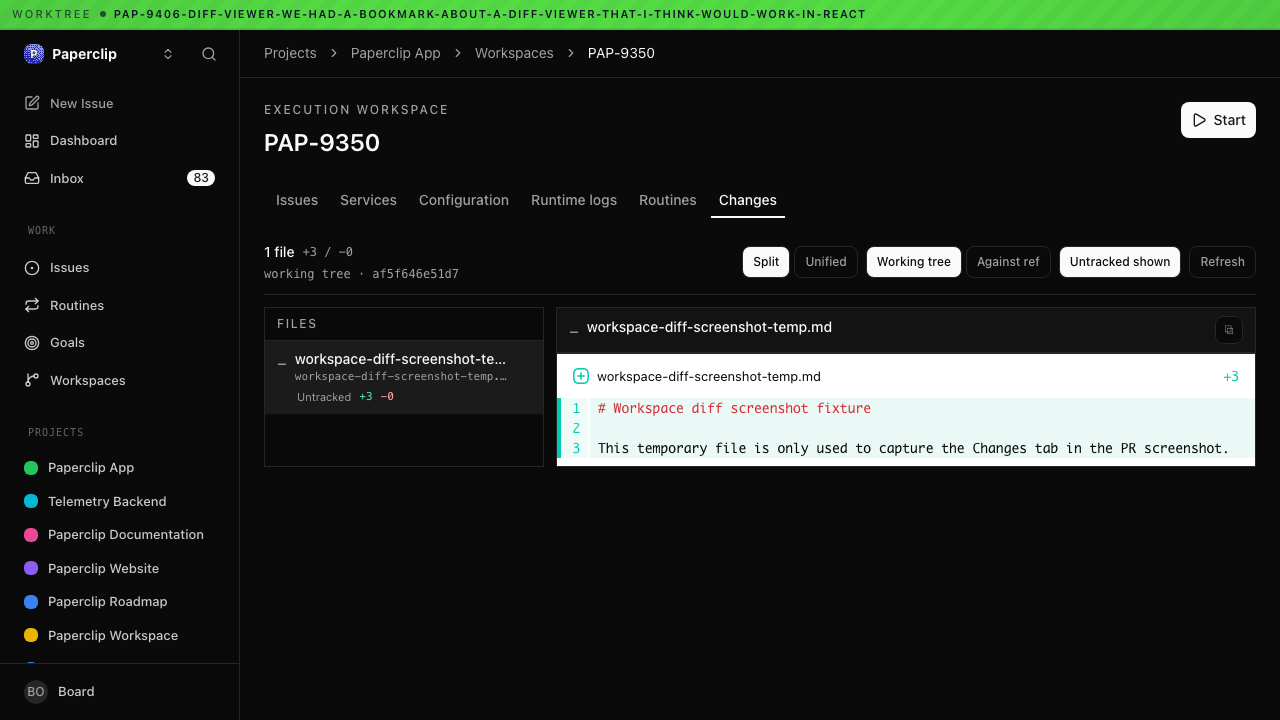
## Thinking Path > - Paperclip orchestrates AI agents for zero-human companies. > - Operators need to inspect what agents changed inside execution and project workspaces. > - The existing workspace detail views did not provide a first-party rich diff surface for staged, unstaged, head, renamed, binary, oversized, and untracked changes. > - The plugin system is the intended extension point for optional rich UI surfaces. > - This pull request adds a workspace diff plugin plus host services and shared contracts so Changes tabs can render workspace diffs through plugin slots. > - The diff-renderer dependency should stay owned by the plugin package rather than the core UI app. > - The dependency surface must stay aligned with repository PR policy, including intentionally omitting `pnpm-lock.yaml` from the PR. > - The benefit is a more reviewable workspace surface without hard-coding the renderer into every page. ## What Changed - Added `@paperclipai/plugin-workspace-diff`, including diff normalization, plugin manifest/worker/UI entrypoints, and focused plugin tests. - Kept `@pierre/diffs` scoped to `@paperclipai/plugin-workspace-diff`; removed the core UI lab diff-renderer surface and direct UI package dependency. - Added shared workspace diff types and validators, plus plugin SDK surface for workspace diff host services. - Added server workspace diff service support and route coverage for execution/project workspace diff flows. - Wired Execution Workspace and Project Workspace Changes tabs to load the diff plugin, including loading/error fallback behavior. - Added UI tests and fixtures for the Changes tabs and plugin bridge behavior. - Added the new plugin package manifest to the Docker deps stage so PR policy can validate dependency coverage. - Addressed review hardening around empty untracked patches, workspace path exposure, project workspace read capability checks, and default base refs. ## Verification - `pnpm --filter @paperclipai/plugin-workspace-diff test` - `pnpm exec vitest run packages/shared/src/validators/workspace-diff.test.ts server/src/__tests__/workspace-diff-service.test.ts ui/src/pages/ProjectWorkspaceDetail.test.tsx ui/src/pages/ExecutionWorkspaceDetail.test.tsx` - `pnpm exec vitest run ui/src/plugins/bridge.test.ts server/src/__tests__/workspace-runtime-routes-authz.test.ts` - `pnpm --filter @paperclipai/shared typecheck` - `pnpm --filter @paperclipai/plugin-workspace-diff typecheck` - `pnpm --filter @paperclipai/server typecheck` - `pnpm --filter @paperclipai/ui typecheck` - `node ./scripts/check-docker-deps-stage.mjs` - Browser screenshot captured from the local worktree dev server: https://files.catbox.moe/ofdpsp.png - Confirmed branch is rebased onto `public-gh/master`, `.github/workflows/pr.yml` is not included in the PR diff, `ui/package.json` is not included in the PR diff, and `pnpm-lock.yaml` is not included in the PR diff. ## Risks - Medium UI integration risk: the Changes tab depends on the plugin slot and host diff service path. - Medium dependency risk: this adds `@pierre/diffs` in the plugin package, but `pnpm-lock.yaml` is intentionally omitted per packaging instructions because repository automation manages lockfile updates. - Current CI blocker: downstream frozen installs fail until the repository policy path for new plugin package dependencies is chosen. - Diff rendering edge cases are covered for common working-tree and head diff states, but very large repositories may still expose performance limits. - No migrations are included. > For core feature work, check [`ROADMAP.md`](ROADMAP.md) first and discuss it in `#dev` before opening the PR. Feature PRs that overlap with planned core work may need to be redirected — check the roadmap first. See `CONTRIBUTING.md`. ## Model Used - OpenAI Codex, GPT-5 class coding model, tool-enabled local execution environment. Exact context window was not exposed by the runtime. ## Checklist - [x] I have included a thinking path that traces from project context to this change - [x] I have specified the model used (with version and capability details) - [x] I have checked ROADMAP.md and confirmed this PR does not duplicate planned core work - [x] I have run tests locally and they pass - [x] I have added or updated tests where applicable - [x] If this change affects the UI, I have included before/after screenshots - [x] I have updated relevant documentation to reflect my changes - [x] I have considered and documented any risks above - [x] I will address all Greptile and reviewer comments before requesting merge --------- Co-authored-by: Paperclip <noreply@paperclip.ing> |
||
|
DottaandPaperclip
|
0096b56a1c |
[codex] Add LLM Wiki plugin host support (#5597)
## Thinking Path > - Paperclip orchestrates AI agents for zero-human companies. > - The plugin system needs host contracts and runtime support before large plugins can integrate cleanly. > - The source branch mixed the LLM Wiki package with supporting host/runtime work, managed plugin skills, root-level storage spaces, and a bookmarks reference plugin. > - [PAP-9173](/PAP/issues/PAP-9173) asked for the current branch to be split by file boundary: plugin package separately from everything else. > - [PAP-9188](/PAP/issues/PAP-9188) clarified that LLM Wiki may have plugin-local spaces, but Paperclip core should not reorganize top-level local storage into spaces. > - Follow-up review clarified that the bookmarks example should not ship in this PR either. > - This pull request contains the non-`packages/plugins/plugin-llm-wiki/` host/runtime work, keeps runtime state under the selected Paperclip instance root, and no longer includes the bookmarks example. ## What Changed - Added/updated plugin host contracts, SDK types, worker RPC plumbing, managed plugin skill support, and related server tests. - Removed the bookmarks example plugin package and its bundled-example/workspace references. - Removed the root-level local spaces CLI/migration surface and restored instance-root runtime defaults for config, db, logs, storage, secrets, workspaces, projects, and adapter homes. - Replaced shared root `space-paths` helpers with `home-paths` helpers for core runtime storage. - Tightened stranded recovery unique-conflict detection so concurrent recovery scans reuse the raced recovery issue when Postgres errors are wrapped. - Kept `packages/plugins/plugin-llm-wiki/` out of this PR diff; plugin-local spaces remain in the stacked plugin-only PR. ## Verification - `pnpm exec vitest run cli/src/__tests__/data-dir.test.ts cli/src/__tests__/home-paths.test.ts cli/src/__tests__/onboard.test.ts packages/shared/src/home-paths.test.ts packages/db/src/runtime-config.test.ts server/src/__tests__/agent-instructions-service.test.ts server/src/__tests__/claude-local-execute.test.ts server/src/__tests__/codex-local-execute.test.ts` - `pnpm exec vitest run packages/db/src/runtime-config.test.ts` - `pnpm exec vitest run server/src/__tests__/plugin-routes-authz.test.ts` - `pnpm --filter @paperclipai/server typecheck` - `pnpm exec vitest run server/src/__tests__/heartbeat-process-recovery.test.ts -t "reuses the raced stranded recovery issue"` skipped locally because embedded Postgres did not initialize on this macOS temp host; the code path was typechecked and is covered by Linux CI. - Boundary check: no core references remain for `PAPERCLIP_SPACE_ID`, `spaces migrate-default`, `@paperclipai/shared/space-paths`, `registerSpacesCommands`, or the removed bookmarks example. - Previous PR head `4f23e034` had green GitHub checks: `verify`, all four serialized server shards, `e2e`, `Canary Dry Run`, `policy`, Snyk, and `Greptile Review`. Current head `582f466d` is re-running checks after the bookmarks deletion. ## Risks - Plugin host changes touch shared runtime paths, so regressions would most likely appear in adapter startup, plugin loading, or local dev path defaults. - Removing the bookmarks example also removes one demonstration of plugin database namespaces plus local-folder persistence; remaining plugin examples still cover bundled example discovery and plugin host flows. - The plugin package itself is intentionally deferred to the stacked plugin-only PR, where LLM Wiki plugin-local spaces live. - Existing installs that tested the transient root-level spaces CLI should stop using it; this PR intentionally removes that unsupported migration surface before merge. > For core feature work, check [`ROADMAP.md`](ROADMAP.md) first and discuss it in `#dev` before opening the PR. Feature PRs that overlap with planned core work may need to be redirected — check the roadmap first. See `CONTRIBUTING.md`. ## Model Used - OpenAI GPT-5 Codex via Codex CLI, tool use and local code execution enabled; context window not exposed. ## Checklist - [x] I have included a thinking path that traces from project context to this change - [x] I have specified the model used (with version and capability details) - [x] I have checked ROADMAP.md and confirmed this PR does not duplicate planned core work - [x] I have run tests locally and they pass, except where noted above for host-specific embedded Postgres initialization - [x] I have added or updated tests where applicable - [x] If this change affects the UI, I have included before/after screenshots - [x] I have updated relevant documentation to reflect my changes - [x] I have considered and documented any risks above - [x] I will address all Greptile and reviewer comments before requesting merge Stacked follow-up: PR #5592 contains only `packages/plugins/plugin-llm-wiki/` and targets this branch. --------- Co-authored-by: Paperclip <noreply@paperclip.ing> |
||
|
DottaandPaperclip
|
3c73ed26b5 |
Expand plugin host surface (#5205)
## Thinking Path > - Paperclip orchestrates AI agents for zero-human companies > - The plugin system is the extension boundary for optional product capabilities > - Rich plugins need more than a worker entrypoint: they need scoped database storage, local project folders, managed agents/routines, host navigation, and reusable UI components > - The LLM Wiki work exposed those missing host surfaces while keeping plugin code outside the core control plane > - This pull request expands the core plugin host, SDK, server APIs, and UI bridge so plugins can declare and use those surfaces > - The benefit is that future plugins can integrate with Paperclip through documented, validated contracts instead of bespoke server or UI imports ## What Changed - Added plugin-managed database namespaces and migration tracking, including Drizzle schema/migration files and SQL validation for namespace isolation. - Added server support for plugin local folders, managed agents, managed routines, scoped plugin APIs, and plugin operation visibility. - Expanded shared plugin manifest/types/validators and SDK host/testing/UI exports for richer plugin surfaces. - Added reusable UI pieces for file trees, managed routines, resizable sidebars, route sidebars, and plugin bridge initialization. - Updated plugin docs and example plugins to use the expanded host and SDK surface. ## Verification - `pnpm install --frozen-lockfile` - `pnpm run preflight:workspace-links && pnpm exec vitest run packages/shared/src/validators/plugin.test.ts server/src/__tests__/plugin-database.test.ts server/src/__tests__/plugin-local-folders.test.ts server/src/__tests__/plugin-managed-agents.test.ts server/src/__tests__/plugin-managed-routines.test.ts server/src/__tests__/plugin-orchestration-apis.test.ts ui/src/api/plugins.test.ts ui/src/components/FileTree.test.tsx ui/src/components/ResizableSidebarPane.test.tsx ui/src/pages/PluginPage.test.tsx ui/src/plugins/bridge.test.ts` passed: 11 files, 67 tests. - Confirmed this PR changes 89 files and does not include `pnpm-lock.yaml` or `.github/workflows/*`. ## Risks - Medium: this expands plugin host contracts across db/shared/server/ui and includes a new core migration (`0076_useful_elektra.sql`). - The plugin database namespace validator is intentionally restrictive; plugin authors may need follow-up affordances for SQL patterns that remain blocked. - Merge this before the LLM Wiki plugin PR so the plugin can resolve the new SDK and host APIs. > For core feature work, check [`ROADMAP.md`](ROADMAP.md) first and discuss it in `#dev` before opening the PR. Feature PRs that overlap with planned core work may need to be redirected — check the roadmap first. See `CONTRIBUTING.md`. ## Model Used - OpenAI Codex, GPT-5 coding agent, tool-enabled shell/git/GitHub workflow. Context window size was not exposed by the runtime. ## Checklist - [x] I have included a thinking path that traces from project context to this change - [x] I have specified the model used (with version and capability details) - [x] I have checked ROADMAP.md and confirmed this PR does not duplicate planned core work - [x] I have run tests locally and they pass - [x] I have added or updated tests where applicable - [x] If this change affects the UI, I have included before/after screenshots - [x] I have updated relevant documentation to reflect my changes - [x] I have considered and documented any risks above - [x] I will address all Greptile and reviewer comments before requesting merge --------- Co-authored-by: Paperclip <noreply@paperclip.ing> |