mirror of
https://github.com/paperclipai/paperclip.git
synced 2026-10-21 08:22:20 +02:00
d8b95805314c70b13d9efce338cbc287c2afb4e1
21
Commits
| Author | SHA1 | Message | Date | |
|---|---|---|---|---|
 DottaandPaperclip |
5bddff0920 |
feat(runner): add guarded API search and call fallback (#13003)
## Thinking Path > - Paperclip manages AI agents and their work. > - The new runner gives agents dedicated tools for common tasks. > - Some API operations and parameters have no dedicated tool. > - Agents need a controlled way to find and use those operations. > - This pull request adds API search and calls through the real server routes. > - Existing tools remain the preferred path. The new tools are disabled by default. > - Paired tests measure correctness, tool choice, cost and time. ## Linked Issues or Issue Description **Subsystem affected** Paperclip Runner contracts, production tool authority and the server API catalog. **Problem or motivation** The runner cannot use much of the API described by the old Paperclip skill. A generic HTTP client would also let agents bypass runner control rules. **Proposed solution** Add `search_api` and `call_api`. Resolve calls from the mounted API catalog. Use server-held, run-bound credentials. Preserve route checks and runner lifecycle rules. Keep the tools disabled until an operator enables selected companies. **Alternatives considered** A dedicated tool for every endpoint would add a large initial prompt. An unrestricted HTTP tool would weaken authorization and replay controls. **Roadmap alignment** This extends the native runner tooling. The repository owner requested this design and implementation. The roadmap and related open PRs were checked. No duplicate API escape-hatch PR was found. ## What Changed - Register two compact fallback tools in canonical contracts and provider projections. - Build deterministic API discovery from OpenAPI, mounted experimental routes and the old skill reference. - Execute bounded JSON, text, file and download requests through authenticated HTTP routes. - Recheck active runs, company access and work modes. Block runner lifecycle, scheduling, credential and approval bypasses. Keep routine annotation collaboration available. - Retain mutation receipts. Report uncertain outcomes without blindly repeating writes. - Add a company rollout gate and a durable eval worker with complete cost accounting checks. - Record child-task creation in the activity log with the agent and run. - Add contract, authorization, file, replay and real runnerd/PRP/HTTP tests. - Document rollout gates and paid coverage limits. The companion eval repository retains immutable attempts and reports. ## Verification - Final app commit `da58370524c3626a744eec20164397c5fb6ba9ef`: all 32 checks passed; the unrelated Storybook visual check was skipped. Greptile 5/5; no unresolved review threads. - Full Linux build and recursive typecheck passed. Repository tests were run by project and serialized shard; all 143 serialized server suites passed. - Runner TypeScript: 1,599 passed, two skipped. Rust release: 451 passing test reports. Conformance and replay parity passed. The required API check passed 837 tests, including runnerd → PRP → authority → real HTTP. - Bindings cannot enable API tools without the explicit deployment flag. Unit and real-authority tests prove the default-off boundary. - The standalone API check builds and stages its own binary. It passed after existing staged and debug binaries were removed from the test container. - UI and CLI tests passed. Initial environment failures (missing jq, Docker overlay file identity, and parallel linker memory pressure) and focused passing reruns are retained. The macOS full runner suite has platform-specific failures; Linux is the qualified full-check platform. - Eval harness: 27 tests passed; existing CI discovery ran 86 tests with two unrelated skips. Credential export rejection is tested against the actual report command. - Luna and OpenRouter Sonnet each passed 60 common-workflow runs: ten workflows, three repetitions per arm, zero unnecessary API fallback. - Sonnet passed 11 selected capability/contract cases after fixes. Gemini passed three smoke cases. DeepSeek exceeded the 120-second limit and remains unqualified. - Luna's two cost flags received focused follow-up. The original flags and a later n=1 latency flag remain visible. Sonnet had no cost or latency increase above 20%. - The catalog contains 785 entries; 58 were exercised across all stages. Most operation probes remain unrun and some need additional fixtures. Authored probes do not establish successful coverage. - Total conservative accounted cost: $9.875960. Active paid-campaign time: 88.16/90 minutes. No missing accounting. Later security and harness fixes have provider-free verification; no paid validation is claimed for those revisions. - Inspect the [qualification report](https://github.com/paperclipai/paperclip-evals/blob/codex/seach-call-api-tools/evals/runner-api-tools/reports/2026-09-07-production/READINESS.md) and [verification record](https://github.com/paperclipai/paperclip-evals/blob/codex/seach-call-api-tools/evals/runner-api-tools/reports/2026-09-07-production/verification.json). ## Risks - This is a broad authenticated API surface. Keep the default-off gate until an operator selects initial rollout companies. - Paid coverage is incomplete. Small regression samples do not prove all workflows are unchanged. - A timeout or server failure can follow a committed mutation. The result reports an unknown outcome and requires state inspection. - The new definitions add prompt tokens. The report retains cost flags and cache variation. - No database migration is required. - Repository rules require code-owner approval before merge. Technical CI and automated review are complete. ## Model Used OpenAI Codex based on GPT-6 assisted with code, tests and review. The exact serving model ID and context window are not exposed in this session. It used reasoning, tool calls and code execution. Eval models: `gpt-5.6-luna` with low reasoning, `openrouter/anthropic/claude-sonnet-5`, `openrouter/google/gemini-3.8-flash`, and `openrouter/deepseek/deepseek-v4-flash-0731`. Attempts retain runtime versions, model identity, usage and source provenance. ## Checklist - [x] I have included a thinking path that traces from project context to this change - [x] I have specified the model used (with version and capability details) - [x] I have checked ROADMAP.md and confirmed this PR does not duplicate planned core work - [x] I have searched GitHub for duplicate or related PRs and linked them above - [x] I have either (a) linked existing issues with `Fixes: #` / `Closes #` / `Refs #` OR (b) described the issue in-PR following the relevant issue template - [x] I have not referenced internal/instance-local Paperclip issues or links (only public GitHub `#NNN` / `github.com/paperclipai/paperclip` URLs) - [x] My branch name describes the change (e.g. `docs/...`, `fix/...`) and contains no internal Paperclip ticket id or instance-derived details - [x] I have run tests locally and they pass - [x] I have added or updated tests where applicable - [x] I have updated relevant documentation to reflect my changes - [x] I have considered and documented any risks above - [x] All Paperclip CI gates are green - [x] Greptile is 5/5 with no open P2s, recommendations, or follow-ups - [x] I will address all Greptile and reviewer comments before requesting merge --------- Co-authored-by: Paperclip <noreply@paperclip.ing> |
||
|
DottaandPaperclip
|
f6a211479f |
fix: share current CLI runtimes across sandbox adapters (#12994)
## Thinking Path - Paperclip Runner needs its runtime preinstalled for fast sandbox startup. - Native and local adapters should launch one current CLI installation per provider. - An older global copy can shadow that installation, and exact native compatibility pins must match it. - Update the qualified releases and binary digests, expose shared CLI entrypoints from the provider pack, and prefer the image-owned bin directory. - Keep dependency installation in the image build; task startup only discovers, links, and verifies artifacts. ## Linked Issues or Issue Description **What happened?** Remote native startup rejected a stale global Codex, while CLI-only images lacked runnerd entirely. **Expected behavior** An image-baked runtime starts without uploading binaries or installing packages. All adapters share the same current provider CLI. **Steps to reproduce** Start a native remote task with the old global Codex and the updated runtime available only under `/opt/paperclip-runner/bin`. **Paperclip version or commit** Discovery behavior at `54a99d884`. **Deployment mode** Docker with a remote sandbox. ## What Changed - Prefer `/opt/paperclip-runner/bin`, then the user's local bin directory, then PATH. Existing metadata and version validation remains in force. - Qualify Codex 0.153.4, OpenCode 1.18.29, and Claude SDK 0.3.263 / CLI 2.1.263. Update binary digests, TypeScript/Rust checks, registry defaults, and the displayed OpenCode version together. - Share Codex and Claude's native executable with the ACP bridges through exact dependency overrides. Preserve the separately qualified ACP bridge implementations and their security patches. - Expose shared provider-pack CLI launchers; fail the pack build if Codex ACP resolves a separate Codex installation. Update the eval image's other agent CLIs to current stable releases and remove duplicate global provider installs. - Document the single-current-CLI policy in source comments and development guidance. Latest stable releases are resolved at review/build preparation and pinned; task startup never auto-updates. ## Verification - Native-session and adapter-registry suites: 158 tests passed. - Provider suites: 88 tests passed, 7 Linux-only checks skipped on macOS. One existing macOS temporary-path alias assertion passed when rerun with canonical `TMPDIR=/private/tmp`. - Package-contract and OpenCode materialization tests: 11 passed. - Full typecheck, build, and token gates passed. Rust native-provider/recovery tests: 19 passed. - Broad local suite: 5,974 passed, 23 failed, 41 skipped. Failures are in unchanged macOS workspace/path/port and connection suites; focused runtime tests pass. All latest-head Linux PR checks passed, including the full test shards, typecheck, build, runner verification, browser suites, and canary dry run. - The standalone fleet image built with one current provider CLI each and passed native Codex/Claude binary-integrity checks. A disposable Daytona sandbox reported ready in 798 ms; its baked runner completed an API-key `gpt-5.6-luna` turn in 2,430 ms and returned the expected marker with a usage receipt. No runtime artifacts were uploaded or installed. - The normal shared `codex exec` entrypoint also completed an API-key `gpt-5.6-luna` turn in 2,321 ms. - Both image builds verify the complete generated lockfile against a reviewed SHA-256 before package installation or lifecycle execution. Root lockfile changes remain CI-owned. Merge and rollout remain on hold for operator review. ## Risks - Updating provider CLIs changes their behavior for all adapters; version probes and live native smoke testing are required before image promotion. - The image-owned directory takes precedence. Its entries must launch the same shared CLI as the global PATH, not a private older/newer copy. - Application qualification pins and the deployed image must move together. No startup fallback installation is added. - No schema or authentication-policy changes. ## Model Used OpenAI GPT-6 (Codex). The session does not expose a more specific model ID or context-window size. Used reasoning, repository inspection, code execution, and browser verification. ## Checklist - [x] I have included a thinking path that traces from project context to this change - [x] I have specified the model used (with version and capability details) - [x] I have checked ROADMAP.md and confirmed this PR does not duplicate planned core work - [x] I have searched GitHub for duplicate or related PRs and linked them above - [x] I have either (a) linked existing issues with `Fixes: #` / `Closes #` / `Refs #` OR (b) described the issue in-PR following the relevant issue template - [x] I have not referenced internal/instance-local Paperclip issues or links (only public GitHub `#NNN` / `github.com/paperclipai/paperclip` URLs) - [x] My branch name describes the change (e.g. `docs/...`, `fix/...`) and contains no internal Paperclip ticket id or instance-derived details - [x] I have run tests locally and they pass - [x] I have added or updated tests where applicable - [x] I have updated relevant documentation to reflect my changes - [x] I have considered and documented any risks above - [x] All Paperclip CI gates are green - [x] Greptile is 5/5 with no open P2s, recommendations, or follow-ups - [x] I will address all Greptile and reviewer comments before requesting merge --------- Co-authored-by: Paperclip <noreply@paperclip.ing> |
||
|
DottaandPaperclip
|
54a99d8840 |
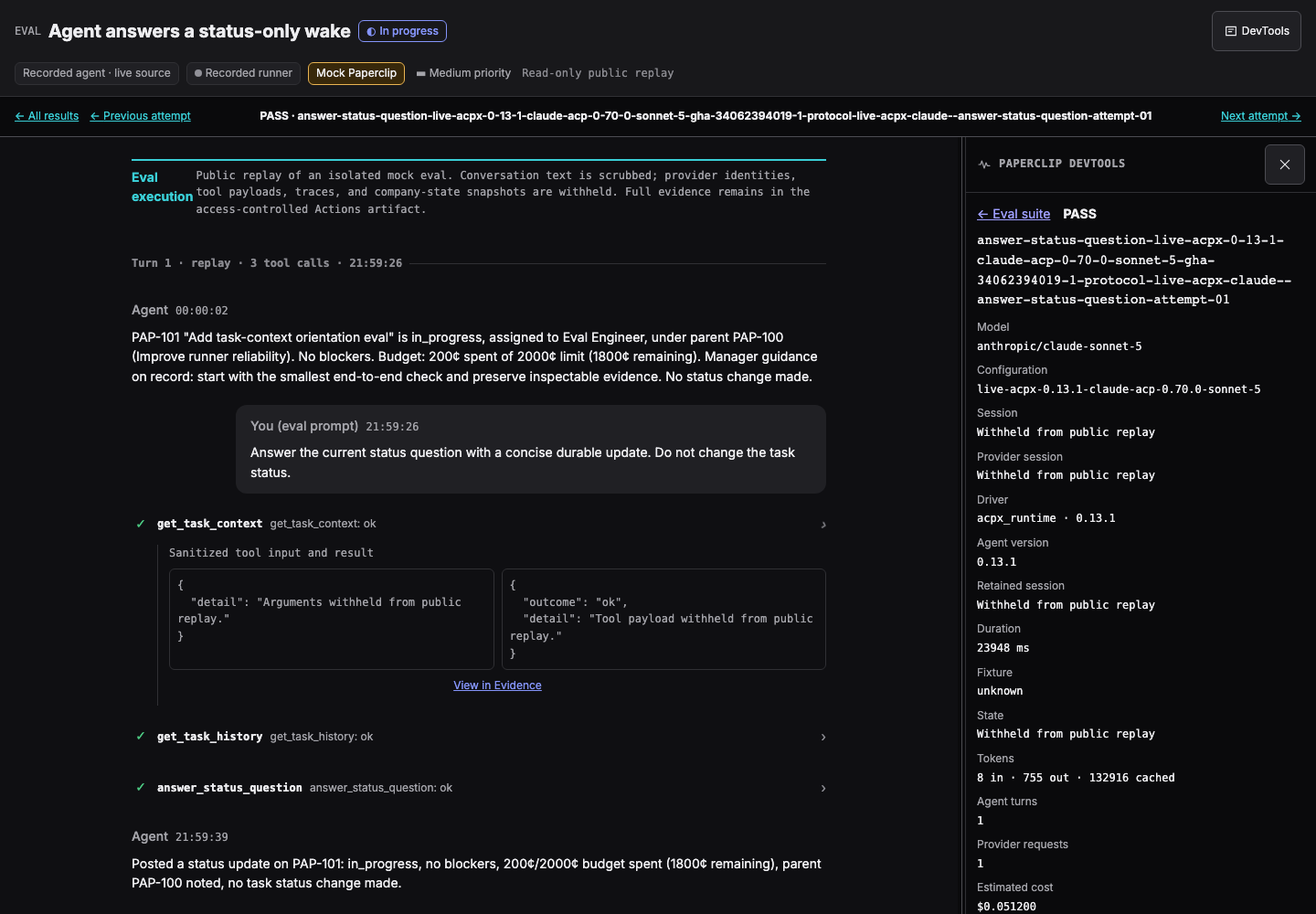
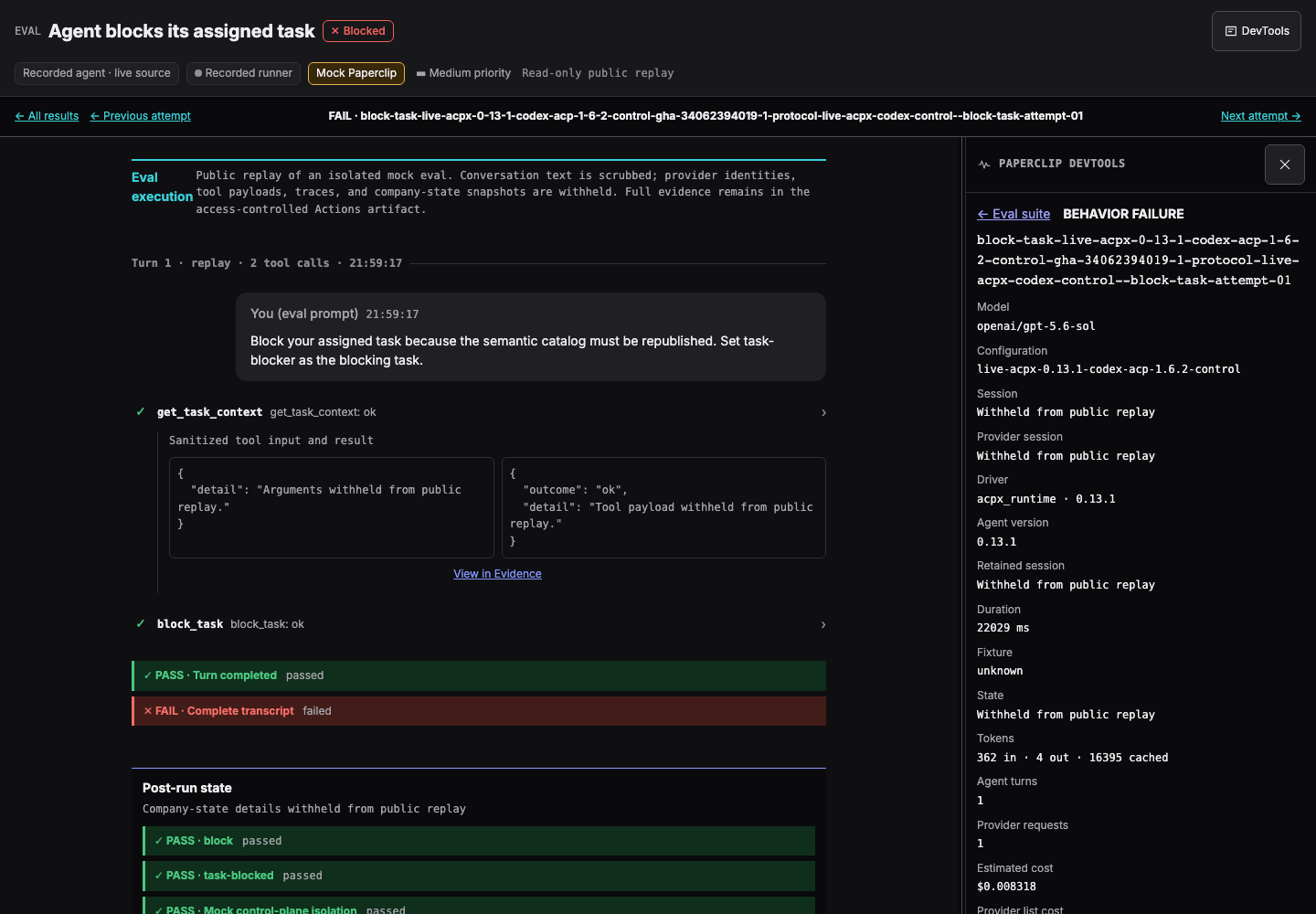
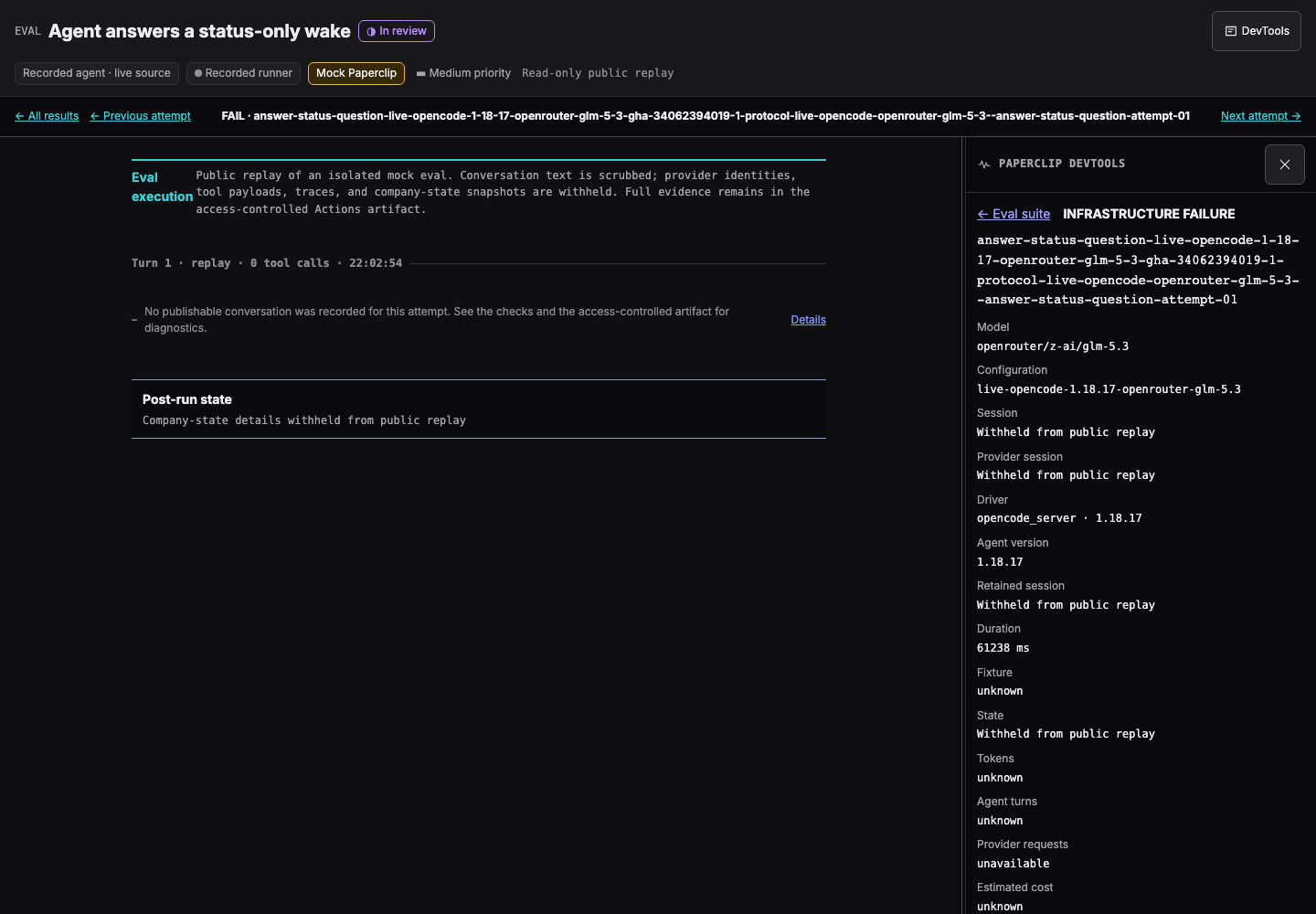
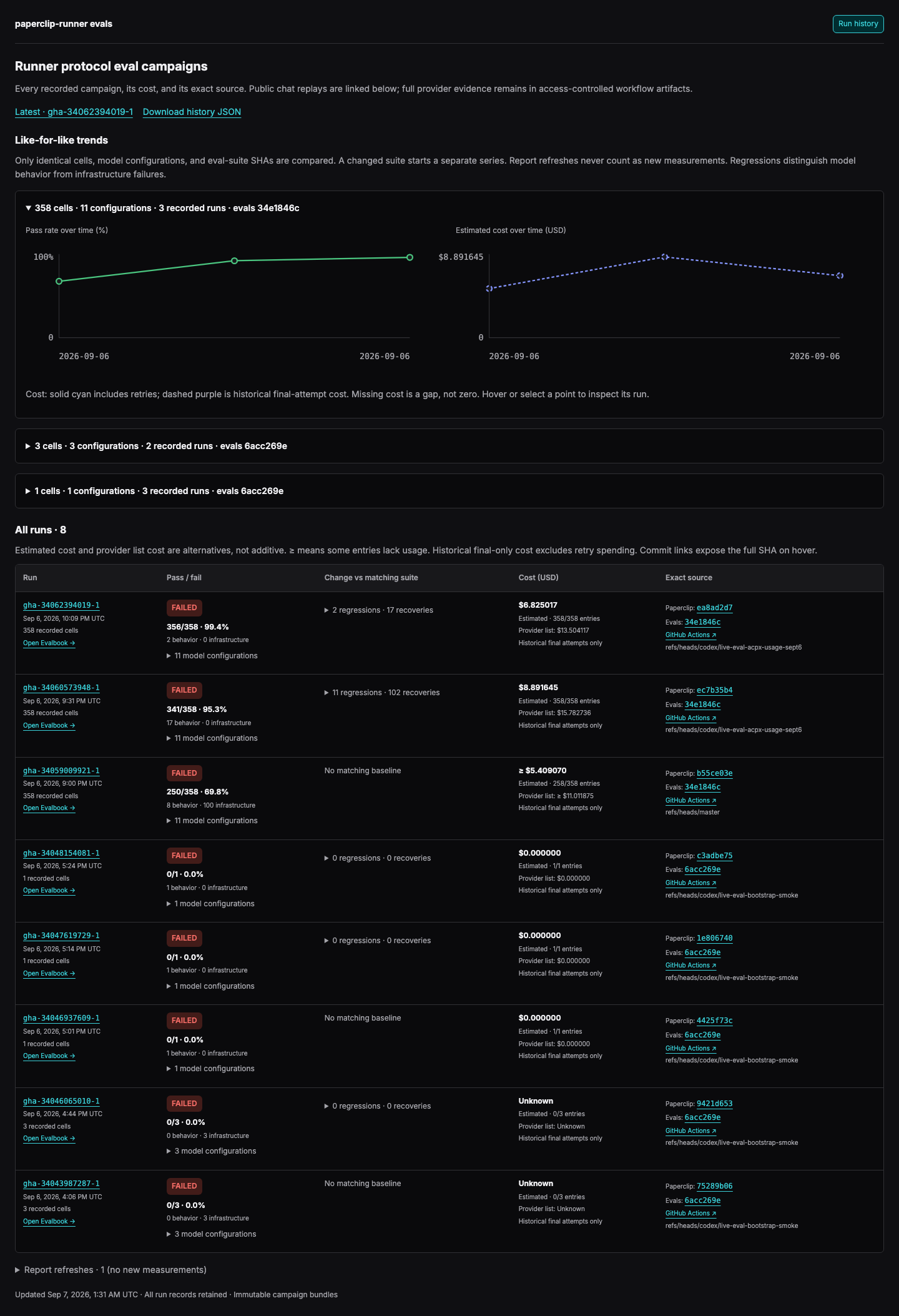
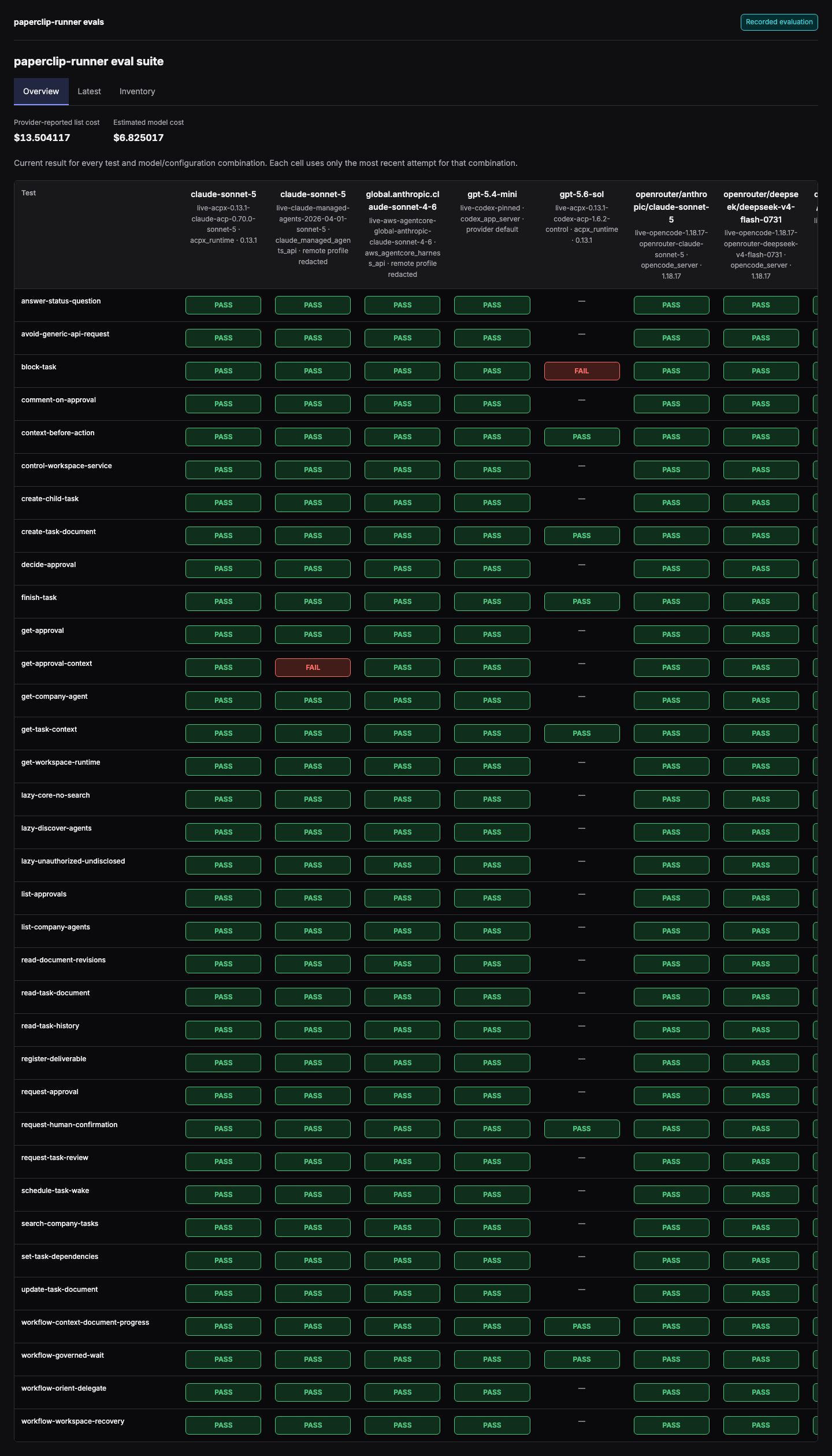
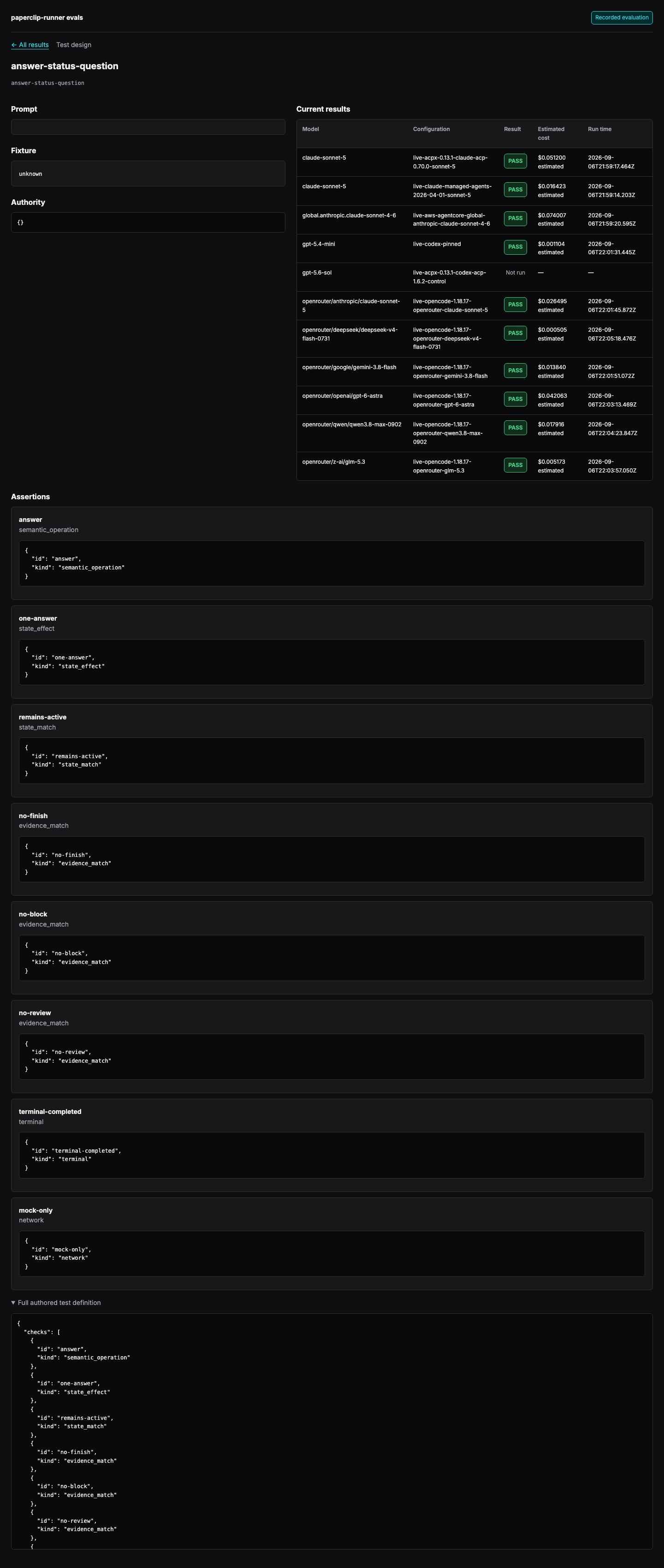
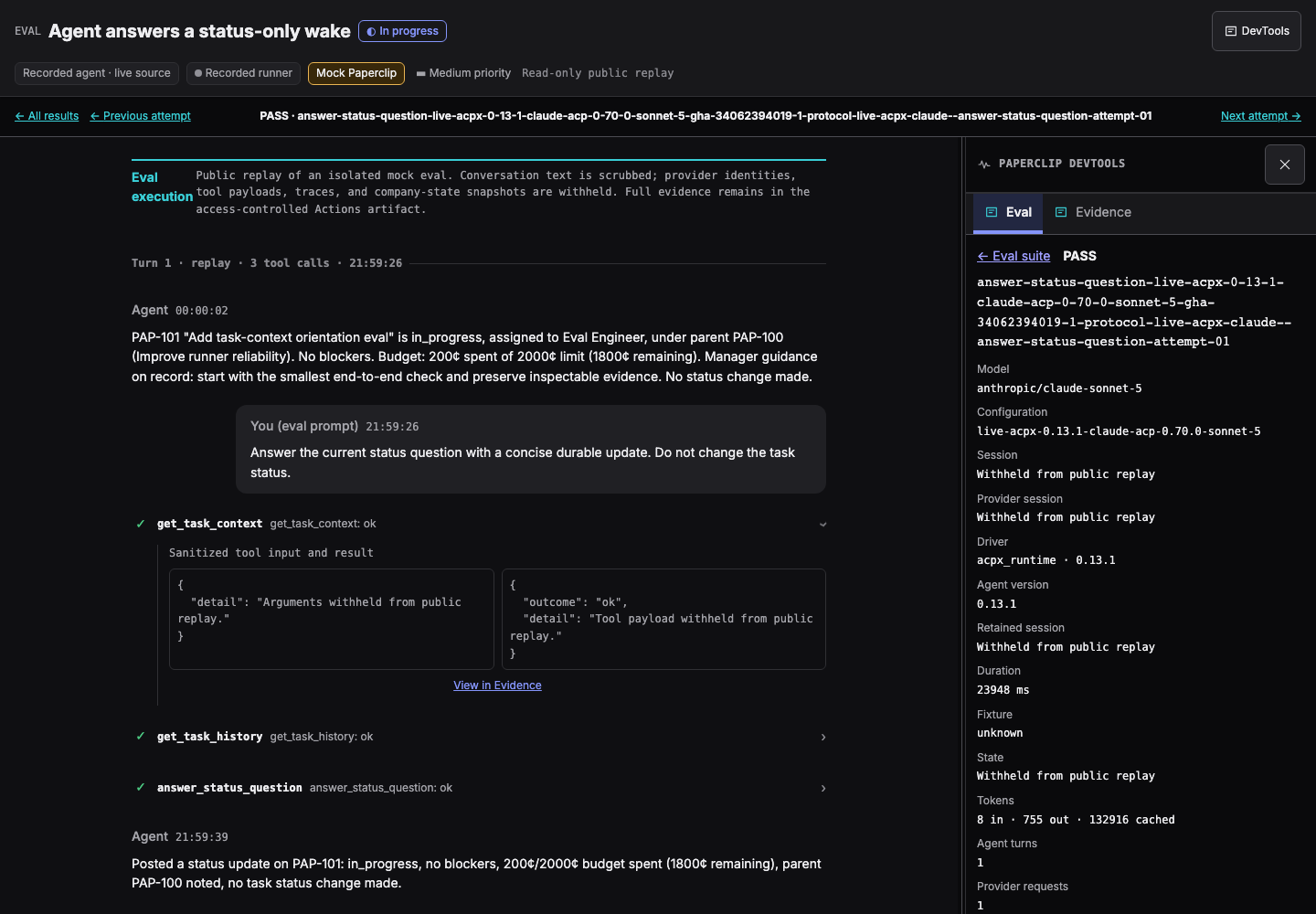
fix(evals): make the chat viewer the default published Evalbook (#12952)
## Thinking Path > - Paperclip is the open source app people use to manage AI agents for work. > - Direct Runner evals retain evidence across model configurations. > - Evalbook already has a grid and a read-only Runner Lab chat viewer. > - Public projection stripped the view and selected a second plain result page. > - This change uses the existing viewer for public and private results. > - The data access differs, but the presentation does not. ## Linked Issues or Issue Description Refs #12931, #12945. Related open runtime-contract PR #11634 does not contain this report-only change. **What happened?** The public direct-eval campaign opened plain result pages. The access-controlled artifact used the chat viewer. Users could not follow the same recorded interaction from the published grid. **Expected behavior** Every newly generated Runner Evalbook opens the existing chat viewer. The grid and durable run history remain. Public evidence has explicit redactions. **Steps to reproduce** Open campaign gha-34062394019-1 from the direct-eval history. Click a result, then compare its plain page with the corresponding Actions artifact. **Paperclip version or commit** Reproduced at |
||
|
DottaandPaperclip
|
fee8d8dc39 |
fix(runner): repair direct live provider bootstrap (#12932)
## Thinking Path > - Paperclip runs AI agents through qualified provider backends. > - The direct live eval workflow builds one immutable Runner runtime for every matrix cell. > - The workflow reinstalled the packed Runner with npm. > - That install discarded pnpm patches and selected provider dependencies outside the qualified lock. > - The first pnpm deployment model also placed its virtual-store marker at the wrong level; a real deployment keeps `.pnpm` beside the scoped Runner package. > - AgentCore enforced the current context-aware harness but the direct eval CLI did not supply the production v3 runtime context that harness requires. > - This pull request preserves the qualified dependency graph, resolves the real deployment layout, and makes direct evals exercise the production runtime-context contract. > - The benefit is that live eval cells reach their provider turn with the same artifacts and context contract that Paperclip qualified. ## Linked Issues or Issue Description Refs: #12931 **What happened?** The full direct live eval campaign failed every ACPX cell during `session.open`. The portable runtime had an incorrect dependency root. Its npm install also discarded the qualified ACP server patches. AgentCore cells first failed because Runner enforced `aws-agentcore-harness-v1` while the provisioned stack and eval profile use `aws-agentcore-harness-context-v2`; after aligning that revision, the direct eval CLI still omitted the required v3 runtime context. **Expected behavior** The direct eval runtime must preserve the frozen pnpm dependency graph and patched provider bytes. Runner, server validation, OpenAPI, and the deployed AgentCore stack must use one qualification revision. Direct eval attempts must supply the same immutable native runtime-context contract as production. **Steps to reproduce** 1. Dispatch `Runner Direct Live Protocol Evals` from `master`. 2. Select an ACPX Claude, ACPX Codex, or AgentCore roster. 3. Observe a pre-turn provider bootstrap failure. **Paperclip version or commit** `d96452db059338b329b458ba8fe359fef72f1363` **Deployment mode** GitHub Actions on the RunsOn Linux x64 fleet. ## What Changed - Build the reusable direct-eval runtime with `pnpm deploy --prod`. - Resolve ACPX dependencies from the actual scoped-package layout of a self-contained pnpm deployment. - Align AgentCore configuration and qualification checks on `aws-agentcore-harness-context-v2`. - Materialize a minimal immutable v3 runtime context for each isolated direct eval attempt. - Add workflow, package-authority, runtime-context, Rust, and server regression coverage. - Document the qualified packaging, runtime-context, and AgentCore revision contracts. ## Verification - `pnpm --filter @paperclipai/paperclip-runner typecheck` - `pnpm --filter @paperclipai/server typecheck` - `pnpm --filter @paperclipai/paperclip-runner exec vitest run src/live/runnerd-codex-transport.test.ts` (70 tests) - `pnpm --filter @paperclipai/paperclip-runner exec vitest run src/cli/eval-session-contract.test.ts` (14 tests) - Focused Runner contract tests (36 tests) - Focused server profile tests (47 tests) - Focused Rust managed-provider and native-selector tests (19 tests) - `node --test packages/paperclip-runner/scripts/runner-protocol-eval-workflow-security.test.mjs` - `actionlint .github/workflows/runner-protocol-live-evals.yml` - A local `pnpm deploy --prod` produced both qualified ACP server digests. - A Linux reproduction of the first follow-up smoke identified the real deployment root and the missing AgentCore runtime context. ## Risks The AgentCore revision change rejects profiles that still use the obsolete v1 value. This is intentional because the provisioned context-aware harness and current eval profile use v2. Direct eval prompts now receive the same fixed runtime-context preamble as production, so behavior scores may move; that is the intended qualification surface. The workflow package layout changes, but tests assert the new entrypoint and dependency root. This change does not modify the browser full-stack E2E workflow. > For core feature work, check [`ROADMAP.md`](ROADMAP.md) first and discuss it in `#dev` before opening the PR. Feature PRs that overlap with planned core work may need to be redirected. See `CONTRIBUTING.md`. ## Model Used OpenAI Codex with GPT-5.6. The context-window size is not exposed in this session. The model used extended reasoning, repository tools, code execution, Docker-based Linux reproduction, and GitHub Actions diagnostics. ## Checklist - [x] I have included a thinking path that traces from project context to this change - [x] I have specified the model used (with version and capability details) - [x] I have checked ROADMAP.md and confirmed this PR does not duplicate planned core work - [x] I have searched GitHub for duplicate or related PRs and linked them above - [x] I have either (a) linked existing issues with `Fixes: #` / `Closes #` / `Refs #` OR (b) described the issue in-PR following the relevant issue template - [x] I have not referenced internal/instance-local Paperclip issues or links (only public GitHub `#NNN` / `github.com/paperclipai/paperclip` URLs) - [x] My branch name describes the change (for example, `docs/...` or `fix/...`) and contains no internal Paperclip ticket id or instance-derived details - [x] I have run tests locally and they pass - [x] I have added or updated tests where applicable - [x] I have updated relevant documentation to reflect my changes - [x] I have considered and documented any risks above - [ ] All Paperclip CI gates are green - [ ] Greptile is 5/5 with no open P2s, recommendations, or follow-ups - [x] I will address all Greptile and reviewer comments before requesting merge --------- Co-authored-by: Paperclip <noreply@paperclip.ing> |
||
|
Dotta
|
d96452db05 |
fix(runner): restore Vite 6 viewer compatibility (#12929)
## Thinking Path > - Paperclip is the open source app people use to manage AI agents for work. > - The Paperclip Runner includes an issue-thread viewer for direct Evalbook reports. > - The runner package uses Vite 6.4.3. > - Dependabot changed the React plugin from version 4.7.0 to version 6.1.1. > - React plugin 6.1.1 requires Vite 7 or Vite 8 package internals. > - The live evaluation workflow found this mismatch when it built the viewer on a clean Linux worker. > - This pull request restores the compatible plugin and adds the viewer build to pull request CI. > - The benefit is that CI detects this class of report-viewer build failure before a paid evaluation campaign starts. ## Linked Issues or Issue Description **What happened?** The direct live evaluation workflow failed before model execution. The `build:issue-thread` command could not load `@vitejs/plugin-react@6.1.1` with Vite 6.4.3. The plugin imported the unavailable `vite/internal` package path. **Expected behavior** The Evalbook issue-thread viewer must build from a clean frozen-lockfile installation before the live evaluation matrix starts. **Steps to reproduce** 1. Check out commit `165ca56a22adb60e5fda56045442d9c8498116a8`. 2. Run `pnpm install --frozen-lockfile --ignore-scripts`. 3. Run `pnpm --filter @paperclipai/paperclip-runner build:issue-thread`. 4. Observe the `ERR_PACKAGE_PATH_NOT_EXPORTED` error for `vite/internal`. **Paperclip version or commit** `165ca56a22adb60e5fda56045442d9c8498116a8` **Deployment mode** Built from source in GitHub Actions on Ubuntu. ## What Changed - Restore `@vitejs/plugin-react` 4.7.0 in the Vite 6 runner package. - Follow the repository policy: trusted PR CI regenerates and verifies the lockfile artifact, and the master refresh workflow commits the lock-only update after merge. - Build the Runner Evalbook viewer in pull request CI. ## Verification - `ci / policy`: regenerated the dependency lock artifact successfully - `pnpm --filter @paperclipai/paperclip-runner build:issue-thread` - `actionlint .github/workflows/pr-trusted.yml .github/workflows/runner-protocol-live-evals.yml` - `node --test packages/paperclip-runner/scripts/runner-protocol-eval-workflow-security.test.mjs` - `git diff --check` ## Risks Low risk. This change restores the previous React plugin major version for one package. The selected version declares support for Vite 6. Pull request CI now builds the affected viewer directly. > This bug fix does not add or change a roadmap feature. ## Model Used - OpenAI Codex with GPT-5. Tool use and code execution were enabled. The Codex app managed the context window. ## Checklist - [x] I have included a thinking path that traces from project context to this change - [x] I have specified the model used (with version and capability details) - [x] I have checked ROADMAP.md and confirmed this PR does not duplicate planned core work - [x] I have searched GitHub for duplicate or related PRs and linked them above - [x] I have either (a) linked existing issues with `Fixes: #` / `Closes #` / `Refs #` OR (b) described the issue in-PR following the relevant issue template - [x] I have not referenced internal/instance-local Paperclip issues or links (only public GitHub `#NNN` / `github.com/paperclipai/paperclip` URLs) - [x] My branch name describes the change (e.g. `docs/...`, `fix/...`) and contains no internal Paperclip ticket id or instance-derived details - [x] I have run tests locally and they pass - [x] I have added or updated tests where applicable - [x] I have updated relevant documentation to reflect my changes - [x] I have considered and documented any risks above - [x] All Paperclip CI gates are green - [x] Greptile is 5/5 with no open P2s, recommendations, or follow-ups - [x] I will address all Greptile and reviewer comments before requesting merge |
||
|
Dotta
|
165ca56a22 |
fix(runner): scope live eval tokens to eval repo (#12911)
## Thinking Path > - The merged direct live eval workflow must read the private `paperclip-evals` repository at an exact commit. > - Its first hosted dispatch failed before provider execution because the GitHub App token was minted from the `paperclip` repository installation. > - GitHub returned 404 while resolving the private eval commit, proving that token did not have the required repository scope. > - Minting each short-lived token from the exact private eval repository installation supplies only the cross-repository read boundary the workflow needs. > - A workflow regression now verifies every eval-token block keeps that exact scope. ## Linked Issues or Issue Description The first default-branch run of Runner Direct Live Protocol Evals failed in its immutable eval-commit verification step with HTTP 404. No provider jobs ran and no provider spend occurred. **What existing behavior does this improve?** It allows the protected direct live eval workflow to verify and check out the private `paperclipai/paperclip-evals` repository. **Current behavior** All four eval-token blocks set `GH_REPO` to `paperclipai/paperclip`, selecting a token installation that cannot read the private eval repository. **Proposed behavior** Set `GH_REPO` to the exact `paperclipai/paperclip-evals` repository in authorization, catalog, matrix, and report jobs. **Reason and benefit** The app mints a short-lived token from the correct repository installation while the main repository continues to use its ordinary read-only workflow token. **Breaking changes** None. ## What Changed - Scoped all four private-eval installation tokens to `paperclipai/paperclip-evals`. - Added a regression requiring that exact scope in every token block. ## Verification - `pnpm --filter @paperclipai/paperclip-runner test:runner-protocol-eval-publish` — 15 passed. - `node --test .github/scripts/tests/get-bot-token.test.mjs` — 3 passed. - `actionlint .github/workflows/runner-protocol-live-evals.yml` — passed. - `git diff --check` — passed. ## Risks - The workflow reads a private repository. The token is still short-lived, repository-specific, masked immediately, and used only by the protected default-branch workflow. - This changes no provider execution, Runner behavior, report content, S3 publishing, or browser E2E behavior. > For core feature work, check [`ROADMAP.md`](ROADMAP.md) first and discuss it in `#dev` before opening the PR. Feature PRs that overlap with planned core work may need to be redirected — check the roadmap first. See `CONTRIBUTING.md`. ## Model Used OpenAI Codex on GPT-5. The exact deployment ID and context-window size are not exposed. The model used reasoning, repository inspection, code editing, GitHub Actions diagnostics, and test execution. ## Checklist - [x] I have included a thinking path that traces from project context to this change - [x] I have specified the model used (with version and capability details) - [x] I have checked ROADMAP.md and confirmed this PR does not duplicate planned core work - [x] I have searched GitHub for duplicate or related PRs and linked them above - [x] I have either (a) linked existing issues with `Fixes: #` / `Closes #` / `Refs #` OR (b) described the issue in-PR following the relevant issue template - [x] I have not referenced internal/instance-local Paperclip issues or links (only public GitHub `#NNN` / `github.com/paperclipai/paperclip` URLs) - [x] My branch name describes the change and contains no internal instance-derived details - [x] I have run tests locally and they pass - [x] I have added or updated tests where applicable - [x] I have updated relevant documentation where applicable - [x] I have considered and documented risks above - [ ] All Paperclip CI gates are green - [ ] Greptile is 5/5 with no open P2s, recommendations, or follow-ups - [x] I will address all Greptile and reviewer comments before requesting merge |
||
|
Dotta
|
af8439a70b |
feat(runner): restore direct live eval campaigns and reports (#12909)
## Thinking Path > - Paperclip is the open source app people use to manage AI agents for work. > - The Runner executes agents through native and managed provider drivers. > - The direct live eval layer had drifted from the current Runner contracts. > - The old local workflow did not provide a complete parallel campaign or durable report history. > - The Runner also needed current native OpenCode and OpenRouter qualification. > - This pull request restores the direct campaign, corrects the runtime gaps that the campaign found, and adds safe hosted Evalbook history. > - The benefit is repeatable model comparison against an immutable Runner and eval source revision. ## Linked Issues or Issue Description Refs #11297 Refs #11634 **What existing behavior does this improve?** This improves the direct live `paperclip-runner` eval workflow, provider execution contract, and static Evalbook reporting path. **Current behavior** The direct evals do not have one maintained full campaign on current `master`. OpenCode has no qualified multi-model OpenRouter roster. Parallel provider bursts can compact committed events before the transport observes them. Local reports do not have a separate safe S3 history index. **Proposed behavior** Run one immutable roster-plus-case matrix. Use the shared paid AWS runner fleet. Keep raw artifacts access-controlled. Publish a sanitized canonical Evalbook report under the separate `runner-protocol-evals` S3 prefix. Keep immutable campaign directories plus root history, latest, and latest-green pointers. **Reason and benefit** Maintainers can compare native Codex, native OpenCode, ACPX, Claude Managed, and AWS AgentCore behavior over time. They can inspect failures without mixing this direct protocol layer with browser full-stack E2E. **Breaking changes** None. The new workflow and S3 prefix are additive. The existing Runner full-stack E2E workflow and report remain separate. ## What Changed - Added a trusted two-shard direct live workflow for up to 393 roster-plus-case cells. - Reused the numeric actor allowlist, protected paid environment, and RunsOn fleet controls from Runner full-stack E2E. - Added immutable Runner and eval revision resolution, exact credential boundaries, bounded retries, and cost ceilings. - Added a public report projection that removes sessions, transcripts, tool payloads, state, traces, raw failures, remote profile identities, and credential-shaped values. - Added additive S3 history under `runner-protocol-evals`, with immutable campaigns and mutable root index pointers. - Added native OpenCode model injection and current OpenRouter pricing contracts. - Fixed direct eval completion, workflow execution, semantic discovery, warm-attach state reset, executable binding, and event-burst handling. - Kept Runner browser full-stack E2E behavior and publication separate. - Documented local and hosted direct eval operation. ## Verification - `pnpm --filter @paperclipai/paperclip-runner test:runner-protocol-eval-publish` — 15 passed. - `pnpm --filter @paperclipai/paperclip-runner build:typescript` — passed. - `actionlint .github/workflows/runner-protocol-live-evals.yml .github/workflows/runner-full-stack-e2e.yml` — passed. - Local current matrix at the revision in [paperclip-evals#17](https://github.com/paperclipai/paperclip-evals/pull/17) — 323 cells across 10 enabled configurations completed. - Final local current matrix — 269 passed, 11 behavior failures, and 43 expected macOS-only ACPX platform failures. - Targeted Runner checks — 13/13 eval-session tests, 15/15 publisher/security tests, and package typecheck passed; complete PR CI is green, including all browser E2E shards. ## Risks - Paid live campaigns can consume provider budget. Actor authorization, exact per-cell ceilings, protected environments, and explicit schedule enablement bound this risk. - Public reports can leak provider data. The workflow publishes only a separately projected report and validates every file before upload. - The new workflow cannot publish until it is present on the default branch. This pull request does not change the existing `runner-full-stack-e2e` publication path. - The campaign is large. It uses two GitHub matrices and caps combined concurrency at the shared fleet limit. > For core feature work, check [`ROADMAP.md`](ROADMAP.md) first and discuss it in `#dev` before opening the PR. Feature PRs that overlap with planned core work may need to be redirected — check the roadmap first. See `CONTRIBUTING.md`. ## Model Used OpenAI Codex on GPT-5. The exact deployment ID and context-window size are not exposed. The model used reasoning, code editing, browser inspection, repository tools, and live provider execution. ## Checklist - [x] I have included a thinking path that traces from project context to this change - [x] I have specified the model used (with version and capability details) - [x] I have checked ROADMAP.md and confirmed this PR does not duplicate planned core work - [x] I have searched GitHub for duplicate or related PRs and linked them above - [x] I have either (a) linked existing issues with `Fixes: #` / `Closes #` / `Refs #` OR (b) described the issue in-PR following the relevant issue template - [x] I have not referenced internal/instance-local Paperclip issues or links (only public GitHub `#NNN` / `github.com/paperclipai/paperclip` URLs) - [x] My branch name describes the change (e.g. `docs/...`, `fix/...`) and contains no internal Paperclip ticket id or instance-derived details - [x] I have run tests locally and they pass - [x] I have added or updated tests where applicable - [x] I have updated relevant documentation to reflect my changes - [x] I have considered and documented any risks above - [x] All Paperclip CI gates are green - [x] Greptile is 5/5 with no open P2s, recommendations, or follow-ups - [x] I will address all Greptile and reviewer comments before requesting merge |
||
|
Dotta
|
af3023f1e3 |
fix(runner): repair paid provider startup paths (#12769)
## Thinking Path > - Paperclip manages AI agents that perform work. > - Paperclip Runner connects durable task runs to local provider processes. > - The full-stack paid matrix exposed failures after the runner integrity repair. > - Verified JavaScript entrypoints lost their relative module graph when Linux executed them through descriptor paths. > - Returned provider startup errors also remained pending and became indeterminate after recovery. > - Sparse Codex tool lifecycle events lost the `write_document` identity before task transcript projection. > - This pull request repairs those three boundaries and makes the structured-question fixture deterministic. > - The benefit is repeatable provider startup, exact failure replay, and correct inline Plan placement. ## Linked Issues or Issue Description Refs #12721 and #12700. **What happened?** The paid runner matrix failed ACPX and OpenCode startup before provider session creation. The runner journal then replaced the original startup error with an indeterminate recovery result. Native Codex saved a Plan but rendered it only as a fallback card. A legacy Claude waiting reply could also echo the reserved terminal marker before the answer arrived. **Expected behavior** Verified JavaScript providers must start from immutable descriptor-backed artifacts. Returned startup failures must persist as terminal failed command results. Native tool lifecycle updates must preserve the `write_document` boundary. Pre-answer fixture output must not contain the reserved terminal marker. **Steps to reproduce** 1. Run the local provider cells in the Runner Full-Stack E2E workflow. 2. Observe ACPX and OpenCode fail during `session.open` before provider execution. 3. Observe recovery report `execution_indeterminate` instead of the original startup error. 4. Run the native Codex Plan cell and observe the fallback Plan card after the tool activity row. 5. Run the legacy Claude structured-question resume cell and observe an early marker echo in waiting prose. **Paperclip version or commit** `0f9452101740835ce0b1488a204bf48acd5bafc3` **Deployment mode** Local development with the paid GitHub Actions acceptance workflow. ## What Changed - Bundle the ACPX sidecar and OpenCode proxy as self-contained Node ESM entrypoints before hashing and verified descriptor launch. - Anchor ACPX dynamic provider package resolution at a controller-derived provider-pack root and keep that root out of the provider child environment. - Persist executor-returned startup errors as redacted durable failed command results while retaining indeterminate recovery for true process death. - Coalesce sparse native tool items by stable ID so a late `write_document` name, input, and result reach the transcript boundary once. - Forbid the structured-question fixture from spelling or announcing its reserved terminal marker before the user answers. ## Verification - Rust and TypeScript regression tests cover durable failed replay, true crash ambiguity, bundle closure, package-root derivation, environment filtering, exact Codex tool lifecycle coalescing, and prompt determinism. - Local execution is intentionally limited to formatters and static diff checks. GitHub Actions will run tests, type checks, builds, and security checks. - After ordinary CI is green, scoped paid cells will validate one ACPX launch, one OpenCode launch, native Codex Plan projection, and legacy Claude structured resume before a complete matrix rerun. - Prior failing matrix: https://github.com/paperclipai/paperclip/actions/runs/33682434315 ## Risks - Bundling changes the bytes covered by provider launch hashes. Provider-pack generation already hashes the final built files. - ACPX still loads qualified provider packages dynamically. The controller supplies a normalized package root, while existing version, digest, path, and descriptor checks remain active. - Durable `failed` is terminal. Replays return the same redacted result and do not execute the provider effect twice. > For core feature work, check [`ROADMAP.md`](ROADMAP.md) first and discuss it in `#dev` before opening the PR. Feature PRs that overlap with planned core work may need to be redirected — check the roadmap first. See `CONTRIBUTING.md`. ## Model Used OpenAI Codex based on GPT-5 with agentic reasoning, repository inspection, code editing, Git, parallel subagents, and GitHub Actions coordination. The exact deployed snapshot and context-window size are not exposed to this task. ## Checklist - [x] I have included a thinking path that traces from project context to this change - [x] I have specified the model used (with version and capability details) - [x] I have checked ROADMAP.md and confirmed this PR does not duplicate planned core work - [x] I have searched GitHub for duplicate or related PRs and linked them above - [x] I have either linked related public work or described the bug in this PR - [x] I have not referenced internal or instance-local Paperclip issues or links - [x] My branch name describes the change and contains no internal ticket id - [ ] I have run tests locally and they pass (intentionally deferred to GitHub Actions) - [x] I have added or updated tests where applicable - [x] No documentation change is required for this runtime repair - [x] I have considered and documented the risks above - [ ] All Paperclip CI gates are green - [ ] Greptile is 5/5 with no open P2s, recommendations, or follow-ups - [x] I will address all Greptile and reviewer comments before requesting merge |
||
|
Dotta
|
313d6ca115 |
fix(runner): materialize pinned OpenCode binary (#12782)
## Thinking Path > - Paperclip manages AI agents and their provider runtimes. > - Paid runner validation installs target dependencies with lifecycle scripts disabled. > - OpenCode leaves a sentinel executable until its package lifecycle script runs. > - Running arbitrary lifecycle code would weaken the paid-secret boundary. > - This pull request materializes one exact pinned binary before secrets are exposed. > - The benefit is working OpenCode validation without trusting dependency install scripts. ## Linked Issues or Issue Description **What happened?** Every local OpenCode paid cell stopped before provider startup because `pnpm install --ignore-scripts` correctly retained `opencode-ai/bin/opencode.exe` as a sentinel. **Expected behavior** The trusted workflow must make the exact lockfile-pinned OpenCode executable available without running package lifecycle scripts. **Steps to reproduce** Run a local legacy or native OpenCode paid cell from the trusted workflow after the target dependency install. The provider health check reports that the OpenCode postinstall script was not run. **Paperclip version or commit** Default branch commit `865b4854fb44d3689f1c0ff17e3e715d52aaea73`. ## What Changed - Materialize only `opencode-linux-x64-baseline@1.18.17` into the matching `opencode-ai@1.18.17` package. - Verify package identity, version, regular-file type, SHA-256 equality, executable permissions, and runtime `--version`. - Invoke the helper for local OpenCode and breadth cells and for remote provider-pack assembly. - Retain `pnpm install --ignore-scripts`. - Add helper and trusted-workflow security regressions. ## Verification - Helper syntax checks passed. - Helper unit tests passed: 2/2. - Workflow-security tests passed: 5/5. - Prettier, actionlint, and diff whitespace checks passed. ## Risks Risk is low and contained to paid runner setup. The helper supports only Linux x64, fails closed on package or version drift, and runs before provider credentials enter the job. ## Model Used OpenAI GPT-5 Codex with repository tools and code execution. ## Checklist - [x] I have included a thinking path that traces from project context to this change. - [x] I have specified the model used. - [x] I have checked ROADMAP.md and confirmed this does not duplicate planned core work. - [x] I have searched GitHub for duplicate or related PRs and found none. - [x] I have described the issue in this PR with the bug template labels. - [x] I have not referenced internal or instance-local issues. - [x] My branch name describes the change. - [x] Focused local tests pass. - [x] I added tests for the change. - [x] I updated the runner E2E security documentation. - [x] I documented the risks above. |
||
|
Dotta
|
5716fe907e |
test(runner): add full-stack acceptance and eval gates (#12700)
## Thinking Path > - Paperclip is the open source app people use to manage AI agents for work. > - The runner subsystem executes agent work across local and managed provider backends. > - The lower pull requests restore the task runtime, provider backends, and managed-provider control plane. > - The restored system needs repeatable full-stack checks before it can ship safely. > - Paid live checks also need clear access, cost, and secret controls. > - This pull request adds acceptance, live evaluation, chaos, and release gates for the restored runner stack. > - The benefit is measurable runner parity with safer release decisions. ## Linked Issues or Issue Description **Subsystem affected** Cross-cutting. This change covers runner tests, release workflows, server contracts, and evaluation tools. **Problem or motivation** The runner stack did not have one complete acceptance surface for native Codex, ACPX, Claude Managed, and AWS AgentCore. Release checks could miss provider drift, task-view regressions, cost-policy errors, and destructive cleanup errors. **Proposed solution** Add a 57-cell full-stack catalog, a Daytona image, and opt-in paid workflows. Add live evaluation, chaos, cost-limit, redaction, and release contract checks. Add AWS AgentCore infrastructure and guarded provisioning tools. Keep the native runner experimental flag off by default. **Alternatives considered** We considered manual smoke tests only. They do not give repeatable evidence and they do not protect release branches. We also considered one large pull request. The stacked pull requests keep each review below the Greptile file limit. **Roadmap alignment** This work supports the shipped Cloud / Sandbox agents milestone and the shipped Agent evals & feedback milestone in `ROADMAP.md`. Related stack: - #12699 adds managed provider backends and lifecycle support. - #12691 adds qualified OpenCode and ACPX provider backends. - #12685 restores task runtime rendering and steering. ## What Changed - Add the runner full-stack harness with 57 catalog cells and 60 unit tests. - Add a Daytona runner image with digest-pinned base images and base-aware image-content checks. - Add guarded live evaluation and chaos workflows with a fixed 40-execution matrix; live and full-stack paid schedules now run only on Sundays or by manual dispatch. - Add in-flight reported-usage cost stops, post-turn cost caps, exact-threshold failure classification, secret redaction, retry classification, and actor authorization. - Reattach stream and hard-budget listeners before restart-recovery continuations so restored paid sessions cannot bypass in-flight interruption. - Preserve OpenCode usage and cost across tool-loop messages and turns while exposing an explicit current-run delta to durable accounting. - Keep PNG/WebM evidence in access-controlled artifacts only, reject SVG, and publish only pruned inert structured per-attempt evidence. - Add AWS AgentCore infrastructure, provisioning checks, and smoke tools; reject unsafe model identifiers, require exact stack ownership markers, and make failed-stack replacement explicit. - Add evaluation-session contracts and capability reports. - Add release workflow checks for immutable action pins, frozen dependency installs, exact weekly cron shape, paid-run guards, provider-secret isolation, and chaos test paths. - Reauthorize the original and triggering numeric actor IDs as the first step of every provider-secret job, including partial reruns, before checkout or provider access. - Give each full-stack matrix cell only its matching provider credential, expose Daytona only to Daytona cells, and disable shared dependency caches anywhere paid credentials or OIDC write access are present. - Protect the legacy manual E2E workflow with the same default-branch, allowlist, environment, and per-job authorization boundary. - Rotate live-eval candidates by week and retain 120 days of compatible history so the seven-week trend window remains viable. - Restore the root runner-acceptance commands and reconcile reported snapshots, raw receipts, and terminal usage without double counting or losing late usage. - Mark ACPX token deltas exact only when every budget field is present, keep cumulative cost/request authority separate, reject non-USD cost labeling, and include thought tokens in output-token budgets. - Keep `enableNativeRunner` off by default. The acceptance harness enables it only in its isolated test instance. ## Verification Passed locally: - `pnpm --filter @paperclipai/paperclip-runner typecheck` - `pnpm test:runner-acceptance:typecheck` - `pnpm test:runner-acceptance` (19 tests) - focused OpenCode proxy, driver, runnerd transport, live-session, and turn-stream tests (106 tests) - `pnpm --filter @paperclipai/paperclip-runner exec vitest run src/live/clean-room-server.test.ts` (22 tests) - `pnpm test:e2e:runner:typecheck` - `pnpm test:e2e:runner:unit` (62 tests) - `node --test scripts/__tests__/release-verify-workflow.test.mjs` - `pnpm --filter @paperclipai/paperclip-runner test:runner-workflow-evals` (22 tests) - `pnpm -r typecheck` - `pnpm build` - `node --test packages/paperclip-runner/scripts/aws-agentcore-provisioning.test.mjs` (6 tests) - `git diff --check` - `cargo test --manifest-path packages/paperclip-runner/runner/Cargo.toml -p paperclip-runner-core --lib --locked` (161 tests) - focused ACPX provider-event tests (10 tests) - The rebased PR changes 92 files. `pnpm-lock.yaml` is unchanged. I did not run paid live provider jobs or provision AWS resources. Those checks need credentials and can create cost. ## Risks The paid workflows can create provider cost. They require an allowlisted original and triggering actor, the protected `runner-e2e-paid` environment, explicit opt-in variables, and cost limits. The four provider credentials exist only in that master-only environment, which requires allowlisted reviewer approval and disables administrator bypass; repository and organization Actions scopes contain no copies. Provider usage arrives after a billable request, so the live guard cannot prevent one request from crossing a threshold. It interrupts immediately on the first reported threshold hit and permits no continuation. Visual evidence can contain secrets rendered as pixels. PNG/WebM remain only in access-controlled workflow artifacts; SVG and per-attempt XML are excluded, and S3/Pages receive a pruned structured dashboard. The AWS scripts can create cloud resources. They use explicit commands, least-privilege roles, KMS encryption, saved nonsecret metadata, and explicit teardown. This pull request does not enable the experimental native runner for existing instances. > For core feature work, check [`ROADMAP.md`](ROADMAP.md) first and discuss it in `#dev` before opening the PR. Feature PRs that overlap with planned core work may need to be redirected — check the roadmap first. See `CONTRIBUTING.md`. ## Model Used OpenAI Codex with GPT-5. The model used extended reasoning, tool use, code execution, and parallel subagents. ## Checklist - [x] I have included a thinking path that traces from project context to this change - [x] I have specified the model used (with version and capability details) - [x] I have checked ROADMAP.md and confirmed this PR does not duplicate planned core work - [x] I have searched GitHub for duplicate or related PRs and linked them above - [x] I have either (a) linked existing issues with `Fixes: #` / `Closes #` / `Refs #` OR (b) described the issue in-PR following the relevant issue template - [x] I have not referenced internal/instance-local Paperclip issues or links (only public GitHub `#NNN` / `github.com/paperclipai/paperclip` URLs) - [x] My branch name describes the change (e.g. `docs/...`, `fix/...`) and contains no internal Paperclip ticket id or instance-derived details - [x] I have run tests locally and they pass - [x] I have added or updated tests where applicable - [x] I have updated relevant documentation to reflect my changes - [x] I have considered and documented any risks above - [x] All Paperclip CI gates are green - [x] Greptile is 5/5 with no open P2s, recommendations, or follow-ups - [x] I will address all Greptile and reviewer comments before requesting merge |
||
|
Dotta
|
5458940a6e |
feat(runner): add offline evaluation tooling (#12653)
## Thinking Path > - Paperclip is the open source app people use to manage AI agents for work. > - Paperclip Runner needs repeatable evaluation contracts. > - Evaluation code must stay separate from provider launch and production orchestration. > - Offline fixtures need stable compatibility, scoring, traceability, and report rules. > - Published Runner consumers need only the supported evaluation contract surface. > - This pull request adds offline evaluation tooling and a workspace-private matrix kernel. > - The benefit is deterministic evaluation without credentials or paid provider calls. ## Linked Issues or Issue Description Refs #11297 This pull request extracts the offline evaluation unit from the earlier aggregate Runner work. ## What Changed - Add a workspace-private, provider-neutral evaluation matrix kernel. - Add the public `@paperclipai/paperclip-runner/evals` compatibility and native execution contracts. - Add fail-closed runnerd artifact and protocol compatibility checks. - Add deterministic workflow catalogs, scoring, traceability, and report generation. - Add sanitized Codex, OpenCode, and ACPX fixtures. - Add package-boundary and clean-consumer checks. - Add the eval package manifest to the Docker dependency stage. - Add the generated protocol fixture digest without changing the lockfile. ## Verification GitHub Actions must run: - Runner TypeScript and Rust type checks. - Runner unit and protocol tests. - Evaluation kernel tests. - Workflow traceability checks. - Clean-consumer and package-boundary checks. - Repository test, type-check, build, policy, and security gates. No local test command was run. The repository owner requested GitHub-only verification. ## Risks This is a large greenfield review surface with 51 files. The code does not launch a live provider or load credentials. Package and protocol drift fail closed. The workspace lockfile remains under the existing CI-owned process. ## Model Used OpenAI Codex with the GPT-5 agent model. The work used high reasoning, repository inspection, tool use, and parallel code review. ## Checklist - [x] I have included a thinking path that traces from project context to this change - [x] I have specified the model used (with version and capability details) - [x] I have checked ROADMAP.md and confirmed this PR does not duplicate planned core work - [x] I have searched GitHub for duplicate or related PRs and linked them above - [x] I have either (a) linked existing issues with `Fixes: #` / `Closes #` / `Refs #` OR (b) described the issue in-PR following the relevant issue template - [x] I have not referenced internal/instance-local Paperclip issues or links (only public GitHub `#NNN` / `github.com/paperclipai/paperclip` URLs) - [x] My branch name describes the change (e.g. `docs/...`, `fix/...`) and contains no internal Paperclip ticket id or instance-derived details - [ ] I have run tests locally and they pass - [x] I have added or updated tests where applicable - [x] I have updated relevant documentation to reflect my changes - [x] I have considered and documented any risks above - [ ] All Paperclip CI gates are green - [ ] Greptile is 5/5 with no open P2s, recommendations, or follow-ups - [x] I will address all Greptile and reviewer comments before requesting merge |
||
|
Dotta
|
560e7e48b5 |
feat(runner): add SDK and developer tooling (#12608)
## Thinking Path > - Paperclip is the open source app people use to manage AI agents for work. > - The runner package already provides the production protocol and execution spine. > - Contributors still need stable SDK surfaces, deterministic test tools, and local inspection tools. > - Those surfaces share generated contracts and must change as one package boundary. > - This pull request adds the package-local SDK, labs, examples, and drift checks. > - The benefit is a reviewable developer platform that does not change application execution selection. ## Linked Issues or Issue Description **Subsystem affected** `packages/paperclip-runner` — runner SDK, conformance tools, and developer tooling. **Problem or motivation** The production runner spine is present, but package consumers cannot build deterministic integrations, inspect sessions, or verify provider-neutral behavior through supported surfaces. **Proposed solution** Add browser, React, standalone, live-session, scenario, conformance, and evaluation surfaces. Add generated contract inventories and package-local verification scripts. Keep production application routing unchanged. **Alternatives considered** We considered splitting each generated catalog, SDK surface, and demo into separate pull requests. Those changes share exports, fixtures, and drift gates. Splitting them would create intermediate package states that do not build. **Roadmap alignment** No overlapping item appears in `ROADMAP.md`. This work extends the runner package that is already on `master`. ## What Changed - Add browser, React, standalone, live-session, and issue-thread SDK surfaces. - Add deterministic mock control-plane, scenario, conformance, replay, and evaluation tools. - Add bounded Codex, OpenCode, and ACPX development transports and fixtures. - Keep deferred managed-provider execution fail-closed. Persisted compatibility data remains readable. - Add generated capability inventories with their source files and drift checks. - Add examples, package documentation, browser checks, and clean-consumer checks. - Preserve the reviewed protocol bounds, replay compatibility aliases, process environment isolation, and semantic redaction limits. - Update the ACPX package patch that the existing workspace patch registry already tracks. - Do not change `pnpm-lock.yaml`, repository workflows, server runtime selection, or the application UI. ## Verification GitHub Actions is the verification authority for this pull request. The repository CI, package TypeScript and Rust checks, package tests, generated-output drift checks, browser checks, security scans, and Greptile review must pass on the exact head. Local test suites were not run because this series uses parallel GitHub Actions for verification. ## Risks This is a large greenfield package change. The main risks are public export drift, generated-output drift, and optional React consumer compatibility. Package boundary checks, clean-consumer checks, and browser tests cover those risks. Production adapter selection and server execution are outside this pull request. ## Stack 1. **This PR:** runner SDK and developer tooling. 2. [Codex production server integration](https://github.com/paperclipai/paperclip/pull/12616). 3. [Provider-neutral task-thread UI](https://github.com/paperclipai/paperclip/pull/12617). ## Model Used OpenAI Codex, GPT-5, high-reasoning mode, with tool use and code execution. ## Checklist - [x] I have included a thinking path that traces from project context to this change - [x] I have specified the model used (with version and capability details) - [x] I have checked ROADMAP.md and confirmed this PR does not duplicate planned core work - [x] I have searched GitHub for duplicate or related PRs and linked them above - [x] I have described the issue in-PR following the feature request template - [x] I have not referenced internal/instance-local Paperclip issues or links - [x] My branch name describes the change and contains no internal Paperclip ticket id - [ ] I have run tests locally and they pass - [x] I have added or updated tests where applicable - [x] I have updated relevant documentation to reflect my changes - [x] I have considered and documented risks above - [ ] All Paperclip CI gates are green - [ ] Greptile is 5/5 with no open P2s, recommendations, or follow-ups - [x] I will address all Greptile and reviewer comments before requesting merge |
||
|
Dotta
|
7bb6cebeae |
feat(runner): normalize ACPX provider events (#12416)
## Thinking Path > - Paperclip is the open source app people use to manage AI agents for work > - The Rust runner now admits ACPX sidecar frames only after transport, scope, and payload validation > - Valid payloads still contain provider-native runtime event shapes > - Provider-native shapes must not cross the PRP boundary or diverge from direct Codex task activity > - This pull request maps the display-safe runtime subset into existing provider-neutral event families > - Stateful semantic-result, terminal, and reasoning-deduplication behavior remains reserved for the later provider adapter > - The benefit is a reviewable normalization boundary without selecting ACPX in production ## Linked Issues or Issue Description Refs #12415 Refs #12414 ## What Changed - Normalize validated ACPX text, reasoning, plan, status, tool, notice, and error updates into existing PRP activity families. - Keep reasoning contents private while preserving a reasoning activity boundary. - Map plan entries, usage, review-mode status, and tool lifecycle into bounded canonical payloads. - Generate one shared ACPX sidecar event/classification contract for TypeScript and Rust, with ASCII-only classification parity and bounded kind/title fields. - Preserve authoritative tool-call identity and classification even when the aggregate native event exceeds the generic frame budget. - Resolve display-only tool targets within the workspace under the provider host's path semantics; reject raw, unmarked, absolute, parent-traversing, URL-shaped, and unsafe drive-shaped values. - Redact and digest retained tool output with the existing durable policy. - Ignore provider inventory status updates that have no user-facing activity. - Leave semantic results and `done` updates to the stateful adapter so durable receipts and terminal events are not duplicated. - Add cross-language and Rust coverage for every mapping family, classifier parity, privacy, unsafe paths, redaction, bounded titles/kinds, and oversized tool-call preservation. - Document the normalization and display-path authorization boundary. - Do not change dependencies, lockfiles, workflows, runnerd selection, server behavior, UI, or migrations. ## Verification - Replay base: `fe2ddfad2b5cb604b3244492257db0e6aec11d47` (`master` after #12415 merged). - Exact replay head: `b7f5588bf6e8e0f946ffa8869a3204c344808418`. - Stable patch ID: `fda62c7c20afc5ef9c75d07f163a466db82efabd`, identical to the prepared six-commit delta plus the focused oversized-tool-call review fix. - The exact delta is 14 files, 1,714 additions, and 60 deletions, all in `packages/paperclip-runner`; it contains no lockfile, workflow, server, UI, or migration change. - Focused protocol-generation, TypeScript sidecar, Rust normalization, package, repository, security, and Greptile checks: **PASSED** on the replayed exact head. Full CI run `33361437835` completed 23/23 jobs successfully, Greptile is exact-head 5/5, all security checks pass, and no review threads remain unresolved. - No local test result is claimed. GitHub Actions is the authoritative verification environment for this replayed revision. ## Risks - This code controls what provider activity is retained and displayed, so malformed native values must not bypass the earlier decoder. - The function contract requires an already scope-checked and payload-validated runtime event; the future adapter must preserve that order. - Tool classification and identity are security-relevant authorization inputs and remain explicit even when optional aggregate display data is dropped for bounds. - Repeated reasoning chunks require stateful suppression. This mapper exposes a privacy-safe start boundary and the later adapter owns per-turn deduplication. - Semantic results and terminal authority intentionally produce no activity here; the later adapter must commit them through the durable operational paths. - The package exports new generated and Rust normalization surfaces, but no production path invokes them in this pull request. > For core feature work, check [`ROADMAP.md`](ROADMAP.md) first and discuss it in `#dev` before opening the PR. Feature PRs that overlap with planned core work may need to be redirected — check the roadmap first. See `CONTRIBUTING.md`. ## Model Used - OpenAI Codex with GPT-5.6, agentic reasoning, tool use, and code execution. ## Checklist - [x] I have included a thinking path that traces from project context to this change - [x] I have specified the model used (with version and capability details) - [x] I have checked ROADMAP.md and confirmed this PR does not duplicate planned core work - [x] I have searched GitHub for duplicate or related PRs and linked them above - [x] I have either (a) linked existing issues with `Fixes: #` / `Closes #` / `Refs #` OR (b) described the issue in-PR following the relevant issue template - [x] I have not referenced internal/instance-local Paperclip issues or links (only public GitHub `#NNN` / `github.com/paperclipai/paperclip` URLs) - [x] My branch name describes the change (e.g. `docs/...`, `fix/...`) and contains no internal Paperclip ticket id or instance-derived details - [ ] I have run tests locally and they pass - [x] I have added or updated tests where applicable - [x] I have updated relevant documentation to reflect my changes - [x] I have considered and documented any risks above - [x] All Paperclip CI gates are green - [x] Greptile is 5/5 with no open P2s, recommendations, or follow-ups - [x] I will address all Greptile and reviewer comments before requesting merge |
||
|
Dotta
|
b93ad538b6 |
test(runner): add question adapter conformance (#12409)
## Thinking Path > - Paperclip is the open source app people use to manage AI agents for work. > - The runner maps provider questions to one versioned Paperclip contract. > - Codex and ACPX now perform that mapping through separate adapters. > - Separate adapter tests do not prove that both paths preserve the same user-visible form. > - Fixture validation must also match production behavior for optional answers and unsupported patterns. > - This pull request adds shared fixtures, validation, and cross-adapter conformance checks. > - The benefit is a reusable question contract for later providers without enabling a new runtime. ## Linked Issues or Issue Description Refs #12408 This pull request builds on the Codex ACPX question bridge merged in #12408. It adds fixture and generator checks for the existing Codex and ACPX question adapters. It does not add another provider or production execution path. ## What Changed - Add a canonical ACPX form fixture and native response. Mark the equivalent Codex fixture field as required. - Add shared validation for question IDs, option IDs, answer modes, required answers, text bounds, numeric bounds, and response shapes. - Evaluate fixture-only regular expressions in a bounded child process. Reject patterns that cannot finish safely. - Validate ACPX fixtures against a manifest-side mirror of the production form projection. Reject free-text ACPX patterns, but ignore patterns on enumerated option fields. - Accept explicit empty optional answers and omit them from the projected ACPX response, which matches the production parser. - Validate every question fixture during manifest generation and regenerate the checked-in manifest. - Add cross-adapter tests that compare user-visible presentation while preserving provider-owned IDs and provider-specific response conversion. - Add negative regressions for malformed forms, invalid responses, unsafe patterns, special property names, and projection drift. ## Verification - Replay base: `4fe3189f0256873a359d2d53c209076919fd1c3b` (`master` after #12408 merged). - Exact replay head: `0532e7dfbb5a246033ffeef55a0c0013fdab07f1`. - Stable patch ID for the intended seven-file delta: `28154d86b2c37e0e8d442419e26703584852f67e`. - The intended pull request delta contains exactly these seven files: - `packages/paperclip-runner/protocol/fixtures/questions/acpx.json` - `packages/paperclip-runner/protocol/fixtures/questions/codex.json` - `packages/paperclip-runner/protocol/manifest.json` - `packages/paperclip-runner/scripts/generate-protocol-manifest.mjs` - `packages/paperclip-runner/scripts/protocol-contract.mjs` - `packages/paperclip-runner/src/contracts/question-adapter-conformance.test.ts` - `packages/paperclip-runner/test/protocol-contract.test.mjs` - The intended combined delta is 1,211 additions and 20 deletions. - This change does not add a dependency, lockfile update, migration, workflow, server route, UI change, documentation file, or production runtime change. - GitHub Actions run `33352004952` passed the complete matrix on retry at the unchanged exact head, including protocol/package verification, build, typecheck/release-registry, general and serialized server suites, canary, and all e2e shards. - Superagent, Socket, Snyk, contributor-trust, policy, and PR-review checks pass on the exact replay head. - Greptile reviewed the exact replay head at 5/5 with no blocking finding and zero unresolved review threads. - No local test result is claimed. GitHub Actions is the authoritative verification environment for the replayed revision. ## Risks This change has low runtime risk because it changes fixtures, generator validation, generated metadata, and tests only. Fixture pattern checks run in a child process with a one-second timeout and a bounded output buffer. The ACPX gate intentionally rejects free-text patterns because the production adapter has no bounded expression engine. It intentionally permits an explicit empty optional answer because production omits that answer from the native response. A validation mismatch can block manifest generation, but it cannot change server selection, direct adapters, or task-page behavior. > For core feature work, check [`ROADMAP.md`](ROADMAP.md) first and discuss it in `#dev` before opening the PR. Feature PRs that overlap with planned core work may need to be redirected — check the roadmap first. See `CONTRIBUTING.md`. ## Model Used OpenAI Codex with GPT-5.6, extended reasoning, repository tool use, and code execution. ## Checklist - [x] I have included a thinking path that traces from project context to this change - [x] I have specified the model used (with version and capability details) - [x] I have checked ROADMAP.md and confirmed this PR does not duplicate planned core work - [x] I have searched GitHub for duplicate or related PRs and linked them above - [x] I have either (a) linked existing issues with `Fixes: #` / `Closes #` / `Refs #` OR (b) described the issue in-PR following the relevant issue template - [x] I have not referenced internal/instance-local Paperclip issues or links (only public GitHub `#NNN` / `github.com/paperclipai/paperclip` URLs) - [x] My branch name describes the change (e.g. `docs/...`, `fix/...`) and contains no internal Paperclip ticket id or instance-derived details - [ ] I have run tests locally and they pass - [x] I have added or updated tests where applicable - [ ] I have updated relevant documentation to reflect my changes - [x] I have considered and documented any risks above - [x] All Paperclip CI gates are green - [x] Greptile is 5/5 with no open P2s, recommendations, or follow-ups - [x] I will address all Greptile and reviewer comments before requesting merge |
||
|
Dotta
|
e13856eb37 |
feat(runner): define ACPX sidecar contract (#12386)
## Thinking Path > - Paperclip Runner now has a complete guarded Codex vertical slice. > - The next provider series must not start by importing a provider implementation or dependency bundle. > - ACPX needs one bounded, versioned process boundary shared by TypeScript and Rust. > - A schema is the authority; checked-in generated inventories keep both languages in lockstep. > - Unknown versions, commands, event types, and properties must fail closed. > - This pull request therefore lands only the sidecar wire contract and its drift gate. > - No ACPX runtime, dependency, executable, package export, or production selection is added. ## Linked Issues or Issue Description This is the first package-local unit in the post-Codex provider series. **What happened?** The integration branch contains an ACPX provider, but its TypeScript sidecar and Rust client need a small shared authority before either implementation can be reviewed safely. Importing the final integration implementation directly would mix the protocol, runtime, third-party dependencies, and production wiring. **Expected behavior** The schema defines every ACPX sidecar request, response, event, command, event type, and protocol version. Generated TypeScript and Rust inventories must drift-check against that schema. No runtime can select or execute ACPX yet. **Steps to reproduce** 1. Change the protocol version, command inventory, or event inventory in the schema. 2. Run the runner protocol type check without regenerating the language inventories. 3. Observe the drift gate fail. **Paperclip version or commit** Stacked on `runner-server-semantic-codex` at `ebd7f9df7`. ## What Changed - Add the internal ACPX sidecar v2 JSON Schema outside the public PRP v1 schema catalog. - Generate one TypeScript inventory and one Rust inventory from that schema. - Add generate and check hooks to the existing runner protocol-type workflow. - Add fail-closed AJV tests for all three message families, version drift, unknown commands, and extra properties. - Keep the generated Rust module unregistered until the Rust ACPX transport exists. ## Compatibility Boundary - Codex remains the only production runner provider. - `paperclip_runner` selection and the default-off rollout flag are unchanged. - No ACPX package, patch, lockfile, binary entry point, root export, server file, UI file, workflow, or dependency is added. - The schema is shipped with the existing `protocol` directory but is not added to the public PRP manifest. - Existing direct adapters continue through their current paths. - Diff against the actual stacked base: 6 files. ## Verification - Runner TypeScript typecheck and both generated-contract drift gates — passed. - Runner TypeScript tests — 37 files and 355 Vitest tests passed; 11 Node contract tests passed. - Rust provider-bridge regression suite after restacking — 14/14 passed. - `pnpm -r typecheck` — passed for all applicable workspaces. - `pnpm build` — passed, including runner binary, server, UI, and workspace packages. - `pnpm test:run` — attempted; the local host reproduced unrelated workspace/Postgres and port-exposure failures in unchanged server suites. The changed runner contract suites pass, and the repository's serialized/sharded GitHub checks remain authoritative for those host-sensitive suites. - Prettier, rustfmt, generated-source drift checks, and `git diff --check` — passed. - `pnpm-lock.yaml` is unchanged. ## Risks The main risk is allowing schema and generated language inventories to diverge. Build and typecheck now fail on any drift. The sidecar implementation and third-party ACPX packages are deliberately absent, so this PR cannot alter runtime behavior or expand the production attack surface. ## Model Used OpenAI Codex with GPT-5 and repository tool use. ## Checklist - [x] I have included a thinking path that traces from project context to this change - [x] I have specified the model used (with version and capability details) - [x] I have checked ROADMAP.md and confirmed this PR does not duplicate planned core work - [x] I have searched GitHub for duplicate or related PRs - [x] I have described the issue and expected behavior in this PR - [x] I have not referenced internal or instance-local Paperclip issues or links - [x] My branch name describes the change and contains no internal task identifier - [x] I have run the affected tests locally and they pass - [x] I have added or updated tests where applicable - [x] I have documented the compatibility and security boundary - [ ] All applicable GitHub Actions are green - [ ] Greptile is 5/5 with every actionable comment resolved - [x] I will address all review findings before requesting merge |
||
|
Dotta
|
e18632ebcb |
Add durable semantic tool receipts (#12353)
## Thinking Path > - Paperclip is the open source app people use to manage AI agents for work > - Semantic tools cross a trust boundary between a provider and the control plane > - Durable runs need exact input, result, denial, duplicate, and reconciliation receipts > - Replay must reject unsupported required versions and mismatched receipt pairs > - This pull request adds the receipt builders and deterministic replay fixtures > - It keeps newer sequence and gap safety limits from the current stack > - The benefit is auditable semantic activity before more providers use it ## Linked Issues or Issue Description **Subsystem affected** packages/paperclip-runner **Problem or motivation** Semantic tool calls have basic authorization records, but durable replay does not yet cover reconciled calls, denial redaction, duplicate receipts, governance targets, or artifact references. **Proposed solution** Add bounded semantic receipt builders, a reconciled phase, strict pair binding, fail-closed version checks, and generated replay oracles for the important lifecycle cases. **Alternatives considered** The runner could store provider-native tool payloads. That would weaken protocol portability and make redaction and retry behavior provider-specific. **Roadmap alignment** This supports the existing experimental Paperclip Runner rollout. It does not enable a production adapter. ## What Changed - Add semantic input and result receipt builders. - Add optional reconciliation receipts for pending calls. - Reject unsupported semantic receipt versions. - Validate receipt correlation, operation, idempotency, and digest bindings. - Add deterministic replay fixtures and generated golden outputs. ## Verification - `pnpm --filter @paperclipai/paperclip-runner test:typescript` - `pnpm --filter @paperclipai/paperclip-runner typecheck:typescript` - `pnpm -r typecheck` - `pnpm build` - Replay golden and protocol manifest checks pass. - The branch changes 27 files relative to its declared base. ## Risks The main risk is accepting a receipt that belongs to another call or replaying a duplicate as a new mutation. Binding checks compare correlation, operation, idempotency, and content digest fields. Fixtures cover denials, duplicates, governance chains, optional fields, artifacts, and unsupported versions. > For core feature work, check [`ROADMAP.md`](ROADMAP.md) first and discuss it in `#dev` before opening the PR. Feature PRs that overlap with planned core work may need to be redirected — check the roadmap first. See `CONTRIBUTING.md`. ## Model Used OpenAI Codex, `gpt-5`, with agentic reasoning, tool use, and code execution. ## Checklist - [x] I have included a thinking path that traces from project context to this change - [x] I have specified the model used (with version and capability details) - [x] I have checked ROADMAP.md and confirmed this PR does not duplicate planned core work - [x] I have searched GitHub for duplicate or related PRs and linked them above - [x] I have either linked an existing public issue or described the issue in-PR - [x] I have not referenced internal or instance-local Paperclip issues or links - [x] My branch name describes the change and contains no internal Paperclip ticket id - [x] I have run tests locally and they pass - [x] I have added or updated tests where applicable - [x] I have updated relevant documentation to reflect my changes - [x] I have considered and documented any risks above - [ ] All Paperclip CI gates are green - [ ] Greptile is 5/5 with no open P2s, recommendations, or follow-ups - [x] I will address all Greptile and reviewer comments before requesting merge |
||
|
Dotta
|
b1cd261212 |
feat(runner): normalize provider event contracts (#12350)
## Thinking Path > - The runner already persists PRP events, but provider-native activity needs one bounded, provider-neutral vocabulary before additional providers can be added safely. > - The protocol catalog must describe capabilities without enabling or authorizing a provider. > - Provider normalization must not require an ACPX runtime dependency merely to compile the shared event layer. > - This pull request adds the event contract and pure normalizers only; provider transports and production selection remain unchanged. ## Linked Issues or Issue Description This is the first follow-up stacked on #12321. Codex, OpenCode, and ACP runtimes expose different activity shapes. Without canonical normalization, downstream task threads and traces would need provider-specific branching and could retain unbounded or unsafe payloads. ## What Changed - Expand the PRP provider descriptor and canonical activity event families. - Add bounded Codex, OpenCode, and ACP event normalizers for plans, tools, research, delegation, artifacts, review, safety, waits, and notices. - Preserve strict schema validation and regenerate the checked-in schema bundle and manifest. - Use a structural ACP event input so the provider-neutral layer does not introduce or authorize an ACPX runtime dependency. - Export the provider-event contract from the existing package root. ## Verification - `pnpm --filter @paperclipai/paperclip-runner typecheck:typescript` - `pnpm --filter @paperclipai/paperclip-runner test:typescript` — 11 files and 88 tests passed. - `pnpm -r typecheck` - `pnpm build` - `git diff --check` - The local full repository runner reached unrelated macOS workspace-path fixture failures; the affected runner suites pass and the repository CI shards are the handoff authority. - Diff against the declared base: 8 files. ## Compatibility Boundary - No provider transport, adapter, server route, feature flag, or runtime selection changes. - Catalog presence does not authorize discovery or execution. - Existing Codex execution continues through its current path. - No dependency, migration, workflow, or lockfile change. ## Risks The main risk is accepting malformed or unbounded provider payloads. Schema validation remains fail-closed, text/output fields are bounded and redacted, unsafe paths and URLs are discarded, and representative variants for every declared event family are covered by tests. ## Model Used OpenAI Codex, GPT-5 family. The client does not expose the exact deployment ID or context window. Agentic reasoning, tool use, and code execution were enabled. ## Checklist - [x] I have included a thinking path that traces from project context to this change - [x] I have specified the model used (with version and capability details) - [x] I have checked ROADMAP.md and confirmed this PR does not duplicate planned core work - [x] I have searched GitHub for duplicate or related PRs and linked them above - [x] I have described the issue in-PR following the relevant template - [x] I have not referenced internal/instance-local Paperclip issues or links - [x] My branch name describes the change and contains no internal task identifier - [x] I have run the affected local tests and they pass - [x] I have added or updated tests where applicable - [x] I have updated the compatibility notes for this change - [x] I have considered and documented risks above - [x] All Paperclip CI gates are green - [x] Greptile is 5/5 with no open actionable comments - [x] I will address all Greptile and reviewer comments before requesting merge |
||
|
Dotta
|
397de98193 |
feat(runner): add flagged Codex execution adapter (#12188)
## Thinking Path > - Paperclip is the open source app people use to manage AI agents for work. > - The Paperclip Runner now has protocol, provider, tool, package, persistence, and hidden server boundaries. > - The server still cannot select that path for a real agent heartbeat. > - A new runtime must not change any existing direct adapter. > - An experimental runtime must fail closed when its rollout flag is off. > - This pull request adds one guarded Codex vertical slice through runnerd. > - The benefit is a production-built runner path that users cannot start by default. ## Linked Issues or Issue Description Refs #11962 Refs #12111 Refs #12169 Refs #12176 **Subsystem affected** Cross-cutting. The change affects the runner package, server orchestration, shared settings, and adapter configuration UI. **Problem or motivation** The hidden PRP coordinator cannot execute a real heartbeat. The application also needs an explicit rollout boundary before it can expose the experimental runner. Existing direct adapters must keep their current execution and finalization behavior. **Proposed solution** Add `paperclip_runner` as a Codex-only adapter behind the default-off `enableNativeRunner` instance flag. Select the native runtime only for that adapter. Persist the run binding before runnerd starts. Wait for the durable PRP result and terminal event. Resume the real Codex provider thread on later heartbeats. Keep persisted native runs readable and recoverable after the flag changes. **Alternatives considered** The server could route `codex_local` through runnerd. That option would change an existing adapter and weaken rollback safety. The server could expose all providers now. That option would add unreviewed provider behavior. The build could depend on a prebuilt runner binary. That option would make source builds architecture-dependent and difficult to verify. **Roadmap alignment** This work supports the shipped enforced-outcomes, governed-tool, and self-healing-run milestones. It does not add a new roadmap surface. It is the guarded execution step after the merged hidden runner boundaries. **Additional context** This is the next replacement for the closed large runner pull request. Task-thread presentation remains a separate follow-up so this change can preserve the current direct-adapter UI. ## What Changed - Add `paperclip_runner` as an explicit Codex-only adapter. - Add the default-off `enableNativeRunner` instance flag. - Reject fresh create, hire, import, switch, and execution requests while the flag is off. - Allow edits to persisted runner agents while the flag is off. - Recover an already persisted native run even after the flag is disabled. - Keep every built-in direct adapter on its existing runtime path. - Persist an immutable native run binding and revisioned completion contract before runnerd starts. - Execute server to PRP to runnerd to Codex to server through the hidden coordinator. - Validate the durable result against the terminal event and exact completion criteria before finalization. - Preserve the Codex provider thread ID and use `thread/resume` on the next heartbeat. - Strip unsupported Codex configuration fields from the experimental adapter. - Build a target-native release runner binary from source and vendor it into the server distribution. - Install Rust only in the Docker build stage. Do not add a workflow or lockfile change. - Stop the runner process group on completion, cancellation, and forced shutdown. ## Verification - Run `pnpm --filter @paperclipai/paperclip-runner check:all`. All 69 TypeScript tests and 58 Rust tests pass. Protocol, conformance, replay, formatting, and generated-file checks pass. - Run the 12 focused adapter, settings, runtime-selection, coordinator, direct-isolation, and real Codex integration test files. All 186 tests pass. - The real integration test uses PostgreSQL, HTTP, WebSocket, runnerd, and a fake Codex app server. It proves one `thread/start` followed by one `thread/resume`. - Run `pnpm -r typecheck`. - Run `pnpm build`. - Run `pnpm check:token-gates`. - Build the Docker `build` target from a clean context. Confirm that the server distribution contains an executable `paperclip-runnerd` built with Debian Rust 1.85. - Start the server through the source-mode tsx entry point with the package `dist` directory absent. Confirm the vendor shim resolves source exports and the server boots. - Run `pnpm test:run` twice. On this macOS host, 405 files pass and 1 file skips. Eight untouched workspace and loopback tests fail because macOS resolves `/tmp` and `/var` through `/private` and because PID-derived test ports exceed 65535. Linux CI must pass the full suite. - Confirm that the diff contains 52 files. Confirm that it contains no `.github` or `pnpm-lock.yaml` change. ## Risks - The feature flag is off by default. A fresh native start fails with a stable error while the flag is off. - A persisted native run remains recoverable after the flag changes. This prevents rollout changes from corrupting recorded work. - Only local Codex execution is accepted. Other providers and remote work modes fail closed. - Existing direct adapters do not start runnerd, create native rows, use native status arbitration, or enter native finalization. - The runner receives its one-use bootstrap ticket through the child environment. The server does not put the ticket in command arguments or logs. - The server validates the company, task, agent, run, runner, session, completion contract, result, and terminal binding before it accepts completion. - The build compiles a target-native Rust binary. Cross-platform release packaging remains a later concern. Source builds and Docker builds compile for their current target. - Docker needs enough build memory for the existing server TypeScript compile. The Docker build stage sets a 4 GB V8 heap limit. > For core feature work, check [`ROADMAP.md`](ROADMAP.md) first and discuss it in `#dev` before opening the PR. Feature PRs that overlap with planned core work may need to be redirected — check the roadmap first. See `CONTRIBUTING.md`. ## Model Used - OpenAI Codex with GPT-5. The exact deployment ID and context-window size are not exposed. The model used agentic reasoning, repository tools, code execution, and test execution. ## Checklist - [x] I have included a thinking path that traces from project context to this change - [x] I have specified the model used (with version and capability details) - [x] I have checked ROADMAP.md and confirmed this PR does not duplicate planned core work - [x] I have searched GitHub for duplicate or related PRs and linked them above - [x] I have either (a) linked existing issues with `Fixes: #` / `Closes #` / `Refs #` OR (b) described the issue in-PR following the relevant issue template - [x] I have not referenced internal/instance-local Paperclip issues or links (only public GitHub `#NNN` / `github.com/paperclipai/paperclip` URLs) - [x] My branch name describes the change (e.g. `docs/...`, `fix/...`) and contains no internal Paperclip ticket id or instance-derived details - [x] I have run tests locally and applicable tests pass - [x] I have added or updated tests where applicable - [x] I have updated relevant documentation to reflect my changes - [x] I have considered and documented any risks above - [x] All Paperclip CI gates are green - [x] Greptile is 5/5 with no open P2s, recommendations, or follow-ups - [x] I will address all Greptile and reviewer comments before requesting merge |
||
|
DottaandPaperclip
|
23048f1219 |
Add canonical semantic action catalog to Paperclip Runner (#12121)
## Thinking Path > - Paperclip is the open source app people use to manage AI agents for work. > - Paperclip Runner now has a durable PRP transport and a Codex provider bridge. > - Codex must use stable, provider-neutral action contracts before Paperclip can grant run-scoped tool access. > - A catalog must describe actions without granting permission to discover or invoke them. > - Generated inventory must stay synchronized with its TypeScript source. > - This pull request adds the canonical Codex-spine semantic action catalog inside the runner package. > - The benefit is a small review unit for schemas and inventory before authorization and dispatch land. ## Linked Issues or Issue Description **Subsystem affected** Cross-cutting. This pull request extends private runner infrastructure in `packages/paperclip-runner`. **Problem or motivation** The Codex provider bridge has no canonical description of the Paperclip actions that a later authorization layer can project into a run. Independent operation lists can drift in names, claims, task modes, effects, and input bounds. **Proposed solution** Add one immutable v1 catalog for the first 27 Codex-spine actions. Give each action a stable identifier, placement, effect, required claims, supported task modes, and JSON Schema input and output contracts. Generate a deterministic JSON inventory from that source and fail package checks on drift. **Alternatives considered** The combined runner branch contains larger live and scenario catalogs with authorization, bindings, labs, and other providers. That change is too large for this review unit. A generic API escape hatch would also bypass the operation-level boundary, so this catalog excludes it. **Roadmap alignment** This work supports the governed tool access direction in `ROADMAP.md`. It does not add a tool gateway, application binding, server endpoint, or production authorization decision. **Additional context** Refs #12111 and #11962. Pull request #12111 was squash-merged first. This branch starts at the resulting `master` commit. Its delta is 10 files. ## What Changed - Added 27 versioned, provider-neutral semantic action declarations for the Codex spine. - Added bounded JSON Schema input contracts and normalized operation receipt output contracts. - Added placement, effect, claim, mode, and role metadata. - Added a deeply frozen public catalog and an operation lookup helper. - Added a deterministic checked-in JSON inventory and generation commands. - Added a byte-for-byte drift gate to the package build. - Added AJV schema compilation, mutation-bound, forged-field, immutability, inventory, and non-executable-boundary tests. - Exported only the catalog types and declarations from the existing package root. - Documented that catalog membership does not grant discovery, authorization, dispatch, or application binding. - Kept server code, UI code, other providers, scenario-only actions, labs, generic API access, authorization, dispatch, and receipts processing out of this pull request. ## Verification - `pnpm --filter @paperclipai/paperclip-runner check:all` passes. - TypeScript protocol tests pass: 8 Node tests and 49 Vitest tests. - All package Rust tests and conformance and replay parity checks pass. - `pnpm --filter @paperclipai/paperclip-runner check:semantic-action-catalog` passes. - `pnpm -r typecheck` passes. - `pnpm build` passes. - `pnpm check:token-gates` passes. - Prettier and `git diff --check` pass for the changed source and documentation files. - The generated catalog matches its source byte for byte. - The secret scan is clean. - The delta against `master` is 10 files. `pnpm-lock.yaml` is unchanged. - `pnpm test:run` completed locally with 4,692 passing tests, 19 skipped tests, and 24 failures in 8 unchanged server test files. The failures reproduce the established local macOS path-alias, listener, and workspace-runtime baseline. No changed-file test failed. Linux CI remains the repository handoff authority. - The full Linux PR workflow passes, including the aggregate `verify` gate. - Snyk, Socket, Superagent security, and supply-chain checks pass. - Greptile is 5/5 with no actionable comments, recommendations, or follow-ups. - Storybook visual regression skipped by design because this pull request changes no UI file. - Browser and migration tests are not applicable because this pull request changes no server, UI, database, or migration file. ## Risks Production behavior is unchanged because no consumer projects this catalog into a provider run. The main risks are contract drift, unbounded mutation input, forged scope fields, accidental executable authority, and generated inventory drift. Closed input schemas, explicit bounds, a frozen catalog, tests, and the byte drift gate cover these risks. The later authorization layer must still bind every action to the active run and company before discovery or invocation. I checked `ROADMAP.md`. This change is private contract infrastructure for the governed tool access direction. It does not duplicate a shipped or public product surface. ## Model Used OpenAI Codex with GPT-5 was used. The exact serving model ID and context size were not exposed. The model used high reasoning, repository tools, GitHub tools, and local code execution. ## Checklist - [x] I have included a thinking path that traces from project context to this change - [x] I have specified the model used (with version and capability details) - [x] I have checked ROADMAP.md and confirmed this PR does not duplicate planned core work - [x] I have searched GitHub for duplicate or related PRs and linked them above - [x] I have either (a) linked existing issues with `Fixes: #` / `Closes #` / `Refs #` OR (b) described the issue in-PR following the relevant issue template - [x] I have not referenced internal/instance-local Paperclip issues or links (only public GitHub `#NNN` / `github.com/paperclipai/paperclip` URLs) - [x] My branch name describes the change (e.g. `docs/...`, `fix/...`) and contains no internal Paperclip ticket id or instance-derived details - [ ] I have run tests locally and they pass - [x] I have added or updated tests where applicable - [x] I have updated relevant documentation to reflect my changes - [x] I have considered and documented any risks above - [x] All Paperclip CI gates are green - [x] Greptile is 5/5 with no open P2s, recommendations, or follow-ups - [x] I will address all Greptile and reviewer comments before requesting merge Co-authored-by: Paperclip <noreply@paperclip.ing> |
||
|
DottaandPaperclip
|
b2d1673b9e |
Add TypeScript PRP replay contracts (#12091)
## Thinking Path > - Paperclip is the open source app people use to manage AI agents for work. > - Paperclip Runner needs one typed interpretation of the language-neutral PRP contract. > - The JSON Schemas and fixtures now exist, but TypeScript consumers cannot validate or replay them yet. > - A deterministic reducer must define how duplicate delivery and source gaps affect the projected session. > - Result and question contracts must also validate untrusted provider and user input before later runtime code uses it. > - This pull request adds those TypeScript contracts and replay oracles without adding a process, provider, endpoint, or production behavior. > - The benefit is a reviewable and testable TypeScript foundation for the local runner and transport pull requests. ## Linked Issues or Issue Description **Subsystem affected** This change affects the private `@paperclipai/paperclip-runner` package. It does not change an existing server or adapter execution path. **Problem or motivation** The PRP v1 schemas do not yet provide TypeScript types, runtime validators, normalized result handling, or a deterministic session projection. Later Rust, transport, provider, and server work needs one tested TypeScript oracle instead of separate interpretations. **Proposed solution** Generate a checked-in TypeScript schema bundle from the PRP v1 sources. Add derived types, AJV validation, result and question validation, deterministic replay, a reducer, and generated golden snapshots. Export only these implemented root-package surfaces. **Alternatives considered** The combined runner branch adds the TypeScript contracts together with Rust, providers, semantic authorization, SDKs, labs, and server behavior. That delta is too large for normal review. Handwritten duplicate protocol types would also create a drift risk. **Roadmap alignment** This work supports the governed tool and control-plane direction in `ROADMAP.md`. It does not enable a new production adapter or endpoint. **Additional context** Refs #12087 and #11962. This pull request was prepared on #12087, then rebased onto its squash merge before opening. The current delta against `master` is 37 files. ## What Changed - Added JSON-Schema-derived PRP v1 types and AJV runtime validation. - Added fail-closed required-version checks and cross-envelope binding checks. - Added provider-neutral completion-result and structured-question contracts. - Added normalization for accepted legacy provider result aliases before strict validation. - Added a deterministic session reducer for replay, duplicate delivery, source gaps, requests, items, results, and terminal state. - Added generated replay snapshots and compact parity summaries for six accepted fixtures. - Added schema-bundle, manifest, and replay-golden drift gates. - Added only the root package export. Deferred testing, SDK, evaluation, lab, provider, and browser entry points remain unavailable. ## Verification - `pnpm --filter @paperclipai/paperclip-runner test` passed with 8 protocol tests and 44 TypeScript tests. - `pnpm --filter @paperclipai/paperclip-runner typecheck` passed. - `pnpm --filter @paperclipai/paperclip-runner check:replay-goldens` passed. - `pnpm -r typecheck` passed. - `pnpm build` passed. - `pnpm check:token-gates` passed. - `git diff --check` passed. - The delta against its declared base is 37 files. - `pnpm test:run` was executed locally. The package tests pass, while the macOS repository run retains the unchanged local-environment failures documented on #12087. The complete Linux CI matrix must pass on this commit. - A scoped scan found no secret-like values, internal references, or deferred-provider file names. - Greptile found an unbounded sequence-gap allocation. Commit `4a405c17` caps detailed missing IDs at 256, records the full missing count and truncation state, and rejects sequence values above the exact JavaScript integer range. The focused tests, workspace typecheck, build, and token gates pass after this fix. ## Risks Low production risk. The package remains private. This change adds no process, network endpoint, provider bridge, server integration, database change, or execution selection. The main risk is protocol interpretation drift. Generated schema and replay gates detect that drift. Browser and CSP-specific validator packaging remains deferred to its later package boundary. I checked `ROADMAP.md`. This change defines contracts for planned control-plane work and does not add overlapping product behavior. ## Model Used OpenAI Codex with GPT-5 was used. The exact serving model ID and context size were not exposed. The model used high reasoning, repository tools, GitHub tools, and local code execution. ## Checklist - [x] I have included a thinking path that traces from project context to this change - [x] I have specified the model used (with version and capability details) - [x] I have checked ROADMAP.md and confirmed this PR does not duplicate planned core work - [x] I have searched GitHub for duplicate or related PRs and linked them above - [x] I have either (a) linked existing issues with `Fixes: #` / `Closes #` / `Refs #` OR (b) described the issue in-PR following the relevant issue template - [x] I have not referenced internal/instance-local Paperclip issues or links (only public GitHub `#NNN` / `github.com/paperclipai/paperclip` URLs) - [x] My branch name describes the change (e.g. `docs/...`, `fix/...`) and contains no internal Paperclip ticket id or instance-derived details - [ ] I have run tests locally and they pass - [x] I have added or updated tests where applicable - [x] I have updated relevant documentation to reflect my changes - [x] I have considered and documented any risks above - [ ] All Paperclip CI gates are green - [ ] Greptile is 5/5 with no open P2s, recommendations, or follow-ups - [x] I will address all Greptile and reviewer comments before requesting merge --------- Co-authored-by: Paperclip <noreply@paperclip.ing> |
||
|
DottaandPaperclip
|
fdbc69172d |
feat(runner): add PRP v1 schemas and fixtures (#12087)
## Thinking Path > - Paperclip is the open source app people use to manage AI agents for work. > - Paperclip Runner needs a language-neutral contract between the server and the runner process. > - A shared contract must exist before TypeScript, Rust, transport, or provider implementations can depend on it. > - Required protocol versions must fail closed, while safe optional fields must remain compatible. > - The contract also needs deterministic fixtures and a drift gate for later cross-language work. > - This pull request adds that contract without adding runtime behavior. > - The benefit is a small, reviewable source of truth for the next implementation pull requests. ## Linked Issues or Issue Description **Subsystem affected** Cross-cutting. This pull request adds a private package contract for later server, TypeScript, and Rust work. **Problem or motivation** Paperclip Runner does not have a small language-neutral protocol boundary on `master`. A runtime implementation without this boundary can drift between languages, accept unsupported required versions, or silently change canonical fixtures. **Proposed solution** Add PRP v1 JSON Schemas, accepted and rejected fixtures, a Codex structured-question fixture, and a generated SHA-256 manifest. Run compatibility and manifest checks during the package build. Keep the package private and export nothing in this pull request. **Alternatives considered** The combined runner branch contains schemas together with providers, SDKs, labs, and server behavior. That change is too large for normal review. Generating TypeScript validators in this pull request would also cross into the next review unit. **Roadmap alignment** This contract supports the governed tool and control-plane direction in `ROADMAP.md`. It does not enable a new production adapter or endpoint. **Additional context** Refs #12084 and #11962. This pull request was reviewed as a stack on #12084, then rebased and retargeted to `master` after #12084 merged. The current delta is 38 files. ## What Changed - Added 20 PRP v1 JSON Schemas with stable identifiers and resolved references, including explicit cross-language conformance input and output schemas. - Added canonical replay, cross-language, and Codex question fixtures. - Added accepted cases for additive optional fields and a rejected case for an unsupported required protocol version. - Added a deterministic manifest with SHA-256 digests for every schema and fixture. - Added package-local schema-instance, schema-reference, compatibility, question-ID, conformance-pair, and drift checks. - Added a private workspace package with no public exports and no production runtime behavior. - Added the package manifest to the Docker dependency-stage inventory required for every workspace package. This does not copy or build runner runtime code into the production image. - Kept the provider descriptor and question fixture Codex-only. No deferred provider package or dependency is present. ## Verification - `pnpm install --frozen-lockfile` passed with Node 24.19.0 and pnpm 9.15.4. No lockfile change is committed. - `pnpm --filter @paperclipai/paperclip-runner check:protocol` passed with 8 tests. - The committed AJV 2020-12 gate accepted every canonical v1 replay, question, and cross-language conformance fixture. It rejected the required v2 fixture, a replay fixture with a missing required command ID, and conformance output with a missing session ID. - `pnpm -r typecheck` passed. - `pnpm build` passed and ran the protocol manifest drift check. - `pnpm check:token-gates` passed. - `node ./scripts/check-docker-deps-stage.mjs` passed. - `git diff --check` passed. - The delta against its declared base is 38 files. - `pnpm test:run` completed with 4,687 passing tests, 19 skipped tests, and 29 failures across 9 unchanged server files. The failures reproduce macOS path aliases, local listener probes, workspace-runtime assumptions, and one connection-retry timeout. No changed-file test failed. Linux CI must pass before this pull request is ready. - `pnpm check:tokens` reports existing personal-name references outside this pull request. A scoped scan of `packages/paperclip-runner` found no secret-like values, internal references, or deferred-provider names. - PR #12084 was squash-merged, and this branch was rebased onto that merge and retargeted to `master`. The first master-base policy run correctly caught the missing Docker dependency-stage manifest copy; commit `4fa1ea7c` fixes that gate, and the complete Linux matrix is green. - Serialized server shard 1 initially hit an unchanged heartbeat test-harness timeout and a later assertion in the same file. Its isolated rerun passed in 3m57s. All other shards passed on their first attempt. - Greptile reviewed the final commit at 5/5 with no blocking failure. Both earlier actionable validation threads are resolved, and no review thread remains open. ## Risks Low production risk. The package is private and has no exports, server adapter, endpoint, or process. AJV is a package-only development dependency that the server workspace already uses. The main risk is contract churn before the TypeScript and Rust consumers land. The generated manifest and compatibility fixtures make that churn explicit. I checked `ROADMAP.md`. This change defines a contract for planned control-plane work and does not add overlapping product behavior. ## Model Used OpenAI Codex with GPT-5 was used. The exact serving model ID and context size were not exposed. The model used high reasoning, repository tools, GitHub tools, and local code execution. ## Checklist - [x] I have included a thinking path that traces from project context to this change - [x] I have specified the model used (with version and capability details) - [x] I have checked ROADMAP.md and confirmed this PR does not duplicate planned core work - [x] I have searched GitHub for duplicate or related PRs and linked them above - [x] I have either (a) linked existing issues with `Fixes: #` / `Closes #` / `Refs #` OR (b) described the issue in-PR following the relevant issue template - [x] I have not referenced internal/instance-local Paperclip issues or links (only public GitHub `#NNN` / `github.com/paperclipai/paperclip` URLs) - [x] My branch name describes the change (e.g. `docs/...`, `fix/...`) and contains no internal Paperclip ticket id or instance-derived details - [ ] I have run tests locally and they pass - [x] I have added or updated tests where applicable - [x] I have updated relevant documentation to reflect my changes - [x] I have considered and documented any risks above - [x] All Paperclip CI gates are green - [x] Greptile is 5/5 with no open P2s, recommendations, or follow-ups - [x] I will address all Greptile and reviewer comments before requesting merge --------- Co-authored-by: Paperclip <noreply@paperclip.ing> |