mirror of
https://github.com/paperclipai/paperclip.git
synced 2026-10-22 16:51:28 +02:00
d423fc4411145eb3745b1db652ae87ec0bea892e
220
Commits
| Author | SHA1 | Message | Date | |
|---|---|---|---|---|
 DottaandCodie |
01d9a12185 |
fix: make keyboard shortcut enablement a personal preference (#14141)
Store keyboard shortcut enablement per user and expose it in Profile settings. Co-Authored-By: Codie <Codie@users.noreply.github.com> |
||
|
DottaandPaperclip
|
8813a50105 |
feat: run GitHub review bots through Paperclip agents (#13717)
## Thinking Path > - Paperclip manages agent work as tasks and runs. > - GitHub chat brings repository conversations into those tasks. > - A review bot needs the assigned agent, its authority, and governed provider tools. > - The existing channel connection did not supply that review workflow or a complete setup journey. > - This pull request adds GitHub App setup, account access, event prompts, task-bound review tools, and exact-commit checks. > - Operators can inspect each review through the same task, run, and activity systems. ## Linked Issues or Issue Description **Subsystem affected** GitHub chat, governed connection tools, task execution, shared/database contracts, and connector setup UI. **Problem or motivation** Operators need a GitHub review bot that runs their assigned Paperclip agent. Mentions and PR events must preserve task ownership and requester authority. Provider publication must use the bot App identity and enforce the configured permissions. **Proposed solution** Extend the existing GitHub chat connector with resumable App onboarding, linked-member and sponsored-guest access, editable event prompts, and governed review operations. Validate structured assessments on the server and compute a stable Paperclip Review check for the exact head commit. **Alternatives considered** A separate review scheduler would duplicate Paperclip execution and permissions. Reusing personal GitHub credentials would change the bot identity and credential boundary. **Roadmap alignment** This extends the existing Connected Apps and governed-tool infrastructure. The project owner requested and approved this design. Related PR #8645 imports external Codex review feedback; this change runs an assigned Paperclip agent and publishes its results through the existing chat connector. ## What Changed - Include the current Paperclip instance origin in the copied setup prompt. Storybook uses its configured Paperclip origin; callback parameters and URL credentials are excluded. - Add a Claude/Codex copy button in the real setup and Storybook opening step. Its detailed prompt asks four setup questions and guides embedded-browser setup, verification, and optional required checks. Clipboard failure exposes selectable instructions. - Add a tutorial that explains why App installation, review scheduling, and required checks are separate choices. - Add manifest registration, an existing-App path, separate installation and repository selection, repository refresh, and explicit account confirmation. - Add low-trust agent guidance, effective capability verification, member selection, and explicit restricted guests with a sponsor. - Add configurable PR events, prompts, repository overrides, rating thresholds, and separate formal-review permissions. - Give the assigned agent governed App tools to read PRs, comment, begin an assessment, submit findings, and optionally submit a formal review. - Bind review history, root PR events, and inline replies to ordinary tasks. Deduplicate deliveries/findings and reject stale publication. - Link check Details to the underlying task on the current trusted hostname, or to Reviews before task creation. - Add schema migration 0283, API contracts, production UI, and 49 interactive Storybook states. - Repair local lease recovery. Keep the Cloud Dockerfile identical to master; no provider-pack layer or runtime-default environment variable is added. - Retry only rolled-back wake-admission transactions after transient endpoint-lock contention. A deterministic held-lock regression proves one accepted wake. ## Verification - Current head: `7ba761fe007bb798400d3e62346fa964f607f0f8`, rebased on master `d9b3a5653e41f2ee5a1345b97c86a238f7a5c8e9`. Dockerfile has zero diff against master. Final workspace typecheck and build passed. The new PostgreSQL migration regression passed and preserves existing relation and constraint identities after replay. - Greptile reviewed this exact head at 5/5. There are zero unresolved review threads and no merge conflicts. - All current-head checks are green: 54 passed and two conditional Storybook jobs skipped. This includes complete server/workspace test suites, build, typechecks, policy checks, Runner suites, browser suites, and security status. One timing-sensitive callback-ordering test passed in isolation and its CI shard passed one retry. The duplicate local full-suite run was stopped after CI completed; it is not counted as a local full-suite pass. - Before the final Slack rebase and migration renumbering, 186 focused GitHub tests, 14 native bootstrap cases, token gates, and Storybook build passed. The final rebase retained the new Slack communication guidance. - The embedded-browser setup test copied the full detailed prompt, including the configured Paperclip instance URL. Desktop and narrow layouts were checked. Component tests cover successful copying and clipboard failure with selectable text and retry. - Live local and hosted GitHub acceptance evidence refers to application revision `cb703ac959876a07ebf3d7a295847f9f351eb6fc`. Real agent tasks exercised issue mentions, automatic PR reviews, inline findings, repeated mentions, task continuation, and failing-to-passing checks after a push. The Storybook agent generated, built, and browser-rendered pages; missing acceptance text failed, matching text passed, and broken JSX produced an incomplete result. - Live cases also covered independently disabled push events, prompt injection, duplicate signed deliveries, rapid pushes, stale-result rejection, finding deduplication, and restart recovery. Formal reviews were denied while disabled and published only after explicit enablement. Check Details links pointed to the underlying task on the trusted hostname. - Those hosted native Claude runs used the provider-pack layer now removed from this PR. They do not prove native Claude works on the standard Cloud image. A replacement hosted native Codex run is not yet verified: the disposable QA tenant has only an Anthropic AI connection. No new staging or production deployment was made for the packaging removal. - Required-check merge enforcement could not be tested because the private disposable repository's GitHub plan rejected the rules configuration. Published success/failure/incomplete check states were verified directly. ## Risks - Latest master allocated migration 0282 to Slack. The GitHub migration is regenerated as 0283 with replay-safe table/index/constraint creation; a PostgreSQL regression verifies existing relations and constraints are preserved. Existing preview tenants remain subject to the fleet migration-history compatibility preflight; no bypass is introduced. - Migration 0283 adds company-scoped configuration, registration, review, and publication records. Existing connections retain their behavior until reviews/tools are enabled. - Signed webhooks and expiring registration state remain required. Hosted installations also need the companion narrow Cloud gateway exemptions. - Agent assessments can be incomplete or wrong. The server enforces coverage/result structure, current-head publication, rating policy, and separate formal-review permission; it does not replace code-review judgment. - No Cloud image packaging changes are included. Remote native ACPX/Claude and OpenCode retain their existing operator-supplied provider-pack prerequisite. Native Codex and Codex with managed MCP tools do not require that pack. Earlier staging deployment evidence refers to its stated revision, not this packaging-removal head. Production rollout and merging remain outside this change. ## Model Used OpenAI GPT-6 through Codex, with repository, code execution, API, and embedded-browser tools. The exact serving model ID and context-window size were not exposed by the environment. ## Checklist - [x] I have included a thinking path that traces from project context to this change - [x] I have specified the model used (with version and capability details) - [x] I have checked ROADMAP.md and confirmed this PR does not duplicate planned core work - [x] I have searched GitHub for duplicate or related PRs and linked them above - [x] I have either (a) linked existing issues with `Fixes: #` / `Closes #` / `Refs #` OR (b) described the issue in-PR following the relevant issue template - [x] I have not referenced internal/instance-local Paperclip issues or links (only public GitHub `#NNN` / `github.com/paperclipai/paperclip` URLs) - [x] My branch name describes the change (e.g. `docs/...`, `fix/...`) and contains no internal Paperclip ticket id or instance-derived details - [x] I have run tests locally and they pass - [x] I have added or updated tests where applicable - [x] I have updated relevant documentation to reflect my changes - [x] I have considered and documented any risks above - [x] All Paperclip CI gates are green - [x] Greptile is 5/5 with no open P2s, recommendations, or follow-ups - [x] I will address all Greptile and reviewer comments before requesting merge --------- Co-authored-by: Paperclip <noreply@paperclip.ing> |
||
|
DottaandPaperclip
|
d9b3a5653e |
feat(chat): add initial Slack communication guidance and connection menus (#13760)
## Thinking Path > - Paperclip is the open source app people use to manage AI agents for work. > - Chat connectors let people use the same tasks and agent tools from external conversations. > - Agents need communication guidance that fits the conversation medium. > - That guidance belongs in the original task context, without repeated instructions on each turn. > - Connection owners also need clear settings and a consistent way to remove a connection. > - This pull request adds initial Slack guidance, optional connection instructions, and chat connection menus. > - The benefit is clearer Slack replies with the existing Paperclip workflow and permissions. ## Linked Issues or Issue Description **What existing behavior does this improve?** Agent replies in Slack and chat connection management in the Apps catalog. **Current behavior** Slack tasks do not carry a saved communication profile. The catalog shows a separate Manage button and does not offer removal on every chat connection row. **Proposed behavior** Save Slack guidance when a new conversation creates a task. Restore that original guidance when a model session is rebuilt. Do not append it to ordinary follow-ups. Expose optional additional instructions in Slack Settings. Put Manage and Remove connection in a three-dot menu for all chat providers. Keep Finish setup visible for drafts. **Reason and benefit** Small answers fit in Slack. Substantial deliverables use ordinary document or artifact tools with a useful Slack summary. Connection settings apply to new tasks and cannot change permissions. Users can remove both active and unfinished chat connections from the catalog. **Breaking changes** Two additive database columns store endpoint preferences and the initial conversation snapshot. Existing endpoints default to empty preferences. Existing conversations keep their original behavior. Non-Slack guidance is unchanged. Related public context: https://github.com/paperclipai/paperclip/pull/13741 improves native chat recovery. This change adds communication context to those existing execution paths. A search found no duplicate communication-guidance PR. ## What Changed - Add a provider-guidance registry, enabled for Slack first. - Persist optional endpoint communication instructions and capture an immutable snapshot when a conversation creates a task. - Resolve guidance from the verified company-scoped connection. Restore it for fresh native and legacy sessions without per-turn reminders, extra model calls, or extra context queries. - Add the Slack Settings field, validation, audit coverage, and Storybook save/error states. - Add Manage and Remove connection menus for all seven chat providers. Keep the draft setup button. Require removal confirmation and allow retry after failure. - Add regression coverage, an active/draft menu story, and connector documentation. ## Verification All CI checks are green for |
||
|
Nicky LeachandClaude Opus 5
|
aeef493f4a |
chore(db): keep only the newest 5 drizzle snapshots and stop shipping them (#13687)
## Thinking Path > - Paperclip is the open source app people use to manage AI agents for work > - `@paperclipai/db` owns the Drizzle schema and the migration history > - Drizzle writes a full copy of the schema as a snapshot for each generated migration. Each snapshot is now about 1.3 MB. > - The `meta/` folder is about 103 MB. That is about half of each checkout and each worktree. The build also copies it into `dist`, so the published `@paperclipai/db` package is 112.8 MB unpacked. > - `drizzle-kit generate` reads only the newest snapshot. The runtime migrator reads only the `.sql` files and `_journal.json`. > - This pull request keeps the newest 5 snapshots and removes snapshots from `dist`. > - The benefit is a checkout that is about 100 MB smaller, and a published package that is about 1.5 MB instead of 113 MB. ## Linked Issues or Issue Description Refs #11240, #11254, #12333 (earlier snapshot work: diff collapse, binary diffs, drift repair) **What existing behavior does this improve?** The size of the Drizzle migration snapshots in the repository and in the published `@paperclipai/db` package. **Subsystem affected** `packages/db`: migrations and the build. **Current behavior** `packages/db/src/migrations/meta/` holds 141 snapshots (102.8 MB). The size grows faster than the number of migrations, because each snapshot is a full copy of the schema. `build` runs `cp -r src/migrations dist/migrations`. `@paperclipai/db@2026.916.0` contains 147 snapshot files. It is 112.8 MB unpacked and 5.3 MB as a tarball. **Proposed behavior** Keep the newest 5 snapshots. `generate` deletes older snapshots after it runs. `dist` gets only `*.sql` and `meta/_journal.json`. **Reason and benefit** - In drizzle-kit 0.31.10, `generate` sorts `meta/*` and diffs against the last snapshot only (`bin.cjs`, `preparePrevSnapshot`). The [generate docs](https://orm.drizzle.team/docs/drizzle-kit-generate) also say it compares against "the most recent" snapshot. - Gaps in the snapshot history already work. 138 of the 280 migrations never had a snapshot, because they were written by hand before `doc/DATABASE.md` required `generate`. - We keep 5 snapshots instead of 1. This lets a developer undo the latest generated migration, and it keeps the `prevId` chain for recent branches. - Git keeps the history cheaply. The 631 snapshot versions use only 2.2 MB of the pack, because git stores each version as a delta of the previous one. The cost is in the checked-out files, not the clone download. Therefore this change does not use git-lfs and does not rewrite history. Old snapshots stay available with `git show <rev>:<path>`. ## What Changed - `packages/db/package.json`: a new `prune:snapshots` script keeps the newest 5 `*_snapshot.json` files. It is `ls | sort -r | tail -n +6 | xargs rm -f`, which works with the BSD tools on macOS and the GNU tools on Linux. `generate` runs this script after `drizzle-kit generate`. - `packages/db/package.json`: `build` copies only `src/migrations/*.sql` and `meta/_journal.json` into `dist/migrations`. - Deleted 137 older snapshots. `0277`–`0281` remain. - `chat-identity-migration-reconciliation.test.ts`: removed the walk over snapshots `0254`–`0268`. Those files do not change after merge, and the walk would fail after pruning. The journal-order assertions in the same test remain. `migration-snapshot-drift.test.ts` still makes sure that the newest snapshot matches the schema. - `doc/DATABASE.md`: documented the retention rule. - The snapshots were already marked `linguist-generated=true -diff -merge` by `packages/db/.gitattributes` (#11240). No change there. `git check-attr` confirms it. ## Verification - `pnpm --filter @paperclipai/db exec vitest run`: 43 files, 160 tests pass. - `pnpm --filter @paperclipai/db build`: `dist/migrations` contains 280 `.sql` files and `meta/_journal.json`. It is 1.5 MB, compared with about 105 MB before. - `prune:snapshots` was run on macOS (BSD) and in `debian:stable-slim` (GNU findutils 4.10). With 7 fixture snapshots, it keeps the newest 5. When 5 or fewer are present, it deletes nothing and exits 0 on both. ## Risks - Low risk. Runtime migration does not read snapshots. The only commands that read older snapshots are `drizzle-kit check` and `drizzle-kit drop`. No script or CI job calls them, and they still have the newest 5 snapshots. - A branch that is open now can still add its own snapshot. If the branch conflicts, the rule is the same as today: renumber the migration and run `generate` again. - When we upgrade to drizzle-kit v1 (folder per migration), check whether its new cross-branch "commutativity" checks need a longer snapshot history. ## Model Used - Claude Opus 5 (`claude-opus-5`) in Claude Code, with tool use (shell, file edits, web fetch). ## Checklist - [x] I have included a thinking path that traces from project context to this change - [x] I have specified the model used (with version and capability details) - [x] I have checked ROADMAP.md and confirmed this PR does not duplicate planned core work - [x] I have searched GitHub for duplicate or related PRs and linked them above - [x] I have either (a) linked existing issues with `Fixes: #` / `Closes #` / `Refs #` OR (b) described the issue in-PR following the relevant issue template - [x] I have not referenced internal/instance-local Paperclip issues or links (only public GitHub `#NNN` / `github.com/paperclipai/paperclip` URLs) - [x] My branch name describes the change (e.g. `docs/...`, `fix/...`) and contains no internal Paperclip ticket id or instance-derived details - [x] I have run tests locally and they pass - [x] I have added or updated tests where applicable - [x] I have updated relevant documentation to reflect my changes - [x] I have considered and documented any risks above - [ ] All Paperclip CI gates are green - [ ] Greptile is 5/5 with no open P2s, recommendations, or follow-ups - [x] I will address all Greptile and reviewer comments before requesting merge 🤖 Generated with [Claude Code](https://claude.com/claude-code) --------- Co-authored-by: Claude Opus 5 <noreply@anthropic.com> |
||
|
DottaandPaperclip
|
f589660ec0 |
feat(routines): add safe webhook setup and in-routine run management (#13637)
## Thinking Path > - Paperclip is the open source app people use to manage AI agents for work. > - Routines turn scheduled work and external events into tasks for an assigned agent. > - Webhook setup was disabled, and actor authentication rejected valid webhook bearer keys. > - Operators need to connect and test a sending app before events can start work. > - This pull request adds a guided setup with durable connection tests that cannot dispatch a task. > - It keeps trigger management, execution tasks, and activity within the routine. > - The benefit is a webhook that can be configured, verified, and operated from one place. ## Linked Issues or Issue Description Fixes #11937. Related: #13216 adds provider-specific Sentry support. This PR addresses general routine setup and ingress. #6841 addresses legacy secret bindings; this PR retains the existing secret service. **Current behavior** Webhook creation is disabled. Bearer deliveries can fail in agent authentication before the routine checks its key. Setup has no safe connection test. Runs and Activity send the operator away from the routine. **Proposed behavior** Choose a schedule or a webhook. Follow the setup steps, copy credentials or complete agent instructions, and test delivery without creating work. Finish setup to allow future events to start tasks. Edit or remove compact trigger cards, undo removal, and inspect tasks and activity inside the routine. **Reason and benefit** An operator can verify credentials and delivery before enabling automatic work. Durable setup state survives refreshes and restarts. Retry receipts prevent an old test event from starting work after activation. ## What Changed - Add a production trigger wizard using reusable Slack setup navigation and footer components. - Add schedule and webhook choices, one-time credentials, agent instructions, and live connection feedback. - Persist pending setup, test delivery receipts, connection status, and reversible trigger removal. - Keep setup checks free of routine runs, tasks, and agent wakeups. Preserve delivery idempotency after activation. - Add compact trigger cards, inline editing, key rotation, pause controls, removal, and Undo. - Keep Runs and Activity in the routine. Use the shared task list and compact activity rows. - Permit only exact public delivery POSTs through actor authentication. Retain webhook authentication, JSON-object validation, and log redaction. - Add production-backed Storybook states and focused server, database, and UI coverage. - Document signing modes, setup checks, retries, rotation, HTTPS ingress, and navigation. ## Verification - Full workspace typecheck, build, and token gates passed on the rebased branch. Storybook also builds. - Focused routine, middleware, logging, shared wizard, and UI coverage passes on the rebased branch: 195 tests across 14 files. The migration passed on a fresh PostgreSQL database and on two repeated applications. - Browser testing used the real app, database, and a deterministic process worker through Tailscale HTTPS and the current Cloud proxy code. - Verified rejected keys, safe setup deliveries, persisted state after restart, activation, retry deduplication, key rotation, schedule editing, removal, and Undo. - Fresh bearer and GitHub-signed deliveries created tasks that the worker checked out and completed. Runs and Activity stayed within the routine. - Current Cloud ingress tests passed. Public delivery POSTs passed through without a browser session; management routes remained gated. - All 54 current-head PR checks pass, including general and serialized tests, all eight browser E2E shards, typecheck, build, runner checks, security checks, and the canary dry run. Two optional Storybook jobs are skipped by workflow conditions. - Greptile is 5/5 on commit `7ea63a61e`, with no unresolved review threads. The stale connection-status finding is fixed and covered by a regression test. - No production deployment was performed. ## Risks - Migration 0281 adds three trigger columns and a test-receipt table. It is additive and safe to reapply. Apply it before running the new server. Existing triggers remain live by default. - Requests without delivery IDs are new events after activation. Senders must reuse an event's delivery ID for retries. - Completed webhooks keep normal dispatch behavior. Their management connection check can start work; the UI states this. - Removing a trigger archives it. Undo restores the URL and credentials. Permanent deletion remains available through the existing API. - Public ingress must remain restricted to the delivery POST route. The tenant verifies credentials. Cloud sleeping-stack behavior is unchanged. - Shared setup components also serve Slack. Existing setup contracts and navigation tests cover that integration. - Senders must use application/json with an object. Other media types receive 415. ## Model Used OpenAI Codex, based on GPT-6, with reasoning, repository tools, shell execution, and browser testing. The exact deployment model ID and context-window size are not exposed in this session. ## Checklist - [x] I have included a thinking path that traces from project context to this change - [x] I have specified the model used (with version and capability details) - [x] I have checked ROADMAP.md and confirmed this PR does not duplicate planned core work - [x] I have searched GitHub for duplicate or related PRs and linked them above - [x] I have either (a) linked existing issues with `Fixes: #` / `Closes #` / `Refs #` OR (b) described the issue in-PR following the relevant issue template - [x] I have not referenced internal/instance-local Paperclip issues or links (only public GitHub `#NNN` / `github.com/paperclipai/paperclip` URLs) - [x] My branch name describes the change (e.g. `docs/...`, `fix/...`) and contains no internal Paperclip ticket id or instance-derived details - [x] I have run tests locally and they pass - [x] I have added or updated tests where applicable - [x] I have updated relevant documentation to reflect my changes - [x] I have considered and documented any risks above - [x] All Paperclip CI gates are green - [x] Greptile is 5/5 with no open P2s, recommendations, or follow-ups - [x] I will address all Greptile and reviewer comments before requesting merge --------- Co-authored-by: Paperclip <noreply@paperclip.ing> |
||
|
|
1ef3b08714 |
feat(ui): integrate agent personas across the app (#13171)
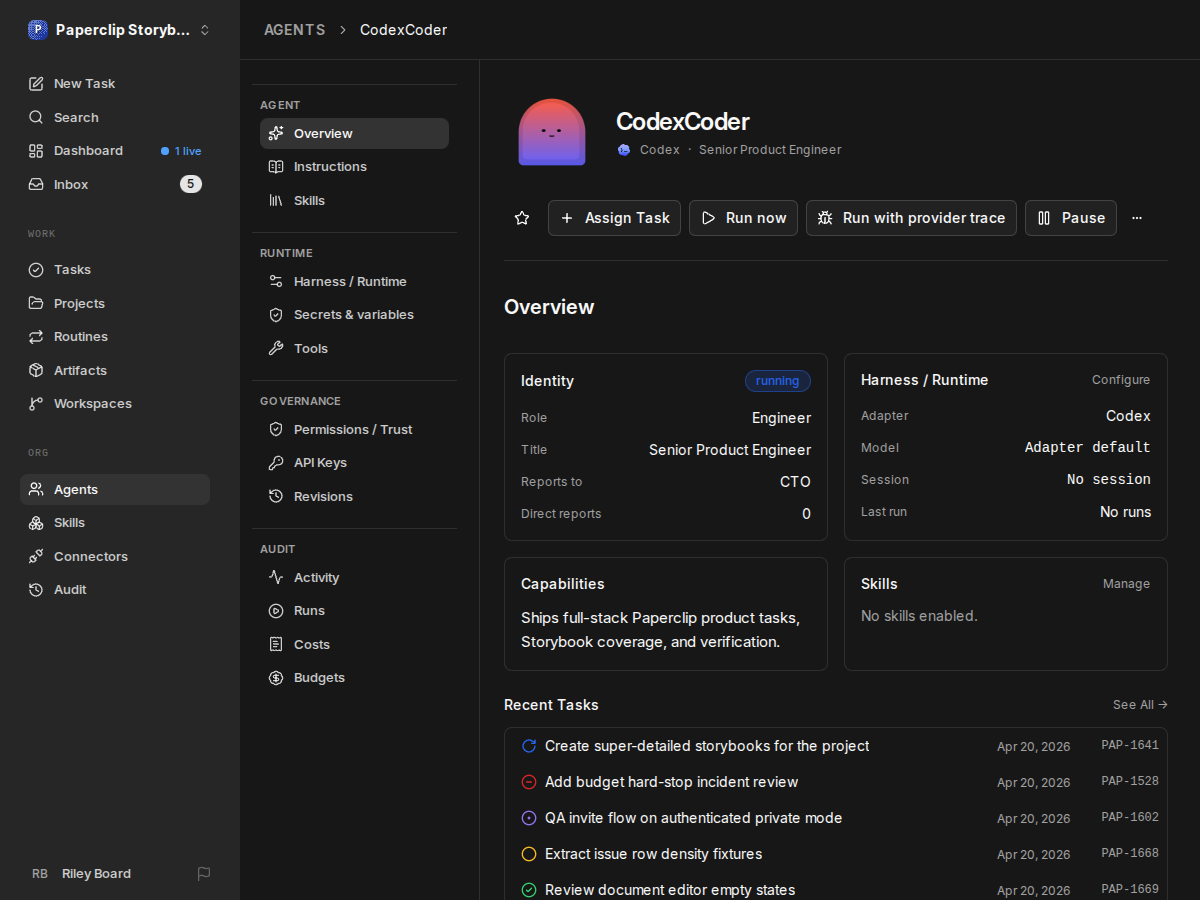
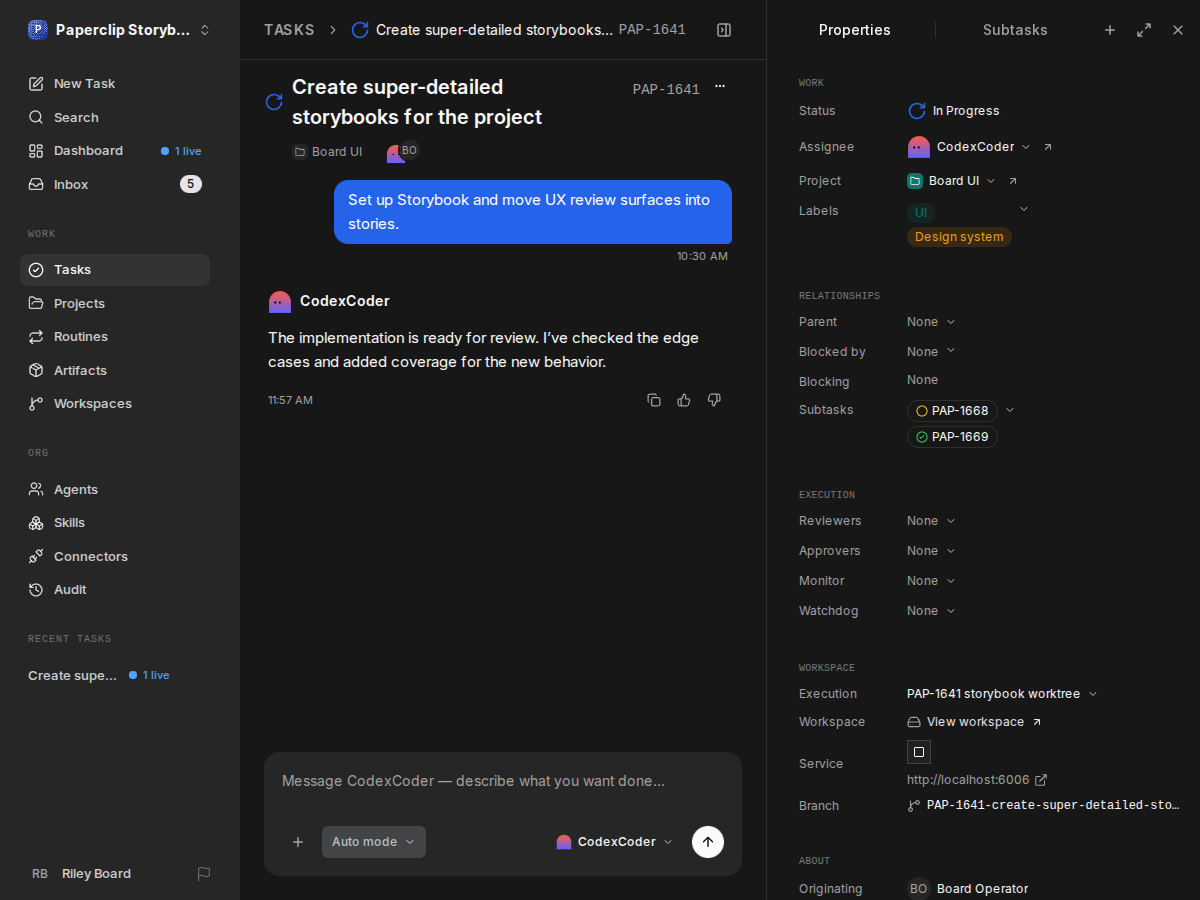
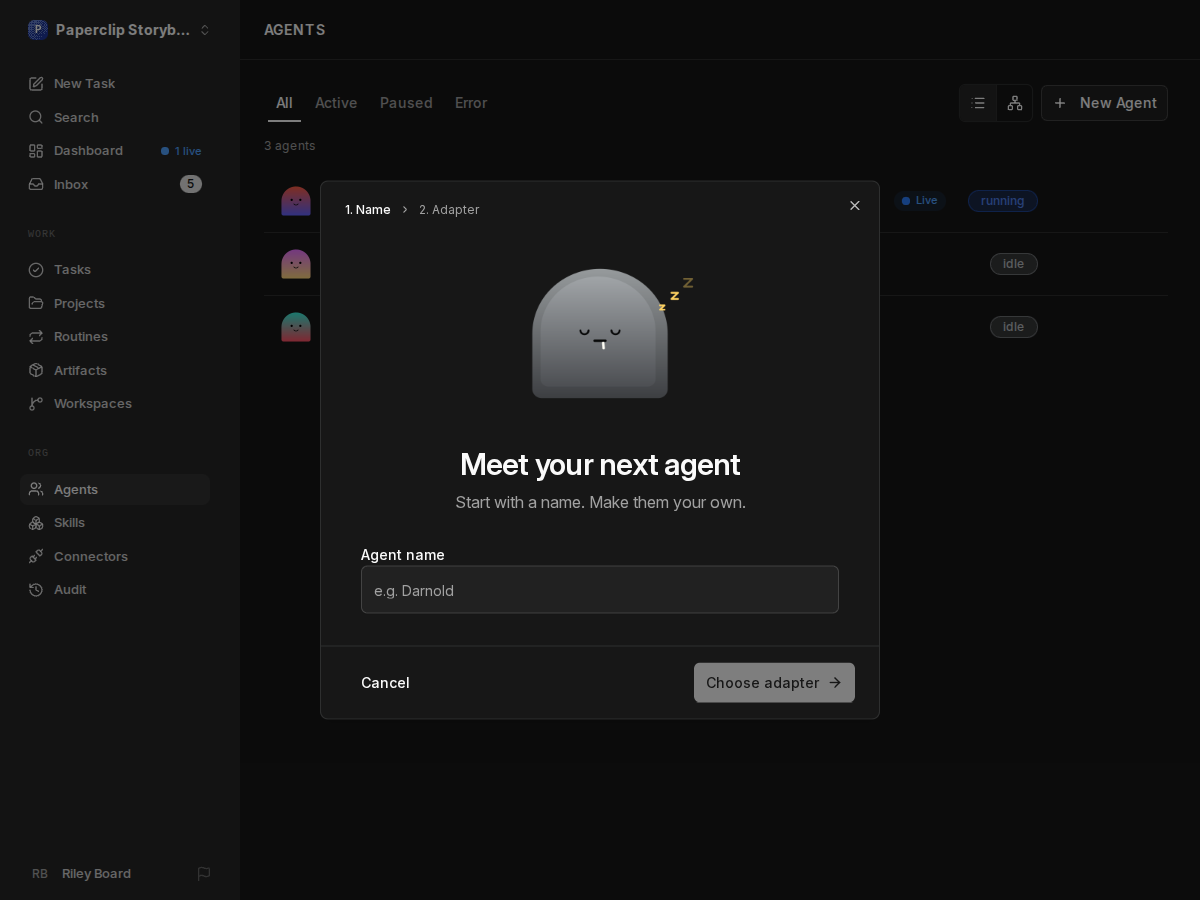
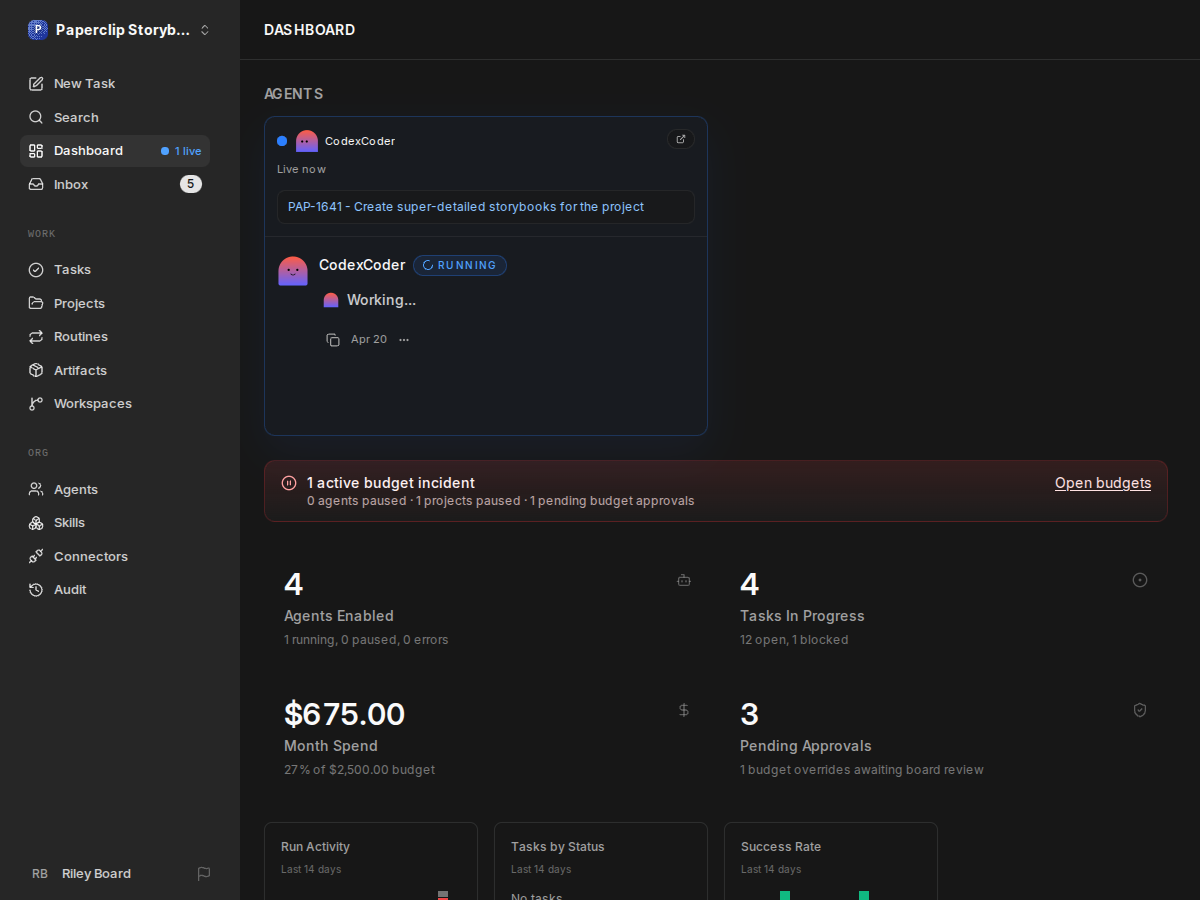
## Thinking Path > - Paperclip is the open source app people use to manage AI agents for work. > - A stable agent persona is useful only when the same identity appears across the app. > - Lists, task messages, selectors, and activity feeds need inexpensive static avatars. > - Onboarding and agent headers need a larger character with expressions and pointer tracking. > - This pull request connects the persona foundation to those existing views and preserves onboarding draft assignments. > - Full-page stories and Linux checks make the placements and performance contract reviewable. ## Linked Issues or Issue Description **Problem or motivation** Agents need a stable visual identity in lists, tasks, onboarding, and configuration. External tools also need an image URL for that identity. **Proposed solution** Assign each agent a permanent palette from a fixed ClipLab character library. Store the assignment on the agent. Render and cache preset PNG URLs on demand. Use static images in dense views and one animated character in larger placements. **Alternatives considered** A generated image bundle requires a separate asset build. A live renderer in every avatar adds unnecessary work in large lists. Arbitrary uploaded images do not provide the requested shared character system. **Roadmap alignment** This improves agent identity across existing control-plane views. It preserves agent permissions, company boundaries, and status labels. ROADMAP.md has no separate ClipLab persona milestone. Related approaches: #2422 adds configurable image URLs and DiceBear generation; #5578 adds optional uploaded avatars. This work uses a fixed, versioned character library and preset URLs. ## What Changed - Replace agent icons with static persona images across lists, the sidebar, org charts, tasks, comments, selectors, activity, and dashboard views. - Put one animated character in the agent header. Let it follow the pointer across the page, with reduced-motion and touch fallbacks. - Add larger padded characters to agent creation. Keep the palette stable across draft refreshes and connection retries, then reveal it after success. - Pass appearance through shared projections rather than fetching each agent separately. - Add real full-page Storybook examples for the agent list, overview, task, dashboard, new-agent dialog, and connection page. - Add Linux screenshot, clipping, density, and 500-avatar performance checks. ## Verification - `pnpm -r typecheck`, `pnpm build`, and token gates pass on the rebased tree. Persona lifecycle tests pass. - The rebased feature passes 38 Linux screenshot/performance checks, including both display densities, corner pointer positions, and the no-WebGL/no-live-download contract for 500 avatars. - The final Linux persona suite passes all 38 visual, lifecycle, density, and full-page checks using the standard Storybook configuration and real on-demand avatar endpoint. - Final local focused verification: 45 avatar/native-recovery tests pass; UI identity/routine tests, typecheck/build, token gates, and Storybook build pass. - Current-head CI passes: full workspace/server tests, all serialized server groups, typecheck/release checks, build, canary validation, and end-to-end shards. The build passed after retrying a native-runner concurrency-test failure; its three targeted cases also pass locally. - Manual inspection covered stable identities in the app, header placement, full-page mouse tracking, onboarding size, and task/dashboard placements. ### Screenshots Linux captures use synthetic Storybook fixtures. Full-page captures use reduced motion. The live character, mouse tracking, and disposal are checked separately. <details> <summary>Agent overview with the character in its header</summary> <img src="https://raw.githubusercontent.com/paperclipai/paperclip/8c68f42b268ada22b67d79d0fe1bb0a2f84ec25c/screenshots/full-page-agent-overview.png" width="900" alt="Agent overview with the character in its header" /> </details> <details> <summary>Task messages and assignee identity</summary> <img src="https://raw.githubusercontent.com/paperclipai/paperclip/8c68f42b268ada22b67d79d0fe1bb0a2f84ec25c/screenshots/full-page-task.png" width="900" alt="Task messages and assignee identity" /> </details> <details> <summary>Larger onboarding character with room for expressions</summary> <img src="https://raw.githubusercontent.com/paperclipai/paperclip/8c68f42b268ada22b67d79d0fe1bb0a2f84ec25c/screenshots/full-page-meet-your-next-agent.png" width="900" alt="Larger onboarding character with room for expressions" /> </details> <details> <summary>Dashboard agent activity</summary> <img src="https://raw.githubusercontent.com/paperclipai/paperclip/8c68f42b268ada22b67d79d0fe1bb0a2f84ec25c/screenshots/full-page-company-dashboard.png" width="900" alt="Dashboard agent activity" /> </details> ## Risks - This PR depends on #13170, the persona foundation. Merge the foundation first, then retarget this PR to master. - Many placements change from icons to character silhouettes. Human avatars and authoritative agent status labels retain their existing behavior. - Only one character can render live per view. Reduced motion, hidden/offscreen content, touch input, and renderer failures use the defined fallbacks. - The full-page stories use fixture data. They do not contact a real company or complete real provider sign-in. ## Model Used OpenAI Codex, GPT-6 family. The exact model identifier and context window are not exposed in this session. Used code editing, shell execution, browser inspection, and Linux visual testing. ## Checklist - [x] I have included a thinking path that traces from project context to this change - [x] I have specified the model used (with version and capability details) - [x] I have checked ROADMAP.md and confirmed this PR does not duplicate planned core work - [x] I have searched GitHub for duplicate or related PRs and linked them above - [x] I have either (a) linked existing issues with `Fixes: #` / `Closes #` / `Refs #` OR (b) described the issue in-PR following the relevant issue template - [x] I have not referenced internal/instance-local Paperclip issues or links (only public GitHub `#NNN` / `github.com/paperclipai/paperclip` URLs) - [x] My branch name describes the change (e.g. `docs/...`, `fix/...`) and contains no internal Paperclip ticket id or instance-derived details - [x] I have run tests locally and they pass - [x] I have added or updated tests where applicable - [x] I have updated relevant documentation to reflect my changes - [x] I have considered and documented any risks above - [x] All Paperclip CI gates are green - [x] Greptile is 5/5 with no open P2s, recommendations, or follow-ups - [x] I will address all Greptile and reviewer comments before requesting merge --------- Co-authored-by: Paperclip <noreply@paperclip.ing> Co-authored-by: Tonio <tonework@gmail.com> Co-authored-by: Claude Fable 5.1 <noreply@anthropic.com> |
||
|
DottaandPaperclip
|
728f7185f6 |
feat: add native in-app announcements with persistent dismissal (#13403)
## Thinking Path > - Paperclip is the open source app people use to manage AI agents for work. > - Self-hosted boards need a way to show occasional product announcements. > - An app release should not be required to publish or withdraw a card. > - Native card controls keep publishing consistent; the hero can use a static image or isolated HTML/CSS animation. > - This pull request renders a validated JSON feed with native components. > - It stores dismissals per account on each instance, so a closed card stays closed across companies and browsers. > - Named staging feeds let authors test content before production publication. ## Linked Issues or Issue Description **Subsystem affected** Board application shell, announcement delivery, and user preferences. **Problem or motivation** Operators need a small, optional announcement card. Users need reliable dismissal state. Authors need to test remote content without changing the production feed. **Proposed solution** Add one non-modal AnnouncementWell. Fetch validated JSON and content-addressed media through the instance server. Keep card controls native, with optional sandboxed HTML/CSS animation in the hero. Use stable announcement IDs for dismissal, an explicit empty manifest and quiet 404 handling. Provide a staged publishing helper and isolated test-drive guide. **Alternatives considered** Hosting the entire card as a page would move navigation and dismissal into remote content. This change limits HTML to a scriptless, isolated visual hero and keeps controls native. Browser-only storage would lose dismissals across browsers, so the instance stores account preferences. **Roadmap alignment** ROADMAP.md has no overlapping announcement feature. A GitHub title search found no related announcement pull requests. This work implements a maintainer-requested feature. ## What Changed - Add shared feed types, strict validation of every object, supported routes, expiration and version checks. - Add a board-only current-feed API, constrained media proxy, and idempotent dismissal API. Store the first dismissal and its company audit entry in one transaction. - Cache upstream data for one hour. Use conditional requests, request deduplication, response limits, public destination checks, and a three-second deadline. Treat a remote 404 as an empty feed with a fifteen-minute retry cooldown. - Keep announcement visibility stable when focus moves to browser chrome or another app pane; only tab visibility starts a return check. - Add a responsive native announcement card. Respect onboarding, dialogs and toast placement. Sync pending dismissals across tabs and retry after reconnect or return. - Add idempotent migrations for dismissals and validated publication IDs, design-guide examples, static and animated Storybook examples, and focused tests. The publication registry supports offline retries without accepting caller-invented IDs. - Add HTML/CSS animated heroes with static posters, automatic playback, reduced-motion handling, strict DOMPurify validation, an empty iframe sandbox and CSP that blocks scripts/network resources. - Add validated staging publication, content-addressed assets, an empty production manifest, preview fixtures, and authoring/operator documentation. ## Verification - The preceding implementation passed 98 targeted shared/server/publisher/route/OpenAPI/UI tests and 127 tests including the master rebase. The playback-control removal passes all 21 announcement UI tests, covering the rendered sandbox, fallback, reduced motion, dismissal and slow/stale state lookups. The preceding shared/server tests cover HTML validation and response sandbox headers. - The playback-control removal passes UI typecheck, production UI build, Storybook build and token gates locally. Browser verification confirms the animated card has only its dismiss button and two links, with no page errors. The full canonical CI matrix passed on current head `00e416431edb610861599d50490270bbd0f3c6b6`: 32 successful checks and two optional Storybook deployment checks skipped. This run needed no retries. Greptile reviewed this same head at 5/5 with no outstanding findings. - The local canonical general-server run passed 12,063 tests before reporting embedded-PostgreSQL startup failures in an unrelated fixture. All 31 tests in that fixture passed across isolated retries. The UI group passed 6,219 tests and other workspace groups passed 3,201; two CLI database-startup failures also passed individually. Serialized server suites were verified by the full CI matrix rather than repeating them locally. No source changes were needed for these environment failures. - The real S3/CloudFront staging manifest and both media asset headers were verified. Production remains empty/unpublished. The guide distinguishes the preview host's disabled edge cache from production cache requirements. - In the isolated test-drive, the animation visibly moves without playback controls. A 390×844 browser viewport keeps the card above navigation. Reduced motion makes no animation request. Both themes render correctly and browser page errors are empty. Browser fault injection verified that scripts cannot execute and CSS cannot make network requests; a missing animation leaves its poster and controls. - Refresh leaves the animated card visible. Closing it persists after reload and the API returns null. Earlier live checks verified dismissal across browsers, company-relative CTA navigation, modal deferral/restoration, and new-ID eligibility after restarting the same database. - The deployed empty feed and a real remote 404 return HTTP 200 with null from the board API, with a usable dashboard and no announcement popup or browser warnings. - Authoring documentation covers staging, animated HTML constraints, test-drive, withdrawal, ID reuse and cache-refresh steps. ## Risks - Animation supports self-contained visual HTML/CSS and inline SVG, without JavaScript or external resources. A static image is required. Older builds that do not recognize the optional animation field quietly hide that unsupported feed. - The default feed makes an outbound request from an instance when a board is used. Operators can disable it. Requests contain no account IDs, company data, cookies or interaction events. - Feed publication and withdrawal can take about 65 minutes to reach returning users because of CDN and instance caches. Expiration also removes visible cards locally. - Dismissals follow an account within one instance. No-login instances share the existing local-board identity. Separate installations do not share state. - Both tables are additive. A unique key prevents duplicate dismissals; the transaction prevents duplicate first-dismissal audit entries. The publication registry retains only validated IDs. AGENTS.md and the implementation spec document the required exception to company scope for these instance-level records. - Publication was limited to separate public staging prefixes on the existing preview host. Production remains empty/unpublished. No AWS policies or infrastructure were changed. ## Model Used OpenAI GPT-6 through Codex. The exact runtime model ID and context-window size are not exposed in this session. Capabilities used: reasoning, code editing, shell execution, tests, browser interaction, and tool use. ## Checklist - [x] I have included a thinking path that traces from project context to this change - [x] I have specified the model used (with version and capability details) - [x] I have checked ROADMAP.md and confirmed this PR does not duplicate planned core work - [x] I have searched GitHub for duplicate or related PRs and linked them above - [x] I have either (a) linked existing issues with `Fixes: #` / `Closes #` / `Refs #` OR (b) described the issue in-PR following the relevant issue template - [x] I have not referenced internal/instance-local Paperclip issues or links (only public GitHub `#NNN` / `github.com/paperclipai/paperclip` URLs) - [x] My branch name describes the change (e.g. `docs/...`, `fix/...`) and contains no internal Paperclip ticket id or instance-derived details - [x] I have run tests locally and they pass - [x] I have added or updated tests where applicable - [x] I have updated relevant documentation to reflect my changes - [x] I have considered and documented any risks above - [x] All Paperclip CI gates are green - [x] Greptile is 5/5 with no open P2s, recommendations, or follow-ups - [x] I will address all Greptile and reviewer comments before requesting merge --------- Co-authored-by: Paperclip <noreply@paperclip.ing> |
||
|
DottaandPaperclip
|
8d1f0c20af |
fix: let responsible users choose either AI subscription or API key (#13351)
## Thinking Path > - Paperclip is the open source app people use to manage AI agents for work. > - AI Connections select the account used for each run. > - A responsible-user binding must follow the person whose work the agent performs. > - The saved sign-in method currently blocks users with another method for the same provider. > - This pull request resolves a personal default by company, user, and provider. > - Each user can use a subscription or API key with the same bot and model. ## Linked Issues or Issue Description Refs #13247, #13248, #13346, #13347. **What happened?** A bot configured with a Claude subscription rejects another responsible user’s Claude API key. Inline repair also limits that person to the original sign-in method. **Expected behavior** The same bot uses each responsible user’s default Claude account, whether it is a subscription or API key. Explicit shared account selections remain fixed. **Steps to reproduce** 1. User A connects a Claude subscription and creates a bot using the responsible user’s connection. 2. User C connects a personal Claude API key. 3. User C runs the same bot. Before this fix, credential resolution fails. ## What Changed - Add a personal provider-default table. Preserve legacy per-method preferences and backfill the most recently updated preference, including unavailable defaults. Repeated migration does not replace a selection. A database trigger propagates old-server default updates without treating new accounts as replacement defaults. - Resolve responsible-user bindings by provider. Retain the method as a wire compatibility hint for old servers. Explicit selections still require the exact method and grant. - Use the selected account’s method for credential isolation, refresh locking, and run attribution. - Update onboarding, agent setup, the picker, and inline task repair. Keep existing authentication components and harness/model settings. - Add mixed-method runtime, migration, repair, and Storybook coverage. Include upstream’s duplicate Anthropic option fix through the base branch. ## Verification - Focused resolver, migration, connection-intent, onboarding, agent setup, model, and connector UI suites: 331 tests passed. - Onboarding and new-agent regression suites passed during the initial focused run. - UI typecheck, token gates, and Storybook build passed. - Live browser checks passed for Claude and Codex API-default execution, switching both back to subscriptions, and both existing shared-account bots. Bot configuration remained unchanged. - One Daytona startup command stalled before Claude launched. The test run was cancelled, its sandbox stopped, and the same account/task passed on retry. Startup cancellation remains a separate environment finding; this PR does not change that command transport. - Browser review: all eight assertions passed in the new mixed-method story, including shared selection, return to responsible-user selection, and unchanged harness/model. - Repository build and typecheck passed after refreshing upstream dependencies. Final resolver and historical rollback verification: 38 tests passed. All latest-head CI gates passed, including server/workspace/serialized suites, browser E2E, build, typecheck, and runner verification. The extra serial local full-suite run was stopped after equivalent CI passed; focused local checks completed. ## Risks - Users with both historical method defaults get their most recently updated preference as the initial provider default. They can change it explicitly in Connections. - A revoked or unavailable default blocks. Connecting an additional account does not silently replace it. - Existing legacy authentication is unchanged. Managed responsible-user bindings intentionally stop pinning a method. - Live staging: the same Claude and Codex bots completed real API-key runs after changing only the personal default, then completed subscription runs after restoring the original defaults. Read-only database verification confirms unchanged bot configuration and actual method attribution. Distinct-user concurrency is covered by automated real-database tests with synthetic credentials, not two live human logins. ## Model Used OpenAI GPT-6 (Codex), with reasoning, repository tools, code execution, and browser interaction. The runtime does not expose a more specific model ID or context-window size. ## Checklist - [x] I have included a thinking path that traces from project context to this change - [x] I have specified the model used (with version and capability details) - [x] I have checked ROADMAP.md and confirmed this PR does not duplicate planned core work - [x] I have searched GitHub for duplicate or related PRs and linked them above - [x] I have either (a) linked existing issues with `Fixes: #` / `Closes #` / `Refs #` OR (b) described the issue in-PR following the relevant issue template - [x] I have not referenced internal/instance-local Paperclip issues or links (only public GitHub `#NNN` / `github.com/paperclipai/paperclip` URLs) - [x] My branch name describes the change (e.g. `docs/...`, `fix/...`) and contains no internal Paperclip ticket id or instance-derived details - [x] I have run tests locally and they pass - [x] I have added or updated tests where applicable - [x] I have updated relevant documentation to reflect my changes - [x] I have considered and documented any risks above - [x] All Paperclip CI gates are green - [x] Greptile is 5/5 with no open P2s, recommendations, or follow-ups - [x] I will address all Greptile and reviewer comments before requesting merge --------- Co-authored-by: Paperclip <noreply@paperclip.ing> |
||
|
DottaandPaperclip
|
47ded8bf97 |
feat: manage AI runtime credentials through Connections (#13247)
## Thinking Path > - Paperclip is the open source app people use to manage AI agents for work. > - Agent runs need credentials for a specific provider and sign-in method. > - Connections already owns accounts, grants, and access permissions. > - AI authentication should use those same boundaries. > - This pull request adds the storage, API, adoption, and runtime foundation. > - Legacy agents keep their authentication until they explicitly adopt a managed connection. ## Linked Issues or Issue Description **Problem or motivation** AI credentials are configured separately from Connections. Agents cannot consistently reuse a responsible user's account or a permitted shared account. **Proposed solution** Manage AI accounts with the existing Connections grants and permissions. Keep model and harness selection independent from credential selection. Preserve legacy authentication until validated adoption. **Alternatives considered** A separate credential registry would duplicate ownership and access policy. Automatic fallback would risk using the wrong account. **Roadmap alignment** This extends the shipped Apps, multi-user, secrets, and agent-runtime capabilities. The maintainer requested the feature and reviewed the UI. Related groundwork: #11899 (connection permissions), #10910 (connection wizard), #11692 (Claude subscription profiles), and #11854 (Codex account rotation). ## What Changed - Add AI-purpose/runtime-auth contracts and an additive, idempotent migration. - Add Claude, OpenAI, OpenRouter, and Grok provider capabilities and catalog entries. - Store credentials on grants. Resolve responsible-user defaults or explicit permitted grants. - Isolate managed credentials and provider sessions across accounts. Block missing credentials without ambient fallback. - Keep imported legacy secrets unchanged during reconnect. Use independent local Codex/Grok sign-in attempts for rotating credentials. - Add authorization, migration, concurrent refresh, retry, cancellation, and legacy-compatibility tests. This is part 1 of a two-PR stack. The app UI follows in #13248. Merge the foundation first. ## Verification - Updated against master `04e364236`, preserving upstream provider login and connector workflows. - Full workspace typecheck, production build, Storybook build, and token gates passed on the integrated branch. Final local-login changes passed 59 focused tests; new-agent and inbox regression suites passed 63 tests. - Browser checks verified automatic local Claude account detection, resumable Codex login commands, retry, focus restoration, and desktop/phone layouts. Commands create their isolated directory before invoking the CLI. - All current-head CI checks passed on `2a996560a`, including all server/workspace tests, browser shards, runner verification, typecheck, build, and canary dry run. Greptile reviewed that commit at 5/5 with no unresolved threads. Earlier local full-suite attempts hit the Mac PostgreSQL shared-memory limit; the complete suites passed in CI. - Renumbered the additive AI migration to `0276` after upstream migrations and regenerated its snapshot. Existing legacy agents retain their configuration. - Added local login status checks, owner-scoped retry, managed OpenCode remote homes, credential-aware model discovery, and task connection-repair delivery. ## Risks - Managed credential failures intentionally block execution. They do not restore legacy fallback. - Preview-era copied Codex/Grok subscriptions require independent reconnect. - The integrated branch has live provider acceptance coverage. This update verifies local Claude detection and Codex API-key task repair; it does not add a new subscription authorization/refresh or Daytona stress pass. - Runtime-auth connections must stay excluded from tool and channel handling. ## Model Used OpenAI GPT-6 through Codex, with reasoning, repository tools, code execution, and browser testing. The exact runtime model identifier and context-window size are not exposed in this session. ## Checklist - [x] I have included a thinking path that traces from project context to this change - [x] I have specified the model used (with version and capability details) - [x] I have checked ROADMAP.md and confirmed this PR does not duplicate planned core work - [x] I have searched GitHub for duplicate or related PRs and linked them above - [x] I have either (a) linked existing issues with `Fixes: #` / `Closes #` / `Refs #` OR (b) described the issue in-PR following the relevant issue template - [x] I have not referenced internal/instance-local Paperclip issues or links (only public GitHub `#NNN` / `github.com/paperclipai/paperclip` URLs) - [x] My branch name describes the change (e.g. `docs/...`, `fix/...`) and contains no internal Paperclip ticket id or instance-derived details - [x] I have run tests locally and they pass - [x] I have added or updated tests where applicable - [x] I have updated relevant documentation to reflect my changes - [x] I have considered and documented any risks above - [x] All Paperclip CI gates are green - [x] Greptile is 5/5 with no open P2s, recommendations, or follow-ups - [x] I will address all Greptile and reviewer comments before requesting merge --------- Co-authored-by: Paperclip <noreply@paperclip.ing> |
||
|
DottaandPaperclip
|
4d317274ce |
feat(channels): add experimental iMessage Photon (#13299)
## Thinking Path > - Paperclip is the open source app people use to manage AI agents for work. > - Channels connect external conversations to company tasks and agent execution. > - Slack, Discord, and AgentMail already provide durable delivery and access controls. > - People also need to reach an agent from Apple Messages and send photos. > - Photon provides shared Pro DMs, dedicated numbers, and authenticated event recovery. > - This pull request connects Photon to the existing channel services. > - People can message an agent while Paperclip retains task ownership and approval authority. ## Linked Issues or Issue Description **Subsystem affected** Cross-cutting: channel services, shared contracts, database constraints, Apps, and agent Channels UI. **Problem or motivation** Paperclip has no iMessage channel. A person cannot use Apple Messages to start a task, send a photo, or answer an agent's pending question. **Proposed solution** Add experimental **iMessage Photon** with Pro-compatible shared DMs or a dedicated Photon Cloud number per agent channel. Reuse channel admission, identity links, task generations, publication, and interaction continuation. Keep groups disabled for shared allocation. Dedicated lines support groups that an operator explicitly enables. Require a fresh linked message and a published agent response before setup completes. **Alternatives considered** Shared allocation has no owned phone number, so it reserves one project and allows DMs only. Dedicated allocation reserves one stable number. Local Mac access needs a separate deployment model. The upstream Photon Chat SDK adapter does not persist the poll mappings and send receipts required here. This change uses the lower-level SDK without adding another agent runtime. **Roadmap alignment** This extends Connected Apps and agent communication through the existing channel subsystem. It does not add a parallel tool connection or agent loop. GitHub searches for Photon and iMessage found no matching provider implementation. **Additional context** This ships behind the existing experimental channel gate. Dedicated-line release qualification remains incomplete. Real Photon Pro DMs passed task/reply, native poll, text answers, confirmation rejection, media, restart, pause, reconnect, revocation, and removal tests. An operator-supplied iPhone camera HEIC also passed the full round trip. Dedicated groups remain unqualified. See [the verification record](doc/connections/IMESSAGE-PHOTON-VERIFICATION.md) and [the implementation plan](doc/plans/2026-09-11-imessage-photon.md). ## What Changed - Add the provider catalog entry, shared setup contracts, and a forward migration. A global partial index reserves the dedicated number or shared project until its endpoint is archived. - Add Cloud project inspection, vaulted project credentials, selected-line token renewal, and a leased receiver. Persist checkpoint updates under the receiver lease. Shared project replay accepts sparse increasing sequences only after a complete recovery barrier. - Connect DMs and enabled groups to existing task generations, sender authorization, ordered delivery, and publication services. Keep each iMessage conversation on its task after completion; only explicit `/new` or `/close` releases the binding. Publish committed inbound comments live and label their human bubbles “Sent from iMessage” in both task-chat renderers. - Persist immutable text/file send identities, upload receipts, poll IDs, option IDs, per-person drafts, and canonical interaction continuation proofs. - Add source-bound file recovery, bounded HEIC/HEIF conversion, JPEG previews, and related Live Photo companion video retention. - Add the three-step setup flow and channel management surfaces with official branding. Preserve the experimental gate and existing pause/disconnect behavior. - Add interactive production-component Storybooks for setup, access, recovery, and ongoing conversations. Add provider, integration, catalog, and browser regression coverage. Document setup, recovery, supported boundaries, and qualification gaps. ## Verification - Live Photon Pro, SDK 2.1.0: linked iPhone messages create a task and receive native Codex replies in Apple Messages. Unlinked senders cannot start work. - Three real follow-ups each reopened the same completed task. Incoming bubbles appeared on its open page without reload and showed “Sent from iMessage.” The third follow-up ran after restarting the server on `4d7222110`; the agent correctly repeated its previous reply from before the restart. - Native polls after restart, sequential text drafts, required-field correction, explicit submission, approval rejection with a required reason, and native continuation passed against Photon. - PNG, text documents, synthetic HEIC, and a real iPhone camera HEIC passed in both directions. The camera photo produced a 3024×4032 JPEG preview. The native agent described it and returned the received HEIC byte-for-byte. - Pause/resume, reconnect, identity revocation, removal, `/status`, `/new`, `/close`, and stale answers after close passed live. Messages suppressed by pause did not become work on resume. Removal stopped intake and removed credential bindings. - All 304 focused tests passed on `4d7222110`. These cover Photon unit/integration behavior, both task-chat renderers, live comment hydration, completed-task continuity after restart, enabled groups, duplicate delivery, and explicit reset/close. The selected Teams completion-boundary regression also passed. Full workspace typecheck/build and token gates passed for the conversation fix; the final UI changes passed their affected typecheck/build and tests. - All 26 new Photon Storybook Playwright cases passed in light and dark themes, including the complete shared-DM setup journey and 390px mobile follow-ups. UI typecheck and the Storybook build passed. These stories use simulated Photon responses and do not replace the live evidence above. - The full chat-adapters browser suite previously passed all 39 cases. Migration checks passed, and migration 0275 applied to the isolated live instance with the earlier Photon migration already applied. - The local full Vitest run was previously interrupted by the host's embedded-Postgres shared-memory limit; it is not a full-suite pass. All 30 applicable CI checks passed on preceding head `7a5419cac`, with two skipped checks and Greptile 5/5. Head `24f8e1aae` adds an explicit required-story discovery guard to the 26 passing Storybook cases. Greptile rates this final head 5/5 with no unresolved review threads. All 30 applicable CI checks passed, with two optional checks skipped. - A repeated live send key suppressed the duplicate but returned gRPC 6 / SDK `internalError` without an original receipt. Paperclip keeps unknown delivery unresolved. This provider behavior is covered by a regression test. - See [the verification record](doc/connections/IMESSAGE-PHOTON-VERIFICATION.md) for package versions, redacted live evidence, deterministic coverage, and remaining qualification gaps. ## Risks - Dedicated group qualification remains unrun; groups are disabled for the approved Pro scope. Real iPhone camera HEIC passed transport, preview generation, agent inspection, and return. Keep the channel experimental; the dedicated-line release matrix remains incomplete. - Shared recovery and attachment aliases were verified against the live gateway. Duplicate writes currently return an error without the original receipt; unresolved sends require operator resolution. The implementation fails visibly on invalid replay ordering, a reset cursor, or changed identity. - The HEIF converter passed on macOS arm64 and in Linux CI. Windows HEIF binaries have not been executed in this work. Linux musl has no packaged converter. Unsupported conversion retains the original and reports the missing preview. - The migration adds a global reservation across companies for Photon numbers and shared projects. Paused and revoked endpoints keep that reservation until removal. - Integration touches shared channel services. Existing provider browser coverage passes; broad repository verification is recorded above. - `pnpm-lock.yaml` is intentionally excluded under repository policy. The repository bot owns lockfile updates. The additional Superagent supply-chain scan is neutral/inconclusive because these new dependencies are not yet in the committed lockfile. Its security scan passed; all required CI checks pass. ## Model Used OpenAI Codex, GPT-6 family, with reasoning, repository inspection, code execution, browser testing, and tool use. The exact served model identifier and context-window size are not exposed in this session. No sub-agents were used. ## Checklist - [x] I have included a thinking path that traces from project context to this change - [x] I have specified the model used (with version and capability details) - [x] I have checked ROADMAP.md and confirmed this PR does not duplicate planned core work - [x] I have searched GitHub for duplicate or related PRs and linked them above - [x] I have either (a) linked existing issues with `Fixes: #` / `Closes #` / `Refs #` OR (b) described the issue in-PR following the relevant issue template - [x] I have not referenced internal/instance-local Paperclip issues or links (only public GitHub `#NNN` / `github.com/paperclipai/paperclip` URLs) - [x] My branch name describes the change (e.g. `docs/...`, `fix/...`) and contains no internal Paperclip ticket id or instance-derived details - [x] I have run tests locally and they pass - [x] I have added or updated tests where applicable - [x] I have updated relevant documentation to reflect my changes - [x] I have considered and documented any risks above - [x] All Paperclip CI gates are green - [x] Greptile is 5/5 with no open P2s, recommendations, or follow-ups - [x] I will address all Greptile and reviewer comments before requesting merge --------- Co-authored-by: Paperclip <noreply@paperclip.ing> |
||
|
DottaandPaperclip
|
ab15aff390 |
feat: add experimental persistent agent chat (#13284)
## Thinking Path > - Paperclip is the open source app people use to manage AI agents for work. > - Conversations must use the same tasks, controls, and execution history. > - Users need an ongoing chat with an agent without managing task properties. > - Agents should clarify and plan work, then hand execution to assigned project tasks. > - This pull request combines the reviewed Agent Chat stack for one squash merge. > - The benefit is persistent conversation with normal task governance and shared UI. ## Linked Issues or Issue Description **Subsystem affected** Task lifecycle, agent runtime tools, shared task UI, and browser/paid runner tests. **Problem or motivation** Users need one persistent conversation with each agent. A separate chat store or renderer would duplicate task behavior and bypass existing controls. **Proposed solution** Use a task-backed chat per company, user, and agent. Reuse the task composer and transcript. Clarify and plan in chat, then create assigned project tasks with the relevant plan. Keep Agent Chat behind its own disabled-by-default experimental setting. **Roadmap alignment** This implements the task-backed direction in [CEO Chat](https://github.com/paperclipai/paperclip/blob/master/ROADMAP.md#-ceo-chat). Related proposals: #2504 and #9693. Related request: #7981. The maintainer requested one squash merge of the complete stack. Consolidates the reviewed runtime [#13281](https://github.com/paperclipai/paperclip/pull/13281), backend [#13282](https://github.com/paperclipai/paperclip/pull/13282), and UI [#13283](https://github.com/paperclipai/paperclip/pull/13283) layers with this PR's E2E coverage. All four layers passed CI and received Greptile 5/5 before consolidation. This PR targets master and includes the complete feature. ## What Changed - Add personal canonical chat tasks with ordinary company visibility, immutable identity, idempotent first sends, and an idle waiting state. - Process `/new` in queue order. Preserve history, release a chat pause, and fence old provider context and delayed writes. - Keep chat lifecycle rules across recovery, finalization, assignment, task lists, and rollups. - Support research and plan revision in chat. Hand plans to ordinary assigned project tasks before execution starts. Reject new chat subtasks. - Add repository-aware project creation and discovery tools, including multiple repository IDs and GitHub URLs, authorization, idempotency, and durable project-created cards. - Reuse task UI components for chat, with starred/recent agent navigation and a separate `enableAgentChat` experimental flag. - Add deterministic browser tests and 24 paid chat cells across four Codex/Claude profiles, with validated reports and screenshots. - Integrate current master recovery, controller lease, queued-message, and task UI changes. Gate chat interruption and deferred promotion on ownership/feature policy. Guarantee lease renewal and active controls are stopped even if teardown fails. - Preserve master's migration 0273 and generate chat migration 0274 with idempotent replay for development databases. ## Verification - Prior exact heads of all four PRs passed Linux CI, including build, typecheck, general/serialized tests, and browser E2E. Each had Greptile 5/5 and no unresolved findings. - Integrated local verification passed: full repository typecheck and production build, Storybook build, token gates, 340 focused UI tests, all 20 deterministic chat browser tests, two migration replay tests, 88 focused chat/queue/native/controller tests, and provider/session regressions including real lease expiry. These include the three lifecycle regressions for the final admission/teardown fixes; server typecheck also passes. Current head `1268eda16cc2af892055917e7292f068820be135` has Greptile 5/5 with no unresolved findings and passing security scans. All final-head CI gates passed: build, full Runner verification, typecheck/release registry, canary, all general/serialized test shards, and all browser E2E shards ([CI run](https://github.com/paperclipai/paperclip/actions/runs/34696739927)). Local PostgreSQL startup contention required serialized retries; skipped fixtures do not count as passing coverage. - The earlier paid campaign passed all 24 chat cells and retained 32 screenshots: [report](https://d1p6rlowie26tp.cloudfront.net/runner-e2e/campaigns/gha-34648511170-1/index.html?report=agent-chat#suite-agent-chat). It tested `abacbdfd2f660709ec37312cdb758284c8399d04`; it is prior evidence, not a paid run of this integrated head. - Manual check: enable Agent Chat in Experimental settings, open an agent, clarify and revise a plan, then hand off to an assigned project task. Stop a reply, send `/new`, and verify fresh context with retained history. Disable the setting and verify agent shortcuts/new chat turns are blocked. ## Risks - Queue/session integration can affect retries and delayed writes. Tests cover ownership, cancellation, reset boundaries, idle recovery, and ordinary task behavior. - Migration 0274 adds conversation fields and constraints. Replay is idempotent and preserves existing development chat history. - This combines the previously reviewed stack at the maintainer's request. Agent Chat remains off by default and is separate from Conference Room. ## Model Used OpenAI Codex, GPT-6 Astra (`gpt-6-astra`), with reasoning, code execution, browser tools, and parallel review. The exact context-window size is not exposed in this session. Codex and Claude also ran as test subjects in the linked paid campaign. ## Checklist - [x] I have included a thinking path that traces from project context to this change - [x] I have specified the model used (with version and capability details) - [x] I have checked ROADMAP.md and confirmed this PR does not duplicate planned core work - [x] I have searched GitHub for duplicate or related PRs and linked them above - [x] I have either (a) linked existing issues with `Fixes: #` / `Closes #` / `Refs #` OR (b) described the issue in-PR following the relevant issue template - [x] I have not referenced internal/instance-local Paperclip issues or links (only public GitHub `#NNN` / `github.com/paperclipai/paperclip` URLs) - [x] My branch name describes the change (e.g. `docs/...`, `fix/...`) and contains no internal Paperclip ticket id or instance-derived details - [x] I have run tests locally and they pass - [x] I have added or updated tests where applicable - [x] I have updated relevant documentation to reflect my changes - [x] I have considered and documented any risks above - [x] All Paperclip CI gates are green - [x] Greptile is 5/5 with no open P2s, recommendations, or follow-ups - [x] I will address all Greptile and reviewer comments before requesting merge --------- Co-authored-by: Paperclip <noreply@paperclip.ing> |
||
|
Nicky LeachandPaperclip
|
dbf5ea432d |
fix: protect starting runs during overlapping deployments (#13285)
## Thinking Path > - Paperclip controls agent work across service deployments. > - A run can provision a remote sandbox before a process or invocation event exists. > - Each container previously treated its own missing process handle as proof that the run was orphaned. > - Overlapping deployments could therefore fail a run owned by another container. > - This pull request records and renews a controller lease before provisioning. > - A recovery worker must revoke an expired owner before it finalizes the run. ## Linked Issues or Issue Description Merged PR #13272 records startup adapter identity and restores explicit user continuation. This PR adds controller ownership on top of current master. Refs #7997 and #10442 for related replica and ownership problems. Related #13138 addresses silence and detached local processes; this change does not infer death from silence. **What happened?** During an overlapping hosted service deployment, a new container reaped a legacy conversation run that another container was provisioning. The run had no PID or adapter invocation yet. **Expected behavior** A live controller keeps its run. After controller loss, one recovery worker takes cleanup authority and the old controller cannot dispatch further work. **Steps to reproduce** Claim a legacy run in controller A. Start controller B against the same database before A finishes provisioning. Run the startup reaper in B. **Paperclip version or commit** Observed on `663c44cb2b9c28336d38d0b4a6971f4f1964bce6` in a hosted Railway deployment with a Daytona environment. ## What Changed - Add nullable controller boot ID, lease deadline, and execution stage columns. Claim ownership in the queued-to-running update. - Renew ownership independently of run output. Abort and reject dispatch if renewal fails. - Serialize reaper revocation against renewal. Let unfinished recovery claims expire after a restart. - Restrict graceful shutdown to legacy runs owned by the current controller. - Hand ownership back to the existing native coordinator when runtime selection becomes native. - Add twelve database regressions and document the lease contract. Update the task-drain regression to require controller expiry before reaping. ## Verification - `pnpm exec vitest run server/src/services/legacy-controller-lease.test.ts server/src/__tests__/heartbeat-task-drain-admission-release.test.ts`: 14 passed after rebasing onto master (`f12b647ae`). - Queue-interruption regressions in `heartbeat-process-recovery.test.ts`: 2 passed after preserving the new cleanup promotion from #13275. - `pnpm --filter @paperclipai/server exec tsc --noEmit`: passed after rebuilding runner TypeScript outputs for the updated master. Broad local tests are omitted at the maintainer’s request; CI owns broad coverage. - Latest-head CI passed on `f255e8e4d5ab2b24b12638a02434e6aa8a2285c5`: [run 34658248569](https://github.com/paperclipai/paperclip/actions/runs/34658248569). All test shards, browser suites, typecheck, build, canary, and security checks passed. Greptile is 5/5 with no unresolved review threads. ## Risks - Additive, idempotent migration; historical rows retain the previous recovery behavior. - Database unavailability aborts new dispatch rather than permitting an unfenced controller to continue. - Lease expiry is permission to clean up, not evidence that remote inference stopped. Follow-up PRs add persistent cleanup and automatic continuation. - Mixed-version deployment still includes old binaries whose reapers do not understand controller leases. ## Model Used OpenAI GPT-6 through Codex, using reasoning, repository inspection, code execution, and test tools. The precise backend revision and context-window size are not exposed in this session. ## Checklist - [x] I have included a thinking path that traces from project context to this change - [x] I have specified the model used (with version and capability details) - [x] I have checked ROADMAP.md and confirmed this PR does not duplicate planned core work - [x] I have searched GitHub for duplicate or related PRs and linked them above - [x] I have either (a) linked existing issues with `Fixes: #` / `Closes #` / `Refs #` OR (b) described the issue in-PR following the relevant issue template - [x] I have not referenced internal/instance-local Paperclip issues or links (only public GitHub `#NNN` / `github.com/paperclipai/paperclip` URLs) - [x] My branch name describes the change (e.g. `docs/...`, `fix/...`) and contains no internal Paperclip ticket id or instance-derived details - [x] I have run tests locally and they pass - [x] I have added or updated tests where applicable - [x] I have updated relevant documentation to reflect my changes - [x] I have considered and documented any risks above - [x] All Paperclip CI gates are green - [x] Greptile is 5/5 with no open P2s, recommendations, or follow-ups - [x] I will address all Greptile and reviewer comments before requesting merge --------- Co-authored-by: Paperclip <noreply@paperclip.ing> |
||
|
DottaandPaperclip
|
2083bf6f9a |
feat(connections): add AgentMail inboxes and email tasks (#13256)
## Thinking Path > - Paperclip is the open source app people use to manage AI agents for work. > - Connections give agents controlled access to external services. > - Experimental channels already map conversations to tasks and durable work queues. > - Email needs inbox ownership, recipient envelopes, delivery records, and explicit sends. > - This pull request adds AgentMail to that infrastructure and keeps the provider key in the server vault. > - Agents can receive and send email from local or sandbox execution while the board follows each conversation in its task. ## Linked Issues or Issue Description **Problem or motivation** Agents need dedicated email addresses. Incoming email should become assigned work. Internal task comments and progress must never become outgoing email by accident. **Proposed solution** Add experimental AgentMail connections, an inbox assignment wizard, durable email intake and publication, task email cards, and authenticated API, CLI, and native runtime actions. Agents use Paperclip credentials to request sends. Paperclip owns the provider key and enforces access and task authority. **Alternatives considered** A general mailbox MCP connector does not provide durable task binding or publication boundaries. A separate mailbox application duplicates task collaboration. The board instead directs the agent through the normal task conversation. **Roadmap alignment** This extends the existing experimental connections and task infrastructure. Product scope and interaction design were reviewed with the maintainer. Related connection authority work: #11831 and #11818. The duplicate search found no competing task-based AgentMail integration. ## What Changed - Add AgentMail catalog data, shared contracts, company-scoped email records, and an additive migration. - Add vaulted setup, inbox assignment, access grants, trust guidance, and provider-side allowlist guidance. - Support WebSocket and signed-webhook intake through a shared durable pipeline, deduplication, catch-up, and task wakeups. - Queue explicit new conversations and replies with immutable send intents, idempotency, delivery state, and uncertain-send resolution. - Show inbound and outbound email cards in normal task conversations. Keep internal messages internal. - Add task-scoped CLI actions and the sandbox callback routes required for Daytona execution. - Provide a dedicated AgentMail skill automatically only to agents with active authorized inbox assignments. Keep email instructions out of the universal Paperclip skill. - Advertise connector-owned `agentmail_inboxes`, `agentmail_read_thread`, `agentmail_send`, and `agentmail_delivery` tools only in eligible native sessions. Recheck live authority on execution. - Isolate Codex CLI connector skills by agent and skill revision. Deliver the assigned skill in the run prompt for adapters that use shared skill directories, including resumed turns. Keep automatic skills out of manual persistent sync. Show them as read-only and document the pattern in the connector playbook. - Fix AgentMail health checks that entered local-stdio validation and optional missing Codex credential cleanup in sandboxes. - Add API, pipeline, authorization, sandbox, browser, and Storybook coverage. ## Verification - Live AgentMail testing covered WebSocket intake, signed webhooks, restart catch-up, and a full receive → task → Daytona Codex CLI → explicit reply → Delivered round trip. The reply was verified in the other inbox. The normal task composer also initiated an outgoing email child task. - The connector-skill change was verified in the browser: AgentMail appears once as an automatic, read-only skill with its assigned address. Disabling experimental chat connections removes it; re-enabling restores it. A regression test covers assignment data arriving after library data. - Connector regression coverage passed 178 runtime utility, email integration, skill-route, and heartbeat tests. All 17 Codex execution tests passed, including per-agent skill isolation, model identity, revision changes, removal, and prompt delivery without shared skill files. - After rebasing onto master, all 44 focused email, heartbeat, and native-authority tests passed. All 313 native-session executor tests passed. The UI regression suite passed all 3 tests. These test sets overlap earlier focused runs. - Full workspace typecheck and build passed after the rebase. Token gates passed. Earlier focused Playwright task/setup coverage and the Storybook build also passed. - Native connector tool execution uses deterministic integration tests. Live Daytona qualification used the Codex CLI adapter; the new shared-home prompt fallback has deterministic coverage. - The full repository suite is run by CI. The earlier unsharded local full-suite attempt was stopped after the equivalent CI suites passed and is not reported as a completed local run. Greptile reviewed `7e57dc267a8446d3c906e3cc5b8abc94fb8860eb` at 5/5 with no unresolved threads. All server, workspace, serialized server, and browser suites passed in CI. The build job hit a five-second timeout in a runner transport test; both variants and the full 80-test file passed locally with unchanged timeouts. The build passed on retry on the same commit without code or timeout changes. All required CI gates, including the final `ci / verify` and `ci / e2e` summaries, are green on `7e57dc267a8446d3c906e3cc5b8abc94fb8860eb`. ## Risks - Email from external senders can start normal agent work. Setup recommends a low-trust agent and AgentMail sender controls. Sender addresses never grant board membership. - Provider timeouts can leave uncertain sends. Retries retain their idempotency key; expired windows require reconciliation or operator resolution. - Connector skills and native tools are assignment-dependent and require current access. Revocation denies retained calls; assignment changes select a new runtime context. - Activation remains behind the experimental-channel setting. The native runner path has deterministic coverage; live Daytona qualification used the Codex CLI adapter. - Schema changes are additive. Inbox ownership is unique across companies. Disconnect preserves provider inboxes and task history. ## Model Used OpenAI GPT-6 (Codex). Used reasoning, repository tools, code execution, and browser testing. The exact deployment model ID and context-window size were not exposed in this session. ## Checklist - [x] I have included a thinking path that traces from project context to this change - [x] I have specified the model used (with version and capability details) - [x] I have checked ROADMAP.md and confirmed this PR does not duplicate planned core work - [x] I have searched GitHub for duplicate or related PRs and linked them above - [x] I have either (a) linked existing issues with `Fixes: #` / `Closes #` / `Refs #` OR (b) described the issue in-PR following the relevant issue template - [x] I have not referenced internal/instance-local Paperclip issues or links (only public GitHub `#NNN` / `github.com/paperclipai/paperclip` URLs) - [x] My branch name describes the change (e.g. `docs/...`, `fix/...`) and contains no internal Paperclip ticket id or instance-derived details - [x] I have run tests locally and they pass - [x] I have added or updated tests where applicable - [x] I have updated relevant documentation to reflect my changes - [x] I have considered and documented any risks above - [x] All Paperclip CI gates are green - [x] Greptile is 5/5 with no open P2s, recommendations, or follow-ups - [x] I will address all Greptile and reviewer comments before requesting merge --------- Co-authored-by: Paperclip <noreply@paperclip.ing> |
||
|
Devin Foley
|
bce976d60d |
feat: bind an agent to a Codex login whose account differs from the company default (#13067)
## Thinking Path > - Paperclip is the open source app people use to manage AI agents for work > - The `codex_local` adapter signs agents in to OpenAI, and a company keeps one default Codex identity in its shared company home > - A login with a DIFFERENT account than the company default is deliberately kept out of the shared home — one agent's sign-in must not switch every unbound agent's credentials — but that left the cross-account login inert: nothing connected the agent the operator was configuring to the credential the login stored > - The stored credential and its company secret already exist; only the last mile — an agent actually using them — was missing > - This pull request reports a non-secret binding claim on the authenticated login and lets the agent page bind that one agent's `CODEX_HOME` to the account's secret, exactly and only when the identities differ > - The benefit is that multi-account Codex becomes one click on the agent that needs it, with company-wide identity untouched ## Linked Issues or Issue Description **What happened?** On an agent's detail page, "Sign in with Codex" using a different OpenAI account than the company default succeeds but changes nothing for that agent. The credential lands in the per-identity store and a company secret names it, but the agent keeps using the company default. The Test keeps reporting that authentication is needed, and no repeat login helps. **Expected behavior** When the operator deliberately signs an agent's page in with a different account, that agent starts using that account. Agents that were not part of the action keep the company default. A same-account login keeps working through the shared company home with no per-agent pinning. **Steps to reproduce** 1. Configure a company whose Codex home holds account A. 2. Open a `codex_local` agent's detail page with a sandbox environment and complete "Sign in with Codex" using account B. 3. Press Test. Before this change the agent still resolves account A and the authentication-needed check returns. ## What Changed - `packages/adapters/codex-local` — the prerequisite shield: `isCodexAuthCachePath` recognizes per-identity credential-store entries, and `seedManagedCodexHome` refuses to symlink, heal, or API-key-overwrite an entry's `auth.json`. The seeding pass runs before every probe and execute; without the shield, an agent bound to an entry would have its stored login silently swapped for the host credential. Static shared config files still copy in. Rotation already survives binding: the sandbox copy-back writes rotated credentials into the identity-keyed store slot. - `server` — the promotion records whether the company default home ended on a different account than the login (any read failure degrades to `false`, so the client can never be told to bind wrongly). After the terminal commit, the routes layer remembers a non-secret claim — the opaque account-home secret id plus that verdict — in a bounded in-memory map, and merges it into the owner read of an `authenticated` `codex_local` session. A restart drops the claim; the panel then shows plain success. - `packages/shared` — `CodexAccountBindingClaim` on the owner session response. It carries no account identifier and no credential byte. - `ui` — the login panel reports the claim upward once. The edit-mode form binds the agent's `CODEX_HOME` to the secret and saves in one step, only when `companyIdentityDiffers` is true. Same-account logins bind nothing on purpose: the company-home refresh already carried them, and an unbound agent keeps following the company default across rotations. Create mode is unchanged. ## Verification - Adapter suite: 381 passed, 1 skipped (includes the new store-entry shield tests and the path-predicate cases). - Server suites (8 files): 130 passed, 15 skipped — including two new route tests that drive a login to `authenticated` and assert the claim with both identity verdicts. - UI render suite: 85 passed — including a panel test that the claim is reported upward exactly once. - `tsc --noEmit` clean in `packages/shared`, the adapter package, and `ui`; `server` clean for the touched file. ## Risks - The bind changes one agent's configuration through the normal agent-update patch, initiated by the operator's own login on that agent's page. The failure direction of every fallback is "offer nothing": a missing claim, a restart, or an unreadable company home all degrade to no bind. - The seed shield narrows what the seeding pass may touch; homes outside the credential store behave exactly as before, covered by the existing seed tests. - Builds on the sign-in credential-resolution fix (#13064), now merged; this branch is rebased onto master and the diff contains only the binding feature. Supersedes #13066, which GitHub auto-closed when its stacked base branch was deleted on merge. ## Model Used Claude (Anthropic) — Claude Fable 5 (`claude-fable-5`), extended thinking, agentic tool use in Claude Code (terminal). **Related PRs (searched; no duplicates found):** #12740, #12082, and #9621 touch adjacent Codex credential sync paths; #8495 is the standing hardening effort for probe auth seeding. ## Checklist - [x] I have included a thinking path that traces from project context to this change - [x] I have specified the model used (with version and capability details) - [x] I have checked ROADMAP.md and confirmed this PR does not duplicate planned core work - [x] I have searched GitHub for duplicate or related PRs and linked them above - [x] I have either (a) linked existing issues with `Fixes: #` / `Closes #` / `Refs #` OR (b) described the issue in-PR following the relevant issue template - [x] I have not referenced internal/instance-local Paperclip issues or links (only public GitHub `#NNN` / `github.com/paperclipai/paperclip` URLs) - [x] My branch name describes the change (e.g. `docs/...`, `fix/...`) and contains no internal Paperclip ticket id or instance-derived details - [x] I have run tests locally and they pass - [x] I have added or updated tests where applicable - [x] I have updated relevant documentation to reflect my changes (no standalone docs cover this flow; the behavioral contracts are documented in-line at each changed site) - [x] I have considered and documented any risks above |
||
|
DottaandPaperclip
|
6abeb67334 |
feat: add opt-in chat provider and data foundation (#13100)
Add dormant provider contracts, qualified patched adapters, tenant-scoped persistence and lifecycle ownership without activating chat routes. Preserve the experimental integration as dependent PR #13038. Co-Authored-By: Paperclip <noreply@paperclip.ing> |
||
|
DottaandPaperclip
|
35fdc0c66b |
fix: make task recovery durable and preserve current requests (#13075)
Make task recovery durable and preserve the latest user request across native and legacy continuations. Keep routine recovery quiet and prevent replay when action outcomes are uncertain. Co-Authored-By: Paperclip <noreply@paperclip.ing> |
||
|
DottaandPaperclip
|
e200104727 |
feat: review connection actions from tasks (#13063)
Bring governed connection reviews into task history and composer approvals. Share resolution with Connections, add scoped remembered permissions, and resume agents through durable outcome receipts. Keep cards compact, collapse raw results, isolate untrusted provider output, bound continuation payloads, and reconcile missed live events. Add Storybook coverage, browser journeys, and service regression tests. Verification: all PR CI gates passed, Greptile 5/5, security scans passed, five connection-review browser journeys passed, and real native Codex approval/continuation was verified against the local MCP fixture. Co-Authored-By: Paperclip <noreply@paperclip.ing> |
||
|
DottaandPaperclip
|
7ed122911b |
Add end-to-end session goals to Paperclip Runner
Add capability-aware slash-goal controls, durable provider goal state, PRP v2 negotiation, autonomous goal execution, and safe local session recovery. Integrate with current master, preserve provider session identity, and verify the browser goal/chat/replacement/clear workflow and unsupported-agent rejection. Co-Authored-By: Paperclip <noreply@paperclip.ing> |
||
|
DottaandPaperclip
|
e095b84dab |
feat(connections): connect services from native task feeds (#13058)
## Thinking Path > - Paperclip is the open source app people use to manage AI agents for work > - Agents use connections to reach external services. > - A fresh native task can have no service tools installed. > - The agent needs a way to discover services and ask the responsible person for access. > - This pull request brings the existing connection-intent flow into native task execution. > - The person can connect from the task, and the agent can continue with updated tools. ## Linked Issues or Issue Description **Subsystem affected** Native runner tool authority, connection intents, task interactions, and shared connection setup. **Problem or motivation** A task that needs an unconnected service cannot finish its work. Leaving the task to configure access also loses context. A resolved request must survive a restart and resume the correct agent once. **Proposed solution** Expose connection discovery and access requests as server-owned native tools. Render a durable task card and use the shared setup dialog. Persist outcome delivery and start a fresh provider session after access is ready. **Alternatives considered** Sending the person to the Connections page adds navigation and does not solve continuation. Polling for authorization consumes runs and can create duplicate requests. **Roadmap alignment** This extends the existing connection-intent runtime and setup experience. It reuses the shared access model and the native runner. Related: #12345, #12347. The service-slug fix in #12906 is related but separate. Companion evaluation PR: https://github.com/paperclipai/paperclip-evals/pull/21. ## What Changed - Expose `connections_search` and `connection_request` with server-bound company, task, agent, and responsible user. Preserve the legacy entry points. - Discover catalog services and authorized custom connections. Check installation, identity, health, and executable permissions before reporting ready. - Keep pending cards through ordinary messages. Reuse requests and retire stale ownership. Put Connect at the right of Not now. - Reuse the shared setup flow in a task dialog. Keep access additive and default to the requesting agent. Recover from cancelled or blocked OAuth windows with a new-tab fallback. - Persist outcome delivery with an idempotent wake key. Resume in a fresh session and recheck ownership before dispatch. - Add native browser fixtures, offline Storybook states, server contracts, and evaluation fixtures. Update guidance and documentation. ## Verification - `pnpm build`: passed after replaying the change on current master. - `pnpm -r typecheck`: passed. - `pnpm check:token-gates`: passed. - `pnpm --filter @paperclipai/ui build-storybook`: passed. - New continuation-policy regression cases: 16 passed. - Docker-backed PostgreSQL regressions passed for requester-only OAuth access, assignment-only expiry, terminal expiry, and credential-free setup metadata. - Shared setup and task-card UI tests: 121 passed, including configured MCP reconnect URL recovery and preserving user edits across refetch. - Storybook browser checks: all 119 passed on the latest reconnect fix. - `pnpm test:run`: 4,734 tests passed in the first server group, but embedded PostgreSQL startup failures and resulting cleanup errors prevented a complete local pass. All Linux CI lanes passed on the latest reviewed commit. One external-object route test returned an unexplained 500 on the first run; it passed twice locally and the failed shard passed on retry without code changes. - Earlier feature-checkout evidence: three deterministic native browser journeys passed, including restart delivery and an actual fixture tool result. Legacy scripted coverage also passed. All 59 added stories were inspected in light and dark themes. - Live Notion testing recorded successful provider reads. The manual test used a local-trusted instance. It does not prove authenticated/cloud deployment or every provider journey. - Native browser rerun reached the embedded PostgreSQL startup limit before bootstrap, so the latest checkout’s full native browser journey remains unverified. Both OAuth page/task regression cases passed against isolated Docker-backed PostgreSQL 17. They verify no premature task access, requester-only completion, additive retries, and reconnect preservation. - Applied both new migrations twice to isolated PostgreSQL 17. Foreign keys remained intact, duplicate active delivery keys were rejected, and failed delivery records did not block retries. Reviewer path: start a fresh test drive, enable the native runner, use an agent that can perform work directly, and ask it to summarize a Notion page. Connect from the card, then verify the resumed provider call and source-linked answer. The default test-drive CEO is instructed to delegate, so it can introduce an unrelated hiring step. ## Risks - Two additive migrations create durable deliveries and a partial unique wake index. They are idempotent. The wake index can require a maintenance window on large tables because migrations run in a transaction. - OAuth and continuation cross asynchronous boundaries. Tests cover ownership changes, retries, additive access, and restart delivery; live provider behavior still varies. - The latest requester-scope fix has not yet been exercised through live OAuth. GitHub, API-key, authenticated-user, and all recovery journeys are not claimed as verified. ## Model Used OpenAI GPT-6-based Codex assisted with implementation, tests, and review using tools and code execution. The runtime does not expose the exact model version, context window, or reasoning setting. Live evaluation used `gpt-5.6-luna`; manual native testing used `gpt-5.6-sol`. ## Checklist - [x] I have included a thinking path that traces from project context to this change - [x] I have specified the model used and disclosed unavailable runtime details - [x] I have checked ROADMAP.md and confirmed this extends existing connection work - [x] I have searched GitHub for duplicate or related PRs and linked them above - [x] I have described the issue in-PR following the feature issue template - [x] I have not referenced internal or instance-local Paperclip issues or links - [x] My branch name describes the change and contains no internal ticket id - [ ] I have run all required tests locally and they pass - [x] I have added or updated tests where applicable - [x] I have updated relevant documentation - [x] I have considered and documented risks - [x] All Paperclip CI gates are green - [x] Greptile is 5/5 with no open P2s, recommendations, or follow-ups - [x] I will address all Greptile and reviewer comments before requesting merge --------- Co-authored-by: Paperclip <noreply@paperclip.ing> |
||
|
DottaandPaperclip
|
1cc45086d3 |
feat: use the responsible person's GitHub for shared agent operations (#13005)
## Thinking Path > - Paperclip is the open source app people use to manage AI agents for work. > - Several people can send instructions to the same agent and task. > - A fixed GitHub token in the provider process can keep the first person's access after another person's message is accepted. > - Task ownership cannot select credentials for each accepted instruction or preserve the identity of an operation already in progress. > - This pull request records ordered execution identity contexts and resolves credentials when managed Git, gh, or GitHub tools start. > - The benefit is automatic personal GitHub access for shared agents, with durable continuation rules and no teammate credential fallback. ## Linked Issues or Issue Description **Subsystem affected** Cross-cutting: orchestration, connection grants, database, runtime adapters, native runners, and run details. **Problem or motivation** A shared agent must use the person whose instructions it has accepted. A queued message must retain its author. A retry or approval without new instructions must retain the originating identity. GitHub must remain optional for ordinary work. **Proposed solution** Persist execution identity separately from task ownership. Give new processes a run-scoped broker capability and token-free managed launchers. Capture identity at operation start. Keep an explicit dedicated-agent grant as an override. Show redacted diagnostics in run details. **Alternatives considered** Per-task ownership, fixed provider tokens, and mutable repository author configuration do not handle accepted steering or concurrent operations. A manual account-selection action would add unnecessary setup to each turn. **Roadmap alignment** This completes the existing Multiple Human Users, MCP Tool Gateway & Apps, Secrets Manager, and Self-healing Runs capabilities. The implementation follows the maintainer-approved plan. Related work: Refs #12843, Refs #12907. Existing proposals #4618 and #8945 cover per-agent or per-worktree author configuration. This change instead follows the accepted human instruction across runtime types. Refs #11831 for governed personal connection delegation; this change preserves connection audience checks and does not use standing delegation as a personal credential fallback. ## What Changed - Add durable, ordered identity contexts and active run references. Preserve message authors through consolidation, steering, retries, delegation, approvals, routines, and restart. - Add an authenticated operation-time GitHub credential broker and local/remote managed git and gh launchers. Keep personal tokens out of the long-lived provider process. - Resolve GitHub gateway and server-side Git operations through the same responsible-person or dedicated-grant selection rules. - Make absent and unavailable GitHub credentials non-blocking at generic startup. Clear host and prior-person credentials. Keep anonymous Git access where supported. - Add run-detail identity history and the dedicated-account warning. Keep task ownership and queue-versus-steer decisions unchanged. - Preserve personal OAuth declarations through connection edits. Retain exact selected grants in the gateway. - Fix continuation races found during real acceptance: verify a warm owner before credential rotation, and wait for bounded durable runner suspension before the next run starts. - Make migrations replay-safe. Retain identity through agent/run deletion, remove it with its company, and clean terminal launcher directories before releasing execution environments. Document coordinated release and rollback. ## Verification - Full workspace typecheck, build, and token gates passed. The complete local suite passed in its normal test groups: 17,120 passing tests, including all 143 serialized server suites. After integrating the newly merged runner API work, full local typecheck and build passed again, along with 890 focused integration tests. All 31 checks on the integrated revision passed, including build, browser E2E, release registry, canary dry run, typecheck, security and all test suites. Greptile is 5/5 with all review threads resolved. - Current focused checks passed: 142 native executor tests, 67 runtime lifecycle tests, 9 durable identity tests, 75 credential/routine tests, 19 low-trust/resumption tests, and the executable migration replay test. - Authenticated browser acceptance with two Paperclip users and two GitHub accounts on one shared native agent passed. Real commits and pushes followed A → B accepted steering → queued A continuation in the same saved conversation. GitHub commit author and committer identities matched all three operations. Both runs succeeded and task ownership stayed unchanged. - Real GitHub MCP calls switched from A to B after accepted steering. A delegated subtask retained its originating identity across a server restart. - Disabling B's GitHub connection left ordinary work successful. Managed gh was unauthenticated and the provider had no inherited GH_TOKEN or GITHUB_TOKEN. - The browser displayed run-detail diagnostics and the exact dedicated-account warning. A final controller-restart check followed by another-person continuation retained the conversation, selected the correct GitHub login and Git author, and removed each terminal launcher directory. - Company-lifetime migration and all five previously failing CI suites passed locally (167 tests). Same-token gateway A → B → A and six broker/launcher boundary tests passed. - Remote callback, launcher, sandbox, and runtime contract tests passed. Both native and legacy Codex completed actual Daytona executions on the integrated revision ([campaign results](https://github.com/paperclipai/paperclip/actions/runs/34155056509)). The remote package-manager shim staging regression also passed locally. ## Risks - Deploy the migrations, server broker, launchers, and runner artifacts together. Existing processes finish with their original contract. New managed processes need the broker endpoint for GitHub operations. - Finish or stop new managed executions before rolling application code back. Keep the additive schema and identity history during rollback. - Scripts that require a persistent raw GH_TOKEN must use managed git, gh, or GitHub gateway tools. Run capabilities authorize code executing within that run to acquire its current identity; this is not hostile-code isolation within one execution principal. Managed commands prevent automatic credential carryover; arbitrary code deliberately copying a credential is outside that boundary. - Uncertain steering acknowledgement deliberately holds new credential acquisition until reconciliation. Already-started operations retain their captured identity. - GitHub private access and provider outages can still fail the specific operation that needs them. Dedicated grant failure does not fall back to personal access. ## Model Used OpenAI GPT-6 through Codex assisted implementation, review, shell execution, and browser acceptance. The exact model variant and context-window size are not exposed in this session. Tool use included TypeScript and Rust tests, database integration tests, GitHub CLI, and authenticated browser control. ## Checklist - [x] I have included a thinking path that traces from project context to this change - [x] I have specified the model used (with version and capability details) - [x] I have checked ROADMAP.md and confirmed this PR does not duplicate planned core work - [x] I have searched GitHub for duplicate or related PRs and linked them above - [x] I have either (a) linked existing issues with `Fixes: #` / `Closes #` / `Refs #` OR (b) described the issue in-PR following the relevant issue template - [x] I have not referenced internal/instance-local Paperclip issues or links (only public GitHub `#NNN` / `github.com/paperclipai/paperclip` URLs) - [x] My branch name describes the change (e.g. `docs/...`, `fix/...`) and contains no internal Paperclip ticket id or instance-derived details - [x] I have run tests locally and they pass - [x] I have added or updated tests where applicable - [x] I have updated relevant documentation to reflect my changes - [x] I have considered and documented any risks above - [x] All Paperclip CI gates are green - [x] Greptile is 5/5 with no open P2s, recommendations, or follow-ups - [x] I will address all Greptile and reviewer comments before requesting merge --------- Co-authored-by: Paperclip <noreply@paperclip.ing> |
||
|
DottaandPaperclip
|
0ffc091473 |
feat(connections): add durable GitHub identities and webhooks (#12843)
## Thinking Path > - Paperclip is the open source app people use to manage AI agents for work > - Agents need source control access for repository work > - A shared token cannot preserve the responsible person's identity or an agent's dedicated identity > - GitHub App tokens also need durable refresh, repository access checks, and webhook delivery > - Paperclip already has managed connections, encrypted grants, run secret leases, and merge-confirmation behavior > - This pull request extends those systems with GitHub identities instead of adding a parallel credential system > - The benefit is durable GitHub access with explicit identity, repository, runtime, and webhook boundaries ## Linked Issues or Issue Description No public GitHub issue describes this connection change. This description follows the feature request template. **Subsystem affected** Connected Apps, connection grants, secret resolution, native Git runtime setup, webhook processing, and the Apps UI. **Problem or motivation** Users need to connect GitHub once and let agents use the correct GitHub identity. A run should use a dedicated agent account when one exists. Otherwise, it should use the responsible person's account. The connection must survive token expiry, repository access changes, and temporary instance downtime. **Proposed solution** Add user-owned and agent-owned GitHub grants to the existing connection model. Resolve one identity for MCP, Git, `gh`, health checks, and webhook bindings. Store provider tokens in the existing encrypted secret system. Refresh expiring token pairs under the existing lease and compare-and-swap path. Register signed Cloud webhook bindings and process normalized pull request and installation events through a durable local inbox. **Alternatives considered** An organization-wide GitHub token would lose person and agent attribution. Environment variables alone would bypass the managed connection and grant model. A new GitHub-only credential store would duplicate the existing secret and access systems. GitHub App installation tokens and private-key custody remain outside this first version. **Roadmap alignment** This change implements the Connected Apps direction. It also extends the shipped MCP Tool Gateway, per-agent secret access, and action-attribution systems. It does not add a repository catalog. The open repository catalog work in [#11234](https://github.com/paperclipai/paperclip/pull/11234) is related and complementary. ## What Changed - Added agent-owned connection grants and a per-agent credential policy with company and subject constraints. - Added a managed GitHub App method while keeping the personal access token method as an advanced fallback. - Added durable access-token and refresh-token handling with proactive rotation and one automatic recovery after a provider `401`. - Added GitHub identity and installation summaries without storing repository-name lists. - Added signed Cloud webhook binding, event lease, acknowledgement, local idempotency, pull request merge processing, and installation access handling. - Added one identity resolver for MCP, native Git, `gh`, checkout, health checks, and webhook bindings. - Added a class-3 run projection for `GH_TOKEN`, `GITHUB_TOKEN`, a `github.com`-only credential helper, SSH-to-HTTPS rewrite, and GitHub noreply commit attribution. - Added personal and dedicated-agent setup choices plus identity, repository, continuity, and webhook status in the Apps UI. - Added schema migrations, tests, and connection documentation. ## Verification - The current head is fully green in GitHub CI, including build, typecheck, all serialized/general server shards, all browser shards, policy, canary dry run, review, and security checks. - Live staging proof completed with a non-expiring GitHub App user token, selected-repository installation, repository add/remove refresh, managed MCP, native `gh`, HTTPS clone/push/delete, GitHub noreply commit attribution, signed merged-PR webhook acceptance, durable Cloud-to-instance delivery, and installation-access event processing. Temporary branches and temporary repository access were removed afterward. - `pnpm check:token-gates` passed. - `pnpm -r typecheck` passed before and after the rebase onto `origin/master`. - `pnpm build` passed. - The focused connector suite passed 285 tests after the rebase. - The full stable suite passed 5,790 tests and failed 22 tests across 8 general server files. The failures reproduced as shared-runner environment issues. They included `/tmp` versus `/private/tmp`, closed database connections, and invalid high ephemeral ports. The focused connection tests pass in isolation. ## Risks - Migrations add agent grant subjects and a durable connection-event inbox. Migration numbering and safety checks pass. - A raw GitHub user token enters the agent process for Git and `gh`. Per-tool Ask-first controls cannot limit those shell operations. The UI warns users about this boundary. - GitHub App user tokens can be non-expiring. Paperclip performs a continuity check every 30 days, but provider revocation still requires a reconnect. - The webhook path accepts only signed and bounded payloads. It stores a minimal normalized record and no raw provider payload. - GitHub repository permissions remain authoritative. Removed access can make a cached repository count temporarily stale, but runtime access fails immediately. > For core feature work, check [`ROADMAP.md`](ROADMAP.md) first and discuss it in `#dev` before opening the PR. Feature PRs that overlap with planned core work may need to be redirected — check the roadmap first. See `CONTRIBUTING.md`. ## Model Used OpenAI Codex, `gpt-5.6-sol`, extended reasoning, tool use, code execution, browser control, and multi-file repository editing. The context window size was not provided. ## Checklist - [x] I have included a thinking path that traces from project context to this change - [x] I have specified the model used (with version and capability details) - [x] I have checked ROADMAP.md and confirmed this PR does not duplicate planned core work - [x] I have searched GitHub for duplicate or related PRs and linked them above - [x] I have either (a) linked existing issues with `Fixes: #` / `Closes #` / `Refs #` OR (b) described the issue in-PR following the relevant issue template - [x] I have not referenced internal/instance-local Paperclip issues or links (only public GitHub `#NNN` / `github.com/paperclipai/paperclip` URLs) - [x] My branch name describes the change (e.g. `docs/...`, `fix/...`) and contains no internal Paperclip ticket id or instance-derived details - [ ] I have run tests locally and they pass - [x] I have added or updated tests where applicable - [x] I have updated relevant documentation to reflect my changes - [x] I have considered and documented any risks above - [x] All Paperclip CI gates are green - [x] Greptile is 5/5 with no open P2s, recommendations, or follow-ups - [x] I will address all Greptile and reviewer comments before requesting merge --------- Co-authored-by: Paperclip <noreply@paperclip.ing> |
||
|
Dotta
|
7b094724e6 |
fix(runner): recover native sessions across restarts (#12845)
## Thinking Path > - Paperclip is the open source app people use to manage AI agents for work. > - The Paperclip Runner keeps durable run and provider state outside one server process. > - A server restart can leave that runner alive or can interrupt it after a provider checkpoint. > - The old startup path used handoff intent and PID evidence, but it did not reconstruct native ownership. > - That gap could block the issue, create a replacement run, or start duplicate provider work. > - This pull request adds durable same-run recovery for coordinated and uncoordinated restarts. > - The benefit is exact recovery of the run, runner, session, provider, steering, and finalization state. ## Linked Issues or Issue Description Refs #9628. That pull request added earlier local-adapter hot-restart work. This change adds native PRP authority reconstruction and same-run provider resume. Refs #10935. That pull request handles missing hot-restart snapshots. This change also supports hard restarts with no snapshot. Refs #11624. That pull request prevents unsafe retry after an adopted legacy process exits. This change reconciles native terminal evidence before provider recovery. Refs #12070. That pull request improves process liveness checks. This change also binds recovery to a process-start fingerprint and fails closed on ambiguity. **What happened?** The server could record hot-restart intent, but startup did not rebuild native runner ownership. A live runner could not re-register its PRP authority. A dead runner could not resume the exact native and provider session on the same heartbeat run. Generic recovery could then block the issue or create replacement work. **Expected behavior** A live native runner must reconnect with the same PID and logical identities. A dead runner must resume the same durable session and heartbeat run with only a new operating-system PID. A proposed or terminal result must finalize once before any provider turn starts. Ambiguous process or session evidence must stay blocked without a signal or duplicate spawn. **Steps to reproduce** 1. Start a Paperclip Runner heartbeat and wait for an active provider turn. 2. Restart only the Paperclip server, with or without a hot-restart marker. 3. Observe that the old startup path does not reconstruct the native control-plane authority. 4. Kill both the server and runner after a provider checkpoint. 5. Observe that the old path cannot resume the exact native session on the original heartbeat run. **Paperclip version or commit** The defect was reproduced from commit `1991f31fd53e7f7794d5c2e4b93be384ade2b41d`. This branch is rebased onto the current `master`. **Deployment mode** Local development and self-hosted server deployments that use the local Paperclip Runner. ## What Changed - Added correlated hot-restart requests and version-compatible native handoff fields. - Added controller boot identity, process-start identity, controller generation, recovery state, request id, and bounded history to the native finalization ledger. - Added transactional recovery claims for live-runner reattach, dead-runner resume, and incomplete bootstrap. - Added fail-closed ownership takeover rules and process identity validation. - Added live runner adoption to the local runner transport without a duplicate spawn. - Added same-run provider checkpoint resume and legacy retry-row compatibility. - Reconciled proposed and terminal results before runner or provider recovery. - Bound the HTTP and PRP listener before startup recovery and delayed scheduling and generic reapers until classification completes. - Added restart-aware health diagnostics, run-log recovery transitions, durable runner diagnostics, and bounded shutdown finalizer draining. - Moved restart-survivable diagnostics into runner-owned, pre-redacted bounded writes; raw stdout and stderr are never persisted. - Added process-start fencing for controller, runner, and provider PIDs; startup classifies every candidate without an implicit cap. - Added crash-recoverable, contention-safe development restart-request coordination and failed-startup listener cleanup. - Added a credential-free real-process restart suite for eight restart, scale, and identity scenarios. - Documented native restart operation, persistence, diagnostics, and verification. ## Verification - The documented native restart commands passed. They ran eight real-process/database recovery scenarios and the live runner adoption transport test. - Native executor tests passed: 111 tests. - Heartbeat recovery tests passed: 124 tests. - Hot restart, health, and shutdown tests passed: 52 tests. - The broader affected server suite passed: 350 tests. - Focused native recovery and startup tests passed: 49 tests. - Runner transport and control-plane tests passed: 63 tests. - Runner-owned diagnostic tests passed for write-time bounding, credential redaction, private file modes, and raw stream non-persistence. - Development restart coordination tests passed: 11 tests. - Database migration checks and the partial-application/replay regression test passed. - Server, database, and Paperclip Runner typechecks passed. - `git diff --check` passed. - Full Paperclip PR CI passed, including build, canary, all five general server shards, all five serialized server shards, all three browser E2E shards, workspace suites, and release-registry verification. - Greptile completed at 5/5 with no outstanding findings, recommendations, follow-ups, or open review threads. ## Risks - Moderate risk. This changes startup ordering and ownership transfer for active native runs. - The migration adds nullable columns and does not rewrite existing rows. - Recovery fails closed when process or durable session identity is incomplete or contradictory. - The first implementation supports the local Paperclip Runner. Remote targets keep their existing behavior. - The real-process suite covers cleanup and asserts that no runner or provider process survives each test. > For core feature work, check [`ROADMAP.md`](ROADMAP.md) first and discuss it in `#dev` before opening the PR. Feature PRs that overlap with planned core work may need to be redirected — check the roadmap first. See `CONTRIBUTING.md`. ## Model Used - OpenAI Codex with GPT-5. The runtime did not expose a more specific model revision or context-window size. Repository editing, shell execution, database tests, and real-process test execution were enabled. ## Checklist - [x] I have included a thinking path that traces from project context to this change - [x] I have specified the model used (with version and capability details) - [x] I have checked ROADMAP.md and confirmed this PR does not duplicate planned core work - [x] I have searched GitHub for duplicate or related PRs and linked them above - [x] I have either (a) linked existing issues with `Fixes: #` / `Closes #` / `Refs #` OR (b) described the issue in-PR following the relevant issue template - [x] I have not referenced internal/instance-local Paperclip issues or links (only public GitHub `#NNN` / `github.com/paperclipai/paperclip` URLs) - [x] My branch name describes the change (e.g. `docs/...`, `fix/...`) and contains no internal Paperclip ticket id or instance-derived details - [x] I have run tests locally and they pass - [x] I have added or updated tests where applicable - [x] I have updated relevant documentation to reflect my changes - [x] I have considered and documented any risks above - [x] All Paperclip CI gates are green - [x] Greptile is 5/5 with no open P2s, recommendations, or follow-ups - [x] I will address all Greptile and reviewer comments before requesting merge |
||
|
Dotta
|
fdf8c8464d |
feat(runner): add managed provider backends (#12699)
## Thinking Path > - Paperclip is the open source app people use to manage AI agents for work. > - The Paperclip Runner provides durable, provider-neutral agent execution. > - The current stack supports qualified local providers but omits the managed provider paths from the integration branch. > - Claude Managed Agents and AWS AgentCore need explicit profile qualification, durable recovery, usage accounting, and cleanup controls. > - This pull request adds those managed backends as the third part of the Runner parity stack. > - The benefit is managed execution without weakening the default-off Runner rollout gate. ## Linked Issues or Issue Description **Subsystem affected** Cross-cutting: Runner, server orchestration, database profiles, CLI, and adapter configuration UI. **Problem or motivation** The current Runner stack cannot select or execute the managed Claude Agents API or AWS Bedrock AgentCore Harness backends. It also lacks qualified profile storage and recovery checks for those remote resources. **Proposed solution** Add qualified managed and remote profiles, API and CLI management, exact provider selection, durable lifecycle handling, cumulative usage accounting, bounded cleanup, and retention acknowledgement. Keep `enableNativeRunner` default-off. **Alternatives considered** A direct copy of the old integration branch was rejected because its provider contracts, model values, credential flow, and migration history no longer match the current base. A single large parity pull request was also rejected because stacked review keeps each subsystem bounded. **Roadmap alignment** This continues the existing Runner architecture and rollout work. It does not introduce a separate execution system. **Additional context** This pull request is based on the merged #12691 and #12685 stack. It also closes the delayed security-review findings reported on #12691 by binding qualified ACPX and OpenCode launch artifacts to the bytes actually executed. A GitHub search for managed agent, AgentCore, and Claude managed work found no duplicate public issue or pull request. ## What Changed - Add Claude Managed Agents and AWS AgentCore provider executors to runnerd. - Add qualified managed and remote profile storage, routes, OpenAPI contracts, CLI commands, and migration 0237. - Validate profile ownership, enabled state, exact qualified revision, model, agent version, and secret binding before persistence and recovery. - Persist durable provider session and owned skill state for restart-safe cleanup. - Reconcile uncertain create responses and delete remote sessions before owned skills. - Track cumulative provider usage and enforce positive session spend caps. - Recover interrupted AgentCore usage at the next turn boundary by charging the prior invocation ceiling exactly once; keep the session gated until an explicit monotonic budget raise. - Isolate AgentCore AWS configuration from host profiles and credential-process/SSO configuration while preserving workload identity. - Require OpenCode 1.18.17 and fixed build-owned provider-pack artifact paths; remove the ambient executable override. - Snapshot and content-verify ACPX and OpenCode commands, scripts, and provider executables before launch. Linux executes sealed inherited descriptors; macOS uses authenticated private snapshots with retry-safe rematerialization at the spawn boundary. - Persist canonical ACPX and OpenCode launch-profile digests, reject drift across fresh recovery, and make recovery failures sticky. - Close and journal unsafe ACPX active-turn recovery before any provider bootstrap or reconnect. - Add managed provider fields to the Runner configuration UI and permission projection. - Preserve the default-off `enableNativeRunner` experimental flag. ## Verification - `pnpm -r typecheck` - `pnpm build` - Focused managed server, database, CLI, Runner TypeScript, Rust, Claude, AgentCore, ACPX, OpenCode, process-supervisor, and durable-recovery tests passed. - `cargo test -p paperclip-runner-core --lib --locked` (160 tests) - `cargo check --workspace --all-targets --locked` - Native Codex integration tests passed (60 tests); native provider tests passed (7 tests); server native-runtime tests passed (87 tests). - Verified-launch replacement, nested-spawn retry, exact-version, profile-drift, sticky-failure, and no-bootstrap active-recovery tests passed. - `git diff --check` - The PR changes 91 files. `pnpm-lock.yaml` is unchanged. The Rust workspace lockfile adds the approved `rustix` dependency used for safe descriptor handling while `#![forbid(unsafe_code)]` remains enabled. ## Risks - The provider APIs can change while they are in beta. Exact qualification and fail-closed recovery checks limit drift. - Remote cleanup can fail after a partial create. Durable ownership inventories and retry-safe deletion preserve recovery state. - Migration 0237 adds profile tables. The generated migration and snapshot pass the repository migration checks. - Managed execution can incur provider cost. Positive default spend caps and explicit retention acknowledgement limit accidental use. - An interrupted AgentCore invocation without final metadata is conservatively charged to its active session ceiling. This can overstate cost, but cannot undercount it; later work requires an explicit budget increase. - Linux qualified launches use sealed memory descriptors. macOS lacks executable-descriptor APIs, so the runner uses owner-only private snapshots and minimizes linked-path lifetime; hostile same-UID processes remain outside the documented local-host trust boundary. - The global Runner feature remains default-off. > For core feature work, check [`ROADMAP.md`](ROADMAP.md) first and discuss it in `#dev` before opening the PR. Feature PRs that overlap with planned core work may need to be redirected — check the roadmap first. See `CONTRIBUTING.md`. ## Model Used OpenAI Codex, GPT-5, with tool use, code execution, and subagent review. ## Checklist - [x] I have included a thinking path that traces from project context to this change - [x] I have specified the model used (with version and capability details) - [x] I have checked ROADMAP.md and confirmed this PR does not duplicate planned core work - [x] I have searched GitHub for duplicate or related PRs and linked them above - [x] I have either (a) linked existing issues with `Fixes: #` / `Closes #` / `Refs #` OR (b) described the issue in-PR following the relevant issue template - [x] I have not referenced internal/instance-local Paperclip issues or links (only public GitHub `#NNN` / `github.com/paperclipai/paperclip` URLs) - [x] My branch name describes the change and contains no internal Paperclip ticket id or instance-derived details - [x] I have run tests locally and they pass - [x] I have added or updated tests where applicable - [x] I have updated relevant documentation to reflect my changes - [x] I have considered and documented any risks above - [x] All Paperclip CI gates are green - [x] Greptile is 5/5 with no open P2s, recommendations, or follow-ups - [x] I will address all Greptile and reviewer comments before requesting merge |
||
|
DottaandPaperclip
|
4b6de5327e |
Remove cheap model profiles (#12683)
## Thinking Path > - Paperclip manages agents that use different model providers and adapters. > - Paperclip must keep agent execution rules clear and predictable. > - The cheap-model profile added a second execution mode across adapters, task recovery, APIs, and the UI. > - That mode increased configuration and recovery complexity. > - This pull request removes the cheap-model profile as a product feature. > - The benefit is one model-selection path for normal work and recovery work. ## Linked Issues or Issue Description **What existing behavior does this improve?** This change simplifies model selection across agent configuration, task execution, recovery, and adapter capabilities. **Current behavior** Paperclip exposes cheap-model profiles in adapter metadata, agent runtime configuration, task overrides, recovery rules, APIs, and the board UI. Recovery work can select a different model profile from the agent's configured model. **Proposed behavior** Paperclip uses the agent's configured model for normal work and recovery work. Status-only recovery stays limited to coordination work. The API rejects legacy model-profile configuration. A migration removes stored model-profile values from existing agent, issue, and historical revision records. **Reason and benefit** One model path reduces configuration, API, UI, and recovery complexity. It also prevents status recovery from becoming a separate product-level model-routing feature. **Breaking changes** This change removes model-profile fields and adapter capability metadata. Existing stored model-profile values are removed by an idempotent migration. The validators reject new legacy profile values with clear errors. ## What Changed - Removed model-profile types, adapter capabilities, API fields, and model selection logic. - Removed cheap-model controls from agent and task UI surfaces. - Kept status-only recovery limited to coordination context while normal continuations use the configured agent model. - Added an idempotent migration that removes stored model-profile values from agents, issues, and configuration revisions without changing issue update timestamps. - Updated tests and product documentation for the single-model behavior. ## Verification - `pnpm check:token-gates` passes. - `pnpm -r typecheck` passes. - `pnpm build` passes. - `pnpm test:run` completed with 5,607 passing tests and 8 environment-sensitive failures in unrelated fixed-port and database-deadlock suites. The same failures repeated in an isolated rerun. CI is the final clean-room result. ## Risks - This is an intentional breaking change for clients that send model-profile fields. - The migration changes legacy agent, issue, and configuration-revision JSON. It is idempotent and preserves unrelated fields and issue update timestamps. - The change is cross-cutting because the removed feature existed in adapters, shared contracts, the server, plugins, and the UI. > For core feature work, check [`ROADMAP.md`](ROADMAP.md) first and discuss it in `#dev` before opening the PR. Feature PRs that overlap with planned core work may need to be redirected — check the roadmap first. See `CONTRIBUTING.md`. ## Model Used - OpenAI Codex with `gpt-5`. Reasoning and tool use were enabled. The runtime did not expose the context-window size. ## Checklist - [x] I have included a thinking path that traces from project context to this change - [x] I have specified the model used (with version and capability details) - [x] I have checked ROADMAP.md and confirmed this PR does not duplicate planned core work - [x] I have searched GitHub for duplicate or related PRs and linked them above - [x] I have either (a) linked existing issues with `Fixes: #` / `Closes #` / `Refs #` OR (b) described the issue in-PR following the relevant issue template - [x] I have not referenced internal/instance-local Paperclip issues or links (only public GitHub `#NNN` / `github.com/paperclipai/paperclip` URLs) - [ ] My branch name describes the change (e.g. `docs/...`, `fix/...`) and contains no internal Paperclip ticket id or instance-derived details - [ ] I have run tests locally and they pass - [x] I have added or updated tests where applicable - [x] I have updated relevant documentation to reflect my changes - [x] I have considered and documented any risks above - [x] All Paperclip CI gates are green - [x] Greptile is 5/5 with no open P2s, recommendations, or follow-ups - [x] I will address all Greptile and reviewer comments before requesting merge --------- Co-authored-by: Paperclip <noreply@paperclip.ing> |
||
|
DottaandDev Agent
|
25cf079ec5 |
feat(runner): add Codex-native application integration (#12591)
## Thinking Path > - Paperclip is the open source app people use to manage AI agents for work. > - The runner package is useful only when the application can start, observe, and recover a native Codex run safely. > - Existing direct adapters must keep their current execution and finalization paths. > - The application boundary therefore needs additive persistence, authorization, coordination, and recovery behind an explicit experimental adapter. > - This pull request adds that Codex-only boundary without activating generalized providers, remote environments, or the later task/SDK surfaces. ## Linked Issues or Issue Description **Subsystem affected** Shared contracts, database persistence, adapter utilities, server native-runtime services, and the experimental Paperclip Runner adapter. **Problem or motivation** The already-landed runner package has a qualified Codex path, but the application needs durable native-run state, guarded runtime selection, authenticated coordination, tool security, finalization, and recovery before the experimental adapter can be exercised safely. **Proposed solution** Add a Codex-only `paperclip_runner` application path behind the existing default-off native-runner setting. Bind native state and coordination to company/run identity, preserve persisted-run recovery, and leave every direct adapter on its existing legacy execution path. **Alternatives considered** The earlier stack boundary introduced a generalized executor and remote-environment lifecycle here. That made this PR depend on implementations in higher PRs and changed reusable sandbox behavior globally. Those pieces are now deferred together to #12592. **Roadmap alignment** ROADMAP.md does not list a conflicting native-runner integration project. This change adds the application boundary for the existing Runner architecture. ## What Changed - Added native run/result/finalization/provider-trace persistence, shared validators, and idempotent migration/replay coverage. - Added guarded Codex-only runtime selection, authenticated PRP coordination, recovery, finalization, and interaction services. - Added run/company-bound tool-gateway authorization, credential redaction, SSRF protections, and replay-safe behavior. - Added the explicit `paperclip_runner` adapter behind the default-off rollout setting. - Preserved legacy answered-question wake projection and direct-adapter execution/finalization paths. - Hardened cancellation so only owned in-memory child processes are signaled; persisted recycled PIDs/process groups are never trusted. - Retained the narrow Claude ACPX isolated-context security follow-up discovered after #12590. - Deferred the generalized executor, provider ingress, remote lifecycle, SDK/lab/eval work, release-process changes, and lockfile. ## Verification - Changed-file delta against `master`: 133 files. - GitHub Actions is the authoritative verification environment for this PR. - Full CI, security, and Greptile review will run on this lowest unmerged stack PR. - Local tests/build/typecheck were not run because this checkout is resource constrained. - Static diff/reference checks pass, and `pnpm-lock.yaml` is unchanged. ## Risks - This touches central heartbeat and agent-route code, so legacy compatibility is the primary risk. - Runtime selection remains Codex-only and explicit; direct Codex, Claude, OpenCode, process, HTTP, and plugin adapters remain on their existing paths. - Fresh native starts fail closed while the rollout flag is off; persisted native records remain readable and recoverable. - Cancellation, company/run binding, tool calls, status decisions, and completion writes are guarded or replay-safe. > For core feature work, check [ROADMAP.md](ROADMAP.md) first and discuss it in #dev before opening the PR. Feature PRs that overlap with planned core work may need to be redirected. ## Model Used OpenAI Codex, GPT-5.6, with repository tools, code execution, and parallel agent review. ## Checklist - [x] I have included a thinking path that traces from project context to this change - [x] I have specified the model used (with version and capability details) - [x] I have checked ROADMAP.md and confirmed this PR does not duplicate planned core work - [x] I have searched GitHub for duplicate or related PRs and linked them above - [x] I have either linked existing issues or described the issue in-PR following the relevant issue template - [x] I have not referenced internal or instance-local Paperclip issues or links - [x] My branch name describes the change and contains no internal Paperclip ticket id - [ ] I have run tests locally and they pass — GitHub Actions is authoritative for this resource-constrained checkout - [x] I have added or updated tests where applicable - [x] I have updated relevant documentation to reflect my changes - [x] I have considered and documented risks above - [ ] All Paperclip CI and security gates are green - [ ] Greptile is 5/5 with no open actionable findings - [x] I will address all Greptile and reviewer comments before merge ## Stack - Position: 3 of 5 overall; lowest of 3 currently unmerged - Base: `master` - Previous: [#12590](https://github.com/paperclipai/paperclip/pull/12590), qualified Claude ACPX runtime — merged - Next: [#12592](https://github.com/paperclipai/paperclip/pull/12592), generalized Codex executor, task experience, and developer SDKs --------- Co-authored-by: Dev Agent <dev@paperclip.ing> |
||
|
Dotta
|
d387cc0ff0 |
feat(connections): add managed external MCP connectors (#12346)
## Thinking Path > - Paperclip is the open source app people use to manage AI agents for work. > - Connection intents need secure provider implementations to complete setup. > - Some providers use managed OAuth or external credential brokers. > - Those tokens must stay out of durable Paperclip state and fail closed when refresh fails. > - This pull request adds managed connector backends and the required storage contract. > - The benefit is safer provider setup with governed credential lifecycles. ## Linked Issues or Issue Description Refs #11965 This is stack 8 of 11. It depends on stack 7 and replaces another reviewable part of #11965. ## What Changed - Add managed Google Workspace and external connector backends. - Add Vercel Connect support without storing provider bearer tokens. - Add replay-safe migration 0232 and its generated snapshot. - Fail closed and clear stale token bindings when organization OAuth refresh needs reauthorization. ## Verification - `pnpm --filter @paperclipai/server typecheck` - `pnpm --filter @paperclipai/server exec vitest run src/__tests__/tool-access-service.test.ts` - Result: 194 tests passed. - `pnpm --filter @paperclipai/db check:migrations` - `pnpm build` - `pnpm exec vitest run --project @paperclipai/server server/src/services/remote-url-credentials.test.ts` (5 passed, including URL userinfo vault extraction) ## Risks - Broker metadata errors can block provider setup. - OAuth refresh failure disables the shared organization connection until reauthorization. - Migration 0232 is generated, ordered after 0231, and safe to replay. > I checked `ROADMAP.md`. This stack continues the existing app connection work from #11965 and does not duplicate another planned item. ## Model Used OpenAI Codex, GPT-5. The runtime model ID and context window were not exposed. The model used reasoning, tool use, and code execution. ## Checklist - [x] I have included a thinking path that traces from project context to this change - [x] I have specified the model used (with version and capability details) - [x] I have checked ROADMAP.md and confirmed this PR does not duplicate planned core work - [x] I have searched GitHub for duplicate or related PRs and linked them above - [x] I have linked the public source pull request with `Refs #` - [x] I have not referenced internal or instance-local Paperclip issues or links - [x] My branch name describes the change and contains no internal Paperclip ticket id or instance-derived details - [x] I have run tests locally and they pass - [x] I have added or updated tests where applicable - [x] I have updated relevant documentation to reflect my changes - [x] I have considered and documented any risks above - [x] All Paperclip CI gates are green - [x] Greptile is 5/5 with no open P2s, recommendations, or follow-ups - [x] I will address all Greptile and reviewer comments before requesting merge |
||
|
DottaandPaperclip
|
20ccf3f476 |
feat(apps): add connection grants and delegated identities (#12341)
## Thinking Path > - Paperclip is the open source app people use to manage AI agents for work. > - External tools need explicit identity and access boundaries. > - Shared connection credentials cannot represent every user-scoped use case. > - Grants must stay company-scoped and support safe delegation. > - This pull request adds connection grants, identity rules, and their database contract. > - The benefit is durable control over which identity an agent may use. ## Linked Issues or Issue Description Refs #11965 This is stack 3 of 11. It depends on stack 2 and replaces another reviewable part of #11965. ## What Changed - Add company and user connection grants. - Add delegated identity and membership rules. - Synchronize database, shared, server, and UI contracts. - Register the grant-member replacement route in the OpenAPI surface in the same layer that mounts it. - Add migration 0231 with replay-safe guards and coverage. ## Verification - `pnpm -r typecheck` - `pnpm --filter @paperclipai/server exec vitest run src/__tests__/tool-access-service.test.ts` - `pnpm --filter @paperclipai/server exec vitest run src/__tests__/openapi-routes.test.ts` (5 passed) - `pnpm --filter @paperclipai/db check:migrations` - `pnpm build` ## Risks - Incorrect grant selection could expose the wrong credential scope. - The service enforces company and subject boundaries before credential use. - Migration 0231 is generated, ordered after 0230, and safe to replay. > I checked `ROADMAP.md`. This stack continues the existing app connection work from #11965 and does not duplicate another planned item. ## Model Used OpenAI Codex, GPT-5. The runtime model ID and context window were not exposed. The model used reasoning, tool use, and code execution. ## Checklist - [x] I have included a thinking path that traces from project context to this change - [x] I have specified the model used (with version and capability details) - [x] I have checked ROADMAP.md and confirmed this PR does not duplicate planned core work - [x] I have searched GitHub for duplicate or related PRs and linked them above - [x] I have either linked a public issue or pull request with `Refs #` - [x] I have not referenced internal or instance-local Paperclip issues or links - [x] My branch name describes the change and contains no internal Paperclip ticket id or instance-derived details - [x] I have run tests locally and they pass - [x] I have added or updated tests where applicable - [x] I have updated relevant documentation to reflect my changes - [x] I have considered and documented any risks above - [x] All Paperclip CI gates are green - [x] Greptile is 5/5 with no open P2s, recommendations, or follow-ups - [x] I will address all Greptile and reviewer comments before requesting merge --------- Co-authored-by: Paperclip <noreply@paperclip.ing> |
||
|
DottaandPaperclip
|
cabc9146d0 |
feat(apps): add secure remote MCP and PostHog setup (#12339)
## Thinking Path > - Paperclip is the open source app people use to manage AI agents for work. > - Apps give those agents governed access to external tools. > - Remote MCP setup needs secure endpoint validation and durable credentials. > - PostHog needs both browser sign-in and personal API key setup paths. > - This pull request adds the shared remote MCP foundation and the PostHog definition. > - The benefit is a secure and reusable base for later app connection work. ## Linked Issues or Issue Description Refs #11965 This is stack 1 of 11. It replaces the first reviewable part of #11965. ## What Changed - Add guarded remote MCP setup and credential handling. - Add PostHog OAuth and API key connection methods. - Add focused server, shared contract, and UI coverage. - Keep the migration replay-safe and idempotent. - Give the late-close security regression the same 10-second CI headroom as the adjacent real-timer handshake test. - Synchronize fake-timer handshake tests at the exact ensure-session boundary so real filesystem setup cannot race the fake deadline. - Drive PTY overflow coverage only after listener registration so scheduling cannot reorder the test fixture. ## Verification - pnpm exec vitest run packages/adapter-utils/src/acpx-engine/execute.test.ts server/src/__tests__/plugin-worker-manager.test.ts (220 passed; affected cases also passed five focused stress repetitions) - `pnpm exec vitest run packages/adapter-utils/src/acpx-engine/execute.test.ts -t "never leaks a sandbox-provided value from a late close rejection into logs or the result"` (1 passed) - `pnpm exec vitest run packages/adapter-utils/src/acpx-engine/execute.test.ts -t "never promotes a late ensureSession resolution|closes a late-resolving real handle exactly once"` (2 passed) - `pnpm -r typecheck` - `pnpm --filter @paperclipai/server exec vitest run src/__tests__/tool-access-service.test.ts` - `pnpm --filter @paperclipai/db check:migrations` - `pnpm build` ## Risks - Remote endpoint validation can reject configurations that previously passed without checks. - OAuth configuration errors can block setup until the operator corrects the provider settings. - The migration uses guarded statements so repeated execution is safe. - The test-only synchronization changes do not affect runtime behavior; they remove filesystem/fake-clock and listener-registration races observed under parallel CI load. > I checked `ROADMAP.md`. This stack continues the existing app connection work from #11965 and does not duplicate another planned item. ## Model Used OpenAI Codex, GPT-5. The runtime model ID and context window were not exposed. The model used reasoning, tool use, and code execution. ## Checklist - [x] I have included a thinking path that traces from project context to this change - [x] I have specified the model used (with version and capability details) - [x] I have checked ROADMAP.md and confirmed this PR does not duplicate planned core work - [x] I have searched GitHub for duplicate or related PRs and linked them above - [x] I have either (a) linked existing issues with `Fixes: #` / `Closes #` / `Refs #` OR (b) described the issue in-PR following the relevant issue template - [x] I have not referenced internal/instance-local Paperclip issues or links (only public GitHub `#NNN` / `github.com/paperclipai/paperclip` URLs) - [x] My branch name describes the change and contains no internal Paperclip ticket id or instance-derived details - [x] I have run tests locally and they pass - [x] I have added or updated tests where applicable - [x] I have updated relevant documentation to reflect my changes - [x] I have considered and documented any risks above - [x] All Paperclip CI gates are green - [x] Greptile is 5/5 with no open P2s, recommendations, or follow-ups - [x] I will address all Greptile and reviewer comments before requesting merge --------- Co-authored-by: Paperclip <noreply@paperclip.ing> |
||
|
Devin Foley
|
8316ceb0b9 |
Add the Better Auth issuer column so signup and sign-in work (#12396)
## Thinking Path > - Paperclip is the open source app people use to manage AI agents for work > - A self-hosted install in `authenticated` mode signs users in with Better Auth, mounted at `/api/auth` over a hand-written Drizzle `account` table in `packages/db` > - Better Auth 1.7.0 added a required `issuer` field to that `account` model, plus a unique index on `(issuer, accountId)` > - The dependency bump in #11886 changed only `server/package.json` and the lockfile, so the Drizzle table never grew the column > - The Drizzle adapter checks the model against the schema on every write, so `linkAccount` throws and sign-up answers 500 with an empty body; a fresh install cannot create its first user, and an upgraded install locks out every existing user > - This pull request adds the `issuer` column and its unique index, and migrates the column in with a backfill that covers every existing row > - The benefit is that sign-up and sign-in work again, on a new install and after an upgrade ## Linked Issues or Issue Description No existing issue. Describing it inline, following `.github/ISSUE_TEMPLATE/bug_report.yml`. Refs #11886 (the dependency bump that introduced the required field). Refs #12269 (an earlier attempt at this fix; its backfill covers only `provider_id = 'credential'`). **What happened?** Sign-up fails on a self-hosted install. `POST /api/auth/sign-up/email` answers HTTP 500 with a zero-byte body. The server log carries: ``` [Better Auth]: The field "issuer" does not exist in the "account" Drizzle schema. # SERVER_ERROR: [BetterAuthError: The field "issuer" does not exist in the "account" Drizzle schema.] ``` The request writes the `user` row and then fails on the `account` row. The address is stuck after that: a second sign-up answers 422 `USER_ALREADY_EXISTS`, sign-in answers 401, and password reset answers 400 `RESET_PASSWORD_DISABLED` because the account that would hold the password does not exist. An upgraded install is worse. `sign-in/email` matches the credential account on `account.issuer === 'local:credential'`. Rows written before the upgrade have no issuer, so every existing user is locked out. **Expected behavior** `POST /api/auth/sign-up/email` answers 2xx and writes both the `user` row and its credential `account` row. `POST /api/auth/sign-in/email` then answers 2xx and sets a session cookie. An install that upgrades keeps its existing users. **Steps to reproduce** 1. Start a server from `master` with `PAPERCLIP_DEPLOYMENT_MODE=authenticated` against an empty database. 2. `curl -X POST http://127.0.0.1:<port>/api/auth/sign-up/email -H 'Content-Type: application/json' -H 'Origin: http://127.0.0.1:<port>' --data '{"name":"A","email":"a@example.com","password":"a-long-password"}'` 3. The response is HTTP 500 with an empty body. **Paperclip version or commit** `master` at |
||
|
Devin Foley
|
bdd8f1bedb |
Repair the drizzle snapshot so generate emits no spurious migration (#12333)
## Thinking Path > - Paperclip is the open source app people use to manage AI agents for work > - Paperclip keeps its state in PostgreSQL, and `packages/db` owns that schema through Drizzle > - `drizzle-kit generate` writes a new migration by diffing `packages/db/src/schema/` against the newest snapshot in `packages/db/src/migrations/meta/`, so the snapshot must describe the schema that the migrations produce > - Snapshot `0228` recorded the new `error_count` column on the wrong table, and snapshot `0229` inherited the error, so the newest snapshot no longer matched the schema > - Because of that, `generate` on `master` folded the drift into any new migration: it emitted an `ADD COLUMN` for a column that migration `0228` already creates, which fails on a fresh database, plus an out-of-scope `DROP COLUMN` > - This pull request moves the column entry to the correct table in both snapshots and adds a test that repeats the diff `generate` performs > - The benefit is that the next person who generates a migration gets only their own change, and CI fails if the snapshot drifts again ## Linked Issues or Issue Description No existing issue. The description below follows `.github/ISSUE_TEMPLATE/bug_report.yml`. **What happened?** `drizzle-kit generate` on `master` emits a wrong migration. The newest snapshot, `packages/db/src/migrations/meta/0229_snapshot.json`, disagrees with the schema in two places. It omits `issue_question_response_deliveries.error_count`, which `0228_nasty_grim_reaper.sql` creates. It also carries `decision_archive_notification_outbox.error_count`, which no migration ever creates and the Drizzle schema never declared. Snapshot `0228` introduced both halves of the error: it added the new `error_count` column to `decision_archive_notification_outbox` instead of the table that the same migration creates. Snapshot `0229` copied it forward. Any new migration therefore starts with two statements that do not belong to it: ```sql ALTER TABLE "issue_question_response_deliveries" ADD COLUMN "error_count" integer DEFAULT 0 NOT NULL; ALTER TABLE "decision_archive_notification_outbox" DROP COLUMN "error_count"; ``` The `ADD COLUMN` fails on a fresh database, because migration `0228` already creates that column. The `DROP COLUMN` targets a column that does not exist on any deployment. **Expected behavior** `drizzle-kit generate` reports "No schema changes, nothing to migrate" on a clean checkout of `master`, and a new migration contains only the author's own schema change. **Steps to reproduce** 1. Check out `master` at commit `bc1a21564`. 2. Run `pnpm install`. 3. Run `pnpm --filter @paperclipai/db generate`. 4. Read the emitted `packages/db/src/migrations/0230_*.sql`. It contains the two statements above, and no schema file was changed. **Paperclip version or commit** `master` at `bc1a21564`. The drift entered in #12307 (snapshot `0228`) and was carried forward by #12291 (snapshot `0229`), which worked around it by building its snapshot by hand. **Deployment mode** Not deployment specific. It affects anyone who generates a migration, and it affects any fresh database that would later run the bad migration. **Database mode** All PostgreSQL modes: embedded, local Docker, and hosted. ## What Changed - Moved the `error_count` column entry from `decision_archive_notification_outbox` to `issue_question_response_deliveries` in `packages/db/src/migrations/meta/0228_snapshot.json` and `packages/db/src/migrations/meta/0229_snapshot.json`. Both files keep their `id` and `prevId`, so the snapshot chain is unchanged. - Added `packages/db/src/migration-snapshot-drift.test.ts`. It reads the newest snapshot named by `_journal.json`, serializes the schema modules with `generateDrizzleJson`, and asserts that `generateMigration` returns no statements. This is the same diff that `generate` performs. - Documented the snapshot rule in `doc/DATABASE.md` under a new "Migration snapshots" section. No migration SQL was added, renumbered, or edited. No schema file changed. The database is correct as it is; only the snapshot was wrong. Why both snapshots and not only the newest one: `0229` is the file that `generate` reads, so repairing it is what fixes the bug. `0228` holds the same error, and `drizzle-kit drop` removes the last migration and its snapshot, which would promote `0228` back to newest and bring the drift back. Repairing both removes that trap. Snapshots are never applied to a database, so neither edit changes any deployment. ## Verification Commands run from the repository root. - `pnpm --filter @paperclipai/db generate` — "No schema changes, nothing to migrate 😴". It writes no SQL file, no snapshot, and no journal entry. `git status` stays clean. Before the fix, the same command wrote `0230_fast_caretaker.sql` with the two spurious statements. - The repaired `0229_snapshot.json` is byte-identical to the snapshot that a real `generate` run produced, except for the `id` and `prevId` that keep the chain intact. - Chain check: the repaired `0228` and `0229` snapshots now differ by exactly the two columns that `0229_drop_company_brand_color_and_attachment_max_bytes.sql` drops, `companies.brand_color` and `companies.attachment_max_bytes`, and by nothing else. - Database check: applied all 229 migrations in order to an embedded PostgreSQL, then compared the live schema with the repaired snapshot. 179 tables and 2687 columns match, with no missing column, no extra column, and no nullability difference. The same comparison against the pre-fix snapshot reports exactly two problems: `column only in snapshot: decision_archive_notification_outbox.error_count` and `column only in database: issue_question_response_deliveries.error_count`. This harness was a scratch script and is not part of the pull request. - `pnpm --filter @paperclipai/db typecheck` — pass. It runs `check:migrations`, which is `check-migration-numbering` and `check-migration-safety`. - `npx vitest run --root packages/db` — 28 files, 102 tests, all pass. This includes the new test. - New test, negative case: with the pre-fix `0229_snapshot.json` restored, `migration-snapshot-drift.test.ts` fails and prints exactly the two spurious statements, plus the instruction to run `generate`. It passes on the repaired snapshot. It takes about 1.2 seconds and needs no database. - `node scripts/check-forbidden-tokens.mjs` and `node scripts/check-no-git-push.mjs` — pass. ## Risks Low risk. A Drizzle snapshot is a build-time record for `drizzle-kit generate`. It is never applied to a database, so this change cannot alter any deployment, and no operator action is needed. Databases that already ran migrations `0228` and `0229` are correct today and stay correct. The proof is a clean `generate`: the command that produced the wrong migration now reports "No schema changes, nothing to migrate" and writes nothing. Two smaller notes: - The new test depends on `drizzle-kit/api`, which is already a dev dependency of `packages/db`. If a future `drizzle-kit` upgrade changes that surface, the test fails loudly at import rather than passing silently. - The test imports every module in `packages/db/src/schema/`, which is the same set that `drizzle.config.ts` points the CLI at. It deduplicates by object identity, because the barrel re-exports the same table objects and `drizzle-kit` rejects a table it sees twice. ## Model Used Claude (Anthropic), Claude Opus, agentic tool use via Claude Code. ## Checklist - [x] I have included a thinking path that traces from project context to this change - [x] I have specified the model used (with version and capability details) - [x] I have checked ROADMAP.md and confirmed this PR does not duplicate planned core work - [x] I have searched GitHub for duplicate or related PRs and linked them above - [x] I have either (a) linked existing issues with `Fixes: #` / `Closes #` / `Refs #` OR (b) described the issue in-PR following the relevant issue template - [x] I have not referenced internal/instance-local Paperclip issues or links (only public GitHub `#NNN` / `github.com/paperclipai/paperclip` URLs) - [x] My branch name describes the change (e.g. `docs/...`, `fix/...`) and contains no internal Paperclip ticket id or instance-derived details - [x] I have run tests locally and they pass - [x] I have added or updated tests where applicable - [x] I have updated relevant documentation to reflect my changes - [x] I have considered and documented any risks above - [x] All Paperclip CI gates are green - [x] Greptile is 5/5 with no open P2s, recommendations, or follow-ups - [x] I will address all Greptile and reviewer comments before requesting merge |
||
|
Devin Foley
|
bc1a21564f |
Remove the company brand color and per-company attachment limit (#12291)
## Thinking Path

> - Paperclip is the open source app people use to manage AI agents for
work
> - A company is the top-level container, and the company General page
holds its settings
> - Two of those settings did almost nothing: the brand color only
tinted the generated company icon, and the attachment size limit sat
under the deployment-level `PAPERCLIP_ATTACHMENT_MAX_BYTES` cap that
already bounded every upload
> - A setting that changes one icon hue, and a setting that can only
lower a limit the operator already set, are not worth the page space or
the code that carries them
> - This pull request deletes both settings from the UI, the validators,
the API contract, the server, and the database
> - With the deployment cap as the only limit left, the message a person
sees when an upload is rejected has to name that limit in terms they can
act on, so the raw byte count becomes a human-readable size
> - The benefit is a shorter company General page for every deployment,
one attachment limit instead of two, and less code between an upload and
its ceiling

## Linked Issues or Issue Description

No existing issue. The description below follows
`.github/ISSUE_TEMPLATE/enhancement.yml`.

**What existing behavior does this improve?**

The company General page (`/company/settings`), the `PATCH
/api/companies/{companyId}` and `PATCH
/api/companies/{companyId}/branding` request contracts, and the
attachment upload limit on task, case, and company-import uploads.

**Subsystem affected**

Cross-cutting: `ui/`, `server/`, `packages/shared`, `packages/db`.

**Current behavior**

The company General page shows an "Appearance" section with three
controls: Logo, Brand color, and Attachment size limit. The brand color
is a hex value that feeds one thing — the hue of the generated company
pattern icon. Companies that never set one already get a hue derived
from the company name. The attachment size limit is a per-company byte
count stored on `companies.attachment_max_bytes`. Every upload path
clamps it against the deployment-level `PAPERCLIP_ATTACHMENT_MAX_BYTES`
cap, so the per-company value can only lower a limit the operator
already chose.

**Proposed behavior**

The Appearance section keeps the Logo control only. The company pattern
icon always derives its hue from the company name. Every attachment path
reads the deployment cap directly, so `PAPERCLIP_ATTACHMENT_MAX_BYTES`
is the single limit. An upload rejected by that limit says so in human
units — "File is larger than the 10 MB limit" rather than a raw byte
count. The `companies.brand_color` and `companies.attachment_max_bytes`
columns are dropped, and both fields leave the company API contract.

**Reason and benefit**

Both settings ask an operator to make a decision that changes almost
nothing. The brand color moves one icon hue on a page that also lets you
upload a real logo, which overrides the icon entirely. The attachment
limit reads as a real control but cannot raise anything, so it is a
second place to look when an upload is rejected. Removing both shortens
the page every deployment sees, removes a company-scoped read from the
task attachment upload path, and leaves one attachment limit to reason
about instead of two.

**Breaking changes**

The company API responses no longer include `brandColor` or
`attachmentMaxBytes`, and `GET /api/invites/{token}` no longer includes
`companyBrandColor`. `PATCH /api/companies/{companyId}/branding` is
strict, so a request that sends `brandColor` now returns 400; the
non-strict `PATCH /api/companies/{companyId}` schema strips it. Company
packages exported by older versions still import: the portability
company manifest schema is non-strict, so the retired keys are stripped
and ignored rather than rejected. Companies that stored a brand color
lose it — their icon reverts to the name-derived hue that every company
without a color already used.

## What Changed

- Removed the "Brand color" and "Attachment size limit" fields from the
company General page, along with their state, dirty checks, save
payload, and Save-button gating.
- Removed `brandColor` and `attachmentMaxBytes` from
`createCompanySchema`, `updateCompanySchema`, and
`updateCompanyBrandingSchema`, and deleted the now-orphaned
`DEFAULT_COMPANY_ATTACHMENT_MAX_BYTES` and
`MAX_COMPANY_ATTACHMENT_MAX_BYTES` constants.
- Removed both fields from the `Company` type, the portability manifest
type and schema, and the `companiesApi.update` payload allowlist.
- Dropped `brandColor` from `CompanyPatternIcon` and its callers, so the
icon hue always comes from the company name. Deleted the now-unused
`hexToHue` helper and the now-unused `pickTextColorForSolidBg` export.
- Stopped emitting `brandColor` from the company service selection and
from the invite-summary and invite-branding payloads in
`server/src/routes/access.ts`.
- Replaced `normalizeIssueAttachmentMaxBytes` with the deployment cap:
task attachments, case attachments, and company import now use
`MAX_ATTACHMENT_BYTES` directly. The helper is deleted.
- Added `formatAttachmentSize()` next to `MAX_ATTACHMENT_BYTES` and
routed every over-limit message through it, so a rejected upload names
the limit in human units instead of raw bytes: `Image exceeds 10485760
bytes` becomes `Image is larger than the 10 MB limit`. Enforcement is
unchanged — the same single cap, the same multer limits, the same status
codes and response shapes.
- Added migration
`0229_drop_company_brand_color_and_attachment_max_bytes.sql` and removed
both columns from the Drizzle `companies` schema.
- Kept legacy imports working: the portability company manifest schema
is non-strict, so older packages carrying the retired keys still import
with the keys ignored.
- Updated the skill API reference and the implementation spec, and
pruned the token-extraction allowlist entries that the removed code made
stale.

## Verification

Commands run from the repository root:

- `pnpm --filter @paperclipai/shared typecheck` — pass
- `pnpm --filter @paperclipai/db typecheck` — pass (includes
`check:migrations`, which validates the new migration number and journal
entry)
- `pnpm --filter @paperclipai/ui typecheck` — pass
- server typecheck via `node_modules/.bin/tsc --noEmit` in `server/` —
pass. `pnpm --filter @paperclipai/server typecheck` could not run
locally because it builds the Rust runner first and `cargo` is not
installed on this machine; the TypeScript step it wraps is the command
above.
- `npx vitest run packages/shared/src/validators/company.test.ts` — 6
passed
- `npx vitest run server/src/__tests__/company-portability.test.ts` — 90
passed
- `npx vitest run server/src/__tests__/attachment-types.test.ts
server/src/__tests__/assets.test.ts
server/src/__tests__/issue-attachment-routes.test.ts
server/src/__tests__/company-portability.test.ts
server/src/__tests__/cases-routes.test.ts` — 165 passed (the
human-readable limit messages)
- `npx vitest run server/src/__tests__/company-branding-route.test.ts
server/src/__tests__/issue-attachment-routes.test.ts
server/src/__tests__/invite-summary-route.test.ts
server/src/__tests__/openclaw-invite-prompt-route.test.ts
server/src/__tests__/companies-route-cross-company-authz.test.ts` — all
passed
- `npx vitest run cli/src/__tests__/company.test.ts
cli/src/__tests__/company-delete.test.ts` — 27 passed
- `npx vitest run` in `ui/` — 4425 passed, 1 pre-existing failure
unrelated to this change (`OnboardingWizard.test.tsx` "renders instead
of throwing when the browser denies storage access", which also fails on
`master`)
- `npx vitest run` in `server/` — see the note below
- `node scripts/check-token-gates.mjs` — no new violations; the only
reported violations are the pre-existing `PillGuy.tsx` ones present on
`master`

New tests added:

- `packages/shared/src/validators/company.test.ts` — the create and
update schemas strip the retired keys, the strict branding schema
rejects `brandColor`, and the portability manifest schema accepts a
legacy entry carrying both keys and drops them.
- `server/src/__tests__/company-branding-route.test.ts` — `PATCH
/api/companies/{companyId}/branding` returns 400 for `brandColor` and
does not call the company service.
- `server/src/__tests__/company-portability.test.ts` — a legacy package
that declares `brandColor` and `attachmentMaxBytes` imports
successfully, and neither key reaches `companies.create`.
- `server/src/__tests__/issue-attachment-routes.test.ts` — the effective
task attachment limit is the deployment cap, and the route no longer
loads the company to size an upload.
- `server/src/__tests__/attachment-types.test.ts` —
`formatAttachmentSize()` renders the default cap as `10 MB`, keeps one
decimal place for fractional sizes and drops a trailing `.0`, falls back
to KB and bytes for small caps, steps up to GB, and never emits `NaN`
for a degenerate input.
- `server/src/__tests__/assets.test.ts` — the asset-image and
company-logo routes both return the human-readable limit message on an
over-cap upload.

## Merge with master

`master` moved while this was open, and the merge needed two
resolutions:

- **`ui/src/pages/CompanySettings.tsx`.** #12243 reworded the
user-facing
copy from "company" to "organization", and that rewording landed inside
  the "Brand color" and "Attachment size limit" hints — the two fields
this change deletes. Both fields are removed, so the conflicted block is
dropped whole. The Logo field and every other copy change from #12243
are
  kept.
- **Migration renumbered 0228 -> 0229.** #12307 landed
  `0228_nasty_grim_reaper`, so this migration is now
`0229_drop_company_brand_color_and_attachment_max_bytes`. Its snapshot
is
rebuilt from master's `0228_snapshot.json` with only the two `companies`
  columns removed, and `meta/_journal.json` is master's journal plus a
single `idx: 229` entry. `pnpm --filter @paperclipai/db
check:migrations`
  passes.

The snapshot was rebuilt by hand rather than taken from `drizzle-kit
generate`, because master's `0228_snapshot.json` has drifted from
master's
own schema: `issue_question_response_deliveries.error_count` is created
by
master's 0228 SQL but missing from its snapshot, and the snapshot still
carries `decision_archive_notification_outbox.error_count`. Regenerating
folds both into this migration, and the resulting `ADD COLUMN
error_count`
would fail on a fresh database where master's 0228 already created that
column. Rebuilding from master's snapshot leaves that drift exactly
where
it is and keeps this migration to the two column drops. The drift is
pre-existing on master and is not addressed here.

## Risks

- **The migration is a destructive column drop.**
`0229_drop_company_brand_color_and_attachment_max_bytes.sql` removes
`companies.brand_color` and `companies.attachment_max_bytes`. It is safe
because both features are removed in the same change and nothing reads
either column after it. The statements use `DROP COLUMN IF EXISTS`,
matching the convention of the recent drop migrations in this
repository. The drop is not reversible: a downgrade after this migration
loses any stored values.
- **Stored brand colors are lost.** A company that had set a color now
renders the name-derived icon hue that every company without a color
already used. No other surface changes, and an uploaded logo still
overrides the icon.
- **API response shape narrows.** `brandColor` and `attachmentMaxBytes`
leave the company payloads, and `companyBrandColor` leaves the invite
summary payload. A client reading those fields now sees `undefined`. The
bundled UI and CLI are updated in this change.
- **Legacy imports are covered.** Packages exported by older versions
still carry both keys. The manifest schema is non-strict, so the keys
are stripped rather than rejected, and a test locks that in.
- **The over-limit message strings changed.** Anything matching on the
old `... exceeds N bytes` text — a test, a script, or a client that
string-matches `body.error` — needs updating. The status codes (422) and
response shapes are unchanged, so structured clients are unaffected.
- **Attachment limits can only widen.** A deployment that had lowered a
company below the deployment cap now allows uploads up to the cap for
that company. Lower `PAPERCLIP_ATTACHMENT_MAX_BYTES` if a smaller
ceiling is needed.
- **Storybook visual baselines shift** for the `CompanyPatternIcon`
matrix story, because those fixtures had brand colors. That workflow
runs only on a PR labeled `storybook-visual`, so it does not gate this
PR; regenerate the baselines if the label is added.

## Model Used

Claude (Anthropic), Claude Opus, agentic tool use via Claude Code.

## Checklist

- [x] I have included a thinking path that traces from project context
to this change
- [x] I have specified the model used (with version and capability
details)
- [x] I have checked ROADMAP.md and confirmed this PR does not duplicate
planned core work
- [x] I have searched GitHub for duplicate or related PRs and linked
them above
- [x] I have either (a) linked existing issues with `Fixes: #` / `Closes
#` / `Refs #` OR (b) described the issue in-PR following the relevant
issue template
- [x] I have not referenced internal/instance-local Paperclip issues or
links (only public GitHub `#NNN` / `github.com/paperclipai/paperclip`
URLs)
- [x] My branch name describes the change (e.g. `docs/...`, `fix/...`)
and contains no internal Paperclip ticket id or instance-derived details
- [x] I have run tests locally and they pass
- [x] I have added or updated tests where applicable
- [x] I have updated relevant documentation to reflect my changes
- [x] I have considered and documented any risks above
- [x] All Paperclip CI gates are green
- [x] Greptile is 5/5 with no open P2s, recommendations, or follow-ups
- [x] I will address all Greptile and reviewer comments before
requesting merge
|
||
|
Dotta
|
67f9867bc6 |
fix(interactions): deliver question answers durably (#12307)
## Thinking Path > - Paperclip is the open source app people use to manage AI agents for work. > - Agents can pause a task and ask the user structured questions. > - The answer is durable in the issue interaction, but delivery to the next run is not durable. > - A process restart can therefore leave an answered interaction without a continuation attempt. > - Native runners also need a provider-neutral question contract before the task page can consume native events safely. > - This pull request adds a content-free delivery outbox and an optional native steering seam. > - Direct adapters keep their existing heartbeat continuation path. > - The benefit is reliable answer delivery without changing runtime selection or task-page behavior. ## Linked Issues or Issue Description Refs #12202. This pull request replaces the question-delivery foundation from that stale task-thread pull request. The task-thread projection will follow in a smaller pull request. **What happened?** Question answers were stored in the issue interaction. The server then made one in-memory continuation wake. A server stop between those operations could leave the answer stored but not delivered. The combined native task-thread pull request also made this behavior hard to review separately from UI changes. **Expected behavior** The answer and its delivery receipt must commit in one transaction. The server must retry pending receipts after a restart. Existing direct adapters must keep the current wake path. A native runtime may use the optional steering seam, but this pull request does not enable native steering in production. **Steps to reproduce** 1. Create an `ask_user_questions` interaction. 2. Answer the interaction. 3. Stop the server before the continuation wake completes. 4. Start the server again. 5. On current master, no durable record tells the server to retry the answer delivery. **Paperclip version or commit** Current `master` at `4d82f5eae`. ## What Changed - Add the `issue_question_response_deliveries` table and migration. - Store only routing state, a correlation ID, and a payload digest in the delivery row. The answer remains in the existing interaction result. - Commit an answered interaction and its pending delivery row in one transaction. - Add bounded claims, retry recovery, cumulative terminal state, and content-free activity records. - Keep every built-in direct adapter and external adapter on the existing heartbeat wake path. - Add an optional native steering seam. No production caller supplies that seam in this pull request. - Retain the provider-neutral `paperclip.question_set.v1` presentation on recovered interactions. - Run delivery immediately after an answer and sweep pending rows at startup and on the existing server interval. - Add focused database, service, route, startup, adapter-matrix, digest, and duplicate-delivery tests. ## Compatibility Boundary - This pull request does not change adapter selection. - This pull request does not start runnerd. - This pull request does not create native run records. - Direct adapters never call the native steering seam. - The existing interaction result stays authoritative for answer content. - The migration is additive and does not rewrite existing rows. - This pull request has no UI, dependency, workflow, package-manager, or lockfile changes. - The diff has 19 files. ## Verification - `pnpm exec vitest run server/src/__tests__/question-response-delivery.test.ts server/src/services/issue-thread-interactions.test.ts server/src/__tests__/issue-thread-interaction-routes.test.ts server/src/__tests__/server-startup-feedback-export.test.ts` — 4 files and 120 tests passed. - `pnpm -r typecheck` — passed for all applicable workspaces. This includes Cargo format and check, protocol drift checks, and migration safety. - `pnpm build` — passed. This includes the Rust release binary, server build, and UI production build. - `git diff --check` — passed. - Secret patterns were not present in the changed text files. - The repository token gates currently report violations from unchanged files on `master`. This pull request does not change those files. ## Risks The main risk is routing a direct-adapter answer into a native session. The service checks the persisted runtime mode, and the adapter matrix proves that all direct adapters use only the existing wake path. The new table is additive. It has foreign keys, unique correlation constraints, bounded attempts, and status checks. Activity records omit question and answer content. ## Model Used OpenAI Codex, GPT-5 family. The client does not expose the exact deployment ID or context window. Agentic reasoning, tool use, and code execution were enabled. ## Checklist - [x] I have included a thinking path that traces from project context to this change - [x] I have specified the model used (with version and capability details) - [x] I have checked ROADMAP.md and confirmed this PR does not duplicate planned core work - [x] I have searched GitHub for duplicate or related PRs and linked them above - [x] I have either (a) linked existing issues with `Fixes:` / `Closes:` / `Refs:` OR (b) described the issue in-PR following the relevant issue template - [x] I have not referenced internal or instance-local Paperclip issues or links - [x] My branch name describes the change and contains no internal Paperclip ticket ID or instance-derived details - [x] I have run the affected tests locally and they pass - [x] I have added or updated tests where applicable - [x] I have documented the new contracts and compatibility boundary - [x] I have considered and documented compatibility and security risks above - [ ] All Paperclip CI gates are green - [ ] Greptile is 5/5 with no open P2s, recommendations, or follow-ups - [x] I will address all Greptile and reviewer comments before requesting merge |
||
|
DottaandPaperclip
|
4d2af732ae |
feat(runner): add native persistence contracts (#12169)
## Thinking Path > - Paperclip is the open source app people use to manage AI agents for work. > - Agent runs need durable records so Paperclip can explain results and final status changes. > - The current heartbeat tables support direct adapters, but they do not model native runner evidence. > - The runner transport and server coordinator must share a strict finalization contract before they write production data. > - This pull request adds that contract and its additive database boundary. > - It does not select the Paperclip Runner or change any existing adapter execution path. > - The benefit is a reviewable persistence layer that preserves all current behavior and supports later guarded integration. ## Linked Issues or Issue Description Refs #11962 Refs #12129 ## What Changed - Add native run result, finalization, completion, assessment, status decision, and status effect tables. - Add inert native metadata to heartbeat runs and events. Keep `legacy` as the default runtime mode. - Bind each evidence relationship to one company, issue, run, contract, result, assessment, and decision with composite constraints. - Add a strict `paperclip.native_finalization.v1` shared type and validator. - Preserve database functions, triggers, and the unique indexes required by foreign keys in JavaScript backups. - Add migration, backup, mixed-owner denial, validator, and direct-adapter compatibility tests. - Document the new records and their ownership rules. ## Verification - Run `pnpm -r typecheck`. - Run `pnpm build`. - Run `pnpm db:generate`. The schema output and migration safety checks remain current. - Run `PAPERCLIP_PSQL_PATH=/Applications/Postgres.app/Contents/Versions/latest/bin/psql pnpm exec vitest run packages/shared/src/validators/native-finalization.test.ts packages/db/src/client.test.ts packages/db/src/backup-lib.test.ts server/src/__tests__/heartbeat-workspace-busy.test.ts server/src/__tests__/heartbeat-comment-wake-batching.test.ts`. All 52 tests pass. - The full local `pnpm test:run` run completed 4,688 tests. It found 30 existing macOS test-environment failures. A serial rerun with the canonical `/private/tmp` path reduced those failures to six existing listener-diagnostics and skill-browser cases. None of those suites use files in this change. - The full Linux GitHub Actions matrix passes. This includes all general-server, serialized-server, workspace, browser, build, typecheck, canary, and aggregate verification jobs. - Greptile passes at 5/5. Contributor trust, Superagent, Socket, and Snyk pass with no finding from this change. - Storybook visual regression skips by path because this pull request has no UI or Storybook change. - Confirm that the diff contains 25 files. Confirm that it contains no workflow or `pnpm-lock.yaml` changes. ## Risks - The migration adds tables, columns, indexes, a function, a trigger, and ownership constraints. It does not remove or rename existing data. - Composite foreign keys reject mixed-company, mixed-issue, and mixed-run evidence even when each ID exists. - The status-version trigger runs only when an issue status changes. Backup tests confirm that restore retains this trigger and its dependencies. - Native source identifiers are unique when present. Legacy event rows remain unchanged. - This change does not add a unique run sequence constraint. The later native writer must allocate its sequence atomically before that invariant can be safe. - Existing adapters keep their current execution and finalization paths. New heartbeat runs default to `legacy` mode. > For core feature work, check [`ROADMAP.md`](ROADMAP.md) first and discuss it in `#dev` before opening the PR. Feature PRs that overlap with planned core work may need to be redirected — check the roadmap first. See `CONTRIBUTING.md`. ## Model Used - OpenAI Codex with GPT-5. The exact deployment ID and context-window size are not exposed. The model used agentic reasoning, repository tools, code execution, and test execution. ## Checklist - [x] I have included a thinking path that traces from project context to this change - [x] I have specified the model used (with version and capability details) - [x] I have checked ROADMAP.md and confirmed this PR does not duplicate planned core work - [x] I have searched GitHub for duplicate or related PRs and linked them above - [x] I have either (a) linked existing issues with `Fixes: #` / `Closes #` / `Refs #` OR (b) described the issue in-PR following the relevant issue template - [x] I have not referenced internal/instance-local Paperclip issues or links (only public GitHub `#NNN` / `github.com/paperclipai/paperclip` URLs) - [x] My branch name describes the change (e.g. `docs/...`, `fix/...`) and contains no internal Paperclip ticket id or instance-derived details - [x] I have run tests locally and they pass - [x] I have added or updated tests where applicable - [x] I have updated relevant documentation to reflect my changes - [x] I have considered and documented any risks above - [x] All Paperclip CI gates are green - [x] Greptile is 5/5 with no open P2s, recommendations, or follow-ups - [x] I will address all Greptile and reviewer comments before requesting merge --------- Co-authored-by: Paperclip <noreply@paperclip.ing> |
||
|
|
cb0009b097 |
fix: preserve recovery retries across restarts (#11817)
## Thinking Path > - Paperclip is the open source app people use to manage AI agents for work. > - The control plane must keep each active issue on a clear execution or recovery path. > - A missing issue disposition can require more than one bounded repair attempt. > - A server restart could lose that repair path or move source ownership to the recovery owner. > - A parked or expired retry could also make the user interface show a false healthy state. > - Concurrent recovery loops must not schedule the same repair attempt twice. > - This pull request keeps retry state durable, makes scheduling atomic, and keeps source ownership stable. > - The benefit is that recovery continues after a restart and operators see the correct state. ## Linked Issues or Issue Description **What happened?** A run that ended without a valid issue disposition could lose its repair path after a server restart. Manager recovery could also change the source owner. In addition, a parked or expired retry could make the issue look healthy when no active work existed. Concurrent reconciliation could also schedule the same repair attempt twice. **Expected behavior** Paperclip must keep bounded source and manager repair attempts across restarts. Recovery ownership must stay separate from source issue ownership. The server and user interface must report only a live retry as active work. Each repair attempt must be scheduled at most once per company. **Steps to reproduce** 1. Start an agent run on an issue. 2. End the run without a valid issue disposition. 3. Let the first repair attempt schedule a retry. 4. Restart the server, let the retry time pass without a live run, or start two reconciliation loops together. 5. Observe that the repair path can stop, the issue can show a false healthy state, or duplicate retries can be created. **Paperclip version or commit** The problem existed on `master` before candidate head `d8e620fe86bade7df18decac332007f5821ae04f`. **Deployment mode** The problem affects self-hosted servers and local builds that use automatic recovery. ## What Changed - Persist bounded source-owner and manager repair lineages with stable fingerprints and retry limits. - Resume incomplete disposition repairs after a server restart. - Keep recovery ownership separate from source issue ownership and enforce source mutation authority. - Project live retry evidence into issue and blocker summaries. - Show recovery owner, return owner, attempt count, and retry state in the board user interface. - Treat expired or parked retries as attention states unless a queued or running attempt exists. - Atomically deduplicate disposition-repair wake requests with a company-scoped partial unique index. - Reuse the winning run when concurrent reconciliation loses the uniqueness race, without duplicate scheduling activity. - Honor disabled on-demand wake policy before recovery scheduling and again before delayed retry promotion. - Keep the new index migration safe for lagging seeded databases that already contain the index. - Add server and user interface tests for recovery, restart, ownership, retry, concurrency, and blocker states. - Update the implementation and execution semantics documents. ## Verification - Focused server recovery and ownership suites: 282 tests passed on the repaired base candidate. - Focused user interface recovery suites: 128 tests passed on the repaired base candidate. - Atomic-deduplication schema and recovery suites: 111 tests passed on the first Greptile repair. - Recovery and scheduled-retry wake-policy suites: 126 tests passed at `d8e620fe86bade7df18decac332007f5821ae04f`. - The exact lagging-source migration-order test passed after the index migration became idempotent: 1 test passed and 62 unrelated tests were skipped. - `@paperclipai/db` and `@paperclipai/server` typechecks passed at the current head. - Migration generation and migration safety checks passed for migration `0226_tan_colossus.sql`. - `pnpm check:token-gates` passed on the repaired base candidate. - `pnpm -r typecheck` passed on the repaired base candidate. - `pnpm build` passed on the repaired base candidate. - `pnpm test:run` passed 4,540 tests on the repaired base candidate. Four fixed-port cases met listeners that already existed on the host. - The two unchanged fixed-port files passed in an isolated network namespace: 129 tests passed and 27 tests were skipped. - Independent Security and QA reviews approved `63c0423aab54c66f2293a20b0fb3f3b013ee3ba8`; exact-head re-review is required after automated checks settle on `d8e620fe86bade7df18decac332007f5821ae04f`. ## Risks - Recovery orchestration affects issue liveness and ownership. The new paths use bounded attempts, stable fingerprints, row locks, authority checks, and database uniqueness. - A conservative attention state can show more warnings when a scheduled retry has no queued or running attempt. It does not hide stopped work. - Migration `0226_tan_colossus.sql` creates a partial unique index on a known-large table. Migrations run transactionally, so `CONCURRENTLY` is unavailable. The matching disposition-repair key namespace is introduced by this release, so deployed databases have no matching rows before the index is added. > For core feature work, check [`ROADMAP.md`](ROADMAP.md) first and discuss it in `#dev` before opening the PR. Feature PRs that overlap with planned core work may need to be redirected — check the roadmap first. See `CONTRIBUTING.md`. ## Model Used - OpenAI Codex from the GPT-5 model family used agentic reasoning, tool use, and code execution. The runtime did not expose the exact model ID or context window. - Anthropic Claude Opus 5 used a 1M context window, tool use, and code execution for part of the user interface repair, as recorded in the commit history. ## Checklist - [x] I have included a thinking path that traces from project context to this change - [x] I have specified the model used (with version and capability details) - [x] I have checked ROADMAP.md and confirmed this PR does not duplicate planned core work - [x] I have searched GitHub for duplicate or related PRs and linked them above - [x] I have either (a) linked existing issues with `Fixes: #` / `Closes #` / `Refs #` OR (b) described the issue in-PR following the relevant issue template - [x] I have not referenced internal/instance-local Paperclip issues or links (only public GitHub `#NNN` / `github.com/paperclipai/paperclip` URLs) - [x] My branch name describes the change (e.g. `docs/...`, `fix/...`) and contains no internal Paperclip ticket id or instance-derived details - [x] I have run tests locally and they pass - [x] I have added or updated tests where applicable - [x] I have updated relevant documentation to reflect my changes - [x] I have considered and documented any risks above - [x] All Paperclip CI gates are green - [x] Greptile is 5/5 with no open P2s, recommendations, or follow-ups - [x] I will address all Greptile and reviewer comments before requesting merge --------- Co-authored-by: Paperclip <noreply@paperclip.ing> Co-authored-by: Claude Opus 5 (1M context) <noreply@anthropic.com> |
||
|
Nicky LeachandPaperclip
|
e0b64529b3 |
feat(auth): normalize agent login in the sandbox onto one session table and a capability contract (#11730)
## Thinking Path > - Paperclip is the open source app people use to manage AI agents for work > - Sandbox agents need a safe login path for each supported adapter > - Codex device login and Claude setup-token login used separate session stores and route logic > - Separate stores made session lookup, expiry, and login capability checks harder to keep consistent > - This pull request unifies both flows on one session table and one capability contract > - The benefit is one company-scoped login model with public session identifiers and shared lifecycle rules ## Linked Issues or Issue Description **Subsystem affected** Cross-cutting (multiple of the above) **Problem or motivation** Codex and Claude sandbox login used separate session stores and different route paths. This split increased the risk of inconsistent company scoping, session lookup, and cleanup. **Proposed solution** Use `adapter_auth_sessions` for both login flows. Use public session identifiers for API access. Select login behavior from projected adapter capability data. Share the route spine, lease arguments, runner lifecycle, and reaper rules. **Alternatives considered** Keep two session tables and add matching fixes to both routes. This keeps duplicate logic and does not provide one capability contract, so this pull request uses shared infrastructure. **Roadmap alignment** This change supports the shipped Cloud / Sandbox agents milestone in `ROADMAP.md`. ## What Changed - Unify Codex device login and Claude setup-token login on `adapter_auth_sessions`. - Return and look up sessions with company-scoped public session identifiers. - Enforce one active session for each company, owner, and adapter. - Share the login route spine, sandbox lease arguments, runner lifecycle, and missing-auth check. - Add a standalone setup-token reaper with adapter-specific row selection. - Add optional login capability projection for adapters and drive route and UI selection from that data. - Rename the provider flag to `supportsLoginPty` and validate its deprecated alias. - Remove the old Claude setup-token session table and add the required migrations. ## Verification - Server typecheck passed with `tsc`. - Database typecheck passed. - UI typecheck passed with `tsc -b`. - Codex login service and route suites passed. - Setup-token session, route, and reaper suites passed. - Adapter session schema, plugin validator, capability projection, UI render, and Daytona suites passed. - GitHub Actions must confirm the complete CI gate after pull request creation. ## Risks - The migrations remove short-lived in-flight login rows during deployment. A login that spans the migration can continue until its provider lease expires. - The Codex credential store remains company-scoped. A cross-owner credential race remains a documented, board-accepted risk. - API clients that use internal session row identifiers no longer work. The API accepts only public session identifiers. ## Model Used Codex, GPT-5, exact runtime model ID not exposed in this handoff, large context window, reasoning, and repository tool use. The implementing engineer produced the code with AI assistance. ## Checklist - [x] I have included a thinking path that traces from project context to this change - [x] I have specified the model used (with version and capability details) - [x] I have checked ROADMAP.md and confirmed this PR does not duplicate planned core work - [x] I have searched GitHub for duplicate or related PRs and linked them above - [x] I have either (a) linked existing issues with `Fixes: #` / `Closes: #` / `Refs: #` OR (b) described the issue in-PR following the relevant issue template - [x] I have not referenced internal/instance-local Paperclip issues or links (only public GitHub `#NNN` / `github.com/paperclipai/paperclip` URLs) - [x] My branch name describes the change (e.g. `docs/...`, `fix/...`) and contains no internal Paperclip ticket id or instance-derived details - [x] I have run tests locally and they pass - [x] I have added or updated tests where applicable - [x] I have updated relevant documentation to reflect my changes - [x] I have considered and documented any risks above - [x] All Paperclip CI gates are green - [x] Greptile is 5/5 with no open P2s, recommendations, or follow-ups - [x] I will address all Greptile and reviewer comments before requesting merge --------- Co-authored-by: Paperclip <noreply@paperclip.ing> |
||
|
DottaandPaperclip
|
6b8e42168e |
Add governed secret alias confirmation cards (#11486)
## Thinking Path > - Paperclip is the open source app people use to manage AI agents for work. > - Agents need scoped secret bindings to use external services safely. > - Agents could not request an existing secret under a new config name without an internal secret identifier. > - Existing binding proposals were only visible in Settings and did not create an issue-thread approval path. > - A confirmation card could record acceptance without proving that the binding was created. > - This pull request extends the existing secret proposal system with safe source references and governed issue-thread confirmation cards. > - The benefit is a one-click flow that creates the binding or shows a clear failure without exposing secret material. ## Linked Issues or Issue Description Related prerequisite: #11482. **Subsystem affected** Cross-cutting: server REST APIs, shared interaction contracts, database proposal schema, and issue-thread UI. **Problem or motivation** An agent can need an existing bound secret under a second config name. The agent cannot safely discover the internal secret identifier. The existing proposal is also easy for the operator to miss because it only appears in Settings. A generic confirmation can record acceptance without executing the binding. **Proposed solution** Let an agent create a binding proposal from one of its existing config paths. Mint a server-owned, human-only confirmation card on the checked-out issue. Recheck the operator's target-agent permission under the proposal row lock. Execute the existing proposal transaction after card acceptance. Store an `executed` or `failed` result on the card. Render the complete lifecycle in the issue thread and attention resolver. **Alternatives considered** A new alias subsystem would duplicate proposal quotas, expiry, authorization, and binding synchronization. A text-only issue comment would not provide a governed action or an execution result. An agent-supplied card payload would permit metadata smuggling. This change uses the existing proposal transaction and a server-owned payload instead. **Roadmap alignment** This change extends the completed "Secrets Manager with per-agent access" roadmap item. It preserves scoped bindings and audited resolution. The required GitHub search found no other open duplicate issue or pull request. ## What Changed - Added safe source-config-path binding proposals and preserved user-secret ownership checks. - Added a proposal-to-interaction link and an idempotent database migration. - Minted human-only `request_confirmation` cards with server-owned `secretProposal` metadata. - Rejected agent-supplied governed metadata and agent addressees. - Rechecked `agent_config:update` authority under the proposal lock before execution. - Recorded `executed` or `failed` results and posted a failure comment when no binding was created. - Settled failed accepted proposals atomically and mirrored rejection, withdrawal, and expiry in both directions. - Emitted `secret.binding.created` for new agent binding writes. - Added a dedicated issue-thread card for pending, executed, failed, rejected, withdrawn, and expired states. - Showed only the source label, target agent, config path, skeptical justification, expiry, and safe failure code. - Replaced resolved attention-query entries immediately with the stitched server result. - Added focused server, database, UI, and state-transition tests. - Added Storybook fixtures for every review state and documented the API and agent behavior. ## Verification - `pnpm exec vitest run ui/src/components/IssueThreadInteractionCard.test.tsx ui/src/components/AttentionInteractionResolver.test.ts` — 58 passed. - `pnpm --filter @paperclipai/ui typecheck` - `pnpm check:token-gates` - `pnpm build-storybook` - `pnpm --filter @paperclipai/shared typecheck` - `pnpm --filter @paperclipai/db typecheck` - `pnpm --filter @paperclipai/server typecheck` - `pnpm --filter @paperclipai/db check:migrations` - `NODE_ENV=test pnpm exec vitest run server/src/__tests__/issue-thread-interaction-routes.test.ts server/src/__tests__/secret-proposals-routes.test.ts server/src/__tests__/secrets-routes.test.ts server/src/__tests__/agents-service-secret-bindings.test.ts` — 142 passed. - `NODE_ENV=test pnpm --filter @paperclipai/db exec vitest run src/company-secret-proposals-migration.test.ts --silent` — 1 passed. - `pnpm -r typecheck` - `pnpm test:run` — server 4,175 passed, UI 4,109 passed; the CLI AWS-doctor case passes 8/8 with runtime-injected static AWS credential variables unset. - `pnpm build` - `git diff --check origin/master...HEAD` ## Risks - Migration `0221` adds one nullable foreign key and one index. It uses idempotent guards. - The accept route performs a governed write after it records card acceptance. A failed write is visible and settles the proposal as rejected. - Concurrent proposal and card resolution must use proposal-before-interaction lock order. A race test covers direct approval against card rejection. - The new audit event increases activity rows for newly added agent bindings. It does not include secret values or fingerprints. - The card includes only safe proposal metadata. It does not include secret value, fingerprint, version, or internal secret identifiers. - The UI uses the stitched resolution result. Focused tests cover immediate cache replacement and every terminal state. > This work extends an existing completed roadmap capability. The GitHub duplicate search returned no other open related work. ## Model Used - OpenAI Codex with model ID `gpt-5`. The runtime did not expose its context-window size. Reasoning, repository tools, code execution, database integration tests, UI rendering, and GitHub tools were enabled. ## Checklist - [x] I have included a thinking path that traces from project context to this change - [x] I have specified the model used (with version and capability details) - [x] I have checked ROADMAP.md and confirmed this PR does not duplicate planned core work - [x] I have searched GitHub for duplicate or related PRs and linked them above - [x] I have either (a) linked existing issues with `Fixes: #` / `Closes #` / `Refs #` OR (b) described the issue in-PR following the relevant issue template - [x] I have not referenced internal/instance-local Paperclip issues or links (only public GitHub `#NNN` / `github.com/paperclipai/paperclip` URLs) - [x] My branch name describes the change (e.g. `docs/...`, `fix/...`) and contains no internal Paperclip ticket id or instance-derived details - [x] I have run tests locally and they pass - [x] I have added or updated tests where applicable - [x] I have updated relevant documentation to reflect my changes - [x] I have considered and documented any risks above - [x] All Paperclip CI gates are green - [x] Greptile is 5/5 with no open P2s, recommendations, or follow-ups - [x] I will address all Greptile and reviewer comments before requesting merge --------- Co-authored-by: Paperclip <noreply@paperclip.ing> |
||
|
Nicky LeachandPaperclip
|
c1c46f1e4e |
feat: Claude login on the new-agent page before agent creation (#11347)
## Thinking Path > - Paperclip is the open source app people use to manage AI agents for work > - The Claude local adapter supports subscription login through a sandbox > - The new-agent page must show login before the user creates an agent > - Test results must not expose raw sandbox diagnostics or secret values > - This pull request adds the login UI to both Test lanes and closes the diagnostic boundary > - The branch also adds durable cleanup recovery for failed sandbox teardown > - Reusable sandboxes must retain both their recorded teardown configuration and a valid lifecycle path until destruction succeeds > - The benefit is a usable login flow with fixed public checks, redacted server logs, and recoverable sandbox cleanup ## Linked Issues or Issue Description Related public work: [#9488](https://github.com/paperclipai/paperclip/pull/9488) adds first-class recognition for `CLAUDE_CODE_OAUTH_TOKEN` in headless and remote runs. Related public issue: [#2681](https://github.com/paperclipai/paperclip/issues/2681) requests Claude Code subscription support. This pull request adds the login transport and new-agent UI flow that those changes do not provide. **Subsystem affected:** Claude local adapter, server login probes, sandbox provider setup, cleanup recovery, and the new-agent UI. **Problem or motivation:** The Test lanes did not show the sandbox login panel in all supported cases. Test results also exposed raw probe diagnostics, and JSON escapes could end secret redaction early. **Proposed solution:** Surface the login capability through the bundled provider manifest. Prepare the same probe runtime in the ACP lane. Send diagnostics only to redacted server logs. Keep Test checks on fixed public messages. Normalize login URL hints to allowlisted HTTPS Claude and Anthropic hosts. Consume JSON escapes during redaction. Preserve failed sandbox cleanup state across retries and restarts, and prevent deletion from severing the lifecycle context of a live reusable sandbox. **Alternatives considered:** Keep raw diagnostics in Test checks or trust login URL text from the sandbox. Both choices increase information exposure. Keep separate probe behavior in the ACP lane. That choice would leave the two Test lanes inconsistent. ## What Changed - Surface the sandbox login panel on both Test lanes. - Reconcile the bundled Daytona plugin manifest so `supportsSetupTokenLogin` reaches the UI capability gate. - Prepare the ACP Test lane with the same probe runtime as the CLI Test lane. - Add the `claude_acp_login_probe_unavailable` warning when the ACP probe cannot run. - Send raw sandbox diagnostics only to redacted server logs. - Keep Test checks on fixed public messages in the ACP, managed-config, and CLI paths. - Normalize login URL hints to allowlisted HTTPS Claude and Anthropic hosts. - Redact JSON and escaped-JSON secret values, including escaped quotes and backslashes. - Preserve orphan cleanup records across provider failures, restarts, and unavailable plugins. - Atomically block environment deletion while a live reusable sandbox lease still depends on it. - Verify pending cleanup destroys plugin sandboxes with the provider configuration recorded on the lease, even after the current environment configuration changes. ## Verification - Head under review: `506b7fa2d83c36bfa5fd722ee9d95b0c7431c241`. - Focused environment route/service/runtime coverage passes: 196 tests across 3 files. - `pnpm -r typecheck` passes. - `pnpm build` passes. - The full Vitest run completed with 4,754 passing and 28 failing tests. All 23 source-test failures reproduce unchanged on parent head `58cfe61a33191ce03d965d65085d26064b4888ba`; the other 5 are duplicate executions from stale `server/dist` output. The failures are unrelated macOS path/listener and scheduler-fixture failures, so there is no new bad commit for bisect to localize. - All required CI checks pass for the current head, including build, typecheck/release registry, all server and workspace shards, serialized server suites, canary, and e2e. - A fresh Greptile review for `506b7fa2d83c36bfa5fd722ee9d95b0c7431c241` reports 5/5, “safe to merge,” with no blocking failure remaining. ## Risks - A probe or redaction change could hide useful server diagnostics. - An allowlist change could reject a valid Claude login URL. - Cleanup recovery changes could affect provider teardown ordering. - An environment with a live reusable sandbox can no longer be deleted until the owning issue or execution workspace completes teardown. - The implementation keeps public Test messages fixed and sends detail to redacted server logs. ## Model Used OpenAI GPT-5 via Codex — exact model ID: GPT-5; tool use and code execution enabled; extended reasoning enabled. The implementation author used AI-assisted development. ## Checklist - [x] I have included a thinking path that traces from project context to this change - [x] I have specified the model used (with version and capability details) - [x] I have checked ROADMAP.md and confirmed this PR does not duplicate planned core work - [x] I have searched GitHub for duplicate or related PRs and linked them above - [x] I have either (a) linked existing issues with `Fixes: #` / `Closes: #` / `Refs: #` OR (b) described the issue in-PR following the relevant issue template - [x] I have not referenced internal/instance-local Paperclip issues or links (only public GitHub `#NNN` / `github.com/paperclipai/paperclip` URLs) - [x] My branch name describes the change (e.g. `docs/...`, `fix/...`) and contains no internal Paperclip ticket id or instance-derived details - [x] I have run tests locally and documented the result - [x] I have added or updated tests where applicable - [x] I have updated relevant documentation or confirmed no separate documentation change is needed - [x] I have considered and documented any risks above - [x] All Paperclip CI gates are green - [x] Greptile is 5/5 with no open P2s, recommendations, or follow-ups - [x] I will address all Greptile and reviewer comments before requesting merge --------- Co-authored-by: Paperclip <noreply@paperclip.ing> |
||
|
Dotta
|
f4802b1bbc |
feat(runtime-exposure): least-privilege Tailscale HTTPS broker, shared contract, and persisted exposure state (#11524)
<!-- Simplified Technical English (ASD-STE100). --> ## Thinking Path > - Paperclip is the open source app people use to manage AI agents for work > - Paperclip starts and supervises managed runtime services for a project's execution workspaces, so an agent's branch can be previewed while it works > - Those services only listen on plain loopback HTTP. A person on another device, or on a phone, cannot open the preview > - A Tailscale HTTPS mapping solves this, but `tailscale serve` needs host privileges that the Paperclip server process must not hold > - This pull request adds the foundation only: a separate least-privilege host broker, the shared exposure contract, and the database columns that hold exposure state > - Nothing calls the broker yet, so there is no behavior change. The benefit is that the privileged surface is small, reviewable, and isolated before any lifecycle code depends on it ## Linked Issues or Issue Description No public GitHub issue exists. The change follows the feature request template. **Subsystem affected** Managed workspace runtime services, the shared type and validator package, and the database schema. **Problem or motivation** A managed runtime service binds to loopback only. There is no supported way to reach that preview from another device. Adding HTTPS directly to the server would mean the server process runs `tailscale serve`, which needs privileges far wider than the task requires. A compromised or buggy server could then map any port to the tailnet. **Proposed solution** Split the privileged work into a separate broker process with a narrow protocol, and define one shared contract that the server, the UI, the runtime, and the broker all read. Land this foundation first, with no caller, so the privileged code can be reviewed on its own. **Alternatives considered** - Call `tailscale serve` from the server process. This was rejected because it gives the server unrestricted mapping authority. - Use `sudo` for single `tailscale` commands. This was rejected because the argument list is the only guard, and it is easy to widen by accident. - Use a generic reverse proxy. This was rejected because it does not remove the need for a privileged Tailscale mapping step. **Roadmap alignment** This supports the existing managed workspace runtime capability. It adds no new product surface on its own. **Additional context** The broker is the security boundary of the feature, so it is deliberately the first slice. Three later pull requests build on it: the server exposure lifecycle, the runtime lease and recovery integration, and the leased-port mediator. ## What Changed - Add the `@paperclipai/tailscale-https-broker` workspace package. The broker listens on a unix socket, authorizes each peer with `SO_PEERCRED`, and answers a small request protocol. - Restrict what the broker will map. It accepts only same-number HTTPS-to-loopback pairs inside the Paperclip port range, refuses protected ports, and confirms that the loopback port belongs to a Paperclip-owned listener. - Parse every request with a strict JSON reader that rejects duplicate keys, prototype keys, and unknown fields. - Write an append-only audit record for each broker decision. - Add the shared exposure contract in `@paperclipai/shared`: the `RuntimeExposureConfig`, `RuntimeExposureState`, and `RuntimeExposureStatus` types, their zod validators, the app and HMR port rules, and the loopback-bind helpers. - Persist exposure state on `workspace_runtime_services` with the new `exposure` column, plus the server-private `exposure_handle` and `backend_url` columns that are never serialized to API clients. - Add the `execution_workspace_runtime_leases` table that the later lease slice uses. - Extend the runtime read-model test fixture for the three new columns. ## Verification Focused checks, all run on this branch: - `pnpm --filter @paperclipai/tailscale-https-broker test` — 12 files, 82 tests pass. This covers peer credentials, port policy, protected ports, the serve config writer, the strict JSON reader, argv parsing, and the socket server. - `pnpm --filter @paperclipai/tailscale-https-broker typecheck` — clean. - `npx vitest run --root packages/shared src/runtime-exposure src/validators/runtime-exposure.test.ts` — 3 files, 40 tests pass. - `pnpm --filter @paperclipai/db typecheck` — runs `check:migrations` first. Migration numbering and migration safety both pass. - `pnpm --filter @paperclipai/shared typecheck` — clean. - `pnpm --filter @paperclipai/ui typecheck` — clean. - `npx vitest run --root server src/services/workspace-runtime-read-model.test.ts` — 3 tests pass. - `npx tsc --noEmit -p server/tsconfig.json` — 139 errors, which is exactly the count on `master` before this branch. All 139 come from the unbuilt `@paperclipai/plugin-sdk` package. To confirm the exposure state is inert, start a managed runtime service as usual. The new columns stay null and the service behaves as it does today. ## Risks - Migration risk is low. Both migrations only add a table and three nullable columns. No column is backfilled and no existing column changes. The migration safety check passes. - Behavior risk is low. No code path calls the broker in this pull request, and the shared exposure fields are optional. - The broker is privileged, so it is the real risk surface. It is mitigated by peer-credential authorization, a fixed port range, a protected-port deny list, same-number pair enforcement, listener-ownership checks, strict JSON parsing, and an audit trail. Reviewers should read `packages/tailscale-https-broker/src/authorization.ts` and `src/port-policy.ts` closely. - The broker requires a `tailscale` version floor, which its README records. An older host CLI makes the broker refuse to start rather than map incorrectly. - `pnpm-lock.yaml` changes because a new workspace package is added. The diff is the new importer block, plus one duplicate `tinyexec` entry that pnpm removed. > For core feature work, check [`ROADMAP.md`](ROADMAP.md) first and discuss it in `#dev` before opening the PR. ## Model Used Claude Opus 5 (`claude-opus-5`), 1M context window, extended thinking, with tool use and code execution. ## Checklist - [x] I have included a thinking path that traces from project context to this change - [x] I have specified the model used (with version and capability details) - [x] I have checked ROADMAP.md and confirmed this PR does not duplicate planned core work - [x] I have searched GitHub for duplicate or related PRs and linked them above - [x] I have either (a) linked existing issues with `Fixes: #` / `Closes #` / `Refs #` OR (b) described the issue in-PR following the relevant issue template - [x] I have not referenced internal/instance-local Paperclip issues or links (only public GitHub `#NNN` / `github.com/paperclipai/paperclip` URLs) - [x] My branch name describes the change (e.g. `docs/...`, `fix/...`) and contains no internal Paperclip ticket id or instance-derived details - [x] I have run tests locally and they pass - [x] I have added or updated tests where applicable - [x] I have updated relevant documentation to reflect my changes - [x] I have considered and documented any risks above - [ ] All Paperclip CI gates are green - [ ] Greptile is 5/5 with no open P2s, recommendations, or follow-ups - [x] I will address all Greptile and reviewer comments before requesting merge |
||
|
DottaandPaperclip
|
10d0555189 |
fix(interactions): authorize resolvers consistently (#11376)
## Thinking Path > - Paperclip is the open source app people use to manage AI agents for work. > - Issue interactions give agents and people a structured decision record. > - Resolver routes used different authorization rules. > - Some routes blocked valid agents, including task watchdogs with normal issue access. > - The API did not show who could resolve a pending interaction. > - This pull request gives every interaction kind one resolver policy evaluator. > - The benefit is a clear decision path with consistent governance and company isolation. ## Linked Issues or Issue Description Fixes: #8087 Refs: #7403 Related PR: #11082 proposes board-only confirmation rules. This change keeps human-only review as an explicit policy. **What happened?** Agents could create issue interactions. Some resolver routes still required board access. This left valid agent confirmations pending. Task watchdogs could see the same problem without board identity. **Expected behavior** Every interaction kind must use one resolver policy contract. The contract must support `anyone`, `not_creator`, and `human_only`. It must also apply all normal governance controls. **Steps to reproduce** 1. Create a `request_confirmation` interaction as an agent. 2. Resolve it with another authorized agent. 3. Observe the board-only denial. **Paperclip version or commit** The problem exists on `master` before this change. **Deployment mode** Local development with `pnpm dev`. ## What Changed - Add canonical policies for `anyone`, `not_creator`, and `human_only`. - Use one server evaluator for every interaction kind. - Apply named addressees, company limits, review rules, and task watchdog scope. - Charge cross-issue resolutions to the existing per-run action limit. - Return the effective resolver audience in attention and interaction data. - Show the audience, governance choices, and denial reasons in the board UI. - Add telemetry, API documents, product documents, and regression fixtures. - Add migration provenance for safe legacy behavior. - Make migration `0218` safe for complete replays and partial prior runs. ## Product Rules - An interaction records a response. It does not grant authority for the next action. - `anyone` lets any authorized issue participant respond. - `not_creator` requires a responder other than the interaction creator. - `human_only` requires an authorized person. - A named addressee, company policy, or governed action can narrow the audience. - These controls cannot widen the audience. - A task watchdog uses the same rules as an ordinary agent. - A task watchdog does not receive board authority. - An agent resolution on another issue uses the shared cross-issue action limit. - Legacy pending interactions keep their earlier restrictions. - The UI shows the effective audience and a permanent denial reason. ## Verification - `pnpm --filter @paperclipai/db check:migrations` - `pnpm --filter @paperclipai/db typecheck` - `pnpm exec vitest run packages/db/src/issue-thread-interaction-resolver-policy-migration.test.ts` - The focused PostgreSQL test applies migration `0218` twice. - The test also completes a partial prior run and preserves existing provenance. - The latest GitHub head has 29 successful checks. - The opt-in Storybook visual check skipped as expected. - Greptile reports 5/5 with no open comments. ## Risks - New interaction writes use `anyone` by default. - Callers must select `not_creator` or `human_only` when they need stricter review. - Legacy pending interactions keep the old creator and human restrictions. - Migration `0218` fills only missing provenance fields during recovery. - Cross-issue resolutions can reach the existing action limit. - The shared evaluator affects every interaction kind. - Route, service, database, shared contract, and UI tests cover these rules. > This work matches the Agent Reviews and Approvals direction in `ROADMAP.md`. It does not duplicate a planned item. ## Model Used OpenAI Codex, GPT-5. The runtime does not expose the exact deployment ID or context window. The agent used reasoning, repository tools, shell commands, and test execution. ## Checklist - [x] I have included a thinking path that traces from project context to this change - [x] I have specified the model used (with version and capability details) - [x] I have checked ROADMAP.md and confirmed this PR does not duplicate planned core work - [x] I have searched GitHub for duplicate or related PRs and linked them above - [x] I have either linked public issues or described the issue with the required labels - [x] I have not referenced internal Paperclip issues or links - [x] My branch name describes the change and contains no internal ticket id - [x] I have run tests locally and they pass - [x] I have added or updated tests where applicable - [x] I have updated relevant documentation - [x] I have considered and documented the risks - [x] All Paperclip CI gates are green - [x] Greptile is 5/5 with no open comments - [x] I will address all Greptile and reviewer comments before requesting merge --------- Co-authored-by: Paperclip <noreply@paperclip.ing> |
||
|
Nicky LeachandPaperclip
|
44694328a3 |
fix(issues): make DELETE /api/issues/:id succeed for issues with dependents (#11331)
## Thinking Path > - Paperclip is the open source app people use to manage AI agents for work > - The server provides issue APIs and the database stores issue child rows > - The issue delete endpoint removes the parent issue before dependent rows > - Several issue foreign keys had no delete policy, so PostgreSQL returned a foreign-key error > - This pull request adds safe cascade and set-null policies and a clear conflict response > - The benefit is reliable issue deletion with a useful error when a restricted audit row still blocks deletion ## Linked Issues or Issue Description Fixes #7728 Fixes #4660 Fixes #7991 Fixes #4627 Fixes #5086 **What happened?** `DELETE /api/issues/:id` returned HTTP 500 when dependent comments, thread interactions, read states, inbox archives, feedback votes, or ledger rows referenced the issue. The database raised SQLSTATE 23503 because several foreign keys had no delete policy. **Expected behavior** The endpoint must remove dependent rows that have no meaning without the issue. It must keep ledger rows with a null issue reference. It must return HTTP 409 when a restricted decision audit row still references the issue. **Steps to reproduce** 1. Create an issue. 2. Add a comment or thread interaction that references the issue. 3. Send `DELETE /api/issues/:id`. 4. Observe the HTTP 500 response. **Paperclip version or commit** Commit `1f8f456f8340823fe2bd891ae8933d942f190b7b`. **Deployment mode** Local dev with embedded PGlite or external PostgreSQL. ## What Changed - Add `CASCADE` to five issue child foreign keys. - Add `SET NULL` to the finance and cost event issue foreign keys. - Keep decision audit references restricted. - Map SQLSTATE 23503 from the issue delete service to HTTP 409. - Add migration 0217 for the seven changed tables. - Add regression tests for cascade deletion and restricted decision references. ## Verification - Run `pnpm --filter @paperclipai/db typecheck`. - Run `pnpm --filter @paperclipai/server typecheck`. - Run `npx vitest run src/__tests__/issue-remove-cascade.test.ts` from `server/`. - The regression test applies migration 0217 to a fresh embedded PostgreSQL database. ## Risks - Migration 0217 changes only seven foreign keys that reference `issues.id`. - Cascade deletion removes child rows that cannot exist without the parent issue. - Set-null preserves finance and cost ledger rows. - Decision audit rows remain protected, so the endpoint can return HTTP 409. ## Model Used Codex, based on GPT-5, with tool use and code-review support. The implementation author used an AI coding agent. This PR handoff uses the same model family to validate the commit and manage the pull request. ## Checklist - [x] I have included a thinking path that traces from project context to this change - [x] I have specified the model used (with version and capability details) - [x] I have checked ROADMAP.md and confirmed this PR does not duplicate planned core work - [x] I have searched GitHub for duplicate or related PRs and linked them above - [x] I have either (a) linked existing issues with `Fixes: #` / `Closes: #` / `Refs: #` OR (b) described the issue in-PR following the relevant issue template - [x] I have not referenced internal/instance-local Paperclip issues or links (only public GitHub `#NNN` / `github.com/paperclipai/paperclip` URLs) - [x] My branch name describes the change (e.g. `docs/...`, `fix/...`) and contains no internal Paperclip ticket id or instance-derived details - [x] I have run tests locally and they pass - [x] I have added or updated tests where applicable - [x] I have updated relevant documentation to reflect my changes - [x] I have considered and documented any risks above - [ ] All Paperclip CI gates are green - [ ] Greptile is 5/5 with no open P2s, recommendations, or follow-ups - [ ] I will address all Greptile and reviewer comments before requesting merge --------- Co-authored-by: Paperclip <noreply@paperclip.ing> |
||
|
|
f0e6c0f549 |
feat(server): receive and apply the Paperclip Cloud onboarding seed (#11098)
## Thinking Path

> - Paperclip is the open source app people use to manage AI agents for
work.
> - Paperclip Cloud provisions a dedicated tenant stack for each
customer. During signup it asks for a mission, a name and role for the
first agent, and a first task.
> - Cloud pushes those answers into the new stack at activation, as
`POST /api/companies/:companyId/onboarding-seed`.
> - No route served that path. The tenant answered 404, so Cloud
recorded the push as unacknowledged and retried on every portfolio
fetch.
> - The failure was soft. The answers stayed durable in Cloud and the
stack still activated. But the stack opened on the empty first-run
wizard, and it asked the customer again for what they had already given.
> - This pull request adds the receiving endpoint. It validates the
seed, applies it, and acknowledges it.
> - The benefit is that a seeded stack opens with the mission, the agent
and the first task already in place.

## Linked Issues or Issue Description

No public GitHub issue covers this. The problem is described in-PR,
following the feature template.

**Subsystem affected**

server/ — Express REST API and orchestration services. Also
`packages/db` (one new table) and `packages/shared` (one new validator).

**Problem or motivation**

Paperclip Cloud collects onboarding answers at signup and pushes them to
the tenant stack at activation. The tenant had no route for that
request. It answered 404. Cloud treats a non-2xx as "not yet applied",
so it kept the answers and retried, but the stack itself stayed
unseeded. A customer who had already named their mission, their first
agent and their first task arrived at an empty first-run wizard that
asked for all three again.

**Proposed solution**

Serve `POST /api/companies/:companyId/onboarding-seed`. Validate the
body, apply it to the company, then acknowledge it.

The seed is customer free text, so it is bounded and validated in
`packages/shared` and read from the JSON body only. It is never read
from an `x-paperclip-cloud-*` header. That header set is the trusted
identity envelope: every member is derived server-side from the host
plus verified domain records, and that is exactly what makes it
trustworthy. Mixing user content into it would remove the property. A
test plants a mission on a cloud header and asserts that the body value
wins.

Application reuses the shapes the first-run wizard already produces, so
a seeded stack and a manually onboarded one look the same afterwards:

- The mission becomes the company-level goal. A multi-line mission
splits into a title and a description, as the wizard does.
- The agent becomes the company's first hire. Its free-text role ("Chief
of Staff") lands on `title`. The structural `role` stays `ceo`, which is
what the org chart and the default-instructions lookup read.
- The first task becomes an issue in the Onboarding project, assigned to
that agent.

Cloud retries until it gets a 2xx, and it reads any 2xx as "the tenant
holds this content". So the endpoint is idempotent per `revision`. A new
`company_onboarding_seeds` table records the applied revision together
with the goal, the agent and the issue it produced. A replay of a
revision that already matches is a successful no-op. A later revision —
the customer edited their answers — updates those three rows in place
instead of creating a second agent and a second task. The record is
written last, after every other write has landed, so a partial
application cannot present itself as acknowledged.

Everything is applied before the 200 is sent. This is an ordering
guarantee, not eventual consistency. The tests read the database
immediately after the response, with no waiting and no polling, so a
lazy receiver fails them on a fast machine as well as a slow one. That
matters because the redirect into the tenant dashboard is gated on this
acknowledgement.

**Alternatives considered**

Store the seed and let the tenant UI apply it on first load. Rejected:
the dashboard redirect is gated on the acknowledgement, so a background
apply would let the dashboard open before the agent and the task exist.
The whole point is that it must not.

Reuse `POST /companies/:companyId/agents` and `POST
/companies/:companyId/issues` over HTTP from Cloud. Rejected: it needs
three round trips with no shared idempotency key, and it moves the "did
all of it land?" decision to the caller.

**Roadmap alignment**

This completes an existing Cloud-to-tenant contract. It does not add a
new user-facing surface.

## What Changed

- Add `POST /api/companies/:companyId/onboarding-seed` in
`server/src/routes/onboarding-seed.ts`. It authenticates exactly as
`POST /api/companies/:companyId/logo` does, through
`assertCompanyAccess`.
- Add `server/src/services/onboarding-seed.ts`. It applies the mission,
the agent and the first task, and records the applied revision last.
- Add the `company_onboarding_seeds` table: schema, migration `0216`,
and journal entry. It holds the applied revision and the ids of the
goal, agent and issue the seed produced.
- Add `applyOnboardingSeedSchema` in `packages/shared`. It bounds
mission to 2000, agent name to 80, agent role to 120, task title to 200,
and task details to 2000 — the same limits Cloud enforces before it
sends.
- Mount the router in `server/src/app.ts` and register the path in the
OpenAPI document.
- Add `server/src/__tests__/onboarding-seed-route.test.ts` with 13
tests.
- The seeded agent is created on `claude_local`. This mirrors the
teams-catalog default for agents created server-side, where no human
runs an environment test first. `PAPERCLIP_ONBOARDING_SEED_ADAPTER_TYPE`
overrides it.

## Verification

```sh
pnpm typecheck                      # whole workspace, passes
npx vitest run \
  server/src/__tests__/onboarding-seed-route.test.ts \
  server/src/__tests__/openapi-routes.test.ts        # 15 passed
```

The suite runs against embedded Postgres with migrations applied, so
migration `0216` is exercised by every test.

The route tests cover:

- the happy path — mission, agent and task all applied, read immediately
after the 200
- replay of the same revision — no second agent, no second task, no
second goal, no second project
- a later revision — the goal, agent and task are updated in place
- a multi-line mission splitting into a goal title and description
- a revision-only seed
- the activity log entry written once, and not again on a replay
- a caller without access to the company — 403, and nothing written
- a body with no revision — 400
- each field bound past its limit — 400
- a mission planted on an `x-paperclip-cloud-*` header — ignored, body
wins
- an existing Onboarding project — reused, not duplicated

Not verified here: the full Cloud-to-tenant walk against a live stack.
That needs a deployed Cloud and a provisioned tenant together, which is
separate staging work.

## Risks

Migration `0216` creates one new table. It adds no column to an existing
table, rewrites nothing, and backfills nothing, so it is safe to apply
online. The migration safety check passes.

The endpoint writes to a company. Access is enforced by
`assertCompanyAccess`, the same gate the company logo write uses, and a
test covers the denial.

Behavioral note for stacks that already hold data. If a company already
has a non-built-in `ceo` agent, a first seed updates that agent's name
and title rather than creating a second lead. Likewise a seed adopts an
existing company-level goal rather than adding a parallel one. This is
deliberate: the seed is the customer's own stated answer from signup,
and two competing missions or two leads would be worse than one updated
in place. In the intended case — a stack that Cloud has just activated —
none of these exist yet.

The seeded agent is created on `claude_local` with an empty adapter
config. It is idle and needs the usual credential setup before it runs.
Seeding it does not start it.

## Update — rebased onto master + review hardening

Master moved on after this PR was cut, so it was **rebased onto
`master`** and
the seed migration was **renumbered from `0212` to `0216`** (the merged
#11101
took `0212_onboarding_first_task_unique`); the drizzle journal was
re-stitched
and `check:migrations` passes.

Two things landed on top of the original receiver:

- **Mission-only walk contract (PAP-67 r17.4).** The tenant now owns the
first
agent and the first task via #11101's server-owned onboarding path,
which
stamps `ONBOARDING_FIRST_TASK_ORIGIN_KIND` and races safely on the
partial
unique index `issues_onboarding_first_task_uq`. A comment in the apply
path
documents why this receiver leaves the first task to that path on the
cloud
walk, and a paperclip-cloud `node:test`
(`src/onboarding/walk-seed.test.ts`)
asserts the walk's seed carries no `agent`/`firstTask`. The receiver
retains
the agent/first-task code for its documented body contract, kept inert
on the
  cloud path by the mission-only seed.
- **Three Greptile P1 fixes** (`95622fa37`): concurrent application is
now
  serialized under a per-company `pg_advisory_xact_lock` (no duplicate
goal/agent/project/task on overlapping pushes); a revised first task
carries
its resolved `assigneeAgentId`/`goalId`; and the
`company.onboarding_seed_applied`
  audit write is best-effort so a logging failure can't leave the entry
  permanently absent. Two new regression tests cover the first two.

## Model Used

Claude Opus 5 (`claude-opus-5`), 1M context window, extended thinking,
with tool use and code execution. Used for the original codebase
investigation, the implementation, and the tests. The rebase, migration
renumber, mission-only contract, and the three P1 fixes were done with
Claude Opus 4.8 (`claude-opus-4-8`), extended thinking, with tool use
and code execution.

## Checklist

- [x] I have included a thinking path that traces from project context
to this change
- [x] I have specified the model used (with version and capability
details)
- [x] I have checked ROADMAP.md and confirmed this PR does not duplicate
planned core work
- [x] I have searched GitHub for duplicate or related PRs and linked
them above
- [x] I have either (a) linked existing issues with `Fixes: #` / `Closes
#` / `Refs #` OR (b) described the issue in-PR following the relevant
issue template
- [x] I have not referenced internal/instance-local Paperclip issues or
links (only public GitHub `#NNN` / `github.com/paperclipai/paperclip`
URLs)
- [x] My branch name describes the change (e.g. `docs/...`, `fix/...`)
and contains no internal Paperclip ticket id or instance-derived details
- [x] I have run tests locally and they pass
- [x] I have added or updated tests where applicable
- [x] I have updated relevant documentation to reflect my changes
- [x] I have considered and documented any risks above
- [ ] All Paperclip CI gates are green
- [ ] Greptile is 5/5 with no open P2s, recommendations, or follow-ups
- [x] I will address all Greptile and reviewer comments before
requesting merge

---------

Co-authored-by: Paperclip <noreply@paperclip.ing>
Co-authored-by: Claude Opus 5 (1M context) <noreply@anthropic.com>
|
||
|
Nicky LeachandPaperclip
|
e5a7fd7038 |
Add sandbox device-login for the Codex adapter (#11237)
## Thinking Path > - Paperclip helps people manage AI agents for work. > - Agent adapters connect Paperclip to tools such as the Codex command line tool. > - A sandboxed Codex agent may start without a credential. > - The operator needs a safe sign-in flow that does not expose credentials to the shared package or the sandbox. > - This pull request adds a company-scoped device-login flow with a temporary Daytona sandbox. > - The flow promotes the credential only after readiness checks pass and removes the temporary sandbox after use. > - The result lets an operator sign in to a sandboxed Codex agent from the agent form. ## Linked Issues or Issue Description **Subsystem affected** Cross-cutting (multiple of the above) **Problem or motivation** A Codex adapter that runs in a sandbox cannot authenticate when the company has no pre-provisioned Codex credential. **Proposed solution** Add a company-scoped device-login session. Start a temporary sandbox, run `codex login --device-auth`, stream the code and URL, verify readiness, promote the credential, and delete the sandbox. **Alternatives considered** Pre-provisioning a credential does not support first-time sandbox login. Keeping the credential in the login sandbox does not provide a durable company credential. **Roadmap alignment** This supports the roadmap item for cloud and sandbox agents. **Additional context** The flow uses a five-minute cleanup reaper, compare-and-set status changes, and a PostgreSQL advisory lock to protect promotion and cleanup. ## What Changed - Add the adapter login-session contract, database table, and migration. - Add company-scoped server routes and a service for sandbox device login. - Add credential promotion, readiness checks, and cleanup after login. - Add restart-safe cleanup for abandoned login sandboxes. - Add sandbox login controls to the agent creation and edit forms. - Keep device-login and vendor identifiers out of public shared and adapter UI symbols. ## Verification - `pnpm --filter @paperclipai/adapter-codex-local exec vitest run` passed with 310 tests at the submitted commit. - The server login route, service, and reaper tests passed with 45 tests at the submitted commit. - The agent form render tests passed with 26 tests at the submitted commit. - The public-symbol leak check passed at the submitted commit. - A live Daytona sign-in flow still requires confirmation by a user with a live sandbox. ## Risks The migration adds a new company-scoped table. A promotion or cleanup race could remove a credential or leave a sandbox active, so the service uses claims, compare-and-set transitions, and an advisory lock. The live Daytona flow needs operator confirmation because local tests do not provide a real browser sign-in. ## Model Used OpenAI Codex, GPT-5, tool use and code execution, extended reasoning. ## Checklist - [x] I have included a thinking path that traces from project context to this change - [x] I have specified the model used (with version and capability details) - [x] I have checked ROADMAP.md and confirmed this PR does not duplicate planned core work - [x] I have searched GitHub for duplicate or related PRs and linked them above - [x] I have either (a) linked existing issues with `Fixes: #` / `Closes: #` / `Refs: #` OR (b) described the issue in-PR following the relevant issue template - [x] I have not referenced internal/instance-local Paperclip issues or links (only public GitHub `#NNN` / `github.com/paperclipai/paperclip` URLs) - [x] My branch name describes the change (e.g. `docs/...`, `fix/...`) and contains no internal Paperclip ticket id or instance-derived details - [x] I have run tests locally and they pass - [x] I have added or updated tests where applicable - [x] I have updated relevant documentation to reflect my changes - [x] I have considered and documented any risks above - [x] All Paperclip CI gates are green - [x] Greptile is 5/5 with no open P2s, recommendations, or follow-ups - [x] I will address all Greptile and reviewer comments before requesting merge --------- Co-authored-by: Paperclip <noreply@paperclip.ing> |
||
|
Devin Foley
|
23a1b025c2 |
feat(server): chunked resumable company import transfers (#11223)
## Thinking Path > - Paperclip is the open source app people use to manage AI agents for work > - Company import moves large packages into an instance, and since the upload cap rose to 1 GB, the transport is the weak point: one HTTP request, buffered fully in memory, with no resume > - A dropped connection at 90% of an 800 MB upload starts the whole transfer over, and a server restart loses all progress > - This pull request adds the server side of chunked resumable import transfers: a durable run ledger and routes that accept the same import zip as verified ~32 MB parts spooled to disk > - An interrupted transfer resumes from the parts already uploaded — across dropped connections, page refreshes, and server restarts — and peak upload memory drops from the whole package to one part > - The benefit is that large imports become reliable on real-world connections instead of all-or-nothing ## Linked Issues or Issue Description **What happened?** Large company imports travel as a single HTTP upload. On a slow or flaky connection, any interruption discards all progress and the upload restarts from zero. The server buffers the entire compressed package in memory during upload. A server restart mid-upload loses the transfer entirely. With the upload cap now at 1 GB, these failure modes govern exactly the imports the cap was raised for. **Expected behavior** A large import upload survives interruptions: already-transferred data is kept and verified, only the missing remainder is re-sent, and the server's memory use during upload is bounded by a part, not the package. **Steps to reproduce** 1. Import a multi-hundred-MB company package over a connection that drops mid-upload. 2. The upload fails; retrying starts from byte zero. 3. Repeat on an unstable connection and the import may never complete. ## What Changed - New `company_transfer_runs` table (drizzle schema + migration) and `companyTransferRunService`: one row per transfer with a content-derived idempotency key, per-part completion recorded atomically and idempotently, resume scoped to actor and direction, completed runs short-circuiting retries of identical content. - New transfer routes beside the existing import routes, same authorization: declare a sliced zip (`POST /import/transfers` — validates cap, 64 MB part ceiling, contiguity, size sums, sha256 format), upload parts (`PUT .../parts/:n` — raw body, hash-and-size verified before an atomic write to a disk spool under the instance root; re-uploads are no-op successes), poll resume state (`GET .../:id` — missing parts recomputed from disk), and apply (`POST .../:id/apply` — requires all parts, re-verifies the assembled zip against the whole-file hash fail-closed, then feeds the existing import pipeline through factored helpers rather than duplicated logic). - Hourly sweep fails and cleans spools idle for 24 h; a swept transfer honestly reports all parts missing on resume. - Strict UUID gating on run ids before any filesystem path construction. - The existing single-shot upload path is untouched; clients arrive in the follow-up PR. ## Verification - Transfer route suite (embedded Postgres): create/upload/status/apply round-trip with a real imported company, out-of-order parts, wrong-hash part rejected and unrecorded, re-upload no-op, apply-with-missing-parts rejection, resume after failure with prior progress intact, assembled-hash mismatch failing closed with spool deletion, actor scoping 404s, async-job apply, sweep followed by honest resume. - Ledger suite (embedded Postgres): part idempotency, actor/direction scoping, completed-run short-circuit, cancelled runs staying cancelled. - Existing portability route suite unchanged and green; server + db typechecks clean. Exact counts in the PR checks. ## Risks - New routes are additive; the existing import path is untouched. The transfer routes carry the same board authorization as the import routes they sit beside. - Disk spool: bounded by the existing upload cap per transfer, cleaned on success, failure, hash mismatch, and by the 24 h sweep. Spool paths are strict-UUID-gated. - The apply step still materializes the assembled zip in memory once (same profile as today's single-shot import at apply time); upload-time memory drops to one part. - Known limitation, deliberate: transfers are keyed on content alone, so identical package content cannot be imported twice without re-exporting (surfaced explicitly to the caller). Acceptable for v1; noted for review. ## Model Used - Claude Fable 5 (`claude-fable-5`) via Claude Code CLI, with extended thinking and tool use (multi-agent implementation with independent verification). ## Checklist - [x] I have included a thinking path that traces from project context to this change - [x] I have specified the model used (with version and capability details) - [x] I have checked ROADMAP.md and confirmed this PR does not duplicate planned core work - [x] I have searched GitHub for duplicate or related PRs and linked them above - [x] I have either (a) linked existing issues with `Fixes: #` / `Closes #` / `Refs #` OR (b) described the issue in-PR following the relevant issue template - [x] I have not referenced internal/instance-local Paperclip issues or links (only public GitHub `#NNN` / `github.com/paperclipai/paperclip` URLs) - [x] My branch name describes the change (e.g. `docs/...`, `fix/...`) and contains no internal Paperclip ticket id or instance-derived details - [x] I have run tests locally and they pass - [x] I have added or updated tests where applicable - [x] I have updated relevant documentation to reflect my changes - [x] I have considered and documented any risks above - [ ] All Paperclip CI gates are green - [ ] Greptile is 5/5 with no open P2s, recommendations, or follow-ups - [x] I will address all Greptile and reviewer comments before requesting merge |
||
|
scotttong
|
815e49bb7c | feat: make chat-style tasks the default experience (#11101) | ||
|
DottaandPaperclip
|
0a511ed1b0 |
feat(apps): support multiple provider connections (#11060)
## Thinking Path > - Paperclip is the open source app people use to manage AI agents for work. > - The Apps subsystem connects company tools through governed provider connections. > - A company can need more than one account for the same provider. > - The current database constraint and Apps flow assume one named connection per company. > - New quarantined actions also need an explicit review decision before activation. > - This pull request supports multiple provider connections and complete action review decisions. > - The benefit is safer access control and a clear multi-account Apps workflow. ## Linked Issues or Issue Description Refs: #11040 **Subsystem affected** Cross-cutting. This change affects the Apps UI, the tool access API, the shared request contract, and the database schema. **Problem or motivation** The connection name constraint prevents a company from keeping more than one connection for a provider. The Apps UI also reuses an existing OAuth connection when a user asks to connect another account. Action review can enable selected entries without recording a decision for every quarantined action. **Proposed solution** Remove the company and connection name uniqueness constraint. Let users open, count, edit, and create multiple provider connections. Require the finish request to cover every quarantined action exactly once before the server activates reviewed entries. **Alternatives considered** The UI could generate unique internal names and keep the database constraint. This would preserve a one-connection assumption in the data model and would make display names part of identity. The server could also infer review decisions from enabled actions. This would not distinguish a reviewed disabled action from an action that the user did not review. **Roadmap alignment** This change extends the completed MCP Tool Gateway and Apps milestone. It also supports the Connected Apps roadmap item. It follows the navigation and connection management work in #11040. ## What Changed - Remove the company-scoped connection name uniqueness index with an ordered and idempotent migration. - Add a reviewed action list to the finish-app contract and reject incomplete or duplicate review decisions. - Activate reviewed entries and keep unreviewed quarantined entries blocked. - Enable a completed connection and preserve the company and connection scope in all updates. - Show provider connection counts and open the provider setup page from Browse. - Let users edit existing connections or connect another account without reusing an active OAuth connection. - Update focused server and UI coverage for multiple connections and action review. ## Verification - Ran the focused Apps UI suite. All 116 tests passed in 11 files. - Ran the focused server and CLI suite. All 276 tests passed in 3 files. - Ran `pnpm --filter @paperclipai/db check:migrations`. The migration safety check passed. - Ran `pnpm -r typecheck`. All projects passed. - Ran `pnpm build`. All projects built successfully. - Ran `pnpm test:run`. It passed 3,735 tests and skipped 4 tests. One worktree-safety assertion failed because the execution workspace reloads its worktree marker. The same test passed with an isolated non-worktree marker. - Ran `pnpm check:token-gates`. It reports 12 existing violations in the unchanged `PaperclipOrbit3D.tsx` file from the target branch. - Started the six affected Playwright specifications. Chromium could not start because the host does not provide `libatk-1.0.so.0`. The GitHub e2e jobs will verify these specifications. - GitHub Actions passed every final-head CI gate, including all three e2e shards and the aggregate `e2e` and `verify` jobs. - Greptile reviewed final commit `9af9200426` at 5/5 with zero review threads. ## Risks - Removing the name uniqueness index permits duplicate display names. Stable connection IDs and UIDs remain unique within a company. - The finish-app endpoint accepts the new review field as optional for backward compatibility. When clients send it, the server requires a complete decision for all quarantined actions. - Multiple OAuth connections depend on the explicit new-connection route flag. Focused tests cover active and draft connection reuse. - The migration is ordered after migration 0210. Its `DROP INDEX IF EXISTS` statement is safe to repeat. > For core feature work, check [`ROADMAP.md`](ROADMAP.md) first and discuss it in `#dev` before opening the PR. Feature PRs that overlap with planned core work may need to be redirected — check the roadmap first. See `CONTRIBUTING.md`. ## Model Used OpenAI Codex with the `gpt-5.6-sol` model assisted this change. The agent used repository tools, code execution, test execution, and agentic reasoning. The Codex runtime manages the context window. ## Checklist - [x] I have included a thinking path that traces from project context to this change - [x] I have specified the model used (with version and capability details) - [x] I have checked ROADMAP.md and confirmed this PR does not duplicate planned core work - [x] I have searched GitHub for duplicate or related PRs and linked them above - [x] I have either (a) linked existing issues with `Fixes: #` / `Closes #` / `Refs #` OR (b) described the issue in-PR following the relevant issue template - [x] I have not referenced internal/instance-local Paperclip issues or links (only public GitHub `#NNN` / `github.com/paperclipai/paperclip` URLs) - [x] My branch name describes the change (e.g. `docs/...`, `fix/...`) and contains no internal Paperclip ticket id or instance-derived details - [x] I have run tests locally and they pass - [x] I have added or updated tests where applicable - [x] I have updated relevant documentation to reflect my changes - [x] I have considered and documented any risks above - [x] All Paperclip CI gates are green - [x] Greptile is 5/5 with no open P2s, recommendations, or follow-ups - [x] I will address all Greptile and reviewer comments before requesting merge --------- Co-authored-by: Paperclip <noreply@paperclip.ing> |
||
|
DottaandClaude Fable 5
|
52b8741b8e |
perf(server): cut steady-state DB hot paths in dashboard, attention, and productivity sweeps (#10992)
<!-- ASD-STE100 --> ## Thinking Path > - Paperclip is the open source app people use to manage AI agents for work > - The server keeps fleet health with periodic sweeps and shows a dashboard with run activity > - The Paperclip instance became slow again after the first round of recovery-sweep indexes landed > - Live profiling found four steady-state hot paths that read much more data than they use > - This pull request bounds the dashboard recursion, adds the missing taskKey index, and narrows two wide reads > - The benefit is a large drop in constant database load and a responsive server ## Linked Issues or Issue Description **Describe the bug** The server becomes slow while agents work. Live query sampling shows four hot paths: 1. The dashboard run-activity recursive CTE reads every run a company ever had on each call. One call takes 2.85 seconds. The UI calls it after almost every fleet event through the dashboard and sidebar-badges routes. 2. The productivity-review sweep runs each 30 seconds. Its run-scope filter is `issueId OR taskId OR taskKey` on the run context JSONB. No index exists for `taskKey`. The planner must detoast every run snapshot for the agent. One query takes 444 ms and the sweep makes one for each of ~152 candidate issues. 3. The attention failed-run section selects the full `context_snapshot` for every run newer than the oldest exhausted run. That fetch moves 29 MB for each feed build. 4. The retention sweep pages the attention feed with a cursor. Each page makes a full feed rebuild. **Expected behavior** Periodic sweeps and dashboard queries read only the data they use, and use indexes. **Actual behavior** The database stays saturated. Users see a slow server. ## What Changed - `server/src/services/dashboard.ts`: bound both arms of the `recovered_runs` recursive CTE to the chart window. A retry is always newer than the run it retries, so the bound cannot change visible chart data. Live time went from 2,852 ms to 54 ms. - `packages/db/src/migrations/0210_heartbeat_context_taskkey_index.sql`: add the `taskKey` expression index that completes the issueId/taskId/taskKey trio. With all three, the planner uses a BitmapOr. Live time for the productivity run-scope query went from 444 ms to 1.9 ms. - `packages/db/src/schema/heartbeat_runs.ts`: mirror the new index in the Drizzle schema. - `server/src/services/productivity-review.ts`: select only the seven run fields the evidence code reads. Before, the query pulled full rows with `result_json` (up to 43 kB per row, 100 rows per issue). - `server/src/services/attention.ts`: project `issueId`/`taskId` text fields instead of the full `context_snapshot` in the failed-run newer-runs query (29 MB per feed build before). - `server/src/index.ts`: the retention sweep now builds the attention feed once per company with `all: true` instead of one full rebuild per cursor page. - `packages/db/src/heartbeat-context-snapshot-index-migration.test.ts`: cover the new index and re-run migration 0210 statements to prove idempotency. ## Verification - `pnpm --filter @paperclipai/db typecheck` (includes migration numbering and safety checks) — pass. - `npx tsc --noEmit` in `server/` — pass. - `npx vitest run packages/db/src/heartbeat-context-snapshot-index-migration.test.ts` — pass (embedded Postgres, full migration chain, planner assertions, idempotent re-run of 0209 and 0210). - `npx vitest run` on attention, dashboard, productivity-review, decision-retention, issue-blocker-attention, and issue-review-attention test files — 72/72 pass. - Live EXPLAIN ANALYZE before/after numbers are in the What Changed list. ## Risks - Migration 0210 builds one btree index without CONCURRENTLY inside the transactional migration runner. The table is not in the large-table bucket. The 0209 twin built in seconds on a 100k-row live table. - The CTE bound excludes retry ancestors that are older than the chart window. Those rows are not visible to the chart query, so chart output does not change. - The attention projection changes JSONB scalar handling in one edge case: a non-string `issueId`/`taskId` value now casts to text instead of reading as absent. These keys are always strings in practice. - The retention sweep now holds one full feed in memory per company. The cursor loop already accumulated all pages into one array, so peak memory is unchanged. ## Model Used Claude Fable 5 (`claude-fable-5`, Anthropic, Mythos-class tier, extended thinking + tool use) via Paperclip agent runtime. - [x] I searched existing PRs and issues and this change is not a duplicate. Co-authored-by: Claude Fable 5 <noreply@anthropic.com> |
||
|
|
e591e75b8c |
perf(db): index context_snapshot/payload issueId lookups used by recovery sweeps (#10969)
## Thinking Path
> - Paperclip is the open source app people use to manage AI agents for
work.
> - The server runs a recovery sweep every 30 seconds. The sweep makes
sure assigned issues do not stall.
> - The sweep reads the latest heartbeat run for each candidate issue.
It filters `heartbeat_runs` on `context_snapshot ->> 'issueId'`. No
index covers this expression.
> - Each lookup scans ~26k rows and detoasts each row's JSONB context
(~645 ms per query, measured with EXPLAIN ANALYZE). With ~460 candidate
issues, one sweep schedules ~500 seconds of database work every 30
seconds.
> - The database saturates. Users see the whole server as slow.
> - This pull request adds expression indexes so these lookups become
index scans.
> - The benefit is that the recovery sweep drops from ~500 seconds of
database work per tick to milliseconds, and the server becomes
responsive again.
## Linked Issues or Issue Description
**What happened?**
The server became slow for all users. `pg_stat_activity` sampling showed
the same two recovery-sweep queries active continuously (15/15 samples).
Each `getLatestIssueRun` call filtered `heartbeat_runs` on the unindexed
expression `context_snapshot ->> 'issueId'`, scanned ~26k rows, and
detoasted a 2.1 GB TOAST region. `heartbeat_runs` accumulated 10.8
billion sequential tuples read. `hasActiveExecutionPath` also scanned
`agent_wakeup_requests` (1.8M rows) on the unindexed expression `payload
->> 'issueId'`.
**Expected behavior**
Per-issue run lookups in the recovery sweep complete in milliseconds.
The sweep finishes well inside its 30-second interval. Background
maintenance does not degrade interactive latency.
**Steps to reproduce**
1. Run a board with several hundred issues in `todo` / `in_progress` /
`in_review` and a large `heartbeat_runs` table with big
`context_snapshot` payloads.
2. Let the heartbeat scheduler run its 30-second recovery sweep.
3. Observe `pg_stat_activity`: the per-issue `heartbeat_runs` lookups
run continuously; `EXPLAIN ANALYZE` shows a filter on `context_snapshot
->> 'issueId'` removing tens of thousands of rows per call.
**Paperclip version or commit**
master (
|
||
|
DottaandPaperclip
|
f554d67377 |
fix(server): add explicit review verdict policies (#10931)
## Thinking Path > - Paperclip is the open source app people use to manage AI agents for work > - Issues use `in_review` to request a final decision from an authorized writer > - The server rejected an assignee agent that tried to close its own review, even when the issue had no independent-review rule > - This rejection stopped the default agent workflow and did not represent the configured execution-stage rules > - Paperclip needs an open default and explicit issue-level constraints for teams that require an independent or human verdict > - This pull request removes the unconditional rejection and adds `anyone`, `not_creator`, and `human_only` review policies > - The benefit is a working default path with opt-in, authenticated verdict controls ## Linked Issues or Issue Description Refs #10635, #4429, and #10671. The related public work covers execution-stage independence, self-approval fallback behavior, and durable review paths. This change is distinct. It controls who can resolve an issue review verdict. It keeps configured execution stages active. ## What Changed - Added a nullable `review_policy` issue column. Null has the same meaning as `anyone`. The migration does not backfill existing issues. - Added shared create, update, response, and compact issue contracts for `anyone`, `not_creator`, and `human_only`. - Removed the unconditional agent self-approval rejection for `in_review` issues. - Added one reusable verdict-actor check for terminal status changes and pending interaction accept or reject actions. - Used the authenticated principal type for `human_only`. Agent keys and run tokens remain agent principals. - Used the latest transition into `in_review` to identify the requester for `not_creator`. - Added actionable 403 responses that name the policy, the allowed actor, and the next step. - Kept the configured execution-stage transition and signoff behavior. - Added focused contract, helper, status-route, interaction-route, and execution-stage regression tests. - Updated the implementation specification for the new issue field. ## Verification - `pnpm exec vitest run packages/shared/src/validators/issue.test.ts server/src/__tests__/issue-review-policy.test.ts server/src/__tests__/issue-stalled-review-decision-routes.test.ts --reporter=dot` passed: 42 tests. - `pnpm --filter @paperclipai/shared typecheck` passed. - `pnpm --filter @paperclipai/db typecheck` passed, including migration numbering and safety checks. - `pnpm --filter @paperclipai/server typecheck` passed. - `pnpm run typecheck:build-gaps` passed across server, CLI, plugin SDK/examples, plugin wiki, and UI. - `git diff --check origin/master...HEAD` passed. - SecurityEngineer review approved the authenticated-principal checks and accepted policy-relaxation tradeoff with no required changes. - Greptile reviewed the latest head at 5/5 with zero inline comments or follow-ups. - The latest-head GitHub rollup passed build, typecheck, server/workspace tests, serialized suites, canary, e2e, and external security checks. ## Risks - The migration adds one nullable text column. It has no default and no backfill. - `not_creator` reads the latest recorded transition into `in_review`. It denies the verdict when it cannot identify the requester. - Agents can change or relax `reviewPolicy` when they have issue write access. This is intentional for this issue-level control. - Null and `anyone` do not add a database query to the verdict path. - Configured execution-stage checks still run after the issue-level policy check. > This work aligns with the completed "Agent Reviews and Approvals" and "Enforced Outcomes" roadmap items. It does not add a new roadmap capability. ## Model Used - OpenAI Codex, GPT-5. The exact deployment ID and context-window size are not exposed to the agent. The run used reasoning, repository tools, code execution, and GitHub CLI access. ## Checklist - [x] I have included a thinking path that traces from project context to this change - [x] I have specified the model used (with version and capability details) - [x] I have checked ROADMAP.md and confirmed this PR does not duplicate planned core work - [x] I have searched GitHub for duplicate or related PRs and linked them above - [x] I have either (a) linked existing issues with `Fixes: #` / `Closes #` / `Refs #` OR (b) described the issue in-PR following the relevant issue template - [x] I have not referenced internal/instance-local Paperclip issues or links (only public GitHub `#NNN` / `github.com/paperclipai/paperclip` URLs) - [x] My branch name describes the change (e.g. `docs/...`, `fix/...`) and contains no internal Paperclip ticket id or instance-derived details - [x] I have run tests locally and they pass - [x] I have added or updated tests where applicable - [x] I have updated relevant documentation to reflect my changes - [x] I have considered and documented any risks above - [x] All Paperclip CI gates are green - [x] Greptile is 5/5 with no open P2s, recommendations, or follow-ups - [x] I will address all Greptile and reviewer comments before requesting merge --------- Co-authored-by: Paperclip <noreply@paperclip.ing> |
||
|
|
e43f187cad |
feat(secrets): add human-approved secret proposals (#9934)
## Thinking Path > - Paperclip is the control plane people use to manage AI-agent companies. > - Agents can encounter credentials during work. > - Directly creating live secrets or bindings would bypass human governance. > - Proposal records must remain inert and separate from live secret resolution until an authorized human approves them. > - Approval must reuse the existing secret-create and protected agent-config write paths. > - This pull request adds the propose, review, approve, and reject lifecycle. > - The benefit is that agents can safely hand credentials into Paperclip without exposing plaintext or gaining authority to activate them. ## Linked Issues or Issue Description Follow-on to #9921, which established run-bound agent secret access. **Problem / motivation:** Agents can receive credentials during work. There is no governed way for them to propose a credential or binding without exposing plaintext in work artifacts or immediately creating live access. **Proposed solution:** Store agent-authored proposals outside live secret tables. Encrypt each proposed value and register exact-value redaction when Paperclip receives it. Require an authorized human to approve or reject each proposal. Approval executes through the normal write paths as the human approver. Binding proposals can target only the proposer or its downward reporting chain under the restrictive V1 policy. **Alternatives considered:** We rejected live secrets with a `proposed` status. That design would put untrusted rows in resolver, list, and sync paths. It would also allow uniqueness squatting. We rejected direct agent binding writes because a binding is an agent-config write and must keep the existing human permission gate. **Roadmap alignment:** This change extends the run-bound agent secret-access foundation in #9921 with a governed proposal workflow. ## Security Verdict Q0 SecEng verdict: **PASS-with-required-changes**. The review accepted the separate proposal-table design and required the implementation to: - fail closed unless both encryption and exact-value run redaction registration succeed; - scrub ciphertext idempotently on reject, withdraw, and expiry, with audit-visible state; - treat agent justification as hostile input and foreground action, target, provenance, and approver permissions; - snapshot and re-check the target agent plus reports-to chain at approval to prevent org-chart laundering; - make cascade approval atomic and fail closed if either secret creation or binding authorization fails; - deny low-trust, `skill_test`, `task_bridge`, and non-run-bound sources consistently; and - execute approval through the normal human secret/config write paths, including protected-change gates. Those requirements are implemented and covered by focused service, route, and UI tests. Residual V1 risk remains the accepted 14-day encrypted retention window. Proposal-time redaction also cannot clean a value that leaked before the propose call. ## What Changed - Added `company_secret_proposals`, migration `0207`, shared proposal contracts, and a state-machine service for create, approve, reject, withdraw, cascade, expiry, and ciphertext scrubbing. - Added run-bound agent proposal routes and board review routes. The routes derive provenance from authentication and enforce source restrictions, company isolation, chain-of-command checks, approval-as-approver, wake-on-resolution, and dual audit trails. - Added durable per-run exact-value redaction registration so proposal values remain redacted on later read surfaces. - Added the Secrets **Proposals** tab and agent configuration **Proposed access** rows. The UI shows fingerprint and length only. It also frames agent justification as untrusted input, runs permission preflight, supports approve and reject actions, and confirms cascades. - Updated OpenAPI, agent skill guidance, API reference documentation, and focused server and UI regression coverage. - Rebased the branch onto current `master` and renumbered the proposal migration after `0206`. ## QA Acceptance Results Q5 QA verdict: **PASS — 9/9 acceptance criteria met**, with one Minor non-blocking follow-up. - **AC1:** proposed values never echo, never appear in live lists/resolvers, and expose only fingerprint + length to board reviewers. - **AC2:** restrictive `self_and_reports` matrix passes: self/downward allowed; upward/lateral denied. - **AC3:** secret approval uses the normal create path, honors rename overrides, records proposer/approver provenance, and scrubs ciphertext. - **AC4:** approved bindings materialize and resolve through the target agent's runtime list/fetch routes. - **AC5:** pending-secret bindings require cascade; cascade succeeds atomically and permission failures leave nothing applied. - **AC6:** reject, withdraw, dependent rejection, and expiry paths scrub ciphertext and preserve reasons/audit state. - **AC7:** token/source and approver denial matrix passes through live checks plus focused route tests. - **AC8:** proposal lifecycle events and reused `secret.created`/config-write events form the required dual audit trail; origin-issue notification and wake are queued. - **AC9:** both review surfaces render and execute correctly; UI approval materializes the binding. QA also confirmed zero plaintext occurrences for all exercised proposal values in server logs. The single finding is that the company-level `bindingTargetPolicy` toggle is not wired yet. V1 is hardcoded to the restrictive `self_and_reports` policy. The matrix is correct and the follow-up is tracked separately, so QA classified it as non-blocking. ## Verification - Focused server proposal and redaction suite: 83 tests pass. - Focused proposal review UI suite: 54 tests pass. - Embedded-Postgres migration reapply test: 1 test passes with the documented 30-second timeout. - `pnpm --filter @paperclipai/db typecheck` passes, including migration numbering and safety checks. - `pnpm --filter @paperclipai/shared typecheck` passes. - `pnpm --filter @paperclipai/ui typecheck` passes. - `pnpm check:token-gates` passes with all gates clean. - Q5 exercised the complete propose, review, approve, bind, and runtime-resolve flow over real HTTP, JWT, and database paths. It verified 9/9 acceptance criteria. ## Risks - Proposal ciphertext is retained encrypted for up to 14 days while pending. Terminal-state and expiry scrub paths reduce but do not remove server-compromise risk during that window. - The V1 target policy is restrictive but not yet company-configurable. A separate follow-up owns that change. - A new migration can require another renumber if another migration lands before maintainers merge this pull request. > For core feature work, check [`ROADMAP.md`](ROADMAP.md) first and discuss it in `#dev` before opening the PR. Feature PRs that overlap with planned core work may need to be redirected. See `CONTRIBUTING.md`. ## Model Used - OpenAI Codex coding agent. The exact runtime model ID and context-window size are not exposed. The agent used reasoning, repository editing, terminal execution, Paperclip API, and GitHub CLI capabilities. Q3 UI work also records Claude Opus 4.8 assistance in its commit trailers. ## Checklist - [x] I have included a thinking path that traces from project context to this change - [x] I have specified the model used (with version and capability details) - [x] I have checked ROADMAP.md and confirmed this PR does not duplicate planned core work - [x] I have searched GitHub for duplicate or related PRs and linked them above - [x] I have either (a) linked existing issues with `Fixes: #` / `Closes #` / `Refs #` OR (b) described the issue in-PR following the relevant issue template - [x] I have not referenced internal or instance-local Paperclip issues or links - [x] My branch name describes the change and contains no internal Paperclip ticket id or instance-derived details - [x] I have run tests locally and they pass - [x] I have added or updated tests where applicable - [x] I have updated relevant documentation to reflect my changes - [x] I have considered and documented any risks above - [x] All Paperclip CI gates are green - [x] Greptile is 5/5 with no open P2s, recommendations, or follow-ups - [x] I will address all Greptile and reviewer comments before requesting merge --------- Co-authored-by: Paperclip <noreply@paperclip.ing> Co-authored-by: Claude Fable 5 <noreply@anthropic.com> |
||
|
|
678728f650 |
feat: maintained in_review review-path contract + stalled-review actions (#10675)
## Thinking Path > - Paperclip is the open source app people use to manage AI agents for work. > - Agents move issues to `in_review` and rely on a "review path" (an interaction, an approval, a monitor, or a named reviewer) to tell them who decides next. > - That review path can silently disappear. A user comment supersedes the pending interaction, a monitor is exhausted, or a run ends without restoring a path. The issue then sits in `in_review` with nobody reviewing it and no visible action. > - Such issues become invisible zombies. Nobody knows a decision is owed, so the work stalls forever. > - This pull request makes the review path a maintained invariant, exposes a `reviewAttention` surface, and gives every stalled review three inline actions in the UI. > - The benefit is that an `in_review` issue always shows who reviews it, or shows an amber "nobody is reviewing this" notice with one-click Approve, Request changes, and Send back to work. ## Linked Issues or Issue Description This pull request describes the problem inline. The tracking issue is internal. **Subsystem affected** The review and attention loop that agents and humans share: the `in_review` status, the `reviewAttention` surface, the /decisions attention feed, and the issue-page review panel. **Problem or motivation** Agent-owned issues in `in_review` can lose their last review path. A user comment supersedes the pending interaction. A monitor is exhausted. A run ends without restoring a path. The issue then sits in `in_review` with no reviewer and no visible action. It becomes an invisible zombie and the work never progresses. **Proposed solution** Maintain the review path as a server invariant. Expose a `reviewAttention` field that says what is under review, who decides, and since when. Render a persistent review panel on the issue page and inline actions on the /decisions feed. Keep human PATCHes into `in_review` ungated, but record the requesting user so the panel never renders empty. **Alternatives considered** A pure background auto-recovery sweep. This stays opt-in and is not enough on its own, because it is invisible to the human. A bare status banner. This is rejected, because it gives no action to resolve the stall. **Roadmap alignment** This improves the core review and attention loop that both agents and humans use every day. ## What Changed - **Server — maintained review-path invariant:** when an issue enters or sits in `in_review`, the server derives and persists a review path (interaction, approval, monitor, or the requesting user) and recovers a stale path with one bounded wake instead of leaving the issue pathless. - **Server — `reviewAttention` surface:** a new field describes what is under review (bound target with links), who decides, since when, and whether the review is stalled. Stalled agent-assigned reviews are now included in the attention feed. - **Server — inline stalled-review decisions:** secured routes let a permitted responder Approve (→ `done`), Request changes (→ `todo` + wake carrying the note), or Send back to work (→ `todo` + wake) directly from the attention feed. - **Server — resume-intent wake:** an `in_review -> todo` transition now wakes the assigned agent so a resumed review is not dropped. - **Server — user-entry symmetry:** user PATCHes into `in_review` stay ungated (no 422 for humans) and record the requesting user, who becomes the named responder when no other path exists. - **UI — review panel:** a persistent `IssueReviewPanel` renders above the thread whenever status is `in_review`. The covered state shows the bound target, responder, and outcomes and hoists the pending interaction/approval card. The stalled state shows the amber notice plus the three actions. - **UI — decisions card actions:** the same three actions render inline on the /decisions `AttentionQueueRow`. - **UI — responsive fix:** the stalled action row stacks to full-width buttons at phone width and returns to a horizontal row at `sm` and up. New 390px stories capture the phone layout. ## Verification - `cd ui && npx vitest run src/components/IssueReviewPanel.test.tsx src/components/AttentionQueueRow.test.tsx src/lib/attention.test.ts src/api/issues.test.ts` — 91 tests pass. - Server suites added and updated: `issue-review-attention`, `issue-stalled-review-decision-routes`, `review-path-recovery`, `recovery-observability`, and related route/liveness tests (run by CI). - A designer reviewed the UI at 390px and desktop in light and dark themes on both the issue-page panel and the /decisions card. The stalled action row stacks cleanly at phone width with no overlap and keeps the horizontal row on desktop. ## Risks - **Migration:** adds migration `0200` (next after master `0199`, no renumber). It extends the agent-wakeup-requests schema and is additive. - **Behavioral shift:** `in_review -> todo` now dispatches a wake. This is intended (resume intent) and covered by tests. - **Authz:** the inline decision routes are permission-gated. Only a permitted responder sees and can trigger the actions. - Overall risk is moderate and contained to the review and attention loop. ## Model Used - Claude, Opus 4.8 (`claude-opus-4-8`), extended thinking, tool use and code execution. ## Checklist - [x] I have included a thinking path that traces from project context to this change - [x] I have specified the model used (with version and capability details) - [x] I have checked ROADMAP.md and confirmed this PR does not duplicate planned core work - [x] I have searched GitHub for duplicate or related PRs and linked them above - [x] I have either (a) linked existing issues with `Fixes: #` / `Closes #` / `Refs #` OR (b) described the issue in-PR following the relevant issue template - [x] I have not referenced internal/instance-local Paperclip issues or links (only public GitHub `#NNN` / `github.com/paperclipai/paperclip` URLs) - [x] My branch name describes the change (e.g. `docs/...`, `fix/...`) and contains no internal Paperclip ticket id or instance-derived details - [x] I have run tests locally and they pass - [x] I have added or updated tests where applicable - [x] I have updated relevant documentation to reflect my changes - [x] I have considered and documented any risks above - [ ] All Paperclip CI gates are green - [ ] Greptile is 5/5 with no open P2s, recommendations, or follow-ups - [ ] I will address all Greptile and reviewer comments before requesting merge --------- Co-authored-by: Paperclip <noreply@paperclip.ing> Co-authored-by: Claude Opus 4.8 <noreply@anthropic.com> |