mirror of
https://github.com/paperclipai/paperclip.git
synced 2026-11-16 03:31:44 +01:00
d221501fb5c0b83385ce021b23d9d1f91fdf4219
2
Commits
| Author | SHA1 | Message | Date | |
|---|---|---|---|---|
 DottaandClaude Opus 5.5 |
7e93ccb4b3 |
perf: fetch recent task summaries in one request (#20389)
## Thinking Path > - Paperclip is the open source app people use to manage AI agents for work > - The board UI sidebar shows the person's recent tasks on every page, including the Mine inbox > - The sidebar refreshes those rows through `GET /companies/:id/issues/summaries`, which accepted at most five IDs > - `useRecentTasks` sent the chunks one after another, so a 25-task history cost five sequential requests > - On staging each request took 3–6 s, so the recent-task rows settled about 20 s after load and every request competed with the inbox rows > - This pull request raises the per-request cap to 50 and fetches any remaining chunks in parallel > - The benefit is one summaries request for a typical history instead of a serial chain ## Linked Issues or Issue Description **What existing behavior does this improve?** The refresh of the sidebar's recent tasks on page load. **Subsystem affected** Board UI (`ui/src/hooks/useRecentTasks.ts`) and the `/issues/summaries` route bound (`packages/shared`, `server/src/routes/issues.ts`). **Current behavior** A history of N recent tasks sends ceil(N/5) summaries requests in series. Measured on staging on 2026-11-09 for a cold Mine load: five requests of five IDs, started at 1.0 s, 4.3 s, 8.1 s, 12.3 s and 18.4 s, each taking 3.3–6.1 s. **Proposed behavior** Up to 50 recent tasks are one request. Longer histories send their chunks at the same time. **Reason and benefit** The staging server is saturated, so each extra serial round trip delays the sidebar and the inbox rows. One request removes four round trips from a typical load. ## What Changed - `ISSUE_SUMMARIES_MAX_IDS` is now 50 (was 5). The shared validator, the route's 400 message, the service guard and the OpenAPI description use the new bound. - `useRecentTasks` builds all chunks first and fetches them at most three at a time (`RECENT_TASK_SUMMARY_CONCURRENCY`). The recent list has no size cap, so this keeps a long history from becoming a burst. The cache key, omission handling and pruning are unchanged. A failed chunk still fails the batch, so nothing is pruned on a partial failure. - Tests: the route test accepts exactly `MAX` IDs and rejects `MAX + 1`; a hook test checks that at most three chunks are in flight; the API test uses the constant; `useRecentTasks` tests cover a 25-task history in one request and a 103-task history with three chunks in flight together, with and without a failed chunk. - New browser check `tests/perf/collections/recent-task-summaries.spec.ts`: a Mine load with a 12-task history sends summaries requests that each carry all 12 IDs, and the server answers 200 with all 12 tasks. ## Verification - `pnpm verify` (selected Vitest files) passes. - `server`: `npx vitest run src/__tests__/issue-summaries-routes.test.ts src/__tests__/issue-display-status.test.ts` passes (embedded PostgreSQL). - `ui`: `npx vitest run src/hooks/useRecentTasks.test.tsx src/api/issue-summaries.test.ts src/components/task-chat/TaskChatBlockerLinks.test.tsx src/components/CoordinatorSidebar.test.tsx src/components/SidebarRecentTasks.test.tsx` passes. - Browser check against a disposable local instance: `PAPERCLIP_COLLECTION_PERF_BASE_URL=http://127.0.0.1:<port> pnpm exec playwright test --config tests/perf/collections/playwright.config.ts recent-task-summaries.spec.ts`. It passes on this branch. With `master`'s hook and constant it fails: three requests of 5, 5 and 2 IDs. ## Risks - Low risk. The route still validates UUIDs, deduplicates, and applies the same read authorization per row. Blocker attention is computed with set-based queries, so 50 IDs is the same number of queries as 5. - During a rolling deploy, a new UI against an old server would get a 400 for a history above five tasks. The server serves the UI bundle, so both change together on a normal deploy. The sidebar keeps its stored snapshot when the refresh fails. ## Model Used - Claude Opus 5.5 (`claude-opus-5-5`), Anthropic, via Claude Code with tool use (shell, file edits, browser). 1M-token context window. Extended thinking was off. ## Checklist - [x] I have included a thinking path that traces from project context to this change - [x] I have specified the model used (with version and capability details) - [x] I have checked ROADMAP.md and confirmed this PR does not duplicate planned core work - [x] I have searched GitHub for duplicate or related PRs and linked them above - [x] I have either (a) linked existing issues with `Fixes: #` / `Closes #` / `Refs #` OR (b) described the issue in-PR following the relevant issue template - [x] I have not referenced internal/instance-local Paperclip issues or links (only public GitHub `#NNN` / `github.com/paperclipai/paperclip` URLs) - [x] My branch name describes the change (e.g. `docs/...`, `fix/...`) and contains no internal Paperclip ticket id or instance-derived details - [x] I have run tests locally and they pass - [x] I have added or updated tests where applicable - [x] I have updated relevant documentation to reflect my changes - [x] I have considered and documented any risks above - [ ] All Paperclip CI gates are green - [ ] Greptile is 5/5 with no open P2s, recommendations, or follow-ups - [x] I will address all Greptile and reviewer comments before requesting merge 🤖 Generated with [Claude Code](https://claude.com/claude-code) --------- Co-authored-by: Claude Opus 5.5 <noreply@anthropic.com> |
||
|
DottaandClaude Opus 5.5
|
9feabfee48 |
fix(ui): use the shared status glyph in inline task links and the live-work strip (#19636)
## Thinking Path
> - Paperclip is the open source app people use to manage AI agents for
work.
> - Task status is the main signal on every task surface, including
agent messages and the task chat.
> - #19329 put the status-to-glyph mapping in one resolver. Two
conversation surfaces did not use all of its inputs.
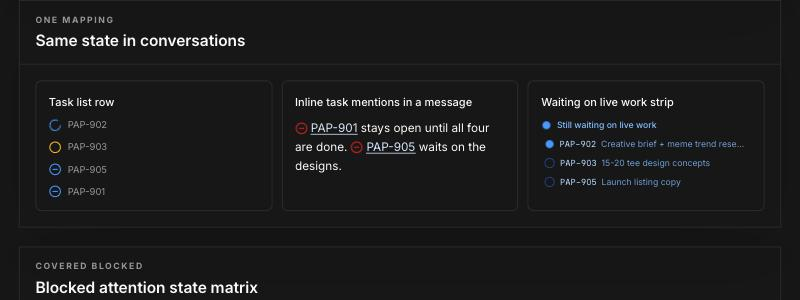
> - Inline task links in a message passed only the bare status. A
blocked task that waits on active sub-tasks showed a red glyph there and
a blue glyph in the list, breadcrumb and sidebar.
> - The "Waiting on live work" strip above the composer drew its own
filled and hollow dots, not task glyphs.
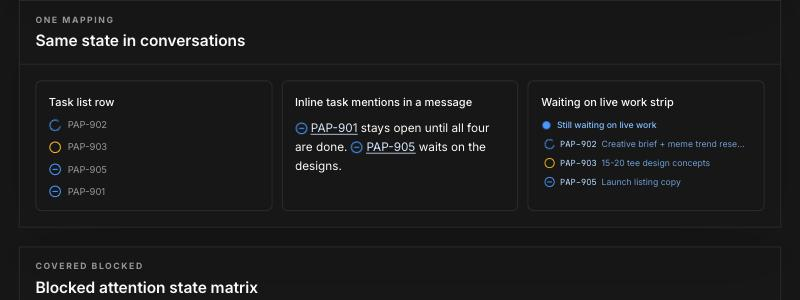
> - This pull request makes both surfaces resolve through the shared
mapping.
> - The benefit is that one task state looks the same in every view.
## Linked Issues or Issue Description
Refs #19329
**What happened?**
In a hands-on onboarding walk, the onboarding task was blocked on four
active sub-tasks. The breadcrumb, the sidebar Recents row, the Tasks
list and the "Blocked" chip used the blue in-queue glyph. Inline task
links in the agent message used the same glyph in red. The "Still
waiting on live work" strip showed the same tasks as plain dots.
**Expected behavior**
The same task state uses the same glyph and colour token in every view,
including inline links and the live-work strip.
**Steps to reproduce**
1. Create a task with sub-tasks, and block the parent on them while a
sub-task runs.
2. Mention the parent in a message (for example "(PAP-1)").
3. Compare the inline link glyph with the task list glyph. The link is
red, the list is blue.
4. Open the parent task. Compare the "Still waiting on live work" strip
with the task list. The strip shows dots.
**Paperclip version or commit**
`master` at
|