mirror of
https://github.com/paperclipai/paperclip.git
synced 2026-11-09 16:02:36 +01:00
cd8c9cd07c192832fa180a845577d36fb0bc41c8
1296
Commits
| Author | SHA1 | Message | Date | |
|---|---|---|---|---|
 TonioandPaperclip |
c650f36007 |
fix(ui): refine agent profiles, identity editing, and list actions (#19535)
## Thinking Path
> - Paperclip is the open source app people use to manage AI agents for
work.
> - Agent pages expose identity files, reporting relationships, and
runtime settings.
> - Several controls had inconsistent spacing, weak navigation, or
misleading save feedback.
> - Empty task-row detail slots also reduced the title width before
truncation.
> - This pull request fixes those behaviors and aligns the reviewed UI
details.
> - The result is clearer agent editing and more readable task and agent
lists.
## Linked Issues or Issue Description
**What happened?**
Agent headers and file controls had inconsistent layout. The Identity
footer appeared without edits and did not provide clear save
confirmation. File names could wrap or omit the Markdown suffix. Task
titles truncated while empty detail slots occupied the row.
**Expected behavior**
Keep headers and actions aligned. Reveal the Identity footer only for
changes or save feedback. Use valid Markdown file names and actual file
dates. Let titles use available space.
**Steps to reproduce**
1. Open an agent overview, then its Identity tab.
2. Edit, undo, save, copy, and add an instruction file.
3. Resize the file panel and inspect file names and date labels.
4. Hover an agent row and inspect the Chat action and tooltip.
5. Open a task list with no recovery or external details and inspect
title width.
Related: #18716 is the prior UI bundle. #16934 and #14483 concern role
editing; this change does not add a role picker.
## What Changed
- Refine the character header, inline title and name editing, crown
position, runtime shortcut, and Chat/New task actions.
- Align profile metadata and manager selection; hide empty direct
reports.
- Refine Identity panels, Markdown filename validation, file-row hover,
truncation, Paper Mono typography, and copy feedback.
- Add a viewport-bound save footer with dirty, saving, and saved states.
Keep undo/discard separate from successful saves.
- Return recorded creation or modification dates for instruction files.
Reuse the active file transaction for metadata reads to avoid exhausting
the small connection pool.
- Reveal the agent-row Chat icon and label on hover, with a standard
delayed tooltip.
- Collapse empty task-row details so titles can use the available width.
## Verification
- Browser checks covered the local overview and Identity flows, narrow
file panels, successful file creation/update, undo/discard, header
navigation, row hover, tooltip delayed-open state, and full task titles.
- Focused instruction, save-footer, date, font-asset, and task-row tests
passed during development. After review, 55 file/instruction tests
passed, including cold restoration with recorded and unknown dates;
server typecheck and 18 immediate-save response tests also passed.
- Full `pnpm -r typecheck` and `pnpm build` passed after rebase onto
current master. The complete `pnpm test:run` attempt hit a 15-second
timeout in the existing chat Retry HTTP integration test; that case
passed in isolation (1 test passed). A second full attempt hit timeouts
in two other chat integration cases (GitHub webhook draining and
delivery retry budget); both passed in isolation without increasing
timeouts. All 55 remote checks passed on
|
||
|
Devin FoleyandPaperclip
|
fd4b197f83 |
fix(ui): hide runner selection during agent setup (#19517)
## Thinking Path > - Paperclip lets people manage AI agents for work. > - Agent setup connects a harness, model, account, and computer. > - The system already selects a qualified runner for a new agent. > - Setup still asks users to select that internal runner. > - The runner dropdown can be the only field in Advanced. > - This PR removes the dropdown and hides an empty Advanced section. > - Users keep their saved execution settings and see fewer setup controls. ## Linked Issues or Issue Description **What existing behavior does this improve?** Agent creation, onboarding, built-in agent setup, company import, and agent configuration. **Subsystem affected** The UI, setup error messages, tests, and Storybook fixtures. **Current behavior** Users can select a runner from a dropdown. Some setup screens place only that dropdown in Advanced. Errors can direct users to that control. **Proposed behavior** Remove runner dropdowns from setup and configuration. Use the existing automatic selection for new agents. Retain saved runner settings. Show Advanced only when other fields remain. **Reason and benefit** Users can configure agents without an extra internal execution choice. Setup also avoids an empty Advanced section. **Breaking changes** Users can no longer select a runner through these UI dropdowns. The API and CLI retain their runner options. Existing agents keep their saved execution settings. **Additional context** Related: [Default new agents to the qualified runner for their harness](https://github.com/paperclipai/paperclip/pull/15422). This PR changes the existing setup UI. It adds no harness or runtime default. The master merge retains the custom gateway placement from [#19510](https://github.com/paperclipai/paperclip/pull/19510). ## What Changed - Remove the shared runner dropdown and its setup/configuration callers. - Hide Advanced when it has no remaining fields. Keep command and argument settings where supported. Preserve custom gateway setup under Advanced on the Claude and OpenAI API key paths. - Keep setup failures visible and keep the retry action outside the removed control. - Update errors and documentation that referred to the removed dropdown. - Update component tests and Storybook fixtures for the new UI states. - Make Legacy first-task evals resume an API-configured setup record. Record that path separately from fresh automatic onboarding. ## Verification - Latest master integration (`187c0f6d6e5`): 276 onboarding/provider-connection tests passed across six files. UI typecheck and build passed. Token gates, query-error rendering checks, and the Storybook catalog check passed. The conflict resolution retains master's bounded connection tests and cancellation while removing the obsolete runner instruction. The first test command used the wrong working directory and failed before collecting tests; the corrected invocation from `ui/` passed. - Earlier branch verification passed: full workspace build and typecheck, 1,037 focused UI/service tests, 49 heartbeat provider contract tests, eval typecheck, and 30 map/catalog tests. - The full local `pnpm test:run` run passed all six chat integration shards (1,931 tests). It was stopped for the master merge before the complete suite finished. The [complete CI run](https://github.com/paperclipai/paperclip/actions/runs/42264662642) passed on the previous head `72e1699`. - Current head `a097c8369d079c839e78661a2206cfa62c5210e0`: [full CI](https://github.com/paperclipai/paperclip/actions/runs/42273168268) passed. PR checks total 55 passed and 3 skipped, with none failed or pending. Greptile reviewed this head at 5/5 with no actionable findings or unresolved review threads. - Live browser/provider evals have not run. The Legacy eval change has no live qualification claim. ## Risks - Removing the dropdown changes the setup UI. Existing API and CLI runner choices remain available. - Conditional Advanced sections must retain valid command and argument fields. - Legacy first-task evals now prove setup resumption. They do not prove the fresh-agent automatic default. - No schema change or data migration is included. ## Model Used OpenAI `gpt-6.1-sol`, through Codex in T3 Code. Reasoning effort: `xhigh`. The model used file editing, shell commands, and test tools. The harness does not expose the context window size. ## Checklist - [x] I have included a thinking path that traces from project context to this change - [x] I have specified the model used (with version and capability details) - [x] I have checked ROADMAP.md and confirmed this PR does not duplicate planned core work - [x] I have searched GitHub for duplicate or related PRs and linked them above - [x] I have either (a) linked existing issues with `Fixes: #` / `Closes #` / `Refs #` OR (b) described the issue in-PR following the relevant issue template - [x] I have not referenced internal/instance-local Paperclip issues or links (only public GitHub `#NNN` / `github.com/paperclipai/paperclip` URLs) - [x] My branch name describes the change (e.g. `docs/...`, `fix/...`) and contains no internal Paperclip ticket id or instance-derived details - [x] I have run tests locally and they pass - [x] I have added or updated tests where applicable - [x] I have updated relevant documentation to reflect my changes - [x] I have considered and documented any risks above - [x] All Paperclip CI gates are green - [x] Greptile is 5/5 with no open P2s, recommendations, or follow-ups - [x] I will address all Greptile and reviewer comments before requesting merge Co-Authored-By: Paperclip <noreply@paperclip.ing> |
||
|
Devin FoleyandPaperclip
|
e3d8f42e19 |
fix(ui): recover stalled onboarding connection checks (#19505)
Bound the complete onboarding connection check to two minutes, abort its requests on timeout, and ignore late results. Keep the saved account available for retry and resume its matching unfinished setup after refresh. Verified 242 focused tests, workspace typecheck and build, and the complete hosted CI check set. Greptile is 5/5 with no unresolved review comments. Local full-UI timing failure and interrupted CI runner attempts remain documented in the PR evidence. Co-Authored-By: Paperclip <noreply@paperclip.ing> |
||
|
DottaandPaperclip
|
952ecdbb39 |
feat(ui): show assignee avatars in task lists (#18607)
## Thinking Path > - Paperclip is the open source app people use to manage AI agents for work. > - People use task lists to see who owns each task. > - The shared task table shows an assignee name without a picture. > - A picture helps people find an agent or person when they scan the list. > - This pull request shows the existing avatar beside the assignee name. > - The table uses the same image and fallback components as other identity views. ## Linked Issues or Issue Description **What existing behavior does this improve?** The Assignee column in the shared task table. **Subsystem affected** `ui/` — the task table and its page data. **Current behavior** The column shows only an assignee name. People must read each name to find an owner. **Proposed behavior** Show the agent avatar or human profile image beside the name when the Assignee column is visible. Use the existing fallback if an image is missing. Show no avatar for an unassigned task. **Reason and benefit** People can use the same identity pictures throughout the app. This helps them scan task ownership. **Breaking changes** None. The API, task assignment, name sorting, and filters keep their existing contracts. **Additional context** Related work: #2422 adds agent avatar URL support. It does not add avatars to this table. #13319 aligns icons in task properties. This change uses the existing identity components. ## What Changed - Pass agent appearance and human profile images from existing company data to the task table. - Keep the avatar visible beside a long name as the name scrolls on hover or focus. - Respect the Assignee column setting and keep unassigned rows without avatars. - Load human photos only from Paperclip asset URLs. Show initials for external profile URLs without an image request. - Add tests with the real task row for agent and human images, image fallbacks, unassigned tasks, and the Columns control. - Use the shared human label when a directory entry is missing. The local operator shows Board. Other missing users show the short user ID. - Update Storybook data, design guidance, and the task-list verification steps. ## Verification - Current head: `c49fee5c9b`. The source-tested merge is `586873fe47921b250ab0de18371d25632f46cff0`, which integrates master `53645a0104`. The last commit removes only the inherited avatar paragraph from the feature map under the current map-scope rule. Map checks pass again. No history rewrite or duplicate feature PR. - Reproduced the old voice-report CI failure before integration. The unchanged test on `7f1d137a` passed on an unloaded local machine. With a controlled 3,250 ms delay in its first local provider fixture and a 15-second wait, the old polling failed: expected 105 report requests, received 315. This confirms the fake clock crossed refresh deadlines during database work. - Master already fixes this exact failure through #18628 (`d26628e35a`). The fixed polling passes with the identical delay and wait budget. The exact session IDs, 105 requests, one attempt per report, bounded reconstruction, restart, and quiet assertions remain. The temporary delay is removed. - Final committed code: all 15 voice-report tests and 46 scheduler/coordinator tests pass against disposable embedded PostgreSQL on macOS arm64. No external provider call is used. - All 154 tests pass across eight focused UI suites: TaskList, TaskList.assignees, CoordinatorTasks, IssueRow, AgentAvatar, useTaskListCollection, useTaskListColumnPreferences, and TaskChatBubble. - Three merge conflicts retained both current behavior and the avatar feature: current sorting and column preferences, unread state, assignee photos, and shared human labels. The focused tests cover those contracts. - UI TypeScript, UI build, token gates, map structure, Storybook catalog generation, and whitespace checks pass. Storybook output is generated and ignored. - The original server shard failure remains recorded: [voice-report CI failure](https://github.com/paperclipai/paperclip/actions/runs/41472540522/job/125369899753), expected zero idle holds but received two. Older attempts also had attention-retention and sandbox-runtime timeouts; their causes were not established in those attempts. Fresh CI must qualify the merged head. - Previous review findings were fixed with red/green coverage: missing avatar tests, shared human labels, and arbitrary human image URLs. Current code still limits human photos to Paperclip asset URLs; external URLs use initials and start no image preload. - Prior browser checks covered agent and human images, fallbacks, unassigned rows, hidden columns, and long-name keyboard focus. Those checks used production components with fixture data and do not prove live backend behavior. No new browser or hosted task action was performed for this CI repair. - Current head `c49fee5c9b`: Greptile and Paperclip review both give 5/5 with no findings. The initial CI attempt passed the original server shard and all other completed test suites. The workspaces-a 2/2 job was interrupted by a runner shutdown signal ([job log](https://github.com/paperclipai/paperclip/actions/runs/42250845315/job/128006963628)); it has no complete test result. A single bounded retry of that shard and its dependent verification has been requested after the initial workflow ended. No source change is based on that interruption. - Final-head qualification: `c49fee5c9b75b695d2894933bbcbe0896aab9148` passes all 55 applicable CI checks (three skipped, one neutral review). [CI result](https://github.com/paperclipai/paperclip/actions/runs/42250845315). Greptile gives 5/5 with no open findings. Hosted task recovery remains pending verified rollout. ## Risks - Low risk. The change adds identity pictures through existing UI components and existing company data. - Human profile images hosted outside Paperclip show initials in this table. This matches the existing task-message avatar rule. - A long name has less width beside its avatar. The existing hover and focus reveal keeps the name readable. - Current master changes table sorting and preferences. Merge resolution retains these contracts and their tests. Fresh CI and review must pass before merge. ## Model Used OpenAI GPT-6 through Codex assisted with code and verification. The runtime did not expose an exact model ID or context-window size. The agent used code execution and repository tools. ## Checklist - [x] I have included a thinking path that traces from project context to this change - [x] I have specified the model used (with version and capability details) - [x] I have checked ROADMAP.md and confirmed this PR does not duplicate planned core work - [x] I have searched GitHub for duplicate or related PRs and linked them above - [x] I have either (a) linked existing issues with `Fixes: #` / `Closes #` / `Refs #` OR (b) described the issue in-PR following the relevant issue template - [x] I have not referenced internal/instance-local Paperclip issues or links (only public GitHub `#NNN` / `github.com/paperclipai/paperclip` URLs) - [x] My branch name describes the change (e.g. `docs/...`, `fix/...`) and contains no internal Paperclip ticket id or instance-derived details - [x] I have run tests locally and they pass - [x] I have added or updated tests where applicable - [x] I have updated relevant documentation to reflect my changes - [x] I have considered and documented any risks above - [x] All Paperclip CI gates are green - [x] Greptile is 5/5 with no open P2s, recommendations, or follow-ups — current head `c49fee5c9b`; the map-scope finding is fixed and its thread is resolved - [x] I will address all Greptile and reviewer comments before requesting merge --------- Co-authored-by: Paperclip <noreply@paperclip.ing> |
||
|
Nicky LeachandClaude Opus 5.5
|
832ede93ed |
fix(apps): stop the Connectors page from pegging the CPU on managed instances (#19380)
## Thinking Path > - Paperclip is the open source app people use to manage AI agents for work > - The Connectors page (`/apps`) merges native connectors with about 1,600 apps from the Composio and Arcade catalogs > - #19328 made some native connectors yield to aggregator sign-in on managed instances. To decide, it checks whether any aggregator serves each native row > - That check scans the whole catalog. It runs once per native row for every catalog app, so one pass makes about 1,600 × 110 × 1,600 name comparisons > - The pass also re-runs on every render, because a memo dependency is a `Map` rebuilt in the component body. Aggregator polling keeps renders coming > - On a managed instance, the page pegs a CPU core and does not become usable. Self-hosted instances skip the branch, and the tests used one or two catalog entries, so nothing caught it > - This pull request makes the check a set lookup, keeps the memo inputs stable, and adds a test at shipped catalog scale plus a general review rule for rendering large collections > - The benefit is that `/apps` loads normally on managed instances again, and similar regressions fail a test or get flagged in review ## Linked Issues or Issue Description Refs #19328 Refs #19247 **What happened?** On a managed instance, opening `/apps` pegs the CPU at 100%, and the page is very slow or unresponsive. **Steps to reproduce** 1. Open a managed instance (`useCloudInstance()?.managed === true`). 2. Go to `/apps`. 3. The tab holds a CPU core at 100%. **Expected behavior** The Connectors page renders in well under a second, and it does not re-run catalog work on unrelated renders. **Root cause** In `ui/src/pages/apps/Browse.tsx`, `yieldsToAggregators()` calls `hasAggregatorRoute()`. That function scans every aggregator catalog entry with regex normalization. The `managedCatalog` loop calls `yieldsToAggregators()` for every native row, for each of about 1,600 catalog apps. A Node benchmark with the shipped catalog data measured about 214 s per pass on a managed instance and 40 ms self-hosted. The `rows` memo depended on `upstreamAppsBySlug` and `gallery`, which were rebuilt on every render, so the memo never reused its result. ## What Changed - Index every aggregator identity once (`managedCatalogIdentities`), so the aggregator route check is one `Set` lookup. - Cache each slug's yield decision for the pass. Rows hold their final connections and chat endpoints by then, so the answer cannot change. - Normalize native row identities once before matching them against catalog apps. - Memoize `gallery`, the aggregator snapshots, `upstreamAppsBySlug` and `managedCatalog`. A small `useShallowStableItems` helper keeps the per-gateway `useQueries` data stable, so the `rows` memo runs only when connector data changes. - Match catalog apps to native rows through an identity-to-row index instead of scanning the native rows for each catalog app. The earliest row among an app's alias lookups is the row the old ordered scan found. - Add a test that loads the shipped aggregator catalog and every native connector in managed-instance mode, with a saved Composio gateway and account. It counts `aggregatorAppIdentity` calls. The full load must stay under 20× the catalog name count (today about 5×). An unchanged refetch and a search must not rebuild the rows, and a changed account must still appear. Above the limit the counter throws, so a regression fails in milliseconds instead of blocking the test worker. - Add `rules/ui-render-cost.mdc`, a general rule for `ui/src/**` code that renders large collections: no nested scans, stable memo dependencies, and a realistic-size test with a deterministic work counter when a change touches such a path. Register it in `.greptile/files.json`. ## Verification - `cd ui && npx vitest run src/pages/apps/Browse.test.tsx`: 100 of 100 pass. - With the previous `Browse.tsx` and the new test, the new test fails in 70 ms with "Connector catalog work exceeded its budget". - Measured on the new code: a full managed-instance load makes 25,810 identity calls for 5,095 catalog names. A search makes 0. - `node scripts/run-tsc.mjs -b` in `ui/`: no new errors. The only errors are in `PluginOrganizationSwitcher`, because `@paperclipai/plugin-sdk` is not built in a fresh worktree. They are unrelated to this change. - `pnpm check:token-gates`: all gates clean. - I did not check this in a browser on a managed instance. A local self-hosted instance does not take that branch. ## Risks - Low. The row-building logic gives the same results. The existing managed-instance Slack, Asana and Google tests still pass. - `useShallowStableItems` writes a ref during render. In the worst case, a concurrent render does one extra memo pass. It cannot return stale data, because it compares every item by identity. - The new rule applies to all `ui/src/**` reviews. Its body limits it to large or unbounded collections, to keep review noise low. > For core feature work, check [`ROADMAP.md`](ROADMAP.md) first and discuss it in `#dev` before opening the PR. Feature PRs that overlap with planned core work may need to be redirected — check the roadmap first. See `CONTRIBUTING.md`. ## Model Used - Anthropic Claude Opus 5.5 (`claude-opus-5-5`) in Claude Code, with tool use (shell, file editing, test execution). ## Checklist - [x] I have included a thinking path that traces from project context to this change - [x] I have specified the model used (with version and capability details) - [x] I have checked ROADMAP.md and confirmed this PR does not duplicate planned core work - [x] I have searched GitHub for duplicate or related PRs and linked them above - [x] I have either (a) linked existing issues with `Fixes: #` / `Closes #` / `Refs #` OR (b) described the issue in-PR following the relevant issue template - [x] I have not referenced internal/instance-local Paperclip issues or links (only public GitHub `#NNN` / `github.com/paperclipai/paperclip` URLs) - [x] My branch name describes the change (e.g. `docs/...`, `fix/...`) and contains no internal Paperclip ticket id or instance-derived details - [x] I have run tests locally and they pass - [x] I have added or updated tests where applicable - [x] I have updated relevant documentation to reflect my changes - [x] I have considered and documented any risks above - [ ] All Paperclip CI gates are green - [ ] Greptile is 5/5 with no open P2s, recommendations, or follow-ups - [x] I will address all Greptile and reviewer comments before requesting merge 🤖 Generated with [Claude Code](https://claude.com/claude-code) --------- Co-authored-by: Claude Opus 5.5 <noreply@anthropic.com> |
||
|
|
f8cb4957dc |
fix(ui): default Tasks to All tasks with a neutral sort header (#19393)
## Thinking Path > - Paperclip is the open source app people use to manage AI agents for work. > - The Tasks page helps people inspect work across their company. > - A new viewer currently starts in Mine and can miss other company tasks. > - The task table also shows an active sort header before the viewer selects a sort. > - This pull request starts new viewers in All tasks and keeps the default sort header neutral. > - People see company work in newest-update order and keep their saved view choices. ## Linked Issues or Issue Description **What existing behavior does this improve?** The initial task view and the task table's default sort state. **Subsystem affected** ui/ — React board UI. **Current behavior** Tasks opens Mine when the viewer has no saved view. The table highlights Last updated even when the viewer has not selected a column sort. **Proposed behavior** Tasks opens All tasks when no saved view exists. The table keeps newest-updated tasks first without an active header or arrow. A column selection or an explicit sort URL activates the selected header. **Reason and benefit** New viewers can inspect company work immediately. The header distinguishes default ordering from an explicit sort choice. **Breaking changes** The first-visit view changes from Mine to All tasks. Saved views and explicit view URLs keep priority. Existing Inbox and Needs attention preferences retain their meaning. The change does not alter task access or database contracts. **Additional context** Refs #19363. This change builds on the grouped task menu from that merged pull request. It uses the existing menu and design tokens. ## What Changed - Default the Coordinator and combined task surfaces to All tasks. - Preserve saved personal views and migrate previous picker choices. - Keep implicit Last updated descending order separate from active header state. - Test default ordering, explicit sorting, reset behavior, view selection, and preference migration. - Update the product and implementation docs. ## Verification - Passed 118 focused tests across task routing, table sorting, views, and collection preferences. - Passed `pnpm check:token-gates`, `pnpm -r typecheck`, and `pnpm build`. - Full `pnpm test:run` is running. Its result will be updated here. - Greptile passed the current head with 5/5 and no findings or open review threads. - Browser check: All tasks uses the grouped My work and Organization menu. Last updated has no active highlight by default. Selecting the header adds the sort URL and active direction. Removing the explicit sort restores the neutral header. - Manual check: Open Tasks with no saved task view. Confirm All tasks opens. Select Mine, leave Tasks, and return. Confirm Mine remains selected. ## Risks - The new default shows more accessible company tasks on the first visit. Saved view choices remain intact. - Task tables share the sort-state change. Explicit sort links and column clicks retain active styling. Default row order stays newest-updated first. - No schema, API, permission, or execution changes. ## Model Used OpenAI Codex, GPT-6 family. This session does not expose the exact model ID or context-window size. Used reasoning, code editing, terminal commands, and browser verification. ## Checklist - [x] I have included a thinking path that traces from project context to this change - [x] I have specified the model used (with version and capability details) - [x] I have checked ROADMAP.md and confirmed this PR does not duplicate planned core work - [x] I have searched GitHub for duplicate or related PRs and linked them above - [x] I have either (a) linked existing issues with `Fixes: #` / `Closes #` / `Refs #` OR (b) described the issue in-PR following the relevant issue template - [x] I have not referenced internal/instance-local Paperclip issues or links (only public GitHub `#NNN` / `github.com/paperclipai/paperclip` URLs) - [x] My branch name describes the change (e.g. `docs/...`, `fix/...`) and contains no internal Paperclip ticket id or instance-derived details - [x] I have run tests locally and they pass - [x] I have added or updated tests where applicable - [x] I have updated relevant documentation to reflect my changes - [x] I have considered and documented any risks above - [ ] All Paperclip CI gates are green - [x] Greptile is 5/5 with no open P2s, recommendations, or follow-ups - [x] I will address all Greptile and reviewer comments before requesting merge --------- Co-authored-by: Scott Tong <scott@scottsmbpm5max.lan> Co-authored-by: Paperclip <noreply@paperclip.ing> |
||
|
Devin FoleyandPaperclip
|
8f79a32898 |
fix(connections): keep agent access consistent through setup and permission changes (#19352)
Task-hosted tool setup kept requester-only defaults, and audience edits could leave runtime installations restricted after permission bindings were widened. Large provider catalogs could also fail before creating an access card. Use the normal agent audience defaults for new tool setup, preserve explicit selections through verified OAuth and draft resumption, and synchronize permission bindings and runtime installations atomically. Enforce agent-edit authority and preserve existing access during additive account reuse. Validation: 915 focused regression tests, typechecks, and builds passed. All 54 CI checks passed and Greptile Apex scored the reviewed head 5/5 with no unresolved threads. Broad local test failures, recoveries, and incomplete heartbeat coverage are documented in the PR. Co-Authored-By: Paperclip <noreply@paperclip.ing> |
||
|
|
4550253dc9 |
feat(ui): rename Needs you to Inbox and move Mine into Tasks (#19363)
## Thinking Path > - Paperclip is the open source app people use to manage AI agents for work. > - Coordinator gives people navigation for conversations, tasks, and decisions. > - The decision entry is called Needs you, while a separate Inbox remains under More. > - Coordinator's personal task filter does not retain the full behavior of the original Mine view. > - This pull request names the decision entry Inbox and hosts the original personal work views inside Tasks. > - People keep their triage tools and saved choices without moving between two task destinations. ## Linked Issues or Issue Description **What existing behavior does this improve?** Coordinator navigation and the personal Mine view in Tasks. **Subsystem affected** UI navigation, task view routing, task collection preferences, and browser coverage. **Current behavior** Needs you opens the decision feed. More contains another Inbox destination. The default Coordinator task filter matches task creators and assignees. It does not use the full personal participation rules, archive behavior, shortcuts, grouping, or saved columns of the original Mine view. The organization task table also resets its column choices on reload. **Proposed behavior** Inbox opens the same decision feed with the inbox icon. Tasks defaults to Mine and remembers a person's selected view per company. Mine uses the existing personal Inbox implementation and preferences. It retains read/unread title weights, keyboard navigation, read/unread shortcuts, archive and undo, mobile swipe-to-archive, grouping, and saved columns. Old Inbox links open the matching task view. The organization task table saves its columns and order per person and company. **Reason and benefit** People get Chat, Tasks, and Inbox as distinct navigation entries. Personal work remains a view within Tasks without losing the existing triage behavior. **Breaking changes** Coordinator no longer offers the previous Inbox destination under More. Old Inbox URLs redirect into Tasks and retain query parameters and fragments. The Needs you label becomes Inbox; its decision feed, count, history, and resolution paths stay in place. Classic retains its separate optional combined-list setting. **Additional context** Refs: #19360, the workspace-defaults PR now integrated from master. Refs: #10620, related Inbox attention ordering. Duplicate searches found no open PR for this navigation and Mine integration. Roadmap review found no separate new execution feature in this scope. ## What Changed - Rename Coordinator's desktop and mobile decision entry and page to Inbox. Use the inbox icon. Remove the old Inbox item under More. Clarify that the combined-list experiment applies only to Classic. - Add one Coordinator task-view router. Host Mine, Unread, Recent, Blocked, and Everything through the existing Inbox owner. Keep organization views in the task table and board. Normalize legacy filtered URLs before mounting a collection so clearing the last filter preserves the current layout and local filters. - Reuse the existing Mine API, participation, read state, archive cache, undo, keyboard, mobile gesture, grouping, and preference paths. Existing personal column choices carry over. - Save organization task-table columns and order per person and company. Keep controls usable if browser storage fails. - Update navigation tests, routing and persistence regressions, exact-run retry browser coverage for each workspace variant, product documentation, and the affected Storybook notes. Keep existing story IDs. ## Verification - Preference, routing, navigation, task table, and inherited Inbox regression tests pass in focused runs. After integrating master and addressing the review finding, all 187 focused tests, UI typecheck, and token gates pass. - Full build and repository typecheck pass after integrating master. The full UI suite previously passed: 894 files, 11,169 tests passed, and one skipped. All 14 desktop/mobile triage and exact-run retry browser cases, including a fresh production UI build, pass after integrating master. - The full repository test suite was not run locally for this UI-only change; full PR CI is running. - Browser checks use a fresh isolated local instance and a deterministic process agent for real run-attributed unread activity. They exercise legacy URLs, title weights, saved grouping and columns, read/unread shortcuts, archive/undo, and a real mobile touch gesture. - Earlier browser fixtures were corrected: own activity is read, agent comments need valid run attribution, and undo uses `u` after the archive refresh completes. The Inbox content heading is scoped separately from the layout heading. - The final settings wording correction passes all 63 settings tests. - The [next CI browser run](https://github.com/paperclipai/paperclip/actions/runs/42137377960/job/127629100535) caught an old URL assertion for denied run retries. The test now pins each workspace variant and covers Coordinator Tasks explicitly. The old expectation fails deterministically for Coordinator; all 12 retry cases pass with the corrected destination, preserving exact run identity and truthful queued, deferred, and denied feedback. - Token gates, map checks, and Storybook catalog checks pass. All 30 map/catalog script tests pass. Storybook play tests were not run. - Greptile reviewed [the final commit](https://github.com/paperclipai/paperclip/commit/5f2f3789b83af259f694f379afb769465688fb72) at **5/5** with no new actionable findings. Its sort-only link finding is fixed and resolved: three cases fail before the fix and pass after it. `sortField` and `sortDir` keep organization links on the organization table. [Current-head CI](https://github.com/paperclipai/paperclip/actions/runs/42139668774) is running. - [CI exposed a routing race](https://github.com/paperclipai/paperclip/actions/runs/42135293421/job/127621981587) when removing the last label from a legacy Everything link. Four deterministic regressions failed before the fix and now pass: collections only mount after URL normalization. The existing end-to-end component cases confirm local filters, board layout, fragments, and history survive the change. - The [initial server shard 4 run](https://github.com/paperclipai/paperclip/actions/runs/42131163087/job/127608751620) failed an unchanged monitor-drain idleness assertion: two active operations remained instead of zero. The complete scheduling suite passes locally (54 tests). One isolated CI retry passed, including its dependent verification gate. The original timing failure's root cause is not established. ## Risks - Mine includes the existing tasks, approvals, failed runs, and join requests, preserving the original personal participation and attention rules. - Shared URLs with organization filters or table sort parameters still open the organization task collection. Task back-links retain their original fragments. - Saved preferences are browser-local. Mine keeps its existing storage keys; the organization table and selected Coordinator view use person/company scopes. - No database or server API contract changes are included. Existing company access, personal participation, and decision permissions retain their owners. ## Model Used OpenAI Codex, based on GPT-6, with reasoning, repository tools, code execution, and browser automation. The exact serving revision and context-window size are not exposed in this session. ## Checklist - [x] I have included a thinking path that traces from project context to this change - [x] I have specified the model used (with version and capability details) - [x] I have checked ROADMAP.md and confirmed this PR does not duplicate planned core work - [x] I have searched GitHub for duplicate or related PRs and linked them above - [x] I have either (a) linked existing issues with `Fixes: #` / `Closes #` / `Refs #` OR (b) described the issue in-PR following the relevant issue template - [x] I have not referenced internal/instance-local Paperclip issues or links (only public GitHub `#NNN` / `github.com/paperclipai/paperclip` URLs) - [x] My branch name describes the change (e.g. `docs/...`, `fix/...`) and contains no internal Paperclip ticket id or instance-derived details - [x] I have run tests locally and they pass - [x] I have added or updated tests where applicable - [x] I have updated relevant documentation to reflect my changes - [x] I have considered and documented any risks above - [ ] All Paperclip CI gates are green - [x] Greptile is 5/5 with no open P2s, recommendations, or follow-ups - [x] I will address all Greptile and reviewer comments before requesting merge --------- Co-authored-by: Scott Tong <scott@scottsmbpm5max.lan> Co-authored-by: Paperclip <noreply@paperclip.ing> |
||
|
|
f2593b7905 |
feat: make Coordinator and Agent Chat standard and speed up navigation (#19360)
## Thinking Path > - Paperclip is the open source app people use to manage AI agents for work. > - People enter that work through the workspace, agent conversations, and tasks. > - Coordinator and Agent Chat still require experimental enrollment. > - Task link prefetches do not warm the compact queries used by the default task view. Chat also waits for a request when its navigation list already holds the conversation. > - This pull request makes Coordinator and Agent Chat standard and reuses the reads needed for navigation. > - People can choose Classic workspace in Experimental settings. Cached work can appear while fresh data loads. ## Linked Issues or Issue Description **What existing behavior does this improve?** Workspace selection, Agent Chat availability, and navigation between Chat, Tasks, and task details. **Subsystem affected** Cross-cutting: UI, workspace preferences, instance settings, and the database migration. **Current behavior** People must enable Coordinator and Agent Chat in Experimental settings. Opening a task can repeat requests because prefetch warms the full detail and comment queries, while the default view reads compact task data and a recent comment window. Opening Chat waits for a detail request even when the current person's conversation list contains it. **Proposed behavior** Coordinator is the standard workspace for everyone. Experimental settings offer Classic workspace, off by default. Old Coordinator experiment values do not select Classic. Agent Chat is available to everyone, including instances with an old saved or managed off value. Task link intent warms the queries used by the mounted view. Chat can use the current person's company-scoped conversation list during refresh. **Reason and benefit** People can use the standard workspace without setup. Repeat navigation can show cached content while the server refreshes it. **Breaking changes** Existing Coordinator experiment and Agent Chat off values no longer disable these surfaces. Classic requires an explicit new opt-in. The workspace API keeps its existing response shape and audit checks. The migration retains legacy values and adds a separate Classic preference. Execution permissions, company access, and chat privacy checks still apply. **Additional context** Roadmap check: this graduates existing surfaces and improves their navigation. It does not add a new agent execution capability. Duplicate searches found no open Coordinator workspace PR. Related server cache work, Refs: #17828, addresses compact issue-list invalidation; this PR addresses client navigation queries. ## What Changed - Add a default-off Classic workspace preference. Derive the existing workspace API response from that choice. Keep personal persistence, account isolation, and audited writes in the workspace preference service. - Replace the Coordinator experiment control with Classic workspace. Use Coordinator while preferences load. Update the existing settings examples and navigation recipe. - Retire the Agent Chat experiment control. Ignore old stored and managed off values. Retain the compatibility key and the existing execution and access checks. - Reuse account- and company-scoped chat list data with its original freshness timestamp. - Share compact task and recent-comment query options between prefetch and the task view. Keep full-history prefetch for Classic tasks and expanded history. - Add upgrade, replay, cache, account isolation, and browser switching regressions. Update product, database, development, and roadmap documentation. ## Verification - Targeted preference, settings, migration, cache, and UI regression tests passed during implementation. The cache tests hold refresh requests pending and check that content still renders. They also check account isolation and stale refresh behavior. - A real browser test verified fresh Coordinator defaults, Classic opt-in persistence, and return to Coordinator. It used an isolated source checkout with fresh data on macOS. - Token, migration numbering and safety, map, and Storybook catalog checks pass after the rebase. - Repository typecheck and build pass. Typecheck and token gates also pass after review repairs. The broad local run passed all six chat integration shards (1,931 tests). It then found the host-CLI-dependent recovery fixture described below. Its remaining duplicate work was stopped after the full current-head CI matrix passed; this is not a claim that the broad local command completed green. - Review repairs passed 419 UI/migration fixture tests, 19 Coordinator navigation tests, and all 214 tests in the five affected server suites. The 24 Chat/workspace browser tests pass, including standard Coordinator switching and explicit Classic persistence. - The broader browser repair run passed 85 tests. It retained two failed assertions and skipped five later serial cases. The affected files then passed all 11 tests after the fixes: reopen the desktop panel after reload and open More for Audit and Connectors. This includes the five serial cases that had not run. - The broad local suite exposed a recovery fixture that executed the host Codex CLI during a simulated remote probe. On a host with Codex 0.154.0, model fallback broke its fixed-model assertion. The fake sandbox now reports Codex 0.160.0. All 20 selected recovery/provider compatibility cases pass after the repair. - A CLI company import/export suite timed out during server startup in the second CI run. The port fallback is intentional in that fixture. No root cause was established. That suite passes on the final commit in CI. This records recovery, not a claimed product fix for the earlier timeout. - The first CI run exposed remaining assumptions about the retired flags and Classic UI. The repair commit updates those fixtures and navigation steps. It also restores the missing enabled Cases destination in Coordinator. Earlier local recovery attempts used the wrong fixture notification and advanced fake time during live execution; the corrected tests use the subscribed recovery queue and wall time during execution. - Greptile reviewed commit `98972b030d4505d838427a2fca6b196b8cad6d47` at **5/5** with no new comments. The original finding is resolved. - Current-head CI is green: **56 successful checks**, with three checks skipped by workflow filters. This includes typecheck, build, the complete Vitest matrix, all eight browser shards, Runner verification, release checks, and security checks. [Final CI run](https://github.com/paperclipai/paperclip/actions/runs/42132651414). - Typecheck caught missing `pid` and `startedAt` fields in the simulated command result. The fixture now returns the complete process contract, and the server test-layer typecheck passes. - Storybook catalog alignment was checked. Storybook play tests were not run. Hosted latency and cold bundle loading were not measured. ## Risks - The new default changes the workspace for people who previously left the Coordinator experiment off. They can opt into Classic in Experimental settings. - The additive migration must run before the new server code. It is safe to replay and preserves explicit Classic choices. - Cached content can be stale during background refresh. Existing query invalidation and source timestamps still control freshness. - These changes reduce avoidable loading waits. They do not establish a measured improvement in hosted request latency or initial bundle download time. ## Model Used OpenAI Codex, based on GPT-6, with reasoning, repository tools, code execution, and browser automation. The exact serving revision and context-window size are not exposed in this session. ## Checklist - [x] I have included a thinking path that traces from project context to this change - [x] I have specified the model used (with version and capability details) - [x] I have checked ROADMAP.md and confirmed this PR does not duplicate planned core work - [x] I have searched GitHub for duplicate or related PRs and linked them above - [x] I have either (a) linked existing issues with `Fixes: #` / `Closes #` / `Refs #` OR (b) described the issue in-PR following the relevant issue template - [x] I have not referenced internal/instance-local Paperclip issues or links (only public GitHub `#NNN` / `github.com/paperclipai/paperclip` URLs) - [x] My branch name describes the change (e.g. `docs/...`, `fix/...`) and contains no internal Paperclip ticket id or instance-derived details - [x] I have run tests locally and they pass - [x] I have added or updated tests where applicable - [x] I have updated relevant documentation to reflect my changes - [x] I have considered and documented any risks above - [x] All Paperclip CI gates are green - [x] Greptile is 5/5 with no open P2s, recommendations, or follow-ups - [x] I will address all Greptile and reviewer comments before requesting merge --------- Co-authored-by: Scott Tong <scott@scottsmbpm5max.lan> Co-authored-by: Paperclip <noreply@paperclip.ing> |
||
|
DottaandClaude Opus 5.5
|
4ece2107b8 |
fix(connections): offer aggregator Slack sign-in on Cloud instead of a customer OAuth app (#19328)
## Thinking Path

> - Paperclip is the open source app people use to manage AI agents for
work
> - Connectors let people give agents tools, such as Slack, from the
Connectors catalog or from an agent's inline "Connect" card
> - On Paperclip Cloud, the only Slack path is "Slack needs its own
OAuth app". The user must create a Slack app, paste a callback URL, and
enter a Client ID and secret
> - Managed Slack chat setup exists, but it is behind the experimental
Chat connectors setting, which is off on Cloud. Composio's and Arcade's
managed Slack sign-in exists, but the native Slack row hides it
> - In an onboarding test on Cloud, a tester got this card from the
onboarding agent, spent 7 minutes on it, and declined it. No Slack
connection was made
> - This pull request follows the existing Google Workspace pattern: on
Cloud, a native connector whose every setup path needs a
customer-created OAuth app yields new setup to the aggregators' managed
sign-in, in the catalog and in agent connection discovery
> - The benefit is that Cloud users can connect Slack with a sign-in
instead of creating a Slack app

## Linked Issues or Issue Description

**What happened?**
On a Paperclip Cloud instance, the onboarding agent asked the user to
connect Slack. Connectors > Slack > Connect showed "Slack needs its own
OAuth app. Slack does not let Paperclip register itself automatically,
so this connector needs an OAuth app you create." The form asks for a
callback URL, a Client ID and a Client secret. It has no link to Slack
app settings. The method description said "Use the provider-hosted
connection for the quickest setup." The tester gave up. The original
notes said that the cloud connector asked for an HTTPS server. That is
not correct: no HTTPS or deployment-mode check is in this path. The real
blocker is the customer OAuth app requirement.

**Expected behavior**
Slack can be connected from the supported Cloud flow without setup steps
that only an operator can do.

**Steps to reproduce**
1. On a Cloud instance with Chat connectors off (the Cloud default),
open Connectors and search for "Slack".
2. Click Connect on Slack. The "needs its own OAuth app" form opens.
3. Or, let an agent call `connections_search("Slack")`. It returns
native `slack` first, and its card opens the same form.

**Additional context**
Evidence: the Slack gallery entry on the Cloud instance had
`ownershipAvailability` `platform_shared: false`, `platform_provisioned:
false`, `customer: true`. `GET
/api/companies/:id/chat-slack/setup-options` returned 403 "Chat
connectors are disabled".

## What Changed

- `packages/shared`: add `nativeConnectorRequiresCustomerOAuthApp(app,
settings)`. It is true when every available setup path of a native
connector needs a customer-created OAuth app: no Paperclip-managed
client, no dynamic client registration, and no enabled chat setup.
- `ui/src/pages/apps/Browse.tsx`: on Cloud, such a connector yields to
aggregators, the same as the built-in Google connectors. The catalog
shows the "Connect through Composio or Arcade" row, and its Connect
button opens the provider choice. A saved native connection, a chat
endpoint, Chat connectors on, a self-hosted instance, or no aggregator
route keeps the native row.
- `server/src/services/connection-intents.ts` and new
`connection-native-yield.ts`: agent `connections_search` uses the same
rule. On Cloud, it does not prefer native Slack for new setup, so the
agent asks the provider-choice question (Composio, Arcade or Zapier).
The rule applies the advertised Paperclip Cloud connector profiles, so
apps with a managed Cloud client (for example Asana) do not yield. If
the profiles cannot be read, the native connector stays.
- `slack.json`: correct the Slack tool method copy, which said "quickest
setup". Add a "register" console link to `https://api.slack.com/apps`,
so the form now shows "Open Slack app settings".
- Tests in all three layers.

## Verification

Red/green. I committed the tests first (`2386fd83df`) and ran them
against unchanged source code.

**Red (before the fix):**

```
server › aggregator connection fallback › Slack on Paperclip Cloud
× offers aggregator Slack routes while native Slack only supports a customer-created OAuth app
AssertionError: expected [ 'slack', 'google-calendar', …(7) ] to deeply equal [ 'via:composio:slack', …(2) ]
+   "slack", "google-calendar", "google-docs", ...
Tests  1 failed | 3 passed | 45 skipped (49)

ui › Connectors landing page
× offers aggregator Slack sign-in on Cloud while the built-in Slack connector needs a customer OAuth app
AssertionError: expected 'SlackSend and read messages in your t…' to contain 'Connect through Composio or Arcade.'
Received: "SlackSend and read messages in your team's channels.Connect"
Tests  1 failed | 5 passed | 92 skipped (98)

shared › Slack tool connection guidance
× describes the customer-created Slack app honestly and links to Slack app settings
AssertionError: expected 'Use the provider-hosted connection fo…' not to match /quickest/i
Tests  1 failed | 3 passed (4)
```

**Green (after the fix):**

```
✓ server › Slack on Paperclip Cloud › offers aggregator Slack routes while native Slack only supports a customer-created OAuth app
✓ server › Slack on Paperclip Cloud › keeps native Slack when Chat connectors provide its own setup path
✓ server › Slack on Paperclip Cloud › keeps native Slack for a company that already saved a Slack connection
✓ server › keeps native Slack on self-hosted instances, where operators register their own Slack app
✓ ui › offers aggregator Slack sign-in on Cloud while the built-in Slack connector needs a customer OAuth app
✓ ui › keeps the built-in Slack connector when Chat connectors offer its setup path
✓ ui › keeps the built-in Slack connector when the instance is self-hosted
✓ ui › keeps a saved built-in Slack connection on its native row on Cloud
✓ shared › describes the customer-created Slack app honestly and links to Slack app settings
✓ shared › flags Slack only while its chat setup is unavailable
✓ shared › does not flag connectors with a managed, dynamic-registration, or credential path
```

Neighbouring suites:
- `packages/shared` (all): 98 files, 1060 tests passed
- `ui` `src/pages/apps` + `src/features/connections`: 54 files, 980
tests passed
- `server` `connection-aggregator-fallback` 49/49,
`connection-intents-service`, `native-connection-baseline-fixture`,
`runner-connection-eval-fixtures` passed. `satisfied-connection-intents`
52/52 passed when run alone. It had a suite-setup error only when three
embedded-Postgres runs went in parallel.
- `pnpm check:token-gates`: clean. `tsc --noEmit` shows no errors in
changed files. Local runs show unrelated errors because the
`paperclip-runner` workspace package is not built. CI runs the full
typecheck.

Still needs a live Slack workspace to prove:
- Complete Slack sign-in through Composio or Arcade on a Cloud instance,
and an agent tool call to Slack.
- An agent run on Cloud that asks the provider-choice question for Slack
and then connects through the selected aggregator.

## Risks

- Behaviour change on Cloud only, for native connectors whose every path
needs a customer-created OAuth app and that an aggregator serves. Today
that is Slack (when Chat connectors are off), and Box and Xero if the
aggregator catalog has them. On Cloud, these move to the aggregator
route for new setup, the same as the built-in Google connectors. Saved
connections keep their native row and discovery.
- Cloud users who want their own Slack app can still open
`/apps/connect?source=slack`, but the catalog row no longer links to it
while the rule applies.
- Self-hosted instances keep the native connector unchanged.
- Follow-up, not in this PR: enable managed Slack chat on Cloud (Chat
connectors Cloud default and `PAPERCLIP_SLACK_MANAGED_SETUP_ENABLED`).
This is a flag and operations change. It needs the Cloud Slack broker to
be proven first. When it is enabled, this rule stops yielding Slack
automatically.

## Model Used

- Claude Opus 5.5 (`claude-opus-5-5`), Anthropic, via Claude Code with
tool use (shell, browser inspection of a staging instance, file
editing).

## Checklist

- [x] I have included a thinking path that traces from project context
to this change
- [x] I have specified the model used (with version and capability
details)
- [x] I have checked ROADMAP.md and confirmed this PR does not duplicate
planned core work
- [x] I have searched GitHub for duplicate or related PRs and linked
them above
- [x] I have either (a) linked existing issues with `Fixes: #` / `Closes
#` / `Refs #` OR (b) described the issue in-PR following the relevant
issue template
- [x] I have not referenced internal/instance-local Paperclip issues or
links (only public GitHub `#NNN` / `github.com/paperclipai/paperclip`
URLs)
- [x] My branch name describes the change (e.g. `docs/...`, `fix/...`)
and contains no internal Paperclip ticket id or instance-derived details
- [x] I have run tests locally and they pass
- [x] I have added or updated tests where applicable
- [x] I have updated relevant documentation to reflect my changes
- [x] I have considered and documented any risks above
- [ ] All Paperclip CI gates are green
- [ ] Greptile is 5/5 with no open P2s, recommendations, or follow-ups
- [x] I will address all Greptile and reviewer comments before
requesting merge

🤖 Generated with [Claude Code](https://claude.com/claude-code)

---------

Co-authored-by: Claude Opus 5.5 <noreply@anthropic.com>
|
||
|
DottaandClaude Opus 5.5
|
d807887534 |
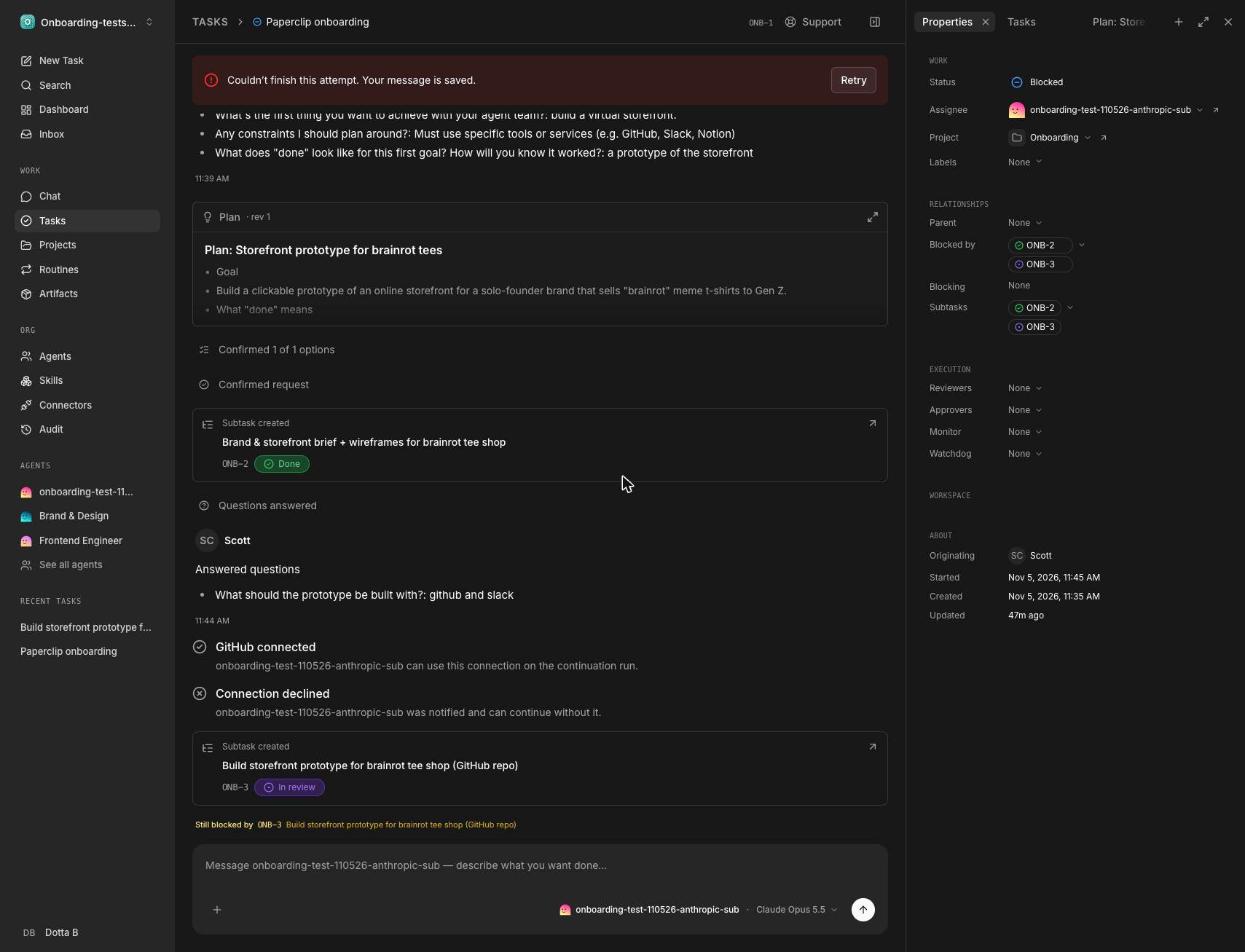
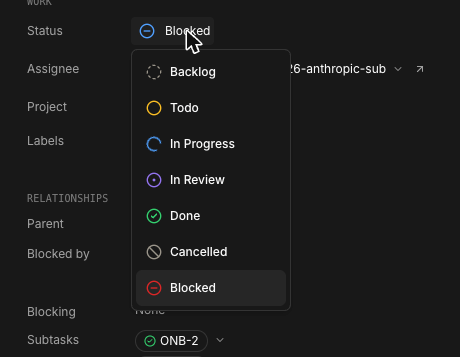
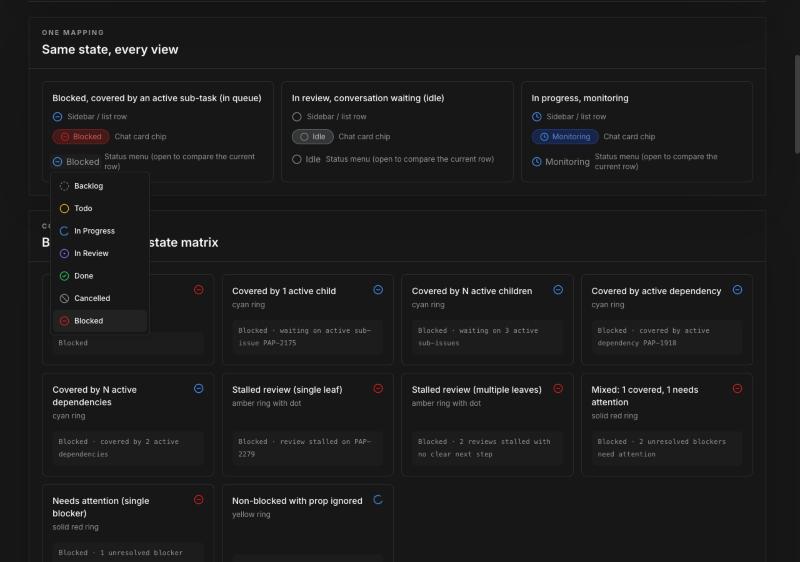
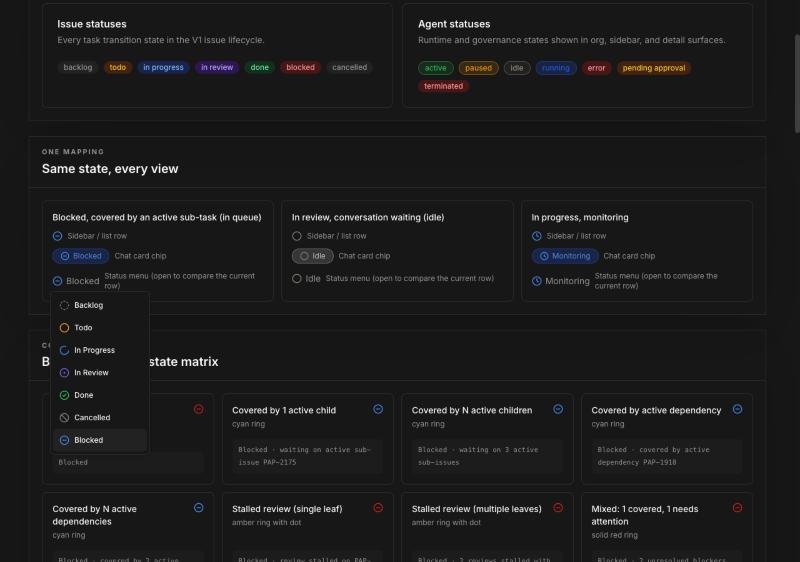
fix(ui): use one status glyph mapping for every task view (#19329)
## Thinking Path > - Paperclip is the open source app people use to manage AI agents for work. > - Task status is the main signal on every task surface: sidebar rows, the task header, the status menu, lists, the inbox, pills and chat cards. > - One task state rendered different status icons in different views. A blocked task that waits on an active sub-task showed the blue "in queue" glyph in the task header. The status menu, the chat chip and the sidebar rows showed the red "Blocked" glyph for the same task. > - The cause: each view passed its own subset of the presentation fields to `StatusIcon`. Many views dropped `blockerAttention` and some dropped `externalConversationState`. The status menu rendered its current row from the bare status. The summaries API did not return `blockerAttention`, so the recent-task sidebar could not know the state. > - This pull request puts the state-to-glyph/label mapping in one resolver and makes every task view pass all of its fields. > - The benefit is that the same state uses the same icon and label everywhere. ## Linked Issues or Issue Description No public issue. Found in a hands-on onboarding test on a staging cloud workspace. **What happened?** The sidebar and the task pane/status menu showed different status icons for the same state. On the test task (blocked, waiting on an active sub-task), the task header and the status button showed the blue "in queue" glyph. The selected "Blocked" row in the status menu showed the red blocked glyph. The coordinator sidebar "Recents" and project rows also showed the red blocked glyph, and the chat "Subtask created" chip showed a red "Blocked" chip. **Expected behavior** The same underlying state uses the same icon and label everywhere. **Steps to reproduce** 1. Create a task with a sub-task. Block the parent on the sub-task, and let the sub-task's agent run (the parent is "blocked, covered"). 2. Open the parent task. The header shows the blue "in queue" glyph. 3. Open the status menu. The current "Blocked" row shows the red glyph. 4. With the coordinator sidebar on, look at the task in Recents or in its expanded project. It shows the red glyph. **Paperclip version or commit** `master` at |
||
|
DottaandPaperclip
|
b400f76647 |
feat(ui): submit task composers with Enter by default (#19272)
Use Enter to submit task replies and new tasks, with Shift+Enter for a new line. Add an experimental preference to require Command/Ctrl+Enter. Preserve autocomplete selection and IME confirmation, and retain the modifier shortcut until saved settings load. Co-Authored-By: Paperclip <noreply@paperclip.ing> |
||
|
DottaandClaude Opus 5.5
|
21640b6d51 |
feat(connections): gate the built-in Google Workspace connector behind an experimental toggle (#19247)
## Thinking Path > - Paperclip is the open source app people use to manage AI agents for work. > - The Apps catalog lets operators connect external tools, including Google services. > - Paperclip has a built-in Google Workspace connector, but Google has not yet verified Paperclip's Google app. > - The built-in connector also hides the Composio and Arcade Google apps, because native Google definitions claim those app names. > - Users therefore see an unverified connector and cannot find the working aggregator Google apps. > - This pull request puts the built-in connector behind a default-off experimental setting. When the setting is off, the aggregator Google apps appear. > - The benefit is that users get working Google connectors now, and the team can still test the built-in connector on demand. ## Linked Issues or Issue Description **Problem** Google has not verified Paperclip's Google app yet. The Apps page still offers the built-in Google Workspace connector. The built-in Google definitions also suppress the Composio and Arcade Google apps (Gmail, Google Calendar, Google Drive, Docs, Sheets, Slides, Chat), so users cannot find them. **Proposed solution** Add the `enableGoogleWorkspaceConnector` experimental setting. The default is off. When it is off, hide and block the built-in connector, and show the aggregator Google apps. When it is on, keep the current behavior. **Alternatives considered** Delete the built-in connector until verification is complete. We rejected this option because the team must continue to test the connector. **Additional context** Composio documents Gmail (63 tools), Google Calendar (50 tools), and Google Drive toolkits that use Composio-managed OAuth. These toolkits do not need Paperclip's Google app verification. ## What Changed - Added the default-off `enableGoogleWorkspaceConnector` experimental setting to the shared types, validator, feature catalog, server defaults, and the managed-key list for Paperclip Cloud staging. - Added `experimentalFeatureKey: "enableGoogleWorkspaceConnector"` to the `google-workspace` app definition. The existing generic connector gate then hides the connector in the gallery and blocks its setup, discovery, execution, and agent suggestions when the setting is off. - Added a "Google Workspace connector (Paperclip)" toggle card to **Settings → Experimental**. - Apps page (`Browse.tsx`): when the setting is off, built-in Google rows without saved accounts no longer claim aggregator app identities. The Composio and Arcade Google apps then show as aggregator rows. The legacy Google slug filter now applies only to native rows, so the Composio `gmail` row is not dropped. - Saved per-service Google connections (Gmail, Drive, and others) are not gated. They stay visible and usable. - Updated `doc/connections/GOOGLE-WORKSPACE.md`. - Tests: added tests for the hidden and visible Apps page states, the settings toggle, and the definition gate. Existing built-in Google Workspace tests now enable the setting. ## Verification - `cd packages/shared && npx vitest run` passes (1055 tests). - `cd server && npx vitest run src/__tests__/connection-management.integration.test.ts src/__tests__/tool-access-service.test.ts src/__tests__/tool-gateway-service.test.ts src/services/gmail-tool-governance.test.ts src/services/google-chat-tool-policy.test.ts src/__tests__/instance-settings-service.test.ts src/__tests__/health.test.ts src/__tests__/instance-settings-managed-overlay.test.ts` passes (864 tests). - `cd ui && npx vitest run src/pages/apps src/pages/InstanceExperimentalSettings.test.tsx src/features/connections` passes. - `tsc --noEmit` passes for `packages/shared`, `server`, and `ui`. The `ui` run shows errors only in the untouched `storybook/support/feature-map` files. - `pnpm check:token-gates` passes. - Manual check: open **Apps** with the setting off. Search for "Gmail". The Composio Gmail row appears, and the built-in Google Workspace card does not. Turn on the setting in **Settings → Experimental**. The built-in card appears again. ## Risks - Existing built-in `google-workspace` connections stop running while the setting is off, because the generic gate blocks execution. This is intentional, so that the unverified Google app is not used. Turn on the setting on instances that must keep these connections. - Saved per-service Google connections are not affected. - When the setting is on, the behavior does not change. > For core feature work, check [`ROADMAP.md`](ROADMAP.md) first and discuss it in `#dev` before opening the PR. Feature PRs that overlap with planned core work may need to be redirected — check the roadmap first. See `CONTRIBUTING.md`. ## Model Used - Claude Opus 5.5 (Anthropic), model ID `claude-opus-5-5`, running in Claude Code with tool use (shell, file edits, web fetch). ## Checklist - [x] I have included a thinking path that traces from project context to this change - [x] I have specified the model used (with version and capability details) - [x] I have checked ROADMAP.md and confirmed this PR does not duplicate planned core work - [x] I have searched GitHub for duplicate or related PRs and linked them above - [x] I have either (a) linked existing issues with `Fixes: #` / `Closes #` / `Refs #` OR (b) described the issue in-PR following the relevant issue template - [x] I have not referenced internal/instance-local Paperclip issues or links (only public GitHub `#NNN` / `github.com/paperclipai/paperclip` URLs) - [x] My branch name describes the change (e.g. `docs/...`, `fix/...`) and contains no internal Paperclip ticket id or instance-derived details - [x] I have run tests locally and they pass - [x] I have added or updated tests where applicable - [x] I have updated relevant documentation to reflect my changes - [x] I have considered and documented any risks above - [ ] All Paperclip CI gates are green - [x] Greptile is 5/5 with no open P2s, recommendations, or follow-ups - [x] I will address all Greptile and reviewer comments before requesting merge 🤖 Generated with [Claude Code](https://claude.com/claude-code) --------- Co-authored-by: Claude Opus 5.5 <noreply@anthropic.com> |
||
|
DottaandPaperclip
|
7fd05e1354 |
fix(skills): keep initial file editor drafts clean (#19241)
## Thinking Path > - Paperclip is the open source app people use to manage AI agents for work. > - People inspect and edit skill files from the Skills library. > - The Markdown editor receives the body without YAML frontmatter. > - The skill page compared that body with the entire saved file. > - Opening Edit therefore showed unsaved changes before the person typed. > - This pull request uses the same saved body for initialization, comparison and Discard. > - Clean files stay clean, while real edits retain the existing save path. ## Linked Issues or Issue Description **What happened?** Open an editable SKILL.md with YAML frontmatter in the Skills library. Select Files, then Edit. The page immediately shows Unsaved changes without input. The draft contains only the body, while the dirty check compares it with the full file. **Expected behavior** Opening Edit leaves the file clean and Save disabled. Real input enables Save. Discard restores the original body. Saving an edit keeps the existing frontmatter. **Steps to reproduce** 1. Open a managed skill whose SKILL.md has YAML frontmatter and a Markdown body. 2. Select Files, then Edit. 3. Make no editor input. 4. Observe the dirty indicator and Save state. **Paperclip version or commit** Reproduced locally on master |
||
|
DottaandPaperclip
|
b3da1d886a |
fix(ui): retain Coordinator label filters across reloads (#19233)
## Thinking Path
> - Paperclip is the open source app people use to manage AI agents for
work.
> - Operators use task filters to keep a useful view of their work.
> - Coordinator saves status and assignee filters in the task-list URL.
> - A selected label stayed only in React state, so reload removed it
and showed unrelated rows.
> - This change saves and restores selected labels through the same
page-owned URL path.
> - Operators can reload and share that filtered collection without
selecting its labels again.
## Linked Issues or Issue Description
**What happened?**
In Coordinator All tasks, select a status, assignee, and label. Sort by
Task ID and reload. Status, assignee, and sort remain selected, but the
label is cleared and rows without that label appear.
**Expected behavior**
Reload and history navigation retain the selected labels with the other
URL filters. Clear filters removes the selected labels.
**Steps to reproduce**
1. Open Coordinator All tasks with labeled and unlabeled tasks for the
same assignee and status.
2. Select that status, assignee, and a label.
3. Change Task ID sorting and reload the page.
4. Check both the selected label and the displayed tasks.
**Paperclip version or commit**
Source regression reproduced at master
|
||
|
TonioandPaperclip
|
56517dda6c |
fix(ui): bundle connector, toolbar, empty-state and agent roster fixes (#18716)
## Thinking Path > - Paperclip is the open source app people use to manage AI agents for work. > - Operators use connector setup, collection headers, empty states, and agent lists to manage that work. > - Provider redirects replace the setup page, and collection controls use different sizes. > - Agent selection inserts a bar above the list. The row link highlights only part of the row. > - This pull request keeps sign-in in a separate window and applies the Tasks control sizes to collection and audit headers. > - It also reuses artifact artwork for empty collections and gives agent selection a fixed action card. > - These changes preserve the operator's place and keep controls and rows stable. ## Linked Issues or Issue Description **What happened?** Connector sign-in replaced the current page. Inline collection controls had different heights. Projects and Artifacts used small placeholder empty states. Agent selection moved the list, hover covered only the identity cell, and chat/status shared that cell without matching headings. **Expected behavior** Provider sign-in opens in a new tab or window. Collection controls match Tasks. Empty collections use the large artifact graphics. Agent actions float above the page while rows remain aligned. **Steps to reproduce** Start connector sign-in from a page or dialog. Compare collection and Audit headers. Open an empty Projects or Artifacts collection. Select an agent, then hover across its row. Related public work: #13584 covers an earlier connector new-tab implementation, including same-page fallbacks that this bundle does not use. #8528 covers Tasks toggle sizing. #17742 covers scoped agent Audit sections. This bundle does not change server callback or audit authorization contracts. ## What Changed - Reserve a separate authorization window during the click. Use validated sign-in URLs, retain a new-tab fallback, and close blank windows after failed requests. Store Cloud reauthentication state in the destination window. - Use the Tasks 44px control foundation for shared collection headers and Audit, Costs, Timeline, Secrets, Teams, Gateways, and agent skill controls. - Use a large artifact stack with an off-white Paperclip image with a dark icon for Projects and artifact Tasks empty states. Use one matching artifact for other types. Set 20px gaps and use the label “Create project”. Action hover and keyboard focus animate the artwork. - Portal agent bulk actions to a fixed card 48px above the bottom safe area. Use quintic entry/exit motion and respect reduced motion. Retain card contents during exit. - Give chat and status separate cells, add a Status heading, use the MessagesSquare chat action with a hover tooltip, and highlight the entire row. - Add linked agent chips and a manager picker to the agent profile. Block self and descendant manager choices. Keep the name crown and custom title inline during edits. - Update design guidance, the connection maps, regression tests, and empty-state Storybook fixtures. ## Verification - Final commit `a41a6c6494a839deaaec1ef7cc50c90078ab6381`: all 55 checks passed, three skipped. [Canonical CI run](https://github.com/paperclipai/paperclip/actions/runs/41999792769) includes all eight browser shards and all server/runner/workspace groups. Greptile: 5/5, zero unresolved review findings. - Workspace typecheck/build passed. Local UI suite passed 11,006 tests in 880 files, plus 542 CLI tests. Subsequent connector callback changes passed all 245 AppsConnect tests, UI typecheck, token gates, and query-error policy checks. Manager cache/error regressions passed four tests. Map checks passed. - Local connector browser suite: 20 passed. All six chat integration shards: 1,931 passed. Workspace B groups passed; database tests passed 313 cases across 72 files with one worker. - Browser preview verified agent manager changes, overview links, inline name/title geometry, empty-state colors, row actions and the chat tooltip. Live provider consent and post-deployment feature verification remain separate from these fixtures. - Preserved failures: ten bulk-roster tests initially missed the portaled action card; their selectors were fixed and all twelve roster tests passed. A nested fixture selected pnpm 11 and removed local dependencies; the local shim now pins pnpm 9. Embedded PostgreSQL native links were restored. A Python 3.9 fixture failure passed all 19 tests with the current runtime. Concurrent local database startup failures passed on the one-worker rerun. - The broad local serialized server run passed 3,791 tests with one scheduling assertion failure, which passed in isolation. The local general-server run reproduced a native recovery provider/model fixture failure and has not completed. These server sources are unchanged by this bundle; all final canonical CI server shards passed. This is not a claim that every broad local run passed. - [Earlier CI run](https://github.com/paperclipai/paperclip/actions/runs/41995119880) failed a browser test during cleanup when heartbeat-run cancellation hit a PostgreSQL lock timeout. All final browser shards passed without weakening that test. - Review follow-ups cover Slack popup/fallback recovery, a single artwork hover transform, shared manager error rendering, detached standalone OAuth windows, and verified task-bound callbacks in both hosts. ## Risks - Browser popup policy and provider callback behavior can affect sign-in completion. The original setup page stays open; blocked windows have an explicit recovery path. - Shared toolbar styles affect several surfaces. Menu content remains in its existing portals; canonical label tabs and search clear buttons retain their own geometry. - No schema, server, API authorization, or migration change. - Required CI and review are complete. Deployment provenance and hosted feature verification are checked separately after merge. ## Model Used OpenAI Codex, GPT-6 family, with reasoning, repository tools, test execution, and browser inspection. The exact model ID and context-window size were not exposed in this session. ## Checklist - [x] I have included a thinking path that traces from project context to this change - [x] I have specified the model used (with version and capability details) - [x] I have checked ROADMAP.md and confirmed this PR does not duplicate planned core work - [x] I have searched GitHub for duplicate or related PRs and linked them above - [x] I have either (a) linked existing issues with `Fixes: #` / `Closes #` / `Refs #` OR (b) described the issue in-PR following the relevant issue template - [x] I have not referenced internal/instance-local Paperclip issues or links (only public GitHub `#NNN` / `github.com/paperclipai/paperclip` URLs) - [x] My branch name describes the change (e.g. `docs/...`, `fix/...`) and contains no internal Paperclip ticket id or instance-derived details - [x] I have run relevant tests locally and they pass (broader local exceptions are recorded above) - [x] I have added or updated tests where applicable - [x] I have updated relevant documentation to reflect my changes - [x] I have considered and documented any risks above - [x] All Paperclip CI gates are green - [x] Greptile is 5/5 with no open P2s, recommendations, or follow-ups - [x] I will address all Greptile and reviewer comments before requesting merge --------- Co-authored-by: Paperclip <noreply@paperclip.ing> |
||
|
TonioandClaude Opus 5.5
|
9e9a628a57 |
feat(ui): turn Artifacts V1 on for every instance and hide its toggle (#19164)
## Thinking Path > - Paperclip is the open source app people use to manage AI agents for work > - Artifacts show the output of agent work on the Artifacts page, in the panel Artifacts tab, and in the task thread > - #17228 added the Artifacts V1 presentation behind an experimental setting that is off by default > - The presentation is now ready for all users, so an opt-in toggle is no longer necessary > - A new default alone does not reach all instances, because each experimental write persists every flag > - This pull request removes the toggle and turns V1 on for every instance > - The benefit is one artifact presentation for all users, with an off switch for hosting operators ## Linked Issues or Issue Description Refs #17228 Refs #17263 **Is your feature request related to a problem? Please describe.** Artifacts V1 shows only on instances where an admin turned on an experimental setting. Other users see the previous cards. **Describe the solution you would like** Show Artifacts V1 on all instances. Remove the toggle from Experimental settings. **Describe alternatives you have considered** A new default without a change to the hook. This does not work, because many instances have a stored false that nobody chose, and no toggle would remain to change it. ## What Changed - Removed the Artifacts V1 card from Instance Settings, Experimental. - Changed `enableArtifactsV1` to default on in the schema, the feature catalog, and the settings service. - Changed `resolveArtifactsV1Enabled` to ignore a stored false. It honours false only when the value comes from managed config. - Kept the flag and the previous cards, so a hosting operator can hold V1 off. - Kept the key in the Cloud staging list, so a managed false does not hold V1 off on staging. - Updated unit tests, the Artifacts V1 plan, and the directions-lab Today reference. - Moved the attachment and upload e2e specs and the runner download helper to the V1 rows. - Added V1 tests for a Markdown review: expansion, deep link, and open, raw and download actions. ## Verification - `cd ui && npx vitest run`: one test file failed before its fix. That file tests the previous cards, and it now mocks the hook to off. I reran it with the other changed UI tests, and they pass. I did not repeat the full UI run after the fix. - `npx playwright test --config tests/e2e/playwright.config.ts tests/e2e/text-attachment-tabs.spec.ts tests/e2e/artifact-uploads.spec.ts tests/e2e/artifact-tab-arrival.spec.ts`: 10 tests pass on V1. - `tests/e2e/cloud-auth.spec.ts` failed once in CI on a task heading. It does not touch artifacts, and 10 local runs pass. - `cd server && npx vitest run src/__tests__/instance-settings`: 183 tests pass. - `cd packages/shared && npx vitest run src/feature-catalog.test.ts src/validators/instance.test.ts`: 35 tests pass. - `pnpm run check:token-gates` and the `ui` and `server` typechecks pass. I did not run the full repository check. - In the artifact directions lab, with no stored settings, the Today right panel renders the V1 rows. - I did not test this on a live instance. After merge, confirm on staging that the Experimental page has no Artifacts V1 card and that all three surfaces show V1. ## Risks - All users see V1 after the next release, not only staging users. To revert, revert this pull request. - Users cannot turn V1 off. Only a hosting operator can, through managed config, and not on Cloud staging. - An instance with a managed `enableArtifactsV1: false` stays on the previous cards. The cloud harness source has no reference to this key, but I cannot read the live fleet configuration. - V1 surfaces render before settings load. An operator-held instance can briefly show V1 before the previous cards. - Admins who use the API can still write the flag. The write has no effect on unmanaged instances. > For core feature work, check [`ROADMAP.md`](ROADMAP.md) first and discuss it in `#dev` before opening the PR. Feature PRs that overlap with planned core work may need to be redirected — check the roadmap first. See `CONTRIBUTING.md`. ## Model Used - Anthropic Claude Opus 5.5 (`claude-opus-5-5`) in Claude Code, with tool use and code execution. ## Checklist - [x] I have included a thinking path that traces from project context to this change - [x] I have specified the model used (with version and capability details) - [x] I have checked ROADMAP.md and confirmed this PR does not duplicate planned core work - [x] I have searched GitHub for duplicate or related PRs and linked them above - [x] I have either (a) linked existing issues with `Fixes: #` / `Closes #` / `Refs #` OR (b) described the issue in-PR following the relevant issue template - [x] I have not referenced internal/instance-local Paperclip issues or links (only public GitHub `#NNN` / `github.com/paperclipai/paperclip` URLs) - [x] My branch name describes the change (e.g. `docs/...`, `fix/...`) and contains no internal Paperclip ticket id or instance-derived details - [x] I have run tests locally and they pass - [x] I have added or updated tests where applicable - [x] I have updated relevant documentation to reflect my changes - [x] I have considered and documented any risks above - [ ] All Paperclip CI gates are green - [ ] Greptile is 5/5 with no open P2s, recommendations, or follow-ups - [x] I will address all Greptile and reviewer comments before requesting merge 🤖 Generated with [Claude Code](https://claude.com/claude-code) --------- Co-authored-by: Claude Opus 5.5 <noreply@anthropic.com> |
||
|
|
2ccc7d37ef |
feat(ui): retain approved reads across outage reloads (#18825)
## Thinking Path > - Paperclip lets people manage agent work through the board. > - The board already retains loaded reads during a temporary server failure. > - Reloading the page removes that in-memory data. > - A deploy can then leave a returning user without the shell or recent tasks. > - This pull request saves an explicit, limited set of reads in the browser. > - Cached identity supports display while fresh session checks protect writes. ## Linked Issues or Issue Description **What happened?** A reload during an API outage loses the board's loaded reads. An automatic worker update can also reload a hidden tab while a write is pending. **Expected behavior** Show the cached shell and recent tasks during a temporary outage. Limit saved content by user, company, age and build. Clear it on sign-out. Wait for a fresh session before sending account-bound writes. Defer automatic reloads while work is pending. **Steps to reproduce** Open a task and settings while online. Return 503 from the API and reload. Restore the API. Sign out and confirm that saved query records are gone. Discover a worker update while offline or during an autosave and confirm that it waits. Stacked on Refs #18822. Related durable-write foundation: Refs #17960. The outage browser suite follows in a separate test PR. ## What Changed - Persist an exact read allowlist through TanStack Query dehydration and hydration. Save shell preferences, company/sidebar data, agent/project lists, plugin UI metadata, the first inbox page, and 20 recent tasks. Task UUID and identifier reads share one recent-task slot. - Namespace records by user and company. Retain eligible reads across normal memory garbage collection, expire each read after 24 hours, and discard them after a build change. Unstamped builds disable hydration and persistence while retaining sign-out cleanup. Use the existing instance-wide plugin contribution query in the user's root record. - Exclude session credentials and bootstrap data, embedded plan documents, comments, preview work products, provider credentials and environment values, browser capabilities, pairing data, other queries, and mutations. Restore only display identity from session data. Preserve safe agent provider/model display fields and configuration object shapes. Apply the projection on save and restore. - Clear saved reads on sign-out, cross-tab account changes, and definitive session denial. Keep revocation working on plain HTTP without crypto.randomUUID. Use per-user revocation revisions to reject delayed writes and stale records. Preserve a newer account. Remove every UUID/identifier projection and nested inbox copy of a denied task. - Detach shared GETs when the account changes or signs out. Load complete, freshly authorized agents before opening bulk settings from a display-only roster. Retire a pending bulk-editor result or error when row, select-all or clear changes the selection, including a clear/reselect of the same agent. - Require a fresh server lookup before account-bound writes, pending task creation, or mounted autosaves resume. This includes automatic task read receipts, inbox archives, workspace preferences and primary-agent choices, with optimistic archive changes gated too. Cancel the old write scope when the verified user changes. Release completed archives through account-independent cleanup without restoring old cached rows; an old operation cannot clear a newer hide flag. Retry unconfirmed read receipts after a fresh session succeeds for the original account, and remember confirmed receipts across refreshes. Track pending reads per task so opening another task sends its receipt immediately; revisiting reuses an outstanding receipt and its original account scope. - Defer a hidden-tab worker reload until connectivity, mutations, durable sends, and autosaves are safe. Synchronously count each unresolved operation across online rate-limit retries. Release a cancelled target’s unused dirty token when an editor changes tasks; keep stored drafts, admitted saves and queued retries. Cover autosave debounce, newer edits, navigation and undo. ## Verification - Current head `fe4f682c879` is merge-ready: all 54 check runs completed (52 successful, one skipped, one neutral), the legacy Snyk status is successful, and both `ci / verify` and `ci / e2e` pass in run `41752927822`. Greptile Apex reviewed this exact head at 5/5 with zero unresolved threads; the branch has no merge conflicts. All three PRs now meet the merge-ready bar; the stack remains unmerged pending operator approval. - Greptile Apex reviewed exact current head `fe4f682c879` at 5/5 with no actionable findings and zero unresolved threads (summary updated 2026-11-04 at 01:24:40 UTC). Both settings-account and pending-selection findings are fixed, replied to and resolved. The branch has no merge conflicts. Current-head CI now passes in run `41752927822`. - Seventeen new cases cover settings restored from actual saved query records, matching/changed/signed-out identities, denied verification, late crown responses without overwriting newer reads, and bulk-selection changes during successful/failed reads. Sixteen fail the preceding source and one preserves denial compatibility. Both settings paths reuse the existing account-bound mutation guard; its optional explicit QueryClient supports the workspace hook’s existing detached-host mode. Primary-agent optimistic updates begin only after verification and cleanup checks ownership and the cache revision. - Earlier CI run `41749456480` on prior head `2cf7516f18c` has one real server test failure: the owned-runtime case in `idle-completed-history.test.ts` could not reach its HTTP child on port 34757 within 10 seconds (99 refused probes). Its other 1,829 cases pass and three skip; the only other unsuccessful job is the downstream `verify` gate. The exact selected case passes locally, and the entire 75-case file passes in 72.19 seconds on the exact `2cf7516f18c` source tree with isolated PostgreSQL and a real child process on macOS arm64/Node 25.6.1. The Linux CI startup cause remains unknown; these local results are not a fix or CI acceptance. One failed-jobs retry with debug logging was accepted on that unchanged head, then superseded by the later settings fixes. Current-head CI remains required; no source change was made for this failure. - Current cache head `fe4f682c879`, based on read head `09d1db29dea` and master `683fa4725e9`, passes all 1,198 focused tests across twenty-eight files, UI typecheck, token gates and the enforcing query-error guard. Dependent browser head `228c1b68d30` contains this exact application source and passes standalone strict checking of all three browser specs. Current-head CI now passes in run `41752927822`. - Three new navigation regressions fail the preceding application source and pass with the fix. They open three cached tasks before any receipt resolves, leave the page before success or failure, revisit an outstanding read without duplicating it, and recover an older failed receipt after a fresh session succeeds while a later task remains pending. - The fixture repair passes all seven deadline integration cases and the complete server typecheck, including the server test layer. The old assertion deterministically fails at 23:59:06.888 UTC; its one-second-old run also fails the first-second-of-day probe. The corrected fixture passes noon and both midnight probes. The permanent three-case coverage uses seeded 2099 clocks. - Nine new cases cover archive success/failure after sign-out and another account takes over, both mounted and unmounted; cleanup ownership when a newer archive uses the same task; session-check 429 exhaustion followed by matching, changed or signed-out identity; and a failed read receipt followed by a new session read. They verify no old-cache restoration, toast or navigation, retained newer hide flags, no failed-check loop and no duplicate confirmed receipt. Seven fail the previous implementation; two compatibility cases retain account-change suppression. Initial test error-constructor and query-notification timing assumptions were corrected before the passing checks. - The inherited skills/app error-priority fix passes all 60 affected tests and UI typecheck on both application branches. Its twelve new regression cases fail the preceding read implementation. The persisted-cache suite includes 48 cases. - Six new regressions fail against the preceding application source and pass with the fix. Actual worker-update and mutation-cache listeners cannot reload a hidden tab between online 429 retries; the original create key survives, and the update reloads once after a receipt. Real self-hosted and Cloud sign-out work without crypto.randomUUID, with stamped and unstamped builds. Saved reads are removed and account write scopes are invalidated. An initial test-fixture type annotation error was corrected before the passing typecheck. - The 48 cache tests cover actual five-minute memory GC, the 20-task bound across saved and live reads, original 24-hour expiry, denial before session verification, unstamped cleanup, cross-tab revocation and delayed flushes. Private GETs cannot cross account transitions. Bulk edits require complete current agent data. Undo releases the update blocker while preserving the Saved indicator. - All 23 built-UI outage/write/loading cases pass in 4.5 minutes on exact integrated head `228c1b68d30`, containing current cache revision `fe4f682c879`: ten outage, six durable-write and seven loading cases. The run uses bundled Chromium, the built UI, a fresh local-trusted server and isolated embedded PostgreSQL on macOS arm64/Node 25.6.1. All three specs pass standalone strict TypeScript checking. Owned temporary server and database stopped. - Earlier browser runs exposed and fixed cached-header, native Storage cleanup and replay/session defects. A prior run passed 21/22 because real WebSockets contradicted the simulated HTTP outage; the fixture now closes existing socket pairs and holds new sockets through the same outage deadline. An older CI run exposed a disposed response in the Inbox route callback; pre-navigation snapshots remove that lifetime, and the current full run includes that repair. Earlier failures and their diagnosis remain in the discussion. The current full run passes. Broader historical workspace failures remain documented in Refs #18822; this does not claim a clean full workspace suite. - Current-head CI passes on `fe4f682c879`. Controlled local outages do not complete hosted authentication or a real Cloud restart/deploy acceptance. Commands for the current cache change and inherited read fix (the current focused run also includes src/lib/inboxArchiveCache.test.ts and src/pages/Inbox.test.ts): ```sh pnpm --filter @paperclipai/ui exec vitest run src/pages/CompanySkills.test.tsx src/pages/apps/AppNotConnected.test.tsx pnpm --filter @paperclipai/ui exec vitest run src/hooks/useDurableSubmit.test.tsx src/hooks/useDurableAutosave.test.tsx src/hooks/useSignOut.test.tsx src/lib/persisted-query-cache.test.ts src/lib/service-worker-updates.test.ts src/lib/service-worker-cache-policy.test.ts src/lib/pending-send.test.ts src/lib/issue-execution-policy.test.ts src/components/InlineEditor.test.tsx src/components/MarkdownEditor.test.tsx src/components/NewIssueDialog.test.tsx pnpm --filter @paperclipai/ui exec vitest run src/components/agents/AgentBulkRoster.test.tsx src/components/agents/AgentBulkSettingsSheet.test.tsx src/hooks/useAccountBoundMutation.test.tsx src/pages/IssueDetail.test.tsx src/components/TaskChatThread.test.tsx src/components/TaskChatThread.task-creation-order.test.tsx src/api/client.test.ts src/api/agents.test.ts pnpm --filter @paperclipai/ui exec vitest run src/hooks/useCoordinatorWorkspaceEnabled.test.tsx src/context/PrimaryAgentProvider.test.tsx src/components/CoordinatorWorkspaceSetting.test.tsx src/components/primary-agent/PrimaryAgentPresentation.test.tsx src/components/MobileBottomNav.coordinator.test.tsx src/components/CoordinatorSidebar.test.tsx src/pages/Issues.coordinator-routing.test.tsx pnpm --filter @paperclipai/ui typecheck pnpm check:token-gates node scripts/check-query-error-rendering.mjs --enforce --summary ``` ## Risks This deliberately saves task content on the local browser for up to 24 hours. The allowlist excludes credentials and ephemeral capabilities. Local storage can be disabled or full; persistence then fails without blocking the app. Restored data can be stale and never grants server access. A user or access change clears cached account reads and invalidates pending writes. The browser outage suite and real hosted deploy acceptance remain release requirements. There are no migrations or new dependencies. ## Model Used OpenAI `gpt-6.1-sol` through Codex, with xhigh reasoning effort, tool use, and code execution. The context window size is not exposed. ## Checklist - [x] I have included a thinking path that traces from project context to this change - [x] I have specified the model used - [x] I have checked ROADMAP.md and confirmed this PR does not duplicate planned core work - [x] I have searched GitHub for duplicate or related PRs and linked them above - [x] I have described the issue in-PR following the bug report template - [x] I have not referenced internal/instance-local Paperclip issues or links - [x] My branch name describes the change and contains no internal ticket id - [x] The focused local tests for this change pass - [x] I have added tests and updated relevant documentation - [x] I have considered and documented risks above - [x] All Paperclip CI gates are green - [x] Greptile is 5/5 with no open P2s, recommendations, or follow-ups - [x] I will address all Greptile and reviewer comments before requesting merge --------- Co-authored-by: devinfoley <139239+devinfoley@users.noreply.github.com> Co-authored-by: Paperclip <noreply@paperclip.ing> Co-authored-by: Bender (Fable) <bender@agents.paperclip.ing> Co-authored-by: Claude Fable 5.1 <noreply@anthropic.com> |
||
|
|
a3313f6944 |
fix(ui): complete read recovery and enforce query error rendering (#18822)
## Thinking Path > - Paperclip lets people manage agent work through the board. > - The board reads task, agent, settings, plugin, and run data from the server. > - A deploy can interrupt those reads after content is already visible. > - Local error branches can replace that content with an error or show raw codes. > - This pull request moves the remaining reads to the shared recovery behavior. > - The query-error guard prevents new local error patterns from returning. ## Linked Issues or Issue Description **What happened?** Loaded lists, settings, task panels, and manual reads could clear their content or show errors during a server restart. Some reads also disabled the shared retry policy. **Expected behavior** Keep loaded content during a temporary failure. Show the shared connection banner. Retry reads after recovery. Replace content after a real access denial or missing resource, with readable copy. **Steps to reproduce** Open a task, settings page, or run log. Return 503 with `tenant_app_unavailable` from the API. Restore the API and check that content refreshes. Repeat with 403 and 404 to check the failure state. Related merged work: Refs #15754, Refs #15772, Refs #17960. This change covers remaining reads and enforcement. Browser persistence and the outage browser suite follow separately. ## What Changed - Repair an existing PostgreSQL deadline fixture at UTC boundaries. A daily cap defers a heartbeat until both its original interval and the next UTC day allow it. Keep the counted run in its seeded day and cover noon, just before midnight and the first second after midnight with explicit clocks and real PostgreSQL. Production scheduling is unchanged. - Integrate the saved list, settings, shell, task, and manual-read recovery changes against current master. Preserve the current task, Inbox, and run-log structure. - Add `useResilientFetch` for component-local reads. Preserve loaded data, cancel stale requests, and retry through the shared connectivity policy. Keep browser and pairing capabilities in memory. - Retain run log chunks across stream changes and catch up after recovery without duplicate chunks or stalled requests. - Keep genuine authorization and missing-resource failures visible. Translate known single-word codes such as `forbidden`. Show known skills and disconnected-app failures before sibling loading states. Keep Retry bound to its failed request. - Make the query-error guard enforce by default and run it in the CI policy job. Document the narrow exceptions and the read recovery contract. - Invalidate pending OAuth discovery when the operator leaves setup or its context changes. Keep reserved-popup cleanup bound to the current attempt. ## Verification - Current read head `09d1db29dea` is merge-ready: all 59 check runs are completed (54 successful, three skipped, two neutral), the legacy Snyk status is successful, and both required `ci / verify` and `ci / e2e` gates pass. Greptile Apex reviewed this exact head at 5/5 with no unresolved threads; the branch has no merge conflicts. The current CI run is `41748339602`. - Current read head `09d1db29dea` includes master `683fa4725e9`. The latest change touches only the existing server deadline test fixture. Application source remains the previously verified `86376fa751e` revision: all 60 affected skills/disconnected-app tests and both application UI typechecks passed, along with token gates and the enforcing query-error guard. Those UI suites were not repeated for this test-only repair. - The fixture repair passes all seven deadline integration cases and the complete server typecheck, including the server test layer. The old assertion deterministically fails at 23:59:06.888 UTC; its one-second-old run also fails the first-second-of-day probe. The corrected fixture passes noon and both midnight probes. The permanent three-case coverage uses seeded 2099 clocks. - Twelve new regressions fail against the previous implementation. Both skills variants and disconnected-app pages show either request's 403 or 429 while the sibling pauses or remains fetching. Permission failures stay visible. Retry stays usable for its failed request and recovers independently. An initial test-fixture query-key typo was corrected before the passing run. The finding is replied to and resolved. Greptile reviewed prior application revision `86376fa751e` at 5/5 with no new actionable findings or unresolved threads. The current test-only head has now received its own Apex 5/5 review with no unresolved threads, and its CI is successful as recorded above. - The preceding OAuth fix passed all 237 setup tests on both application branches. Its ten regressions prove that Back, Cancel, unmount, or context changes retire initial discovery without creating a connection, caching old identities, navigating an abandoned popup, or closing a newer attempt. - Earlier master integration `e992f770339` passed all 309 tests across eight affected Slack, recovery, retry, submission and task files, plus UI typecheck, token gates, enforcing query-error scan and seven guard tests. The integration preserves Slack workspace reconnect and shared recovery, readable execution errors, source-inspection company scoping, and current submission behavior. Newly inherited retained-file recovery controls keep cached data through transient failures and hide it after definitive denial. - The preceding cache head `97c0bc3966f` passed 1,038 focused cache/write/editor/account/task/API tests. All 22 built-UI outage/write/loading cases passed in 4.7 minutes on exact browser head `b7deaaee5da`, with strict checking of all three specs. The latest skills/app rendering fix is covered by its affected component suites; those broader cases were not repeated for this separate read path. - Historical broader UI, CLI and build results and unresolved aggregate server/DB/adapter failures remain in the PR discussion. Interrupted CI runs were audited and recorded separately; they are not counted as passes. Controlled local outages do not prove hosted authentication or a real Cloud restart/deploy. Real hosted acceptance remains required after merge and deployment. Commands for the latest fix: ```sh pnpm --filter @paperclipai/ui exec vitest run src/pages/CompanySkills.test.tsx src/pages/apps/AppNotConnected.test.tsx pnpm --filter @paperclipai/ui typecheck pnpm check:token-gates node scripts/check-query-error-rendering.mjs --enforce --summary ``` ## Risks This migration touches many read surfaces. The main risks are initial loading, request cancellation, retained authorization state, and run-log paging. The tests cover those states. There are no server, schema, dependency, or API contract changes. The follow-up browser suite and hosted deploy acceptance are required before release acceptance. Recovered commits retain their original authors. If squash-merging, preserve `Co-Authored-By: Bender (Fable) <bender@agents.paperclip.ing>` and the Paperclip trailer. ## Model Used OpenAI `gpt-6.1-sol` through Codex, with xhigh reasoning effort, tool use, and code execution. The context window size is not exposed. Saved source commits keep their original authorship. ## Checklist - [x] I have included a thinking path that traces from project context to this change - [x] I have specified the model used (with version and capability details) - [x] I have checked ROADMAP.md and confirmed this PR does not duplicate planned core work - [x] I have searched GitHub for duplicate or related PRs and linked them above - [x] I have described the issue in-PR following the bug report template - [x] I have not referenced internal/instance-local Paperclip issues or links - [x] My branch name describes the change and contains no internal ticket id - [x] The affected local tests pass; broader limitations are recorded above - [x] I have added or updated tests where applicable - [x] I have updated relevant documentation to reflect my changes - [x] I have considered and documented risks above - [x] All Paperclip CI gates are green - [x] Greptile is 5/5 with no open P2s, recommendations, or follow-ups - [x] I will address all Greptile and reviewer comments before requesting merge --------- Co-authored-by: devinfoley <139239+devinfoley@users.noreply.github.com> Co-authored-by: Paperclip <noreply@paperclip.ing> Co-authored-by: Bender (Fable) <bender@agents.paperclip.ing> Co-authored-by: Claude Fable 5.1 <noreply@anthropic.com> |
||
|
DottaandPaperclip
|
e54f9fbf82 |
fix(secrets): expose secure human entry in native discovery (#18927)
## Thinking Path > - Paperclip helps people manage AI agents and their work. > - Some tasks need a company credential or the current person's credential. > - Paperclip already has secure human entry forms for these values. > - Native connection guidance did not distinguish storing a credential from connecting an external service. > - Native API search also omitted the existing secure entry route from secret operation help. > - This change makes that route discoverable while preserving human and owner authority. ## Linked Issues or Issue Description Refs #18780. Related #18921 corrects a separate observer false positive. Neither PR owns this production guidance change. **What happened?** A request to store an existing company or personal credential could lead to an unnecessary external provider question. Native API search did not explain the existing human entry surface. **Expected behavior** An agent can find the existing secure form, direct the human to the matching entry, and verify the result through its authorized interfaces. The agent must not ask for values in chat or act as the human. **Steps to reproduce** Search the native API for a company credential or personal publishing credential. The result should name the supported Secrets settings route and its human authority boundary. Open a known personal definition link and confirm that the existing Set my value action appears. ## What Changed - Distinguish Paperclip credential storage from external connection discovery in shared native guidance. - Describe the existing Secrets settings route, secure entry actions and current-person boundary in OpenAPI help. Qualify definition detail links as admin-only; other members use My secrets and Set my value. - Exercise discovery through the actual OpenCode MCP bridge and native API catalog. - Retain agent denials for personal definition and value routes. Exercise the real Secrets UI definition link. ## Verification - Focused local checks: four suites, 78 tests passed. These cover native discovery, secret-route permissions, shared guidance and the Secrets UI. - The new discovery test fails against unchanged master OpenAPI help. It passes with this change. - Token gates and diff checks passed. - Full workspace typecheck passed. The first attempt found missing SDK links after script-free installation; the existing root postinstall helper restored them. An unprivileged retry also hit the local tsx IPC sandbox restriction. The corrected owned setup passed without source changes. - Full local workspace build passed. The full local test run stopped in chat shard 2: one Discord receiver-lease test failed during initial configuration. That shard passed 263 tests; the first shard passed 310. The test and owning lease/configuration sources are unchanged from master. One focused isolation passed without code changes. Its cause remains unknown; this is not a complete local test pass. No unrelated Discord code was changed. [Normal hosted CI](https://github.com/paperclipai/paperclip/actions/runs/41773266687) passed on exact head `0abb8b722779368109b9639f68122d7df02a8ab1`. - Fresh Greptile review reports 5/5 on the exact current head; all review threads are resolved. Paperclip Review remains in progress. The optional Superagent scan is neutral/inconclusive: Security Graph context retrieval returned HTTP 503 and assessment did not start. It supplies no security PASS credit. - A retained representative native attempt with this guidance produced the correct definition-scoped secure-entry link. Its observer then rejected an explicit warning against chat entry. That failed result remains unchanged. Human entry, saving the value and worker delivery were not exercised. This PR claims no complete product-eval pass. ## Risks This changes agent guidance and search ranking. It grants no new permission and changes no secret resolution or owner checks. Broader service-connection discovery still applies when a task needs a connection. The secure human forms are unchanged. ## Model Used OpenAI `gpt-6.1-sol` through Codex, with repository tools, code execution and test analysis. The host does not expose the context-window limit. ## Checklist - [x] I have included a thinking path that traces from project context to this change - [x] I have specified the model used (with version and capability details) - [x] I have checked ROADMAP.md and confirmed this PR does not duplicate planned core work - [x] I have searched GitHub for duplicate or related PRs and linked them above - [x] I have either (a) linked existing issues with `Fixes: #` / `Closes #` / `Refs #` OR (b) described the issue in-PR following the relevant issue template - [x] I have not referenced internal/instance-local Paperclip issues or links (only public GitHub `#NNN` / `github.com/paperclipai/paperclip` URLs) - [x] My branch name describes the change (e.g. `docs/...`, `fix/...`) and contains no internal Paperclip ticket id or instance-derived details - [x] I have run tests locally and they pass — the 78 owning controls pass; the broad local failure remains disclosed above - [x] I have added or updated tests where applicable - [x] I have updated relevant documentation to reflect my changes - [x] I have considered and documented any risks above - [x] All Paperclip CI gates are green — normal CI passed; optional review states are disclosed above - [x] Greptile is 5/5 with no open P2s, recommendations, or follow-ups - [x] I will address all Greptile and reviewer comments before requesting merge --------- Co-authored-by: Paperclip <noreply@paperclip.ing> |
||
|
DottaandPaperclip
|
652cd76026 |
fix(ui): expose Stop for failed native retries (#18899)
## Thinking Path > - Paperclip manages agents and their tasks. > - A native run can fail while it still owns a same-run retry. > - The server supports Stop for that pending execution. > - Run details show Cancel only for queued or running records. > - A failed pending retry therefore has no ordinary cleanup control. > - This pull request exposes the existing Stop eligibility and uses the existing cancellation endpoint. ## Linked Issues or Issue Description Refs #14743 and #14733 for correlated native Stop. Those changes cover backend cancellation and protocol qualification. They do not add the failed-run control to run details. Searches of current master and open PRs found no matching UI repair. **What happened?** A native run can show failed while its coordinator still owns a retryable failure with no accepted result. The backend can cancel that retry. Both run-detail implementations hide the cancellation button because the record is terminal. **Expected behavior** The selected run offers Stop when the server confirms that pending native retry. Unknown, legacy, terminal and accepted-result states do not gain this control. Existing queued and running cancellation stays available. **Steps to reproduce** Render either run-detail implementation for a failed native run with an eligible retry. The original UI has no Stop button. The original batched execution projection has no eligibility field. The regression tests exercise both real components and the actual PostgreSQL projection query. **Paperclip version or commit** The missing control and projection field were reproduced on |
||
|
DottaandPaperclip
|
f1fb1bcb8a |
fix(ui): let Done close completed Slack setup (#18878)
## Thinking Path > - Paperclip is the open source app people use to manage AI agents for work. > - Slack connections let people talk to their assigned agents. > - Setup saves a completed state after the connection is ready. > - A saved setup link can still open Success after completion. > - Done submits completion again, which the server rejects. > - This pull request opens settings when the Slack setup is already complete. > - Users can close the saved setup without changing the bot's lifecycle. ## Linked Issues or Issue Description **What happened?** Reopening a completed Slack setup shows Success. Done then shows “Couldn't finish setup: This connection is not waiting for a setup test.” The user stays in the wizard. **Expected behavior** Done opens the saved connection settings. A paused bot stays paused. A setup that is still awaiting completion must use the existing verification request. **Steps to reproduce** 1. Finish a Slack connection. 2. Reopen its saved chat/connect link with provider=slack and its resume parameter. 3. Click Done on Success. 4. Observe the completion error instead of the settings page. **Paperclip version or commit** Reproduced live on Core |
||
|
|
51d1d4ce07 |
fix(ui): refine coordinator navigation and task list defaults (#18831)
## Thinking Path > - Paperclip is the open source app people use to manage AI agents for work. > - The Coordinator workspace puts chat, tasks, and human decisions in one navigation. > - Its task menu exposed only two views and always opened All tasks. > - Its sidebar hid search under More and showed an empty Recents section. > - This pull request restores the four task views and saves each user's last selection. > - It also groups the main navigation and makes the task list use the page background. > - Users can return to their preferred task view and find search from the sidebar. ## Linked Issues or Issue Description **What existing behavior does this improve?** The Coordinator sidebar and task collection. **Subsystem affected** ui/ — React and Vite board UI. **Current behavior** Coordinator opens All tasks and offers only All tasks and Needs attention. Search lives under More. Empty Recents content takes sidebar space. The task list inherits a darker root background. **Proposed behavior** Tasks starts in Inbox for new users. The menu contains Inbox, Unread, Needs attention, and All tasks. The selected view persists per user in browser storage. The sidebar groups Chat, Tasks, and Needs you between New task and More. Search sits beside the organization menu. Recents appears only when entries exist. The list surface and edge fades match the local page background. **Reason and benefit** The page starts with personal work and restores the user's last choice. Navigation gives search a fixed location and removes empty content. **Breaking changes** Unread task-view links now stay on Coordinator Tasks. Retired merged-Inbox views keep their existing Inbox routes. Organization-filter links without an explicit view still open All tasks. Needs attention keeps the existing pending-decision feed. The initial Inbox rule applies to Coordinator. Task lists now default to newest updates, including task-detail subtask lists. Saved and URL sort choices stay intact. **Additional context** Related merged work: Refs #18703, Refs #17983, Refs #18323, Refs #18492. The GitHub search found no duplicate open PR for these changes. This is focused UI polish within the existing workspace and does not add a roadmap feature. ## What Changed - Default task lists to Last updated descending and show that active header. Keep descendants with their parents while nesting is on; use a flat newest-first order when nesting is off. Task-detail subtask lists use this default and retain checklist controls. Saved and URL sort choices keep precedence. - Add space after New task and before More. Add header search with the existing command palette action. - Use “Needs you” in desktop navigation, mobile navigation, and the decision page. - Hide Recents when no entries exist. - Restore the shared four-view task menu. Default Coordinator to Inbox and save the last view per user. - Read unread tasks through the server's viewer read filter. Preserve task hierarchy and existing filtered links. - Use the resolved local-board identity for Inbox. Keep Inbox and Unread selected when a status filter changes. Load accessible read ancestors as context for unread subtasks. - Resolve task-list and edge-fade surfaces against the Coordinator background token. - Update view, routing, navigation tests, and DESIGN.md. ## Verification - Passed for the sorting update: 344 tests across the task-list, classic and streamlined nesting, Coordinator task page, and task-detail suites. - Passed for the sorting update: 30 Storybook catalog and map checks, token gates, UI typecheck, and UI production build. - Browser check: a task-list URL without sort parameters shows Last updated descending as the active sort. - Passed: `pnpm -r typecheck` after rebase onto master. - Passed after review fixes: 91 tests across seven affected task-view, routing, identity, navigation, and decision-page suites. - Passed after review fixes: UI typecheck and UI production build. - Passed: `pnpm check:token-gates` and `git diff --check`. - Browser checks: Inbox opens on the first task visit. The menu shows all four views. Unread survives leaving Tasks and returning, and survives reload. Header search opens the command palette. Empty Recents is absent. - Browser style check: the page, task-list section, row groups, and edge-fade token resolve to the same local background. - Passed: `pnpm build` after rebase onto master. - Local full-suite run: all six chat integration shards passed (1,834 tests). Stopped the remaining local run after all latest-head CI test gates passed. The local full suite did not finish. - Greptile: 5/5 on current commit `5fc50d616c`, with all three earlier review findings fixed and all threads resolved. The sorting update added no new review findings. - Initial CI failed in [browser shard 1/8](https://github.com/paperclipai/paperclip/actions/runs/41702707260/job/126156263776). The cross-organization UUID task-link test reached its 5-second heading assertion timeout. The failure screenshot and page snapshot show the correct task heading. The precise cause of the timeout remains unknown. - Passed during CI diagnosis: six focused Chrome browser runs, then all 35 tests from the same shard on the unchanged branch. Task links resolved to the target organization and attachment uploads completed. - Passed on the single unchanged-head CI retry: [all 35 tests in browser shard 1/8](https://github.com/paperclipai/paperclip/actions/runs/41702707260/job/126184223560), including the original UUID task-link case. This establishes recovery; it does not establish the original timeout cause. - Passed: [all CI gates for commit `5fc50d616c`](https://github.com/paperclipai/paperclip/actions/runs/41702707260). The final aggregate gate passed. No check is pending or failing. Three checks are skipped as expected, and the optional Superagent scan is neutral. - Review: confirm the sidebar order, four task views, saved view after navigation, and matching list background. ## Risks - Task-list defaults change from Task ID order to newest updates. Task-detail subtask lists use the same default instead of workflow order. Existing saved and explicit sort choices remain available. - Low risk. New Coordinator users start in Inbox instead of All tasks. - The view preference stays in this browser and does not sync across devices. - The task collection keeps its existing paging behavior. - Unread URLs now select the native Coordinator task view. ## Model Used OpenAI Codex, GPT-6 family. The session did not expose a more specific runtime model ID or context-window size. Used code editing, terminal tools, and browser verification. ## Checklist - [x] I have included a thinking path that traces from project context to this change - [x] I have specified the model used (with version and capability details) - [x] I have checked ROADMAP.md and confirmed this PR does not duplicate planned core work - [x] I have searched GitHub for duplicate or related PRs and linked them above - [x] I have either (a) linked existing issues with `Fixes: #` / `Closes #` / `Refs #` OR (b) described the issue in-PR following the relevant issue template - [x] I have not referenced internal/instance-local Paperclip issues or links (only public GitHub `#NNN` / `github.com/paperclipai/paperclip` URLs) - [x] My branch name describes the change (e.g. `docs/...`, `fix/...`) and contains no internal Paperclip ticket id or instance-derived details - [x] I have run tests locally and they pass - [x] I have added or updated tests where applicable - [x] I have updated relevant documentation to reflect my changes - [x] I have considered and documented any risks above - [x] All Paperclip CI gates are green - [x] Greptile is 5/5 with no open P2s, recommendations, or follow-ups - [x] I will address all Greptile and reviewer comments before requesting merge --------- Co-authored-by: Scott Tong <scott@scottsmbpm5max.lan> Co-authored-by: Paperclip <noreply@paperclip.ing> |
||
|
DottaandPaperclip
|
a80eec1164 |
fix(recovery): continue Retry after completed file preservation (#18845)
Reuse completed file preservation for task Retry and show bounded admission explanations, including newer saved messages and identifier routes. Co-Authored-By: Paperclip <noreply@paperclip.ing> |
||
|
DottaandPaperclip
|
519b345d69 |
fix(ui): expose governed retained-file recovery (#18848)
## Thinking Path > - Paperclip is the open source app people use to manage AI agents for work. > - The control plane must preserve saved work before it admits another attempt. > - Retained-file recovery already has an authorized API and a bounded worker. > - The task UI hid that operation when workspace repair blocked execution. > - The run inspector could check source identity but could not request preservation. > - This pull request exposes that existing operation with its exact source binding. > - The worker still owns file verification, stop receipts, and execution release. ## Linked Issues or Issue Description Refs #18678 and #18803 for the existing retained-source and continuation contracts. **What happened?** A failed native run could leave an active, system-owned export recovery action. The task showed a generic Retry control. Its workspace repair gate correctly refused another provider turn. The run inspector offered only read-only source inspection. The authorized file-preservation API had no production UI caller. **Expected behavior** An authorized board operator can request preservation of the exact retained files. The UI keeps the repair hold until the server records verified preservation. A lost response must keep the same request identity. **Steps to reproduce** 1. Use an active retained-export action whose workspace recovery is blocked and retryable. 2. Open its source task while `workspaceRepairRequired` is true. 3. Open the exact failed run and inspect recovery. 4. Before this change, neither surface can request the existing file-preservation operation. **Paperclip version or commit** The focused regression fails on master `1f55073f96b2485f49f98ee8c261aa14ec2f79ac` before the production UI edits. I checked the roadmap and searched open public PRs for this UI repair. No duplicate was found. This is a repair to the existing recovery capability. ## What Changed - Add Recover saved files to the existing task recovery area and exact-run inspector. Reuse the current board task-mutation access check and the existing `recoverWorkspace` API. - Read the exact action, run, company, task, and source observation again before sending. Refuse changed, retired, foreign, unverified, or non-retryable sources. - Save one account-scoped request before POST. Keep its key through a lost response and reload. Reconcile with GET before an explicit resend. Use a new key only after an explicit click and a fresh, confirmed exhausted attempt; do not resend automatically. - Show queued, recovering, blocked, and verified receipt states separately. A request acknowledgement does not mark files saved or resolve the task hold. Hide generic Retry for native export holds. Keep the existing Retry path for legacy restoration. - Cover both mounted surfaces and negative access, source, account, persistence, duplicate-click, and lost-response cases. Update the existing design guidance and correct the affected run-detail recipe only. ## Verification - RED: the new component regression fails with `missing Recover saved files` before production changes. The original failure is retained. - GREEN: 265 tests pass across `WorkspaceExportRecovery.control.test.tsx`, `WorkspaceExportRecovery.test.tsx`, `RunWorkspaceRecoverySurface.test.tsx`, and the full `IssueDetail.test.tsx` suite. - Review RED/GREEN: the prior UI reused the failed key after a confirmed exhausted attempt. A focused regression now proves a different key for an explicit new attempt, while the lost-response controls still prove key reuse. Mounted task controls prove that verified native preservation stays available, unverified or stale native sources never offer generic Retry, and viewers cannot mutate. A separate RED against the exact prior UI proves the lost legacy control. Its GREEN clicks the existing legacy Retry API while the workspace hold remains active. - Full UI TypeScript check passes: `node scripts/run-tsc.mjs -p ui/tsconfig.json --noEmit`. - `node scripts/check-token-gates.mjs`, `node scripts/check-maps.mjs`, and `git diff --check` pass. The map check proves structure only. - One early legacy test probe used an unsigned fixture and a readonly array; those setup failures are retained. The corrected same-user fixture proves the source RED and GREEN. The first test command used an unnamed project filter and stopped before loading tests. The corrected package configuration produced the recorded RED. One initial storage fault probe did not intercept jsdom's storage method; the corrected prototype fault proves that unavailable storage sends no POST. - Dependencies use Node 24.22.2 and a frozen pnpm 9.15.4 install with scripts disabled. The maintained shared and SDK prerequisite builds pass on this base. No dependency or lockfile changes are included. - A later Paperclip Review follow-up found the plain-HTTP UUID gap. Its focused regression fails before POST with the prior direct call, then passes with the existing UUID helper. The same storage, lost-response, retry and source controls remain green. - Original full CI `41715060582` fails two Cloud-auth task-entry browser checks at their existing heading assertion. The retained original artifacts show a late task pane (one already contains the heading; one still shows Loading conversation). The cause remains unproven. No auth, fixture, timeout or assertion change is included. Fresh Greptile is 5/5 with zero open threads and Paperclip Review passes on the UUID fix head. Current full CI `41720068249` attempt 1 failed. Three workers were terminated by AWS Spot capacity loss. The CLI startup and dense-ZIP checks also timed out at their unchanged deadlines. The CLI/shared input trees match a previous passing CI job, and the dense-ZIP case passes one focused local check. The CLI timeout cause remains unknown. The coordinator requested one bounded recheck. Attempt 2 succeeds on the same source, with all current checks green. No source, fixture, timeout or assertion changed for that recheck. The worker issued no retry. This pass does not establish the original CLI timeout cause. - Full recursive typecheck, repository tests, and application build were not run locally under the bounded UI verification scope. Full CI is requested. - No live preservation request, provider turn, deployment, or sandbox cleanup was performed for this repair. Original saved-file recovery remains unverified until rollout and real acceptance. ## Risks The client access check is a display guard. The existing server authorization and physical source, ownership, stop, and snapshot checks remain authoritative. Unavailable browser storage blocks the request before POST. A failed acknowledgement retains the request for its owner. The UI never calls task Retry, recovery resolution, reconstruction, provider execution, or destructive cleanup. The existing worker retains its bounded recovery policy and may finish the saved result after real preservation. ## Model Used OpenAI Codex, GPT-6 family, with repository inspection, code editing, and test execution. The exact runtime model ID and context-window size are not exposed to this agent. ## Checklist - [x] I have included a thinking path that traces from project context to this change - [x] I have specified the model used (with version and capability details) - [x] I have checked ROADMAP.md and confirmed this PR does not duplicate planned core work - [x] I have searched GitHub for duplicate or related PRs and linked them above - [x] I have either (a) linked existing issues with `Fixes: #` / `Closes #` / `Refs #` OR (b) described the issue in-PR following the relevant issue template - [x] I have not referenced internal/instance-local Paperclip issues or links (only public GitHub `#NNN` / `github.com/paperclipai/paperclip` URLs) - [x] My branch name describes the change (e.g. `docs/...`, `fix/...`) and contains no internal Paperclip ticket id or instance-derived details - [x] I have run tests locally and they pass - [x] I have added or updated tests where applicable - [x] I have updated relevant documentation to reflect my changes - [x] I have considered and documented any risks above - [x] All Paperclip CI gates are green - [x] Greptile is 5/5 with no open P2s, recommendations, or follow-ups - [x] I will address all Greptile and reviewer comments before requesting merge --------- Co-authored-by: Paperclip <noreply@paperclip.ing> |
||
|
DottaandPaperclip
|
ff80845756 |
fix(ui): show Slack workspace reconnect on saved setup errors (#18837)
## Thinking Path > - Paperclip is the open source app people use to manage AI agents for work. > - Slack setup connects a saved agent draft to a workspace. > - Workspace authorization can fail before the agent's Slack app exists. > - The error requested reconnection while its primary action said Continue. > - Older grants could also make retry provision instead of reopening authorization. > - This change names the recovery action and keeps it on the authorization path. > - People can reconnect from the same setup page and resume the saved agent. ## Linked Issues or Issue Description Refs: #18722. **What happened?** A managed Slack draft showed “Reconnect your Slack workspace to continue setting up this agent.” Its primary action was Continue. The reconnect label depended on a registration that might not exist, and a saved error or failed explicit authorization could be ignored when an older grant remained available. **Expected behavior:** Offer one enabled Reconnect Slack workspace action that opens ordinary Slack authorization and resumes the saved setup. **Steps to reproduce:** Resume a managed Slack draft before app creation with a saved manager reauthorization error, or fail an explicit workspace authorization request. Inspect the recovery action with zero, one or multiple older workspace grants. ## What Changed - Show Reconnect Slack workspace for saved and local authorization failures before app creation and for existing-app recovery. - Honor the saved manager error and retain explicit authorization intent, so retry authorizes rather than provisioning with an older grant. - Hide irrelevant workspace controls during recovery and allow authorization before choosing an old grant. Use one recovery action. - Cover zero, one and two older grants in component regressions. Update the existing browser test to use the explicit action; add production-wizard desktop/mobile recovery previews and provider guidance. The Slack provider UI owns this change. It uses the existing authorization endpoint and shared footer; API contracts and provider permissions are unchanged. Maps are unchanged. ## Verification - Final head: `02234bd1afc61d404841a9fc2b7e457b0dc021bf`. Full CI [41715544834](https://github.com/paperclipai/paperclip/actions/runs/41715544834) passed on attempt 2, including all browser, server/chat, Runner, typecheck, build, policy and canary checks. Greptile and Ponytail both give this exact head 5/5; all review threads are resolved. - All 20 managed setup tests and 276 related chat UI tests across 19 files passed. All 9 Slack provider browser cases passed on the final source in 1.3 minutes using Node 24.22.2 and unchanged Playwright configuration. Provider responses are mocked in those cases. - Full repository typecheck and build passed earlier; final UI typecheck/build, token gates and Storybook catalog checks passed after the source refinement. All 30 map/catalog Node checks passed. Catalog/map checks are structural. The full local server Vitest suite was not repeated for this UI-only change; full CI covered it. - Production-wizard browser previews covered saved recovery on desktop and at 320 × 568, older grants, and failed explicit authorization. On the final source, the visible retry with older grants returned to an error-free workspace chooser, where Continue requires a choice. Selecting a workspace and continuing was also exercised through the message step during the preceding refinement. All provider actions in these previews are simulated. - The existing recovery path was independently exercised live in staging through ordinary controls: Continue → Slack Allow → Success → Open Slack → real agent DM reply → Done → full reload. The new action label still needs deployed acceptance. No live grant was revoked or duplicate bot created to force the error. Failures retained through acceptance: - New regressions failed on the earlier sources for missing recovery labels, ignored saved errors with active grants, a duplicate action, disabled multi-workspace recovery, and lost explicit authorization intent. The final tests require enabled recovery, authorization navigation and no provisioning on that action. - The first preview assertion raced workspace-options loading; it now waits for the same enabled condition. A later multi-workspace return assertion incorrectly expected the message step; it now checks the required workspace choice and disabled Continue before selection. The fixture's authorization flag is reset by a normal full reload. An unsupported Testing Library `exact` option was caught by typecheck and replaced with an anchored name regex. Failure screenshots remain preserved. - Earlier CI [41707550300](https://github.com/paperclipai/paperclip/actions/runs/41707550300) found the existing browser test still clicking Continue and an npm canary-version collision. The locator was updated without removing authorization-count/redirect assertions; subsequent packaging checks passed. CI [41709833527](https://github.com/paperclipai/paperclip/actions/runs/41709833527) had runner shutdown/lost-communication interruptions; those earlier successes were not used to qualify the final head. - Final-head attempt 1 had a native Runner shutdown while unpacking its cache, plus a distinct Cursor Cloud Stop assertion failure in the package lane (4890 passed, 10 skipped). The Cursor Cloud case passed unchanged in isolation, with its source subtree matching the CI merge tree; the CI cause is not established. Both full Runner lanes then passed on retry of the same reviewed commit, with successful checks retained. - One local browser invocation timed out during server startup on Node 26 before assertions. The first Node 24 wrapper invocation failed a nested-npx package selector before assertions. Direct Playwright execution with that wrapper variable cleared and unchanged timeouts passed the final 9-case suite. - Greptile flagged a routine regression paragraph outside feature-map scope; it was removed. Ponytail then found the active-grant mismatch; it was reproduced and fixed at the authorization decision. Both reviewers now report 5/5. ## Risks Saved reauthorization errors and retries of explicit authorization requests now reopen existing Slack consent even when older grants remain. Provider availability or browser consent can still prevent reconnection. This change does not establish why the original workspace grant became unusable; simulated previews are not live Slack proof. ## Model Used OpenAI Codex, GPT-6 family, with reasoning, repository editing, browser use and command execution. The runtime does not expose a more precise model ID or context-window size. ## Checklist - [x] I have included a thinking path that traces from project context to this change - [x] I have specified the model used (with version and capability details) - [x] I have checked ROADMAP.md and confirmed this PR does not duplicate planned core work - [x] I have searched GitHub for duplicate or related PRs and linked them above - [x] I have either (a) linked existing issues with `Fixes: #` / `Closes #` / `Refs #` OR (b) described the issue in-PR following the relevant issue template - [x] I have not referenced internal/instance-local Paperclip issues or links (only public GitHub `#NNN` / `github.com/paperclipai/paperclip` URLs) - [x] My branch name describes the change (e.g. `docs/...`, `fix/...`) and contains no internal Paperclip ticket id or instance-derived details - [x] I have run tests locally and they pass - [x] I have added or updated tests where applicable - [x] I have updated relevant documentation to reflect my changes - [x] I have considered and documented any risks above - [x] All Paperclip CI gates are green - [x] Greptile is 5/5 with no open P2s, recommendations, or follow-ups - [x] I will address all Greptile and reviewer comments before requesting merge --------- Co-authored-by: Paperclip <noreply@paperclip.ing> |
||
|
DottaandPaperclip
|
1f55073f96 |
fix(cursor-cloud): support API-only controllers on managed stacks (#18310)
## Thinking Path > - Paperclip helps people manage AI agents at work. > - Cursor Cloud hosts execution behind its API. > - Product setup still expected a Paperclip Computer. > - Managed-only tenants therefore rejected valid setup. > - This admits the validated API-owned controller. > - Authority, Stop proof, budgets and cleanup remain enforced. ## Linked Issues or Issue Description Refs #18068 and #18069; both dependencies have merged. **What happened?** Managed-only setup still requested a Computer. Live tests exposed missing Cursor Stop proof and duplicate replay. **Expected behavior** Use Cursor’s API controller. Verify provider/controller termination and replay each log identity once. **Steps to reproduce** Enable native Runner/managed-only. Configure Cursor model/repository/key without a Computer, then Test, finish setup, run and Stop. ## What Changed - Derive API-only placement from validated native Cursor configuration; reject placement/command/workspace/home overrides and keep Kubernetes-only execution closed. - Skip Computers/checkout/workspace realization. Keep scoped tools, completion, private staging, budgets, leases and recovery. Persist placement; reject contradictions. - Align Cloud cards, Test, Save and Finish setup; hold unready drafts. Legacy keeps its Computer, credential and policy checks. - Verify Stop from exact API ownership, audited intent, provider-terminal proof, no Computer/process ownership and controller retirement. Recheck immediate/deferred retirement; wake existing recovery on durable evidence. - Clear warnings when the actual stopped target later has authoritative confirmation. Keep missing/other-run negatives and the existing predicate. - Publish safe status refresh after full-proof ACK. Retain bounded native/physical cancellation history; add no poller or weaker proof path. ## Verification Core merged as `3910352c923a`; Product merged as `27d35314be8e`. Public branch `5f86eb66b081` has tree `67344151d303`. Its exact-head Greptile summary is 5/5; the fresh audit found zero unresolved threads and complete pagination. The controlled workspace retry and required summary passed. All 59 current-head contexts are terminal and clean. Prior green-36 evidence keeps its identity. [Current CI](https://github.com/paperclipai/paperclip/actions/runs/41680511731) first failed workspaces-a 1/2: the CLI company-import/export beforeAll 30-second runtime-info/child-PID/HTTP readiness wait expired. All 431 UI files/4,714 tests and 285 other CLI tests passed (one skip). The cause remains UNKNOWN. Child output records startup recovery complete, but buffered CI prefixes do not establish its relation to the waiter deadline; runtime-file/PID/last-health state was not captured. Both unchanged local probes were RED. The second observed dependency preflight still pending at the deadline; observer overhead was not quantified. Neither proves the CI cause. After all functional jobs finished, only the queued metadata summary was cancelled; the other 48 records stayed unchanged. Attempt 1 retains 46 successes, the original failure, one skip and the cancelled summary. One same-head debug retry was admitted at 18:42 UTC on November 3. Its workspace job passed at 19:23 UTC on the same checkout: UI 431 files/4,714 tests and CLI 33 files/286 tests, including company import/export. Test caching was disabled. The new `ci / verify` summary passed; workflow attempt 2 completed SUCCESS. Required `ci / e2e` also passed. The final check at 19:53 UTC on November 3 found all 59 current-head contexts terminal and clean: zero pending and zero failing. The 47 inherited completed/skipped rows are not new executions. No code, assertion or timeout changed; success does not explain the original failure or erase the local REDs. CI checkout is `1ea9d8608ced`/tree `78cb1ec13d59` (parents `2e37c73c05fe`, 5f86); both workflows use 2e37. Its 20 extra paths add low-memory build/Rust task-memory. Scripts cohere; later matrix changes only labels, with no newer debug-cache steps. Static audit found no blocker. Supported API arguments omit the memory flag: no default monitor/instruction changes. Flagged external launchers can change Cursor instructions/digests and remain unqualified. The merge added 41 master-identical paths, retained the green-36 inbox hunk and found UI fixtures matching upstream. Startup/backup, recovery projection, sleep diagnostics and binary backup change production. Static audit found eight Stop/ACK owner blobs and 37 sleep-work SQL templates unchanged, with sleep fences/single-flight accounting intact. Exact precommit tree: 416/416 across eight server files, binary backup 1/1, server types PASS; repeated scopes are not summed. The deferred-retirement P1 reproduced three real-DB/owned-process failures; missing proof stayed unverified. Recovery passed 47 process cases/33 proof negatives. Warning repair binds actual targets to same-run proof. Validation passed 729 scoped UI cases, a separate 359-case thread run, 111 backend cases (84 CAS, 6 assembled, 21 activity/privacy), types/tokens. Proof validators/predicate are unchanged; no new poller or increased timeout. The d8d3 attempt stays FAILED: 45 passes, two workspaces-a failures, derived verify failure and one skip. Both shards shared three failures: two successful mocks omitted the account guard’s required userId. The two-line fixture repair changed no guard, assertion or timeout. Three failures reproduced; 54 access/auth tests then passed, including account-change/denial negatives, plus UI types/tokens. The 69285 attempt stays FAILED: 49 jobs, 46 passed, serialized shard 9 failed, its verify aggregate failed and one selection job skipped. The shard passed 575/576 cases. Its aborted-snapshot case expected nine computes but saw eight: a final HTTP 200 coalesced while seven ordinary reads had not proved the aborted compute settled. Earlier CI and the unmodified local baseline passed with a miss; no local RED is claimed. The repair awaits the snapshot, allows exactly one extra GET if coalesced, then requires a miss and retains nine computes/all HTTP429 assertions. No production code, hook, loop, sleep or timeout changed. Six inbox and seven cache/admission cases passed locally, plus server types; 30 unrelated cases were filtered. Green 36 passed 576/576 without taking the extra-GET branch; local runs also missed that schedule. Current CI event merge 1ea9 now passed 576/576 and naturally exercised the former failure: coalesced (count 2, 1ms), then exactly one fresh miss (count 1, 16ms), with strict nine-compute/HTTP429 assertions intact. No instrumentation or retry was added. Earlier compatibility passed scoped remote/inbox, routine, API-placement and UI tests, plus types/migrations/snapshots/maps/tokens. The 89-path adoption restored fleet routing without workflow overrides or added skips. Each result retains its source identity. Live qualification remains actual `9af1a5de42a2`: unchanged Artifact grader PASSED 17/17 and active-Stop grader PASSED 21/21. All three provider test resources were deleted canonically with GET404; post-delete download returned the exact 27 bytes. Histories stayed stable (Artifact 121 and Stop 67 canonical identities), with 21 company runs, zero active work and no accounting/cancellation/reservation debt or integrity findings. Saved settings reopened; no-prompt Test/Linux admission passed with `claude-sonnet-4-5`. No new Save is claimed. The first Stop sampling case stays FAILED on a 10.373-second gap. Unchanged retry kept all 24 samples: 35.076 seconds quiet, maximum gap 4.584 seconds, plus a separate CANCELLED/artifact-absent read after 180 seconds. Initial grading rejected locator spelling before functional checks; metadata changed only after same-file/inode/byte proof, with raw evidence/oracles unchanged. Original Question/Plan/reconnect and historical deleted-artifact results keep their identities. Git trees verified 11 history-only conflicts and six earlier mainline paths. Hosted 9af to the public BRANCH differs in 222 paths; 13,500 other mode/blob leaves match. Runner runtime implementations and six observer/driver pins match 9af on that branch only; inherited `drivers/acpx/runtime-host.test.ts` differs. No all-Runner/src, CI/latest-master runtime or image equality is claimed. Later static audits through `8ab89f41e499` found no concrete API-only blocker. That base adds completed-history sleep proofs and an MCP cleanup migration; protected Stop/ACK owners are unchanged. These later changes are outside this CI and have no live qualification here. Host duplicate-card and later recovery/UI repairs retain separate proof, not deployed 9af identity. Direct-key coverage requires absent aiConnection; API-only placement skips inherited remote-workspace disk-full paths, and config-read gates match their parent. Other retained failures: stale fixture 132/133; E8 48/135 with 87 reset-hook failures; Mac 17 SQL failures/skips; title/startup/custody/Stop/deletion unknown causes and bounded recoveries; superseded warning/50 duplicate identities; pre-repair ACK/Core CI failures. Fixture RED/GREEN passed 7/7 browser and 121/121 shutdown tests with a failing broken-unsubscribe control; stable WSP wrapper passed 128 after physical teardown failure. No full local-suite pass is inferred. All paid attempts remain recorded; vendor dollar cost is UNKNOWN. ## Risks Experimental: Cursor independently acknowledges neither the effective model nor instruction digest before the first prompt. Explicit values are submitted and behavior checked live; unpriced provider dollar cost stays UNKNOWN. The placement exception applies only to validated native Cursor API execution. Other local work remains denied under managed-only policy. Missing/stale Stop or cleanup proof stays pending; damaged archives remain failed. Explicit Legacy keeps its existing policy owners. ## Model Used OpenAI Codex/GPT-6 family: tools, execution, browser checks, delegated review. API ID/context window unavailable. ## Checklist - [x] I have included a thinking path that traces from project context to this change - [x] I have specified the model used and the limits of available model metadata - [x] I have checked ROADMAP.md and confirmed this PR does not duplicate planned core work - [x] I have searched GitHub for duplicate or related PRs and linked them above - [x] I have linked public issues or described the issue in this PR - [x] I have not referenced internal or instance-local Paperclip issues or links - [x] My branch describes the change and contains no internal ticket ID - [x] I have run the scoped local tests reported above; retained failures are stated separately - [x] I have added or updated tests where applicable - [x] I have updated relevant documentation - [x] I have considered and documented the risks - [x] All required CI gates pass on the current head - [x] Fresh Greptile is 5/5 with no unresolved findings on the current head - [x] I will address all reviewer comments before requesting merge --------- Co-authored-by: Paperclip <noreply@paperclip.ing> |
||
|
DottaandPaperclip
|
b40e6edaea |
perf(inbox): combine startup reads and reduce refetch pressure (#18790)
## Thinking Path > - Paperclip helps people manage AI agents and their work. > - Mine shows the work and failures that need the viewing user's attention. > - A reload waits for account access, task rows, parent captions and failure state. > - Those reads form several browser request stages before useful rows appear. > - Live invalidations can also restart the same task-list request more than once. > - This change supplies startup data together and removes redundant refresh work. > - It preserves current authority, failure presentation, archive state and row stability. ## Linked Issues or Issue Description Refs #18645. Related: #18642. This change implements the read-receipt behavior independently on current master. It does not use that PR's branch or patch. **What happened?** Mine starts its primary request after the session, company and board-access reads. It then requests parent captions and rich failure context. Four observed loads spent another 0.45–0.70 seconds after the primary rows arrived. One slower load waited 1.71 seconds for parent context. The same run observed two HTTP 429 responses. These timings identify request waits; they do not attribute the delay to SQL or Node CPU. Read receipts also invalidate general task collections and dashboards. Overlapping parent and child invalidations can start two requests and abort the first. **Expected behavior** The initial page should use one account-safe startup projection and one complete Mine response. A read receipt should refresh the affected viewer's inbox state. Each invalidation batch should refresh a covered query once. Required captions and current failure state must be ready before first reveal. Existing rows should remain usable during a transient refresh error. **Steps to reproduce** 1. Open a populated Mine inbox with parent tasks outside the visible index and a current failed run. 2. Reload with browser HTTP cache retained and application query state empty. 3. Inspect the session, company, board access, task-index and context request sequence. 4. Open or mark a task read and inspect the unrelated collection refetches. **Paperclip version or commit** Baseline: `44a9a043b80c18314d8dd89556f444dae696d3d6`. **Deployment mode** Authenticated board UI. Local proof uses the real APIs and database with a synthetic session resolver. No hosted candidate deployment is claimed. ## What Changed - Add optional, same-user `boardBootstrap` data to the existing session response. Seed account-keyed company and board-access reads from it. Keep ordinary endpoint reads for fallback, retry and live reconciliation. A returning account cannot reuse revoked cached access. Cache collection and later real refetches remain effective. - Add the board-only Mine snapshot endpoint. Reuse the canonical issue selector, private-task filtering, run-read decisions, secret redaction and interruption/recovery presentation. Assemble the fixed 100-task page, parent captions and bounded 200-run failure window on the server. Start independent reads together. Optional source errors keep successful task rows usable. - Keep array-shaped source caches for archive and undo. Key Mine source, context and reveal state by account. Validate the response's user stamp before committing it. Remove array-only cross-tab Mine broadcasts, which cannot carry its paired failure context. The server retains authenticated in-flight coalescing. - Scope read-receipt invalidation to the affected viewer's inbox, badges and chat unread state. Keep company and task audit views fresh. Preserve genuine task mutations, run updates and subscription-gap reconciliation. - Remove covered scalar-prefix invalidations within a batch. Preserve predicates, exact matches and different query/refetch constraints. A later event can still refresh again. - Retire Mine in-flight reuse after local company activity or run lifecycle changes. A post-archive read starts fresh. Old work keeps its admission slot until it settles, even if every HTTP client aborts. The eight-compute limit stays in place. - Add API, component and browser regressions. Extend the production timing harness with matching API/UI artifact receipts, retained-cache reloads, request status counts, layout checks and optional controlled network latency. Update API and verification documentation. ## Verification - Full `pnpm -r typecheck` passes. - Full `pnpm build` passes. - Token gates, map checks and diff whitespace checks pass. - 72 Inbox component tests pass. Startup-specific checks pass, including account switching, revoked cached access, malformed/absent bootstrap data and cache collection. The canonical authenticated bootstrap route also passes against real PostgreSQL. - Six real PostgreSQL Mine route cases pass, including full equivalence with legacy authorized projections, privacy, fixed bounds, membership revocation, coalescing, archive freshness and aborted-client admission. Four focused legacy coordinator controls pass. Six assembly tests pass. - Refetch and invalidation regressions pass. Meaningful pre-fix tests observed two request starts and one abort for overlapping invalidations; the fix produces one start and no abort. The archive race test observed the post-archive GET joining the old body before the fix. - All 11 existing startup browser checks pass, including Tasks/Mine code loading, desktop/mobile bounds, non-streamlined Coordinator, task navigation, failed preloading and Back position. The nine focused startup, fallback, partial-source error, rate-limit recovery, archive/undo and geometry cases also pass. The 429 cases use the inherited retry window. Archive and keyboard undo are corroborated through the real API and reload. Authentication and failure fault injection in these cases are explicitly simulated. - Matched production before/after timings are complete. Full aggregate Vitest coverage is left to CI. At 15:15 UTC, the final-head runner gate and `review` workflow pass. The 45 build/test/policy jobs are queued; the Build job has no `ubuntu-latest` runner assigned and has executed no steps, so remote aggregate results remain unverified. Paperclip Review and Superagent Security Scan are in progress. Superseded runs for this PR were cancelled. No current-head check has reported a failure; the CI checklist remains open. The remaining step is runner allocation and completion of those external checks; persistent queueing needs the repository CI owner's attention. - Greptile completed on final head `ecde295565309275c4f2fae903caf6892f1eaafd` at 5/5. The map-scope finding is fixed and resolved; there are no open review threads. ### Matched browser timings Five alternating baseline/candidate pairs per network scenario, measured serially in headful Chrome 156.0.8078.80 on Apple silicon with Node 24.22.2 and a 1440×900 viewport. Both production UIs use their matching real API revision against one fixed disposable PostgreSQL fixture: 34 tasks, 31 visible task rows, one paused agent and one terminal failure. No active agent/provider work. HTTP cache is retained; each initial sample reloads the document and clears application query state. Warm navigation and Back retain query state. CPU and throughput are native. The 100ms scenario uses CDP minimum request-to-response-header latency without request interception. It is a controlled request-dependency experiment, not a staging reproduction. Values are median milliseconds with min–max in parentheses. Paired saving is baseline minus candidate for each alternating pair; its median differs from the difference of arm medians. Positive saving favors the candidate. | Network / journey | Baseline | Candidate | Median paired saving | | --- | ---: | ---: | ---: | | Native / initial rows | 187.6 (128.9–208.5) | 191.7 (130.3–210.9) | −23.3 | | Native / Recent → Mine | 100.17 (99.90–101.87) | 100.07 (99.88–101.37) | −0.16 | | Native / task → Back | 70.45 (56.63–72.02) | 66.64 (56.52–67.71) | +4.94 | | 100ms / initial rows | 930.3 (914.1–1015.7) | 799.0 (697.1–826.0) | +211.8 | | 100ms / Recent → Mine | 100.09 (97.73–100.16) | 100.18 (96.65–100.98) | −0.02 | | 100ms / task → Back | 74.97 (62.77–75.82) | 75.47 (61.51–76.19) | +0.35 | The controlled-latency initial pairs all improve, saving 108.3–217.0ms. Native initial pairs have mixed signs (−67.5 to +78.1ms), so they establish no reliable native page-speed improvement. Warm and Back timings are effectively unchanged. Median primary-request start is 110.4→135.2ms natively and 497.8→480.9ms with 100ms latency; these runs do not establish a large startup-only timing gain. API requests through the two-second post-reveal window fall from median 32 (32–37) to 27 (25–28) natively, and 37 (33–38) to 30 (25–32) with 100ms latency. All 20 samples preserve the same ordered 31 task links, first-row DOM identity and geometry. All recorded API responses are HTTP 200; zero unfinished requests, 429s or JavaScript errors. Lower 429 incidence on staging remains unproven. Measured source: baseline `44a9a043b80c18314d8dd89556f444dae696d3d6`, candidate `4c12b2ef0ecf0754676e99bd6b9399e84408646c`. Final head `ecde295565309275c4f2fae903caf6892f1eaafd` changes only two feature-map files and existing browser test expectations since that measured candidate; production executable inputs are identical to the measured candidate. Asset hashes, API health revision receipts and every raw sample were retained. These results do not claim hosted-page improvement or deployment of this PR. ## Risks - Startup enrichment adds work to the session read. Failure of this optional projection falls back to the ordinary company and access endpoints. It does not invalidate a valid session or replace per-request server authorization. - Account changes, stale cache entries and same-company navigation can expose old presentation data. Account keys, principal stamps, reveal scopes and canonical bootstrap replacement have dedicated negative cases. Permission failures hide cached task rows; transient network, 429 and 5xx failures preserve them. - Current failure state can differ from the historical failed run. The snapshot uses the existing canonical rich projection and verified missing-ID coverage. Partial context failures retain an explicit retry path. - Mutation retirement follows events delivered to the current server process. This adds no cross-replica invalidation protocol or distributed read-after-write guarantee. - New UI assets require the matching API. Older UI/session consumers retain their existing response and endpoint behavior. There is no database migration, provider call or deployment change. ## Model Used OpenAI Codex, based on GPT-6, with reasoning, code execution, browser automation and delegated source review. The exact runtime model ID and context-window size are not exposed by this session. ## Checklist - [x] I have included a thinking path that traces from project context to this change - [x] I have specified the model used (with version and capability details) - [x] I have checked ROADMAP.md and confirmed this PR does not duplicate planned core work - [x] I have searched GitHub for duplicate or related PRs and linked them above - [x] I have either (a) linked existing issues with `Fixes: #` / `Closes #` / `Refs #` OR (b) described the issue in-PR following the relevant issue template - [x] I have not referenced internal/instance-local Paperclip issues or links (only public GitHub `#NNN` / `github.com/paperclipai/paperclip` URLs) - [x] My branch name describes the change (e.g. `docs/...`, `fix/...`) and contains no internal Paperclip ticket id or instance-derived details - [x] I have run tests locally and they pass - [x] I have added or updated tests where applicable - [x] I have updated relevant documentation to reflect my changes - [x] I have considered and documented any risks above - [ ] All Paperclip CI gates are green - [x] Greptile is 5/5 with no open P2s, recommendations, or follow-ups - [x] I will address all Greptile and reviewer comments before requesting merge --------- Co-authored-by: Paperclip <noreply@paperclip.ing> |
||
|
DottaandPaperclip
|
27d35314be |
feat: connect experimental Cursor Cloud to native Runner (#18069)
## Thinking Path > - Paperclip helps people manage AI agents at work. > - Native Runner owns execution and task authority. > - Operators need an explicit native Cursor Cloud choice. > - Tools/files need company, task, session and run scope. > - This connects setup and lifecycle to Runner Core. > - Legacy agents retain their selected runtime/history. ## Linked Issues or Issue Description Depends on #18068. Managed-only API placement and API-owned Stop containment are in #18310. Refs #5664, #11803, #17299, and #17471. No duplicate native integration was found. ## What Changed - Add explicit native setup, Test, saved settings and dispatch with no-prompt account/catalog/callback checks. - Scope MCP to company, agent, task, session and run through authenticated HTTPS. Register verified artifacts/work products; preserve unpriced accounting, completion and budgets. - Connect Question/Plan continuation, cold handoff and admitted fresh sessions; recheck waiting admission under the task lock. - Present audited Stop intent while preserving physical containment proof; bound typed Stop metadata. Preserve title edits through preference/navigation readiness. - Select one live/history representation per run to prevent duplicate settled cards. Integrate upstream task/read-state/retry/schema contracts and repair two test fixtures. ## Verification Core #18068 merged normally as `3910352c923a`. Product head `5a60f541c982` has passing repository CI/build/browser checks, including required `ci / verify` and `ci / e2e`, plus a fresh exact-head Greptile 5/5 review with zero unresolved threads. Two non-required external app checks remain pending: Paperclip Review is queued waiting for its assigned agent; Superagent Security Scan is reviewing the diff. These are not claimed completed. The normal merge endpoint enforces the repository rules; no policy or status override is used. The dependent Top PR is addressing its fresh deferred-Stop review finding. Product `5a60f541c982` passed 270 UI and 20 selected Cloud/native/disk-full tests, UI/server typechecks, tokens and maps. Top’s clean normal merge passed tokens/maps/diff checks; its matrix is pending. Earlier receipts retain Core’s 47 Rust, 4 compiled-native retirement and 19 settlement controls, normal Runner build, and runtime 9af build/recursive typecheck. Reproduced loading/shutdown CI fixture failures passed 7/7 browser and 121/121 unit tests, including a broken-unsubscribe negative control. No timeout/oracle was relaxed. The actual-parent restack adopts 75 mainline paths, including schema/permission and generic runtime changes, beyond the prior two fixture repairs and client projection fix. The full difference from hosted `9af1a5de42a2` is therefore larger than four files; backend source also differs. The merged config-read checks match Core391, and the Cursor placement/runtime/relay/selection modules match frozen9af; selected affected regressions pass. Paid proof keeps its actual 9af source/image identity. The separately tested live/history card fix is not claimed deployed on that host. On 9af, original saved settings survived reopening and fresh no-prompt Test authenticated catalog/model/binding; no new Save is claimed. Fresh Linux admission passed. With `claude-sonnet-4-5`, Artifact downloaded exact 27 bytes and matched 121 canonical identities in complete S3-served history. First Stop’s strict quiet FAILED on a 10.373-second gap despite independent cancellation/no late artifact. One targeted unchanged-sampler retry retained all 24 samples: 35.076 seconds quiet / maximum gap 4.584 seconds, 67 ordered canonical identities, and separate CANCELLED/artifact-absent status after the original 180-second deadline. The pre-reload duplicate settled card is disclosed. Exact-ID cleanup for the three new provider agents is awaiting authorization, so full grades and the fresh Artifact’s post-cleanup download remain blocked. A historical deleted-provider artifact was newly downloaded on 9af; original F226 Question/Plan/reconnect and cleanup proof keep their identities. Retained failures: stale fixture 132/133; E8 48/135 with 87 reset-hook failures; Mac 17 SQL failures/skips; earlier title/startup/custody/Stop/deletion failures with unknown causes/bounded recoveries; `dea023` Stop’s warning/50 duplicate identities; pre-repair ACK and original Core CI failures. WSP’s 251-assertion, 7/8-suite attempt failed physical PostgreSQL teardown; the unchanged wrapper rerun passed 128. Retry alone establishes no cause or full local-suite pass. All paid attempts remain recorded; vendor dollar cost is UNKNOWN. ## Risks Experimental: Cursor independently acknowledges neither the effective model nor instruction digest before the first prompt. Explicit values are submitted and checked through behavior; unpriced provider dollar cost stays UNKNOWN. Callbacks need authenticated reachable HTTPS. Scope, revocation, budgets, completion and cleanup remain authoritative. Operator Stop intent is separate from physical containment. Saved legacy agents retain their selected runtime. Prior shared title-save/deletion failures remain disclosed. ## Model Used OpenAI Codex, GPT-6 family, assisted with reasoning, repository tools, code execution, browser verification, and delegated code review. The serving model’s exact API ID and context window are not exposed. No value is inferred from the model catalog. ## Checklist - [x] I have included a thinking path that traces from project context to this change - [x] I have specified the model used and the limits of available model metadata - [x] I have checked ROADMAP.md and confirmed this PR does not duplicate planned core work - [x] I have searched GitHub for duplicate or related PRs and linked them above - [x] I have linked public issues or described the issue in this PR - [x] I have not referenced internal or instance-local Paperclip issues or links - [x] My branch describes the change and contains no internal ticket ID - [x] I have run the scoped local tests reported above; pending gates are stated separately - [x] I have added or updated tests where applicable - [x] I have updated relevant documentation - [x] I have considered and documented the risks - [x] All required CI gates pass on the current head - [x] Fresh Greptile is 5/5 with no unresolved findings on the current head - [x] I will address all reviewer comments before requesting merge --------- Co-authored-by: Paperclip <noreply@paperclip.ing> |
||
|
DottaandPaperclip
|
44a9a043b8 |
fix(ui): make the full chat agent selector clickable (#18708)
## Thinking Path > - Paperclip is the open source app people use to manage AI agents for work. > - Chat gives each person a standing conversation with an agent. > - The Coordinator chat header shows an agent avatar, name, and caret. > - Only the caret opened the agent picker. The avatar and name were separate text. > - This pull request puts all three parts in one button that opens the existing picker. > - The benefit is a larger click target with one keyboard focus stop. ## Linked Issues or Issue Description **What happened?** In Coordinator Chat, the caret opened the agent picker. The agent avatar and name did not open it. **Expected behavior** The avatar, name, and caret must form one control. Each part must open the same picker. **Steps to reproduce** 1. Enable the personal Coordinator workspace and open an agent chat. 2. Click the agent avatar or name in the header. 3. Compare the result with a click on the caret. ## What Changed - Put the avatar, name, and caret inside one button in `CoordinatorAgentSwitcher`. Keep its current-page marker for screen readers. - Add an optional trigger to `AgentChatPicker`. The shared dialog handles keyboard access and focus return. - Add an optional breadcrumb control slot. The chat owns its button, while the text label still sets the document title. - Add regression cases for both header layouts on desktop and mobile. Check all three click areas, Escape, focus return, and selection of another agent. - Add a Coordinator chat Storybook case with production components and fixture API data. Update the feature recipe. ## Verification - Passed 235 focused tests for `BreadcrumbBar`, `AgentChatPicker`, `BreadcrumbContext`, and `IssueDetail`. The header cases also check the current-page marker. - Passed UI typecheck and UI production build. - Passed token gates, map checks, and Storybook catalog checks. All 30 map and catalog regression tests passed. - The new header cases failed before the change and passed after it. - Full local typecheck could not finish because this workspace has no `cargo` command. - Full local build and the first UI typecheck attempt reached the 8 GB workspace memory limit. The separate UI build and typecheck passed. The full local test run was stopped to free memory for browser verification; it has no complete verdict. - Passed 18 browser checks in Chromium across desktop light, mobile light, and desktop dark. Each case checks avatar/name/caret clicks, Enter, Space, Escape/focus return, and selection of QAChecker. No page render errors occurred. - Captured six screenshots of the header and picker across these viewports and themes. Review images remain outside the repository. - Browser review first found stale fixture responses for recent comments, decision receipts, chat handoffs, and ordinary-task email state. Correct API response shapes removed those fixture render failures before the successful review. ## Risks - Low risk. The shared breadcrumb renderer has a new optional control slot. Callers that omit it retain their existing rendering. - Chat selection uses the existing picker and route. No database or API contract changes are required. - The Storybook API is simulated. It does not prove provider execution or server persistence. ## Model Used OpenAI Codex, GPT-6. The runtime did not expose the exact deployed model ID or context window. The agent used code editing, terminal checks, and browser automation. ## Checklist - [x] I have included a thinking path that traces from project context to this change - [x] I have specified the model used (with version and capability details) - [x] I have checked ROADMAP.md and confirmed this PR does not duplicate planned core work - [x] I have searched GitHub for duplicate or related PRs and linked them above - [x] I have either (a) linked existing issues with `Fixes: #` / `Closes #` OR (b) described the issue in-PR following the relevant issue template - [x] I have not referenced internal/instance-local Paperclip issues or links (only public GitHub `#NNN` / `github.com/paperclipai/paperclip` URLs) - [x] My branch name describes the change (e.g. `docs/...`, `fix/...`) and contains no internal Paperclip ticket id or instance-derived details - [x] I have run tests locally and they pass - [x] I have added or updated tests where applicable - [x] I have updated relevant documentation to reflect my changes - [x] I have considered and documented any risks above - [ ] All Paperclip CI gates are green - [ ] Greptile is 5/5 with no open P2s, recommendations, or follow-ups - [x] I will address all Greptile and reviewer comments before requesting merge --------- Co-authored-by: Paperclip <noreply@paperclip.ing> |
||
|
DottaandPaperclip
|
8bd45b5b30 |
fix(ui): expose redacted arguments in pending tool reviews (#18734)
## Thinking Path
> - Paperclip helps people manage AI agents and review their actions.
> - Ask first tool actions require a person to inspect the proposed
operation.
> - The task and Apps review surfaces share the pending tool-action
card.
> - That card shows a short preview but omits the available redacted
argument body.
> - A valid preview can omit important text, such as the date at the end
of a proposal.
> - This pull request adds optional argument inspection to the shared
card.
> - The person can inspect the proposed content before using the
existing decision controls.
## Linked Issues or Issue Description
Refs: #16540.
Related PRs: #16571 exposes reviewed arguments on formal board approvals
and scrolls the task review into view. #16716 routes tool actions to
their required formal board approvals. This change addresses the
separate shared pending tool-action card used by the task takeover and
linked Apps reviews. It does not close the other reported paths in
#16540.
## What Changed
- Add the existing Arguments and audit hash disclosure pattern to the
shared pending card.
- Show only the bounded argument summary already redacted by the server
and its audit hash. Show an unavailable message for missing, malformed,
or oversized fields.
- Keep the current approval, decline, and remembered-scope callbacks.
- Add a long-proposal story and update the tool-review feature recipe.
- Add React coverage for the real task review transition, the linked
Apps review, plain text rendering, invalid fields, and unchanged
decision calls.
## Verification
- The new task-review test failed on the parent because the disclosure
was absent. It opens Review request, inspects the proposal tail and
hash, then approves the same interaction.
- Oversized-whitespace controls fail on the previous guard ordering
because trimming runs before the length bound. The guard now checks
length first for both fields.
- Passed: 117 React tests across TaskChatInteractionCard,
IssueThreadInteractionCard, and ReviewQueueCard. The tests use the
repository UI config with the existing installed Vitest 5.0.3 dependency
tree.
- Passed: token gates, map checks, Storybook catalog checks, and git
diff checks.
- Local full UI typecheck did not pass. The linked dependency tree lacks
adapter and json-schema-to-ts declarations and has stale shared exports.
It reports no diagnostics in the changed files. This is not a successful
full typecheck.
- Full workspace build, browser, and provider checks were not run
locally. Current head
|
||
|
DottaandPaperclip
|
b22ef22d56 |
fix(runner): show provider failure details on tasks and runs (#18622)
## Thinking Path > - Paperclip is the open source app people use to manage AI agents for work. > - Native Runner starts providers and records their run outcomes. > - Provider failures can contain useful details below a generic protocol error. > - Those details were lost at the sidecar, command receipt, and run projection boundaries. > - A blocked task therefore showed a generic failure even when the provider gave a clear reason. > - This pull request carries a bounded, sanitized provider failure through those boundaries. > - Operators can read the actual cause on the task and run pages. Existing recovery policy still controls retries. ## Linked Issues or Issue Description Refs #17543 for the related closed JSON-RPC classification work. Refs #17272 for provider recovery in the legacy OpenCode adapter. This change adds display evidence for native Runner providers and keeps recovery policy separate. **What happened?** A native Claude session returned an HTTP 429 message below an ACP `Internal error`. The task and run showed only a generic startup failure. Operators had to inspect the provider response to learn that the account was rate limited. **Expected behavior** The task and run show the sanitized provider message, provider name, startup or turn phase, and available HTTP status. Unknown categories keep the message. Display evidence does not grant a retry or replace a recovery decision. **Steps to reproduce** 1. Start a native Claude run whose account is rate limited during model selection, or return a structured provider failure from a Codex or OpenCode turn. 2. Let the run fail and open its task page. 3. Before this change, the page shows a generic failure. With this change, the page shows the provider explanation. The run page shows the same explanation after reload. **Paperclip version or commit** Source checkout based on `f8a888a072`. ## What Changed - Add one JSON Schema for `ProviderFailure` and generate matching Runner and shared TypeScript readers. Keep the Runner package independent of the app workspace at runtime. - Normalize known ACPX, Codex, and OpenCode error fields. Preserve unknown messages. Redact known credential values and credential patterns before applying the 4,000-character limit. Do not copy response bodies, headers, stacks, or prompts. - Carry startup failures through the sidecar, Rust Runner, durable command receipts, and private transport error details. Keep provider text out of generic transport error strings and Sentry failure messages. - Keep turn failures in authenticated run events. Recover the same evidence from persisted events during server finalization. Store the cause in the company-scoped run result. - Show one shared notice on failed tasks and run details. Keep existing retry permissions, scheduled retry state, and resolved-task behavior. - Reapply registered run-secret and current-user redaction to task display data. Batch secret lookups for only the visible provider causes. - Document the contract and update the capability maps. Add regressions for nested Claude 429 errors, OpenAI quota and rate limits, OpenCode errors, redaction, durable receipt replay, restart finalization, and UI rendering. ## Verification - `pnpm -r typecheck` passed. `pnpm build` passed. All GitHub Actions build, test, package, and validation jobs passed on `d49c79ab4a`. The security checks passed. Greptile gave this head 5/5 with no open review threads. Paperclip Review remains pending. Its review worker exhausted six workspace recovery attempts with export_interrupted. A fresh review request was accepted and is waiting for that saved workspace. The ordinary Retry action rejected reuse of the stopped request. This is an external review-worker blocker; no check was overridden. The duplicate local `pnpm test:run` was stopped after the CI test shards passed. - Focused server settlement, provider evidence, and restart tests: 93 passed. Runner admission and normalization tests: 103 passed. Focused Runner wire and terminal tests: 29 passed. The real Rust/sidecar command receipt replay test passed. - The new projection test failed before implementation because the task had no provider cause. The startup producer regression also failed before extraction moved ahead of the generic error-code replacement. Both pass with this change. - Live check: a rebuilt local sidecar received an actual Claude HTTP 429 during startup. The new cause kept the full provider message. A synthetic task in an isolated local app then reached the same provider error through the native Runner path. The dedicated run result, task API, task banner, and run detail all showed the same message after reload. The later reporting fix keeps run.error generic; a regression proves the display cause still survives restart and stays out of Sentry capture. - The first isolated app attempt failed earlier in `admission_credential`. An ordinary manual Retry reached the provider and produced the 429 above. This PR does not claim to fix that separate admission failure. An initial parallel local database test setup also failed; the serial restart suite passed. - Security review found that copying display text into run.error could forward it to Sentry. A regression failed with that behavior. The fix keeps the cause in its display field. All 38 settlement/restart tests and the server typecheck pass. - All 29 protocol contract tests pass, including bounds and extra-field rejection. An earlier full Rust core run passed. The later full run hit one 5-second receipt-limit timing assertion; its isolated rerun passed. The full Linux and Windows Rust CI jobs passed on this head. - Review regressions pass for explicit Codex driver identity, native Rust startup and resume receipt propagation, oversized OpenCode/ACPX errors, task read-time registered-secret redaction, and the standalone source closure. The focused Runner run passed 103 tests; projection/restart tests passed 16. - Read-time redaction edge cases passed: a missing decryption key omits only the unsafe optional explanation; expanded redacted messages remain visible within the Unicode character limit. All 14 task projection tests and server typecheck pass. - The package Build check found an old Pi assertion against Error.message. The probe now checks the exact closed classification in the authenticated receipt and requires the new provider cause. Both polling transport cases pass. A local credential-free Pi probe stopped at admission_installation because this checkout lacks the Pi distribution; the installed Linux package probe passed in CI on this head. - UI coverage includes startup and turn text, unknown categories, literal rendering of provider text, read-only retry behavior, and resolved-task suppression. Token gates and map checks passed. - The live check covers Claude startup on macOS. Codex, OpenCode, terminal failures, and restart paths have deterministic regression coverage. The change is not deployed. ## Risks - Provider messages are untrusted text. The boundary selects specific fields, redacts credential patterns and known environment secret values, bounds the message, and renders plain text. New provider-specific secret formats may need added redaction patterns. - Optional fields preserve compatibility with older producers and stored runs. Old runs without the field keep their current fallback text. No database migration is required. - The cause stays in company-scoped run data. This change does not send provider text to first-party Telemetry or add it to OpenTelemetry span attributes. - Normalized categories and retryability are display evidence. Existing recovery classifiers, retry limits, ownership checks, and approval gates keep their authority. ## Model Used - OpenAI GPT-6 through Codex, with reasoning, repository tools, code execution, and browser verification. The host does not expose the exact serving variant or context window size. ## Checklist - [x] I have included a thinking path that traces from project context to this change - [x] I have specified the model used (with version and capability details) - [x] I have checked ROADMAP.md and confirmed this PR does not duplicate planned core work - [x] I have searched GitHub for duplicate or related PRs and linked them above - [x] I have either (a) linked existing issues with `Fixes: #` / `Closes #` / `Refs #` OR (b) described the issue in-PR following the relevant issue template - [x] I have not referenced internal/instance-local Paperclip issues or links (only public GitHub `#NNN` / `github.com/paperclipai/paperclip` URLs) - [x] My branch name describes the change and contains no internal Paperclip ticket id or instance-derived details - [x] I have run tests locally and they pass - [x] I have added or updated tests where applicable - [x] I have updated relevant documentation to reflect my changes - [x] I have considered and documented any risks above - [ ] All Paperclip CI gates are green - [x] Greptile is 5/5 with no open P2s, recommendations, or follow-ups - [x] I will address all Greptile and reviewer comments before requesting merge --------- Co-authored-by: Paperclip <noreply@paperclip.ing> |
||
|
DottaandPaperclip
|
e5713d95c6 |
test(e2e): add scheduled routine journey (#18728)
## Thinking Path > - Paperclip manages agent work through tasks, projects, and routines. > - Daily QA must exercise the staging app through normal browser and API surfaces. > - A schedule must create real work and retain its result and history. > - Pausing that schedule must prevent the next invocation. > - The routine journey in #18652 passed in QA, while its separate completion journey has not passed. > - This PR delivers the routine test independently and preserves its measured flow and assertions. ## Linked Issues or Issue Description Refs: #18652. This is the routine-only delivery from that PR. The original completion implementation and its failed attempts remain on #18652. ## What Changed - Add the target-independent `routine-scheduled-run` journey with one native run and seven required checks. - Start from the measured routine source `ac4efb7c6f4782ea806661683c656fd2b4cc3189`. Keep its request, seven success assertions, one native-run limit, and 65-second pause check. - Bound each observed GET by the original remaining journey deadline. Preserve the normal API timeout for other callers. Keep the original routine error if final trigger disabling also fails, save a closed secondary receipt, and fail an otherwise successful journey when disabling fails. - Narrow the shared output-reader type to its one-argument GET capability without changing its runtime code. - Register only this case in the catalog, types, feature associations, dispatcher, and definition hash. Keep the strict catalog expectation in sync. - Retain the real Routines component controls and the existing project-flow coverage for the shared browser helper. - Document resource cleanup and the 65-second pause observation. Preserve the current routine map content. ## Verification - The original source passed [QA staging run 41567574185](https://pages.paperclip.ing/evals-qa-smoke-41567574185-1/). TestOps launch 1657 / result 3431 maps to case 718. All seven checks and five phases passed. One scheduler-bound native run, saved output attribution, the full pause window, and cleanup were verified. - Current source `8f62137f130f59fd3e39276e3d60185ddff24517` passed [fresh QA staging run 41582706162](https://pages.paperclip.ing/evals-qa-smoke-41582706162-1/) against Core `09162fe893b464dd2ccdafd14bd3ef1611202a86`. TestOps launch 1855. All seven checks, five phases, and all three workflow jobs passed. The run used one scheduler-bound native turn and observed 65.352 seconds after pause and completion. Canonical evidence collection and normal cleanup completed, with no active operations and the owned agent terminal. - This fresh pass covers the reviewed deadline and failure-reporting changes in the current source. The earlier ac4 pass and the byte-preserving b940 extraction remain historical records under their original conditions; neither failed attempts nor prior source conditions are regraded. - Causal controls: six assertions failed on the old behavior, then all 62 focused controls passed after the repair. Local: 834 related support tests, 41 shared chat/output-reader tests, and 26 unchanged real component controls passed. Runner E2E typecheck, recursive typecheck, build, maps, token gates, and `git diff --check` passed. The temporary output-reader type mismatch exposed by typecheck was corrected by narrowing the capability type. - The first restricted build/typecheck invocations failed because local tsx IPC was denied. A restricted support run also lacked the report CLI output. The same source passed with normal owned local IPC allowed; the original logs remain retained. - The original head's hosted e2e shard 2/8 failed at the unchanged mobile preference frame-count test: expected more than five frames, observed five. The cause is unknown. Its original log remains retained; it is not labeled a proven flake. No CI rerun was requested. - Current-head full CI run 41580423918, attempt 1, passed. The fresh review is 5/5 with zero unresolved threads. The broad local suite was not repeated. The earlier full local run recorded in #18643 had four failures and did not reach 164 serialized groups; this PR does not claim an all-local pass. - Prior failed routine attempts remain recorded. They exposed composer focus, collapsed schedule controls, pending browser events, and Markdown serialization problems. The measured later pass does not regrade those attempts. ## Risks - The shared browser-event helper also serves task creation and project creation. Its regression tests and existing consumers remain included. - The staging pass qualifies the captured source and configuration. The coordinator retains source merging, daily pinning, and plan selection. - The repository test and the unpassed completion test are not registered by this PR. ## Model Used OpenAI GPT-6 through Codex, with tool use and code execution. The exact deployment ID and context window are not exposed by this session. ## Checklist - [x] I have included a thinking path that traces from project context to this change - [x] I have specified the model used (with version and capability details) - [x] I have checked ROADMAP.md and confirmed this PR does not duplicate planned core work - [x] I have searched GitHub for duplicate or related PRs and linked them above - [x] I have either (a) linked existing issues with `Fixes: #` / `Closes: #` / `Refs: #` OR (b) described the issue in-PR following the relevant issue template - [x] I have not referenced internal/instance-local Paperclip issues or links (only public GitHub issue/PR references) --------- Co-authored-by: Paperclip <noreply@paperclip.ing> |
||
|
Dotta
|
f8b35b3318 |
fix(ui): retain Slack conversation handoff after setup (#18722)
## Thinking Path > - Paperclip is the open source app people use to manage AI agents for work. > - Slack setup connects a person with an agent in Slack. > - Welcome delivery can complete setup before the person chooses Open Slack. > - Success and saved settings then offer no link to the conversation. > - This pull request retains Open Slack in both views. > - The benefit is that people can use the connected bot without finding its URL elsewhere. ## Linked Issues or Issue Description Refs: #18707. This is the next problem found during its deployed user walkthrough. **What happened?** Managed setup completed after welcome delivery. The Open Slack link disappeared. Success offered Done, and saved settings offered only Slack app configuration. The bot could answer, but the handoff to its conversation was lost. **Expected behavior** A person can open the connected bot from Success and from the saved connection. **Steps to reproduce** 1. Complete managed Slack setup with welcome delivery. 2. Wait for automatic Success before choosing Open Slack. 3. Choose Done and open the saved connection. No conversation link is available. ## What Changed - Retain Open Slack on Success while keeping the centered Done action. - Add Open Slack to completed Slack connection pages. Keep app configuration separate. - Use a saved DM only when its linked owner matches the current signed-in account. Other managers and unknown identities use the provider-link or Slack fallback. - Update the existing component regressions, three Storybook cases, setup guidance and feature recipe. The Slack UI owns the shared URL helper. This change adds no API or permission contract and leaves unfinished setup on its existing path. ## Verification - Focused Slack component and prompt suites: 40 passed. All related chat UI suites: 269 passed across 19 files. The settings regression switches from the installer to a second user and then to a signed-out state. - Repository typecheck and production build: passed. - Token gates, map structure and Storybook catalog checks: passed. The map/catalog Node suite passed all 30 tests; these are structural checks. - Storybook managed and own-app Success play assertions passed. The managed mobile view retained readable Open Slack and Done controls after scrolling. Saved settings play assertions passed after a fresh page load. Fixtures simulate Slack; no live provider actions were sent from Storybook. - The first local typecheck rejected an unsupported Storybook assertion option. It passed after using an exact-name regular expression. The settings story first hit a stale Vite dynamic-import cache; a normal reload fetched the current module and all settings play assertions passed. Restarting the owned review server later emitted Storybook manager state timeouts; all three production-page play cases passed again on the corrected head. - The preceding deployed fix produced real Slack DM and thread replies. This follow-up still needs deployed acceptance through its visible Open Slack link. - Greptile first found that a second manager could receive the installer's DM link. The correction checks the linked owner against the resolved account and falls back while identity is unknown. The two threads have replies and are resolved. Greptile reviewed corrected head |
||
|
DottaandPaperclip
|
554a770c6f |
perf(apps): scope connection profile configuration reads (#18687)
## Thinking Path > - Paperclip is the open source app people use to manage AI agents for work. > - The Apps Permissions page reads saved access profiles for one connection. > - The page fetched every company profile, rule, and binding. > - It used only the app profile and eligible task-granted profiles for that connection. > - This pull request adds a saved configuration read owned by the profile service. > - The route keeps current connection and per-profile management checks. > - The benefit is fewer database rows, less Node work, and a smaller response for the same displayed configuration. ## Linked Issues or Issue Description **Subsystem affected** Server profile configuration reads and the Apps Permissions and Review data caller. **Problem or motivation** One connection page loaded and serialized unrelated company profiles. In the local fixture, this produced a 32.35 MB response with 76,001 rule rows. **Proposed solution** Select the displayed connection's app profile and exact eligible connection-intent profiles before loading their entries and bindings. Return an explicit configuration DTO with complete selected arrays. Keep summary and pending-review work on the existing full API. **Alternatives considered** Filtering the full response in the browser retains the database and Node cost. Truncating the full API would break other clients. Filtering entries to the connection would lose selectors and bindings needed by saves. **Roadmap alignment** This improves the existing governed Apps capability. It does not add a new access policy. Related merged work: #18673 and #18681. Related harness cleanup: #18683. Public PR searches found no duplicate connection configuration projection. ## What Changed - Add `ToolProfileConfiguration` and `GET /api/tool-connections/{connectionId}/profile-configuration`. - Select `app:<connectionId>` at any status and exact active, correctly bound `connection_intent` profiles. Run the existing per-profile visibility filter before configuration queries. - Preserve complete ordered entries and bindings. Keep all save behavior, empty-binding install fallback, and the existing full profile API. - Switch AppDetail and AgentConnectionAccess to the configuration DTO. Use a distinct cache key below the existing profiles prefix so mutation and reconnect invalidations still refresh it. - Add real PostgreSQL differential and authenticated HTTP tests, UI caller coverage, a reproducible benchmark, and access-map documentation. ## Verification Baseline: `3f8ebfff8aa9febd0733c6f65b07485dcadfd0e2`, after both #18673 and #18681. Final head: `b40c1ed7c0833d403e20ee8a5ff9d09f1bad6d22`. Current implementation and reproduction details are in [the performance note](https://github.com/paperclipai/paperclip/blob/b40c1ed7c0833d403e20ee8a5ff9d09f1bad6d22/doc/performance/2026-11-02-connection-profile-configuration.md). - AppDetail: 79 tests passed. Existing access/action saves, install fallback, grant removal, errors, and refresh cases use the new caller. - Real PostgreSQL differential: passed. Full ordered selected configuration equals the old full-list selection. Cases cover extra bindings, sibling selectors, wrong source/key/status/binding, null and non-string agent metadata, fresh mutations, empty app bindings, visibility filtering, and company scope. - Production HTTP authentication: API key and run JWT cases passed. Hidden personal accounts omit spanning profiles. Private connection reads fail. Restored ownership restores visibility. Revoked management grants deny fresh calls. Final UID canonicalization and foreign-company 404 assertions passed on the current head. - Map structural check, token gate, and `git diff --check`: passed. - Required local `pnpm -r typecheck` and `pnpm build`: passed on the current head. `pnpm test:run` was started once. Its first chat shard passed (337 tests, 151.87 seconds); the second shard was intentionally interrupted after the complete final-head CI suite passed. This partial local attempt is not a full local test pass. The same stable-runner general and serialized partitions and Runner lanes passed in [final-head CI](https://github.com/paperclipai/paperclip/actions/runs/41538805231), including aggregate `ci / verify`. No local assertion failures were observed before interruption. - Final-head focused acceptance: four files, 85 tests passed. Full token gates, maps, and module boundaries passed. - Actual browser acceptance passed on the current checkout with isolated real PostgreSQL and a local trusted board. An action saved as Off persisted after reload. Both app agent bindings stayed intact. Removing an agent-only task grant persisted after reload. Requests used only the narrow profile endpoint. No browser exceptions occurred. No responses were mocked. No provider calls or hosted changes were made. The helper stopped the owned runtime and database after the check. - Final exact-head checks: 54 success, one clean neutral Paperclip Review, three skipped, zero pending or failures. Legacy Snyk status: success. No inline review comments. - Greptile reviewed exact head `b40c1ed7c0833d403e20ee8a5ff9d09f1bad6d22`: 5/5, no findings, completed successful check. Five alternating unprofiled pairs ran with real PostgreSQL on macOS/arm64, Node v24.22.2, and forced GC. The fixture has 210 profiles (200 heavy profiles plus ten eligibility cases), 76,001 rules, 1,900 active tools, 695 removed tools, and 12 agents. The selected configuration has two profiles and 1,391 rules. Each pair asserts complete ordered selected DTO equality. | Measurement | Full list | Configuration read | | --- | --- | --- | | Service wall ms, median [min, max] | 200.927 [193.319, 213.390] | 6.414 [5.508, 6.973] | | Node CPU ms, median [min, max] | 262.751 [246.727, 271.573] | 27.525 [22.576, 29.308] | | Select queries / returned rows | 7 / 78,139 | 3 / 1,397 | | Actual response JSON bytes | 32,353,534 | 592,233 | | Serialization wall ms, median [min, max] | 90.714 [88.715, 99.304] | 1.644 [1.637, 1.745] | | Serialization CPU ms, median [min, max] | 90.644 [88.569, 96.778] | 1.654 [1.637, 1.807] | Reproduce: `node --expose-gc --import ./server/node_modules/tsx/dist/loader.mjs server/scripts/benchmark-connection-profile-configuration.ts 5`. The benchmark measures the service and actual response JSON separately. It excludes HTTP and authorization work through an identity visibility callback. Node CPU does not include PostgreSQL CPU. No hosted or foreground-under-load improvement is claimed. Preserved failures: offline install lacked a locked tarball; frozen online install passed. Sandbox localhost and tsx IPC restrictions blocked initial DB/typecheck attempts; permitted retries use the same checks. The first HTTP suite needed the unbuilt plugin SDK; its owning build helper fixed setup. Shared typecheck caught a missing barrel export, now fixed. A broad typecheck inherited the host's unpinned nested pnpm executable; the owned stalled process was stopped and restarted with pinned pnpm 9. The complete current-head CI suite and aggregate verify passed. The separate Paperclip agent review published 5/5 with no findings at this head and completed with a clean neutral conclusion. An added foreign-company assertion expected 403; the existing guard correctly returned 404. Only the test expectation changed. The first real browser attempt saved and reloaded the action correctly, but grant deletion returned 422: the stress fixture had a company binding, which makes that profile the company default. The UI showed the existing deletion error. The second browser seed used the production agent-only intent shape and passed removal and reload. This does not change the stress fixture or product deletion gates. Initial external browser script attempts also needed an ESM extension and the correct dependency path. Logs, first-failure screenshots, traces, and result files are retained in the local evidence directory. ## Risks - SQL selection must stay aligned with connection-intent eligibility. Differential fixtures cover the exact current predicate. - A selected connection can still have many rules. This change preserves all selected configuration. - Per-profile authorization still reads current selected resources and can add work. Connection visibility does not bypass that check. - No migration, default-allow, effective-access, policy-review, provider, or deployment behavior changes. The old endpoint remains available. Rollback restores the old AppDetail caller and removes the additive endpoint. ## Model Used OpenAI Codex, `gpt-6.1-sol`, with code execution and repository tools. The host does not expose the context-window size. ## Checklist - [x] I have included a thinking path that traces from project context to this change - [x] I have specified the model used (with version and capability details) - [x] I have checked ROADMAP.md and confirmed this PR does not duplicate planned core work - [x] I have searched GitHub for duplicate or related PRs and linked them above - [x] I have either (a) linked existing issues with `Fixes: #` / `Closes #` / `Refs #` OR (b) described the issue in-PR following the relevant issue template - [x] I have not referenced internal/instance-local Paperclip issues or links (only public GitHub `#NNN` / `github.com/paperclipai/paperclip` URLs) - [x] My branch name describes the change (e.g. `docs/...`, `fix/...`) and contains no internal Paperclip ticket id or instance-derived details - [x] I have run tests locally and they pass - [x] I have added or updated tests where applicable - [x] I have updated relevant documentation to reflect my changes - [x] I have considered and documented any risks above - [x] All Paperclip CI gates are green - [x] Greptile is 5/5 with no open P2s, recommendations, or follow-ups - [x] I will address all Greptile and reviewer comments before requesting merge --------- Co-authored-by: Paperclip <noreply@paperclip.ing> |
||
|
Devin FoleyandPaperclip
|
49b3804830 |
fix(connections): load permissions and show AI account identity (#18653)
## Thinking Path > - Paperclip manages AI agents and their access to saved connections. > - The Permissions page loads account details and permitted agent choices. > - Company-wide AI accounts repeat retained installation checks for every candidate agent. > - This makes target checks grow with the square of the roster size. > - The browser waits without a deadline, and connection names do not identify the provider login. > - This pull request batches direct AI checks and bounds loading with recovery controls. > - Account details load separately and show a provider email or an explicit profile-permission limit. ## Linked Issues or Issue Description **What happened?** Opening a saved AI account can leave Permissions on “Loading AI account…” for minutes. The account itself can be connected. The existing capability batch excludes AI connections, so a company-wide install repeats checks for every installed agent for every candidate. Saved names and Paperclip ownership also do not establish which provider login a credential uses. **Expected behavior** Direct AI accounts reuse retained-target checks within one descriptive request. The page shows loaded account controls or a bounded failure with Retry. Permissions shows the provider email and organization when the selected credential permits profile access. An unavailable profile must not block maintenance or disconnect a working inference credential. Writes still authorize current permissions. **Steps to reproduce** 1. Save an AI account in a company with several agents. 2. Install the account company-wide. 3. Open its Permissions page. 4. Delay the account-list or grants response to exercise the loading failure. The maintained benchmark reproduces database work with synthetic local data. Refs #17945, which added batching for non-AI connections. Searches found no open PR for this AI-account loading fix. ## What Changed - Include direct AI accounts in the existing board capability batch. Referenced pool members, delegated actors, complex selectors, and mutation authorization keep their existing evaluator. - Add opt-in per-caller GET deadlines to the API client. A timed-out caller detaches the stuck coalesced request so Retry starts a fresh fetch. Other callers retain their own cancellation and results. - Apply a 15-second deadline to AI account lists and grants reads. The permissions view retries transient failures once and reports other failures immediately. - Share the parent Permissions grants query with AI account details. Keep loaded controls visible after a background error and offer Retry. - Add a grant-scoped identity GET and OpenAPI contract. The service checks current membership and credential audience before it reads the selected credential. It projects only the provider email and organization; provider IDs, tokens, and raw errors stay private. - Show account details independently of maintenance controls. Anthropic profile denial has an explicit message and preserves connected status. Transient profile failures have a separate Retry action. Observations are cached for five minutes under the company, connection, grant, and grant revision. - Extend real PostgreSQL and authenticated HTTP coverage, client/component regressions, map guidance, and the existing benchmark's AI mode. - Address the Apex file-size finding by moving gallery identity lookup into the existing app display helper module. `AppDetail.tsx` is 984 lines; lookup behavior is unchanged. ## Verification Local source checkout on macOS, Node 25.6.1, pnpm 9.15.4, and disposable PostgreSQL 18.1. Provider calls use fixtures. No hosted deployment or provider qualification is claimed. - Passed `pnpm -r typecheck` and `pnpm build`. - Passed all 87 tests in `connection-management.integration.test.ts` and all 33 tests in `connection-install-capabilities.test.ts`. - Passed 196 AI connection, identity-provider, and OpenAPI tests: `ai-connections.test.ts`, `ai-account-identity.test.ts`, and `openapi-routes.test.ts`. - Passed 107 focused UI/client tests: `client.test.ts`, `ManagedAiConnectionDetails.test.tsx`, `AiConnectionAccountDetails.test.tsx`, and `AppDetail.test.tsx`. - After the Apex extraction, passed UI typecheck/build and 106 component tests across `AppDetail.test.tsx`, `AppNotConnected.test.tsx`, `ManagedAiConnectionDetails.test.tsx`, and `AiConnectionAccountDetails.test.tsx`. - The authenticated HTTP tests compare complete grants responses across human roles, for tool and AI connections. They verify a real install mutation succeeds before revocation and fails afterward. - A company-wide personal AI fixture checks 20 targets instead of 400. Pool-member permission loss still denies the complete pool description. - UI states covered: shared cached grants, stuck account/grants fetches, one automatic retry, terminal failure, manual recovery, authorization failure, background failure with retained controls, and unmount cancellation. Client tests also cover stalled response bodies and independent coalesced callers. - Identity coverage includes actual bearer-key/JWT reads, private-user and cross-company denial before provider access, revoked credentials, provider 401/403/429/500, and grant-change isolation. A real local HTTP fixture stalls the response body, verifies the shared 15-second deadline, and keeps unrelated HTTP requests responsive. The test shortens the native deadline to 100 ms. Profile permission denial leaves the saved account connected. - Passed `pnpm check:token-gates`, `node scripts/check-maps.mjs`, `node scripts/check-module-boundaries.mjs`, and `git diff --check`. - The full local `pnpm test:run` started with the loading-only change. All six chat shards passed. It recorded one failure in the unchanged `heartbeat-retry-scheduling.test.ts` quota-rejection case. That exact case passed a focused rerun on the final head. The initial failure cause remains unconfirmed and its local log is retained; this is not a full local-suite pass. The redundant local run was stopped with SIGINT after final-head CI completed successfully. - [Final-head CI](https://github.com/paperclipai/paperclip/actions/runs/41515556725) passed on `ead8d276d4a2023614fff54b3e9a858f28c3178b`: typecheck, build, all 12 server shards, all 3 chat shards, workspace suites, all 9 serialized suites, all 8 end-to-end shards, Runner checks, and the aggregate verify gate. Security checks passed. Optional Storybook checks were skipped by workflow policy. GitHub reports the branch mergeable without conflicts. - Apex reviewed head `ead8d276d4a2023614fff54b3e9a858f28c3178b` at 5/5, confirmed the extraction resolves its earlier file-size finding, and has no unresolved review threads. The existing benchmark ran for the loading-only change now recorded in commit `5f725b36fa52002545241a5a8b7a10602f0cc0ce`, with `--purpose=ai --baseline-ref=026fd9e3452`. The identity follow-up leaves that batch source unchanged. Two warmups and five alternating samples exercise each of eight fixture shapes. Complete positional capabilities, reasons, and operations match the baseline in every sample. | AI fixture | SQL calls before → after | Target reads before → after | | --- | ---: | ---: | | 1 agent, company install | 9 → 9 | 1 → 1 | | 32 agents, company install | 5,248 → 164 | 1,024 → 32 | | 100 agents, company install | 50,400 → 504 | 10,000 → 100 | | 100 agents, partial install | 13,175 → 503 | 2,575 → 100 | These counts measure the real service over local PostgreSQL. They do not predict hosted page latency. To reproduce the standalone benchmark, use a checkout of commit `5f725b36fa52002545241a5a8b7a10602f0cc0ce` and run the command below. Its isolation check intentionally rejects the later identity follow-up's additional runtime changes. ```sh node --import ./server/node_modules/tsx/dist/esm/index.mjs scripts/benchmark-connection-install-capabilities.ts --purpose=ai --baseline-ref=026fd9e3452 ``` Run the final-head regression suites from the repository root: ```sh cd server pnpm exec vitest run src/__tests__/connection-management.integration.test.ts src/__tests__/connection-install-capabilities.test.ts src/__tests__/ai-connections.test.ts src/services/ai-account-identity.test.ts src/__tests__/openapi-routes.test.ts cd ../ui pnpm exec vitest run src/api/client.test.ts src/components/ai-connections/ManagedAiConnectionDetails.test.tsx src/components/ai-connections/AiConnectionAccountDetails.test.tsx src/pages/apps/AppDetail.test.tsx ``` ## Risks Descriptive permissions reuse retained facts within one request. A concurrent change can leave a displayed choice stale; the next request and every write still authorize fresh. Pools with referenced members retain their existing cost. The account and grants clients now bound each caller's wait. A browser abort does not cancel an authorization read already admitted by the server. The independent profile request uses a fixed Anthropic origin, a bounded body, no redirects, and a 15-second deadline. Inference-only credentials can return no email; that is reported without guessing from a Paperclip owner or changing connection health. Profiles are fetched only for the caller's authorized selected grant. No ambient CLI identity, persistent identity cache, background polling, or billing-identity change is added. Other API reads keep their existing behavior. No migration is required. Staging has not been redeployed. ## Model Used OpenAI `gpt-6.1-sol` through the Codex harness in T3 Code, with xhigh reasoning, code editing, execution, and test tools. The host does not expose the context-window size. ## Checklist - [x] I have included a thinking path that traces from project context to this change - [x] I have specified the model used (with version and capability details) - [x] I have checked ROADMAP.md and confirmed this PR does not duplicate planned core work - [x] I have searched GitHub for duplicate or related PRs and linked them above - [x] I have either (a) linked existing issues with `Fixes: #` / `Closes #` / `Refs #` OR (b) described the issue in-PR following the relevant issue template - [x] I have not referenced internal/instance-local Paperclip issues or links (only public GitHub `#NNN` / `github.com/paperclipai/paperclip` URLs) - [x] My branch name describes the change and contains no internal Paperclip ticket id or instance-derived details - [x] I have run tests locally and they pass - [x] I have added or updated tests where applicable - [x] I have updated relevant documentation to reflect my changes - [x] I have considered and documented any risks above - [x] All Paperclip CI gates are green - [x] Greptile is 5/5 with no open P2s, recommendations, or follow-ups - [x] I will address all Greptile and reviewer comments before requesting merge --------- Co-authored-by: Paperclip <noreply@paperclip.ing> |
||
|
DottaandPaperclip
|
946735d03a |
Persist task sorting in URLs and show newest routine tasks first
Save task sort choices in URLs across task views. Open routine tasks by creation time, newest first, with stable sorting before pagination. Co-Authored-By: Paperclip <Paperclip-Paperclip@users.noreply.github.com> |
||
|
DottaandPaperclip
|
1f8f2e195f |
perf(ui): reuse parent metadata when loading the inbox (#18645)
## Thinking Path > - Paperclip helps people manage AI agents and their work. > - The Mine inbox combines task rows with approval and failure items. > - It waits for parent captions before it reveals the initial list. > - It fetched rich diagnostics for every parent, including parents already in the task index. > - Parent captions only use fields that the index already provides. > - This change reuses loaded parents and fetches missing parent metadata through the index view. > - Failure items keep their rich interruption data and the initial reveal boundary stays in place. ## Linked Issues or Issue Description **What existing behavior does this improve?** The initial load of Mine and other inbox views that need parent task captions. **Subsystem affected** `ui/` collection reads. The API contract and database schema stay the same. **Current behavior** The inbox fetches all parent and failed-run task IDs with `view=rows` after the primary task request. This adds active-run, blocker, review, interruption and recovery work to the reveal path. The observed hosted case fetched four parents. One was already in the 31-row task index. The other three were completed parents. The serial context response took 1.0–2.9 seconds during the diagnostic reloads. **Proposed behavior** Reuse parents from the selected source index. Fetch missing parents with `view=index`. Keep `view=rows` for every failed-run task, including overlaps with parents or source rows. Keep both role-specific ID lists in the query key. Drop old placeholder rows when the new index supplies a parent. **Reason and benefit** This removes unnecessary diagnostic work from a required serial request. Five alternating same-four-parent requests on the hosted app had index times of 189, 162, 156, 128 and 169 ms, versus rich-row times of 282, 211, 329, 219 and 284 ms. All requests missed the response cache. All consumed parent fields matched. This isolates the projection cost; it is not a deployed UI speedup claim. **Breaking changes** None. Membership, ordering, nesting, archive state, authorization and failure presentation retain their owners and contracts. Refs: #18323 and #18492 for the prior collection and startup work. This change addresses the remaining parent-context read. ## What Changed - Partition missing parent metadata from failed-run context. Load the two batches concurrently, with at most two batch requests in flight. - Keep richer failure rows last in the context result. Filter placeholders by company and current requested IDs. Track completed failure reads, including missing tasks, so a parent placeholder cannot reveal an unverified failure card. Keep existing verified cards mounted through refresh. - Cover delayed captions, reuse of indexed parents, refreshed parent captions, failure overlaps, resolved failures and parent-to-failure cache transitions. - Add a real browser check for delayed parent metadata and stable geometry through deferred diagnostics. Give the test its own disposable company. - Add a reusable local timing harness and update the collection verification recipe. ## Verification - Baseline source: `0710c5684243a663c09ff907011ab88838173a02`. Final measured candidate: `c8c69b5af11966b4144707a3da21e840c73c6cca`. Production UI assets were built from the same checkout and dependencies, with only the Inbox module changed between variants. - Targeted regression failed on the old implementation and passed after the change. All 58 Inbox component tests pass, including existing archive/undo and order checks. - Full workspace typecheck passes. The final UI typecheck passes. Full build passes. Token gates, map checks and diff whitespace checks pass. - All 12 collection browser checks pass, including pagination and reading-position restoration. - The full CI workflow passes on `c8c69b5af11966b4144707a3da21e840c73c6cca`, including all server, chat, workspace, serialized, runner and E2E shards. [CI run](https://github.com/paperclipai/paperclip/actions/runs/41502803275). Greptile reports 5/5 on this commit with no unresolved threads. The separate Paperclip Review check is still queued. Its first attempt saved a text result but did not complete the GitHub assessment. Normal retry was rejected because that attempt already recorded a result. The current-head review request is queued. The review service is now unavailable, so this external gate remains open. - The duplicate local `pnpm test:run` was interrupted after the equivalent CI run passed. Its six chat shards passed 1,828 tests. The general-server phase was stopped. This local full-suite run is incomplete, not a passing result. - Local synthetic fixture: four parents and 30 children, with three completed parents archived. The fixture also has 30 archived child records. No agent or provider calls ran. Mac arm64, Node 24.22.2, Chromium, production assets, 1440×900, native CPU, loopback network, fresh HTTP/query caches for each cold sample. - Five alternating local pairs produced identical 31-row membership and order and no browser errors: | Journey | Baseline median (range), ms | Candidate median (range), ms | Median paired saving, ms | | --- | --- | --- | --- | | Cold first usable Mine rows | 310 (252–435) | 258 (250–261) | 50 | | Warm Recent → Mine | 60 (56–64) | 67 (61–71) | -7 | | Task → Back to Mine | 42 (40–47) | 43 (40–45) | 0 | The final cold result has a material control limitation. The median primary-request start was 259 ms for baseline and 210 ms for candidate. Much of the cold difference occurs before the changed request. The parent response medians were 19.3 and 13.5 ms, with fewer parent IDs requested. Do not attribute the full 52 ms difference between cold medians to this fix. Four cold pairs were faster and one was 6 ms slower. Warm Recent → Mine was about 7 ms slower at the median; Back was unchanged. These runs establish no warm-navigation gain. The earlier five-pair experiment showed the same startup confound and mixed warm/Back results. All samples remain in the local evidence. A hosted final-shape comparison timed out and was cancelled by closing its owned browser tab; it supplies no result. The candidate has not been deployed. Reproduce the contract and geometry check against an isolated production UI with `pnpm exec playwright test --config tests/perf/collections/playwright.config.ts parent-context.spec.ts`. Run `tests/perf/collections/measure-mine-context.ts` against baseline and candidate loopback production origins that share one disposable API, as documented in `tests/perf/collections/README.md`. Preserve upstream startup timings as controls. Required parent responses remain inside the reveal boundary. ## Risks - Explicit-ID `index` and `rows` requests use the same company, visibility and actor filters. They do not use the inbox archive filter. An archived parent is still returned by either projection. A deleted or unreadable parent is absent in both. A second index request for a failure-parent overlap would not restore missing caption data. - A failed-run task must never reuse parent-only metadata. The query key includes each projection role. Completed reads carry explicit failure-ID coverage. The tests cover overlaps, pending role changes, late heartbeat data, known absence, and transitions to empty views. - Old parent context must not override a fresh indexed parent. The current-ID placeholder filter and caption-refresh regression cover this case. - The hosted app still has unrelated server contention. This PR reduces parent request work. It does not claim to fix all hosted loading delay. Deployment acceptance should confirm the serving revision, compare matched Mine reloads and inspect errors and row stability. Revert this change if failure items or captions regress. ## Model Used OpenAI Codex, based on GPT-6, with reasoning, tool use, browser diagnostics and code execution. The exact runtime model identifier and context-window size are not exposed by this session. ## Checklist - [x] I have included a thinking path that traces from project context to this change - [x] I have specified the model used (with version and capability details) - [x] I have checked ROADMAP.md and confirmed this PR does not duplicate planned core work - [x] I have searched GitHub for duplicate or related PRs and linked them above - [x] I have either (a) linked existing issues with `Fixes: #` / `Closes #` / `Refs #` OR (b) described the issue in-PR following the relevant issue template - [x] I have not referenced internal/instance-local Paperclip issues or links (only public GitHub `#NNN` / `github.com/paperclipai/paperclip` URLs) - [x] My branch name describes the change (e.g. `docs/...`, `fix/...`) and contains no internal Paperclip ticket id or instance-derived details - [x] I have run tests locally and they pass - [x] I have added or updated tests where applicable - [x] I have updated relevant documentation to reflect my changes - [x] I have considered and documented any risks above - [x] All Paperclip CI gates are green - [x] Greptile is 5/5 with no open P2s, recommendations, or follow-ups - [x] I will address all Greptile and reviewer comments before requesting merge --------- Co-authored-by: Paperclip <noreply@paperclip.ing> |
||
|
DottaandPaperclip
|
40b8075916 |
feat(ui): show scheduled task waits as Monitoring (#18624)
## Thinking Path
> - Paperclip is the open source app people use to manage AI agents for
work.
> - Task indicators tell an operator whether work is active, waiting, or
complete.
> - An agent can yield until a saved monitor checks CI or another
external result.
> - The task currently keeps the In Progress icon between those runs.
> - Changing the stored status would affect monitor admission and
recovery.
> - This pull request adds a read-only Monitoring display state with a
blue clock.
> - Operators can see and filter scheduled waits while execution keeps
its existing rules.
## Linked Issues or Issue Description
**What existing behavior does this improve?**
Task status indicators, task collection filters, board columns, and
search facets.
**Current behavior**
A task that waits for a scheduled monitor shows the same In Progress
icon as active work.
**Proposed behavior**
Show Monitoring with a static blue clock when an agent-owned task has a
saved ordinary monitor and no active run, execution lock, review
participant, or active recovery action. Return to the normal task
indicator when the check starts. Preserve review, blocked, terminal, and
quota-recovery states.
**Reason and benefit**
Operators can distinguish scheduled waits from current agent work
without reading the task history.
**Breaking changes**
None to stored task statuses or execution rules. Task reads gain
optional displayStatus. Collections and search gain a separate read
filter. Existing status filters keep their lifecycle meaning.
Related historical work: #4396 covered a monitoring label exemption.
This change uses the saved monitor and a read projection.
## What Changed
- Add one SQL projection for task detail, compact lists, summaries,
relations, search results, and display-status counts.
- Show the blue clock in shared task icons and chips, task detail and
breadcrumbs, properties, references, list rows, recent navigation, and
agent task cards.
- Add Monitoring to task filtering, grouping, sorting, board columns,
and search facets. Prevent a drag from creating this derived state.
- Keep stored lifecycle statuses, monitor scheduling, checkout,
recovery, permissions, and agent status filters unchanged.
- Add database and UI regression coverage, full-page Storybook examples,
and product and access-map documentation.
## Verification
- Passed `pnpm -r typecheck`.
- Passed `pnpm build`.
- Passed `pnpm check:token-gates` and the map/catalog structural checks.
- Ran the new database suite on a disposable PostgreSQL 17 database. It
covers read surfaces, filter pagination/counts, queued/running checks,
rescheduling, completion, retained monitors, review, and recovery holds.
- Ran existing search, list, board, sidebar, task status, and filter
tests. Corrected board queries use displayStatus and eight columns.
- The full local `pnpm test:run` stopped in a chat integration shard: 12
failures (four timeouts and eight FIFO publication assertions). That run
spanned a rebase. A focused rerun on the current source passed all 21
selected cases without assertion or timeout changes. The original cause
is not established; this does not claim the full local suite passed.
Final-head required CI passed (ci / verify and ci / e2e, run
41488267209).
- Passed 82 tests for task API summaries, recovery precedence, search,
and optimistic updates; 54 tests for status cards, database reads, and
board moves; and 27 tests for blocker relations and recent-task cache
updates. One intermediate database setup hit its 20-second hook timeout;
the serial rerun passed.
- Greptile is 5/5 on
|
||
|
DottaandPaperclip
|
f6fc336a35 |
fix(ui): reveal task conversations without loading layout shifts (#18545)
## Thinking Path
> - Paperclip is the open source app people use to manage AI agents for
work.
> - Tasks combine saved messages, documents, run output, monitors, and
decisions.
> - Compact history makes long tasks load quickly.
> - The loading view still showed the real task header before the thread
scrolled to recent messages.
> - Different loading frames also changed the viewport, composer bounds,
and header typography.
> - This pull request uses one loading frame and reveals the prepared
conversation once.
> - The benefit is a stable first view without a material loading-speed
penalty.
## Linked Issues or Issue Description
**What happened?**
A cold task open could show a generic skeleton, then the real title and
monitor above placeholder messages, then jump to recent content. The
loading view changed width on desktop and height on mobile. Its title
line height differed from the real title.
**Expected behavior**
Keep the loading viewport and composer in place. Prepare the initial
reading position out of view. Reveal the recent conversation once its
data, fonts, scroll position, and composer bounds settle. Cap the font
wait at three seconds if the font host does not answer.
**Steps to reproduce**
1. Open a task with a long title, long saved replies, document cards, a
monitor, and a pending decision.
2. Reload it with CPU and network throttling.
3. Watch the header appear above placeholders, then move offscreen when
the recent conversation appears.
**Paperclip version or commit**
|
||
|
TonioandClaude Opus 5.5
|
8ea240218d |
feat(ui): bring the Refine-v2 layout to the agent page (#18378)
## Thinking Path > - Paperclip is the open source app people use to manage AI agents for work. > - The agent page is where an operator reads and changes one agent. > - The page grew one tab at a time. Ten tabs sit in one flat list, the header holds many buttons, and the audit links leave the agent. > - A design pass, called Refine-v2, made a calmer layout for this page. It ran in a prototype on fixture data only. > - This pull request moves the Refine-v2 layout and behavior into the live agent page. Where the prototype and the live page differ, the live behavior stays. For example, the floating save bar stays on screen. > - The benefit is a shorter navigation, edits in place, and audit data that stays inside the agent. ## Linked Issues or Issue Description Refs #13716 Refs #9166 Both pull requests mount plugin tabs or slots on the agent page. They touch the same files, so one of the three needs a rebase after the others merge. **Subsystem affected** The agent detail page in `ui/` (`ui/src/pages/AgentDetail.tsx`, its sidebar, header actions, and the shared agent config form). **Problem or motivation** The agent page is hard to scan. The navigation shows ten items in one list. The header shows Run now, Pause, Clear error, and Assign task as separate buttons. The name, title, and manager are form fields deep in the Harness tab. Activity, Runs, Costs, and Budgets open company-wide pages, so the operator loses the agent context. Each tab uses a different card and table style. **Proposed solution** Use one layout system for every agent tab. Group the navigation into Agent and Audit. Edit the name and title in the header. Move the work actions into the actions menu. Show audit views inside the agent. Keep the persistent save bar and add a status dot to it. **Alternatives considered** We considered a flag that lets operators opt in to the new layout. We did not use a flag, because two layouts on one page double the test surface. We also considered moving the save button to the end of the scrolling content, as the prototype did. We kept the floating save bar, because it is always visible. **Roadmap alignment** `ROADMAP.md` has no item for the agent page. This change is a UI refinement of an existing page. It adds one optional field to an existing API request and no database schema change. ## What Changed - **Navigation.** The agent sidebar shows two groups. Agent has Overview, Identity, Harness / Runtime, Secrets & variables, Permissions / Trust, and Advanced. Audit has Activity, Runs, Costs, and Budgets. Skills, Tools, Channels, and API Keys leave the navigation. Their URLs still open. The Instructions tab is now Identity, at `/identity`. The old `/instructions` URL redirects. - **Header.** The agent character shows at a larger size. The name and title edit in place. Enter or blur saves. Escape cancels. An error restores the old value. A rename updates the URL. While a tab has unsaved changes, the header refuses the edit and asks the operator to save or discard first. The third line shows the title and a link to the manager. A crown button to the right of the name replaces the "Set as my primary" link and the separate primary indicator. It is outlined and dimmed until the agent is your primary, then fills with a short pop. Replacing an existing primary asks for confirmation first, and the pop plays after the dialog closes. Reduced motion skips the pop. Run now, Pause or Resume, Clear error, and Agent history move into the actions menu. Assign task is the primary button. For an agent that still needs setup, Finish setup is the primary button and Assign task moves into the menu. - **Agent history.** A new dialog in the actions menu replaces the Revisions entry. Each row shows a plain-language summary, the person or agent who made the change, the date, and Restore. Restore asks for confirmation. A failed restore shows its reason inside the confirmation. - **Overview.** Four metric tiles show activity this week, runs this week, costs this month, and budget used. Each tile links to its audit view. When the list behind a count is capped, the tile shows a lower bound, for example 200+. The activity tile follows live updates. Profile, Skills, and Recent tasks panels follow. The Profile panel lists direct reports under their label in at most two rows, then a "+N more" button that expands the list. The Latest run card is removed. - **Identity.** The file preview shows the raw text. A pencil button switches to a plain text editor. Copy and Delete are icon buttons. A chip next to the file name says "Managed by you" or "Managed externally". Per-file history and unsaved edits stay. - **External instructions.** "Advanced settings" opens Root path and Entry file fields and a Load profile button. Load profile asks the server to switch only if the root directory and the entry file already exist. If either is missing, the server refuses and the panel shows the reason. The entry file can have any name inside the root. - **Instructions bundle API.** `PATCH /agents/:id/instructions-bundle` accepts an optional `requireExistingEntry` flag (`packages/shared` validator, `server` service, `ui` client). With the flag, the server checks the root directory and entry file before it creates or copies anything. Without the flag, the behavior does not change. - **Harness / Runtime.** The config form gets a `panels` layout: Harness and Execution side by side, then the runtime test, then environment variables. The identity and run-policy sections are hidden from this tab. - **Secrets & variables and Advanced.** These tabs use the same filled panels and table headers. - **Permissions / Trust.** The trust presets show as selectable cards. An Allowed connectors panel shows up to three connector logos and links to Apps, filtered to installed connectors. Capabilities sit in their own panel. Changes on this tab save at once, with no save bar. - **Audit inside the agent.** Activity, Runs, Costs, and Budgets render inside the agent page. Runs is locked to the current agent. A failed budget incident action shows its reason under the incident. - **Save bar.** The floating save bar stays. It shows an amber dot for unsaved changes and a green dot with "Changes saved" after a save. Discard stays. - **Leave guard.** If the form has unsaved changes and the operator clicks a link, a dialog asks to keep editing or discard the changes. Browser back and the header actions keep the native confirm. - **Apps.** `/apps?source=installed` opens the Apps page on the Installed filter. - **Tokens.** New `--agent-detail-*` tokens in `ui/src/index.css` hold every spacing and fill value. Each fill is a mix of foreground into background, so one value works in light and dark themes. - **Tests and maps.** Tests cover the navigation model, sidebar, header menu, Overview layout, Identity editor, and helpers. The agent-configuration recipe in `maps/feature-map/agents.md` describes the new page. ## Verification - `cd ui && npx vitest run`: 849 test files and 10,081 tests pass. - `cd server && npx vitest run src/__tests__/agent-instructions-routes.test.ts src/__tests__/agent-instructions-service.test.ts`: 40 tests pass. - `npx playwright test --config tests/e2e/playwright.config.ts tests/e2e/onboarding.spec.ts tests/e2e/chat-adapters-ui-providers.spec.ts`: 26 tests pass. - `cd ui && pnpm typecheck` passes. This includes the Storybook catalog check. The `server` and `packages/shared` typechecks pass. - `cd ui && pnpm build` passes. - `pnpm run check:token-gates` reports all gates clean. - `node scripts/check-maps.mjs` and `node scripts/storybook-catalog.mjs --check` pass. - Manual check on a local instance, in light and dark themes: 1. Open an agent. Confirm the sidebar shows the Agent and Audit groups. 2. Click the agent name in the header. Type a new name and press Enter. Confirm the URL changes. Rename it back. 3. Open the actions menu. Open Agent history. Confirm the rows and the Restore confirmation. 4. Open Identity. Click the pencil. Change a line. Confirm the save bar shows the amber dot. Click a sidebar link. Confirm the discard dialog. Click Keep editing, then save. Confirm the green dot. 5. Open Harness / Runtime, Secrets & variables, and Permissions / Trust. Confirm the panels and the trust cards. 6. Open Runs under Audit. Confirm the list shows only this agent and the page stays inside the agent. ## Risks - This changes a high-traffic page for every operator at once. There is no flag to switch back. - Run policy and Reports to are no longer editable on the agent page. The header shows the manager as a link only. - Skills, Tools, Channels, and API Keys are reachable by URL only. Operators who use them from the sidebar must use the URL. - The pull request conflicts with #13716 and #9166 in `AgentDetail.tsx` and the agent sidebar. - Storybook stories for the agent page and `DESIGN.md` are not updated in this pull request. - The new `requireExistingEntry` flag is opt-in. Existing API callers keep the old behavior, which creates a missing external directory and entry file. - I ran two e2e spec files locally, not the full `pnpm test:e2e` or `pnpm test:release-smoke`. CI runs the full e2e suite. I did not run the repo-wide `pnpm -r typecheck`, because the local toolchain has no Rust. > For core feature work, check [`ROADMAP.md`](ROADMAP.md) first and discuss it in `#dev` before opening the PR. Feature PRs that overlap with planned core work may need to be redirected — check the roadmap first. See `CONTRIBUTING.md`. ## Model Used - Anthropic Claude Opus 5.5 (`claude-opus-5-5`), in Claude Code, with reasoning and tool use (shell, file edits, and a browser for visual checks). A person directed every design decision. ## Checklist - [x] I have included a thinking path that traces from project context to this change - [x] I have specified the model used (with version and capability details) - [x] I have checked ROADMAP.md and confirmed this PR does not duplicate planned core work - [x] I have searched GitHub for duplicate or related PRs and linked them above - [x] I have either (a) linked existing issues with `Fixes: #` / `Closes #` / `Refs #` OR (b) described the issue in-PR following the relevant issue template - [x] I have not referenced internal/instance-local Paperclip issues or links (only public GitHub `#NNN` / `github.com/paperclipai/paperclip` URLs) - [x] My branch name describes the change (e.g. `docs/...`, `fix/...`) and contains no internal Paperclip ticket id or instance-derived details - [x] I have run tests locally and they pass - [x] I have added or updated tests where applicable - [x] I have updated relevant documentation to reflect my changes - [x] I have considered and documented any risks above - [x] All Paperclip CI gates are green - [x] Greptile is 5/5 with no open P2s, recommendations, or follow-ups - [x] I will address all Greptile and reviewer comments before requesting merge 🤖 Generated with [Claude Code](https://claude.com/claude-code) --------- Co-authored-by: Claude Opus 5.5 <noreply@anthropic.com> |
||
|
DottaandPaperclip
|
d38cdf261a |
perf(ui): speed up Tasks and Inbox startup (#18492)
## Thinking Path > - Paperclip is the open source app people use to manage AI agents for work. > - Tasks and Inbox are the main entry points for that work. > - Earlier changes made their data reads and row counts smaller. > - Those changes remain, but shared controls now pull in the whole task-detail bundle. > - A cold open can also read a remembered organization before selecting the one in the URL. > - This pull request separates collection code and selects the addressed organization first. > - It warms task code after collection paint, so the next task open stays fast. ## Linked Issues or Issue Description Refs #17756, #18323, #16849, #17041, #17983, #17960, #18461. **What happened?** Tasks and Inbox still use their optimized index reads and row budgets. However, small shared controls and hooks were placed in the task-detail chunk. A collection had to download that whole chunk. The HTML also preloaded it on every route. The original production profile loaded about 6.5 MB of decoded JavaScript before useful rows, or 1.9 MB transferred with compression. Company bootstrap could select a different remembered organization before Layout selected the URL's organization. This started unnecessary company reads. A retained multi-company browser fixture reproduced two attention-count requests for different companies. **Expected behavior** Show correctly scoped, stable collection rows without waiting for task-detail code. Keep compact reads, bounded rendering, direct task preloading, immediate New Task input, and fast follow-on navigation. **Steps to reproduce** 1. Use a production UI build with Coordinator enabled and two active organizations. 2. Remember one organization, then cold-open Tasks or Mine in the other. 3. Inspect startup script and company requests before the first useful row. The baseline UI revision is `91fdf02e95`. This is a UI change. It has no API, schema, migration, or authorization changes. ## What Changed - Group the static collection dependency trees above the task-detail group. Keep the existing startup and task grouping strategy. - Preload task detail and its static dependency closure early on direct task and agent-chat URLs. Keep collection aliases out of that preload. - Fetch the immutable task chunk at low priority after a collection paints, or on a same-origin task-link hint. After a successful immutable response is fully read, module-preload the cached chunk so it can compile without executing. A failed HTTP probe skips module preload. - Prefer an addressed active organization during bootstrap. Preserve manual selection, archived-company handling, and account-scoped company lists. - Preserve a task reading anchor when a programmatic scroll event reports an unchanged offset during restore reflow. Strengthen the Back journey to wait for a completed collection navigation. - Add production-browser checks for delayed indexes, correct company scope, stable row geometry, failed speculation, and early direct-task preload. Update collection verification notes and the feature map. ## Verification Final source: `e402ab7fc6`; baseline UI: `91fdf02e95`. - All **234 focused unit cases** and **44 production-browser journeys** passed on the final source: 33 task journeys and 11 collection journeys. Coverage includes compact history, saved cards, draft persistence, avatar continuity, failed-probe recovery, delayed data, pagination, deep links, desktop/mobile and reading-position restoration through Back. Desktop and mobile screenshots were inspected. - Workspace typecheck, full production build, map checks, token gates and diff checks passed. The default local `pnpm test:run` still stops before executing tests because the existing chat-test line selector reports `No test found` (1,816 skipped). This is not a passed full local test suite. Focused tests and remote CI remain separate evidence. - Greptile reviewed the exact final commit at **5/5**, with zero open review threads. Final code CI passed. The complete check inventory is **55 successful, 3 skipped, 1 neutral**. The neutral result is the separate Paperclip Review: its agent finished without completing an assessment, so it is not a passing review score. Five alternating baseline/candidate pairs per scenario, Chromium 151.0.7922.34, 1440×900, 4× CPU, 50ms latency, approximately 9Mbps down / 1.5Mbps up. Cold cases use fresh browser contexts with normal cache writes enabled; warm cases use the same context and normal application query cache. Both previews use the server's immutable hashed-asset cache policy and uncached HTML, with real local feature settings and no request interception. All task-owned builds and suites were stopped during timing; other host activity was uncontrolled. Readiness requires useful rows and editable search, or the readable task thread and editable composer, followed by two animation frames. | Journey | Baseline median (range) | PR median (range) | Median paired saving | | --- | --- | --- | --- | | Cold Tasks | 3239 ms (3189–3333) | 2545 ms (2441–2682) | +752 ms | | Cold Inbox | 3207 ms (3203–3268) | 2679 ms (2502–3062) | +541 ms | | Warm Inbox | 717 ms (701–917) | 760 ms (745–768) | -47 ms | | Warm Tasks | 1150 ms (1126–1207) | 1136 ms (1119–1174) | +18 ms | | First task click | 943 ms (932–1008) | 1007 ms (976–1098) | -74 ms | | Back to Tasks | 584 ms (568–617) | 566 ms (559–575) | +10 ms | | Cold direct task control | 3389 ms (3377–3402) | 3415 ms (3395–3896) | -13 ms | All five pairs improved for each cold collection. The signed saving is baseline minus candidate for each pair; it is distinct from the difference of medians. Warm navigation is broadly similar. First task click was 74ms slower by median paired difference. Direct-task median paired difference was 13ms slower, with one slower 3.90s candidate sample retained in the range; this is not a claimed direct-task speedup. Completed script transfers by collection readiness fell from about **1.91MB to 1.14MB** (Tasks), and **1.90MB to 1.14MB** (Inbox). Task code warms after rows paint. At the test bandwidth, the removed 0.77MB critical transfer represents roughly 0.65s of download time; CPU and network overlap, so their savings are not added. Unthrottled loopback API control medians stayed about 17–18ms in both variants. All 30 cold samples had zero browser errors. Rejected experiments remain separate: automatic splitting produced over 200 startup requests; disabling recursive grouping slowed direct tasks; HTTP-only warming improved collection startup but slowed first task opens. The final correction preloads direct dependencies and compiles successfully cached code after paint. Routing disables HTTP caching, so intercepted runs were kept as diagnostic evidence rather than used for warm-cache acceptance; see [Playwright's cache behavior](https://playwright.dev/docs/api/class-page#page-route). Vite preview's default asset `no-cache` policy was also corrected to match the shipped server before final measurement. ## Risks - Bundle placement affects shared consumers. Browser checks cover collections and task navigation; the full PR checks also cover other routes. - Code warming still transfers the task chunk if the user stays on a populated collection. It moves that download past first paint and does not execute it. This is a startup latency improvement, not a claim that all eventual bytes disappear. - A direct click before warming finishes still loads code on demand. Direct task and chat URLs retain early module preload. - Local browser evidence does not establish a deployed staging speedup. This PR does not merge or deploy itself. ## Model Used OpenAI GPT-6 (Codex), with reasoning, tool use and local code execution. The context-window size is not exposed in this environment. ## Checklist - [x] I have included a thinking path that traces from project context to this change - [x] I have specified the model used (with version and capability details) - [x] I have checked ROADMAP.md and confirmed this PR does not duplicate planned core work - [x] I have searched GitHub for duplicate or related PRs and linked them above - [x] I have either (a) linked existing issues with `Fixes: #` / `Closes #` / `Refs #` OR (b) described the issue in-PR following the relevant issue template - [x] I have not referenced internal/instance-local Paperclip issues or links (only public GitHub `#NNN` / `github.com/paperclipai/paperclip` URLs) - [x] My branch name describes the change (e.g. `docs/...`, `fix/...`) and contains no internal Paperclip ticket id or instance-derived details - [x] I have run the relevant tests locally and they pass (234 unit cases and 44 browser journeys; the full-command limitation is documented above) - [x] I have added or updated tests where applicable - [x] I have updated relevant documentation to reflect my changes - [x] I have considered and documented any risks above - [x] All code CI gates are green (the separate Paperclip Review is neutral because its agent did not complete an assessment) - [x] Greptile is 5/5 with no open P2s, recommendations, or follow-ups - [x] I will address all Greptile and reviewer comments before requesting merge --------- Co-authored-by: Paperclip <noreply@paperclip.ing> |
||
|
DottaandPaperclip
|
5e4cc01073 |
feat(workspaces): keep remote files off the webserver disk (#18403)
Keep native sandbox workspace files independent of the webserver disk. Use encrypted saved versions and Postgres ownership so a replacement server can recover files and continue work. Enable the path by default for new eligible workspaces when durable storage is configured. Preserve explicit opt-outs and existing host workspaces. Include safe snapshot repair, Files access, import, migration and retention. Bound saved-Files resources, preserve imported Git recovery, reject unfinished Git operations, publish immutable concurrent captures, and verify permanent object-version deletion. Validated 471 targeted local controls, build/typechecks, all 40 CI partitions, fresh Greptile 5/5 and security review. The PR records original failed attempts and scoped retries. Co-Authored-By: Paperclip <noreply@paperclip.ing> |
||
|
DottaandPaperclip
|
e40de0c9e8 |
perf(ci): refresh test weights and narrow graph dependencies (#18464)
## Thinking Path > - Paperclip is the open source app people use to manage AI agents for work. > - Contributors need fast, reliable CI feedback. > - Diff-aware CI selects test files and partitions them into runner jobs. > - Stale cost estimates put several slow suites on the same runner. Broad imports also couple small tests to large modules. > - This PR refreshes test costs, runs independent graph discovery in parallel, and narrows three dependency boundaries. > - Selection safeguards and CODEOWNER-only AWS routing stay in force. ## Linked Issues or Issue Description Refs #18398. This follows the audit of [PR #18427's verification run](https://github.com/paperclipai/paperclip/actions/runs/41169978784). The audit found 403 selected general-server files without timing weights. Three suites measured at 232s, 122s and 116s shared one shard because each received a roughly 2s fallback weight. Local graph discovery across four projects took 43.7s serially and 21.7s with two workers. A reverse-order repeat took 37.7s serially and 22.6s with two workers. Both comparisons produced identical selection results. This is a local measurement, not a claim about production CI speed. ## What Changed - Refresh general-server costs for 1,285 of 1,309 current files and serialized costs for all 163 files from two successful protected-master Cloud readiness runs. Retain prior costs for unmeasured files, including dedicated chat and native-runner suites. - Record passing server file costs, including collection, setup and environment preparation. A weekly hosted workflow validates trusted source runs and opens a timing-only PR. It tests shard coverage, pauses while a refresh PR is open, and never merges automatically. - Discover at most two project graphs concurrently in isolated, heap-limited Node processes. Cache repeated inventory reads within one selection. Worker errors and timeouts retain the full task plan. - Fetch only the merge commit and parents for the selector. A real shallow-clone regression proves the complete diff still includes more than 300 files, renames and deletions. - Share the identical log viewer and run details between both AgentDetail pages. The viewer test imports the shared implementation and runs each of its 13 distinct cases once. - Extract the pure API error class while preserving the API client's public exports. Import delivery work signals through their existing narrow DB export. ## Verification - PASS: `pnpm -r typecheck` and `pnpm build`. - PASS: 284 CI selection, timing, shallow-diff, sharding and routing tests. - PASS: 74 further cache, routing and graph-proof tests. - PASS: 94 targeted UI assertions across the viewer, run invocation, API errors/client and progress helpers. All 76 assertions in the 12 server suites made independently selectable also pass. - PASS: `pnpm check:token-gates`, module-boundary checks, YAML parsing and `git diff --check`. - PASS: [Full PR CI and required `ci / verify` aggregate](https://github.com/paperclipai/paperclip/actions/runs/41206683345), including all 12 general-server shards, all nine serialized shards, workspace groups, chat suites, Runner lanes and build checks. - PASS: [GitHub hosted real-workspace selector and cache/routing qualification](https://github.com/paperclipai/paperclip/actions/runs/41206683205). - PASS: Both Greptile and Paperclip reviews are 5/5 with no actionable findings or inline comments on `7dc65c51b8`. The PR has no merge conflicts. - PASS: The production refresh parser accepted all 107 structured file-cost records from a real successful server CI job, including setup/loading cost. - Local `pnpm test:run` completed all six chat shards successfully. The duplicate monolithic local run was stopped after the complete remote suite passed; it was not completed locally. The focused log-viewer command improved from 18.84s (26 duplicate variant cases) to 8.49s (all 13 distinct behavior cases). The dependency audit confirms 12 server files and the API-error test no longer need conservative always-run retention. Repartitioning the audited PR with the new costs changes the slowest shard from 810s to 591s of summed historical test execution (1,124 of 1,142 files measured). This is a workload simulation, not measured new CI wall time. ## Risks - Two graph processes use more peak memory. Each has a 2 GiB heap limit and a three-minute timeout. Any failure preserves the original task plan. Real workspace qualification runs in GitHub CI. - Historical logs contain test/hook costs only. New reporter records add loading/setup costs after merge. The manifests identify measurement coverage and source runs. These weights change placement, never permission to skip tests. - Runner load adds timing noise. The refresh uses medians and requires at least 90% measurement coverage in each lane. - GitHub may require approval to run checks on a PR created with `GITHUB_TOKEN`. Refreshes remain reviewable and do not merge themselves. - The shared viewer is a mechanical extraction. Both pages retain their existing exports, and the behavior assertions remain covered. AWS runner authorization is unchanged. ## Model Used OpenAI Codex, GPT-6, with repository inspection, reasoning, code execution and GitHub tools. The exact deployment ID and context-window size were not exposed in this session. ## Checklist - [x] I have included a thinking path that traces from project context to this change - [x] I have specified the model used (with version and capability details) - [x] I have checked ROADMAP.md and confirmed this PR does not duplicate planned core work - [x] I have searched GitHub for duplicate or related PRs and linked them above - [x] I have either (a) linked existing issues with `Fixes: #` / `Closes #` / `Refs #` OR (b) described the issue in-PR following the relevant issue template - [x] I have not referenced internal/instance-local Paperclip issues or links (only public GitHub references) - [x] My branch name describes the change and contains no internal Paperclip ticket id or instance-derived details - [x] I have run tests locally and they pass (focused checks and six chat shards; complete suite passed in CI as detailed above) - [x] I have added or updated tests where applicable - [x] I have updated relevant documentation to reflect my changes - [x] I have considered and documented any risks above - [x] All Paperclip CI gates are green - [x] Greptile is 5/5 with no open P2s, recommendations, or follow-ups - [x] I will address all Greptile and reviewer comments before requesting merge --------- Co-authored-by: Paperclip <noreply@paperclip.ing> |
||
|
DottaandPaperclip
|
322fa6b65c |
fix(ui): restore task document authoring and add persistence journey (#18356)
## Thinking Path > - Paperclip helps people manage AI agents and their work. > - Task documents keep versioned work beside each conversation. > - The default chat interface could read general documents but hid their editor. > - People also need unfinished edits to survive a tab switch or reload. > - This pull request restores the shared editor in Artifacts. > - A portable browser journey checks exact saved content and revision history. > - The benefit is a usable document flow with independent deployment checks. ## Linked Issues or Issue Description **What happened?** A person using the default task interface could read a general task document but could not create or edit one. The existing editor was available in Classic mode. A pending create could also leave newer text as a new form after its editor unmounted, causing a conflict against the person's own successful creation. **Expected behavior** A person can create and edit general documents through Artifacts. Titles, bodies and revision history persist after reopening and reloading the task. Unfinished text survives tab switches. A successful create makes retained newer text an edit of that confirmed revision. Later writes from another actor still cause a conflict. **Steps to reproduce** 1. Open an ordinary task in the default chat interface, then open Artifacts. 2. Try to create a general document. The previous interface has no authoring control. 3. With authoring restored, submit a new document, keep typing, and switch to Properties before the request finishes. 4. Reopen Artifacts. The previous draft path restores a new form despite the successful create. Related public work: #17598 adds document copy/download and #18157 adds image galleries. The selected actual merged parent is `f1d780838218f975064f38333946805e0ec103a5` from #18427. It includes the stable profile-entry ordering repair and the exact recovery-fixture prerequisite. The resulting PR diff contains 32 document and reporting files. ## What Changed - Reuse `IssueDocumentsSection` for general documents in default-chat Artifacts. Keep Classic authoring in its existing task body. Ordinary tasks, conversations and Coordinator mode share the same editor options and signed-in permission wrapper. - Preserve Plans, file-review documents, attachments, uploads and work products. Hide duplicate general-document cards. Use the same general-document key rules for visible rows, validation and refused writes. - Forward image uploads, mentions, references, author maps and feedback to both editor mounts. Keep empty mention/project values stable while queries load. - Back up unfinished forms within their signed-in account, task and editor scope. Preserve text entered before its key. Record a successful create on its matching retained newer buffer, including after unmount or an early reopen. Preserve newer title/body edits, real remote conflicts and matching cancellation cleanup. - Add the model-free `task-document-persistence` journey. Setup creates only an owned empty backlog task. The browser creates and edits the document; normal APIs independently check company, task, actor, exact content and both revision records. - Reopen the owned task through the explicit Backlog view, then reload it. Require exact UI readback and zero native runs. Add only the Doc registration, definition-hash inputs, report mapping and four closed checks to the shared harness. - Count explicit zero-run browser receipts after private journey metadata is removed for publication. Preserve missing billing evidence, positive usage and native/protocol accounting. - Update browser assertions for the restored inline editor while retaining exact download bytes, revision collisions, paused-state and no-run checks. Update the feature map, usage docs and shared editor stories. ## Verification - Latest focused checks use official Node 24.22.2: 568 journey, catalog, report, billing and attempt-accounting tests across 25 suites pass. All four admitted journeys remain registered. The seven relevant UI suites pass 529 tests, including the task-page container after the parent merge. Maps, token gates, the PR-scope diff check and the owned credential-pattern scan pass. The normal QA import preflight also passes with an empty environment and network access blocked. - Billing regression: before the repair, the explicit empty public receipt counted one run, and two positive-usage receipts were discarded by browser metadata. Those three cases fail before and pass after the repair. Two additional red regressions cover aggregate usage beside an empty run list. That ambiguous shape now keeps an unavailable receipt and a minimum count of one. Missing receipts retain unavailable billing, and native/protocol one-or-more run totals retain their measurements. - The previous fresh CI run failed its unchanged snapshot-only recovery fixture: one global sweep did not call its callback. The original failure remains recorded. An isolated PGlite probe with all canonical migrations exercises the real reconciler: it processes two earlier sources, then reaches the owned third source on the next sweep. It preserves source evidence, files and run IDs. This proves bounded pagination, not full native snapshot repair. - Local native recovery tests could not start PostgreSQL because the host semaphore limit was reached. That run executed zero cases. Canonical Linux CI later passed all 143 fixture cases, including the original snapshot-only case and the new competing-candidate control. The exact fixture repair is now inherited from #18427 and is absent from this PR diff. - The portable oracle rejects 19 stale, missing, foreign or incorrect outcomes. Result validation also rejects model/provider metadata and native runs for this case. - Five real Artifacts-to-Properties unmount regressions fail before the repair and pass after it. They cover both editor modes, reopening before and after completion, later typing, and a foreign revision that must still conflict. The edit-storage failure case also checks that Cancel clears the promoted fallback copy. - UI coverage includes default chat, Classic, conversations, Coordinator, Plan rendering, document-card deduplication, reserved keys, pending-query stability, permissions and rich editor options. - Earlier real browser checks passed five upload cases and two artifact-arrival cases. They retain exact CSV bytes, original/revised content, collision, paused-state and no-run assertions. Current-head normal CI runs the updated browser suites again. - The branch merges only the selected actual parent `f1d780838218f975064f38333946805e0ec103a5`. The merge has no conflicts or manual resolution. The SQL service and recovery fixture match that parent exactly. The own document editor, persistence flow, saved-state oracle and billing repair retain their previously qualified source blobs. Follow-up, clarification, question/resumption, screenshot helpers and the Steering map are byte-identical to the merged parent. Existing project/search/question/follow-up registrations remain present. - Required document source blobs remain exact: Doc UI `22e80663b053363e5f75e1432dd9043dc0e70243`, its unmount tests `16f3f4ed0dc9b11aaff129e06e6cf2bbf4522713`, readiness helper `800a747284db19b8484650b6759e8bd1f356839d`, and budget service `3a15d489f0aa55c22e8f7fe6a6bc6a0e14e5914e`. - Local typing is limited by borrowed declarations from another checkout. They omit current `skill_test` and sandbox creation-operation fields. No dependency declarations or repository config were changed. The authoritative clean CI Typecheck + Release Registry gate passes on exact head `2ffce29827ae170420d740940c1c069c7225a74c`. - Full monorepo typecheck, tests and build were not run locally. Borrowed build declarations from another checkout limit local typing. Authoritative [clean CI](https://github.com/paperclipai/paperclip/actions/runs/41171717008) passes on exact head `82d15946c5844d3ae41c6ade62fa224053f20a9a`: 55 successful checks, 3 skipped and 1 neutral, with zero pending or failed checks. Typecheck, build, Runner, server and browser lanes pass. Greptile gives that same head a fresh 5/5. All 15 review threads are resolved, with no further thread page. The PR is mergeable and clean. - Failure history remains recorded. The earlier recovery failure was repaired with a bounded, owned-source fixture. A later CI worker shut down after 2,375 Runner unit tests passed. Its one authorized narrow retry passed those tests and all five native integration suites. The separate AgentConfig browser failure was reproduced and fixed by the merged #18427 parent. These earlier passes do not replace current-head CI. - Final-source live qualification passed on exact harness and served application `82d15946c5844d3ae41c6ade62fa224053f20a9a`. QA run `41177696858` completed all four closed checks and all five phases with zero native runs. Cleanup passed; the durable manifest is complete with no pending evidence. The coordinator verified the original grade and manifest. - The [public qualification report](https://pages.paperclip.ing/evals-qa-smoke-41177696858-1/) records zero agent runs, empty run IDs and empty run usage. Pricing remains unavailable and billing remains incomplete; the report does not claim measured zero cost. - The earlier harness `36c8d9ddd76d0b7ddb28a9a6c674d9e538f6df88` pass against application `2ffce29827ae170420d740940c1c069c7225a74c` remains historical evidence. It is separate from the final-source measurement above. - The selected parent brings profile-entry ordering, proactive chat, a database migration, Runner updates, and task-page chat/read behavior. Its new task-page container is included in the final application measurement. The coordinator retains the original evidence and owns the primary merge and daily-plan admission. ## Risks Artifacts now mounts the existing shared editor. Its autosave, conflict, revision, annotation and server access contracts remain in place. Tests cover both interface modes, shared scopes, later remote writes and unavailable edit storage. Plans and generated file-review documents keep their existing flows. The PR adds no database schema or API change. The shared billing repair requires explicit captured empty run IDs and an unambiguous usage object containing only an empty run list for public browser-only receipts. Other fields beside an empty list keep conservative unavailable billing. Missing measurements remain unavailable. Contradicting positive usage remains counted. The inherited recovery fixture keeps the production sweep limit and its source, readback and no-agent-work assertions. The live journey must fail when authoring controls or saved outcomes are absent. It must not create the expected document through setup APIs or switch to another interface to pass. Final deployment verification must retain the actual app and harness revisions separately. ## Model Used OpenAI Codex, based on GPT-6, with tool use and code execution. The exact runtime model ID and context window were not exposed in this session. ## Checklist - [x] I have included a thinking path that traces from project context to this change - [x] I have specified the model used (with version and capability details) - [x] I have checked ROADMAP.md and confirmed this PR does not duplicate planned core work - [x] I have searched GitHub for duplicate or related PRs and linked them above - [x] I have either (a) linked existing issues with `Fixes: #` / `Closes #` / `Refs #` OR (b) described the issue in-PR following the relevant issue template - [x] I have not referenced internal/instance-local Paperclip issues or links (only public GitHub `#NNN` / `github.com/paperclipai/paperclip` URLs) - [x] My branch name describes the change (e.g. `docs/...`, `fix/...`) and contains no internal Paperclip ticket id or instance-derived details - [x] I have run tests locally and they pass - [x] I have added or updated tests where applicable - [x] I have updated relevant documentation to reflect my changes - [x] I have considered and documented any risks above - [x] All Paperclip CI gates are green - [x] Greptile is 5/5 with no open P2s, recommendations, or follow-ups - [x] I will address all Greptile and reviewer comments before requesting merge --------- Co-authored-by: Paperclip <noreply@paperclip.ing> |
||
|
DottaandPaperclip
|
59da15066a |
feat(runner): deliver native Kimi Code (#18391)
Deliver native Kimi Code setup, exact models, scoped credentials, verified packages and runtime packs. Preserve current upstream release attestations and restore verified same-run remote retry dispatch without weakening process ownership. Co-Authored-By: Paperclip <noreply@paperclip.ing> |
||
|
DottaandPaperclip
|
100b364264 |
Preserve selected Google services when setup resumes (#18048)
## Thinking Path > - Paperclip is the open source app people use to manage AI agents for work. > - Connections control which external services an agent can use. > - Google Workspace setup lets a person choose services and read or write access. > - A draft lost that choice after a declined or expired OAuth handoff. > - Finish setup could then show all services with write access instead of the saved narrow choice. > - This pull request saves the exact draft choice without treating it as granted access. > - The benefit is safe setup recovery that preserves the person's choice and existing account limits. ## Linked Issues or Issue Description Refs #15545. The duplicate search found no open PR for Workspace draft consent recovery. Related #18000 concerns satisfied gateway access requests, not saved OAuth setup intent. **What happened?** A cold Workspace draft resumed with the new-account service defaults. The selected request lived only in short-lived OAuth state. Denial consumed that state. The picker ignored draft connections. **Expected behavior** Finish setup restores the same person's saved service choice. It does not use another person's choice, a broad profile hint, or a credential grant as draft intent. An old draft with no reliable choice asks the person to choose services. **Steps to reproduce** 1. Start a new Google Workspace connection. Select Gmail read-only. Turn off Drive and Calendar. 2. Continue to Google, then decline authorization. 3. Close the setup page. Return through Finish setup. 4. Open the service picker. Before this fix, all three services can be enabled with write access. **Paperclip version or commit** Reproduced in tests on master `820c458465fa40137c81fe510f3e6dc573b4f895`. **Deployment mode** Authenticated and local source builds. The source regression uses real PostgreSQL fixtures and the production React setup components. Live provider acceptance of this repair is still pending deployment. ## What Changed - Save validated, non-secret draft intent before managed or customer-owned OAuth. Bind it to company, connection, actor, grant kind, and subject. - Restore that intent after denial, state expiry, and cold Finish setup. Keep active reconnect bound to its saved grant. Do not change new-account defaults. - Preserve agent-to-human setup handoffs. Consume only the addressed person's reviewed proposal. Keep other people's proposals. - Lock and merge the current draft before saving intent. Return 409 if its credential identity or method changed during setup. - Preserve the latest saved choice across overlapping customer-owned starts. Merge both current configuration records under short locks. Reject stale client-binding changes. Keep each OAuth state's own requested scopes. - Add shared, service, handoff, picker, and cold-page regression tests. Update the connector contract and existing feature plan. - Route the default ungrouped test/release paths through six sequential exact-cover chat partitions. Preserve remaining server/native coverage, explicit grouped CI, selection-first execution and shared-database paths. - Correct the retention test driver so pending owned real I/O does not advance logical deadlines. Pump zero-duration connection timers and add a held-I/O regression; keep production scheduling and original timing assertions unchanged. The shared helper is needed by the server and picker to validate the same narrow binding. It does not resolve credentials or grant access. No production schema migration, new route, provider scope or deployment configuration is added. The test-harness changes do not change production timers. ## Verification ### Current candidate: source qualification passed; live acceptance pending - Current published candidate: `82d13d4d698a5579378b5d506cb7a1f9cb64b5c8`, tree `78d6a821ce53f481fe3e9991edce56f0acffb22f`. It combines the Workspace repair with launcher commit `bf29c9` and retention-test commit `e25987`, then integrates master `493e229d93ba7798e80152f4549e2e9177ce50ae`. The integration brings 40 upstream commits across 713 files. One launcher conflict keeps upstream validated CI selection and its selection-first path, then applies six default chat partitions only without a selection. The authored PR diff has 16 files, 833 additions and 100 deletions; it adds no authored lockfile or `.github` changes. The public head is confirmed at this revision. Fresh CI and review passed as recorded below. Source qualification is complete using exact-tree full CI and the local results below. The separate local whole command was interrupted by host disk protection and is not called a pass. Live repaired-draft acceptance remains pending deployment. - Exact clean `82d13d4` passed one Node 24.19.0 builtin-only run: 41/41 cases (37 launcher and four CI-workflow cases), zero failures/skips. HEAD, tree and relevant file hashes stayed unchanged and clean before, at start and after. This proves launcher fixtures, not real chat execution, current typecheck/build, the dependency-backed selection graph, or full feature acceptance. - The new default ungrouped whole command uses six sequential exact-cover chat partitions, then the remaining server suites, workspaces and serialized suites: 28 expected invocations. It preserves all native suites, including upstream usage coverage. The plain ungrouped release launch path also changes. Explicit grouped CI, validated selection and shared-database execution stay unchanged. Launcher hard RED had three expected body failures and two unchanged passes; the repaired focused five and final 37 passed. A later 41-case staged-merge pass is retained separately; the clean 82 run above is the frozen proof. - Fresh [CI run 41153113944](https://github.com/paperclipai/paperclip/actions/runs/41153113944) completed successfully on October 31 at 01:14:53 UTC. Current head has 52 successful check runs, four conditional skips and no pending/failing checks; legacy Snyk also passed. The skips are test-file selection, the optional paired benchmark and two Storybook checks. The full server/chat/workspace/serialized matrix, all eight e2e shards, normal build, build-gap typecheck, Runner checks and final aggregate gates passed. Build and all three chat job logs identify checkout `e5e831fd3a8534d0d0f1e892118c0f8fbe12dd92`, merging this head into `493e229d93`. Its Git tree is exactly `78d6a821ce53f481fe3e9991edce56f0acffb22f`, identical to the clean candidate. The six real chat partitions passed 314, 358, 273, 239, 321 and 311 cases: 1,816 total. Other cases shown as skipped in each partition were selection exclusions, not extra passed cases. This is current tree-equivalent CI proof, not a pass of the separate default ungrouped local whole command. - Fresh [Greptile summary](https://github.com/paperclipai/paperclip/pull/18048#issuecomment-6473856992), edited October 31 at 01:05:04 UTC, explicitly reviews exact head `82d13d4` at 5/5 with no actionable code issue. Its exact-head check passed. The prior overlapping-start discussion is resolved. This review is source-only, not provider or live acceptance. - Exact clean `82d13d4` passed full recursive typecheck and normal `pnpm build` on the independent darwin/arm64 snapshot. Typecheck finished on October 31 at 01:27:33 UTC; build finished at 01:28:33 UTC. Both exited 0. Normal native preparation and code signing passed. Source HEAD, tree and tracked/untracked state stayed unchanged and clean. `pnpm check:token-gates` also passed all token, palette and ClipLab checks on this candidate. The earlier forced-clone `ENOSYS` preflight remains recorded as setup failure, not an assertion result. - The unchanged default `pnpm test:run` started at 01:51:33.796 UTC on clean exact `82d13d4`. All six real chat partitions passed: 358, 314, 273, 239, 311 and 321 cases, or 1,816 actual cases. The original FIFO and ambiguous-retry cases both passed under their unchanged 15-second limits. General-server then reported 37 completed file rows with 5,438 passed cases and five default remote-continuity skips, including all 498 tool-access service cases and all 83 connection-route cases. At 02:39:44 UTC, the unchanged 5-GiB host-disk guard terminated the owned run. The child ended with SIGTERM and the container/harness exited 143, with no OOM or recorded assertion failure. Only seven of 28 RUN invocations started. Retention had no completed local row. Later invocations did not run. This whole local command is interrupted/incomplete, not passed. - A coverage check found no default suite missing from current full PR CI. The maintained launcher tests prove exact coverage for all 12 PR server shards, chat and five native suites; all configured workspace projects; and all nine serialized shards. The final Runner CI shard executes the five native server suites. The 41 local launcher/workflow cases cover six sequential chat children, per-child isolation, native retention, fail-fast propagation and unchanged explicit selection/shared-database paths. The actual six-chat run above exercises that changed default path. The remaining unqualified local difference is uninterrupted sequential whole-command composition and resource accumulation, not omitted test selection. Current exact-tree full CI supplies broad source-test qualification; no local whole-pass claim or provider acceptance is inferred. - A task-owned remote runner was considered to complete that separate composition check. Its provider rejected the requested allocation with per-sandbox limits of 8 GiB RAM and 10 GiB disk. No sandbox was admitted and no remote tests ran. No tests, timeouts, assertions, database synchronization, source or provider settings were changed to avoid the capacity limit. Historical a0 failures remain below. No deployment or live repaired-draft acceptance has run. ### Bounded follow-up on the prior source - On a0, one finite phase-traced chat diagnostic executed exactly the two failed cases. Both passed (1,374 and 1,767 ms); 1,814 other cases were filtered, not passed. This did not reproduce a blocked await or establish the original monolithic timeout cause. No assertion or 15-second limit changed. - The retention diagnosis preserved an initial zero-body selector failure, then corrected only the selector: one original case passed in 783 ms, with 42 filtered. Trace showed the old settling helper advancing logical time while real I/O was active. A new held-I/O regression then failed hard because the old helper advanced 1,000 ms. This proves a test-driver defect, not the precise cause of the old 5,340 ms full-run gap. - The first manual-clock repair failed the complete 44-case file: 43 passed, one body hit 15 seconds and cleanup hit 30 seconds. Its planned mutant did not run. Source then identified a fresh PostgreSQL connection's zero-duration timer. The corrected driver pumps zero-duration timers while initial readiness or tracked I/O is pending, without advancing logical Date. That pre-integration file passed 44/44 with no skips. A separate scratch-only 5,000 ms normal-continuation mutant failed the original hard `5000 < 3000` assertion; its expected failure is not a test pass. The original page-count, fairness, expiry and quiet assertions stayed intact. The authored repair does not change the production worker. The merged master changes an older retention case and dependencies; these pre-integration results are not a complete 82 retention or whole-suite pass. ### Historical qualification: SHA-bound, not 82 acceptance - Historical a0 candidate: `a0f9089fc1ff466bf4e1eeddc5b1a910d09e380b`, tree `b9d73713319dcd52b9eaa6053008b5190e43fdf1`. It adds the overlapping-start repair to parent `6c18`, which already merged pinned master `1511c92965325249ed6b52dd5be52eb6d736fbfa`. That candidate changed 12 files. Its CI and review passed; its local full qualification remained failed/incomplete. - Greptile's previous `6c18` review found P1 [Latest service choice gets lost](https://github.com/paperclipai/paperclip/pull/18048#discussion_r4425965828), confidence 4/5. Two hard-assert regressions reproduced it on untouched `6c18`: the already-bound path overwrote the later choice, and real first-use client stamping also restored the old choice. Existing OAuth states/grants were not widened, but a later setup could restore an older request. The new repair covers both write boundaries without holding locks over external work or copying another attempt's scopes. - The complete affected service file passed 498 tests with no failures or skips. All 31 required controls ran, including both unchanged RED cases, 14 new client-drift cases, seven earlier identity guards, reconnect/cold-resume cases and upstream transaction tests. The tested three-file patch is byte-identical to this commit; the connector contract update is separate. Independent scoped review found no additional actionable issue. Fresh Greptile reviewed exact `a0f` at 5/5 with no actionable findings. The previous P1 thread is resolved. - On exact `a0f`, the five shared/UI files passed 312 tests. An initial complete connection-management run then failed: 74 passed, eight timed out at the unchanged 15-second limit, and one AI-account verification returned 422 instead of 201. The Google addressed-user handoff passed. The container exited 1 without OOM and stopped before chat/token/whole tests. This material failure remains retained and its cause unclassified; the later controlled recovery below is not a causal explanation. - One diagnostic executed the first failed gateway case and the two AI cases with temporary phase-only tracing. All three passed at 8.516, 5.511 and 3.523 seconds; 80 other cases were filtered. Original hard assertions and timeouts stayed unchanged. No timeout or suspected late provider cleanup reproduced, so the complete-file failure remains unresolved. Vitest exited 0; the harness exited 1 because its trace parser missed ANSI prefixes. All 203 events were recovered from retained logs without rerunning tests. Instrumentation was removed. This is not acceptance. - Historical a0 CI [41097596364](https://github.com/paperclipai/paperclip/actions/runs/41097596364) completed successfully: 52 successful checks, two expected Storybook skips and no failed/pending checks. Legacy Snyk passed. All 48 CI jobs passed, including all 1,816 chat cases and explicit passing lines for the original 20 local failures. [Server 11/12](https://github.com/paperclipai/paperclip/actions/runs/41097596364/job/124207469276) explicitly passed the complete 83-case connection file in 129.49 seconds, including all nine local failure titles. The actual checkout was synthetic merge `06851da6eb969d63e1c7dc9f7c95f08d09fa4ff1`, combining `a0f` with `aa58fa107389e8b9ae5949f7ad815943dfd94292`. This is not standalone local `a0f` qualification and does not erase the nine local route failures. - Linux admission uses Node 24.22.2, pnpm 9.15.4 and Rust 1.97.1. Frozen offline install, exact native hashes and real migrated PostgreSQL 18.1 passed. Native/protocol/build/lock inputs are identical between `6c18` and `a0f`; validated cache reuse retains the actual `6c18` native-build provenance. The selected packaged release binary is not called a fresh `a0f` build. Database synchronization settings stayed on. This admission alone does not explain the route failures. - A fresh Mac snapshot of exact `a0f` passed frozen install, workspace prerequisites, full sequential recursive typecheck and normal `pnpm build`, both on their first attempt. Typecheck completed at 17:43:05 UTC, build at 17:44:43 UTC; both exited 0 with clean tracked/untracked source. Pinned Node 24.19, pnpm 9.15.4, Rust 1.97.1, package concurrency one, Cargo jobs one and a 12 GiB V8 heap ceiling were retained. Largest-process maximum RSS was 7,668,154,368 bytes for typecheck and 10,038,837,248 bytes for build, not aggregate tree peaks. The first build correctly withheld its freshness stamp because 125 ignored, pinned Copilot assets appeared during preparation; exact path/hash analysis explained this. The normal build then recorded a genuine stamp and reused Cargo outputs in 1.18 seconds. No manual stamp, source workaround or gate retry. This is darwin/arm64 static/build proof, not Linux packaging/runtime or full tests. - The historical a0 candidate's token checker passed all four gates across 1,410 files, run directly with pinned Node 24 against the script behind `pnpm check:token-gates`. - The single controlled complete-file comparison passed: baseline `6c18` 83/83 in 287.07 seconds, then candidate `a0f` 83/83 in 293.03 seconds, with zero skips. All nine earlier failure titles passed on both. Both child/container exits were 0, no OOM/interruption; source and native/resolver/PostgreSQL guards matched. This ran only after all owned Mac compilation ended, with fresh processes/databases and identical four-CPU-quota/6-GiB/overlay inputs. No filtering, instrumentation, assertion/timeout/source changes or retry loop. This establishes standalone complete-file recovery, not the cause of the earlier eight timeouts/AI 422. - The first unchanged full `pnpm test:run` on exact clean `a0f` ran from October 30 at 18:01:43 UTC to 21:06:19 UTC. It failed naturally with test and container exit 1, without OOM. General-server reported 1,257 passed, one failed and seven skipped files; 28,633 passed, one failed and 103 skipped tests. Only the first of 22 invocations ran. The later four groups and 21 invocations did not run. The sole failure was the unchanged chat-shard CLI meta-test: its nested projectless pnpm lookup hit the offline network guard. This was a failed full gate, not Google provider acceptance. - A finite environment pair reproduced that one meta-test failure, then passed the same unchanged case after supported `corepack prepare pnpm@9.15.4 --activate` as the existing non-root node user. The cached pnpm payload was identical. Only the missing node-user last-known-good record changed. Core source, dependencies, lockfile, fixtures, assertions, timers and offline guards stayed unchanged. This isolates the nested collection defect; it does not explain the earlier route failures or complete the full gate. - The corrected unchanged full command ran from October 30 at 21:29:03.500 UTC to October 31 at 00:02:44.207 UTC on the same exact clean `a0f`. It failed naturally with exit 1, signal null and no OOM. Source stayed clean before, at start and after. It retained two visible CPUs/quota, 6 GiB, private IPC, normal overlay, matching native inputs, synchronized real PostgreSQL 18.1, and the default five groups/22 invocations. Only the first general-server invocation ran; the other 21 did not run. General-server reported 1,265 files: 1,256 passed, two failed and seven skipped. It reported 28,737 tests: 28,631 passed, three failed and 103 skipped. The two chat cases emitted `Test timed out in 15000ms` at `chat-channels.integration.test.ts:77310` and `:81790`, with durations of 15,045 and 15,058 ms. These were the durable pre-run FIFO notice and ambiguous GitHub text restart/retry cases. The retention case emitted `expected 5340 to be less than 3000` at `skill-version-retention.test.ts:593`. Its real duration was 1,727 ms; 5,340 ms was the recorded fake-time directory-page gap, not a deadline timeout. The timeout stacks do not identify the blocked internal await. The cause of these failures remains unclassified. Inside this same failed run, the complete 83-case connection file and 498-case service file passed. The former Corepack meta-case also passed in 6,396 ms. These component passes do not waive the failed/incomplete full gate. No rerun, cancellation, timeout/assertion change or full-pass claim. A later fresh two-case phase trace passed both chat cases; it did not reproduce or establish the original timeout cause. At that checkpoint, the PR stayed draft. - Prior `6c18` targeted checks passed 930 tests across eight files and token gates. Its selected queue group passed all 53 cases, including the original 20 failures and 12 new named controls. Backlog cases took 10.49 and 8.45 seconds under the unchanged 15-second limit. Another 1,763 chat cases were intentionally filtered. This is historical targeted recovery, not a full pass or proof of the new repair. No timeout or assertion was relaxed. - Prior `6c18` full local qualification failed during serial typecheck: server TypeScript was killed with code 137. Docker confirmed OOM in the 6 GiB container; full tests and build never started. The failure is retained. The new Mac resource plan avoids repeating that undersized run and does not change the shared Docker VM. - Prior CI [41089793558](https://github.com/paperclipai/paperclip/actions/runs/41089793558) completed successfully for synthetic merge `a73bffcfa3ede051961bcabcfa576c703d10c932` (`6c18` plus `abc270ee4c03e13b4d6eaad156a41b4ebed4bb0a`). All 48 CI jobs passed; all 1,816 chat cases passed, including explicit log lines for the original 20. Check runs were 51 success, two expected skips and one Greptile failure; legacy Snyk passed. These results do not qualify `a0f` or erase its local route failures. - Red proof on the unmodified master baseline: cold picker and Finish setup restore broad defaults; managed and customer-owned drafts lack saved intent. The stale setup tests also fail before the lock guard. - Live staging baseline `b25f3e2af8e77d882cd22d36ca55640e6468e46f` also reproduces the ordinary failure: select Gmail read-only only, cancel at Google, reload the connector catalog, then Finish setup. All three groups return enabled at read/write. Authorization was declined; no new Google access was granted. This is baseline failure evidence, not a deployed-fix pass. - Historical affected suites: 800 tests passed before the final lock guard. The final focused service and handoff cases passed 126 tests after that guard. These are not results for the integrated candidate. - Historical `pnpm -r typecheck` and final lock-guard server typecheck passed. The historical a0 candidate passed the full recursive gate separately, as recorded above. - `pnpm build`: passed again on the final lock-guard source in commit `1c31cde0ed199fbf4e41b7649590554f7886dfc2`. - Historical `pnpm check:token-gates` passed; the historical a0 candidate's direct checker pass is recorded above. - `pnpm test:run` on macOS failed on the frozen commit. It exited 1 after 9,432.41 seconds. General server results: 1,195 files passed, 10 failed, eight skipped; 26,706 tests passed, one timed out, 157 skipped. Nine setup hooks timed out while starting embedded PostgreSQL. The retained log records host-wide semaphore exhaustion (`semget`), not disk exhaustion. One unchanged publication-text performance case also timed out. Its cause is not established. Later workspace and serialized groups did not run. This is a failed and incomplete local gate. - The independent full-source Linux run also failed and was incomplete on the same frozen commit. Native and real-database admission passed. Chat integration reported 20 failures in 1,593 tests. Tool-access passed all 479 tests. Native-session-executor passed all 965 tests. Docker interrupted the run after about 48 minutes on October 29. The container exited 143 and was not OOM-killed. The run produced no final group totals or detailed assertion summary. Shell trap metadata reports zero, but this is not a valid test-pass result. Source and evidence remain unchanged. The focused diagnosis below retains those failures; their cause is not assumed from the interruption. Neither historical local full run passed. - A fresh focused replay on the frozen source then executed exactly those 20 case bodies. All 20 failed; this was not a setup-hook failure. The two backlog cases reached the unchanged 15-second timeout. The 18 FIFO cases failed on missing notices or receipt rows. All 18 FIFO cases passed when run alone in a fresh process and database. This supports an order interaction, not a complete cause or baseline conclusion. A separate two-backlog control used RAM-backed temporary storage and real PostgreSQL with synchronization settings on. One backlog case passed in 10.65 seconds; the other still timed out at 15 seconds. No source, assertion or timeout was changed. The full local gate remains open. - Earlier mixed-revision run: it began before the final guard and imported older source before collecting later regression cases. It failed those new cases with that older cached module. This run is retained, not counted as candidate acceptance. The fresh focused run passed all seven stale-setup cases. No case was skipped to hide a failure. - Historical remote gates for `1c31` were terminal and clean: 53 successful contexts and two expected Storybook skips. Main CI [40720536514](https://github.com/paperclipai/paperclip/actions/runs/40720536514) passed. Greptile reviewed exact head `1c31cde0ed199fbf4e41b7649590554f7886dfc2` at 5/5 with no actionable findings; the separate review job also passed, and there were no inline review comments. These results do not qualify `6c18`. - CI source qualification: the chat jobs checked out synthetic merge `ef36746b3d2ec52ba5727dcbe4da265a03421fe4`, which merges the PR into `7d75ae0569e41786640cf09647ae8849411d2f22`. All 20 locally failing case names have explicit passing CI log lines. These passes do not establish standalone local acceptance of `1c31`. The merge adds two upstream Teams tests, so it collects 1,595 chat cases instead of 1,593. Neither backlog/FIFO assertions nor their timeouts changed. - Independent source review found an earlier credential-identity race. The guard and seven deterministic cases resolve that finding. A later integration review missed the separate overlapping-start race. Both RED failures and that review miss are retained. The narrow follow-up repair passed 498 service cases, independent source review and fresh remote CI/5-of-5 review; full local qualification remains incomplete. - Source qualification is ready for merge. Live repaired-draft recovery, delivery and Google approval are not established by these results. The local whole command remains explicitly incomplete. ## Risks - Historical drafts without a matching intent now need an explicit service choice. This is deliberate and prevents silent broadening. - A concurrent credential or method edit now returns 409. Reloading lets the person review the changed setup. - Overlapping starts keep separate requested scope sets. Updating draft intent does not relabel an earlier OAuth state's consent request. - Saved intent is not consent. Provider-reported scopes and current action policies still control discovery and dispatch. - No migration is needed. No existing token or grant is rewritten by saving draft intent. - Default ungrouped launch paths now execute six chat children in sequence and 28 whole-command invocations. Exact coverage, local launcher contracts and all six real default chat partitions passed. A complete uninterrupted local whole-command run remains unqualified because of host capacity. - The retention test-clock repair depends on owned-I/O and zero-duration connection-timer progress. The controlled regression, sensitivity mutant and current exact-tree CI protect the original assertion. It did not reach a completed row in the interrupted local whole run. ## Model Used OpenAI Codex, described by the runtime as GPT-5 based. The exact runtime model ID and context-window size are not exposed to this task. Used reasoning, code execution, browser verification, and independent delegated review. ## Checklist - [x] I have included a thinking path that traces from project context to this change - [x] I have specified the model used, including the runtime metadata limit - [x] I have checked ROADMAP.md and confirmed this PR does not duplicate planned core work - [x] I have searched GitHub for duplicate or related PRs and linked them above - [x] I have described the issue in-PR following the bug report template - [x] I have not referenced internal or instance-local Paperclip issues or links - [x] My branch name describes the change and contains no internal ticket or instance identifier - [x] I have run tests locally and they pass — exact clean 82 passed 41 launcher/workflow cases and all 1,816 real default chat cases, full recursive typecheck, normal build and token gates. Full exact-tree PR CI passed. The separate local whole `pnpm test:run` was interrupted by disk protection and remains incomplete; it is not claimed as a local whole pass. - [x] I have added or updated tests where applicable - [x] I have updated relevant documentation to reflect my changes - [x] I have considered and documented risks above - [x] All Paperclip CI gates are green — current exact-head checks passed; the verified CI checkout tree equals clean 82. The separate interrupted local whole command is disclosed above. - [x] Greptile is 5/5 with no open P2s, recommendations, or follow-ups — fresh exact-82 summary and check passed; the earlier finding is resolved. This is source review, not acceptance. - [x] I will address all Greptile and reviewer comments before requesting merge --------- Co-authored-by: Paperclip <noreply@paperclip.ing> |
||
|
DottaandPaperclip
|
909e29dd07 |
fix(ui): show agent-created subtasks inline in the task feed (#18320)
## Thinking Path > - Paperclip is the open source app people use to manage AI agents for work. > - The task feed shows agent messages, documents, and artifacts. > - An agent can create a subtask or a separate follow-up task during that work. > - The reader must open the Tasks tab to find the new task. > - This pull request adds a linked task card to the source feed at creation time. > - The card shows the current title, task number, and status. > - The reader can inspect delegated work without searching a second panel. ## Linked Issues or Issue Description **What existing behavior does this improve?** Task creation visibility in the source task feed. Related work: #13823 added ancestor navigation in the Tasks panel. **Current behavior** Agent-created child tasks appear in the Tasks tab. The main feed has no persistent link card for those tasks. **Proposed behavior** Show each agent-created direct child or source-linked follow-up task once in the feed. Keep the card at creation time when status changes. Keep existing chat handoff and accepted suggestion cards without duplicates. **Reason and benefit** Readers can see which work an agent created and open that task from the conversation. **Breaking changes** None. This change uses existing authorized task reads. It does not add API or database fields. ## What Changed - Pass the existing child and source-task reads from task detail to the feed. - Add a task card with a link, wrapping title, task number, and status badge. Use existing design tokens. - Suppress repeated cards and tasks already shown by accepted suggestions or chat handoffs. - Show task-read failures with Retry. Keep the conversation readable during those failures. - Add feed and page regression cases plus desktop, multiple-task, dark, and mobile stories. Update the product description and delegation recipe. - Keep task selection and rendering in the task feed module. Existing issue APIs continue to own access checks and company scope. ## Verification - Passed: 224 focused tests with `pnpm exec vitest run ui/src/components/TaskChatThread.task-creation-order.test.tsx ui/src/pages/IssueDetail.test.tsx ui/src/components/task-detail/TaskDetailTasksPanel.test.tsx --maxWorkers=1`. - Passed: `pnpm --filter @paperclipai/ui typecheck`. - Passed: `pnpm check:token-gates`, `node scripts/check-maps.mjs`, and `node scripts/storybook-catalog.mjs`. - Cases cover creation order, current status, links, company filtering, direct children versus grandchildren, duplicate suppression, and read failure with retry. - Passed: browser render and link assertions for desktop, multiple tasks, dark theme, and mobile at 390px. All four story play phases finished. No page errors or horizontal overflow occurred. Screenshots use fixture task data and the production task feed. They do not prove server persistence or agent execution. - Passed: `pnpm --filter @paperclipai/ui build` after the concurrent memory failure. - The mobile preview frame needed spacing to contain the feed scrollbar gutter. Fixed the frame and repeated the browser checks. - Addressed the first Greptile finding: source-linked follow-ups now load with Streamlined UI off. A regression test covers that setting. - Full local build and typecheck cannot complete because Cargo is absent. The first concurrent UI build and UI typecheck were killed by the workspace memory limit. Both UI commands passed when run separately. The full local test run was stopped to fit that limit. PR CI must supply the full-suite verdict. ## Risks - Low risk. Delayed task reads can insert an older card into a loaded feed. Stable task IDs preserve the card during status updates. - New cards use the same access-checked task data as the Tasks panel. No task mutation or permission change is added. ## Model Used - OpenAI Codex, GPT-6. The runtime does not expose a more specific model ID or context size. Used reasoning, tool calls, code edits, tests, and browser automation. ## Checklist - [x] I have included a thinking path that traces from project context to this change - [x] I have specified the model used (with version and capability details) - [x] I have checked ROADMAP.md and confirmed this PR does not duplicate planned core work - [x] I have searched GitHub for duplicate or related PRs and linked them above - [x] I have either (a) linked existing issues with `Fixes: #` / `Closes #` / `Refs #` OR (b) described the issue in-PR following the relevant issue template - [x] I have not referenced internal/instance-local Paperclip issues or links (only public GitHub `#NNN` / `github.com/paperclipai/paperclip` URLs) - [x] My branch name describes the change (e.g. `docs/...`, `fix/...`) and contains no internal Paperclip ticket id or instance-derived details - [x] I have run tests locally and they pass - [x] I have added or updated tests where applicable - [x] I have updated relevant documentation to reflect my changes - [x] I have considered and documented any risks above - [ ] All Paperclip CI gates are green - [ ] Greptile is 5/5 with no open P2s, recommendations, or follow-ups - [x] I will address all Greptile and reviewer comments before requesting merge --------- Co-authored-by: Paperclip <noreply@paperclip.ing> |
||
|
DottaandPaperclip
|
8ff812cdde |
feat(chat): deliver proactive task messages to agent chats (#18374)
## Thinking Path

> - Paperclip is the open source app people use to manage AI agents for
work.
> - Agent Chat gives each person a persistent conversation with each
agent.
> - Tasks and routines produce results outside that conversation.
> - Those runs need a safe way to bring a requested result back to the
person.
> - The server must select the agent's own chat and check the source
task's access rules.
> - This pull request adds proactive chat messages and unread
indicators.
> - People can see the result, open its source task, and reply in the
same chat.

## Linked Issues or Issue Description

**Subsystem affected**

Server, native runner tools, shared contracts, database, and UI.

**Problem or motivation**

An agent can report progress on a task or comment on an authorized task.
It cannot send a routine result to its own standing chat with the
responsible person. A morning review routine therefore cannot leave a
visible digest in that person's chat.

**Proposed solution**

Add `send_chat_message({body, idempotencyKey})` and `POST
/api/agents/me/chat/messages`. The server selects the company, agent,
and responsible person from the active run. It saves an attributed
comment and audit record in one transaction. The chat shows a
source-task link and per-person unread state.

**Alternatives considered**

A destination parameter on a generic comment tool would expose
unnecessary routing authority. A new delivery worker would add another
durable delivery path. This change uses a dedicated tool and the
existing comment and live-event paths.

**Roadmap alignment**

This extends the experimental Agent Chat capability in `ROADMAP.md`. The
existing `enableAgentChat` setting controls it. Related public work:
Refs #13282, Refs #13283, and Refs #14408. Searches for proactive chat
and unread chat found no duplicate PR.

## What Changed

- Add a focused messaging service shared by the native tool and HTTP
route. It checks current run ownership, execution mode, recipient
membership, task access, and task privacy.
- Reuse the canonical company/agent/person conversation. Save the
comment and audit record together. Keep task completion and chat
execution separate from delivery.
- Add source-task provenance and source-scoped retry keys. Identical
retries return the saved receipt. Changed content returns a conflict.
- Enforce the conversation's fixed agent at the shared comment-write
boundary. Keep normal reply cancellation and session checks.
- Add chat unread state, accessible agent dots, aggregate Chat
indicators, and visible-message read cutoffs. Refresh through existing
live events.
- Add the request-key constraint, native tool contracts, documentation,
capability maps, stories, and regression coverage.

## Verification

- Local delivery/security proof: all 38 proactive-message cases pass.
Eight credential-scope regressions and four quota regressions fail
against the prior source. The repaired delivery and canonical
cross-issue cap suites pass all 49 cases; all 31 OpenAPI tests, server
typecheck, and capability-map checks pass. The shared per-run cap covers
native and HTTP sends, mixed ordinary mutations, concurrent last-slot
contention, and retry/recovery without double charging.
- Credential tests preserve the authenticated person and authorizer;
reject bridge/test credentials and persisted skill-test runs after
task-mode changes; and recheck API-key revocation, scope, and
responsible person after destination locking. The earlier
delivery/native-authority suites passed all 74 cases before the four
quota additions.
- Four PostgreSQL contention cases cover native and HTTP sends plus
retries during a native chat mutation. All four deadlock against the
earlier source and pass with destination-before-source/run locking.
Recovery and human-reply delivery enqueue only the human comment; a
proactive digest never wakes the chat agent.
- Passed 108 companion conversation, native-authority, and OpenAPI
tests; 112 runner catalog/workflow-report tests; 47 completion-delivery
tests; and 25 project-handoff tests. Focused runner tests cover native
tool availability without generic API tools.
- All 327 affected UI tests, UI typecheck, token gates, and catalog
checks pass. The read hook retries at most three times, respects server
retry delay, coalesces only seen cutoffs, recovers on reconnect, and
cancels on scope changes.
- Real browser journeys with a deterministic process agent verify
routine-to-chat delivery, first-chat creation, unread state across
reload, the source link, secondary chat navigation, and a follow-up
reply referring to the digest. This does not qualify live GitHub
retrieval or model output quality.
- The Storybook showcase uses production components with deterministic
network fixtures. Rendered interactions pass for the landing, ordinary
read success, transient read recovery, and persistent failure after
bounded retries. Both Chat navigation variants update from two unread
chats to one while only Kodi's dot clears. Mobile and light variants
were reviewed. The existing Coordinator Recents label contrast finding
is unchanged; no Linux visual baseline archive exists.
- Current master's independent sandbox migration retains 0418.
Regenerated the feature migration as 0419 from the combined schema and
retained exactly the newest five snapshots; numbering/safety, replay,
and schema-drift checks pass.
- Workspace typecheck and build passed before PR preparation; canonical
server/UI typechecks passed again on the combined tree. Migration
`0419_slippery_impossible_man.sql` passes safety and schema drift checks
on disposable PostgreSQL, including interrupted index repair, concurrent
migrators, one-time owner read-state backfill, preserved receipts, and
two SQL replays. A default five-second local snapshot comparison timed
out; a diagnostic 30-second run passed without drift.
- Earlier failures are retained in the record: full local `pnpm
test:run` and broad shards encountered embedded-PostgreSQL startup,
timing, and provider-recovery failures. Thirteen selected
external-channel cases pass in isolation on the original and changed
sources; an unordered comment-row assertion now explicitly orders both
reads. The earlier route registry, native tool count, runner catalog,
and accessible Chat badge-name failures were fixed and passed full
remote CI on `920b3bb7db`.
- Repeated managed-skill server8 failures came from CI's newer synthetic
merge: its Cloud guard correctly rejected the old local-disk fixture.
Master independently repaired the fixture in #18385; this branch keeps
that repair unchanged. All 57 managed-skill and Cloud prerequisite cases
pass on the combined tree, and that fixture has no remaining PR diff.
- Current reviewed head `dc16f314739a6d977bed21cb1446d0e80a541578`:
Greptile 5/5 with no findings, Superagent security assessment passed,
advisory Paperclip Review 5/5 with no findings, and zero open review
threads. All 55 current-head check runs pass, with five expected skips
and the advisory review neutral at 5/5; Snyk also passes. No checks are
pending or failing. Protected squash auto-merge is enabled and is
waiting for required code-owner approval. A normal exact-head merge was
refused by the base-branch policy; no admin bypass was used. The
previous head's Superagent quota finding is fixed and covered above.

## Risks

- Chat remains company-visible. Delivery rejects a source task with
private-task, project, or ancestor restrictions.
- Read state uses a comment timestamp cutoff. The server retains
database precision and never moves a read receipt backward.
- The new unique constraint changes comment query planning. An existing
regression now uses an explicit row order. The migration builds the
unique index concurrently, then takes a brief table lock to attach it.
It uses the existing top-level migration and interrupted-index recovery
path.
- The upgrade backfills missing chat-owner read-state rows at the latest
existing agent comment. Existing read receipts remain intact. New chats
can still be unread before the human participates.
- Quota observation commits atomically with delivery. A rejected send
rolls back its attempted denial audit row and any first-chat creation;
the canonical warning remains in server logs, and previously spent quota
remains enforced. Identical/conflicting retries and receipt recovery
spend no extra slot.
- This version delivers in-app only. It adds no external-channel, push,
or email delivery.
- Local full-suite acceptance remains limited by the failures recorded
above. The feature stays behind `enableAgentChat`.

## Model Used

OpenAI Codex. PR preparation and CI work used `gpt-6.1-sol` with tool
use and code execution. The earlier implementation also used Codex, but
its exact model ID was not recorded in the visible session. The
context-window size was not provided.

## Checklist

- [x] I have included a thinking path that traces from project context
to this change
- [x] I have specified the model used (with version and capability
details)
- [x] I have checked ROADMAP.md and confirmed this PR does not duplicate
planned core work
- [x] I have searched GitHub for duplicate or related PRs and linked
them above
- [x] I have either (a) linked existing issues with `Fixes: #` / `Closes
#` / `Refs #` OR (b) described the issue in-PR following the relevant
issue template
- [x] I have not referenced internal/instance-local Paperclip issues or
links (only public GitHub `#NNN` / `github.com/paperclipai/paperclip`
URLs)
- [x] My branch name describes the change (e.g. `docs/...`, `fix/...`)
and contains no internal Paperclip ticket id or instance-derived details
- [x] I have run focused tests locally and they pass; the broad local
failures are recorded above
- [x] I have added or updated tests where applicable
- [x] I have updated relevant documentation to reflect my changes
- [x] I have considered and documented any risks above
- [x] All Paperclip CI gates are green
- [x] Greptile is 5/5 with no open P2s, recommendations, or follow-ups
- [x] I will address all Greptile and reviewer comments before
requesting merge

---------

Co-authored-by: Paperclip <noreply@paperclip.ing>
|
||
|
DottaandPaperclip
|
0e15c92073 |
feat(skills): make managed content independent of web-server disk (#18334)
## Thinking Path > - Paperclip is the open source app people use to manage AI agents for work. > - Agents use installed skills and exact version pins during execution. > - Managed skills still depended on mutable directories on the web server. > - A replacement server could lose acknowledged edits or remove an unassigned skill whose directory was absent. > - This pull request makes immutable versions the authority for managed content and installed repository reads. > - The server can rebuild delivery files from durable content after replacement. > - This establishes skills readiness for ephemeral web servers. General server draining and workspace recovery remain separate work. ## Linked Issues or Issue Description **Subsystem affected** Skills services, shared contracts, database receipts, Skill Studio, and runtime delivery. **Problem or motivation** A fresh web server must discover, read, edit, and deliver protected installed skills using the same database, object storage, secrets, and supported application artifacts. It must not need its predecessor's files or process memory. **Proposed solution** Use `managed` ownership with a null source locator. Read installed content by immutable version. Prepare packages before a short publication transaction. Persist execution selections before materialization. Recover exact pinned runtime assets and reject deletion while active or recovering pins exist. **Alternatives considered** Reconstructing a mutable installed directory preserves the old source-of-truth ambiguity. Permanent dual writes create two competing authorities. This change uses one managed model after a bounded legacy conversion. **Roadmap alignment** This improves the existing Skills Manager, Studio, version history, and Cloud execution capabilities. The maintainer supplied the implementation contract. This does not add a separate skills product or deploy fleet changes. Related work: #18082 supplies immutable package storage. #17273 addresses edits outside the API for linked local skills; this PR keeps that source category separate. #2648 is a closed earlier ephemeral-filesystem proposal. ## What Changed - Add managed ownership and focused content publication and execution materialization modules. Keep the archive format and package storage tables. - Publish managed create, save, delete, fork, rename, restore, and catalog content with version checks. Add durable create receipts. Preserve file-save receipt responses. - Return file version identities. Keep Studio drafts after a conflict and provide an explicit reload action. A delayed reload cannot overwrite newer typing or navigation. - Persist exact runtime selections, including empty selections. Rebuild pinned assets and verify their admitted digests on a replacement server. - Preserve source access on forks and disconnected copies. Keep the existing workspace policy category for managed skills. - Add bounded conversion, eligibility, and independent verification phases. Load persisted Cloud configuration in the standalone CLI without seeding or changing it. Reject partial current versions against installed inventories; recover only complete saved content or the exact source. Document storage migration blockers and the compatible rollback floor. - Add separate-process PostgreSQL/S3 qualification and update domain, retention, policy, and UI regressions. - Pass the plugin worker manager into Studio execution, admit restricted `skill_test` mode through native Runner contracts, and preserve admitted scope across native and REST tools. Native tests cannot create ordinary tasks, browse company data, or use external tools. - Select the exact durable Studio revision even when unassigned or Beta skills is off. Persist Studio output and audit atomically with native task completion, preserving the result on replay. ## Verification - Final revision `13e8af480b88ba6fea5737bac4bd81104d604792` passed full CI: all 49 workflow jobs completed successfully ([run 41127396098](https://github.com/paperclipai/paperclip/actions/runs/41127396098)). This includes typecheck, test suites, Runner checks, browser checks and build. Greptile review 15 is 5/5 on that same revision, with zero unresolved threads. The PR is ready for review. - Local workspace typecheck and build passed after integrating master. Focused checks passed: 33 execution/completion cases, 52 Runner HTTP cases, 16 managed-content cases, 17 Studio cases, the new real-process CLI regression, map checks and UI token gates. The CLI regression proves inspection does not seed missing Cloud configuration. Server typecheck passed after that fix. - The independent-process PostgreSQL/S3 matrix passed through normal HTTP skill routes. It covers A → B → C replacement, lost commit responses, upload crashes, concurrent saves, binary contents and executable delivery. Metadata listing and warm selected delivery retain zero object downloads. Local timing measurements are recorded; they do not establish hosted latency. - Hosted A → B → C passed on the owned disposable test tenant with external Postgres, S3 and a real remote Paperclip Computer. Predecessor temporary homes were absent. C read and executed B's acknowledged managed save. New runs used repository v1 while v2 was installed. Hashes matched an independently checked exact upstream commit. - Compatible image rollback to `6518b323` passed. Studio retained the unassigned fork's C save. A fresh remote run executed the newer managed content and historical repository pin. The actual shell event confirmed expected hashes, stdout, exit 0 and mode 0555. - Runtime candidate `9200e3fcb4` deployed successfully ([Cloud run 41124147876](https://github.com/paperclipai/paperclip-cloud/actions/runs/41124147876)). The final Studio test delivered only the unassigned fork's exact v3, executed its script and persisted a successful output snapshot. Independent command-event inspection confirmed all three hashes, stdout, exit 0 and mode 0555. All 14 installations were version-backed. Independent verification checked all 25 versions: 23 remote objects, two bundled database snapshots, zero blockers. - The deployed image is `9200e3fcb4`. Later master integration, the client-only delayed-reload draft guard and the CLI bootstrap have separate automated proof. The CLI bootstrap was also exercised against the tenant's stored configuration and storage through the same read-only services. This PR does not claim that the deployed image is the final PR revision. - Live Studio checks exposed worker wiring, admission, access scope, exact selection and completion-publication gaps. They are fixed. Failed attempts remain in the evidence. The full local suite exceeded 80 minutes under host contention and was stopped. Later combined/isolated local attempts also timed out; they are not counted as passes. Full CI covers the integrated suites. Earlier CI found an obsolete restart-scope fixture, which was corrected and passed all 52 HTTP cases. - Reproduction and migration: [`doc/skill-ephemeral-web-servers.md`](doc/skill-ephemeral-web-servers.md). Source revisions, deployments, versions, run IDs, hashes and failure history: [`doc/plans/2026-10-30-ephemeral-web-skills.md`](doc/plans/2026-10-30-ephemeral-web-skills.md). ## Risks - Legacy conversion requires stopped admission and retired filesystem-authoritative writers. Pre-conversion binaries are not supported rollback targets afterward. - Cloud readiness requires remote object storage. Local provider receipts and provider mismatches remain blockers until objects are copied and verified. - Linked local sources retain filesystem semantics and are outside the cloud guarantee. - Cold reads still fetch the existing archive format. Warm runtime preparation retains the verified-cache path. - Bundled reconciliation preserves an installed head. Existing release snapshots remain selectable. An older server must not replace a newer head with its shipped files. - No production volumes, fleet defaults, or general deployment coordination change in this PR. ## Model Used OpenAI Codex, GPT-6 family, with reasoning, repository tools, code execution, and browser use. The exact backend model ID and context-window size are not exposed in this session. No subagents were used. ## Checklist - [x] I have included a thinking path that traces from project context to this change - [x] I have specified the model used (with version and capability details) - [x] I have checked ROADMAP.md and confirmed this PR does not duplicate planned core work - [x] I have searched GitHub for duplicate or related PRs and linked them above - [x] I have either (a) linked existing issues with `Fixes: #` / `Closes #` / `Refs #` OR (b) described the issue in-PR following the relevant issue template - [x] I have not referenced internal/instance-local Paperclip issues or links (only public GitHub `#NNN` / `github.com/paperclipai/paperclip` URLs) - [x] My branch name describes the change (e.g. `docs/...`, `fix/...`) and contains no internal Paperclip ticket id or instance-derived details - [x] I have run tests locally and they pass - [x] I have added or updated tests where applicable - [x] I have updated relevant documentation to reflect my changes - [x] I have considered and documented any risks above - [x] All Paperclip CI gates are green - [x] Greptile is 5/5 with no open P2s, recommendations, or follow-ups - [x] I will address all Greptile and reviewer comments before requesting merge --------- Co-authored-by: Paperclip <noreply@paperclip.ing> |