mirror of
https://github.com/paperclipai/paperclip.git
synced 2026-10-08 00:54:38 +02:00
cd501499a2fa8fd02b64efca3934f0d72a3087bb
159
Commits
| Author | SHA1 | Message | Date | |
|---|---|---|---|---|
 Nicky LeachandPaperclip Nicky LeachandPaperclip
|
fdb9a4880d |
fix(security): route paperclipai CLI guidance through safe npx form (CWE-78) (#11400)
## Thinking Path > - Paperclip is the open source app people use to manage AI agents for work > - Paperclip provides CLI commands and guidance for operators and agents > - The `pnpm paperclipai` script can pass argument values through a shell > - Shell re-parsing can execute command substitutions inside quoted values > - This pull request routes guidance through inert-argv `npx paperclipai` commands and adds regression coverage > - The benefit is safer operator guidance across documentation and runtime hints ## Linked Issues or Issue Description This pull request fixes a command-injection-class defect in Paperclip CLI guidance. **What happened?** The `pnpm paperclipai <sub> --flag "$VALUE"` form can re-parse argument values through a shell. A command substitution inside a quoted value can execute on the host. **Expected behavior** Paperclip guidance must pass CLI values as inert argument values. Host-derived values must not appear in copyable commands. **Steps to reproduce** 1. Run a Paperclip guidance command that uses the `pnpm paperclipai` script. 2. Provide a quoted value that contains a command substitution. 3. Observe that the shell can evaluate the substitution before the CLI starts. 4. Compare the result with the `npx paperclipai` form. **Paperclip version or commit** `5670984b75d109950c968542a0111ebb6967f4da` **Deployment mode** All deployment modes that show or use the affected CLI guidance. **Installation method** Built from source and installed CLI guidance. **Agent adapter(s) involved** Not adapter-specific (core bug). **Database mode** Not database-related. **Access context** Both. **Additional context** The earlier merged PR [#11343](https://github.com/paperclipai/paperclip/pull/11343) used the unsafe `pnpm exec paperclipai` form. This fresh PR replaces that guidance with the safe `npx paperclipai` form. ## What Changed - Standardize documentation and runtime hints on `npx paperclipai`. - Remove the broken `pnpm exec paperclipai` guidance. - Use a static `<host>` placeholder in private-hostname guidance. - Add regression tests for unsafe forms, continued lines, static hosts, and offline guidance. ## Verification - `git diff --check origin/master...origin/fix/paperclipai-cli-npx-safe-invocation` passes. - The branch adds `server/src/__tests__/cli-invocation-safety.test.ts` and updates private-hostname tests. - CI must run the new tests, typecheck, lint, and build checks. - Local Vitest execution was not available because this worktree has no installed Vitest binary. ## Risks - The change affects operator and agent documentation text. - The runtime hints now show `<host>` instead of a request-derived host value. - No database schema or migration changes exist. - CI will detect any missed unsafe invocation or type error. ## Model Used OpenAI GPT-5, exact model ID `gpt-5`, with tool use and code-review assistance. The model used repository inspection, Git operations, and PR preparation. ## Checklist - [x] I have included a thinking path that traces from project context to this change - [x] I have specified the model used (with version and capability details) - [x] I have checked ROADMAP.md and confirmed this PR does not duplicate planned core work - [x] I have searched GitHub for duplicate or related PRs and linked them above - [x] I have either (a) linked existing issues with `Fixes: #` / `Closes #` / `Refs #` OR (b) described the issue in-PR following the relevant issue template - [x] I have not referenced internal/instance-local Paperclip issues or links (only public GitHub `#NNN` / `github.com/paperclipai/paperclip` URLs) - [x] My branch name describes the change (e.g. `docs/...`, `fix/...`) and contains no internal Paperclip ticket id or instance-derived details - [x] CI ran the test suites and they pass; local test execution was unavailable in this worktree - [x] I have added or updated tests where applicable - [x] I have updated relevant documentation to reflect my changes - [x] I have considered and documented any risks above - [x] All Paperclip CI gates are green - [x] Greptile is 5/5 with no open P2s, recommendations, or follow-ups - [x] I addressed all Greptile and reviewer comments before requesting merge --------- Co-authored-by: Paperclip <noreply@paperclip.ing> |
||
|
Devin Foley
|
0a95ada1be |
feat(server): chunked import preview endpoint and resumable upload in the Import page and CLI (#11224)
## Thinking Path > - Paperclip is the open source app people use to manage AI agents for work > - The previous pull request added server-side chunked resumable import transfers; without clients, large imports still ride the single fragile upload > - The Import page and the CLI need to slice large packages, upload parts with retry and progress, resume after interruptions, and preview before applying > - Preview is the missing server piece: the browser flow is preview-then-import, so a completed spool must be previewable without re-uploading > - This pull request adds the transfer preview endpoint, switches the Import page to the chunked path for zips over 48 MB, and teaches the CLI the same for oversized local imports > - The benefit is that large imports get progress, per-part retry, and resume in both clients, while small imports keep the exact single-shot path they have today ## Linked Issues or Issue Description **What happened?** With only the server transfer routes in place, users still upload large company packages as one request from the Import page and the CLI: no progress indication, no retry below the whole file, and no resume after a dropped connection or refresh. The preview-then-import flow also cannot run against an uploaded transfer, forcing a second full upload. **Expected behavior** A large package uploads once as verified parts with visible progress; preview and import both run against the uploaded spool; an interrupted upload resumes with only the missing parts re-sent; packages at or below 48 MB behave exactly as before. **Steps to reproduce** 1. Select a 500 MB zip on the Import page over an unreliable connection. 2. Watch the single upload fail near the end and restart from zero, twice — once for preview, once for import. 3. Same story headless via the CLI. ## What Changed - Server: `POST /import/transfers/:id/preview` runs the existing preview logic against the completed spool (shared assembly + whole-file verification helper with apply); preview neither completes the run nor deletes the spool, so the subsequent apply reuses it. Missing parts respond with the missing list. - UI: zips over 48 MB take the chunked path in both preview and import — the file is sliced into 32 MB parts hashed with WebCrypto (single ArrayBuffer, no second copy), the transfer is created or resumed (the create response's missing-parts list drives what uploads), parts upload sequentially with three attempts each and visible progress, then transfer preview/apply replace the multipart calls. The existing preview pane, collision handling, adapter overrides, and async job polling are unchanged; ≤ 48 MB keeps the single-shot path. - CLI: oversized local `.zip` or folder imports zip/slice/hash with node crypto, upload with resume and per-part retry and progress lines, and use transfer preview/apply. Small packages keep the inline path byte-identical. - Failure honesty: adapters/API errors fail open to existing behavior; a part failing all attempts surfaces a durable error panel with resume intact. ## Verification - Server: preview-then-apply on one spool (run stays open, spool intact, then apply completes), preview with missing parts rejected — added to the transfer route suite (embedded Postgres). - UI suite: large file takes the chunked path (manifest shape, part uploads, progress, apply on a resumed transfer, single-shot endpoints never called), small file stays single-shot, part failure after three attempts surfaces the error panel without running preview, resume re-uploads only the missing part. - CLI: manifest slicing/hashing, threshold behavior for zip and folder sources, folder-zip round-trip through the real zip reader, upload resume/retry/exhaustion/already-completed, full-command chunked and small-zip inline flows. - Server, ui, cli typechecks clean. Exact counts in the PR checks. ## Risks - The 48 MB threshold only routes between two verified paths; behavior below it is untouched. - Chunked CLI imports use the board-scoped transfer routes, so oversized CLI imports need board credentials (agent tokens keep the agent-safe small-file path). No privilege change — board actors already had the generic routes — but the two size regimes differ semantically; called out for review. - A CLI dry-run over the threshold uploads parts before previewing; the spool persists (24 h sweep) and a later apply resumes without re-upload — inherent to preview-against-spool. Stacked on #11223 — merge that first; this PR then shows only the preview endpoint and client changes. ## Model Used - Claude Fable 5 (`claude-fable-5`) via Claude Code CLI, with extended thinking and tool use (multi-agent implementation with independent verification). ## Checklist - [x] I have included a thinking path that traces from project context to this change - [x] I have specified the model used (with version and capability details) - [x] I have checked ROADMAP.md and confirmed this PR does not duplicate planned core work - [x] I have searched GitHub for duplicate or related PRs and linked them above - [x] I have either (a) linked existing issues with `Fixes: #` / `Closes #` / `Refs #` OR (b) described the issue in-PR following the relevant issue template - [x] I have not referenced internal/instance-local Paperclip issues or links (only public GitHub `#NNN` / `github.com/paperclipai/paperclip` URLs) - [x] My branch name describes the change (e.g. `docs/...`, `fix/...`) and contains no internal Paperclip ticket id or instance-derived details - [x] I have run tests locally and they pass - [x] I have added or updated tests where applicable - [x] I have updated relevant documentation to reflect my changes - [x] I have considered and documented any risks above - [ ] All Paperclip CI gates are green - [ ] Greptile is 5/5 with no open P2s, recommendations, or follow-ups - [x] I will address all Greptile and reviewer comments before requesting merge |
||
|
Devin Foley
|
1ea2f0e2d6 |
feat(cli): add 'paperclipai channels' to show release lanes and the current one (#11210)
## Thinking Path > - Paperclip is the open source app people use to manage AI agents for work > - The release channels (canary → nightly → beta → stable) select by install target, and users discover them today only through maintainer-oriented docs > - A user who wants to know "which lane am I on, and what else is there" has no self-serve answer > - The channel rollout planned a read-only CLI command for exactly this > - This pull request adds `paperclipai channels`: every lane with the version its dist-tag resolves to, the install command for it, and which lane the running install follows > - The benefit is self-serve lane discovery without reading release documentation ## Linked Issues or Issue Description Refs #11008 — the user-facing discovery surface for the channel model completed there. **Subsystem affected** CLI: `cli/src/commands/channels.ts` (new), `cli/src/index.ts`, `doc/CHANNELS.md`, tests. **Problem or motivation** Channel selection is install-based (`@latest` / `@beta` / `@nightly` / `@canary`), but nothing in the product tells a user which channel their install follows or what the other lanes currently resolve to. The information lives in `doc/CHANNELS.md` and the npm registry, neither of which a running install surfaces. **Proposed solution** A read-only `paperclipai channels` command: prints each channel with the version its dist-tag currently resolves to (per-lane registry lookups that degrade to `unavailable` individually), the install command for each, and the running install's lane parsed from its version suffix — source checkouts carry the repository's placeholder version and are reported as unmapped rather than guessed. `--json` emits the same data for scripting. ## What Changed - `cli/src/commands/channels.ts` (new): channel table, lane parsing, registry resolution, human and `--json` output - `cli/src/index.ts`: registers `channels` - `doc/CHANNELS.md`: "Seeing where you are" section - `cli/src/__tests__/channels.test.ts` (new): lane parsing including unknown versions, full resolution against a fake runner, per-lane degradation, table/dist-tag sync ## Verification - `vitest run cli/src/__tests__/channels.test.ts`: 5 pass - `pnpm typecheck` in `cli/` - Live run against the real registry shows all four lanes with their current versions (`2026.722.0` / `2026.811.0-beta.0` / `2026.811.0-nightly.0` / canary) and correctly reports a source checkout as unmapped ## Risks - Low. Read-only command reusing the existing `resolvePublishedVersion` registry helper; no state, no auth, no publish surface ## Model Used Claude Fable 5 (`claude-fable-5`, Anthropic) in Claude Code, with extended thinking and full tool use. All changes model-authored under human direction. ## Checklist - [x] I have included a thinking path that traces from project context to this change - [x] I have specified the model used (with version and capability details) - [x] I have checked ROADMAP.md and confirmed this PR does not duplicate planned core work - [x] I have searched GitHub for duplicate or related PRs and linked them above - [x] I have either (a) linked existing issues with `Fixes: #` / `Closes #` / `Refs #` OR (b) described the issue in-PR following the relevant issue template - [x] I have not referenced internal/instance-local Paperclip issues or links (only public GitHub `#NNN` / `github.com/paperclipai/paperclip` URLs) - [x] My branch name describes the change (e.g. `docs/...`, `fix/...`) and contains no internal Paperclip ticket id or instance-derived details - [x] I have run tests locally and they pass - [x] I have added or updated tests where applicable - [x] I have updated relevant documentation to reflect my changes - [x] I have considered and documented any risks above - [ ] All Paperclip CI gates are green (pending — will confirm before merge) - [ ] Greptile is 5/5 with no open P2s, recommendations, or follow-ups (pending — will confirm before merge) - [x] I will address all Greptile and reviewer comments before requesting merge |
||
|
DottaandPaperclip
|
b18b0fc39b |
feat: refine app connections and legacy worktree startup (#11040)
## Thinking Path > - Paperclip is the open source app people use to manage AI agents for work. > - The Apps UI manages app discovery and app connections. > - The managed worktree runtime starts agent work in repository worktrees. > - The Apps routes do not match the main discovery flow, and the connections view lacks a delete action. > - Legacy managed worktrees can also start before their pending seed operation runs. > - This pull request makes app discovery the main Apps route and makes connection management explicit. > - It also seeds legacy managed worktrees before runtime startup and makes the CLI read the repository-local config. > - The benefit is a clearer Apps workflow and a safer managed-worktree startup path. ## Linked Issues or Issue Description **What existing behavior does this improve?** This improves the Apps navigation, app connection management, managed git-worktree startup, and CLI worktree selection. **Subsystem affected** Cross-cutting. The change affects `ui/`, `server/`, `cli/`, and development documentation. **Current behavior** The `/apps` route opens the connections list while discovery uses a nested route. The connections list has no delete action. Some legacy managed worktrees can start runtime work before their pending seed operation runs. The CLI can also read an ambient Paperclip config instead of the repository-local config. **Proposed behavior** The `/apps` route opens Browse, and `/apps/connections` opens the connection list. Users can delete a connection after confirmation. Runtime startup seeds legacy managed worktrees when required. The CLI resolves the current worktree from the repository-local `.paperclip/config.json` file. **Reason and benefit** Users can discover apps from the canonical Apps route and can manage existing connections from a dedicated route. Legacy worktrees receive their required repository content before agent runtime starts. CLI worktree selection stays scoped to the current repository. **Breaking changes** The `/apps` and `/apps/browse` route behavior changes. Old Browse links redirect to `/apps`. The change does not modify an API schema or database schema. ## What Changed - Make Browse the canonical `/apps` page and move the connection list to `/apps/connections`. - Align Apps navigation, redirects, attention links, empty states, and connection actions with the new routes. - Add connection deletion with confirmation and clear failure feedback. - Seed legacy managed git worktrees before runtime startup when their seed status is pending. - Read the CLI worktree selection from the repository-local Paperclip config. - Update focused UI, server, CLI, and development documentation coverage. ## Verification - Ran 202 focused UI, server, and CLI tests. All tests passed. - Ran `pnpm -r typecheck`. All projects passed. - Ran `pnpm build`. All projects built successfully. - Ran `pnpm test:run`. The server and UI stages passed 7,168 tests. The CLI stage found one environment-sensitive secrets test because this workspace injects static AWS credentials. The isolated CLI file passed all 8 tests after those injected variables were unset. - Ran `pnpm check:token-gates`. It reports 12 existing color-token violations in the unchanged `PaperclipOrbit3D.tsx` file from the target branch. This pull request does not modify that file. - Ran focused regression coverage for repository-root CLI config resolution and connection deletion state. All tests and affected package typechecks passed. - Collected all 27 tests in the six changed Playwright specifications successfully. - GitHub Actions passed every latest-head CI gate, including all three e2e shards and the aggregate `e2e` and `verify` jobs. - Greptile reviewed the final commit at 5/5 with zero unresolved threads. ## Risks - Existing bookmarks for `/apps/browse` redirect to `/apps`. - Connection deletion changes visible connection state and requires user confirmation. - The legacy seed path runs only for managed git worktrees with pending seed state. Tests cover the startup condition. - The rebase preserves the target branch's direct OAuth policy for the Notion connection flow. > For core feature work, check [`ROADMAP.md`](ROADMAP.md) first and discuss it in `#dev` before opening the PR. Feature PRs that overlap with planned core work may need to be redirected — check the roadmap first. See `CONTRIBUTING.md`. ## Model Used OpenAI Codex with the GPT-5 model family assisted this change. The agent used reasoning, repository tools, code execution, and test execution. The runtime does not expose the exact model snapshot or context-window size. ## Checklist - [x] I have included a thinking path that traces from project context to this change - [x] I have specified the model used (with version and capability details) - [x] I have checked ROADMAP.md and confirmed this PR does not duplicate planned core work - [x] I have searched GitHub for duplicate or related PRs and linked them above - [x] I have either (a) linked existing issues with `Fixes: #` / `Closes #` / `Refs #` OR (b) described the issue in-PR following the relevant issue template - [x] I have not referenced internal/instance-local Paperclip issues or links (only public GitHub `#NNN` / `github.com/paperclipai/paperclip` URLs) - [x] My branch name describes the change (e.g. `docs/...`, `fix/...`) and contains no internal Paperclip ticket id or instance-derived details - [x] I have run tests locally and they pass - [x] I have added or updated tests where applicable - [x] I have updated relevant documentation to reflect my changes - [x] I have considered and documented any risks above - [x] All Paperclip CI gates are green - [x] Greptile is 5/5 with no open P2s, recommendations, or follow-ups - [x] I will address all Greptile and reviewer comments before requesting merge --------- Co-authored-by: Paperclip <noreply@paperclip.ing> |
||
|
DottaandPaperclip
|
5da382fd59 |
feat(skills): require explicit merge modes (#10978)
## Thinking Path > - Paperclip is the open source app people use to manage AI agents for work > - Agents can select company skills and synchronize them to adapter runtimes > - The skill sync API replaced the complete selection without an explicit destructive choice > - Company package import also replaced conflicting skills by default > - These defaults could remove operator edits during setup and import reruns > - This pull request adds explicit assignment merge modes and safe package conflict handling > - The benefit is that reruns preserve operator work unless the caller explicitly requests replacement ## Linked Issues or Issue Description **What existing behavior does this improve?** This change improves agent skill synchronization and company package import. **Subsystem affected** This is a cross-cutting change across the shared contracts, server, CLI, and UI. **Current behavior** Agent skill synchronization replaces the full desired skill set from a modeless request. Package import replaces a conflicting skill when the caller does not select a conflict mode. **Proposed behavior** Agent skill synchronization requires `add`, `remove`, or `replace`. Package import skips conflicts by default. Each imported skill reports whether it was created, renamed, replaced, or skipped. **Reason and benefit** Setup and import reruns must preserve operator edits by default. Explicit destructive modes make data loss less likely and make each outcome inspectable. **Breaking changes** Callers of the agent skill sync API must now send `mode`. Callers that need the former behavior must send `replace`. Package import now uses `skip` when `onConflict` is absent. ## What Changed - Added required `add`, `remove`, and `replace` modes to the shared agent skill sync contract. - Added actionable `422` validation for missing or invalid modes. - Updated first-party UI and CLI callers with explicit modes. - Changed package skill conflict handling to use `skip` by default. - Kept plugin-owned and built-in stock skill imports on explicit `replace`. - Added created, renamed, replaced, and skipped results to company imports. - Added regression coverage for merge modes and package conflict outcomes. ## Verification - `pnpm check:token-gates` - `pnpm -r typecheck` - `pnpm build` - `pnpm test:run:serialized` (128 suites passed) - `pnpm --filter @paperclipai/skills-catalog test` (20 tests passed) - Focused agent skill route, company skill service, portability, CLI, and UI tests passed. - GitHub CI passed build, typecheck, canary, all general and serialized test shards, all browser shards, policy, security, and final verification on commit `2cfbb3e4c5`. - Greptile reviewed the latest commit at 5/5 with zero unresolved threads. ## Risks - This change intentionally rejects modeless agent skill sync requests. - The safe package default can leave an existing skill unchanged where the old default overwrote it. - All first-party callers now select a mode. Regression tests cover each outcome. > For core feature work, check [`ROADMAP.md`](ROADMAP.md) first and discuss it in `#dev` before opening the PR. Feature PRs that overlap with planned core work may need to be redirected — check the roadmap first. See `CONTRIBUTING.md`. ## Model Used - OpenAI `gpt-5.6-sol` through Codex. The runtime used agentic reasoning, tool use, code execution, and repository editing. The runtime did not expose the context window size. ## Checklist - [x] I have included a thinking path that traces from project context to this change - [x] I have specified the model used (with version and capability details) - [x] I have checked ROADMAP.md and confirmed this PR does not duplicate planned core work - [x] I have searched GitHub for duplicate or related PRs and linked them above - [x] I have either (a) linked existing issues with `Fixes: #` / `Closes #` / `Refs #` OR (b) described the issue in-PR following the relevant issue template - [x] I have not referenced internal/instance-local Paperclip issues or links (only public GitHub `#NNN` / `github.com/paperclipai/paperclip` URLs) - [x] My branch name describes the change (e.g. `docs/...`, `fix/...`) and contains no internal Paperclip ticket id or instance-derived details - [x] I have run tests locally and they pass - [x] I have added or updated tests where applicable - [x] I have updated relevant documentation to reflect my changes - [x] I have considered and documented any risks above - [x] All Paperclip CI gates are green - [x] Greptile is 5/5 with no open P2s, recommendations, or follow-ups - [x] I will address all Greptile and reviewer comments before requesting merge --------- Co-authored-by: Paperclip <noreply@paperclip.ing> |
||
|
DottaandPaperclip
|
35132af161 |
fix(config): preserve extensions and guard invalid repairs (#11005)
## Thinking Path > - Paperclip is the open source app people use to manage AI agents for work. > - The CLI and server share a JSON configuration contract for local installations and worktrees. > - Existing config writes removed extension keys because Zod stripped unknown object properties. > - Invalid config files could also be replaced with defaults before an operator preserved the original bytes. > - Configuration updates must preserve operator edits and must not rewrite files when the effective value is unchanged. > - This pull request adds extension-preserving merges, guarded invalid-config repair, atomic writes, and focused regression tests. > - The benefit is safe setup and configuration reruns without data loss or unnecessary mtime changes. ## Linked Issues or Issue Description **What happened?** Known-field updates through the CLI or server removed unknown top-level and nested config keys. Non-interactive configure and onboard paths could replace a present but invalid config with defaults. **Expected behavior** Writers preserve extension keys, skip semantic no-op writes, and require explicit interactive confirmation before an invalid config is replaced. Repair preserves an exact collision-safe backup first. **Steps to reproduce** 1. Add an unknown top-level key and an unknown nested provider key to `config.json`. 2. Update a known field through the CLI or worktree config writer. 3. Observe that the extension keys are removed on the base branch. 4. Write invalid JSON and run configure or onboard without an interactive terminal. 5. Observe that the original file can be replaced without a durable invalid-file backup on the base branch. **Paperclip version or commit** `master` at the pull request base commit. ## What Changed - Accept unknown properties at each extensible config object boundary while keeping every known field validated. - Merge known-field updates into the parsed source config and preserve only unknown extension data. - Warn about near-match key names without deleting or changing them. - Skip writes when the effective config is unchanged, which keeps file mtimes stable. - Write config changes through a temporary file, file sync, rename, and directory sync. - Distinguish a missing config from an invalid config in configure and onboard. - Back up invalid bytes as `config.json.invalid-N` and verify the source still matches that backup before repair. - Require interactive repair confirmation and reject non-interactive replacement with an actionable message. - Document the config preservation and repair behavior. ## Verification - `pnpm exec vitest run packages/shared/src/config-schema.test.ts cli/src/__tests__/config-store.test.ts cli/src/__tests__/configure-repair.test.ts cli/src/__tests__/configure.test.ts cli/src/__tests__/onboard.test.ts server/src/__tests__/config-file.test.ts server/src/__tests__/worktree-config.test.ts` - `pnpm -r typecheck` - `AWS_ACCESS_KEY_ID= AWS_SECRET_ACCESS_KEY= VITEST_MAX_WORKERS=1 pnpm test:run` - `pnpm build` - Confirm all pull request checks are green on the latest commit. - Confirm Greptile reports 5/5 with no unresolved comments. ## Risks - Passthrough keeps misspelled keys. Near-match warnings make this visible without destructive cleanup. - Merge behavior must distinguish unknown extension keys from optional known keys. Schema-aware regression tests cover preservation and known-key deletion. - Repair must not overwrite bytes that changed after backup. The writer compares the current source with the selected backup before atomic replacement. - The change does not alter database schema, company scoping, or activity logging. > For core feature work, check [`ROADMAP.md`](ROADMAP.md) first and discuss it in `#dev` before opening the PR. Feature PRs that overlap with planned core work may need to be redirected — check the roadmap first. See `CONTRIBUTING.md`. ## Model Used OpenAI Codex, GPT-5 model family. The exact deployment model ID and context window are not exposed. Agentic reasoning, tool use, and code execution were enabled. ## Checklist - [x] I have included a thinking path that traces from project context to this change - [x] I have specified the model used (with version and capability details) - [x] I have checked ROADMAP.md and confirmed this PR does not duplicate planned core work - [x] I have searched GitHub for duplicate or related PRs and linked them above - [x] I have either (a) linked existing issues with `Fixes: #` / `Closes #` / `Refs #` OR (b) described the issue in-PR following the relevant issue template - [x] I have not referenced internal/instance-local Paperclip issues or links (only public GitHub `#NNN` / `github.com/paperclipai/paperclip` URLs) - [x] My branch name describes the change (e.g. `docs/...`, `fix/...`) and contains no internal Paperclip ticket id or instance-derived details - [x] I have run tests locally and they pass - [x] I have added or updated tests where applicable - [x] I have updated relevant documentation to reflect my changes - [x] I have considered and documented any risks above - [x] All Paperclip CI gates are green - [x] Greptile is 5/5 with no open P2s, recommendations, or follow-ups - [x] I will address all Greptile and reviewer comments before requesting merge --------- Co-authored-by: Paperclip <noreply@paperclip.ing> |
||
|
|
dcac49a4fd |
feat(workspaces): defer isolated setup until runtime start (#10653)
## Thinking Path > - Paperclip is the open source app people use to manage AI agents for work. > - Isolated workspaces give each task a safe and reproducible checkout. > - The existing setup cloned the development database before an agent needed to run the app. > - This made worktree creation slower and heavier for tasks that never start a service. > - Runtime services already use one server start path for heartbeat, operator, and startup recovery flows. > - This pull request moves heavy setup to that start path and keeps worktree creation lean. > - The benefit is faster isolated workspace creation with the same reliable runtime setup when a service starts. ## Linked Issues or Issue Description Related pull request: #10652 covers the initial deferred database-seeding slice. This pull request supersedes it with end-to-end runtime provisioning and safe cleanup. **What existing behavior does this improve?** This improves isolated worktree creation, runtime service startup, and isolated instance cleanup. **Subsystem affected** Cross-cutting: CLI worktree setup, server runtime orchestration, shared workspace contracts, and development scripts. **Current behavior** Paperclip seeds an isolated development database during worktree creation. It can also leave an isolated instance directory after workspace teardown. This work happens even when no runtime service starts. **Proposed behavior** Paperclip creates the worktree with a lean eager setup. It runs an idempotent runtime provision command before the first managed service spawn. Concurrent starts share one provision attempt. Teardown removes the isolated instance safely. **Reason and benefit** Many agent tasks only edit and test code. They do not need a running Paperclip instance. Deferring the database seed reduces workspace startup cost while preserving automatic setup for tasks that start the app. **Breaking changes** None. The new runtime provision command is optional. Existing workspace behavior is unchanged when it is absent. ## What Changed - Split Paperclip worktree setup into a lean eager script and an idempotent runtime provision script. - Added `runtimeProvisionCommand` to project, issue, realized workspace, and persisted workspace contracts. - Added a per-workspace provision mutex before local service spawn for heartbeat, operator, and startup recovery flows. - Added a persisted `provisioning` service state and the `workspace_runtime_provision` operation phase. - Kept provision time outside the service readiness timeout and made failed attempts visible and retryable. - Reclaimed isolated instance data during safe workspace teardown. - Serialized deferred database seeding across processes and bound teardown to the instance root captured in persisted workspace metadata. - Added tests for config flow, concurrency, retry, no-op behavior, readiness timing, scripts, CLI commands, and cleanup. - Documented the eager and runtime provisioning contracts. ## Verification - `pnpm -r typecheck` - `pnpm build` - `pnpm test:run` (server: 3,201 passed; UI: 3,345 passed; the CLI phase exposed one environment-sensitive AWS doctor assertion because the agent runtime injects static AWS credentials) - `env -u AWS_ACCESS_KEY_ID -u AWS_SECRET_ACCESS_KEY pnpm exec vitest run cli/src/__tests__/secrets.test.ts -t 'passes AWS doctor checks when non-secret provider config is present'` - Focused runtime tests cover serialized provisioning, retry after stderr failure, absent-command no-op behavior, operation logging, persisted state order, and readiness timeout exclusion. - Focused CLI and cleanup tests cover concurrent seed serialization, stale-lock fail-closed behavior, persisted instance ownership, and rewritten sibling pointers. ## Risks - A faulty runtime provision script blocks service startup. Paperclip records stderr, marks the service failed, and retries on the next start. - Concurrent service requests share an in-process provision attempt, while the seed command uses an atomic filesystem lock across processes. A stale lock fails closed and requires an operator to verify no seed is running before removing it. - Isolated instance cleanup is destructive. The cleanup service validates ownership and path containment before removal. > For core feature work, check [`ROADMAP.md`](ROADMAP.md) first and discuss it in `#dev` before opening the PR. Feature PRs that overlap with planned core work may need to be redirected — check the roadmap first. See `CONTRIBUTING.md`. ## Model Used - OpenAI Codex, `gpt-5.6-sol`, with agentic reasoning, tool use, and code execution. The service does not expose the context-window size. ## Checklist - [x] I have included a thinking path that traces from project context to this change - [x] I have specified the model used (with version and capability details) - [x] I have checked ROADMAP.md and confirmed this PR does not duplicate planned core work - [x] I have searched GitHub for duplicate or related PRs and linked them above - [x] I have either (a) linked existing issues with `Fixes: #` / `Closes #` / `Refs #` OR (b) described the issue in-PR following the relevant issue template - [x] I have not referenced internal/instance-local Paperclip issues or links (only public GitHub `#NNN` / `github.com/paperclipai/paperclip` URLs) - [x] My branch name describes the change (e.g. `docs/...`, `fix/...`) and contains no internal Paperclip ticket id or instance-derived details - [x] I have run tests locally and they pass - [x] I have added or updated tests where applicable - [x] I have updated relevant documentation to reflect my changes - [x] I have considered and documented any risks above - [x] All Paperclip CI gates are green - [x] Greptile is 5/5 with no open P2s, recommendations, or follow-ups - [x] I will address all Greptile and reviewer comments before requesting merge --------- Co-authored-by: Paperclip <noreply@paperclip.ing> Co-authored-by: Claude Opus 4.8 <noreply@anthropic.com> |
||
|
|
fc5a30805e |
feat(cli): add managed install, update, and service lifecycle (#10045)
## Thinking Path > - Paperclip is the open source control plane people use to manage AI-agent companies > - Operators need a predictable installation path that survives beyond an ephemeral `npx` process > - A durable installation needs an owned per-user payload store, stable command shim, safe shell integration, and supported service lifecycle > - Updates must preserve recoverability by backing up data, installing side-by-side, verifying the new payload, and retaining rollback state > - Bootstrap scripts and privileged service operations must fail closed across download, filesystem, ownership, and consent boundaries > - This pull request integrates managed install, update, rollback, service, uninstall, doctor, bootstrap-installer, and runtime-serving support into one workflow > - The benefit is a recoverable, inspectable, and documented installation lifecycle with explicit safety boundaries across Linux, macOS, containers, WSL, npm, npx, and source checkouts ## Linked Issues or Issue Description ### Problem Paperclip lacks a first-class durable installation and lifecycle workflow. Operators currently have to assemble npm/npx installation, PATH setup, background-service management, updates, rollback, diagnostics, and uninstall behavior themselves. That makes upgrades harder to recover, creates inconsistent behavior across platforms, and leaves shell/download/service trust boundaries without one documented implementation. ### Proposed Solution Add a managed per-user install store and stable shim, a verified shell bootstrap installer, service lifecycle commands, install-mode-aware update/rollback behavior, doctor checks, and documentation. Managed updates back up the database, install and smoke-test a side-by-side payload, atomically switch `current`, and retain prior payloads. The shell installer pins registry/download trust boundaries and requires explicit consent for non-interactive privileged actions. ### Alternatives Considered - Keep recommending `npx`: simple for evaluation, but ephemeral and unsuitable for stable services, atomic updates, or rollback. - Require global npm installation only: familiar, but cannot provide the owned side-by-side payload store and retained rollback semantics. - Split the capability across multiple PRs: rejected because install, update, service, uninstall, bootstrap, and serving behavior share contracts and security boundaries that need review together. ### Related Pull Requests - Supersedes #10042 and #10044 with one integrated final diff. - Incorporates and replaces the closed preparatory work in #10032 and #10034. ## What Changed - Added `paperclipai install`, `update`/`upgrade`, rollback, uninstall, service lifecycle, onboarding integration, and managed-install doctor checks. - Added a private managed payload store, verified manifest/marker ownership, exclusive mutation locks, atomic manifest/current/shim writes, retained previous payloads, and provenance validation. - Added npm and GitHub-ref install sources with exact target resolution, registry isolation, database backup, side-by-side verification, atomic activation, service restart coordination, and failure rollback. - Made managed-update backups report actionable service-start and `--no-backup` recovery guidance for unreachable databases, while clean never-onboarded instances skip an empty backup. - Added systemd user and launchd service definitions, status/health/log commands, single-instance coordination, stale-port recovery, and explicit sudo/lingering consent handling. - Added the `scripts/install.sh` bootstrap path with checked two-stage downloads, pinned public npm registry usage, platform checks, dry-run/non-interactive controls, and Docker fixtures. - Added embedded Postgres/native bootstrap integration, hot-restart/systemd-notify serving support, passive update notices, configuration contracts, README/CLI/install documentation, and focused regression tests. - Security re-review should explicitly re-verify: (1) `addManagedPathBlock`/`removeManagedPathBlock` reject symlinked or non-regular rc files, assert current-user ownership, preserve restrictive modes, and replace atomically; (2) managed shim replacement rejects unsafe parents, foreign-owned or multiply linked files, and uses checked atomic replacement; (3) the shell installer and sudo path preserve explicit consent and checked downloads; and (4) installed service/runtime serving remains bound to the validated managed shim and instance configuration. ## Verification - `bash -n scripts/install.sh scripts/clean-install-git.sh scripts/clean-install-npm.sh scripts/test-install-sh-docker.sh` - `pnpm exec vitest run cli/src/__tests__/install-store.test.ts cli/src/__tests__/install-command.test.ts cli/src/__tests__/managed-install-check.test.ts cli/src/__tests__/onboard-service.test.ts cli/src/__tests__/service-health-check.test.ts cli/src/__tests__/service-manager.test.ts cli/src/__tests__/update-command.test.ts cli/src/__tests__/update-notice.test.ts packages/db/src/embedded-postgres-native.test.ts` — 9 files, 66 tests passed - `pnpm --dir cli typecheck` - `pnpm --dir cli build` - Follow-up verification: `pnpm exec vitest run cli/src/__tests__/update-command.test.ts` (14/14), `pnpm --dir cli typecheck`, `pnpm --dir cli build`, and `pnpm --filter @paperclipai/server typecheck`. - `pnpm -r typecheck` - `pnpm build` - Full `pnpm test:run` exercised all suites; an injected static AWS credential changed one unrelated doctor expectation, which passed when those credentials were removed. A second run cleared that case and exposed stale pre-existing adapter-utils `dist` output; rebuilding `@paperclipai/adapter-utils` made the isolated test pass. The updated PR CI is the authoritative clean-workspace full-suite run. ## Risks - Installer/update code writes executable shims, symlinks, shell rc blocks, service definitions, and managed payloads; ownership, regular-file, symlink, hard-link, marker, and path-containment checks fail closed before destructive changes. - The bootstrap installer executes downloaded tooling; downloads are staged and checked before execution, npm traffic is pinned to the public registry, and non-interactive privileged behavior requires explicit consent. - Linux lingering may invoke `sudo`; the command is surfaced and confirmed before execution, and unsupported service managers fall back to foreground-run guidance. - Database migrations remain forward-only; payload rollback does not reverse migrations, so managed updates create a backup before activation unless explicitly disabled. - Service restart and runtime serving touch process/port ownership; lifecycle locks, health/version checks, and stable-shim service definitions reduce split-brain and stale-process risk. > For core feature work, check [`ROADMAP.md`](ROADMAP.md) first and discuss it in `#dev` before opening the PR. Feature PRs that overlap with planned core work may need to be redirected — check the roadmap first. See `CONTRIBUTING.md`. ## Model Used - OpenAI Codex coding agents using GPT-5.5 and GPT-5.6-sol, with reasoning, repository/API access, shell execution, and test tooling. The runtime did not expose a reliable context-window size. ## Checklist - [x] I have included a thinking path that traces from project context to this change - [x] I have specified the model used (with version and capability details) - [x] I have checked ROADMAP.md and confirmed this PR does not duplicate planned core work - [x] I have searched GitHub for duplicate or related PRs and linked them above - [x] I have either (a) linked existing issues with `Fixes: #` / `Closes #` / `Refs #` OR (b) described the issue in-PR following the relevant issue template - [x] I have not referenced internal/instance-local Paperclip issues or links (only public GitHub `#NNN` / `github.com/paperclipai/paperclip` URLs) - [x] My branch name describes the change (e.g. `docs/...`, `fix/...`) and contains no internal Paperclip ticket id or instance-derived details - [x] I have run tests locally and they pass - [x] I have added or updated tests where applicable - [x] I have updated relevant documentation to reflect my changes - [x] I have considered and documented any risks above - [x] All Paperclip CI gates are green - [x] Greptile is 5/5 with no open P2s, recommendations, or follow-ups - [x] I will address all Greptile and reviewer comments before requesting merge --------- Co-authored-by: Paperclip <noreply@paperclip.ing> Co-authored-by: Claude Fable 5 <noreply@anthropic.com> |
||
|
Devin Foley
|
5ec7ce76e5 |
Upload company import packages as compressed zip uploads (fix large-company imports through Cloud) (#10531)
## Thinking Path > - Paperclip is the open source app people use to manage AI agents for work > - Company Import (#10507, hardened in #10523) lets a user upload a company package on the Import page > - The page expanded the user's `.zip` into a files map and POSTed it as ONE inline JSON body — ~40MB for a real company because attachment blobs get base64-inflated > - On Paperclip Cloud that body travels browser → harness proxy → tenant, where it truncated in transit → body-parser 400 → the browser saw "Failed to fetch", and nothing imported > - Two compounding causes: the giant inline body itself, and the board async opt-in riding an `x-paperclip-cloud-*` header that the Cloud harness strips as anti-spoofing (so async never engaged and the import held one fragile synchronous connection) > - This pull request uploads the raw compressed `.zip` as a multipart request (about a third the size, already compressed) parsed server-side into the same bundle the importer consumes, and moves the async opt-in to a proxy-safe `?async=1` > - The benefit is that a large-company import actually completes through Cloud: a small compressed upload, a real async job that survives dropped connections ## Linked Issues or Issue Description - Refs #10507 / #10523 (Import/Export and its hardening). No open issue; problem described above (large-company browser import through a proxy: inline JSON body truncates → 400 → "Failed to fetch"; async opt-in header stripped by the front door → async never engages). ## What Changed - **Multipart zip transport.** The Import page uploads the raw `File` as `multipart/form-data` (field `package`, import options in a JSON `meta` field); the server unzips it into `{ rootPath, files }` and runs the exact existing preview/import logic. The `application/json` inline path is byte-identical for CLI/programmatic callers. Bare `application/zip` (meta via `?meta=`) is also accepted for programmatic use. - **Shared node zip reader.** `packages/shared/src/portability-zip.ts` (node-only subpath, not re-exported to the browser bundle — same pattern as `portability-hash.ts`); the CLI's `zip.ts` becomes a thin re-export. Identical codec (STORE + DEFLATE via `inflateRawSync`, rejects data descriptors/zip64). - **Proxy-safe async signal.** `wantsAsyncImport` = `?async=1` (board browsers, survives the harness) OR the existing `x-paperclip-cloud-async-import` header (cloud tenants, set server-side). The UI async client now uses `?async=1`. Backward compatible. - **Size + preflight.** New `PORTABLE_ZIP_UPLOAD_LIMIT_BYTES = 128MB`; the inline 56MB preflight no longer gates the zip path (it shows the compressed size instead). Async submit/poll/resume, the duplicate-guard fingerprint (now over the resolved bundle), pause-on-import, progress/error panels, and activation all apply to the multipart path. - OpenAPI documents json + multipart + zip bodies and the `async` query param. ## Verification - Full typecheck chain (shared, server, ui, cli) clean. - 152 tests across 8 files: new `portability-zip.test.ts` (STORE/DEFLATE/base64-blob byte-exact round-trip, truncation throws, data-descriptor rejection); `company-portability-routes.test.ts` +7 (multipart import+preview equals the inline bundle; async multipart 202→poll→success; board async via `?async=1` with no cloud header; cloud-tenant async via header; sync fallback with neither; truncated-zip 400, nothing imported); `CompanyImport.test.tsx` asserts the local zip sends the raw File and the inline preflight no longer blocks; `openapi-routes.test.ts` green. - NOT yet measured: the end-to-end browser upload through the live Cloud harness — verified on staging after deploy before closing out. ## Risks - Import semantics unchanged — only transport changed; the JSON inline path is byte-identical, the cloud-tenant header async path untouched. Multipart parsing is server-side (memory-bound: a ~13MB zip → ~30MB files map, fine on the server). - The bare `application/zip` path is programmatic-only and covered by content-type dispatch but not a dedicated route test (the multipart path is). ## Model Used - Claude Fable 5 (`claude-fable-5`, Anthropic), Claude Code CLI, extended thinking + tool use; root-caused against live logs/DB and the harness proxy source. ## Checklist - [x] I have included a thinking path that traces from project context to this change - [x] I have specified the model used (with version and capability details) - [x] I have checked ROADMAP.md and confirmed this PR does not duplicate planned core work - [x] I have searched GitHub for duplicate or related PRs and linked them above - [x] I have either (a) linked existing issues with `Fixes: #` / `Closes #` / `Refs #` OR (b) described the issue in-PR following the relevant issue template - [x] I have not referenced internal/instance-local Paperclip issues or links (only public GitHub `#NNN` / `github.com/paperclipai/paperclip` URLs) - [x] My branch name describes the change and contains no internal Paperclip ticket id or instance-derived details - [x] I have run tests locally and they pass - [x] I have added or updated tests where applicable - [x] I have updated relevant documentation to reflect my changes - [x] I have considered and documented any risks above - [ ] All Paperclip CI gates are green - [ ] Greptile is 5/5 with no open P2s, recommendations, or follow-ups - [x] I will address all Greptile and reviewer comments before requesting merge |
||
|
DottaandPaperclip
|
7cfb655f60 |
fix(worktree): disable automatic database backups (#10520)
## Thinking Path > - Paperclip is the open source app people use to manage AI agents for work > - Paperclip creates isolated instances for linked git worktrees so development does not affect the primary instance > - Those instances inherited the source instance's automatic database-backup setting and also repaired older configs without overriding it > - As worktrees accumulated, each isolated instance could schedule its own backup stream, producing redundant backup churn for disposable database clones > - This pull request makes backup disablement an invariant of worktree config creation and repair > - The benefit is that automatic backups remain focused on the durable primary instance while isolated development instances stop accumulating redundant backup files ## Linked Issues or Issue Description No public GitHub issue exists for this bug, so the report is included here. The closest related open change is Refs #10266, which hardens where worktree config repair may write; this PR changes the backup policy applied by that repair and by worktree initialization. ### What happened? Isolated worktree instances copied `database.backup.enabled` from their source config. When the source instance enabled automatic backups (the normal default), every linked worktree also enabled a scheduled backup stream. Existing worktree configs kept that state during startup repair, so the redundant backups continued after the policy changed. ### Expected behavior Automatic database backups are disabled for isolated worktree instances created by `paperclipai worktree init` or `paperclipai worktree:make`, and legacy worktree configs are migrated to that policy during normal startup repair. The durable primary/default instance keeps its existing backup behavior. ### Steps to reproduce 1. Start from a Paperclip instance whose database backup setting is enabled. 2. Create or initialize a linked worktree with `paperclipai worktree init`. 3. Inspect the generated worktree config and environment. 4. Before this change, the config retained `database.backup.enabled: true` and the environment had no disabling override; after this change, the config is false and `PAPERCLIP_DB_BACKUP_ENABLED=false` is persisted. ### Paperclip version, deployment mode, and environment - Reproduced against `master` before commit `ea5e0a0269`. - Deployment mode: local trusted development with linked git worktrees and embedded PostgreSQL. - Environment: Node.js 22, pnpm workspace install. ## What Changed - Always generate isolated worktree configs with automatic backups disabled. - Persist `PAPERCLIP_DB_BACKUP_ENABLED=false` in generated worktree environments. - Repair existing isolated worktree configs and environments that still enable backups. - Add CLI and server regression coverage for creation and legacy repair paths. - Document the worktree-specific backup policy and primary-instance exception. ## Verification - `pnpm exec vitest run cli/src/__tests__/worktree.test.ts server/src/__tests__/worktree-config.test.ts` — 52 tests passed. - `pnpm -r typecheck` — passed. - `pnpm build` — passed. - All repository commands above were run with inherited worktree runtime identity variables removed. ## Risks - Low operational risk: the change is limited to explicitly isolated worktree instances. - Operators who intentionally relied on automatic backups of disposable worktree databases will now need to run a manual backup or explicitly manage those files outside the scheduled worktree runtime. - No schema, migration, API, UI, lockfile, or workflow changes. > For core feature work, check [`ROADMAP.md`](ROADMAP.md) first and discuss it in `#dev` before opening the PR. Feature PRs that overlap with planned core work may need to be redirected — check the roadmap first. See `CONTRIBUTING.md`. ## Model Used - OpenAI Codex based on GPT-5 (the runtime does not expose a more specific snapshot ID or context-window value), using reasoning, tool use, local code execution, and GitHub CLI integration. ## Checklist - [x] I have included a thinking path that traces from project context to this change - [x] I have specified the model used (with version and capability details) - [x] I have checked ROADMAP.md and confirmed this PR does not duplicate planned core work - [x] I have searched GitHub for duplicate or related PRs and linked them above - [x] I have either (a) linked existing issues with `Fixes: #` / `Closes #` / `Refs #` OR (b) described the issue in-PR following the relevant issue template - [x] I have not referenced internal/instance-local Paperclip issues or links (only public GitHub `#NNN` / `github.com/paperclipai/paperclip` URLs) - [x] My branch name describes the change (e.g. `docs/...`, `fix/...`) and contains no internal Paperclip ticket id or instance-derived details - [x] I have run tests locally and they pass - [x] I have added or updated tests where applicable - [x] I have updated relevant documentation to reflect my changes - [x] I have considered and documented any risks above - [x] All Paperclip CI gates are green - [x] Greptile is 5/5 with no open P2s, recommendations, or follow-ups - [x] I will address all Greptile and reviewer comments before requesting merge --------- Co-authored-by: Paperclip <noreply@paperclip.ing> |
||
|
Devin Foley
|
916c13501f |
Replace host-to-host Cloud Sync with full-fidelity company Import/Export (#10507)
## Thinking Path > - Paperclip is the open source app people use to manage AI agents for work > - A company accumulates real state — issues, labels, blockers, documents, work products, monitors, attachments, agents, routines — and people need to move that state between instances: self-hosted to cloud, cloud back to self-hosted, or plain backups > - The experimental, flag-gated Cloud Sync transport (#6548) tried to solve this host-to-host: the source pushed into a receiver over HTTPS with a cross-instance consent/token handshake, which required the destination to be publicly reachable and broke for common self-hosted topologies (plain-HTTP LAN/VPN origins); the receiver half never landed upstream at all > - Meanwhile the portability bundle and the existing export/import pages already move companies offline with none of those networking constraints — but silently dropped labels, blockers, issue documents, work products, monitors, and every attachment > - This pull request removes the host-to-host transport and makes Import/Export the single data-movement path: the pages become first-class company-settings destinations, exports declare exactly what they do not carry, and bundle schemaVersion 6 now carries all of the above, with attachments as content-addressed sha256 blobs verified before a single row is written > - The benefit is a migration and backup flow that works between any two instances with no reachability requirements, no cross-instance auth, and no silent data loss ## Linked Issues or Issue Description - Refs #6548 — the original Cloud Sync sender this PR supersedes and removes. - Related, not duplicates: #1697 (goals in the portability manifest — orthogonal field addition), #954 (an earlier import/export + skill-visibility proposal predating the current portability bundle). - No open issue describes this directly, so in brief (feature-request shape): **Problem** — moving a company between instances silently lost labels (imports with label references actually hard-failed), blocker relations, issue documents, work products, monitor state, and all attachments, and the alternative Cloud Sync transport required the destination to be publicly reachable over HTTPS plus a consent handshake, which failed for typical self-hosted setups. **Desired behavior** — one Import/Export flow in company settings that produces a portable bundle carrying all of that data, tells the operator up front what it cannot carry, imports with automations paused, and offers real one-click activation afterwards. ## What Changed - New export fidelity report (`GET /api/companies/:companyId/export/fidelity`) + an "Export fidelity" panel on the Export page listing anything a bundle will not include (now only: approvals, cost history, activity history) - Imports accept `pauseAutomations`; imported agents and routines land paused, the import result reports created routines, and the Import page ends in an activation panel that actually resumes selected agents/activates routines - Export and Import pages promoted into the company-settings nav; the Cloud Upstream wizard, ux-lab page, and API client removed; the old settings route redirects to Export - Host-to-host transport removed: upstream-sync/receiver-client routes and services, CLI `cloud connect`/`cloud push` + keypair store, the shared upstream transfer contract, and the `enableCloudSync` flag; migration `0196` drops the two experimental `cloud_upstream_*` sender tables - Bundle schemaVersion 6: labels (definitions + per-task names, remapped by name on import), blocker relations (`blockedBy` slugs, cycle-tolerant), issue documents (`tasks/<slug>/documents/<key>.md`), work products (system refs nulled), monitors (notes/scheduledBy restored, imported un-armed) - Attachments travel as content-addressed `blobs/<sha256>` entries (deduped; comment-scoped attachments re-link via comment index); every blob is hash-verified **before any write**, so a corrupted bundle cannot leave a partially imported company; both zip codecs now round-trip extensionless/binary entries byte-exactly; the Import page preflights the inline body limit and offers continue-without-attachments - v5 (and older) bundles still import, with an informational warning; bundles newer than v6 are rejected cleanly - Docs: board-operator import/export guide, CLI README, README/ROADMAP updated ## Verification - `pnpm -r` typechecks (shared, db incl. migration numbering/safety checks, server, ui, cli) and `pnpm check:token-gates` — clean - Vitest: full server + shared sweep 4,888 passed / 1 skipped, with the only 3 failures being pre-existing on `master` (2× heartbeat-workspace-branch-containment, 1× workspace-runtime auto-port; reproduced identically with this change stashed); ui + cli suites green; the embedded-Postgres export-fidelity suite applies the full migration chain including the new `0196` against a fresh database - Live end-to-end on a scratch instance: seeded a company with labels, a blocker pair, an issue document, a work product, a monitor, an agent, a routine, and two binary attachments (one comment-scoped) → export → import into a fresh company → labels remapped to new ids, blocker edge and document restored, monitor un-armed with notes intact, attachments byte-identical (sha256-compared through the API), agents/routines paused → activation panel resumed them; a v5-shaped bundle imported with only the info warning; flipping one byte in a blob made the import 422 with **zero** rows created - Reviewer repro: create a company with a labeled issue + attachment → Settings → Export → download → Settings → Import on another company/instance → watch the preview, apply with "start paused", then activate ## Risks - Migration `0196` drops `cloud_upstream_connections`/`cloud_upstream_runs` — experimental tables behind a default-off flag; their connection/run history is intentionally discarded - Breaking removals are all of experimental, flag-gated surface: `/api/upstream-sync/*` + `/api/cloud-upstreams/*` routes, `paperclipai cloud connect|push`, and the `enableCloudSync` flag (stale keys in stored instance settings parse harmlessly) - Import remains non-atomic on mid-apply errors generally (pre-existing behavior); the new blob verification specifically moved ahead of all writes so tampered bundles cannot create partial state - GitHub-sourced imports do not fetch `blobs/*` and skip attachments with a warning ## Model Used - Claude Fable 5 (`claude-fable-5`, Anthropic), via Claude Code CLI with extended thinking, tool use, and subagent orchestration; implementation and review split across Fable 5 subagents, with live end-to-end verification against a running instance ## Checklist - [x] I have included a thinking path that traces from project context to this change - [x] I have specified the model used (with version and capability details) - [x] I have checked ROADMAP.md and confirmed this PR does not duplicate planned core work - [x] I have searched GitHub for duplicate or related PRs and linked them above - [x] I have either (a) linked existing issues with `Fixes: #` / `Closes #` / `Refs #` OR (b) described the issue in-PR following the relevant issue template - [x] I have not referenced internal/instance-local Paperclip issues or links (only public GitHub `#NNN` / `github.com/paperclipai/paperclip` URLs) - [x] My branch name describes the change (e.g. `docs/...`, `fix/...`) and contains no internal Paperclip ticket id or instance-derived details - [x] I have run tests locally and they pass - [x] I have added or updated tests where applicable - [x] I have updated relevant documentation to reflect my changes - [x] I have considered and documented any risks above - [ ] All Paperclip CI gates are green - [ ] Greptile is 5/5 with no open P2s, recommendations, or follow-ups - [x] I will address all Greptile and reviewer comments before requesting merge |
||
|
|
1b8738da5c |
feat(cli): add --force to company export for non-interactive runs (#10054)
## Thinking Path

- `company export` writes into a target directory but aborts
non-interactively when that directory is non-empty ("already contains
files. Re-run interactively or choose an empty directory"), and there is
no override flag. Any automated caller that exports into a pre-existing
directory (for example a git clone used as a backup target) is therefore
stuck.
- The interactive confirmation is the right default for humans, but
automation needs an explicit opt-out rather than being forced to export
into a throwaway empty directory and copy the tree afterward.
- A `--force` flag that skips only the non-empty-directory confirmation
is the minimal change: it does not alter what gets written (existing
files are overwritten in place, nothing is bulk-deleted), so callers
keep full control over cleanup via their own VCS.

## What Changed

- Added a `--force` option to `company export` that skips the non-empty
output-directory confirmation for non-interactive/automated runs.
- Threaded the flag into `confirmOverwriteExportDirectory(outDir, {
force })`; behavior is unchanged when the flag is absent.
- Updated the non-interactive error message to also mention `--force`.
- Added focused unit tests covering: missing dir (resolves), empty dir
(resolves), non-empty dir without force (throws), non-empty dir with
force (resolves), and a path that exists but is a file (throws).

## Verification

- `pnpm --filter @paperclipai/cli exec vitest run
src/__tests__/company-export-force.test.ts` → 5/5 pass.
- `tsc --noEmit` over the CLI sources: no new type errors (the only
errors are pre-existing `@paperclipai/plugin-sdk` module-not-found in
`server/` from an unbuilt plugin sdk in the sandbox, unrelated to this
change).
- End-to-end against a local server: exporting into a non-empty
directory fails without `--force` and succeeds with it; a `.git`
directory and a sentinel file in the target were preserved; 128 files
written.

## Risks

- Low. The flag is opt-in and defaults to false; interactive and
empty-directory behavior is untouched. `--force` overwrites matching
files in place but never deletes unrelated files, so it cannot silently
wipe a directory.

## Model Used

Claude Opus 4.8 (claude-opus-4-8)

---

**Problem or motivation**
`company export` aborts when the `--out` directory is non-empty and
stdin/stdout are not a TTY, and there is no override flag. This makes it
impossible to run `company export` unattended into a pre-existing
directory such as a git clone.

**Proposed solution**
Add a `--force` flag that skips the non-empty-directory confirmation for
non-interactive callers. Files are still written on top of existing
content with no bulk delete, so unrelated files such as `.git` are
preserved.

**Alternatives considered**
Exporting into a fresh temp directory and copying the tree into the real
target afterward works but is clumsy and error-prone for automation;
broadening or removing the guard entirely would remove a useful safety
net for interactive users.

**Roadmap alignment**
Hardens the automated/unattended export path used by scheduled
company-backup routines.

---

- [x] I searched the repository and open pull requests for similar or
duplicate PRs and found none.

Co-authored-by: anicca <annica@MichaelacStudio.localdomain>
Co-authored-by: Paperclip <noreply@paperclip.ing>
|
||
|
Kevin Manase
|
f4b65c122a |
fix(cli): preserve extension file when import selections are cleared (#2379)
## Summary - always include the extension file in interactive import selection when it exists - add a regression test for the all-deselected case ## Why In the interactive company import flow, clearing every entity selection also drops `.paperclip.yaml`, which makes configuration-only imports impossible even when the extension file is present. ## Testing - pnpm test:run cli/src/__tests__/company.test.ts |
||
|
DottaandPaperclip
|
9c8adee48b |
feat(mcp) [split 5/8]: integrate adapters and deployment runtime (#9560)
## Thinking Path > - Paperclip is the open source app people use to manage AI agents for work > - Governed MCP access spans contracts, runtime enforcement, adapters, UI surfaces, and operator verification > - The parity reference PR #9534 is too large for effective automated or human review > - The feature therefore needs a linear stack whose individual diffs stay below the 100-file review limit > - This pull request is split 5/8 and focuses on remaining adapters, CLI, plugin examples, and deployment packaging > - The benefit is a standalone, testable review boundary while preserving byte-for-byte parity at the top of the stack ## Linked Issues or Issue Description - Related parity reference: #9534 - Problem: The backend runtime needs packaging, CLI propagation, worktree provisioning, release manifests, and remaining adapter/plugin consumers. - Proposed solution: Adds the remaining runtime/deployment integration after compile-required contracts and concrete MCP injection moved into lower server levels. - Alternatives considered: keeping #9534 as one 403-file review, or rewriting the feature to manufacture seams; both were rejected in favor of path extraction plus compile-driven boundary moves. - Roadmap alignment: this advances the existing governed MCP/tool-access work already represented by #9534; it does not introduce a separate roadmap initiative. - Stack position: base branch is `pap10341-split/04-server-runtime-wiring`. - Merge policy: merge bottom-up, in order, only after the complete eight-PR stack has been reviewed and the top-of-stack parity gate remains empty. - Requested review: QA for CLI, packaging, and worktree behavior; Greptile on every PR. ## What Changed - Adds the remaining runtime/deployment integration after compile-required contracts and concrete MCP injection moved into lower server levels. - Keeps this PR below 100 changed files and independently typecheckable. - Preserves the final tree from #9534 when combined with the other seven stack levels. ## Verification - `pnpm typecheck` - Focused CLI Vitest run — 4 files, 49 tests passed ## Risks - Packaging omissions could make the feature work in source but fail in Docker, worktrees, or release assembly. - Stack risk: merging out of order can expose incomplete layers; mitigate by following the documented bottom-up merge policy. - Parity risk: later edits to an intermediate branch can drift from #9534; mitigate by re-running the empty top-of-stack diff before merge. > For core feature work, check [`ROADMAP.md`](ROADMAP.md) first and discuss it in `#dev` before opening the PR. Feature PRs that overlap with planned core work may need to be redirected — check the roadmap first. See `CONTRIBUTING.md`. ## Model Used - OpenAI Codex, exact model ID `gpt-5.4`; runtime-managed context window; medium reasoning with repository, shell, Git, GitHub CLI, and code-execution tools enabled. ## Checklist - [x] I have included a thinking path that traces from project context to this change - [x] I have specified the model used (with version and capability details) - [x] I have checked ROADMAP.md and confirmed this PR does not duplicate planned core work - [x] I have searched GitHub for duplicate or related PRs and linked them above - [x] I have either (a) linked existing issues with `Fixes: #` / `Closes #` / `Refs #` OR (b) described the issue in-PR following the relevant issue template - [x] Internal references are omitted except the execution-plan link explicitly required for this coordinated split stack - [x] My branch name describes the change and contains no internal Paperclip ticket id or instance-derived details - [x] I have run tests locally and they pass - [x] I have added or updated tests where applicable - [x] I have updated relevant documentation to reflect my changes - [x] I have considered and documented any risks above - [ ] All Paperclip CI gates are green - [ ] Greptile is 5/5 with no open P2s, recommendations, or follow-ups - [x] I will address all Greptile and reviewer comments before requesting merge ## Stack Coordination - Internal execution plan: [PAP-13874](/PAP/issues/PAP-13874#document-plan) - Parity reference: #9534 - Stack: #9556 → #9557 → #9558 → #9559 → #9560 → #9561 → #9562 → #9563 - Merge bottom-up only after full-stack review and an empty parity diff at #9563. --------- Co-authored-by: Paperclip <noreply@paperclip.ing> |
||
|
DottaandPaperclip
|
43b005b704 |
Add pipeline workflow primitives and operator UI (#7903)
## Thinking Path > - Paperclip is the open source app people use to manage AI agents for work. > - The pipeline subsystem models repeatable work as items moving through stages, with agent automation, review gates, blockers, drift notices, and linked work. > - Operators need this to be usable as one coherent workflow surface, not just as backend primitives or disconnected route experiments. > - The branch now carries the pipeline data model, service/routes, CLI/tutorial path, aggregation feeds, operator UI, stage automation controls, liveness/retry handling, and follow-up polish that make the primitive reviewable end to end. > - This pull request is the single review target for that pipeline workflow primitive stack. > - The benefit is that reviewers can evaluate the full operator experience and server contract together against `master`. ## Linked Issues or Issue Description No public GitHub issue exists for this work. The underlying feature request is described inline. ### Problem or motivation Paperclip needs a first-class way to model multi-stage agent/company workflows where upstream items can spawn downstream work, request review, carry fields across pipelines, surface drift, retry automation, and show operators where work is blocked or active. Without a unified pipeline primitive, these workflows spread across ad hoc issues, routines, and comments, making the state hard to inspect or operate. ### Proposed solution Add the pipeline workflow primitive stack: database schema and migrations, shared validators/types, server services and REST routes, aggregation and liveness helpers, CLI/tutorial smoke support, and the React operator UI for pipeline lists, boards, item detail, review/learnings views, settings, stage automation, secrets, carry-over fields, and retry/recovery flows. ### Alternatives considered - Keep workflows as loosely linked issues and routines: rejected because operators need a single board/detail/settings surface for repeated workflow patterns. - Ship backend primitives first and defer UI: rejected for this branch because the operator experience is the main way to validate the primitive. - Add a narrower one-off content workflow: rejected because the same primitives are useful across future company processes. ## What Changed - Added and evolved pipeline schema, migrations, shared contracts, server services, REST routes, route tests, and CLI/tutorial smoke support. - Added pipeline aggregation, health/liveness, drift acknowledgment, blocker/carry-over, automation retry, stage automation environment, and permission recovery behavior. - Added the operator UI for pipeline index/board/item detail/settings/review/learnings flows, including stage secrets, automation controls, markdown/item descriptions, linked issue assets, liveness banners, and source automation metadata. - Refactored issue document frame rendering through the shared `DocumentFrameHeader` component to keep document controls consistent with the pipeline document surfaces. - Kept this PR as the single base-branch review target for the current pipeline branch. ## Verification Current branch refresh: - `pnpm vitest run server/src/__tests__/pipelines-service.test.ts` — 31 passed - `pnpm vitest run server/src/__tests__/pipelines-routes.test.ts` — 19 passed - `pnpm --filter ./server typecheck` — passed - `pnpm --filter ./ui typecheck` — passed - Verified Pipelines remains gated by `enablePipelines === true`: sidebar item is hidden unless the flag is enabled, direct pipeline routes redirect to `/dashboard` when disabled, and the Experimental settings UI still has no Pipelines toggle. - GitHub status checks on `df071c710646de625131064c3fb6588b5e97964a` — all complete with no failing conclusions, including Actions, Socket, Superagent/Security, and Greptile Review - Greptile summary on `df071c710646de625131064c3fb6588b5e97964a` — Confidence Score 5/5 - GitHub review-thread sweep — 0 unresolved Greptile threads Previously recorded during branch development: - Server pipeline service/route and aggregation tests - Shared validator tests - UI pipeline page/settings/item-detail/learnings/liveness tests - Pipeline tutorial smoke path ## Risks - High review surface: this is a large feature branch spanning database, shared contracts, server behavior, CLI/docs, and UI. - Migration ordering and schema compatibility need reviewer attention because this branch has been kept current across multiple `master` syncs. - GitHub still reports merge state `BLOCKED` because the PR is awaiting normal human review/branch-protection completion; all current status checks are green. - Branch-name checklist exception: this PR uses the pre-existing requested branch name, which predates the current public-branch naming rule. The PR title/body avoid internal issue references. > For core feature work, check [`ROADMAP.md`](ROADMAP.md) first and discuss it in `#dev` before opening the PR. Feature PRs that overlap with planned core work may need to be redirected — check the roadmap first. See `CONTRIBUTING.md`. ## Model Used OpenAI Codex coding agent based on GPT-5, with repository tool use, shell execution, git/GitHub CLI operations, and local verification commands. Earlier commits in this branch were assisted by Paperclip agents and other AI coding agents as recorded in commit authorship. ## Checklist - [x] I have included a thinking path that traces from project context to this change - [x] I have specified the model used (with version and capability details) - [x] I have checked ROADMAP.md and confirmed this PR does not duplicate planned core work - [x] I have searched GitHub for duplicate or related PRs and linked them above - [x] I have either (a) linked existing issues with `Fixes: #` / `Closes #` / `Refs #` OR (b) described the issue in-PR following the relevant issue template - [x] I have not referenced internal/instance-local Paperclip issues or links (only public GitHub `#NNN` / `github.com/paperclipai/paperclip` URLs) - [ ] My branch name describes the change (e.g. `docs/...`, `fix/...`) and contains no internal Paperclip ticket id or instance-derived details - [x] I have run tests locally and they pass - [x] I have added or updated tests where applicable - [x] I have updated relevant documentation to reflect my changes - [x] I have considered and documented any risks above - [x] All Paperclip CI gates are green - [x] Greptile is 5/5 with no open P2s, recommendations, or follow-ups - [x] I will address all Greptile and reviewer comments before requesting merge --------- Co-authored-by: Paperclip <noreply@paperclip.ing> |
||
|
Devin Foley
|
1951c80237 |
feat(cli): surface plugin install target host + add plugin target (#8575)
## Thinking Path > - Paperclip is the open source app people use to manage AI agents for work > - The CLI (`paperclipai plugin ...`) installs and manages plugins against a Paperclip server resolved from `--api-base` / `PAPERCLIP_API_URL` / the active profile / an inferred default > - During local plugin development you can have more than one Paperclip running (a released host plus a branch build on another port), and nothing told you *which* instance a command actually talked to > - So a plugin that depends on a route or response field only present on a feature branch could be silently installed/tested against a stale host, returning `API route not found`, and look broken when the real problem was the test target > - This pull request makes the install target explicit: it probes `GET /api/health` and prints the resolved API URL + server status/version/mode/exposure before installing, and adds a `plugin target` command plus docs for running and verifying against a branch service > - The benefit is that local plugin authors can confirm they are exercising the runtime they intend to, instead of debugging phantom plugin bugs caused by hitting the wrong server ## Linked Issues or Issue Description No public GitHub issue exists, so the underlying problem is described inline following the feature-request template. **Problem or motivation** Local plugin development assumes a single Paperclip on `http://127.0.0.1:3100`. When a plugin depends on server code that only exists on a feature branch (a new scoped route, a new response field, a new managed-resource capability), installing it into a long-lived host still on older code makes the route/field missing there. The plugin falls back or errors and *looks* broken, when the real cause is that it was tested against the wrong runtime. The CLI already let you point at any server, but it never surfaced which server you ended up on — so the mistake was invisible. **Proposed solution** Make the install target explicit. Before `plugin install` runs, probe `GET /api/health` and print the resolved API URL plus server status/version/deploymentMode/exposure, so the developer can confirm which Paperclip they are installing into. Add a standalone `plugin target` command to inspect the target without installing, a `--no-verify-target` escape hatch, and docs covering how to run a branch service on its own port and verify a branch route end-to-end. **Alternatives considered** - Do nothing and rely on the existing `--api-base` / `PAPERCLIP_API_URL` resolution — rejected because the gap was never the inability to point at a branch server, it was the lack of feedback about which server was actually hit. - Fail the install when the target looks stale — rejected as too aggressive; the probe is advisory and degrades gracefully when health details are not exposed or the server is unreachable. ## Dedup Search - [x] I searched the open and recently closed GitHub PRs for similar or duplicate PRs — this is not a duplicate ## What Changed - Add `probeTargetDiagnostics` / `formatTargetDiagnostics` helpers (`cli/src/commands/client/plugin.ts`) that read `GET /api/health` and report the resolved API URL plus server `status` / `version` / `deploymentMode` / `deploymentExposure`. - `plugin install` now prints these target diagnostics before installing, so you can confirm which instance you are installing into. Skippable with `--no-verify-target`. - `plugin install --json` keeps its original flat `PluginRecord` shape (top-level `id` / `pluginKey` / `version` / `status` are unchanged); when the target was probed it gains an additional top-level `target` field. Existing automation that reads the plugin fields keeps working. - Add a standalone `paperclipai plugin target` command to inspect the install target without installing anything. - Update `doc/plugins/LOCAL_PLUGIN_DEVELOPMENT.md`: how the CLI resolves its target, how to run a branch service on its own port and point the CLI at it explicitly, an end-to-end check that the branch route is actually served, and a troubleshooting entry for the stale-target symptom. - Unit tests for the diagnostics helpers (reachable + unreachable probe, and both render paths). ## Verification - `npx vitest run cli/src/__tests__/plugin-init.test.ts` — 10/10 pass (covers `probeTargetDiagnostics` success/failure and `formatTargetDiagnostics` rendering). - CLI typecheck (`tsc --noEmit` in `cli/`) — clean. - Manual: with a server running, `paperclipai plugin target` prints `Target Paperclip: <url>` and the health line; `plugin install` prints the same block before installing and `--no-verify-target` skips it. ## Risks Low risk. The probe is read-only (`GET /api/health`) and runs before install; if the server does not expose details it degrades to `ok (no details exposed)`, and an unreachable target prints a remediation hint rather than failing the command. The `--json` output keeps its original flat shape, so existing scripts are unaffected. No server or schema changes. ## Model Used Claude Opus 4.7 (`claude-opus-4-7`), extended thinking + tool use, via Claude Code. |
||
|
Devin FoleyandPaperclip
|
33353ce62b |
feat(skills): remove bundled paperclip-dev skill and retire required skill attribute (#7029)
## Thinking Path > - Paperclip is the open source app people use to manage AI agents for work > - Local adapters (Claude, Codex, Cursor, Gemini, Grok, OpenCode, Pi, ACPX) ship bundled "skills" — opinionated Markdown prompt bundles materialized into the agent's runtime > - One of those bundled skills, `paperclip-dev`, existed to let agents develop Paperclip itself; it has now moved to its own external repo and no longer belongs in the core tree > - The adapter skill model also carried a `required` / `requiredReason` attribute plus a `paperclip_required` `AdapterSkillOrigin` variant, all of which only existed to mark bundled skills as non-optional in the UI and adapter sync logic > - With `paperclip-dev` gone, no bundled skill is "required" anymore, and the type / runtime surface for `required` is dead weight — but it is computed at request time and never persisted, so a clean removal is safe (no compatibility shim needed) > - This pull request deletes `skills/paperclip-dev/` and removes every trace of the `required` / `requiredReason` field and the `paperclip_required` origin across shared types, validators, adapter-utils, all eight local adapters, server routes, the company-skills service, the UI, the storybook fixtures, and the test suite > - The benefit is a smaller, simpler adapter-skill surface: one origin (`company_managed`) for managed bundled skills, `resolvePaperclipDesiredSkillNames` collapses to "just the configured desired set", and the AgentDetail skills tab no longer renders a "Required by Paperclip" section that no longer applies ## Linked Issues or Issue Description <!-- No existing public GitHub issue; describing the underlying work inline (feature_request template fields). --> **Summary** Remove the bundled `paperclip-dev` skill (now maintained in its own external repo) and retire the `required` / `requiredReason` skill attribute and the `paperclip_required` skill origin, which only existed to support it. **Problem or motivation** `paperclip-dev` is the only bundled skill that was ever marked "required". Now that it lives in a separate repository, shipping it inside the core tree is wrong, and the entire `required` surface (a type field, a validator field, a synthesized `paperclip_required` origin, UI "Required by Paperclip" section, and required-skill merging in the desired-skills calculation) becomes dead weight. The `required` value is computed at request time and never persisted, so it can be removed cleanly without a migration or compatibility shim. **Proposed solution** Delete `skills/paperclip-dev/`, drop the `required` / `requiredReason` fields and `paperclip_required` origin everywhere they are produced or consumed, collapse managed-skill origin to a single `company_managed` value, and simplify `resolvePaperclipDesiredSkillNames` to return only the configured desired set. **Alternatives considered** Keeping the `required` attribute as a no-op for forward compatibility — rejected because it is request-time only (nothing persists it), so leaving it in place is pure dead surface area with no callers. **Roadmap alignment** Internal cleanup / dead-code removal that simplifies the adapter-skill surface; it does not introduce or duplicate any planned core feature in ROADMAP.md. ## What Changed - Deleted bundled `skills/paperclip-dev/` (moved to a separate repo). - Dropped `required`, `requiredReason`, and the `paperclip_required` origin from `packages/shared/src/types/adapter-skills.ts`, `packages/shared/src/validators/adapter-skills.ts`, and `packages/adapter-utils/src/types.ts`. - In `packages/adapter-utils/src/server-utils.ts`: removed `readSkillRequired()`; dropped `required`/`requiredReason` from `listPaperclipSkillEntries()`, `normalizeConfiguredPaperclipRuntimeSkills()`, `buildPersistentSkillSnapshot()`, and `PaperclipSkillEntry`; collapsed `buildManagedSkillOrigin()` to always return `company_managed`; simplified `resolvePaperclipDesiredSkillNames()` to return only the configured desired set (signature preserved so adapter call sites are untouched). - Walked all eight local adapters (`acpx-local`, `claude-local`, `codex-local`, `cursor-local`, `gemini-local`, `grok-local`, `opencode-local`, `pi-local`) and removed every remaining `requiredReason` / `paperclip_required` reference. - `server/src/services/company-skills.ts`: dropped the `required = sourceKind === "paperclip_bundled"` synthesis when listing runtime skill entries. - `server/src/routes/agents.ts`: removed required-skill merging from the desired-skills calculation in the persist-config path and the unsupported-snapshot path (keeping the current version-aware `desiredSkillEntries` structure). - `ui/src/pages/AgentDetail.tsx`: dropped required-based filters, the required tooltip, and the entire "Required by Paperclip" section from the agent skills tab; storybook fixtures in `ui/storybook/stories/acpx-local.stories.tsx` cleaned up to match. - Tests: deleted the `required: false` case in `paperclip-skill-utils.test.ts` and the "keeps required bundled skills installed" case in every `*-local-skill-sync.test.ts`; `acpx-local-execute.test.ts`, `cursor-local-execute.test.ts`, `cursor-local-skill-sync.test.ts`, `agent-skills-routes.test.ts`, and `packages/adapter-utils/src/server-utils.test.ts` were updated to drop removed fields and map `origin: "paperclip_required"` → `"company_managed"`. - `server/src/adapters/registry.ts`: two `as unknown as ServerAdapterModule["..."]` casts on `hermesListSkills` / `hermesSyncSkills` (matching the existing `executeHermesLocal` pattern). `hermes-paperclip-adapter@0.2.0` still depends on the published `@paperclipai/adapter-utils` which keeps the retired `paperclip_required` variant; the cast bridges the workspace-vs-published type mismatch at the registry seam and can drop once hermes upgrades. ## Verification Run from the workspace root: ```sh grep -rn "skills/paperclip-dev" . grep -rn "paperclip_required" --include="*.ts" --include="*.tsx" . grep -rn "requiredReason" --include="*.ts" --include="*.tsx" . pnpm -w typecheck pnpm --filter @paperclipai/server exec vitest run paperclip-skill-utils pnpm --filter @paperclipai/server exec vitest run skill-sync ``` The first three greps return only the explanatory comment in `server/src/adapters/registry.ts` (no live `paperclip_required` / `requiredReason` usage) and zero `skills/paperclip-dev` source hits. Locally: - `pnpm -w typecheck` → all packages this PR touches pass (adapter-utils, shared, server, ui, cli, and the cursor/gemini/opencode/pi adapters). - Affected vitest suites pass: `paperclip-skill-utils`, `server-utils`, all eight `*-local-skill-sync`, `agent-skills-routes`, and the `acpx`/`cursor`/`pi` execute suites. ## Risks - Behavioral shift in the agent skills UI: the "Required by Paperclip" section disappears. No bundled skill is required anymore, so this only affects environments that previously surfaced `paperclip-dev` as a forced-on row; those installs will see the skill move into the regular "company-managed" list (and be uninstalled on next sync unless explicitly listed as desired). - Existing agents may still have the string `"paperclip-dev"` in their persisted `desiredSkills`. That entry is inert (no source for it to install from); a one-time DB cleanup is out of scope. Low risk. - Hermes adapter type bridge: two casts in `registry.ts` paper over a type-only divergence between the workspace `@paperclipai/adapter-utils` and the published version still pinned by `hermes-paperclip-adapter@0.2.0`. Runtime behavior is unaffected because the retired `paperclip_required` value is no longer produced by anything in this tree. The casts can be removed once hermes upgrades its dependency. ## Model Used - Provider: Anthropic - Model: Claude Opus 4.7 (`claude-opus-4-7`) - Capability: agent tool use via Paperclip's `claude_local` adapter ## Checklist - [x] I have included a thinking path that traces from project context to this change - [x] I have specified the model used (with version and capability details) - [x] I have checked ROADMAP.md and confirmed this PR does not duplicate planned core work - [x] I have searched GitHub for duplicate or related PRs and linked them above - [x] I have either (a) linked existing issues with `Fixes: #` / `Closes #` / `Refs #` OR (b) described the issue in-PR following the relevant issue template - [x] I have not referenced internal/instance-local Paperclip issues or links (only public GitHub `#NNN` / `github.com/paperclipai/paperclip` URLs) - [ ] My branch name describes the change (e.g. `docs/...`, `fix/...`) and contains no internal Paperclip ticket id or instance-derived details - [x] I have run tests locally and they pass - [x] I have added or updated tests where applicable - [x] I have updated relevant documentation to reflect my changes - [x] I have considered and documented any risks above - [ ] All Paperclip CI gates are green - [ ] Greptile is 5/5 with no open P2s, recommendations, or follow-ups - [x] I will address all Greptile and reviewer comments before requesting merge Co-authored-by: Paperclip <noreply@paperclip.ing> |
||
|
ashColdandPaperclip
|
9cd62cf3bb |
fix(cli): handle headless browser-open failure in board auth (#8328)
## Thinking Path > - Paperclip is the open-source app for managing AI agents, very commonly self-hosted as a headless Docker container. > - Its CLI authorizes board/admin actions through an interactive browser-approval flow (`auth login`, and the auto-recover path behind commands like `run list`). > - That flow calls `openUrl()`, which `spawn`s the OS browser opener (`xdg-open` on Linux). > - In a headless container there is no `xdg-open`; `spawn` reports the missing binary asynchronously via an `'error'` event, which the surrounding `try/catch` cannot catch, so Node aborts the process before the approval can be polled. > - This makes CLI board auth impossible in the most common self-hosted deployment shape. > - This PR makes `openUrl` error-handled, async, and truthful, and adds headless affordances. > - The benefit is that board-authenticated CLI commands degrade gracefully and work headless instead of crashing. ## Linked Issues or Issue Description Closes #7941 ## What Changed - `openUrl` (`cli/src/client/board-auth.ts`) is now async and attaches an `'error'` listener to the spawned opener: resolves `false` on async spawn failure (missing binary) or sync throw, and `true` only on a successful `'spawn'`. Fixes the unhandled-`'error'` crash and makes the return value honest. - `loginBoardCli` prints an accurate "couldn't open a browser" message, supports `--no-browser` / `PAPERCLIP_NO_BROWSER` to skip the open attempt, and renders the approval URL from `PAPERCLIP_PUBLIC_URL` (or `publicBaseUrl`) so it's reachable from a remote operator's browser. - Updated the three other `openUrl` call sites (`cloud.ts` ×2, `company.ts`) to `await` it. - Added the `auth login --no-browser` flag. - Tests: new `open-url.test.ts` (launch → true, async ENOENT → false, sync throw → false); extended auth-command-registration test for `--no-browser`. ## Verification - `pnpm --filter paperclipai typecheck` — clean. - `pnpm exec vitest run cli/src/__tests__/open-url.test.ts cli/src/__tests__/auth-command-registration.test.ts` — pass. - Manual, in a headless container with no `xdg-open`: `pnpm paperclipai auth login -C <company-id>` now prints the approval URL and waits (previously crashed with `spawn xdg-open ENOENT`); `--no-browser` skips the open attempt; `PAPERCLIP_PUBLIC_URL=...` renders a reachable approval URL; completing approval in a browser stores the credential and `run list` works. ## Risks Low. `openUrl` became async; all four call sites updated to `await`. Desktop behavior is unchanged (successful spawn still resolves true and opens the browser). No API, schema, or migration changes. ## Model Used Claude Opus 4.8 (`claude-opus-4-8`) via Claude Code, with extended thinking and tool use, used to diagnose the bug and draft the fix and tests. Human-reviewed and tested on a live headless deployment. ## Checklist - [x] I have included a thinking path that traces from project context to this change - [x] I have specified the model used (with version and capability details) - [x] I have checked ROADMAP.md and confirmed this PR does not duplicate planned core work - [x] I have searched GitHub for duplicate or related PRs and linked them above - [x] I have either (a) linked existing issues with `Fixes: #` / `Closes #` / `Refs #` OR (b) described the issue in-PR - [x] I have not referenced internal/instance-local Paperclip issues or links - [x] I have run tests locally and they pass - [x] I have added or updated tests where applicable - [ ] If this change affects the UI, I have included before/after screenshots (N/A — CLI only) - [ ] I have updated relevant documentation to reflect my changes - [x] I have considered and documented any risks above - [ ] All Paperclip CI gates are green - [ ] Greptile is 5/5 with no open P2s, recommendations, or follow-ups - [ ] I will address all Greptile and reviewer comments before requesting merge Co-authored-by: Paperclip <noreply@paperclip.ing> |
||
|
Aron PrinsandClaude Opus 4.8
|
8b85fdfa3c |
fix(cli): send X-Paperclip-Run-Id so agents can mutate their issues via the CLI (#7642)
## Thinking Path > - Paperclip is the open source app people use to manage AI agents for work. > - Agents act on issues through the `paperclipai` CLI as well as the HTTP API; the server gates agent-authenticated **mutations** of an in-progress issue (checkout, release, interactions, PATCH, attachment upload) behind the `X-Paperclip-Run-Id` header (`requireAgentRunId` / `assertAgentIssueMutationAllowed`). > - The CLI's HTTP client (`client/http.ts`) already supports sending that header, but `resolveCommandContext` never populated `runId`, so there was no way to provide it — every agent-authenticated mutation via the CLI failed with `401 Agent run id required`. > - Separately, `issue attachment:upload` hand-rolls its own multipart `fetch` (bypassing the JSON client), so it never forwarded the run-id at all, and its `inferContentTypeFromPath` couldn't produce `text/html` and appended `; charset=utf-8` to `md`/`txt` — which fails the server's exact-match content-type allowlist (`422 Unsupported attachment content type`). > - This PR lets the CLI send `X-Paperclip-Run-Id` from a new global `--run-id` flag (falling back to `$PAPERCLIP_RUN_ID`), and fixes `attachment:upload` to forward the run-id and emit server-allowed bare MIME types. > - The benefit is that an embodied agent can drive the full issue lifecycle (checkout → work → disposition → upload deliverable) entirely through the official CLI, instead of dropping to raw HTTP. ## Linked Issues or Issue Description No issue exactly covers the CLI **send** side, so describing it here (bug path). Related: - `Refs #2063` — "Sub-agents cannot post comments on subtickets — Agent run id required" (same error string; that report focuses on the server gate, this PR fixes the CLI not sending the header for agent mutations). - `Refs #1199` — injects `X-Paperclip-Run-Id` on the **http adapter's** outbound request (server side). This PR is the complementary **CLI client** side. **Bug (per `bug_report.yml`):** - **What happened:** Running agent-authenticated CLI mutations (`issue checkout` / `issue update` on an in-progress issue / `issue attachment:upload`) returns `401 Agent run id required`, even with `--run-id`/`$PAPERCLIP_RUN_ID` set; `attachment:upload` of an HTML/markdown deliverable additionally returns `422 Unsupported attachment content type`. - **Expected:** The CLI forwards the agent run-id so the server authorizes the mutation, and uploads use a content-type the server accepts. - **Steps to reproduce:** As an agent token, `paperclipai issue checkout <id> --agent-id <id>` then `paperclipai issue update <id> --status done` (→ 401); `paperclipai issue attachment:upload <id> ./report.html` (→ 401, then 422 once run-id is wired). - **Deployment mode:** local_trusted (applies to all modes — server-side gate is mode-independent). ## What Changed - `cli/src/commands/client/common.ts`: resolve `runId` in `resolveCommandContext` from a new global `--run-id` flag, falling back to `$PAPERCLIP_RUN_ID`, so the existing HTTP client sends `X-Paperclip-Run-Id`; thread `runId` into the attachment-upload path; align `inferContentTypeFromPath` with the server's `DEFAULT_ALLOWED_TYPES` (add `html`/`htm`/`csv`/`zip`/`mp4`/`m4v`/`webm`/`mov`/`qt`, drop the `; charset` suffix). - `cli/src/commands/client/issue.ts`: pass `ctx.api.runId` into `uploadAttachment` and send the `X-Paperclip-Run-Id` header on the hand-rolled multipart request (matching what the JSON client injects automatically). - Tests: CLI asserts `attachment:upload` forwards `x-paperclip-run-id` + the inferred bare MIME type, and that `inferContentTypeFromPath` covers the allowed types; a server test locks the contract that an in-progress checkout owner without a run-id is rejected `401` on attachment upload. ## Verification ```bash # CLI tests (no DB) node_modules/.bin/vitest run \ cli/src/__tests__/common.test.ts \ cli/src/__tests__/issue-subresources.test.ts # → 2 files, 13 tests passed # Server contract test (embedded postgres) node_modules/.bin/vitest run \ server/src/__tests__/issue-agent-mutation-ownership-routes.test.ts # → 37 tests passed ``` Manual: with an agent token and a valid `$PAPERCLIP_RUN_ID`, `issue checkout` / `issue update --status done` / `issue attachment:upload ./report.html` now succeed where they previously returned 401/422. ## Risks Low. Additive only: - `--run-id` is a new optional flag; behavior is unchanged when it (and `$PAPERCLIP_RUN_ID`) are unset — the header is simply omitted as before. - The content-type map only **widens** the allowed set to match the server's existing allowlist and removes a suffix the server already rejected, so no previously-accepted upload changes type. - No schema/migration changes; no server behavior changes (the server test only documents the existing gate). ## Model Used Claude Opus 4.8 (1M context window), via Claude Code (tool use / agentic file edits + local test execution). Extended reasoning enabled. ## Checklist - [x] I have included a thinking path that traces from project context to this change - [x] I have specified the model used (with version and capability details) - [x] I have checked ROADMAP.md and confirmed this PR does not duplicate planned core work - [x] I have searched GitHub for duplicate or related PRs and linked them above - [x] I have either (a) linked existing issues with `Fixes: #` / `Closes #` / `Refs #` OR (b) described the issue in-PR following the relevant issue template - [x] I have run tests locally and they pass - [x] I have added or updated tests where applicable - [x] If this change affects the UI, I have included before/after screenshots — N/A (CLI-only) - [x] I have considered and documented any risks above - [x] All Paperclip CI gates are green — pending CI run on this PR - [x] Greptile is 5/5 with no open P2s, recommendations, or follow-ups — pending review - [x] I will address all Greptile and reviewer comments before requesting merge --------- Co-authored-by: Claude Opus 4.8 (1M context) <noreply@anthropic.com> |
||
|
DottaandPaperclip
|
4d5322c821 |
[codex] Add checkbox confirmation issue interactions (#7649)
## Thinking Path > - Paperclip is the open source app people use to manage AI agents for work. > - Agent work is coordinated through issues, comments, interactions, and approval-style handoffs. > - Existing issue-thread interactions could ask questions, suggest tasks, and request confirmation, but they did not support a structured checkbox confirmation payload for choosing one or more options. > - That gap made board/user confirmations harder to validate consistently across API callers, plugin helpers, CLI tooling, and the UI. > - This pull request adds the shared checkbox confirmation contract, server handling, client helpers, and issue-thread UI needed to render and submit structured selections. > - The benefit is that agents can request bounded multi-select confirmations in the same audited issue-thread flow as other Paperclip interactions. ## Linked Issues or Issue Description - No public GitHub issue found for this exact branch. Internal Paperclip issue: PAP-10415 / PAP-10441 requested creating this PR for the checkbox confirmation issue-thread UI component work. - GitHub duplicate search performed for checkbox confirmation / issue-thread interaction PRs; no matching open PR was found. - Related issue search result `#7497` was unrelated company file cleanup work, so it is not linked as a related issue. ## What Changed - Added shared types, validators, constants, and tests for `request_checkbox_confirmation` interactions. - Extended server issue-thread interaction service and routes for checkbox confirmation creation, validation, expiration, and response handling. - Added CLI, MCP, and plugin SDK helper coverage so external callers can create the new interaction shape consistently. - Updated the issue-thread interaction UI to render checkbox confirmations with min/max bounds, selection summaries, stale-target states, and accept/decline flows. - Documented the checkbox confirmation interaction contract in the Paperclip skill/API reference. ## Verification - Rebased cleanly on `paperclipai/paperclip` `master` fetched into `public-gh/master` at `a4fa0eaf5`. - Confirmed the PR diff does not include `pnpm-lock.yaml` or `.github/workflows` changes. - Ran focused tests with `NODE_ENV=test`: ```sh NODE_ENV=test pnpm run preflight:workspace-links NODE_ENV=test pnpm exec vitest run packages/shared/src/issue-thread-interactions.test.ts server/src/__tests__/issue-thread-interaction-routes.test.ts server/src/__tests__/issue-thread-interactions-service.test.ts ui/src/components/IssueThreadInteractionCard.test.tsx ui/src/lib/issue-thread-interactions.test.ts cli/src/__tests__/issue-subresources.test.ts cli/src/__tests__/project-goal.test.ts packages/mcp-server/src/tools.test.ts packages/plugins/sdk/tests/testing-actions.test.ts ``` Result: 8 test files passed, 78 tests passed. - CI on latest head `63b9e55` is green. - Greptile Review passed on latest head; GraphQL review-thread check shows all Greptile threads resolved. ## Risks - Medium surface area because the interaction contract touches shared validators, server routes/services, UI rendering, CLI, MCP, plugin SDK helpers, and docs. - No database migrations are included. - `pnpm-lock.yaml` is intentionally excluded per repository lockfile policy. - UI screenshots are not attached because the task explicitly requested not to add design screenshots or images unless they were part of the work; component tests cover the new rendering and interaction states. > For core feature work, check [`ROADMAP.md`](ROADMAP.md) first and discuss it in `#dev` before opening the PR. Feature PRs that overlap with planned core work may need to be redirected — check the roadmap first. See `CONTRIBUTING.md`. ## Model Used - OpenAI Codex coding agent based on GPT-5, with repository file access, shell command execution, git/GitHub CLI tooling, and Paperclip control-plane API access. Exact hosted model ID/context-window metadata is not exposed inside this runtime. ## Checklist - [x] I have included a thinking path that traces from project context to this change - [x] I have specified the model used (with version and capability details) - [x] I have checked ROADMAP.md and confirmed this PR does not duplicate planned core work - [x] I have searched GitHub for duplicate or related PRs and linked them above - [x] I have either (a) linked existing issues with `Fixes: #` / `Closes #` / `Refs #` OR (b) described the issue in-PR following the relevant issue template - [x] I have run tests locally and they pass - [x] I have added or updated tests where applicable - [ ] If this change affects the UI, I have included before/after screenshots - [x] I have updated relevant documentation to reflect my changes - [x] I have considered and documented any risks above - [x] All Paperclip CI gates are green - [x] Greptile is 5/5 with no open P2s, recommendations, or follow-ups - [x] I will address all Greptile and reviewer comments before requesting merge --------- Co-authored-by: Paperclip <noreply@paperclip.ing> |
||
|
|
fff3832a01 |
[codex] Add teams catalog extraction (#7550)
Fixes #7551 ## Thinking Path > - Paperclip is the control plane for AI-agent companies, and reusable company/team setup is part of making those companies faster to launch. > - The teams catalog work introduces app-shipped team templates that can be browsed, previewed, and installed into a company. > - Catalog installation crosses several contracts: bundled package contents, shared API types, server import/install behavior, CLI workflows, and the board UI. > - Agents also need a safe path through catalog installs: scoped company selection, explicit source policy, approval fallback for agent creation, and preserved catalog provenance. > - This pull request extracts the completed teams catalog branch into one reviewable PR on top of `public-gh/master`. > - The benefit is a reusable teams catalog foundation with server, CLI, package, docs, and hidden UI surfaces kept in sync. ## What Changed - Added the `@paperclipai/teams-catalog` package with bundled/optional team definitions, generated manifest, validators, catalog builder tests, and migration notes. - Added shared teams catalog types/validators plus server routes and services for listing, previewing, and installing catalog teams. - Integrated catalog install with company portability, skill/source policy checks, provenance metadata, origin hashes, target-manager reparenting, and installed/out-of-date detection. - Added CLI `teams` commands and agent-safe company selection behavior, including `company current` and approval fallback for forbidden agent-run installs. - Added hidden Team Catalog UI/API/query surfaces, Storybook fixtures, and targeted UI tests while keeping the UI route out of primary navigation. - Added docs for CLI/company/teams catalog behavior and removed generated screenshot artifacts from the PR diff. ## Verification - `pnpm exec vitest run cli/src/__tests__/company.test.ts cli/src/__tests__/teams.test.ts packages/teams-catalog/src/catalog-builder.test.ts packages/teams-catalog/src/shipped-catalog.test.ts server/src/__tests__/agent-permissions-service.test.ts server/src/__tests__/company-portability.test.ts server/src/__tests__/company-skills-service.test.ts server/src/__tests__/teams-catalog-routes.test.ts server/src/__tests__/teams-catalog-service.test.ts server/src/__tests__/teams-catalog-install-no-overrides.test.ts ui/src/lib/company-routes.test.ts ui/src/pages/TeamCard.test.tsx ui/src/pages/TeamCatalog.test.tsx ui/src/pages/useInstallTeamCatalogEntry.test.tsx` - `pnpm --filter @paperclipai/shared typecheck && pnpm --filter @paperclipai/teams-catalog typecheck && pnpm --filter paperclipai typecheck && pnpm --filter @paperclipai/server typecheck && pnpm --filter @paperclipai/ui typecheck` - Confirmed branch is rebased onto `public-gh/master` (`78dc3625a`) and `public-gh/master` is an ancestor of `HEAD`. - Confirmed PR diff excludes `pnpm-lock.yaml`, `.github/workflows/*`, generated screenshot images, and screenshot helper scripts. ## Risks - Medium review surface: this crosses package generation, shared contracts, server install behavior, CLI, docs, and hidden UI code. - Catalog install behavior creates agents/projects/tasks/skills and must keep company scoping, permissions, source policy, and provenance checks strict. - `pnpm-lock.yaml` is intentionally excluded per repo policy; CI/default-branch automation owns lockfile refresh. - The Team Catalog UI is included but hidden from primary navigation, so future enablement should re-check visual QA before exposure. > For core feature work, check [`ROADMAP.md`](ROADMAP.md) first and discuss it in `#dev` before opening the PR. Feature PRs that overlap with planned core work may need to be redirected — check the roadmap first. See `CONTRIBUTING.md`. > > ROADMAP checked: this aligns with reusable companies/templates and plugin-adjacent onboarding work. This PR packages work already developed on the Paperclip task branch for review. ## Model Used - OpenAI Codex, GPT-5 series coding agent in this Paperclip session; exact runtime context window was not exposed. Used shell, git, `gh`, and local test/typecheck tooling. ## Checklist - [x] I have included a thinking path that traces from project context to this change - [x] I have specified the model used (with version and capability details) - [x] I have checked ROADMAP.md and confirmed this PR does not duplicate planned core work - [x] I have run tests locally and they pass - [x] I have added or updated tests where applicable - [x] If this change affects the UI, I have included before/after screenshots, or documented why screenshots are intentionally omitted - [x] I have updated relevant documentation to reflect my changes - [x] I have considered and documented any risks above - [x] I will address all Greptile and reviewer comments before requesting merge --------- Co-authored-by: Paperclip <noreply@paperclip.ing> Co-authored-by: Claude Opus 4.8 <noreply@anthropic.com> |
||
|
Aron PrinsandDevin Foley
|
70b1a9109d |
Improve CLI API parity coverage (#6626)
## Thinking Path > - Paperclip is a control plane for AI-agent companies, with the CLI acting as a scriptable operator and agent interface to that control plane. > - The REST API surface has grown across companies, agents, issues, routines, plugins, auth, workspaces, secrets, and operational inspection commands. > - The CLI had drifted from that API surface: some commands were missing, some command shapes differed from docs/reference material, and several edge cases only failed during end-to-end local-source testing. > - The local development runbook requires these tests to be disposable and isolated from a real `~/.paperclip`, `~/.codex`, or `~/.claude` installation. > - This pull request adds broad CLI/API parity coverage, fixes the actionable bugs found during that pass, and records the reproducible test log under `doc/logs`. > - The benefit is a more complete, scriptable CLI surface with regression coverage for the command families exercised by the parity run. ## What Changed - Added or expanded CLI command coverage for access/auth, companies, agents, projects, goals, issues and subresources, routines, plugins, workspaces, activity/run/cost/dashboard inspection, assets, skills, secrets, tokens, prompt/wake flows, and local setup helpers. - Fixed CLI/API parity bugs found during the run, including context profile patching, issue interaction optional payloads, malformed tree-hold errors, environment duplicate handling, configure invalid-section exit codes, worktree pnpm invocation, token agent ID resolution, plugin tool worker lookup, and routine webhook secret cleanup. - Added missing CLI wrappers and route coverage for health/access, invite resolution URL forwarding, join status normalization, secret lifecycle commands, LLM docs routes, available-skill isolation, positive board-claim coverage, and interactive `connect` prompt-flow tests. - Added a schema-backed `/api/openapi.json` route sufficient for CLI parity and `paperclipai openapi --json` smoke coverage. - Added `doc/logs/2026-05-24-cli-api-parity-e2e-log.md` with the detailed living test/bug log and renamed the log directory from `doc/bugs` to `doc/logs`. - Added `doc/plans/2026-05-23-cli-api-parity.md` and the OpenAPI parity reference used during the pass. OpenAPI note: this PR intentionally does not try to subsume `feature/openapi-spec`. The OpenAPI implementation here is schema-backed and better than the earlier route-inventory stub, but `feature/openapi-spec` is the fuller/better OpenAPI branch because it includes exact mounted-route coverage tests and additional current route coverage. That branch should stay as its own PR and can supersede this OpenAPI route implementation. ## Verification Targeted automated checks run: - `pnpm exec vitest run server/src/__tests__/openapi-routes.test.ts` - `pnpm exec vitest run server/src/__tests__/board-claim.test.ts` - `pnpm exec vitest run cli/src/__tests__/connect.test.ts` - `pnpm exec vitest run cli/src/__tests__/agent-lifecycle.test.ts` - `pnpm exec vitest run server/src/__tests__/plugin-database.test.ts` - `pnpm exec vitest run server/src/__tests__/routines-service.test.ts` - `pnpm --dir cli typecheck` - `pnpm --dir server typecheck` Manual/local E2E verification: - Ran the full disposable local-source CLI/API parity pass with isolated `PAPERCLIP_HOME`, `PAPERCLIP_CONFIG`, `PAPERCLIP_CONTEXT`, `PAPERCLIP_AUTH_STORE`, `CODEX_HOME`, and `CLAUDE_HOME` under `tmp/cli-api-parity`. - Verified `DATABASE_URL` and `DATABASE_MIGRATION_URL` stayed unset for the scratch server. - Verified live health and schema-backed OpenAPI responses on non-default port `3197`. - Revoked created board/agent tokens and cleaned up temporary plugins, secrets, non-default environments, and project workspaces. - See `doc/logs/2026-05-24-cli-api-parity-e2e-log.md` for the full command-by-command reproduction log. Not run: - Full `pnpm test`, `pnpm test:run`, or `pnpm build` were not run after the entire branch because the branch is broad and the parity pass used focused test/typecheck verification plus live isolated CLI reruns. ## Risks - This is a broad PR and touches many CLI command modules, so review surface is high. The changes are grouped around one theme, but a split may be easier if maintainers prefer narrower PRs. - The OpenAPI route in this PR is not the final/best OpenAPI implementation. `feature/openapi-spec` has stronger exact-route coverage and should remain the source for the dedicated OpenAPI PR. - The living log is intentionally detailed and large. It is useful for reproducibility but adds documentation weight. - No UI changes are intended; screenshots are not applicable. > For core feature work, check [`ROADMAP.md`](ROADMAP.md) first and discuss it in `#dev` before opening the PR. Feature PRs that overlap with planned core work may need to be redirected — check the roadmap first. See `CONTRIBUTING.md`. ## Model Used - OpenAI Codex, GPT-5-based coding agent in Codex desktop. Exact served model/context-window identifier was not exposed in the local app. Work used shell/Git/GitHub CLI tooling, local source inspection, targeted test execution, and live isolated Paperclip CLI/API smoke testing. ## Checklist - [x] I have included a thinking path that traces from project context to this change - [x] I have specified the model used (with version and capability details) - [x] I have checked ROADMAP.md and confirmed this PR does not duplicate planned core work - [x] I have run tests locally and they pass - [x] I have added or updated tests where applicable - [x] If this change affects the UI, I have included before/after screenshots - [x] I have updated relevant documentation to reflect my changes - [x] I have considered and documented any risks above - [x] I will address all Greptile and reviewer comments before requesting merge --------- Co-authored-by: Devin Foley <devin@devinfoley.com> |
||
|
DottaandPaperclip
|
9eac727cf1 |
[codex] Add skills CLI and catalog management (#6782)
## Thinking Path > - Paperclip orchestrates AI agents for zero-human companies through company-scoped control-plane workflows. > - Agents need reusable, inspectable skills that can be installed, reset, audited, exported, and assigned without bespoke local setup. > - The existing skill truth model needed cleanup so bundled skills, optional catalog skills, runtime skills, and adapter-provided skills have clear provenance. > - Operators also need a practical CLI and board UI for discovering and managing company skills. > - This pull request adds the skills CLI, packaged skills catalog, company skills APIs, and catalog-aware board UI. > - The benefit is a more reusable Paperclip company setup where skills are portable, auditable, and easier for operators and agents to manage. ## What Changed - Added `paperclipai skills` CLI commands and coverage for catalog listing, installing, resetting, and inspecting company skills. - Added a packaged `@paperclipai/skills-catalog` workspace with bundled and optional skill content plus validation/build tests. - Added shared company-skill types and validators used across CLI, server, and UI contracts. - Added server catalog APIs/services for company skill catalog operations, reset semantics, audit behavior, and portability provenance. - Updated adapter skill handling so runtime/catalog provenance remains explicit across local adapters. - Added board UI support for browsing and managing catalog-backed company skills. - Updated docs for the skills CLI/catalog flow and the company skills Paperclip skill reference. - Rebased the branch onto current `paperclipai/paperclip:master`; no `pnpm-lock.yaml`, `.github/workflows`, or migration files are included in the final PR diff. ## Verification - Passed: `pnpm run preflight:workspace-links && pnpm exec vitest run cli/src/__tests__/skills.test.ts packages/skills-catalog/src/catalog-builder.test.ts packages/skills-catalog/src/shipped-catalog.test.ts packages/shared/src/validators/company-skill.test.ts packages/adapter-utils/src/server-utils.test.ts packages/plugins/create-paperclip-plugin/src/entrypoints.test.ts server/src/__tests__/company-skills-catalog-service.test.ts server/src/__tests__/company-skills-routes.test.ts server/src/__tests__/company-portability.test.ts`. - Passed: `pnpm exec vitest run server/src/__tests__/workspace-runtime.test.ts -t "default branch|origin/master|symbolic-ref"`. - Attempted: full `server/src/__tests__/workspace-runtime.test.ts`. Four provisioning tests failed while seeding an isolated worktree database from the local Paperclip instance because the local plugin schema dump contains a duplicate-column foreign key (`plugin_content_machine_18a7bc327b.content_case_signals`). The default-branch tests touched by the rebase conflict passed in the focused run above. - Checked final diff: no `pnpm-lock.yaml`, no `.github/workflows`, and no migration-file changes relative to `master`. ## Risks - Medium: this is a broad skills/catalog change touching CLI, server APIs, shared contracts, adapter skill sync, and UI. - Catalog validation and reset semantics need careful reviewer attention because they affect reusable company setup and portability. - No database migrations are included in this PR, so there is no migration ordering/idempotency risk in the final diff. - No lockfile is included by design; dependency resolution will be handled by the repository lockfile workflow. ## Model Used - OpenAI Codex coding agent based on GPT-5, running in Paperclip via the `codex_local` adapter with shell, git, GitHub CLI, and code-editing tool access. Exact hosted model build/context-window metadata is not exposed in this runtime. ## Checklist - [x] I have included a thinking path that traces from project context to this change - [x] I have specified the model used (with version and capability details) - [x] I have checked ROADMAP.md and confirmed this PR does not duplicate planned core work - [x] I have run targeted tests locally and documented the local workspace-runtime seed failure above - [x] I have added or updated tests where applicable - [x] If this change affects the UI, screenshots were intentionally omitted per PAP-10124 instructions; UI behavior is covered by tests and reviewer inspection - [x] I have updated relevant documentation to reflect my changes - [x] I have considered and documented any risks above - [x] I will address all Greptile and reviewer comments before requesting merge --------- Co-authored-by: Paperclip <noreply@paperclip.ing> |
||
|
Dotta
|
ad6effa65c |
[codex] Improve runtime and import reliability (#6549)
## Thinking Path > - Paperclip coordinates autonomous company work through local and hosted runtime surfaces. > - Local embedded Postgres and tenant import/export paths are foundational reliability pieces. > - A runtime failure in either path can stop agents or imports before useful work begins. > - The branch included remaining fixes for embedded native library bootstrap and async tenant import handling. > - This pull request groups those runtime/import reliability changes into one standalone PR. > - The benefit is a more robust local runtime and safer cloud tenant import behavior. ## What Changed - Prepared embedded Postgres native runtime before startup in CLI/server/test entrypoints. - Added embedded Postgres native bootstrap coverage. - Added async tenant import job handling and deferred validation coverage. - Kept the runtime/import changes based directly on current `origin/master` after related upstream PRs had already merged. ## Verification - `pnpm --filter @paperclipai/plugin-sdk build` - `NODE_ENV=test pnpm exec vitest run packages/db/src/embedded-postgres-native.test.ts server/src/__tests__/company-portability-routes.test.ts` ## Risks - Medium-low: this touches startup/import paths, but the branch is small and covered by targeted tests. - The embedded Postgres change depends on platform-specific native-library behavior, so CI and follow-up checks should still verify supported runners. > For core feature work, check [`ROADMAP.md`](ROADMAP.md) first and discuss it in `#dev` before opening the PR. Feature PRs that overlap with planned core work may need to be redirected — check the roadmap first. See `CONTRIBUTING.md`. ## Model Used - OpenAI GPT-5 Codex via `codex_local`, tool-enabled coding session; exact context window not exposed by this runtime. ## Checklist - [x] I have included a thinking path that traces from project context to this change - [x] I have specified the model used (with version and capability details) - [x] I have checked ROADMAP.md and confirmed this PR does not duplicate planned core work - [x] I have run tests locally and they pass - [x] I have added or updated tests where applicable - [x] If this change affects the UI, I have included before/after screenshots - [x] I have updated relevant documentation to reflect my changes - [x] I have considered and documented any risks above - [x] I will address all Greptile and reviewer comments before requesting merge |
||
|
Dotta
|
e43b392a79 |
[codex] Add local Cloud Upstream sync (#6548)
## Thinking Path > - Paperclip is the control plane for AI-agent companies. > - Operators need a path to move local company state toward Paperclip Cloud without losing local-first control. > - The Cloud Upstream flow needs API, persistence, CLI, and board UI surfaces that agree on the same manifest/run model. > - The existing branch had the feature work plus UX and error-handling follow-ups. > - This pull request packages the remaining Cloud Upstream sync work into one standalone branch. > - The benefit is an inspectable local-to-cloud sync workflow with preview, conflicts, activation, and captured UX review states. ## What Changed - Added Cloud Upstream shared types, server routes/services, and persisted run schema/migration. - Added Paperclip Cloud CLI sync helpers and local connection storage. - Added the Cloud Upstream board UI, settings entry points, query keys, and UX lab page. - Added preview/activation checklist behavior, redirect handling, manifest-only preview support, friendly errors, in-flight hints, and entity count summaries. ## Verification - `pnpm --filter @paperclipai/plugin-sdk build` - `NODE_ENV=test pnpm exec vitest run cli/src/__tests__/cloud.test.ts server/src/__tests__/instance-settings-routes.test.ts server/src/__tests__/instance-settings-service.test.ts ui/src/pages/CloudUpstream.test.tsx ui/src/components/CompanySettingsSidebar.test.tsx` - `NODE_ENV=test pnpm exec vitest run server/src/__tests__/cloud-upstreams.test.ts` Worktree setup note: the isolated worktree install skipped native sqlite build scripts, so I copied the already-built local sqlite binding from the main checkout before running `server/src/__tests__/cloud-upstreams.test.ts`. The test then passed. ## Risks - Medium: this adds a database migration and a broad feature path across CLI/server/UI. - Merge order: this is the only PR in this split with a DB migration; merge it before any future Cloud Upstream migration follow-up. - Mitigation: the PR is based directly on current `origin/master`, has targeted route/service/UI tests, and keeps the feature behind existing experimental Cloud Sync settings. > For core feature work, check [`ROADMAP.md`](ROADMAP.md) first and discuss it in `#dev` before opening the PR. Feature PRs that overlap with planned core work may need to be redirected — check the roadmap first. See `CONTRIBUTING.md`. ## Model Used - OpenAI GPT-5 Codex via `codex_local`, tool-enabled coding session; exact context window not exposed by this runtime. ## Checklist - [x] I have included a thinking path that traces from project context to this change - [x] I have specified the model used (with version and capability details) - [x] I have checked ROADMAP.md and confirmed this PR does not duplicate planned core work - [x] I have run tests locally and they pass - [x] I have added or updated tests where applicable - [x] If this change affects the UI, screenshot artifacts are intentionally omitted per reviewer request - [x] I have updated relevant documentation to reflect my changes - [x] I have considered and documented any risks above - [x] I will address all Greptile and reviewer comments before requesting merge |
||
|
Devin FoleyandPaperclip
|
242a2c2f2b |
fix(cli): stop worktree init --force from wiping repo worktrees/ (#6240)
## Thinking Path

> - Paperclip orchestrates AI agents for zero-human companies
> - Each working tree gets an isolated Paperclip instance; the CLI's
`paperclip worktree init` is what bootstraps that instance and writes
`<repo>/.paperclip/config.json` + `.env`
> - When `--force` was passed, the init path tried to "start clean" by
recursively removing the entire `<repo>/.paperclip/` directory before
rewriting those two files
> - But `<repo>/.paperclip/` also holds `worktrees/`, which contains
every repo-managed worktree checkout (70+ on this machine). The
recursive rm silently nuked all of them.
> - This PR narrows the `--force` reset so it only deletes the two files
it's about to rewrite (`config.json`, `.env`), instead of wiping the
whole `repoConfigDir`
> - It also adds a regression test that drops a sentinel file into
`<repoConfigDir>/worktrees/` and asserts it survives a `--force` init
> - The benefit is that `worktree init --force` becomes safe to run from
inside the main repo without destroying every sibling worktree checkout

## What Changed

- `cli/src/commands/worktree.ts`: in the `--force` branch of
`runWorktreeInit`, replace `rmSync(paths.repoConfigDir, { recursive:
true, force: true })` with targeted removals of `paths.configPath` and
`paths.envPath`. `paths.instanceRoot` removal is unchanged — that path
is per-instance and safe to wipe.
- `cli/src/__tests__/worktree.test.ts`: new regression test that seeds a
fake `worktrees/<name>/` checkout inside the repo's `.paperclip/` and
verifies `runWorktreeInit({ force: true, ... })` does not delete it.

## Verification

- `pnpm --filter @paperclip/cli test -- worktree` — the new regression
test fails on the old code and passes on the fix
- Manual: from a repo checkout, `npx paperclipai worktree init --force
…` no longer removes `<repo>/.paperclip/worktrees/`; only `config.json`
and `.env` are rewritten

## Risks

- Low. The change strictly narrows what `--force` removes. Any caller
that depended on `--force` also wiping unrelated files under
`<repo>/.paperclip/` (there shouldn't be any — it's documented as just
config + env) would see those files persist. `instanceRoot` cleanup is
unchanged.

## Model Used

- Claude (Anthropic), model `claude-opus-4-7`, ~200K context,
extended-thinking + tool-use enabled, run via the Paperclip
`claude_local` adapter.

## Checklist

- [x] I have included a thinking path that traces from project context
to this change
- [x] I have specified the model used (with version and capability
details)
- [x] I have checked ROADMAP.md and confirmed this PR does not duplicate
planned core work
- [x] I have run tests locally and they pass
- [x] I have added or updated tests where applicable
- [ ] If this change affects the UI, I have included before/after
screenshots (N/A — CLI-only fix)
- [x] I have updated relevant documentation to reflect my changes (no
doc surface affected)
- [x] I have considered and documented any risks above
- [x] I will address all Greptile and reviewer comments before
requesting merge

Co-authored-by: Paperclip <noreply@paperclip.ing>
|
||
|
DottaandPaperclip
|
b947a7d76c |
[codex] Improve local plugin development workflow (#5821)
## Thinking Path > - Paperclip is the control plane for autonomous AI-agent companies. > - Plugins are the extension point for adding capabilities without expanding the core product surface. > - Local plugin development needed a tighter CLI-first loop so plugin authors can scaffold, run, install, inspect, and reload plugins without reaching into internal package paths. > - The server plugin install path also needed local-path handling that keeps plugin identity, dashboard routes, and development watchers coherent. > - This pull request adds the CLI scaffold/install workflow, fixes the server and SDK edge cases that blocked that loop, and updates the agent-facing plugin creation skill and docs. > - The benefit is that contributors can develop plugins from local folders with a documented, repeatable happy path. ## What Changed - Added `paperclipai plugin init` coverage and CLI wiring for local plugin scaffolding. - Improved local plugin install handling, plugin key route resolution, dashboard capability behavior, and dev watcher startup/reload behavior. - Fixed plugin SDK worker entrypoint validation for symlinked package layouts. - Added targeted tests for plugin init, server plugin authz/watcher behavior, SDK worker host validation, and the authoring smoke example. - Added a short local plugin development guide and refreshed the plugin authoring guide plus `paperclip-create-plugin` skill instructions. ## Verification - `pnpm run preflight:workspace-links && pnpm --filter @paperclipai/plugin-sdk build && pnpm --filter @paperclipai/create-paperclip-plugin typecheck && pnpm --filter paperclipai typecheck && pnpm --filter @paperclipai/plugin-sdk typecheck && pnpm --filter @paperclipai/server typecheck` - `pnpm exec vitest run --project paperclipai cli/src/__tests__/plugin-init.test.ts` - `pnpm exec vitest run --project @paperclipai/plugin-sdk packages/plugins/sdk/tests/worker-rpc-host.test.ts` - `pnpm exec vitest run --project @paperclipai/server server/src/__tests__/plugin-dev-watcher.test.ts --pool=forks --poolOptions.forks.isolate=true` - `pnpm exec vitest run --project @paperclipai/server server/src/__tests__/plugin-routes-authz.test.ts --pool=forks --poolOptions.forks.isolate=true` - `pnpm --dir packages/plugins/examples/plugin-authoring-smoke-example test` - Confirmed `pnpm-lock.yaml` is not included in the PR diff. ## Risks - Medium risk: this touches plugin install routing, CLI command behavior, and the local development watcher. - Local path plugin installs execute trusted local code by design; the new docs call out that trust boundary. - No database migrations are included. > For core feature work, check [`ROADMAP.md`](ROADMAP.md) first and discuss it in `#dev` before opening the PR. Feature PRs that overlap with planned core work may need to be redirected — check the roadmap first. See `CONTRIBUTING.md`. ## Model Used - OpenAI Codex, GPT-5 coding agent, tool-enabled local shell and git workflow, medium reasoning effort. Context window details were not exposed in this runtime. ## Checklist - [x] I have included a thinking path that traces from project context to this change - [x] I have specified the model used (with version and capability details) - [x] I have checked ROADMAP.md and confirmed this PR does not duplicate planned core work - [x] I have run tests locally and they pass - [x] I have added or updated tests where applicable - [x] If this change affects the UI, I have included before/after screenshots - [x] I have updated relevant documentation to reflect my changes - [x] I have considered and documented any risks above - [x] I will address all Greptile and reviewer comments before requesting merge UI screenshots: not applicable; this PR changes CLI/server/plugin docs and tests, not board UI rendering. --------- Co-authored-by: Paperclip <noreply@paperclip.ing> |
||
|
|
778e775c35 |
Add secrets provider vaults and remote import (#5429)
## Thinking Path > - Paperclip orchestrates AI-agent companies and needs secrets handling to work across local development, hosted operators, and governed agent execution. > - The affected subsystem is the company-scoped secrets control plane: database schema, server services/routes, CLI workflows, and the Secrets settings UI. > - The gap was that secrets were local-only and operators could not manage provider vaults or import existing remote references without exposing plaintext. > - This branch adds provider vault configuration plus an AWS Secrets Manager remote-import path while preserving company boundaries, binding context, and audit trails. > - I kept the PR to a single branch PR, removed unrelated lockfile/package drift, rebased the full branch onto the current `public-gh/master`, and addressed fresh Greptile findings. > - The benefit is a reviewable implementation of provider-backed secrets with focused tests covering provider selection, import conflicts, deleted secret reuse, rotation guards, and AWS signing behavior. ## What Changed - Added provider vault support for company secrets, including provider config storage, default vault handling, health checks, binding usage, access events, and remote import preview/commit. - Added an AWS Secrets Manager provider using SigV4 request signing, bounded request timeouts, namespace guardrails, cached runtime credential resolution, and external-reference linking without plaintext reads. - Added Secrets UI surfaces for vault management and remote import, plus CLI/API documentation for setup and operations. - Stabilized routine webhook secret binding paths and SSH environment-driver fixture bindings discovered during verification. - Addressed Greptile and CI findings: no lockfile/package drift, monotonic migration metadata, disabled-vault default races, soft-deleted secret hiding/recreate behavior, remove behavior with disabled vaults, soft-deleted external-reference re-import, non-active rotation guards, managed-secret soft deletion through PATCH, and per-call AWS SDK credential client churn. - Rebased this branch onto `public-gh/master` at `0e1a5828` and force-pushed with lease to keep this as the single PR for the branch. ## Verification - `git fetch public-gh master` - `git rebase public-gh/master` - `git diff --name-only public-gh/master...HEAD | grep '^pnpm-lock\.yaml$' || true` confirmed `pnpm-lock.yaml` is not in the PR diff. - Confirmed migration ordering: master ends at `0081_optimal_dormammu`; this PR adds `0082_dry_vision` and `0083_company_secret_provider_configs`. - Inspected migrations for repeat safety: new tables/indexes use `IF NOT EXISTS`; foreign keys are guarded by `DO $$ ... IF NOT EXISTS`; column additions use `ADD COLUMN IF NOT EXISTS`. - `pnpm -r typecheck` passed before the Greptile follow-up commits. - `pnpm test:run` ran the full stable Vitest path before the Greptile follow-up commits; it completed with 3 timing-related failures under parallel load: `codex-local-execute.test.ts`, `cursor-local-execute.test.ts`, and `environment-service.test.ts`. - `pnpm --filter @paperclipai/server exec vitest run src/__tests__/codex-local-execute.test.ts src/__tests__/cursor-local-execute.test.ts src/__tests__/environment-service.test.ts` passed on targeted rerun (`24/24`). - `pnpm build` passed before the Greptile follow-up commits. Vite reported existing chunk-size/dynamic-import warnings. - After Greptile follow-up commits: `pnpm --filter @paperclipai/server exec vitest run src/__tests__/secrets-service.test.ts` passed (`26/26`). - After Greptile follow-up commits: `pnpm --filter @paperclipai/server exec vitest run src/__tests__/aws-secrets-manager-provider.test.ts src/__tests__/secrets-service.test.ts` passed (`39/39`). - After Greptile follow-up commits: `pnpm --filter @paperclipai/server typecheck` passed. - Captured Storybook screenshots from `ui/storybook-static` for visual review. - Latest PR checks on `5ca3a5cf`: `policy`, serialized server suites 1/4-4/4, `Canary Dry Run`, `e2e`, `security/snyk`, and `Greptile Review` pass; aggregate `verify` is still registering the completed child checks. - Greptile review loop continued through the latest requested pass; all Greptile review threads are resolved and the latest `Greptile Review` check on `5ca3a5cf` passed with 0 comments added. ## Screenshots Before: the provider-vault and remote-import surfaces did not exist on `master`; these are after-state screenshots from the Storybook fixtures. 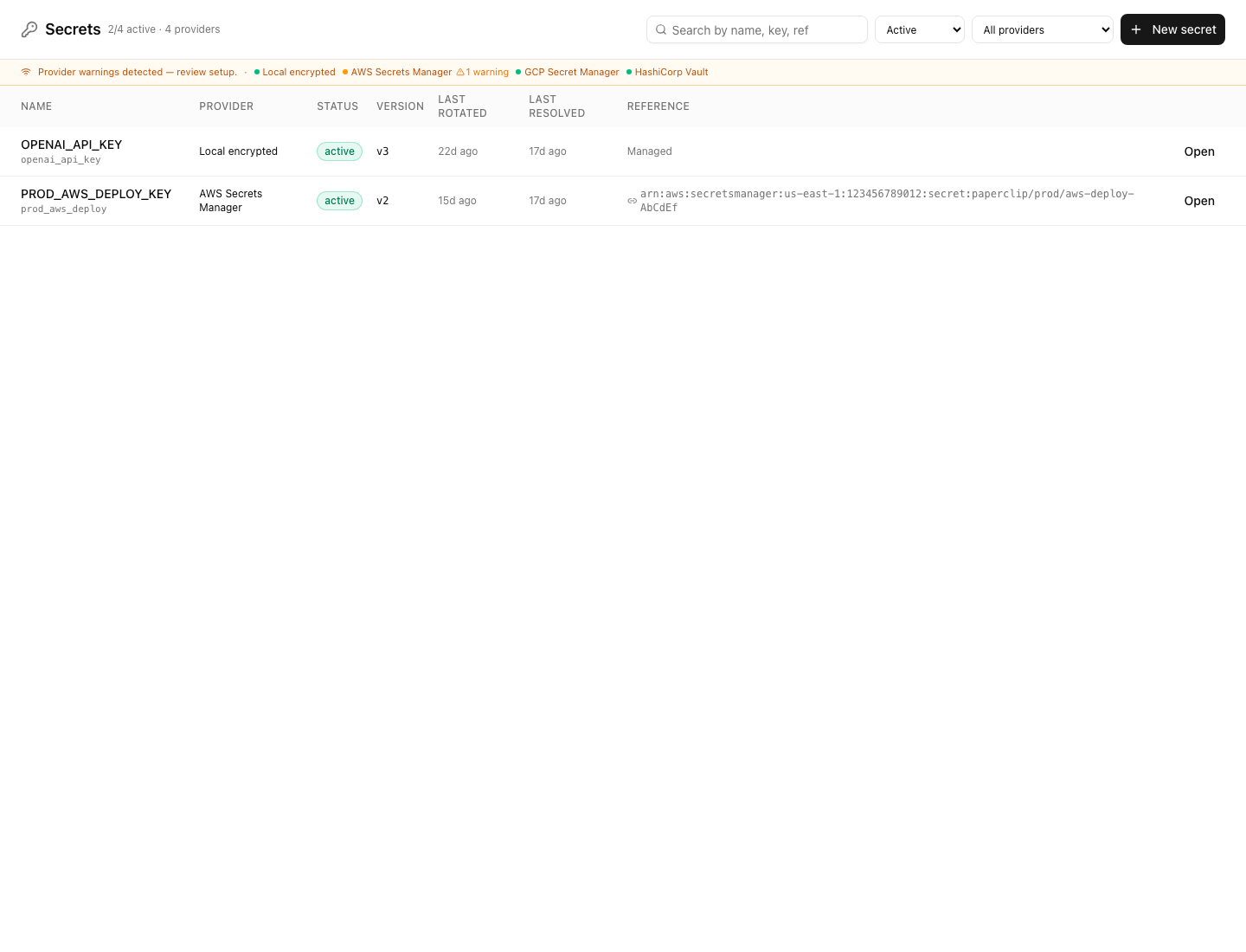 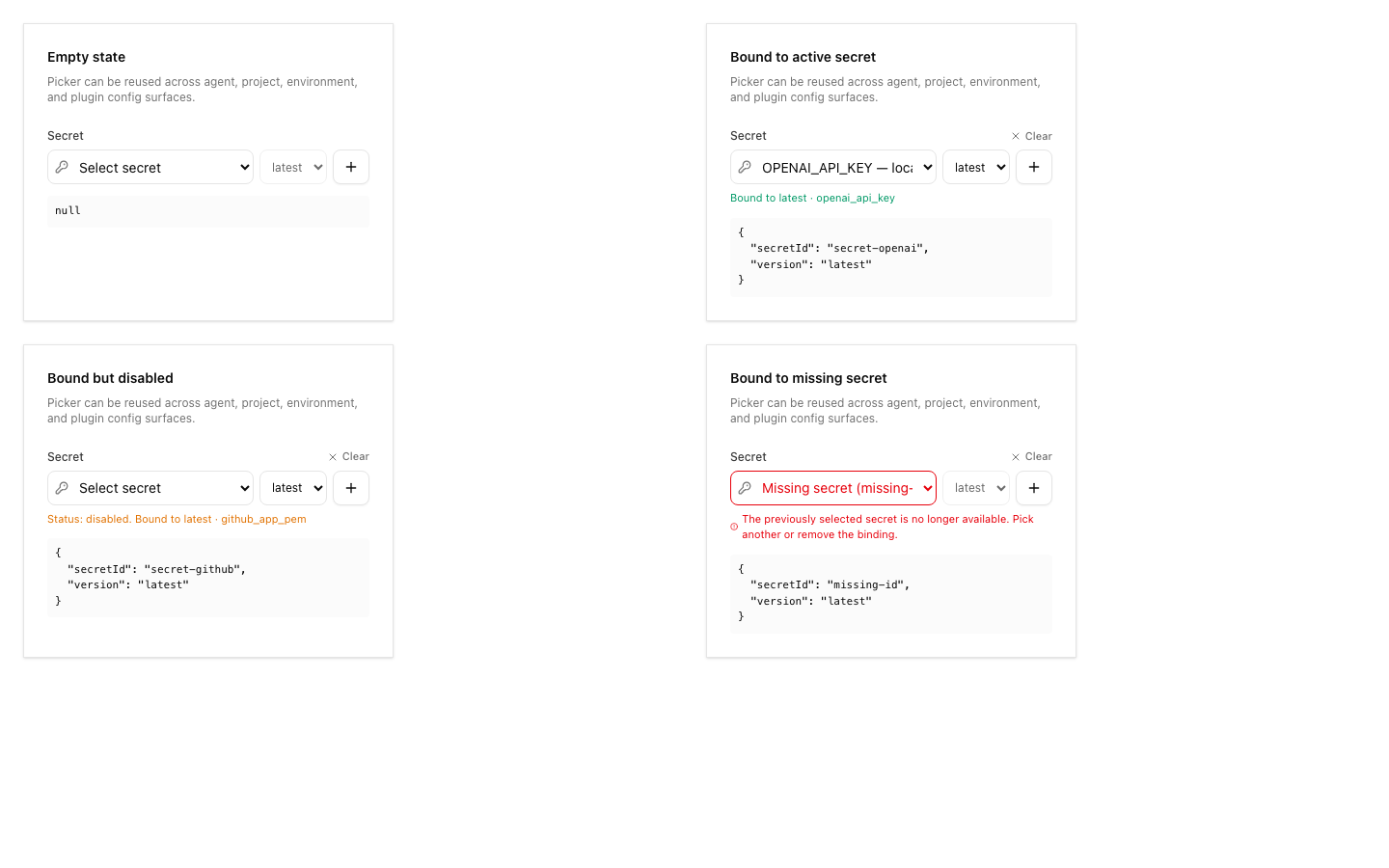 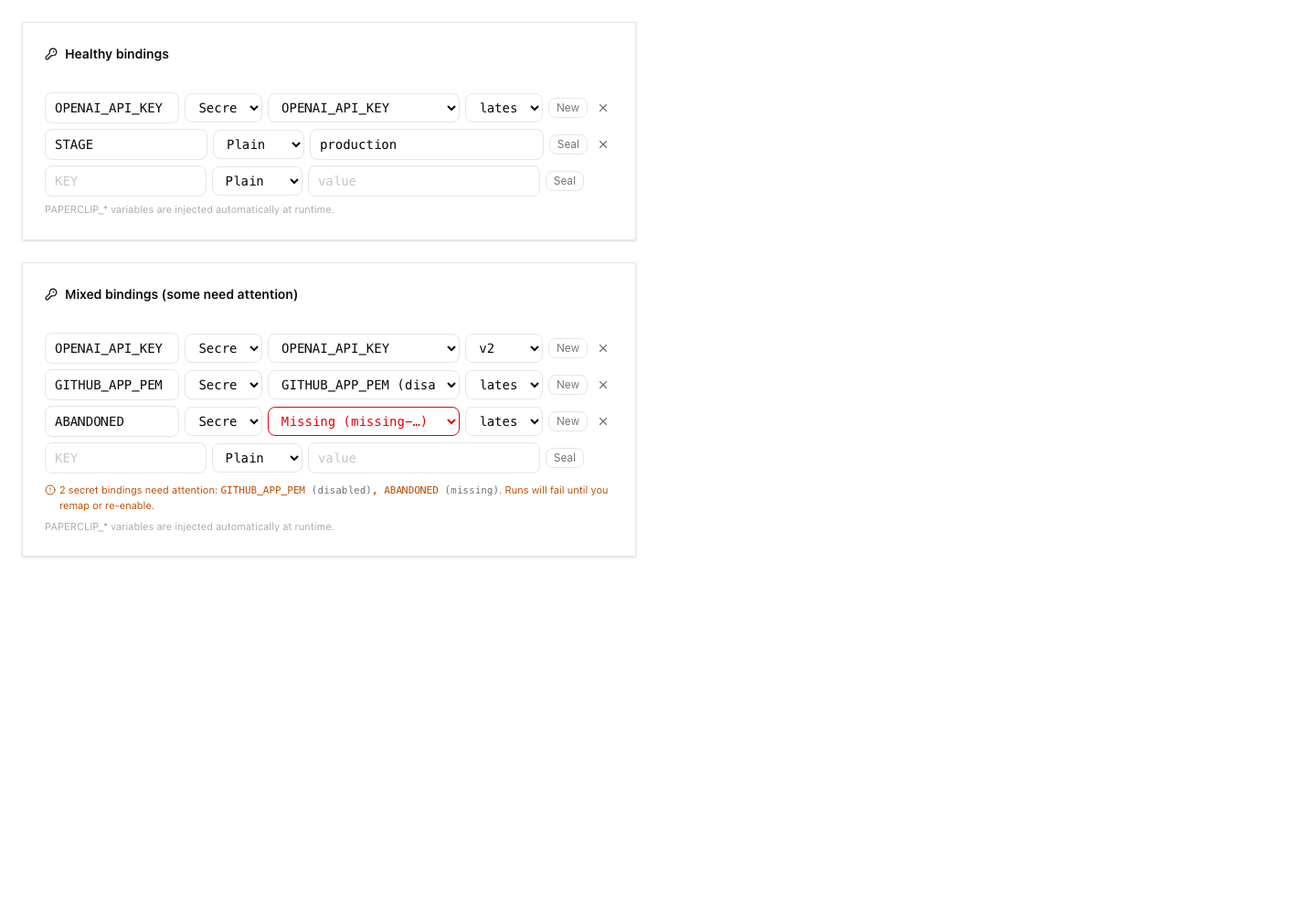 ## Risks - Migration risk: this adds new secret provider tables and extends existing secret rows. The migrations were checked for monotonic ordering and idempotent guards, but reviewers should still inspect upgrade behavior carefully. - Provider risk: AWS support uses direct SigV4 requests. Automated tests cover signing, request timeouts, vault-config selection, namespace guardrails, pending-version archival, sanitized provider errors, and service-level cleanup paths. A real-vault AWS smoke test remains deployment validation for an operator with AWS credentials rather than an unverified merge blocker in this local branch. - UI risk: the Secrets page and import dialog are large new surfaces; screenshots are included above for reviewer inspection. - Verification risk: the full local stable test command hit parallel-load timing failures, although the exact failed files passed when rerun directly. - Operational risk: remote import intentionally avoids plaintext reads; operators must understand that imported external references resolve at runtime and may fail if AWS permissions change. > For core feature work, check [`ROADMAP.md`](ROADMAP.md) first and discuss it in `#dev` before opening the PR. Feature PRs that overlap with planned core work may need to be redirected — check the roadmap first. See `CONTRIBUTING.md`. ## Model Used - OpenAI Codex, GPT-5 coding agent with local shell/tool use in the Paperclip worktree. Exact context-window size was not exposed by the runtime. ## Checklist - [x] I have included a thinking path that traces from project context to this change - [x] I have specified the model used (with version and capability details) - [x] I have checked ROADMAP.md and confirmed this PR does not duplicate planned core work - [ ] I have run tests locally and they pass - [x] I have added or updated tests where applicable - [x] If this change affects the UI, I have included before/after screenshots - [x] I have updated relevant documentation to reflect my changes - [x] I have considered and documented any risks above - [x] I will address all Greptile and reviewer comments before requesting merge --------- Co-authored-by: Paperclip <noreply@paperclip.ing> Co-authored-by: Claude Sonnet 4.6 <noreply@anthropic.com> |
||
|
Devin Foley
|
08af830430 |
Tighten publicBaseUrl port rewriting (#4553)
## Thinking Path > - Paperclip is a control plane for autonomous agent companies, so its local and authenticated deployment behavior has to stay predictable under port rebinding and worktree isolation. > - This change sits in the server/worktree configuration path that derives runtime URLs and auth origins from `auth.publicBaseUrl`. > - The original hostname-port rewrite change fixed one real gap for private/tailnet host:port worktree setups, but it widened the rewrite rule too far. > - Rewriting every explicit `auth.publicBaseUrl` can corrupt public or reverse-proxy URLs by turning a stable origin like `https://paperclip.example` into a local listen-port URL. > - Paperclip's auth and trusted-origin handling depend on that URL staying semantically correct, so this had to be narrowed before merge. > - This pull request tightens the rewrite rule to explicit-port URLs only and adds regression coverage across the CLI helper, worktree config persistence, and server startup path. > - The benefit is that private host:port worktree flows still work, while public/default-port URLs remain stable and safe. ## What Changed - Tightened `rewriteLocalUrlPort` in `cli/src/commands/worktree-lib.ts`, `server/src/worktree-config.ts`, and `server/src/index.ts` so it only rewrites URLs that already include an explicit port. - Removed the old loopback-only hostname gate from the CLI/worktree helpers and replaced it with the more precise `parsed.port` guard. - Updated CLI helper coverage to assert that explicit-port non-loopback URLs still rewrite while no-port public URLs stay unchanged. - Expanded `server/src/__tests__/worktree-config.test.ts` to cover explicit-port rewrite and no-port stability for both persisted worktree config and in-memory runtime port selection. - Added startup-path coverage in `server/src/__tests__/server-startup-feedback-export.test.ts` for `detect-port` rebinding with both explicit-port and no-port `auth.publicBaseUrl` values. ## Verification - `pnpm --filter @paperclipai/plugin-sdk build` - `npx vitest run server/src/__tests__/server-startup-feedback-export.test.ts` - `npx vitest run cli/src/__tests__/worktree.test.ts server/src/__tests__/worktree-config.test.ts` - All of the above were run locally in this issue worktree and passed. ## Risks - Low risk. The behavior change is deliberately narrower than the reviewed broad-host rewrite and is guarded by regression coverage for both the explicit-port and no-port cases. - The main remaining risk is behavioral only if another code path starts depending on port rewriting for URLs that never declared a port, which would be a separate bug. > For core feature work, check [`ROADMAP.md`](ROADMAP.md) first and discuss it in `#dev` before opening the PR. Feature PRs that overlap with planned core work may need to be redirected — check the roadmap first. See `CONTRIBUTING.md`. ## Model Used - OpenAI Codex local agent using `gpt-5.4` with high reasoning effort, tool use, shell execution, and file editing. - Anthropic Claude local agent using `claude-opus-4-6` for follow-up code review approval on the implementation issue. ## Checklist - [x] I have included a thinking path that traces from project context to this change - [x] I have specified the model used (with version and capability details) - [x] I have checked ROADMAP.md and confirmed this PR does not duplicate planned core work - [x] I have run tests locally and they pass - [x] I have added or updated tests where applicable - [x] If this change affects the UI, I have included before/after screenshots - [x] I have updated relevant documentation to reflect my changes - [x] I have considered and documented any risks above - [x] I will address all Greptile and reviewer comments before requesting merge |
||
|
Dotta
|
5a0c1979cf | [codex] Add runtime lifecycle recovery and live issue visibility (#4419) | ||
|
Devin Foley
|
e4995bbb1c |
Add SSH environment support (#4358)
## Thinking Path > - Paperclip orchestrates AI agents for zero-human companies > - The environments subsystem already models execution environments, but before this branch there was no end-to-end SSH-backed runtime path for agents to actually run work against a remote box > - That meant agents could be configured around environment concepts without a reliable way to execute adapter sessions remotely, sync workspace state, and preserve run context across supported adapters > - We also need environment selection to participate in normal Paperclip control-plane behavior: agent defaults, project/issue selection, route validation, and environment probing > - Because this capability is still experimental, the UI surface should be easy to hide and easy to remove later without undoing the underlying implementation > - This pull request adds SSH environment execution support across the runtime, adapters, routes, schema, and tests, then puts the visible environment-management UI behind an experimental flag > - The benefit is that we can validate real SSH-backed agent execution now while keeping the user-facing controls safely gated until the feature is ready to come out of experimentation ## What Changed - Added SSH-backed execution target support in the shared adapter runtime, including remote workspace preparation, skill/runtime asset sync, remote session handling, and workspace restore behavior after runs. - Added SSH execution coverage for supported local adapters, plus remote execution tests across Claude, Codex, Cursor, Gemini, OpenCode, and Pi. - Added environment selection and environment-management backend support needed for SSH execution, including route/service work, validation, probing, and agent default environment persistence. - Added CLI support for SSH environment lab verification and updated related docs/tests. - Added the `enableEnvironments` experimental flag and gated the environment UI behind it on company settings, agent configuration, and project configuration surfaces. ## Verification - `pnpm exec vitest run packages/adapters/claude-local/src/server/execute.remote.test.ts packages/adapters/cursor-local/src/server/execute.remote.test.ts packages/adapters/gemini-local/src/server/execute.remote.test.ts packages/adapters/opencode-local/src/server/execute.remote.test.ts packages/adapters/pi-local/src/server/execute.remote.test.ts` - `pnpm exec vitest run server/src/__tests__/environment-routes.test.ts` - `pnpm exec vitest run server/src/__tests__/instance-settings-routes.test.ts` - `pnpm exec vitest run ui/src/lib/new-agent-hire-payload.test.ts ui/src/lib/new-agent-runtime-config.test.ts` - `pnpm -r typecheck` - `pnpm build` - Manual verification on a branch-local dev server: - enabled the experimental flag - created an SSH environment - created a Linux Claude agent using that environment - confirmed a run executed on the Linux box and synced workspace changes back ## Risks - Medium: this touches runtime execution flow across multiple adapters, so regressions would likely show up in remote session setup, workspace sync, or environment selection precedence. - The UI flag reduces exposure, but the underlying runtime and route changes are still substantial and rely on migration correctness. - The change set is broad across adapters, control-plane services, migrations, and UI gating, so review should pay close attention to environment-selection precedence and remote workspace lifecycle behavior. ## Model Used - OpenAI Codex via Paperclip's local Codex adapter, GPT-5-class coding model with tool use and code execution in the local repo workspace. The local adapter does not surface a more specific public model version string in this branch workflow. ## Checklist - [x] I have included a thinking path that traces from project context to this change - [x] I have specified the model used (with version and capability details) - [x] I have checked ROADMAP.md and confirmed this PR does not duplicate planned core work - [x] I have run tests locally and they pass - [x] I have added or updated tests where applicable - [ ] If this change affects the UI, I have included before/after screenshots - [x] I have updated relevant documentation to reflect my changes - [x] I have considered and documented any risks above - [x] I will address all Greptile and reviewer comments before requesting merge |
||
|
DottaandPaperclip
|
16b2b84d84 |
[codex] Improve agent runtime recovery and governance (#4086)
## Thinking Path > - Paperclip orchestrates AI agents for zero-human companies. > - The heartbeat runtime, agent import path, and agent configuration defaults determine whether work is dispatched safely and predictably. > - Several accumulated fixes all touched agent execution recovery, wake routing, import behavior, and runtime concurrency defaults. > - Those changes need to land together so the heartbeat service and agent creation defaults stay internally consistent. > - This pull request groups the runtime/governance changes from the split branch into one standalone branch. > - The benefit is safer recovery for stranded runs, bounded high-volume reads, imported-agent approval correctness, skill-template support, and a clearer default concurrency policy. ## What Changed - Fixed stranded continuation recovery so successful automatic retries are requeued instead of incorrectly blocking the issue. - Bounded high-volume issue/log reads across issue, heartbeat, agent, project, and workspace paths. - Fixed imported-agent approval and instruction-path permission handling. - Quarantined seeded worktree execution state during worktree provisioning. - Queued approval follow-up wakes and hardened SQL_ASCII heartbeat output handling. - Added reusable agent instruction templates for hiring flows. - Set the default max concurrent agent runs to five and updated related UI/tests/docs. ## Verification - `pnpm install --frozen-lockfile` - `pnpm exec vitest run server/src/__tests__/company-portability.test.ts server/src/__tests__/heartbeat-process-recovery.test.ts server/src/__tests__/heartbeat-comment-wake-batching.test.ts server/src/__tests__/heartbeat-list.test.ts server/src/__tests__/issues-service.test.ts server/src/__tests__/agent-permissions-routes.test.ts packages/adapter-utils/src/server-utils.test.ts ui/src/lib/new-agent-runtime-config.test.ts` - Split integration check: merged this branch first, followed by the other [PAP-1614](/PAP/issues/PAP-1614) branches, with no merge conflicts. - Confirmed this branch does not include `pnpm-lock.yaml`. ## Risks - Medium risk: touches heartbeat recovery, queueing, and issue list bounds in central runtime paths. - Imported-agent and concurrency default behavior changes may affect existing automation that assumes one-at-a-time default runs. - No database migrations are included. > For core feature work, check [`ROADMAP.md`](ROADMAP.md) first and discuss it in `#dev` before opening the PR. Feature PRs that overlap with planned core work may need to be redirected — check the roadmap first. See `CONTRIBUTING.md`. ## Model Used - OpenAI Codex, GPT-5.4 tool-enabled coding model, agentic code-editing/runtime with local shell and GitHub CLI access; exact context window and reasoning mode are not exposed by the Paperclip harness. ## Checklist - [x] I have included a thinking path that traces from project context to this change - [x] I have specified the model used (with version and capability details) - [x] I have checked ROADMAP.md and confirmed this PR does not duplicate planned core work - [x] I have run tests locally and they pass - [x] I have added or updated tests where applicable - [x] If this change affects the UI, I have included before/after screenshots - [x] I have updated relevant documentation to reflect my changes - [x] I have considered and documented any risks above - [x] I will address all Greptile and reviewer comments before requesting merge --------- Co-authored-by: Paperclip <noreply@paperclip.ing> |
||
|
DottaandPaperclip
|
7f893ac4ec |
[codex] Harden execution reliability and heartbeat tooling (#3679)
## Thinking Path > - Paperclip orchestrates AI agents for zero-human companies > - Reliable execution depends on heartbeat routing, issue lifecycle semantics, telemetry, and a fast enough local verification loop to keep regressions visible > - The remaining commits on this branch were mostly server/runtime correctness fixes plus test and documentation follow-ups in that area > - Those changes are logically separate from the UI-focused issue-detail and workspace/navigation branches even when they touch overlapping issue APIs > - This pull request groups the execution reliability, heartbeat, telemetry, and tooling changes into one standalone branch > - The benefit is a focused review of the control-plane correctness work, including the follow-up fix that restored the implicit comment-reopen helpers after branch splitting ## What Changed - Hardened issue/heartbeat execution behavior, including self-review stage skipping, deferred mention wakes during active execution, stranded execution recovery, active-run scoping, assignee resolution, and blocked-to-todo wake resumption - Reduced noisy polling/logging overhead by trimming issue run payloads, compacting persisted run logs, silencing high-volume request logs, and capping heartbeat-run queries in dashboard/inbox surfaces - Expanded telemetry and status semantics with adapter/model fields on task completion plus clearer status guidance in docs/onboarding material - Updated test infrastructure and verification defaults with faster route-test module isolation, cheaper default `pnpm test`, e2e isolation from local state, and repo verification follow-ups - Included docs/release housekeeping from the branch and added a small follow-up commit restoring the implicit comment-reopen helpers that were dropped during branch reconstruction ## Verification - `pnpm vitest run server/src/__tests__/issue-comment-reopen-routes.test.ts server/src/__tests__/issue-telemetry-routes.test.ts` - `pnpm vitest run server/src/__tests__/http-log-policy.test.ts server/src/__tests__/heartbeat-run-log.test.ts server/src/__tests__/health.test.ts` - `server/src/__tests__/activity-service.test.ts`, `server/src/__tests__/heartbeat-comment-wake-batching.test.ts`, and `server/src/__tests__/heartbeat-process-recovery.test.ts` were attempted on this host but the embedded Postgres harness reported init-script/data-dir problems and skipped or failed to start, so they are noted as environment-limited ## Risks - Medium: this branch changes core issue/heartbeat routing and reopen/wakeup behavior, so regressions would affect agent execution flow rather than isolated UI polish - Because it also updates verification infrastructure, reviewers should pay attention to whether the new tests are asserting the right failure modes and not just reshaping harness behavior ## Model Used - OpenAI Codex coding agent (GPT-5-class runtime in Codex CLI; exact deployed model ID is not exposed in this environment), reasoning enabled, tool use and local code execution enabled ## Checklist - [x] I have included a thinking path that traces from project context to this change - [x] I have specified the model used (with version and capability details) - [ ] I have run tests locally and they pass - [x] I have added or updated tests where applicable - [ ] If this change affects the UI, I have included before/after screenshots - [x] I have updated relevant documentation to reflect my changes - [x] I have considered and documented any risks above - [x] I will address all Greptile and reviewer comments before requesting merge --------- Co-authored-by: Paperclip <noreply@paperclip.ing> |
||
|
Dotta
|
a77206812e | Harden tailnet bind setup | ||
|
dottaandPaperclip
|
2a84e53c1b |
Introduce bind presets for deployment setup
Co-Authored-By: Paperclip <noreply@paperclip.ing> |
||
|
Dotta
|
8bdf4081ee | chore: improve worktree tooling and security docs | ||
|
Devin Foley
|
f4a05dc35c |
fix(cli): prepare plugin sdk before cli dev boot (#3343)
## Thinking Path > - Paperclip orchestrates AI agents for zero-human companies > - The company import/export e2e exercises the local CLI startup path that boots the dev server inside a workspace > - That startup path loads server and plugin code which depends on built workspace package artifacts such as `@paperclipai/shared` and `@paperclipai/plugin-sdk` > - In a clean worktree those `dist/*` artifacts may not exist yet even though `paperclipai run` can still attempt to import the local server entry > - That mismatch caused the import/export e2e to fail before the actual company package flow ran > - This pull request adds a CLI preflight step that prepares the needed workspace build dependencies before the local server import and fails closed if that preflight is interrupted or stalls > - The benefit is that clean worktrees can boot `paperclipai run` reliably without silently continuing after incomplete dependency preparation ## What Changed - Updated `cli/src/commands/run.ts` to execute `scripts/ensure-plugin-build-deps.mjs` before importing `server/src/index.ts` for local dev startup. - Ensured `paperclipai run` can materialize missing workspace artifacts such as `packages/shared/dist` and `packages/plugins/sdk/dist` automatically in clean worktrees. - Made the preflight fail closed when the child process exits via signal and bounded it with a 120-second timeout so the CLI does not hang indefinitely. - Kept the fix isolated to the CLI startup path; no API contract, schema, or UI behavior changed. - Reused the existing `cli/src/__tests__/company-import-export-e2e.test.ts` coverage that already exercises the failing boot path, so no additional test file was needed. ## Verification - `pnpm test:run cli/src/__tests__/company-import-export-e2e.test.ts` - `pnpm --filter paperclipai typecheck` - On the isolated branch, confirmed `packages/shared/dist/index.js` and `packages/plugins/sdk/dist/index.js` were absent before the run, then reran the targeted e2e and observed a passing result. ## Risks - Low risk: the change only affects the local CLI dev startup path before the server import. - Residual risk: other entrypoints still rely on their own preflight/build behavior, so this does not normalize every workspace startup path. - The 120-second timeout is intentionally generous, but unusually slow machines could still hit it and surface a startup error instead of waiting forever. ## Model Used - OpenAI Codex, GPT-5-based coding agent in the Codex CLI environment, with shell/tool execution enabled. The exact runtime revision and context window are not exposed by this environment. ## Checklist - [x] I have included a thinking path that traces from project context to this change - [x] I have specified the model used (with version and capability details) - [x] I have run tests locally and they pass - [x] I have added or updated tests where applicable - [x] If this change affects the UI, I have included before/after screenshots - [x] I have updated relevant documentation to reflect my changes - [x] I have considered and documented any risks above - [x] I will address all Greptile and reviewer comments before requesting merge |
||
|
Dotta
|
b00d52c5b6 |
Merge pull request #3015 from aronprins/feature/backups-configuration
feat(backups): gzip compression and tiered retention with UI controls |
||
|
dotta
|
8e88577371 | chore(dev): preflight workspace links and simplify worktree helpers | ||
|
dottaandPaperclip
|
46892ded18 |
Add worktree reseed command
Co-Authored-By: Paperclip <noreply@paperclip.ing> |
||
|
Aron Prins
|
fcbae62baf |
feat(backups): tiered daily/weekly/monthly retention with UI controls
Replace single retentionDays with a three-tier BackupRetentionPolicy: - Daily: keep all backups (presets: 3, 7, 14 days; default 7) - Weekly: keep one per calendar week (presets: 1, 2, 4 weeks; default 4) - Monthly: keep one per calendar month (presets: 1, 3, 6 months; default 1) Pruning sorts backups newest-first and applies each tier's cutoff, keeping only the newest entry per ISO week/month bucket. The Instance Settings General page now shows three preset selectors (no icon, matches existing page design). Remove Database icon import. |
||
|
dotta
|
b5e177df7e | Address greptile review feedback | ||
|
dotta
|
34589ad457 | Add worktree reseed command | ||
|
dottaandPaperclip
|
fd6cfc7149 |
fix(routines): address Greptile review findings
Co-Authored-By: Paperclip <noreply@paperclip.ing> |
||
|
dottaandPaperclip
|
909e8cd4c8 |
feat(routines): add workspace-aware routine runs
Co-Authored-By: Paperclip <noreply@paperclip.ing> |
||
|
dottaandPaperclip
|
38833304d4 |
fix: restore cli telemetry config handling in worktrees
Co-Authored-By: Paperclip <noreply@paperclip.ing> |
||
|
dottaandPaperclip
|
53dbcd185e |
fix: align telemetry client payload and dimensions with backend schema
Restructure the TelemetryClient to send the correct backend envelope
format ({app, schemaVersion, installId, events: [{name, occurredAt, dimensions}]})
instead of the old per-event format. Update all event dimension names
to match the backend registry (agent_role, adapter_type, error_code, etc.).

Co-Authored-By: Paperclip <noreply@paperclip.ing>
|
||
|
dottaandPaperclip
|
34044cdfce |
feat: implement app-side telemetry sender
Add the shared telemetry sender, wire the CLI/server emit points, and cover the config and completion behavior with tests. Co-Authored-By: Paperclip <noreply@paperclip.ing> |
||
|
dottaandPaperclip
|
d12e3e3d1a |
Fix feedback review findings
Co-Authored-By: Paperclip <noreply@paperclip.ing> |
||
|
dottaandPaperclip
|
c0d0d03bce |
Add feedback voting and thumbs capture flow
Co-Authored-By: Paperclip <noreply@paperclip.ing> |


