mirror of
https://github.com/paperclipai/paperclip.git
synced 2026-11-09 07:10:34 +01:00
c99bcd89fe6f9db8a7dfea92b036c2c0ed6d3521
21
Commits
| Author | SHA1 | Message | Date | |
|---|---|---|---|---|
 DottaandPaperclip |
2c96f76780 |
feat(connections): add model-backed prompt injection prevention
Add opt-in OpenRouter checks at existing tool-result boundaries with regex fallback, service accounting, and settings on Connections. Make migration 0362 safe to replay over existing or partially applied schema state. Co-Authored-By: Paperclip <noreply@paperclip.ing> |
||
|
DottaandPaperclip
|
a7dd5284b5 |
feat: add company fast-response acknowledgements (#15748)
## Thinking Path > - Paperclip is the open source app people use to manage AI agents for work. > - Human messages start agent work through task, chat, and external-channel intake. > - Agent startup can delay the first visible response. > - A small direct model call can acknowledge the request while normal work starts. > - This response must remain separate from evidence that the agent answered or completed work. > - This pull request adds optional company-wide fast responses with durable receipts, access checks, and cost accounting. > - Users receive prompt acknowledgement without changing the agent execution path. ## Linked Issues or Issue Description **Subsystem affected** Cross-cutting: database, shared contracts, server orchestration, connections, and UI. **Problem or motivation** Users can wait for an agent to start before they receive a contextual response. Generic progress messages do not confirm what the user asked. An acknowledgement must not falsely complete work or satisfy an unanswered turn. **Proposed solution** Add a disabled-by-default experimental fast-response model using an existing shared API connection. Generate one short acknowledgement for each accepted human turn. Use the existing agent identity and external publication outboxes. Retain platform provenance and account for the inference independently. **Alternatives considered** Running the acknowledgement through the agent runtime adds startup latency. Restricting implementation to OpenRouter leaves other existing API connections unsupported. This change supports all existing API connections and uses OpenRouter for live verification. **Roadmap alignment** This extends existing agent communication and connection settings. ROADMAP.md and open pull requests were checked. No duplicate fast-response implementation was found. The maintainer supplied the feature plan directly. ## What Changed - Add Experimental fast responses to instance settings. Keep the feature off by default. Enforce the flag at intake, dispatch, and publication. - Move Decision model and Fast response setup to company Settings → Connections when the experiment is enabled. Place Connections below Environments. Separate the model sections with clear headings and a divider. Keep Decision model in General when the experiment is off. Route Costs setup links to the available settings page. - Make the acknowledgement prompt a multiline template string. Ask for a brief, positive response in the user’s language. - Add settings, connection/model selection, sponsorship, fixed-sample testing, and Costs history. - Add a Vercel AI SDK text service for existing native, routed, Bedrock, and local API connections. - Add durable per-turn requests, a bounded worker, a three-second admission deadline, and one inference attempt. - Integrate task creation, task and agent chat, steering, queued follow-ups, experimental board chat, shared chat intake, and email. - Preserve receipt provenance and exclude receipts from completion, recovery, interaction resolution, and agent wakeups. - Recheck authorization, source validity, real replies, budgets, and destination binding before publication. Preserve accounting for suppressed or uncertain outcomes. - Add provider contracts, database race tests, channel outbox tests, UI tests, Stories, and documentation. Keep decision-model execution unchanged. ## Verification - Local `pnpm -r typecheck`, `pnpm build`, and UI token gates pass after rebase. The UI typecheck and build also pass after the final navigation fixes. All 37 focused navigation tests pass. The first full local `pnpm test:run` invocation reported seven chat failures. All seven passed in isolated reruns after fixture updates and host cleanup. This invocation was stopped after the full final-head CI suite passed. - Initial local database tests hit macOS shared-memory exhaustion. A diagnostic confirmed `shmget: No space left on device` with the system limit of 32 IDs. Three abandoned, unattached PostgreSQL IPC headers were reclaimed. The isolated rerun passed all 31 fast-response and channel tests. The two additional Slack regression cases also passed in a separate rerun. No active database was stopped. - UI token gates pass. Provider contract tests cover all supported API connection types. Fast-response tests cover uniqueness, authorization, budgets, expiry, cancellation, restart, real-reply races, and the experimental flag. - The test drive verified that disabling the experiment hides Connections and redirects its direct URL. Enabling it restores the saved OpenRouter setup. After restart on the final commit, the OpenRouter settings sample returned “Sure, I’ll take care of fixing the border around the settings panel.” in 428 ms. It used 260 input and 31 output tokens and recorded $0.0000576 in reported cost. - Earlier live OpenRouter verification produced a receipt in 1.013 seconds for a new task. The real agent then supplied its substantive answer. A separate settings test took 1.34 seconds, used 246 input and 23 output tokens, and recorded $0.0000361. - Live Slack verification on final commit `24016fa525961ebc7a4acffdc5019ce123970549` passed for a fresh initial task and a follow-up in a disposable bot DM. The initial acknowledgement appeared 2.405 seconds after the Slack message and 1.413 seconds after durable acceptance; the follow-up appeared in 2.322 seconds and 1.160 seconds respectively. The recorded generation/settlement durations were 898 ms and 697 ms. The initial call used 291 input / 39 output tokens and cost $0.00006705; the follow-up used 281 / 47 and cost $0.00007035. - The Slack acknowledgements retained the assigned agent identity and `origin: fast_response`, source-turn references, and no fabricated run ID. A status snapshot after the initial receipt showed the task still `in_progress` with its real execution run. The agent then read the CSV fixture and correctly reported two ready items, two blockers, and their owners. Both replies stayed in the originating DM, and no duplicate generic working message followed the delivered contextual acknowledgements. The `new` command started a fresh conversation session without generating a fast response. - An earlier eligible Slack turn generated a response but suppressed publication. Its reported cost was retained, generic progress remained, and the real agent completed the requested result. This is recorded separately from the two delivered acknowledgements; the history did not expose a precise suppression reason. - Slack verification used real signed provider events, the existing intake/publication paths, and a user-approved temporary webhook-only HTTPS tunnel. Subscriptions were limited to direct-message events. The test bot was paused and the tunnel stopped afterward. Live channel/group-thread and GitHub journeys remain unverified; their mocked tests cover intake, destination binding, publication, and continued underlying work. - Greptile reviewed final commit `24016fa525961ebc7a4acffdc5019ce123970549` at 5/5. Both new review findings are fixed and all threads are resolved. [Final-head CI run](https://github.com/paperclipai/paperclip/actions/runs/38060015730) passed. This includes grouped server/chat/workspace tests, serialized suites, runner checks, browser journeys, typecheck, build, release registry, policy, and the canary dry run. - Manual check: enable Experimental fast responses. Open company Settings → Connections. Select a shared API connection and model. Save and use Test response. Submit a task message and confirm that its receipt does not complete the task. ## Risks - The migration adds receipt and configuration tables plus accounting references. It uses idempotent statements and follows the current migration sequence. - A slow provider, authorization change, or real-agent reply can suppress an acknowledgement. Existing progress feedback remains available. - Unknown provider billing retains a reservation until reconciliation. External deliveries with uncertain outcomes must not be blindly repeated. - Live Slack initial-task and follow-up DM journeys pass. Live Slack channel/group-thread and GitHub journeys remain unverified. The PR remains a draft and records these gaps. Final-head repository CI and automated review pass. ## Model Used OpenAI Codex, based on GPT-6, with reasoning, repository tools, code execution, and browser interaction. The runtime does not expose an exact model snapshot ID or context-window size; these are not asserted. ## Checklist - [x] I have included a thinking path that traces from project context to this change - [x] I have specified the model used (with version and capability details) - [x] I have checked ROADMAP.md and confirmed this PR does not duplicate planned core work - [x] I have searched GitHub for duplicate or related PRs and linked them above - [x] I have either (a) linked existing issues with `Fixes: #` / `Closes #` / `Refs #` OR (b) described the issue in-PR following the relevant issue template - [x] I have not referenced internal/instance-local Paperclip issues or links (only public GitHub `#NNN` / `github.com/paperclipai/paperclip` URLs) - [x] My branch name describes the change (e.g. `docs/...`, `fix/...`) and contains no internal Paperclip ticket id or instance-derived details - [x] I have run tests locally and they pass - [x] I have added or updated tests where applicable - [x] I have updated relevant documentation to reflect my changes - [x] I have considered and documented any risks above - [x] All Paperclip CI gates are green - [x] Greptile is 5/5 with no open P2s, recommendations, or follow-ups - [x] I will address all Greptile and reviewer comments before requesting merge --------- Co-authored-by: Paperclip <noreply@paperclip.ing> |
||
|
|
871f7d1124 |
fix(ui): polish core navigation and task layout (#12793)
<!-- Write all pull request text in Simplified Technical English (ASD-STE100): short sentences, one instruction per sentence, simple approved vocabulary, and the active voice. --> ## Thinking Path > - Paperclip is the open source app people use to manage AI agents for work. > - Operators use the main navigation, contextual navigation, and task chat throughout the product. > - The recent core UI refactor left uneven spacing and inconsistent navigation styles. > - The Apps label also did not match the Connectors product language. > - The account area did not provide a clear direct path for feedback. > - This pull request aligns these related core UI surfaces and preserves their existing behavior. > - The benefit is a more consistent interface with clearer navigation and balanced task-chat layout. ## Linked Issues or Issue Description **What existing behavior does this improve?** This improves the core sidebar, Settings navigation, Connectors catalog, task-chat layout, and account controls. **Subsystem affected** `ui/` — React and Vite board UI. **Current behavior** The task chat had uneven edge treatment. Settings used a separate contextual-navigation style. Apps used inconsistent product labels. The account footer did not expose a direct feedback control. **Proposed behavior** The task chat keeps balanced content padding while its scrollbar sits at the properties boundary. Settings replaces the primary sidebar with a matching navigation surface and a Back to app link. Apps uses Connectors and Browse labels. The account footer provides a dedicated feedback icon with a tooltip. **Reason and benefit** These changes make related navigation and layout patterns predictable. They reduce duplicate labels and improve access to feedback. **Breaking changes** None. Routes, APIs, and stored data do not change. ## What Changed - Balanced the task-chat content gutter and moved its scrollbar to the properties-panel boundary. - Reworked Settings navigation to replace the main sidebar and use the shared primary-sidebar style. - Added a Back to app navigation item to Settings. - Renamed Apps to Connectors in the main navigation and added the `Unplug` icon. - Renamed the Connectors contextual item to Browse. - Added the Connectors top-level header and aligned the search field with the connector cards. - Added account-footer hover states and a direct feedback flag with a Share feedback tooltip. - Removed the duplicate Feedback item from the account popover. - Added regression coverage for each changed UI surface. ## Verification - `pnpm --filter @paperclipai/ui exec vitest run src/components/AppsSidebar.test.tsx src/components/CompanySettingsSidebar.test.tsx src/components/Layout.test.tsx src/components/Sidebar.test.tsx src/components/SidebarAccountMenu.test.tsx src/components/task-chat/TaskMessageScroller.test.tsx src/pages/apps/Browse.test.tsx` — 90 tests passed. - `pnpm --filter @paperclipai/ui typecheck` — passed. - `pnpm --filter @paperclipai/ui build` — passed. - `pnpm check:token-gates` — passed. - `git diff --check origin/master...HEAD` — passed. - `env PAPERCLIP_PLAYWRIGHT_CHANNEL=chrome PAPERCLIP_E2E_PORT=3201 pnpm exec playwright test --config tests/e2e/playwright.config.ts tests/e2e/apps-dark-mode-shots.spec.ts tests/e2e/sidebar-takeover.spec.ts` — 10 tests passed. - The full workspace typecheck and build reached the Rust runner and stopped because `cargo` is not installed on this machine. - The full test suite exposed unrelated server and workspace-runtime failures and was stopped after the affected suites completed. No changed UI test failed. - Manually verified the changed Settings, Connectors, task-chat, and account-menu surfaces in the running app. ## Risks - Low risk. The change affects layout and navigation presentation only. - The Settings sidebar now replaces the main sidebar by design. Users must use Back to app to return to the application navigation. - The task scrollbar offset depends on the existing responsive page gutters. Regression tests cover both narrow and desktop spacing. > For core feature work, check [`ROADMAP.md`](ROADMAP.md) first and discuss it in `#dev` before opening the PR. Feature PRs that overlap with planned core work may need to be redirected — check the roadmap first. See `CONTRIBUTING.md`. ## Model Used - OpenAI Codex, `gpt-5.6-sol`, extended reasoning with tool use and code execution. The host does not expose the context-window size. ## Checklist - [x] I have included a thinking path that traces from project context to this change - [x] I have specified the model used (with version and capability details) - [x] I have checked ROADMAP.md and confirmed this PR does not duplicate planned core work - [x] I have searched GitHub for duplicate or related PRs and linked them above - [x] I have either (a) linked existing issues with `Fixes: #` / `Closes #` / `Refs #` OR (b) described the issue in-PR following the relevant issue template - [x] I have not referenced internal/instance-local Paperclip issues or links (only public GitHub `#NNN` / `github.com/paperclipai/paperclip` URLs) - [x] My branch name describes the change (e.g. `docs/...`, `fix/...`) and contains no internal Paperclip ticket id or instance-derived details - [ ] I have run tests locally and they pass - [x] I have added or updated tests where applicable - [x] I have updated relevant documentation to reflect my changes - [x] I have considered and documented any risks above - [x] All Paperclip CI gates are green - [x] Greptile is 5/5 with no open P2s, recommendations, or follow-ups - [x] I will address all Greptile and reviewer comments before requesting merge --------- Co-authored-by: Scott Tong <scott@scottsmbpm5max.lan> Co-authored-by: Paperclip <noreply@paperclip.ing> |
||
|
scotttong
|
597fd63b61 | feat(ui): add streamlined navigation foundation (#12746) | ||
|
Devin Foley
|
a4f1b3c533 |
Move company invites into a tab of the Members page (#12289)
## Thinking Path > - Paperclip is the open source app people use to manage AI agents for work > - Company settings include member management and invites, which are one workflow: invite someone, watch the join request, manage the membership > - Today invites sit on a standalone settings page, costing a sidebar entry and forcing people to bounce between two pages for one task > - Merging invites into the Members page keeps the workflow in one place without losing any capability > - This pull request turns the Members page into a Members/Invites tab bar, redirects the old URL, and keeps both operator-visibility keys meaningful > - The benefit is a tighter settings surface for every deployment, with `company.invites` now hiding just the tab while `company.members` hides the whole page ## Linked Issues or Issue Description No public issue exists; describing the issue inline per the enhancement template: **What existing behavior does this improve?** Company invites live on a standalone settings page separate from the Members page, even though inviting someone and managing the resulting membership are one workflow. **Subsystem affected** Web UI (company settings) **Current behavior** `/company/settings/invites` is its own page with its own sidebar entry (gated by `company.invites`); the Members page (`company.members`) is separate. The sidebar company menu's "Invite people" shortcut links to the invites page and is not gated by the hidden-settings mechanism at all. **Proposed behavior** The Members page carries a Members/Invites tab bar, addressable via `?tab=invites`. The invite creation flow, latest-link panel, and invite history move unchanged into an `InvitesSection` component. The old URL redirects to the tab (still behind its `HiddenSettingsPageGate`). `company.members` hides the whole page; `company.invites` hides just the Invites tab, and the tab bar collapses when only Members remains. The "Invite people" shortcut points at the tab and hides when either surface is operator-hidden. **Reason and benefit** One settings surface for one workflow: fewer sidebar entries and no bouncing between two pages to invite someone and then manage the membership. Operators keep the same visibility controls, with a sharper meaning for each key. **Breaking changes** None. Bookmarks to the old invites URL redirect to the tab, invite and membership APIs are unchanged, and both hidden-settings keys keep working. ## What Changed - `ui/src/pages/CompanyInvites.tsx` → `ui/src/components/access/InvitesSection.tsx` (page chrome and breadcrumbs dropped; content unchanged), with its tests moved alongside. - `ui/src/pages/CompanyAccess.tsx`: Members/Invites tabs via the shared `PageTabBar`, `?tab=invites` search param, `company.invites` gating with tab snap-back; legacy "Open Invites" button retargeted. - `ui/src/App.tsx`: the invites route becomes a gated redirect to `/company/settings/members?tab=invites`. - `CompanySettingsSidebar` / `CompanySettingsNav`: standalone Invites entry/tab removed; the old path maps to the members tab. - `ui/src/components/SidebarCompanyMenu.tsx`: "Invite people" now links to the tab and hides when `company.members` or `company.invites` is hidden (closes an existing gating gap). - Tests: moved invites tests, new tab coverage (default tab, deep link, operator-hidden tab skips the invites fetch), sidebar/nav suites updated. ## Verification - `npx vitest run ui/src/components/CompanySettingsSidebar.test.tsx ui/src/components/access/CompanySettingsNav.test.tsx ui/src/pages/CompanyAccess.test.tsx ui/src/components/access/InvitesSection.test.tsx` — 24 tests passing. - `pnpm --filter @paperclipai/ui typecheck` — clean. ## Risks - Low. Pure UI restructure: invite APIs, membership APIs, and the hidden-settings registry keys are unchanged. Bookmarks to the old invites URL redirect (and stay gated). The `company.invites` key's meaning narrows from "hide the page" to "hide the tab", which is the same effective surface. ## Model Used Claude (Anthropic), model id `claude-fable-5`, extended thinking, agentic tool use via Claude Code. ## Checklist - [x] I have included a thinking path that traces from project context to this change - [x] I have specified the model used (with version and capability details) - [x] I have checked ROADMAP.md and confirmed this PR does not duplicate planned core work - [x] I have searched GitHub for duplicate or related PRs and linked them above - [x] I have either (a) linked existing issues with `Fixes: #` / `Closes #` / `Refs #` OR (b) described the issue in-PR following the relevant issue template - [x] I have not referenced internal/instance-local Paperclip issues or links (only public GitHub `#NNN` / `github.com/paperclipai/paperclip` URLs) - [x] My branch name describes the change (e.g. `docs/...`, `fix/...`) and contains no internal Paperclip ticket id or instance-derived details - [x] I have run tests locally and they pass - [x] I have added or updated tests where applicable - [x] I have updated relevant documentation to reflect my changes - [x] I have considered and documented any risks above - [ ] All Paperclip CI gates are green - [ ] Greptile is 5/5 with no open P2s, recommendations, or follow-ups - [x] I will address all Greptile and reviewer comments before requesting merge |
||
|
Devin Foley
|
7551b63ef2 |
Remove the instance Heartbeats settings page (#12282)
## Thinking Path > - Paperclip is the open source app people use to manage AI agents for work > - Instance settings collect deployment-wide controls; one of them was the Heartbeats page, an instance-wide list of scheduler heartbeat agents with enable/disable toggles > - The same controls live on each agent's own configuration surface, so the standalone list duplicates them, and its framing no longer matches how heartbeat agents are managed > - Keeping a settings view that no longer makes sense costs every deployment navigation noise and maintenance > - This pull request removes the page, its route, its navigation entries, and its hidden-settings key for all deployments > - The benefit is a smaller, coherent settings surface, with operator hidden-settings lists that still mention the retired key continuing to work unchanged ## Linked Issues or Issue Description No public issue exists; describing the issue inline per the enhancement template: **What existing behavior does this improve?** The instance settings surface — specifically the Settings → Heartbeats page, which listed scheduler heartbeat agents instance-wide with enable/disable toggles. The view no longer makes sense as a standalone settings page: the same controls are available on each agent's configuration surface, and the instance-wide list framing does not match how heartbeat agents are managed. **Subsystem affected** Cross-cutting: `ui/` (page, route, navigation), `packages/shared` (settings-visibility registry), docs. **Current behavior** The page renders at `/company/settings/instance/heartbeats`, appears in the settings sidebar and tab bar, and is hideable by hosting operators via the `instance.heartbeats` key of `PAPERCLIP_HIDDEN_SETTINGS`. **Proposed behavior** The page, route, and navigation entries are removed for every deployment. The `instance.heartbeats` registry key is retired; operator lists that still send it are logged and ignored, so mixed-version fleets keep working. Remembered settings paths pointing at the old page remap to the settings root. Heartbeat APIs are unchanged. **Reason and benefit** A smaller, coherent settings surface with no duplicated controls; less navigation noise and maintenance for every deployment. **Breaking changes** None functional. Bookmarks and remembered paths to the removed page land on the settings root; `PAPERCLIP_HIDDEN_SETTINGS` lists that still include `instance.heartbeats` log a warning and are otherwise honored unchanged. ## What Changed - Deleted `ui/src/pages/InstanceSettings.tsx` (the Heartbeats view) and its route in `ui/src/App.tsx`. - Removed the sidebar entry (`CompanySettingsSidebar`) and tab-bar item (`CompanySettingsNav`). - Removed `"/heartbeats"` from the remembered-settings-path allowlist; remembered heartbeats paths now remap to the settings root. - Retired the `instance.heartbeats` key from the shared settings-visibility registry and the environment-variables doc; documented that retired keys are ignored with a warning. - Dropped the now-unused UI client wrapper for the instance scheduler-agent list (`heartbeatsApi.listInstanceSchedulerAgents`); the server endpoint stays. - Removed the unused `schedulerHeartbeats` query key. ## Verification - `npx vitest run packages/shared/src/settings-visibility.test.ts ui/src/lib/instance-settings.test.ts ui/src/components/CompanySettingsSidebar.test.tsx ui/src/components/access/CompanySettingsNav.test.tsx` — 24 tests passing. - Full `ui` vitest suite: 4426 tests, 4 failures — all in files this PR does not touch; 3 were load-induced timeouts that pass on rerun, and `OnboardingWizard.test.tsx` "renders instead of throwing when the browser denies storage access" fails identically on a clean master checkout (pre-existing). - `pnpm --filter @paperclipai/ui typecheck` and `pnpm --filter @paperclipai/shared typecheck` — clean. - Merged `master` to clear a conflict (see below) and re-ran the four focused suites (24 passing), `ui/src/App.test.tsx` and `ui/src/plugins/bridge.test.ts` (22 passing), and both typechecks — all clean. Full CI is green on the merge commit. ## Merge With master `master` gained the `company` → `organization` copy pass (#12243), which reworded strings inside `ui/src/pages/InstanceSettings.tsx` — the page this branch deletes — producing a modify/delete conflict. Resolved by keeping the deletion: the page is going away, so the rewording of its copy has nothing to apply to. Every other file merged cleanly, and `master`'s rewording in `App.tsx`, `App.test.tsx`, and `CompanySettingsSidebar.tsx` sits away from this branch's structural removals, so both changes survive. The net diff against `master` is unchanged from the pre-merge review: the same 13 files, 23 insertions, 330 deletions. ## Risks - Low. Pure removal of a UI surface; heartbeat data and APIs are untouched. Operators still listing `instance.heartbeats` in `PAPERCLIP_HIDDEN_SETTINGS` get a warning log and otherwise unchanged behavior (covered by the registry's unknown-key handling). Bookmarks and remembered paths to the old page land on the settings root. ## Model Used Claude (Anthropic), model id `claude-fable-5`, extended thinking, agentic tool use via Claude Code. ## Checklist - [x] I have included a thinking path that traces from project context to this change - [x] I have specified the model used (with version and capability details) - [x] I have checked ROADMAP.md and confirmed this PR does not duplicate planned core work - [x] I have searched GitHub for duplicate or related PRs and linked them above - [x] I have either (a) linked existing issues with `Fixes: #` / `Closes #` / `Refs #` OR (b) described the issue in-PR following the relevant issue template - [x] I have not referenced internal/instance-local Paperclip issues or links (only public GitHub `#NNN` / `github.com/paperclipai/paperclip` URLs) - [x] My branch name describes the change (e.g. `docs/...`, `fix/...`) and contains no internal Paperclip ticket id or instance-derived details - [x] I have run tests locally and they pass - [x] I have added or updated tests where applicable - [x] I have updated relevant documentation to reflect my changes - [x] I have considered and documented any risks above - [x] All Paperclip CI gates are green - [x] Greptile is 5/5 with no open P2s, recommendations, or follow-ups - [x] I will address all Greptile and reviewer comments before requesting merge |
||
|
scotttong
|
4d82f5eaea | copy: unify user-facing "company" wording to "organization" (#12243) | ||
|
Devin Foley
|
9c03443c48 |
feat: hideable company settings pages, with import floored on cloud-managed instances (#12199)
## Thinking Path

> - Paperclip is the open source app people use to manage AI agents for
work
> - The app can run self-hosted or as a cloud-managed instance, where a
hosting platform provisions the instance with its company already
materialized (the existing `isCloudManagedInstance()` predicate and
`cloud_managed` floors)
> - The company Import/Export surface lets an operator materialize whole
companies from an export bundle; on a cloud-managed instance this
bypasses the existing `cloud_managed` company-creation floor and
conflicts with platform-owned provisioning
> - Importing should be disabled on cloud-managed instances, while
export stays open as the data-portability escape hatch
> - This pull request floors every import route with 403
`code=cloud_managed` on cloud-managed instances and hides the Import UI
there, using the existing predicate and the established floor pattern
> - It also extends the operator-hidden settings registry with keys for
every top-level company settings page, so a hosting operator can hide
any of them with `PAPERCLIP_HIDDEN_SETTINGS` alone next time
> - The benefit is one consistent managed-instance policy: cloud-managed
instances cannot import companies, self-hosted installs keep the full
import surface unchanged

## Linked Issues or Issue Description

No public issue exists; the underlying problem follows the enhancement
template.

**What existing behavior does this improve?**

The company import surface (`/api/companies/import*`,
`/api/companies/:companyId/imports/*`) and its UI entry points on
cloud-managed instances.

**Subsystem affected**

Server routes (`server/src/routes/companies.ts`) and UI navigation/pages
(settings sidebar, settings tabs, org chart, `/company/import` route).

**Current behavior**

A cloud-managed instance floors direct company creation (`POST
/api/companies` answers 403 `cloud_managed`), but the import routes
still accept company bundles, so an import can materialize companies the
hosting platform did not provision. The UI offers Import entry points
that lead to a surface that is not available on cloud-managed instances.

**Proposed behavior**

On instances where `isCloudManagedInstance()` is true, every import
route answers 403 `code=cloud_managed` before auth and body work, and
the Import UI (sidebar entry, settings tab, org-chart button,
`/company/import` route) is hidden or redirected. Export remains fully
available. Self-hosted instances are unchanged.

**Reason and benefit**

Cloud-managed instances keep one consistent provisioning authority, and
users do not see an Import surface that dead-ends in a 403.

## What Changed

- `server/src/routes/companies.ts`: a router-level floor mounted at the
`/import` and `/:companyId/imports` prefixes. It covers the single-shot
upload, preview, job polling, chunked transfer
declare/part-upload/status/preview/apply, and the agent-safe per-company
import routes. It throws `forbidden(..., { code: "cloud_managed" })` on
cloud-managed instances, or `403 settings_operator_managed` when the
operator hides `company.import` — both before auth and body validation,
mirroring the company-creation floor.
- `packages/shared/src/settings-visibility.ts`: new
`HIDEABLE_COMPANY_PAGES` registry group — `company.members`,
`company.invites`, `company.secrets`, `company.export`, `company.import`
— with a `hidesCompanyPage` helper. The company General page stays
non-hideable (settings root). `company.import` floors its API; the other
keys are UI-visibility only, as documented in the registry, so
membership/invite/secret/export APIs stay live for agents.
- `ui/src/components/CloudManagedPageGate.tsx` (new): route gate that
redirects cloud-managed instances to `/company/settings`, modeled on
`HiddenSettingsPageGate`.
- `ui/src/App.tsx`: wraps the `company/import` route in
`CloudManagedPageGate`.
- `ui/src/components/CompanySettingsSidebar.tsx`,
`ui/src/components/access/CompanySettingsNav.tsx`,
`ui/src/pages/OrgChart.tsx`: hide the Import entry points when
`useCloudInstance()` reports a managed instance, and honor the new
`company.*` hidden-settings keys for every company page entry (sidebar
item, tab, org-chart buttons).
- `ui/src/App.tsx`: `HiddenSettingsPageGate` route gates for the members
(incl. the legacy access route), invites, secrets, export, and import
pages under their `company.*` keys.
- `docs/deploy/environment-variables.md`: documents the new keys and
their semantics; the CLI and board-operator guides note that import is
unavailable on cloud-managed instances.
- Tests: new `server/src/__tests__/company-import-cloud-floor.test.ts`
and `ui/src/components/CloudManagedPageGate.test.tsx`, registry cases in
`packages/shared/src/settings-visibility.test.ts`, plus cloud and
hidden-key cases in the sidebar, settings-nav, and org-chart suites.

## Verification

- TypeScript typechecks pass for every workspace package (`tsc` in
shared, server, ui; the runner's Rust leg needs a local cargo toolchain
and is covered by CI).
- `pnpm test` on this branch fails only in 9 files that also fail on a
clean `origin/master` checkout on the same machine
(environment-dependent suites: live-listener probes,
workspace/native-runtime spawns, skill materialization). Zero
branch-only failures against that baseline; every suite touched by this
change passes.
- `server/src/__tests__/company-import-cloud-floor.test.ts` asserts:
every import route answers 403 `cloud_managed` under the server-token
signal; the managed-config signal alone also floors; every import route
answers 403 `settings_operator_managed` when `company.import` is hidden;
hiding other company pages leaves import open; the floor applies before
auth and body validation; export stays open on cloud-managed instances;
self-hosted import preview and job polling still work.
- `packages/shared/src/settings-visibility.test.ts` covers the new
`company.*` keys and `hidesCompanyPage`.
- UI suites assert the Import tab, sidebar entry, and org-chart button
disappear on a cloud-managed instance while Export stays, that
`/company/import` redirects through the gate, and that the `company.*`
keys hide their sidebar entries and tabs.

## Risks

- Low risk for self-hosted installs: the floor is inert unless a cloud
signal (`PAPERCLIP_CLOUD_TENANT_SERVER_TOKEN` or
`PAPERCLIP_MANAGED_CONFIG`) is present, and the self-hosted paths are
regression-tested.
- On cloud-managed instances this is a deliberate behavioral removal:
import (including agent-driven safe imports and resumable transfers)
stops working the moment an instance runs this build. In-flight chunked
transfers on such instances cannot be applied afterward; they answer
403.
- CLI import commands against a cloud-managed instance now fail with the
`cloud_managed` error; the message names the reason.
- The new `company.*` keys change nothing unless an operator sets them:
`PAPERCLIP_HIDDEN_SETTINGS` unset keeps behavior identical, and older
images ignore unknown keys by design. The four non-import company keys
hide UI only; their APIs stay live, which the registry documents
explicitly.

## Model Used

Claude Fable 5 (`claude-fable-5`, Anthropic) via Claude Code — agentic
coding session with tool use (code search, editing, local test
execution).

## Checklist

- [x] I have included a thinking path that traces from project context
to this change
- [x] I have specified the model used (with version and capability
details)
- [x] I have checked ROADMAP.md and confirmed this PR does not duplicate
planned core work
- [x] I have searched GitHub for duplicate or related PRs and linked
them above
- [x] I have either (a) linked existing issues with `Fixes: #` / `Closes
#` / `Refs #` OR (b) described the issue in-PR following the relevant
issue template
- [x] I have not referenced internal/instance-local Paperclip issues or
links (only public GitHub `#NNN` / `github.com/paperclipai/paperclip`
URLs)
- [x] My branch name describes the change (e.g. `docs/...`, `fix/...`)
and contains no internal Paperclip ticket id or instance-derived details
- [x] I have run tests locally and they pass
- [x] I have added or updated tests where applicable
- [x] I have updated relevant documentation to reflect my changes
- [x] I have considered and documented any risks above
- [ ] All Paperclip CI gates are green
- [ ] Greptile is 5/5 with no open P2s, recommendations, or follow-ups
- [x] I will address all Greptile and reviewer comments before
requesting merge
|
||
|
Devin Foley
|
db4defdfbf |
feat: operator-configurable settings visibility via PAPERCLIP_HIDDEN_SETTINGS (#11823)
## Thinking Path

> - Paperclip is the open source app people use to manage AI agents for
work
> - The instance settings surface (Access, Plugins, Adapters, General,
Experimental) assumes the person at the keyboard operates the whole
instance
> - Operators who host Paperclip for others — a managed cloud or an
internal shared server — expose settings pages and toggles that do not
apply to their deployment, and the related mutation APIs stay open
> - A hosted tenant can open Plugins or Adapters, try an action, and hit
a confusing failure, because only a few hardcoded platform floors exist
> - This pull request adds a generic, operator-configured visibility
mechanism: one env var hides declared settings surfaces in the UI and
floors their mutation routes with a stable 403 code
> - The benefit is a clean hosted-tenant settings surface for any
operator, with zero behavior change for normal self-hosted instances

## Linked Issues or Issue Description

**Subsystem affected**

Instance settings (server routes and UI), the shared settings registry
in `packages/shared`, and the `/api/health` bootstrap payload.

**Problem or motivation**

An operator who hosts Paperclip for other people cannot hide settings
surfaces that the platform manages. Tenants see Access, Plugins, and
Adapters pages, backup retention, and host-level experimental toggles
that do nothing useful for them. The mutation APIs behind these surfaces
also stay open, so a tenant admin can attempt actions the platform must
control. ROADMAP.md names a cleaner shared deployment story as a goal
("Teams should be able to run the same product in hosted or semi-hosted
environments without changing the mental model").

**Proposed solution**

Add a declarative registry of hideable settings surfaces and one env
var, `PAPERCLIP_HIDDEN_SETTINGS`. The server parses the list at boot,
reports it on `/api/health`, and rejects value-changing writes to hidden
surfaces with a stable `settings_operator_managed` 403 code. The UI
reads the list from the health payload and removes the hidden pages,
sections, and toggles from navigation, routes, and page content. Unknown
keys warn and are ignored, so one list can roll across a fleet with
mixed app versions. With the variable unset, behavior is byte-identical
to today.

**Alternatives considered**

- Hardcode the hidden set for cloud instances in this repo: rejected,
because each hosting operator needs a different policy, and policy does
not belong in shared code.
- Deliver the hidden set through the managed-config document: rejected,
because that channel is cloud-specific and fail-closed on unknown
fields; a plain env var works for any operator, including self-hosted
shared servers.
- Lock the controls with a badge instead of hiding them: rejected for
these surfaces, because they are meaningless to tenants, not merely
platform-controlled; the existing managed-overlay lock stays the right
tool for controlled flags.

**Roadmap alignment**

Supports the "shared deployment story" item in ROADMAP.md: hosted and
semi-hosted deployments keep the same product with a settings surface
that matches what the tenant can actually do.

## What Changed

- New `packages/shared/src/settings-visibility.ts`: registry of hideable
surfaces (every instance settings page — profile, environments, access,
heartbeats, experimental, plugins, adapters; every Instance → General
section; every experimental flag as `instance.experimental.<key>`), the
`PAPERCLIP_HIDDEN_SETTINGS` parser, and the `settings_operator_managed`
error code. The General page stays visible as the settings root and
redirect target.
- New `server/src/services/settings-visibility.ts`: parse-once accessor;
unknown keys log one warning and are ignored.
- `/api/health` reports `hiddenSettings` on every response shape; the
field is omitted when nothing is hidden.
- Server floors on hidden surfaces, with same-value echo tolerance (the
`executionMode` precedent): field-backed general sections and
experimental keys reject value-changing PATCHes, and hiding the whole
Experimental page floors every toggle; plugin lifecycle and config
writes, adapter management writes, and the Access admin routes (reads
included) return 403 `settings_operator_managed`. Reads the app itself
needs (plugin `ui-contributions`, adapter metadata, plugin job trigger)
stay open. Pages without instance-scoped mutation routes are hidden in
the UI only.
- UI: new `useHiddenSettings` hook and `HiddenSettingsPageGate` route
gate (hidden pages redirect to the settings root); the settings sidebar
and tab bar drop hidden entries; remembered settings paths remap to the
default page; `InstanceGeneralSettings` skips hidden sections; every
`ExperimentalToggleCard` now carries its flag key and renders nothing
when hidden.
- Removed the dead `InstanceSidebar` component (referenced only by its
own test).
- Docs: `docs/deploy/environment-variables.md` documents the variable
and the key registry.

## Verification

- `pnpm vitest run` over the new and extended suites: shared registry
and parser, representative floor tests per route class (changed-value
403, same-value echo 200, unset env 200, page-level Experimental
hiding), the health field, the route gate, nav filtering, and
section/card hiding with one hidden example per surface kind — 168 tests
pass.
- Full root `pnpm typecheck` passes.
- Manual: booted a server with the variable set. `/api/health` lists the
keys; an unknown key logs one warning and the server boots; hidden pages
redirect; hidden sections and cards do not render; hidden-field PATCH
returns 403 with `details.code = "settings_operator_managed"`; a
same-value echo returns 200. Unset the variable: the full settings
surface returns and responses are byte-identical to master.

## Risks

- Low risk for self-hosted instances: with the variable unset, the
hidden set is empty, the health field is omitted, and no floor
activates.
- Flooring plugin config writes assumes hosted deployments configure
plugins through the platform. If a future bundled plugin needs
tenant-entered config, the floor needs a narrow carve-out.
- Hidden-key floors tolerate same-value echoes, so API clients that
round-trip full GET responses keep working.
- Hiding a toggle does not change its value; operators pair hiding with
the desired default where the value matters.

## Model Used

Claude Fable 5 (Anthropic, `claude-fable-5`) with extended thinking and
agentic tool use, driven through the Claude Code CLI (file edits, test
execution, and live-server verification loops).

## Checklist

- [x] I have included a thinking path that traces from project context
to this change
- [x] I have specified the model used (with version and capability
details)
- [x] I have checked ROADMAP.md and confirmed this PR does not duplicate
planned core work
- [x] I have searched GitHub for duplicate or related PRs and linked
them above
- [x] I have either (a) linked existing issues with `Fixes: #` / `Closes
#` / `Refs #` OR (b) described the issue in-PR following the relevant
issue template
- [x] I have not referenced internal/instance-local Paperclip issues or
links (only public GitHub `#NNN` / `github.com/paperclipai/paperclip`
URLs)
- [x] My branch name describes the change (e.g. `docs/...`, `fix/...`)
and contains no internal Paperclip ticket id or instance-derived details
- [x] I have run tests locally and they pass
- [x] I have added or updated tests where applicable
- [x] I have updated relevant documentation to reflect my changes
- [x] I have considered and documented any risks above
- [ ] All Paperclip CI gates are green
- [ ] Greptile is 5/5 with no open P2s, recommendations, or follow-ups
- [x] I will address all Greptile and reviewer comments before
requesting merge
|
||
|
DottaandPaperclip
|
e826188e82 |
refactor(settings): unify settings and speed up exports (#11789)
## Thinking Path > - Paperclip is the open source app that people use to manage AI agents for work. > - Operators use the settings area to control a company and its Paperclip instance. > - The current navigation separates related settings and uses duplicate instance pages. > - Company exports also do independent reads in sequence and do extra work for previews. > - Hardened workspace commands can differ from their saved command after loopback binding. > - This pull request makes these related operator workflows consistent and faster. > - The benefit is one clear settings area, faster exports, and stable runtime command matching. ## Linked Issues or Issue Description Refs #338 Related: #9834 **What existing behavior does this improve?** This improves the company settings UI, company export preparation, and workspace runtime command matching. **Current behavior** Company and instance settings use separate navigation and duplicate pages. Export preparation reads many independent records in sequence. Preview generation can also build an unused organization image. A command with a forced loopback bind can fail to match its saved runtime command. **Proposed behavior** Use one settings navigation and put general instance controls on the company General page. Load independent export data with bounded concurrency, skip unused preview image work, and load the export page only when it is needed. Treat the loopback-bound form of a command as the same runtime command. **Reason and benefit** Operators get one clear settings area. Large company exports need fewer serialized reads. Export previews and initial UI loads do less work. Hardened runtime services remain linked to their saved command definitions. **Breaking changes** The obsolete instance General URL redirects to the unified settings page. Access and Heartbeats remain available, and legacy bookmarks keep their destinations. No API response shape or database schema changes. ## What Changed - Unified company and instance settings navigation and removed duplicate instance settings pages. - Embedded general instance controls in the company General page and kept access-sensitive navigation behavior. - Preserved instance Access and Heartbeats controls in the unified navigation and normalized old bookmarks to those destinations. - Improved environment and access-state handling when workspace seed requests overlap. - Added bounded export reads, a lighter preview path, deferred export preparation, and lazy export-page loading. - Matched loopback-bound runtime commands to their saved command definitions. - Added focused shared, server, and UI regression tests. ## Verification - `pnpm exec vitest run <18 changed test files>`: 18 files and 256 tests passed. - `pnpm check:token-gates`: passed all four token gates. - `pnpm -r typecheck`: passed for all workspace projects. - `pnpm build`: passed for all workspace projects. - `pnpm test:run`: tests ran without a reported failure, but the runner did not close after the server handoff tests. The process closed with status 0 after an interrupt. - Focused latest-head route tests: 2 files and 4 tests passed. - GitHub latest-head checks: all completed without failure. - Greptile: 5/5 with no unresolved review threads. ## Risks - Medium risk: settings routes and navigation changed across several operator roles. - Medium risk: bounded export concurrency increases simultaneous database reads. The limits stay below the normal pool size. - Low risk: runtime command matching accepts only the known Tailscale HTTPS loopback transformation. - No migrations are included. > For core feature work, check [`ROADMAP.md`](ROADMAP.md) first and discuss it in `#dev` before opening the PR. Feature PRs that overlap with planned core work may need to be redirected — check the roadmap first. See `CONTRIBUTING.md`. ## Model Used - OpenAI Codex with a GPT-5-family coding model. The runtime does not expose the exact deployed model ID or context-window size. Reasoning, tool use, and local code execution were enabled. ## Checklist - [x] I have included a thinking path that traces from project context to this change - [x] I have specified the model used (with version and capability details) - [x] I have checked ROADMAP.md and confirmed this PR does not duplicate planned core work - [x] I have searched GitHub for duplicate or related PRs and linked them above - [x] I have either (a) linked existing issues with `Fixes: #` / `Closes #` / `Refs #` OR (b) described the issue in-PR following the relevant issue template - [x] I have not referenced internal/instance-local Paperclip issues or links (only public GitHub `#NNN` / `github.com/paperclipai/paperclip` URLs) - [ ] My branch name describes the change (e.g. `docs/...`, `fix/...`) and contains no internal Paperclip ticket id or instance-derived details Exception: This task requires the existing execution branch. The harness does not permit a branch rename. - [x] I have run tests locally and they pass - [x] I have added or updated tests where applicable - [x] I have updated relevant documentation to reflect my changes - [x] I have considered and documented any risks above - [x] All Paperclip CI gates are green - [x] Greptile is 5/5 with no open P2s, recommendations, or follow-ups - [x] I will address all Greptile and reviewer comments before requesting merge --------- Co-authored-by: Paperclip <noreply@paperclip.ing> |
||
|
Devin Foley
|
916c13501f |
Replace host-to-host Cloud Sync with full-fidelity company Import/Export (#10507)
## Thinking Path > - Paperclip is the open source app people use to manage AI agents for work > - A company accumulates real state — issues, labels, blockers, documents, work products, monitors, attachments, agents, routines — and people need to move that state between instances: self-hosted to cloud, cloud back to self-hosted, or plain backups > - The experimental, flag-gated Cloud Sync transport (#6548) tried to solve this host-to-host: the source pushed into a receiver over HTTPS with a cross-instance consent/token handshake, which required the destination to be publicly reachable and broke for common self-hosted topologies (plain-HTTP LAN/VPN origins); the receiver half never landed upstream at all > - Meanwhile the portability bundle and the existing export/import pages already move companies offline with none of those networking constraints — but silently dropped labels, blockers, issue documents, work products, monitors, and every attachment > - This pull request removes the host-to-host transport and makes Import/Export the single data-movement path: the pages become first-class company-settings destinations, exports declare exactly what they do not carry, and bundle schemaVersion 6 now carries all of the above, with attachments as content-addressed sha256 blobs verified before a single row is written > - The benefit is a migration and backup flow that works between any two instances with no reachability requirements, no cross-instance auth, and no silent data loss ## Linked Issues or Issue Description - Refs #6548 — the original Cloud Sync sender this PR supersedes and removes. - Related, not duplicates: #1697 (goals in the portability manifest — orthogonal field addition), #954 (an earlier import/export + skill-visibility proposal predating the current portability bundle). - No open issue describes this directly, so in brief (feature-request shape): **Problem** — moving a company between instances silently lost labels (imports with label references actually hard-failed), blocker relations, issue documents, work products, monitor state, and all attachments, and the alternative Cloud Sync transport required the destination to be publicly reachable over HTTPS plus a consent handshake, which failed for typical self-hosted setups. **Desired behavior** — one Import/Export flow in company settings that produces a portable bundle carrying all of that data, tells the operator up front what it cannot carry, imports with automations paused, and offers real one-click activation afterwards. ## What Changed - New export fidelity report (`GET /api/companies/:companyId/export/fidelity`) + an "Export fidelity" panel on the Export page listing anything a bundle will not include (now only: approvals, cost history, activity history) - Imports accept `pauseAutomations`; imported agents and routines land paused, the import result reports created routines, and the Import page ends in an activation panel that actually resumes selected agents/activates routines - Export and Import pages promoted into the company-settings nav; the Cloud Upstream wizard, ux-lab page, and API client removed; the old settings route redirects to Export - Host-to-host transport removed: upstream-sync/receiver-client routes and services, CLI `cloud connect`/`cloud push` + keypair store, the shared upstream transfer contract, and the `enableCloudSync` flag; migration `0196` drops the two experimental `cloud_upstream_*` sender tables - Bundle schemaVersion 6: labels (definitions + per-task names, remapped by name on import), blocker relations (`blockedBy` slugs, cycle-tolerant), issue documents (`tasks/<slug>/documents/<key>.md`), work products (system refs nulled), monitors (notes/scheduledBy restored, imported un-armed) - Attachments travel as content-addressed `blobs/<sha256>` entries (deduped; comment-scoped attachments re-link via comment index); every blob is hash-verified **before any write**, so a corrupted bundle cannot leave a partially imported company; both zip codecs now round-trip extensionless/binary entries byte-exactly; the Import page preflights the inline body limit and offers continue-without-attachments - v5 (and older) bundles still import, with an informational warning; bundles newer than v6 are rejected cleanly - Docs: board-operator import/export guide, CLI README, README/ROADMAP updated ## Verification - `pnpm -r` typechecks (shared, db incl. migration numbering/safety checks, server, ui, cli) and `pnpm check:token-gates` — clean - Vitest: full server + shared sweep 4,888 passed / 1 skipped, with the only 3 failures being pre-existing on `master` (2× heartbeat-workspace-branch-containment, 1× workspace-runtime auto-port; reproduced identically with this change stashed); ui + cli suites green; the embedded-Postgres export-fidelity suite applies the full migration chain including the new `0196` against a fresh database - Live end-to-end on a scratch instance: seeded a company with labels, a blocker pair, an issue document, a work product, a monitor, an agent, a routine, and two binary attachments (one comment-scoped) → export → import into a fresh company → labels remapped to new ids, blocker edge and document restored, monitor un-armed with notes intact, attachments byte-identical (sha256-compared through the API), agents/routines paused → activation panel resumed them; a v5-shaped bundle imported with only the info warning; flipping one byte in a blob made the import 422 with **zero** rows created - Reviewer repro: create a company with a labeled issue + attachment → Settings → Export → download → Settings → Import on another company/instance → watch the preview, apply with "start paused", then activate ## Risks - Migration `0196` drops `cloud_upstream_connections`/`cloud_upstream_runs` — experimental tables behind a default-off flag; their connection/run history is intentionally discarded - Breaking removals are all of experimental, flag-gated surface: `/api/upstream-sync/*` + `/api/cloud-upstreams/*` routes, `paperclipai cloud connect|push`, and the `enableCloudSync` flag (stale keys in stored instance settings parse harmlessly) - Import remains non-atomic on mid-apply errors generally (pre-existing behavior); the new blob verification specifically moved ahead of all writes so tampered bundles cannot create partial state - GitHub-sourced imports do not fetch `blobs/*` and skip attachments with a warning ## Model Used - Claude Fable 5 (`claude-fable-5`, Anthropic), via Claude Code CLI with extended thinking, tool use, and subagent orchestration; implementation and review split across Fable 5 subagents, with live end-to-end verification against a running instance ## Checklist - [x] I have included a thinking path that traces from project context to this change - [x] I have specified the model used (with version and capability details) - [x] I have checked ROADMAP.md and confirmed this PR does not duplicate planned core work - [x] I have searched GitHub for duplicate or related PRs and linked them above - [x] I have either (a) linked existing issues with `Fixes: #` / `Closes #` / `Refs #` OR (b) described the issue in-PR following the relevant issue template - [x] I have not referenced internal/instance-local Paperclip issues or links (only public GitHub `#NNN` / `github.com/paperclipai/paperclip` URLs) - [x] My branch name describes the change (e.g. `docs/...`, `fix/...`) and contains no internal Paperclip ticket id or instance-derived details - [x] I have run tests locally and they pass - [x] I have added or updated tests where applicable - [x] I have updated relevant documentation to reflect my changes - [x] I have considered and documented any risks above - [ ] All Paperclip CI gates are green - [ ] Greptile is 5/5 with no open P2s, recommendations, or follow-ups - [x] I will address all Greptile and reviewer comments before requesting merge |
||
|
|
c07e650cd7 |
feat(ui): single-source design tokens, visual regression suite, and theme retune (#9134)
## Thinking Path > - Paperclip is the open source app people use to manage AI agents for work > - Its UI is the operator's daily surface: task lists, boards, budgets, agent status — all built on shadcn components and Tailwind > - Visual values (colors, spacing, type sizes, radii) were hardcoded at ~1,600 call sites: the same "small gray label" was 9/10/11px depending on the file, charts disagreed with chips about status colors, two toggle-switch implementations coexisted in two greens, and there was no visual regression coverage > - This made the UI drift-prone and made any restyle a hundreds-of-files project, which discourages design iteration > - This pull request extracts visual values into a single token layer in `ui/src/index.css`, adds a Storybook visual regression suite backed by external immutable baseline archives, and then applies a deliberate retune reviewed change-by-change on screenshot diffs > - The benefit is that Paperclip's look becomes a config surface: retheming is a token edit reviewed as a snapshot diff, drift is blocked by a token gate, and future UI PRs can prove exactly what changed visually without committing hundreds of PNGs ## Linked Issues or Issue Description No existing public issue covers this work (searched "design tokens", "visual regression", "design system" across issues and PRs). Related in spirit: Refs #8982 (theming a hardcoded panel — a one-off instance of the same problem class this PR addresses systematically). **Problem (feature-request form):** UI visual values are hardcoded per call site with no source of truth and no regression coverage; consistency depends on reviewer memory, and restyling requires mass file edits. **Proposed solution (this PR):** a single token layer + enforcement gate + externally stored visual snapshot suite, then an intentional restyle on top of that foundation. ## What Changed - **Token extraction (zero visual change, machine-verified during development):** committed codemods (`scripts/codemod-*.mjs`) moved ~1,600 hardcoded color/type/spacing/radius/shadow/misc values into named tokens in a non-inline `:root` block of `ui/src/index.css`. - **Visual regression suite:** `pnpm test:storybook-visual` covers 255 stories × light/dark = 510 Playwright screenshots at `maxDiffPixels: 0`, plus new primitive-coverage stories and deterministic-render fixes. - **External visual baselines:** committed PNG snapshots were removed. `tests/storybook-visual/baseline-manifest.json` pins an immutable archive URL/hash/size/count, and `scripts/storybook-visual-baseline.mjs` handles `download`, `verify`, `pack`, and trusted maintainer `upload` flows. - **Opt-in visual CI artifacts:** added a `Storybook Visual` workflow that runs on manual dispatch or PRs labeled `storybook-visual`, downloads/verifies the baseline, runs Playwright, and uploads Playwright report/test-result artifacts for review. Normal PR runs do not mutate baseline objects. - **Token gate:** `pnpm check:token-gates` — zero hex literals, zero arbitrary bracket values, zero raw font-sizes in `ui/src/components/**` and `ui/src/pages/**`, with a documented inline allowlist for legitimate opt-outs. - **Theme retune (intentional, snapshot-reviewed):** new base theme values; radius ladder derived from a single `--radius` knob; micro-type cluster collapsed to a named ladder (`--text-nano/micro/compact` + Tailwind `text-xs`/`text-sm`); letter-spacing collapsed to named steps. - **One status-color vocabulary:** charts, quota/budget bar fills, RUNNING/live chips, and liveness indicators all use the canonical `--status-*` hues. Light-mode legibility fixes for red alert surfaces that used dark-tuned text classes. - **One switch:** `ToggleSwitch` restyled to the registry capsule form, second hand-rolled implementation removed, and all call sites unified. - **Docs:** `DESIGN.md` is the design contract; `doc/design/` holds audit reports, decision logs, and updated guidance for external baseline review/update workflows. - Dead code removed (`agentStatusBadge` duplicate map), byte-identical contrast constants consolidated, semantic renames (`--project-seed`/`--project-none`, `--liveness-blue`). ## Verification - `pnpm check:token-gates` — 3/3 gates CLEAN during the design-system run - `pnpm typecheck` && `pnpm --filter @paperclipai/ui build` — green during the design-system run - `node --test scripts/__tests__/storybook-visual-baseline.test.mjs` — pass after external-baseline rework - `pnpm exec tsc --noEmit --pretty false --module NodeNext --moduleResolution NodeNext --target ES2022 --types node,@playwright/test tests/storybook-visual/playwright.config.ts tests/storybook-visual/storybook-visual.spec.ts` — pass after external-baseline rework - `git diff --check origin/pr/9134..HEAD` — pass after external-baseline rework - `find tests/storybook-visual -type f -name '*.png' -print | wc -l` — `0` - `node scripts/storybook-visual-baseline.mjs verify` — intentionally fails closed until the first trusted maintainer publishes the baseline archive and updates `baseline-manifest.json` ## Risks - **Large but shallow:** the PR still touches many UI files due to mechanical token extraction and retune work, but committed PNG snapshot churn has been removed from the branch. - **Baseline publication required before the visual suite can pass in clean clones:** the manifest currently has placeholder archive metadata. A trusted maintainer must publish the first immutable archive, then update `baseline-manifest.json`. - **Rendering platform variance:** the external baseline should be captured in the documented Linux/Chromium environment. Future CI runs verify against the pinned archive and fail closed on checksum/count mismatch. - **Visual CI is opt-in while stabilizing:** add the `storybook-visual` label or dispatch the workflow manually to produce downloadable Playwright report/test-result artifacts. - **Scheduled follow-ups, deliberately out of scope:** Tailwind palette classes map to semantic tokens in a dedicated pass; card/pill component consolidation; ESLint ratchet. Tracked in `doc/design/DECISION-SHEET.md`. ## Model Used Claude Fable 5 (Anthropic, `claude-fable-5`, Mythos-class tier) with extended thinking, running in Claude Code with tool use; mechanical phases delegated to Claude Sonnet subagents. Follow-up external-baseline rework assisted by OpenAI Codex (`gpt-5` coding agent with repository, terminal, and GitHub tool use). All bulk rewrites executed via deterministic, idempotent scripts committed in `scripts/`; intentional visual changes were human-reviewed on screenshot contact sheets. ## Checklist - [x] I have included a thinking path that traces from project context to this change - [x] I have specified the model used (with version and capability details) - [x] I have checked ROADMAP.md and confirmed this PR does not duplicate planned core work - [x] I have searched GitHub for duplicate or related PRs and linked them above - [x] I have either (a) linked existing issues with `Fixes: #` / `Closes #` / `Refs #` OR (b) described the issue in-PR following the relevant issue template - [x] I have not referenced internal/instance-local Paperclip issues or links (only public GitHub `#NNN` / `github.com/paperclipai/paperclip` URLs) - [x] My branch name describes the change (e.g. `docs/...`, `fix/...`) and contains no internal Paperclip ticket id or instance-derived details - [x] I have run targeted local verification and documented the intentional baseline-publication failure above - [x] I have added or updated tests where applicable - [x] I have updated relevant documentation to reflect my changes - [x] I have considered and documented any risks above - [ ] All Paperclip CI gates are green *(pending new CI run after this rework)* - [ ] Greptile is 5/5 with no open P2s, recommendations, or follow-ups *(pending review)* - [x] I will address all Greptile and reviewer comments before requesting merge 🤖 Generated with [Claude Code](https://claude.com/claude-code) and OpenAI Codex --------- Co-authored-by: Claude Fable 5 <noreply@anthropic.com> Co-authored-by: Dotta <bippadotta@protonmail.com> Co-authored-by: Paperclip <noreply@paperclip.ing> |
||
|
Devin Foley
|
547463d3a2 |
refactor(environments): make execution environments instance-scoped (#8375)
## Thinking Path > - Paperclip is the control plane for AI-agent companies, so execution environment selection has to stay inspectable and predictable across companies, agents, and runs. > - The environment subsystem decides where an agent heartbeat actually runs and how remote sandbox state is realized and restored. > - That subsystem previously mixed company-scoped environment catalogs with issue-level environment stamping, so a reassigned issue could keep executing in the previous assignee's sandbox. > - That behavior breaks the control-plane contract: changing the assignee should change the executing agent/environment path unless there is an explicit current override. > - Fixing it cleanly required more than a narrow patch; the environment model had to move to instance scope with a single inherited default and per-agent override semantics. > - This pull request rewires the schema, server/API surface, runtime resolution, and UI around that model, then adds regression coverage for cross-company inheritance and per-agent isolation. > - The benefit is that environment choice now follows the approved instance/agent configuration path instead of stale issue state, while shared environments only need to be configured once per instance. ## Linked Issues or Issue Description - No directly matching public GitHub issue or PR was found while searching for this refactor. ### What happened? Reassigning work between agents with different execution environments could keep running in the previous sandbox because environment choice was stamped onto the issue and outranked the current assignee. The same subsystem also forced environment catalogs to be duplicated per company even though the underlying execution environments were instance-wide resources. ### Expected behavior Execution should resolve through the current instance and agent configuration path, with one instance-scoped environment catalog, one instance default, optional per-agent override, and no stale issue-level environment authority surviving reassignment. ### Steps to reproduce 1. Configure two agents to use different execution environments. 2. Assign an issue to the first agent so the issue records execution state in that environment. 3. Reassign the same issue to the second agent and run another heartbeat. 4. Observe that the pre-fix runtime can still sync or execute in the original sandbox instead of the second agent's environment. ### Paperclip version or commit Current `master` before this PR. ### Deployment mode Self-hosted server. ### Installation method Built from source (`pnpm dev` / `pnpm build`). ### Agent adapter(s) involved - Claude Code - Not adapter-specific (core bug in environment authority / resolution) ### Database mode External Postgres. ### Access context Both board reassignment and agent heartbeats were involved. ## What Changed - Moved environments and their default selection contract to instance scope in DB/shared types, including the migration that dedupes legacy per-company environments and seeds the instance local default. - Reworked environment CRUD/auth flows to use instance-scoped APIs and added route/service coverage for instance-level environment management. - Changed runtime resolution to prefer `agent default -> instance default -> built-in local`, removed issue-level environment stamping from the active execution path, and isolated sandbox/plugin leases by `(executionWorkspaceId, agentId)`. - Added environment env-var runtime precedence so environment-provided values act as the baseline for agent execution. - Moved the environment UI into instance settings and updated agent configuration surfaces to reflect inherit/override behavior. - Added regression coverage for instance-default inheritance across companies and for the new runtime resolution behavior. - Fixed a rebase-only duplicate `enableTaskWatchdogs` flag regression in instance settings types/validators/services so the branch typechecks cleanly on current `master`. - Updated stale server tests so CI matches the shipped instance-scoped environment contract. ## Verification - `git diff --check` - `pnpm --filter @paperclipai/shared typecheck` - `pnpm --filter @paperclipai/db typecheck` - `pnpm exec vitest run server/src/__tests__/environment-runtime-driver-contract.test.ts server/src/__tests__/agent-permissions-routes.test.ts server/src/__tests__/environment-routes.test.ts server/src/__tests__/environment-instance-routes.test.ts server/src/__tests__/execution-workspace-policy.test.ts server/src/__tests__/heartbeat-plugin-environment.test.ts server/src/__tests__/instance-settings-routes.test.ts` ## Risks - The migration changes environment scope and dedupes existing rows, so installs with unusual legacy environment combinations should be reviewed carefully during upgrade. - Remote execution behavior now depends on instance-default inheritance semantics instead of issue-level stamping, so any remaining code paths that still assume issue-scoped environment authority would surface as follow-up bugs. - This PR includes both server/runtime behavior and UI relocation, so reviewers should watch for authorization edge cases around instance settings and environment management. > I checked [`ROADMAP.md`](ROADMAP.md). This work fits the existing Cloud / Sandbox agents direction as a bug-fix/refactor to current behavior, not a new parallel product surface. ## Model Used - OpenAI Codex coding agent in this Paperclip/Codex session; GPT-5-class tool-using model with code execution and shell access. The exact backend model ID is not exposed to the session runtime. ## Checklist - [x] I have included a thinking path that traces from project context to this change - [x] I have specified the model used (with version and capability details) - [x] I have checked ROADMAP.md and confirmed this PR does not duplicate planned core work - [x] I have searched GitHub for duplicate or related PRs and linked them above - [x] I have either (a) linked existing issues with `Fixes: #` / `Closes #` / `Refs #` OR (b) described the issue in-PR following the relevant issue template - [x] I have not referenced internal/instance-local Paperclip issues or links (only public GitHub `#NNN` / `github.com/paperclipai/paperclip` URLs) - [x] My branch name describes the change (e.g. `docs/...`, `fix/...`) and contains no internal Paperclip ticket id or instance-derived details - [x] I have run tests locally and they pass - [x] I have added or updated tests where applicable - [ ] If this change affects the UI, I have included before/after screenshots - [x] I have updated relevant documentation to reflect my changes - [x] I have considered and documented any risks above - [ ] All Paperclip CI gates are green - [ ] Greptile is 5/5 with no open P2s, recommendations, or follow-ups - [x] I will address all Greptile and reviewer comments before requesting merge |
||
|
DottaandPaperclip
|
76c88e5855 |
[codex] Move instance settings under company settings (#7680)
## Thinking Path > - Paperclip is the open source app people use to manage AI agents for work > - Operators manage both company-scoped configuration and instance-level runtime/admin settings from the board UI > - Instance settings previously lived as their own top-level sidebar area, separate from the company settings context operators already use > - That split made settings navigation feel heavier and made instance configuration less discoverable from the settings tab > - This pull request moves instance settings under company settings while preserving the existing instance settings routes and plugin/admin surfaces > - The benefit is a smaller primary sidebar and a more coherent settings hierarchy for operators ## Linked Issues or Issue Description - Refs #338 - Internal: PAP-10491, PAP-10538 ## What Changed - Moved instance settings navigation under the company settings area. - Added route helpers and sidebar entries for nested instance settings paths. - Updated plugin/admin settings routes to use the company settings instance scope. - Preserved legacy instance-settings bookmarks through compatibility redirects that keep the active company prefix. - Updated focused UI and plugin tests for the new navigation shape. - Stabilized the process-loss retry test that was failing the serialized server shard in CI. - Rebased the branch onto current `paperclipai/paperclip` `master` and pushed the current head. ## Verification - `pnpm exec vitest run ui/src/components/CompanySettingsSidebar.test.tsx ui/src/components/access/CompanySettingsNav.test.tsx ui/src/lib/instance-settings.test.ts ui/src/components/InstanceSidebar.test.tsx ui/src/components/Layout.test.tsx ui/src/components/SidebarAccountMenu.test.tsx ui/src/pages/PluginPage.test.tsx ui/src/plugins/bridge.test.ts packages/shared/src/validators/plugin.test.ts` - `pnpm exec vitest run ui/src/lib/instance-settings.test.ts ui/src/components/CompanySettingsSidebar.test.tsx ui/src/components/access/CompanySettingsNav.test.tsx ui/src/components/Layout.test.tsx ui/src/plugins/bridge.test.ts` - `pnpm exec vitest run server/src/__tests__/heartbeat-process-recovery.test.ts -t "queues exactly one retry when the recorded local pid is dead"` - `pnpm test:run:serialized -- --shard-index 0 --shard-count 4` - GitHub PR checks are green on head `fe7b0955169dcae55cbe10889c1876a70ab0b80c`, including `verify`, `General tests (server)`, all serialized server shards, build, e2e, policy, security checks, and Greptile. - Confirmed the PR diff does not include `pnpm-lock.yaml` or `.github/workflows` changes. ## Risks - Medium UI/navigation risk: instance settings links are intentionally moving under company settings, so stale external bookmarks to legacy paths rely on the compatibility routing in this branch. - Low test-only risk from the CI stabilization commit: it makes the recovery assertion select the actual retry run by `retryOfRunId` instead of whichever non-original run appears first. - No database migrations. - No dependency lockfile or workflow changes. > For core feature work, check [`ROADMAP.md`](ROADMAP.md) first and discuss it in `#dev` before opening the PR. Feature PRs that overlap with planned core work may need to be redirected — check the roadmap first. See `CONTRIBUTING.md`. ## Model Used - OpenAI Codex coding agent based on GPT-5, with shell/tool execution in a local repository worktree. Exact context window was not exposed by the runtime. ## Checklist - [x] I have included a thinking path that traces from project context to this change - [x] I have specified the model used (with version and capability details) - [x] I have checked ROADMAP.md and confirmed this PR does not duplicate planned core work - [x] I have searched GitHub for duplicate or related PRs and linked them above - [x] I have either (a) linked existing issues with `Fixes: #` / `Closes #` / `Refs #` OR (b) described the issue in-PR following the relevant issue template - [x] I have run tests locally and they pass - [x] I have added or updated tests where applicable - [ ] If this change affects the UI, I have included before/after screenshots - [x] I have updated relevant documentation to reflect my changes - [x] I have considered and documented any risks above - [x] All Paperclip CI gates are green - [x] Greptile is 5/5 with no open P2s, recommendations, or follow-ups - [x] I will address all Greptile and reviewer comments before requesting merge --------- Co-authored-by: Paperclip <noreply@paperclip.ing> |
||
|
Dotta
|
e43b392a79 |
[codex] Add local Cloud Upstream sync (#6548)
## Thinking Path > - Paperclip is the control plane for AI-agent companies. > - Operators need a path to move local company state toward Paperclip Cloud without losing local-first control. > - The Cloud Upstream flow needs API, persistence, CLI, and board UI surfaces that agree on the same manifest/run model. > - The existing branch had the feature work plus UX and error-handling follow-ups. > - This pull request packages the remaining Cloud Upstream sync work into one standalone branch. > - The benefit is an inspectable local-to-cloud sync workflow with preview, conflicts, activation, and captured UX review states. ## What Changed - Added Cloud Upstream shared types, server routes/services, and persisted run schema/migration. - Added Paperclip Cloud CLI sync helpers and local connection storage. - Added the Cloud Upstream board UI, settings entry points, query keys, and UX lab page. - Added preview/activation checklist behavior, redirect handling, manifest-only preview support, friendly errors, in-flight hints, and entity count summaries. ## Verification - `pnpm --filter @paperclipai/plugin-sdk build` - `NODE_ENV=test pnpm exec vitest run cli/src/__tests__/cloud.test.ts server/src/__tests__/instance-settings-routes.test.ts server/src/__tests__/instance-settings-service.test.ts ui/src/pages/CloudUpstream.test.tsx ui/src/components/CompanySettingsSidebar.test.tsx` - `NODE_ENV=test pnpm exec vitest run server/src/__tests__/cloud-upstreams.test.ts` Worktree setup note: the isolated worktree install skipped native sqlite build scripts, so I copied the already-built local sqlite binding from the main checkout before running `server/src/__tests__/cloud-upstreams.test.ts`. The test then passed. ## Risks - Medium: this adds a database migration and a broad feature path across CLI/server/UI. - Merge order: this is the only PR in this split with a DB migration; merge it before any future Cloud Upstream migration follow-up. - Mitigation: the PR is based directly on current `origin/master`, has targeted route/service/UI tests, and keeps the feature behind existing experimental Cloud Sync settings. > For core feature work, check [`ROADMAP.md`](ROADMAP.md) first and discuss it in `#dev` before opening the PR. Feature PRs that overlap with planned core work may need to be redirected — check the roadmap first. See `CONTRIBUTING.md`. ## Model Used - OpenAI GPT-5 Codex via `codex_local`, tool-enabled coding session; exact context window not exposed by this runtime. ## Checklist - [x] I have included a thinking path that traces from project context to this change - [x] I have specified the model used (with version and capability details) - [x] I have checked ROADMAP.md and confirmed this PR does not duplicate planned core work - [x] I have run tests locally and they pass - [x] I have added or updated tests where applicable - [x] If this change affects the UI, screenshot artifacts are intentionally omitted per reviewer request - [x] I have updated relevant documentation to reflect my changes - [x] I have considered and documented any risks above - [x] I will address all Greptile and reviewer comments before requesting merge |
||
|
DottaandPaperclip
|
38c185fb8b |
[codex] Add agent permissions and controls plan (#6386)
## Thinking Path > - Paperclip orchestrates AI agents for zero-human companies by keeping task ownership, approvals, and operator control inside one control plane. > - Agent permissions and plugin-hosted company settings sit on the boundary between autonomy and governance. > - V1 needs scoped task assignment rules, plugin extension points, and clearer company access surfaces without weakening company boundaries. > - The branch builds the core authorization service, plugin SDK/host APIs, and UI simplifications needed to support those controls. > - Paperclip EE plugin surfaces were intentionally moved out of this core PR per review direction, so this PR now carries only the public core/plugin infrastructure work. > - The latest updates preserve the PAP-9937 branch changes that belong in this PR, remove the `design/` artifacts, and exclude the experimental `plugin-briefs` package. > - Greptile feedback was applied through the authorization/audit paths and the final cleanup commit was re-reviewed at 5/5 with no unresolved Greptile threads. > - The benefit is safer assignment control with extension hooks for richer permission products while preserving simple defaults for normal operators. ## What Changed - Added scoped task-assignment authorization decisions and routed issue/agent assignment mutations through the authorization service. - Added plugin SDK and host APIs for company settings slots, authorization policy/grant management, assignment previews, and bridge invocation scope propagation. - Simplified core company access UI and moved advanced controls behind plugin-provided settings surfaces. - Added retry-now affordances for blocked issue next-step notices. - Added protected-assignment enforcement for persisted agent/project/issue policies, including explicit-grant fallback behavior. - Added incremental principal-access compatibility backfill for active agent memberships and role-default human permission grants. - Added the Markdown code block wrap action fix from the latest branch changes. - Removed `design/` artifacts from the PR and removed `packages/plugins/plugin-briefs` from the final diff. - Addressed Greptile feedback for plugin actor sanitization, legacy membership handling, audit pagination, unknown grant-scope metadata, and startup test mocks. ## Verification - `pnpm exec vitest run server/src/__tests__/access-service.test.ts server/src/__tests__/company-portability.test.ts` -> 2 files passed, 54 tests passed. - `pnpm exec vitest run server/src/__tests__/server-startup-feedback-export.test.ts server/src/__tests__/access-service.test.ts server/src/__tests__/company-portability.test.ts` -> 3 files passed, 62 tests passed. - `pnpm exec vitest run server/src/__tests__/authorization-service.test.ts server/src/__tests__/plugin-access-authorization-host-services.test.ts server/src/__tests__/server-startup-feedback-export.test.ts` -> 3 files passed, 28 tests passed. - `pnpm --filter @paperclipai/server typecheck` -> passed. - `git diff --check` -> passed. - `node ./scripts/check-docker-deps-stage.mjs` -> passed. - `CI=true pnpm install --frozen-lockfile --ignore-scripts` -> passed with no lockfile update. - `pnpm exec vitest run ui/src/components/MarkdownBody.interaction.test.tsx` -> 1 test passed. - `git ls-files design packages/plugins/plugin-briefs | wc -l` -> 0. - GitHub CI on `40cd83b53` -> all checks passed, merge state `CLEAN`. - Greptile on `40cd83b53` -> 5/5, 102 files reviewed, 0 comments/annotations added, 0 unresolved review threads. - Confirmed the PR diff contains no `design/`, `packages/plugins/plugin-briefs`, `pnpm-lock.yaml`, or `.github/workflows` changes. ## Risks - Medium: task assignment authorization paths are behaviorally stricter for protected/private policy data, so existing plugin-authored policies may block assignment until explicit grants or approval flows are configured. - Medium: plugin-host authorization APIs expand the surface area available to trusted plugins and need careful review for company scoping. - Low: startup now performs a principal-access compatibility backfill, but the migration and runtime backfill use conflict-tolerant inserts. > For core feature work, check [`ROADMAP.md`](ROADMAP.md) first and discuss it in `#dev` before opening the PR. Feature PRs that overlap with planned core work may need to be redirected — check the roadmap first. See `CONTRIBUTING.md`. ## Model Used - OpenAI Codex, GPT-5 coding agent, tool-enabled workflow with shell, git, and GitHub CLI access. ## Checklist - [x] I have included a thinking path that traces from project context to this change - [x] I have specified the model used (with version and capability details) - [x] I have checked ROADMAP.md and confirmed this PR does not duplicate planned core work - [x] I have run tests locally and they pass - [x] I have added or updated tests where applicable - [x] If this change affects the UI, I have included before/after screenshots - [x] I have updated relevant documentation to reflect my changes - [x] I have considered and documented any risks above - [x] I will address all Greptile and reviewer comments before requesting merge --------- Co-authored-by: Paperclip <noreply@paperclip.ing> |
||
|
|
778e775c35 |
Add secrets provider vaults and remote import (#5429)
## Thinking Path > - Paperclip orchestrates AI-agent companies and needs secrets handling to work across local development, hosted operators, and governed agent execution. > - The affected subsystem is the company-scoped secrets control plane: database schema, server services/routes, CLI workflows, and the Secrets settings UI. > - The gap was that secrets were local-only and operators could not manage provider vaults or import existing remote references without exposing plaintext. > - This branch adds provider vault configuration plus an AWS Secrets Manager remote-import path while preserving company boundaries, binding context, and audit trails. > - I kept the PR to a single branch PR, removed unrelated lockfile/package drift, rebased the full branch onto the current `public-gh/master`, and addressed fresh Greptile findings. > - The benefit is a reviewable implementation of provider-backed secrets with focused tests covering provider selection, import conflicts, deleted secret reuse, rotation guards, and AWS signing behavior. ## What Changed - Added provider vault support for company secrets, including provider config storage, default vault handling, health checks, binding usage, access events, and remote import preview/commit. - Added an AWS Secrets Manager provider using SigV4 request signing, bounded request timeouts, namespace guardrails, cached runtime credential resolution, and external-reference linking without plaintext reads. - Added Secrets UI surfaces for vault management and remote import, plus CLI/API documentation for setup and operations. - Stabilized routine webhook secret binding paths and SSH environment-driver fixture bindings discovered during verification. - Addressed Greptile and CI findings: no lockfile/package drift, monotonic migration metadata, disabled-vault default races, soft-deleted secret hiding/recreate behavior, remove behavior with disabled vaults, soft-deleted external-reference re-import, non-active rotation guards, managed-secret soft deletion through PATCH, and per-call AWS SDK credential client churn. - Rebased this branch onto `public-gh/master` at `0e1a5828` and force-pushed with lease to keep this as the single PR for the branch. ## Verification - `git fetch public-gh master` - `git rebase public-gh/master` - `git diff --name-only public-gh/master...HEAD | grep '^pnpm-lock\.yaml$' || true` confirmed `pnpm-lock.yaml` is not in the PR diff. - Confirmed migration ordering: master ends at `0081_optimal_dormammu`; this PR adds `0082_dry_vision` and `0083_company_secret_provider_configs`. - Inspected migrations for repeat safety: new tables/indexes use `IF NOT EXISTS`; foreign keys are guarded by `DO $$ ... IF NOT EXISTS`; column additions use `ADD COLUMN IF NOT EXISTS`. - `pnpm -r typecheck` passed before the Greptile follow-up commits. - `pnpm test:run` ran the full stable Vitest path before the Greptile follow-up commits; it completed with 3 timing-related failures under parallel load: `codex-local-execute.test.ts`, `cursor-local-execute.test.ts`, and `environment-service.test.ts`. - `pnpm --filter @paperclipai/server exec vitest run src/__tests__/codex-local-execute.test.ts src/__tests__/cursor-local-execute.test.ts src/__tests__/environment-service.test.ts` passed on targeted rerun (`24/24`). - `pnpm build` passed before the Greptile follow-up commits. Vite reported existing chunk-size/dynamic-import warnings. - After Greptile follow-up commits: `pnpm --filter @paperclipai/server exec vitest run src/__tests__/secrets-service.test.ts` passed (`26/26`). - After Greptile follow-up commits: `pnpm --filter @paperclipai/server exec vitest run src/__tests__/aws-secrets-manager-provider.test.ts src/__tests__/secrets-service.test.ts` passed (`39/39`). - After Greptile follow-up commits: `pnpm --filter @paperclipai/server typecheck` passed. - Captured Storybook screenshots from `ui/storybook-static` for visual review. - Latest PR checks on `5ca3a5cf`: `policy`, serialized server suites 1/4-4/4, `Canary Dry Run`, `e2e`, `security/snyk`, and `Greptile Review` pass; aggregate `verify` is still registering the completed child checks. - Greptile review loop continued through the latest requested pass; all Greptile review threads are resolved and the latest `Greptile Review` check on `5ca3a5cf` passed with 0 comments added. ## Screenshots Before: the provider-vault and remote-import surfaces did not exist on `master`; these are after-state screenshots from the Storybook fixtures. 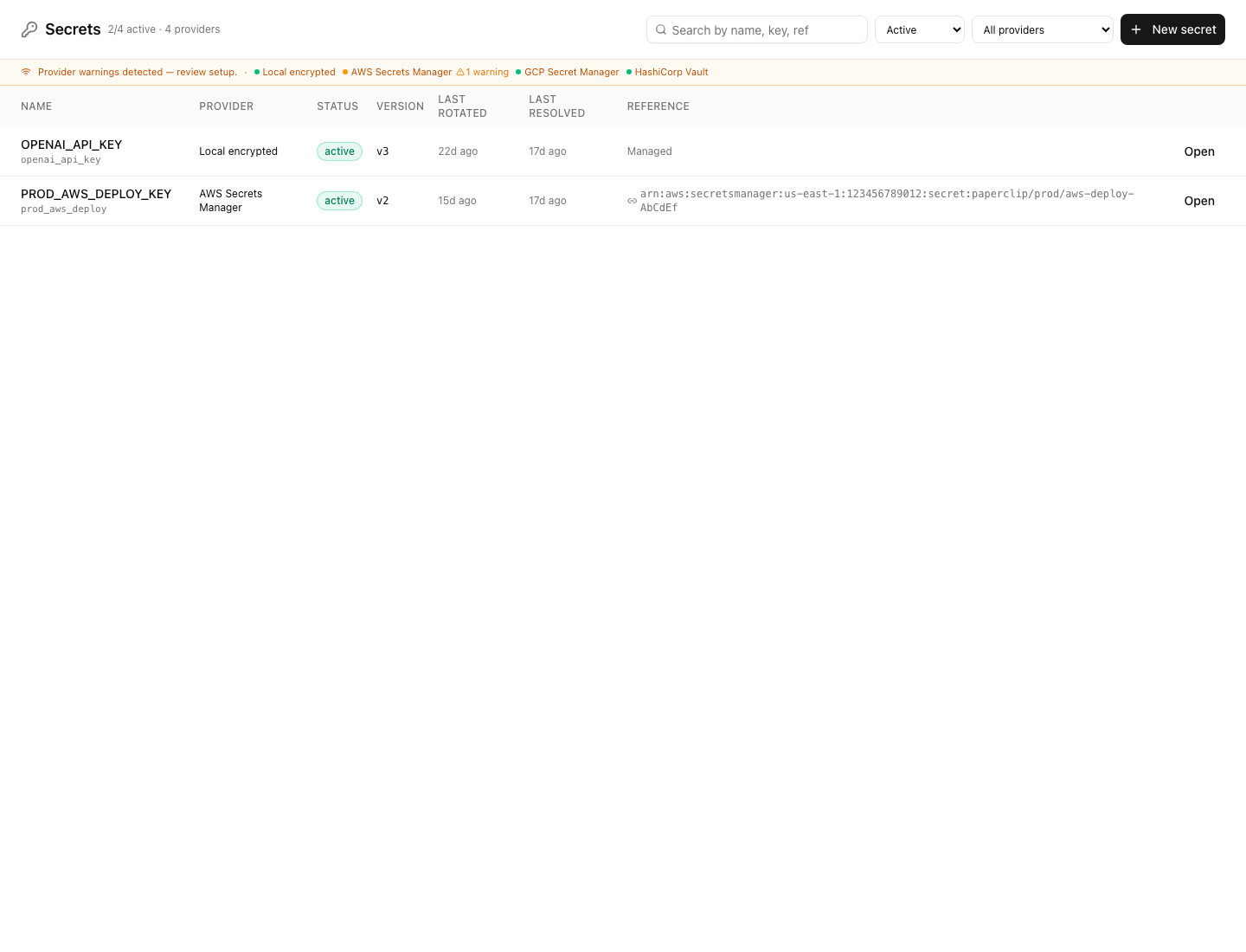 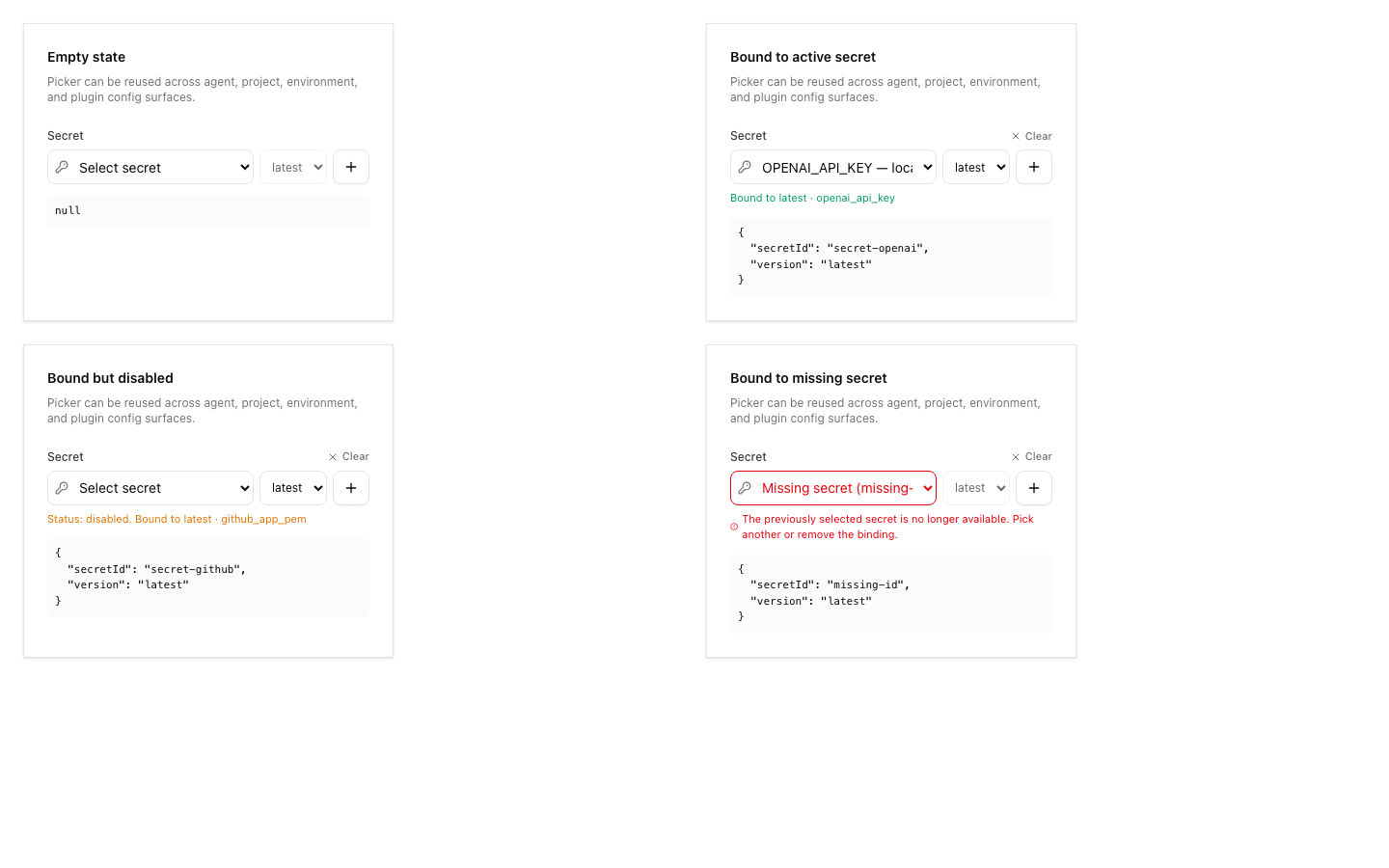 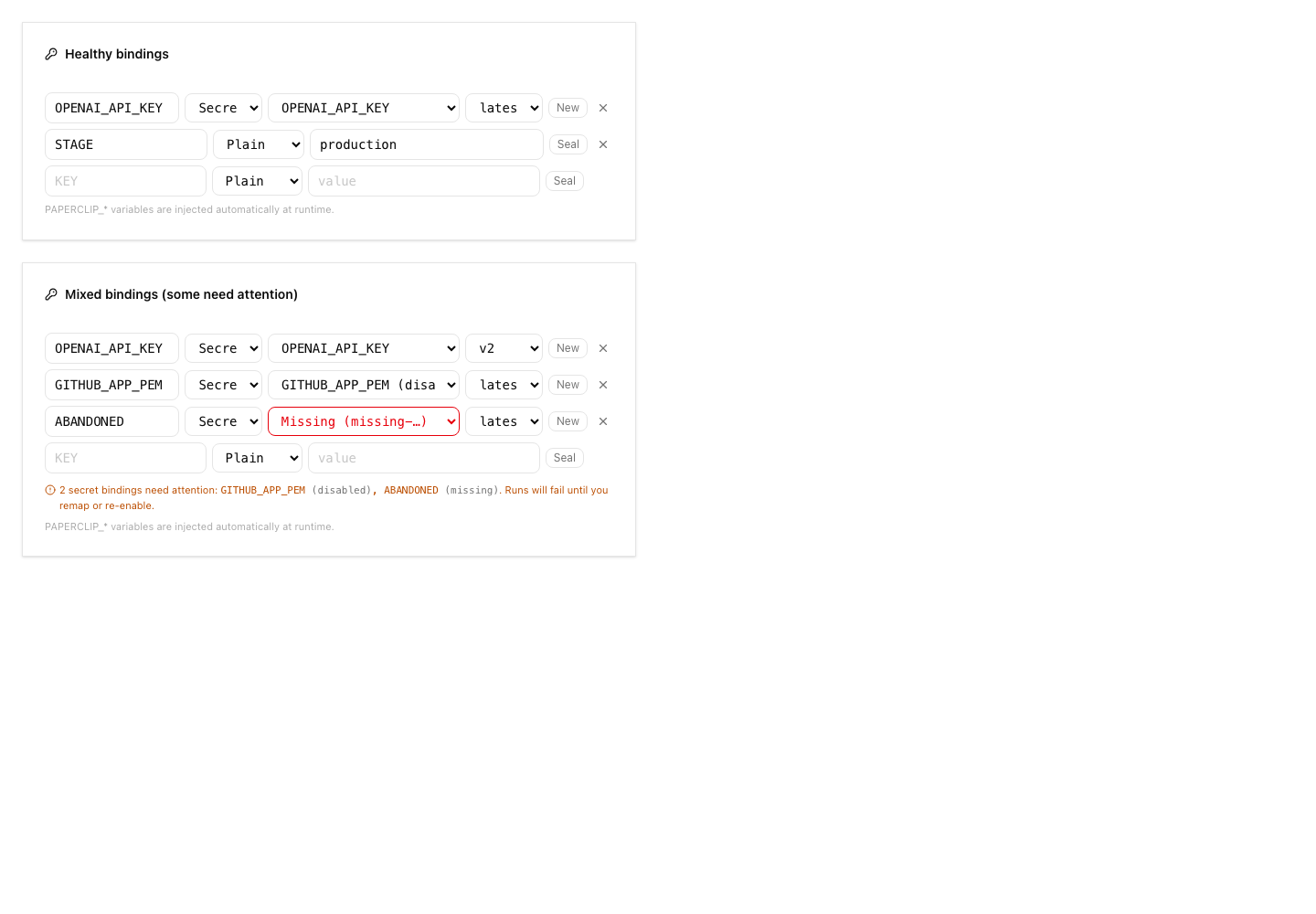 ## Risks - Migration risk: this adds new secret provider tables and extends existing secret rows. The migrations were checked for monotonic ordering and idempotent guards, but reviewers should still inspect upgrade behavior carefully. - Provider risk: AWS support uses direct SigV4 requests. Automated tests cover signing, request timeouts, vault-config selection, namespace guardrails, pending-version archival, sanitized provider errors, and service-level cleanup paths. A real-vault AWS smoke test remains deployment validation for an operator with AWS credentials rather than an unverified merge blocker in this local branch. - UI risk: the Secrets page and import dialog are large new surfaces; screenshots are included above for reviewer inspection. - Verification risk: the full local stable test command hit parallel-load timing failures, although the exact failed files passed when rerun directly. - Operational risk: remote import intentionally avoids plaintext reads; operators must understand that imported external references resolve at runtime and may fail if AWS permissions change. > For core feature work, check [`ROADMAP.md`](ROADMAP.md) first and discuss it in `#dev` before opening the PR. Feature PRs that overlap with planned core work may need to be redirected — check the roadmap first. See `CONTRIBUTING.md`. ## Model Used - OpenAI Codex, GPT-5 coding agent with local shell/tool use in the Paperclip worktree. Exact context-window size was not exposed by the runtime. ## Checklist - [x] I have included a thinking path that traces from project context to this change - [x] I have specified the model used (with version and capability details) - [x] I have checked ROADMAP.md and confirmed this PR does not duplicate planned core work - [ ] I have run tests locally and they pass - [x] I have added or updated tests where applicable - [x] If this change affects the UI, I have included before/after screenshots - [x] I have updated relevant documentation to reflect my changes - [x] I have considered and documented any risks above - [x] I will address all Greptile and reviewer comments before requesting merge --------- Co-authored-by: Paperclip <noreply@paperclip.ing> Co-authored-by: Claude Sonnet 4.6 <noreply@anthropic.com> |
||
|
DottaandPaperclip
|
3c73ed26b5 |
Expand plugin host surface (#5205)
## Thinking Path > - Paperclip orchestrates AI agents for zero-human companies > - The plugin system is the extension boundary for optional product capabilities > - Rich plugins need more than a worker entrypoint: they need scoped database storage, local project folders, managed agents/routines, host navigation, and reusable UI components > - The LLM Wiki work exposed those missing host surfaces while keeping plugin code outside the core control plane > - This pull request expands the core plugin host, SDK, server APIs, and UI bridge so plugins can declare and use those surfaces > - The benefit is that future plugins can integrate with Paperclip through documented, validated contracts instead of bespoke server or UI imports ## What Changed - Added plugin-managed database namespaces and migration tracking, including Drizzle schema/migration files and SQL validation for namespace isolation. - Added server support for plugin local folders, managed agents, managed routines, scoped plugin APIs, and plugin operation visibility. - Expanded shared plugin manifest/types/validators and SDK host/testing/UI exports for richer plugin surfaces. - Added reusable UI pieces for file trees, managed routines, resizable sidebars, route sidebars, and plugin bridge initialization. - Updated plugin docs and example plugins to use the expanded host and SDK surface. ## Verification - `pnpm install --frozen-lockfile` - `pnpm run preflight:workspace-links && pnpm exec vitest run packages/shared/src/validators/plugin.test.ts server/src/__tests__/plugin-database.test.ts server/src/__tests__/plugin-local-folders.test.ts server/src/__tests__/plugin-managed-agents.test.ts server/src/__tests__/plugin-managed-routines.test.ts server/src/__tests__/plugin-orchestration-apis.test.ts ui/src/api/plugins.test.ts ui/src/components/FileTree.test.tsx ui/src/components/ResizableSidebarPane.test.tsx ui/src/pages/PluginPage.test.tsx ui/src/plugins/bridge.test.ts` passed: 11 files, 67 tests. - Confirmed this PR changes 89 files and does not include `pnpm-lock.yaml` or `.github/workflows/*`. ## Risks - Medium: this expands plugin host contracts across db/shared/server/ui and includes a new core migration (`0076_useful_elektra.sql`). - The plugin database namespace validator is intentionally restrictive; plugin authors may need follow-up affordances for SQL patterns that remain blocked. - Merge this before the LLM Wiki plugin PR so the plugin can resolve the new SDK and host APIs. > For core feature work, check [`ROADMAP.md`](ROADMAP.md) first and discuss it in `#dev` before opening the PR. Feature PRs that overlap with planned core work may need to be redirected — check the roadmap first. See `CONTRIBUTING.md`. ## Model Used - OpenAI Codex, GPT-5 coding agent, tool-enabled shell/git/GitHub workflow. Context window size was not exposed by the runtime. ## Checklist - [x] I have included a thinking path that traces from project context to this change - [x] I have specified the model used (with version and capability details) - [x] I have checked ROADMAP.md and confirmed this PR does not duplicate planned core work - [x] I have run tests locally and they pass - [x] I have added or updated tests where applicable - [x] If this change affects the UI, I have included before/after screenshots - [x] I have updated relevant documentation to reflect my changes - [x] I have considered and documented any risks above - [x] I will address all Greptile and reviewer comments before requesting merge --------- Co-authored-by: Paperclip <noreply@paperclip.ing> |
||
|
DottaandPaperclip
|
76f09c8eb6 |
[PAP-3180] Move workspace switcher into sidebar (#4981)
## Thinking Path > - Paperclip is the control plane for autonomous AI companies. > - The board UI needs a clear persistent way to move between company workspaces. > - The previous layout kept company switching in a separate left rail, which made the sidebar feel split between workspace selection and navigation. > - The workspace switcher belongs in the sidebar header so navigation and workspace context stay together. > - This pull request removes the separate company rail from the layout and turns the sidebar company menu into the primary workspace switcher. > - The benefit is a cleaner sidebar structure that keeps workspace identity, switching, company actions, and navigation in one place. ## What Changed - Removed the standalone `CompanyRail` from the main layout. - Added the company/workspace switcher to the default, company settings, and instance settings sidebars. - Expanded `SidebarCompanyMenu` to list active workspaces, indicate the current workspace, navigate out of instance settings when switching, and expose add-company onboarding. - Updated focused component tests for the new workspace-switcher behavior. ## Verification - `pnpm --filter @paperclipai/ui exec vitest run src/components/SidebarCompanyMenu.test.tsx src/components/CompanySettingsSidebar.test.tsx` - `pnpm --filter @paperclipai/ui typecheck` - `git diff --check` - Visual smoke attempted against the managed dev server at `http://127.0.0.1:57385`; a fresh browser context reached the authenticated sign-in screen, so I could not capture an authenticated sidebar screenshot from this heartbeat. ## Risks - Low-to-medium UI risk: this changes the primary sidebar structure and workspace-switching entry point. - The instance-settings switch behavior now routes back to the selected company dashboard when a workspace is selected. - No migrations, API contracts, or lockfile changes. > For core feature work, check [`ROADMAP.md`](ROADMAP.md) first and discuss it in `#dev` before opening the PR. Feature PRs that overlap with planned core work may need to be redirected — check the roadmap first. See `CONTRIBUTING.md`. ## Model Used - OpenAI Codex, GPT-5 coding agent, tool-enabled, medium reasoning mode. ## Checklist - [x] I have included a thinking path that traces from project context to this change - [x] I have specified the model used (with version and capability details) - [x] I have checked ROADMAP.md and confirmed this PR does not duplicate planned core work - [x] I have run tests locally and they pass - [x] I have added or updated tests where applicable - [ ] If this change affects the UI, I have included before/after screenshots - [x] I have updated relevant documentation to reflect my changes - [x] I have considered and documented any risks above - [x] I will address all Greptile and reviewer comments before requesting merge Co-authored-by: Paperclip <noreply@paperclip.ing> |
||
|
Devin Foley
|
9b99d30330 |
Add dedicated environment settings page and test-in-environment (#4798)
## Thinking Path > - Paperclip orchestrates AI agents for zero-human companies > - Agents run inside environments (local, SSH, E2B sandbox) > - Operators need to configure and manage these environments > - But environment settings were buried inside the general company settings page, making them hard to find > - Additionally, when testing an agent from the configuration form, the test always ran locally regardless of which environment was selected > - This PR moves environments into a dedicated top-level company settings section and wires the "Test Environment" button to run inside the selected environment > - The benefit is operators can find and manage environments more easily, and the test button now validates the actual environment the agent will use ## What Changed - Added a dedicated `CompanyEnvironments` settings page with its own route and sidebar entry - Updated `CompanySettingsSidebar` and `CompanySettingsNav` to include the new environments section - Modified the agent test route (`POST /agents/:id/test`) to accept an optional `environmentId` parameter - Updated all adapter `test.ts` handlers to resolve and use the specified execution target environment - Added `resolveTestExecutionTarget` to `execution-target.ts` for remote environment test resolution with cwd fallback - Moved the "Test Environment" button and its feedback display into the `NewAgent` page footer for better UX flow ## Verification - `pnpm test` — all existing and new tests pass - `pnpm typecheck` — clean - Manual: navigate to Company Settings, confirm "Environments" appears as a top-level section - Manual: configure an agent with a non-local environment, click "Test Environment", confirm the test runs inside that environment ## Risks - Low risk. UI-only routing change for the settings page. The test-in-environment change adds an optional parameter with a local fallback, so existing behavior is preserved when no environment is specified. ## Model Used Codex GPT 5.4 high via Paperclip. ## Checklist - [x] I have included a thinking path that traces from project context to this change - [x] I have specified the model used (with version and capability details) - [x] I have checked ROADMAP.md and confirmed this PR does not duplicate planned core work - [x] I have run tests locally and they pass - [x] I have added or updated tests where applicable - [x] If this change affects the UI, I have included before/after screenshots - [x] I have updated relevant documentation to reflect my changes - [x] I have considered and documented any risks above - [x] I will address all Greptile and reviewer comments before requesting merge |
||
|
|
b9a80dcf22 |
feat: implement multi-user access and invite flows (#3784)
## Thinking Path > - Paperclip is the control plane for autonomous AI companies. > - V1 needs to stay local-first while also supporting shared, authenticated deployments. > - Human operators need real identities, company membership, invite flows, profile surfaces, and company-scoped access controls. > - Agents and operators also need the existing issue, inbox, workspace, approval, and plugin flows to keep working under those authenticated boundaries. > - This branch accumulated the multi-user implementation, follow-up QA fixes, workspace/runtime refinements, invite UX improvements, release-branch conflict resolution, and review hardening. > - This pull request consolidates that branch onto the current `master` branch as a single reviewable PR. > - The benefit is a complete multi-user implementation path with tests and docs carried forward without dropping existing branch work. ## What Changed - Added authenticated human-user access surfaces: auth/session routes, company user directory, profile settings, company access/member management, join requests, and invite management. - Added invite creation, invite landing, onboarding, logo/branding, invite grants, deduped join requests, and authenticated multi-user E2E coverage. - Tightened company-scoped and instance-admin authorization across board, plugin, adapter, access, issue, and workspace routes. - Added profile-image URL validation hardening, avatar preservation on name-only profile updates, and join-request uniqueness migration cleanup for pending human requests. - Added an atomic member role/status/grants update path so Company Access saves no longer leave partially updated permissions. - Improved issue chat, inbox, assignee identity rendering, sidebar/account/company navigation, workspace routing, and execution workspace reuse behavior for multi-user operation. - Added and updated server/UI tests covering auth, invites, membership, issue workspace inheritance, plugin authz, inbox/chat behavior, and multi-user flows. - Merged current `public-gh/master` into this branch, resolved all conflicts, and verified no `pnpm-lock.yaml` change is included in this PR diff. ## Verification - `pnpm exec vitest run server/src/__tests__/issues-service.test.ts ui/src/components/IssueChatThread.test.tsx ui/src/pages/Inbox.test.tsx` - `pnpm run preflight:workspace-links && pnpm exec vitest run server/src/__tests__/plugin-routes-authz.test.ts` - `pnpm exec vitest run server/src/__tests__/plugin-routes-authz.test.ts server/src/__tests__/workspace-runtime-service-authz.test.ts server/src/__tests__/access-validators.test.ts` - `pnpm exec vitest run server/src/__tests__/authz-company-access.test.ts server/src/__tests__/routines-routes.test.ts server/src/__tests__/sidebar-preferences-routes.test.ts server/src/__tests__/approval-routes-idempotency.test.ts server/src/__tests__/openclaw-invite-prompt-route.test.ts server/src/__tests__/agent-cross-tenant-authz-routes.test.ts server/src/__tests__/routines-e2e.test.ts` - `pnpm exec vitest run server/src/__tests__/auth-routes.test.ts ui/src/pages/CompanyAccess.test.tsx` - `pnpm --filter @paperclipai/shared typecheck && pnpm --filter @paperclipai/db typecheck && pnpm --filter @paperclipai/server typecheck` - `pnpm --filter @paperclipai/shared typecheck && pnpm --filter @paperclipai/server typecheck` - `pnpm --filter @paperclipai/ui typecheck` - `pnpm db:generate` - `npx playwright test --config tests/e2e/playwright.config.ts --list` - Confirmed branch has no uncommitted changes and is `0` commits behind `public-gh/master` before PR creation. - Confirmed no `pnpm-lock.yaml` change is staged or present in the PR diff. ## Risks - High review surface area: this PR contains the accumulated multi-user branch plus follow-up fixes, so reviewers should focus especially on company-boundary enforcement and authenticated-vs-local deployment behavior. - UI behavior changed across invites, inbox, issue chat, access settings, and sidebar navigation; no browser screenshots are included in this branch-consolidation PR. - Plugin install, upgrade, and lifecycle/config mutations now require instance-admin access, which is intentional but may change expectations for non-admin board users. - A join-request dedupe migration rejects duplicate pending human requests before creating unique indexes; deployments with unusual historical duplicates should review the migration behavior. - Company member role/status/grant saves now use a new combined endpoint; older separate endpoints remain for compatibility. - Full production build was not run locally in this heartbeat; CI should cover the full matrix. ## Model Used - OpenAI Codex coding agent, GPT-5-based model, CLI/tool-use environment. Exact deployed model identifier and context window were not exposed by the runtime. ## Checklist - [x] I have included a thinking path that traces from project context to this change - [x] I have specified the model used (with version and capability details) - [x] I have run tests locally and they pass - [x] I have added or updated tests where applicable - [x] If this change affects the UI, I have included before/after screenshots - [x] I have updated relevant documentation to reflect my changes - [x] I have considered and documented any risks above - [x] I will address all Greptile and reviewer comments before requesting merge Note on screenshots: this is a branch-consolidation PR for an already-developed multi-user branch, and no browser screenshots were captured during this heartbeat. --------- Co-authored-by: dotta <dotta@example.com> Co-authored-by: Paperclip <noreply@paperclip.ing> Co-authored-by: Claude Opus 4.6 <noreply@anthropic.com> |


