mirror of
https://github.com/paperclipai/paperclip.git
synced 2026-11-10 11:27:14 +01:00
c66b4a55efdc5675b5a5146197078b94de6407da
217
Commits
| Author | SHA1 | Message | Date | |
|---|---|---|---|---|
 Devin Foley |
0a95ada1be |
feat(server): chunked import preview endpoint and resumable upload in the Import page and CLI (#11224)
## Thinking Path > - Paperclip is the open source app people use to manage AI agents for work > - The previous pull request added server-side chunked resumable import transfers; without clients, large imports still ride the single fragile upload > - The Import page and the CLI need to slice large packages, upload parts with retry and progress, resume after interruptions, and preview before applying > - Preview is the missing server piece: the browser flow is preview-then-import, so a completed spool must be previewable without re-uploading > - This pull request adds the transfer preview endpoint, switches the Import page to the chunked path for zips over 48 MB, and teaches the CLI the same for oversized local imports > - The benefit is that large imports get progress, per-part retry, and resume in both clients, while small imports keep the exact single-shot path they have today ## Linked Issues or Issue Description **What happened?** With only the server transfer routes in place, users still upload large company packages as one request from the Import page and the CLI: no progress indication, no retry below the whole file, and no resume after a dropped connection or refresh. The preview-then-import flow also cannot run against an uploaded transfer, forcing a second full upload. **Expected behavior** A large package uploads once as verified parts with visible progress; preview and import both run against the uploaded spool; an interrupted upload resumes with only the missing parts re-sent; packages at or below 48 MB behave exactly as before. **Steps to reproduce** 1. Select a 500 MB zip on the Import page over an unreliable connection. 2. Watch the single upload fail near the end and restart from zero, twice — once for preview, once for import. 3. Same story headless via the CLI. ## What Changed - Server: `POST /import/transfers/:id/preview` runs the existing preview logic against the completed spool (shared assembly + whole-file verification helper with apply); preview neither completes the run nor deletes the spool, so the subsequent apply reuses it. Missing parts respond with the missing list. - UI: zips over 48 MB take the chunked path in both preview and import — the file is sliced into 32 MB parts hashed with WebCrypto (single ArrayBuffer, no second copy), the transfer is created or resumed (the create response's missing-parts list drives what uploads), parts upload sequentially with three attempts each and visible progress, then transfer preview/apply replace the multipart calls. The existing preview pane, collision handling, adapter overrides, and async job polling are unchanged; ≤ 48 MB keeps the single-shot path. - CLI: oversized local `.zip` or folder imports zip/slice/hash with node crypto, upload with resume and per-part retry and progress lines, and use transfer preview/apply. Small packages keep the inline path byte-identical. - Failure honesty: adapters/API errors fail open to existing behavior; a part failing all attempts surfaces a durable error panel with resume intact. ## Verification - Server: preview-then-apply on one spool (run stays open, spool intact, then apply completes), preview with missing parts rejected — added to the transfer route suite (embedded Postgres). - UI suite: large file takes the chunked path (manifest shape, part uploads, progress, apply on a resumed transfer, single-shot endpoints never called), small file stays single-shot, part failure after three attempts surfaces the error panel without running preview, resume re-uploads only the missing part. - CLI: manifest slicing/hashing, threshold behavior for zip and folder sources, folder-zip round-trip through the real zip reader, upload resume/retry/exhaustion/already-completed, full-command chunked and small-zip inline flows. - Server, ui, cli typechecks clean. Exact counts in the PR checks. ## Risks - The 48 MB threshold only routes between two verified paths; behavior below it is untouched. - Chunked CLI imports use the board-scoped transfer routes, so oversized CLI imports need board credentials (agent tokens keep the agent-safe small-file path). No privilege change — board actors already had the generic routes — but the two size regimes differ semantically; called out for review. - A CLI dry-run over the threshold uploads parts before previewing; the spool persists (24 h sweep) and a later apply resumes without re-upload — inherent to preview-against-spool. Stacked on #11223 — merge that first; this PR then shows only the preview endpoint and client changes. ## Model Used - Claude Fable 5 (`claude-fable-5`) via Claude Code CLI, with extended thinking and tool use (multi-agent implementation with independent verification). ## Checklist - [x] I have included a thinking path that traces from project context to this change - [x] I have specified the model used (with version and capability details) - [x] I have checked ROADMAP.md and confirmed this PR does not duplicate planned core work - [x] I have searched GitHub for duplicate or related PRs and linked them above - [x] I have either (a) linked existing issues with `Fixes: #` / `Closes #` / `Refs #` OR (b) described the issue in-PR following the relevant issue template - [x] I have not referenced internal/instance-local Paperclip issues or links (only public GitHub `#NNN` / `github.com/paperclipai/paperclip` URLs) - [x] My branch name describes the change (e.g. `docs/...`, `fix/...`) and contains no internal Paperclip ticket id or instance-derived details - [x] I have run tests locally and they pass - [x] I have added or updated tests where applicable - [x] I have updated relevant documentation to reflect my changes - [x] I have considered and documented any risks above - [ ] All Paperclip CI gates are green - [ ] Greptile is 5/5 with no open P2s, recommendations, or follow-ups - [x] I will address all Greptile and reviewer comments before requesting merge |
||
|
Devin Foley
|
23a1b025c2 |
feat(server): chunked resumable company import transfers (#11223)
## Thinking Path > - Paperclip is the open source app people use to manage AI agents for work > - Company import moves large packages into an instance, and since the upload cap rose to 1 GB, the transport is the weak point: one HTTP request, buffered fully in memory, with no resume > - A dropped connection at 90% of an 800 MB upload starts the whole transfer over, and a server restart loses all progress > - This pull request adds the server side of chunked resumable import transfers: a durable run ledger and routes that accept the same import zip as verified ~32 MB parts spooled to disk > - An interrupted transfer resumes from the parts already uploaded — across dropped connections, page refreshes, and server restarts — and peak upload memory drops from the whole package to one part > - The benefit is that large imports become reliable on real-world connections instead of all-or-nothing ## Linked Issues or Issue Description **What happened?** Large company imports travel as a single HTTP upload. On a slow or flaky connection, any interruption discards all progress and the upload restarts from zero. The server buffers the entire compressed package in memory during upload. A server restart mid-upload loses the transfer entirely. With the upload cap now at 1 GB, these failure modes govern exactly the imports the cap was raised for. **Expected behavior** A large import upload survives interruptions: already-transferred data is kept and verified, only the missing remainder is re-sent, and the server's memory use during upload is bounded by a part, not the package. **Steps to reproduce** 1. Import a multi-hundred-MB company package over a connection that drops mid-upload. 2. The upload fails; retrying starts from byte zero. 3. Repeat on an unstable connection and the import may never complete. ## What Changed - New `company_transfer_runs` table (drizzle schema + migration) and `companyTransferRunService`: one row per transfer with a content-derived idempotency key, per-part completion recorded atomically and idempotently, resume scoped to actor and direction, completed runs short-circuiting retries of identical content. - New transfer routes beside the existing import routes, same authorization: declare a sliced zip (`POST /import/transfers` — validates cap, 64 MB part ceiling, contiguity, size sums, sha256 format), upload parts (`PUT .../parts/:n` — raw body, hash-and-size verified before an atomic write to a disk spool under the instance root; re-uploads are no-op successes), poll resume state (`GET .../:id` — missing parts recomputed from disk), and apply (`POST .../:id/apply` — requires all parts, re-verifies the assembled zip against the whole-file hash fail-closed, then feeds the existing import pipeline through factored helpers rather than duplicated logic). - Hourly sweep fails and cleans spools idle for 24 h; a swept transfer honestly reports all parts missing on resume. - Strict UUID gating on run ids before any filesystem path construction. - The existing single-shot upload path is untouched; clients arrive in the follow-up PR. ## Verification - Transfer route suite (embedded Postgres): create/upload/status/apply round-trip with a real imported company, out-of-order parts, wrong-hash part rejected and unrecorded, re-upload no-op, apply-with-missing-parts rejection, resume after failure with prior progress intact, assembled-hash mismatch failing closed with spool deletion, actor scoping 404s, async-job apply, sweep followed by honest resume. - Ledger suite (embedded Postgres): part idempotency, actor/direction scoping, completed-run short-circuit, cancelled runs staying cancelled. - Existing portability route suite unchanged and green; server + db typechecks clean. Exact counts in the PR checks. ## Risks - New routes are additive; the existing import path is untouched. The transfer routes carry the same board authorization as the import routes they sit beside. - Disk spool: bounded by the existing upload cap per transfer, cleaned on success, failure, hash mismatch, and by the 24 h sweep. Spool paths are strict-UUID-gated. - The apply step still materializes the assembled zip in memory once (same profile as today's single-shot import at apply time); upload-time memory drops to one part. - Known limitation, deliberate: transfers are keyed on content alone, so identical package content cannot be imported twice without re-exporting (surfaced explicitly to the caller). Acceptable for v1; noted for review. ## Model Used - Claude Fable 5 (`claude-fable-5`) via Claude Code CLI, with extended thinking and tool use (multi-agent implementation with independent verification). ## Checklist - [x] I have included a thinking path that traces from project context to this change - [x] I have specified the model used (with version and capability details) - [x] I have checked ROADMAP.md and confirmed this PR does not duplicate planned core work - [x] I have searched GitHub for duplicate or related PRs and linked them above - [x] I have either (a) linked existing issues with `Fixes: #` / `Closes #` / `Refs #` OR (b) described the issue in-PR following the relevant issue template - [x] I have not referenced internal/instance-local Paperclip issues or links (only public GitHub `#NNN` / `github.com/paperclipai/paperclip` URLs) - [x] My branch name describes the change (e.g. `docs/...`, `fix/...`) and contains no internal Paperclip ticket id or instance-derived details - [x] I have run tests locally and they pass - [x] I have added or updated tests where applicable - [x] I have updated relevant documentation to reflect my changes - [x] I have considered and documented any risks above - [ ] All Paperclip CI gates are green - [ ] Greptile is 5/5 with no open P2s, recommendations, or follow-ups - [x] I will address all Greptile and reviewer comments before requesting merge |
||
|
DottaandPaperclip
|
7ea2068ef8 |
fix(files): only highlight accessible workspace file links (#11090)
## Thinking Path > - Paperclip is the open source app people use to manage AI agents for work. > - Task comments can contain references to files in project and execution workspaces. > - Paperclip detected path-shaped inline code and showed it as an actionable file chip. > - The UI did not first confirm that the current board session could open the file. > - Missing, denied, ambiguous, remote, and unsupported files therefore looked actionable and failed after a click. > - This pull request adds an issue-scoped availability check and promotes only confirmed files to chips. > - The benefit is that the task thread shows a file action only when that action can succeed. ## Linked Issues or Issue Description **What happened?** Task comments promoted path-shaped inline code to file chips before Paperclip checked the file. A chip could point to a missing, denied, ambiguous, remote, or non-previewable file. The action then failed after the user selected it. **Expected behavior** Paperclip must show a file chip only after the server confirms that the current board session can open the exact file reference. All other path-shaped text must stay ordinary inline code. **Steps to reproduce** 1. Add a task comment that contains inline code with a missing or inaccessible workspace path. 2. Open the task thread as a board user. 3. Observe that the path looks like an actionable file chip. 4. Select the chip and observe that the file cannot open. **Paperclip version or commit** `19be4cf927` and earlier. **Deployment mode** Local dev and self-hosted server. **Access context** Board user. ## What Changed - Added shared request, response, and validation contracts for batched workspace-file availability checks. - Added an issue-scoped server endpoint that resolves file references with company, issue, workspace, and preview-access checks. - Added bounded batch concurrency and tests for missing, denied, ambiguous, remote, unsupported, and available files. - Added an issue-scoped UI availability registry that deduplicates, batches, caches, and invalidates file checks. - Changed task-comment markdown rendering so only confirmed files get chip styling and file-viewer behavior. - Bound each chip to the exact workspace target that passed the availability check. ## Verification - `pnpm exec vitest run packages/shared/src/workspace-file-resource.test.ts server/src/__tests__/file-resources.test.ts ui/src/components/MarkdownBody.test.tsx ui/src/components/WorkspaceFileMarkdownBody.availability.test.tsx ui/src/lib/remark-workspace-file-refs.test.ts ui/src/lib/workspace-file-availability.test.ts` — 93 passed, 35 skipped. - `pnpm check:token-gates` — clean. - `pnpm -r typecheck` — passed. - `pnpm build` — passed. - `pnpm test:run` — all server and UI groups passed. One unchanged CLI test saw the run-injected static AWS credentials and expected only its local `AWS_PROFILE`. The same test passed, 8 of 8, after removing only `AWS_ACCESS_KEY_ID` and `AWS_SECRET_ACCESS_KEY` from its process environment. ## Risks - File chips now appear after an asynchronous availability check, so path-shaped text can briefly render as inline code. - Availability results use the existing 30-second file-resource cache window. File-resource invalidation forces a new check. - The endpoint limits each request to 100 references and the client chunks larger sets. > For core feature work, check [`ROADMAP.md`](ROADMAP.md) first and discuss it in `#dev` before opening the PR. Feature PRs that overlap with planned core work may need to be redirected — check the roadmap first. See `CONTRIBUTING.md`. ## Model Used - OpenAI Codex with GPT-5. The service did not expose a more specific model ID or context-window size. The agent used high-reasoning mode, repository tools, command execution, and test execution. ## Checklist - [x] I have included a thinking path that traces from project context to this change - [x] I have specified the model used (with version and capability details) - [x] I have checked ROADMAP.md and confirmed this PR does not duplicate planned core work - [x] I have searched GitHub for duplicate or related PRs and linked them above - [x] I have either (a) linked existing issues with `Fixes: #` / `Closes #` / `Refs #` OR (b) described the issue in-PR following the relevant issue template - [x] I have not referenced internal/instance-local Paperclip issues or links (only public GitHub `#NNN` / `github.com/paperclipai/paperclip` URLs) - [x] My branch name describes the change (e.g. `docs/...`, `fix/...`) and contains no internal Paperclip ticket id or instance-derived details - [x] I have run tests locally and they pass - [x] I have added or updated tests where applicable - [x] I have updated relevant documentation to reflect my changes - [x] I have considered and documented any risks above - [x] All Paperclip CI gates are green - [ ] Greptile is 5/5 with no open P2s, recommendations, or follow-ups - [x] I will address all Greptile and reviewer comments before requesting merge --------- Co-authored-by: Paperclip <noreply@paperclip.ing> |
||
|
DottaandPaperclip
|
5da382fd59 |
feat(skills): require explicit merge modes (#10978)
## Thinking Path > - Paperclip is the open source app people use to manage AI agents for work > - Agents can select company skills and synchronize them to adapter runtimes > - The skill sync API replaced the complete selection without an explicit destructive choice > - Company package import also replaced conflicting skills by default > - These defaults could remove operator edits during setup and import reruns > - This pull request adds explicit assignment merge modes and safe package conflict handling > - The benefit is that reruns preserve operator work unless the caller explicitly requests replacement ## Linked Issues or Issue Description **What existing behavior does this improve?** This change improves agent skill synchronization and company package import. **Subsystem affected** This is a cross-cutting change across the shared contracts, server, CLI, and UI. **Current behavior** Agent skill synchronization replaces the full desired skill set from a modeless request. Package import replaces a conflicting skill when the caller does not select a conflict mode. **Proposed behavior** Agent skill synchronization requires `add`, `remove`, or `replace`. Package import skips conflicts by default. Each imported skill reports whether it was created, renamed, replaced, or skipped. **Reason and benefit** Setup and import reruns must preserve operator edits by default. Explicit destructive modes make data loss less likely and make each outcome inspectable. **Breaking changes** Callers of the agent skill sync API must now send `mode`. Callers that need the former behavior must send `replace`. Package import now uses `skip` when `onConflict` is absent. ## What Changed - Added required `add`, `remove`, and `replace` modes to the shared agent skill sync contract. - Added actionable `422` validation for missing or invalid modes. - Updated first-party UI and CLI callers with explicit modes. - Changed package skill conflict handling to use `skip` by default. - Kept plugin-owned and built-in stock skill imports on explicit `replace`. - Added created, renamed, replaced, and skipped results to company imports. - Added regression coverage for merge modes and package conflict outcomes. ## Verification - `pnpm check:token-gates` - `pnpm -r typecheck` - `pnpm build` - `pnpm test:run:serialized` (128 suites passed) - `pnpm --filter @paperclipai/skills-catalog test` (20 tests passed) - Focused agent skill route, company skill service, portability, CLI, and UI tests passed. - GitHub CI passed build, typecheck, canary, all general and serialized test shards, all browser shards, policy, security, and final verification on commit `2cfbb3e4c5`. - Greptile reviewed the latest commit at 5/5 with zero unresolved threads. ## Risks - This change intentionally rejects modeless agent skill sync requests. - The safe package default can leave an existing skill unchanged where the old default overwrote it. - All first-party callers now select a mode. Regression tests cover each outcome. > For core feature work, check [`ROADMAP.md`](ROADMAP.md) first and discuss it in `#dev` before opening the PR. Feature PRs that overlap with planned core work may need to be redirected — check the roadmap first. See `CONTRIBUTING.md`. ## Model Used - OpenAI `gpt-5.6-sol` through Codex. The runtime used agentic reasoning, tool use, code execution, and repository editing. The runtime did not expose the context window size. ## Checklist - [x] I have included a thinking path that traces from project context to this change - [x] I have specified the model used (with version and capability details) - [x] I have checked ROADMAP.md and confirmed this PR does not duplicate planned core work - [x] I have searched GitHub for duplicate or related PRs and linked them above - [x] I have either (a) linked existing issues with `Fixes: #` / `Closes #` / `Refs #` OR (b) described the issue in-PR following the relevant issue template - [x] I have not referenced internal/instance-local Paperclip issues or links (only public GitHub `#NNN` / `github.com/paperclipai/paperclip` URLs) - [x] My branch name describes the change (e.g. `docs/...`, `fix/...`) and contains no internal Paperclip ticket id or instance-derived details - [x] I have run tests locally and they pass - [x] I have added or updated tests where applicable - [x] I have updated relevant documentation to reflect my changes - [x] I have considered and documented any risks above - [x] All Paperclip CI gates are green - [x] Greptile is 5/5 with no open P2s, recommendations, or follow-ups - [x] I will address all Greptile and reviewer comments before requesting merge --------- Co-authored-by: Paperclip <noreply@paperclip.ing> |
||
|
|
e43f187cad |
feat(secrets): add human-approved secret proposals (#9934)
## Thinking Path > - Paperclip is the control plane people use to manage AI-agent companies. > - Agents can encounter credentials during work. > - Directly creating live secrets or bindings would bypass human governance. > - Proposal records must remain inert and separate from live secret resolution until an authorized human approves them. > - Approval must reuse the existing secret-create and protected agent-config write paths. > - This pull request adds the propose, review, approve, and reject lifecycle. > - The benefit is that agents can safely hand credentials into Paperclip without exposing plaintext or gaining authority to activate them. ## Linked Issues or Issue Description Follow-on to #9921, which established run-bound agent secret access. **Problem / motivation:** Agents can receive credentials during work. There is no governed way for them to propose a credential or binding without exposing plaintext in work artifacts or immediately creating live access. **Proposed solution:** Store agent-authored proposals outside live secret tables. Encrypt each proposed value and register exact-value redaction when Paperclip receives it. Require an authorized human to approve or reject each proposal. Approval executes through the normal write paths as the human approver. Binding proposals can target only the proposer or its downward reporting chain under the restrictive V1 policy. **Alternatives considered:** We rejected live secrets with a `proposed` status. That design would put untrusted rows in resolver, list, and sync paths. It would also allow uniqueness squatting. We rejected direct agent binding writes because a binding is an agent-config write and must keep the existing human permission gate. **Roadmap alignment:** This change extends the run-bound agent secret-access foundation in #9921 with a governed proposal workflow. ## Security Verdict Q0 SecEng verdict: **PASS-with-required-changes**. The review accepted the separate proposal-table design and required the implementation to: - fail closed unless both encryption and exact-value run redaction registration succeed; - scrub ciphertext idempotently on reject, withdraw, and expiry, with audit-visible state; - treat agent justification as hostile input and foreground action, target, provenance, and approver permissions; - snapshot and re-check the target agent plus reports-to chain at approval to prevent org-chart laundering; - make cascade approval atomic and fail closed if either secret creation or binding authorization fails; - deny low-trust, `skill_test`, `task_bridge`, and non-run-bound sources consistently; and - execute approval through the normal human secret/config write paths, including protected-change gates. Those requirements are implemented and covered by focused service, route, and UI tests. Residual V1 risk remains the accepted 14-day encrypted retention window. Proposal-time redaction also cannot clean a value that leaked before the propose call. ## What Changed - Added `company_secret_proposals`, migration `0207`, shared proposal contracts, and a state-machine service for create, approve, reject, withdraw, cascade, expiry, and ciphertext scrubbing. - Added run-bound agent proposal routes and board review routes. The routes derive provenance from authentication and enforce source restrictions, company isolation, chain-of-command checks, approval-as-approver, wake-on-resolution, and dual audit trails. - Added durable per-run exact-value redaction registration so proposal values remain redacted on later read surfaces. - Added the Secrets **Proposals** tab and agent configuration **Proposed access** rows. The UI shows fingerprint and length only. It also frames agent justification as untrusted input, runs permission preflight, supports approve and reject actions, and confirms cascades. - Updated OpenAPI, agent skill guidance, API reference documentation, and focused server and UI regression coverage. - Rebased the branch onto current `master` and renumbered the proposal migration after `0206`. ## QA Acceptance Results Q5 QA verdict: **PASS — 9/9 acceptance criteria met**, with one Minor non-blocking follow-up. - **AC1:** proposed values never echo, never appear in live lists/resolvers, and expose only fingerprint + length to board reviewers. - **AC2:** restrictive `self_and_reports` matrix passes: self/downward allowed; upward/lateral denied. - **AC3:** secret approval uses the normal create path, honors rename overrides, records proposer/approver provenance, and scrubs ciphertext. - **AC4:** approved bindings materialize and resolve through the target agent's runtime list/fetch routes. - **AC5:** pending-secret bindings require cascade; cascade succeeds atomically and permission failures leave nothing applied. - **AC6:** reject, withdraw, dependent rejection, and expiry paths scrub ciphertext and preserve reasons/audit state. - **AC7:** token/source and approver denial matrix passes through live checks plus focused route tests. - **AC8:** proposal lifecycle events and reused `secret.created`/config-write events form the required dual audit trail; origin-issue notification and wake are queued. - **AC9:** both review surfaces render and execute correctly; UI approval materializes the binding. QA also confirmed zero plaintext occurrences for all exercised proposal values in server logs. The single finding is that the company-level `bindingTargetPolicy` toggle is not wired yet. V1 is hardcoded to the restrictive `self_and_reports` policy. The matrix is correct and the follow-up is tracked separately, so QA classified it as non-blocking. ## Verification - Focused server proposal and redaction suite: 83 tests pass. - Focused proposal review UI suite: 54 tests pass. - Embedded-Postgres migration reapply test: 1 test passes with the documented 30-second timeout. - `pnpm --filter @paperclipai/db typecheck` passes, including migration numbering and safety checks. - `pnpm --filter @paperclipai/shared typecheck` passes. - `pnpm --filter @paperclipai/ui typecheck` passes. - `pnpm check:token-gates` passes with all gates clean. - Q5 exercised the complete propose, review, approve, bind, and runtime-resolve flow over real HTTP, JWT, and database paths. It verified 9/9 acceptance criteria. ## Risks - Proposal ciphertext is retained encrypted for up to 14 days while pending. Terminal-state and expiry scrub paths reduce but do not remove server-compromise risk during that window. - The V1 target policy is restrictive but not yet company-configurable. A separate follow-up owns that change. - A new migration can require another renumber if another migration lands before maintainers merge this pull request. > For core feature work, check [`ROADMAP.md`](ROADMAP.md) first and discuss it in `#dev` before opening the PR. Feature PRs that overlap with planned core work may need to be redirected. See `CONTRIBUTING.md`. ## Model Used - OpenAI Codex coding agent. The exact runtime model ID and context-window size are not exposed. The agent used reasoning, repository editing, terminal execution, Paperclip API, and GitHub CLI capabilities. Q3 UI work also records Claude Opus 4.8 assistance in its commit trailers. ## Checklist - [x] I have included a thinking path that traces from project context to this change - [x] I have specified the model used (with version and capability details) - [x] I have checked ROADMAP.md and confirmed this PR does not duplicate planned core work - [x] I have searched GitHub for duplicate or related PRs and linked them above - [x] I have either (a) linked existing issues with `Fixes: #` / `Closes #` / `Refs #` OR (b) described the issue in-PR following the relevant issue template - [x] I have not referenced internal or instance-local Paperclip issues or links - [x] My branch name describes the change and contains no internal Paperclip ticket id or instance-derived details - [x] I have run tests locally and they pass - [x] I have added or updated tests where applicable - [x] I have updated relevant documentation to reflect my changes - [x] I have considered and documented any risks above - [x] All Paperclip CI gates are green - [x] Greptile is 5/5 with no open P2s, recommendations, or follow-ups - [x] I will address all Greptile and reviewer comments before requesting merge --------- Co-authored-by: Paperclip <noreply@paperclip.ing> Co-authored-by: Claude Fable 5 <noreply@anthropic.com> |
||
|
DottaandPaperclip
|
5858ccb981 |
feat: make in-app features cloud-aware (#10850)
## Thinking Path > - Paperclip is the open source app people use to manage AI agents for work. > - Operators use the same board application in self-hosted and Paperclip Cloud deployments. > - A Cloud tenant contains one company, so an in-app company switch does not change the active Cloud stack. > - Cloud operators need the sidebar and company surfaces to use the signed-in user's stack portfolio. > - The server must derive Cloud identity and links from trusted instance context instead of client input. > - This pull request adds canonical Cloud context, a trusted stack portfolio proxy, and Cloud-aware navigation. > - The benefit is consistent stack switching on Cloud while self-hosted company behavior stays unchanged. ## Linked Issues or Issue Description **Subsystem affected** Cross-cutting: server REST routes and the React board UI. **Problem or motivation** A Cloud-managed instance contains one company. The existing company switcher could only switch records inside that tenant. It could not move the operator to another Cloud stack. The existing header also gave long organization names too little width. **Proposed solution** Expose a canonical public Cloud context in health data. Add a trusted server proxy for the current user's stack portfolio. Use that data in the board UI to switch stacks with top-level navigation. Keep the existing company behavior on self-hosted instances. Move search into the navigation and keep long organization names inside the sidebar panel. **Alternatives considered** An in-app `/stacks` route was rejected because Cloud tenant hosts reserve that path and stack selection must wake or authenticate another tenant. Client-supplied user identity was rejected because the server can derive the trusted Cloud actor. **Roadmap alignment** This change advances the Cloud deployments milestone. It keeps the product local-first and Cloud-ready without changing the self-hosted mental model. ## What Changed - Added canonical Cloud instance context and public health metadata. - Added a Cloud-only stack portfolio proxy with trusted actor forwarding and per-user caching. - Prevented normal company creation on Cloud-managed instances. - Switched the sidebar and Companies page from company actions to stack actions on Cloud. - Added full-page stack navigation and Cloud create-stack links. - Moved search into the sidebar navigation so the organization name keeps more width. - Added truncation and hover recovery for long organization and stack names. - Added server and UI regression coverage for Cloud and self-hosted behavior. - Updated the implementation specification for the Cloud contracts. ## Verification - `node scripts/check-token-gates.mjs` passed. All three token gates are clean. - `pnpm --dir server exec vitest run src/__tests__/health.test.ts src/__tests__/cloud-instance.test.ts src/__tests__/cloud-routes.test.ts src/__tests__/company-cloud-floor.test.ts src/__tests__/company-portability-routes.test.ts` passed: 5 files and 66 tests. - `pnpm --dir ui exec vitest run src/components/SidebarCompanyMenu.test.tsx` passed: 1 file and 11 tests. - Pre-PR QA report `7da87ca7` passed all 8 acceptance criteria with real HTTP route factories and real Chromium screenshots in Cloud and self-hosted modes. - Security reviews passed for the canonical Cloud context and stack portfolio proxy. ## Risks - Cloud stack switching depends on the configured Cloud application and tenant portfolio URLs. - The new health `cloud` block is public by design, but it contains only canonical public instance metadata. - The stack proxy fails closed on self-hosted instances and derives the user identity from the trusted actor. - Self-hosted navigation and company creation retain their existing paths and behavior. > For core feature work, check [`ROADMAP.md`](ROADMAP.md) first and discuss it in `#dev` before opening the PR. Feature PRs that overlap with planned core work may need to be redirected — check the roadmap first. See `CONTRIBUTING.md`. ## Model Used - OpenAI Codex, model `gpt-5`. The run used reasoning, repository tools, shell execution, and GitHub integration. The deployment did not expose its context-window size. ## Checklist - [x] I have included a thinking path that traces from project context to this change - [x] I have specified the model used (with version and capability details) - [x] I have checked ROADMAP.md and confirmed this PR does not duplicate planned core work - [x] I have searched GitHub for duplicate or related PRs and linked them above - [x] I have either (a) linked existing issues with `Fixes: #` / `Closes #` / `Refs #` OR (b) described the issue in-PR following the relevant issue template - [x] I have not referenced internal/instance-local Paperclip issues or links (only public GitHub `#NNN` / `github.com/paperclipai/paperclip` URLs) - [x] My branch name describes the change (e.g. `docs/...`, `fix/...`) and contains no internal Paperclip ticket id or instance-derived details - [x] I have run tests locally and they pass - [x] I have added or updated tests where applicable - [x] I have updated relevant documentation to reflect my changes - [x] I have considered and documented any risks above - [x] All Paperclip CI gates are green - [x] Greptile is 5/5 with no open P2s, recommendations, or follow-ups - [x] I will address all Greptile and reviewer comments before requesting merge --------- Co-authored-by: Paperclip <noreply@paperclip.ing> |
||
|
|
678728f650 |
feat: maintained in_review review-path contract + stalled-review actions (#10675)
## Thinking Path > - Paperclip is the open source app people use to manage AI agents for work. > - Agents move issues to `in_review` and rely on a "review path" (an interaction, an approval, a monitor, or a named reviewer) to tell them who decides next. > - That review path can silently disappear. A user comment supersedes the pending interaction, a monitor is exhausted, or a run ends without restoring a path. The issue then sits in `in_review` with nobody reviewing it and no visible action. > - Such issues become invisible zombies. Nobody knows a decision is owed, so the work stalls forever. > - This pull request makes the review path a maintained invariant, exposes a `reviewAttention` surface, and gives every stalled review three inline actions in the UI. > - The benefit is that an `in_review` issue always shows who reviews it, or shows an amber "nobody is reviewing this" notice with one-click Approve, Request changes, and Send back to work. ## Linked Issues or Issue Description This pull request describes the problem inline. The tracking issue is internal. **Subsystem affected** The review and attention loop that agents and humans share: the `in_review` status, the `reviewAttention` surface, the /decisions attention feed, and the issue-page review panel. **Problem or motivation** Agent-owned issues in `in_review` can lose their last review path. A user comment supersedes the pending interaction. A monitor is exhausted. A run ends without restoring a path. The issue then sits in `in_review` with no reviewer and no visible action. It becomes an invisible zombie and the work never progresses. **Proposed solution** Maintain the review path as a server invariant. Expose a `reviewAttention` field that says what is under review, who decides, and since when. Render a persistent review panel on the issue page and inline actions on the /decisions feed. Keep human PATCHes into `in_review` ungated, but record the requesting user so the panel never renders empty. **Alternatives considered** A pure background auto-recovery sweep. This stays opt-in and is not enough on its own, because it is invisible to the human. A bare status banner. This is rejected, because it gives no action to resolve the stall. **Roadmap alignment** This improves the core review and attention loop that both agents and humans use every day. ## What Changed - **Server — maintained review-path invariant:** when an issue enters or sits in `in_review`, the server derives and persists a review path (interaction, approval, monitor, or the requesting user) and recovers a stale path with one bounded wake instead of leaving the issue pathless. - **Server — `reviewAttention` surface:** a new field describes what is under review (bound target with links), who decides, since when, and whether the review is stalled. Stalled agent-assigned reviews are now included in the attention feed. - **Server — inline stalled-review decisions:** secured routes let a permitted responder Approve (→ `done`), Request changes (→ `todo` + wake carrying the note), or Send back to work (→ `todo` + wake) directly from the attention feed. - **Server — resume-intent wake:** an `in_review -> todo` transition now wakes the assigned agent so a resumed review is not dropped. - **Server — user-entry symmetry:** user PATCHes into `in_review` stay ungated (no 422 for humans) and record the requesting user, who becomes the named responder when no other path exists. - **UI — review panel:** a persistent `IssueReviewPanel` renders above the thread whenever status is `in_review`. The covered state shows the bound target, responder, and outcomes and hoists the pending interaction/approval card. The stalled state shows the amber notice plus the three actions. - **UI — decisions card actions:** the same three actions render inline on the /decisions `AttentionQueueRow`. - **UI — responsive fix:** the stalled action row stacks to full-width buttons at phone width and returns to a horizontal row at `sm` and up. New 390px stories capture the phone layout. ## Verification - `cd ui && npx vitest run src/components/IssueReviewPanel.test.tsx src/components/AttentionQueueRow.test.tsx src/lib/attention.test.ts src/api/issues.test.ts` — 91 tests pass. - Server suites added and updated: `issue-review-attention`, `issue-stalled-review-decision-routes`, `review-path-recovery`, `recovery-observability`, and related route/liveness tests (run by CI). - A designer reviewed the UI at 390px and desktop in light and dark themes on both the issue-page panel and the /decisions card. The stalled action row stacks cleanly at phone width with no overlap and keeps the horizontal row on desktop. ## Risks - **Migration:** adds migration `0200` (next after master `0199`, no renumber). It extends the agent-wakeup-requests schema and is additive. - **Behavioral shift:** `in_review -> todo` now dispatches a wake. This is intended (resume intent) and covered by tests. - **Authz:** the inline decision routes are permission-gated. Only a permitted responder sees and can trigger the actions. - Overall risk is moderate and contained to the review and attention loop. ## Model Used - Claude, Opus 4.8 (`claude-opus-4-8`), extended thinking, tool use and code execution. ## Checklist - [x] I have included a thinking path that traces from project context to this change - [x] I have specified the model used (with version and capability details) - [x] I have checked ROADMAP.md and confirmed this PR does not duplicate planned core work - [x] I have searched GitHub for duplicate or related PRs and linked them above - [x] I have either (a) linked existing issues with `Fixes: #` / `Closes #` / `Refs #` OR (b) described the issue in-PR following the relevant issue template - [x] I have not referenced internal/instance-local Paperclip issues or links (only public GitHub `#NNN` / `github.com/paperclipai/paperclip` URLs) - [x] My branch name describes the change (e.g. `docs/...`, `fix/...`) and contains no internal Paperclip ticket id or instance-derived details - [x] I have run tests locally and they pass - [x] I have added or updated tests where applicable - [x] I have updated relevant documentation to reflect my changes - [x] I have considered and documented any risks above - [ ] All Paperclip CI gates are green - [ ] Greptile is 5/5 with no open P2s, recommendations, or follow-ups - [ ] I will address all Greptile and reviewer comments before requesting merge --------- Co-authored-by: Paperclip <noreply@paperclip.ing> Co-authored-by: Claude Opus 4.8 <noreply@anthropic.com> |
||
|
|
ded813ad6f |
feat(interactions): add governed agent addressees (#10252)
## Thinking Path > - Paperclip is the control plane that lets humans govern companies of AI agents. > - Issue-thread interactions are the structured handoff point for confirmations, questions, suggested tasks, and other governed decisions. > - Those interactions previously assumed that only board users could resolve them, preventing one agent from explicitly addressing another agent for a response. > - Agent resolution needs company-level governance, auditable resolver identity, safe terminal-state handling, and attention routing so authorization is enforced server-side rather than inferred from UI behavior. > - This pull request adds governed agent resolution, withdrawal and terminal expiry semantics, explicit agent addressees, lifecycle reconciliation, and attention-feed filtering. > - The benefit is that agents can participate in structured decisions without weakening board control, company isolation, wake behavior, or audit invariants. ## Linked Issues or Issue Description ### Subsystem affected Issue-thread interactions across database, shared contracts, server authorization/services, adapter callbacks, agent skill guidance, API docs, and UI governance surfaces. ### Problem or motivation Structured interactions were board-only, had no explicit agent addressee, and lacked durable withdrawal/terminal-expiry semantics. That made peer-agent decisions impossible to authorize and audit safely. ### Proposed solution Persist requested/effective resolver policy and addressee identity, enforce company governance and eligible agent resolution, reconcile addressee lifecycle changes, expose withdrawal and terminal expiry, and route attention to the intended active agent with board fallback. ### Alternatives considered Implicitly authorizing the issue assignee or mentioned agents was rejected as ambiguous and difficult to audit. Using comments alone was rejected because it loses structured outcomes and continuation behavior. ### Roadmap alignment Supports the ROADMAP direction for lightweight leadership-agent communication that still resolves into governed decisions and work objects. ### Additional context Public GitHub issue/PR search found no duplicate implementation; open PR search for interaction resolver governance and agent addressees only returned this PR. ## What Changed - Add company-scoped interaction resolver governance contracts and persistence. - Add requested/effective resolver policy, resolver identity, withdrawal, and terminal-expiry behavior. - Add explicit `addresseeAgentId` validation, authorization, persistence, lifecycle reconciliation, API documentation, and skill guidance. - Route pending addressed interactions to the intended invokable agent and fall back to board attention when that agent becomes ineligible or is deleted. - Preserve sandbox callback identity fields required by governed resolution paths. - Add migrations `0193` and `0194` plus route, service, attention, adapter, CLI, and UI coverage. - Add governance state and company settings UI, including responsive mobile behavior and distinct withdrawn/expired audit presentation. ## Verification - `pnpm check:token-gates` — passed. - `pnpm -r typecheck` — passed, including migration numbering and safety checks. - `pnpm test:run` — feature/server and UI workspace suites passed; one unrelated CLI AWS doctor test observed injected static AWS credentials and warned instead of passing. - `env -u AWS_ACCESS_KEY_ID -u AWS_SECRET_ACCESS_KEY pnpm exec vitest run cli/src/__tests__/secrets.test.ts --project paperclipai` — 8 tests passed, confirming the failure was environment-sensitive. - `pnpm build` — passed. - Latest rebased head `e24cece6be9f1877bdbac7691bcb44fd583c0161` completed all GitHub CI jobs successfully. ## Risks - Migrations add interaction and company-governance fields; numbering is conflict-free on current `master`, additive statements are idempotent, and migration safety checks pass. - Agent authorization behavior expands beyond board-only resolution, but defaults remain board-only and coverage exercises company boundaries, resolver eligibility, lifecycle invalidation, wake behavior, withdrawal, expiry, and attention fallback. - Attention routing depends on current agent invokability; reconciliation and read-time filtering prevent stale addressees from retaining visibility or resolution authority. > For core feature work, check [`ROADMAP.md`](ROADMAP.md) first and discuss it in `#dev` before opening the PR. Feature PRs that overlap with planned core work may need to be redirected — check the roadmap first. See `CONTRIBUTING.md`. ## Model Used - OpenAI Codex using `gpt-5.6-sol` with reasoning, terminal tool use, code execution, Git/GitHub integration, and Paperclip control-plane tools. Context-window metadata was not reported by the runtime. ## Checklist - [x] I have included a thinking path that traces from project context to this change - [x] I have specified the model used (with version and capability details) - [x] I have checked ROADMAP.md and confirmed this PR does not duplicate planned core work - [x] I have searched GitHub for duplicate or related PRs and linked them above - [x] I have either (a) linked existing issues with `Fixes: #` / `Closes #` / `Refs #` OR (b) described the issue in-PR following the relevant issue template - [x] I have not referenced internal/instance-local Paperclip issues or links (only public GitHub `#NNN` / `github.com/paperclipai/paperclip` URLs) - [x] My branch name describes the change and contains no internal Paperclip ticket id or instance-derived details - [x] I have run tests locally and they pass - [x] I have added or updated tests where applicable - [x] I have updated relevant documentation to reflect my changes - [x] I have considered and documented any risks above - [x] All Paperclip CI gates are green - [x] Greptile is 5/5 with no open P2s, recommendations, or follow-ups - [x] I will address all Greptile and reviewer comments before requesting merge --------- Co-authored-by: Paperclip <noreply@paperclip.ing> Co-authored-by: Claude Fable 5 <noreply@anthropic.com> |
||
|
DottaandPaperclip
|
717684ad8f |
Add project folder browsing to skill imports (#9930)
## Thinking Path > - Paperclip is the control plane teams use to manage AI agents and their reusable capabilities. > - Skills Manager lets operators discover and import skills from project workspaces. > - Automatic discovery only surfaces skills in conventional locations, so valid skills stored elsewhere in a project are invisible. > - Operators need a safe way to navigate project folders without exposing paths outside the selected workspace. > - This pull request adds company-scoped workspace folder browsing and selection to the project skill import flow. > - The benefit is that operators can find and import valid skill folders regardless of repository layout while preserving workspace boundaries. ## Linked Issues or Issue Description - **Subsystem affected:** Cross-cutting (`server/`, `ui/`, and `packages/shared`). - **Problem or motivation:** Project skill imports rely on conventional directory discovery, which prevents operators from selecting valid `SKILL.md` folders stored in atypical locations. - **Proposed solution:** Add a company-scoped browse endpoint and a folder browser in the import dialog. The server resolves real paths, rejects traversal outside the workspace, skips symlinks and high-noise directories, identifies skill directories/files, and caps listings at 250 entries. - **Alternatives considered:** Expanding the automatic scan to every directory would be slower and noisier, while accepting arbitrary filesystem paths would weaken project/workspace scoping. - **Roadmap alignment:** This extends the completed “Skills Manager, Skill Studio & Skills Store” capability in `ROADMAP.md` without duplicating planned core work. - **Additional context:** GitHub search found no duplicate or closely related public issues or pull requests. ## What Changed - Added shared browse request/result contracts and validation for project workspace navigation. - Added a company-scoped API route and service that safely lists local workspace folders and detects `SKILL.md` entries. - Added project workspace/folder navigation to the import dialog, including parent navigation, workspace switching, truncation feedback, and direct skill selection. - Added service and route regression tests for browsing, skill detection, company isolation, and traversal rejection. - Added shared response schemas and OpenAPI documentation for the browse endpoint. - Hardened explicit skill selections with realpath containment so symlinked directories cannot escape the project workspace. ## Verification - `pnpm exec vitest run server/src/__tests__/company-skills-service.test.ts server/src/__tests__/company-skills.test.ts` — 64 tests passed. - `pnpm --filter @paperclipai/shared typecheck` — passed. - `pnpm --filter @paperclipai/server typecheck` — passed. - `pnpm --filter @paperclipai/ui typecheck` — passed. - `pnpm exec vitest run server/src/__tests__/openapi-routes.test.ts` — 3 tests passed. - Focused post-review reruns: `company-skills-service.test.ts` — 45 tests passed; shared/server typechecks passed. - GitHub latest-head checks — all green after one transient e2e rerun; no pending or failing checks. - `pnpm check:token-gates` — all gates clean on the rebased head. ## Risks - Low-to-moderate risk: this adds a filesystem browsing surface. Realpath containment checks prevent workspace escape, symlinks are excluded, remote-managed workspaces are rejected, and directory listings are capped. - The browser intentionally hides `.git` and `node_modules`; skills inside those directories cannot be selected through this flow. > For core feature work, check [`ROADMAP.md`](ROADMAP.md) first and discuss it in `#dev` before opening the PR. Feature PRs that overlap with planned core work may need to be redirected — check the roadmap first. See `CONTRIBUTING.md`. ## Model Used - OpenAI Codex, exact model ID `gpt-5.5`, reasoning-enabled with terminal/tool use and code execution; runtime context-window size is not exposed. ## Checklist - [x] I have included a thinking path that traces from project context to this change - [x] I have specified the model used (with version and capability details) - [x] I have checked ROADMAP.md and confirmed this PR does not duplicate planned core work - [x] I have searched GitHub for duplicate or related PRs and linked them above - [x] I have either (a) linked existing issues with `Fixes: #` / `Closes #` / `Refs #` OR (b) described the issue in-PR following the relevant issue template - [x] I have not referenced internal/instance-local Paperclip issues or links (only public GitHub `#NNN` / `github.com/paperclipai/paperclip` URLs) - [ ] My branch name describes the change (e.g. `docs/...`, `fix/...`) and contains no internal Paperclip ticket id or instance-derived details — the execution harness requires preserving the assigned branch name. - [x] I have run tests locally and they pass - [x] I have added or updated tests where applicable - [x] I have updated relevant documentation to reflect my changes — no user-facing docs changes are needed beyond this PR description because the flow is self-explanatory UI behavior. - [x] I have considered and documented any risks above - [x] All Paperclip CI gates are green - [x] Greptile is 5/5 with no open P2s, recommendations, or follow-ups - [x] I will address all Greptile and reviewer comments before requesting merge --------- Co-authored-by: Paperclip <noreply@paperclip.ing> |
||
|
|
0a09e4d975 |
feat(decisions): add desk workflow and retention (#10672)
## Thinking Path > - Paperclip is the open source app people use to manage AI agents for work > - The Decisions desk shows work that needs a human decision > - The queue foundation can group and rank decision work > - Operators also need a focused daily view and a safe way to handle old work > - This pull request adds the desk controls, the aging shelf, and reversible retention > - It also binds bulk archive decisions to the exact reviewed item set > - The benefit is a smaller daily queue without lost or orphaned work ## Linked Issues or Issue Description **Subsystem affected** Cross-cutting: server, UI, database, and shared contracts. **Problem or motivation** Decision work can grow into one large company list. Operators need quick queue and date controls. Old items also need a safe retention path that does not delete work. **Proposed solution** Add queue and date controls to the Decisions desk. Compute the aging shelf on the server. Archive idle items after 90 days unless an operator keeps them. Keep archived items searchable and revivable. Notify origin agents in one batch per sweep. Bind bulk archive proposals to a signed, exact item manifest. **Alternatives considered** Client-only aging can drift across browsers and source kinds. Deleting old rows removes audit and recovery paths. An unsigned dynamic bulk query can archive items that the reviewer did not inspect. **Roadmap alignment** This work supports the Work Queues and decision-memory directions in `ROADMAP.md`. It extends the Decisions and attention-feed foundation from #10651. Related earlier work includes #9380, #10010, and #10474. ## What Changed - Added the queue rail, date chips, decide split, triage strip, queue page, and aging shelf UI. - Added server-owned shelf state with per-queue retention overrides. - Added reversible retention state, archive history, and an idempotent notification outbox. - Added the 90-day archive sweeper, Keep exemption, archived feed query, and revive actions. - Added one origin-agent notification per agent and sweep. - Added signed bulk archive proposals with exact-set and version checks. - Persisted queue-exclusion reasons atomically and kept cross-domain source resolution per-item until it has an exact-set transaction contract. - Added API contracts, OpenAPI entries, migration coverage, focused tests, and Storybook screens. ## Verification - `pnpm -r typecheck` - `pnpm test:run` (server: 329 files and 3,453 tests passed; UI: 408 files and 3,362 tests passed) - `env -u AWS_ACCESS_KEY_ID -u AWS_SECRET_ACCESS_KEY pnpm exec vitest run cli/src/__tests__/secrets.test.ts` - `pnpm build` - `pnpm check:token-gates` - Focused retention, attention, decisions, migration replay, startup, and UI API tests. - Complete queue snapshot regression with 51 items across the normal 50-item page boundary. The unmodified CLI test reports one warning assertion in this runtime because the harness injects static AWS credential variables. The isolated test passes when those two variables are removed. ## Risks - The migration adds retention and notification outbox tables. It uses idempotent table, index, and foreign-key creation. - Retention runs on the heartbeat scheduler interval. Compare-and-set version checks prevent stale archive writes. - Bulk archive acceptance fails closed when authority, activity, version, or the reviewed set changes. - Archive is reversible and does not delete source records. > For core feature work, check [`ROADMAP.md`](ROADMAP.md) first and discuss it in `#dev` before opening the PR. Feature PRs that overlap with planned core work may need to be redirected — check the roadmap first. See `CONTRIBUTING.md`. ## Model Used OpenAI Codex with `gpt-5.6-sol`. The model used tool calls, code execution, database migration generation, and test execution. The context-window size is not exposed in this runtime. ## Checklist - [x] I have included a thinking path that traces from project context to this change - [x] I have specified the model used (with version and capability details) - [x] I have checked ROADMAP.md and confirmed this PR does not duplicate planned core work - [x] I have searched GitHub for duplicate or related PRs and linked them above - [x] I have either (a) linked existing issues with `Fixes: #` / `Closes #` / `Refs #` OR (b) described the issue in-PR following the relevant issue template - [x] I have not referenced internal/instance-local Paperclip issues or links (only public GitHub `#NNN` / `github.com/paperclipai/paperclip` URLs) - [x] My branch name describes the change (e.g. `docs/...`, `fix/...`) and contains no internal Paperclip ticket id or instance-derived details - [x] I have run tests locally and they pass - [x] I have added or updated tests where applicable - [x] I have updated relevant documentation to reflect my changes - [x] I have considered and documented any risks above - [x] All Paperclip CI gates are green - [x] Greptile is 5/5 with no open P2s, recommendations, or follow-ups - [x] I will address all Greptile and reviewer comments before requesting merge --------- Co-authored-by: Claude Opus 4.8 <noreply@anthropic.com> Co-authored-by: Paperclip <noreply@paperclip.ing> |
||
|
DottaandPaperclip
|
30c49c8327 |
feat(decisions): add queues and prioritized attention feed (#10651)
<!-- Write all pull request text in Simplified Technical English (ASD-STE100): short sentences, one instruction per sentence, simple approved vocabulary, and the active voice. --> ## Thinking Path > - Paperclip is the open source control plane for companies of AI agents. > - Operators use the attention feed to find decisions that need action. > - The feed has eleven source kinds, but it has no durable queue or triage state. > - The feed also returns every item and lacks decision deadlines, snooze state, and decision-focused ordering. > - This pull request adds secure queue sidecars and enriches the attention feed with triage data, filters, cursor pagination, and decide-now ranking. > - The benefit is a bounded feed that can show the most urgent decisions first without weakening source visibility rules. ## Linked Issues or Issue Description This pull request replaces the closed [#10634](https://github.com/paperclipai/paperclip/pull/10634). It combines that queue foundation with the dependent attention-feed change as one review unit. **Subsystem affected** Database schema, shared contracts, server authorization and REST APIs, and the UI attention client library. **Problem or motivation** The attention feed can contain hundreds of mixed decision items. Operators cannot group them into durable queues, set a decision deadline, snooze an item, or request a bounded page ordered by urgency. The current client must download the full feed on each refresh. **Proposed solution** Store queue membership and triage state by stable attention identity. Re-authorize each source during queue reads and writes. Enrich attention items with queue, deadline, snooze, expiry, rule, and origin data. Add activity and queue filters, opaque cursor pagination, decide-focused ordering, and a decide-now count. **Alternatives considered** Adding queue fields to every source would duplicate schema and authorization logic across eleven source kinds. Client-only filtering and sorting would still transfer the full feed and would make pagination unstable. **Roadmap alignment** This change improves the core decision-attention surface and operator oversight. It does not implement the separate general-purpose work queue milestone in `ROADMAP.md`. ## What Changed - Added company-scoped queue, membership, triage, and append-only event tables with actor and run provenance. - Added queue CRUD, item membership, starter-rule discovery, and decide-by and snooze endpoints. - Kept source authorization on each queue mutation, read, and count. - Added attention fields for expiry, rule, origin agent, queues, decide-by attribution, and snooze state. - Added activity date filters, queue filters, opaque cursor pagination, and configurable page limits. - Added decide-now ordering by deadline, expiry, severity, and activity. - Added `decideNowCount` and excluded actively snoozed items from the default feed. - Updated the shared and UI client contracts. - Added focused server, route, OpenAPI, and UI client tests. ## Verification - `pnpm exec vitest run server/src/__tests__/attention-service.test.ts server/src/__tests__/decision-queues-routes.test.ts server/src/__tests__/openapi-routes.test.ts ui/src/api/attention.test.ts ui/src/lib/attention.test.ts` (72 tests passed) - `pnpm --filter @paperclipai/db check:migrations` - `pnpm -r --filter @paperclipai/db --filter @paperclipai/shared --filter @paperclipai/server --filter @paperclipai/ui typecheck` - `git diff --check origin/master...HEAD` ## Risks - The migration adds four company-scoped tables and provenance foreign keys. Migration numbering and safety checks pass. - Attention reads can lazily create starter queues and memberships. Inserts are idempotent, audited, and transactional. - Cursor validity depends on the filtered feed. The API returns a clear validation error when the cursor item no longer exists in that feed. - Queue reads re-check source visibility. This favors correct authorization over fewer queries. > For core feature work, check [`ROADMAP.md`](ROADMAP.md) first and discuss it in `#dev` before opening the PR. Feature PRs that overlap with planned core work may need to be redirected — check the roadmap first. See `CONTRIBUTING.md`. ## Model Used - OpenAI Codex, model `gpt-5`. The runtime used agentic reasoning, repository tools, code execution, and test execution. The runtime did not expose the context-window size. ## Checklist - [x] I have included a thinking path that traces from project context to this change - [x] I have specified the model used (with version and capability details) - [x] I have checked ROADMAP.md and confirmed this PR does not duplicate planned core work - [x] I have searched GitHub for duplicate or related PRs and linked them above - [x] I have either (a) linked existing issues with `Fixes: #` / `Closes #` / `Refs #` OR (b) described the issue in-PR following the relevant issue template - [x] I have not referenced internal/instance-local Paperclip issues or links (only public GitHub `#NNN` / `github.com/paperclipai/paperclip` URLs) - [x] My branch name describes the change (e.g. `docs/...`, `fix/...`) and contains no internal Paperclip ticket id or instance-derived details - [x] I have run tests locally and they pass - [x] I have added or updated tests where applicable - [x] I have updated relevant documentation to reflect my changes - [x] I have considered and documented any risks above - [x] All Paperclip CI gates are green - [x] Greptile is 5/5 with no open P2s, recommendations, or follow-ups - [x] I will address all Greptile and reviewer comments before requesting merge --------- Co-authored-by: Paperclip <noreply@paperclip.ing> |
||
|
|
9c1f8e7887 |
feat(decisions): add first-class propose mode (#10010)
## Thinking Path > - Paperclip is the open source app people use to manage AI agents for work > - Agents can currently perform many mutations directly, while humans often need a durable review point before cross-issue or destructive actions occur > - Existing approvals and issue-thread interactions do not provide a standalone, reusable object for presenting options, collecting typed inputs, detecting stale targets, and auditing effect execution > - The control plane therefore needs a first-class propose mode that separates an agent's recommendation from the governed mutation it may cause > - This pull request adds Decisions v1 across the database, shared contracts, server execution and telemetry, agent skill guidance, and operator UI > - The benefit is that agents can propose multi-option actions safely while operators get explicit provenance, fail-closed execution, per-effect results, and a focused attention workflow ## Linked Issues or Issue Description ### Subsystem affected Cross-cutting: `packages/db`, `packages/shared`, `server`, and `ui`. ### Problem or motivation Agents need a governed way to propose consequential work without immediately mutating issues, especially when one choice can affect several issue trees. Existing approvals and issue-thread interactions do not provide a standalone object with typed options, target snapshots, effect-level authorization, expiration, execution outcomes, and reusable attention-feed presentation. ### Proposed solution Add first-class Decisions that store options and typed inputs, surface open proposals in the operator attention feed, validate target freshness and the origin-agent/operator authorization intersection at decision time, execute a bounded set of auditable effects, and retain terminal outcomes. Decisions v1 supports comments, status and assignee changes, follow-up issue creation, blocker resolution, and issue-tree cancellation, plus bundle grouping, expiration/dismissal, rule-key telemetry, and agent-facing API guidance. ### Alternatives considered - Extend approvals with arbitrary effects: rejected because approvals represent governed yes/no actions and would become an unsafe generic mutation envelope. - Model every proposal as an issue-thread interaction: rejected because decisions can span several targets and need independent lifecycle, telemetry, idempotency, and effect results. - Let agents perform the mutation and ask for retrospective review: rejected because it removes the pre-execution governance boundary this feature is meant to provide. ### Roadmap alignment Aligns with `ROADMAP.md` sections **Agent Reviews and Approvals**, **Enforced Outcomes**, **MCP Tool Gateway & Apps (governed tool access)**, and **Activity History** by making explicit decisions, authorization gates, auditable execution, and terminal outcomes first-class control-plane objects. ### Additional context This does not replace existing approvals or issue-thread interactions, and it does not add an unrestricted generic mutation effect. ## What Changed - Added company-scoped decision, option, target, and effect-execution schema plus migration and shared TypeScript/Zod contracts. - Added decision routes and services for propose, list/get, decide, dismiss, cancel, target freshness checks, authorization intersection, idempotency, activity logging, and execution auditing. - Added rule-key decision telemetry and attention-feed metadata so open decisions are visible and measurable. - Added agent skill documentation for proposing and resolving decisions through the Paperclip API. - Added the Decisions UI: API client, query keys, inline attention resolver, bundle grouping, target-issue strip, terminal history, destructive confirmation, and per-effect result rendering. - Added server service coverage, DecisionCard state tests, and Storybook stories for the supported visual states. ## Verification - `pnpm -r typecheck` — passed. - `pnpm test:run` — 2,876 passed, 1 skipped, with one unrelated cross-suite cleanup-order failure in `heartbeat-responsible-user-invariant.test.ts`; the failing file passes in isolation (`6/6`). - `pnpm --filter @paperclipai/server exec vitest run src/__tests__/heartbeat-responsible-user-invariant.test.ts` — passed. - `pnpm --filter @paperclipai/ui exec vitest run src/components/DecisionCard.test.tsx` — passed (`9/9`). - `pnpm --filter @paperclipai/server exec vitest run src/__tests__/authz-existence-oracle-guard.test.ts src/__tests__/openapi-routes.test.ts` — passed (`5/5`). - `pnpm --filter @paperclipai/server exec vitest run src/__tests__/decisions-service.test.ts` — passed (`16/16`). - `pnpm --filter paperclipai exec vitest run src/__tests__/company-import-export-e2e.test.ts` — passed (`1/1`). - `pnpm --filter @paperclipai/server typecheck` and `pnpm --filter paperclipai typecheck` — passed. - `pnpm build` — passed. - Rebased-head focused suite — passed (`6` files, `88` tests): shared decision contracts, Decisions service, OpenAPI routes, startup feedback export, DecisionCard states, and attention helpers. The follow-up stale-secondary-target regression passes in the DecisionCard suite (`10/10`). - Rebased-head scoped typechecks — passed for `@paperclipai/shared`, `@paperclipai/db`, `@paperclipai/server`, and `@paperclipai/ui`. - Rebased-head migration numbering and safety checks — passed after renumbering the additive migration to `0193` and making it replay-safe for environments that applied the earlier feature-branch number. - `pnpm check:token-gates` — passed with all gates clean. - GitHub PR workflow and Greptile review for `1f9f7645882d05dfdd9c99377c03a1f53f20e8be` — running after the stale-secondary-target fix and PR metadata refresh on July 27, 2026. - `pnpm --filter @paperclipai/ui build-storybook` exposes an existing Storybook version mismatch (`storybook` 10.4.6 vs `@storybook/addon-docs` 10.5.0); Decisions stories were validated with the docs addon temporarily disabled and the tracked config remains unchanged. ## Risks - **Migration:** Adds replay-safe migration `0193`; migration numbering and safety checks pass. The new tables and indexes are additive. - **Authorization:** Effect execution intersects the proposing agent's permissions with the responsible user context and fails closed; mistakes could reject a valid proposal rather than silently over-authorize it. - **Concurrency:** Target snapshots and idempotency keys protect against stale or duplicate execution, but reviewers should focus on mixed-effect partial outcomes and retry behavior. - **UI:** Decisions are integrated into the existing attention feed rather than a separate navigation surface, reducing routing risk but increasing the importance of attention-item metadata compatibility. > For core feature work, check [`ROADMAP.md`](ROADMAP.md) first and discuss it in `#dev` before opening the PR. Feature PRs that overlap with planned core work may need to be redirected — check the roadmap first. See `CONTRIBUTING.md`. ## Model Used - OpenAI Codex CLI using `gpt-5.6-sol` for final PR preparation, review fixes, and verification; repository tools and code execution were enabled, and context-window size is not exposed in this runtime. - Anthropic Claude Opus 4.8 with 1M context assisted with the Decisions UI implementation, as recorded in the relevant commits. ## Checklist - [x] I have included a thinking path that traces from project context to this change - [x] I have specified the model used (with version and capability details) - [x] I have checked ROADMAP.md and confirmed this PR does not duplicate planned core work - [x] I have searched GitHub for duplicate or related PRs and linked them above - [x] I have either (a) linked existing issues with `Fixes: #` / `Closes #` / `Refs #` OR (b) described the issue in-PR following the relevant issue template - [x] I have not referenced internal/instance-local Paperclip issues or links (only public GitHub `#NNN` / `github.com/paperclipai/paperclip` URLs) - [x] My branch name describes the change (e.g. `docs/...`, `fix/...`) and contains no internal Paperclip ticket id or instance-derived details - [x] I have run tests locally and they pass - [x] I have added or updated tests where applicable - [x] I have updated relevant documentation to reflect my changes - [x] I have considered and documented any risks above - [x] All Paperclip CI gates are green - [x] Greptile is 5/5 with no open P2s, recommendations, or follow-ups - [x] I will address all Greptile and reviewer comments before requesting merge --------- Co-authored-by: Paperclip <noreply@paperclip.ing> Co-authored-by: Claude Opus 4.8 (1M context) <noreply@anthropic.com> |
||
|
|
71231dfa38 |
feat(audit): agent audit UI — company page + per-agent tab (#9744)
## Thinking Path > - Paperclip is the open source app people use to manage AI agents for work > - Operators need an audit record of agent actions across tasks, comments, documents, approvals, and runs > - The permission-gated audit read API provides that record, but operators cannot inspect it in the product > - A readable UI must preserve company boundaries, server-side permission decisions, and redaction > - Audit exports must also be safe to open in spreadsheet software and must record the export itself > - This pull request adds company and per-agent audit views plus a guarded CSV export > - The benefit is a searchable, filterable, and reviewable agent action history with direct links back to work ## Linked Issues or Issue Description **Feature.** This change adds the frontend and CSV export for the agent action audit log. Refs #9731 and #9735. - Problem: agent actions are recorded, but operators have no readable product surface to inspect or export them. - Solution: add a company audit page and a per-agent Audit tab that use the permission-gated audit API. - Alternative: build a separate plugin-only surface. This was rejected because the existing permission model already supports a unified, server-authoritative view. This pull request targets the audit epic branch, which contains the merged #9735 audit API. ## What Changed - Added a company Audit page and sidebar entry. - Added a per-agent Audit tab with a fixed agent filter. - Added filters for agent, responsible user, action domain, entity type, and date range. - Added task and run links, responsible-user context, cursor pagination, and readable action text. - Added a permission-denied Enterprise card for callers without `audit:view_agent_actions`. - Added a CSV export that is permission-gated, capped, self-audited, CSV-escaped, and protected against spreadsheet formula injection. - Preserved the merged audit API cursor validation, redaction, and sub-millisecond pagination behavior. ## Verification - `pnpm exec vitest run ui/src/pages/audit/AuditFeed.test.tsx` — 6 passed. - `pnpm --filter @paperclipai/server exec vitest run src/__tests__/agent-action-audit-routes.test.ts` — 8 passed with embedded PostgreSQL. - `pnpm -r typecheck` — passed across all workspaces. - `pnpm build` — passed across all workspaces. - `pnpm test:run` — all completed shards passed except one environment-sensitive CLI assertion caused by injected static AWS credential variables; the exact test passes 8/8 with those variables unset. - Manual Chromium QA exercised the populated feed, active filters, permission-denied card, per-agent tab, and CSV export. ## Screenshots and Manual QA - [All audit states exercised in Chromium](https://github.com/paperclipai/paperclip/pull/9744#issuecomment-4998997001) - [Detailed browser report and per-agent tab root cause](https://github.com/paperclipai/paperclip/pull/9744#issuecomment-4998771061) The per-agent redirect defect found during QA is fixed in this branch. ## Risks Low to moderate risk. The UI and export route are additive and use the existing company-scoped permission gate. The main risks are large exports and spreadsheet interpretation. The export is capped at 10,000 rows, records truncation accurately, and prefixes formula-like cells as text. There are no schema changes or migrations. > For core feature work, check [`ROADMAP.md`](ROADMAP.md) first and discuss it in `#dev` before opening the PR. Feature PRs that overlap with planned core work may need to be redirected — check the roadmap first. See `CONTRIBUTING.md`. ## Model Used - Anthropic Claude Opus 4.8, 1M context, extended thinking, tool use, and code execution produced the original implementation. - OpenAI Codex, GPT-5 (deployment ID and context window not exposed), reasoning, tool use, code execution, browser-test orchestration, and GitHub review tooling repaired and verified the pull request. ## Checklist - [x] I have included a thinking path that traces from project context to this change - [x] I have specified the model used (with version and capability details) - [x] I have checked ROADMAP.md and confirmed this PR does not duplicate planned core work - [x] I have searched GitHub for duplicate or related PRs and linked them above - [x] I have either (a) linked existing issues with `Fixes: #` / `Closes #` / `Refs #` OR (b) described the issue in-PR following the relevant issue template - [x] I have not referenced internal/instance-local Paperclip issues or links (only public GitHub `#NNN` / `github.com/paperclipai/paperclip` URLs) - [ ] My branch name describes the change (e.g. `docs/...`, `fix/...`) and contains no internal Paperclip ticket id or instance-derived details - [x] I have run tests locally and they pass - [x] I have added or updated tests where applicable - [x] I have updated relevant documentation to reflect my changes - [x] I have considered and documented any risks above - [x] All Paperclip CI gates are green - [x] Greptile is 5/5 with no open P2s, recommendations, or follow-ups - [x] I will address all Greptile and reviewer comments before requesting merge --------- Co-authored-by: Paperclip <noreply@paperclip.ing> Co-authored-by: Claude Opus 4.8 (1M context) <noreply@anthropic.com> |
||
|
Devin Foley
|
90ead239a8 |
feat(ui/server): name cross-company environment secret refs instead of calling them missing (#10577)
## Thinking Path > - Paperclip is the open source app people use to manage AI agents for work > - Environment configs (sandbox providers, SSH) can bind stored company secrets through `format: "secret-ref"` fields, picked in the environment editor's secret picker > - Environments are instance-scoped and shared by every company on an instance, but the picker lists only the current company's secrets, so a ref pointing at another company's secret renders as "Missing secret (…)" in destructive styling > - That state is indistinguishable from a genuinely deleted secret, so operators "fix" a healthy binding by creating a duplicate secret in their own company — the exact sequence that used to corrupt bindings before #10576 > - This pull request adds an instance-gated metadata endpoint for an environment's secret refs and teaches the picker to name a cross-company secret and its owner honestly > - The benefit is that operators can tell a healthy cross-company binding from a broken one, and stop creating duplicate secrets ## Linked Issues or Issue Description **Is your feature request related to a problem? Please describe.** In the environment editor, a secret-ref field that points at a secret owned by a different company shows "Missing secret (22095402…)" in red, with "The previously selected secret is no longer available. Pick another or remove the binding." The binding is actually healthy — the current company's picker just cannot list the other company's secrets. Operators react by creating a duplicate secret and re-pointing the field. **Describe the solution you'd like** The editor should know the referenced secret's name, status, and owning company (metadata only, never the value) and present a cross-company ref neutrally, a deleted secret as deleted, and only an unknown id as missing. Related: #10576 (fixes the binding corruption this UI state used to trigger). ## What Changed - New `GET /environments/:id/secret-refs` returns `{ refs: [{ configPath, secretId, name, status, companyId, companyName }] }` for the environment's config-derived secret refs. Values are never returned. The route sits behind `assertCanAccessInstanceEnvironments`, the same gate as environment editing. - New `secretService.describeSecretRefs` loads that metadata across companies; unknown ids are omitted. - `SecretBindingPicker` reads an optional `SecretRefHintsContext` (keyed by secret id). With a hint, a ref the company list cannot show renders as `NAME — Owning Company` with neutral styling and the note "Owned by the … company. The binding keeps working; selecting a secret from this list re-points it here." A hint with `status: "deleted"` reports the secret as deleted. Without hints, behavior is byte-identical to before — agent editors and other picker users are unaffected. - `CompanyEnvironments` fetches descriptors for the environment being edited and provides them through the context. ## Verification - `cd server && pnpm vitest run src/__tests__/environment-routes.test.ts src/__tests__/secrets-service.test.ts` — new endpoint happy path, agent 403 (descriptors never computed), and embedded-Postgres coverage proving cross-company names resolve and unknown ids drop out. - `cd ui && pnpm vitest run src/components/SecretBindingPicker.test.tsx src/components/JsonSchemaForm.test.tsx src/pages/CompanyEnvironments.test.tsx` — hinted cross-company rendering, hinted deleted secret, and unchanged no-hint fallback. - `pnpm run typecheck` in `server` and `ui`. - Manual: edit an environment whose secret-ref field references another company's secret; the field names the secret and its owning company instead of "Missing secret". ## Risks - The endpoint exposes secret names and company names across companies to instance-level environment editors. Those actors already manage instance-shared environments (and instance admins are implicit members of every company), so this reveals no secret material and no new reach; the service method documents that callers must sit behind an instance-level gate. - UI change is additive and context-gated; pickers without a provider render exactly as before. ## Model Used Claude Fable 5 (`claude-fable-5`, Anthropic) via Claude Code — extended thinking, agentic tool use (file edits, vitest/tsc runs). No other models involved. ## Checklist - [x] I have included a thinking path that traces from project context to this change - [x] I have specified the model used (with version and capability details) - [x] I have checked ROADMAP.md and confirmed this PR does not duplicate planned core work - [x] I have searched GitHub for duplicate or related PRs and linked them above - [x] I have either (a) linked existing issues with `Fixes: #` / `Closes #` / `Refs #` OR (b) described the issue in-PR following the relevant issue template - [x] I have not referenced internal/instance-local Paperclip issues or links (only public GitHub `#NNN` / `github.com/paperclipai/paperclip` URLs) - [x] My branch name describes the change (e.g. `docs/...`, `fix/...`) and contains no internal Paperclip ticket id or instance-derived details - [x] I have run tests locally and they pass - [x] I have added or updated tests where applicable - [x] I have updated relevant documentation to reflect my changes - [x] I have considered and documented any risks above - [ ] All Paperclip CI gates are green - [ ] Greptile is 5/5 with no open P2s, recommendations, or follow-ups - [x] I will address all Greptile and reviewer comments before requesting merge |
||
|
Devin Foley
|
51bb41c7e3 |
Expose the running build commit on the unauthenticated health response (#10563)
## Thinking Path > - Paperclip is the open source app people use to manage AI agents for work > - Instances run self-hosted or under hosting/deploy tooling, and operators need to observe what build a server is actually running > - `/api/health` carries the git SHA only inside `serverInfo`, which is gated to board/agent actors — anonymous callers get a redacted body with no version signal at all > - Deploy tooling that manages instances from outside (fleet rollouts, hosting providers, upgrade scripts) therefore cannot ground-truth that a deploy actually shipped without holding credentials > - A build commit is a plain git SHA of this public repository — it is not a secret, and gating it buys no security while blocking legitimate verification > - This pull request surfaces the running build commit as a top-level `commit` field on every `/api/health` response, including the redacted anonymous one > - The benefit is credential-free deploy verification: any operator or tool can confirm which commit an instance serves, while the fuller `serverInfo` block stays access-controlled as before ## Linked Issues or Issue Description No existing public issue — inline description following the feature request template: **Subsystem affected** Server (API, runs, routes) **Problem or motivation** An anonymous `GET /api/health` returns a redacted body with no version information; the running git SHA exists only in `serverInfo.git.fullSha`, which requires a board/agent actor. External deploy tooling (fleet rollouts, hosting providers, upgrade scripts) therefore cannot verify that an instance is actually serving the build it was just upgraded to — a rollout that silently keeps running the old image is indistinguishable from a successful one at the health endpoint. **Proposed solution** Surface the running build commit as a top-level nullable `commit` field on every `/api/health` response shape, including the redacted anonymous one, while keeping the fuller `serverInfo` block access-controlled as before. A build commit is a plain git SHA of this public repository — exposing it costs nothing and enables credential-free deploy verification, like the `version` endpoints on most server software. **Alternatives considered** Authenticating deploy tooling as a board actor to read `serverInfo` — rejected: it forces credential plumbing into infrastructure that only needs a public SHA, and adds a whole class of auth-misconfiguration failure to deploy verification. **Roadmap alignment** Not on ROADMAP.md; a small operational observability improvement, no overlap with planned core work. ## What Changed - `server/src/routes/health.ts`: derive `commit` from the server info snapshot (`serverInfo.git.fullSha` when git metadata is available, else `null`) and include it as a top-level field on every `/api/health` response shape — the redacted anonymous body, the full-details body, the no-db body, and the 503 database-unreachable body. - `serverInfo` itself remains gated to full-details responses exactly as before; only the bare commit is newly public. - `server/src/__tests__/health.test.ts`: updated exact-shape assertions to include `commit`, and added an assertion that `commit` is `null` (not omitted) when git metadata is unavailable. The redacted-response tests now pin that anonymous callers receive the commit. ## Verification - `pnpm vitest run src/__tests__/health.test.ts` in `server/` — 13 tests pass, including the redacted-anonymous shapes (which now pin the `commit` field) and the git-unavailable `null` case. - `tsc -p server/tsconfig.json --noEmit` — clean. - Manual: `curl -s https://<instance>/api/health` as an anonymous caller returns `"commit": "<full sha>"` alongside the existing redacted fields. ## Risks - **Version disclosure:** anonymous callers can now fingerprint the exact running commit. This is a deliberate trade-off: the builds are of a public repository (the SHA reveals no private code), the endpoint already responds to anonymous callers, and the operational value — verifying deploys actually shipped — outweighs the marginal fingerprinting surface. Operators who consider this sensitive are typically fronting `/api` with their own access controls already. - Otherwise low risk: no behavioral change to any gated field, no schema or API-surface removal; `commit: null` keeps the field shape stable when git metadata is absent (e.g. non-git installs). ## Model Used Claude Opus 4.8 (`claude-opus-4-8`, extended thinking, via Claude Code with tool use and code execution) authored the change and tests; finalized and PR'd under Claude Fable 5 (`claude-fable-5`). ## Checklist - [x] I have included a thinking path that traces from project context to this change - [x] I have specified the model used (with version and capability details) - [x] I have checked ROADMAP.md and confirmed this PR does not duplicate planned core work - [x] I have searched GitHub for duplicate or related PRs and linked them above - [x] I have either (a) linked existing issues with `Fixes: #` / `Closes #` / `Refs #` OR (b) described the issue in-PR following the relevant issue template - [x] I have not referenced internal/instance-local Paperclip issues or links (only public GitHub `#NNN` / `github.com/paperclipai/paperclip` URLs) - [x] My branch name describes the change (e.g. `docs/...`, `fix/...`) and contains no internal Paperclip ticket id or instance-derived details - [x] I have run tests locally and they pass - [x] I have added or updated tests where applicable - [x] I have updated relevant documentation to reflect my changes (none needed beyond code comments — health endpoint has no standalone doc) - [x] I have considered and documented any risks above - [x] All Paperclip CI gates are green - [x] Greptile is 5/5 with no open P2s, recommendations, or follow-ups - [x] I will address all Greptile and reviewer comments before requesting merge |
||
|
Devin Foley
|
5ec7ce76e5 |
Upload company import packages as compressed zip uploads (fix large-company imports through Cloud) (#10531)
## Thinking Path > - Paperclip is the open source app people use to manage AI agents for work > - Company Import (#10507, hardened in #10523) lets a user upload a company package on the Import page > - The page expanded the user's `.zip` into a files map and POSTed it as ONE inline JSON body — ~40MB for a real company because attachment blobs get base64-inflated > - On Paperclip Cloud that body travels browser → harness proxy → tenant, where it truncated in transit → body-parser 400 → the browser saw "Failed to fetch", and nothing imported > - Two compounding causes: the giant inline body itself, and the board async opt-in riding an `x-paperclip-cloud-*` header that the Cloud harness strips as anti-spoofing (so async never engaged and the import held one fragile synchronous connection) > - This pull request uploads the raw compressed `.zip` as a multipart request (about a third the size, already compressed) parsed server-side into the same bundle the importer consumes, and moves the async opt-in to a proxy-safe `?async=1` > - The benefit is that a large-company import actually completes through Cloud: a small compressed upload, a real async job that survives dropped connections ## Linked Issues or Issue Description - Refs #10507 / #10523 (Import/Export and its hardening). No open issue; problem described above (large-company browser import through a proxy: inline JSON body truncates → 400 → "Failed to fetch"; async opt-in header stripped by the front door → async never engages). ## What Changed - **Multipart zip transport.** The Import page uploads the raw `File` as `multipart/form-data` (field `package`, import options in a JSON `meta` field); the server unzips it into `{ rootPath, files }` and runs the exact existing preview/import logic. The `application/json` inline path is byte-identical for CLI/programmatic callers. Bare `application/zip` (meta via `?meta=`) is also accepted for programmatic use. - **Shared node zip reader.** `packages/shared/src/portability-zip.ts` (node-only subpath, not re-exported to the browser bundle — same pattern as `portability-hash.ts`); the CLI's `zip.ts` becomes a thin re-export. Identical codec (STORE + DEFLATE via `inflateRawSync`, rejects data descriptors/zip64). - **Proxy-safe async signal.** `wantsAsyncImport` = `?async=1` (board browsers, survives the harness) OR the existing `x-paperclip-cloud-async-import` header (cloud tenants, set server-side). The UI async client now uses `?async=1`. Backward compatible. - **Size + preflight.** New `PORTABLE_ZIP_UPLOAD_LIMIT_BYTES = 128MB`; the inline 56MB preflight no longer gates the zip path (it shows the compressed size instead). Async submit/poll/resume, the duplicate-guard fingerprint (now over the resolved bundle), pause-on-import, progress/error panels, and activation all apply to the multipart path. - OpenAPI documents json + multipart + zip bodies and the `async` query param. ## Verification - Full typecheck chain (shared, server, ui, cli) clean. - 152 tests across 8 files: new `portability-zip.test.ts` (STORE/DEFLATE/base64-blob byte-exact round-trip, truncation throws, data-descriptor rejection); `company-portability-routes.test.ts` +7 (multipart import+preview equals the inline bundle; async multipart 202→poll→success; board async via `?async=1` with no cloud header; cloud-tenant async via header; sync fallback with neither; truncated-zip 400, nothing imported); `CompanyImport.test.tsx` asserts the local zip sends the raw File and the inline preflight no longer blocks; `openapi-routes.test.ts` green. - NOT yet measured: the end-to-end browser upload through the live Cloud harness — verified on staging after deploy before closing out. ## Risks - Import semantics unchanged — only transport changed; the JSON inline path is byte-identical, the cloud-tenant header async path untouched. Multipart parsing is server-side (memory-bound: a ~13MB zip → ~30MB files map, fine on the server). - The bare `application/zip` path is programmatic-only and covered by content-type dispatch but not a dedicated route test (the multipart path is). ## Model Used - Claude Fable 5 (`claude-fable-5`, Anthropic), Claude Code CLI, extended thinking + tool use; root-caused against live logs/DB and the harness proxy source. ## Checklist - [x] I have included a thinking path that traces from project context to this change - [x] I have specified the model used (with version and capability details) - [x] I have checked ROADMAP.md and confirmed this PR does not duplicate planned core work - [x] I have searched GitHub for duplicate or related PRs and linked them above - [x] I have either (a) linked existing issues with `Fixes: #` / `Closes #` / `Refs #` OR (b) described the issue in-PR following the relevant issue template - [x] I have not referenced internal/instance-local Paperclip issues or links (only public GitHub `#NNN` / `github.com/paperclipai/paperclip` URLs) - [x] My branch name describes the change and contains no internal Paperclip ticket id or instance-derived details - [x] I have run tests locally and they pass - [x] I have added or updated tests where applicable - [x] I have updated relevant documentation to reflect my changes - [x] I have considered and documented any risks above - [ ] All Paperclip CI gates are green - [ ] Greptile is 5/5 with no open P2s, recommendations, or follow-ups - [x] I will address all Greptile and reviewer comments before requesting merge |
||
|
Devin Foley
|
276ae3a75d |
Harden company import: durable UI, async jobs, integrity guard, batched inserts (#10523)
## Thinking Path > - Paperclip is the open source app people use to manage AI agents for work > - Company Import/Export (#10507) moves whole companies between instances as portability bundles > - Real-world use on a large company (1,418 issues, ~10.6k comments) surfaced a cluster of related failures: the import took hours and the browser connection died while the server kept running, a retry silently produced a second partial import, the progress/error UI gave no durable signal, and a cloud-tenant user couldn't even open the companies afterward > - Root cause of the slowness: importBundle inserted every issue, comment, and document as a separate round-trip to a network Postgres — an N+1-over-network pattern > - This pull request hardens the whole import path: durable progress/error UI, an async server-side job so imports survive dropped connections (with a duplicate-submit guard), a fail-closed guard against incomplete payloads, and batched inserts that cut a large import from hours to minutes > - The benefit is that migrating a real, large company actually completes, is legible while it runs, and can't half-import twice ## Linked Issues or Issue Description - Refs #10507 (the Import/Export feature this hardens). Supersedes #10513 (the progress/error-UI piece, folded in here). No open issue; problem described above (large-company import: slow, connection-fragile, silently duplicable, opaque UI). ## What Changed - **Batched inserts (perf):** importBundle pre-generates entity ids in JS and inserts in chunked multi-row statements, so children no longer wait on parents' generated ids. A 1,418-issue import drops from ~15,600 insert statements to **82** (190×); benchmark below. Import semantics — collision handling, pause-on-import, label/blocker/monitor/attachment/embedded-asset handling, blob sha verification — are unchanged (full portability suite green). - **Async import jobs for board sessions:** the existing cloud-tenant async job path opens to board sessions with per-actor job keys; the import page submits, polls, and resumes watching after a reload or dropped connection instead of holding one fragile request. A non-terminal job blocks a duplicate submit (409 returns the running job), preventing the double-import. - **Fail-closed completeness guard:** an optional `expectedFileCount` on inline imports; the server rejects (422 `import_payload_incomplete`) a body carrying fewer files than declared, so a re-framed/short payload fails loudly instead of half-importing. - **Durable progress/error UI (was #10513):** persistent progress panels with size-aware copy, persistent error panels with retry guidance, and inline explanation when the preview button is disabled; request-lifecycle guards so stale previews/imports can't publish or detach. ## Verification - `pnpm -r` typechecks (shared, server, ui) clean. - `company-portability.test.ts` (76) + `company-portability-routes.test.ts` (30) green — the import correctness net — plus new `CompanyImport.test.tsx` async/resume/409 coverage and a new batching regression test (a 50-issue import issues <50 issue-insert statements; rows land unchanged). - **Batching benchmark (embedded Postgres):** at 1,418 issues × 7 comments × 1 doc — 82 insert statements vs ~15,598 one-per-row (190×), ~1s wall-clock; a row-verifying run at that scale imports all 1,418 issues / 9,926 comments / 1,418 documents with unique identifiers and no warnings (no rows dropped by chunking). Over a network DB the round-trip reduction is the hours→minutes lever. - What is NOT directly measured here: wall-clock against a real network Postgres (that happens on a staging deploy); the local timing is network-free. ## Risks - Batching is the load-bearing change: it rewrites the import write path. Mitigated by the unchanged 106-test correctness suite, a new scale/row-integrity test, and per-writer transactions (a failure rolls back its table group; not a single outer transaction across writers — noted, correctness preserved). - Async jobs are in-memory (lost on server restart → pollers 404 and can resubmit); matches the pre-existing cloud-tenant job semantics. - `expectedFileCount` is optional (older callers unaffected); over-count is allowed, only under-count fails closed. ## Model Used - Claude Fable 5 (`claude-fable-5`, Anthropic), Claude Code CLI, extended thinking + tool use; implementation across Fable 5 subagents with live diagnosis against a running instance. ## Checklist - [x] I have included a thinking path that traces from project context to this change - [x] I have specified the model used (with version and capability details) - [x] I have checked ROADMAP.md and confirmed this PR does not duplicate planned core work - [x] I have searched GitHub for duplicate or related PRs and linked them above - [x] I have either (a) linked existing issues with `Fixes: #` / `Closes #` / `Refs #` OR (b) described the issue in-PR following the relevant issue template - [x] I have not referenced internal/instance-local Paperclip issues or links (only public GitHub `#NNN` / `github.com/paperclipai/paperclip` URLs) - [x] My branch name describes the change and contains no internal Paperclip ticket id or instance-derived details - [x] I have run tests locally and they pass - [x] I have added or updated tests where applicable - [x] I have updated relevant documentation to reflect my changes - [x] I have considered and documented any risks above - [ ] All Paperclip CI gates are green - [ ] Greptile is 5/5 with no open P2s, recommendations, or follow-ups - [x] I will address all Greptile and reviewer comments before requesting merge |
||
|
DottaandPaperclip
|
fcf66f3a91 |
feat(skills): add managed skill rename API (#9688)
## Thinking Path > - Paperclip is the open source control plane people use to manage AI-agent companies. > - Company skills are reusable capabilities that operators install, edit, assign, and materialize for agents. > - Managed local skills currently lack a safe backend operation for changing their display name and canonical slug/key together. > - Treating rename as an ordinary save can leave duplicate records, stale runtime materializations, or agent assignments pointing at the old key. > - This pull request adds a company-scoped managed-skill rename contract, service operation, and REST endpoint with focused authorization and activity logging. > - The benefit is an atomic-enough, recoverable rename path that keeps disk state, database identity, and agent skill assignments synchronized. ## Linked Issues or Issue Description - Refs #2121 - Problem: managed company skills need a dedicated rename operation rather than save-time duplication behavior. - Expected behavior: renaming a managed skill updates its name, slug, key, source directory, frontmatter, runtime materialization, and assigned-agent references while preserving version pins. ## What Changed - Added shared request/result types and Zod validation for managed skill rename requests. - Added `POST /api/companies/:companyId/skills/:skillId/rename` with `skills.edit` policy checks and `company.skill_renamed` activity logging. - Restricted renames to Paperclip-managed local skills and added slug, key, and target-directory conflict handling. - Moved the managed directory, rewrote only the `SKILL.md` frontmatter name, updated the database row, and rolled filesystem changes back when persistence fails. - Rewrote assigned agents' desired-skill keys while preserving pinned version IDs and removed stale runtime materialization. - Added focused route and service coverage for success, no-op, name-only changes, conflicts, unsupported sources, assignment rewrites, rollback-sensitive behavior, and runtime cleanup. - Rejected multiline rename names before they can inject extra `SKILL.md` frontmatter fields. ## Verification - `pnpm exec vitest run server/src/__tests__/company-skills-service.test.ts server/src/__tests__/company-skills-routes.test.ts` — 106 tests passed. - `pnpm --filter @paperclipai/shared typecheck` — passed. - `pnpm --filter @paperclipai/server typecheck` — passed. ## Risks - Filesystem and database updates cannot share one native transaction; the service stages filesystem changes and explicitly restores the original directory and markdown when the database transaction fails. - Renames intentionally reject catalog, remote, project-scanned, and unmanaged local skills to avoid changing identities owned by external sources. - No database migration is required; the endpoint updates existing company-skill and agent configuration fields. > For core feature work, check [`ROADMAP.md`](ROADMAP.md) first and discuss it in `#dev` before opening the PR. Feature PRs that overlap with planned core work may need to be redirected — check the roadmap first. See `CONTRIBUTING.md`. ## Model Used - OpenAI Codex coding agent (exact underlying model ID and context-window size were not exposed to this runtime), with reasoning, repository tool use, code execution, and test execution. The rescued source commit also records assistance from Claude Opus 4.8. ## Checklist - [x] I have included a thinking path that traces from project context to this change - [x] I have specified the model used (with version and capability details) - [x] I have checked ROADMAP.md and confirmed this PR does not duplicate planned core work - [x] I have searched GitHub for duplicate or related PRs and linked them above - [x] I have either (a) linked existing issues with `Fixes: #` / `Closes #` / `Refs #` OR (b) described the issue in-PR following the relevant issue template - [x] I have not referenced internal/instance-local Paperclip issues or links (only public GitHub `#NNN` / `github.com/paperclipai/paperclip` URLs) - [x] My branch name describes the change (e.g. `docs/...`, `fix/...`) and contains no internal Paperclip ticket id or instance-derived details - [x] I have run tests locally and they pass - [x] I have added or updated tests where applicable - [x] I have updated relevant documentation to reflect my changes - [x] I have considered and documented any risks above - [x] All Paperclip CI gates are green - [x] Greptile is 5/5 with no open P2s, recommendations, or follow-ups - [x] I will address all Greptile and reviewer comments before requesting merge --------- Co-authored-by: Paperclip <noreply@paperclip.ing> |
||
|
Devin Foley
|
916c13501f |
Replace host-to-host Cloud Sync with full-fidelity company Import/Export (#10507)
## Thinking Path > - Paperclip is the open source app people use to manage AI agents for work > - A company accumulates real state — issues, labels, blockers, documents, work products, monitors, attachments, agents, routines — and people need to move that state between instances: self-hosted to cloud, cloud back to self-hosted, or plain backups > - The experimental, flag-gated Cloud Sync transport (#6548) tried to solve this host-to-host: the source pushed into a receiver over HTTPS with a cross-instance consent/token handshake, which required the destination to be publicly reachable and broke for common self-hosted topologies (plain-HTTP LAN/VPN origins); the receiver half never landed upstream at all > - Meanwhile the portability bundle and the existing export/import pages already move companies offline with none of those networking constraints — but silently dropped labels, blockers, issue documents, work products, monitors, and every attachment > - This pull request removes the host-to-host transport and makes Import/Export the single data-movement path: the pages become first-class company-settings destinations, exports declare exactly what they do not carry, and bundle schemaVersion 6 now carries all of the above, with attachments as content-addressed sha256 blobs verified before a single row is written > - The benefit is a migration and backup flow that works between any two instances with no reachability requirements, no cross-instance auth, and no silent data loss ## Linked Issues or Issue Description - Refs #6548 — the original Cloud Sync sender this PR supersedes and removes. - Related, not duplicates: #1697 (goals in the portability manifest — orthogonal field addition), #954 (an earlier import/export + skill-visibility proposal predating the current portability bundle). - No open issue describes this directly, so in brief (feature-request shape): **Problem** — moving a company between instances silently lost labels (imports with label references actually hard-failed), blocker relations, issue documents, work products, monitor state, and all attachments, and the alternative Cloud Sync transport required the destination to be publicly reachable over HTTPS plus a consent handshake, which failed for typical self-hosted setups. **Desired behavior** — one Import/Export flow in company settings that produces a portable bundle carrying all of that data, tells the operator up front what it cannot carry, imports with automations paused, and offers real one-click activation afterwards. ## What Changed - New export fidelity report (`GET /api/companies/:companyId/export/fidelity`) + an "Export fidelity" panel on the Export page listing anything a bundle will not include (now only: approvals, cost history, activity history) - Imports accept `pauseAutomations`; imported agents and routines land paused, the import result reports created routines, and the Import page ends in an activation panel that actually resumes selected agents/activates routines - Export and Import pages promoted into the company-settings nav; the Cloud Upstream wizard, ux-lab page, and API client removed; the old settings route redirects to Export - Host-to-host transport removed: upstream-sync/receiver-client routes and services, CLI `cloud connect`/`cloud push` + keypair store, the shared upstream transfer contract, and the `enableCloudSync` flag; migration `0196` drops the two experimental `cloud_upstream_*` sender tables - Bundle schemaVersion 6: labels (definitions + per-task names, remapped by name on import), blocker relations (`blockedBy` slugs, cycle-tolerant), issue documents (`tasks/<slug>/documents/<key>.md`), work products (system refs nulled), monitors (notes/scheduledBy restored, imported un-armed) - Attachments travel as content-addressed `blobs/<sha256>` entries (deduped; comment-scoped attachments re-link via comment index); every blob is hash-verified **before any write**, so a corrupted bundle cannot leave a partially imported company; both zip codecs now round-trip extensionless/binary entries byte-exactly; the Import page preflights the inline body limit and offers continue-without-attachments - v5 (and older) bundles still import, with an informational warning; bundles newer than v6 are rejected cleanly - Docs: board-operator import/export guide, CLI README, README/ROADMAP updated ## Verification - `pnpm -r` typechecks (shared, db incl. migration numbering/safety checks, server, ui, cli) and `pnpm check:token-gates` — clean - Vitest: full server + shared sweep 4,888 passed / 1 skipped, with the only 3 failures being pre-existing on `master` (2× heartbeat-workspace-branch-containment, 1× workspace-runtime auto-port; reproduced identically with this change stashed); ui + cli suites green; the embedded-Postgres export-fidelity suite applies the full migration chain including the new `0196` against a fresh database - Live end-to-end on a scratch instance: seeded a company with labels, a blocker pair, an issue document, a work product, a monitor, an agent, a routine, and two binary attachments (one comment-scoped) → export → import into a fresh company → labels remapped to new ids, blocker edge and document restored, monitor un-armed with notes intact, attachments byte-identical (sha256-compared through the API), agents/routines paused → activation panel resumed them; a v5-shaped bundle imported with only the info warning; flipping one byte in a blob made the import 422 with **zero** rows created - Reviewer repro: create a company with a labeled issue + attachment → Settings → Export → download → Settings → Import on another company/instance → watch the preview, apply with "start paused", then activate ## Risks - Migration `0196` drops `cloud_upstream_connections`/`cloud_upstream_runs` — experimental tables behind a default-off flag; their connection/run history is intentionally discarded - Breaking removals are all of experimental, flag-gated surface: `/api/upstream-sync/*` + `/api/cloud-upstreams/*` routes, `paperclipai cloud connect|push`, and the `enableCloudSync` flag (stale keys in stored instance settings parse harmlessly) - Import remains non-atomic on mid-apply errors generally (pre-existing behavior); the new blob verification specifically moved ahead of all writes so tampered bundles cannot create partial state - GitHub-sourced imports do not fetch `blobs/*` and skip attachments with a warning ## Model Used - Claude Fable 5 (`claude-fable-5`, Anthropic), via Claude Code CLI with extended thinking, tool use, and subagent orchestration; implementation and review split across Fable 5 subagents, with live end-to-end verification against a running instance ## Checklist - [x] I have included a thinking path that traces from project context to this change - [x] I have specified the model used (with version and capability details) - [x] I have checked ROADMAP.md and confirmed this PR does not duplicate planned core work - [x] I have searched GitHub for duplicate or related PRs and linked them above - [x] I have either (a) linked existing issues with `Fixes: #` / `Closes #` / `Refs #` OR (b) described the issue in-PR following the relevant issue template - [x] I have not referenced internal/instance-local Paperclip issues or links (only public GitHub `#NNN` / `github.com/paperclipai/paperclip` URLs) - [x] My branch name describes the change (e.g. `docs/...`, `fix/...`) and contains no internal Paperclip ticket id or instance-derived details - [x] I have run tests locally and they pass - [x] I have added or updated tests where applicable - [x] I have updated relevant documentation to reflect my changes - [x] I have considered and documented any risks above - [ ] All Paperclip CI gates are green - [ ] Greptile is 5/5 with no open P2s, recommendations, or follow-ups - [x] I will address all Greptile and reviewer comments before requesting merge |
||
|
DottaandPaperclip
|
c111ee4cb3 |
feat(server): add per-user document stars (#9952)
## Thinking Path > - Paperclip is the open source control plane people use to manage AI-agent companies and their work. > - Artifacts and documents are first-class outputs, but users need a personal way to keep important documents easy to find. > - Existing resource memberships already model per-user starred projects and agents with company scoping and activity logging. > - Documents lacked the equivalent membership model, route, and artifact filtering behavior. > - The shared membership contract also needs to remain safe for existing UI project/agent mutation helpers when documents become a recognized resource type. > - This pull request extends the existing resource-membership system with per-user document stars and a starred artifacts view. > - The benefit is a company-scoped, idempotent server foundation for a dedicated starred-documents experience without weakening authorization or artifact filtering semantics. ## Linked Issues or Issue Description ### Problem / Motivation Board users cannot star individual documents, and the company artifacts API cannot return only the current user's starred documents. ### Proposed Solution Add company/user-scoped document memberships, a board-only document star route, document membership data in the shared contract, and a `starred=true` artifacts filter. ### Alternatives Considered A document column was rejected because stars are per-user; a separate star API was rejected because projects and agents already use resource memberships. ### Roadmap Alignment This extends the existing Artifacts & Work Products roadmap area and does not duplicate another open pull request found in the repository search. ## What Changed - Added the `document_memberships` schema and migration with company/user/document uniqueness and starred ordering. - Extended shared resource-membership and artifact-query contracts for documents and `starred=true`. - Added company-scoped document star/unstar service and board-only route behavior with activity logging. - Added starred document artifact filtering, including user-authored documents, document kinds, cursor ordering, and incompatible-kind handling. - Preserved idempotency under concurrent star requests and synchronized UI membership defaults/helpers with the expanded contract. - Added focused shared, route, service, and UI regression coverage. ## Verification - `pnpm exec vitest run packages/shared/src/resource-memberships.test.ts server/src/__tests__/company-artifacts-service.test.ts server/src/__tests__/resource-memberships-routes.test.ts` - `pnpm exec vitest run ui/src/components/SidebarAgents.test.tsx ui/src/components/SidebarProjects.test.tsx ui/src/components/SidebarStarredProjects.test.tsx` - `pnpm --filter @paperclipai/db check:migrations` - `pnpm -r typecheck` - `pnpm test:run` - `pnpm build` ## Risks - The migration adds a new membership table and non-concurrent indexes; migration safety gates pass with the repository's established policy. - The starred artifacts query intentionally returns only documents and relaxes the normal agent-authored/system-kind predicates for documents the current user explicitly starred. - Document membership mutations remain board-user-only; agent callers receive no document-star capability. > For core feature work, check [`ROADMAP.md`](ROADMAP.md) first and discuss it in `#dev` before opening the PR. Feature PRs that overlap with planned core work may need to be redirected — check the roadmap first. See `CONTRIBUTING.md`. ## Model Used - OpenAI Codex CLI; runtime model ID and context-window size were not exposed to this session. Reasoning, repository tool use, code execution, and test execution were enabled. ## Checklist - [x] I have included a thinking path that traces from project context to this change - [x] I have specified the model used (with version and capability details) - [x] I have checked ROADMAP.md and confirmed this PR does not duplicate planned core work - [x] I have searched GitHub for duplicate or related PRs and linked them above - [x] I have either (a) linked existing issues with `Fixes: #` / `Closes #` / `Refs #` OR (b) described the issue in-PR following the relevant issue template - [x] I have not referenced internal/instance-local Paperclip issues or links (only public GitHub `#NNN` / `github.com/paperclipai/paperclip` URLs) - [x] My branch name describes the change (e.g. `docs/...`, `fix/...`) and contains no internal Paperclip ticket id or instance-derived details - [x] I have run tests locally and they pass - [x] I have added or updated tests where applicable - [x] I have updated relevant documentation to reflect my changes - [x] I have considered and documented any risks above - [x] All Paperclip CI gates are green - [x] Greptile is 5/5 with no open P2s, recommendations, or follow-ups - [x] I will address all Greptile and reviewer comments before requesting merge --------- Co-authored-by: Paperclip <noreply@paperclip.ing> |
||
|
DottaandPaperclip
|
f6ab82d490 |
feat(interactions): add interaction withdrawal and terminal-issue expiry (#10251)
## Thinking Path > - Paperclip is the open source app people use to manage AI agents for work > - Agents and boards coordinate through issue-thread interactions (request_confirmation, ask_user_questions, suggest_tasks, …) that wait as `pending` cards until someone resolves them > - Two lifecycle gaps existed: an interaction's creator could not take back a card it no longer stands behind, and interactions left `pending` on issues that reached a terminal status lingered forever as live-looking approval requests > - Stale pending cards mislead humans (they look actionable), distort attention/liveness signals, and in the worst case invite acting on a proposal whose issue is already closed or cancelled > - This pull request adds an explicit withdraw route for pending interactions and automatically expires pending interactions when their issue reaches a terminal status (including a catch-up sweep for issues closed before this change) > - The benefit is that interaction cards now faithfully reflect reality: only genuinely actionable requests stay pending, and creators can retract requests that events have overtaken ## Linked Issues or Issue Description Fixes #5787 Refs #7403 Related prior PRs found while searching for duplicates (all overlap partially; none combine both lifecycle paths or the route-level authorization used here): #6709 and #7312 (creator-withdraw attempts), #8169 (terminal expiry), #8081 and #5137 (generalized cancel/expire endpoints), #6094 (stale confirmation auto-resolve). Related merged context: #9568 (agent cancel for ask_user_questions), #10119 (tolerating legacy `withdrawn_by_creator` result outcomes — the reader side of the outcome this PR writes). ## What Changed - New route `POST /issues/:id/interactions/:interactionId/withdraw` that resolves a `pending` interaction to status `withdrawn` with a structured result (`outcome: "withdrawn"`, optional trimmed `reason`), stamps `resolvedBy*`/`resolvedAt`, touches the issue, logs activity, and emits resolved-interaction telemetry - Withdrawal authorization: board users, the interaction's creator agent, or the issue's current assignee agent (assignees additionally pass the standard issue-mutation gate); task-watchdog runs are explicitly rejected, and authorization-boundary plus low-trust control-plane checks apply - Withdrawing an already-resolved interaction returns `409`; unknown/cross-issue/cross-company interaction ids return `404` - New service method `expirePendingInteractionsForTerminalIssue`: when an issue transitions to a terminal status, all of its `pending` interactions are resolved to `expired` with `outcome: "issue_closed"`, guarded by a `status = 'pending'` predicate so concurrent resolutions are not overwritten - The same expiry runs as a catch-up when interactions are listed on an already-terminal issue, so cards stranded by issues closed before this change also get cleaned up; expired request_confirmations are logged with a distinguishing source - Shared package: new `withdrawIssueThreadInteractionSchema` validator, `WithdrawIssueThreadInteraction` type, and `withdrawn` / `issue_closed` result-outcome support for all interaction kinds (kind-aware result shapes for `ask_user_questions` and `request_item_verdicts`) - UI helper `ui/src/lib/issue-thread-interactions.ts` recognizes the new outcomes for card rendering - Docs: bundled skill API reference updated with the withdraw endpoint - Review follow-up: terminal expiry moved from the HTTP route hooks into `issueService.update`'s status-transition block, so direct service callers (tree control, recovery, pipelines, status cards) expire pending cards too; the list-endpoint catch-up remains for issues closed before this change - Review follow-up: withdrawing or issue-close-expiring a `request_confirmation` also settles its linked `tool_action_requests` row (withdraw -> `cancelled`, issue closed -> `expired`), so a parked tool call cannot stay approvable after its card is gone - Review follow-up: interaction cards render dedicated copy for the new outcomes ("Withdrawn" with the reason, "Expired when issue closed") instead of falling through to superseded-by-comment / stale-target variants; withdrawn plan reviews badge as "Withdrawn" rather than "Changes requested" ## Screenshots Card states rendered from a local ux-lab harness with mocked data ([full gallery](https://pages.paperclip.ing/pr-10251-interaction-withdrawal-cards/)): | Light | Dark | | --- | --- | |  |  | ## Verification - `pnpm --filter @paperclipai/shared build` — clean tsc - `cd server && npx vitest run src/__tests__/issue-thread-interaction-routes.test.ts` — 22 tests pass, including new coverage for: creator-agent withdraw success, non-creator/non-assignee agent 403, watchdog-run 403, double-withdraw 409, and board-user withdraw - `cd server && npx vitest run src/services/issue-thread-interactions.test.ts` — 4 tests pass, including terminal-issue expiry writing `issue_closed` results and leaving already-resolved interactions untouched - `cd ui && pnpm typecheck` — clean - `cd server && npx vitest run src/__tests__/issues-service.test.ts` — includes a new embedded-Postgres test proving a direct `issueService.update` terminal transition expires pending interactions and writes the activity-log entry - `cd ui && npx vitest run src/components/IssueThreadInteractionCard.test.tsx` — 32 tests, including new coverage for withdrawn / issue-closed confirmation and question cards - `cd server && npx tsc --noEmit` — matches the pre-existing repo error baseline exactly (no new errors) - Manual: `POST /issues/:id/interactions/:interactionId/withdraw` with `{"reason":"superseded"}` as the creator agent resolves the card to `withdrawn`; closing an issue with a pending confirmation flips it to `expired` with `outcome: "issue_closed"` ## Risks - Interactions on terminal issues now auto-expire (including retroactively via the list-time catch-up), so consumers that expected to resolve a pending interaction on a closed issue will get `409`; this is the intended semantics and matches how the attention feed already wants to treat dead cards - New result outcomes (`withdrawn`, `issue_closed`) are written to stored results; readers were already made tolerant of these outcome strings in #10119, so mixed-version reads are safe - No schema/migration changes; per-row conditional updates (`status = 'pending'`) avoid clobbering concurrent resolutions - Withdrawal is a new mutation surface, but it is strictly narrower than existing resolve paths (board, creator, or assignee only; watchdog runs blocked) ## Model Used Claude Fable 5 (`claude-fable-5`, Anthropic Mythos-class tier) with extended thinking and agentic tool use (Claude Code harness); commit authored in a Paperclip-managed engineering session. ## Checklist - [x] I have included a thinking path that traces from project context to this change - [x] I have specified the model used (with version and capability details) - [x] I have checked ROADMAP.md and confirmed this PR does not duplicate planned core work - [x] I have searched GitHub for duplicate or related PRs and linked them above - [x] I have either (a) linked existing issues with `Fixes: #` / `Closes #` / `Refs #` OR (b) described the issue in-PR following the relevant issue template - [x] I have not referenced internal/instance-local Paperclip issues or links (only public GitHub `#NNN` / `github.com/paperclipai/paperclip` URLs) - [x] My branch name describes the change (e.g. `docs/...`, `fix/...`) and contains no internal Paperclip ticket id or instance-derived details - [x] I have run tests locally and they pass - [x] I have added or updated tests where applicable - [x] I have updated relevant documentation to reflect my changes - [x] I have considered and documented any risks above - [x] All Paperclip CI gates are green - [x] Greptile is 5/5 with no open P2s, recommendations, or follow-ups - [x] I will address all Greptile and reviewer comments before requesting merge --------- Co-authored-by: Paperclip <noreply@paperclip.ing> |
||
|
|
7e40ed8c43 |
feat(status-cards): add experimental status card update view (#10101)
## Thinking Path > - Paperclip is the open source control plane people use to manage AI-agent companies. > - Operators need a board-level way to monitor a changing slice of company work without repeatedly rebuilding filters or reading raw task threads. > - Existing summaries are useful snapshots, but they do not provide a dedicated query-backed card with refresh policy, change tracking, update history, and per-update cost visibility. > - The capability needs to be safe to evaluate before it becomes part of the default product surface. > - This pull request adds end-to-end experimental Status Cards, from schema and query compilation through update orchestration and operator UI. > - The entire feature is gated behind the `enableStatusCards` experimental toggle, including its route and sidebar entry. > - The benefit is a governed, inspectable way to keep focused operational rollups current while preserving explicit controls over refresh frequency and spend. ## Linked Issues or Issue Description ### Subsystem affected Cross-cutting (`packages/db`, `packages/shared`, `server/`, `ui/`, and bundled skills/docs). ### Problem or motivation Operators cannot currently define a reusable natural-language view of company work, compile it into an inspectable query, and keep its summary current as matching issues change. Rebuilding filters and rereading task threads makes board-level monitoring repetitive and hides the relationship between source changes, refresh cost, and the resulting summary. ### Proposed solution Add experimental Status Cards that compile operator intent into a query, summarize matched work, record each update, expose manual/interval/reactive refresh policies and costs, and preserve the last good result across stale, updating, paused, and error states. The capability is off by default and fully gated behind `enableStatusCards`, including its route and navigation entry. ### Alternatives considered - Extend existing one-off summaries: rejected because status cards require persistent query provenance, refresh policy, update history, and card-specific cost controls. - Add a dashboard-only filter widget: rejected because it would not provide governed background refresh, an update ledger, or an inspectable compile pipeline. - Ship the surface by default: rejected in favor of an experimental toggle while behavior and operator value are evaluated. ### Roadmap alignment This advances Paperclip’s board-level execution visibility and output-first product goals. `ROADMAP.md` was checked and no duplicate status-card initiative was found. ### Additional context No related open PR was found in the public GitHub search for status cards. The PR-only design wireframes were removed from the repository after review; the published prototype remains external to the production source tree. ## What Changed - Added company-scoped status-card schema, CRUD APIs, compile provenance, update ledger, shared contracts, validators, and OpenAPI coverage. - Added the text-to-query compile pipeline, bundled `status-card-query` agent skill, query versioning, and authorized write-back flow. - Added the experimental board, create flow, lifecycle tiles, detail/settings/debug drawers, archived view, routing, navigation, and instance setting. - Added a change-gated update engine with manual, interval, and reactive refresh policies, trigger selection, active hours, and daily token caps. - Added per-update token/cost recording, today and lifetime rollups, and policy-derived cost previews. - Added operator documentation and agent-authoring hardening for compile and update behavior. - Added PR-prep integration coverage for settings/startup wiring and replaced raw UI values with design-system tokens. - Removed the PR-only `design/pap-15023-status-cards` wireframe artifacts so the repository contains only production feature assets. ## Verification - `pnpm -r typecheck` — passes on the PR head; includes `ui` `tsc -b` passing. The UI compile gate was also independently recorded as passing at `6d7f3cf96b` on July 23, 2026. - `pnpm build` — passes. - `pnpm check:token-gates` — passes with all three gates clean. - `pnpm test:run` — 2,880 tests passed and 1 skipped; the sole failure was an unrelated 10-second `afterAll` database-cleanup timeout in `execution-workspaces-service.test.ts`. - `pnpm --filter @paperclipai/server exec vitest run src/__tests__/execution-workspaces-service.test.ts` — passes on immediate focused rerun (25/25). - `pnpm --filter @paperclipai/server exec vitest run src/__tests__/instance-settings-service.test.ts src/__tests__/server-startup-feedback-export.test.ts` — passes (31/31). - `pnpm --filter @paperclipai/ui exec vitest run src/pages/StatusCards/StatusCardSettingsForm.test.tsx src/pages/StatusCards/StatusCardTile.test.tsx src/pages/StatusCards/format.test.ts src/lib/status-card-state.test.ts` — passes (26/26). - Recorded pre-PR QA: compile-pipeline e2e PASS; full lifecycle and cost QA PASS; security re-review PASS after write-back hardening; UX approved. - `pnpm exec vitest run packages/db/src/status-card-migrations.test.ts` — passes; reapplies migrations `0185`–`0189` against an already-migrated embedded Postgres database. - `pnpm --filter /db check:migrations` — passes migration numbering and safety checks. - `pnpm --filter /db typecheck` — passes. - Merged current `origin/master` on July 24, 2026 with no conflicts; migrations `0185`–`0189` remain unclaimed on master. ## Risks - The feature introduces five database migrations and a new background update path; all new DDL is repeat-safe after partial application, migration numbering/safety checks pass, and update execution is company-scoped and change-gated. - Natural-language compilation can produce invalid or overly broad queries; compile provenance, query validation, debug visibility, and version history make failures inspectable and recoverable. - Reactive or interval refresh could increase spend; active hours, max refresh frequency, daily token caps, per-update cost records, and budget-paused states bound and expose that risk. - The branch name contains an internal execution identifier because it is a fixed handoff branch; it was intentionally not renamed or rebased per the release handoff instructions. - Overall rollout risk is limited because the route, navigation, services, and UI are disabled by default behind `enableStatusCards`. > For core feature work, check [`ROADMAP.md`](ROADMAP.md) first and discuss it in `#dev` before opening the PR. Feature PRs that overlap with planned core work may need to be redirected — check the roadmap first. See `CONTRIBUTING.md`. ## Model Used - OpenAI Codex using GPT-5.5 with reasoning, repository tool use, shell execution, GitHub CLI, and test/build execution. The runtime did not expose a context-window size. ## Checklist - [x] I have included a thinking path that traces from project context to this change - [x] I have specified the model used (with version and capability details) - [x] I have checked ROADMAP.md and confirmed this PR does not duplicate planned core work - [x] I have searched GitHub for duplicate or related PRs and linked them above - [x] I have either (a) linked existing issues with `Fixes: #` / `Closes #` / `Refs #` OR (b) described the issue in-PR following the relevant issue template - [x] I have not referenced internal/instance-local Paperclip issues or links (only public GitHub `#NNN` / `github.com/paperclipai/paperclip` URLs) - [x] My branch name describes the change; the fixed execution-workspace identifier is documented as an authorized handoff exception - [x] I have run tests locally and they pass, with the one cleanup timeout passing on focused rerun - [x] I have added or updated tests where applicable - [x] I have updated relevant documentation to reflect my changes - [x] I have considered and documented any risks above - [x] All Paperclip CI gates are green - [x] Greptile is 5/5 with no open P2s, recommendations, or follow-ups - [x] I will address all Greptile and reviewer comments before requesting merge --------- Co-authored-by: Claude Fable 5 <noreply@anthropic.com> Co-authored-by: Paperclip <noreply@paperclip.ing> |
||
|
|
0b496c9c03 |
feat(secrets): add run-bound agent secret access (#9921)
## Thinking Path > - Paperclip is the open source control plane people use to manage AI-agent companies. > - Agents already receive selected company secrets through `env.*` bindings at run launch, but environment injection is ambient, long-lived, and not suitable for every secret consumer. > - The existing binding and secret-access-event models already provide company-scoped authorization and per-resolution audit seams. > - Agents need an explicit way to discover only the secrets granted to them and fetch a value on demand without exposing the wider company catalog. > - That capability must remain run-bound, preserve low-trust token carve-outs, and make every value read visible in both security and operator audit trails. > - This pull request adds an `access.*` delivery namespace, two run-bound agent routes, dual audit logging, documentation, and an operator grants editor. > - The benefit is least-privilege, revocable, auditable secret access while preserving existing env injection behavior. ## Linked Issues or Issue Description No pre-existing public issue. Related work: - Refs #9797 — existing in-sheet agent access UI that this PR extends to distinguish env and API delivery. - Refs #9918 — complementary searchable-agent picker improvement for the same secrets sheet. - Refs #9530 — related company-wide metadata catalog proposal; this PR intentionally exposes only the authenticated run's granted aliases and values. **Problem / motivation:** Agents can currently consume secrets only through process environment injection. This keeps values resident for the run, does not support on-demand consumers, and cannot provide a discrete operator-visible activity event for each agent-initiated read. **Proposed solution:** Treat `company_secret_bindings` as the source of truth for agent secret grants. Keep `env.KEY` as env delivery and add `access.ALIAS` for API-only delivery; an env binding also implies read access because the value is already present in the agent process. Add run-bound list/fetch endpoints that derive scope from the authenticated heartbeat run and never accept caller-selected overlays. **Alternatives considered:** A company-wide agent-readable catalog was rejected for this value path because it increases reconnaissance and does not prove a per-secret grant. Reusing the ephemeral environment-probe resolver was rejected because it lacks binding enforcement. Approval-gated reads and user-scoped secrets remain deferred beyond v1. **Roadmap alignment:** This extends the completed **Secrets Manager with per-agent access** roadmap capability from launch-time env injection to explicit run-bound API delivery without duplicating a separate planned initiative. ## What Changed - Added `access.*` agent binding validation and a dedicated run-bound resolver that combines `secrets:read` authorization with binding-context enforcement. - Added `GET /api/agents/me/secrets` for minimal granted metadata and `POST /api/agents/me/secrets/:key/value` for on-demand value fetches with `Cache-Control: no-store`. - Preserved the existing denials for low-trust review agents, task-bridge credentials, and skill-test tokens; standard long-lived agent API keys cannot call the run-bound routes. - Added dual audit behavior: value attempts write `secret_access_events` and `activity_log` (`secret.value.read`), while metadata listing writes the lighter `secret.access.listed` activity event. - Kept env compatibility: `env.*` remains injected at launch and also implies API read for the same bound agent; `access.*` never becomes an environment variable. - Added the agent-settings **Secret access** editor plus delivery-mode/alias surfacing on the Secrets page, with focused UI tests and tokenized layout styles. - Updated OpenAPI, shared types, agent-facing skill documentation, and API reference documentation. ### UI Screenshots P3 produced and reviewed three screenshots using mock data; images are intentionally not committed to the repository: - `secret-access-editor.png` — agent settings grant editor. - `secret-access-light.png` — Secrets-page delivery surfacing in light mode. - `secret-access-dark.png` — Secrets-page delivery surfacing in dark mode. The source attachments are retained with the implementation task and linked in the internal handoff; the public page publisher was unavailable in the PR-prep runtime. ## Verification - `pnpm exec vitest run server/src/__tests__/agent-secrets-routes.test.ts server/src/__tests__/secrets-service.test.ts server/src/__tests__/secrets-routes.test.ts ui/src/lib/secret-delivery.test.ts ui/src/components/AgentSecretAccessEditor.test.tsx` — 5 files, 122 tests passed. - Security follow-up: `pnpm exec vitest run server/src/__tests__/agent-secrets-routes.test.ts server/src/__tests__/secrets-service.test.ts` — 2 files, 73 tests passed after active-run and version-consistency fixes. - Final-head CI: all feature, typecheck, build, e2e, security, and review gates pass; `General tests (server (1/3))` remains red after one rerun because unrelated `heartbeat-retry-scheduling.test.ts` cleanup deletes `heartbeat_runs` before referenced `activity_log` rows. - `pnpm --filter @paperclipai/server typecheck` — passed. - `pnpm --filter @paperclipai/shared typecheck` — passed. - `pnpm --filter @paperclipai/ui typecheck` — passed. - `pnpm check:token-gates` — feature-local arbitrary-value violations fixed; command still reports five unchanged `#9627` literals outside this PR. - End-to-end QA passed all eight acceptance criteria: grant/list, fetch, dual audit, env-implies-read, denial matrix, revocation, UI rendering, and env-injection regression. Evidence: https://github.com/paperclipai/paperclip/pull/9921#issuecomment-5027455492 - Security review returned PASS-with-required-changes; the implementation uses the required dedicated binding-enforcing resolver, run-bound JWT restriction, run-derived overlays, minimal metadata, and a resolver redaction-registration hook. Evidence: https://github.com/paperclipai/paperclip/pull/9921#issuecomment-5027455382 ## Risks - A compromised agent can exfiltrate any secret explicitly granted to it; explicit company-scoped/run-scoped grants, revocation, and audit reduce but cannot remove that inherent capability risk. - The resolver invokes a redaction-registration hook before returning values, but the current route has no persistent cross-request per-run redaction registry. Paperclip-owned later comments/events therefore cannot yet guarantee automatic scrubbing of a deliberately copied fetched value; QA classified this as non-blocking residual hardening. - Audit-event insertion currently fails open if the security-event insert itself fails; the operator activity event provides partial redundancy, but a future hardening change should define fail-closed behavior for value delivery. - This PR overlaps `ui/src/pages/Secrets.tsx` with #9918 and may require a straightforward rebase after that PR moves. > For core feature work, check [`ROADMAP.md`](ROADMAP.md) first and discuss it in `#dev` before opening the PR. Feature PRs that overlap with planned core work may need to be redirected — check the roadmap first. See `CONTRIBUTING.md`. ## Model Used - OpenAI Codex, `gpt-5.3-codex`, with reasoning, repository tool use, terminal execution, Paperclip API access, and GitHub CLI capabilities. Context-window size is not exposed by the runtime. - Anthropic Claude Opus 4.8 with 1M context and tool use assisted with the UI implementation commit. ## Checklist - [x] I have included a thinking path that traces from project context to this change - [x] I have specified the model used (with version and capability details) - [x] I have checked ROADMAP.md and confirmed this PR does not duplicate planned core work - [x] I have searched GitHub for duplicate or related PRs and linked them above - [x] I have either (a) linked existing issues with `Fixes: #` / `Closes #` / `Refs #` OR (b) described the issue in-PR following the relevant issue template - [x] I have not referenced internal/instance-local Paperclip issues or links (only public GitHub `#NNN` / `github.com/paperclipai/paperclip` URLs) - [x] My branch name describes the change (e.g. `docs/...`, `fix/...`) and contains no internal Paperclip ticket id or instance-derived details - [x] I have run tests locally and they pass - [x] I have added or updated tests where applicable - [x] I have updated relevant documentation to reflect my changes - [x] I have considered and documented any risks above - [x] All Paperclip CI gates are green - [x] Greptile is 5/5 with no open P2s, recommendations, or follow-ups - [x] I will address all Greptile and reviewer comments before requesting merge --------- Co-authored-by: Paperclip <noreply@paperclip.ing> Co-authored-by: Claude Opus 4.8 (1M context) <noreply@anthropic.com> |
||
|
DottaandPaperclip
|
cac3c0fa1a |
feat(connections): add runtime subjects and grants (#9982)
## Thinking Path > - Paperclip is the open source app people use to manage AI agents for work > - Connections is the subsystem that lets operators connect external apps and govern which subjects may use those credentials > - #9958 established the v3 schema foundation and #9981 adds the AppDefinition catalog layer > - The runtime still needs subject-aware authorization state, scoped key handling, and API/OpenAPI routes so connected apps can actually be granted and used safely > - This pull request adds the runtime grants/authorization behavior on top of the catalog branch, while keeping unrelated dependency and workflow sync commits out of the stack > - The benefit is a reviewable runtime layer that can land after the catalog PR, then unblock the wizard and orchestrator cutover work ## Linked Issues or Issue Description Refs #9958 and #9981. Refs #9981. No public GitHub issue exists for this branch. This is the runtime layer for the Connections v3 stack and is rebased onto `master` after #9981 landed. ## What Changed - Adds the connection user authorization state migration and schema wiring. - Adds shared runtime subject/grant types and validators. - Adds runtime grant and scoped key behavior in the tool-access service. - Adds runtime route coverage and registers the routes in OpenAPI. - Replays only the Connections runtime commits on top of the catalog branch, dropping unrelated sync/dependency history from the prior closed runtime PR. ## Verification - `pnpm run preflight:workspace-links` - `pnpm exec vitest run packages/shared/src/validators/tool-access.test.ts server/src/__tests__/tool-access-service.test.ts` ## Risks - Medium: runtime grant enforcement is security-sensitive and must fail closed for unknown key scopes. - Migration ordering depends on the schema and catalog layers already merged through #9958 and #9981. - This PR is rebased and retargeted to `master` with runtime-only commits. > For core feature work, check [`ROADMAP.md`](ROADMAP.md) first and discuss it in `#dev` before opening the PR. Feature PRs that overlap with planned core work may need to be redirected — check the roadmap first. See `CONTRIBUTING.md`. ## Model Used OpenAI GPT-5 Codex coding agent with repository tool use. ## Checklist - [x] I have included a thinking path that traces from project context to this change - [x] I have specified the model used (with version and capability details) - [x] I have checked ROADMAP.md and confirmed this PR does not duplicate planned core work - [x] I have searched GitHub for duplicate or related PRs and linked them above - [x] I have either (a) linked existing issues with `Fixes: #` / `Closes #` / `Refs #` OR (b) described the issue in-PR following the relevant issue template - [x] I have not referenced internal/instance-local Paperclip issues or links (only public GitHub `#NNN` / `github.com/paperclipai/paperclip` URLs) - [x] My branch name describes the change (e.g. `docs/...`, `fix/...`) and contains no internal Paperclip ticket id or instance-derived details - [x] I have run tests locally and they pass - [x] I have added or updated tests where applicable - [x] I have updated relevant documentation to reflect my changes - [x] I have considered and documented any risks above - [x] All Paperclip CI gates are green - [x] Greptile is 5/5 with no open P2s, recommendations, or follow-ups - [x] I will address all Greptile and reviewer comments before requesting merge --------- Co-authored-by: Paperclip <noreply@paperclip.ing> |
||
|
DottaandPaperclip
|
051ae4d102 |
feat: restore decision training library and inspector (#9779)
## Thinking Path > - Paperclip is the open source control plane people use to manage AI-agent companies and supervise governed work. > - Decisions capture high-value operator judgment, and the decision-training foundation merged in #9702 freezes that evidence for later evaluation and learning. > - Operators still need the UI from the closed stacked PR #9718 to intentionally capture examples and inspect the resulting dataset. > - GitHub automatically closed #9718 when its stacked base branch was deleted after #9702 merged, leaving the server foundation on `master` without the corresponding UI. > - This pull request restores the final UI and its still-required supporting API fields directly on current `master`, while excluding the obsolete migration and duplicated server-foundation diffs. > - The benefit is a reviewable replacement PR that preserves the completed decision-training workflow without replaying stale stack history. ## Linked Issues or Issue Description - Refs #9718 - Refs #9702 ## What Changed - Restored the top-level `/training` library and record inspector with search, filters, JSONL export, notes editing, and evidence tabs. - Restored the Decisions-row training affordance and capture drawer, including preview, provenance, deletion, cache refresh, and approval consistency behavior. - Restored the shared types and focused server support needed by the UI without reintroducing decision-training migrations or the already-merged server foundation. - Restored focused UI and attention-service tests from the final #9718 state. - Credit to the authors and reviewers of #9718; this recovery transplants their final reviewed delta after the stacked base deletion. ## Verification - `pnpm exec vitest run ui/src/pages/Training.test.tsx ui/src/components/DecisionTrainingDrawer.test.tsx ui/src/components/AttentionQueueRow.test.tsx server/src/__tests__/attention-service.test.ts server/src/__tests__/decision-training.test.ts` — 5 files, 48 tests passed. - `pnpm --filter @paperclipai/shared typecheck` — passed. - `pnpm --filter @paperclipai/server typecheck` — passed. - `pnpm --filter @paperclipai/ui typecheck` — passed. - `pnpm exec vitest run server/src/__tests__/openapi-routes.test.ts` — 3 tests passed; confirms exact route/OpenAPI parity for the restored preview endpoint. - `pnpm check:token-gates` — the restored files are clean; the repository-wide command currently reports five pre-existing false positives where comments reference GitHub issue `#9627` as if it were a color literal. ## Risks - Low migration risk: this PR contains no database migrations and is based directly on current `master`. - The main behavioral risk is cache invalidation across Decisions and Training views; focused tests cover capture, update, deletion, row state, and approval refresh behavior. - The token-gate baseline remains red on unrelated `#9627` comment references; this PR does not modify those files. > For core feature work, check [`ROADMAP.md`](ROADMAP.md) first and discuss it in `#dev` before opening the PR. Feature PRs that overlap with planned core work may need to be redirected — check the roadmap first. See `CONTRIBUTING.md`. ## Model Used - OpenAI Codex, GPT-5.3-Codex, reasoning with repository/tool access and code execution. Context window not exposed by the runtime. ## Checklist - [x] I have included a thinking path that traces from project context to this change - [x] I have specified the model used (with version and capability details) - [x] I have checked ROADMAP.md and confirmed this PR does not duplicate planned core work - [x] I have searched GitHub for duplicate or related PRs and linked them above - [x] I have either (a) linked existing issues with `Fixes: #` / `Closes #` / `Refs #` OR (b) described the issue in-PR following the relevant issue template - [x] I have not referenced internal/instance-local Paperclip issues or links (only public GitHub `#NNN` / `github.com/paperclipai/paperclip` URLs) - [x] My branch name describes the change (e.g. `docs/...`, `fix/...`) and contains no internal Paperclip ticket id or instance-derived details - [x] I have run tests locally and they pass - [x] I have added or updated tests where applicable - [x] I have updated relevant documentation to reflect my changes - [x] I have considered and documented any risks above - [x] All Paperclip CI gates are green - [x] Greptile is 5/5 with no open P2s, recommendations, or follow-ups - [x] I will address all Greptile and reviewer comments before requesting merge --------- Co-authored-by: Paperclip <noreply@paperclip.ing> |
||
|
DottaandPaperclip
|
a090c09ee5 |
feat: add decision training snapshot foundation (#9702)
## Thinking Path > - Paperclip is the open source control plane people use to manage AI-agent companies and their work > - Human approvals, issue interactions, and execution decisions already capture high-value decision moments > - Those moments are currently transient and cannot be reused as stable evaluation or training examples > - Reusable examples need a server-owned, immutable snapshot so later comments or runs cannot leak into the recorded state > - Human notes need to remain editable and auditable without changing the captured state > - This pull request adds the database model, snapshot capture service, API, export format, and attention-feed enrichment for decision training > - The benefit is a durable, inspectable foundation for evaluating whether agents can reproduce good human decisions from only the context available at decision time ## Linked Issues or Issue Description ### Subsystem affected Cross-cutting (`server/`, `packages/db`, and `packages/shared`). ### Problem or motivation Paperclip has no durable dataset for converting human decisions into evaluation-ready examples. Teams need to capture pending or resolved decisions with the exact issue context, comments, runs, and repository evidence available at a cutoff, while preventing future context from leaking into the example. ### Proposed solution Store immutable, schema-versioned snapshots anchored to durable interaction, approval, or execution-decision records; keep notes separately editable with history; expose human-only CRUD, list, and JSONL export APIs. ### Alternatives considered Client-generated snapshots were rejected because they duplicate cutoff logic and cannot reliably enforce no-leakage boundaries. Automatic outcome backfill was deferred so captured examples remain faithful to what was known at capture time. ### Roadmap alignment Supports the roadmap direction of turning completed work and decision patterns into reusable organizational knowledge. ### Additional context The implementation records explicit commit-resolution confidence (`exact`, `nearest_run`, `workspace`, or `none`) so downstream evaluation can distinguish evidence quality. ## What Changed - Added the `decision_training_examples` schema and idempotent migration with company, issue, and source/author indexes. - Added shared types for decision-training records, notes history, and versioned snapshots. - Added a single server-side snapshot capture path with inclusive comment cutoffs, pre-cutoff run capture, durable decision payloads, and explicit commit-resolution confidence. - Added create, list, detail, notes-only update, delete, and JSONL export routes with human-only write authorization and activity logging that skips no-op note submissions. - Added per-user `trainingExampleId` enrichment to attention items. - Added focused embedded-Postgres tests for cutoff boundaries, post-cutoff leakage, immutable snapshots, human-only writes, duplicate prevention, notes history, attention enrichment, and export shape. - Updated UI test and Storybook attention-item factories for the new required `trainingExampleId` contract. ## Verification - `pnpm exec vitest run server/src/__tests__/decision-training.test.ts` — 10 tests passed. - `pnpm --filter @paperclipai/db typecheck` — passed, including migration numbering and safety checks. - `pnpm --filter @paperclipai/shared typecheck` — passed. - `pnpm --filter @paperclipai/server typecheck` — passed. - `pnpm --filter @paperclipai/ui typecheck` — passed. ## Risks - The migration adds a new table and indexes only; it does not rewrite existing rows or install resolve-time hooks. - Snapshot JSON can grow with long comment threads and run histories; v1 intentionally favors complete, inspectable examples over aggressive truncation. - Commit SHA resolution is evidence-based and records `exact`, `nearest_run`, or `none` so downstream consumers can account for confidence. - The API is additive, but future UI work must continue to treat the snapshot as immutable and use notes-only updates. > For core feature work, check [`ROADMAP.md`](ROADMAP.md) first and discuss it in `#dev` before opening the PR. Feature PRs that overlap with planned core work may need to be redirected — check the roadmap first. See `CONTRIBUTING.md`. ## Model Used - OpenAI Codex using `gpt-5.3-codex`, with repository tool use, terminal execution, and code-editing capabilities; context-window size is not exposed by the runtime. ## Checklist - [x] I have included a thinking path that traces from project context to this change - [x] I have specified the model used (with version and capability details) - [x] I have checked ROADMAP.md and confirmed this PR does not duplicate planned core work - [x] I have searched GitHub for duplicate or related PRs and linked them above - [x] I have either (a) linked existing issues with `Fixes: #` / `Closes #` / `Refs #` OR (b) described the issue in-PR following the relevant issue template - [x] I have not referenced internal/instance-local Paperclip issues or links (only public GitHub `#NNN` / `github.com/paperclipai/paperclip` URLs) - [x] My branch name describes the change (e.g. `docs/...`, `fix/...`) and contains no internal Paperclip ticket id or instance-derived details - [x] I have run tests locally and they pass - [x] I have added or updated tests where applicable - [x] I have updated relevant documentation to reflect my changes - [x] I have considered and documented any risks above - [ ] All Paperclip CI gates are green - [ ] Greptile is 5/5 with no open P2s, recommendations, or follow-ups - [x] I will address all Greptile and reviewer comments before requesting merge --------- Co-authored-by: Paperclip <noreply@paperclip.ing> |
||
|
|
1f1f545238 |
feat: add built-in summarizer and summary slots (#9713)
## Thinking Path > - Paperclip is the open source control plane people use to organize, govern, and understand AI-agent work > - Operators need concise, current status views across projects and execution workspaces without manually reading every issue and run > - Paperclip already has auditable issues, documents, built-in agents, routines, and live run events, but no first-class summary-slot workflow connecting those systems > - A built-in Summarizer can generate status prose through ordinary governed tasks while summary slots provide stable, revisioned destinations for that output > - The UI needs to show current summaries, generation progress, failures, revisions, and streaming draft status in the places operators already work > - This pull request adds the end-to-end summary-slot data, API, agent, orchestration, and UI surfaces behind an experimental setting > - The benefit is decision-oriented status context that remains company-scoped, auditable, retryable, and inexpensive by default ## Linked Issues or Issue Description No public GitHub issue exists for this feature. **Problem** Operators currently have to reconstruct project and workspace status by reading many issues, runs, and comments. This makes it hard to identify decisions, review queues, recent work, and the next event worth watching. **Proposed capability** Add an experimental summary system with revisioned summary slots for projects and workspaces, a paused-by-default built-in Summarizer agent, governed generation tasks, live draft status, and reusable UI cards. **Expected behavior** - Summary data remains company-scoped and revisions remain auditable. - Generation runs through normal issue/agent orchestration and deduplicates active requests. - Only the linked built-in Summarizer generation task can author a slot revision. - Operators can generate, retry, inspect revisions, and follow draft progress from project and workspace views. - The feature remains opt-in and background generation remains paused by default. ## What Changed - Added summary-slot schema, idempotent migrations, shared contracts, validators, API paths, and service tests. - Added company-scoped summary-slot routes for reading revisions, requesting generation, and guarded Summarizer writes with activity logging. - Added terminal generation finalization, failure reasons, assignment wakeups, and orchestration integration. - Added the paused-by-default built-in Summarizer bundle, low-cost runtime defaults, status-summarization skill, and stale-summary routine. - Added summary cards, revision selection, retry/configuration states, live draft streaming, transcript chunk handling, and project/workspace integrations. - Updated Claude local parsing for streamed status output and expanded server, adapter, shared, database, catalog, and UI coverage. ## Verification - `pnpm -r typecheck` - `pnpm exec vitest run packages/db/src/summary-slots-schema.test.ts packages/shared/src/summary-slot.test.ts server/src/__tests__/summary-slot-routes.test.ts server/src/__tests__/summary-slots.test.ts server/src/__tests__/built-in-agents.test.ts ui/src/components/SummarySlotCard.test.tsx ui/src/components/SummarySlotCard.status.test.tsx ui/src/components/useSummaryDraftStream.test.tsx ui/src/lib/summary-draft-stream.test.ts ui/src/lib/run-log-chunks.test.ts ui/src/context/LiveUpdatesProvider.hook.test.tsx` — 113 tests passed - `pnpm test:run` — server and UI suites passed; one CLI AWS doctor test was affected by inherited `AWS_ACCESS_KEY_ID`/`AWS_SECRET_ACCESS_KEY`, and passed when those host credentials were removed - `pnpm exec vitest run cli/src/__tests__/secrets.test.ts` with inherited AWS credential variables removed — 8 tests passed - `pnpm build` - `pnpm check:token-gates` currently reports nine `#9627` comment references introduced by current `master`; none are in this PR diff ## Risks - Database risk is limited by incrementally ordered, idempotent migrations and migration safety checks. - Summary generation creates normal issues/runs, so misconfiguration can produce failed slots; the UI exposes retryable failure reasons and agent configuration entry points. - Streaming draft parsing depends on the documented `STATUS:` protocol; final persisted revisions remain the source of truth. - The feature is experimental, opt-in, and its built-in routine is paused with no background token spend by default. > For core feature work, check [`ROADMAP.md`](ROADMAP.md) first and discuss it in `#dev` before opening the PR. Feature PRs that overlap with planned core work may need to be redirected — check the roadmap first. See `CONTRIBUTING.md`. ## Model Used - OpenAI GPT-5.3 Codex with reasoning, repository tool use, code execution, GitHub CLI, and Paperclip control-plane integration. Earlier branch commits also record Claude model co-authorship where applicable. ## Checklist - [x] I have included a thinking path that traces from project context to this change - [x] I have specified the model used (with version and capability details) - [x] I have checked ROADMAP.md and confirmed this PR does not duplicate planned core work - [x] I have searched GitHub for duplicate or related PRs and linked them above - [x] I have either (a) linked existing issues with `Fixes: #` / `Closes #` / `Refs #` OR (b) described the issue in-PR following the relevant issue template - [x] I have not referenced internal/instance-local Paperclip issues or links (only public GitHub `#NNN` / `github.com/paperclipai/paperclip` URLs) - [x] My branch name describes the change (e.g. `docs/...`, `fix/...`) and contains no internal Paperclip ticket id or instance-derived details - [x] I have run tests locally and they pass - [x] I have added or updated tests where applicable - [x] I have updated relevant documentation to reflect my changes - [x] I have considered and documented any risks above - [x] All Paperclip CI gates are green - [x] Greptile is 5/5 with no open P2s, recommendations, or follow-ups - [x] I will address all Greptile and reviewer comments before requesting merge --------- Co-authored-by: Paperclip <noreply@paperclip.ing> Co-authored-by: Claude Opus 4.8 <noreply@anthropic.com> |
||
|
|
59fb27ff79 |
feat(inbox): let agents safely tidy user inboxes (#9724)
## Thinking Path > - Paperclip is the open source control plane people use to manage AI-agent companies and their work > - The inbox is a per-user attention view, so archiving an item must not alter the underlying issue, assignment, or status > - Agents can help responsible users tidy resolved work only when the action is company-scoped, reversible, policy-controlled, and fully attributable > - The database and authorization foundations landed in #9654 and #9658, but the end-to-end archive routes, audit details, agent workflow guidance, and operator UI still need to ship together > - Separate stacked PRs #9659 and #9661 made the complete behavior harder to review and land as one coherent capability > - This pull request consolidates the remaining server, shared-contract, documentation, skill, and UI work on top of current master > - The benefit is a single reviewable change that lets agents safely archive responsible-user inbox items and lets users control or undo that behavior ## Linked Issues or Issue Description ### Subsystem affected Cross-cutting inbox management across shared contracts, server authorization/routes/services, shipped agent skills, and the board UI. ### Problem or motivation Agents may complete work whose issue remains in the responsible user's Mine inbox. Existing board-user archive behavior does not provide the agent-facing policy endpoints, target resolution, heartbeat-run attribution, typed denials, conservative workflow guidance, or UI needed for safe agent-managed cleanup. ### Proposed solution Allow authorized agents to archive or unarchive responsible-user inbox items under the user's open, allowlist, or disabled policy; preserve actor/agent/run attribution in issue detail and activity records; expose policy controls and agent archive attribution in the UI; and document conservative cleanup rules for agents and PR gardening. ### Alternatives considered - Reuse generic issue mutation permissions: rejected because inbox state belongs to a target user and requires user-scoped authorization. - Automatically archive every completed or closed item: rejected because completion signals can still require human review or a decision. - Keep the backend and UI as separate stacked PRs: superseded by this consolidated PR so the complete user-visible behavior can be reviewed and verified together. ### Related work - Builds on merged foundations #9654 and #9658. - Supersedes the remaining stacked changes in #9659 and #9661. - `ROADMAP.md` has no overlapping inbox archive or inbox authorization initiative. ## What Changed - Added shared inbox-agent policy types and validators plus company-scoped self-service policy routes and OpenAPI coverage. - Enabled agent archive/unarchive mutations with responsible-user targeting, policy enforcement, typed failures, attribution, idempotency, and detailed activity auditing. - Returned agent archive attribution in issue detail and documented reversible inbox cleanup semantics in the implementation spec and Paperclip skill. - Added conservative PR-gardening inbox tidy guidance that keeps GitHub access read-only and avoids archiving work that still needs human action. - Added the Profile settings policy control and Issue Properties attribution/unarchive UI with focused component coverage and narrow-pane handling. ## Verification - `pnpm exec vitest run server/src/__tests__/inbox-archive-routes.test.ts server/src/__tests__/inbox-agent-policy-routes.test.ts server/src/__tests__/authorization-service.test.ts server/src/__tests__/openapi-routes.test.ts ui/src/components/InboxAgentPolicyControl.test.tsx ui/src/components/IssueProperties.test.tsx` — 110 passed. - `pnpm --filter @paperclipai/db exec vitest run src/inbox-archive-agent-policies-migration.test.ts` — 1 passed. - `node --test .agents/skills/pr-gardening/scripts/pr-gardening.test.mjs` — 9 passed. - `pnpm --filter @paperclipai/server typecheck` — passed. - `pnpm --filter @paperclipai/ui typecheck` — passed. - `pnpm check:token-gates` — changed files are clean; the repository-wide command currently reports nine unrelated pre-existing `#9627` literals outside this PR's diff. ## Risks - Agent inbox mutations broaden an existing endpoint path, so authorization and target resolution must remain fail-closed; focused route and authorization tests cover allowed and denied paths. - Archive state affects only the responsible user's inbox presentation and remains reversible; it does not mutate issue status, assignment, or visibility. - The UI policy defaults to the existing open behavior, while allowlist and disabled modes can reduce agent access. - This PR intentionally builds on #9654 and #9658 and contains no new migration number or modification to an already-applied migration. > For core feature work, check [`ROADMAP.md`](ROADMAP.md) first and discuss it in `#dev` before opening the PR. Feature PRs that overlap with planned core work may need to be redirected — check the roadmap first. See `CONTRIBUTING.md`. ## Model Used - OpenAI Codex using GPT-5.4, medium reasoning, repository tool use, shell execution, code review, and test execution. ## Checklist - [x] I have included a thinking path that traces from project context to this change - [x] I have specified the model used (with version and capability details) - [x] I have checked ROADMAP.md and confirmed this PR does not duplicate planned core work - [x] I have searched GitHub for duplicate or related PRs and linked them above - [x] I have either (a) linked existing issues with `Fixes: #` / `Closes #` / `Refs #` OR (b) described the issue in-PR following the relevant issue template - [x] I have not referenced internal/instance-local Paperclip issues or links (only public GitHub `#NNN` / `github.com/paperclipai/paperclip` URLs) - [x] My branch name describes the change (`feat/inbox-agent-archive-complete`) and contains no internal Paperclip ticket id or instance-derived details - [x] I have run tests locally and they pass - [x] I have added or updated tests where applicable - [x] I have updated relevant documentation to reflect my changes - [x] I have considered and documented any risks above - [x] All Paperclip CI gates are green - [x] Greptile is 5/5 with no open P2s, recommendations, or follow-ups - [x] I will address all Greptile and reviewer comments before requesting merge --------- Co-authored-by: Paperclip <noreply@paperclip.ing> Co-authored-by: Claude Opus 4.8 <noreply@anthropic.com> |
||
|
DottaandPaperclip
|
52aea90263 |
feat: organize skills with nested folders and My Skills (#9633)
## Thinking Path > - Paperclip is the open source control plane people use to organize and govern AI-agent companies > - Company skills are durable resources that users browse, import, assign, and maintain over time > - A flat skill list plus tags does not provide a stable location or hierarchy for personal, company, project-imported, and bundled skills > - Folder paths need to be canonical, company-scoped, safe to move, and preserved across re-imports without changing skill IDs > - The `/skills` UI also needs traversal, breadcrumbs, move/create flows, and a dedicated My Skills namespace that work on desktop and mobile > - This pull request adds the folder data model and APIs, reserved-root lifecycle, project import behavior, and the folder-first skills experience > - The benefit is a predictable filesystem-like organization model while tags remain available for cross-cutting classification ## Linked Issues or Issue Description Refs #9619 — the reviewed folder foundation was intentionally closed and folded into this combined feature PR. Refs #9026 — earlier flat-folder attempt superseded by this integrated implementation. Refs #3281 — related skill organization proposal; this PR uses canonical persisted folders rather than deriving groups from skill keys, and does not add hidden-skill behavior. **Feature request** - **Problem:** Skills currently lack a canonical hierarchical location, making personal skills, project imports, bundled skills, and company-authored skills difficult to traverse and manage at scale. - **Proposed behavior:** Add nested company-scoped folders with stable paths, reserved My/Projects/Bundled roots, subtree queries, safe move/create operations, and a folder-first `/skills` library UI. - **Import behavior:** New project scans file skills under `projects/<project-slug>`; later imports update content without overriding a user-selected folder. - **Alternatives considered:** Tags alone remain useful for cross-cutting classification, but they do not provide canonical location, nesting, reserved namespaces, or stable import placement. - **Roadmap alignment:** Extends the completed Skills Manager and Scheduled Routines capabilities without duplicating an active roadmap item. ## What Changed - Adds `folders` persistence for routine and skill folders, nested canonical paths, parent/slug/system-key fields, migration backfills, and reapply-safe migrations `0174`–`0175` after current master migrations. - Adds company-scoped folder CRUD, cycle/depth/namespace validation, reserved My/Projects/Bundled lifecycle, item moves, subtree filtering, and folder paths on skill results. - Preserves project-import placement: first import files into the project folder, while re-import keeps user-owned placement and stable skill IDs. - Adds the `/skills` folder tree rail, tags facet, breadcrumbs, subfolder browser, move/new-folder dialog, canonical detail location, inline tag editing, and folder-aware Studio creation. - Keeps bundled skills read-only even when their source metadata is incomplete by detecting the reserved Bundled folder and hiding selection/move actions. - Extends routine folder UI and OpenAPI coverage, and adds regression tests across migrations, services, routes, tree helpers, pages, and Studio creation. ## Verification - `pnpm exec vitest run packages/db/src/nested-skill-folders-migration.test.ts server/src/__tests__/folders-routes.test.ts server/src/__tests__/folders-service.test.ts server/src/__tests__/company-skills-service.test.ts server/src/__tests__/routines-service.test.ts ui/src/components/folders/FolderControls.test.tsx ui/src/components/folders/SkillFolderTree.test.tsx ui/src/components/folders/skill-folder-tree.test.ts ui/src/pages/CompanySkills.test.tsx ui/src/pages/Routines.test.tsx ui/src/pages/SkillStudio.test.tsx ui/src/lib/company-skill-routes.test.ts ui/src/lib/skill-create.test.ts` — 13 files, 192 tests passed. - `pnpm exec vitest run ui/src/pages/CompanySkills.test.tsx ui/src/components/folders/SkillFolderTree.test.tsx` — 2 files, 20 tests passed after preserving the existing PR's bundled-skill fixes. - `pnpm -r typecheck` — passed for all workspace packages. - `pnpm test:run` — passed in an isolated CI-like environment with inherited Paperclip runtime identity and static AWS credential variables removed. - `pnpm build` — production build passed for all workspace packages. - Greptile iteration 2 — 5/5 confidence with zero unresolved threads on commit `ff2d67aa71`. - Latest-head GitHub checks — all success, neutral, or skipped; PR is mergeable with a clean merge state. - `pnpm check:token-gates` — reports nine existing `#9627` comment false positives already present on `master`; this PR introduces no new token violation. ## Risks - **Migration/backfill:** `0174` creates the foundation and `0175` adds nested/reserved semantics. Both are ordered after current master migration `0173`, are covered by numbering/safety checks, and are designed to be reapply-safe. - **Reserved namespaces:** My, Projects, and Bundled roots are service-managed. Regression coverage prevents namespace squatting, cross-company folder use, bundled writes, cycles, and excessive depth. - **Behavioral change:** Project scans choose a project folder only on initial creation; existing skills deliberately retain their current folder during refresh. - **UI scope:** The folder rail applies to the Installed library; Catalog retains the discovery-oriented category sidebar. > For core feature work, check [`ROADMAP.md`](ROADMAP.md) first and discuss it in `#dev` before opening the PR. Feature PRs that overlap with planned core work may need to be redirected — check the roadmap first. See `CONTRIBUTING.md`. ## Model Used - OpenAI `gpt-5.5` in Codex CLI, medium reasoning mode; runtime did not expose a context-window value. Used repository/file tools, terminal execution, Git/GitHub operations, test execution, and code editing. ## Checklist - [x] I have included a thinking path that traces from project context to this change - [x] I have specified the model used (with version and capability details) - [x] I have checked ROADMAP.md and confirmed this PR does not duplicate planned core work - [x] I have searched GitHub for duplicate or related PRs and linked them above - [x] I have either (a) linked existing issues with `Fixes: #` / `Closes #` / `Refs #` OR (b) described the issue in-PR following the relevant issue template - [x] I have not referenced internal/instance-local Paperclip issues or links (only public GitHub `#NNN` / `github.com/paperclipai/paperclip` URLs) - [x] My branch name describes the change (e.g. `docs/...`, `fix/...`) and contains no internal Paperclip ticket id or instance-derived details - [x] I have run tests locally and they pass - [x] I have added or updated tests where applicable - [x] I have updated relevant documentation to reflect my changes - [x] I have considered and documented any risks above - [x] All Paperclip CI gates are green - [x] Greptile is 5/5 with no open P2s, recommendations, or follow-ups - [x] I will address all Greptile and reviewer comments before requesting merge --------- Co-authored-by: Paperclip <noreply@paperclip.ing> |
||
|
|
3124dd0f1e |
feat(server): recovery observability report and rate alert (#9644)
## Thinking Path

> - Paperclip is the open source app people use to manage AI agents for
work
> - When a run is stranded (process lost, adapter failure, a finished
run with no disposition, an over-eager inactivity kill), the harness
opens a *recovery action* and wakes an owner to recover it
> - Recovery volume regressed sharply in one week — 3.26% of all runs vs
a ~1.2% monthly norm, 5–8x the prior volume — and nobody noticed until
it was ~194 actions deep, because there was no way to *see* the recovery
rate
> - We also could not see which causes drive recovery, nor how often a
manager ends up doing the deliverable work themselves instead of handing
it back to the original owner (the product goal is that managers doing
the work stays rare)
> - This pull request adds a recovery-observability report + API
endpoint: weekly rate normalized per run, a threshold alert, the cause
taxonomy live from the ledger, and the handed-back vs owner-completed
ratio and per-cause routing outcomes
> - The benefit is that a recovery regression like that week is caught
by a threshold instead of by a human noticing it by feel, and each
recovery playbook row can be verified in production

## Linked Issues or Issue Description

**Feature.**

**Problem or motivation**

Recovery takeovers are a first-class exception path
(`issue_recovery_actions`), but there is no aggregate view of them. A
week where the recovery rate tripled went unnoticed until it was deep.
There is no signal for (a) the per-run recovery rate over time, (b)
which cause + run error code drives it, or (c) whether the recovery
owner hands the task back to the original assignee or ends up doing the
deliverable work themselves.

**Proposed solution**

A read-only report service and `GET
/companies/:companyId/recovery-observability` endpoint that surfaces the
weekly rate, a threshold alert, the cause taxonomy, the hand-back ratio,
and per-cause routing outcomes.

**Alternatives considered**

Adding `handed_back` / `owner_completed` to the recovery-action outcome
vocabulary and writing them at resolution time. Rejected for this
change: the distinction is derivable from the recovery owner, the
recorded return owner, and where the source issue actually landed, so
the report works against all historical data without a backfill.

**Roadmap alignment**

Implements the recovery-observability line of the approved
recovery-takeover plan (make regressions visible via a threshold rather
than by human feel); no schema or write-path change.

## What Changed

- Add `server/src/services/recovery-observability.ts`:
- `recoveryObservabilityService(db).report(companyId, { weeks,
thresholdPercent, now })` returns weekly rates (recovery actions / runs,
Monday-anchored to match the retrospective), a `cause` +
`latestRunErrorCode` breakdown, a handed-back vs owner-completed
summary, and per-cause routing outcomes.
- `evaluateRecoveryRateAlert(weekly, thresholdPercent)` — a pure
function (default threshold 2% of runs) returning the breached weeks and
whether the latest week regressed.
- `classifyRecoveryHandoff(...)` — a pure classifier deriving
`self_recovery` / `handed_back` / `owner_completed` from the recovery
owner, return owner, and final issue landing.
- Add `GET /companies/:companyId/recovery-observability` (optional
`weeks` and `threshold` query params) to the existing dashboard router.
- The `weeks` window is bounded (`MAX_WINDOW_WEEKS = 104`,
service-authoritative and re-clamped at the route) so a large query
value can't over-allocate the per-week array.
- Add tests: unit coverage for the alert and the classifier, plus an
embedded-Postgres integration test that seeds synthetic runs and
recovery actions crossing 2% and asserts the alert fires and the
hand-back ratio is computed.

## Verification

- `CI=1 NODE_ENV=development npx vitest run
server/src/__tests__/recovery-observability.test.ts` — 10/10 pass
(includes the synthetic 2%-crossing alert case and the hand-back ratio
case).
- Rendered against a live database of 300+ recovery actions: the weekly
rates reproduce the retrospective (e.g. 1.37% / 1.53% / 0.65% / 0.86% /
1.37% for early-June weeks), the alert fires on the two most recent
weeks (3.15% and 3.05%, both over 2%), and the hand-back summary shows
owner-completed ≈ 73% vs handed-back ≈ 27% — matching the observed
"managers keep ~80% of takeovers".

## Risks

- Low risk. Read-only: adds one GET endpoint and a service; no schema,
migration, or write-path changes. The hand-back classification reads the
source issue's current assignee/status, so a much-later reassignment
could reclassify a historical action — acceptable for an aggregate trend
view.

## Model Used

- Claude, `claude-opus-4-8` (Opus 4.8), extended thinking, tool use /
code execution.

## Checklist

- [x] I have included a thinking path that traces from project context
to this change
- [x] I have specified the model used (with version and capability
details)
- [x] I have checked ROADMAP.md and confirmed this PR does not duplicate
planned core work
- [x] I have searched GitHub for duplicate or related PRs and linked
them above
- [x] I have either (a) linked existing issues with `Fixes: #` / `Closes
#` / `Refs #` OR (b) described the issue in-PR following the relevant
issue template
- [x] I have not referenced internal/instance-local Paperclip issues or
links
- [x] My branch name describes the change and contains no internal
Paperclip ticket id
- [x] I have run tests locally and they pass
- [x] I have added or updated tests where applicable
- [ ] I have updated relevant documentation to reflect my changes
- [x] I have considered and documented any risks above
- [ ] All Paperclip CI gates are green
- [ ] Greptile is 5/5 with no open P2s, recommendations, or follow-ups
- [ ] I will address all Greptile and reviewer comments before
requesting merge

🤖 Generated with [Claude Code](https://claude.com/claude-code)

---------

Co-authored-by: Paperclip <noreply@paperclip.ing>
Co-authored-by: Claude Opus 4.8 <noreply@anthropic.com>
|
||
|
DottaandPaperclip
|
ae77908618 |
feat(search): add bulk extract endpoint (#9507)
## Thinking Path > - Paperclip is the open source control plane people use to coordinate AI-agent companies > - Agents and operators need company-scoped search to discover relevant issue history safely > - The interactive search endpoint intentionally returns compact excerpts and low pagination caps for UI use > - Automation that inventories repeated references, such as pull-request URLs, needs exhaustive distinct matches without loading full issue objects into an LLM context > - Client-provided regular expressions would create an unsafe and expensive query surface, so extraction must remain literal with server-owned expansion modes > - This pull request adds a bounded agent-oriented extraction endpoint with explicit truncation > - The benefit is deterministic, compact bulk discovery across issues, comments, and documents while preserving company authorization and rate limits ## Linked Issues or Issue Description ### Subsystem affected `server/` REST API and `packages/shared/` contracts. ### Problem or motivation The existing interactive company search caps issue pagination and snippets, so automation cannot reliably enumerate every distinct literal or pull-request URL across issue descriptions, comments, and linked documents without fetching large full issue payloads. ### Proposed solution Add `GET /api/companies/:companyId/search/extract` with escaped literal matching, optional server-owned URL token expansion, issue/comment/document scopes, status/date filters, higher issue-level pagination caps, compact source references, and explicit pagination/match truncation flags. ### Alternatives considered Reusing `GET /issues?q=` would return unnecessarily large issue objects; increasing interactive-search snippet limits would make the UI API heavier; accepting arbitrary client regex would expose avoidable database cost and ReDoS risk. ### Roadmap alignment `ROADMAP.md` does not currently list a conflicting company-search or bulk-extraction initiative. GitHub searches found no directly duplicative open issue or pull request. ## What Changed - Added shared query validation and response contracts for literal and URL extraction. - Added a company-scoped extraction service that pages issues, gathers matching issue/comment/document sources, expands URL tokens, deduplicates values, and reports truncation explicitly. - Added the authenticated route using the existing company-search authorization decision and rate limiter. - Added targeted Vitest coverage for URL extraction, multi-source dedupe, date/status filters, match caps, cross-company denial, and rate limiting. - Documented the extraction surface in the implementation specification. ## Verification - `pnpm exec vitest run server/src/__tests__/company-search-extract-service.test.ts server/src/__tests__/company-search-extract-routes.test.ts server/src/__tests__/company-search-rate-limit-routes.test.ts server/src/__tests__/company-search-service.test.ts` — 30 tests passed. - `pnpm --filter @paperclipai/shared typecheck` — passed. - `pnpm --filter @paperclipai/server typecheck` — passed. - `git diff --check` — passed. ## Risks - Bulk substring search can scan large text columns. The endpoint mitigates this with a minimum literal length, bounded issue pagination, a 20-distinct-match cap per issue, explicit truncation, existing company-search rate limiting, and no client-provided regex. - URL expansion uses a fixed server-owned pattern plus an escaped literal. A security review is requested as part of PR review to confirm the pattern and abuse controls. - No database migration or existing API response shape changes are included. > For core feature work, check [`ROADMAP.md`](ROADMAP.md) first and discuss it in `#dev` before opening the PR. Feature PRs that overlap with planned core work may need to be redirected — check the roadmap first. See `CONTRIBUTING.md`. ## Model Used - OpenAI Codex CLI coding agent; exact runtime model ID and context-window size were not exposed to the session. Tool-enabled code execution and repository editing were used with medium reasoning effort. ## Checklist - [x] I have included a thinking path that traces from project context to this change - [x] I have specified the model used (with version and capability details) - [x] I have checked ROADMAP.md and confirmed this PR does not duplicate planned core work - [x] I have searched GitHub for duplicate or related PRs and linked them above - [x] I have either (a) linked existing issues with `Fixes: #` / `Closes #` / `Refs #` OR (b) described the issue in-PR following the relevant issue template - [x] I have not referenced internal/instance-local Paperclip issues or links (only public GitHub `#NNN` / `github.com/paperclipai/paperclip` URLs) - [x] My branch name describes the change (e.g. `docs/...`, `fix/...`) and contains no internal Paperclip ticket id or instance-derived details - [x] I have run tests locally and they pass - [x] I have added or updated tests where applicable - [x] I have updated relevant documentation to reflect my changes - [x] I have considered and documented any risks above - [x] All Paperclip CI gates are green - [x] Greptile is 5/5 with no open P2s, recommendations, or follow-ups - [x] I will address all Greptile and reviewer comments before requesting merge --------- Co-authored-by: Paperclip <noreply@paperclip.ing> |
||
|
|
3ae2c30f2f |
feat(skills): import skills from projects (#9620)
## Thinking Path > - Paperclip is the open source control plane people use to manage AI-agent companies. > - Company skills make reusable agent behavior discoverable and editable from one place. > - Projects already contain skill directories, but operators had to import each skill path manually. > - Copying those skills would break the desired write-through workflow between Skill Studio and the source project. > - The server therefore needs a safe preview/select/import contract that only accepts rediscovered, workspace-contained candidates. > - The UI needs a guided project picker that explains reference semantics, handles conflicts, and remains usable on mobile. > - This pull request adds that end-to-end project skill import flow with authorization, tenant-scope, traversal, and symlink regression coverage. > - The benefit is faster bulk onboarding while keeping project files as the single source of truth. ## Linked Issues or Issue Description **Feature request** **Problem:** Importing several skills already stored in a Paperclip project requires operators to discover and submit each local path individually. This is slow, hides which well-known directories were searched, and makes conflict/already-imported states difficult to evaluate before mutation. **Proposed solution:** Add an “Import skills from project” flow that previews skills from well-known directories, lets operators selectively import eligible candidates, and stores local-path references so Skill Studio edits write through to the project files. **Alternatives considered:** Copying files into company-managed skill storage was rejected because it creates divergent copies. Trusting client-supplied paths was rejected because imports must be constrained to server-rediscovered, workspace-contained candidates. **Additional context:** GitHub duplicate search found no existing issue or PR for this exact workflow. Refs #3799 for related skill-import inventory behavior; this PR does not claim to close that issue. ## What Changed - Extend `scan-projects` with backward-compatible preview and selective-import modes, typed validation, candidate statuses, and OpenAPI coverage. - Discover project skills under `skills`, `.agents/skills`, `.claude/skills`, `.codex/skills`, `.cursor/skills`, `.opencode/skills`, and `.gemini/skills`. - Re-discover selections server-side, enforce company/project/workspace scope, and reject traversal or symlink escapes before creating `local_path` references. - Add the Skills-page menu entry and responsive project import dialog with project selection, grouped candidates, select all/deselect all, conflicts, empty/error/403 states, and import results. - Add route, service, and component regressions for preview authorization, cross-tenant selections, traversal/symlink safety, selection counts, grouping, and result semantics. ### Screenshots **Choose a project** 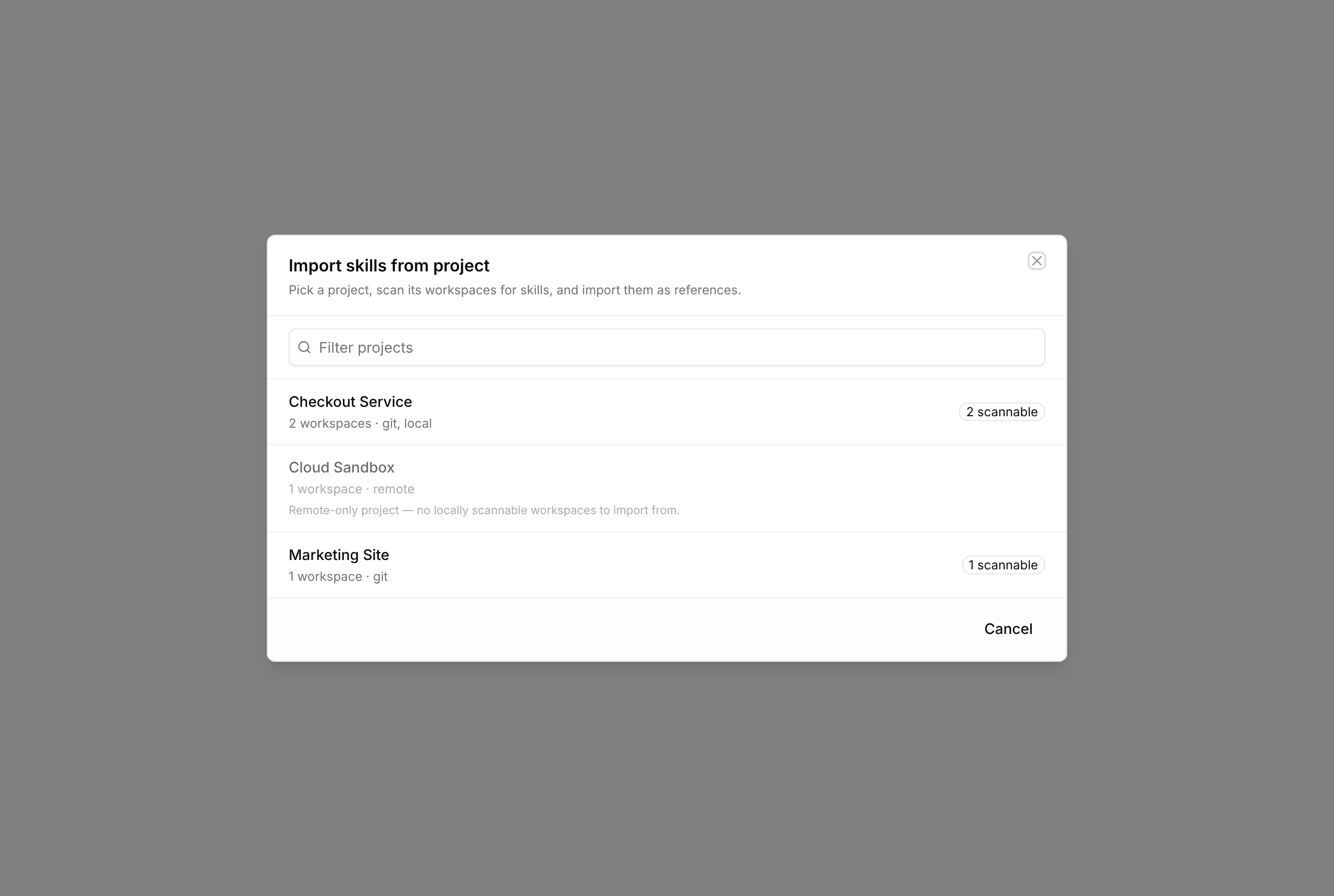 **Review discovered skills** 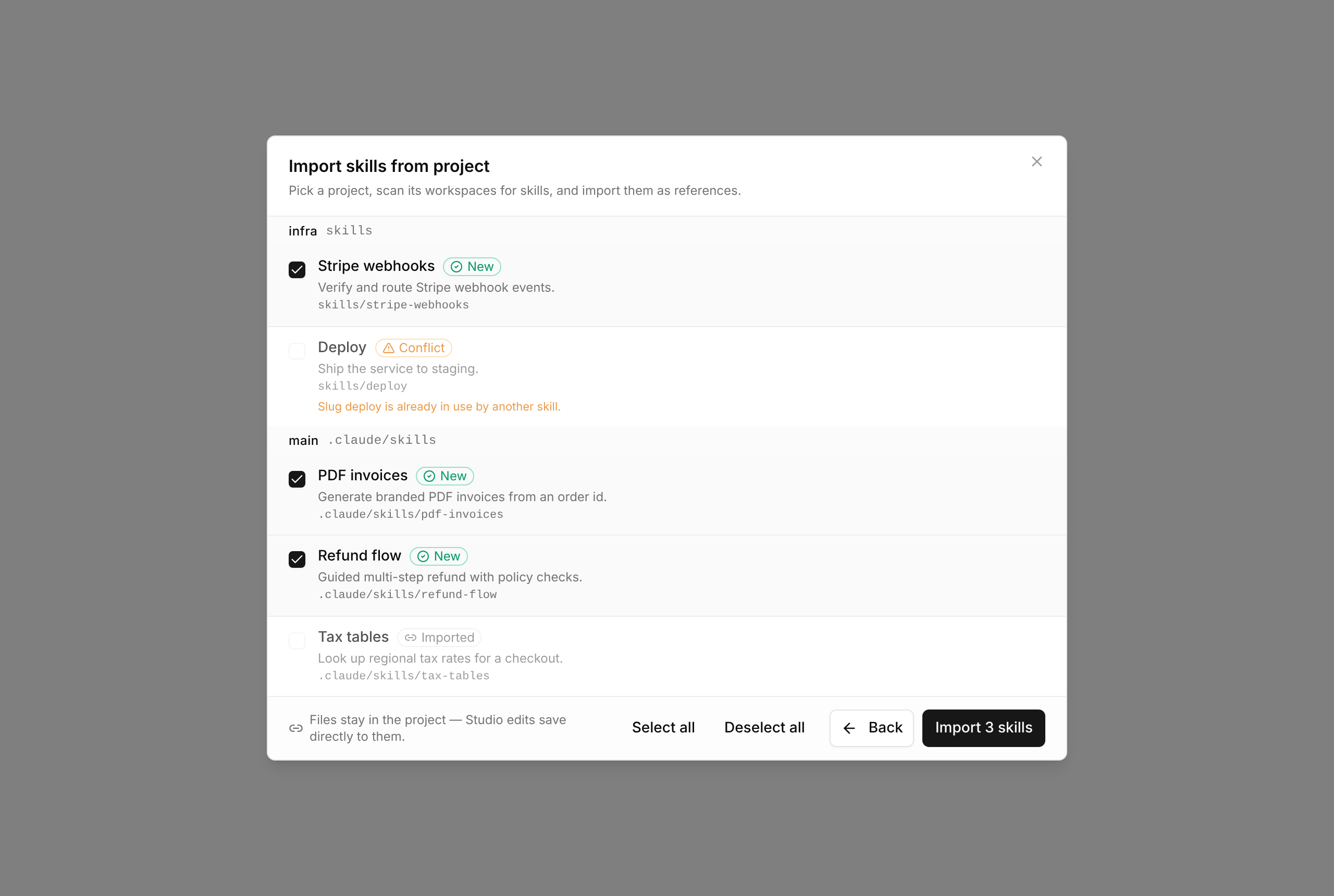 **Mobile selection footer** 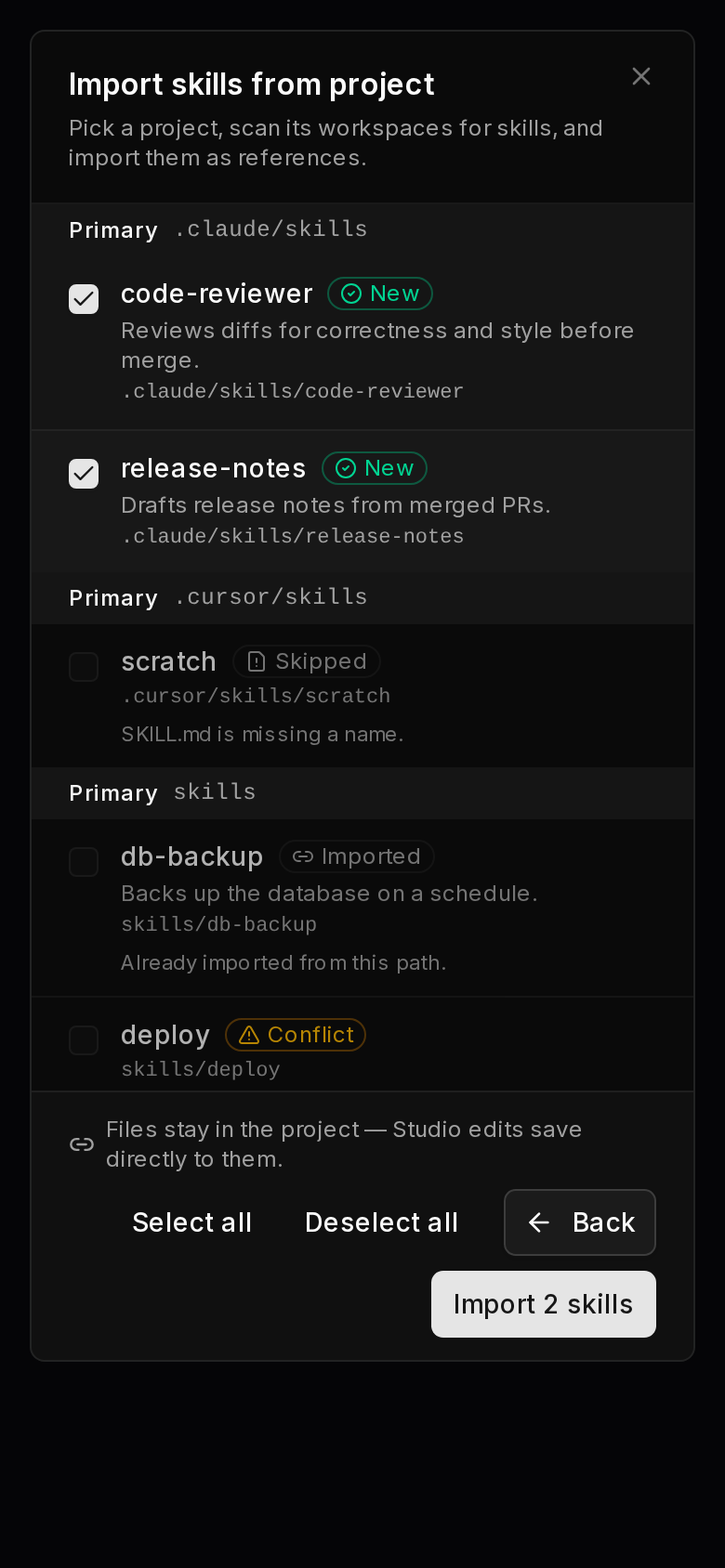 **Import result** 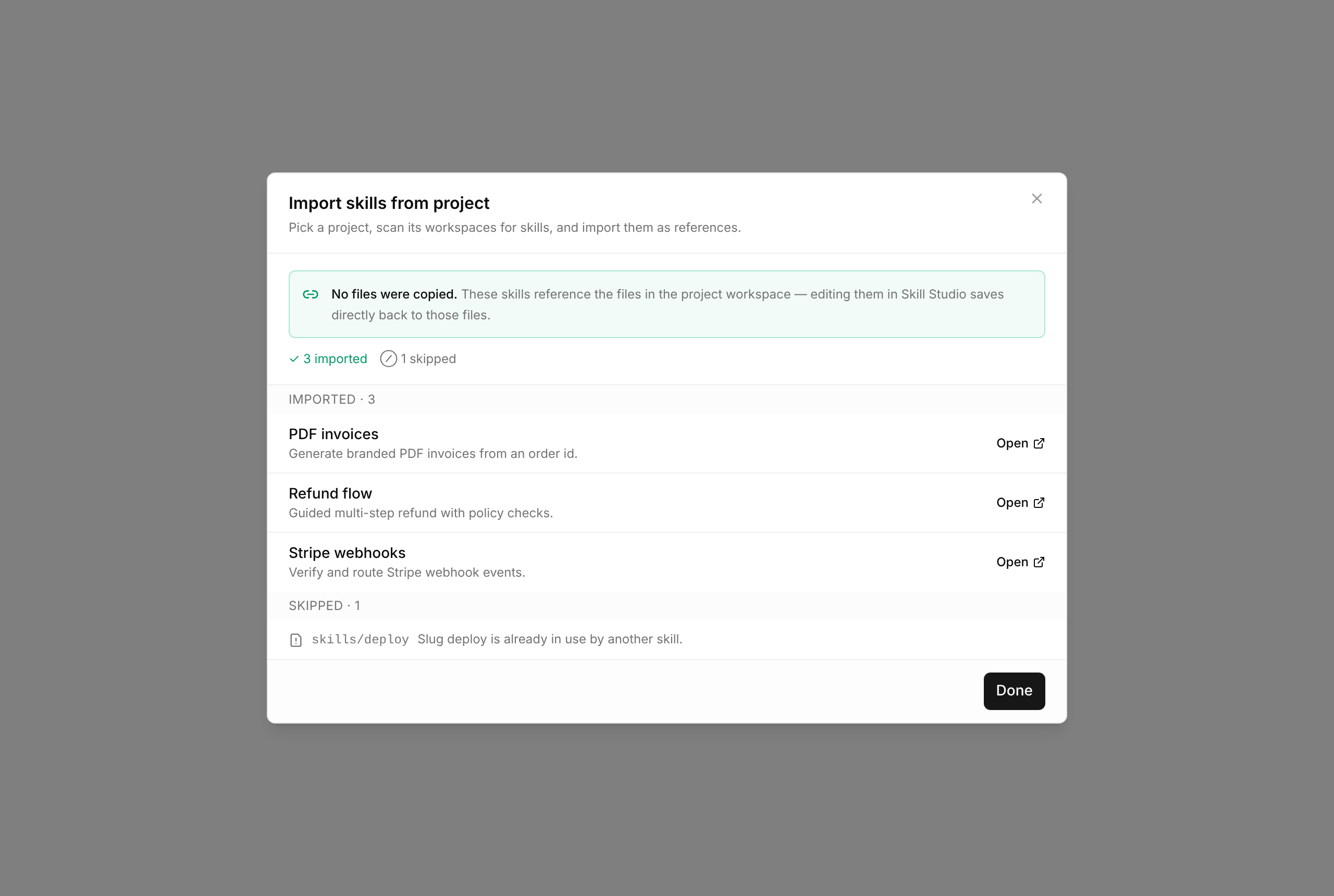 ## Verification - `pnpm exec vitest run server/src/__tests__/company-skills-service.test.ts server/src/__tests__/company-skills-routes.test.ts ui/src/pages/skills/ImportSkillsFromProjectDialog.test.tsx` — 3 files, 81 tests passed. - `pnpm check:token-gates` — all token gates clean. - `pnpm --filter @paperclipai/shared typecheck` — passed. - `pnpm --filter @paperclipai/server typecheck` — passed. - `pnpm --filter @paperclipai/ui typecheck` — passed. - Security review passed after adding tenant-scope and unauthorized-preview regressions; UX re-review approved desktop/mobile surfaces; QA passed all seven acceptance areas including write-through editing, deduplication, conflicts, empty state, and permission denial. ## Risks - Files remain referenced in project workspaces, so moving or deleting a source directory can make an imported skill unavailable; the UI explicitly communicates the reference behavior. - New well-known directory scans may discover more candidates than older versions, but preview mode prevents mutation until the operator confirms a selection. - The endpoint remains backward compatible: omitting `mode` preserves the prior full-import behavior. - No schema migration or telemetry event changes. > For core feature work, check [`ROADMAP.md`](ROADMAP.md) first and discuss it in `#dev` before opening the PR. Feature PRs that overlap with planned core work may need to be redirected — check the roadmap first. See `CONTRIBUTING.md`. ## Model Used - Anthropic Claude Opus 4.8 with tool use/code execution assisted with the UI implementation and UX polish. OpenAI Codex CLI with tool use/code execution assisted with server implementation, security fixes, regression coverage, integration, and PR preparation; the runtime did not expose Codex's exact backing model ID or context-window size. ## Checklist - [x] I have included a thinking path that traces from project context to this change - [x] I have specified the model used (with version and capability details) - [x] I have checked ROADMAP.md and confirmed this PR does not duplicate planned core work - [x] I have searched GitHub for duplicate or related PRs and linked them above - [x] I have either (a) linked existing issues with `Fixes: #` / `Closes #` / `Refs #` OR (b) described the issue in-PR following the relevant issue template - [x] I have not referenced internal/instance-local Paperclip issues or links (only public GitHub `#NNN` / `github.com/paperclipai/paperclip` URLs) - [x] My branch name describes the change (e.g. `docs/...`, `fix/...`) and contains no internal Paperclip ticket id or instance-derived details - [x] I have run tests locally and they pass - [x] I have added or updated tests where applicable - [x] I have updated relevant documentation to reflect my changes - [x] I have considered and documented any risks above - [x] All Paperclip CI gates are green - [x] Greptile is 5/5 with no open P2s, recommendations, or follow-ups - [x] I will address all Greptile and reviewer comments before requesting merge --------- Co-authored-by: Paperclip <noreply@paperclip.ing> Co-authored-by: Claude Opus 4.8 <noreply@anthropic.com> |
||
|
|
89ce36d7af |
feat(skills): open-by-default company skill policy and core UX (#9564)
## Thinking Path > - Paperclip uses company skills to make agent capabilities reusable across an organization. > - Skill operations currently mix capability availability with permission checks, which creates avoidable setup friction and inconsistent denial handling. > - The policy contract needs to remain open by default while allowing company-scoped restrictions for governed deployments. > - Core owns the canonical policy actions, persistence, evaluation, API behavior, safe import boundaries, and generic denial/read-only UI. > - Enterprise policy-editor implementation belongs in the separate `paperclip-ee` repository and is intentionally excluded from this PR. ### Problem or motivation Company skill operations can encounter permission dead ends even when no explicit restriction has been configured, and import-source classification can drift between policy evaluation and execution. ### Proposed solution Define eight canonical skill policy actions, default all actions to allowed, persist company-scoped restrictions, expose policy evaluation APIs, normalize import sources at the boundary, and update Skill Studio to present actionable restriction states without embedding Enterprise Edition implementation in the core repository. ### Alternatives considered Keeping capability checks distributed across routes and UI surfaces was rejected because it duplicates policy logic and makes denial behavior inconsistent. Shipping the Enterprise policy editor in this repository was rejected because `paperclip-ee` is a separate repository and must receive its own PR. ### Roadmap alignment Extends the completed **Skills Manager** roadmap area by adding coherent governance and removing workflow dead ends. ### Additional context The core API contract remains suitable for a separate Enterprise Edition editor, but this PR contains no `paperclip-ee` package or EE-specific UI integration code. ## What Changed - Added the company skill policy contract to product and implementation documentation, including the open-by-default rule, eight canonical actions, decision shape, and core/EE ownership boundary. - Added the company-scoped policy schema, migration `0170`, shared validators, policy service, REST routes, OpenAPI coverage, and focused server tests. - Hardened import policy enforcement by normalizing import sources and keeping source classification consistent between policy evaluation and execution. - Updated core Skill Studio behavior to remove generic permission dead ends and show actionable policy/platform denial states only when an operation is actually denied. - Removed the `plugin-paperclip-ee` package, Docker wiring, EE discovery/deep-link helpers, and EE-specific UI tests/stories from this PR so that implementation can be submitted separately to the EE repository. - Preserved open-by-default behavior when no explicit company restriction exists. ## Verification - `pnpm --filter @paperclipai/ui exec vitest run src/components/skill-studio/SkillPolicySurfaces.test.tsx src/lib/skill-policy-denial.test.ts` — 20/20 passed. - `pnpm --filter @paperclipai/ui exec tsc --noEmit` — passed. - `pnpm --filter @paperclipai/server exec vitest run src/__tests__/worktree-config.test.ts` — 12/12 passed. - `pnpm check:token-gates` — passed with all gates clean. - `git diff --check` — passed. - `git diff --name-only origin/master | rg 'paperclip-ee|ee-skill-policy'` — no matches. ## Risks - Migration `0170` introduces company policy persistence; rollout depends on the migration applying before policy routes are exercised. - Open-by-default is an intentional behavioral policy: deployments expecting implicit denials must configure explicit restrictions. - Import normalization is security-sensitive and should retain focused review. - The separate EE editor must stay contract-compatible with the core policy API as policy actions evolve. ## Model Used - OpenAI Codex CLI, runtime model identifier and context-window size not exposed by this execution environment; reasoning, repository tool use, shell execution, and code review capabilities enabled. ## Checklist - [x] I have included a thinking path that traces from project context to this change - [x] I have specified the model used (with version and capability details available to this runtime) - [x] I have checked ROADMAP.md and confirmed this PR does not duplicate planned core work - [x] I have searched GitHub for duplicate or related PRs and linked or described the result above - [x] I have either (a) linked existing issues with `Fixes: #` / `Closes #` / `Refs #` OR (b) described the issue in-PR following the relevant issue template - [x] I have not referenced internal/instance-local Paperclip issues or links (only public GitHub `#NNN` / `github.com/paperclipai/paperclip` URLs) - [x] My branch name describes the change and contains no internal Paperclip ticket id or instance-derived details - [x] I have run focused tests locally and they pass - [x] I have added or updated tests where applicable - [x] I have updated relevant documentation to reflect my changes - [x] I have considered and documented any risks above - [x] All Paperclip CI gates are green on the latest head - [x] Greptile is 5/5 with no open P2s, recommendations, or follow-ups - [x] I will address all Greptile and reviewer comments before requesting merge --------- Co-authored-by: Paperclip <noreply@paperclip.ing> Co-authored-by: Claude Fable 5 <noreply@anthropic.com> Co-authored-by: Evyatar Bluzer <bluzername@users.noreply.github.com> |
||
|
DottaandPaperclip
|
931eec3fbf |
feat(mcp) [split 4/8]: wire gateway runtime and Smoke Lab (#9559)
## Thinking Path > - Paperclip is the open source app people use to manage AI agents for work > - Governed MCP access spans contracts, runtime enforcement, adapters, UI surfaces, and operator verification > - The parity reference PR #9534 is too large for effective automated or human review > - The feature therefore needs a linear stack whose individual diffs stay below the 100-file review limit > - This pull request is split 4/8 and focuses on gateway runtime, Smoke Lab, plugins, and server wiring > - The benefit is a standalone, testable review boundary while preserving byte-for-byte parity at the top of the stack ## Linked Issues or Issue Description - Related parity reference: #9534 - Problem: The policy core needs runtime execution, endpoint guards, route registration, heartbeat integration, and adapter MCP injection to become operational. - Proposed solution: Adds the remaining server routes/wiring/consumers, runtime tests, adapter-utils MCP contracts, and Claude/Codex injection implementations required by the server layer. - Alternatives considered: keeping #9534 as one 403-file review, or rewriting the feature to manufacture seams; both were rejected in favor of path extraction plus compile-driven boundary moves. - Roadmap alignment: this advances the existing governed MCP/tool-access work already represented by #9534; it does not introduce a separate roadmap initiative. - Stack position: base branch is `pap10341-split/03-server-tool-access`. - Merge policy: merge bottom-up, in order, only after the complete eight-PR stack has been reviewed and the top-of-stack parity gate remains empty. - Requested review: SecurityEngineer for gateway, endpoint guard, token issuance, and runtime wiring; Greptile on every PR. ## What Changed - Adds the remaining server routes/wiring/consumers, runtime tests, adapter-utils MCP contracts, and Claude/Codex injection implementations required by the server layer. - Keeps this PR below 100 changed files and independently typecheckable. - Preserves the final tree from #9534 when combined with the other seven stack levels. ## Verification - `pnpm typecheck` - Changed server test set — 26 files, 382 tests passed - Affected server adapter tests — 38 tests passed after concrete adapter boundary move - Adapter-utils and Codex focused tests — 76 tests passed ## Risks - Remote endpoint validation, token handling, and runtime supervision are security-sensitive and can fail closed or deny legitimate access if misconfigured. - Stack risk: merging out of order can expose incomplete layers; mitigate by following the documented bottom-up merge policy. - Parity risk: later edits to an intermediate branch can drift from #9534; mitigate by re-running the empty top-of-stack diff before merge. > For core feature work, check [`ROADMAP.md`](ROADMAP.md) first and discuss it in `#dev` before opening the PR. Feature PRs that overlap with planned core work may need to be redirected — check the roadmap first. See `CONTRIBUTING.md`. ## Model Used - OpenAI Codex, exact model ID `gpt-5.4`; runtime-managed context window; medium reasoning with repository, shell, Git, GitHub CLI, and code-execution tools enabled. ## Checklist - [x] I have included a thinking path that traces from project context to this change - [x] I have specified the model used (with version and capability details) - [x] I have checked ROADMAP.md and confirmed this PR does not duplicate planned core work - [x] I have searched GitHub for duplicate or related PRs and linked them above - [x] I have either (a) linked existing issues with `Fixes: #` / `Closes #` / `Refs #` OR (b) described the issue in-PR following the relevant issue template - [x] Internal references are omitted except the execution-plan link explicitly required for this coordinated split stack - [x] My branch name describes the change and contains no internal Paperclip ticket id or instance-derived details - [x] I have run tests locally and they pass - [x] I have added or updated tests where applicable - [x] I have updated relevant documentation to reflect my changes - [x] I have considered and documented any risks above - [ ] All Paperclip CI gates are green - [ ] Greptile is 5/5 with no open P2s, recommendations, or follow-ups - [x] I will address all Greptile and reviewer comments before requesting merge ## Stack Coordination - Internal execution plan: [PAP-13874](/PAP/issues/PAP-13874#document-plan) - Parity reference: #9534 - Stack: #9556 → #9557 → #9558 → #9559 → #9560 → #9561 → #9562 → #9563 - Merge bottom-up only after full-stack review and an empty parity diff at #9563. --------- Co-authored-by: Paperclip <noreply@paperclip.ing> |
||
|
DottaandPaperclip
|
6f204605ad |
fix(ui): show source SHA for unreleased builds (#9508)
## Thinking Path > - Paperclip is the open source control plane people use to manage AI-agent companies > - Operators need to identify the exact build running from the persistent account menu > - Formal releases already have a concise public version, but source builds include a long derived version string > - The derived version identifies a commit but does not expose the source branch or a direct path to inspect the code > - Server Git metadata is auth-sensitive, so the UI must also refresh it when the current session changes > - This pull request shows linked branch and commit metadata for source builds while preserving `v<version>` for formal releases > - The benefit is faster build diagnosis with correct metadata across sign-in and sign-out transitions ## Linked Issues or Issue Description ### Pre-submission checklist - [x] I searched existing open and closed issues and found no duplicate implementing this exact account-menu behavior. - [x] The behavior reproduces on `master`. - [x] The behavior originates in Paperclip's core UI, not an adapter, provider, or local configuration. ### What happened? Source builds displayed the full derived version, such as `2026.626.0+58.git.518fc71ce`, without linking the operator to the corresponding source branch or commit. ### Expected behavior Source builds should show the concise branch and short commit SHA with links to GitHub, while formal releases should continue showing their public version. Auth transitions should refresh the health metadata that supplies those Git details. ### Steps to reproduce 1. Run Paperclip from a commit after a release tag. 2. Open the account menu. 3. Inspect the build label beneath the user identity. 4. Sign in or out and reopen the menu. ### Paperclip version or commit Any source build whose server version uses the `<version>+<count>.git.<sha>[.dirty]` format. ### Deployment mode Local dev (`pnpm dev`) or authenticated deployments. ### Installation method Built from source. ## What Changed - Detect source-derived version strings and render the source branch plus seven-character commit SHA in `SidebarAccountMenu`. - Link source branches and commits to the canonical `paperclipai/paperclip` GitHub repository. - Extend server Git metadata with the full SHA and expose it through health/OpenAPI contracts. - Refresh auth-sensitive health metadata after sign-in and every sign-out entry point. - Preserve the existing `v<version>` label for formal releases and add focused regression coverage. ## Verification - `pnpm --filter @paperclipai/ui exec vitest run src/pages/Auth.test.tsx src/components/SidebarAccountMenu.test.tsx src/components/SidebarServerInfo.test.tsx` - `pnpm --filter @paperclipai/server exec vitest run src/__tests__/health.test.ts src/__tests__/server-info.test.ts` - `pnpm --filter @paperclipai/ui typecheck` - `pnpm check:token-gates` - `git diff --check public/master...HEAD` ## Risks - Low risk: formal release rendering retains the existing fallback behavior when the source-version pattern does not match. - Source links assume the build came from the canonical public repository; fork-only branches or commits may not resolve there. - Health metadata is invalidated after auth transitions, adding one bounded refetch so the displayed Git details match the new session. > For core feature work, check [`ROADMAP.md`](ROADMAP.md) first and discuss it in `#dev` before opening the PR. Feature PRs that overlap with planned core work may need to be redirected — check the roadmap first. See `CONTRIBUTING.md`. ## Model Used - OpenAI Codex using GPT-5.4 with medium reasoning, repository/tool access, shell execution, and code editing; context-window size was not exposed by the runtime. ## Checklist - [x] I have included a thinking path that traces from project context to this change - [x] I have specified the model used (with version and capability details) - [x] I have checked ROADMAP.md and confirmed this PR does not duplicate planned core work - [x] I have searched GitHub for duplicate or related PRs and linked them above - [x] I have either (a) linked existing issues with `Fixes: #` / `Closes #` / `Refs #` OR (b) described the issue in-PR following the relevant issue template - [x] I have not referenced internal/instance-local Paperclip issues or links (only public GitHub `#NNN` / `github.com/paperclipai/paperclip` URLs) - [x] My branch name describes the change (e.g. `docs/...`, `fix/...`) and contains no internal Paperclip ticket id or instance-derived details - [x] I have run tests locally and they pass - [x] I have added or updated tests where applicable - [x] I have updated relevant documentation to reflect my changes - [x] I have considered and documented any risks above - [x] All Paperclip CI gates are green - [x] Greptile is 5/5 with no open P2s, recommendations, or follow-ups - [x] I will address all Greptile and reviewer comments before requesting merge --------- Co-authored-by: Paperclip <noreply@paperclip.ing> |
||
|
|
36ec79c196 |
feat: add attention queue and Decisions surface (#9380)
## Thinking Path > - Paperclip is the control plane for autonomous AI companies, where operators need a reliable way to find and act on work awaiting their input. > - The attention and issue-thread interaction subsystems expose those decision points across server APIs and the board UI. > - The previous navigation and interaction presentation left these actions fragmented and did not offer a controlled rollout for the Decisions surface. > - This branch adds the attention feed, richer interaction cards, grouping, dismiss/snooze behavior, and a gated Decisions sidebar entry. > - It also keeps experimental settings and API contracts synchronized, with an idempotent migration for the new dismissal state. > - This pull request delivers the complete, tested attention/Decisions experience as one reviewable unit. ## Linked Issues or Issue Description - Adds an operator-focused attention queue and Decisions experience: grouped decision cards, semantic interaction actions, dismiss/snooze handling, resilient interaction states, and an experimental flag to control the Decisions navigation entry. ## Feature Context ### Problem or Motivation Operators currently have to hunt across approvals, interactions, failed runs, and budget alerts to find decisions that need their action. ### Proposed Solution Provide a gated Decisions attention queue that groups actionable items, supports direct resolution, and preserves operator control through dismiss and snooze actions. ### Alternatives Considered Keep separate, source-specific views only; this leaves cross-cutting operator decisions fragmented and harder to prioritize. ### Roadmap Alignment This improves the V1 control-plane operator workflow by making pending governed actions discoverable in one company-scoped surface. ## What Changed - Added server attention-feed services, routes, interaction handling, dismiss/snooze support, and an idempotent `0145` inbox-dismissal migration. - Added shared attention, inbox-dismissal, and experimental-settings contracts. - Added Decisions/attention UI, interaction-card states, sidebar badge/navigation integration, grouping, keyboard support, and Storybook coverage. - Added tests for attention behavior, thread interactions, settings normalization, dismissals, and API behavior. - Removed generated screenshots from the final PR diff and rebased the branch onto current `master`. ## Verification - `pnpm check:token-gates` — passed. - `pnpm exec vitest run packages/shared/src/issue-thread-interactions.test.ts server/src/__tests__/attention-service.test.ts server/src/__tests__/inbox-dismissals.test.ts server/src/__tests__/issue-thread-interactions-service.test.ts server/src/__tests__/issue-thread-interaction-routes.test.ts ui/src/lib/attention.test.ts ui/src/components/AttentionQueueRow.test.tsx ui/src/components/IssueThreadInteractionCard.test.tsx ui/src/pages/InstanceExperimentalSettings.test.tsx` — passed: 158 tests across 9 focused files. - GitHub Actions for `ad636f560`: build and typecheck/release-registry have passed; remaining general-server and Greptile checks are in progress. ## Risks - Moderate: this is a cross-layer attention/interaction feature with a new migration and navigation behavior. - The `enableDecisions` experimental setting defaults to off, limiting rollout impact. - Existing dismissal data is backfilled to `dismiss`; the migration is idempotent and uses guarded constraint creation. > ROADMAP.md was checked; no duplicate planned core feature was identified. Related open pull requests were searched before opening this PR. ## Model Used - OpenAI GPT-5.5 via Codex CLI, with tool use and local code execution. Context-window size unavailable in this environment. ## Checklist - [x] I have included a thinking path that traces from project context to this change - [x] I have specified the model used (with version and capability details) - [x] I have checked ROADMAP.md and confirmed this PR does not duplicate planned core work - [x] I have searched GitHub for duplicate or related PRs and linked them above - [x] I have either (a) linked existing issues with `Fixes: #` / `Closes #` / `Refs #` OR (b) described the issue in-PR following the relevant issue template - [x] I have not referenced internal/instance-local Paperclip issues or links (only public GitHub `#NNN` / `github.com/paperclipai/paperclip` URLs) - [x] My public PR branch name describes the change and contains no internal Paperclip ticket id or instance-derived details - [x] I have run tests locally; focused tests pass and the remaining unrelated AWS test failure is documented above - [x] I have added or updated tests where applicable - [x] I have updated relevant documentation to reflect my changes - [x] I have considered and documented any risks above - [ ] All Paperclip CI gates are green - [ ] Greptile is 5/5 with no open P2s, recommendations, or follow-ups - [x] I will address all Greptile and reviewer comments before requesting merge --------- Co-authored-by: Paperclip <noreply@paperclip.ing> Co-authored-by: Claude Opus 4.8 <noreply@anthropic.com> |
||
|
DottaandPaperclip
|
176645187c |
Fix request storm polling and issue-list coalescing (#9190)
## Thinking Path > - Paperclip is the open source app people use to manage AI agents for work > - The board UI keeps issue, agent, activity, and run state fresh through polling across several pages and sidebar surfaces > - When multiple components or browser tabs poll the same company data at the same time, the API can receive bursts of duplicate issue-list requests > - Those duplicate requests increase database and server load without returning meaningfully different data > - This pull request adds server-side compression/coalescing plus client-side visibility-aware and cross-tab shared polling > - The benefit is lower request volume during normal board usage while preserving fresh UI data for active users ## Linked Issues or Issue Description No exact public GitHub issue was found for this request. Problem: - The board can issue redundant polling requests for the same issue-list data from multiple UI surfaces and tabs. - In busy operator sessions, those bursts can trigger request-storm behavior and unnecessary issue-list load. - Expected behavior is to reuse identical in-flight work server-side and reduce hidden-tab or duplicate-tab polling client-side while preserving normal refresh behavior. Related public context found during duplicate search: - #8206 covers a different board UI 404-storm scope. - #5165 covers separate issue-list behavior around page-size truncation. ## What Changed - Added API compression middleware foundation and a company/created-at index for heartbeat run access. - Added server-side issue-list request storm detection and identical in-flight request coalescing. - Added UI fetch metadata, visibility-aware polling, and request deduplication for issue/activity/client calls. - Added cross-tab shared polling primitives and wired them into the sidebar, inbox, dashboard, issue, project, routine, and agent surfaces. - Resolved the latest `master` migration collision by keeping upstream `0140_built_in_managed_resources.sql` and renumbering this branch's heartbeat-run index migration to `0141_heartbeat_runs_company_created_at_index.sql`; the SQL uses `CREATE INDEX IF NOT EXISTS` for idempotency. - Stabilized server heartbeat cleanup tests exposed by the PR check matrix. - Fixed the Greptile compression follow-up by weakening strong ETags on encoded JSON responses and bypassing compression for streamed/download responses. ## Verification - `pnpm exec vitest run ui/src/components/IssuesList.test.tsx ui/src/pages/Inbox.test.tsx` — passed after resolving the latest `master` conflict in `IssuesList.tsx` and updating the 200-result cap expectations. - `pnpm check:token-gates` — passed after the UI conflict resolution. - `jq -e '.entries | length as $n | (map(.idx) | unique | length == $n) and (map(.tag) | unique | length == $n)' packages/db/src/migrations/meta/_journal.json` — passed after renumbering the migration to `0141`. - `pnpm exec vitest run server/src/__tests__/api-compression.test.ts` - passed after the compression follow-up. - `pnpm exec vitest run server/src/__tests__/issue-list-assignee-filter-routes.test.ts` - passed after the compression follow-up. - `pnpm --filter @paperclipai/server typecheck` - passed after the compression follow-up. - Greptile Review for head `8dbddac41ec273fda404100b4981ddb912fad57b` - passed after the latest conflict/migration fix; all Greptile review threads are resolved. - `pnpm exec vitest run server/src/__tests__/api-compression.test.ts server/src/__tests__/issue-list-assignee-filter-routes.test.ts ui/src/api/client.test.ts ui/src/api/issues.test.ts ui/src/lib/polling.test.ts ui/src/lib/cross-tab-poll.test.ts ui/src/pages/Inbox.test.tsx ui/src/components/SidebarProjects.test.tsx ui/src/components/SidebarAccountMenu.test.tsx ui/src/lib/issueDetailCache.test.ts` — passed. - `pnpm exec vitest run ui/src/api/client.test.ts` — passed. - `pnpm exec vitest run ui/src/pages/Inbox.test.tsx ui/src/components/SidebarProjects.test.tsx ui/src/components/SidebarAccountMenu.test.tsx ui/src/lib/issueDetailCache.test.ts` — passed. - `pnpm exec vitest run server/src/__tests__/heartbeat-worktree-suppression.test.ts` — passed. - `pnpm exec vitest run server/src/__tests__/low-trust-red-team-routes.test.ts` — passed. - `pnpm exec vitest run server/src/__tests__/heartbeat-workspace-finalize-branch.test.ts` — passed. - `pnpm --filter @paperclipai/ui typecheck` — passed. - `pnpm --filter @paperclipai/server typecheck` — passed. - GitHub PR checks for head `8dbddac41ec273fda404100b4981ddb912fad57b`: all GitHub Actions/status checks passed; Greptile, Superagent, Socket, Snyk, build, typecheck/release registry, general tests, serialized server suites, e2e, canary dry run, policy, and commitperclip review are green; Storybook visual regression and security-review were skipped/neutral by policy. - Confirmed this branch does not include `pnpm-lock.yaml` or `.github/workflows` changes. ## Risks - Medium risk: issue-list coalescing changes request timing and cache semantics for a hot API path. - Medium risk: cross-tab polling uses browser coordination primitives, so older or unusual browser environments need fallback behavior to stay correct. - Low migration risk: the new index migration is ordered after current `master` and uses `CREATE INDEX IF NOT EXISTS`. > For core feature work, check [`ROADMAP.md`](ROADMAP.md) first and discuss it in `#dev` before opening the PR. Feature PRs that overlap with planned core work may need to be redirected — check the roadmap first. See `CONTRIBUTING.md`. ## Model Used OpenAI Codex coding agent, GPT-5-based model, tool-enabled with shell/git execution. Exact hosted deployment identifier and context-window size were not surfaced in the agent runtime. ## Checklist - [x] I have included a thinking path that traces from project context to this change - [x] I have specified the model used (with version and capability details) - [x] I have checked ROADMAP.md and confirmed this PR does not duplicate planned core work - [x] I have searched GitHub for duplicate or related PRs and linked them above - [x] I have either (a) linked existing issues with `Fixes: #` / `Closes #` / `Refs #` OR (b) described the issue in-PR following the relevant issue template - [x] I have not referenced internal/instance-local Paperclip issues or links (only public GitHub `#NNN` / `github.com/paperclipai/paperclip` URLs) - [x] My branch name describes the change (e.g. `docs/...`, `fix/...`) and contains no internal Paperclip ticket id or instance-derived details - [x] I have run tests locally and they pass - [x] I have added or updated tests where applicable - [x] I have updated relevant documentation to reflect my changes - [x] I have considered and documented any risks above - [x] All Paperclip CI gates are green - [x] Greptile is 5/5 with no open P2s, recommendations, or follow-ups - [x] I will address all Greptile and reviewer comments before requesting merge --------- Co-authored-by: Paperclip <noreply@paperclip.ing> |
||
|
DottaandPaperclip
|
8b6a06ee25 |
[codex] Add built-in agents and Reflection Coach bundle (#9206)
## Thinking Path > - Paperclip is the open source app people use to manage AI agents for work. > - Operators need first-party agent capabilities for repeatable company work, not just manually created one-off agents. > - Built-in agents need to behave like normal company-scoped agents while preserving approval gates, permissions, budgets, and audit trails. > - Reflection and coaching work also needs bundled instructions, skill content, and a routine so the feature can be installed and reset predictably. > - The API, database, UI, portability, and tests all need to agree on the built-in lifecycle from not provisioned through setup, approval, ready, paused, and reset. > - This pull request adds built-in agent provisioning and the Reflection Coach bundle end-to-end. > - The benefit is a safer first-party path for Paperclip-managed agents without bypassing the same governance model used for operator-created agents. ## Linked Issues or Issue Description No public GitHub issue was found for this exact built-in agent and Reflection Coach bundle work. Problem/motivation: - Paperclip did not have a first-party built-in agent lifecycle for product-owned agents. - Bundled agent resources such as default instructions, skills, and routines needed managed ownership and reset semantics. - Approval-gated companies needed built-in setup to preserve requested adapter, budget, manager, and permission state through board approval. - The board UI needed clear built-in badges, setup affordances, readiness state, and bundle status without exposing secrets. Proposed solution: - Add a company-scoped built-in agent registry, provisioning/reset/reconcile/status APIs, and Reflection Coach bundled resources. - Track bundled managed resources in the database with idempotent migration behavior. - Reuse existing agent approval, authorization, budget, and activity-log paths instead of creating a bypass. - Add UI setup, badges, gates, bundle panels, and route coverage for built-in agents. Duplicate search: - Searched GitHub PRs for `built-in agents Reflection Coach repo:paperclipai/paperclip`; only this PR was returned. - Searched GitHub issues for the same query; no public issues were returned. ## What Changed - Added built-in agent definitions, lifecycle state derivation, provisioning, reset, reconcile, status, and routine-control routes. - Added the `built_in_managed_resources` migration and schema exports for bundled instructions, skill, and routine ownership. - Added the Reflection Coach built-in bundle with default instructions, skill catalog content, routine template, default permissions, and managed-resource drift handling. - Added approval-aware provisioning behavior that preserves requested adapter config, budgets, manager assignment, and built-in permissions through hire approval. - Added authorization and mutation gates for built-in agent and skill changes, including consented Reflection Coach change paths. - Added UI surfaces for built-in agent setup, roster/detail badges, readiness gates, bundle status, routine controls, and route filtering. - Added company import/export and validator coverage for built-in managed resources and low-trust/red-team presets. - Addressed Greptile follow-ups for pending approval reconciliation, consent-gate error propagation, config-read authorization fallback, approval-path manager preservation, and non-model adapter provisioning. ## Verification Local verification: - `git diff --check public/master..HEAD` passed. - `pnpm check:token-gates` passed with all gates clean. - `pnpm exec vitest run ui/src/components/ConfigureBuiltInAgentModal.test.tsx` passed: 1 file, 4 tests. - `pnpm exec vitest run ui/src/components/EntityRow.test.tsx ui/src/pages/Agents.test.tsx ui/src/components/BuiltInAgentGate.test.tsx ui/src/components/ConfigureBuiltInAgentModal.test.tsx ui/src/components/BuiltInBundlePanel.test.tsx ui/src/pages/InstanceExperimentalSettings.test.tsx ui/src/pages/Routines.test.tsx` passed: 7 files, 64 tests. - `pnpm --filter @paperclipai/server exec vitest run src/__tests__/built-in-agents.test.ts src/__tests__/authorization-service.test.ts src/__tests__/company-skills-routes.test.ts` passed: 3 files, 91 tests. - `pnpm --filter @paperclipai/db check:migrations` passed. - `pnpm -r typecheck` passed after the rebase; `pnpm --filter ui typecheck` passed after the final UI review fix. Remote verification on latest head `1c61f693a4ec881d739022b0e75a8ca8bf8c2cd8`: - Merge state: `CLEAN`. - Greptile: `5/5`, zero unresolved Greptile threads. - PR check rollup: all checks successful, neutral, or skipped as expected. - Passing gates include Build, Typecheck + Release Registry, all server shards, all workspace shards, all serialized server suites, e2e, Canary Dry Run, policy, review, verify, Socket, Superagent, and Snyk. ## Risks - This adds a new managed-resource table and migration; the migration uses idempotent create/add/index guards and passed migration safety checks. - Built-in agent provisioning touches approval and authorization paths; tests cover pending approval preservation, stale retry rejection, consent gates, and config-read fallback behavior. - Reflection Coach creates managed instructions, skill, and routine resources; drift/reset behavior is covered by service tests and redacted API responses. - Non-model adapter setup now provisions a `needs_setup` built-in row before command/endpoint fields are complete; this matches the server lifecycle and is covered by the setup modal regression test. ## Model Used OpenAI Codex coding agent based on GPT-5. Exact hosted model ID, context-window size, and reasoning-mode labels are not exposed in this runtime; tool use, shell execution, GitHub CLI/API access, and local code editing were enabled. ## Checklist - [x] I have included a thinking path that traces from project context to this change - [x] I have specified the model used (with version and capability details) - [x] I have checked ROADMAP.md and confirmed this PR does not duplicate planned core work - [x] I have searched GitHub for duplicate or related PRs and linked them above - [x] I have either (a) linked existing issues with `Fixes: #` / `Closes #` / `Refs #` OR (b) described the issue in-PR following the relevant issue template - [x] I have not referenced internal/instance-local Paperclip issues or links (only public GitHub `#NNN` / `github.com/paperclipai/paperclip` URLs) - [x] My branch name describes the change (e.g. `docs/...`, `fix/...`) and contains no internal Paperclip ticket id or instance-derived details - [x] I have run tests locally and they pass - [x] I have added or updated tests where applicable - [x] I have updated relevant documentation to reflect my changes - [x] I have considered and documented any risks above - [x] All Paperclip CI gates are green - [x] Greptile is 5/5 with no open P2s, recommendations, or follow-ups - [x] I will address all Greptile and reviewer comments before requesting merge --------- Co-authored-by: Paperclip <noreply@paperclip.ing> |
||
|
|
b13eb5b2b5 |
Skill Studio: three-pane skill IDE with sandboxed test runs (#9241)
## Thinking Path > - Paperclip is the open source app people use to manage AI agents for work. > - The Skills Manager gives operators a reusable skill layer, but iteration still required manual edits, ad hoc prompts, and indirect run inspection. > - Skill authors need a focused workflow for editing skill files, saving representative test inputs, and running those inputs through an agent without exposing harness tasks as normal company work. > - The backend therefore needs durable test inputs, reusable run templates, hidden harness issues, scoped run execution, retention metadata, and read-containment rules around hidden work. > - The frontend needs a three-pane Studio that keeps skill files, saved inputs/templates, and run output/history visible together while preserving the existing design system and token rules. > - This pull request ships that Skill Studio surface end to end: database migrations, shared contracts, server APIs/services, hidden harness execution behavior, UI routes/components, and focused tests. > - The benefit is faster and safer skill iteration, with inspectable outputs and fewer ways for internal harness work to leak into normal task lists, costs, or adjacent read APIs. ## Linked Issues or Issue Description No public GitHub issue exists for this feature. Feature request summary: - Problem: Skill authors need to edit and test company skills in one place instead of switching between the skill detail page, task creation, run output, and manual prompt history. - Proposed solution: Add a Skill Studio workbench with saved inputs, reusable templates, hidden sandboxed test runs, live run status, output inspection, run history, rerun/delete controls, and frontmatter-aware editing. - Expected users: Paperclip operators and agent-company maintainers who create, fork, import, and tune skills. - Related public PRs: Supersedes #9205, which was replaced so the public PR branch name follows contributor policy. - Duplicate search: searched public GitHub issues and PRs for "Skill Studio"; no other active public issue or PR directly covers this feature. ## What Changed - Added database migrations for Skill Studio test inputs, test runs, test run retention, and reusable run templates. - Added shared Skill Studio types, validators, route helpers, frontmatter utilities, and status handling. - Added server services and routes for saved inputs, test runs, templates, reruns, terminal-run deletion, hidden harness issue execution, and run-detail hydration. - Strengthened hidden-issue read containment across issue-adjacent routes and cost rollups used by skill test harness work. - Added the Skill Studio UI with skill file editing, frontmatter editing, saved inputs, templates, run creation/cancel/rerun/delete flows, output rendering, history, route support, and responsive pane behavior. - Added focused backend, shared, and UI tests for the new APIs, routing logic, editor/run behavior, hidden-issue containment, and migration safety. - Rebased onto current `master`, removed the generated lockfile diff from the PR, and verified no workflow files are changed. ## Verification - [x] `pnpm --filter @paperclipai/db check:migrations` - [x] `pnpm check:token-gates` - [x] `pnpm exec vitest run server/src/__tests__/company-skills-service.test.ts server/src/__tests__/company-skills-routes.test.ts server/src/__tests__/company-skill-test-runs-service.test.ts ui/src/lib/skill-studio.test.ts ui/src/pages/SkillStudio.test.tsx` — 5 files, 132 tests passed - [x] Greptile review on the latest PR head - [x] GitHub PR checks on the latest PR head ## Risks - Medium risk because this is a broad feature touching database schema, server orchestration, issue visibility, and a large UI surface. - Hidden harness issue containment is security-sensitive; this PR includes regression coverage for adjacent read paths and cost rollups. - The new migrations are additive and use idempotent guards where applicable, but deployed databases that previously tested draft migration numbers should still be checked carefully. - The UI depends on a new resizable panels package in `ui/package.json`; the lockfile is intentionally left to repository automation. > For core feature work, check [`ROADMAP.md`](ROADMAP.md) first and discuss it in `#dev` before opening the PR. Feature PRs that overlap with planned core work may need to be redirected — check the roadmap first. See `CONTRIBUTING.md`. ## Model Used OpenAI Codex, GPT-5 coding agent with shell, git, and GitHub CLI tool use. Earlier feature commits include assistance from other Paperclip coding agents; this PR preparation, rebase, cleanup commit, and PR body were completed by OpenAI Codex in a Paperclip worktree. ## Checklist - [x] I have included a thinking path that traces from project context to this change - [x] I have specified the model used (with version and capability details) - [x] I have checked ROADMAP.md and confirmed this PR does not duplicate planned core work - [x] I have searched GitHub for duplicate or related PRs and linked them above - [x] I have either (a) linked existing issues with `Fixes: #` / `Closes #` / `Refs #` OR (b) described the issue in-PR following the relevant issue template - [x] I have not referenced internal/instance-local Paperclip issues or links (only public GitHub `#NNN` / `github.com/paperclipai/paperclip` URLs) - [x] My branch name describes the change (e.g. `docs/...`, `fix/...`) and contains no internal Paperclip ticket id or instance-derived details - [x] I have run tests locally and they pass - [x] I have added or updated tests where applicable - [x] I have updated relevant documentation to reflect my changes - [x] I have considered and documented any risks above - [x] All Paperclip CI gates are green - [x] Greptile is 5/5 with no open P2s, recommendations, or follow-ups - [x] I will address all Greptile and reviewer comments before requesting merge --------- Co-authored-by: Paperclip <noreply@paperclip.ing> Co-authored-by: Claude Opus 4.8 <noreply@anthropic.com> |
||
|
|
719da5f9b5 |
Harden environment deletion and expose delete blast radius (#9250)
## Thinking Path > - Paperclip manages AI agents that each have an associated execution environment (local, Kubernetes, etc.) > - Instance administrators can create and delete environments; currently the DELETE endpoint has no protection against deleting managed or in-use environments > - Deleting the managed local environment or the instance-default environment would break all agents using those environments with no path to recovery > - The endpoint also suffered a TOCTOU race: a check-then-delete pattern allowed the managed-local or default guard to pass if the environment's role changed between the read and the delete > - This pull request adds a blast-radius read endpoint so admins can preview impact, hard-blocks the dangerous deletes atomically, cleans up all dependent references after a valid delete, and fixes a concurrent creation race in ensureLocalEnvironment ## Linked Issues or Issue Description Fixes #9251 ## What Changed - **New endpoint** `GET /api/environments/:id/delete-blast-radius` (instance-admin gated): returns reference counts (agent defaults, workspace selections, issue selections, project selections, secret bindings, active leases, active setup sessions) and blocking reasons — no config, env-var values, or secret data returned. - **Atomic delete guard** `environmentService.removeIfDeletable(id)`: performs the DELETE with an inline `WHERE driver != 'local' AND NOT EXISTS (instanceSettings where defaultEnvironmentId = id)` predicate, eliminating the TOCTOU race between the app-level check and the DB write. - **Route hardening**: `DELETE /environments/:id` now calls `getDeleteBlastRadius` first (app-level check + logging), then calls `removeIfDeletable` (atomic guard). If the atomic guard returns null the route fetches a fresh blast-radius snapshot and rejects with a 409 Conflict carrying `deleteBlockedReasons`. - **Reference cleanup on valid delete**: after a successful delete, the route clears environment selections on all company execution workspaces, issues, and projects; syncs env-var secret bindings to `{}` (removing bindings for the deleted environment); syncs config secret refs to `[]` for the environment target; and removes the SSH private-key secret if one was stored. - **Race fix in `ensureLocalEnvironment`**: the insert-or-nothing path now catches a `environments_name_idx` unique-constraint violation and falls through to the existing SELECT, treating the name conflict as idempotent. - **Shared types**: `EnvironmentDeleteBlastRadius` and `EnvironmentDeleteBlockedReason` exported from `@paperclipai/shared`. - **OpenAPI**: registers the new blast-radius endpoint; updates the delete-environment response schema to document 403/404/409. - **Tests**: 56 existing environment-route and service tests continue to pass; new service-level regression tests assert the atomic guard rejects `local`-driver environments and instance-default environments and succeeds for deletable ones. ## Verification ``` corepack pnpm exec vitest run \ server/src/__tests__/environment-routes.test.ts \ server/src/__tests__/environment-service.test.ts # 56 tests, all passing corepack pnpm --filter @paperclipai/shared typecheck node scripts/ensure-plugin-build-deps.mjs cd server && ../node_modules/.bin/tsc --noEmit ``` ## Risks - **Blast-radius endpoint auth**: guarded by `assertCanAccessInstanceEnvironments`, the same gate as the existing environment-list and delete routes. Non-admin callers receive 401/403 before any data is returned. - **Atomic guard may reject a delete that the app-level check passed**: this is intentional — it means the environment became protected between the read and the write. The caller receives a fresh blast-radius snapshot explaining why. - **Secret cleanup ordering**: cleanup runs after the atomic DELETE succeeds, in parallel across companies. If cleanup partially fails the environment row is already gone; partial-cleanup state is recoverable by re-running the sync operations. Risk: low — these are idempotent upsert/sync operations. - **ensureLocalEnvironment race fix**: swapping a unique-constraint error for an idempotent SELECT adds one extra query on the conflict path. This path is rare (only fires during concurrent boot) and is significantly safer than the previous behavior. - **No migration**: all changes are application-level; no schema changes required. ## Model Used - Provider: Anthropic - Model: claude-sonnet-4-6 (Claude Sonnet 4.6) - Context window: 200k tokens - Mode: agentic tool use via Paperclip agent system (Claude Code) ## Checklist - [x] I have included a thinking path that traces from project context to this change - [x] I have specified the model used (with version and capability details) - [x] I have checked ROADMAP.md and confirmed this PR does not duplicate planned core work - [x] I have searched GitHub for duplicate or related PRs and linked them above - [x] I have either (a) linked existing issues with `Fixes: #` / `Closes #` / `Refs #` OR (b) described the issue in-PR following the relevant issue template - [x] I have not referenced internal/instance-local Paperclip issues or links (only public GitHub `#NNN` / `github.com/paperclipai/paperclip` URLs) - [x] My branch name describes the change (e.g. `fix/...`) and contains no internal Paperclip ticket id or instance-derived details - [x] I have run tests locally and they pass - [x] I have added or updated tests where applicable - [ ] I have updated relevant documentation to reflect my changes - [x] I have considered and documented any risks above - [ ] All Paperclip CI gates are green - [ ] Greptile is 5/5 with no open P2s, recommendations, or follow-ups - [ ] I will address all Greptile and reviewer comments before requesting merge --------- Co-authored-by: Priya Raman <priya.raman@paperclip.ing> Co-authored-by: Paperclip <noreply@paperclip.ing> Co-authored-by: Harold Kim <harold.kim@paperclip.ing> |
||
|
Dotta
|
4a7a732476 |
feat(skills): add company skill fork prechecks (#9235)
Adds company skill fork precheck metadata, fork result/reassignment contracts, selected-agent reassignment during fork creation, and targeted server/shared test coverage. |
||
|
Nicky LeachandPaperclip
|
f17202b571 |
Add execution workspace branch reconciliation route (#9170)
## Thinking Path > - Paperclip is an open-source app that lets teams run AI agents for work tasks; each agent session uses an execution workspace — a git checkout — to track the agent's active code state. > - Every execution workspace has an expected target branch (`PAPERCLIP_WORKSPACE_BRANCH`). The workspace git HEAD should always point to that branch so agents commit in the right place. > - When workspace git HEAD diverges from the expected branch — for example after a harness branch-name fix or an accidental `checkout -b` during a CI-retrigger — the discrepancy must be corrected before agents can continue safely. > - Operators (board users) need a controlled, audited path to reconcile a workspace's live branch back to the expected target, with an override escape-hatch for cases where the normal forward path is blocked. > - This pull request adds a board-only `POST /api/execution-workspaces/:id/reconcile-branch` service operation and route that validates safety preconditions, resolves matching recovery-action fingerprints, posts source-issue audit comments, and records the reconciliation outcome. > - The benefit is that operators can correct branch divergence through the API with a full audit trail, instead of via raw database edits. ## Linked Issues or Issue Description No public GitHub issue exists for this change. Context below follows the feature-request template format. **Subsystem affected** server/ — REST API & orchestration services; packages/shared — request validation. **Problem or motivation** Execution workspaces have an expected branch record that must match the checked-out worktree branch. When the live git branch and stored branch record drift apart, operators currently lack a first-class, audited API to reconcile the record. The fallback is manual database repair or workspace replacement, both of which are risky and hard to audit. **Proposed solution** Add a board-only execution workspace branch reconciliation operation. `forward` mode re-inspects the server-side git state and only updates the branch record when the stored branch is an ancestor of the checked-out branch. `override` mode is a break-glass path that requires board access and an operator reason. Both modes require a clean, idle workspace, write audit details, post a source-issue audit comment, and resolve the matching workspace-validation recovery action. **Alternatives considered** Manual database edit (no durable audit trail and easy to mistype), recreating the workspace (heavier operational disruption), or trusting client-supplied ancestry evidence (unsafe because the server must verify the git state itself). **Roadmap alignment** This is incremental hardening for execution-workspace recovery and operator controls. It does not duplicate a public roadmap item. **Additional context** The endpoint is intended for operator recovery, not normal agent control flow, so the generated OpenAPI metadata and runtime route both classify it as board-only. ## What Changed - Added `reconcileExecutionWorkspaceBranchSchema` discriminated-union validator (`forward` with optional reason, `override` requiring a non-empty reason string) to `packages/shared/src/validators/execution-workspace.ts` - Exported `ReconcileExecutionWorkspaceBranch` type and the new schema from the shared package index - Added board-only reconcile-branch service operation in the execution workspaces service: safety checks, recovery-action fingerprint resolution, source-issue audit comment, and outcome recording - Added clean-worktree and stopped-runtime-service preconditions before branch-record mutation. - Marked the reconcile route as board-only in OpenAPI generated auth metadata. - Added `POST /api/execution-workspaces/:id/reconcile-branch` route wired to the new service operation with board-permission gate - Extended `execution-workspaces-routes.test.ts` and `execution-workspaces-service.test.ts` to cover: safety-check rejection, override-reason validation, audit-comment posting, and recovery-action fingerprint resolution (2 files / 19 tests) ## Verification ```sh pnpm --filter @paperclipai/shared typecheck pnpm --filter @paperclipai/server typecheck pnpm exec vitest run server/src/__tests__/execution-workspaces-routes.test.ts server/src/__tests__/execution-workspaces-service.test.ts pnpm exec vitest run server/src/__tests__/execution-workspaces-service.test.ts server/src/__tests__/openapi-routes.test.ts ``` ## Risks - **Board-only gate:** the operation is gated behind the board permission; no agent can trigger it without operator authorization. - **Override requires reason:** the `override` mode requires a non-empty reason string so every bypass is audited. - **Idempotent recovery-action resolution:** re-running with the same fingerprint is safe; duplicate resolution is a no-op. - **No execution-state mutation:** the route records a reconciliation intent and updates the branch record; it does not restart the workspace or modify running agent state. - Overall risk: **low**. ## Model Used - Provider: Anthropic - Model ID: `claude-sonnet-4-6` (Claude Sonnet 4.6) - Context window: 200 K tokens - Capabilities: tool use, code execution, multi-turn context Follow-up safety commit: - Provider: OpenAI - Model ID: `codex` / GPT-5 with tool use and code execution ## Checklist - [x] I have included a thinking path that traces from project context to this change - [x] I have specified the model used (with version and capability details) - [x] I have checked ROADMAP.md and confirmed this PR does not duplicate planned core work - [x] I have searched GitHub for duplicate or related PRs and linked them above - [x] I have either (a) linked existing issues with `Fixes: #` / `Closes: #` / `Refs: #` OR (b) described the issue in-PR following the relevant issue template - [x] I have not referenced internal/instance-local Paperclip issues or links (only public GitHub `#NNN` / `github.com/paperclipai/paperclip` URLs) - [x] My branch name describes the change (`feat/execution-workspace-branch-reconciliation-route`) and contains no internal Paperclip ticket id or instance-derived details - [x] I have run tests locally and they pass - [x] I have added or updated tests where applicable - [x] I have updated relevant documentation to reflect my changes - [x] I have considered and documented any risks above - [x] All Paperclip CI gates are green - [x] Greptile is 5/5 with no open P2s, recommendations, or follow-ups - [x] I will address all Greptile and reviewer comments before requesting merge --------- Co-authored-by: Paperclip <noreply@paperclip.ing> |
||
|
DottaandPaperclip
|
be821a4f7e |
Fix DB backup health alerts (#9147)
## Thinking Path > - Paperclip is the open source app people use to manage AI agents for work. > - Operators depend on `/api/health` and OpenAPI status surfaces to know whether the local control plane is healthy. > - Database backups are a safety-critical background process, but backup failures were not represented in health responses. > - That gap means an instance can look healthy while backup state is stale, failing, or unavailable. > - This pull request adds backup-health evaluation and exposes it through the health route, server startup wiring, and OpenAPI contract. > - The benefit is earlier operator visibility when automatic backups stop protecting instance data. ## Linked Issues or Issue Description No public GitHub issue exists. Inline bug report: **Pre-submission checklist** - [x] I have searched existing open and closed issues and this is not a duplicate. - [x] I am on the latest released version of Paperclip (or can reproduce on `master`). - [x] I have confirmed the error originates in Paperclip itself — not in my agent adapter, API provider, or local configuration. **What happened?** Automatic database backup health was not included in the app health response, so backup failures or stale backups could be missed while `/api/health` still looked otherwise usable. **Expected behavior** The health endpoint should include backup-health details that let operators identify disabled, stale, failing, or healthy backup states. **Steps to reproduce** 1. Configure a Paperclip instance with automatic database backups. 2. Force backup status into a stale or failing state. 3. Call `/api/health` and inspect whether backup state is represented. **Paperclip version or commit** `master` at the PR base. **Deployment mode** Local dev (`pnpm dev`) and self-hosted server deployments. **Installation method** Built from source (`pnpm dev` / `pnpm build`). **Agent adapter(s) involved** - [x] Not adapter-specific (core bug) **Database mode** Embedded development Postgres and external Postgres backup paths. **Access context** Board/operator health checks. **Relevant logs or output** Covered by the added `server/src/__tests__/health.test.ts` cases. **Relevant config (if applicable)** Not applicable. **Additional context** This surfaces backup status only; it does not change backup execution scheduling. **Privacy checklist** - [x] I have reviewed all pasted output for PII (usernames, file paths, API keys, tokens, company names) and redacted where necessary. ## What Changed - Added a database backup health service that classifies backup recency, status, and failure conditions. - Wired backup health into app/server startup and the health route response. - Documented the backup-health behavior in development docs and OpenAPI output. - Added focused health route tests for healthy, stale, disabled, and failing backup states. ## Verification - `/srv/paperclip/home/paperclipai/paperclip/node_modules/.bin/vitest run server/src/__tests__/health.test.ts` ## Risks Low-to-medium risk. This changes health response content and may affect external health consumers that parse fields strictly. It should not alter backup execution itself. > For core feature work, check [`ROADMAP.md`](ROADMAP.md) first and discuss it in `#dev` before opening the PR. Feature PRs that overlap with planned core work may need to be redirected — check the roadmap first. See `CONTRIBUTING.md`. ## Model Used OpenAI Codex, GPT-5.5 coding agent with repository tool use and local shell execution. Context window was not surfaced by the runtime. ## Checklist - [x] I have included a thinking path that traces from project context to this change - [x] I have specified the model used (with version and capability details) - [x] I have checked ROADMAP.md and confirmed this PR does not duplicate planned core work - [x] I have searched GitHub for duplicate or related PRs and linked them above - [x] I have either (a) linked existing issues with `Fixes: #` / `Closes #` / `Refs #` OR (b) described the issue in-PR following the relevant issue template - [x] I have not referenced internal/instance-local Paperclip issues or links (only public GitHub `#NNN` / `github.com/paperclipai/paperclip` URLs) - [x] My branch name describes the change (e.g. `docs/...`, `fix/...`) and contains no internal Paperclip ticket id or instance-derived details - [x] I have run tests locally and they pass - [x] I have added or updated tests where applicable - [x] I have updated relevant documentation to reflect my changes - [x] I have considered and documented any risks above - [ ] All Paperclip CI gates are green - [ ] Greptile is 5/5 with no open P2s, recommendations, or follow-ups - [ ] I will address all Greptile and reviewer comments before requesting merge --------- Co-authored-by: Paperclip <noreply@paperclip.ing> |
||
|
Nicky LeachandPaperclip
|
9d5b0e3c57 |
Add read-only issue subtree diagnostics endpoint (#9135)
## Thinking Path > - Paperclip is the open source app people use to manage AI agents for work > - The issue/task orchestration subsystem tracks parent–child and blocker–dependent relationships, forming a directed acyclic (in intention) subtree below each root issue > - Agents and operators have no lightweight way to inspect the dependency and wake state across an entire issue subtree — they must walk the tree issue-by-issue, making multiple round-trips with full object fetches > - A bounded, read-only subtree diagnostic endpoint lets callers understand the health of an entire work tree (which nodes are blocked, which are cycling, which have pending wakes) from a single authenticated request > - This pull request adds `GET /api/issues/:id/diagnostics/subtree`, a depth/node/per-node capped traversal that reuses the blocker and wake projection helpers from the companion blocker and wake diagnostics endpoints (see Refs #9114, #9133) > - The benefit is that platform operators, monitoring, and coaching tooling can surface \"why is this subtree stalled?\" across all nodes without database access or unbounded graph walks, using only data the caller already has read permission for ## Linked Issues or Issue Description Refs #9114 (companion blocker diagnostics endpoint — blocker projection helpers reused here) Refs #9133 (companion wake diagnostics endpoint — wake projection helpers reused here) ## What Changed - **New route** `GET /api/issues/:id/diagnostics/subtree` in `server/src/routes/issues.ts`: returns a bounded subtree traversal rooted at `:id`, with depth/node/per-node caps and explicit truncation flags - **Cycle-safe traversal**: visited-node set prevents infinite loops on any accidental cycle in the ancestry graph - **Per-node authorization**: each subtree node is individually filtered through `assertIssueReadAllowed`; unauthorized nodes are omitted from the response and do not influence aggregate counts - **Blocker and wake reuse**: per-node blocker rows and wake events are projected through the same helpers as #9114 and #9133 — raw wake payloads, raw errors, activity details, and trigger detail fields are stripped - **Low-trust filtering**: the `mention-scoped` low-trust path redacts node/blocker identifiers for unauthorized actors, consistent with #9133 - **Truncation reporting**: response includes `depthTruncated`, `nodeTruncated`, and per-node `blockersTruncated`/`wakesTruncated` flags when caps are hit - **Shared types** in `@paperclipai/shared`: `IssueSubtreeDiagnosticsResponse` and supporting node/blocker/wake types exported from the shared package - **OpenAPI tag registration** for the new route - **API reference docs** in `skills/paperclip/references/api-reference.md` - **Test coverage** (`server/src/__tests__/issue-subtree-diagnostics-routes.test.ts`, embedded Postgres): happy path, quiet singleton (no children/blockers), node cap truncation, mention-scoped low-trust filtering, cross-company denial ## Verification ```bash # Subtree diagnostics tests only pnpm exec vitest run server/src/__tests__/issue-subtree-diagnostics-routes.test.ts # Full diagnostics suite (blocker + wake + subtree) pnpm exec vitest run server/src/__tests__/issue-blocker-diagnostics-routes.test.ts server/src/__tests__/issue-wake-diagnostics-routes.test.ts server/src/__tests__/issue-subtree-diagnostics-routes.test.ts # Type-check shared and server packages pnpm --filter @paperclipai/shared typecheck pnpm --filter @paperclipai/server typecheck # Whitespace / diff check git diff --check ``` All commands passed locally (5 subtree tests, 17 total across the three diagnostics test files). ## Risks - **No schema or migration changes** — read-only projection over existing relations; no DDL risk - **Bounded traversal** — depth, node count, and per-node blocker/wake caps prevent unbounded graph walks; truncation is reported explicitly in the response - **Auth boundary** — root issue read is company-scoped and checked before the subtree is built; each subtree node is individually authorized; cross-company access is denied at `assertCompanyAccess` - **No raw payloads** — raw wake payload, raw error, activity details, and trigger detail fields are stripped from all nodes, consistent with the companion endpoints - Low overall risk; the endpoint is additive and read-only ## Model Used - **Provider:** Anthropic - **Model:** Claude Sonnet 4.6 (`claude-sonnet-4-6`) - **Tool use:** yes (file reads, edits, bash execution, Paperclip API calls) - **Reasoning mode:** standard (no extended thinking) ## Checklist - [x] I have included a thinking path that traces from project context to this change - [x] I have specified the model used (with version and capability details) - [x] I have checked ROADMAP.md and confirmed this PR does not duplicate planned core work - [x] I have searched GitHub for duplicate or related PRs and linked them above - [x] I have either (a) linked existing issues with `Fixes: #` / `Closes #` / `Refs #` OR (b) described the issue in-PR following the relevant issue template - [x] I have not referenced internal/instance-local Paperclip issues or links (only public GitHub `#NNN` / `github.com/paperclipai/paperclip` URLs) - [x] My branch name describes the change (e.g. `docs/...`, `fix/...`) and contains no internal Paperclip ticket id or instance-derived details - [x] I have run tests locally and they pass - [x] I have added or updated tests where applicable - [x] I have updated relevant documentation to reflect my changes - [x] I have considered and documented any risks above - [ ] All Paperclip CI gates are green - [ ] Greptile is 5/5 with no open P2s, recommendations, or follow-ups - [ ] I will address all Greptile and reviewer comments before requesting merge --------- Co-authored-by: Paperclip <noreply@paperclip.ing> |
||
|
Nicky LeachandPaperclip
|
31a0080e61 |
Fix wake diagnostics low-trust identifier redaction (#9133)
## Thinking Path

> - Paperclip is the open-source app people use to manage AI agents for
work
> - The task/issue lifecycle subsystem tracks when agents wake up, are
suppressed, or are deferred, recording each wake request in
`agent_wakeup_requests` and each defer/suppression event in
`activity_log`
> - When an agent appears stuck or doesn't resume after a dependency
resolves, there is currently no read-only API surface to inspect its
wake history — operators must query the database directly
> - Making wake history queryable via a first-class endpoint lets
operators, support, and monitoring tools diagnose "why didn't this agent
wake up?" without database access
> - This pull request adds `GET /api/issues/:id/diagnostics/wakes`,
returning a bounded 14-day/50-row projection of wake requests and
defer/suppression activity events, with a deterministic `diagnosis`
field and a `likelyReason` inference — including a Case-B inference ("no
wake enqueued because a visible blocker is not done") that reuses the
blocker readiness data from the companion blocker diagnostics endpoint
(see Refs #9114)
> - The benefit is that platform operators can answer "why is this agent
not waking up?" from a safe, read-only HTTP endpoint rather than needing
direct database access, and CI/monitoring can assert expected wake
behavior

## Linked Issues or Issue Description

Refs #9114 (companion blocker diagnostics endpoint, already merged —
this PR extends the same diagnostic surface to wake/activity history)

## What Changed

- **New route** `GET /api/issues/:id/diagnostics/wakes` in
`server/src/routes/issues.ts`: returns a bounded (14-day window, 50-row
cap) projection of `agent_wakeup_requests` rows and wake-relevant
`activity_log` rows (defer/suppression events)
- **Sanitized projection**: raw `payload`, `details`, `error`, and
`triggerDetail` fields are stripped; unknown free-form `source`,
`reason`, and `status` values are projected to `"other"` to prevent
schema bleed
- **Deterministic `diagnosis` and `likelyReason` fields**: includes
Case-B inference ("no wake enqueued — visible blocker not done") that
calls the existing blocker-readiness helper from Slice 1 (#9114) so the
wake surface can explain missing wakes caused by outstanding blockers
- **Auth**: `assertCompanyAccess` + `assertIssueReadAllowed`;
cross-company requests are denied; Case-B blocker inference filters by
caller trust level so hidden (low-trust) blockers are mentioned but not
identified
- **Types in `@paperclipai/shared`**: `IssueWakeDiagnosticsResponse`,
`WakeEvent`, `ActivityEvent` exported from the shared package
- **OpenAPI tag registration** for the new route
- **Skill reference docs** in
`skills/paperclip/references/api-reference.md` documenting the endpoint
contract
- **Test coverage**
(`server/src/__tests__/issue-wake-diagnostics-routes.test.ts`, embedded
Postgres): happy path, empty/null diagnosis, Case-B inference, low-trust
hidden blocker, cross-company denial, raw blob minimization, cap
behaviour, combined blocker+wake test run

## Verification

```bash
# Wake diagnostics tests only
pnpm exec vitest run server/src/__tests__/issue-wake-diagnostics-routes.test.ts

# Wake + blocker diagnostics together (integration)
pnpm exec vitest run server/src/__tests__/issue-blocker-diagnostics-routes.test.ts server/src/__tests__/issue-wake-diagnostics-routes.test.ts

# Type-check shared and server packages
pnpm --filter @paperclipai/shared typecheck
pnpm --filter @paperclipai/server typecheck

# Whitespace / diff check
git diff --check
```

All commands passed locally.

## Risks

- **No schema or migration changes** — this is a read-only projection
over existing tables; no DDL risk.
- **Bounded queries** — 14-day window + 50-row cap limit per call; no
unbounded scans.
- **Auth boundary** — cross-company access is denied at
`assertCompanyAccess`; Case-B inference uses the same per-node trust
filtering as the blocker endpoint so low-trust blockers are acknowledged
but not identified.
- Low overall risk; the endpoint is additive and read-only.

## Model Used

- **Provider:** Anthropic
- **Model:** Claude Sonnet 4.6 (`claude-sonnet-4-6`)
- **Tool use:** yes (file reads, edits, bash execution, Paperclip API
calls)
- **Reasoning mode:** standard (no extended thinking)

## Checklist

- [x] I have included a thinking path that traces from project context
to this change
- [x] I have specified the model used (with version and capability
details)
- [x] I have checked ROADMAP.md and confirmed this PR does not duplicate
planned core work
- [x] I have searched GitHub for duplicate or related PRs and linked
them above
- [x] I have either (a) linked existing issues with `Fixes: #` / `Closes
#` / `Refs #` OR (b) described the issue in-PR following the relevant
issue template
- [x] I have not referenced internal/instance-local Paperclip issues or
links (only public GitHub `#NNN` / `github.com/paperclipai/paperclip`
URLs)
- [x] My branch name describes the change (e.g. `docs/...`, `fix/...`)
and contains no internal Paperclip ticket id or instance-derived details
- [x] I have run tests locally and they pass
- [x] I have added or updated tests where applicable
- [x] I have updated relevant documentation to reflect my changes
- [x] I have considered and documented any risks above
- [ ] All Paperclip CI gates are green
- [ ] Greptile is 5/5 with no open P2s, recommendations, or follow-ups
- [ ] I will address all Greptile and reviewer comments before
requesting merge

---------

Co-authored-by: Paperclip <noreply@paperclip.ing>
|
||
|
Nicky LeachandPaperclip
|
295294d7ce |
Add read-only issue blocker diagnostics endpoint (#9114)
## Thinking Path > - Paperclip is the open source app people use to manage AI agents for work > - Agents block each other with `blockedByIssueIds` relationships to express dependencies > - Users and tooling have no lightweight way to inspect *why* an issue is blocked or whether its blockers are themselves ready to resolve > - A read-only diagnostic endpoint over the existing blocker graph lets callers understand dependency chains without requiring a full issue-tree traversal > - This pull request adds `GET /api/issues/:id/diagnostics/blockers` — a bounded, read-only projection over each blocker's readiness state > - The benefit is that callers can surface blocking-chain diagnosis (e.g. "waiting on N blockers, M of which are themselves blocked") from a single authenticated request, using only data they already have read permission for ## Linked Issues or Issue Description No public GitHub issue exists for this change. Feature description: **Subsystem affected:** `server/` — REST API & orchestration services; `packages/shared` — types, constants, validators, API paths **Problem or motivation** There is no API endpoint to inspect *why* an issue is blocked or to get a per-blocker readiness summary. Clients must walk the issue graph manually or fetch full issue objects, which requires multiple round-trips and is expensive. **Proposed solution** A single `GET /api/issues/:id/diagnostics/blockers` endpoint returns a bounded projection: root issue summary, an ordered blocker list with per-blocker `readiness` state, and a top-level `diagnosis` field summarizing overall blocking status. Authorization mediation omits blockers the caller cannot read, so `diagnosis` only reflects visible data. **Alternatives considered** A general graph-walk query (too broad/expensive for a targeted diagnostic call); enriching the existing `GET /api/issues/:id` response (too coupled to the main response shape and adds weight for callers that do not need blocker detail). **Roadmap alignment** Read-only observability surface over existing data; no database schema changes. This aligns with tooling that helps users understand dependency state without mutating anything. ## What Changed - Added `GET /api/issues/:id/diagnostics/blockers` route to the server - Returns per-blocker `readiness` state and a top-level `diagnosis` field summarizing overall blocking status - Enforces `issue:read` authorization per-blocker: unauthorized blockers are omitted and do not influence `diagnosis` or `readiness` values - Added shared TypeScript response types in `@paperclipai/shared` - Added route-level tests using embedded Postgres - Added API documentation in the `paperclip` skill ## Verification ```sh ./node_modules/.bin/vitest run server/src/__tests__/issue-blocker-diagnostics-routes.test.ts pnpm --filter @paperclipai/shared typecheck pnpm --filter @paperclipai/server typecheck ``` All three commands pass locally. ## Risks - Read-only endpoint over existing relations — no writes, no schema or migration changes — low risk - Authorization mediation intentionally omits unauthorized blockers from both the list and from `diagnosis`/`readiness`; callers with partial access will see a narrower picture than the full blocker graph ## Model Used - Provider: Anthropic - Model: Claude Sonnet 4.6 (`claude-sonnet-4-6`) - Context window: 200k tokens - Mode: Tool use, code generation, extended reasoning ## Checklist - [x] I have included a thinking path that traces from project context to this change - [x] I have specified the model used (with version and capability details) - [x] I have checked ROADMAP.md and confirmed this PR does not duplicate planned core work - [x] I have searched GitHub for duplicate or related PRs and linked them above - [x] I have either (a) linked existing issues with `Fixes: #` / `Closes: #` / `Refs: #` OR (b) described the issue in-PR following the relevant issue template - [x] I have not referenced internal/instance-local Paperclip issues or links (only public GitHub `#NNN` / `github.com/paperclipai/paperclip` URLs) - [x] My branch name describes the change (e.g. `docs/...`, `fix/...`) and contains no internal Paperclip ticket id or instance-derived details - [x] I have run tests locally and they pass - [x] I have added or updated tests where applicable - [x] I have updated relevant documentation to reflect my changes - [x] I have considered and documented any risks above - [x] All Paperclip CI gates are green - [x] Greptile is 5/5 with no open P2s, recommendations, or follow-ups - [x] I will address all Greptile and reviewer comments before requesting merge --------- Co-authored-by: Paperclip <noreply@paperclip.ing> |
||
|
|
ad961227f5 |
feat(secrets): add user-specific runtime secrets (#8825)
## Thinking Path > - Paperclip is the open source app people use to manage AI agents for work. > - Agent runs often need provider credentials, API tokens, and other environment-bound secrets. > - Company-level secrets work for shared credentials, but they do not model values that should differ by human operator. > - Without a user-scoped model, a run can dispatch without knowing whether the responsible human has supplied the needed value. > - Paperclip also needs run attribution to make those user-scoped runtime checks deterministic and auditable. > - This pull request adds user-specific secret definitions, per-user values, environment bindings, responsible-user attribution, and runtime resolution gates. > - The benefit is that teams can define the secret once, let each user provide their own value, and block runs before dispatch when required user secrets or active definitions are unavailable. ## Linked Issues or Issue Description Refs #224 Refs #6057 This PR implements user-specific secret support as a core secret-management capability rather than a one-off adapter setting. It is related to existing public work on company secrets UI and runtime secret refs, but is distinct because the value is owned by the responsible user and resolved at run dispatch time. Related PR search before opening found existing secrets work such as #1550, #8256, #8614, #8634, and #8647; none of those add the full user-secret definition/value/runtime gate covered here. ## What Changed - Added user-secret definitions and per-user "My secrets" values, keeping stored values out of access metadata. - Added `user_secret_ref` environment bindings and UI affordances to pick them alongside existing secret refs. - Added responsible-user runtime resolution so user-secret refs resolve against the human responsible for the run. - Added pre-dispatch missing-secret gates so runs fail before adapter dispatch when required user values are absent or definitions are inactive. - Added low-trust allowlist hardening for user-secret runtime access. - Added issue, routine, run, and agent API key responsible-user attribution and fail-closed dispatch behavior when attribution cannot be resolved. - Added denial-copy mapping so responsible-user authorization failures surface as actionable run outcomes instead of opaque setup failures. - Added OpenAPI documentation for the user-secret routes. - Rebases cleanly on current `master`; migrations were renumbered incrementally as `0128_user_specific_secrets`, `0129_agent_api_key_responsible_user`, and `0130_run_responsible_user_invariant` after upstream `0126`/`0127` migrations. - Removed previously committed local design screenshots so the PR contains code/docs/tests only. ## Verification - PASS: PR head `2527febd106bcf3ca264ca0da7fca491084192d6` is based on `paperclipai/paperclip:master`. - PASS: `git diff --check` - PASS: `git diff --name-only public/master...HEAD | rg '^(pnpm-lock\\.yaml|\\.github/workflows/|screenshots/)' || true` produced no files. - PASS: migration journal audit confirmed unique indexes through `130` with tail entries `0126_issue_comment_derived_attribution`, `0127_environment_custom_images_instance_scoped`, `0128_user_specific_secrets`, `0129_agent_api_key_responsible_user`, and `0130_run_responsible_user_invariant`. - PASS: `pnpm --filter @paperclipai/ui typecheck` - PASS: `pnpm --filter @paperclipai/server typecheck` - PASS: `pnpm --filter @paperclipai/server exec vitest run src/__tests__/heartbeat-responsible-user-invariant.test.ts` - PASS: `pnpm --filter @paperclipai/server exec vitest run src/__tests__/heartbeat-active-run-output-watchdog.test.ts src/__tests__/heartbeat-stale-queue-invalidation.test.ts src/__tests__/heartbeat-workspace-finalize-branch.test.ts src/__tests__/issue-monitor-scheduler.test.ts` - PASS: `pnpm --filter @paperclipai/server exec vitest run src/__tests__/heartbeat-comment-wake-batching.test.ts src/__tests__/heartbeat-retry-scheduling.test.ts src/__tests__/heartbeat-accepted-plan-workspace-refresh.test.ts src/__tests__/heartbeat-plugin-environment.test.ts` - PASS: `pnpm --filter @paperclipai/server exec vitest run src/__tests__/low-trust-red-team-routes.test.ts` - PASS: `pnpm --filter @paperclipai/server exec vitest run src/__tests__/secrets-service.test.ts` (55 tests) - PASS: `pnpm vitest run server/src/__tests__/secrets-routes.test.ts server/src/__tests__/secrets-service.test.ts` (89 tests after final Greptile cleanup fixes) - PASS: `pnpm --filter @paperclipai/server exec vitest run src/__tests__/heartbeat-issue-liveness-escalation.test.ts` (17 tests after the final rebase CI fix) - PASS: focused server Vitest batches covering heartbeat recovery, project env, plugin env, routines, low-trust, pipelines, monitors, watchdog, and stale queue paths. - PASS: GitHub checks are green on `2527febd106bcf3ca264ca0da7fca491084192d6`, including Typecheck + Release Registry, Build, General tests, serialized server suites, e2e, Canary Dry Run, verify, security checks, and Greptile Review. - PASS: Greptile Review completed successfully on `2527febd106bcf3ca264ca0da7fca491084192d6` with Confidence Score 5/5, and GraphQL review-thread audit returned zero unresolved non-outdated threads. ## Risks - Runtime behavior now depends on a run having a correct responsible user; missing or incorrect responsibility assignment can block runs before adapter dispatch. - `user_secret_ref` bindings intentionally expose metadata without values, but UI/API callers may need to handle the new binding kind explicitly. - External secret providers and IAM policies are not automatically provisioned by this PR; operators still need to configure provider-side access for non-local vaults. - The PR is broad across db/shared/server/UI/runtime paths, so release validation should include both API and UI secret workflows before merge. - The migration renumbering is intentionally incremental after upstream migrations; the branch migrations use guarded column/table/index/constraint creation so users who tested the older draft numbering should not hit duplicate DDL for the existing objects. > For core feature work, check [`ROADMAP.md`](ROADMAP.md) first and discuss it in `#dev` before opening the PR. Feature PRs that overlap with planned core work may need to be redirected — check the roadmap first. See `CONTRIBUTING.md`. ## Model Used OpenAI Codex, GPT-5-based coding agent (`gpt-5`), Codex local adapter with shell/tool use and code execution. Context window and internal reasoning mode are not exposed by the runtime. ## Checklist - [x] I have included a thinking path that traces from project context to this change - [x] I have specified the model used (with version and capability details) - [x] I have checked ROADMAP.md and confirmed this PR does not duplicate planned core work - [x] I have searched GitHub for duplicate or related PRs and linked them above - [x] I have either (a) linked existing issues with `Fixes: #` / `Closes #` / `Refs #` OR (b) described the issue in-PR following the relevant issue template - [x] I have not referenced internal/instance-local Paperclip issues or links (only public GitHub `#NNN` / `github.com/paperclipai/paperclip` URLs) - [x] My branch name describes the change (e.g. `docs/...`, `fix/...`) and contains no internal Paperclip ticket id or instance-derived details - [x] I have run tests locally and they pass - [x] I have added or updated tests where applicable - [x] I have updated relevant documentation to reflect my changes - [x] I have considered and documented any risks above - [x] All Paperclip CI gates are green - [x] Greptile is 5/5 with no open P2s, recommendations, or follow-ups - [x] I will address all Greptile and reviewer comments before requesting merge --------- Co-authored-by: Paperclip <noreply@paperclip.ing> Co-authored-by: Claude Opus 4.8 <noreply@anthropic.com> |
||
|
Devin FoleyandPaperclip
|
bcac517f3b |
Add browser SSH terminal for custom image setup (#8911)
## Thinking Path > - Paperclip is the open source app people use to manage AI agents for work. > - Environment sandboxes already support custom image creation and refresh through a temporary SSH setup session. > - The existing workflow makes operators copy an SSH command into an external terminal before they can install packages or make image changes. > - That extra context switch is slower, easier to get wrong, and less integrated with the setup session Paperclip already tracks. > - This pull request adds an embedded browser SSH terminal for custom image setup, so operators can start working in the target sandbox directly from the environment configuration flow. > - The implementation uses short-lived websocket attachment tokens, session-lifetime SSH host-key pinning, and server-managed terminal cleanup so the feature fits the existing setup-session boundary. > - The benefit is a smoother custom image creation and refresh experience without asking users to leave Paperclip for routine sandbox setup work. ## Linked Issues or Issue Description No public GitHub issue exists. ### Subsystem affected Cross-cutting: `server/` custom image setup APIs and websocket handling, `ui/` environment configuration UI, and shared custom image contracts. ### Problem or motivation Custom image creation and refresh require an operator to open a separate SSH client, paste the command shown by Paperclip, perform setup work, then return to the browser to finish the image flow. This is functional but awkward for a setup process that already starts and tracks a temporary sandbox session. ### Proposed solution Embed an SSH terminal in the custom image setup UI. When a setup session exposes an SSH payload, Paperclip should open a browser terminal backed by a server-side websocket session, let the operator run setup commands in-place, and then close the terminal when setup is finished, cancelled, expired, or disconnected. ### Alternatives considered - Keep the existing copy/paste SSH command workflow. This remains a fallback, but it does not streamline the common path. - Put SSH credentials directly into websocket URLs. This was avoided so terminal authentication can happen in an explicit first websocket auth frame rather than in logged URLs. - Trust the SSH host blindly for every reconnect. This PR instead pins the observed host-key fingerprint for the setup-session lifetime. ### Roadmap alignment This fits the roadmap theme of making agent workspaces usable in more remote and sandboxed environments while preserving Paperclip's control-plane model. ### Additional context Public GitHub search did not find a duplicate issue or PR for `custom image terminal ssh` in `paperclipai/paperclip`. ## What Changed - Added server-side terminal session tracking for custom image setup sessions, including connect-token issuance, websocket attachment, expiry, resize, input, and shutdown handling. - Added an embedded browser terminal to the custom image creation and refresh flow when a setup session provides SSH connection details. - Moved terminal token authentication out of the websocket URL and into the first websocket JSON auth frame. - Added SSH host-key SHA-256 pinning for each terminal session and documented the provider convention for username-embedded SSH credentials. - Updated the custom image environment API and UI so the setup terminal can open, reconnect, show status, authenticate, resize, and remain active for the setup-session lifetime once attached. - Kept custom image setup routes company-scoped and closed active terminal sessions on setup finish/cancel. - Added focused unit/integration/UI coverage for token expiry, setup-session expiry, websocket close paths, host-key pinning, and terminal session lifecycle behavior. - Removed the generated lockfile delta from the PR; CI owns temporary lockfile regeneration for manifest-changing PRs. ## Verification - `pnpm exec vitest run server/src/__tests__/server-startup-feedback-export.test.ts server/src/__tests__/environment-custom-image-terminal-ws.test.ts server/src/services/environment-custom-image-terminal-sessions.test.ts server/src/__tests__/environment-custom-image-routes.test.ts packages/shared/src/environment-custom-images.test.ts ui/src/pages/CompanyEnvironments.test.tsx` - 6 test files passed - 58 tests passed - `pnpm --filter @paperclipai/server typecheck` - `pnpm --filter @paperclipai/ui typecheck` - `pnpm --filter @paperclipai/server build` - `pnpm --filter @paperclipai/ui build` - `pnpm run typecheck:build-gaps` - `git diff --check` - Local sensitive-content scan over the PR diff using patterns for API keys, private keys, private hostnames, local paths, token fields, and credential-like strings. - Findings were limited to removed URL-token code and synthetic test placeholders such as `ssh-token-secret` and `terminal-token-terminal-token-123456`. - No real credentials, private hostnames, local filesystem paths, or instance-local links were found. - Remote PR checks were green after the implementation commit, including Build, Typecheck + Release Registry, General tests, serialized server suites, e2e, verify, Socket, Snyk, Superagent, and Greptile 5/5. - Post-merge PR hardening on July 3, 2026: merged `origin/master` at `47448721e` into the branch, resolved the `CompanyEnvironments.tsx` import conflict, reran focused tests, server/UI typechecks, server/UI builds, `pnpm run typecheck:build-gaps`, and `git diff --check`, scanned the final diff for sensitive content, pushed `4b43558cc`, and confirmed all remote checks plus Greptile 5/5 were green. - PR metadata correction on July 3, 2026: changed the title/body framing from bug-fix language to feature-request language. No source files changed for this metadata-only update. ## Risks - Moderate surface area because this adds websocket routing, setup-session runtime state, package dependencies, and a new custom image UI path. - New websocket attachments still require valid short-lived tokens; established terminal sessions remain bounded by setup-session expiry, explicit finish/cancel, client close, or server shutdown. - The terminal-session store is in-memory, so active terminal websocket tokens and host-key pins do not survive server restarts. - SSH host-key verification uses session-lifetime TOFU pinning because the current provider payload does not expose a trusted host-key fingerprint. - The external SSH command remains important as a fallback if a browser, proxy, or network environment cannot sustain the websocket terminal. > For core feature work, check [`ROADMAP.md`](ROADMAP.md) first and discuss it in `#dev` before opening the PR. Feature PRs that overlap with planned core work may need to be redirected — check the roadmap first. See `CONTRIBUTING.md`. ## Model Used OpenAI Codex, GPT-5 coding agent with shell/tool execution. Context window size was not exposed in this runtime. ## Checklist - [x] I have included a thinking path that traces from project context to this change - [x] I have specified the model used (with version and capability details) - [x] I have checked ROADMAP.md and confirmed this PR does not duplicate planned core work - [x] I have searched GitHub for duplicate or related PRs and linked them above - [x] I have either (a) linked existing issues with `Fixes: #` / `Closes #` / `Refs #` OR (b) described the issue in-PR following the relevant issue template - [x] I have not referenced internal/instance-local Paperclip issues or links (only public GitHub `#NNN` / `github.com/paperclipai/paperclip` URLs) - [x] My branch name describes the change (e.g. `docs/...`, `fix/...`) and contains no internal Paperclip ticket id or instance-derived details - [x] I have run tests locally and they pass - [x] I have added or updated tests where applicable - [x] I have updated relevant documentation to reflect my changes - [x] I have considered and documented any risks above - [x] All Paperclip CI gates are green - [x] Greptile is 5/5 with no open P2s, recommendations, or follow-ups - [x] I will address all Greptile and reviewer comments before requesting merge --------- Co-authored-by: Paperclip <noreply@paperclip.ing> |
||
|
DottaandPaperclip
|
dea7c4e274 |
[codex] add company work timeline endpoint (#8875)
## Thinking Path > - Paperclip is the open source app people use to manage AI agents for work. > - Operators need visibility into who initiated work, which agents ran, and how tasks were delegated across a company. > - The existing control plane stores the raw data across issues, heartbeat runs, comments, approvals, interactions, and activity logs. > - There was no single company-scoped API response that reconstructed those records into timeline actors, spans, events, and edges for a Gantt-style view. > - This pull request adds that aggregation endpoint behind the same company and issue read authorization model used elsewhere. > - The benefit is that UI work can consume one bounded endpoint instead of reimplementing timeline joins client-side. ## Linked Issues or Issue Description No public GitHub issue exists for this feature. ## Problem or motivation Paperclip stores enough execution and delegation data to show work over time, but consumers need a single endpoint that aggregates it consistently. ## Proposed solution Add `GET /api/companies/:companyId/timeline` with date and entity filters, bounded windows, pagination, actor normalization, run spans, human events, and delegation/assignment edges. ## Alternatives considered Querying each source separately from the UI would duplicate ACL and attribution logic and make client rendering depend on storage details. ## Roadmap alignment This supports operator visibility and auditability, and does not duplicate a listed roadmap item. ## What Changed - Added a `workTimelineService` that aggregates issue candidates from runs, activity, comments, approvals, interactions, and recently touched issues. - Added `GET /api/companies/:companyId/timeline` with `from`, `to`, `userId`, `goalId`, `projectId`, `issueId`, `limit`, and `offset` query parameters. - Enforced company-scope access plus per-issue `issue:read` filtering before emitting spans, events, or edges. - Added 31-day window capping, in-progress span handling for null `finishedAt`, retry/continuation metadata, user-lens subtree filtering, and activity-log run attribution fallback. - Added embedded-Postgres tests for aggregation joins, route behavior, ACL filtering, window capping, and user-lens closure. ## Verification - `pnpm vitest run server/src/__tests__/work-timeline-service.test.ts` - `pnpm exec tsc -p server/tsconfig.json --noEmit` Additional smoke attempted: - `pnpm dev:once` did not start the local app because the existing embedded instance has pending migration drift: Postgres rejected a foreign key on `pipeline_case_blockers.company_id` because that column does not exist. I did not manually alter the embedded database. ## Risks - Medium risk: this introduces a new aggregate endpoint over several tables, so query volume should be watched on very large companies. - The endpoint caps windows and paginates issue candidates to keep the first version bounded. - ACL behavior is fail-closed per issue: unreadable issues are filtered before response rows are emitted. - No migrations or schema changes are included. ## Model Used OpenAI GPT-5 via Codex coding agent, with tool use for repository inspection, editing, local Vitest execution, TypeScript checking, git, and GitHub CLI operations. ## Checklist - [x] I have included a thinking path that traces from project context to this change - [x] I have specified the model used (with version and capability details) - [x] I have checked ROADMAP.md and confirmed this PR does not duplicate planned core work - [x] I have searched GitHub for duplicate or related PRs and linked them above - [x] I have either (a) linked existing issues with `Fixes: #` / `Closes #` / `Refs #` OR (b) described the issue in-PR following the relevant issue template - [x] I have not referenced internal/instance-local Paperclip issues or links (only public GitHub `#NNN` / `github.com/paperclipai/paperclip` URLs) - [x] My branch name describes the change (e.g. `docs/...`, `fix/...`) and contains no internal Paperclip ticket id or instance-derived details - [x] I have run tests locally and they pass - [x] I have added or updated tests where applicable - [ ] I have updated relevant documentation to reflect my changes - [x] I have considered and documented any risks above - [ ] All Paperclip CI gates are green - [ ] Greptile is 5/5 with no open P2s, recommendations, or follow-ups - [x] I will address all Greptile and reviewer comments before requesting merge --------- Co-authored-by: Paperclip <noreply@paperclip.ing> |
||
|
Devin FoleyandPaperclip
|
8d9f9fd240 |
Add reusable sandbox custom images (#8794)
## Thinking Path > - Paperclip is the open source app people use to manage AI agents for work. > - A growing part of that work runs in sandboxed environments rather than on the operator's local machine. > - Today sandbox providers can start fresh workspaces and run probes, but they do not have a shared contract for capturing and reusing prepared sandbox state. > - Operators need a way to set up tools, credentials, and project dependencies once, then reuse that prepared image for later agent runs. > - This pull request adds reusable sandbox custom images across the provider contract, server runtime, and board UI. > - It also keeps probes and sandbox copy flows aligned with pre-authenticated/custom-image environments. > - The benefit is faster, more reliable sandbox runs without repeatedly rebuilding the same environment setup. ## Linked Issues or Issue Description No public GitHub issue was found for this change. Inline feature request follows. ### Problem or motivation Sandboxed agents need reusable prepared runtime state so repeated runs do not require manual setup every time. Operators often need system packages, CLIs, SDKs, dependency caches, credentials, and project tooling available before an agent can work productively. ### Proposed solution Add a provider-level custom-image capability, server-side setup/capture lifecycle, Daytona/fake provider support, and board UI controls for creating, testing, selecting, and deleting custom images. ### Alternatives considered Leaving this as provider-specific setup outside Paperclip would keep the control plane blind to image state and would not give agents consistent environment metadata. Re-running setup commands for every lease is simpler, but slower and less reliable for interactive or credentialed setup. ### Roadmap alignment Checked `ROADMAP.md`; this aligns with the Cloud / Sandbox agents roadmap area and does not duplicate any related public issue or PR found by search. Additional context: - Subsystem affected: cross-cutting (`packages/db`, `packages/shared`, `packages/plugins`, `server`, `ui`). - Duplicate search: searched GitHub for `sandbox custom image` and `sandbox template environment`; no related public issues or PRs were found. ## What Changed - Added custom-image shared types, validators, constants, API paths, and database schema/migration. - Added server services/routes for custom-image templates and setup sessions, including runtime cleanup and provider metadata handling. - Extended plugin/sandbox provider capabilities for interactive setup, template capture, and template deletion. - Implemented custom-image support in the fake sandbox provider and Daytona provider. - Updated environment runtime/config handling so active custom images flow into leases, probes, and agent execution. - Added board UI controls and API client support for custom-image setup, capture, selection, status, and error states. - Hardened sandbox copy/probe behavior for insecure clipboard contexts and pre-authenticated sandbox images. - Added targeted coverage across shared validators, DB schema, server routes/services, provider plugins, adapter probes, and UI flows. ## Verification - `pnpm install --frozen-lockfile --ignore-scripts` - `pnpm vitest run packages/adapters/claude-local/src/server/test.probe.test.ts packages/adapters/claude-local/src/server/test.ts packages/adapters/codex-local/src/server/test.remote.test.ts packages/adapters/codex-local/src/server/test.ts` - `pnpm --filter @paperclipai/adapter-claude-local typecheck` - `pnpm --filter @paperclipai/adapter-codex-local typecheck` - `pnpm vitest run packages/db/src/environment-custom-images-schema.test.ts packages/shared/src/environment-custom-images.test.ts packages/shared/src/validators/plugin.test.ts server/src/__tests__/environment-custom-images-service.test.ts server/src/__tests__/workspace-runtime.test.ts packages/plugins/sandbox-providers/daytona/src/plugin.test.ts ui/src/pages/CompanyEnvironments.test.tsx ui/src/pages/CompanySettings.test.tsx` - `pnpm -r typecheck` - `pnpm build` - `rm -rf packages/db/dist && pnpm test:run` - Public-safety scan of the final diff found no internal Paperclip issue links, private instance URLs, or real secret patterns. ## Risks - Adds a database migration and new environment runtime tables, so migration ordering and rollback need care. - Provider implementations may differ in how reliably they can capture/delete images; unsupported providers surface capability-gated UI states. - Custom-image state can contain operator-prepared tooling and credentials inside the provider image, so providers must enforce their own access controls and cleanup semantics. - Broad surface area across shared contracts, server runtime, plugins, adapters, and UI means CI and Greptile review should be watched closely. > For core feature work, check [`ROADMAP.md`](ROADMAP.md) first and discuss it in `#dev` before opening the PR. Feature PRs that overlap with planned core work may need to be redirected — check the roadmap first. See `CONTRIBUTING.md`. ## Model Used OpenAI GPT-5 (`gpt-5`) via Codex CLI with tool use and code execution. Assisted with branch cleanup, conflict resolution, local verification, and PR preparation. Earlier branch implementation work was assisted by Paperclip-managed Claude/Codex agents. ## Checklist - [x] I have included a thinking path that traces from project context to this change - [x] I have specified the model used (with version and capability details) - [x] I have checked ROADMAP.md and confirmed this PR does not duplicate planned core work - [x] I have searched GitHub for duplicate or related PRs and linked them above - [x] I have either (a) linked existing issues with `Fixes: #` / `Closes #` / `Refs #` OR (b) described the issue in-PR following the relevant issue template - [x] I have not referenced internal/instance-local Paperclip issues or links (only public GitHub `#NNN` / `github.com/paperclipai/paperclip` URLs) - [x] My branch name describes the change (e.g. `docs/...`, `fix/...`) and contains no internal Paperclip ticket id or instance-derived details - [x] I have run tests locally and they pass - [x] I have added or updated tests where applicable - [x] I have updated relevant documentation to reflect my changes - [x] I have considered and documented any risks above - [ ] All Paperclip CI gates are green - [ ] Greptile is 5/5 with no open P2s, recommendations, or follow-ups - [x] I will address all Greptile and reviewer comments before requesting merge --------- Co-authored-by: Paperclip <noreply@paperclip.ing> |





