mirror of
https://github.com/paperclipai/paperclip.git
synced 2026-10-17 01:25:26 +02:00
bf95a7eae255b390749fa5a4bda56de1127aa4e1
6
Commits
| Author | SHA1 | Message | Date | |
|---|---|---|---|---|
 DottaandPaperclip DottaandPaperclip
|
f554d67377 |
fix(server): add explicit review verdict policies (#10931)
## Thinking Path > - Paperclip is the open source app people use to manage AI agents for work > - Issues use `in_review` to request a final decision from an authorized writer > - The server rejected an assignee agent that tried to close its own review, even when the issue had no independent-review rule > - This rejection stopped the default agent workflow and did not represent the configured execution-stage rules > - Paperclip needs an open default and explicit issue-level constraints for teams that require an independent or human verdict > - This pull request removes the unconditional rejection and adds `anyone`, `not_creator`, and `human_only` review policies > - The benefit is a working default path with opt-in, authenticated verdict controls ## Linked Issues or Issue Description Refs #10635, #4429, and #10671. The related public work covers execution-stage independence, self-approval fallback behavior, and durable review paths. This change is distinct. It controls who can resolve an issue review verdict. It keeps configured execution stages active. ## What Changed - Added a nullable `review_policy` issue column. Null has the same meaning as `anyone`. The migration does not backfill existing issues. - Added shared create, update, response, and compact issue contracts for `anyone`, `not_creator`, and `human_only`. - Removed the unconditional agent self-approval rejection for `in_review` issues. - Added one reusable verdict-actor check for terminal status changes and pending interaction accept or reject actions. - Used the authenticated principal type for `human_only`. Agent keys and run tokens remain agent principals. - Used the latest transition into `in_review` to identify the requester for `not_creator`. - Added actionable 403 responses that name the policy, the allowed actor, and the next step. - Kept the configured execution-stage transition and signoff behavior. - Added focused contract, helper, status-route, interaction-route, and execution-stage regression tests. - Updated the implementation specification for the new issue field. ## Verification - `pnpm exec vitest run packages/shared/src/validators/issue.test.ts server/src/__tests__/issue-review-policy.test.ts server/src/__tests__/issue-stalled-review-decision-routes.test.ts --reporter=dot` passed: 42 tests. - `pnpm --filter @paperclipai/shared typecheck` passed. - `pnpm --filter @paperclipai/db typecheck` passed, including migration numbering and safety checks. - `pnpm --filter @paperclipai/server typecheck` passed. - `pnpm run typecheck:build-gaps` passed across server, CLI, plugin SDK/examples, plugin wiki, and UI. - `git diff --check origin/master...HEAD` passed. - SecurityEngineer review approved the authenticated-principal checks and accepted policy-relaxation tradeoff with no required changes. - Greptile reviewed the latest head at 5/5 with zero inline comments or follow-ups. - The latest-head GitHub rollup passed build, typecheck, server/workspace tests, serialized suites, canary, e2e, and external security checks. ## Risks - The migration adds one nullable text column. It has no default and no backfill. - `not_creator` reads the latest recorded transition into `in_review`. It denies the verdict when it cannot identify the requester. - Agents can change or relax `reviewPolicy` when they have issue write access. This is intentional for this issue-level control. - Null and `anyone` do not add a database query to the verdict path. - Configured execution-stage checks still run after the issue-level policy check. > This work aligns with the completed "Agent Reviews and Approvals" and "Enforced Outcomes" roadmap items. It does not add a new roadmap capability. ## Model Used - OpenAI Codex, GPT-5. The exact deployment ID and context-window size are not exposed to the agent. The run used reasoning, repository tools, code execution, and GitHub CLI access. ## Checklist - [x] I have included a thinking path that traces from project context to this change - [x] I have specified the model used (with version and capability details) - [x] I have checked ROADMAP.md and confirmed this PR does not duplicate planned core work - [x] I have searched GitHub for duplicate or related PRs and linked them above - [x] I have either (a) linked existing issues with `Fixes: #` / `Closes #` / `Refs #` OR (b) described the issue in-PR following the relevant issue template - [x] I have not referenced internal/instance-local Paperclip issues or links (only public GitHub `#NNN` / `github.com/paperclipai/paperclip` URLs) - [x] My branch name describes the change (e.g. `docs/...`, `fix/...`) and contains no internal Paperclip ticket id or instance-derived details - [x] I have run tests locally and they pass - [x] I have added or updated tests where applicable - [x] I have updated relevant documentation to reflect my changes - [x] I have considered and documented any risks above - [x] All Paperclip CI gates are green - [x] Greptile is 5/5 with no open P2s, recommendations, or follow-ups - [x] I will address all Greptile and reviewer comments before requesting merge --------- Co-authored-by: Paperclip <noreply@paperclip.ing> |
||
|
|
ad961227f5 |
feat(secrets): add user-specific runtime secrets (#8825)
## Thinking Path > - Paperclip is the open source app people use to manage AI agents for work. > - Agent runs often need provider credentials, API tokens, and other environment-bound secrets. > - Company-level secrets work for shared credentials, but they do not model values that should differ by human operator. > - Without a user-scoped model, a run can dispatch without knowing whether the responsible human has supplied the needed value. > - Paperclip also needs run attribution to make those user-scoped runtime checks deterministic and auditable. > - This pull request adds user-specific secret definitions, per-user values, environment bindings, responsible-user attribution, and runtime resolution gates. > - The benefit is that teams can define the secret once, let each user provide their own value, and block runs before dispatch when required user secrets or active definitions are unavailable. ## Linked Issues or Issue Description Refs #224 Refs #6057 This PR implements user-specific secret support as a core secret-management capability rather than a one-off adapter setting. It is related to existing public work on company secrets UI and runtime secret refs, but is distinct because the value is owned by the responsible user and resolved at run dispatch time. Related PR search before opening found existing secrets work such as #1550, #8256, #8614, #8634, and #8647; none of those add the full user-secret definition/value/runtime gate covered here. ## What Changed - Added user-secret definitions and per-user "My secrets" values, keeping stored values out of access metadata. - Added `user_secret_ref` environment bindings and UI affordances to pick them alongside existing secret refs. - Added responsible-user runtime resolution so user-secret refs resolve against the human responsible for the run. - Added pre-dispatch missing-secret gates so runs fail before adapter dispatch when required user values are absent or definitions are inactive. - Added low-trust allowlist hardening for user-secret runtime access. - Added issue, routine, run, and agent API key responsible-user attribution and fail-closed dispatch behavior when attribution cannot be resolved. - Added denial-copy mapping so responsible-user authorization failures surface as actionable run outcomes instead of opaque setup failures. - Added OpenAPI documentation for the user-secret routes. - Rebases cleanly on current `master`; migrations were renumbered incrementally as `0128_user_specific_secrets`, `0129_agent_api_key_responsible_user`, and `0130_run_responsible_user_invariant` after upstream `0126`/`0127` migrations. - Removed previously committed local design screenshots so the PR contains code/docs/tests only. ## Verification - PASS: PR head `2527febd106bcf3ca264ca0da7fca491084192d6` is based on `paperclipai/paperclip:master`. - PASS: `git diff --check` - PASS: `git diff --name-only public/master...HEAD | rg '^(pnpm-lock\\.yaml|\\.github/workflows/|screenshots/)' || true` produced no files. - PASS: migration journal audit confirmed unique indexes through `130` with tail entries `0126_issue_comment_derived_attribution`, `0127_environment_custom_images_instance_scoped`, `0128_user_specific_secrets`, `0129_agent_api_key_responsible_user`, and `0130_run_responsible_user_invariant`. - PASS: `pnpm --filter @paperclipai/ui typecheck` - PASS: `pnpm --filter @paperclipai/server typecheck` - PASS: `pnpm --filter @paperclipai/server exec vitest run src/__tests__/heartbeat-responsible-user-invariant.test.ts` - PASS: `pnpm --filter @paperclipai/server exec vitest run src/__tests__/heartbeat-active-run-output-watchdog.test.ts src/__tests__/heartbeat-stale-queue-invalidation.test.ts src/__tests__/heartbeat-workspace-finalize-branch.test.ts src/__tests__/issue-monitor-scheduler.test.ts` - PASS: `pnpm --filter @paperclipai/server exec vitest run src/__tests__/heartbeat-comment-wake-batching.test.ts src/__tests__/heartbeat-retry-scheduling.test.ts src/__tests__/heartbeat-accepted-plan-workspace-refresh.test.ts src/__tests__/heartbeat-plugin-environment.test.ts` - PASS: `pnpm --filter @paperclipai/server exec vitest run src/__tests__/low-trust-red-team-routes.test.ts` - PASS: `pnpm --filter @paperclipai/server exec vitest run src/__tests__/secrets-service.test.ts` (55 tests) - PASS: `pnpm vitest run server/src/__tests__/secrets-routes.test.ts server/src/__tests__/secrets-service.test.ts` (89 tests after final Greptile cleanup fixes) - PASS: `pnpm --filter @paperclipai/server exec vitest run src/__tests__/heartbeat-issue-liveness-escalation.test.ts` (17 tests after the final rebase CI fix) - PASS: focused server Vitest batches covering heartbeat recovery, project env, plugin env, routines, low-trust, pipelines, monitors, watchdog, and stale queue paths. - PASS: GitHub checks are green on `2527febd106bcf3ca264ca0da7fca491084192d6`, including Typecheck + Release Registry, Build, General tests, serialized server suites, e2e, Canary Dry Run, verify, security checks, and Greptile Review. - PASS: Greptile Review completed successfully on `2527febd106bcf3ca264ca0da7fca491084192d6` with Confidence Score 5/5, and GraphQL review-thread audit returned zero unresolved non-outdated threads. ## Risks - Runtime behavior now depends on a run having a correct responsible user; missing or incorrect responsibility assignment can block runs before adapter dispatch. - `user_secret_ref` bindings intentionally expose metadata without values, but UI/API callers may need to handle the new binding kind explicitly. - External secret providers and IAM policies are not automatically provisioned by this PR; operators still need to configure provider-side access for non-local vaults. - The PR is broad across db/shared/server/UI/runtime paths, so release validation should include both API and UI secret workflows before merge. - The migration renumbering is intentionally incremental after upstream migrations; the branch migrations use guarded column/table/index/constraint creation so users who tested the older draft numbering should not hit duplicate DDL for the existing objects. > For core feature work, check [`ROADMAP.md`](ROADMAP.md) first and discuss it in `#dev` before opening the PR. Feature PRs that overlap with planned core work may need to be redirected — check the roadmap first. See `CONTRIBUTING.md`. ## Model Used OpenAI Codex, GPT-5-based coding agent (`gpt-5`), Codex local adapter with shell/tool use and code execution. Context window and internal reasoning mode are not exposed by the runtime. ## Checklist - [x] I have included a thinking path that traces from project context to this change - [x] I have specified the model used (with version and capability details) - [x] I have checked ROADMAP.md and confirmed this PR does not duplicate planned core work - [x] I have searched GitHub for duplicate or related PRs and linked them above - [x] I have either (a) linked existing issues with `Fixes: #` / `Closes #` / `Refs #` OR (b) described the issue in-PR following the relevant issue template - [x] I have not referenced internal/instance-local Paperclip issues or links (only public GitHub `#NNN` / `github.com/paperclipai/paperclip` URLs) - [x] My branch name describes the change (e.g. `docs/...`, `fix/...`) and contains no internal Paperclip ticket id or instance-derived details - [x] I have run tests locally and they pass - [x] I have added or updated tests where applicable - [x] I have updated relevant documentation to reflect my changes - [x] I have considered and documented any risks above - [x] All Paperclip CI gates are green - [x] Greptile is 5/5 with no open P2s, recommendations, or follow-ups - [x] I will address all Greptile and reviewer comments before requesting merge --------- Co-authored-by: Paperclip <noreply@paperclip.ing> Co-authored-by: Claude Opus 4.8 <noreply@anthropic.com> |
||
|
DottaandPaperclip
|
43b005b704 |
Add pipeline workflow primitives and operator UI (#7903)
## Thinking Path > - Paperclip is the open source app people use to manage AI agents for work. > - The pipeline subsystem models repeatable work as items moving through stages, with agent automation, review gates, blockers, drift notices, and linked work. > - Operators need this to be usable as one coherent workflow surface, not just as backend primitives or disconnected route experiments. > - The branch now carries the pipeline data model, service/routes, CLI/tutorial path, aggregation feeds, operator UI, stage automation controls, liveness/retry handling, and follow-up polish that make the primitive reviewable end to end. > - This pull request is the single review target for that pipeline workflow primitive stack. > - The benefit is that reviewers can evaluate the full operator experience and server contract together against `master`. ## Linked Issues or Issue Description No public GitHub issue exists for this work. The underlying feature request is described inline. ### Problem or motivation Paperclip needs a first-class way to model multi-stage agent/company workflows where upstream items can spawn downstream work, request review, carry fields across pipelines, surface drift, retry automation, and show operators where work is blocked or active. Without a unified pipeline primitive, these workflows spread across ad hoc issues, routines, and comments, making the state hard to inspect or operate. ### Proposed solution Add the pipeline workflow primitive stack: database schema and migrations, shared validators/types, server services and REST routes, aggregation and liveness helpers, CLI/tutorial smoke support, and the React operator UI for pipeline lists, boards, item detail, review/learnings views, settings, stage automation, secrets, carry-over fields, and retry/recovery flows. ### Alternatives considered - Keep workflows as loosely linked issues and routines: rejected because operators need a single board/detail/settings surface for repeated workflow patterns. - Ship backend primitives first and defer UI: rejected for this branch because the operator experience is the main way to validate the primitive. - Add a narrower one-off content workflow: rejected because the same primitives are useful across future company processes. ## What Changed - Added and evolved pipeline schema, migrations, shared contracts, server services, REST routes, route tests, and CLI/tutorial smoke support. - Added pipeline aggregation, health/liveness, drift acknowledgment, blocker/carry-over, automation retry, stage automation environment, and permission recovery behavior. - Added the operator UI for pipeline index/board/item detail/settings/review/learnings flows, including stage secrets, automation controls, markdown/item descriptions, linked issue assets, liveness banners, and source automation metadata. - Refactored issue document frame rendering through the shared `DocumentFrameHeader` component to keep document controls consistent with the pipeline document surfaces. - Kept this PR as the single base-branch review target for the current pipeline branch. ## Verification Current branch refresh: - `pnpm vitest run server/src/__tests__/pipelines-service.test.ts` — 31 passed - `pnpm vitest run server/src/__tests__/pipelines-routes.test.ts` — 19 passed - `pnpm --filter ./server typecheck` — passed - `pnpm --filter ./ui typecheck` — passed - Verified Pipelines remains gated by `enablePipelines === true`: sidebar item is hidden unless the flag is enabled, direct pipeline routes redirect to `/dashboard` when disabled, and the Experimental settings UI still has no Pipelines toggle. - GitHub status checks on `df071c710646de625131064c3fb6588b5e97964a` — all complete with no failing conclusions, including Actions, Socket, Superagent/Security, and Greptile Review - Greptile summary on `df071c710646de625131064c3fb6588b5e97964a` — Confidence Score 5/5 - GitHub review-thread sweep — 0 unresolved Greptile threads Previously recorded during branch development: - Server pipeline service/route and aggregation tests - Shared validator tests - UI pipeline page/settings/item-detail/learnings/liveness tests - Pipeline tutorial smoke path ## Risks - High review surface: this is a large feature branch spanning database, shared contracts, server behavior, CLI/docs, and UI. - Migration ordering and schema compatibility need reviewer attention because this branch has been kept current across multiple `master` syncs. - GitHub still reports merge state `BLOCKED` because the PR is awaiting normal human review/branch-protection completion; all current status checks are green. - Branch-name checklist exception: this PR uses the pre-existing requested branch name, which predates the current public-branch naming rule. The PR title/body avoid internal issue references. > For core feature work, check [`ROADMAP.md`](ROADMAP.md) first and discuss it in `#dev` before opening the PR. Feature PRs that overlap with planned core work may need to be redirected — check the roadmap first. See `CONTRIBUTING.md`. ## Model Used OpenAI Codex coding agent based on GPT-5, with repository tool use, shell execution, git/GitHub CLI operations, and local verification commands. Earlier commits in this branch were assisted by Paperclip agents and other AI coding agents as recorded in commit authorship. ## Checklist - [x] I have included a thinking path that traces from project context to this change - [x] I have specified the model used (with version and capability details) - [x] I have checked ROADMAP.md and confirmed this PR does not duplicate planned core work - [x] I have searched GitHub for duplicate or related PRs and linked them above - [x] I have either (a) linked existing issues with `Fixes: #` / `Closes #` / `Refs #` OR (b) described the issue in-PR following the relevant issue template - [x] I have not referenced internal/instance-local Paperclip issues or links (only public GitHub `#NNN` / `github.com/paperclipai/paperclip` URLs) - [ ] My branch name describes the change (e.g. `docs/...`, `fix/...`) and contains no internal Paperclip ticket id or instance-derived details - [x] I have run tests locally and they pass - [x] I have added or updated tests where applicable - [x] I have updated relevant documentation to reflect my changes - [x] I have considered and documented any risks above - [x] All Paperclip CI gates are green - [x] Greptile is 5/5 with no open P2s, recommendations, or follow-ups - [x] I will address all Greptile and reviewer comments before requesting merge --------- Co-authored-by: Paperclip <noreply@paperclip.ing> |
||
|
DottaandPaperclip
|
a1b30c9f35 |
Add planning mode for issue work (#5353)
## Thinking Path > - Paperclip is a control plane for autonomous AI companies. > - Issues are the core unit of work, and issue comments are how board users and agents coordinate execution. > - Some issue conversations need to produce plans and approvals instead of immediate implementation work. > - The existing issue contract did not distinguish standard execution comments from planning-oriented issue work. > - This pull request adds an issue work-mode contract and board UI affordances for standard vs planning mode. > - The benefit is that planning-mode issues can be created, displayed, discussed, and carried through agent heartbeat context without losing the normal issue workflow. ## What Changed - Added `standard` / `planning` issue work-mode contracts across DB, shared validators/types, server issue flows, plugin protocol, and adapter heartbeat payloads. - Added an idempotent `0081_optimal_dormammu` migration for `issues.work_mode`, ordered after current `public-gh/master` migrations. - Updated heartbeat/context summaries and issue-thread interaction behavior so planning work mode is preserved when creating suggested follow-up issues. - Added UI support for planning-mode issue creation, issue rows, detail composer styling, and composer work-mode toggles. - Added focused server/shared/UI tests plus a Playwright visual verification spec for planning-mode surfaces. - Rebased the branch onto current `public-gh/master` and added durable planning-mode screenshots under `doc/assets/pap-3368/`. ## Verification - `pnpm --filter @paperclipai/db run check:migrations` - `pnpm exec vitest run --project @paperclipai/shared packages/shared/src/validators/issue.test.ts` - `pnpm exec vitest run --project @paperclipai/server server/src/__tests__/heartbeat-context-summary.test.ts server/src/__tests__/issue-thread-interactions-service.test.ts server/src/__tests__/issues-goal-context-routes.test.ts --pool=forks --poolOptions.forks.isolate=true` - `pnpm exec vitest run --project @paperclipai/ui ui/src/components/IssueChatThread.test.tsx ui/src/components/NewIssueDialog.test.tsx ui/src/components/IssueRow.test.tsx ui/src/pages/IssueDetail.test.tsx` - `pnpm exec vitest run --project @paperclipai/adapter-utils packages/adapter-utils/src/server-utils.test.ts` - `PAPERCLIP_E2E_SKIP_LLM=true npx playwright test --config tests/e2e/playwright.config.ts tests/e2e/planning-mode-visual-verification.spec.ts` ## Screenshots Desktop planning detail: 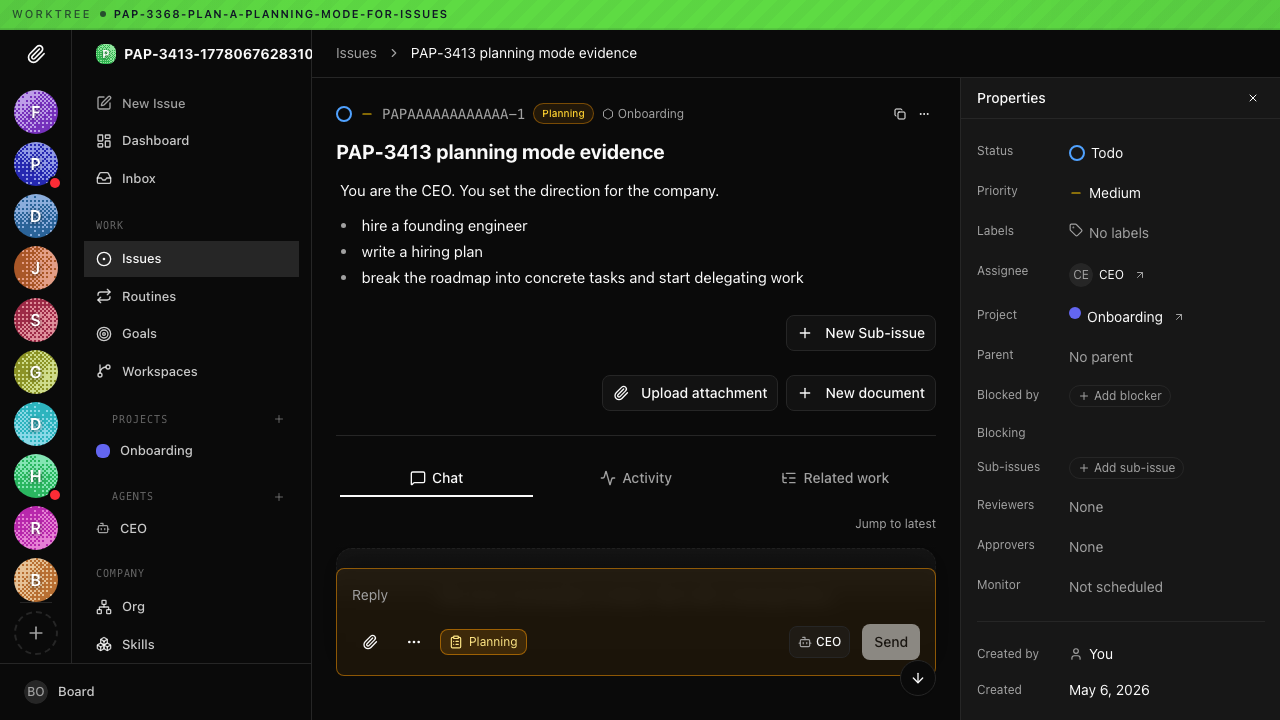 Desktop planning row: 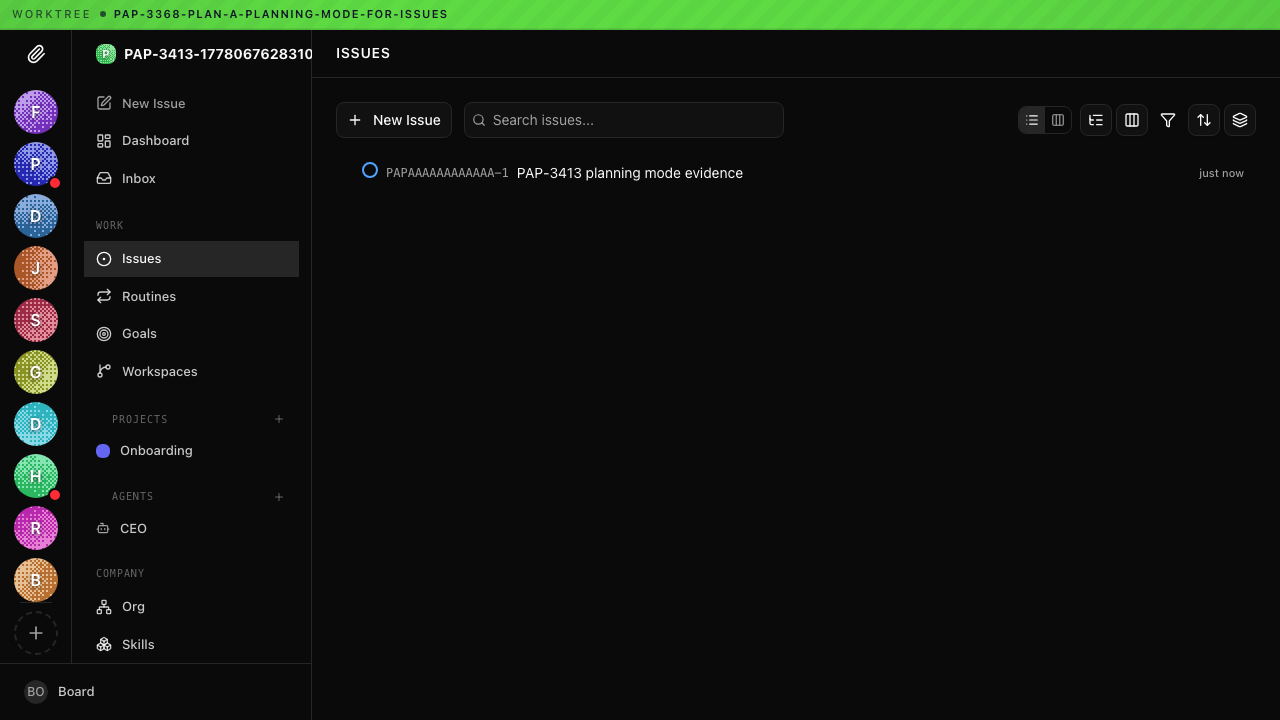 Desktop staged standard toggle: 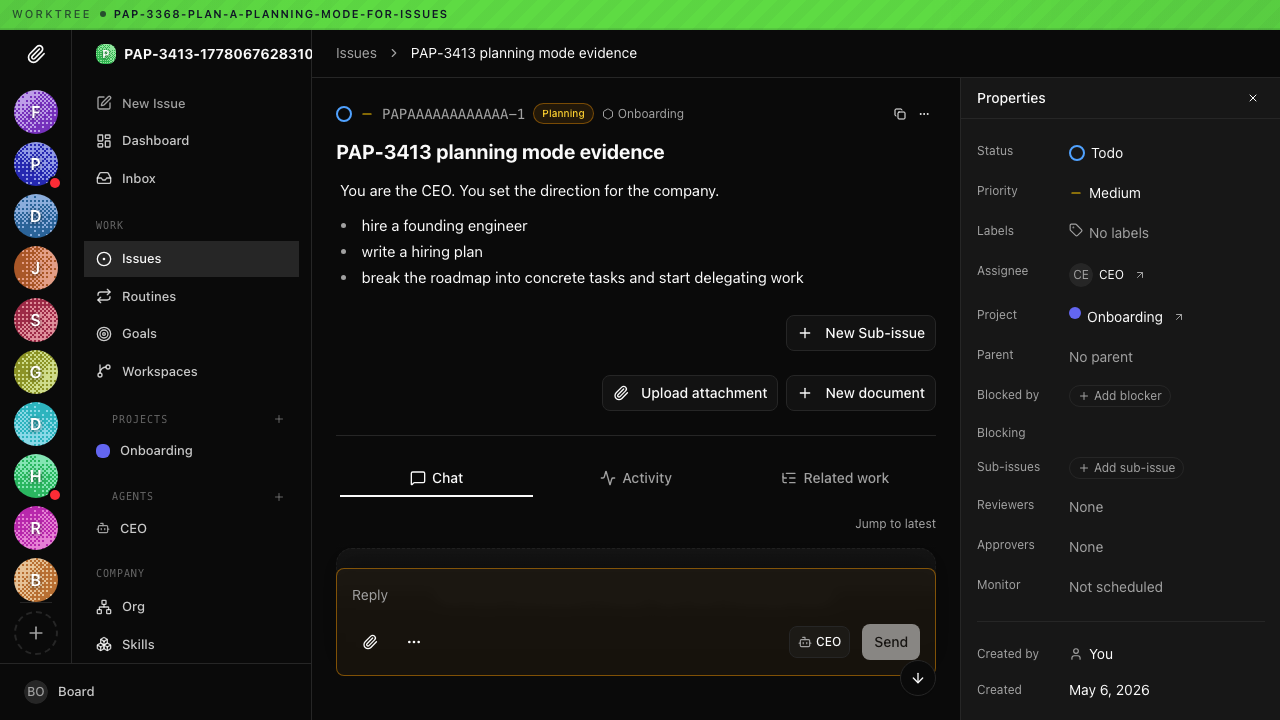 Mobile planning detail: 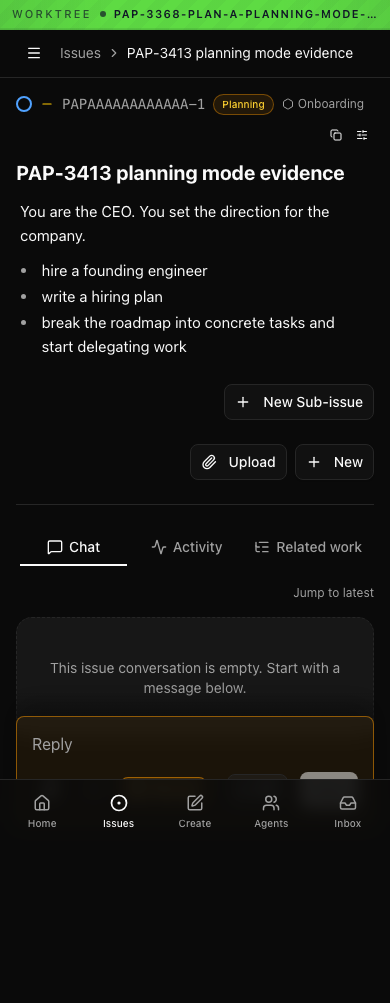 Mobile planning row: 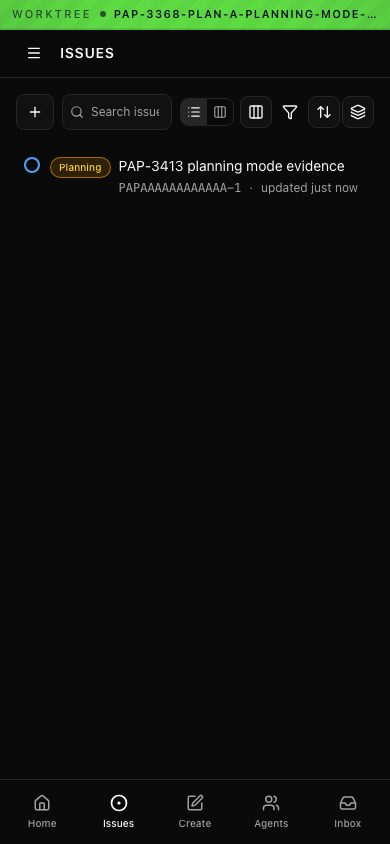 ## Risks - Medium migration risk: this adds a non-null issue column. The migration uses `ADD COLUMN IF NOT EXISTS` so installations that applied an older branch-local migration number can still apply the final numbered migration safely. - Medium contract risk: issue payloads, plugin payloads, and adapter heartbeat payloads now include work mode; compatibility is handled by defaulting missing values to `standard`. - UI risk is moderate because composer controls changed; focused component tests and visual e2e coverage exercise standard vs planning display and toggle behavior. > For core feature work, check [`ROADMAP.md`](ROADMAP.md) first and discuss it in `#dev` before opening the PR. Feature PRs that overlap with planned core work may need to be redirected — check the roadmap first. See `CONTRIBUTING.md`. ## Model Used - OpenAI Codex, GPT-5 coding agent in a local Paperclip worktree, with shell/tool use. Exact context-window size is not exposed in this runtime. ## Checklist - [x] I have included a thinking path that traces from project context to this change - [x] I have specified the model used (with version and capability details) - [x] I have checked ROADMAP.md and confirmed this PR does not duplicate planned core work - [x] I have run tests locally and they pass - [x] I have added or updated tests where applicable - [x] If this change affects the UI, I have included before/after screenshots - [x] I have updated relevant documentation to reflect my changes - [x] I have considered and documented any risks above - [x] I will address all Greptile and reviewer comments before requesting merge --------- Co-authored-by: Paperclip <noreply@paperclip.ing> |
||
|
Dotta
|
0cb42f49ea | Fix rebased issue detail prefetch typing | ||
|
Dotta
|
1729e41179 | Speed up issue-to-issue navigation |




