mirror of
https://github.com/paperclipai/paperclip.git
synced 2026-10-24 01:41:42 +02:00
be3196433dc0e45b19b6c5cd45bf54d6e37bc426
9
Commits
| Author | SHA1 | Message | Date | |
|---|---|---|---|---|
 DottaandPaperclip |
d432dc7fa3 |
Add GitHub-synced skill sources (#14713)
## Thinking Path > - Paperclip is the open source app people use to manage AI agents for work. > - Company skills supply instructions and files to those agents. > - GitHub imports already exist, but users cannot manage repositories as skill sources. > - Repository refresh also needs caller-authorized access and complete local packages. > - This pull request adds Sources inside Skills and reuses GitHub connections from Apps. > - Installed snapshots let agents use skills without fetching GitHub during a run. > - Manual refresh preserves skill identity and leaves failed imports on their last good version. ## Linked Issues or Issue Description **Subsystem affected** Cross-cutting: skills UI, server, database, shared contracts, and runtime materialization. **Problem or motivation** Users keep skills in GitHub repositories. They need a clear way to select, import, and refresh those skills. Existing imports do not expose repository management or consistently preserve supporting files. **Proposed solution** Add company-scoped skill sources. Browse repositories from all accessible GitHub connections, or paste a public repository or branch URL. Select whole skill packages, inspect included files and reference warnings, and install complete, immutable snapshots. Refresh each source manually. **Alternatives considered** Project repository settings hide the workflow from Skills. A second GitHub connector would duplicate credentials and grants. Upstream editing and PR creation are separate work. **Roadmap alignment** This implements the Skills Manager direction in ROADMAP.md. The maintainer requested this scope and reviewed the component and full-app journey stories before implementation. Related reports: Refs #10285, Refs #10949, Refs #13464. Related work: #14356, #13656, #9268. ## What Changed - Add source and entry records, an idempotent migration, company-scoped APIs, and legacy GitHub import adoption. - Reuse current caller grants and credential refresh. Combine and deduplicate repository inventories across accessible connections. Pasted public URLs also prefer the active user’s authorized connections. Tokens stay in the Git child environment, never argv or disk. - Fetch a shallow Git snapshot at one immutable commit. Scan the full local tree, including hidden and nested folders. Read Git objects without checkout or archive transformations and enforce nested package boundaries. - Bound Git downloads to 128 MiB and three minutes. Cancel active process groups and remove incomplete downloads. Preserve cancellation and deadlines while progress drains; close stalled HTTP progress streams after 30 seconds. Reuse caller-scoped temporary snapshots for preview/import after reauthorization. - Index repository package boundaries once and cap expanded work at 1,000 packages, 10,000 files, and 100 MiB, including repeated copies of shared blobs. Bound path depth and the shared path index. Discovery keeps audited manifests without retaining all package bodies. - Resolve moving branches before fetching so unchanged discovery reuses caller-scoped snapshots. Limit active scans, scan frequency, and new downloads per caller and company; quotas apply before metadata reads and across connections, and cached scans do not consume the download quota. - Store complete versions with script content, binary bytes, and executable modes. Preserve these through copies, runtime caches, and runner packaging. - Stage downloads before publication. Use source leases, revision checks, and transactional activity records. Keep installed versions after failures, upstream deletion, deselection, and disconnect. - Add the approved import flow, Sources page, selection tree, provenance, read-only Studio behavior, and saved return from GitHub setup. - Add package manifests, commit-pinned file previews, and separate runtime requirements and reference warnings. Supporting files are included together; nested skills remain independently selectable. Preview requests reauthorize the caller and re-audit package content. - Show installed skills as compact links beneath each source. Repository titles open GitHub. Keep Refresh, Select skills, and Disconnect source in a three-dot menu. Source rows omit the branch, imported count, and refresh timestamp; action alignment and repository titles work at narrow widths. - Stream discovery metadata over an opt-in NDJSON response. Show measured Git download progress and real package/file counts, animate newly checked skills, support cancellation, and require a complete scan before selection. Keep the existing JSON API. - Retain component stories and add a separate full-app journey story group. Include fixed progress states and interactive scan, large-repository, interruption, and saving stories. - Update Skills documentation and product contracts. Suppress private GitHub skill references in telemetry. Privacy review requested for the telemetry changes. ## Verification - Local repository typecheck, full build, token gates, and Storybook build passed during this work. Focused transport, authorization, scanner, persistence, route, and UI tests pass. The final UI refinement passes all eight focused UI tests, UI typecheck/build, and token gates. The scanner resource and repeated-discovery fixes pass 132 focused scanner, transport, authorization, source-service, route, and rate-limit tests, plus server typecheck/build. Full-suite verification comes from CI; the older full local Vitest run was stopped after unrelated chat failures and a font-test failure, all of which passed in fresh focused runs. At commit `1098d5996`, all 54 active checks pass; two optional Storybook jobs are skipped. CI covers repository typecheck, build, the full test suites, browser shards, and the canary dry run. Greptile is 5/5 with no open findings; the security scan also passes. - Adversarial scanner tests verify repeated-blob byte accounting with and without declared sizes, package/file/path caps, one-time repository indexing, metadata-only discovery audits, and nested package boundaries. Additional tests cover branch movement, snapshot reuse, caller/company quotas, isolation across connections, active-lease cleanup, quota recovery, and rejection before any metadata API call. - Real Git tests verify hidden paths, exact binary bytes, executable modes, export-ignore preservation, symlink/submodule reporting, pinned commits, caller-scoped cache reuse, cancellation, cleanup, and credential isolation. Regression tests hold both download slots with permanently blocked progress callbacks, verify timeout/cancellation cleanup and retry, and exercise HTTP backpressure cancellation. Access tests cover automatic public-URL connection selection and revoked grants. Database tests verify company and grant audiences. - Live isolated browser test: the public `anthropics/skills` scan now completes and discovers all 20 skills without connecting an account. Imported canvas-design with all 83 files, opened it from Sources, and verified the installed binary-font preview/download control. Package previews also expose the complete file inventory before import. Cancelled an active Git download and retried successfully to all 20 discovered skills; the browser displayed measured download progress. The current audits reject four other packages; eligible selections remain importable. - Browser checks verify the simplified source rows at desktop and narrow widths, keyboard navigation into the actions menu, Refresh from the menu, selection, and fixture disconnect with installed skills retained. Storybook includes a menu-open checkpoint and a 320px layout. - Storybook includes receiving/preparing download checkpoints and a timed full-app import journey, plus cancellation, retry, large-repository, and saving states. Streaming tests cover split UTF-8 frames, incomplete streams, late responses, cross-company requests, HTTP errors, and JSON compatibility. - Earlier live acceptance on this PR imported `stitch-skill` with `DESIGN.md`, assigned it to an agent, disconnected its source, and ran a successful Studio test that read both installed files. An editable copy changed independently. Both Skills variants, mobile selection, and return from GitHub setup were exercised. - Private access, revoked credentials, OAuth success return, binary/script preservation, concurrent refresh, transaction rollback, version pins, and legacy adoption have automated coverage. A real private-repository OAuth grant was not created during this test. ## Risks - The migration groups recognizable legacy imports without provider calls. Their first successful refresh completes the local package snapshot. - Reference checks are advisory. They cover Markdown links and explicit relative resource paths, not arbitrary runtime dependency graphs. Preview text is capped at 64 KiB; imported bytes remain complete. - Git must be installed on the server. Shallow fetches still download the branch snapshot, including files outside selected packages. Downloads have size/time/concurrency limits. Temporary caches are bounded and caller-scoped. GitHub API quota still applies to repository metadata and the connection picker; content no longer uses per-file API requests. Failed scans retain installed content. - Sources depend on the current caller's GitHub access. A saved connection does not grant access to another person's token. - GitHub script support and immediate manual refresh are explicit maintainer-approved requirements. The operator trusts the selected repository and accepts upstream script and executable-mode changes on refresh. Static audits are not a sandbox or a guarantee of safe code; agents may later invoke installed helpers under their runtime permissions. Import and refresh do not execute scripts, hooks, package installation, or builds. Raw URL and skills.sh imports keep their prior script restrictions. - Source originals remain read-only. Refresh affects subsequent unpinned runs; explicit pins and active runs retain their versions. - The telemetry change removes source-managed GitHub identifiers from skill-reference events. It introduces no event or field. Please review the privacy boundary. ## Model Used OpenAI Codex, based on GPT-6, with reasoning, code execution, and browser tools. The exact serving model ID and context-window size are not exposed in this session. ## Checklist - [x] I have included a thinking path that traces from project context to this change - [x] I have specified the model used (with version and capability details) - [x] I have checked ROADMAP.md and confirmed this PR does not duplicate planned core work - [x] I have searched GitHub for duplicate or related PRs and linked them above - [x] I have either (a) linked existing issues with `Fixes: #` / `Closes #` / `Refs #` OR (b) described the issue in-PR following the relevant issue template - [x] I have not referenced internal/instance-local Paperclip issues or links (only public GitHub `#NNN` / `github.com/paperclipai/paperclip` URLs) - [x] My branch name describes the change (e.g. `docs/...`, `fix/...`) and contains no internal Paperclip ticket id or instance-derived details - [x] I have run tests locally and they pass - [x] I have added or updated tests where applicable - [x] I have updated relevant documentation to reflect my changes - [x] I have considered and documented any risks above - [x] All Paperclip CI gates are green - [x] Greptile is 5/5 with no open P2s, recommendations, or follow-ups - [x] I will address all Greptile and reviewer comments before requesting merge --------- Co-authored-by: Paperclip <noreply@paperclip.ing> |
||
|
DottaandPaperclip
|
3c561642b4 |
fix(chat): resolve approvals and preserve unanswered questions (#14613)
## Thinking Path > - Paperclip is the open source app people use to manage AI agents for work. > - Agents ask for decisions and optional details through cards in chat. > - A clear approval in a message can leave the matching card pending. > - An unanswered question can also block an unrelated later reply. > - Decisions need a saved source message, while optional questions need to remain answerable in history. > - This pull request records conversational decisions and lets users move on from questions and answer them later. ## Linked Issues or Issue Description **What happened?** Native Claude and Codex could act on approval in chat while the original approval card stayed pending. Pending question forms stayed above the composer, were absent from history, and could suppress later chat replies. A late native question answer could wait for a finished run to reconnect. **Expected behavior** The active agent records a clear approval or refusal against the exact card and user message. Ambiguous replies do not grant consent. Users can send another message without answering a question. The question remains pending in history and can be reopened and answered later. The saved answer reaches the agent. **Steps to reproduce** 1. Ask an agent to propose work with a confirmation card, then approve it in chat. 2. Check that the original card records that approval before work starts. 3. Ask an interactive question, send an unrelated message, and reload. 4. Open the unanswered question from history and submit an answer. Related work: #14408 added completion delivery. #14607 tests completion reporting turns. Neither records conversational answers on approval cards. ## What Changed - Add a confirmation endpoint backed by a user comment, with schema validation, OpenAPI discovery, and native Plan-mode access. Ask mode remains read-only. - Check company, active run, actor, current session, message provenance, revision, and resolver policy. Save the decision and audit in one transaction. Retries do not repeat effects. Emit resolution telemetry after commit. - Give fresh and resumed chat turns the actual pending confirmation identities. Teach agents to save clear conversational decisions before acting and to clarify ambiguity. - Keep unanswered Agent Chat questions as compact history entries. A newer user message closes the old form. Question cards never contribute to composer pending counts or navigation, including after dismissing a fresh form. The history card is the sole reminder; clicking it restores that exact form and draft. - Preserve Agent Chat questions when later messages or questions arrive. Historical ordinary inputs no longer gate later chat replies. Current-run requests, task execution, and governed approvals keep their gates. Remove the special acknowledgement-publication proof helpers that this rule replaces. - Route answers to finished native runs through durable fresh-wake delivery, with existing idempotency and source-question context. Settle late replies against contiguous completed conversation turns and freeze their history replay; failed, unhandled, and newly arriving messages remain actionable. - Add real-component Storybook scenarios, database and UI regressions, and a three-turn native Claude/Codex E2E case. Capture distinct, UI-ready screenshots and report the individual assertions. ## Verification - Focused decision/publication/UI regressions after merging master: 288 passed; subsequent UI draft, failed-send, and conversation checks: 199 passed. - Native question and durable delivery regressions: 106 passed, including all four terminal run states and exactly-once late delivery. Seven targeted regressions fail against the original implementation and pass with the fix. - Latest conversation/decision/native-delivery regressions after the master merge: 121 passed. Covers completed progress, missing or failed intervening turns, new messages during a late reply, stale sessions, and frozen retry/replay boundaries. Four new assertions fail before the ordering fix. - E2E support suite after the master merge: 792 passed. Negative controls reject expired cards, wrong questions/answers, stale or missing replies, unrelated clarification forms, and unexpected tasks. - The embedded-browser walkthrough caught one additional defect: dismissing a fresh question still showed a composer badge. Both Cancel and close-button regressions failed before the fix. The fix at `65f2ade12` passes 170 chat-thread tests and 792 E2E support tests. After merging master, 232 chat-thread/confirmation tests, server/UI typechecks, and token gates pass. The preview and two-provider live E2E pass at `e5512a206`; Greptile is 5/5 with zero unresolved threads at that commit. All 55 checks are now successful at `e5512a206` (four conditional checks skipped), including the aggregate verification gate and clean-install canary test. The first attempt was interrupted by simultaneous CI worker shutdowns; one failed-job rerun passed without code changes. - [Published Storybook](https://d1p6rlowie26tp.cloudfront.net/storybook/branches/codex~2Fchat-approval-resolution/?path=/story/chat-comments-agent-chat-unanswered-questions--moved-on): nine real-component scenarios. Manually exercised move on, reopen, preserve draft, answer later, answer one of multiple questions, and a custom mobile answer in the embedded browser. Retested fresh Cancel and close-button dismissal in the updated build, then reopened and submitted the preserved Green selection and inspected its answered receipt. Static preview has no live model/backend; its callbacks are fixture responses. - [First live campaign](https://d1p6rlowie26tp.cloudfront.net/runner-e2e/campaigns/gha-36714504406-1/) reproduced the late-answer completion-state defect on both providers despite correct saved answers and acknowledgements. It also exposed a valid imperative clarification rejected by the old oracle. Both issues are fixed with regression controls; this failing run is retained as evidence. - [Four-cell qualification](https://d1p6rlowie26tp.cloudfront.net/runner-e2e/campaigns/gha-36717804064-1/) passed 4/4 at `2bf8a1009`: unanswered-question return and ambiguous confirmation, each on native Claude and Codex. Inspected saved state, source-message decisions, visible cards, and agent replies. Both late-answer chats settled to waiting; no unrequested tasks were created. [Final branch rerun](https://d1p6rlowie26tp.cloudfront.net/runner-e2e/campaigns/gha-36719666238-1/) passed 2/2 at `142630720`: the same unanswered-question journey after merging master, plus an additional screenshot and browser assertion for the actual late-answer acknowledgement. - [Composer-reminder E2E](https://d1p6rlowie26tp.cloudfront.net/runner-e2e/campaigns/gha-36727006818-1/) passed 2/2 at `5b62c52d9`: native Claude and Codex, three turns each, with explicit no-badge assertions before and after reload. Inspected saved pending/answered state, both screenshots with a clear composer, and actual Blue acknowledgements; all five behavioral matchers passed per provider and neither created tasks. Cost coverage is partial; this is bounded workflow qualification. - [Fresh-dismissal E2E](https://d1p6rlowie26tp.cloudfront.net/runner-e2e/campaigns/gha-36742773318-1/) passed 2/2 at `e5512a206`: native Claude and Codex, including fresh Cancel, clear composer, reopen, unrelated message, reload, late Blue answer, and actual agent acknowledgement. All five behavioral matchers pass per provider. Inspected the fresh-dismissal screenshots and saved pending/answered identity; neither created tasks. Cost coverage is partial (4/6 runs). - Prior evidence remains available in [the earlier campaign](https://d1p6rlowie26tp.cloudfront.net/runner-e2e/campaigns/gha-36642252725-1/). Its early loading screenshot and overwritten final capture prompted the UI-ready, distinct screenshot fixes. ## Risks - The model interprets intent. The server verifies permission and provenance; it does not infer consent from text. Ambiguous and unrelated replies are not approvals. - Historical questions can accumulate. They remain visible, pending, and answerable; no automatic answer or expiry is invented. - The change to completion gates is scoped to Agent Chat and ordinary historical inputs. Current-turn and governed approvals retain their existing controls. - Live qualification is limited to the selected stories. Broader native onboarding finalization remains separate work. - No database migration. Telemetry adds no fields or values; the contract and README document the commit boundary. Privacy review was requested on the PR. ## Model Used OpenAI Codex, GPT-6 family, with reasoning, repository tools, code execution, and browser-test orchestration. The exact model ID and context-window size are not exposed to this session. ## Checklist - [x] I have included a thinking path that traces from project context to this change - [x] I have specified the model used (with version and capability details) - [x] I have checked ROADMAP.md and confirmed this PR does not duplicate planned core work - [x] I have searched GitHub for duplicate or related PRs and linked them above - [x] I have either (a) linked existing issues with `Fixes: #` / `Closes #` / `Refs #` OR (b) described the issue in-PR following the relevant issue template - [x] I have not referenced internal/instance-local Paperclip issues or links (only public GitHub `#NNN` / `github.com/paperclipai/paperclip` URLs) - [x] My branch name describes the change (e.g. `docs/...`, `fix/...`) and contains no internal Paperclip ticket id or instance-derived details - [x] I have run tests locally and they pass - [x] I have added or updated tests where applicable - [x] I have updated relevant documentation to reflect my changes - [x] I have considered and documented any risks above - [x] All Paperclip CI gates are green - [x] Greptile is 5/5 with no open P2s, recommendations, or follow-ups - [x] I will address all Greptile and reviewer comments before requesting merge --------- Co-authored-by: Paperclip <noreply@paperclip.ing> |
||
|
Nicky LeachandPaperclip
|
184b014c25 |
feat(telemetry): add the agent.task_run event and emit it at every terminal run transition (#12809)
## Thinking Path > - Paperclip is the open source app people use to manage AI agents for work > - Paperclip records agent run outcomes through telemetry and run lifecycle services > - Terminal run transitions need one consistent event for outcome analysis > - The current paths do not report every terminal transition through one event > - This pull request adds the agent.task_run event and emits it at each terminal transition > - The benefit is complete run outcome data without exposing raw task identifiers ## Linked Issues or Issue Description **What existing behavior does this improve?** Paperclip telemetry reports agent activity, but it does not report every terminal task run through one event. **Subsystem affected** Cross-cutting (multiple of the above): packages/shared telemetry and server run lifecycle services. **Current behavior** Several run paths write a terminal status without a matching agent.task_run telemetry event. **Proposed behavior** Each terminal run transition emits one agent.task_run event. The event records the terminal state and uses the existing pseudonym helper for the optional task identifier. **Reason and benefit** Complete terminal-run data helps operators measure agent outcomes. The pseudonym helper prevents the raw task identifier from leaving the installation. **Breaking changes** None. The change adds an event and keeps existing event behavior compatible. ## What Changed - Add the agent.task_run telemetry contract and client helper. - Reuse the existing pseudonym helper for the task identifier. The helper hashes the identifier with a per-installation salt and returns 16 hexadecimal characters. The raw identifier never leaves the installation. Existing identifiers do not move. - Emit one event from each legacy, native, recovery, and issue terminal transition. - Keep emissions outside database transactions and make delivery best-effort. - Add regression tests for event shape, hashing, terminal transitions, and emission failures. - Document the event and its privacy rule in the telemetry data contract. ## Verification - `npx tsc --noEmit` in `server/` passes at the submitted commit. - The pull-request CI suite must pass. CI is the authority because local Vitest has a known dependency artifact. - The added regression tests cover event output shape, per-installation hash divergence, raw identifier handoff, omitted identifiers, and non-throwing emits. ## Risks - A missed terminal path could reduce event coverage. - Telemetry delivery remains best-effort and cannot change run finalization. - The pseudonym helper uses installation-specific state, so identifiers differ between installations. ## Model Used OpenAI Codex, GPT-5, tool use and code execution. Context window details were not provided. ## Checklist - [x] I have included a thinking path that traces from project context to this change - [x] I have specified the model used (with version and capability details) - [x] I have checked ROADMAP.md and confirmed this PR does not duplicate planned core work - [x] I have searched GitHub for duplicate or related PRs and linked them above - [x] I have either (a) linked existing issues with `Fixes: #` / `Closes: #` / `Refs #` OR (b) described the issue in-PR following the relevant issue template - [x] I have not referenced internal/instance-local Paperclip issues or links (only public GitHub `#NNN` / `github.com/paperclipai/paperclip` URLs) - [x] My branch name describes the change (e.g. `docs/...`, `fix/...`) and contains no internal Paperclip ticket id or instance-derived details - [x] I have run tests locally and they pass - [x] I have added or updated tests where applicable - [x] I have updated relevant documentation to reflect my changes - [x] I have considered and documented any risks above - [x] All Paperclip CI gates are green - [x] Greptile is 5/5 with no open P2s, recommendations, or follow-ups - [x] I have addressed all Greptile and reviewer comments before requesting merge --------- Co-authored-by: Paperclip <noreply@paperclip.ing> |
||
|
DottaandDev Agent
|
25cf079ec5 |
feat(runner): add Codex-native application integration (#12591)
## Thinking Path > - Paperclip is the open source app people use to manage AI agents for work. > - The runner package is useful only when the application can start, observe, and recover a native Codex run safely. > - Existing direct adapters must keep their current execution and finalization paths. > - The application boundary therefore needs additive persistence, authorization, coordination, and recovery behind an explicit experimental adapter. > - This pull request adds that Codex-only boundary without activating generalized providers, remote environments, or the later task/SDK surfaces. ## Linked Issues or Issue Description **Subsystem affected** Shared contracts, database persistence, adapter utilities, server native-runtime services, and the experimental Paperclip Runner adapter. **Problem or motivation** The already-landed runner package has a qualified Codex path, but the application needs durable native-run state, guarded runtime selection, authenticated coordination, tool security, finalization, and recovery before the experimental adapter can be exercised safely. **Proposed solution** Add a Codex-only `paperclip_runner` application path behind the existing default-off native-runner setting. Bind native state and coordination to company/run identity, preserve persisted-run recovery, and leave every direct adapter on its existing legacy execution path. **Alternatives considered** The earlier stack boundary introduced a generalized executor and remote-environment lifecycle here. That made this PR depend on implementations in higher PRs and changed reusable sandbox behavior globally. Those pieces are now deferred together to #12592. **Roadmap alignment** ROADMAP.md does not list a conflicting native-runner integration project. This change adds the application boundary for the existing Runner architecture. ## What Changed - Added native run/result/finalization/provider-trace persistence, shared validators, and idempotent migration/replay coverage. - Added guarded Codex-only runtime selection, authenticated PRP coordination, recovery, finalization, and interaction services. - Added run/company-bound tool-gateway authorization, credential redaction, SSRF protections, and replay-safe behavior. - Added the explicit `paperclip_runner` adapter behind the default-off rollout setting. - Preserved legacy answered-question wake projection and direct-adapter execution/finalization paths. - Hardened cancellation so only owned in-memory child processes are signaled; persisted recycled PIDs/process groups are never trusted. - Retained the narrow Claude ACPX isolated-context security follow-up discovered after #12590. - Deferred the generalized executor, provider ingress, remote lifecycle, SDK/lab/eval work, release-process changes, and lockfile. ## Verification - Changed-file delta against `master`: 133 files. - GitHub Actions is the authoritative verification environment for this PR. - Full CI, security, and Greptile review will run on this lowest unmerged stack PR. - Local tests/build/typecheck were not run because this checkout is resource constrained. - Static diff/reference checks pass, and `pnpm-lock.yaml` is unchanged. ## Risks - This touches central heartbeat and agent-route code, so legacy compatibility is the primary risk. - Runtime selection remains Codex-only and explicit; direct Codex, Claude, OpenCode, process, HTTP, and plugin adapters remain on their existing paths. - Fresh native starts fail closed while the rollout flag is off; persisted native records remain readable and recoverable. - Cancellation, company/run binding, tool calls, status decisions, and completion writes are guarded or replay-safe. > For core feature work, check [ROADMAP.md](ROADMAP.md) first and discuss it in #dev before opening the PR. Feature PRs that overlap with planned core work may need to be redirected. ## Model Used OpenAI Codex, GPT-5.6, with repository tools, code execution, and parallel agent review. ## Checklist - [x] I have included a thinking path that traces from project context to this change - [x] I have specified the model used (with version and capability details) - [x] I have checked ROADMAP.md and confirmed this PR does not duplicate planned core work - [x] I have searched GitHub for duplicate or related PRs and linked them above - [x] I have either linked existing issues or described the issue in-PR following the relevant issue template - [x] I have not referenced internal or instance-local Paperclip issues or links - [x] My branch name describes the change and contains no internal Paperclip ticket id - [ ] I have run tests locally and they pass — GitHub Actions is authoritative for this resource-constrained checkout - [x] I have added or updated tests where applicable - [x] I have updated relevant documentation to reflect my changes - [x] I have considered and documented risks above - [ ] All Paperclip CI and security gates are green - [ ] Greptile is 5/5 with no open actionable findings - [x] I will address all Greptile and reviewer comments before merge ## Stack - Position: 3 of 5 overall; lowest of 3 currently unmerged - Base: `master` - Previous: [#12590](https://github.com/paperclipai/paperclip/pull/12590), qualified Claude ACPX runtime — merged - Next: [#12592](https://github.com/paperclipai/paperclip/pull/12592), generalized Codex executor, task experience, and developer SDKs --------- Co-authored-by: Dev Agent <dev@paperclip.ing> |
||
|
|
233c12f029 |
feat: add kimi-local adapter for Kimi Code CLI (CLI + ACP engines) (#9967)
## Thinking Path > - Paperclip is the open source app people use to manage AI agents for work > - Local agent adapters (`claude_local`, `gemini_local`, `grok_local`, …) are the integration surface that lets Paperclip run coding CLIs on the host machine > - The Kimi Code CLI (`kimi`, Moonshot AI) has a documented non-interactive mode, `kimi -p --output-format stream-json` with session resume via `kimi -r`, but Paperclip has no built-in adapter for it > - So Kimi users (especially Kimi membership / OAuth subscribers) cannot onboard their CLI to Paperclip agent teams > - This pull request adds a complete built-in `kimi_local` adapter (both execution engines, session management, instructions + skills delivery, thinking-effort control, environment test, UI and CLI modules, docs) following the established `gemini_local`/`grok_local` package pattern > - Kimi Code ships an ACP server (`kimi acp`), so the adapter runs on Paperclip's shared acpx engine by default (streaming transcript with live tool status, like `claude_local`/`gemini_local`) and falls back to a headless CLI lane (`kimi -p --output-format stream-json`) when ACP prerequisites are unavailable > - The benefit is that Kimi Code becomes a first-class Paperclip agent lane: selectable in the UI, resumable across heartbeats, with the same operating context (instruction bundle, skills, effort) and streaming transcript the other local adapters get ## Linked Issues or Issue Description - Supersedes #9880 (same branch; expanded from the CLI-only lane into a complete adapter with the default ACP engine lane, control-plane skill install, and live transcript wiring) - Refs #9879 (adapter request for Kimi Code CLI, filed with this PR) - Refs #163 (original Kimi support request) Duplicate/related prior PRs, per the dedup search (both appear stale: no updates or maintainer review since May 2026, and both target an older Kimi CLI interface; calling them out for reviewer context per CONTRIBUTING.md): - Refs #6276 (`feat: add kimi-local adapter`): targets an older array-based content format (`{type: think}`/`{type: text}` blocks), not the current documented stream-json schema - Refs #5202 (`feat(adapter): add Kimi CLI local adapter with Wire protocol support`): builds on a `--wire` JSON-RPC interface that current Kimi Code CLI (0.27.0) no longer documents; the current documented headless interface is `-p --output-format stream-json` This PR is a fresh implementation against current master and the currently documented/verified Kimi CLI behavior (see Verification). Happy to fold in anything useful from the earlier attempts if a reviewer prefers. ## What Changed - **New adapter package** `packages/adapters/kimi-local` (`@paperclipai/adapter-kimi-local`), modeled on `gemini-local`/`grok-local`: - `src/server/execute.ts`: spawns `kimi -p <prompt> --output-format stream-json` (argv array, no shell), `-m <model>` only when configured, `-r <sessionId>` when the stored session cwd matches the run cwd, automatic fresh-session retry on unrecoverable-session errors, headless-safe env (`CI=1`, `NO_COLOR=1`, `KIMI_CODE_NO_AUTO_UPDATE=1`, `TERM=dumb`; user-configured values win), full remote (ssh/sandbox) execution lane with runtime install via `@moonshot-ai/kimi-code` - **Instruction bundle delivery**: the prompt path directive now names the sibling instruction files (`./HEARTBEAT.md`, `./SOUL.md`, `./TOOLS.md`) alongside the prepended entry file, and local runs pass `--add-dir <instructions-dir>` so Kimi can actually open them (matching `claude_local`). Without this, only the entry file reached Kimi and agents improvised the operating workflow that `HEARTBEAT.md` documents - **Thinking effort**: a configured `effort` is forwarded as the `KIMI_MODEL_THINKING_EFFORT` operational override (Kimi has no per-invocation effort flag). It is only sent for models that advertise `support_efforts` (currently `kimi-code/k3`) to avoid provider rejections, and `medium` maps to `high` since Kimi has no medium tier (`low`/`high`/`max` pass through) - **Skills delivery**: desired Paperclip skills are delivered via Kimi's `--skills-dir` flag from a dedicated per-run directory (a local snapshot, or the synced snapshot on remote targets), so skills load reliably and in isolation. Paperclip never overwrites the shared `$KIMI_CODE_HOME/skills` home, so skills installed by the operator or other agents are left intact. `--skills-dir` is only passed when at least one skill is desired, so unconfigured agents keep Kimi's default skill discovery - **Live run status**: the adapter now forwards each streamed stream-json line to `onEvent` (assistant `content` as an assistant snippet, `tool_calls` as tool-name events), which drives the issue-thread activity indicator (`currentToolName` / `lastAssistantSnippet` / `lastEventAt`). Previously the adapter only wrote the raw run log, so the issue thread showed a stale "no output for N s" line with no tool or reasoning context while Kimi worked. Tool results are omitted so the last meaningful "Using X" / snippet is not overwritten by a generic label - `src/server/parse.ts`: parses the verified Kimi stream-json event shapes (`assistant` text, `assistant.tool_calls` with JSON-string arguments, `tool` results, trailing `meta.session.resume_hint` for session-id capture) plus failure classifiers (`kimi_auth_required`, transient network, unrecoverable session). A signaled exit (null exit code, not a timeout) is now reported as a failure rather than coalesced to success, and the error message names the terminating signal - `src/server/skills.ts`: lists/syncs Paperclip skills for the adapter's skill-management surface - `src/server/test.ts`: environment test covering CLI resolution + `kimi --version`, cwd check, auth detection (OAuth credential dirs, keyed `[providers.*]` in config.toml, or the `KIMI_MODEL_NAME` + `KIMI_MODEL_API_KEY` env pair), and a live hello probe - `src/ui/` (stdout-line parser for transcripts, config builder) and `src/cli/` (stream event formatter) modules - Root metadata: three managed model aliases (`kimi-code/kimi-for-coding`, `kimi-code/kimi-for-coding-highspeed`, `kimi-code/k3`), effort-capable-model metadata (`EFFORT_CAPABLE_MODELS`, effort mapping helpers), `agentConfigurationDoc` - Tests: 101 tests across parse, execute (args building, resume gating, retry, auth error code, timeout, signaled-exit failure, effort forwarding/gating/mapping, `--add-dir` instructions directive, `--skills-dir` gating, `onEvent` runtime-event forwarding), ACP engine (engine resolution, acpx config build, node-version gate), ACP transcript delegation, environment test, UI parse/build-config - **ACP engine lane (default)** (`src/server/acp.ts` + shared `adapter-utils/acpx-engine`): Kimi Code ships an ACP server (`kimi acp`), so `kimi_local` now runs on Paperclip's shared acpx engine by default, matching `claude_local`/`codex_local`/`gemini_local`. The issue-thread transcript streams live (assistant text deltas, tool calls with a `pending`->`completed` status lifecycle) instead of the CLI lane's bursty complete-message output. Registered `kimi_local -> "kimi"` in `ACPX_ADAPTER_AGENT_IDS` and resolved the built-in agent command to `kimi acp`; `execute.ts` dispatches to the ACP executor first with an automatic CLI fallback when ACP prerequisites fail (`engine=acp` requires ACP, `engine=cli` pins the headless lane); `index.ts` falls back to the shared acpx session codec; the UI/CLI delegate `acpx.*` events to the shared acpx transcript parser and event formatter. The headless CLI lane (above) remains as the fallback - **Registration** (one entry each, mirroring existing adapters): server adapter registry + `BUILTIN_ADAPTER_TYPES`, `AGENT_ADAPTER_TYPES` (shared), UI adapter registry + display registry (`Kimi Code`, Moon icon) + capabilities defaults, CLI adapter registry, `Dockerfile` (package copy + `npm install --global @moonshot-ai/kimi-code@latest`), `vitest.config.ts` workspace, `scripts/release-package-manifest.json` - **Behavioral sets** mirroring `gemini_local` (Kimi resumes sessions the same way): `GIT_SENSITIVE_LOCAL_ADAPTER_TYPES`, `SESSIONED_LOCAL_ADAPTERS` (heartbeat + recovery), `REMOTE_MANAGED_ADAPTERS`, ssh/sandbox execution-target allow-lists, `ADAPTER_DEFAULT_RULES_BY_TYPE` (`timeoutSec: 0`, `graceSec: 15`), and `LEGACY_SESSIONED_ADAPTER_TYPES` + `ADAPTER_SESSION_MANAGEMENT` in adapter-utils - **UI touch-points**: New Agent default-model branch, AgentConfigForm command map (`kimi_local: "kimi"`) + model defaults + a Kimi-specific thinking-effort option list (`Low`/`High`/`Max`, reflecting Kimi's tiers rather than borrowing Claude's), OnboardingWizard (command map, model default, `kimi login` / `KIMI_MODEL_NAME + KIMI_MODEL_API_KEY` auth hints, manual-debug command line), InviteLanding enabled adapters - **Control-plane skill install** (`cli/src/commands/client/agent.ts`): `paperclipai agent local-cli` seeded the Paperclip control-plane skills into `~/.codex/skills` and `~/.claude/skills` so Codex/Claude agents auto-discover the API reference every run. Kimi had no equivalent target, so `kimi_local` agents began each session without the control-plane skill and rediscovered routes (e.g. the company-scoped `POST /api/companies/{companyId}/issues`) by trial and error. Added `~/.kimi-code/skills` (honoring `KIMI_CODE_HOME`) as a third install target for parity. Independent of the per-run `--skills-dir` delivery, which only applies to explicitly configured skills. - **Docs**: `docs/adapters/kimi-local.md` (prerequisites, auth options, config fields including `effort`, session resume, instruction bundle, skills delivery, control-plane skill install) + a row in `docs/adapters/overview.md` Out of scope (deliberately): model profiles, built-in agent `allowedAdapterTypes` additions. ## Verification\n\nCurrent-master rebase verification (OpenAI Codex, 2026-08-03): 13 focused files / 231 tests pass; adapter-utils, server, UI, CLI, and Kimi adapter typechecks pass; full repository build and UI token gates pass. The branch is conflict-free against master at head `1249df117c5e12e5771b9a570a6340866450619e`.\n\nAutomated (all from repo root, pnpm 9.15.4, Node 22): - `vitest run packages/adapters/kimi-local`: 89/89 pass (includes coverage for the instruction `--add-dir` directive, effort forwarding/gating/mapping, `--skills-dir` gating, the signaled-exit failure path, and `onEvent` runtime-event forwarding with cross-chunk line buffering) - `vitest run server/src/__tests__/adapter-registry.test.ts server/src/__tests__/adapter-routes.test.ts server/src/services/heartbeat-stop-metadata.test.ts ui/src/adapters/adapter-display-registry.test.ts`: 37/37 pass - `vitest run cli/src/__tests__/skills.test.ts`: 13/13 pass (the control-plane skill install target follows the existing Codex/Claude install path, whose symlink logic is unchanged) - `vitest run packages/shared`: 307/307 pass; `vitest run packages/adapter-utils`: pass except one pre-existing, unrelated failure (`mcp-isolation.integration.test.ts` requires Claude CLI ≥ 2.1.207; host has 2.1.185, fails identically on unmodified master) - `pnpm --filter @paperclipai/adapter-kimi-local typecheck|build`, plus typecheck of `server`, `ui`, `cli`, `adapter-utils`: all clean - `pnpm install --frozen-lockfile`: passes (the PR diff itself contains no lockfile changes, per repo policy; verified against a locally regenerated lockfile) - `node scripts/check-no-git-push.mjs` and `node scripts/check-forbidden-tokens.mjs`: pass - CI note: the `policy` job's release-bootstrap step is expected to stay red until a maintainer bootstraps the first npm publish of `@paperclipai/adapter-kimi-local`; see the CI Note for Maintainers comment. All other contributor-actionable checks are green. Manual end-to-end (real Kimi CLI 0.27.0, OAuth login, dev server on an isolated instance): 1. Server `GET /api/adapters` lists `kimi_local` as builtin with correct capability flags; models endpoint returns the three Kimi models 2. `POST .../adapters/kimi_local/test-environment`: all checks pass, including a live `kimi -p` hello probe 3. Created a `kimi_local` agent and invoked two heartbeats: run 1 spawned `kimi -p ... --output-format stream-json`, Kimi used its `Read` tool, produced the expected answer, and the session id was captured from the `session.resume_hint` meta event; run 2 resumed the **same** Kimi session (`sessionIdBefore == sessionIdAfter`) via `-r` 4. UI: adapter appears in the New Agent dropdown; selecting it shows the Kimi command placeholder, the three models, and the Kimi config fields; the run transcript renders Kimi tool calls via the adapter's stdout parser The instruction-bundle, thinking-effort, and `--skills-dir` changes landed after the manual run above. They are covered by the unit tests listed under Automated, and the Kimi CLI flags they rely on (`--add-dir`, `--skills-dir`, `KIMI_MODEL_THINKING_EFFORT`) were confirmed against the installed Kimi Code CLI 0.27.0 (`kimi --help`, config-file thinking-effort docs). Screenshots (assets branch on the fork, not part of the diff): 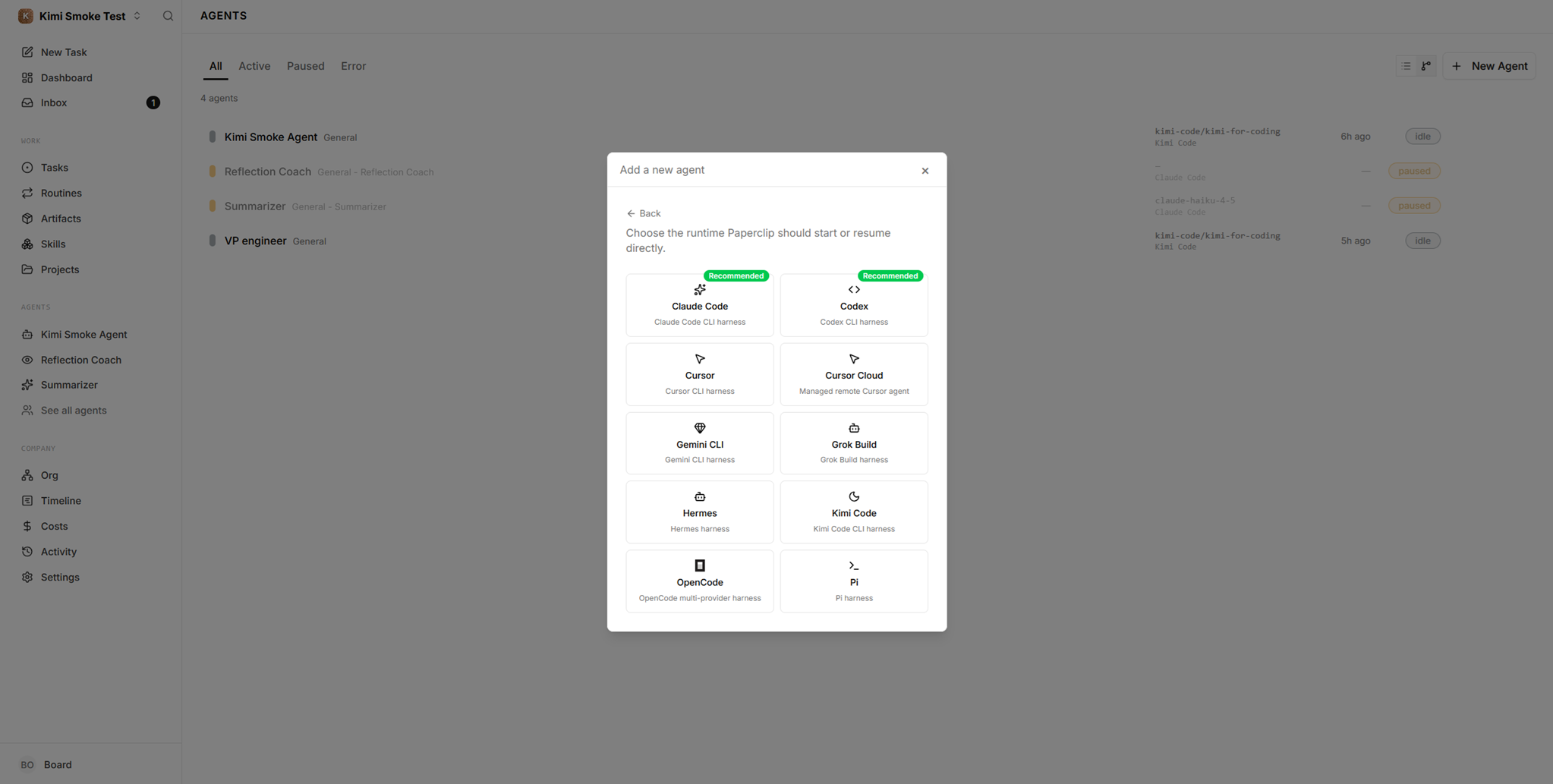 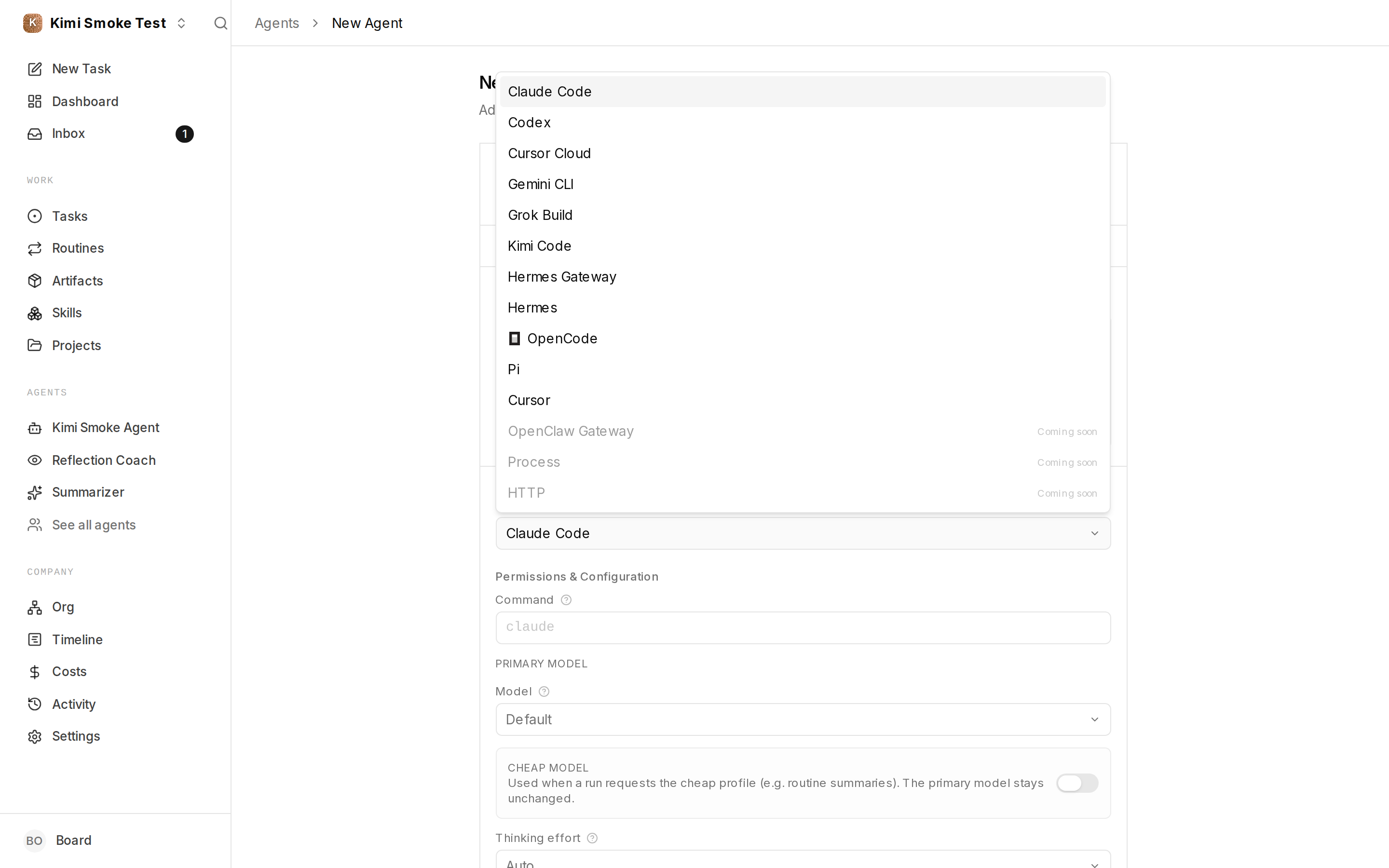 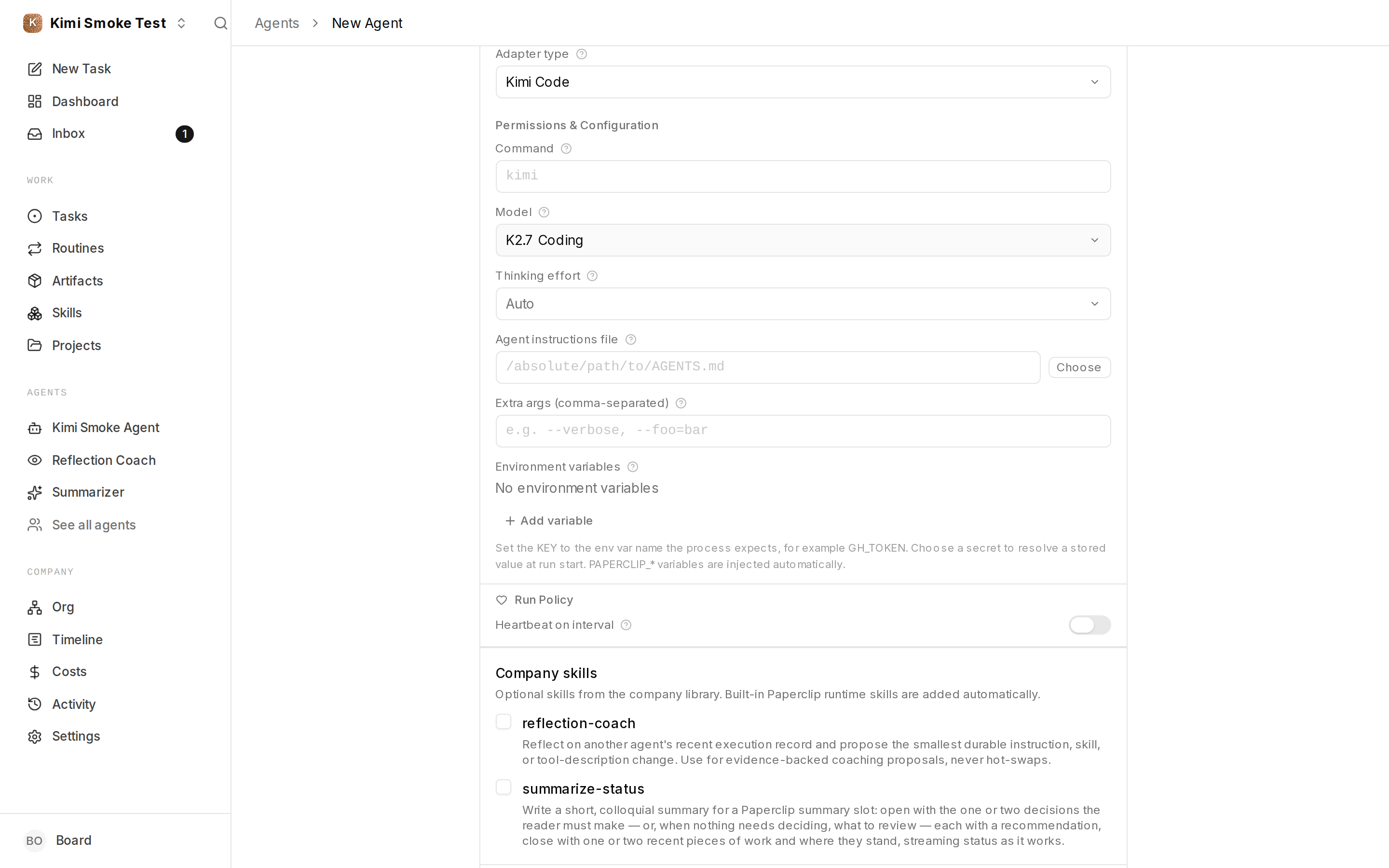 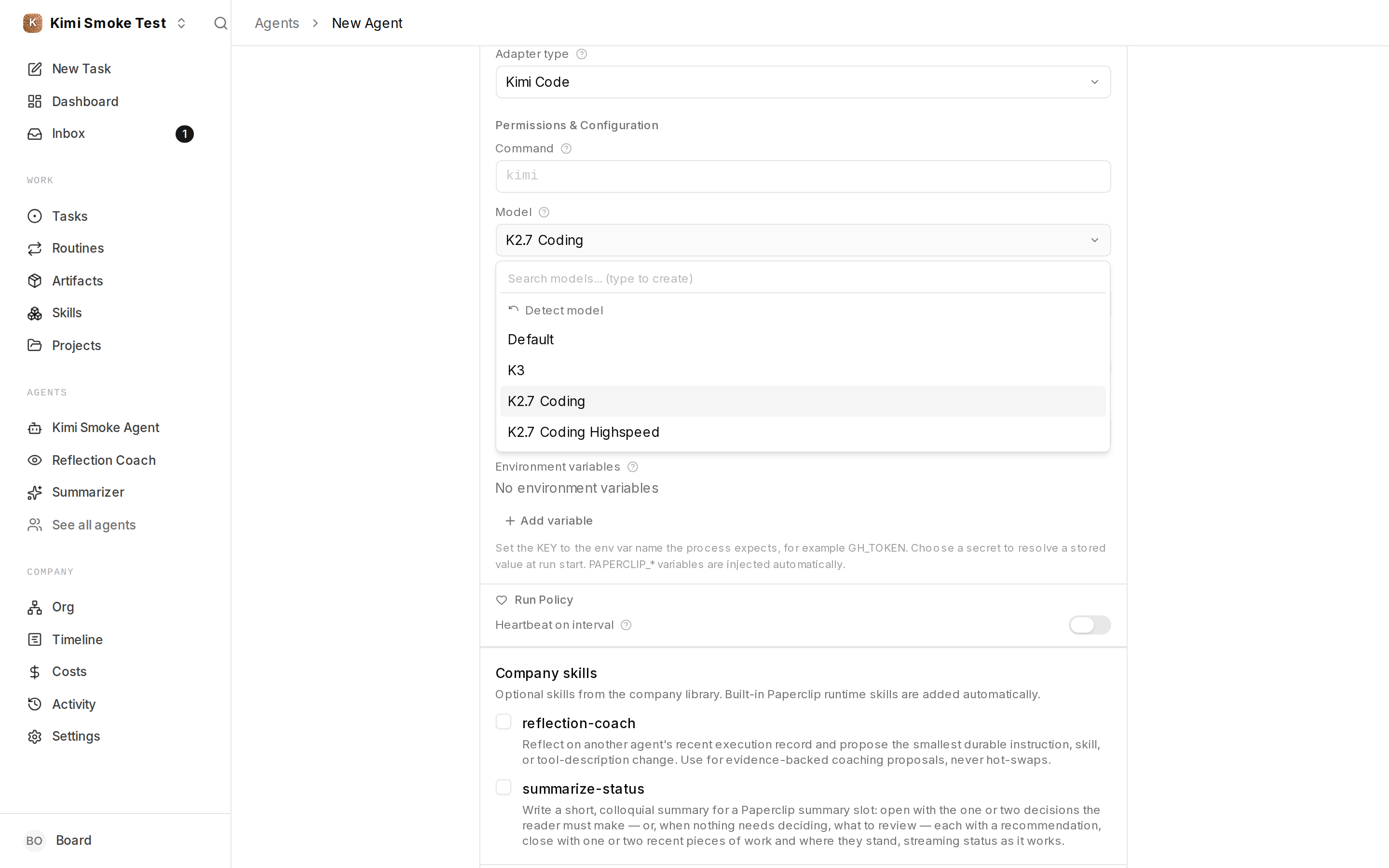 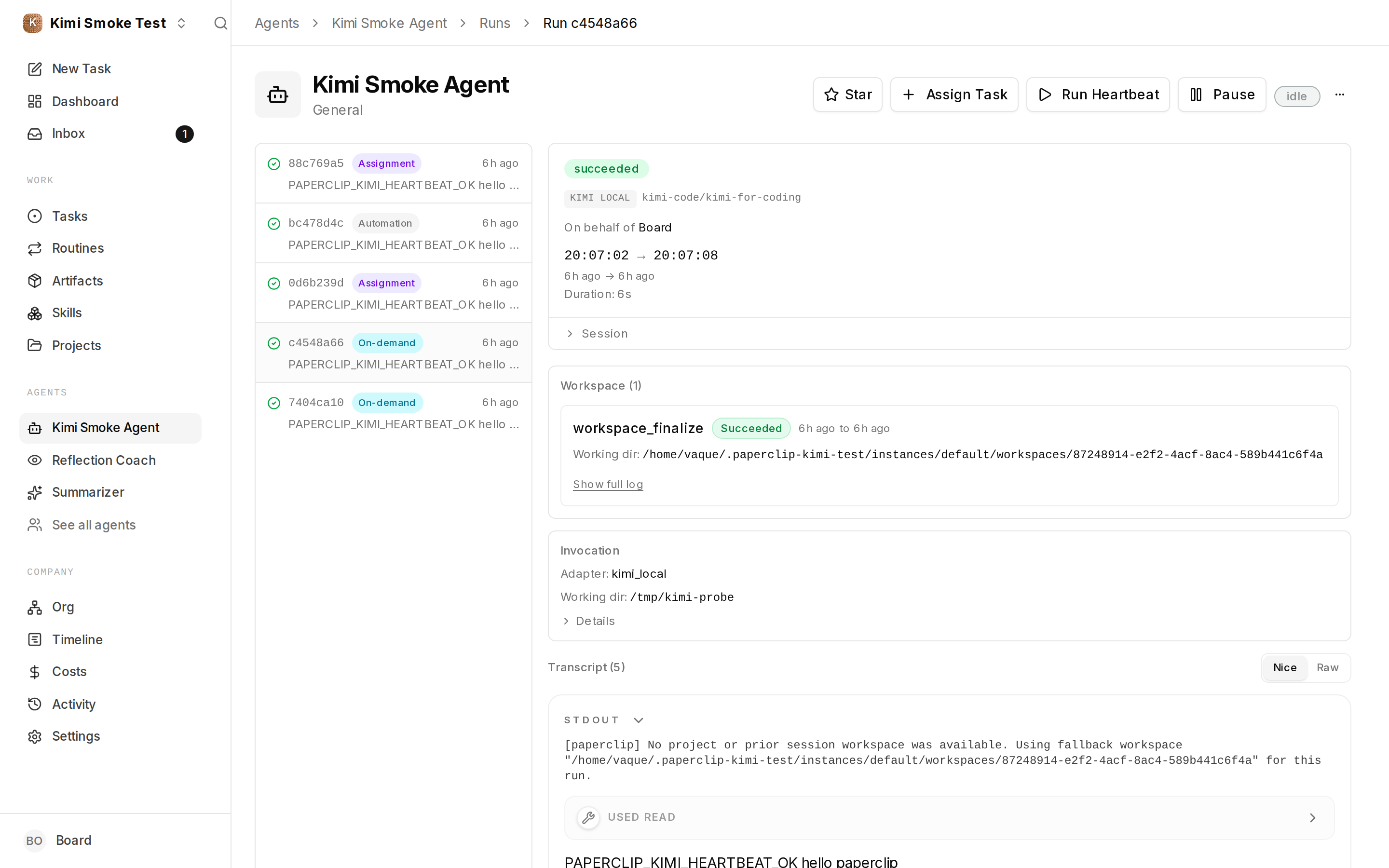 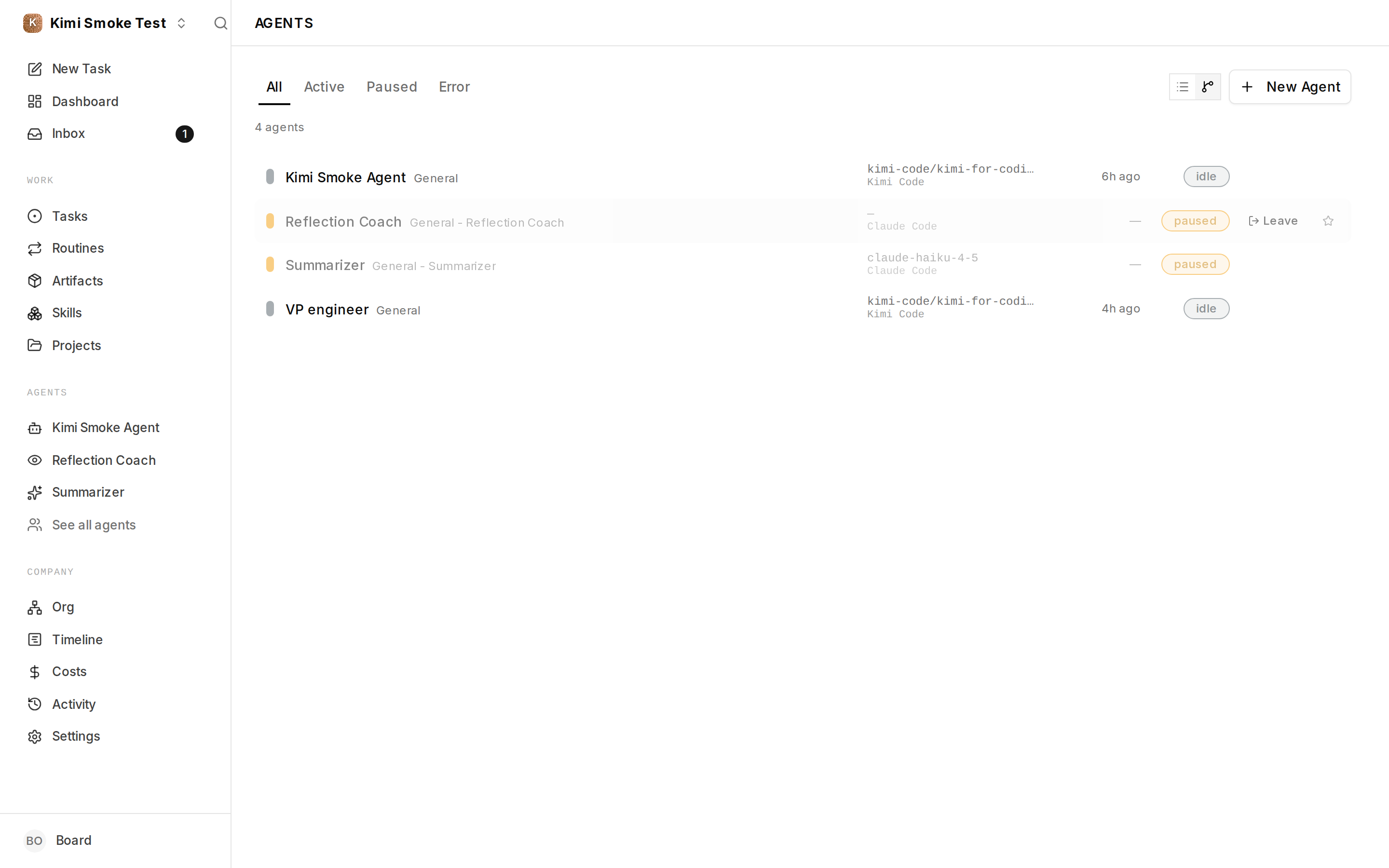 ## Risks - Low risk to existing behavior: the change is additive, one new workspace package plus single-entry registrations alongside existing adapters; no existing adapter code paths are modified. - The adapter invokes the locally installed `kimi` CLI; like other local adapters, run behavior depends on the host's Kimi version. The parser is written against the documented/verified 0.27.0 stream-json schema and degrades gracefully (malformed lines are skipped, failures surface as run errors). - `--skills-dir` overrides Kimi's auto-discovery of user and project skills for the run. This is intentional (paperclip-managed agents get a reproducible, isolated skill set), and it is only passed when at least one Paperclip skill is desired, so unconfigured agents keep default discovery. - Thinking effort is only forwarded to models that advertise `support_efforts` (currently `kimi-code/k3`); `EFFORT_CAPABLE_MODELS` must be extended when more Kimi models gain support, otherwise a configured effort is silently ignored for them. - `Dockerfile` now installs `@moonshot-ai/kimi-code@latest` globally alongside the other agent CLIs, so image size increases slightly. - Maintainer action needed for the npm bootstrap gate: the `policy` job's release-bootstrap step fails until the first npm publish of `@paperclipai/adapter-kimi-local` (the gate from #5146 that every new adapter package has passed through). Enrollment with `publishFromCi: true` is required by the manifest validator (dropping the entry, `false`, or `private` are all rejected), so this is intentionally left to a maintainer. Remaining CI lanes are expected to run once it is done. ## Model Used\n\n- **Current-master rebase, conflict adaptation, and registry-parity coverage:** OpenAI, **GPT-5 Codex** (Codex agent; exact serving model ID and context-window size were not exposed to the runtime), with repository, shell, Git, and GitHub tooling. It preserved Hawik’s commit authorship, reconciled ACPX and environment-capability changes, added current registry tests, and ran the verification above.\n- **Adapter implementation and initial review:** Moonshot AI, **Kimi K3 Coding** (latest), via **Kimi Code CLI v0.27.0** (`kimi-code/k3` alias, 1M-token context window, thinking mode, agentic tool use). The CLI agent explored the repo, wrote the adapter implementation (delegated to a coder sub-agent of the same model), ran tests, and drafted the first version of this PR body. A second model-driven review pass (read-only, same model) audited the diff for security/correctness before submission; its findings (shell-quoting hardening, auth-detection false positive, session-compaction registration, test gaps) were fixed and are included. - **Harness-context fixes and review responses:** Anthropic, **Claude Opus 4.8** (`claude-opus-4-8`) via Claude Code. Diagnosed from run logs that Kimi received only the entry instructions file (not the `HEARTBEAT.md`/`SOUL.md`/`TOOLS.md` bundle) and that `effort` was never wired, then implemented the instruction `--add-dir` delivery, `KIMI_MODEL_THINKING_EFFORT` forwarding, and `--skills-dir` skill delivery, added the accompanying tests and docs, and addressed the automated review comments (preserving external skills on remote sync, treating a signaled exit as a failure). Also extended the `paperclipai agent local-cli` installer to seed the control-plane skills into `~/.kimi-code/skills` for Codex/Claude parity, wired `onEvent` runtime events so the issue-thread activity indicator reflects Kimi's tool and reasoning output live, and built the ACP engine lane (`kimi acp` via the shared acpx engine, default) so the transcript streams with live tool status like the other ACP adapters. The Kimi CLI flags, subcommand, and env var relied on here were verified against the installed Kimi Code CLI 0.27.0. - All CLI behaviors claimed here (`-p`, `--output-format stream-json`, `-r` resume, event shapes, `--add-dir`, `--skills-dir`, `KIMI_MODEL_THINKING_EFFORT`) were verified empirically against the installed Kimi CLI, not assumed. ## Checklist - [x] I have included a thinking path that traces from project context to this change - [x] I have specified the model used (with version and capability details) - [x] I have checked ROADMAP.md and confirmed this PR does not duplicate planned core work - [x] I have searched GitHub for duplicate or related PRs and linked them above - [x] I have either (a) linked existing issues with `Fixes: #` / `Closes #` / `Refs #` OR (b) described the issue in-PR following the relevant issue template - [x] I have not referenced internal/instance-local Paperclip issues or links (only public GitHub `#NNN` / `github.com/paperclipai/paperclip` URLs) - [x] My branch name describes the change (e.g. `docs/...`, `fix/...`) and contains no internal Paperclip ticket id or instance-derived details - [x] I have run tests locally and they pass - [x] I have added or updated tests where applicable - [x] I have updated relevant documentation to reflect my changes - [x] I have considered and documented any risks above - [x] All Paperclip CI gates are green *(only the release-bootstrap step remains red, pending the maintainer npm publish described in Risks)* - [x] Greptile is 5/5 with no open P2s, recommendations, or follow-ups *(will address all Greptile comments as they arrive)* - [x] I will address all Greptile and reviewer comments before requesting merge --- ## Maintainer Addendum (2026-08-20) The shared acpx-engine and issue-chat changes (run-summary segmentation, placeholder tool-event coalescing, `ISSUE_CHAT_TRANSCRIPT_MAX_VISIBLE_ENTRIES` 30 → 400, live-reasoning UI) have been **extracted to #11761** so the cross-adapter behavior changes review and revert independently — both commits there preserve @hawikk's authorship. This PR is now the kimi-specific adapter only (60 files, +3,793/−8, essentially pure addition); the only shared-engine touch left is the `kimi acp` command resolution. `publishFromCi` is `true` — the package name is bootstrapped on npm. --------- Co-authored-by: Claude Opus 4.8 <noreply@anthropic.com> Co-authored-by: Paperclip <noreply@paperclip.ing> Co-authored-by: Dotta <bippadotta@protonmail.com> Co-authored-by: Devin Foley <devin@paperclip.ing> |
||
|
DottaandPaperclip
|
10d0555189 |
fix(interactions): authorize resolvers consistently (#11376)
## Thinking Path > - Paperclip is the open source app people use to manage AI agents for work. > - Issue interactions give agents and people a structured decision record. > - Resolver routes used different authorization rules. > - Some routes blocked valid agents, including task watchdogs with normal issue access. > - The API did not show who could resolve a pending interaction. > - This pull request gives every interaction kind one resolver policy evaluator. > - The benefit is a clear decision path with consistent governance and company isolation. ## Linked Issues or Issue Description Fixes: #8087 Refs: #7403 Related PR: #11082 proposes board-only confirmation rules. This change keeps human-only review as an explicit policy. **What happened?** Agents could create issue interactions. Some resolver routes still required board access. This left valid agent confirmations pending. Task watchdogs could see the same problem without board identity. **Expected behavior** Every interaction kind must use one resolver policy contract. The contract must support `anyone`, `not_creator`, and `human_only`. It must also apply all normal governance controls. **Steps to reproduce** 1. Create a `request_confirmation` interaction as an agent. 2. Resolve it with another authorized agent. 3. Observe the board-only denial. **Paperclip version or commit** The problem exists on `master` before this change. **Deployment mode** Local development with `pnpm dev`. ## What Changed - Add canonical policies for `anyone`, `not_creator`, and `human_only`. - Use one server evaluator for every interaction kind. - Apply named addressees, company limits, review rules, and task watchdog scope. - Charge cross-issue resolutions to the existing per-run action limit. - Return the effective resolver audience in attention and interaction data. - Show the audience, governance choices, and denial reasons in the board UI. - Add telemetry, API documents, product documents, and regression fixtures. - Add migration provenance for safe legacy behavior. - Make migration `0218` safe for complete replays and partial prior runs. ## Product Rules - An interaction records a response. It does not grant authority for the next action. - `anyone` lets any authorized issue participant respond. - `not_creator` requires a responder other than the interaction creator. - `human_only` requires an authorized person. - A named addressee, company policy, or governed action can narrow the audience. - These controls cannot widen the audience. - A task watchdog uses the same rules as an ordinary agent. - A task watchdog does not receive board authority. - An agent resolution on another issue uses the shared cross-issue action limit. - Legacy pending interactions keep their earlier restrictions. - The UI shows the effective audience and a permanent denial reason. ## Verification - `pnpm --filter @paperclipai/db check:migrations` - `pnpm --filter @paperclipai/db typecheck` - `pnpm exec vitest run packages/db/src/issue-thread-interaction-resolver-policy-migration.test.ts` - The focused PostgreSQL test applies migration `0218` twice. - The test also completes a partial prior run and preserves existing provenance. - The latest GitHub head has 29 successful checks. - The opt-in Storybook visual check skipped as expected. - Greptile reports 5/5 with no open comments. ## Risks - New interaction writes use `anyone` by default. - Callers must select `not_creator` or `human_only` when they need stricter review. - Legacy pending interactions keep the old creator and human restrictions. - Migration `0218` fills only missing provenance fields during recovery. - Cross-issue resolutions can reach the existing action limit. - The shared evaluator affects every interaction kind. - Route, service, database, shared contract, and UI tests cover these rules. > This work matches the Agent Reviews and Approvals direction in `ROADMAP.md`. It does not duplicate a planned item. ## Model Used OpenAI Codex, GPT-5. The runtime does not expose the exact deployment ID or context window. The agent used reasoning, repository tools, shell commands, and test execution. ## Checklist - [x] I have included a thinking path that traces from project context to this change - [x] I have specified the model used (with version and capability details) - [x] I have checked ROADMAP.md and confirmed this PR does not duplicate planned core work - [x] I have searched GitHub for duplicate or related PRs and linked them above - [x] I have either linked public issues or described the issue with the required labels - [x] I have not referenced internal Paperclip issues or links - [x] My branch name describes the change and contains no internal ticket id - [x] I have run tests locally and they pass - [x] I have added or updated tests where applicable - [x] I have updated relevant documentation - [x] I have considered and documented the risks - [x] All Paperclip CI gates are green - [x] Greptile is 5/5 with no open comments - [x] I will address all Greptile and reviewer comments before requesting merge --------- Co-authored-by: Paperclip <noreply@paperclip.ing> |
||
|
DottaandPaperclip
|
8e7f1c03eb |
feat(decisions): improve desk triage and queue parity (#10785)
## Thinking Path > - Paperclip is the open source app people use to manage AI agents for work. > - The decisions desk and queue help operators find work that needs a human decision. > - The current views use different grouping, sorting, and labels. > - Repeated confirmation requests can also leave stale pending actions in the queue. > - Blocked-work attention can point at an intermediate issue instead of the terminal blocker. > - This pull request aligns the server contract and both user interfaces. > - The benefit is a smaller, clearer queue that ranks the decisions with the largest impact. ## Linked Issues or Issue Description Related PR: #10774 **What existing behavior does this improve?** The decisions desk and queue currently use different triage rules. They can show stale repeated confirmations and can rank blocked work by an intermediate issue. **Subsystem affected** This change affects attention aggregation, issue thread interactions, shared attention contracts, and the decisions user interface. **Current behavior** The desk uses a can-wait group that has no clear arrival meaning. The queue has fewer controls than the desk. Repeated pending confirmations remain actionable. Blocked-work rows do not always identify the terminal actionable blocker. **Proposed behavior** Group desk items by arrival date, and reserve Decide now for explicit due dates. Use one toolbar and shelf model on both pages. Supersede older repeated pending confirmations. Aggregate blocked work under the terminal actionable blocker and rank it by impact. **Reason and benefit** Operators get one consistent triage model. The badge reflects new and overdue work. High-impact blockers move to the top. Duplicate confirmation work no longer consumes attention. **Breaking changes** The attention summary field `decideNowCount` changes to `deskBadgeCount`. Consumers must use the new field. Older repeated confirmation interactions can now finish with the `superseded_by_newer_request` outcome. ## What Changed - Supersede older pending confirmation requests for the same issue and record the mutation in activity history. - Resolve blocked-work attention to actionable terminal blockers, suppress live blocker trees, and rank rows by blocked-work impact. - Group the decisions desk into New today and Earlier, and count new plus overdue work in the desk badge. - Share the decision toolbar and shelf components across the desk and queue. - Add queue grouping, sorting, filtering, aging, visible training controls, and clearer recommendation copy. - Add server, shared-contract, and user-interface tests for the new behavior. ## Verification - `pnpm check:token-gates` - `pnpm -r typecheck` - `env -u AWS_ACCESS_KEY_ID -u AWS_SECRET_ACCESS_KEY pnpm test:run` (all server, UI, CLI, shared, and catalog tests passed; one fixed five-second DB timeout flaked under full-suite load) - `NODE_ENV=test pnpm --filter @paperclipai/db exec vitest run src/status-card-migrations.test.ts` (passed in isolation) - `pnpm build` ## Risks - The attention summary field rename requires synchronized consumers. - Terminal-blocker traversal uses cycle and depth guards. A malformed dependency graph can stop at the last safe node. - The new arrival grouping changes which items contribute to the decisions badge. - Superseding repeated confirmations changes the terminal state of older pending interactions. > For core feature work, check [`ROADMAP.md`](ROADMAP.md) first and discuss it in `#dev` before opening the PR. Feature PRs that overlap with planned core work may need to be redirected — check the roadmap first. See `CONTRIBUTING.md`. ## Model Used OpenAI Codex with GPT-5. The runtime did not expose a dated model snapshot or context-window size. The model used reasoning, repository tools, code execution, and test execution. ## Checklist - [x] I have included a thinking path that traces from project context to this change - [x] I have specified the model used (with version and capability details) - [x] I have checked ROADMAP.md and confirmed this PR does not duplicate planned core work - [x] I have searched GitHub for duplicate or related PRs and linked them above - [x] I have either (a) linked existing issues with `Fixes: #` / `Closes #` / `Refs #` OR (b) described the issue in-PR following the relevant issue template - [x] I have not referenced internal/instance-local Paperclip issues or links (only public GitHub `#NNN` / `github.com/paperclipai/paperclip` URLs) - [x] My branch name describes the change (e.g. `docs/...`, `fix/...`) and contains no internal Paperclip ticket id or instance-derived details - [x] I have run tests locally and they pass - [x] I have added or updated tests where applicable - [x] I have updated relevant documentation to reflect my changes - [x] I have considered and documented any risks above - [x] All Paperclip CI gates are green - [x] Greptile is 5/5 with no open P2s, recommendations, or follow-ups - [x] I will address all Greptile and reviewer comments before requesting merge --------- Co-authored-by: Paperclip <noreply@paperclip.ing> |
||
|
Devin FoleyandPaperclip
|
eedc7ddef2 |
Make ACP the default engine for local adapters (#9238)
## Thinking Path > - Paperclip is the open source app people use to manage AI agents for work. > - Adapter packages are the bridge between the control plane and local agent harnesses such as Claude Code, Codex, and Gemini CLI. > - ACP support was concentrated in a separate `acpx_local` adapter, which made ACP feel like a separate agent choice instead of an execution capability of the harness adapters. > - Claude, Codex, and Gemini now have ACP-capable harnesses, so the native adapter should own ACP selection, fallback, config, transcript parsing, and environment diagnostics. > - The standalone ACPX adapter still needs a compatibility path for existing rows, but it should not be offered as an active adapter for new agents. > - This pull request moves the shared ACP runtime into `@paperclipai/acpx-engine`, wires Claude/Codex/Gemini local adapters to prefer ACP when prerequisites are available, and retires `acpx_local` to a tombstone. > - The benefit is one adapter per harness, richer ACP transcripts by default where possible, and a migration path for existing Claude/Codex ACPX agents. ## Linked Issues or Issue Description Closes #5932 — the broken default `acpx_local` Claude path is replaced by native `claude_local` ACP support, existing Claude/Codex ACPX rows migrate to native adapters, and new agents no longer choose the standalone ACPX adapter. Refs #4893 — original merged ACPX local adapter runtime that this PR replaces with native per-harness ACP engines. Refs #6590 — prior ACPX-Claude seamlessness work folded into the new native Claude ACP path. Refs #197 — related open generic ACP/Kiro adapter work; this PR does not close it because Kiro/custom generic ACP remains a separate adapter decision. Refs #7018 — related Kimi-specific `acpx_local` shell failure; this PR retires the built-in standalone adapter but does not add a native Kimi adapter. Refs #8864 — related ACPX prompt/API guidance PR; this PR moves runtime guidance into the shared/native ACP engine path instead of the old standalone adapter. Refs #8881 — related `acpx_local` POSIX shell failure from the old `acpx` pin; this PR updates ACP dependencies but does not claim custom/OMP ACP support as a first-class native adapter. Refs #8964 — related open `acpx_local` stderr cleanup PR; this PR makes the old runtime path obsolete for new agents but keeps it as a non-closing reference. Problem description: - The standalone `acpx_local` adapter duplicates Claude/Codex agent choices that already have first-class local adapters. - ACP should be an execution engine capability of each harness adapter when the underlying harness supports ACP. - Existing `acpx_local` agents should either migrate to native harness adapters or fail with an explicit retirement message instead of silently falling back to the process adapter. ## What Changed - Added `@paperclipai/acpx-engine` as the shared ACP execution, session-codec, CLI formatter, and UI parser package. - Wired `claude_local`, `codex_local`, and `gemini_local` to auto-select ACP by default when prerequisites pass, with `engine=cli` opt-out and `engine=acp` strict mode. - Added ACP config schema/UI fields, environment checks, session-codec preservation, transcript parsing, and adapter capability metadata for the native adapters. - Retired `acpx_local` to a server tombstone, removed its UI/package/runtime image surface, and added a migration for existing Claude/Codex ACPX agents. - Updated package manifests, lockfile, release tooling, docs, Kubernetes sandbox defaults, and tests. ## Verification - `corepack pnpm --filter @paperclipai/acpx-engine typecheck` - `corepack pnpm --filter @paperclipai/adapter-claude-local typecheck` - `corepack pnpm --filter @paperclipai/adapter-codex-local typecheck` - `corepack pnpm --filter @paperclipai/adapter-gemini-local typecheck` - `corepack pnpm --filter @paperclipai/acpx-engine exec vitest run` - `corepack pnpm --filter @paperclipai/adapter-claude-local exec vitest run src/server/acp.test.ts src/server/execute.acp-fallback.test.ts src/ui/build-config.test.ts` - `corepack pnpm --filter @paperclipai/adapter-codex-local exec vitest run src/server/acp.test.ts src/ui/build-config.test.ts` - `corepack pnpm --filter @paperclipai/adapter-gemini-local exec vitest run src/server/acp.test.ts src/ui/build-config.test.ts src/ui/parse-stdout.test.ts` - `corepack pnpm --filter @paperclipai/plugin-sdk ensure-build-deps && corepack pnpm --filter @paperclipai/server exec tsc --noEmit` - `corepack pnpm --filter @paperclipai/server exec vitest run src/__tests__/adapter-routes.test.ts src/__tests__/adapter-session-codecs.test.ts src/__tests__/adapter-models.test.ts` - `corepack pnpm --filter @paperclipai/ui typecheck` - `corepack pnpm --filter @paperclipai/ui exec vitest run src/adapters/metadata.test.ts src/adapters/adapter-display-registry.test.ts src/components/AgentConfigForm.test.ts src/components/AgentConfigForm.render.test.tsx src/components/transcript/RunTranscriptView.test.tsx` - `node --test scripts/bootstrap-npm-package.test.mjs scripts/release-package-map.test.mjs scripts/verify-release-registry-state.test.mjs` Note: the server typecheck script calls `pnpm` internally; this dev shell exposes pnpm through Corepack only, so I ran the two script steps manually with `corepack pnpm`. ## Risks - Migration changes existing `acpx_local` Claude/Codex agents to native adapter types and clears old ACPX task sessions/runtime state. - Custom ACP commands remain on the retired tombstone and will need a separate future adapter/plugin path. - ACP auto-selection depends on local Node and ACP server command prerequisites; remote and unsupported environments fall back to CLI unless `engine=acp` is explicit. - `@paperclipai/acpx-engine` is a new public package and needs npm trusted-publishing bootstrap before release automation can publish it. > For core feature work, check [`ROADMAP.md`](ROADMAP.md) first and discuss it in `#dev` before opening the PR. Feature PRs that overlap with planned core work may need to be redirected — check the roadmap first. See `CONTRIBUTING.md`. ## Model Used OpenAI GPT-5 via Codex coding agent. Exact hosted model build and context-window size are not exposed in this runtime. Tool use included shell execution, repository editing, GitHub CLI operations, and local test/typecheck execution. ## Checklist - [x] I have included a thinking path that traces from project context to this change - [x] I have specified the model used (with version and capability details) - [x] I have checked ROADMAP.md and confirmed this PR does not duplicate planned core work - [x] I have searched GitHub for duplicate or related PRs and linked them above - [x] I have either (a) linked existing issues with `Fixes: #` / `Closes #` / `Refs #` OR (b) described the issue in-PR following the relevant issue template - [x] I have not referenced internal/instance-local Paperclip issues or links (only public GitHub `#NNN` / `github.com/paperclipai/paperclip` URLs) - [x] My branch name describes the change (e.g. `docs/...`, `fix/...`) and contains no internal Paperclip ticket id or instance-derived details - [x] I have run tests locally and they pass - [x] I have added or updated tests where applicable - [x] I have updated relevant documentation to reflect my changes - [x] I have considered and documented any risks above - [x] All Paperclip CI gates are green - [x] Greptile is 5/5 with no open P2s, recommendations, or follow-ups - [x] I will address all Greptile and reviewer comments before requesting merge --------- Co-authored-by: Paperclip <noreply@paperclip.ing> |
||
|
Nicky LeachandPaperclip
|
8a93a0de4c |
Implement generated client telemetry types (#8818)
## Thinking Path > - Paperclip is the open source app people use to manage AI agents for work. > - Telemetry is part of the control plane's operational visibility and needs stable event contracts. > - The shared telemetry client accepted first-party event names through a broad string surface, which weakened compile-time guarantees. > - Plugin telemetry still needs a dynamic path because plugin-defined events cannot be enumerated in the core generated type module. > - This pull request vendors generated Paperclip telemetry event and dimension types, closes the first-party event-name union, and keeps plugin telemetry on an explicit dynamic method. > - Review feedback clarified that backend normalization should remain the source of truth, so telemetry helpers now preserve raw categorical values while keeping generated per-event type hints. > - The benefit is stricter first-party telemetry typing without hiding backend normalization signals or changing batching, flushing, schema versioning, sinks, or endpoints. ## Linked Issues or Issue Description No public GitHub issue exists for this internal type-contract maintenance change. ### Problem or motivation The shared telemetry client should reject unregistered first-party event names at compile time, while the plugin telemetry bridge must continue to emit plugin-defined events through the existing batching and envelope path. Helper wrappers should also avoid client-side enum coercion so the backend can detect and record normalization when clients send unexpected categorical values. ### Proposed solution Generate and vendor the accepted Paperclip telemetry event and dimension types, use those types for the first-party `track()` API, keep plugin-defined telemetry on an explicit dynamic method, and let helper wrappers pass raw categorical dimensions through to backend validation. ### Alternatives considered Keeping `track()` open to arbitrary strings would preserve flexibility, but it would not give first-party callers the type safety this change is meant to provide. Enumerating plugin events in core was also ruled out because plugin-defined events are not known to the core package. Client-side enum normalization was removed after review because it duplicates backend validation and can hide misbehaving-client signals. ### Roadmap alignment This is a tightly scoped telemetry contract maintenance change and does not overlap with a roadmap-level core feature. ## What Changed - Vendored the generated Paperclip telemetry event and dimension type module under shared telemetry code. - Closed the first-party telemetry event-name union to generated backend-accepted names plus an explicit `RegisteredPluginEventName = never` extension point. - Added `TelemetryClient.trackDynamic()` for plugin telemetry bridge emission while keeping `track()` closed and typed. - Added JSDoc explaining when to use `track()` versus `trackDynamic()`. - Updated telemetry helper wrappers to type dimensions from each event's generated schema entry while passing raw categorical values through for backend normalization. - Added `trackInteractionResolved()` and updated focused shared/server tests for telemetry event typing, raw pass-through behavior, and plugin telemetry bridging. ## Verification Local verification passed before the latest push: - `pnpm --filter @paperclipai/shared typecheck` - `pnpm --filter @paperclipai/server typecheck` - `pnpm exec vitest run packages/shared/src/telemetry/client-types.test.ts server/src/__tests__/shared-telemetry-events.test.ts server/src/__tests__/plugin-telemetry-bridge.test.ts server/src/__tests__/project-goal-telemetry-routes.test.ts server/src/__tests__/routine-run-telemetry.test.ts server/src/__tests__/issue-telemetry-routes.test.ts` - `git diff --check` Post-push verification completed on head `3d973ffbea6154b19ad208dcffd1374d1b25b654`: - GitHub PR checks passed, including `verify`, build, typecheck/release registry, general test shards, serialized server shards, canary dry run, e2e, and security checks. - Greptile Review passed with 5/5 confidence. - All PR review threads are resolved. ## Risks Low runtime risk. The change is intended to affect TypeScript contracts and helper typing while preserving the existing telemetry enqueue, batching, and backend ingest path. The main intentional behavior shift is that helper wrappers no longer coerce unexpected categorical values on the client; those values reach the backend so backend normalization can record the signal. Private company import source refs still use `hashPrivateRef` when `isPrivate` is true. ## Model Used OpenAI GPT-5 Codex, tool-enabled coding agent. Exact context window was not exposed by the runtime; the agent used repository file access, shell commands, and GitHub CLI operations. ## Checklist - [x] I have included a thinking path that traces from project context to this change - [x] I have specified the model used (with version and capability details) - [x] I have checked ROADMAP.md and confirmed this PR does not duplicate planned core work - [x] I have searched GitHub for duplicate or related PRs and linked them above - [x] I have either (a) linked existing issues with `Fixes: #` / `Closes #` / `Refs #` OR (b) described the issue in-PR following the relevant issue template - [x] I have not referenced internal/instance-local Paperclip issues or links (only public GitHub `#NNN` / `github.com/paperclipai/paperclip` URLs) - [x] My branch name describes the change (e.g. `docs/...`, `fix/...`) and contains no internal Paperclip ticket id or instance-derived details - [x] I have run tests locally and they pass - [x] I have added or updated tests where applicable - [x] I have updated relevant documentation to reflect my changes - [x] I have considered and documented any risks above - [x] All Paperclip CI gates are green - [x] Greptile is 5/5 with no open P2s, recommendations, or follow-ups - [x] I will address all Greptile and reviewer comments before requesting merge --------- Co-authored-by: Paperclip <noreply@paperclip.ing> |





