mirror of
https://github.com/paperclipai/paperclip.git
synced 2026-10-14 08:26:46 +02:00
a7b49fc14d67f2c3279ccac2d2506aa33554d017
8
Commits
| Author | SHA1 | Message | Date | |
|---|---|---|---|---|
 DottaandPaperclip DottaandPaperclip
|
2043e0c735 |
fix: repair runner configuration, macOS execution, and artifact galleries (#13062)
## Thinking Path > - Paperclip is the open source app people use to manage AI agents for work. > - Agent adapters select a provider, a model, and a runtime. > - Runner conversion rejected existing Claude agents. The model list mixed providers. > - The native Claude runner rejected custom models and could not launch on macOS. > - This pull request fixes conversion, model selection, and verified macOS execution. > - It also groups configuration fields consistently across adapters and opens artifact images in the task gallery. > - Operators can change an agent configuration and run the selected model on their Mac. ## Linked Issues or Issue Description **What happened?** Converting an existing Claude agent to Paperclip Runner failed with a Codex-only restriction. ACPX Claude showed unrelated models and required `claude-sonnet-5`. Its native runtime rejected macOS. Configuration mixed common model settings with process controls. Artifact cards labeled “Open gallery” navigated to attachment URLs instead of opening the task gallery. **Expected behavior** Conversion keeps agent identity and compatible settings. ACPX Claude uses the normal Claude catalog and accepts typed model IDs. Codex uses the native runner. The verified Claude runtime can launch on macOS ARM64 and x64. Common configuration sections place the same fields together across adapters. Artifact images open in the shared task gallery with navigation and downloads. **Steps to reproduce** 1. Open the configuration of an existing Claude agent. 2. Convert it to Paperclip Runner. 3. Select ACPX Claude and a different catalog model or a typed model ID. 4. Save the agent and run a disposable task on macOS. 5. Inspect configuration and advanced run-policy controls across adapters. **Paperclip version or commit** The bugs were reproduced on `165ca56a22adb60e5fda56045442d9c8498116a8`. This branch was rebased onto `7ed122911`. **Deployment mode** Built from source. Local test-drive instance on macOS ARM64 with an isolated database. Related work: #11798 addresses unsupported ACP session options in the existing adapter path. #13048 addresses working-folder preservation. This change fixes native runner configuration and launch behavior. ## What Changed - Remove the Codex-only conversion restriction. Preserve agent identity, instructions, directories, credentials, and compatible model settings. Reset incompatible sessions while retaining history. - Show ACPX Claude and native Codex as distinct provider choices. Remove ACPX Codex from advertised configuration. Normalize legacy configurations before fresh runs without rewriting historical run descriptors. - Select model catalogs and cache entries by provider. Support refresh and typed model IDs. Pass exact Claude IDs through session creation, model changes, and recovery. - Add verified macOS ARM64 and x64 Claude SDK snapshots. Bound executable allocation and total snapshot size. Preserve package checks, dependency isolation, process ownership, cancellation, and Linux descriptor loading. - Probe local runtime readiness. Report remote platform checks as incomplete until the remote runner verifies its runtime. - Surface actual model rejection and allow correction and retry. - Repair missing ACPX goal-capability helpers exposed by the post-rebase live test. Persist and restore the optional capability without breaking session startup. - Put Agent identity first and intentionally remove the Capabilities editor, as requested. This is removal of UI editing, not relocation: preserve existing capability metadata and API compatibility without adding another editor. Use the themed select for configurable permission modes, with normal text instead of monospace. - Put model and provider under Adapter. Give environment variables their own section. Fold command and arguments under Configuration. Fold lifecycle, timeout, and interrupt grace under Advanced Run Policy. Hide single-option permission controls. - Open image and video artifact cards in the existing task gallery, including cards in the artifacts panel. Chat attachment images use the same gallery. Preserve standalone media previews and download links. ## Verification - Rebased focused UI/API/database suites: 293 tests passed. - Rebased native runtime and ACPX suites: 242 passed, 7 skipped. - Repository typecheck, build, and token gates passed for the runner changes. Gallery follow-up UI typecheck, build, and token gates also passed. - Follow-up UI suites passed (86 tests), packaging checks passed (14 tests), and the final focused runtime suites passed (126 passed, 7 skipped). - Linux container isolation and lifecycle fixtures passed before rebase (57 passed, 2 skipped). Rust ACPX provider-session tests passed after rebase (8 tests). - Browser tests completed actual Claude and native Codex tasks on macOS ARM64. They covered conversion, catalog refresh, a non-default catalog model, a typed `haiku` ID, save/reload, cancel, follow-up session continuity, invalid-model errors, and recovery. - Final-revision live tests completed a typed Claude task, a follow-up with the same provider session, and a native Codex task on macOS ARM64. - Browser tests confirmed the moved interrupt-grace field saves and survives reload. Cross-adapter tests cover Claude, Codex, Gemini, process, gateway, and schema forms. - Full local run: 7,080 passed, 30 skipped, and two timeouts. Both timeout suites passed on isolated rerun (84 tests); the failures were the plugin login-worker exit diagnostic and the runner real-server vertical slice. - Final follow-up checks: 50 registry tests and 45 snapshot/installation tests passed (6 platform-specific skips). Oversized executable rejection is covered before allocation or reading; unsupported-platform tests invoke the real installation probe. - Runner head `ddb5101c483a297f74875ab96b3c66035b002d50`: all CI gates green, including full runner verification, repository build, typecheck, general/serialized server suites, browser tests, and canary dry run. [CI run](https://github.com/paperclipai/paperclip/actions/runs/34286178670). - Greptile: 5/5 on that runner head. All four review threads resolved. Superagent, Socket, and Snyk checks green. - After snapshot hardening, another real Claude task completed on this Mac using the rebuilt runtime. - Gallery follow-up: 148 focused tests passed, covering artifact selection, shared attachment collections, deduplication, image/video cards, standalone previews, downloads, and closing. Live browser verification completed on the settings follow-up: artifact selection, 6-image pagination with wrapping, download action, and closing all stayed on the same task URL. All checks passed on gallery head `96136da58ff195bf6ca00b281eb3022ad12d7bd8`: [CI run](https://github.com/paperclipai/paperclip/actions/runs/34287987536). Greptile returned 5/5 on that exact head with no unresolved threads. - Final settings polish: 96 focused tests, UI typecheck/build, and token gates passed. A real browser walkthrough verified readable permission options, identity placement, Capabilities removal, and permission save/reload. Original test-agent permission mode restored. All 31 checks passed on final head `e46540d6bf32bfb0566dca16b2f4a75ba437618c`: [CI run](https://github.com/paperclipai/paperclip/actions/runs/34292797886). Greptile returned 5/5 with no unresolved threads. ## Risks - Capabilities intentionally has no editable UI field after this change. Existing values remain readable and API-compatible; removing the field does not erase stored metadata. - macOS launch now copies verified package files into private snapshots. The implementation must retain isolation and clean up snapshots on exit. - Runtime provider or model changes reset the current session. Historical runs remain available. - The macOS x64 SDK executable digest was verified, but a live Intel Mac run was not available. Linux verification used container fixtures, not a real Claude task. - Remote environment tests report a warning when only the platform has been checked. They do not claim package readiness from the server host. ## Model Used OpenAI Codex, based on GPT-6. The exact served model identifier and context-window limit are not exposed in this session. Used reasoning, repository inspection, code execution, Rust and TypeScript tests, and browser automation. ## Checklist - [x] I have included a thinking path that traces from project context to this change - [x] I have specified the model used (with version and capability details) - [x] I have checked ROADMAP.md and confirmed this PR does not duplicate planned core work - [x] I have searched GitHub for duplicate or related PRs and linked them above - [x] I have either (a) linked existing issues with `Fixes: #` / `Closes #` / `Refs #` OR (b) described the issue in-PR following the relevant issue template - [x] I have not referenced internal/instance-local Paperclip issues or links (only public GitHub `#NNN` / `github.com/paperclipai/paperclip` URLs) - [x] My branch name describes the change (e.g. `docs/...`, `fix/...`) and contains no internal Paperclip ticket id or instance-derived details - [x] I have run tests locally and they pass (focused suites and both timeout suites on rerun; full-run counts above) - [x] I have added or updated tests where applicable - [x] I have updated relevant documentation to reflect my changes - [x] I have considered and documented any risks above - [x] All Paperclip CI gates are green - [x] Greptile is 5/5 with no open P2s, recommendations, or follow-ups - [x] I will address all Greptile and reviewer comments before requesting merge --------- Co-authored-by: Paperclip <noreply@paperclip.ing> |
||
|
Dotta
|
0f94521017 |
fix(runner): restore local session and task integrity (#12721)
## Thinking Path > - Paperclip is the control plane for agents that perform work. > - Paperclip Runner connects durable provider sessions to individual task runs through PRP. > - Provider continuity and per-run authority are different lifetimes. > - The existing implementation mixed those lifetimes and lost event metadata between provider frames, runnerd, persistence, API sanitization, and the task thread. > - That caused failed continuation, missing progress and Plans, duplicate replies, hidden failures, and unsafe recovery. > - This repair gives every heartbeat fresh authority, preserves qualified provider-session continuity, and restores one lossless presentation path without changing direct adapters. ## Linked Issues or Issue Description **What happened?** A second native heartbeat could reuse tickets, leases, command receipts, sequence state, and run identity from the first heartbeat. Provider phase and item identity could be lost before the UI read them. Redaction could corrupt protocol discriminators while still missing malformed credential tails. The task thread could fold progress into the final response, hide failures, or show more than one final answer. Native Codex also exposed approval modes that do not yet have a durable approval bridge. **Expected behavior** Each heartbeat uses a new PRP authority epoch. Codex and OpenCode preserve exact qualified provider sessions; ACPX emits an explicit continuity event when its qualified process-replacement policy is used. Every accepted provider event is presented, classified as internal, or surfaced as unsupported. The task page shows chronological progress, reasoning summaries, activity, Plans, interactions, terminal failures, and exactly one final reply. Direct adapters retain their existing path. **Steps to reproduce** 1. Enable the unified experimental Paperclip Runner setting. 2. Create a local native Codex, OpenCode, ACPX Claude, or ACPX Codex agent. 3. Run response, Plan, structured-question/resume, restart, cancellation, and failure scenarios. 4. Reload the task while active, waiting, failed, and settled. 5. On the old implementation, observe stale run authority, missing classifications, incomplete output, or duplicated/folded replies. **Paperclip version or commit** The repair is based directly on `master` at `87d05e194b643810d16d20612115acd01d735d43`. **Deployment mode** Local development with the embedded database. Related work: Refs #12616, #12646, #12666, #12685, and #12700. ## What Changed - Rotates PRP control-plane, outbox, ticket, lease, command, receipt, and sequence authority for each heartbeat while carrying forward only a validated provider-session identity. - Reads `control-plane-state.json`, validates both durable schemas and lifecycle values, resumes coherent current runs, archives qualified settled authority, and quarantines malformed or mismatched scoped state without moving ambiguous live legacy state. - Preserves Codex provider phase and stable item identities so commentary remains progress and only `final_answer` becomes final. - Adds raw OpenCode HTTP/SSE boundary coverage and canonical reasoning lifecycle mapping. - Makes ACPX normalization lossless for visible reasoning, tool lifecycle metadata, stable bounded identities, Plan revisions, structured requests, failures, and qualified process replacement. Only the compatible terminal assistant message is promoted as final. - Applies schema-aware redaction before generic JWT-shaped detection and scans every diagnostic string leaf. Malformed raw/escaped quoted credential tails are redacted in both server and durable Rust state. - Restores snapshot-style chronological task presentation, expandable tool activity, inline Plan cards, visible waiting/resume/cancel/failure states, and exactly one final answer. - Makes `never` the only qualified native Codex permission mode and rejects unsupported persisted native modes with remediation. OpenCode and ACPX policies remain intact. - Keeps the unified experimental Runner setting as the only enablement flag. Onboarding and direct Codex, Claude, and OpenCode stay on their legacy execution/finalization paths. - Adds cross-language goldens, authority/recovery/fault coverage, exact response/count assertions, and native plus legacy acceptance scenarios. ## Verification - Pull-request GitHub Actions run Rust formatting/tests, TypeScript checks, server/UI tests, builds, protocol drift checks, browser E2E, and security scans. - A separate workflow-only validation ref is pinned directly on this PR head and runs the 35-cell paid local matrix: three core scenarios plus structured-question resume and restart/resume for native Codex, native OpenCode, ACPX Claude, ACPX Codex, and direct Codex/Claude/OpenCode. Run: https://github.com/paperclipai/paperclip/actions/runs/33682434315 - Acceptance requires exact single visible replies, monotonic sequences, matching envelope discriminators, one semantic terminal, one run terminal, no unresolved interaction, no duplicate mutation, no secret leakage, provider continuity, and zero native rows for direct adapters. - Per maintainer direction, tests are running in GitHub Actions rather than on the slower local host. Only formatters and static diff checks were run locally. ## Risks - Recovery from old or partial filesystem state is sensitive. The repair fails closed, preserves active or unverifiable authority, and quarantines only state whose scoped ownership is safe to move. - Provider event formats can change. Closed validators and boundary goldens turn new or malformed events into visible diagnostics instead of silent drops. - Shared task presentation could affect direct adapters. Runtime-fact gating plus the direct-adapter matrix protect the existing path. - Managed and remote providers are not qualified here. Shared code continues to compile and fail safely, but live qualification is deferred. > For core feature work, check [`ROADMAP.md`](ROADMAP.md) first and discuss it in `#dev` before opening the PR. Feature PRs that overlap with planned core work may need to be redirected — check the roadmap first. See `CONTRIBUTING.md`. ## Model Used OpenAI Codex based on GPT-5. The exact deployed snapshot and context-window size are not exposed to this task. It used agentic reasoning, repository inspection, code editing, Git, parallel subagents, and GitHub Actions. ## Checklist - [x] I have included a thinking path that traces from project context to this change - [x] I have specified the model used (with version and capability details) - [x] I have checked ROADMAP.md and confirmed this PR does not duplicate planned core work - [x] I have searched GitHub for duplicate or related PRs and linked them above - [x] I have either (a) linked existing issues with `Fixes: #` / `Closes #` / `Refs #` OR (b) described the issue in-PR following the relevant issue template - [x] I have not referenced internal/instance-local Paperclip issues or links (only public GitHub `#NNN` / `github.com/paperclipai/paperclip` URLs) - [x] My branch name describes the change and contains no internal Paperclip ticket id - [ ] I have run tests locally and they pass (intentionally deferred to GitHub Actions) - [x] I have added or updated tests where applicable - [x] I have updated relevant documentation to reflect my changes - [x] I have considered and documented risks above - [ ] All Paperclip CI gates are green - [ ] The paid local-provider matrix is green - [ ] Greptile is 5/5 with no open P2s, recommendations, or follow-ups - [x] I will address all Greptile and reviewer comments before requesting merge |
||
|
Devin FoleyandPaperclip
|
eedc7ddef2 |
Make ACP the default engine for local adapters (#9238)
## Thinking Path > - Paperclip is the open source app people use to manage AI agents for work. > - Adapter packages are the bridge between the control plane and local agent harnesses such as Claude Code, Codex, and Gemini CLI. > - ACP support was concentrated in a separate `acpx_local` adapter, which made ACP feel like a separate agent choice instead of an execution capability of the harness adapters. > - Claude, Codex, and Gemini now have ACP-capable harnesses, so the native adapter should own ACP selection, fallback, config, transcript parsing, and environment diagnostics. > - The standalone ACPX adapter still needs a compatibility path for existing rows, but it should not be offered as an active adapter for new agents. > - This pull request moves the shared ACP runtime into `@paperclipai/acpx-engine`, wires Claude/Codex/Gemini local adapters to prefer ACP when prerequisites are available, and retires `acpx_local` to a tombstone. > - The benefit is one adapter per harness, richer ACP transcripts by default where possible, and a migration path for existing Claude/Codex ACPX agents. ## Linked Issues or Issue Description Closes #5932 — the broken default `acpx_local` Claude path is replaced by native `claude_local` ACP support, existing Claude/Codex ACPX rows migrate to native adapters, and new agents no longer choose the standalone ACPX adapter. Refs #4893 — original merged ACPX local adapter runtime that this PR replaces with native per-harness ACP engines. Refs #6590 — prior ACPX-Claude seamlessness work folded into the new native Claude ACP path. Refs #197 — related open generic ACP/Kiro adapter work; this PR does not close it because Kiro/custom generic ACP remains a separate adapter decision. Refs #7018 — related Kimi-specific `acpx_local` shell failure; this PR retires the built-in standalone adapter but does not add a native Kimi adapter. Refs #8864 — related ACPX prompt/API guidance PR; this PR moves runtime guidance into the shared/native ACP engine path instead of the old standalone adapter. Refs #8881 — related `acpx_local` POSIX shell failure from the old `acpx` pin; this PR updates ACP dependencies but does not claim custom/OMP ACP support as a first-class native adapter. Refs #8964 — related open `acpx_local` stderr cleanup PR; this PR makes the old runtime path obsolete for new agents but keeps it as a non-closing reference. Problem description: - The standalone `acpx_local` adapter duplicates Claude/Codex agent choices that already have first-class local adapters. - ACP should be an execution engine capability of each harness adapter when the underlying harness supports ACP. - Existing `acpx_local` agents should either migrate to native harness adapters or fail with an explicit retirement message instead of silently falling back to the process adapter. ## What Changed - Added `@paperclipai/acpx-engine` as the shared ACP execution, session-codec, CLI formatter, and UI parser package. - Wired `claude_local`, `codex_local`, and `gemini_local` to auto-select ACP by default when prerequisites pass, with `engine=cli` opt-out and `engine=acp` strict mode. - Added ACP config schema/UI fields, environment checks, session-codec preservation, transcript parsing, and adapter capability metadata for the native adapters. - Retired `acpx_local` to a server tombstone, removed its UI/package/runtime image surface, and added a migration for existing Claude/Codex ACPX agents. - Updated package manifests, lockfile, release tooling, docs, Kubernetes sandbox defaults, and tests. ## Verification - `corepack pnpm --filter @paperclipai/acpx-engine typecheck` - `corepack pnpm --filter @paperclipai/adapter-claude-local typecheck` - `corepack pnpm --filter @paperclipai/adapter-codex-local typecheck` - `corepack pnpm --filter @paperclipai/adapter-gemini-local typecheck` - `corepack pnpm --filter @paperclipai/acpx-engine exec vitest run` - `corepack pnpm --filter @paperclipai/adapter-claude-local exec vitest run src/server/acp.test.ts src/server/execute.acp-fallback.test.ts src/ui/build-config.test.ts` - `corepack pnpm --filter @paperclipai/adapter-codex-local exec vitest run src/server/acp.test.ts src/ui/build-config.test.ts` - `corepack pnpm --filter @paperclipai/adapter-gemini-local exec vitest run src/server/acp.test.ts src/ui/build-config.test.ts src/ui/parse-stdout.test.ts` - `corepack pnpm --filter @paperclipai/plugin-sdk ensure-build-deps && corepack pnpm --filter @paperclipai/server exec tsc --noEmit` - `corepack pnpm --filter @paperclipai/server exec vitest run src/__tests__/adapter-routes.test.ts src/__tests__/adapter-session-codecs.test.ts src/__tests__/adapter-models.test.ts` - `corepack pnpm --filter @paperclipai/ui typecheck` - `corepack pnpm --filter @paperclipai/ui exec vitest run src/adapters/metadata.test.ts src/adapters/adapter-display-registry.test.ts src/components/AgentConfigForm.test.ts src/components/AgentConfigForm.render.test.tsx src/components/transcript/RunTranscriptView.test.tsx` - `node --test scripts/bootstrap-npm-package.test.mjs scripts/release-package-map.test.mjs scripts/verify-release-registry-state.test.mjs` Note: the server typecheck script calls `pnpm` internally; this dev shell exposes pnpm through Corepack only, so I ran the two script steps manually with `corepack pnpm`. ## Risks - Migration changes existing `acpx_local` Claude/Codex agents to native adapter types and clears old ACPX task sessions/runtime state. - Custom ACP commands remain on the retired tombstone and will need a separate future adapter/plugin path. - ACP auto-selection depends on local Node and ACP server command prerequisites; remote and unsupported environments fall back to CLI unless `engine=acp` is explicit. - `@paperclipai/acpx-engine` is a new public package and needs npm trusted-publishing bootstrap before release automation can publish it. > For core feature work, check [`ROADMAP.md`](ROADMAP.md) first and discuss it in `#dev` before opening the PR. Feature PRs that overlap with planned core work may need to be redirected — check the roadmap first. See `CONTRIBUTING.md`. ## Model Used OpenAI GPT-5 via Codex coding agent. Exact hosted model build and context-window size are not exposed in this runtime. Tool use included shell execution, repository editing, GitHub CLI operations, and local test/typecheck execution. ## Checklist - [x] I have included a thinking path that traces from project context to this change - [x] I have specified the model used (with version and capability details) - [x] I have checked ROADMAP.md and confirmed this PR does not duplicate planned core work - [x] I have searched GitHub for duplicate or related PRs and linked them above - [x] I have either (a) linked existing issues with `Fixes: #` / `Closes #` / `Refs #` OR (b) described the issue in-PR following the relevant issue template - [x] I have not referenced internal/instance-local Paperclip issues or links (only public GitHub `#NNN` / `github.com/paperclipai/paperclip` URLs) - [x] My branch name describes the change (e.g. `docs/...`, `fix/...`) and contains no internal Paperclip ticket id or instance-derived details - [x] I have run tests locally and they pass - [x] I have added or updated tests where applicable - [x] I have updated relevant documentation to reflect my changes - [x] I have considered and documented any risks above - [x] All Paperclip CI gates are green - [x] Greptile is 5/5 with no open P2s, recommendations, or follow-ups - [x] I will address all Greptile and reviewer comments before requesting merge --------- Co-authored-by: Paperclip <noreply@paperclip.ing> |
||
|
Devin FoleyandPaperclip
|
e281095cb4 |
fix(ui): make adapter test button test only (#8405)
## Thinking Path > - Paperclip is the open source app people use to manage AI agents for work. > - Agent adapter configuration is where operators edit the runtime settings that control how each agent is invoked. > - The adapter form includes a test action so operators can validate the in-progress configuration before saving it. > - In edit mode, that test action changed into `Save + Test` when the form was dirty, which mixed validation with persistence. > - Operators already have an explicit Save action for committing adapter changes. > - This pull request makes the adapter test action test-only so validation never implicitly saves a dirty draft. > - The benefit is clearer operator control: Test validates the current draft, Save persists it. ## Linked Issues or Issue Description No matching public GitHub issue or in-flight PR was found, so this PR describes the bug inline. ### Pre-submission checklist - I searched existing open and closed issues and did not find a duplicate. - I can reproduce this behavior on current `master` before this branch. - I confirmed this originates in the Paperclip UI, not in a specific local agent CLI or provider configuration. ### What happened? When editing an existing agent adapter configuration, changing an adapter setting made the adapter environment test button change from `Test` to `Save + Test`. Clicking it saved dirty edits before running the environment test. ### Expected behavior The test action should always be a test action. Dirty draft values should be validated without persisting them, and the explicit Save button should be the only save path. ### Steps to reproduce 1. Open an existing agent adapter configuration. 2. Edit an adapter setting so the form becomes dirty. 3. Observe the adapter environment test action label and behavior. ### Paperclip version or commit Current `master` before this branch, `c0743482b`. ### Deployment mode Local dev/private operator UI. ### Installation method Built from source with pnpm. ### Agent adapter(s) involved Not adapter-specific. The behavior lives in the shared agent adapter config form. ### Database mode Not database-related. ### Access context Board operator UI. ### Additional context Public searches performed before opening this PR: - `adapter test save` - `Save + Test` - `AgentConfigForm testEnvironment` - `adapter configuration test button` No logs or local config are needed for this UI-only behavior report. ## What Changed - Removed the helper that converted dirty edit-mode adapter tests into `Save + Test`. - Removed the save-before-test helper path so clicking Test only invokes the adapter environment test mutation. - Kept draft testing behavior by continuing to build the test payload from the current in-progress adapter config. - Dropped unit tests that asserted the old save-and-test behavior. ## Verification - `pnpm vitest run ui/src/components/AgentConfigForm.test.ts` -> 6/6 passed. - `pnpm --filter @paperclipai/ui typecheck` was attempted locally and failed on the existing unrelated `packages/plugins/sdk/src/ui/components.ts` React module-resolution error before reaching this change. - Static review: `Save + Test`, `getAgentConfigTestActionLabel`, and `runAgentConfigEnvironmentTest` no longer appear in `ui/src`. - Before/after visual state for the dirty edit-mode adapter test action: - Before: `Save + Test` - After: `Test` - PR CI passed: policy, commitperclip review, typecheck/release-registry, build, general tests, serialized server suites, e2e, canary dry run, aggregate verify, and security scans. - Greptile passed with 5/5 confidence. The remaining screenshot/documentation thread was answered and resolved because this is a text-only button-label state already captured above. ## Risks Low risk. This is a narrow UI behavior change in the adapter config form. The main behavior change is intentional: testing a dirty adapter draft no longer persists it. If an operator expected Test to save edits, they must now use the explicit Save button. ## Model Used - Anthropic Claude via Paperclip `claude_local` produced the initial implementation commit. - OpenAI GPT-5 Codex via Paperclip `codex_local` reviewed the change, amended public commit metadata, pushed the branch, and prepared this pull request. The adapter did not expose an exact context-window value in the run payload; tool use and local shell execution were used. ## Checklist - [x] I have included a thinking path that traces from project context to this change - [x] I have specified the model used (with version and capability details) - [x] I have checked ROADMAP.md and confirmed this PR does not duplicate planned core work - [x] I have searched GitHub for duplicate or related PRs and linked them above - [x] I have either (a) linked existing issues with `Fixes: #` / `Closes #` / `Refs #` OR (b) described the issue in-PR following the relevant issue template - [x] I have not referenced internal/instance-local Paperclip issues or links (only public GitHub `#NNN` / `github.com/paperclipai/paperclip` URLs) - [x] My branch name describes the change (e.g. `docs/...`, `fix/...`) and contains no internal Paperclip ticket id or instance-derived details - [x] I have run tests locally and they pass - [x] I have added or updated tests where applicable - [x] If this change affects the UI, I have included before/after screenshots - [x] I have updated relevant documentation to reflect my changes - [x] I have considered and documented any risks above - [x] All Paperclip CI gates are green - [x] Greptile is 5/5 with no open P2s, recommendations, or follow-ups - [x] I will address all Greptile and reviewer comments before requesting merge Co-authored-by: Paperclip <noreply@paperclip.ing> |
||
|
Devin Foley
|
547463d3a2 |
refactor(environments): make execution environments instance-scoped (#8375)
## Thinking Path > - Paperclip is the control plane for AI-agent companies, so execution environment selection has to stay inspectable and predictable across companies, agents, and runs. > - The environment subsystem decides where an agent heartbeat actually runs and how remote sandbox state is realized and restored. > - That subsystem previously mixed company-scoped environment catalogs with issue-level environment stamping, so a reassigned issue could keep executing in the previous assignee's sandbox. > - That behavior breaks the control-plane contract: changing the assignee should change the executing agent/environment path unless there is an explicit current override. > - Fixing it cleanly required more than a narrow patch; the environment model had to move to instance scope with a single inherited default and per-agent override semantics. > - This pull request rewires the schema, server/API surface, runtime resolution, and UI around that model, then adds regression coverage for cross-company inheritance and per-agent isolation. > - The benefit is that environment choice now follows the approved instance/agent configuration path instead of stale issue state, while shared environments only need to be configured once per instance. ## Linked Issues or Issue Description - No directly matching public GitHub issue or PR was found while searching for this refactor. ### What happened? Reassigning work between agents with different execution environments could keep running in the previous sandbox because environment choice was stamped onto the issue and outranked the current assignee. The same subsystem also forced environment catalogs to be duplicated per company even though the underlying execution environments were instance-wide resources. ### Expected behavior Execution should resolve through the current instance and agent configuration path, with one instance-scoped environment catalog, one instance default, optional per-agent override, and no stale issue-level environment authority surviving reassignment. ### Steps to reproduce 1. Configure two agents to use different execution environments. 2. Assign an issue to the first agent so the issue records execution state in that environment. 3. Reassign the same issue to the second agent and run another heartbeat. 4. Observe that the pre-fix runtime can still sync or execute in the original sandbox instead of the second agent's environment. ### Paperclip version or commit Current `master` before this PR. ### Deployment mode Self-hosted server. ### Installation method Built from source (`pnpm dev` / `pnpm build`). ### Agent adapter(s) involved - Claude Code - Not adapter-specific (core bug in environment authority / resolution) ### Database mode External Postgres. ### Access context Both board reassignment and agent heartbeats were involved. ## What Changed - Moved environments and their default selection contract to instance scope in DB/shared types, including the migration that dedupes legacy per-company environments and seeds the instance local default. - Reworked environment CRUD/auth flows to use instance-scoped APIs and added route/service coverage for instance-level environment management. - Changed runtime resolution to prefer `agent default -> instance default -> built-in local`, removed issue-level environment stamping from the active execution path, and isolated sandbox/plugin leases by `(executionWorkspaceId, agentId)`. - Added environment env-var runtime precedence so environment-provided values act as the baseline for agent execution. - Moved the environment UI into instance settings and updated agent configuration surfaces to reflect inherit/override behavior. - Added regression coverage for instance-default inheritance across companies and for the new runtime resolution behavior. - Fixed a rebase-only duplicate `enableTaskWatchdogs` flag regression in instance settings types/validators/services so the branch typechecks cleanly on current `master`. - Updated stale server tests so CI matches the shipped instance-scoped environment contract. ## Verification - `git diff --check` - `pnpm --filter @paperclipai/shared typecheck` - `pnpm --filter @paperclipai/db typecheck` - `pnpm exec vitest run server/src/__tests__/environment-runtime-driver-contract.test.ts server/src/__tests__/agent-permissions-routes.test.ts server/src/__tests__/environment-routes.test.ts server/src/__tests__/environment-instance-routes.test.ts server/src/__tests__/execution-workspace-policy.test.ts server/src/__tests__/heartbeat-plugin-environment.test.ts server/src/__tests__/instance-settings-routes.test.ts` ## Risks - The migration changes environment scope and dedupes existing rows, so installs with unusual legacy environment combinations should be reviewed carefully during upgrade. - Remote execution behavior now depends on instance-default inheritance semantics instead of issue-level stamping, so any remaining code paths that still assume issue-scoped environment authority would surface as follow-up bugs. - This PR includes both server/runtime behavior and UI relocation, so reviewers should watch for authorization edge cases around instance settings and environment management. > I checked [`ROADMAP.md`](ROADMAP.md). This work fits the existing Cloud / Sandbox agents direction as a bug-fix/refactor to current behavior, not a new parallel product surface. ## Model Used - OpenAI Codex coding agent in this Paperclip/Codex session; GPT-5-class tool-using model with code execution and shell access. The exact backend model ID is not exposed to the session runtime. ## Checklist - [x] I have included a thinking path that traces from project context to this change - [x] I have specified the model used (with version and capability details) - [x] I have checked ROADMAP.md and confirmed this PR does not duplicate planned core work - [x] I have searched GitHub for duplicate or related PRs and linked them above - [x] I have either (a) linked existing issues with `Fixes: #` / `Closes #` / `Refs #` OR (b) described the issue in-PR following the relevant issue template - [x] I have not referenced internal/instance-local Paperclip issues or links (only public GitHub `#NNN` / `github.com/paperclipai/paperclip` URLs) - [x] My branch name describes the change (e.g. `docs/...`, `fix/...`) and contains no internal Paperclip ticket id or instance-derived details - [x] I have run tests locally and they pass - [x] I have added or updated tests where applicable - [ ] If this change affects the UI, I have included before/after screenshots - [x] I have updated relevant documentation to reflect my changes - [x] I have considered and documented any risks above - [ ] All Paperclip CI gates are green - [ ] Greptile is 5/5 with no open P2s, recommendations, or follow-ups - [x] I will address all Greptile and reviewer comments before requesting merge |
||
|
Devin FoleyandPaperclip
|
fc95699fde |
fix(server): enforce agent secret binding sync across lifecycle flows (#8307)
## Thinking Path > - Paperclip is the control plane people use to create, configure, and run AI agents for work. > - This change sits in the server-side agent lifecycle and secret-binding subsystem, where adapter config `env` entries can reference company secrets. > - An incident (while trying to configure a Novita sandbox) showed that an agent can reach a broken runtime state if `adapterConfig.env` contains `secret_ref` entries but the matching `company_secret_bindings` rows are missing. > - The immediate run-path guard and error-surfacing work made the failure diagnosable, but they did not fully prevent new broken agents from being created. > - The risk came from create and approval flows being responsible for remembering to sync bindings at each call site, which is easy to miss as new flows are added. > - This pull request moves the invariant into `agentService` create/update/activate paths, keeps the existing hire-flow fix, and adds regression coverage for create, update, and legacy pending-approval recovery. > - The benefit is that agent secret binding integrity is enforced closer to the data mutation point, so future callers inherit the protection automatically. ## Linked Issues or Issue Description Refs #8309 ### What happened? A Paperclip agent could persist `adapterConfig.env` `secret_ref` entries without matching agent-scoped `company_secret_bindings` rows. When that happened, the config UI could still look configured, but the real run path failed pre-dispatch because the secret was not actually bound to that agent. ### Expected behavior Every normal agent create, config-update, and pending-approval activation flow should leave the agent with secret bindings that match its persisted secret-ref env config. ### Steps to reproduce 1. Create or activate an agent through a flow that persists `adapterConfig.env` secret refs without synchronizing `company_secret_bindings`. 2. Observe that the config state can still appear populated. 3. Start a run for that agent. 4. Observe that pre-dispatch binding validation fails because the secret reference exists but the agent binding does not. ### Deployment mode Local dev (`pnpm dev`) ### Installation method Built from source (`pnpm dev` / `pnpm build`) ### Agent adapter(s) involved - Claude Code - Not adapter-specific (core bug) ### Database mode Embedded PGlite / embedded local dev database flow ### Access context Board (human operator) created or approved the agent; agent runtime later consumed the config. ### Additional context This PR focuses on preventing new broken states from normal service flows and on backfilling the covered legacy pending-approval activation path. ## What Changed - Kept the existing branch-local hire-flow fix that synchronized bindings for route and approval paths. - Moved the binding integrity invariant into `agentService.create()`, `agentService.update()` when `adapterConfig` changes, and `agentService.activatePendingApproval()`. - Added `server/src/__tests__/agents-service-secret-bindings.test.ts` covering create-time sync, update-time resync, and backfill for legacy pending-approval agents. - Removed now-redundant route-layer and approval-layer binding sync calls once the service layer became authoritative. - Simplified the affected unit tests so route/approval tests no longer assert service-owned binding writes directly. ## Verification - `pnpm --filter @paperclipai/server typecheck` - `pnpm exec vitest run server/src/__tests__/agents-service-secret-bindings.test.ts server/src/__tests__/approvals-service.test.ts server/src/__tests__/agent-skills-routes.test.ts` ## Risks - Low to medium risk. - This changes where secret-binding synchronization is enforced, so any unexpected caller that relied on upper-layer manual sync behavior could behave differently. - Agent create/update/activation flows now perform binding synchronization consistently, which adds binding-table writes at those mutation points. - This PR does not retroactively scan and heal every already-broken historical agent row; it prevents and backfills through the covered service flows. > For core feature work, check [`ROADMAP.md`](ROADMAP.md) first and discuss it in `#dev` before opening the PR. Feature PRs that overlap with planned core work may need to be redirected — check the roadmap first. See `CONTRIBUTING.md`. ## Model Used - OpenAI Codex / GPT-5 Codex class model via `codex_local` - Session model family: GPT-5 Codex - Tool-assisted coding with shell, git, HTTP, and local test execution - Reasoning mode: medium interactive tool-use workflow ## Checklist - [x] I have included a thinking path that traces from project context to this change - [x] I have specified the model used (with version and capability details) - [x] I have checked ROADMAP.md and confirmed this PR does not duplicate planned core work - [x] I have searched GitHub for duplicate or related PRs and linked them above - [x] I have either (a) linked existing issues with `Fixes: #` / `Closes #` / `Refs #` OR (b) described the issue in-PR following the relevant issue template - [x] I have run tests locally and they pass - [x] I have added or updated tests where applicable - [x] If this change affects the UI, I have included before/after screenshots - [x] I have updated relevant documentation to reflect my changes - [x] I have considered and documented any risks above - [x] All Paperclip CI gates are green - [x] Greptile is 5/5 with no open P2s, recommendations, or follow-ups - [x] I will address all Greptile and reviewer comments before requesting merge --------- Co-authored-by: Paperclip <noreply@paperclip.ing> |
||
|
Jannes StubbemannandClaude Opus 4.8
|
4ad94d0bde |
feat(server): kubernetes execution integration for sandbox-provider plugins (stage 2/3) (#7938)
## Thinking Path > - Paperclip is the open source app people use to manage AI agents for work > - The execution subsystem runs those agents in environments (local, ssh, sandbox), and sandbox-provider plugins let an environment materialize per-run sandboxes > - Stage 1 (#5790) contributed a first-party Kubernetes sandbox-provider plugin, but the server core has no way to adopt it operationally: no per-run adapter selection, no way to force an instance onto sandboxed execution, no declarative adapter/model configuration, and the plugin must be installed by hand > - Without this, a multi-tenant or security-conscious deployment cannot guarantee that agent runs never execute on the host, and a single environment cannot serve agents with different harnesses > - This pull request adds the server + SDK integration: per-run adapterType on the lease protocol, an env-gated forced-Kubernetes execution policy with provisioning and a per-run allowlist guard, a declarative adapter registry and model list, in-cluster env passthrough for sandbox plugin workers, fail-safe auto-install of the bundled plugin, and the matching UI affordance > - The benefit is that sandbox-provider plugins become fully usable for Kubernetes execution: operators configure everything via environment variables and GitOps, while self-hosters who set none of the variables see exactly the behavior they have today ## Linked Issues or Issue Description Refs #5790 (stage 1 of 3: the Kubernetes sandbox-provider plugin package). No existing issue. Feature description: the server core lacks the integration seams to operate a sandbox-provider plugin as the mandatory execution path of an instance. This PR is stage 2 of 3 of the staged Kubernetes contribution; stage 3 will contribute the agent runtime images and their build pipeline. ## What Changed One line per piece: - `packages/plugins/sdk/protocol.ts`: optional `adapterType` on `PluginEnvironmentAcquireLeaseParams` so a provider can select the runtime image per run; existing providers simply ignore it - `server/services/environment-runtime.ts` + `environment-run-orchestrator.ts`: thread the agent's adapter type into both lease-acquiring drivers, including the heartbeat path (the two call sites have historically drifted, hence the pinned test) - `server/services/environments.ts`: `ensureKubernetesEnvironment` / `findKubernetesEnvironment`, an idempotent managed Kubernetes environment per company, identified by a metadata marker and refreshed (not recreated) on config change; `timeoutMs` rides on the config for slow cold-start leases - `server/services/execution-allowlist.ts`: pure (driver, provider, policy) -> allow/deny guard; `executionMode=kubernetes` only allows the kubernetes sandbox provider - `server/services/execution-policy-bootstrap.ts` + startup hook in `server/index.ts`: parse `PAPERCLIP_EXECUTION_MODE` / `PAPERCLIP_K8S_*`, persist `executionMode` into instance general settings, and provision the managed environment for every company; fails loud on misconfiguration - `server/services/heartbeat.ts`: when the policy forces Kubernetes, pin run selection to the managed environment (also overriding any persisted workspace environment id), refuse to fall back to local, and re-check the actually acquired environment against the allowlist as defense in depth - `server/services/adapter-registry-bootstrap.ts` + shared `AdapterRegistryEntry` type/validator: declarative `PAPERCLIP_ADAPTERS` registry (inline JSON or file) that reconciles adapter availability at startup and rides on the Kubernetes environment config - `server/services/adapter-models-env.ts` + `adapters/registry.ts`: `PAPERCLIP_ADAPTER_MODELS` lets an operator declare picker model lists the server cannot CLI-discover - `server/services/plugin-loader.ts`: pass `KUBERNETES_SERVICE_HOST/PORT(_HTTPS)` through to plugin workers that register environment drivers, so in-cluster API clients can be constructed; all other host env stays stripped - `server/app.ts`: fail-safe auto-install of the bundled kubernetes plugin at boot; no-ops when the bundle is absent and never blocks startup on error - `packages/shared` types/validators: `InstanceExecutionMode` on general settings (optional, strict schema) - `ui/lib/forced-kubernetes-environment.ts` + `AgentConfigForm`: when the policy is active, show a read-only Kubernetes environment instead of the environment picker and default new agents onto the managed environment - Tests for every new module plus the adapterType pin in `heartbeat-plugin-environment` and the managed-environment lifecycle in `environment-service` Everything is gated: with `PAPERCLIP_EXECUTION_MODE`, `PAPERCLIP_ADAPTERS`, and `PAPERCLIP_ADAPTER_MODELS` unset (and no bundled plugin present), every code path reduces to current behavior. The per-run `adapterType` is an optional SDK parameter that existing providers ignore. ## Verification - `cd server && npx tsc --noEmit`: clean (0 errors); `ui` typecheck also clean - Targeted suites all green (11 files, 90 tests): `npx vitest run server/src/__tests__/heartbeat-plugin-environment.test.ts server/src/__tests__/environment-service.test.ts server/src/__tests__/environment-runtime.test.ts server/src/__tests__/environment-run-orchestrator.test.ts server/src/__tests__/plugin-database.test.ts server/src/services/execution-policy-bootstrap.test.ts server/src/services/execution-allowlist.test.ts server/src/services/adapter-registry-bootstrap.test.ts server/src/services/adapter-registry-bootstrap.reconcile.test.ts server/src/services/adapter-models-env.test.ts packages/shared/src/validators/adapter-registry.test.ts` - `npx vitest run ui/src/components/AgentConfigForm.test.ts`: green (6 tests) - Full `npx vitest run server/src/__tests__`: 2323 passed, 1 skipped; the only failures (heartbeat-process-recovery pid-retry, workspace-runtime symbolic-ref/git tests) reproduce identically on pristine `master` in the same environment, so they are machine-environment issues unrelated to this change; `server-startup-feedback-export` needed its `services/index.js` mock extended with the new export and is green - This integration has been running in production on a hosted multi-tenant deployment, where it executes agent runs across five different harnesses through the stage 1 plugin ## Risks - Low for existing deployments: every behavior is env-gated and the defaults preserve current semantics; the auto-install block is wrapped fail-safe and skips silently when the plugin bundle is absent - `executionMode` is a new optional field on a strict zod schema; absent input normalizes exactly as before - The forced policy intentionally fails runs loudly (rather than falling back to local) when no managed Kubernetes environment exists; this only affects instances that explicitly set `PAPERCLIP_EXECUTION_MODE=kubernetes` ## Model Used Claude Opus 4.8 (claude-opus-4-8, 1M context), extended thinking, agentic tool use via Claude Code. ## UI screenshots The UI change is a new read-only "Execution" section in `AgentConfigForm`, shown only when the instance execution policy forces Kubernetes (`executionMode=kubernetes`); there is no "before" state for it (the section did not exist, and instances without the forced policy render the existing picker unchanged). Captured from the new Storybook stories added in this PR (`Product/Agent Management`): Managed Kubernetes environment present (read-only display, no local/SSH picker): 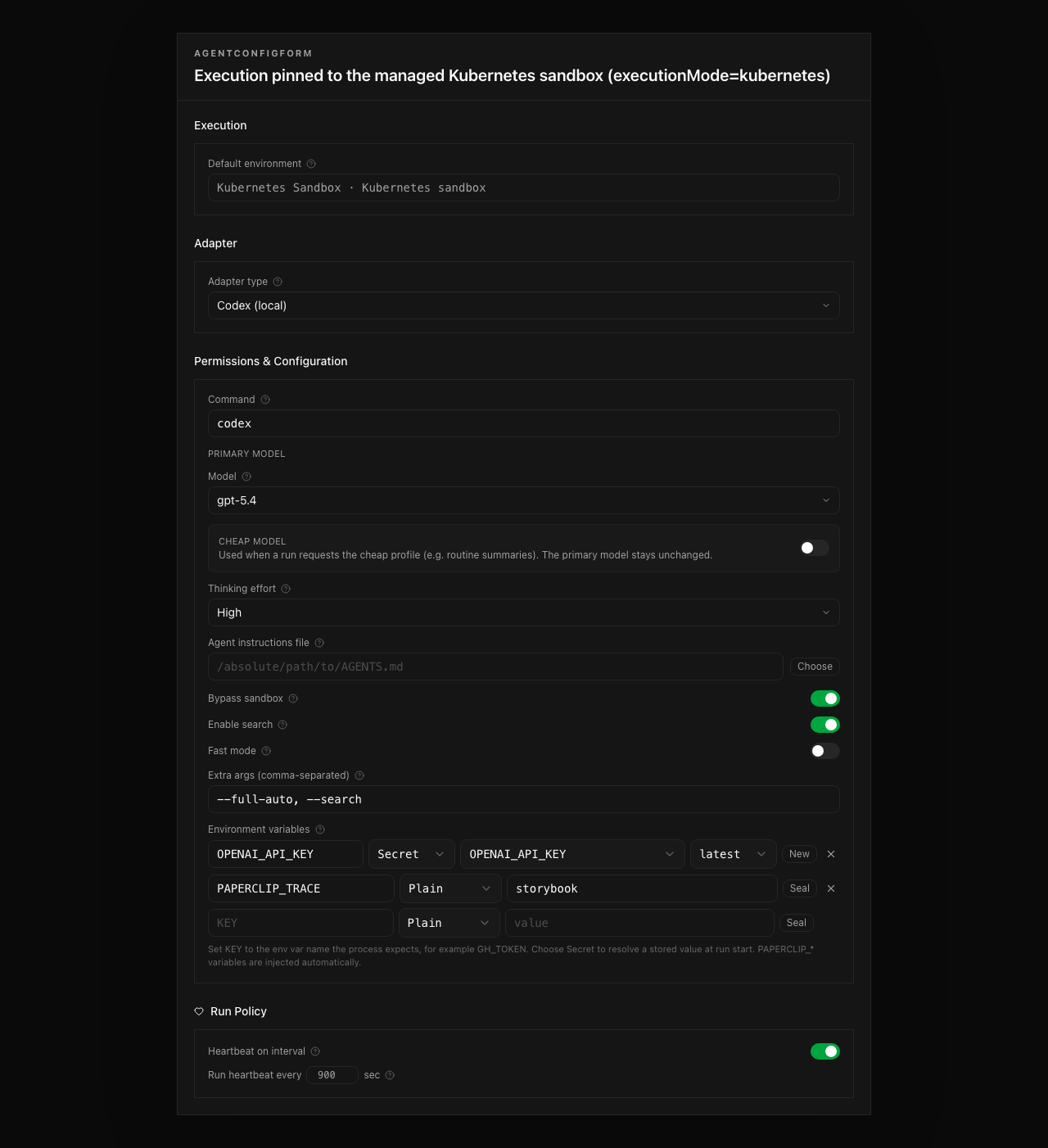 No managed environment available yet (warning notice, no silent local fallback): 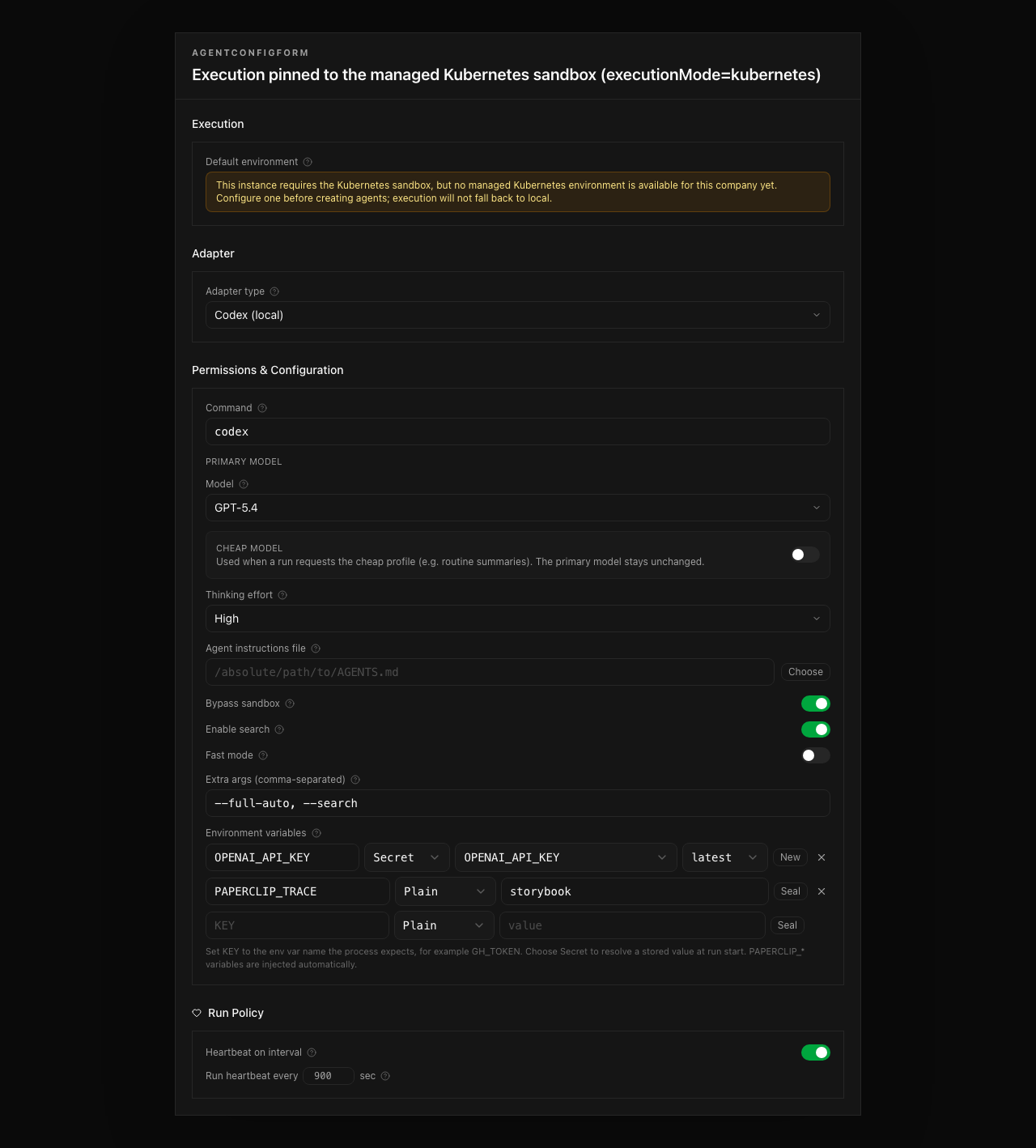 ## Checklist - [x] I have included a thinking path that traces from project context to this change - [x] I have specified the model used (with version and capability details) - [x] I have checked ROADMAP.md and confirmed this PR does not duplicate planned core work - [x] I have searched GitHub for duplicate or related PRs and linked them above - [x] I have either (a) linked existing issues with `Fixes: #` / `Closes #` / `Refs #` OR (b) described the issue in-PR following the relevant issue template - [x] I have run tests locally and they pass - [x] I have added or updated tests where applicable - [x] If this change affects the UI, I have included before/after screenshots - [x] I have updated relevant documentation to reflect my changes - [x] I have considered and documented any risks above - [ ] All Paperclip CI gates are green - [ ] Greptile is 5/5 with no open P2s, recommendations, or follow-ups - [x] I will address all Greptile and reviewer comments before requesting merge 🤖 Generated with [Claude Code](https://claude.com/claude-code) --------- Co-authored-by: Claude Opus 4.8 (1M context) <noreply@anthropic.com> |
||
|
Dotta
|
5153b01ada |
[codex] Add Claude model refresh (#6953)
## Thinking Path > - Paperclip orchestrates AI-agent companies through adapter-backed local and external runtimes. > - The agent configuration UI lets operators choose adapter models and refresh model lists when adapters support live discovery. > - Codex already had a live refresh path, but Claude Local only exposed static fallback models and the UI hid the refresh action for Claude. > - A newly available Claude Opus model should not require a code release every time the model catalog changes. > - This pull request adds Anthropic model discovery for Claude Local, keeps the static fallback current with Claude Opus 4.8, and exposes the existing refresh button in the Claude Local dropdown. > - The benefit is that operators can refresh Claude models from the same model selector flow they already use for Codex. ## What Changed - Added `claude-opus-4-8` to the Claude Local fallback model list. - Added Claude model discovery through Anthropic-compatible `GET /v1/models` when `ANTHROPIC_API_KEY` is available. - Added normal cache reuse, forced refresh support, a SHA-256-based API-key fingerprint for cache keys, and warning logging for discovery errors before fallback. - Wired `claude_local.refreshModels` into the server adapter registry. - Enabled the existing `Refresh models` dropdown action for `claude_local` in `AgentConfigForm`. - Added tests for Claude fallback, live discovery, API-failure fallback, forced refresh, and the UI refresh-button gate. ## Verification - `pnpm exec vitest run server/src/__tests__/adapter-models.test.ts` - `pnpm exec vitest run ui/src/components/AgentConfigForm.test.ts` - `pnpm --filter @paperclipai/adapter-claude-local typecheck` - `pnpm --filter @paperclipai/server typecheck` - `pnpm --filter @paperclipai/ui typecheck` - Greptile review reached Confidence Score: 5/5 on commit `b796cf4f1` with addressed threads resolved. UI note: the visible change is a conditional action row inside the existing model dropdown; the regression test covers that `claude_local` now receives the refresh action. ## Risks - Low risk. Without `ANTHROPIC_API_KEY`, Claude Local still uses the static fallback list. - If Anthropic model discovery fails or times out, Paperclip falls back to the existing cached or static list. - Bedrock environments remain on Bedrock-native model IDs. ## Model Used OpenAI GPT-5 via Codex local coding agent, with repository file access, shell command execution, git operations, and targeted test/typecheck verification. Exact context window is not exposed by the runtime. ## Checklist - [x] I have included a thinking path that traces from project context to this change - [x] I have specified the model used (with version and capability details) - [x] I have checked ROADMAP.md and confirmed this PR does not duplicate planned core work - [x] I have run tests locally and they pass - [x] I have added or updated tests where applicable - [x] If this change affects the UI, I have included before/after screenshots - [x] I have updated relevant documentation to reflect my changes - [x] I have considered and documented any risks above - [x] I will address all Greptile and reviewer comments before requesting merge |

