mirror of
https://github.com/paperclipai/paperclip.git
synced 2026-11-23 21:24:45 +01:00
a792409d07e984e7bf8382e295bdaebd2aa18dda
15
Commits
| Author | SHA1 | Message | Date | |
|---|---|---|---|---|

|
e2cee049f9 |
fix: show instruction saves in history, credit the real writer, and speed up the agent tool-rule list (#19515)
## Thinking Path

> - Paperclip is the open source app people use to manage AI agents for
work
> - Operators and agents change agent instructions (AGENTS.md), and they
must see who changed them and when
> - Agent files replaced instruction revisions. Saves no longer write
revision rows, so instruction history is empty
> - The current revision is stamped with the reader and the date
1970-01-01, so it gives false audit data
> - Separately, an agent that lists tool rules gets a timeout when many
rules name the same resources
> - This pull request reads history from the save records that Paperclip
already writes, credits the real writer, and checks each tool-rule
resource one time
> - The benefit is a correct audit trail for instruction changes and a
tool-rule list that agents can read

## Linked Issues or Issue Description

No public issue exists. I searched open and closed issues and PRs for
these problems and found none.

**What happened?**
1. `get_agent_instruction_history` (and the history API) returns 0
revisions for an agent whose AGENTS.md was saved many times. The
activity log shows each save as `agent.files_updated` with the path,
content hash, actor and run.
2. `read_agent_instructions` returns a current revision with `createdAt`
1970-01-01. Its actor is the agent that reads it, and its `sourceRunId`
is the run that reads it.
3. `GET /api/companies/{companyId}/tools/policies` from an agent fails
with a transport timeout most of the time when the company has many tool
rules. A board user gets the list without a problem.

**Expected behavior**
1. History lists each save, newest first, with its writer, run, source
and time.
2. The current revision names the agent or user that wrote those bytes,
and the time of that save. If no save is recorded, it names no writer.
3. The agent gets the tool-rule list in normal time, with the same rules
hidden as before.

**Steps to reproduce**
1. Save an agent's instruction entry file (board editor,
`update_agent_instructions`, or a run that edits the file). Read the
history. It is empty.
2. As a different agent, call `read_agent_instructions` on that agent.
The revision shows the reader and 1970-01-01.
3. Create about 40 tool rules that name the same connection and agent.
As an agent, list `/tools/policies`. Each rule does a new set of access
checks for each resource, one after another.

**Paperclip version or commit**
`master` at `819420a60a`.

**Deployment mode**
Hosted. The new tests reproduce all 3 problems on `master`.

## What Changed

- `agent-instruction-revisions.ts`: history merges the legacy revision
rows with the `agent.files_updated` save records for the entry file. The
order is `(created_at, id)` descending, and cursors keep PostgreSQL
timestamp precision.
- `agent-instruction-revisions.ts`: the current revision takes its
writer, run, source and time from the latest save of the same content
hash. A reader is never the writer. Bytes with no save record have no
writer.
- `agent-instruction-revisions.ts`: an identical re-save over bytes with
no record is marked `source: "adopted"`. It repairs the runtime journal
but is not listed as a save.
- `agent-instruction-revisions.ts`: a history ID can be a legacy
revision, a save record, or the current content token. A save record
keeps only metadata. If its bytes are no longer current, a read returns
404 with `INSTRUCTION_REVISION_CONTENT_NOT_RETAINED`.
- `agent-file-store.ts`: saves record `byteLength`. A run collection
that changes the entry file records its path, hash and size, so history
shows saves from runs.
- `connection-management-authz.ts`: `filterConnectionManagementPolicies`
keeps one read decision for each distinct resource in a request, and
loads each application or catalog entry one time. A rule is still hidden
when any resource that it names is hidden. Board callers do not use this
path.
- Tests: new tests for save history, paging, writer credit, adoption,
and the tool-rule list. Old assertions that expected empty history now
check the exact saves.

## Verification

- `pnpm --filter @paperclipai/server exec vitest run
src/__tests__/agent-instruction-revisions.test.ts
src/__tests__/agent-instruction-working-copies.test.ts
src/__tests__/agent-directory-working-copies.test.ts
src/__tests__/built-in-agents.test.ts
src/services/native-runtime/agent-instruction-tools.integration.test.ts
src/__tests__/tool-policy-list-authz.integration.test.ts`
- With the fix: all pass (revisions: 28 passed, 1 skipped on Linux;
other 5 files: 230 passed).
  - With the new tests on `master` code: 13 tests fail, as expected.
- `src/__tests__/connection-management.integration.test.ts`: 90 passed.
- The new tool-rule test lists 40 rules that name 1 connection and
counts the connection reads. It needs fewer than 10.
- I could not run the full server typecheck in my sandbox because of a
memory limit. CI runs it.
- CI on head `a2f0b825`: all checks pass, including `ci / verify` and
`ci / e2e`.

## Risks

- History now shows entries whose ID is an activity row ID, not a
revision row ID. Clients that read or restore an older save get a clear
404 because Paperclip no longer keeps those bytes. The latest save and
legacy revisions still read and restore as before.
- Saves recorded before this change have no `byteLength`. For those,
history shows the current size when the hash matches, and 0 otherwise.
- Stock updates of built-in agents do not record a file path, so they do
not show in history.
- No migration. No change to the stored data model.

> For core feature work, check [`ROADMAP.md`](ROADMAP.md) first and
discuss it in `#dev` before opening the PR. Feature PRs that overlap
with planned core work may need to be redirected — check the roadmap
first. See `CONTRIBUTING.md`.

## Model Used

- Anthropic Claude Opus 5.5 (`claude-opus-5-5`), in Claude Code with
tool use (shell, file edits, test runs). Standard context window.

## Checklist

- [x] I have included a thinking path that traces from project context
to this change
- [x] I have specified the model used (with version and capability
details)
- [x] I have checked ROADMAP.md and confirmed this PR does not duplicate
planned core work
- [x] I have searched GitHub for duplicate or related PRs and linked
them above
- [x] I have either (a) linked existing issues with `Fixes: #` / `Closes
#` / `Refs #` OR (b) described the issue in-PR following the relevant
issue template
- [x] I have not referenced internal/instance-local Paperclip issues or
links (only public GitHub `#NNN` / `github.com/paperclipai/paperclip`
URLs)
- [x] My branch name describes the change (e.g. `docs/...`, `fix/...`)
and contains no internal Paperclip ticket id or instance-derived details
- [x] I have run tests locally and they pass
- [x] I have added or updated tests where applicable
- [ ] I have updated relevant documentation to reflect my changes
- [x] I have considered and documented any risks above
- [x] All Paperclip CI gates are green
- [x] Greptile is 5/5 with no open P2s, recommendations, or follow-ups
- [x] I will address all Greptile and reviewer comments before
requesting merge

🤖 Generated with [Claude Code](https://claude.com/claude-code)

---------

Co-authored-by: Claude Opus 5.5 <noreply@anthropic.com>
Co-authored-by: lucktastic <13757243+lucktastic@users.noreply.github.com>
|
||
|
DottaandClaude Opus 5.5
|
6383eb8033 |
fix(authz): require board authority for agent budget changes on every route (#20213)
## Thinking Path > - Paperclip is the open source app people use to manage AI agents for work > - Budgets stop agent spending. The budget hard stop is a control-plane invariant > - The budget routes (`PATCH /api/agents/:id/budgets`, `PATCH /api/companies/:id/budgets`) are board-only > - `PATCH /api/agents/:id` also accepts `budgetMonthlyCents`, and the configuration service writes the agent budget policy from it. That route had no board check for the field > - So an agent, such as a CEO, a manager or the agent itself, can change a monthly budget without a board user. This is a second route around a board-only control, like the pause bypass that #20164 fixed > - This pull request applies the budget route authority to every route that writes an agent budget, and gives agents the final board-only denial with a link to the budget page (#20151) > - The benefit is that only the board changes budgets, and an agent that asks gets a final answer that it can pass to the person ## Linked Issues or Issue Description Refs #17857 (earlier fix, now in conflict with master; this PR rebases it and adds the budget page link). Refs #20164 and #20151 (same pattern for PATCH status and board-only denials). **What happened** An agent can send `PATCH /api/agents/{id}` with `budgetMonthlyCents`. The route accepts it, and the configuration service writes the agent budget policy. This works for the agent's own budget and, with update permission, for other agents. The same field also reaches budget policy through a configuration rollback, direct agent creation, an immediate hire and a built-in agent provision. A chat eval (`budgets-costs.resolve-budget`) found the route. **Expected behavior** Only a board user can change an active budget, as on the dedicated budget routes. An agent gets `403` with code `board_access_required`. The denial says it is final and links the agent's budget tab (`/<prefix>/agents/<id>/budgets`) or the company budgets page (`/<prefix>/activity/budgets`). An agent can still propose a budget in a hire that waits for board approval. The approving board user activates it. **Steps to reproduce** 1. On master, authenticate as an agent of a company (for example the CEO). 2. Send `PATCH /api/agents/{agentId}` with body `{"budgetMonthlyCents": 5000}`, for its own id or for another agent. 3. See `200`. The agent budget policy changes with no board action. 4. The new route tests reproduce this: on master source they fail with `expected 200 to be 403`. ## What Changed - `PATCH /api/agents/:id`: a changed `budgetMonthlyCents` requires a board actor. An unchanged amount with other edits still works. - Configuration rollback: a rollback that changes the budget requires a board actor. - `POST /api/companies/:id/agents` and an immediate `agent-hires`: a positive budget requires a board actor. A hire that needs board approval keeps the proposed budget and does not activate it before approval. - Built-in agent provision: a budget override requires a board actor. - `prepareAgentConfiguration` rejects an agent-originated budget change again (defense in depth). An agent rollback with an unchanged amount does not rewrite the policy. - Board writes keep the actual operator identity. The initial hire budget is saved in the hire transaction. - `assertBoard` and `boardAccessRequired` take an optional board page. Budget denials link the agent's budget tab or the company budgets page, not the general agent profile. - Agent access map updated. - This includes the four commits of #17857 ( |
||
|
DottaandPaperclip
|
8193abb936 |
feat(claude): default qualified macOS and Linux targets to Paperclip Runner (#15997)
## Thinking Path > - Paperclip must run the selected agent on its selected host. > - Claude needs verified packages for each supported target. > - A Mac controller must select the correct Linux provider pack. > - New defaults must follow package and execution evidence. > - This PR adds Claude platform packaging and target-specific pack selection. > - Existing Codex Linux ARM64 behavior remains intact. ## Linked Issues or Issue Description Refs #15683. This PR depends on #15993 and #15994. Related scope: #15422 and #15224. ## What Changed - Reuse the merged four-target daemon producer/consumer matrix. Add target-owned Linux provider packs and carry their immutable identities through release assembly and vendoring. - Reuse master’s landed pinned Claude SDK ARM64 executable admission and retain package-integrity, architecture and no-follow admission. - Select target-specific remote packs so Mac controllers can use Linux hosts without a development pack override. - Preserve read-only runtime context on SSH startup and resume without accepting unverified old content. - Check ordinary installed Claude readiness without injected package authority. Retain Codex and Linux x64 consumer checks. - Extend Claude automatic target selection for the remaining qualified package targets. Retain unsupported-platform and external-override behavior. - Qualify managed Daytona snapshot names through provider IDs during Claude Connect. Pin native acquisition to the measured ID. Preserve a revocation marker after failed probes or target edits, and block native acquisition until requalification instead of falling back to a mutable name. Preserve immutable-image proof, company and account boundaries, and Legacy acquisition. ## Verification - Reconciled with master `9179d8dcc3e908c217fde4f63c9d08ccf8132eeb` through the prerequisite stack, retaining the merged startup fix and latest Codex Linux ARM64 behavior. - [Four-target exact-source package qualification](https://github.com/paperclipai/paperclip/actions/runs/39267321383) passed on source `04e0202ca81387b17cbe7fd094a8338648356fe9`: all four native builds, public-package assembly, Linux x64 verification and clean installed consumers on Apple Silicon, Intel Mac and Linux ARM64. The later master reconciliation adds shared OpenRouter attribution and changes runtime source. This historical result keeps its original source identity; [later qualification](https://github.com/paperclipai/paperclip/actions/runs/39281100929) passed at `dca62c7aeb4b45f0dd91a8e18d386a16a2658ef8`. It predates the subsequent TypeScript startup fix. - Fresh local product acceptance on integrated source `b2c9fe43f9cd3bc5dd9d22552da0148845ba71a4` completed a useful file and follow-up through native Claude/Opus 5.5, High effort and the API-key connection. Both actual browser downloads were independently checked; the revision preserves the original body and session continuity. Total task estimates: $0.518432800. Ordinary web and API creation saved defaults with the native experiment disabled. - Local focused verification passed 993 startup/session tests, 243 UI tests, 12 workflow security tests, direct server/UI TypeScript checks, and token/palette gates before the last review changes. Initial DB-backed snapshot pin/revocation coverage passed 18 cases; the final serial route suites pass 122 credential/permission and 232 snapshot/environment cases after correcting a test hook timeout. Current-head cloud suites pass. - Preserved the failed pre-provider local fixture and its full pending reservation. The successful fixture has no unpriced or pending usage. Historical failed Cloud journeys, accounting holds, source identities and subscription limitations remain in the dated plan. - All Docker/Rust release production was performed in cloud CI. No local Docker image was built. An inadvertently invoked local Rust prerequisite was stopped. - Current-head cloud CI is green. All three stack PRs have fresh Greptile 5/5 reviews and zero unresolved review threads. Required typecheck, test and build gates ran in cloud CI; Docker work stayed remote. Earlier failed checks remain in their original runs. - The final master merge preserves task-loading, permission, skill-retention and OpenRouter changes. Pi uses a fresh combined profile 27, preserving both historical profile-24 declarations; Copilot remains profile 22. Focused protocol checks passed 155 cases (one skipped), the updated Pi attestation check passed 18 (one skipped), and 91 evaluation/catalog checks passed. - Latest-application manual continuation passed in 37.942 seconds on `695e5c005a85bddc8711d3fcddcaf6b7e1fb64d0`, with High effort, native Opus 5.5, Anthropic API attribution, the same resumed Claude session, an independently checked 635-byte file and persisted Done status. It uses the earlier verified Mac daemon; the preceding-source package qualification passed at `dca62c7aeb4b45f0dd91a8e18d386a16a2658ef8`. That package run predates the small TypeScript startup fix and is not relabeled as qualification for it. - Upgrade limitation: changed compiled sidecar identity rejected old durable launch state and recovery hit session-open bounds before eventually resuming. That attempt was operator-cancelled and retained; the successful manual continuation does not qualify seamless upgrades. - Local latency profile, Opus 5.5/High unchanged: three alternating real-ACP loopback samples per variant reduce median provider-ready time from 5.081s to 4.034s. The matched real API task startup improves from 5.533s to 4.348s, but total reply time changes from 17.933s to 20.221s because agent work varies. This establishes a startup saving of about one second, not a consistent total-reply speedup. A real candidate follow-up passed in 20.146s and resumed the same saved session. The loopback fixture makes no external model requests; failed initial probes remain retained. - The startup change passes 107 focused runtime/effort/lease tests, 53 profile checks (one skipped), TypeScript checking and the TypeScript-only runtime build. Native hire fixture checks pass 70 tests; their first local run retained a socket-hangup failure and stale OpenCode expectation, both accounted for before the passing rerun. Broader required checks run in cloud CI. ## Risks - **Experience needs improvement:** successful connection setup still shows “Connection needs attention” because runtime checks are deferred. Cold provider-pack upload took 122–126 seconds per run while the task mainly showed “Thinking.” The tested Core-only preview excludes private Cloud UI plugins; this is not full Cloud distribution or subscription qualification. Desktop dark theme was tested; mobile and comprehensive accessibility were not. The portable report validates, but gallery interaction could not be inspected because host preview was queued. - The optional supply-chain scan returned neutral/inconclusive because GitHub Actions package coverage and infrastructure parsing are unavailable. It is not counted as a successful supply-chain qualification. Exact package, daemon and image integrity checks passed. - A stale, missing or wrong-architecture pack must fail admission. It must not change runner or target silently. - Provider-pack source changes invalidate affected earlier execution results. Existing unknown-cost and cleanup holds remain intact. - Live subscription execution remains unverified under the API-key qualification direction. Built-in authentication flows are retained. ARM64 cloud-image production is deferred. Merge and production deployment remain separate. ## Model Used OpenAI Codex, GPT-6 family, with reasoning, repository tools, code execution and browser testing. The exact serving model ID and context-window size are not exposed in this session. ## Checklist - [x] I have included a thinking path that traces from project context to this change - [x] I have specified the model used (with version and capability details) - [x] I have checked ROADMAP.md and confirmed this PR does not duplicate planned core work - [x] I have searched GitHub for duplicate or related PRs and linked them above - [x] I have either (a) linked existing issues with `Fixes: #` / `Closes #` / `Refs #` OR (b) described the issue in-PR following the relevant issue template - [x] I have not referenced internal/instance-local Paperclip issues or links (only public GitHub `#NNN` / `github.com/paperclipai/paperclip` URLs) - [x] My branch name describes the change (e.g. `docs/...`, `fix/...`) and contains no internal Paperclip ticket id or instance-derived details - [ ] Focused local tests and final cloud verification pass - [x] I have added or updated tests where applicable - [x] I have updated relevant documentation to reflect my changes - [x] I have considered and documented any risks above - [x] All Paperclip CI gates are green - [x] Greptile is 5/5 with no open P2s, recommendations, or follow-ups - [x] I will address all Greptile and reviewer comments before requesting merge --------- Co-authored-by: Paperclip <noreply@paperclip.ing> |
||
|
DottaandPaperclip
|
adb69e8f09 |
feat: default new Codex agents to Paperclip Runner on Linux and macOS (#15683)
## Thinking Path > - Paperclip is the open source control plane for agent companies. > - People choose a harness when creating an agent. > - The server should resolve that harness to a qualified runner. > - Codex is the first harness in the staged default rollout. > - Saved agents must retain their execution choices. > - New Codex agents therefore use Paperclip Runner on qualified macOS/Linux targets, with an explicit Legacy override. ## Linked Issues or Issue Description Refs #16028, #15555, #15673, #15422, #15631, #15926, #15932, #16149. The runtime/install prerequisite and release repair are merged. This slice owns Codex creation, setup, configuration and preservation. Other harness defaults remain unchanged. It adds no database migration; incoming master migrations, required maps and regression coverage are retained. ## What Changed - Resolve `runner: auto | paperclip | legacy` at the common creation boundary across onboarding, API/CLI, hires, built-ins, plugins and imports. Freeze pending hires and export resolved execution choices. - Preserve existing runners on upgrades, unrelated edits and import updates, including compatible accounts, workspace settings, Codex effort and intentional clears. - Use the underlying harness picker and branding; put the runner override in Advanced. Use the shared dropdown and update production-component stories and creation contracts. - Support qualified Apple Silicon, Intel Mac, Linux x64 and Linux ARM64. Linux requires GNU libc 2.39+. Disabled, external, unsupported and unqualified combinations retain their applicable Legacy execution. - Test the selected runtime/account/model/environment. Ordinary Connect probes eligible immutable managed targets and refreshes scoped discovery. Creation/discovery do not provision. Auth, dependency, incompatible-setting and cleanup failures remain actionable without changing runners. - Keep setup probes read-only, preserve local/SSH isolation and resolve packaged assets before staging credentials. Bound cleanup reads by the remaining absolute deadline; physically close every owned ingress socket before endpoint release. Unconfirmed cleanup retains recovery state. - Preserve validated completed-onboarding callbacks through startup recovery. First file-producing work belongs to the child task and uses the existing dependency/block handoff and task-scoped registration. - Reuse existing E2E fixtures, artifact checks, reporting and controls. Keep Docker/Cargo/native compilation remote. Paperclip tarballs contain no Codex payloads; official optional npm platform dependencies remain. ## Verification Current tested head: `1c03a8815672d82c264a9b08d4ea1984e8fae107`. **Merge-ready: required CI, fresh review, package qualification, Mac core acceptance and Test task/follow-up acceptance pass.** The existing attachment and native-continuity oracles independently verify both Test downloads, run attribution and unchanged native/provider/workspace identities. The maintainer authorized a code-owner-review exception for this PR only. The first Test setup failure and normal Board completion-review friction are retained below. Actual post-merge packages and private Cloud distribution remain separate qualification gates. - [Current CI](https://github.com/paperclipai/paperclip/actions/runs/38564241625): all 48 ordinary jobs and required verify/E2E pass. Attempt 1 retained six simultaneous host-shutdown cancellations. One failed-only retry passes those six lanes and two aggregates, preserving 40 successes. Actual integration checkout `53104c1` combines this head with master `c80`; it is not relabeled as the branch tree. Fresh exact-head Greptile 5/5, 30 resolved threads, no actionable findings. - [Exact-source package qualification](https://github.com/paperclipai/paperclip/actions/runs/38565287239): nine applicable jobs pass, nine conditional jobs skip. Four remote native producers; Linux x64 clean install; Intel Mac, Apple Silicon and Linux ARM64 native startup/physical cleanup controls. All 18 tarballs/four daemon source/hash/manifest bindings and 343 migrations through 0344 verify. No Codex payload is packed. These hosted tarballs are not a published npm canary. - Normal Apple Silicon installation and credential-free native startup/cleanup pass using the packaged daemon, with no source build or provider turn. Fresh installed DB initialization passes. Upgrade 651a→1c03 preserves all three complete execution configs, accounts, ten recorded run profiles, paused budgets, active incidents, cost summaries and two historical unpriced events. Historical recovery state is retained. - Cleanup regressions: four delayed-read baseline failures become 15 passing deadline/authority controls. No-acknowledgement and prior-error socket ownership regressions become 12 passing controls. Direct runtime/server types, maps: 35 areas / 176 IDs, diff checks and independent reviews pass. Permission/auth/reconnect policy and the 10-second setup budget remain intact. - Existing source coverage includes creation/selection/imports, pending approvals, recovery, account/lifecycle handling, mounted forms, dropdowns and E2E support. Full typechecks/tests/build/token and applicable Storybook checks pass in the recorded current CI; no duplicate suite or weakened grader. - Literal 9546 live Mac proof: ordinary Auto Codex onboarding, useful document, real completed-child callback/reply, seven successful native runs, manual follow-up and independently downloaded1,101-byte child file. Existing Legacy title edit/reload preserves execution; two real Legacy runs produce independently checked15/34-byte files. These remain historical source records. - Current literal 1c03 Mac core acceptance passes independent checks: ordinary Auto native Codex onboarding without runner override; only timeout 180 seconds/concurrency 1 saved; six successful native runs and six serialized turns (maximum overlap 1); both same-task continuity checks and five mechanical callback checks; actual rendered parent reply and exact child downloads. The useful handoff advances from revision 1 to 2. Both files are 48 bytes, SHA-256 `8b742bd4e8123a7c078f0a8d9f3449fbfa8a320d7d90be641a2818db3c53d92c` and `f42db9774fa06e804ab7d596fc8b922a2b638921c418b87d0111151d290a6afe`; exactly one byte changes and old history remains. The agent is paused with zero active runs/errors. Both artifact work products have `isPrimary=false`, and descriptive titles fail a stricter title-helper assumption; these retained results are scoped editorial follow-up, not new merge gates. Six source-bound screenshots are uploaded and verified in the private primary QA report. - [Literal 9546 managed proof](https://d1p6rlowie26tp.cloudfront.net/runner-e2e/campaigns/gha-38485488621-1/index.html): original 19 assertions and completed judge pass, four native turns, child-bound240-byte file and session/workspace continuity. Checkout reports a verified generated target-lock mutation; full final porcelain was not retained. Signed execution-image identity remains separate from Core source. - Actual 651a Test deployment succeeds on one owned/pinned target. One ordinary Auto API-key Connect then fails native cleanup before hire. Controller turn/drain/suspend completion and service-recorded environment cleanup are observed; they do not certify physical deletion or native authority retirement. Failure/recovery/unknown holds are retained. No Legacy switch or unchanged paid retry. The two source repairs above require actual treatment. - [Current immutable Core preview](https://github.com/paperclipai/paperclip/actions/runs/38570365725) and matching DB/shared artifacts pass. One owned, pinned Test target serves exact `1c03`; identical migration history correctly skips the migrator. Ordinary Auto Codex Connect succeeds and hires native; saved native selection and QA bounds survive reload. The initial child preparation attempt fails before provider work, with actual stdout identifying `renewal_deadline`; its trigger remains unknown and the failure is retained. Normal Board **Try again** and **Resume** recover the child to Done, producing a browser-verified 44-byte file, SHA-256 `0a8458b1efcc2d7a0d815689458c4caab039a46c7c7a3e5805de6bc8b1a96ecc`. The actual parent callback reports the completed child document/file. The existing validator requires a parent-owned attachment, so recovery enters normal Review; after byte checking, normal **Approve completion** reaches parent Done. No forced status or duplicate parent file is used. The validator is unchanged from integrated and current master. Autonomous initial callback-to-Done is not proven. The same-child follow-up completes document revision 2 and publishes a second independently downloaded 44-byte file, SHA-256 `22022257300fae762784632d08d3bbe0bab61e2ce81f91864a14dcd7aa464591`; only the revision digit changes. The unchanged existing native-continuity and attachment oracles pass. All ten recorded runs are terminal: nine native successes and the retained pre-provider setup failure. The QA agent is paused with zero active runs. The pre-existing parent evidence scope mismatch is a separate follow-up, with ordinary completion review exercised rather than a forced status or relaxed validation. This unsigned Core preview remains distinct from post-merge private Cloud composition. ## Risks - Saved agents are not migrated. Explicit runner changes use normal configuration/session rules; historical runs retain their recorded execution. - Native readiness depends on verified assets and server-owned target qualification. A Legacy probe, HTTP200 or successful account save cannot prove native readiness. - Recovery exceptions remain restricted to validated completed-onboarding reports; process-loss, ownership and terminal-state safeguards remain active. Unexecuted live journeys stay open. - Linux ARM paid tasks, Windows, Alpine and 32-bit ARM remain deferred. Cold Cargo cache misses are recorded; no warm-cache speedup is claimed. - Historical invoices/physical cleanup remain unconfirmed and held. After merge, exact published npm canary, signed standard image/migrator, private composition and serving/live acceptance still require qualification. Production deployment/default promotion is not authorized. ## Model Used OpenAI Codex, GPT-6 family, with reasoning, tools, code execution and parallel agents. Exact serving snapshot and context-window size are not exposed. ## Checklist - [x] I have included a thinking path that traces from project context to this change - [x] I have specified the model used with available version and capability details - [x] I have checked ROADMAP.md and confirmed this PR does not duplicate planned core work - [x] I have searched GitHub for duplicate or related PRs and linked them above - [x] I have linked public issues or PRs above - [x] I have not referenced internal/instance-local Paperclip issues or links - [x] My branch name describes the change and contains no internal ticket id - [x] I have run the stated focused tests locally and they pass - [x] I have added or updated tests where applicable - [x] I have updated relevant documentation - [x] I have considered and documented risks - [x] All Paperclip CI gates are green on the current candidate - [x] Greptile is 5/5 with no open findings on the current candidate - [x] I will address all reviewer comments before requesting merge --------- Co-authored-by: Paperclip <noreply@paperclip.ing> |
||
|
|
ba4fac585d |
feat(agents): show who created an agent in shared companies (#16055)
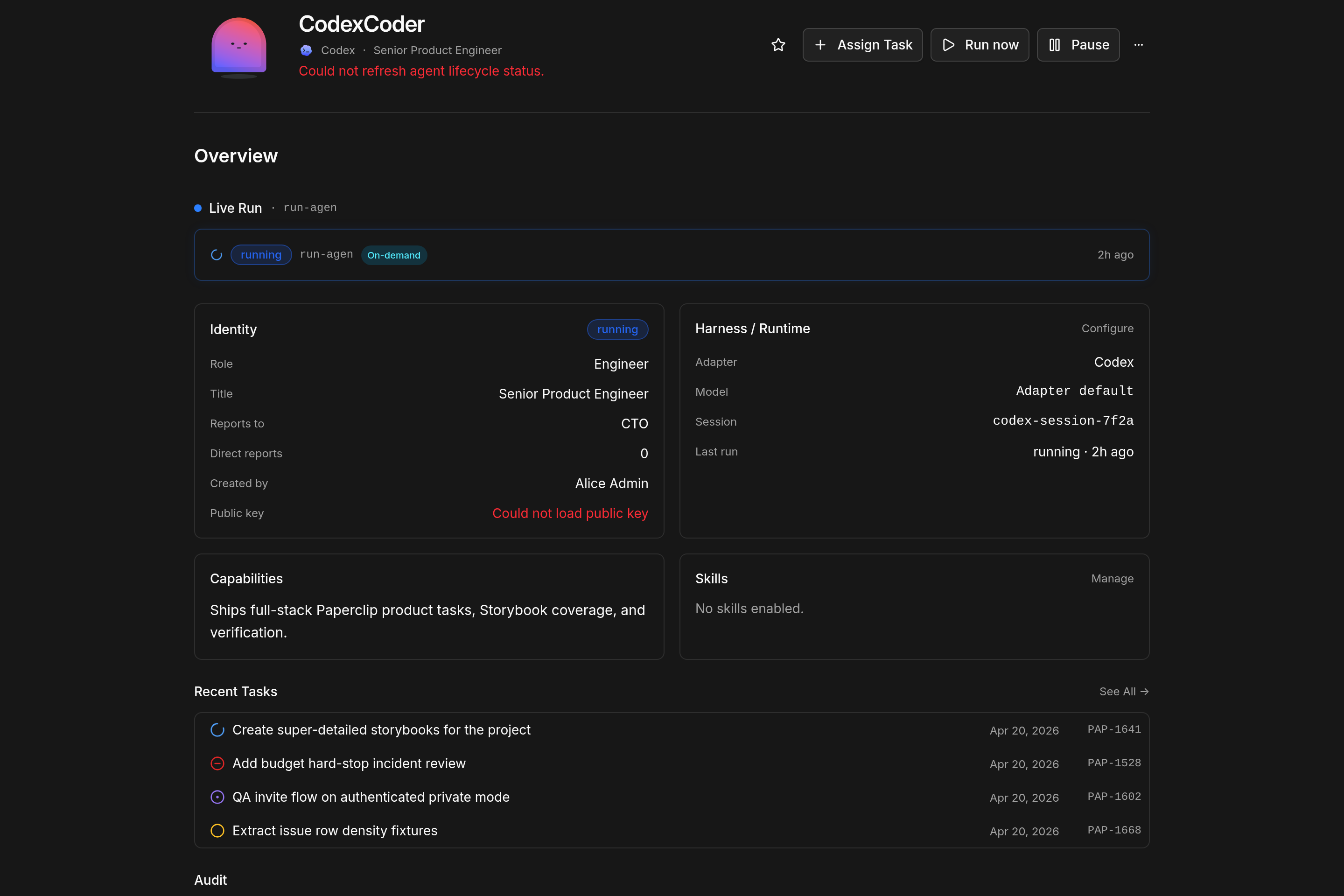
## Thinking Path > - Paperclip is the open source app people use to manage AI agents for work > - A company in Paperclip can have more than one human member, and each member can create agents > - The app does not record which person created an agent > - When two or more people share a company, members cannot see who added an agent or who to ask about it > - This pull request records the creator of each agent and shows the creator on the agent Overview tab > - The benefit is clear ownership of agents in shared companies, with no change for single-user companies ## Linked Issues or Issue Description No public issue exists. This description follows `feature_request.yml`. **Subsystem affected** Agents: the agent data model, the agent create path on the server, and the agent Overview tab in the board UI. **Problem or motivation** Paperclip does not record which human user created an agent. When more than one human user works in a company, the agent page does not tell members who created the agent. **Proposed solution** Record the user ID of the creator when a human creates an agent. Show "Created by <name>" on the Identity card of the agent Overview tab. Show this row only when the company has two or more human members. Do not count the synthetic local Board principal as a human member. Do not show the local Board as a creator. **Alternatives considered** Count human users across the full instance. We did not do this. An instance-wide count tells a member of one company that other companies have users. The creator is always a member of the agent's company, so the company count is sufficient. **Roadmap alignment** `ROADMAP.md` has no item for agent ownership. This change is small and additive. ## What Changed - Add the nullable column `agents.created_by_user_id` (`packages/db/src/schema/agents.ts`, migration `0343_new_mentor.sql`). - Set the column in the single agent insert path (`server/src/modules/agent-lifecycle/adapters/records.ts`). The value comes from the authenticated user actor. The server ignores a creator value in the request body. Agents that agents or the system create keep `null`. - Backfill existing agents in the migration. The backfill uses the earliest `agent.created` or `agent.hire_created` activity row that a user actor wrote in the same company. - Add `createdByUserId` to the shared `Agent` type (`packages/shared/src/types/agent.ts`). - Add `ui/src/lib/agent-creator.ts`. It decides if the UI shows the creator row and it resolves the creator name. If the creator left the company, the row shows "Former member". - Add the "Created by" row to the Identity card in `ui/src/pages/AgentDetail.tsx`. If the company user directory request fails, the row shows "Could not load creator". The row does not disappear silently. - Add the Storybook story `Pages/Agent Detail → Shared Company Shows Creator`. - Document the column in `doc/SPEC-implementation.md` §7.2. ## Verification - `pnpm --filter @paperclipai/db typecheck` passes. This includes the migration numbering and migration safety checks. - `pnpm --filter @paperclipai/shared typecheck` passes. - `ui`: `tsc --noEmit` passes. - `server`: `vitest run src/modules/agent-lifecycle/__tests__/lifecycle.test.ts` passes (49/49). Two new tests: - The server records the creator from the actor and ignores a creator value in the request body. - The backfill takes the earliest user activity row. It skips agent actors and rows from other companies. - `server`: `vitest run src/__tests__/built-in-agents.test.ts` passes (40/40). A new test checks that a built-in agent enabled by a human records that human, and that automatic provisioning stays unattributed. The gated (pending-approval) provisioning test also asserts the creator. `src/__tests__/built-in-agent-routes.test.ts` also passes. - `ui`: `vitest run src/lib/agent-creator.test.ts src/pages/AgentOverview.test.tsx` passes (10/10). The tests cover these cases: the row shows with two or more humans, the row stays hidden with one human plus the Board, the UI never shows the Board as the creator, the row shows an error when the directory request fails, and the row stays hidden (no error) for agents with no creator or the Board as creator. The last case fails without the fix. - The current Storybook catalog uses source annotations and generated indexes. `node scripts/storybook-catalog.mjs --check` passes (264 story files, 2,514 stories). The merge keeps the authored catalog deletion from master. - `pnpm check:token-gates` is clean. - Screenshots from the Storybook story (fake data: two human members, Alice Admin and Bob Builder, plus the local Board). The red "Could not load public key" text is a Storybook artifact: the story has no fixture for the public key request. The existing `Dashboard` story shows the same text. **Two or more human members: the Identity card shows "Created by".** 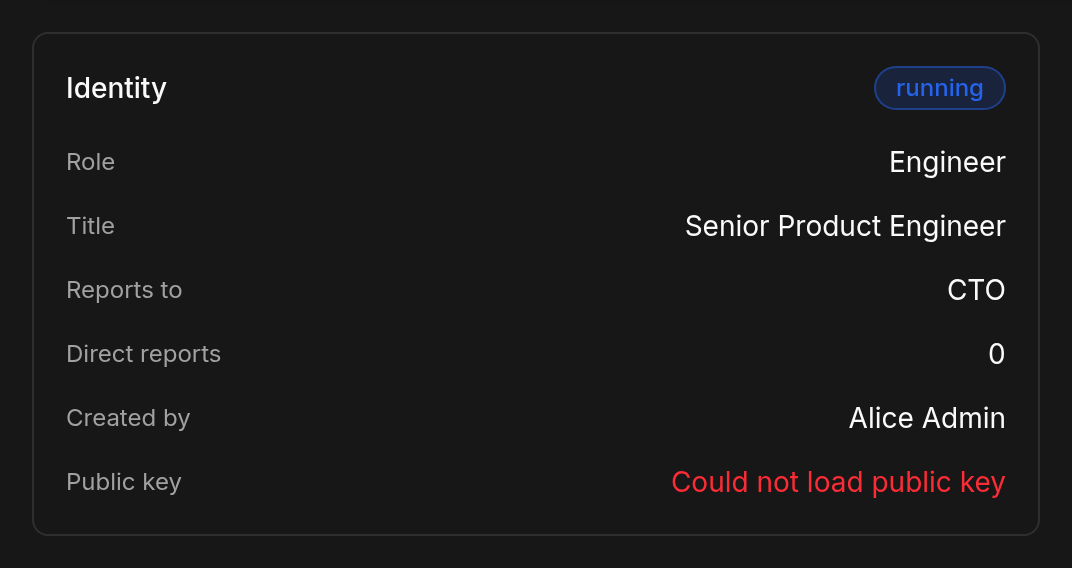 **One human member plus the local Board: the row stays hidden.** 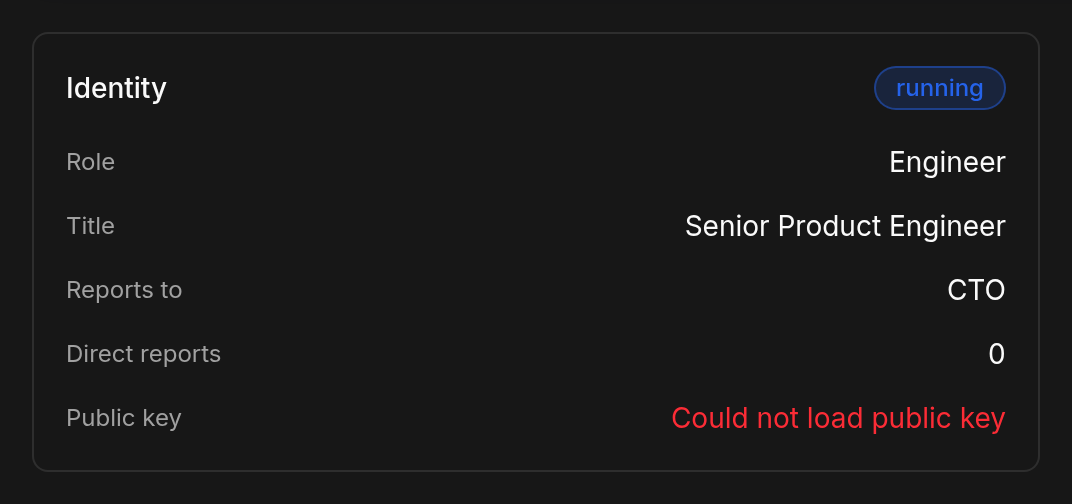 Full Overview tab: [overview-created-by.png](https://raw.githubusercontent.com/paperclipai/paperclip/9b62bd2ea6cf984ce6745f08cc45f44ddf00fb51/pr-16055/overview-created-by.png). The images are on the separate branch `pr-assets/agent-created-by`. They are not in this PR and do not go to `master`. - Manual check: open Storybook at `Pages/Agent Detail → Shared Company Shows Creator`. The Identity card shows "Created by Alice Admin". The `Dashboard` story has one human, so it does not show the row. - Final focused verification on `5a02350cf16050a3cf3cb3f8dc061fe61758c60d`: all 99 tests pass across the two UI suites, built-in-agent suite, and lifecycle suite. The backfill test applies the complete migration twice. The migration uses `ADD COLUMN IF NOT EXISTS` and preserves the company-scoped backfill. Migration numbering and token checks pass. - Full repository typecheck, build, and Storybook build pass. The generated creator story ID is present. A Chromium check renders the production agent page fixture and verifies the creator row and Alice Admin name. Map checks and their 21 tests pass. A fresh Apex review is 5/5 on the current head with no unresolved findings. All 54 successful CI checks pass on this head, with two intentional skips, including all general and serialized test shards, E2E, typecheck, and build. The workspaces-b job passed after rerunning a runner shutdown; no source change was needed. The separate, unsharded local `pnpm test:run` invocation has not completed; complete suite verification comes from CI. ## Risks - Migration: the migration adds one nullable column and runs one `UPDATE` on `agents` with a correlated subquery on `activity_log`. On an instance with a very large activity log, the backfill can take some time. The migration does not lock other tables and does not delete data. - Backfill accuracy: agents with no user-authored create activity row keep `null`. The UI then does not show a creator. This is the same as the current behavior. - Privacy: the row shows only names from the company user directory, and only to users who can already see that directory. - Low risk for single-user companies: the UI does not change for them. > For core feature work, check [`ROADMAP.md`](ROADMAP.md) first and discuss it in `#dev` before opening the PR. Feature PRs that overlap with planned core work may need to be redirected — check the roadmap first. See `CONTRIBUTING.md`. ## Model Used - Provider: Anthropic, Claude Opus 5.5 (model ID `claude-opus-5-5`), run as a coding agent through Claude Code with tool use (shell, file edit, and test execution), standard context window. OpenAI GPT-6 (`gpt-6`) through Codex assisted conflict resolution, regression tests, and repository verification. This session does not expose an exact context-window size. ## Checklist - [x] I have included a thinking path that traces from project context to this change - [x] I have specified the model used (with version and capability details) - [x] I have checked ROADMAP.md and confirmed this PR does not duplicate planned core work - [x] I have searched GitHub for duplicate or related PRs and linked them above - [x] I have either (a) linked existing issues with `Fixes: #` / `Closes #` / `Refs #` OR (b) described the issue in-PR following the relevant issue template - [x] I have not referenced internal/instance-local Paperclip issues or links (only public GitHub `#NNN` / `github.com/paperclipai/paperclip` URLs) - [x] My branch name describes the change (e.g. `docs/...`, `fix/...`) and contains no internal Paperclip ticket id or instance-derived details - [x] I have run tests locally and they pass - [x] I have added or updated tests where applicable - [x] I have updated relevant documentation to reflect my changes - [x] I have considered and documented any risks above - [x] All Paperclip CI gates are green - [x] Greptile is 5/5 with no open P2s, recommendations, or follow-ups - [x] I will address all Greptile and reviewer comments before requesting merge 🤖 Generated with [Claude Code](https://claude.com/claude-code) --------- Co-authored-by: Amy (Opus) <noreply@anthropic.com> Co-authored-by: Paperclip <noreply@paperclip.ing> Co-authored-by: devinfoley <139239+devinfoley@users.noreply.github.com> |
||
|
Nicky LeachandPaperclip
|
2dd9811e8b |
Own agent hiring and termination in a lifecycle module (#15631)
## Thinking Path > - Paperclip manages AI agents and their work. > - Agent creation, approval, pause, and termination change whether an agent can work. > - These changes currently use separate service and database paths. > - Some agents need setup after their record exists and before their harness can run. > - This PR adds one module that owns those state changes and their transactions. > - The module records progress and retries incomplete work after a server restart. ## Linked Issues or Issue Description **Problem or motivation** A hire can become active before its execution environment is ready. Direct agent state writes also bypass one common lifecycle boundary. Termination does not have a durable step for resource cleanup. **Proposed solution** Use agent lifecycle commands for hiring, approval, pause, resume, and termination. Keep proposed hires pending until approval. Prepare each approved hire, test its saved harness configuration, and then permit work. Wait for required plugin work before completing a step. **Alternatives considered** A general database commit hook would expose transaction details to callers. A timer alone would delay each new hire. This module owns each command transaction and starts its worker after commit. A periodic scan recovers work after a process stops. **Roadmap alignment** This change adds the lifecycle boundary for the existing agent and plugin systems. It does not add a user interface or a provider implementation. It replaces the lifecycle delivery approach in #15391. Related proposals include #11475 and #13099; this change does not add their external executor protocols. ## What Changed - Add durable approval, preparation, verification, pause, resume, stop, and cleanup states. - Keep agent creation, lifecycle state, configuration writes, and agent record deletion behind `modules/agent-lifecycle`. Keep validation, credential rules, reads, onboarding, invitations, general approvals, and company data deletion in their services. - Commit a hire before the remaining onboarding or invitation work. Serialize requests with the existing dedicated database connection helper. Reuse the hire after a failed attempt. - Keep accepted work in the run queue during setup. Require execution and cleanup evidence before completing pause or termination. - Retain the original credential owner when approving migrated hires. - Start lifecycle work after each command commits. Use database leases and revision checks for retries and late results. - Add a generic required plugin method and capability. Store the required plugin IDs for each agent. Track host and plugin completion separately. - Keep harness verification and credential rules in services. Supply their results to lifecycle through explicit ports. Reject failed logins and incomplete probes. - Remove reverse imports from lifecycle adapters into services. Share record queries and validation below both layers. - Use one hire decision path for agent IDs and approval IDs. Resolve the approval and agent change in one transaction. Expose policy reconciliation on the command object. - Save configuration and verification invalidation through one module operation. Ordinary commands own their transaction. Restrict the shared transaction integration to its listed callers. Reject identity, company, accounting, timestamp, and unknown fields. - Require completed termination before deleting agent records. The company deletion service calls the module through a separate deletion interface. - Save an approved secret before applying its agent binding. A failed binding leaves the secret approved. A retry reuses it. - Remove old permission and metadata export files. Move hire configuration rules out of lifecycle persistence. - Report failed worker steps and scans with operation context and known error codes. Omit provider messages, stacks, and configuration values. Document ordinary application use and extension rules. - Recover expired native owners only after execution stops. Retry cleanup of failed retained leases. Wait for setup in the live smoke script. - Keep manual, budget, and company pause reasons separate. Guard execution status writes with the ready state. - Add a migration, boundary checks, regression tests, and a lifecycle guide. Keep the current UI. - Limit periodic policy checks to 100 eligible agents per minute. Continue from the last agent ID. Exclude pending hires and agents in termination or a final state. Keep explicit company and budget updates immediate. ## Verification - Latest head `ccc3c86b0` aligns the shared status update schema with the PATCH route. All 15 shared tests, 104 server route/OpenAPI tests, 2 CLI tests, and shared/server/CLI TypeScript checks pass. The Greptile comment is fixed. CI is running; no new Apex review was requested for this small fix. - Rebase `75708ac94` rebases onto master at `2eb5187e4`. The backup test uses the shared 90-second timeout from master; the older timeout commit was removed. The affected backup test passes. - Agent budget edits now pass the target agent ID through enforcement. All 50 affected tests, server TypeScript, and 11 boundary tests pass. Both configuration update paths have regression coverage. CI is running on the latest head. No new Apex review was requested for these small fixes. - Rebase `9b568666a` preserves the run-control extraction and delivery-work startup changes from master. All 559 affected tests, server TypeScript, and 11 boundary tests pass. CI and Apex review are running on the final head. - The policy scan fix passes 56 lifecycle and diagnostic tests, 24 policy and caller tests, and 11 boundary tests. A regression test checks the page limit, interval, excluded states, and cursor wraparound. - Rebase `fd4698750` passes all 611 tests in eight affected lifecycle, route, and heartbeat suites. Server TypeScript and all 11 module boundary tests pass. The company deletion rollback and concurrent hire tests are included. - Follow-up `00aac7646` fixes the failed decision deletion test and the public update schema. All 126 affected server tests, 8 shared tests, 2 CLI tests, and 11 boundary tests pass. Shared, server, CLI, and UI TypeScript checks pass. - Server TypeScript passes: `pnpm --filter @paperclipai/server exec tsc --noEmit`. - All 11 boundary tests pass: `node --test scripts/check-module-boundaries.test.mjs`. The repository boundary scan also passes. - All 68 lifecycle, failure diagnostic, and harness verification tests pass. Tests reject forbidden fields through the root command, combined transition command, and restricted transaction integration. They also check invalid fields returned by configuration preparation. - Failure tests cover host work, plugin work, claims, renewals, deferrals, and scans. Log tests check known error codes and exclusion of private error contents. - All 355 tests in 10 existing caller suites pass. These tests cover secret approval, pairing, pending hires, credentials, company import, built-in agents, managed agents, instructions, and skills. - The branch is rebased onto `origin/master` at `2eb5187e4`. The queue guards and cancellation lock fix use the extracted heartbeat queue. Agent cancellation uses the extracted run-control file. The source diff scan found no secrets or private URLs. - Earlier checks cover approval retries, rollback, late verification results, policy holds, deletion rollback, concurrent company deletion, and queue admission during setup. - Before the rebase, CI passed on `00aac7646` and Greptile Apex rated it 5/5 with no open comments. CI and a new Apex review are pending for the rebased commit. The branch has no merge conflicts. - The full local build and native Dot suite were not run. The host has no Cargo. No live provider test was run. ## Risks - Background policy recovery takes more than one minute when more than 100 agents are eligible. Explicit company and budget updates still reconcile immediately. - The restricted configuration integration keeps an agent reference and its dependent records in one transaction. It cannot change a budget or invoke a lifecycle transition. A periodic scan starts pending setup after that transaction commits. - Secret approval and binding use separate transactions. A failed binding can leave an approved secret with no agent binding. - New approved hires remain unavailable until setup and verification complete. Existing clients see `paused` during these steps. This PR does not change the UI. - Migration `0320_daily_onslaught.sql` maps existing statuses and pause reasons. It does not create external resources or claim that an existing harness passed verification. - Use a coordinated server update for this migration. Older server versions can write legacy status without the new lifecycle checks. - A failed onboarding or invitation request can leave a committed hire. A retry reuses that hire and completes the remaining records. - Deletion requires completed termination. Company deletion can require another request while cleanup is pending. - Required plugins must make repeated calls safe and reject older revisions. A disabled or removed required plugin blocks completion until it is restored. - A new hire can run a second harness test after the existing UI test. Some adapters can charge for this test. - No live provider test was run. Provider implementation and resource backfill remain separate work. ## Model Used OpenAI GPT-6 through Codex, with reasoning, code tools, and local test execution. ## Checklist - [x] I have included a thinking path that traces from project context to this change - [x] I have specified the model used (with version and capability details) - [x] I have checked ROADMAP.md and confirmed this PR does not duplicate planned core work - [x] I have searched GitHub for duplicate or related PRs and linked them above - [x] I have described the issue in this PR with the feature request field labels - [x] I have not referenced internal or instance-local issues or links - [x] My branch name describes the change - [x] I have added or updated tests where applicable - [x] I have updated relevant documentation - [x] I have considered and documented risks - [x] Targeted local tests pass - [x] All Paperclip CI gates are green on the new commit - [x] Greptile Apex is 5/5 with no open comments on the new commit - [x] I will address review comments before requesting merge --------- Co-authored-by: Paperclip <noreply@paperclip.ing> |
||
|
DottaandPaperclip
|
a1ab55a56d |
fix(agents): grant configuration access by default (#15283)
## Thinking Path > - Paperclip manages agent work and permissions for a company. > - Agent setup can require one agent to configure another agent. > - New standard agents could create agents, but they had no direct configuration grant. > - Existing agents must keep their current permissions after an upgrade. > - The requested new-agent defaults include 13 more direct permissions for suggestions, skills, tools, audit, inbox, and task assignment. > - This pull request adds the 14-grant set at creation and approval activation, retains it through invitations, and keeps existing agents unchanged. > - The change keeps low trust and built-in agents on their narrower permissions. ## Linked Issues or Issue Description **What existing behavior does this improve?** The agent creation and approval flows, and the agent configuration authorization path. **Current behavior** A new standard agent can create an agent. It cannot make protected changes to a peer agent unless an operator adds an `agents:configure` grant. **Proposed behavior** Add direct grants for `agents:configure`, `agents:suggest-changes`, `skills:create`, `skills:suggest-changes`, `tools:manage_connections`, `tools:manage_profiles`, `tools:view_audit`, `audit:view_agent_actions`, `tools:use`, `tools:manage_runtime`, `inbox:manage`, `tasks:assign`, `tasks:assign_scope`, and `tasks:manage_active_checkouts` to new standard agents. Scope `tasks:assign_scope` to the agent’s reporting subtree. Keep existing agents and their grants unchanged. **Reason and benefit** New standard agents can complete agent setup and the requested tool, skill, inbox, and task workflows under existing route, scope, and approval checks. **Breaking changes** Existing agents keep their current permissions. There is no permission migration. Related PR: #12212 adds scoped grant routes. This PR changes the default grant. ## What Changed - Add the 14 requested direct grants in agent creation and approval activation. Keep them when invitation approval replaces grants, preserving explicit scopes. Remove them when an agent is deleted. - Apply defaults only to new agents. Remove the existing-agent permission migration, its snapshot, and its journal entry. Preserve existing scoped grants. - Add permission, scope, invitation, and existing-agent regression tests. Document all default and excluded permissions. - Prevent agent keys from creating, changing, or restoring host-executed process or local adapter command settings, and from restoring workspace commands through rollback. ## Verification - Run `node_modules/.bin/vitest run server/src/__tests__/agent-default-configure-grants.test.ts server/src/__tests__/invite-join-grants.test.ts packages/db/src/migration-snapshot-drift.test.ts`. All 15 tests pass. These cover new-agent defaults, unchanged existing grants, pending approval, invitation grants, and migration history. - Run `node_modules/.bin/tsc -p server/tsconfig.json --noEmit`. It passes. - Run `packages/db/node_modules/.bin/tsx packages/db/src/check-migration-numbering.ts` and `packages/db/node_modules/.bin/tsx packages/db/src/check-migration-safety.ts`. Both pass. - Confirm that this PR has no files under `packages/db/src/migrations/` in its final diff. - GitHub CI at `e8173b2c41` passes build, typecheck, server suites, browser shards, and canary verification. One unchanged OpenCode transport test reached its five-second timeout in the first Runner shard run. That test passes locally in 2.55 seconds. The shard passed on one retry. All 54 checks pass, with two expected skips. - Greptile gives this exact head 5/5. Security review passes. The PR has no unresolved review threads or merge conflicts. ## Risks - The 14 default permissions apply only to new standard agents. Existing permissions stay unchanged. Low trust and managed built-in agents are excluded. - New grants include connection, runtime, and active-checkout management. Existing company, responsible-user, scope, and approval checks remain in force. The default inbox grant carries a responsible-user-only scope so it cannot override another user's inbox settings. - Protected changes still need the responsible user's authority when that check applies. Company boundaries and approval gates still apply. - Agent-authenticated requests cannot configure process adapters or host command settings on local adapters. Known provider credential references remain allowed, as do narrow plain authentication overrides on new peers when the caller uses an AI connection pool. Arbitrary environment settings remain blocked. Board operators retain the host configuration paths. > I checked `ROADMAP.md`. This is a narrow fix to existing agent configuration behavior. ## Model Used - OpenAI Codex, GPT-6 series. This runtime did not expose its exact hosted model ID or context window. This revision uses OpenAI GPT-6 through Codex with tool use, code execution, and tests. The runtime does not expose the exact hosted model ID or context window. ## Checklist - [x] I have included a thinking path that traces from project context to this change - [x] I have specified the model used (with version and capability details) - [x] I have checked ROADMAP.md and confirmed this PR does not duplicate planned core work - [x] I have searched GitHub for duplicate or related PRs and linked them above - [x] I have either (a) linked existing issues with `Fixes: #` / `Closes #` / `Refs #` OR (b) described the issue in-PR following the relevant issue template - [x] I have not referenced internal/instance-local Paperclip issues or links (only public GitHub `#NNN` / `github.com/paperclipai/paperclip` URLs) - [x] My branch name describes the change (e.g. `docs/...`, `fix/...`) and contains no internal Paperclip ticket id or instance-derived details - [x] I have run tests locally and they pass - [x] I have added or updated tests where applicable - [x] I have updated relevant documentation to reflect my changes - [x] I have considered and documented any risks above - [x] All Paperclip CI gates are green - [x] Greptile is 5/5 with no open P2s, recommendations, or follow-ups - [x] I will address all Greptile and reviewer comments before requesting merge --------- Co-authored-by: Paperclip <noreply@paperclip.ing> |
||
|
DottaandFry
|
3ca196b0a6 |
feat(agents): persist agent files across tasks without revision history (#14420)
## Thinking Path > - Paperclip is the open source app people use to manage AI agents for work. > - An agent needs personal files across tasks and sessions. > - AGENTS.md is one file in that directory. Supporting files need the same persistence. > - The Instructions Editor and agent runs must share one current directory. > - Concurrent runs should apply only the files they change. The last sync of the same file wins. > - This pull request uses existing file transport and removes temporary copies after sync. > - Old instruction-only sessions keep their restore contract. New saves do not create revision history. ## Linked Issues or Issue Description Refs #14325. This replaces its revision-oriented design with persistent agent files. Keep #14325 unmerged. Transport prerequisite #14416 merged first at `d172197117a14b80a1eb2d2835a0e7cce2679656`. This PR now targets master and remains below 100 changed files. Related work: #4513 and #8798 cover instruction tooling. This change handles run synchronization, cross-task personal files, browser editing, and old-session restoration. ## What Changed - Keep one current directory per company and agent. Point AGENT_HOME at a temporary working copy for each active run. Keep task files and provider HOME separate. - Restore text, binary files, and nested folders through workspace transport. Exclude remote agent files from task Git snapshots with a self-ignoring file inside the reserved runtime directory; never write through repository-controlled Git metadata. - Collect after the provider and child processes have stopped. Keep resumable conversation state. - Apply changed and deleted files under the agent lock. The last sync wins for the same file. Unrelated concurrent changes survive. - Remove temporary copies after successful sync, rejected sync, and staging failure. Register ownership before copying so restart recovery can remove interrupted preparation. Retry transient synchronization up to three times. Preserve the original remote lease reference until deletion succeeds; restart cleanup never acquires a replacement sandbox. Do not create captured directories or a conflict-review queue for new runs. - Keep browser editing, stale-draft protection, and streaming binary downloads. Keep the instruction entry and text editor limited to 1 MiB. - Keep historical agent-folder sync failures on their affected runs instead of repeating them above current saved instructions. Preserve legacy candidate review and current browser-save errors. Avoid duplicate quota warnings while retaining separate sync failures when they describe a different problem. - Require target-scoped caller grants for peer instruction access, while preserving self edits, responsible-user checks, and protected-change consent. - Treat full storage as a nonblocking run warning, never an agent pause or run-admission failure. Restore already-over-quota saved folders so ordinary agent cleanup can recover; warn on each run until cleanup. The run detail view shows the warning. - Allow 256 MiB per file, 2 GiB per directory, and 100,000 entries. Hash large files as streams. Check editor-save quotas with metadata instead of hashing unrelated files. - Preserve old native inputs, instruction-only copies, paths, digests, and pending legacy candidates. Adopt old revision heads once. New writes do not append history rows. - Add idempotent migration 0287 and verify upgrades from the preview tables and receipts. - Add nine interactive stories under **Agents / Persistent files**, including automatic incoming edits, stale browser drafts, and storage-limit diagnostics. ## Verification - Merge candidate: `4f5390107ec6ffd80a76d1d2e85530e66f21d079`, after merging current master and the landed transport prerequisite. Integration required no manual conflict resolution; the feature remains 99 changed files. Full workspace typecheck, production build, token gates, and 715 focused tests passed on this merge candidate. Fresh Greptile review is 5/5 with no unresolved findings. All 55 checks passed, with four conditional skips, including the build, typecheck, browser E2E, and canary dry run. A single retry recovered four jobs interrupted by runner shutdowns; no source changes were required. - Historical-warning UI fix: all 6,834 UI tests across 640 files passed, including regression coverage for three old failures, legacy preserved edits, and warnings scoped to the affected run. Full workspace typecheck, production build, Storybook build, and token gates passed. Browser-verified Storybook playtests passed for Historical Failures After Successful Save, Storage Limit, and Full Storage Run Warning. - Review follow-ups at `4e20c9fb2`: all 18 focused tests passed, including external Git directories, linked worktrees, symlinks, hardlinks, and distinct I/O failures alongside storage warnings. Server and UI typechecks, token gates, and the production build passed. - Storage warning regressions at `0724f3012`: all 33 directory tests and all five heartbeat-list tests passed, with no skips in their successful runs. They cover repeated runs while full, an already-over-quota saved folder, cleanup, warnings retained after unrelated save failures, and bounded warnings in large result JSON. Server typecheck passed after the final warning fixes. - Full workspace typecheck, production build, and token gates passed during this follow-up. Product E2E harness: 631 tests passed across 52 files; harness typecheck passed. Earlier native session/context and directory/legacy collection suites passed 537 tests; Runner unit/transport suites passed 329 tests. - **Real E2E at `0724f3012` (before this follow-up):** legacy local Codex and native Daytona Codex each passed six tasks, one server restart, seven independent assertions, and cleanup verification. Both prove browser-to-agent edits, agent-to-browser edits, nested/binary restoration, per-file last-sync-wins, a successful run after an oversized save rejection, and cleanup clearing the warning. - Native local Codex also passed the six-task quota flow before the final warning-retention fixes. That pass began at `918d1ed02` while the bounded-result warning fix was being edited, so it is not claimed as exact-final-head evidence. Its final-head rerun failed during embedded PostgreSQL bootstrap before any provider run: the macOS host had 87,365 of 87,381 SysV semaphores occupied. No unrelated services or kernel limits were changed. - The final-source report intentionally records **2/3 cells passed**, preserving the blocked native-local attempt: `tests/runner-e2e/results/agent-files-quota-final-20260928-report/`. Earlier failed attempts and provenance notes remain under `tests/runner-e2e/results/agent-files-quota-final-20260928-input/` and the original campaign directories. - Daytona used immutable image `ghcr.io/paperclipai/paperclip-daytona-runner@sha256:5643f0d801417cae3581833a1a3bc6715b325e028602738d2652c44cac5dc6bf` and its exact Linux runner binary. Controller source is `0724f3012`; image source is recorded separately. - Legacy-session compatibility and all three ACP Stop/resume browser regressions passed on the prior validated feature head `169fab46d5af21caa2269b4c1b29b69c933a6951`. They assert the same provider session is retained and interrupted writes are not replayed. Migration upgrade tests also passed earlier. - Nine interactive stories are under **Agents / Persistent files**, including **Full Storage Run Warning**. Its playtest and visual browser inspection passed; the warning states that runs continue and the editor remains available. - Prior-head checks on `4e20c9fb2`: 55 passed, two conditional jobs skipped, no failures or pending checks. All eight browser E2E shards and their aggregate passed. Fresh Greptile review is 5/5 with no findings; all review threads are resolved, the security scan passed, and GitHub reports no merge conflicts. - The broad local follow-up test run was interrupted after host semaphore exhaustion affected isolated PostgreSQL instances. It also encountered the existing macOS long-path fixture failure and two timeout failures. This is not a claim that the full local suite passed. Logs are retained; focused storage/warning tests passed. ## Risks - A later sync can overwrite an earlier edit to the same file, including a saved browser edit. There is no text merge or retained version. This is the intended last-sync-wins policy. - A save that exceeds a storage limit is rejected and its temporary copy is discarded. The run itself continues normally, and later runs restore the last saved files with a warning until cleanup. Transient sync failures get bounded retries. An I/O failure partway through a sync can leave some files updated; a failed receipt does not claim whole-folder success. - Larger folders increase copy time, network traffic, and temporary disk usage. Active runs still need working copies. Terminal runs do not accumulate archives. Operators must provision disk for agents and configured concurrency; these limits are not company-wide quotas. - A restored old native session remains instruction-only until a fresh session starts. Its original conflict fence and existing pending candidates remain compatible. - Provider processes close at the collection boundary. Conversation resume remains available, but warm process reuse is lost. - Backups must include the instance filesystem and database. External bundles keep their existing behavior until explicitly moved to managed storage. ## Model Used OpenAI Codex, GPT-6 family. The session does not expose a more specific model ID or context-window size. Reasoning, code execution, and browser tools assisted this change. Real provider E2E uses `gpt-5.6-sol`. ## Checklist - [x] I have included a thinking path that traces from project context to this change - [x] I have specified the model used (with version and capability details) - [x] I have checked ROADMAP.md and confirmed this PR does not duplicate planned core work - [x] I have searched GitHub for duplicate or related PRs and linked them above - [x] I have either (a) linked existing issues with `Fixes: #` / `Closes #` / `Refs #` OR (b) described the issue in-PR following the relevant issue template - [x] I have not referenced internal/instance-local Paperclip issues or links (only public GitHub `#NNN` / `github.com/paperclipai/paperclip` URLs) - [x] My branch name describes the change (e.g. `docs/...`, `fix/...`) and contains no internal Paperclip ticket id or instance-derived details - [x] I have run tests locally and they pass - [x] I have added or updated tests where applicable - [x] I have updated relevant documentation to reflect my changes - [x] I have considered and documented any risks above - [x] All Paperclip CI gates are green - [x] Greptile is 5/5 with no open P2s, recommendations, or follow-ups - [x] I will address all Greptile and reviewer comments before requesting merge --------- Co-authored-by: Fry (Paperclip) <noreply@paperclip.ing> |
||
|
DottaandPaperclip
|
4b6de5327e |
Remove cheap model profiles (#12683)
## Thinking Path > - Paperclip manages agents that use different model providers and adapters. > - Paperclip must keep agent execution rules clear and predictable. > - The cheap-model profile added a second execution mode across adapters, task recovery, APIs, and the UI. > - That mode increased configuration and recovery complexity. > - This pull request removes the cheap-model profile as a product feature. > - The benefit is one model-selection path for normal work and recovery work. ## Linked Issues or Issue Description **What existing behavior does this improve?** This change simplifies model selection across agent configuration, task execution, recovery, and adapter capabilities. **Current behavior** Paperclip exposes cheap-model profiles in adapter metadata, agent runtime configuration, task overrides, recovery rules, APIs, and the board UI. Recovery work can select a different model profile from the agent's configured model. **Proposed behavior** Paperclip uses the agent's configured model for normal work and recovery work. Status-only recovery stays limited to coordination work. The API rejects legacy model-profile configuration. A migration removes stored model-profile values from existing agent, issue, and historical revision records. **Reason and benefit** One model path reduces configuration, API, UI, and recovery complexity. It also prevents status recovery from becoming a separate product-level model-routing feature. **Breaking changes** This change removes model-profile fields and adapter capability metadata. Existing stored model-profile values are removed by an idempotent migration. The validators reject new legacy profile values with clear errors. ## What Changed - Removed model-profile types, adapter capabilities, API fields, and model selection logic. - Removed cheap-model controls from agent and task UI surfaces. - Kept status-only recovery limited to coordination context while normal continuations use the configured agent model. - Added an idempotent migration that removes stored model-profile values from agents, issues, and configuration revisions without changing issue update timestamps. - Updated tests and product documentation for the single-model behavior. ## Verification - `pnpm check:token-gates` passes. - `pnpm -r typecheck` passes. - `pnpm build` passes. - `pnpm test:run` completed with 5,607 passing tests and 8 environment-sensitive failures in unrelated fixed-port and database-deadlock suites. The same failures repeated in an isolated rerun. CI is the final clean-room result. ## Risks - This is an intentional breaking change for clients that send model-profile fields. - The migration changes legacy agent, issue, and configuration-revision JSON. It is idempotent and preserves unrelated fields and issue update timestamps. - The change is cross-cutting because the removed feature existed in adapters, shared contracts, the server, plugins, and the UI. > For core feature work, check [`ROADMAP.md`](ROADMAP.md) first and discuss it in `#dev` before opening the PR. Feature PRs that overlap with planned core work may need to be redirected — check the roadmap first. See `CONTRIBUTING.md`. ## Model Used - OpenAI Codex with `gpt-5`. Reasoning and tool use were enabled. The runtime did not expose the context-window size. ## Checklist - [x] I have included a thinking path that traces from project context to this change - [x] I have specified the model used (with version and capability details) - [x] I have checked ROADMAP.md and confirmed this PR does not duplicate planned core work - [x] I have searched GitHub for duplicate or related PRs and linked them above - [x] I have either (a) linked existing issues with `Fixes: #` / `Closes #` / `Refs #` OR (b) described the issue in-PR following the relevant issue template - [x] I have not referenced internal/instance-local Paperclip issues or links (only public GitHub `#NNN` / `github.com/paperclipai/paperclip` URLs) - [ ] My branch name describes the change (e.g. `docs/...`, `fix/...`) and contains no internal Paperclip ticket id or instance-derived details - [ ] I have run tests locally and they pass - [x] I have added or updated tests where applicable - [x] I have updated relevant documentation to reflect my changes - [x] I have considered and documented any risks above - [x] All Paperclip CI gates are green - [x] Greptile is 5/5 with no open P2s, recommendations, or follow-ups - [x] I will address all Greptile and reviewer comments before requesting merge --------- Co-authored-by: Paperclip <noreply@paperclip.ing> |
||
|
scotttong
|
815e49bb7c | feat: make chat-style tasks the default experience (#11101) | ||
|
Devin Foley
|
dc12197cce |
fix: prevent duplicate built-in agents and self-heal reconciliation (#10223)
## Thinking Path

> - Paperclip is the open source app people use to manage AI agents for
work.
> - Every company is auto-provisioned a set of built-in agents (e.g. the
Summarizer), and a startup reconciler keeps that set correct across
every company on boot.
> - Provisioning marks these agents with
`metadata.paperclipBuiltInAgent.key`, but nothing in the database
enforced one active agent per `(company, key)` —
`provision()`/`ensure()` did a check-then-insert with no guard.
> - Two concurrent server processes (e.g. a `tsx watch` double-boot)
could both read "no summarizer exists" and both insert, leaving a
company with duplicate built-in agents plus paired orphan pending
`hire_agent` approvals.
> - That data blemish then became a recurring outage: `findSingleAgent`
throws on >1 marked row, and because the throw escaped
`reconcileBuiltInAgentsOnStartup`'s sequential loop, **every company
after the affected one was silently skipped** on each boot — no
auto-provisioning, no default grants — until manual DB surgery.
> - This pull request closes the race at the database level and makes
reconciliation self-healing and fault-isolated.
> - The benefit is that concurrent provisioning can no longer create
duplicates, and even pre-existing duplicates are resolved automatically
instead of bricking startup reconciliation for unrelated companies.

## Linked Issues or Issue Description

- [x] I searched the GitHub PR list (open and recently closed) for
similar PRs and confirmed this is not a duplicate.

No public GitHub issue exists; describing the bug in-PR (bug-report
shape):

**What happened**

A dev instance booted with two concurrent server processes. Both ran
built-in agent provisioning for the same company at the same time, and
the check-then-insert in `provision()`/`ensure()`
(`server/src/services/built-in-agents.ts`) let both writers see "no
summarizer exists" and each create one — the company ended up with two
identical Summarizer agents (identical `paperclipBuiltInAgent` markers)
plus two paired pending `hire_agent` approvals.

From then on, **every** server boot logged:

```
ERROR: startup reconciliation of built-in agents failed
       Multiple built-in agents found for summarizer (built_in_agent_duplicate_instance)
```

because `findSingleAgent` throws on >1 marked row rather than resolving
the duplicate. Worse, `reconcileBuiltInAgentsOnStartup` loops companies
sequentially and the throw escaped the loop, so every company *after*
the affected one was silently skipped on every boot.

**Expected behavior**

1. Concurrent provisioning must not create duplicate built-in agents
(there was no DB uniqueness constraint on the marker key per company).
2. Reconciliation should be resilient: if duplicates exist anyway,
self-heal (keep the oldest row, terminate the newer dupe, cancel its
orphan pending `hire_agent` approval), and never let one bad company
abort reconciliation for the rest.

**Steps to reproduce**

- Race two `provision(companyId, "summarizer")` calls for a company with
board approval for new agents enabled (or simulate a double-boot); both
insert.
- Restart the server → startup reconciliation error fires, companies
later in the loop are never reconciled.

## What Changed

**Part 1 — stop creating duplicates**

- Migration `0192_built_in_agent_unique_marker` adds a **partial unique
index** on `(company_id, metadata->'paperclipBuiltInAgent'->>'key')`
where the marker exists and `status != 'terminated'`. It first resolves
any pre-existing duplicates (keep oldest by `created_at`, terminate
newer dupes, cancel their orphan pending `hire_agent` approvals, revoke
their API keys) so the index can be created on already-affected
instances.
- `provision()`/`ensure()` now catch the losing race's `23505` unique
violation (walking the driver's wrapped cause chain) and re-resolve to
the winning row instead of surfacing the error.

**Part 2 — resilient reconciliation**

- `findSingleAgent` self-heals: keeps the oldest marked row, terminates
the newer duplicates, and cancels each one's orphan pending `hire_agent`
approval (idempotent) instead of throwing.
- `reconcileBuiltInAgentsOnStartup` isolates per-company failures in
both loops so one bad company can't abort reconciliation for the rest;
it surfaces a `companyFailures` count in the startup log.
- Adds `approvalService.cancel()` for system-initiated cancellation of
an orphan approval.

## Verification

- `pnpm --filter @paperclipai/db run check:migrations` → numbering +
safety checks pass.
- `packages/db` migration test (real embedded Postgres) — seeds
pre-index duplicate state, runs the migration, asserts dupes resolved +
index enforced: **1 passed**.
- `server` `built-in-agents.test.ts` — self-heal, concurrent races
(plain and board-gated), and startup
self-heal-without-aborting-later-companies: **34 passed**.

```
pnpm --filter @paperclipai/db exec vitest run src/built-in-agent-unique-marker-migration.test.ts
pnpm --filter @paperclipai/server exec vitest run src/__tests__/built-in-agents.test.ts
```

## Risks

- **Migration safety**: the migration mutates data (terminates duplicate
rows, cancels their orphan pending approvals, revokes their API keys)
before creating the index. It keeps the oldest row per `(company, key)`
and only touches non-terminated marked rows; the destructive step is
covered by the migration test and the safety-check baseline. On a clean
instance it is a no-op cleanup followed by `CREATE UNIQUE INDEX IF NOT
EXISTS`.
- Otherwise low risk: the unique index is partial (excludes terminated
rows, so re-provisioning after a termination stays possible), and the
conflict handling degrades gracefully to re-resolving the existing
winner.

## Model Used

Claude Opus 4.8 (`claude-opus-4-8`), 1M context window, extended
thinking, with tool use.
|
||
|
Devin Foley
|
176a9e8230 |
fix(built-in-agents): allow first-time setup of a needs_setup built-in under board-approval policy (#10129)
## Thinking Path > - Paperclip is the open source app people use to manage AI agents for work > - Companies can require **board approval for new agents**; built-in agents (e.g. the Reflection Coach / Briefs) are provisioned through the `built-in-agents` service `provision()` > - Some built-in agents are *auto-provisioned* as a hire that, once approved, resolves to an idle agent row whose `adapterConfig` is still empty — status `needs_setup` > - When the board operator then opens that agent's setup dialog and submits the adapter config, `provision()` saw `adapterType`/`adapterConfig` on an already-existing row and classified it as a **reconfiguration**, throwing a dead-end 409: *"Built-in agent adapter changes require board approval before they can be applied."* > - The operator *is* the board, so there was no one left to grant an approval they already implicitly hold — setup could never be completed > - This pull request treats first-time adapter setup of a `needs_setup` built-in as the first-time configuration it actually is, applying it directly while still gating genuine reconfiguration of a live agent > - The benefit is the board can finish setting up an auto-provisioned built-in agent without hitting an unsatisfiable approval wall ## Linked Issues or Issue Description <!-- No public GitHub issue exists; describing the underlying bug in-PR following the bug_report template. --> **What happened?** With "require board approval for new agents" enabled, completing the adapter setup of an auto-provisioned but unconfigured built-in agent (status `needs_setup`, e.g. the Reflection Coach) failed with a 409 — *"Built-in agent adapter changes require board approval before they can be applied."* — even for the board user. Because the operator *is* the board, no additional approver existed, so setup was permanently blocked. Root cause: in `builtInAgentService.provision()`, any request carrying `adapterType`/`adapterConfig` against an existing row was treated as a reconfiguration and gated, regardless of whether that row had ever completed its initial adapter setup. An auto-provisioned hire resolves to an idle row with an empty `adapterConfig` (`needs_setup`), so its very first configuration was misclassified. **Expected behavior** The board can complete first-time setup of an already-sanctioned built-in agent without a fresh approval, matching the behavior when board approval is not required. Genuine reconfiguration of an already-configured (`ready`/`paused`) agent should still require approval. **Steps to reproduce** 1. In a company with `requireBoardApprovalForNewAgents` enabled, have a built-in agent auto-provisioned so its row exists but its adapter is unconfigured (status `needs_setup`). 2. As the board user, open that agent's setup dialog and submit an adapter type + config. 3. Observe the 409 "Built-in agent adapter changes require board approval before they can be applied." with no way for the board to grant the approval. **Deployment mode** Local single-instance / self-hosted (server `built-in-agents` service). ## What Changed - `server/src/services/built-in-agents.ts`: In `provision()`, when the existing built-in row has **not** yet completed adapter setup (`!hasCompleteAdapterConfig(...)`, i.e. `needs_setup`), first-time adapter configuration now applies directly via `ensure()` — the same path used when board approval is not required. The hire that created the row was already sanctioned, so no fresh approval is required. - Reconfiguration of an already-configured (`ready`/`paused`) built-in agent stays gated behind board approval exactly as before, and `pending_approval` rows are handled before the new branch. - `server/src/__tests__/built-in-agents.test.ts`: Added a regression test — under `requireApproval: true`, completing first-time setup of a `needs_setup` built-in returns `approval: null`, transitions the agent to `ready`, and creates **no** approval row. ## Verification ```bash cd server npx vitest run src/__tests__/built-in-agents.test.ts # Test Files 1 passed (1) # Tests 31 passed (31) ``` - New test `completes first-time setup of a needs_setup built-in without a fresh board approval` passes. - Full `built-in-agents.test.ts` suite (31 tests) passes, including existing tests that assert genuine reconfiguration of a configured agent **remains** gated. ## Risks Low risk. The change narrows an over-broad approval gate: it only opens the direct-apply path for rows that have never completed adapter setup (`needs_setup`), determined by the existing `hasCompleteAdapterConfig` predicate that already drives `deriveBuiltInAgentStatus`. Already-configured (`ready`/`paused`) agents, and `pending_approval` rows, are unaffected and still gated. No schema or migration changes. ## Model Used Claude Opus 4.8 (`claude-opus-4-8`), 1M context, extended thinking, with tool use / code execution. ## Checklist - [x] I have included a thinking path that traces from project context to this change - [x] I have specified the model used (with version and capability details) - [x] I have checked ROADMAP.md and confirmed this PR does not duplicate planned core work - [x] I have searched GitHub for duplicate or related PRs and linked them above (searched my open PRs and compared patch-ids — no duplicate exists) - [x] I have either (a) linked existing issues with `Fixes: #` / `Closes #` / `Refs #` OR (b) described the issue in-PR following the relevant issue template - [x] I have not referenced internal/instance-local Paperclip issues or links (only public GitHub `#NNN` / `github.com/paperclipai/paperclip` URLs) - [x] My branch name describes the change (e.g. `docs/...`, `fix/...`) and contains no internal Paperclip ticket id or instance-derived details - [x] I have run tests locally and they pass - [x] I have added or updated tests where applicable - [x] I have considered and documented any risks above - [x] All Paperclip CI gates are green - [x] Greptile is 5/5 with no open P2s, recommendations, or follow-ups - [x] I will address all Greptile and reviewer comments before requesting merge |
||
|
|
1f1f545238 |
feat: add built-in summarizer and summary slots (#9713)
## Thinking Path > - Paperclip is the open source control plane people use to organize, govern, and understand AI-agent work > - Operators need concise, current status views across projects and execution workspaces without manually reading every issue and run > - Paperclip already has auditable issues, documents, built-in agents, routines, and live run events, but no first-class summary-slot workflow connecting those systems > - A built-in Summarizer can generate status prose through ordinary governed tasks while summary slots provide stable, revisioned destinations for that output > - The UI needs to show current summaries, generation progress, failures, revisions, and streaming draft status in the places operators already work > - This pull request adds the end-to-end summary-slot data, API, agent, orchestration, and UI surfaces behind an experimental setting > - The benefit is decision-oriented status context that remains company-scoped, auditable, retryable, and inexpensive by default ## Linked Issues or Issue Description No public GitHub issue exists for this feature. **Problem** Operators currently have to reconstruct project and workspace status by reading many issues, runs, and comments. This makes it hard to identify decisions, review queues, recent work, and the next event worth watching. **Proposed capability** Add an experimental summary system with revisioned summary slots for projects and workspaces, a paused-by-default built-in Summarizer agent, governed generation tasks, live draft status, and reusable UI cards. **Expected behavior** - Summary data remains company-scoped and revisions remain auditable. - Generation runs through normal issue/agent orchestration and deduplicates active requests. - Only the linked built-in Summarizer generation task can author a slot revision. - Operators can generate, retry, inspect revisions, and follow draft progress from project and workspace views. - The feature remains opt-in and background generation remains paused by default. ## What Changed - Added summary-slot schema, idempotent migrations, shared contracts, validators, API paths, and service tests. - Added company-scoped summary-slot routes for reading revisions, requesting generation, and guarded Summarizer writes with activity logging. - Added terminal generation finalization, failure reasons, assignment wakeups, and orchestration integration. - Added the paused-by-default built-in Summarizer bundle, low-cost runtime defaults, status-summarization skill, and stale-summary routine. - Added summary cards, revision selection, retry/configuration states, live draft streaming, transcript chunk handling, and project/workspace integrations. - Updated Claude local parsing for streamed status output and expanded server, adapter, shared, database, catalog, and UI coverage. ## Verification - `pnpm -r typecheck` - `pnpm exec vitest run packages/db/src/summary-slots-schema.test.ts packages/shared/src/summary-slot.test.ts server/src/__tests__/summary-slot-routes.test.ts server/src/__tests__/summary-slots.test.ts server/src/__tests__/built-in-agents.test.ts ui/src/components/SummarySlotCard.test.tsx ui/src/components/SummarySlotCard.status.test.tsx ui/src/components/useSummaryDraftStream.test.tsx ui/src/lib/summary-draft-stream.test.ts ui/src/lib/run-log-chunks.test.ts ui/src/context/LiveUpdatesProvider.hook.test.tsx` — 113 tests passed - `pnpm test:run` — server and UI suites passed; one CLI AWS doctor test was affected by inherited `AWS_ACCESS_KEY_ID`/`AWS_SECRET_ACCESS_KEY`, and passed when those host credentials were removed - `pnpm exec vitest run cli/src/__tests__/secrets.test.ts` with inherited AWS credential variables removed — 8 tests passed - `pnpm build` - `pnpm check:token-gates` currently reports nine `#9627` comment references introduced by current `master`; none are in this PR diff ## Risks - Database risk is limited by incrementally ordered, idempotent migrations and migration safety checks. - Summary generation creates normal issues/runs, so misconfiguration can produce failed slots; the UI exposes retryable failure reasons and agent configuration entry points. - Streaming draft parsing depends on the documented `STATUS:` protocol; final persisted revisions remain the source of truth. - The feature is experimental, opt-in, and its built-in routine is paused with no background token spend by default. > For core feature work, check [`ROADMAP.md`](ROADMAP.md) first and discuss it in `#dev` before opening the PR. Feature PRs that overlap with planned core work may need to be redirected — check the roadmap first. See `CONTRIBUTING.md`. ## Model Used - OpenAI GPT-5.3 Codex with reasoning, repository tool use, code execution, GitHub CLI, and Paperclip control-plane integration. Earlier branch commits also record Claude model co-authorship where applicable. ## Checklist - [x] I have included a thinking path that traces from project context to this change - [x] I have specified the model used (with version and capability details) - [x] I have checked ROADMAP.md and confirmed this PR does not duplicate planned core work - [x] I have searched GitHub for duplicate or related PRs and linked them above - [x] I have either (a) linked existing issues with `Fixes: #` / `Closes #` / `Refs #` OR (b) described the issue in-PR following the relevant issue template - [x] I have not referenced internal/instance-local Paperclip issues or links (only public GitHub `#NNN` / `github.com/paperclipai/paperclip` URLs) - [x] My branch name describes the change (e.g. `docs/...`, `fix/...`) and contains no internal Paperclip ticket id or instance-derived details - [x] I have run tests locally and they pass - [x] I have added or updated tests where applicable - [x] I have updated relevant documentation to reflect my changes - [x] I have considered and documented any risks above - [x] All Paperclip CI gates are green - [x] Greptile is 5/5 with no open P2s, recommendations, or follow-ups - [x] I will address all Greptile and reviewer comments before requesting merge --------- Co-authored-by: Paperclip <noreply@paperclip.ing> Co-authored-by: Claude Opus 4.8 <noreply@anthropic.com> |
||
|
DottaandPaperclip
|
0f5f461729 |
Avoid startup crash when Reflection Coach assets are missing (#9351)
## Thinking Path > - Paperclip is the open source app people use to manage AI agents for work > - The server has built-in agent definitions that are loaded during startup and used to provision optional operational agents such as Reflection Coach > - Reflection Coach stores richer stock instructions, a routine description, and a bundled skill as markdown assets outside the TypeScript module body > - A deployed server can fail before it is healthy if one of those copied markdown assets is absent from `server/dist` > - A recent build fix preserves those assets during normal server builds, but runtime should still degrade gracefully if a packaged asset is missing or unreadable > - This pull request adds resilient loading for built-in Reflection Coach assets and keeps a minimal compiled fallback available > - The benefit is that a missing optional built-in agent file no longer turns into a process-wide startup crash ## Linked Issues or Issue Description Bug fix. No public GitHub issue found for this exact startup crash. - Related public PR: #9339 - What happened: the server could throw `ENOENT` while importing the built-in agent service if `server/dist/built-ins/agents/reflection-coach/AGENTS.md` was missing from a deployed build. - Expected behavior: the server should keep starting, log that the built-in asset was missing, and use safe fallback text for the optional built-in agent resource. - Steps to reproduce: build the server, remove the compiled Reflection Coach `AGENTS.md` asset from `server/dist`, then import/start the server path that loads built-in agent definitions. - Paperclip version/commit: reproduced against a deployed build containing the Reflection Coach built-in agent assets; fixed against current `master` after #9339. - Deployment mode: Node server deployment using compiled `server/dist` output. ## What Changed - Added built-in agent text loading that checks the compiled asset path first, then source/package fallback paths, then a minimal compiled-in fallback string. - Added fallback text for Reflection Coach instructions, routine description, and bundled skill content so startup does not depend on optional markdown assets being present. - Added regression coverage for readable candidate selection and missing-file fallback behavior. ## Verification - `pnpm -w exec vitest run server/src/__tests__/built-in-agents.test.ts` — 1 test file passed, 24 tests passed. - `pnpm --filter @paperclipai/server build` — server TypeScript build completed and copied `src/built-ins` into `dist/built-ins`. - Manual smoke: temporarily moved `server/dist/built-ins/agents/reflection-coach/AGENTS.md`, imported `server/dist/services/built-in-agents.js` through the repo-pinned `tsx` runtime, and confirmed Reflection Coach definitions still loaded with output `reflection-coach:3732`; the asset was restored afterward. ## Risks Low risk. The normal path still uses the full packaged markdown assets. The fallback path is only used when those files are missing or unreadable, and it logs a warning so packaging drift remains visible. ## Model Used OpenAI GPT-5 Codex coding agent, with repository tool access and shell-based verification. Exact context window was not exposed in this runtime. ## Checklist - [x] I have included a thinking path that traces from project context to this change - [x] I have specified the model used (with version and capability details) - [x] I have checked ROADMAP.md and confirmed this PR does not duplicate planned core work - [x] I have searched GitHub for duplicate or related PRs and linked them above - [x] I have either (a) linked existing issues with `Fixes: #` / `Closes #` / `Refs #` OR (b) described the issue in-PR following the relevant issue template - [x] I have not referenced internal/instance-local Paperclip issues or links (only public GitHub `#NNN` / `github.com/paperclipai/paperclip` URLs) - [x] My branch name describes the change (e.g. `docs/...`, `fix/...`) and contains no internal Paperclip ticket id or instance-derived details - [x] I have run tests locally and they pass - [x] I have added or updated tests where applicable - [x] I have updated relevant documentation to reflect my changes - [x] I have considered and documented any risks above - [x] All Paperclip CI gates are green - [x] Greptile is 5/5 with no open P2s, recommendations, or follow-ups - [x] I will address all Greptile and reviewer comments before requesting merge --------- Co-authored-by: Paperclip <noreply@paperclip.ing> |
||
|
DottaandPaperclip
|
8b6a06ee25 |
[codex] Add built-in agents and Reflection Coach bundle (#9206)
## Thinking Path > - Paperclip is the open source app people use to manage AI agents for work. > - Operators need first-party agent capabilities for repeatable company work, not just manually created one-off agents. > - Built-in agents need to behave like normal company-scoped agents while preserving approval gates, permissions, budgets, and audit trails. > - Reflection and coaching work also needs bundled instructions, skill content, and a routine so the feature can be installed and reset predictably. > - The API, database, UI, portability, and tests all need to agree on the built-in lifecycle from not provisioned through setup, approval, ready, paused, and reset. > - This pull request adds built-in agent provisioning and the Reflection Coach bundle end-to-end. > - The benefit is a safer first-party path for Paperclip-managed agents without bypassing the same governance model used for operator-created agents. ## Linked Issues or Issue Description No public GitHub issue was found for this exact built-in agent and Reflection Coach bundle work. Problem/motivation: - Paperclip did not have a first-party built-in agent lifecycle for product-owned agents. - Bundled agent resources such as default instructions, skills, and routines needed managed ownership and reset semantics. - Approval-gated companies needed built-in setup to preserve requested adapter, budget, manager, and permission state through board approval. - The board UI needed clear built-in badges, setup affordances, readiness state, and bundle status without exposing secrets. Proposed solution: - Add a company-scoped built-in agent registry, provisioning/reset/reconcile/status APIs, and Reflection Coach bundled resources. - Track bundled managed resources in the database with idempotent migration behavior. - Reuse existing agent approval, authorization, budget, and activity-log paths instead of creating a bypass. - Add UI setup, badges, gates, bundle panels, and route coverage for built-in agents. Duplicate search: - Searched GitHub PRs for `built-in agents Reflection Coach repo:paperclipai/paperclip`; only this PR was returned. - Searched GitHub issues for the same query; no public issues were returned. ## What Changed - Added built-in agent definitions, lifecycle state derivation, provisioning, reset, reconcile, status, and routine-control routes. - Added the `built_in_managed_resources` migration and schema exports for bundled instructions, skill, and routine ownership. - Added the Reflection Coach built-in bundle with default instructions, skill catalog content, routine template, default permissions, and managed-resource drift handling. - Added approval-aware provisioning behavior that preserves requested adapter config, budgets, manager assignment, and built-in permissions through hire approval. - Added authorization and mutation gates for built-in agent and skill changes, including consented Reflection Coach change paths. - Added UI surfaces for built-in agent setup, roster/detail badges, readiness gates, bundle status, routine controls, and route filtering. - Added company import/export and validator coverage for built-in managed resources and low-trust/red-team presets. - Addressed Greptile follow-ups for pending approval reconciliation, consent-gate error propagation, config-read authorization fallback, approval-path manager preservation, and non-model adapter provisioning. ## Verification Local verification: - `git diff --check public/master..HEAD` passed. - `pnpm check:token-gates` passed with all gates clean. - `pnpm exec vitest run ui/src/components/ConfigureBuiltInAgentModal.test.tsx` passed: 1 file, 4 tests. - `pnpm exec vitest run ui/src/components/EntityRow.test.tsx ui/src/pages/Agents.test.tsx ui/src/components/BuiltInAgentGate.test.tsx ui/src/components/ConfigureBuiltInAgentModal.test.tsx ui/src/components/BuiltInBundlePanel.test.tsx ui/src/pages/InstanceExperimentalSettings.test.tsx ui/src/pages/Routines.test.tsx` passed: 7 files, 64 tests. - `pnpm --filter @paperclipai/server exec vitest run src/__tests__/built-in-agents.test.ts src/__tests__/authorization-service.test.ts src/__tests__/company-skills-routes.test.ts` passed: 3 files, 91 tests. - `pnpm --filter @paperclipai/db check:migrations` passed. - `pnpm -r typecheck` passed after the rebase; `pnpm --filter ui typecheck` passed after the final UI review fix. Remote verification on latest head `1c61f693a4ec881d739022b0e75a8ca8bf8c2cd8`: - Merge state: `CLEAN`. - Greptile: `5/5`, zero unresolved Greptile threads. - PR check rollup: all checks successful, neutral, or skipped as expected. - Passing gates include Build, Typecheck + Release Registry, all server shards, all workspace shards, all serialized server suites, e2e, Canary Dry Run, policy, review, verify, Socket, Superagent, and Snyk. ## Risks - This adds a new managed-resource table and migration; the migration uses idempotent create/add/index guards and passed migration safety checks. - Built-in agent provisioning touches approval and authorization paths; tests cover pending approval preservation, stale retry rejection, consent gates, and config-read fallback behavior. - Reflection Coach creates managed instructions, skill, and routine resources; drift/reset behavior is covered by service tests and redacted API responses. - Non-model adapter setup now provisions a `needs_setup` built-in row before command/endpoint fields are complete; this matches the server lifecycle and is covered by the setup modal regression test. ## Model Used OpenAI Codex coding agent based on GPT-5. Exact hosted model ID, context-window size, and reasoning-mode labels are not exposed in this runtime; tool use, shell execution, GitHub CLI/API access, and local code editing were enabled. ## Checklist - [x] I have included a thinking path that traces from project context to this change - [x] I have specified the model used (with version and capability details) - [x] I have checked ROADMAP.md and confirmed this PR does not duplicate planned core work - [x] I have searched GitHub for duplicate or related PRs and linked them above - [x] I have either (a) linked existing issues with `Fixes: #` / `Closes #` / `Refs #` OR (b) described the issue in-PR following the relevant issue template - [x] I have not referenced internal/instance-local Paperclip issues or links (only public GitHub `#NNN` / `github.com/paperclipai/paperclip` URLs) - [x] My branch name describes the change (e.g. `docs/...`, `fix/...`) and contains no internal Paperclip ticket id or instance-derived details - [x] I have run tests locally and they pass - [x] I have added or updated tests where applicable - [x] I have updated relevant documentation to reflect my changes - [x] I have considered and documented any risks above - [x] All Paperclip CI gates are green - [x] Greptile is 5/5 with no open P2s, recommendations, or follow-ups - [x] I will address all Greptile and reviewer comments before requesting merge --------- Co-authored-by: Paperclip <noreply@paperclip.ing> |