mirror of
https://github.com/paperclipai/paperclip.git
synced 2026-10-06 10:48:12 +02:00
a661caf74e704f7700a8b8a1e79b76ebd04e3483
36
Commits
| Author | SHA1 | Message | Date | |
|---|---|---|---|---|
 Nicky LeachandPaperclip Nicky LeachandPaperclip
|
38d8f37172 |
fix(build): enforce Node 24 across Paperclip (#11792)
## Thinking Path > - Paperclip is the open source app people use to manage AI agents for work. > - Paperclip runs across the CLI, server, adapters, plugins, CI, and container images. > - These surfaces declared different Node.js versions from 20 through 24. > - A newer `@types/node` major can expose APIs that the supported runtime does not provide. > - Node.js 20 is no longer a suitable project baseline, and Node.js 24 is the current LTS line. > - This pull request sets Node.js 24.11.0 as one repository-wide baseline, adds a drift check, and gives users actionable startup guidance when their runtime is too old. > - The benefit is one clear runtime contract for development, release, installation, and published packages. ## Linked Issues or Issue Description Refs #2734 Refs #11727 Refs #739 ## What Changed - Require Node.js 24.11.0 or newer in all 42 package manifests and runtime checks. - Use Node.js 24 in GitHub Actions, Docker images, smoke images, sandbox setup, portable installs, and esbuild targets. - Align every direct `@types/node` declaration on `^24.0.0`. - Prevent Dependabot from opening major `@types/node` upgrades without a matching runtime decision. - Add `.nvmrc` and a CI policy check for Node version drift. - Update ACP version gates, tests, and user documentation for the new minimum. - Print a non-blocking warning on CLI and server startup when Node is unsupported, with remediation through a version manager or the documented downloaded `install.sh` workflow. - Deduplicate that warning when `paperclipai run` boots the CLI and server in the same process. ## Verification - `node scripts/check-node-version-policy.mjs` - `node --check scripts/check-node-version-policy.mjs` - `node --check cli/esbuild.config.mjs` - `node --check scripts/generate-npm-package-json.mjs` - `bash -n scripts/install.sh scripts/test-install-sh-docker.sh scripts/e2e-install-lifecycle.sh` - Parsed all 42 package manifests and confirmed `engines.node` is `>=24.11.0`. - `git diff --check` - `vitest run packages/adapter-utils/src/sandbox-install-command.test.ts` passed with 3 tests. - `vitest run cli/src/node-version.test.ts` passed with 4 tests. - Directly exercised the shared warning helper for unsupported-version messaging and same-process deduplication. - The focused exe.dev suite could not resolve the locally unbuilt plugin SDK from this isolated worktree. A full offline workspace install was also blocked because the package-manager signature verifier requires registry access. The full suite was not run locally; draft CI performs a clean install and evaluates the wider impact. ## Risks - This is a breaking runtime change for users, plugins, and deployments that still use Node.js 20 or 22. - Published workspace packages will now produce an engine warning or failure in strict package managers on older Node.js releases. - Node.js 24 can reveal dependency, native module, Playwright, or agent CLI compatibility issues in CI. - The bootstrap installer now installs Node.js 24 when the current runtime is older than 24.11.0. - The portable sandbox fallback is pinned to Node.js 24.11.0 and depends on that upstream tarball remaining available. - Unsupported runtimes continue booting after a warning, so a later incompatibility can still fail at its point of use. - The CLI and server share the warning policy through the published `@paperclipai/shared` package; packaging checks must keep that subpath export available. - This PR does not commit `pnpm-lock.yaml` because repository policy assigns lockfile generation to CI. > For core feature work, check [`ROADMAP.md`](ROADMAP.md) first and discuss it in `#dev` before opening the PR. Feature PRs that overlap with planned core work may need to be redirected — check the roadmap first. See `CONTRIBUTING.md`. ## Model Used - OpenAI Codex based on GPT-5. The exact deployment ID and context window are not exposed in this session. Reasoning, repository tools, shell execution, and GitHub tools were enabled. ## Checklist - [x] I have included a thinking path that traces from project context to this change - [x] I have specified the model used (with version and capability details) - [x] I have checked ROADMAP.md and confirmed this PR does not duplicate planned core work - [x] I have searched GitHub for duplicate or related PRs and linked them above - [x] I have either (a) linked existing issues with `Fixes: #` / `Closes #` / `Refs #` OR (b) described the issue in-PR following the relevant issue template - [x] I have not referenced internal/instance-local Paperclip issues or links (only public GitHub `#NNN` / `github.com/paperclipai/paperclip` URLs) - [x] My branch name describes the change (e.g. `docs/...`, `fix/...`) and contains no internal Paperclip ticket id or instance-derived details - [x] I have run tests locally and they pass - [x] I have added or updated tests where applicable - [x] I have updated relevant documentation to reflect my changes - [x] I have considered and documented any risks above - [x] All Paperclip CI gates are green - [x] Greptile is 5/5 with no open P2s, recommendations, or follow-ups - [x] I will address all Greptile and reviewer comments before requesting merge --------- Co-authored-by: Paperclip <noreply@paperclip.ing> |
||
|
Andrew AymelogluandClaude Fable 5
|
fd106c6fa6 |
ci(commitperclip): remove the security gate that filed a draft advisory per PR (#11828)
## Thinking Path > - Paperclip's `commitperclip-review` workflow runs `check-pr-security.mjs` on every PR and files a **draft security advisory** whenever one of its heuristics fires (#6469). > - The heuristics fire on most ordinary PRs: any change under `server/src/routes/agents.ts` / `companies.ts` / `approvals.ts` / `authz.ts` / `MarkdownBody.tsx`, any test file containing `fetch(` / `exec(` / `process.env.X`, any `key: "<20+ chars>"` string (it flagged `pluginKey: "paperclipai.plugin-llm-wiki"`), any touch of `.github/workflows/`. > - The repository now holds **1,566 commitperclip-authored draft advisories** against ~99 human-reported ones, burying the reports that matter under the 🔒 Security tab. > - Nothing consumes them: no code reads the drafts, nothing reads the `security-review` check run the script also posts, and `master` has no required status checks. The "Review and dismiss if not a real concern" footer assumed a human triage loop that never existed. > - A second bug made it worse: the advisories endpoint is cursor-paginated and ignores `page=`, so `findExistingDraftAdvisory` only ever saw the newest 100 drafts and re-flagged PRs got a second draft (1,566 drafts for 1,386 distinct PRs; 136 PRs have 2+). > - Removing the gate stops the flood at the source; the quality gates and Dependency Review carry on unchanged. ## Linked Issues or Issue Description **Problem:** `check-pr-security.mjs` files a draft security advisory for nearly every PR, flooding the repository's advisory list with bot-authored noise that no one reads. Human-reported advisories in `triage` state are buried among ~1,560 `🚨 Security flag — PR #NNNN` drafts. **Expected:** the advisory list contains only real vulnerability reports. Heuristic PR checks, if wanted at all, do not create disclosure records. ## What Changed - Deleted `.github/scripts/check-pr-security.mjs` and `.github/scripts/tests/check-pr-security.test.mjs`. - Removed the `Run security gates` step from `.github/workflows/commitperclip-review.yml`, and the `security-events: write` permission that only it used. - No other script imports from the removed module (`resolveBaseRef` lives in `check-pr-dependencies.mjs` and stays). ## Verification - `node --test .github/scripts/tests/*.test.mjs` → 114 pass, 0 fail. - `grep -rn check-pr-security .github` → no remaining references. - The 1,563 existing bot drafts are being closed out-of-band via the API (there is no delete endpoint for advisories). ## Risks - Low. The only behaviour removed is the draft-advisory filing and the informational `security-review` check run, neither of which is consumed by code or branch protection. - Recommended follow-up for an org admin: drop `security_advisories: write` from the commitperclip App's permissions so no workflow can recreate this. ## Model Used Claude Fable 5 (claude-fable-5) via Claude Code, with tool use: GitHub API reads, file edits, local test runs. ## Checklist - [x] I have included a thinking path that traces from project context to this change - [x] I have specified the model used (with version and capability details) - [x] I have checked ROADMAP.md and confirmed this PR does not duplicate planned core work - [x] I have searched GitHub for duplicate or related PRs and linked them above - [x] I have either (a) linked existing issues with `Fixes: #` / `Closes #` / `Refs #` OR (b) described the issue in-PR following the relevant issue template - [x] I have run tests locally and they pass - [x] I have considered and documented any risks above 🤖 Generated with [Claude Code](https://claude.com/claude-code) https://claude.ai/code/session_016HitAcRu3NW5YDeBxXxePi --------- Co-authored-by: Claude Fable 5 <noreply@anthropic.com> |
||
|
|
233c12f029 |
feat: add kimi-local adapter for Kimi Code CLI (CLI + ACP engines) (#9967)
## Thinking Path > - Paperclip is the open source app people use to manage AI agents for work > - Local agent adapters (`claude_local`, `gemini_local`, `grok_local`, …) are the integration surface that lets Paperclip run coding CLIs on the host machine > - The Kimi Code CLI (`kimi`, Moonshot AI) has a documented non-interactive mode, `kimi -p --output-format stream-json` with session resume via `kimi -r`, but Paperclip has no built-in adapter for it > - So Kimi users (especially Kimi membership / OAuth subscribers) cannot onboard their CLI to Paperclip agent teams > - This pull request adds a complete built-in `kimi_local` adapter (both execution engines, session management, instructions + skills delivery, thinking-effort control, environment test, UI and CLI modules, docs) following the established `gemini_local`/`grok_local` package pattern > - Kimi Code ships an ACP server (`kimi acp`), so the adapter runs on Paperclip's shared acpx engine by default (streaming transcript with live tool status, like `claude_local`/`gemini_local`) and falls back to a headless CLI lane (`kimi -p --output-format stream-json`) when ACP prerequisites are unavailable > - The benefit is that Kimi Code becomes a first-class Paperclip agent lane: selectable in the UI, resumable across heartbeats, with the same operating context (instruction bundle, skills, effort) and streaming transcript the other local adapters get ## Linked Issues or Issue Description - Supersedes #9880 (same branch; expanded from the CLI-only lane into a complete adapter with the default ACP engine lane, control-plane skill install, and live transcript wiring) - Refs #9879 (adapter request for Kimi Code CLI, filed with this PR) - Refs #163 (original Kimi support request) Duplicate/related prior PRs, per the dedup search (both appear stale: no updates or maintainer review since May 2026, and both target an older Kimi CLI interface; calling them out for reviewer context per CONTRIBUTING.md): - Refs #6276 (`feat: add kimi-local adapter`): targets an older array-based content format (`{type: think}`/`{type: text}` blocks), not the current documented stream-json schema - Refs #5202 (`feat(adapter): add Kimi CLI local adapter with Wire protocol support`): builds on a `--wire` JSON-RPC interface that current Kimi Code CLI (0.27.0) no longer documents; the current documented headless interface is `-p --output-format stream-json` This PR is a fresh implementation against current master and the currently documented/verified Kimi CLI behavior (see Verification). Happy to fold in anything useful from the earlier attempts if a reviewer prefers. ## What Changed - **New adapter package** `packages/adapters/kimi-local` (`@paperclipai/adapter-kimi-local`), modeled on `gemini-local`/`grok-local`: - `src/server/execute.ts`: spawns `kimi -p <prompt> --output-format stream-json` (argv array, no shell), `-m <model>` only when configured, `-r <sessionId>` when the stored session cwd matches the run cwd, automatic fresh-session retry on unrecoverable-session errors, headless-safe env (`CI=1`, `NO_COLOR=1`, `KIMI_CODE_NO_AUTO_UPDATE=1`, `TERM=dumb`; user-configured values win), full remote (ssh/sandbox) execution lane with runtime install via `@moonshot-ai/kimi-code` - **Instruction bundle delivery**: the prompt path directive now names the sibling instruction files (`./HEARTBEAT.md`, `./SOUL.md`, `./TOOLS.md`) alongside the prepended entry file, and local runs pass `--add-dir <instructions-dir>` so Kimi can actually open them (matching `claude_local`). Without this, only the entry file reached Kimi and agents improvised the operating workflow that `HEARTBEAT.md` documents - **Thinking effort**: a configured `effort` is forwarded as the `KIMI_MODEL_THINKING_EFFORT` operational override (Kimi has no per-invocation effort flag). It is only sent for models that advertise `support_efforts` (currently `kimi-code/k3`) to avoid provider rejections, and `medium` maps to `high` since Kimi has no medium tier (`low`/`high`/`max` pass through) - **Skills delivery**: desired Paperclip skills are delivered via Kimi's `--skills-dir` flag from a dedicated per-run directory (a local snapshot, or the synced snapshot on remote targets), so skills load reliably and in isolation. Paperclip never overwrites the shared `$KIMI_CODE_HOME/skills` home, so skills installed by the operator or other agents are left intact. `--skills-dir` is only passed when at least one skill is desired, so unconfigured agents keep Kimi's default skill discovery - **Live run status**: the adapter now forwards each streamed stream-json line to `onEvent` (assistant `content` as an assistant snippet, `tool_calls` as tool-name events), which drives the issue-thread activity indicator (`currentToolName` / `lastAssistantSnippet` / `lastEventAt`). Previously the adapter only wrote the raw run log, so the issue thread showed a stale "no output for N s" line with no tool or reasoning context while Kimi worked. Tool results are omitted so the last meaningful "Using X" / snippet is not overwritten by a generic label - `src/server/parse.ts`: parses the verified Kimi stream-json event shapes (`assistant` text, `assistant.tool_calls` with JSON-string arguments, `tool` results, trailing `meta.session.resume_hint` for session-id capture) plus failure classifiers (`kimi_auth_required`, transient network, unrecoverable session). A signaled exit (null exit code, not a timeout) is now reported as a failure rather than coalesced to success, and the error message names the terminating signal - `src/server/skills.ts`: lists/syncs Paperclip skills for the adapter's skill-management surface - `src/server/test.ts`: environment test covering CLI resolution + `kimi --version`, cwd check, auth detection (OAuth credential dirs, keyed `[providers.*]` in config.toml, or the `KIMI_MODEL_NAME` + `KIMI_MODEL_API_KEY` env pair), and a live hello probe - `src/ui/` (stdout-line parser for transcripts, config builder) and `src/cli/` (stream event formatter) modules - Root metadata: three managed model aliases (`kimi-code/kimi-for-coding`, `kimi-code/kimi-for-coding-highspeed`, `kimi-code/k3`), effort-capable-model metadata (`EFFORT_CAPABLE_MODELS`, effort mapping helpers), `agentConfigurationDoc` - Tests: 101 tests across parse, execute (args building, resume gating, retry, auth error code, timeout, signaled-exit failure, effort forwarding/gating/mapping, `--add-dir` instructions directive, `--skills-dir` gating, `onEvent` runtime-event forwarding), ACP engine (engine resolution, acpx config build, node-version gate), ACP transcript delegation, environment test, UI parse/build-config - **ACP engine lane (default)** (`src/server/acp.ts` + shared `adapter-utils/acpx-engine`): Kimi Code ships an ACP server (`kimi acp`), so `kimi_local` now runs on Paperclip's shared acpx engine by default, matching `claude_local`/`codex_local`/`gemini_local`. The issue-thread transcript streams live (assistant text deltas, tool calls with a `pending`->`completed` status lifecycle) instead of the CLI lane's bursty complete-message output. Registered `kimi_local -> "kimi"` in `ACPX_ADAPTER_AGENT_IDS` and resolved the built-in agent command to `kimi acp`; `execute.ts` dispatches to the ACP executor first with an automatic CLI fallback when ACP prerequisites fail (`engine=acp` requires ACP, `engine=cli` pins the headless lane); `index.ts` falls back to the shared acpx session codec; the UI/CLI delegate `acpx.*` events to the shared acpx transcript parser and event formatter. The headless CLI lane (above) remains as the fallback - **Registration** (one entry each, mirroring existing adapters): server adapter registry + `BUILTIN_ADAPTER_TYPES`, `AGENT_ADAPTER_TYPES` (shared), UI adapter registry + display registry (`Kimi Code`, Moon icon) + capabilities defaults, CLI adapter registry, `Dockerfile` (package copy + `npm install --global @moonshot-ai/kimi-code@latest`), `vitest.config.ts` workspace, `scripts/release-package-manifest.json` - **Behavioral sets** mirroring `gemini_local` (Kimi resumes sessions the same way): `GIT_SENSITIVE_LOCAL_ADAPTER_TYPES`, `SESSIONED_LOCAL_ADAPTERS` (heartbeat + recovery), `REMOTE_MANAGED_ADAPTERS`, ssh/sandbox execution-target allow-lists, `ADAPTER_DEFAULT_RULES_BY_TYPE` (`timeoutSec: 0`, `graceSec: 15`), and `LEGACY_SESSIONED_ADAPTER_TYPES` + `ADAPTER_SESSION_MANAGEMENT` in adapter-utils - **UI touch-points**: New Agent default-model branch, AgentConfigForm command map (`kimi_local: "kimi"`) + model defaults + a Kimi-specific thinking-effort option list (`Low`/`High`/`Max`, reflecting Kimi's tiers rather than borrowing Claude's), OnboardingWizard (command map, model default, `kimi login` / `KIMI_MODEL_NAME + KIMI_MODEL_API_KEY` auth hints, manual-debug command line), InviteLanding enabled adapters - **Control-plane skill install** (`cli/src/commands/client/agent.ts`): `paperclipai agent local-cli` seeded the Paperclip control-plane skills into `~/.codex/skills` and `~/.claude/skills` so Codex/Claude agents auto-discover the API reference every run. Kimi had no equivalent target, so `kimi_local` agents began each session without the control-plane skill and rediscovered routes (e.g. the company-scoped `POST /api/companies/{companyId}/issues`) by trial and error. Added `~/.kimi-code/skills` (honoring `KIMI_CODE_HOME`) as a third install target for parity. Independent of the per-run `--skills-dir` delivery, which only applies to explicitly configured skills. - **Docs**: `docs/adapters/kimi-local.md` (prerequisites, auth options, config fields including `effort`, session resume, instruction bundle, skills delivery, control-plane skill install) + a row in `docs/adapters/overview.md` Out of scope (deliberately): model profiles, built-in agent `allowedAdapterTypes` additions. ## Verification\n\nCurrent-master rebase verification (OpenAI Codex, 2026-08-03): 13 focused files / 231 tests pass; adapter-utils, server, UI, CLI, and Kimi adapter typechecks pass; full repository build and UI token gates pass. The branch is conflict-free against master at head `1249df117c5e12e5771b9a570a6340866450619e`.\n\nAutomated (all from repo root, pnpm 9.15.4, Node 22): - `vitest run packages/adapters/kimi-local`: 89/89 pass (includes coverage for the instruction `--add-dir` directive, effort forwarding/gating/mapping, `--skills-dir` gating, the signaled-exit failure path, and `onEvent` runtime-event forwarding with cross-chunk line buffering) - `vitest run server/src/__tests__/adapter-registry.test.ts server/src/__tests__/adapter-routes.test.ts server/src/services/heartbeat-stop-metadata.test.ts ui/src/adapters/adapter-display-registry.test.ts`: 37/37 pass - `vitest run cli/src/__tests__/skills.test.ts`: 13/13 pass (the control-plane skill install target follows the existing Codex/Claude install path, whose symlink logic is unchanged) - `vitest run packages/shared`: 307/307 pass; `vitest run packages/adapter-utils`: pass except one pre-existing, unrelated failure (`mcp-isolation.integration.test.ts` requires Claude CLI ≥ 2.1.207; host has 2.1.185, fails identically on unmodified master) - `pnpm --filter @paperclipai/adapter-kimi-local typecheck|build`, plus typecheck of `server`, `ui`, `cli`, `adapter-utils`: all clean - `pnpm install --frozen-lockfile`: passes (the PR diff itself contains no lockfile changes, per repo policy; verified against a locally regenerated lockfile) - `node scripts/check-no-git-push.mjs` and `node scripts/check-forbidden-tokens.mjs`: pass - CI note: the `policy` job's release-bootstrap step is expected to stay red until a maintainer bootstraps the first npm publish of `@paperclipai/adapter-kimi-local`; see the CI Note for Maintainers comment. All other contributor-actionable checks are green. Manual end-to-end (real Kimi CLI 0.27.0, OAuth login, dev server on an isolated instance): 1. Server `GET /api/adapters` lists `kimi_local` as builtin with correct capability flags; models endpoint returns the three Kimi models 2. `POST .../adapters/kimi_local/test-environment`: all checks pass, including a live `kimi -p` hello probe 3. Created a `kimi_local` agent and invoked two heartbeats: run 1 spawned `kimi -p ... --output-format stream-json`, Kimi used its `Read` tool, produced the expected answer, and the session id was captured from the `session.resume_hint` meta event; run 2 resumed the **same** Kimi session (`sessionIdBefore == sessionIdAfter`) via `-r` 4. UI: adapter appears in the New Agent dropdown; selecting it shows the Kimi command placeholder, the three models, and the Kimi config fields; the run transcript renders Kimi tool calls via the adapter's stdout parser The instruction-bundle, thinking-effort, and `--skills-dir` changes landed after the manual run above. They are covered by the unit tests listed under Automated, and the Kimi CLI flags they rely on (`--add-dir`, `--skills-dir`, `KIMI_MODEL_THINKING_EFFORT`) were confirmed against the installed Kimi Code CLI 0.27.0 (`kimi --help`, config-file thinking-effort docs). Screenshots (assets branch on the fork, not part of the diff): 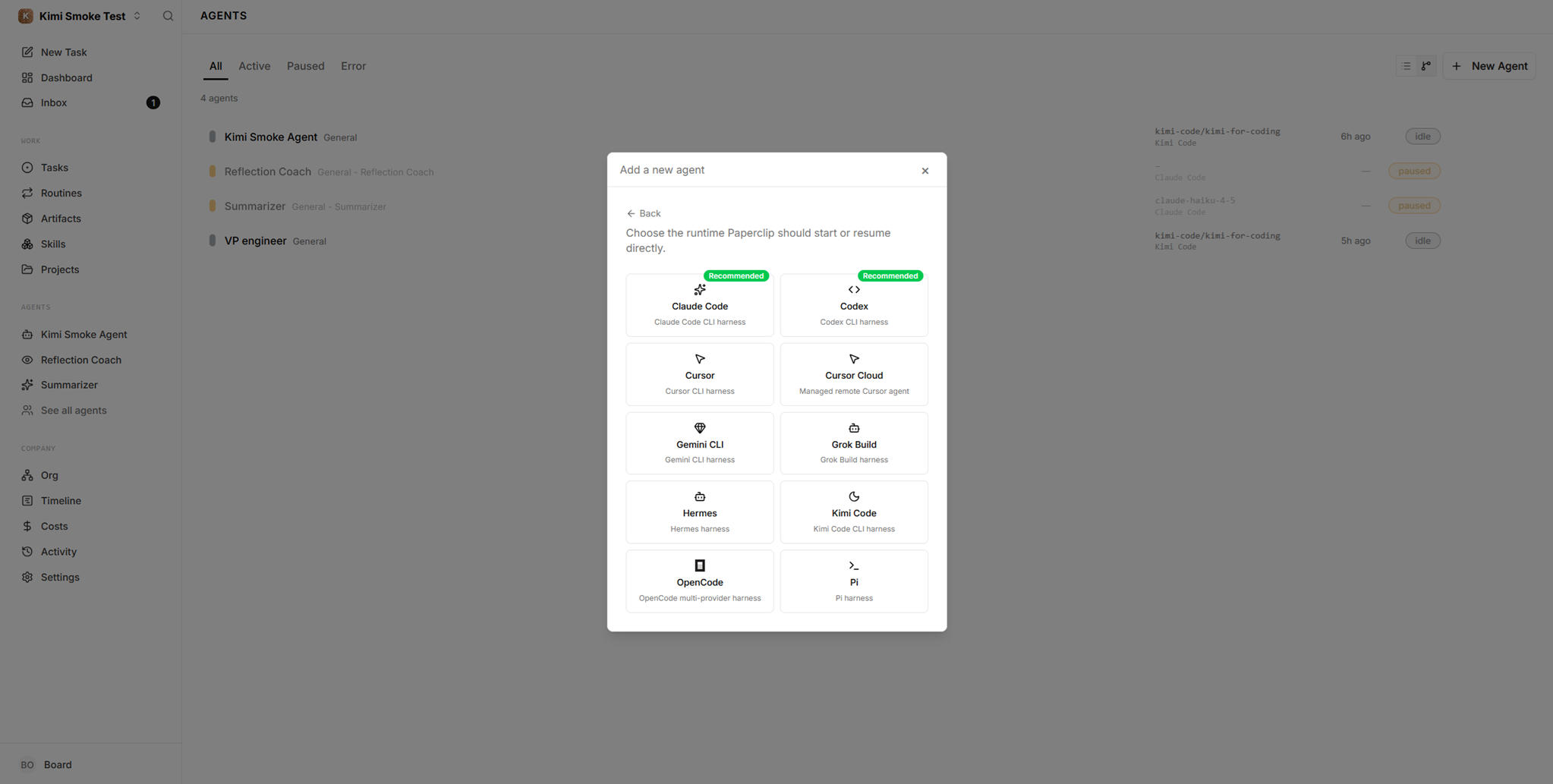 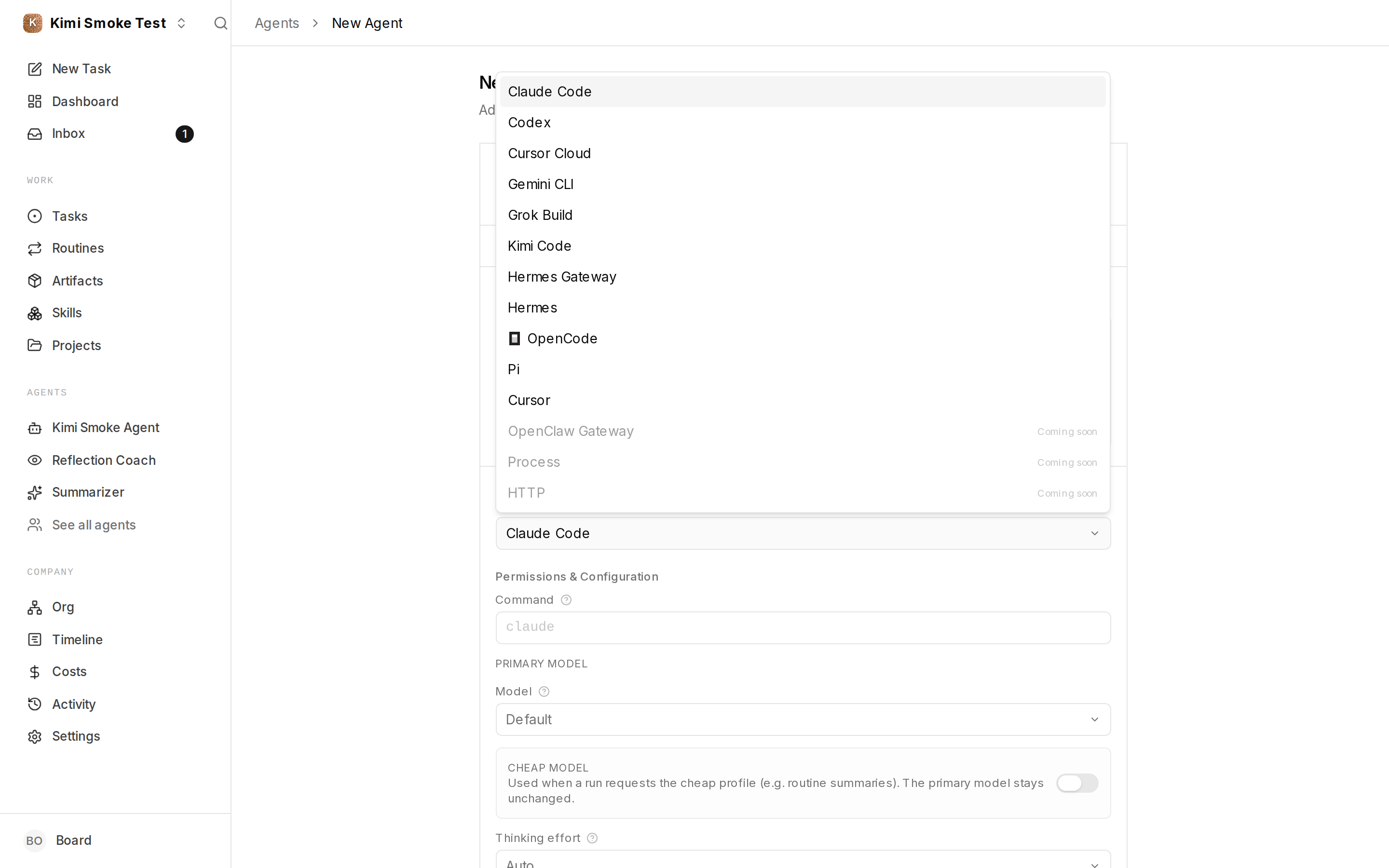 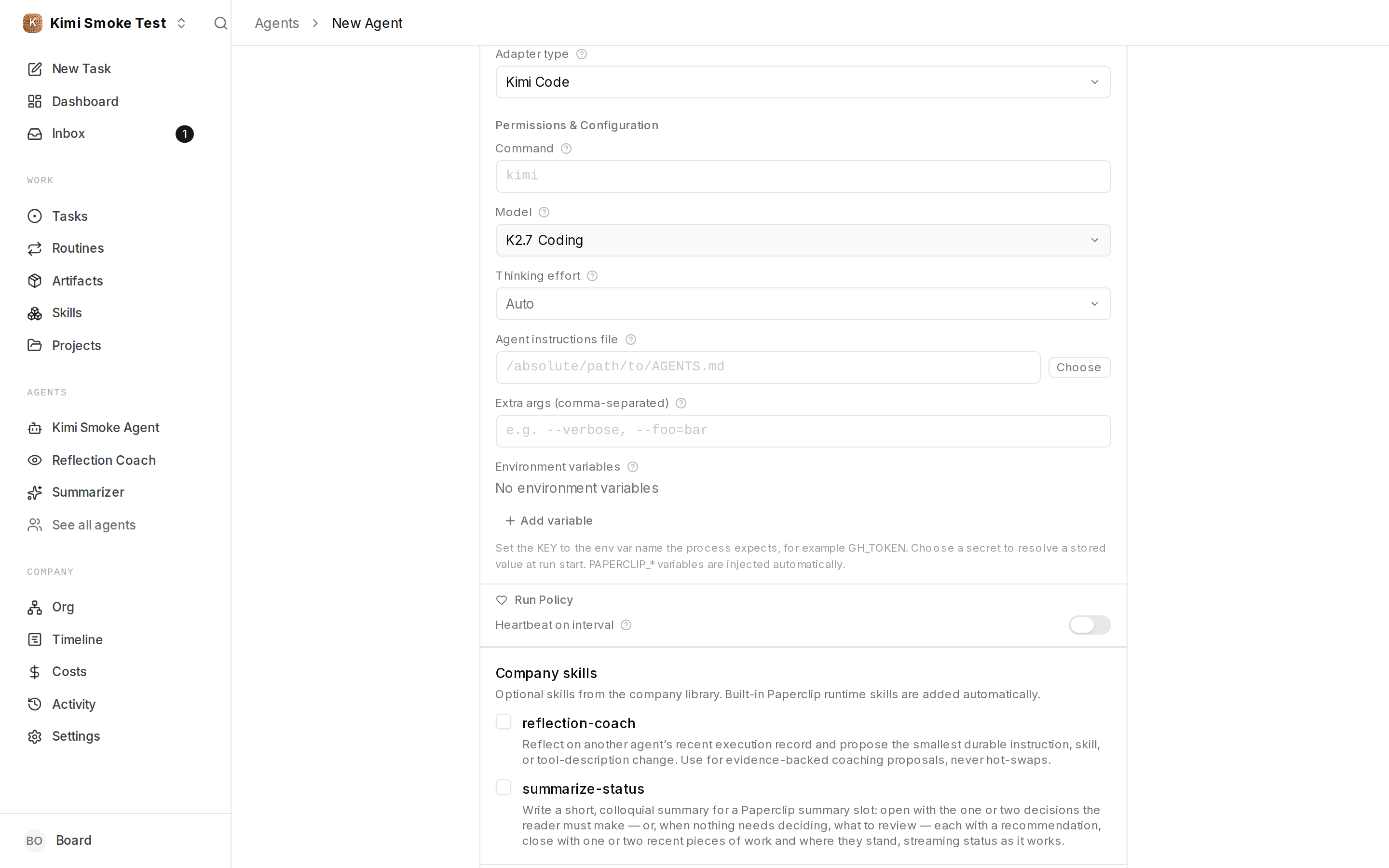 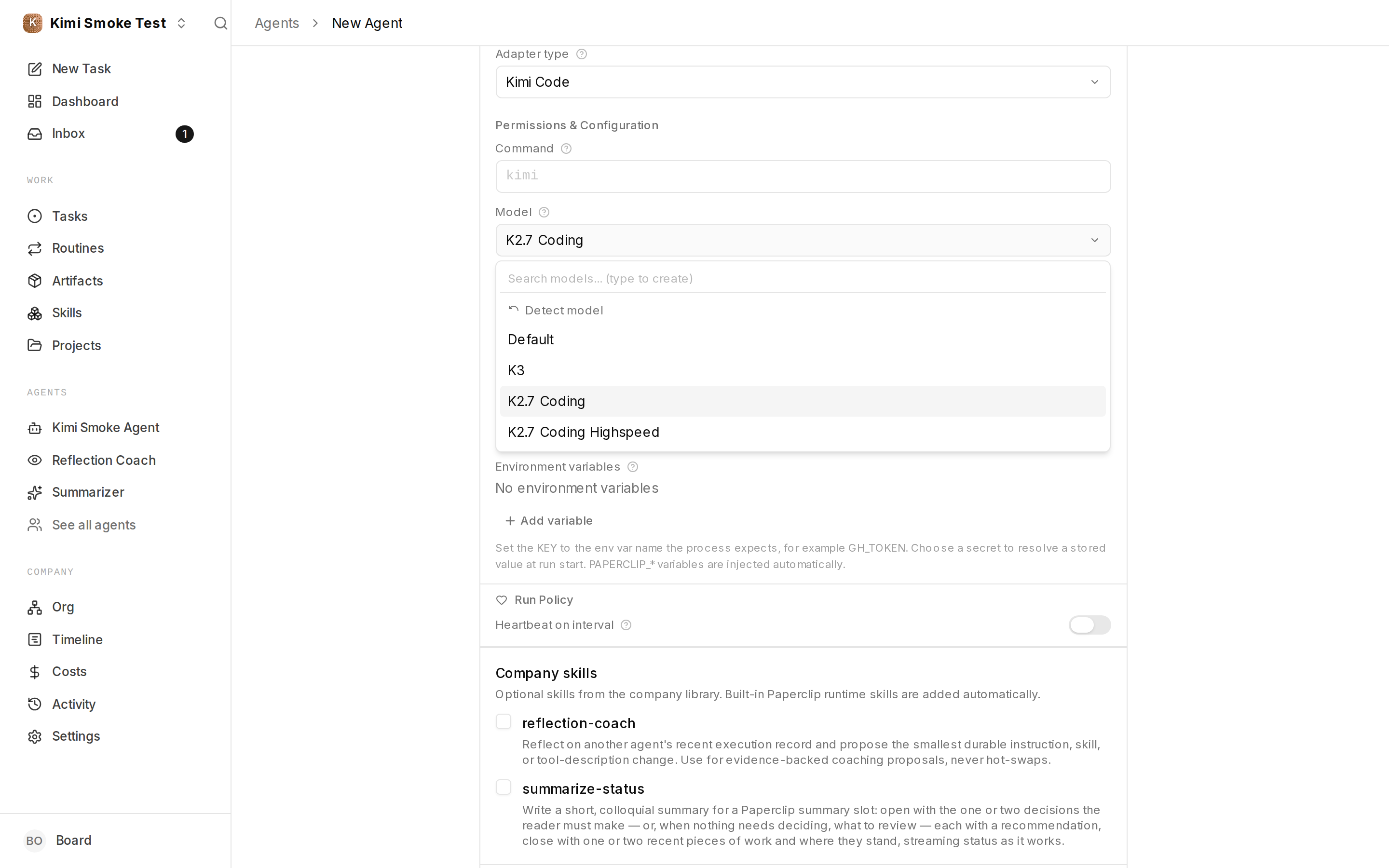 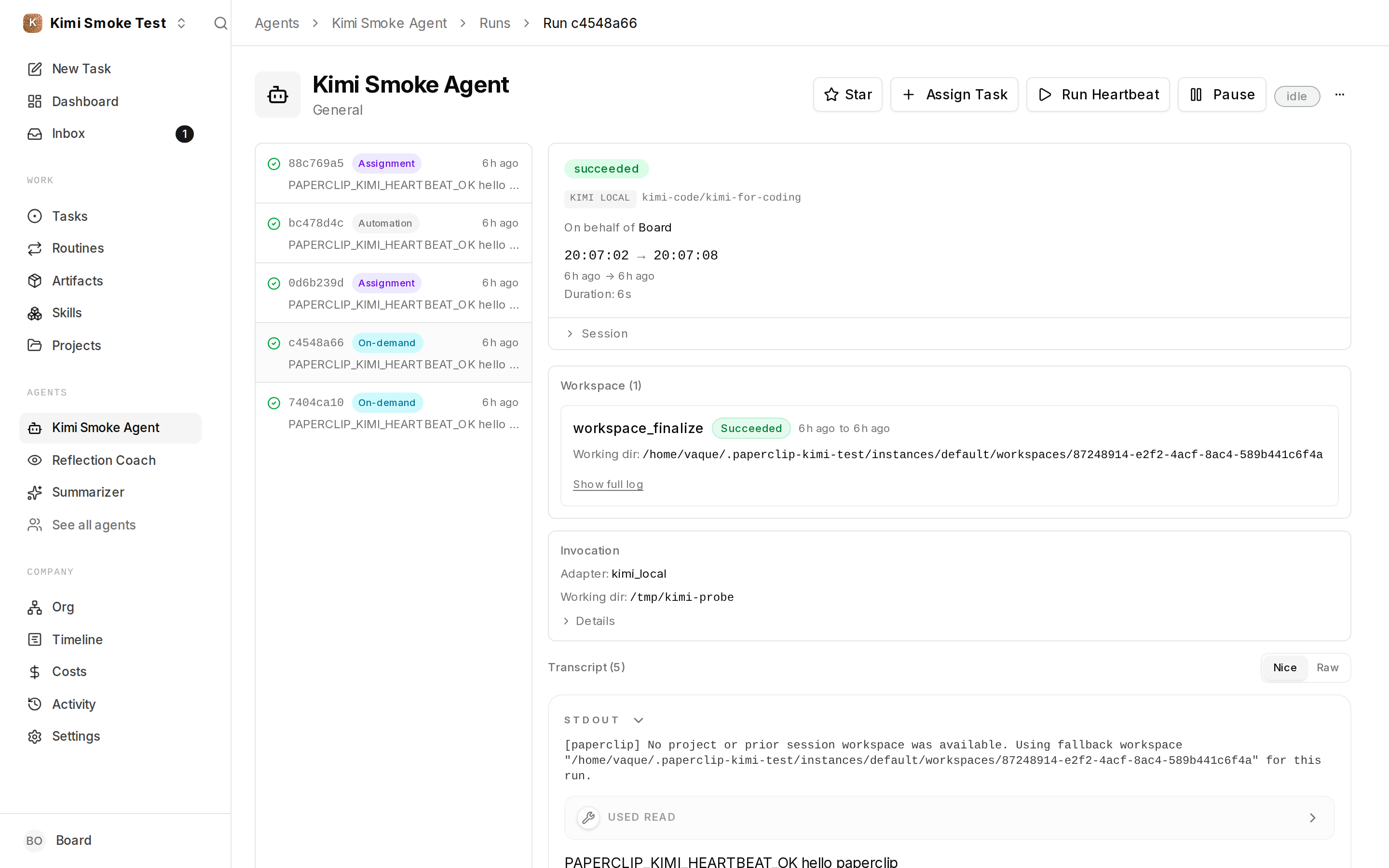 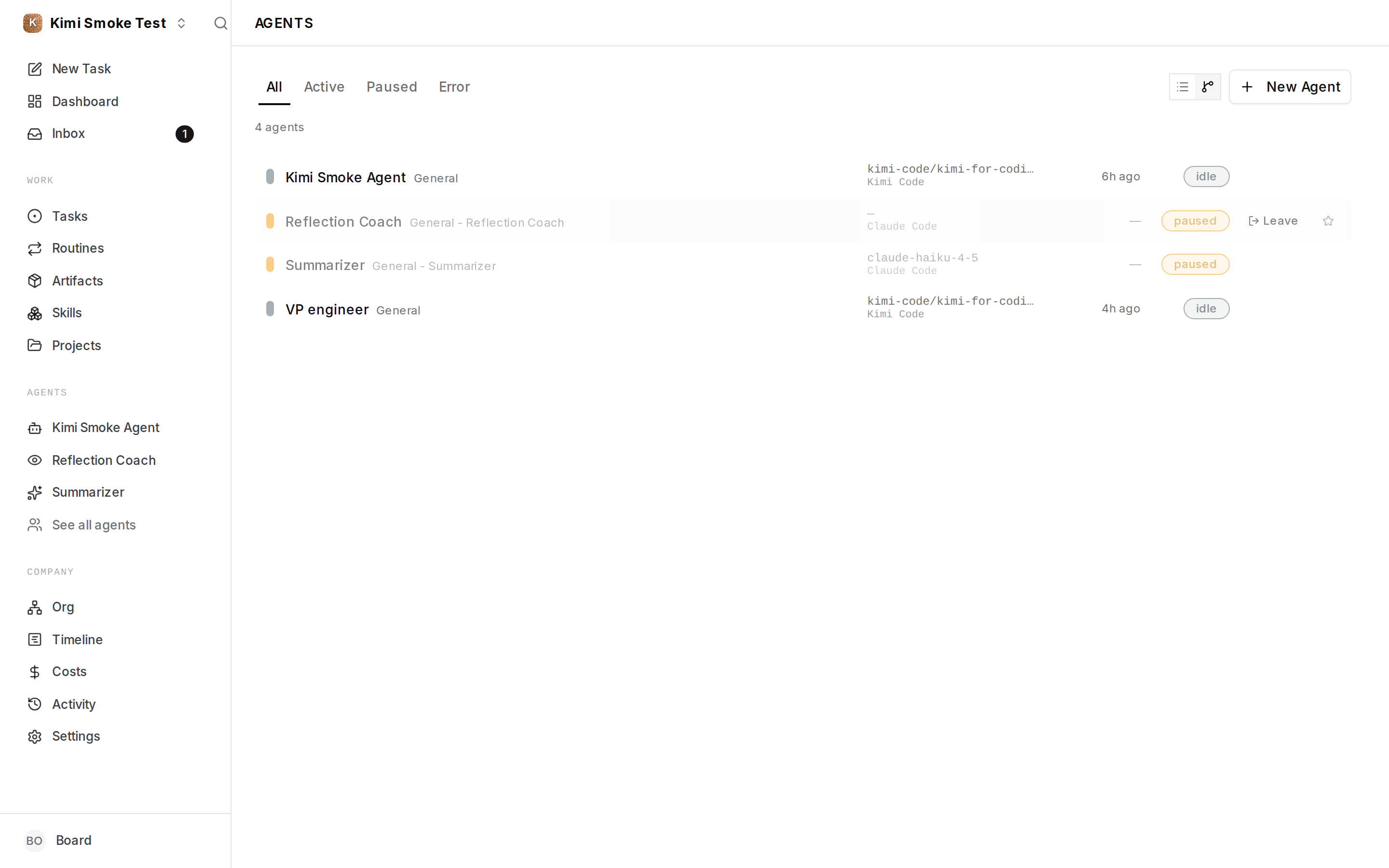 ## Risks - Low risk to existing behavior: the change is additive, one new workspace package plus single-entry registrations alongside existing adapters; no existing adapter code paths are modified. - The adapter invokes the locally installed `kimi` CLI; like other local adapters, run behavior depends on the host's Kimi version. The parser is written against the documented/verified 0.27.0 stream-json schema and degrades gracefully (malformed lines are skipped, failures surface as run errors). - `--skills-dir` overrides Kimi's auto-discovery of user and project skills for the run. This is intentional (paperclip-managed agents get a reproducible, isolated skill set), and it is only passed when at least one Paperclip skill is desired, so unconfigured agents keep default discovery. - Thinking effort is only forwarded to models that advertise `support_efforts` (currently `kimi-code/k3`); `EFFORT_CAPABLE_MODELS` must be extended when more Kimi models gain support, otherwise a configured effort is silently ignored for them. - `Dockerfile` now installs `@moonshot-ai/kimi-code@latest` globally alongside the other agent CLIs, so image size increases slightly. - Maintainer action needed for the npm bootstrap gate: the `policy` job's release-bootstrap step fails until the first npm publish of `@paperclipai/adapter-kimi-local` (the gate from #5146 that every new adapter package has passed through). Enrollment with `publishFromCi: true` is required by the manifest validator (dropping the entry, `false`, or `private` are all rejected), so this is intentionally left to a maintainer. Remaining CI lanes are expected to run once it is done. ## Model Used\n\n- **Current-master rebase, conflict adaptation, and registry-parity coverage:** OpenAI, **GPT-5 Codex** (Codex agent; exact serving model ID and context-window size were not exposed to the runtime), with repository, shell, Git, and GitHub tooling. It preserved Hawik’s commit authorship, reconciled ACPX and environment-capability changes, added current registry tests, and ran the verification above.\n- **Adapter implementation and initial review:** Moonshot AI, **Kimi K3 Coding** (latest), via **Kimi Code CLI v0.27.0** (`kimi-code/k3` alias, 1M-token context window, thinking mode, agentic tool use). The CLI agent explored the repo, wrote the adapter implementation (delegated to a coder sub-agent of the same model), ran tests, and drafted the first version of this PR body. A second model-driven review pass (read-only, same model) audited the diff for security/correctness before submission; its findings (shell-quoting hardening, auth-detection false positive, session-compaction registration, test gaps) were fixed and are included. - **Harness-context fixes and review responses:** Anthropic, **Claude Opus 4.8** (`claude-opus-4-8`) via Claude Code. Diagnosed from run logs that Kimi received only the entry instructions file (not the `HEARTBEAT.md`/`SOUL.md`/`TOOLS.md` bundle) and that `effort` was never wired, then implemented the instruction `--add-dir` delivery, `KIMI_MODEL_THINKING_EFFORT` forwarding, and `--skills-dir` skill delivery, added the accompanying tests and docs, and addressed the automated review comments (preserving external skills on remote sync, treating a signaled exit as a failure). Also extended the `paperclipai agent local-cli` installer to seed the control-plane skills into `~/.kimi-code/skills` for Codex/Claude parity, wired `onEvent` runtime events so the issue-thread activity indicator reflects Kimi's tool and reasoning output live, and built the ACP engine lane (`kimi acp` via the shared acpx engine, default) so the transcript streams with live tool status like the other ACP adapters. The Kimi CLI flags, subcommand, and env var relied on here were verified against the installed Kimi Code CLI 0.27.0. - All CLI behaviors claimed here (`-p`, `--output-format stream-json`, `-r` resume, event shapes, `--add-dir`, `--skills-dir`, `KIMI_MODEL_THINKING_EFFORT`) were verified empirically against the installed Kimi CLI, not assumed. ## Checklist - [x] I have included a thinking path that traces from project context to this change - [x] I have specified the model used (with version and capability details) - [x] I have checked ROADMAP.md and confirmed this PR does not duplicate planned core work - [x] I have searched GitHub for duplicate or related PRs and linked them above - [x] I have either (a) linked existing issues with `Fixes: #` / `Closes #` / `Refs #` OR (b) described the issue in-PR following the relevant issue template - [x] I have not referenced internal/instance-local Paperclip issues or links (only public GitHub `#NNN` / `github.com/paperclipai/paperclip` URLs) - [x] My branch name describes the change (e.g. `docs/...`, `fix/...`) and contains no internal Paperclip ticket id or instance-derived details - [x] I have run tests locally and they pass - [x] I have added or updated tests where applicable - [x] I have updated relevant documentation to reflect my changes - [x] I have considered and documented any risks above - [x] All Paperclip CI gates are green *(only the release-bootstrap step remains red, pending the maintainer npm publish described in Risks)* - [x] Greptile is 5/5 with no open P2s, recommendations, or follow-ups *(will address all Greptile comments as they arrive)* - [x] I will address all Greptile and reviewer comments before requesting merge --- ## Maintainer Addendum (2026-08-20) The shared acpx-engine and issue-chat changes (run-summary segmentation, placeholder tool-event coalescing, `ISSUE_CHAT_TRANSCRIPT_MAX_VISIBLE_ENTRIES` 30 → 400, live-reasoning UI) have been **extracted to #11761** so the cross-adapter behavior changes review and revert independently — both commits there preserve @hawikk's authorship. This PR is now the kimi-specific adapter only (60 files, +3,793/−8, essentially pure addition); the only shared-engine touch left is the `kimi acp` command resolution. `publishFromCi` is `true` — the package name is bootstrapped on npm. --------- Co-authored-by: Claude Opus 4.8 <noreply@anthropic.com> Co-authored-by: Paperclip <noreply@paperclip.ing> Co-authored-by: Dotta <bippadotta@protonmail.com> Co-authored-by: Devin Foley <devin@paperclip.ing> |
||
|
Nicky LeachandPaperclip
|
fdb9a4880d |
fix(security): route paperclipai CLI guidance through safe npx form (CWE-78) (#11400)
## Thinking Path > - Paperclip is the open source app people use to manage AI agents for work > - Paperclip provides CLI commands and guidance for operators and agents > - The `pnpm paperclipai` script can pass argument values through a shell > - Shell re-parsing can execute command substitutions inside quoted values > - This pull request routes guidance through inert-argv `npx paperclipai` commands and adds regression coverage > - The benefit is safer operator guidance across documentation and runtime hints ## Linked Issues or Issue Description This pull request fixes a command-injection-class defect in Paperclip CLI guidance. **What happened?** The `pnpm paperclipai <sub> --flag "$VALUE"` form can re-parse argument values through a shell. A command substitution inside a quoted value can execute on the host. **Expected behavior** Paperclip guidance must pass CLI values as inert argument values. Host-derived values must not appear in copyable commands. **Steps to reproduce** 1. Run a Paperclip guidance command that uses the `pnpm paperclipai` script. 2. Provide a quoted value that contains a command substitution. 3. Observe that the shell can evaluate the substitution before the CLI starts. 4. Compare the result with the `npx paperclipai` form. **Paperclip version or commit** `5670984b75d109950c968542a0111ebb6967f4da` **Deployment mode** All deployment modes that show or use the affected CLI guidance. **Installation method** Built from source and installed CLI guidance. **Agent adapter(s) involved** Not adapter-specific (core bug). **Database mode** Not database-related. **Access context** Both. **Additional context** The earlier merged PR [#11343](https://github.com/paperclipai/paperclip/pull/11343) used the unsafe `pnpm exec paperclipai` form. This fresh PR replaces that guidance with the safe `npx paperclipai` form. ## What Changed - Standardize documentation and runtime hints on `npx paperclipai`. - Remove the broken `pnpm exec paperclipai` guidance. - Use a static `<host>` placeholder in private-hostname guidance. - Add regression tests for unsafe forms, continued lines, static hosts, and offline guidance. ## Verification - `git diff --check origin/master...origin/fix/paperclipai-cli-npx-safe-invocation` passes. - The branch adds `server/src/__tests__/cli-invocation-safety.test.ts` and updates private-hostname tests. - CI must run the new tests, typecheck, lint, and build checks. - Local Vitest execution was not available because this worktree has no installed Vitest binary. ## Risks - The change affects operator and agent documentation text. - The runtime hints now show `<host>` instead of a request-derived host value. - No database schema or migration changes exist. - CI will detect any missed unsafe invocation or type error. ## Model Used OpenAI GPT-5, exact model ID `gpt-5`, with tool use and code-review assistance. The model used repository inspection, Git operations, and PR preparation. ## Checklist - [x] I have included a thinking path that traces from project context to this change - [x] I have specified the model used (with version and capability details) - [x] I have checked ROADMAP.md and confirmed this PR does not duplicate planned core work - [x] I have searched GitHub for duplicate or related PRs and linked them above - [x] I have either (a) linked existing issues with `Fixes: #` / `Closes #` / `Refs #` OR (b) described the issue in-PR following the relevant issue template - [x] I have not referenced internal/instance-local Paperclip issues or links (only public GitHub `#NNN` / `github.com/paperclipai/paperclip` URLs) - [x] My branch name describes the change (e.g. `docs/...`, `fix/...`) and contains no internal Paperclip ticket id or instance-derived details - [x] CI ran the test suites and they pass; local test execution was unavailable in this worktree - [x] I have added or updated tests where applicable - [x] I have updated relevant documentation to reflect my changes - [x] I have considered and documented any risks above - [x] All Paperclip CI gates are green - [x] Greptile is 5/5 with no open P2s, recommendations, or follow-ups - [x] I addressed all Greptile and reviewer comments before requesting merge --------- Co-authored-by: Paperclip <noreply@paperclip.ing> |
||
|
Nicky LeachandPaperclip
|
5ca7b4c1fe |
fix(security): standardize paperclipai CLI guidance on safe npx path (#11343)
## Thinking Path > - Paperclip is the open source app people use to manage AI agents for work. > - Paperclip provides CLI guidance to agents and operators through documentation and runtime messages. > - Content-bearing `pnpm paperclipai` examples send arguments through a shell. > - Shell evaluation can execute command substitutions in untrusted argument content. > - Runtime hostname guidance can also place request-derived content inside a shell command. > - This pull request uses `npx paperclipai` for content-bearing guidance and uses a static hostname placeholder. > - The benefit is safer copy-paste guidance for agents and operators. ## Linked Issues or Issue Description **Issue type** Incorrect information **Where is the issue?** CLI guidance in `doc/CLI.md`, `skills/paperclip/SKILL.md`, documentation, and runtime-generated hints. **What's wrong?** Content-bearing `pnpm paperclipai` commands can pass argument text through `/bin/sh`. Shell command substitution in an argument can execute before the CLI receives the value. **Suggested fix** Use `npx paperclipai` for content-bearing commands. Use a static `<host>` placeholder when runtime guidance displays the allowed-hostname command. ## What Changed - Replace content-bearing `pnpm paperclipai` examples with `npx paperclipai` across the documentation and agent-facing guidance. - Update runtime-generated CLI hints to use a static `<host>` placeholder. - Add safety notes to `doc/CLI.md` and `skills/paperclip/SKILL.md`. - Add scans and regression tests for unsafe invocation and hostile hostname headers. - Keep fixed lifecycle commands and `pnpm --filter @paperclipai/*` build commands unchanged. ## Verification - Run `tsc --noEmit` for the changed server files. - Run `cli-invocation-safety.test.ts`. - Run `private-hostname-guard.test.ts`. - Confirm that hostile hostname headers do not enter shown shell commands. - Confirm that the three commits contain the required Paperclip co-author trailer. ## Risks - This change updates documentation and diagnostic text across many surfaces. - Fixed lifecycle and setup commands remain unchanged. - The tests fail if content-bearing `pnpm paperclipai` guidance returns. - The change does not alter the CLI argument parser. ## Model Used OpenAI Codex, GPT-5, tool use, code execution, and repository review assistance. ## Checklist - [x] I have included a thinking path that traces from project context to this change - [x] I have specified the model used (with version and capability details) - [x] I have checked ROADMAP.md and confirmed this PR does not duplicate planned core work - [x] I have searched GitHub for duplicate or related PRs and linked them above - [x] I have either (a) linked existing issues with `Fixes: #` / `Closes #` / `Refs #` OR (b) described the issue in-PR following the relevant issue template - [x] I have not referenced internal/instance-local Paperclip issues or links (only public GitHub `#NNN` / `github.com/paperclipai/paperclip` URLs) - [x] My branch name describes the change (e.g. `docs/...`, `fix/...`) and contains no internal Paperclip ticket id or instance-derived details - [x] I have run tests locally and they pass - [x] I have added or updated tests where applicable - [x] I have updated relevant documentation to reflect my changes - [x] I have considered and documented any risks above - [x] All Paperclip CI gates are green - [x] Greptile is 5/5 with no open P2s, recommendations, or follow-ups - [x] I will address all Greptile and reviewer comments before requesting merge --------- Co-authored-by: Paperclip <noreply@paperclip.ing> |
||
|
Devin Foley
|
f0b06d2de9 |
feat(claude): environment-aware test-environment probe and claude-local CI coverage (#10833)
## Thinking Path > - Paperclip is the open source app people use to manage AI agents for work > - The claude_local adapter runs Claude Code on sandbox execution targets, and operators verify an agent's configuration with the test-environment probe before running it > - Real runs merge the selected environment's env vars (secret refs included) under the agent's adapter config env, but the probe built its config from the adapter config alone — so environment-level auth worked in runs while the Test button reported missing auth, and a dropped secret binding passed silently > - The claude env-test hints also did not recognize `CLAUDE_CODE_OAUTH_TOKEN` even though the CLI accepts it, and a hello probe that hit the subscription usage limit reported a hard failure although authentication worked > - Separately, the claude-local package test suites were absent from the CI project list, so two suites drifted broken without notice > - This pull request makes the probe resolve the same layered env as a real run, adds the missing auth hint, classifies usage-limit probe results as a warning, repairs the drifted suites, and turns the claude-local project on in CI > - The benefit is a Test button that tells the truth about environment-level configuration, and a test suite that actually gates the claude-local adapter ## Linked Issues or Issue Description No public issue exists; related open PRs: Refs #9488 (recognizes CLAUDE_CODE_OAUTH_TOKEN in environment checks — overlaps with the auth-hint portion of this PR via a differently named check; it does not cover the environment-envVars probe merge, the usage-limit classification, or the CI coverage), Refs #9933 (live credential validation in environment checks — complementary, no file-level conflict with the route change). The underlying problem, following the enhancement template: **Current behavior** The test-environment route builds the probe config from the agent's adapterConfig only. Real runs merge the selected environment's envVars under the agent env, so environment-level env vars (including auth such as `ANTHROPIC_API_KEY` or `CLAUDE_CODE_OAUTH_TOKEN` bound as environment secrets) work in runs while "Test environment" cannot see them, and a missing secret binding passes silently. The claude env-test hints do not recognize `CLAUDE_CODE_OAUTH_TOKEN`. A hello probe that hits the subscription usage limit reports a hard `claude_hello_probe_failed`. The claude-local package test suites do not run in CI, and two of them are stale. **Proposed behavior** The probe resolves the selected environment's envVars (environment-consumer secret bindings included) and merges them under the agent config env with the run-path precedence; missing bindings surface as an explicit error check that fails the test. The env-test emits a `claude_oauth_token_configured` info check when that variable is set. Usage-limit probe results classify as a `claude_hello_probe_usage_limited` warning because auth works and only the usage window is spent. The claude-local suites run in CI. Docs state the resulting facts. **Reason and benefit** The Test button should tell the truth: it previously contradicted run behavior for environment-level configuration and hid broken secret bindings. Enabling the package suites in CI prevents further silent drift — two suites were already broken on master without anyone noticing. **Breaking changes** None. Runs are unchanged. The probe route only adds env layers and checks; setups without environment envVars behave exactly as before. ## What Changed - `server/src/routes/agents.ts`: the test-environment route resolves the selected environment's envVars (forbidden keys stripped, environment-consumer secret context) and merges them under the agent adapterConfig env, mirroring `resolveExecutionRunAdapterConfig` precedence. Missing secret bindings are skipped, reported as an `environment_env_binding_missing` error check, and fail the test — matching the `ConfigurationIncompleteFailure` a real dispatch would raise. - `packages/adapters/claude-local/src/server/test.ts`: new `claude_oauth_token_configured` info hint between the API-key warning and the subscription fallback; hello-probe classification gains a `claude_hello_probe_usage_limited` warning for provider-quota results (previously a hard `claude_hello_probe_failed`). - `scripts/run-vitest-stable.mjs`: add `@paperclipai/adapter-claude-local` to `nonServerProjects` so CI runs the package suites. - `packages/adapters/claude-local/src/server/execute.remote.test.ts`: assert both runtime asset syncs (skills and mcp-config); the suite predated the mcp-config asset. - `packages/adapters/claude-local/src/server/test.probe.test.ts`: usage-limit fixture now expects the usage-limited warning; new fixture covers the genuine transient path (529 overloaded); new tests cover the token hint and API-key precedence. - `server/src/__tests__/agent-test-environment-routes.test.ts`: new tests for the env merge (agent wins on conflict, forbidden key filtered), missing-binding reporting, and the no-execution-target fallback path. - `docs/adapters/claude-local.md`, `docs/adapters/overview.md`: state the auth-input facts (API key or oauth token wins over stored logins; snapshot-owns-auth applies when neither is configured) and describe the environment-aware Test behavior. ## Verification - `npx vitest run --project @paperclipai/adapter-claude-local` — 131 tests pass (both drifted suites repaired; they fail on master today). - `npx vitest run server/src/__tests__/agent-test-environment-routes.test.ts` — 7 tests pass. - `node --test ./scripts/__tests__/run-vitest-stable-shard.test.mjs` — passes with the added project. - `pnpm typecheck` in `server/` and `packages/adapters/claude-local/` — clean. ## Risks - Low risk. The run path is untouched; the probe route change is additive and inert when the environment has no envVars. - The probe now performs environment-consumer secret resolution at test time; access is authorized per binding exactly as at run time, and the audit consumer is the environment (as before for adapter-config resolution). - Enabling the claude-local project in CI adds about 2 seconds of vitest wall time to the general workspaces group and could surface future regressions in that package — which is the point. ## Model Used Claude Fable 5 (`claude-fable-5`), extended thinking enabled, agentic tool use via Claude Code (CLI). ## Checklist - [x] I have included a thinking path that traces from project context to this change - [x] I have specified the model used (with version and capability details) - [x] I have checked ROADMAP.md and confirmed this PR does not duplicate planned core work - [x] I have searched GitHub for duplicate or related PRs and linked them above - [x] I have either (a) linked existing issues with `Fixes: #` / `Closes #` / `Refs #` OR (b) described the issue in-PR following the relevant issue template - [x] I have not referenced internal/instance-local Paperclip issues or links (only public GitHub `#NNN` / `github.com/paperclipai/paperclip` URLs) - [x] My branch name describes the change (e.g. `docs/...`, `fix/...`) and contains no internal Paperclip ticket id or instance-derived details - [x] I have run tests locally and they pass - [x] I have added or updated tests where applicable - [x] I have updated relevant documentation to reflect my changes - [x] I have considered and documented any risks above - [ ] All Paperclip CI gates are green - [ ] Greptile is 5/5 with no open P2s, recommendations, or follow-ups - [x] I will address all Greptile and reviewer comments before requesting merge |
||
|
Devin FoleyandPaperclip
|
eedc7ddef2 |
Make ACP the default engine for local adapters (#9238)
## Thinking Path > - Paperclip is the open source app people use to manage AI agents for work. > - Adapter packages are the bridge between the control plane and local agent harnesses such as Claude Code, Codex, and Gemini CLI. > - ACP support was concentrated in a separate `acpx_local` adapter, which made ACP feel like a separate agent choice instead of an execution capability of the harness adapters. > - Claude, Codex, and Gemini now have ACP-capable harnesses, so the native adapter should own ACP selection, fallback, config, transcript parsing, and environment diagnostics. > - The standalone ACPX adapter still needs a compatibility path for existing rows, but it should not be offered as an active adapter for new agents. > - This pull request moves the shared ACP runtime into `@paperclipai/acpx-engine`, wires Claude/Codex/Gemini local adapters to prefer ACP when prerequisites are available, and retires `acpx_local` to a tombstone. > - The benefit is one adapter per harness, richer ACP transcripts by default where possible, and a migration path for existing Claude/Codex ACPX agents. ## Linked Issues or Issue Description Closes #5932 — the broken default `acpx_local` Claude path is replaced by native `claude_local` ACP support, existing Claude/Codex ACPX rows migrate to native adapters, and new agents no longer choose the standalone ACPX adapter. Refs #4893 — original merged ACPX local adapter runtime that this PR replaces with native per-harness ACP engines. Refs #6590 — prior ACPX-Claude seamlessness work folded into the new native Claude ACP path. Refs #197 — related open generic ACP/Kiro adapter work; this PR does not close it because Kiro/custom generic ACP remains a separate adapter decision. Refs #7018 — related Kimi-specific `acpx_local` shell failure; this PR retires the built-in standalone adapter but does not add a native Kimi adapter. Refs #8864 — related ACPX prompt/API guidance PR; this PR moves runtime guidance into the shared/native ACP engine path instead of the old standalone adapter. Refs #8881 — related `acpx_local` POSIX shell failure from the old `acpx` pin; this PR updates ACP dependencies but does not claim custom/OMP ACP support as a first-class native adapter. Refs #8964 — related open `acpx_local` stderr cleanup PR; this PR makes the old runtime path obsolete for new agents but keeps it as a non-closing reference. Problem description: - The standalone `acpx_local` adapter duplicates Claude/Codex agent choices that already have first-class local adapters. - ACP should be an execution engine capability of each harness adapter when the underlying harness supports ACP. - Existing `acpx_local` agents should either migrate to native harness adapters or fail with an explicit retirement message instead of silently falling back to the process adapter. ## What Changed - Added `@paperclipai/acpx-engine` as the shared ACP execution, session-codec, CLI formatter, and UI parser package. - Wired `claude_local`, `codex_local`, and `gemini_local` to auto-select ACP by default when prerequisites pass, with `engine=cli` opt-out and `engine=acp` strict mode. - Added ACP config schema/UI fields, environment checks, session-codec preservation, transcript parsing, and adapter capability metadata for the native adapters. - Retired `acpx_local` to a server tombstone, removed its UI/package/runtime image surface, and added a migration for existing Claude/Codex ACPX agents. - Updated package manifests, lockfile, release tooling, docs, Kubernetes sandbox defaults, and tests. ## Verification - `corepack pnpm --filter @paperclipai/acpx-engine typecheck` - `corepack pnpm --filter @paperclipai/adapter-claude-local typecheck` - `corepack pnpm --filter @paperclipai/adapter-codex-local typecheck` - `corepack pnpm --filter @paperclipai/adapter-gemini-local typecheck` - `corepack pnpm --filter @paperclipai/acpx-engine exec vitest run` - `corepack pnpm --filter @paperclipai/adapter-claude-local exec vitest run src/server/acp.test.ts src/server/execute.acp-fallback.test.ts src/ui/build-config.test.ts` - `corepack pnpm --filter @paperclipai/adapter-codex-local exec vitest run src/server/acp.test.ts src/ui/build-config.test.ts` - `corepack pnpm --filter @paperclipai/adapter-gemini-local exec vitest run src/server/acp.test.ts src/ui/build-config.test.ts src/ui/parse-stdout.test.ts` - `corepack pnpm --filter @paperclipai/plugin-sdk ensure-build-deps && corepack pnpm --filter @paperclipai/server exec tsc --noEmit` - `corepack pnpm --filter @paperclipai/server exec vitest run src/__tests__/adapter-routes.test.ts src/__tests__/adapter-session-codecs.test.ts src/__tests__/adapter-models.test.ts` - `corepack pnpm --filter @paperclipai/ui typecheck` - `corepack pnpm --filter @paperclipai/ui exec vitest run src/adapters/metadata.test.ts src/adapters/adapter-display-registry.test.ts src/components/AgentConfigForm.test.ts src/components/AgentConfigForm.render.test.tsx src/components/transcript/RunTranscriptView.test.tsx` - `node --test scripts/bootstrap-npm-package.test.mjs scripts/release-package-map.test.mjs scripts/verify-release-registry-state.test.mjs` Note: the server typecheck script calls `pnpm` internally; this dev shell exposes pnpm through Corepack only, so I ran the two script steps manually with `corepack pnpm`. ## Risks - Migration changes existing `acpx_local` Claude/Codex agents to native adapter types and clears old ACPX task sessions/runtime state. - Custom ACP commands remain on the retired tombstone and will need a separate future adapter/plugin path. - ACP auto-selection depends on local Node and ACP server command prerequisites; remote and unsupported environments fall back to CLI unless `engine=acp` is explicit. - `@paperclipai/acpx-engine` is a new public package and needs npm trusted-publishing bootstrap before release automation can publish it. > For core feature work, check [`ROADMAP.md`](ROADMAP.md) first and discuss it in `#dev` before opening the PR. Feature PRs that overlap with planned core work may need to be redirected — check the roadmap first. See `CONTRIBUTING.md`. ## Model Used OpenAI GPT-5 via Codex coding agent. Exact hosted model build and context-window size are not exposed in this runtime. Tool use included shell execution, repository editing, GitHub CLI operations, and local test/typecheck execution. ## Checklist - [x] I have included a thinking path that traces from project context to this change - [x] I have specified the model used (with version and capability details) - [x] I have checked ROADMAP.md and confirmed this PR does not duplicate planned core work - [x] I have searched GitHub for duplicate or related PRs and linked them above - [x] I have either (a) linked existing issues with `Fixes: #` / `Closes #` / `Refs #` OR (b) described the issue in-PR following the relevant issue template - [x] I have not referenced internal/instance-local Paperclip issues or links (only public GitHub `#NNN` / `github.com/paperclipai/paperclip` URLs) - [x] My branch name describes the change (e.g. `docs/...`, `fix/...`) and contains no internal Paperclip ticket id or instance-derived details - [x] I have run tests locally and they pass - [x] I have added or updated tests where applicable - [x] I have updated relevant documentation to reflect my changes - [x] I have considered and documented any risks above - [x] All Paperclip CI gates are green - [x] Greptile is 5/5 with no open P2s, recommendations, or follow-ups - [x] I will address all Greptile and reviewer comments before requesting merge --------- Co-authored-by: Paperclip <noreply@paperclip.ing> |
||
|
Nicky LeachandPaperclip
|
187a929d97 |
docs: explain Codex and Claude credential ownership
Squash-merges the adapter credential ownership doc PR. - Documents codex_local host-owns-auth topology and CODEX_HOME auth precedence - Documents claude_local snapshot-owns-auth topology (sandbox targets only) - Adds API-key vs ChatGPT-subscription guidance for high-concurrency fleets - Adds deferred config-validation warning spec for sandbox credential mismatches - Fixes: SSH scope mismatch (Greptile P1) and codex auth.json materialization note (Greptile P2) Co-Authored-By: Paperclip <noreply@paperclip.ing> |
||
|
Devin FoleyandPaperclip
|
c48feee190 |
Improve live agent feedback during sandboxed runs (#8915)
## Thinking Path > - Paperclip is the open source app people use to manage AI agents for work > - A core part of that experience is watching active agent runs without dropping into raw logs first > - Local and sandbox-backed adapters already record useful run output, progress, and tool activity > - But active issue threads could sit visually stale while the agent was syncing workspaces, tailing sandbox output, or emitting incremental tool-call updates > - Operators need timely, human-readable progress while preserving the raw transcript underneath > - This pull request streams sandbox run-log progress into runtime status, keeps visible issue threads refreshed, and folds repeated ACPX tool updates into stable transcript cards > - The benefit is that long-running agent work becomes easier to supervise without changing the task/comment control-plane model ## Linked Issues or Issue Description No public GitHub issue exists for this exact change. Problem/motivation: - During long-running sandboxed agent work, the issue UI can appear idle even though the agent is actively syncing, running tools, or producing incremental output. - Operators need realtime feedback at the issue-thread layer, not only after opening raw logs or waiting for the final heartbeat result. - Related public context: #1808 previously added live-run status dots to Projects; #4362 touches heartbeat wakeup behavior but is not a duplicate of this runtime/UI feedback change. ## What Changed - Added sandbox run-log streaming support and defaulted sandbox-capable local adapters into the richer live-feedback path. - Surfaced environment/sandbox sync progress through heartbeat runtime status with bounded, redacted snippets. - Added live issue-thread cache patching so visible active runs update as progress events arrive. - Folded repeated ACPX `tool_call` updates into one transcript card instead of stacking duplicate cards. - Updated adapter docs and added focused regression coverage for sandbox log streaming, runtime status, ACPX parsing, live updates, transcript rendering, and issue chat messages. ## Verification - `pnpm install --frozen-lockfile` - `pnpm exec vitest run ui/src/context/LiveUpdatesProvider.test.ts` - `pnpm exec vitest run server/src/services/heartbeat-run-runtime-status.test.ts server/src/__tests__/heartbeat-runtime-state.test.ts ui/src/context/LiveUpdatesProvider.test.ts` - `pnpm exec vitest run packages/adapter-utils/src/execution-target-sandbox.test.ts packages/adapter-utils/src/sandbox-managed-runtime.test.ts server/src/services/heartbeat-run-runtime-status.test.ts server/src/__tests__/agent-live-run-routes.test.ts server/src/__tests__/heartbeat-runtime-state.test.ts packages/adapters/acpx-local/src/ui/parse-stdout.test.ts ui/src/context/LiveUpdatesProvider.test.ts ui/src/components/transcript/RunTranscriptView.test.tsx ui/src/lib/issue-chat-messages.test.ts ui/src/components/IssueChatThread.test.tsx` - GitHub PR workflow on head `8397953e7b41ccd42e5d9457ee7e4dfb996e4ec5`: `verify`, build, typecheck/release-registry, e2e, general shards, serialized server shards, and canary dry run passed. - Greptile Review on head `8397953e7b41ccd42e5d9457ee7e4dfb996e4ec5`: Confidence Score 5/5, no unresolved review threads. ## Risks - Live issue-thread cache patching could miss an edge case for a route shape not covered by tests. - Surfacing active-run snippets needs continued care around redaction; this PR keeps snippets bounded and adds redaction-focused coverage. - More frequent active-run UI refreshes could expose performance issues on very large issue threads, though updates are scoped to visible run/query caches. ## Model Used OpenAI GPT-5 via Codex, operating as a tool-enabled coding agent with shell, git, and repository-editing capabilities. Context window size is not exposed in this runtime. ## Checklist - [x] I have included a thinking path that traces from project context to this change - [x] I have specified the model used (with version and capability details) - [x] I have checked ROADMAP.md and confirmed this PR does not duplicate planned core work - [x] I have searched GitHub for duplicate or related PRs and linked them above - [x] I have either (a) linked existing issues with `Fixes: #` / `Closes #` / `Refs #` OR (b) described the issue in-PR following the relevant issue template - [x] I have not referenced internal/instance-local Paperclip issues or links (only public GitHub `#NNN` / `github.com/paperclipai/paperclip` URLs) - [x] My branch name describes the change (e.g. `docs/...`, `fix/...`) and contains no internal Paperclip ticket id or instance-derived details - [x] I have run tests locally and they pass - [x] I have added or updated tests where applicable - [x] I have updated relevant documentation to reflect my changes - [x] I have considered and documented any risks above - [x] All Paperclip CI gates are green - [x] Greptile is 5/5 with no open P2s, recommendations, or follow-ups - [x] I will address all Greptile and reviewer comments before requesting merge Co-authored-by: Paperclip <noreply@paperclip.ing> |
||
|
Devin FoleyandPaperclip
|
bf982c8c83 |
Normalize adapter display labels (#8913)
## Thinking Path > - Paperclip is the open source app people use to manage AI agents for work. > - Adapter names are part of the board-facing agent setup and management experience. > - The product now treats adapters as harnesses, while execution environments are modeled separately. > - Several built-in adapter labels still carried legacy local wording from the older harness-by-environment model. > - That wording makes the UI noisier and implies a distinction users no longer need to reason about. > - This pull request normalizes adapter display labels while keeping persisted adapter type identifiers unchanged. > - The benefit is clearer adapter selection and management copy without a database migration. ## Linked Issues or Issue Description No public GitHub issue was found for this exact cleanup. Related public PRs: - Supersedes #8910, an earlier branch for the same cleanup that did not include the later docs/gateway/Cursor alignment. - Refs #8819, which is related display-registry work for external multi-segment adapter labels, but not a duplicate of this built-in label cleanup. Feature request details: - Subsystem affected: Cross-cutting (`ui/`, `packages/adapters`, and docs). - Problem or motivation: user-facing adapter names include legacy local qualifiers even though adapters map to harnesses and environments are first-class elsewhere. - Proposed solution: remove the legacy local wording from built-in display labels, keep machine-readable adapter type ids unchanged, and keep gateway disambiguation where it is useful. - Alternatives considered: changing persisted adapter type ids was ruled out because it would create migration and compatibility risk; one-off UI replacements were ruled out because the display registry is already the correct central label boundary. - Roadmap alignment: this is small adapter UX polish, not a new roadmap-level core feature. ## What Changed - Updated the adapter display registry so known adapter labels are final and no built-in local adapter renders a legacy local suffix. - Preserved clean derived labels for unknown plugin local types while keeping gateway disambiguation for unknown gateway types. - Updated `AdapterManager` to prefer registry labels when the server reports raw adapter type ids for built-ins. - Removed legacy local wording from built-in adapter metadata labels in UI and adapter packages. - Aligned Cursor adapter metadata with the central display registry label. - Updated adapter docs and Storybook fixtures to match the new display names. - Added focused registry coverage for built-in labels and unknown plugin suffix behavior. ## Verification - `pnpm check:tokens` - `git diff --check origin/master...fix/adapter-display-labels` - Patch-addition scan for added secrets, private paths, and internal links: no matches. - GitHub duplicate search for open adapter-label/local-suffix issues and PRs; #8910 was identified as the older superseded public PR. - `pnpm exec vitest run ui/src/adapters/adapter-display-registry.test.ts` - `pnpm --filter @paperclipai/ui typecheck` - Stale-label scan found no remaining user-facing display-label suffixes; remaining local wording is operational/test terminology such as adapter ids, docs about running locally, and test descriptions. ## Risks Low risk. The change is display-label and documentation focused, and adapter type ids remain unchanged. The main risk is ambiguous gateway naming, mitigated by keeping explicit gateway labels where variants need disambiguation. ## Model Used OpenAI GPT-5 via Codex, tool-enabled coding agent in a local repository workspace. Context window size is not exposed by this environment. ## Checklist - [x] I have included a thinking path that traces from project context to this change - [x] I have specified the model used (with version and capability details) - [x] I have checked ROADMAP.md and confirmed this PR does not duplicate planned core work - [x] I have searched GitHub for duplicate or related PRs and linked them above - [x] I have either (a) linked existing issues with `Fixes: #` / `Closes #` / `Refs #` OR (b) described the issue in-PR following the relevant issue template - [x] I have not referenced internal/instance-local Paperclip issues or links (only public GitHub `#NNN` / `github.com/paperclipai/paperclip` URLs) - [x] My branch name describes the change (e.g. `docs/...`, `fix/...`) and contains no internal Paperclip ticket id or instance-derived details - [x] I have run tests locally and they pass - [x] I have added or updated tests where applicable - [x] I have updated relevant documentation to reflect my changes - [x] I have considered and documented any risks above - [x] All Paperclip CI gates are green - [x] Greptile is 5/5 with no open P2s, recommendations, or follow-ups - [x] I will address all Greptile and reviewer comments before requesting merge Co-authored-by: Paperclip <noreply@paperclip.ing> |
||
|
DottaandPaperclip
|
fd2f82ac5b |
[codex] Add built-in Hermes adapters (#8543)
## Thinking Path > - Paperclip is the open source app people use to manage AI agents for work. > - Agent adapters are the boundary between the control plane and the runtimes that actually do work. > - Hermes support needs to be available as first-class local and gateway adapters while still preserving the adapter-manager override path for external packages. > - The adapter work touches runtime execution, UI adapter metadata, onboarding prompts, scoped credentials, release packaging, and smoke coverage, so the handoff needs concrete verification rather than only unit tests. > - This pull request adds built-in Hermes local and Hermes gateway support, keeps external adapter overrides compatible, and documents/tests the gateway flow end to end. > - The benefit is that operators can hire Hermes-backed agents without a manual plugin install, while self-hosted installs can still override/shadow the built-ins through Adapter manager packages. ## Linked Issues or Issue Description No public GitHub issue exists for this exact Hermes built-in adapter, gateway onboarding, and release-source work. Problem description: - Hermes local and gateway adapters need a public, reviewable source path in the monorepo so package artifacts and built-in adapter behavior match the application source. - Operators need built-in `hermes_local` and `hermes_gateway` adapter choices without losing the ability to install external Hermes packages as overrides. - Gateway onboarding needs secure defaults for API server URLs, API keys, and generated agent setup text. - Hermes-originated task bridge credentials need narrower API-key scope configuration. - Related public PRs found during duplicate search include #3027, #2363, #7544, #7950, #8095, and #8543. ## What Changed - Added the unified Hermes adapter package with local and gateway server/UI/CLI exports, config schemas, transcript parsing, model detection, and package metadata. - Registered `hermes_local` and `hermes_gateway` as built-in adapters across shared constants, server registries, CLI packaging, and UI adapter registries. - Kept the external adapter override path compatible so installed Hermes packages can shadow built-ins and restore the built-in parser when disabled. - Added Hermes gateway onboarding docs, board-operator docs, Docker smoke assets, and shell smoke harnesses for join/e2e validation. - Added scoped task-bridge API-key support, authorization checks, issue-origin handling, and tests for Hermes-created Paperclip tasks. - Hardened gateway transport and redaction behavior for API keys, headers, session data, and smoke diagnostics. - Updated release packaging/bootstrap checks for the Hermes packages while leaving `pnpm-lock.yaml` out of the PR per repository policy. ## Verification Targeted local verification recorded before PR handoff: - `pnpm --filter @paperclipai/hermes-paperclip-adapter exec vitest run src/gateway/server/execute.test.ts` — 14/14 passed. - `pnpm test:hermes-gateway-smoke` — 6/6 passed. - Hermes package typecheck/build checks passed. - Focused server/UI adapter tests passed — 31/31. - Release helper Node tests passed — 18/18. - `git diff --check origin/master..HEAD` passed. Fresh Docker E2E smoke evidence: - Ran `pnpm smoke:hermes-gateway-e2e` on 2026-06-26 with a fresh state directory and fresh Docker container against a live Paperclip dev server. - Hermes direct execution reached `completed`. - Hermes stop/cancel path reached `cancelled`. - Hermes gateway created a Paperclip task, Paperclip ran the Hermes agent, and the task reached `done` with the expected marker response. - Temporary board auth keys, token files, smoke state, and Docker containers were cleaned up after the run. PR checks on head `b5eae40ce`: - GitHub Actions passed: `policy`, `review`, `Typecheck + Release Registry`, all general test shards, all serialized server shards, `Build`, `Canary Dry Run`, `e2e`, and aggregate `verify`. - External checks passed: Snyk and Socket Project Report. - External Socket Pull Request Alerts remained pending after the first-party CI matrix completed. ## Risks - Medium risk: this spans adapter registration, package publishing, gateway execution, onboarding docs, API-key scoping, and UI adapter metadata. - Migration risk is low: the scope-config migration adds a nullable column and does not rewrite existing keys. - Gateway execution depends on operator-provided Hermes API configuration; the smoke covers the Docker gateway path but real deployments may differ by network/auth setup. - Direct Greptile review on the latest expanded diff is file-count limited, although the commitperclip review gate passed. > For core feature work, check [`ROADMAP.md`](ROADMAP.md) first and discuss it in `#dev` before opening the PR. Feature PRs that overlap with planned core work may need to be redirected — check the roadmap first. See `CONTRIBUTING.md`. ## Model Used OpenAI Codex, GPT-5 coding agent, tool use enabled in a local repository workspace. Context window size is not exposed in this environment. ## Checklist - [x] I have included a thinking path that traces from project context to this change - [x] I have specified the model used (with version and capability details) - [x] I have checked ROADMAP.md and confirmed this PR does not duplicate planned core work - [x] I have searched GitHub for duplicate or related PRs and linked them above - [x] I have either (a) linked existing issues with `Fixes: #` / `Closes #` / `Refs #` OR (b) described the issue in-PR following the relevant issue template - [x] I have not referenced internal/instance-local Paperclip issues or links (only public GitHub `#NNN` / `github.com/paperclipai/paperclip` URLs) - [x] My branch name describes the change (e.g. `docs/...`, `fix/...`) and contains no internal Paperclip ticket id or instance-derived details - [x] I have run tests locally and they pass - [x] I have added or updated tests where applicable - [x] I have updated relevant documentation to reflect my changes - [x] I have considered and documented any risks above - [x] All Paperclip CI gates are green - [x] Commitperclip review gate is green; direct Greptile review is file-count limited on the latest expanded diff - [x] I will address all Greptile and reviewer comments before requesting merge --------- Co-authored-by: Paperclip <noreply@paperclip.ing> |
||
|
Devin FoleyandPaperclip
|
67ca8287e8 |
fix(codex-local): seed managed auth into isolated homes (#8403)
## Thinking Path > - Paperclip is the open source app people use to manage AI agents for work > - The `codex_local` adapter isolates local Codex runs by assigning managed `CODEX_HOME` state per company and per agent > - PR #8272 tightened that isolation, but it left a gap: once `CODEX_HOME` became explicit, the adapter treated it like a user-managed override and skipped auth seeding > - That meant newly isolated agents could launch with no usable `auth.json`, hit OpenAI unauthenticated, and fail with `401 Missing bearer` > - Users who had already persisted one of those broken managed homes could remain stranded even after config changes unless Paperclip repaired the home itself > - This pull request teaches Paperclip to seed managed homes correctly, backfill already-stranded managed homes on startup, and reject credential-less managed homes before they reach the provider > - The benefit is that affected managed `codex_local` agents recover automatically after upgrade and restart, without manual `CODEX_HOME` surgery ## Linked Issues or Issue Description - Fixes #497 - Refs #5028 - Related PR: #8272 - Related PR: #8399 ## What Changed - Distinguished Paperclip-managed `CODEX_HOME` paths from genuine external overrides and always seeded auth into managed homes, even when `CODEX_HOME` is explicit in config. - Wrote API-key-backed `auth.json` files for managed homes when `OPENAI_API_KEY` is configured, otherwise symlinked the shared Codex auth for subscription/OAuth flows. - Added a startup reconciliation pass that backfills already-isolated managed homes created by the broken release so upgrade plus restart repairs stranded agents automatically. - Preserved previously resolved API-key auth when the stored `OPENAI_API_KEY` binding is secret-backed and startup cannot resolve the secret value directly. - Hardened the managed-home preflight to require a credential-bearing `auth.json`, not just file presence, and documented the recovery behavior. - Added regression tests covering managed-home seeding, fail-fast behavior, and server-side startup reconciliation. ## Verification ```bash pnpm exec vitest run packages/adapters/codex-local/src/server/codex-home.test.ts packages/adapters/codex-local/src/server/execute.auth.test.ts server/src/__tests__/codex-auth-reconciliation.test.ts server/src/__tests__/codex-local-execute.test.ts server/src/__tests__/server-startup-feedback-export.test.ts pnpm --filter @paperclipai/adapter-codex-local typecheck pnpm --filter @paperclipai/server typecheck pnpm check:tokens pnpm exec vitest run server/src/__tests__/server-startup-feedback-export.test.ts ``` GitHub Actions `PR` workflow is green on latest head `e5b1e08d4`, including policy, typecheck, test shards, build, e2e, serialized server suites, and canary dry run. Greptile Review is green on latest head with 0 comments added. No UI changes. ## Risks - Startup reconciliation now mutates persisted managed Codex homes at boot. Risk is low because it only touches Paperclip-managed company/agent home paths and no-ops when a home already has usable auth. - Genuine external `CODEX_HOME` overrides remain intentionally self-managed, so those users still own repair steps inside their custom home. - Hosts with neither shared Codex auth nor an explicit per-agent API key now fail earlier with a clearer adapter error instead of surfacing a downstream `401`, which changes timing but not capability. ## Model Used - OpenAI Codex, GPT-5-based coding agent in a local Codex session; exact served model ID/context window were not exposed to the session. Tool use and code execution were enabled. ## Checklist - [x] I have included a thinking path that traces from project context to this change - [x] I have specified the model used (with version and capability details) - [x] I have checked ROADMAP.md and confirmed this PR does not duplicate planned core work - [x] I have searched GitHub for duplicate or related PRs and linked them above - [x] I have either (a) linked existing issues with `Fixes: #` / `Closes #` / `Refs #` OR (b) described the issue in-PR following the relevant issue template - [x] I have not referenced internal/instance-local Paperclip issues or links (only public GitHub `#NNN` / `github.com/paperclipai/paperclip` URLs) - [x] My branch name describes the change and contains no internal Paperclip ticket id or instance-derived details - [x] I have run tests locally and they pass - [x] I have added or updated tests where applicable - [x] If this change affects the UI, I have included before/after screenshots - [x] I have updated relevant documentation to reflect my changes - [x] I have considered and documented any risks above - [x] All Paperclip CI gates are green - [x] Greptile is 5/5 with no open P2s, recommendations, or follow-ups - [x] I will address all Greptile and reviewer comments before requesting merge --------- Co-authored-by: Paperclip <noreply@paperclip.ing> |
||
|
|
8ee3987d12 |
adapter-claude-local: recover from poisoned previous_message_id 400 (detect + clearSession) (#5972)
## Thinking Path

> - Paperclip's `claude_local` adapter persists Claude Code session
jsonls under `~/.claude/projects/…/{sessionId}.jsonl` and resumes them
on the next heartbeat
> - When Claude Code injects `<synthetic>` placeholder assistant
messages (after rate-limit, max-turn exhaustion, or transient-upstream
failures) those placeholders get UUID-format `message.id`s rather than
`msg_…`-format ids
> - On the next `--resume`, Claude Code passes that UUID as
`previous_message_id` and Anthropic's API rejects it with a 400:
``diagnostics.previous_message_id: must be the `id` from a prior
/v1/messages response (starts with `msg_`)``
> - The adapter had a session-rotation fallback only for "unknown
session" errors, so the poisoned session was `--resume`-d indefinitely
and the agent flipped between `idle` and `error` every heartbeat
> - Even worse, the *result* event of the failing run still carried a
`session_id`, and the adapter was persisting that id into the
issue-scoped session store (`agentTaskSessions`). So even after we
detected the 400, every subsequent continuation re-loaded the same
poisoned id and hit the same 400 again — the issue was permanently
stranded
> - We observed this on multiple agents in our deployment; the only
manual fix was to rename the `.jsonl`, which is not a viable long-term
workaround
> - This PR detects the 400, runs the same session-rotation fallback the
unknown-session path uses **and** stops persisting the poisoned id, so
the next attempt starts genuinely fresh

## Linked Issues or Issue Description

No external GitHub issue is linked. Describing the problem inline
following the bug-report template:

**What happened:** `claude_local` agents flipped between `idle` and
`error` on every heartbeat because the persisted session jsonl carried a
synthetic UUID `previous_message_id` (from `<synthetic>` assistant
placeholders injected after rate-limit/max-turn/upstream errors).
Anthropic's API rejected every `--resume` with a 400:
``diagnostics.previous_message_id: must be the `id` from a prior
/v1/messages response (starts with `msg_`)``.

**Expected behavior:** When the persisted session is poisoned and
unrecoverable, the adapter should rotate to a fresh session — the same
fallback path already used for unknown-session errors — and stop
re-persisting the poisoned `session_id`.

**Actual behavior:** The session-rotation fallback only matched the
"unknown session" pattern, so the poisoned session was `--resume`-d
forever. The result event of the failing run still carried `session_id`,
which was being persisted into `agentTaskSessions`, so every subsequent
continuation reloaded the same poisoned id and hit the same 400.

**Reproduction:** Inject any flow that causes Claude Code to emit a
`<synthetic>` placeholder (rate-limit, max-turn exhaustion, transient
upstream failure). The next `--resume` will fail with the 400 and the
agent will not self-recover.

**Scope of fix:** Add a `previous_message_id` 400 detector; route it
through the existing unknown-session fallback; drop the poisoned
`sessionId` and emit `clearSession: true` so the heartbeat service wipes
the persisted row; best-effort delete the local poisoned `.jsonl`.

## What Changed

Two commits:

1. **`adapter-claude-local: auto-rotate session on previous_message_id
400 (synthetic-msg poisoning)`** — detector + execute-time rotation
2. **`adapter-claude-local: guard against persisting poisoned
sessionId`** — validate-before-persist + `clearSession`

Combined diff:

- `parse.ts`: new `isClaudePoisonedPreviousMessageIdError(parsed)`
matching ``/diagnostics\.previous_message_id.*starts with `msg_`/i``
against `parsed.result` and `extractClaudeErrorMessages(parsed)`
- `parse.ts`: `isClaudeTransientUpstreamError()` excludes the new error
from transient classification so it isn't masked as retryable upstream
noise
- `execute.ts`: expand the resume-fallback branch so it triggers on both
`isClaudeUnknownSessionError` and the new
`isClaudePoisonedPreviousMessageIdError`, with a distinct log line
(`"returned a poisoned message-id"` vs `"is unavailable"`)
- `execute.ts`: for local (non-remote) execution targets, best-effort
delete the poisoned `~/.claude/projects/.../{sessionId}.jsonl` before
retrying so the file can't be accidentally resumed by an out-of-band
caller. The `fs.unlink` and follow-up log call are in separate try/catch
blocks so a closed log stream cannot mask a successful unlink (and vice
versa)
- `execute.ts` / `toAdapterResult`: when a result carries the poisoned
400, **drop** `sessionId`/`sessionParams`/`sessionDisplayId` (return
`null`) and emit `clearSession: true` so the heartbeat service's
`resolveNextSessionState` wipes the persisted row. The result also
surfaces `errorCode: "claude_poisoned_previous_message_id"` for
observability
- `docs/adapters/claude-local.md`: runbook entry — symptom,
auto-recovery flow, on-call checklist
- Tests:
- 4 new `parse.test.ts` cases covering positive detection in `result`
and `errors[]`, negative cases, and non-transient classification
- 3 new `claude-local-execute.test.ts` cases: (a) fresh run reports the
poisoned error → sessionId dropped + `clearSession: true`; (b) recovery
retry also reports the poisoned error → same guards apply; (c)
session-rotation success on retry

## Verification

```bash
pnpm --filter @paperclipai/adapter-claude-local exec vitest run src/server/parse.test.ts
pnpm --filter @paperclipai/server exec vitest run src/__tests__/claude-local-execute.test.ts
```

Both suites green locally. This patch is also currently running as a
hot-patch over the published `2026.513.0` adapter on the reporting
deployment — sessions that previously looped indefinitely now
self-recover on the first heartbeat after the 400 surfaces.

## Risks

- Low risk. The detector is conservative (regex over `result` +
`errors[]` only) and the rotation reuses the existing unknown-session
fallback path
- The local-only `fs.unlink` of the poisoned `.jsonl` is wrapped in
`try/catch` and ignored on failure — strictly an optimization; the
server-side session clear is the authoritative reset
- Remote execution targets (`executionTargetIsRemote`) skip the disk
cleanup because the file lives on a remote host that we can't safely
reach from the adapter
- The `clearSession: true` + nulled session fields path is a no-op on
healthy runs; it only fires when the new detector matches, so existing
successful continuations are unaffected
- No DB schema changes, no public API changes, no new dependencies

## Model Used

- Provider: Anthropic Claude
- Model: `claude-opus-4-7` (Opus 4.7)
- Context window: 1M
- Capabilities: extended reasoning, tool use, code execution
- Role: implemented the detector, expanded the fallback branch, added
the persist-guard + `clearSession`, wrote the unit + integration tests,
validated locally, and applied the equivalent hot-patch to the deployed
`2026.513.0` install while this PR is in review

## Checklist

- [x] I have included a thinking path that traces from project context
to this change
- [x] I have specified the model used (with version and capability
details)
- [x] I have checked ROADMAP.md and confirmed this PR does not duplicate
planned core work
- [x] I have searched GitHub for similar or duplicate PRs and linked
them — closed #2295, #2361, #3572, #5438 as duplicates of this canonical
fix; complementary fixes #4838 (heartbeat_timer reset) and #4932 (gemini
context-overflow rotation) target different code paths
- [x] I have run tests locally and they pass
- [x] I have added or updated tests where applicable
- [x] If this change affects the UI, I have included before/after
screenshots — N/A, adapter-only change
- [x] I have updated relevant documentation
(`docs/adapters/claude-local.md` runbook entry)
- [x] I have considered and documented any risks above
- [x] I will address all Greptile and reviewer comments before
requesting merge

---------

Co-authored-by: Danial Jawaid <danial.jawaid@gmail.com>
Co-authored-by: Paperclip <noreply@paperclip.ing>
Co-authored-by: Devin Foley <devin@paperclip.ing>
|
||
|
Devin FoleyandPaperclip
|
1f70fd9a22 |
PAPA-430: workspace finalize gates + no-remote-git enforcement (#6969)
## Thinking Path > - Paperclip orchestrates AI agents across isolated execution workspaces; the local cwd is the only persistence boundary between runs. > - Workspace lifecycle (worktree_prepare → execute → workspace_finalize) and the wake/accept flow are what guarantee that dependent issues see a consistent worktree. > - PAPA-380 / PAPA-431 / PAPA-432 / PAPA-440 surfaced three holes in that contract: silent env reuse across assignees, dependent wakes firing before finalize, and `issue.interaction.accept` advancing before finalize landed. > - PAPA-441 / PAPA-442 then needed to document the "no remote git" contract and prevent future adapter/runtime code from quietly reintroducing `git push` as a backdoor sync. > - This pull request lands those server fixes, the static `check-no-git-push` enforcement, the AUTHORING.md cross-link, and the Cody-review follow-ups on the PAPA-430 thread. > - The benefit is that finalize is a real barrier — board accepts, dependent wakes, and operator-set env all respect it — and adapter code can't bypass it via raw `git push`. ## What Changed - **server (PAPA-380, PAPA-431):** `execution-workspace-policy` refuses silent env reuse when the assignee's resolved env disagrees with the workspace it would inherit. The inheritance protection is now scoped to the actual inheritance signal — explicit issue-level `environmentId` is honored even when the agent's default env is `null`. - **server (PAPA-432):** `heartbeat.ts` gates dependent wakes on `listUnfinalizedExecutionWorkspaceIds`, and writes a `workspace_finalize` row on the succeeded path. Write failures now surface instead of being swallowed so dependents aren't silently stranded behind a missing row. - **server (PAPA-440):** `issue-thread-interactions.acceptInteraction` adds a workspace_finalize precondition for `request_confirmation` (not `suggest_tasks`). Accept returns 409 if finalize hasn't succeeded for the latest workspace operation. - **ci (PAPA-442):** new `scripts/check-no-git-push.mjs` static check scans `packages/adapters/`, `packages/adapter-utils/`, `server/src/`, and `cli/src/` for any `git push` invocation (string or args-array). Wired into the `policy` PR job and `test:release-registry`. Operators can opt in per-call with `// paperclip:allow-git-push: <reason>`. Release scripts are out of scope by design. - **docs (PAPA-441):** `AUTHORING.md` documents the no-remote-git contract and cross-links the static check so adapter authors learn the rule and the enforcement together. - **review follow-up (PAPA-430, Cody):** three fixes — env resolver bug, accept-gate scope (request_confirmation only), and finalize record write on the succeeded path. ## Verification - `pnpm exec vitest run server/src/__tests__/execution-workspace-policy.test.ts server/src/__tests__/issue-thread-interactions-service.test.ts` → 33/33 pass - `node scripts/check-no-git-push.test.mjs` → check covers string form, args-array form, comment exclusions, and per-line allow-comment. - Manual: server compiles; the policy job runs the check in <1s before heavier jobs. ## Risks - **Behavioral shift in accept:** boards accepting `request_confirmation` while finalize is in-flight now get 409s. This is intentional — they can retry — but it changes timing on a hot path. `suggest_tasks` is unaffected. - **Workspace policy:** the env-reuse refusal is a new error path. Issues that previously silently reused an env from a different-assignee workspace will now fail-loud; the resolver still honors explicit issue-level `executionWorkspaceSettings.environmentId`. - **CI rule:** any future legitimate `git push` in scoped dirs must be marked with the allow-comment, which is the intended ergonomic. ## Model Used - Claude Opus 4.7 (`claude-opus-4-7`, extended thinking), via Claude Code in the Paperclip executor adapter. ## Checklist - [x] I have included a thinking path that traces from project context to this change - [x] I have specified the model used (with version and capability details) - [x] I have checked ROADMAP.md and confirmed this PR does not duplicate planned core work - [x] I have run tests locally and they pass - [x] I have added or updated tests where applicable - [ ] If this change affects the UI, I have included before/after screenshots (N/A — server/CI/docs only) - [x] I have updated relevant documentation to reflect my changes - [x] I have considered and documented any risks above - [x] I will address all Greptile and reviewer comments before requesting merge Closes related issues: PAPA-430, PAPA-380, PAPA-431, PAPA-432, PAPA-440, PAPA-441, PAPA-442 --------- Co-authored-by: Paperclip <noreply@paperclip.ing> |
||
|
|
50cd76d8a3 |
feat(adapters): add capability flags to ServerAdapterModule (#3540)
## Thinking Path > - Paperclip orchestrates AI agents via adapters (`claude_local`, `codex_local`, etc.) > - Each adapter type has different capabilities — instructions bundles, skill materialization, local JWT — but these were gated by 5 hardcoded type lists scattered across server routes and UI components > - External adapter plugins (e.g. a future `opencode_k8s`) cannot add themselves to those hardcoded lists without patching Paperclip source > - The existing `supportsLocalAgentJwt` field on `ServerAdapterModule` proves the right pattern already exists; it just wasn't applied to the other capability gates > - This pull request replaces the 4 remaining hardcoded lists with declarative capability flags on `ServerAdapterModule`, exposed through the adapter listing API > - The benefit is that external adapter plugins can now declare their own capabilities without any changes to Paperclip source code ## What Changed - **`packages/adapter-utils/src/types.ts`** — added optional capability fields to `ServerAdapterModule`: `supportsInstructionsBundle`, `instructionsPathKey`, `requiresMaterializedRuntimeSkills` - **`server/src/routes/agents.ts`** — replaced `DEFAULT_MANAGED_INSTRUCTIONS_ADAPTER_TYPES` and `ADAPTERS_REQUIRING_MATERIALIZED_RUNTIME_SKILLS` hardcoded sets with capability-aware helper functions that fall back to the legacy sets for adapters that don't set flags - **`server/src/routes/adapters.ts`** — `GET /api/adapters` now includes a `capabilities` object per adapter (all four flags + derived `supportsSkills`) - **`server/src/adapters/registry.ts`** — all built-in adapters (`claude_local`, `codex_local`, `process`, `cursor`) now declare flags explicitly - **`ui/src/adapters/use-adapter-capabilities.ts`** — new hook that fetches adapter capabilities from the API - **`ui/src/pages/AgentDetail.tsx`** — replaced hardcoded `isLocal` allowlist with `capabilities.supportsInstructionsBundle` from the API - **`ui/src/components/AgentConfigForm.tsx`** / **`OnboardingWizard.tsx`** — replaced `NONLOCAL_TYPES` denylist with capability-based checks - **`server/src/__tests__/adapter-registry.test.ts`** / **`adapter-routes.test.ts`** — tests covering flag exposure, undefined-when-unset, and per-adapter values - **`docs/adapters/creating-an-adapter.md`** — new "Capability Flags" section documenting all flags and an example for external plugin authors ## Verification - Run `pnpm test --filter=@paperclip/server -- adapter-registry adapter-routes` — all new tests pass - Run `pnpm test --filter=@paperclip/adapter-utils` — existing tests still pass - Spin up dev server, open an agent with `claude_local` type — instructions bundle tab still visible - Create/open an agent with a non-local type — instructions bundle tab still hidden - Call `GET /api/adapters` and verify each adapter includes a `capabilities` object with the correct flags ## Risks - **Low risk overall** — all new flags are optional with backwards-compatible fallbacks to the existing hardcoded sets; no adapter behaviour changes unless a flag is explicitly set - Adapters that do not declare flags continue to use the legacy lists, so there is no regression risk for built-in adapters - The UI capability hook adds one API call to AgentDetail mount; this is a pre-existing endpoint, so no new latency path is introduced ## Model Used - Provider: Anthropic - Model: Claude Sonnet 4.6 (`claude-sonnet-4-6`) - Context: 200k token context window - Mode: Agentic tool use (code editing, bash, grep, file reads) ## Checklist - [x] I have included a thinking path that traces from project context to this change - [x] I have specified the model used (with version and capability details) - [x] I have run tests locally and they pass - [x] I have added or updated tests where applicable - [ ] If this change affects the UI, I have included before/after screenshots - [x] I have updated relevant documentation to reflect my changes - [x] I have considered and documented any risks above - [x] I will address all Greptile and reviewer comments before requesting merge --------- Co-authored-by: Pawla Abdul (Bot) <pawla@groombook.dev> Co-authored-by: Paperclip <noreply@paperclip.ing> |
||
|
Dotta
|
a7dc88941b | fix(codex-local): avoid fast mode in env probe | ||
|
Dotta
|
2d8f97feb0 | feat(codex-local): add fast mode support | ||
|
HenkDz
|
f884cbab78 |
fix(adapters): restore built-in Hermes and sync lockfile with server
Re-align phase1 with upstream: hermes_local ships via hermes-paperclip-adapter on the server and UI (hermes-local module). Fixes ERR_PNPM_OUTDATED_LOCKFILE from server/package.json missing a dep still present in the lockfile. Add shared BUILTIN_ADAPTER_TYPES and skip external plugin registration when it would override a built-in type. Docs list Hermes as built-in; Droid remains the primary external example. Made-with: Cursor |
||
|
HenkDz
|
14d59da316 |
feat(adapters): external adapter plugin system with dynamic UI parser
- Plugin loader: install/reload/remove/reinstall external adapters from npm packages or local directories - Plugin store persisted at ~/.paperclip/adapter-plugins.json - Self-healing UI parser resolution with version caching - UI: Adapter Manager page, dynamic loader, display registry with humanized names for unknown adapter types - Dev watch: exclude adapter-plugins dir from tsx watcher to prevent mid-request server restarts during reinstall - All consumer fallbacks use getAdapterLabel() for consistent display - AdapterTypeDropdown uses controlled open state for proper close behavior - Remove hermes-local from built-in UI (externalized to plugin) - Add docs for external adapters and UI parser contract |
||
|
dottaandPaperclip
|
bd6d07d0b4 |
fix(ui): polish issue detail timelines and attachments
Co-Authored-By: Paperclip <noreply@paperclip.ing> |
||
|
|
11ff24cd22 |
docs: fix adapter type references and complete adapter table
- Fix openclaw → openclaw_gateway type key in adapters overview and managing-agents guide - Add missing adapters to overview table: hermes_local, cursor, pi_local - Mark gemini_local as experimental (adapter package exists but not in stable type enum) - Update "Choosing an Adapter" recommendations to match stable adapter set Co-Authored-By: Paperclip <noreply@paperclip.ing> Co-Authored-By: Claude Opus 4.6 <noreply@anthropic.com> |
||
|
dottaandPaperclip
|
19154d0fec |
Clarify Codex instruction sources
Co-Authored-By: Paperclip <noreply@paperclip.ing> |
||
|
Dotta
|
528505a04a | fix: isolate codex home in worktrees | ||
|
DottaandPaperclip
|
7d1748b3a7 |
feat: optimize heartbeat token usage
Co-Authored-By: Paperclip <noreply@paperclip.ing> |
||
|
DottaandPaperclip
|
aeafeba12b |
Raise default max turns to 300
Co-Authored-By: Paperclip <noreply@paperclip.ing> |
||
|
Aditya Sasidhar
|
af97259a9c |
feat(adapters): add Gemini CLI local adapter support
Signed-off-by: Aditya Sasidhar <telikicherlaadityasasidhar@gmail.com> |
||
|
DottaandClaude Opus 4.6
|
654463c28f |
feat(cli): add agent local-cli command for skill install and env export
New subcommand to install Paperclip skills for Claude/Codex agents and print the required PAPERCLIP_* environment variables for local CLI usage outside heartbeat runs. Co-Authored-By: Claude Opus 4.6 <noreply@anthropic.com> |
||
|
Konan69
|
6a101e0da1 | Add OpenCode provider integration and strict model selection | ||
|
DottaandClaude Opus 4.6
|
c7c96feef7 |
docs: simplify quickstart to npx onboard, mention create-adapter skill
- Remove Docker option from quickstart, make `npx paperclipai onboard --yes` the recommended path - Add tip about `create-agent-adapter` skill in the creating-an-adapter guide Co-Authored-By: Claude Opus 4.6 <noreply@anthropic.com> |
||
|
DottaandClaude Opus 4.6
|
09d2ef1a37 |
fix: restore docs deleted in v0.2.3 release, add Paperclip branding
- Restored docs/ directory that was accidentally deleted by `git add -A` in the v0.2.3 release script - Replaced generic "P" favicon with actual paperclip icon using brand primary color (#2563EB) - Added light/dark logo SVGs for Mintlify navbar (paperclip icon + wordmark) - Updated docs.json with logo configuration for dark/light mode - Fixed release.sh to stage only release-related files instead of `git add -A` to prevent sweeping unrelated changes into release commits Co-Authored-By: Claude Opus 4.6 <noreply@anthropic.com> |
||
|
Dotta
|
28bf5e9e9b | chore: release v0.2.3 | ||
|
Dotta
|
9513bef7e7 | Improve onboarding adapter diagnostics with live hello probes | ||
|
Dotta
|
8351f7f1bd | Auto-create missing cwd for claude_local and codex_local | ||
|
DottaandClaude Opus 4.6
|
f60c1001ec |
refactor: rename packages to @paperclipai and CLI binary to paperclipai
Rename all workspace packages from @paperclip/* to @paperclipai/* and the CLI binary from `paperclip` to `paperclipai` in preparation for npm publishing. Bump CLI version to 0.1.0 and add package metadata (description, keywords, license, repository, files). Update all imports, documentation, user-facing messages, and tests accordingly. Co-Authored-By: Claude Opus 4.6 <noreply@anthropic.com> |
||
|
Dotta
|
cabd16bc70 | docs: sync docs and skills updates from backup branch | ||
|
ForgottenandClaude Opus 4.6
|
02dc46e782 |
docs: add external documentation site content
Add structured documentation covering quickstart, architecture, core concepts, API reference, adapter guides, CLI commands, deployment options, and operator/developer guides. Co-Authored-By: Claude Opus 4.6 <noreply@anthropic.com> |





