mirror of
https://github.com/paperclipai/paperclip.git
synced 2026-10-28 04:02:18 +01:00
a32ce172a441df4fa90ebefdbb25b154dfc7813e
22
Commits
| Author | SHA1 | Message | Date | |
|---|---|---|---|---|
 DottaandPaperclip |
6abeb67334 |
feat: add opt-in chat provider and data foundation (#13100)
Add dormant provider contracts, qualified patched adapters, tenant-scoped persistence and lifecycle ownership without activating chat routes. Preserve the experimental integration as dependent PR #13038. Co-Authored-By: Paperclip <noreply@paperclip.ing> |
||
|
DottaandPaperclip
|
35fdc0c66b |
fix: make task recovery durable and preserve current requests (#13075)
Make task recovery durable and preserve the latest user request across native and legacy continuations. Keep routine recovery quiet and prevent replay when action outcomes are uncertain. Co-Authored-By: Paperclip <noreply@paperclip.ing> |
||
|
Jannes StubbemannandClaude Fable 5.1
|
023e640a7e |
fix(db): reap idle pool connections, name the pool, and end it on shutdown (#12956)
## Thinking Path > - Paperclip is the open source app people use to manage AI agents for work. > - The server keeps one postgres.js pool (`packages/db/src/client.ts`, `createDb`) for every query it runs. #10795 made the pool tunable from the environment, but the defaults stayed at the driver defaults: an idle connection never closes, the pool reports itself as `postgres.js`, and no code path ever calls `sql.end()`. > - On a hosted Paperclip deployment the server entered a restart loop (a bundled plugin failure that #12953 describes made every run fail, and the pool saturated). Each generation opened its ten connections, died, and left the backends open on the PostgreSQL side until TCP keepalive reaped them hours later. After about 20 generations the backends exceeded `max_connections`, and every later boot died on its first bootstrap query with `sorry, too many clients already`, before `server.listen()`. The loop could not heal itself. #9555 describes the same shape on a launchd-supervised self-hosted install. > - Three properties of the pool combine to make this possible: idle connections are never reaped, the pool is never ended on any exit path, and an operator cannot even find the leaked backends in `pg_stat_activity` because they carry the generic driver name. > - This pull request gives the pool a 60 second idle timeout and the `paperclip` application name by default, exposes `max_lifetime` and `application_name` through the same `DATABASE_*` environment contract that #10795 introduced, and ends the pool on the orderly SIGINT/SIGTERM path and on the fail-loud startup path. > - The benefit is that a restarting or crash-looping server releases its backends instead of accumulating them, and an operator can see and count Paperclip's connections. ## Linked Issues or Issue Description - Refs #9555 — database connection pool leak causes an infinite restart loop under load. This PR closes the "pool never ends, idle connections never close" part of that report. - Refs #12953 — hosted outage report. The pool exhaustion is the second half of that incident; the first half (a stuck sandbox provider plugin) has its own PR. - Related prior PRs: #9597 and #8780 both propose hard-coded `idle_timeout` / `max_lifetime` values in `createDb`. Both predate #10795 (merged), which made these options environment-driven; this PR builds on the merged shape and adds the shutdown `end()` that neither covers. #4006 and #7481 are closed earlier attempts in the same area. ## What Changed - `packages/db/src/client.ts` - New `resolveDatabaseClientOptions()` applies Paperclip defaults on top of the environment: `idleTimeoutSeconds` defaults to 60 (`DEFAULT_DATABASE_IDLE_TIMEOUT_SECONDS`) and `applicationName` to `paperclip` (`DEFAULT_DATABASE_APPLICATION_NAME`). `createDb` uses it for both the environment path and explicit options. - `DATABASE_IDLE_TIMEOUT_SECONDS` now accepts `0` to restore the driver default (keep idle connections open). Negative or non-integer values still throw. - New environment variables: `DATABASE_MAX_LIFETIME_SECONDS` (positive integer, maps to `max_lifetime`) and `DATABASE_APPLICATION_NAME` (non-empty string, maps to `connection.application_name`). - `postgresJsOptions()` maps the two new options. - `server/src/shutdown.ts` - `finalizeServerShutdown` gains two optional ordered steps: `closeHttpListener` runs first, before the application services stop; `closeDatabase` runs after the application services and before the embedded PostgreSQL stop. A failure in either is logged and does not stop the teardown. Final order: listener → application services → database pool → embedded PostgreSQL → instrumentation → Sentry. - New `closeHttpListenerForShutdown()`: stops accepting requests, closes idle keep-alive sockets, waits up to 5 s for open connections, then closes whatever is left. Requests still in flight are drained while every service is available, and none can reach a route after `sql.end()`, on the signal path and the programmatic path alike (the programmatic path's later `server.close` finds the listener closed and skips). - `server/src/app.ts`: the app shutdown hook (`shutdownAppServices`) now stops the plugin job scheduler, whose tick queries the database, so a programmatic `shutdown()` leaves no timer running against the ended pool. - `server/src/index.ts` - `startServer()` is now a thin wrapper around the boot sequence. When the boot sequence throws after the pool exists, the wrapper ends the pool (and the separate migration pool, when configured) before it rethrows. This covers the `process.exit(1)` path in the main module and the CLI `paperclip run` path alike. - The orderly shutdown passes the same `closeDatabaseClients` to `finalizeServerShutdown`. - `endDatabaseClient` tolerates a client without `$client` (test doubles) and uses a 5 second end timeout. - Docs: `docs/deploy/database.md` gets a "Connection Pool Settings" table with every `DATABASE_*` pool variable, its default and its effect; `doc/DATABASE.md` lists the two new variables. - Tests - `packages/db/src/client-options.test.ts`: parsing of the new variables, `0` for the idle timeout, rejection of malformed values, driver option mapping, and the `resolveDatabaseClientOptions` defaults. - `packages/db/src/client.test.ts` (embedded PostgreSQL): `createDb(url)` reports `application_name = paperclip` for its own backend, and a pool with `idleTimeoutSeconds: 1` has zero backends in `pg_stat_activity` after the timeout. - `server/src/shutdown.test.ts`: the listener closes before the application services, and the database close runs between the application services and the embedded PostgreSQL stop; a failing database close is logged while the teardown still finishes; `closeHttpListenerForShutdown` closes idle sockets and resolves on close, force-closes after the grace period, and is a no-op when the listener was never bound. ## Verification - `pnpm --filter @paperclipai/db typecheck` — passes (`check:migrations` + `tsc --noEmit`). - `cd server && pnpm typecheck` — passes. - `cd packages/db && pnpm exec vitest run src/client-options.test.ts src/client.test.ts src/client-teardown-registry.test.ts` — 9 + 18 + 3 tests pass (the `client.test.ts` cases need embedded PostgreSQL; the new one waits up to 10 s for the idle reap and passed in about 3 s). - `cd server && pnpm exec vitest run src/shutdown.test.ts src/__tests__/server-startup-feedback-export.test.ts src/__tests__/bootstrap-claim-routes.test.ts` — 34 + 11 tests pass. The startup-feedback suite exercises `startServer()` with a mocked `createDb`, which is why `endDatabaseClient` tolerates a client without `$client`. - Manual check for a reviewer: start the server against any PostgreSQL, then run `SELECT application_name, state, count(*) FROM pg_stat_activity GROUP BY 1, 2;`. Paperclip's backends now show `paperclip`. Leave the server idle for more than 60 s and the idle backends disappear. Send SIGTERM and the backends close before the process exits. ## Risks - Behavior change with no environment set: idle pooled connections now close after 60 s. The next query after an idle period pays a reconnect (single-digit milliseconds on a local socket). postgres.js reconnects transparently. Set `DATABASE_IDLE_TIMEOUT_SECONDS=0` to keep the previous behavior. - `application_name` changes from `postgres.js` to `paperclip`. Anything that filtered `pg_stat_activity` on the old name would need an update; nothing in this repo does. - The HTTP listener now closes at the start of the final teardown (after the heartbeat run drain, which still needs the API for running agents). The pool close runs after the application services. A late query from a timer that survived the service shutdown would fail with a driver "connection ended" error instead of running; the known database-backed timer (the plugin job scheduler) is now stopped in the service shutdown. - The listener drain adds at most 5 s to a shutdown while long-lived connections (for example WebSocket clients) are open; after that they are closed forcibly. - `startServer()` is split into a wrapper and the boot sequence. The exported signature and return type are unchanged. - No migration, no schema change. ## Model Used - Claude Fable 5.1 (`claude-fable-5-1`) via Claude Code, extended thinking, tool use (file edits, shell, test runs). The change was produced with the model and reviewed by the submitting human. ## Checklist - [x] I have included a thinking path that traces from project context to this change - [x] I have specified the model used (with version and capability details) - [x] I have checked ROADMAP.md and confirmed this PR does not duplicate planned core work - [x] I have searched GitHub for duplicate or related PRs and linked them above - [x] I have either (a) linked existing issues with `Fixes: #` / `Closes #` / `Refs #` OR (b) described the issue in-PR following the relevant issue template - [x] I have not referenced internal/instance-local Paperclip issues or links (only public GitHub `#NNN` / `github.com/paperclipai/paperclip` URLs) - [x] My branch name describes the change (e.g. `docs/...`, `fix/...`) and contains no internal Paperclip ticket id or instance-derived details - [x] I have run tests locally and they pass - [x] I have added or updated tests where applicable - [x] I have updated relevant documentation to reflect my changes - [x] I have considered and documented any risks above - [x] All Paperclip CI gates are green - [x] Greptile is 5/5 with no open P2s, recommendations, or follow-ups - [x] I will address all Greptile and reviewer comments before requesting merge 🤖 Generated with [Claude Code](https://claude.com/claude-code) https://claude.ai/code/session_014t3bi2beVNVVHAxK36dmXm --------- Co-authored-by: Claude Fable 5.1 <noreply@anthropic.com> |
||
|
DottaandPaperclip
|
4b6de5327e |
Remove cheap model profiles (#12683)
## Thinking Path > - Paperclip manages agents that use different model providers and adapters. > - Paperclip must keep agent execution rules clear and predictable. > - The cheap-model profile added a second execution mode across adapters, task recovery, APIs, and the UI. > - That mode increased configuration and recovery complexity. > - This pull request removes the cheap-model profile as a product feature. > - The benefit is one model-selection path for normal work and recovery work. ## Linked Issues or Issue Description **What existing behavior does this improve?** This change simplifies model selection across agent configuration, task execution, recovery, and adapter capabilities. **Current behavior** Paperclip exposes cheap-model profiles in adapter metadata, agent runtime configuration, task overrides, recovery rules, APIs, and the board UI. Recovery work can select a different model profile from the agent's configured model. **Proposed behavior** Paperclip uses the agent's configured model for normal work and recovery work. Status-only recovery stays limited to coordination work. The API rejects legacy model-profile configuration. A migration removes stored model-profile values from existing agent, issue, and historical revision records. **Reason and benefit** One model path reduces configuration, API, UI, and recovery complexity. It also prevents status recovery from becoming a separate product-level model-routing feature. **Breaking changes** This change removes model-profile fields and adapter capability metadata. Existing stored model-profile values are removed by an idempotent migration. The validators reject new legacy profile values with clear errors. ## What Changed - Removed model-profile types, adapter capabilities, API fields, and model selection logic. - Removed cheap-model controls from agent and task UI surfaces. - Kept status-only recovery limited to coordination context while normal continuations use the configured agent model. - Added an idempotent migration that removes stored model-profile values from agents, issues, and configuration revisions without changing issue update timestamps. - Updated tests and product documentation for the single-model behavior. ## Verification - `pnpm check:token-gates` passes. - `pnpm -r typecheck` passes. - `pnpm build` passes. - `pnpm test:run` completed with 5,607 passing tests and 8 environment-sensitive failures in unrelated fixed-port and database-deadlock suites. The same failures repeated in an isolated rerun. CI is the final clean-room result. ## Risks - This is an intentional breaking change for clients that send model-profile fields. - The migration changes legacy agent, issue, and configuration-revision JSON. It is idempotent and preserves unrelated fields and issue update timestamps. - The change is cross-cutting because the removed feature existed in adapters, shared contracts, the server, plugins, and the UI. > For core feature work, check [`ROADMAP.md`](ROADMAP.md) first and discuss it in `#dev` before opening the PR. Feature PRs that overlap with planned core work may need to be redirected — check the roadmap first. See `CONTRIBUTING.md`. ## Model Used - OpenAI Codex with `gpt-5`. Reasoning and tool use were enabled. The runtime did not expose the context-window size. ## Checklist - [x] I have included a thinking path that traces from project context to this change - [x] I have specified the model used (with version and capability details) - [x] I have checked ROADMAP.md and confirmed this PR does not duplicate planned core work - [x] I have searched GitHub for duplicate or related PRs and linked them above - [x] I have either (a) linked existing issues with `Fixes: #` / `Closes #` / `Refs #` OR (b) described the issue in-PR following the relevant issue template - [x] I have not referenced internal/instance-local Paperclip issues or links (only public GitHub `#NNN` / `github.com/paperclipai/paperclip` URLs) - [ ] My branch name describes the change (e.g. `docs/...`, `fix/...`) and contains no internal Paperclip ticket id or instance-derived details - [ ] I have run tests locally and they pass - [x] I have added or updated tests where applicable - [x] I have updated relevant documentation to reflect my changes - [x] I have considered and documented any risks above - [x] All Paperclip CI gates are green - [x] Greptile is 5/5 with no open P2s, recommendations, or follow-ups - [x] I will address all Greptile and reviewer comments before requesting merge --------- Co-authored-by: Paperclip <noreply@paperclip.ing> |
||
|
DottaandDev Agent
|
25cf079ec5 |
feat(runner): add Codex-native application integration (#12591)
## Thinking Path > - Paperclip is the open source app people use to manage AI agents for work. > - The runner package is useful only when the application can start, observe, and recover a native Codex run safely. > - Existing direct adapters must keep their current execution and finalization paths. > - The application boundary therefore needs additive persistence, authorization, coordination, and recovery behind an explicit experimental adapter. > - This pull request adds that Codex-only boundary without activating generalized providers, remote environments, or the later task/SDK surfaces. ## Linked Issues or Issue Description **Subsystem affected** Shared contracts, database persistence, adapter utilities, server native-runtime services, and the experimental Paperclip Runner adapter. **Problem or motivation** The already-landed runner package has a qualified Codex path, but the application needs durable native-run state, guarded runtime selection, authenticated coordination, tool security, finalization, and recovery before the experimental adapter can be exercised safely. **Proposed solution** Add a Codex-only `paperclip_runner` application path behind the existing default-off native-runner setting. Bind native state and coordination to company/run identity, preserve persisted-run recovery, and leave every direct adapter on its existing legacy execution path. **Alternatives considered** The earlier stack boundary introduced a generalized executor and remote-environment lifecycle here. That made this PR depend on implementations in higher PRs and changed reusable sandbox behavior globally. Those pieces are now deferred together to #12592. **Roadmap alignment** ROADMAP.md does not list a conflicting native-runner integration project. This change adds the application boundary for the existing Runner architecture. ## What Changed - Added native run/result/finalization/provider-trace persistence, shared validators, and idempotent migration/replay coverage. - Added guarded Codex-only runtime selection, authenticated PRP coordination, recovery, finalization, and interaction services. - Added run/company-bound tool-gateway authorization, credential redaction, SSRF protections, and replay-safe behavior. - Added the explicit `paperclip_runner` adapter behind the default-off rollout setting. - Preserved legacy answered-question wake projection and direct-adapter execution/finalization paths. - Hardened cancellation so only owned in-memory child processes are signaled; persisted recycled PIDs/process groups are never trusted. - Retained the narrow Claude ACPX isolated-context security follow-up discovered after #12590. - Deferred the generalized executor, provider ingress, remote lifecycle, SDK/lab/eval work, release-process changes, and lockfile. ## Verification - Changed-file delta against `master`: 133 files. - GitHub Actions is the authoritative verification environment for this PR. - Full CI, security, and Greptile review will run on this lowest unmerged stack PR. - Local tests/build/typecheck were not run because this checkout is resource constrained. - Static diff/reference checks pass, and `pnpm-lock.yaml` is unchanged. ## Risks - This touches central heartbeat and agent-route code, so legacy compatibility is the primary risk. - Runtime selection remains Codex-only and explicit; direct Codex, Claude, OpenCode, process, HTTP, and plugin adapters remain on their existing paths. - Fresh native starts fail closed while the rollout flag is off; persisted native records remain readable and recoverable. - Cancellation, company/run binding, tool calls, status decisions, and completion writes are guarded or replay-safe. > For core feature work, check [ROADMAP.md](ROADMAP.md) first and discuss it in #dev before opening the PR. Feature PRs that overlap with planned core work may need to be redirected. ## Model Used OpenAI Codex, GPT-5.6, with repository tools, code execution, and parallel agent review. ## Checklist - [x] I have included a thinking path that traces from project context to this change - [x] I have specified the model used (with version and capability details) - [x] I have checked ROADMAP.md and confirmed this PR does not duplicate planned core work - [x] I have searched GitHub for duplicate or related PRs and linked them above - [x] I have either linked existing issues or described the issue in-PR following the relevant issue template - [x] I have not referenced internal or instance-local Paperclip issues or links - [x] My branch name describes the change and contains no internal Paperclip ticket id - [ ] I have run tests locally and they pass — GitHub Actions is authoritative for this resource-constrained checkout - [x] I have added or updated tests where applicable - [x] I have updated relevant documentation to reflect my changes - [x] I have considered and documented risks above - [ ] All Paperclip CI and security gates are green - [ ] Greptile is 5/5 with no open actionable findings - [x] I will address all Greptile and reviewer comments before merge ## Stack - Position: 3 of 5 overall; lowest of 3 currently unmerged - Base: `master` - Previous: [#12590](https://github.com/paperclipai/paperclip/pull/12590), qualified Claude ACPX runtime — merged - Next: [#12592](https://github.com/paperclipai/paperclip/pull/12592), generalized Codex executor, task experience, and developer SDKs --------- Co-authored-by: Dev Agent <dev@paperclip.ing> |
||
|
DottaandPaperclip
|
4d2af732ae |
feat(runner): add native persistence contracts (#12169)
## Thinking Path > - Paperclip is the open source app people use to manage AI agents for work. > - Agent runs need durable records so Paperclip can explain results and final status changes. > - The current heartbeat tables support direct adapters, but they do not model native runner evidence. > - The runner transport and server coordinator must share a strict finalization contract before they write production data. > - This pull request adds that contract and its additive database boundary. > - It does not select the Paperclip Runner or change any existing adapter execution path. > - The benefit is a reviewable persistence layer that preserves all current behavior and supports later guarded integration. ## Linked Issues or Issue Description Refs #11962 Refs #12129 ## What Changed - Add native run result, finalization, completion, assessment, status decision, and status effect tables. - Add inert native metadata to heartbeat runs and events. Keep `legacy` as the default runtime mode. - Bind each evidence relationship to one company, issue, run, contract, result, assessment, and decision with composite constraints. - Add a strict `paperclip.native_finalization.v1` shared type and validator. - Preserve database functions, triggers, and the unique indexes required by foreign keys in JavaScript backups. - Add migration, backup, mixed-owner denial, validator, and direct-adapter compatibility tests. - Document the new records and their ownership rules. ## Verification - Run `pnpm -r typecheck`. - Run `pnpm build`. - Run `pnpm db:generate`. The schema output and migration safety checks remain current. - Run `PAPERCLIP_PSQL_PATH=/Applications/Postgres.app/Contents/Versions/latest/bin/psql pnpm exec vitest run packages/shared/src/validators/native-finalization.test.ts packages/db/src/client.test.ts packages/db/src/backup-lib.test.ts server/src/__tests__/heartbeat-workspace-busy.test.ts server/src/__tests__/heartbeat-comment-wake-batching.test.ts`. All 52 tests pass. - The full local `pnpm test:run` run completed 4,688 tests. It found 30 existing macOS test-environment failures. A serial rerun with the canonical `/private/tmp` path reduced those failures to six existing listener-diagnostics and skill-browser cases. None of those suites use files in this change. - The full Linux GitHub Actions matrix passes. This includes all general-server, serialized-server, workspace, browser, build, typecheck, canary, and aggregate verification jobs. - Greptile passes at 5/5. Contributor trust, Superagent, Socket, and Snyk pass with no finding from this change. - Storybook visual regression skips by path because this pull request has no UI or Storybook change. - Confirm that the diff contains 25 files. Confirm that it contains no workflow or `pnpm-lock.yaml` changes. ## Risks - The migration adds tables, columns, indexes, a function, a trigger, and ownership constraints. It does not remove or rename existing data. - Composite foreign keys reject mixed-company, mixed-issue, and mixed-run evidence even when each ID exists. - The status-version trigger runs only when an issue status changes. Backup tests confirm that restore retains this trigger and its dependencies. - Native source identifiers are unique when present. Legacy event rows remain unchanged. - This change does not add a unique run sequence constraint. The later native writer must allocate its sequence atomically before that invariant can be safe. - Existing adapters keep their current execution and finalization paths. New heartbeat runs default to `legacy` mode. > For core feature work, check [`ROADMAP.md`](ROADMAP.md) first and discuss it in `#dev` before opening the PR. Feature PRs that overlap with planned core work may need to be redirected — check the roadmap first. See `CONTRIBUTING.md`. ## Model Used - OpenAI Codex with GPT-5. The exact deployment ID and context-window size are not exposed. The model used agentic reasoning, repository tools, code execution, and test execution. ## Checklist - [x] I have included a thinking path that traces from project context to this change - [x] I have specified the model used (with version and capability details) - [x] I have checked ROADMAP.md and confirmed this PR does not duplicate planned core work - [x] I have searched GitHub for duplicate or related PRs and linked them above - [x] I have either (a) linked existing issues with `Fixes: #` / `Closes #` / `Refs #` OR (b) described the issue in-PR following the relevant issue template - [x] I have not referenced internal/instance-local Paperclip issues or links (only public GitHub `#NNN` / `github.com/paperclipai/paperclip` URLs) - [x] My branch name describes the change (e.g. `docs/...`, `fix/...`) and contains no internal Paperclip ticket id or instance-derived details - [x] I have run tests locally and they pass - [x] I have added or updated tests where applicable - [x] I have updated relevant documentation to reflect my changes - [x] I have considered and documented any risks above - [x] All Paperclip CI gates are green - [x] Greptile is 5/5 with no open P2s, recommendations, or follow-ups - [x] I will address all Greptile and reviewer comments before requesting merge --------- Co-authored-by: Paperclip <noreply@paperclip.ing> |
||
|
|
3ae2c30f2f |
feat(skills): import skills from projects (#9620)
## Thinking Path > - Paperclip is the open source control plane people use to manage AI-agent companies. > - Company skills make reusable agent behavior discoverable and editable from one place. > - Projects already contain skill directories, but operators had to import each skill path manually. > - Copying those skills would break the desired write-through workflow between Skill Studio and the source project. > - The server therefore needs a safe preview/select/import contract that only accepts rediscovered, workspace-contained candidates. > - The UI needs a guided project picker that explains reference semantics, handles conflicts, and remains usable on mobile. > - This pull request adds that end-to-end project skill import flow with authorization, tenant-scope, traversal, and symlink regression coverage. > - The benefit is faster bulk onboarding while keeping project files as the single source of truth. ## Linked Issues or Issue Description **Feature request** **Problem:** Importing several skills already stored in a Paperclip project requires operators to discover and submit each local path individually. This is slow, hides which well-known directories were searched, and makes conflict/already-imported states difficult to evaluate before mutation. **Proposed solution:** Add an “Import skills from project” flow that previews skills from well-known directories, lets operators selectively import eligible candidates, and stores local-path references so Skill Studio edits write through to the project files. **Alternatives considered:** Copying files into company-managed skill storage was rejected because it creates divergent copies. Trusting client-supplied paths was rejected because imports must be constrained to server-rediscovered, workspace-contained candidates. **Additional context:** GitHub duplicate search found no existing issue or PR for this exact workflow. Refs #3799 for related skill-import inventory behavior; this PR does not claim to close that issue. ## What Changed - Extend `scan-projects` with backward-compatible preview and selective-import modes, typed validation, candidate statuses, and OpenAPI coverage. - Discover project skills under `skills`, `.agents/skills`, `.claude/skills`, `.codex/skills`, `.cursor/skills`, `.opencode/skills`, and `.gemini/skills`. - Re-discover selections server-side, enforce company/project/workspace scope, and reject traversal or symlink escapes before creating `local_path` references. - Add the Skills-page menu entry and responsive project import dialog with project selection, grouped candidates, select all/deselect all, conflicts, empty/error/403 states, and import results. - Add route, service, and component regressions for preview authorization, cross-tenant selections, traversal/symlink safety, selection counts, grouping, and result semantics. ### Screenshots **Choose a project** 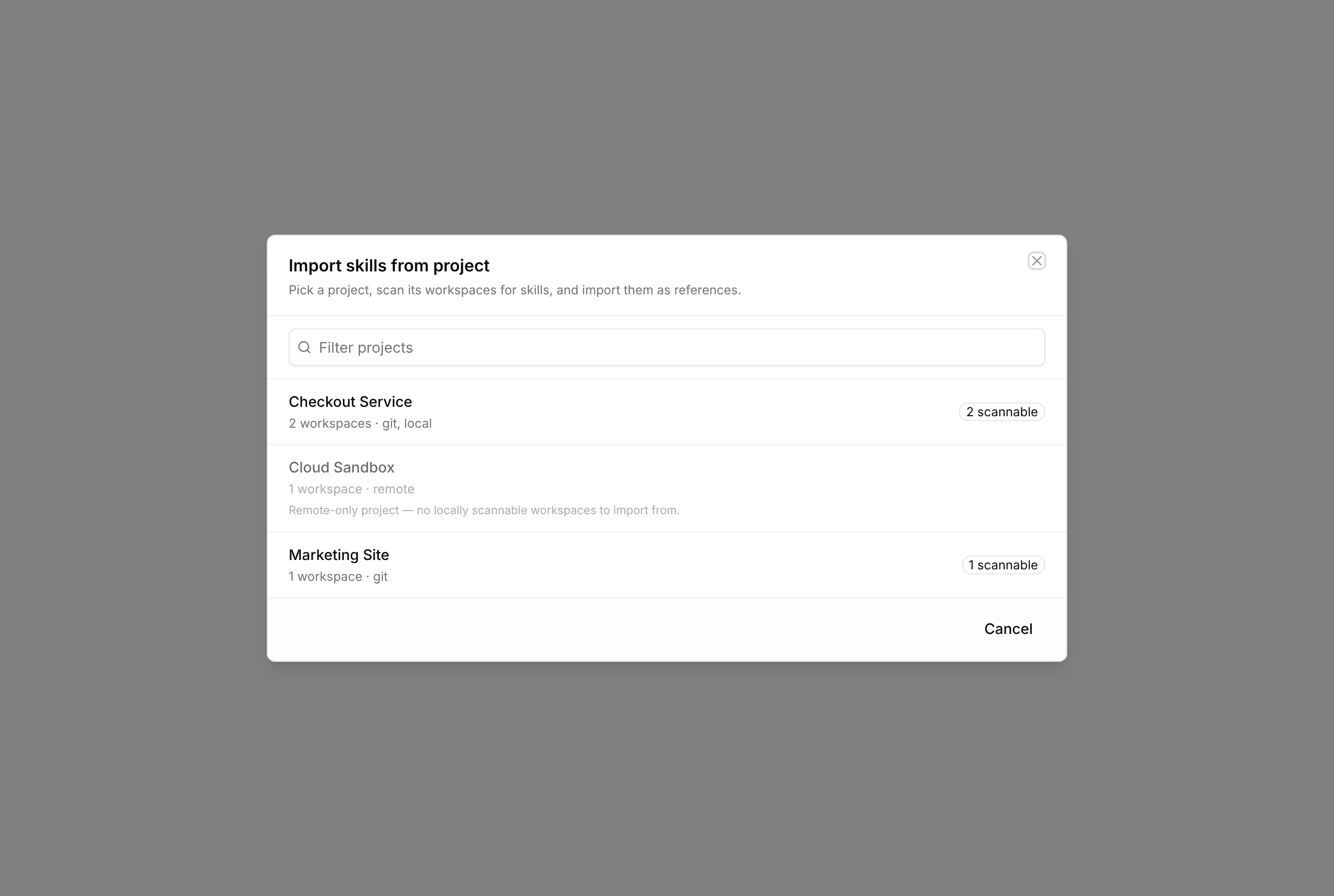 **Review discovered skills** 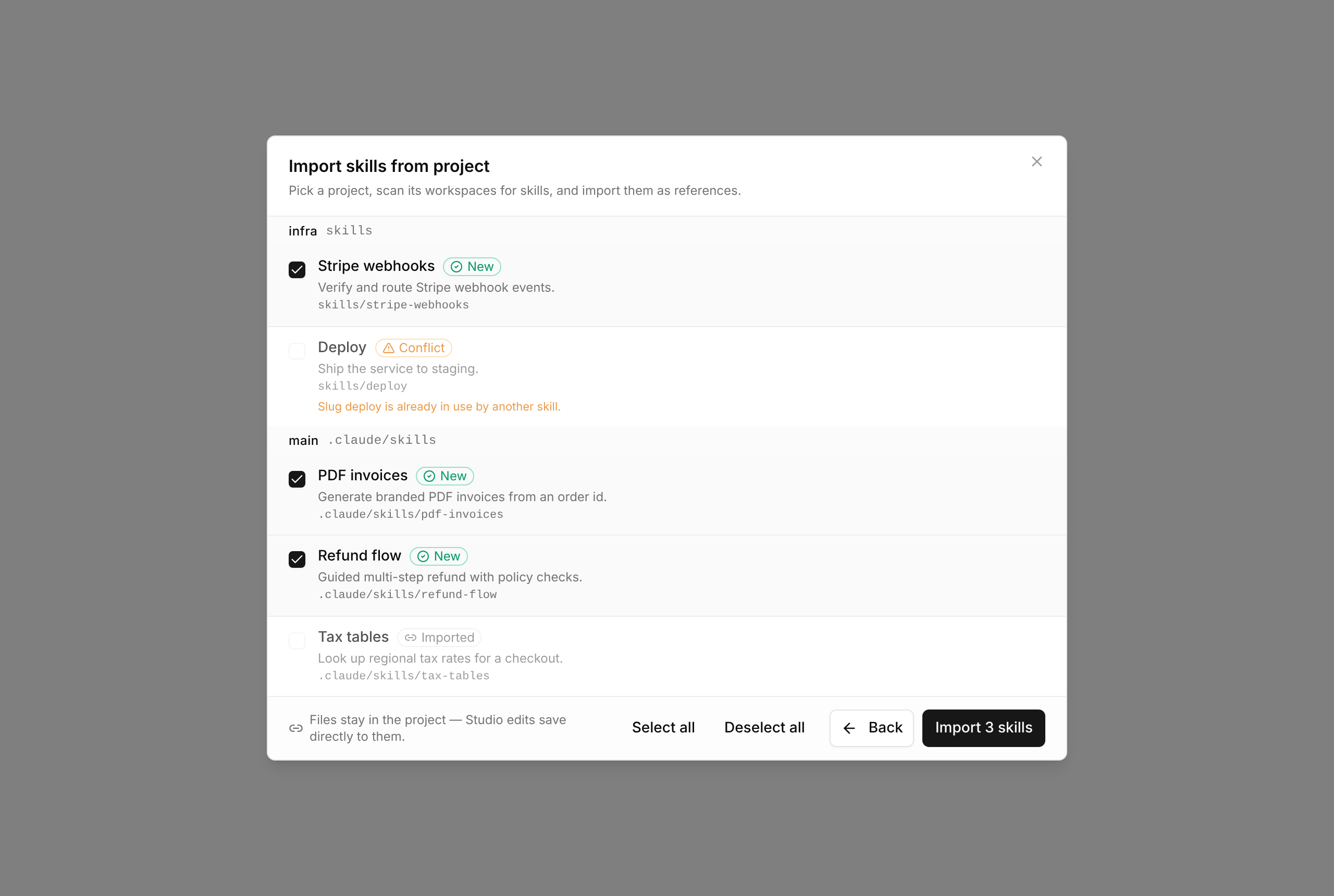 **Mobile selection footer** 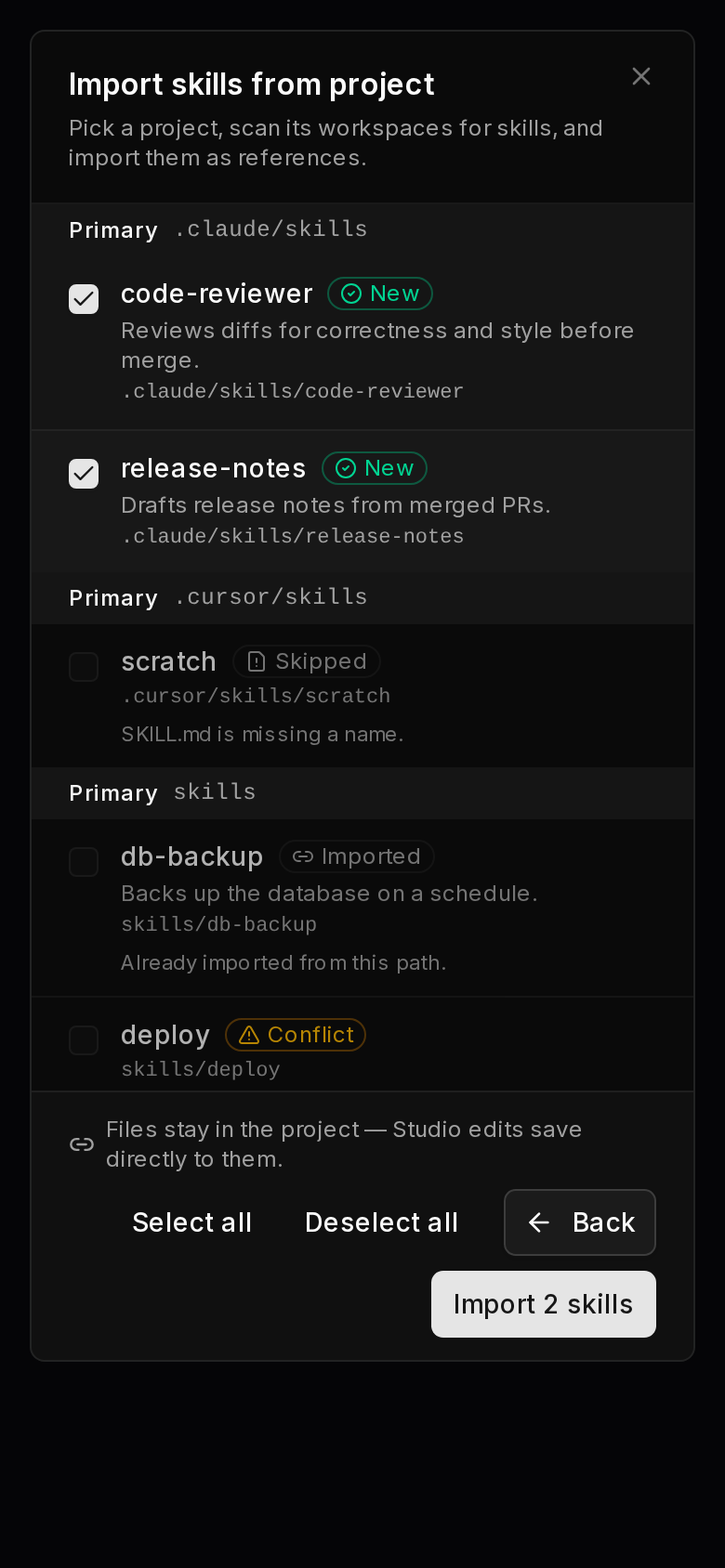 **Import result** 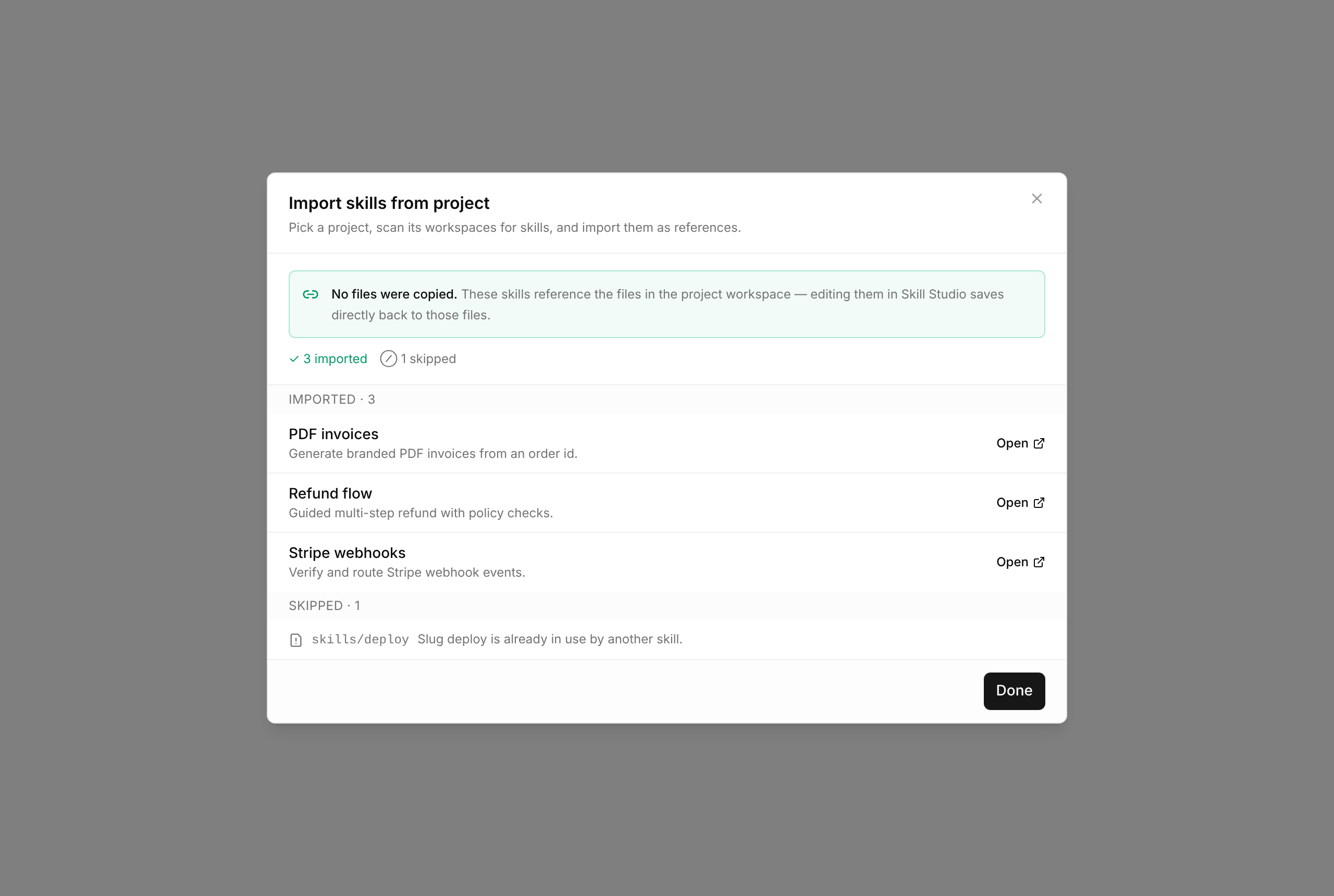 ## Verification - `pnpm exec vitest run server/src/__tests__/company-skills-service.test.ts server/src/__tests__/company-skills-routes.test.ts ui/src/pages/skills/ImportSkillsFromProjectDialog.test.tsx` — 3 files, 81 tests passed. - `pnpm check:token-gates` — all token gates clean. - `pnpm --filter @paperclipai/shared typecheck` — passed. - `pnpm --filter @paperclipai/server typecheck` — passed. - `pnpm --filter @paperclipai/ui typecheck` — passed. - Security review passed after adding tenant-scope and unauthorized-preview regressions; UX re-review approved desktop/mobile surfaces; QA passed all seven acceptance areas including write-through editing, deduplication, conflicts, empty state, and permission denial. ## Risks - Files remain referenced in project workspaces, so moving or deleting a source directory can make an imported skill unavailable; the UI explicitly communicates the reference behavior. - New well-known directory scans may discover more candidates than older versions, but preview mode prevents mutation until the operator confirms a selection. - The endpoint remains backward compatible: omitting `mode` preserves the prior full-import behavior. - No schema migration or telemetry event changes. > For core feature work, check [`ROADMAP.md`](ROADMAP.md) first and discuss it in `#dev` before opening the PR. Feature PRs that overlap with planned core work may need to be redirected — check the roadmap first. See `CONTRIBUTING.md`. ## Model Used - Anthropic Claude Opus 4.8 with tool use/code execution assisted with the UI implementation and UX polish. OpenAI Codex CLI with tool use/code execution assisted with server implementation, security fixes, regression coverage, integration, and PR preparation; the runtime did not expose Codex's exact backing model ID or context-window size. ## Checklist - [x] I have included a thinking path that traces from project context to this change - [x] I have specified the model used (with version and capability details) - [x] I have checked ROADMAP.md and confirmed this PR does not duplicate planned core work - [x] I have searched GitHub for duplicate or related PRs and linked them above - [x] I have either (a) linked existing issues with `Fixes: #` / `Closes #` / `Refs #` OR (b) described the issue in-PR following the relevant issue template - [x] I have not referenced internal/instance-local Paperclip issues or links (only public GitHub `#NNN` / `github.com/paperclipai/paperclip` URLs) - [x] My branch name describes the change (e.g. `docs/...`, `fix/...`) and contains no internal Paperclip ticket id or instance-derived details - [x] I have run tests locally and they pass - [x] I have added or updated tests where applicable - [x] I have updated relevant documentation to reflect my changes - [x] I have considered and documented any risks above - [x] All Paperclip CI gates are green - [x] Greptile is 5/5 with no open P2s, recommendations, or follow-ups - [x] I will address all Greptile and reviewer comments before requesting merge --------- Co-authored-by: Paperclip <noreply@paperclip.ing> Co-authored-by: Claude Opus 4.8 <noreply@anthropic.com> |
||
|
DottaandPaperclip
|
1de0a3bb1e |
feat(mcp) [split 2/8]: add governed access contracts (#9557)
## Thinking Path > - Paperclip is the open source app people use to manage AI agents for work > - Governed MCP access spans contracts, runtime enforcement, adapters, UI surfaces, and operator verification > - The parity reference PR #9534 is too large for effective automated or human review > - The feature therefore needs a linear stack whose individual diffs stay below the 100-file review limit > - This pull request is split 2/8 and focuses on database schema and shared governance contracts > - The benefit is a standalone, testable review boundary while preserving byte-for-byte parity at the top of the stack ## Linked Issues or Issue Description - Related parity reference: #9534 - Problem: The governed access model needs additive persistence and synchronized shared types before server enforcement can compile. - Proposed solution: Adds migrations 0148–0169, tool-access and Smoke Lab schema, shared types/validators/gallery helpers, and the minimal compile-required contract consumers identified by boundary testing. - Alternatives considered: keeping #9534 as one 403-file review, or rewriting the feature to manufacture seams; both were rejected in favor of path extraction plus compile-driven boundary moves. - Roadmap alignment: this advances the existing governed MCP/tool-access work already represented by #9534; it does not introduce a separate roadmap initiative. - Stack position: base branch is `pap10341-split/01-demo-servers`. - Merge policy: merge bottom-up, in order, only after the complete eight-PR stack has been reviewed and the top-of-stack parity gate remains empty. - Requested review: QA for migrations/validators; Greptile on every PR. ## What Changed - Adds migrations 0148–0169, tool-access and Smoke Lab schema, shared types/validators/gallery helpers, and the minimal compile-required contract consumers identified by boundary testing. - Keeps this PR below 100 changed files and independently typecheckable. - Preserves the final tree from #9534 when combined with the other seven stack levels. ## Verification - `pnpm typecheck` — passed, including migration numbering and safety checks - `pnpm --filter @paperclipai/db test` — passed - `pnpm --filter @paperclipai/shared test` — passed ## Risks - Migration or contract mistakes could affect every upper layer; all migrations are additive/idempotent and compile consumers are included in this boundary. - Stack risk: merging out of order can expose incomplete layers; mitigate by following the documented bottom-up merge policy. - Parity risk: later edits to an intermediate branch can drift from #9534; mitigate by re-running the empty top-of-stack diff before merge. > For core feature work, check [`ROADMAP.md`](ROADMAP.md) first and discuss it in `#dev` before opening the PR. Feature PRs that overlap with planned core work may need to be redirected — check the roadmap first. See `CONTRIBUTING.md`. ## Model Used - OpenAI Codex, exact model ID `gpt-5.4`; runtime-managed context window; medium reasoning with repository, shell, Git, GitHub CLI, and code-execution tools enabled. ## Checklist - [x] I have included a thinking path that traces from project context to this change - [x] I have specified the model used (with version and capability details) - [x] I have checked ROADMAP.md and confirmed this PR does not duplicate planned core work - [x] I have searched GitHub for duplicate or related PRs and linked them above - [x] I have either (a) linked existing issues with `Fixes: #` / `Closes #` / `Refs #` OR (b) described the issue in-PR following the relevant issue template - [x] Internal references are omitted except the execution-plan link explicitly required for this coordinated split stack - [x] My branch name describes the change and contains no internal Paperclip ticket id or instance-derived details - [x] I have run tests locally and they pass - [x] I have added or updated tests where applicable - [x] I have updated relevant documentation to reflect my changes - [x] I have considered and documented any risks above - [ ] All Paperclip CI gates are green - [ ] Greptile is 5/5 with no open P2s, recommendations, or follow-ups - [x] I will address all Greptile and reviewer comments before requesting merge ## Stack Coordination - Internal execution plan: [PAP-13874](/PAP/issues/PAP-13874#document-plan) - Parity reference: #9534 - Stack: #9556 → #9557 → #9558 → #9559 → #9560 → #9561 → #9562 → #9563 - Merge bottom-up only after full-stack review and an empty parity diff at #9563. --------- Co-authored-by: Paperclip <noreply@paperclip.ing> |
||
|
DottaandPaperclip
|
8b6a06ee25 |
[codex] Add built-in agents and Reflection Coach bundle (#9206)
## Thinking Path > - Paperclip is the open source app people use to manage AI agents for work. > - Operators need first-party agent capabilities for repeatable company work, not just manually created one-off agents. > - Built-in agents need to behave like normal company-scoped agents while preserving approval gates, permissions, budgets, and audit trails. > - Reflection and coaching work also needs bundled instructions, skill content, and a routine so the feature can be installed and reset predictably. > - The API, database, UI, portability, and tests all need to agree on the built-in lifecycle from not provisioned through setup, approval, ready, paused, and reset. > - This pull request adds built-in agent provisioning and the Reflection Coach bundle end-to-end. > - The benefit is a safer first-party path for Paperclip-managed agents without bypassing the same governance model used for operator-created agents. ## Linked Issues or Issue Description No public GitHub issue was found for this exact built-in agent and Reflection Coach bundle work. Problem/motivation: - Paperclip did not have a first-party built-in agent lifecycle for product-owned agents. - Bundled agent resources such as default instructions, skills, and routines needed managed ownership and reset semantics. - Approval-gated companies needed built-in setup to preserve requested adapter, budget, manager, and permission state through board approval. - The board UI needed clear built-in badges, setup affordances, readiness state, and bundle status without exposing secrets. Proposed solution: - Add a company-scoped built-in agent registry, provisioning/reset/reconcile/status APIs, and Reflection Coach bundled resources. - Track bundled managed resources in the database with idempotent migration behavior. - Reuse existing agent approval, authorization, budget, and activity-log paths instead of creating a bypass. - Add UI setup, badges, gates, bundle panels, and route coverage for built-in agents. Duplicate search: - Searched GitHub PRs for `built-in agents Reflection Coach repo:paperclipai/paperclip`; only this PR was returned. - Searched GitHub issues for the same query; no public issues were returned. ## What Changed - Added built-in agent definitions, lifecycle state derivation, provisioning, reset, reconcile, status, and routine-control routes. - Added the `built_in_managed_resources` migration and schema exports for bundled instructions, skill, and routine ownership. - Added the Reflection Coach built-in bundle with default instructions, skill catalog content, routine template, default permissions, and managed-resource drift handling. - Added approval-aware provisioning behavior that preserves requested adapter config, budgets, manager assignment, and built-in permissions through hire approval. - Added authorization and mutation gates for built-in agent and skill changes, including consented Reflection Coach change paths. - Added UI surfaces for built-in agent setup, roster/detail badges, readiness gates, bundle status, routine controls, and route filtering. - Added company import/export and validator coverage for built-in managed resources and low-trust/red-team presets. - Addressed Greptile follow-ups for pending approval reconciliation, consent-gate error propagation, config-read authorization fallback, approval-path manager preservation, and non-model adapter provisioning. ## Verification Local verification: - `git diff --check public/master..HEAD` passed. - `pnpm check:token-gates` passed with all gates clean. - `pnpm exec vitest run ui/src/components/ConfigureBuiltInAgentModal.test.tsx` passed: 1 file, 4 tests. - `pnpm exec vitest run ui/src/components/EntityRow.test.tsx ui/src/pages/Agents.test.tsx ui/src/components/BuiltInAgentGate.test.tsx ui/src/components/ConfigureBuiltInAgentModal.test.tsx ui/src/components/BuiltInBundlePanel.test.tsx ui/src/pages/InstanceExperimentalSettings.test.tsx ui/src/pages/Routines.test.tsx` passed: 7 files, 64 tests. - `pnpm --filter @paperclipai/server exec vitest run src/__tests__/built-in-agents.test.ts src/__tests__/authorization-service.test.ts src/__tests__/company-skills-routes.test.ts` passed: 3 files, 91 tests. - `pnpm --filter @paperclipai/db check:migrations` passed. - `pnpm -r typecheck` passed after the rebase; `pnpm --filter ui typecheck` passed after the final UI review fix. Remote verification on latest head `1c61f693a4ec881d739022b0e75a8ca8bf8c2cd8`: - Merge state: `CLEAN`. - Greptile: `5/5`, zero unresolved Greptile threads. - PR check rollup: all checks successful, neutral, or skipped as expected. - Passing gates include Build, Typecheck + Release Registry, all server shards, all workspace shards, all serialized server suites, e2e, Canary Dry Run, policy, review, verify, Socket, Superagent, and Snyk. ## Risks - This adds a new managed-resource table and migration; the migration uses idempotent create/add/index guards and passed migration safety checks. - Built-in agent provisioning touches approval and authorization paths; tests cover pending approval preservation, stale retry rejection, consent gates, and config-read fallback behavior. - Reflection Coach creates managed instructions, skill, and routine resources; drift/reset behavior is covered by service tests and redacted API responses. - Non-model adapter setup now provisions a `needs_setup` built-in row before command/endpoint fields are complete; this matches the server lifecycle and is covered by the setup modal regression test. ## Model Used OpenAI Codex coding agent based on GPT-5. Exact hosted model ID, context-window size, and reasoning-mode labels are not exposed in this runtime; tool use, shell execution, GitHub CLI/API access, and local code editing were enabled. ## Checklist - [x] I have included a thinking path that traces from project context to this change - [x] I have specified the model used (with version and capability details) - [x] I have checked ROADMAP.md and confirmed this PR does not duplicate planned core work - [x] I have searched GitHub for duplicate or related PRs and linked them above - [x] I have either (a) linked existing issues with `Fixes: #` / `Closes #` / `Refs #` OR (b) described the issue in-PR following the relevant issue template - [x] I have not referenced internal/instance-local Paperclip issues or links (only public GitHub `#NNN` / `github.com/paperclipai/paperclip` URLs) - [x] My branch name describes the change (e.g. `docs/...`, `fix/...`) and contains no internal Paperclip ticket id or instance-derived details - [x] I have run tests locally and they pass - [x] I have added or updated tests where applicable - [x] I have updated relevant documentation to reflect my changes - [x] I have considered and documented any risks above - [x] All Paperclip CI gates are green - [x] Greptile is 5/5 with no open P2s, recommendations, or follow-ups - [x] I will address all Greptile and reviewer comments before requesting merge --------- Co-authored-by: Paperclip <noreply@paperclip.ing> |
||
|
DottaandPaperclip
|
0f08c2b526 |
fix(db): repair responsible user migration timestamps (#9146)
## Thinking Path > - Paperclip is the open source app people use to manage AI agents for work. > - The database migration layer keeps local and deployed instances moving forward safely as schema/data contracts evolve. > - The responsible-user backfill migration could make historical issues look newly updated by bumping user-visible `updated_at` columns during a backfill. > - That timestamp churn can invalidate inbox/archive state and make old work appear fresh even though no user-facing activity happened. > - This pull request moves the responsible-user invariant migration later in the current migration sequence, keeps it from touching user-visible timestamps, and adds a repair sweep for databases that already saw the timestamp bump. > - The benefit is safer migration replay and regression coverage for future backfills that might otherwise mutate visible timestamps. ## Linked Issues or Issue Description No public GitHub issue exists. Inline bug report: **Pre-submission checklist** - [x] I have searched existing open and closed issues and this is not a duplicate. - [x] I am on the latest released version of Paperclip (or can reproduce on `master`). - [x] I have confirmed the error originates in Paperclip itself — not in my agent adapter, API provider, or local configuration. **What happened?** A responsible-user migration backfill could update user-visible `updated_at` columns while filling missing responsible-user data. That makes historical issues/runs/routines appear newer even when no user-facing activity happened. **Expected behavior** Responsible-user backfills should populate ownership metadata without mutating user-visible recency fields, and databases already affected by a timestamp sweep should be repairable. **Steps to reproduce** 1. Start from current `master` with the responsible-user migration sequence. 2. Apply migrations to a database containing historical issues, runs, routines, and companies with older activity timestamps. 3. Replay the responsible-user invariant migration and inspect user-visible `updated_at` values. **Paperclip version or commit** `master` at the PR base. **Deployment mode** Local dev (`pnpm dev`) and deployed instances using the same migrations. **Installation method** Built from source (`pnpm dev` / `pnpm build`). **Agent adapter(s) involved** - [x] Not adapter-specific (core bug) **Database mode** External Postgres and embedded development Postgres migration paths. **Access context** Board and agent-visible issue recency can both be affected. **Relevant logs or output** Covered by the added embedded-Postgres regression tests. **Relevant config (if applicable)** Not applicable. **Additional context** This PR adapts an extracted local migration fix onto the current master migration sequence, where `0133` is already occupied. **Privacy checklist** - [x] I have reviewed all pasted output for PII (usernames, file paths, API keys, tokens, company names) and redacted where necessary. ## What Changed - Renumbered the responsible-user invariant migration onto the current master migration sequence. - Added a repair migration that detects broad timestamp sweeps and restores safer `updated_at` values for issues, heartbeat runs, routines, routine runs, and companies. - Added focused embedded-Postgres regression coverage for the relocated migration, repair migration, and updated-at backfill allowlist. ## Verification - `pnpm --filter @paperclipai/db run check:migrations` - `/srv/paperclip/home/paperclipai/paperclip/node_modules/.bin/vitest run packages/db/src/client.test.ts -t "migration 0134|migration 0135|unallowlisted migration backfills"` ## Risks Migration behavior is the main risk. The PR intentionally changes the active migration sequence by removing the old responsible-user invariant slot and replaying that work later with a repair migration. Reviewers should confirm this matches the intended release/migration policy for installations that may already have applied the earlier migration. > For core feature work, check [`ROADMAP.md`](ROADMAP.md) first and discuss it in `#dev` before opening the PR. Feature PRs that overlap with planned core work may need to be redirected — check the roadmap first. See `CONTRIBUTING.md`. ## Model Used OpenAI Codex, GPT-5.5 coding agent with repository tool use and local shell execution. Context window was not surfaced by the runtime. ## Checklist - [x] I have included a thinking path that traces from project context to this change - [x] I have specified the model used (with version and capability details) - [x] I have checked ROADMAP.md and confirmed this PR does not duplicate planned core work - [x] I have searched GitHub for duplicate or related PRs and linked them above - [x] I have either (a) linked existing issues with `Fixes: #` / `Closes #` / `Refs #` OR (b) described the issue in-PR following the relevant issue template - [x] I have not referenced internal/instance-local Paperclip issues or links (only public GitHub `#NNN` / `github.com/paperclipai/paperclip` URLs) - [x] My branch name describes the change (e.g. `docs/...`, `fix/...`) and contains no internal Paperclip ticket id or instance-derived details - [x] I have run tests locally and they pass - [x] I have added or updated tests where applicable - [x] I have updated relevant documentation to reflect my changes - [x] I have considered and documented any risks above - [ ] All Paperclip CI gates are green - [ ] Greptile is 5/5 with no open P2s, recommendations, or follow-ups - [ ] I will address all Greptile and reviewer comments before requesting merge --------- Co-authored-by: Paperclip <noreply@paperclip.ing> |
||
|
DottaandPaperclip
|
d2e3f7dce5 |
fix(db): correct 0130 responsible-user backfill in place (inbox resurface) (#9111)
## Thinking Path > - Paperclip is the open source app people use to manage AI agents for work > - Users triage agent work through the issue inbox, which suppresses archived issues by comparing issue `updated_at` against the archive timestamp > - Migration `0130_run_responsible_user_invariant` backfilled responsible-user columns but also set `updated_at = now()` on every row it touched (companies, issues, routines, routine_runs, heartbeat_runs) > - That blanket timestamp bump made every archived issue look newly updated, resurfacing thousands of archived issues into every user's inbox > - This pull request corrects the 0130 backfill in place so it only fills `NULL` responsible-user columns and never touches timestamps, and adds tests that prevent this class of bug from being reintroduced > - The benefit is that inbox archive suppression stays intact across migrations, and no future migration backfill can silently bump `updated_at` on user-visible tables ## Linked Issues or Issue Description **Bug description (no public issue exists):** - **What happened:** after upgrading a dev instance across migration 0130, every previously archived inbox item resurfaced as unread/new for all users. - **Expected:** data backfills must not alter row modification timestamps; archived issues stay archived unless genuinely updated. - **Root cause:** the 0130 backfill's `UPDATE` statements set `updated_at = now()` alongside the responsible-user columns. ## What Changed - `packages/db/src/migrations/0130_run_responsible_user_invariant.sql`: removed all `updated_at = now()` assignments from the backfill UPDATEs; the migration now only fills `NULL` responsible-user columns. The file is corrected **in place** (no new migration number, journal untouched) because 0130 has never shipped in a published release. - `packages/db/src/client.test.ts`: added a guard test that scans every migration and rejects backfills that bump `updated_at` on user-visible tables (with an explicit allowlist for the pre-existing 0131 repair migration). - `packages/db/src/client.test.ts`: added a replay test that simulates an already-migrated database picking up the corrected file (deletes the 0130 ledger hash, re-applies mid-journal) and asserts issue `updated_at` and inbox-archive suppression ordering are untouched. ### Why an in-place edit is safe - 0130 only exists on master/canary builds; the latest published release (v2026.626.0) predates it. - The migration ledger is content-hash based: databases that already applied the old 0130 keep an orphaned hash row (harmless) and see the corrected file as pending, so they replay the corrected backfill — which is idempotent (fills `NULL`s only, no timestamp writes). - Fresh databases simply run the corrected 0130 in journal order. ## Verification - `pnpm --filter @paperclipai/db run check:migrations` — clean - `cd packages/db && npx vitest run src/client.test.ts` — 11/11 passing against embedded Postgres, including the new guard and mid-journal replay tests ## Risks - Migration safety: the corrected backfill is idempotent and only writes `NULL` columns; replay on already-migrated databases is exercised directly by the new test. No schema changes. - Databases that already ran the old 0130 keep the bumped timestamps from that run; repairing historical damage is intentionally out of scope here (no released build ever contained the bug). ## Model Used - Claude Opus 4.7 (`claude-opus-4-7`, extended thinking, tool use) via Claude Code / Paperclip agent runtime ## Checklist - [x] I have included a thinking path that traces from project context to this change - [x] I have specified the model used (with version and capability details) - [x] I have checked ROADMAP.md and confirmed this PR does not duplicate planned core work - [x] I have searched GitHub for duplicate or related PRs and linked them above (backup health alert work split into #9113; no other related open PRs) - [x] I have either (a) linked existing issues with `Fixes: #` / `Closes #` / `Refs #` OR (b) described the issue in-PR following the relevant issue template - [x] I have not referenced internal/instance-local Paperclip issues or links (only public GitHub `#NNN` / `github.com/paperclipai/paperclip` URLs) - [x] My branch name describes the change (e.g. `docs/...`, `fix/...`) and contains no internal Paperclip ticket id or instance-derived details - [x] I have run tests locally and they pass - [x] I have added or updated tests where applicable - [x] I have updated relevant documentation to reflect my changes (none needed for a migration content fix) - [x] I have considered and documented any risks above - [ ] All Paperclip CI gates are green - [ ] Greptile is 5/5 with no open P2s, recommendations, or follow-ups - [x] I will address all Greptile and reviewer comments before requesting merge Co-authored-by: Paperclip <noreply@paperclip.ing> |
||
|
DottaandPaperclip
|
1e81bd188b |
Fix heartbeat run responsible user migration for identifier refs (#9107)
## Thinking Path

> - Paperclip is the open source app people use to manage AI agents for
work
> - Paperclip stores heartbeat run ownership context so operators can
audit which user was responsible for agent work
> - A migration backfills missing heartbeat run `responsible_user_id`
values from issue references in each run's context snapshot
> - Some context snapshots can store issue identifiers as public ticket
strings rather than UUIDs
> - The migration needs to resolve both UUID issue ids and issue
identifiers without trying to cast identifier strings to UUID
> - This pull request tightens the migration query so UUID matching only
casts validated UUID-shaped values and identifier matching remains a
separate fallback
> - A companion repair migration is needed so installations that already
recorded `0130` still get the corrected heartbeat-run backfill
> - The benefit is that existing installations can apply the
responsible-user invariant migrations without failing on non-UUID issue
references and without leaving already-migrated databases unrepaired

## Linked Issues or Issue Description

No public GitHub issue was found in a quick search for this migration
failure.

Bug report context following `.github/ISSUE_TEMPLATE/bug_report.yml`:

**Pre-submission checklist**

- I searched existing open and closed issues and did not find a
duplicate.
- I can reproduce against current `master` plus the responsible-user
invariant migration path.
- The error originates in Paperclip's database migration, not in an
adapter, API provider, or local configuration.

**What happened?**

Applying the heartbeat run responsible-user backfill migration could
fail when `heartbeat_runs.context_snapshot->>'issueId'` or `taskId`
contained an issue identifier such as `PAP-123` instead of a UUID. The
migration attempted to use issue refs for UUID matching and identifier
fallback, but the UUID path needed to avoid casting non-UUID identifier
strings. Because `0130` may already have been applied in some
installations, a follow-up repair migration is needed as well.

**Expected behavior**

The migration should backfill from UUID issue ids when present, from
issue identifiers when present, and fall back to the company default
responsible user without unsafe UUID casts. Already-migrated
installations should receive the repaired heartbeat-run context-ref
backfill through a new migration.

**Steps to reproduce**

1. Use a migrated database with a company, issue, agent, and heartbeat
run.
2. Store a null `heartbeat_runs.responsible_user_id` and a
`context_snapshot` like `{"issueId":"PAP-123"}`.
3. Replay/apply the run responsible-user repair migration.
4. Observe that the migration must not cast `PAP-123` to UUID and should
backfill from the matching issue identifier.

**Paperclip version or commit**

Current `master` plus this migration fix branch.

**Deployment mode**

Database migration during server startup or explicit migration command.

**Installation method**

Built from source / self-hosted migration path.

**Agent adapter(s) involved**

Not adapter-specific; core database migration bug.

**Database mode**

Postgres migration path, including embedded Postgres in development.

**Access context**

Not applicable; migration-time data backfill.

**Relevant logs or output**

Unsafe UUID casts can surface as Postgres invalid input syntax errors
when a context snapshot issue ref is an identifier rather than a UUID.

**Privacy checklist**

No private logs, paths, API keys, tokens, company names, or internal
Paperclip issue links are included.

## What Changed

- Split heartbeat run context issue reference extraction into reusable
CTEs.
- Only cast `issueId` / `taskId` values to UUID after a UUID-shape regex
check.
- Preserve fallback matching by issue identifier within the same
company.
- Keep deterministic candidate priority with `issueId` before `taskId`
and UUID matches before identifier matches.
- Added `0131_repair_run_responsible_user_context_refs.sql` so
installations that already applied `0130` still receive the corrected
heartbeat-run backfill.
- Added a DB migration regression test that replays the repair migration
with an identifier-style heartbeat run issue ref.

## Verification

- `pnpm --filter @paperclipai/db typecheck`
- `pnpm --filter @paperclipai/db exec vitest run src/client.test.ts`
- Isolated embedded Postgres migration run with a temporary
`PAPERCLIP_CONFIG`: `pnpm --filter @paperclipai/db migrate` applied all
pending migrations successfully.
- GitHub Actions PR workflow is green on commit
`1c2655bc457cef3716a43e66463e1e5bc2fdcfab`.
- Greptile is 5/5 with no unresolved threads on commit
`1c2655bc457cef3716a43e66463e1e5bc2fdcfab`.
- Searched for duplicate public issues/PRs with GitHub search; no direct
duplicate found.
- Checked `ROADMAP.md` for overlap; no related roadmap item found.

## Risks

- Low-to-medium migration risk because this modifies an existing data
backfill migration and adds a companion repair migration.
- The query still relies on `context_snapshot` containing either issue
UUIDs or identifiers that match issues in the same company.
- Installations with unusual malformed context snapshots now skip unsafe
UUID casts and fall through to identifier/default backfill behavior.

> For core feature work, check [`ROADMAP.md`](ROADMAP.md) first and
discuss it in `#dev` before opening the PR. Feature PRs that overlap
with planned core work may need to be redirected — check the roadmap
first. See `CONTRIBUTING.md`.

## Model Used

OpenAI GPT-5 Codex coding agent with tool use and local command
execution.

## Checklist

- [x] I have included a thinking path that traces from project context
to this change
- [x] I have specified the model used (with version and capability
details)
- [x] I have checked ROADMAP.md and confirmed this PR does not duplicate
planned core work
- [x] I have searched GitHub for duplicate or related PRs and linked
them above
- [x] I have either (a) linked existing issues with `Fixes: #` / `Closes
#` / `Refs #` OR (b) described the issue in-PR following the relevant
issue template
- [x] I have not referenced internal/instance-local Paperclip issues or
links (only public GitHub `#NNN` / `github.com/paperclipai/paperclip`
URLs)
- [x] My branch name describes the change (e.g. `docs/...`, `fix/...`)
and contains no internal Paperclip ticket id or instance-derived details
- [x] I have run tests locally and they pass
- [x] I have added or updated tests where applicable
- [x] I have updated relevant documentation to reflect my changes, or
confirmed no docs update is needed for this migration-only fix
- [x] I have considered and documented any risks above
- [x] All Paperclip CI gates are green
- [x] Greptile is 5/5 with no open P2s, recommendations, or follow-ups
- [x] I will address all Greptile and reviewer comments before
requesting merge

---------

Co-authored-by: Paperclip <noreply@paperclip.ing>
|
||
|
DottaandPaperclip
|
9c6f551595 |
[codex] Add plugin orchestration host APIs (#4114)
## Thinking Path > - Paperclip orchestrates AI agents for zero-human companies. > - The plugin system is the extension path for optional capabilities that should not require core product changes for every integration. > - Plugins need scoped host APIs for issue orchestration, documents, wakeups, summaries, activity attribution, and isolated database state. > - Without those host APIs, richer plugins either cannot coordinate Paperclip work safely or need privileged core-side special cases. > - This pull request adds the plugin orchestration host surface, scoped route dispatch, a database namespace layer, and a smoke plugin that exercises the contract. > - The benefit is a broader plugin API that remains company-scoped, auditable, and covered by tests. ## What Changed - Added plugin orchestration host APIs for issue creation, document access, wakeups, summaries, plugin-origin activity, and scoped API route dispatch. - Added plugin database namespace tables, schema exports, migration checks, and idempotent replay coverage under migration `0059_plugin_database_namespaces`. - Added shared plugin route/API types and validators used by server and SDK boundaries. - Expanded plugin SDK types, protocol helpers, worker RPC host behavior, and testing utilities for orchestration flows. - Added the `plugin-orchestration-smoke-example` package to exercise scoped routes, restricted database namespaces, issue orchestration, documents, wakeups, summaries, and UI status surfaces. - Kept the new orchestration smoke fixture out of the root pnpm workspace importer so this PR preserves the repository policy of not committing `pnpm-lock.yaml`. - Updated plugin docs and database docs for the new orchestration and database namespace surfaces. - Rebased the branch onto `public-gh/master`, resolved conflicts, and removed `pnpm-lock.yaml` from the final PR diff. ## Verification - `pnpm install --frozen-lockfile` - `pnpm --filter @paperclipai/db typecheck` - `pnpm exec vitest run packages/db/src/client.test.ts` - `pnpm exec vitest run server/src/__tests__/plugin-database.test.ts server/src/__tests__/plugin-orchestration-apis.test.ts server/src/__tests__/plugin-routes-authz.test.ts server/src/__tests__/plugin-scoped-api-routes.test.ts server/src/__tests__/plugin-sdk-orchestration-contract.test.ts` - From `packages/plugins/examples/plugin-orchestration-smoke-example`: `pnpm exec vitest run --config ./vitest.config.ts` - `pnpm --dir packages/plugins/examples/plugin-orchestration-smoke-example run typecheck` - `pnpm --filter @paperclipai/server typecheck` - PR CI on latest head `293fc67c`: `policy`, `verify`, `e2e`, and `security/snyk` all passed. ## Risks - Medium risk: this expands plugin host authority, so route auth, company scoping, and plugin-origin activity attribution need careful review. - Medium risk: database namespace migration behavior must remain idempotent for environments that may have seen earlier branch versions. - Medium risk: the orchestration smoke fixture is intentionally excluded from the root workspace importer to avoid a `pnpm-lock.yaml` PR diff; direct fixture verification remains listed above. - Low operational risk from the PR setup itself: the branch is rebased onto current `master`, the migration is ordered after upstream `0057`/`0058`, and `pnpm-lock.yaml` is not in the final diff. > For core feature work, check [`ROADMAP.md`](ROADMAP.md) first and discuss it in `#dev` before opening the PR. Feature PRs that overlap with planned core work may need to be redirected — check the roadmap first. See `CONTRIBUTING.md`. Roadmap checked: this work aligns with the completed Plugin system milestone and extends the plugin surface rather than duplicating an unrelated planned core feature. ## Model Used - OpenAI Codex, GPT-5-based coding agent in a tool-enabled CLI environment. Exact hosted model build and context-window size are not exposed by the runtime; reasoning/tool use were enabled for repository inspection, editing, testing, git operations, and PR creation. ## Checklist - [x] I have included a thinking path that traces from project context to this change - [x] I have specified the model used (with version and capability details) - [x] I have checked ROADMAP.md and confirmed this PR does not duplicate planned core work - [x] I have run tests locally and they pass - [x] I have added or updated tests where applicable - [x] If this change affects the UI, I have included before/after screenshots (N/A: no core UI screen change; example plugin UI contract is covered by tests) - [x] I have updated relevant documentation to reflect my changes - [x] I have considered and documented any risks above - [x] I will address all Greptile and reviewer comments before requesting merge --------- Co-authored-by: Paperclip <noreply@paperclip.ing> |
||
|
dotta
|
1e76bbe38c | test(db): cover 0050 migration replay | ||
|
dottaandPaperclip
|
909e8cd4c8 |
feat(routines): add workspace-aware routine runs
Co-Authored-By: Paperclip <noreply@paperclip.ing> |
||
|
dottaandPaperclip
|
29d0e82dce |
fix: make feedback migration replay-safe after rebase
Co-Authored-By: Paperclip <noreply@paperclip.ing> |
||
|
dotta
|
90889c12d8 | fix(db): make document revision migration replay-safe | ||
|
dottaandPaperclip
|
c916626cef |
test: skip embedded postgres suites when initdb is unavailable
Co-Authored-By: Paperclip <noreply@paperclip.ing> |
||
|
dottaandPaperclip
|
5602576ae1 |
Fix embedded Postgres initdb failure in Docker slim containers
The embedded-postgres library hardcodes --lc-messages=en_US.UTF-8 and strips the parent process environment when spawning initdb/postgres. In slim Docker images (e.g. node:20-bookworm-slim), the en_US.UTF-8 locale isn't installed, causing initdb to exit with code 1. Two fixes applied: 1. Add --lc-messages=C to all initdbFlags arrays (overrides the library's hardcoded locale since our flags come after in the spread) 2. pnpm patch on embedded-postgres to preserve process.env in spawn calls, preventing loss of PATH, LD_LIBRARY_PATH, and other vars Co-Authored-By: Paperclip <noreply@paperclip.ing> |
||
|
dottaandPaperclip
|
7f9a76411a |
Address Greptile review on board CLI auth
Co-Authored-By: Paperclip <noreply@paperclip.ing> |
||
|
dottaandPaperclip
|
01b6b7e66a |
fix: make cli auth migration 0044 idempotent
Co-Authored-By: Paperclip <noreply@paperclip.ing> |
||
|
Dotta
|
3d01217aef | Fix legacy migration reconciliation |



