mirror of
https://github.com/paperclipai/paperclip.git
synced 2026-10-21 08:22:20 +02:00
a015ac7a57b2f60b074f59daf75b1663bd6d52e7
848
Commits
| Author | SHA1 | Message | Date | |
|---|---|---|---|---|

|
59fb27ff79 |
feat(inbox): let agents safely tidy user inboxes (#9724)
## Thinking Path > - Paperclip is the open source control plane people use to manage AI-agent companies and their work > - The inbox is a per-user attention view, so archiving an item must not alter the underlying issue, assignment, or status > - Agents can help responsible users tidy resolved work only when the action is company-scoped, reversible, policy-controlled, and fully attributable > - The database and authorization foundations landed in #9654 and #9658, but the end-to-end archive routes, audit details, agent workflow guidance, and operator UI still need to ship together > - Separate stacked PRs #9659 and #9661 made the complete behavior harder to review and land as one coherent capability > - This pull request consolidates the remaining server, shared-contract, documentation, skill, and UI work on top of current master > - The benefit is a single reviewable change that lets agents safely archive responsible-user inbox items and lets users control or undo that behavior ## Linked Issues or Issue Description ### Subsystem affected Cross-cutting inbox management across shared contracts, server authorization/routes/services, shipped agent skills, and the board UI. ### Problem or motivation Agents may complete work whose issue remains in the responsible user's Mine inbox. Existing board-user archive behavior does not provide the agent-facing policy endpoints, target resolution, heartbeat-run attribution, typed denials, conservative workflow guidance, or UI needed for safe agent-managed cleanup. ### Proposed solution Allow authorized agents to archive or unarchive responsible-user inbox items under the user's open, allowlist, or disabled policy; preserve actor/agent/run attribution in issue detail and activity records; expose policy controls and agent archive attribution in the UI; and document conservative cleanup rules for agents and PR gardening. ### Alternatives considered - Reuse generic issue mutation permissions: rejected because inbox state belongs to a target user and requires user-scoped authorization. - Automatically archive every completed or closed item: rejected because completion signals can still require human review or a decision. - Keep the backend and UI as separate stacked PRs: superseded by this consolidated PR so the complete user-visible behavior can be reviewed and verified together. ### Related work - Builds on merged foundations #9654 and #9658. - Supersedes the remaining stacked changes in #9659 and #9661. - `ROADMAP.md` has no overlapping inbox archive or inbox authorization initiative. ## What Changed - Added shared inbox-agent policy types and validators plus company-scoped self-service policy routes and OpenAPI coverage. - Enabled agent archive/unarchive mutations with responsible-user targeting, policy enforcement, typed failures, attribution, idempotency, and detailed activity auditing. - Returned agent archive attribution in issue detail and documented reversible inbox cleanup semantics in the implementation spec and Paperclip skill. - Added conservative PR-gardening inbox tidy guidance that keeps GitHub access read-only and avoids archiving work that still needs human action. - Added the Profile settings policy control and Issue Properties attribution/unarchive UI with focused component coverage and narrow-pane handling. ## Verification - `pnpm exec vitest run server/src/__tests__/inbox-archive-routes.test.ts server/src/__tests__/inbox-agent-policy-routes.test.ts server/src/__tests__/authorization-service.test.ts server/src/__tests__/openapi-routes.test.ts ui/src/components/InboxAgentPolicyControl.test.tsx ui/src/components/IssueProperties.test.tsx` — 110 passed. - `pnpm --filter @paperclipai/db exec vitest run src/inbox-archive-agent-policies-migration.test.ts` — 1 passed. - `node --test .agents/skills/pr-gardening/scripts/pr-gardening.test.mjs` — 9 passed. - `pnpm --filter @paperclipai/server typecheck` — passed. - `pnpm --filter @paperclipai/ui typecheck` — passed. - `pnpm check:token-gates` — changed files are clean; the repository-wide command currently reports nine unrelated pre-existing `#9627` literals outside this PR's diff. ## Risks - Agent inbox mutations broaden an existing endpoint path, so authorization and target resolution must remain fail-closed; focused route and authorization tests cover allowed and denied paths. - Archive state affects only the responsible user's inbox presentation and remains reversible; it does not mutate issue status, assignment, or visibility. - The UI policy defaults to the existing open behavior, while allowlist and disabled modes can reduce agent access. - This PR intentionally builds on #9654 and #9658 and contains no new migration number or modification to an already-applied migration. > For core feature work, check [`ROADMAP.md`](ROADMAP.md) first and discuss it in `#dev` before opening the PR. Feature PRs that overlap with planned core work may need to be redirected — check the roadmap first. See `CONTRIBUTING.md`. ## Model Used - OpenAI Codex using GPT-5.4, medium reasoning, repository tool use, shell execution, code review, and test execution. ## Checklist - [x] I have included a thinking path that traces from project context to this change - [x] I have specified the model used (with version and capability details) - [x] I have checked ROADMAP.md and confirmed this PR does not duplicate planned core work - [x] I have searched GitHub for duplicate or related PRs and linked them above - [x] I have either (a) linked existing issues with `Fixes: #` / `Closes #` / `Refs #` OR (b) described the issue in-PR following the relevant issue template - [x] I have not referenced internal/instance-local Paperclip issues or links (only public GitHub `#NNN` / `github.com/paperclipai/paperclip` URLs) - [x] My branch name describes the change (`feat/inbox-agent-archive-complete`) and contains no internal Paperclip ticket id or instance-derived details - [x] I have run tests locally and they pass - [x] I have added or updated tests where applicable - [x] I have updated relevant documentation to reflect my changes - [x] I have considered and documented any risks above - [x] All Paperclip CI gates are green - [x] Greptile is 5/5 with no open P2s, recommendations, or follow-ups - [x] I will address all Greptile and reviewer comments before requesting merge --------- Co-authored-by: Paperclip <noreply@paperclip.ing> Co-authored-by: Claude Opus 4.8 <noreply@anthropic.com> |
||
|
DottaandPaperclip
|
52aea90263 |
feat: organize skills with nested folders and My Skills (#9633)
## Thinking Path > - Paperclip is the open source control plane people use to organize and govern AI-agent companies > - Company skills are durable resources that users browse, import, assign, and maintain over time > - A flat skill list plus tags does not provide a stable location or hierarchy for personal, company, project-imported, and bundled skills > - Folder paths need to be canonical, company-scoped, safe to move, and preserved across re-imports without changing skill IDs > - The `/skills` UI also needs traversal, breadcrumbs, move/create flows, and a dedicated My Skills namespace that work on desktop and mobile > - This pull request adds the folder data model and APIs, reserved-root lifecycle, project import behavior, and the folder-first skills experience > - The benefit is a predictable filesystem-like organization model while tags remain available for cross-cutting classification ## Linked Issues or Issue Description Refs #9619 — the reviewed folder foundation was intentionally closed and folded into this combined feature PR. Refs #9026 — earlier flat-folder attempt superseded by this integrated implementation. Refs #3281 — related skill organization proposal; this PR uses canonical persisted folders rather than deriving groups from skill keys, and does not add hidden-skill behavior. **Feature request** - **Problem:** Skills currently lack a canonical hierarchical location, making personal skills, project imports, bundled skills, and company-authored skills difficult to traverse and manage at scale. - **Proposed behavior:** Add nested company-scoped folders with stable paths, reserved My/Projects/Bundled roots, subtree queries, safe move/create operations, and a folder-first `/skills` library UI. - **Import behavior:** New project scans file skills under `projects/<project-slug>`; later imports update content without overriding a user-selected folder. - **Alternatives considered:** Tags alone remain useful for cross-cutting classification, but they do not provide canonical location, nesting, reserved namespaces, or stable import placement. - **Roadmap alignment:** Extends the completed Skills Manager and Scheduled Routines capabilities without duplicating an active roadmap item. ## What Changed - Adds `folders` persistence for routine and skill folders, nested canonical paths, parent/slug/system-key fields, migration backfills, and reapply-safe migrations `0174`–`0175` after current master migrations. - Adds company-scoped folder CRUD, cycle/depth/namespace validation, reserved My/Projects/Bundled lifecycle, item moves, subtree filtering, and folder paths on skill results. - Preserves project-import placement: first import files into the project folder, while re-import keeps user-owned placement and stable skill IDs. - Adds the `/skills` folder tree rail, tags facet, breadcrumbs, subfolder browser, move/new-folder dialog, canonical detail location, inline tag editing, and folder-aware Studio creation. - Keeps bundled skills read-only even when their source metadata is incomplete by detecting the reserved Bundled folder and hiding selection/move actions. - Extends routine folder UI and OpenAPI coverage, and adds regression tests across migrations, services, routes, tree helpers, pages, and Studio creation. ## Verification - `pnpm exec vitest run packages/db/src/nested-skill-folders-migration.test.ts server/src/__tests__/folders-routes.test.ts server/src/__tests__/folders-service.test.ts server/src/__tests__/company-skills-service.test.ts server/src/__tests__/routines-service.test.ts ui/src/components/folders/FolderControls.test.tsx ui/src/components/folders/SkillFolderTree.test.tsx ui/src/components/folders/skill-folder-tree.test.ts ui/src/pages/CompanySkills.test.tsx ui/src/pages/Routines.test.tsx ui/src/pages/SkillStudio.test.tsx ui/src/lib/company-skill-routes.test.ts ui/src/lib/skill-create.test.ts` — 13 files, 192 tests passed. - `pnpm exec vitest run ui/src/pages/CompanySkills.test.tsx ui/src/components/folders/SkillFolderTree.test.tsx` — 2 files, 20 tests passed after preserving the existing PR's bundled-skill fixes. - `pnpm -r typecheck` — passed for all workspace packages. - `pnpm test:run` — passed in an isolated CI-like environment with inherited Paperclip runtime identity and static AWS credential variables removed. - `pnpm build` — production build passed for all workspace packages. - Greptile iteration 2 — 5/5 confidence with zero unresolved threads on commit `ff2d67aa71`. - Latest-head GitHub checks — all success, neutral, or skipped; PR is mergeable with a clean merge state. - `pnpm check:token-gates` — reports nine existing `#9627` comment false positives already present on `master`; this PR introduces no new token violation. ## Risks - **Migration/backfill:** `0174` creates the foundation and `0175` adds nested/reserved semantics. Both are ordered after current master migration `0173`, are covered by numbering/safety checks, and are designed to be reapply-safe. - **Reserved namespaces:** My, Projects, and Bundled roots are service-managed. Regression coverage prevents namespace squatting, cross-company folder use, bundled writes, cycles, and excessive depth. - **Behavioral change:** Project scans choose a project folder only on initial creation; existing skills deliberately retain their current folder during refresh. - **UI scope:** The folder rail applies to the Installed library; Catalog retains the discovery-oriented category sidebar. > For core feature work, check [`ROADMAP.md`](ROADMAP.md) first and discuss it in `#dev` before opening the PR. Feature PRs that overlap with planned core work may need to be redirected — check the roadmap first. See `CONTRIBUTING.md`. ## Model Used - OpenAI `gpt-5.5` in Codex CLI, medium reasoning mode; runtime did not expose a context-window value. Used repository/file tools, terminal execution, Git/GitHub operations, test execution, and code editing. ## Checklist - [x] I have included a thinking path that traces from project context to this change - [x] I have specified the model used (with version and capability details) - [x] I have checked ROADMAP.md and confirmed this PR does not duplicate planned core work - [x] I have searched GitHub for duplicate or related PRs and linked them above - [x] I have either (a) linked existing issues with `Fixes: #` / `Closes #` / `Refs #` OR (b) described the issue in-PR following the relevant issue template - [x] I have not referenced internal/instance-local Paperclip issues or links (only public GitHub `#NNN` / `github.com/paperclipai/paperclip` URLs) - [x] My branch name describes the change (e.g. `docs/...`, `fix/...`) and contains no internal Paperclip ticket id or instance-derived details - [x] I have run tests locally and they pass - [x] I have added or updated tests where applicable - [x] I have updated relevant documentation to reflect my changes - [x] I have considered and documented any risks above - [x] All Paperclip CI gates are green - [x] Greptile is 5/5 with no open P2s, recommendations, or follow-ups - [x] I will address all Greptile and reviewer comments before requesting merge --------- Co-authored-by: Paperclip <noreply@paperclip.ing> |
||
|
dependabot[bot]
|
db61cc97d3 |
build(deps-dev): bump tsx from 4.22.4 to 4.23.1 (#9480)
Bumps [tsx](https://github.com/privatenumber/tsx) from 4.22.4 to 4.23.1. <details> <summary>Release notes</summary> <p><em>Sourced from <a href="https://github.com/privatenumber/tsx/releases">tsx's releases</a>.</em></p> <blockquote> <h2>v4.23.1</h2> <h2><a href="https://github.com/privatenumber/tsx/compare/v4.23.0...v4.23.1">4.23.1</a> (2026-07-13)</h2> <h3>Bug Fixes</h3> <ul> <li>support tsImport after global preload (<a href="https://github.com/privatenumber/tsx/commit/8d4ffc24f37b396ca2fe3f251aa92c4919f2c1a4">8d4ffc2</a>)</li> <li><strong>watch:</strong> avoid clearing piped output (<a href="https://github.com/privatenumber/tsx/commit/95d0672e0247a829ae4469daa493212967ea768e">95d0672</a>)</li> <li><strong>watch:</strong> treat script and dependency paths literally (<a href="https://github.com/privatenumber/tsx/commit/79fddde523d3bb7d0af66682ce1265f95113a073">79fddde</a>)</li> </ul> <h3>Performance Improvements</h3> <ul> <li>index transform cache lazily (<a href="https://github.com/privatenumber/tsx/commit/e818ad608159a6fb36fb8a0bd59327fec313323d">e818ad6</a>)</li> <li>load esbuild lazily in CLI (<a href="https://github.com/privatenumber/tsx/commit/d0679381b60a55a9b5863603a4022a81db5d13c8">d067938</a>)</li> <li>map Node TypeScript formats directly (<a href="https://github.com/privatenumber/tsx/commit/cdcc6232a3277fb3028b226958b66c49a6d86c17">cdcc623</a>)</li> <li>use sync module hooks on Node v22.22.3+ (<a href="https://github.com/privatenumber/tsx/commit/f8992f1a50213e11b7ef8ab5121c78e0d2f29384">f8992f1</a>)</li> </ul> <hr /> <p>This release is also available on:</p> <ul> <li><a href="https://www.npmjs.com/package/tsx/v/4.23.1"><code>npm package (@latest dist-tag)</code></a></li> </ul> <h2>v4.23.0</h2> <h1><a href="https://github.com/privatenumber/tsx/compare/v4.22.5...v4.23.0">4.23.0</a> (2026-07-03)</h1> <h3>Bug Fixes</h3> <ul> <li>avoid redundant filesystem probes during module resolution (<a href="https://github.com/privatenumber/tsx/commit/257bbbb7eb2784cad6a3bb7a2d9c9747d28d96ec">257bbbb</a>), closes <a href="https://redirect.github.com/privatenumber/tsx/issues/809">privatenumber/tsx#809</a></li> </ul> <h3>Features</h3> <ul> <li>add multi-scenario startup benchmark suite (<a href="https://github.com/privatenumber/tsx/commit/c178197b104d055fd3431f7448982f3156394d12">c178197</a>), closes <a href="https://redirect.github.com/privatenumber/tsx/issues/809">privatenumber/tsx#809</a> <a href="https://redirect.github.com/privatenumber/tsx/issues/809">#809</a> <a href="https://github.com/hi/issues/signal">hi#signal</a> <a href="https://redirect.github.com/privatenumber/tsx/issues/145">privatenumber/tsx#145</a> <a href="https://redirect.github.com/privatenumber/tsx/issues/809">#809</a></li> </ul> <hr /> <p>This release is also available on:</p> <ul> <li><a href="https://www.npmjs.com/package/tsx/v/4.23.0"><code>npm package (@latest dist-tag)</code></a></li> </ul> <h2>v4.22.5</h2> <h2><a href="https://github.com/privatenumber/tsx/compare/v4.22.4...v4.22.5">4.22.5</a> (2026-07-02)</h2> <h3>Bug Fixes</h3> <ul> <li>isolate hook state per async module.register() registration (<a href="https://github.com/privatenumber/tsx/commit/a305f365f0cbcc31a44549dcbb0e63dc2883e96d">a305f36</a>)</li> </ul> <hr /> <p>This release is also available on:</p> <ul> <li><a href="https://www.npmjs.com/package/tsx/v/4.22.5"><code>npm package (@latest dist-tag)</code></a></li> </ul> </blockquote> </details> <details> <summary>Commits</summary> <ul> <li><a href="https://github.com/privatenumber/tsx/commit/79fddde523d3bb7d0af66682ce1265f95113a073"><code>79fddde</code></a> fix(watch): treat script and dependency paths literally</li> <li><a href="https://github.com/privatenumber/tsx/commit/e818ad608159a6fb36fb8a0bd59327fec313323d"><code>e818ad6</code></a> perf: index transform cache lazily</li> <li><a href="https://github.com/privatenumber/tsx/commit/cdcc6232a3277fb3028b226958b66c49a6d86c17"><code>cdcc623</code></a> perf: map Node TypeScript formats directly</li> <li><a href="https://github.com/privatenumber/tsx/commit/d0679381b60a55a9b5863603a4022a81db5d13c8"><code>d067938</code></a> perf: load esbuild lazily in CLI</li> <li><a href="https://github.com/privatenumber/tsx/commit/95d0672e0247a829ae4469daa493212967ea768e"><code>95d0672</code></a> fix(watch): avoid clearing piped output</li> <li><a href="https://github.com/privatenumber/tsx/commit/6fd4607e8a99d1efe27f185f749c659138f00ece"><code>6fd4607</code></a> docs: add per-page metadata</li> <li><a href="https://github.com/privatenumber/tsx/commit/f4176d8c6329a12205ed9b8c582e559cafc45018"><code>f4176d8</code></a> docs: generate sitemap</li> <li><a href="https://github.com/privatenumber/tsx/commit/8d4ffc24f37b396ca2fe3f251aa92c4919f2c1a4"><code>8d4ffc2</code></a> fix: support tsImport after global preload</li> <li><a href="https://github.com/privatenumber/tsx/commit/f0e89b244c98849dc5f9483fa33aaaf983ede18f"><code>f0e89b2</code></a> docs: document Node's public type-stripping API vs internal loader path</li> <li><a href="https://github.com/privatenumber/tsx/commit/f8992f1a50213e11b7ef8ab5121c78e0d2f29384"><code>f8992f1</code></a> perf: use sync module hooks on Node v22.22.3+</li> <li>Additional commits viewable in <a href="https://github.com/privatenumber/tsx/compare/v4.22.4...v4.23.1">compare view</a></li> </ul> </details> <br /> Signed-off-by: dependabot[bot] <support@github.com> Co-authored-by: dependabot[bot] <49699333+dependabot[bot]@users.noreply.github.com> |
||
|
dependabot[bot]
|
c4da1c925f |
build(deps): bump @agentclientprotocol/claude-agent-acp from 0.52.0 to 0.59.0 (#9484)
Bumps [@agentclientprotocol/claude-agent-acp](https://github.com/agentclientprotocol/claude-agent-acp) from 0.52.0 to 0.59.0. <details> <summary>Release notes</summary> <p><em>Sourced from <a href="https://github.com/agentclientprotocol/claude-agent-acp/releases">@agentclientprotocol/claude-agent-acp's releases</a>.</em></p> <blockquote> <h2>v0.59.0</h2> <h2><a href="https://github.com/agentclientprotocol/claude-agent-acp/compare/v0.58.1...v0.59.0">0.59.0</a> (2026-07-13)</h2> <h3>Features</h3> <ul> <li><strong>deps-dev:</strong> bump nanoid from 3.3.15 to 3.3.16 (<a href="https://redirect.github.com/agentclientprotocol/claude-agent-acp/issues/875">#875</a>) (<a href="https://github.com/agentclientprotocol/claude-agent-acp/commit/e67dacdcac629b00e5bdcda94b3de57459696b1e">e67dacd</a>)</li> <li><strong>deps:</strong> bump <code>@anthropic-ai/claude-agent-sdk</code> to 0.3.207 (<a href="https://redirect.github.com/agentclientprotocol/claude-agent-acp/issues/874">#874</a>) (<a href="https://github.com/agentclientprotocol/claude-agent-acp/commit/c7f5b8fe768507afa28cdffe5cc3c054c56306ad">c7f5b8f</a>)</li> </ul> <h3>Bug Fixes</h3> <ul> <li>Add subagent parent tool use attribution (<a href="https://redirect.github.com/agentclientprotocol/claude-agent-acp/issues/859">#859</a>) (<a href="https://github.com/agentclientprotocol/claude-agent-acp/commit/9cd48c597af68f630774ec00bc3adc85f6b0fd4b">9cd48c5</a>)</li> <li>forward result text when the turn emitted no assistant message (<a href="https://redirect.github.com/agentclientprotocol/claude-agent-acp/issues/858">#858</a>) (<a href="https://github.com/agentclientprotocol/claude-agent-acp/commit/61ae8609d4343da6758c2376c6cf684c7fb0956a">61ae860</a>)</li> <li>hold a turn open while its background subagents are still live (<a href="https://redirect.github.com/agentclientprotocol/claude-agent-acp/issues/870">#870</a>) (<a href="https://github.com/agentclientprotocol/claude-agent-acp/commit/7a70f82739e085014cad878f08513cdef7b7fe16">7a70f82</a>)</li> <li>Refine tool calls from streamed input (<a href="https://redirect.github.com/agentclientprotocol/claude-agent-acp/issues/867">#867</a>) (<a href="https://github.com/agentclientprotocol/claude-agent-acp/commit/2c19974d5b80d3178b35e80a4bb0a1050588aab9">2c19974</a>)</li> <li>Seed context window from SDK usage report (<a href="https://redirect.github.com/agentclientprotocol/claude-agent-acp/issues/868">#868</a>) (<a href="https://github.com/agentclientprotocol/claude-agent-acp/commit/3ba2d367a282fe3053a73804a416a435cb01ee08">3ba2d36</a>), closes <a href="https://redirect.github.com/agentclientprotocol/claude-agent-acp/issues/596">#596</a></li> <li>Skip synthetic login messages on replay (<a href="https://redirect.github.com/agentclientprotocol/claude-agent-acp/issues/869">#869</a>) (<a href="https://github.com/agentclientprotocol/claude-agent-acp/commit/c7dff3cf7eeb03cb993493efafa96344f18de81b">c7dff3c</a>), closes <a href="https://redirect.github.com/agentclientprotocol/claude-agent-acp/issues/863">#863</a></li> </ul> <h2>v0.58.1</h2> <h2><a href="https://github.com/agentclientprotocol/claude-agent-acp/compare/v0.58.0...v0.58.1">0.58.1</a> (2026-07-09)</h2> <h3>Bug Fixes</h3> <ul> <li>Use valid npm version for publish (<a href="https://redirect.github.com/agentclientprotocol/claude-agent-acp/issues/855">#855</a>) (<a href="https://github.com/agentclientprotocol/claude-agent-acp/commit/8b366d8e9ad55e9237bf2d618cfc99b57fac570d">8b366d8</a>)</li> </ul> <h2>v0.58.0</h2> <h2><a href="https://github.com/agentclientprotocol/claude-agent-acp/compare/v0.57.0...v0.58.0">0.58.0</a> (2026-07-09)</h2> <h3>Features</h3> <ul> <li><strong>deps:</strong> update to <code>@anthropic-ai/claude-agent-sdk</code> 0.3.205 (<a href="https://redirect.github.com/agentclientprotocol/claude-agent-acp/issues/854">#854</a>) (<a href="https://github.com/agentclientprotocol/claude-agent-acp/commit/f664ced76df00674d88aedd018a4261da3bc3f3a">f664ced</a>)</li> </ul> <h3>Bug Fixes</h3> <ul> <li>Preserve live model on resumed sessions (<a href="https://redirect.github.com/agentclientprotocol/claude-agent-acp/issues/848">#848</a>) (<a href="https://github.com/agentclientprotocol/claude-agent-acp/commit/f3d8ae3eb389ee9367f48c8762562a55280ade0a">f3d8ae3</a>), closes <a href="https://redirect.github.com/agentclientprotocol/claude-agent-acp/issues/845">#845</a></li> <li>Report usage for cancelled active turns (<a href="https://redirect.github.com/agentclientprotocol/claude-agent-acp/issues/846">#846</a>) (<a href="https://github.com/agentclientprotocol/claude-agent-acp/commit/b03318f59c6165146c8d8e036227f35c3abd0ff4">b03318f</a>), closes <a href="https://redirect.github.com/agentclientprotocol/claude-agent-acp/issues/844">#844</a></li> <li>tolerate missing text in streamed thinking chunks (<a href="https://redirect.github.com/agentclientprotocol/claude-agent-acp/issues/852">#852</a>) (<a href="https://github.com/agentclientprotocol/claude-agent-acp/commit/e944ceddea79950d6bfb6339266862507c4b964f">e944ced</a>)</li> <li>Use SDK guards for elicitation validation (<a href="https://redirect.github.com/agentclientprotocol/claude-agent-acp/issues/850">#850</a>) (<a href="https://github.com/agentclientprotocol/claude-agent-acp/commit/32b93501d7a35a3b405b5022b4caaad492eed11c">32b9350</a>)</li> </ul> <h2>v0.57.0</h2> <h2><a href="https://github.com/agentclientprotocol/claude-agent-acp/compare/v0.56.0...v0.57.0">0.57.0</a> (2026-07-07)</h2> <h3>Features</h3> <ul> <li>Update <code>@anthropic-ai/claude-agent-sdk</code> to 0.3.202 (<a href="https://redirect.github.com/agentclientprotocol/claude-agent-acp/issues/843">#843</a>) (<a href="https://github.com/agentclientprotocol/claude-agent-acp/commit/1612c078953c134e12368a2d968a9bcf14d31b55">1612c07</a>)</li> </ul> <!-- raw HTML omitted --> </blockquote> <p>... (truncated)</p> </details> <details> <summary>Changelog</summary> <p><em>Sourced from <a href="https://github.com/agentclientprotocol/claude-agent-acp/blob/main/CHANGELOG.md">@agentclientprotocol/claude-agent-acp's changelog</a>.</em></p> <blockquote> <h2><a href="https://github.com/agentclientprotocol/claude-agent-acp/compare/v0.58.1...v0.59.0">0.59.0</a> (2026-07-13)</h2> <h3>Features</h3> <ul> <li><strong>deps-dev:</strong> bump nanoid from 3.3.15 to 3.3.16 (<a href="https://redirect.github.com/agentclientprotocol/claude-agent-acp/issues/875">#875</a>) (<a href="https://github.com/agentclientprotocol/claude-agent-acp/commit/e67dacdcac629b00e5bdcda94b3de57459696b1e">e67dacd</a>)</li> <li><strong>deps:</strong> bump <code>@anthropic-ai/claude-agent-sdk</code> to 0.3.207 (<a href="https://redirect.github.com/agentclientprotocol/claude-agent-acp/issues/874">#874</a>) (<a href="https://github.com/agentclientprotocol/claude-agent-acp/commit/c7f5b8fe768507afa28cdffe5cc3c054c56306ad">c7f5b8f</a>)</li> </ul> <h3>Bug Fixes</h3> <ul> <li>Add subagent parent tool use attribution (<a href="https://redirect.github.com/agentclientprotocol/claude-agent-acp/issues/859">#859</a>) (<a href="https://github.com/agentclientprotocol/claude-agent-acp/commit/9cd48c597af68f630774ec00bc3adc85f6b0fd4b">9cd48c5</a>)</li> <li>forward result text when the turn emitted no assistant message (<a href="https://redirect.github.com/agentclientprotocol/claude-agent-acp/issues/858">#858</a>) (<a href="https://github.com/agentclientprotocol/claude-agent-acp/commit/61ae8609d4343da6758c2376c6cf684c7fb0956a">61ae860</a>)</li> <li>hold a turn open while its background subagents are still live (<a href="https://redirect.github.com/agentclientprotocol/claude-agent-acp/issues/870">#870</a>) (<a href="https://github.com/agentclientprotocol/claude-agent-acp/commit/7a70f82739e085014cad878f08513cdef7b7fe16">7a70f82</a>)</li> <li>Refine tool calls from streamed input (<a href="https://redirect.github.com/agentclientprotocol/claude-agent-acp/issues/867">#867</a>) (<a href="https://github.com/agentclientprotocol/claude-agent-acp/commit/2c19974d5b80d3178b35e80a4bb0a1050588aab9">2c19974</a>)</li> <li>Seed context window from SDK usage report (<a href="https://redirect.github.com/agentclientprotocol/claude-agent-acp/issues/868">#868</a>) (<a href="https://github.com/agentclientprotocol/claude-agent-acp/commit/3ba2d367a282fe3053a73804a416a435cb01ee08">3ba2d36</a>), closes <a href="https://redirect.github.com/agentclientprotocol/claude-agent-acp/issues/596">#596</a></li> <li>Skip synthetic login messages on replay (<a href="https://redirect.github.com/agentclientprotocol/claude-agent-acp/issues/869">#869</a>) (<a href="https://github.com/agentclientprotocol/claude-agent-acp/commit/c7dff3cf7eeb03cb993493efafa96344f18de81b">c7dff3c</a>), closes <a href="https://redirect.github.com/agentclientprotocol/claude-agent-acp/issues/863">#863</a></li> </ul> <h2><a href="https://github.com/agentclientprotocol/claude-agent-acp/compare/v0.58.0...v0.58.1">0.58.1</a> (2026-07-09)</h2> <h3>Bug Fixes</h3> <ul> <li>Use valid npm version for publish (<a href="https://redirect.github.com/agentclientprotocol/claude-agent-acp/issues/855">#855</a>) (<a href="https://github.com/agentclientprotocol/claude-agent-acp/commit/8b366d8e9ad55e9237bf2d618cfc99b57fac570d">8b366d8</a>)</li> </ul> <h2><a href="https://github.com/agentclientprotocol/claude-agent-acp/compare/v0.57.0...v0.58.0">0.58.0</a> (2026-07-09)</h2> <h3>Features</h3> <ul> <li><strong>deps:</strong> update to <code>@anthropic-ai/claude-agent-sdk</code> 0.3.205 (<a href="https://redirect.github.com/agentclientprotocol/claude-agent-acp/issues/854">#854</a>) (<a href="https://github.com/agentclientprotocol/claude-agent-acp/commit/f664ced76df00674d88aedd018a4261da3bc3f3a">f664ced</a>)</li> </ul> <h3>Bug Fixes</h3> <ul> <li>Preserve live model on resumed sessions (<a href="https://redirect.github.com/agentclientprotocol/claude-agent-acp/issues/848">#848</a>) (<a href="https://github.com/agentclientprotocol/claude-agent-acp/commit/f3d8ae3eb389ee9367f48c8762562a55280ade0a">f3d8ae3</a>), closes <a href="https://redirect.github.com/agentclientprotocol/claude-agent-acp/issues/845">#845</a></li> <li>Report usage for cancelled active turns (<a href="https://redirect.github.com/agentclientprotocol/claude-agent-acp/issues/846">#846</a>) (<a href="https://github.com/agentclientprotocol/claude-agent-acp/commit/b03318f59c6165146c8d8e036227f35c3abd0ff4">b03318f</a>), closes <a href="https://redirect.github.com/agentclientprotocol/claude-agent-acp/issues/844">#844</a></li> <li>tolerate missing text in streamed thinking chunks (<a href="https://redirect.github.com/agentclientprotocol/claude-agent-acp/issues/852">#852</a>) (<a href="https://github.com/agentclientprotocol/claude-agent-acp/commit/e944ceddea79950d6bfb6339266862507c4b964f">e944ced</a>)</li> <li>Use SDK guards for elicitation validation (<a href="https://redirect.github.com/agentclientprotocol/claude-agent-acp/issues/850">#850</a>) (<a href="https://github.com/agentclientprotocol/claude-agent-acp/commit/32b93501d7a35a3b405b5022b4caaad492eed11c">32b9350</a>)</li> </ul> <h2><a href="https://github.com/agentclientprotocol/claude-agent-acp/compare/v0.56.0...v0.57.0">0.57.0</a> (2026-07-07)</h2> <h3>Features</h3> <ul> <li>Update <code>@anthropic-ai/claude-agent-sdk</code> to 0.3.202 (<a href="https://redirect.github.com/agentclientprotocol/claude-agent-acp/issues/843">#843</a>) (<a href="https://github.com/agentclientprotocol/claude-agent-acp/commit/1612c078953c134e12368a2d968a9bcf14d31b55">1612c07</a>)</li> </ul> <h3>Bug Fixes</h3> <!-- raw HTML omitted --> </blockquote> <p>... (truncated)</p> </details> <details> <summary>Commits</summary> <ul> <li><a href="https://github.com/agentclientprotocol/claude-agent-acp/commit/30b7c06f7640fb6a0530ba18f85e26fe2bc08882"><code>30b7c06</code></a> chore(main): release 0.59.0 (<a href="https://redirect.github.com/agentclientprotocol/claude-agent-acp/issues/860">#860</a>)</li> <li><a href="https://github.com/agentclientprotocol/claude-agent-acp/commit/c7f5b8fe768507afa28cdffe5cc3c054c56306ad"><code>c7f5b8f</code></a> feat(deps): bump <code>@anthropic-ai/claude-agent-sdk</code> to 0.3.207 (<a href="https://redirect.github.com/agentclientprotocol/claude-agent-acp/issues/874">#874</a>)</li> <li><a href="https://github.com/agentclientprotocol/claude-agent-acp/commit/7a70f82739e085014cad878f08513cdef7b7fe16"><code>7a70f82</code></a> fix: hold a turn open while its background subagents are still live (<a href="https://redirect.github.com/agentclientprotocol/claude-agent-acp/issues/870">#870</a>)</li> <li><a href="https://github.com/agentclientprotocol/claude-agent-acp/commit/e67dacdcac629b00e5bdcda94b3de57459696b1e"><code>e67dacd</code></a> feat(deps-dev): bump nanoid from 3.3.15 to 3.3.16 (<a href="https://redirect.github.com/agentclientprotocol/claude-agent-acp/issues/875">#875</a>)</li> <li><a href="https://github.com/agentclientprotocol/claude-agent-acp/commit/61ae8609d4343da6758c2376c6cf684c7fb0956a"><code>61ae860</code></a> fix: forward result text when the turn emitted no assistant message (<a href="https://redirect.github.com/agentclientprotocol/claude-agent-acp/issues/858">#858</a>)</li> <li><a href="https://github.com/agentclientprotocol/claude-agent-acp/commit/2c19974d5b80d3178b35e80a4bb0a1050588aab9"><code>2c19974</code></a> fix: Refine tool calls from streamed input (<a href="https://redirect.github.com/agentclientprotocol/claude-agent-acp/issues/867">#867</a>)</li> <li><a href="https://github.com/agentclientprotocol/claude-agent-acp/commit/c7dff3cf7eeb03cb993493efafa96344f18de81b"><code>c7dff3c</code></a> fix: Skip synthetic login messages on replay (<a href="https://redirect.github.com/agentclientprotocol/claude-agent-acp/issues/869">#869</a>)</li> <li><a href="https://github.com/agentclientprotocol/claude-agent-acp/commit/3ba2d367a282fe3053a73804a416a435cb01ee08"><code>3ba2d36</code></a> fix: Seed context window from SDK usage report (<a href="https://redirect.github.com/agentclientprotocol/claude-agent-acp/issues/868">#868</a>)</li> <li><a href="https://github.com/agentclientprotocol/claude-agent-acp/commit/f4e750decf6057cf984d15afe3a25a42f16f3911"><code>f4e750d</code></a> feat(deps): bump the minor group with 11 updates (<a href="https://redirect.github.com/agentclientprotocol/claude-agent-acp/issues/862">#862</a>)</li> <li><a href="https://github.com/agentclientprotocol/claude-agent-acp/commit/9cd48c597af68f630774ec00bc3adc85f6b0fd4b"><code>9cd48c5</code></a> fix: Add subagent parent tool use attribution (<a href="https://redirect.github.com/agentclientprotocol/claude-agent-acp/issues/859">#859</a>)</li> <li>Additional commits viewable in <a href="https://github.com/agentclientprotocol/claude-agent-acp/compare/v0.52.0...v0.59.0">compare view</a></li> </ul> </details> <br /> Signed-off-by: dependabot[bot] <support@github.com> Co-authored-by: dependabot[bot] <49699333+dependabot[bot]@users.noreply.github.com> |
||
|
DottaandPaperclip
|
5a5c918705 |
fix(acpx): configure Codex models at startup (#9700)
Move Codex ACPX model, reasoning effort, and fast-mode settings into CODEX_CONFIG startup config so arbitrary model IDs avoid ACP session picker validation. Co-Authored-By: Paperclip <noreply@paperclip.ing> |
||
|
DottaandPaperclip
|
9a92124c63 |
fix(codex-local): raise default output-inactivity timeout to 30m (#9699)
## Thinking Path > - Paperclip is the open source control plane for managing AI-agent companies. > - Agent adapters are responsible for launching, observing, and terminating provider processes safely. > - The local Codex adapter uses an output-inactivity monitor to stop genuinely hung child processes. > - The existing seven-minute default also stopped legitimate long-running tasks that emitted no output while tests or remote checks were still running. > - Explicit per-agent timeout overrides already provide configuration flexibility, so the smallest safe correction is to increase only the default window. > - This pull request raises the default to 30 minutes, retains the existing termination behavior, and adds a regression assertion for the new value. > - The benefit is fewer unnecessary Codex restarts while still bounding genuinely silent processes well below the platform safety limit. ## Linked Issues or Issue Description **Pre-submission checklist** - Searched open and closed GitHub issues and pull requests; no duplicate fix exists. The original inactivity monitor was introduced in #5017. - Reproduces on the current `master` implementation. - The termination originates in Paperclip's Codex adapter inactivity monitor rather than the model provider or local configuration. **What happened?** Long-running `codex_local` tasks were terminated after seven minutes without stdout or stderr, even when the child process was still performing legitimate work such as a quiet test suite or waiting for remote checks. **Expected behavior** The default inactivity window should tolerate common long-running quiet tasks while continuing to terminate processes that remain silent for an extended period. **Steps to reproduce** 1. Start a `codex_local` run with the default `outputInactivityTimeoutMs` configuration. 2. Have the child process perform legitimate work without emitting stdout or stderr for more than seven minutes. 3. Observe the adapter terminate the process at the old default threshold. **Version / deployment** Current `master`, built from source in local/self-hosted deployments, using the Codex adapter. This behavior is not database- or access-context-specific. ## What Changed - Raise `DEFAULT_CODEX_OUTPUT_INACTIVITY_TIMEOUT_MS` from seven minutes to 30 minutes. - Update the adapter configuration documentation to state the new default. - Add a focused regression assertion that pins the default to 30 minutes. ## Verification - `pnpm vitest run packages/adapters/codex-local/src/server/output-inactivity-monitor.test.ts` — 15 tests passed. - `pnpm --filter @paperclipai/adapter-codex-local typecheck` — passed. ## Risks - Low risk: only the fallback default changes; explicit positive timeout values and `null` disablement retain their existing behavior. - A genuinely silent Codex process now remains alive up to 23 minutes longer before the same SIGTERM/SIGKILL cleanup path runs. - No schema, API, migration, UI, or workflow changes are included. > This is a focused bug fix and does not overlap with planned core feature work in `ROADMAP.md`. ## Model Used - Anthropic Claude Fable 5 via the `claude_local` adapter produced the initial investigation and implementation with repository/tool access. - OpenAI Codex via the Codex CLI prepared the PR, added the focused regression assertion, and ran verification; the runtime did not expose a more specific model ID or context-window value. ## Checklist - [x] I have included a thinking path that traces from project context to this change - [x] I have specified the model used (with version and capability details) - [x] I have checked ROADMAP.md and confirmed this PR does not duplicate planned core work - [x] I have searched GitHub for duplicate or related PRs and linked them above - [x] I have either (a) linked existing issues with `Fixes: #` / `Closes #` / `Refs #` OR (b) described the issue in-PR following the relevant issue template - [x] I have not referenced internal/instance-local Paperclip issues or links (only public GitHub `#NNN` / `github.com/paperclipai/paperclip` URLs) - [ ] I have used a public-friendly branch name without internal tracker identifiers (execution-workspace exception: this branch is runtime-managed and cannot be renamed) - [x] I have run tests locally and they pass - [x] I have added or updated tests where applicable - [x] I have updated relevant documentation to reflect my changes - [x] I have considered and documented any risks above - [x] All Paperclip CI gates are green - [x] Greptile is 5/5 with no open P2s, recommendations, or follow-ups - [x] I will address all Greptile and reviewer comments before requesting merge The source branch is execution-workspace managed and cannot be renamed during this run; the PR title and body intentionally contain no internal tracker references. Co-authored-by: Paperclip <noreply@paperclip.ing> |
||
|
DottaandPaperclip
|
6ec059ab4e |
fix(server): suppress stale handoff alarms during live continuation (#9695)
## Thinking Path > - Paperclip is the open source app people use to manage AI agents for work > - The control plane records a successful-run handoff when productive work ends without a durable next-step disposition > - That handoff state was derived only from the latest activity event, without checking whether a corrective run or wake was currently alive > - As a result, actively progressing issues could still show a high-severity missing-disposition alarm and blocked-inbox row > - The same stale required event could also remain indefinitely when a later successful run correctly skipped recovery because another valid continuation path already existed > - This pull request makes the derived state liveness-aware, suppresses attention only while the live path exists, and resolves stale required events on valid-path skips > - The benefit is that productive work stays calm while genuine stalls still resurface automatically when liveness disappears ## Linked Issues or Issue Description - **Bug:** An issue whose latest successful-run handoff event is `required` continues to report a missing disposition even while a heartbeat run, scheduled retry, or queued/deferred/claimed wake is actively targeting that issue. - **Expected behavior:** The API should expose current continuation liveness, the blocked inbox should suppress the alarm only while that path remains live, and a later successful run that skips recovery because a valid path exists should durably resolve the stale event. - **Related but distinct:** #9370 changes disposition freshness at detection time; #8748 adds an explicit policy opt-out. This PR preserves detection/escalation policy and fixes read-time/current-liveness state. ## What Changed - Extended `SuccessfulRunHandoffState` with `hasLiveContinuation` and optional `liveRunId` evidence. - Added bounded liveness hydration for required handoff states using active heartbeat-run and wake-request signals. - Suppressed `missing_disposition` blocked-inbox rows only while a run, scheduled retry, or live wake targets the issue. - Added durable `issue.successful_run_handoff_resolved` logging when handoff detection skips because another valid continuation path owns the next action. - Added focused regressions for live/absent derived state, self-healing attention suppression, valid-path skip classification, and resolved-event logging. - Updated UI normalization and fixtures for the shared contract without changing rendering behavior. ## Verification - `pnpm --filter @paperclipai/shared typecheck` - `pnpm --filter @paperclipai/server typecheck` - `pnpm --filter @paperclipai/ui typecheck` - `pnpm vitest run server/src/services/recovery/successful-run-handoff.test.ts server/src/__tests__/issue-list-assignee-filter-routes.test.ts server/src/__tests__/issue-blocker-attention.test.ts` — 56 passed - `pnpm vitest run server/src/__tests__/heartbeat-process-recovery.test.ts -t "queues one finish-handoff wake when a successful run leaves in-progress work without a next action"` — 1 passed - `git diff --check` ## Risks - Low risk: no schema or migration changes, and detection, bounded correction attempts, and escalation behavior are unchanged. - Liveness lookups are limited to issues whose latest handoff state is `required`; blocked-inbox suppression reuses rows already loaded by that query path. - Suppression is read-time and self-healing: when the run or wake stops, the alarm returns on the next fetch. > For core feature work, check [`ROADMAP.md`](ROADMAP.md) first and discuss it in `#dev` before opening the PR. Feature PRs that overlap with planned core work may need to be redirected — check the roadmap first. See `CONTRIBUTING.md`. ## Model Used - OpenAI Codex using `gpt-5.4`, tool-enabled software-engineering workflow with repository, shell, test, Git, GitHub, and Paperclip control-plane access. Context-window size is not exposed by this runtime. ## Checklist - [x] I have included a thinking path that traces from project context to this change - [x] I have specified the model used (with version and capability details) - [x] I have checked ROADMAP.md and confirmed this PR does not duplicate planned core work - [x] I have searched GitHub for duplicate or related PRs and linked them above - [x] I have either (a) linked existing issues with `Fixes: #` / `Closes #` / `Refs #` OR (b) described the issue in-PR following the relevant issue template - [x] I have not referenced internal/instance-local Paperclip issues or links (only public GitHub `#NNN` / `github.com/paperclipai/paperclip` URLs) - [x] My branch name describes the change (e.g. `docs/...`, `fix/...`) and contains no internal Paperclip ticket id or instance-derived details - [x] I have run tests locally and they pass - [x] I have added or updated tests where applicable - [x] I have updated relevant documentation to reflect my changes - [x] I have considered and documented any risks above - [x] All Paperclip CI gates are green - [x] Greptile is 5/5 with no open P2s, recommendations, or follow-ups - [x] I will address all Greptile and reviewer comments before requesting merge --------- Co-authored-by: Paperclip <noreply@paperclip.ing> |
||
|
DottaandPaperclip
|
a04a77c9d3 |
feat(authz): govern agent inbox archive access (#9658)
## Thinking Path > - Paperclip is the open source control plane people use to manage AI-agent companies and their work > - The inbox subsystem must let agents act for a responsible user without silently granting access to every company user's tasks > - Existing authorization had no inbox-specific action, target-user scope, or per-user agent policy > - Inbox archive data also needs company-safe ownership and replay-safe schema changes before API mutations can rely on it > - This pull request adds the database policy foundation and a fail-closed `inbox:manage` authorization decision > - The benefit is a least-privilege core for later inbox archive endpoints, including explicit cross-user grants and low-trust denial ## Linked Issues or Issue Description ### Subsystem affected Cross-cutting (`packages/db`, `packages/shared`, and `server`). ### Problem or motivation Agents need to manage inbox state for the user responsible for their run, but the control plane lacks an inbox-specific permission model and user-targeted grant scope. A generic mutation path would risk cross-user access or inconsistent policy enforcement. ### Proposed solution Add inbox archive ownership and per-user agent policies, introduce `inbox:manage`, and evaluate responsible-user defaults, disabled/allowlist policies, active membership, low-trust presets, and scoped cross-user grants in one authorization decision. ### Alternatives considered Reusing generic issue mutation permissions was rejected because it cannot express user-targeted inbox scope. Requiring grants for all self-user access was rejected because it would make the responsible-user path closed by default instead of using the requested per-user policy model. ### Roadmap alignment `ROADMAP.md` contains no overlapping inbox archive or inbox authorization item; this is incremental control-plane authorization work. ### Additional context This PR provides the authorization and schema foundation. Route and UI behavior can build on this decision without duplicating access-control rules. ## What Changed - Builds on the merged migration `0172_inbox_archive_agent_policies` (#9654) for company/user-scoped inbox archives and per-user agent policy rows. - Added replay-safe migration `0173_inbox_policy_agent_cleanup` with a GIN allowlist index and GIN-backed database cleanup that removes deleted agent IDs from policy allowlists. - Added Drizzle schema exports for inbox agent policies and responsible-user ownership on inbox archives. - Added the shared `inbox:manage` permission key and `scope.userIds` evaluation for user-targeted grants. - Added fail-closed inbox authorization for unresolved targets, inactive memberships, low-trust agents, disabled policies, allowlist misses, and ungranted cross-user access. - Added migration replay coverage and the full inbox authorization decision matrix. ## Verification - `pnpm exec vitest run packages/db/src/inbox-archive-agent-policies-migration.test.ts server/src/__tests__/authorization-service.test.ts` — 50 tests passed. - `pnpm --filter @paperclipai/db typecheck` - `pnpm --filter @paperclipai/shared typecheck` - `pnpm --filter @paperclipai/server typecheck` - `git diff --check origin/master...HEAD` ## Risks - The merged `0172` migration changed inbox archive uniqueness from agent-owned to responsible-user-owned rows; `0173` is additive (index + cleanup trigger) and idempotent, and replay coverage verifies both remain safe for databases that already applied an earlier form. - `scope.userIds` uses the existing JSON grant-scope parser, so malformed privileged grant payloads continue to fail through the shared parsing behavior rather than a dedicated schema. - Cross-user grants intentionally act as board-admin overrides; responsible-user default access remains bounded by disabled and allowlist policies. - The authorization action is not yet wired to public mutation routes, limiting immediate behavioral impact while establishing the contract those routes must use. > For core feature work, check [`ROADMAP.md`](ROADMAP.md) first and discuss it in `#dev` before opening the PR. Feature PRs that overlap with planned core work may need to be redirected — check the roadmap first. See `CONTRIBUTING.md`. ## Model Used - OpenAI Codex with `gpt-5.6-sol`, high reasoning effort, CLI tool use, code execution, GitHub CLI, and Paperclip control-plane integration. Context window size is not exposed by the configured adapter. ## Checklist - [x] I have included a thinking path that traces from project context to this change - [x] I have specified the model used (with version and capability details) - [x] I have checked ROADMAP.md and confirmed this PR does not duplicate planned core work - [x] I have searched GitHub for duplicate or related PRs and linked them above - [x] I have either (a) linked existing issues with `Fixes: #` / `Closes #` / `Refs #` OR (b) described the issue in-PR following the relevant issue template - [x] I have not referenced internal/instance-local Paperclip issues or links (only public GitHub `#NNN` / `github.com/paperclipai/paperclip` URLs) - [x] My branch name describes the change (e.g. `docs/...`, `fix/...`) and contains no internal Paperclip ticket id or instance-derived details - [x] I have run tests locally and they pass - [x] I have added or updated tests where applicable - [x] I have updated relevant documentation to reflect my changes - [x] I have considered and documented any risks above - [x] All Paperclip CI gates are green - [x] Greptile is 5/5 with no open P2s, recommendations, or follow-ups - [x] I will address all Greptile and reviewer comments before requesting merge --------- Co-authored-by: Paperclip <noreply@paperclip.ing> |
||
|
DottaandPaperclip
|
c65ab09d9f |
fix(recovery): wait for provider quota resets (#9635)
## Thinking Path > - Paperclip is the open source control plane people use to manage AI-agent companies and keep assigned work moving safely. > - The recovery subsystem decides whether a failed agent run should retry, wait, block for configuration, or escalate to another owner. > - Provider usage-limit failures currently arrive as generic `adapter_failed` results, so stranded-work reconciliation can create takeover recovery even when the provider states that capacity will reset later. > - Credential and model lookup failures are also configuration problems, not evidence that another agent should take over the task. > - This pull request classifies those failure families at recovery time and persists the classification on the run. > - Quota failures now schedule a monitor for the original assignee at the parsed reset time, or after a bounded default backoff when no reset time is available. > - The benefit is that transient provider capacity waits no longer wake recovery owners, while configuration failures stop with an actionable classification. ## Linked Issues or Issue Description No public GitHub issue exists for this exact change. **What happened?** When an assigned issue's latest run failed with a provider usage-limit message such as "try again at 12:00 AM (UTC)," recovery treated the run as generic `adapter_failed` work and could create a takeover action. Missing credentials and `model_not_found` failures followed the same generic path. **Expected behavior:** Provider quota failures should keep the original assignee and schedule a monitor for the reset time, without creating recovery work or immediately waking another owner. Missing credentials and model lookup failures should be classified as `configuration_incomplete` and blocked with the configuration fix recorded. **Steps to reproduce:** 1. Assign and start an issue for an agent. 2. Record a failed heartbeat run with `errorCode: adapter_failed` and a provider quota/reset message. 3. Run stranded assigned-issue reconciliation. 4. Observe that the old behavior routes the issue through generic recovery instead of waiting for provider capacity. Reproduced on `master` at `9af96461d`. This is a core recovery bug, not adapter-specific, and applies to built-from-source deployments with either embedded PGlite or Postgres. Related work checked: #9288 adds adapter-side Claude provider-limit classification; #5392 suppresses some recovery creation for quota-class errors; #9634 is a broader recovery-routing change with overlapping provider-quota behavior. This PR is the narrow recovery-service fix with focused parsed-reset, fallback-backoff, zero-takeover, and configuration-failure coverage. ## What Changed - Added conservative recovery-time classification for provider quota, missing-credential, and model-not-found adapter failures. - Parsed provider reset timestamps with a default one-hour backoff when no usable reset time is present. - Persisted `provider_quota` or `configuration_incomplete` metadata on the failed heartbeat run. - Scheduled quota monitors for the active issue owner, including the current review participant, without creating recovery actions or enqueueing takeover wakes. - Routed configuration failures to blocked recovery with actionable evidence instead of a takeover. - Added unit and embedded-database regression coverage for parsed/fallback quota timing, zero CTO/recovery wake behavior, and configuration classification. ## Verification - `pnpm exec vitest run server/src/services/recovery/provider-failure-classification.test.ts server/src/__tests__/issue-recovery-actions.test.ts server/src/__tests__/issue-monitor-scheduler.test.ts server/src/__tests__/heartbeat-stale-queue-invalidation.test.ts` — 4 files passed, 66 tests passed. - `pnpm --filter @paperclipai/shared typecheck` — passed. - `pnpm --filter @paperclipai/server typecheck` — passed. ## Risks - Recovery behavior changes for text-matched adapter failures; matching is intentionally conservative, and unmatched failures retain the existing generic recovery path. - Provider reset strings do not always include a date or timezone; parsing chooses the next future matching time and falls back to a one-hour wait when the timestamp is unusable. - This overlaps the provider-quota portion of broader recovery-routing PR #9634, so only one implementation should land if both remain open. - No schema, migration, API contract, or UI changes are included. No documentation update is needed because this corrects internal recovery behavior without changing operator commands or configuration. > For core feature work, check [`ROADMAP.md`](ROADMAP.md) first and discuss it in `#dev` before opening the PR. Feature PRs that overlap with planned core work may need to be redirected — check the roadmap first. See `CONTRIBUTING.md`. ## Model Used - OpenAI Codex with model `gpt-5.4`, medium reasoning, tool use, and code execution. The runtime does not expose its configured context-window size. ## Checklist - [x] I have included a thinking path that traces from project context to this change - [x] I have specified the model used (with version and capability details) - [x] I have checked ROADMAP.md and confirmed this PR does not duplicate planned core work - [x] I have searched GitHub for duplicate or related PRs and linked them above - [x] I have either (a) linked existing issues with `Fixes: #` / `Closes #` / `Refs #` OR (b) described the issue in-PR following the relevant issue template - [x] I have not referenced internal/instance-local Paperclip issues or links (only public GitHub `#NNN` / `github.com/paperclipai/paperclip` URLs) - [x] My branch name describes the change (e.g. `docs/...`, `fix/...`) and contains no internal Paperclip ticket id or instance-derived details - [x] I have run tests locally and they pass - [x] I have added or updated tests where applicable - [x] I have updated relevant documentation to reflect my changes - [x] I have considered and documented any risks above - [ ] All Paperclip CI gates are green - [ ] Greptile is 5/5 with no open P2s, recommendations, or follow-ups - [x] I will address all Greptile and reviewer comments before requesting merge --------- Co-authored-by: Paperclip <noreply@paperclip.ing> |
||
|
DottaandPaperclip
|
da549123cc |
feat(db): add inbox archive agent policies (#9654)
## Thinking Path > - Paperclip is the open source app people use to manage AI agents for work > - The inbox tracks issue visibility separately for each responsible user > - Existing inbox archive records only identify the user whose inbox changed, not the actor that made the change > - Agent-managed inbox cleanup needs durable agent and heartbeat-run attribution for auditability > - Users also need a minimal core policy that can remain open, restrict access to an allowlist, or disable agent inbox management > - This pull request adds those database contracts without changing routes or services > - The benefit is a company-scoped, auditable foundation for later agent inbox-management APIs ## Linked Issues or Issue Description ### Subsystem affected `packages/db` — Drizzle schema and migrations. ### Problem or motivation Agent workflows such as PR gardening can reduce inbox noise after work is complete, but existing inbox archive records only identify the user whose inbox changed. They cannot retain which agent acted or which heartbeat run performed the action, and there is no user-specific policy controlling whether agents may manage that inbox. ### Proposed solution Add database-only contracts for agent-managed inbox archiving: actor type, agent ID, and heartbeat-run attribution on archive rows, plus one company-scoped policy per user with `open`, `allowlist`, or `disabled` mode. Existing archive rows retain `user` attribution by default. Route, service, and UI behavior are intentionally deferred. ### Alternatives considered - Store attribution only in activity logs: rejected because archive state needs durable, directly queryable attribution. - Add richer per-agent rules immediately: rejected because advanced policy rules belong in a later or enterprise layer; the core table stays deliberately minimal. - Implement APIs in the same change: rejected to keep this migration-focused PR independently reviewable and safe to deploy. ### Roadmap alignment `ROADMAP.md` does not currently list this capability. This PR establishes only the database foundation and does not overlap a listed roadmap item. ### Additional context Expected behavior is that legacy archive rows upgrade without backfill, new archive rows can reference an agent and heartbeat run, and each company/user pair has at most one agent policy. ## What Changed - Added actor type, agent ID, and heartbeat run ID attribution columns to `issue_inbox_archives` with enum checks and `SET NULL` foreign keys. - Added the company-scoped `user_inbox_agent_policies` table with mode validation, JSONB agent allowlists, timestamps, and unique company/user ownership. - Added migration `0172_inbox_archive_agent_policies.sql` using idempotent DDL for existing installations. - Added an embedded PostgreSQL migration test covering legacy rows, attribution round-trips, policy JSON, and policy uniqueness. ## Verification - `pnpm --filter @paperclipai/db exec vitest run src/inbox-archive-agent-policies-migration.test.ts` - `pnpm --filter @paperclipai/db typecheck` ## Risks - Low migration risk: adding the non-null actor type uses a constant `user` default so legacy rows upgrade without a data backfill. - Agent and run deletions clear attribution foreign keys by design; the actor type remains available for audit interpretation. - No API behavior changes are included, so the new contracts remain unused until follow-up service work lands. > For core feature work, check [`ROADMAP.md`](ROADMAP.md) first and discuss it in `#dev` before opening the PR. Feature PRs that overlap with planned core work may need to be redirected — check the roadmap first. See `CONTRIBUTING.md`. ## Model Used - OpenAI Codex using GPT-5.4 with reasoning, repository tools, shell execution, and test execution. The runtime did not expose a context-window size. ## Checklist - [x] I have included a thinking path that traces from project context to this change - [x] I have specified the model used (with version and capability details) - [x] I have checked ROADMAP.md and confirmed this PR does not duplicate planned core work - [x] I have searched GitHub for duplicate or related PRs and linked them above - [x] I have either (a) linked existing issues with `Fixes: #` / `Closes #` / `Refs #` OR (b) described the issue in-PR following the relevant issue template - [x] I have not referenced internal/instance-local Paperclip issues or links (only public GitHub `#NNN` / `github.com/paperclipai/paperclip` URLs) - [x] My branch name describes the change (e.g. `docs/...`, `fix/...`) and contains no internal Paperclip ticket id or instance-derived details - [x] I have run tests locally and they pass - [x] I have added or updated tests where applicable - [x] I have updated relevant documentation to reflect my changes - [x] I have considered and documented any risks above - [x] All Paperclip CI gates are green - [x] Greptile is 5/5 with no open P2s, recommendations, or follow-ups - [x] I will address all Greptile and reviewer comments before requesting merge --------- Co-authored-by: Paperclip <noreply@paperclip.ing> |
||
|
DottaandPaperclip
|
df2404d443 |
fix(codex): count raw child output as activity (#9632)
## Thinking Path > - Paperclip is the open source control plane teams use to manage AI agents and their work > - The Codex local adapter supervises CLI child processes and terminates genuinely silent runs > - The existing inactivity timer only recognized parsed JSONL stdout events as activity > - Long verification commands can emit ordinary stdout or stderr while producing no JSONL, so healthy children could be killed > - This pull request makes the watchdog observe raw child-process output before filtering or parsing > - The benefit is that long typecheck, build, and test phases survive while truly silent children remain bounded ## Linked Issues or Issue Description - **Bug:** The Codex output-inactivity watchdog could terminate healthy runs during long verification phases because non-JSON stdout and stderr did not reset its timer. - **Expected:** Any bytes emitted by the child process count as output activity; only a child with no stdout or stderr for the configured interval is terminated. - **Reproduction:** Configure a short `outputInactivityTimeoutMs`, run a Codex child that periodically emits plain-text verification progress without JSONL events, and observe the old monitor firing despite continued output. - **Deployment mode:** Local `codex_local` adapter execution. - Related implementation: #5017 - Related recovery behavior: #8680 ## What Changed - Reset the Codex inactivity monitor on every non-empty stdout or stderr chunk before stderr noise filtering. - Track raw output chunk and byte counts in monitor diagnostics while retaining parsed JSONL event counts. - Add regression coverage for more than 21 simulated minutes of non-JSON verification output and retain silent-child termination coverage. - Document that `outputInactivityTimeoutMs` observes raw child output and that `null` still disables the monitor. ## Verification - `/srv/paperclip/home/paperclipai/paperclip/node_modules/.bin/vitest run packages/adapters/codex-local/src/server/output-inactivity-monitor.test.ts packages/adapters/codex-local/src/server/output-inactivity-monitor.integration.test.ts` - `/srv/paperclip/home/paperclipai/paperclip/node_modules/.bin/tsc -p packages/adapters/codex-local/tsconfig.json --noEmit` ## Risks - Low risk: the monitor becomes more conservative and may allow a noisy-but-stuck child to run longer, but the configured hard timeout and platform silent-run safety net remain unchanged. - No schema, API, migration, or UI changes. > For core feature work, check [`ROADMAP.md`](ROADMAP.md) first and discuss it in `#dev` before opening the PR. Feature PRs that overlap with planned core work may need to be redirected — check the roadmap first. See `CONTRIBUTING.md`. ## Model Used - OpenAI Codex CLI coding agent; runtime model ID and context-window size were not exposed to the agent. Used repository/tool access, code execution, and focused test verification. ## Checklist - [x] I have included a thinking path that traces from project context to this change - [x] I have specified the model used (with version and capability details) - [x] I have checked ROADMAP.md and confirmed this PR does not duplicate planned core work - [x] I have searched GitHub for duplicate or related PRs and linked them above - [x] I have either (a) linked existing issues with `Fixes: #` / `Closes #` / `Refs #` OR (b) described the issue in-PR following the relevant issue template - [x] I have not referenced internal/instance-local Paperclip issues or links (only public GitHub `#NNN` / `github.com/paperclipai/paperclip` URLs) - [x] My branch name describes the change (e.g. `docs/...`, `fix/...`) and contains no internal Paperclip ticket id or instance-derived details - [x] I have run tests locally and they pass - [x] I have added or updated tests where applicable - [x] I have updated relevant documentation to reflect my changes - [x] I have considered and documented any risks above - [x] All Paperclip CI gates are green - [x] Greptile is 5/5 with no open P2s, recommendations, or follow-ups - [x] I will address all Greptile and reviewer comments before requesting merge --------- Co-authored-by: Paperclip <noreply@paperclip.ing> |
||
|
DottaandPaperclip
|
bd7c0d5f83 |
fix(issues): deduplicate repeated creates (#9650)
## Thinking Path > Paperclip already treats issue creation as a company-scoped mutation, but retries and parallel agent heartbeats can submit the same create more than once. Client instructions cannot provide at-most-once behavior under concurrency, so the guard belongs in the server transaction. This change adds an explicit company-scoped idempotency contract, a conservative fallback for recent open same-parent titles, and run attribution for auditability. Advisory transaction locks serialize competing requests before lookup/insert, avoiding the race that affected the prior attempt. ## Linked Issues or Issue Description Fixes #6529. This is a clean replacement for #6936, which was closed because it mixed unrelated changes and its check-then-insert implementation was not concurrency-safe. Unlike that attempt, this PR is scoped to eight files, uses a dedicated idempotency-key table, and serializes duplicate candidates inside the create transaction. ## What Changed - Accept optional `idempotencyKey` and `allowDuplicate` fields on issue creation. - Replay the existing issue with HTTP 200 and deduplication metadata for a repeated company/key pair. - Deduplicate recent open issues with the same company, parent, and normalized title for 48 hours unless `allowDuplicate: true` is supplied. - Persist idempotency mappings in a company-scoped table and serialize competing creates with transaction advisory locks. - Populate `originRunId` from `X-Paperclip-Run-Id` for agent/manual creates when the body does not provide an origin run. - Add route integration coverage for key replay, title fallback, bypass, closed/old recreation, company scoping, and run attribution. ## Verification - `pnpm exec vitest run server/src/__tests__/issue-create-deduplication-routes.test.ts` — 7 tests passed. - `pnpm --filter @paperclipai/db typecheck` — passed, including migration numbering and safety checks. - `pnpm --filter @paperclipai/shared typecheck` — passed. - `pnpm --filter @paperclipai/server typecheck` — passed. - `git diff --check origin/master...HEAD` — passed. - `pnpm exec vitest run server/src/__tests__/issue-assigned-backlog-contract-routes.test.ts server/src/__tests__/issue-create-deduplication-routes.test.ts` — 10 tests passed after the service-contract compatibility fix. ## Risks - The title fallback intentionally treats normalized same-parent titles as duplicates for 48 hours; callers creating intentionally repeated titles must send `allowDuplicate: true`. - Advisory locks use hashed duplicate keys, so an extremely unlikely hash collision can serialize unrelated creates but cannot merge their lookup results. - Deleting an issue cascades its idempotency mapping, allowing the same key to create a replacement later. ## Model Used - OpenAI `gpt-5.6-sol`, high reasoning effort, Codex CLI with repository, shell, GitHub CLI, and Paperclip API tool access. ## Checklist - [x] I have included a thinking path that traces from project context to this change - [x] I have specified the model used (with version and capability details) - [x] I have checked ROADMAP.md and confirmed this PR does not duplicate planned core work - [x] I have searched GitHub for duplicate or related PRs and linked them above - [x] I have either (a) linked existing issues with `Fixes: #` / `Closes #` / `Refs #` OR (b) described the issue in-PR following the relevant issue template - [x] I have not referenced internal/instance-local Paperclip issues or links (only public GitHub `#NNN` / `github.com/paperclipai/paperclip` URLs) - [x] My branch name describes the change (e.g. `docs/...`, `fix/...`) and contains no internal Paperclip ticket id or instance-derived details - [x] I have run tests locally and they pass - [x] I have added or updated tests where applicable - [x] I have updated relevant documentation to reflect my changes - [x] I have considered and documented any risks above - [x] All Paperclip CI gates are green - [x] Greptile is 5/5 with no open P2s, recommendations, or follow-ups - [x] I will address all Greptile and reviewer comments before requesting merge --------- Co-authored-by: Paperclip <noreply@paperclip.ing> |
||
|
DottaandPaperclip
|
ea0e899905 |
fix(search): honor extract match limits + harden pr-gardening candidate discovery (#9652)
## Thinking Path

> - Paperclip is the open source app people use to manage AI agents for
work
> - The `/pr-gardening` skill drives a bundled agent that scans a
company's issues for those linked to open GitHub PRs, then reports on
their state; it relies on the server's company-search **extract**
endpoint to pull PR references out of issue bodies
> - Two gaps surfaced during end-to-end QA of the gardening workflow:
the extract service silently ignored a per-issue match cap, so callers
could not bound how many matches came back per issue, and the skill's
candidate-discovery scripts fell over on large repos and on issues that
referenced deleted PRs
> - Left unaddressed, the gardener either truncated its scan
unpredictably or aborted outright, so it could not reliably enumerate PR
candidates
> - This pull request honors an explicit `matchesPerIssue` limit in the
extract search API and hardens the skill's candidate discovery against
missing/unavailable PRs and oversized `gh` output
> - The benefit is a PR-gardening workflow that scans deterministically
and finishes cleanly on real-world companies

## Linked Issues or Issue Description

No pre-existing public GitHub issue — describing the bug in-PR following
the bug report template (`.github/ISSUE_TEMPLATE/bug_report.yml`).

### What happened?

The company-search extract endpoint accepted a per-issue match limit but
did not apply it, returning matches capped only by the old hardcoded
constant regardless of the caller's request. Separately, the
`/pr-gardening` skill's candidate-discovery scripts crashed when a
scanned issue referenced a deleted PR (GitHub `Not Found (HTTP 404)` /
GraphQL `Could not resolve to a PullRequest`) and could exceed the
default `gh` output buffer on large result sets, aborting the whole
scan.

### Expected behavior

The extract API bounds matches per issue when a caller passes
`matchesPerIssue` (default 20, max 200), and omitting it preserves the
previous default. The gardening scripts skip PRs that are
deleted/unavailable and tolerate large `gh` responses without aborting
the scan.

### Steps to reproduce

1. Call the company-search extract endpoint with a `matchesPerIssue`
value against an issue containing many PR references — previously the
value was ignored.
2. Run the pr-gardening candidate scan against a company whose issues
reference a since-deleted PR — previously the scan threw instead of
skipping that PR.

### Paperclip version or commit

`master` at the base of this PR (branch cut from current
`origin/master`).

### Deployment mode

Local Paperclip instance / self-hosted.

## What Changed

- **Extract search honors `matchesPerIssue`**: added the
`matchesPerIssue` field to the shared search validator/types and applied
the cap in `company-search-extract` so results are bounded per issue
(`packages/shared`, `server/src/services/company-search-extract.ts`,
`doc/SPEC-implementation.md`).
- **Hardened pr-gardening candidate discovery**: `find-candidates.mjs` /
`lib.mjs` now request `matchesPerIssue=200`, treat missing/unavailable
PRs (deleted PR → `isMissingPullRequestError` / `unavailable`) as skips
instead of fatal errors, and raise the `gh` `maxBuffer` to 50 MB for
large repos.
- **Tests**: expanded `company-search-extract-{routes,service}.test.ts`
for the new limit and added coverage in `pr-gardening.test.mjs`.

## Verification

Re-run on a fresh worktree cherry-picked onto current `master`:

- `node --test
.agents/skills/pr-gardening/scripts/pr-gardening.test.mjs` → 8/8 pass
- `pnpm vitest run
server/src/__tests__/company-search-extract-routes.test.ts
server/src/__tests__/company-search-extract-service.test.ts` → 10/10
pass

## Risks

Low risk. `matchesPerIssue` is optional and backward-compatible
(omitting it preserves prior behavior). The skill changes only add
skip/tolerance paths and a larger buffer; no schema or migration
changes.

## Model Used

Claude — Opus 4.8 (`claude-opus-4-8`), extended thinking, tool use /
code execution via the Claude Agent SDK.

## Checklist

- [x] I have included a thinking path that traces from project context
to this change
- [x] I have specified the model used (with version and capability
details)
- [x] I have checked ROADMAP.md and confirmed this PR does not duplicate
planned core work
- [x] I have searched GitHub for duplicate or related PRs and linked
them above
- [x] I have either (a) linked existing issues with `Fixes: #` / `Closes
#` / `Refs #` OR (b) described the issue in-PR following the relevant
issue template
- [x] I have not referenced internal/instance-local Paperclip issues or
links (only public GitHub `#NNN` / `github.com/paperclipai/paperclip`
URLs)
- [x] My branch name describes the change (e.g. `docs/...`, `fix/...`)
and contains no internal Paperclip ticket id or instance-derived details
- [x] I have run tests locally and they pass
- [x] I have added or updated tests where applicable
- [x] I have updated relevant documentation to reflect my changes
- [x] I have considered and documented any risks above
- [ ] All Paperclip CI gates are green
- [ ] Greptile is 5/5 with no open P2s, recommendations, or follow-ups
- [x] I will address all Greptile and reviewer comments before
requesting merge

---------

Co-authored-by: Paperclip <noreply@paperclip.ing>
|
||
|
DottaandPaperclip
|
d32ed88443 |
fix(recovery): route recovery by failure cause (#9634)
## Thinking Path > - Paperclip is the open source control plane people use to coordinate AI-agent companies and their work. > - Its recovery subsystem detects stranded issue execution and decides whether to retry, escalate, or request operator intervention. > - The existing recovery path used a mostly generic owner ladder and generic execution contract, so transient failures could wake a manager who then performed the deliverable instead of repairing and returning the task. > - Provider quota failures also entered the same takeover path even when the correct action was to wait for capacity and retry the original assignee. > - Recovery actions already retain the source owner and evidence needed to choose a cause-specific route, render a scoped contract, and measure whether work was handed back. > - This pull request adds a cause-keyed recovery playbook, propagates its contract through every built-in adapter, and makes resolved recovery actions return work to the original owner by default. > - The benefit is bounded self-recovery that preserves task ownership, avoids needless management takeover, and makes recovery outcomes observable. ## Linked Issues or Issue Description No matching public GitHub issue was found. Related recovery work was reviewed but is not duplicated here: #9630 restores bounded recovery continuations, #8807 changes one assignee-ranking case, and #9404 records runtime-failure transition evidence. This change instead introduces cause-specific routing and recovery contracts across the recovery lifecycle. ### What happened? When an issue became stranded, recovery generally selected an owner through the same fallback ladder and rendered the normal execution contract. That made the recovery wake look like ordinary deliverable work, even when the correct action was to retry the original agent, repair its runtime, or wait for a provider quota reset. ### Expected behavior Recovery should select a response by failure cause, tell the recipient to recover rather than complete the deliverable, suppress takeover wakes for provider quota waits, and return repaired work to its original assignee unless the recovery owner explicitly completes it. ### Actual behavior Recovery could escalate transient failures to management, omit the cause-specific next action from the wake, and leave the recovery owner assigned after the runtime problem was resolved. ### Impact The generic path creates avoidable management work, ownership churn, and budget consumption while obscuring whether recovery successfully returned work to the responsible agent. ## What Changed - Added cause-keyed routing for process loss, missing disposition, provider quota limits, Codex output inactivity, workspace validation failures, and fallback recovery causes. - Added recovery-scoped wake rendering that replaces the generic execution contract with the failure summary, original assignee, attempt count, next action, and cause-specific playbook instruction. - Propagated the structured recovery contract through all built-in adapter execution paths, including Hermes local and gateway adapters. - Added provider-quota wait monitoring so capacity failures schedule the original assignee instead of enqueueing a takeover wake. - Added hand-back behavior and `handed_back` / `owner_completed` outcome accounting when recovery actions are resolved. - Added focused routing, renderer, quota-monitor, and hand-back regression coverage plus implementation-spec documentation. ## Verification - `pnpm exec vitest run packages/adapter-utils/src/server-utils.test.ts server/src/__tests__/heartbeat-process-recovery.test.ts server/src/__tests__/heartbeat-workspace-branch-containment.test.ts server/src/__tests__/issue-recovery-actions.test.ts` - 4 test files passed; 194 tests passed. - Targeted `pnpm --filter ... typecheck` across `@paperclipai/adapter-utils`, `@paperclipai/shared`, `@paperclipai/server`, `@paperclipai/ui`, and all nine changed adapter packages. - 13 affected workspace packages passed typecheck. - `pnpm check:token-gates` - All UI token gates passed. ## Risks - Recovery routing behavior changes for stranded work, so an incorrectly classified cause could select a different recipient than before; fallback causes retain the existing management ladder. - Provider quota detection depends on structured failure evidence and conservative text matching; unmatched failures continue through fallback recovery. - Adapter prompt plumbing changes across built-ins, covered by shared renderer tests and compile-time call signatures. > For core feature work, check [`ROADMAP.md`](ROADMAP.md) first and discuss it in `#dev` before opening the PR. Feature PRs that overlap with planned core work may need to be redirected — check the roadmap first. See `CONTRIBUTING.md`. ## Model Used - OpenAI Codex with exact model ID `gpt-5.6-sol`, using reasoning, tool use, and code execution. The runtime does not expose its configured context-window size. ## Checklist - [x] I have included a thinking path that traces from project context to this change - [x] I have specified the model used (with version and capability details) - [x] I have checked ROADMAP.md and confirmed this PR does not duplicate planned core work - [x] I have searched GitHub for duplicate or related PRs and linked them above - [x] I have either (a) linked existing issues with `Fixes: #` / `Closes #` / `Refs #` OR (b) described the issue in-PR following the relevant issue template - [x] I have not referenced internal/instance-local Paperclip issues or links (only public GitHub `#NNN` / `github.com/paperclipai/paperclip` URLs) - [x] My branch name describes the change (e.g. `docs/...`, `fix/...`) and contains no internal Paperclip ticket id or instance-derived details - [x] I have run tests locally and they pass - [x] I have added or updated tests where applicable - [x] I have updated relevant documentation to reflect my changes - [x] I have considered and documented any risks above - [x] All Paperclip CI gates are green - [x] Greptile is 5/5 with no open P2s, recommendations, or follow-ups - [x] I will address all Greptile and reviewer comments before requesting merge --------- Co-authored-by: Paperclip <noreply@paperclip.ing> |
||
|
DottaandPaperclip
|
ae77908618 |
feat(search): add bulk extract endpoint (#9507)
## Thinking Path > - Paperclip is the open source control plane people use to coordinate AI-agent companies > - Agents and operators need company-scoped search to discover relevant issue history safely > - The interactive search endpoint intentionally returns compact excerpts and low pagination caps for UI use > - Automation that inventories repeated references, such as pull-request URLs, needs exhaustive distinct matches without loading full issue objects into an LLM context > - Client-provided regular expressions would create an unsafe and expensive query surface, so extraction must remain literal with server-owned expansion modes > - This pull request adds a bounded agent-oriented extraction endpoint with explicit truncation > - The benefit is deterministic, compact bulk discovery across issues, comments, and documents while preserving company authorization and rate limits ## Linked Issues or Issue Description ### Subsystem affected `server/` REST API and `packages/shared/` contracts. ### Problem or motivation The existing interactive company search caps issue pagination and snippets, so automation cannot reliably enumerate every distinct literal or pull-request URL across issue descriptions, comments, and linked documents without fetching large full issue payloads. ### Proposed solution Add `GET /api/companies/:companyId/search/extract` with escaped literal matching, optional server-owned URL token expansion, issue/comment/document scopes, status/date filters, higher issue-level pagination caps, compact source references, and explicit pagination/match truncation flags. ### Alternatives considered Reusing `GET /issues?q=` would return unnecessarily large issue objects; increasing interactive-search snippet limits would make the UI API heavier; accepting arbitrary client regex would expose avoidable database cost and ReDoS risk. ### Roadmap alignment `ROADMAP.md` does not currently list a conflicting company-search or bulk-extraction initiative. GitHub searches found no directly duplicative open issue or pull request. ## What Changed - Added shared query validation and response contracts for literal and URL extraction. - Added a company-scoped extraction service that pages issues, gathers matching issue/comment/document sources, expands URL tokens, deduplicates values, and reports truncation explicitly. - Added the authenticated route using the existing company-search authorization decision and rate limiter. - Added targeted Vitest coverage for URL extraction, multi-source dedupe, date/status filters, match caps, cross-company denial, and rate limiting. - Documented the extraction surface in the implementation specification. ## Verification - `pnpm exec vitest run server/src/__tests__/company-search-extract-service.test.ts server/src/__tests__/company-search-extract-routes.test.ts server/src/__tests__/company-search-rate-limit-routes.test.ts server/src/__tests__/company-search-service.test.ts` — 30 tests passed. - `pnpm --filter @paperclipai/shared typecheck` — passed. - `pnpm --filter @paperclipai/server typecheck` — passed. - `git diff --check` — passed. ## Risks - Bulk substring search can scan large text columns. The endpoint mitigates this with a minimum literal length, bounded issue pagination, a 20-distinct-match cap per issue, explicit truncation, existing company-search rate limiting, and no client-provided regex. - URL expansion uses a fixed server-owned pattern plus an escaped literal. A security review is requested as part of PR review to confirm the pattern and abuse controls. - No database migration or existing API response shape changes are included. > For core feature work, check [`ROADMAP.md`](ROADMAP.md) first and discuss it in `#dev` before opening the PR. Feature PRs that overlap with planned core work may need to be redirected — check the roadmap first. See `CONTRIBUTING.md`. ## Model Used - OpenAI Codex CLI coding agent; exact runtime model ID and context-window size were not exposed to the session. Tool-enabled code execution and repository editing were used with medium reasoning effort. ## Checklist - [x] I have included a thinking path that traces from project context to this change - [x] I have specified the model used (with version and capability details) - [x] I have checked ROADMAP.md and confirmed this PR does not duplicate planned core work - [x] I have searched GitHub for duplicate or related PRs and linked them above - [x] I have either (a) linked existing issues with `Fixes: #` / `Closes #` / `Refs #` OR (b) described the issue in-PR following the relevant issue template - [x] I have not referenced internal/instance-local Paperclip issues or links (only public GitHub `#NNN` / `github.com/paperclipai/paperclip` URLs) - [x] My branch name describes the change (e.g. `docs/...`, `fix/...`) and contains no internal Paperclip ticket id or instance-derived details - [x] I have run tests locally and they pass - [x] I have added or updated tests where applicable - [x] I have updated relevant documentation to reflect my changes - [x] I have considered and documented any risks above - [x] All Paperclip CI gates are green - [x] Greptile is 5/5 with no open P2s, recommendations, or follow-ups - [x] I will address all Greptile and reviewer comments before requesting merge --------- Co-authored-by: Paperclip <noreply@paperclip.ing> |
||
|
|
3ae2c30f2f |
feat(skills): import skills from projects (#9620)
## Thinking Path > - Paperclip is the open source control plane people use to manage AI-agent companies. > - Company skills make reusable agent behavior discoverable and editable from one place. > - Projects already contain skill directories, but operators had to import each skill path manually. > - Copying those skills would break the desired write-through workflow between Skill Studio and the source project. > - The server therefore needs a safe preview/select/import contract that only accepts rediscovered, workspace-contained candidates. > - The UI needs a guided project picker that explains reference semantics, handles conflicts, and remains usable on mobile. > - This pull request adds that end-to-end project skill import flow with authorization, tenant-scope, traversal, and symlink regression coverage. > - The benefit is faster bulk onboarding while keeping project files as the single source of truth. ## Linked Issues or Issue Description **Feature request** **Problem:** Importing several skills already stored in a Paperclip project requires operators to discover and submit each local path individually. This is slow, hides which well-known directories were searched, and makes conflict/already-imported states difficult to evaluate before mutation. **Proposed solution:** Add an “Import skills from project” flow that previews skills from well-known directories, lets operators selectively import eligible candidates, and stores local-path references so Skill Studio edits write through to the project files. **Alternatives considered:** Copying files into company-managed skill storage was rejected because it creates divergent copies. Trusting client-supplied paths was rejected because imports must be constrained to server-rediscovered, workspace-contained candidates. **Additional context:** GitHub duplicate search found no existing issue or PR for this exact workflow. Refs #3799 for related skill-import inventory behavior; this PR does not claim to close that issue. ## What Changed - Extend `scan-projects` with backward-compatible preview and selective-import modes, typed validation, candidate statuses, and OpenAPI coverage. - Discover project skills under `skills`, `.agents/skills`, `.claude/skills`, `.codex/skills`, `.cursor/skills`, `.opencode/skills`, and `.gemini/skills`. - Re-discover selections server-side, enforce company/project/workspace scope, and reject traversal or symlink escapes before creating `local_path` references. - Add the Skills-page menu entry and responsive project import dialog with project selection, grouped candidates, select all/deselect all, conflicts, empty/error/403 states, and import results. - Add route, service, and component regressions for preview authorization, cross-tenant selections, traversal/symlink safety, selection counts, grouping, and result semantics. ### Screenshots **Choose a project** 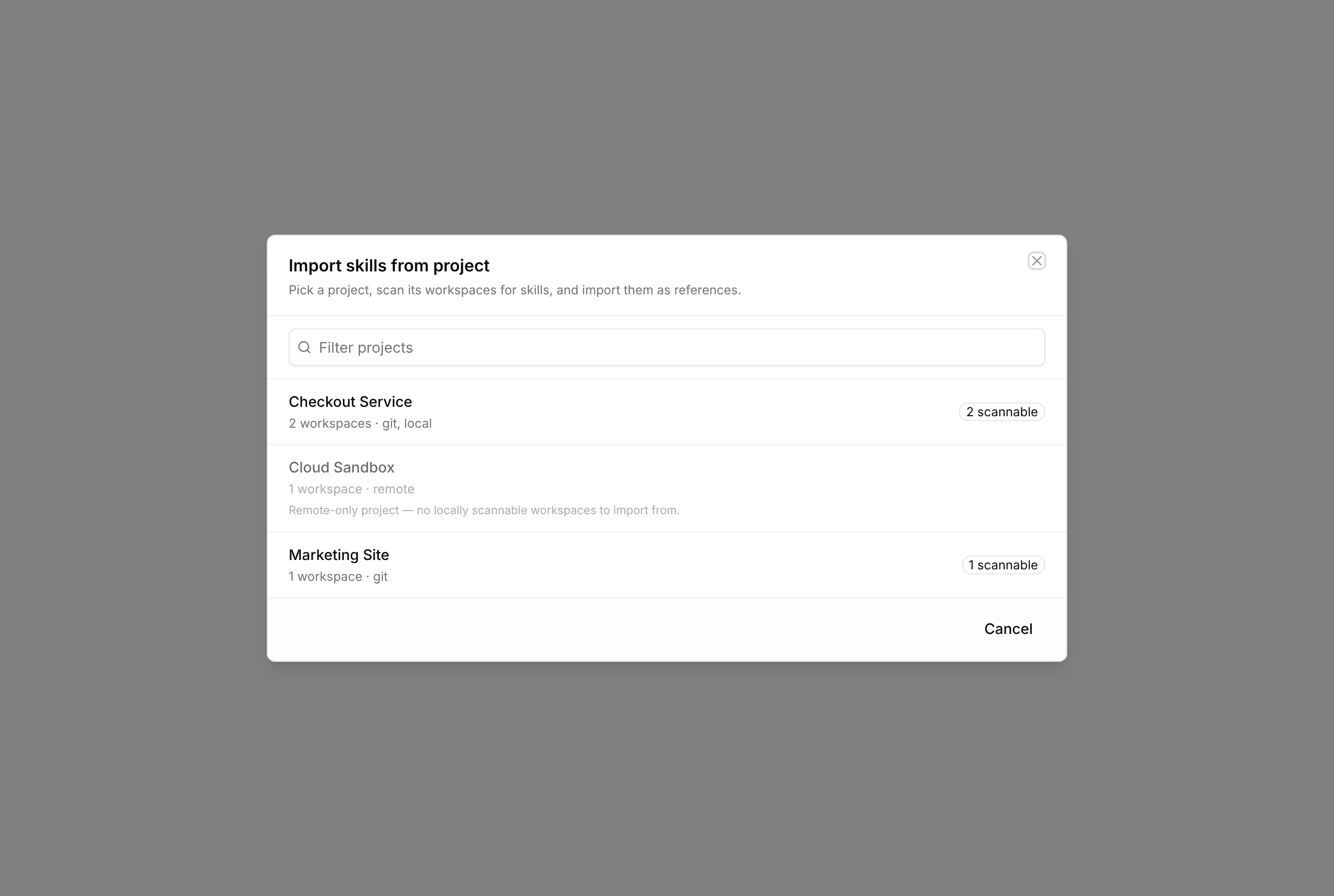 **Review discovered skills** 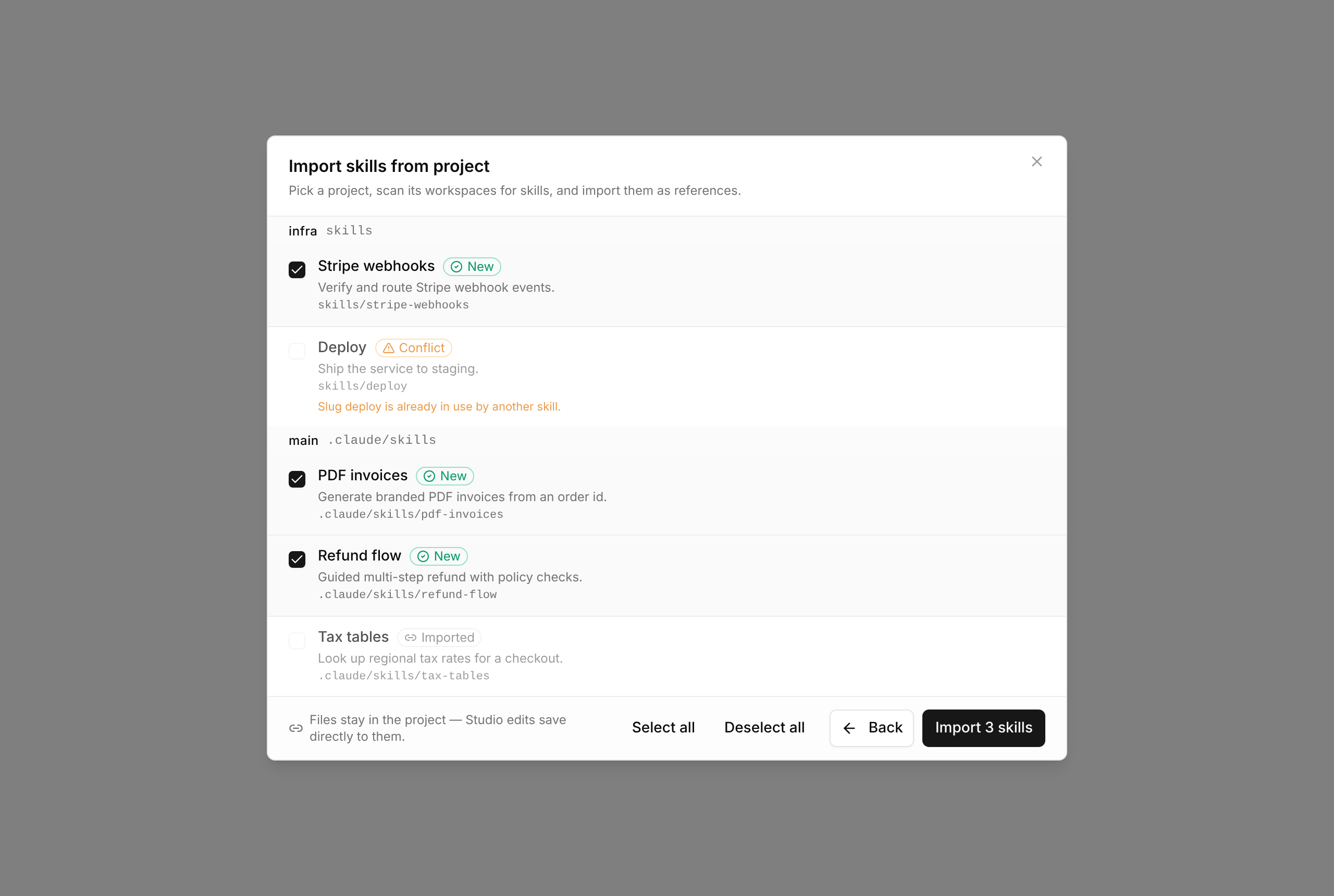 **Mobile selection footer** 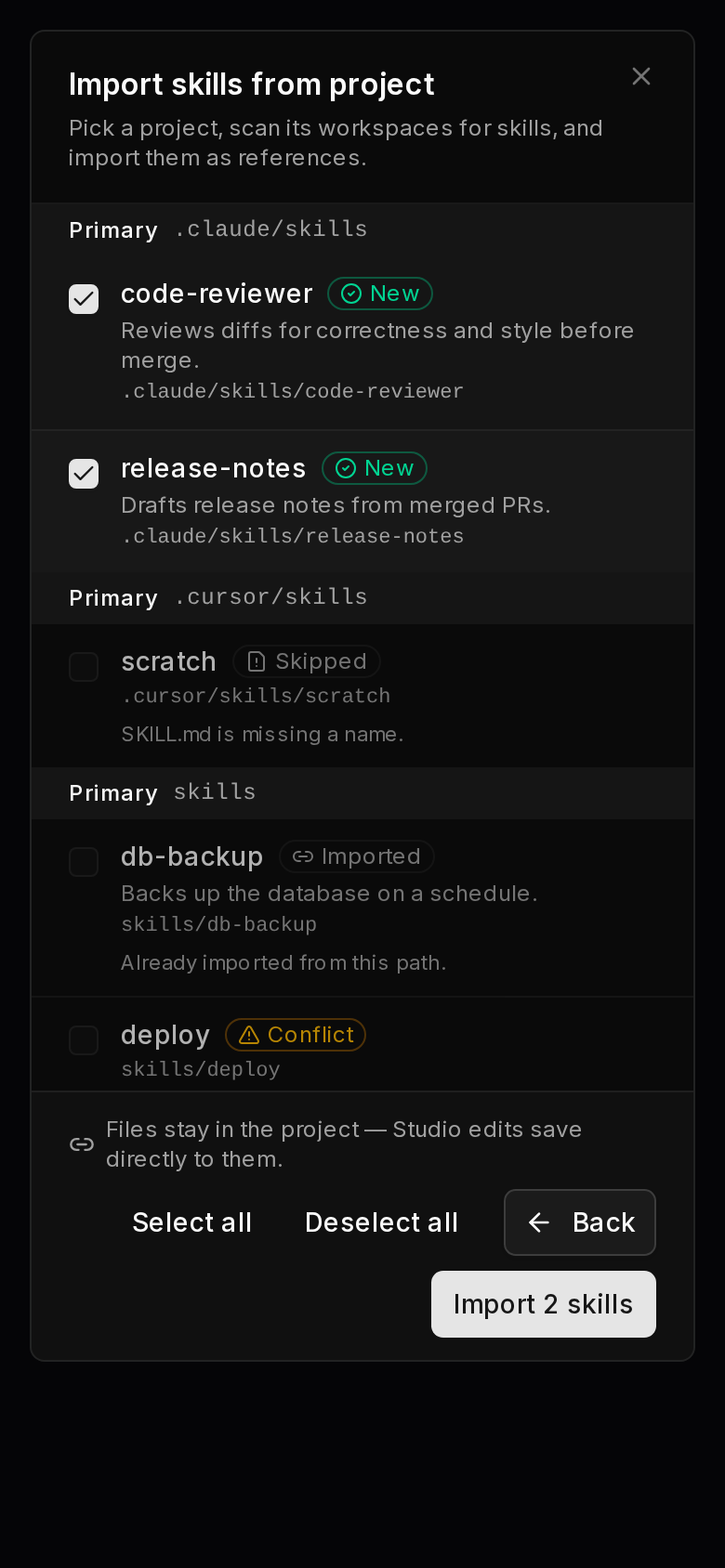 **Import result** 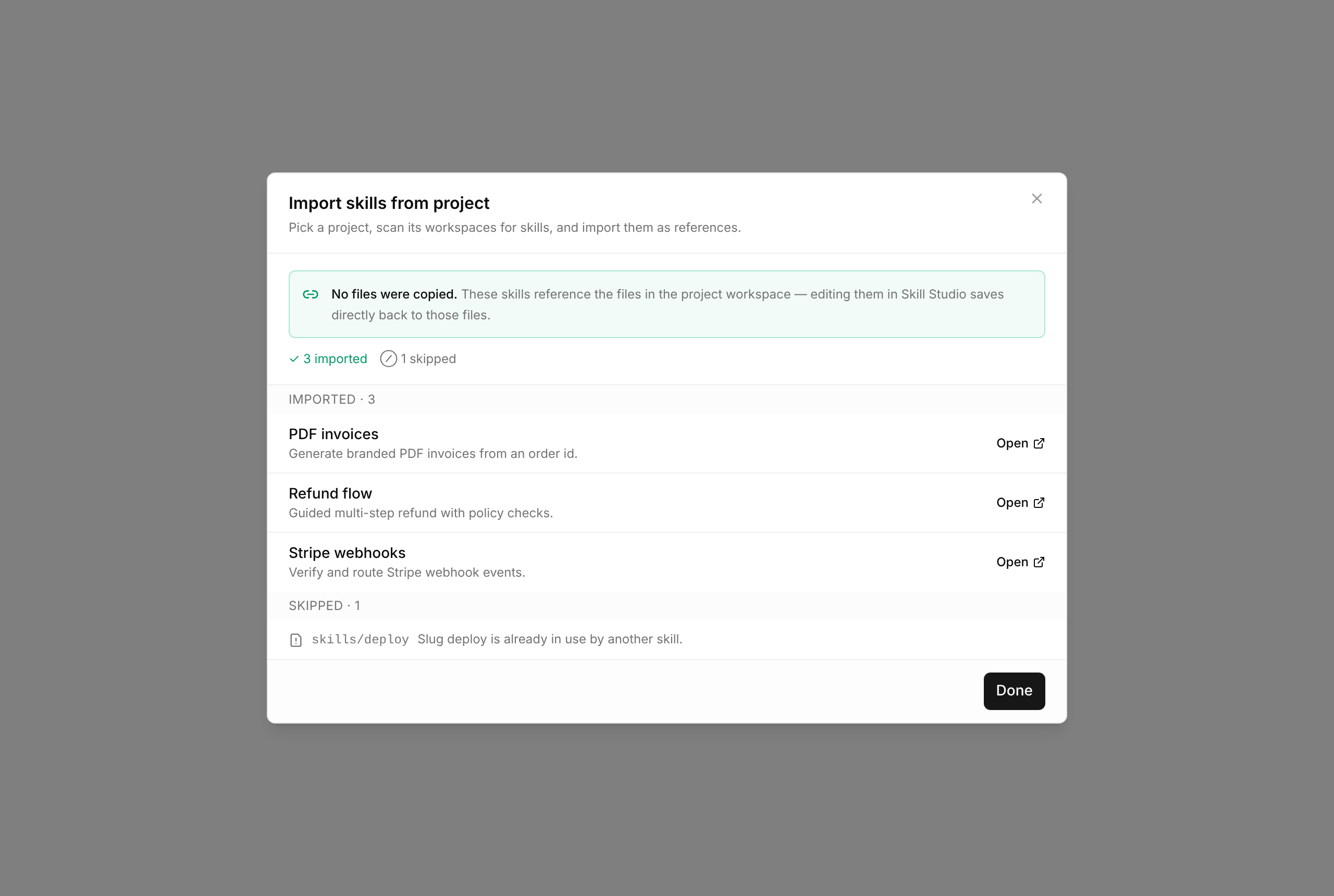 ## Verification - `pnpm exec vitest run server/src/__tests__/company-skills-service.test.ts server/src/__tests__/company-skills-routes.test.ts ui/src/pages/skills/ImportSkillsFromProjectDialog.test.tsx` — 3 files, 81 tests passed. - `pnpm check:token-gates` — all token gates clean. - `pnpm --filter @paperclipai/shared typecheck` — passed. - `pnpm --filter @paperclipai/server typecheck` — passed. - `pnpm --filter @paperclipai/ui typecheck` — passed. - Security review passed after adding tenant-scope and unauthorized-preview regressions; UX re-review approved desktop/mobile surfaces; QA passed all seven acceptance areas including write-through editing, deduplication, conflicts, empty state, and permission denial. ## Risks - Files remain referenced in project workspaces, so moving or deleting a source directory can make an imported skill unavailable; the UI explicitly communicates the reference behavior. - New well-known directory scans may discover more candidates than older versions, but preview mode prevents mutation until the operator confirms a selection. - The endpoint remains backward compatible: omitting `mode` preserves the prior full-import behavior. - No schema migration or telemetry event changes. > For core feature work, check [`ROADMAP.md`](ROADMAP.md) first and discuss it in `#dev` before opening the PR. Feature PRs that overlap with planned core work may need to be redirected — check the roadmap first. See `CONTRIBUTING.md`. ## Model Used - Anthropic Claude Opus 4.8 with tool use/code execution assisted with the UI implementation and UX polish. OpenAI Codex CLI with tool use/code execution assisted with server implementation, security fixes, regression coverage, integration, and PR preparation; the runtime did not expose Codex's exact backing model ID or context-window size. ## Checklist - [x] I have included a thinking path that traces from project context to this change - [x] I have specified the model used (with version and capability details) - [x] I have checked ROADMAP.md and confirmed this PR does not duplicate planned core work - [x] I have searched GitHub for duplicate or related PRs and linked them above - [x] I have either (a) linked existing issues with `Fixes: #` / `Closes #` / `Refs #` OR (b) described the issue in-PR following the relevant issue template - [x] I have not referenced internal/instance-local Paperclip issues or links (only public GitHub `#NNN` / `github.com/paperclipai/paperclip` URLs) - [x] My branch name describes the change (e.g. `docs/...`, `fix/...`) and contains no internal Paperclip ticket id or instance-derived details - [x] I have run tests locally and they pass - [x] I have added or updated tests where applicable - [x] I have updated relevant documentation to reflect my changes - [x] I have considered and documented any risks above - [x] All Paperclip CI gates are green - [x] Greptile is 5/5 with no open P2s, recommendations, or follow-ups - [x] I will address all Greptile and reviewer comments before requesting merge --------- Co-authored-by: Paperclip <noreply@paperclip.ing> Co-authored-by: Claude Opus 4.8 <noreply@anthropic.com> |
||
|
Nicky Leach
|
3a727bf780 | fix(codex): warn when sandbox auth is shadowed (#9259) | ||
|
|
89ce36d7af |
feat(skills): open-by-default company skill policy and core UX (#9564)
## Thinking Path > - Paperclip uses company skills to make agent capabilities reusable across an organization. > - Skill operations currently mix capability availability with permission checks, which creates avoidable setup friction and inconsistent denial handling. > - The policy contract needs to remain open by default while allowing company-scoped restrictions for governed deployments. > - Core owns the canonical policy actions, persistence, evaluation, API behavior, safe import boundaries, and generic denial/read-only UI. > - Enterprise policy-editor implementation belongs in the separate `paperclip-ee` repository and is intentionally excluded from this PR. ### Problem or motivation Company skill operations can encounter permission dead ends even when no explicit restriction has been configured, and import-source classification can drift between policy evaluation and execution. ### Proposed solution Define eight canonical skill policy actions, default all actions to allowed, persist company-scoped restrictions, expose policy evaluation APIs, normalize import sources at the boundary, and update Skill Studio to present actionable restriction states without embedding Enterprise Edition implementation in the core repository. ### Alternatives considered Keeping capability checks distributed across routes and UI surfaces was rejected because it duplicates policy logic and makes denial behavior inconsistent. Shipping the Enterprise policy editor in this repository was rejected because `paperclip-ee` is a separate repository and must receive its own PR. ### Roadmap alignment Extends the completed **Skills Manager** roadmap area by adding coherent governance and removing workflow dead ends. ### Additional context The core API contract remains suitable for a separate Enterprise Edition editor, but this PR contains no `paperclip-ee` package or EE-specific UI integration code. ## What Changed - Added the company skill policy contract to product and implementation documentation, including the open-by-default rule, eight canonical actions, decision shape, and core/EE ownership boundary. - Added the company-scoped policy schema, migration `0170`, shared validators, policy service, REST routes, OpenAPI coverage, and focused server tests. - Hardened import policy enforcement by normalizing import sources and keeping source classification consistent between policy evaluation and execution. - Updated core Skill Studio behavior to remove generic permission dead ends and show actionable policy/platform denial states only when an operation is actually denied. - Removed the `plugin-paperclip-ee` package, Docker wiring, EE discovery/deep-link helpers, and EE-specific UI tests/stories from this PR so that implementation can be submitted separately to the EE repository. - Preserved open-by-default behavior when no explicit company restriction exists. ## Verification - `pnpm --filter @paperclipai/ui exec vitest run src/components/skill-studio/SkillPolicySurfaces.test.tsx src/lib/skill-policy-denial.test.ts` — 20/20 passed. - `pnpm --filter @paperclipai/ui exec tsc --noEmit` — passed. - `pnpm --filter @paperclipai/server exec vitest run src/__tests__/worktree-config.test.ts` — 12/12 passed. - `pnpm check:token-gates` — passed with all gates clean. - `git diff --check` — passed. - `git diff --name-only origin/master | rg 'paperclip-ee|ee-skill-policy'` — no matches. ## Risks - Migration `0170` introduces company policy persistence; rollout depends on the migration applying before policy routes are exercised. - Open-by-default is an intentional behavioral policy: deployments expecting implicit denials must configure explicit restrictions. - Import normalization is security-sensitive and should retain focused review. - The separate EE editor must stay contract-compatible with the core policy API as policy actions evolve. ## Model Used - OpenAI Codex CLI, runtime model identifier and context-window size not exposed by this execution environment; reasoning, repository tool use, shell execution, and code review capabilities enabled. ## Checklist - [x] I have included a thinking path that traces from project context to this change - [x] I have specified the model used (with version and capability details available to this runtime) - [x] I have checked ROADMAP.md and confirmed this PR does not duplicate planned core work - [x] I have searched GitHub for duplicate or related PRs and linked or described the result above - [x] I have either (a) linked existing issues with `Fixes: #` / `Closes #` / `Refs #` OR (b) described the issue in-PR following the relevant issue template - [x] I have not referenced internal/instance-local Paperclip issues or links (only public GitHub `#NNN` / `github.com/paperclipai/paperclip` URLs) - [x] My branch name describes the change and contains no internal Paperclip ticket id or instance-derived details - [x] I have run focused tests locally and they pass - [x] I have added or updated tests where applicable - [x] I have updated relevant documentation to reflect my changes - [x] I have considered and documented any risks above - [x] All Paperclip CI gates are green on the latest head - [x] Greptile is 5/5 with no open P2s, recommendations, or follow-ups - [x] I will address all Greptile and reviewer comments before requesting merge --------- Co-authored-by: Paperclip <noreply@paperclip.ing> Co-authored-by: Claude Fable 5 <noreply@anthropic.com> Co-authored-by: Evyatar Bluzer <bluzername@users.noreply.github.com> |
||
|
DottaandPaperclip
|
0ecae2cd7e |
fix(adapters): forward resolved adapter env to local agents, keep runtime env authoritative (#9617)
## Thinking Path > - Paperclip is the open source app people use to manage AI agents for work > - Local coding adapters (Claude, Codex) run each agent heartbeat in a spawned child process; Paperclip resolves adapter-configured env — including `secret_ref` bindings — into the env for that process > - The resolved adapter env was not being forwarded reliably: config env could overwrite Paperclip's own runtime vars, and a warm/resumable ACP session could keep serving stale env because its fingerprint ignored the resolved env > - This mattered because a configured API key or other secret could be silently absent from the agent shell, and a resumed session would never pick up an updated value — while a config binding could also override runtime identity/wake vars > - This pull request keeps Paperclip-managed `PAPERCLIP_*` runtime env authoritative over config, and folds a stable hash of the applied adapter env into the session fingerprint so an env change forces a fresh launch > - The benefit is that adapter-configured env (plain values and resolved secrets) reliably reaches the agent process, updates are picked up on the next launch, and runtime identity can never be clobbered by config ## Linked Issues or Issue Description No public GitHub issue exists, so the underlying bug is described inline following the bug-report template. **What happened** Env keys configured on a local adapter (plain values and `secret_ref` bindings, resolved server-side into plain strings) did not reliably reach the spawned agent process. Two distinct gaps: (1) when merging config env into the process env, a config key in the reserved `PAPERCLIP_*` namespace could overwrite a Paperclip-managed runtime variable (identity, wake, workspace, API access); (2) a warm-handle / resumable ACP session computed its reuse fingerprint from `secretManifestHash` only, which misses plain-value edits and same-version secret rotations — so a resumed session kept serving stale env and never re-launched with updated values. **Expected behavior** Non-`PAPERCLIP_*` adapter env (plain + resolved secret values) is forwarded to the agent process; a change to any applied forwarded value invalidates a warm/resumable session so the next launch sources the latest env; configured `PAPERCLIP_*` entries can never override Paperclip runtime env, while an explicitly configured `PAPERCLIP_API_KEY` (stable per-run config) is still honored and its rotation also busts the session. **Steps to reproduce** Configure an adapter with an env key (e.g. a `secret_ref` API key) and a resumable ACP session. On resume, the updated env value is not sourced; separately, a `PAPERCLIP_*` config key overrides the runtime value. **Deployment mode** Local adapters (Claude / Codex) via the shared adapter-utils execution path. ## What Changed - `packages/adapter-utils/src/server-utils.ts`: add `isPaperclipRuntimeEnvKey` and, in `refreshPaperclipWorkspaceEnvForExecution` (used by all local adapters), skip a `PAPERCLIP_*` config key when Paperclip has already assigned it this run; all other keys still forward. - `packages/adapter-utils/src/acpx-engine/execute.ts`: apply the same `PAPERCLIP_*` non-override rule (via the shared helper) when merging config env, capture the applied config env in `resolvedAdapterEnv`, and fold a stable `adapterEnvHash` of it into the session fingerprint so an env change forces a fresh launch. Per-wake `PAPERCLIP_*` runtime vars are assigned earlier and never enter that map, so they stay out of the hash; stable configured `PAPERCLIP_*` values (e.g. an explicit `PAPERCLIP_API_KEY`) are included so rotating one busts the session. - Added unit/integration tests for plain + secret forwarding, `PAPERCLIP_*` non-override, the explicit-API-key path, fingerprint refresh-on-env-change vs. stable-across-wakes, and rotation of a configured `PAPERCLIP_API_KEY`. ## Verification - `npx vitest run packages/adapter-utils/src/acpx-engine/execute.test.ts packages/adapter-utils/src/server-utils.test.ts` → 2 files, 111 tests passing (includes the new cases). - Tests assert: forwarded plain/secret values appear in the spawned wrapper `.env`; a `PAPERCLIP_*` config key does not override the runtime value; changing an applied forwarded env value (including a rotated `PAPERCLIP_API_KEY`) changes `configFingerprint`, while a new wake with the same config env keeps it stable. ## Risks Low risk. Behavior change is limited to (a) config env no longer overriding `PAPERCLIP_*` runtime vars — a security-positive tightening — and (b) a resumable session re-launching when its applied config env changes, which is the intended fix. Per-wake `PAPERCLIP_*` churn is deliberately excluded from the fingerprint so normal sessions still resume across heartbeats. Existing sessions get a new fingerprint once on first deploy (the added `adapterEnvHash` field), which is expected. No secret values are logged (key-name redaction in the adapter plus manifest-driven redaction of `meta.env`). ## Model Used Claude Opus 4.8 (Anthropic), model id `claude-opus-4-8`, extended reasoning with tool use. ## Checklist - [x] I have included a thinking path that traces from project context to this change - [x] I have specified the model used (with version and capability details) - [x] I have checked ROADMAP.md and confirmed this PR does not duplicate planned core work - [x] I have searched GitHub for duplicate or related PRs and linked them above - [x] I have either (a) linked existing issues with `Fixes: #` / `Closes #` / `Refs #` OR (b) described the issue in-PR following the relevant issue template - [x] I have not referenced internal/instance-local Paperclip issues or links (only public GitHub `#NNN` / `github.com/paperclipai/paperclip` URLs) - [x] My branch name describes the change (e.g. `docs/...`, `fix/...`) and contains no internal Paperclip ticket id or instance-derived details - [x] I have run tests locally and they pass - [x] I have added or updated tests where applicable - [ ] I have updated relevant documentation to reflect my changes - [x] I have considered and documented any risks above - [x] All Paperclip CI gates are green - [x] Greptile is 5/5 with no open P2s, recommendations, or follow-ups - [x] I will address all Greptile and reviewer comments before requesting merge --------- Co-authored-by: Paperclip <noreply@paperclip.ing> |
||
|
Nicky LeachandPaperclip
|
7947308276 |
fix(codex): classify refresh auth failures (#9598)
## Thinking Path > - Paperclip is the open source app people use to manage AI agents for work > - Paperclip supports the Codex local adapter, which runs OpenAI Codex CLI sessions on behalf of agents > - Codex uses OAuth refresh tokens to maintain long-running authenticated sessions > - When a refresh fails, the failure has distinct root causes: a refresh token was already reused in a parallel request, the token expired by TTL, or the token was invalidated/revoked by the provider > - Without classifying these failure modes, all refresh auth errors surface identically — operators cannot distinguish retryable transient collisions from permanent invalidations, and run logs carry no actionable diagnosis > - This pull request adds structured classification (`refresh_token_reused`, `refresh_token_expired`, `refresh_token_invalidated`) of Codex refresh-token auth failures across the CLI quota-probe, ACP auth path, and execute path > - The benefit is that these distinct failure modes can be surfaced in run logs and acted on appropriately — transient reuse can be retried; true invalidations require re-auth ## Linked Issues or Issue Description <!-- Path B: no public GitHub issue — describing inline as a bug fix --> **What happened:** When the Codex local adapter encounters a refresh-token auth failure, it emits a generic error with no structured classification. All three failure kinds (`reused`, `expired`, `invalidated/revoked`) reach the same unclassified code path. **Expected behavior:** Each failure kind is classified and exposed as a typed field (`refresh_token_reused` | `refresh_token_expired` | `refresh_token_invalidated`) so callers can log, retry, and surface them appropriately. **Steps to reproduce:** 1. Run a Codex agent session with a reused or expired OAuth refresh token. 2. Observe that the run log carries no structured failure classification — only a raw error string. **Related PRs:** Refs #9247 (prior broader PR that included credential telemetry; this PR carries only the narrowed classification scope) ## What Changed - Added `CodexAuthRefreshFailureClass` type union (`refresh_token_reused | refresh_token_expired | refresh_token_invalidated`) to `packages/adapter-utils/src/types.ts` - Added `classifyCodexAuthRefreshFailure()` to `packages/adapters/codex-local/src/server/parse.ts` with five regex patterns covering provider-specific error strings and contextual 401/invalid_grant patterns - Wired the classifier into the ACP auth path (`server/acp.ts`), execute path (`server/execute.ts`), and CLI quota-probe (`cli/quota-probe.ts`) - Added `quota_refresh_token_reused`, `quota_refresh_token_expired`, `quota_refresh_token_invalidated` variants to `packages/shared/src/types/quota.ts` - Added classification unit tests (`parse.test.ts`, `quota-spawn-error.test.ts`, `acp.test.ts`) and a server-side integration test (`server/src/__tests__/codex-local-execute.test.ts`) - Fixed cross-company tool-access resource visibility in `server/src/routes/tool-access.ts` - Stabilized `heartbeat-retry-scheduling.test.ts` (CASCADE cleanup), `heartbeat-run-log.test.ts`, and `quota-windows.test.ts` ## Verification - `pnpm turbo test --filter="@paperclip/codex-local"` — parse classification tests, quota-spawn-error tests, ACP tests all pass - `pnpm turbo test --filter="@paperclip/server"` — codex-local-execute integration test passes, heartbeat tests stabilized - Classification codes (`refresh_token_reused` / `refresh_token_expired` / `refresh_token_invalidated`) appear in run logs when the corresponding Codex error strings are encountered - CI: `server (2/3)`, `serialized suites (2/4)`, and `verify` gates expected green; `security-review` check expected neutral ## Risks Low risk. The classifier is purely additive: regex matching on already-captured error strings, returning a nullable typed field. Callers that do not inspect the classification field are unaffected. No execution paths, retry logic, or existing error surfaces changed. ## Model Used - **Provider:** Anthropic - **Model ID:** `claude-sonnet-4-6` - **Context window:** 200K tokens - **Mode:** standard tool use (no extended thinking) ## Checklist - [x] I have included a thinking path that traces from project context to this change - [x] I have specified the model used (with version and capability details) - [x] I have checked ROADMAP.md and confirmed this PR does not duplicate planned core work - [x] I have searched GitHub for duplicate or related PRs and linked them above - [x] I have either (a) linked existing issues with `Fixes: #` / `Closes #` / `Refs #` OR (b) described the issue in-PR following the relevant issue template - [x] I have not referenced internal/instance-local Paperclip issues or links (only public GitHub `#NNN` / `github.com/paperclipai/paperclip` URLs) - [x] My branch name describes the change (e.g. `docs/...`, `fix/...`) and contains no internal Paperclip ticket id or instance-derived details - [x] I have run tests locally and they pass - [x] I have added or updated tests where applicable - [x] I have updated relevant documentation to reflect my changes - [x] I have considered and documented any risks above - [x] All Paperclip CI gates are green - [x] Greptile is 5/5 with no open P2s, recommendations, or follow-ups - [x] I will address all Greptile and reviewer comments before requesting merge --------- Co-authored-by: Paperclip <noreply@paperclip.ing> |
||
|
|
b79f744a8d |
Fix Codex auth merge host-unusable fail closed (#9276)
## Thinking Path > - Paperclip is the open source platform people use to manage AI agents for work > - The Codex adapter runs agent tasks in isolated sandbox environments on the user's machine > - When a Codex sandbox is reused across agent runs, its home directory (including `~/.codex/auth.json`) is restored from a prior snapshot > - Both the host machine and the sandbox independently maintain `auth.json` credentials; on sandbox reuse, these can diverge > - The previous merge code had fail-open edge cases: if host auth was in an unusable state, if the auth JSON object shapes differed between host and sandbox, or if the subscription account identities didn't match, the merge would proceed silently with whatever data was available > - This PR adds fail-closed behavior: if host Codex auth is unusable, if auth parser shapes differ, or if subscription account identities don't match, the merge fails explicitly rather than silently continuing with stale or incorrect credentials > - The benefit is that Codex agents on reused sandboxes now fail fast and loudly when auth is in a broken state, instead of silently running with wrong credentials and producing confusing downstream failures ## Linked Issues or Issue Description No pre-existing public GitHub issue. This is a targeted security hardening fix for the Codex reused-sandbox auth merge path. **Problem:** When a Codex sandbox is reused, the merge logic that reconciles host and sandbox `auth.json` credentials failed open in several cases: - Host `auth.json` present but in an unusable state (missing required keys, empty token material, malformed JSON) → merge would proceed with whatever the sandbox had - Host and sandbox auth payloads had different shapes (e.g., one uses `OPENAI_API_KEY`, the other uses a `tokens` object) → parser-differential case not detected - Subscription account identities (`tokens.account_id`) differed between host and sandbox → stale sandbox identity would be used silently **Fix:** All three cases now fail closed. The merge returns an explicit error rather than proceeding with potentially stale or mismatched credentials. Related PRs: - Refs #9262 — sandbox Codex auth shadow warning (adjacent auth area) - Refs #9259 — auth precedence exports (adjacent auth area) ## What Changed - `packages/adapters/codex-local/src/server/codex-home.ts` — New file with `hasUsableAuthPayload()`, `codexHomeHasUsableAuth()`, and full Codex home setup/teardown. Includes fail-closed auth merge guards: rejects unusable host auth, detects parser shape differentials, and checks subscription account identity match before merging - `packages/adapter-utils/src/workspace-restore-merge.ts` — New file with directory snapshot diffing and restore-merge logic; the merge operation fails closed when auth validation fails - `packages/adapters/codex-local/src/server/codex-home.test.ts` — Unit tests covering auth usability checks, symlink management, and fail-closed merge paths - `packages/adapter-utils/src/workspace-restore-merge.test.ts` — Unit tests for snapshot/restore-merge behavior including fail-closed cases - `packages/adapter-utils/src/sandbox-managed-runtime.ts` — Updated to invoke the fail-closed auth merge during sandbox restore ## Verification Tests run and passing: ```sh corepack pnpm exec vitest run packages/adapter-utils/src/workspace-restore-merge.test.ts packages/adapters/codex-local/src/server/codex-home.test.ts corepack pnpm exec vitest run packages/adapter-utils/src/sandbox-managed-runtime.test.ts corepack pnpm --filter @paperclipai/adapter-utils typecheck corepack pnpm --filter @paperclipai/adapter-codex-local typecheck git diff --check origin/master HEAD ``` All passed locally before push. ## Risks - **Intentional behavioral change (breaking for previously-silent failures):** Reused sandboxes that previously completed auth merge with unusable host auth, parser-differential auth shapes, or mismatched account identities will now fail with an explicit error. This is the correct behavior — the prior silent-proceed path was the bug. Users affected will see a clear error message rather than a confusing downstream auth failure. - **Auth.json symlink migration:** `ensureSymlink()` detects stale copied `auth.json` files (written by older Paperclip versions) and replaces them with symlinks on first run. This is safe: the target is always under the Paperclip-managed company home, never the user's real `~/.codex`. Directories at the symlink path are left untouched (EISDIR is not silently swallowed). - **Low risk for non-reuse paths:** The fail-closed logic only activates during sandbox restore/reuse. Fresh sandbox allocations are unaffected. ## Model Used - **Provider:** Anthropic - **Model ID:** claude-sonnet-4-6 (Claude Sonnet 4.6) - **Context window:** 200k tokens - **Mode:** Agentic coding with tool use; extended thinking not used - **Role:** Code author (Priya Raman, BackendEngineer) with Harold Kim (Git Expert) handling push and PR operations ## Checklist - [x] I have included a thinking path that traces from project context to this change - [x] I have specified the model used (with version and capability details) - [x] I have checked ROADMAP.md and confirmed this PR does not duplicate planned core work - [x] I have searched GitHub for duplicate or related PRs and linked them above - [x] I have either (a) linked existing issues with `Fixes: #` / `Closes #` / `Refs #` OR (b) described the issue in-PR following the relevant issue template - [x] I have not referenced internal/instance-local Paperclip issues or links (only public GitHub `#NNN` / `github.com/paperclipai/paperclip` URLs) - [x] My branch name describes the change (e.g. `docs/...`, `fix/...`) and contains no internal Paperclip ticket id or instance-derived details - [x] I have run tests locally and they pass - [x] I have added or updated tests where applicable - [x] I have updated relevant documentation to reflect my changes - [x] I have considered and documented any risks above - [x] All Paperclip CI gates are green - [x] Greptile is 5/5 with no open P2s, recommendations, or follow-ups - [x] I will address all Greptile and reviewer comments before requesting merge --------- Co-authored-by: Priya Raman <priya.raman@paperclip.local> Co-authored-by: Paperclip <noreply@paperclip.ing> Co-authored-by: Harold Kim <harold@paperclip.ing> |
||
|
Jannes StubbemannandClaude Fable 5
|
543de323f6 |
fix(shared): tolerate empty-string user name in profile/session parse (#8986)
## Thinking Path

> - Paperclip is the open source app people use to manage AI agents for
work
> - Humans sign in through the auth layer; every authenticated request
parses the session/user profile with `currentUserProfileSchema` in
`packages/shared`
> - The schema requires `name` to be `null` or a non-empty string, but
some identity providers hand back `name: ""` for users who never set a
display name
> - For those users the session payload fails validation on every
request, so the app treats them as unauthenticated and bounces them to
`/auth` in a loop — they can never get in
> - This pull request preprocesses empty/whitespace-only names to `null`
before validation, so the existing `min(1).max(120).nullable()` rule
still holds for real names
> - Review found the sibling `email` field has the same failure mode
(the DB `auth` schema declares `email` as `notNull`, so a provider that
supplies no email stores `""`, which `z.string().email()` rejects); the
same preprocess is applied there
> - The benefit is that users whose provider reports an empty name (or
email) can sign in normally instead of being locked out, with no change
in behavior for anyone else

## Linked Issues or Issue Description

No existing issue; described in-PR following the bug report template:

**What happened?**

Users whose auth provider returns `name: ""` (empty string) in the
profile payload fail `currentUserProfileSchema` / `authSessionSchema`
parsing (`name: z.string().min(1)...`). The parse failure makes the
session look invalid and the UI redirects to `/auth` on every attempt —
an endless sign-in loop. The `email` field has the same failure mode
(`z.string().email()` rejects `""`).

**Expected behavior:**

An empty display name (or email) should be treated the same as a missing
one (`null`); the user should be signed in normally.

**Steps to reproduce:**

Sign in with an account whose upstream identity record has an
empty-string name (or set a user's `name` column to `''` directly), then
load the app: session parse fails and you are bounced back to `/auth`.

**Adapter(s) involved:**

Not adapter-specific (core bug).

**Deployment mode / version:**

Any; reproduces on current `master`.

## What Changed

- `packages/shared/src/validators/access.ts`:
`currentUserProfileSchema.name` now runs through `z.preprocess` that
coerces empty or whitespace-only strings to `null` before the existing
`z.string().min(1).max(120).nullable()` validation.
- `packages/shared/src/validators/access.ts`: the same preprocess is
applied to `email` (review follow-up): `users.email` is `notNull` in the
DB schema, so a provider without an email stores `""`, which
`z.string().email()` rejects — the identical lockout loop.
Empty/whitespace-only emails now coerce to `null` (the field was already
nullable); malformed non-empty emails are still rejected.
- `packages/shared/src/validators/access.test.ts` (new): covers
empty-string → `null`, whitespace-only → `null`, real values preserved,
`null` preserved, and malformed non-empty email still rejected — for
both `name` and `email`, and the same cases through `authSessionSchema`.

## Verification

- `vitest run src/validators/access.test.ts` in `packages/shared` — 13
tests pass.
- `tsc --noEmit -p packages/shared` passes.
- Manual: parse `{ id, email: "", name: "", image: null }` with
`currentUserProfileSchema` — succeeds with `name: null` and `email:
null` instead of failing validation.

## Risks

- Low risk. The change only widens accepted input (empty/whitespace
string → `null` for `name` and `email`); every previously valid payload
parses identically. `updateCurrentUserProfileSchema` (user-initiated
rename) is untouched and still rejects empty names.

## Model Used

Claude Fable 5 (Anthropic, `claude-fable-5`, agentic coding harness via
Claude Code, extended reasoning enabled). Original fix drafted with
Claude Sonnet 4.6.

## Checklist

- [x] I have included a thinking path that traces from project context
to this change
- [x] I have specified the model used (with version and capability
details)
- [x] I have checked ROADMAP.md and confirmed this PR does not duplicate
planned core work
- [x] I have searched GitHub for duplicate or related PRs and linked
them above
- [x] I have either (a) linked existing issues with `Fixes: #` / `Closes
#` / `Refs #` OR (b) described the issue in-PR following the relevant
issue template
- [x] I have not referenced internal/instance-local Paperclip issues or
links (only public GitHub `#NNN` / `github.com/paperclipai/paperclip`
URLs)
- [x] My branch name describes the change (e.g. `docs/...`, `fix/...`)
and contains no internal Paperclip ticket id or instance-derived details
- [x] I have run tests locally and they pass
- [x] I have added or updated tests where applicable
- [x] I have updated relevant documentation to reflect my changes
- [x] I have considered and documented any risks above
- [ ] All Paperclip CI gates are green
- [ ] Greptile is 5/5 with no open P2s, recommendations, or follow-ups
- [x] I will address all Greptile and reviewer comments before
requesting merge

---------

Co-authored-by: Claude Fable 5 <noreply@anthropic.com>
|
||
|
DottaandPaperclip
|
9c8adee48b |
feat(mcp) [split 5/8]: integrate adapters and deployment runtime (#9560)
## Thinking Path > - Paperclip is the open source app people use to manage AI agents for work > - Governed MCP access spans contracts, runtime enforcement, adapters, UI surfaces, and operator verification > - The parity reference PR #9534 is too large for effective automated or human review > - The feature therefore needs a linear stack whose individual diffs stay below the 100-file review limit > - This pull request is split 5/8 and focuses on remaining adapters, CLI, plugin examples, and deployment packaging > - The benefit is a standalone, testable review boundary while preserving byte-for-byte parity at the top of the stack ## Linked Issues or Issue Description - Related parity reference: #9534 - Problem: The backend runtime needs packaging, CLI propagation, worktree provisioning, release manifests, and remaining adapter/plugin consumers. - Proposed solution: Adds the remaining runtime/deployment integration after compile-required contracts and concrete MCP injection moved into lower server levels. - Alternatives considered: keeping #9534 as one 403-file review, or rewriting the feature to manufacture seams; both were rejected in favor of path extraction plus compile-driven boundary moves. - Roadmap alignment: this advances the existing governed MCP/tool-access work already represented by #9534; it does not introduce a separate roadmap initiative. - Stack position: base branch is `pap10341-split/04-server-runtime-wiring`. - Merge policy: merge bottom-up, in order, only after the complete eight-PR stack has been reviewed and the top-of-stack parity gate remains empty. - Requested review: QA for CLI, packaging, and worktree behavior; Greptile on every PR. ## What Changed - Adds the remaining runtime/deployment integration after compile-required contracts and concrete MCP injection moved into lower server levels. - Keeps this PR below 100 changed files and independently typecheckable. - Preserves the final tree from #9534 when combined with the other seven stack levels. ## Verification - `pnpm typecheck` - Focused CLI Vitest run — 4 files, 49 tests passed ## Risks - Packaging omissions could make the feature work in source but fail in Docker, worktrees, or release assembly. - Stack risk: merging out of order can expose incomplete layers; mitigate by following the documented bottom-up merge policy. - Parity risk: later edits to an intermediate branch can drift from #9534; mitigate by re-running the empty top-of-stack diff before merge. > For core feature work, check [`ROADMAP.md`](ROADMAP.md) first and discuss it in `#dev` before opening the PR. Feature PRs that overlap with planned core work may need to be redirected — check the roadmap first. See `CONTRIBUTING.md`. ## Model Used - OpenAI Codex, exact model ID `gpt-5.4`; runtime-managed context window; medium reasoning with repository, shell, Git, GitHub CLI, and code-execution tools enabled. ## Checklist - [x] I have included a thinking path that traces from project context to this change - [x] I have specified the model used (with version and capability details) - [x] I have checked ROADMAP.md and confirmed this PR does not duplicate planned core work - [x] I have searched GitHub for duplicate or related PRs and linked them above - [x] I have either (a) linked existing issues with `Fixes: #` / `Closes #` / `Refs #` OR (b) described the issue in-PR following the relevant issue template - [x] Internal references are omitted except the execution-plan link explicitly required for this coordinated split stack - [x] My branch name describes the change and contains no internal Paperclip ticket id or instance-derived details - [x] I have run tests locally and they pass - [x] I have added or updated tests where applicable - [x] I have updated relevant documentation to reflect my changes - [x] I have considered and documented any risks above - [ ] All Paperclip CI gates are green - [ ] Greptile is 5/5 with no open P2s, recommendations, or follow-ups - [x] I will address all Greptile and reviewer comments before requesting merge ## Stack Coordination - Internal execution plan: [PAP-13874](/PAP/issues/PAP-13874#document-plan) - Parity reference: #9534 - Stack: #9556 → #9557 → #9558 → #9559 → #9560 → #9561 → #9562 → #9563 - Merge bottom-up only after full-stack review and an empty parity diff at #9563. --------- Co-authored-by: Paperclip <noreply@paperclip.ing> |
||
|
DottaandPaperclip
|
931eec3fbf |
feat(mcp) [split 4/8]: wire gateway runtime and Smoke Lab (#9559)
## Thinking Path > - Paperclip is the open source app people use to manage AI agents for work > - Governed MCP access spans contracts, runtime enforcement, adapters, UI surfaces, and operator verification > - The parity reference PR #9534 is too large for effective automated or human review > - The feature therefore needs a linear stack whose individual diffs stay below the 100-file review limit > - This pull request is split 4/8 and focuses on gateway runtime, Smoke Lab, plugins, and server wiring > - The benefit is a standalone, testable review boundary while preserving byte-for-byte parity at the top of the stack ## Linked Issues or Issue Description - Related parity reference: #9534 - Problem: The policy core needs runtime execution, endpoint guards, route registration, heartbeat integration, and adapter MCP injection to become operational. - Proposed solution: Adds the remaining server routes/wiring/consumers, runtime tests, adapter-utils MCP contracts, and Claude/Codex injection implementations required by the server layer. - Alternatives considered: keeping #9534 as one 403-file review, or rewriting the feature to manufacture seams; both were rejected in favor of path extraction plus compile-driven boundary moves. - Roadmap alignment: this advances the existing governed MCP/tool-access work already represented by #9534; it does not introduce a separate roadmap initiative. - Stack position: base branch is `pap10341-split/03-server-tool-access`. - Merge policy: merge bottom-up, in order, only after the complete eight-PR stack has been reviewed and the top-of-stack parity gate remains empty. - Requested review: SecurityEngineer for gateway, endpoint guard, token issuance, and runtime wiring; Greptile on every PR. ## What Changed - Adds the remaining server routes/wiring/consumers, runtime tests, adapter-utils MCP contracts, and Claude/Codex injection implementations required by the server layer. - Keeps this PR below 100 changed files and independently typecheckable. - Preserves the final tree from #9534 when combined with the other seven stack levels. ## Verification - `pnpm typecheck` - Changed server test set — 26 files, 382 tests passed - Affected server adapter tests — 38 tests passed after concrete adapter boundary move - Adapter-utils and Codex focused tests — 76 tests passed ## Risks - Remote endpoint validation, token handling, and runtime supervision are security-sensitive and can fail closed or deny legitimate access if misconfigured. - Stack risk: merging out of order can expose incomplete layers; mitigate by following the documented bottom-up merge policy. - Parity risk: later edits to an intermediate branch can drift from #9534; mitigate by re-running the empty top-of-stack diff before merge. > For core feature work, check [`ROADMAP.md`](ROADMAP.md) first and discuss it in `#dev` before opening the PR. Feature PRs that overlap with planned core work may need to be redirected — check the roadmap first. See `CONTRIBUTING.md`. ## Model Used - OpenAI Codex, exact model ID `gpt-5.4`; runtime-managed context window; medium reasoning with repository, shell, Git, GitHub CLI, and code-execution tools enabled. ## Checklist - [x] I have included a thinking path that traces from project context to this change - [x] I have specified the model used (with version and capability details) - [x] I have checked ROADMAP.md and confirmed this PR does not duplicate planned core work - [x] I have searched GitHub for duplicate or related PRs and linked them above - [x] I have either (a) linked existing issues with `Fixes: #` / `Closes #` / `Refs #` OR (b) described the issue in-PR following the relevant issue template - [x] Internal references are omitted except the execution-plan link explicitly required for this coordinated split stack - [x] My branch name describes the change and contains no internal Paperclip ticket id or instance-derived details - [x] I have run tests locally and they pass - [x] I have added or updated tests where applicable - [x] I have updated relevant documentation to reflect my changes - [x] I have considered and documented any risks above - [ ] All Paperclip CI gates are green - [ ] Greptile is 5/5 with no open P2s, recommendations, or follow-ups - [x] I will address all Greptile and reviewer comments before requesting merge ## Stack Coordination - Internal execution plan: [PAP-13874](/PAP/issues/PAP-13874#document-plan) - Parity reference: #9534 - Stack: #9556 → #9557 → #9558 → #9559 → #9560 → #9561 → #9562 → #9563 - Merge bottom-up only after full-stack review and an empty parity diff at #9563. --------- Co-authored-by: Paperclip <noreply@paperclip.ing> |
||
|
DottaandPaperclip
|
1de0a3bb1e |
feat(mcp) [split 2/8]: add governed access contracts (#9557)
## Thinking Path > - Paperclip is the open source app people use to manage AI agents for work > - Governed MCP access spans contracts, runtime enforcement, adapters, UI surfaces, and operator verification > - The parity reference PR #9534 is too large for effective automated or human review > - The feature therefore needs a linear stack whose individual diffs stay below the 100-file review limit > - This pull request is split 2/8 and focuses on database schema and shared governance contracts > - The benefit is a standalone, testable review boundary while preserving byte-for-byte parity at the top of the stack ## Linked Issues or Issue Description - Related parity reference: #9534 - Problem: The governed access model needs additive persistence and synchronized shared types before server enforcement can compile. - Proposed solution: Adds migrations 0148–0169, tool-access and Smoke Lab schema, shared types/validators/gallery helpers, and the minimal compile-required contract consumers identified by boundary testing. - Alternatives considered: keeping #9534 as one 403-file review, or rewriting the feature to manufacture seams; both were rejected in favor of path extraction plus compile-driven boundary moves. - Roadmap alignment: this advances the existing governed MCP/tool-access work already represented by #9534; it does not introduce a separate roadmap initiative. - Stack position: base branch is `pap10341-split/01-demo-servers`. - Merge policy: merge bottom-up, in order, only after the complete eight-PR stack has been reviewed and the top-of-stack parity gate remains empty. - Requested review: QA for migrations/validators; Greptile on every PR. ## What Changed - Adds migrations 0148–0169, tool-access and Smoke Lab schema, shared types/validators/gallery helpers, and the minimal compile-required contract consumers identified by boundary testing. - Keeps this PR below 100 changed files and independently typecheckable. - Preserves the final tree from #9534 when combined with the other seven stack levels. ## Verification - `pnpm typecheck` — passed, including migration numbering and safety checks - `pnpm --filter @paperclipai/db test` — passed - `pnpm --filter @paperclipai/shared test` — passed ## Risks - Migration or contract mistakes could affect every upper layer; all migrations are additive/idempotent and compile consumers are included in this boundary. - Stack risk: merging out of order can expose incomplete layers; mitigate by following the documented bottom-up merge policy. - Parity risk: later edits to an intermediate branch can drift from #9534; mitigate by re-running the empty top-of-stack diff before merge. > For core feature work, check [`ROADMAP.md`](ROADMAP.md) first and discuss it in `#dev` before opening the PR. Feature PRs that overlap with planned core work may need to be redirected — check the roadmap first. See `CONTRIBUTING.md`. ## Model Used - OpenAI Codex, exact model ID `gpt-5.4`; runtime-managed context window; medium reasoning with repository, shell, Git, GitHub CLI, and code-execution tools enabled. ## Checklist - [x] I have included a thinking path that traces from project context to this change - [x] I have specified the model used (with version and capability details) - [x] I have checked ROADMAP.md and confirmed this PR does not duplicate planned core work - [x] I have searched GitHub for duplicate or related PRs and linked them above - [x] I have either (a) linked existing issues with `Fixes: #` / `Closes #` / `Refs #` OR (b) described the issue in-PR following the relevant issue template - [x] Internal references are omitted except the execution-plan link explicitly required for this coordinated split stack - [x] My branch name describes the change and contains no internal Paperclip ticket id or instance-derived details - [x] I have run tests locally and they pass - [x] I have added or updated tests where applicable - [x] I have updated relevant documentation to reflect my changes - [x] I have considered and documented any risks above - [ ] All Paperclip CI gates are green - [ ] Greptile is 5/5 with no open P2s, recommendations, or follow-ups - [x] I will address all Greptile and reviewer comments before requesting merge ## Stack Coordination - Internal execution plan: [PAP-13874](/PAP/issues/PAP-13874#document-plan) - Parity reference: #9534 - Stack: #9556 → #9557 → #9558 → #9559 → #9560 → #9561 → #9562 → #9563 - Merge bottom-up only after full-stack review and an empty parity diff at #9563. --------- Co-authored-by: Paperclip <noreply@paperclip.ing> |
||
|
DottaandPaperclip
|
7b35de65aa |
feat(mcp) [split 1/8]: add fixture demo servers (#9556)
## Thinking Path > - Paperclip is the open source app people use to manage AI agents for work > - Governed MCP access spans contracts, runtime enforcement, adapters, UI surfaces, and operator verification > - The parity reference PR #9534 is too large for effective automated or human review > - The feature therefore needs a linear stack whose individual diffs stay below the 100-file review limit > - This pull request is split 1/8 and focuses on fixture and demo MCP servers > - The benefit is a standalone, testable review boundary while preserving byte-for-byte parity at the top of the stack ## Linked Issues or Issue Description - Related parity reference: #9534 - Problem: Developers need deterministic local MCP fixtures and visible demo servers without pulling in the governed production runtime. - Proposed solution: Adds the Google Sheets and KV demo MCP packages, fixture catalog/servers, smoke harness, guide, and the root smoke/typecheck registration hunks. - Alternatives considered: keeping #9534 as one 403-file review, or rewriting the feature to manufacture seams; both were rejected in favor of path extraction plus compile-driven boundary moves. - Roadmap alignment: this advances the existing governed MCP/tool-access work already represented by #9534; it does not introduce a separate roadmap initiative. - Stack position: base branch is `master`. - Merge policy: merge bottom-up, in order, only after the complete eight-PR stack has been reviewed and the top-of-stack parity gate remains empty. - Requested review: QA for fixture and smoke coverage; Greptile on every PR. ## What Changed - Adds the Google Sheets and KV demo MCP packages, fixture catalog/servers, smoke harness, guide, and the root smoke/typecheck registration hunks. - Keeps this PR below 100 changed files and independently typecheckable. - Preserves the final tree from #9534 when combined with the other seven stack levels. ## Verification - `pnpm typecheck` - `pnpm --filter @paperclipai/google-sheets-mcp-server test` — 27 tests passed - `pnpm --filter @paperclipai/kv-demo-mcp-server test` — 12 tests passed ## Risks - The new packages add dependencies that are intentionally not committed to `pnpm-lock.yaml`, per repository policy. - Stack risk: merging out of order can expose incomplete layers; mitigate by following the documented bottom-up merge policy. - Parity risk: later edits to an intermediate branch can drift from #9534; mitigate by re-running the empty top-of-stack diff before merge. > For core feature work, check [`ROADMAP.md`](ROADMAP.md) first and discuss it in `#dev` before opening the PR. Feature PRs that overlap with planned core work may need to be redirected — check the roadmap first. See `CONTRIBUTING.md`. ## Model Used - OpenAI Codex, exact model ID `gpt-5.4`; runtime-managed context window; medium reasoning with repository, shell, Git, GitHub CLI, and code-execution tools enabled. ## Checklist - [x] I have included a thinking path that traces from project context to this change - [x] I have specified the model used (with version and capability details) - [x] I have checked ROADMAP.md and confirmed this PR does not duplicate planned core work - [x] I have searched GitHub for duplicate or related PRs and linked them above - [x] I have either (a) linked existing issues with `Fixes: #` / `Closes #` / `Refs #` OR (b) described the issue in-PR following the relevant issue template - [x] Internal references are omitted except the execution-plan link explicitly required for this coordinated split stack - [x] My branch name describes the change and contains no internal Paperclip ticket id or instance-derived details - [x] I have run tests locally and they pass - [x] I have added or updated tests where applicable - [x] I have updated relevant documentation to reflect my changes - [x] I have considered and documented any risks above - [ ] All Paperclip CI gates are green - [ ] Greptile is 5/5 with no open P2s, recommendations, or follow-ups - [x] I will address all Greptile and reviewer comments before requesting merge ## Stack Coordination - Internal execution plan: [PAP-13874](/PAP/issues/PAP-13874#document-plan) - Parity reference: #9534 - Stack: #9556 → #9557 → #9558 → #9559 → #9560 → #9561 → #9562 → #9563 - Merge bottom-up only after full-stack review and an empty parity diff at #9563. --------- Co-authored-by: Paperclip <noreply@paperclip.ing> |
||
|
DottaandPaperclip
|
98d9360658 |
feat(adapters): confine local coding processes (#9504)
## Thinking Path > - Paperclip is the open source control plane people use to manage AI agents for work. > - Local coding adapters currently spawn their CLI processes directly on the Paperclip host. > - CLI-native approval and sandbox flags do not provide a reliable host filesystem or network boundary. > - An agent can therefore inspect unrelated host files or fetch external material when an operator needs stronger isolation. > - The confinement must stay opt-in so existing local adapter behavior does not change unexpectedly. > - This pull request adds a shared Linux Bubblewrap spawn layer for workspace filesystem and deny/allowlist network scopes. > - The benefit is enforceable defense in depth around Codex and Claude local runs while preserving explicit provider connectivity. ## Linked Issues or Issue Description ### What happened? `codex_local` and `claude_local` processes could read arbitrary host paths and make unrestricted outbound network requests because Paperclip did not impose a spawn-level boundary. ### Expected behavior Operators can opt into a workspace-only filesystem view and either deny network egress or allow exact provider/API hosts, independently of CLI approval flags. ### Steps to reproduce 1. Run current `master` on Linux and configure a Codex or Claude local adapter. 2. Ask the agent to read a canary file outside its active workspace. 3. Ask the agent to `curl` a public host. 4. Observe that both operations succeed without a Paperclip-level confinement option. ### Environment - Paperclip commit: `c36f1a4af` / current `master` base. - Deployment mode: Linux local dev or self-hosted server. - Installation: built from source. - Adapters: Codex and Claude Code. - Database: not related. ## What Changed - Added a shared Bubblewrap process wrapper with opt-in `filesystemScope: "workspace"`, managed/extra path mounts, private `/tmp`, and Linux-only validation. - Added `networkScope: "deny" | "allowlist"`; both use a private network namespace, while allowlist mode exposes an exact-host HTTP(S) proxy over a Unix-socket bridge. - Wired Codex and Claude local CLI execution through the wrapper and forced scoped auto runs onto the CLI lane because ACP processes are not covered. - Added unit and gated Bubblewrap canaries for outside-file denial, workspace writes, direct network denial, allowlisted forwarding, and rejected destinations. - Documented both scopes, provider allowlist examples, Bubblewrap requirements, and default-off behavior. ## Verification - `pnpm exec vitest run packages/adapter-utils/src/local-process-sandbox.test.ts packages/adapters/codex-local/src/server/acp.test.ts packages/adapters/claude-local/src/server/acp.test.ts` — 34 passed, 4 gated Bubblewrap tests skipped by default. - `pnpm --filter @paperclipai/adapter-utils typecheck` - `pnpm --filter @paperclipai/adapter-codex-local typecheck` - `pnpm --filter @paperclipai/adapter-claude-local typecheck` - `pnpm --filter @paperclipai/adapter-utils build` - `pnpm --filter @paperclipai/adapter-codex-local build` - `pnpm --filter @paperclipai/adapter-claude-local build` - Attempted the gated tests with a vendored Bubblewrap binary; this container blocks unprivileged namespace setup (`setting up uid map: Permission denied` / loopback `RTM_NEWADDR: Operation not permitted`), so kernel-level execution remains for CI or a namespace-enabled Linux host. ## Risks - Bubblewrap must be installed and unprivileged user/mount/network namespaces must be enabled on the host; scoped runs fail clearly if the prerequisite is missing. - Allowlist mode depends on the coding CLI honoring standard `HTTP_PROXY` / `HTTPS_PROXY` variables; custom providers must list every required exact hostname and port. - Exact-host allowlists intentionally reject wildcards, which is safer but may require operators to enumerate multi-host provider setups. - No behavior changes unless an operator enables `filesystemScope` or `networkScope`. > This aligns with the ROADMAP direction toward safer remote and sandboxed agent environments and does not duplicate an open PR or issue found in the repository search. ## Model Used - OpenAI GPT-5.5 (`gpt-5.5`) via Codex CLI, with reasoning, repository tool use, shell execution, code editing, and test execution. The serving context-window size is not exposed to the agent. ## Checklist - [x] I have included a thinking path that traces from project context to this change - [x] I have specified the model used (with version and capability details) - [x] I have checked ROADMAP.md and confirmed this PR does not duplicate planned core work - [x] I have searched GitHub for duplicate or related PRs and linked them above - [x] I have either (a) linked existing issues with `Fixes: #` / `Closes #` / `Refs #` OR (b) described the issue in-PR following the relevant issue template - [x] I have not referenced internal/instance-local Paperclip issues or links (only public GitHub `#NNN` / `github.com/paperclipai/paperclip` URLs) - [x] My branch name describes the change (e.g. `docs/...`, `fix/...`) and contains no internal Paperclip ticket id or instance-derived details - [x] I have run tests locally and they pass - [x] I have added or updated tests where applicable - [x] I have updated relevant documentation to reflect my changes - [x] I have considered and documented any risks above - [ ] All Paperclip CI gates are green - [ ] Greptile is 5/5 with no open P2s, recommendations, or follow-ups - [x] I will address all Greptile and reviewer comments before requesting merge --------- Co-authored-by: Paperclip <noreply@paperclip.ing> |
||
|
Nicky LeachandPaperclip
|
24bbc0f57e |
docs: add telemetry marker workflow (#9543)
## Thinking Path

> - Paperclip is an open-source agentic AI management platform that
ships anonymous usage telemetry to understand product health and
adoption.
> - The telemetry system has a generated contract
(`packages/shared/src/telemetry/generated/paperclip-telemetry.ts`) that
types every first-party event the product emits.
> - When a product change needs a new first-party event that is not yet
in the generated contract, contributors had no public workflow
explaining how to propose an event or later promote it into the contract
once accepted.
> - The gap leads to confusion at call sites: contributors either skip
tracking entirely or emit untyped events that bypass the privacy and
governance safeguards built into the contract.
> - This PR fills that gap by adding `doc/TELEMETRY_WORKFLOW.md` — a
public contributor guide that covers the full propose → promote
lifecycle: the `@ts-expect-error -- proposed-telemetry(...)` marker, the
canonical multi-line `track()` shape, the TS2578 expiry signal, and the
look-up-by-event-name promotion step.
> - `packages/shared/src/telemetry/README.md` gains a cross-reference so
readers of the data-contract doc can find the workflow guide without
searching.
> - `README.md` gains a one-line pointer in the telemetry section so the
workflow is discoverable from the project entry point.

## Linked Issues or Issue Description

No pre-existing public GitHub issue covers this doc gap. Inline
description:

**Problem:** Contributors adding product telemetry for events not yet in
the generated contract have no documented workflow. The
`@ts-expect-error -- proposed-telemetry(...)` pattern exists in the
codebase but is undocumented, leading to inconsistent usage and missing
adoption signals.

**Solution:** A new public guide (`doc/TELEMETRY_WORKFLOW.md`) documents
the marker format, the recommended multi-line `track()` shape that
preserves the TS2578 expiry signal, the dimension rules, and the
promotion checklist. Cross-references are added to
`packages/shared/src/telemetry/README.md` and the top-level `README.md`.

No related open PRs found.

## What Changed

- **New file `doc/TELEMETRY_WORKFLOW.md`** — public contributor guide
for the propose/promote lifecycle: marker format, canonical multi-line
example, TS2578 single-line trap, dimension rules, and step-by-step
promotion checklist.
- **`packages/shared/src/telemetry/README.md`** — added one-line
cross-reference pointing at `doc/TELEMETRY_WORKFLOW.md` for proposed
events not yet in the generated contract.
- **`README.md`** — added one-line pointer in the telemetry section so
the new workflow guide is reachable from the top-level project entry.

## Verification

This is a docs-only change. Verification steps:

1. Open `doc/TELEMETRY_WORKFLOW.md` and confirm it contains:
   - The `^[a-z0-9][a-z0-9._:-]{1,63}$` event-name grammar.
- The exact `// @ts-expect-error -- proposed-telemetry(<issue>):
<rationale>` marker.
- The multi-line `client.track()` copy-paste example (directive on line
before event-name string).
- The explanation of the TS2578 single-line trap and the
look-up-by-event-name step.
   - The promotion checklist in the "Promote An Event" section.
2. Confirm `packages/shared/src/telemetry/README.md` cross-references
`doc/TELEMETRY_WORKFLOW.md`.
3. Confirm the `README.md` telemetry section links to
`doc/TELEMETRY_WORKFLOW.md`.

## Risks

Low risk — docs-only change. No runtime behavior, schema, or existing
telemetry emission is affected. The risk is that the guidance could
diverge from the actual enforcement in the codebase over time; mitigated
by linking to the generated contract and keeping the doc in the same
repo.

## Model Used

Claude — `claude-sonnet-4-6` (Anthropic Claude Sonnet 4.6). Tool use
enabled. Extended context. Produced via the Paperclip agentic workflow
with `Co-authored-by: Paperclip <noreply@paperclip.ing>`.

## Checklist

- [x] I have included a thinking path that traces from project context
to this change
- [x] I have specified the model used (with version and capability
details)
- [x] I have checked ROADMAP.md and confirmed this PR does not duplicate
planned core work
- [x] I have searched GitHub for duplicate or related PRs and linked
them above
- [x] I have either (a) linked existing issues with `Fixes: #` / `Closes
#` / `Refs #` OR (b) described the issue in-PR following the relevant
issue template
- [x] I have not referenced internal/instance-local Paperclip issues or
links (only public GitHub `#NNN` / `github.com/paperclipai/paperclip`
URLs)
- [x] My branch name describes the change (e.g. `docs/...`, `fix/...`)
and contains no internal Paperclip ticket id or instance-derived details
- [x] I have run tests locally and they pass
- [x] I have added or updated tests where applicable
- [x] I have updated relevant documentation to reflect my changes
- [x] I have considered and documented any risks above
- [x] All Paperclip CI gates are green
- [x] Greptile is 5/5 with no open P2s, recommendations, or follow-ups
- [x] I will address all Greptile and reviewer comments before
requesting merge

Co-authored-by: Paperclip <noreply@paperclip.ing>
|
||
|
Nicky LeachandPaperclip
|
90f85a7d11 |
Add telemetry proposal extractor (#9544)
## Thinking Path > - Paperclip is the open source app people use to manage AI agents for work > - It emits telemetry events to understand product usage — registered event names are gated by a generated `PAPERCLIP_EVENTS` registry so the client only enqueues known, schema-approved events > - When product teams want to instrument a new behaviour, they must first register the event name — but schema registration is a commit-and-release cycle, which creates friction in fast-moving product iterations > - A proposal lane is needed: let developers mark a `track()` call with a typed `@ts-expect-error` proposal marker so the event name can be reviewed and tracked in CI before the schema is formally registered > - The existing client had no guard against unregistered event names, so any call with an out-of-registry name (or a prototype-inherited key) would silently enter the queue, state, and network flush path > - This PR adds an `Object.hasOwn(PAPERCLIP_EVENTS, eventName)` guard at the entry point of `track()` to swallow unregistered calls before any side effects, adds `scripts/extract-proposed-events.mjs` to scan source for proposal markers and emit a v2 JSON manifest with provenance and rationale, and documents the complete proposal workflow > - The benefit is that new instrumentation can be proposed and reviewed in code without touching the registered schema, and tooling can surface missing rationale before events graduate to stable ## Linked Issues or Issue Description No existing GitHub issue covers this change. This PR introduces a new feature. **Feature motivation:** Paperclip's telemetry schema is intentionally stable — registered event names are code-generated and gated. Product engineers who want to instrument a new behaviour today must land a schema change first, creating a two-step process that slows iteration. A proposal lane lets developers write the instrumentation call ahead of schema registration, protected by a compile-time `@ts-expect-error` marker that an extractor script can surface for review. This PR implements both the client-side safety gate and the extraction tooling. Refs: #9518 (closed predecessor — docs-only; this PR supersedes it with the full implementation) ## What Changed - Added `Object.hasOwn(PAPERCLIP_EVENTS, eventName)` guard at the top of `TelemetryClient.track()`: unregistered event names (including prototype-inherited keys) are now swallowed before any state, queue, or network operation - Added `scripts/extract-proposed-events.mjs`: scans TypeScript source for `@ts-expect-error -- proposed-telemetry(<issue>): <rationale>` markers; emits a v2 JSON manifest per proposed event including name, rationale, provenance (repo-relative file + line), and a `rationale_missing` flag for CI enforcement - Added `scripts/extract-proposed-events.test.mjs`: test suite covering marker parsing, multi-line markers, path validation, out-of-repo rejection, and the v2 schema output contract - Added `doc/TELEMETRY_WORKFLOW.md`: documents the proposal workflow, the canonical multi-line marker example, rationale requirements, and how to graduate a proposed event to stable schema - Updated `packages/shared/src/telemetry/README.md`: added "Proposed Events" section to the Telemetry Data Contract per the contributing guide requirement for telemetry changes ## Verification Run all of the following from the repo root: ```sh # Extractor unit tests node --test scripts/extract-proposed-events.test.mjs # Telemetry client + types tests pnpm exec vitest run --config vitest.config.ts \ src/telemetry/client.test.ts src/telemetry/client-types.test.ts \ --reporter=verbose # (run from packages/shared) # Type-check pnpm --filter @paperclipai/shared typecheck # Smoke-run the extractor in local-test mode node scripts/extract-proposed-events.mjs --ref local-test ``` All four commands pass locally. ## Risks - **Silent drop on unregistered events:** The `Object.hasOwn` guard fails closed — any event name not in `PAPERCLIP_EVENTS` is silently dropped. If the generated registry is missing an event that was previously tracked, those calls will be silently lost. Mitigation: the extractor script surfaces proposed events that need registration; the TypeScript type system already enforces `TelemetryEventName ⊆ PAPERCLIP_EVENTS` at compile time. - **Extractor is read-only:** `extract-proposed-events.mjs` reads source and emits JSON; it does not modify any files. No runtime or schema risk. - Overall risk: **low**. The guard is additive and defensive; the extractor and docs are additive only. ## Model Used - Provider: Anthropic - Model ID: `claude-sonnet-4-6` - Context window: 200 K tokens - Capabilities: tool use, extended context, code generation ## Checklist - [x] I have included a thinking path that traces from project context to this change - [x] I have specified the model used (with version and capability details) - [x] I have checked ROADMAP.md and confirmed this PR does not duplicate planned core work - [x] I have searched GitHub for duplicate or related PRs and linked them above - [x] I have either (a) linked existing issues with `Fixes: #` / `Closes #` / `Refs #` OR (b) described the issue in-PR following the relevant issue template - [x] I have not referenced internal/instance-local Paperclip issues or links (only public GitHub `#NNN` / `github.com/paperclipai/paperclip` URLs) - [x] My branch name describes the change (e.g. `docs/...`, `fix/...`) and contains no internal Paperclip ticket id or instance-derived details - [x] I have run tests locally and they pass - [x] I have added or updated tests where applicable - [x] I have updated relevant documentation to reflect my changes - [x] I have considered and documented any risks above - [ ] All Paperclip CI gates are green - [ ] Greptile is 5/5 with no open P2s, recommendations, or follow-ups - [x] I will address all Greptile and reviewer comments before requesting merge --------- Co-authored-by: Paperclip <noreply@paperclip.ing> |
||
|
DottaandPaperclip
|
6f204605ad |
fix(ui): show source SHA for unreleased builds (#9508)
## Thinking Path > - Paperclip is the open source control plane people use to manage AI-agent companies > - Operators need to identify the exact build running from the persistent account menu > - Formal releases already have a concise public version, but source builds include a long derived version string > - The derived version identifies a commit but does not expose the source branch or a direct path to inspect the code > - Server Git metadata is auth-sensitive, so the UI must also refresh it when the current session changes > - This pull request shows linked branch and commit metadata for source builds while preserving `v<version>` for formal releases > - The benefit is faster build diagnosis with correct metadata across sign-in and sign-out transitions ## Linked Issues or Issue Description ### Pre-submission checklist - [x] I searched existing open and closed issues and found no duplicate implementing this exact account-menu behavior. - [x] The behavior reproduces on `master`. - [x] The behavior originates in Paperclip's core UI, not an adapter, provider, or local configuration. ### What happened? Source builds displayed the full derived version, such as `2026.626.0+58.git.518fc71ce`, without linking the operator to the corresponding source branch or commit. ### Expected behavior Source builds should show the concise branch and short commit SHA with links to GitHub, while formal releases should continue showing their public version. Auth transitions should refresh the health metadata that supplies those Git details. ### Steps to reproduce 1. Run Paperclip from a commit after a release tag. 2. Open the account menu. 3. Inspect the build label beneath the user identity. 4. Sign in or out and reopen the menu. ### Paperclip version or commit Any source build whose server version uses the `<version>+<count>.git.<sha>[.dirty]` format. ### Deployment mode Local dev (`pnpm dev`) or authenticated deployments. ### Installation method Built from source. ## What Changed - Detect source-derived version strings and render the source branch plus seven-character commit SHA in `SidebarAccountMenu`. - Link source branches and commits to the canonical `paperclipai/paperclip` GitHub repository. - Extend server Git metadata with the full SHA and expose it through health/OpenAPI contracts. - Refresh auth-sensitive health metadata after sign-in and every sign-out entry point. - Preserve the existing `v<version>` label for formal releases and add focused regression coverage. ## Verification - `pnpm --filter @paperclipai/ui exec vitest run src/pages/Auth.test.tsx src/components/SidebarAccountMenu.test.tsx src/components/SidebarServerInfo.test.tsx` - `pnpm --filter @paperclipai/server exec vitest run src/__tests__/health.test.ts src/__tests__/server-info.test.ts` - `pnpm --filter @paperclipai/ui typecheck` - `pnpm check:token-gates` - `git diff --check public/master...HEAD` ## Risks - Low risk: formal release rendering retains the existing fallback behavior when the source-version pattern does not match. - Source links assume the build came from the canonical public repository; fork-only branches or commits may not resolve there. - Health metadata is invalidated after auth transitions, adding one bounded refetch so the displayed Git details match the new session. > For core feature work, check [`ROADMAP.md`](ROADMAP.md) first and discuss it in `#dev` before opening the PR. Feature PRs that overlap with planned core work may need to be redirected — check the roadmap first. See `CONTRIBUTING.md`. ## Model Used - OpenAI Codex using GPT-5.4 with medium reasoning, repository/tool access, shell execution, and code editing; context-window size was not exposed by the runtime. ## Checklist - [x] I have included a thinking path that traces from project context to this change - [x] I have specified the model used (with version and capability details) - [x] I have checked ROADMAP.md and confirmed this PR does not duplicate planned core work - [x] I have searched GitHub for duplicate or related PRs and linked them above - [x] I have either (a) linked existing issues with `Fixes: #` / `Closes #` / `Refs #` OR (b) described the issue in-PR following the relevant issue template - [x] I have not referenced internal/instance-local Paperclip issues or links (only public GitHub `#NNN` / `github.com/paperclipai/paperclip` URLs) - [x] My branch name describes the change (e.g. `docs/...`, `fix/...`) and contains no internal Paperclip ticket id or instance-derived details - [x] I have run tests locally and they pass - [x] I have added or updated tests where applicable - [x] I have updated relevant documentation to reflect my changes - [x] I have considered and documented any risks above - [x] All Paperclip CI gates are green - [x] Greptile is 5/5 with no open P2s, recommendations, or follow-ups - [x] I will address all Greptile and reviewer comments before requesting merge --------- Co-authored-by: Paperclip <noreply@paperclip.ing> |
||
|
DottaandPaperclip
|
efcce9cc8e |
fix(adapters): record unpriced CLI usage (#9505)
## Thinking Path > - Paperclip is the open source control plane people use to manage AI-agent companies > - Budgets and spend telemetry are control-plane safety features, not just reporting > - Local Codex and Claude adapters can execute through either ACP or their native CLI engines > - The ACP lane records usage and reported cost, but CLI JSON output often reports tokens without a price > - The CLI lane was either losing per-run usage semantics or coercing missing cost to zero, making real usage indistinguishable from a genuinely free run > - This pull request preserves CLI usage as per-run totals and records token-bearing runs without a reported price as explicitly unpriced ledger events > - The benefit is accurate usage accounting and a visible pricing gap instead of silently misleading zero-cost telemetry ## Linked Issues or Issue Description Refs #9471 Refs #9230 **Bug description** A `codex_local` run using the CLI engine can emit a final `turn.completed` event with millions of input tokens and tens of thousands of output tokens while the agent's spend ledger remains indistinguishable from a true zero-usage, zero-cost run. Claude CLI output has the same missing-price edge case. **Expected behavior** Token-bearing CLI runs should persist their usage. If the adapter reports a price, the ledger should record it as reported; if the CLI reports usage but no price, the ledger should explicitly mark the event as unpriced rather than silently treating missing price data as a reported `$0` cost. **Reproduction shape** 1. Configure `codex_local` with `engine: cli`. 2. Run a task that produces a `turn.completed` usage payload. 3. Observe token usage in the run stream. 4. Before this change, missing price data is represented as ordinary zero-cost spend and the CLI usage basis is not consistently propagated. ## What Changed - Mark Codex and Claude native CLI usage totals as `per_run` and propagate that basis through success and failure results. - Stop coercing missing Claude CLI cost to `0`. - Add `cost_status` to cost events with `reported` and `unpriced` values, including an idempotent migration and shared validation/types. - Persist token-bearing runs without a reported price as `unpriced` ledger events while retaining zero cents until an authoritative price exists. - Add parser, execute-path, heartbeat-accounting, and cost-service regression coverage for both local CLI adapters. - Document the cost-status invariant and CLI accounting behavior. ## Verification - `pnpm exec vitest run packages/adapters/codex-local/src/server/parse.test.ts packages/adapters/claude-local/src/server/parse.test.ts server/src/__tests__/codex-local-execute.test.ts server/src/__tests__/claude-local-execute.test.ts server/src/__tests__/heartbeat-cost-accounting.test.ts server/src/__tests__/costs-service.test.ts` — 6 files / 102 tests passed. - `pnpm --filter @paperclipai/shared typecheck` - `pnpm --filter @paperclipai/db typecheck` — includes migration numbering and safety checks. - `pnpm --filter @paperclipai/adapter-codex-local typecheck` - `pnpm --filter @paperclipai/adapter-claude-local typecheck` - `pnpm --filter @paperclipai/server typecheck` ## Risks - Existing cost rows default to `reported`, preserving current interpretation; only new token-bearing events with absent cost are marked `unpriced`. - This change does not invent model pricing. Budget hard stops still cannot charge an unknown amount, but operators and evals can now distinguish missing pricing from a genuinely reported zero cost. - Consumers that enumerate cost-event fields should tolerate the additive `costStatus` field. > For core feature work, check [`ROADMAP.md`](ROADMAP.md) first and discuss it in `#dev` before opening the PR. Feature PRs that overlap with planned core work may need to be redirected — check the roadmap first. See `CONTRIBUTING.md`. ## Model Used - OpenAI Codex, exact model `gpt-5.3-codex`, with repository tool use and code execution; default reasoning mode. ## Checklist - [x] I have included a thinking path that traces from project context to this change - [x] I have specified the model used (with version and capability details) - [x] I have checked ROADMAP.md and confirmed this PR does not duplicate planned core work - [x] I have searched GitHub for duplicate or related PRs and linked them above - [x] I have either (a) linked existing issues with `Fixes: #` / `Closes #` / `Refs #` OR (b) described the issue in-PR following the relevant issue template - [x] I have not referenced internal/instance-local Paperclip issues or links (only public GitHub `#NNN` / `github.com/paperclipai/paperclip` URLs) - [x] My branch name describes the change (e.g. `docs/...`, `fix/...`) and contains no internal Paperclip ticket id or instance-derived details - [x] I have run tests locally and they pass - [x] I have added or updated tests where applicable - [x] I have updated relevant documentation to reflect my changes - [x] I have considered and documented any risks above - [x] All Paperclip CI gates are green - [x] Greptile is 5/5 with no open P2s, recommendations, or follow-ups - [x] I will address all Greptile and reviewer comments before requesting merge Co-authored-by: Paperclip <noreply@paperclip.ing> |
||
|
machjesusmotoandZephyr
|
0e21a27301 |
fix: forward onSpawn to hermes and process adapters for PID persistence (#8722)
## Thinking Path > - Paperclip is the open source app people use to manage AI agents for work > - The adapter layer (hermes-local, process adapters) delegates agent execution to child processes via `runChildProcess()` > - `runChildProcess()` accepts an `onSpawn` callback to report child PID and process group info, but the hermes and process adapters were not forwarding `ctx.onSpawn` to this call > - Without PID persistence, the orphan reaper cannot distinguish live runs from abandoned processes, causing false-positive reaps and 5-minute timeout errors for active runs > - This pull request adds `onSpawn: ctx.onSpawn` to both adapter call sites and declares the option in the `runChildProcess` wrapper type > - The benefit is that the orphan reaper can now correctly track live child processes, eliminating false-positive reaps ## Linked Issues or Issue Description Fixes #8723 Fixes false-positive orphan reaps in hermes-local and process adapters by forwarding the `onSpawn` callback to `runChildProcess()`. All other adapters (claude-local, codex-local, cursor-local, gemini-local, grok-local, opencode-local, pi-local) already forward `ctx.onSpawn` — these two were the only ones missing it. ## What Changed - `server/src/adapters/utils.ts`: Added `onSpawn?` to the `runChildProcess()` options type so callers can forward the callback - `server/src/adapters/process/execute.ts`: Forward `ctx.onSpawn` to `runChildProcess()` - `packages/adapters/hermes/src/server/execute.ts`: Forward `ctx.onSpawn` to `runChildProcess()` ## Verification - `pnpm -r typecheck` passes across all packages - Confirmed all other adapters already forward `ctx.onSpawn` (12 grep matches across 9 adapter files) - The 3-line diff is additive only — no existing behavior is changed, only a previously-ignored callback is now forwarded ## Risks Low risk. This is a 3-line additive change. The `onSpawn` parameter is optional (`?`) so existing callers are unaffected. The callback is already well-established across all other adapters. ## Model Used Hermes Agent (by Nous Research) — xiaomi/mimo-v2.5-pro via OpenRouter, with tool use (file editing, git, GitHub API). ## Checklist - [x] I have included a thinking path that traces from project context to this change - [x] I have specified the model used (with version and capability details) - [x] I have checked ROADMAP.md and confirmed this PR does not duplicate planned core work - [x] I have searched GitHub for duplicate or related PRs and linked them above - [x] I have either (a) linked existing issues with `Fixes: #` / `Closes #` / `Refs #` OR (b) described the issue in-PR following the relevant issue template - [x] I have not referenced internal/instance-local Paperclip issues or links - [x] My branch name describes the change and contains no internal ticket id - [x] I have run tests locally and they pass (typecheck passes) - [x] I have added or updated tests where applicable (N/A — type-level fix only, no behavioral change) - [x] I have updated relevant documentation to reflect my changes (N/A — internal fix) - [x] I have considered and documented any risks above --------- Co-authored-by: Zephyr <zephyr@motoyuki.dev> |
||
|
DottaandPaperclip
|
c8253e3641 |
fix(adapters): inject execution contract once per fresh heartbeat (#9469)
## Thinking Path > - Paperclip coordinates AI-agent work through repeated heartbeat runs. > - Adapter prompts combine a default heartbeat template with scoped wake context. > - Fresh heartbeats received the same execution contract from both layers, wasting prompt tokens and obscuring which layer owns the contract. > - Resume deltas and template-less adapters do not share that composition path, so removing the wake-payload copy unconditionally would drop required guidance. > - Empty comment batches also emitted instructions and metadata that only matter when comments exist. > - This pull request makes execution-contract inclusion explicit by prompt path, preserves OpenClaw gateway behavior, and suppresses no-op comment boilerplate. > - The benefit is one contract per heartbeat path and roughly 300 fewer prompt tokens on a fresh zero-comment wake. ## Linked Issues or Issue Description - Fixes #9221 - Refs #9200 - Refs #7634 ## What Changed - Stop emitting the execution-contract paragraph from fresh scoped wake payloads because the default heartbeat template already contains the full contract. - Keep the contract in resume deltas, and add `includeExecutionContract` for adapters that do not render the default heartbeat template. - Opt `openclaw-gateway` into wake-payload contract rendering so template-less gateway runs retain the guidance. - Omit comment-batch acknowledgement/fetch guidance and empty `pending comments` / `latest comment id` metadata when a fresh wake has no pending comments. - Add regression and acceptance coverage proving composed fresh prompts contain `Execution contract` exactly once while resume and template-less paths retain it. Measured effect: the fresh zero-comment wake block drops from 1,840 to 855 characters (about 300 tokens saved per fresh heartbeat; about 220 on comment wakes), and the composed fresh prompt contains `Execution contract` once instead of twice. ## Verification - `npx vitest run packages/adapter-utils/src/server-utils.test.ts` — 63 passed - `npx vitest run server/src/__tests__/codex-local-execute.test.ts` — 13 passed - `npx vitest run server/src/__tests__/heartbeat-comment-wake-batching.test.ts server/src/__tests__/openclaw-gateway-adapter.test.ts server/src/__tests__/low-trust-red-team-routes.test.ts` — 27 passed - `pnpm --filter @paperclipai/adapter-utils typecheck` — passed - `pnpm --filter @paperclipai/adapter-openclaw-gateway typecheck` — passed ## Risks - Low risk: prompt text and adapter composition only; no database or API migration. - The main compatibility risk is a template-less adapter losing the contract. The explicit option and OpenClaw gateway regression coverage protect the known template-less path. - External adapters that call `renderPaperclipWakePrompt` directly can opt into `includeExecutionContract: true` when they do not render the default template. > For core feature work, check [`ROADMAP.md`](ROADMAP.md) first and discuss it in `#dev` before opening the PR. Feature PRs that overlap with planned core work may need to be redirected — check the roadmap first. See `CONTRIBUTING.md`. ## Model Used - OpenAI Codex, GPT-5.4, reasoning mode with tool use and code execution; context-window size is not exposed by the runtime. ## Checklist - [x] I have included a thinking path that traces from project context to this change - [x] I have specified the model used (with version and capability details) - [x] I have checked ROADMAP.md and confirmed this PR does not duplicate planned core work - [x] I have searched GitHub for duplicate or related PRs and linked them above - [x] I have either (a) linked existing issues with `Fixes: #` / `Closes #` / `Refs #` OR (b) described the issue in-PR following the relevant issue template - [x] I have not referenced internal/instance-local Paperclip issues or links (only public GitHub `#NNN` / `github.com/paperclipai/paperclip` URLs) - [x] My branch name describes the change (e.g. `docs/...`, `fix/...`) and contains no internal Paperclip ticket id or instance-derived details - [x] I have run tests locally and they pass - [x] I have added or updated tests where applicable - [x] I have updated relevant documentation to reflect my changes - [x] I have considered and documented any risks above - [x] All Paperclip CI gates are green - [x] Greptile is 5/5 with no open P2s, recommendations, or follow-ups - [x] I will address all Greptile and reviewer comments before requesting merge Co-authored-by: Paperclip <noreply@paperclip.ing> |
||
|
|
9e7e84e3fe |
fix(adapters): propagate ACP-lane usage and cost into spend telemetry (#9471)
## Thinking Path > - Paperclip is the open source control plane for running and governing AI-agent companies. > - Adapter executions feed token usage, billing identity, and run cost into the control plane's spend telemetry. > - The default ACP execution lane for local Claude and Codex adapters did not propagate per-turn usage or cost, so paid runs could be recorded with zero spend and no tokens. > - Claude CLI result events could also undercount output tokens by reading only the main-loop usage block instead of the complete per-model ledger. > - The shared executor needs to distinguish per-run usage from session-cumulative usage so the server does not apply the wrong delta heuristic. > - This pull request captures ACP usage and cumulative-cost deltas, resolves adapter billing identity, uses Claude's complete model-usage ledger, and preserves per-run usage in server normalization. > - The benefit is accurate token and cost accounting across the default paid Claude and Codex execution paths. ## Linked Issues or Issue Description ### What happened? Paid `claude_local` and `codex_local` runs using the default ACP engine can complete successfully while the control plane records zero or null cost and missing token usage. Claude CLI result parsing can additionally undercount output tokens when subagent or sidechain usage is present. ### Steps to reproduce 1. Run a paid Claude or Codex local adapter through the ACP engine. 2. Complete a turn that reports usage and cumulative cost through ACP status/events. 3. Inspect the execution result and normalized run telemetry. ### Expected behavior The execution result contains per-turn token usage, a per-run USD cost delta, and the correct billing identity. Server normalization records those per-run values without applying a session-cumulative delta a second time. ### Actual behavior before this change ACP execution results returned no usage and `costUsd: null` with unknown billing. The server therefore recorded zero spend and no tokens for paid runs. Claude CLI parsing could use an incomplete usage block. ## What Changed - Capture ACP usage from runtime status and `usage_update` events, reporting it as `usageBasis: per_run`. - Convert agent-reported cumulative ACP cost into a per-turn delta, including counter-reset and no-report safeguards. - Add a shared billing-identity resolver and map Claude and Codex authentication/provider modes to control-plane billing types. - Prefer Claude result-event `modelUsage` totals so subagent and sidechain tokens are included. - Skip the server's session-cumulative usage delta when an adapter explicitly reports per-run usage. - Add regression coverage for usage capture, event fallback, cost resets, stale reports, billing identities, model-usage totals, and server spend normalization. ## Verification - `pnpm exec vitest run packages/adapter-utils/src/acpx-engine/execute.test.ts packages/adapters/claude-local/src/server/parse.test.ts packages/adapters/claude-local/src/server/acp.test.ts packages/adapters/codex-local/src/server/acp.test.ts server/src/__tests__/costs-service.test.ts server/src/__tests__/monthly-spend-service.test.ts` — 6 files, 126 tests passed. - `pnpm --filter @paperclipai/adapter-utils typecheck` — passed. - `pnpm --filter @paperclipai/adapter-claude-local typecheck` — passed. - `pnpm --filter @paperclipai/adapter-codex-local typecheck` — passed. - `pnpm --filter @paperclipai/server typecheck` — passed. - A broader Claude-local suite has a pre-existing rate-limit classification failure in `test.probe.test.ts`; it also fails on clean `master` and is unrelated to this change. ## Risks - Cost reporting depends on the agent's cumulative counter semantics; reset handling falls back to the post-turn amount and is covered by regression tests. - Incorrect billing-mode inference could misclassify spend; provider/auth mappings mirror each adapter's existing CLI behavior and have focused tests. - The new `usageBasis` contract changes server normalization only when adapters explicitly opt into `per_run`; existing adapters retain prior behavior. - No database migration, workflow, lockfile, or UI changes are included. > For core feature work, check [`ROADMAP.md`](ROADMAP.md) first and discuss it in `#dev` before opening the PR. Feature PRs that overlap with planned core work may need to be redirected — check the roadmap first. See `CONTRIBUTING.md`. ## Model Used - Implementation commit: Anthropic Claude Fable 5, tool-enabled coding workflow (exact context window and runtime configuration were not recorded in the commit metadata). - PR preparation and verification: OpenAI Codex, tool-enabled coding agent (runtime model ID and context window are not exposed to this session). ## Checklist - [x] I have included a thinking path that traces from project context to this change - [x] I have specified the model used (with version and capability details) - [x] I have checked ROADMAP.md and confirmed this PR does not duplicate planned core work - [x] I have searched GitHub for duplicate or related PRs and linked them above - [x] I have either (a) linked existing issues with `Fixes: #` / `Closes #` / `Refs #` OR (b) described the issue in-PR following the relevant issue template - [x] I have not referenced internal/instance-local Paperclip issues or links (only public GitHub `#NNN` / `github.com/paperclipai/paperclip` URLs) - [x] My branch name describes the change (e.g. `docs/...`, `fix/...`) and contains no internal Paperclip ticket id or instance-derived details - [x] I have run tests locally and they pass - [x] I have added or updated tests where applicable - [x] I have updated relevant documentation to reflect my changes - [x] I have considered and documented any risks above - [x] All Paperclip CI gates are green - [x] Greptile is 5/5 with no open P2s, recommendations, or follow-ups - [x] I will address all Greptile and reviewer comments before requesting merge --------- Co-authored-by: Claude Fable 5 <noreply@anthropic.com> Co-authored-by: Paperclip <noreply@paperclip.ing> |
||
|
DottaandPaperclip
|
4a40c0cb13 |
feat(routines): gate scheduled runs on external activity (#9436)
## Thinking Path > - Paperclip is the open source app people use to manage AI-agent companies and their recurring work > - Scheduled routines provide native cron-driven execution for recurring agent tasks > - Watcher-style routines currently dispatch a model run even when the control plane has been quiet since their last useful run > - Existing pause, catch-up, and concurrency policies do not distinguish external work from a routine's own bookkeeping > - This pull request adds a generic activity gate that checks company-scoped activity provenance before scheduled dispatch > - The benefit is backward-compatible zero-token quiet skips while real human, agent, or delegated-child activity still wakes the routine ## Linked Issues or Issue Description - Refs #8534 ## What Changed - Added `activity_gate_policy` and `activity_gate_scope` routine columns with backward-compatible `always` / `company` defaults. - Added a company-bounded `evaluateActivityGate()` predicate that uses the last dispatched run as its open window, excludes the routine's own execution runs and scheduler bookkeeping, ignores pure-read actions, and supports company/project scope. - Integrated the predicate into scheduled ticks after pause/worktree eligibility checks; quiet ticks create visible skipped run-history rows with reason `no_external_activity` and gate-window diagnostics without advancing the activity window. - Kept webhook, manual, and API dispatch paths ungated; catch-up schedules evaluate the gate once per scheduler tick. - Added migration-default, provenance predicate, project-scope, quiet-window, scheduler, and webhook-bypass coverage. ## Verification - `pnpm --filter @paperclipai/db typecheck` - `pnpm --filter @paperclipai/server typecheck` - `pnpm exec vitest run server/src/__tests__/routines-service.test.ts` — 51 tests passed - Embedded Postgres `EXPLAIN` for the company-scope gate scan: ```text Limit (cost=24.56..24.58 rows=1 width=24) -> Incremental Sort (cost=24.56..24.60 rows=2 width=24) Sort Key: activity.created_at, activity.id Presorted Key: activity.created_at -> Nested Loop Anti Join (cost=0.44..24.55 rows=1 width=24) Join Filter: (own_run.id = activity.run_id) -> Index Scan using activity_log_company_created_idx on activity_log activity (cost=0.15..8.19 rows=1 width=40) Index Cond: ((company_id = '00000000-0000-0000-0000-000000000001'::uuid) AND (created_at > (now() - '01:00:00'::interval)) AND (created_at <= now())) ``` ## Risks - The migration adds two non-null text columns, but constant defaults preserve all existing routine behavior and avoid a backfill step. - Project scope resolves activity through issue/run/routine provenance; tests cover in-project and cross-project issue activity, while every top-level and correlated query remains company-bounded. - This is the scheduler/schema foundation. Public API validation and documentation for configuring the new fields are intentionally handled in the next scoped follow-up. > For core feature work, check [`ROADMAP.md`](ROADMAP.md) first and discuss it in `#dev` before opening the PR. Feature PRs that overlap with planned core work may need to be redirected — check the roadmap first. See `CONTRIBUTING.md`. ## Model Used - OpenAI Codex using `gpt-5.4` with medium reasoning, repository/tool access, terminal code execution, and test execution. The runtime did not expose a context-window size. ## Checklist - [x] I have included a thinking path that traces from project context to this change - [x] I have specified the model used (with version and capability details) - [x] I have checked ROADMAP.md and confirmed this PR extends the existing Scheduled Routines roadmap item - [x] I have searched GitHub for duplicate or related PRs and linked the related efficiency request above - [x] I have either (a) linked existing issues with `Fixes: #` / `Closes #` / `Refs #` OR (b) described the issue in-PR following the relevant issue template - [x] I have not referenced internal/instance-local Paperclip issues or links (only public GitHub `#NNN` / `github.com/paperclipai/paperclip` URLs) - [x] My branch name describes the change and contains no internal Paperclip ticket id or instance-derived details - [x] I have run tests locally and they pass - [x] I have added or updated tests where applicable - [x] I have updated relevant documentation to reflect my changes (no user-facing configuration is exposed in this scoped foundation PR) - [x] I have considered and documented any risks above - [x] All Paperclip CI gates are green - [x] Greptile is 5/5 with no open P2s, recommendations, or follow-ups - [x] I will address all Greptile and reviewer comments before requesting merge Co-authored-by: Paperclip <noreply@paperclip.ing> |
||
|
|
9cde4e128c |
feat: run ACP sessions in sandbox execution targets (#9390)
## Thinking Path > - Paperclip is the open source app people use to manage AI agents for work > - Agent adapters (Claude, Codex, Gemini) default to the ACP engine lane, which needs a live bidirectional stdio session with the agent process > - Sandbox execution targets only exposed one-shot command execution, so every ACP-capable adapter refused remote targets and fell back to the CLI lane with a "supports only the local Paperclip host" warning > - Running agents in sandboxes is a core deployment mode, and losing ACP there means losing streaming updates, structured events, and default-lane parity with local runs > - This pull request adds a provider-agnostic process-session bridge that relays the ACP stdio session into the sandbox over the existing sandbox runner contract, and updates the adapters to use it > - The benefit is that the default ACP lane now behaves the same on the local host and in any sandbox provider, with CLI fallback reserved for targets that genuinely cannot host a bidirectional session ## Linked Issues or Issue Description No existing public issue covers this; inline description following the feature request template: **Problem or motivation** Configuring an ACP-capable adapter (e.g. Claude) with a sandbox environment made every run fall back to the CLI lane with the warning "Claude ACP currently supports only the local Paperclip host, but this run targets a remote environment." The ACP engine only knew how to spawn a local subprocess, while sandbox providers only expose one-shot command execution — so there was no way to hold the bidirectional stdio session ACP requires. **Proposed solution** Add a process-session bridge in `adapter-utils`: a local ACPX-spawnable proxy script connects to a token-authenticated loopback TCP server, which relays JSON-framed stdin/stdout/stderr events to and from a small relay script executed inside the sandbox via the provider's ordinary runner. Claude/Codex/Gemini adapters now treat sandbox targets with a runner as ACP-capable, resolve agent commands against the remote target, and fall back to CLI only when the sandbox exposes no bidirectional path. The sandbox callback bridge injects a run-scoped API endpoint and bridge token so the agent inside the sandbox can reach Paperclip (including work-product handoffs) without ever receiving the host run JWT. **Alternatives considered** A provider-specific lane was prototyped first: Daytona minting SSH access metadata at lease time, converted into an SSH execution target. It was dropped because it only worked for providers able to advertise SSH, added per-provider surface area, and left every other sandbox provider on the CLI fallback. The merged design rides the one-shot runner contract all providers already implement; a regression test pins that sandbox targets stay on the bridge lane even when lease metadata advertises SSH access. **Roadmap alignment** Directly advances the "Cloud / Sandbox agents" roadmap item — agents running in remote and sandboxed environments keep the same control-plane behavior as local ones. No overlap with other planned core work. ## What Changed - `packages/adapter-utils/src/execution-target.ts`: new `startAdapterExecutionTargetProcessSessionBridge()` plus helpers — writes a token-authenticated local proxy script (spawnable by ACPX) and a remote relay script synced into the sandbox, with a loopback TCP server streaming JSON-framed stdio between them; events emitted before the ACP client attaches are buffered so none are lost. - `packages/adapter-utils/src/acpx-engine/execute.ts`: the ACP engine can execute against remote sandbox targets through the bridge instead of requiring a local subprocess, including remote cwd/env shaping. - `packages/adapter-utils/src/sandbox-callback-bridge.ts`: sandbox-scoped API bridging extended to allow work-product handoffs; the sandbox payload env carries a bridge token, never the host run JWT. - `packages/adapters/claude-local`, `codex-local`, `gemini-local` (`src/server/acp.ts`): default-lane selection no longer rejects all remote targets; command resolution is remote-aware (`ensureAdapterExecutionTargetCommandResolvable`, `resolveAdapterExecutionTargetCwd`); the fallback reason is now scoped to sandboxes that expose only one-shot execution. - `server/src/__tests__/environment-execution-target.test.ts`: pins that sandbox targets resolve to the bridge lane, including when lease metadata advertises SSH access. - Non-sandbox remote targets (e.g. SSH) keep the CLI lane: the ACP engine's remote transport is sandbox-only, so default-lane selection falls back for those targets across all three adapters, and tests covering CLI-specific remote behavior pin `engine: "cli"` explicitly. - The bridge authenticates loopback connections before they can own the session or receive buffered output (token required, idle unauthenticated peers dropped), and remote event writes are serialized so the exit event always lands after stdout/stderr have drained. - Daytona plugin: formatting-only residue from the earlier iteration; no functional change. ## Verification - `vitest run` over the touched suites — `packages/adapter-utils/src/acpx-engine/execute.test.ts`, `packages/adapter-utils/src/execution-target-sandbox.test.ts`, `packages/adapter-utils/src/sandbox-callback-bridge.test.ts`, the three adapter `acp.test.ts` files, and `server/src/__tests__/environment-execution-target.test.ts` — 102 tests pass. - End to end: with a Claude agent configured on a Daytona sandbox environment, the primary-model test now selects the default ACP lane (no fallback warning), and the full round trip (wake → sandbox execution → API bridge → comment post) was exercised twice from inside a live sandbox. ## Risks - Behavioral shift: adapters that previously always fell back to CLI on sandbox targets now default to ACP there; `engine=cli` still pins the CLI lane explicitly. - The bridge relays stdio as JSON lines over loopback TCP guarded by a per-session random token; the remote relay runs inside the sandbox under the provider's runner. Providers with slow one-shot execution will see higher session startup latency — the CLI fallback remains for genuinely incapable targets. - No schema or migration changes. ## Model Used - Claude Fable 5 (`claude-fable-5`, Anthropic) — extended thinking enabled, agentic tool use via the Claude Agent SDK harness; implementation iterated with local Vitest verification. ## Checklist - [x] I have included a thinking path that traces from project context to this change - [x] I have specified the model used (with version and capability details) - [x] I have checked ROADMAP.md and confirmed this PR does not duplicate planned core work - [x] I have searched GitHub for duplicate or related PRs and linked them above - [x] I have either (a) linked existing issues with `Fixes: #` / `Closes #` / `Refs #` OR (b) described the issue in-PR following the relevant issue template - [x] I have not referenced internal/instance-local Paperclip issues or links (only public GitHub `#NNN` / `github.com/paperclipai/paperclip` URLs) - [x] My branch name describes the change (e.g. `docs/...`, `fix/...`) and contains no internal Paperclip ticket id or instance-derived details - [x] I have run tests locally and they pass - [x] I have added or updated tests where applicable - [x] I have updated relevant documentation to reflect my changes (no shipped docs describe the old local-only ACP limitation) - [x] I have considered and documented any risks above - [x] All Paperclip CI gates are green - [x] Greptile is 5/5 with no open P2s, recommendations, or follow-ups - [x] I will address all Greptile and reviewer comments before requesting merge --------- Co-authored-by: Cody <noreply@paperclip.ing> Co-authored-by: Cody <cody@paperclip.local> |
||
|
|
36ec79c196 |
feat: add attention queue and Decisions surface (#9380)
## Thinking Path > - Paperclip is the control plane for autonomous AI companies, where operators need a reliable way to find and act on work awaiting their input. > - The attention and issue-thread interaction subsystems expose those decision points across server APIs and the board UI. > - The previous navigation and interaction presentation left these actions fragmented and did not offer a controlled rollout for the Decisions surface. > - This branch adds the attention feed, richer interaction cards, grouping, dismiss/snooze behavior, and a gated Decisions sidebar entry. > - It also keeps experimental settings and API contracts synchronized, with an idempotent migration for the new dismissal state. > - This pull request delivers the complete, tested attention/Decisions experience as one reviewable unit. ## Linked Issues or Issue Description - Adds an operator-focused attention queue and Decisions experience: grouped decision cards, semantic interaction actions, dismiss/snooze handling, resilient interaction states, and an experimental flag to control the Decisions navigation entry. ## Feature Context ### Problem or Motivation Operators currently have to hunt across approvals, interactions, failed runs, and budget alerts to find decisions that need their action. ### Proposed Solution Provide a gated Decisions attention queue that groups actionable items, supports direct resolution, and preserves operator control through dismiss and snooze actions. ### Alternatives Considered Keep separate, source-specific views only; this leaves cross-cutting operator decisions fragmented and harder to prioritize. ### Roadmap Alignment This improves the V1 control-plane operator workflow by making pending governed actions discoverable in one company-scoped surface. ## What Changed - Added server attention-feed services, routes, interaction handling, dismiss/snooze support, and an idempotent `0145` inbox-dismissal migration. - Added shared attention, inbox-dismissal, and experimental-settings contracts. - Added Decisions/attention UI, interaction-card states, sidebar badge/navigation integration, grouping, keyboard support, and Storybook coverage. - Added tests for attention behavior, thread interactions, settings normalization, dismissals, and API behavior. - Removed generated screenshots from the final PR diff and rebased the branch onto current `master`. ## Verification - `pnpm check:token-gates` — passed. - `pnpm exec vitest run packages/shared/src/issue-thread-interactions.test.ts server/src/__tests__/attention-service.test.ts server/src/__tests__/inbox-dismissals.test.ts server/src/__tests__/issue-thread-interactions-service.test.ts server/src/__tests__/issue-thread-interaction-routes.test.ts ui/src/lib/attention.test.ts ui/src/components/AttentionQueueRow.test.tsx ui/src/components/IssueThreadInteractionCard.test.tsx ui/src/pages/InstanceExperimentalSettings.test.tsx` — passed: 158 tests across 9 focused files. - GitHub Actions for `ad636f560`: build and typecheck/release-registry have passed; remaining general-server and Greptile checks are in progress. ## Risks - Moderate: this is a cross-layer attention/interaction feature with a new migration and navigation behavior. - The `enableDecisions` experimental setting defaults to off, limiting rollout impact. - Existing dismissal data is backfilled to `dismiss`; the migration is idempotent and uses guarded constraint creation. > ROADMAP.md was checked; no duplicate planned core feature was identified. Related open pull requests were searched before opening this PR. ## Model Used - OpenAI GPT-5.5 via Codex CLI, with tool use and local code execution. Context-window size unavailable in this environment. ## Checklist - [x] I have included a thinking path that traces from project context to this change - [x] I have specified the model used (with version and capability details) - [x] I have checked ROADMAP.md and confirmed this PR does not duplicate planned core work - [x] I have searched GitHub for duplicate or related PRs and linked them above - [x] I have either (a) linked existing issues with `Fixes: #` / `Closes #` / `Refs #` OR (b) described the issue in-PR following the relevant issue template - [x] I have not referenced internal/instance-local Paperclip issues or links (only public GitHub `#NNN` / `github.com/paperclipai/paperclip` URLs) - [x] My public PR branch name describes the change and contains no internal Paperclip ticket id or instance-derived details - [x] I have run tests locally; focused tests pass and the remaining unrelated AWS test failure is documented above - [x] I have added or updated tests where applicable - [x] I have updated relevant documentation to reflect my changes - [x] I have considered and documented any risks above - [ ] All Paperclip CI gates are green - [ ] Greptile is 5/5 with no open P2s, recommendations, or follow-ups - [x] I will address all Greptile and reviewer comments before requesting merge --------- Co-authored-by: Paperclip <noreply@paperclip.ing> Co-authored-by: Claude Opus 4.8 <noreply@anthropic.com> |
||
|
Devin Foley
|
17dde9d3f2 |
fix(sandbox): keep custom-image snapshots applied to config tests, probes, and saves (#9385)
## Thinking Path > - Paperclip is the open source app people use to manage AI agents for work > - Sandbox environments can capture reusable custom images (provider snapshots) so agents boot with pre-installed tools and CLI logins > - The custom-image runtime fingerprint check included provider secret-ref paths (e.g. the Daytona `apiKey`), while capture-time fingerprinting excluded them, so any config carrying a credential never matched its captured snapshot > - As a result, agent config tests and environment probes silently booted the provider base image instead of the snapshot, test sandboxes were deleted before operators could inspect them, and any environment save orphaned the snapshot without warning > - The UI compounded the confusion by displaying an internal template id that matches nothing in the provider dashboard > - This pull request aligns runtime fingerprints with capture-time exclusions, re-stamps fingerprints on saves that cannot affect the snapshot (warning when they can), archives test/probe sandboxes instead of deleting them, and surfaces the provider snapshot ref in the UI > - The benefit is that custom images actually apply to config tests and probes, survive unrelated config edits, and are debuggable against the provider dashboard ## Linked Issues or Issue Description No public GitHub issue exists for this; describing it in-PR per the bug template. Related: Refs #9329 (saved-environment probe company context — this branch carries an equivalent fix), Refs #8794 (introduced reusable sandbox custom images). **What happened?** With a Daytona environment whose provider config stores the API key as a secret reference and an active captured custom-image snapshot: - Agent config tests and environment probes booted the provider base image (`daytonaio/sandbox:0.8.0`) instead of the captured snapshot, so CLI upgrades/logins baked into the snapshot were missing and the probe reported "login required" and an outdated CLI. - The environment card showed an internal template id (e.g. `b5be03e1-ca5…`) that does not correspond to any snapshot name in the provider dashboard, making the active image impossible to correlate. - Test/probe sandboxes were deleted immediately after the run, so the sandbox a test used could not be inspected afterwards. - Saving the environment config (even fields unrelated to the image) changed the stored fingerprint, silently detaching the snapshot with no warning. **Expected behavior** Config tests and probes boot the captured snapshot when one is active; the UI shows the provider-facing snapshot/template ref; test sandboxes stay inspectable for a short window; unrelated config edits keep the snapshot linked, and edits that genuinely invalidate it produce an explicit warning. **Steps to reproduce** 1. Configure a sandbox environment on Daytona with the API key stored as a company secret reference. 2. Capture a custom image snapshot from the environment page and mark it active (e.g. after installing/logging into a CLI in the setup sandbox). 3. Run the agent config test or an environment probe: the sandbox boots the base image, not the snapshot, and the sandbox is deleted immediately after the test. 4. Save the environment config with an unrelated field change: the snapshot silently stops applying. **Paperclip version or commit** `master` at the merge-base of this branch. **Deployment mode** Self-hosted local instance (macOS, pnpm dev server) with the Daytona sandbox provider plugin. ## What Changed - Runtime custom-image fingerprint checks now exclude provider secret-ref paths, matching capture-time exclusions, so configs carrying credentials match their captured snapshots (`environment-custom-image-runtime.ts`). - Agent config tests and saved-environment probes force fresh, non-reused sandboxes and pass company context so lease-backed probes can resolve company secrets and boot the real snapshot (`environment-probe.ts`, `routes/agents.ts`, `routes/environments.ts`). - Test/probe sandboxes are released by archiving (stop + 60-minute provider-side auto-delete) instead of immediate deletion, so operators can inspect the exact sandbox a test used (Daytona plugin). - On environment PATCH save, changes that cannot affect the captured snapshot re-stamp the template's source fingerprint so the snapshot stays linked; boot-source or provider-identity changes (new manifest field `templateIdentityPaths`) mark the template detached and the save response reports it (`environment-custom-images.ts`, shared plugin types/validators). - The custom-image overview exposes `activeTemplateMatchesConfig`; the environments UI shows the provider snapshot/template ref (internal id moved to a tooltip), warns via toast when a save detaches the snapshot, and shows a persistent "Not in use" warning when the active template no longer matches the saved config (`CompanyEnvironments.tsx`, `api/environments.ts`). ## Verification - `pnpm vitest run server/src/__tests__/environment-custom-images-service.test.ts server/src/__tests__/environment-probe.test.ts server/src/__tests__/environment-routes.test.ts server/src/__tests__/agent-test-environment-routes.test.ts` — server coverage for fingerprint exclusions, re-stamp/detach on save, probe company context, and fresh-sandbox test behavior. - `pnpm vitest run packages/plugins/sandbox-providers/daytona/src/plugin.test.ts` — archive-on-release and snapshot ref handling. - `pnpm vitest run ui/src/pages/CompanyEnvironments.test.tsx` — snapshot ref display, detach toast, and "Not in use" warning. - Manually verified end-to-end on a live self-hosted instance against real Daytona: config test boots the captured snapshot (CLI login and version persist), the test sandbox remains visible in the provider dashboard as archived, and saving unrelated fields keeps the snapshot applied. ## Risks - Fingerprint exclusion widening: a provider credential rotation alone no longer detaches a captured snapshot; that is the intended behavior (the snapshot content does not depend on the credential), and provider-identity fields (e.g. Daytona `apiUrl`) still detach via `templateIdentityPaths`. - Archived test sandboxes consume provider-side resources for up to their auto-delete window instead of being freed immediately; bounded (60 minutes) and only for test/probe sandboxes. - New optional manifest field `templateIdentityPaths` is backward-compatible; providers that omit it keep current matching behavior. ## Model Used - Claude Fable 5 (`claude-fable-5`), extended thinking, agentic tool use via Claude Code / Claude Agent SDK. ## Checklist - [x] I have included a thinking path that traces from project context to this change - [x] I have specified the model used (with version and capability details) - [x] I have checked ROADMAP.md and confirmed this PR does not duplicate planned core work - [x] I have searched GitHub for duplicate or related PRs and linked them above - [x] I have either (a) linked existing issues with `Fixes: #` / `Closes #` / `Refs #` OR (b) described the issue in-PR following the relevant issue template - [x] I have not referenced internal/instance-local Paperclip issues or links (only public GitHub `#NNN` / `github.com/paperclipai/paperclip` URLs) - [x] My branch name describes the change (e.g. `docs/...`, `fix/...`) and contains no internal Paperclip ticket id or instance-derived details - [x] I have run tests locally and they pass - [x] I have added or updated tests where applicable - [x] I have updated relevant documentation to reflect my changes - [x] I have considered and documented any risks above - [x] All Paperclip CI gates are green - [x] Greptile is 5/5 with no open P2s, recommendations, or follow-ups - [x] I will address all Greptile and reviewer comments before requesting merge |
||
|
|
70ce005bef |
Ensure worktree execution starts only after activation (#9374)
## Thinking Path > - Paperclip is the open-source control plane people use to manage AI agents and their work. > - Its scheduler, routines, and heartbeat services decide when agents automatically begin work. > - Experimental per-worktree execution is useful for isolated development, but enabling it previously allowed automatic services to consider an existing backlog. > - A worktree activation must therefore create a durable eligibility boundary rather than merely toggle execution on. > - This pull request records an activation cutoff and applies it consistently to automatic routine and heartbeat dispatch. > - The result is that an enabled worktree executes only work created after its own activation, while non-worktree behavior remains unchanged. ## Linked Issues or Issue Description **Problem type:** Bug / safety regression **Summary:** Enabling experimental run execution in an existing worktree could start automatic scheduler, routine, watchdog, and heartbeat activity for work created before that worktree was explicitly armed. **Expected behavior:** A worktree that has execution enabled only considers automatically dispatched work created on or after its activation timestamp. Ambiguous activation state fails closed. Non-worktree instances keep their existing behavior. **Related public work:** Refs #8275 (runtime worktree policy gating); this PR adds an activation-time boundary for automatic execution rather than changing the general runtime policy. ## What Changed - Persist a worktree execution activation timestamp and originating instance ID; stamp them only when the experimental toggle changes from disabled to enabled. - Resolve activation state fail-closed when the cutoff is missing, invalid, disabled, or belongs to another instance. - Gate automatic routine scheduling, webhooks, watchdog activity, and heartbeat selection at the activation cutoff; manual runs remain available. - Share the canonical worktree truthy-environment helper across routine dispatch and agent inbox filtering. - Add cutoff and truthy-runtime regression coverage, plus experimental-settings UI states that explain armed and suppressed execution. ## Verification - `pnpm exec vitest run server/src/__tests__/routines-service.test.ts server/src/__tests__/instance-settings-service.test.ts` — passes: 2 files, 60 tests. - `pnpm --filter @paperclipai/server typecheck` — passes. - Existing CI completed successfully before the follow-up review fixes; this branch was rebased onto the latest `origin/master` before retesting. ## Risks - **Behavioral:** Automatic worktree execution is intentionally more restrictive; pre-existing work is suppressed until newly created after activation. - **Operational:** A malformed or cross-instance activation record fails closed, requiring an operator to disable and re-enable the experimental toggle on the intended worktree. - **Compatibility:** The worktree environment now accepts all canonical truthy values (`1`, `true`, `yes`, and `on`) consistently; non-worktree instances are unaffected. - **Branch metadata:** This existing execution-workspace branch predates the current naming rule and cannot be renamed under this task's workspace contract; the code and PR title do not include internal ticket references. > `ROADMAP.md` was checked; this targeted execution-safety fix does not duplicate planned core work. ## Model Used - Anthropic Claude Code — assisted with the original implementation; exact model identifier and context window were not recorded in the repository metadata. - OpenAI Codex CLI — assisted with PR preparation and review fixes; exact model identifier and context window are not exposed in this execution environment. Used with terminal tooling, code editing, and targeted test execution. ## Checklist - [x] I have included a thinking path that traces from project context to this change - [x] I have specified the model used (with version and capability details) - [x] I have checked ROADMAP.md and confirmed this PR does not duplicate planned core work - [x] I have searched GitHub for duplicate or related PRs and linked them above - [x] I have either (a) linked existing issues with `Fixes: #` / `Closes #` / `Refs #` OR (b) described the issue in-PR following the relevant issue template - [x] I have not referenced internal/instance-local Paperclip issues or links (only public GitHub `#NNN` / `github.com/paperclipai/paperclip` URLs) - [ ] My branch name describes the change (e.g. `docs/...`, `fix/...`) and contains no internal Paperclip ticket id or instance-derived details - [x] I have run tests locally and they pass - [x] I have added or updated tests where applicable - [x] I have updated relevant documentation to reflect my changes - [x] I have considered and documented any risks above - [ ] All Paperclip CI gates are green - [ ] Greptile is 5/5 with no open P2s, recommendations, or follow-ups - [x] I will address all Greptile and reviewer comments before requesting merge --------- Co-authored-by: Paperclip <noreply@paperclip.ing> Co-authored-by: Claude Opus 4.8 <noreply@anthropic.com> |
||
|
Justin ToddandAndrew Aymeloglu
|
1e8ede4e1e |
fix(adapter-utils): runChildProcess escalates to SIGKILL on liveness, not child.killed (#8598)
## Thinking Path

> - Paperclip is the open source app people use to manage AI agents for
work
> - Those agents run as child processes spawned by
`@paperclipai/adapter-utils`'s `runChildProcess`, which arms a
parent-side wall-clock timer at `timeoutSec` to bound a hung run
> - At the deadline `runChildProcess` sends SIGTERM, then after a grace
window escalates to SIGKILL — the SIGKILL backstop is what turns a
wedged child into a dead PID so the scheduler can reclaim and retry it
> - On the **direct-child fallback** path (`signalRunningProcess`, used
on win32 and whenever process-group signaling is unavailable or throws)
the escalation was gated on `!child.killed`
> - But Node sets `ChildProcess.killed` to `true` the instant a signal
is *successfully sent*, not when the process exits — so once the earlier
SIGTERM has been sent, `child.killed` is already `true`, the
`!child.killed` guard is `false`, and the SIGKILL escalation never runs
> - A child that ignores SIGTERM (e.g. a graceful-shutdown handler
wedged on a socket) is therefore never force-killed, outlives its
deadline, and for an unattended scheduler sits running forever with no
terminal state
> - This PR gates the fallback escalation on real liveness (`exitCode
=== null && signalCode === null`), so SIGKILL fires precisely while the
child is still alive
> - The benefit is the hard timeout actually guarantees termination
(except true uninterruptible D-state) on every platform/configuration,
not just where the process-group path is available

## Linked Issues or Issue Description

No existing public issue — describing the bug inline, following
`.github/ISSUE_TEMPLATE/bug_report.yml`:

### What happened?

When `@paperclipai/adapter-utils`'s `runChildProcess` reaches
`timeoutSec` and the spawned child ignores SIGTERM, the SIGKILL
escalation on the **direct-child fallback** path
(`signalRunningProcess`, taken on win32 or whenever `process.kill(-pgid,
…)` is unavailable or throws) never fires, so the child outlives its
deadline indefinitely. Root cause: the escalation is gated on
`!running.child.killed`, and `ChildProcess.killed` reflects only that a
signal was *successfully sent* (per the Node docs it "does not indicate
that the child process has been terminated"). After the deadline
SIGTERM, `child.killed` is already `true`, so `!child.killed` is `false`
and the follow-up SIGKILL is suppressed.

### Expected behavior

After the grace window, a child that is still alive is force-killed with
SIGKILL regardless of whether SIGTERM was already sent — the hard
timeout should guarantee termination (except true uninterruptible
D-state) on every platform/configuration.

### Steps to reproduce

1. Spawn a child that installs a no-op `SIGTERM` handler and never exits
(e.g. `process.on('SIGTERM', () => {}); setInterval(() => {}, 1000)`).
2. Drive it through the direct-child fallback, i.e.
`signalRunningProcess({ child, processGroupId: null }, …)` (the path
used on win32 / when group signaling is unavailable).
3. Send SIGTERM (the child swallows it; `child.killed` becomes `true`),
then send SIGKILL.
4. On the pre-fix `!child.killed` guard the SIGKILL call is a no-op and
the PID survives past its deadline. Covered by the new regression test
in this PR.

### Paperclip version or commit

Reproduces on `master` (the `signalRunningProcess` fallback). Also
present in published `@paperclipai/adapter-utils` (e.g. `2026.325.0`),
where the same `!child.killed` guard sits on the single direct-child
escalation path.

_Searched the open PR list for duplicates/related work on
`runChildProcess` / `signalRunningProcess` / SIGKILL escalation; found
none._

## What Changed

- `packages/adapter-utils/src/server-utils.ts`: in
`signalRunningProcess`, replace the direct-child fallback guard
`!running.child.killed` with `running.child.exitCode === null &&
running.child.signalCode === null` (real liveness). The process-group
path is unchanged.
- `packages/adapter-utils/src/server-utils.ts`: `export`
`signalRunningProcess` so the fallback branch can be unit-tested
directly.
- `packages/adapter-utils/src/server-utils.test.ts`: add a companion
regression test (POSIX-only, like the sibling timeout tests) that forces
the fallback (`processGroupId: null`) — sends SIGTERM (child swallows
it, `child.killed` becomes `true`), asserts the child is still alive,
then sends SIGKILL and asserts the PID dies. Also keeps the end-to-end
`runChildProcess` SIGTERM-ignoring test.

## Verification

```
npx vitest run packages/adapter-utils/src/server-utils.test.ts   # 52 passed
npx tsc --noEmit                                                  # clean
```

- **Regression proof:** reverting the guard to `!running.child.killed`
makes the new fallback test fail (`waitForPidExit` → false; the child
survives); the liveness guard makes it pass. This addresses the prior
review note that the existing test only exercised the process-group path
(which already escalated correctly on POSIX) and never reached the
changed branch.

## Risks

Low. A one-line guard change scoped to the direct-child fallback; the
process-group path is untouched. SIGKILL is only sent when
`exitCode`/`signalCode` are both still `null`, i.e. the process is
provably alive, so the change cannot signal an already-reaped/recycled
PID. New tests are POSIX-only and `skipIf(win32)`, consistent with the
sibling timeout tests in this file.

## Model Used

Anthropic **Claude Opus 4.8**, driven via the Cursor agent (extended
reasoning + tool use, large context). Diff, tests, and the regression
proof above were produced and run by the agent; reviewed by a human
before pushing.

## Checklist

- [x] I have included a thinking path that traces from project context
to this change
- [x] I have specified the model used (with version and capability
details)
- [x] I have checked ROADMAP.md and confirmed this PR does not duplicate
planned core work
- [x] I have searched GitHub for duplicate or related PRs and linked
them above
- [x] I have either (a) linked existing issues with `Fixes: #` / `Closes
#` / `Refs #` OR (b) described the issue in-PR following the relevant
issue template
- [x] I have not referenced internal/instance-local Paperclip issues or
links (only public GitHub `#NNN` / `github.com/paperclipai/paperclip`
URLs)
- [x] My branch name describes the change (e.g. `docs/...`, `fix/...`)
and contains no internal Paperclip ticket id or instance-derived details
- [x] I have run tests locally and they pass
- [x] I have added or updated tests where applicable
- [ ] I have updated relevant documentation to reflect my changes
- [x] I have considered and documented any risks above
- [ ] All Paperclip CI gates are green
- [ ] Greptile is 5/5 with no open P2s, recommendations, or follow-ups
- [x] I will address all Greptile and reviewer comments before
requesting merge

---------

Co-authored-by: Andrew Aymeloglu <aaymeloglu@gmail.com>
|
||
|
|
1fe89eb8f8 |
Enforce durable external-wait liveness (#9373)
## Thinking Path > - Paperclip is the open source app people use to manage AI agents for work. > - The heartbeat/recovery subsystem decides whether an agent run has a durable continuation path after the process stops. > - External waits need stricter semantics than local background watchers: a killed local process is not durable, while a first-class blocker/monitor/scheduled wake is. > - Without that distinction, recovery can repeatedly treat adapter-failed continuations as live work and obscure the real reason a task stopped. > - This pull request adds explicit durable external-wait liveness handling and documents the expected execution semantics. > - It also improves operator-visible recovery evidence so invalid external-wait paths explain why they were rejected. > - The benefit is clearer recovery behavior, fewer duplicate continuation recoveries, and a safer contract for monitor-backed external waits. ## Linked Issues or Issue Description - Refs #5978 - Related PRs: #4988, #7495, #8502 ## What Changed - Added durable external-wait liveness classification so local/background watchers are not accepted as durable live paths after the owning process exits. - Preserved first-class blocker/monitor/scheduled wake paths as valid external-wait continuations. - Added backend regression coverage for killed watcher failure, monitor-backed durable wait resumption, normal completion, blocker behavior, and no duplicate recovery. - Added adapter utility coverage for terminal cleanup behavior used by local process adapters. - Surfaced invalid external-wait recovery evidence in the recovery action card and run ledger. - Updated execution semantics documentation and the V1 implementation contract. ## Verification - `pnpm check:token-gates` passed. - `pnpm -r typecheck` passed. - `node scripts/run-vitest-stable.mjs --mode general --group general-server` equivalent lane passed in CI-clean env: 238 files, 2164 tests passed, 1 skipped. - `node scripts/run-vitest-stable.mjs --mode general --group general-workspaces-a` passed in fully Paperclip-env-clean env: UI 305 files / 2430 tests; CLI 43 files / 230 tests. - `node scripts/run-vitest-stable.mjs --mode general --group general-workspaces-b` passed in fully Paperclip-env-clean env: shared/db/adapters/plugin packages all green. - `node scripts/run-vitest-stable.mjs --mode serialized` passed in fully Paperclip-env-clean env: 107 serialized server suites green, including 84/84 heartbeat-process-recovery tests. - `pnpm build` passed in fully Paperclip-env-clean env. Notes: running `pnpm test:run` directly inside the Paperclip heartbeat environment exposed local harness env contamination in existing tests (`PAPERCLIP_CONFIG`, `PAPERCLIP_DB_BACKUP_DIR`, and `PAPERCLIP_WORKTREE_START_POINT`). Re-running the same lanes with inherited `PAPERCLIP_*` and port env removed produced the CI-equivalent green results above. ## Risks - Medium behavioral risk: this changes recovery classification for stopped local external-wait processes, so adapters relying on unmanaged background watchers must use blockers, monitors, scheduled wakes, or explicit durable handoff instead. - Low UI risk: recovery-card copy changes are covered by component tests and Storybook screenshot QA. - No database migration is included. > For core feature work, check [`ROADMAP.md`](ROADMAP.md) first and discuss it in `#dev` before opening the PR. Feature PRs that overlap with planned core work may need to be redirected — check the roadmap first. See `CONTRIBUTING.md`. ## Model Used - OpenAI Codex, GPT-5-based coding agent, tool-enabled terminal/code execution. Exact context-window metadata was not exposed in the runtime. ## Checklist - [x] I have included a thinking path that traces from project context to this change - [x] I have specified the model used (with version and capability details) - [x] I have checked ROADMAP.md and confirmed this PR does not duplicate planned core work - [x] I have searched GitHub for duplicate or related PRs and linked them above - [x] I have either (a) linked existing issues with `Fixes: #` / `Closes #` / `Refs #` OR (b) described the issue in-PR following the relevant issue template - [x] I have not referenced internal/instance-local Paperclip issues or links (only public GitHub `#NNN` / `github.com/paperclipai/paperclip` URLs) - [x] My branch name describes the change (e.g. `docs/...`, `fix/...`) and contains no internal Paperclip ticket id or instance-derived details - [x] I have run tests locally and they pass - [x] I have added or updated tests where applicable - [x] I have updated relevant documentation to reflect my changes - [x] I have considered and documented any risks above - [ ] All Paperclip CI gates are green - [ ] Greptile is 5/5 with no open P2s, recommendations, or follow-ups - [x] I will address all Greptile and reviewer comments before requesting merge --------- Co-authored-by: Paperclip <noreply@paperclip.ing> Co-authored-by: Claude Opus 4.8 <noreply@anthropic.com> |
||
|
DottaandPaperclip
|
a02fe8d575 |
Update Codex adapter GPT-5.6 defaults (#9352)
## Thinking Path > - Paperclip is the open source app people use to manage AI agents for work. > - Codex local is the adapter subsystem that exposes OpenAI Codex CLI model choices to agents and issue overrides. > - OpenAI has GPT-5.6 Codex-capable models that should appear in Paperclip's built-in Codex model list and refresh behavior. > - Paperclip's server model listing falls back to the adapter metadata and merges OpenAI refresh results with known Codex defaults. > - This pull request updates the Codex default model metadata to include GPT-5.6 options and adds regression coverage for fallback and refresh paths. > - The benefit is that operators can select the new Codex models without relying on manual model IDs, and refresh behavior keeps known GPT-5.6 options visible. ## Linked Issues or Issue Description Refs #9322. Refs #9342. Refs #9346. ### Agent or provider Codex CLI (OpenAI). ### Why this adapter is useful OpenAI's GPT-5.6 Codex-capable models should be available in Paperclip's Codex adapter defaults and model refresh path. ### How the agent is invoked `codex` ## What Changed - Changed the `codex_local` default model metadata from `gpt-5.5` to `gpt-5.6`. - Added `gpt-5.6-sol`, `gpt-5.6-terra`, and `gpt-5.6-luna` to the built-in Codex adapter model list. - Updated adapter and server model-listing tests to cover GPT-5.6 fallback and refresh behavior. - Aligned Codex Fast mode support and helper text with the new `gpt-5.6` default, while preserving GPT-5.5, GPT-5.4, and manual model ID support. ## Verification - `git diff --check origin/master...HEAD` - `pnpm exec vitest run packages/adapters/codex-local/src/index.test.ts packages/adapters/codex-local/src/server/codex-args.test.ts server/src/__tests__/adapter-models.test.ts server/src/__tests__/adapter-model-refresh-routes.test.ts` - `pnpm check:token-gates` - `pnpm --filter @paperclipai/adapter-codex-local typecheck` - `pnpm --filter @paperclipai/server typecheck` - `pnpm --filter @paperclipai/ui typecheck` ## Risks Medium risk because changing `DEFAULT_CODEX_LOCAL_MODEL` from `gpt-5.5` to `gpt-5.6` changes the adapter's default model selection for new blank configurations. The model-list additions are otherwise low risk and covered by adapter/server metadata tests. This PR intentionally overlaps related PRs #9342 and #9346, so reviewers may prefer to close or fold it into one of those branches. > For core feature work, check [`ROADMAP.md`](ROADMAP.md) first and discuss it in `#dev` before opening the PR. Feature PRs that overlap with planned core work may need to be redirected — check the roadmap first. See `CONTRIBUTING.md`. ## Model Used OpenAI Codex coding agent based on GPT-5, with shell, git, GitHub CLI, and repository editing tool use. Exact served model ID and context window were not exposed by the runtime. ## Checklist - [x] I have included a thinking path that traces from project context to this change - [x] I have specified the model used (with version and capability details) - [x] I have checked ROADMAP.md and confirmed this PR does not duplicate planned core work - [x] I have searched GitHub for duplicate or related PRs and linked them above - [x] I have either (a) linked existing issues with `Fixes: #` / `Closes #` / `Refs #` OR (b) described the issue in-PR following the relevant issue template - [x] I have not referenced internal/instance-local Paperclip issues or links (only public GitHub `#NNN` / `github.com/paperclipai/paperclip` URLs) - [x] My branch name describes the change (e.g. `docs/...`, `fix/...`) and contains no internal Paperclip ticket id or instance-derived details - [x] I have run tests locally and they pass - [x] I have added or updated tests where applicable - [x] I have updated relevant documentation to reflect my changes - [x] I have considered and documented any risks above - [x] All Paperclip CI gates are green - [x] Greptile is 5/5 with no open P2s, recommendations, or follow-ups - [x] I will address all Greptile and reviewer comments before requesting merge --------- Co-authored-by: Paperclip <noreply@paperclip.ing> |
||
|
DottaandPaperclip
|
953b315dfb |
Shorten skill frontmatter descriptions (#9353)
## Thinking Path > - Paperclip is the open source app people use to manage AI agents for work. > - Paperclip agents can load repository and catalog skills, and Codex renders skill names and frontmatter descriptions into startup context. > - Long descriptions consume the fixed skill metadata budget before Codex can use the progressively disclosed skill bodies. > - The repo `.agents/skills` descriptions and a few shipped catalog descriptions had grown into operational documentation instead of short trigger metadata. > - This pull request keeps the strongest trigger language in frontmatter while leaving detailed procedures in each skill body. > - The benefit is lower prompt overhead, more reliable skill triggering, and a regression guard that prevents description drift from returning. ## Linked Issues or Issue Description No public GitHub issue found for this maintenance item. ### Pre-submission checklist - [x] I have searched existing open and closed issues and this is not a duplicate. - [x] I am working against `master`. - [x] I have confirmed the issue originates in Paperclip's shipped skill metadata, not in a local agent adapter or provider. ### What happened? Codex startup renders discovered skill names and frontmatter descriptions into a fixed skill metadata budget. Several repository skill descriptions and one shipped catalog description had grown into long-form operational guidance, which can force Codex to truncate descriptions before the model has enough trigger signal to select the right skill. ### Expected behavior Skill frontmatter descriptions should stay short trigger summaries: one capability sentence plus a “use when” clause. Detailed procedures should stay in the skill body and load only after the skill triggers. ### Steps to reproduce 1. Inspect `.agents/skills/*/SKILL.md` and `packages/skills-catalog/catalog/**/SKILL.md` frontmatter descriptions. 2. Measure folded YAML `description` values. 3. Observe descriptions above the intended short-trigger range, including descriptions above 300 characters. 4. Run the new shipped catalog test to verify future descriptions stay capped. ### Paperclip version or commit Reproduced on `master` at `cc81eefb6047d8eaf57faf785f421c03dc97073c`. ### Deployment mode Local dev / source checkout metadata inspection. This is not database-related. ### Installation method Built from source. ### Agent adapter(s) involved Codex, because Codex startup uses the skill metadata prompt budget. The metadata source itself is core repository/catalog content. ### Database mode Not database-related. ### Access context Not applicable; this is static repository metadata. ### Node.js version `v22.22.2` in the verification environment. ### Operating system Linux container environment. ### Relevant logs or output Final measurement after this PR: 29 source `SKILL.md` files, max description length 215 chars, 5,449 total description chars, estimated 1,363 description tokens at 4 chars/token. ### Relevant config None. ### Additional context The shipped catalog manifest was regenerated so the generated package metadata matches the edited catalog `SKILL.md` sources. ### Privacy checklist - [x] I have reviewed all pasted output for PII and redacted where necessary. ## What Changed - Shortened long `.agents/skills/*/SKILL.md` frontmatter descriptions to concise capability plus use-when trigger clauses. - Shortened the over-budget shipped skills catalog descriptions for wireframe, Paperclip capsules, and reflection coach. - Regenerated `packages/skills-catalog/generated/catalog.json` so shipped metadata matches source skill frontmatter. - Added a Vitest regression guard that caps repo skill source descriptions and generated catalog descriptions at 300 characters. ## Verification - `pnpm --filter @paperclipai/skills-catalog build:manifest` - `pnpm --filter @paperclipai/skills-catalog test` — 5 files passed, 19 tests passed - `pnpm --filter @paperclipai/skills-catalog typecheck` - Final measurement: 29 source `SKILL.md` files, max description length 215 chars, 5,449 total description chars, estimated 1,363 description tokens at 4 chars/token. Note: the clean PR worktree was created from `origin/master` and contains only this commit, but it does not have `node_modules`; running `pnpm --filter @paperclipai/skills-catalog test` there failed at tool/package resolution (`vitest`, `tsc`, `@paperclipai/shared`). The dependency-equipped workspace passed the commands above before the commit was cherry-picked onto the clean branch. ## Risks Low risk. This changes skill metadata and tests only. The main risk is over-trimming a useful trigger phrase, mitigated by keeping explicit “use when” clauses and leaving detailed guidance in the skill bodies. > For core feature work, check [`ROADMAP.md`](ROADMAP.md) first and discuss it in `#dev` before opening the PR. Feature PRs that overlap with planned core work may need to be redirected — check the roadmap first. See `CONTRIBUTING.md`. ## Model Used OpenAI GPT-5 Codex coding agent via Paperclip/Codex, with shell and file-edit tool use. Exact API model ID and context window were not exposed in the runtime. ## Checklist - [x] I have included a thinking path that traces from project context to this change - [x] I have specified the model used (with version and capability details) - [x] I have checked ROADMAP.md and confirmed this PR does not duplicate planned core work - [x] I have searched GitHub for duplicate or related PRs and linked them above - [x] I have either (a) linked existing issues with `Fixes: #` / `Closes #` / `Refs #` OR (b) described the issue in-PR following the relevant issue template - [x] I have not referenced internal/instance-local Paperclip issues or links (only public GitHub `#NNN` / `github.com/paperclipai/paperclip` URLs) - [x] My branch name describes the change (e.g. `docs/...`, `fix/...`) and contains no internal Paperclip ticket id or instance-derived details - [x] I have run tests locally and they pass - [x] I have added or updated tests where applicable - [x] I have updated relevant documentation to reflect my changes - [x] I have considered and documented any risks above - [ ] All Paperclip CI gates are green - [ ] Greptile is 5/5 with no open P2s, recommendations, or follow-ups - [x] I will address all Greptile and reviewer comments before requesting merge --------- Co-authored-by: Paperclip <noreply@paperclip.ing> |
||
|
DottaandPaperclip
|
cc81eefb60 |
Make plan-approval continuations durable after failed wakes (#9331)
## Thinking Path > - Paperclip is the open source app people use to manage AI agents for work. > - Agents often work from reviewed plans that are approved through issue-thread interactions. > - Accepting a plan is not just a UI decision; it must reliably resume the assignee so approved work continues. > - A failed continuation wake could leave an approved plan stranded in review with no durable retry or visible recovery path. > - This pull request makes approved plan continuations retryable, recoverable, and visible when resume fails. > - The benefit is that operators can trust plan approval to either resume the agent or produce an explicit actionable failure instead of silent limbo. ## Linked Issues or Issue Description No public GitHub issue exists. Inline bug report follows the repository bug template. ### Pre-submission checklist - [x] I have searched existing open and closed issues and this is not a duplicate. - [x] I am on the latest released version of Paperclip or can reproduce on `master`. - [x] I have confirmed the error originates in Paperclip itself, not in my agent adapter, API provider, or local configuration. ### What happened? When a plan-confirmation interaction was accepted, the assignee continuation wake could fail before useful agent execution. In that case the issue could remain in review even though the plan had been approved, because the failed wake was fire-and-forget and there was no durable retry or recovery path for accepted continuations. ### Expected behavior Accepted plan continuations should either wake the assignee successfully, retry bounded infrastructure failures, recover dropped wakes, or surface an explicit failure state that operators can act on. ### Steps to reproduce 1. Create an issue with an assignee and a plan confirmation that wakes the assignee on accept. 2. Accept the confirmation. 3. Simulate a pre-flight continuation failure, such as process loss before agent start or workspace validation failure. 4. Observe that the approved issue can remain in review without an active assignee wake or visible retry/failure state. ### Paperclip version or commit Reproducible on `master` before this PR's retry/recovery changes. ### Deployment mode Local dev (`pnpm dev`) and server-side recovery paths. ### Installation method Built from source (`pnpm install`, `pnpm dev`, test runner). ### Agent adapter(s) involved Not adapter-specific; this is a core continuation/recovery bug. The tests cover local-agent failure shapes without relying on a provider-specific API. ### Database mode Embedded Postgres test database for verification. The affected logic is database-backed and applies to normal Postgres deployments as well. ### Access context Board accepts the interaction; agent execution resumes through the assignee wake path. ### Relevant logs or output No sensitive logs are needed. The regression tests simulate the failed wake and recovery states directly. ### Relevant config No special config is required beyond an assignee with wake-on-demand enabled. ### Additional context This PR also prevents a stale workspace-validation payload from quarantining another issue's active workspace and prevents unrelated successful runs from masking a continuation that never resumed. ### Privacy checklist - [x] I have reviewed all pasted output for PII, usernames, file paths, API keys, tokens, and company names, and redacted where necessary. ## What Changed - Added bounded infrastructure retries for failed accepted-interaction continuation wakes. - Extended stranded issue recovery so dropped accepted-plan continuation wakes are requeued. - Recorded and rendered explicit resume-failure state on accepted confirmation cards. - Added clean-workspace fallback for workspace-validation failures while preventing cross-issue workspace quarantine. - Tightened recovery so unrelated successful runs do not mask an accepted continuation that never resumed. - Added focused server/UI coverage for retry scheduling, recovery, visible failure state, and interaction card rendering. ## Verification - `pnpm vitest run server/src/__tests__/heartbeat-retry-scheduling.test.ts server/src/__tests__/heartbeat-process-recovery.test.ts` — 106 tests passed. - Earlier branch verification also covered the issue-thread interaction card tests for the visible resume-failure UI. - GitHub CI is green on the replacement PR head, and Greptile reports 5/5 with no blocking issues. ## Risks - Medium behavioral risk: this changes recovery behavior for accepted continuation interactions and workspace-validation retries. - Mitigation: retries are bounded, scoped to same-company issue context, and workspace quarantine now requires ownership by the issue being retried. - Existing stored confirmation results remain compatible because the new resume-failure field is optional. > For core feature work, check [`ROADMAP.md`](ROADMAP.md) first and discuss it in `#dev` before opening the PR. Feature PRs that overlap with planned core work may need to be redirected — check the roadmap first. See `CONTRIBUTING.md`. ## Model Used OpenAI Codex, GPT-5 coding agent, tool-enabled terminal workflow. The runtime does not expose an exact context-window value to the agent. ## Checklist - [x] I have included a thinking path that traces from project context to this change - [x] I have specified the model used (with version and capability details) - [x] I have checked ROADMAP.md and confirmed this PR does not duplicate planned core work - [x] I have searched GitHub for duplicate or related PRs and linked them above - [x] I have either (a) linked existing issues with `Fixes: #` / `Closes #` / `Refs #` OR (b) described the issue in-PR following the relevant issue template - [x] I have not referenced internal/instance-local Paperclip issues or links (only public GitHub `#NNN` / `github.com/paperclipai/paperclip` URLs) - [x] My branch name describes the change (e.g. `docs/...`, `fix/...`) and contains no internal Paperclip ticket id or instance-derived details - [x] I have run tests locally and they pass - [x] I have added or updated tests where applicable - [x] I have updated relevant documentation to reflect my changes - [x] I have considered and documented any risks above - [x] All Paperclip CI gates are green - [x] Greptile is 5/5 with no open P2s, recommendations, or follow-ups - [x] I will address all Greptile and reviewer comments before requesting merge --------- Co-authored-by: Paperclip <noreply@paperclip.ing> |
||
|
Devin Foley
|
05973b2073 |
Enable sandbox environments for Grok local adapter (#9338)
## Thinking Path > - Paperclip is the open source app people use to manage AI agents for work. > - Local CLI adapters can run against Paperclip-managed execution environments instead of only the host filesystem. > - The environment picker and environment capability API derive sandbox support from shared adapter capability lists. > - The Grok Build adapter is implemented as a local CLI adapter, but it was missing from those shared environment capability lists. > - That made Grok agents look local-only even when sandbox environments were configured. > - This pull request registers `grok_local` in the shared adapter constants and remote-managed environment support path. > - The benefit is that Grok Build agents can select the same local, SSH, and sandbox environment overrides as other local CLI adapters. ## Linked Issues or Issue Description No public GitHub issue exists for this bug. Inline bug report follows. ### Pre-submission checklist - [x] I have searched existing open and closed issues and this is not a duplicate. - [x] I am on `master`. - [x] I have confirmed the error originates in Paperclip itself, not in the Grok adapter provider or local configuration. ### What happened? When configuring a Grok Build local agent in the board UI, Paperclip did not expose configured sandbox environments as selectable environment overrides. The shared environment capability helper treated `grok_local` as local-only because it was missing from the remote-managed local adapter allowlist. ### Expected behavior Grok Build should behave like other local CLI adapters: when environments are enabled and a runnable sandbox environment exists, the agent configuration form should show the environment override selector and allow the sandbox to be selected. ### Steps to reproduce 1. Enable environments in instance experimental settings. 2. Configure at least one runnable sandbox environment. 3. Open the agent configuration form for a Grok Build local agent. 4. Observe that the sandbox environment is not offered as an override before this fix. ### Paperclip version or commit `master` before this PR. ### Deployment mode Local dev (`pnpm dev`). ### Installation method Built from source (`pnpm dev` / `pnpm build`). ### Agent adapter(s) involved - Grok Build local adapter. - Core bug in shared environment capability logic. ### Database mode Not database-related. ### Access context Board human operator. ### Relevant logs or output No runtime error is emitted; the issue is a missing UI option caused by shared capability metadata. ### Relevant config No secret-bearing config required. Reproduction only needs environments enabled and a runnable sandbox environment configured. ### Privacy checklist - [x] I have reviewed all pasted output for PII, usernames, file paths, API keys, tokens, company names, and redacted where necessary. ## What Changed - Added `grok_local` to the shared built-in adapter type list. - Added `grok_local` to the remote-managed adapter set used by environment capability helpers. - Added shared regression coverage for Grok local sandbox provider and driver support. - Added a UI render regression test that confirms Grok Build agents show the environment override when a runnable sandbox exists. ## Verification - `git diff --check` - Changed-file secret scan with `rg` for common token/key patterns. - `pnpm --filter @paperclipai/shared exec vitest run src/environment-support.test.ts` - `pnpm --dir ui exec vitest run src/components/AgentConfigForm.render.test.tsx` ## Risks - Low risk. This expands environment support for an existing local adapter to match the local CLI adapter behavior already used by Claude, Codex, Gemini, OpenCode, Cursor, and Pi. - Operators still need at least one configured runnable sandbox environment before a Grok agent has a sandbox option to select. - This PR was created from a Paperclip execution workspace branch whose name is runtime-provided; the PR body intentionally avoids internal issue identifiers or instance-local links. > For core feature work, check [`ROADMAP.md`](ROADMAP.md) first and discuss it in `#dev` before opening the PR. Feature PRs that overlap with planned core work may need to be redirected — check the roadmap first. See `CONTRIBUTING.md`. ## Model Used - OpenAI Codex, GPT-5 coding agent, tool-enabled terminal/code execution environment. ## Checklist - [x] I have included a thinking path that traces from project context to this change - [x] I have specified the model used (with version and capability details) - [x] I have checked ROADMAP.md and confirmed this PR does not duplicate planned core work - [x] I have searched GitHub for duplicate or related PRs and linked them above - [x] I have either (a) linked existing issues with `Fixes: #` / `Closes #` / `Refs #` OR (b) described the issue in-PR following the relevant issue template - [x] I have not referenced internal/instance-local Paperclip issues or links (only public GitHub `#NNN` / `github.com/paperclipai/paperclip` URLs) - [x] My branch name describes the change (e.g. `docs/...`, `fix/...`) and contains no internal Paperclip ticket id or instance-derived details - [x] I have run tests locally and they pass - [x] I have added or updated tests where applicable - [x] I have updated relevant documentation to reflect my changes - [x] I have considered and documented any risks above - [x] All Paperclip CI gates are green - [x] Greptile is 5/5 with no open P2s, recommendations, or follow-ups - [x] I will address all Greptile and reviewer comments before requesting merge |
||
|
|
5c85ae64a0 |
Cases: experimental first-class case object (#9198)
## Thinking Path > - Paperclip is the open source app people use to manage AI agents for work. > - The board currently uses issues for execution, but longer-lived content work needs a separate object that can survive beyond a single task thread. > - The Cases subsystem adds an experimental, company-scoped record for content artifacts and their supporting metadata. > - The backend needs durable storage, API routes, revision history, issue linkage, and company-boundary enforcement before the UI can depend on Cases. > - The UI needs an opt-in navigation surface, list/detail views, reference chips, and issue-page context so operators can inspect Cases without making them the default workflow. > - The agent-facing skills need a contract for creating and updating Cases so automated content workflows can dogfood the feature. > - This pull request ships that experimental end-to-end path behind the `enableCases` flag. > - The benefit is a first-class place to collect content work, references, attachments, revisions, and related execution threads without polluting the core issue model. ## Linked Issues or Issue Description No public GitHub issue exists for this experimental feature. Feature request fields: ### Problem Content-oriented work such as release notes, announcements, docs, and campaigns can span many execution issues, which makes the final artifact hard to find and reason about after the execution thread moves on. ### Proposed solution Add an experimental Cases object that is company-scoped, linked to issues, queryable through the API, inspectable in the board UI, and writable by agent workflows through documented conventions. ### Alternatives considered Continue encoding content artifacts directly in issues or documents only. That keeps the data model smaller, but it does not give operators a stable artifact-centric view or a clean way to link related execution history. ### Roadmap alignment Checked `ROADMAP.md`; this PR does not duplicate an existing planned core roadmap item. ## What Changed - Added the `cases` data model, migration, schema exports, and experimental `enableCases` instance setting. - Added company-scoped Cases API routes for list/detail/update, issue links, revisions, children, activity events, annotations, attachments, and idempotent agent-oriented upserts. - Scoped case and issue lookup helpers before access checks so inaccessible cross-company identifiers resolve as not found rather than leaking existence. - Fixed case PATCH timestamp handling so non-status updates cannot overwrite `completedAt` from a stale pre-transaction row snapshot. - Moved Cases list type/status/project filters into the server request before the server-side limit is applied, including multi-select filters and no-project filtering. - Added backend route coverage for creation, updates, idempotency, issue linking, attribution, company-boundary enforcement, OpenAPI registration, list filtering, timestamp patch behavior, and inaccessible lookup regressions. - Added the experimental Cases UI surface: sidebar entry, gated routes, list filters/grouping, detail overview, activity, revisions, children, attachments, and issue-page case rail. - Added case reference rendering and company-prefixed case href generation so case links resolve directly inside the active company route. - Added Paperclip skill documentation for agent workflows that create or update Cases. - Wired release-content skills to emit Cases for dogfooding. - Rebased onto current `master` and renumbered the Cases migrations to `0143`/`0144` after the latest upstream migration sequence. ## Verification - Current PR head: `ecc13be0d`. - Rebased on current `master` (`606aa4f266`) and pushed to the existing PR branch. - `git diff --check origin/master...HEAD` — passed before the first update push; subsequent committed diffs were also checked with `git diff --check` before commit. - Guardrails checked: no `pnpm-lock.yaml` changes, no `.github/workflows` changes, and changed-file count is below the Greptile 100-file limit. - `pnpm --filter @paperclipai/server exec vitest run src/__tests__/cases-routes.test.ts src/__tests__/instance-settings-service.test.ts src/__tests__/openapi-routes.test.ts` — passed, 3 files / 26 tests before review-fix commits. - `pnpm --filter @paperclipai/server exec vitest run src/__tests__/cases-routes.test.ts` — passed after each server-side Greptile fix, latest 1 file / 15 tests. - `pnpm --filter @paperclipai/server typecheck` — passed after the timestamp and lookup fixes. - `pnpm --filter @paperclipai/ui exec vitest run src/pages/Cases.test.tsx src/pages/CaseDetail.test.tsx src/pages/CompanySkills.test.tsx src/App.cases-routing.test.tsx` — passed, 4 files / 30 tests before review-fix commits. - `pnpm --filter @paperclipai/ui exec vitest run src/pages/Cases.test.tsx` — passed after the list-filter fix, 1 file / 12 tests. - `pnpm --filter @paperclipai/ui typecheck` — passed after the list-filter fix. - `pnpm check:token-gates` — passed after UI changes. - Remote PR checks on head `ecc13be0d` are green: Paperclip CI, build, typecheck, test matrix, e2e, Canary Dry Run, policy, commit review, Superagent Security Scan, Socket, Snyk, and Greptile passed; Storybook visual regression is skipped and security-review is neutral. - Greptile Review: 5/5 confidence, zero unresolved Greptile threads. ## Risks - Medium feature risk because this introduces a new experimental domain object across database, server, shared contracts, skills, and UI. - The feature is gated behind `enableCases`, which limits default operator exposure while the model is exercised. - Case links now prefer company-prefixed hrefs; the unprefixed redirect remains for externally entered URLs. - Cases list filtering now sends multi-select filters to the server before limiting; the UI still applies the same local filters as a second pass for ancestor/context rows. - Migrations were renumbered on top of current master; the SQL uses guarded `IF NOT EXISTS` / `ADD COLUMN IF NOT EXISTS` patterns where relevant for safer replay. > For core feature work, check [`ROADMAP.md`](ROADMAP.md) first and discuss it in `#dev` before opening the PR. Feature PRs that overlap with planned core work may need to be redirected — check the roadmap first. See `CONTRIBUTING.md`. ## Model Used OpenAI GPT-5 Codex in the Paperclip local coding environment was used for this PR curation, rebase verification, review-fix implementation, push, and PR description update. The runtime exposes tool use and shell execution; context-window size is not exposed by this Paperclip adapter. Several implementation commits also include AI co-author trailers recorded in git history. ## Checklist - [x] I have included a thinking path that traces from project context to this change - [x] I have specified the model used (with version and capability details) - [x] I have checked ROADMAP.md and confirmed this PR does not duplicate planned core work - [x] I searched the GitHub PR list for similar PRs and confirmed this is not a duplicate - [x] I have either (a) linked existing issues with `Fixes: #` / `Closes #` / `Refs #` OR (b) described the issue in-PR following the relevant issue template - [x] I have not referenced internal/instance-local Paperclip issues or links (only public GitHub `#NNN` / `github.com/paperclipai/paperclip` URLs) - [ ] My branch name describes the change (e.g. `docs/...`, `fix/...`) and contains no internal Paperclip ticket id or instance-derived details - [x] I have run tests locally and they pass - [x] I have added or updated tests where applicable - [x] I have updated relevant documentation to reflect my changes - [x] I have considered and documented any risks above - [x] All Paperclip CI gates are green - [x] Greptile is 5/5 with no open P2s, recommendations, or follow-ups - [x] I will address all Greptile and reviewer comments before requesting merge --------- Co-authored-by: Paperclip <noreply@paperclip.ing> Co-authored-by: Claude Opus 4.8 <noreply@anthropic.com> |
||
|
|
606aa4f266 |
feat(search): filters, sorting, operators & command-palette parity (#9327)
## Thinking Path > - Paperclip is the open source app people use to manage AI agents for work > - Company search is the primary way operators find issues, comments, documents, artifacts, agents, and projects across a busy company > - Search previously supported only a bare text query: no way to narrow by status/assignee/project/label/date, no sort control, no typed operators, and weak relevance/snippets meant hunting through noise > - As companies accumulate tens of thousands of items, unfiltered single-sort search stops scaling for day-to-day operator workflows > - This pull request adds a full filtering model (filter bar, chips, mobile sheet, URL state), sort modes, typed query operators (`status:`, `assignee:`, `type:`, …) with command-palette parity, relevance/snippet/deep-link improvements, zero-results recovery, and the supporting shared validators, backend service work, and DB indexes > - The benefit is that operators can go from a vague query to the exact item in a couple of keystrokes, on desktop and mobile, with shareable filtered-search URLs ## Linked Issues or Issue Description No existing public GitHub issue; describing the underlying feature request inline (per feature_request template): - **Problem:** Company search accepted only a plain text query. Users could not filter results by status, assignee, project, label, or recency; could not change result ordering; and got no guidance when filters emptied the result set. - **Desired solution:** Structured search filters (UI controls + typed query operators + URL parameters), selectable sort modes, better relevance and snippets with exact deep links, and parity between the search page and the command palette. - **Alternatives considered:** Client-side filtering of unfiltered results (does not scale past the fetch limit); a separate "advanced search" page (splits the surface and duplicates state handling). Related (not duplicate) PRs found while searching: #4848 (issue search query planning), #8235 (search rate limiting). ## What Changed - **Shared contract:** new search filter/sort/count/zero-results types and validators in `packages/shared` (`validators/search.ts`, types index). - **Backend:** `server/src/services/company-search.ts` supports issue filters, sort modes, per-filter option counts, snippets, artifact visibility, and zero-results loosen suggestions; single-statement match replaces per-scope scans and predicates are trigram-index compatible (~3.7s → ~350ms on a live 14.8k-hit corpus). - **DB:** migration `0142_company_search_sort_indexes.sql` adds the supporting indexes. - **Search page (`ui/src/pages/Search.tsx`):** filter bar, removable chips, mobile filter sheet with result-count preview, sort menu, URL round-tripping, zero-results recovery UI. - **Query operators (`ui/src/lib/search-query-parser.ts`):** typed operators parsed into filters, operator autocomplete, filter pills. - **Command palette:** operator-aware parsing and full-search handoff. - **Stale-operator fix (latest commit):** typed operator filters are no longer folded into persistent URL-filter state, so deleting a token (e.g. removing `status:blocked` from the input) actually removes the filter from subsequent requests; filter-control edits materialize control state and strip typed tokens so a removed chip cannot resurrect from the input. ## Verification - `cd ui && npx vitest run src/pages/Search.test.tsx` — 19 tests including two new red→green regressions for the stale-operator paths (both fail on the previous commit, pass now). - `cd ui && npx vitest run src/components/CommandPalette.test.tsx` and `cd server && npx vitest run src/services/company-search-service.test.ts` — operator parity and backend filter/sort/count coverage. - `cd ui && npx tsc --noEmit` — clean. - Manual: open `/search`, type `auth status:blocked`, confirm the status filter applies; delete `status:blocked`, confirm results are unfiltered again; drive the same filters from the filter bar/chips/mobile sheet and confirm the URL round-trips (reload/back/forward preserves state). - Full end-to-end QA pass (9/9 acceptance checks) against the wireframes on desktop (1280px) and mobile (390px) with a live API and browser automation. ## Risks - Additive migration (indexes only, no data rewrites) — safe to roll forward; index creation cost is paid once at migrate time. - Search request shape gains optional parameters only; old clients keep working. - Behavioral shift: filter-control edits now strip typed operator tokens from the query text (their values persist as filter state) — deliberate, so removed filters stay removed. - Ranking changes alter result ordering for existing queries; covered by service tests and the QA pass. > For core feature work, check [`ROADMAP.md`](ROADMAP.md) first and discuss it in `#dev` before opening the PR. Feature PRs that overlap with planned core work may need to be redirected — check the roadmap first. See `CONTRIBUTING.md`. ## Model Used - Claude Fable 5 (`claude-fable-5`, Anthropic, extended thinking + tool use) — stale-operator-filter fix, regression tests, PR preparation. - GPT-5 Codex (`codex_local` adapter) and Claude Opus 4.6 (`claude-opus-4-6`) — earlier implementation phases (backend contract, filter UI, operators, ranking) under agent orchestration. ## Checklist - [x] I have included a thinking path that traces from project context to this change - [x] I have specified the model used (with version and capability details) - [x] I have checked ROADMAP.md and confirmed this PR does not duplicate planned core work - [x] I have searched GitHub for duplicate or related PRs and linked them above - [x] I have either (a) linked existing issues with `Fixes: #` / `Closes #` / `Refs #` OR (b) described the issue in-PR following the relevant issue template - [x] I have not referenced internal/instance-local Paperclip issues or links (only public GitHub `#NNN` / `github.com/paperclipai/paperclip` URLs) - [ ] My branch name describes the change (e.g. `docs/...`, `fix/...`) and contains no internal Paperclip ticket id or instance-derived details — pre-existing branch name retained to avoid closing/reopening the PR - [x] I have run tests locally and they pass - [x] I have added or updated tests where applicable - [x] I have updated relevant documentation to reflect my changes (no user-facing docs affected) - [x] I have considered and documented any risks above - [ ] All Paperclip CI gates are green (pending re-run on latest commit) - [ ] Greptile is 5/5 with no open P2s, recommendations, or follow-ups (pending re-review of the stale-filter fix) - [x] I will address all Greptile and reviewer comments before requesting merge 🤖 Generated with [Claude Code](https://claude.com/claude-code) --------- Co-authored-by: Paperclip <noreply@paperclip.ing> Co-authored-by: Claude Opus 4.8 <noreply@anthropic.com> |
||
|
DottaandPaperclip
|
d3e26a8d02 |
docs: point Paperclip docs links at docs.paperclip.ing (#9300)
## Thinking Path > - Paperclip is the open source app people use to manage AI agents for work. > - The public README files are owned discovery surfaces for users who arrive from GitHub or npm. > - Some documentation links still used the old `https://paperclip.ing/docs` redirect path. > - Redirect hops are worse for users and for SEO because crawlers and readers do not land on the canonical docs host immediately. > - Package metadata should still point at the GitHub repository, because npm package homepages are expected to identify the source/project page. > - This pull request updates only explicit documentation links to the canonical docs subdomain. > - The benefit is a smaller, clearer link sweep with no package homepage metadata change. ## Linked Issues or Issue Description - No public GitHub issue exists for this small documentation maintenance change. - Problem: public README documentation links used a redirecting docs URL instead of the canonical docs host. - Expected behavior: README documentation links should point directly at `https://docs.paperclip.ing`. - Scope: root README, CLI README, and the Hermes adapter README docs reference. - Related search results reviewed: #793, #592, #675, and this PR. No open duplicate PR was found for this README-only canonical docs URL sweep. ## What Changed - Updated the root README Docs navigation link from `https://paperclip.ing/docs` to `https://docs.paperclip.ing`. - Updated the CLI README Docs navigation link from `https://paperclip.ing/docs` to `https://docs.paperclip.ing`. - Updated the Hermes adapter README Paperclip Docs link from `https://paperclip.ing/docs` to `https://docs.paperclip.ing`. - Kept all `package.json` homepage fields pointing at the Paperclip GitHub repository or package-specific GitHub README pages. ## Verification - `git diff --check origin/master...HEAD` - `rg 'https://paperclip\.ing/docs|https://docs\.paperclip\.ing' README.md cli/README.md packages/adapters/hermes/README.md` - `rg '"homepage": "https://docs\.paperclip\.ing"' -g 'package.json'` returned no matches. - Reviewed the final diff against `origin/master`; only the three README files changed. ## Risks - Low risk: this is a documentation-only URL update. - The main review risk is scope creep into npm metadata; that was explicitly avoided by keeping package homepages on GitHub. > For core feature work, check [`ROADMAP.md`](ROADMAP.md) first and discuss it in `#dev` before opening the PR. Feature PRs that overlap with planned core work may need to be redirected — check the roadmap first. See `CONTRIBUTING.md`. ## Model Used - OpenAI GPT-5-based Codex coding agent with local shell, git, GitHub CLI, and Paperclip API tool use. ## Checklist - [x] I have included a thinking path that traces from project context to this change - [x] I have specified the model used (with version and capability details) - [x] I have checked ROADMAP.md and confirmed this PR does not duplicate planned core work - [x] I have searched GitHub for duplicate or related PRs and linked them above - [x] I have either (a) linked existing issues with `Fixes: #` / `Closes #` / `Refs #` OR (b) described the issue in-PR following the relevant issue template - [x] I have not referenced internal/instance-local Paperclip issues or links (only public GitHub `#NNN` / `github.com/paperclipai/paperclip` URLs) - [x] My branch name describes the change (e.g. `docs/...`, `fix/...`) and contains no internal Paperclip ticket id or instance-derived details - [x] I have run tests locally and they pass - [x] I have added or updated tests where applicable - [x] I have updated relevant documentation to reflect my changes - [x] I have considered and documented any risks above - [ ] All Paperclip CI gates are green - [ ] Greptile is 5/5 with no open P2s, recommendations, or follow-ups - [x] I will address all Greptile and reviewer comments before requesting merge --------- Co-authored-by: Paperclip <noreply@paperclip.ing> |
||
|
DottaandPaperclip
|
3369c0dab7 |
fix(prompt): render exact branch name with backtick-safe fence in wake branch guard (#9326)
## Thinking Path > - Paperclip is the open source app people use to manage AI agents for work > - Agents run heartbeats inside execution workspaces pinned to a specific git branch; the wake prompt now carries a one-time "stay on this branch" guard (#9319) > - Greptile's final review round on #9319 landed after the PR merged: the guard sanitized the branch name by stripping backticks, which mutates the ref, so the prompt could tell the agent to stay on a branch name that does not exist > - A guard that names the wrong branch defeats its purpose and still leaves the workspace contract breakable > - This pull request keeps the pinned ref name exact and instead escapes it at render time with a backtick fence longer than any backtick run inside the name (standard Markdown inline-code escaping) > - The benefit is the guard always names the real branch while a hostile ref name still cannot close the code span or inject prompt text ## Linked Issues or Issue Description Refs #9319 — follow-up addressing the final Greptile review round that arrived after that PR merged. ## What Changed - `normalizePaperclipWakeExecutionWorkspace` no longer strips backticks from the branch name; it removes only control characters (illegal in git ref names, and the newline route into the prompt), trims, and caps length. - Added a `markdownInlineCode` helper that wraps a value in an inline-code span whose backtick fence is one longer than the longest backtick run in the value, and used it when rendering the branch guard line. - Updated the hostile-branch-name test to assert the exact ref is preserved and fenced, and control characters are removed. ## Verification - `pnpm vitest run packages/adapter-utils/src/server-utils.test.ts` — 58 tests pass, including the updated hostile-branch-name case. - `npx tsc --noEmit` in `packages/adapter-utils` — clean. - Manual: render a wake payload with `branchName: "evil` + backtick + `name"` and confirm the guard line reads ``` `` evil`name `` ``` and the span does not break. ## Risks - Low risk: prompt-rendering-only change; the normalized payload shape is unchanged. Branch names containing backticks (extremely rare) now render exactly instead of mutated. ## Model Used - Claude Fable 5 (`claude-fable-5`, Anthropic) with extended thinking and tool use, via Claude Code / Paperclip agent harness. ## Checklist - [x] I have included a thinking path that traces from project context to this change - [x] I have specified the model used (with version and capability details) - [x] I have checked ROADMAP.md and confirmed this PR does not duplicate planned core work - [x] I have searched GitHub for duplicate or related PRs and linked them above - [x] I have either (a) linked existing issues with `Fixes: #` / `Closes #` / `Refs #` OR (b) described the issue in-PR following the relevant issue template - [x] I have not referenced internal/instance-local Paperclip issues or links (only public GitHub `#NNN` / `github.com/paperclipai/paperclip` URLs) - [x] My branch name describes the change (e.g. `docs/...`, `fix/...`) and contains no internal Paperclip ticket id or instance-derived details - [x] I have run tests locally and they pass - [x] I have added or updated tests where applicable - [x] I have updated relevant documentation to reflect my changes - [x] I have considered and documented any risks above - [ ] All Paperclip CI gates are green - [x] Greptile is 5/5 with no open P2s, recommendations, or follow-ups - [x] I will address all Greptile and reviewer comments before requesting merge 🤖 Generated with [Claude Code](https://claude.com/claude-code) Co-authored-by: Paperclip <noreply@paperclip.ing> |
||
|
|
f3ca4d24bc |
fix: repair dirty/foreign-branch execution worktrees (#9297)
## Thinking Path > - Paperclip is the open source app people use to manage AI agents for work. > - Execution workspaces are the bridge between Paperclip's control plane and a local agent's checked-out repository state. > - When a workspace is restored after a failed or interrupted run, the recorded branch can disagree with the branch currently checked out on disk. > - A clean branch mismatch can be reconciled safely, but a dirty mismatch needs a lossless path that does not discard uncommitted agent work. > - This pull request adds a quarantine-and-restore path that saves dirty work to a rescue branch, restores the recorded branch, and exposes the repair from the board UI and run page. > - The benefit is that operators can recover wedged execution workspaces without losing work or moving another live branch unexpectedly. ## Linked Issues or Issue Description No public GitHub issue exists for this workspace-recovery failure, so this PR includes the bug report inline. **What happened** A git worktree-backed execution workspace could become wedged when Paperclip expected one branch but found a different checked-out branch with dirty tracked or untracked files. The existing safe repair path refused the restore, leaving the source task blocked with no lossless one-click recovery path. **Expected behavior** Paperclip should preserve dirty work before restoring the recorded workspace branch. If another live workspace claims the checked-out branch, or an attached runtime service is active, the repair should refuse with clear operator-facing evidence instead of risking work loss or file contention. **Steps to reproduce** Create a git worktree execution workspace whose persisted branch name differs from the checked-out branch, add dirty tracked or untracked files in that worktree, then trigger workspace validation or use the branch reconcile endpoint. Before this change, the dirty mismatch remained blocked because Paperclip had no quarantine restore mode. **Paperclip version or commit** Observed on the pre-fix workspace-recovery implementation. Verified on this PR head after rebasing onto current `master`. **Deployment mode** Local trusted development/worktree deployments using git worktree execution workspaces and optional workspace runtime services. ## What Changed - Added dirty-worktree quarantine repair that creates a rescue branch, commits dirty tracked and untracked files there, restores the recorded branch, writes audit comments/activity, and preserves the live foreign branch ref. - Added `quarantine_restore` branch reconcile API support, recovery-action resolution, source-task wake behavior, execution-review preservation, claimant refusal, runtime-service refusal, and coverage for the non-transactional git ordering. - Added board UI controls for the repair action in the recovery card plus a compact failed-run workspace recovery surface that uses the same reconcile handlers. - Hardened Greptile follow-up cases by best-effort restoring the recorded branch after a mid-sequence rescue commit failure and by refusing quarantine restore while attached runtime services are active. ## Verification - `pnpm exec vitest run server/src/__tests__/execution-workspaces-service.test.ts -t "quarantine_restore"` - `pnpm exec vitest run server/src/__tests__/workspace-runtime.test.ts -t "workspace dirty quarantine branch repair"` - `pnpm exec vitest run server/src/__tests__/heartbeat-workspace-finalize-branch.test.ts -t "repairs clean unrecorded branch drift|adopts unrecorded forward branch drift"` - `pnpm exec vitest run server/src/__tests__/workspace-runtime-routes-authz.test.ts` - `pnpm --filter @paperclipai/server typecheck` - Earlier PR verification covered the route, service, heartbeat, UI component, and run-page recovery surfaces; Cutter posted public preview screenshots for the repair popover and run-page panel at https://github.com/paperclipai/paperclip/pull/9297#issuecomment-4926934211. - GitHub PR checks are green on `dcac76b05f4cf6e1ee16544c2831d83c7857e475`. - Greptile is 5/5 with zero annotations and no unresolved review threads on `dcac76b05f4cf6e1ee16544c2831d83c7857e475`. ## Risks - Moderate risk because the change intentionally runs git commands against local worktrees; the implementation refuses dirty repair when another claimant or active runtime service is detected and records rescue refs for auditability. - Compatibility / release-note callout for self-hosted operators: existing instances that left `enableWorkspaceBranchReconcileForward` unset now get automatic forward branch reconciliation during heartbeat workspace recovery. Operators who want the previous advisory-only behavior can set `experimental.enableWorkspaceBranchReconcileForward` to `false`; dirty quarantine repair can likewise be disabled with `experimental.enableWorkspaceDirtyQuarantineRepair: false`. - If the git rescue succeeds but a later database write fails, the worktree may already be restored while the recovery action remains open; this ordering is documented in code because git side effects cannot participate in the database transaction. - UI risk is limited to the workspace recovery surfaces and covered by component tests plus the existing Cutter visual preview. ## Model Used OpenAI Codex coding agent based on GPT-5, with repository tool use, shell execution, and local test execution. Earlier preserved commits on this branch also show Claude Code / Claude Opus 4.8 assistance in their commit metadata. ## Checklist - [x] I have included a thinking path that traces from project context to this change - [x] I have specified the model used (with version and capability details) - [x] I have checked ROADMAP.md and confirmed this PR does not duplicate planned core work - [x] I have searched GitHub for duplicate or related PRs and linked them above - [x] I have either (a) linked existing issues with `Fixes: #` / `Closes #` / `Refs #` OR (b) described the issue in-PR following the relevant issue template - [x] I have not referenced internal/instance-local Paperclip issues or links (only public GitHub `#NNN` / `github.com/paperclipai/paperclip` URLs) - [x] Branch naming exception documented: this PR preserves the existing worktree branch requested for publication while keeping the PR title and body public-facing - [x] I have run tests locally and they pass - [x] I have added or updated tests where applicable - [x] I have updated relevant documentation to reflect my changes - [x] I have considered and documented any risks above - [x] All Paperclip CI gates are green - [x] Greptile is 5/5 with no open P2s, recommendations, or follow-ups - [x] I will address all Greptile and reviewer comments before requesting merge --------- Co-authored-by: Paperclip <noreply@paperclip.ing> Co-authored-by: Claude Opus 4.8 <noreply@anthropic.com> |



