mirror of
https://github.com/paperclipai/paperclip.git
synced 2026-10-30 13:20:54 +01:00
989ee668e08b4161ff7cfdedb5f19ccfafe740e4
6
Commits
| Author | SHA1 | Message | Date | |
|---|---|---|---|---|
 Devin FoleyandPaperclip |
317ed367d4 |
Handle incomplete task policies and preserve review limits (#15593)
Apply the reviewed change for Handle incomplete task policies and preserve review limits. Validation: local typecheck/build and focused regression tests, passing exact-head CI, Greptile 5/5, and independent source review. The PR records full-suite evidence and any local environment limitations. Co-Authored-By: Paperclip <noreply@paperclip.ing> |
||
|
DottaandPaperclip
|
b43073d11f |
feat(connections): sync and group accounts managed by aggregators (#15254)
## Thinking Path > - Paperclip is the open source app people use to manage AI agents for work. > - Connections give agents governed access to external tools. > - Aggregator gateways can expose accounts that users already connected upstream. > - The Apps catalog did not show those accounts or their current provider status. > - Separate cards and setup tasks also made account ownership unclear. > - This pull request discovers upstream accounts and groups them under one app card. > - Users can find connected apps while each provider keeps control of its accounts. ## Linked Issues or Issue Description **Subsystem affected** Connections across the database, shared contracts, server, and board UI. **Problem or motivation** Users cannot see which apps are connected through a saved aggregator gateway. Native and upstream accounts need one app card. Discovery must preserve company, user, gateway, and credential boundaries. **Proposed solution** Sync account metadata from Composio, Arcade, and supported Executor gateways. Keep upstream account management in each provider. Use source chips and search to browse the catalog. Preserve native setup and the gateway's existing access policy. **Alternatives considered** Creating a local executable connection for each upstream account would duplicate authorization state. Using an agent task for routine Composio setup would add an unnecessary step. The board now calls the saved gateway directly for that setup. **Roadmap alignment** This extends the shipped Connected Apps and MCP Tool Gateway features in ROADMAP.md. The duplicate search found no open PR for managed account discovery. Related work: Refs #13755, Refs #13941, Refs #14725, Refs #13855. Open PR #12906 covers adjacent toolkit routing work. ## What Changed - Add provider-neutral discovery, sync, and refresh APIs. Preserve the Composio API paths. - Cache observations by company, saved gateway, viewing user, and credential version. Retain stale observations after failed or incomplete scans. - Add optional Arcade account sync credentials in the vault. Discover Executor accounts through its supported inventory interface. - Group native and upstream accounts in one app card. Imported account menus open their provider. Gateway menus own refresh and sync setup. - Add Paperclip, Composio, Arcade, Installed, and All chips. Show 50 catalog entries per page. Keep connected accounts above discovery. Keep explicit provider searches scoped. - Simplify Composio app setup and refresh its connected app list on the gateway Permissions page. - Add a compact agent access card and task creation defaults for connection setup. Preserve explicit blocks and approval policies. - Add two replay-safe migrations, service and UI tests, Storybook journeys, and acceptance stories. ## Verification - Passed the repository typecheck, full build, token gates, and migration ordering check. - Passed the focused provider adapter, connection interaction, and catalog tests after rebasing onto master. - Passed all nine database sync and migration replay tests using a disposable database on the test-drive PostgreSQL cluster. Removed that database after the run. - Verified Arcade cursor pagination against its official Go SDK and passed all eight adapter tests, including short and incomplete pages. - Passed all 45 interaction tests after making the exact requested tools and their Allowed/Ask first permissions visible before granting access. Verified the compact card in Storybook. - Passed the complete UI suite on the final code: 683 files and 7,432 tests, including the corrected Composio destination assertions. Passed 130 focused tests for the UUID, management-link, and health-status corrections. - Passed 22 Composio setup/sync tests, 23 connection-intent service tests, and the connection migration test in separate disposable databases. Database startup alone was substituted; the suites exercised their real SQL and services. - Passed all 10 OpenAPI route checks and the full-stack connection-intent browser test, including scoped consent, agent continuation, and task completion. - The local full runner encountered embedded PostgreSQL startup failures on this loaded macOS host. The earlier in-flight run also held the pre-fix Arcade transform; a fresh run of the final provider suite passes. The final-head CI is queued during GitHub’s active Actions incident: https://www.githubstatus.com/. The previous run also lost several runners simultaneously; its real catalog assertion failures are fixed and the fresh complete UI suite passes. - Tested the real test-drive server in the embedded browser with a live Composio gateway. Detected Airtable and Circleback. Verified refresh progress, account rows, source chips, search scope, and 50-entry pagination. - Arcade and Executor coverage uses provider fixtures. Live credentials were unavailable. - Storybook builds successfully and includes grouped native/provider accounts, stale and unavailable discovery, optional Arcade setup, and mobile states. The acceptance document records the simulated and live coverage separately. - Greptile reviewed final commit `217b024c27b5933e773ce9419c4e92b1032042c6` at 5/5. All six review threads are resolved, security scans pass, and the PR has no merge conflicts. The outstanding remote checks are `ci / Select trusted runner` and `review`, queued by GitHub. They need to complete before merge. ## Risks - Provider response changes can break inventory discovery. Failed scans retain observations and show stale status. - Composio scans only the supported catalog and can take time. Large inventories run in the background with progress and a bounded lease. - Arcade requires a project API key and user ID when the gateway cannot supply them. This key is used only for discovery. - Executor discovery depends on the server's exposed inventory tools. Unsupported servers report unavailable discovery. - Cached account rows do not grant access or create executable connections. Gateway policies still govern tool use. Account deletion and per-app authorization remain upstream. - The migrations add tables and one nullable column. Replay preserves existing rows and company-scoped foreign keys. ## Model Used OpenAI Codex, based on GPT-6. The session does not expose a more specific serving model ID or context limit. Used reasoning, repository tools, code execution, and browser verification. ## Checklist - [x] I have included a thinking path that traces from project context to this change - [x] I have specified the model used (with version and capability details) - [x] I have checked ROADMAP.md and confirmed this PR does not duplicate planned core work - [x] I have searched GitHub for duplicate or related PRs and linked them above - [x] I have either (a) linked existing issues with `Fixes: #` / `Closes #` / `Refs #` OR (b) described the issue in-PR following the relevant issue template - [x] I have not referenced internal/instance-local Paperclip issues or links (only public GitHub `#NNN` / `github.com/paperclipai/paperclip` URLs) - [x] My branch name describes the change (e.g. `docs/...`, `fix/...`) and contains no internal Paperclip ticket id or instance-derived details - [ ] I have run tests locally and they pass - [x] I have added or updated tests where applicable - [x] I have updated relevant documentation to reflect my changes - [x] I have considered and documented any risks above - [ ] All Paperclip CI gates are green - [x] Greptile is 5/5 with no open P2s, recommendations, or follow-ups - [x] I will address all Greptile and reviewer comments before requesting merge --------- Co-authored-by: Paperclip <noreply@paperclip.ing> |
||
|
|
47448721e1 |
[codex] Clean up issue properties pane (#8941)
## Thinking Path > - Paperclip is the open source app people use to manage AI agents for work. > - The issue details sidebar is a high-traffic operator surface for scanning task state, ownership, policy, relationships, and external references. > - The previous properties pane mixed too much behavior in one large component and several rows could overflow or become hard to scan with long labels and relation lists. > - The UI needed a narrower, more reusable structure so compact property rows, relation pills, external URL rows, and picker triggers behave consistently. > - This pull request splits the properties pane into focused helper modules and tightens the pane's layout, truncation, popover, and overflow behavior. > - The benefit is a denser, more stable properties pane that stays usable when issues have long titles, many relationships, external URLs, or execution policy IDs. ## Linked Issues or Issue Description No public issue exists for this work. I searched GitHub issues and PRs for `IssueProperties properties pane`; there was no duplicate issue and the matching PRs were unrelated test stabilization or other work. ### Problem or motivation The board issue details properties pane is a frequent operator workflow surface, but it was implemented as one large component and several rows could become hard to scan with long labels, many relationships, external URLs, or execution policy IDs. ### Proposed solution Split the properties pane into focused modules, tighten compact row layout and truncation behavior, add bounded previews with explicit expansion controls for long relation and URL lists, and make execution policy ID generation work on insecure origins as well as normal browser origins. ### Alternatives considered A smaller patch inside the existing monolithic component would fix individual overflow symptoms, but it would keep related primitives, picker behavior, relation controls, and external URL rendering tangled in one file. The split keeps the behavior easier to test and review without changing public APIs. ### Roadmap alignment This is an incremental UI quality improvement to the existing board task details surface. I checked `ROADMAP.md` and did not find overlapping planned core feature work. ## What Changed - Split the issue properties pane into focused modules for helpers, primitives, relation controls, property pickers, and external object rows. - Cleaned up row spacing, truncation, picker trigger alignment, scroll behavior, status color coverage, and long-value titles. - Added bounded previews and expand/collapse controls for blocking, sub-task, related-task, and external URL lists. - Fixed execution policy ID generation so insecure origins fall back to a stable base URL instead of throwing. - Updated Storybook issue-management stories and expanded unit coverage for the new properties pane behavior. ## Verification - `git diff --check origin/master..HEAD` - `pnpm --filter @paperclipai/ui exec vitest run src/components/IssueProperties.test.tsx` — 38 tests passed ## Risks Low to moderate risk. The changes are UI-only, but they touch a frequently used task details surface. The main risk is a subtle layout regression in an untested viewport or issue shape; the branch adds targeted coverage for long relation and external URL lists. > For core feature work, check [`ROADMAP.md`](ROADMAP.md) first and discuss it in `#dev` before opening the PR. Feature PRs that overlap with planned core work may need to be redirected — check the roadmap first. See `CONTRIBUTING.md`. ## Model Used OpenAI GPT-5 Codex coding agent with repository tool use, shell execution, GitHub CLI access, and local test execution. Context window size was not exposed in this runtime. ## Checklist - [x] I have included a thinking path that traces from project context to this change - [x] I have specified the model used (with version and capability details) - [x] I have checked ROADMAP.md and confirmed this PR does not duplicate planned core work - [x] I have searched GitHub for duplicate or related PRs and linked them above - [x] I have either (a) linked existing issues with `Fixes: #` / `Closes #` / `Refs #` OR (b) described the issue in-PR following the relevant issue template - [x] I have not referenced internal/instance-local Paperclip issues or links (only public GitHub `#NNN` / `github.com/paperclipai/paperclip` URLs) - [x] My branch name describes the change (e.g. `docs/...`, `fix/...`) and contains no internal Paperclip ticket id or instance-derived details - [x] I have run tests locally and they pass - [x] I have added or updated tests where applicable - [x] I have updated relevant documentation to reflect my changes - [x] I have considered and documented any risks above - [x] All Paperclip CI gates are green - [x] Greptile is 5/5 with no open P2s, recommendations, or follow-ups - [x] I will address all Greptile and reviewer comments before requesting merge --------- Co-authored-by: Paperclip <noreply@paperclip.ing> Co-authored-by: Claude Opus 4.8 <noreply@anthropic.com> |
||
|
DottaandPaperclip
|
57229d0f24 |
[codex] Add issue monitor liveness controls (#4988)
## Thinking Path > - Paperclip is a control plane for autonomous AI companies where work must stay observable, governable, and recoverable. > - The task/heartbeat subsystem owns agent execution continuity, issue state transitions, and visible recovery behavior. > - Waiting on an external service is not the same as being blocked when the assignee still owns a future check. > - The gap was that agents had no first-class one-shot monitor state for external-service waits, so recovery could look stalled or require ad hoc comments. > - This pull request adds bounded issue monitors that can wake the owner, clear exhausted waits, and produce explicit recovery behavior. > - It also surfaces monitor status in the board UI and documents when to use monitors versus `blocked`. > - The benefit is clearer liveness semantics for asynchronous waits without weakening single-assignee task ownership. ## What Changed - Added issue monitor fields, shared types, validators, constants, and an idempotent `0075` migration for scheduled monitor state. - Added server-side monitor scheduling, dispatch, recovery bounds, activity logging, and external-ref redaction. - Added board/agent route coverage for monitor permissions and child monitor scheduling. - Added issue detail/property UI for monitor state, a monitor activity card, and Storybook stories for review surfaces. - Documented monitor semantics and recovery policy behavior in `doc/execution-semantics.md`. - Addressed Greptile review feedback by preserving monitor state in skipped-stage builders and making board monitor saves send `scheduledBy: "board"`. ## Verification - `pnpm install --frozen-lockfile` - `pnpm run preflight:workspace-links && pnpm exec vitest run server/src/__tests__/issue-execution-policy-routes.test.ts server/src/__tests__/issue-execution-policy.test.ts server/src/__tests__/issue-monitor-scheduler.test.ts server/src/__tests__/recovery-classifiers.test.ts ui/src/components/IssueMonitorActivityCard.test.tsx ui/src/components/IssueProperties.test.tsx ui/src/lib/activity-format.test.ts` - First run passed 5 files and failed to collect 2 server suites because the worktree was missing the optional `acpx/runtime` dependency. - After `pnpm install --frozen-lockfile`, reran the 2 failed suites successfully. - `pnpm exec vitest run server/src/__tests__/issue-monitor-scheduler.test.ts server/src/__tests__/recovery-classifiers.test.ts` - `pnpm --filter @paperclipai/shared typecheck && pnpm --filter @paperclipai/db typecheck && pnpm --filter @paperclipai/server typecheck && pnpm --filter @paperclipai/ui typecheck` - `pnpm exec vitest run server/src/__tests__/issue-execution-policy.test.ts ui/src/components/IssueProperties.test.tsx` - `pnpm --filter @paperclipai/server typecheck && pnpm --filter @paperclipai/ui typecheck` - `pnpm exec vitest run ui/src/components/IssueMonitorActivityCard.test.tsx ui/src/components/IssueProperties.test.tsx` - `pnpm --filter @paperclipai/ui typecheck` - Storybook screenshot captured from `http://127.0.0.1:6006/iframe.html?viewMode=story&id=product-issue-monitor-surfaces--monitor-surfaces` with Playwright. ## Screenshots 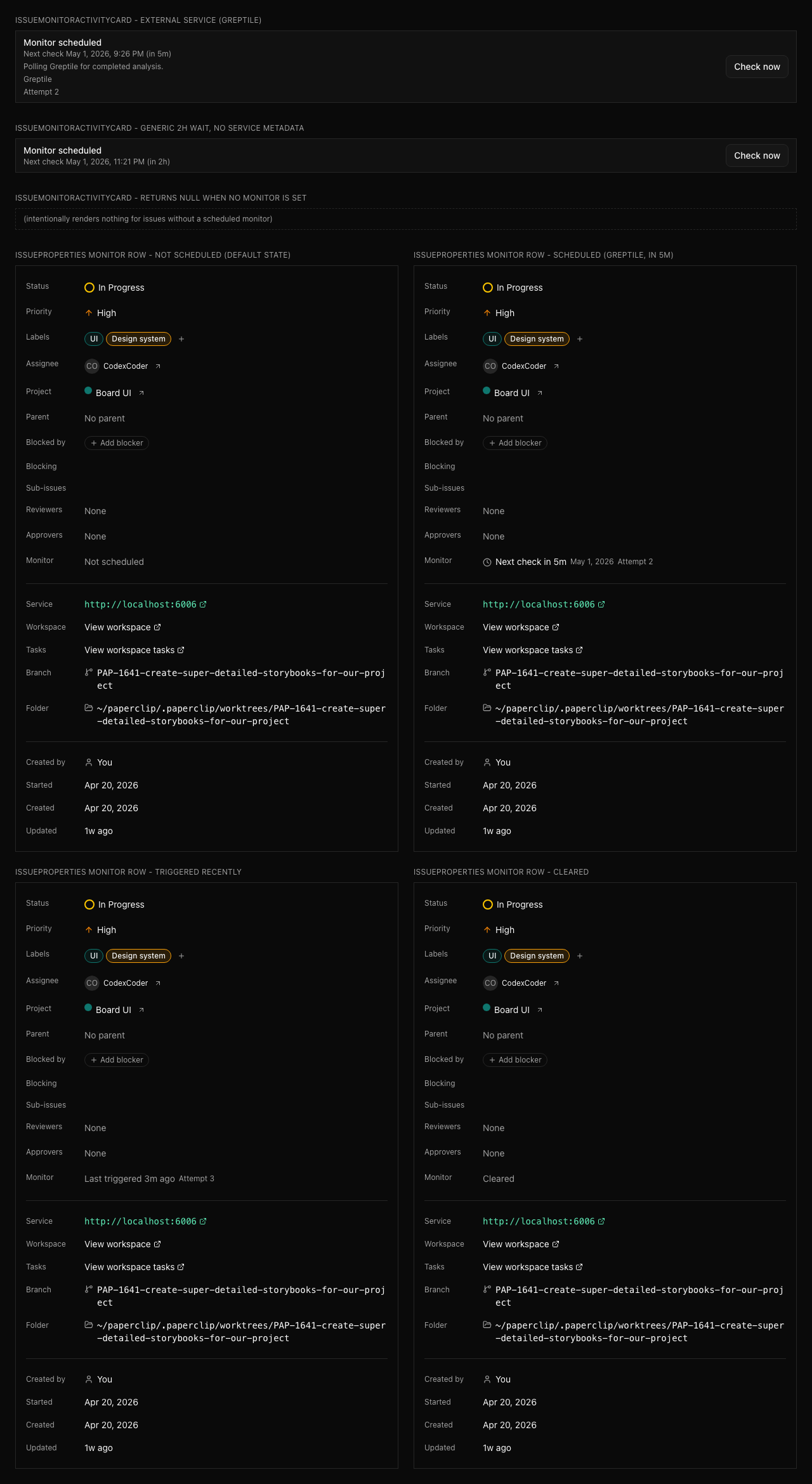 ## Risks - Medium: this changes heartbeat recovery behavior for scheduled external-service waits, so regressions could affect wake timing or recovery issue creation. - Migration risk is reduced by using `IF NOT EXISTS` for the new issue monitor columns and index. - External monitor references are treated as secret-adjacent and are intentionally omitted from visible activity/wake payloads. > For core feature work, check [`ROADMAP.md`](ROADMAP.md) first and discuss it in `#dev` before opening the PR. Feature PRs that overlap with planned core work may need to be redirected — check the roadmap first. See `CONTRIBUTING.md`. ## Model Used - OpenAI Codex, GPT-5 coding agent with repository tool use and terminal execution. ## Checklist - [x] I have included a thinking path that traces from project context to this change - [x] I have specified the model used (with version and capability details) - [x] I have checked ROADMAP.md and confirmed this PR does not duplicate planned core work - [x] I have run tests locally and they pass - [x] I have added or updated tests where applicable - [x] If this change affects the UI, I have included before/after screenshots or Storybook review surfaces - [x] I have updated relevant documentation to reflect my changes - [x] I have considered and documented any risks above - [x] I will address all Greptile and reviewer comments before requesting merge --------- Co-authored-by: Paperclip <noreply@paperclip.ing> |
||
|
dotta
|
bce58d353d | fix execution policy decision persistence | ||
|
dottaandPaperclip
|
b3e0c31239 |
Add issue review policy and comment retry
Co-Authored-By: Paperclip <noreply@paperclip.ing> |
