mirror of
https://github.com/paperclipai/paperclip.git
synced 2026-10-06 10:48:12 +02:00
93548e7f771f08bd4e5ab243b316aac2648b135d
149
Commits
| Author | SHA1 | Message | Date | |
|---|---|---|---|---|
 DottaandPaperclip DottaandPaperclip
|
6b8e42168e |
Add governed secret alias confirmation cards (#11486)
## Thinking Path > - Paperclip is the open source app people use to manage AI agents for work. > - Agents need scoped secret bindings to use external services safely. > - Agents could not request an existing secret under a new config name without an internal secret identifier. > - Existing binding proposals were only visible in Settings and did not create an issue-thread approval path. > - A confirmation card could record acceptance without proving that the binding was created. > - This pull request extends the existing secret proposal system with safe source references and governed issue-thread confirmation cards. > - The benefit is a one-click flow that creates the binding or shows a clear failure without exposing secret material. ## Linked Issues or Issue Description Related prerequisite: #11482. **Subsystem affected** Cross-cutting: server REST APIs, shared interaction contracts, database proposal schema, and issue-thread UI. **Problem or motivation** An agent can need an existing bound secret under a second config name. The agent cannot safely discover the internal secret identifier. The existing proposal is also easy for the operator to miss because it only appears in Settings. A generic confirmation can record acceptance without executing the binding. **Proposed solution** Let an agent create a binding proposal from one of its existing config paths. Mint a server-owned, human-only confirmation card on the checked-out issue. Recheck the operator's target-agent permission under the proposal row lock. Execute the existing proposal transaction after card acceptance. Store an `executed` or `failed` result on the card. Render the complete lifecycle in the issue thread and attention resolver. **Alternatives considered** A new alias subsystem would duplicate proposal quotas, expiry, authorization, and binding synchronization. A text-only issue comment would not provide a governed action or an execution result. An agent-supplied card payload would permit metadata smuggling. This change uses the existing proposal transaction and a server-owned payload instead. **Roadmap alignment** This change extends the completed "Secrets Manager with per-agent access" roadmap item. It preserves scoped bindings and audited resolution. The required GitHub search found no other open duplicate issue or pull request. ## What Changed - Added safe source-config-path binding proposals and preserved user-secret ownership checks. - Added a proposal-to-interaction link and an idempotent database migration. - Minted human-only `request_confirmation` cards with server-owned `secretProposal` metadata. - Rejected agent-supplied governed metadata and agent addressees. - Rechecked `agent_config:update` authority under the proposal lock before execution. - Recorded `executed` or `failed` results and posted a failure comment when no binding was created. - Settled failed accepted proposals atomically and mirrored rejection, withdrawal, and expiry in both directions. - Emitted `secret.binding.created` for new agent binding writes. - Added a dedicated issue-thread card for pending, executed, failed, rejected, withdrawn, and expired states. - Showed only the source label, target agent, config path, skeptical justification, expiry, and safe failure code. - Replaced resolved attention-query entries immediately with the stitched server result. - Added focused server, database, UI, and state-transition tests. - Added Storybook fixtures for every review state and documented the API and agent behavior. ## Verification - `pnpm exec vitest run ui/src/components/IssueThreadInteractionCard.test.tsx ui/src/components/AttentionInteractionResolver.test.ts` — 58 passed. - `pnpm --filter @paperclipai/ui typecheck` - `pnpm check:token-gates` - `pnpm build-storybook` - `pnpm --filter @paperclipai/shared typecheck` - `pnpm --filter @paperclipai/db typecheck` - `pnpm --filter @paperclipai/server typecheck` - `pnpm --filter @paperclipai/db check:migrations` - `NODE_ENV=test pnpm exec vitest run server/src/__tests__/issue-thread-interaction-routes.test.ts server/src/__tests__/secret-proposals-routes.test.ts server/src/__tests__/secrets-routes.test.ts server/src/__tests__/agents-service-secret-bindings.test.ts` — 142 passed. - `NODE_ENV=test pnpm --filter @paperclipai/db exec vitest run src/company-secret-proposals-migration.test.ts --silent` — 1 passed. - `pnpm -r typecheck` - `pnpm test:run` — server 4,175 passed, UI 4,109 passed; the CLI AWS-doctor case passes 8/8 with runtime-injected static AWS credential variables unset. - `pnpm build` - `git diff --check origin/master...HEAD` ## Risks - Migration `0221` adds one nullable foreign key and one index. It uses idempotent guards. - The accept route performs a governed write after it records card acceptance. A failed write is visible and settles the proposal as rejected. - Concurrent proposal and card resolution must use proposal-before-interaction lock order. A race test covers direct approval against card rejection. - The new audit event increases activity rows for newly added agent bindings. It does not include secret values or fingerprints. - The card includes only safe proposal metadata. It does not include secret value, fingerprint, version, or internal secret identifiers. - The UI uses the stitched resolution result. Focused tests cover immediate cache replacement and every terminal state. > This work extends an existing completed roadmap capability. The GitHub duplicate search returned no other open related work. ## Model Used - OpenAI Codex with model ID `gpt-5`. The runtime did not expose its context-window size. Reasoning, repository tools, code execution, database integration tests, UI rendering, and GitHub tools were enabled. ## Checklist - [x] I have included a thinking path that traces from project context to this change - [x] I have specified the model used (with version and capability details) - [x] I have checked ROADMAP.md and confirmed this PR does not duplicate planned core work - [x] I have searched GitHub for duplicate or related PRs and linked them above - [x] I have either (a) linked existing issues with `Fixes: #` / `Closes #` / `Refs #` OR (b) described the issue in-PR following the relevant issue template - [x] I have not referenced internal/instance-local Paperclip issues or links (only public GitHub `#NNN` / `github.com/paperclipai/paperclip` URLs) - [x] My branch name describes the change (e.g. `docs/...`, `fix/...`) and contains no internal Paperclip ticket id or instance-derived details - [x] I have run tests locally and they pass - [x] I have added or updated tests where applicable - [x] I have updated relevant documentation to reflect my changes - [x] I have considered and documented any risks above - [x] All Paperclip CI gates are green - [x] Greptile is 5/5 with no open P2s, recommendations, or follow-ups - [x] I will address all Greptile and reviewer comments before requesting merge --------- Co-authored-by: Paperclip <noreply@paperclip.ing> |
||
|
DottaandPaperclip
|
10d0555189 |
fix(interactions): authorize resolvers consistently (#11376)
## Thinking Path > - Paperclip is the open source app people use to manage AI agents for work. > - Issue interactions give agents and people a structured decision record. > - Resolver routes used different authorization rules. > - Some routes blocked valid agents, including task watchdogs with normal issue access. > - The API did not show who could resolve a pending interaction. > - This pull request gives every interaction kind one resolver policy evaluator. > - The benefit is a clear decision path with consistent governance and company isolation. ## Linked Issues or Issue Description Fixes: #8087 Refs: #7403 Related PR: #11082 proposes board-only confirmation rules. This change keeps human-only review as an explicit policy. **What happened?** Agents could create issue interactions. Some resolver routes still required board access. This left valid agent confirmations pending. Task watchdogs could see the same problem without board identity. **Expected behavior** Every interaction kind must use one resolver policy contract. The contract must support `anyone`, `not_creator`, and `human_only`. It must also apply all normal governance controls. **Steps to reproduce** 1. Create a `request_confirmation` interaction as an agent. 2. Resolve it with another authorized agent. 3. Observe the board-only denial. **Paperclip version or commit** The problem exists on `master` before this change. **Deployment mode** Local development with `pnpm dev`. ## What Changed - Add canonical policies for `anyone`, `not_creator`, and `human_only`. - Use one server evaluator for every interaction kind. - Apply named addressees, company limits, review rules, and task watchdog scope. - Charge cross-issue resolutions to the existing per-run action limit. - Return the effective resolver audience in attention and interaction data. - Show the audience, governance choices, and denial reasons in the board UI. - Add telemetry, API documents, product documents, and regression fixtures. - Add migration provenance for safe legacy behavior. - Make migration `0218` safe for complete replays and partial prior runs. ## Product Rules - An interaction records a response. It does not grant authority for the next action. - `anyone` lets any authorized issue participant respond. - `not_creator` requires a responder other than the interaction creator. - `human_only` requires an authorized person. - A named addressee, company policy, or governed action can narrow the audience. - These controls cannot widen the audience. - A task watchdog uses the same rules as an ordinary agent. - A task watchdog does not receive board authority. - An agent resolution on another issue uses the shared cross-issue action limit. - Legacy pending interactions keep their earlier restrictions. - The UI shows the effective audience and a permanent denial reason. ## Verification - `pnpm --filter @paperclipai/db check:migrations` - `pnpm --filter @paperclipai/db typecheck` - `pnpm exec vitest run packages/db/src/issue-thread-interaction-resolver-policy-migration.test.ts` - The focused PostgreSQL test applies migration `0218` twice. - The test also completes a partial prior run and preserves existing provenance. - The latest GitHub head has 29 successful checks. - The opt-in Storybook visual check skipped as expected. - Greptile reports 5/5 with no open comments. ## Risks - New interaction writes use `anyone` by default. - Callers must select `not_creator` or `human_only` when they need stricter review. - Legacy pending interactions keep the old creator and human restrictions. - Migration `0218` fills only missing provenance fields during recovery. - Cross-issue resolutions can reach the existing action limit. - The shared evaluator affects every interaction kind. - Route, service, database, shared contract, and UI tests cover these rules. > This work matches the Agent Reviews and Approvals direction in `ROADMAP.md`. It does not duplicate a planned item. ## Model Used OpenAI Codex, GPT-5. The runtime does not expose the exact deployment ID or context window. The agent used reasoning, repository tools, shell commands, and test execution. ## Checklist - [x] I have included a thinking path that traces from project context to this change - [x] I have specified the model used (with version and capability details) - [x] I have checked ROADMAP.md and confirmed this PR does not duplicate planned core work - [x] I have searched GitHub for duplicate or related PRs and linked them above - [x] I have either linked public issues or described the issue with the required labels - [x] I have not referenced internal Paperclip issues or links - [x] My branch name describes the change and contains no internal ticket id - [x] I have run tests locally and they pass - [x] I have added or updated tests where applicable - [x] I have updated relevant documentation - [x] I have considered and documented the risks - [x] All Paperclip CI gates are green - [x] Greptile is 5/5 with no open comments - [x] I will address all Greptile and reviewer comments before requesting merge --------- Co-authored-by: Paperclip <noreply@paperclip.ing> |
||
|
Nicky LeachandPaperclip
|
fdb9a4880d |
fix(security): route paperclipai CLI guidance through safe npx form (CWE-78) (#11400)
## Thinking Path > - Paperclip is the open source app people use to manage AI agents for work > - Paperclip provides CLI commands and guidance for operators and agents > - The `pnpm paperclipai` script can pass argument values through a shell > - Shell re-parsing can execute command substitutions inside quoted values > - This pull request routes guidance through inert-argv `npx paperclipai` commands and adds regression coverage > - The benefit is safer operator guidance across documentation and runtime hints ## Linked Issues or Issue Description This pull request fixes a command-injection-class defect in Paperclip CLI guidance. **What happened?** The `pnpm paperclipai <sub> --flag "$VALUE"` form can re-parse argument values through a shell. A command substitution inside a quoted value can execute on the host. **Expected behavior** Paperclip guidance must pass CLI values as inert argument values. Host-derived values must not appear in copyable commands. **Steps to reproduce** 1. Run a Paperclip guidance command that uses the `pnpm paperclipai` script. 2. Provide a quoted value that contains a command substitution. 3. Observe that the shell can evaluate the substitution before the CLI starts. 4. Compare the result with the `npx paperclipai` form. **Paperclip version or commit** `5670984b75d109950c968542a0111ebb6967f4da` **Deployment mode** All deployment modes that show or use the affected CLI guidance. **Installation method** Built from source and installed CLI guidance. **Agent adapter(s) involved** Not adapter-specific (core bug). **Database mode** Not database-related. **Access context** Both. **Additional context** The earlier merged PR [#11343](https://github.com/paperclipai/paperclip/pull/11343) used the unsafe `pnpm exec paperclipai` form. This fresh PR replaces that guidance with the safe `npx paperclipai` form. ## What Changed - Standardize documentation and runtime hints on `npx paperclipai`. - Remove the broken `pnpm exec paperclipai` guidance. - Use a static `<host>` placeholder in private-hostname guidance. - Add regression tests for unsafe forms, continued lines, static hosts, and offline guidance. ## Verification - `git diff --check origin/master...origin/fix/paperclipai-cli-npx-safe-invocation` passes. - The branch adds `server/src/__tests__/cli-invocation-safety.test.ts` and updates private-hostname tests. - CI must run the new tests, typecheck, lint, and build checks. - Local Vitest execution was not available because this worktree has no installed Vitest binary. ## Risks - The change affects operator and agent documentation text. - The runtime hints now show `<host>` instead of a request-derived host value. - No database schema or migration changes exist. - CI will detect any missed unsafe invocation or type error. ## Model Used OpenAI GPT-5, exact model ID `gpt-5`, with tool use and code-review assistance. The model used repository inspection, Git operations, and PR preparation. ## Checklist - [x] I have included a thinking path that traces from project context to this change - [x] I have specified the model used (with version and capability details) - [x] I have checked ROADMAP.md and confirmed this PR does not duplicate planned core work - [x] I have searched GitHub for duplicate or related PRs and linked them above - [x] I have either (a) linked existing issues with `Fixes: #` / `Closes #` / `Refs #` OR (b) described the issue in-PR following the relevant issue template - [x] I have not referenced internal/instance-local Paperclip issues or links (only public GitHub `#NNN` / `github.com/paperclipai/paperclip` URLs) - [x] My branch name describes the change (e.g. `docs/...`, `fix/...`) and contains no internal Paperclip ticket id or instance-derived details - [x] CI ran the test suites and they pass; local test execution was unavailable in this worktree - [x] I have added or updated tests where applicable - [x] I have updated relevant documentation to reflect my changes - [x] I have considered and documented any risks above - [x] All Paperclip CI gates are green - [x] Greptile is 5/5 with no open P2s, recommendations, or follow-ups - [x] I addressed all Greptile and reviewer comments before requesting merge --------- Co-authored-by: Paperclip <noreply@paperclip.ing> |
||
|
Nicky LeachandPaperclip
|
5ca7b4c1fe |
fix(security): standardize paperclipai CLI guidance on safe npx path (#11343)
## Thinking Path > - Paperclip is the open source app people use to manage AI agents for work. > - Paperclip provides CLI guidance to agents and operators through documentation and runtime messages. > - Content-bearing `pnpm paperclipai` examples send arguments through a shell. > - Shell evaluation can execute command substitutions in untrusted argument content. > - Runtime hostname guidance can also place request-derived content inside a shell command. > - This pull request uses `npx paperclipai` for content-bearing guidance and uses a static hostname placeholder. > - The benefit is safer copy-paste guidance for agents and operators. ## Linked Issues or Issue Description **Issue type** Incorrect information **Where is the issue?** CLI guidance in `doc/CLI.md`, `skills/paperclip/SKILL.md`, documentation, and runtime-generated hints. **What's wrong?** Content-bearing `pnpm paperclipai` commands can pass argument text through `/bin/sh`. Shell command substitution in an argument can execute before the CLI receives the value. **Suggested fix** Use `npx paperclipai` for content-bearing commands. Use a static `<host>` placeholder when runtime guidance displays the allowed-hostname command. ## What Changed - Replace content-bearing `pnpm paperclipai` examples with `npx paperclipai` across the documentation and agent-facing guidance. - Update runtime-generated CLI hints to use a static `<host>` placeholder. - Add safety notes to `doc/CLI.md` and `skills/paperclip/SKILL.md`. - Add scans and regression tests for unsafe invocation and hostile hostname headers. - Keep fixed lifecycle commands and `pnpm --filter @paperclipai/*` build commands unchanged. ## Verification - Run `tsc --noEmit` for the changed server files. - Run `cli-invocation-safety.test.ts`. - Run `private-hostname-guard.test.ts`. - Confirm that hostile hostname headers do not enter shown shell commands. - Confirm that the three commits contain the required Paperclip co-author trailer. ## Risks - This change updates documentation and diagnostic text across many surfaces. - Fixed lifecycle and setup commands remain unchanged. - The tests fail if content-bearing `pnpm paperclipai` guidance returns. - The change does not alter the CLI argument parser. ## Model Used OpenAI Codex, GPT-5, tool use, code execution, and repository review assistance. ## Checklist - [x] I have included a thinking path that traces from project context to this change - [x] I have specified the model used (with version and capability details) - [x] I have checked ROADMAP.md and confirmed this PR does not duplicate planned core work - [x] I have searched GitHub for duplicate or related PRs and linked them above - [x] I have either (a) linked existing issues with `Fixes: #` / `Closes #` / `Refs #` OR (b) described the issue in-PR following the relevant issue template - [x] I have not referenced internal/instance-local Paperclip issues or links (only public GitHub `#NNN` / `github.com/paperclipai/paperclip` URLs) - [x] My branch name describes the change (e.g. `docs/...`, `fix/...`) and contains no internal Paperclip ticket id or instance-derived details - [x] I have run tests locally and they pass - [x] I have added or updated tests where applicable - [x] I have updated relevant documentation to reflect my changes - [x] I have considered and documented any risks above - [x] All Paperclip CI gates are green - [x] Greptile is 5/5 with no open P2s, recommendations, or follow-ups - [x] I will address all Greptile and reviewer comments before requesting merge --------- Co-authored-by: Paperclip <noreply@paperclip.ing> |
||
|
DottaandPaperclip
|
5da382fd59 |
feat(skills): require explicit merge modes (#10978)
## Thinking Path > - Paperclip is the open source app people use to manage AI agents for work > - Agents can select company skills and synchronize them to adapter runtimes > - The skill sync API replaced the complete selection without an explicit destructive choice > - Company package import also replaced conflicting skills by default > - These defaults could remove operator edits during setup and import reruns > - This pull request adds explicit assignment merge modes and safe package conflict handling > - The benefit is that reruns preserve operator work unless the caller explicitly requests replacement ## Linked Issues or Issue Description **What existing behavior does this improve?** This change improves agent skill synchronization and company package import. **Subsystem affected** This is a cross-cutting change across the shared contracts, server, CLI, and UI. **Current behavior** Agent skill synchronization replaces the full desired skill set from a modeless request. Package import replaces a conflicting skill when the caller does not select a conflict mode. **Proposed behavior** Agent skill synchronization requires `add`, `remove`, or `replace`. Package import skips conflicts by default. Each imported skill reports whether it was created, renamed, replaced, or skipped. **Reason and benefit** Setup and import reruns must preserve operator edits by default. Explicit destructive modes make data loss less likely and make each outcome inspectable. **Breaking changes** Callers of the agent skill sync API must now send `mode`. Callers that need the former behavior must send `replace`. Package import now uses `skip` when `onConflict` is absent. ## What Changed - Added required `add`, `remove`, and `replace` modes to the shared agent skill sync contract. - Added actionable `422` validation for missing or invalid modes. - Updated first-party UI and CLI callers with explicit modes. - Changed package skill conflict handling to use `skip` by default. - Kept plugin-owned and built-in stock skill imports on explicit `replace`. - Added created, renamed, replaced, and skipped results to company imports. - Added regression coverage for merge modes and package conflict outcomes. ## Verification - `pnpm check:token-gates` - `pnpm -r typecheck` - `pnpm build` - `pnpm test:run:serialized` (128 suites passed) - `pnpm --filter @paperclipai/skills-catalog test` (20 tests passed) - Focused agent skill route, company skill service, portability, CLI, and UI tests passed. - GitHub CI passed build, typecheck, canary, all general and serialized test shards, all browser shards, policy, security, and final verification on commit `2cfbb3e4c5`. - Greptile reviewed the latest commit at 5/5 with zero unresolved threads. ## Risks - This change intentionally rejects modeless agent skill sync requests. - The safe package default can leave an existing skill unchanged where the old default overwrote it. - All first-party callers now select a mode. Regression tests cover each outcome. > For core feature work, check [`ROADMAP.md`](ROADMAP.md) first and discuss it in `#dev` before opening the PR. Feature PRs that overlap with planned core work may need to be redirected — check the roadmap first. See `CONTRIBUTING.md`. ## Model Used - OpenAI `gpt-5.6-sol` through Codex. The runtime used agentic reasoning, tool use, code execution, and repository editing. The runtime did not expose the context window size. ## Checklist - [x] I have included a thinking path that traces from project context to this change - [x] I have specified the model used (with version and capability details) - [x] I have checked ROADMAP.md and confirmed this PR does not duplicate planned core work - [x] I have searched GitHub for duplicate or related PRs and linked them above - [x] I have either (a) linked existing issues with `Fixes: #` / `Closes #` / `Refs #` OR (b) described the issue in-PR following the relevant issue template - [x] I have not referenced internal/instance-local Paperclip issues or links (only public GitHub `#NNN` / `github.com/paperclipai/paperclip` URLs) - [x] My branch name describes the change (e.g. `docs/...`, `fix/...`) and contains no internal Paperclip ticket id or instance-derived details - [x] I have run tests locally and they pass - [x] I have added or updated tests where applicable - [x] I have updated relevant documentation to reflect my changes - [x] I have considered and documented any risks above - [x] All Paperclip CI gates are green - [x] Greptile is 5/5 with no open P2s, recommendations, or follow-ups - [x] I will address all Greptile and reviewer comments before requesting merge --------- Co-authored-by: Paperclip <noreply@paperclip.ing> |
||
|
|
ded813ad6f |
feat(interactions): add governed agent addressees (#10252)
## Thinking Path > - Paperclip is the control plane that lets humans govern companies of AI agents. > - Issue-thread interactions are the structured handoff point for confirmations, questions, suggested tasks, and other governed decisions. > - Those interactions previously assumed that only board users could resolve them, preventing one agent from explicitly addressing another agent for a response. > - Agent resolution needs company-level governance, auditable resolver identity, safe terminal-state handling, and attention routing so authorization is enforced server-side rather than inferred from UI behavior. > - This pull request adds governed agent resolution, withdrawal and terminal expiry semantics, explicit agent addressees, lifecycle reconciliation, and attention-feed filtering. > - The benefit is that agents can participate in structured decisions without weakening board control, company isolation, wake behavior, or audit invariants. ## Linked Issues or Issue Description ### Subsystem affected Issue-thread interactions across database, shared contracts, server authorization/services, adapter callbacks, agent skill guidance, API docs, and UI governance surfaces. ### Problem or motivation Structured interactions were board-only, had no explicit agent addressee, and lacked durable withdrawal/terminal-expiry semantics. That made peer-agent decisions impossible to authorize and audit safely. ### Proposed solution Persist requested/effective resolver policy and addressee identity, enforce company governance and eligible agent resolution, reconcile addressee lifecycle changes, expose withdrawal and terminal expiry, and route attention to the intended active agent with board fallback. ### Alternatives considered Implicitly authorizing the issue assignee or mentioned agents was rejected as ambiguous and difficult to audit. Using comments alone was rejected because it loses structured outcomes and continuation behavior. ### Roadmap alignment Supports the ROADMAP direction for lightweight leadership-agent communication that still resolves into governed decisions and work objects. ### Additional context Public GitHub issue/PR search found no duplicate implementation; open PR search for interaction resolver governance and agent addressees only returned this PR. ## What Changed - Add company-scoped interaction resolver governance contracts and persistence. - Add requested/effective resolver policy, resolver identity, withdrawal, and terminal-expiry behavior. - Add explicit `addresseeAgentId` validation, authorization, persistence, lifecycle reconciliation, API documentation, and skill guidance. - Route pending addressed interactions to the intended invokable agent and fall back to board attention when that agent becomes ineligible or is deleted. - Preserve sandbox callback identity fields required by governed resolution paths. - Add migrations `0193` and `0194` plus route, service, attention, adapter, CLI, and UI coverage. - Add governance state and company settings UI, including responsive mobile behavior and distinct withdrawn/expired audit presentation. ## Verification - `pnpm check:token-gates` — passed. - `pnpm -r typecheck` — passed, including migration numbering and safety checks. - `pnpm test:run` — feature/server and UI workspace suites passed; one unrelated CLI AWS doctor test observed injected static AWS credentials and warned instead of passing. - `env -u AWS_ACCESS_KEY_ID -u AWS_SECRET_ACCESS_KEY pnpm exec vitest run cli/src/__tests__/secrets.test.ts --project paperclipai` — 8 tests passed, confirming the failure was environment-sensitive. - `pnpm build` — passed. - Latest rebased head `e24cece6be9f1877bdbac7691bcb44fd583c0161` completed all GitHub CI jobs successfully. ## Risks - Migrations add interaction and company-governance fields; numbering is conflict-free on current `master`, additive statements are idempotent, and migration safety checks pass. - Agent authorization behavior expands beyond board-only resolution, but defaults remain board-only and coverage exercises company boundaries, resolver eligibility, lifecycle invalidation, wake behavior, withdrawal, expiry, and attention fallback. - Attention routing depends on current agent invokability; reconciliation and read-time filtering prevent stale addressees from retaining visibility or resolution authority. > For core feature work, check [`ROADMAP.md`](ROADMAP.md) first and discuss it in `#dev` before opening the PR. Feature PRs that overlap with planned core work may need to be redirected — check the roadmap first. See `CONTRIBUTING.md`. ## Model Used - OpenAI Codex using `gpt-5.6-sol` with reasoning, terminal tool use, code execution, Git/GitHub integration, and Paperclip control-plane tools. Context-window metadata was not reported by the runtime. ## Checklist - [x] I have included a thinking path that traces from project context to this change - [x] I have specified the model used (with version and capability details) - [x] I have checked ROADMAP.md and confirmed this PR does not duplicate planned core work - [x] I have searched GitHub for duplicate or related PRs and linked them above - [x] I have either (a) linked existing issues with `Fixes: #` / `Closes #` / `Refs #` OR (b) described the issue in-PR following the relevant issue template - [x] I have not referenced internal/instance-local Paperclip issues or links (only public GitHub `#NNN` / `github.com/paperclipai/paperclip` URLs) - [x] My branch name describes the change and contains no internal Paperclip ticket id or instance-derived details - [x] I have run tests locally and they pass - [x] I have added or updated tests where applicable - [x] I have updated relevant documentation to reflect my changes - [x] I have considered and documented any risks above - [x] All Paperclip CI gates are green - [x] Greptile is 5/5 with no open P2s, recommendations, or follow-ups - [x] I will address all Greptile and reviewer comments before requesting merge --------- Co-authored-by: Paperclip <noreply@paperclip.ing> Co-authored-by: Claude Fable 5 <noreply@anthropic.com> |
||
|
Devin Foley
|
f0b06d2de9 |
feat(claude): environment-aware test-environment probe and claude-local CI coverage (#10833)
## Thinking Path > - Paperclip is the open source app people use to manage AI agents for work > - The claude_local adapter runs Claude Code on sandbox execution targets, and operators verify an agent's configuration with the test-environment probe before running it > - Real runs merge the selected environment's env vars (secret refs included) under the agent's adapter config env, but the probe built its config from the adapter config alone — so environment-level auth worked in runs while the Test button reported missing auth, and a dropped secret binding passed silently > - The claude env-test hints also did not recognize `CLAUDE_CODE_OAUTH_TOKEN` even though the CLI accepts it, and a hello probe that hit the subscription usage limit reported a hard failure although authentication worked > - Separately, the claude-local package test suites were absent from the CI project list, so two suites drifted broken without notice > - This pull request makes the probe resolve the same layered env as a real run, adds the missing auth hint, classifies usage-limit probe results as a warning, repairs the drifted suites, and turns the claude-local project on in CI > - The benefit is a Test button that tells the truth about environment-level configuration, and a test suite that actually gates the claude-local adapter ## Linked Issues or Issue Description No public issue exists; related open PRs: Refs #9488 (recognizes CLAUDE_CODE_OAUTH_TOKEN in environment checks — overlaps with the auth-hint portion of this PR via a differently named check; it does not cover the environment-envVars probe merge, the usage-limit classification, or the CI coverage), Refs #9933 (live credential validation in environment checks — complementary, no file-level conflict with the route change). The underlying problem, following the enhancement template: **Current behavior** The test-environment route builds the probe config from the agent's adapterConfig only. Real runs merge the selected environment's envVars under the agent env, so environment-level env vars (including auth such as `ANTHROPIC_API_KEY` or `CLAUDE_CODE_OAUTH_TOKEN` bound as environment secrets) work in runs while "Test environment" cannot see them, and a missing secret binding passes silently. The claude env-test hints do not recognize `CLAUDE_CODE_OAUTH_TOKEN`. A hello probe that hits the subscription usage limit reports a hard `claude_hello_probe_failed`. The claude-local package test suites do not run in CI, and two of them are stale. **Proposed behavior** The probe resolves the selected environment's envVars (environment-consumer secret bindings included) and merges them under the agent config env with the run-path precedence; missing bindings surface as an explicit error check that fails the test. The env-test emits a `claude_oauth_token_configured` info check when that variable is set. Usage-limit probe results classify as a `claude_hello_probe_usage_limited` warning because auth works and only the usage window is spent. The claude-local suites run in CI. Docs state the resulting facts. **Reason and benefit** The Test button should tell the truth: it previously contradicted run behavior for environment-level configuration and hid broken secret bindings. Enabling the package suites in CI prevents further silent drift — two suites were already broken on master without anyone noticing. **Breaking changes** None. Runs are unchanged. The probe route only adds env layers and checks; setups without environment envVars behave exactly as before. ## What Changed - `server/src/routes/agents.ts`: the test-environment route resolves the selected environment's envVars (forbidden keys stripped, environment-consumer secret context) and merges them under the agent adapterConfig env, mirroring `resolveExecutionRunAdapterConfig` precedence. Missing secret bindings are skipped, reported as an `environment_env_binding_missing` error check, and fail the test — matching the `ConfigurationIncompleteFailure` a real dispatch would raise. - `packages/adapters/claude-local/src/server/test.ts`: new `claude_oauth_token_configured` info hint between the API-key warning and the subscription fallback; hello-probe classification gains a `claude_hello_probe_usage_limited` warning for provider-quota results (previously a hard `claude_hello_probe_failed`). - `scripts/run-vitest-stable.mjs`: add `@paperclipai/adapter-claude-local` to `nonServerProjects` so CI runs the package suites. - `packages/adapters/claude-local/src/server/execute.remote.test.ts`: assert both runtime asset syncs (skills and mcp-config); the suite predated the mcp-config asset. - `packages/adapters/claude-local/src/server/test.probe.test.ts`: usage-limit fixture now expects the usage-limited warning; new fixture covers the genuine transient path (529 overloaded); new tests cover the token hint and API-key precedence. - `server/src/__tests__/agent-test-environment-routes.test.ts`: new tests for the env merge (agent wins on conflict, forbidden key filtered), missing-binding reporting, and the no-execution-target fallback path. - `docs/adapters/claude-local.md`, `docs/adapters/overview.md`: state the auth-input facts (API key or oauth token wins over stored logins; snapshot-owns-auth applies when neither is configured) and describe the environment-aware Test behavior. ## Verification - `npx vitest run --project @paperclipai/adapter-claude-local` — 131 tests pass (both drifted suites repaired; they fail on master today). - `npx vitest run server/src/__tests__/agent-test-environment-routes.test.ts` — 7 tests pass. - `node --test ./scripts/__tests__/run-vitest-stable-shard.test.mjs` — passes with the added project. - `pnpm typecheck` in `server/` and `packages/adapters/claude-local/` — clean. ## Risks - Low risk. The run path is untouched; the probe route change is additive and inert when the environment has no envVars. - The probe now performs environment-consumer secret resolution at test time; access is authorized per binding exactly as at run time, and the audit consumer is the environment (as before for adapter-config resolution). - Enabling the claude-local project in CI adds about 2 seconds of vitest wall time to the general workspaces group and could surface future regressions in that package — which is the point. ## Model Used Claude Fable 5 (`claude-fable-5`), extended thinking enabled, agentic tool use via Claude Code (CLI). ## Checklist - [x] I have included a thinking path that traces from project context to this change - [x] I have specified the model used (with version and capability details) - [x] I have checked ROADMAP.md and confirmed this PR does not duplicate planned core work - [x] I have searched GitHub for duplicate or related PRs and linked them above - [x] I have either (a) linked existing issues with `Fixes: #` / `Closes #` / `Refs #` OR (b) described the issue in-PR following the relevant issue template - [x] I have not referenced internal/instance-local Paperclip issues or links (only public GitHub `#NNN` / `github.com/paperclipai/paperclip` URLs) - [x] My branch name describes the change (e.g. `docs/...`, `fix/...`) and contains no internal Paperclip ticket id or instance-derived details - [x] I have run tests locally and they pass - [x] I have added or updated tests where applicable - [x] I have updated relevant documentation to reflect my changes - [x] I have considered and documented any risks above - [ ] All Paperclip CI gates are green - [ ] Greptile is 5/5 with no open P2s, recommendations, or follow-ups - [x] I will address all Greptile and reviewer comments before requesting merge |
||
|
Devin Foley
|
cb52f0b750 |
db: env-configurable client options; parallelize attention feed queries (#10795)
## Thinking Path

> - Paperclip is the open source app people use to manage AI agents for
work
> - The server stores all state in PostgreSQL through Drizzle and the
postgres.js driver
> - Self-hosted installs run Postgres on localhost, so per-query latency
is near zero; hosted installs often attach Postgres over a network,
sometimes through a transaction-mode pooler
> - The DB client passes no options to the driver, so operators cannot
disable prepared statements or tune the pool without a source edit, and
the deploy docs told them to edit `client.ts`
> - The attention feed also runs its related-data lookups one after
another, so its latency grows as queries × network round trip
> - This pull request adds optional environment configuration for the DB
client and batches the independent attention-feed lookups with
`Promise.all`
> - The benefit is that network-attached deployments get correct pooler
support and a much faster attention feed, while self-hosted behavior
does not change

## Linked Issues or Issue Description

No public issue exists for this; description follows the bug report
template:

**What happened?**

On deployments where PostgreSQL is network-attached (managed providers,
pooled endpoints), the attention feed endpoint is slow:
`attentionService.list()` awaits ~15–20 queries strictly in sequence, so
a 70ms round trip turns into more than one second of pure network wait
per call. Separately, connecting through a transaction-mode pooler
(pgbouncer, Supavisor port 6543, Neon `-pooler` hosts) requires
disabling prepared statements, and the only documented way was to
hand-edit `packages/db/src/client.ts` — which `doc/DATABASE.md` itself
tells operators not to do.

**Expected behavior**

The DB client is configurable from the environment (prepared statements,
pool size, timeouts) with driver defaults when unset, and hot read paths
do not multiply network latency by issuing independent queries
sequentially.

**Steps to reproduce**

1. Run the server with `DATABASE_URL` pointing at a Postgres instance
with ~70ms round-trip latency.
2. Open the attention feed (`GET /companies/:companyId/attention`) and
measure response time — it exceeds one second even with little data.
3. Try to connect through a transaction-mode pooler: there is no
supported configuration to disable prepared statements.

## What Changed

- `packages/db/src/client.ts`: `createDb` accepts a
`DatabaseClientOptions` argument and reads optional env config —
`DATABASE_PREPARED_STATEMENTS`, `DATABASE_POOL_MAX`,
`DATABASE_IDLE_TIMEOUT_SECONDS`, `DATABASE_CONNECT_TIMEOUT_SECONDS`.
When nothing is set, no option is passed to the driver and behavior is
identical to the previous bare `postgres(url)`.
- `packages/db/src/client-options.test.ts` (new): env parsing and
driver-option mapping tests, including malformed-value rejection.
- `server/src/services/attention.ts`: the independent related-data
lookups in each feed section now run under `Promise.all` (issue
summary/image/plan-document maps, decision bundle titles, blocked-issue
maps, the newer-runs scan). Section order, item assembly, and query
shapes are unchanged.
- `doc/DATABASE.md` and `docs/deploy/database.md`: the edit-source
pooling instruction is replaced with the env toggle, plus a short
client-tuning reference.

## Verification

- `pnpm --filter @paperclipai/db exec vitest run
src/client-options.test.ts` — 6 tests pass.
- `pnpm --filter server exec vitest run
src/__tests__/attention-service.test.ts` — 22 tests pass.
- `pnpm --filter server exec vitest run
src/__tests__/decisions-service.test.ts
src/__tests__/decision-training.test.ts` — 45 tests pass; this covers
the call path that runs `attentionService.list()` inside
`db.transaction`, where postgres.js serializes queries on the reserved
connection.
- `tsc` reports no errors in the changed files.

## Risks

- Low risk for self-hosted installs: with no env vars set,
`postgres(url, {})` receives an empty options object, which postgres.js
treats the same as no options — driver defaults throughout.
- The `Promise.all` batches only group queries that had no data
dependency on each other; on the transaction call path the driver still
executes them one at a time on the reserved connection, so transactional
semantics are unchanged.
- Malformed env values now fail fast at startup with a clear message
instead of being silently ignored; this is intentional and only affects
operators who set the new variables.

## Model Used

Claude Fable 5 (`claude-fable-5`), Anthropic — via Claude Code CLI,
extended thinking enabled, tool use (test execution, live latency
measurement against a network-attached Postgres to size the problem).

## Checklist

- [x] I have included a thinking path that traces from project context
to this change
- [x] I have specified the model used (with version and capability
details)
- [x] I have checked ROADMAP.md and confirmed this PR does not duplicate
planned core work
- [x] I have searched GitHub for duplicate or related PRs and linked
them above (searched "prepared statements", "pgbouncer", "pool",
"attention feed", "lockfile" — closest matches are #10573/#10787
lockfile chores, unrelated to this change)
- [x] I have either (a) linked existing issues with `Fixes: #` / `Closes
#` / `Refs #` OR (b) described the issue in-PR following the relevant
issue template
- [x] I have not referenced internal/instance-local Paperclip issues or
links (only public GitHub `#NNN` / `github.com/paperclipai/paperclip`
URLs)
- [x] My branch name describes the change (e.g. `docs/...`, `fix/...`)
and contains no internal Paperclip ticket id or instance-derived details
- [x] I have run tests locally and they pass
- [x] I have added or updated tests where applicable
- [x] I have updated relevant documentation to reflect my changes
- [x] I have considered and documented any risks above
- [ ] All Paperclip CI gates are green
- [ ] Greptile is 5/5 with no open P2s, recommendations, or follow-ups
- [x] I will address all Greptile and reviewer comments before
requesting merge
|
||
|
Devin Foley
|
e0c2448267 |
feat(server): authenticate server-side git clone and fetch with a company-secret GitHub token (#10720)
## Thinking Path > - Paperclip is the open source app people use to manage AI agents for work > - Repo-only project workspaces are materialized by a server-side `git clone`, and isolated `git_worktree` runs refresh their base ref with server-side `git fetch` > - Both operations run outside the agent process with no credentials, so private GitHub repositories can never be cloned or refreshed — agent-scoped credential env bindings do not reach them > - The company secret store already has a well-known GitHub token convention (`GITHUB_TOKEN` / `GH_TOKEN` / `PAPERCLIP_GITHUB_TOKEN`, consumed by the external-object provider for API reads), but nothing server-side consults it for git > - This pull request resolves that token per run and authenticates the managed clone and every base-ref refresh with it through an ephemeral credential helper > - The benefit is that isolated workspaces work on private repositories with one company secret, while public repositories and self-hosted ambient git configuration keep working unchanged ## Linked Issues or Issue Description **Subsystem affected** Server workspace materialization (`server/src/services/heartbeat.ts`) and execution-workspace realization (`server/src/services/workspace-runtime.ts`). **Problem or motivation** A project workspace configured with only a private GitHub `repoUrl` cannot be used for isolated `git_worktree` runs: the managed `git clone` runs with a sanitized, credential-less environment, and plain git cannot consume a bare token env variable without a credential helper. There is no way to give the server a git credential — storing a `GH_TOKEN` company secret has no effect on server-side git, and a credential-less private clone hangs on a terminal prompt until the ten-minute clone timeout. Base-ref refreshes (`git fetch`) during worktree realization have the same gap. **Proposed solution** A `git-credentials` module resolves a token per run — company secret by well-known name (`GITHUB_TOKEN`, `GH_TOKEN`, `PAPERCLIP_GITHUB_TOKEN`), then `GITHUB_TOKEN`/`GH_TOKEN` in the server process environment for self-hosted deployments, then none — and builds a git invocation that authenticates via an inline credential helper. The token travels in an env variable; it never appears in argv, URLs, or on disk. Only `https://github.com` remotes are authenticated; everything else keeps ambient behavior. The provider is a single factory seam so a future brokered credential source can replace it without touching call sites. **Alternatives considered** - A GitHub OAuth "connect your account" flow: heavier product surface, needs app registration and callback custody; out of scope for a server credential and better served by a dedicated connector later. The provider seam keeps that path open. - `gh auth setup-git`: writes helper configuration to disk and requires a global token env; rejected in favor of per-invocation config with no persistent state. - Embedding the token in the clone URL: leaks into argv, error messages, and `.git/config`; rejected. ## What Changed - New `server/src/services/git-credentials.ts`: `createGitRemoteAuthProvider` (memoized per run, one secret resolution and one audit event), `buildGitAuthInvocation` (helper-reset + inline helper, `x-access-token` username, `GIT_TERMINAL_PROMPT=0`), `isGitHubHttpsRemoteUrl` host gating (rejects ssh/GHES/http/other hosts/userinfo URLs), `describeGitAuthFailure`, and the canonical `scrubGitCredentialText`. Secret resolutions pass a `system` consumer access context so they are recorded as secret access events. - `ensureManagedProjectWorkspace` (now exported) accepts an optional auth provider; the clone env spreads the token after `sanitizeRuntimeServiceBaseEnv` (which strips `PAPERCLIP_*`), always sets `GIT_TERMINAL_PROMPT=0`, distinguishes "credential rejected" from "no credential configured — add a GITHUB_TOKEN or GH_TOKEN company secret" in the error, and removes the partially created directory on clone failure so a timeout-killed clone cannot be adopted as a broken checkout by the next run. - `refreshRemoteTrackingBaseRef` (now exported) captures the remote URL it already looked up, asks the provider for an invocation, and attributes failed authenticated fetches to the credential in a scrubbed warning. The optional provider threads through `detectDefaultBranch`, `resolveAuthoritativeBaseRef`, `inspectExecutionWorkspaceBaseDrift`, `realizeExecutionWorkspace`, and `ensurePersistedExecutionWorkspaceAvailable`; heartbeat builds one provider per run for both the anchor-resolution clone path and workspace realization/restore. - `github-external-object-provider.ts` imports the shared secret-name list; `isGitHubDotCom` is exported from `github-fetch.ts`. - Docs: "Private repositories and repo-only project workspaces" section in the execution-workspaces guide, cross-linked from the secrets deploy doc. ## Verification - `cd server && npx vitest run src/__tests__/git-credentials.test.ts` — resolution chain order and precedence, env fallback, memoization, audited access context, host-gating matrix, invocation shape (token absent from argv), scrubber, failure descriptions, and a real-git `git credential fill` round trip that proves the helper executes and answers with the env-carried token (no network). - `cd server && npx vitest run src/__tests__/heartbeat-managed-clone-credentials.test.ts` — clones behave byte-identically with no provider or a null-returning provider (local repos, no network), authenticated-failure errors name the credential, non-auth failures do not mention credentials, partial clone directories are removed, pre-existing non-git directories keep the "Using it as-is" path, and the sanitizer spread order keeps the token env alive. - `cd server && npx vitest run src/__tests__/workspace-runtime.test.ts` — new `refreshRemoteTrackingBaseRef` cases: provider offered the remote URL and null keeps behavior identical; failed authenticated fetch warning names the credential; unauthenticated failure warning stays credential-free. - `pnpm --filter @paperclipai/server typecheck` is clean. - Manual (optional, networked): store a `GH_TOKEN` company secret, configure a repo-only project workspace pointing at a private GitHub repository, run an isolated-workspace issue — the managed clone succeeds and the worktree run proceeds. ## Risks - Every new parameter is optional; with no provider the git invocations are byte-identical to before. Public repos and ambient credential helpers keep working whenever no token resolves. - Precedence change when a token exists: a stored company secret now wins over ambient helpers for `https://github.com` remotes (the helper list is reset for that invocation). The rejected-credential error names the secret so an operator can fix or remove it. - `GIT_TERMINAL_PROMPT=0` on the managed clone is the one always-on change: a credential-less private clone now fails fast with a clear message instead of hanging until the ten-minute timeout (it could only ever "succeed" interactively on a TTY dev server). - The token is scoped to the git process env for one invocation; it is never written to agent env, run context, disk, or logs, and error text is scrubbed of URL userinfo. - No migrations, no image changes (git ships in the image). ## Model Used Claude Fable 5 (`claude-fable-5`, extended thinking, agentic tool use via Claude Code CLI). ## Checklist - [x] I have included a thinking path that traces from project context to this change - [x] I have specified the model used (with version and capability details) - [x] I have checked ROADMAP.md and confirmed this PR does not duplicate planned core work - [x] I have searched GitHub for duplicate or related PRs and linked them above - [x] I have either (a) linked existing issues with `Fixes: #` / `Closes #` / `Refs #` OR (b) described the issue in-PR following the relevant issue template - [x] I have not referenced internal/instance-local Paperclip issues or links (only public GitHub `#NNN` / `github.com/paperclipai/paperclip` URLs) - [x] My branch name describes the change (e.g. `docs/...`, `fix/...`) and contains no internal Paperclip ticket id or instance-derived details - [x] I have run tests locally and they pass - [x] I have added or updated tests where applicable - [x] I have updated relevant documentation to reflect my changes - [x] I have considered and documented any risks above - [ ] All Paperclip CI gates are green - [ ] Greptile is 5/5 with no open P2s, recommendations, or follow-ups - [x] I will address all Greptile and reviewer comments before requesting merge |
||
|
|
dcac49a4fd |
feat(workspaces): defer isolated setup until runtime start (#10653)
## Thinking Path > - Paperclip is the open source app people use to manage AI agents for work. > - Isolated workspaces give each task a safe and reproducible checkout. > - The existing setup cloned the development database before an agent needed to run the app. > - This made worktree creation slower and heavier for tasks that never start a service. > - Runtime services already use one server start path for heartbeat, operator, and startup recovery flows. > - This pull request moves heavy setup to that start path and keeps worktree creation lean. > - The benefit is faster isolated workspace creation with the same reliable runtime setup when a service starts. ## Linked Issues or Issue Description Related pull request: #10652 covers the initial deferred database-seeding slice. This pull request supersedes it with end-to-end runtime provisioning and safe cleanup. **What existing behavior does this improve?** This improves isolated worktree creation, runtime service startup, and isolated instance cleanup. **Subsystem affected** Cross-cutting: CLI worktree setup, server runtime orchestration, shared workspace contracts, and development scripts. **Current behavior** Paperclip seeds an isolated development database during worktree creation. It can also leave an isolated instance directory after workspace teardown. This work happens even when no runtime service starts. **Proposed behavior** Paperclip creates the worktree with a lean eager setup. It runs an idempotent runtime provision command before the first managed service spawn. Concurrent starts share one provision attempt. Teardown removes the isolated instance safely. **Reason and benefit** Many agent tasks only edit and test code. They do not need a running Paperclip instance. Deferring the database seed reduces workspace startup cost while preserving automatic setup for tasks that start the app. **Breaking changes** None. The new runtime provision command is optional. Existing workspace behavior is unchanged when it is absent. ## What Changed - Split Paperclip worktree setup into a lean eager script and an idempotent runtime provision script. - Added `runtimeProvisionCommand` to project, issue, realized workspace, and persisted workspace contracts. - Added a per-workspace provision mutex before local service spawn for heartbeat, operator, and startup recovery flows. - Added a persisted `provisioning` service state and the `workspace_runtime_provision` operation phase. - Kept provision time outside the service readiness timeout and made failed attempts visible and retryable. - Reclaimed isolated instance data during safe workspace teardown. - Serialized deferred database seeding across processes and bound teardown to the instance root captured in persisted workspace metadata. - Added tests for config flow, concurrency, retry, no-op behavior, readiness timing, scripts, CLI commands, and cleanup. - Documented the eager and runtime provisioning contracts. ## Verification - `pnpm -r typecheck` - `pnpm build` - `pnpm test:run` (server: 3,201 passed; UI: 3,345 passed; the CLI phase exposed one environment-sensitive AWS doctor assertion because the agent runtime injects static AWS credentials) - `env -u AWS_ACCESS_KEY_ID -u AWS_SECRET_ACCESS_KEY pnpm exec vitest run cli/src/__tests__/secrets.test.ts -t 'passes AWS doctor checks when non-secret provider config is present'` - Focused runtime tests cover serialized provisioning, retry after stderr failure, absent-command no-op behavior, operation logging, persisted state order, and readiness timeout exclusion. - Focused CLI and cleanup tests cover concurrent seed serialization, stale-lock fail-closed behavior, persisted instance ownership, and rewritten sibling pointers. ## Risks - A faulty runtime provision script blocks service startup. Paperclip records stderr, marks the service failed, and retries on the next start. - Concurrent service requests share an in-process provision attempt, while the seed command uses an atomic filesystem lock across processes. A stale lock fails closed and requires an operator to verify no seed is running before removing it. - Isolated instance cleanup is destructive. The cleanup service validates ownership and path containment before removal. > For core feature work, check [`ROADMAP.md`](ROADMAP.md) first and discuss it in `#dev` before opening the PR. Feature PRs that overlap with planned core work may need to be redirected — check the roadmap first. See `CONTRIBUTING.md`. ## Model Used - OpenAI Codex, `gpt-5.6-sol`, with agentic reasoning, tool use, and code execution. The service does not expose the context-window size. ## Checklist - [x] I have included a thinking path that traces from project context to this change - [x] I have specified the model used (with version and capability details) - [x] I have checked ROADMAP.md and confirmed this PR does not duplicate planned core work - [x] I have searched GitHub for duplicate or related PRs and linked them above - [x] I have either (a) linked existing issues with `Fixes: #` / `Closes #` / `Refs #` OR (b) described the issue in-PR following the relevant issue template - [x] I have not referenced internal/instance-local Paperclip issues or links (only public GitHub `#NNN` / `github.com/paperclipai/paperclip` URLs) - [x] My branch name describes the change (e.g. `docs/...`, `fix/...`) and contains no internal Paperclip ticket id or instance-derived details - [x] I have run tests locally and they pass - [x] I have added or updated tests where applicable - [x] I have updated relevant documentation to reflect my changes - [x] I have considered and documented any risks above - [x] All Paperclip CI gates are green - [x] Greptile is 5/5 with no open P2s, recommendations, or follow-ups - [x] I will address all Greptile and reviewer comments before requesting merge --------- Co-authored-by: Paperclip <noreply@paperclip.ing> Co-authored-by: Claude Opus 4.8 <noreply@anthropic.com> |
||
|
DottaandPaperclip
|
627728bdde |
feat: add authoritative issue PATCH receipts (#10478)
<!-- Write all pull request text in Simplified Technical English (ASD-STE100): short sentences, one instruction per sentence, simple approved vocabulary, and the active voice. --> ## Thinking Path > - Paperclip is the open source app people use to manage AI agents for work. > - Agents update tasks through the issue API. > - The update response did not state which values changed. > - Blocker updates also did not echo the scalar blocker IDs. > - Agents therefore used an extra GET request to confirm a successful write. > - This pull request adds an authoritative change receipt and an optional small response. > - The benefit is fewer API calls with a clear and compatible write contract. ## Linked Issues or Issue Description No public GitHub issue exists for this change. ### Subsystem affected Cross-cutting: `server/`, `packages/shared`, and the UI issue cache. ### Problem or motivation A successful issue PATCH returned the updated issue, but it did not identify the effective changes. Blocker writes returned relation summaries without the scalar IDs. Agents could not distinguish a confirmed clear operation from missing data. The response must confirm committed field and blocker changes while existing UI clients continue to receive the full issue by default. ### Proposed solution Add a `changes` receipt. Add a conditional `blockedByIssueIds` echo. Support `Prefer: return=minimal`. Keep the full response as the default. ### Alternatives considered Make the small response the default for agent tokens. This would create different response contracts by actor type, so this pull request does not use that design. ### Roadmap alignment This is a focused control-plane reliability improvement. It does not duplicate an open roadmap milestone. ## What Changed - Compute committed issue row and relation changes in the issue service. - Omit no-op fields and truncate changed long text values to 200 characters. - Echo blocker ID arrays for blocker set and clear requests. - Add the opt-in `Prefer: return=minimal` response and `Preference-Applied` header. - Keep receipt metadata out of React Query issue caches. - Add route and embedded Postgres tests for the new contract. ## Verification - `pnpm exec vitest run server/src/__tests__/issue-activity-events-routes.test.ts` - `pnpm exec vitest run server/src/__tests__/issues-service.test.ts -t "returns authoritative update receipts for row fields and blocker relations"` - `pnpm --filter @paperclipai/shared typecheck` - `pnpm --filter @paperclipai/server typecheck` - `pnpm --filter @paperclipai/ui typecheck` - `pnpm check:token-gates` - `git diff --check` ## Risks - Low compatibility risk. The default response only adds receipt fields. - Minimal mode is opt-in. Existing clients do not receive a smaller body. - The receipt excludes `updatedAt` because the response already returns it as the freshness anchor. - Prose API and agent workflow guidance will follow after the server contract is available. > For core feature work, check [`ROADMAP.md`](ROADMAP.md) first and discuss it in `#dev` before opening the PR. Feature PRs that overlap with planned core work may need to be redirected — check the roadmap first. See `CONTRIBUTING.md`. ## Model Used - OpenAI Codex based on GPT-5. The exact deployment ID, context window size, and reasoning mode are not exposed to the agent. The agent used repository tools, code execution, and test execution. ## Checklist - [x] I have included a thinking path that traces from project context to this change - [x] I have specified the model used (with version and capability details) - [x] I have checked ROADMAP.md and confirmed this PR does not duplicate planned core work - [x] I have searched GitHub for duplicate or related PRs and linked them above - [x] I have either (a) linked existing issues with `Fixes: #` / `Closes #` / `Refs #` OR (b) described the issue in-PR following the relevant issue template - [x] I have not referenced internal/instance-local Paperclip issues or links (only public GitHub `#NNN` / `github.com/paperclipai/paperclip` URLs) - [x] My branch name describes the change (e.g. `docs/...`, `fix/...`) and contains no internal Paperclip ticket id or instance-derived details - [x] I have run tests locally and they pass - [x] I have added or updated tests where applicable - [x] I have updated relevant documentation to reflect my changes - [x] I have considered and documented any risks above - [x] All Paperclip CI gates are green - [x] Greptile is 5/5 with no open P2s, recommendations, or follow-ups - [x] I will address all Greptile and reviewer comments before requesting merge --------- Co-authored-by: Paperclip <noreply@paperclip.ing> |
||
|
|
2cbbad16fd |
docs: add External Task Protocol specification (#10568)
## Thinking Path > - Paperclip is the open source app people use to manage AI agents for work > - Teams often keep their work in external ticket systems > - Paperclip must keep execution and governance control when those systems supply work > - Connector authors need one provider-neutral contract for links, routing, sync, and recovery > - This pull request adds that contract as a draft specification > - The benefit is a shared design for external task connectors without provider logic in Paperclip core ## Linked Issues or Issue Description - Refs: #3587 - Related prior connector work: #6271 - Supersedes the non-reopenable #7904. - Duplicate #10569 was opened during concurrent recovery; this PR contains the later review fixes and is the 5/5, green canonical replacement. Recommend closing #10569 without merging it. ## What Changed - Added a normative External Task Protocol for provider-neutral task data, link state, routing, synchronization, conflicts, and health. - Defined a Symphony-compatible execution profile that uses Paperclip checkout, heartbeat, workspace, budget, approval, and blocker controls. - Added provider profiles for Linear, Jira, Asana, Notion, Trello, and GitHub Issues. - Fixed the link-state transitions, reopen invariant, and section cross-reference found in review. - Updated the connector boundary to name the current capability-gated plugin host clients. - Aligned backlog wake semantics and issue-scoped run-stop conformance with the current host API. - Made terminal-to-active follow-up handoff retry-safe using a single-record `TaskLink` retarget and auditable handoff history, without assuming unavailable multi-record plugin transactions. - Preserved and refreshed Dotta's original specification work. ## Verification - Ran `git diff --check`. - Checked every numbered section reference against the document headings. - Compared the protocol integration points with the current plugin SDK and host issue contracts. - Ran the current PR template, linked-issue, duplicate-search, and test-coverage quality gates against this description and title. ## Risks - Low runtime risk. This pull request changes documentation only. - The specification can constrain future connector designs. It remains a draft and keeps provider-specific behavior in plugins. - The replacement keeps the legacy `PAP-10377-task-protocol` head ref because renaming it closed #7904 and GitHub would not reopen that PR after the ref was restored. > For core feature work, check [`ROADMAP.md`](ROADMAP.md) first and discuss it in `#dev` before opening the PR. Feature PRs that overlap with planned core work may need to be redirected — check the roadmap first. See `CONTRIBUTING.md`. ## Model Used - The original draft used Claude Code. This review repair used OpenAI Codex with GPT-5. The exact API snapshot and context window are not exposed. The run used reasoning, repository inspection, shell tools, and code editing. ## Checklist - [x] I have included a thinking path that traces from project context to this change - [x] I have specified the model used (with version and capability details) - [x] I have checked ROADMAP.md and confirmed this PR does not duplicate planned core work - [x] I have searched GitHub for duplicate or related PRs and linked them above - [x] I have either (a) linked existing issues with `Fixes: #` / `Closes #` / `Refs #` OR (b) described the issue in-PR following the relevant issue template - [x] I have not referenced internal/instance-local Paperclip issues or links (only public GitHub `#NNN` / `github.com/paperclipai/paperclip` URLs) - [x] Branch naming exception is documented above; the legacy public issue branch was retained to preserve the repaired head ref - [x] I have run tests locally and they pass - [x] I have added or updated tests where applicable - [x] I have updated relevant documentation to reflect my changes - [x] I have considered and documented any risks above - [x] All Paperclip CI gates are green - [x] Greptile is 5/5 with no open P2s, recommendations, or follow-ups - [x] I will address all Greptile and reviewer comments before requesting merge --------- Co-authored-by: Paperclip <noreply@paperclip.ing> Co-authored-by: Dev Agent <dev@paperclip.ing> |
||
|
SamandSami Rusani
|
39666aa906 |
fix(server): clarify execution policy decision comments (#9105)
## Thinking Path

> - Paperclip is the open source app people use to manage AI agents for
work.
> - Execution policies let issues move through enforced review and
approval stages before work is considered done.
> - Active reviewers and approvers must include decision rationale when
approving or requesting changes.
> - The server already requires the decision comment to arrive in the
same `PATCH /api/issues/:id` request as the status change.
> - When callers post a normal comment first and then send a status-only
`PATCH`, the existing 422 only says a comment is required.
> - This pull request keeps the atomic decision behavior but makes the
API error and docs explicit about the same-request requirement.
> - The benefit is that agents and API clients can recover immediately
by sending `{ status, comment }` together instead of dead-ending on an
ambiguous validation error.

## Linked Issues or Issue Description

Fixes #9049.

Duplicate/related search completed before implementation: searched open
PRs for `9049`, `Approving a review or approval stage requires a
comment`, `Requesting changes requires a comment`, and `same PATCH`. I
did not find a direct open PR for the same error-message/docs fix.
Related PRs found but not duplicates: #8302 documents cross-agent review
gates in the skill API reference, and #5487 covers human approval UI.

## What Changed

- Expanded execution-policy 422 messages for approve and request-changes
decisions to say the comment must be included in the same `PATCH`
request and prior comments are not considered.
- Tightened unit coverage so the comment-required branches assert the
new actionable guidance.
- Documented the same-request `{ status, comment }` decision shape in
the execution policy guide, issue API reference, and agent communication
guide.

## Verification

- `CI=true corepack pnpm --filter @paperclipai/server exec vitest run
src/__tests__/issue-execution-policy.test.ts --reporter verbose`
- `CI=true corepack pnpm --filter @paperclipai/plugin-sdk exec node
../../../scripts/ensure-plugin-build-deps.mjs`
- `CI=true corepack pnpm --filter @paperclipai/server exec tsc --noEmit`
- `git diff --check`

## Risks

Low risk. This does not change execution-policy state transitions or
relax the atomic decision guard; it only makes the existing requirement
explicit in errors and docs.

> For core feature work, check [`ROADMAP.md`](ROADMAP.md) first and
discuss it in `#dev` before opening the PR. Feature PRs that overlap
with planned core work may need to be redirected — check the roadmap
first. See `CONTRIBUTING.md`.

## Model Used

OpenAI Codex (GPT-5 Codex), operating in Codex desktop with repository
file access, shell validation, and GitHub CLI workflow. Exact context
window size is not surfaced by this environment.

## Checklist

- [x] I have included a thinking path that traces from project context
to this change
- [x] I have specified the model used (with version and capability
details)
- [x] I have checked ROADMAP.md and confirmed this PR does not duplicate
planned core work
- [x] I have searched GitHub for duplicate or related PRs and linked
them above
- [x] I have either (a) linked existing issues with `Fixes: #` / `Closes
#` / `Refs #` OR (b) described the issue in-PR following the relevant
issue template
- [x] I have not referenced internal/instance-local Paperclip issues or
links (only public GitHub `#NNN` / `github.com/paperclipai/paperclip`
URLs)
- [x] My branch name describes the change (e.g. `docs/...`, `fix/...`)
and contains no internal Paperclip ticket id or instance-derived details
- [x] I have run tests locally and they pass
- [x] I have added or updated tests where applicable
- [x] I have updated relevant documentation to reflect my changes
- [x] I have considered and documented any risks above
- [ ] All Paperclip CI gates are green
- [ ] Greptile is 5/5 with no open P2s, recommendations, or follow-ups
- [x] I will address all Greptile and reviewer comments before
requesting merge

Co-authored-by: Sami Rusani <sr@samirusani>
|
||
|
Devin Foley
|
916c13501f |
Replace host-to-host Cloud Sync with full-fidelity company Import/Export (#10507)
## Thinking Path > - Paperclip is the open source app people use to manage AI agents for work > - A company accumulates real state — issues, labels, blockers, documents, work products, monitors, attachments, agents, routines — and people need to move that state between instances: self-hosted to cloud, cloud back to self-hosted, or plain backups > - The experimental, flag-gated Cloud Sync transport (#6548) tried to solve this host-to-host: the source pushed into a receiver over HTTPS with a cross-instance consent/token handshake, which required the destination to be publicly reachable and broke for common self-hosted topologies (plain-HTTP LAN/VPN origins); the receiver half never landed upstream at all > - Meanwhile the portability bundle and the existing export/import pages already move companies offline with none of those networking constraints — but silently dropped labels, blockers, issue documents, work products, monitors, and every attachment > - This pull request removes the host-to-host transport and makes Import/Export the single data-movement path: the pages become first-class company-settings destinations, exports declare exactly what they do not carry, and bundle schemaVersion 6 now carries all of the above, with attachments as content-addressed sha256 blobs verified before a single row is written > - The benefit is a migration and backup flow that works between any two instances with no reachability requirements, no cross-instance auth, and no silent data loss ## Linked Issues or Issue Description - Refs #6548 — the original Cloud Sync sender this PR supersedes and removes. - Related, not duplicates: #1697 (goals in the portability manifest — orthogonal field addition), #954 (an earlier import/export + skill-visibility proposal predating the current portability bundle). - No open issue describes this directly, so in brief (feature-request shape): **Problem** — moving a company between instances silently lost labels (imports with label references actually hard-failed), blocker relations, issue documents, work products, monitor state, and all attachments, and the alternative Cloud Sync transport required the destination to be publicly reachable over HTTPS plus a consent handshake, which failed for typical self-hosted setups. **Desired behavior** — one Import/Export flow in company settings that produces a portable bundle carrying all of that data, tells the operator up front what it cannot carry, imports with automations paused, and offers real one-click activation afterwards. ## What Changed - New export fidelity report (`GET /api/companies/:companyId/export/fidelity`) + an "Export fidelity" panel on the Export page listing anything a bundle will not include (now only: approvals, cost history, activity history) - Imports accept `pauseAutomations`; imported agents and routines land paused, the import result reports created routines, and the Import page ends in an activation panel that actually resumes selected agents/activates routines - Export and Import pages promoted into the company-settings nav; the Cloud Upstream wizard, ux-lab page, and API client removed; the old settings route redirects to Export - Host-to-host transport removed: upstream-sync/receiver-client routes and services, CLI `cloud connect`/`cloud push` + keypair store, the shared upstream transfer contract, and the `enableCloudSync` flag; migration `0196` drops the two experimental `cloud_upstream_*` sender tables - Bundle schemaVersion 6: labels (definitions + per-task names, remapped by name on import), blocker relations (`blockedBy` slugs, cycle-tolerant), issue documents (`tasks/<slug>/documents/<key>.md`), work products (system refs nulled), monitors (notes/scheduledBy restored, imported un-armed) - Attachments travel as content-addressed `blobs/<sha256>` entries (deduped; comment-scoped attachments re-link via comment index); every blob is hash-verified **before any write**, so a corrupted bundle cannot leave a partially imported company; both zip codecs now round-trip extensionless/binary entries byte-exactly; the Import page preflights the inline body limit and offers continue-without-attachments - v5 (and older) bundles still import, with an informational warning; bundles newer than v6 are rejected cleanly - Docs: board-operator import/export guide, CLI README, README/ROADMAP updated ## Verification - `pnpm -r` typechecks (shared, db incl. migration numbering/safety checks, server, ui, cli) and `pnpm check:token-gates` — clean - Vitest: full server + shared sweep 4,888 passed / 1 skipped, with the only 3 failures being pre-existing on `master` (2× heartbeat-workspace-branch-containment, 1× workspace-runtime auto-port; reproduced identically with this change stashed); ui + cli suites green; the embedded-Postgres export-fidelity suite applies the full migration chain including the new `0196` against a fresh database - Live end-to-end on a scratch instance: seeded a company with labels, a blocker pair, an issue document, a work product, a monitor, an agent, a routine, and two binary attachments (one comment-scoped) → export → import into a fresh company → labels remapped to new ids, blocker edge and document restored, monitor un-armed with notes intact, attachments byte-identical (sha256-compared through the API), agents/routines paused → activation panel resumed them; a v5-shaped bundle imported with only the info warning; flipping one byte in a blob made the import 422 with **zero** rows created - Reviewer repro: create a company with a labeled issue + attachment → Settings → Export → download → Settings → Import on another company/instance → watch the preview, apply with "start paused", then activate ## Risks - Migration `0196` drops `cloud_upstream_connections`/`cloud_upstream_runs` — experimental tables behind a default-off flag; their connection/run history is intentionally discarded - Breaking removals are all of experimental, flag-gated surface: `/api/upstream-sync/*` + `/api/cloud-upstreams/*` routes, `paperclipai cloud connect|push`, and the `enableCloudSync` flag (stale keys in stored instance settings parse harmlessly) - Import remains non-atomic on mid-apply errors generally (pre-existing behavior); the new blob verification specifically moved ahead of all writes so tampered bundles cannot create partial state - GitHub-sourced imports do not fetch `blobs/*` and skip attachments with a warning ## Model Used - Claude Fable 5 (`claude-fable-5`, Anthropic), via Claude Code CLI with extended thinking, tool use, and subagent orchestration; implementation and review split across Fable 5 subagents, with live end-to-end verification against a running instance ## Checklist - [x] I have included a thinking path that traces from project context to this change - [x] I have specified the model used (with version and capability details) - [x] I have checked ROADMAP.md and confirmed this PR does not duplicate planned core work - [x] I have searched GitHub for duplicate or related PRs and linked them above - [x] I have either (a) linked existing issues with `Fixes: #` / `Closes #` / `Refs #` OR (b) described the issue in-PR following the relevant issue template - [x] I have not referenced internal/instance-local Paperclip issues or links (only public GitHub `#NNN` / `github.com/paperclipai/paperclip` URLs) - [x] My branch name describes the change (e.g. `docs/...`, `fix/...`) and contains no internal Paperclip ticket id or instance-derived details - [x] I have run tests locally and they pass - [x] I have added or updated tests where applicable - [x] I have updated relevant documentation to reflect my changes - [x] I have considered and documented any risks above - [ ] All Paperclip CI gates are green - [ ] Greptile is 5/5 with no open P2s, recommendations, or follow-ups - [x] I will address all Greptile and reviewer comments before requesting merge |
||
|
DottaandClaude Fable 5
|
3a16b91217 |
feat(status-cards): single-message setup drives query and update prompt (#10202)
## Thinking Path > - Paperclip is the open source control plane people use to manage AI-agent companies and their ongoing work. > - Status cards turn a standing question into recurring, agent-generated summaries on the board. > - The existing setup split intent across a watch prompt and separate update instructions, which made creation and later behavior harder to understand. > - A status card should have one durable source of truth for both deciding what to watch and telling the summarizer what each update must contain. > - This pull request makes the card prompt that source of truth, simplifies creation to one step, and lets operators choose the running agent immediately. > - The benefit is a smaller mental model, fewer configuration modes, and consistent update instructions throughout the card lifecycle. ## Linked Issues or Issue Description Status cards currently require operators to express the same intent in two places: the watch prompt and optional update instructions with append/replace/none modes. This feature simplifies the experimental status-card workflow so a single prompt defines both the watch query and every generated update. The create flow must also support selecting the responsible agent without a second setup step. Related prior status-card work: #10101. ## What Changed - Use the status card's single prompt to compile the watch query and directly instruct every summary update. - Add migration `0190_status_card_single_prompt` to remove `status_cards.instructions_mode` and `status_cards.instructions`. - Add `agentId` to `createStatusCardSchema`, validate company membership, and default new cards to the built-in Summarizer. - Replace the two-step create flow with one prompt-and-agent dialog and extract a shared `SummarizerAgentSelect` for create/settings surfaces. - Remove the extra-instructions settings section, reset incremental history when the prompt changes, and rename the board page to "Status". - Update the bundled `status-card-query` skill and board-operator documentation, then regenerate the skills catalog manifest. ## Verification - Server status-card suites: 29/29 passing. - UI `StatusCards` suites: 22/22 passing. - Skills catalog suite: 20/20 passing. - `tsc -b` passes for server, UI, shared, and database packages. - `pnpm check:migrations` passes. - Light and dark mode screenshots cover the new create dialog and settings tab. ## Risks - Migration `0190` intentionally drops existing separate instruction text. Existing card prompts remain and become the update instructions under the new model; status cards are experimental and feature-flagged. - Prompt edits now reset the incremental summary chain and trigger a full rebuild, which is intentional because the prompt is also the update contract. - Agent selection is company-scoped; invalid agent ids return a validation error rather than creating a misrouted card. > For core feature work, check [`ROADMAP.md`](ROADMAP.md) first and discuss it in `#dev` before opening the PR. Feature PRs that overlap with planned core work may need to be redirected — check the roadmap first. See `CONTRIBUTING.md`. ## Model Used - Implementation: Anthropic Claude via the `claude_local` adapter, agent label "Claude Fable 5"; extended reasoning, tool use, and code execution. The exact provider model id and context-window value were not retained in the task metadata. - PR preparation: OpenAI GPT-5.4 through Codex CLI, with reasoning, repository inspection, GitHub CLI, and Paperclip API tool use. ## Checklist - [x] I have included a thinking path that traces from project context to this change - [x] I have specified the model used (with version and capability details) - [x] I have checked ROADMAP.md and confirmed this PR does not duplicate planned core work - [x] I have searched GitHub for duplicate or related PRs and linked them above - [x] I have either (a) linked existing issues with `Fixes: #` / `Closes #` / `Refs #` OR (b) described the issue in-PR following the relevant issue template - [x] I have not referenced internal/instance-local Paperclip issues or links (only public GitHub `#NNN` / `github.com/paperclipai/paperclip` URLs) - [ ] My branch name describes the change (e.g. `docs/...`, `fix/...`) and contains no internal Paperclip ticket id or instance-derived details - [x] I have run tests locally and they pass - [x] I have added or updated tests where applicable - [x] I have updated relevant documentation to reflect my changes - [x] I have considered and documented any risks above - [x] All Paperclip CI gates are green - [x] Greptile is 5/5 with no open P2s, recommendations, or follow-ups - [x] I will address all Greptile and reviewer comments before requesting merge Co-authored-by: Claude Fable 5 <noreply@anthropic.com> |
||
|
|
7e40ed8c43 |
feat(status-cards): add experimental status card update view (#10101)
## Thinking Path > - Paperclip is the open source control plane people use to manage AI-agent companies. > - Operators need a board-level way to monitor a changing slice of company work without repeatedly rebuilding filters or reading raw task threads. > - Existing summaries are useful snapshots, but they do not provide a dedicated query-backed card with refresh policy, change tracking, update history, and per-update cost visibility. > - The capability needs to be safe to evaluate before it becomes part of the default product surface. > - This pull request adds end-to-end experimental Status Cards, from schema and query compilation through update orchestration and operator UI. > - The entire feature is gated behind the `enableStatusCards` experimental toggle, including its route and sidebar entry. > - The benefit is a governed, inspectable way to keep focused operational rollups current while preserving explicit controls over refresh frequency and spend. ## Linked Issues or Issue Description ### Subsystem affected Cross-cutting (`packages/db`, `packages/shared`, `server/`, `ui/`, and bundled skills/docs). ### Problem or motivation Operators cannot currently define a reusable natural-language view of company work, compile it into an inspectable query, and keep its summary current as matching issues change. Rebuilding filters and rereading task threads makes board-level monitoring repetitive and hides the relationship between source changes, refresh cost, and the resulting summary. ### Proposed solution Add experimental Status Cards that compile operator intent into a query, summarize matched work, record each update, expose manual/interval/reactive refresh policies and costs, and preserve the last good result across stale, updating, paused, and error states. The capability is off by default and fully gated behind `enableStatusCards`, including its route and navigation entry. ### Alternatives considered - Extend existing one-off summaries: rejected because status cards require persistent query provenance, refresh policy, update history, and card-specific cost controls. - Add a dashboard-only filter widget: rejected because it would not provide governed background refresh, an update ledger, or an inspectable compile pipeline. - Ship the surface by default: rejected in favor of an experimental toggle while behavior and operator value are evaluated. ### Roadmap alignment This advances Paperclip’s board-level execution visibility and output-first product goals. `ROADMAP.md` was checked and no duplicate status-card initiative was found. ### Additional context No related open PR was found in the public GitHub search for status cards. The PR-only design wireframes were removed from the repository after review; the published prototype remains external to the production source tree. ## What Changed - Added company-scoped status-card schema, CRUD APIs, compile provenance, update ledger, shared contracts, validators, and OpenAPI coverage. - Added the text-to-query compile pipeline, bundled `status-card-query` agent skill, query versioning, and authorized write-back flow. - Added the experimental board, create flow, lifecycle tiles, detail/settings/debug drawers, archived view, routing, navigation, and instance setting. - Added a change-gated update engine with manual, interval, and reactive refresh policies, trigger selection, active hours, and daily token caps. - Added per-update token/cost recording, today and lifetime rollups, and policy-derived cost previews. - Added operator documentation and agent-authoring hardening for compile and update behavior. - Added PR-prep integration coverage for settings/startup wiring and replaced raw UI values with design-system tokens. - Removed the PR-only `design/pap-15023-status-cards` wireframe artifacts so the repository contains only production feature assets. ## Verification - `pnpm -r typecheck` — passes on the PR head; includes `ui` `tsc -b` passing. The UI compile gate was also independently recorded as passing at `6d7f3cf96b` on July 23, 2026. - `pnpm build` — passes. - `pnpm check:token-gates` — passes with all three gates clean. - `pnpm test:run` — 2,880 tests passed and 1 skipped; the sole failure was an unrelated 10-second `afterAll` database-cleanup timeout in `execution-workspaces-service.test.ts`. - `pnpm --filter @paperclipai/server exec vitest run src/__tests__/execution-workspaces-service.test.ts` — passes on immediate focused rerun (25/25). - `pnpm --filter @paperclipai/server exec vitest run src/__tests__/instance-settings-service.test.ts src/__tests__/server-startup-feedback-export.test.ts` — passes (31/31). - `pnpm --filter @paperclipai/ui exec vitest run src/pages/StatusCards/StatusCardSettingsForm.test.tsx src/pages/StatusCards/StatusCardTile.test.tsx src/pages/StatusCards/format.test.ts src/lib/status-card-state.test.ts` — passes (26/26). - Recorded pre-PR QA: compile-pipeline e2e PASS; full lifecycle and cost QA PASS; security re-review PASS after write-back hardening; UX approved. - `pnpm exec vitest run packages/db/src/status-card-migrations.test.ts` — passes; reapplies migrations `0185`–`0189` against an already-migrated embedded Postgres database. - `pnpm --filter /db check:migrations` — passes migration numbering and safety checks. - `pnpm --filter /db typecheck` — passes. - Merged current `origin/master` on July 24, 2026 with no conflicts; migrations `0185`–`0189` remain unclaimed on master. ## Risks - The feature introduces five database migrations and a new background update path; all new DDL is repeat-safe after partial application, migration numbering/safety checks pass, and update execution is company-scoped and change-gated. - Natural-language compilation can produce invalid or overly broad queries; compile provenance, query validation, debug visibility, and version history make failures inspectable and recoverable. - Reactive or interval refresh could increase spend; active hours, max refresh frequency, daily token caps, per-update cost records, and budget-paused states bound and expose that risk. - The branch name contains an internal execution identifier because it is a fixed handoff branch; it was intentionally not renamed or rebased per the release handoff instructions. - Overall rollout risk is limited because the route, navigation, services, and UI are disabled by default behind `enableStatusCards`. > For core feature work, check [`ROADMAP.md`](ROADMAP.md) first and discuss it in `#dev` before opening the PR. Feature PRs that overlap with planned core work may need to be redirected — check the roadmap first. See `CONTRIBUTING.md`. ## Model Used - OpenAI Codex using GPT-5.5 with reasoning, repository tool use, shell execution, GitHub CLI, and test/build execution. The runtime did not expose a context-window size. ## Checklist - [x] I have included a thinking path that traces from project context to this change - [x] I have specified the model used (with version and capability details) - [x] I have checked ROADMAP.md and confirmed this PR does not duplicate planned core work - [x] I have searched GitHub for duplicate or related PRs and linked them above - [x] I have either (a) linked existing issues with `Fixes: #` / `Closes #` / `Refs #` OR (b) described the issue in-PR following the relevant issue template - [x] I have not referenced internal/instance-local Paperclip issues or links (only public GitHub `#NNN` / `github.com/paperclipai/paperclip` URLs) - [x] My branch name describes the change; the fixed execution-workspace identifier is documented as an authorized handoff exception - [x] I have run tests locally and they pass, with the one cleanup timeout passing on focused rerun - [x] I have added or updated tests where applicable - [x] I have updated relevant documentation to reflect my changes - [x] I have considered and documented any risks above - [x] All Paperclip CI gates are green - [x] Greptile is 5/5 with no open P2s, recommendations, or follow-ups - [x] I will address all Greptile and reviewer comments before requesting merge --------- Co-authored-by: Claude Fable 5 <noreply@anthropic.com> Co-authored-by: Paperclip <noreply@paperclip.ing> |
||
|
|
0b496c9c03 |
feat(secrets): add run-bound agent secret access (#9921)
## Thinking Path > - Paperclip is the open source control plane people use to manage AI-agent companies. > - Agents already receive selected company secrets through `env.*` bindings at run launch, but environment injection is ambient, long-lived, and not suitable for every secret consumer. > - The existing binding and secret-access-event models already provide company-scoped authorization and per-resolution audit seams. > - Agents need an explicit way to discover only the secrets granted to them and fetch a value on demand without exposing the wider company catalog. > - That capability must remain run-bound, preserve low-trust token carve-outs, and make every value read visible in both security and operator audit trails. > - This pull request adds an `access.*` delivery namespace, two run-bound agent routes, dual audit logging, documentation, and an operator grants editor. > - The benefit is least-privilege, revocable, auditable secret access while preserving existing env injection behavior. ## Linked Issues or Issue Description No pre-existing public issue. Related work: - Refs #9797 — existing in-sheet agent access UI that this PR extends to distinguish env and API delivery. - Refs #9918 — complementary searchable-agent picker improvement for the same secrets sheet. - Refs #9530 — related company-wide metadata catalog proposal; this PR intentionally exposes only the authenticated run's granted aliases and values. **Problem / motivation:** Agents can currently consume secrets only through process environment injection. This keeps values resident for the run, does not support on-demand consumers, and cannot provide a discrete operator-visible activity event for each agent-initiated read. **Proposed solution:** Treat `company_secret_bindings` as the source of truth for agent secret grants. Keep `env.KEY` as env delivery and add `access.ALIAS` for API-only delivery; an env binding also implies read access because the value is already present in the agent process. Add run-bound list/fetch endpoints that derive scope from the authenticated heartbeat run and never accept caller-selected overlays. **Alternatives considered:** A company-wide agent-readable catalog was rejected for this value path because it increases reconnaissance and does not prove a per-secret grant. Reusing the ephemeral environment-probe resolver was rejected because it lacks binding enforcement. Approval-gated reads and user-scoped secrets remain deferred beyond v1. **Roadmap alignment:** This extends the completed **Secrets Manager with per-agent access** roadmap capability from launch-time env injection to explicit run-bound API delivery without duplicating a separate planned initiative. ## What Changed - Added `access.*` agent binding validation and a dedicated run-bound resolver that combines `secrets:read` authorization with binding-context enforcement. - Added `GET /api/agents/me/secrets` for minimal granted metadata and `POST /api/agents/me/secrets/:key/value` for on-demand value fetches with `Cache-Control: no-store`. - Preserved the existing denials for low-trust review agents, task-bridge credentials, and skill-test tokens; standard long-lived agent API keys cannot call the run-bound routes. - Added dual audit behavior: value attempts write `secret_access_events` and `activity_log` (`secret.value.read`), while metadata listing writes the lighter `secret.access.listed` activity event. - Kept env compatibility: `env.*` remains injected at launch and also implies API read for the same bound agent; `access.*` never becomes an environment variable. - Added the agent-settings **Secret access** editor plus delivery-mode/alias surfacing on the Secrets page, with focused UI tests and tokenized layout styles. - Updated OpenAPI, shared types, agent-facing skill documentation, and API reference documentation. ### UI Screenshots P3 produced and reviewed three screenshots using mock data; images are intentionally not committed to the repository: - `secret-access-editor.png` — agent settings grant editor. - `secret-access-light.png` — Secrets-page delivery surfacing in light mode. - `secret-access-dark.png` — Secrets-page delivery surfacing in dark mode. The source attachments are retained with the implementation task and linked in the internal handoff; the public page publisher was unavailable in the PR-prep runtime. ## Verification - `pnpm exec vitest run server/src/__tests__/agent-secrets-routes.test.ts server/src/__tests__/secrets-service.test.ts server/src/__tests__/secrets-routes.test.ts ui/src/lib/secret-delivery.test.ts ui/src/components/AgentSecretAccessEditor.test.tsx` — 5 files, 122 tests passed. - Security follow-up: `pnpm exec vitest run server/src/__tests__/agent-secrets-routes.test.ts server/src/__tests__/secrets-service.test.ts` — 2 files, 73 tests passed after active-run and version-consistency fixes. - Final-head CI: all feature, typecheck, build, e2e, security, and review gates pass; `General tests (server (1/3))` remains red after one rerun because unrelated `heartbeat-retry-scheduling.test.ts` cleanup deletes `heartbeat_runs` before referenced `activity_log` rows. - `pnpm --filter @paperclipai/server typecheck` — passed. - `pnpm --filter @paperclipai/shared typecheck` — passed. - `pnpm --filter @paperclipai/ui typecheck` — passed. - `pnpm check:token-gates` — feature-local arbitrary-value violations fixed; command still reports five unchanged `#9627` literals outside this PR. - End-to-end QA passed all eight acceptance criteria: grant/list, fetch, dual audit, env-implies-read, denial matrix, revocation, UI rendering, and env-injection regression. Evidence: https://github.com/paperclipai/paperclip/pull/9921#issuecomment-5027455492 - Security review returned PASS-with-required-changes; the implementation uses the required dedicated binding-enforcing resolver, run-bound JWT restriction, run-derived overlays, minimal metadata, and a resolver redaction-registration hook. Evidence: https://github.com/paperclipai/paperclip/pull/9921#issuecomment-5027455382 ## Risks - A compromised agent can exfiltrate any secret explicitly granted to it; explicit company-scoped/run-scoped grants, revocation, and audit reduce but cannot remove that inherent capability risk. - The resolver invokes a redaction-registration hook before returning values, but the current route has no persistent cross-request per-run redaction registry. Paperclip-owned later comments/events therefore cannot yet guarantee automatic scrubbing of a deliberately copied fetched value; QA classified this as non-blocking residual hardening. - Audit-event insertion currently fails open if the security-event insert itself fails; the operator activity event provides partial redundancy, but a future hardening change should define fail-closed behavior for value delivery. - This PR overlaps `ui/src/pages/Secrets.tsx` with #9918 and may require a straightforward rebase after that PR moves. > For core feature work, check [`ROADMAP.md`](ROADMAP.md) first and discuss it in `#dev` before opening the PR. Feature PRs that overlap with planned core work may need to be redirected — check the roadmap first. See `CONTRIBUTING.md`. ## Model Used - OpenAI Codex, `gpt-5.3-codex`, with reasoning, repository tool use, terminal execution, Paperclip API access, and GitHub CLI capabilities. Context-window size is not exposed by the runtime. - Anthropic Claude Opus 4.8 with 1M context and tool use assisted with the UI implementation commit. ## Checklist - [x] I have included a thinking path that traces from project context to this change - [x] I have specified the model used (with version and capability details) - [x] I have checked ROADMAP.md and confirmed this PR does not duplicate planned core work - [x] I have searched GitHub for duplicate or related PRs and linked them above - [x] I have either (a) linked existing issues with `Fixes: #` / `Closes #` / `Refs #` OR (b) described the issue in-PR following the relevant issue template - [x] I have not referenced internal/instance-local Paperclip issues or links (only public GitHub `#NNN` / `github.com/paperclipai/paperclip` URLs) - [x] My branch name describes the change (e.g. `docs/...`, `fix/...`) and contains no internal Paperclip ticket id or instance-derived details - [x] I have run tests locally and they pass - [x] I have added or updated tests where applicable - [x] I have updated relevant documentation to reflect my changes - [x] I have considered and documented any risks above - [x] All Paperclip CI gates are green - [x] Greptile is 5/5 with no open P2s, recommendations, or follow-ups - [x] I will address all Greptile and reviewer comments before requesting merge --------- Co-authored-by: Paperclip <noreply@paperclip.ing> Co-authored-by: Claude Opus 4.8 (1M context) <noreply@anthropic.com> |
||
|
Granis87andRobinALG87
|
bbb3e19c6f |
docs: add safe local worktree bootstrap guidance (#9195)
## Thinking Path > - Parallel local agent experiments should not reuse the primary Paperclip instance. > - Paperclip already creates isolated worktree instances with generated names and environment files. > - The local development guide lacked a complete bootstrap and recovery path. > - This pull request adds that path using the registered CLI forms and generated selector. > - The benefit is safer setup, recovery, and cleanup for local experiments. ## Linked Issues or Issue Description No public issue was found. The local development guide did not connect worktree creation, environment loading, startup, repair/reseed, and cleanup into one safe sequence. ## What Changed - Added an isolated worktree bootstrap example. - Documented bash/zsh environment loading without presenting invalid PowerShell syntax. - Used registered repair/reseed commands and the generated paperclip-local-lab selector. - Added explicit cleanup guidance. ## Verification - git diff --check upstream/master...HEAD - Verified command registration and generated naming in cli/src/commands/worktree.ts. ## Risks Low. Documentation-only; reviewed command and selector mismatches are corrected. ## Model Used OpenAI GPT-5.3 Codex Spark for initial branch work; OpenAI GPT-5 Codex for review and follow-up fixes, with repository and GitHub tool use. Context-window sizes were not exposed in this session. ## Checklist - [x] I have included a thinking path that traces from project context to this change - [x] I have specified the model used (with version and capability details) - [x] I have checked ROADMAP.md and confirmed this docs PR does not duplicate planned core work - [x] I have searched GitHub for duplicate or related PRs and linked or described the problem above - [x] I have either linked an existing issue or described the issue in-PR - [x] I have not referenced internal/instance-local Paperclip issues or links - [x] My branch name describes the change and contains no internal ticket id - [x] I have run focused validation locally - [x] I have added or updated tests where applicable (documentation-only; no runtime tests needed) - [x] I have updated the relevant documentation - [x] I have considered and documented risks above - [x] All Paperclip CI gates are green on the latest commit - [x] Greptile is 5/5 with no open P2s, recommendations, or follow-ups on the latest commit - [x] I will address all Greptile and reviewer comments before requesting merge --------- Co-authored-by: RobinALG87 <RobinALG87@users.noreply.github.com> |
||
|
DottaandPaperclip
|
7b35de65aa |
feat(mcp) [split 1/8]: add fixture demo servers (#9556)
## Thinking Path > - Paperclip is the open source app people use to manage AI agents for work > - Governed MCP access spans contracts, runtime enforcement, adapters, UI surfaces, and operator verification > - The parity reference PR #9534 is too large for effective automated or human review > - The feature therefore needs a linear stack whose individual diffs stay below the 100-file review limit > - This pull request is split 1/8 and focuses on fixture and demo MCP servers > - The benefit is a standalone, testable review boundary while preserving byte-for-byte parity at the top of the stack ## Linked Issues or Issue Description - Related parity reference: #9534 - Problem: Developers need deterministic local MCP fixtures and visible demo servers without pulling in the governed production runtime. - Proposed solution: Adds the Google Sheets and KV demo MCP packages, fixture catalog/servers, smoke harness, guide, and the root smoke/typecheck registration hunks. - Alternatives considered: keeping #9534 as one 403-file review, or rewriting the feature to manufacture seams; both were rejected in favor of path extraction plus compile-driven boundary moves. - Roadmap alignment: this advances the existing governed MCP/tool-access work already represented by #9534; it does not introduce a separate roadmap initiative. - Stack position: base branch is `master`. - Merge policy: merge bottom-up, in order, only after the complete eight-PR stack has been reviewed and the top-of-stack parity gate remains empty. - Requested review: QA for fixture and smoke coverage; Greptile on every PR. ## What Changed - Adds the Google Sheets and KV demo MCP packages, fixture catalog/servers, smoke harness, guide, and the root smoke/typecheck registration hunks. - Keeps this PR below 100 changed files and independently typecheckable. - Preserves the final tree from #9534 when combined with the other seven stack levels. ## Verification - `pnpm typecheck` - `pnpm --filter @paperclipai/google-sheets-mcp-server test` — 27 tests passed - `pnpm --filter @paperclipai/kv-demo-mcp-server test` — 12 tests passed ## Risks - The new packages add dependencies that are intentionally not committed to `pnpm-lock.yaml`, per repository policy. - Stack risk: merging out of order can expose incomplete layers; mitigate by following the documented bottom-up merge policy. - Parity risk: later edits to an intermediate branch can drift from #9534; mitigate by re-running the empty top-of-stack diff before merge. > For core feature work, check [`ROADMAP.md`](ROADMAP.md) first and discuss it in `#dev` before opening the PR. Feature PRs that overlap with planned core work may need to be redirected — check the roadmap first. See `CONTRIBUTING.md`. ## Model Used - OpenAI Codex, exact model ID `gpt-5.4`; runtime-managed context window; medium reasoning with repository, shell, Git, GitHub CLI, and code-execution tools enabled. ## Checklist - [x] I have included a thinking path that traces from project context to this change - [x] I have specified the model used (with version and capability details) - [x] I have checked ROADMAP.md and confirmed this PR does not duplicate planned core work - [x] I have searched GitHub for duplicate or related PRs and linked them above - [x] I have either (a) linked existing issues with `Fixes: #` / `Closes #` / `Refs #` OR (b) described the issue in-PR following the relevant issue template - [x] Internal references are omitted except the execution-plan link explicitly required for this coordinated split stack - [x] My branch name describes the change and contains no internal Paperclip ticket id or instance-derived details - [x] I have run tests locally and they pass - [x] I have added or updated tests where applicable - [x] I have updated relevant documentation to reflect my changes - [x] I have considered and documented any risks above - [ ] All Paperclip CI gates are green - [ ] Greptile is 5/5 with no open P2s, recommendations, or follow-ups - [x] I will address all Greptile and reviewer comments before requesting merge ## Stack Coordination - Internal execution plan: [PAP-13874](/PAP/issues/PAP-13874#document-plan) - Parity reference: #9534 - Stack: #9556 → #9557 → #9558 → #9559 → #9560 → #9561 → #9562 → #9563 - Merge bottom-up only after full-stack review and an empty parity diff at #9563. --------- Co-authored-by: Paperclip <noreply@paperclip.ing> |
||
|
DottaandPaperclip
|
8b6a06ee25 |
[codex] Add built-in agents and Reflection Coach bundle (#9206)
## Thinking Path > - Paperclip is the open source app people use to manage AI agents for work. > - Operators need first-party agent capabilities for repeatable company work, not just manually created one-off agents. > - Built-in agents need to behave like normal company-scoped agents while preserving approval gates, permissions, budgets, and audit trails. > - Reflection and coaching work also needs bundled instructions, skill content, and a routine so the feature can be installed and reset predictably. > - The API, database, UI, portability, and tests all need to agree on the built-in lifecycle from not provisioned through setup, approval, ready, paused, and reset. > - This pull request adds built-in agent provisioning and the Reflection Coach bundle end-to-end. > - The benefit is a safer first-party path for Paperclip-managed agents without bypassing the same governance model used for operator-created agents. ## Linked Issues or Issue Description No public GitHub issue was found for this exact built-in agent and Reflection Coach bundle work. Problem/motivation: - Paperclip did not have a first-party built-in agent lifecycle for product-owned agents. - Bundled agent resources such as default instructions, skills, and routines needed managed ownership and reset semantics. - Approval-gated companies needed built-in setup to preserve requested adapter, budget, manager, and permission state through board approval. - The board UI needed clear built-in badges, setup affordances, readiness state, and bundle status without exposing secrets. Proposed solution: - Add a company-scoped built-in agent registry, provisioning/reset/reconcile/status APIs, and Reflection Coach bundled resources. - Track bundled managed resources in the database with idempotent migration behavior. - Reuse existing agent approval, authorization, budget, and activity-log paths instead of creating a bypass. - Add UI setup, badges, gates, bundle panels, and route coverage for built-in agents. Duplicate search: - Searched GitHub PRs for `built-in agents Reflection Coach repo:paperclipai/paperclip`; only this PR was returned. - Searched GitHub issues for the same query; no public issues were returned. ## What Changed - Added built-in agent definitions, lifecycle state derivation, provisioning, reset, reconcile, status, and routine-control routes. - Added the `built_in_managed_resources` migration and schema exports for bundled instructions, skill, and routine ownership. - Added the Reflection Coach built-in bundle with default instructions, skill catalog content, routine template, default permissions, and managed-resource drift handling. - Added approval-aware provisioning behavior that preserves requested adapter config, budgets, manager assignment, and built-in permissions through hire approval. - Added authorization and mutation gates for built-in agent and skill changes, including consented Reflection Coach change paths. - Added UI surfaces for built-in agent setup, roster/detail badges, readiness gates, bundle status, routine controls, and route filtering. - Added company import/export and validator coverage for built-in managed resources and low-trust/red-team presets. - Addressed Greptile follow-ups for pending approval reconciliation, consent-gate error propagation, config-read authorization fallback, approval-path manager preservation, and non-model adapter provisioning. ## Verification Local verification: - `git diff --check public/master..HEAD` passed. - `pnpm check:token-gates` passed with all gates clean. - `pnpm exec vitest run ui/src/components/ConfigureBuiltInAgentModal.test.tsx` passed: 1 file, 4 tests. - `pnpm exec vitest run ui/src/components/EntityRow.test.tsx ui/src/pages/Agents.test.tsx ui/src/components/BuiltInAgentGate.test.tsx ui/src/components/ConfigureBuiltInAgentModal.test.tsx ui/src/components/BuiltInBundlePanel.test.tsx ui/src/pages/InstanceExperimentalSettings.test.tsx ui/src/pages/Routines.test.tsx` passed: 7 files, 64 tests. - `pnpm --filter @paperclipai/server exec vitest run src/__tests__/built-in-agents.test.ts src/__tests__/authorization-service.test.ts src/__tests__/company-skills-routes.test.ts` passed: 3 files, 91 tests. - `pnpm --filter @paperclipai/db check:migrations` passed. - `pnpm -r typecheck` passed after the rebase; `pnpm --filter ui typecheck` passed after the final UI review fix. Remote verification on latest head `1c61f693a4ec881d739022b0e75a8ca8bf8c2cd8`: - Merge state: `CLEAN`. - Greptile: `5/5`, zero unresolved Greptile threads. - PR check rollup: all checks successful, neutral, or skipped as expected. - Passing gates include Build, Typecheck + Release Registry, all server shards, all workspace shards, all serialized server suites, e2e, Canary Dry Run, policy, review, verify, Socket, Superagent, and Snyk. ## Risks - This adds a new managed-resource table and migration; the migration uses idempotent create/add/index guards and passed migration safety checks. - Built-in agent provisioning touches approval and authorization paths; tests cover pending approval preservation, stale retry rejection, consent gates, and config-read fallback behavior. - Reflection Coach creates managed instructions, skill, and routine resources; drift/reset behavior is covered by service tests and redacted API responses. - Non-model adapter setup now provisions a `needs_setup` built-in row before command/endpoint fields are complete; this matches the server lifecycle and is covered by the setup modal regression test. ## Model Used OpenAI Codex coding agent based on GPT-5. Exact hosted model ID, context-window size, and reasoning-mode labels are not exposed in this runtime; tool use, shell execution, GitHub CLI/API access, and local code editing were enabled. ## Checklist - [x] I have included a thinking path that traces from project context to this change - [x] I have specified the model used (with version and capability details) - [x] I have checked ROADMAP.md and confirmed this PR does not duplicate planned core work - [x] I have searched GitHub for duplicate or related PRs and linked them above - [x] I have either (a) linked existing issues with `Fixes: #` / `Closes #` / `Refs #` OR (b) described the issue in-PR following the relevant issue template - [x] I have not referenced internal/instance-local Paperclip issues or links (only public GitHub `#NNN` / `github.com/paperclipai/paperclip` URLs) - [x] My branch name describes the change (e.g. `docs/...`, `fix/...`) and contains no internal Paperclip ticket id or instance-derived details - [x] I have run tests locally and they pass - [x] I have added or updated tests where applicable - [x] I have updated relevant documentation to reflect my changes - [x] I have considered and documented any risks above - [x] All Paperclip CI gates are green - [x] Greptile is 5/5 with no open P2s, recommendations, or follow-ups - [x] I will address all Greptile and reviewer comments before requesting merge --------- Co-authored-by: Paperclip <noreply@paperclip.ing> |
||
|
Devin FoleyandPaperclip
|
eedc7ddef2 |
Make ACP the default engine for local adapters (#9238)
## Thinking Path > - Paperclip is the open source app people use to manage AI agents for work. > - Adapter packages are the bridge between the control plane and local agent harnesses such as Claude Code, Codex, and Gemini CLI. > - ACP support was concentrated in a separate `acpx_local` adapter, which made ACP feel like a separate agent choice instead of an execution capability of the harness adapters. > - Claude, Codex, and Gemini now have ACP-capable harnesses, so the native adapter should own ACP selection, fallback, config, transcript parsing, and environment diagnostics. > - The standalone ACPX adapter still needs a compatibility path for existing rows, but it should not be offered as an active adapter for new agents. > - This pull request moves the shared ACP runtime into `@paperclipai/acpx-engine`, wires Claude/Codex/Gemini local adapters to prefer ACP when prerequisites are available, and retires `acpx_local` to a tombstone. > - The benefit is one adapter per harness, richer ACP transcripts by default where possible, and a migration path for existing Claude/Codex ACPX agents. ## Linked Issues or Issue Description Closes #5932 — the broken default `acpx_local` Claude path is replaced by native `claude_local` ACP support, existing Claude/Codex ACPX rows migrate to native adapters, and new agents no longer choose the standalone ACPX adapter. Refs #4893 — original merged ACPX local adapter runtime that this PR replaces with native per-harness ACP engines. Refs #6590 — prior ACPX-Claude seamlessness work folded into the new native Claude ACP path. Refs #197 — related open generic ACP/Kiro adapter work; this PR does not close it because Kiro/custom generic ACP remains a separate adapter decision. Refs #7018 — related Kimi-specific `acpx_local` shell failure; this PR retires the built-in standalone adapter but does not add a native Kimi adapter. Refs #8864 — related ACPX prompt/API guidance PR; this PR moves runtime guidance into the shared/native ACP engine path instead of the old standalone adapter. Refs #8881 — related `acpx_local` POSIX shell failure from the old `acpx` pin; this PR updates ACP dependencies but does not claim custom/OMP ACP support as a first-class native adapter. Refs #8964 — related open `acpx_local` stderr cleanup PR; this PR makes the old runtime path obsolete for new agents but keeps it as a non-closing reference. Problem description: - The standalone `acpx_local` adapter duplicates Claude/Codex agent choices that already have first-class local adapters. - ACP should be an execution engine capability of each harness adapter when the underlying harness supports ACP. - Existing `acpx_local` agents should either migrate to native harness adapters or fail with an explicit retirement message instead of silently falling back to the process adapter. ## What Changed - Added `@paperclipai/acpx-engine` as the shared ACP execution, session-codec, CLI formatter, and UI parser package. - Wired `claude_local`, `codex_local`, and `gemini_local` to auto-select ACP by default when prerequisites pass, with `engine=cli` opt-out and `engine=acp` strict mode. - Added ACP config schema/UI fields, environment checks, session-codec preservation, transcript parsing, and adapter capability metadata for the native adapters. - Retired `acpx_local` to a server tombstone, removed its UI/package/runtime image surface, and added a migration for existing Claude/Codex ACPX agents. - Updated package manifests, lockfile, release tooling, docs, Kubernetes sandbox defaults, and tests. ## Verification - `corepack pnpm --filter @paperclipai/acpx-engine typecheck` - `corepack pnpm --filter @paperclipai/adapter-claude-local typecheck` - `corepack pnpm --filter @paperclipai/adapter-codex-local typecheck` - `corepack pnpm --filter @paperclipai/adapter-gemini-local typecheck` - `corepack pnpm --filter @paperclipai/acpx-engine exec vitest run` - `corepack pnpm --filter @paperclipai/adapter-claude-local exec vitest run src/server/acp.test.ts src/server/execute.acp-fallback.test.ts src/ui/build-config.test.ts` - `corepack pnpm --filter @paperclipai/adapter-codex-local exec vitest run src/server/acp.test.ts src/ui/build-config.test.ts` - `corepack pnpm --filter @paperclipai/adapter-gemini-local exec vitest run src/server/acp.test.ts src/ui/build-config.test.ts src/ui/parse-stdout.test.ts` - `corepack pnpm --filter @paperclipai/plugin-sdk ensure-build-deps && corepack pnpm --filter @paperclipai/server exec tsc --noEmit` - `corepack pnpm --filter @paperclipai/server exec vitest run src/__tests__/adapter-routes.test.ts src/__tests__/adapter-session-codecs.test.ts src/__tests__/adapter-models.test.ts` - `corepack pnpm --filter @paperclipai/ui typecheck` - `corepack pnpm --filter @paperclipai/ui exec vitest run src/adapters/metadata.test.ts src/adapters/adapter-display-registry.test.ts src/components/AgentConfigForm.test.ts src/components/AgentConfigForm.render.test.tsx src/components/transcript/RunTranscriptView.test.tsx` - `node --test scripts/bootstrap-npm-package.test.mjs scripts/release-package-map.test.mjs scripts/verify-release-registry-state.test.mjs` Note: the server typecheck script calls `pnpm` internally; this dev shell exposes pnpm through Corepack only, so I ran the two script steps manually with `corepack pnpm`. ## Risks - Migration changes existing `acpx_local` Claude/Codex agents to native adapter types and clears old ACPX task sessions/runtime state. - Custom ACP commands remain on the retired tombstone and will need a separate future adapter/plugin path. - ACP auto-selection depends on local Node and ACP server command prerequisites; remote and unsupported environments fall back to CLI unless `engine=acp` is explicit. - `@paperclipai/acpx-engine` is a new public package and needs npm trusted-publishing bootstrap before release automation can publish it. > For core feature work, check [`ROADMAP.md`](ROADMAP.md) first and discuss it in `#dev` before opening the PR. Feature PRs that overlap with planned core work may need to be redirected — check the roadmap first. See `CONTRIBUTING.md`. ## Model Used OpenAI GPT-5 via Codex coding agent. Exact hosted model build and context-window size are not exposed in this runtime. Tool use included shell execution, repository editing, GitHub CLI operations, and local test/typecheck execution. ## Checklist - [x] I have included a thinking path that traces from project context to this change - [x] I have specified the model used (with version and capability details) - [x] I have checked ROADMAP.md and confirmed this PR does not duplicate planned core work - [x] I have searched GitHub for duplicate or related PRs and linked them above - [x] I have either (a) linked existing issues with `Fixes: #` / `Closes #` / `Refs #` OR (b) described the issue in-PR following the relevant issue template - [x] I have not referenced internal/instance-local Paperclip issues or links (only public GitHub `#NNN` / `github.com/paperclipai/paperclip` URLs) - [x] My branch name describes the change (e.g. `docs/...`, `fix/...`) and contains no internal Paperclip ticket id or instance-derived details - [x] I have run tests locally and they pass - [x] I have added or updated tests where applicable - [x] I have updated relevant documentation to reflect my changes - [x] I have considered and documented any risks above - [x] All Paperclip CI gates are green - [x] Greptile is 5/5 with no open P2s, recommendations, or follow-ups - [x] I will address all Greptile and reviewer comments before requesting merge --------- Co-authored-by: Paperclip <noreply@paperclip.ing> |
||
|
Nicky LeachandPaperclip
|
187a929d97 |
docs: explain Codex and Claude credential ownership
Squash-merges the adapter credential ownership doc PR. - Documents codex_local host-owns-auth topology and CODEX_HOME auth precedence - Documents claude_local snapshot-owns-auth topology (sandbox targets only) - Adds API-key vs ChatGPT-subscription guidance for high-concurrency fleets - Adds deferred config-validation warning spec for sandbox credential mismatches - Fixes: SSH scope mismatch (Greptile P1) and codex auth.json materialization note (Greptile P2) Co-Authored-By: Paperclip <noreply@paperclip.ing> |
||
|
Devin FoleyandPaperclip
|
cc17f29e7e |
fix(timeouts): raise sandbox wall-clock backstop to 4h and make acpx_local timeouts self-describing (#9232)
## Thinking Path > - Paperclip is the open source app people use to manage AI agents for work > - Agent runs execute through adapters (e.g. `acpx_local`), which can run locally, over SSH, or inside sandbox execution targets, each with a wall-clock execution timeout > - Sandbox-backed runs defaulted to a 30-minute wall-clock backstop (`DEFAULT_REMOTE_SANDBOX_ADAPTER_TIMEOUT_SEC = 1800`), which kills healthy long agent runs that are still making progress — long before the recovery watchdog's 4h critical threshold would even consider them stuck > - On top of that, `acpx_local` resolved its timeout directly from `adapterConfig.timeoutSec` instead of the shared execution-target resolver, and its timeout failures surfaced as a bare `Timed out after Ns` — giving operators no clue which timer fired or which knob raises it > - This pull request raises the sandbox backstop to 4h (aligned with the recovery watchdog), routes `acpx_local` through the shared timeout resolver, logs the effective timeout and its source at run start, and makes every timeout error message self-describing > - The benefit is that long-running sandbox agent runs no longer die at 30 minutes, and when a wall-clock timeout does fire, the run log states exactly which timer fired and how to configure it ## Linked Issues or Issue Description Refs #4535 (related: wall-clock execution timeouts killing agent runs that are still making progress — that issue covers a different hardcoded 600s timer, but the operator pain is the same). No exact public issue exists for this one, so describing it in-PR: **Bug:** A long sandbox-backed `acpx_local` agent run was killed with a bare `Timed out after 1800s` even though the agent was actively working. - **What happened:** The run hit the 30-minute `DEFAULT_REMOTE_SANDBOX_ADAPTER_TIMEOUT_SEC` backstop. `acpx_local` never consulted the shared execution-target timeout resolution (it read `adapterConfig.timeoutSec` directly, default 0), so on sandbox targets the sandbox-provider default applied with no adapter-level say. The resulting error named neither the timer that fired nor the knob that controls it. - **Expected:** Healthy long runs should not be killed by a 30-minute wall-clock backstop when the recovery watchdog only treats runs as critically stuck after 4h of output silence; and any timeout error should say which timeout fired and how to raise it. - **Impact:** Long, legitimate agent runs in sandboxes fail mid-work; operators waste time reverse-engineering which of several timers produced "Timed out after Ns". ## What Changed - `packages/adapter-utils/src/execution-target.ts` - `DEFAULT_REMOTE_SANDBOX_ADAPTER_TIMEOUT_SEC` raised from `1_800` to `14_400` (4h), with a comment explaining it intentionally matches the recovery watchdog's `ACTIVE_RUN_OUTPUT_CRITICAL_THRESHOLD_MS` (4h) so the adapter backstop never fires before the watchdog path. Output-inactivity monitors remain the primary hang detectors. - New `resolveAdapterExecutionTargetTimeout(target, configuredTimeoutSec)` returns `{ timeoutSec, source }` where `source` is `configured` / `sandbox_default` / `unlimited`. The existing `resolveAdapterExecutionTargetTimeoutSec` is preserved as a thin wrapper, so current callers are unaffected. - New `formatAdapterExecutionTimeoutErrorMessage(resolution)` and `formatAdapterExecutionTimeoutStartLogLine(resolution)` produce self-describing messages that name the timer that fired and the `adapterConfig.timeoutSec` knob that controls it. - `packages/adapters/acpx-local/src/server/execute.ts` - `buildRuntime` now resolves the wall-clock timeout through the shared resolver: sandbox targets default to the 4h backstop, local/SSH keep the historical "0 = no adapter timeout", and a configured `adapterConfig.timeoutSec` always wins. - The executor logs the effective timeout and its source at run start (`[paperclip] Adapter execution timeout: …`), so a later timeout is diagnosable from the run log alone. - All three bare timeout messages (timer cancel reason, turn result `errorMessage`, catch-path `messageOverride`) now use the self-describing format. - `packages/adapters/acpx-local/src/index.ts` — the adapter configuration doc for `timeoutSec` states the sandbox default and that the output-inactivity monitor remains the primary hang detector. - Tests: `packages/adapter-utils/src/execution-target-sandbox.test.ts` and `packages/adapters/acpx-local/src/server/execute.test.ts` (see Verification). ## Verification - `pnpm --filter @paperclipai/adapter-utils typecheck` — passes - `pnpm --filter @paperclipai/adapter-acpx-local typecheck` — passes - `npx vitest run packages/adapter-utils/src/execution-target-sandbox.test.ts packages/adapters/acpx-local/src/server/execute.test.ts` — 2 files, 40 tests, all pass - New/updated test coverage: - sandbox default resolves to 4h (and the constant is asserted to be `4 * 60 * 60`) - `resolveAdapterExecutionTargetTimeout` reports `configured` / `sandbox_default` / `unlimited` sources with the correct precedence (configured > sandbox default; local/SSH stay unlimited) - exact wording of the self-describing error message and the start-of-run log line - `acpx_local` runtime picks up the sandbox default into `timeoutMs`, keeps the unlimited local default, honors configured-over-default precedence, emits the start-of-run log line, and surfaces the self-describing `errorMessage`/cancel reason when the wall-clock timer kills a turn ## Risks - **Behavioral shift:** sandbox-backed adapter runs that previously hit the 30-minute backstop now run up to 4h before the adapter kills them. Genuinely hung runs are still caught much earlier by the adapters' output-inactivity monitors and by the recovery watchdog; the wall-clock timer is a last-resort kill switch. Operators who relied on the 30-minute default can restore it explicitly via `adapterConfig.timeoutSec`. - **Error-message consumers:** any tooling that pattern-matched the exact `Timed out after Ns` string from `acpx_local` will see the new self-describing message instead. - No API or schema changes; `resolveAdapterExecutionTargetTimeoutSec` keeps its exact signature and behavior (modulo the raised sandbox default). > For core feature work, check [`ROADMAP.md`](ROADMAP.md) first and discuss it in `#dev` before opening the PR. Feature PRs that overlap with planned core work may need to be redirected — check the roadmap first. See `CONTRIBUTING.md`. ## Model Used - Claude (Anthropic) via Claude Code CLI — model ID `claude-fable-5`, extended thinking enabled, agentic tool use (file edits, shell, test execution) ## Checklist - [x] I have included a thinking path that traces from project context to this change - [x] I have specified the model used (with version and capability details) - [x] I have checked ROADMAP.md and confirmed this PR does not duplicate planned core work - [x] I have searched GitHub for duplicate or related PRs and linked them above - [x] I have either (a) linked existing issues with `Fixes: #` / `Closes #` / `Refs #` OR (b) described the issue in-PR following the relevant issue template - [x] I have not referenced internal/instance-local Paperclip issues or links (only public GitHub `#NNN` / `github.com/paperclipai/paperclip` URLs) - [x] My branch name describes the change (e.g. `docs/...`, `fix/...`) and contains no internal Paperclip ticket id or instance-derived details - [x] I have run tests locally and they pass - [x] I have added or updated tests where applicable - [x] I have updated relevant documentation to reflect my changes - [x] I have considered and documented any risks above - [ ] All Paperclip CI gates are green - [ ] Greptile is 5/5 with no open P2s, recommendations, or follow-ups - [x] I will address all Greptile and reviewer comments before requesting merge --------- Co-authored-by: Paperclip <noreply@paperclip.ing> |
||
|
DottaandPaperclip
|
555391fed7 |
fix: run restart recovery, workspace self-heal, quota-aware retries, failed-run metrics (#9183)
## Thinking Path
> - Paperclip is the open source app people use to manage AI agents for
work
> - Agents run in heartbeat runs orchestrated by the server; run
lifecycle, retry scheduling, and the dashboard's run-activity metrics
are the subsystems involved
> - A spike in "failed" tasks traced to three causes: server restarts
killing in-flight runs and mislabeling them as failures, deterministic
workspace-validation loops when a worktree's branch diverged, and
provider quota/usage-limit errors being classified as generic transient
failures (putting agents into error state and polluting metrics)
> - Killed-then-recovered runs and quota waits are not product failures,
so both the runtime behavior and the reporting needed to distinguish
them
> - This pull request drains runs gracefully on shutdown with idempotent
restart retries, self-heals workspace branch mismatches, adds a
quota-aware failure class with reset-time retry, separates recovered
restart kills from true failures on the dashboard, and documents restart
hygiene for operators
> - The benefit is fewer spurious failures, automatic recovery instead
of manual repair, and dashboard metrics that reflect real failure rates
## Linked Issues or Issue Description
No public GitHub issue exists; describing the bug inline per the
bug-report template:
**What happened?**
In-flight heartbeat runs are marked `failed` when the server restarts,
even though a retry later succeeds. Worktrees whose checked-out branch
diverges from the issue branch fail workspace validation on every
subsequent run with no recovery path. Provider quota/usage-limit
responses are treated as generic transient upstream errors, putting
agents into an error state and retrying before the quota window resets.
The dashboard counts all of these as true failures, inflating failure
metrics.
**Expected behavior**
Graceful shutdown should interrupt (not fail) running runs and chain
exactly one recovery retry. Workspace validation should repair
recoverable branch mismatches automatically. Quota errors should get
their own error class with the retry scheduled at the provider reset
time and the agent left idle. The dashboard should report recovered
restart kills separately from true failures.
**Steps to reproduce**
1. Start a heartbeat run, then restart the server (SIGTERM) while it is
in flight — the run lands as `failed` with a process-loss error code
even when its retry succeeds
2. Check out an issue whose worktree branch has diverged (e.g. after a
force-moved branch) — every subsequent run fails
`workspace_validation_failed` deterministically
3. Drive an agent into a provider usage-limit window — the run fails as
a generic transient upstream error and the agent enters an error state
instead of idling until the reset time
**Paperclip version or commit**
master (base
|
||
|
DottaandPaperclip
|
72c42fad99 |
[codex] Add optional Ramp skill (#9157)
## Thinking Path > - Paperclip is the open source app people use to manage AI agents for work. > - Skills are how operators give agents reusable, reviewable operating instructions without baking every integration into core runtime code. > - Finance setup is a sensitive workflow because account onboarding, incorporation, cards, spend controls, and data sharing can all create real-world effects. > - Ramp publishes an agent-facing setup skill and playbooks, but Paperclip needs a curated wrapper that makes those instructions subordinate to Paperclip governance. > - This pull request adds an optional Ramp catalog skill that fetches Ramp's live entrypoint while preserving Paperclip approval gates. > - The benefit is that companies can opt into Ramp setup assistance while reviewers can see the source model, allowed hosts, and fail-closed safety rules in one shipped catalog entry. ## Linked Issues or Issue Description No public GitHub issue exists for this optional catalog skill. Feature request context: - **Problem / motivation:** Paperclip companies need a safe, installable way for agents to follow Ramp's public agent setup flow without giving those fetched instructions authority over financial, legal, credential, or spend decisions. - **Proposed solution:** Ship a markdown-only optional `paperclipai:optional:finance:ramp` skill that points agents at Ramp's live get-started skill, documents the thin-wrapper source model, allowlists the Ramp host, and requires Paperclip approval for financial, incorporation, credential, connector, third-party tool, and money-movement actions. - **Alternatives considered:** Vendoring a snapshot would reduce runtime source drift but would stale quickly as Ramp updates its own onboarding flow. The wrapper instead fetches fresh instructions while explicitly failing closed on unclear provenance and keeping fetched instructions subordinate to Paperclip instructions. - **Roadmap alignment:** This fits the completed Skills Manager roadmap area by adding a focused optional catalog skill rather than expanding core workflow code. ## What Changed - Added a markdown-only optional Ramp skill under the finance catalog. - Documented the source model for live Ramp instructions, the allowed host, provenance handling, community/unclear playbook approval requirements, and safety rules. - Added mandatory Paperclip approval gates for Ramp account setup, incorporation/legal filings, CLI installers, connector/auth flows, third-party browser/MCP/CLI tooling, financial data sharing, Agent Cards, spend controls, and money movement. - Updated the Skills Store guide to document thin fetch-and-follow wrappers for curated optional skills. - Regenerated the shipped skills catalog manifest. - Added catalog tests for the Ramp entry, approval-gate wording, mixed-provenance handling, and avoiding remote-fetch execution hard-stop patterns. ## Verification - `pnpm --filter @paperclipai/skills-catalog build:manifest` - `pnpm --filter @paperclipai/skills-catalog validate` - `pnpm --filter @paperclipai/skills-catalog test -- src/shipped-catalog.test.ts` — 1 file, 8 tests passed. - `git diff --check` ## Risks - Ramp-hosted instructions can change after install. The wrapper mitigates this by keeping fetched content subordinate to Paperclip instructions, limiting the source host, failing closed on unclear provenance, and requiring scoped approvals before governed actions. - The skill is markdown-only and optional, so it does not add executable package code or install by default. - The generated catalog manifest changes hashes for the shipped catalog entry; catalog validation passed after regeneration. ## Model Used OpenAI Codex, GPT-5-based coding agent, with repository file access, shell execution, GitHub CLI/tooling, and medium-reasoning mode. ## Checklist - [x] I have included a thinking path that traces from project context to this change - [x] I have specified the model used (with version and capability details) - [x] I have checked ROADMAP.md and confirmed this PR does not duplicate planned core work - [x] I have searched GitHub for duplicate or related PRs and linked them above - [x] I have either (a) linked existing issues with `Fixes: #` / `Closes #` / `Refs #` OR (b) described the issue in-PR following the relevant issue template - [x] I have not referenced internal/instance-local Paperclip issues or links (only public GitHub `#NNN` / `github.com/paperclipai/paperclip` URLs) - [x] My branch name describes the change (e.g. `docs/...`, `fix/...`) and contains no internal Paperclip ticket id or instance-derived details - [x] I have run tests locally and they pass - [x] I have added or updated tests where applicable - [x] I have updated relevant documentation to reflect my changes - [x] I have considered and documented any risks above - [ ] All Paperclip CI gates are green - [ ] Greptile is 5/5 with no open P2s, recommendations, or follow-ups - [ ] I will address all Greptile and reviewer comments before requesting merge --------- Co-authored-by: Paperclip <noreply@paperclip.ing> |
||
|
|
ad961227f5 |
feat(secrets): add user-specific runtime secrets (#8825)
## Thinking Path > - Paperclip is the open source app people use to manage AI agents for work. > - Agent runs often need provider credentials, API tokens, and other environment-bound secrets. > - Company-level secrets work for shared credentials, but they do not model values that should differ by human operator. > - Without a user-scoped model, a run can dispatch without knowing whether the responsible human has supplied the needed value. > - Paperclip also needs run attribution to make those user-scoped runtime checks deterministic and auditable. > - This pull request adds user-specific secret definitions, per-user values, environment bindings, responsible-user attribution, and runtime resolution gates. > - The benefit is that teams can define the secret once, let each user provide their own value, and block runs before dispatch when required user secrets or active definitions are unavailable. ## Linked Issues or Issue Description Refs #224 Refs #6057 This PR implements user-specific secret support as a core secret-management capability rather than a one-off adapter setting. It is related to existing public work on company secrets UI and runtime secret refs, but is distinct because the value is owned by the responsible user and resolved at run dispatch time. Related PR search before opening found existing secrets work such as #1550, #8256, #8614, #8634, and #8647; none of those add the full user-secret definition/value/runtime gate covered here. ## What Changed - Added user-secret definitions and per-user "My secrets" values, keeping stored values out of access metadata. - Added `user_secret_ref` environment bindings and UI affordances to pick them alongside existing secret refs. - Added responsible-user runtime resolution so user-secret refs resolve against the human responsible for the run. - Added pre-dispatch missing-secret gates so runs fail before adapter dispatch when required user values are absent or definitions are inactive. - Added low-trust allowlist hardening for user-secret runtime access. - Added issue, routine, run, and agent API key responsible-user attribution and fail-closed dispatch behavior when attribution cannot be resolved. - Added denial-copy mapping so responsible-user authorization failures surface as actionable run outcomes instead of opaque setup failures. - Added OpenAPI documentation for the user-secret routes. - Rebases cleanly on current `master`; migrations were renumbered incrementally as `0128_user_specific_secrets`, `0129_agent_api_key_responsible_user`, and `0130_run_responsible_user_invariant` after upstream `0126`/`0127` migrations. - Removed previously committed local design screenshots so the PR contains code/docs/tests only. ## Verification - PASS: PR head `2527febd106bcf3ca264ca0da7fca491084192d6` is based on `paperclipai/paperclip:master`. - PASS: `git diff --check` - PASS: `git diff --name-only public/master...HEAD | rg '^(pnpm-lock\\.yaml|\\.github/workflows/|screenshots/)' || true` produced no files. - PASS: migration journal audit confirmed unique indexes through `130` with tail entries `0126_issue_comment_derived_attribution`, `0127_environment_custom_images_instance_scoped`, `0128_user_specific_secrets`, `0129_agent_api_key_responsible_user`, and `0130_run_responsible_user_invariant`. - PASS: `pnpm --filter @paperclipai/ui typecheck` - PASS: `pnpm --filter @paperclipai/server typecheck` - PASS: `pnpm --filter @paperclipai/server exec vitest run src/__tests__/heartbeat-responsible-user-invariant.test.ts` - PASS: `pnpm --filter @paperclipai/server exec vitest run src/__tests__/heartbeat-active-run-output-watchdog.test.ts src/__tests__/heartbeat-stale-queue-invalidation.test.ts src/__tests__/heartbeat-workspace-finalize-branch.test.ts src/__tests__/issue-monitor-scheduler.test.ts` - PASS: `pnpm --filter @paperclipai/server exec vitest run src/__tests__/heartbeat-comment-wake-batching.test.ts src/__tests__/heartbeat-retry-scheduling.test.ts src/__tests__/heartbeat-accepted-plan-workspace-refresh.test.ts src/__tests__/heartbeat-plugin-environment.test.ts` - PASS: `pnpm --filter @paperclipai/server exec vitest run src/__tests__/low-trust-red-team-routes.test.ts` - PASS: `pnpm --filter @paperclipai/server exec vitest run src/__tests__/secrets-service.test.ts` (55 tests) - PASS: `pnpm vitest run server/src/__tests__/secrets-routes.test.ts server/src/__tests__/secrets-service.test.ts` (89 tests after final Greptile cleanup fixes) - PASS: `pnpm --filter @paperclipai/server exec vitest run src/__tests__/heartbeat-issue-liveness-escalation.test.ts` (17 tests after the final rebase CI fix) - PASS: focused server Vitest batches covering heartbeat recovery, project env, plugin env, routines, low-trust, pipelines, monitors, watchdog, and stale queue paths. - PASS: GitHub checks are green on `2527febd106bcf3ca264ca0da7fca491084192d6`, including Typecheck + Release Registry, Build, General tests, serialized server suites, e2e, Canary Dry Run, verify, security checks, and Greptile Review. - PASS: Greptile Review completed successfully on `2527febd106bcf3ca264ca0da7fca491084192d6` with Confidence Score 5/5, and GraphQL review-thread audit returned zero unresolved non-outdated threads. ## Risks - Runtime behavior now depends on a run having a correct responsible user; missing or incorrect responsibility assignment can block runs before adapter dispatch. - `user_secret_ref` bindings intentionally expose metadata without values, but UI/API callers may need to handle the new binding kind explicitly. - External secret providers and IAM policies are not automatically provisioned by this PR; operators still need to configure provider-side access for non-local vaults. - The PR is broad across db/shared/server/UI/runtime paths, so release validation should include both API and UI secret workflows before merge. - The migration renumbering is intentionally incremental after upstream migrations; the branch migrations use guarded column/table/index/constraint creation so users who tested the older draft numbering should not hit duplicate DDL for the existing objects. > For core feature work, check [`ROADMAP.md`](ROADMAP.md) first and discuss it in `#dev` before opening the PR. Feature PRs that overlap with planned core work may need to be redirected — check the roadmap first. See `CONTRIBUTING.md`. ## Model Used OpenAI Codex, GPT-5-based coding agent (`gpt-5`), Codex local adapter with shell/tool use and code execution. Context window and internal reasoning mode are not exposed by the runtime. ## Checklist - [x] I have included a thinking path that traces from project context to this change - [x] I have specified the model used (with version and capability details) - [x] I have checked ROADMAP.md and confirmed this PR does not duplicate planned core work - [x] I have searched GitHub for duplicate or related PRs and linked them above - [x] I have either (a) linked existing issues with `Fixes: #` / `Closes #` / `Refs #` OR (b) described the issue in-PR following the relevant issue template - [x] I have not referenced internal/instance-local Paperclip issues or links (only public GitHub `#NNN` / `github.com/paperclipai/paperclip` URLs) - [x] My branch name describes the change (e.g. `docs/...`, `fix/...`) and contains no internal Paperclip ticket id or instance-derived details - [x] I have run tests locally and they pass - [x] I have added or updated tests where applicable - [x] I have updated relevant documentation to reflect my changes - [x] I have considered and documented any risks above - [x] All Paperclip CI gates are green - [x] Greptile is 5/5 with no open P2s, recommendations, or follow-ups - [x] I will address all Greptile and reviewer comments before requesting merge --------- Co-authored-by: Paperclip <noreply@paperclip.ing> Co-authored-by: Claude Opus 4.8 <noreply@anthropic.com> |
||
|
Devin FoleyandPaperclip
|
c48feee190 |
Improve live agent feedback during sandboxed runs (#8915)
## Thinking Path > - Paperclip is the open source app people use to manage AI agents for work > - A core part of that experience is watching active agent runs without dropping into raw logs first > - Local and sandbox-backed adapters already record useful run output, progress, and tool activity > - But active issue threads could sit visually stale while the agent was syncing workspaces, tailing sandbox output, or emitting incremental tool-call updates > - Operators need timely, human-readable progress while preserving the raw transcript underneath > - This pull request streams sandbox run-log progress into runtime status, keeps visible issue threads refreshed, and folds repeated ACPX tool updates into stable transcript cards > - The benefit is that long-running agent work becomes easier to supervise without changing the task/comment control-plane model ## Linked Issues or Issue Description No public GitHub issue exists for this exact change. Problem/motivation: - During long-running sandboxed agent work, the issue UI can appear idle even though the agent is actively syncing, running tools, or producing incremental output. - Operators need realtime feedback at the issue-thread layer, not only after opening raw logs or waiting for the final heartbeat result. - Related public context: #1808 previously added live-run status dots to Projects; #4362 touches heartbeat wakeup behavior but is not a duplicate of this runtime/UI feedback change. ## What Changed - Added sandbox run-log streaming support and defaulted sandbox-capable local adapters into the richer live-feedback path. - Surfaced environment/sandbox sync progress through heartbeat runtime status with bounded, redacted snippets. - Added live issue-thread cache patching so visible active runs update as progress events arrive. - Folded repeated ACPX `tool_call` updates into one transcript card instead of stacking duplicate cards. - Updated adapter docs and added focused regression coverage for sandbox log streaming, runtime status, ACPX parsing, live updates, transcript rendering, and issue chat messages. ## Verification - `pnpm install --frozen-lockfile` - `pnpm exec vitest run ui/src/context/LiveUpdatesProvider.test.ts` - `pnpm exec vitest run server/src/services/heartbeat-run-runtime-status.test.ts server/src/__tests__/heartbeat-runtime-state.test.ts ui/src/context/LiveUpdatesProvider.test.ts` - `pnpm exec vitest run packages/adapter-utils/src/execution-target-sandbox.test.ts packages/adapter-utils/src/sandbox-managed-runtime.test.ts server/src/services/heartbeat-run-runtime-status.test.ts server/src/__tests__/agent-live-run-routes.test.ts server/src/__tests__/heartbeat-runtime-state.test.ts packages/adapters/acpx-local/src/ui/parse-stdout.test.ts ui/src/context/LiveUpdatesProvider.test.ts ui/src/components/transcript/RunTranscriptView.test.tsx ui/src/lib/issue-chat-messages.test.ts ui/src/components/IssueChatThread.test.tsx` - GitHub PR workflow on head `8397953e7b41ccd42e5d9457ee7e4dfb996e4ec5`: `verify`, build, typecheck/release-registry, e2e, general shards, serialized server shards, and canary dry run passed. - Greptile Review on head `8397953e7b41ccd42e5d9457ee7e4dfb996e4ec5`: Confidence Score 5/5, no unresolved review threads. ## Risks - Live issue-thread cache patching could miss an edge case for a route shape not covered by tests. - Surfacing active-run snippets needs continued care around redaction; this PR keeps snippets bounded and adds redaction-focused coverage. - More frequent active-run UI refreshes could expose performance issues on very large issue threads, though updates are scoped to visible run/query caches. ## Model Used OpenAI GPT-5 via Codex, operating as a tool-enabled coding agent with shell, git, and repository-editing capabilities. Context window size is not exposed in this runtime. ## Checklist - [x] I have included a thinking path that traces from project context to this change - [x] I have specified the model used (with version and capability details) - [x] I have checked ROADMAP.md and confirmed this PR does not duplicate planned core work - [x] I have searched GitHub for duplicate or related PRs and linked them above - [x] I have either (a) linked existing issues with `Fixes: #` / `Closes #` / `Refs #` OR (b) described the issue in-PR following the relevant issue template - [x] I have not referenced internal/instance-local Paperclip issues or links (only public GitHub `#NNN` / `github.com/paperclipai/paperclip` URLs) - [x] My branch name describes the change (e.g. `docs/...`, `fix/...`) and contains no internal Paperclip ticket id or instance-derived details - [x] I have run tests locally and they pass - [x] I have added or updated tests where applicable - [x] I have updated relevant documentation to reflect my changes - [x] I have considered and documented any risks above - [x] All Paperclip CI gates are green - [x] Greptile is 5/5 with no open P2s, recommendations, or follow-ups - [x] I will address all Greptile and reviewer comments before requesting merge Co-authored-by: Paperclip <noreply@paperclip.ing> |
||
|
Devin FoleyandPaperclip
|
bf982c8c83 |
Normalize adapter display labels (#8913)
## Thinking Path > - Paperclip is the open source app people use to manage AI agents for work. > - Adapter names are part of the board-facing agent setup and management experience. > - The product now treats adapters as harnesses, while execution environments are modeled separately. > - Several built-in adapter labels still carried legacy local wording from the older harness-by-environment model. > - That wording makes the UI noisier and implies a distinction users no longer need to reason about. > - This pull request normalizes adapter display labels while keeping persisted adapter type identifiers unchanged. > - The benefit is clearer adapter selection and management copy without a database migration. ## Linked Issues or Issue Description No public GitHub issue was found for this exact cleanup. Related public PRs: - Supersedes #8910, an earlier branch for the same cleanup that did not include the later docs/gateway/Cursor alignment. - Refs #8819, which is related display-registry work for external multi-segment adapter labels, but not a duplicate of this built-in label cleanup. Feature request details: - Subsystem affected: Cross-cutting (`ui/`, `packages/adapters`, and docs). - Problem or motivation: user-facing adapter names include legacy local qualifiers even though adapters map to harnesses and environments are first-class elsewhere. - Proposed solution: remove the legacy local wording from built-in display labels, keep machine-readable adapter type ids unchanged, and keep gateway disambiguation where it is useful. - Alternatives considered: changing persisted adapter type ids was ruled out because it would create migration and compatibility risk; one-off UI replacements were ruled out because the display registry is already the correct central label boundary. - Roadmap alignment: this is small adapter UX polish, not a new roadmap-level core feature. ## What Changed - Updated the adapter display registry so known adapter labels are final and no built-in local adapter renders a legacy local suffix. - Preserved clean derived labels for unknown plugin local types while keeping gateway disambiguation for unknown gateway types. - Updated `AdapterManager` to prefer registry labels when the server reports raw adapter type ids for built-ins. - Removed legacy local wording from built-in adapter metadata labels in UI and adapter packages. - Aligned Cursor adapter metadata with the central display registry label. - Updated adapter docs and Storybook fixtures to match the new display names. - Added focused registry coverage for built-in labels and unknown plugin suffix behavior. ## Verification - `pnpm check:tokens` - `git diff --check origin/master...fix/adapter-display-labels` - Patch-addition scan for added secrets, private paths, and internal links: no matches. - GitHub duplicate search for open adapter-label/local-suffix issues and PRs; #8910 was identified as the older superseded public PR. - `pnpm exec vitest run ui/src/adapters/adapter-display-registry.test.ts` - `pnpm --filter @paperclipai/ui typecheck` - Stale-label scan found no remaining user-facing display-label suffixes; remaining local wording is operational/test terminology such as adapter ids, docs about running locally, and test descriptions. ## Risks Low risk. The change is display-label and documentation focused, and adapter type ids remain unchanged. The main risk is ambiguous gateway naming, mitigated by keeping explicit gateway labels where variants need disambiguation. ## Model Used OpenAI GPT-5 via Codex, tool-enabled coding agent in a local repository workspace. Context window size is not exposed by this environment. ## Checklist - [x] I have included a thinking path that traces from project context to this change - [x] I have specified the model used (with version and capability details) - [x] I have checked ROADMAP.md and confirmed this PR does not duplicate planned core work - [x] I have searched GitHub for duplicate or related PRs and linked them above - [x] I have either (a) linked existing issues with `Fixes: #` / `Closes #` / `Refs #` OR (b) described the issue in-PR following the relevant issue template - [x] I have not referenced internal/instance-local Paperclip issues or links (only public GitHub `#NNN` / `github.com/paperclipai/paperclip` URLs) - [x] My branch name describes the change (e.g. `docs/...`, `fix/...`) and contains no internal Paperclip ticket id or instance-derived details - [x] I have run tests locally and they pass - [x] I have added or updated tests where applicable - [x] I have updated relevant documentation to reflect my changes - [x] I have considered and documented any risks above - [x] All Paperclip CI gates are green - [x] Greptile is 5/5 with no open P2s, recommendations, or follow-ups - [x] I will address all Greptile and reviewer comments before requesting merge Co-authored-by: Paperclip <noreply@paperclip.ing> |
||
|
DottaandPaperclip
|
fd2f82ac5b |
[codex] Add built-in Hermes adapters (#8543)
## Thinking Path > - Paperclip is the open source app people use to manage AI agents for work. > - Agent adapters are the boundary between the control plane and the runtimes that actually do work. > - Hermes support needs to be available as first-class local and gateway adapters while still preserving the adapter-manager override path for external packages. > - The adapter work touches runtime execution, UI adapter metadata, onboarding prompts, scoped credentials, release packaging, and smoke coverage, so the handoff needs concrete verification rather than only unit tests. > - This pull request adds built-in Hermes local and Hermes gateway support, keeps external adapter overrides compatible, and documents/tests the gateway flow end to end. > - The benefit is that operators can hire Hermes-backed agents without a manual plugin install, while self-hosted installs can still override/shadow the built-ins through Adapter manager packages. ## Linked Issues or Issue Description No public GitHub issue exists for this exact Hermes built-in adapter, gateway onboarding, and release-source work. Problem description: - Hermes local and gateway adapters need a public, reviewable source path in the monorepo so package artifacts and built-in adapter behavior match the application source. - Operators need built-in `hermes_local` and `hermes_gateway` adapter choices without losing the ability to install external Hermes packages as overrides. - Gateway onboarding needs secure defaults for API server URLs, API keys, and generated agent setup text. - Hermes-originated task bridge credentials need narrower API-key scope configuration. - Related public PRs found during duplicate search include #3027, #2363, #7544, #7950, #8095, and #8543. ## What Changed - Added the unified Hermes adapter package with local and gateway server/UI/CLI exports, config schemas, transcript parsing, model detection, and package metadata. - Registered `hermes_local` and `hermes_gateway` as built-in adapters across shared constants, server registries, CLI packaging, and UI adapter registries. - Kept the external adapter override path compatible so installed Hermes packages can shadow built-ins and restore the built-in parser when disabled. - Added Hermes gateway onboarding docs, board-operator docs, Docker smoke assets, and shell smoke harnesses for join/e2e validation. - Added scoped task-bridge API-key support, authorization checks, issue-origin handling, and tests for Hermes-created Paperclip tasks. - Hardened gateway transport and redaction behavior for API keys, headers, session data, and smoke diagnostics. - Updated release packaging/bootstrap checks for the Hermes packages while leaving `pnpm-lock.yaml` out of the PR per repository policy. ## Verification Targeted local verification recorded before PR handoff: - `pnpm --filter @paperclipai/hermes-paperclip-adapter exec vitest run src/gateway/server/execute.test.ts` — 14/14 passed. - `pnpm test:hermes-gateway-smoke` — 6/6 passed. - Hermes package typecheck/build checks passed. - Focused server/UI adapter tests passed — 31/31. - Release helper Node tests passed — 18/18. - `git diff --check origin/master..HEAD` passed. Fresh Docker E2E smoke evidence: - Ran `pnpm smoke:hermes-gateway-e2e` on 2026-06-26 with a fresh state directory and fresh Docker container against a live Paperclip dev server. - Hermes direct execution reached `completed`. - Hermes stop/cancel path reached `cancelled`. - Hermes gateway created a Paperclip task, Paperclip ran the Hermes agent, and the task reached `done` with the expected marker response. - Temporary board auth keys, token files, smoke state, and Docker containers were cleaned up after the run. PR checks on head `b5eae40ce`: - GitHub Actions passed: `policy`, `review`, `Typecheck + Release Registry`, all general test shards, all serialized server shards, `Build`, `Canary Dry Run`, `e2e`, and aggregate `verify`. - External checks passed: Snyk and Socket Project Report. - External Socket Pull Request Alerts remained pending after the first-party CI matrix completed. ## Risks - Medium risk: this spans adapter registration, package publishing, gateway execution, onboarding docs, API-key scoping, and UI adapter metadata. - Migration risk is low: the scope-config migration adds a nullable column and does not rewrite existing keys. - Gateway execution depends on operator-provided Hermes API configuration; the smoke covers the Docker gateway path but real deployments may differ by network/auth setup. - Direct Greptile review on the latest expanded diff is file-count limited, although the commitperclip review gate passed. > For core feature work, check [`ROADMAP.md`](ROADMAP.md) first and discuss it in `#dev` before opening the PR. Feature PRs that overlap with planned core work may need to be redirected — check the roadmap first. See `CONTRIBUTING.md`. ## Model Used OpenAI Codex, GPT-5 coding agent, tool use enabled in a local repository workspace. Context window size is not exposed in this environment. ## Checklist - [x] I have included a thinking path that traces from project context to this change - [x] I have specified the model used (with version and capability details) - [x] I have checked ROADMAP.md and confirmed this PR does not duplicate planned core work - [x] I have searched GitHub for duplicate or related PRs and linked them above - [x] I have either (a) linked existing issues with `Fixes: #` / `Closes #` / `Refs #` OR (b) described the issue in-PR following the relevant issue template - [x] I have not referenced internal/instance-local Paperclip issues or links (only public GitHub `#NNN` / `github.com/paperclipai/paperclip` URLs) - [x] My branch name describes the change (e.g. `docs/...`, `fix/...`) and contains no internal Paperclip ticket id or instance-derived details - [x] I have run tests locally and they pass - [x] I have added or updated tests where applicable - [x] I have updated relevant documentation to reflect my changes - [x] I have considered and documented any risks above - [x] All Paperclip CI gates are green - [x] Commitperclip review gate is green; direct Greptile review is file-count limited on the latest expanded diff - [x] I will address all Greptile and reviewer comments before requesting merge --------- Co-authored-by: Paperclip <noreply@paperclip.ing> |
||
|
DottaandPaperclip
|
43b005b704 |
Add pipeline workflow primitives and operator UI (#7903)
## Thinking Path > - Paperclip is the open source app people use to manage AI agents for work. > - The pipeline subsystem models repeatable work as items moving through stages, with agent automation, review gates, blockers, drift notices, and linked work. > - Operators need this to be usable as one coherent workflow surface, not just as backend primitives or disconnected route experiments. > - The branch now carries the pipeline data model, service/routes, CLI/tutorial path, aggregation feeds, operator UI, stage automation controls, liveness/retry handling, and follow-up polish that make the primitive reviewable end to end. > - This pull request is the single review target for that pipeline workflow primitive stack. > - The benefit is that reviewers can evaluate the full operator experience and server contract together against `master`. ## Linked Issues or Issue Description No public GitHub issue exists for this work. The underlying feature request is described inline. ### Problem or motivation Paperclip needs a first-class way to model multi-stage agent/company workflows where upstream items can spawn downstream work, request review, carry fields across pipelines, surface drift, retry automation, and show operators where work is blocked or active. Without a unified pipeline primitive, these workflows spread across ad hoc issues, routines, and comments, making the state hard to inspect or operate. ### Proposed solution Add the pipeline workflow primitive stack: database schema and migrations, shared validators/types, server services and REST routes, aggregation and liveness helpers, CLI/tutorial smoke support, and the React operator UI for pipeline lists, boards, item detail, review/learnings views, settings, stage automation, secrets, carry-over fields, and retry/recovery flows. ### Alternatives considered - Keep workflows as loosely linked issues and routines: rejected because operators need a single board/detail/settings surface for repeated workflow patterns. - Ship backend primitives first and defer UI: rejected for this branch because the operator experience is the main way to validate the primitive. - Add a narrower one-off content workflow: rejected because the same primitives are useful across future company processes. ## What Changed - Added and evolved pipeline schema, migrations, shared contracts, server services, REST routes, route tests, and CLI/tutorial smoke support. - Added pipeline aggregation, health/liveness, drift acknowledgment, blocker/carry-over, automation retry, stage automation environment, and permission recovery behavior. - Added the operator UI for pipeline index/board/item detail/settings/review/learnings flows, including stage secrets, automation controls, markdown/item descriptions, linked issue assets, liveness banners, and source automation metadata. - Refactored issue document frame rendering through the shared `DocumentFrameHeader` component to keep document controls consistent with the pipeline document surfaces. - Kept this PR as the single base-branch review target for the current pipeline branch. ## Verification Current branch refresh: - `pnpm vitest run server/src/__tests__/pipelines-service.test.ts` — 31 passed - `pnpm vitest run server/src/__tests__/pipelines-routes.test.ts` — 19 passed - `pnpm --filter ./server typecheck` — passed - `pnpm --filter ./ui typecheck` — passed - Verified Pipelines remains gated by `enablePipelines === true`: sidebar item is hidden unless the flag is enabled, direct pipeline routes redirect to `/dashboard` when disabled, and the Experimental settings UI still has no Pipelines toggle. - GitHub status checks on `df071c710646de625131064c3fb6588b5e97964a` — all complete with no failing conclusions, including Actions, Socket, Superagent/Security, and Greptile Review - Greptile summary on `df071c710646de625131064c3fb6588b5e97964a` — Confidence Score 5/5 - GitHub review-thread sweep — 0 unresolved Greptile threads Previously recorded during branch development: - Server pipeline service/route and aggregation tests - Shared validator tests - UI pipeline page/settings/item-detail/learnings/liveness tests - Pipeline tutorial smoke path ## Risks - High review surface: this is a large feature branch spanning database, shared contracts, server behavior, CLI/docs, and UI. - Migration ordering and schema compatibility need reviewer attention because this branch has been kept current across multiple `master` syncs. - GitHub still reports merge state `BLOCKED` because the PR is awaiting normal human review/branch-protection completion; all current status checks are green. - Branch-name checklist exception: this PR uses the pre-existing requested branch name, which predates the current public-branch naming rule. The PR title/body avoid internal issue references. > For core feature work, check [`ROADMAP.md`](ROADMAP.md) first and discuss it in `#dev` before opening the PR. Feature PRs that overlap with planned core work may need to be redirected — check the roadmap first. See `CONTRIBUTING.md`. ## Model Used OpenAI Codex coding agent based on GPT-5, with repository tool use, shell execution, git/GitHub CLI operations, and local verification commands. Earlier commits in this branch were assisted by Paperclip agents and other AI coding agents as recorded in commit authorship. ## Checklist - [x] I have included a thinking path that traces from project context to this change - [x] I have specified the model used (with version and capability details) - [x] I have checked ROADMAP.md and confirmed this PR does not duplicate planned core work - [x] I have searched GitHub for duplicate or related PRs and linked them above - [x] I have either (a) linked existing issues with `Fixes: #` / `Closes #` / `Refs #` OR (b) described the issue in-PR following the relevant issue template - [x] I have not referenced internal/instance-local Paperclip issues or links (only public GitHub `#NNN` / `github.com/paperclipai/paperclip` URLs) - [ ] My branch name describes the change (e.g. `docs/...`, `fix/...`) and contains no internal Paperclip ticket id or instance-derived details - [x] I have run tests locally and they pass - [x] I have added or updated tests where applicable - [x] I have updated relevant documentation to reflect my changes - [x] I have considered and documented any risks above - [x] All Paperclip CI gates are green - [x] Greptile is 5/5 with no open P2s, recommendations, or follow-ups - [x] I will address all Greptile and reviewer comments before requesting merge --------- Co-authored-by: Paperclip <noreply@paperclip.ing> |
||
|
Devin FoleyandPaperclip
|
67ca8287e8 |
fix(codex-local): seed managed auth into isolated homes (#8403)
## Thinking Path > - Paperclip is the open source app people use to manage AI agents for work > - The `codex_local` adapter isolates local Codex runs by assigning managed `CODEX_HOME` state per company and per agent > - PR #8272 tightened that isolation, but it left a gap: once `CODEX_HOME` became explicit, the adapter treated it like a user-managed override and skipped auth seeding > - That meant newly isolated agents could launch with no usable `auth.json`, hit OpenAI unauthenticated, and fail with `401 Missing bearer` > - Users who had already persisted one of those broken managed homes could remain stranded even after config changes unless Paperclip repaired the home itself > - This pull request teaches Paperclip to seed managed homes correctly, backfill already-stranded managed homes on startup, and reject credential-less managed homes before they reach the provider > - The benefit is that affected managed `codex_local` agents recover automatically after upgrade and restart, without manual `CODEX_HOME` surgery ## Linked Issues or Issue Description - Fixes #497 - Refs #5028 - Related PR: #8272 - Related PR: #8399 ## What Changed - Distinguished Paperclip-managed `CODEX_HOME` paths from genuine external overrides and always seeded auth into managed homes, even when `CODEX_HOME` is explicit in config. - Wrote API-key-backed `auth.json` files for managed homes when `OPENAI_API_KEY` is configured, otherwise symlinked the shared Codex auth for subscription/OAuth flows. - Added a startup reconciliation pass that backfills already-isolated managed homes created by the broken release so upgrade plus restart repairs stranded agents automatically. - Preserved previously resolved API-key auth when the stored `OPENAI_API_KEY` binding is secret-backed and startup cannot resolve the secret value directly. - Hardened the managed-home preflight to require a credential-bearing `auth.json`, not just file presence, and documented the recovery behavior. - Added regression tests covering managed-home seeding, fail-fast behavior, and server-side startup reconciliation. ## Verification ```bash pnpm exec vitest run packages/adapters/codex-local/src/server/codex-home.test.ts packages/adapters/codex-local/src/server/execute.auth.test.ts server/src/__tests__/codex-auth-reconciliation.test.ts server/src/__tests__/codex-local-execute.test.ts server/src/__tests__/server-startup-feedback-export.test.ts pnpm --filter @paperclipai/adapter-codex-local typecheck pnpm --filter @paperclipai/server typecheck pnpm check:tokens pnpm exec vitest run server/src/__tests__/server-startup-feedback-export.test.ts ``` GitHub Actions `PR` workflow is green on latest head `e5b1e08d4`, including policy, typecheck, test shards, build, e2e, serialized server suites, and canary dry run. Greptile Review is green on latest head with 0 comments added. No UI changes. ## Risks - Startup reconciliation now mutates persisted managed Codex homes at boot. Risk is low because it only touches Paperclip-managed company/agent home paths and no-ops when a home already has usable auth. - Genuine external `CODEX_HOME` overrides remain intentionally self-managed, so those users still own repair steps inside their custom home. - Hosts with neither shared Codex auth nor an explicit per-agent API key now fail earlier with a clearer adapter error instead of surfacing a downstream `401`, which changes timing but not capability. ## Model Used - OpenAI Codex, GPT-5-based coding agent in a local Codex session; exact served model ID/context window were not exposed to the session. Tool use and code execution were enabled. ## Checklist - [x] I have included a thinking path that traces from project context to this change - [x] I have specified the model used (with version and capability details) - [x] I have checked ROADMAP.md and confirmed this PR does not duplicate planned core work - [x] I have searched GitHub for duplicate or related PRs and linked them above - [x] I have either (a) linked existing issues with `Fixes: #` / `Closes #` / `Refs #` OR (b) described the issue in-PR following the relevant issue template - [x] I have not referenced internal/instance-local Paperclip issues or links (only public GitHub `#NNN` / `github.com/paperclipai/paperclip` URLs) - [x] My branch name describes the change and contains no internal Paperclip ticket id or instance-derived details - [x] I have run tests locally and they pass - [x] I have added or updated tests where applicable - [x] If this change affects the UI, I have included before/after screenshots - [x] I have updated relevant documentation to reflect my changes - [x] I have considered and documented any risks above - [x] All Paperclip CI gates are green - [x] Greptile is 5/5 with no open P2s, recommendations, or follow-ups - [x] I will address all Greptile and reviewer comments before requesting merge --------- Co-authored-by: Paperclip <noreply@paperclip.ing> |
||
|
Devin FoleyandPaperclip
|
fce3b439af |
fix: warn operators that experimental features may break (#8382)
## Thinking Path > - Paperclip is the control plane operators use to manage AI-agent companies. > - Board operators rely on the settings UI and CLI docs to understand which product surfaces are stable to depend on. > - Experimental features already existed in the product, but the operator-facing contract around them was too soft and too fragmented. > - That created a risk that users would enable experiments without being told clearly that they can break, change, or disappear. > - The docs and the in-product settings page both needed the same explicit warning language so the contract is visible at the moment of decision. > - This pull request adds that warning to the board-operator guide, CLI references, and the experimental settings page. > - The benefit is clearer operator expectations without changing the underlying feature flags or rollout behavior. ## Linked Issues or Issue Description No public GitHub issue exists for this docs/polish gap. Problem description: - Board operators could enable experimental features without a clear operator-facing statement that those features are opt-in and come without compatibility guarantees. - The docs site, repo CLI reference, and in-product experimental settings page did not present one consistent warning contract. - This PR closes that gap by documenting the risk explicitly where operators discover and enable those settings. Related public search: - Searched public issues/PRs for related work with `gh search issues --repo paperclipai/paperclip 'experimental features warning'` and `gh search prs --repo paperclipai/paperclip 'experimental features warning'`. - Reviewed open PR #6165 during that search and found it unrelated; it changes experimental auth/routing flags rather than documenting experimental-feature risk. ## What Changed - Added a new board-operator guide at `docs/guides/board-operator/experimental-features.md` that defines the Paperclip contract for experimental features. - Registered that guide in `docs/docs.json` so it appears in the public docs navigation. - Added matching caveat language next to `instance settings:experimental` in `docs/cli/control-plane-commands.md`. - Added the same caveat to `doc/CLI.md` so the repo CLI reference does not drift from the published docs. - Added a single page-level warning banner to `ui/src/pages/InstanceExperimentalSettings.tsx` stating that experimental features are opt-in, carry no compatibility guarantees, and may change, break, or be removed. - Added a targeted UI test in `ui/src/pages/InstanceExperimentalSettings.test.tsx` that asserts exactly one page-level warning renders with the new risk language. ## Verification - `jq empty docs/docs.json` - `git diff --check` - `cd ui && pnpm vitest run src/pages/InstanceExperimentalSettings.test.tsx` - Manual review of the warning contract across: - `docs/guides/board-operator/experimental-features.md` - `docs/cli/control-plane-commands.md` - `doc/CLI.md` - `ui/src/pages/InstanceExperimentalSettings.tsx` UI note: - This is a copy-level warning addition rather than a layout rework. I did not attach before/after screenshots in this PR body. ## Risks - Low risk: this changes operator-facing documentation and warning copy, not feature-flag behavior. - The main failure mode is wording drift across docs and UI in future edits, which is why this PR adds the same contract to all relevant operator-facing surfaces. > I checked `ROADMAP.md` before opening this PR. This is docs/UI polish around an existing experimental surface, not overlapping roadmap-level core feature work. ## Model Used - OpenAI Codex Local using `gpt-5.4` with high reasoning and tool use for coordination, review, docs changes, and PR preparation. - Anthropic Claude Local using `claude-opus-4-8` with high reasoning and tool use for the in-product warning and targeted UI test. ## Checklist - [x] I have included a thinking path that traces from project context to this change - [x] I have specified the model used (with version and capability details) - [x] I have checked ROADMAP.md and confirmed this PR does not duplicate planned core work - [x] I have searched GitHub for duplicate or related PRs and linked them above - [x] I have either (a) linked existing issues with `Fixes: #` / `Closes #` / `Refs #` OR (b) described the issue in-PR following the relevant issue template - [x] I have not referenced internal/instance-local Paperclip issues or links (only public GitHub `#NNN` / `github.com/paperclipai/paperclip` URLs) - [x] My branch name describes the change (e.g. `docs/...`, `fix/...`) and contains no internal Paperclip ticket id or instance-derived details - [x] I have run tests locally and they pass - [x] I have added or updated tests where applicable - [ ] If this change affects the UI, I have included before/after screenshots - [x] I have updated relevant documentation to reflect my changes - [x] I have considered and documented any risks above - [ ] All Paperclip CI gates are green - [ ] Greptile is 5/5 with no open P2s, recommendations, or follow-ups - [x] I will address all Greptile and reviewer comments before requesting merge --------- Co-authored-by: Paperclip <noreply@paperclip.ing> |
||
|
|
a71c4b6782 |
[codex] feat(watchdog): add task watchdog control plane (#8339)
## Thinking Path > - Paperclip is the open source app people use to manage AI agents for work. > - The task lifecycle and recovery subsystems decide when agent work is still productive, stalled, or ready for review. > - Existing recovery paths can observe stopped or incomplete work, but there was no first-class per-task watchdog model with scoped review permissions. > - Watchdog follow-ups also need strict boundaries so recovery/status-only runs cannot mutate approvals or perform deliverable work. > - This pull request adds the task watchdog data model, API/service layer, scheduler/review flow, adapter wake context, UI configuration surfaces, and docs. > - The branch has been rebased onto current `paperclipai/paperclip` `master`; the watchdog migration is now ordered after master's latest migrations as `0104_issue_watchdogs`. > - The benefit is a more explicit task-review loop that preserves Paperclip's single-assignee and governance invariants while making stalled work easier to route. ## Linked Issues or Issue Description No linked GitHub issue. Paperclip task: [PAP-11275](/PAP/issues/PAP-11275). ## Problem or motivation Task recovery needs a first-class watchdog path that can inspect stopped work and create scoped follow-ups without bypassing normal task ownership. Board/UI users need a way to configure watchdogs on tasks and see watchdog-related live work. Recovery/status-only runs must remain limited to status reporting and must not create approvals, link approvals, or submit approval comments. ## Proposed solution Add a task-watchdog data model, scheduler/classifier, scoped mutation guard, adapter wake context, API/UI configuration surfaces, and documentation so watchdog agents can review stopped task subtrees under explicit boundaries. ## Alternatives considered Reuse the existing recovery-action flow only. That would keep stopped-work detection implicit, make per-task watchdog assignment harder to expose in the UI, and would not provide a durable scoped-review issue for stalled task trees. ## Roadmap alignment This is Paperclip control-plane lifecycle infrastructure for task execution and recovery. I checked `ROADMAP.md`; this PR does not duplicate an existing planned core item. ## What Changed - Added issue watchdog schema, migration, shared contracts, validators, CRUD API, and service support. - Added task watchdog scheduler/classifier behavior, scoped mutation enforcement, adapter wake context, and default watchdog mandate guidance. - Added UI surfaces for configuring watchdogs on new/existing tasks, viewing watchdog activity, and exposing the experimental setting. - Added docs for the user-facing task watchdog workflow and implementation semantics. - Gated new-task watchdog setup behind `enableTaskWatchdogs` and blocked cheap status-only recovery runs from approval mutations. - Rebased onto current `master` and renumbered the idempotent watchdog migration from the branch-local `0102_issue_watchdogs` slot to `0104_issue_watchdogs`. - Addressed Greptile feedback by loading watchdog classifier input with a recursive subtree query and centralizing the watchdog origin-kind constant. - Added and updated focused server/UI tests for watchdog routes, scheduler/classifier behavior, scope boundaries, live task visibility, settings, and new issue dialog behavior. ## Verification - `pnpm vitest run server/src/__tests__/task-watchdogs-scheduler.test.ts server/src/__tests__/task-watchdogs-classifier.test.ts` - `pnpm vitest run server/src/__tests__/approval-routes-idempotency.test.ts server/src/__tests__/issue-agent-mutation-ownership-routes.test.ts` - `pnpm vitest run ui/src/components/NewIssueDialog.test.tsx` - `pnpm --filter @paperclipai/server typecheck` - `git diff --check` - Verified the PR diff does not include `pnpm-lock.yaml` or `.github/workflows`. ## Risks - Medium risk: this introduces a new task lifecycle surface touching DB schema, server routes/services, adapter wake context, and UI task configuration. - Watchdog scheduling behavior depends on the new experimental setting and runtime context checks behaving consistently across local and production agents. - The watchdog migration is idempotent (`IF NOT EXISTS` / duplicate-object guards) so users who tried the previous branch-local migration number should not get duplicate-object failures. - CI and the second Greptile pass are pending after the latest review-fix push. > For core feature work, check [`ROADMAP.md`](ROADMAP.md) first and discuss it in `#dev` before opening the PR. Feature PRs that overlap with planned core work may need to be redirected — check the roadmap first. See `CONTRIBUTING.md`. ## Model Used OpenAI Codex, GPT-5-class coding agent in the Paperclip workspace. Exact runtime model id and context window were not exposed to the agent; tool use and local command execution were enabled. ## Checklist - [x] I have included a thinking path that traces from project context to this change - [x] I have specified the model used (with version and capability details) - [x] I have checked ROADMAP.md and confirmed this PR does not duplicate planned core work - [x] I have searched GitHub for duplicate or related PRs and linked them above - [x] I have either (a) linked existing issues with `Fixes: #` / `Closes #` / `Refs #` OR (b) described the issue in-PR following the relevant issue template - [x] I have run tests locally and they pass - [x] I have added or updated tests where applicable - [x] If this change affects the UI, I have included before/after screenshots — N/A per Paperclip task instruction: do not add screenshots/images to this PR unless they are specifically part of the work. - [x] I have updated relevant documentation to reflect my changes - [x] I have considered and documented any risks above - [ ] All Paperclip CI gates are green - [ ] Greptile is 5/5 with no open P2s, recommendations, or follow-ups - [x] I will address all Greptile and reviewer comments before requesting merge --------- Co-authored-by: Paperclip <noreply@paperclip.ing> Co-authored-by: Claude Opus 4.8 <noreply@anthropic.com> |
||
|
|
8ee3987d12 |
adapter-claude-local: recover from poisoned previous_message_id 400 (detect + clearSession) (#5972)
## Thinking Path

> - Paperclip's `claude_local` adapter persists Claude Code session
jsonls under `~/.claude/projects/…/{sessionId}.jsonl` and resumes them
on the next heartbeat
> - When Claude Code injects `<synthetic>` placeholder assistant
messages (after rate-limit, max-turn exhaustion, or transient-upstream
failures) those placeholders get UUID-format `message.id`s rather than
`msg_…`-format ids
> - On the next `--resume`, Claude Code passes that UUID as
`previous_message_id` and Anthropic's API rejects it with a 400:
``diagnostics.previous_message_id: must be the `id` from a prior
/v1/messages response (starts with `msg_`)``
> - The adapter had a session-rotation fallback only for "unknown
session" errors, so the poisoned session was `--resume`-d indefinitely
and the agent flipped between `idle` and `error` every heartbeat
> - Even worse, the *result* event of the failing run still carried a
`session_id`, and the adapter was persisting that id into the
issue-scoped session store (`agentTaskSessions`). So even after we
detected the 400, every subsequent continuation re-loaded the same
poisoned id and hit the same 400 again — the issue was permanently
stranded
> - We observed this on multiple agents in our deployment; the only
manual fix was to rename the `.jsonl`, which is not a viable long-term
workaround
> - This PR detects the 400, runs the same session-rotation fallback the
unknown-session path uses **and** stops persisting the poisoned id, so
the next attempt starts genuinely fresh

## Linked Issues or Issue Description

No external GitHub issue is linked. Describing the problem inline
following the bug-report template:

**What happened:** `claude_local` agents flipped between `idle` and
`error` on every heartbeat because the persisted session jsonl carried a
synthetic UUID `previous_message_id` (from `<synthetic>` assistant
placeholders injected after rate-limit/max-turn/upstream errors).
Anthropic's API rejected every `--resume` with a 400:
``diagnostics.previous_message_id: must be the `id` from a prior
/v1/messages response (starts with `msg_`)``.

**Expected behavior:** When the persisted session is poisoned and
unrecoverable, the adapter should rotate to a fresh session — the same
fallback path already used for unknown-session errors — and stop
re-persisting the poisoned `session_id`.

**Actual behavior:** The session-rotation fallback only matched the
"unknown session" pattern, so the poisoned session was `--resume`-d
forever. The result event of the failing run still carried `session_id`,
which was being persisted into `agentTaskSessions`, so every subsequent
continuation reloaded the same poisoned id and hit the same 400.

**Reproduction:** Inject any flow that causes Claude Code to emit a
`<synthetic>` placeholder (rate-limit, max-turn exhaustion, transient
upstream failure). The next `--resume` will fail with the 400 and the
agent will not self-recover.

**Scope of fix:** Add a `previous_message_id` 400 detector; route it
through the existing unknown-session fallback; drop the poisoned
`sessionId` and emit `clearSession: true` so the heartbeat service wipes
the persisted row; best-effort delete the local poisoned `.jsonl`.

## What Changed

Two commits:

1. **`adapter-claude-local: auto-rotate session on previous_message_id
400 (synthetic-msg poisoning)`** — detector + execute-time rotation
2. **`adapter-claude-local: guard against persisting poisoned
sessionId`** — validate-before-persist + `clearSession`

Combined diff:

- `parse.ts`: new `isClaudePoisonedPreviousMessageIdError(parsed)`
matching ``/diagnostics\.previous_message_id.*starts with `msg_`/i``
against `parsed.result` and `extractClaudeErrorMessages(parsed)`
- `parse.ts`: `isClaudeTransientUpstreamError()` excludes the new error
from transient classification so it isn't masked as retryable upstream
noise
- `execute.ts`: expand the resume-fallback branch so it triggers on both
`isClaudeUnknownSessionError` and the new
`isClaudePoisonedPreviousMessageIdError`, with a distinct log line
(`"returned a poisoned message-id"` vs `"is unavailable"`)
- `execute.ts`: for local (non-remote) execution targets, best-effort
delete the poisoned `~/.claude/projects/.../{sessionId}.jsonl` before
retrying so the file can't be accidentally resumed by an out-of-band
caller. The `fs.unlink` and follow-up log call are in separate try/catch
blocks so a closed log stream cannot mask a successful unlink (and vice
versa)
- `execute.ts` / `toAdapterResult`: when a result carries the poisoned
400, **drop** `sessionId`/`sessionParams`/`sessionDisplayId` (return
`null`) and emit `clearSession: true` so the heartbeat service's
`resolveNextSessionState` wipes the persisted row. The result also
surfaces `errorCode: "claude_poisoned_previous_message_id"` for
observability
- `docs/adapters/claude-local.md`: runbook entry — symptom,
auto-recovery flow, on-call checklist
- Tests:
- 4 new `parse.test.ts` cases covering positive detection in `result`
and `errors[]`, negative cases, and non-transient classification
- 3 new `claude-local-execute.test.ts` cases: (a) fresh run reports the
poisoned error → sessionId dropped + `clearSession: true`; (b) recovery
retry also reports the poisoned error → same guards apply; (c)
session-rotation success on retry

## Verification

```bash
pnpm --filter @paperclipai/adapter-claude-local exec vitest run src/server/parse.test.ts
pnpm --filter @paperclipai/server exec vitest run src/__tests__/claude-local-execute.test.ts
```

Both suites green locally. This patch is also currently running as a
hot-patch over the published `2026.513.0` adapter on the reporting
deployment — sessions that previously looped indefinitely now
self-recover on the first heartbeat after the 400 surfaces.

## Risks

- Low risk. The detector is conservative (regex over `result` +
`errors[]` only) and the rotation reuses the existing unknown-session
fallback path
- The local-only `fs.unlink` of the poisoned `.jsonl` is wrapped in
`try/catch` and ignored on failure — strictly an optimization; the
server-side session clear is the authoritative reset
- Remote execution targets (`executionTargetIsRemote`) skip the disk
cleanup because the file lives on a remote host that we can't safely
reach from the adapter
- The `clearSession: true` + nulled session fields path is a no-op on
healthy runs; it only fires when the new detector matches, so existing
successful continuations are unaffected
- No DB schema changes, no public API changes, no new dependencies

## Model Used

- Provider: Anthropic Claude
- Model: `claude-opus-4-7` (Opus 4.7)
- Context window: 1M
- Capabilities: extended reasoning, tool use, code execution
- Role: implemented the detector, expanded the fallback branch, added
the persist-guard + `clearSession`, wrote the unit + integration tests,
validated locally, and applied the equivalent hot-patch to the deployed
`2026.513.0` install while this PR is in review

## Checklist

- [x] I have included a thinking path that traces from project context
to this change
- [x] I have specified the model used (with version and capability
details)
- [x] I have checked ROADMAP.md and confirmed this PR does not duplicate
planned core work
- [x] I have searched GitHub for similar or duplicate PRs and linked
them — closed #2295, #2361, #3572, #5438 as duplicates of this canonical
fix; complementary fixes #4838 (heartbeat_timer reset) and #4932 (gemini
context-overflow rotation) target different code paths
- [x] I have run tests locally and they pass
- [x] I have added or updated tests where applicable
- [x] If this change affects the UI, I have included before/after
screenshots — N/A, adapter-only change
- [x] I have updated relevant documentation
(`docs/adapters/claude-local.md` runbook entry)
- [x] I have considered and documented any risks above
- [x] I will address all Greptile and reviewer comments before
requesting merge

---------

Co-authored-by: Danial Jawaid <danial.jawaid@gmail.com>
Co-authored-by: Paperclip <noreply@paperclip.ing>
Co-authored-by: Devin Foley <devin@paperclip.ing>
|
||
|
Darren DavisonandClaude Opus 4.8
|
9802636be3 |
build(docker): bundle Gemini CLI in image for gemini_local adapter (#7693)
## Thinking Path > - Paperclip is the open source app people use to manage AI agents for work, and it runs agents through pluggable adapters. > - One of those adapters, `gemini_local` (`packages/adapters/gemini-local/`), runs Google's Gemini CLI on the same host as the server. > - For local (in-container) execution, the adapter only probes `PATH` for the binary (`packages/adapter-utils/src/execution-target.ts`); it does **not** auto-install — only `sandbox` transport targets install on demand via `SANDBOX_INSTALL_COMMAND`. > - The production Docker image bakes in `claude`, `codex`, and `opencode` so their `*_local` adapters work out of the box, but `gemini` was never added — so `gemini_local` fails inside the container with a missing-binary error. > - This PR adds `@google/gemini-cli@latest` to the image's global install so `gemini_local` works locally like the other bundled CLIs, sets `GEMINI_SANDBOX=false` for safe in-container CLI use, and documents all bundled CLIs. > - The benefit is plug-and-play Gemini support in Docker with no per-deployment CLI install step, plus accurate docs (including a previously-undocumented `opencode` bundle) and a heads-up about Google's imminent unrestricted-API-key block. ## Linked Issues or Issue Description No existing issue. Following the **adapter/feature** template fields: - **Capability:** Run the existing `gemini_local` adapter inside the official Docker image without a manual CLI install. - **Problem/motivation:** The image pre-installs `claude`, `codex`, and `opencode`, but not `gemini`. Because local execution probes `PATH` and never auto-installs (only sandbox targets do), `gemini_local` runs fail in-container with a missing-binary error. Operators currently have to maintain a forked image. - **Proposed solution:** Add `@google/gemini-cli@latest` to the existing global `npm install` line; set `GEMINI_SANDBOX=false` in `ENV`. - **Alternatives considered:** Runtime install at container start (slower, network-dependent, inconsistent with how the other three CLIs are handled). **Related / superseded PRs** (both make the same Dockerfile change and can be closed if this merges): - #5912 — `fix(docker): install gemini-cli and normalize persistent volume permissions`. Same Dockerfile line, but also bundles unrelated volume-permission and heartbeat-test changes, and a maintainer noted it now has a merge conflict. I corrected Greptile's `GEMINI_SANDBOX` reasoning there and it was re-scored 5/5 (see [resolved thread](https://github.com/paperclipai/paperclip/pull/5912#discussion_r3367332785)) — this PR is the rebased, docs-complete, single-purpose version of that change. - #2731 — `Added @google/gemini-cli to the Dockerfile`. One-liner, now stale and merge-conflicting (predates the `opencode-ai` addition). > **Note for Greptile:** the `--sandbox=none` reasoning for the Gemini CLI sandbox concern was already validated on #5912's `Dockerfile:59` thread and accepted (re-scored 5/5). This PR additionally bakes `GEMINI_SANDBOX=false` into `ENV` as defense-in-depth, so the concern is covered both at the adapter layer and the image layer. ## What Changed - **Dockerfile:** add `@google/gemini-cli@latest` to the production global npm install (after `opencode-ai`). - **Dockerfile:** add `GEMINI_SANDBOX=false` to the `ENV` block (matches the existing `OPENCODE_ALLOW_ALL_MODELS=true` precedent) so a manually-invoked `gemini` inside the container does not attempt a Docker-in-Docker sandbox. - **docs/deploy/docker.md:** rename the section to "Local Adapter CLIs in Docker"; list all four bundled CLIs mapped to their adapter type keys (fixes a pre-existing gap — `opencode` was bundled but undocumented); add `GEMINI_API_KEY` to the example; document per-provider credentials, the `GEMINI_SANDBOX=false` default, and Google's 2026-06-19 unrestricted-key block with the `gemini auth login` (OAuth) alternative. ## Verification - `npm view @google/gemini-cli` confirms the package exists, provides the `gemini` bin, and requires Node `>=20` (the base image is Node 22 LTS). ✅ - Adapter already disables the CLI sandbox per run: `packages/adapters/gemini-local/src/server/execute.ts` pushes `--sandbox=none` whenever `config.sandbox` is false (the default). ✅ - Confirmed neither file was modified on `upstream/master`, so this rebases cleanly with no conflicts. ✅ - Full image build is exercised by CI. (I did not run the multi-stage `docker build` locally; the change adds one package to an existing, working `npm install` line.) - Reviewer manual check: `docker build -t paperclip-local . && docker run --rm paperclip-local gemini --version` should print the CLI version. ## Risks - **Low risk.** Adds one npm package to an existing global install and one inert env var; no application code paths change. - Minor image-size increase from the additional CLI (consistent with the three already bundled). - `@latest` is unpinned — intentionally consistent with the sibling `@anthropic-ai/claude-code@latest` / `@openai/codex@latest` on the same line; pinning all of them is a separate decision out of scope here. ## Model Used Claude Opus 4.8 (model ID `claude-opus-4-8`, 1M-context variant), via Claude Code with tool use / agentic file editing and web research. ## Checklist - [x] I have included a thinking path that traces from project context to this change - [x] I have specified the model used (with version and capability details) - [x] I have checked ROADMAP.md and confirmed this PR does not duplicate planned core work - [x] I have searched GitHub for duplicate or related PRs and linked them above - [x] I have either (a) linked existing issues OR (b) described the issue in-PR following the relevant issue template - [ ] I have run tests locally and they pass (no unit tests cover the Dockerfile; package/bin/engine verified via `npm view`, full build runs in CI) - [ ] I have added or updated tests where applicable (N/A — Docker image + docs change) - [ ] If this change affects the UI, I have included before/after screenshots (N/A) - [x] I have updated relevant documentation to reflect my changes - [x] I have considered and documented any risks above - [x] All Paperclip CI gates are green (pending CI run on this PR) - [x] Greptile is 5/5 with no open P2s, recommendations, or follow-ups (pending review) - [x] I will address all Greptile and reviewer comments before requesting merge Co-authored-by: Claude Opus 4.8 (1M context) <noreply@anthropic.com> |
||
|
Dotta
|
2d1b531a49 |
[codex] Add clear-error agent action (#7695)
## Thinking Path > - Paperclip is the open source control plane people use to manage AI agents for work. > - Agent runtime state is surfaced in both the server API and the board UI so operators can tell whether an agent is idle, running, paused, or in error. > - When an agent is already in `error`, the existing pause/resume action slot is not useful because there is no running work to pause. > - Operators need a direct, audited recovery path that clears the stale error state only for agents in the same company. > - This pull request adds a company-scoped clear-error mutation, exposes the shared API contract, and wires the board action cluster to show Clear error in the pause/resume slot for errored agents. > - The benefit is that operators can recover CEO/CTO-style errored agents without resorting to database edits or unrelated session reset actions. ## Linked Issues or Issue Description Refs #4021 Paperclip issue: PAP-10515 — right now the CEO and CTO agents are in error state, but there is no way to clear the error; they appear otherwise fine. ## What Changed - Added shared constants, API path, and agent status type support for a company-scoped clear-error action. - Added the server service and route to clear an agent from `error` back to `idle`, with company access enforcement and activity logging. - Added OpenAPI/docs coverage for the clear-error endpoint. - Added backend coverage for service behavior and cross-tenant authorization. - Updated the board agent action cluster to show a red-tinted Clear error button only when `agent.status === "error"`. - Updated agent properties to show a red active last-error indicator only while the agent is currently errored. - Added UI component tests for the error-state action and the non-error pause/resume behavior. ## Verification Local: - `pnpm exec vitest run server/src/__tests__/agents-service-clear-error.test.ts server/src/__tests__/agent-cross-tenant-authz-routes.test.ts ui/src/components/AgentActionButtons.test.tsx` - `pnpm --filter @paperclipai/ui typecheck` - `pnpm exec vitest run server/src/__tests__/openapi-routes.test.ts` PR checks: - Main Paperclip workflow is green on `a7378e584d50594e7bd507a1a02985bfaaa5abf8`. - Greptile is 5/5 with no files requiring special attention and no new comments on the latest review. - `commitperclip PR Review` is still red because its security-gate step canceled after filing a draft advisory; the linked `security-review` check is neutral and says the draft advisory is not a merge block. Visual artifact: -  ## Risks Low to medium risk. The mutation is intentionally narrow, but reviewers should check that clearing `lastError`/`lastRunError` and returning to `idle` is the desired recovery semantics for every adapter state. The remaining red check is from the external commitperclip security-review workflow, not from the code/test workflow for this PR. > For core feature work, check [`ROADMAP.md`](ROADMAP.md) first and discuss it in `#dev` before opening the PR. Feature PRs that overlap with planned core work may need to be redirected — check the roadmap first. See `CONTRIBUTING.md`. ## Model Used OpenAI Codex, GPT-5-family coding model, tool-assisted with local shell, git, GitHub CLI, and targeted Vitest execution. ## Checklist - [x] I have included a thinking path that traces from project context to this change - [x] I have specified the model used (with version and capability details) - [x] I have checked ROADMAP.md and confirmed this PR does not duplicate planned core work - [x] I have searched GitHub for duplicate or related PRs and linked them above - [x] I have either (a) linked existing issues with `Fixes: #` / `Closes #` / `Refs #` OR (b) described the issue in-PR following the relevant issue template - [x] I have run tests locally and they pass - [x] I have added or updated tests where applicable - [x] If this change affects the UI, I have included before/after screenshots - [x] I have updated relevant documentation to reflect my changes - [x] I have considered and documented any risks above - [ ] All Paperclip CI gates are green - [x] Greptile is 5/5 with no open P2s, recommendations, or follow-ups - [x] I will address all Greptile and reviewer comments before requesting merge |
||
|
|
fff3832a01 |
[codex] Add teams catalog extraction (#7550)
Fixes #7551 ## Thinking Path > - Paperclip is the control plane for AI-agent companies, and reusable company/team setup is part of making those companies faster to launch. > - The teams catalog work introduces app-shipped team templates that can be browsed, previewed, and installed into a company. > - Catalog installation crosses several contracts: bundled package contents, shared API types, server import/install behavior, CLI workflows, and the board UI. > - Agents also need a safe path through catalog installs: scoped company selection, explicit source policy, approval fallback for agent creation, and preserved catalog provenance. > - This pull request extracts the completed teams catalog branch into one reviewable PR on top of `public-gh/master`. > - The benefit is a reusable teams catalog foundation with server, CLI, package, docs, and hidden UI surfaces kept in sync. ## What Changed - Added the `@paperclipai/teams-catalog` package with bundled/optional team definitions, generated manifest, validators, catalog builder tests, and migration notes. - Added shared teams catalog types/validators plus server routes and services for listing, previewing, and installing catalog teams. - Integrated catalog install with company portability, skill/source policy checks, provenance metadata, origin hashes, target-manager reparenting, and installed/out-of-date detection. - Added CLI `teams` commands and agent-safe company selection behavior, including `company current` and approval fallback for forbidden agent-run installs. - Added hidden Team Catalog UI/API/query surfaces, Storybook fixtures, and targeted UI tests while keeping the UI route out of primary navigation. - Added docs for CLI/company/teams catalog behavior and removed generated screenshot artifacts from the PR diff. ## Verification - `pnpm exec vitest run cli/src/__tests__/company.test.ts cli/src/__tests__/teams.test.ts packages/teams-catalog/src/catalog-builder.test.ts packages/teams-catalog/src/shipped-catalog.test.ts server/src/__tests__/agent-permissions-service.test.ts server/src/__tests__/company-portability.test.ts server/src/__tests__/company-skills-service.test.ts server/src/__tests__/teams-catalog-routes.test.ts server/src/__tests__/teams-catalog-service.test.ts server/src/__tests__/teams-catalog-install-no-overrides.test.ts ui/src/lib/company-routes.test.ts ui/src/pages/TeamCard.test.tsx ui/src/pages/TeamCatalog.test.tsx ui/src/pages/useInstallTeamCatalogEntry.test.tsx` - `pnpm --filter @paperclipai/shared typecheck && pnpm --filter @paperclipai/teams-catalog typecheck && pnpm --filter paperclipai typecheck && pnpm --filter @paperclipai/server typecheck && pnpm --filter @paperclipai/ui typecheck` - Confirmed branch is rebased onto `public-gh/master` (`78dc3625a`) and `public-gh/master` is an ancestor of `HEAD`. - Confirmed PR diff excludes `pnpm-lock.yaml`, `.github/workflows/*`, generated screenshot images, and screenshot helper scripts. ## Risks - Medium review surface: this crosses package generation, shared contracts, server install behavior, CLI, docs, and hidden UI code. - Catalog install behavior creates agents/projects/tasks/skills and must keep company scoping, permissions, source policy, and provenance checks strict. - `pnpm-lock.yaml` is intentionally excluded per repo policy; CI/default-branch automation owns lockfile refresh. - The Team Catalog UI is included but hidden from primary navigation, so future enablement should re-check visual QA before exposure. > For core feature work, check [`ROADMAP.md`](ROADMAP.md) first and discuss it in `#dev` before opening the PR. Feature PRs that overlap with planned core work may need to be redirected — check the roadmap first. See `CONTRIBUTING.md`. > > ROADMAP checked: this aligns with reusable companies/templates and plugin-adjacent onboarding work. This PR packages work already developed on the Paperclip task branch for review. ## Model Used - OpenAI Codex, GPT-5 series coding agent in this Paperclip session; exact runtime context window was not exposed. Used shell, git, `gh`, and local test/typecheck tooling. ## Checklist - [x] I have included a thinking path that traces from project context to this change - [x] I have specified the model used (with version and capability details) - [x] I have checked ROADMAP.md and confirmed this PR does not duplicate planned core work - [x] I have run tests locally and they pass - [x] I have added or updated tests where applicable - [x] If this change affects the UI, I have included before/after screenshots, or documented why screenshots are intentionally omitted - [x] I have updated relevant documentation to reflect my changes - [x] I have considered and documented any risks above - [x] I will address all Greptile and reviewer comments before requesting merge --------- Co-authored-by: Paperclip <noreply@paperclip.ing> Co-authored-by: Claude Opus 4.8 <noreply@anthropic.com> |
||
|
Devin FoleyandPaperclip
|
1f70fd9a22 |
PAPA-430: workspace finalize gates + no-remote-git enforcement (#6969)
## Thinking Path > - Paperclip orchestrates AI agents across isolated execution workspaces; the local cwd is the only persistence boundary between runs. > - Workspace lifecycle (worktree_prepare → execute → workspace_finalize) and the wake/accept flow are what guarantee that dependent issues see a consistent worktree. > - PAPA-380 / PAPA-431 / PAPA-432 / PAPA-440 surfaced three holes in that contract: silent env reuse across assignees, dependent wakes firing before finalize, and `issue.interaction.accept` advancing before finalize landed. > - PAPA-441 / PAPA-442 then needed to document the "no remote git" contract and prevent future adapter/runtime code from quietly reintroducing `git push` as a backdoor sync. > - This pull request lands those server fixes, the static `check-no-git-push` enforcement, the AUTHORING.md cross-link, and the Cody-review follow-ups on the PAPA-430 thread. > - The benefit is that finalize is a real barrier — board accepts, dependent wakes, and operator-set env all respect it — and adapter code can't bypass it via raw `git push`. ## What Changed - **server (PAPA-380, PAPA-431):** `execution-workspace-policy` refuses silent env reuse when the assignee's resolved env disagrees with the workspace it would inherit. The inheritance protection is now scoped to the actual inheritance signal — explicit issue-level `environmentId` is honored even when the agent's default env is `null`. - **server (PAPA-432):** `heartbeat.ts` gates dependent wakes on `listUnfinalizedExecutionWorkspaceIds`, and writes a `workspace_finalize` row on the succeeded path. Write failures now surface instead of being swallowed so dependents aren't silently stranded behind a missing row. - **server (PAPA-440):** `issue-thread-interactions.acceptInteraction` adds a workspace_finalize precondition for `request_confirmation` (not `suggest_tasks`). Accept returns 409 if finalize hasn't succeeded for the latest workspace operation. - **ci (PAPA-442):** new `scripts/check-no-git-push.mjs` static check scans `packages/adapters/`, `packages/adapter-utils/`, `server/src/`, and `cli/src/` for any `git push` invocation (string or args-array). Wired into the `policy` PR job and `test:release-registry`. Operators can opt in per-call with `// paperclip:allow-git-push: <reason>`. Release scripts are out of scope by design. - **docs (PAPA-441):** `AUTHORING.md` documents the no-remote-git contract and cross-links the static check so adapter authors learn the rule and the enforcement together. - **review follow-up (PAPA-430, Cody):** three fixes — env resolver bug, accept-gate scope (request_confirmation only), and finalize record write on the succeeded path. ## Verification - `pnpm exec vitest run server/src/__tests__/execution-workspace-policy.test.ts server/src/__tests__/issue-thread-interactions-service.test.ts` → 33/33 pass - `node scripts/check-no-git-push.test.mjs` → check covers string form, args-array form, comment exclusions, and per-line allow-comment. - Manual: server compiles; the policy job runs the check in <1s before heavier jobs. ## Risks - **Behavioral shift in accept:** boards accepting `request_confirmation` while finalize is in-flight now get 409s. This is intentional — they can retry — but it changes timing on a hot path. `suggest_tasks` is unaffected. - **Workspace policy:** the env-reuse refusal is a new error path. Issues that previously silently reused an env from a different-assignee workspace will now fail-loud; the resolver still honors explicit issue-level `executionWorkspaceSettings.environmentId`. - **CI rule:** any future legitimate `git push` in scoped dirs must be marked with the allow-comment, which is the intended ergonomic. ## Model Used - Claude Opus 4.7 (`claude-opus-4-7`, extended thinking), via Claude Code in the Paperclip executor adapter. ## Checklist - [x] I have included a thinking path that traces from project context to this change - [x] I have specified the model used (with version and capability details) - [x] I have checked ROADMAP.md and confirmed this PR does not duplicate planned core work - [x] I have run tests locally and they pass - [x] I have added or updated tests where applicable - [ ] If this change affects the UI, I have included before/after screenshots (N/A — server/CI/docs only) - [x] I have updated relevant documentation to reflect my changes - [x] I have considered and documented any risks above - [x] I will address all Greptile and reviewer comments before requesting merge Closes related issues: PAPA-430, PAPA-380, PAPA-431, PAPA-432, PAPA-440, PAPA-441, PAPA-442 --------- Co-authored-by: Paperclip <noreply@paperclip.ing> |
||
|
DottaandPaperclip
|
9eac727cf1 |
[codex] Add skills CLI and catalog management (#6782)
## Thinking Path > - Paperclip orchestrates AI agents for zero-human companies through company-scoped control-plane workflows. > - Agents need reusable, inspectable skills that can be installed, reset, audited, exported, and assigned without bespoke local setup. > - The existing skill truth model needed cleanup so bundled skills, optional catalog skills, runtime skills, and adapter-provided skills have clear provenance. > - Operators also need a practical CLI and board UI for discovering and managing company skills. > - This pull request adds the skills CLI, packaged skills catalog, company skills APIs, and catalog-aware board UI. > - The benefit is a more reusable Paperclip company setup where skills are portable, auditable, and easier for operators and agents to manage. ## What Changed - Added `paperclipai skills` CLI commands and coverage for catalog listing, installing, resetting, and inspecting company skills. - Added a packaged `@paperclipai/skills-catalog` workspace with bundled and optional skill content plus validation/build tests. - Added shared company-skill types and validators used across CLI, server, and UI contracts. - Added server catalog APIs/services for company skill catalog operations, reset semantics, audit behavior, and portability provenance. - Updated adapter skill handling so runtime/catalog provenance remains explicit across local adapters. - Added board UI support for browsing and managing catalog-backed company skills. - Updated docs for the skills CLI/catalog flow and the company skills Paperclip skill reference. - Rebased the branch onto current `paperclipai/paperclip:master`; no `pnpm-lock.yaml`, `.github/workflows`, or migration files are included in the final PR diff. ## Verification - Passed: `pnpm run preflight:workspace-links && pnpm exec vitest run cli/src/__tests__/skills.test.ts packages/skills-catalog/src/catalog-builder.test.ts packages/skills-catalog/src/shipped-catalog.test.ts packages/shared/src/validators/company-skill.test.ts packages/adapter-utils/src/server-utils.test.ts packages/plugins/create-paperclip-plugin/src/entrypoints.test.ts server/src/__tests__/company-skills-catalog-service.test.ts server/src/__tests__/company-skills-routes.test.ts server/src/__tests__/company-portability.test.ts`. - Passed: `pnpm exec vitest run server/src/__tests__/workspace-runtime.test.ts -t "default branch|origin/master|symbolic-ref"`. - Attempted: full `server/src/__tests__/workspace-runtime.test.ts`. Four provisioning tests failed while seeding an isolated worktree database from the local Paperclip instance because the local plugin schema dump contains a duplicate-column foreign key (`plugin_content_machine_18a7bc327b.content_case_signals`). The default-branch tests touched by the rebase conflict passed in the focused run above. - Checked final diff: no `pnpm-lock.yaml`, no `.github/workflows`, and no migration-file changes relative to `master`. ## Risks - Medium: this is a broad skills/catalog change touching CLI, server APIs, shared contracts, adapter skill sync, and UI. - Catalog validation and reset semantics need careful reviewer attention because they affect reusable company setup and portability. - No database migrations are included in this PR, so there is no migration ordering/idempotency risk in the final diff. - No lockfile is included by design; dependency resolution will be handled by the repository lockfile workflow. ## Model Used - OpenAI Codex coding agent based on GPT-5, running in Paperclip via the `codex_local` adapter with shell, git, GitHub CLI, and code-editing tool access. Exact hosted model build/context-window metadata is not exposed in this runtime. ## Checklist - [x] I have included a thinking path that traces from project context to this change - [x] I have specified the model used (with version and capability details) - [x] I have checked ROADMAP.md and confirmed this PR does not duplicate planned core work - [x] I have run targeted tests locally and documented the local workspace-runtime seed failure above - [x] I have added or updated tests where applicable - [x] If this change affects the UI, screenshots were intentionally omitted per PAP-10124 instructions; UI behavior is covered by tests and reviewer inspection - [x] I have updated relevant documentation to reflect my changes - [x] I have considered and documented any risks above - [x] I will address all Greptile and reviewer comments before requesting merge --------- Co-authored-by: Paperclip <noreply@paperclip.ing> |
||
|
DottaandPaperclip
|
f257530537 |
[codex] UI and dev ops quality-of-life (#6384)
## Thinking Path > - Paperclip operators spend most of their time scanning the board, inbox, sidebar, and local dev status surfaces > - Small UI and dev-ops frictions make repeated operator workflows feel slower than they need to be > - The working branch contained several independent quality-of-life improvements mixed with larger cloud work > - Grouping these smaller UI/dev-ops changes together keeps review overhead reasonable without merging them into feature PRs > - This pull request collects the operator-facing QoL polish into one standalone branch > - The benefit is a cleaner board navigation and local dev recovery experience without depending on cloud upstream sync ## What Changed - Relaxed forced 44px touch targets for small inline widgets. - Fixed mobile mention menu scrolling and sidebar spacing on touch/mobile layouts. - Synced inbox hover state with j/k selection. - Moved plugin sidebar entries into the Work section. - Added manual dev-server restart action/banner behavior. - Logged plugin bridge 502 causes for better diagnosis. ## Verification - `pnpm install --frozen-lockfile --ignore-scripts` - `pnpm --filter @paperclipai/plugin-sdk build` - `pnpm exec vitest run ui/src/components/MarkdownEditor.test.tsx ui/src/components/Sidebar.test.tsx ui/src/components/SidebarProjects.test.tsx ui/src/pages/Inbox.test.tsx ui/src/components/DevRestartBanner.test.tsx server/src/__tests__/dev-server-status.test.ts server/src/__tests__/health-dev-server-token.test.ts server/src/__tests__/plugin-routes-authz.test.ts` initially failed only because plugin SDK `dist` was not built in the fresh worktree. - Rerun after build: `pnpm exec vitest run server/src/__tests__/plugin-routes-authz.test.ts` passed. - The remaining targeted UI/dev-server tests passed on the first post-install run. ## Visual Evidence - Sidebar layout and plugin Work section: 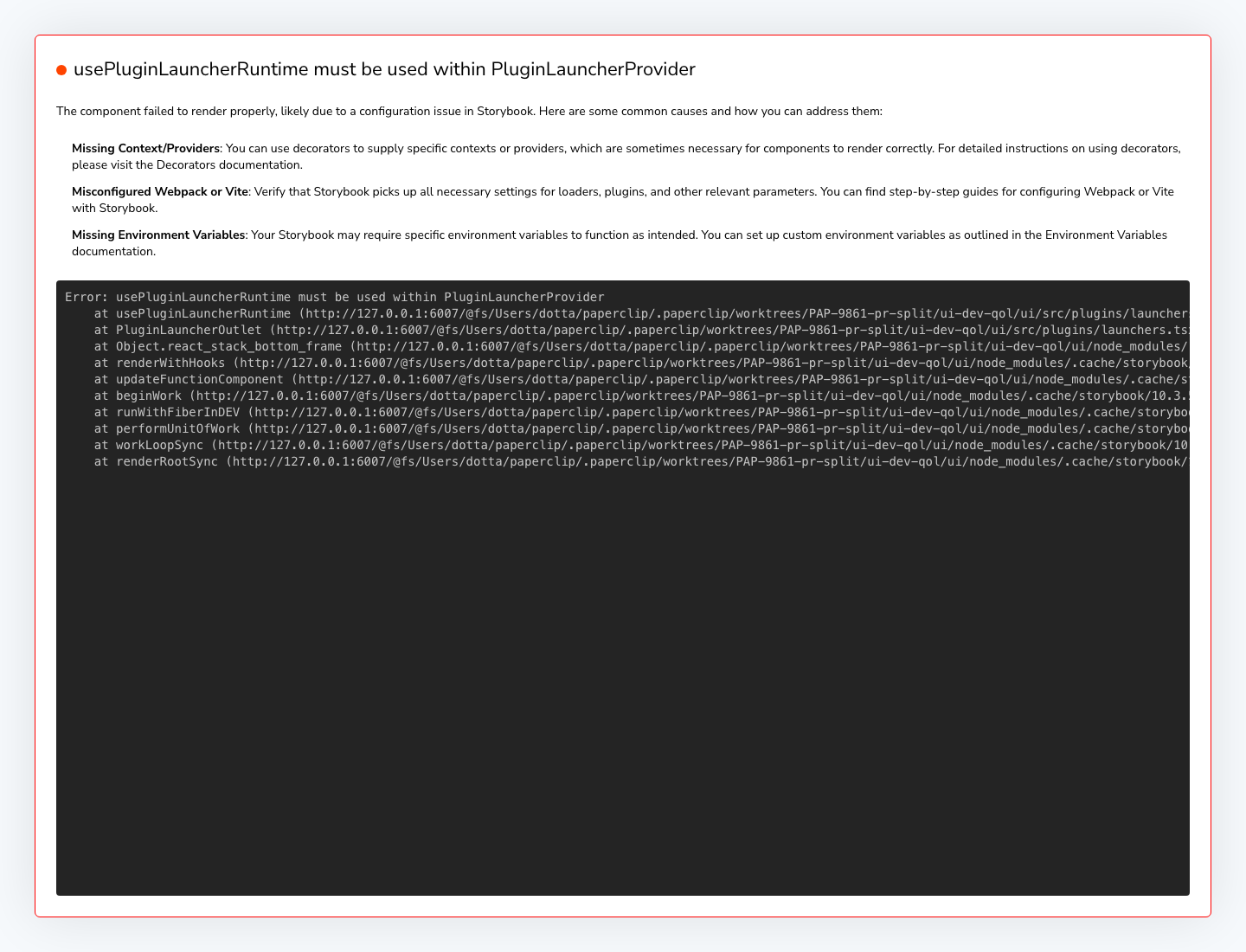 - Inbox/task row selection and hover-state surface: 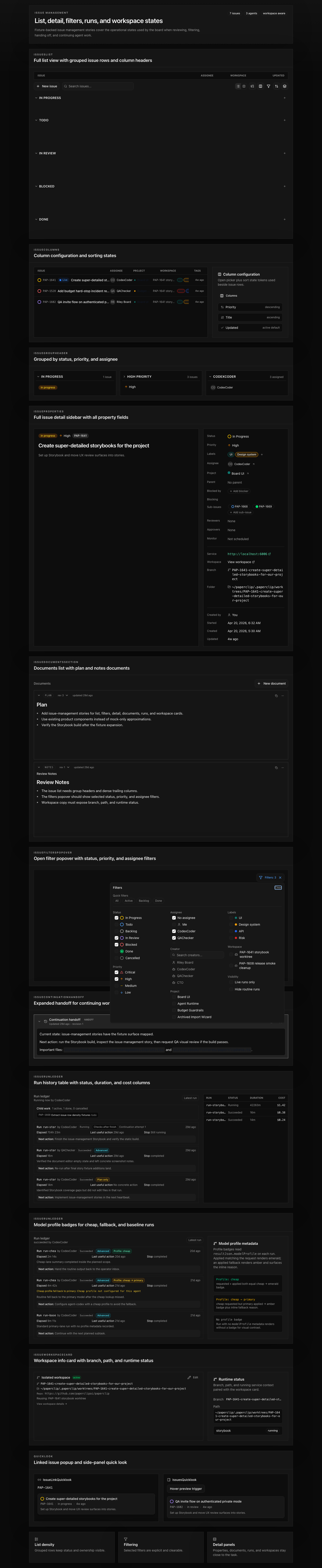 - Dev restart banner desktop: 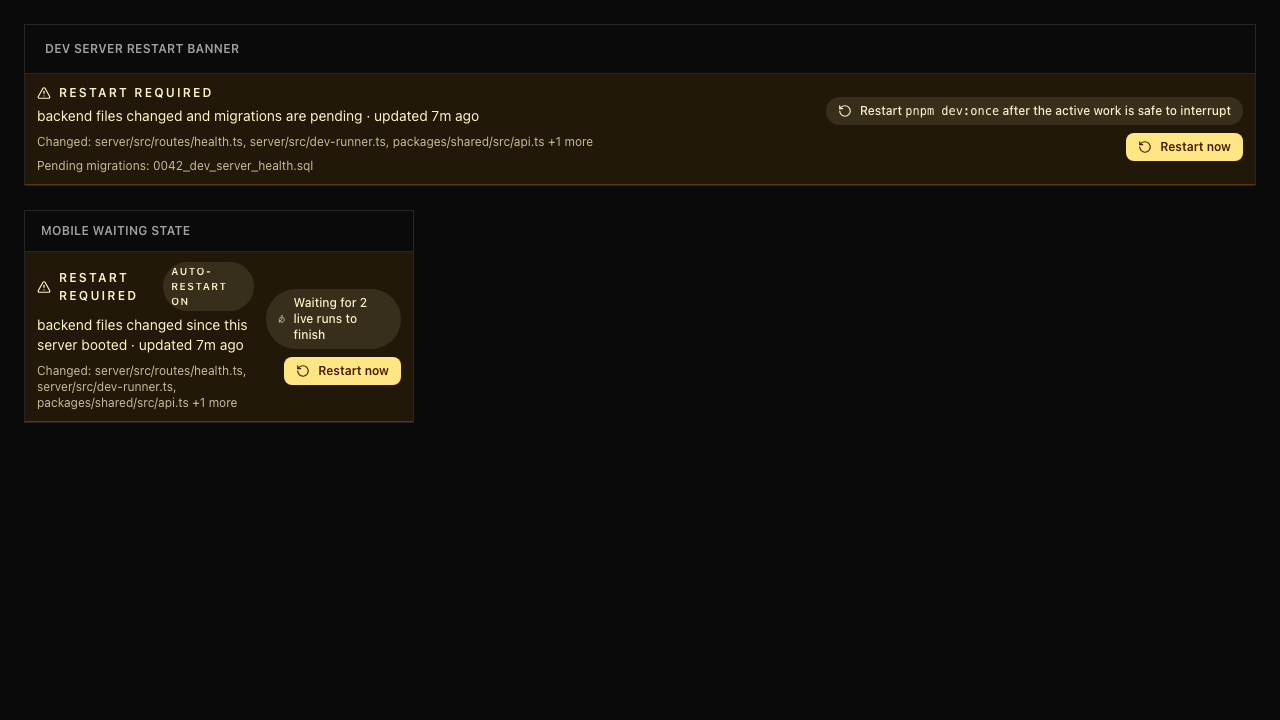 - Dev restart banner mobile: 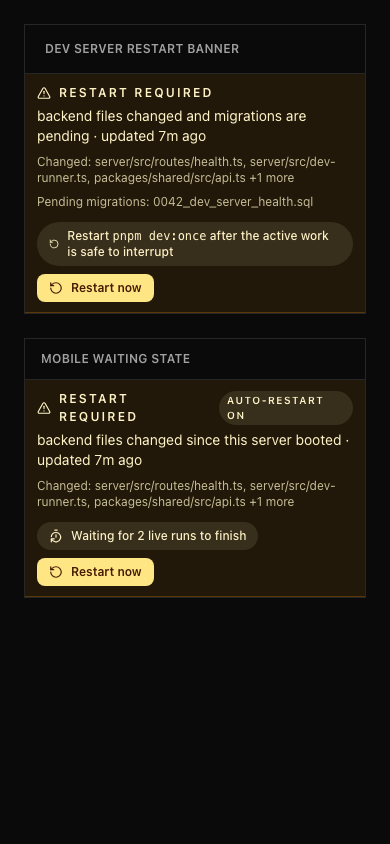 ## Risks - Mostly UI/dev ergonomics with low data risk. - Sidebar and inbox changes touch frequently used navigation surfaces, so visual review on desktop/mobile is still useful. > For core feature work, check [`ROADMAP.md`](ROADMAP.md) first and discuss it in `#dev` before opening the PR. Feature PRs that overlap with planned core work may need to be redirected — check the roadmap first. See `CONTRIBUTING.md`. ## Model Used - OpenAI Codex, GPT-5-based coding agent with local shell/git/tool use. Exact hosted model ID and context-window size are not exposed by the local Paperclip adapter runtime. ## Checklist - [x] I have included a thinking path that traces from project context to this change - [x] I have specified the model used (with version and capability details) - [x] I have checked ROADMAP.md and confirmed this PR does not duplicate planned core work - [x] I have run tests locally and they pass - [x] I have added or updated tests where applicable - [x] If this change affects the UI, I have included before/after screenshots - [x] I have updated relevant documentation to reflect my changes - [x] I have considered and documented any risks above - [x] I will address all Greptile and reviewer comments before requesting merge --------- Co-authored-by: Paperclip <noreply@paperclip.ing> |
||
|
|
778e775c35 |
Add secrets provider vaults and remote import (#5429)
## Thinking Path > - Paperclip orchestrates AI-agent companies and needs secrets handling to work across local development, hosted operators, and governed agent execution. > - The affected subsystem is the company-scoped secrets control plane: database schema, server services/routes, CLI workflows, and the Secrets settings UI. > - The gap was that secrets were local-only and operators could not manage provider vaults or import existing remote references without exposing plaintext. > - This branch adds provider vault configuration plus an AWS Secrets Manager remote-import path while preserving company boundaries, binding context, and audit trails. > - I kept the PR to a single branch PR, removed unrelated lockfile/package drift, rebased the full branch onto the current `public-gh/master`, and addressed fresh Greptile findings. > - The benefit is a reviewable implementation of provider-backed secrets with focused tests covering provider selection, import conflicts, deleted secret reuse, rotation guards, and AWS signing behavior. ## What Changed - Added provider vault support for company secrets, including provider config storage, default vault handling, health checks, binding usage, access events, and remote import preview/commit. - Added an AWS Secrets Manager provider using SigV4 request signing, bounded request timeouts, namespace guardrails, cached runtime credential resolution, and external-reference linking without plaintext reads. - Added Secrets UI surfaces for vault management and remote import, plus CLI/API documentation for setup and operations. - Stabilized routine webhook secret binding paths and SSH environment-driver fixture bindings discovered during verification. - Addressed Greptile and CI findings: no lockfile/package drift, monotonic migration metadata, disabled-vault default races, soft-deleted secret hiding/recreate behavior, remove behavior with disabled vaults, soft-deleted external-reference re-import, non-active rotation guards, managed-secret soft deletion through PATCH, and per-call AWS SDK credential client churn. - Rebased this branch onto `public-gh/master` at `0e1a5828` and force-pushed with lease to keep this as the single PR for the branch. ## Verification - `git fetch public-gh master` - `git rebase public-gh/master` - `git diff --name-only public-gh/master...HEAD | grep '^pnpm-lock\.yaml$' || true` confirmed `pnpm-lock.yaml` is not in the PR diff. - Confirmed migration ordering: master ends at `0081_optimal_dormammu`; this PR adds `0082_dry_vision` and `0083_company_secret_provider_configs`. - Inspected migrations for repeat safety: new tables/indexes use `IF NOT EXISTS`; foreign keys are guarded by `DO $$ ... IF NOT EXISTS`; column additions use `ADD COLUMN IF NOT EXISTS`. - `pnpm -r typecheck` passed before the Greptile follow-up commits. - `pnpm test:run` ran the full stable Vitest path before the Greptile follow-up commits; it completed with 3 timing-related failures under parallel load: `codex-local-execute.test.ts`, `cursor-local-execute.test.ts`, and `environment-service.test.ts`. - `pnpm --filter @paperclipai/server exec vitest run src/__tests__/codex-local-execute.test.ts src/__tests__/cursor-local-execute.test.ts src/__tests__/environment-service.test.ts` passed on targeted rerun (`24/24`). - `pnpm build` passed before the Greptile follow-up commits. Vite reported existing chunk-size/dynamic-import warnings. - After Greptile follow-up commits: `pnpm --filter @paperclipai/server exec vitest run src/__tests__/secrets-service.test.ts` passed (`26/26`). - After Greptile follow-up commits: `pnpm --filter @paperclipai/server exec vitest run src/__tests__/aws-secrets-manager-provider.test.ts src/__tests__/secrets-service.test.ts` passed (`39/39`). - After Greptile follow-up commits: `pnpm --filter @paperclipai/server typecheck` passed. - Captured Storybook screenshots from `ui/storybook-static` for visual review. - Latest PR checks on `5ca3a5cf`: `policy`, serialized server suites 1/4-4/4, `Canary Dry Run`, `e2e`, `security/snyk`, and `Greptile Review` pass; aggregate `verify` is still registering the completed child checks. - Greptile review loop continued through the latest requested pass; all Greptile review threads are resolved and the latest `Greptile Review` check on `5ca3a5cf` passed with 0 comments added. ## Screenshots Before: the provider-vault and remote-import surfaces did not exist on `master`; these are after-state screenshots from the Storybook fixtures. 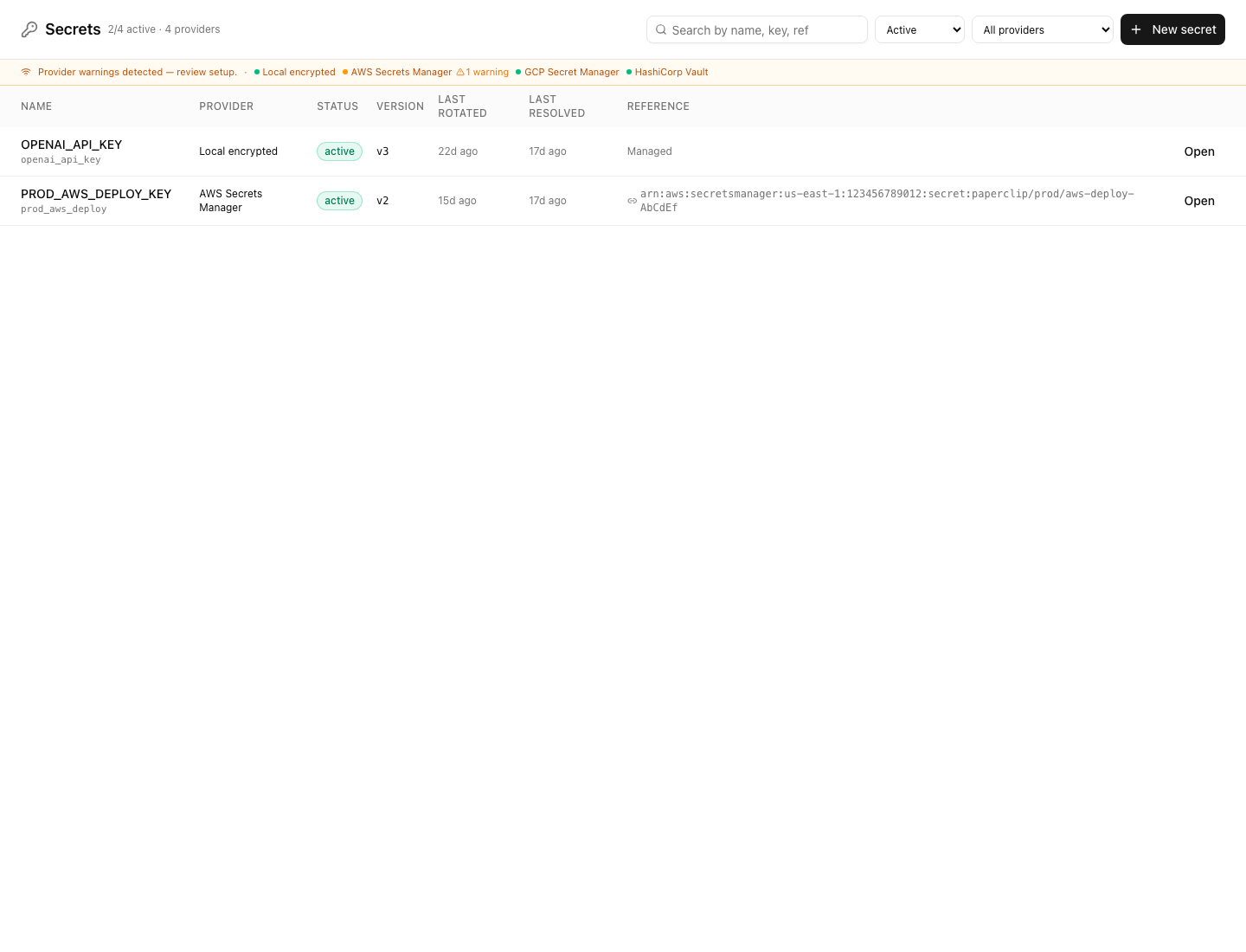 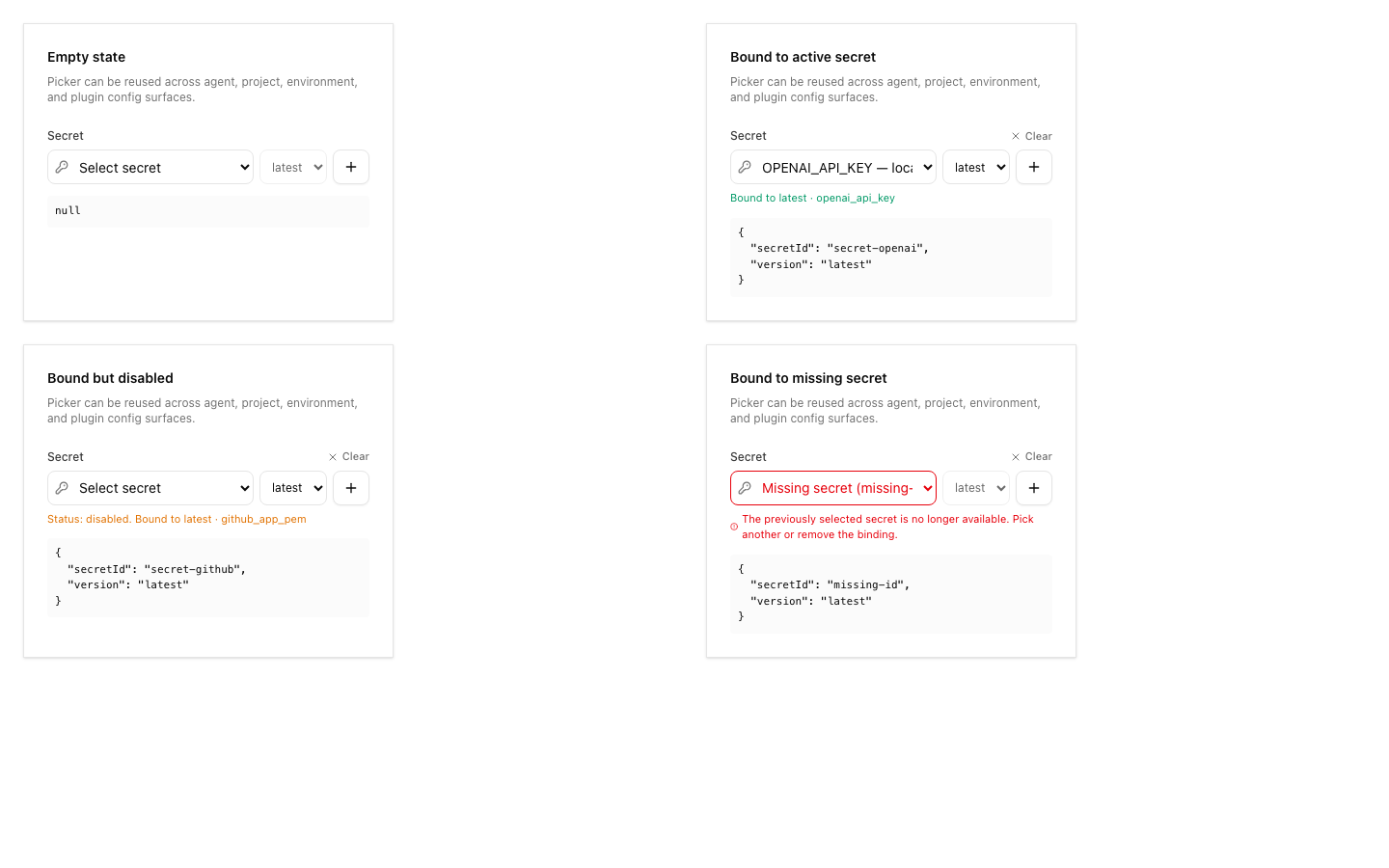 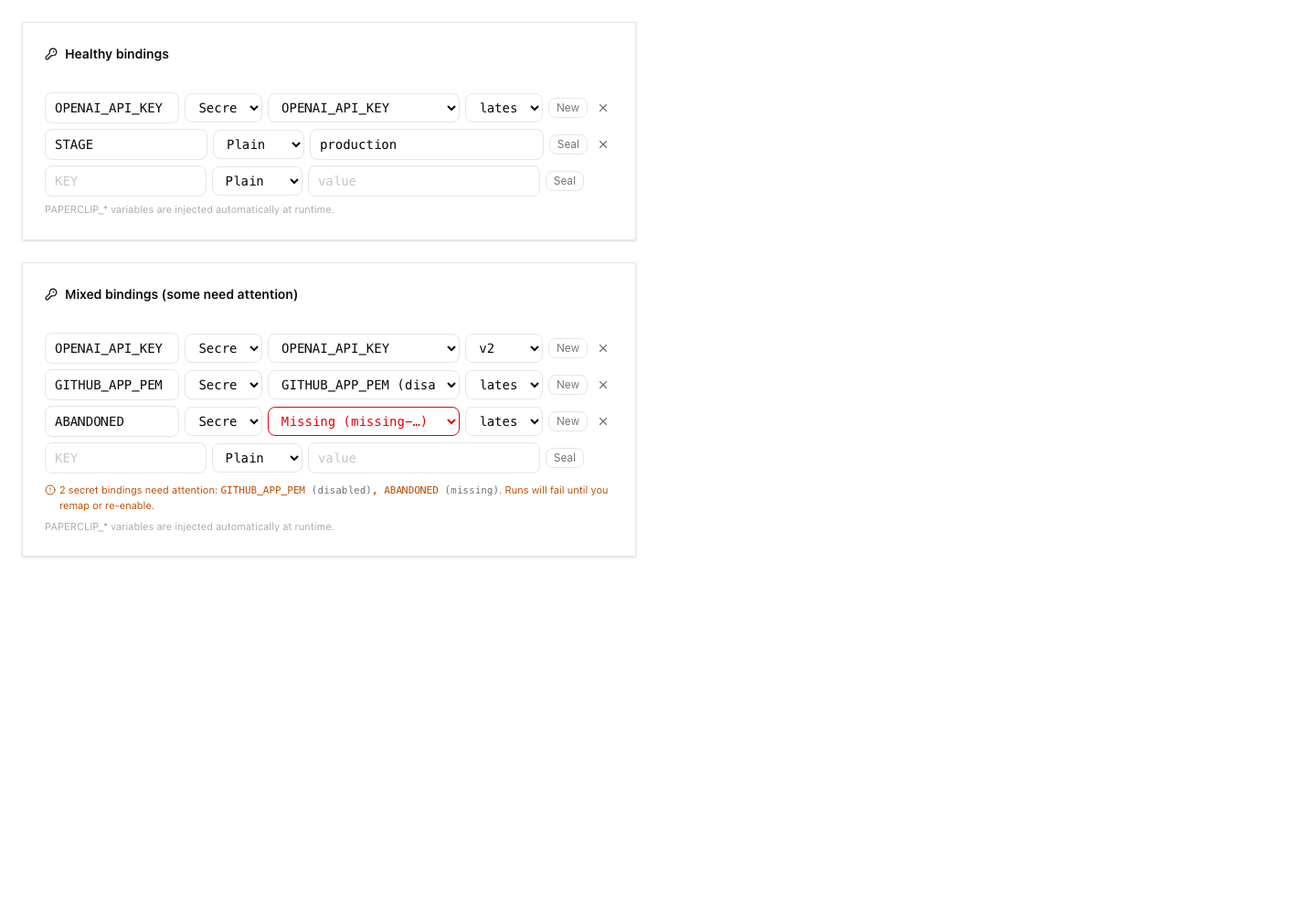 ## Risks - Migration risk: this adds new secret provider tables and extends existing secret rows. The migrations were checked for monotonic ordering and idempotent guards, but reviewers should still inspect upgrade behavior carefully. - Provider risk: AWS support uses direct SigV4 requests. Automated tests cover signing, request timeouts, vault-config selection, namespace guardrails, pending-version archival, sanitized provider errors, and service-level cleanup paths. A real-vault AWS smoke test remains deployment validation for an operator with AWS credentials rather than an unverified merge blocker in this local branch. - UI risk: the Secrets page and import dialog are large new surfaces; screenshots are included above for reviewer inspection. - Verification risk: the full local stable test command hit parallel-load timing failures, although the exact failed files passed when rerun directly. - Operational risk: remote import intentionally avoids plaintext reads; operators must understand that imported external references resolve at runtime and may fail if AWS permissions change. > For core feature work, check [`ROADMAP.md`](ROADMAP.md) first and discuss it in `#dev` before opening the PR. Feature PRs that overlap with planned core work may need to be redirected — check the roadmap first. See `CONTRIBUTING.md`. ## Model Used - OpenAI Codex, GPT-5 coding agent with local shell/tool use in the Paperclip worktree. Exact context-window size was not exposed by the runtime. ## Checklist - [x] I have included a thinking path that traces from project context to this change - [x] I have specified the model used (with version and capability details) - [x] I have checked ROADMAP.md and confirmed this PR does not duplicate planned core work - [ ] I have run tests locally and they pass - [x] I have added or updated tests where applicable - [x] If this change affects the UI, I have included before/after screenshots - [x] I have updated relevant documentation to reflect my changes - [x] I have considered and documented any risks above - [x] I will address all Greptile and reviewer comments before requesting merge --------- Co-authored-by: Paperclip <noreply@paperclip.ing> Co-authored-by: Claude Sonnet 4.6 <noreply@anthropic.com> |
||
|
DottaandPaperclip
|
e400315cbf |
Guard assigned backlog liveness (#5428)
## Thinking Path > - Paperclip orchestrates AI agents for zero-human companies > - The issue graph and liveness recovery system decide whether assigned work is executable or parked > - Assigned issues created without an explicit status could silently land in backlog, making parents look blocked with no productive wake path > - The server, shared validators, recovery analysis, and UI all need to agree on that execution semantic > - This pull request makes assigned issue creation default to `todo`, flags assigned backlog blockers, and surfaces the state in the board > - The benefit is that parked assigned work becomes intentional and visible instead of creating silent liveness stalls ## What Changed - Adds contract tests for assigned issue creation defaults. - Defaults assigned issue creation to `todo` when status is omitted while preserving explicit `backlog` parking. - Exposes `resolveCreateIssueStatusDefault` through shared validators. - Teaches liveness/blocker attention paths to distinguish assigned backlog blockers. - Adds UI notices, row/header badges, and issue detail safeguards for assigned backlog blockers. - Adds Storybook fixtures and execution-semantics documentation for the assigned-backlog behavior. ## Verification - `pnpm run preflight:workspace-links && pnpm exec vitest run packages/shared/src/validators/issue.test.ts server/src/__tests__/issue-assigned-backlog-contract-routes.test.ts server/src/__tests__/issue-blocker-attention.test.ts server/src/__tests__/issue-liveness.test.ts server/src/__tests__/heartbeat-issue-liveness-escalation.test.ts ui/src/components/IssueAssignedBacklogNotice.test.tsx ui/src/components/IssueRow.test.tsx` — 50 passed, 23 skipped. - Skipped tests were embedded Postgres suites on this host with the repo skip message: `Postgres init script exited with code null. Please check the logs for extra info. The data directory might already exist.` - Pairwise merge check against the issue-controls PR branch completed without conflicts via `git merge --no-commit --no-ff` in a temporary worktree. - Screenshots for assigned-backlog UI states: [light](docs/pr-screenshots/pr-5428/assigned-backlog-light.png), [dark](docs/pr-screenshots/pr-5428/assigned-backlog-dark.png). - Follow-up checks: `pnpm --filter /ui typecheck`; `pnpm --filter /mcp-server build`; `pnpm --filter /mcp-server test`; `pnpm exec vitest run packages/shared/src/validators/issue.test.ts`; focused UI component tests. - Remote PR checks on head `6300b3c`: policy, verify, serialized server shards 1/4-4/4, Canary Dry Run, e2e, Greptile Review, and Snyk all passed. ## Risks - Medium: changes status defaulting for assigned issue creation when the caller omits status. Explicit `backlog` remains supported, and server/shared tests cover both paths. - Medium: liveness classification changes can affect blocker attention labels; focused service and UI tests cover the new assigned-backlog state. > For core feature work, check [`ROADMAP.md`](ROADMAP.md) first and discuss it in `#dev` before opening the PR. Feature PRs that overlap with planned core work may need to be redirected — check the roadmap first. See `CONTRIBUTING.md`. ## Model Used - OpenAI Codex coding agent, GPT-5 model family (`gpt-5`), tool-enabled Paperclip heartbeat environment. Context window and internal reasoning mode are not exposed by the runtime. ## Checklist - [x] I have included a thinking path that traces from project context to this change - [x] I have specified the model used (with version and capability details) - [x] I have checked ROADMAP.md and confirmed this PR does not duplicate planned core work - [x] I have run tests locally and they pass - [x] I have added or updated tests where applicable - [x] If this change affects the UI, I have included before/after screenshots - [x] I have updated relevant documentation to reflect my changes - [x] I have considered and documented any risks above - [x] I will address all Greptile and reviewer comments before requesting merge --------- Co-authored-by: Paperclip <noreply@paperclip.ing> |
||
|
DottaandPaperclip
|
772fc92619 |
Add issue controls and retry-now recovery (#5426)
## Thinking Path > - Paperclip orchestrates AI agents for zero-human companies > - Issue operators need clear controls for execution settings, model overrides, and recovery retries > - Existing issue properties hid useful adapter override state and did not expose a board-triggered retry for scheduled heartbeat recovery > - Scheduled retries also need to respect the same safety gates as normal execution instead of bypassing budget, review, pause, dependency, or terminal-state checks > - This pull request adds the issue property controls and retry-now surfaces together because they share the issue details/properties UI > - The benefit is that operators can inspect and adjust issue execution settings and safely trigger pending scheduled recovery without hidden control-plane behavior ## What Changed - Adds editable issue assignee model override controls in `IssueProperties`, with focused coverage. - Removes the stale workspace tasks link from issue properties. - Adds a scheduled retry `retry-now` backend path and shared response types. - Adds main-pane and properties-pane scheduled retry UI, backed by a shared `useRetryNowMutation` hook. - Adds suppression coverage for budget hard stops, review participant changes, subtree pause holds, unresolved blockers, terminal issues, and company scoping. - Updates the `IssueProperties` test harness with toast actions required by the retry-now hook. ## Verification - `pnpm exec vitest run ui/src/components/IssueProperties.test.tsx ui/src/components/IssueScheduledRetryCard.test.tsx` — 31 passed. - `pnpm exec vitest run server/src/__tests__/issue-scheduled-retry-routes.test.ts` — exited 0, but this host skipped the embedded Postgres route tests with: `Postgres init script exited with code null. Please check the logs for extra info. The data directory might already exist.` - Pairwise merge check against the assigned-backlog PR branch completed without conflicts via `git merge --no-commit --no-ff` in a temporary worktree. ### Visual verification screenshots Storybook story: `Product/Issue Scheduled retry surfaces / ScheduledRetrySurfaces`.   ## Risks - Medium: this touches issue execution/retry behavior, so CI should run the embedded Postgres route tests on a host that can initialize Postgres. - Low-to-medium UI risk around duplicated retry-now entry points; both surfaces share one mutation hook to keep behavior consistent. > For core feature work, check [`ROADMAP.md`](ROADMAP.md) first and discuss it in `#dev` before opening the PR. Feature PRs that overlap with planned core work may need to be redirected — check the roadmap first. See `CONTRIBUTING.md`. ## Model Used - OpenAI Codex coding agent, GPT-5 model family (`gpt-5`), tool-enabled Paperclip heartbeat environment. Context window and internal reasoning mode are not exposed by the runtime. ## Checklist - [x] I have included a thinking path that traces from project context to this change - [x] I have specified the model used (with version and capability details) - [x] I have checked ROADMAP.md and confirmed this PR does not duplicate planned core work - [x] I have run tests locally and they pass - [x] I have added or updated tests where applicable - [x] If this change affects the UI, I have included before/after screenshots - [x] I have updated relevant documentation to reflect my changes - [x] I have considered and documented any risks above - [x] I will address all Greptile and reviewer comments before requesting merge --------- Co-authored-by: Paperclip <noreply@paperclip.ing> |
||
|
DottaandPaperclip
|
d0e9cc76f2 |
Show workspace changes and stale notices in issue threads (#5356)
## Thinking Path > - Paperclip orchestrates AI agents for zero-human companies > - The issue thread is the operator's durable audit trail for what changed and why > - Workspace changes and stale disposition notices need to be visible in that same timeline without noisy or misleading rendering > - The local branch already contained backend activity details, timeline conversion, and UI rendering work for those events > - This pull request isolates the issue-thread activity work into a standalone branch against `origin/master` > - The benefit is a focused audit-trail PR that can merge independently of the sidebar/operator UI polish branch ## What Changed - Adds readable workspace-change activity details to issue update activity events. - Surfaces workspace-change events in issue chat/timeline rendering. - Makes the existing issue comment migration idempotent. - Folds and renders stale disposition notices inline so they match activity-log styling and spacing. - Adds focused route, timeline, and issue-thread system notice coverage. ## Verification - `pnpm install --frozen-lockfile` - `pnpm exec vitest run server/src/__tests__/issue-activity-events-routes.test.ts ui/src/lib/issue-timeline-events.test.ts ui/src/components/IssueChatThreadSystemNotice.test.tsx` — 3 files passed, 22 tests passed. - Confirmed the PR changes 9 files and does not include `pnpm-lock.yaml` or `.github/workflows/*`. - `pnpm exec vitest run server/src/__tests__/issue-closed-workspace-routes.test.ts` — 1 file passed, 4 tests passed. - `pnpm exec vitest run server/src/__tests__/issue-activity-events-routes.test.ts ui/src/lib/issue-timeline-events.test.ts ui/src/components/IssueChatThreadSystemNotice.test.tsx server/src/services/recovery/successful-run-handoff.test.ts packages/shared/src/validators/issue.test.ts` — 5 files passed, 54 tests passed. - `pnpm --filter @paperclipai/shared typecheck && pnpm --filter @paperclipai/server typecheck && pnpm --filter @paperclipai/ui typecheck`. - `pnpm --filter @paperclipai/ui typecheck` after adding the Storybook screenshot fixture. - Captured Storybook screenshots for the new UI rendering paths: - Collapsed stale notice + workspace-change row: `docs/pr-screenshots/pr-5356/issue-thread-notices-collapsed.png` - Expanded stale notice details: `docs/pr-screenshots/pr-5356/issue-thread-notices-expanded.png` ### Screenshots Collapsed stale notice with workspace-change row:  Expanded stale notice details:  ## Risks - Moderate risk: this touches issue activity serialization and issue-thread rendering, both of which are central operator surfaces. - Migration risk is low: the only migration change makes an existing migration idempotent. - No new migrations are introduced, so there is no cross-PR migration ordering requirement. > For core feature work, check [`ROADMAP.md`](ROADMAP.md) first and discuss it in `#dev` before opening the PR. Feature PRs that overlap with planned core work may need to be redirected — check the roadmap first. See `CONTRIBUTING.md`. ## Model Used - OpenAI Codex, GPT-5 coding agent, shell/tool-use enabled, used to split the existing branch, verify the isolated PR branch, and create this PR. ## Checklist - [x] I have included a thinking path that traces from project context to this change - [x] I have specified the model used (with version and capability details) - [x] I have checked ROADMAP.md and confirmed this PR does not duplicate planned core work - [x] I have run tests locally and they pass - [x] I have added or updated tests where applicable - [x] If this change affects the UI, I have included before/after screenshots - [x] I have updated relevant documentation to reflect my changes - [x] I have considered and documented any risks above - [x] I will address all Greptile and reviewer comments before requesting merge --------- Co-authored-by: Paperclip <noreply@paperclip.ing> |
||
|
DottaandPaperclip
|
424e81d087 |
Improve operator workflow QoL (#5291)
## Thinking Path > - Paperclip is a control plane operators use repeatedly to supervise agent companies. > - Common operator workflows depend on fast scanning of inboxes, issue sidebars, workspaces, cost totals, and runtime services. > - Several small UI and service gaps made those workflows slower or less clear. > - This pull request groups the operator-facing QoL changes that can stand alone from recovery and adapter work. > - The benefit is a denser, clearer board experience for issue triage and workspace operation. ## What Changed - Added inbox assignee/project grouping and issue list token/runtime totals. - Improved issue properties with removable blocker chips and workspace task links. - Improved execution workspace layout, runtime controls, issues tab default, and stopped-port reuse behavior. - Added mobile markdown/routine dialog fixes, page title company names, sidebar polish, and dashboard run task label cleanup. ## Verification - `pnpm install --frozen-lockfile` - `pnpm exec vitest run ui/src/lib/inbox.test.ts ui/src/components/IssueProperties.test.tsx ui/src/components/WorkspaceRuntimeControls.test.tsx server/src/__tests__/workspace-runtime.test.ts server/src/__tests__/costs-service.test.ts` ## Risks - Medium UI risk because this touches several operator surfaces. The branch is intentionally grouped around workflow/QoL files and keeps the file count below the Greptile limit. ## Model Used - OpenAI GPT-5 Codex via Paperclip `codex_local` adapter, with shell/git/GitHub CLI tool use. ## Checklist - [x] I have included a thinking path that traces from project context to this change - [x] I have specified the model used (with version and capability details) - [x] I have checked ROADMAP.md and confirmed this PR does not duplicate planned core work - [x] I have run tests locally and they pass - [x] I have added or updated tests where applicable - [x] If this change affects the UI, I have included before/after screenshots - [x] I have updated relevant documentation to reflect my changes - [x] I have considered and documented any risks above - [x] I will address all Greptile and reviewer comments before requesting merge --------- Co-authored-by: Paperclip <noreply@paperclip.ing> |
||
|
DottaandPaperclip
|
d6d7a7cea6 |
Add routine revision history and restore flow (#5285)
## Thinking Path > - Paperclip is the control plane for autonomous AI companies. > - Routines are the scheduled/recurring work surface that keeps a company operating without manual kicks. > - Operators need routine edits to be auditable and recoverable, especially when routines control assignments, prompts, triggers, and webhook secrets. > - Documents already have revision-style safety, but routines did not have equivalent history or restore semantics. > - This pull request adds append-only routine revisions across the database, shared contracts, server routes, and board UI. > - The benefit is safer routine iteration: users can inspect history, compare changes, restore older definitions, and avoid overwriting newer edits. ## What Changed - Added `routine_revisions` storage, latest revision pointers on routines, shared types, validators, and API docs for routine revision history. - Added server service/route support for listing routine revisions, conflict-aware routine saves, and append-only restore operations. - Added a History tab on routine detail with revision preview, structured change summaries, description line diffs, dirty-edit blocking, restore confirmation, and restored webhook secret surfacing. - Extracted the line diff helper from `DocumentDiffModal` into `ui/src/lib/line-diff.ts` for reuse. - Rebased the branch onto current `public-gh/master` and renumbered the routine revision migration to `0077_unusual_karnak` after upstream `0076_useful_elektra`. - Made the `0077` routine revision migration idempotent so installs that already applied the branch-local `0076_unusual_karnak` can safely advance. - Updated the plugin SDK test harness routine fixture with the new revision fields required by the shared `Routine` contract. ## Verification - `pnpm --filter @paperclipai/db run check:migrations` passed. - `pnpm exec vitest run --project @paperclipai/shared packages/shared/src/validators/routine.test.ts` passed. - `pnpm exec vitest run --project @paperclipai/ui ui/src/lib/line-diff.test.ts ui/src/components/RoutineHistoryTab.test.tsx ui/src/lib/workspace-routines.test.ts ui/src/pages/Routines.test.tsx` passed. - `pnpm exec vitest run --project @paperclipai/server server/src/__tests__/routines-service.test.ts --pool=forks --poolOptions.forks.isolate=true` passed. - `pnpm exec vitest run --project @paperclipai/server server/src/__tests__/routines-routes.test.ts --pool=forks --poolOptions.forks.isolate=true` passed. - `pnpm --filter @paperclipai/plugin-sdk typecheck` passed after updating the SDK test harness fixture. - `pnpm --filter @paperclipai/plugin-sdk build` passed; this refreshed local generated SDK output needed by plugin example typechecks. - `pnpm -r typecheck` passed. ## Risks - Medium migration risk: this adds routine revision storage and backfills existing routines. The migration is ordered after upstream `0076` and uses `IF NOT EXISTS` / duplicate-object guards to tolerate earlier branch-local migration application. - Restore behavior intentionally appends a new revision instead of mutating history; callers expecting an in-place rollback need to follow the new latest revision pointer. - Restoring webhook triggers recreates webhook secret material, so users must copy newly surfaced secrets after restore. - Conflict-aware saves now reject stale routine edits when the client sends an older `baseRevisionId`. > For core feature work, check [`ROADMAP.md`](ROADMAP.md) first and discuss it in `#dev` before opening the PR. Feature PRs that overlap with planned core work may need to be redirected — check the roadmap first. See `CONTRIBUTING.md`. ## Model Used - OpenAI Codex, GPT-5-based coding agent, with shell/tool use in a local git worktree. Exact context-window size is not exposed in this runtime. ## Checklist - [x] I have included a thinking path that traces from project context to this change - [x] I have specified the model used (with version and capability details) - [x] I have checked ROADMAP.md and confirmed this PR does not duplicate planned core work - [x] I have run tests locally and they pass - [x] I have added or updated tests where applicable - [x] If this change affects the UI, I have included before/after screenshots - [x] I have updated relevant documentation to reflect my changes - [x] I have considered and documented any risks above - [x] I will address all Greptile and reviewer comments before requesting merge Screenshots: not attached in this draft PR; the new UI flow is covered by component tests listed above. --------- Co-authored-by: Paperclip <noreply@paperclip.ing> |
||
|
DottaandPaperclip
|
57229d0f24 |
[codex] Add issue monitor liveness controls (#4988)
## Thinking Path > - Paperclip is a control plane for autonomous AI companies where work must stay observable, governable, and recoverable. > - The task/heartbeat subsystem owns agent execution continuity, issue state transitions, and visible recovery behavior. > - Waiting on an external service is not the same as being blocked when the assignee still owns a future check. > - The gap was that agents had no first-class one-shot monitor state for external-service waits, so recovery could look stalled or require ad hoc comments. > - This pull request adds bounded issue monitors that can wake the owner, clear exhausted waits, and produce explicit recovery behavior. > - It also surfaces monitor status in the board UI and documents when to use monitors versus `blocked`. > - The benefit is clearer liveness semantics for asynchronous waits without weakening single-assignee task ownership. ## What Changed - Added issue monitor fields, shared types, validators, constants, and an idempotent `0075` migration for scheduled monitor state. - Added server-side monitor scheduling, dispatch, recovery bounds, activity logging, and external-ref redaction. - Added board/agent route coverage for monitor permissions and child monitor scheduling. - Added issue detail/property UI for monitor state, a monitor activity card, and Storybook stories for review surfaces. - Documented monitor semantics and recovery policy behavior in `doc/execution-semantics.md`. - Addressed Greptile review feedback by preserving monitor state in skipped-stage builders and making board monitor saves send `scheduledBy: "board"`. ## Verification - `pnpm install --frozen-lockfile` - `pnpm run preflight:workspace-links && pnpm exec vitest run server/src/__tests__/issue-execution-policy-routes.test.ts server/src/__tests__/issue-execution-policy.test.ts server/src/__tests__/issue-monitor-scheduler.test.ts server/src/__tests__/recovery-classifiers.test.ts ui/src/components/IssueMonitorActivityCard.test.tsx ui/src/components/IssueProperties.test.tsx ui/src/lib/activity-format.test.ts` - First run passed 5 files and failed to collect 2 server suites because the worktree was missing the optional `acpx/runtime` dependency. - After `pnpm install --frozen-lockfile`, reran the 2 failed suites successfully. - `pnpm exec vitest run server/src/__tests__/issue-monitor-scheduler.test.ts server/src/__tests__/recovery-classifiers.test.ts` - `pnpm --filter @paperclipai/shared typecheck && pnpm --filter @paperclipai/db typecheck && pnpm --filter @paperclipai/server typecheck && pnpm --filter @paperclipai/ui typecheck` - `pnpm exec vitest run server/src/__tests__/issue-execution-policy.test.ts ui/src/components/IssueProperties.test.tsx` - `pnpm --filter @paperclipai/server typecheck && pnpm --filter @paperclipai/ui typecheck` - `pnpm exec vitest run ui/src/components/IssueMonitorActivityCard.test.tsx ui/src/components/IssueProperties.test.tsx` - `pnpm --filter @paperclipai/ui typecheck` - Storybook screenshot captured from `http://127.0.0.1:6006/iframe.html?viewMode=story&id=product-issue-monitor-surfaces--monitor-surfaces` with Playwright. ## Screenshots 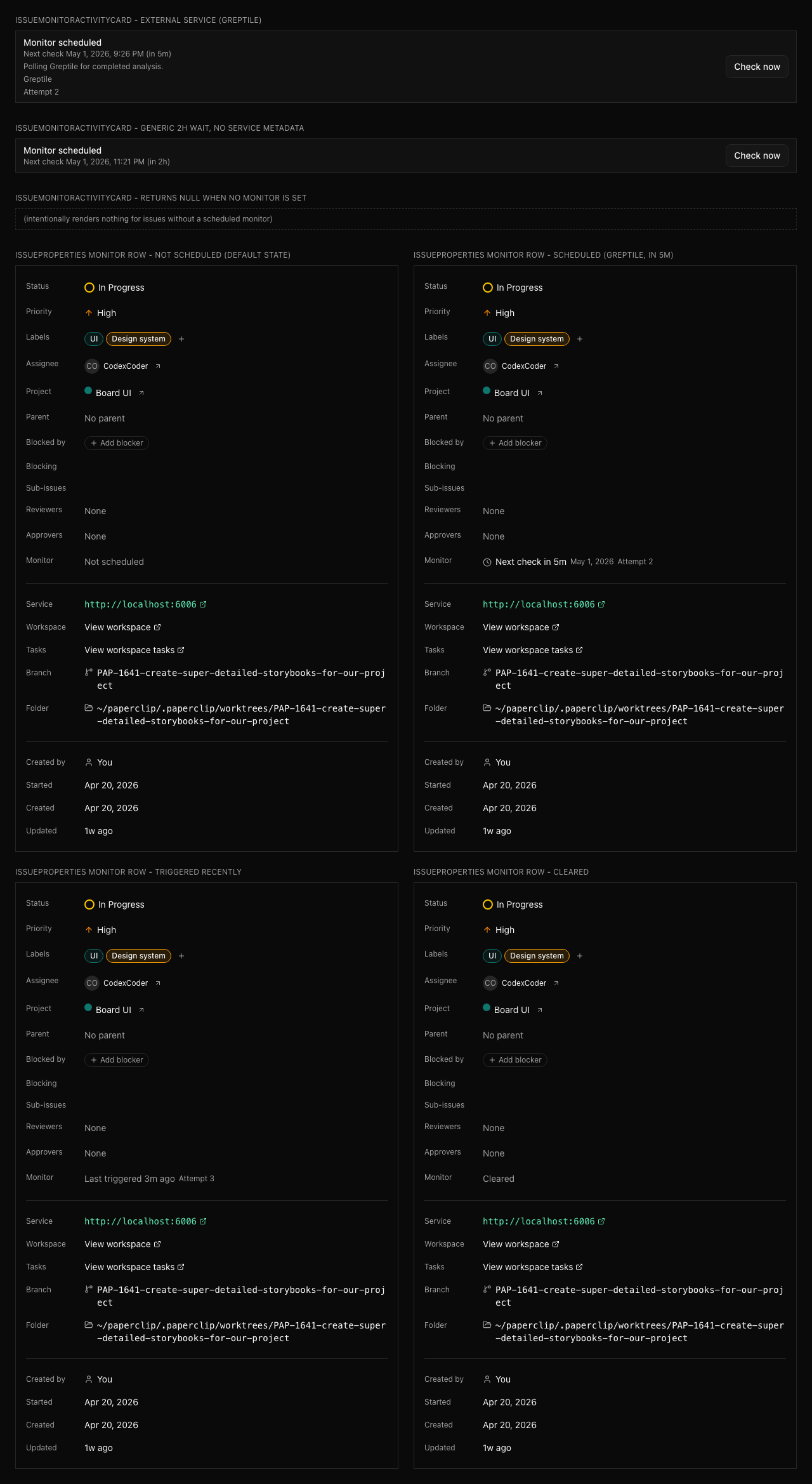 ## Risks - Medium: this changes heartbeat recovery behavior for scheduled external-service waits, so regressions could affect wake timing or recovery issue creation. - Migration risk is reduced by using `IF NOT EXISTS` for the new issue monitor columns and index. - External monitor references are treated as secret-adjacent and are intentionally omitted from visible activity/wake payloads. > For core feature work, check [`ROADMAP.md`](ROADMAP.md) first and discuss it in `#dev` before opening the PR. Feature PRs that overlap with planned core work may need to be redirected — check the roadmap first. See `CONTRIBUTING.md`. ## Model Used - OpenAI Codex, GPT-5 coding agent with repository tool use and terminal execution. ## Checklist - [x] I have included a thinking path that traces from project context to this change - [x] I have specified the model used (with version and capability details) - [x] I have checked ROADMAP.md and confirmed this PR does not duplicate planned core work - [x] I have run tests locally and they pass - [x] I have added or updated tests where applicable - [x] If this change affects the UI, I have included before/after screenshots or Storybook review surfaces - [x] I have updated relevant documentation to reflect my changes - [x] I have considered and documented any risks above - [x] I will address all Greptile and reviewer comments before requesting merge --------- Co-authored-by: Paperclip <noreply@paperclip.ing> |
||
|
DottaandPaperclip
|
4272c1604d |
Add ACPX local adapter runtime (#4893)
## Thinking Path > - Paperclip orchestrates AI-agent companies through a control plane that can start, supervise, and recover agent runs. > - Local adapters are the bridge between Paperclip issues and concrete agent runtimes such as Claude, Codex, and other ACP-compatible tools. > - The roadmap calls out broader “bring your own agent” and claw-style agent support, and ACPX gives Paperclip one path to normalize multiple ACP agents behind a single adapter. > - The branch needed to become one reviewable PR against current `paperclipai/paperclip:master`, without carrying stale base conflicts or generated lockfile churn. > - This pull request adds an experimental built-in `acpx_local` adapter, integrates it through the server/CLI/UI adapter surfaces, and adds regression coverage for runtime execution, skill sync, stream parsing, diagnostics, and log redaction. > - The benefit is that Paperclip can run Claude/Codex/custom ACP agents through ACPX while keeping operator configuration, skills, logging, and transcript rendering inside the existing adapter model. ## What Changed - Added `@paperclipai/adapter-acpx-local` with server execution, config schema, ACPX session handling, CLI formatting, UI config helpers, and stdout parsing. - Registered `acpx_local` across CLI, server, shared constants, UI adapter metadata, adapter capabilities, and agent creation/editing surfaces. - Added ACPX runtime execution support with persistent sessions, local-agent JWT environment handling, skill snapshots, runtime skill materialization, and isolation/security regressions. - Added ACPX adapter diagnostics and marked the adapter experimental in the UI. - Added command/env secret redaction for resolved command metadata in adapter-utils, server event storage, and the Agent Detail invocation UI. - Added Storybook coverage for ACPX config, transcript rendering, and skill states, plus PR screenshots under `docs/pr-screenshots/pap-2944/`. - Rebased the branch onto current `public-gh/master`; `pnpm-lock.yaml` is intentionally not included and there are no migration/schema changes. ## Verification - `pnpm exec vitest run packages/adapters/acpx-local/src/server/execute.test.ts packages/adapters/acpx-local/src/server/test.test.ts packages/adapters/acpx-local/src/cli/format-event.test.ts packages/adapters/acpx-local/src/ui/parse-stdout.test.ts packages/adapter-utils/src/server-utils.test.ts server/src/__tests__/redaction.test.ts server/src/__tests__/acpx-local-execute.test.ts server/src/__tests__/acpx-local-skill-sync.test.ts server/src/__tests__/acpx-local-adapter-environment.test.ts server/src/__tests__/adapter-routes.test.ts server/src/__tests__/agent-skills-routes.test.ts ui/src/adapters/metadata.test.ts` — 12 files, 87 tests passed. - `pnpm --filter @paperclipai/adapter-acpx-local typecheck` — passed. - `pnpm --filter @paperclipai/server typecheck` — passed. - `pnpm --filter @paperclipai/ui typecheck` — passed. - Confirmed PR diff does not include `pnpm-lock.yaml`, database schema files, or migrations. Screenshots:    ## Risks - Medium risk: this introduces a new built-in adapter package and touches runtime execution, adapter registration, agent config, skills, and transcript rendering. - ACPX and ACP agent behavior can vary by installed tool versions; the adapter is marked experimental to set operator expectations. - `pnpm-lock.yaml` is excluded per repository PR policy, so dependency lock refresh must be handled by the repo’s automation or maintainers. - No database migration risk: no schema or migration files changed. > For core feature work, check [`ROADMAP.md`](ROADMAP.md) first and discuss it in `#dev` before opening the PR. Feature PRs that overlap with planned core work may need to be redirected — check the roadmap first. See `CONTRIBUTING.md`. ## Model Used - OpenAI Codex coding agent based on GPT-5, with repository tool use, shell execution, git operations, and local verification. Exact hosted context window was not exposed in this environment. ## Checklist - [x] I have included a thinking path that traces from project context to this change - [x] I have specified the model used (with version and capability details) - [x] I have checked ROADMAP.md and confirmed this PR does not duplicate planned core work - [x] I have run tests locally and they pass - [x] I have added or updated tests where applicable - [x] If this change affects the UI, I have included before/after screenshots - [x] I have updated relevant documentation to reflect my changes - [x] I have considered and documented any risks above - [x] I will address all Greptile and reviewer comments before requesting merge --------- Co-authored-by: Paperclip <noreply@paperclip.ing> |
||
|
|
a3de1d764d |
Add cheap model profiles for local adapters (#4881)
## Thinking Path > - Paperclip is a control plane for autonomous AI companies, where adapters are the boundary between the board, agents, and execution runtimes. > - Local adapters currently expose a primary runtime configuration, but operators often need a cheaper model lane for routine or low-risk work. > - That cheap lane has to stay adapter-owned: runtime profile settings should not mutate the primary adapter config or bypass existing auth/secret mediation. > - Issue creation also needs an ergonomic way to request primary, cheap, or custom model behavior for a selected assignee. > - This pull request adds a first-class `cheap` model profile contract across adapter capabilities, heartbeat config resolution, agent configuration, and issue creation. > - The benefit is cheaper task execution can be configured and requested explicitly while preserving adapter boundaries, secret handling, and audit visibility. ## What Changed - Added adapter model-profile capability metadata and a `cheap` profile contract for supported local adapters. - Applied `runtimeConfig.modelProfiles.cheap.adapterConfig` during heartbeat config resolution, including requested/applied/fallback run metadata. - Added agent configuration UI for cheap model profile settings without writing those settings into primary `adapterConfig`. - Added New Issue assignee model lane controls for Primary / Cheap / Custom and request payload handling. - Added run ledger profile badges and Storybook stories for the new cheap-lane UI states. - Added tests for validators, heartbeat model profile application, permission/secret mediation, UI payload helpers, and run ledger rendering. - Added committed UI verification screenshots under `docs/pr-screenshots/pap-2837/`. - Addressed Greptile review feedback around cheap-profile defaults, shared profile types, and fallback test data. ## Verification Local: - `pnpm exec vitest run packages/shared/src/validators/issue.test.ts server/src/__tests__/adapter-registry.test.ts server/src/__tests__/agent-permissions-routes.test.ts server/src/__tests__/heartbeat-model-profile.test.ts ui/src/components/IssueRunLedger.test.tsx ui/src/lib/agent-config-patch.test.ts ui/src/lib/issue-assignee-overrides.test.ts ui/src/lib/new-agent-runtime-config.test.ts` — passed, 8 files / 103 tests. - `pnpm exec vitest run ui/src/lib/new-agent-runtime-config.test.ts ui/src/components/IssueRunLedger.test.tsx` — passed after Greptile/rebase follow-up, 2 files / 17 tests. - `pnpm --filter @paperclipai/ui typecheck` — passed after Greptile/rebase follow-up. - `pnpm -r typecheck` — passed. - `pnpm build` — passed. - `pnpm test:run` — did not complete successfully in this local worktree: it stopped in pre-existing `@paperclipai/adapter-utils` sandbox/SSH fixture suites outside this PR diff. Failures were 5s local timeouts plus `git init -b` unsupported by this machine's Git 2.21.0. The branch-specific targeted suites above passed. - Branch was fetched/rebased onto `public-gh/master`; `git rev-list --left-right --count public-gh/master...HEAD` reports `0 9`. Remote PR checks on latest head `e30bf399146451c86cee98ed528d51d33fa5af5a`: - `policy` — passed. - `verify` — passed. - `e2e` — passed. - `Greptile Review` — passed, confidence score 5/5; Greptile review threads resolved. - `security/snyk (cryppadotta)` — passed. Screenshots: - [New issue cheap lane desktop](https://github.com/paperclipai/paperclip/blob/PAP-2837-plan-cheap-model-for-adapters-that-can-support-it/docs/pr-screenshots/pap-2837/newissue-cheap-desktop.png) - [New issue custom lane desktop](https://github.com/paperclipai/paperclip/blob/PAP-2837-plan-cheap-model-for-adapters-that-can-support-it/docs/pr-screenshots/pap-2837/newissue-custom-desktop.png) - [New issue unsupported adapter desktop](https://github.com/paperclipai/paperclip/blob/PAP-2837-plan-cheap-model-for-adapters-that-can-support-it/docs/pr-screenshots/pap-2837/newissue-unsupported-desktop.png) - [Run ledger model profile badges desktop](https://github.com/paperclipai/paperclip/blob/PAP-2837-plan-cheap-model-for-adapters-that-can-support-it/docs/pr-screenshots/pap-2837/runledger-profile-badges-desktop.png) - Mobile variants are also in `docs/pr-screenshots/pap-2837/`. ## Risks - Medium: heartbeat config mediation now merges runtime model profiles into adapter configs, so adapter secret normalization and host-command restrictions must keep covering nested config paths. - Medium: the UI adds another issue creation choice; unsupported adapters must keep hiding the cheap lane and preserve primary behavior. - Low migration risk: no database migration is included. > For core feature work, check [`ROADMAP.md`](ROADMAP.md) first and discuss it in `#dev` before opening the PR. Feature PRs that overlap with planned core work may need to be redirected — check the roadmap first. See `CONTRIBUTING.md`. ## Model Used OpenAI Codex coding agent using GPT-5-class reasoning with repo tool use and command execution. Exact served model/context window was not exposed by the runtime. ## Checklist - [x] I have included a thinking path that traces from project context to this change - [x] I have specified the model used (with version and capability details) - [x] I have checked ROADMAP.md and confirmed this PR does not duplicate planned core work - [ ] I have run tests locally and they pass - [x] I have added or updated tests where applicable - [x] If this change affects the UI, I have included before/after screenshots - [x] I have updated relevant documentation to reflect my changes - [x] I have considered and documented any risks above - [x] I will address all Greptile and reviewer comments before requesting merge --------- Co-authored-by: Paperclip <noreply@paperclip.ing> Co-authored-by: Claude Opus 4.7 <noreply@anthropic.com> |
||
|
DottaandPaperclip
|
43b0f2ae58 |
Add pause and resume actions to sidebar agents (#4616)
## Thinking Path > - Paperclip operators need fast control over the agents running their company. > - The sidebar is the persistent place operators scan agent state while navigating the board UI. > - Agent pause and resume already exist as control-plane actions, but sidebar users had to navigate away to use them. > - This pull request adds a compact per-agent action menu in the sidebar. > - It keeps edit, pause, and resume close to the visible agent list while preserving existing navigation behavior. > - The benefit is faster operator intervention when an agent needs to be paused or restarted. ## What Changed - Refactored sidebar agent rows into a small item component with a hover/focus action menu. - Added edit, pause, and resume actions using existing agent API calls and cache invalidation keys. - Added success/error toasts for pause and resume mutations. - Tracked pause/resume pending state per agent so one active mutation does not disable every sidebar row. - Disabled direct sidebar resume for budget-paused agents and labeled that state clearly. - Added jsdom coverage for active-agent pause, paused-agent resume, per-agent pending state, and budget-paused resume protection. - Added visual review artifacts for the default row and opened action menu: - [Sidebar row](docs/pr-screenshots/pr-4616/sidebar-agent-row.png) - [Sidebar action menu](docs/pr-screenshots/pr-4616/sidebar-agent-actions.png) ## Verification - `pnpm exec vitest run ui/src/components/SidebarAgents.test.tsx` - `pnpm --filter @paperclipai/server prepare:ui-dist` - Browser screenshot pass against a temporary local trusted instance at `http://127.0.0.1:3102` using Playwright. ## Risks - Low risk: UI-only addition using existing agent pause/resume endpoints. The main risk is layout crowding for very narrow sidebars, mitigated by the icon-only trigger and existing truncation. - Budget-paused agents now require a non-sidebar path to resume, which is intentional to avoid accidentally restarting agents stopped by budget enforcement. > For core feature work, check [`ROADMAP.md`](ROADMAP.md) first and discuss it in `#dev` before opening the PR. Feature PRs that overlap with planned core work may need to be redirected — check the roadmap first. See `CONTRIBUTING.md`. ## Model Used - OpenAI Codex coding agent based on GPT-5, tool-enabled local repository and shell/browser access, Paperclip heartbeat context. ## Checklist - [x] I have included a thinking path that traces from project context to this change - [x] I have specified the model used (with version and capability details) - [x] I have checked ROADMAP.md and confirmed this PR does not duplicate planned core work - [x] I have run tests locally and they pass - [x] I have added or updated tests where applicable - [x] If this change affects the UI, I have included before/after screenshots - [x] I have updated relevant documentation to reflect my changes - [x] I have considered and documented any risks above - [x] I will address all Greptile and reviewer comments before requesting merge --------- Co-authored-by: Paperclip <noreply@paperclip.ing> |













