mirror of
https://github.com/paperclipai/paperclip.git
synced 2026-11-13 15:55:46 +01:00
8cefbe9977bbe75b0be775a2ffff3682a3678f49
12
Commits
| Author | SHA1 | Message | Date | |
|---|---|---|---|---|
 Nicky LeachandClaude Opus 5.5 |
369e238295 |
fix(projects): make workspace storage the project's only placement choice (#20835)
## Thinking Path > - Paperclip is the open source app people use to manage AI agents for work > - A repository project gets its working files from core staging or from a workspace storage plugin > - #20459 reported that an installed storage plugin attached every new repository project, so sandbox agents could not use those projects > - #20587 fixed creation with an **Available in** choice that selects storage > - #20651 then saved an environment on every new project and used it before the agent default to place runs. That solved a problem that did not exist: the project needs storage, not a run environment > - Creation saves the first environment of the chosen group, so a project silently sends every agent's runs to that environment. Project Configuration also shows two controls (Environment and Workspace storage) for one decision > - This pull request removes the project run environment and makes storage the only placement choice a project owns. Storage is fixed at creation > - The benefit is that runs follow the agent again, and project settings show one clear, read-only fact about storage ## Linked Issues or Issue Description Refs #20459. Follow-up to #20587 and #20651. Refs #11644. That issue asks for a project-level run environment override. This pull request removes the override that #20651 added for it, because the override is not necessary to fix #20459. #11644 stays a separate feature request. Related: #18176 (open) repairs placement through the legacy workspace-policy field. This pull request does not restore project placement, so it conflicts with the direction of #18176. ## What Changed - **Remove the project run environment.** Migration `0466` drops `projects.environment_id`. Run placement no longer reads the project. Runs use the agent default, then the instance default, then local execution. The low-trust task sandbox and the enforced sandbox policies keep their precedence. - **Keep the #20651 recovery and binding guards.** A recovered run still uses its admitted environment lease (source `run`). Company-binding checks before admission and during lease creation stay. - **Keep the creation choice.** **Available in** in New Project still selects storage. It still shows only when the environments need more than one storage owner. That can only occur when a storage plugin is installed. `POST /projects` with `environmentId` selects the storage of that environment and does not save the environment. - **Fix storage at creation.** `PATCH /projects/:id` rejects any storage change with `409 project_storage_locked`, from core to a plugin and from a plugin to core. Before, a core project could move to a plugin. - **Drop legacy writes.** Older clients can still send `executionWorkspacePolicy.environmentId`. The service removes it on create and update. - **Simplify Project Configuration.** Remove the Environment and Workspace storage selectors. Show an advisory **Available in** list of the environments that can use the project's storage. Show it when a storage plugin is installed or when the project uses one. When the project's plugin is not installed, show **Storage plugin unavailable**. Without a storage plugin, show nothing. - **Issue workspace card.** Remove the "project default" environment label. - **Shared contract.** Remove `Project.environmentId`, the `environmentId` project field, and `expectedStorageProviderPluginId` from the update schema. The create schema keeps `environmentId` and `expectedStorageProviderPluginId` from #20587. - **Docs and maps.** Update `doc/project-environment-compatibility.md`, `docs/api/goals-and-projects.md`, and the project feature and agent-access maps. - **SDK source pins.** Refresh `tests/runner-e2e/source-sdk-public-inputs.json` for the two shared files. The shared file blobs return to their values before #20651. The refresh also corrects the `pnpm-lock.yaml` pin and `lockSha256`: `master` pins an older lockfile blob than the one it contains. ## Verification - Targeted server suites pass (227 tests): `project-environments`, `project-workspace-provider.integration`, `heartbeat/environment-selection`, `execution-workspace-policy`, `environment-selection-route-guards`, `environment-run-orchestrator`, `openapi-routes`. - Related server suites pass (349 tests): `environment-service`, `environment-routes`, `plugin-workspaces.integration`, `issues-service`. - Targeted UI suites pass: `ProjectProperties.concurrency`, `IssueWorkspaceCard`, `NewProjectDialog`, `NewProjectDialog.managed-sandbox`, `ProjectDetail`. - New tests: - Creation saves storage, not an environment. Core and plugin projects both reject a storage change with `project_storage_locked`. - A legacy policy `environmentId` is dropped on create and update. - A new run follows the agent default for any project. A recovered run keeps its admitted lease after the agent default changes. - Project Configuration has no storage or environment selector. The note is hidden without a plugin. It lists the core or plugin environments for the project's storage. It shows **Storage plugin unavailable** for a removed plugin. - `pnpm --filter @paperclipai/server typecheck`, `pnpm --filter @paperclipai/ui typecheck`, and `pnpm --filter @paperclipai/shared typecheck` pass. - `pnpm --filter @paperclipai/db check:migrations`, `pnpm check:token-gates`, `node scripts/check-maps.mjs`, and `node tests/runner-e2e/source-sdk-public-inputs.mjs <HEAD> --check` pass. - Not run locally: the full `pnpm test:run`, `pnpm build`, and browser suites. CI supplies that coverage. - Manual check: open Project Configuration on an instance with a storage plugin. Confirm that there is no Environment or Workspace storage selector, and that **Available in** lists the environments. ## Risks - **Migration.** `0466` drops `projects.environment_id` and its foreign key. The migration deletes the saved project environments. Apply it before you serve the new revision. An old server revision that reads `projects` fails until it stops. This is the same pattern as earlier drop-column migrations (`0229`, `0289`). - **Behavior change for existing projects.** Projects created after #20651 shipped have a saved environment that overrides the agent. After this change, their runs follow the agent default again. This is the intended fix. Before #20651, a project environment selection was not applied to runs (#11644), so no older behavior is lost. - **No path from core to a plugin.** A core project, including one created before a plugin was installed, cannot move to the plugin. To use plugin storage, create a new project. - **API.** A `PATCH` that sends `environmentId` or `expectedStorageProviderPluginId` no longer has an effect. The schema strips these fields. > For core feature work, check [`ROADMAP.md`](ROADMAP.md) first and discuss it in `#dev` before opening the PR. Feature PRs that overlap with planned core work may need to be redirected — check the roadmap first. See `CONTRIBUTING.md`. ## Model Used - Claude Opus 5.5 (`claude-opus-5-5`) by Anthropic, in Claude Code, with tool use (shell, file edits, test runs). Extended thinking was available. ## Checklist - [x] I have included a thinking path that traces from project context to this change - [x] I have specified the model used (with version and capability details) - [x] I have checked ROADMAP.md and confirmed this PR does not duplicate planned core work - [x] I have searched GitHub for duplicate or related PRs and linked them above - [x] I have either (a) linked existing issues with `Fixes: #` / `Closes #` / `Refs #` OR (b) described the issue in-PR following the relevant issue template - [x] I have not referenced internal/instance-local Paperclip issues or links (only public GitHub `#NNN` / `github.com/paperclipai/paperclip` URLs) - [x] My branch name describes the change (e.g. `docs/...`, `fix/...`) and contains no internal Paperclip ticket id or instance-derived details - [x] I have run tests locally and they pass - [x] I have added or updated tests where applicable - [x] I have updated relevant documentation to reflect my changes - [x] I have considered and documented any risks above - [x] All Paperclip CI gates are green - [x] Greptile is 5/5 with no open P2s, recommendations, or follow-ups - [x] I will address all Greptile and reviewer comments before requesting merge 🤖 Generated with [Claude Code](https://claude.com/claude-code) --------- Co-authored-by: Claude Opus 5.5 <noreply@anthropic.com> |
||
|
Nicky LeachandPaperclip
|
f30ac226d6 |
Keep project environment mappings independent of shared defaults (#20651)
## Thinking Path > - Paperclip is the open source app people use to manage AI agents for work. > - A project supplies work context and repository storage to task runs. > - Creation selected a storage owner but did not retain the selected environment on the project. > - Configuration stored an environment inside checkout policy, but policy reads and run selection dropped it. > - Projects therefore continued to follow shared agent and instance defaults. > - This pull request saves placement on each project and uses it for new runs. > - The benefit is an independent Project to Environment association with the existing storage, trust, and recovery safeguards. ## Linked Issues or Issue Description Refs #20459 and #11644. Follow-up to #20587. The reported journey is Project > Configuration: changing one project's environment must not change another project's mapping or shared defaults. Related open PR #18176 repairs placement through the legacy workspace-policy field. This follow-up introduces a separate project association, saves creation defaults, and migrates saved legacy references. It overlaps that PR's placement, permission, and recovery safeguards. The changes should be reviewed together. #9588 concerns environment-variable response privacy and does not address placement. ROADMAP.md has no separate project-association work planned. ## What Changed - Add nullable `projects.environment_id` and expose `Project.environmentId`. Save the effective creation default once on the project. Keep environment placement separate from checkout/isolation policy. - Read and write Environment directly in Project Configuration. Keep the control available with isolated workspaces disabled. Each form reads its project's value, even when environment choices share a query cache. - Offer environments compatible with the current storage owner. Change the target and storage together when the existing storage selector attaches a core project to a plugin. Preserve retained-data restrictions and validate the observed storage owner again on save. - Resolve new task runs from their organizational project's target before agent and instance defaults. File sources from another project do not change placement. Explicit low-trust sandbox choices and enforced sandbox policies retain precedence. External provider placement remains separate. - Restore admitted native runs from their owned environment lease. Later project edits apply to new admissions. Require workspace-write permission for environment changes and clears. Check company bindings before runtime admission and during lease creation. - Migrate valid saved policy references into the project column. Normalize legacy API writes. Count and clear matching project references when an environment is deleted. Update API and behavior documentation. - Refresh the maintained SDK source registry for the two changed shared files. Runtime pins are unchanged. ## Verification - [Hosted CI](https://github.com/paperclipai/paperclip/actions/runs/42908045146) is green on `8b3b7d5b5aed51fc4c8e9c2e3506508bbaf9e00c`: **60 successful checks**, three skipped gates, no failures, and `ci / verify` passed. GitHub reports no merge conflicts. Standard Greptile scored the same commit **5/5** with both review threads resolved. - Source checkout on macOS arm64, Node 26.12.0, with fresh isolated PostgreSQL. No production data or live provider calls. - The two-project component test changes the first form with isolation disabled and a shared query cache. The second form keeps its target. Storage changes update only the selected project. A saved target remains selected while the list loads, and an explicit clear remains possible. - API integration creates two projects from the same default, patches one, reads both, and checks that agent and instance defaults remain unchanged. A later instance-default change does not rewrite either saved project target. Tests cover unavailable/incompatible choices, anonymous and cross-company denials, and storage preconditions. - The migration test runs the actual SQL against an existing project row and verifies its environment and disabled checkout policy survive. Deletion accounting and clearing affect only matching project references. - The final guard set passes **53 tests across four files**: `project-environments.test.ts`, `environment-selection-route-guards.test.ts`, `heartbeat/environment-selection.test.ts`, and `ProjectProperties.environment.test.tsx`. All **64 environment-run-orchestrator tests** pass, including direct lease acquisition without an extra caller argument. The broader affected set passed **109 tests across eight files** before the additional admission guards. These sets overlap. - UI typecheck, migration numbering/safety, token gates, module boundaries, query-error rendering, and diff checks pass. `pnpm verify --explain` returns exit 2 and requires broad CI because shared schema/runtime paths and behavior documentation changed. Broad coverage is delegated to current-head CI. - Early iterations failed due to a legacy parser that drops the environment field, a fixture without real company membership, and incorrect expectations for privacy-preserving 404 denials. The service now reads legacy references before normalization, the API fixture has real membership, and denial assertions match the existing privacy contract. The orchestrator mock also needed the reused company-binding guard in its service contract. The focused suites above pass after those corrections. - Local server typecheck remains blocked by installed ACPX, Slack, AI SDK, and Runner type mismatches in unchanged dependency-facing code. It reports no errors in the changed production paths. This is not a full local typecheck or suite pass. Hosted CI supplies full current-head coverage. - SDK source-proof and privacy qualification passes **56 tests across three files**, including the real built SDK. The maintained source registry matches the committed revision; runtime pins are unchanged. - Review reproduced two failures: an incoming policy without a storage owner could be validated before the existing owner was restored, and uppercase legacy UUIDs missed migration matching. Preserve the owner before validation and compare normalized UUID text. Both regressions now pass. The post-fix project/storage/orchestrator batch passes **107 tests**: `node node_modules/vitest/vitest.mjs run server/src/__tests__/project-environments.test.ts server/src/__tests__/project-workspace-provider.integration.test.ts server/src/__tests__/environment-run-orchestrator.test.ts --silent`. - The first hosted run failed build, typecheck, and canary at the same `run-completion.test.ts` call because lease acquisition required a new argument. The lease method now enforces binding internally. Its existing caller compiles without a new field, and the orchestrator tests prove the binding flag reaches the runtime. The full server check no longer reports that error; the local dependency errors above remain. ## Risks - Apply the normal database migration before serving the new revision. The migration adds a nullable foreign key and copies valid legacy project selections. It does not move repository data or resize provider storage. The five newest schema snapshots are retained. - New projects retain their creation target when shared defaults change. Existing projects without a saved selection continue to inherit defaults. A null target explicitly opts into inheritance. - Existing saved project selections now affect placement. Missing, archived, incompatible, and foreign-company targets fail validation; they do not silently choose another storage owner. A running admitted process keeps its original owned lease. - Local dependency limitations are listed above. No live-provider, deployed-browser, or production rollout qualification is claimed. ## Model Used OpenAI Codex, based on GPT-6, with reasoning, tool use, and code execution. The exact serving snapshot and context-window size are not exposed in this session. ## Checklist - [x] I have included a thinking path that traces from project context to this change - [x] I have specified the model used (with version and capability details) - [x] I have checked ROADMAP.md and confirmed this PR does not duplicate planned core work - [x] I have searched GitHub for duplicate or related PRs and linked them above - [x] I have either (a) linked existing issues with `Fixes: #` / `Closes #` / `Refs #` OR (b) described the issue in-PR following the relevant issue template - [x] I have not referenced internal/instance-local Paperclip issues or links (only public GitHub `#NNN` / `github.com/paperclipai/paperclip` URLs) - [x] My branch name describes the change (e.g. `docs/...`, `fix/...`) and contains no internal Paperclip ticket id or instance-derived details - [x] I have run tests locally and they pass - [x] I have added or updated tests where applicable - [x] I have updated relevant documentation to reflect my changes - [x] I have considered and documented any risks above - [x] All Paperclip CI gates are green - [x] Greptile is 5/5 with no open P2s, recommendations, or follow-ups - [x] I will address all Greptile and reviewer comments before requesting merge --------- Co-authored-by: Paperclip <noreply@paperclip.ing> |
||
|
Devin FoleyandPaperclip
|
94a0aa7726 |
fix(ui): hide workspace isolation controls for managed hosts (#13907)
## Thinking Path > - Paperclip manages AI agents and their work. > - Workspace isolation keeps task checkouts separate. > - Managed hosts can enable isolation and hide its experimental toggles. > - Project, task, and routine forms still expose choices that override that policy. > - This pull request adds an operator visibility key for those controls. > - Workspace access stays available, and execution keeps its existing policy. ## Linked Issues or Issue Description **What existing behavior does this improve?** Operator control over workspace isolation settings in the UI. This follows the settings list cleanup in #13905. **Current behavior** Hiding the experimental isolation toggles leaves project policy editors, task selectors, routine and pipeline overrides, recovery actions, and workspace configuration visible. **Proposed behavior** Set `PAPERCLIP_HIDDEN_SETTINGS=workspaces.isolation` to hide these controls. Keep workspace navigation, status, files, and runtime access. Hide experimental toggles separately. Instances that do not set this key keep their controls. **Reason and benefit** Users on managed hosts should use the host's isolation default. A hidden form must not submit a stale draft that overrides it. ## What Changed - Add the UI-only `workspaces.isolation` key to the shared visibility registry. - Hide project workspace policy, task and subtask selectors, routine and pipeline overrides, and isolated re-issue actions. - Hide the workspace Configuration tab and redirect direct links to workspace issues. - Omit hidden new-task and routine overrides. Keep explicit task/subtask workspace launch context, saved policies, and automatic branch values for workspace routine runs. - Wait for the health visibility policy before showing controls. Keep workspace access and all execution APIs available. - Document the key and test visibility, form payloads, deep links, and unchanged workspace access. ## Verification - All 52 CI checks pass on `50cc770d33` (two expected skips). The branch is mergeable. Greptile is 5/5 with no unresolved comments. - `pnpm -r typecheck` passed. - `pnpm build` passed. - `pnpm check:token-gates` passed. - Targeted UI checks passed: 346 tests across 14 suites, including hidden project/task controls, stale task drafts, routine branch defaults, recovery actions, configuration deep links, and workspace access. - Shared settings-visibility tests passed: 11 tests. - `pnpm test:run` was run and stopped after reproducing five failures in unchanged server tests: two `chat-channels.integration` cases (linked-request provenance and direct external-chat finals) and three `company-skills-service` cases (runtime refresh, concurrent download, and explicit update). The earlier local run for #13905 showed the same failures. The full local suite is not claimed green. Targeted UI/shared checks pass. All PR CI shards, including the affected chat and skills suites, pass. - Reviewed the diff for secrets, private links, and run artifacts. ## Risks This key changes UI visibility only. It does not reject API calls or change feature values. Operators must enable isolation and its default through their existing policy mechanism. Older app versions ignore the new key until upgraded. Removing the key restores the controls. No schema changes. ## Model Used OpenAI GPT-6 (Codex), with reasoning, repository tools, and test execution. ## Checklist - [x] I have included a thinking path that traces from project context to this change - [x] I have specified the model used (with version and capability details) - [x] I have checked ROADMAP.md and confirmed this PR does not duplicate planned core work - [x] I have searched GitHub for duplicate or related PRs and linked them above - [x] I have either linked existing issues or described the issue in-PR following the relevant issue template - [x] I have not referenced internal/instance-local Paperclip issues or links - [x] My branch name describes the change and contains no internal ticket id - [x] I have run tests locally; targeted checks pass (full-suite limitation documented above) - [x] I have added or updated tests where applicable - [x] I have updated relevant documentation to reflect my changes - [x] I have considered and documented any risks above - [x] All Paperclip CI gates are green - [x] Greptile is 5/5 with no open P2s, recommendations, or follow-ups - [x] I will address all Greptile and reviewer comments before requesting merge --------- Co-authored-by: Paperclip <noreply@paperclip.ing> |
||
|
DottaandPaperclip
|
f554d67377 |
fix(server): add explicit review verdict policies (#10931)
## Thinking Path > - Paperclip is the open source app people use to manage AI agents for work > - Issues use `in_review` to request a final decision from an authorized writer > - The server rejected an assignee agent that tried to close its own review, even when the issue had no independent-review rule > - This rejection stopped the default agent workflow and did not represent the configured execution-stage rules > - Paperclip needs an open default and explicit issue-level constraints for teams that require an independent or human verdict > - This pull request removes the unconditional rejection and adds `anyone`, `not_creator`, and `human_only` review policies > - The benefit is a working default path with opt-in, authenticated verdict controls ## Linked Issues or Issue Description Refs #10635, #4429, and #10671. The related public work covers execution-stage independence, self-approval fallback behavior, and durable review paths. This change is distinct. It controls who can resolve an issue review verdict. It keeps configured execution stages active. ## What Changed - Added a nullable `review_policy` issue column. Null has the same meaning as `anyone`. The migration does not backfill existing issues. - Added shared create, update, response, and compact issue contracts for `anyone`, `not_creator`, and `human_only`. - Removed the unconditional agent self-approval rejection for `in_review` issues. - Added one reusable verdict-actor check for terminal status changes and pending interaction accept or reject actions. - Used the authenticated principal type for `human_only`. Agent keys and run tokens remain agent principals. - Used the latest transition into `in_review` to identify the requester for `not_creator`. - Added actionable 403 responses that name the policy, the allowed actor, and the next step. - Kept the configured execution-stage transition and signoff behavior. - Added focused contract, helper, status-route, interaction-route, and execution-stage regression tests. - Updated the implementation specification for the new issue field. ## Verification - `pnpm exec vitest run packages/shared/src/validators/issue.test.ts server/src/__tests__/issue-review-policy.test.ts server/src/__tests__/issue-stalled-review-decision-routes.test.ts --reporter=dot` passed: 42 tests. - `pnpm --filter @paperclipai/shared typecheck` passed. - `pnpm --filter @paperclipai/db typecheck` passed, including migration numbering and safety checks. - `pnpm --filter @paperclipai/server typecheck` passed. - `pnpm run typecheck:build-gaps` passed across server, CLI, plugin SDK/examples, plugin wiki, and UI. - `git diff --check origin/master...HEAD` passed. - SecurityEngineer review approved the authenticated-principal checks and accepted policy-relaxation tradeoff with no required changes. - Greptile reviewed the latest head at 5/5 with zero inline comments or follow-ups. - The latest-head GitHub rollup passed build, typecheck, server/workspace tests, serialized suites, canary, e2e, and external security checks. ## Risks - The migration adds one nullable text column. It has no default and no backfill. - `not_creator` reads the latest recorded transition into `in_review`. It denies the verdict when it cannot identify the requester. - Agents can change or relax `reviewPolicy` when they have issue write access. This is intentional for this issue-level control. - Null and `anyone` do not add a database query to the verdict path. - Configured execution-stage checks still run after the issue-level policy check. > This work aligns with the completed "Agent Reviews and Approvals" and "Enforced Outcomes" roadmap items. It does not add a new roadmap capability. ## Model Used - OpenAI Codex, GPT-5. The exact deployment ID and context-window size are not exposed to the agent. The run used reasoning, repository tools, code execution, and GitHub CLI access. ## Checklist - [x] I have included a thinking path that traces from project context to this change - [x] I have specified the model used (with version and capability details) - [x] I have checked ROADMAP.md and confirmed this PR does not duplicate planned core work - [x] I have searched GitHub for duplicate or related PRs and linked them above - [x] I have either (a) linked existing issues with `Fixes: #` / `Closes #` / `Refs #` OR (b) described the issue in-PR following the relevant issue template - [x] I have not referenced internal/instance-local Paperclip issues or links (only public GitHub `#NNN` / `github.com/paperclipai/paperclip` URLs) - [x] My branch name describes the change (e.g. `docs/...`, `fix/...`) and contains no internal Paperclip ticket id or instance-derived details - [x] I have run tests locally and they pass - [x] I have added or updated tests where applicable - [x] I have updated relevant documentation to reflect my changes - [x] I have considered and documented any risks above - [x] All Paperclip CI gates are green - [x] Greptile is 5/5 with no open P2s, recommendations, or follow-ups - [x] I will address all Greptile and reviewer comments before requesting merge --------- Co-authored-by: Paperclip <noreply@paperclip.ing> |
||
|
DottaandPaperclip
|
72b509c895 |
Recognize delivered workspaces and reap terminal worktrees (#10908)
## Thinking Path > - Paperclip separates workspace provisioning lifecycle from whether the work was actually delivered. > - Git ancestry alone cannot recognize squash merges or deliveries into a branch other than the workspace base. > - A merged pull request linked from a terminal issue is stronger delivery evidence for those cases. > - The read contract should expose that evidence without changing persisted workspace schema. > - Cleanup must remain conservative: terminal descendants, delivered work, and no active run checkout are all required. > - Reusing the existing cleanup primitives keeps service shutdown, lease cleanup, activity logging, and archival behavior consistent. > - Focused regression coverage locks in both the honest read signal and the fail-closed reaper guards. ## Linked Issues or Issue Description **What existing behavior does this improve?** Execution workspace close-readiness payloads and terminal workspace cleanup. **Current behavior** Delivered squash-merged or cross-branch workspaces can remain `active` and report a permanent “not merged” warning because git ancestry does not contain their original commits. **Proposed behavior** Read payloads distinguish PR-confirmed delivery, ancestry delivery, unmerged work, and unknown state. Fully terminal delivered workspace trees are archived only when no active run holds the checkout. **Reason and benefit** Operators and automation receive an honest delivery signal, while shipped worktrees stop looking active forever and genuinely unmerged work retains its warning. **Breaking changes** The workspace payload gains a derived field. Existing fields and persistence remain unchanged; no database migration is required. **What happened?** A delivered workspace can remain `active` and warn that it is not merged forever after its issue ships through a squash or cross-branch pull request. **Expected behavior** Pull-request delivery should be represented honestly, and a fully terminal delivered workspace should become cleanup-eligible when no run holds its checkout. **Steps to reproduce** 1. Create an issue workspace with commits ahead of its configured base. 2. Deliver those commits with a squash merge or into a different target branch. 3. Mark the source issue and descendants done, then read workspace close readiness. Before this change, the workspace remains active with a “not merged” warning indefinitely. ## What Changed - Added the derived `deliveryState` workspace contract: `merged_via_pr`, `merged_by_ancestry`, `unmerged`, or `unknown`. - Extracted a shared GitHub pull-request merge classifier and reused it for merge confirmations and workspace delivery checks. - Suppressed false ancestry warnings when a terminal issue has ground-truth merged-PR evidence. - Added an idempotent terminality reaper with descendant-terminal, active-run, and delivered-work guards. - Restricted PR delivery evidence to the source issue, then required live merged state plus matching GitHub repository, head branch, and current workspace HEAD; persisted status, stale PRs, lexical mentions, inbound references, and descendant PRs cannot authorize cleanup. - Preserved workspaces with modified or untracked files even when their committed HEAD was delivered. - Bounded both long-lived pull-request state caches to 1,000 entries with oldest-entry eviction. - Routed eligible workspaces through existing runtime shutdown, lease cleanup, activity logging, and archival machinery with exclusive Git index, HEAD, and branch-ref locks plus non-forced removal. - Added regression coverage for delivery derivation, warning behavior, reaper guards, scheduler wiring, and squash/cross-branch delivery. ## Verification - `pnpm -r typecheck` - `pnpm --filter @paperclipai/server exec vitest run src/__tests__/execution-workspaces-service.test.ts src/__tests__/merged-pr-confirmation-sweep.test.ts src/__tests__/server-startup-feedback-export.test.ts --reporter=verbose` — 63 passed - `pnpm --filter @paperclipai/server exec vitest run src/__tests__/execution-workspaces-service.test.ts --reporter=verbose` after review hardening — 43 passed - `pnpm --filter @paperclipai/server exec vitest run src/__tests__/execution-workspaces-service.test.ts src/__tests__/merged-pr-confirmation-sweep.test.ts src/__tests__/external-objects-service.test.ts --reporter=dot` on the final local head — 73 passed - `pnpm --filter @paperclipai/server exec vitest run src/__tests__/heartbeat-workspace-busy.test.ts --reporter=verbose` — 15 passed - `env -u AWS_ACCESS_KEY_ID -u AWS_SECRET_ACCESS_KEY pnpm test:run` — server 3,662 passed (4 skipped), UI 3,599 passed, CLI 327 passed, shared 415 passed, and skills catalog 20 passed; the aggregate DB stage ran both source and built copies of one unrelated embedded-Postgres migration test and both reached its 5-second timeout - `pnpm --filter @paperclipai/db exec vitest run src/status-card-migrations.test.ts --reporter=verbose` — isolated aggregate-timeout verification passed in 3.99 seconds - `NODE_ENV=production pnpm build` - `pnpm check:token-gates` ## Risks The reaper intentionally fails closed when issue terminality, pull-request state, git ancestry, or checkout ownership cannot be proven. GitHub lookups can delay classification and cleanup but cannot cause an unproven workspace to be archived. Automated terminal archival holds exclusive Git index, HEAD, and branch-ref locks across validation and removal, skips configured destructive hooks, and uses non-forced removal so dirty writes fail closed. Reopening a source issue does not restore an archived workspace; it emits an audit event so a human or agent can re-provision explicitly. ## Model Used OpenAI Codex, GPT-5. The runtime did not expose a more specific model ID or context-window size. Reasoning, tool use, repository editing, test execution, and GitHub CLI access were enabled. ## Checklist - [x] I have included a thinking path that traces from project context to this change - [x] I have specified the model used (with version and capability details) - [x] I have checked ROADMAP.md and confirmed this PR does not duplicate planned core work - [x] I have searched GitHub for duplicate or related PRs and linked them above - [x] I have either (a) linked existing issues with `Fixes: #` / `Closes #` / `Refs #` OR (b) described the issue in-PR following the relevant issue template - [x] I have not referenced internal/instance-local Paperclip issues or links (only public GitHub `#NNN` / `github.com/paperclipai/paperclip` URLs) - [x] My branch name describes the change and contains no internal Paperclip ticket id or instance-derived details - [x] I have run tests locally and they pass - [x] I have added or updated tests where applicable - [x] I have updated relevant documentation to reflect my changes - [x] I have considered and documented any risks above - [x] All Paperclip CI gates are green - [x] Greptile is 5/5 with no open P2s, recommendations, or follow-ups - [x] I will address all Greptile and reviewer comments before requesting merge --------- Co-authored-by: Paperclip <noreply@paperclip.ing> --------- Co-authored-by: Paperclip <noreply@paperclip.ing> |
||
|
|
ad961227f5 |
feat(secrets): add user-specific runtime secrets (#8825)
## Thinking Path > - Paperclip is the open source app people use to manage AI agents for work. > - Agent runs often need provider credentials, API tokens, and other environment-bound secrets. > - Company-level secrets work for shared credentials, but they do not model values that should differ by human operator. > - Without a user-scoped model, a run can dispatch without knowing whether the responsible human has supplied the needed value. > - Paperclip also needs run attribution to make those user-scoped runtime checks deterministic and auditable. > - This pull request adds user-specific secret definitions, per-user values, environment bindings, responsible-user attribution, and runtime resolution gates. > - The benefit is that teams can define the secret once, let each user provide their own value, and block runs before dispatch when required user secrets or active definitions are unavailable. ## Linked Issues or Issue Description Refs #224 Refs #6057 This PR implements user-specific secret support as a core secret-management capability rather than a one-off adapter setting. It is related to existing public work on company secrets UI and runtime secret refs, but is distinct because the value is owned by the responsible user and resolved at run dispatch time. Related PR search before opening found existing secrets work such as #1550, #8256, #8614, #8634, and #8647; none of those add the full user-secret definition/value/runtime gate covered here. ## What Changed - Added user-secret definitions and per-user "My secrets" values, keeping stored values out of access metadata. - Added `user_secret_ref` environment bindings and UI affordances to pick them alongside existing secret refs. - Added responsible-user runtime resolution so user-secret refs resolve against the human responsible for the run. - Added pre-dispatch missing-secret gates so runs fail before adapter dispatch when required user values are absent or definitions are inactive. - Added low-trust allowlist hardening for user-secret runtime access. - Added issue, routine, run, and agent API key responsible-user attribution and fail-closed dispatch behavior when attribution cannot be resolved. - Added denial-copy mapping so responsible-user authorization failures surface as actionable run outcomes instead of opaque setup failures. - Added OpenAPI documentation for the user-secret routes. - Rebases cleanly on current `master`; migrations were renumbered incrementally as `0128_user_specific_secrets`, `0129_agent_api_key_responsible_user`, and `0130_run_responsible_user_invariant` after upstream `0126`/`0127` migrations. - Removed previously committed local design screenshots so the PR contains code/docs/tests only. ## Verification - PASS: PR head `2527febd106bcf3ca264ca0da7fca491084192d6` is based on `paperclipai/paperclip:master`. - PASS: `git diff --check` - PASS: `git diff --name-only public/master...HEAD | rg '^(pnpm-lock\\.yaml|\\.github/workflows/|screenshots/)' || true` produced no files. - PASS: migration journal audit confirmed unique indexes through `130` with tail entries `0126_issue_comment_derived_attribution`, `0127_environment_custom_images_instance_scoped`, `0128_user_specific_secrets`, `0129_agent_api_key_responsible_user`, and `0130_run_responsible_user_invariant`. - PASS: `pnpm --filter @paperclipai/ui typecheck` - PASS: `pnpm --filter @paperclipai/server typecheck` - PASS: `pnpm --filter @paperclipai/server exec vitest run src/__tests__/heartbeat-responsible-user-invariant.test.ts` - PASS: `pnpm --filter @paperclipai/server exec vitest run src/__tests__/heartbeat-active-run-output-watchdog.test.ts src/__tests__/heartbeat-stale-queue-invalidation.test.ts src/__tests__/heartbeat-workspace-finalize-branch.test.ts src/__tests__/issue-monitor-scheduler.test.ts` - PASS: `pnpm --filter @paperclipai/server exec vitest run src/__tests__/heartbeat-comment-wake-batching.test.ts src/__tests__/heartbeat-retry-scheduling.test.ts src/__tests__/heartbeat-accepted-plan-workspace-refresh.test.ts src/__tests__/heartbeat-plugin-environment.test.ts` - PASS: `pnpm --filter @paperclipai/server exec vitest run src/__tests__/low-trust-red-team-routes.test.ts` - PASS: `pnpm --filter @paperclipai/server exec vitest run src/__tests__/secrets-service.test.ts` (55 tests) - PASS: `pnpm vitest run server/src/__tests__/secrets-routes.test.ts server/src/__tests__/secrets-service.test.ts` (89 tests after final Greptile cleanup fixes) - PASS: `pnpm --filter @paperclipai/server exec vitest run src/__tests__/heartbeat-issue-liveness-escalation.test.ts` (17 tests after the final rebase CI fix) - PASS: focused server Vitest batches covering heartbeat recovery, project env, plugin env, routines, low-trust, pipelines, monitors, watchdog, and stale queue paths. - PASS: GitHub checks are green on `2527febd106bcf3ca264ca0da7fca491084192d6`, including Typecheck + Release Registry, Build, General tests, serialized server suites, e2e, Canary Dry Run, verify, security checks, and Greptile Review. - PASS: Greptile Review completed successfully on `2527febd106bcf3ca264ca0da7fca491084192d6` with Confidence Score 5/5, and GraphQL review-thread audit returned zero unresolved non-outdated threads. ## Risks - Runtime behavior now depends on a run having a correct responsible user; missing or incorrect responsibility assignment can block runs before adapter dispatch. - `user_secret_ref` bindings intentionally expose metadata without values, but UI/API callers may need to handle the new binding kind explicitly. - External secret providers and IAM policies are not automatically provisioned by this PR; operators still need to configure provider-side access for non-local vaults. - The PR is broad across db/shared/server/UI/runtime paths, so release validation should include both API and UI secret workflows before merge. - The migration renumbering is intentionally incremental after upstream migrations; the branch migrations use guarded column/table/index/constraint creation so users who tested the older draft numbering should not hit duplicate DDL for the existing objects. > For core feature work, check [`ROADMAP.md`](ROADMAP.md) first and discuss it in `#dev` before opening the PR. Feature PRs that overlap with planned core work may need to be redirected — check the roadmap first. See `CONTRIBUTING.md`. ## Model Used OpenAI Codex, GPT-5-based coding agent (`gpt-5`), Codex local adapter with shell/tool use and code execution. Context window and internal reasoning mode are not exposed by the runtime. ## Checklist - [x] I have included a thinking path that traces from project context to this change - [x] I have specified the model used (with version and capability details) - [x] I have checked ROADMAP.md and confirmed this PR does not duplicate planned core work - [x] I have searched GitHub for duplicate or related PRs and linked them above - [x] I have either (a) linked existing issues with `Fixes: #` / `Closes #` / `Refs #` OR (b) described the issue in-PR following the relevant issue template - [x] I have not referenced internal/instance-local Paperclip issues or links (only public GitHub `#NNN` / `github.com/paperclipai/paperclip` URLs) - [x] My branch name describes the change (e.g. `docs/...`, `fix/...`) and contains no internal Paperclip ticket id or instance-derived details - [x] I have run tests locally and they pass - [x] I have added or updated tests where applicable - [x] I have updated relevant documentation to reflect my changes - [x] I have considered and documented any risks above - [x] All Paperclip CI gates are green - [x] Greptile is 5/5 with no open P2s, recommendations, or follow-ups - [x] I will address all Greptile and reviewer comments before requesting merge --------- Co-authored-by: Paperclip <noreply@paperclip.ing> Co-authored-by: Claude Opus 4.8 <noreply@anthropic.com> |
||
|
DottaandPaperclip
|
50ae8fc657 |
[codex] Improve reusable workspace selector search (#8597)
## Thinking Path > - Paperclip is the open source app people use to manage AI agents for work > - The new issue dialog lets operators create follow-up tasks and optionally reuse an existing execution workspace > - Reusing a workspace depends on a searchable selector that can include workspace names, branches, and local paths > - The selector previously treated all matched text equally, so hidden path text could outrank the visible workspace label and unrelated fuzzy letter matches could leak into results > - The reusable workspace popover also needed to stay inside the modal so scrolling and layering behave like the rest of the dialog > - This pull request improves the shared searchable select scoring and applies it to reusable execution workspace choices > - The benefit is a more predictable workspace reuse flow when an operator searches by branch, task name, or workspace label ## Linked Issues or Issue Description No public GitHub issue found for this selector bug. ### Pre-submission checklist - [x] I have searched existing open and closed issues and this is not a duplicate. - [x] I am on the latest released version of Paperclip (or can reproduce on `master`). - [x] I have confirmed the error originates in Paperclip itself — not in my agent adapter, API provider, or local configuration. ### What happened? Workspace searches could rank hidden path matches ahead of direct visible label matches, and broad fuzzy matching could match letters spread across unrelated workspace metadata. ### Expected behavior Direct label/name matches should sort ahead of weaker hidden metadata matches, and fuzzy matching should stay constrained enough to avoid unrelated workspace results. ### Steps to reproduce 1. Open the new issue dialog. 2. Choose reuse existing execution workspace. 3. Search for a term that appears in one workspace label and only in another workspace path. 4. Observe that the path-only match can rank ahead of the direct visible label match. ### Paperclip version or commit Current `master` before this change. ### Deployment mode Local dev (`pnpm dev`). ### Installation method Built from source (`pnpm dev` / `pnpm build`). ### Agent adapter(s) involved - [x] Not adapter-specific (core bug) ### Database mode Not database-related. ### Access context Board (human operator). ### Node.js version Not version-specific. ### Operating system Not OS-specific. ### Relevant logs or output No logs; this is client-side selector behavior. ### Relevant config (if applicable) None. ### Additional context This PR also keeps the reusable workspace selector popover inside the modal and contains command-list scroll events to keep the dialog interaction stable. ### Privacy checklist - [x] I have reviewed all pasted output for PII (usernames, file paths, API keys, tokens, company names) and redacted where necessary. ## What Changed - Added fuzzy scoring helpers for searchable text fields, including field weights for visible labels versus secondary search metadata. - Updated `SearchableSelect` to sort filtered results by score while preserving original order for ties and custom filters. - Updated reusable execution workspace matching to prefer visible labels, then descriptions, then hidden search text. - Kept the reusable workspace selector popover inside the new issue modal and contained wheel/touch scrolling in the command list. - Added unit/component coverage for selector ranking, reusable workspace matching, modal popover containment, and scroll containment classes. ## Verification - `pnpm exec vitest run ui/src/lib/searchable-select.ts ui/src/lib/reusable-execution-workspaces.test.ts ui/src/components/SearchableSelect.test.tsx ui/src/components/NewIssueDialog.test.tsx` - `pnpm --filter @paperclipai/ui typecheck` ## Risks Low risk. The change is scoped to client-side searchable selector ranking and modal popover behavior. The main behavior shift is that searches are intentionally less permissive for unrelated fuzzy letter spreads, which should reduce noisy results but could hide a result someone previously reached through very loose matching. ## Model Used OpenAI Codex, GPT-5-based coding agent with repository file access, shell/tool execution, and medium reasoning effort. Exact hosted model build and context window were not surfaced in this environment. ## Checklist - [x] I have included a thinking path that traces from project context to this change - [x] I have specified the model used (with version and capability details) - [x] I have checked ROADMAP.md and confirmed this PR does not duplicate planned core work - [x] I have searched GitHub for duplicate or related PRs and linked them above - [x] I have either (a) linked existing issues with `Fixes: #` / `Closes #` / `Refs #` OR (b) described the issue in-PR following the relevant issue template - [x] I have not referenced internal/instance-local Paperclip issues or links (only public GitHub `#NNN` / `github.com/paperclipai/paperclip` URLs) - [x] My branch name describes the change (e.g. `docs/...`, `fix/...`) and contains no internal Paperclip ticket id or instance-derived details - [x] I have run tests locally and they pass - [x] I have added or updated tests where applicable - [x] I have updated relevant documentation to reflect my changes - [x] I have considered and documented any risks above - [x] All Paperclip CI gates are green - [x] Greptile is 5/5 with no open P2s, recommendations, or follow-ups - [x] I will address all Greptile and reviewer comments before requesting merge --------- Co-authored-by: Paperclip <noreply@paperclip.ing> |
||
|
Devin Foley
|
547463d3a2 |
refactor(environments): make execution environments instance-scoped (#8375)
## Thinking Path > - Paperclip is the control plane for AI-agent companies, so execution environment selection has to stay inspectable and predictable across companies, agents, and runs. > - The environment subsystem decides where an agent heartbeat actually runs and how remote sandbox state is realized and restored. > - That subsystem previously mixed company-scoped environment catalogs with issue-level environment stamping, so a reassigned issue could keep executing in the previous assignee's sandbox. > - That behavior breaks the control-plane contract: changing the assignee should change the executing agent/environment path unless there is an explicit current override. > - Fixing it cleanly required more than a narrow patch; the environment model had to move to instance scope with a single inherited default and per-agent override semantics. > - This pull request rewires the schema, server/API surface, runtime resolution, and UI around that model, then adds regression coverage for cross-company inheritance and per-agent isolation. > - The benefit is that environment choice now follows the approved instance/agent configuration path instead of stale issue state, while shared environments only need to be configured once per instance. ## Linked Issues or Issue Description - No directly matching public GitHub issue or PR was found while searching for this refactor. ### What happened? Reassigning work between agents with different execution environments could keep running in the previous sandbox because environment choice was stamped onto the issue and outranked the current assignee. The same subsystem also forced environment catalogs to be duplicated per company even though the underlying execution environments were instance-wide resources. ### Expected behavior Execution should resolve through the current instance and agent configuration path, with one instance-scoped environment catalog, one instance default, optional per-agent override, and no stale issue-level environment authority surviving reassignment. ### Steps to reproduce 1. Configure two agents to use different execution environments. 2. Assign an issue to the first agent so the issue records execution state in that environment. 3. Reassign the same issue to the second agent and run another heartbeat. 4. Observe that the pre-fix runtime can still sync or execute in the original sandbox instead of the second agent's environment. ### Paperclip version or commit Current `master` before this PR. ### Deployment mode Self-hosted server. ### Installation method Built from source (`pnpm dev` / `pnpm build`). ### Agent adapter(s) involved - Claude Code - Not adapter-specific (core bug in environment authority / resolution) ### Database mode External Postgres. ### Access context Both board reassignment and agent heartbeats were involved. ## What Changed - Moved environments and their default selection contract to instance scope in DB/shared types, including the migration that dedupes legacy per-company environments and seeds the instance local default. - Reworked environment CRUD/auth flows to use instance-scoped APIs and added route/service coverage for instance-level environment management. - Changed runtime resolution to prefer `agent default -> instance default -> built-in local`, removed issue-level environment stamping from the active execution path, and isolated sandbox/plugin leases by `(executionWorkspaceId, agentId)`. - Added environment env-var runtime precedence so environment-provided values act as the baseline for agent execution. - Moved the environment UI into instance settings and updated agent configuration surfaces to reflect inherit/override behavior. - Added regression coverage for instance-default inheritance across companies and for the new runtime resolution behavior. - Fixed a rebase-only duplicate `enableTaskWatchdogs` flag regression in instance settings types/validators/services so the branch typechecks cleanly on current `master`. - Updated stale server tests so CI matches the shipped instance-scoped environment contract. ## Verification - `git diff --check` - `pnpm --filter @paperclipai/shared typecheck` - `pnpm --filter @paperclipai/db typecheck` - `pnpm exec vitest run server/src/__tests__/environment-runtime-driver-contract.test.ts server/src/__tests__/agent-permissions-routes.test.ts server/src/__tests__/environment-routes.test.ts server/src/__tests__/environment-instance-routes.test.ts server/src/__tests__/execution-workspace-policy.test.ts server/src/__tests__/heartbeat-plugin-environment.test.ts server/src/__tests__/instance-settings-routes.test.ts` ## Risks - The migration changes environment scope and dedupes existing rows, so installs with unusual legacy environment combinations should be reviewed carefully during upgrade. - Remote execution behavior now depends on instance-default inheritance semantics instead of issue-level stamping, so any remaining code paths that still assume issue-scoped environment authority would surface as follow-up bugs. - This PR includes both server/runtime behavior and UI relocation, so reviewers should watch for authorization edge cases around instance settings and environment management. > I checked [`ROADMAP.md`](ROADMAP.md). This work fits the existing Cloud / Sandbox agents direction as a bug-fix/refactor to current behavior, not a new parallel product surface. ## Model Used - OpenAI Codex coding agent in this Paperclip/Codex session; GPT-5-class tool-using model with code execution and shell access. The exact backend model ID is not exposed to the session runtime. ## Checklist - [x] I have included a thinking path that traces from project context to this change - [x] I have specified the model used (with version and capability details) - [x] I have checked ROADMAP.md and confirmed this PR does not duplicate planned core work - [x] I have searched GitHub for duplicate or related PRs and linked them above - [x] I have either (a) linked existing issues with `Fixes: #` / `Closes #` / `Refs #` OR (b) described the issue in-PR following the relevant issue template - [x] I have not referenced internal/instance-local Paperclip issues or links (only public GitHub `#NNN` / `github.com/paperclipai/paperclip` URLs) - [x] My branch name describes the change (e.g. `docs/...`, `fix/...`) and contains no internal Paperclip ticket id or instance-derived details - [x] I have run tests locally and they pass - [x] I have added or updated tests where applicable - [ ] If this change affects the UI, I have included before/after screenshots - [x] I have updated relevant documentation to reflect my changes - [x] I have considered and documented any risks above - [ ] All Paperclip CI gates are green - [ ] Greptile is 5/5 with no open P2s, recommendations, or follow-ups - [x] I will address all Greptile and reviewer comments before requesting merge |
||
|
|
468edd8b22 |
Add workspace file viewer and artifact links (#7681)
## Thinking Path > - Paperclip is the open source app people use to manage AI agents for work. > - Agent work is issue-centered, and reviewers often need to inspect files, artifacts, and path references produced during that work. > - Before this branch, workspace-relative paths and artifact file references were not first-class inspectable objects in the board UI. > - Safe file viewing needs shared resource contracts, server-side workspace boundary checks, and UI that opens files without exposing arbitrary host paths. > - The workspace file viewer branch needed to stay as one active PR and be rebased onto current `paperclipai/paperclip:master` for review. > - This pull request adds the workspace file resource API, issue-page file viewer and browser, markdown file-reference links, and artifact file chips. > - The benefit is that board users can inspect relevant files from issue context while preserving workspace boundaries and auditability. ## Linked Issues or Issue Description No public GitHub issue exists for this branch. Internal Paperclip issues: `PAP-1953`, `PAP-10539`, `PAP-10733`. Problem / motivation: - Board users need to open workspace-relative files mentioned by agents or attached as work-product metadata without switching to a terminal. - The UI needs to support both direct file-path opening and workspace browsing/searching from an issue page. - The server must enforce company access, workspace boundaries, size limits, rate limits, and safe audit logging. Related PR: - Prior closed attempt: #4442 - Single active PR for this branch: #7681 ## What Changed - Added shared workspace file resource types, validators, and workspace-file `resourceRef` metadata validation for work products. - Added server routes/services for resolving, listing, and previewing workspace-relative files with access checks, scan caps, list-specific limits, and audit logging. - Added the issue file viewer provider, sheet, workspace browser, command-palette action, markdown workspace-file autolinks, and artifact file chips. - Updated issue workspace UI and stories/tests for file browsing and workspace file opening. - Rebased the branch onto current `paperclipai/paperclip:master` and updated the existing single PR branch. - Addressed current-head Greptile follow-ups by applying `offset` consistently across search/recent/changed file listings, restoring stopped-service port ownership checks before auto-port reuse, and stabilizing the workspace browser pagination test. ## Verification Current local verification after rebase to `public/master`: - `pnpm exec vitest run packages/shared/src/work-product.test.ts server/src/__tests__/file-resources.test.ts server/src/__tests__/instance-settings-routes.test.ts server/src/__tests__/instance-settings-service.test.ts server/src/__tests__/workspace-runtime.test.ts ui/src/components/FileViewerSheet.test.tsx ui/src/components/FileViewerSheet.copy.test.tsx ui/src/components/WorkspaceFileBrowser.test.tsx ui/src/components/WorkspaceFileMarkdownBody.test.tsx ui/src/context/FileViewerContext.test.ts ui/src/lib/remark-workspace-file-refs.test.ts ui/src/lib/workspace-file-parser.test.ts ui/src/components/IssueWorkspaceCard.test.tsx` - 13 files passed, 197 tests passed. - `pnpm -r --filter @paperclipai/shared --filter @paperclipai/server --filter @paperclipai/ui typecheck` - passed. - `pnpm exec vitest run ui/src/components/WorkspaceFileBrowser.test.tsx` - 1 file passed, 25 tests passed. - `pnpm exec vitest run server/src/__tests__/file-resources.test.ts server/src/__tests__/workspace-runtime.test.ts` - 2 files passed, 90 tests passed. - `pnpm -r --filter @paperclipai/server typecheck` - passed. - Confirmed branch is `0` behind and `46` ahead of current `public/master` after rebase and follow-up commits. - Confirmed the PR diff does not include `pnpm-lock.yaml`. - Confirmed the PR diff does not include `.github/workflows` changes. - Searched GitHub for duplicate or related workspace file viewer PRs/issues; #4442 is the prior closed attempt and this PR is the single active PR for the branch. - No screenshots were committed; the task explicitly asked not to add design screenshots or images unless they were part of the work. Current remote verification on head `a698a7bc10137baf7d25bd5722e1d6e0343387c1`: - Greptile Review - success, 64 files reviewed, 0 comments added, no unresolved Greptile review threads. - PR workflow `verify` - success. - Typecheck + Release Registry, General tests, workspace test shards, serialized server suites, Build, Canary Dry Run, e2e, Socket, and Snyk - success. - `security-review` - neutral, with output saying a draft advisory was filed for maintainer review and is not a merge block. - `commitperclip PR Review / review` - cancelled after the security gate detected flags and timed out while creating/reviewing the advisory. I reran it once and it cancelled the same way; no actionable code/test failure was exposed in the job logs. ## Risks - This is a broad UI/server feature PR, so review needs to pay attention to route authorization, workspace boundary handling, and markdown autolink false positives. - Workspace browsing intentionally caps list results and scan depth; very large workspaces may require users to refine search terms. - Remote workspace preview remains unavailable until remote file-access support is implemented. - The neutral commitperclip security-review advisory needs maintainer review, but the check output says it is not a merge block. > For core feature work, check [`ROADMAP.md`](ROADMAP.md) first and discuss it in `#dev` before opening the PR. Feature PRs that overlap with planned core work may need to be redirected - check the roadmap first. See `CONTRIBUTING.md`. ## Model Used - OpenAI Codex, GPT-5 coding agent in a Paperclip/Codex local tool-use environment, medium reasoning, with shell/GitHub CLI tool use for branch inspection, verification, rebase, PR update, Greptile review, and CI inspection. ## Checklist - [x] I have included a thinking path that traces from project context to this change - [x] I have specified the model used (with version and capability details) - [x] I have checked ROADMAP.md and confirmed this PR does not duplicate planned core work - [x] I have searched GitHub for duplicate or related PRs and linked them above - [x] I have either (a) linked existing issues with `Fixes: #` / `Closes #` / `Refs #` OR (b) described the issue in-PR following the relevant issue template - [x] I have run tests locally and they pass - [x] I have added or updated tests where applicable - [ ] If this change affects the UI, I have included before/after screenshots - [x] I have updated relevant documentation to reflect my changes - [x] I have considered and documented any risks above - [ ] All Paperclip CI gates are green - [x] Greptile is 5/5 with no open P2s, recommendations, or follow-ups - [x] I will address all Greptile and reviewer comments before requesting merge --------- Co-authored-by: Paperclip <noreply@paperclip.ing> Co-authored-by: Claude Opus 4.7 <noreply@anthropic.com> |
||
|
DottaandPaperclip
|
a1b30c9f35 |
Add planning mode for issue work (#5353)
## Thinking Path > - Paperclip is a control plane for autonomous AI companies. > - Issues are the core unit of work, and issue comments are how board users and agents coordinate execution. > - Some issue conversations need to produce plans and approvals instead of immediate implementation work. > - The existing issue contract did not distinguish standard execution comments from planning-oriented issue work. > - This pull request adds an issue work-mode contract and board UI affordances for standard vs planning mode. > - The benefit is that planning-mode issues can be created, displayed, discussed, and carried through agent heartbeat context without losing the normal issue workflow. ## What Changed - Added `standard` / `planning` issue work-mode contracts across DB, shared validators/types, server issue flows, plugin protocol, and adapter heartbeat payloads. - Added an idempotent `0081_optimal_dormammu` migration for `issues.work_mode`, ordered after current `public-gh/master` migrations. - Updated heartbeat/context summaries and issue-thread interaction behavior so planning work mode is preserved when creating suggested follow-up issues. - Added UI support for planning-mode issue creation, issue rows, detail composer styling, and composer work-mode toggles. - Added focused server/shared/UI tests plus a Playwright visual verification spec for planning-mode surfaces. - Rebased the branch onto current `public-gh/master` and added durable planning-mode screenshots under `doc/assets/pap-3368/`. ## Verification - `pnpm --filter @paperclipai/db run check:migrations` - `pnpm exec vitest run --project @paperclipai/shared packages/shared/src/validators/issue.test.ts` - `pnpm exec vitest run --project @paperclipai/server server/src/__tests__/heartbeat-context-summary.test.ts server/src/__tests__/issue-thread-interactions-service.test.ts server/src/__tests__/issues-goal-context-routes.test.ts --pool=forks --poolOptions.forks.isolate=true` - `pnpm exec vitest run --project @paperclipai/ui ui/src/components/IssueChatThread.test.tsx ui/src/components/NewIssueDialog.test.tsx ui/src/components/IssueRow.test.tsx ui/src/pages/IssueDetail.test.tsx` - `pnpm exec vitest run --project @paperclipai/adapter-utils packages/adapter-utils/src/server-utils.test.ts` - `PAPERCLIP_E2E_SKIP_LLM=true npx playwright test --config tests/e2e/playwright.config.ts tests/e2e/planning-mode-visual-verification.spec.ts` ## Screenshots Desktop planning detail: 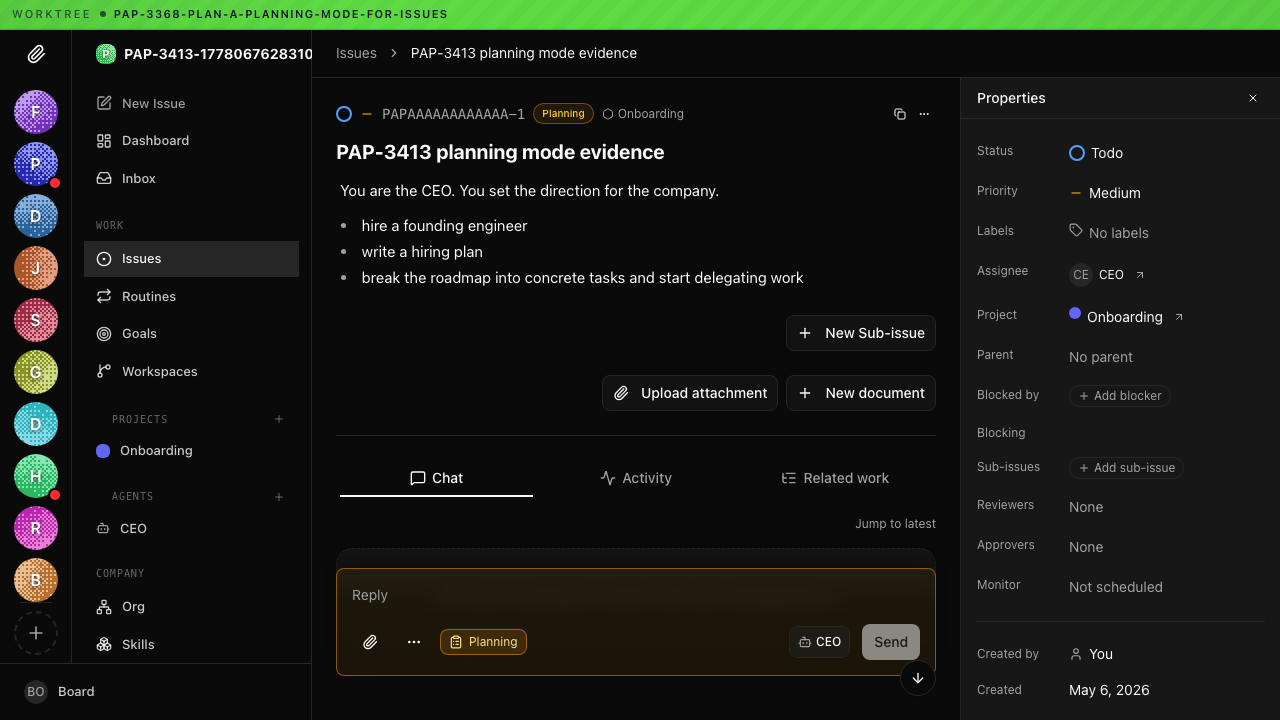 Desktop planning row: 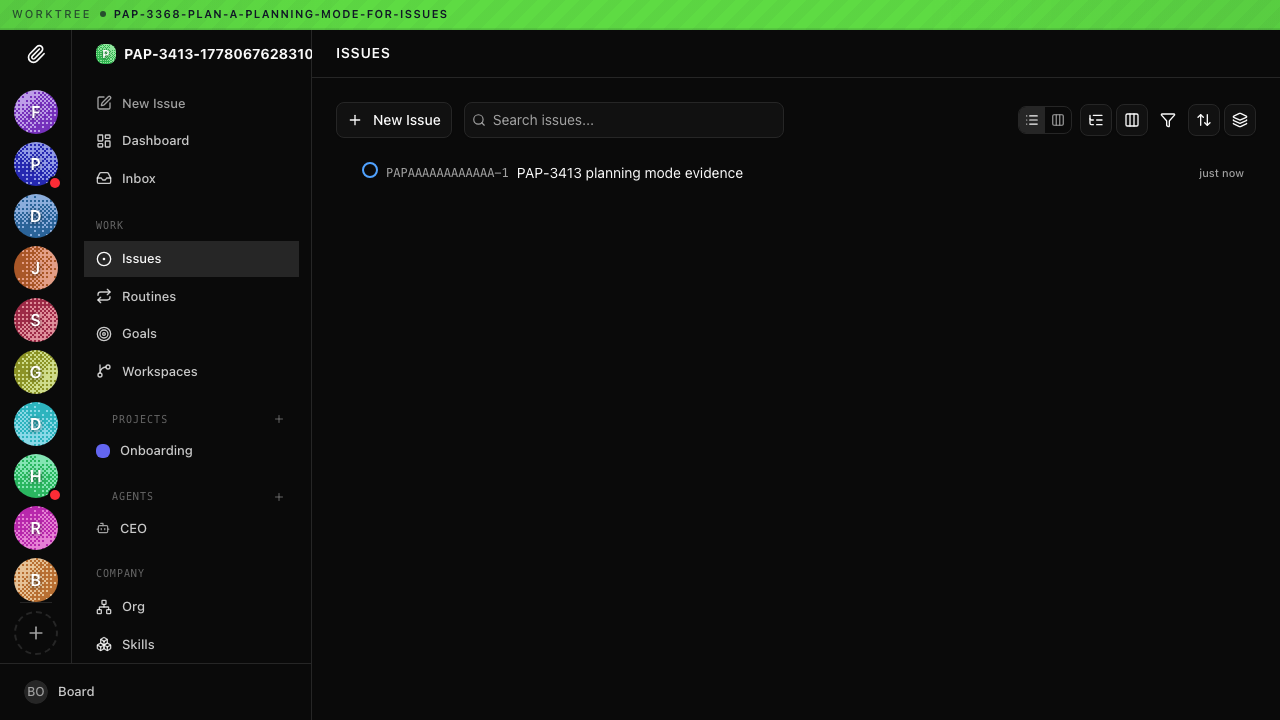 Desktop staged standard toggle: 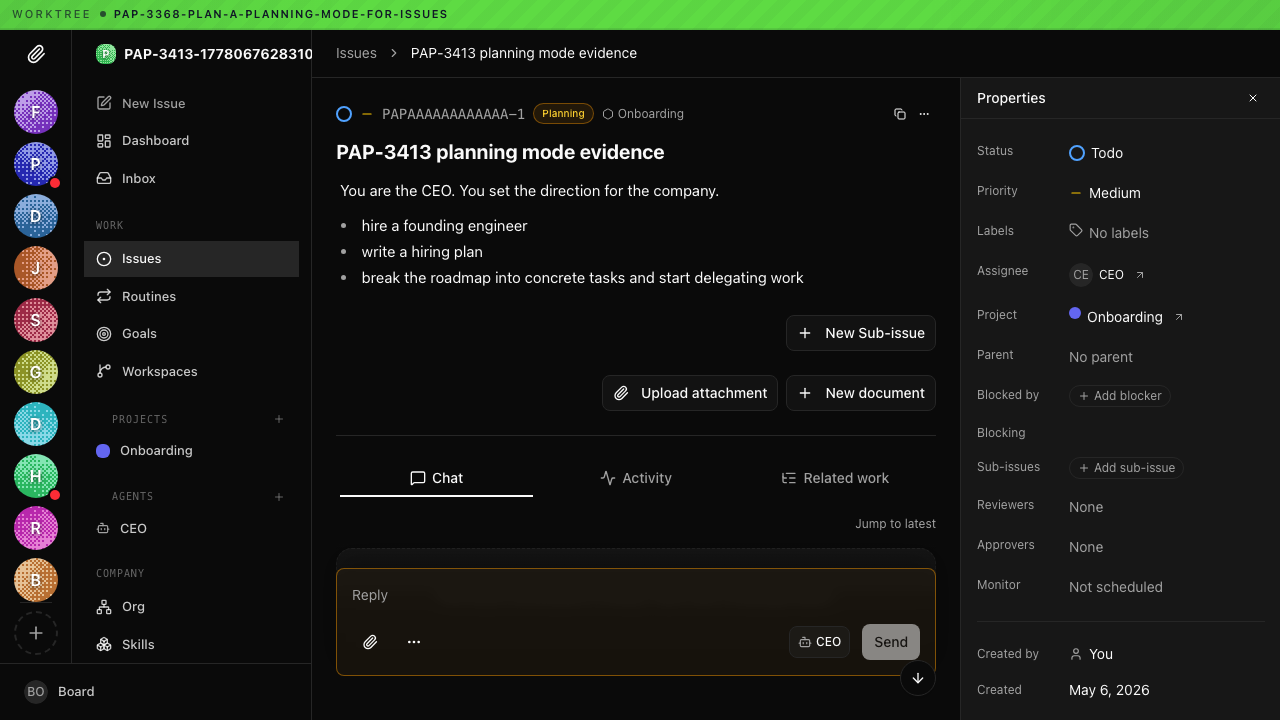 Mobile planning detail: 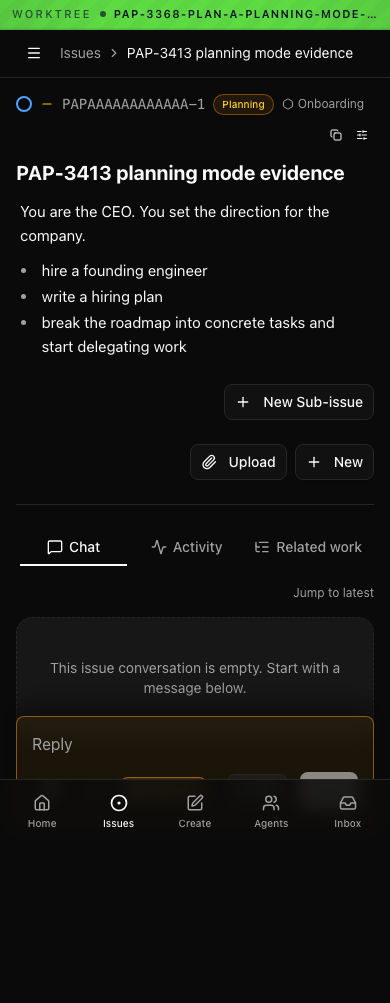 Mobile planning row: 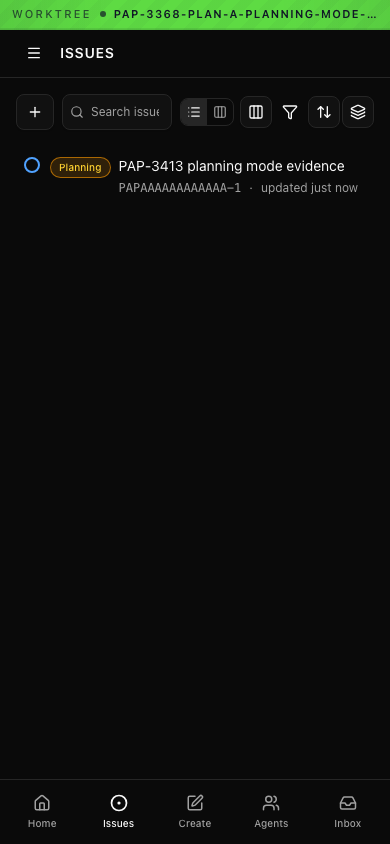 ## Risks - Medium migration risk: this adds a non-null issue column. The migration uses `ADD COLUMN IF NOT EXISTS` so installations that applied an older branch-local migration number can still apply the final numbered migration safely. - Medium contract risk: issue payloads, plugin payloads, and adapter heartbeat payloads now include work mode; compatibility is handled by defaulting missing values to `standard`. - UI risk is moderate because composer controls changed; focused component tests and visual e2e coverage exercise standard vs planning display and toggle behavior. > For core feature work, check [`ROADMAP.md`](ROADMAP.md) first and discuss it in `#dev` before opening the PR. Feature PRs that overlap with planned core work may need to be redirected — check the roadmap first. See `CONTRIBUTING.md`. ## Model Used - OpenAI Codex, GPT-5 coding agent in a local Paperclip worktree, with shell/tool use. Exact context-window size is not exposed in this runtime. ## Checklist - [x] I have included a thinking path that traces from project context to this change - [x] I have specified the model used (with version and capability details) - [x] I have checked ROADMAP.md and confirmed this PR does not duplicate planned core work - [x] I have run tests locally and they pass - [x] I have added or updated tests where applicable - [x] If this change affects the UI, I have included before/after screenshots - [x] I have updated relevant documentation to reflect my changes - [x] I have considered and documented any risks above - [x] I will address all Greptile and reviewer comments before requesting merge --------- Co-authored-by: Paperclip <noreply@paperclip.ing> |
||
|
Devin Foley
|
70679a3321 |
Add sandbox environment support (#4415)
## Thinking Path > - Paperclip orchestrates AI agents for zero-human companies. > - The environment/runtime layer decides where agent work executes and how the control plane reaches those runtimes. > - Today Paperclip can run locally and over SSH, but sandboxed execution needs a first-class environment model instead of one-off adapter behavior. > - We also want sandbox providers to be pluggable so the core does not hardcode every provider implementation. > - This branch adds the Sandbox environment path, the provider contract, and a deterministic fake provider plugin. > - That required synchronized changes across shared contracts, plugin SDK surfaces, server runtime orchestration, and the UI environment/workspace flows. > - The result is that sandbox execution becomes a core control-plane capability while keeping provider implementations extensible and testable. ## What Changed - Added sandbox runtime support to the environment execution path, including runtime URL discovery, sandbox execution targeting, orchestration, and heartbeat integration. - Added plugin-provider support for sandbox environments so providers can be supplied via plugins instead of hardcoded server logic. - Added the fake sandbox provider plugin with deterministic behavior suitable for local and automated testing. - Updated shared types, validators, plugin protocol definitions, and SDK helpers to carry sandbox provider and workspace-runtime contracts across package boundaries. - Updated server routes and services so companies can create sandbox environments, select them for work, and execute work through the sandbox runtime path. - Updated the UI environment and workspace surfaces to expose sandbox environment configuration and selection. - Added test coverage for sandbox runtime behavior, provider seams, environment route guards, orchestration, and the fake provider plugin. ## Verification - Ran locally before the final fixture-only scrub: - `pnpm -r typecheck` - `pnpm test:run` - `pnpm build` - Ran locally after the final scrub amend: - `pnpm vitest run server/src/__tests__/runtime-api.test.ts` - Reviewer spot checks: - create a sandbox environment backed by the fake provider plugin - run work through that environment - confirm sandbox provider execution does not inherit host secrets implicitly ## Risks - This touches shared contracts, plugin SDK plumbing, server runtime orchestration, and UI environment/workspace flows, so regressions would likely show up as cross-layer mismatches rather than isolated type errors. - Runtime URL discovery and sandbox callback selection are sensitive to host/bind configuration; if that logic is wrong, sandbox-backed callbacks may fail even when execution succeeds. - The fake provider plugin is intentionally deterministic and test-oriented; future providers may expose capability gaps that this branch does not yet cover. ## Model Used - OpenAI Codex coding agent on a GPT-5-class backend in the Paperclip/Codex harness. Exact backend model ID is not exposed in-session. Tool-assisted workflow with shell execution, file editing, git history inspection, and local test execution. ## Checklist - [x] I have included a thinking path that traces from project context to this change - [x] I have specified the model used (with version and capability details) - [x] I have checked ROADMAP.md and confirmed this PR does not duplicate planned core work - [x] I have run tests locally and they pass - [x] I have added or updated tests where applicable - [ ] If this change affects the UI, I have included before/after screenshots - [x] I have updated relevant documentation to reflect my changes - [x] I have considered and documented any risks above - [x] I will address all Greptile and reviewer comments before requesting merge |
||
|
dotta
|
efc1e336b0 | Improve issue detail load stability |




