mirror of
https://github.com/paperclipai/paperclip.git
synced 2026-10-24 01:41:42 +02:00
7eea9d8214fec00dfde32bda7fcf9b20a428e330
51
Commits
| Author | SHA1 | Message | Date | |
|---|---|---|---|---|
 Devin FoleyandPaperclip |
f858207161 |
Guard routine UUID lookups without narrowing valid inputs (#15313)
## Thinking Path > - Paperclip manages work for AI agents and their companies. > - Routines expose details, triggers, and management actions through resource IDs. > - These resource IDs are UUIDs. The UI and CLI do not resolve short prefixes. > - A malformed ID reaches a PostgreSQL UUID comparison and returns a server error. > - A lookup guard can return the existing not-found response before that query. > - This PR preserves valid PostgreSQL UUID input forms and the existing access checks. ## Linked Issues or Issue Description Refs #11471. This is a credited continuation of the lookup-guard approach from @mv2woods. That older PR remains open and unchanged. Its review requested the required PR description sections. This continuation uses current master and adds UUID compatibility and authorization coverage. The earlier `isUuidLike` guard restricts UUID versions to 1–5 and trims input. The database currently accepts other UUID values and input forms. This guard preserves the existing [PostgreSQL UUID input contract](https://www.postgresql.org/docs/current/datatype-uuid.html), including uppercase, paired braces, omitted hyphens, and hyphens after groups of four digits. It rejects whitespace and short prefixes without rewriting the value sent to the database. ## What Changed - Guard the shared routine and private-trigger UUID lookups. Malformed resource IDs return null, so existing routes return their normal 404 response. - Keep company access, assignee permissions, body validation order, and database error propagation unchanged. - Add real PostgreSQL tests for stored UUIDv4, UUIDv7, nil, and max values in six input forms. Add no-query checks for malformed input and HTTP coverage across all 15 root-resource route handlers. - Document complete resource IDs and distinguish them from opaque public webhook IDs. ## Verification - `pnpm exec vitest run server/src/__tests__/routines-service.test.ts server/src/__tests__/routines-e2e.test.ts`: 91 passed, including the new PostgreSQL and HTTP regressions. - Independent review found no blockers and passed all 9 focused PostgreSQL and HTTP regression cases on this commit. - Full local `pnpm -r typecheck` and `pnpm build` passed on Node 24.21.0 with pnpm 9.15.4. - Full Linux CI passed on `0a2990eca2f904335821027a322e4db868151eb3`: 53 successful checks and 2 inapplicable Storybook skips. No retries were needed. This provides aggregate suite coverage; a duplicate full local aggregate was not run. - [Greptile reviewed this exact commit](https://github.com/paperclipai/paperclip/pull/15313#issuecomment-6010222312) at 5/5 with no findings or unresolved threads. The PR is ready for review and has no merge conflicts. - `git diff --check` and the added-diff secret and PII scan passed. ## Risks Malformed routine and private-trigger IDs now return 404 instead of a database error. Full UUIDs retain the existing company and assignee checks. This change does not add prefix lookup, alter public webhook IDs, or validate unrelated nested revision/thread IDs or query parameters. No migration is required. ## Model Used OpenAI GPT-6 through Codex, with reasoning, repository editing, code execution, and independent agent review. The exact deployment model ID and context window are not exposed in this session. ## Checklist - [x] I have included a thinking path that traces from project context to this change - [x] I have specified the model used (with version and capability details) - [x] I have checked ROADMAP.md and confirmed this PR does not duplicate planned core work - [x] I have searched GitHub for duplicate or related PRs and linked them above - [x] I have either (a) linked existing issues with `Fixes: #` / `Closes #` / `Refs #` OR (b) described the issue in-PR following the relevant issue template - [x] I have not referenced internal/instance-local Paperclip issues or links (only public GitHub `#NNN` / `github.com/paperclipai/paperclip` URLs) - [x] My branch name describes the change (e.g. `docs/...`, `fix/...`) and contains no internal Paperclip ticket id or instance-derived details - [x] I have run tests locally and they pass - [x] I have added or updated tests where applicable - [x] I have updated relevant documentation to reflect my changes - [x] I have considered and documented any risks above - [x] All Paperclip CI gates are green - [x] Greptile is 5/5 with no open P2s, recommendations, or follow-ups - [x] I will address all Greptile and reviewer comments before requesting merge Co-authored-by: Paperclip <noreply@paperclip.ing> |
||
|
DottaandPaperclip
|
24429024e7 |
feat: add Fireflies connector and summary-ready routines (#13890)
## Thinking Path > - Paperclip is the open source app people use to manage AI agents for work. > - Apps gives agents governed access to external tools through stored credentials. > - Routines start work when an external service sends an event. > - Fireflies provides meeting transcripts and summaries through an official hosted MCP server. > - This PR adds that connection and accepts signed meeting events through the shared app webhook flow. > - Agents can review completed meetings with the same permissions and audit records as other work. ## Linked Issues or Issue Description **Problem or motivation** Operators need agents to read Fireflies meetings and start follow-up work when a summary is ready. The Apps catalog lacks Fireflies. The shared app webhook flow needs to accept its signed deliveries. **Proposed solution** Use the official Fireflies MCP endpoint with OAuth or a vaulted bearer API key. Extend the existing Another app or script flow with signed webhook support. Verify the raw-body signature and pass the JSON payload as external data. Select Meeting Summarized in Fireflies. Deduplicate identical signed deliveries, including setup deliveries. **Alternatives considered** A separate REST connector would duplicate the governed MCP path. Polling, legacy V1 payloads, and automatic provider-side webhook registration are outside this change. **Roadmap alignment** This extends the existing MCP Tool Gateway & Apps and Scheduled Routines surfaces. It adds a provider to those systems. It does not introduce a second integration framework. **Additional context** A GitHub search found no existing Fireflies issues or PRs. Provider references and verification limits are in `doc/connections/FIREFLIES.md`. ## What Changed - Add the official Fireflies catalog definition, generated registry, provider evidence, and branded artwork. - Reuse Access → Connect, dynamic discovery, Permissions, vault storage, policy, and audit behavior. - Classify Fireflies sharing, movement, and access revocation as writes. - Preserve Off and Ask first restrictions during OAuth reauthorization and API-key replacement. New actions retain normal defaults. - Add `app_webhook` authentication to the shared Another app or script flow. Accept bearer tokens or raw-body HMAC-SHA256. Preserve earlier `fireflies_hmac` triggers and revision snapshots for compatibility. Existing text columns need no migration. - Verify `X-Hub-Signature` or `X-Hub-Signature-256` against the exact request body. Preserve generic event payloads and deduplicate identical signed requests. - Keep the routine wizard generic. Show one webhook URL and secret in Another app or script. Keep all new app webhook event names provider-neutral. Keep provider setup instructions in the connector documentation. - Pass generic webhook JSON to the task in an explicit external-data block, capped at 16,384 characters. Keep strict meeting validation for existing legacy Fireflies triggers. ## Verification - Feature implementation commit `0882dc8a1`: all 54 CI checks passed; two conditional Storybook checks skipped. This includes full tests, typecheck, build, browser E2E, canary dry run, and security checks. Greptile rated this commit 5/5; all review threads are resolved. - Full local `pnpm -r typecheck`, `pnpm build`, and token gates passed on the final code. Targeted connector, gateway, webhook, revision, and UI suites passed during implementation. After the provider-neutral follow-up, all 84 app-webhook and routine-service tests passed; the final payload-to-task assertion also passed in the 72-test routine suite and a clean-config rerun. - The long local `pnpm test:run` invocation started before the final edits and was stopped after the final-commit CI suites passed. It reported one generic webhook test failure while those files were changing; that test and the entire routine suite passed on the final source, including a clean-config reproduction. The interrupted local run is not counted as a full-suite pass. - In the embedded browser, completed official OAuth consent and discovered 20 live actions. Real meeting listing, transcript retrieval, and summary/action-item retrieval succeeded as the selected agent. Turning a live read Off blocked its test; catalog refresh preserved the restriction. - Embedded-browser Another app or script setup, back/save/resume, narrow layout, and a signed synthetic Fireflies delivery succeeded. The UI reported authentication passed without creating a task. Fixtures cover signature tampering, malformed requests, ordinary app event names, duplicate/setup deliveries, rotation, revisions, pause/archive, and company isolation. - Existing MCP browser suite: 8 passed and 2 provider-dependent cases skipped. Branding checks passed; connector artwork and webhook setup were checked at desktop/mobile widths and in light/dark modes. - An unauthenticated POST to a correctly formatted public webhook URL reached the staging tenant verifier through the existing Cloud gateway. - A real Fireflies webhook delivery remains unverified. A staging callback is available for the operator walkthrough. Live API-key authorization, credential expiry, and a new meeting's summary completion were not tested against the provider. Fixtures cover these protocol and lifecycle paths where applicable. - Storybook follow-up `c54174faa`: 27 production-component stories cover every UI change, with a source-to-story map in the connector documentation. Static Storybook build, UI typecheck, token gates, and Playwright checks for all stories and the mobile footer pass. All PR checks passed for this Storybook follow-up; Greptile reviewed `c54174faa` at 5/5. ## Risks - Fireflies may change its hosted MCP tools or OAuth behavior. Tool discovery stays dynamic. Experimental search/fetch tools are not required. - Public webhook setup requires HTTPS and a separate signing secret. Fireflies normally emits events for meetings owned by the configuring account. - Reauthorization touches shared MCP permission code. Regression tests cover existing restrictions, new actions, connection removal, and other gateway callers. - Webhook receipt grants no tool access. The routine agent still needs an authorized Fireflies connection. - New generic triggers rely on provider event subscriptions. Without a sender-supplied idempotency key, changed request bytes count as a new event. Existing legacy Fireflies triggers retain summary-only filtering and per-meeting deduplication. ## Model Used OpenAI Codex, model `gpt-6-astra`. Used reasoning, repository editing, code execution, and embedded-browser testing. The runtime did not expose a context-window size. ## Checklist - [x] I have included a thinking path that traces from project context to this change - [x] I have specified the model used (with version and capability details) - [x] I have checked ROADMAP.md and confirmed this PR does not duplicate planned core work - [x] I have searched GitHub for duplicate or related PRs and linked them above - [x] I have either (a) linked existing issues with `Fixes: #` / `Closes #` / `Refs #` OR (b) described the issue in-PR following the relevant issue template - [x] I have not referenced internal/instance-local Paperclip issues or links (only public GitHub `#NNN` / `github.com/paperclipai/paperclip` URLs) - [x] My branch name describes the change (e.g. `docs/...`, `fix/...`) and contains no internal Paperclip ticket id or instance-derived details - [x] I have run tests locally and they pass - [x] I have added or updated tests where applicable - [x] I have updated relevant documentation to reflect my changes - [x] I have considered and documented any risks above - [x] All Paperclip CI gates are green - [x] Greptile is 5/5 with no open P2s, recommendations, or follow-ups - [x] I will address all Greptile and reviewer comments before requesting merge --------- Co-authored-by: Paperclip <noreply@paperclip.ing> |
||
|
DottaandPaperclip
|
f589660ec0 |
feat(routines): add safe webhook setup and in-routine run management (#13637)
## Thinking Path > - Paperclip is the open source app people use to manage AI agents for work. > - Routines turn scheduled work and external events into tasks for an assigned agent. > - Webhook setup was disabled, and actor authentication rejected valid webhook bearer keys. > - Operators need to connect and test a sending app before events can start work. > - This pull request adds a guided setup with durable connection tests that cannot dispatch a task. > - It keeps trigger management, execution tasks, and activity within the routine. > - The benefit is a webhook that can be configured, verified, and operated from one place. ## Linked Issues or Issue Description Fixes #11937. Related: #13216 adds provider-specific Sentry support. This PR addresses general routine setup and ingress. #6841 addresses legacy secret bindings; this PR retains the existing secret service. **Current behavior** Webhook creation is disabled. Bearer deliveries can fail in agent authentication before the routine checks its key. Setup has no safe connection test. Runs and Activity send the operator away from the routine. **Proposed behavior** Choose a schedule or a webhook. Follow the setup steps, copy credentials or complete agent instructions, and test delivery without creating work. Finish setup to allow future events to start tasks. Edit or remove compact trigger cards, undo removal, and inspect tasks and activity inside the routine. **Reason and benefit** An operator can verify credentials and delivery before enabling automatic work. Durable setup state survives refreshes and restarts. Retry receipts prevent an old test event from starting work after activation. ## What Changed - Add a production trigger wizard using reusable Slack setup navigation and footer components. - Add schedule and webhook choices, one-time credentials, agent instructions, and live connection feedback. - Persist pending setup, test delivery receipts, connection status, and reversible trigger removal. - Keep setup checks free of routine runs, tasks, and agent wakeups. Preserve delivery idempotency after activation. - Add compact trigger cards, inline editing, key rotation, pause controls, removal, and Undo. - Keep Runs and Activity in the routine. Use the shared task list and compact activity rows. - Permit only exact public delivery POSTs through actor authentication. Retain webhook authentication, JSON-object validation, and log redaction. - Add production-backed Storybook states and focused server, database, and UI coverage. - Document signing modes, setup checks, retries, rotation, HTTPS ingress, and navigation. ## Verification - Full workspace typecheck, build, and token gates passed on the rebased branch. Storybook also builds. - Focused routine, middleware, logging, shared wizard, and UI coverage passes on the rebased branch: 195 tests across 14 files. The migration passed on a fresh PostgreSQL database and on two repeated applications. - Browser testing used the real app, database, and a deterministic process worker through Tailscale HTTPS and the current Cloud proxy code. - Verified rejected keys, safe setup deliveries, persisted state after restart, activation, retry deduplication, key rotation, schedule editing, removal, and Undo. - Fresh bearer and GitHub-signed deliveries created tasks that the worker checked out and completed. Runs and Activity stayed within the routine. - Current Cloud ingress tests passed. Public delivery POSTs passed through without a browser session; management routes remained gated. - All 54 current-head PR checks pass, including general and serialized tests, all eight browser E2E shards, typecheck, build, runner checks, security checks, and the canary dry run. Two optional Storybook jobs are skipped by workflow conditions. - Greptile is 5/5 on commit `7ea63a61e`, with no unresolved review threads. The stale connection-status finding is fixed and covered by a regression test. - No production deployment was performed. ## Risks - Migration 0281 adds three trigger columns and a test-receipt table. It is additive and safe to reapply. Apply it before running the new server. Existing triggers remain live by default. - Requests without delivery IDs are new events after activation. Senders must reuse an event's delivery ID for retries. - Completed webhooks keep normal dispatch behavior. Their management connection check can start work; the UI states this. - Removing a trigger archives it. Undo restores the URL and credentials. Permanent deletion remains available through the existing API. - Public ingress must remain restricted to the delivery POST route. The tenant verifies credentials. Cloud sleeping-stack behavior is unchanged. - Shared setup components also serve Slack. Existing setup contracts and navigation tests cover that integration. - Senders must use application/json with an object. Other media types receive 415. ## Model Used OpenAI Codex, based on GPT-6, with reasoning, repository tools, shell execution, and browser testing. The exact deployment model ID and context-window size are not exposed in this session. ## Checklist - [x] I have included a thinking path that traces from project context to this change - [x] I have specified the model used (with version and capability details) - [x] I have checked ROADMAP.md and confirmed this PR does not duplicate planned core work - [x] I have searched GitHub for duplicate or related PRs and linked them above - [x] I have either (a) linked existing issues with `Fixes: #` / `Closes #` / `Refs #` OR (b) described the issue in-PR following the relevant issue template - [x] I have not referenced internal/instance-local Paperclip issues or links (only public GitHub `#NNN` / `github.com/paperclipai/paperclip` URLs) - [x] My branch name describes the change (e.g. `docs/...`, `fix/...`) and contains no internal Paperclip ticket id or instance-derived details - [x] I have run tests locally and they pass - [x] I have added or updated tests where applicable - [x] I have updated relevant documentation to reflect my changes - [x] I have considered and documented any risks above - [x] All Paperclip CI gates are green - [x] Greptile is 5/5 with no open P2s, recommendations, or follow-ups - [x] I will address all Greptile and reviewer comments before requesting merge --------- Co-authored-by: Paperclip <noreply@paperclip.ing> |
||
|
DottaandCodex
|
0798c77fde |
Secure Cloud canonical runtime identity (#12766)
Accept and persist Cloud-signed canonical runtime identity before activation, then route absolute self-URLs through the durable runtime identity provider. Co-Authored-By: Codex <codex@openai.com> |
||
|
DottaandPaperclip
|
01ddc26a37 |
fix(routines): clear transient execution failures (#9689)
## Thinking Path > - Paperclip is the open source app people use to manage AI agents for work > - Scheduled routines track each dispatch in `routine_runs` and link it to an execution issue > - Moving an execution issue to `blocked` or `cancelled` correctly records a failed run state for operator visibility > - When that issue later resumes or completes, the run can retain the earlier failure reason and completion timestamp > - That stale state makes an active or successfully completed routine appear failed > - This pull request reconciles the run back to a live state on resume and preserves cleared failure details as completion context > - The benefit is that routine run status consistently reflects the current execution issue lifecycle without losing useful recovery history ## Linked Issues or Issue Description Refs #9201 ### What happened? A routine execution issue that temporarily moved to `blocked` or `cancelled` caused its linked routine run to become `failed`. If the issue later returned to an active status or reached `done`, the routine run could keep the stale failure reason and terminal timestamp. ### Expected behavior Active execution issues should have an `issue_created` run with no failure or completion timestamp. Completed execution issues should have a `completed` run with no active failure reason, while retaining any earlier transient failure in structured trigger context for diagnosis. ### Steps to reproduce 1. Create a routine run linked to a routine execution issue. 2. Move the issue to `blocked` and synchronize the run state. 3. Move the issue back to `in_progress` or forward to `done` and synchronize again. 4. Observe that the run previously retained stale failed-state fields. ### Environment - Reproduced on `master` at `da549123cc`. - Core server behavior; not adapter-specific. - Covered with the embedded PostgreSQL routines service test harness. ## What Changed - Load the linked routine run while synchronizing execution issue status. - Restore transiently failed runs to `issue_created` when their execution issue resumes active work. - Clear stale failure state when an execution issue completes and retain the earlier failure under `triggerPayload.transientFailure`. - Add regression coverage for both resumed and completed execution issues. ## Verification - `pnpm --filter @paperclipai/server exec vitest run src/__tests__/routines-service.test.ts` — 57 tests passed. - `pnpm --filter @paperclipai/server typecheck` — passed. ## Risks - Low risk: the change is limited to routine execution issue/run reconciliation. - A completed run now stores a prior failed-state reason as structured transient context instead of leaving `failureReason` populated. - No schema, migration, API contract, or UI behavior changes are included. > For core feature work, check [`ROADMAP.md`](ROADMAP.md) first and discuss it in `#dev` before opening the PR. Feature PRs that overlap with planned core work may need to be redirected — check the roadmap first. See `CONTRIBUTING.md`. ## Model Used - OpenAI Codex using GPT-5.4 with reasoning, repository tools, GitHub CLI access, code execution, and focused test execution. The runtime did not expose a context-window size. ## Checklist - [x] I have included a thinking path that traces from project context to this change - [x] I have specified the model used (with version and capability details) - [x] I have checked ROADMAP.md and confirmed this PR does not duplicate planned core work - [x] I have searched GitHub for duplicate or related PRs and linked them above - [x] I have either (a) linked existing issues with `Fixes: #` / `Closes #` / `Refs #` OR (b) described the issue in-PR following the relevant issue template - [x] I have not referenced internal/instance-local Paperclip issues or links (only public GitHub `#NNN` / `github.com/paperclipai/paperclip` URLs) - [x] My branch name describes the change (e.g. `docs/...`, `fix/...`) and contains no internal Paperclip ticket id or instance-derived details - [x] I have run tests locally and they pass - [x] I have added or updated tests where applicable - [x] I have updated relevant documentation to reflect my changes - [x] I have considered and documented any risks above - [x] All Paperclip CI gates are green - [x] Greptile is 5/5 with no open P2s, recommendations, or follow-ups - [x] I will address all Greptile and reviewer comments before requesting merge --------- Co-authored-by: Paperclip <noreply@paperclip.ing> |
||
|
Jonathan Reyes
|
676e20a894 |
fix(routines): reject HMAC webhook replays (#9994)
## Thinking Path > - Paperclip is the open source app people use to manage AI agents for work > - Routines allow external systems to start recurring work through authenticated public webhooks > - Timestamped HMAC authentication currently verifies authenticity and age but does not remember an accepted delivery > - An exact signed request can therefore be reused within its replay window, including through simultaneous duplicate delivery > - Replay rejection must be atomic with run creation so concurrent copies cannot both succeed > - This pull request derives a non-secret replay identity from each valid timestamped HMAC delivery and claims it under the existing routine transaction lock > - The benefit is at-most-once acceptance of an exact HMAC delivery without changing ordinary caller-supplied idempotency semantics ## Linked Issues or Issue Description Fixes: #9993 ## What Changed - Derive a stable, non-secret idempotency key after a timestamped HMAC signature has been validated. - Reject a previously claimed HMAC delivery with a conflict while preserving coalescing for existing non-HMAC idempotency keys. - Apply the same atomic replay claim when automatic worktree execution is suppressed. - Add regression coverage for sequential, concurrent, and suppressed-run replays. ## Verification - `pnpm exec vitest run server/src/__tests__/routines-service.test.ts` — 59 tests passed. - `pnpm typecheck` — all workspace packages passed. - The sequential test was observed failing on unmodified `master`: the second identical request resolved and a second run was created. - The concurrent regression test verifies exactly one request succeeds and only one routine run exists. ## Risks - Low migration risk: no schema change is required; the existing nullable routine-run idempotency field is reused. - The routine row lock serializes replay claims, adding a small amount of contention only while a routine run is being created. - Replay rejection applies only to `hmac_sha256`, which carries the timestamp needed for a bounded replay policy. Existing `github_hmac`, bearer, and unauthenticated trigger semantics are unchanged. > For core feature work, check [`ROADMAP.md`](ROADMAP.md) first and discuss it in `#dev` before opening the PR. Feature PRs that overlap with planned core work may need to be redirected — check the roadmap first. See `CONTRIBUTING.md`. ## Model Used OpenAI Codex (GPT-5 family) with reasoning, repository inspection, shell execution, and test tooling. ## Checklist - [x] I have included a thinking path that traces from project context to this change - [x] I have specified the model used (with version and capability details) - [x] I have checked ROADMAP.md and confirmed this PR does not duplicate planned core work - [x] I have searched GitHub for duplicate or related PRs and linked them above - [x] I have either (a) linked existing issues with `Fixes: #` / `Closes #` / `Refs #` OR (b) described the issue in-PR following the relevant issue template - [x] I have not referenced internal/instance-local Paperclip issues or links (only public GitHub `#NNN` / `github.com/paperclipai/paperclip` URLs) - [x] My branch name describes the change (e.g. `docs/...`, `fix/...`) and contains no internal Paperclip ticket id or instance-derived details - [x] I have run tests locally and they pass - [x] I have added or updated tests where applicable - [x] Documentation does not require an update because this restores the documented replay-window security behavior without changing configuration or APIs - [x] I have considered and documented any risks above - [ ] All Paperclip CI gates are green - [ ] Greptile is 5/5 with no open P2s, recommendations, or follow-ups - [x] I will address all Greptile and reviewer comments before requesting merge |
||
|
|
c5574599b1 |
fix(routines): exclude assignee configuration from detail responses (#9818)
## Thinking Path > - Paperclip is the open-source control plane people use to manage AI agents for work. > - Routines are the subsystem that schedules recurring work and returns routine detail to authorized company actors. > - Routine detail embedded the complete assignee database row even though its shared contract requires only assignee identity. > - That full row can contain protected adapter and runtime configuration, including environment bindings. > - The service boundary should project only the fields the routine contract actually needs. > - This pull request replaces the full-row query with a company-scoped identity projection and adds sentinel-based regression coverage. > - The benefit is useful routine detail without exposing protected assignee configuration. ## Linked Issues or Issue Description No public issue exactly tracks this service-level exposure. - Related prior PR: Refs #4967, an older route-level redaction approach with broader changes and no focused routine serialization test. - Related closed PR: Refs #5144, an unmerged prior implementation of the same identity-projection approach. - Related agent-route hardening: Refs #8779; that work covers direct agent responses, while this PR removes protected fields from the routine embed itself. Bug details: - Actual behavior: `GET /api/routines/{routineId}` could serialize the complete assignee row, including protected adapter/runtime configuration. - Expected behavior: routine detail exposes only the assignee identity required by `RoutineDetail`, including its derived `urlKey`. - Reproduction: assign an agent with sentinel-only protected configuration to a routine, retrieve routine detail, and inspect key presence or serialize the response; no production value is needed or recorded. - Version/commit reproduced: upstream `master` immediately before this PR. - Deployment mode: service-level embedded Postgres test; the vulnerable serializer is shared by supported deployments. ## What Changed - Added a company-scoped assignee summary query in `server/src/services/routines.ts` that selects only `id`, `name`, `role`, and `title`, then derives the non-sensitive `urlKey` from the name. - Updated `getDetail()` to use that projection instead of selecting the complete agent row. - Added focused negative and positive identity assertions, including the derived `urlKey`, in `server/src/__tests__/routines-service.test.ts`. - Audited routine list/detail serialization and broader embedded-agent query sites; routine list exposes only `assigneeAgentId`, while other agent embeds use explicit projections or authorized agent endpoints. ## Verification - `pnpm exec vitest run server/src/__tests__/routines-service.test.ts` — 57/57 passed. - Focused sentinel regression test — passed. - `pnpm -r typecheck` — passed. - Server, UI, and CLI builds — passed; UI gzip-size completion used a 4096 MB Node heap. - `git diff --check` — passed. - Full `pnpm test:run` — 2,699 passed, 1 skipped, 9 failed in untouched tests. The failures reproduce outside this change and are limited to local-adapter `nohup`/PTY behavior, macOS `/tmp` versus `/private/tmp` normalization, and one workspace-runtime auto-port fixture. ## Risks - Low compatibility risk: the returned shape now matches the existing shared `RoutineDetail` contract. - A consumer relying on undocumented protected agent fields inside routine detail will stop receiving them. - No schema, migration, deployment, credential, or production-secret changes are included. - Rollback is a single commit revert, but reverting would restore the exposure. > This is security hardening for the already-shipped routines subsystem; `ROADMAP.md` marks Scheduled Routines complete, and this PR does not add or duplicate roadmap feature work. ## Model Used - OpenAI GPT-5 via Codex, with repository search, local code execution, tests, TypeScript typechecking, builds, Git, and GitHub API use. The runtime does not expose a more granular snapshot ID or context-window size. ## Checklist - [x] I have included a thinking path that traces from project context to this change - [x] I have specified the model used (with version and capability details) - [x] I have checked ROADMAP.md and confirmed this PR does not duplicate planned core work - [x] I have searched GitHub for duplicate or related PRs and linked them above - [x] I have either (a) linked existing issues with `Fixes: #` / `Closes #` / `Refs #` OR (b) described the issue in-PR following the relevant issue template - [x] I have not referenced internal/instance-local Paperclip issues or links (only public GitHub `#NNN` / `github.com/paperclipai/paperclip` URLs) - [x] My branch name describes the change (e.g. `docs/...`, `fix/...`) and contains no internal Paperclip ticket id or instance-derived details - [x] I have run tests locally and relevant tests pass - [x] I have added or updated tests where applicable - [x] I have updated relevant documentation to reflect my changes (no documentation change is required for this contract-preserving security fix) - [x] I have considered and documented any risks above - [ ] All Paperclip CI gates are green 5 with no open P2s, recommendations, or follow-ups/- [x] Greptile is 5/5 with no open P2s, recommendations, or follow-ups/5 with no open P2s, recommendations, or follow-ups - [x] I will address all Greptile and reviewer comments before requesting merge --------- Co-authored-by: ClawdeBot <clawdebot@Mac-mini-de-ClawdeBot.local> Co-authored-by: Paperclip <noreply@paperclip.ing> |
||
|
DottaandPaperclip
|
14d4db6330 |
fix(inbox): keep passive issue views out of Mine (#10581)
## Thinking Path > - Paperclip is the open source app people use to manage AI agents for work > - The inbox shows work that a board user owns or has joined > - Issue detail views update a per-user read receipt > - The Mine query treated that read receipt as user participation > - A passive view therefore added the issue to Mine > - This pull request separates passive reads from audited user mutations > - The benefit is a Mine inbox that reflects ownership and real participation ## Linked Issues or Issue Description **What happened?** Opening an issue detail marks the issue as read. The Mine query treated the read receipt as participation. The viewed issue then appeared in Mine even when the user did not change it. **Expected behavior** Viewing an issue can update unread state. A view alone must not add the issue to Mine. Issue creation, assignment, comments, and audited user mutations must add it. **Steps to reproduce** 1. Open an issue that you did not create and that is not assigned to you. 2. Do not comment or change the issue. 3. Open the Mine inbox. 4. Observe that the issue appears in Mine on the previous implementation. **Paperclip version or commit** `90ead239a8` **Deployment mode** Local dev from source. **Additional context** Related approach: #3421 changes Mine to an assignee-only filter. This change keeps participation-based Mine behavior and corrects the participation signal. ## What Changed - Use an explicit audited user-mutation allowlist for Mine participation, including comment cancellation. - Keep passive reads, previews, denied resource requests, and archive bookkeeping out of Mine participation. - Record manual routine reuse as an explicit audited inbox touch instead of a read receipt. - Keep that inbox bookkeeping from satisfying routine activity gates. - Add focused regression coverage for passive views, real mutations, comment cancellation, and manual routine runs. - Document the Mine participation contract. ## Verification - `pnpm exec vitest run server/src/__tests__/issues-service.test.ts -t "does not treat passive issue activity"` - `pnpm exec vitest run server/src/__tests__/routines-service.test.ts -t "touches a (coalesced|skipped active) routine issue|ignores inbox bookkeeping activity"` - `pnpm --filter @paperclipai/server typecheck` - GitHub latest-head CI: all required checks passed, including build, typecheck, server suites, and e2e shards. ## Risks - Low risk. The change affects only the server query that defines user participation in Mine and the manual routine touch signal. - Historical audited user mutations can now qualify an issue for Mine. Passive read and archive actions remain excluded. > For core feature work, check [`ROADMAP.md`](ROADMAP.md) first and discuss it in `#dev` before opening the PR. Feature PRs that overlap with planned core work may need to be redirected — check the roadmap first. See `CONTRIBUTING.md`. ## Model Used - OpenAI Codex, GPT-5 family. The runtime did not expose the exact deployment ID or context window. Agentic reasoning, tool use, and code execution were enabled. ## Checklist - [x] I have included a thinking path that traces from project context to this change - [x] I have specified the model used (with version and capability details) - [x] I have checked ROADMAP.md and confirmed this PR does not duplicate planned core work - [x] I have searched GitHub for duplicate or related PRs and linked them above - [x] I have either (a) linked existing issues with `Fixes: #` / `Closes #` / `Refs #` OR (b) described the issue in-PR following the relevant issue template - [x] I have not referenced internal/instance-local Paperclip issues or links (only public GitHub `#NNN` / `github.com/paperclipai/paperclip` URLs) - [x] My branch name describes the change (e.g. `docs/...`, `fix/...`) and contains no internal Paperclip ticket id or instance-derived details - [x] I have run tests locally and they pass - [x] I have added or updated tests where applicable - [x] I have updated relevant documentation to reflect my changes - [x] I have considered and documented any risks above - [x] All Paperclip CI gates are green - [x] Greptile is 5/5 with no open P2s, recommendations, or follow-ups - [x] I will address all Greptile and reviewer comments before requesting merge --------- Co-authored-by: Paperclip <noreply@paperclip.ing> |
||
|
DottaandPaperclip
|
30ff3d7c58 |
feat(routines): expose activity gate API (#9438)
## Thinking Path > - Paperclip is the open source app people use to manage AI agents for work > - Scheduled routines provide recurring control-plane work without manual intervention > - The new activity gate can suppress scheduled runs when no external work occurred > - The core scheduler and database support landed without a public create/update contract > - Agents, operators, and managed plugins need validated fields plus discoverable semantics to opt in safely > - This pull request exposes the activity gate through routine APIs, revisions, plugin contracts, tests, and skill documentation > - The benefit is backward-compatible control over idle scheduled work without losing activity-triggered follow-up ## Linked Issues or Issue Description - Refs #8534 ## What Changed - Added shared activity-gate policy and scope enums with create/PATCH validation. - Persisted activity-gate fields through routine creation, updates, revision snapshots, pipeline snapshots, and revision restores. - Defaulted legacy revision snapshots during restore and added regression coverage for pre-field snapshots. - Extended managed-plugin routine declarations, production reconciliation, and the SDK test harness to preserve non-default gate settings. - Added end-to-end API coverage for create/PATCH/list/detail round-trips, defaults, and invalid enum rejection. - Documented schedule-only semantics, activity windows, own-run/read-action exclusions, scopes, and an hourly quiet-night watcher example. ## Verification - `pnpm exec vitest run packages/shared/src/validators/routine.test.ts server/src/__tests__/routines-service.test.ts server/src/__tests__/routines-e2e.test.ts` - `pnpm exec vitest run packages/shared/src/validators/plugin.test.ts packages/plugins/sdk/tests/testing-actions.test.ts server/src/__tests__/plugin-managed-routines.test.ts server/src/__tests__/routines-service.test.ts -t 'activity gate|preserves declared activity gate settings|resolves routine agent and project refs'` - `pnpm exec vitest run ui/src/lib/workspace-routines.test.ts ui/src/pages/Routines.test.tsx` - `pnpm --filter @paperclipai/shared typecheck` - `pnpm --filter @paperclipai/plugin-sdk typecheck` - `pnpm --filter @paperclipai/server typecheck` - `pnpm --filter @paperclipai/ui typecheck` - `pnpm check:token-gates` - GitHub CI: all final-head checks green; Storybook visual regression skipped by path rules. - Greptile: 5/5 with no unresolved review threads. ## Risks - Low risk: defaults remain `always` and `company`, preserving existing routine behavior and old revision snapshots. - Managed plugin manifests can now declare the same validated gate settings as the public routine API; omitted values retain core defaults. - Revision snapshots now include the new fields so policy changes are not lost or treated as no-ops during restore. > For core feature work, checked `ROADMAP.md`: this extends the existing Scheduled Routines roadmap item and does not duplicate a separate planned capability. ## Model Used - OpenAI GPT-5.5 via Codex CLI, with repository tool use and code execution; context-window size was not exposed by the runtime. ## Checklist - [x] I have included a thinking path that traces from project context to this change - [x] I have specified the model used (with version and capability details) - [x] I have checked ROADMAP.md and confirmed this PR does not duplicate planned core work - [x] I have searched GitHub for duplicate or related PRs and linked them above - [x] I have either (a) linked existing issues with `Fixes: #` / `Closes #` / `Refs #` OR (b) described the issue in-PR following the relevant issue template - [x] I have not referenced internal/instance-local Paperclip issues or links (only public GitHub `#NNN` / `github.com/paperclipai/paperclip` URLs) - [x] My branch name describes the change (e.g. `docs/...`, `fix/...`) and contains no internal Paperclip ticket id or instance-derived details - [x] I have run tests locally and they pass - [x] I have added or updated tests where applicable - [x] I have updated relevant documentation to reflect my changes - [x] I have considered and documented any risks above - [x] All Paperclip CI gates are green - [x] Greptile is 5/5 with no open P2s, recommendations, or follow-ups - [x] I will address all Greptile and reviewer comments before requesting merge --------- Co-authored-by: Paperclip <noreply@paperclip.ing> |
||
|
DottaandPaperclip
|
52aea90263 |
feat: organize skills with nested folders and My Skills (#9633)
## Thinking Path > - Paperclip is the open source control plane people use to organize and govern AI-agent companies > - Company skills are durable resources that users browse, import, assign, and maintain over time > - A flat skill list plus tags does not provide a stable location or hierarchy for personal, company, project-imported, and bundled skills > - Folder paths need to be canonical, company-scoped, safe to move, and preserved across re-imports without changing skill IDs > - The `/skills` UI also needs traversal, breadcrumbs, move/create flows, and a dedicated My Skills namespace that work on desktop and mobile > - This pull request adds the folder data model and APIs, reserved-root lifecycle, project import behavior, and the folder-first skills experience > - The benefit is a predictable filesystem-like organization model while tags remain available for cross-cutting classification ## Linked Issues or Issue Description Refs #9619 — the reviewed folder foundation was intentionally closed and folded into this combined feature PR. Refs #9026 — earlier flat-folder attempt superseded by this integrated implementation. Refs #3281 — related skill organization proposal; this PR uses canonical persisted folders rather than deriving groups from skill keys, and does not add hidden-skill behavior. **Feature request** - **Problem:** Skills currently lack a canonical hierarchical location, making personal skills, project imports, bundled skills, and company-authored skills difficult to traverse and manage at scale. - **Proposed behavior:** Add nested company-scoped folders with stable paths, reserved My/Projects/Bundled roots, subtree queries, safe move/create operations, and a folder-first `/skills` library UI. - **Import behavior:** New project scans file skills under `projects/<project-slug>`; later imports update content without overriding a user-selected folder. - **Alternatives considered:** Tags alone remain useful for cross-cutting classification, but they do not provide canonical location, nesting, reserved namespaces, or stable import placement. - **Roadmap alignment:** Extends the completed Skills Manager and Scheduled Routines capabilities without duplicating an active roadmap item. ## What Changed - Adds `folders` persistence for routine and skill folders, nested canonical paths, parent/slug/system-key fields, migration backfills, and reapply-safe migrations `0174`–`0175` after current master migrations. - Adds company-scoped folder CRUD, cycle/depth/namespace validation, reserved My/Projects/Bundled lifecycle, item moves, subtree filtering, and folder paths on skill results. - Preserves project-import placement: first import files into the project folder, while re-import keeps user-owned placement and stable skill IDs. - Adds the `/skills` folder tree rail, tags facet, breadcrumbs, subfolder browser, move/new-folder dialog, canonical detail location, inline tag editing, and folder-aware Studio creation. - Keeps bundled skills read-only even when their source metadata is incomplete by detecting the reserved Bundled folder and hiding selection/move actions. - Extends routine folder UI and OpenAPI coverage, and adds regression tests across migrations, services, routes, tree helpers, pages, and Studio creation. ## Verification - `pnpm exec vitest run packages/db/src/nested-skill-folders-migration.test.ts server/src/__tests__/folders-routes.test.ts server/src/__tests__/folders-service.test.ts server/src/__tests__/company-skills-service.test.ts server/src/__tests__/routines-service.test.ts ui/src/components/folders/FolderControls.test.tsx ui/src/components/folders/SkillFolderTree.test.tsx ui/src/components/folders/skill-folder-tree.test.ts ui/src/pages/CompanySkills.test.tsx ui/src/pages/Routines.test.tsx ui/src/pages/SkillStudio.test.tsx ui/src/lib/company-skill-routes.test.ts ui/src/lib/skill-create.test.ts` — 13 files, 192 tests passed. - `pnpm exec vitest run ui/src/pages/CompanySkills.test.tsx ui/src/components/folders/SkillFolderTree.test.tsx` — 2 files, 20 tests passed after preserving the existing PR's bundled-skill fixes. - `pnpm -r typecheck` — passed for all workspace packages. - `pnpm test:run` — passed in an isolated CI-like environment with inherited Paperclip runtime identity and static AWS credential variables removed. - `pnpm build` — production build passed for all workspace packages. - Greptile iteration 2 — 5/5 confidence with zero unresolved threads on commit `ff2d67aa71`. - Latest-head GitHub checks — all success, neutral, or skipped; PR is mergeable with a clean merge state. - `pnpm check:token-gates` — reports nine existing `#9627` comment false positives already present on `master`; this PR introduces no new token violation. ## Risks - **Migration/backfill:** `0174` creates the foundation and `0175` adds nested/reserved semantics. Both are ordered after current master migration `0173`, are covered by numbering/safety checks, and are designed to be reapply-safe. - **Reserved namespaces:** My, Projects, and Bundled roots are service-managed. Regression coverage prevents namespace squatting, cross-company folder use, bundled writes, cycles, and excessive depth. - **Behavioral change:** Project scans choose a project folder only on initial creation; existing skills deliberately retain their current folder during refresh. - **UI scope:** The folder rail applies to the Installed library; Catalog retains the discovery-oriented category sidebar. > For core feature work, check [`ROADMAP.md`](ROADMAP.md) first and discuss it in `#dev` before opening the PR. Feature PRs that overlap with planned core work may need to be redirected — check the roadmap first. See `CONTRIBUTING.md`. ## Model Used - OpenAI `gpt-5.5` in Codex CLI, medium reasoning mode; runtime did not expose a context-window value. Used repository/file tools, terminal execution, Git/GitHub operations, test execution, and code editing. ## Checklist - [x] I have included a thinking path that traces from project context to this change - [x] I have specified the model used (with version and capability details) - [x] I have checked ROADMAP.md and confirmed this PR does not duplicate planned core work - [x] I have searched GitHub for duplicate or related PRs and linked them above - [x] I have either (a) linked existing issues with `Fixes: #` / `Closes #` / `Refs #` OR (b) described the issue in-PR following the relevant issue template - [x] I have not referenced internal/instance-local Paperclip issues or links (only public GitHub `#NNN` / `github.com/paperclipai/paperclip` URLs) - [x] My branch name describes the change (e.g. `docs/...`, `fix/...`) and contains no internal Paperclip ticket id or instance-derived details - [x] I have run tests locally and they pass - [x] I have added or updated tests where applicable - [x] I have updated relevant documentation to reflect my changes - [x] I have considered and documented any risks above - [x] All Paperclip CI gates are green - [x] Greptile is 5/5 with no open P2s, recommendations, or follow-ups - [x] I will address all Greptile and reviewer comments before requesting merge --------- Co-authored-by: Paperclip <noreply@paperclip.ing> |
||
|
DottaandPaperclip
|
8368fb30b0 |
fix(routines): coalesce sub-hourly catch-up runs (#9649)
## Thinking Path > - Paperclip is the open source control plane people use to run AI-agent companies. > - Scheduled routines support catch-up policies when the server resumes after missed cron ticks. > - The existing capped replay policy dispatched once per missed tick, which can flood the board after downtime for frequent schedules. > - Sub-hourly routines usually need one prompt catch-up execution rather than historical per-tick replay, while hourly-or-slower schedules may rely on the existing behavior. > - This pull request coalesces missed sub-hourly ticks into one execution and keeps the slower-schedule behavior unchanged. > - The benefit is bounded recovery work without changing the semantics of lower-frequency scheduled routines. ## Linked Issues or Issue Description ### What happened? When a scheduled routine using `enqueue_missed_with_cap` resumes after several missed sub-hourly cron ticks, Paperclip dispatches one catch-up execution for every missed tick. Those executions arrive in a same-second burst and can flood the board with duplicate-looking work. ### Expected behavior Sub-hourly schedules should advance past all missed ticks but dispatch exactly one catch-up execution. Hourly-or-slower schedules should retain capped per-tick replay. ### Steps to reproduce 1. Build Paperclip from `master` and create a routine with a sub-hourly cron schedule and `catchUpPolicy: enqueue_missed_with_cap`. 2. Set its persisted `nextRunAt` far enough in the past to cover several scheduled occurrences. 3. Run routine catch-up processing. 4. Observe multiple catch-up dispatches instead of one coalesced execution. ### Paperclip version or commit Reproduced on `master` before this PR. ### Deployment mode Built from source in local development with embedded PGlite. ## What Changed - Classify sub-hourly cadence from timezone-aware scheduled occurrences, avoiding daily multi-minute false positives while supporting schedules restricted to active days. - Coalesce all missed sub-hourly ticks into one catch-up dispatch while advancing `nextRunAt` to the next future occurrence. - Preserve capped per-tick replay for hourly-or-slower schedules. - Clarify the catch-up policy labels in both routine editing surfaces. - Add regression coverage for both the coalesced and preserved behaviors. ## Verification - `pnpm exec vitest run server/src/__tests__/routines-service.test.ts --testNamePattern='coalesces multiple missed sub-hourly ticks|continues replaying each missed hourly tick|continues replaying missed ticks for daily schedules with multiple minute values|coalesces sub-hourly schedules restricted to weekdays'` — 4 passed. - `pnpm check:token-gates` — all gates clean. - `git diff --check origin/master...HEAD` — clean. ## Risks - Low-to-moderate behavioral risk: sub-hourly routines using `enqueue_missed_with_cap` now intentionally receive one recovery execution instead of one per missed tick. - Hourly-or-slower schedules retain their previous capped replay behavior, limiting the compatibility surface. - No schema, migration, workflow, or lockfile changes. > For core feature work, check [`ROADMAP.md`](ROADMAP.md) first and discuss it in `#dev` before opening the PR. Feature PRs that overlap with planned core work may need to be redirected — check the roadmap first. See `CONTRIBUTING.md`. ## Model Used - OpenAI Codex CLI with GPT-5.5, medium reasoning, code execution and repository tool use; the runtime did not expose a context-window size. ## Checklist - [x] I have included a thinking path that traces from project context to this change - [x] I have specified the model used (with version and capability details) - [x] I have checked ROADMAP.md and confirmed this PR does not duplicate planned core work - [x] I have searched GitHub for duplicate or related PRs and linked them above - [x] I have either (a) linked existing issues with `Fixes: #` / `Closes #` / `Refs #` OR (b) described the issue in-PR following the relevant issue template - [x] I have not referenced internal/instance-local Paperclip issues or links (only public GitHub `#NNN` / `github.com/paperclipai/paperclip` URLs) - [x] My branch name describes the change (e.g. `docs/...`, `fix/...`) and contains no internal Paperclip ticket id or instance-derived details - [x] I have run tests locally and they pass - [x] I have added or updated tests where applicable - [x] I have updated relevant documentation to reflect my changes - [x] I have considered and documented any risks above - [x] All Paperclip CI gates are green - [x] Greptile is 5/5 with no open P2s, recommendations, or follow-ups - [x] I will address all Greptile and reviewer comments before requesting merge --------- Co-authored-by: Paperclip <noreply@paperclip.ing> |
||
|
DottaandPaperclip
|
4a40c0cb13 |
feat(routines): gate scheduled runs on external activity (#9436)
## Thinking Path > - Paperclip is the open source app people use to manage AI-agent companies and their recurring work > - Scheduled routines provide native cron-driven execution for recurring agent tasks > - Watcher-style routines currently dispatch a model run even when the control plane has been quiet since their last useful run > - Existing pause, catch-up, and concurrency policies do not distinguish external work from a routine's own bookkeeping > - This pull request adds a generic activity gate that checks company-scoped activity provenance before scheduled dispatch > - The benefit is backward-compatible zero-token quiet skips while real human, agent, or delegated-child activity still wakes the routine ## Linked Issues or Issue Description - Refs #8534 ## What Changed - Added `activity_gate_policy` and `activity_gate_scope` routine columns with backward-compatible `always` / `company` defaults. - Added a company-bounded `evaluateActivityGate()` predicate that uses the last dispatched run as its open window, excludes the routine's own execution runs and scheduler bookkeeping, ignores pure-read actions, and supports company/project scope. - Integrated the predicate into scheduled ticks after pause/worktree eligibility checks; quiet ticks create visible skipped run-history rows with reason `no_external_activity` and gate-window diagnostics without advancing the activity window. - Kept webhook, manual, and API dispatch paths ungated; catch-up schedules evaluate the gate once per scheduler tick. - Added migration-default, provenance predicate, project-scope, quiet-window, scheduler, and webhook-bypass coverage. ## Verification - `pnpm --filter @paperclipai/db typecheck` - `pnpm --filter @paperclipai/server typecheck` - `pnpm exec vitest run server/src/__tests__/routines-service.test.ts` — 51 tests passed - Embedded Postgres `EXPLAIN` for the company-scope gate scan: ```text Limit (cost=24.56..24.58 rows=1 width=24) -> Incremental Sort (cost=24.56..24.60 rows=2 width=24) Sort Key: activity.created_at, activity.id Presorted Key: activity.created_at -> Nested Loop Anti Join (cost=0.44..24.55 rows=1 width=24) Join Filter: (own_run.id = activity.run_id) -> Index Scan using activity_log_company_created_idx on activity_log activity (cost=0.15..8.19 rows=1 width=40) Index Cond: ((company_id = '00000000-0000-0000-0000-000000000001'::uuid) AND (created_at > (now() - '01:00:00'::interval)) AND (created_at <= now())) ``` ## Risks - The migration adds two non-null text columns, but constant defaults preserve all existing routine behavior and avoid a backfill step. - Project scope resolves activity through issue/run/routine provenance; tests cover in-project and cross-project issue activity, while every top-level and correlated query remains company-bounded. - This is the scheduler/schema foundation. Public API validation and documentation for configuring the new fields are intentionally handled in the next scoped follow-up. > For core feature work, check [`ROADMAP.md`](ROADMAP.md) first and discuss it in `#dev` before opening the PR. Feature PRs that overlap with planned core work may need to be redirected — check the roadmap first. See `CONTRIBUTING.md`. ## Model Used - OpenAI Codex using `gpt-5.4` with medium reasoning, repository/tool access, terminal code execution, and test execution. The runtime did not expose a context-window size. ## Checklist - [x] I have included a thinking path that traces from project context to this change - [x] I have specified the model used (with version and capability details) - [x] I have checked ROADMAP.md and confirmed this PR extends the existing Scheduled Routines roadmap item - [x] I have searched GitHub for duplicate or related PRs and linked the related efficiency request above - [x] I have either (a) linked existing issues with `Fixes: #` / `Closes #` / `Refs #` OR (b) described the issue in-PR following the relevant issue template - [x] I have not referenced internal/instance-local Paperclip issues or links (only public GitHub `#NNN` / `github.com/paperclipai/paperclip` URLs) - [x] My branch name describes the change and contains no internal Paperclip ticket id or instance-derived details - [x] I have run tests locally and they pass - [x] I have added or updated tests where applicable - [x] I have updated relevant documentation to reflect my changes (no user-facing configuration is exposed in this scoped foundation PR) - [x] I have considered and documented any risks above - [x] All Paperclip CI gates are green - [x] Greptile is 5/5 with no open P2s, recommendations, or follow-ups - [x] I will address all Greptile and reviewer comments before requesting merge Co-authored-by: Paperclip <noreply@paperclip.ing> |
||
|
|
70ce005bef |
Ensure worktree execution starts only after activation (#9374)
## Thinking Path > - Paperclip is the open-source control plane people use to manage AI agents and their work. > - Its scheduler, routines, and heartbeat services decide when agents automatically begin work. > - Experimental per-worktree execution is useful for isolated development, but enabling it previously allowed automatic services to consider an existing backlog. > - A worktree activation must therefore create a durable eligibility boundary rather than merely toggle execution on. > - This pull request records an activation cutoff and applies it consistently to automatic routine and heartbeat dispatch. > - The result is that an enabled worktree executes only work created after its own activation, while non-worktree behavior remains unchanged. ## Linked Issues or Issue Description **Problem type:** Bug / safety regression **Summary:** Enabling experimental run execution in an existing worktree could start automatic scheduler, routine, watchdog, and heartbeat activity for work created before that worktree was explicitly armed. **Expected behavior:** A worktree that has execution enabled only considers automatically dispatched work created on or after its activation timestamp. Ambiguous activation state fails closed. Non-worktree instances keep their existing behavior. **Related public work:** Refs #8275 (runtime worktree policy gating); this PR adds an activation-time boundary for automatic execution rather than changing the general runtime policy. ## What Changed - Persist a worktree execution activation timestamp and originating instance ID; stamp them only when the experimental toggle changes from disabled to enabled. - Resolve activation state fail-closed when the cutoff is missing, invalid, disabled, or belongs to another instance. - Gate automatic routine scheduling, webhooks, watchdog activity, and heartbeat selection at the activation cutoff; manual runs remain available. - Share the canonical worktree truthy-environment helper across routine dispatch and agent inbox filtering. - Add cutoff and truthy-runtime regression coverage, plus experimental-settings UI states that explain armed and suppressed execution. ## Verification - `pnpm exec vitest run server/src/__tests__/routines-service.test.ts server/src/__tests__/instance-settings-service.test.ts` — passes: 2 files, 60 tests. - `pnpm --filter @paperclipai/server typecheck` — passes. - Existing CI completed successfully before the follow-up review fixes; this branch was rebased onto the latest `origin/master` before retesting. ## Risks - **Behavioral:** Automatic worktree execution is intentionally more restrictive; pre-existing work is suppressed until newly created after activation. - **Operational:** A malformed or cross-instance activation record fails closed, requiring an operator to disable and re-enable the experimental toggle on the intended worktree. - **Compatibility:** The worktree environment now accepts all canonical truthy values (`1`, `true`, `yes`, and `on`) consistently; non-worktree instances are unaffected. - **Branch metadata:** This existing execution-workspace branch predates the current naming rule and cannot be renamed under this task's workspace contract; the code and PR title do not include internal ticket references. > `ROADMAP.md` was checked; this targeted execution-safety fix does not duplicate planned core work. ## Model Used - Anthropic Claude Code — assisted with the original implementation; exact model identifier and context window were not recorded in the repository metadata. - OpenAI Codex CLI — assisted with PR preparation and review fixes; exact model identifier and context window are not exposed in this execution environment. Used with terminal tooling, code editing, and targeted test execution. ## Checklist - [x] I have included a thinking path that traces from project context to this change - [x] I have specified the model used (with version and capability details) - [x] I have checked ROADMAP.md and confirmed this PR does not duplicate planned core work - [x] I have searched GitHub for duplicate or related PRs and linked them above - [x] I have either (a) linked existing issues with `Fixes: #` / `Closes #` / `Refs #` OR (b) described the issue in-PR following the relevant issue template - [x] I have not referenced internal/instance-local Paperclip issues or links (only public GitHub `#NNN` / `github.com/paperclipai/paperclip` URLs) - [ ] My branch name describes the change (e.g. `docs/...`, `fix/...`) and contains no internal Paperclip ticket id or instance-derived details - [x] I have run tests locally and they pass - [x] I have added or updated tests where applicable - [x] I have updated relevant documentation to reflect my changes - [x] I have considered and documented any risks above - [ ] All Paperclip CI gates are green - [ ] Greptile is 5/5 with no open P2s, recommendations, or follow-ups - [x] I will address all Greptile and reviewer comments before requesting merge --------- Co-authored-by: Paperclip <noreply@paperclip.ing> Co-authored-by: Claude Opus 4.8 <noreply@anthropic.com> |
||
|
|
b13eb5b2b5 |
Skill Studio: three-pane skill IDE with sandboxed test runs (#9241)
## Thinking Path > - Paperclip is the open source app people use to manage AI agents for work. > - The Skills Manager gives operators a reusable skill layer, but iteration still required manual edits, ad hoc prompts, and indirect run inspection. > - Skill authors need a focused workflow for editing skill files, saving representative test inputs, and running those inputs through an agent without exposing harness tasks as normal company work. > - The backend therefore needs durable test inputs, reusable run templates, hidden harness issues, scoped run execution, retention metadata, and read-containment rules around hidden work. > - The frontend needs a three-pane Studio that keeps skill files, saved inputs/templates, and run output/history visible together while preserving the existing design system and token rules. > - This pull request ships that Skill Studio surface end to end: database migrations, shared contracts, server APIs/services, hidden harness execution behavior, UI routes/components, and focused tests. > - The benefit is faster and safer skill iteration, with inspectable outputs and fewer ways for internal harness work to leak into normal task lists, costs, or adjacent read APIs. ## Linked Issues or Issue Description No public GitHub issue exists for this feature. Feature request summary: - Problem: Skill authors need to edit and test company skills in one place instead of switching between the skill detail page, task creation, run output, and manual prompt history. - Proposed solution: Add a Skill Studio workbench with saved inputs, reusable templates, hidden sandboxed test runs, live run status, output inspection, run history, rerun/delete controls, and frontmatter-aware editing. - Expected users: Paperclip operators and agent-company maintainers who create, fork, import, and tune skills. - Related public PRs: Supersedes #9205, which was replaced so the public PR branch name follows contributor policy. - Duplicate search: searched public GitHub issues and PRs for "Skill Studio"; no other active public issue or PR directly covers this feature. ## What Changed - Added database migrations for Skill Studio test inputs, test runs, test run retention, and reusable run templates. - Added shared Skill Studio types, validators, route helpers, frontmatter utilities, and status handling. - Added server services and routes for saved inputs, test runs, templates, reruns, terminal-run deletion, hidden harness issue execution, and run-detail hydration. - Strengthened hidden-issue read containment across issue-adjacent routes and cost rollups used by skill test harness work. - Added the Skill Studio UI with skill file editing, frontmatter editing, saved inputs, templates, run creation/cancel/rerun/delete flows, output rendering, history, route support, and responsive pane behavior. - Added focused backend, shared, and UI tests for the new APIs, routing logic, editor/run behavior, hidden-issue containment, and migration safety. - Rebased onto current `master`, removed the generated lockfile diff from the PR, and verified no workflow files are changed. ## Verification - [x] `pnpm --filter @paperclipai/db check:migrations` - [x] `pnpm check:token-gates` - [x] `pnpm exec vitest run server/src/__tests__/company-skills-service.test.ts server/src/__tests__/company-skills-routes.test.ts server/src/__tests__/company-skill-test-runs-service.test.ts ui/src/lib/skill-studio.test.ts ui/src/pages/SkillStudio.test.tsx` — 5 files, 132 tests passed - [x] Greptile review on the latest PR head - [x] GitHub PR checks on the latest PR head ## Risks - Medium risk because this is a broad feature touching database schema, server orchestration, issue visibility, and a large UI surface. - Hidden harness issue containment is security-sensitive; this PR includes regression coverage for adjacent read paths and cost rollups. - The new migrations are additive and use idempotent guards where applicable, but deployed databases that previously tested draft migration numbers should still be checked carefully. - The UI depends on a new resizable panels package in `ui/package.json`; the lockfile is intentionally left to repository automation. > For core feature work, check [`ROADMAP.md`](ROADMAP.md) first and discuss it in `#dev` before opening the PR. Feature PRs that overlap with planned core work may need to be redirected — check the roadmap first. See `CONTRIBUTING.md`. ## Model Used OpenAI Codex, GPT-5 coding agent with shell, git, and GitHub CLI tool use. Earlier feature commits include assistance from other Paperclip coding agents; this PR preparation, rebase, cleanup commit, and PR body were completed by OpenAI Codex in a Paperclip worktree. ## Checklist - [x] I have included a thinking path that traces from project context to this change - [x] I have specified the model used (with version and capability details) - [x] I have checked ROADMAP.md and confirmed this PR does not duplicate planned core work - [x] I have searched GitHub for duplicate or related PRs and linked them above - [x] I have either (a) linked existing issues with `Fixes: #` / `Closes #` / `Refs #` OR (b) described the issue in-PR following the relevant issue template - [x] I have not referenced internal/instance-local Paperclip issues or links (only public GitHub `#NNN` / `github.com/paperclipai/paperclip` URLs) - [x] My branch name describes the change (e.g. `docs/...`, `fix/...`) and contains no internal Paperclip ticket id or instance-derived details - [x] I have run tests locally and they pass - [x] I have added or updated tests where applicable - [x] I have updated relevant documentation to reflect my changes - [x] I have considered and documented any risks above - [x] All Paperclip CI gates are green - [x] Greptile is 5/5 with no open P2s, recommendations, or follow-ups - [x] I will address all Greptile and reviewer comments before requesting merge --------- Co-authored-by: Paperclip <noreply@paperclip.ing> Co-authored-by: Claude Opus 4.8 <noreply@anthropic.com> |
||
|
|
ad961227f5 |
feat(secrets): add user-specific runtime secrets (#8825)
## Thinking Path > - Paperclip is the open source app people use to manage AI agents for work. > - Agent runs often need provider credentials, API tokens, and other environment-bound secrets. > - Company-level secrets work for shared credentials, but they do not model values that should differ by human operator. > - Without a user-scoped model, a run can dispatch without knowing whether the responsible human has supplied the needed value. > - Paperclip also needs run attribution to make those user-scoped runtime checks deterministic and auditable. > - This pull request adds user-specific secret definitions, per-user values, environment bindings, responsible-user attribution, and runtime resolution gates. > - The benefit is that teams can define the secret once, let each user provide their own value, and block runs before dispatch when required user secrets or active definitions are unavailable. ## Linked Issues or Issue Description Refs #224 Refs #6057 This PR implements user-specific secret support as a core secret-management capability rather than a one-off adapter setting. It is related to existing public work on company secrets UI and runtime secret refs, but is distinct because the value is owned by the responsible user and resolved at run dispatch time. Related PR search before opening found existing secrets work such as #1550, #8256, #8614, #8634, and #8647; none of those add the full user-secret definition/value/runtime gate covered here. ## What Changed - Added user-secret definitions and per-user "My secrets" values, keeping stored values out of access metadata. - Added `user_secret_ref` environment bindings and UI affordances to pick them alongside existing secret refs. - Added responsible-user runtime resolution so user-secret refs resolve against the human responsible for the run. - Added pre-dispatch missing-secret gates so runs fail before adapter dispatch when required user values are absent or definitions are inactive. - Added low-trust allowlist hardening for user-secret runtime access. - Added issue, routine, run, and agent API key responsible-user attribution and fail-closed dispatch behavior when attribution cannot be resolved. - Added denial-copy mapping so responsible-user authorization failures surface as actionable run outcomes instead of opaque setup failures. - Added OpenAPI documentation for the user-secret routes. - Rebases cleanly on current `master`; migrations were renumbered incrementally as `0128_user_specific_secrets`, `0129_agent_api_key_responsible_user`, and `0130_run_responsible_user_invariant` after upstream `0126`/`0127` migrations. - Removed previously committed local design screenshots so the PR contains code/docs/tests only. ## Verification - PASS: PR head `2527febd106bcf3ca264ca0da7fca491084192d6` is based on `paperclipai/paperclip:master`. - PASS: `git diff --check` - PASS: `git diff --name-only public/master...HEAD | rg '^(pnpm-lock\\.yaml|\\.github/workflows/|screenshots/)' || true` produced no files. - PASS: migration journal audit confirmed unique indexes through `130` with tail entries `0126_issue_comment_derived_attribution`, `0127_environment_custom_images_instance_scoped`, `0128_user_specific_secrets`, `0129_agent_api_key_responsible_user`, and `0130_run_responsible_user_invariant`. - PASS: `pnpm --filter @paperclipai/ui typecheck` - PASS: `pnpm --filter @paperclipai/server typecheck` - PASS: `pnpm --filter @paperclipai/server exec vitest run src/__tests__/heartbeat-responsible-user-invariant.test.ts` - PASS: `pnpm --filter @paperclipai/server exec vitest run src/__tests__/heartbeat-active-run-output-watchdog.test.ts src/__tests__/heartbeat-stale-queue-invalidation.test.ts src/__tests__/heartbeat-workspace-finalize-branch.test.ts src/__tests__/issue-monitor-scheduler.test.ts` - PASS: `pnpm --filter @paperclipai/server exec vitest run src/__tests__/heartbeat-comment-wake-batching.test.ts src/__tests__/heartbeat-retry-scheduling.test.ts src/__tests__/heartbeat-accepted-plan-workspace-refresh.test.ts src/__tests__/heartbeat-plugin-environment.test.ts` - PASS: `pnpm --filter @paperclipai/server exec vitest run src/__tests__/low-trust-red-team-routes.test.ts` - PASS: `pnpm --filter @paperclipai/server exec vitest run src/__tests__/secrets-service.test.ts` (55 tests) - PASS: `pnpm vitest run server/src/__tests__/secrets-routes.test.ts server/src/__tests__/secrets-service.test.ts` (89 tests after final Greptile cleanup fixes) - PASS: `pnpm --filter @paperclipai/server exec vitest run src/__tests__/heartbeat-issue-liveness-escalation.test.ts` (17 tests after the final rebase CI fix) - PASS: focused server Vitest batches covering heartbeat recovery, project env, plugin env, routines, low-trust, pipelines, monitors, watchdog, and stale queue paths. - PASS: GitHub checks are green on `2527febd106bcf3ca264ca0da7fca491084192d6`, including Typecheck + Release Registry, Build, General tests, serialized server suites, e2e, Canary Dry Run, verify, security checks, and Greptile Review. - PASS: Greptile Review completed successfully on `2527febd106bcf3ca264ca0da7fca491084192d6` with Confidence Score 5/5, and GraphQL review-thread audit returned zero unresolved non-outdated threads. ## Risks - Runtime behavior now depends on a run having a correct responsible user; missing or incorrect responsibility assignment can block runs before adapter dispatch. - `user_secret_ref` bindings intentionally expose metadata without values, but UI/API callers may need to handle the new binding kind explicitly. - External secret providers and IAM policies are not automatically provisioned by this PR; operators still need to configure provider-side access for non-local vaults. - The PR is broad across db/shared/server/UI/runtime paths, so release validation should include both API and UI secret workflows before merge. - The migration renumbering is intentionally incremental after upstream migrations; the branch migrations use guarded column/table/index/constraint creation so users who tested the older draft numbering should not hit duplicate DDL for the existing objects. > For core feature work, check [`ROADMAP.md`](ROADMAP.md) first and discuss it in `#dev` before opening the PR. Feature PRs that overlap with planned core work may need to be redirected — check the roadmap first. See `CONTRIBUTING.md`. ## Model Used OpenAI Codex, GPT-5-based coding agent (`gpt-5`), Codex local adapter with shell/tool use and code execution. Context window and internal reasoning mode are not exposed by the runtime. ## Checklist - [x] I have included a thinking path that traces from project context to this change - [x] I have specified the model used (with version and capability details) - [x] I have checked ROADMAP.md and confirmed this PR does not duplicate planned core work - [x] I have searched GitHub for duplicate or related PRs and linked them above - [x] I have either (a) linked existing issues with `Fixes: #` / `Closes #` / `Refs #` OR (b) described the issue in-PR following the relevant issue template - [x] I have not referenced internal/instance-local Paperclip issues or links (only public GitHub `#NNN` / `github.com/paperclipai/paperclip` URLs) - [x] My branch name describes the change (e.g. `docs/...`, `fix/...`) and contains no internal Paperclip ticket id or instance-derived details - [x] I have run tests locally and they pass - [x] I have added or updated tests where applicable - [x] I have updated relevant documentation to reflect my changes - [x] I have considered and documented any risks above - [x] All Paperclip CI gates are green - [x] Greptile is 5/5 with no open P2s, recommendations, or follow-ups - [x] I will address all Greptile and reviewer comments before requesting merge --------- Co-authored-by: Paperclip <noreply@paperclip.ing> Co-authored-by: Claude Opus 4.8 <noreply@anthropic.com> |
||
|
DottaandPaperclip
|
43b005b704 |
Add pipeline workflow primitives and operator UI (#7903)
## Thinking Path > - Paperclip is the open source app people use to manage AI agents for work. > - The pipeline subsystem models repeatable work as items moving through stages, with agent automation, review gates, blockers, drift notices, and linked work. > - Operators need this to be usable as one coherent workflow surface, not just as backend primitives or disconnected route experiments. > - The branch now carries the pipeline data model, service/routes, CLI/tutorial path, aggregation feeds, operator UI, stage automation controls, liveness/retry handling, and follow-up polish that make the primitive reviewable end to end. > - This pull request is the single review target for that pipeline workflow primitive stack. > - The benefit is that reviewers can evaluate the full operator experience and server contract together against `master`. ## Linked Issues or Issue Description No public GitHub issue exists for this work. The underlying feature request is described inline. ### Problem or motivation Paperclip needs a first-class way to model multi-stage agent/company workflows where upstream items can spawn downstream work, request review, carry fields across pipelines, surface drift, retry automation, and show operators where work is blocked or active. Without a unified pipeline primitive, these workflows spread across ad hoc issues, routines, and comments, making the state hard to inspect or operate. ### Proposed solution Add the pipeline workflow primitive stack: database schema and migrations, shared validators/types, server services and REST routes, aggregation and liveness helpers, CLI/tutorial smoke support, and the React operator UI for pipeline lists, boards, item detail, review/learnings views, settings, stage automation, secrets, carry-over fields, and retry/recovery flows. ### Alternatives considered - Keep workflows as loosely linked issues and routines: rejected because operators need a single board/detail/settings surface for repeated workflow patterns. - Ship backend primitives first and defer UI: rejected for this branch because the operator experience is the main way to validate the primitive. - Add a narrower one-off content workflow: rejected because the same primitives are useful across future company processes. ## What Changed - Added and evolved pipeline schema, migrations, shared contracts, server services, REST routes, route tests, and CLI/tutorial smoke support. - Added pipeline aggregation, health/liveness, drift acknowledgment, blocker/carry-over, automation retry, stage automation environment, and permission recovery behavior. - Added the operator UI for pipeline index/board/item detail/settings/review/learnings flows, including stage secrets, automation controls, markdown/item descriptions, linked issue assets, liveness banners, and source automation metadata. - Refactored issue document frame rendering through the shared `DocumentFrameHeader` component to keep document controls consistent with the pipeline document surfaces. - Kept this PR as the single base-branch review target for the current pipeline branch. ## Verification Current branch refresh: - `pnpm vitest run server/src/__tests__/pipelines-service.test.ts` — 31 passed - `pnpm vitest run server/src/__tests__/pipelines-routes.test.ts` — 19 passed - `pnpm --filter ./server typecheck` — passed - `pnpm --filter ./ui typecheck` — passed - Verified Pipelines remains gated by `enablePipelines === true`: sidebar item is hidden unless the flag is enabled, direct pipeline routes redirect to `/dashboard` when disabled, and the Experimental settings UI still has no Pipelines toggle. - GitHub status checks on `df071c710646de625131064c3fb6588b5e97964a` — all complete with no failing conclusions, including Actions, Socket, Superagent/Security, and Greptile Review - Greptile summary on `df071c710646de625131064c3fb6588b5e97964a` — Confidence Score 5/5 - GitHub review-thread sweep — 0 unresolved Greptile threads Previously recorded during branch development: - Server pipeline service/route and aggregation tests - Shared validator tests - UI pipeline page/settings/item-detail/learnings/liveness tests - Pipeline tutorial smoke path ## Risks - High review surface: this is a large feature branch spanning database, shared contracts, server behavior, CLI/docs, and UI. - Migration ordering and schema compatibility need reviewer attention because this branch has been kept current across multiple `master` syncs. - GitHub still reports merge state `BLOCKED` because the PR is awaiting normal human review/branch-protection completion; all current status checks are green. - Branch-name checklist exception: this PR uses the pre-existing requested branch name, which predates the current public-branch naming rule. The PR title/body avoid internal issue references. > For core feature work, check [`ROADMAP.md`](ROADMAP.md) first and discuss it in `#dev` before opening the PR. Feature PRs that overlap with planned core work may need to be redirected — check the roadmap first. See `CONTRIBUTING.md`. ## Model Used OpenAI Codex coding agent based on GPT-5, with repository tool use, shell execution, git/GitHub CLI operations, and local verification commands. Earlier commits in this branch were assisted by Paperclip agents and other AI coding agents as recorded in commit authorship. ## Checklist - [x] I have included a thinking path that traces from project context to this change - [x] I have specified the model used (with version and capability details) - [x] I have checked ROADMAP.md and confirmed this PR does not duplicate planned core work - [x] I have searched GitHub for duplicate or related PRs and linked them above - [x] I have either (a) linked existing issues with `Fixes: #` / `Closes #` / `Refs #` OR (b) described the issue in-PR following the relevant issue template - [x] I have not referenced internal/instance-local Paperclip issues or links (only public GitHub `#NNN` / `github.com/paperclipai/paperclip` URLs) - [ ] My branch name describes the change (e.g. `docs/...`, `fix/...`) and contains no internal Paperclip ticket id or instance-derived details - [x] I have run tests locally and they pass - [x] I have added or updated tests where applicable - [x] I have updated relevant documentation to reflect my changes - [x] I have considered and documented any risks above - [x] All Paperclip CI gates are green - [x] Greptile is 5/5 with no open P2s, recommendations, or follow-ups - [x] I will address all Greptile and reviewer comments before requesting merge --------- Co-authored-by: Paperclip <noreply@paperclip.ing> |
||
|
DottaandPaperclip
|
b3c0fadd63 |
feat(routines): add date variable controls (#8655)
## Thinking Path > - Paperclip is the open source app people use to manage AI agents for work. > - Scheduled routines can prompt agents with variables that are filled in at dispatch time. > - Existing routine variable handling supported plain text-like values, but date inputs need a structured contract so routines can pass consistent date values. > - Operators also need date variables to be easy to configure and override from the routine UI. > - This pull request adds a date variable type across shared validation, server dispatch, and UI editing/run dialogs. > - The benefit is that routine authors can define date inputs once and agents receive validated ISO-style date values when routines run. ## Linked Issues or Issue Description Refs #219 Feature request: - Problem/motivation: Scheduled routines need first-class, typed date variables so operators can configure dates without relying on free-form text conventions. - Proposed solution: Add an `x-date` routine variable type with shared parsing/validation, server dispatch support, and UI date-picker controls in routine variable editors and run dialogs. - Alternatives considered: Continue treating dates as plain text, but that leaves validation and formatting to individual operators and agents. - Roadmap alignment: This is a focused improvement to the completed Scheduled Routines milestone and does not duplicate an active roadmap item. Related PR search: - Searched existing PRs/issues for `routine date picker`, `date variables`, and `scheduled routine date variable`; no direct duplicate PR was found. ## What Changed - Added the shared `x-date` routine variable contract, parsing, defaults, and validation coverage. - Extended routine dispatch to validate and pass date variable values. - Added date input controls to the routine variable editor and routine run variables dialog. - Added focused tests for shared validation, server dispatch, and the UI date controls. ## Verification - `git diff --check public/master...HEAD` - `pnpm run preflight:workspace-links && pnpm exec vitest run packages/shared/src/routine-variables.test.ts packages/shared/src/validators/routine.test.ts server/src/__tests__/routines-service.test.ts ui/src/components/RoutineRunVariablesDialog.test.tsx ui/src/components/RoutineVariablesEditor.test.tsx` - 5 test files passed - 68 tests passed ## Risks Low to medium risk. This adds a new routine variable type across shared/server/UI paths, so the main risk is compatibility with existing routine variable payloads. The change keeps existing variable types intact and adds targeted validation tests for the new date behavior. > For core feature work, check [`ROADMAP.md`](ROADMAP.md) first and discuss it in `#dev` before opening the PR. Feature PRs that overlap with planned core work may need to be redirected — check the roadmap first. See `CONTRIBUTING.md`. ## Model Used OpenAI Codex coding agent based on GPT-5, with terminal, git, GitHub CLI, and local test execution capabilities. ## Checklist - [x] I have included a thinking path that traces from project context to this change - [x] I have specified the model used (with version and capability details) - [x] I have checked ROADMAP.md and confirmed this PR does not duplicate planned core work - [x] I have searched GitHub for duplicate or related PRs and linked them above - [x] I have either (a) linked existing issues with `Fixes: #` / `Closes #` / `Refs #` OR (b) described the issue in-PR following the relevant issue template - [x] I have not referenced internal/instance-local Paperclip issues or links (only public GitHub `#NNN` / `github.com/paperclipai/paperclip` URLs) - [x] My branch name describes the change (e.g. `docs/...`, `fix/...`) and contains no internal Paperclip ticket id or instance-derived details - [x] I have run tests locally and they pass - [x] I have added or updated tests where applicable - [x] I have updated relevant documentation to reflect my changes - [x] I have considered and documented any risks above - [x] All Paperclip CI gates are green - [x] Greptile is 5/5 with no open P2s, recommendations, or follow-ups - [x] I will address all Greptile and reviewer comments before requesting merge --------- Co-authored-by: Paperclip <noreply@paperclip.ing> |
||
|
DottaandPaperclip
|
746e287e33 |
feat(control-plane): add annotation and workspace controls (#8229)
## Thinking Path > - Paperclip is the open source app people use to manage AI-agent companies. > - The control plane coordinates issues, workspaces, documents, routines, and board review flows across company-scoped data. > - The local source branch contained related schema, service, and UI changes for workspace issue scoping and document/routine annotations. > - These changes need to move together because db schema, shared types, server services, and UI consumers form one contract. > - This pull request extracts the migration-bearing control-plane work from the source branch onto `origin/master`. > - The benefit is a standalone branch with deterministic migration order and focused review for the highest-risk part of the split. ## Linked Issues or Issue Description No GitHub issue exists for this branch split. Internal source task: [PAP-11234](/PAP/issues/PAP-11234). Problem/motivation: - Workspace operations need explicit issue scoping so readiness and blocker handling can be derived correctly. - Document annotations need reliable live updates, save failure surfacing, normalized activity keys, and better comment panel behavior. - Routine descriptions need the same annotation contract as issue documents so operators can discuss and edit routine text without special-case infrastructure. Proposed solution: - Add the workspace-operation `issueId` migration and readiness scoping. - Add routine document/annotation schema, shared types, services, routes, and UI editing support. - Keep the related migrations in one PR so the renumbered `0106` and `0107` migrations land in a deterministic order after current `master`. Alternatives considered: - Split migrations into separate PRs, rejected because that would create migration-numbering conflicts and make each branch less standalone. - Merge this with UI polish, rejected because this branch needs deeper server/db review. Roadmap alignment: - Checked `ROADMAP.md`; the roadmap mentions future recurring routine capabilities generally, but no duplicate implementation PR for these annotation/workspace changes was found. ## What Changed - Added `0106_workspace_operations_issue_id.sql` and `0107_routine_description_annotations.sql`, plus schema exports. - Scoped workspace readiness to blocker issues and attached workspace operation issue ids. - Scoped issue-thread interaction accept finalization to the source run. - Added routine document annotation contracts across db/shared/server/UI. - Improved document annotation live updates, activity-key normalization, save failure surfacing, and comment panel behavior. - Added issue workspace property controls and compact blocked-by/quick-control UI updates. - Added focused server and UI regression tests for the new contracts. ## Verification - `CI=true NODE_ENV=development pnpm install --frozen-lockfile --prefer-offline` - `NODE_ENV=test pnpm exec vitest server/src/__tests__/document-annotation-routes.test.ts server/src/__tests__/issue-thread-interactions-service.test.ts server/src/__tests__/issues-service.test.ts server/src/__tests__/routine-document-annotation-routes.test.ts server/src/__tests__/routines-routes.test.ts server/src/__tests__/workspace-runtime.test.ts ui/src/components/IssueDocumentAnnotations.test.tsx ui/src/components/IssueProperties.test.tsx ui/src/components/WorkspaceRuntimeControls.test.tsx ui/src/context/LiveUpdatesProvider.test.ts --run` — 10 files, 273 tests passed. - `NODE_ENV=test pnpm -r --filter @paperclipai/db --filter @paperclipai/shared --filter @paperclipai/server --filter @paperclipai/ui typecheck` — passed, including db migration numbering check. ## Risks - Migration-bearing PR; merge this branch before any later PR that adds migrations with higher numbers. - Cross-layer contract risk across db/shared/server/ui, mitigated with targeted tests and affected-package typecheck. - Review should pay special attention to company scoping in new routine/document annotation paths. > For core feature work, check [`ROADMAP.md`](ROADMAP.md) first and discuss it in `#dev` before opening the PR. Feature PRs that overlap with planned core work may need to be redirected — check the roadmap first. See `CONTRIBUTING.md`. ## Model Used OpenAI GPT-5 Codex via Paperclip `codex_local` / CodexCoder, GPT-5-class coding model with tool use and shell execution. Exact runtime snapshot and context-window setting were not exposed by the Paperclip run context. ## Checklist - [x] I have included a thinking path that traces from project context to this change - [x] I have specified the model used (with version and capability details available from the run context) - [x] I have checked ROADMAP.md and confirmed this PR does not duplicate planned core work - [x] I have searched GitHub for duplicate or related PRs and linked them above - [x] I have either (a) linked existing issues with `Fixes: #` / `Closes #` / `Refs #` OR (b) described the issue in-PR following the relevant issue template - [x] I have run tests locally and they pass - [x] I have added or updated tests where applicable - [x] If this change affects the UI, I have included before/after screenshots (N/A per source task: do not add screenshots/images unless specifically part of the work) - [x] I have updated relevant documentation to reflect my changes (N/A; no public docs changed) - [x] I have considered and documented any risks above - [x] All Paperclip CI gates are green - [x] Greptile is 5/5 with no open P2s, recommendations, or follow-ups - [x] I will address all Greptile and reviewer comments before requesting merge --------- Co-authored-by: Paperclip <noreply@paperclip.ing> |
||
|
DottaandPaperclip
|
e68188c438 |
fix: upstream deployed document-comment, routine-annotation, workspace & board-polling fixes (#8536)
## Thinking Path > - Paperclip is the open source app people use to manage AI agents for work > - This change touches several already-shipped subsystems — document-comment annotations, the selected-agent Conference Room chat surface, routine description annotations, workspace-operation tracking, and the board polling/inbox UI > - A batch of incremental fixes and two small backend additions had accumulated on a local mainline and were deployed to a live instance, but never landed upstream — so each `origin/master` sync kept re-diverging > - Leaving them un-upstreamed means the same delta has to be re-merged on every sync and risks being lost or silently reverted > - This pull request rebases that delta cleanly on top of current `origin/master` (preserving recent upstream work such as reusable sandbox leases and the relation-list collapse controls) and brings it up for review > - The benefit is that mainline and the deployed instance converge, and these fixes/additions get normal review + CI + Greptile coverage ## Linked Issues or Issue Description No single GitHub issue tracks this; it is a bundle of bug fixes and two small feature additions. Following the issue-template fields: **Bug fixes (what was wrong → what this does):** - Document comments rendered out of document order, didn't live-update across clients, swallowed save failures, and lost the markdown text selection on re-render. Now: doc-order sort, live updates, surfaced save-failure state, stable selection across re-renders. - The board polling hot path returned oversized payloads on every poll. Now: an opt-in `summary` projection trims the heartbeat-run list payload. - Assorted UI fixes: sidebar nav peek/streamlining edge cases, markdown file-viewer re-mount/line-height issues on iOS Safari, inbox badge/skill deep-link tab selection, and `⌘.` work-mode cycling on iOS. **Feature additions:** - `workspace_operations.issue_id` — associate a workspace operation with the issue that triggered it (new migration `0106`, schema, service, shared type). - Routine **description annotations** — comment threads on a routine's description document, mirroring issue document annotations (new migration `0107`, `routine_documents` schema, routes/service, editable-sections UI). - Selected-agent **Conference Room chat** surface wiring and live issue-thread updates. **Related PR:** #8229 (`feat(control-plane): add annotation and workspace controls`, draft) covers overlapping annotation/workspace-control territory — flagging it so a reviewer can reconcile the two rather than double-merging. ## What Changed - `feat(workspace)`: `workspace_operations.issue_id` migration + schema/service/type; issue workspace property controls reconciled with upstream's evolved "Service" row. - `feat(routines)`: routine description annotations — `routine_documents` schema, migration `0107`, routes/service, `editable-sections` UI. - `fix(document-comments)`: doc-order sort, live updates, save-failure surfacing, stable markdown selection (+ storybook story, rerender test). - `feat(chat)`: selected-agent Conference Room chat surface and live issue-thread updates (`LiveUpdatesProvider`, `issue-chat-messages`, interactions service). - `perf(board)`: opt-in `summary` projection for the board polling/heartbeat-run list payload, plus assorted sidebar / file-viewer / inbox / IssueProperties UI fixes. Organized into 5 logical commits. Migrations are numbered incrementally after upstream's latest (`0105`) — `0106` then `0107`, no journal collision. ## Verification - Built by 3-way merging the deployed delta onto current `origin/master`; the only merge conflict (`IssueProperties.test.tsx`, two adjacent test blocks) was resolved in favor of upstream's evolved "green service link above the workspace row" layout, which matches the merged component's rendered output. - Confirmed recent upstream work is preserved post-merge: reusable sandbox lease teardown (`#8513`), the IssueProperties relation-list collapse controls, and the sidebar streamlined-nav default. - Confirmed the net diff vs `origin/master` is exactly the intended feature delta (65 files) and that overlapping server files (`issues.ts`, `agents.ts`, `heartbeat.ts`) only add feature code without disturbing upstream logic. - This delta is already running on a live deployed instance. - Full typecheck/test suite + Greptile to run in CI (see checklist). ## Risks - Two new migrations (`0106`, `0107`). Both are additive (new table / new nullable column) and ordered after upstream's `0105`; no data backfill, low risk. If another migration-bearing PR merges first, renumber before merge. - Largest blast radius is in the merged overlapping UI/service files; covered by the existing test suites for those files plus CI. - Overlaps thematically with draft PR #8229 — reviewers should reconcile rather than merge both blindly. ## Model Used Claude Opus 4.8 (`claude-opus-4-8`), extended thinking, with tool use (git, shell). Agentic coding workflow. ## Checklist - [x] I have included a thinking path that traces from project context to this change - [x] I have specified the model used (with version and capability details) - [x] I have checked ROADMAP.md and confirmed this PR does not duplicate planned core work - [x] I have searched GitHub for duplicate or related PRs and linked them above - [x] I have either (a) linked existing issues with `Fixes: #` / `Closes #` / `Refs #` OR (b) described the issue in-PR following the relevant issue template - [x] I have not referenced internal/instance-local Paperclip issues or links (only public GitHub `#NNN` / `github.com/paperclipai/paperclip` URLs) - [ ] I have run tests locally and they pass - [x] I have added or updated tests where applicable - [x] I have updated relevant documentation to reflect my changes - [x] I have considered and documented any risks above - [ ] All Paperclip CI gates are green - [ ] Greptile is 5/5 with no open P2s, recommendations, or follow-ups - [ ] I will address all Greptile and reviewer comments before requesting merge --------- Co-authored-by: Paperclip <noreply@paperclip.ing> |
||
|
Aron PrinsandClaude Fable 5
|
a5b3cc98b0 |
fix(server): cache Intl.DateTimeFormat per timezone in cron minute-stepper (#8033) (#8034)
## Thinking Path > - Paperclip is the open source app people use to manage AI agents for work > - The routine scheduler lets agents and users run work on cron schedules; every 30s a tick computes each trigger's next occurrence > - `computeNextRun`/`nextCronTickInTimeZone` find that occurrence by stepping forward one minute at a time (capped at 2.6M iterations), constructing a fresh `Intl.DateTimeFormat` on every step — ~1ms of ICU work each > - Sparse schedules (monthly ≈ 43k steps ≈ 40s) and never-matching crons (the #7529 midnight bug → full 2.6M steps ≈ 45 min) block the Node event loop for the whole scan, every tick > - In production this pegs the server at 100% CPU, health checks time out, and Paperclip Desktop repeatedly shows "the embedded server is no longer responding" (diagnosed via a CPU sample: 74% of samples inside `Builtin_DateTimeFormatConstructor`) > - This pull request caches the formatter per timezone, since `Intl.DateTimeFormat` instances are immutable and reusable > - The benefit is each minute-step pays only `formatToParts` (~1µs): a 43k-step scan drops from ~40s of blocked event loop to under a second, and the server stays responsive while routines are active ## Linked Issues or Issue Description - Fixes: #8033 - Refs #7529 — a never-matching midnight cron forces the minute-stepper through its full 2.6M-iteration cap, which is the worst-case trigger for this perf bug; the two compound - Refs #7922 — in-flight fix for #7529 touching the same function (`getZonedMinuteParts`); the changes are compatible (this PR changes formatter construction, that PR changes hour normalization) ## What Changed - `server/src/services/routines.ts`: added a per-timezone `Intl.DateTimeFormat` cache (`getZonedMinuteFormatter`) used by `getZonedMinuteParts` and `assertTimeZone`, replacing per-call construction - Exported `nextCronTickInTimeZone` so the behavior is testable (same export PR #7922 makes) - Added `server/src/services/routines-formatter-cache.test.ts`: verifies a sparse monthly cron resolves to the correct next occurrence across a DST-bearing timezone, and asserts at most one formatter construction for a ~43k-minute-step scan (and zero on a warm cache) ## Verification - `npx vitest run server/src/services/routines-formatter-cache.test.ts` — 2 tests pass - `pnpm --filter @paperclipai/server exec tsc --noEmit` — clean - Live validation: applied the same patch to the server bundled in Paperclip Desktop 3.2.9, which was hitting 99.3% CPU with 5s health-check timeouts within 60s of boot on a real workload; after the patch, CPU idles at 0–3% across scheduler ticks and `/api/health` answers in ~1ms (observed over multiple 30s ticks) ## Risks - Low risk. `Intl.DateTimeFormat` instances are immutable and safe to reuse; the cache key is the timezone string, and entries are small and bounded by the number of distinct timezones in use - Invalid timezones still throw in the constructor before anything is cached, so `assertTimeZone` semantics are unchanged - Does not change cron matching semantics; minute-stepping remains (replacing it with cron-field arithmetic is noted in #8033 as a follow-up) ## Model Used - Claude (Anthropic), model ID `claude-fable-5` (Fable 5), via Claude Code CLI with extended thinking and tool use (profiling, patching, and live verification performed by the model under user supervision) ## Checklist - [x] I have included a thinking path that traces from project context to this change - [x] I have specified the model used (with version and capability details) - [x] I have checked ROADMAP.md and confirmed this PR does not duplicate planned core work - [x] I have searched GitHub for duplicate or related PRs and linked them above - [x] I have either (a) linked existing issues with `Fixes: #` / `Closes #` / `Refs #` OR (b) described the issue in-PR following the relevant issue template - [x] I have run tests locally and they pass - [x] I have added or updated tests where applicable - [ ] If this change affects the UI, I have included before/after screenshots (N/A — server-only change) - [ ] I have updated relevant documentation to reflect my changes (N/A — internal perf fix, no doc surface) - [x] I have considered and documented any risks above - [x] All Paperclip CI gates are green - [ ] Greptile is 5/5 with no open P2s, recommendations, or follow-ups (pending review) - [x] I will address all Greptile and reviewer comments before requesting merge --------- Co-authored-by: Claude Fable 5 <noreply@anthropic.com> |
||
|
DottaandPaperclip
|
71a8464fee |
[codex] prevent invalid agents from receiving assignments and runs (#7663)
## Thinking Path > - Paperclip is the open source app people use to manage AI agents for work > - The control plane owns agent lifecycle, issue assignment, routine dispatch, heartbeat wakeups, and recovery paths > - Terminated, paused, pending-approval, or otherwise invalid agents should not receive new work or new execution attempts > - The old behavior left eligibility checks spread across routes and services, so assignment and run paths could drift apart > - This pull request centralizes agent lifecycle eligibility and applies it consistently to assignment, invocation, routines, recovery, and UI affordances > - The benefit is safer autonomy: terminated agents stay paused, invalid org-chain agents are surfaced, and active agents keep receiving valid work ## Linked Issues or Issue Description Refs #5103 Related: #1864 Bug fix context: - What happened: agent assignment and heartbeat/run paths did not share one eligibility contract, so invalid lifecycle states could still be considered in some paths. - Expected behavior: terminated agents must never receive new assignments or heartbeat runs, and paused or otherwise invalid agents should be treated as non-invokable consistently. - Steps to reproduce: create or select an agent in an invalid lifecycle state, then attempt assignment, routine dispatch, or heartbeat/recovery wake paths. - Paperclip version/commit: fixed on top of `paperclipai/paperclip` `master` at the PR base. - Deployment mode: applies to the server control plane in local and authenticated deployments. ## What Changed - Added shared agent lifecycle eligibility helpers and exported the related shared types. - Centralized server-side assignability and invokability checks for issue assignment, agent routes, heartbeat dispatch, routines, recovery, and liveness logic. - Hardened issue assignment so invalid assignees are rejected instead of queued for work. - Hardened heartbeat/routine/recovery paths so terminated and otherwise invalid agents are not woken for new runs. - Updated board UI affordances to disable invalid agent actions and surface org-chain warnings where relevant. - Added targeted shared, server, and UI tests for the new eligibility behavior. ## Verification - `pnpm exec vitest run packages/shared/src/agent-eligibility.test.ts server/src/__tests__/agent-invokability.test.ts server/src/__tests__/heartbeat-archived-company-guard.test.ts server/src/__tests__/issue-liveness.test.ts server/src/__tests__/issues-service.test.ts server/src/__tests__/routines-service.test.ts ui/src/lib/company-members.test.ts ui/src/pages/Agents.test.tsx` — 8 files, 144 tests passed. - `pnpm --filter @paperclipai/shared typecheck && pnpm --filter @paperclipai/server typecheck && pnpm --filter @paperclipai/ui typecheck` — passed. - Checked the PR diff does not include `pnpm-lock.yaml` or `.github/workflows` changes. - Checked `ROADMAP.md`; this is a targeted control-plane safety fix and does not duplicate a planned core feature. - Searched GitHub for duplicate or related PRs/issues; closest related items are linked above. - CI and Greptile verification are pending on the opened PR and will be followed up before requesting merge. ## Risks Low to moderate risk. The intended behavioral shift is that invalid agents are refused earlier and more consistently, which could expose existing data with paused, pending, terminated, or broken org-chain assignees. The added tests cover the critical assignment, heartbeat, routine, recovery, shared helper, and UI paths. No database migrations are included. > For core feature work, check [`ROADMAP.md`](ROADMAP.md) first and discuss it in `#dev` before opening the PR. Feature PRs that overlap with planned core work may need to be redirected — check the roadmap first. See `CONTRIBUTING.md`. ## Model Used OpenAI GPT-5 Codex via the Paperclip `codex_local` adapter, with shell/git/GitHub CLI tool use. Reasoning mode and context window are managed by the adapter runtime and not exposed in this environment. ## Checklist - [x] I have included a thinking path that traces from project context to this change - [x] I have specified the model used (with version and capability details) - [x] I have checked ROADMAP.md and confirmed this PR does not duplicate planned core work - [x] I have searched GitHub for duplicate or related PRs and linked them above - [x] I have either (a) linked existing issues with `Fixes: #` / `Closes #` / `Refs #` OR (b) described the issue in-PR following the relevant issue template - [x] I have run tests locally and they pass - [x] I have added or updated tests where applicable - [x] If this change affects the UI, I have included before/after screenshots (not applicable: no design screenshots requested; UI behavior is covered by tests) - [x] I have updated relevant documentation to reflect my changes (not applicable: no user-facing command or schema docs changed) - [x] I have considered and documented any risks above - [ ] All Paperclip CI gates are green (pending CI) - [ ] Greptile is 5/5 with no open P2s, recommendations, or follow-ups (pending Greptile) - [x] I will address all Greptile and reviewer comments before requesting merge --------- Co-authored-by: Paperclip <noreply@paperclip.ing> |
||
|
Doyeon BaekandClaude Opus 4.8
|
d60f50e4a4 |
feat(routines): suppress scheduled ticks while project is paused (TON-2139) (#7502)
Fixes #7501 ## Thinking Path Issue checkout already rejects paused projects (`issues.ts` → 409), but that fires only *after* the routine execution issue exists. Per internal TON-1102, the pause must be honored earlier — at the scheduler tick — so no execution issue is ever created while a project is paused. The fix gates dispatch in `tickScheduledTriggers` on the due routine's `projects.pausedAt`, while preserving normal cron advancement so resume does not backfill missed firings. ## What Changed - `server/src/services/routines.ts`: - `tickScheduledTriggers` LEFT JOINs `projects` and derives `projectPaused` from `projects.pausedAt`. Routines with no project are never suppressed. - When paused: the tick is still claimed and `routineTriggers.nextRunAt` advances by a single cron step (catch-up backfill bypassed while paused — no replay on resume); `recordSuppressedScheduleRun` runs instead of `dispatchRoutineRun`. - New `recordSuppressedScheduleRun` inserts one `routine_runs` row (`source: schedule`, `status: skipped`, `failureReason: paused`, `linkedIssueId: null`, `completedAt` set), updates routine/trigger touched state, and logs a `routine.run_skipped` activity entry. - `nextResultText` gains a `skipped_paused` branch for pause-specific audit text (does not overload the live-issue `skipped` text). - `server/src/__tests__/routines-service.test.ts`: focused test proving all four acceptance criteria (no issue created while paused; one `skipped`/`paused`/null-link run; `nextRunAt` advanced; normal resume on a later unpaused tick). ## Verification ```bash pnpm --filter @paperclipai/server exec tsc --noEmit npx vitest run server/src/__tests__/routines-service.test.ts ``` - The focused test in `routines-service.test.ts` proves all four acceptance criteria: no execution issue is created while the project is paused; exactly one `routine_runs` row is written with `source: schedule` / `status: skipped` / `failureReason: paused` / `linkedIssueId: null`; the trigger's `nextRunAt` advances by a single cron step (missed firings are not backfilled); and a later tick after the project is unpaused dispatches normally. ## Risks - Catch-up backfill is intentionally bypassed while paused — missed firings are **not** replayed on resume (specified no-backfill behavior). - Scope is deliberately narrow: manual runs, webhook/API triggers, routine-level paused status, workspace runtime start/stop, `concurrencyPolicy`, and `catchUpPolicy` (beyond no-backfill) are untouched. ## Model Used claude-opus-4-8 (Paperclip CTO heartbeat) Co-authored-by: Claude Opus 4.8 <noreply@anthropic.com> |
||
|
Aron PrinsandDevin Foley
|
70b1a9109d |
Improve CLI API parity coverage (#6626)
## Thinking Path > - Paperclip is a control plane for AI-agent companies, with the CLI acting as a scriptable operator and agent interface to that control plane. > - The REST API surface has grown across companies, agents, issues, routines, plugins, auth, workspaces, secrets, and operational inspection commands. > - The CLI had drifted from that API surface: some commands were missing, some command shapes differed from docs/reference material, and several edge cases only failed during end-to-end local-source testing. > - The local development runbook requires these tests to be disposable and isolated from a real `~/.paperclip`, `~/.codex`, or `~/.claude` installation. > - This pull request adds broad CLI/API parity coverage, fixes the actionable bugs found during that pass, and records the reproducible test log under `doc/logs`. > - The benefit is a more complete, scriptable CLI surface with regression coverage for the command families exercised by the parity run. ## What Changed - Added or expanded CLI command coverage for access/auth, companies, agents, projects, goals, issues and subresources, routines, plugins, workspaces, activity/run/cost/dashboard inspection, assets, skills, secrets, tokens, prompt/wake flows, and local setup helpers. - Fixed CLI/API parity bugs found during the run, including context profile patching, issue interaction optional payloads, malformed tree-hold errors, environment duplicate handling, configure invalid-section exit codes, worktree pnpm invocation, token agent ID resolution, plugin tool worker lookup, and routine webhook secret cleanup. - Added missing CLI wrappers and route coverage for health/access, invite resolution URL forwarding, join status normalization, secret lifecycle commands, LLM docs routes, available-skill isolation, positive board-claim coverage, and interactive `connect` prompt-flow tests. - Added a schema-backed `/api/openapi.json` route sufficient for CLI parity and `paperclipai openapi --json` smoke coverage. - Added `doc/logs/2026-05-24-cli-api-parity-e2e-log.md` with the detailed living test/bug log and renamed the log directory from `doc/bugs` to `doc/logs`. - Added `doc/plans/2026-05-23-cli-api-parity.md` and the OpenAPI parity reference used during the pass. OpenAPI note: this PR intentionally does not try to subsume `feature/openapi-spec`. The OpenAPI implementation here is schema-backed and better than the earlier route-inventory stub, but `feature/openapi-spec` is the fuller/better OpenAPI branch because it includes exact mounted-route coverage tests and additional current route coverage. That branch should stay as its own PR and can supersede this OpenAPI route implementation. ## Verification Targeted automated checks run: - `pnpm exec vitest run server/src/__tests__/openapi-routes.test.ts` - `pnpm exec vitest run server/src/__tests__/board-claim.test.ts` - `pnpm exec vitest run cli/src/__tests__/connect.test.ts` - `pnpm exec vitest run cli/src/__tests__/agent-lifecycle.test.ts` - `pnpm exec vitest run server/src/__tests__/plugin-database.test.ts` - `pnpm exec vitest run server/src/__tests__/routines-service.test.ts` - `pnpm --dir cli typecheck` - `pnpm --dir server typecheck` Manual/local E2E verification: - Ran the full disposable local-source CLI/API parity pass with isolated `PAPERCLIP_HOME`, `PAPERCLIP_CONFIG`, `PAPERCLIP_CONTEXT`, `PAPERCLIP_AUTH_STORE`, `CODEX_HOME`, and `CLAUDE_HOME` under `tmp/cli-api-parity`. - Verified `DATABASE_URL` and `DATABASE_MIGRATION_URL` stayed unset for the scratch server. - Verified live health and schema-backed OpenAPI responses on non-default port `3197`. - Revoked created board/agent tokens and cleaned up temporary plugins, secrets, non-default environments, and project workspaces. - See `doc/logs/2026-05-24-cli-api-parity-e2e-log.md` for the full command-by-command reproduction log. Not run: - Full `pnpm test`, `pnpm test:run`, or `pnpm build` were not run after the entire branch because the branch is broad and the parity pass used focused test/typecheck verification plus live isolated CLI reruns. ## Risks - This is a broad PR and touches many CLI command modules, so review surface is high. The changes are grouped around one theme, but a split may be easier if maintainers prefer narrower PRs. - The OpenAPI route in this PR is not the final/best OpenAPI implementation. `feature/openapi-spec` has stronger exact-route coverage and should remain the source for the dedicated OpenAPI PR. - The living log is intentionally detailed and large. It is useful for reproducibility but adds documentation weight. - No UI changes are intended; screenshots are not applicable. > For core feature work, check [`ROADMAP.md`](ROADMAP.md) first and discuss it in `#dev` before opening the PR. Feature PRs that overlap with planned core work may need to be redirected — check the roadmap first. See `CONTRIBUTING.md`. ## Model Used - OpenAI Codex, GPT-5-based coding agent in Codex desktop. Exact served model/context-window identifier was not exposed in the local app. Work used shell/Git/GitHub CLI tooling, local source inspection, targeted test execution, and live isolated Paperclip CLI/API smoke testing. ## Checklist - [x] I have included a thinking path that traces from project context to this change - [x] I have specified the model used (with version and capability details) - [x] I have checked ROADMAP.md and confirmed this PR does not duplicate planned core work - [x] I have run tests locally and they pass - [x] I have added or updated tests where applicable - [x] If this change affects the UI, I have included before/after screenshots - [x] I have updated relevant documentation to reflect my changes - [x] I have considered and documented any risks above - [x] I will address all Greptile and reviewer comments before requesting merge --------- Co-authored-by: Devin Foley <devin@devinfoley.com> |
||
|
DottaandPaperclip
|
705c1b8d81 |
[codex] Add routine env secrets support (#6212)
## Thinking Path > - Paperclip orchestrates AI agents for zero-human companies. > - Scheduled routines are the control-plane path for recurring agent work. > - Routines already had dispatch/history, but their runtime environment did not carry routine-owned secret bindings through execution. > - Operators need routine-specific secrets that can override project/agent env without exposing secret values in history, logs, or access events. > - This pull request adds the routine env runtime contract, wires it into execution, and makes the routine UI/history surfaces show safe secret metadata. > - The benefit is that routine executions can use scoped secret refs predictably while preserving company boundaries and auditability. ## What Changed - Added routine env persistence/runtime support, including `routines.env`, `routine_runs.routine_revision_id`, revision snapshots, and idempotent migration `0086_routine_env_runtime_contract`. - Resolved routine env during heartbeat adapter config assembly with precedence `agent < project < routine` and secret access events recorded against the routine consumer. - Added secret binding synchronization for routine create/update/restore flows and guarded cross-company, missing, disabled, and deleted secret cases. - Added a Secrets tab to routine detail, env/secret history diff rendering, and Storybook coverage for the new UI states. - Added server/UI regression tests, including an embedded-Postgres QA path for routine secret execution and restore behavior. - Updated implementation/database docs for routine env and secret-binding behavior. ## Verification - `pnpm install --frozen-lockfile` after rebasing onto `public-gh/master` to refresh workspace links for the newly-added upstream Grok adapter package. - `pnpm exec vitest run server/src/__tests__/heartbeat-project-env.test.ts server/src/__tests__/routines-service.test.ts server/src/__tests__/secrets-service.test.ts server/src/__tests__/qa-routine-secrets-e2e.test.ts ui/src/components/RoutineHistoryTab.test.tsx` passed: 5 files, 92 tests. - `pnpm -r typecheck` passed across the workspace. - `pnpm build` passed. Vite emitted the existing large-chunk/dynamic-import warnings. - UI screenshots were captured locally during QA in `artifacts/pap-9521/` and `artifacts/pap-9522/`; generated screenshots are not committed to avoid adding binary artifacts to the repo. ## Risks - Migration risk is limited by `IF NOT EXISTS` guards for the new columns, FK, and index, and the migration is ordered as `0086` immediately after upstream `0085`. - Runtime behavior changes env precedence for routine executions by adding routine env as the highest-precedence layer; tests cover agent/project/routine precedence. - Secret handling is security-sensitive; tests cover value-free manifests/events/errors, disabled/missing/deleted secrets, and cross-company rejection. - UI history now renders routine env/secret diffs; tests and Storybook stories cover the main rendering paths. > For core feature work, check [`ROADMAP.md`](ROADMAP.md) first and discuss it in `#dev` before opening the PR. Feature PRs that overlap with planned core work may need to be redirected — check the roadmap first. See `CONTRIBUTING.md`. ## Model Used - OpenAI Codex coding agent based on GPT-5, with shell/tool use and medium reasoning effort. ## Checklist - [x] I have included a thinking path that traces from project context to this change - [x] I have specified the model used (with version and capability details) - [x] I have checked ROADMAP.md and confirmed this PR does not duplicate planned core work - [x] I have run tests locally and they pass - [x] I have added or updated tests where applicable - [x] If this change affects the UI, I have included before/after screenshots - [x] I have updated relevant documentation to reflect my changes - [x] I have considered and documented any risks above - [x] I will address all Greptile and reviewer comments before requesting merge --------- Co-authored-by: Paperclip <noreply@paperclip.ing> |
||
|
|
778e775c35 |
Add secrets provider vaults and remote import (#5429)
## Thinking Path > - Paperclip orchestrates AI-agent companies and needs secrets handling to work across local development, hosted operators, and governed agent execution. > - The affected subsystem is the company-scoped secrets control plane: database schema, server services/routes, CLI workflows, and the Secrets settings UI. > - The gap was that secrets were local-only and operators could not manage provider vaults or import existing remote references without exposing plaintext. > - This branch adds provider vault configuration plus an AWS Secrets Manager remote-import path while preserving company boundaries, binding context, and audit trails. > - I kept the PR to a single branch PR, removed unrelated lockfile/package drift, rebased the full branch onto the current `public-gh/master`, and addressed fresh Greptile findings. > - The benefit is a reviewable implementation of provider-backed secrets with focused tests covering provider selection, import conflicts, deleted secret reuse, rotation guards, and AWS signing behavior. ## What Changed - Added provider vault support for company secrets, including provider config storage, default vault handling, health checks, binding usage, access events, and remote import preview/commit. - Added an AWS Secrets Manager provider using SigV4 request signing, bounded request timeouts, namespace guardrails, cached runtime credential resolution, and external-reference linking without plaintext reads. - Added Secrets UI surfaces for vault management and remote import, plus CLI/API documentation for setup and operations. - Stabilized routine webhook secret binding paths and SSH environment-driver fixture bindings discovered during verification. - Addressed Greptile and CI findings: no lockfile/package drift, monotonic migration metadata, disabled-vault default races, soft-deleted secret hiding/recreate behavior, remove behavior with disabled vaults, soft-deleted external-reference re-import, non-active rotation guards, managed-secret soft deletion through PATCH, and per-call AWS SDK credential client churn. - Rebased this branch onto `public-gh/master` at `0e1a5828` and force-pushed with lease to keep this as the single PR for the branch. ## Verification - `git fetch public-gh master` - `git rebase public-gh/master` - `git diff --name-only public-gh/master...HEAD | grep '^pnpm-lock\.yaml$' || true` confirmed `pnpm-lock.yaml` is not in the PR diff. - Confirmed migration ordering: master ends at `0081_optimal_dormammu`; this PR adds `0082_dry_vision` and `0083_company_secret_provider_configs`. - Inspected migrations for repeat safety: new tables/indexes use `IF NOT EXISTS`; foreign keys are guarded by `DO $$ ... IF NOT EXISTS`; column additions use `ADD COLUMN IF NOT EXISTS`. - `pnpm -r typecheck` passed before the Greptile follow-up commits. - `pnpm test:run` ran the full stable Vitest path before the Greptile follow-up commits; it completed with 3 timing-related failures under parallel load: `codex-local-execute.test.ts`, `cursor-local-execute.test.ts`, and `environment-service.test.ts`. - `pnpm --filter @paperclipai/server exec vitest run src/__tests__/codex-local-execute.test.ts src/__tests__/cursor-local-execute.test.ts src/__tests__/environment-service.test.ts` passed on targeted rerun (`24/24`). - `pnpm build` passed before the Greptile follow-up commits. Vite reported existing chunk-size/dynamic-import warnings. - After Greptile follow-up commits: `pnpm --filter @paperclipai/server exec vitest run src/__tests__/secrets-service.test.ts` passed (`26/26`). - After Greptile follow-up commits: `pnpm --filter @paperclipai/server exec vitest run src/__tests__/aws-secrets-manager-provider.test.ts src/__tests__/secrets-service.test.ts` passed (`39/39`). - After Greptile follow-up commits: `pnpm --filter @paperclipai/server typecheck` passed. - Captured Storybook screenshots from `ui/storybook-static` for visual review. - Latest PR checks on `5ca3a5cf`: `policy`, serialized server suites 1/4-4/4, `Canary Dry Run`, `e2e`, `security/snyk`, and `Greptile Review` pass; aggregate `verify` is still registering the completed child checks. - Greptile review loop continued through the latest requested pass; all Greptile review threads are resolved and the latest `Greptile Review` check on `5ca3a5cf` passed with 0 comments added. ## Screenshots Before: the provider-vault and remote-import surfaces did not exist on `master`; these are after-state screenshots from the Storybook fixtures. 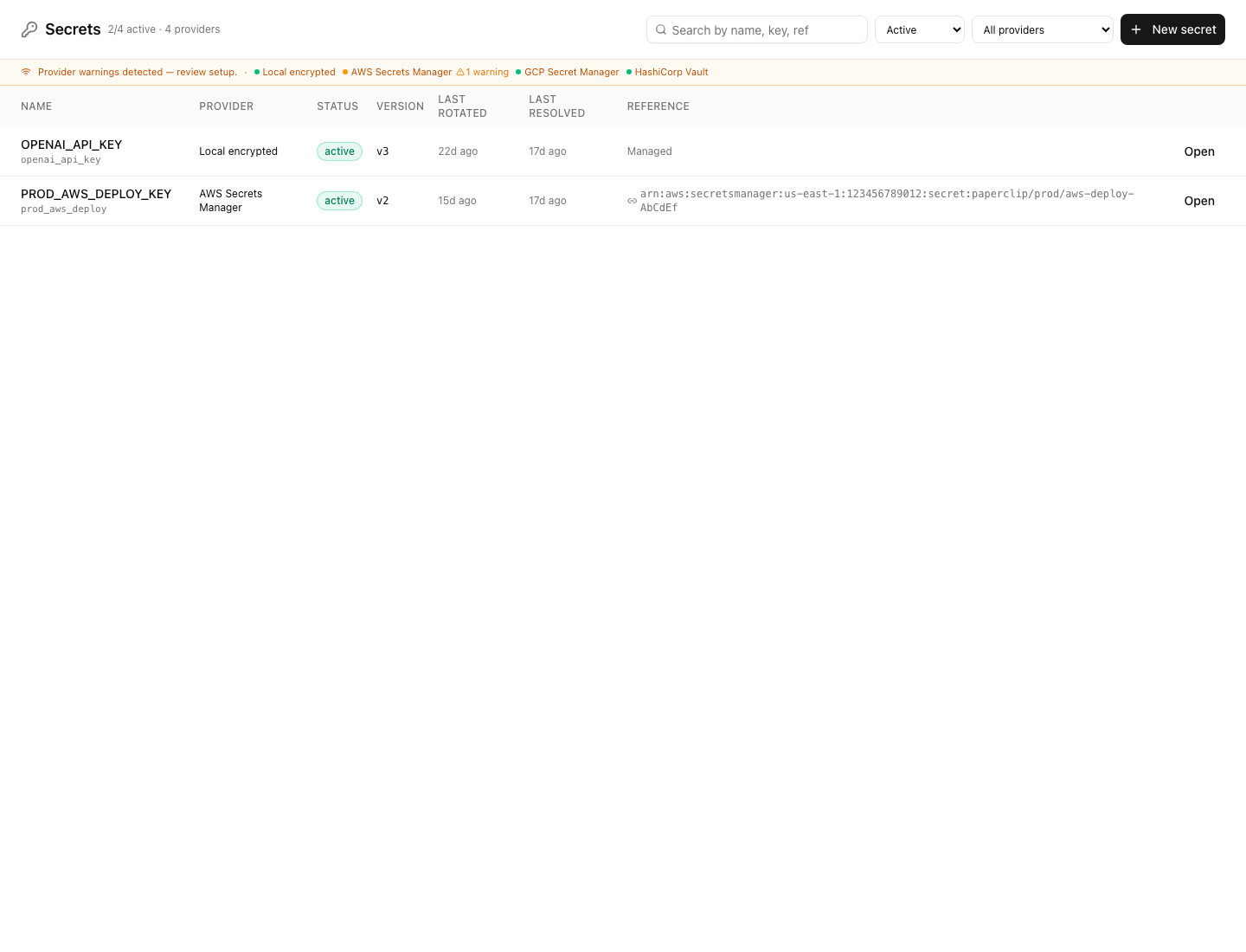 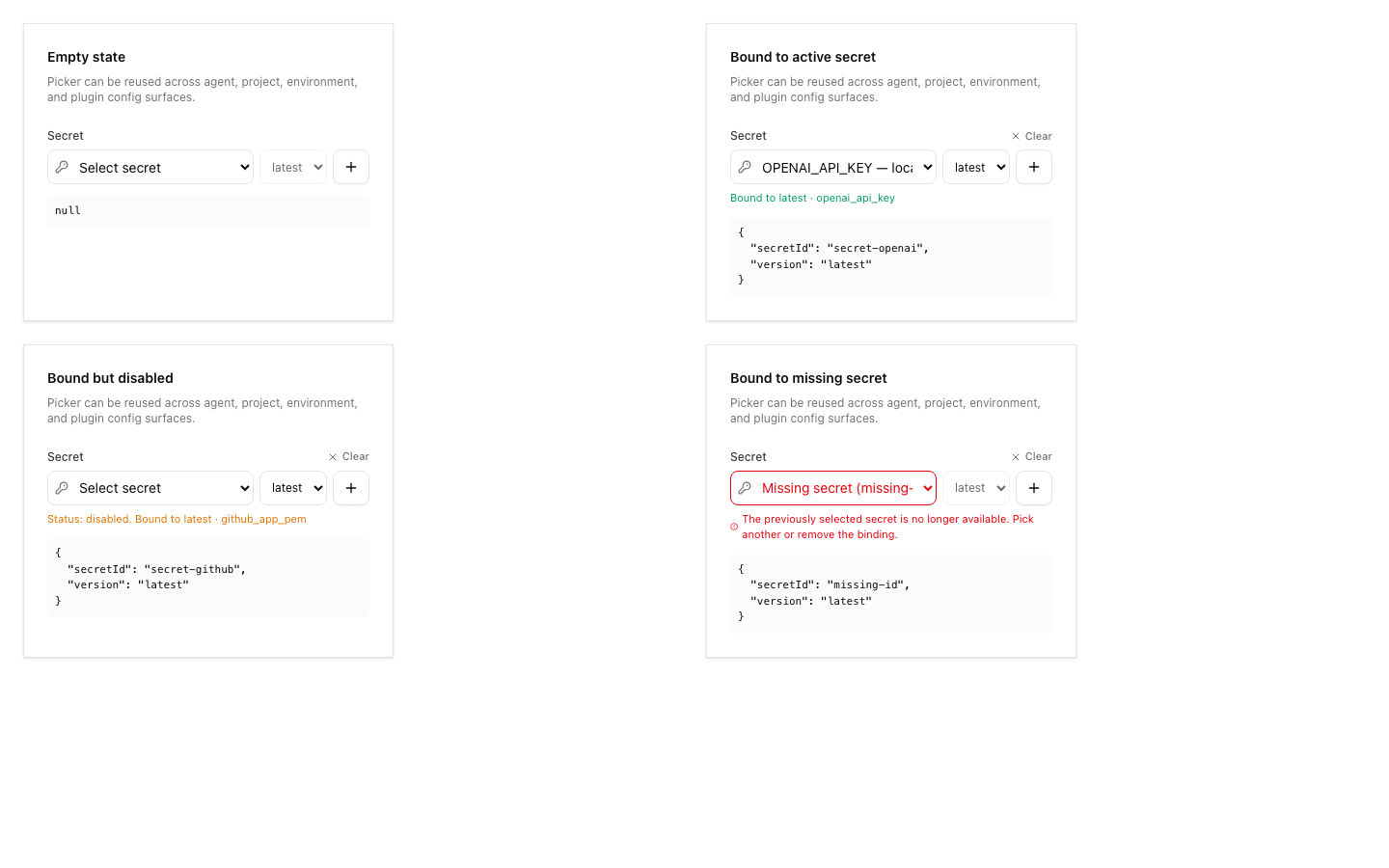 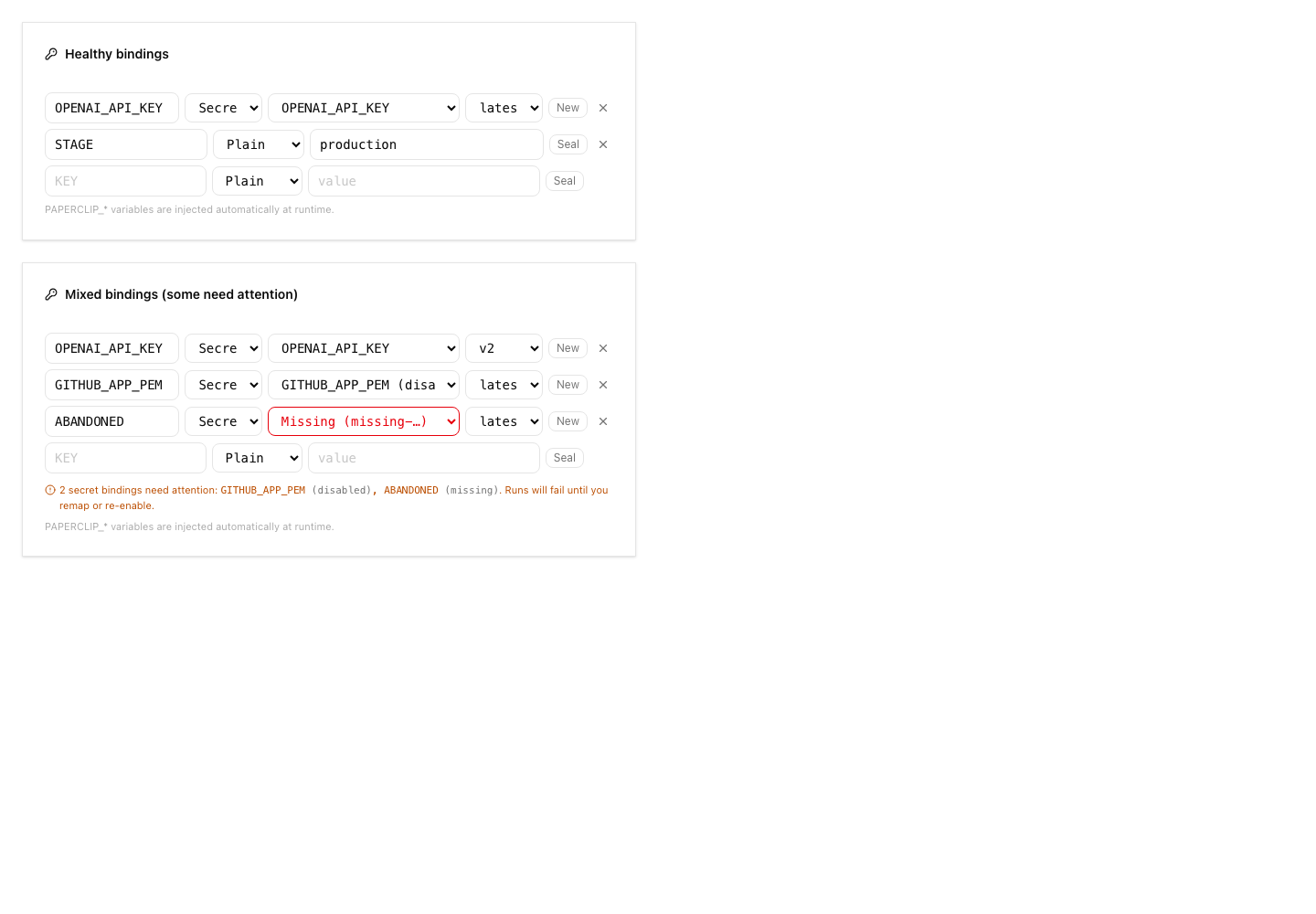 ## Risks - Migration risk: this adds new secret provider tables and extends existing secret rows. The migrations were checked for monotonic ordering and idempotent guards, but reviewers should still inspect upgrade behavior carefully. - Provider risk: AWS support uses direct SigV4 requests. Automated tests cover signing, request timeouts, vault-config selection, namespace guardrails, pending-version archival, sanitized provider errors, and service-level cleanup paths. A real-vault AWS smoke test remains deployment validation for an operator with AWS credentials rather than an unverified merge blocker in this local branch. - UI risk: the Secrets page and import dialog are large new surfaces; screenshots are included above for reviewer inspection. - Verification risk: the full local stable test command hit parallel-load timing failures, although the exact failed files passed when rerun directly. - Operational risk: remote import intentionally avoids plaintext reads; operators must understand that imported external references resolve at runtime and may fail if AWS permissions change. > For core feature work, check [`ROADMAP.md`](ROADMAP.md) first and discuss it in `#dev` before opening the PR. Feature PRs that overlap with planned core work may need to be redirected — check the roadmap first. See `CONTRIBUTING.md`. ## Model Used - OpenAI Codex, GPT-5 coding agent with local shell/tool use in the Paperclip worktree. Exact context-window size was not exposed by the runtime. ## Checklist - [x] I have included a thinking path that traces from project context to this change - [x] I have specified the model used (with version and capability details) - [x] I have checked ROADMAP.md and confirmed this PR does not duplicate planned core work - [ ] I have run tests locally and they pass - [x] I have added or updated tests where applicable - [x] If this change affects the UI, I have included before/after screenshots - [x] I have updated relevant documentation to reflect my changes - [x] I have considered and documented any risks above - [x] I will address all Greptile and reviewer comments before requesting merge --------- Co-authored-by: Paperclip <noreply@paperclip.ing> Co-authored-by: Claude Sonnet 4.6 <noreply@anthropic.com> |
||
|
DottaandPaperclip
|
d6d7a7cea6 |
Add routine revision history and restore flow (#5285)
## Thinking Path > - Paperclip is the control plane for autonomous AI companies. > - Routines are the scheduled/recurring work surface that keeps a company operating without manual kicks. > - Operators need routine edits to be auditable and recoverable, especially when routines control assignments, prompts, triggers, and webhook secrets. > - Documents already have revision-style safety, but routines did not have equivalent history or restore semantics. > - This pull request adds append-only routine revisions across the database, shared contracts, server routes, and board UI. > - The benefit is safer routine iteration: users can inspect history, compare changes, restore older definitions, and avoid overwriting newer edits. ## What Changed - Added `routine_revisions` storage, latest revision pointers on routines, shared types, validators, and API docs for routine revision history. - Added server service/route support for listing routine revisions, conflict-aware routine saves, and append-only restore operations. - Added a History tab on routine detail with revision preview, structured change summaries, description line diffs, dirty-edit blocking, restore confirmation, and restored webhook secret surfacing. - Extracted the line diff helper from `DocumentDiffModal` into `ui/src/lib/line-diff.ts` for reuse. - Rebased the branch onto current `public-gh/master` and renumbered the routine revision migration to `0077_unusual_karnak` after upstream `0076_useful_elektra`. - Made the `0077` routine revision migration idempotent so installs that already applied the branch-local `0076_unusual_karnak` can safely advance. - Updated the plugin SDK test harness routine fixture with the new revision fields required by the shared `Routine` contract. ## Verification - `pnpm --filter @paperclipai/db run check:migrations` passed. - `pnpm exec vitest run --project @paperclipai/shared packages/shared/src/validators/routine.test.ts` passed. - `pnpm exec vitest run --project @paperclipai/ui ui/src/lib/line-diff.test.ts ui/src/components/RoutineHistoryTab.test.tsx ui/src/lib/workspace-routines.test.ts ui/src/pages/Routines.test.tsx` passed. - `pnpm exec vitest run --project @paperclipai/server server/src/__tests__/routines-service.test.ts --pool=forks --poolOptions.forks.isolate=true` passed. - `pnpm exec vitest run --project @paperclipai/server server/src/__tests__/routines-routes.test.ts --pool=forks --poolOptions.forks.isolate=true` passed. - `pnpm --filter @paperclipai/plugin-sdk typecheck` passed after updating the SDK test harness fixture. - `pnpm --filter @paperclipai/plugin-sdk build` passed; this refreshed local generated SDK output needed by plugin example typechecks. - `pnpm -r typecheck` passed. ## Risks - Medium migration risk: this adds routine revision storage and backfills existing routines. The migration is ordered after upstream `0076` and uses `IF NOT EXISTS` / duplicate-object guards to tolerate earlier branch-local migration application. - Restore behavior intentionally appends a new revision instead of mutating history; callers expecting an in-place rollback need to follow the new latest revision pointer. - Restoring webhook triggers recreates webhook secret material, so users must copy newly surfaced secrets after restore. - Conflict-aware saves now reject stale routine edits when the client sends an older `baseRevisionId`. > For core feature work, check [`ROADMAP.md`](ROADMAP.md) first and discuss it in `#dev` before opening the PR. Feature PRs that overlap with planned core work may need to be redirected — check the roadmap first. See `CONTRIBUTING.md`. ## Model Used - OpenAI Codex, GPT-5-based coding agent, with shell/tool use in a local git worktree. Exact context-window size is not exposed in this runtime. ## Checklist - [x] I have included a thinking path that traces from project context to this change - [x] I have specified the model used (with version and capability details) - [x] I have checked ROADMAP.md and confirmed this PR does not duplicate planned core work - [x] I have run tests locally and they pass - [x] I have added or updated tests where applicable - [x] If this change affects the UI, I have included before/after screenshots - [x] I have updated relevant documentation to reflect my changes - [x] I have considered and documented any risks above - [x] I will address all Greptile and reviewer comments before requesting merge Screenshots: not attached in this draft PR; the new UI flow is covered by component tests listed above. --------- Co-authored-by: Paperclip <noreply@paperclip.ing> |
||
|
DottaandPaperclip
|
3c73ed26b5 |
Expand plugin host surface (#5205)
## Thinking Path > - Paperclip orchestrates AI agents for zero-human companies > - The plugin system is the extension boundary for optional product capabilities > - Rich plugins need more than a worker entrypoint: they need scoped database storage, local project folders, managed agents/routines, host navigation, and reusable UI components > - The LLM Wiki work exposed those missing host surfaces while keeping plugin code outside the core control plane > - This pull request expands the core plugin host, SDK, server APIs, and UI bridge so plugins can declare and use those surfaces > - The benefit is that future plugins can integrate with Paperclip through documented, validated contracts instead of bespoke server or UI imports ## What Changed - Added plugin-managed database namespaces and migration tracking, including Drizzle schema/migration files and SQL validation for namespace isolation. - Added server support for plugin local folders, managed agents, managed routines, scoped plugin APIs, and plugin operation visibility. - Expanded shared plugin manifest/types/validators and SDK host/testing/UI exports for richer plugin surfaces. - Added reusable UI pieces for file trees, managed routines, resizable sidebars, route sidebars, and plugin bridge initialization. - Updated plugin docs and example plugins to use the expanded host and SDK surface. ## Verification - `pnpm install --frozen-lockfile` - `pnpm run preflight:workspace-links && pnpm exec vitest run packages/shared/src/validators/plugin.test.ts server/src/__tests__/plugin-database.test.ts server/src/__tests__/plugin-local-folders.test.ts server/src/__tests__/plugin-managed-agents.test.ts server/src/__tests__/plugin-managed-routines.test.ts server/src/__tests__/plugin-orchestration-apis.test.ts ui/src/api/plugins.test.ts ui/src/components/FileTree.test.tsx ui/src/components/ResizableSidebarPane.test.tsx ui/src/pages/PluginPage.test.tsx ui/src/plugins/bridge.test.ts` passed: 11 files, 67 tests. - Confirmed this PR changes 89 files and does not include `pnpm-lock.yaml` or `.github/workflows/*`. ## Risks - Medium: this expands plugin host contracts across db/shared/server/ui and includes a new core migration (`0076_useful_elektra.sql`). - The plugin database namespace validator is intentionally restrictive; plugin authors may need follow-up affordances for SQL patterns that remain blocked. - Merge this before the LLM Wiki plugin PR so the plugin can resolve the new SDK and host APIs. > For core feature work, check [`ROADMAP.md`](ROADMAP.md) first and discuss it in `#dev` before opening the PR. Feature PRs that overlap with planned core work may need to be redirected — check the roadmap first. See `CONTRIBUTING.md`. ## Model Used - OpenAI Codex, GPT-5 coding agent, tool-enabled shell/git/GitHub workflow. Context window size was not exposed by the runtime. ## Checklist - [x] I have included a thinking path that traces from project context to this change - [x] I have specified the model used (with version and capability details) - [x] I have checked ROADMAP.md and confirmed this PR does not duplicate planned core work - [x] I have run tests locally and they pass - [x] I have added or updated tests where applicable - [x] If this change affects the UI, I have included before/after screenshots - [x] I have updated relevant documentation to reflect my changes - [x] I have considered and documented any risks above - [x] I will address all Greptile and reviewer comments before requesting merge --------- Co-authored-by: Paperclip <noreply@paperclip.ing> |
||
|
DottaandPaperclip
|
2d72292ad6 |
[codex] Add workspace routine run tab (#4958)
## Thinking Path > - Paperclip orchestrates AI agents through reusable execution workspaces and routines > - Operators need a fast way to run workspace-aware routines against a specific execution workspace > - The existing workspace detail surface showed configuration, runtime logs, and linked issues, but not routines that depend on workspace variables > - Routine runs also needed to prefill the selected execution workspace so branch variables resolve correctly > - This pull request adds a workspace routines tab and prefilled routine-run dialog support > - The benefit is a tighter workflow for rerunning reviews, smoke checks, and other workspace-specific routines ## What Changed - Added an execution workspace `Routines` tab and company-prefixed routes. - Listed routines that declare or reference workspace-specific variables. - Added `Run now` support that preselects the current execution workspace in `RoutineRunVariablesDialog`. - Centralized reusable execution workspace ordering/deduplication for issue creation and workspace cards. - Added focused UI helper and dialog regression tests. ## Verification - `pnpm exec vitest run ui/src/lib/reusable-execution-workspaces.test.ts ui/src/lib/workspace-routines.test.ts ui/src/components/RoutineRunVariablesDialog.test.tsx ui/src/lib/company-routes.test.ts` - Screenshots were not captured in this PR split; the visible flow is covered by focused component/helper tests and should get browser QA in the follow-up issue. ## Risks - Medium risk: this adds a new workspace detail tab and routine-run path. It is isolated to workspace-scoped routines and uses existing routine run APIs. > For core feature work, check [`ROADMAP.md`](ROADMAP.md) first and discuss it in `#dev` before opening the PR. Feature PRs that overlap with planned core work may need to be redirected — check the roadmap first. See `CONTRIBUTING.md`. ## Model Used - OpenAI Codex, GPT-5 coding agent, tool use and local command execution. Exact context window was not exposed in the runtime. ## Checklist - [x] I have included a thinking path that traces from project context to this change - [x] I have specified the model used (with version and capability details) - [x] I have checked ROADMAP.md and confirmed this PR does not duplicate planned core work - [x] I have run tests locally and they pass - [x] I have added or updated tests where applicable - [ ] If this change affects the UI, I have included before/after screenshots - [x] I have updated relevant documentation to reflect my changes - [x] I have considered and documented any risks above - [x] I will address all Greptile and reviewer comments before requesting merge --------- Co-authored-by: Paperclip <noreply@paperclip.ing> |
||
|
DottaandPaperclip
|
f88f538e6d |
Keep manual routine runs visible in the runner inbox (#4615)
## Thinking Path > - Paperclip coordinates recurring agent work through scheduled and manual routines. > - Manual routine runs are board-initiated work and should stay visible to the human who kicked them off. > - Routine execution issues are agent-assigned, so they can be filtered away from a board user's inbox unless the user is recorded as touching the work. > - Coalesced or skipped active routine runs have the same visibility problem because they reuse an existing live issue. > - This pull request carries the manual runner actor into routine dispatch and touches the linked issue for that user's inbox. > - The benefit is that manually triggered routine work stays discoverable by the operator who started it. ## What Changed - Passed the board or agent actor from the routine run route into the routine service. - Recorded manual board runners as `createdByUserId` on fresh routine execution issues. - Touched coalesced or skipped active routine issues for the manual runner by updating read state and clearing that user's inbox archive. - Added route and service regressions for manual routine run actor propagation and inbox visibility. ## Verification - `pnpm exec vitest run server/src/__tests__/routines-routes.test.ts server/src/__tests__/routines-service.test.ts` ## Risks - Low risk: the change is scoped to manual routine runs and only updates issue attribution/read-state metadata for the initiating actor. - No migrations. > For core feature work, check [`ROADMAP.md`](ROADMAP.md) first and discuss it in `#dev` before opening the PR. Feature PRs that overlap with planned core work may need to be redirected — check the roadmap first. See `CONTRIBUTING.md`. ## Model Used - OpenAI Codex coding agent based on GPT-5, tool-enabled local repository and shell access, Paperclip heartbeat context. ## Checklist - [x] I have included a thinking path that traces from project context to this change - [x] I have specified the model used (with version and capability details) - [x] I have checked ROADMAP.md and confirmed this PR does not duplicate planned core work - [x] I have run tests locally and they pass - [x] I have added or updated tests where applicable - [x] If this change affects the UI, I have included before/after screenshots - [x] I have updated relevant documentation to reflect my changes - [x] I have considered and documented any risks above - [x] I will address all Greptile and reviewer comments before requesting merge --------- Co-authored-by: Paperclip <noreply@paperclip.ing> |
||
|
Devin Foley
|
70679a3321 |
Add sandbox environment support (#4415)
## Thinking Path > - Paperclip orchestrates AI agents for zero-human companies. > - The environment/runtime layer decides where agent work executes and how the control plane reaches those runtimes. > - Today Paperclip can run locally and over SSH, but sandboxed execution needs a first-class environment model instead of one-off adapter behavior. > - We also want sandbox providers to be pluggable so the core does not hardcode every provider implementation. > - This branch adds the Sandbox environment path, the provider contract, and a deterministic fake provider plugin. > - That required synchronized changes across shared contracts, plugin SDK surfaces, server runtime orchestration, and the UI environment/workspace flows. > - The result is that sandbox execution becomes a core control-plane capability while keeping provider implementations extensible and testable. ## What Changed - Added sandbox runtime support to the environment execution path, including runtime URL discovery, sandbox execution targeting, orchestration, and heartbeat integration. - Added plugin-provider support for sandbox environments so providers can be supplied via plugins instead of hardcoded server logic. - Added the fake sandbox provider plugin with deterministic behavior suitable for local and automated testing. - Updated shared types, validators, plugin protocol definitions, and SDK helpers to carry sandbox provider and workspace-runtime contracts across package boundaries. - Updated server routes and services so companies can create sandbox environments, select them for work, and execute work through the sandbox runtime path. - Updated the UI environment and workspace surfaces to expose sandbox environment configuration and selection. - Added test coverage for sandbox runtime behavior, provider seams, environment route guards, orchestration, and the fake provider plugin. ## Verification - Ran locally before the final fixture-only scrub: - `pnpm -r typecheck` - `pnpm test:run` - `pnpm build` - Ran locally after the final scrub amend: - `pnpm vitest run server/src/__tests__/runtime-api.test.ts` - Reviewer spot checks: - create a sandbox environment backed by the fake provider plugin - run work through that environment - confirm sandbox provider execution does not inherit host secrets implicitly ## Risks - This touches shared contracts, plugin SDK plumbing, server runtime orchestration, and UI environment/workspace flows, so regressions would likely show up as cross-layer mismatches rather than isolated type errors. - Runtime URL discovery and sandbox callback selection are sensitive to host/bind configuration; if that logic is wrong, sandbox-backed callbacks may fail even when execution succeeds. - The fake provider plugin is intentionally deterministic and test-oriented; future providers may expose capability gaps that this branch does not yet cover. ## Model Used - OpenAI Codex coding agent on a GPT-5-class backend in the Paperclip/Codex harness. Exact backend model ID is not exposed in-session. Tool-assisted workflow with shell execution, file editing, git history inspection, and local test execution. ## Checklist - [x] I have included a thinking path that traces from project context to this change - [x] I have specified the model used (with version and capability details) - [x] I have checked ROADMAP.md and confirmed this PR does not duplicate planned core work - [x] I have run tests locally and they pass - [x] I have added or updated tests where applicable - [ ] If this change affects the UI, I have included before/after screenshots - [x] I have updated relevant documentation to reflect my changes - [x] I have considered and documented any risks above - [x] I will address all Greptile and reviewer comments before requesting merge |
||
|
Dotta
|
09d0678840 |
[codex] Harden heartbeat scheduling and runtime controls (#4223)
## Thinking Path > - Paperclip orchestrates AI agents through issue checkout, heartbeat runs, routines, and auditable control-plane state > - The runtime path has to recover from lost local processes, transient adapter failures, blocked dependencies, and routine coalescing without stranding work > - The existing branch carried several reliability fixes across heartbeat scheduling, issue runtime controls, routine dispatch, and operator-facing run state > - These changes belong together because they share backend contracts, migrations, and runtime status semantics > - This pull request groups the control-plane/runtime slice so it can merge independently from board UI polish and adapter sandbox work > - The benefit is safer heartbeat recovery, clearer runtime controls, and more predictable recurring execution behavior ## What Changed - Adds bounded heartbeat retry scheduling, scheduled retry state, and Codex transient failure recovery handling. - Tightens heartbeat process recovery, blocker wake behavior, issue comment wake handling, routine dispatch coalescing, and activity/dashboard bounds. - Adds runtime-control MCP tools and Paperclip skill docs for issue workspace runtime management. - Adds migrations `0061_lively_thor_girl.sql` and `0062_routine_run_dispatch_fingerprint.sql`. - Surfaces retry state in run ledger/agent UI and keeps related shared types synchronized. ## Verification - `pnpm exec vitest run server/src/__tests__/heartbeat-retry-scheduling.test.ts server/src/__tests__/heartbeat-process-recovery.test.ts server/src/__tests__/routines-service.test.ts` - `pnpm exec vitest run src/tools.test.ts` from `packages/mcp-server` ## Risks - Medium risk: this touches heartbeat recovery and routine dispatch, which are central execution paths. - Migration order matters if split branches land out of order: merge this PR before branches that assume the new runtime/routine fields. - Runtime retry behavior should be watched in CI and in local operator smoke tests because it changes how transient failures are resumed. > For core feature work, check [`ROADMAP.md`](ROADMAP.md) first and discuss it in `#dev` before opening the PR. Feature PRs that overlap with planned core work may need to be redirected — check the roadmap first. See `CONTRIBUTING.md`. ## Model Used - OpenAI Codex, GPT-5-based coding agent runtime, shell/git tool use enabled. Exact hosted model build and context window are not exposed in this Paperclip heartbeat environment. ## Checklist - [x] I have included a thinking path that traces from project context to this change - [x] I have specified the model used (with version and capability details) - [x] I have checked ROADMAP.md and confirmed this PR does not duplicate planned core work - [x] I have run tests locally and they pass - [x] I have added or updated tests where applicable - [ ] If this change affects the UI, I have included before/after screenshots - [x] I have updated relevant documentation to reflect my changes - [x] I have considered and documented any risks above - [x] I will address all Greptile and reviewer comments before requesting merge |
||
|
DottaandPaperclip
|
549ef11c14 |
[codex] Respect manual workspace runtime controls (#4125)
## Thinking Path > - Paperclip orchestrates AI agents inside execution and project workspaces > - Workspace runtime services can be controlled manually by operators and reused by agent runs > - Manual start/stop state was not preserved consistently across workspace policies and routine launches > - Routine launches also needed branch/workspace variables to default from the selected workspace context > - This pull request makes runtime policy state explicit, preserves manual control, and auto-fills routine branch variables from workspace data > - The benefit is less surprising workspace service behavior and fewer manual inputs when running workspace-scoped routines ## What Changed - Added runtime-state handling for manual workspace control across execution and project workspace validators, routes, and services. - Updated heartbeat/runtime startup behavior so manually stopped services are respected. - Auto-filled routine workspace branch variables from available workspace context. - Added focused server and UI tests for workspace runtime and routine variable behavior. - Removed muted gray background styling from workspace pages and cards for a cleaner workspace UI. ## Verification - `pnpm install --frozen-lockfile --ignore-scripts` - `pnpm exec vitest run server/src/__tests__/routines-service.test.ts server/src/__tests__/workspace-runtime.test.ts ui/src/components/RoutineRunVariablesDialog.test.tsx` - Result: 55 tests passed, 21 skipped. The embedded Postgres routines tests skipped on this host with the existing PGlite/Postgres init warning; workspace-runtime and UI tests passed. ## Risks - Medium risk: this touches runtime service start/stop policy and heartbeat launch behavior. - The focused tests cover manual runtime state, routine variables, and workspace runtime reuse paths. > For core feature work, check [`ROADMAP.md`](ROADMAP.md) first and discuss it in `#dev` before opening the PR. Feature PRs that overlap with planned core work may need to be redirected — check the roadmap first. See `CONTRIBUTING.md`. ## Model Used - OpenAI Codex coding agent based on GPT-5, tool-enabled local shell and GitHub workflow, exact runtime context window not exposed in this session. ## Checklist - [x] I have included a thinking path that traces from project context to this change - [x] I have specified the model used (with version and capability details) - [x] I have checked ROADMAP.md and confirmed this PR does not duplicate planned core work - [x] I have run tests locally and they pass - [x] I have added or updated tests where applicable - [x] If this change affects the UI, I have included before/after screenshots, or documented why targeted component/service verification is sufficient here - [x] I have updated relevant documentation to reflect my changes - [x] I have considered and documented any risks above - [x] I will address all Greptile and reviewer comments before requesting merge --------- Co-authored-by: Paperclip <noreply@paperclip.ing> |
||
|
Lempkey
|
d0a8d4e08a |
fix(routines): include cronExpression and timezone in list trigger response (#3209)
## Thinking Path

> - Paperclip orchestrates AI agents for zero-human companies
> - Routines are recurring tasks that trigger agents on a schedule or
via webhook
> - Routine triggers store their schedule as a `cronExpression` +
`timezone` in the database
> - The `GET /companies/:companyId/routines` list endpoint is the
primary way API consumers (and the UI) discover all routines and their
triggers
> - But the list endpoint was silently dropping `cronExpression` and
`timezone` from each trigger object — the DB query fetched them, but the
explicit object-construction mapping only forwarded seven other fields
> - This PR fixes the mapping to include `cronExpression` and
`timezone`, and extends the `RoutineListItem.triggers` type to match
> - The benefit is that API consumers can now see the actual schedule
from the list endpoint, and future UI components reading from the list
cache will get accurate schedule data

## What Changed

- **`server/src/services/routines.ts`** — Added `cronExpression` and
`timezone` to the explicit trigger object mapping inside
`routinesService.list()`. The DB query (`listTriggersForRoutineIds`)
already fetched all columns via `SELECT *`; the values were being
discarded during object construction.
- **`packages/shared/src/types/routine.ts`** — Extended
`RoutineListItem.triggers` `Pick<RoutineTrigger, ...>` to include
`cronExpression` and `timezone` so the TypeScript type contract matches
the actual runtime shape.
- **`server/src/__tests__/routines-e2e.test.ts`** — Added assertions to
the existing schedule-trigger E2E test that verify both `cronExpression`
and `timezone` are present in the `GET /companies/:companyId/routines`
list response.

## Verification

```bash
# Run the route + service unit tests
npx vitest run server/src/__tests__/routines-routes.test.ts server/src/__tests__/routines-service.test.ts
# → 21 tests pass

# Confirm cronExpression appears in list response
curl /api/companies/{id}/routines | jq '.[].triggers[].cronExpression'
# → now returns the actual cron string instead of undefined
```

Manual reproduction per the issue:
1. Create a routine with a schedule trigger (`cronExpression: "47 14 * *
*"`, `timezone: "America/Mexico_City"`)
2. `GET /api/companies/{id}/routines` — trigger object now includes
`cronExpression` and `timezone`

## Risks

Low risk. The change only adds two fields to an existing response shape
— no fields removed, no behavior changed. The `cronExpression` is `null`
for non-schedule trigger kinds (webhook, etc.), consistent with
`RoutineTrigger.cronExpression: string | null`. No migration required.

## Model Used

- **Provider:** Anthropic
- **Model:** Claude Sonnet 4.6 (`claude-sonnet-4-6`)
- **Context window:** 200k tokens
- **Mode:** Extended thinking + tool use (agentic)
- Secondary adversarial review: OpenAI Codex (via codex-companion
plugin)

## Checklist

- [x] I have included a thinking path that traces from project context
to this change
- [x] I have specified the model used (with version and capability
details)
- [x] I have run tests locally and they pass
- [x] I have added or updated tests where applicable
- [ ] If this change affects the UI, I have included before/after
screenshots (API-only fix; no UI rendering change)
- [ ] I have updated relevant documentation to reflect my changes (no
doc changes needed)
- [x] I have considered and documented any risks above
- [x] I will address all Greptile and reviewer comments before
requesting merge
|
||
|
dotta
|
5d021583be | Add draft routine defaults and run-time overrides | ||
|
dotta
|
1de5fb9316 | Support routine variables in titles | ||
|
AntonioandClaude Opus 4.6
|
a8d1c4b596 |
fix(server): use Buffer.length for timing-safe HMAC comparison and document header fallback
Compare Buffer byte lengths instead of string character lengths before timingSafeEqual to avoid potential mismatch with multi-byte input. Add comment explaining the hubSignatureHeader ?? signatureHeader fallback. Co-Authored-By: Claude Opus 4.6 (1M context) <noreply@anthropic.com> |
||
|
AntonioandClaude Opus 4.6
|
cd19834fab |
feat(server): add github_hmac and none webhook signing modes
Adds two new webhook trigger signing modes for external provider compatibility: - github_hmac: accepts X-Hub-Signature-256 header with HMAC-SHA256(secret, rawBody), no timestamp prefix. Compatible with GitHub, Sentry, and services following the same standard. - none: no authentication; the 24-char hex publicId in the URL acts as the shared secret. For services that cannot add auth headers. The replay window UI field is hidden when these modes are selected since neither uses timestamp-based replay protection. Closes #1892 Co-Authored-By: Claude Opus 4.6 (1M context) <noreply@anthropic.com> |
||
|
dottaandPaperclip
|
37b6ad42ea |
Add versioned telemetry events
Co-Authored-By: Paperclip <noreply@paperclip.ing> |
||
|
dottaandPaperclip
|
fd6cfc7149 |
fix(routines): address Greptile review findings
Co-Authored-By: Paperclip <noreply@paperclip.ing> |
||
|
dottaandPaperclip
|
909e8cd4c8 |
feat(routines): add workspace-aware routine runs
Co-Authored-By: Paperclip <noreply@paperclip.ing> |
||
|
dotta
|
8dc98db717 | fix: close remaining routine merge blockers | ||
|
dotta
|
9093cfbe4f | fix: address greptile routine review | ||
|
dotta
|
99eb317600 | fix: harden routine dispatch and permissions | ||
|
dotta
|
a62c264ddf | fix: harden public routine trigger auth | ||
|
dottaandPaperclip
|
5b1e1239fd |
Fix routine run assignment wakeups
Co-Authored-By: Paperclip <noreply@paperclip.ing> |
||
|
dottaandPaperclip
|
2d8c8abbfb |
Fix routine assignment wakeups
Share issue-assignment wakeup logic between direct issue creation and routine-created execution issues, and add regression coverage for the routine path. Co-Authored-By: Paperclip <noreply@paperclip.ing> |
||
|
dottaandPaperclip
|
5fee484e85 |
Fix routine coalescing for idle execution issues
Co-Authored-By: Paperclip <noreply@paperclip.ing> |
||
|
dottaandPaperclip
|
c7d05096ab |
Allow Run Now on paused routines
The server rejected manual runs for any non-active routine. Now only archived routines are blocked — paused routines can still be triggered manually via "Run now". Co-Authored-By: Paperclip <noreply@paperclip.ing> |
||
|
dottaandPaperclip
|
5caf43349b |
Improve routine configuration: delete triggers, fix pause, add feedback
- Add trash icon button to delete triggers (full stack: service, route, API client, UI) - Fix pause/unpause bug where saving routine could revert status by excluding status from the save payload (status is managed via dedicated pause/resume buttons) - Add toast feedback for run, pause, and resume actions - Auto-switch to Runs tab after triggering a manual run - Add live update invalidation for routine/trigger/run activity events Co-Authored-By: Paperclip <noreply@paperclip.ing> |
||
|
dottaandPaperclip
|
500d926da7 |
Refine routines editor flow
Align the routines list and detail editors with the issue-composer interaction model, and fix the scheduler's typed date comparison. Co-Authored-By: Paperclip <noreply@paperclip.ing> |


