mirror of
https://github.com/paperclipai/paperclip.git
synced 2026-10-21 00:05:49 +02:00
7cbd61349a67b7ddb87700a7169ff3f7f3cf5f38
14
Commits
| Author | SHA1 | Message | Date | |
|---|---|---|---|---|
 Nicky LeachandPaperclip |
984f092ddf |
Add project and agent resource lifecycle hooks (#15280)
## Thinking Path > - Paperclip manages agents and projects for work. > - Plugins need reliable lifecycle hooks for these resources. > - In-process notifications can disappear during a restart. > - A lifecycle record must commit with the resource change. > - This pull request adds a generic lifecycle journal without provider calls. > - A later plugin delivery layer can use these records without losing lifecycle changes. ## Linked Issues or Issue Description **Problem or motivation** Resource provisioning needs durable hooks for agent hiring, pause, resume, termination, and project creation. Hooks must cover shared service callers, budget actions, and approval paths. Capture should work for all plugins and deployment modes. **Proposed solution** Record content-free events in the resource transaction. Deduplicate creation and unchanged status. Preserve each pause/resume cycle. Commit approval, activation, and creation together. Commit termination and API-key revocation together. **Alternatives considered** Event subscriptions alone cannot survive process failure. Cloud-only capture would exclude other plugins. Provider calls inside tenant transactions would couple resource creation to external services. **Roadmap alignment** This is lifecycle infrastructure for the existing plugin system. It adds no provider, adapter, UI, or plugin read API. Repository mutations and backfill remain separate work. Searches found no duplicate lifecycle-journal PR. ## What Changed - Add a company-scoped lifecycle journal and an additive migration. - Record hired-agent and project creation from shared services. - Record agent pause, resume, and termination, including generic updates and budget actions. - Lock agent state changes to suppress concurrent duplicate hooks. - Make hire approval, rejection, and termination transactions atomic with their lifecycle records. - Document capture, ordering, future per-plugin acknowledgments, and migration scope. ## Verification - Full workspace typecheck: `pnpm -r typecheck` passed. - Production build: `pnpm build` passed. - Focused agent, project, approval, budget, and built-in regressions: 102 tests passed across 9 suites. - Final lifecycle journal check: 14 tests passed. It covers repeated/concurrent transitions, rollback, key revocation, self-hosted capture, and company boundaries. - Review regression: 32 lifecycle and approval tests passed, including rejected-hire rollback and retry; server typecheck passed after the fix. - The initial local `pnpm test:run` overlapped the rejection fix and reported the new rollback regression against the earlier service code. A fresh lifecycle run passed all 14 tests. Fresh full local shards were stopped once the complete CI test matrix passed on the final commit. - `git diff --check` and a local secret/PII scan passed. - Greptile: 5/5 on `3ee3903f8e1a171ea3ba2bea9caa2b5766a3f807`, with the review thread resolved. - [Complete CI passed](https://github.com/paperclipai/paperclip/actions/runs/37374227222) on `3ee3903f8e1a171ea3ba2bea9caa2b5766a3f807`: general server/chat/workspace tests, serialized server suites, runner checks, build, typecheck, canary, and all end-to-end shards. The requester waived CI during the Actions outage, but the workflow subsequently completed successfully. ## Risks - The migration creates an empty table. It does not scan or backfill existing resources. - Apply the normal database migration before running this server version. Event-write failure intentionally rolls back the resource change. - Pending hires cannot bypass approval through pause or resume. - Capture works on all deployments. Plugin delivery, retention, retries, and provider actions remain separate work. No plugin can read this journal through a new API in this PR. - Future delivery must enforce company scope, track acknowledgments per plugin, and preserve resource order. A global sequence cursor can skip uncommitted transactions. - A termination hook does not authorize deleting persistent volumes. ## Model Used OpenAI Codex, based on GPT-6, with reasoning, repository inspection, code execution, and tool use. The exact deployment model ID and context window are not exposed in this session. ## Checklist - [x] I have included a thinking path that traces from project context to this change - [x] I have specified the model used (with version and capability details) - [x] I have checked ROADMAP.md and confirmed this PR does not duplicate planned core work - [x] I have searched GitHub for duplicate or related PRs and linked them above - [x] I have either (a) linked existing issues with `Fixes: #` / `Closes #` / `Refs #` OR (b) described the issue in-PR following the relevant issue template - [x] I have not referenced internal/instance-local Paperclip issues or links (only public GitHub `#NNN` / `github.com/paperclipai/paperclip` URLs) - [x] My branch name describes the change (e.g. `docs/...`, `fix/...`) and contains no internal Paperclip ticket id or instance-derived details - [x] I have run tests locally and they pass - [x] I have added or updated tests where applicable - [x] I have updated relevant documentation to reflect my changes - [x] I have considered and documented any risks above - [x] All Paperclip CI gates are green - [x] Greptile is 5/5 with no open P2s, recommendations, or follow-ups - [x] I will address all Greptile and reviewer comments before requesting merge --------- Co-authored-by: Paperclip <noreply@paperclip.ing> |
||
|
|
1ef3b08714 |
feat(ui): integrate agent personas across the app (#13171)
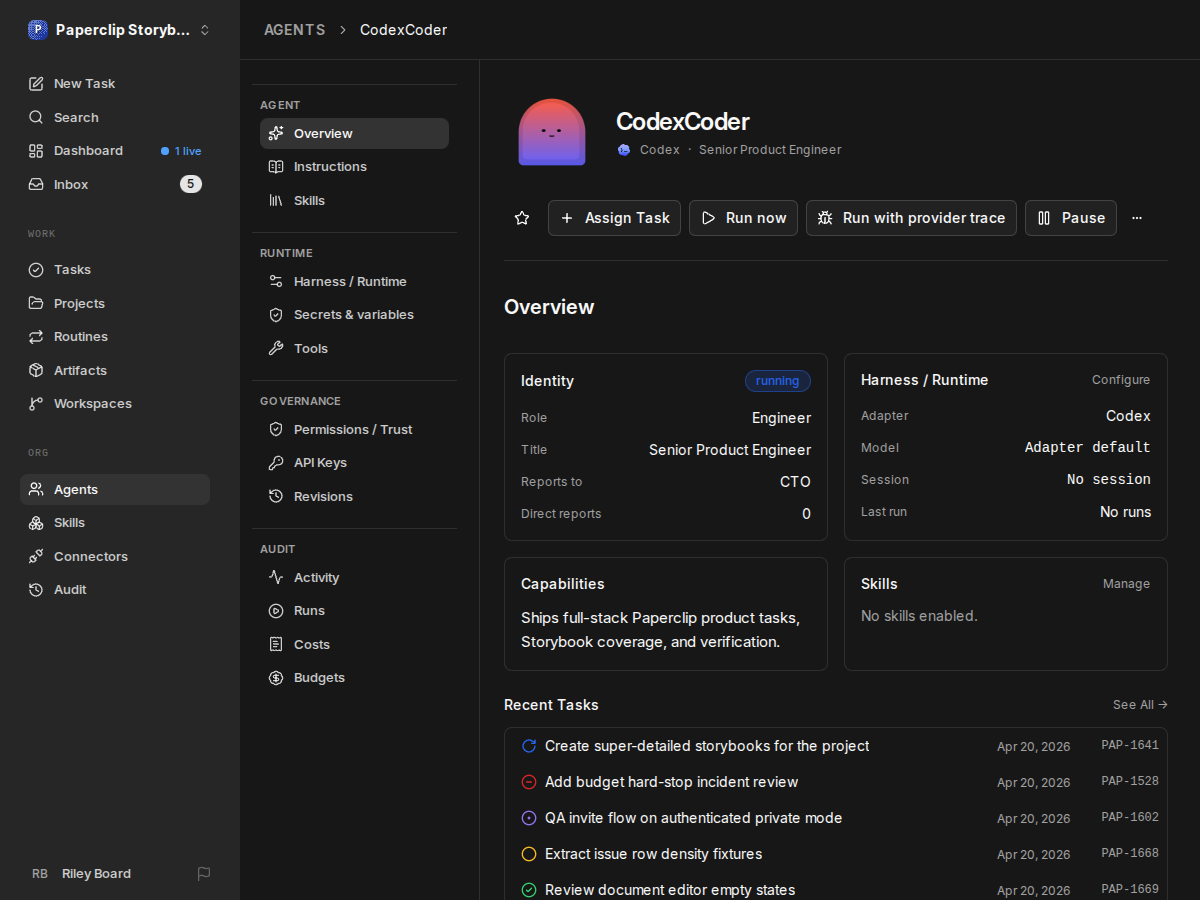
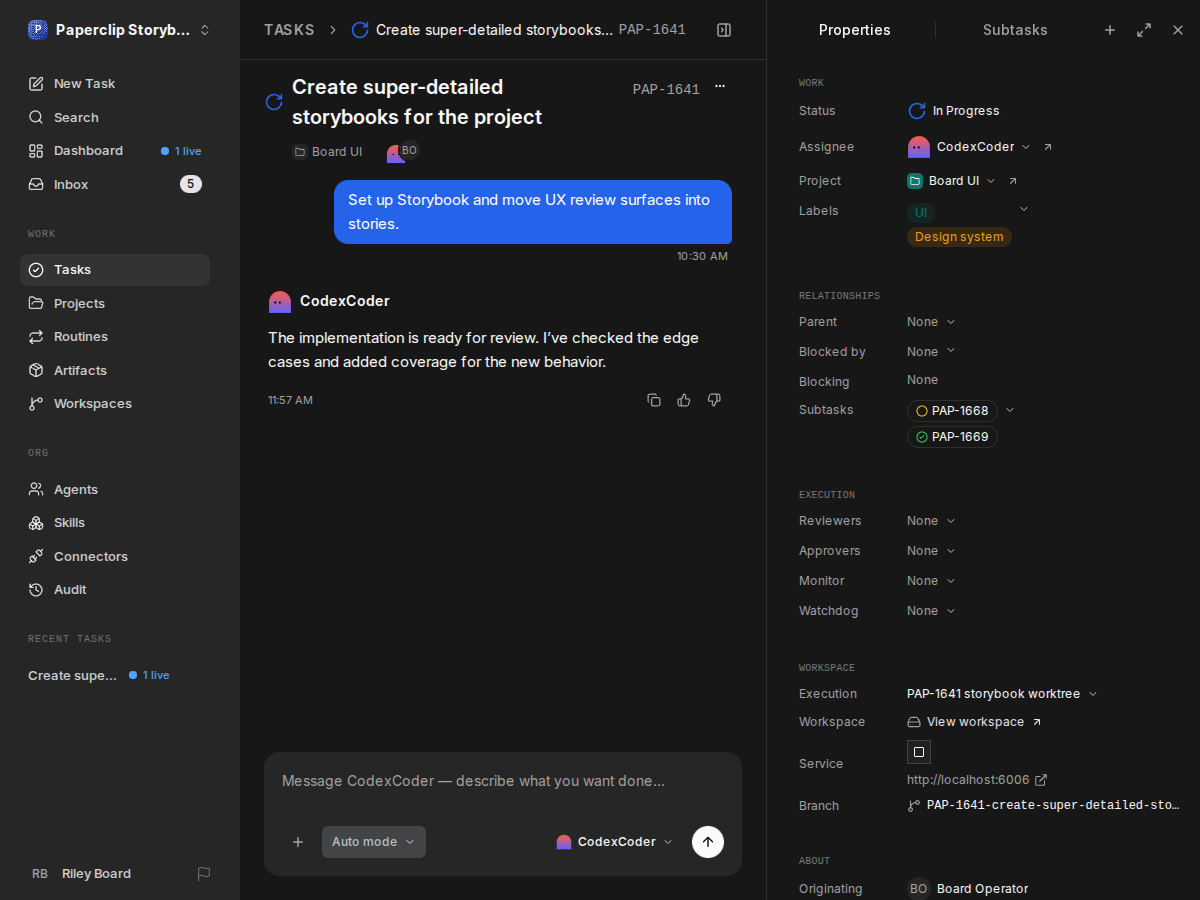
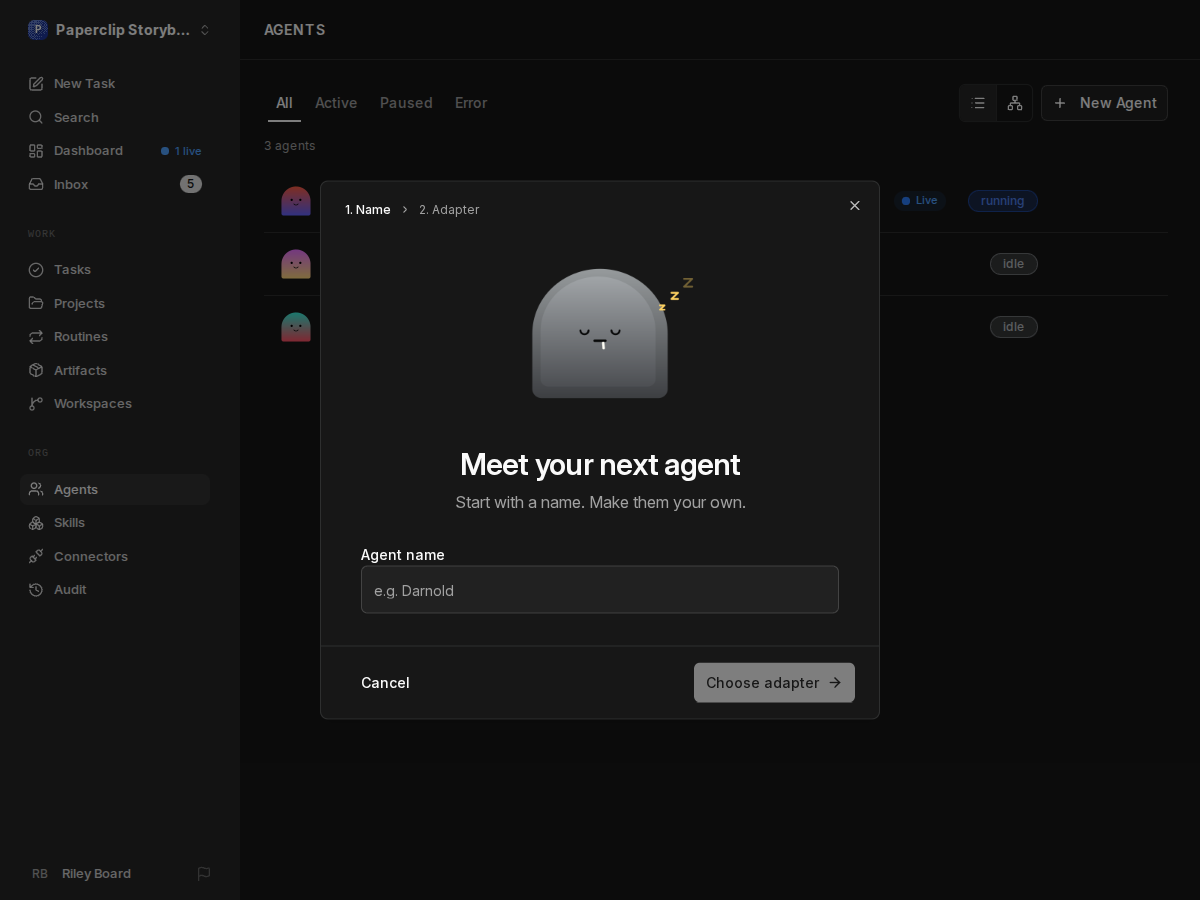
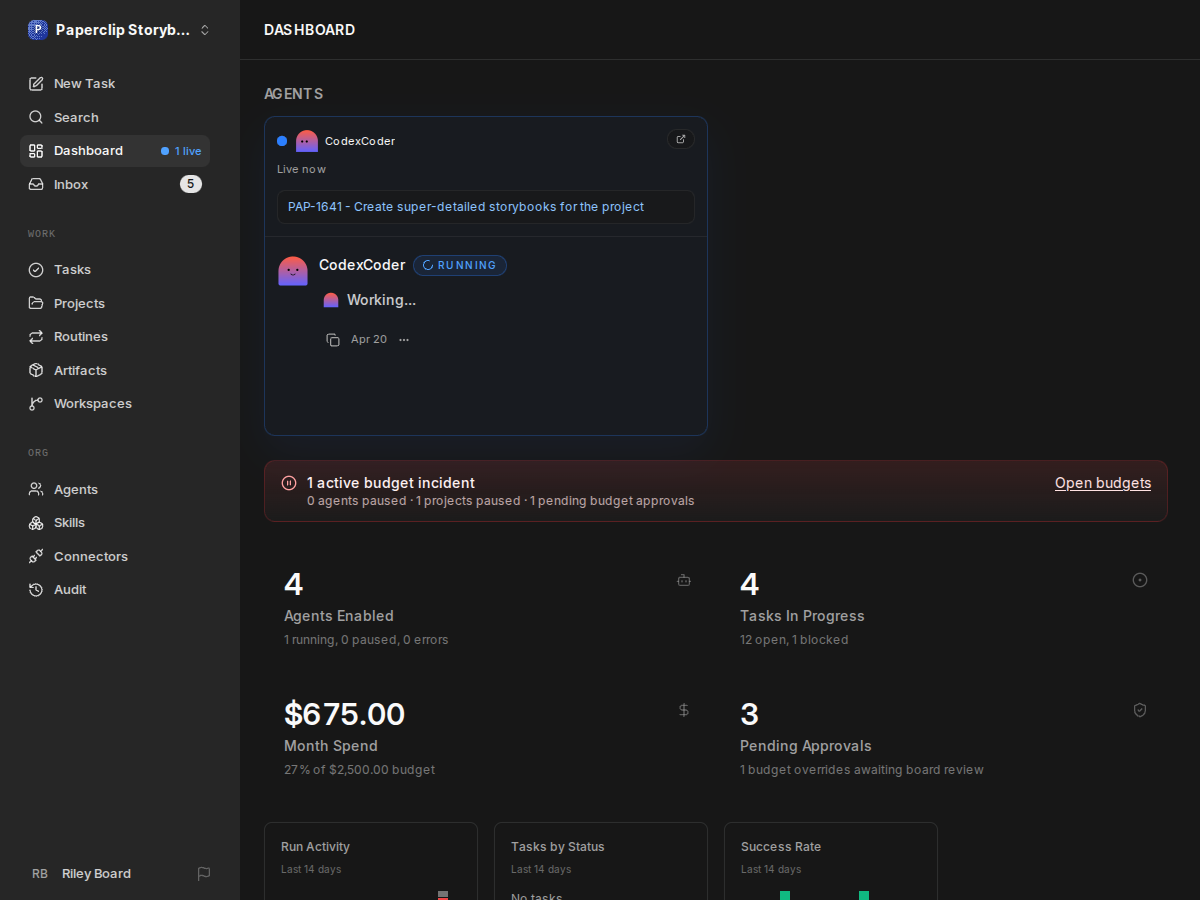
## Thinking Path > - Paperclip is the open source app people use to manage AI agents for work. > - A stable agent persona is useful only when the same identity appears across the app. > - Lists, task messages, selectors, and activity feeds need inexpensive static avatars. > - Onboarding and agent headers need a larger character with expressions and pointer tracking. > - This pull request connects the persona foundation to those existing views and preserves onboarding draft assignments. > - Full-page stories and Linux checks make the placements and performance contract reviewable. ## Linked Issues or Issue Description **Problem or motivation** Agents need a stable visual identity in lists, tasks, onboarding, and configuration. External tools also need an image URL for that identity. **Proposed solution** Assign each agent a permanent palette from a fixed ClipLab character library. Store the assignment on the agent. Render and cache preset PNG URLs on demand. Use static images in dense views and one animated character in larger placements. **Alternatives considered** A generated image bundle requires a separate asset build. A live renderer in every avatar adds unnecessary work in large lists. Arbitrary uploaded images do not provide the requested shared character system. **Roadmap alignment** This improves agent identity across existing control-plane views. It preserves agent permissions, company boundaries, and status labels. ROADMAP.md has no separate ClipLab persona milestone. Related approaches: #2422 adds configurable image URLs and DiceBear generation; #5578 adds optional uploaded avatars. This work uses a fixed, versioned character library and preset URLs. ## What Changed - Replace agent icons with static persona images across lists, the sidebar, org charts, tasks, comments, selectors, activity, and dashboard views. - Put one animated character in the agent header. Let it follow the pointer across the page, with reduced-motion and touch fallbacks. - Add larger padded characters to agent creation. Keep the palette stable across draft refreshes and connection retries, then reveal it after success. - Pass appearance through shared projections rather than fetching each agent separately. - Add real full-page Storybook examples for the agent list, overview, task, dashboard, new-agent dialog, and connection page. - Add Linux screenshot, clipping, density, and 500-avatar performance checks. ## Verification - `pnpm -r typecheck`, `pnpm build`, and token gates pass on the rebased tree. Persona lifecycle tests pass. - The rebased feature passes 38 Linux screenshot/performance checks, including both display densities, corner pointer positions, and the no-WebGL/no-live-download contract for 500 avatars. - The final Linux persona suite passes all 38 visual, lifecycle, density, and full-page checks using the standard Storybook configuration and real on-demand avatar endpoint. - Final local focused verification: 45 avatar/native-recovery tests pass; UI identity/routine tests, typecheck/build, token gates, and Storybook build pass. - Current-head CI passes: full workspace/server tests, all serialized server groups, typecheck/release checks, build, canary validation, and end-to-end shards. The build passed after retrying a native-runner concurrency-test failure; its three targeted cases also pass locally. - Manual inspection covered stable identities in the app, header placement, full-page mouse tracking, onboarding size, and task/dashboard placements. ### Screenshots Linux captures use synthetic Storybook fixtures. Full-page captures use reduced motion. The live character, mouse tracking, and disposal are checked separately. <details> <summary>Agent overview with the character in its header</summary> <img src="https://raw.githubusercontent.com/paperclipai/paperclip/8c68f42b268ada22b67d79d0fe1bb0a2f84ec25c/screenshots/full-page-agent-overview.png" width="900" alt="Agent overview with the character in its header" /> </details> <details> <summary>Task messages and assignee identity</summary> <img src="https://raw.githubusercontent.com/paperclipai/paperclip/8c68f42b268ada22b67d79d0fe1bb0a2f84ec25c/screenshots/full-page-task.png" width="900" alt="Task messages and assignee identity" /> </details> <details> <summary>Larger onboarding character with room for expressions</summary> <img src="https://raw.githubusercontent.com/paperclipai/paperclip/8c68f42b268ada22b67d79d0fe1bb0a2f84ec25c/screenshots/full-page-meet-your-next-agent.png" width="900" alt="Larger onboarding character with room for expressions" /> </details> <details> <summary>Dashboard agent activity</summary> <img src="https://raw.githubusercontent.com/paperclipai/paperclip/8c68f42b268ada22b67d79d0fe1bb0a2f84ec25c/screenshots/full-page-company-dashboard.png" width="900" alt="Dashboard agent activity" /> </details> ## Risks - This PR depends on #13170, the persona foundation. Merge the foundation first, then retarget this PR to master. - Many placements change from icons to character silhouettes. Human avatars and authoritative agent status labels retain their existing behavior. - Only one character can render live per view. Reduced motion, hidden/offscreen content, touch input, and renderer failures use the defined fallbacks. - The full-page stories use fixture data. They do not contact a real company or complete real provider sign-in. ## Model Used OpenAI Codex, GPT-6 family. The exact model identifier and context window are not exposed in this session. Used code editing, shell execution, browser inspection, and Linux visual testing. ## Checklist - [x] I have included a thinking path that traces from project context to this change - [x] I have specified the model used (with version and capability details) - [x] I have checked ROADMAP.md and confirmed this PR does not duplicate planned core work - [x] I have searched GitHub for duplicate or related PRs and linked them above - [x] I have either (a) linked existing issues with `Fixes: #` / `Closes #` / `Refs #` OR (b) described the issue in-PR following the relevant issue template - [x] I have not referenced internal/instance-local Paperclip issues or links (only public GitHub `#NNN` / `github.com/paperclipai/paperclip` URLs) - [x] My branch name describes the change (e.g. `docs/...`, `fix/...`) and contains no internal Paperclip ticket id or instance-derived details - [x] I have run tests locally and they pass - [x] I have added or updated tests where applicable - [x] I have updated relevant documentation to reflect my changes - [x] I have considered and documented any risks above - [x] All Paperclip CI gates are green - [x] Greptile is 5/5 with no open P2s, recommendations, or follow-ups - [x] I will address all Greptile and reviewer comments before requesting merge --------- Co-authored-by: Paperclip <noreply@paperclip.ing> Co-authored-by: Tonio <tonework@gmail.com> Co-authored-by: Claude Fable 5.1 <noreply@anthropic.com> |
||
|
Devin Foley
|
dc12197cce |
fix: prevent duplicate built-in agents and self-heal reconciliation (#10223)
## Thinking Path

> - Paperclip is the open source app people use to manage AI agents for
work.
> - Every company is auto-provisioned a set of built-in agents (e.g. the
Summarizer), and a startup reconciler keeps that set correct across
every company on boot.
> - Provisioning marks these agents with
`metadata.paperclipBuiltInAgent.key`, but nothing in the database
enforced one active agent per `(company, key)` —
`provision()`/`ensure()` did a check-then-insert with no guard.
> - Two concurrent server processes (e.g. a `tsx watch` double-boot)
could both read "no summarizer exists" and both insert, leaving a
company with duplicate built-in agents plus paired orphan pending
`hire_agent` approvals.
> - That data blemish then became a recurring outage: `findSingleAgent`
throws on >1 marked row, and because the throw escaped
`reconcileBuiltInAgentsOnStartup`'s sequential loop, **every company
after the affected one was silently skipped** on each boot — no
auto-provisioning, no default grants — until manual DB surgery.
> - This pull request closes the race at the database level and makes
reconciliation self-healing and fault-isolated.
> - The benefit is that concurrent provisioning can no longer create
duplicates, and even pre-existing duplicates are resolved automatically
instead of bricking startup reconciliation for unrelated companies.

## Linked Issues or Issue Description

- [x] I searched the GitHub PR list (open and recently closed) for
similar PRs and confirmed this is not a duplicate.

No public GitHub issue exists; describing the bug in-PR (bug-report
shape):

**What happened**

A dev instance booted with two concurrent server processes. Both ran
built-in agent provisioning for the same company at the same time, and
the check-then-insert in `provision()`/`ensure()`
(`server/src/services/built-in-agents.ts`) let both writers see "no
summarizer exists" and each create one — the company ended up with two
identical Summarizer agents (identical `paperclipBuiltInAgent` markers)
plus two paired pending `hire_agent` approvals.

From then on, **every** server boot logged:

```
ERROR: startup reconciliation of built-in agents failed
       Multiple built-in agents found for summarizer (built_in_agent_duplicate_instance)
```

because `findSingleAgent` throws on >1 marked row rather than resolving
the duplicate. Worse, `reconcileBuiltInAgentsOnStartup` loops companies
sequentially and the throw escaped the loop, so every company *after*
the affected one was silently skipped on every boot.

**Expected behavior**

1. Concurrent provisioning must not create duplicate built-in agents
(there was no DB uniqueness constraint on the marker key per company).
2. Reconciliation should be resilient: if duplicates exist anyway,
self-heal (keep the oldest row, terminate the newer dupe, cancel its
orphan pending `hire_agent` approval), and never let one bad company
abort reconciliation for the rest.

**Steps to reproduce**

- Race two `provision(companyId, "summarizer")` calls for a company with
board approval for new agents enabled (or simulate a double-boot); both
insert.
- Restart the server → startup reconciliation error fires, companies
later in the loop are never reconciled.

## What Changed

**Part 1 — stop creating duplicates**

- Migration `0192_built_in_agent_unique_marker` adds a **partial unique
index** on `(company_id, metadata->'paperclipBuiltInAgent'->>'key')`
where the marker exists and `status != 'terminated'`. It first resolves
any pre-existing duplicates (keep oldest by `created_at`, terminate
newer dupes, cancel their orphan pending `hire_agent` approvals, revoke
their API keys) so the index can be created on already-affected
instances.
- `provision()`/`ensure()` now catch the losing race's `23505` unique
violation (walking the driver's wrapped cause chain) and re-resolve to
the winning row instead of surfacing the error.

**Part 2 — resilient reconciliation**

- `findSingleAgent` self-heals: keeps the oldest marked row, terminates
the newer duplicates, and cancels each one's orphan pending `hire_agent`
approval (idempotent) instead of throwing.
- `reconcileBuiltInAgentsOnStartup` isolates per-company failures in
both loops so one bad company can't abort reconciliation for the rest;
it surfaces a `companyFailures` count in the startup log.
- Adds `approvalService.cancel()` for system-initiated cancellation of
an orphan approval.

## Verification

- `pnpm --filter @paperclipai/db run check:migrations` → numbering +
safety checks pass.
- `packages/db` migration test (real embedded Postgres) — seeds
pre-index duplicate state, runs the migration, asserts dupes resolved +
index enforced: **1 passed**.
- `server` `built-in-agents.test.ts` — self-heal, concurrent races
(plain and board-gated), and startup
self-heal-without-aborting-later-companies: **34 passed**.

```
pnpm --filter @paperclipai/db exec vitest run src/built-in-agent-unique-marker-migration.test.ts
pnpm --filter @paperclipai/server exec vitest run src/__tests__/built-in-agents.test.ts
```

## Risks

- **Migration safety**: the migration mutates data (terminates duplicate
rows, cancels their orphan pending approvals, revokes their API keys)
before creating the index. It keeps the oldest row per `(company, key)`
and only touches non-terminated marked rows; the destructive step is
covered by the migration test and the safety-check baseline. On a clean
instance it is a no-op cleanup followed by `CREATE UNIQUE INDEX IF NOT
EXISTS`.
- Otherwise low risk: the unique index is partial (excludes terminated
rows, so re-provisioning after a termination stays possible), and the
conflict handling degrades gracefully to re-resolving the existing
winner.

## Model Used

Claude Opus 4.8 (`claude-opus-4-8`), 1M context window, extended
thinking, with tool use.
|
||
|
DottaandPaperclip
|
8b6a06ee25 |
[codex] Add built-in agents and Reflection Coach bundle (#9206)
## Thinking Path > - Paperclip is the open source app people use to manage AI agents for work. > - Operators need first-party agent capabilities for repeatable company work, not just manually created one-off agents. > - Built-in agents need to behave like normal company-scoped agents while preserving approval gates, permissions, budgets, and audit trails. > - Reflection and coaching work also needs bundled instructions, skill content, and a routine so the feature can be installed and reset predictably. > - The API, database, UI, portability, and tests all need to agree on the built-in lifecycle from not provisioned through setup, approval, ready, paused, and reset. > - This pull request adds built-in agent provisioning and the Reflection Coach bundle end-to-end. > - The benefit is a safer first-party path for Paperclip-managed agents without bypassing the same governance model used for operator-created agents. ## Linked Issues or Issue Description No public GitHub issue was found for this exact built-in agent and Reflection Coach bundle work. Problem/motivation: - Paperclip did not have a first-party built-in agent lifecycle for product-owned agents. - Bundled agent resources such as default instructions, skills, and routines needed managed ownership and reset semantics. - Approval-gated companies needed built-in setup to preserve requested adapter, budget, manager, and permission state through board approval. - The board UI needed clear built-in badges, setup affordances, readiness state, and bundle status without exposing secrets. Proposed solution: - Add a company-scoped built-in agent registry, provisioning/reset/reconcile/status APIs, and Reflection Coach bundled resources. - Track bundled managed resources in the database with idempotent migration behavior. - Reuse existing agent approval, authorization, budget, and activity-log paths instead of creating a bypass. - Add UI setup, badges, gates, bundle panels, and route coverage for built-in agents. Duplicate search: - Searched GitHub PRs for `built-in agents Reflection Coach repo:paperclipai/paperclip`; only this PR was returned. - Searched GitHub issues for the same query; no public issues were returned. ## What Changed - Added built-in agent definitions, lifecycle state derivation, provisioning, reset, reconcile, status, and routine-control routes. - Added the `built_in_managed_resources` migration and schema exports for bundled instructions, skill, and routine ownership. - Added the Reflection Coach built-in bundle with default instructions, skill catalog content, routine template, default permissions, and managed-resource drift handling. - Added approval-aware provisioning behavior that preserves requested adapter config, budgets, manager assignment, and built-in permissions through hire approval. - Added authorization and mutation gates for built-in agent and skill changes, including consented Reflection Coach change paths. - Added UI surfaces for built-in agent setup, roster/detail badges, readiness gates, bundle status, routine controls, and route filtering. - Added company import/export and validator coverage for built-in managed resources and low-trust/red-team presets. - Addressed Greptile follow-ups for pending approval reconciliation, consent-gate error propagation, config-read authorization fallback, approval-path manager preservation, and non-model adapter provisioning. ## Verification Local verification: - `git diff --check public/master..HEAD` passed. - `pnpm check:token-gates` passed with all gates clean. - `pnpm exec vitest run ui/src/components/ConfigureBuiltInAgentModal.test.tsx` passed: 1 file, 4 tests. - `pnpm exec vitest run ui/src/components/EntityRow.test.tsx ui/src/pages/Agents.test.tsx ui/src/components/BuiltInAgentGate.test.tsx ui/src/components/ConfigureBuiltInAgentModal.test.tsx ui/src/components/BuiltInBundlePanel.test.tsx ui/src/pages/InstanceExperimentalSettings.test.tsx ui/src/pages/Routines.test.tsx` passed: 7 files, 64 tests. - `pnpm --filter @paperclipai/server exec vitest run src/__tests__/built-in-agents.test.ts src/__tests__/authorization-service.test.ts src/__tests__/company-skills-routes.test.ts` passed: 3 files, 91 tests. - `pnpm --filter @paperclipai/db check:migrations` passed. - `pnpm -r typecheck` passed after the rebase; `pnpm --filter ui typecheck` passed after the final UI review fix. Remote verification on latest head `1c61f693a4ec881d739022b0e75a8ca8bf8c2cd8`: - Merge state: `CLEAN`. - Greptile: `5/5`, zero unresolved Greptile threads. - PR check rollup: all checks successful, neutral, or skipped as expected. - Passing gates include Build, Typecheck + Release Registry, all server shards, all workspace shards, all serialized server suites, e2e, Canary Dry Run, policy, review, verify, Socket, Superagent, and Snyk. ## Risks - This adds a new managed-resource table and migration; the migration uses idempotent create/add/index guards and passed migration safety checks. - Built-in agent provisioning touches approval and authorization paths; tests cover pending approval preservation, stale retry rejection, consent gates, and config-read fallback behavior. - Reflection Coach creates managed instructions, skill, and routine resources; drift/reset behavior is covered by service tests and redacted API responses. - Non-model adapter setup now provisions a `needs_setup` built-in row before command/endpoint fields are complete; this matches the server lifecycle and is covered by the setup modal regression test. ## Model Used OpenAI Codex coding agent based on GPT-5. Exact hosted model ID, context-window size, and reasoning-mode labels are not exposed in this runtime; tool use, shell execution, GitHub CLI/API access, and local code editing were enabled. ## Checklist - [x] I have included a thinking path that traces from project context to this change - [x] I have specified the model used (with version and capability details) - [x] I have checked ROADMAP.md and confirmed this PR does not duplicate planned core work - [x] I have searched GitHub for duplicate or related PRs and linked them above - [x] I have either (a) linked existing issues with `Fixes: #` / `Closes #` / `Refs #` OR (b) described the issue in-PR following the relevant issue template - [x] I have not referenced internal/instance-local Paperclip issues or links (only public GitHub `#NNN` / `github.com/paperclipai/paperclip` URLs) - [x] My branch name describes the change (e.g. `docs/...`, `fix/...`) and contains no internal Paperclip ticket id or instance-derived details - [x] I have run tests locally and they pass - [x] I have added or updated tests where applicable - [x] I have updated relevant documentation to reflect my changes - [x] I have considered and documented any risks above - [x] All Paperclip CI gates are green - [x] Greptile is 5/5 with no open P2s, recommendations, or follow-ups - [x] I will address all Greptile and reviewer comments before requesting merge --------- Co-authored-by: Paperclip <noreply@paperclip.ing> |
||
|
Devin Foley
|
6a3f5b685d |
fix(agents): clear inbox hire approval when approving/terminating from detail page (#8340)
## Thinking Path > - Paperclip is the open source app people use to manage AI agents for work > - Hiring a new agent creates a `hire_agent` approval record; until it is resolved, the agent sits in `pending_approval` and the open approval surfaces an "Approve/Reject" card in the inbox > - There are two places to act on that hire: the inbox approval card and the agent detail page's Approve/Terminate buttons > - The agent detail page only flipped the agent to `idle` via `activatePendingApproval`, never resolving the linked approval record > - So after approving (or terminating) from the detail page, the approval stayed `pending` and the inbox kept showing a stale "Approve/Reject" card for an agent that was already decided > - This pull request routes the detail-page approve through the shared `approvalsSvc.approve()` (which resolves the approval and runs activation, budget policy, and the hire-approved notification), and rejects the linked approval when a still-pending agent is terminated > - The benefit is a single source of truth: deciding a hire in one place clears it everywhere, so the inbox no longer asks you to approve an agent you already approved ## Linked Issues or Issue Description No public GitHub issue exists for this; describing in-PR (bug report). **What happened:** Create a new agent, then approve it from the agent detail page. The agent activates, but the inbox still shows a "Hire Agent" item with Approve/Reject buttons for it. **Expected:** Once a hire is approved or rejected anywhere in the UI, it should be resolved everywhere — the inbox should not re-ask you to approve an agent that is already decided. **Root cause:** `POST /agents/:id/approve` called `activatePendingApproval`, which only changes the agent's status. The linked `hire_agent` approval row stayed `pending`. The inbox lists approvals filtered to unresolved statuses, so the card persisted. Terminating a pending agent from the detail page had the mirror problem for the "reject" half. Related (not duplicates): #215 (join-request inbox badge), #1815 (approval detail button loading text). ## What Changed - Added `approvalService.findOpenHireApprovalForAgent(companyId, agentId)` to locate the open `hire_agent` approval for an agent. The company/type/open-status **and** `payload->>'agentId'` predicates all run in SQL (jsonb operator), so the DB returns only the relevant row instead of filtering in JS (`server/src/services/approvals.ts`). - `POST /agents/:id/approve` resolves the linked approval through the shared `approvalsSvc.approve()` — running activation, budget-policy upsert, and the hire-approved notification as one path — and falls back to direct `activatePendingApproval` only when no open approval exists (legacy agents created before approvals were tracked) (`server/src/routes/agents.ts`). - `POST /agents/:id/terminate` now branches the same way: when a still-`pending_approval` agent has an open hire approval, it delegates to `approvalsSvc.reject()` (which resolves the approval **and** terminates the agent internally) and re-reads the agent, otherwise it terminates directly. This avoids terminating the agent twice (`reject()` already calls `agentsSvc.terminate()`) (`server/src/routes/agents.ts`). - The `agent.approved` activity log records the resolved `approvalId` (or `null` on the fallback path) for traceability. ## Verification - `pnpm --filter @paperclipai/server typecheck` — clean. - Targeted server tests pass (57 tests): `npx vitest run src/__tests__/approvals-service.test.ts src/__tests__/agent-permissions-routes.test.ts` - `findOpenHireApprovalForAgent` returns the row the SQL filter yields / returns null when none matches. - Approving from the detail page resolves the linked approval via `approvalsSvc.approve()` and does not double-activate; legacy fallback still calls `activatePendingApproval`. - Terminating a still-pending agent with an open approval calls `approvalsSvc.reject()` and does **not** call `agentsSvc.terminate()` a second time; terminating with no open approval terminates directly. - Manual: create an agent → inbox shows the hire card → approve from the agent detail page → inbox card is gone and the agent is active. Same for terminate-while-pending clearing the card. ## Risks Low risk, server-only, no schema or migration changes. The fallback to `activatePendingApproval` preserves existing behavior for agents with no tracked approval record, so legacy agents still activate. The shared approval path is the same one the inbox card already uses, so approve/terminate-from-detail-page now match approve/reject-from-inbox exactly. ## Model Used Claude Opus 4.8 (claude-opus-4-8), extended thinking with tool use, via Claude Code. ## Checklist - [x] I have included a thinking path that traces from project context to this change - [x] I have specified the model used (with version and capability details) - [x] I have checked ROADMAP.md and confirmed this PR does not duplicate planned core work - [x] I have searched GitHub for duplicate or related PRs and linked them above - [x] I have either (a) linked existing issues with `Fixes: #` / `Closes #` / `Refs #` OR (b) described the issue in-PR following the relevant issue template - [x] I have not referenced internal/instance-local Paperclip issues or links (only public GitHub `#NNN` / `github.com/paperclipai/paperclip` URLs) - [x] I have run tests locally and they pass - [x] I have added or updated tests where applicable - [x] If this change affects the UI, I have included before/after screenshots (server-only change, no UI diff) - [x] I have considered and documented any risks above - [x] All Paperclip CI gates are green - [ ] Greptile is 5/5 with no open P2s, recommendations, or follow-ups (in progress) - [x] I will address all Greptile and reviewer comments before requesting merge |
||
|
dottaandPaperclip
|
39878fcdfe |
Add username log censor setting
Co-Authored-By: Paperclip <noreply@paperclip.ing> |
||
|
Dotta
|
76e6cc08a6 | feat(costs): add billing, quota, and budget control plane | ||
|
DottaandPaperclip
|
088eaea0cb |
Redact current user in comments and token checks
Co-Authored-By: Paperclip <noreply@paperclip.ing> |
||
|
David Ahmann
|
9c68c1b80b | server: make approval retries idempotent (#499) | ||
|
Dotta
|
3369a9e685 | feat(openclaw): add adapter hire-approved hooks | ||
|
DottaandClaude Opus 4.6
|
f60c1001ec |
refactor: rename packages to @paperclipai and CLI binary to paperclipai
Rename all workspace packages from @paperclip/* to @paperclipai/* and the CLI binary from `paperclip` to `paperclipai` in preparation for npm publishing. Bump CLI version to 0.1.0 and add package metadata (description, keywords, license, repository, files). Update all imports, documentation, user-facing messages, and tests accordingly. Co-Authored-By: Claude Opus 4.6 <noreply@anthropic.com> |
||
|
ForgottenandClaude Opus 4.6
|
c09037ffad |
Implement agent hiring, approval workflows, config revisions, LLM reflection, and sidebar badges
Agent management: hire endpoint with permission gates and pending_approval status, config revision tracking with rollback, agent duplicate route, permission CRUD. Block pending_approval agents from auth, heartbeat, and assignments. Approvals: revision request/resubmit flow, approval comments CRUD, issue-approval linking, auto-wake agents on approval decisions with context snapshot. Costs: per-agent breakdown, period filtering (month/week/day/all), cost by agent list endpoint. Adapters: agentConfigurationDoc on all adapters, /llms/agent-configuration.txt reflection routes. Inject PAPERCLIP_APPROVAL_ID, PAPERCLIP_APPROVAL_STATUS, PAPERCLIP_LINKED_ISSUE_IDS into adapter environments. Sidebar badges endpoint for pending approval/inbox counts. Dashboard and company settings extensions. Co-Authored-By: Claude Opus 4.6 <noreply@anthropic.com> |
||
|
ForgottenandClaude Opus 4.6
|
8c2bf0a2e6 |
Remove contextMode, consolidate wake policies, and default serveUi to true
Drop the unused contextMode field from the agent schema, shared types, validators, and all UI references. Merge wakeOnOnDemand and wakeOnAutomation into a single wakeOnDemand toggle. Default serveUi to true and remove the onboarding prompt for it. Co-Authored-By: Claude Opus 4.6 <noreply@anthropic.com> |
||
|
ForgottenandClaude Opus 4.6
|
abadd469bc |
Add server routes for companies, approvals, costs, and dashboard
New routes: companies, approvals, costs, dashboard, authz. New services: companies, approvals, costs, dashboard, heartbeat, activity-log. Add auth middleware and structured error handling. Expand existing agent and issue routes with richer CRUD operations. Co-Authored-By: Claude Opus 4.6 <noreply@anthropic.com> |