mirror of
https://github.com/paperclipai/paperclip.git
synced 2026-10-24 10:13:11 +02:00
7c7d2d8d2cfca96aa956b85d086f067bc9fd8880
15
Commits
| Author | SHA1 | Message | Date | |
|---|---|---|---|---|

|
bfe7c6357d |
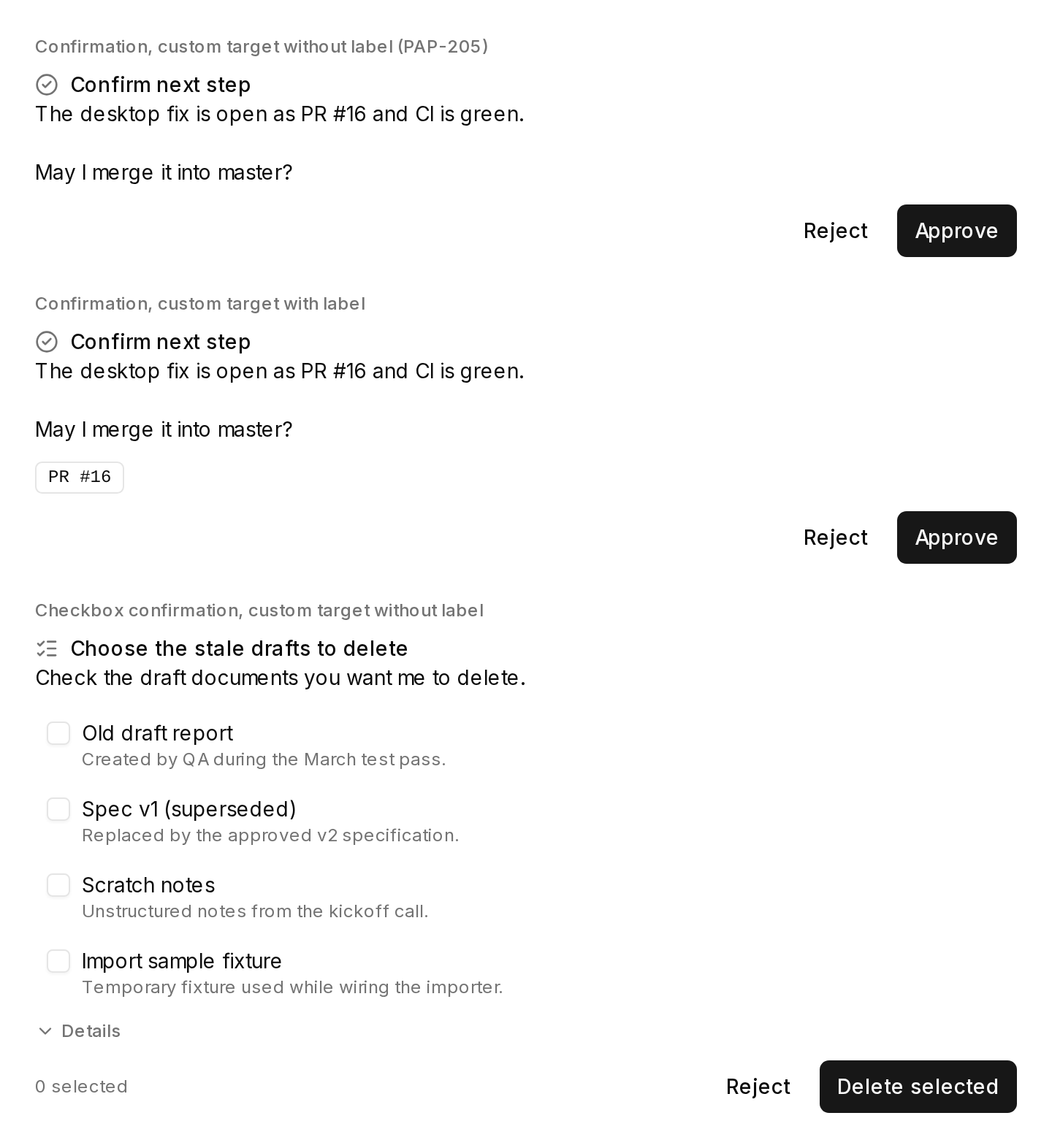
fix(ui): stack confirmation prompt and hide raw custom target keys (#15895)
## Thinking Path
> - Paperclip is the open source app people use to manage AI agents for
work
> - Agents ask the board for decisions with `request_confirmation`
interaction cards
> - The compact task-chat card puts the prompt and the target pill in
one `justify-between` flex row
> - An agent can send a `custom` target with only a machine `key` (for
example `github:org/repo:pull:16`) and no `label`
> - The card shows that raw key as a mono pill that does not shrink, so
the card splits about 50/50 and the prompt is squeezed into the left
half
> - This pull request stacks the prompt above the pill and hides custom
targets that have no human label
> - The benefit is a readable, full-width confirmation prompt without
meaningless identifier pills
## Linked Issues or Issue Description
**What happened?**
A pending confirmation card split its body into two columns. The prompt
used the left half. A pill with the raw text
`github:paperclipai/paperclip-desktop:pull:16` used the right half. The
line breaks in the prompt were also lost.
**Steps to reproduce**
1. Create a `request_confirmation` interaction with a multi-line
`prompt` and `target: { "type": "custom", "key":
"github:org/repo:pull:16" }` (no `label`).
2. Open the task chat for the issue.
3. See that the prompt and the key pill share one row, split about
50/50.
**Expected behavior**
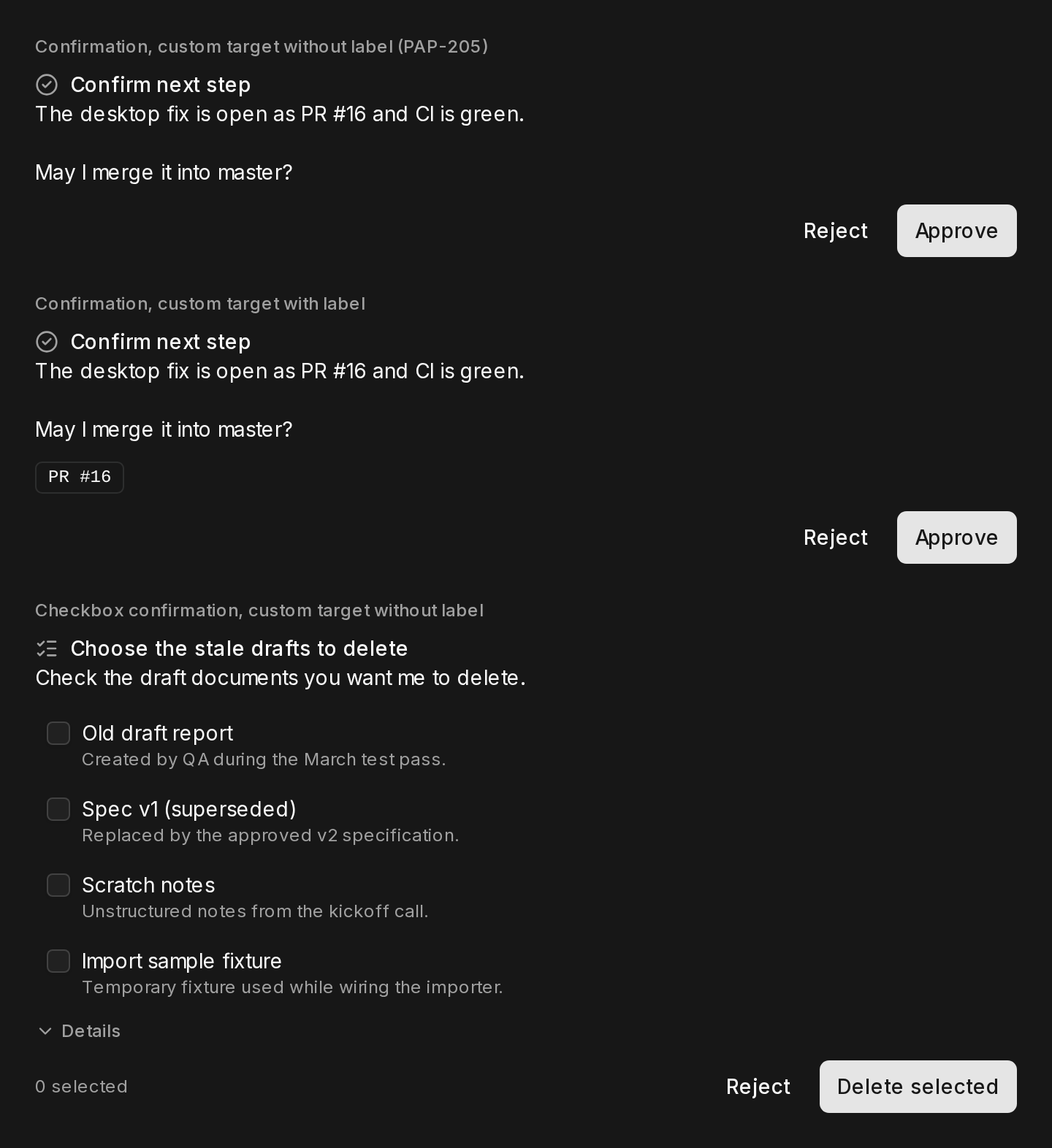
The prompt uses the full card width and keeps its line breaks. A custom
target key is an identifier for idempotency and stale detection, so it
does not show as display text. A target pill shows only when the target
has a human label.
## What Changed
- `TaskChatCompactInteractionCard`: stack the prompt full width with the
target pill below it. This applies to the confirmation and the
checkbox-confirmation cards.
- `TaskChatCompactInteractionCard`: keep line breaks in the prompt
(`whitespace-pre-line`, `break-words`).
- `TaskChatCompactInteractionCard` and `IssueThreadInteractionCard`:
show no target chip for a `custom` target without a `label`. Labeled
custom targets (for example connection authorization) and
`issue_document` targets do not change. The stale-target chevron shows
only when both chips show.
- Add regression tests for the stacked layout, the hidden unlabeled key,
and the labeled link pill. The tests cover the compact confirmation and
checkbox-confirmation cards, and the thread card pending chip and
stale-target expiry (with labeled, unlabeled, and mixed custom targets,
and the chevron rule).
- `CONTRIBUTING.md`: add a "Keep Screenshots Out of the Repo" section.
Contributors attach review screenshots to the PR on GitHub. They do not
commit them to the repository.
## Verification
- `cd ui && npx vitest run
src/components/task-chat/TaskChatInteractionCard.test.tsx
src/components/IssueThreadInteractionCard.test.tsx`: 2 files, 100 tests
pass. If you revert the `isDisplayableRequestConfirmationTarget` guard,
3 of the new thread-card tests fail.
- `node scripts/check-token-gates.mjs`: all gates clean.
- `pnpm --filter @paperclipai/ui typecheck`: no errors in changed files.
The only errors come from `@paperclipai/plugin-sdk/ui`, which had no
built `dist` in the local workspace. These errors are not related to
this change.
- Manual: create a confirmation as in the steps above. The prompt is
full width and no key pill shows. Add `label: "PR #16"` and an `href`. A
`PR #16` link pill shows below the prompt.
### Screenshots
These are Storybook renders of the compact task-chat card at 720 px. The
three cards are: a confirmation with an unlabeled custom target (the
reported case), a confirmation with a labeled custom target, and a
checkbox confirmation with an unlabeled custom target.
The images load from an earlier commit of this PR. A later commit
deletes them, so they are not part of the merged change.
| Before (light) | After (light) | After (dark) |
| --- | --- | --- |
|
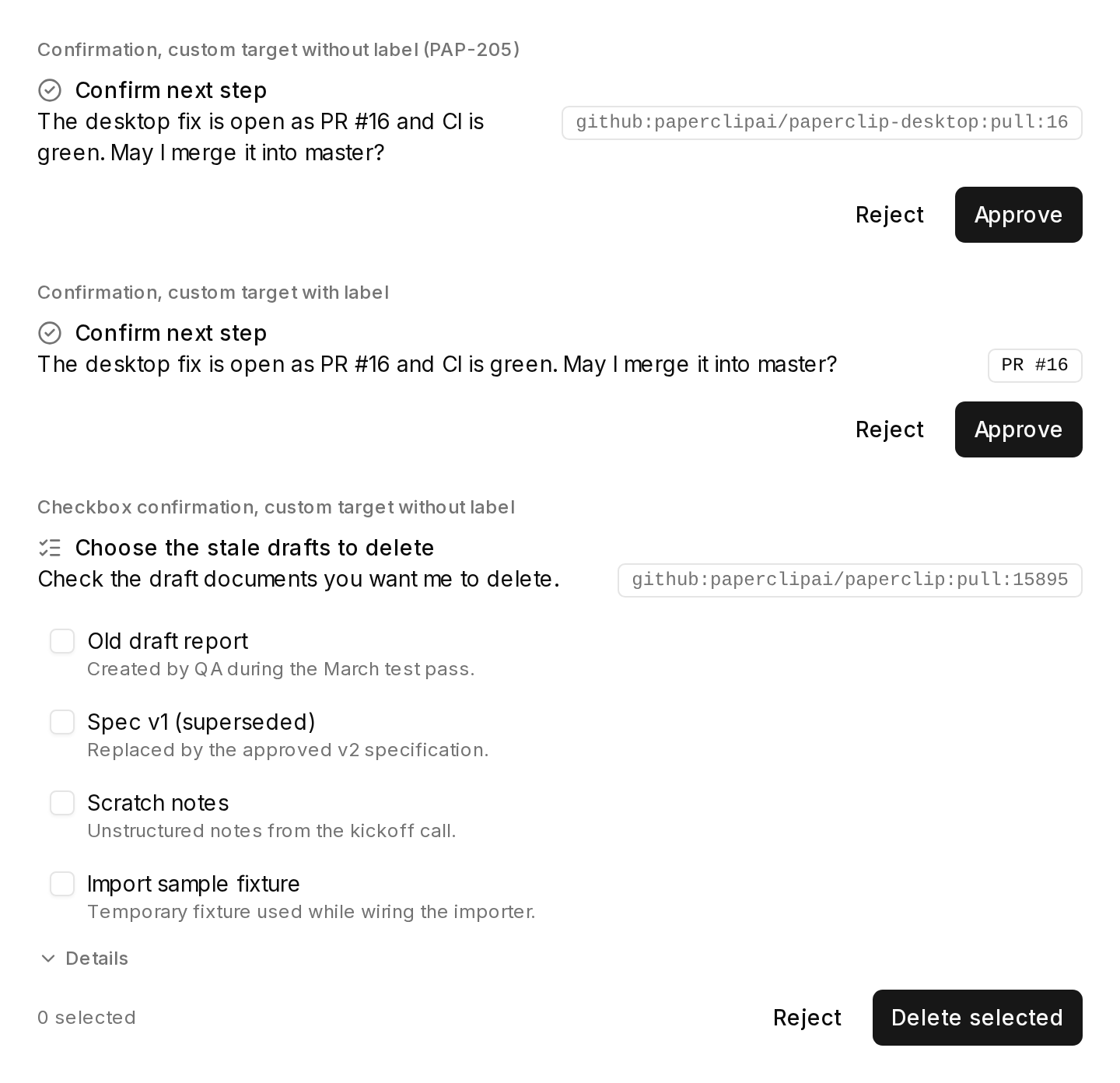
| 
| 
|
## Risks
- Low risk. This is a UI-only change. No schema or API change.
- Agents that send a custom target without a label lose the visible
pill. The key was never readable display text. To show a pill, agents
set `label`.
## Merge Note
The first commit was authored as Paperclip. When you squash-merge, keep
this trailer in the squash body:
Co-Authored-By: Paperclip <Paperclip-Paperclip@users.noreply.github.com>
## Model Used
- Claude Opus 5.5 (`claude-opus-5-5`), Anthropic, via Claude Code agent
harness with tool use (shell, file edit). Standard context window.
## Checklist
- [x] I have included a thinking path that traces from project context
to this change
- [x] I have specified the model used (with version and capability
details)
- [x] I have checked ROADMAP.md and confirmed this PR does not duplicate
planned core work
- [x] I have searched GitHub for duplicate or related PRs and linked
them above
- [x] I have either (a) linked existing issues with `Fixes: #` / `Closes
#` / `Refs #` OR (b) described the issue in-PR following the relevant
issue template
- [x] I have not referenced internal/instance-local Paperclip issues or
links (only public GitHub `#NNN` / `github.com/paperclipai/paperclip`
URLs)
- [x] My branch name describes the change (e.g. `docs/...`, `fix/...`)
and contains no internal Paperclip ticket id or instance-derived details
- [x] I have run tests locally and they pass
- [x] I have added or updated tests where applicable
- [x] I have updated relevant documentation to reflect my changes
- [x] I have considered and documented any risks above
- [ ] All Paperclip CI gates are green
- [ ] Greptile is 5/5 with no open P2s, recommendations, or follow-ups
- [x] I will address all Greptile and reviewer comments before
requesting merge
🤖 Generated with [Claude Code](https://claude.com/claude-code)
---------
Co-authored-by: Paperclip <noreply@paperclip.ing>
Co-authored-by: Claude Opus 5.5 <noreply@anthropic.com>
Co-authored-by: devinfoley <139239+devinfoley@users.noreply.github.com>
|
||
|
DottaandPaperclip
|
57e977be72 |
feat: integrate Pi 1.0 into the experimental Runner (#14921)
## Thinking Path > - Paperclip manages AI agents and their work. > - The experimental Runner owns provider processes and durable sessions. > - Pi needs working task execution and human controls. > - The five-PR stack must preserve changes already on master. > - Each layer now carries the complete integrated source for a safe sequential fallback. > - This PR belongs to native GitHub stack #15602, ending at #14956. ## Linked Issues or Issue Description Refs #14436, #14631, #14743 and #14956. Ship Pi 1.0 through the experimental Paperclip Runner. The five PRs are #14921, #14922, #14923, #14924 and #14956. The user authorized the complete merge after checks pass. Existing `pi_local` execution is unchanged. Accounting and wider provider/platform qualification remain deferred. ## What Changed - Recover missing final replies after workspace finalization changes owners, using accepted-turn evidence without rerunning work or granting external-chat publication. - Preserve the admitted Pi instruction root across warm runs, while retaining changed-root rejection. - Give Pi a bounded 15-second default shutdown grace so stop, drain acknowledgement and durable suspension can complete. Explicit deadlines and other providers retain their existing behavior. - Integrate the Pi 1.0 runtime and master contracts. - Use Pi profile 22. Preserve explicit caller-selected models and exact native thinking levels. Keep Pi's wrapper, helper, extension and question/control behavior unchanged from the qualified profile-19 runtime. - Preserve master's Dot lifecycle and consent fields, configured task environment, status guards and current Codex/Claude dependency versions. Cursor stays qualified. Copilot stays pending; profile 17 binds the changed shared protocol validation sources. - Exclude general AWS IAM credentials from Pi static/custom provider bindings and selected task projections; preserve the provider-scoped Bedrock bearer key. Profile 21 is retained as historical provenance. Rust and cloud install probes use the current declaration. - Patch bundled brace-expansion 5.0.9 to the exact official 5.0.12 payload. Pin the patch and complete runtime closures. Include the patch in normal installed setup tooling. Keep the upstream Pi shrinkwrap as provenance and permit only this exact security correction. - Include current attestation files in the Docker build context. Keep the repository lockfile unchanged from master. CI and private image builds resolve manifest changes before their frozen installation. ## Verification - Full local `pnpm -r typecheck` passes, including Runner Rust, server and UI. Focused integration checks pass: 194 Runner admission/environment tests, 63 profile/credential tests with one expected skip, 152 Dot/UI configuration tests, and Pi transcript/notice tests. - Full local `pnpm build` passes on the final source. - Fresh final-source checks pass: all 698 Rust workspace tests (32 binaries), 156 credential/profile/controller tests with one expected skip, Runner TypeScript typecheck, and 20 package/setup/sandbox tests. - The profile-21 Pi materializer passes on the native host with the official pinned Node 24.21.0 and its npm. It verifies all 150 locked packages, the patched dependency and the exact closure. Setup/package bundle tests and UI token gates pass. - The old hashes were reproduced for all three supported targets before calculating the patched graph. New closure hashes are darwin-arm64 `282022db10150c6632b3444df421342e7d534bdf5d5fb1097a2e79d0625a2bcf`, darwin-x64 `64e251e19009f755c0b04f73ce2138246faab71a961b0f13d75ebfcc34bef12e`, and linux-x64 `713b1fdff42fb56a1518bdc084f181d70bee8ebadc3e4b1d76321ed9108c8410`. Independent native platform execution is separate from graph identity reproduction. - Historical cloud qualification remains unchanged: all seven core cases pass on shipping source `10dc43c9ec65d88c2f782d62afb296d09494f215`, harness `1a4408a48cfb5a1f094a311141c257c92cd7a893`, image `sha256:5b3a775b383591bda1b0c1889e509acc70ce7f37c53f09733c81d59037f02280`, and accepted Sonnet 4.6/low fixture. All 215 canonical files and all seven cleanup checks pass independent verification. These are profile-19 results and are not relabeled as fresh profile-22 runs. - Current Pi digest: `sha256:e92078bee3c23bec4100aa589013a44613d054cd686826534025d8019e9f39a9`. [The readiness plan](https://github.com/paperclipai/paperclip/blob/codex/pi-production-readiness/doc/plans/2026-10-02-pi-production-readiness.md) preserves campaign and failed-attempt provenance. - Merge only after every PR's current-head CI and fresh review pass. Linux CI covers the full suites, build and browser tests. The local embedded Postgres API-authority suite cannot start on this macOS/Node 26 host, so Linux CI must confirm that suite. ### Fresh profile-22 core qualification — 2026-10-08 All seven accepted core cases pass canonically on Pi profile 22, with `openrouter/anthropic/claude-sonnet-4.6` and native-confirmed low thinking. This model is a fixture; production accepts the caller's explicit Pi provider/model. Runtime/install source: `3241a992f2a7703e59e97ed0fd3e5d6405de4401`. Frozen accepted harness: `1a4408a48cfb5a1f094a311141c257c92cd7a893`. Immutable cloud image: `ghcr.io/paperclipai/paperclip-daytona-runner@sha256:506f22db7edd78f37c0c40bec1cc084af1850455026dbf467194bfbb8fcef141`. Pi digest: `sha256:e92078bee3c23bec4100aa589013a44613d054cd686826534025d8019e9f39a9`. [Hosted Linux image and clean-install verification](https://github.com/paperclipai/paperclip/actions/runs/37868328023) passes, including all 20 source-bound archives, normal CLI/Pi setup, companion import and the production pack reader. This exact installation source includes the latest master integration and the corrected Pi warm instruction-root fence. Full local typecheck/build and current-head hosted CI verify the final stack. All 13 focused real-root regressions pass. The full local executor suite passed 662 tests; 15 database tests could not start the Mac embedded PostgreSQL service. Hosted Linux CI passes the full required verification and E2E checks. These fresh results keep their own source identity; profile-19 results remain historical. | Core path | Canonical campaign | Retained archive SHA-256 | | --- | --- | --- | | File edit, validation, download and Done | `pi-core22-replyfix-0-1791511228` | 23 files; `a473e8603a3dd4737863291f8d3d1e392391f0b16d433c3e0e0e9d8baf7a97b0` | | Pending question and controller restart | `pi-core22-replyfix-1-1791511376` | 33 files; `6b829c4eb74e1f32a89c692a4ae7130dbfc1c6d3cf13915effe2103d9e242c8e` | | Three-turn session/process/workspace continuity | `pi-core22-replyfix-2-1791511587` | 23 files; `7a87021f8f9a3fdd3c58bb4467f8d82c635e3ea4795d6e75f144d9aa14818df8` | | Four typed questions and browser reconnects | `pi-core22-replyfix-3-1791511881` | 42 files; `9e31755252be1f4f9cb0626c984c142d4d1ae5f5bee3a7af08444db8d12c280a` | | Plan approval and completion | `pi-core22-replyfix-4-1791512031` | 22 files; `a0383ce1aab38e7b5a25ce0e9dd3bebea5c037ebd96ae6b29dae19015da2ae2c` | | Same-turn steering and permission denial | `pi-core22-replyfix-5-1791512261` | 39 files; `c929b8c7070f0b66aedc17e65ca46e6beab1e363926ac9f7e2a75fb250f05949` | | Stop during pending permission | `pi-core22-replyfix-6-1791512390` | 33 files; `7f0a58ae0f4d5bfc76149435f4e322537089c5bd16e7ffe9b5ad71f10a621a07` | All 215 canonical files (28714587 bytes) are independently hash-verified. All seven cleanup grades pass, with no owned runtime process or temporary root after each case. Automatic retries are zero. The owned cloud host stopped normally after retention. The prior profile-22 warm attempt remains failed and separately retained: archive SHA-256 `1e54eba5ec72b50cee1534b23d1d1d4f21a090006b8a64501ba70db972abfde5`. Its original canonical classification is preserved. Diagnosis reproduced a product bug comparing an agent-files root against an unset checkpoint-only field. The fix stores the admitted physical root separately from the adopted per-run collection capability. The real-root regression fails before the fix and passes afterward, including rejection of a changed physical root. Fixture, grader, model and all seven accepted case IDs are unchanged; this fresh campaign tests final-reply publication after file registration first. The intermediate restart attempt also remains failed and retained: archive SHA-256 `5dcaefdf1d17cf4cd54fd4cf810f45e736667392339b8ce7caf08bb4e225277f`. Its original canonical classification is preserved. Pi resumed, wrote the verified answer and completed its task; exact runner suspension was proven, but idle stop consumed about 5.2s and left under 3s for the drain acknowledgement. The Pi-only default shutdown grace is now 15s, preserving a full 5s drain round trip and a finite suspension reserve. Explicit caller deadlines, other provider defaults, literal drain receipts and exact suspension identity checks remain unchanged. The timing regression fails before this correction and passes afterward; all 18 focused settlement tests and Runner typecheck pass. The final-source file attempt is also preserved as failed (`candidate_failure`), archive SHA-256 `db6767b6773ea618997927ac77bdb005a5ac81492c7b9c0ffbc900449f829bc9`. Native edit, validation, exact downloadable artifact and Done/succeeded all passed, and the exact final reply was durably recorded. A workspace recovery owner completed before the live heartbeat reached presentation, leaving that reply absent from task chat. Recovery now materializes only a completed final reply from the accepted turn of an ordinary internal Done task, preserving issue/run/contract binding, suppression, external-chat authorization and same-run deduplication. The database regression covers the generated file-preparation receipt, suppression, unapproved external continuation and replay. Server typecheck and all 49 response-selection tests pass; hosted Linux verifies the database regression because embedded PostgreSQL cannot start on this Mac. The delayed-final-answer database regression passes on [the final root-source Linux server shard](https://github.com/paperclipai/paperclip/actions/runs/37868262553/job/113628594152), alongside 1,108 passing tests. The first root Runner shard had one unchanged durable-resume test exceed its 5-second timeout; the identical top-source shard and the isolated exact test passed. One rerun of that failed job and its required aggregate passed without source or test changes. The original failed job log and the single-rerun receipt remain retained. ### October 9 merge verification Current merge head: `5a8fe63512a7166aaef5cf50065a25008aa8b44b`. All current-head checks pass, including `ci / verify` and `ci / e2e`; exact-head Greptile review is 5/5 with no unresolved threads. Current master conflicts are resolved. The user authorized the maintainer override of the code-owner review gate after these checks. The seven retained live core cases remain bound to source `3241a992f2a7703e59e97ed0fd3e5d6405de4401` and its recorded cloud image. ## Risks - The security correction changes the dependency closure and profile identity. Old sessions must reopen on the new profile. Exact identities and credential bindings fail closed. - The runner remains experimental and requires explicit selection. Legacy Pi Local is unchanged. Caller model IDs pass through; the E2E model is a fixture. - Accounting and the broad platform/provider matrix remain deferred. This merge does not publish a release or deploy a service. ## Model Used OpenAI GPT-6 through Codex assisted with reasoning, repository inspection, editing and tool use. The exact serving ID and context window are not exposed in this session. Final live qualification uses Pi 1.0.0 with `openrouter/anthropic/claude-sonnet-4.6` and native-confirmed low thinking. ## Checklist - [x] I have included a thinking path that traces from project context to this change - [x] I have specified the model used (with version and capability details) - [x] I have checked ROADMAP.md and confirmed this PR does not duplicate planned core work - [x] I have searched GitHub for duplicate or related PRs and linked them above - [x] I have either (a) linked existing issues with `Fixes: #` / `Closes #` OR (b) described the issue in-PR following the relevant issue template - [x] I have not referenced internal/instance-local Paperclip issues or links (only public GitHub `#NNN` / `github.com/paperclipai/paperclip` URLs) - [x] My branch name describes the change (e.g. `docs/...`, `fix/...`) and contains no internal Paperclip ticket id or instance-derived details - [x] I have run tests locally and they pass - [x] I have added or updated tests where applicable - [x] I have updated relevant documentation to reflect my changes - [x] I have considered and documented any risks above - [x] All Paperclip CI gates are green - [x] Greptile is 5/5 with no open P2s, recommendations, or follow-ups - [x] I will address all Greptile and reviewer comments before requesting merge --------- Co-authored-by: Paperclip <noreply@paperclip.ing> |
||
|
Devin FoleyandPaperclip
|
144083fd48 |
fix(interactions): wait for workspace readiness before enabling approval (#14893)
## Thinking Path > - Paperclip lets people manage AI agents and review their work. > - Task confirmations must use the work produced by their source run. > - The server blocks approval while that run still needs to sync its workspace. > - The card currently enables approval before that check can pass, so an ordinary click produces an error. > - This PR exposes the existing readiness check and shows “Preparing approval…” with acceptance disabled. > - The card refreshes itself and enables approval when the source workspace settles. ## Linked Issues or Issue Description **What happened?** A confirmation appears while its source run is still preparing or syncing its workspace. Its enabled approval button returns a conflict asking the user to retry after syncing. **Steps to reproduce** 1. Run an agent in an isolated workspace. 2. Have it create a confirmation before workspace finalization completes. 3. Click the approval button while the source workspace is still active. **Expected behavior** The card explains that approval is preparing. Acceptance becomes available automatically when the same server check permits it. Reject and revise remain available. Related work: #10770 handles this conflict after a click with retries. #9520 proposes changing the workspace acceptance barrier. This PR preserves that barrier and exposes readiness before the click, including in compact task chat. It preserves the terminal-finalize behavior from #10099. ## What Changed - Add an optional, read-only `acceptanceBlocker` to interaction responses. Readiness uses the existing source-run workspace predicate, with one check per pending source run. - Disable acceptance and show a shared preparation notice in classic and compact confirmation cards, including checkbox and secret-binding confirmations. - Refresh preparing cards every two seconds in task detail, attention, pipelines, and Skill Studio. Restore each surface's previous polling cadence when preparation clears. - Preserve live tool reviews, questions, rejection, revision, and the server acceptance barrier. No automatic acceptance occurs. - Document the preparation state and cover readiness, terminal sync outcomes, unrelated runs, historical cards, and automatic refresh. ## Verification - Focused service, card, query-refresh, and helper tests: 217 passed across five files. - `pnpm -r typecheck`: passed. - `pnpm build`: passed. - `pnpm build-storybook`: passed. - `pnpm check:token-gates`: passed. - `pnpm test:run`: incomplete locally. Stopped after about 17 minutes once it reproduced seven existing environment failures: two Slack tests and two email tests lack ancestor-directory skill fixtures; three company-skills tests fail on macOS runtime-cache staging permissions. These are outside this change. The full CI test matrix passed. - CI: all 53 checks passed; two optional Storybook jobs were skipped. The branch has no conflicts with `master`. - Greptile: 5/5 on commit `8a6f216d8d`, with no review threads. - Reviewed added lines and new files for credentials, private URLs, internal task references, user paths, and run artifacts. None found. ## Risks - No database migration or change to acceptance authorization. Readiness is advisory; the server still enforces its existing gate at acceptance. - An open preparing card adds a read every two seconds. This cadence stops after readiness clears; historical cards add no workspace checks. - Failed or stale finalization retains the existing server behavior. This PR does not change recovery policy. ## Model Used OpenAI GPT-6 through Codex. The exact serving model ID and context-window size are not exposed in this session. Used reasoning, repository inspection, tool execution, and automated tests. No sub-agents. ## Checklist - [x] I have included a thinking path that traces from project context to this change - [x] I have specified the model used (with version and capability details) - [x] I have checked ROADMAP.md and confirmed this PR does not duplicate planned core work - [x] I have searched GitHub for duplicate or related PRs and linked them above - [x] I have either (a) linked existing issues with `Fixes: #` / `Closes #` / `Refs #` OR (b) described the issue in-PR following the relevant issue template - [x] I have not referenced internal/instance-local Paperclip issues or links (only public GitHub `#NNN` / `github.com/paperclipai/paperclip` URLs) - [x] My branch name describes the change (e.g. `docs/...`, `fix/...`) and contains no internal Paperclip ticket id or instance-derived details - [x] I have run tests locally and they pass (217 focused tests; full local-suite limitations are recorded above) - [x] I have added or updated tests where applicable - [x] I have updated relevant documentation to reflect my changes - [x] I have considered and documented any risks above - [x] All Paperclip CI gates are green - [x] Greptile is 5/5 with no open P2s, recommendations, or follow-ups - [x] I will address all Greptile and reviewer comments before requesting merge Co-authored-by: Paperclip <noreply@paperclip.ing> |
||
|
scotttongandClaude Opus 5
|
34355e5109 |
fix(task-chat): selecting an option no longer jumps to the next question (#13602)
## Thinking Path > - Paperclip is the open source app people use to manage AI agents for work > - An agent that needs a decision asks in the task composer, which renders a question set one question per page > - Single-choice questions use radio options, and the composer also ships a "Next" button and pagination arrows > - Selecting a radio option also set a pending advance, waited for a short confirm animation, and turned the page on its own > - That takes the page away from the reader while they are still reading it, and a misclick costs them the question > - Nothing on the option says that clicking it will navigate > - This pull request makes selection answer the question and nothing else > - The benefit is that moving between questions is always something the reader chose to do ## Linked Issues or Issue Description **What happened?** In the task composer, selecting an option with a radio button jumps to the next question. `QuestionForm.toggleOption()` set `pendingAdvance` for any single-select question that was not on the last page, and an effect then read `--motion-question-confirm`, waited that long, and called `setPage(page + 1)`. With reduced motion it advanced immediately, with no pause at all. The result is that a click meant to answer a question also navigates away from it. There is no way to read the rest of the page after choosing, and no way to undo the jump other than pressing the back arrow. **Expected behavior** Selecting an option records the answer and stays on the question. Moving to the next question stays an explicit act. **Steps to reproduce** 1. Get an agent to ask a question set with two or more single-choice questions. 2. Open the question in the task composer. 3. Click one of the radio options. 4. Before this change the composer moves to the next question on its own. **Paperclip version or commit** `45586170e` on `master`. **Deployment mode** Local. **Agent adapter(s) involved** Not adapter-specific (core bug). **Additional context** Every route forward already shipped beside the options, so removing the shortcut traps no one: - a footer button that reads "Next" on any page but the last, and the submit label on the last; - previous and next pagination arrows; - "Skip" on questions that are not required. The same question sets render outside the composer in `IssueThreadInteractionCard`, which never had the auto-advance. This change brings the two surfaces to the same behavior. ## What Changed - `QuestionForm` no longer sets a pending advance when a single-choice option is selected. The effect that turned the page is removed with it. - Selecting an option still clears a submit error about a missing answer, which is the case that error is about. - The confirm-before-advance animation existed only to soften the jump. Its `--motion-question-confirm` token, its keyframes, its class, and the now-unused `confirming` prop on the option button are removed. - Tests that asserted the jump now assert the opposite: selection leaves the page number unchanged, "Next" advances, and number-key selection stays on the same question. ## Verification - `npx vitest run ui/src/components/task-chat` — the composer, interaction card, protocol card, and motion token suites pass. - `npx vitest run ui/src/components/task-chat/TaskChatComposer.test.tsx` — 87 tests pass, including four new tests for the stationary behavior. - `npx tsc -b ui` — clean. - Keyboard: options keep `role="radio"` inside a `radiogroup`, and a test asserts that number-key selection selects without navigating. ## Risks Low. One deliberate behavior is removed. It costs a reader one extra click per question on multi-question sets, and the explicit control for that click already existed and is already tested. ## Model Used Claude Opus 5 (`claude-opus-5`), 1M context, extended thinking, with tool use and code execution. ## Checklist - [x] I have included a thinking path that traces from project context to this change - [x] I have specified the model used (with version and capability details) - [x] I have checked ROADMAP.md and confirmed this PR does not duplicate planned core work - [x] I have searched GitHub for duplicate or related PRs and linked them above - [x] I have either (a) linked existing issues with `Fixes: #` / `Closes #` / `Refs #` OR (b) described the issue in-PR following the relevant issue template - [x] I have not referenced internal/instance-local Paperclip issues or links (only public GitHub `#NNN` / `github.com/paperclipai/paperclip` URLs) - [x] My branch name describes the change (e.g. `docs/...`, `fix/...`) and contains no internal Paperclip ticket id or instance-derived details - [x] I have run tests locally and they pass - [x] I have added or updated tests where applicable - [x] I have updated relevant documentation to reflect my changes - [x] I have considered and documented any risks above - [ ] All Paperclip CI gates are green - [ ] Greptile is 5/5 with no open P2s, recommendations, or follow-ups - [ ] I will address all Greptile and reviewer comments before requesting merge --------- Co-authored-by: Claude Opus 5 (1M context) <noreply@anthropic.com> |
||
|
DottaandPaperclip
|
42a4f5b15b |
feat(ui): advance single-choice questions on selection (#13234)
## Thinking Path > - Paperclip is the open source app people use to manage AI agents for work. > - Agents ask structured questions in task threads and the composer. > - The shared form shows one question at a time. > - A single choice already completes an answer, but the form requires another click on Next. > - This pull request moves to the next question when the user selects one option. > - Multi-select and custom answers keep their Next step. The last page keeps explicit submission. ## Linked Issues or Issue Description **What existing behavior does this improve?** The paged question form in the task composer and task interaction cards. **Subsystem affected** ui/ — React board UI. **Current behavior** The user clicks a single choice, then clicks Next to reach the next question. **Proposed behavior** A single choice shows its checked state for 160 ms, then opens the next question with an 80 ms fade. Reduced-motion mode skips the animation. Multi-select stays on the current page until Next. Other stays open for typing. The last question waits for Submit answers. **Reason and benefit** Remove an extra click from each single-choice question while preserving explicit submission. **Breaking changes** Single-choice selection now changes the page. Answer payloads and APIs do not change. The user can return to earlier answers with the previous arrow. **Additional context** Related work: #12640 introduced the task workspace. No duplicate auto-advance change was found. ## What Changed - Confirm a single-choice answer with a brief radio animation and row highlight, then fade into the next page and focus the new question. - Use motion tokens for the 160 ms confirmation and 80 ms page fade. Honor reduced motion and cancel pending advances when the user changes direction or closes the form. - Lightly highlight every selected row with a foreground tint that remains visible against the composer in both themes, for single-select and multi-select answers. - Preserve multi-select, custom answers, back navigation, and final submission. - Ignore repeated number-key events and selection during an upload or submission. - Update composer and card tests. Add interactive and verified composer stories to the existing interaction Storybook group. - Document the Storybook scenario in the developer guide. ## Verification - Focused composer, card, and motion-catalog tests: 121 passed, including animation timing and cancellation. - `pnpm check:token-gates`: passed. - `pnpm build-storybook`: passed. Browser interaction story: passed with the selection animation enabled. - Selected-row refinement: 121 focused tests, token gates, and Storybook build passed. Browser inspection confirmed row highlighting for single-select and multiple selected checkboxes, plus light-theme contrast. - Manual browser check: select SQLite, select two features, click Next, select Now, then submit. The summary contains every answer. - `pnpm -r typecheck`: passed. - `pnpm build`: passed. - All 31 remote checks passed on the latest commit (`04a3f3983`), including typecheck, general and serialized tests, production build/native-runner verification, canary validation, and browser tests. Two optional Storybook deployment/visual jobs were skipped. Greptile reviewed the same commit at 5/5 with no actionable findings. The selected-row highlight refinement is included in that verification. - Animation refinement: UI typecheck, UI build, token gates, and 121 focused tests passed. - The broader UI run had 5,940 passing tests and three failures in unchanged Inbox/IssuesList tests. Both affected suites passed in isolation (73/73), including all three previously failing cases. - The broad local `pnpm test:run` was stopped after reproducing the native-runner failure below and after the full remote suite passed. It is not a clean local full-suite result. - Local runner limitation: `server/src/services/native-runtime/native-session-resume.test.ts` has one reproducible failure in unchanged code. The damaged-epoch recovery test expects `run.attach requires a settled Codex provider session`; the runner instead reports `semantic tool input content digest does not match its transmitted input` at line 1019. After building the missing fake provider with `pnpm --filter @paperclipai/paperclip-runner build:rust`, the isolated suite has 36 passing tests and this one failure. No server or runner files changed in this PR. ## Risks - Selecting a single choice changes the visible question after a brief checked-state confirmation. Back navigation preserves the choice so it can be edited. - The final page still requires Submit answers. Selecting Other still requires text and explicit progress. - No database, server, API, or dependency changes. ## Model Used - OpenAI GPT-6 in Codex, with reasoning, code editing, terminal tools, and browser verification. Exact serving revision and context window size are not exposed in this session. ## Checklist - [x] I have included a thinking path that traces from project context to this change - [x] I have specified the model used (with version and capability details) - [x] I have checked ROADMAP.md and confirmed this PR does not duplicate planned core work - [x] I have searched GitHub for duplicate or related PRs and linked them above - [x] I have either (a) linked existing issues with `Fixes: #` / `Closes #` / `Refs #` OR (b) described the issue in-PR following the relevant issue template - [x] I have not referenced internal/instance-local Paperclip issues or links (only public GitHub `#NNN` / `github.com/paperclipai/paperclip` URLs) - [x] My branch name describes the change (e.g. `docs/...`, `fix/...`) and contains no internal Paperclip ticket id or instance-derived details - [ ] I have run tests locally and they pass - [x] I have added or updated tests where applicable - [x] I have updated relevant documentation to reflect my changes - [x] I have considered and documented any risks above - [x] All Paperclip CI gates are green - [x] Greptile is 5/5 with no open P2s, recommendations, or follow-ups - [x] I will address all Greptile and reviewer comments before requesting merge --------- Co-authored-by: Paperclip <noreply@paperclip.ing> |
||
|
|
5acf56658b |
feat(onboarding): first task opens as a chat with a chief of staff (#13068)
## Thinking Path > - Paperclip is the open source app people use to manage AI agents for work > - Onboarding ends by handing a new user to their first agent on a seeded first task > - Today the wizard asks for a mission up front, the UI composes what the agent is told, and the agent starts running before the user says anything > - New users get a cold, ticket-shaped start, and nobody can edit the agent's brief or persona without a code change > - This pull request makes the first task a short chat: a four-step wizard, a chief-of-staff persona, a greeting plus a two-option opening card, server-owned markdown texts, and no run until the user answers > - It also gives question cards one consistent action row (Cancel / Skip / Next), makes agent hires idempotent within a run, and turns the Paperclip Runner flag on by default for self-hosted instances > - The benefit is a first run the user steers, with texts a board operator can edit as markdown ## Linked Issues or Issue Description No public GitHub issue exists for this change. The feature request fields follow. Related PRs and issues: - Refs #11043 — an earlier draft of the first-task onboarding experience. This PR supersedes it. - Refs #11280 — a report about the onboarding first-task route test. This PR extends that test file. ### Subsystem affected Onboarding wizard, the seeded first task and its texts, task-chat question cards, agent hiring, and the instance experimental settings. ### Problem or motivation The onboarding wizard collects a mission through two extra steps and a questionnaire. The UI then composes the first agent's instructions and the first task description from those answers. The first task wakes the agent at once, so the agent runs and posts before the user types a word. Board operators cannot change the greeting, the brief, or the persona without editing TypeScript. Question cards in chat behave differently per adapter, and a single-select pick submits on click. A misread hire response could create a duplicate agent that the creating agent cannot remove. ### Proposed solution Reduce the wizard to four steps and stop the UI from authoring agent texts. Move the greeting, the brief, the chief-of-staff persona, and the opening question into markdown and JSON files that the server loads at runtime. Seed the persona onto the first agent through an explicit hire marker. Do not wake the first task until the user answers the opening card or types. Give every question card the same Cancel / Skip / Next actions. Add an experimental toggle that switches the single-task proposal between one confirmation card and a plan document with a checkbox card. Make agent hires idempotent within a run. ### Alternatives considered - Keep the mission questionnaire and feed it into the brief. Rejected: the agent asks better questions in chat, and the wizard gets shorter. - Keep the first task open-ended with a plain composer. Rejected: a two-option card gives the user a clear first move. - Derive the plan-document behaviour from the user's intent only. Rejected in favour of an explicit experimental toggle so operators can choose. - Key the "pick does not submit" behaviour off the presence of a submit label. Rejected: several adapters set a submit label on single-select cards, and their cards would change behaviour. ### Roadmap alignment `ROADMAP.md` lists no planned core work on onboarding or the first task. This change refines the existing flow and does not duplicate planned work. ## What Changed - Wizard: four steps (Name your organization, Create your first agent, Connect a model, Review). The front door and both mission steps are removed with their state and saved-progress keys. The UI no longer composes the first agent's instructions or the first task description. - Server-owned texts: the greeting, the brief with two proposal variants, the chief-of-staff persona, the opening question, and a README live in `server/src/onboarding-assets/first-task/` and load at runtime. The create route stores the assembled brief and ignores any client description. - Persona seed: an `onboardingFirstAgent` marker on the hire lets the server seed the chief-of-staff persona over the first agent's entry file. Board-authored hires only. The persona tells the agent the hire response shape and to list agents before it acts on an unclear result. - No auto-run: the first task does not queue an assignment wake. The stranded-assignment reconciler leaves it idle until a user comment or an answered card exists. - Opening card: the server seeds an `ask_user_questions` card right after the greeting with two options: "Interview me and propose a plan and an agent team to execute it." and "I have a task in mind" with free text. Answering wakes the agent. - Experimental toggle `enableFirstTaskPlanProposal` (default off): the single-task proposal is one confirmation card, or a plan document plus a checkbox card when on. - Question cards: every `ask_user_questions` card renders Cancel, Skip, and Next (the submit label on the last question). Skip hides on required questions. Picking an option no longer advances or submits by itself. - Wizard guards: the dashboard's agentless offer ignores a cached empty agent list while a refetch is in flight. The hire step adopts an agent that already carries the typed name instead of hiring "Name 2". - Agent hires are idempotent within a run: a retry of the identical request under the same run id returns the existing agent with `200` and `idempotent: true`. The fingerprint covers the whole validated request, so a corrected payload is a new hire. Lookup, create, and activity record run under one lock per company and run, so overlapping retries cannot both create. - The Paperclip Runner experimental flag defaults to on for self-hosted instances. Cloud keeps its declared default: a managed instance whose tenant row and managed overlay omit the flag resolves it to off. - Question cards: a send that finds an earlier required answer missing returns to that question with a message instead of failing silently. - The two onboarding e2e specs follow the new wizard: the front door and growth intake shots are gone, and the planning-mode spec dismisses the opening card before it reads the composer. - Docs: `docs/board-operator/editing-first-task-texts.md` explains how to edit the texts and the toggle. ## Verification Commands, run from the repo root: ``` pnpm -r --filter './packages/*' --filter '!@paperclipai/paperclip-runner' build pnpm --filter ./packages/shared typecheck pnpm --filter ./ui typecheck pnpm --filter ./server exec tsc --noEmit pnpm check:token-gates pnpm --filter ./ui exec vitest run OnboardingWizard onboarding QuestionForm InteractionCard ProtocolCard TaskChatComposer Dashboard feature PAPERCLIP_IN_WORKTREE=false pnpm --filter ./server exec vitest run onboarding-first-task heartbeat-process-recovery agent-hire-idempotency instance-settings agent-skills-routes issue-onboarding onboarding-greeting --testTimeout=90000 ``` Results on this branch: - Typecheck is clean for shared, ui, and server. - Token gates: 4 of 4 clean. - UI: 344 tests pass across 23 files. - Server: all suites pass. The first test in `agent-skills-routes` has its own 10 s cap and needs about 15 s on my laptop for the app cold start. It passes with a longer cap. This PR does not change that cap. Manual steps on a dev instance: 1. Open `/onboarding`. Confirm four steps: Name your organization, Create your first agent, Connect a model, Review. 2. Finish the wizard. Confirm the first task shows the chief-of-staff greeting and the opening card with two options. Confirm no run starts. 3. Pick "Interview me…". Confirm no run starts. Press Continue. Confirm a run starts and an interview card of 3–4 questions arrives. 4. On a fresh organization, pick "I have a task in mind", type a task, and press Continue. Confirm a proposal arrives as one confirmation card. 5. Turn on Settings → Experimental → "First task: propose with a plan document" and repeat step 4. Confirm a plan document and a checkbox card arrive. 6. Visit the dashboard after the hire. Confirm the wizard does not reopen and one agent exists. 7. Open any question card. Confirm Cancel returns the plain composer with the card still pending, Skip advances an optional question, and Next moves to the next question. Design reference with flow diagrams, chat mock-ups, and live captures: https://pages.paperclip.ing/first-task-flow/proposed/ ## Risks - `pnpm dev` now builds the runner daemon because the Paperclip Runner flag is on by default. Developers without a Rust toolchain must set `PAPERCLIP_RUNNER_BINARY` or turn the flag off. Self-hosted instances that never set the flag now let qualified agents use the runner. - The wizard drops the mission steps and their saved-progress keys. A user who is mid-wizard on an older build restarts at step 1 after an upgrade. Existing organizations are not touched. - The first task no longer runs on its own. A user who neither answers the card nor types sees no agent activity. This is intended. - The persona seed applies only to hires that carry the marker from the wizard. API hires are unchanged. - Hire idempotency is scoped to one run id and to the exact request. Retries across runs, or with a changed payload, still create a second agent. The lock is per server process, which matches how an instance serves its API. - Single-select question cards no longer submit on pick. Users of adapters that relied on that behaviour now press Next. - No database migrations. > For core feature work, check [`ROADMAP.md`](ROADMAP.md) first and discuss it in `#dev` before opening the PR. Feature PRs that overlap with planned core work may need to be redirected — check the roadmap first. See `CONTRIBUTING.md`. ## Model Used - Claude (Anthropic) through Claude Code. `claude-fable-5-1` with extended thinking, tool use, and code execution wrote most commits. `claude-opus-4-8` wrote the toggle, texts, wizard, and idempotency commits, as the `Co-Authored-By` trailers show. ## Checklist - [x] I have included a thinking path that traces from project context to this change - [x] I have specified the model used (with version and capability details) - [x] I have checked ROADMAP.md and confirmed this PR does not duplicate planned core work - [x] I have searched GitHub for duplicate or related PRs and linked them above - [x] I have either (a) linked existing issues with `Fixes: #` / `Closes #` / `Refs #` OR (b) described the issue in-PR following the relevant issue template - [x] I have not referenced internal/instance-local Paperclip issues or links (only public GitHub `#NNN` / `github.com/paperclipai/paperclip` URLs) - [x] My branch name describes the change (e.g. `docs/...`, `fix/...`) and contains no internal Paperclip ticket id or instance-derived details - [x] I have run tests locally and they pass - [x] I have added or updated tests where applicable - [x] I have updated relevant documentation to reflect my changes - [x] I have considered and documented any risks above - [x] All Paperclip CI gates are green - [x] Greptile is 5/5 with no open P2s, recommendations, or follow-ups - [x] I will address all Greptile and reviewer comments before requesting merge --------- Co-authored-by: Paperclip <noreply@paperclip.ing> Co-authored-by: Claude Opus 4.8 <noreply@anthropic.com> |
||
|
Dotta
|
05735b3d87 |
fix(ui): show continuation actions in confirmation receipts (#12939)
## Thinking Path > - Paperclip is the open source app people use to manage AI agents for work. > - Task interactions let an operator approve completion or ask an agent to continue. > - The server stores the continue choice as a rejected completion request so it can resume the same task. > - The task feed ignored the configured action label and showed the generic text `Declined request`. > - The generic text made a successful three-turn continuation look like a failed request. > - This pull request keeps the server state and shows the action that the operator selected. > - The benefit is an accurate task feed for legacy Codex and Runner Codex. ## Linked Issues or Issue Description **What happened?** A rejected confirmation always appeared as `Declined request`. The feed did not use a custom rejection action such as `Continue work`. **Expected behavior** The resolved receipt and success toast must show the selected custom action. Confirmations without a custom action must keep the current fallback text. **Steps to reproduce** 1. Create a completion confirmation with `rejectLabel` set to `Continue work`. 2. Select `Continue work` and enter a continuation note. 3. Open the completed task feed. 4. Observe that the old UI says `Declined request` instead of the selected action. **Paperclip version or commit** `539c9212f4b98e37643f5a8e3b603f1b5845b5d7` **Deployment mode** GitHub Actions Runner E2E with warm Daytona sandboxes. ## What Changed - Show `Selected “Continue work”` when a rejected confirmation has that custom action label. - Use the same action-aware text in the success toast. - Keep `Declined request` as the fallback for confirmations without a custom rejection label. - Make the legacy warm-turn prompt ask if the task is ready to complete. - Require both warm Daytona matrix cells to show two continuation receipts and no generic decline receipt. ## Verification - `pnpm exec vitest run ui/src/pages/IssueDetail.test.tsx ui/src/lib/issue-thread-interactions.test.ts ui/src/components/task-chat/TaskChatInteractionCard.test.tsx` - `pnpm test:e2e:runner:unit` - `pnpm test:e2e:runner:typecheck` - `pnpm --filter @paperclipai/ui typecheck` - `pnpm --filter @paperclipai/ui build` - `pnpm check:token-gates` - Paid `daytona-warm-continuity` campaign: both three-turn cells passed on attempt 1 ([workflow run](https://github.com/paperclipai/paperclip/actions/runs/34052047946)); the downloaded evidence aggregates locally as 2/2. The trusted report job did not publish because default branch `pnpm-lock.yaml` was transiently behind its manifest. - `pnpm typecheck` reached an unrelated `plugin-workspace-diff` dependency type error after the current master manifest and lockfile resolved different versions. The focused UI and runner checks pass. ## Risks - Low risk. The database state and continuation behavior do not change. - A custom rejection label now appears in resolved receipts and success toasts. - The paid warm Daytona suite has a stricter browser assertion. ## Model Used - OpenAI Codex, GPT-5, with reasoning, tool use, and code execution. ## Checklist - [x] I have included a thinking path that traces from project context to this change - [x] I have specified the model used with version and capability details - [x] I have checked ROADMAP.md and confirmed this PR does not duplicate planned core work - [x] I have searched GitHub for duplicate or related PRs and linked them above - [x] I have either linked existing issues or described the issue in this PR with the bug template fields - [x] I have not referenced internal or instance-local Paperclip issues or links - [x] My branch name describes the change and contains no internal task identifier - [x] I have run focused tests locally and they pass - [x] I have added or updated tests where applicable - [x] I have updated the relevant E2E fixture and assertions - [x] I have considered and documented the risks above - [x] All Paperclip CI gates are green - [x] Greptile is 5/5 with no open P2s, recommendations, or follow-ups - [x] I will address all Greptile and reviewer comments before requesting merge |
||
|
scotttong
|
4d30efa8e3 | feat(ui): refine streamlined task experience (#12748) | ||
|
Dotta
|
0f94521017 |
fix(runner): restore local session and task integrity (#12721)
## Thinking Path > - Paperclip is the control plane for agents that perform work. > - Paperclip Runner connects durable provider sessions to individual task runs through PRP. > - Provider continuity and per-run authority are different lifetimes. > - The existing implementation mixed those lifetimes and lost event metadata between provider frames, runnerd, persistence, API sanitization, and the task thread. > - That caused failed continuation, missing progress and Plans, duplicate replies, hidden failures, and unsafe recovery. > - This repair gives every heartbeat fresh authority, preserves qualified provider-session continuity, and restores one lossless presentation path without changing direct adapters. ## Linked Issues or Issue Description **What happened?** A second native heartbeat could reuse tickets, leases, command receipts, sequence state, and run identity from the first heartbeat. Provider phase and item identity could be lost before the UI read them. Redaction could corrupt protocol discriminators while still missing malformed credential tails. The task thread could fold progress into the final response, hide failures, or show more than one final answer. Native Codex also exposed approval modes that do not yet have a durable approval bridge. **Expected behavior** Each heartbeat uses a new PRP authority epoch. Codex and OpenCode preserve exact qualified provider sessions; ACPX emits an explicit continuity event when its qualified process-replacement policy is used. Every accepted provider event is presented, classified as internal, or surfaced as unsupported. The task page shows chronological progress, reasoning summaries, activity, Plans, interactions, terminal failures, and exactly one final reply. Direct adapters retain their existing path. **Steps to reproduce** 1. Enable the unified experimental Paperclip Runner setting. 2. Create a local native Codex, OpenCode, ACPX Claude, or ACPX Codex agent. 3. Run response, Plan, structured-question/resume, restart, cancellation, and failure scenarios. 4. Reload the task while active, waiting, failed, and settled. 5. On the old implementation, observe stale run authority, missing classifications, incomplete output, or duplicated/folded replies. **Paperclip version or commit** The repair is based directly on `master` at `87d05e194b643810d16d20612115acd01d735d43`. **Deployment mode** Local development with the embedded database. Related work: Refs #12616, #12646, #12666, #12685, and #12700. ## What Changed - Rotates PRP control-plane, outbox, ticket, lease, command, receipt, and sequence authority for each heartbeat while carrying forward only a validated provider-session identity. - Reads `control-plane-state.json`, validates both durable schemas and lifecycle values, resumes coherent current runs, archives qualified settled authority, and quarantines malformed or mismatched scoped state without moving ambiguous live legacy state. - Preserves Codex provider phase and stable item identities so commentary remains progress and only `final_answer` becomes final. - Adds raw OpenCode HTTP/SSE boundary coverage and canonical reasoning lifecycle mapping. - Makes ACPX normalization lossless for visible reasoning, tool lifecycle metadata, stable bounded identities, Plan revisions, structured requests, failures, and qualified process replacement. Only the compatible terminal assistant message is promoted as final. - Applies schema-aware redaction before generic JWT-shaped detection and scans every diagnostic string leaf. Malformed raw/escaped quoted credential tails are redacted in both server and durable Rust state. - Restores snapshot-style chronological task presentation, expandable tool activity, inline Plan cards, visible waiting/resume/cancel/failure states, and exactly one final answer. - Makes `never` the only qualified native Codex permission mode and rejects unsupported persisted native modes with remediation. OpenCode and ACPX policies remain intact. - Keeps the unified experimental Runner setting as the only enablement flag. Onboarding and direct Codex, Claude, and OpenCode stay on their legacy execution/finalization paths. - Adds cross-language goldens, authority/recovery/fault coverage, exact response/count assertions, and native plus legacy acceptance scenarios. ## Verification - Pull-request GitHub Actions run Rust formatting/tests, TypeScript checks, server/UI tests, builds, protocol drift checks, browser E2E, and security scans. - A separate workflow-only validation ref is pinned directly on this PR head and runs the 35-cell paid local matrix: three core scenarios plus structured-question resume and restart/resume for native Codex, native OpenCode, ACPX Claude, ACPX Codex, and direct Codex/Claude/OpenCode. Run: https://github.com/paperclipai/paperclip/actions/runs/33682434315 - Acceptance requires exact single visible replies, monotonic sequences, matching envelope discriminators, one semantic terminal, one run terminal, no unresolved interaction, no duplicate mutation, no secret leakage, provider continuity, and zero native rows for direct adapters. - Per maintainer direction, tests are running in GitHub Actions rather than on the slower local host. Only formatters and static diff checks were run locally. ## Risks - Recovery from old or partial filesystem state is sensitive. The repair fails closed, preserves active or unverifiable authority, and quarantines only state whose scoped ownership is safe to move. - Provider event formats can change. Closed validators and boundary goldens turn new or malformed events into visible diagnostics instead of silent drops. - Shared task presentation could affect direct adapters. Runtime-fact gating plus the direct-adapter matrix protect the existing path. - Managed and remote providers are not qualified here. Shared code continues to compile and fail safely, but live qualification is deferred. > For core feature work, check [`ROADMAP.md`](ROADMAP.md) first and discuss it in `#dev` before opening the PR. Feature PRs that overlap with planned core work may need to be redirected — check the roadmap first. See `CONTRIBUTING.md`. ## Model Used OpenAI Codex based on GPT-5. The exact deployed snapshot and context-window size are not exposed to this task. It used agentic reasoning, repository inspection, code editing, Git, parallel subagents, and GitHub Actions. ## Checklist - [x] I have included a thinking path that traces from project context to this change - [x] I have specified the model used (with version and capability details) - [x] I have checked ROADMAP.md and confirmed this PR does not duplicate planned core work - [x] I have searched GitHub for duplicate or related PRs and linked them above - [x] I have either (a) linked existing issues with `Fixes: #` / `Closes #` / `Refs #` OR (b) described the issue in-PR following the relevant issue template - [x] I have not referenced internal/instance-local Paperclip issues or links (only public GitHub `#NNN` / `github.com/paperclipai/paperclip` URLs) - [x] My branch name describes the change and contains no internal Paperclip ticket id - [ ] I have run tests locally and they pass (intentionally deferred to GitHub Actions) - [x] I have added or updated tests where applicable - [x] I have updated relevant documentation to reflect my changes - [x] I have considered and documented risks above - [ ] All Paperclip CI gates are green - [ ] The paid local-provider matrix is green - [ ] Greptile is 5/5 with no open P2s, recommendations, or follow-ups - [x] I will address all Greptile and reviewer comments before requesting merge |
||
|
Dotta
|
39206c0096 |
feat(ui): complete the task workspace (#12640)
## Thinking Path > - Paperclip is the open source app people use to manage AI agents for work. > - The task page is the main place where people guide and review agent work. > - Native runner events already project into the existing task chat on the lower stack. > - The larger task workspace must support those events without breaking direct adapters. > - Legacy questions, final replies, empty transcripts, and classic controls must keep their behavior. > - This pull request completes the provider-neutral task workspace experience. > - The benefit is one coherent task surface for native and direct execution paths. ## Linked Issues or Issue Description Refs #12639. Refs #12617. Refs #12352. **Subsystem affected** Task chat, task detail, side panels, interaction forms, and transcript presentation. **Problem or motivation** The task page does not provide one complete workspace for live activity, plans, questions, queued guidance, files, and documents. Earlier native UI work also exposed compatibility risks in legacy question and reply paths. **Proposed solution** Add the task workspace components and provider-neutral protocol presentation. Keep runner-only controls behind runtime facts. Preserve all direct-adapter composer, transcript, interaction, and finalization behavior. **Alternatives considered** A separate runner page would duplicate task behavior. Replacing legacy transcript logic would create unnecessary adapter regressions. **Roadmap alignment** This work supports the unified task experience and the Cloud and Sandbox agents milestone. ## Stack - Base PR: #12639. - Lower PR: #12638. - This PR contains only its 119-file UI delta against `runner/remote-wss-transport`. - The next stack PR adds administrator and observability controls. ## What Changed - Added a reusable task workspace side panel for files and documents. - Added provider-neutral cards for tools, plans, questions, protocol activity, and progress. - Added queued guidance and richer composer state. - Added compact and expanded interaction presentation. - Added live activity, thinking, usage, recovery, and final reply presentation. - Added document annotations and task deep links. - Added bounded question validation and response handling. - Preserved native runner event projection from master. - Preserved legacy channel-less replies and explicit final reply precedence. - Preserved direct-adapter and classic-interface controls. - Did not change server execution selection, Rust code, migrations, workflows, or `pnpm-lock.yaml`. ## Verification - GitHub Actions will run UI tests, repository tests, typecheck, build, browser tests, security, and policy gates. - Tests cover active, settled, empty-transcript, interaction, queued-message, plan, question, file, document, and classic-interface states. - Compatibility tests cover direct adapters and native runner projection together. - Local tests were not run. The requested verification policy uses GitHub Actions for this series. - `git diff --check runner/remote-wss-transport...HEAD` passes. - The delta contains 119 UI-only files. ## Risks - This is a large task-page change. - Most files are new focused components and tests. - Shared transcript code keeps the lower native projection and legacy direct-adapter fallbacks. - Runner-only controls use adapter and runtime facts. - No execution path or rollout flag changes in this PR. > For core feature work, check [`ROADMAP.md`](ROADMAP.md) first and discuss it in `#dev` before opening the PR. Feature PRs that overlap with planned core work may need to be redirected — check the roadmap first. See `CONTRIBUTING.md`. ## Model Used OpenAI Codex with GPT-5.6. The work used high-reasoning agent mode, repository tools, GitHub tools, and parallel code-audit agents. ## Checklist - [x] I have included a thinking path that traces from project context to this change - [x] I have specified the model used (with version and capability details) - [x] I have checked ROADMAP.md and confirmed this PR does not duplicate planned core work - [x] I have searched GitHub for duplicate or related PRs and linked them above - [x] I have either (a) linked existing issues with Fixes: / Closes / Refs OR (b) described the issue in-PR following the relevant issue template - [x] I have not referenced internal or instance-local Paperclip issues or links - [x] My branch name describes the change and contains no internal Paperclip ticket id - [ ] I have run tests locally and they pass - [x] I have added or updated tests where applicable - [x] I have updated relevant documentation to reflect my changes - [x] I have considered and documented risks above - [ ] All Paperclip CI gates are green - [ ] Greptile is 5/5 with no open P2s, recommendations, or follow-ups - [x] I will address all Greptile and reviewer comments before requesting merge |
||
|
DottaandPaperclip
|
6b8e42168e |
Add governed secret alias confirmation cards (#11486)
## Thinking Path > - Paperclip is the open source app people use to manage AI agents for work. > - Agents need scoped secret bindings to use external services safely. > - Agents could not request an existing secret under a new config name without an internal secret identifier. > - Existing binding proposals were only visible in Settings and did not create an issue-thread approval path. > - A confirmation card could record acceptance without proving that the binding was created. > - This pull request extends the existing secret proposal system with safe source references and governed issue-thread confirmation cards. > - The benefit is a one-click flow that creates the binding or shows a clear failure without exposing secret material. ## Linked Issues or Issue Description Related prerequisite: #11482. **Subsystem affected** Cross-cutting: server REST APIs, shared interaction contracts, database proposal schema, and issue-thread UI. **Problem or motivation** An agent can need an existing bound secret under a second config name. The agent cannot safely discover the internal secret identifier. The existing proposal is also easy for the operator to miss because it only appears in Settings. A generic confirmation can record acceptance without executing the binding. **Proposed solution** Let an agent create a binding proposal from one of its existing config paths. Mint a server-owned, human-only confirmation card on the checked-out issue. Recheck the operator's target-agent permission under the proposal row lock. Execute the existing proposal transaction after card acceptance. Store an `executed` or `failed` result on the card. Render the complete lifecycle in the issue thread and attention resolver. **Alternatives considered** A new alias subsystem would duplicate proposal quotas, expiry, authorization, and binding synchronization. A text-only issue comment would not provide a governed action or an execution result. An agent-supplied card payload would permit metadata smuggling. This change uses the existing proposal transaction and a server-owned payload instead. **Roadmap alignment** This change extends the completed "Secrets Manager with per-agent access" roadmap item. It preserves scoped bindings and audited resolution. The required GitHub search found no other open duplicate issue or pull request. ## What Changed - Added safe source-config-path binding proposals and preserved user-secret ownership checks. - Added a proposal-to-interaction link and an idempotent database migration. - Minted human-only `request_confirmation` cards with server-owned `secretProposal` metadata. - Rejected agent-supplied governed metadata and agent addressees. - Rechecked `agent_config:update` authority under the proposal lock before execution. - Recorded `executed` or `failed` results and posted a failure comment when no binding was created. - Settled failed accepted proposals atomically and mirrored rejection, withdrawal, and expiry in both directions. - Emitted `secret.binding.created` for new agent binding writes. - Added a dedicated issue-thread card for pending, executed, failed, rejected, withdrawn, and expired states. - Showed only the source label, target agent, config path, skeptical justification, expiry, and safe failure code. - Replaced resolved attention-query entries immediately with the stitched server result. - Added focused server, database, UI, and state-transition tests. - Added Storybook fixtures for every review state and documented the API and agent behavior. ## Verification - `pnpm exec vitest run ui/src/components/IssueThreadInteractionCard.test.tsx ui/src/components/AttentionInteractionResolver.test.ts` — 58 passed. - `pnpm --filter @paperclipai/ui typecheck` - `pnpm check:token-gates` - `pnpm build-storybook` - `pnpm --filter @paperclipai/shared typecheck` - `pnpm --filter @paperclipai/db typecheck` - `pnpm --filter @paperclipai/server typecheck` - `pnpm --filter @paperclipai/db check:migrations` - `NODE_ENV=test pnpm exec vitest run server/src/__tests__/issue-thread-interaction-routes.test.ts server/src/__tests__/secret-proposals-routes.test.ts server/src/__tests__/secrets-routes.test.ts server/src/__tests__/agents-service-secret-bindings.test.ts` — 142 passed. - `NODE_ENV=test pnpm --filter @paperclipai/db exec vitest run src/company-secret-proposals-migration.test.ts --silent` — 1 passed. - `pnpm -r typecheck` - `pnpm test:run` — server 4,175 passed, UI 4,109 passed; the CLI AWS-doctor case passes 8/8 with runtime-injected static AWS credential variables unset. - `pnpm build` - `git diff --check origin/master...HEAD` ## Risks - Migration `0221` adds one nullable foreign key and one index. It uses idempotent guards. - The accept route performs a governed write after it records card acceptance. A failed write is visible and settles the proposal as rejected. - Concurrent proposal and card resolution must use proposal-before-interaction lock order. A race test covers direct approval against card rejection. - The new audit event increases activity rows for newly added agent bindings. It does not include secret values or fingerprints. - The card includes only safe proposal metadata. It does not include secret value, fingerprint, version, or internal secret identifiers. - The UI uses the stitched resolution result. Focused tests cover immediate cache replacement and every terminal state. > This work extends an existing completed roadmap capability. The GitHub duplicate search returned no other open related work. ## Model Used - OpenAI Codex with model ID `gpt-5`. The runtime did not expose its context-window size. Reasoning, repository tools, code execution, database integration tests, UI rendering, and GitHub tools were enabled. ## Checklist - [x] I have included a thinking path that traces from project context to this change - [x] I have specified the model used (with version and capability details) - [x] I have checked ROADMAP.md and confirmed this PR does not duplicate planned core work - [x] I have searched GitHub for duplicate or related PRs and linked them above - [x] I have either (a) linked existing issues with `Fixes: #` / `Closes #` / `Refs #` OR (b) described the issue in-PR following the relevant issue template - [x] I have not referenced internal/instance-local Paperclip issues or links (only public GitHub `#NNN` / `github.com/paperclipai/paperclip` URLs) - [x] My branch name describes the change (e.g. `docs/...`, `fix/...`) and contains no internal Paperclip ticket id or instance-derived details - [x] I have run tests locally and they pass - [x] I have added or updated tests where applicable - [x] I have updated relevant documentation to reflect my changes - [x] I have considered and documented any risks above - [x] All Paperclip CI gates are green - [x] Greptile is 5/5 with no open P2s, recommendations, or follow-ups - [x] I will address all Greptile and reviewer comments before requesting merge --------- Co-authored-by: Paperclip <noreply@paperclip.ing> |
||
|
DottaandPaperclip
|
10d0555189 |
fix(interactions): authorize resolvers consistently (#11376)
## Thinking Path > - Paperclip is the open source app people use to manage AI agents for work. > - Issue interactions give agents and people a structured decision record. > - Resolver routes used different authorization rules. > - Some routes blocked valid agents, including task watchdogs with normal issue access. > - The API did not show who could resolve a pending interaction. > - This pull request gives every interaction kind one resolver policy evaluator. > - The benefit is a clear decision path with consistent governance and company isolation. ## Linked Issues or Issue Description Fixes: #8087 Refs: #7403 Related PR: #11082 proposes board-only confirmation rules. This change keeps human-only review as an explicit policy. **What happened?** Agents could create issue interactions. Some resolver routes still required board access. This left valid agent confirmations pending. Task watchdogs could see the same problem without board identity. **Expected behavior** Every interaction kind must use one resolver policy contract. The contract must support `anyone`, `not_creator`, and `human_only`. It must also apply all normal governance controls. **Steps to reproduce** 1. Create a `request_confirmation` interaction as an agent. 2. Resolve it with another authorized agent. 3. Observe the board-only denial. **Paperclip version or commit** The problem exists on `master` before this change. **Deployment mode** Local development with `pnpm dev`. ## What Changed - Add canonical policies for `anyone`, `not_creator`, and `human_only`. - Use one server evaluator for every interaction kind. - Apply named addressees, company limits, review rules, and task watchdog scope. - Charge cross-issue resolutions to the existing per-run action limit. - Return the effective resolver audience in attention and interaction data. - Show the audience, governance choices, and denial reasons in the board UI. - Add telemetry, API documents, product documents, and regression fixtures. - Add migration provenance for safe legacy behavior. - Make migration `0218` safe for complete replays and partial prior runs. ## Product Rules - An interaction records a response. It does not grant authority for the next action. - `anyone` lets any authorized issue participant respond. - `not_creator` requires a responder other than the interaction creator. - `human_only` requires an authorized person. - A named addressee, company policy, or governed action can narrow the audience. - These controls cannot widen the audience. - A task watchdog uses the same rules as an ordinary agent. - A task watchdog does not receive board authority. - An agent resolution on another issue uses the shared cross-issue action limit. - Legacy pending interactions keep their earlier restrictions. - The UI shows the effective audience and a permanent denial reason. ## Verification - `pnpm --filter @paperclipai/db check:migrations` - `pnpm --filter @paperclipai/db typecheck` - `pnpm exec vitest run packages/db/src/issue-thread-interaction-resolver-policy-migration.test.ts` - The focused PostgreSQL test applies migration `0218` twice. - The test also completes a partial prior run and preserves existing provenance. - The latest GitHub head has 29 successful checks. - The opt-in Storybook visual check skipped as expected. - Greptile reports 5/5 with no open comments. ## Risks - New interaction writes use `anyone` by default. - Callers must select `not_creator` or `human_only` when they need stricter review. - Legacy pending interactions keep the old creator and human restrictions. - Migration `0218` fills only missing provenance fields during recovery. - Cross-issue resolutions can reach the existing action limit. - The shared evaluator affects every interaction kind. - Route, service, database, shared contract, and UI tests cover these rules. > This work matches the Agent Reviews and Approvals direction in `ROADMAP.md`. It does not duplicate a planned item. ## Model Used OpenAI Codex, GPT-5. The runtime does not expose the exact deployment ID or context window. The agent used reasoning, repository tools, shell commands, and test execution. ## Checklist - [x] I have included a thinking path that traces from project context to this change - [x] I have specified the model used (with version and capability details) - [x] I have checked ROADMAP.md and confirmed this PR does not duplicate planned core work - [x] I have searched GitHub for duplicate or related PRs and linked them above - [x] I have either linked public issues or described the issue with the required labels - [x] I have not referenced internal Paperclip issues or links - [x] My branch name describes the change and contains no internal ticket id - [x] I have run tests locally and they pass - [x] I have added or updated tests where applicable - [x] I have updated relevant documentation - [x] I have considered and documented the risks - [x] All Paperclip CI gates are green - [x] Greptile is 5/5 with no open comments - [x] I will address all Greptile and reviewer comments before requesting merge --------- Co-authored-by: Paperclip <noreply@paperclip.ing> |
||
|
scotttong
|
815e49bb7c | feat: make chat-style tasks the default experience (#11101) | ||
|
|
ded813ad6f |
feat(interactions): add governed agent addressees (#10252)
## Thinking Path > - Paperclip is the control plane that lets humans govern companies of AI agents. > - Issue-thread interactions are the structured handoff point for confirmations, questions, suggested tasks, and other governed decisions. > - Those interactions previously assumed that only board users could resolve them, preventing one agent from explicitly addressing another agent for a response. > - Agent resolution needs company-level governance, auditable resolver identity, safe terminal-state handling, and attention routing so authorization is enforced server-side rather than inferred from UI behavior. > - This pull request adds governed agent resolution, withdrawal and terminal expiry semantics, explicit agent addressees, lifecycle reconciliation, and attention-feed filtering. > - The benefit is that agents can participate in structured decisions without weakening board control, company isolation, wake behavior, or audit invariants. ## Linked Issues or Issue Description ### Subsystem affected Issue-thread interactions across database, shared contracts, server authorization/services, adapter callbacks, agent skill guidance, API docs, and UI governance surfaces. ### Problem or motivation Structured interactions were board-only, had no explicit agent addressee, and lacked durable withdrawal/terminal-expiry semantics. That made peer-agent decisions impossible to authorize and audit safely. ### Proposed solution Persist requested/effective resolver policy and addressee identity, enforce company governance and eligible agent resolution, reconcile addressee lifecycle changes, expose withdrawal and terminal expiry, and route attention to the intended active agent with board fallback. ### Alternatives considered Implicitly authorizing the issue assignee or mentioned agents was rejected as ambiguous and difficult to audit. Using comments alone was rejected because it loses structured outcomes and continuation behavior. ### Roadmap alignment Supports the ROADMAP direction for lightweight leadership-agent communication that still resolves into governed decisions and work objects. ### Additional context Public GitHub issue/PR search found no duplicate implementation; open PR search for interaction resolver governance and agent addressees only returned this PR. ## What Changed - Add company-scoped interaction resolver governance contracts and persistence. - Add requested/effective resolver policy, resolver identity, withdrawal, and terminal-expiry behavior. - Add explicit `addresseeAgentId` validation, authorization, persistence, lifecycle reconciliation, API documentation, and skill guidance. - Route pending addressed interactions to the intended invokable agent and fall back to board attention when that agent becomes ineligible or is deleted. - Preserve sandbox callback identity fields required by governed resolution paths. - Add migrations `0193` and `0194` plus route, service, attention, adapter, CLI, and UI coverage. - Add governance state and company settings UI, including responsive mobile behavior and distinct withdrawn/expired audit presentation. ## Verification - `pnpm check:token-gates` — passed. - `pnpm -r typecheck` — passed, including migration numbering and safety checks. - `pnpm test:run` — feature/server and UI workspace suites passed; one unrelated CLI AWS doctor test observed injected static AWS credentials and warned instead of passing. - `env -u AWS_ACCESS_KEY_ID -u AWS_SECRET_ACCESS_KEY pnpm exec vitest run cli/src/__tests__/secrets.test.ts --project paperclipai` — 8 tests passed, confirming the failure was environment-sensitive. - `pnpm build` — passed. - Latest rebased head `e24cece6be9f1877bdbac7691bcb44fd583c0161` completed all GitHub CI jobs successfully. ## Risks - Migrations add interaction and company-governance fields; numbering is conflict-free on current `master`, additive statements are idempotent, and migration safety checks pass. - Agent authorization behavior expands beyond board-only resolution, but defaults remain board-only and coverage exercises company boundaries, resolver eligibility, lifecycle invalidation, wake behavior, withdrawal, expiry, and attention fallback. - Attention routing depends on current agent invokability; reconciliation and read-time filtering prevent stale addressees from retaining visibility or resolution authority. > For core feature work, check [`ROADMAP.md`](ROADMAP.md) first and discuss it in `#dev` before opening the PR. Feature PRs that overlap with planned core work may need to be redirected — check the roadmap first. See `CONTRIBUTING.md`. ## Model Used - OpenAI Codex using `gpt-5.6-sol` with reasoning, terminal tool use, code execution, Git/GitHub integration, and Paperclip control-plane tools. Context-window metadata was not reported by the runtime. ## Checklist - [x] I have included a thinking path that traces from project context to this change - [x] I have specified the model used (with version and capability details) - [x] I have checked ROADMAP.md and confirmed this PR does not duplicate planned core work - [x] I have searched GitHub for duplicate or related PRs and linked them above - [x] I have either (a) linked existing issues with `Fixes: #` / `Closes #` / `Refs #` OR (b) described the issue in-PR following the relevant issue template - [x] I have not referenced internal/instance-local Paperclip issues or links (only public GitHub `#NNN` / `github.com/paperclipai/paperclip` URLs) - [x] My branch name describes the change and contains no internal Paperclip ticket id or instance-derived details - [x] I have run tests locally and they pass - [x] I have added or updated tests where applicable - [x] I have updated relevant documentation to reflect my changes - [x] I have considered and documented any risks above - [x] All Paperclip CI gates are green - [x] Greptile is 5/5 with no open P2s, recommendations, or follow-ups - [x] I will address all Greptile and reviewer comments before requesting merge --------- Co-authored-by: Paperclip <noreply@paperclip.ing> Co-authored-by: Claude Fable 5 <noreply@anthropic.com> |
||
|
scotttongandClaude Fable 5
|
c185e64b77 |
feat(ui): chat-style task view behind an experimental flag (#10606)
## Thinking Path > - Paperclip is the open source app people use to manage AI agents for work. > - Operators spend most of their time on the issue detail page. They talk to the assigned agent there through comments. > - The current page reads as a ticket form. The thread sits below properties, the composer sits mid-page, and live agent activity renders as dense transcript logs. > - Talking to an agent is a conversation. A chat-first layout matches that mental model better than a ticket form. > - A layout change this large must not disrupt current users. It needs a safe opt-in path and full parity with the existing thread features. > - This pull request adds a chat-style task view behind a new "Chat-Style Tasks" experiment toggle. The flag is off by default and the existing page is unchanged when it is off. > - The benefit is a focused, readable conversation with the agent: live tool activity folds into compact summaries, the composer stays at the bottom, and properties, plan, and artifacts move into header tabs. ## Linked Issues or Issue Description Refs #49 (chat with agents is a much-wanted feature). Related PRs found in the dedup search: - #4489 — an earlier, closed attempt to promote the conversation to the primary surface on issue detail. This PR is a fresh, flag-gated take on the same goal. - #8837 — an open PR that proposes a two-column task layout. It restructures the same page but keeps the ticket paradigm; this PR is orthogonal because it is opt-in and chat-first. **Subsystem affected** UI (issue detail page). **Problem or motivation** The issue detail page presents agent conversations as a ticket: properties first, thread below, composer in the middle of the page, and raw transcript noise during live runs. Users who mainly converse with their agents must scroll past chrome to follow the conversation, and live activity is hard to read. **Proposed solution** An opt-in chat-style view of the issue detail page, gated by a new "Chat-Style Tasks" experiment toggle in Settings → Experimental. With the flag on, the thread fills the center pane, the composer docks to the bottom of the viewport, Properties / Plan / Artifacts become header tabs, live turns show a status pill with the current tool action and elapsed time, and settled turns collapse to a "Worked · N tools" summary that expands into per-tool rows. With the flag off, nothing changes. **Alternatives considered** Restyling the existing layout in place (rejected: too disruptive without an opt-out), and a separate chat page beside the issue page (rejected: splits the task's single source of truth). A per-request lab page (`/task-chat-lab`, dev-only) was kept for design iteration instead. **Roadmap alignment** ROADMAP.md "CEO Chat" wants lighter conversations that still resolve to real work objects. This PR keeps the core task-and-comments model — it only changes presentation, opt-in — so it does not duplicate that planned work. ## What Changed - New `enableTaskChatRedesign` instance setting, exposed as a "Chat-Style Tasks" experiment card in Settings → Experimental (shared feature catalog, validators, server instance-settings service, and UI settings page). - New `ui/src/components/task-chat/` component family: chat thread with turn grouping, agent reply bubbles, live status pill, collapsible turn summaries with per-tool rows, plan tab with a sticky CTA action bar, inline interaction cards, per-request mode chips, and a bottom-docked composer. - A shared tool taxonomy (`tool-taxonomy.ts`) maps tool names to verbs and icons; the status pill, tool rows, and the classic transcript view all use it. - A transcript adapter converts stored run logs into chat turns; it dedupes tool-call updates by `toolUseId` so tool counts match the expanded rows, and it keeps a tool row's first real name when later generic updates arrive. - Composer: posts on Cmd/Ctrl+Enter, supports image paste with object-URL thumbnail previews (revoked on clear/unmount), and uploads through the issue attachments route. - `IssueDetail.tsx`: with the flag on, pane tabs move to the header bar, the header is not sticky, and the chat fills the center; with the flag off, the previous layout renders unchanged. - Motion tokens for the new animations live in `ui/src/index.css` with a `motion-tokens.ts` catalog and a test that keeps the two in sync (the catalog now also covers the shared enter/exit/swap tokens that the decision/quicklook block declares). - A dev-only `/task-chat-lab` page with fixtures and a tweak panel for motion tuning. ## Verification - `pnpm typecheck` — clean across the workspace. - `pnpm check:token-gates` — 3/3 CLEAN. - `cd ui && pnpm vitest run` — 3,344 of 3,345 tests pass locally. The one failure is `IssueProperties.test.tsx` monitor-row time formatting, which is timezone-sensitive: it also fails on unmodified `origin/master` in a non-UTC timezone and passes with `TZ=UTC`. It is not related to this change. - `cd server && pnpm vitest run src/__tests__/instance-settings-service.test.ts` — 21/21 pass (covers the new setting). - Manual: start the dev server, open Settings → Experimental, enable "Chat-Style Tasks", and open any issue. The thread fills the page, the composer docks to the bottom, and Properties / Plan / Artifacts appear as header tabs. Assign an agent and comment to watch a live run: the status pill shows the current tool action with elapsed time, and the finished turn folds into a "Worked · N tools" summary. Disable the toggle and confirm the classic page is unchanged. - Visual snapshot baselines are intentionally not updated: per `doc/design/DECISION-SHEET.md`, "Per-change snapshot verification demoted to dormant (Jul 13 2026)". ## Risks - The flag-off path goes through the same `IssueDetail.tsx` file, so a regression there would affect current users. Mitigation: the classic markup renders through the same components as before behind explicit flag conditionals, and the full UI suite passes. - The transcript adapter interprets stored run-log formats, including legacy entries without `toolUseId`. Malformed logs degrade to generic tool rows rather than crashing. - The new view changes no server behavior other than one additive instance setting; it is additive and default-off. Overall risk with the flag off is low. ## Model Used - Claude (Anthropic), model id `claude-fable-5` (Claude Fable 5), extended thinking enabled, agentic tool use (file editing, shell, test execution) via Claude Code / Claude Agent SDK. ## Checklist - [x] I have included a thinking path that traces from project context to this change - [x] I have specified the model used (with version and capability details) - [x] I have checked ROADMAP.md and confirmed this PR does not duplicate planned core work - [x] I have searched GitHub for duplicate or related PRs and linked them above - [x] I have either (a) linked existing issues with `Fixes: #` / `Closes #` / `Refs #` OR (b) described the issue in-PR following the relevant issue template - [x] I have not referenced internal/instance-local Paperclip issues or links (only public GitHub `#NNN` / `github.com/paperclipai/paperclip` URLs) - [x] My branch name describes the change (e.g. `docs/...`, `fix/...`) and contains no internal Paperclip ticket id or instance-derived details - [x] I have run tests locally and they pass - [x] I have added or updated tests where applicable - [x] I have updated relevant documentation to reflect my changes - [x] I have considered and documented any risks above - [ ] All Paperclip CI gates are green - [ ] Greptile is 5/5 with no open P2s, recommendations, or follow-ups - [x] I will address all Greptile and reviewer comments before requesting merge 🤖 Generated with [Claude Code](https://claude.com/claude-code) --------- Co-authored-by: Claude Fable 5 <noreply@anthropic.com> |


