mirror of
https://github.com/paperclipai/paperclip.git
synced 2026-11-05 21:02:34 +01:00
75f5cb820e4fd63d1cbcbbd6f67bdc1972465564
740
Commits
| Author | SHA1 | Message | Date | |
|---|---|---|---|---|
 DottaandPaperclip |
c7d1dfb5ee |
Reconcile Claude platform qualification with current master
Co-Authored-By: Paperclip <noreply@paperclip.ing> |
||
|
DottaandPaperclip
|
f00ad14972 |
Merge current master and preserve Claude default behavior
Co-Authored-By: Paperclip <noreply@paperclip.ing> |
||
|
DottaandPaperclip
|
074c67fea8 |
fix(grok): avoid routine wakes for accepted work (#16394)
## Thinking Path
> - Paperclip lets people manage AI agents and their work.
> - Grok Bot receives assignments through routine webhooks and uses
agent MCP tools.
> - Each accepted assignment belongs to the current external
interaction.
> - A pending tool result or comment could start another routine while
that work was still active.
> - Quiet MCP traffic cannot prove that Grok has stopped working.
> - This pull request keeps receipts and feedback durable for the
current interaction to read.
> - New task routines start only for offers that the Bot has not
accepted.
## Linked Issues or Issue Description
Refs #16219 and #16305. The duplicate search also found #12991, which
covers instruction files for local Grok runs.
**What happened?**
The dispatcher could start another routine for an unread result after a
period without a routine reply. It could also wake accepted work for a
task comment. A queued delivery could still start after the Bot had
claimed the offer.
**Expected behavior**
Accepted work stays in its current interaction. The Bot polls the
original operation receipt and reads queued feedback at a safe boundary.
Acknowledgements of a sent wake remain valid after acceptance.
**Steps to reproduce**
1. Accept a Grok assignment and leave it active.
2. Add an unread comment, or complete a tool operation whose call
returned pending.
3. Run the dispatcher after its quiet period.
4. Observe another webhook call. Also queue an offer wake, accept the
offer before sending, and observe that delivery still starts.
**Paperclip version or commit**
Observed during real-client qualification on Core
|
||
|
DottaandPaperclip
|
982ff62949 |
test(shared): consolidate ZIP conversion observations (#16118)
Co-Authored-By: Paperclip <noreply@paperclip.ing> |
||
|
DottaandPaperclip
|
662a20281d |
test(cli): retire duplicate ZIP codec owner tests (#16116)
Co-Authored-By: Paperclip <noreply@paperclip.ing> |
||
|
DottaandPaperclip
|
3ea39f75c1 |
test: consolidate duplicate owner proofs (#16075)
Co-Authored-By: Paperclip <noreply@paperclip.ing> |
||
|
Dotta
|
b030683ca2 |
Reconcile Claude platform packages with merged Codex defaults
Co-Authored-By: Paperclip <noreply@paperclip.ing> * codex/claude-runner-default: (85 commits) feat: default new Codex agents to Paperclip Runner on Linux and macOS (#15683) docs(skills): add slow-query diagnosis and fix skill (#16303) feat(sentry): add opt-in run failure reporting with saved run references (#16300) refactor(server): isolate provider message admission and runtime policies (#16289) refactor(server): isolate provider webhook lifecycle decisions (#16283) fix(workspaces): keep cleanup Git scans fresh and dedupe page reads (#16302) fix(sentry): keep provider-rejected Grok wakes out of run failure reports (#16297) fix(runner): report Runner disconnect age when a Dot bridge exits (#16296) refactor(server): isolate chat conversation and control policies (#16276) perf(recovery): use indexed execution identity lookups (#16291) perf(runs): bound history and reduce repeated context reads (#16286) fix(native-runtime): report which close barrier failed (#16298) feat(skills): select and validate tracked GitHub branches (#16288) fix(observability): sample native runs independently of triggers (#16285) fix(github): retry and recover review publication (#16284) perf(workspaces): wake terminal cleanup from committed changes (#16282) fix(mcp): deduplicate discovered tool descriptors (#16281) perf: remove history scans from task and chat queries (#16278) docs(skills): add maintenance bot setup workflow (#16279) fix(observability): time execution configuration steps (#16236) ... # Conflicts: # scripts/verify-grok-npm-install.mjs |
||
|
Dotta
|
28a02f1853 |
Reconcile Claude defaults with merged Codex source
Co-Authored-By: Paperclip <noreply@paperclip.ing> * codex/claude-runner-protocol: (84 commits) feat: default new Codex agents to Paperclip Runner on Linux and macOS (#15683) docs(skills): add slow-query diagnosis and fix skill (#16303) feat(sentry): add opt-in run failure reporting with saved run references (#16300) refactor(server): isolate provider message admission and runtime policies (#16289) refactor(server): isolate provider webhook lifecycle decisions (#16283) fix(workspaces): keep cleanup Git scans fresh and dedupe page reads (#16302) fix(sentry): keep provider-rejected Grok wakes out of run failure reports (#16297) fix(runner): report Runner disconnect age when a Dot bridge exits (#16296) refactor(server): isolate chat conversation and control policies (#16276) perf(recovery): use indexed execution identity lookups (#16291) perf(runs): bound history and reduce repeated context reads (#16286) fix(native-runtime): report which close barrier failed (#16298) feat(skills): select and validate tracked GitHub branches (#16288) fix(observability): sample native runs independently of triggers (#16285) fix(github): retry and recover review publication (#16284) perf(workspaces): wake terminal cleanup from committed changes (#16282) fix(mcp): deduplicate discovered tool descriptors (#16281) perf: remove history scans from task and chat queries (#16278) docs(skills): add maintenance bot setup workflow (#16279) fix(observability): time execution configuration steps (#16236) ... # Conflicts: # maps/feature-map/onboarding.md # maps/storybook-map/INDEX.md # maps/storybook-map/REVIEW.md # maps/storybook-map/catalog.json # packages/shared/src/agent-runner.ts # server/src/routes/agents.ts # server/src/services/agent-runner-selection.ts # server/src/services/company-portability.ts # server/src/services/native-runtime/native-execution-input.ts # server/src/services/native-runtime/provider-profile.ts # server/src/services/native-runtime/runtime-mode.test.ts # server/src/services/native-runtime/runtime-mode.ts # ui/src/adapters/adapter-display-registry.ts # ui/src/components/AgentConfigForm.render.test.tsx # ui/src/components/AgentRunnerSelect.tsx # ui/src/components/OnboardingWizard.test.tsx # ui/src/components/OnboardingWizard.tsx # ui/src/pages/CompanyImport.tsx # ui/storybook/stories/agents/codex-runner-creation.stories.tsx # ui/storybook/stories/agents/codex-runner/creation.stories.tsx # ui/storybook/stories/codex-runner/creation.stories.tsx |
||
|
DottaandPaperclip
|
adb69e8f09 |
feat: default new Codex agents to Paperclip Runner on Linux and macOS (#15683)
## Thinking Path > - Paperclip is the open source control plane for agent companies. > - People choose a harness when creating an agent. > - The server should resolve that harness to a qualified runner. > - Codex is the first harness in the staged default rollout. > - Saved agents must retain their execution choices. > - New Codex agents therefore use Paperclip Runner on qualified macOS/Linux targets, with an explicit Legacy override. ## Linked Issues or Issue Description Refs #16028, #15555, #15673, #15422, #15631, #15926, #15932, #16149. The runtime/install prerequisite and release repair are merged. This slice owns Codex creation, setup, configuration and preservation. Other harness defaults remain unchanged. It adds no database migration; incoming master migrations, required maps and regression coverage are retained. ## What Changed - Resolve `runner: auto | paperclip | legacy` at the common creation boundary across onboarding, API/CLI, hires, built-ins, plugins and imports. Freeze pending hires and export resolved execution choices. - Preserve existing runners on upgrades, unrelated edits and import updates, including compatible accounts, workspace settings, Codex effort and intentional clears. - Use the underlying harness picker and branding; put the runner override in Advanced. Use the shared dropdown and update production-component stories and creation contracts. - Support qualified Apple Silicon, Intel Mac, Linux x64 and Linux ARM64. Linux requires GNU libc 2.39+. Disabled, external, unsupported and unqualified combinations retain their applicable Legacy execution. - Test the selected runtime/account/model/environment. Ordinary Connect probes eligible immutable managed targets and refreshes scoped discovery. Creation/discovery do not provision. Auth, dependency, incompatible-setting and cleanup failures remain actionable without changing runners. - Keep setup probes read-only, preserve local/SSH isolation and resolve packaged assets before staging credentials. Bound cleanup reads by the remaining absolute deadline; physically close every owned ingress socket before endpoint release. Unconfirmed cleanup retains recovery state. - Preserve validated completed-onboarding callbacks through startup recovery. First file-producing work belongs to the child task and uses the existing dependency/block handoff and task-scoped registration. - Reuse existing E2E fixtures, artifact checks, reporting and controls. Keep Docker/Cargo/native compilation remote. Paperclip tarballs contain no Codex payloads; official optional npm platform dependencies remain. ## Verification Current tested head: `1c03a8815672d82c264a9b08d4ea1984e8fae107`. **Merge-ready: required CI, fresh review, package qualification, Mac core acceptance and Test task/follow-up acceptance pass.** The existing attachment and native-continuity oracles independently verify both Test downloads, run attribution and unchanged native/provider/workspace identities. The maintainer authorized a code-owner-review exception for this PR only. The first Test setup failure and normal Board completion-review friction are retained below. Actual post-merge packages and private Cloud distribution remain separate qualification gates. - [Current CI](https://github.com/paperclipai/paperclip/actions/runs/38564241625): all 48 ordinary jobs and required verify/E2E pass. Attempt 1 retained six simultaneous host-shutdown cancellations. One failed-only retry passes those six lanes and two aggregates, preserving 40 successes. Actual integration checkout `53104c1` combines this head with master `c80`; it is not relabeled as the branch tree. Fresh exact-head Greptile 5/5, 30 resolved threads, no actionable findings. - [Exact-source package qualification](https://github.com/paperclipai/paperclip/actions/runs/38565287239): nine applicable jobs pass, nine conditional jobs skip. Four remote native producers; Linux x64 clean install; Intel Mac, Apple Silicon and Linux ARM64 native startup/physical cleanup controls. All 18 tarballs/four daemon source/hash/manifest bindings and 343 migrations through 0344 verify. No Codex payload is packed. These hosted tarballs are not a published npm canary. - Normal Apple Silicon installation and credential-free native startup/cleanup pass using the packaged daemon, with no source build or provider turn. Fresh installed DB initialization passes. Upgrade 651a→1c03 preserves all three complete execution configs, accounts, ten recorded run profiles, paused budgets, active incidents, cost summaries and two historical unpriced events. Historical recovery state is retained. - Cleanup regressions: four delayed-read baseline failures become 15 passing deadline/authority controls. No-acknowledgement and prior-error socket ownership regressions become 12 passing controls. Direct runtime/server types, maps: 35 areas / 176 IDs, diff checks and independent reviews pass. Permission/auth/reconnect policy and the 10-second setup budget remain intact. - Existing source coverage includes creation/selection/imports, pending approvals, recovery, account/lifecycle handling, mounted forms, dropdowns and E2E support. Full typechecks/tests/build/token and applicable Storybook checks pass in the recorded current CI; no duplicate suite or weakened grader. - Literal 9546 live Mac proof: ordinary Auto Codex onboarding, useful document, real completed-child callback/reply, seven successful native runs, manual follow-up and independently downloaded1,101-byte child file. Existing Legacy title edit/reload preserves execution; two real Legacy runs produce independently checked15/34-byte files. These remain historical source records. - Current literal 1c03 Mac core acceptance passes independent checks: ordinary Auto native Codex onboarding without runner override; only timeout 180 seconds/concurrency 1 saved; six successful native runs and six serialized turns (maximum overlap 1); both same-task continuity checks and five mechanical callback checks; actual rendered parent reply and exact child downloads. The useful handoff advances from revision 1 to 2. Both files are 48 bytes, SHA-256 `8b742bd4e8123a7c078f0a8d9f3449fbfa8a320d7d90be641a2818db3c53d92c` and `f42db9774fa06e804ab7d596fc8b922a2b638921c418b87d0111151d290a6afe`; exactly one byte changes and old history remains. The agent is paused with zero active runs/errors. Both artifact work products have `isPrimary=false`, and descriptive titles fail a stricter title-helper assumption; these retained results are scoped editorial follow-up, not new merge gates. Six source-bound screenshots are uploaded and verified in the private primary QA report. - [Literal 9546 managed proof](https://d1p6rlowie26tp.cloudfront.net/runner-e2e/campaigns/gha-38485488621-1/index.html): original 19 assertions and completed judge pass, four native turns, child-bound240-byte file and session/workspace continuity. Checkout reports a verified generated target-lock mutation; full final porcelain was not retained. Signed execution-image identity remains separate from Core source. - Actual 651a Test deployment succeeds on one owned/pinned target. One ordinary Auto API-key Connect then fails native cleanup before hire. Controller turn/drain/suspend completion and service-recorded environment cleanup are observed; they do not certify physical deletion or native authority retirement. Failure/recovery/unknown holds are retained. No Legacy switch or unchanged paid retry. The two source repairs above require actual treatment. - [Current immutable Core preview](https://github.com/paperclipai/paperclip/actions/runs/38570365725) and matching DB/shared artifacts pass. One owned, pinned Test target serves exact `1c03`; identical migration history correctly skips the migrator. Ordinary Auto Codex Connect succeeds and hires native; saved native selection and QA bounds survive reload. The initial child preparation attempt fails before provider work, with actual stdout identifying `renewal_deadline`; its trigger remains unknown and the failure is retained. Normal Board **Try again** and **Resume** recover the child to Done, producing a browser-verified 44-byte file, SHA-256 `0a8458b1efcc2d7a0d815689458c4caab039a46c7c7a3e5805de6bc8b1a96ecc`. The actual parent callback reports the completed child document/file. The existing validator requires a parent-owned attachment, so recovery enters normal Review; after byte checking, normal **Approve completion** reaches parent Done. No forced status or duplicate parent file is used. The validator is unchanged from integrated and current master. Autonomous initial callback-to-Done is not proven. The same-child follow-up completes document revision 2 and publishes a second independently downloaded 44-byte file, SHA-256 `22022257300fae762784632d08d3bbe0bab61e2ce81f91864a14dcd7aa464591`; only the revision digit changes. The unchanged existing native-continuity and attachment oracles pass. All ten recorded runs are terminal: nine native successes and the retained pre-provider setup failure. The QA agent is paused with zero active runs. The pre-existing parent evidence scope mismatch is a separate follow-up, with ordinary completion review exercised rather than a forced status or relaxed validation. This unsigned Core preview remains distinct from post-merge private Cloud composition. ## Risks - Saved agents are not migrated. Explicit runner changes use normal configuration/session rules; historical runs retain their recorded execution. - Native readiness depends on verified assets and server-owned target qualification. A Legacy probe, HTTP200 or successful account save cannot prove native readiness. - Recovery exceptions remain restricted to validated completed-onboarding reports; process-loss, ownership and terminal-state safeguards remain active. Unexecuted live journeys stay open. - Linux ARM paid tasks, Windows, Alpine and 32-bit ARM remain deferred. Cold Cargo cache misses are recorded; no warm-cache speedup is claimed. - Historical invoices/physical cleanup remain unconfirmed and held. After merge, exact published npm canary, signed standard image/migrator, private composition and serving/live acceptance still require qualification. Production deployment/default promotion is not authorized. ## Model Used OpenAI Codex, GPT-6 family, with reasoning, tools, code execution and parallel agents. Exact serving snapshot and context-window size are not exposed. ## Checklist - [x] I have included a thinking path that traces from project context to this change - [x] I have specified the model used with available version and capability details - [x] I have checked ROADMAP.md and confirmed this PR does not duplicate planned core work - [x] I have searched GitHub for duplicate or related PRs and linked them above - [x] I have linked public issues or PRs above - [x] I have not referenced internal/instance-local Paperclip issues or links - [x] My branch name describes the change and contains no internal ticket id - [x] I have run the stated focused tests locally and they pass - [x] I have added or updated tests where applicable - [x] I have updated relevant documentation - [x] I have considered and documented risks - [x] All Paperclip CI gates are green on the current candidate - [x] Greptile is 5/5 with no open findings on the current candidate - [x] I will address all reviewer comments before requesting merge --------- Co-authored-by: Paperclip <noreply@paperclip.ing> |
||
|
DottaandPaperclip
|
ebeac833a6 |
perf(runs): bound history and reduce repeated context reads (#16286)
## Thinking Path > - Paperclip helps operators manage AI agents and inspect their work. > - Run history supplies recent execution records to the board and API clients. > - The list repeats eight reads of a large stored JSON context. > - A caller can also omit the limit and read the complete history. > - This pull request expands context fields once and bounds every list read. > - The benefit is lower database cost and bounded redaction work. ## Linked Issues or Issue Description Refs #958. Related community reports: #13962 and #10631. This is an independent implementation. It does not use their commits or code. It covers the history bounds reported in both. Process memory monitoring from #10631 is outside this change. **What happened?** The run-history query repeatedly extracts fields from large context JSON. Requests without a limit also load every historical run before authorization and redaction. Accumulated staging query statistics showed 271 ms for summary history and another 58 ms for its redaction lookup. **What did you expect to happen?** Normal reads must use a bounded recent history. Context projection must preserve the existing values and privacy behavior with less repeated database work. **Steps to reproduce** Run the disposable benchmark below against the baseline revision. It creates 1,400 synthetic runs with 192 KiB contexts. It compares the exact service SQL and every returned column for both summary and full history. ## What Changed - Expand context fields with one lateral record projection. Preserve non-object legacy contexts and the first-class issue binding. - Enforce a 200-row default and a 1,000-row maximum in the route and service. - Apply the default in the shared UI client, including both agent detail implementations. - Preserve response arrays, authorization, result projection and secret redaction. - Fetch older linked runs by ID in both agent pages. Check company and agent scope, navigation races and visible retry errors. - Update OpenAPI, data-path documentation and capability maps. - Add real PostgreSQL and HTTP regressions plus a reproducible benchmark. ## Verification - Local benchmark: summary history 37.72 ms to 19.34 ms; full history 37.84 ms to 19.01 ms. All 200 complete positional rows match in each comparison. These are synthetic local SQL timings, excluding HTTP and redaction. - History, route, privacy and redaction suites: 160 server tests passed across six files. Twenty-two UI API, selection, run-panel and log-visibility tests passed. Both agent-page variants render an older linked run with an empty history page on desktop and mobile. - `pnpm -r typecheck` and `pnpm build` passed. - Map validation and `git diff --check` passed. - All current-head CI and security checks passed, including the full general and serialized suites, browser shards, Runner verification and build. Greptile reviewed the exact commit at 5/5 with no remaining findings. - The full local sweep began before the final compatibility fixes. It was stopped after the final commits passed complete CI. The focused local suites listed above passed on the final code. Before interruption, the broader local sweep passed 31,743 tests across the general server, UI and several package groups, with no reported failures. The full local command is not claimed as a completed pass. ```sh pnpm --filter @paperclipai/server exec vitest run src/services/heartbeat/run-state.test.ts src/__tests__/heartbeat-list.test.ts src/__tests__/agent-live-run-routes.test.ts src/__tests__/run-secret-redaction.test.ts src/__tests__/heartbeat-run-privacy-routes.test.ts pnpm --filter @paperclipai/ui exec vitest run src/api/heartbeats.test.ts pnpm --filter @paperclipai/server exec tsx ../scripts/benchmark-run-history.ts --baseline-ref=1e731520bb ``` ## Risks - Clients that relied on an unbounded array now receive 200 rows by default. Explicit limits allow up to 1,000. This change does not add pagination. - Legacy context conversion must stay identical. Real database regressions cover null, array, scalar, nested values and native issue precedence. - No schema migration or persistent cache is introduced. Redaction and access checks remain active. ## Model Used OpenAI GPT-6 through Codex, with reasoning, repository inspection, shell tools and local code execution. The runtime does not expose a more specific backend model ID or context-window size. ## Checklist - [x] I have included a thinking path that traces from project context to this change - [x] I have specified the model used (with version and capability details) - [x] I have checked ROADMAP.md and confirmed this PR does not duplicate planned core work - [x] I have searched GitHub for duplicate or related PRs and linked them above - [x] I have either (a) linked existing issues with `Fixes: #` / `Closes #` / `Refs #` OR (b) described the issue in-PR following the relevant issue template - [x] I have not referenced internal/instance-local Paperclip issues or links (only public GitHub `#NNN` / `github.com/paperclipai/paperclip` URLs) - [x] My branch name describes the change (e.g. `docs/...`, `fix/...`) and contains no internal Paperclip ticket id or instance-derived details - [x] I have run tests locally and they pass - [x] I have added or updated tests where applicable - [x] I have updated relevant documentation to reflect my changes - [x] I have considered and documented any risks above - [x] All Paperclip CI gates are green - [x] Greptile is 5/5 with no open P2s, recommendations, or follow-ups - [x] I will address all Greptile and reviewer comments before requesting merge --------- Co-authored-by: Paperclip <noreply@paperclip.ing> |
||
|
DottaandPaperclip
|
df4ee06e2f |
feat(skills): select and validate tracked GitHub branches (#16288)
## Thinking Path > - Paperclip is the open source app people use to manage AI agents for work. > - Skills can track a branch in an authorized GitHub repository. > - Sources previously offered only a default-branch repair action. > - People need to select a listed branch or enter a branch that GitHub has not listed. > - The server must validate the selected ref with the caller's authorized connection. > - This pull request connects the approved branch picker to production APIs. > - Installed skills remain usable while the source changes its tracked ref. ## Linked Issues or Issue Description **Subsystem affected** Skills UI, shared API contracts, GitHub source services, and agent API discovery. **Problem or motivation** The default-branch repair action does not let people choose another branch. The settings service also validates the old ref when a caller supplies a new ref other than HEAD. A missing tracked branch can prevent connection repair even when the selected account has repository access. **Proposed solution** Load a bounded branch list with the authorized connection. Mark the default branch. Search listed branches or accept a typed ref. Validate the selected ref before saving. Keep the chosen value after a load error, invalid ref, or concurrent update. Save the selected connection and branch together during connection repair. **Alternatives considered** A default-branch button does not support a named branch. A text field alone does not help people find the repository default or available branches. **Roadmap alignment** This improves the existing Skills source manager. It does not add a new skill import system. **Additional context** Refs #16066 and #16256. This is the production implementation of the approved branch-selection Storybook journeys. ## What Changed - Add an authorized branch-list endpoint and shared response/query types. Register it in agent API discovery. - Validate the requested ref, including the returned commit SHA. Preserve source leases, revision checks, project ownership, skill identities, selections, and installed versions. - Add the searchable branch picker to Sources and connection repair. Allow typed refs during branch discovery and after discovery fails. - Keep save errors in the dialog. Retain the selected branch through a concurrent source update. - Use the production components and API client in Storybook. Add keyboard, touch, loading, retry, invalid-ref, connection-repair, and concurrent-update browser journeys. - Update product documentation and the feature/access maps. ## Verification - Red/green: two new database regressions fail against the previous service and pass against the implementation. - Linux database/service suite: 85 tests passed. This includes source visibility, human/agent authorization, selected connections, immutable versions, and invalid refs. - Rebased branch and review fixes: 94 focused UI, route, branch-validation, and fixture tests passed. Two conflict-message regressions and the stale-retry fixture regression fail before the fix and pass after it. - Storybook build passed. All 26 focused browser journeys passed. - Repository typecheck and build passed. Final UI typecheck passed after the review fixes. - The full local Vitest run was interrupted when the checkout and its dependencies disappeared. It reported missing working-directory/Postgres files and worker startup errors. Its two timed-out tests pass after the checkout was restored. The complete CI suite passed on the final head, `cf5d4c8f0a`: [CI run](https://github.com/paperclipai/paperclip/actions/runs/38571068332). One unchanged workspace timestamp test required a single rerun. Its release-minus-one-millisecond value can equal the original confirmation time. The rerun passed. - Live acceptance passed on implementation head `5dd935bf14` in an isolated macOS arm64 instance with Node 24.21.0 and an authorized private GitHub repository. The UI loaded the actual default branch, saved branch and selected connection together, and preserved the installed skill/version IDs after reload. An invalid typed ref retained the draft and showed the provider error. A valid typed HEAD ref then saved successfully. The owned runtime and database were stopped after the test. Focused unit, Linux database, and browser suites passed again after the error-handling review fixes. - Greptile reviewed final head `cf5d4c8f0a` at 5/5. Both review threads are resolved; the fresh review has no remaining findings. - Token gates and map/catalog checks passed. - Review entry points: `Skills / Project repository skills / 03 Branch selection components` and `04 Branch selection journeys`. Run `pnpm storybook` to inspect them. - Browser command: `pnpm exec playwright test --config tests/storybook-visual/playwright.config.ts tests/storybook-visual/skill-source-branch-selection.spec.ts tests/storybook-visual/project-repository-skills.spec.ts`. - Manual check: open an independent GitHub source, choose a new branch, select the default or type a ref, save, and reload. Try an invalid ref and confirm the selection remains in the dialog. For a project-bound source, change its ref in project settings. ## Risks - GitHub discovery is bounded to 100 listed branches. The default branch is always included. Typed refs remain available. - A source can change while the dialog is open. The API rejects a stale revision and the UI keeps the draft for retry. - A ref change schedules the existing refresh pipeline. Installed versions remain available until a successful refresh imports new content. - No database migration or credential storage change is required. Existing HEAD requests remain supported. ## Model Used OpenAI Codex, GPT-6 family. The serving model's exact identifier and context-window size are not exposed in this session. Used reasoning, repository tools, code execution, and browser tools. ## Checklist - [x] I have included a thinking path that traces from project context to this change - [x] I have specified the model used (with version and capability details) - [x] I have checked ROADMAP.md and confirmed this PR does not duplicate planned core work - [x] I have searched GitHub for duplicate or related PRs and linked them above - [x] I have either (a) linked existing issues with `Fixes: #` / `Closes #` / `Refs #` OR (b) described the issue in-PR following the relevant issue template - [x] I have not referenced internal/instance-local Paperclip issues or links (only public GitHub `#NNN` / `github.com/paperclipai/paperclip` URLs) - [x] My branch name describes the change (e.g. `docs/...`, `fix/...`) and contains no internal Paperclip ticket id or instance-derived details - [x] I have run tests locally and they pass - [x] I have added or updated tests where applicable - [x] I have updated relevant documentation to reflect my changes - [x] I have considered and documented any risks above - [x] All Paperclip CI gates are green - [x] Greptile is 5/5 with no open P2s, recommendations, or follow-ups - [x] I will address all Greptile and reviewer comments before requesting merge --------- Co-authored-by: Paperclip <noreply@paperclip.ing> |
||
|
DottaandPaperclip
|
c36281d639 |
fix(skills): repair missing branches and show grouped import progress (#16256)
## Thinking Path > - Paperclip lets people manage AI agents and their reusable skills. > - GitHub skill sources must keep their installed content usable during updates. > - A source can track a branch that no longer exists. > - The UI treats that GitHub error as a connection problem, so saving a valid account does not resolve it. > - Project workspaces also show the same repository several times, and long imports give little feedback. > - This pull request adds explicit branch repair, groups repository imports, and shows import progress. > - People can repair the actual problem and see when their import is working. ## Linked Issues or Issue Description Refs #16066 and #14713. This fixes the Sources experience introduced by those changes. Related adapter-source PRs #14340 and #14341 cover runtime mounting, not this source-management flow. No overlapping source-management fix was found. **What happened?** An installed source tracked `main` while its GitHub repository used `master`. GitHub returned HTTP 422. The UI showed a general read error and asked for a new connection after a valid account was saved. The project repository list repeated the same repository/ref for each project. Import had no spinner or explanation of queued work. **Expected behavior** Identify an unavailable branch and offer an explicit repair. Retain the selected connection and installed versions. Show one repository/ref row with its projects. Give immediate feedback and show the queued and active import states. **Steps to reproduce** 1. Install a source with an immutable commit and a saved tracked branch that does not exist. 2. Refresh it, or try to save a valid GitHub connection. 3. Add the same repository/ref to two legacy project workspaces and open Sources. 4. Import that repository and observe the row until installation completes. ## What Changed - Distinguish a missing GitHub revision from access denial and temporary read errors. - Validate both repository identity and the tracked revision when saving a connection. - Offer Use default branch on independent sources and in connection repair. Keep `HEAD` as the default-branch alias after refresh. Preserve skill IDs, versions and selections. - Keep active project refs under project configuration. Reject source-level changes that would alter their tracking. Recheck the ref under the source lock when project attachment races with branch repair. - Group matching repository/ref workspaces. Adopt eligible workspaces and skip pending workspaces. Keep remaining project links inside the existing source card. Allow remaining imports while another workspace is pending. - Show a spinner, busy state and queued/importing text. Keep the saved authorized account selected in connection repair. - Update shared contracts, feature/access maps, database notes and production-component Storybook journeys. ## Verification - Red/green: three local regressions failed on the original code: missing-ref classification, duplicate repository rows, and branch repair instead of another connection prompt. The changed UI/reader tests pass after the fixes. - Live local app with a real authorized GitHub credential: reproduced HTTP 422 for the unavailable branch; used the UI to restore default-branch tracking; confirmed the same connection, skill ID and single immutable version remained. - Live local grouped Paperclip import: one source, two project associations and 52 installed skills. Sources survived reload. No staging data was changed. - All 16 project repository Storybook browser journeys pass on the final head, including keyboard focus recovery after branch repair. These include branch repair, grouped imports, connection selection, recovery, removal and responsive layouts. - Repository typecheck, production build, Storybook build, token gates and 28 map/catalog tests passed. Final UI typecheck and build also passed after grouping remaining project links. - Linux qualification: all 94 focused source, project import, GitHub reader and UI tests pass with supported Node 24. No database tests were skipped. Both review findings failed before their fixes and pass after them. - The full local `pnpm test:run` attempt was stopped after macOS database suites exhausted the host shared-memory limit. The complete Linux CI matrix is the full-suite gate. The complete Linux CI matrix passes for head `f886e3ac073ec1c6f051fd6429496234f5143694`. - Greptile rates head `f886e3ac073ec1c6f051fd6429496234f5143694` 5/5. Both findings are fixed and all review threads are resolved. - Storybook: `skills-project-repository-skills-02-journeys--missing-branch` and `--duplicate-projects`. ## Risks - Default-branch repair changes the tracked branch only after an explicit user action. Existing execution version pins stay intact. - A selected connection now needs access to the tracked revision, not only repository metadata. - Grouping is by repository and ref. Project access and provenance remain separate and are checked by the existing services. - Legacy source errors contain safe text. The repair-action classifier maps known errors and treats other failures as retryable. No credentials or provider response bodies are returned. - No schema migration, workflow change, lockfile change or staging deployment. ## Model Used OpenAI Codex, GPT-6 family. The exact serving model identifier and context-window size are not exposed in this session. Tool-assisted implementation, code execution and browser verification. ## Checklist - [x] I have included a thinking path that traces from project context to this change - [x] I have specified the model used (with version and capability details) - [x] I have checked ROADMAP.md and confirmed this PR does not duplicate planned core work - [x] I have searched GitHub for duplicate or related PRs and linked them above - [x] I have either (a) linked existing issues with `Fixes: #` / `Closes #` / `Refs #` OR (b) described the issue in-PR following the relevant issue template - [x] I have not referenced internal/instance-local Paperclip issues or links (only public GitHub `#NNN` / `github.com/paperclipai/paperclip` URLs) - [x] My branch name describes the change (e.g. `docs/...`, `fix/...`) and contains no internal Paperclip ticket id or instance-derived details - [x] I have run tests locally and they pass - [x] I have added or updated tests where applicable - [x] I have updated relevant documentation to reflect my changes - [x] I have considered and documented any risks above - [x] All Paperclip CI gates are green - [x] Greptile is 5/5 with no open P2s, recommendations, or follow-ups - [x] I will address all Greptile and reviewer comments before requesting merge Co-Authored-By: Paperclip <noreply@paperclip.ing> |
||
|
DottaandPaperclip
|
b8ffeb973a |
feat(runner): add experimental Grok Bot agent participation (#16219)
## Thinking Path > - Paperclip manages AI agents that perform work for a company. > - The shared Runner owns task admission, authority, receipts and finalization. > - An existing Grok Bot needs to receive assignments and return results through that Runner. > - The Bot also needs governed access when it starts work from its own conversation. > - This PR adds agent-purpose MCP access and routine webhook dispatch. > - It reuses the external-agent Rust Runner and keeps Grok capabilities explicit. > - The provider stays experimental until the real-client managed journeys pass. ## Linked Issues or Issue Description **Agent or provider** Grok Bot, distinct from the Grok Build coding runtime in #13882. **Why this adapter is useful** Users can assign work to an existing Bot, receive progress, questions, documents and files in Paperclip, and let the Bot initiate work under its agent permissions. **How the agent is invoked** A webhook-only routine delivers bounded references. Dedicated named-agent OAuth and MCP provide inbound calls. Setup follows [Grok routines](https://cursor.com/help/grok-bot/routines) and [custom plugins](https://cursor.com/help/grok-bot/connect-plugins). The current desktop app needs its Bot-generated Webhook URL navigation link when routine-row clicks fail. The GitHub search found related Grok Build runtime work, but no existing Grok Bot agent provider. This extends the roadmap’s existing agent, Runner, governance and artifact foundations. ## What Changed - Add default-off Grok Bot participation through the shared real Rust external backend, preserving native provider identity guarantees and distinguishing session closure from remote termination. - Bind agent OAuth to company, agent, client, gateway and authorizer; recheck permissions and task-bound execution authority without manufacturing a native identity. - Persist routine configuration, dispatch intents, authenticated acknowledgement and recovery holds. Store URL/key together in encrypted secret storage, use guarded public egress, and never automatically replay ambiguous HTTP delivery. - Reuse native tools, durable waiting, completion assessment and review. Add task-bound file grants through existing artifact storage; suppress proactive echo dispatch and synchronous result wake loops. - Enforce the current native deliverable work-mode policy at file-ticket issuance and use. Add operator retries for confirmed rejected wakes, with retained receipts, stable retry intent and current-authority checks. Recovery locks bindings before routine rows. Thread Stop resolves the selected run and its agent. - Cancel queued and preparing Stop targets before assignment creation, restore saved setup after a failed request and successful retry, and publish the Grok provider descriptor schema. Advance the versioned Copilot source declaration for the shared schema change; its qualification remains pending. - Filter task summaries with the shared privacy policy, preserve feedback admission when wake delivery is blocked, reconcile settled delivery receipts without restoring work authority, and bind every Stop control to its displayed run. Recovery records distinguish dispatch uncertainty from a revoked session. - Add resumable guided setup, credential replacement, consent, management, observed work status and stop/recovery controls, plus an interactive Storybook journey using the production task thread, question form and report card. Grok’s own apps remain available; Paperclip workspace and third-party tools are deferred. ## Verification - Five focused protocol, authorization, person MCP and Runner files: 192 tests pass. The Grok assigned-work case executes the actual Rust Runner, saves a document, uploads/deduplicates a file and reaches ordinary finalization. - Proactive intake/deduplication and renewed-session recovery pass. These use scripted clients and synthetic storage; they are not real-provider acceptance. - Repository typecheck, production build, token gates, map checks and Storybook build/catalog checks pass. The local full-suite campaign was stopped after macOS shared-memory exhaustion repeatedly prevented embedded PostgreSQL startup. No local aggregate pass is claimed. The first clean-worker CI run identified avatar fixture/configuration, flag defaults, feature-card ordering and OpenAPI route-coverage gaps; all four focused regressions pass after correction. Those regressions pass. The latest clean-worker CI run also found a Copilot source-hash declaration mismatch after the shared descriptor update; the corrected declaration passes all 28 integrity tests. The next review corrections pass 144 rendered UI tests, 21 OpenAPI tests and 82 Runner contract/integrity/history tests. The latest database fixtures were blocked at startup by host shared-memory exhaustion; clean-worker CI must execute their new regressions. Full current-head CI now passes: 54 successful checks and four intentional skips. The database regression uses the PostgreSQL driver result shape; file-policy, rejected-feedback and lock-order cases pass on clean workers. Current-head Greptile is 5/5 with no unresolved findings. - Rendered setup steps and outbound-only verification were walked through in Storybook. Simulation cannot enable Done without an authenticated-reply state. - Actual client OAuth, continued access, reconnect and one routine wake with an exact chat acknowledgement were observed separately. This candidate’s live authenticated challenge, assigned/proactive workflows, Linux managed artifact, restart and cleanup are not yet qualified. The provider stays disabled by default. - The separate Cloud ingress change forwards only exact task-bound upload/download paths and preserves host identity and header stripping. - Current Cloud policy reserves Test for pre-merge app/harness experiments; Staging accepts only master-derived revisions. Real-client qualification needs a supported, authorized deployment target and remains outstanding. ## Risks One append-only migration adds routine/dispatch state and extends shared bindings and file tickets. The unshipped migrations were regenerated after upstream consumed their original numbers. Rolling back code retains the durable rows; revoke grants and inspect unknown remote activity before resuming dispatch. Grok cannot confirm remote termination, stream its complete transcript or report spending. Plugins are account-wide and do not isolate credentials between Bots. Real-client managed acceptance remains required before enabling the experimental provider. ## Model Used OpenAI Codex based on GPT-6, with reasoning, code execution and browser/native UI tools. The exact deployment model ID and context-window size are not exposed by this runtime. ## Checklist - [x] I have included a thinking path that traces from project context to this change - [x] I have specified the model used (with version and capability details) - [x] I have checked ROADMAP.md and confirmed this PR does not duplicate planned core work - [x] I have searched GitHub for duplicate or related PRs and linked them above - [x] I have either (a) linked existing issues with `Fixes: #` / `Closes #` / `Refs #` OR (b) described the issue in-PR following the relevant issue template - [x] I have not referenced internal/instance-local Paperclip issues or links (only public GitHub `#NNN` / `github.com/paperclipai/paperclip` URLs) - [x] My branch name describes the change (e.g. `docs/...`, `fix/...`) and contains no internal Paperclip ticket id or instance-derived details - [x] I have run tests locally and they pass - [x] I have added or updated tests where applicable - [x] I have updated relevant documentation to reflect my changes - [x] I have considered and documented any risks above - [x] All Paperclip CI gates are green - [x] Greptile is 5/5 with no open P2s, recommendations, or follow-ups - [x] I will address all Greptile and reviewer comments before requesting merge --------- Co-authored-by: Paperclip <noreply@paperclip.ing> |
||
|
|
ba4fac585d |
feat(agents): show who created an agent in shared companies (#16055)
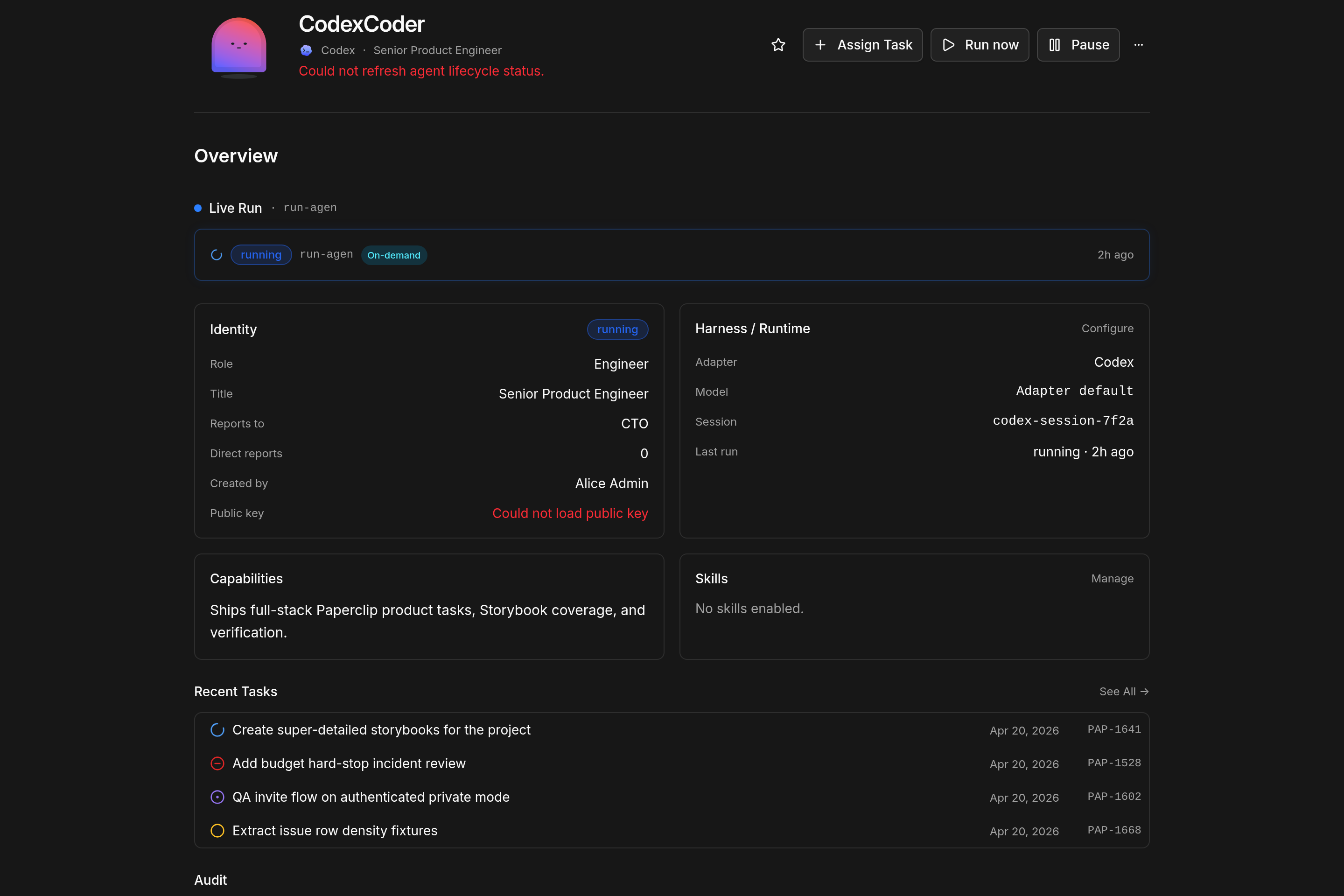
## Thinking Path > - Paperclip is the open source app people use to manage AI agents for work > - A company in Paperclip can have more than one human member, and each member can create agents > - The app does not record which person created an agent > - When two or more people share a company, members cannot see who added an agent or who to ask about it > - This pull request records the creator of each agent and shows the creator on the agent Overview tab > - The benefit is clear ownership of agents in shared companies, with no change for single-user companies ## Linked Issues or Issue Description No public issue exists. This description follows `feature_request.yml`. **Subsystem affected** Agents: the agent data model, the agent create path on the server, and the agent Overview tab in the board UI. **Problem or motivation** Paperclip does not record which human user created an agent. When more than one human user works in a company, the agent page does not tell members who created the agent. **Proposed solution** Record the user ID of the creator when a human creates an agent. Show "Created by <name>" on the Identity card of the agent Overview tab. Show this row only when the company has two or more human members. Do not count the synthetic local Board principal as a human member. Do not show the local Board as a creator. **Alternatives considered** Count human users across the full instance. We did not do this. An instance-wide count tells a member of one company that other companies have users. The creator is always a member of the agent's company, so the company count is sufficient. **Roadmap alignment** `ROADMAP.md` has no item for agent ownership. This change is small and additive. ## What Changed - Add the nullable column `agents.created_by_user_id` (`packages/db/src/schema/agents.ts`, migration `0343_new_mentor.sql`). - Set the column in the single agent insert path (`server/src/modules/agent-lifecycle/adapters/records.ts`). The value comes from the authenticated user actor. The server ignores a creator value in the request body. Agents that agents or the system create keep `null`. - Backfill existing agents in the migration. The backfill uses the earliest `agent.created` or `agent.hire_created` activity row that a user actor wrote in the same company. - Add `createdByUserId` to the shared `Agent` type (`packages/shared/src/types/agent.ts`). - Add `ui/src/lib/agent-creator.ts`. It decides if the UI shows the creator row and it resolves the creator name. If the creator left the company, the row shows "Former member". - Add the "Created by" row to the Identity card in `ui/src/pages/AgentDetail.tsx`. If the company user directory request fails, the row shows "Could not load creator". The row does not disappear silently. - Add the Storybook story `Pages/Agent Detail → Shared Company Shows Creator`. - Document the column in `doc/SPEC-implementation.md` §7.2. ## Verification - `pnpm --filter @paperclipai/db typecheck` passes. This includes the migration numbering and migration safety checks. - `pnpm --filter @paperclipai/shared typecheck` passes. - `ui`: `tsc --noEmit` passes. - `server`: `vitest run src/modules/agent-lifecycle/__tests__/lifecycle.test.ts` passes (49/49). Two new tests: - The server records the creator from the actor and ignores a creator value in the request body. - The backfill takes the earliest user activity row. It skips agent actors and rows from other companies. - `server`: `vitest run src/__tests__/built-in-agents.test.ts` passes (40/40). A new test checks that a built-in agent enabled by a human records that human, and that automatic provisioning stays unattributed. The gated (pending-approval) provisioning test also asserts the creator. `src/__tests__/built-in-agent-routes.test.ts` also passes. - `ui`: `vitest run src/lib/agent-creator.test.ts src/pages/AgentOverview.test.tsx` passes (10/10). The tests cover these cases: the row shows with two or more humans, the row stays hidden with one human plus the Board, the UI never shows the Board as the creator, the row shows an error when the directory request fails, and the row stays hidden (no error) for agents with no creator or the Board as creator. The last case fails without the fix. - The current Storybook catalog uses source annotations and generated indexes. `node scripts/storybook-catalog.mjs --check` passes (264 story files, 2,514 stories). The merge keeps the authored catalog deletion from master. - `pnpm check:token-gates` is clean. - Screenshots from the Storybook story (fake data: two human members, Alice Admin and Bob Builder, plus the local Board). The red "Could not load public key" text is a Storybook artifact: the story has no fixture for the public key request. The existing `Dashboard` story shows the same text. **Two or more human members: the Identity card shows "Created by".** 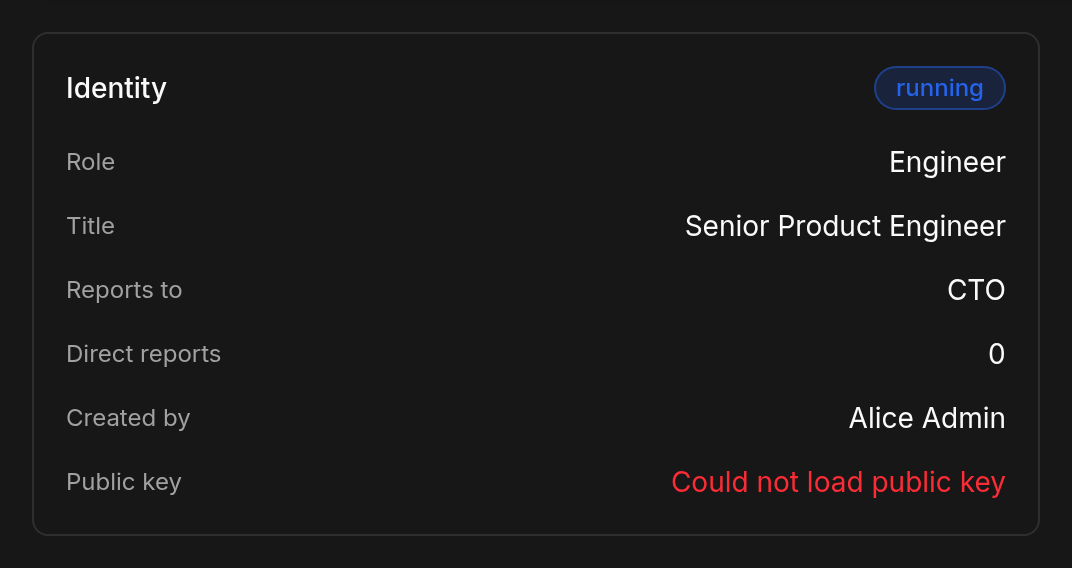 **One human member plus the local Board: the row stays hidden.** 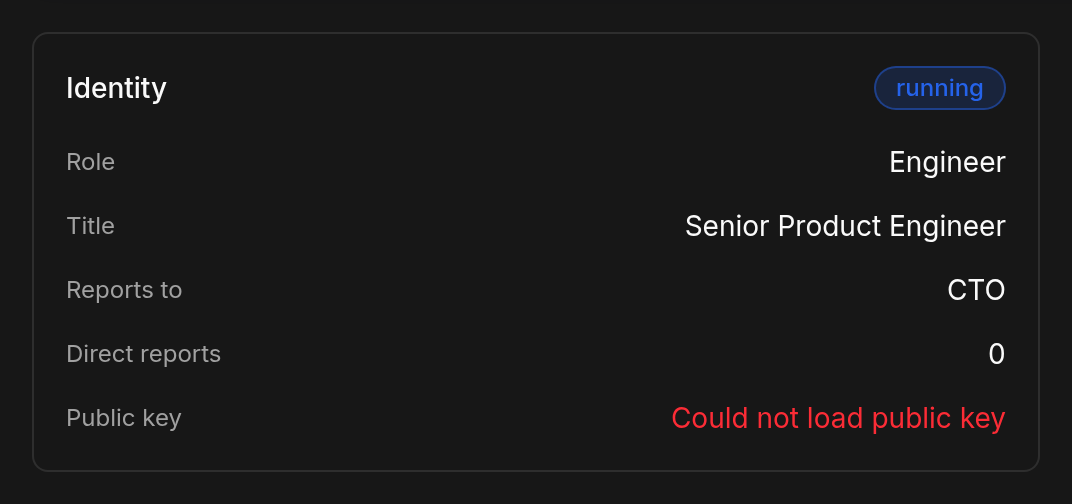 Full Overview tab: [overview-created-by.png](https://raw.githubusercontent.com/paperclipai/paperclip/9b62bd2ea6cf984ce6745f08cc45f44ddf00fb51/pr-16055/overview-created-by.png). The images are on the separate branch `pr-assets/agent-created-by`. They are not in this PR and do not go to `master`. - Manual check: open Storybook at `Pages/Agent Detail → Shared Company Shows Creator`. The Identity card shows "Created by Alice Admin". The `Dashboard` story has one human, so it does not show the row. - Final focused verification on `5a02350cf16050a3cf3cb3f8dc061fe61758c60d`: all 99 tests pass across the two UI suites, built-in-agent suite, and lifecycle suite. The backfill test applies the complete migration twice. The migration uses `ADD COLUMN IF NOT EXISTS` and preserves the company-scoped backfill. Migration numbering and token checks pass. - Full repository typecheck, build, and Storybook build pass. The generated creator story ID is present. A Chromium check renders the production agent page fixture and verifies the creator row and Alice Admin name. Map checks and their 21 tests pass. A fresh Apex review is 5/5 on the current head with no unresolved findings. All 54 successful CI checks pass on this head, with two intentional skips, including all general and serialized test shards, E2E, typecheck, and build. The workspaces-b job passed after rerunning a runner shutdown; no source change was needed. The separate, unsharded local `pnpm test:run` invocation has not completed; complete suite verification comes from CI. ## Risks - Migration: the migration adds one nullable column and runs one `UPDATE` on `agents` with a correlated subquery on `activity_log`. On an instance with a very large activity log, the backfill can take some time. The migration does not lock other tables and does not delete data. - Backfill accuracy: agents with no user-authored create activity row keep `null`. The UI then does not show a creator. This is the same as the current behavior. - Privacy: the row shows only names from the company user directory, and only to users who can already see that directory. - Low risk for single-user companies: the UI does not change for them. > For core feature work, check [`ROADMAP.md`](ROADMAP.md) first and discuss it in `#dev` before opening the PR. Feature PRs that overlap with planned core work may need to be redirected — check the roadmap first. See `CONTRIBUTING.md`. ## Model Used - Provider: Anthropic, Claude Opus 5.5 (model ID `claude-opus-5-5`), run as a coding agent through Claude Code with tool use (shell, file edit, and test execution), standard context window. OpenAI GPT-6 (`gpt-6`) through Codex assisted conflict resolution, regression tests, and repository verification. This session does not expose an exact context-window size. ## Checklist - [x] I have included a thinking path that traces from project context to this change - [x] I have specified the model used (with version and capability details) - [x] I have checked ROADMAP.md and confirmed this PR does not duplicate planned core work - [x] I have searched GitHub for duplicate or related PRs and linked them above - [x] I have either (a) linked existing issues with `Fixes: #` / `Closes #` / `Refs #` OR (b) described the issue in-PR following the relevant issue template - [x] I have not referenced internal/instance-local Paperclip issues or links (only public GitHub `#NNN` / `github.com/paperclipai/paperclip` URLs) - [x] My branch name describes the change (e.g. `docs/...`, `fix/...`) and contains no internal Paperclip ticket id or instance-derived details - [x] I have run tests locally and they pass - [x] I have added or updated tests where applicable - [x] I have updated relevant documentation to reflect my changes - [x] I have considered and documented any risks above - [x] All Paperclip CI gates are green - [x] Greptile is 5/5 with no open P2s, recommendations, or follow-ups - [x] I will address all Greptile and reviewer comments before requesting merge 🤖 Generated with [Claude Code](https://claude.com/claude-code) --------- Co-authored-by: Amy (Opus) <noreply@anthropic.com> Co-authored-by: Paperclip <noreply@paperclip.ing> Co-authored-by: devinfoley <139239+devinfoley@users.noreply.github.com> |
||
|
DottaandPaperclip
|
22d05644f4 |
feat(ui): add Speko voice setup, task calls, and Storybook coverage (#15728)
Runtime #15727 is merged. This PR adds the UI. Qualification follows in
#15729.
## Thinking Path
> - Paperclip manages agent work through tasks and governed connections.
> - Chat connections already bind external conversations to those tasks.
> - Speko handles voice and telephony, while the selected Paperclip
agent does the work.
> - A call needs durable session authority, ordered follow-ups, and safe
result delivery.
> - This PR adds the Speko setup and call controls to the existing Apps
and task UI.
> - This PR depends on #15727. The qualification suite follows
separately. Speko stays experimental.
## Linked Issues or Issue Description
**Problem or motivation**
Phone and browser voice conversations cannot use the chat connection
task lifecycle. A separate voice runtime is needed to preserve task
authority, retries, and reply history.
**Proposed solution**
Add company-scoped voice sessions, signed callbacks, durable replies,
inbound intake, and an agent-facing outbound-call tool. Reuse existing
tasks, queues, secrets, and publications.
**Roadmap alignment**
This extends the experimental chat connector entry points under Agent
Chat and Connected Apps. The project owner requested this feature.
Refs #11418 for the original provider catalog proposal. This
implementation uses the newer chat connection infrastructure rather than
an MCP catalog-only integration. Refs #15721 for remote OpenCode
startup.
## What Changed
- Add the Speko Apps catalog entry, provider artwork, and browser SDK.
- Reuse existing agents in setup. Keep the optional Company Phone Agent
in the catalog, with connection instructions available to any assigned
agent.
- Add task voice controls, transcripts, phone callbacks, inbound-line
settings, and call Activity entries.
- Surface retryable connection and incoming-task inventory failures,
preserve active call controls and cached tasks, restore keyboard focus
after recovery, and bound notification polling so a stuck request cannot
hide later results.
- Put Save & exit and Connect Speko in the credential step’s shared
footer.
- Add deterministic production-component Storybook fixtures for setup,
lifecycle, failures, permissions, and phone surfaces.
- Include voice components in the design guide. Stories never request a
real microphone or place calls.
## Verification
- All 27 focused UI/controller regressions, UI typecheck, token gates,
and 28 map/catalog structural tests pass. The shared connection cache
test covers pause/resume invalidation during the 30-second fresh period.
- Storybook builds 157 Speko production-component stories. The complete
prior 156-story set passed all 624 checks on UI source
|
||
|
DottaandPaperclip
|
473c80d13f |
Automatically import and update project repository skills (#16066)
Automatically import skills from new GitHub project repositories and update enabled sources in the background. Preserve project-derived access, saved selections, immutable execution versions and explicit pins; add legacy adoption, refresh and connection repair in Sources. Include durable scheduling and bounded work credits, production Storybook journeys, real GitHub-to-routine acceptance receipts and final-head CI/security/Greptile qualification. Co-Authored-By: Paperclip <noreply@paperclip.ing> |
||
|
Nicky LeachandPaperclip
|
db65a0863e |
Deliver durable resource lifecycle events to plugins without polling (#16203)
## Thinking Path > - Paperclip manages AI agents and their work. > - Plugins keep external resources aligned with Paperclip projects and agents. > - The durable resource journal stores changes, but its plugin interface requires polling. > - Project deletion has no journal entry, so consumers must scan for missing projects. > - This PR delivers committed journal events through a native plugin callback and records deletion. > - Plugins can recover unfinished work without periodic change scans. ## Linked Issues or Issue Description Related: #15343 introduced the durable inbox. #15631 added required agent lifecycle participation. This change keeps both contracts and adds automatic delivery for the resource inbox. **What happened?** Plugins must schedule reads of the durable inbox. A deleted project has no durable deletion event. Consumers must scan saved bindings to detect its removal. **Expected behavior** Core should deliver committed resource events and replay unfinished work. Empty queues should have no polling timer. Project removal should leave a durable event. **Steps to reproduce** 1. Install a plugin that consumes project lifecycle events. 2. Create or update a project. The plugin must call `listLifecycle` to discover it. 3. Delete the project. The journal has no deletion entry. ## What Changed - Add `resourceLifecycle` to the manifest and `onResourceLifecycle` to the SDK. Require `events.subscribe` and a configured, enabled company scope. - Reuse transaction-aware work signals and the delivery coordinator. Wake after commit, on startup and plugin activation, and after configuration changes. - Acknowledge only a matching successful result. Retry unfinished or interrupted work. Retain deferred events without an idle retry timer. - Wake again after successful worker configuration application, and retain failed scans through idle drain (both Apex findings fixed). - Keep ordering per resource and deliver past failed or deferred resources. Keep the manual inbox methods for existing consumers. - Record project deletion in the removal transaction. Extend the journal constraint with a generated migration. ## Verification - Apex follow-up: 129 focused worker, delivery, coordinator, and application tests passed; server typecheck passed. Regression coverage verifies configuration-application races and failed scans across idle drain. - Focused lifecycle, transaction coordinator, manifest, and SDK dispatch suites: 105 tests passed, including single-connection saves, redacted failure diagnostics, wakeups retained during idle drain, and per-event retry deadlines. - Complete SDK suite plus delivery database tests: 128 tests passed. - Shared, database, and SDK typechecks passed. Direct server `tsc --noEmit` passed against rebuilt SDK declarations. - Full local `pnpm test:run` finished with 19,491 passed, 148 skipped, and 6 failed tests across 5 files (plus two suite setup errors). This run overlapped branch updates and is not final-head evidence: failures included missing Cargo, local Git default-branch assumptions, and stale in-process lifecycle modules. Final Apex-fix commit `75d028788` passed all CI gates, including the full test shards, and received Apex 5/5 with no unresolved comments. - `pnpm -r typecheck` and `pnpm build` were attempted. Both stopped because Cargo is unavailable locally. CI supplies the Rust toolchain. - Local installation used the repository's documented lockfile fallback because master has dependencies missing from its lockfile. No dependency changes are included here. ## Risks - Delivery is at least once. Plugins must re-read current state and make external effects idempotent. - Signals are process-local, like the other delivery queues. Startup recovers committed rows. Independent database writers or multiple active server processes require an explicit ownership and wake protocol. - Apply migration `0340_open_warlock.sql` before running code that records project deletion. Earlier deletions cannot be reconstructed. - Automatic delivery selects plugins with company configuration rows. `deferred` waits for a later startup, configuration change, or other work notification. - This does not replace required agent lifecycle participation or establish that external mounts are unused. ## Model Used OpenAI Codex (GPT-6), with tool-assisted code editing, code inspection, and test execution. ## Checklist - [x] I have included a thinking path that traces from project context to this change - [x] I have specified the model used (with version and capability details) - [x] I have checked ROADMAP.md and confirmed this PR does not duplicate planned core work - [x] I have searched GitHub for duplicate or related PRs and linked them above - [x] I have either (a) linked existing issues with `Fixes: #` / `Closes #` / `Refs #` OR (b) described the issue in-PR following the relevant issue template - [x] I have not referenced internal/instance-local Paperclip issues or links (only public GitHub `#NNN` / `github.com/paperclipai/paperclip` URLs) - [x] My branch name describes the change (e.g. `docs/...`, `fix/...`) and contains no internal Paperclip ticket id or instance-derived details - [ ] I have run tests locally and they pass - [x] I have added or updated tests where applicable - [x] I have updated relevant documentation to reflect my changes - [x] I have considered and documented any risks above - [x] All Paperclip CI gates are green - [x] Greptile is 5/5 with no open P2s, recommendations, or follow-ups - [x] I will address all Greptile and reviewer comments before requesting merge --------- Co-authored-by: Paperclip <noreply@paperclip.ing> |
||
|
Devin FoleyandPaperclip
|
5a6d0d08a7 |
fix: record verified workspace file recovery from tasks (#16104)
## Thinking Path > - Paperclip is the open source app people use to manage AI agents for work. > - Recovery must preserve files and show the next operator action. > - A stopped run can leave a file repair hold after its recovery action is resolved. > - The task notice shows that hold but has no form to record verified file recovery. > - A chat connection can also replace the file repair instruction with a chat retry instruction. > - This pull request adds a file recovery form and preserves the file repair instruction. > - The form records evidence for the original run and keeps the current task status. ## Linked Issues or Issue Description **What happened?** A retained workspace file hold can block a task after its recovery action is resolved. The task page offers no file recovery form. A chat binding can hide the required file repair instruction. **Expected behavior** An authorized board member can record verified recovery of the original files. The server checks the original stop proof. The task keeps its current status and does not start another run. Chat instructions must not replace file repair instructions. **Steps to reproduce** 1. Create a stopped legacy run with a retained workspace recovery marker and a resolved recovery action. 2. Open its task page, including a task with a chat connection. 3. Observe that the file hold has no supported form to record verified recovery. Refs: #15857, #15824, #16095. Those PRs address shutdown export, native finalization and workspace source isolation. This PR uses the existing file repair API. ## What Changed - Add a board-only file recovery form with evidence and an explicit file verification confirmation. - Preserve the current task status when recording file recovery. - Project whether the original recovery marker supports file recording. - Keep file repair instructions when a task has a chat binding. - Add UI, route and Storybook examples for success, denial and chat-connected file holds. - Document the recovery flow and update the affected Storybook catalog entries. ## Verification - Merged master `c8efdbfba43` and resolved both rounds of catalog/index conflicts. Upstream review notes and classifications are preserved, together with all four retained-file recovery examples and their stable story IDs. Both fix branches also combine without merge conflicts or catalog fingerprint drift. - Passed locally after conflict resolution: 47 tests covering the file recovery UI, execution blocker notice and retained workspace repair route. The earlier ownership-route pass also covered 196 tests. - Passed: UI token gates, the complete Storybook catalog check with no drift errors, feature and agent map structure checks, and all 17 catalog/index script tests. Verification inventory counts match all 262 authored suites and 2,485 story IDs. The upstream production verification obligations remain intact. - Passed: full workspace typecheck, build and Storybook build on latest head `10ac22b35d0a4fe469cf620914845c509046da48`. The built index retains all four file-recovery story IDs. - Latest head `10ac22b35d0a4fe469cf620914845c509046da48` has 54 successful checks and two intentionally skipped Storybook checks. Apex is 5/5 on that exact commit, with no unresolved findings. The full general/serialized suites and all eight browser shards passed in CI. Local tests use the focused suites above. Storybook browser interactions have not been executed locally. - Manual check: open a task with a retained file hold. Verify that evidence and confirmation are required. Record verified file recovery. Confirm that its status stays unchanged and no run starts. Repeat without board runtime access and with an unverified stop receipt. ## Risks - The form records an operator attestation. It does not recover files itself or prove external action outcomes. - A stale source or missing stop proof must remain rejected by the existing server route. - No database migration or automatic task retry is added. ## Model Used OpenAI GPT-6 (`gpt-6`), used through Codex with reasoning, repository tools, code editing and test execution. The exact context window size is not exposed by this environment. ## Checklist - [x] I have included a thinking path that traces from project context to this change - [x] I have specified the model used (with version and capability details) - [x] I have checked ROADMAP.md and confirmed this PR does not duplicate planned core work - [x] I have searched GitHub for duplicate or related PRs and linked them above - [x] I have either (a) linked existing issues with `Fixes: #` / `Closes #` / `Refs #` OR (b) described the issue in-PR following the relevant issue template - [x] I have not referenced internal/instance-local Paperclip issues or links (only public GitHub `#NNN` / `github.com/paperclipai/paperclip` URLs) - [x] My branch name describes the change (e.g. `docs/...`, `fix/...`) and contains no internal Paperclip ticket id or instance-derived details - [x] I have run tests locally and they pass - [x] I have added or updated tests where applicable - [x] I have updated relevant documentation to reflect my changes - [x] I have considered and documented any risks above - [x] All Paperclip CI gates are green - [x] Greptile is 5/5 with no open P2s, recommendations, or follow-ups - [x] I will address all Greptile and reviewer comments before requesting merge --------- Co-authored-by: Paperclip <noreply@paperclip.ing> |
||
|
Nicky LeachandPaperclip
|
da9af67415 |
Persist agent-owned instance secrets through lifecycle results (#16191)
## Thinking Path > - Paperclip coordinates agents and controls when they can run. > - Lifecycle plugins prepare and remove resources for each agent. > - Those resources can require private connection credentials. > - The current SDK can resolve configured secrets but cannot save these credentials securely. > - Ordinary company secrets can be bound to agents and do not provide the required server-only boundary. > - This change saves agent-owned instance secrets through the existing local lifecycle result and native secret service. > - The tenant can retain runtime credentials through restarts without a separate encryption system or remote API. ## Linked Issues or Issue Description **Subsystem affected** Agent lifecycle, plugin contract, and native secret storage. **Problem or motivation** Lifecycle plugins need to save private runtime connection details for the owning agent. Worker memory loses these details on restart. Plugin state and company secrets do not provide a private runtime-only boundary. **Proposed solution** Add optional instance-secret changes to lifecycle results. Save them through the existing secret service and local encrypted provider before accepting the result. Require company, agent, plugin, phase, operation, revision, and current unexpired attempt ownership. Supply saved values through the existing local preparation/resume request. **Alternatives considered** A separate encrypted store duplicates the native secret system. Generic plugin company-secret writes proposed by #5007 do not supply agent ownership or a server-only secret scope. This change does not add that general write API. **Roadmap alignment** Extends the existing lifecycle contract from #15631. It does not add a resource provider or select an execution backend. ## What Changed - Add an instance scope to native secrets with mandatory agent/plugin ownership, a company-qualified agent foreign key, and key uniqueness per owner. Existing company and user scopes retain their constraints. - Reuse native creation, rotation, deletion, secret versions, access audit, and the local encrypted provider. Keep values out of company catalogs, normal bindings, agent access, and public agent records. - Accept local secret patches only after locking and checking the current lifecycle operation and required plugin selection. Storage failure or a stale reply cannot complete setup. Expired or replaced attempt owners cannot overwrite a successor's credentials. - Keep vault-import conflicts company-scoped. Protect instance-owned account-home paths during failed device-login cleanup with a private, fail-closed scan. - Skip decryption on stop and cleanup so a lost key cannot block removal. Cascade secret records when their agent or plugin is deleted. - Log fixed provider diagnostics without raw errors that can contain credentials. Document the local contract, runtime resolver, and access-map exclusions. Retain the five latest migration snapshots through the normal generator pruning. ## Verification - 239 focused tests passed across agent-instance-secrets, lifecycle, secrets-service, secrets-routes, plugin-secrets-handler, and agent-device-login-routes. Used disposable PostgreSQL 18 clusters through the existing test constructor seam because the bundled binary cannot start on this macOS host. The temporary harness is outside git. - Regression tests reproduced the vault-import conflict and missed cleanup claimant before the fixes; both pass after the fixes. - New coverage includes encrypted native versions, rotation, restart recovery, company/agent/plugin isolation, ordinary-read and binding denial, stale replies, storage failure, safe logging, cleanup without the master key, and same-name secret isolation, native account-home mutation guards, lease takeover/expiry, and live agent/plugin deletion cascades. - Direct server TypeScript check, DB/shared typechecks, migration numbering/safety checks, module boundaries, and git diff check passed. - Full workspace typecheck and build were attempted; both stop at the missing local cargo toolchain. The full test command was started and stopped after failures in unchanged native-runtime/workspace suites plus bundled-PostgreSQL skips; it did not complete. CI must verify the full toolchain paths. - Current head `c0f8bfd12477ad509252ecd40e168a6c84dbeb36`: all 55 CI checks passed, including the previously canceled e2e shard. Greptile Apex reviewed this exact head at 5/5 with no unresolved threads. GitHub reports the branch mergeable and clean. - No live provider probe, production data access, or deployment. Reviewed the diff for credentials, private references, and run artifacts. ## Risks Apply migration 0339_luxuriant_iron_monger.sql before deploying tenant code. It adds nullable ownership columns, a partial unique index, foreign keys, and a stricter scope constraint. Existing rows remain valid. Keep the schema on application rollback. Preserve the existing secrets master key through deployments and backup restoration. The lifecycle request/result now has a sensitive, server-only field. Plugins must never log it or return it to an agent or browser. Values stay in the tenant database through the existing encryption provider. Trusted runtime consumers must apply normal execution admission before resolving them. Older hosts omit instanceSecrets; plugins that require durable storage must reject those hosts. ## Model Used OpenAI GPT-6 via Codex, with reasoning, repository inspection, code editing, and local test execution. The exact serving model identifier and context window are not exposed in this session. ## Checklist - [x] I have included a thinking path that traces from project context to this change - [x] I have specified the model used (with version and capability details) - [x] I have checked ROADMAP.md and confirmed this PR does not duplicate planned core work - [x] I have searched GitHub for duplicate or related PRs and linked them above - [x] I have either (a) linked existing issues with `Fixes: #` / `Closes #` / `Refs #` OR (b) described the issue in-PR following the relevant issue template - [x] I have not referenced internal/instance-local Paperclip issues or links (only public GitHub `#NNN` / `github.com/paperclipai/paperclip` URLs) - [x] My branch name describes the change (e.g. `docs/...`, `fix/...`) and contains no internal Paperclip ticket id or instance-derived details - [x] I have run tests locally and they pass - [x] I have added or updated tests where applicable - [x] I have updated relevant documentation to reflect my changes - [x] I have considered and documented any risks above - [x] All Paperclip CI gates are green - [x] Greptile is 5/5 with no open P2s, recommendations, or follow-ups - [x] I will address all Greptile and reviewer comments before requesting merge --------- Co-authored-by: Paperclip <noreply@paperclip.ing> |
||
|
|
0b0e53029f |
fix: recover saved workspace results automatically (#15824)
## Thinking Path - Paperclip preserves accepted agent results before workspace copyback and result commitment. - A replaced controller can leave a physical copyback owner receipt behind. A lost database lock or expired lease cannot prove that its tar/Git children stopped. - Infrastructure recovery should belong to the runtime and deployment harness; task users should not investigate processes or attest shutdown. - New receipts record the exact deployment. The harness independently verifies that deployment fully stopped and signs a short-lived proof bound to the stack, run, owner and deployment. - The existing guarded reconciler then finishes the same accepted result without a new agent turn. Legacy receipts retain the documented administrator API after independent platform verification. ## Linked Issues or Issue Description **What happened?** An accepted native result can remain at `workspace_finalizing` with an abandoned physical copyback owner. Repeated recovery sweeps could replace specific instructions with advice to start new agent work. The first version of this PR exposed a shutdown-evidence form in the task; that asks end users to resolve infrastructure details. **Expected behavior** Automatically verify and recover the exact stopped deployment, preserve the original accepted result and existing approval/monitor waits, and show only a quiet task status. Unknown or live workers must remain fenced. Older receipts without platform identity need independently verified operator assistance through the administrator API. **Steps to reproduce** 1. Persist an accepted native result and a copyback receipt from a prior controller. 2. Replace that deployment before workspace finalization commits. 3. Let the normal finalization reconciler revisit the saved result. 4. With a platform-bound receipt and a fully stopped deployment, recovery should finish automatically. With missing, live, unverifiable or changed ownership, it must not write files or create another provider turn. Related public work: #14402 introduced copyback ownership; #9687 handles dead-run finalize barriers; #15795 handles terminal stale-run cleanup. This change addresses an accepted result whose physical copyback owner prevents commitment. ## What Changed - Record Railway project, environment, service and deployment identity on new physical copyback owners. - Request read-only platform verification from the managed cloud harness. Require an Ed25519 stop receipt with a disjoint purpose, configured signing key, exact stack/run/owner/deployment binding and valid expiry. - Keep live, unknown, malformed, unavailable and legacy owners fenced. Compare the whole prior receipt during ownership takeover, under the existing dedicated advisory lock. - Persist platform proof and audit automatic takeover. Resume normal finalization of the same saved result, preserving task ownership, approved boundaries, monitors and pending confirmations. - Remove process metadata, shutdown evidence, confirmation checkboxes and infrastructure-repair forms from task views. Suppress the duplicate technical owner-recovery card. Show “Restoring saved work…” only from server-confirmed recovery or queued operator recovery; platform identity alone shows the operator-assistance fallback. Remove the status when recovery resolves. - Share current-task, current-running-execution, accepted-result, authoritative-reviewer and newer-execution checks between automatic and operator recovery. Validate after the provider lookup, atomically with the owner claim, and again before file publication; closed or superseded tasks cannot start copyback. - Keep the separately authorized exact-owner API for operator recovery of legacy receipts, with active-lock, live-controller, stale-result and newer-execution rejection. Generic dismissal cannot bypass the copyback fence. - Replace obsolete form stories with production-backed automatic, queued, legacy, completed and mobile examples; retain stable suite IDs. Update the operator runbook and scoped Storybook catalog. ## Verification - Red/green: new platform-proof tests failed before implementation; the database takeover regression failed against the original ownership guard; reduced-UI assertions failed against the original form. All pass after the changes. - Passed: 59 physical-owner/finalization database tests using isolated PostgreSQL, including real reconciler commitment from all three saved-result phases through both automatic and operator recovery. They preserve result identity, exact saved file bytes, pending approval and overdue monitor waits, and create no new run or wake request. Unknown evidence and changed ownership remain fenced. - Passed: 162 focused proof, cloud identity, recovery route, recovery-card and reduced-UI tests. - Passed: full workspace typecheck and build, final server/UI typechecks, token gates, and Storybook build. - Browser inspection: desktop task composition shows only the quiet status; completed example removes it and retains the approval-wait message. Mobile shows the existing bottom navigation with no horizontal overflow. These are fixture UI observations, not live provider acceptance. - A companion harness change implements the actual provider check, signed receipts, server-token authentication and bounded/coalesced provider reads. Its full typecheck and test suite passed: 3,240 passed, 92 skipped, zero failures. This application alone cannot enable platform verification. - The updated full application `pnpm test:run` was stopped after repeated local embedded-Postgres startup failures; it is not claimed green. The same affected recovery suites pass against isolated PostgreSQL. CI passed on final head `9ad5c3529e`: 54 successful checks, two intentional skips, and successful legacy Snyk status. Greptile is 5/5 with no unresolved findings. - Global Storybook catalog validation is green: 225 files, 2,224 stories. Its 17 catalog/index tests pass. Master was merged and the inherited index metadata was reconciled after source review. - Review correction red/green: two UI and two database assertions reproduced misleading progress / missing server recovery state; all pass after server-confirmed state was added. All 153 focused server tests and 68 UI tests pass on the final recovery code, including repeated-sweep idempotence. Full workspace typecheck/build, token gates and Storybook build also pass. - Safety regression red/green: stale-task copyback and publication tests failed against the previous guard. The final suite covers changes during proof lookup, closed/cancelled tasks, replaced execution/checkout, newer and queued legacy runs, reassignment and rejected/unbound results, plus the real reconciler selecting closed or superseded tasks. Files remain untouched and no workspace operation starts. - No staging mutations, deployment, live provider probes or live production recovery were performed. The three historical receipts lack deployment identity and still require independent operator proof. ## Risks Automatic takeover requires the companion harness release and configured runtime-identity keys. Deploying only this application leaves unavailable evidence fenced. Legacy receipts are not retrospectively assigned a deployment identity. An authorized operator can still make an incorrect attestation through the fallback API; its administrator gate and exact-owner safeguards remain. Provider history that is missing or deeper than the bounded lookup defers automatic recovery. Copyback can still fail under its existing retained-workspace policy. No migration, telemetry change or cloud provider credential delivery is required. The companion harness PR also has passing CI and a 5/5 review; neither branch is deployed. ## Model Used OpenAI Codex, GPT-6, with repository inspection, browser verification, tool use and code execution. The exact serving model ID and context-window size were not exposed in this session. ## Checklist - [x] I have included a thinking path that traces from project context to this change - [x] I have specified the model used (with version and capability details) - [x] I have checked ROADMAP.md and confirmed this PR does not duplicate planned core work - [x] I have searched GitHub for duplicate or related PRs and linked them above - [x] I have either (a) linked existing issues with `Fixes: #` / `Closes #` / `Refs #` OR (b) described the issue in-PR following the relevant issue template - [x] I have not referenced internal/instance-local Paperclip issues or links (only public GitHub `#NNN` / `github.com/paperclipai/paperclip` URLs) - [x] My branch name describes the change and contains no internal Paperclip ticket id or instance-derived details - [x] I have run the relevant tests locally and they pass - [x] I have added or updated tests where applicable - [x] I have updated relevant documentation to reflect my changes - [x] I have considered and documented any risks above - [x] All Paperclip CI gates are green - [x] Greptile is 5/5 with no open P2s, recommendations, or follow-ups - [x] I will address all Greptile and reviewer comments before requesting merge --------- Co-authored-by: Paperclip <noreply@paperclip.ing> Co-authored-by: Paperclip <paperclip@paperclip.ing> Co-authored-by: Devin Foley <devin@paperclip.ing> |
||
|
DottaandPaperclip
|
be380ba155 |
fix(ui): hide agent-created tasks by default (#16157)
Hide agent-created, system-created, and chat-channel tasks from independent collections by default. Preserve task hierarchy context and existing inbox participation. Add a saved opt-in checkbox without helper text. Co-Authored-By: Paperclip <noreply@paperclip.ing> |
||
|
DottaandPaperclip
|
aded4197e5 |
fix: make multiplayer task toasts personal (#16153)
## Thinking Path > - Paperclip is the open source app people use to manage AI agents for work. > - A company can have several human users and shared agents. > - Live task events currently produce toasts for any user who can read the task. > - This makes unrelated work interrupt other users. > - This pull request checks each user's task participation before it permits a toast. > - Users receive relevant task notifications while company views continue to refresh. ## Linked Issues or Issue Description **What happened?** Company task activity and agent failures produce noisy toasts for users who have no involvement in the task. **Expected behavior** A task qualifies when the viewer created it, commented on it, is its assigned user, deliberately acted on it under the Mine rules, or has an explicit user mention in its description or a non-deleted comment. Viewing, agent ownership, responsible-user attribution, and parent participation alone do not qualify. **Steps to reproduce** 1. Sign in as two users in the same company. 2. Have the second user create and update a task that does not involve the first user. 3. Observe a task toast in the first user's company view before this fix. The duplicate PR search found no existing change for personal task-toast eligibility. ## What Changed - Extract the existing Mine participation predicate without changing Mine behavior. - Compute task eligibility from stored tasks, comments, and run associations after WebSocket access checks. Use an exact indexed comment-mention lookup with `LIMIT 1`. - Add optional `toastEligible` metadata to each viewer's event copy. Keep it off the shared event bus. - Require eligibility for live task activity and task-linked run errors. Suppress generic agent errors. - Continue cache updates for quiet events. Refetch visible comments when authenticated events omit hydration details. Ignore stale socket callbacks after account or company changes. - Document toast semantics and add feature-map and agent-access-map coverage. - Add persisted-data, socket, UI, and authenticated browser regression coverage. ## Verification - Final commit: `1dc4f9402c5883744738cfe236ad00fa0bb5ca4c`. - All 55 current-head checks passed. Two Storybook checks were skipped because this change does not affect that coverage. - Greptile approved this exact commit with 5/5. The security scan passed. Both review threads are resolved. - Local `pnpm build`, `pnpm -r typecheck`, `pnpm check:token-gates`, and `node scripts/check-maps.mjs` passed. - The focused socket/UI suite passed 123 tests. The persisted eligibility suite passed 9 tests, including long history, exact viewer matching, and regex escaping. The existing Mine service suite previously passed 140 tests. - The named browser case `task toasts follow personal involvement in multiplayer` passed against the final commit in an isolated authenticated instance. It used two real sessions, real WebSocket delivery, and persisted tasks, edits, comments, and mentions. It verified quiet unrelated activity, viewing alone, first and historical mentions, own-action suppression, visible-task suppression, and live cache refresh. - A prior-head server shard passed its single rerun after a fixture-cleanup deadlock. The final-head CI run passed without a rerun. - The broad local run remained in progress when CI completed the full test suite. Local focused checks and CI provide the completed test evidence. ## Risks - This intentionally reduces live notifications. A new client stays quiet against an older server that omits eligibility. - Eligibility queries add work to live event delivery. A lookup failure suppresses the toast and still delivers the authorized event. - Deleted mentions cease to qualify unless another participation rule applies. Historical comment authorship retains the existing Mine behavior. - No database migration or notification-settings change is required. ## Model Used OpenAI Codex with GPT-6 assisted with implementation, tests, documentation, and PR preparation. It used repository tools, shell commands, and browser automation. The runtime did not expose an exact backend revision or context-window size. ## Checklist - [x] I have included a thinking path that traces from project context to this change - [x] I have specified the model used (with version and capability details) - [x] I have checked ROADMAP.md and confirmed this PR does not duplicate planned core work - [x] I have searched GitHub for duplicate or related PRs and linked them above - [x] I have either (a) linked existing issues with `Fixes: #` / `Closes #` / `Refs #` OR (b) described the issue in-PR following the relevant issue template - [x] I have not referenced internal/instance-local Paperclip issues or links (only public GitHub `#NNN` / `github.com/paperclipai/paperclip` URLs) - [x] My branch name describes the change (e.g. `docs/...`, `fix/...`) and contains no internal Paperclip ticket id or instance-derived details - [x] I have run tests locally and they pass - [x] I have added or updated tests where applicable - [x] I have updated relevant documentation to reflect my changes - [x] I have considered and documented any risks above - [x] All Paperclip CI gates are green - [x] Greptile is 5/5 with no open P2s, recommendations, or follow-ups - [x] I will address all Greptile and reviewer comments before requesting merge Co-Authored-By: Paperclip <noreply@paperclip.ing> |
||
|
DottaandPaperclip
|
2ad36f4ff2 |
Fix skill source removal with a keep-or-delete choice (#16150)
## Thinking Path
> - Paperclip is the open source app people use to manage AI agents for
work.
> - GitHub sources import skills and keep their updates together.
> - Disconnect only disabled a source and kept its read-only imports.
> - A disabled source could not be removed or imported again.
> - Removing a source needs an explicit decision about its imported
skills.
> - This pull request removes the source after the user keeps editable
copies or deletes the imports.
> - Existing disabled sources use the same removal flow.
## Linked Issues or Issue Description
Refs #15731, #14713.
**What happened?**
Disconnect left the repository on Sources. Its Disconnect action was
then disabled. The saved repository still blocked a new import.
**Expected behavior**
Remove the repository from Sources. Require a choice to keep editable
copies or delete its imports. Allow removal of sources that are already
disconnected.
**Steps to reproduce**
1. Import a repository in Skills → Sources.
2. Choose Disconnect source.
3. Observe the disconnected row and disabled removal action.
4. Try to import the repository again.
**Paperclip version or commit**
|
||
|
DottaandPaperclip
|
a6390e894c |
Reconcile Claude platforms with actual merged master
Co-Authored-By: Paperclip <noreply@paperclip.ing> * codex/claude-runner-default: Record merged-master Claude reconciliation and catalog scope feat(runner): qualify Codex platform packages and cache hosted builds (#16028) Record local Claude startup collision without retry fix(ui): default human task replies to the latest assigning agent (#15594) refactor(server): move provider setup, inventory and delivery into channel folders (#16058) fix(apps): show user avatars and center access rows (#15577) fix(issues): preserve human handoffs from the active agent run (#16082) |
||
|
DottaandPaperclip
|
3f442729a4 |
Reconcile Claude behavior with merged master
Co-Authored-By: Paperclip <noreply@paperclip.ing> * codex/claude-runner-protocol: feat(runner): qualify Codex platform packages and cache hosted builds (#16028) fix(ui): default human task replies to the latest assigning agent (#15594) refactor(server): move provider setup, inventory and delivery into channel folders (#16058) fix(apps): show user avatars and center access rows (#15577) fix(issues): preserve human handoffs from the active agent run (#16082) |
||
|
Dotta
|
abcd8261d2 |
Reconcile Claude protocol with merged runtime prerequisite
Co-Authored-By: Paperclip <noreply@paperclip.ing> * commit 'd67e3507b23041212fa26302ce6de078c5ebcc05': feat(runner): qualify Codex platform packages and cache hosted builds (#16028) fix(ui): default human task replies to the latest assigning agent (#15594) refactor(server): move provider setup, inventory and delivery into channel folders (#16058) fix(apps): show user avatars and center access rows (#15577) fix(issues): preserve human handoffs from the active agent run (#16082) # Conflicts: # doc/plans/2026-10-06-default-agent-runner.md # maps/agent-access-map/runs-adapters.md # maps/feature-map/runs-adapters.md # packages/paperclip-runner/README.md # server/src/__tests__/dev-runner-native-binary.test.ts |
||
|
DottaandPaperclip
|
7d7f55e4be |
fix(apps): show user avatars and center access rows (#15577)
## Thinking Path > - Paperclip helps people manage AI agents and their access to apps. > - The app access page shows people with linked chat accounts. > - The identity response omitted the user's saved image. > - The row placed the avatar beside only the first name line. > - This change returns the image and centers the avatar beside both name lines. > - People can recognize linked accounts and still see initials when no image is available. ## Linked Issues or Issue Description **What happened?** The app access page showed initials even when the linked Paperclip user had a profile image. The avatar was above the vertical center of the Disconnect button. **Expected behavior** Show the linked user's saved image. Center it beside the Paperclip and chat names. Keep initials when no image is available. **Steps to reproduce** 1. Link a Slack account to a Paperclip user with a profile image. 2. Open the app's Access tab. 3. Inspect the person's avatar and the two name lines. Searched public issues and pull requests. No duplicate fix was found. Related avatar work in #15095 concerns agent uploads, not linked user profiles. ## What Changed - Return `paperclipUserImage` from the chat principal service and declare it in the API and client types. - Use the shared avatar primitives and center the avatar beside the full name block. Keep full names available in hover text. - Add image and initials examples to the existing Storybook access story, with image and alignment checks. - Extend the service test to check saved images and missing images. ## Verification - Token gates and `git diff --check` pass. - The 33 existing chat setup and identity-link UI tests pass. - The OAuth installer service regression test passes. - Chromium rendered the Storybook Access story at desktop and mobile sizes. The avatar, name block, and Disconnect button centers all measured 307 CSS pixels on desktop. - UI typecheck passes. Full repository typecheck and build stop at the Rust runner because this workspace has no `cargo`. The initial parallel typecheck also exceeded the 4 GiB workspace limit. The full local test attempt was stopped as memory approached the 4 GiB limit; it has no complete verdict. CI passed the full build, typecheck, test, and E2E lanes on the initial commit. The previously reviewed commit passed 54 checks with two intentionally skipped Storybook checks. Master was merged on October 10 to resolve an import conflict; fresh CI is running for `24badb742d331c1b6ee3e90cbd06defefe5cd634`. Token gates and whitespace checks pass after conflict resolution. The single retry after CI runner shutdowns passed. Greptile gives this commit 5/5, with both review threads resolved. ### Screenshots The Storybook fixture shows an image, fallback initials, and a pending account.   ## Risks Low risk. The API field is additive and needs no migration. The image uses the same avatar primitive as other user identities. Missing or failed images retain the initials fallback. Other chat providers share this access row. ## Model Used OpenAI Codex, GPT-6. Tool use and code execution. The runtime does not expose a more specific model ID or context window size. ## Checklist - [x] I have included a thinking path that traces from project context to this change - [x] I have specified the model used (with version and capability details) - [x] I have checked ROADMAP.md and confirmed this PR does not duplicate planned core work - [x] I have searched GitHub for duplicate or related PRs and linked them above - [x] I have either (a) linked existing issues with `Fixes: #` / `Closes #` / `Refs #` OR (b) described the issue in-PR following the relevant issue template - [x] I have not referenced internal/instance-local Paperclip issues or links (only public GitHub `#NNN` / `github.com/paperclipai/paperclip` URLs) - [x] My branch name describes the change (e.g. `docs/...`, `fix/...`) and contains no internal Paperclip ticket id or instance-derived details - [x] I have run tests locally and they pass - [x] I have added or updated tests where applicable - [x] I have updated relevant documentation to reflect my changes - [x] I have considered and documented any risks above - [ ] All Paperclip CI gates are green - [x] Greptile is 5/5 with no open P2s, recommendations, or follow-ups - [x] I will address all Greptile and reviewer comments before requesting merge --------- Co-authored-by: Paperclip <noreply@paperclip.ing> |
||
|
DottaandPaperclip
|
4ba521823f |
merge: preserve Claude consumers and canonical install diagnostics
Retain both Claude SDK admission and bounded Intel initial-install failure evidence. All25 focused consumer controls pass; no provider, build campaign, local Rust or Docker. Co-Authored-By: Paperclip <noreply@paperclip.ing> |
||
|
DottaandPaperclip
|
cf1fa2e982 |
merge: preserve Claude behavior with canonical task-workspace source
Retain both scoped Storybook reviews and source lists, regenerate the index, preserve Claude acceptance docs, and refresh only ignored shared/SDK JavaScript declarations. UI/server types and189 creation/form controls pass. Co-Authored-By: Paperclip <noreply@paperclip.ing> |
||
|
DottaandPaperclip
|
12113e431e |
merge: reconcile task-workspace canonical prerequisite
Preserve Claude v7 effort, lease ownership, historical readers, and Pi25 source binding while composing canonical16a and task-workspace masterf329. Protocol/surfaces noemit and all generation checks pass. Co-Authored-By: Paperclip <noreply@paperclip.ing> |
||
|
DottaandPaperclip
|
f29dad6c94 |
merge: preserve current canonical source and Claude fixture review
Keep the qualified four-target selection and both Linux provider-pack assembly paths while carrying the current shared source. Co-Authored-By: Paperclip <noreply@paperclip.ing> |
||
|
DottaandPaperclip
|
f329b24ee1 |
feat: give tasks durable project-optional workspaces (#15749)
Give tasks durable company-scoped workspace bindings independent of project assignment, channel defaults and authorized repository preparation. Reuse verified input seeds and sparse output recovery while preserving trust, privacy and controller provisioning boundaries.
Full CI and E2E, Superagent, legacy checks and Greptile Apex 5/5 passed on reviewed head
|
||
|
DottaandPaperclip
|
304e95c320 |
merge: compose Claude behavior with canonical master reconciliation
Co-Authored-By: Paperclip <noreply@paperclip.ing> |
||
|
DottaandPaperclip
|
48ffca9438 |
merge: reconcile published native prerequisite and current master
Preserve canonical startup ownership, scoped evidence, current Storybook IDs, and the Codex form controls while carrying Claude effort and immutable source bindings. Co-Authored-By: Paperclip <noreply@paperclip.ing> |
||
|
DottaandPaperclip
|
48d4ab54d6 |
chore: reconcile contribution rules and onboarding fixtures
Extract the guided setup test fixture without dropping cases. Supply current settings/discovery contracts and Opus 5.5 in the isolated Storybook boundary. Co-Authored-By: Paperclip <noreply@paperclip.ing> |
||
|
DottaandPaperclip
|
dabb8c5daf |
test: remove repeated setup and strengthen regression proof (#16022)
## Thinking Path > - Paperclip is the open source app people use to manage AI agents for work. > - Its tests protect company boundaries, approvals, durable tasks, credentials and the board UI. > - Several owner suites repeat large database fixtures and render frames. > - Some tests repeat stronger proof or pass when the behavior they describe is broken. > - This pull request shares exact setup, removes proven duplicate cases and repairs weak observations. > - It preserves distinct security, lifecycle, concurrency and user-facing contracts. > - The benefit is 5,027 fewer test lines and stronger regression checks. ## Linked Issues or Issue Description Refs #15978. This continues the merged test-audit cleanup in [PR #15978](https://github.com/paperclipai/paperclip/pull/15978), which removed 11,976 test/support lines. The savings in this pull request are additional. Related open work: [PR #13460](https://github.com/paperclipai/paperclip/pull/13460) changes legacy OAuth parent/version lock ordering. This pull request retains those production paths and the existing lock-order test. Its secrets changes compact fixtures and repair the two AWS wrapper exclusion observations. Scoped title searches found no open duplicate audit or fixture-consolidation PR and no matching audit issue. The problem is described here using the enhancement template. **What existing behavior does this improve?** The maintenance and regression value of the existing server, UI, CLI, shared and wiki-plugin test suites. **Subsystem affected** Cross-cutting test code. Two UI modules also lose unused test inspection exports. **Current behavior** Owner tests repeat database rows, service inputs, HTTP setup and render frames. Some cases repeat stronger assertions. Two AWS lock tests record only cleanup events, so an AWS provider write can happen inside the held lock without failing those observations. Several other negative tests accept or do not observe the wrong result. Worktree fixtures also use a temporary path alias that conflicts with the existing canonical-path checks on macOS. **Proposed behavior** Use small local helpers that preserve exact inputs, fresh allocations, callbacks, query order and await positions. Remove only cases with named stronger keepers. Tighten negative assertions and observe actual AWS provider entry while a confirmed lock holder remains parked. Resolve temporary fixture roots to their canonical paths. **Reason and benefit** Remove 5,027 net test lines and 15 redundant registered executions. Remove 11 lines of unused UI inspection exports. Keep every distinct company, actor, approval, credential, persistence, stale-write and concurrency contract. No wall-time speedup is claimed for setup compaction. **Breaking changes** None for application behavior, APIs or stored data. The removed exports expose private UI test state and have no remaining callers. ## What Changed - Consolidate repeated runtime, workspace, portability, route, tool-access, policy, gateway and state-service fixtures. - Share repeated UI render frames and CLI/wiki-plugin setup while retaining the original actions and expected results. - Remove 15 repeated case executions only where the audit records an exact stronger keeper. - Repair weak HTTP/UI negative assertions and two AWS account-home lock observations. Keep the existing durable results and cleanup behavior. - Remove the unused `__inflightGetCount` and `__secondTickInternals` inspection exports. Keep observable request coalescing and ticker lifecycle checks. - Canonicalize temporary worktree fixture paths without weakening production path checks. - Record the owner decisions, savings, independent preservation reviews and validation in [the dated audit report](https://github.com/paperclipai/paperclip/blob/58c5c4aa241c85f4665a3159c192888bbb2a5cfa/doc/plans/2026-10-12-test-audit-rounds.md) and [the compact control evidence](https://github.com/paperclipai/paperclip/blob/58c5c4aa241c85f4665a3159c192888bbb2a5cfa/doc/plans/2026-10-12-test-audit-controls.json). ## Verification - Complete owner and retained-sibling baselines passed before each audit cutover. Independent reviewers checked the full original tests, actual helper bodies, exact inputs, receipt provenance, async order, fresh allocations and case registrations. - All 14 UI/route/wiki mutations failed at their intended assertions: ten UI/API/ticker controls, one route control and three wiki persistence/receipt controls. Each mutated production source was restored to its exact original bytes. - Both old AWS lock tests passed with their respective AWS-only lock bypass. Both repaired tests failed at the intended assertions with the same bypasses. These give 16 intended failures and two passing weak controls across 18 executions. Each source was restored exactly. - Final complete state-owner/sibling run: 329/329 passed at code revision `64370831ebe191e5ce092f85f79b6fb661df7e16`. - Final `pnpm -r typecheck`, `pnpm check:token-gates` and `pnpm build`: passed at the same code revision. - Delivery head `58c5c4aa241c85f4665a3159c192888bbb2a5cfa` includes the evidence commit and master `4b766b872993045a2e787404f0475503683e5ded`. All 27 audited test files and both application files match the locally verified code revision byte-for-byte. Current-head CI validates the integrated branch, including the incoming master changes. - All eight production-owner SHA guards for the 16 deliberate failing mutation controls still match the integrated delivery checkout. The mutation receipts therefore apply to those current owners. - Full default `pnpm test:run`: **failed** with exit 1 at frozen code revision `64370831ebe191e5ce092f85f79b6fb661df7e16`; HEAD and tracked source bytes remained unchanged. The first general-server group reported 878 passing files, four failing files and six skipped files; 17,846 passing cases, 24 failing cases and 105 skipped cases. Later groups did not run. Failures were `http-log-redaction` (socket hangup), `public-mcp` (initial 15-second timeout followed by hosted token “Refresh before subscribing” failures), `remove-test-home` (macOS `ENOTEMPTY` where permission errors were expected, plus cleanup failure), and `workspace-git-snapshot-streaming` (300-second timeout). All four failing test files and the relevant cleanup/MCP production owners are unchanged by this audit. Full local success is not claimed. - Focused complete-owner diagnosis at the same frozen revision: 149/152 passed, three failed, zero skipped. `public-mcp` passed 82/82 and `http-log-redaction` passed 66/66 unchanged. The two `remove-test-home` cases reproduced macOS `ENOTEMPTY` against an expected `EACCES`/`EPERM` contract; the 32 MiB workspace snapshot case reproduced its existing 300,000 ms timeout. HEAD and tracked files stayed clean. Exact blob comparison confirmed all four test files and the relevant cleanup/MCP owners match both inspected master `4b766b872993045a2e787404f0475503683e5ded` and the frozen local revision. The three remaining local failures are unresolved; no timeout, retry or assertion was weakened. - Current-head CI: [workflow 38299262149](https://github.com/paperclipai/paperclip/actions/runs/38299262149) has passed runner selection and created all downstream test/typecheck/build gates; those gates are queued, with no failures reported. Greptile completed successfully at `58c5c4aa241c85f4665a3159c192888bbb2a5cfa` with [5/5 and zero comments](https://github.com/paperclipai/paperclip/pull/16022#issuecomment-6131457592). All review threads are resolved or absent. This pull request will remain open after verification. Reviewers can reproduce the required workspace checks: ```sh pnpm -r typecheck pnpm check:token-gates pnpm test:run pnpm build ``` Browser suites were not run. Their sources and user journeys are unchanged by this audit. ## Risks - A fixture helper can hide a specialized input or change object freshness. Full-program expansion checks and independent reviews preserve the exact old inputs and execution order. - Removing duplicate proof can remove a distinct contract by mistake. The audit records the keeper for each deletion; all distinct security and lifecycle cases remain. - Concurrency checks can miss progress during a fixed delay. The AWS repairs record actual provider entry, confirm holder entry, use measured entry windows, require exact final event order and drain both operations in `finally`. - The full local default run failed. Focused diagnosis reproduced two macOS cleanup failures and one existing snapshot timeout in unchanged owners; these remain unresolved. Current-head CI is pending. No test deadline, retry policy, skip or CI shard was weakened to obtain a pass. > For core feature work, check [`ROADMAP.md`](ROADMAP.md) first and discuss it in `#dev` before opening the PR. Feature PRs that overlap with planned core work may need to be redirected — check the roadmap first. See `CONTRIBUTING.md`. ## Model Used OpenAI Codex with GPT-6, reasoning, repository inspection, code execution and delegated audit/review. The runtime does not expose the exact served model identifier or context-window size; those values are unavailable and are not inferred from the model catalog. ## Checklist - [x] I have included a thinking path that traces from project context to this change - [x] I have specified the model used (with version and capability details) - [x] I have checked ROADMAP.md and confirmed this PR does not duplicate planned core work - [x] I have searched GitHub for duplicate or related PRs and linked them above - [x] I have either (a) linked existing issues with `Fixes: #` / `Closes #` / `Refs #` OR (b) described the issue in-PR following the relevant issue template - [x] I have not referenced internal/instance-local Paperclip issues or links (only public GitHub `#NNN` / `github.com/paperclipai/paperclip` URLs) - [x] My branch name describes the change (e.g. `docs/...`, `fix/...`) and contains no internal Paperclip ticket id or instance-derived details - [ ] I have run tests locally and they pass - [x] I have added or updated tests where applicable - [x] I have updated relevant documentation to reflect my changes - [x] I have considered and documented any risks above - [ ] All Paperclip CI gates are green - [x] Greptile is 5/5 with no open P2s, recommendations, or follow-ups - [x] I will address all Greptile and reviewer comments before requesting merge --------- Co-authored-by: Paperclip <noreply@paperclip.ing> |
||
|
DottaandPaperclip
|
559644635d |
feat(claude): default qualified macOS and Linux targets to Runner
Enable Intel Mac, Linux x64, and Linux ARM64 after passing package consumers and the bounded API task/continuity pairs. Keep unsupported targets, overrides, and explicit Legacy choices intact. Co-Authored-By: Paperclip <noreply@paperclip.ing> |
||
|
DottaandPaperclip
|
f0e12c8519 |
Add managed Slack setup with an independent own-app path (#15679)
## Thinking Path > - Paperclip is the open source app people use to manage AI agents for work. > - Slack connects a person to an agent through an installed app and a verified identity. > - Independent installations must remain usable without Paperclip Cloud or manager credentials. > - Approved Cloud deployments can use Slack manager grants to create and install each agent's app. > - Both paths should share credential storage, identity checks, recovery, and the existing runtime. > - This pull request adds gated managed setup and keeps independent app setup under Advanced. > - It also makes ongoing connection settings and personal test messages easier to use. ## Linked Issues or Issue Description **Subsystem affected** Slack setup, connection settings, tenant credential storage, and the Cloud connector handoff. **Problem or motivation** Approved deployments need an installation flow without pasted configuration tokens. Open-source users must retain their independent Slack app flow. A connection manager also needs a simple way to check a bot from Settings. **Proposed solution** Use the managed path when the instance is configured to support it. Choose agent and Connect are the two visible stops. Continue starts authorization or installation. Use your own app remains under Advanced before creation. Save personal manager grants by company, Paperclip user, Slack user, workspace, and manager app. Reuse only verified identities for test messages. Unknown identities must complete a private Slack connection challenge before linking and receiving the test DM. **Alternatives considered** A shared bot would change each agent's Slack identity. Requiring Slack CLI or a hosted service for self-hosted users would remove independent installation. **Roadmap alignment** This maintainer-requested change improves Connected Apps and experimental Agent Chat. It adds provisioning and management controls to the existing Slack runtime. **Additional context** The companion Cloud broker profile is a separate deployment prerequisite. Managed setup remains gated. Existing-app adoption is deferred. ## What Changed - Extract Slack registration, provider requests, completion, customer-owned setup, managed setup, and personal manager grants into focused services. Preserve the compatibility facade and independent removal cleanup. - Add company-scoped manager grants and a registration reference through an additive, idempotent migration after current master. Keep runtime credentials separate from app-registration secrets. - Add authenticated manager authorization, sealed handoff, serialized refresh and revocation, app creation, managed installation, and installer-bound OAuth fallback. - Preserve creation intent, block automatic uncertain recreation, save credentials before downstream checks, and validate app, workspace, bot, scopes, and installer identity. - Add the two-stop production wizard and ordered stories. Keep the own-app, manual, existing-app, and legacy-draft paths. - Simplify Settings. Open Slack configuration targets the saved app. The test-message action has its own row. Remove the old manual-avatar section, channel-message section, and broken permissions link. - Add paginated account discovery and a private connection challenge for unknown accounts. Expired invitations stop waiting and offer a new private invitation. Save send receipts before provider dispatch and preserve confirmed delivery when activity logging fails. - Reinstall the saved managed app on explicit reconnect, replace revoked credentials, and resume completion. Persist reconnect intent and duplicate-request receipts without creating another app. - Update provider browser tests, recovery tests, secret redaction, setup documentation, and the agent prompt. Preserve current master's durable verification scheduling. ## Verification - Full workspace typecheck and repository build passed on `56d389d47a`. The subsequent reconnect retry fix in `288364eada` also passed UI typecheck and UI build. - 114 focused Slack registration cases and 13 production managed-wizard cases passed, including fresh-token reconnect, retry after installation failure, and duplicate reconnect requests. - All nine affected Slack browser cases passed against the production UI and a disposable fixture server. They cover managed setup, automatic setup, own-app selection, refresh, recovery, mobile behavior, and connection settings. - Eight focused real-database test-message cases passed. They cover a private ownership challenge, saved grant reuse, account pagination, revoked and conflicting links, workspace mismatch, disabled DMs, revoked membership, audit failure, ambiguous dispatch, and secret canaries. - UI token gates and the production Storybook build passed. - Greptile reviewed exact head `288364eada5d9c114fad991ff634612639d06672` at 5/5 with no actionable findings or unresolved review threads. - The full repository test suite and current-head CI are running. Their final results will replace this line before merge. - Earlier live feature previews created two bots in the authorized Paperclip Slack workspace and reused one personal manager grant. Local managed Continue created and installed a bot without a configuration token or a separate Add to Slack action. Avatars, welcome DMs, signed callbacks, and direct replies were observed. A Settings test DM also arrived in the signed-in user's Slack account. - Earlier staging thread qualification required manual publication recovery for one bot. Current-head live qualification remains required before enabling the production default. Fixture results do not establish Slack approval behavior in other workspaces. ## Risks - Personal manager tokens can create apps. They stay in scoped vault entries. The manager client secret stays at the broker. Company, actor/session, origin, and app identity checks apply throughout setup. - The additive migration must also work on qualification instances that applied earlier branch migrations. Table, column, index, and constraint creation is idempotent. - Creation and message timeouts can leave uncertain outcomes. Saved request IDs prevent automatic duplicate dispatch. - Unknown Slack identities must receive and complete their private challenge while signed in. Account selection alone does not grant Paperclip permissions. Existing revoked or conflicting links are not overwritten. - A development-only manager transport uses an explicitly configured private credential file for local qualification. Production ignores this transport; no manager credentials are bundled with open source. - Managed rollout requires Slack approval, the companion broker deployment, configured secrets, and final live qualification. Removing a connection does not delete its Slack app. ## Model Used OpenAI Codex, GPT-6 family, with reasoning, code execution, and browser tools. The session does not expose the exact serving model ID or context-window size. ## Checklist - [x] I have included a thinking path that traces from project context to this change - [x] I have specified the model used (with version and capability details) - [x] I have checked ROADMAP.md and confirmed this PR does not duplicate planned core work - [x] I have searched GitHub for duplicate or related PRs and linked them above - [x] I have either (a) linked existing issues with `Fixes: #` / `Closes #` / `Refs #` OR (b) described the issue in-PR following the relevant issue template - [x] I have not referenced internal/instance-local Paperclip issues or links (only public GitHub `#NNN` / `github.com/paperclipai/paperclip` URLs) - [x] My branch name describes the change (e.g. `docs/...`, `fix/...`) and contains no internal Paperclip ticket id or instance-derived details - [ ] I have run tests locally and they pass - [x] I have added or updated tests where applicable - [x] I have updated relevant documentation to reflect my changes - [x] I have considered and documented any risks above - [ ] All Paperclip CI gates are green - [x] Greptile is 5/5 with no open P2s, recommendations, or follow-ups - [x] I will address all Greptile and reviewer comments before requesting merge --------- Co-authored-by: Paperclip <noreply@paperclip.ing> |
||
|
Dotta
|
ed31211f0e |
Merge latest Codex qualification and master fixes
Co-Authored-By: Paperclip <noreply@paperclip.ing> * codex/claude-runner-protocol: (25 commits) fix: pin ARM qualification helper to workflow source perf(ci): cache the Runner's release crate artifacts keyed by their inputs (#15932) perf(build): reuse a current Runner build in the server's prepare:runner-vendor step (#15926) fix(test): make the vitest home teardown remove read-only runtime-context bundles (#15931) fix(test): stop the Sentry timeout assertion matching a random event id (#15929) test: qualify Linux ARM with stock sandbox prerequisites docs(release): align 2026.1006.0-beta.0 stable notes header with v2026.1012.0 (#16000) fix: use Hermes adapter API URL env in prompt (#9425) fix(docker): skip the full-tree ownership walk on routine boots (#15992) refactor(chat): isolate Telegram, Slack, GitHub and Discord workflows (#15976) Preserve repository dependencies when importing GitHub skills (#15731) refactor(heartbeat): extract instruction working-copy lifecycle (#15984) test: retire redundant suites and consolidate owner coverage (#15978) refactor(heartbeat): extract runtime service coordination (#15980) refactor(heartbeat): extract execution configuration (#15973) refactor(heartbeat): extract run output recording (#15969) refactor(chat): extract failed-run retry coordination (#15845) refactor(chat): extract publication replacement decisions (#15844) refactor(chat): extract identity linking (#15836) refactor(heartbeat): extract session preparation (#15966) ... # Conflicts: # tests/runner-e2e/README.md |
||
|
DottaandPaperclip
|
665c155472 |
Merge master and preserve qualified runner paths
Retain both hosted cache scopes. Use shared test-home teardown and restore owned directory permissions for the observed Mac ENOTEMPTY failure while keeping unrelated errors visible. Co-Authored-By: Paperclip <noreply@paperclip.ing> |
||
|
DottaandPaperclip
|
966b3d5bc2 |
Merge latest Codex platform qualification into Claude default
Preserve Codex GNU libc eligibility and Linux ARM64 behavior; keep Claude automatic selection limited to Apple Silicon. Co-Authored-By: Paperclip <noreply@paperclip.ing> |
||
|
Dotta
|
a9830414c7 |
Preserve repository dependencies when importing GitHub skills (#15731)
## Thinking Path > - Paperclip is the open source app people use to manage AI agents for work. > - Its Skills library imports reusable instructions from GitHub. > - Some skills depend on shared files and sibling skills outside their folders. > - Directory-only imports lose those dependencies. > - This pull request keeps repository files together and lets users select which skills appear in the library. > - Agents receive the original files and paths through the existing skill delivery system. ## Linked Issues or Issue Description Refs #14713. Related: #13656. **Current behavior** GitHub imports copy independent skill directories. Shared scripts, policies, helper skills, and credit files can be omitted. One shared-file error can block every skill. **Proposed behavior** New imports keep repository files together at the scanned commit. Show all skills with their folders and select every skill by default. Collapse individual package files. Omit unsupported or oversized files with a warning. Import available content without repair choices or an extra confirmation. Keep warnings on the saved source. **Reason and benefit** Skills can read their shared repository files after Paperclip delivers them to an agent. Original instructions stay unchanged. Users can inspect included files and understand omissions before and after import. ## What Changed - Store immutable company-scoped repository snapshots and associate them with skill versions. Regenerate the migration after merging master. - Preserve original bytes, binary encoding, and executable modes. Shared-file changes version each usable selected skill. Pinned versions retain their original files. - Deliver a discovery wrapper with the original tree under `.paperclip-repository/`. Preserve invocation policy when present. Fork and create-from-existing retain repository files. - Keep repository files together for new UI imports. Show every skill, select all by default, and collapse package files. Remove the packaging-mode menu. Keep the mobile import footer visible. - Warn about symlinks, submodules, oversized files, missing references, and invalid optional manifests. A malformed skill remains selected with a Needs setup warning. Usable skills still publish, and its original file remains repository support content. Source warnings persist through refresh. Unsafe execution and secret-disclosure findings omit the affected files before snapshot publication. - Expose saved repository files in the installed skill viewer, including binary encoding and executable flags. Reads use the immutable company-scoped snapshot; relative instruction links resolve from their original repository directory. - Audit delivered inventories and derive trust from all repository files. Accept evaluation prose while retaining dynamic-execution findings. Read blobs in one bounded Git batch and check budgets before reading support files. Imports never execute setup commands. - Add scanner, database, delivery, UI, and browser regressions. Update Storybooks, screenshots, and documentation. ## Verification - 69 focused scanner, Git snapshot, delivery, and PostgreSQL lifecycle tests passed. They cover partial imports, warning persistence, missing references, binary files, executable modes, copies, pinned versions, cancellation, company isolation, and batched Git reads. - 110 import, skill-detail, selection-tree, saved-file link, and Markdown renderer tests passed. A file-switch regression failed before the resolver fix and passed afterward. Browser walkthroughs cover the all-selected open tree, repository preview, non-blocking warnings, missing references, setup problems, warning persistence, and mobile layout. - Full workspace typecheck and build passed. Runner E2E TypeScript checks and design-token gates passed. The full serial local suite was attempted and stopped after over an hour. The existing 40,000-file Git streaming stress test failed after 303 seconds on macOS; the broad local suite is not counted as passed. All 55 applicable PR checks passed on the final commit, including the full sharded CI suite. Two optional Storybook workflows were skipped; the five local Storybook walkthroughs passed. - On October 12, live campaigns imported the private Poteto repository through the production GitHub Sources UI, selected architect and bro, and invoked them with native Codex on local and Daytona. The source connection was disabled before invocation. Independent filesystem inspections matched every supported Git blob, size, and executable mode. Both tasks completed and cleanup passed. Campaigns: `local-2026-10-12T15-07-39-504Z` (both environments), `local-2026-10-12T16-08-39-682Z` (local), and `local-2026-10-12T16-03-33-938Z` (Daytona). Each of the two selected skills received all 234 supported repository files. Later changes only affect the installed-file viewer and documentation. This qualifies skill delivery and instruction reads, not every Poteto workflow or adapter. - A manual source-checkout test drive imported a synthetic private GitHub repository with a symlink, an oversized file, a missing reference, and malformed skill metadata. Available skills published with their shared checklist. The walkthrough found duplicate warning text after import; the final UI fix removes that duplicate. The file viewer exposes saved repository dependencies and resolves authored relative links without changing the instructions. A follow-up live refresh omitted unsafe helper files with warnings, preserved every safe file byte, and survived a server restart. Screenshots below use the production UI with Storybook fixtures. They do not replace the live GitHub and runtime checks. <details> <summary>All skills visible and selected by default</summary>  </details> <details> <summary>Import stays available with warnings</summary>  </details> <details> <summary>Repository file inspector</summary>  </details> <details> <summary>Mobile import</summary>  </details> ## Risks - Each selected skill carries a repository copy in the runtime. The database stores each snapshot once. Runtime transfer and storage increase with the number of assigned skills. - Runtime budgets remain: 9,990 repository entries, 1 MiB per file, and 61 MiB total. File omissions are recorded as warnings. Source-access or download failures retain installed versions. - Import success does not prove that every skill can run. Environment dependencies, credentials, delegation tools, and schedules still need configuration. Imported setup scripts are not executed. - Live runtime coverage is native Codex on local and Daytona. Other adapters use the shared delivery path but were not exercised in these campaigns. The roadmap marks Skills Manager as shipped. This extends the existing importer. Related pull requests were checked. ## Model Used OpenAI Codex, based on GPT-6, with repository inspection, code execution, automated tests, and browser tools. The exact deployment identifier and context-window size were not exposed in this session. ## Checklist - [x] I have included a thinking path that traces from project context to this change - [x] I have specified the model used (with version and capability details) - [x] I have checked ROADMAP.md and confirmed this PR does not duplicate planned core work - [x] I have searched GitHub for duplicate or related PRs and linked them above - [x] I have either (a) linked existing issues with `Fixes: #` / `Closes #` / `Refs #` OR (b) described the issue in-PR following the relevant issue template - [x] I have not referenced internal/instance-local Paperclip issues or links (only public GitHub `#NNN` / `github.com/paperclipai/paperclip` URLs) - [x] My branch name describes the change (e.g. `docs/...`, `fix/...`) and contains no internal Paperclip ticket id or instance-derived details - [ ] I have run tests locally and they pass - [x] I have added or updated tests where applicable - [x] I have updated relevant documentation to reflect my changes - [x] I have considered and documented any risks above - [x] All Paperclip CI gates are green - [x] Greptile is 5/5 with no open P2s, recommendations, or follow-ups - [x] I will address all Greptile and reviewer comments before requesting merge |
||
|
DottaandPaperclip
|
695506ad39 |
perf: cache native builds and verify Linux runtime targets
Preserve actual target selection, record the GNU libc baseline, and retain primary installed-startup failures for ARM qualification. Co-Authored-By: Paperclip <noreply@paperclip.ing> |
||
|
DottaandPaperclip
|
5f0b898e9e |
merge: reconcile latest Codex runner target qualification
Preserve the user-approved Codex Linux ARM64 default and keep Claude automatic selection limited to Apple Silicon. Co-Authored-By: Paperclip <noreply@paperclip.ing> |
||
|
DottaandPaperclip
|
6fd56c445d |
feat: default Claude to the native runner on Apple Silicon
Carry Claude effort through versioned native admission and recovery. Preserve existing connections and saved runner choices, and price Opus 5.5 API receipts. Co-Authored-By: Paperclip <noreply@paperclip.ing> |
||
|
DottaandPaperclip
|
1e0cfcb4fc |
test: retire redundant suites and consolidate owner coverage (#15978)
Retire duplicate ACPX and Codex proof after migrating unique assertions to their behavioral owners. Consolidate repeated fixtures and exact case matrices while preserving lifecycle, protocol, company, credential, approval, and ordering contracts. Remove the unused runtime-controls compatibility path and document test ownership and preservation evidence. Co-Authored-By: Paperclip <noreply@paperclip.ing> |
||
|
DottaandPaperclip
|
dcdf09a0f3 |
feat: include Linux ARM64 in native Codex runner targets
Ship a source-bound ARM64 daemon alongside Linux x64 and both Mac targets. Use native hosted builds and the existing clean npm/native startup verifier. Read target requirements from the immutable source to preserve historical three-target promotions. Keep Codex payloads as official npm dependencies. Resolve ARM64 creation and login through the shared platform contract. Share the existing legacy CLI permission calculation with import previews without changing execution behavior. Record targeted checks and live Mac evidence. Co-Authored-By: Paperclip <noreply@paperclip.ing> |
||
|
DottaandPaperclip
|
f4abdc2cfc |
Merge master b189f586d into Codex runner default candidate
Preserve master transport, lifecycle, and release verification controls alongside macOS qualification. Co-Authored-By: Paperclip <noreply@paperclip.ing> |
||
|
DottaandPaperclip
|
7b8d29a856 |
feat: qualify macOS Codex runner defaults and release artifacts
Co-Authored-By: Paperclip <noreply@paperclip.ing> |
||
|
|
1b4c803816 |
fix(costs): preserve usage attribution and explain unavailable run costs (#15948)
## Thinking Path > - Paperclip is the open source app people use to manage AI agents for work. > - The cost ledger records usage and controls agent budgets. > - Some runs lose the selected model or API billing category before their usage reaches the ledger. > - The dashboard reports missing costs but does not identify the affected runs or the available actions. > - This pull request preserves usage attribution and adds a compact view of cost gaps grouped by agent. > - Operators can inspect runs, open agent settings, and record saved costs without starting new agent work. ## Linked Issues or Issue Description Refs #15634, #11938, #15879. This follows the merged subscription reporting in #15634. The older proposal in #11938 addresses part of ACP model attribution. This change also rejects conflicting models across a turn, fixes credential-backed billing capture, and explains cost gaps in the existing dashboard. The Pi receipt recovery work in #15879 covers a separate adapter recovery path. This PR preserves unresolved receipts and does not recover provider usage or reprice past entries. **What happened?** ACP results use the requested model even when the runtime selects a model. Native and OpenCode API runs can report unknown billing despite a matching API credential. The dashboard shows notices without links to the affected runs. These gaps make API and subscription totals harder to interpret. **Expected behavior** Record the model selected by the runtime. Identify API billing only from a matching credential. Keep costs unresolved when reliable usage or pricing is absent. Show the affected agents and runs. Offer an accounting retry only when saved evidence is ready. **Steps to reproduce** 1. Run an ACP agent with its model left unset, or use a matching API credential with a native or OpenCode agent. 2. Inspect the recorded model and billing category for the run. 3. Open Costs Overview for a period with unpriced usage or terminal runs awaiting receipts. 4. Inspect the notice and try to find the affected run or the relevant agent settings. **Paperclip version or commit** Current master at `657e71584a0`. The patch is rebased on that commit. **Deployment mode** Self-hosted server and local development. The cost detail tests use a disposable PostgreSQL database. ## What Changed - Preserve the runtime-selected ACP model in checkpoints and final results. Conflicting models across one turn remain unpriced. - Share credential-backed API billing checks across native and OpenCode results. Keep unknown billing when the provider and credential do not match. - Add company-scoped cost detail and accounting retry endpoints. Board viewers can read details but cannot retry. Agents and foreign companies are denied. - Limit each detail category to 25 entries. Use one consistent database snapshot and sparse indexes matching the filters and sort order. Add the unknown-billing count to the existing summary query. - Replace the notice with an expandable count line. Group entries alphabetically by agent. Show the saved blob icon, link each name to configuration, and put run and retry links beside the date. - Preserve estimate and unavailable-price labels on Providers and Billers; keep retry confirmation after the resolved notice disappears. - Fetch details only while expanded. Retain the last loaded details after a refresh error. Retry saved accounting only; do not rerun the agent. - Add capture, database, authorization, UI, and Storybook coverage. Update the implementation contract and cost reporting guide. ## Verification - `pnpm -r typecheck` passed after rebase. - `pnpm build` and `pnpm build-storybook` passed after rebase. - `pnpm check:token-gates` and `git diff --check` passed. - 1,086 focused tests passed across 17 files. These cover ACP, native and OpenCode capture, PostgreSQL reports, route authorization, OpenAPI, Costs UI, and existing accounting regressions. - Desktop and mobile browser checks passed during UI review. They cover lazy expansion, alphabetical groups, loaded blob icons, configuration and run links, keyboard retry, and layout overflow. - `pnpm test:run` was attempted with command-scoped `init.defaultBranch=master` for Git fixtures. It was stopped after a native session recovery failure reproduced on unchanged base `657e71584a0` (`archives a damaged prior epoch before completing guarded same-task replacement with real runnerd`). An MCP upload case failed in the broad run but passed in isolation on both the base and PR branch. These local limitations do not affect the 1,086 passing focused tests. - Current-head CI is green, including all unit test lanes, serialized server suites, runner checks, typecheck, build, policy, and eight browser shards. Apex re-review is 5/5 on `56de60effdb`; all four original findings are addressed and every review thread is resolved. - PostgreSQL applies migration `0333` in the integration fixtures. EXPLAIN ANALYZE on the production detail statements uses the new sparse indexes behind 5,000 healthy records in each table. - Ten provider/biller card cases cover missing and estimated prices; the retry test covers row removal and notice unmount. A live Storybook browser check verifies the confirmation and updated count. - Run `pnpm storybook`. Open **Costs / Subscriptions / Cost Data Quality Details** to inspect the production page with representative fixtures. ## Risks - Model and billing metadata change for future runs. Estimates still require complete usage and a supported price. No past cost amount is rewritten. - A missing final receipt remains unresolved for budget checks. The display changes after fifteen minutes; that time limit never authorizes settlement. - Accounting retry is a write action. It retains the existing company checks, receipt fences, idempotency, and audit logging. - Detail reads are bounded and run only after expansion. They poll every 30 seconds while open. No provider probe or new summary query is added. - Migration `0333` adds two partial indexes; it changes no stored cost amounts or table columns. Index creation scans the existing tables and may briefly block writes during deployment. No lockfile or workflow change is included. ## Model Used OpenAI Codex, based on GPT-6, with repository inspection, code editing, browser checks, and test execution. The exact serving model ID, reasoning setting, and context window were not exposed to this session. ## Checklist - [x] I have included a thinking path that traces from project context to this change - [x] I have specified the model used (with version and capability details) - [x] I have checked ROADMAP.md and confirmed this PR does not duplicate planned core work - [x] I have searched GitHub for duplicate or related PRs and linked them above - [x] I have either (a) linked existing issues with `Fixes: #` / `Closes #` / `Refs #` OR (b) described the issue in-PR following the relevant issue template - [x] I have not referenced internal/instance-local Paperclip issues or links (only public GitHub `#NNN` / `github.com/paperclipai/paperclip` URLs) - [x] My branch name describes the change (e.g. `docs/...`, `fix/...`) and contains no internal Paperclip ticket id or instance-derived details - [x] I have run tests locally and they pass - [x] I have added or updated tests where applicable - [x] I have updated relevant documentation to reflect my changes - [x] I have considered and documented any risks above - [x] All Paperclip CI gates are green - [x] Greptile is 5/5 with no open P2s, recommendations, or follow-ups - [x] I will address all Greptile and reviewer comments before requesting merge --------- Co-authored-by: Codex <noreply@openai.com> Co-authored-by: Paperclip <noreply@paperclip.ing> |